EP3343705B1 - Buchsenstecker und kameraeinheit - Google Patents
Buchsenstecker und kameraeinheit Download PDFInfo
- Publication number
- EP3343705B1 EP3343705B1 EP17207419.7A EP17207419A EP3343705B1 EP 3343705 B1 EP3343705 B1 EP 3343705B1 EP 17207419 A EP17207419 A EP 17207419A EP 3343705 B1 EP3343705 B1 EP 3343705B1
- Authority
- EP
- European Patent Office
- Prior art keywords
- shell
- extension direction
- connector
- spacer
- electronic substrate
- Prior art date
- Legal status (The legal status is an assumption and is not a legal conclusion. Google has not performed a legal analysis and makes no representation as to the accuracy of the status listed.)
- Active
Links
Images




Classifications
-
- H—ELECTRICITY
- H01—ELECTRIC ELEMENTS
- H01R—ELECTRICALLY-CONDUCTIVE CONNECTIONS; STRUCTURAL ASSOCIATIONS OF A PLURALITY OF MUTUALLY-INSULATED ELECTRICAL CONNECTING ELEMENTS; COUPLING DEVICES; CURRENT COLLECTORS
- H01R13/00—Details of coupling devices of the kinds covered by groups H01R12/70 or H01R24/00 - H01R33/00
- H01R13/40—Securing contact members in or to a base or case; Insulating of contact members
- H01R13/405—Securing in non-demountable manner, e.g. moulding, riveting
-
- H—ELECTRICITY
- H01—ELECTRIC ELEMENTS
- H01R—ELECTRICALLY-CONDUCTIVE CONNECTIONS; STRUCTURAL ASSOCIATIONS OF A PLURALITY OF MUTUALLY-INSULATED ELECTRICAL CONNECTING ELEMENTS; COUPLING DEVICES; CURRENT COLLECTORS
- H01R13/00—Details of coupling devices of the kinds covered by groups H01R12/70 or H01R24/00 - H01R33/00
- H01R13/46—Bases; Cases
-
- H—ELECTRICITY
- H01—ELECTRIC ELEMENTS
- H01R—ELECTRICALLY-CONDUCTIVE CONNECTIONS; STRUCTURAL ASSOCIATIONS OF A PLURALITY OF MUTUALLY-INSULATED ELECTRICAL CONNECTING ELEMENTS; COUPLING DEVICES; CURRENT COLLECTORS
- H01R12/00—Structural associations of a plurality of mutually-insulated electrical connecting elements, specially adapted for printed circuits, e.g. printed circuit boards [PCB], flat or ribbon cables, or like generally planar structures, e.g. terminal strips, terminal blocks; Coupling devices specially adapted for printed circuits, flat or ribbon cables, or like generally planar structures; Terminals specially adapted for contact with, or insertion into, printed circuits, flat or ribbon cables, or like generally planar structures
- H01R12/70—Coupling devices
- H01R12/71—Coupling devices for rigid printing circuits or like structures
- H01R12/712—Coupling devices for rigid printing circuits or like structures co-operating with the surface of the printed circuit or with a coupling device exclusively provided on the surface of the printed circuit
- H01R12/716—Coupling device provided on the PCB
-
- H—ELECTRICITY
- H01—ELECTRIC ELEMENTS
- H01R—ELECTRICALLY-CONDUCTIVE CONNECTIONS; STRUCTURAL ASSOCIATIONS OF A PLURALITY OF MUTUALLY-INSULATED ELECTRICAL CONNECTING ELEMENTS; COUPLING DEVICES; CURRENT COLLECTORS
- H01R13/00—Details of coupling devices of the kinds covered by groups H01R12/70 or H01R24/00 - H01R33/00
- H01R13/02—Contact members
- H01R13/04—Pins or blades for co-operation with sockets
-
- H—ELECTRICITY
- H01—ELECTRIC ELEMENTS
- H01R—ELECTRICALLY-CONDUCTIVE CONNECTIONS; STRUCTURAL ASSOCIATIONS OF A PLURALITY OF MUTUALLY-INSULATED ELECTRICAL CONNECTING ELEMENTS; COUPLING DEVICES; CURRENT COLLECTORS
- H01R13/00—Details of coupling devices of the kinds covered by groups H01R12/70 or H01R24/00 - H01R33/00
- H01R13/40—Securing contact members in or to a base or case; Insulating of contact members
- H01R13/42—Securing in a demountable manner
- H01R13/436—Securing a plurality of contact members by one locking piece or operation
- H01R13/4367—Insertion of locking piece from the rear
-
- H—ELECTRICITY
- H01—ELECTRIC ELEMENTS
- H01R—ELECTRICALLY-CONDUCTIVE CONNECTIONS; STRUCTURAL ASSOCIATIONS OF A PLURALITY OF MUTUALLY-INSULATED ELECTRICAL CONNECTING ELEMENTS; COUPLING DEVICES; CURRENT COLLECTORS
- H01R13/00—Details of coupling devices of the kinds covered by groups H01R12/70 or H01R24/00 - H01R33/00
- H01R13/46—Bases; Cases
- H01R13/502—Bases; Cases composed of different pieces
-
- H—ELECTRICITY
- H01—ELECTRIC ELEMENTS
- H01R—ELECTRICALLY-CONDUCTIVE CONNECTIONS; STRUCTURAL ASSOCIATIONS OF A PLURALITY OF MUTUALLY-INSULATED ELECTRICAL CONNECTING ELEMENTS; COUPLING DEVICES; CURRENT COLLECTORS
- H01R13/00—Details of coupling devices of the kinds covered by groups H01R12/70 or H01R24/00 - H01R33/00
- H01R13/46—Bases; Cases
- H01R13/502—Bases; Cases composed of different pieces
- H01R13/506—Bases; Cases composed of different pieces assembled by snap action of the parts
-
- H—ELECTRICITY
- H01—ELECTRIC ELEMENTS
- H01R—ELECTRICALLY-CONDUCTIVE CONNECTIONS; STRUCTURAL ASSOCIATIONS OF A PLURALITY OF MUTUALLY-INSULATED ELECTRICAL CONNECTING ELEMENTS; COUPLING DEVICES; CURRENT COLLECTORS
- H01R13/00—Details of coupling devices of the kinds covered by groups H01R12/70 or H01R24/00 - H01R33/00
- H01R13/46—Bases; Cases
- H01R13/52—Dustproof, splashproof, drip-proof, waterproof, or flameproof cases
- H01R13/5202—Sealing means between parts of housing or between housing part and a wall, e.g. sealing rings
-
- H—ELECTRICITY
- H01—ELECTRIC ELEMENTS
- H01R—ELECTRICALLY-CONDUCTIVE CONNECTIONS; STRUCTURAL ASSOCIATIONS OF A PLURALITY OF MUTUALLY-INSULATED ELECTRICAL CONNECTING ELEMENTS; COUPLING DEVICES; CURRENT COLLECTORS
- H01R13/00—Details of coupling devices of the kinds covered by groups H01R12/70 or H01R24/00 - H01R33/00
- H01R13/46—Bases; Cases
- H01R13/52—Dustproof, splashproof, drip-proof, waterproof, or flameproof cases
- H01R13/521—Sealing between contact members and housing, e.g. sealing insert
-
- H—ELECTRICITY
- H01—ELECTRIC ELEMENTS
- H01R—ELECTRICALLY-CONDUCTIVE CONNECTIONS; STRUCTURAL ASSOCIATIONS OF A PLURALITY OF MUTUALLY-INSULATED ELECTRICAL CONNECTING ELEMENTS; COUPLING DEVICES; CURRENT COLLECTORS
- H01R13/00—Details of coupling devices of the kinds covered by groups H01R12/70 or H01R24/00 - H01R33/00
- H01R13/62—Means for facilitating engagement or disengagement of coupling parts or for holding them in engagement
- H01R13/639—Additional means for holding or locking coupling parts together, after engagement, e.g. separate keylock, retainer strap
-
- H—ELECTRICITY
- H01—ELECTRIC ELEMENTS
- H01R—ELECTRICALLY-CONDUCTIVE CONNECTIONS; STRUCTURAL ASSOCIATIONS OF A PLURALITY OF MUTUALLY-INSULATED ELECTRICAL CONNECTING ELEMENTS; COUPLING DEVICES; CURRENT COLLECTORS
- H01R13/00—Details of coupling devices of the kinds covered by groups H01R12/70 or H01R24/00 - H01R33/00
- H01R13/648—Protective earth or shield arrangements on coupling devices, e.g. anti-static shielding
- H01R13/658—High frequency shielding arrangements, e.g. against EMI [Electro-Magnetic Interference] or EMP [Electro-Magnetic Pulse]
- H01R13/6591—Specific features or arrangements of connection of shield to conductive members
-
- H—ELECTRICITY
- H01—ELECTRIC ELEMENTS
- H01R—ELECTRICALLY-CONDUCTIVE CONNECTIONS; STRUCTURAL ASSOCIATIONS OF A PLURALITY OF MUTUALLY-INSULATED ELECTRICAL CONNECTING ELEMENTS; COUPLING DEVICES; CURRENT COLLECTORS
- H01R13/00—Details of coupling devices of the kinds covered by groups H01R12/70 or H01R24/00 - H01R33/00
- H01R13/648—Protective earth or shield arrangements on coupling devices, e.g. anti-static shielding
- H01R13/658—High frequency shielding arrangements, e.g. against EMI [Electro-Magnetic Interference] or EMP [Electro-Magnetic Pulse]
- H01R13/6591—Specific features or arrangements of connection of shield to conductive members
- H01R13/6594—Specific features or arrangements of connection of shield to conductive members the shield being mounted on a PCB and connected to conductive members
-
- H—ELECTRICITY
- H04—ELECTRIC COMMUNICATION TECHNIQUE
- H04N—PICTORIAL COMMUNICATION, e.g. TELEVISION
- H04N23/00—Cameras or camera modules comprising electronic image sensors; Control thereof
- H04N23/50—Constructional details
- H04N23/54—Mounting of pick-up tubes, electronic image sensors, deviation or focusing coils
-
- H—ELECTRICITY
- H01—ELECTRIC ELEMENTS
- H01R—ELECTRICALLY-CONDUCTIVE CONNECTIONS; STRUCTURAL ASSOCIATIONS OF A PLURALITY OF MUTUALLY-INSULATED ELECTRICAL CONNECTING ELEMENTS; COUPLING DEVICES; CURRENT COLLECTORS
- H01R13/00—Details of coupling devices of the kinds covered by groups H01R12/70 or H01R24/00 - H01R33/00
- H01R13/40—Securing contact members in or to a base or case; Insulating of contact members
- H01R13/405—Securing in non-demountable manner, e.g. moulding, riveting
- H01R13/41—Securing in non-demountable manner, e.g. moulding, riveting by frictional grip in grommet, panel or base
Definitions
- the present invention relates to a receptacle connector according to the preamble of claim 1, comprising: a plurality of signal terminals that can fit together with a plug connector in an extension direction, that are electrically connected to the electronic substrate, and that are configured to transmit signals between a plug connector side and an electronic substrate side; an insulating holder in the form of a circular column that extends in the extension direction and is configured to hold the plurality of signal terminals by being penetrated thereby in the extension direction; a conductive first shell in the form of a tube that covers an outer circumference in a radial direction of the holder; and a non-conductive connector case including a cylindrical space that contains the first shell and extends in the extension direction, the first shell being fixed to the connector case.
- the present invention also relates to a camera unit to which the receptacle connector is attached, according to claim 8.
- a receptacle connector of the above defined type is known from EP 2 833 489 A2 .
- US 4,990,104 A discloses a snap-in retention system for coaxial contact.
- JP 2000-340291 A discloses a shield connector with a small number of parts.
- US 5,007,862 A discloses a shielded connector having a multiply orientable housing.
- receptacle connectors for high-speed transmission that shield signal terminals with a conductive material and have structures that are resistant to noise have been used to connect internal wiring and electronic devices.
- this kind of receptacle connector is used widely in particular for connecting internal wiring of a vehicle-mounted device such as a vehicle-mounted camera, a car navigation system, car audio, and other vehicle-mounted devices, and electronic devices.
- This kind of receptacle connector has a signal terminal with one side connected to an electronic substrate of an electronic device, and is used as an electronic substrate unit (e.g., a vehicle-mounted camera unit obtained by attaching a receptacle connector to a vehicle-mounted camera module serving as the electronic substrate) in some cases.
- an electronic substrate unit e.g., a vehicle-mounted camera unit obtained by attaching a receptacle connector to a vehicle-mounted camera module serving as the electronic substrate
- this kind of receptacle connector is sometimes used together with a plug connector connected to a connection portion on a side of the receptacle connector corresponding to the plug connector (hereinafter referred to as "plug connector side”), which is the side opposite to a side corresponding to the electronic substrate (hereinafter referred to as “electronic substrate side”), to form a pair of connectors.
- plug connector side a plug connector connected to a connection portion on a side of the receptacle connector corresponding to the plug connector
- electro substrate side the side opposite to a side corresponding to the electronic substrate
- Examples of added functions include a waterproofing function, ease of attaching an electronic substrate including an electronic circuit (hereinafter referred to as “mountability"), an ability of shielding the electronic circuit from noise, ease of assembly, and safety during use.
- An embodiment of the present invention has been made in view of the foregoing circumstance and it is an object thereof to provide a receptacle connector and a camera unit with simple structures, which include added functions such as mountability and ease of assembly.
- a receptacle connector which is to be mounted and connected to an electronic substrate, comprising:
- the holder is in a state of holding the signal terminals at the center portion in the extension direction of the signal terminals (i.e., a state in which both end portions of the signal terminals are exposed). Also, the holder is covered by the first shell due to being inserted into the tube of the first shell or the like, for example, while holding the signal terminals.
- the signal terminals when held by the holder, overlap with the portion of the tube of the conductive first shell in a view in the radial direction of the signal terminals, and the signal terminals are shielded from electrical noise (electromagnetic waves) from the radial direction at the overlapping portion.
- the signal terminals and the holder are contained in the connector case via the first shell and function as the receptacle connector.
- the surface portion of the spacer can be used to mount the electronic substrate for forming the camera unit on the receptacle connector, for example.
- the electronic substrate can be easily mounted on the receptacle connector due to the surface portion of the spacer.
- the holder that holds the multiple signal terminals due to being penetrated thereby and the spacer including the support portion that has multiple insertion holes through which the signal terminals penetrate are engaged with each other by the multiple signal terminals.
- the holder and the spacer are in a relationship in which they restrict each other from rotating using an axis that extends in the extension direction of the signal terminals as a rotation axis.
- the spacer is restricted from moving in the extension direction with respect to the connector case due to the engagement between the spacer engagement hook and the spacer engagement recessed portion, and the spacer is fixed to the connector case in the extension direction. Also, due to the engagement between the cantilever portion of the spacer and the engagement groove of the first shell fixed to the connector case, the spacer is restricted from rotating with respect to the connector case using the axis extending in the extension direction as the rotation axis, and the spacer is made unable to rotate with respect to the connector case using the axis extending in the extension direction as the rotation axis.
- the spacer that restricts the rotation of the holder restricts rotation of the holder with respect to the connector case using the axis extending in the extension direction L of the signal terminals as the rotation axis.
- a receptacle connector that includes an added function of being able to provide high safety by reliably positioning the holder and the signal terminals so as to avoid a case in which the positions of the signal terminals shift during use (e.g., avoid an accident such as short-circuiting), with a simple structure in which the above-described spacer is used to engage the signal terminals, the holder, and the first shell to each other as described above.
- a second shell having a conducting bottom portion including an opening portion through which the first shell penetrates, wherein the spacer is arranged on the electronic substrate side with respect to the second shell, and the second shell is interposed between the spacer and the connector case with the second shell being penetrated by the first shell at the opening portion, and thus the second shell is restricted from moving in the extension direction.
- the second shell penetrates through the first shell at its opening portion, and therefore the second shell intersects with the extension direction of the signal terminals. Accordingly, the bottom portion of the conductive second shell functions so as to block electrical noise in the extension direction. Also, the second shell having this noise blocking ability can be attached to the receptacle connector using a simple structure and assembly method in which the second shell is interposed between the spacer and the connector case.
- a receptacle connector with a simple structure including added functions such as a noise blocking ability and ease of assembly.
- the surface portion includes a spacer wall that is bent from the periphery of the surface portion and extends to the plug connector side in the extension direction, and an end portion of the spacer wall on the plug connector side locks the second shell from the electronic substrate side and restricts movement of the second shell in the extension direction.
- the second shell is locked by the end portion of the spacer wall on the plug connector side, and thus it is possible to prevent movement of the second shell in the extension direction, or in other words, movement thereof toward the plug connector side, and the second shell can be prevented from falling off from the electronic substrate side with a simple configuration.
- a circular ring-shaped outer seal member that seals a gap between the first shell and the connector case in the extension direction is included on an outer side of the first shell in the radial direction, and the outer seal member is interposed between the bottom portion and the connector case and thus the outer seal member is restricted from moving in the extension direction.
- the gap between the inner circumferential surface of the connector case and the first shell is sealed by the outer seal member, and thus it is possible to provide a waterproofing function of preventing water from entering the electronic substrate side from the plug connector side.
- the mounting of the outer seal member can be made reliable using a mode in which the outer seal member is interposed between the bottom portion of the second shell and the connector case, or in other words, with a simple and easily-assembled structure in which the outer seal member is locked from the electronic substrate side to the plug connector side by the bottom portion of the second shell.
- a circular column-shaped inner seal member that seals the interior of the first shell in the extension direction is included on an inner side of the first shell in the radial direction, and the inner seal member is interposed between the spacer and the holder, and thus the inner seal member is restricted from moving in the extension direction.
- the gap between the first shell and the inner seal member is sealed by the inner seal member, and it is possible to provide a waterproofing function of preventing water from entering the electronic substrate side from the plug connector side (waterproofing). Also, the mounting of the inner seal member can be made more reliable with a simple and easily-assembled structure in which the inner seal member is interposed between the spacer and the holder.
- the support portion of the spacer locks the inner seal member from the electronic substrate side and thus restricts movement of the inner seal member in the extension direction.
- the surface of the inner seal member on the electronic substrate side is locked by the support portion, whereby it is possible to prevent the inner seal member from moving to the electronic substrate side.
- a case in which the inner seal member falls off from the electronic substrate side can be avoided with a simple structure.
- the support portion of the spacer protrudes in the form of a circular column from the surface portion to the plug connector side in the extension direction.
- mounting of the inner seal member can be made reliable in a state of arrangement in which the inner seal member is pressed to the inner side (inner portion) of the tube of the first shell by the support portion.
- the positioning of the signal terminals can be made reliable by increasing the lengths in the extension direction of the insertion holes provided in the support portion.
- a camera unit according to the present invention for achieving the above-described object comprises:
- a camera unit including added functions such as high safety, a noise blocking ability, ease of assembly, and a waterproofing ability can be provided with a simple configuration in which the electronic substrate is mounted on the surface portion of the spacer.
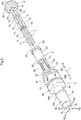
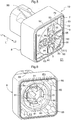
- FIGS. 1 to 9 A receptacle connector and a connector according to an embodiment of the present invention will be described with reference to FIGS. 1 to 9 .
- the present embodiment describes, as an example, a receptacle connector 10 that is to be attached to a camera module 110 serving as an example of an electronic substrate, and that is to be used in a camera unit 100 (e.g., a vehicle-mounted camera to be installed in a car) that is to be mounted in a vehicle (not shown).
- a camera unit 100 e.g., a vehicle-mounted camera to be installed in a car
- the receptacle connector 10 is normally used in a connector 20 (see FIG. 7 ), the receptacle connector 10 being paired with a plug connector 120 that is connected by being inserted from a plug connector side L1 (see FIG. 2 ) of the receptacle connector 10.
- the connector 20 is used to electrically connect a cable 130 connected to the plug connector 120 and the camera module 110.
- the cable 130 is a signal line or a power supply line that is obtained by covering an inner conductor (not shown) with an insulator (not shown), and that transmits a signal, is connected to ground (earth), or supplies power.
- the cable 130 includes an outer conductor (not shown) serving as an electrical protection member (a so-called shield) that covers the inner conductor together with the insulator and protects the inner conductor from electrical noise from an outer space E1.
- the connector 20 outputs signals from the cable 130 to the camera module 110 (see FIG. 1 ) and outputs signals from the camera module 110 to the cable 130. Furthermore, the power for driving that is supplied from the cable 130 is supplied to the camera module 110.
- signals transmitted by the cable 130 include signals for controlling the camera module 110 and image signals including image information received from the camera module 110.
- the receptacle connector 10 includes: four linear signal terminals 1 that can fit together with the plug connector 120 (see FIG. 7 ) in an extension direction L and transmit signals between the plug connector side L1 and an electronic substrate side L2; an insulating holder 2 that has a circular column shape extending in the extension direction L, and that holds the signal terminals 1 by being penetrated by them in the extension direction L; a conductive first shell 3 having a tube shape that covers the outer circumference of the holder 2 in a radial direction R that is orthogonal to the extension direction L; and a non-conductive connector case 8 that includes a cylindrical space E3 that extends in the extension direction L and contains the first shell 3.
- FIG. 2 shows a cross-section taken along the extension direction L of the receptacle connector 10.
- the receptacle connector 10 further includes: an inner seal member 4 that seals the interior of the first shell 3 in the extension direction L; and an outer seal member 6 that seals the interior of the cylindrical space E3 in the extension direction L, and thus water is prevented from entering the electronic substrate side L2 from the plug connector side L1 (hereinafter referred to as "waterproofing").
- waterproofing By thus including the waterproofing function, it is possible to prevent accidents such as short-circuiting, for example, and thus high safety can be provided.
- the receptacle connector 10 includes a second shell 7, which is an electrical protection member that covers the electronic substrate side L2 of the receptacle connector 10 so as to shield and protect it from electrical noise (electromagnetic waves) oriented from mainly the plug connector side L1 to the electronic substrate side L2 of the outer space E1, and a spacer 9 for mounting the camera module 110.
- a second shell 7 is an electrical protection member that covers the electronic substrate side L2 of the receptacle connector 10 so as to shield and protect it from electrical noise (electromagnetic waves) oriented from mainly the plug connector side L1 to the electronic substrate side L2 of the outer space E1, and a spacer 9 for mounting the camera module 110.
- the connector case 8 includes a cylindrical space E3 partitioned by an inner circumferential surface 8a, and a space E2.
- the connector case 8 is a container for the receptacle connector 10 that contains a terminal module 30 composed of the first shell 3 in the cylindrical space E3, and into which the plug connector 120 is inserted.
- terminal module 30 refers to a module obtained by assembling the holder 2 holding the signal terminal 1 and the inner seal member 4 in the first shell 3.
- the second shell 7 and the spacer 9 are contained in the space E2 of the connector case 8.
- the connector case 8 is formed of an insulating (non-conductive) material such as resin. The purpose of this is to insulate the signal terminal 1, the first shell 3, and the second shell 7 from the exterior of the receptacle connector 10 because the signal terminal 1, the first shell 3, and the second shell 7 are conductive.
- the connector case 8 is made of resin
- the connector case 8 can be formed of nylon, polypropylene, polyphenylene sulfide resin, vinyl chloride resin, or the like, and the present embodiment indicates a case of being formed of nylon as one embodiment.
- the connector case 8 includes first engagement hooks 81 and an outer seal contact surface 86 on the inner circumferential surface 8a of the connector case 8 that forms the cylindrical space E3 (see FIG. 6 ).
- the first engagement hooks 81 are multiple (in the present embodiment, four) hook-shaped protrusions that protrude to an inner side R1 in the radial direction R from the inner circumferential surface 8a and have elastic forces along the radial direction R.
- the first engagement hooks 81 engage with later-described first engagement recessed portions 31, which are groove-shaped recessed portions of the first shell 3 and lock the first shell 3 (terminal module 30) in the cylindrical space E3.
- Jutting portions 83 that slightly protrude from the inner circumferential surface 8a to the inner side R1 in the radial direction R are provided between respective adjacent first engagement hooks 81 of the connector case 8 (see FIG. 6 ).
- the outer seal contact surface 86 is a surface provided on the inner circumferential surface 8a of the connector case 8 and is provided as a surface that intersects the extension direction L and opposes the space E2 (a surface that faces the electronic substrate side L2). In the present embodiment, the outer seal contact surface 86 is orthogonal to the extension direction L in one mode of intersecting. The outer seal member 6 comes into contact with the outer seal contact surface 86.
- the connector case 8 includes protrusions 85 and a ring-shaped extension portion 82, for example, as members that support the second shell 7 when the second shell 7 is contained in the space E2 (see FIG. 6 ).
- the ring-shaped extension portion 82 supports a bottom portion 71 of the second shell 7 toward the electronic substrate side L2, and the protrusions 85 support the second shell 7 relatively from the sides with respect to the extension direction L.
- the protrusions 85 are provided in a mode of protruding from the inner circumferential surface 8a to the inner side R1 in the radial direction R, for example.
- the ring-shaped extension portion 82 extends in the extension direction L from the connector case 8, for example, and is provided as a ring-shaped member that extends to the electronic substrate side L2.
- the space E2 is a space for containing the second shell 7 and the spacer 9.
- the space E2 is a space that is on the electronic substrate side L2 with respect to the leading end portion on the electronic substrate side L2 of the ring-shaped extension portion 82.
- the connector case 8 includes a retaining reception portion 88 that engages with a retaining pin of the plug connector 120 and prevents separation of the plug connector 120 from the connector case 8.
- the connector case 8 sometimes includes a main body case 89, which is a case that covers the electronic substrate side L2 of the receptacle connector 10 and contains the camera module 110 when the receptacle connector 10 is attached to the camera module 110 and is used as the camera unit 100.
- a main body case 89 which is a case that covers the electronic substrate side L2 of the receptacle connector 10 and contains the camera module 110 when the receptacle connector 10 is attached to the camera module 110 and is used as the camera unit 100.
- the signal terminals 1 are members that transmit at least signals between the cable 130 (see FIG. 7 ) connected from the plug connector side L1 and the camera module 110 connected to the electronic substrate side L2.
- the signal terminals 1 of the present embodiment are linear conductive members the transmit signals and supply power, and are so-called contact pins.
- the signal terminals 1 have gold serving as a conductive coating material plated on copper serving as a metal.
- the signal terminals 1 correspond to the inner conductor of the cable 130.
- the diameters of the signal terminals 1 are 0.3 mm to 5 mm, for example. In the case of using the receptacle connector 10 with the camera module 110, the diameters of the signal terminals 1 are typically 0.3 mm to 1.5 mm.
- the signal terminals 1 each include at least a first terminal portion 11 that is electrically connected to a connection terminal (not shown) of the plug connector 120, and a second terminal portion 12 that is electrically connected to a receptacle (not shown) of the camera module 110.
- the signal terminals 1 each further include a first bulging portion 13, a second bulging portion 14, an adjustment portion 15, and a retaining protrusion 16 (see FIG. 3 ).
- the signal terminals 1 each include a first terminal portion 11, a retaining protrusion 16, a second bulging portion 14, an adjustment portion 15, a first bulging portion 13, and a second terminal portion 12, in the stated order from the plug connector side L1 to the electronic substrate side L2.
- the second terminal portion 12 is arranged in a state in which the leading end portion extends (protrudes) from the spacer 9 to the electronic substrate side L2.
- the purpose of this is to electrically connect to the camera module 110.
- the first bulging portion 13 and the second bulging portion 14 are portions of the signal terminal 1 that are formed so as to be relatively thicker than the first terminal portion 11 and the second terminal portion 12 respectively.
- the adjustment portion 15 is a portion of the signal terminal 1 that is formed so as to be relatively thicker than the first terminal portion 11 or the second terminal portion 12 and to be relatively thinner than the first bulging portion 13.
- the retaining protrusion 16 is a protrusion that is provided at a position shifted toward the electronic substrate side L2 of the first terminal portion 11 (the approximate central portion of the signal terminal 1, in the vicinity of the plug connector side L1 of the second bulging portion 14).
- the diameter of the signal terminal 1 refers to the diameter of the first terminal portion 11 or the second terminal portion 12.
- the signal terminal 1 can adjust the characteristic impedance of the receptacle connector 10 by adjusting the diameter or length of the first bulging portion 13 or the adjustment portion 15 in the extension direction L of the signal terminal 1.
- the second bulging portion 14 is a portion that is supported by the inner seal member 4 by being inserted through the inner seal member 4.
- the characteristic impedance of the receptacle connector 10 decreases. Conversely, if the diameter of the signal terminal 1 decreases, the characteristic impedance of the receptacle connector 10 increases.
- the characteristic impedance of the receptacle connector 10 decreases. Conversely, if the diameters of the first bulging portion 13 and the adjustment portion 15 decrease, the characteristic impedance of the receptacle connector 10 increases.
- the characteristic impedance of the receptacle connector 10 will increase. Conversely, when the length of the adjustment portion 15 is reduced (when the length of the first bulging portion 13 is increased), the characteristic impedance of the receptacle connector 10 will decrease.
- the holder 2 is an insulator that covers the signal terminals 1 and corresponds to the insulator of the cable 130.
- the holder 2 is formed of resin serving as an insulator.
- resin for example, nylon resin, vinyl chloride resin, polyethylene resin, or the like can be used as the resin.
- the holder 2 is a holding member that accurately positions and holds the signal terminals 1 due to the signal terminals 1 being inserted so as to penetrate through holding holes 29 (see FIG. 3 ).
- the holding holes 29 are holes that extend in the extension direction L.
- one signal terminal 1 is allocated to one holding hole 29.
- the holder 2 includes the same number of holding holes 29 as signal terminals 1.
- the holder 2 has a column shape that extends in the extension direction L, and includes a circular column-shaped body portion 23 that is the main body portion of the holder 2, a locking portion 25 that is arranged on the end portion on the electronic substrate side L2 of the body portion 23 and is relatively thicker than the body portion 23 (the diameter in the radial direction R that is orthogonal to the extension direction L is larger), holding holes 29 that are holes that extend in the extension direction L, and leg portions 28 that serve as three-dimensional barriers for the plug connector 120 and determine the insertion state of the plug connector 120.
- the body portion 23 is inserted into the first shell 3 from the electronic substrate side L2 of the first shell 3 to the plug connector side L1.
- the locking portion 25 engages with the first shell 3 and determines the insertion position of the body portion 23 with respect to the first shell 3.
- the leg portions 28 are members that extend in the form of columns along the extension direction L from the body portion 23 toward the plug connector side L1. As will be described later, the leg portions 28 are positioning portions that determine mutual insertion positions in the case where the plug connector 120 is inserted into and fit into the receptacle connector 10.
- the first terminal portions 11 of the signal terminals 1 are inserted into the holding holes 29 of the holder 2.
- the retaining protrusions 16 of the first terminal portions 11 are press-fit into the holding holes 29 from the electronic substrate side L2 of the holder 2, the holding holes 29 and the retaining protrusions 16 are engaged, and the signal terminals 1 are fixed to the holder 2.
- the diameters of the holding holes 29 are formed to be the same as or slightly larger than the diameters of the signal terminals 1. Also, the diameters of the holding holes 29 are slightly smaller than the diameters of the portions of the retaining protrusions 16. This is done to enable the first terminal portions 11 of the signal terminals 1 to be inserted through the holding holes 29 without strain and to prevent the signal terminals 1 from easily falling off in the case where the retaining protrusions 16 of the first terminal portions 11 are press-fit into the holding holes 29.
- the insertion positions of the signal terminals 1 in the holder 2 are determined due to the end portions on the plug connector side L1 of the second bulging portions 14 being locked at the opening portions on the electronic substrate side L2 of the holding holes 29. That is, the holder 2 holds the portions on the electronic substrate side of the first terminal portions 11 of the signal terminals 1, or in other words, the approximate central portions of the signal terminals 1 in the holding holes 29. That is, the leading end portions on the plug connector side L1 of the first terminal portions 11 are not covered by the holder 2, but penetrate through and are exposed from the holder 2 to serve as terminal portions.
- the holder 2 includes multiple (in the present embodiment, four) holding holes 29, which are holes that extend in the extension direction L in the body portion 23, and one signal terminal 1 is accurately positioned and held by one holding hole 29.
- leg portions 28 are provided between some of the adjacent signal terminals 1. In the present embodiment, the leg portions 28 are provided between three of the four signal terminals 1.
- the first shell 3 is a member that covers the outer circumferential side in the radial direction R of the holder 2.
- the first shell 3 is a member that corresponds to the outer conductor of the cable 130 and is an electrical protection member that protects the signal terminal 1 from electrical noise from the outer space E1.
- the first shell 3 includes a body portion 38 serving as a main body portion of the first shell 3, and the body portion 38 includes, in order from the plug connector side L1 to the electronic substrate side L2, a polyhedron portion 36, a first engagement recessed portion 31 that is a groove-shaped recessed portion, a connection portion 37, and a second engagement recessed portion 39 that is a groove-shaped recessed portion.
- Leading-end protrusions 33 see FIGS. 3 and 5
- engagement grooves 34 are provided on the leading end on the electronic substrate side L2 of the body portion 38 (see FIG. 3 ).
- the first shell 3 is used as an electrical protection member and is formed of a material that shields electrical noise.
- materials that block electrical noise include resin compounds with a metal or a metal powder kneaded in, resin with metal plating, and the like.
- the first shell 3 is formed of copper serving as a metal, and the surface thereof is plated with tin serving as a metal.
- the tin plating also prevents rusting of the first shell 3.
- the first shell 3 can be formed by cutting (i.e., formed by carving) a copper material, or can be molded in a mold, for example.
- the present example illustrates a case in which the first shell 3 is formed by cutting a copper material.
- the first shell 3 is a tube-shaped member that extends in the extension direction L.
- the circular column-shaped holder 2 into which the signal terminal 1 is press-fit is inserted into the first shell 3.
- the axial center extending in the extension direction L of the column of the holder 2 and the axial center extending in the extension direction L of the cylinder of the first shell 3 match. That is, the axial center extending in the extension direction L of the cylinder of the first shell 3 matches the axial center direction of the cylinder of the first shell 3.
- the locking portion 25 of the holder 2 is locked by the engagement surface 32 (see FIG. 2 ) of the first shell 3 and thus movement toward the plug connector side L1 in the extension direction L is restricted.
- the engagement surface 32 is a surface that is provided on the inner circumferential surface 3a (see FIG. 2 ) of the first shell 3, and is provided as a surface that intersects the extension direction L and opposes the space E2 (a surface that faces the electrode substrate side L2). In the present embodiment, the engagement surface 32 is orthogonal to the extension direction L in one mode of intersecting.
- the first shell 3 includes: the tube-shaped body portion 38 into which the plug connector 120 fits; the polyhedron portion36 that restricts rotation using the axis (axial center) extending in the extension direction L of the first shell 3 as a rotation axis P; the first engagement recessed portion 31 with which the first engagement hooks 81 engage; the tube-shaped connection portion 37 that is electrically connected to the second shell 7; the second engagement recessed portion 39 that engages with the spacer 9; the engagement groove 34 located at the end portion on the electronic substrate side L2 of the first shell 3; and the leading-end protrusions 33, which are located at the end portion on the electronic substrate side L2 of the first shell 3 and are protruding portions that extend in the extension direction L toward the electronic substrate side L2.
- the first engagement recessed portion 31 is a ring-shaped groove portion (recessed portion) that is provided on the outer circumferential surface 3b of the first shell 3.
- the cross-section of the groove of the first engagement recessed portion 31 is approximately rectangular.
- the first engagement recessed portion 31 is an engagement portion with which the first engagement hooks 81 engage.
- the first engagement recessed portion 31 is located between the polyhedron portion 36 and the connection portion 37 and is a groove relative to the polyhedron portion 36 and the connection portion 37.
- the first shell 3 is contained in the connector case 8 in a state of being locked by the connector case 8 due to the engagement between the first engagement hooks 81 and the first engagement recessed portion 31 (see FIG. 2 ). In the state in which the first shell 3 is contained in (mounted in, attached to) the connector case 8, movement in the extension direction L of the first shell 3 (signal terminals 1) with respect to the connector case 8 is restricted.
- the first engagement hooks 81 of the connector case 8 engage with the first engagement recessed portion 31 of the first shell 3.
- the polyhedron portion 36 includes multiple (in the present embodiment, four) flat portions 36b that extend in the extension direction L.
- planar chamfered portions 36a obtained by chamfering the peaks of adjacent flat portions 36b are included.
- four flat portions 36b are included.
- the first shell 3 is contained in the connector case 8 in a state in which the chamfered portions 36a oppose the protruding portions 83 of the connector case 8.
- the flat portion 36b engages with the protruding portion 83 (see FIG. 6 ) in the manner of a three-dimensional barrier, and thus prevents rotation using the axis extending in the extension direction L of the first shell 3 as the rotation axis P.
- the second engagement recessed portion 39 is provided as a circular ring-shaped recessed portion on the outer circumferential surface 3b of the first shell 3, the second engagement recessed portion 39 being the portion with which the later-described second engagement hooks 96 engage.
- the engagement grooves 34 are cut-outs provided along the circumferential direction of the connection portion 37 of the first shell 3 on the end portion on the electronic substrate side L2 of the first shell 3.
- the engagement grooves 34 are provided between adjacent leading end protrusions 33 at regular intervals.
- the present embodiment shows a case in which the leading-end protrusions 33 and the engagement grooves 34 are provided alternatingly. Also, the present embodiment shows a case in which four each of the leading-end protrusions 33 and the engagement grooves 34 are provided at regular intervals.
- the outer conductor of the cable 130 is electrically connected to the first shell 3. Also, since the first shell 3 and the second shell 7 are electrically connected as will be described later, if the second shell 7 is connected to the ground of the camera module 110, the grounds of the first shell 3 and the cable 130 are also electrically connected to the ground of the camera module 110.
- the inner seal member 4 is an elastic member, and as shown in FIGS. 2 and 3 , it is a sealing member that seals the gap between the first shell 3 and the connector case 8 in the extension direction L.
- a circular column-shaped rubber-like member that extends in the extension direction L is used as the inner seal member 4.
- the inner seal member 4 is formed of a rubber-like member, which is an example of an elastic member, for example.
- a rubber material is used as the rubber-like member.
- silicone rubber or a silicone sponge is preferable as the rubber material.
- a rubber impregnated with an oil such as silicone oil is more preferably used as the rubber material.
- silicone rubber impregnated with silicone oil is used as the inner seal member 4.
- the inner seal member 4 includes insertion holes 49 (see FIG. 3 ) into which the signal terminals 1 are press-fit, and in a state in which the outer circumferential portion 4a of the outer side R2 in the radial direction R of the inner seal member 4 is pressed into contact with the inner circumferential surface 3a of the inner side R1 in the radial direction R of the first shell 3, the interior of the first shell 3 is sealed in the extension direction L and is thus waterproofed.
- the insertion holes 49 are pressed into contact with the signal terminals 1 at the second bulging portions 14, at which the signal terminals 1 have larger outer diameters than at other portions. Since the inner seal member 4 is an elastic member, it is pressed into contact with the signal terminals 1 by being flexibly deformed according to the outer diameters of the second bulging portions 14. The diameters of the insertion holes 49 are the same as or slightly smaller than the diameters of the second bulging portions 14. This is because if the signal terminals 1 are inserted into the insertion holes 49, a state is entered in which the signal terminals 1 are pressed into contact therewith by the inner seal member 4.
- one signal terminal 1 is allocated to one insertion hole 49. In other words, there are as many insertion holes 49 as there are signal terminals 1.
- the inner seal member 4 is arranged by being inserted between the holder 2 and the spacer 9.
- the surface 42 on the electronic substrate side L2 of the inner seal member 4 is locked by a surface 97a on the connector side of the support portion 97 of the spacer 9.
- the surface 42 on the electronic substrate side L2 is in contact with the surface 97a on the connector side of the support portion 97 of the spacer 9.
- the inner seal member 4 is restricted from moving to the electronic substrate side L2 by the spacer 9. Note that the support portion 97 of the spacer 9 will be described later.
- the surface 41 on the plug connector side L1 of the inner seal member 4 is locked by the surface 22 on the electronic substrate side L2 of the holder 2.
- the surface 41 on the plug connector side L1 is in contact with the surface 22 on the electronic substrate side L2 of the holder 2.
- the inner seal member 4 is restricted from moving to the plug connector side L1 by the holder 2.
- the inner seal member 4 is restricted from moving in the extension direction L due to being interposed between the spacer 9 and the holder 2. Since the inner seal member 4 can be fixed in this manner by merely being interposed between the spacer 9 and the holder 2, it has excellent ease of assembly.
- An integrated terminal module 30 (see FIG. 4 ) is obtained when the holder 2 through which the signal terminals 1 are inserted and the inner seal member 4 are inserted into the first shell 3 from the electronic substrate side L2.
- the terminal module 30 can be assembled easily by merely inserting the signal terminals 1, the holder 2, and the inner seal member 4 into the first shell 3.
- the terminal module 30 With a simple operation of merely inserting the terminal module 30 into the cylindrical space E3 from the electronic substrate side L2 of the connector case 8 so that it is contained in the connector case 8, the terminal module 30 can be mounted in the connector case 8, and excellent ease of assembly is achieved.
- the first shell 3 in the case of connecting the receptacle connector 10 and the plug connector 120, the first shell 3 sometimes includes a socket-side seal member 5 that seals the gap between the first shell 3 and the plug connector 120 and makes it waterproof.
- a socket-side seal member 5 A case in which the first shell 3 includes the socket-side seal member 5 will be described hereinafter.
- the outer seal member 6 is an elastic member, and as shown in FIGS. 2 and 4 , it is a sealing member that seals the portion on the inner side R1 of the first shell 3 in the extension direction L.
- a circular ring-shaped rubber-like member is used as the outer seal member 6.
- the outer seal member 6 is formed of a rubber-like member, which is an example of an elastic member, for example.
- a rubber material is used as the rubber-like member.
- silicone rubber or a silicone sponge is preferable as the rubber material.
- a rubber impregnated with an oil such as silicone oil is more preferably used as the rubber material.
- silicone rubber impregnated with silicone oil is used as the outer seal member 6.
- the outer seal member 6 seals and waterproofs the interior of the cylindrical space E3 in the extension direction L in a state in which the outer circumferential portion 6b on the outer side R2 in the radial direction R is pressed into contact with the inner circumferential surface 8a (inner circumferential surface of the ring-shaped extension portion 82) of the connector case 8 that forms the cylindrical space E3 and the inner circumferential portion 6a on the inner side R1 in the radial direction R is pressed into contact with the outer circumferential surface 3b on the outer side R2 in the radial direction R of the first shell 3.
- the outer seal member 6 is arranged on the plug connector side L1 with respect to the second shell 7 and the spacer 9.
- the outer shell seal member 6 is installed on the first shell 3. And the surface 61 on the plug connector side L1 is locked by the connector case 8. In the present embodiment, as a mode of locking, the surface 61 on the plug connector side L1 comes into contact with the connector case 8.
- the surface 61 is a surface that is provided on the inner circumferential surface 8a of the connector case 8, and the outer seal member 6 is locked by the outer seal contact surface 86, which is a surface that is orthogonal to and intersects the extension direction L and faces the space E2. In other words, the outer seal member 6 is restricted from moving toward the plug connector side L1 by the inner circumferential surface 8a of the connector case 8.
- the surface 62 on the electronic substrate side L2 is locked by the second shell 7 and the outer seal member 6 is installed on the first shell 3.
- the surface 62 on the electronic substrate side L2 is in contact with the second shell 7.
- the outer seal member 6 is restricted from moving to the electronic substrate side L2 by the second shell 7.
- the outer seal member 6 is restricted from moving in the extension direction L due to being interposed between the connector case 8 and the second shell 7.
- the outer seal member 6 is mounted with a simple operation of being inserted into the terminal module 30 (first shell 3) contained in the connector case 8 from the electronic substrate side L2 of the connector case 8 and being enclosed by the second shell 7 from the electronic substrate side L2 of the connector case 8, and thereby excellent ease of assembly is achieved.
- the second shell 7 is an electrical protection member (a so-called shield) that shields the electronic substrate side L2 from electrical noise and protects the electrical signals flowing in the signal terminals 1 and the members on the electronic substrate side L2 in the extension direction L with respect to the second shell 7, such as the camera module 110 serving as the electronic substrate, from electrical noise.
- an electrical protection member a so-called shield
- the second shell 7 is supported by and contained in the portion of the space E2 of the connector case 8 while being accurately positioned by the ring-shaped extension portion 82 and the protrusions 85.
- the second shell 7 is used as an electrical protection member and is formed of a material that blocks electrical noise.
- materials that block electrical noise include resin compounds with a metal or a metal powder kneaded in, resin with metal plating, and the like.
- the second shell 7 is formed of copper serving as a metal, and the surface thereof is plated with tin serving as a metal.
- the tin plating also prevents rusting of the first shell 3.
- the second shell 7 can be formed by bending a copper material, for example.
- the second shell 7 is provided on the electronic substrate side L2 of the connector case 8 so as to cover the space E2 on the electronic substrate side L2 of the receptacle connector 10 from the plug connector side L1 to the electronic substrate side L2 (such that one surface is surrounded from the plug connector side L1 to the electronic substrate side L2).
- the connector case 8 includes a rectangular tube-shaped space as the space E2, for example, and the second shell 7 is contained in the rectangular tube-shaped space.
- the second shell 7 is provided as a bottomed tube-shaped conductive member that has a bottom portion 71 and side wall portions 72, an inner side of the tube facing the electronic substrate side.
- the side wall portions 72 are provided so as to be bent from the periphery of the bottom portion 71 and extend to the electronic substrate side L2 in the extension direction L.
- the side wall portions 72 are a body portion serving as a tube of the bottomed tube-shaped second shell 7.
- the second shell 7 protects the electrical signals that flow in the signal terminals 1 and the electrical signals that are to be processed by the electronic substrate by covering the space E2 with a bottomed tube shape formed mainly by the bottom portion 71 and the side wall portions 72 and shielding the space E2 from electrical noise in the outer space E1.
- An opening portion 73 whose center is penetrated by the first shell 3 is included on the bottom portion 71, and the opening portion 73 includes a protruding portion 75 that is bent from the opening edge portion 73e of the opening portion 73 and extends to the electronic substrate side L2 in the extension direction L.
- the second shell 7 is joined by being fit over the first shell 3 at the protruding portion 75.
- the second shell 7 is arranged on the first shell 3 in a state in which the outer circumferential surface 3b of the first shell 3 and the inner circumferential surface 75a in the radial direction R of the protruding portion 75 are in surface contact with each other (in a fit-together state).
- the first shell 3 and the second shell 7 are both formed of a conductive material, such as a metal, and therefore the first shell 3 and the second shell 7 are also electrically connected by being fit together in this manner.
- connection portion 37 of the first shell 3 is press-fit into the containing space E4 (see FIG. 4 ) of the protruding portion 75 of the second shell 7, and the outer circumferential surface 3b of the first shell 3 (connection portion 37) is pressed into contact with the inner circumferential surface 75a of the protruding portion 75. Accordingly, the first shell 3 and the second shell 7 are joined without there being a gap at the edge portion (opening edge portion 73e) of the opening portion 73 in the bottom portion 71 of the second shell 7. Accordingly, entrance of electromagnetic waves from the outer space E1 into the space E2, leakage of electromagnetic waves from the space E2 to the outer space E1, and the like can be suitably suppressed.
- the second shell 7 is arranged such that the first shell 3 penetrates through the bottom portion 71 of the second shell 7, or in other words, is arranged such that the bottom portion 71 of the second shell 7 intersects (in the present embodiment, is orthogonal to, as a mode of intersecting) the extension direction L of the signal terminal 1, and the second shell 7 in this arrangement covers the electronic substrate side L2 with the side wall portions 72, the protruding portion 75, and the bottom portion 71, which protrude to the electronic substrate side L2.
- the second shell 7 protects the members on the electronic substrate side L2 in the extension direction L with respect to the second shell 7, such as the signal terminal 1 (the second terminal portion 12) and the camera module 110, and electrical signals to be processed by those members by shielding them from electrical noise.
- the spacer 9 is a base on which the camera module 110 serving as the electronic substrate is mounted.
- the spacer 9 includes a surface portion 91 serving as the base, and a spacer wall 92 that extends in the extension direction L from the outer circumference of the surface portion 91 to the plug connector side L1.
- the spacer 9 is formed of resin serving as an insulator.
- resin for example, nylon resin, vinyl chloride resin, polyethylene resin, or the like can be used as the resin.
- the spacer 9 is formed of the same resin as the connector case 8 is.
- the surface portion 91 is a circular flat plate with the same axial center as the axial center that extends in the extension direction L of the cylinder of the first shell 3.
- the surface portion 91 is orthogonal to and intersects the extension direction L.
- the surface portion 91 includes: a support portion 97 that includes insertion holes 99 that are penetrated by the signal terminals 1 and accurately position and support the signal terminals 1; second engagement hooks 96 that are hooks that engage with the second engagement recessed portion 39 and have elastic forces along the radial direction R; and cantilever portions 95 that hold the support portion 97 on the surface portion 91. Also, in the surface portion 91, one opening portion 93 is formed for one second engagement hook 96.
- the second engagement hooks 96 are bent at portions relatively on the inner side R1 starting from a position displaced relatively toward the outer side R2 of the surface portion 91, and the second engagement hooks 96 protrude (extend) in the extension direction L to the plug connector side L1 and are arranged on the outer side R2 in the radial direction R of the support portion 97.
- the second engagement hooks 96 engage with the second engagement recessed portions 39 and the second engagement hooks 96 and the second engagement recessed portions 39 mutually restrict movement in the extension direction L.
- the spacer 9 is locked to the first shell 3 due to the engagement between the second engagement hooks 96 and the second engagement recessed portions 39, and thus movement in the extension direction L with respect to the connector case 8 is restricted.
- the adjacent second engagement hooks 96 are arranged at even intervals.
- One opening portion 93 is formed on a portion in the periphery of each second engagement hook 96 (portion on the inner side R1 of the surface portion 91).
- the beam portions 95 are portions of the surface portion 91 between adjacent opening portions 93.
- the beam portions 95 engage with the engagement grooves 34 and restrict the spacer 9 from rotating with respect to the first shell 3 using the axis (axial center) extending in the extension direction L as the rotation axis P.
- the spacer 9 is restricted from moving in the extension direction L with respect to the first shell 3 and from rotating with respect to the first shell 3 using the axis (axial center) extending in the extension direction L as the rotation axis P.
- the first shell 3 is restricted from moving with respect to the connector case 8 in the extension direction L of the first shell 3, and is restricted from rotating with respect to the connector case 8 using the axis (axial center) extending in the extension direction L as the rotation axis P.
- the spacer 9 is restricted from moving with respect to the connector case 8 in the extension direction L and from rotating with respect to the connector case 8 using the axis (axial center) extending in the extension direction L as the rotation axis P.
- the spacer 9 is restricted from moving in the extension direction L with respect to the connector case 8, and due to the engagement between the beam portions 95 and the engagement grooves 34, the spacer 9 is restricted from rotating with respect to the connector case 8 using the axis (axial center) extending in the extension direction L as the rotation axis P.
- the insertion holes 99 are holes that are penetrated by and support the signal terminals 1 and that extend in the extension direction L.
- the signal terminals 1 are accurately positioned and arranged by being inserted through the insertion holes 99 of the support portion 97.
- the purpose of this is to electrically connect to the camera module 110 mounted on the surface portion 91.
- one signal terminal 1 is allocated to one insertion hole 99.
- the spacer 9 is inserted in the terminal module 30 (first shell 3) contained in the connector case 8 from the electronic substrate side L2 of the connector case 8, it can be mounted easily due to the engagement between the second engagement hooks 96 and the second engagement recessed portion 39.
- the signal terminals 1 are positioned accurately by being held by the holding holes 29, and therefore it is easy to perform an operation of inserting the multiple signal terminals 1 into the corresponding insertion holes 99.
- the spacer 9 thus has excellent ease of assembly.
- the number of holding holes 29 of the holder 2 that are provided is the same as the number of insertion holes 99.
- the insertion holes 99 and the holding holes 29 are provided at corresponding positions.
- the distance and positional relationship between the adjacent insertion holes 99 are the same as the distance and positional relationship between the adjacent holding holes 29.
- the arrangement of the multiple insertion holes 99 and the arrangement of the holding holes 29 are the same.
- insertion holes 49 also similarly have an arrangement similar to those of the insertion holes 99 and the holding holes 29.
- the spacer 9 and the holder 2 restrict each other via the two or more signal terminals 1 in the direction of rotation using the axis (axial center) extending in the extension direction L of the first shell 3 as the rotation axis P. That is, the spacer 9 and the holder 2 are in a relationship of being mutually fixed in the direction of rotation using the axis (axial center) extending in the extension direction L of the first shell 3 as the rotation axis P.
- the spacer 9 since the spacer 9 is in a state of being restricted from moving with respect to the connector case 8 in the extension direction L and from rotating with respect to the connector case 8 using the axis (axial center) extending in the extension direction L as the rotation axis P, the connector case 8 and the holder 2 are in a relationship of being mutually fixed in the direction of rotation using the axis (axial center) extending in the extension direction L of the first shell 3 as the rotation axis P.
- the spacer 9 restricts rotation of the holder 2 with respect to the connector case 8 using the axis (axial center) extending in the extension direction L as the rotation axis P. Accordingly, the holder 2 and the signal terminals 1 are accurately positioned with a simple structure, a high assembly accuracy is maintained, a case in which the positions of the signal terminals 1 shift is avoided during use, accidents such as short-circuiting can be prevented, and high safety can be provided.
- the support portion 97 is formed so as to protrude in the form of a circular column in the extension direction L from the surface portion 91 to the plug connector side L1.
- the spacer 9 of the present embodiment is arranged in a state in which a portion of the support portion 97 that protrudes in the form of a circular column toward the plug connector side L1 is inserted into the first shell 3. For this reason, the inner seal member 4 enters an arrangement state of being pressed into the first shell 3 by the support portion 97 that protrudes in the form of a circular column toward the plug connector side L1.
- the insertion holes 99 are supported so as to cover the first bulging portions 13 and the adjustment portions 15 of the signal terminals 1. Accordingly, the diameters of the insertion holes 99 are larger than the diameters of the first terminal portions 11 and the second terminal portions 12 of the signal terminals 1.
- the support portion 97 including the insertion holes 99 is a circular column that extends in the extension direction L, but in some cases, the lengths of the first bulging portions 13 and the adjustment portions 15 of the signal terminals 1 are changed by changing the length in the extension direction L of the circular column-shaped support portion 97. Also, in some cases, the diameters of the first bulging portions 13 and the adjustment portions 15 of the signal terminals 1 are changed by changing the diameters of the insertion holes 99. In other words, in some cases, the characteristic impedance of the receptacle connector 10 is adjusted by changing the length in the extension direction L or the diameter of the support portion 97.
- the spacer 9 is arranged on the electronic substrate side L2 with respect to the holder 2, and the inner seal member 4 is arranged between the spacer 9 and the holder 2.
- the surface 97a on the plug connector side L1 of the support portion 97 of the spacer 9 is brought into contact with the surface 42 on the electronic substrate side L2 of the inner seal member 4 from the electronic substrate side L2, whereby movement of the inner seal member 4 toward the electronic substrate side L2 in the extension direction L is restricted.
- the spacer 9 is arranged on the electronic substrate side L2 with respect to the second shell 7.
- the second shell 7 is locked by the spacer 9. Also, this is because the second shell 7 is arranged on the first shell 3 in the state in which the second shell 7 is restricted from moving with respect to the first shell 3 in the extension direction L.
- the surface on the electronic substrate side L2 of the second shell 7 is locked by the end portion 92a on the plug connector side L1 of the spacer wall 92.
- the second shell 7 in a state in which the second shell 7 is penetrated by the first shell 3 (terminal module 30) at the opening portion 73, the second shell 7 is interposed between the connector case 8 and the spacer 9, whereby movement of the second shell 7 in the extension direction is restricted.
- the second shell 7 is arranged on the electronic substrate side L2 with respect to the outer seal member 6.
- the outer seal member 6 is interposed between the connector case 8 (inner circumferential surface 8a) and the bottom portion 71 of the second shell 7, whereby movement of the outer seal member 6 in the extension direction is restricted.
- outer seal member 6 can be fixed in this manner by merely being interposed between the second shell 7 and the connector case 8, it has excellent ease of assembly.
- the receptacle connector 10 can be assembled through the following simple procedure.
- the holder 2 is inserted into the first shell 3.
- the signal terminal 1 is inserted through the holder 2 through press-fitting.
- the inner seal member 4 is press-fit into the signal terminals 1.
- the signal terminals 1 inserted through the holder 2 are press-fit into the inner seal member 4.
- the terminal module 30 (first shell 3) is contained by being inserted into the connector case 8 from the electronic substrate side L2.
- the terminal module 30 and the connector case 8 are engaged, and the terminal module 30 is fixed to and installed in the connector case 8.
- the outer seal member 6 is fit into the terminal module 30 (first shell 3).
- the second shell 7 is press-fit into the terminal module 30 (first shell 3) and is contained in the space E2 of the connector case 8.
- the spacer 9 is attached to the terminal module 30 (first shell 3) from the electronic substrate side L2.
- the receptacle connector 10 and the plug connector 120 can be used as a pair of connectors 20, using the receptacle connector 10 and the plug connector 120 that is connected by being inserted into the cylindrical space E3 of the connector case 8 from the plug connector side L1 of the receptacle connector 10.
- the plug connector 120 includes a connection tube portion 122 that overlaps with the body portion 38 of the first shell 3 in a view in the radial direction in a state of being inserted into at least the connector case 8 (see FIGS. 8 and 9 ).
- first shell 3 and the connection tube portion 122 overlap (in the present invention, as a mode of overlapping, the first shell 3 is fit into the connection tube portion 122) in a view in the radial direction in a state in which the connection tube portion 122 fits over the body portion 38 of the first shell 3, but in some cases, the first shell 3 and the connection tube portion 122 overlap in a state in which the connection tube portion 122 fits inside of the body portion 38 of the first shell 3 (not shown).
- connection terminal portion (not shown) of the plug connector 120 is electrically connected to the plug connector side L1 of the signal terminal 1.
- connection terminal portion (not shown) of the plug connector 120 is electrically connected to the plug connector side L1 of the signal terminal 1 with the first shell 3 and the connection tube portion 122 overlapping will simply be written as "connection is complete”.
- the plug connector 120 includes: a retaining pin 121 that includes a protrusion 121a and engages with the retaining reception portion 88, which is a retaining mechanism on the receptacle connector 10 side; a gripping portion 124 by which the user grips the plug connector 120; and positioning portions 123 that engage with the positioning grooves 8b provided on the inner circumferential surface 8a of the connector case 8 to determine the position of inserting the plug connector 120 into the receptacle connector 10.
- the retaining pin 121 is a retaining mechanism on the plug connector 120 side for preventing unintended falling out in the state in which the plug connector 120 is connected to the receptacle connector 10 and for ensuring maintenance of the state in which connection is complete.
- the protrusion 121a engages with the recessed portion of the retaining reception portion 88, and movement of the plug connector 120 in the direction of falling out of the receptacle connector 10 is restricted.
- the first shell 3 further includes the socket-side seal member 5 that seals the gap between the first shell 3 and the connection tube portion 122
- the gap between the first shell 3 and the connection tube portion 122 of the plug connector 120 is sealed by the socket-side seal member 5, whereby water is prevented from entering the inner side R1 of the second shell 7 from the outer side R2 of the connection tube portion 122, which is preferable.
- socket-side seal member 5 is arranged at the position at which the first shell 3 and the connection tube portion 122 overlap.
- the socket-side seal member 5 is a circular column-shaped elastic member that extends in the extension direction L.
- a rubber member is used as the elastic member.
- a rubber material is used as the rubber member.
- silicone rubber or a silicone sponge is preferable as the rubber material.
- a rubber impregnated with an oil such as silicone oil is more preferably used as the rubber material.
- silicone rubber impregnated with silicone oil is used as the socket-side seal member 5.
- the socket-side seal member 5 is fixed by being fit into a waterproofing recessed portion 35 of the first shell 3.
- a waterproofing recessed portion 35 is relatively formed as a groove portion by a surface 35b on the connector side of the polyhedron portion 36 and a waterproofing protrusion 35a that is located on the connector side relative to the surface 35b and protrudes from the outer circumferential surface 3b of the first shell 3 to the outer side R2.
- waterproofing recessed portion 35 is provided on the outer circumferential surface 3b of the body portion 38 as a groove portion.
- the plug connector side L1 of the socket-side seal member 5 is locked by the waterproofing protrusion 35a and the electronic substrate side L2 of the socket-side seal member 5 is locked by the surface 35b of the polyhedron portion 36.
- the inner circumferential portion 5a which is the inner side R1 of the socket-side seal member 5 seals the gap between the first shell 3 and the socket-side seal member 5 by being pressed into contact with the outer circumferential surface 3b of the first shell 3.
- the outer circumferential portion 5b which is the outer side R2 of the socket-side seal member 5 seals the gap between the connection tube portion 122 and the socket-side seal member 5 due to being pressed into contact with the surface on the inner-side R1 of the connection tube portion 122 (see FIG. 9 ).
- the socket-side seal member 5 exhibits a waterproofing effect from the outer side of the connection tube portion 122 to the inner side of the first shell (hereinafter referred to as the "waterproofing effect of the socket-side seal member 5") due to the gap between the first shell 3 and the connection tube portion 122 of the plug module being sealed by the socket-side seal member 5.
- the first shell 3 includes the socket-side seal member 5 that seals the gap between the first shell 3 and the connection tube portion 122, if a connection tube portion 122 in which the end portion on the electronic substrate side of the connection tube portion 122 is located on the connector side relative to the waterproofing protrusion 35a in the state in which connection is complete, it is possible to disable the waterproofing function of the socket-side seal member 5.
- the waterproofing function is enabled in the case of using the plug connector 120 having a length in the extension direction L of a degree such that the connection tube portion 122 overlaps with the socket-side seal member 5 in the state in which connection is complete (see FIG. 9 ), and the waterproofing function can be disabled in the case of using the plug connector 120 having a length in the extension direction L of a degree such that the connection tube portion 122 does not overlap with the socket-side seal member 5 in the state in which connection is complete (e.g., a length according to which the end portion on the electronic substrate side of the connection tube portion 122 is located on the connector side with respect to the waterproofing protrusion 35a in the state in which connection is complete) (see FIG. 8 ).
- different plug connectors 120 can be used in the case of exhibiting the waterproofing function (the case of FIG. 9 ) and in the case of not exhibiting the waterproofing function (the case of FIG. 8 ).
- the receptacle connector 10 illustrated in the present embodiment can be fit together in both the case in which the plug connector 120 exhibits the waterproofing function and the case in which the plug connector 120 does not exhibit the waterproofing function.
- the receptacle connector 10 can be used as a receptacle connector 10 that is interchangeable with both a new plug connector 120 of a relatively new standard for exhibiting the waterproofing function, and a relatively old model of plug connector 120 (e.g., a plug connector 120 that has conventionally been used) that does not include the waterproofing function.
- a relatively old model of plug connector 120 e.g., a plug connector 120 that has conventionally been used
- the receptacle connector 10 (connector 20) transmits the signals transmitted by the cable 130 to the camera module 110 and receives the signals transmitted by the cable 130 from the camera module 110. Furthermore, in order for the power for driving that is supplied from the cable 130 to be supplied to the camera module 110, the receptacle connector 10 is used while connected to the camera module 110.
- the camera module 110 can be used in a mode in which an electronic substrate (not shown; a printed circuit board or a flexible printed circuit board can be given as an example of the electronic substrate) is mounted on the spacer 9.
- an electronic substrate not shown; a printed circuit board or a flexible printed circuit board can be given as an example of the electronic substrate
- the camera module 110 is locked (being fixed is an example of being locked) to the leading end protrusions 33.
- the receptacle connector 10 includes the spacer 9, which includes a flat surface on the electronic substrate side L2
- the receptacle connector 10 can easily mount the substrate of the camera module 110 and thus has excellent mountability.
- the signal terminals 1 are electrically connected to the circuit wiring on the substrate through a method such as soldering.
- the connector case 8 is located on the plug connector side L1 relative to the camera module 110, and therefore is referred to as a "rear case” in some cases.
- the camera module 110 is preferably contained in the main body case 89.
- the main body case 89 is sometimes referred to as a "front case” in contrast to the connector case 8, which is referred to as the "rear case”.
- the containing space inside of which the terminal module 30, the second shell 7, the camera module 110, and the like are contained is formed due to the connector case 8 and the main body case 89 coming into contact with each other.
- the camera module 110 is an example of an electronic substrate, and includes at least an image sensor 101, an electronic circuit 102 that performs control for driving the image sensor 101 and processes image signals output from the image sensor 101, and an optical system 104 that includes a lens 103 that focuses light on the image sensor 101.
- the camera unit 100 is connected to an image processing apparatus (not shown) and a monitor apparatus (not shown) via the cable 130.
- the cable 130 supplies power to the image sensor 101 of the camera unit 100 and the electronic circuit 102 from the image processing apparatus and the monitor apparatus, and outputs signals of images output from the image sensor 101 and the electronic circuit 102 to the image processing apparatus and the monitor apparatus via the cable 130.
- the camera unit 100 is an image capturing apparatus using a known power source superposition scheme.
- the image sensor 101 of the camera module 110 is a CCD (Charge Coupled Device) sensor or a CIS (CMOS Image Sensor). There is no limitation to using one lens 103, and multiple lenses 103 may be used.
- the electronic circuit 102 includes a clock driver for driving the image sensor 101 and an analog signal processing circuit for carrying out analog signal processing such as sample holding or clamp processing on analog signals output from the image sensor 101.
- the electronic circuit 102 may further include an A/D converter for converting analog signals into digital signals.
- the electronic circuit 102 may include a power source circuit for performing processing such as rectification on the power source supplied using the power source superposition scheme.
- the electronic circuit 102 is configured as an electronic substrate obtained by mounting electronic components on one or multiple substrates (e.g., printed circuit boards). In the case of using multiple electronic substrates, flexible circuit boards may be used to electrically connect the electronic substrates.
- the receptacle connector (not shown) for connecting the cable 130 via the plug connector 120 is also mounted on the electronic substrate on which the electronic circuit 102 is formed.
- the plug connector 120 is connected to the receptacle connector 10 and is connected to the cable 130 as well, whereby the camera module 110 including the electronic circuit 102 and the cable 130 are electrically connected.
- the camera unit 100 (vehicle-mounted camera) includes a camera module 110 having the image sensor 101, the electronic circuit 102 for performing driving control on the image sensor 101 and processing image signals output from the image sensor 101, and an optical system 104 that includes a lens 103 for collecting light in the image sensor 101.
- the second shell 7 functions to protect the members (at least a portion of the electronic circuit 102) that are included in the camera module 110 and are located on the electronic substrate side in the extension direction L relative to the second shell 7, by shielding them from electrical noise in the outer space E1.
- connection portion 37 of the first shell 3 is press-fit into the containing space E4 of the protruding portion 75 of the second shell 7 as the joining between the first shell 3 and the second shell 7.
- first shell 3 and the second shell 7 are not limited to being achieved by press-fitting.
- the first shell 3 and the second shell 7 may be joined by welding, adhering, or soldering the opening edge portion 73e after the first shell 3 is inserted into the containing space E4 of the protruding portion 75.
- the above-described embodiment illustrates a case in which the support portion 97 is formed so as to protrude in the form of a circular column from the surface portion 91 to the plug connector side L1 in the extension direction L.
- the support portion 97 is not limited to a case of protruding.
- the inner seal member 4 which is a rubber member that has a circular column shape extending in the extension direction L, may be formed longer in the extension direction L, for example.
- the above-described embodiment illustrates a case in which the electronic substrate is the camera module 110.
- the electronic substrate is not limited to the camera module 110.
- the electronic substrate is a vehicle-mounted collision prevention sensor in some cases.
- collision prevention sensors include ultrasound sensors and terahertz wave sensors.
Landscapes
- Engineering & Computer Science (AREA)
- Multimedia (AREA)
- Signal Processing (AREA)
- Details Of Connecting Devices For Male And Female Coupling (AREA)
- Connector Housings Or Holding Contact Members (AREA)
Claims (8)
- Ein Buchsenstecker (10), der auf ein elektronisches Substrat (110) montiert und mit diesem verbunden werden soll, umfassend:eine Mehrzahl von Signalanschlüssen (1), die mit einem Steckverbinder (120) in einer Erstreckungsrichtung (L) zusammengefügt werden können, die mit dem elektronischen Substrat (110) elektrisch verbunden sind und die so konfiguriert sind, dass sie Signale zwischen einer Steckverbinderseite (L1) und einer elektronischen Substratseite (L2) übertragen;einen isolierenden Halter (2) in der Form einer runden Säule, der sich in der Erstreckungsrichtung (L) erstreckt und so konfiguriert ist, dass er die Mehrzahl von Signalanschlüssen (1) aufnimmt, indem er dabei in der Erstreckungsrichtung (L) durchdrungen wird;eine leitende erste Schale (3) in der Form einer Röhre, die einen äußerem Umfang des Halters (2) in einer radialen Richtung (R) abdeckt; undein nicht leitendes Steckergehäuse (8), das einen zylindrischen Raum (E3) umschließt, der die erste Schale (3) enthält und sich in der Erstreckungsrichtung (L) erstreckt,wobei die erste Schale (3) an dem Steckergehäuse (8) befestigt ist,dadurch gekennzeichnet, dassein Abstandhalter (9), der an der ersten Schale (3) von der elektronischen Substratseite (L2) aus befestigt ist und einen Oberflächenbereich (91) umfasst, der rechtwinklig zu der Erstreckungsrichtung (L) ist, vorgesehen ist,der Oberflächenbereich (91) als eine Basis dient, an der der elektronische Träger (110) zu montieren ist;der Oberflächenbereich (91) einen Auflagebereich (97) einschließt, der eine Mehrzahl von Einstecklöchern (99) aufweist, durch welche die Signalanschlüsse (1) eindringen, einen Balkenabschnitt (95), der den Auflagebereich (97) stützt, und einen Abstandshalter-Eingriff-Haken (96), der von dem Oberflächenbereich zur Steckverbinderseite (L1) hin in der Erstreckungsrichtung (L) vorspringt und eine elastische Kraft in der radialen Richtung (R) aufweist,die erste Schale (3) einen eingezogenen Abstandhalter-Eingriff-Bereich (39) umfasst, in den der Abstandhalter-Eingriff-Haken (96) auf einer äußeren Umfangsfläche (3b) in der radialen Richtung (R) der ersten Schale (3) eingreift, und eine Einrastrille (34) umfasst, in die der Balkenabschnitt (95) auf einem Endbereich auf einer elektronischen Substratseite (L2) in der Erstreckungsrichtung (L) eingreift,die Einrastrille (34) ein Ausschnitt ist, der in der Umfangsrichtung der ersten Schale (3) an dem Endbereich auf der elektronischen Substratseite (L2) der ersten Schale (3) angeordnet ist,der Abstandhalter (9) daran gehindert wird, sich gegenüber dem Steckergehäuse (8) in der Erstreckungsrichtung (L) zu bewegen aufgrund des Eingriffs zwischen dem Abstandshalter-Eingriff-Haken (96) und dem eingezogenen Abstandhalter-Eingriff-Bereich (39), und daran gehindert wird, um eine Rotationsachse (P), die sich in der Erstreckungsrichtung (L) erstreckt, zu rotieren aufgrund des Eingriffs zwischen dem Balkenabschnitt (95) und der Einrastrille (34), undder Abstandshalter (9) die Rotation des Halters (2) gegenüber dem Steckergehäuses (8) verhindert in einem Zustand, in dem die Signalanschlüsse (1) durch die Mehrzahl von Einstecklöchern (99) hindurch gesteckt sind.
- Buchsenstecker (10) nach Anspruch 1, aufweisend
eine zweite Schale (7), die einen leitenden Bodenbereich (71) besitzt, der einen Öffnungsbereich (73) einschließt, durch den die erste Schale (3) hindurchgeht,wobei der Abstandhalter (9) in Bezug auf die zweite Schale (7) auf der elektronischen Substratseite (L2) angeordnet ist, unddie zweite Schale (7) zwischen dem Abstandhalter (9) und dem Steckergehäuse (8) eingefügt ist, wobei die zweite Schale (7) von der ersten Schale (3) bei dem Öffnungsbereich (73) durchdrungen wird und dadurch die zweite Schale (7) daran gehindert wird, sich in die Erstreckungsrichtung (L) zu bewegen. - Buchsenstecker (10) nach Anspruch 2, wobei
der Oberflächenbereich (91) eine Abstandhalterwand (92) einschließt, die von der Peripherie des Oberflächenbereichs (91) weg gebogen ist und sich zur Steckverbinderseite (L1) hin in der Erstreckungsrichtung (L) erstreckt, und
ein Endabschnitt der Abstandhalterwand (92) auf der Steckverbinderseite (L1) die zweite Schale (7) von der elektronischen Substratseite (L2) aus arretiert und die Bewegung der zweiten Schale (7) in der Erstreckungsrichtung (L) beschränkt. - Buchsenstecker (10) nach Anspruch 2 oder 3, wobei
ein rundes ringförmiges äußeres Dichtungselement (6), das einen Spalt zwischen der ersten Schale (3) und dem Steckergehäuse (8) in der Erstreckungsrichtung verschließt, auf einer äußeren Seite (R1) der ersten Schale (3) in der radialen Richtung (R) enthalten ist, und
das äußere Dichtungselement (6) zwischen dem Bodenbereich (71) und dem Steckergehäuse (8) eingefügt ist und dadurch das äußere Dichtungselement (6) daran gehindert ist, sich in der Erstreckungsrichtung (L) zu bewegen. - Buchsenstecker (10) nach einem der Ansprüche 1 bis 4, wobei
ein rundes säulenförmiges inneres Dichtungselement (4), das das Innere der ersten Schale (3) in der Erstreckungsrichtung verschließt, auf einer Innenseite (R2) der ersten Schale (3) in der radialen Richtung (R) enthalten ist, und
das innere Dichtungselement (4) zwischen dem Abstandhalter (9) und dem Halter (2) eingefügt ist, und dadurch das innere Dichtungselement (4) daran gehindert ist, sich in der Erstreckungsrichtung (L) zu bewegen. - Buchsenstecker (10) nach Anspruch 5, wobei
der Auflagebereich (97) des Abstandhalters (9) das innere Dichtungselement (4) von der elektronischen Substratseite (L2) aus arretiert und dadurch die Bewegung des inneren Dichtungselements (4) in der Erstreckungsrichtung (L) verhindert. - Buchsenstecker (10) nach einem der Ansprüche 1 bis 6, wobei
der Auflagebereich (97) des Abstandhalters (9) in der Form einer runden Säule von dem Oberflächenbereich (91) zur Steckverbinderseite (L1) hin in der Erstreckungsrichtung (L) hervorsteht. - Eine Kameraeinheit (100), umfassend:ein elektronisches Substrat (110), aufweisend: einen Bildsensor (101); eine elektronische Schaltung (102), die die Antriebs-Steuerung für den Bildsensor (101) bewerkstelligt und die eine Bildsignalausgabe von dem Bildsensor (101) verarbeitet; und ein optisches System (104), das eine Linse (103) besitzt, die Licht auf den Bildsensor (101) fokussiert; undden Buchsenstecker (10) nach einem der Ansprüche 1 bis 7,wobei die elektronische Schaltung (102) elektrisch mit den Signalanschlüssen (1) verbunden ist und das elektronische Substrat (110) auf dem Oberflächenbereich (91) des Abstandhalters (9) montiert ist.
Applications Claiming Priority (1)
| Application Number | Priority Date | Filing Date | Title |
|---|---|---|---|
| JP2016254316A JP6749232B2 (ja) | 2016-12-27 | 2016-12-27 | レセプタクルコネクタおよびカメラユニット |
Publications (2)
| Publication Number | Publication Date |
|---|---|
| EP3343705A1 EP3343705A1 (de) | 2018-07-04 |
| EP3343705B1 true EP3343705B1 (de) | 2019-10-16 |
Family
ID=60673597
Family Applications (1)
| Application Number | Title | Priority Date | Filing Date |
|---|---|---|---|
| EP17207419.7A Active EP3343705B1 (de) | 2016-12-27 | 2017-12-14 | Buchsenstecker und kameraeinheit |
Country Status (4)
| Country | Link |
|---|---|
| US (1) | US10074924B2 (de) |
| EP (1) | EP3343705B1 (de) |
| JP (1) | JP6749232B2 (de) |
| CN (1) | CN108242645B (de) |
Families Citing this family (20)
| Publication number | Priority date | Publication date | Assignee | Title |
|---|---|---|---|---|
| JP6779123B2 (ja) * | 2016-12-27 | 2020-11-04 | ホシデン株式会社 | レセプタクルコネクタおよびコネクタ |
| CN108695641A (zh) * | 2017-04-03 | 2018-10-23 | 泰科电子日本合同会社 | 密封构件及电连接器 |
| WO2019181825A1 (ja) * | 2018-03-22 | 2019-09-26 | 京セラ株式会社 | カメラモジュール |
| JP2019220311A (ja) * | 2018-06-19 | 2019-12-26 | 矢崎総業株式会社 | コネクタ接続構造及び装置複合体 |
| CN108965664A (zh) * | 2018-07-09 | 2018-12-07 | 中国科学院长春光学精密机械与物理研究所 | 一种光电探测成像装置 |
| CN110858672B (zh) * | 2018-08-23 | 2023-02-21 | 本田技研工业株式会社 | 电池模块 |
| CN111596416B (zh) * | 2019-02-20 | 2022-04-26 | 利佳科技股份有限公司 | 连接器系统及其防尘件 |
| TWI702761B (zh) * | 2019-05-24 | 2020-08-21 | 香港商安費諾(東亞)有限公司 | 具有活動解鎖結構之插頭連接器及其組件 |
| CN111029839B (zh) * | 2019-12-25 | 2021-12-31 | 奇瑞新能源汽车股份有限公司 | 高压大电流屏蔽接线器 |
| JP2021166161A (ja) * | 2020-04-07 | 2021-10-14 | ホシデン株式会社 | コネクタモジュール |
| DE102020204913A1 (de) * | 2020-04-17 | 2021-10-21 | Te Connectivity Germany Gmbh | Miniaturisierter Stecker |
| JP7411505B2 (ja) * | 2020-06-03 | 2024-01-11 | ホシデン株式会社 | シールド部材、シールドユニット、及びコネクタモジュール |
| EP4176493A1 (de) | 2020-07-01 | 2023-05-10 | CommScope Technologies LLC | Stromkabelverbinder und anordnungen |
| JP7128237B2 (ja) * | 2020-07-29 | 2022-08-30 | 矢崎総業株式会社 | 防水コネクタ |
| JP7460959B2 (ja) * | 2020-09-14 | 2024-04-03 | 株式会社オートネットワーク技術研究所 | シールドコネクタ |
| CN215418828U (zh) * | 2021-01-06 | 2022-01-04 | 东莞富强电子有限公司 | 防水插座连接器 |
| TWI835107B (zh) * | 2022-04-01 | 2024-03-11 | 佳必琪國際股份有限公司 | 插座連接器的防水結構 |
| CN115134530B (zh) * | 2022-07-18 | 2025-06-20 | 维沃移动通信有限公司 | 摄像头模组及电子设备 |
| TWI882728B (zh) * | 2024-03-15 | 2025-05-01 | 台達電子工業股份有限公司 | 安全連接結構及安全連接器 |
| JP7703088B1 (ja) | 2024-07-29 | 2025-07-04 | ホシデン株式会社 | コネクタ |
Family Cites Families (32)
| Publication number | Priority date | Publication date | Assignee | Title |
|---|---|---|---|---|
| US4990104A (en) * | 1990-05-31 | 1991-02-05 | Amp Incorporated | Snap-in retention system for coaxial contact |
| US5007862A (en) * | 1990-06-15 | 1991-04-16 | Amp Incorporated | Shielded connector having a multiply orientable housing |
| JP3405270B2 (ja) * | 1999-05-27 | 2003-05-12 | 住友電装株式会社 | シールドコネクタ |
| AU2003290791A1 (en) * | 2002-11-14 | 2004-06-15 | Donnelly Corporation | Imaging system for vehicle |
| DE102004039580A1 (de) * | 2004-08-12 | 2006-02-23 | Murr-Elektronik Gmbh | Steckverbinder |
| US7967371B2 (en) * | 2007-03-20 | 2011-06-28 | Caterpillar Inc. | Machine having camera and mounting strategy therefor |
| JP4903630B2 (ja) * | 2007-05-21 | 2012-03-28 | 日本圧着端子製造株式会社 | コネクタ及び電気的接続装置 |
| JP5065992B2 (ja) * | 2008-05-22 | 2012-11-07 | 矢崎総業株式会社 | 電子機器モジュール |
| JP5467850B2 (ja) * | 2009-12-03 | 2014-04-09 | 矢崎総業株式会社 | L字型コネクタ |
| WO2013059574A1 (en) * | 2011-10-19 | 2013-04-25 | Winchester Electronics Corporation | Closed entry din jack and connector with pcb board lock |
| US8861951B2 (en) * | 2011-12-05 | 2014-10-14 | Flextronics Ap, Llc | Two part camera module |
| WO2014060789A1 (en) * | 2012-10-15 | 2014-04-24 | Delphi International Operations Luxembourg S.À.R.L. | Electrical connector |
| US8740629B1 (en) * | 2012-11-29 | 2014-06-03 | Tyco Electronics Corporation | Header assembly |
| CN103078211B (zh) * | 2013-02-17 | 2014-12-10 | 安费诺-泰姆斯(常州)通讯设备有限公司 | 直角式电连接器 |
| JP6024991B2 (ja) * | 2013-06-17 | 2016-11-16 | 住友電装株式会社 | コネクタおよびハウジング |
| JP6039514B2 (ja) * | 2013-07-29 | 2016-12-07 | 日本航空電子工業株式会社 | 電子機器モジュール |
| CN203386995U (zh) * | 2013-08-01 | 2014-01-08 | 苏州智绿环保科技有限公司 | 带高压互锁回路的大电流、高屏蔽性连接器 |
| US10298823B2 (en) * | 2014-02-03 | 2019-05-21 | Magna Electronics Inc. | Vehicle camera housing with tolerance compensating connector |
| JP6182093B2 (ja) * | 2014-03-10 | 2017-08-16 | ホシデン株式会社 | コネクタ及びこれを備えた電子機器 |
| JP6278782B2 (ja) * | 2014-03-28 | 2018-02-14 | 矢崎総業株式会社 | 同軸コネクタ及びそれを備えたカメラモジュール |
| CN203800255U (zh) * | 2014-04-18 | 2014-08-27 | 深圳市通茂电子有限公司 | 一种汽车高压连接器 |
| JP2016024863A (ja) * | 2014-07-16 | 2016-02-08 | 矢崎総業株式会社 | コネクタ |
| JP6160844B2 (ja) * | 2015-04-08 | 2017-07-12 | Smk株式会社 | コネクタ |
| CN104779488B (zh) * | 2015-04-17 | 2017-06-06 | 四川永贵科技有限公司 | 弯式屏蔽mcu总线插头 |
| US20160311375A1 (en) * | 2015-04-21 | 2016-10-27 | Magna Electronics Inc. | Vehicle vision system with exchangeable cameras |
| CN205051094U (zh) * | 2015-10-15 | 2016-02-24 | 沈阳兴华华亿轨道交通电器有限公司 | 一种大电流弯式屏蔽电连接器 |
| CN205231371U (zh) * | 2015-12-18 | 2016-05-11 | 德尔福中央电气(上海)有限公司 | 一种电缆装配用屏蔽连接结构 |
| CN205248536U (zh) * | 2015-12-28 | 2016-05-18 | 四川永贵科技有限公司 | 直式高压屏蔽插头 |
| CN205429317U (zh) * | 2016-03-18 | 2016-08-03 | 泰科电子(上海)有限公司 | 连接器及连接器组件 |
| CN205657217U (zh) * | 2016-06-02 | 2016-10-19 | 莫西元 | 高压电连接器 |
| JP6704806B2 (ja) * | 2016-07-01 | 2020-06-03 | ホシデン株式会社 | コネクタモジュール及びそれを用いた車載カメラ |
| JP6797654B2 (ja) * | 2016-12-08 | 2020-12-09 | イリソ電子工業株式会社 | 電子部品及び撮像装置 |
-
2016
- 2016-12-27 JP JP2016254316A patent/JP6749232B2/ja active Active
-
2017
- 2017-12-14 EP EP17207419.7A patent/EP3343705B1/de active Active
- 2017-12-21 US US15/850,196 patent/US10074924B2/en active Active
- 2017-12-22 CN CN201711405928.8A patent/CN108242645B/zh active Active
Non-Patent Citations (1)
| Title |
|---|
| None * |
Also Published As
| Publication number | Publication date |
|---|---|
| US10074924B2 (en) | 2018-09-11 |
| US20180183169A1 (en) | 2018-06-28 |
| JP2018107036A (ja) | 2018-07-05 |
| JP6749232B2 (ja) | 2020-09-02 |
| CN108242645A (zh) | 2018-07-03 |
| CN108242645B (zh) | 2020-12-08 |
| EP3343705A1 (de) | 2018-07-04 |
Similar Documents
| Publication | Publication Date | Title |
|---|---|---|
| EP3343705B1 (de) | Buchsenstecker und kameraeinheit | |
| EP3343706B1 (de) | Buchsensteckverbinder und steckverbinder | |
| EP3462550B1 (de) | Verbindermodul und bordkamera damit | |
| EP3264537B1 (de) | Verbindungsmodul und fahrzeugmontierte kamera mit solch einem modul | |
| US11515673B2 (en) | Electrical connector module with shielding members engaging upon connection to a mating connector | |
| EP3430797B1 (de) | Kameraanordnung mit abgeschirmter bildgeberschaltung | |
| EP4089845A1 (de) | Koaxialstecker | |
| US10224666B2 (en) | Packing and shield connector | |
| CN103460517B (zh) | 屏蔽连接器 | |
| JP2019067740A (ja) | コネクタモジュール及びそれを用いた車載カメラ | |
| KR102510778B1 (ko) | 방수용 커넥터 | |
| KR102687138B1 (ko) | 전자기 복사를 차폐하기 위한 하우징을 갖는 카메라 및 자동차 | |
| KR20180103656A (ko) | 전기 커넥터의 부착구조 및 전기 커넥터 모듈의 제조방법 | |
| EP2907199B1 (de) | Elektrisches verbindungssystem | |
| CN212460629U (zh) | 行车记录仪 | |
| KR100800788B1 (ko) | 실드쉘 접속수단 및 이를 구비한 실드커넥터 | |
| JP2026037049A (ja) | ソケット及びソケットの製造方法 | |
| JP2017098199A (ja) | コネクタ | |
| JP2018098042A (ja) | 同軸コネクタ |
Legal Events
| Date | Code | Title | Description |
|---|---|---|---|
| PUAI | Public reference made under article 153(3) epc to a published international application that has entered the european phase |
Free format text: ORIGINAL CODE: 0009012 |
|
| STAA | Information on the status of an ep patent application or granted ep patent |
Free format text: STATUS: THE APPLICATION HAS BEEN PUBLISHED |
|
| AK | Designated contracting states |
Kind code of ref document: A1 Designated state(s): AL AT BE BG CH CY CZ DE DK EE ES FI FR GB GR HR HU IE IS IT LI LT LU LV MC MK MT NL NO PL PT RO RS SE SI SK SM TR |
|
| AX | Request for extension of the european patent |
Extension state: BA ME |
|
| STAA | Information on the status of an ep patent application or granted ep patent |
Free format text: STATUS: REQUEST FOR EXAMINATION WAS MADE |
|
| 17P | Request for examination filed |
Effective date: 20181211 |
|
| RBV | Designated contracting states (corrected) |
Designated state(s): AL AT BE BG CH CY CZ DE DK EE ES FI FR GB GR HR HU IE IS IT LI LT LU LV MC MK MT NL NO PL PT RO RS SE SI SK SM TR |
|
| REG | Reference to a national code |
Ref country code: DE Ref legal event code: R079 Ref document number: 602017007865 Country of ref document: DE Free format text: PREVIOUS MAIN CLASS: H01R0013436000 Ipc: H04N0005225000 |
|
| GRAP | Despatch of communication of intention to grant a patent |
Free format text: ORIGINAL CODE: EPIDOSNIGR1 |
|
| STAA | Information on the status of an ep patent application or granted ep patent |
Free format text: STATUS: GRANT OF PATENT IS INTENDED |
|
| RIC1 | Information provided on ipc code assigned before grant |
Ipc: H01R 13/506 20060101ALI20190319BHEP Ipc: H01R 13/41 20060101ALI20190319BHEP Ipc: H01R 12/71 20110101ALI20190319BHEP Ipc: H04N 5/225 20060101AFI20190319BHEP Ipc: H01R 13/04 20060101ALI20190319BHEP Ipc: H01R 13/405 20060101ALI20190319BHEP Ipc: H01R 13/6594 20110101ALI20190319BHEP Ipc: H01R 13/52 20060101ALI20190319BHEP Ipc: H01R 13/436 20060101ALI20190319BHEP |
|
| INTG | Intention to grant announced |
Effective date: 20190424 |
|
| GRAJ | Information related to disapproval of communication of intention to grant by the applicant or resumption of examination proceedings by the epo deleted |
Free format text: ORIGINAL CODE: EPIDOSDIGR1 |
|
| STAA | Information on the status of an ep patent application or granted ep patent |
Free format text: STATUS: REQUEST FOR EXAMINATION WAS MADE |
|
| GRAS | Grant fee paid |
Free format text: ORIGINAL CODE: EPIDOSNIGR3 |
|
| STAA | Information on the status of an ep patent application or granted ep patent |
Free format text: STATUS: GRANT OF PATENT IS INTENDED |
|
| GRAP | Despatch of communication of intention to grant a patent |
Free format text: ORIGINAL CODE: EPIDOSNIGR1 |
|
| RAP1 | Party data changed (applicant data changed or rights of an application transferred) |
Owner name: HOSIDEN CORPORATION |
|
| INTC | Intention to grant announced (deleted) | ||
| INTG | Intention to grant announced |
Effective date: 20190716 |
|
| GRAA | (expected) grant |
Free format text: ORIGINAL CODE: 0009210 |
|
| STAA | Information on the status of an ep patent application or granted ep patent |
Free format text: STATUS: THE PATENT HAS BEEN GRANTED |
|
| AK | Designated contracting states |
Kind code of ref document: B1 Designated state(s): AL AT BE BG CH CY CZ DE DK EE ES FI FR GB GR HR HU IE IS IT LI LT LU LV MC MK MT NL NO PL PT RO RS SE SI SK SM TR |
|
| REG | Reference to a national code |
Ref country code: GB Ref legal event code: FG4D |
|
| REG | Reference to a national code |
Ref country code: CH Ref legal event code: EP |
|
| REG | Reference to a national code |
Ref country code: DE Ref legal event code: R096 Ref document number: 602017007865 Country of ref document: DE |
|
| REG | Reference to a national code |
Ref country code: IE Ref legal event code: FG4D |
|
| REG | Reference to a national code |
Ref country code: AT Ref legal event code: REF Ref document number: 1192455 Country of ref document: AT Kind code of ref document: T Effective date: 20191115 |
|
| REG | Reference to a national code |
Ref country code: NL Ref legal event code: MP Effective date: 20191016 |
|
| REG | Reference to a national code |
Ref country code: LT Ref legal event code: MG4D |
|
| REG | Reference to a national code |
Ref country code: AT Ref legal event code: MK05 Ref document number: 1192455 Country of ref document: AT Kind code of ref document: T Effective date: 20191016 |
|
| PG25 | Lapsed in a contracting state [announced via postgrant information from national office to epo] |
Ref country code: SE Free format text: LAPSE BECAUSE OF FAILURE TO SUBMIT A TRANSLATION OF THE DESCRIPTION OR TO PAY THE FEE WITHIN THE PRESCRIBED TIME-LIMIT Effective date: 20191016 Ref country code: AT Free format text: LAPSE BECAUSE OF FAILURE TO SUBMIT A TRANSLATION OF THE DESCRIPTION OR TO PAY THE FEE WITHIN THE PRESCRIBED TIME-LIMIT Effective date: 20191016 Ref country code: LV Free format text: LAPSE BECAUSE OF FAILURE TO SUBMIT A TRANSLATION OF THE DESCRIPTION OR TO PAY THE FEE WITHIN THE PRESCRIBED TIME-LIMIT Effective date: 20191016 Ref country code: NL Free format text: LAPSE BECAUSE OF FAILURE TO SUBMIT A TRANSLATION OF THE DESCRIPTION OR TO PAY THE FEE WITHIN THE PRESCRIBED TIME-LIMIT Effective date: 20191016 Ref country code: LT Free format text: LAPSE BECAUSE OF FAILURE TO SUBMIT A TRANSLATION OF THE DESCRIPTION OR TO PAY THE FEE WITHIN THE PRESCRIBED TIME-LIMIT Effective date: 20191016 Ref country code: GR Free format text: LAPSE BECAUSE OF FAILURE TO SUBMIT A TRANSLATION OF THE DESCRIPTION OR TO PAY THE FEE WITHIN THE PRESCRIBED TIME-LIMIT Effective date: 20200117 Ref country code: NO Free format text: LAPSE BECAUSE OF FAILURE TO SUBMIT A TRANSLATION OF THE DESCRIPTION OR TO PAY THE FEE WITHIN THE PRESCRIBED TIME-LIMIT Effective date: 20200116 Ref country code: PL Free format text: LAPSE BECAUSE OF FAILURE TO SUBMIT A TRANSLATION OF THE DESCRIPTION OR TO PAY THE FEE WITHIN THE PRESCRIBED TIME-LIMIT Effective date: 20191016 Ref country code: FI Free format text: LAPSE BECAUSE OF FAILURE TO SUBMIT A TRANSLATION OF THE DESCRIPTION OR TO PAY THE FEE WITHIN THE PRESCRIBED TIME-LIMIT Effective date: 20191016 Ref country code: BG Free format text: LAPSE BECAUSE OF FAILURE TO SUBMIT A TRANSLATION OF THE DESCRIPTION OR TO PAY THE FEE WITHIN THE PRESCRIBED TIME-LIMIT Effective date: 20200116 Ref country code: PT Free format text: LAPSE BECAUSE OF FAILURE TO SUBMIT A TRANSLATION OF THE DESCRIPTION OR TO PAY THE FEE WITHIN THE PRESCRIBED TIME-LIMIT Effective date: 20200217 |
|
| PG25 | Lapsed in a contracting state [announced via postgrant information from national office to epo] |
Ref country code: HR Free format text: LAPSE BECAUSE OF FAILURE TO SUBMIT A TRANSLATION OF THE DESCRIPTION OR TO PAY THE FEE WITHIN THE PRESCRIBED TIME-LIMIT Effective date: 20191016 Ref country code: RS Free format text: LAPSE BECAUSE OF FAILURE TO SUBMIT A TRANSLATION OF THE DESCRIPTION OR TO PAY THE FEE WITHIN THE PRESCRIBED TIME-LIMIT Effective date: 20191016 Ref country code: IS Free format text: LAPSE BECAUSE OF FAILURE TO SUBMIT A TRANSLATION OF THE DESCRIPTION OR TO PAY THE FEE WITHIN THE PRESCRIBED TIME-LIMIT Effective date: 20200224 |
|
| PG25 | Lapsed in a contracting state [announced via postgrant information from national office to epo] |
Ref country code: AL Free format text: LAPSE BECAUSE OF FAILURE TO SUBMIT A TRANSLATION OF THE DESCRIPTION OR TO PAY THE FEE WITHIN THE PRESCRIBED TIME-LIMIT Effective date: 20191016 |
|
| REG | Reference to a national code |
Ref country code: DE Ref legal event code: R097 Ref document number: 602017007865 Country of ref document: DE |
|
| PG2D | Information on lapse in contracting state deleted |
Ref country code: IS |
|
| PG25 | Lapsed in a contracting state [announced via postgrant information from national office to epo] |
Ref country code: CZ Free format text: LAPSE BECAUSE OF FAILURE TO SUBMIT A TRANSLATION OF THE DESCRIPTION OR TO PAY THE FEE WITHIN THE PRESCRIBED TIME-LIMIT Effective date: 20191016 Ref country code: RO Free format text: LAPSE BECAUSE OF FAILURE TO SUBMIT A TRANSLATION OF THE DESCRIPTION OR TO PAY THE FEE WITHIN THE PRESCRIBED TIME-LIMIT Effective date: 20191016 Ref country code: EE Free format text: LAPSE BECAUSE OF FAILURE TO SUBMIT A TRANSLATION OF THE DESCRIPTION OR TO PAY THE FEE WITHIN THE PRESCRIBED TIME-LIMIT Effective date: 20191016 Ref country code: DK Free format text: LAPSE BECAUSE OF FAILURE TO SUBMIT A TRANSLATION OF THE DESCRIPTION OR TO PAY THE FEE WITHIN THE PRESCRIBED TIME-LIMIT Effective date: 20191016 Ref country code: ES Free format text: LAPSE BECAUSE OF FAILURE TO SUBMIT A TRANSLATION OF THE DESCRIPTION OR TO PAY THE FEE WITHIN THE PRESCRIBED TIME-LIMIT Effective date: 20191016 Ref country code: IS Free format text: LAPSE BECAUSE OF FAILURE TO SUBMIT A TRANSLATION OF THE DESCRIPTION OR TO PAY THE FEE WITHIN THE PRESCRIBED TIME-LIMIT Effective date: 20200216 |
|
| PLBE | No opposition filed within time limit |
Free format text: ORIGINAL CODE: 0009261 |
|
| STAA | Information on the status of an ep patent application or granted ep patent |
Free format text: STATUS: NO OPPOSITION FILED WITHIN TIME LIMIT |
|
| REG | Reference to a national code |
Ref country code: BE Ref legal event code: MM Effective date: 20191231 |
|
| PG25 | Lapsed in a contracting state [announced via postgrant information from national office to epo] |
Ref country code: SK Free format text: LAPSE BECAUSE OF FAILURE TO SUBMIT A TRANSLATION OF THE DESCRIPTION OR TO PAY THE FEE WITHIN THE PRESCRIBED TIME-LIMIT Effective date: 20191016 Ref country code: IT Free format text: LAPSE BECAUSE OF FAILURE TO SUBMIT A TRANSLATION OF THE DESCRIPTION OR TO PAY THE FEE WITHIN THE PRESCRIBED TIME-LIMIT Effective date: 20191016 Ref country code: SM Free format text: LAPSE BECAUSE OF FAILURE TO SUBMIT A TRANSLATION OF THE DESCRIPTION OR TO PAY THE FEE WITHIN THE PRESCRIBED TIME-LIMIT Effective date: 20191016 Ref country code: MC Free format text: LAPSE BECAUSE OF FAILURE TO SUBMIT A TRANSLATION OF THE DESCRIPTION OR TO PAY THE FEE WITHIN THE PRESCRIBED TIME-LIMIT Effective date: 20191016 |
|
| 26N | No opposition filed |
Effective date: 20200717 |
|
| PG25 | Lapsed in a contracting state [announced via postgrant information from national office to epo] |
Ref country code: LU Free format text: LAPSE BECAUSE OF NON-PAYMENT OF DUE FEES Effective date: 20191214 Ref country code: IE Free format text: LAPSE BECAUSE OF NON-PAYMENT OF DUE FEES Effective date: 20191214 |
|
| PG25 | Lapsed in a contracting state [announced via postgrant information from national office to epo] |
Ref country code: BE Free format text: LAPSE BECAUSE OF NON-PAYMENT OF DUE FEES Effective date: 20191231 Ref country code: SI Free format text: LAPSE BECAUSE OF FAILURE TO SUBMIT A TRANSLATION OF THE DESCRIPTION OR TO PAY THE FEE WITHIN THE PRESCRIBED TIME-LIMIT Effective date: 20191016 |
|
| PG25 | Lapsed in a contracting state [announced via postgrant information from national office to epo] |
Ref country code: CY Free format text: LAPSE BECAUSE OF FAILURE TO SUBMIT A TRANSLATION OF THE DESCRIPTION OR TO PAY THE FEE WITHIN THE PRESCRIBED TIME-LIMIT Effective date: 20191016 |
|
| PG25 | Lapsed in a contracting state [announced via postgrant information from national office to epo] |
Ref country code: MT Free format text: LAPSE BECAUSE OF FAILURE TO SUBMIT A TRANSLATION OF THE DESCRIPTION OR TO PAY THE FEE WITHIN THE PRESCRIBED TIME-LIMIT Effective date: 20191016 Ref country code: HU Free format text: LAPSE BECAUSE OF FAILURE TO SUBMIT A TRANSLATION OF THE DESCRIPTION OR TO PAY THE FEE WITHIN THE PRESCRIBED TIME-LIMIT; INVALID AB INITIO Effective date: 20171214 |
|
| REG | Reference to a national code |
Ref country code: CH Ref legal event code: PL |
|
| PG25 | Lapsed in a contracting state [announced via postgrant information from national office to epo] |
Ref country code: CH Free format text: LAPSE BECAUSE OF NON-PAYMENT OF DUE FEES Effective date: 20201231 Ref country code: LI Free format text: LAPSE BECAUSE OF NON-PAYMENT OF DUE FEES Effective date: 20201231 |
|
| PG25 | Lapsed in a contracting state [announced via postgrant information from national office to epo] |
Ref country code: TR Free format text: LAPSE BECAUSE OF FAILURE TO SUBMIT A TRANSLATION OF THE DESCRIPTION OR TO PAY THE FEE WITHIN THE PRESCRIBED TIME-LIMIT Effective date: 20191016 |
|
| PG25 | Lapsed in a contracting state [announced via postgrant information from national office to epo] |
Ref country code: MK Free format text: LAPSE BECAUSE OF FAILURE TO SUBMIT A TRANSLATION OF THE DESCRIPTION OR TO PAY THE FEE WITHIN THE PRESCRIBED TIME-LIMIT Effective date: 20191016 |
|
| REG | Reference to a national code |
Ref country code: DE Ref legal event code: R079 Ref document number: 602017007865 Country of ref document: DE Free format text: PREVIOUS MAIN CLASS: H04N0005225000 Ipc: H04N0023000000 |
|
| PGFP | Annual fee paid to national office [announced via postgrant information from national office to epo] |
Ref country code: GB Payment date: 20251218 Year of fee payment: 9 |
|
| PGFP | Annual fee paid to national office [announced via postgrant information from national office to epo] |
Ref country code: FR Payment date: 20251218 Year of fee payment: 9 |
|
| PGFP | Annual fee paid to national office [announced via postgrant information from national office to epo] |
Ref country code: DE Payment date: 20251217 Year of fee payment: 9 |