EP3344664B1 - Biozide mischungen - Google Patents
Biozide mischungen Download PDFInfo
- Publication number
- EP3344664B1 EP3344664B1 EP16758189.1A EP16758189A EP3344664B1 EP 3344664 B1 EP3344664 B1 EP 3344664B1 EP 16758189 A EP16758189 A EP 16758189A EP 3344664 B1 EP3344664 B1 EP 3344664B1
- Authority
- EP
- European Patent Office
- Prior art keywords
- copper
- penflufen
- wood
- biocidal
- mixture according
- Prior art date
- Legal status (The legal status is an assumption and is not a legal conclusion. Google has not performed a legal analysis and makes no representation as to the accuracy of the status listed.)
- Active
Links
Classifications
-
- A—HUMAN NECESSITIES
- A01—AGRICULTURE; FORESTRY; ANIMAL HUSBANDRY; HUNTING; TRAPPING; FISHING
- A01N—PRESERVATION OF BODIES OF HUMANS OR ANIMALS OR PLANTS OR PARTS THEREOF; BIOCIDES, e.g. AS DISINFECTANTS, AS PESTICIDES OR AS HERBICIDES; PEST REPELLANTS OR ATTRACTANTS; PLANT GROWTH REGULATORS
- A01N25/00—Biocides, pest repellants or attractants, or plant growth regulators, characterised by their forms, or by their non-active ingredients or by their methods of application, e.g. seed treatment or sequential application; Substances for reducing the noxious effect of the active ingredients to organisms other than pests
- A01N25/08—Biocides, pest repellants or attractants, or plant growth regulators, characterised by their forms, or by their non-active ingredients or by their methods of application, e.g. seed treatment or sequential application; Substances for reducing the noxious effect of the active ingredients to organisms other than pests containing solids as carriers or diluents
- A01N25/10—Macromolecular compounds
-
- A—HUMAN NECESSITIES
- A01—AGRICULTURE; FORESTRY; ANIMAL HUSBANDRY; HUNTING; TRAPPING; FISHING
- A01N—PRESERVATION OF BODIES OF HUMANS OR ANIMALS OR PLANTS OR PARTS THEREOF; BIOCIDES, e.g. AS DISINFECTANTS, AS PESTICIDES OR AS HERBICIDES; PEST REPELLANTS OR ATTRACTANTS; PLANT GROWTH REGULATORS
- A01N33/00—Biocides, pest repellants or attractants, or plant growth regulators containing organic nitrogen compounds
- A01N33/02—Amines; Quaternary ammonium compounds
- A01N33/08—Amines; Quaternary ammonium compounds containing oxygen or sulfur
-
- A—HUMAN NECESSITIES
- A01—AGRICULTURE; FORESTRY; ANIMAL HUSBANDRY; HUNTING; TRAPPING; FISHING
- A01N—PRESERVATION OF BODIES OF HUMANS OR ANIMALS OR PLANTS OR PARTS THEREOF; BIOCIDES, e.g. AS DISINFECTANTS, AS PESTICIDES OR AS HERBICIDES; PEST REPELLANTS OR ATTRACTANTS; PLANT GROWTH REGULATORS
- A01N43/00—Biocides, pest repellants or attractants, or plant growth regulators containing heterocyclic compounds
- A01N43/48—Biocides, pest repellants or attractants, or plant growth regulators containing heterocyclic compounds having rings with two nitrogen atoms as the only ring hetero atoms
- A01N43/56—1,2-Diazoles; Hydrogenated 1,2-diazoles
-
- A—HUMAN NECESSITIES
- A01—AGRICULTURE; FORESTRY; ANIMAL HUSBANDRY; HUNTING; TRAPPING; FISHING
- A01N—PRESERVATION OF BODIES OF HUMANS OR ANIMALS OR PLANTS OR PARTS THEREOF; BIOCIDES, e.g. AS DISINFECTANTS, AS PESTICIDES OR AS HERBICIDES; PEST REPELLANTS OR ATTRACTANTS; PLANT GROWTH REGULATORS
- A01N59/00—Biocides, pest repellants or attractants, or plant growth regulators containing elements or inorganic compounds
- A01N59/16—Heavy metals; Compounds thereof
- A01N59/20—Copper
-
- B—PERFORMING OPERATIONS; TRANSPORTING
- B27—WORKING OR PRESERVING WOOD OR SIMILAR MATERIAL; NAILING OR STAPLING MACHINES IN GENERAL
- B27K—PROCESSES, APPARATUS OR SELECTION OF SUBSTANCES FOR IMPREGNATING, STAINING, DYEING, BLEACHING OF WOOD OR SIMILAR MATERIALS, OR TREATING OF WOOD OR SIMILAR MATERIALS WITH PERMEANT LIQUIDS, NOT OTHERWISE PROVIDED FOR; CHEMICAL OR PHYSICAL TREATMENT OF CORK, CANE, REED, STRAW OR SIMILAR MATERIALS
- B27K3/00—Impregnating wood, e.g. impregnation pretreatment, for example puncturing; Wood impregnation aids not directly involved in the impregnation process
- B27K3/005—Impregnating wood, e.g. impregnation pretreatment, for example puncturing; Wood impregnation aids not directly involved in the impregnation process employing compositions comprising microparticles
-
- B—PERFORMING OPERATIONS; TRANSPORTING
- B27—WORKING OR PRESERVING WOOD OR SIMILAR MATERIAL; NAILING OR STAPLING MACHINES IN GENERAL
- B27K—PROCESSES, APPARATUS OR SELECTION OF SUBSTANCES FOR IMPREGNATING, STAINING, DYEING, BLEACHING OF WOOD OR SIMILAR MATERIALS, OR TREATING OF WOOD OR SIMILAR MATERIALS WITH PERMEANT LIQUIDS, NOT OTHERWISE PROVIDED FOR; CHEMICAL OR PHYSICAL TREATMENT OF CORK, CANE, REED, STRAW OR SIMILAR MATERIALS
- B27K3/00—Impregnating wood, e.g. impregnation pretreatment, for example puncturing; Wood impregnation aids not directly involved in the impregnation process
- B27K3/007—Impregnating wood, e.g. impregnation pretreatment, for example puncturing; Wood impregnation aids not directly involved in the impregnation process employing compositions comprising nanoparticles
-
- B—PERFORMING OPERATIONS; TRANSPORTING
- B27—WORKING OR PRESERVING WOOD OR SIMILAR MATERIAL; NAILING OR STAPLING MACHINES IN GENERAL
- B27K—PROCESSES, APPARATUS OR SELECTION OF SUBSTANCES FOR IMPREGNATING, STAINING, DYEING, BLEACHING OF WOOD OR SIMILAR MATERIALS, OR TREATING OF WOOD OR SIMILAR MATERIALS WITH PERMEANT LIQUIDS, NOT OTHERWISE PROVIDED FOR; CHEMICAL OR PHYSICAL TREATMENT OF CORK, CANE, REED, STRAW OR SIMILAR MATERIALS
- B27K3/00—Impregnating wood, e.g. impregnation pretreatment, for example puncturing; Wood impregnation aids not directly involved in the impregnation process
- B27K3/02—Processes; Apparatus
- B27K3/08—Impregnating by pressure, e.g. vacuum impregnation
-
- B—PERFORMING OPERATIONS; TRANSPORTING
- B27—WORKING OR PRESERVING WOOD OR SIMILAR MATERIAL; NAILING OR STAPLING MACHINES IN GENERAL
- B27K—PROCESSES, APPARATUS OR SELECTION OF SUBSTANCES FOR IMPREGNATING, STAINING, DYEING, BLEACHING OF WOOD OR SIMILAR MATERIALS, OR TREATING OF WOOD OR SIMILAR MATERIALS WITH PERMEANT LIQUIDS, NOT OTHERWISE PROVIDED FOR; CHEMICAL OR PHYSICAL TREATMENT OF CORK, CANE, REED, STRAW OR SIMILAR MATERIALS
- B27K3/00—Impregnating wood, e.g. impregnation pretreatment, for example puncturing; Wood impregnation aids not directly involved in the impregnation process
- B27K3/02—Processes; Apparatus
- B27K3/15—Impregnating involving polymerisation including use of polymer-containing impregnating agents
-
- B—PERFORMING OPERATIONS; TRANSPORTING
- B27—WORKING OR PRESERVING WOOD OR SIMILAR MATERIAL; NAILING OR STAPLING MACHINES IN GENERAL
- B27K—PROCESSES, APPARATUS OR SELECTION OF SUBSTANCES FOR IMPREGNATING, STAINING, DYEING, BLEACHING OF WOOD OR SIMILAR MATERIALS, OR TREATING OF WOOD OR SIMILAR MATERIALS WITH PERMEANT LIQUIDS, NOT OTHERWISE PROVIDED FOR; CHEMICAL OR PHYSICAL TREATMENT OF CORK, CANE, REED, STRAW OR SIMILAR MATERIALS
- B27K3/00—Impregnating wood, e.g. impregnation pretreatment, for example puncturing; Wood impregnation aids not directly involved in the impregnation process
- B27K3/16—Inorganic impregnating agents
- B27K3/163—Compounds of boron
-
- B—PERFORMING OPERATIONS; TRANSPORTING
- B27—WORKING OR PRESERVING WOOD OR SIMILAR MATERIAL; NAILING OR STAPLING MACHINES IN GENERAL
- B27K—PROCESSES, APPARATUS OR SELECTION OF SUBSTANCES FOR IMPREGNATING, STAINING, DYEING, BLEACHING OF WOOD OR SIMILAR MATERIALS, OR TREATING OF WOOD OR SIMILAR MATERIALS WITH PERMEANT LIQUIDS, NOT OTHERWISE PROVIDED FOR; CHEMICAL OR PHYSICAL TREATMENT OF CORK, CANE, REED, STRAW OR SIMILAR MATERIALS
- B27K3/00—Impregnating wood, e.g. impregnation pretreatment, for example puncturing; Wood impregnation aids not directly involved in the impregnation process
- B27K3/16—Inorganic impregnating agents
- B27K3/20—Compounds of alkali metals or ammonium
-
- B—PERFORMING OPERATIONS; TRANSPORTING
- B27—WORKING OR PRESERVING WOOD OR SIMILAR MATERIAL; NAILING OR STAPLING MACHINES IN GENERAL
- B27K—PROCESSES, APPARATUS OR SELECTION OF SUBSTANCES FOR IMPREGNATING, STAINING, DYEING, BLEACHING OF WOOD OR SIMILAR MATERIALS, OR TREATING OF WOOD OR SIMILAR MATERIALS WITH PERMEANT LIQUIDS, NOT OTHERWISE PROVIDED FOR; CHEMICAL OR PHYSICAL TREATMENT OF CORK, CANE, REED, STRAW OR SIMILAR MATERIALS
- B27K3/00—Impregnating wood, e.g. impregnation pretreatment, for example puncturing; Wood impregnation aids not directly involved in the impregnation process
- B27K3/16—Inorganic impregnating agents
- B27K3/22—Compounds of zinc or copper
-
- B—PERFORMING OPERATIONS; TRANSPORTING
- B27—WORKING OR PRESERVING WOOD OR SIMILAR MATERIAL; NAILING OR STAPLING MACHINES IN GENERAL
- B27K—PROCESSES, APPARATUS OR SELECTION OF SUBSTANCES FOR IMPREGNATING, STAINING, DYEING, BLEACHING OF WOOD OR SIMILAR MATERIALS, OR TREATING OF WOOD OR SIMILAR MATERIALS WITH PERMEANT LIQUIDS, NOT OTHERWISE PROVIDED FOR; CHEMICAL OR PHYSICAL TREATMENT OF CORK, CANE, REED, STRAW OR SIMILAR MATERIALS
- B27K3/00—Impregnating wood, e.g. impregnation pretreatment, for example puncturing; Wood impregnation aids not directly involved in the impregnation process
- B27K3/34—Organic impregnating agents
- B27K3/343—Heterocyclic compounds
-
- B—PERFORMING OPERATIONS; TRANSPORTING
- B27—WORKING OR PRESERVING WOOD OR SIMILAR MATERIAL; NAILING OR STAPLING MACHINES IN GENERAL
- B27K—PROCESSES, APPARATUS OR SELECTION OF SUBSTANCES FOR IMPREGNATING, STAINING, DYEING, BLEACHING OF WOOD OR SIMILAR MATERIALS, OR TREATING OF WOOD OR SIMILAR MATERIALS WITH PERMEANT LIQUIDS, NOT OTHERWISE PROVIDED FOR; CHEMICAL OR PHYSICAL TREATMENT OF CORK, CANE, REED, STRAW OR SIMILAR MATERIALS
- B27K3/00—Impregnating wood, e.g. impregnation pretreatment, for example puncturing; Wood impregnation aids not directly involved in the impregnation process
- B27K3/34—Organic impregnating agents
- B27K3/36—Aliphatic compounds
-
- B—PERFORMING OPERATIONS; TRANSPORTING
- B27—WORKING OR PRESERVING WOOD OR SIMILAR MATERIAL; NAILING OR STAPLING MACHINES IN GENERAL
- B27K—PROCESSES, APPARATUS OR SELECTION OF SUBSTANCES FOR IMPREGNATING, STAINING, DYEING, BLEACHING OF WOOD OR SIMILAR MATERIALS, OR TREATING OF WOOD OR SIMILAR MATERIALS WITH PERMEANT LIQUIDS, NOT OTHERWISE PROVIDED FOR; CHEMICAL OR PHYSICAL TREATMENT OF CORK, CANE, REED, STRAW OR SIMILAR MATERIALS
- B27K3/00—Impregnating wood, e.g. impregnation pretreatment, for example puncturing; Wood impregnation aids not directly involved in the impregnation process
- B27K3/52—Impregnating agents containing mixtures of inorganic and organic compounds
-
- C—CHEMISTRY; METALLURGY
- C08—ORGANIC MACROMOLECULAR COMPOUNDS; THEIR PREPARATION OR CHEMICAL WORKING-UP; COMPOSITIONS BASED THEREON
- C08L—COMPOSITIONS OF MACROMOLECULAR COMPOUNDS
- C08L101/00—Compositions of unspecified macromolecular compounds
-
- C—CHEMISTRY; METALLURGY
- C08—ORGANIC MACROMOLECULAR COMPOUNDS; THEIR PREPARATION OR CHEMICAL WORKING-UP; COMPOSITIONS BASED THEREON
- C08L—COMPOSITIONS OF MACROMOLECULAR COMPOUNDS
- C08L97/00—Compositions of lignin-containing materials
- C08L97/02—Lignocellulosic material, e.g. wood, straw or bagasse
-
- A—HUMAN NECESSITIES
- A01—AGRICULTURE; FORESTRY; ANIMAL HUSBANDRY; HUNTING; TRAPPING; FISHING
- A01N—PRESERVATION OF BODIES OF HUMANS OR ANIMALS OR PLANTS OR PARTS THEREOF; BIOCIDES, e.g. AS DISINFECTANTS, AS PESTICIDES OR AS HERBICIDES; PEST REPELLANTS OR ATTRACTANTS; PLANT GROWTH REGULATORS
- A01N2300/00—Combinations or mixtures of active ingredients covered by classes A01N27/00 - A01N65/48 with other active or formulation relevant ingredients, e.g. specific carrier materials or surfactants, covered by classes A01N25/00 - A01N65/48
-
- B—PERFORMING OPERATIONS; TRANSPORTING
- B27—WORKING OR PRESERVING WOOD OR SIMILAR MATERIAL; NAILING OR STAPLING MACHINES IN GENERAL
- B27K—PROCESSES, APPARATUS OR SELECTION OF SUBSTANCES FOR IMPREGNATING, STAINING, DYEING, BLEACHING OF WOOD OR SIMILAR MATERIALS, OR TREATING OF WOOD OR SIMILAR MATERIALS WITH PERMEANT LIQUIDS, NOT OTHERWISE PROVIDED FOR; CHEMICAL OR PHYSICAL TREATMENT OF CORK, CANE, REED, STRAW OR SIMILAR MATERIALS
- B27K2240/00—Purpose of the treatment
- B27K2240/20—Removing fungi, molds or insects
Definitions
- the invention relates to biocidal mixtures containing penflufen inconvenience polymer particles, copper compounds and special alkanolamines and their use for the protection of wood and wood products, and wood preservatives containing biocidal mixtures and optionally other active ingredients.
- Penflufen N- (2- [1,3-Dimethylbuthylphenyl] -5-fluoro-1,3-dimethyl-1H-pyrazole-4-carboxamide, CAS No. 494793-67-8 ) is a fungicidal active ingredient from the class of pyrazolylcarboxanilides of the formula (I) and from WO 20031010149 A1 known.
- Copper compounds are used in many ways in industrial wood preservation because of their spectrum of action and their economic efficiency. There are both soluble, as well as insoluble, but also, such as from the US 2005/0118280 A1 known to use micronized copper compounds. Commonly soluble copper compounds are, for example, Cu-amine complexes, such as copper monoethanolamine complexes. Furthermore, copper compounds are also used together with other active ingredients to broaden the spectrum of action. From the US 5635217 Wood preservatives of azoles, copper compounds and alkanolamines are known, for example, which provide a good spectrum of activity. However, a disadvantage of these biocidal mixtures is that high quantities of toxic azoles must continue to be used.
- the invention therefore relates to a biocidal mixture containing penflufen inconvenience polymer particles, at least one alkanylamine selected from the group monoalkylmonoamines, monoalkyldiamines, dialkylamines and trialkylamines, which are substituted by one, two or three hydroxyl groups and at least one copper compound or its copper alkanolamine.
- Water-soluble or water-insoluble inorganic or organic copper compounds or salts such as, for example, and preferably copper sulfate, copper acetate, copper carbonate, copper hydroxide, copper borate, copper fluoride, copper hydroxide carbonate, copper oxide and copper chloride can be used as copper compounds in the biocidal mixtures according to the invention.
- Alkanolamines used in the biocidal mixtures according to the invention are monoalkylmonoamines, monoalkyldiamines, dialkylamines and trialkylamines which are substituted by one, two or three hydroxyl groups.
- the alkanolamines used are isopropanolamine, 1,1-diaminoethanol, 1,2-diaminoethanol, aminoethylethanolamine, diethanolamine, triethanolamine, methylethanolamine and monoethanolamine.
- C 1 -C 8 -monoalkylmonoamines particularly preference is given to using C 1 -C 8 -monoalkylmonoamines, C 1 -C 8 -monoalkyldiamines and C 1 -C 8 -dialkylamines which are substituted by one or two hydroxyl groups.
- monoethanolamine particularly preference is given to using monoethanolamine.
- alkyl is an unbranched or branched, linear or cyclic alkyl radical having 1 to 20 carbon atoms.
- Alkyl is preferably an unbranched or branched, linear or cyclic alkyl radical having 1 to 14 carbon atoms, very particularly preferably having 1 to 8 carbon atoms.
- alkyl represents methyl, ethyl, n-propyl, isopropyl, n-, i-, s- or t-butyl, cyclopropyl, cyclobutyl, cyclopentyl, cyclohexyl, cycloheptyl, n-pentyl, 1-methylbutyl, 2-methylbutyl , 3-methylbutyl, neo-pentyl, 1-ethylpropyl, cyclohexyl, cyclo-pentyl, n-hexyl, n-heptyl, n-octyl, n-decyl and n-dodecyl.
- the penflufentownn polymer particles can be prepared from polymer particles, which were prepared from natural, semi-synthetic and synthetic materials.
- polymer particles for example gum arabic, agar, agarose, maltodextrin, sodium alginate, calcium alginate, dextran, fats, Fatty acids, cetyl alcohol, milk solids, molasses, gelatin, gluten, albumin, shellac, starches, caseinates, stearines, sucrose and waxes such as beeswax, carnauba wax and spermaceti wax.
- natural materials for the polymer particles for example gum arabic, agar, agarose, maltodextrin, sodium alginate, calcium alginate, dextran, fats, Fatty acids, cetyl alcohol, milk solids, molasses, gelatin, gluten, albumin, shellac, starches, caseinates, stearines, sucrose and waxes such as beeswax, carnauba wax and spermaceti wax.
- the semisynthetic materials for the polymer particles for example, cellulose acetate, cellulose acetate butyrate, cellulose acetate phthalate, cellulose nitrate, ethylcellulose, hydroxypropylcellulose, hydroxypropylmethylcellulose, hydroxypropylmethylcellulose phthalate, methylcellulose, sodium carboxymethylcellulose, hydrogenated tallow, myristyl alcohol, glycerol mono- or di-palmitate, hydrogenated castor oil, glyceryl mono- or tristearates, and 12 Hydroxystearylalkohol be used.
- suitable synthetic materials for the polymer particles are aminoplast resins, such as formaldehyde-melamine resins, formaldehyde-urea resins, formaldehyde-urea-melamine resins, polyurethanes, epoxy resins, styrene polymers and copolymers, acrylic polymers and copolymers, such as polyacrylamide, polyalkylcyanoacrylate, and poly (ethylene vinyl acetate), poly (styrene acrylamide), aluminum monostearate, carboxyvinyl polymers, polyamides, poly (methyl vinyl ether maleic anhydride), poly (adipyl-L-lysine), polycarbonates, polyterephthalamide, poly (vinyl acetate phthalate), poly ( terephthaloyl-L-lysine), polyarylsulfones, poly (methylmethacrylate), poly ( ⁇ -caprolactone), polyvinylpyrrolidone, polydimethylsiloxane, polyoxyethylenes, poly(
- Penflufen can also be brought into contact with the finished polymer particles in order to adsorptively bind the penflufen.
- polymer particles Penflufen may be enclosed by a polymer layer (classic form of encapsulation) or evenly distributed in the polymer (polymer matrix). Penflufen can be undissolved, crystalline or amorphous, finely dispersed or dissolved in the polymer.
- Penflufen can be used both as a racemate, in an enantiomerically pure form or as an enriched enantiomeric mixture. Also, use as a salt or acid addition compound is possible, with salts being understood in particular as meaning sodium, potassium, magnesium, calcium, zinc, aluminum, iron and copper salts, and acid addition compounds in particular adducts with hydrohalic acids, e.g. Hydrogen chloride and hydrogen bromide, carboxylic acids, e.g. Formic acid, acetic acid, tartaric acid and oxalic acid, sulfonic acids, e.g. p-toluenesulfonic acid and sulfuric acid, phosphoric acid and nitric acid is understood. Penflufen is preferably used.
- hydrohalic acids e.g. Hydrogen chloride and hydrogen bromide
- carboxylic acids e.g. Formic acid, acetic acid, tartaric acid and oxalic acid
- sulfonic acids e.
- the polymer of the penflufen additionallyn polymer particles of styrene polymers and - copolymers, and acrylic polymers and copolymers.
- acrylic polymers and copolymers are particularly preferably polyalkyl acrylates, polyalkyl methacrylates and copolymers of C 1 -C 18 -alkyl acrylates and C 1 -C 18 -alkyl methacrylates.
- the penflufen inconveniencen polymer particles containing 0.1 wt.% To 30 wt.%, Preferably 0.2 wt.% To 20 wt.% And most preferably 0.5 wt.% To 15 wt.% Penflufen based on the total amount on penflufen inconveniencen polymer particles.
- the polymer particles are preferably prepared from polymers based on ethylenically unsaturated monomers.
- the ethylenically unsaturated monomers may consist either as pure substances or as mixtures of several ethylenically unsaturated monomers.
- They are preferably neutral, uncharged, ethylenically unsaturated monomers which are designated M1.
- Suitable monomers M1 are also vinyl and allyl esters of aliphatic carboxylic acids having 1 to 20 carbon atoms, for example vinyl acetate, vinyl propionate and the vinyl esters of Versatic® acids (vinyl versatates), vinyl halides such as vinyl chloride and vinylidene chloride, conjugated diolefins such as butadiene and isoprene, and C 2 -C 6 Olefins such as ethylene, propene, 1-butene and n-hexene.
- vinyl halides such as vinyl chloride and vinylidene chloride
- conjugated diolefins such as butadiene and isoprene
- C 2 -C 6 Olefins such as ethylene, propene, 1-butene and n-hexene.
- Preferred monomers are vinylaromatic monomers, in particular styrene, divinylbenzene, C 1 -C 20 -alkyl acrylates, in particular C 1 -C 18 -alkyl acrylates and C 1 -C 18 -alkyl methacrylates, or mixtures of these monomers.
- amides of the abovementioned ethylenically unsaturated carboxylic acids in particular acrylamide and methacrylamide, ethylenically unsaturated nitriles such as methacrylonitrile and acrylonitrile, hydroxyalkyl esters of the abovementioned ⁇ , ⁇ -ethylenically unsaturated C 3 -C 8 -monocarboxylic acids and C 4 -C 8- dicarboxylic acids, in particular hydroxyethyl acrylate, hydroxyethyl methacrylate, 2- and 3-hydroxypropyl acrylate, 2- and 3-hydroxypropyl methacrylate, esters of the abovementioned monoethylenically unsaturated mono- and dicarboxylic acids with C 2 -C 4 -polyalkylene glycols, in particular the esters of these carboxylic acids with polyethylene glycol or alkyl-polyethylene glycols, wherein
- N-vinylamides such as N-vinylformamide, N-vinylpyrrolidone, N-vinylimidazole and N-vinylcaprolactam.
- the polymer preferably builds up from at least 60% by weight of monomers M1, based on the total amount of the monomers used.
- the proportion of monomers M1 is at least 70% by weight, very particularly preferably at least 80% by weight.
- ethylenically unsaturated monomers having anionic or cationic groups that is to say charged, ethylenically unsaturated monomers, may also be incorporated by copolymerization.
- the ethylenically unsaturated monomers having anionic or cationic groups are designated M2.
- the monomers M2 include in particular monoethylenically unsaturated monomers which have at least one anionic group, in particular monomers which have at least one acid group, preferably at least one sulfonic acid group, a phosphonic acid group or one or two carboxylic acid groups, and the salts of the monomers, in particular the alkali metal salts, for.
- the alkali metal salts for.
- sodium or potassium salts and ammonium salts As the sodium or potassium salts and ammonium salts.
- ethylenically unsaturated sulfonic acids in particular vinylsulfonic acid, 2-acrylamido-2-methylpropanesulfonic acid, 2-acryloxyethanesulfonic acid and 2-methacryloxyethanesulfonic acid, 3-acryloxy- and 3-methacryloxypropanesulfonic acid, vinylbenzenesulfonic acid and salts thereof, ethylenically unsaturated phosphonic acids, such as vinylphosphonic acid and vinylphosphonic acid dimethylester and their salts and ⁇ , ⁇ -ethylenically unsaturated C 3 -C 8 -mono- and C 4 -C 8 -dicarboxylic acids, in particular acrylic acid, methacrylic acid, crotonic acid, maleic acid, fumaric acid and itaconic acid.
- monomers M2 preference is given to using ⁇ , ⁇ -ethylenically unsaturated C 3 -C 8 -mono- and C 4 -C 8 -
- the monomers M2 may furthermore include in particular monoethylenically unsaturated monomers which have at least one cationic group and / or at least one in the aqueous protonatable group.
- the cationic monomers M2 include, in particular, those which have a protonatable amino group, a quaternary ammonium group, a protonatable imino group or a quaternized imino group. Examples of monomers M2 having a protonatable imino group are N-vinylimidazole and vinylpyridines.
- Examples of monomers M2 having a quaternized imino group are N-alkylvinylpyridinium salts and N-alkyl-N'-vinylimidazolinium salts such as N-methyl-N'-vinylimidazolinium chloride or methosulfate.
- Examples of monomers M2 having protonatable amino groups are, for example and preferably, 2- (N, N-dimethylamino) ethyl acrylate, 2- (N, N-dimethylamino) ethyl methacrylate, 2- (N, N-dimethylamino) ethylacrylamide, 3- (N, N) , N-dimethylamino) propylacrylamide, 3- (N, N-dimethylamino) propylmethacrylamide, 2- (N, N-dimethylamino) ethylmethacrylamide, they may be present, for example, as Cl - , HSO 4 - , 1/2 SO 4 2- or CH 3 OSO 3 - salts.
- Quaternary ammonium monomers are, for example, and preferably 2- (N, N, N-trimethyl ammonium) ethyl acrylate chloride, 2- (N, N, N-trimethyl ammonium) ethyl methacrylate chloride, 2- (N, N, N-trimethyl ammonium ) -ethylmethacrylamide chloride, 3- (N, N, N-trimethylammonium) propylacrylamide chloride, 3- (N, N, N-trimethylammonium) propylmethacrylamide chloride, 2- (N, N, N-trimethylammonium) -ethylacrylamide- Chloride, as well as the corresponding methosulfates and sulfates.
- the proportion of the monomers M2 is preferably not greater than 35% by weight, particularly preferably not greater than 20% by weight, based on the total amount of the monomers used. Very particular preference is given to using 80% by weight to 99.9% by weight of monomers M1 and 0.1% by weight to 20% by weight of monomers M2, based on the total amount of monomers used.
- the amount of charged monomers M2 in the polymer is less than 0.01% by weight, based on the total amount of monomers used.
- the monomers are described above and may be used singly or in admixture.
- the starters suitable for emulsion polymerization are the polymerization initiators which are suitable and usually used for emulsion polymerization and trigger a radical polymerization of the monomers M.
- These include oil-soluble azo compounds, such as 2,2'-azobis-isobutyronitrile, 2,2'-azobis (2-methyl-butyronitrile), 2,2'-azobis [2-methyl-N - (- 2-hydroxyethyl) propionamide, 1,1'-azobis (1-cyclohexanecarbonitrile), 2,2'-azobis (2,4-dimethylvaleronitrile), 2,2'-azobis (N, N'-dimethyleneisobutyroamidine) dihydrochloride, and 2,2'-azobis ( 2-amidinopropane) dihydrochloride, organic or inorganic peroxides such as diacetyl peroxide, di-tert-butyl peroxide, diamyl peroxide, dioctanoyl
- water-soluble free-radical initiators for example salts of peroxodisulfuric acid and redox initiator systems or cationic azo compounds, for example azobis (dimethylamidinopropane).
- Water-soluble initiators which may be used are the salts of peroxodisulfuric acid, in particular a sodium, potassium or ammonium salt or a redox initiator system which contains, as the oxidizing agent, a salt of peroxodisulfuric acid, hydrogen peroxide or an organic peroxide such as tert-butyl hydroperoxide.
- reducing agent preferably contain a sulfur compound, which is particularly selected from sodium hydrogensulfite, sodium hydroxymethanesulfinate and the bisulfite adduct of acetone.
- sulfur compound which is particularly selected from sodium hydrogensulfite, sodium hydroxymethanesulfinate and the bisulfite adduct of acetone.
- phosphorus-containing compounds such as phosphorous acid, hypophosphites and phosphinates, as well as hydrazine or hydrazine hydrate and ascorbic acid.
- redox initiator systems may contain an addition of small amounts of redox metal salts, such as iron salts, vanadium salts, copper salts, chromium salts or manganese salts, for example the redox initiator system ascorbic acid / iron (II) sulfate / sodium peroxodisulfate.
- redox metal salts such as iron salts, vanadium salts, copper salts, chromium salts or manganese salts, for example the redox initiator system ascorbic acid / iron (II) sulfate / sodium peroxodisulfate.
- further adjuvants such as e.g. Costabilizers, surfactants, e.g. Protective colloids and low molecular weight emulsifiers, solvents and plasticizers are used. If auxiliaries are used, these are preferably costabilizers, emulsifiers and solvents.
- the optionally used costabilizers are substances which stabilize the microemulsion against Ostwaldreifung and have a very low solubility in the continuous phase. It is preferably long-chain, linear, cyclic or branched, aliphatic hydrocarbons selected from the group C 14 -C 25 alkanes and C 14 -C 25 cycloalkanes. Particular preference is given to C 14 -C 18 -alkanes and C 14 -C 18 -cycloalkanes, very particularly preferably to tetradecane, pentadecane, hexadecane, heptadecane, octadecane and nonadecane or mixtures of these costabilizers.
- the amount is generally between 0.05 to 20 wt.%, Preferably between 0.1 to 15 wt.% And most preferably between 0.2 and 10 wt.% Based on the total amount of used monomers.
- Preferred solvents are inert, dipolar, aprotic, organic solvents, in particular esters of dibasic carboxylic acids, for example and preferably mixtures containing diisobutyl adipate, diisobutylglutarate, diisobutylsuccinate (for example Rhodiasolv DIB), as well as benzyl alcohol, polyethylene glycols, polypropylene glycols.
- esters of dibasic carboxylic acids for example and preferably mixtures containing diisobutyl adipate, diisobutylglutarate, diisobutylsuccinate (for example Rhodiasolv DIB), as well as benzyl alcohol, polyethylene glycols, polypropylene glycols.
- Preferred plasticizers are phthalates, in particular diethylhexyl phthalate (DEHP), dibutyl phthalate (BBP), diisononyl phthalate (DINP), diisodecyl phthalate (DIDP), diisooctyl phthalate (DNOP), diisobutyl phthalate (DIBP), diisohexyl phthalate, diisoheptyl phthalate, di-n-octyl phthalate, diisoundecyl phthalate, Diisotredecylphthalate; Adipates, in particular diethylhexyl adipate (DEHA), diisooctyl adipate, diisononyl adipate, polyesters of adipic acid or glutaric acid, in particular Ultramoll IV® from Lanxess Deutschland GmbH; Trialkyl esters of citric acid or acetylated trialkyl esters of citric acid
- Acetylated mono- and diglycerides Benzoeklad, in particular dialkylene glycols, in particular Dipropylenglycoldibenzoat or Isononylbenzoat; Trimethylolpropane esters, in particular trimethylolpropane-benzoate-2-ethylhexanoate mixtures; Dialkyl esters of terephthalic acid, in particular di-2-ethylhexyl terephthalate used.
- Surface-active substances include both protective colloids and low molecular weight emulsifiers, the latter preferably having a molecular weight below 2000 g / mol, in particular below 1000 g / mol (mass average), in contrast to the protective colloids.
- the protective colloids and low molecular weight emulsifiers may be both cationic, anionic, neutral and zwitterionic in nature.
- anionic surface-active substances are anionic low-molecular-weight emulsifiers, for example and preferably alkylphenylsulfonates, phenylsulfonates, alkylsulfates, alkylsulfonates, alkyl ether sulfates, alkylphenol ether sulfates, alkylpolyglycol ether phosphates, alkyldiphenyl ether sulfonates, polyarylphenyl ether phosphates, alkyl sulfosuccinates, olefin sulfonates, paraffin sulfonates, petroleum sulfonates, taurides, sarcosides, fatty acids, Alkylnaphthalenesulfonic acids, naphthalenesulfonic acids, including their alkali, alkaline earth, ammonium and amine salts.
- anionic low-molecular-weight emulsifiers
- Anionic protective colloids are, for example and preferably lignosulfonic acids, condensation products of sulfonated naphthalenes with formaldehyde or with formaldehyde and phenol and optionally urea and condensation products of phenol-sulfonic acid, formaldehyde and urea, lignin-sulfite waste liquor and lignosulfonates and polycarboxylates such as polyacrylates, maleic anhydride / olefin copolymers and the alkali, alkaline earth, ammonium and amine salts of the aforementioned protective colloids.
- lignosulfonic acids condensation products of sulfonated naphthalenes with formaldehyde or with formaldehyde and phenol and optionally urea and condensation products of phenol-sulfonic acid, formaldehyde and urea, lignin-sulfite waste liquor and lignosulfonates and polycarboxylates
- Nonionic protective colloids are, for example and preferably, polyethylene glycol, polypropylene glycol, polyethylene glycol-polypropylene glycol block copolymers, polyethylene glycol alkyl ethers, polypropylene glycol alkyl ethers, polyethylene glycol-polypropylene glycol ether block copolymers and mixtures thereof.
- relatively high molecular weight protective colloids are, for example and preferably, carboxymethylcellulose, natural and synthetic powdery, granular or latent polymers, such as gum arabic, polyvinyl alcohol, polyvinyl acetate, and natural phospholipids, such as cephalins and lecithins, and synthetic phospholipids and paraffin oils.
- Nonionic low molecular weight emulsifiers are, for example and preferably, alkylphenol alkoxylates, alcohol alkoxylates, fatty amine alkoxylates, polyoxyethylene glycol fatty acid esters, castor oil alkoxylates, fatty acid alkoxylates, fatty acid amide alkoxylates, fatty acid polydiethanolamides, lanolin ethoxylates, fatty acid polyglycol esters, isotridecyl alcohol, fatty acid amides, methyl cellulose, fatty acid esters, silicone oils, alkyl polyglycosides and glycerol fatty acid esters.
- Cationic low molecular weight emulsifiers are, for example and preferably quaternary ammonium salts, for.
- Zwitterionic low molecular weight emulsifiers are those with betainic structures. Such substances are known to the person skilled in the art and can be taken from the relevant prior art (see, for example R. Heusch, in Ullmann's Encyclopedia of Industrial Chemistry, 5th. Ed. On CD-ROM, Wiley-VCH 1997, “Emulsions", Chapter 7, Table 4 ).
- the amount of low molecular weight emulsifier is usually in the range of 0.1 wt.% To 15 wt.%, In particular in the range of 0.2 wt.% To 12 wt.% And particularly preferably 0.7 wt.% To 10 wt. % based on the total amount of monomers used.
- Thdiazimine thiazopyr, triflusulfuron, vernolate.
- the preparation of penflufen ambiencen polymer particles is preferably carried out in a free-radical oil-in-water emulsion polymerization in which at least one ethylenically unsaturated monomer in the presence of Penflufen or its salts and acid addition compounds and in the presence of a free-radical initiator is polymerized.
- an emulsion is first prepared to produce the penflufen inconveniencen polymer particles.
- the monomers and penflufen or its salts and acid addition compounds are initially mixed to prepare this emulsion.
- the addition may be carried out by adding the complete amount of the monomers and the penetraying to the aqueous solution in one step. But it can also be done in doses.
- the addition is usually at least over a period of 0.5 h. Preferably, the addition takes place in a period of 0.5 to 5 hours.
- a neutral pH is adjusted.
- the oil-in-water emulsion of monomers, penflufen and optionally low molecular weight emulsifiers, protective colloids and costabilizers is usually converted to produce high shear forces in an emulsion with particles of the desired size.
- rotor stator systems such as Ultraturrax, ultrasound, high-pressure dispersers or axial flow nozzle assemblies are generally used.
- the radical initiator is added.
- the Radkali Iniator can just as well the Mixture of monomers and Penflufen be added before the mixture is emulsified.
- the resulting emulsion is then heated. Usually, the heated emulsion for a period of 1 to 20 hours, preferably 8 to 15 hours, stirred.
- the resulting suspension of penflufen inconveniencen polymer particles usually requires no further workup.
- the penflufen inconveniencen polymer particles can also be isolated and dried and then quizverabeitet
- the isolation of the penflufen inconveniencen polymer particles can be done for example by filtration and evaporation of water, for example in a spray dryer. If the pH has to be adjusted within the production process of the penflufen inconveniencen microcapsules, then the adjustment of the pH is usually carried out using alkali metal salts of carbonates hydrogencarbonates, phosphates, hydrogen phosphates, Dihydrogenphoshaten, citrates or by using alkali metal compounds weak organic acids.
- the preparation of the penflufen inconveniencen polymer particles is carried out so that initially the aqueous solution, preferably low molecular weight emulsifiers containing submitted.
- Another mixture containing the monomers and the active ingredients, in particular penflufen, and optionally other auxiliaries, and free-radical, oil-soluble initiators is then either dosed or substantially in an amount added to the aqueous solution.
- the radical oil-soluble initiator is added.
- the emulsion is then emulsified under high shear forces to achieve the desired particle size.
- the emulsion is then preferably heated and stirred for a period of preferably 8 to 15 hours.
- the aqueous suspension of the penflufen inconveniencen polymer particles is then processed into the biocidal mixtures according to the invention.
- the polymerization generally takes place at temperatures between 50 ° C and 90 ° C.
- the polymerization can also be carried out at higher or lower temperatures.
- the polymerization is carried out at 60 ° C to 80 ° C.
- penflufen In general, from 0.1% by weight to 30% by weight, preferably from 0.2% by weight to 20% by weight and very particularly preferably from 0.5% by weight to 15% by weight, of penflufen based on the total amount of monomers in Manufacturing method of penflufen inconveniencen polymer particles used.
- the molecular weights of the penflufentownn polymer particles can vary within a very wide range, preferably they have a molecular weight of 10,000 to 100,000 g / mol.
- the penflufen ambiencen polymer particles usually have an average particle diameter of less than 1.5 microns, preferably from 20 nm to 1 .mu.m, more preferably 50 nm to 600 nm.
- the average particle diameter is determined by laser diffraction according to ISO 13320-1.
- oil phase within the patent application, it is meant the phase in which the substantially water-insoluble compounds used have dissolved each other.
- the oil phase generally contains the monomer or monomers, penflufen, radical oil-soluble initiator, optionally a co-stabilizer, optionally further active ingredients and optionally other auxiliaries.
- the water phase generally contains one or more emulsifiers and / or protective colloids and optionally salts and radical scavengers, which are intended to prevent the polymerization from starting in the water phase.
- the ratio of oil phase to water phase can be varied within a wide range. In general, the ratio is 10: 1 to 1:10, preferably 5: 1 to 1: 5.
- the penflufen inconveniencen polymer particles are then generally mixed with the copper compounds and the alkanolamines to the biocidal mixtures according to the invention.
- the copper compounds may also be first mixed with the alkanolamines and then added to the penflufen inconveniencen polymer particles and prepared in this way, the biocidal mixtures of the invention.
- Solvents are preferably added to the alkanolamines and / or the copper compounds.
- water is used as the solvent.
- the copper compounds are first mixed with the alkanolamines and optionally the solvent and then added to the penflufen adventuren polymer particles.
- the copper compounds with the alkanolamines arise copper-alkanolamine complexes. These can be prepared separately or used in situ without further separation.
- the copper-alkanolamine complex usually contains a water-soluble alkanolamine.
- Suitable copper-alkanolamine complexes include ethanolamine-copper complexes, diethanolamine-copper complexes, triethanolamine-copper complexes, and any combination of any of the foregoing.
- the molar ratio of the copper compounds to penflufen can be varied within a wide range. In general, copper is used in excess. Preferably, the molar ratio of the copper compounds to Penflufen in a range of 150: 1 to 2: 1. More preferably, the molar ratio is between 120: 1 and 3: 1, and most preferably between 90: 1 and 5: 1.
- the molar ratio of alkanolamines to penflufen can be varied within a wide range.
- the molar ratio of alkanolamines to penflufen ranges from 600: 1 to 8: 1. More preferably, the molar ratio of alkanolamines to Penflufen is between 480: 1 and 15: 1, and most preferably between 360: 1 and 20: 1.
- the molar ratio of alkanolamines to copper can be varied within a wide range.
- the molar ratio of alkanolamines to copper is in a range of 10: 1 to 1: 1. More preferably, the molar ratio of alkanolamines to copper is between 8: 1 and 2: 1.
- the molar ratio of copper to penflufen can be varied within a wide range. In general, copper is used in excess. Preferably, the molar ratio of copper to penflufen ranges from 600: 1 to 8: 1. More preferably, the molar ratio of copper to penflufen is between 600: 1 and 20: 1, and most preferably between 600: 1 and 40: 1.
- the biocidal mixtures according to the invention can be prepared by adding further auxiliaries, such as e.g. Solvents and diluents, antioxidants, radical scavengers, UV stabilizers, such as UV absorbers and chelators, defoamers, as well as other biocides, thickeners and containerized preservatives to wood preservatives are implemented or used directly without further addition of these ingredients.
- further auxiliaries such as e.g. Solvents and diluents, antioxidants, radical scavengers, UV stabilizers, such as UV absorbers and chelators, defoamers, as well as other biocides, thickeners and containerized preservatives to wood preservatives are implemented or used directly without further addition of these ingredients.
- Preference is given to the novel biocidal mixtures, solvents and diluents and, if appropriate, thickeners, defoamers, further biocides and containerized preservatives.
- Solvents and diluents are essentially: aromatics, such as xylene, toluene or alkylnaphthalenes, chlorinated aromatics or chlorinated aliphatic hydrocarbons, such as chlorobenzenes or chloroethylenes, aliphatic hydrocarbons, such as cyclohexane or paraffins, e.g. Petroleum fractions, alcohols, such as butanol or glycol, and their ethers and esters, and water.
- aromatics such as xylene, toluene or alkylnaphthalenes
- chlorinated aromatics or chlorinated aliphatic hydrocarbons such as chlorobenzenes or chloroethylenes
- aliphatic hydrocarbons such as cyclohexane or paraffins, e.g. Petroleum fractions
- alcohols such as butanol or glycol
- ethers and esters and water.
- thickeners for example, polysaccharides, xanthan gum, sodium or magnesium silicates, heteropolysaccharides, alginates, carboxymethylcellulose, gum arabic or polyacrylic acids are used.
- Xanthan gum is preferably used as thickener.
- biocides, bactericides and fungicides are used as packaging preservatives.
- defoamers it is generally possible to use surface-active substances which are only slightly soluble in the surfactant solution.
- Preferred defoamers are those derived from natural fats and oils, petroleum derivatives or silicone oils.
- the wood preservatives according to the invention could also be colored.
- dyes inorganic pigments such as iron oxide, titanium oxide, ferrocyan blue and organic dyes such as alizarin, azo and metal phthalocyanine dyes and trace nutrients such as salts of iron, manganese, boron, copper, cobalt, molybdenum and zinc can be used.
- the wood preservatives according to the invention generally contain between 0.05 and 20 percent by weight of polymer particles containing penflufen, based on the total amount of wood preservative used, preferably between 0.2 and 5 percent by weight.
- the wood preservatives of the invention generally contain between 0.2 and 50 mole percent copper based on the total amount of wood preservative used, preferably between 1 and 20 mole percent.
- the wood preservatives of the invention may also contain other biocides or adjuvants such as potentiators. If triazoles are used as biocides, the amount of these triazoles is generally less than 3.5% by weight, based on the total amount of wood preservative used. Preferably, the amount of triazoles used, if triazoles are used as biocides, between 0.01 wt.% And 3 wt.%. The amount of triazoles is more preferably less than 0.01% by weight, based on the total amount of wood preservative used.
- wood preservatives according to the invention can likewise be provided as concentrates.
- the concentrate may be diluted to a concentration range of about 0.02 to about 50%.
- Use dilutions of the composition typically comprise a biocidally effective amount of copper-alkanolamine complex and pen-containing polymer particles.
- use dilutions comprise from about 0.1% to about 2.0% by weight of the above concentrates.
- the biocidal mixture of the invention and / or the wood preservative may be applied by known wood treatment methods including, but not limited to, brushing, dipping, soaking, vacuum impregnation (eg, double vacuum technique), and pressure treatment using various cycles.
- the invention also encompasses the use of the biocidal mixtures and wood preservatives for the protection of wood, wood products and wood-plastic composites against microorganisms.
- Penflufen preferably acts against fungi, in particular molds, wood-discolouring and wood-destroying fungi (Basidiomycetes) and against slime organisms and algae. Furthermore, it has been found that the inventive penflufen inconveniencen microcapsules and wood preservatives, excellent protection of the wood against wood-destroying fungi (Basidiomycetes) have.
- the invention therefore also encompasses the use of the biocidal mixtures and wood preservatives according to the invention for protecting wood, wood products and wood-plastic composites against destruction by wood-destroying basidiomycetes.
- biocidal mixtures and the wood preservatives very particularly preferably act against species of the genera Gloeophyllum, Coniophora, Coriolus, Stereum or Poria. Even more preferably, the biocidal mixtures are effective against species of the genera Coniphora or Poria, in particular against Poria placenta and Coniphora souna. Even more preferred is the use of biocidal mixtures and penflufen inconveniencen wood preservative for the protection of wood against Poria placenta.
- Wood, wood-based materials and wood-plastic composites which can be protected by the biocidal mixtures and wood preservatives according to the invention are to be understood by way of example: timber, wooden beams, railway sleepers, bridge parts, boat jetties, wooden vehicles, boxes, pallets, containers, telephone poles, wooden cladding, wooden windows and doors , Plywood, medium density fiberboard (MDF), chipboard, Oriented Strand Board (OSB), waferboard, laminated veneer lumber (LVL) or wood products commonly used in house building or carpentry, as well as wood-plastic composites. Preferred is the protection of wood and solid wood.
- MDF medium density fiberboard
- OSB Oriented Strand Board
- LDL laminated veneer lumber
- wood products commonly used in house building or carpentry as well as wood-plastic composites. Preferred is the protection of wood and solid wood.
- biocidal mixtures and wood preservatives according to the invention can penetrate excellently into the wood or the wood product and thereby act efficiently. In addition, they show an improved activity against wood-destroying microorganisms compared to the unencapsulated Penflufen, in the presence of copper compounds and alkanolamines on.
- Average particle size (measured by laser diffraction) 0.153 ⁇ m; 90% of the particles (Vol%) are less than 0.382 ⁇ m.
- Penflufen be in a mixture of 232.5 g Genagen 4296 (N, N-dimethyl fatty acid amide / CAS No. 14433-76-2 ) and 260 g Emulan EL (ethoxylated castor oil) are dissolved with stirring. The solution contains 1.5% by weight of Penflufen.
- the copper-ethanolamine complex from Example 1.3 is introduced into an Erlenmeyer flask in an amount which leads to the copper / Penflufenparticularlysmengenkgn used in Table 1. While stirring continuously, on a magnetic stirrer, slowly add the necessary amount Penflufenown from Example 1.2 or the necessary amount Penflufen inconveniences polymer from Example 1.1 and allowed to stir for 3 h.
- Table 1 Composition of the active substance solutions used in Example 2 active substance number Copper ethanolamine complex (from Example 1.3) Penflufen inconveniences polymer (from Example 1.1) Penflufen solution (from Example 1.2 (comparative experiment) Cu + Penflufen (40: 1) JJT 6646 85.6% by weight 14.4% by weight Cu + Penflufen in Polymer (40: 1) JJT 6648 86.5% by weight 13.5% by weight Cu + Penflufen (100: 1) JJT 6647 93.7% by weight 6.3% by weight Cu + Penflufen in polymer (100: 1 JJT 6649 94.1% by weight 5.9% by weight
- test specimens of the species Pinus sylvestris and Fagus sylvatica were vacuum-impregnated with 0.04 to 0.4% aqueous active substance solutions (copper and Penflufen) and conditioned for 14 days.
- the amount of active ingredient per kg / m 3 in the treated specimens was measured and is shown in Tables A to D.
- the test specimens were inoculated on an agar-agar medium with a fungal spore suspension according to DIN EN 113. After a further 10 or 11 weeks of incubation, the average weight loss of the wood specimens was determined.
- the average weight loss of wood for blends containing penflufen and polymer and copper as active ingredients is significantly lower compared to blends in which penflufen and copper were used, ie where not at least a part of Penflufen was protected by the polymer.
Landscapes
- Life Sciences & Earth Sciences (AREA)
- Engineering & Computer Science (AREA)
- Wood Science & Technology (AREA)
- Forests & Forestry (AREA)
- Chemical & Material Sciences (AREA)
- Inorganic Chemistry (AREA)
- Health & Medical Sciences (AREA)
- General Health & Medical Sciences (AREA)
- Dentistry (AREA)
- Plant Pathology (AREA)
- Pest Control & Pesticides (AREA)
- Agronomy & Crop Science (AREA)
- Zoology (AREA)
- Environmental Sciences (AREA)
- Medicinal Chemistry (AREA)
- Chemical Kinetics & Catalysis (AREA)
- Polymers & Plastics (AREA)
- Organic Chemistry (AREA)
- Toxicology (AREA)
- Materials Engineering (AREA)
- Nanotechnology (AREA)
- Agricultural Chemicals And Associated Chemicals (AREA)
- Chemical And Physical Treatments For Wood And The Like (AREA)
Description
- Die Erfindung betrifft biozide Mischungen enthaltend penflufenhaltige Polymerpartikel, Kupferverbindungen und spezielle Alkanolamine und deren Verwendung zum Schutz von Holz- und Holzprodukten, sowie Holzschutzmittel enthaltend biozide Mischungen und gegebenenfalls weitere Wirkstoffe.
- Penflufen (N-(2-[1,3-Dimethylbuthylphenyl]-5-fluor-1,3-dimethyl-1H-pyrazol-4-carboxamid, CAS Nr. 494793-67-8) ist ein fungizider Wirkstoff aus der Klasse der Pyrazolylcarboxanilide der Formel (I) und aus der
WO 20031010149 A1 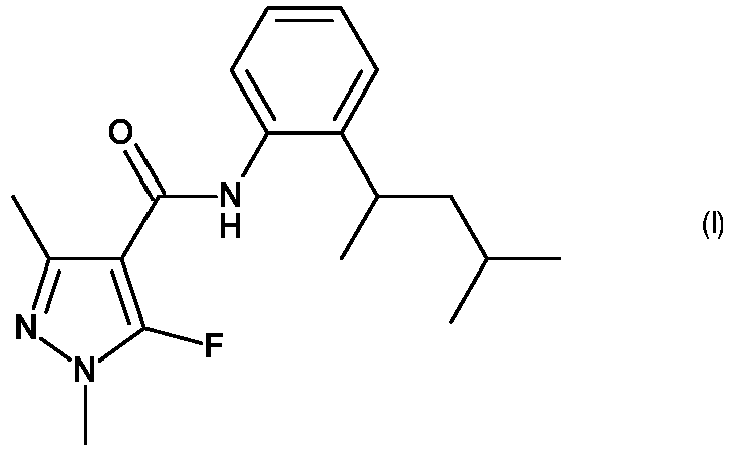
- In Kombination mit weiteren fungiziden, bakteriziden, algiziden und insektiziden Wirkstoffen kann das Wirkspektrum verbreitert und den jeweiligen Anforderungen angepasst werden. Aus der
WO 2012055673 A1 und derWO 2012055674 A1 ist bekannt, dass Penflufen insbesondere zur Bekämpfung von holzzerstörende Pilzen genutzt werden kann. - Kupferverbindungen werden aufgrund ihres Wirkspektrums und ihrer Wirtschaftlichkeit in vielfältiger Weise im industriellen Holzschutz eingesetzt. Es werden sowohl lösliche, wie auch unlösliche, aber auch, wie z.B. aus der
US 2005/0118280 A1 bekannt, mikronisierte Kupferverbindungen eingesetzt. Gängig lösliche Kupferverbindungen, sind beispielsweise Cu-Amin Komplexe, wie Kupfermonoethanolaminkomplexe. Weiterhin werden Kupferverbindungen auch zusammen mit anderen Wirkstoffen eingesetzt, um das Wirkspektrum zu verbreitern. Aus derUS 5635217 sind beispielsweise Holzschutzmittel aus Azolen, Kupferverbindungen und Alkanolaminen bekannt, die ein gutes Wirkspektrum liefern. Nachteilig an diesen bioziden Mischungen ist allerdings, dass weiterhin hohe Mengen an toxischen Azolen eingesetzt werden müssen. - Es bestand also weiterhin Bedarf nach einer Wirkstoffkombination, die einen hohen Schutz gegen holzzerstörende Pilze bietet und durch die die Nachteile des Stands der Technik überwunden werden können.
- Überraschend wurde jetzt eine biozide Mischung enthaltend penflufenhaltige Polymerpartikel, Kupferverbindungen und spezielle Alkanolamine gefunden, die das Wirkspektrum ergänzt und wirksamer ist als im Falle der Verwendung von unverkapseltem Penflufen in Gegenwart von Kupferverbindungen und Alkanolaminen. Zudem kann sogar auf den zusätzlichen Einsatz von Azolen verzichtet werden.
- Gegenstand der Erfindung ist daher eine biozide Mischung enthaltend penflufenhaltige Polymerpartikel, mindestens ein Alkanloamin ausgewählt aus der Gruppe Monoalkylmonoamine, Monoalkyldiamine, Dialkylamine und Trialkylamine, die mit einer, zwei oder drei Hydroxylgruppen substituiert sind und mindestens eine Kupferverbindung oder deren Kupfer-Alkanolaminkomplexe.
- Als Kupferverbindungen in den erfindungsgemäßen bioziden Mischungen können wasserlösliche oder wasserunlösliche anorganische oder organische Kupferverbindungen oder Salze wie beispielsweise und vorzugsweise Kupfersulfat, Kupferacetat, Kupfercarbonat, Kupferhydroxid, Kupferborat, Kupferfluorid, Kupferhydroxidcarbonat, Kupferoxid und Kupferchlorid eingesetzt werden. Bevorzugt werden wasserlösliche, anorganische Kupfersalze eingesetzt. Besonders bevorzugt werden Kupferhydroxid und Kupferhydroxidcarbonat oder Gemische dieser Verbindungen eingesetzt.
- Als Alkanolamine in den erfindungsgemäßen bioziden Mischungen werden Monoalkylmonoamine, Monoalkyldiamine, Dialkylamine und Trialkylamine, die mit einer, zwei oder drei Hydroxylgruppen substituiert sind, eingesetzt. Beispielsweise und vorzugsweise werden als Alkanolamine Isopropanolamin, 1,1-Diaminoethanol, 1,2-Diaminoethanol, Aminoethylethanolamin, Diethanolamin, Triethanolamin, Methylethanolamin und Monoethanolamin eingesetzt werden. Besonders bevorzugt werden C1-C8-Monoalkylmonoamine, C1-C8-Monoalkyldiamine und C1-C8-Dialkylamine, die mit einer oder zwei Hydroxylgruppen substituiert sind, eingesetzt. Ganz besonders bevorzugt wird Monoethanolamin eingesetzt.
- Alkyl steht im Rahmen der Erfindung für einen unverzweigten oder verzweigten, linearen oder zyklischen Alkyl-Rest mit 1 bis 20 Kohlenstoffatomen. Bevorzugt steht Alkyl- für einen unverzweigten oder verzweigten, linearen oder zyklischen Alkyl-Rest mit 1 bis 14 Kohlenstoffatomen, ganz besonders bevorzugt mit 1 bis 8 Kohlenstoffatomen.
- Beispielhaft und vorzugsweise steht Alkyl für Methyl, Ethyl, n-Propyl, Isopropyl, n-, i-, s- oder t-Butyl, Cyclopropyl, Cyclobutyl, Cyclopentyl, Cyclohexyl, Cycloheptyl, n-Pentyl, 1-Methylbutyl, 2-Methylbutyl, 3-Methylbutyl, neo-Pentyl, 1-Ethylpropyl, cyclo-Hexyl, cyclo-Pentyl, n-Hexyl, n-Heptyl, n-Octyl, n-Decyl und n-Dodecyl.
- Die penflufenhaltigen Polymerpartikel können aus Polymerpartikeln hergestellt werden, die aus natürlichen, halbsynthetischen und synthetischen Materialien hergestellt wurden.
- Im Rahmen der Erfindung können als naturliche Materialien fur die Polymerpartikel z.B. Gummi arabicum, Agar, Agarose, Maltodextrin, Natriumalginat, Calciumalginat, Dextran, Fette, Fettsauren, Cetylalkohol, Milchfeststoffe, Molassen, Gelatine, Gluten, Albumin, Schellack, Stärken, Caseinate, Stearine, Saccharose sowie Wachse, wie Bienenwachs, Carnaubawachs und Spermacetiwachs eingesetzt werden.
- Als halbsynthetische Materialien fur die Polymerpartikel können beispielsweise Celluloseacetat, Celluloseacetatbutyrat, Celluloseacetatphthalat, Cellulosenitrat, Ethylcellulose, Hydroxypropylcellulose, Hydroxypropylmethylcellulose, Hydroxypropylmethylcellulosephthalat, Methylcellulose, Natriumcarboxymethylcellulose, hydrierter Talg, Myristylalcohol, Glycerin mono- oder -dipalmitat, hydriertes Rizinusöl, Glycerylmono- oder -tristearate und 12-Hydroxystearylalkohol eingesetzt werden.
- Als synthetische Materialien für die Polymerpartikel können beispielsweise Aminoplastharze, wie Formaldehyd-Melamin-Harze, Formaldehyd-Harnstoff-Harze, Formaldehyd-Harnstoff-Melamin-Harze, Polyurethane, Epoxidharze, Styrolpolymere und -copolymere, Acrylpolymere und - copolymere, wie Polyacrylamid, Polyalkylcyanoacrylat, und Poly- (ethylenvinylacetat), Poly-(styrolacrylamid), Aluminiummonostearat, Carboxyvinylpolymere, Polyamide, Poly-(methylvinylether-maleinsaureanhydrid), Poly-(adipyl-L-lysin), Polycarbonate, Polyterephthalamid, Poly-(vinylacetatphthalat), Poly-(terephthaloyl-L-lysin), Polyarylsulfone, Poly-(methylmethacrylat), Poly-(ε-caprolacton), Polyvinylpyrrolidon, Polydimethylsiloxan, Polyoxyethylene, Polypropylene, Polyester, Polyglycolsäure, Polymilchsäure und deren Copolymere, Polyglutaminsäure, Polylysin, Polyimine und Polyvinylalkohol oder Mischungen oder Copolymere hieraus eingesetzt werden.
- Fur die Herstellung der natürlichen, halbsynthetischen oder synthetischen Polymerpartikel sind zahlreiche Verfahren bekannt (siehe beispielsweise C.A. Finch, R. Bodmeier, Microencapsulation, Ullmann's Encyclopedia of Industrial Chemistry, 6. Auflage 2001, Elektronic Release; D.Crespy, K. Landfester, Beilstein J. of Org. Chem. 2010, 6, 1132-1148). Die penflufenhaltigen Polymerpartikel können dadurch hergestellt werden, dass das Penflufen bereits vor der Polymerisation mit den Monomeren in Kontakt gebracht wird, um dann polymerisiert zu werden. Sie können aber auch dadurch hergestellt werden, dass das Penflufen in das bereits vorliegende Polymer einarbeitet wird. Dieses erfolgt entweder durch Extrusion oder durch Emulgieren einer Lösung des Polymers und Penflufen und Entfernen des Lösungsmittels (Emulsions-Verdampfungs-Methode). In einer weiteren Ausführungsform kann das Penflufen auch mit den fertigen Polymerpartikel in Kontakt gebracht werden, um das Penflufen adsorptiv zu binden. Im penflufenhaltigen Polymerpartikel kann das Penflufen von einer Polymerschicht umschlossen sein (klassische Form der Verkapselung) oder auch gleichmäßig im Polymer (Polymermatrix) verteilt sein. Penflufen kann dort ungelöst, kristallin oder amorph, feindispers vorliegen oder gelöst im Polymer vorliegen. Bei den Lösungen im Polymer spricht man in der Literatur häufig auch von "erstarrten Lösungen", "erstarrten Schmelzen" oder "Polymermatrix". Insgesamt sind auch Zwischenformen mit umfasst und auch relativ wahrscheinlich, wie beispielsweise Kapseln, bei denen das Penflufen im Kern von dem Polymer umschlossen ist und sich aber zusätzlich noch Penflufen in der Kapselschale befindet, aber auch Formen bei denen beispielsweise ein Teil des Penflufen im Polymer gelöst ist und ein anderer Teil in ungelöster Form fein verteilt im Polymer vorliegt.
- Penflufen kann sowohl als Racemat, in enantiomerenreiner Form oder als angereichertes Enantiomerengemisch eingesetzt werden. Auch eine Verwendung als Salz oder Säureadditionsverbindung ist möglich, wobei unter Salzen insbesondere Natrium-, Kalium-, Magnesium-, Calcium-, Zink-, Aluminium-, Eisen- und Kupfer-Salze verstanden wird und unter Säureadditionsverbindungen insbesondere Addukte mit Halogenwasserstoffsäuren, z.B. Chlorwasserstoff und Bromwasserstoff, Carbonsäuren, wie z.B. Ameisensäure, Essigsäure, Weinsäure und Oxalsäure, Sulfonsäuren, wie z.B. p-Toluolsulfonsäure sowie Schwefelsäure, Phosphorsäure und Salpetersäure verstanden wird. Bevorzugt wird Penflufen eingesetzt.
- Bevorzugt besteht das Polymer der penflufenhaltigen Polymerpartikel aus Styrolpolymeren und - copolymeren, sowie Acrylpolymeren und -copolymeren. Besonders bevorzugt handelt es sich hierbei um Polyalkylacrylate, Polyalkylmethacrylate und Copolymerisate aus C1-C18-Alkylacrylaten und C1-C18-Alkylmethacrylaten.
- Im Allgemeinen enthält das penflufenhaltigen Polymerpartikel 0,1 Gew. % bis 30 Gew.% , bevorzugt 0,2 Gew.% bis 20 Gew.% und ganz besonders bevorzugt 0,5 Gew.% bis 15 Gew.% Penflufen bezogen auf die Gesamtmenge an penflufenhaltigen Polymerpartikel. Bevorzugt werden die Polymerpartikel aus Polymeren auf Basis von ethylenisch ungesättigten Monomeren hergestellt.
- Die ethylenisch ungesättigten Monomeren können entweder als Reinstoffe oder als Mischungen aus mehreren ethylenisch ungesättigten Monomeren bestehen.
- Bevorzugt handelt es sich um neutrale, ungeladene, ethylenisch ungesättigten Monomere, die die Bezeichnung M1 erhalten.
- Geeignete Monomere M1 umfassen bevorzugt vinylaromatische Monomere wie Styrol, Divinylbenzol, Ester monoethylenisch ungesättigter Mono- und Dicarbonsäuren mit 3 bis 8 und insbesondere 3 oder 4 C-Atomen, mit C1-C20-Alkanolen oder mit C5-C8-Cycloalkanolen, insbesondere die Ester der Acrylsäure, der Methacrylsäure, der Crotonsäure, die Diester der Maleinsäure, der Fumarsäure und der Itaconsäure und besonders bevorzugt die Ester der Acrylsäure mit C1-C18-Alkanolen (= C1-C18-Alkylacrylate) wie Methylacrylat, Ethylacrylat, n-Butylacrylat, Isobutylacrylat, tert.-Butylacrylat, n-Hexylacrylat, 2-Ethylhexylacrylat, 3-Propylheptylacrylat und Stearylacrylat sowie die Ester der Methacrylsäure mit C1-C18-Alkanolen, wie Methylmethacrylat, Ethylmethacrylat, n-Butylmethacrylat, Isobutylmethacrylat, tert.-Butylmethacrylat, n-Hexylmethacrylat und Stearylmethacrylat. Geeignete Monomere M1 sind außerdem Vinyl- und Allylester aliphatischer Carbonsäuren mit 1 bis 20 C-Atomen, beispielsweise Vinylacetat, Vinylpropionat sowie die Vinylester der Versatic®-Säuren (Vinylversatate), Vinylhalogenide wie Vinylchlorid und Vinylidenchlorid, konjugierte Diolefine wie Butadien und Isopren, sowie C2-C6-Olefine, wie Ethylen, Propen, 1-Buten und n-Hexen. Bevorzugte Monomere sind vinylaromatische Monomere, insbesondere Styrol, Divinylbenzol, C1-C20-Alkylacrylate, insbesondere C1-C18-Alkylacrylate und C1-C18-Alkylmethacrylate oder Gemische aus diesen Monomeren.
- Des Weiteren eignen sich als Monomere M1 auch Amide der vorgenannten ethylenisch ungesättigten Carbonsäuren, insbesondere Acrylamid und Methacrylamid, ethylenisch ungesättigte Nitrile wie Methacrylnitril und Acrylnitril, Hydroxyalkylester der vorgenannten α,β-ethylenisch ungesättigten C3-C8-Monocarbonsäuren und der C4-C8-Dicarbonsäuren insbesondere Hydroxyethylacrylat, Hydroxyethylmethacrylat, 2- und 3-Hydroxypropyl-acrylat, 2- und 3-Hydroxypropylmethacrylat, Ester der vorstehend genannten monoethylenisch ungesättigten Mono- und Dicarbonsäuren mit C2-C4-Polyalkylenglykolen, insbesondere die Ester dieser Carbonsäuren mit Polyethylenglykol oder Alkyl-Polyethylenglykolen, wobei der (Alkyl)polyethylenglykol-Rest üblicherweise ein Molekulargewicht im Bereich von 100 bis 3000 g/mol aufweist.
- Weitere Monomere M1 sind N-Vinylamide wie N-Vinylformamid, N-Vinylpyrrolidon, N-Vinylimidazol und N-Vinylcaprolactam.
- Bevorzugt baut sich das Polymer aus mindestens 60 Gew. % Monomeren M1 auf, bezogen auf die Gesamtmenge der eingesetzten Monomeren auf. Besonders bevorzugt besteht der Anteil an Monomeren M1 mindestens 70 Gew. %, ganz besonders bevorzugt mindestens 80 Gew. %.
- Zusätzlich zu den Monomeren M1 können gegebenenfalls auch ethylenisch, ungesättigte Monomere mit anionischen oder kationischen Gruppen, also geladene, ethylenisch, ungesättigte Monomere mit einpolymerisiert werden. Die ethylenisch, ungesättigten Monomeren mit anionischen oder kationischen Gruppen erhalten die Bezeichnung M2.
- Zu den Monomeren M2 zählen insbesondere monoethylenisch ungesättigte Monomere, die wenigstens eine anionische Gruppe aufweisen, insbesondere Monomere, die wenigstens eine Säuregruppe, vorzugsweise wenigstens eine Sulfonsäuregruppe, eine Phosphonsäuregruppe oder ein oder zwei Carbonsäuregruppen aufweisen, sowie die Salze der Monomeren insbesondere die Alkalimetallsalze, z. B. die Natrium- oder Kaliumsalze sowie die Ammoniumsalze. Des Weiteren ethylenisch ungesättigte Sulfonsäuren insbesondere Vinylsulfonsäure, 2-Acrylamido-2-methylpropansulfonsäure, 2-Acryloxyethansulfonsäure und 2-Methacryloxyethansulfonsäure, 3-Acryloxy- und 3-Methacryloxypropansulfonsäure, Vinylbenzolsulfonsäure und deren Salze, ethylenisch ungesättigte Phosphonsäuren wie Vinylphosphonsäure und Vinylphosphonsäuredimethylester und deren Salze und α,β-ethylenisch ungesättigte C3-C8-Mono- und C4-C8-Dicarbonsäuren insbesondere Acrylsäure, Methacrylsäure, Crotonsäure, Maleinsäure, Fumarsäure und Itaconsäure. Bevorzugt werden als Monomere M2 α,β-ethylenisch ungesättigte C3-C8-Mono- und C4-C8-Dicarbonsäuren eingesetzt.
- Zu den Monomeren M2 können weiterhin insbesondere monoethylenisch ungesättigte Monomere zählen, die wenigstens eine kationische Gruppe und/oder wenigstens eine im wässrigen protonierbare Gruppe aufweisen. Zu den kationischen Monomeren M2 zählen insbesondere solche, die eine protonierbare Aminogruppe, eine quaternäre Ammoniumgruppe, eine protonierbare Iminogruppe oder eine quaternisierte Iminogruppe aufweisen. Beispiele für Monomere M2 mit einer protonierbaren Iminogruppe sind N-Vinylimidazol und Vinylpyridine. Beispiele für Monomere M2 mit einer quaternisierten Iminogruppe sind N-Alkylvinylpyridiniumsalze und N-Alkyl-N'-vinylimidazoliniumsalze wie N-Methyl-N'-vinylimidazoliniumchlorid oder Methosulfat.
- Beispiele für Monomere M2 mit protonierbaren Aminogruppen sind beispielsweise und vorzugsweise 2-(N,N-Dimethylamino)ethylacrylat, 2-(N,N-Dimethylamino)ethyl-methacrylat, 2-(N,N-Dimethylamino)ethylacrylamid, 3-(N,N-Dimethylamino)propyl-acrylamid, 3-(N,N-Dimethylamino)propylmethacrylamid, 2-(N,N-Dimethylamino)ethylmethacrylamid, sie können beispielsweise vorliegen als Cl-, HSO4 -, 1/2 SO4 2- oder CH3OSO3 --Salze. Monomere mit quartären Ammoniumverbindungen sind beispielsweise und vorzugsweise 2-(N,N,N-Trimethylammonium)ethylacrylat-Chlorid, 2-(N,N,N-Tri-methylammonium)ethylmethacrylat-Chlorid, 2-(N,N,N-Trimethylammonium)-ethylmethacrylamid-Chlorid, 3-(N,N,N-Trimethylammonium)propylacrylamid-Chlorid, 3-(N,N,N-Trimethylammonium) propylmethacrylamid-Chlorid, 2-(N,N,N-Trimethylammonium)-ethylacrylamid-Chlorid, sowie die entsprechenden Methosulfate und Sulfate.
- Der Anteil der Monomere M2 ist vorzugsweise nicht größer als 35 Gew.-%, besonders bevorzugt nicht größer als 20 Gew.-%, bezogen auf die Gesamtmenge der eingesetzten Monomeren. Ganz besonders bevorzugt wird 80 Gew. % bis 99.9 Gew. % Monomere M1 und 0,1 Gew.% bis 20 Gew. % Monomere M2, bezogen auf die Gesamtmenge der eingesetzten Monomeren, eingesetzt.
- In einer weiteren bevorzugten Ausführungsform ist die Menge an geladenen Monomeren M2 im Polymer kleiner als 0,01 Gew. % bezogen auf die Gesamtmenge an eingesetzten Monomeren. Die Monomeren sind oben beschrieben und können einzeln oder in Mischung eingesetzt werden.
- Die für die Emulsionspolymerisation geeigneten Starter sind die für eine Emulsionspolymerisation geeigneten und üblicherweise verwendeten Polymerisationsinitiatoren, die eine radikalische Polymerisation der Monomere M auslösen. Hierzu zählen öllösliche Azoverbindungen, wie 2,2'-Azobis-isobutyronitril, 2,2'-Azobis(2-methyl-butyronitril), 2,2'-Azobis[2-methyl-N-(-2-hydroxyethyl)propionamid, 1,1'-Azobis(1-cyclohexancarbonitril), 2,2'-Azobis(2,4-dimethylvaleronitril),2,2' -Azobis(N,N' -dimethylenisobutyroamidin)dihydrochlorid, und 2,2'-Azobis(2-amidinopropan)dihydrochlorid, organische oder anorganische Peroxide wie Diacetylperoxid, Di-tert.-butylperoxid, Diamylperoxid, Dioctanoylperoxid, Didecanoylperoxid, Dilauroylperoxid, Dibenzoylperoxid, Bis(o-toluyl)peroxid, Succinylperoxid, tert.-Butylperacetat, tert.-Butylpermaleinat, tert.-Butylperisobutyrat, tert.-Butylperpivalat, tert.-Butylperoctoat, tert.-Butylperneodecanoat, tert.-Butylperben-zoat, tert.-Butylperoxid, tert.-Butylhydroperoxid, Cumolhydroperoxid, tert.-Butylperoxi-2-ethylhexanoat und Diisopropylperoxidicarbamat. Es können aber ebenfalls wasserlösliche radikalische Initiatoren, wie z.B. Salze der Peroxodischwefelsäure und Redox-Initiatorsysteme oder kationische Azoverbindungen, wie z.B. Azobis(dimethylamidinpropan) eingesetzt werden. Als wasserlösliche Initiatoren können die Salze der Peroxodischwefelsäure, insbesondere ein Natrium-, Kalium- oder Ammoniumsalze oder ein Redoxinitiatorsystem, das als Oxidationsmittel ein Salz der Peroxodischwefelsäure, Wasserstoffperoxid oder ein organisches Peroxid wie tert.-Butylhydroperoxid eingesetzt werden. Als Reduktionsmittel enthalten sie vorzugsweise eine Schwefelverbindung, die insbesondere ausgewählt ist unter Natriumhydrogensulfit, Natriumhydroxymethansulfinat und dem Hydrogensulfit-Addukt an Aceton. Weitere geeignete Reduktionsmittel sind phosphorhaltige Verbindungen wie phosphorige Säure, Hypophosphite und Phosphinate, sowie Hydrazin bzw. Hydrazinhydrat und Ascorbinsäure. Weiterhin können Redoxinitiatorsysteme einen Zusatz geringer Mengen von Redoxmetallsalzen wie Eisensalze, Vanadiumsalze, Kupfersalze, Chromsalze oder Mangansalze enthalten wie beispielsweise das Redoxinitiatorsystem Ascorbinsäure/Eisen(II)sulfat/Natriumperoxodisulfat.
- Bevorzugt werden öllösliche radikalische Initiatoren eingesetzt. Ganz besonders bevorzugt handelt es sich bei den radikalischen Initiatoren um 2,2'-Azobis-isobutyronitril, 2,2'-Azobis(2-methylbutyronitril) oder Gemische dieser Initiatoren.
- Zudem können gegebenenfalls weitere Hilfsstoffe wie z.B. Costabilisatoren, oberflächenaktive Substanzen, wie z.B. Schutzkolloide und niedermolekulare Emulgatoren, Lösungsmittel und Weichmacher eingesetzt werden. Falls Hilfsstoffe eingesetzt werden, sind dies bevorzugt Costabilisatoren, Emulgatoren und Lösungsmittel.
- Die gegebenenfalls eingesetzten Costabilisatoren sind Stoffe, die die Mikroemulsion gegen Ostwaldreifung stabilisieren und eine sehr geringe Löslichkeit in der kontinuierlichen Phase aufweisen. Bevorzugt handelt es sich um langkettige, lineare, cyklische oder verzweigte, aliphatische Kohlenwasserstoffe ausgewählt aus der Gruppe C14-C25-Alkane und C14-C25-Cycloalkane. Besonders bevorzugt handelt es sich um C14-C18-Alkane und C14-C18-Cycloalkane, wie ganz besonders bevorzugt um Tetradecan, Pentadecan, Hexadecan, Heptadecan, Octadecan und Nonadecan oder Gemische aus diesen Costabilisatoren.
- Wenn Costabilisatoren eingesetzt werden, dann liegt die Menge im Allgemeinen zwischen 0,05 bis 20 Gew.%, bevorzugt zwischen 0,1 bis 15 Gew.% und ganz besonders bevorzugt zwischen 0,2 und 10 Gew. % bezogen auf die Gesamtmenge der eingesetzten Monomeren.
- Als Lösungsmittel und Weichmacher können im Allgemeinen alle Stoffe eingesetzt werden, die sich gegenüber den Monomeren, dem entstandenen Polymeren und dem Penflufen inert verhalten.
- Als bevorzugte Lösungsmittel werden inerte, dipolare, aprotische, organische Lösungsmittel, wie insbesondere Ester zweiwertiger Carbonsäuren, beispielsweise und vorzugsweise Mischungen enthaltend Diisobutyladipat, Diisobutylglutarat, Diisobutylsuccinat (z.B. Rhodiasolv DIB), wie auch Benzylalkohol, Polyethylenglycole, Polypropylenglycole, eingesetzt.
- Als Weichmacher werden bevorzugt Phthalate, wie insbesondere Diethylhexylphthalat (DEHP), Dibutylphthalat (BBP), Diisononylphthalat (DINP), Diisodecylphthalat (DIDP), Diisooctylphthalat (DNOP), Diisobutylphthalat (DIBP), Diisohexylphthalat, Diisoheptylphthalat, Di-n-octylphthalat, Diisoundecylphthalat, Diisotredecylphthalate; Adipate, wie insbesondere Diethylhexyladipat (DEHA), Diisooctyladipat, Diisononyladipat, Polyester der Adipinsäure oder Glutarsäure, wie insbesondere Ultramoll IV® der Lanxess Deutschland GmbH; Trialkylester der Zitronensäure oder acetylierte Trialkylester der Zitronensäure, wie insbesondere Acetyltributylcitrat (ATBC); Ester der Trimellitsäure, wie insbesondere Tri(2-ethylhexyl)trimellitat, Tri(isooctyl)trimellitat, Triisononyl)trimellitat; 1,2-Dicyclohexylbasierte Weichmacher, wie insbesondere 1,2-Cyclohexandicarbon-säurenonylester (Hexamoll®, DINCH); Alkylsulfonsäureester des Phenols, wie insbesondere Mesamoll® der Lanxess Deutschland GmbH (CAS-Nr 091082-17-6); Acetylierte Mono- und Diglyceride; Benzoesäurediester, wie insbesondere Dialkylen-glycolen, wie insbesondere Dipropylenglycoldibenzoat oder Isononylbenzoat; Trimethylolpropanester wie insbesondere Trimethylolpropan-benzoat-2-ethylhexanoat-Gemische; Dialkylester der Terephthalsäure, wie insbesondere Di-2-ethylhexyl-terephthalat, eingesetzt.
- Als oberflächenaktive Substanzen zählen sowohl Schutzkolloide als auch niedermolekulare Emulgatoren, wobei letztere im Unterschied zu den Schutzkolloiden vorzugsweise ein Molekulargewicht unterhalb von 2000 g/mol, insbesondere unterhalb 1000 g/mol (Massenmittel) aufweisen. Die Schutzkolloide und niedermolekularen Emulgatoren können sowohl kationischer, anionischer, neutraler als auch zwitterionischer Natur sein.
- Beispiele für anionische oberflächenaktive Substanzen sind anionische niedermolekulare Emulgatoren wie beispielsweise und vorzugsweise Alkylphenylsulfonate, Phenylsulfonate, Alkylsulfate, Alkylsulfonate, Alkylethersulfate, Alkylphenolethersulfate, Alkylpolyglykoletherphosphate, Alkyldiphenylethersulfonate, Polyarylphenyletherphosphate, Alkylsulfosuccinate, Olefinsulfonate, Paraffinsulfonate, Petroleumsulfonate, Tauride, Sarkoside, Fettsäuren, Alkylnaphthalinsulfonsäuren, Naphthalinsulfonsäuren, einschliesslich ihrer Alkali-, Erdalkali-, Ammonium- und Amin-Salze.
- Anionische Schutzkolloide sind beispielsweise und vorzugsweise Ligninsulfonsäuren, Kondensationsprodukte sulfonierter Naphthaline mit Formaldehyd oder mit Formaldehyd und Phenol und gegebenenfalls Harnstoff sowie Kondensationsprodukte aus Phenol-sulfonsäure, Formaldehyd und Harnstoff, Lignin-Sulfit-Ablauge und Ligninsulfonate sowie Polycarboxylate wie Polyacrylate, Maleinsäureanhydrid/Olefin-Copolymere sowie die Alkali-, Erdalkali-, Ammonium- und Amin-Salze der vorgenannten Schutzkolloide. Nichtionische Schutzkolloide sind beispielsweise und vorzugsweise Polyethylenglykol, Polypropylenglykol, Polyethylenglykolpolypropylenglykol-Blockcopolymere, Polyethylen-glykolalkylether, Polypropylenglykolalkylether, Polyethylenglykolpolypropylen-glykolether-Blockcopolymere und deren Gemische.
- Weitere, höhermolekulare Schutzkolloide, sind beispielsweise und vorzugsweise Carboxymethylcellulose, natürliche und synthetische pulvrige, körnige oder latexförmige Polymere, wie Gummi Arabicum, Polyvinylalkohol, Polyvinylacetat, sowie natürliche Phospholipide, wie Kephaline und Lecithine und synthetische Phospholipid sowie Paraffinöle.
- Nichtionische niedermolekulare Emulgatoren sind beispielsweise und vorzugsweise Alkylphenolalkoxylate, Alkoholalkoxylate, Fettaminalkoxylate, Polyoxyeethylenglycerolfettsäureester, Rizinusölalkoxylate, Fettsäurealkoxylate, Fettsäureamidalkoxylate, Fettsäurepolydiethanolamide, Lanolinethoxylate, Fettsäurepolyglykolester, Isotridecyl-alkohol, Fettsäureamide, Methylcellulose, Fettsäureester, Silicon-Öle, Alkylpolyglykoside und Glycerolfettsäureester.
- Kationische niedermolekulare Emulgatoren sind beispielsweise und vorzugsweise quartäre Ammoniumsalze, z. B. Trimethyl- und Triethyl-C6-C30-alkylammoniumsalze, wie Cocotrimethylammoniumsalze, Trimethylcetylammoniumsalze, Dimethyl- und Diethyl-di-C4-C20-alkylammoniumsalze, wie Didecyldimethylammoniumsalze und Dicocodimethylammoniumsalze, Methyl- und Ethyl-tri-C4-C20-alkylammoniumsalze, wie Methyltrioctylammoniumsalze, C1-C20-Alkyl-di-C1-C4-alkylbenzylammoniumsalze, wie Triethylbenzylammoniumsalze und Cocobenzyldimethylammoniumsalze, Hexadecyltrimethyl-ammoniumsalze, Methyl- und Ethyl-di-C4-C20-alkylpoly(oxyethyl)ammoniumsalze, z. B. Didecylmethylpoly(oxyethyl)ammoniumsalze, N-C6-C20-Alkylpyridiniumsalze, z. B. N-Laurylpyridiniumsalze, N-Methyl- und N-Ethyl-N-C6-C20-alkylmorpholiniumsalze, sowie N-Methyl- und N-Ethyl-N'-C6-C20-alkylimidazoliniumsalze, insbesondere die Halogenide, Borate, Carbonate, Formiate, Acetate, Propionate, Hydrogencarbonate, Sulfate und Methosulfate.
- Zwitterionische niedermolekulare Emulgatoren sind solche mit betainischen Strukturen. Derartige Substanzen sind dem Fachmann bekannt und können einschlägigem Stand der Technik entnommen werden (siehe beispielsweise R.Heusch, in Ullmanns Encyclopedia of Industrial Chemistry, 5th. Ed. On CD-ROM, Wiley-VCH 1997, "Emulsions", Kapitel 7, Tabelle 4).
- Die Menge an niedermolekularem Emulgator liegt üblicherweise im Bereich von 0,1 Gew. % bis 15 Gew. %, insbesondere im Bereich von 0,2 Gew. % bis 12 Gew. % und besonders bevorzugt 0,7 Gew. % bis 10 Gew. % bezogen auf die Gesamtmenge der eingesetzten Monomeren.
- Zur Erhöhung der Wirksamkeit, aber auch zur Konservierung der entstandenen Suspensionen, können die penflufenhaltigen Polymerpartikel gegebenenfalls weitere antimikrobiell wirksame Verbindungen, Fungizide, Bakterizide, Herbizide, Insektizide oder andere Wirkstoffe enthalten. Diese Mischungen können ein noch breiteres Wirkungsspektrum besitzen. Diese Verbindungen können, wie das Penflufen, in den Monomeren gelöst werden oder dispergiert eingesetzt werden. In vielen Fällen erhält man dabei synergistische Effekte, d.h. die Wirksamkeit der Mischung ist größer als die Wirksamkeit der Einzelkomponenten. Besonders günstige Mischungspartner bzw. Biozide sind z.B. die folgenden Verbindungen:
- Triazole wie:
Azaconazol, Azocyclotin, Bitertanol, Bromuconazol, Cyproconazol, Diclobutrazol, Difenoconazol, Diniconazol, Epoxyconazol, Etaconazol, Fenbuconazol, Fenchlorazol, Fenethanil, Fluquinconazol, Flusilazol, Flutriafol, Furconazol, Hexaconazol, Imibenconazol, Ipconazol, Isozofos, Myclobutanil, Metconazol, Paclobutrazol, Penconazol, Propioconazol, Prothioconazol, Simeoconazol, (+)-cis-1-(4-chlorphenyl)-2-(1H-1,2,4-triazol-1-yl)-cycloheptanol, 2-(1-tert-Butyl)-1-(2-chlorphenyl)-3-(1,2,4-triazol-1-yl)-propan-2-ol, Tebuconazol, Tetraconazol, Triadimefon, Triadimenol, Triapenthenol, Triflumizol, Triticonazol, Uniconazol sowie deren Metallsalze und Säureaddukte; - Imidazole wie:
Clotrimazol, Bifonazol, Climbazol, Econazol, Fenapamil, Imazalil, Isoconazol, Ketoconazol, Lombazol, Miconazol, Pefurazoat, Prochloraz, Triflumizol, Thiazolcar 1-Imidazolyl-1-(4'-chlorophenoxy)-3,3-dimethylbutan-2-on sowie deren Metallsalze und Säureaddukte; - Pyridine und Pyrimidine wie:
Ancymidol, Buthiobat, Fenarimol, Mepanipyrin, Nuarimol, Pyroxyfur, Triamirol; - Succinat-Dehydrogenase Inhibitoren wie:
Benodanil, Carboxim, Carboximsulfoxid, Cyclafluramid, Fenfuram, Flutanil, Furcarbanil, Furmecyclox, Mebenil, Mepronil, Methfuroxam, Metsulfovax, Nicobifen, Pyrocarbolid, Oxycarboxin, Shirlan, Seedvax; - Naphthalin-Derivate wie:
Terbinafin, Naftifin, Butenafin, 3-Chloro-7-(2-aza-2,7,7-trimethyl-oct-3-en-5-in); - Sulfenamide wie:
Dichlofluanid, Tolylfluanid, Folpet, Fluorfolpet; Captan, Captofol; - Benzimidazole wie:
Carbendazim, Benomyl, Fuberidazole, Thiabendazol oder deren Salze; - Morpholinderivate wie:
Aldimorph, Dimethomorph, Dodemorph, Falimorph, Fenpropidin, Fenpropimorph, Tridemorph, Trimorphamid und ihre arylsulfonsauren Salze, wie z.B. p-Toluolsulfonsäure und p-Dodecylphenylsulfonsäure; - Benzthiazole wie:
2-Mercaptobenzothiazol; - Benzthiophendioxide wie:
Benzo[b]thiophen-S,S-dioxid-carbonsäurecyclohexylamid; - Benzamide wie:
2,6-Dichloro-N-(4-trifluoromethylbenzyl)-benzamid, Tecloftalam; - Borverbindungen wie:
Borsäure, Borsäureester, Borax; - Formaldehyd und Formaldehydabspaltende Verbindungen wie:
Benzylalkoholmono-(poly)-hemiformal, 1,3-Bis(hydroxymethyl)-5,5-dimethylimidazolidine-2,4-dione (DMDMH), Bisoxazolidine, n-Butanol-hemiformal, Cis 1-(3-Chlorallyl)-3,5,7-triaza-1-azoniaadamantane chlorid, 1-[1,3-Bis(hydroxymethyl-2,5-dioxoimidazolidin-4-yl]-1,3-bis(hydroxymethyl)urea, Dazomet, Dimethylolharnstoff, 4,4-Dimethyl-oxazolidine, Ethylen¬glycol-hemiformal, 7-Ethylbicyclooxazolidine, Hexa-hydro-S-triazine, Hexamethylentetramin, N-Hydroxymethyl-N'-methylthioharnstoff, Methylenbismorpholin, Natrium N-(Hydroxymethyl)glycinat, N-Methylolchloracetamid, Oxazolidine, Paraform-aldehyd, Taurolin, Tetrahydro-1,3-oxazin, N-(2-Hydroxypropyl)-amin-methanol, Tetra-methylol-acetylen-diharnstoff (TMAD); - Isothiazolinone wie:
N-Methylisothiazolin-3-on, 5-Chlor-N-methylisothiazolin-3-on, 4,5-Dichloro-N-octyliso-thiazolin-3-on, 5-Chlor-N-octylisothiazolinon, N-Octyl-isothiazolin-3-on, 4,5-Trimethylen-isothiazolinon, 4,5-Benzisothiazolinon; - Aldehyde wie:
Zimtaldehyd, Formaldehyd, Glutardialdehyd, ß-Bromzimtaldehyd, o-Phthaldialdehyd; - Thiocyanate wie:
Thiocyanatomethylthiobenzothiazol, Methylenbisthiocyanat; - quartäre Ammoniumverbindungen und Guanidine wie:
Benzalkoniumchlorid, Benzyldimethyltetradecylammoniumchlorid, Benzyldimethyldodecylammoniumchlorid, Dichlorbenzyldimethylalkylammoniumchlorid, Didecyldimethylammoniumchlorid, Dioctyldimethylammoniumchlorid, N-Hexadecyltrimethyl-ammoniumchlorid, 1-Hexadecylpyridiniumchlorid, Iminoctadine-tris(albesilat); - Phenole wie:
Tribromphenol, Tetrachlorphenol, 3-Methyl-4-chlorphenol, 3,5-Dimethyl-4-chlorphenol, Dichlorphen, 2-Benzyl-4-chlorphenol, Triclosan, Diclosan, Hexachlorophen, p-Hydroxybenzoesäuremethylester, p-Hydroxybenzoesäureethylester, p-Hydroxybenzoe-säurepropylester, p-Hydroxybenzoesäurebutylester, p-Hydroxybenzoesäureoctylester ,o-Phenylphenol, m-Phenylphenol, p-Phenylphenol, 4-(2-tert.-Butyl-4-methyl-phenoxy)-phenol, 4-(2-Isopropyl-4-methyl-phenoxy)-phenol, 4-(2,4-Dimethyl-phenoxy)-phenol und deren Alkali- und Erdalkalimetallsalze; - Mikrobizide mit aktivierter Halogengruppe wie:
Bronopol, Bronidox, 2-Brom-2-nitro-1,3-propandiol, 2-Brom-4'-hydroxy-acetophenon, 1-Brom-3-chlor-4,4,5,5-tetramethyl-2-imidazoldinone, ß-Brom-ß-nitrostyrol, Chloracetamid, Chloramin T, 1,3-Dibrom-4,4,5,5-tetrametyl-2-imidazoldinone, Dichloramin T, 3,4-Dichlor-(3H)-1,2-dithiol-3-on, 2,2-Dibrom-3-nitril-propionamid, 1,2-Dibrom-2,4-dicyanobutan, Halane, Halazone, Mucochlorsäure, Phenyl-(2-chlor-cyan-vinyl)sulfon, Phenyl-(1,2-dichlor-2-cyanvinyl)sulfon, Trichlorisocyanursäure; - Pyridine wie:
1-Hydroxy-2-pyridinthion (und ihre Cu-, Na-, Fe-, Mn-, Zn-Salze), Tetrachlor-4-methylsulfonylpyridin, Pyrimethanol, Mepanipyrim, Dipyrithion, 1-Hydroxy-4-methyl-6-(2,4,4-trimethylpentyl)-2(1H)-pyridin; - Methoxyacrylate oder Ähnliche wie:
Azoxystrobin, Dimoxystrobin, Fluoxastrobin, Kresoxim-methyl, Metominostrobin, Orysastrobin, Picoxystrobin, Pyraclostrobin, Trifloxystrobin, 2,4-dihydro-5-methoxy-2-methyl-4-[2-[[[[1-[3-(trifluoromethyl)phenyl]ethylidene]amino]oxy]methyl]phenyl]-3H-1,2,4-triazol-3-one (CAS-Nr. 185336-79-2); - Metallseifen wie:
Salze der Metalle Zinn, Kupfer und Zink mit höheren Fett-, Harz-, Naphthensäuren und Phosphorsäure wie z.B. Zinn-, Kupfer-, Zinknaphtenat, -octoat, 2-ethylhexanoat, -oleat, phosphat, -benzoat; - Metallsalze wie:
Salze der Metalle Zinn, Kupfer, Zink, sowie auch Chromate und Dichromate wie z.B. Kupferhydroxycarbonat, Natriumdichromat, Kaliumdichromat, Kaliumchromat, Kupfersulfat, Kupferchlorid, Kupferborat, Zinkfluorosilikat, Kupferfluorosilikat; - Oxide wie:
Oxide der Metalle Zinn, Kupfer und Zink wie z.B. Tributylzinnoxid, Cu2O, CuO, ZnO; - Oxidationsmittel wie:
Wasserstoffperoxid, Peressigsäure, Kaliumpersulfat; - Dithiocarbamate wie:
Cufraneb, Ferban, Kalium-N-hydroxymethyl-N'-methyl-dithiobarbamat, Na- oder K-dimethyldithiocarbamat, Macozeb, Maneb, Metam, Metiram, Thiram, Zineb, Ziram; - Nitrile wie:
2,4,5,6-Tetrachlorisophthalodinitril, Dinatrium-cyano-dithioimidocarbamat; - Chinoline wie:
8-Hydroxychinolin und deren Cu-Salze; - sonstige Fungizide und Bakterizide wie:
- Bethoxazin, 5-Hydroxy-2(5H)-furanon; 4,5-Benzdithiazolinon, 4,5-Trimethylendithiazolinon, N (2-p-Chlorbenzoylethyl)-hexaminiumchlorid, 2-Oxo-2-(4-hydroxy-phenyl)-acethydroximsäurechlorid, Tris-N-(cyclohexyldiazeniumdioxy)-aluminium, N-(Cyclo-hexyldiazeniumdioxy)-tributylzinn bzw. K-Salze, Bis-N-(cyclohexyldiazeniumdioxy)-kupfer, Iprovalicarb, Fenhexamid, Spiroxamin, Carpropamid, Diflumetorin, Quinoxyfen, Famoxadone, Polyoxorim, Acibenzolar-S-methyl, Furametpyr, Thifluzamide, Methalaxyl-M, Benthiavalicarb, Metrafenon, Cyflufenamid, Tiadinil, Teebaumöl, Phenoxyethanol,
- Ag, Zn oder Cu-haltige Zeolithe allein oder eingeschlossen in polymere Werkstoffe.
- Ganz besonders bevorzugt sind Mischungen mit
Azaconazol, Bromuconazol, Cyproconazol, Dichlobutrazol, Diniconazol, Diuron, Hexacona-zol, Metaconazol, Penconazol, Propiconazol, Tebuconazol, Dichlofluanid, Tolylfluanid, Fluorfolpet, Methfuroxam, Carboxin, Benzo[b]thiophen-S,S-dioxid-carbon-säurecyclohexylamid, Fenpiclonil, 4-(2,2-Difluoro-1,3-benzodioxol-4-yl)-1H-pyrrol-3-carbo-nitril, Butenafin, Imazalil, N-Methylisothiazolin-3-on, 5-Chlor-N-methylisothiazolin-3-on, N-Octylisothiazolin-3-on, Dichlor-N-octylisozhiazolinon, Mercaptobenzthiazol, Thiocyanatomethylthiobenzothiazol, Thiabendazol, Benzisothiazolinon, N-(2-Hydroxy-propyl)-amino-methanol, Benzylalkohol-(hemi)-formal, N Methylolchloracetamid, N-(2-Hydroxypropyl)-amin-methanol, Glutaraldehyd, Omadine, Zn Omadine, Dimethyldicarbonat, 2-Brom-2-nitro-1,3-propandiol, Bethoxazin, o-Phthaldialdehyd, 2,2-Dibrom-3-nitril-propionamid, 1,2-Dibrom-2,4-dicyanobutan, 1,3-Bis(hydroxymethyl)-5,5-dimethylimidazolidine-2,4-dione (DMDMH), Tetramethylol-acetylen-diharnstoff (TMAD), Ethylenglycol-hemiformal, p-Hydroxybenzoesäure, Carbendazim, Chlorophen, 3-Methyl-4-chlorphenol, o-Phenylphenol. - Desweiteren werden neben den oben genannten Fungiziden und Bakteriziden auch gut wirksame Mischungen mit anderen Wirkstoffen hergestellt:
- Insektizide / Akarizide / Nematizide:
- Abamectin, Acephat, Acetamiprid, Acetoprole, Acrinathrin, Alanycarb, Aldicarb, Aldoxycarb, Aldrin, Allethrin, Alpha-cypermethrin, Amidoflumet, Amitraz, Avermectin, Azadirachtin, Azinphos A, Azinphos M, Azocyclotin,
- Bacillus thuringiensis, Barthrin, 4-Bromo-2(4-chlorphenyl)-1-(ethoxymethyl)-5-(trifluoro-methyl)-1H-pyrrole-3-carbonitrile, Bendiocarb, Benfuracarb, Bensultap, Betacyfluthrin, Bifenthrin, Bioresmethrin, Bioallethrin, Bistrifluron, Bromophos A, Bromophos M, Bufencarb, Buprofezin, Butathiophos, Butocarboxin, Butoxycarboxim,
- Cadusafos, Carbaryl, Carbofuran, Carbophenothion, Carbosulfan, Cartap, Chinomethionat, Cloethocarb, Chlordane, Chlorethoxyfos, Chlorfenapyr, Chlorfenvinphos, Chlorfluazuron, Chlormephos, N-[(6-Chloro-3-pyridinyl)-methyl]-N'-cyano-N-methyl-ethanimidamid, Chlorpicrin, Chlorpyrifos A, Chlorpyrifos M, Cis-Resmethrin, Clocythrin, Clothiazoben, Cypophenothrin Clofentezin, Coumaphos, Cyanophos, Cycloprothrin, Cyfluthrin, Cyhalothrin, Cyhexatin, Cypermethrin, Cyromazin,
- Decamethrin, Deltamethrin, Demeton M, Demeton S, Demeton-S-methyl, Diafenthiuron, Dialiphos, Diazinon, 1,2-Dibenzoyl-1(1,1-dimethyl)-hydrazin, DNOC, Dichlofenthion, Dichlorvos, Dicliphos, Dicrotophos, Difethialon, Diflubenzuron, Dimethoat, 3,5-Dimethylphenylmethylcarbamat, Dimethyl-(phenyl)-silyl-methyl-3-phenoxybenzylether, Dimethyl-(4-Ethoxyphenyl)-silylmethyl-3-phenoxybenzylether, Dimethylvinphos, Dioxathion, Disulfoton,
- Eflusilanate, Emamectin, Empenthrin, Endosulfan, EPN, Esfenvalerat, Ethiofencarb, Ethion, Ethofenprox, Etrimphos, Etoxazole, Etobenzanid,
- Fenamiphos, Fenazaquin, Fenbutatinoxid, Fenfluthrin, Fenitrothion, Fenobucarb, Fenothiocarb, Fenoxycarb, Fenpropathrin, Fenpyrad, Fenpyroximat, Fensulfothion, Fenthion, Fenvalerate, Fipronil, Flonicamid, Fluacrypyrim, Fluazuron, Flucycloxuron, Flucythrinate, Flufenerim, Flufenoxuron, Flupyrazofos, Flufenzine, Flumethrin Flufenprox, Fluvalinate, Fonophos, Formethanate, Formothion, Fosmethilan Fosthiazat, Fubfenprox, Furathiocarb,
- Halofenocid, HCH (CAS RN: 58-89-9), Heptenophos, Hexaflumuron, Hexythiazox, Hydramethylnon, Hydropren,
- Imidacloprid, Imiprothrin, Indoxycarb, Iprinomectin, Iprobenfos, Isazophos, Isoamidophos, Isofenphos, Isoprocarb, Isoprothiolane, Isoxathion, Ivermectin,
- Kadedrin
- Lambda-Cyhalothrin, Lufenuron,
- Malathion, Mecarbam, Mervinphos, Mesulfenphos, Metaldehyd, Methacrifos, Methamidophos, Methidathion, Methiocarb, Methomyl, Metalcarb, Milbemectin, Monocrotophos, Moxiectin,
- Naled, NI 125, Nicotin, Nitenpyram, Noviflumuron,
- Omethoat, Oxamyl, Oxydemethon M, Oxydeprofos,
- Parathion A, Parathion M, Penfluron, Permethrin, 2-(4-Phenoxyphenoxy)-ethyl-ethyl-carbamat, Phenthoat, Phorat, Phosalon, Phosmet, Phosphamidon, Phoxim, Pirimicarb, Pirimiphos M, Pirimiphos A, Prallethrin, Profenophos, Promecarb, Propaphos, Propoxur, Prothiophos, Prothoat, Pymetrozin, Pyrachlophos, Pyridaphenthion, Pyresmethrin, Pyrethrum, Pyridaben, Pyridalyl, Pyrimidifen, Pyriproxifen, Pyrithiobac-natrium
- Quinalphos,
- Resmethrin, Rotenon,
- Salithion, Sebufos, Silafluofen, Spinosad, Spirodiclofen, Spiromesifen, Sulfotep, Sulprofos,
- Tau-fluvalinat, Taroils, Tebufenozide, Tebufenpyrad, Tebupirimphos, Teflubenzuron, Tefluthrin, Temephos, Terbam, Terbufos, Tetrachlorvinphos, Tetramethrin, Tetramethacarb, Thiacloprid, Thiafenox, Thiamethoxam, Thiapronil, Thiodicarb, Thiofanox, Thiazophos, Thiocyclam, Thiomethon, Thionazin, Thuringiensin, Tralomethrin, Transfluthrin, Triarathen, Triazophos, Triazamate, Triazuron, Trichlorfon, Triflumuron, Trimethacarb,
- Vamidothion, Xylylcarb, Zetamethrin;
- Molluscizide:
Fentinacetat, Metaldehyd, Methiocarb, Niclosamid; - Herbizide und Algizide:
- Acetochlor, Acifluorfen, Aclonifen, Acrolein, Alachlor, Alloxydim, Ametryn, Amidosulfuron, Amitrole, Ammonium sulfamate, Anilofos, Asulam, Atrazine, Azafenidin, Aziptrotryn, Azimsulfuron,
- Benazolin, Benfluralin, Benfuresat, Bensulfuron, Bensulfid, Bentazon, Benzofencap, Benzthiazuron, Bifenox, Bispyribac, Bispyribac-Natrium, Borax, Bromacil, Bromobutide, Bromofenoxim, Bromoxynil, Butachlor, Butamifos, Butralin, Butylat, Bialaphos, Benzoyl-prop, Bromobutide, Butroxydim,
- Carbetamid, Carfentrazone-ethyl, Carfenstrol, Chlomethoxyfen, Chloramben, Chlor-bromuron, Chlorflurenol, Chloridazon, Chlorimuron, Chlornitrofen, Chloressigsäure, Chloransulam-methyl, Cinidon-ethyl, Chlorotoluron, Chloroxuron, Chlorpropham, Chlorsulfuron, Chlorthal, Chlorthiamid, Cinmethylin, Cinofulsuron, Clefoxydim, Clethodim, Clomazone, Chlomeprop, Clopyralid, Cyanamide, Cyanazine, Cycloat, Cycloxydim, Chloroxynil, Clodinafop-propargyl, Cumyluron, Clometoxyfen, Cyhalofop, Cyhalofop-butyl, Clopyrasuluron, Cyclosulfamuron,
- Diclosulam, Dichlorprop, Dichlorprop-P, Diclofop, Diethatyl, Difenoxuron, Difenzoquat, Diflufenican, Diflufenzopyr, Dimefuron, Dimepiperate, Dimethachlor, Dimethipin, Dinitramine, Dinoseb, Dinoseb Acetate, Dinoterb, Diphenamid, Dipropetryn, Diquat, Dithiopyr, Diduron, DNOC, DSMA, 2,4-D, Daimuron, Dalapon, Dazomet, 2,4-DB, Desmedipham, Desmetryn, Dicamba, Dichlobenil, Dimethamid, Dithiopyr, Dimethametryn,
- Eglinazin, Endothal, EPTC, Esprocarb, Ethalfluralin, Ethidimuron, Ethofumesat, Ethobenzanid, Ethoxyfen, Ethametsulfuron, Ethoxysulfuron,
- Fenoxaprop, Fenoxaprop-P, Fenuron, Flamprop, Flamprop-M, Flazasulfuron, Fluazifop, Fluazifop-P, Fuenachlor, Fluchloralin, Flufenacet Flumeturon, Fluorocglycofen, Fluoronitrofen, Flupropanate, Flurenol, Fluridone, Flurochloridone, Fluroxypyr, Fomesafen, Fosamine, Fosametine, Flamprop-isopropyl, Flamprop-isopropyl-L, Flufenpyr, Flumiclorac-pentyl, Flumipropyn, Flumioxzim, Flurtamon, Flumioxzim, Flupyrsulfuron-methyl, Fluthiacet-methyl,
- Glyphosate, Glufosinate-ammonium
- Haloxyfop, Hexazinon,
- Imazamethabenz, Isoproturon, Isoxaben, Isoxapyrifop, Imazapyr, Imazaquin, Imazethapyr, Ioxynil, Isopropalin, Imazosulfuron, Imazomox, Isoxaflutole, Imazapic,
- Ketospiradox,
- Lactofen, Lenacil, Linuron,
- MCPA, MCPA-hydrazid, MCPA-thioethyl, MCPB, Mecoprop, Mecoprop-P, Mefenacet, Mefluidid, Mesosulfuron, Metam, Metamifop, Metamitron, Metazachlor, Methabenzthiazuron, Methazol, Methoroptryne, Methyldymron, Methylisothiocyanat, Metobromuron, Metoxuron, Metribuzin, Metsulfuron, Molinat, Monalid, Monolinuron, MSMA, Metolachlor, Metosulam, Metobenzuron,
- Naproanilid, Napropamid, Naptalam, Neburon, Nicosulfuron, Norflurazon, Natriumchlorat,
- Oxadiazon, Oxyfluorfen, Oxysulfuron, Orbencarb, Oryzalin, Oxadiargyl,
- Propyzamid, Prosulfocarb, Pyrazolate, Pyrazolsulfuron, Pyrazoxyfen, Pyribenzoxim, Pyributicarb, Pyridat, Paraquat, Pebulat, Pendimethalin, Pentachlorophenol, Pentoxazon, Pentanochlor, Petroleumöle, Phenmedipham, Picloram, Piperophos, Pretilachlor, Primisulfuron, Prodiamine, Profoxydim, Prometryn, Propachlor, Propanil, Propaquizafob, Propazine, Propham, Propisochlor, Pyriminobac-methyl, Pelargonsäure, Pyrithiobac, Pyraflufen-ethyl,
- Quinmerac, Quinocloamine, Quizalofop, Quizalofop-P, Quinchlorac,
- Rimsulfuron
- Sethoxydim, Sifuron, Simazine, Simetryn, Sulfosulfuron, Sulfometuron, Sulfentrazone, Sulcotrione, Sulfosate,
- Teeröle, TCA, TCA-Natrium, Tebutam, Tebuthiuron, Terbacil, Terbumeton, Terbutylazine, Terbutryn, Thiazafluoron, Thifensulfuron, Thiobencarb, Thiocarbazil, Tralkoxydim, Triallate, Triasulfuron, Tribenuron, Triclopyr, Tridiphane, Trietazine, Trifluralin, Tycor, Thdiazimin, Thiazopyr, Triflusulfuron, Vernolat.
- Thdiazimin, Thiazopyr, Triflusulfuron, Vernolat.
- Die Herstellung von penflufenhaltigen Polymerpartikel erfolgt bevorzugt in einer radikalischen Öl-in-Wasser Emulsionspolymerisation bei dem mindestens ein ethylenisch, ungesättigtes Monomer in Gegenwart von Penflufen oder dessen Salze und Säureadditionsverbindungen und in Gegenwart eines radikalischen Initiators polymerisiert wird.
- Üblicherweise wird zur Herstellung der penflufenhaltigen Polymerpartikel zunächst eine Emulsion hergestellt. Im Allgemeinen werden zur Herstellung dieser Emulsion zunächst die Monomeren und Penflufen oder dessen Salze und Säureadditionsverbindungen, gegebenenfalls in Gegenwart weiterer Hilfsstoffe, vermischt. Die Zugabe kann dabei so erfolgen, dass in einem Schritt, die vollständige Menge der Monomeren und des Penflufens zu der wässrigen Lösung gegeben wird. Sie kann aber auch dosiert erfolgen. Im Falle der dosierten Zugabe erfolgt die Zugabe in der Regel mindestens über einen Zeitraum von 0,5 h. Bevorzugt erfolgt die Zugabe in einem Zeitraum von 0,5 bis 5 Stunden. Gegebenenfalls wird ein neutraler pH-Wert eingestellt. Die Öl-in-Wasser Emulsion aus Monomeren, Penflufen und gegebenenfalls niedermolekularen Emulgatoren, Schutzkolloiden und Costabilisatoren wird in der Regel unter Erzeugung von hohen Scherkräften in eine Emulsion mit Partikeln der gewünschten Größe umgewandelt. Um hohe Scherkräfte zu erzeugen, werden im Allgemeinen Rotor Stator Systeme wie Ultraturrax, Ultraschall, Hochdruckdispergatoren oder axial durchströmte Düsenaggregate verwendet. Üblicherweise wird dann der radikalische Initiator zugegeben. Der radkalische Iniator kann aber genauso gut der Mischung aus Monomeren und Penflufen zugesetzt worden sein, bevor die Mischung emulgiert wird. In der Regel wird die entstandene Emulsion dann erwärmt. Üblicherweise wird die erwärmte Emulsion für einen Zeitraum von 1 bis 20 Stunden, bevorzugt 8 bis 15 Stunden, nachgerührt. Die entstandene Suspension der penflufenhaltigen Polymerpartikel bedarf in der Regel keiner weiteren Aufarbeitung. Die penflufenhaltigen Polymerpartikel können aber auch isoliert und getrocknet werden und dann weiterverabeitet werden Die Isolierung der penflufenhaltigen Polymerpartikel kann z.B. durch Filtration und Verdampfen des Wassers, beispielsweise im Sprühtrockner, erfolgen. Falls innerhalb des Herstellungsverfahren der penflufenhaltigen Mikrokapseln der pH-Wert eingestellt werden muss, dann erfolgt die Einstellung des pH-Wertes üblicherweise unter Verwendung von Alkalimetallsalze von Carbonaten Hydrogencarbonaten, Phosphaten, Hydrogenphosphaten, Dihydrogenphoshaten, Citraten oder durch Verwendung Alkalimetallverbindungen schwacher organischer Säuren.
- Bevorzugt erfolgt die Herstellung der penflufenhaltigen Polymerpartikel so, dass zunächst die wässrige Lösung, bevorzugt niedermolekulare Emulgatoren enthaltend, vorgelegt wird. Eine weitere Mischung, die die Monomeren und die Wirkstoffe, insbesondere Penflufen enthält, und gegebenenfalls weiterer Hilfsstoffe, und radikalische, öllösliche Initiatoren wird dann entweder dosiert oder auch im Wesentlichen in einer Menge, zu der wässrigen Lösung gegeben. Dann wird bevorzugt der radikalische öllösliche Initiator zugegeben. Bevorzugt wird danach die Emulsion unter hohen Scherkräften emulgiert, um auf die gewünschte Partikelgröße zu kommen. Die Emulsion wird vorzugsweise dann erwärmt und für einen Zeitraum von vorzugsweise 8 bis 15 Stunden nachgerührt. Bevorzugt wird die wässrige Suspension der penflufenhaltigen Polymerpartikel dann zu den erfindungsgemäßen bioziden Mischungen verarbeitet.
- Die Polymerisation erfolgt im Allgemeinen bei Temparaturen zwischen 50 °C und 90 °C. Die Polymerisation kann aber auch bei höheren oder geringeren Temperaturen durchgeführt werden. Bevorzugt erfolgt die Polymerisation bei 60 °C bis 80 °C.
- Im Allgemeinen werden 0,1 Gew. % bis 30 Gew.% , bevorzugt 0,2 Gew.% bis 20 Gew.% und ganz besonders bevorzugt 0,5 Gew.% bis 15 Gew.% Penflufen bezogen auf die Gesamtmenge der Monomeren im Herstellungsverfahren der penflufenhaltigen Polymerpartikel eingesetzt.
- Die Molekulargewichte der penflufenhaltigen Polymerpartikel können in einem sehr breiten Bereich variieren, bevorzugt haben sie eine Molmasse von 10.000 bis 100.000 g/mol.
- Die penflufenhaltigen Polymerpartikel weisen üblicherweise einen mittleren Teilchendurchmesser von kleiner 1,5 µm auf, bevorzugt von 20 nm bis 1 µm, besonders bevorzugt 50 nm bis 600 nm auf. Die Bestimmung des mittleren Teilchendurchmessers erfolgt durch Laserbeugung gemäß ISO 13320-1.
- Wenn innerhalb der Patentanmeldung auf eine Ölphase Bezug genommen wird, dann ist hierbei die Phase gemeint, in der sich die im Wesentlichen wasserunlöslichen, eingesetzten Verbindungen gegenseitig gelöst haben. Die Ölphase enthält im Allgemeinen das oder die Monomeren, Penflufen, radikalischer öllöslicher Initiator, ggf. einen Costabilisator, ggf. weitere Wirkstoffe und ggf. weitere Hilfsstoffe.
- Die Wasserphase enthält im Allgemeinen einen oder mehrere Emulgatoren und/oder Schutzkolloide und ggf. Salze und Radikalfänger, die verhindern sollen, dass die Polymerisation in der Wasserphase startet.
- Das Verhältnis von Ölphase zu Wasserphase kann in einem großen Bereich variiert werden. Im Allgemeinen beträgt das Verhältnis 10:1 bis 1:10, bevorzugt 5:1 bis 1:5.
- Die penflufenhaltigen Polymerpartikel werden dann im Allgemeinen mit den Kupferverbindungen und den Alkanolaminen zu den erfindungsgemäßen bioziden Mischungen vermischt. Es können aber ebenfalls die Kupferverbindungen zunächst mit den Alkanolaminen vermischt werden und dann zu den penflufenhaltigen Polymerpartikeln hinzugegeben werden und in dieser Weise die erfindungsgemäßen bioziden Mischungen hergestellt werden. Bevorzugt werden den Alkanolaminen oder/und den Kupferverbindungen Lösungsmittel zugesetzt. Bevorzugt wird als Lösungsmittel Wasser eingesetzt. Bevorzugt werden zunächst die Kupferverbindungen mit den Alkanolaminen und gegebenenfalls dem Lösungsmittel vermischt und dann zu den penflufenhaltigen Polymerpartikeln gegeben. Im Rahmen der Vermischung der Kupferverbindungen mit den Alkanolaminen entstehen Kupfer-Alkanolamin-Komplexe. Diese können separat hergestellt werden oder auch in situ ohne weitere Abtrennung eingesetzt werden.
- Der Kupfer-Alkanolamin-Komplex enthält gewöhnlich ein wasserlösliches Alkanolamin. Geeignete Kupfer-Alkanolmin-Komplexe schließen, Ethanolamin-Kupfer-Komplexe, Diethanolamin-Kupfer-Komplexe, Triethanolamin-Kupfer-Komplexe, und jegliche Kombination irgendwelcher der vorgenannten ein.
- Das molare Verhältnis der Kupferverbindungen zu Penflufen kann in einem breiten Bereich variiert werden. Im Allgemeinen wird Kupfer im Überschuss eingesetzt. Bevorzugt liegt das molare Verhältnis der Kupferverbindungen zu Penflufen in einem Bereich von 150:1 bis 2:1. Besonders bevorzugt liegt das molare Verhältnis zwischen 120:1 und 3:1 und ganz besonders bevorzugt zwischen 90:1 und 5:1.
- Das molare Verhältnis von Alkanolaminen zu Penflufen kann in einem breiten Bereich variiert werden. Bevorzugt liegt das molare Verhältnis von Alkanolaminen zu Penflufen in einem Bereich von 600:1 bis 8:1. Besonders bevorzugt liegt das molare Verhältnis von Alkanolaminen zu Penflufen zwischen 480:1 und 15:1 und ganz besonders bevorzugt zwischen 360:1 und 20:1.
- Das molare Verhältnis von Alkanolaminen zu Kupfer kann in einem breiten Bereich variiert werden. Bevorzugt liegt das molare Verhältnis von Alkanolaminen zu Kupfer in einem Bereich von 10:1 bis 1:1. Besonders bevorzugt liegt das molare Verhältnis von Alkanolaminen zu Kupfer zwischen 8:1 und 2:1.
- Das molare Verhältnis von Kupfer zu Penflufen kann in einem breiten Bereich variiert werden. Im Allgemeinen wird Kupfer im Überschuss eingesetzt. Bevorzugt liegt das molare Verhältnis von Kupfer zu Penflufen in einem Bereich von 600:1 bis 8:1. Besonders bevorzugt liegt das molare Verhältnis von Kupfer zu Penflufen zwischen 600:1 und 20:1 und ganz besonders bevorzugt zwischen 600:1 und 40:1.
- Die erfindungsgemäßen bioziden Mischungen können durch Zugabe von weiteren Hilfsmitteln, wie z.B. Lösungs- und Verdünnungsmitteln, Antioxidantien, Radikalfänger, UV-Stabilisatoren, wie UV-Absorbern und Chelatoren, Entschäumern, sowie weitere Bioziden, Verdickungsmitteln und Gebindekonservierungsmitteln zu Holzschutzmitteln umgesetzt werden oder auch direkt ohne weitere Zugabe dieser Inhaltsstoffe eingesetzt werden. Bevorzugt werden den erfindungsgemäßen biozide Mischungen, Lösungs- und Verdünnungsmitteln und gegebenenfalls dann Verdickungsmittel, Entschäumer, weitere Biozide und Gebindekonservierungsmittel zugesetzt.
- Als Lösungs- und Verdünnungsmitteln kommen im Wesentlichen in Frage: Aromaten, wie Xylol, Toluol oder Alkylnaphthaline, chlorierte Aromaten oder chlorierte aliphatische Kohlenwasserstoffe, wie Chlorbenzole oder Chlorethylene, aliphatische Kohlenwasserstoffe, wie Cyclohexan oder Paraffine, z.B. Erdölfraktionen, Alkohole, wie Butanol oder Glycol sowie deren Ether und Ester, sowie Wasser.
- Als Verdickungsmittel werden beispielweise Polysaccharide, Xanthan Gum, Natrium- oder Magnesium Silicate, Heteropolysaccharide, Alginate, Carboxymethylcellulose, Gummi Arabicum oder Polyacrylsäuren eingesetzt. Bevorzugt wird als Verdickungsmittel Xanthan Gum eingesetzt.
- Als Gebindekonservierungsmittel werden beispielsweise und vorzugsweise Biozide, Bakterizide und Fungizide eingesetzt.
- Als Entschäumer können im Allgemeinen grenzflächenaktive Stoffe eingesetzt werden, die in der tensidischen Lösung nur schwach löslich sind. Bevorzugte Entschäumer sind solche, die sich von natürlichen Fetten und Ölen, Petroleum-Derivaten oder Siliconölen ableiten.
- Die erfindungsgemäßen Holzschutzmittel könnten auch eingefärbt werden. Als Farbstoffe können anorganische Pigmente, wie z.B. Eisenoxid, Titanoxid, Ferrocyanblau und organische Farbstoffe, wie Alizarin-, Azo- und Metallphthalocyaninfarbstoffe und Spurennährstoffe, wie Salze von Eisen, Mangan, Bor, Kupfer, Kobalt, Molybdän und Zink verwendet werden.
- Die erfindungsgemäßen Holzschutzmittel enthalten im Allgemeinen zwischen 0.05 und 20 Gewichtsprozent penflufenhaltige Polymerpartikel bezogen auf die Gesamtmenge an eingesetztem Holzschutzmittel, vorzugsweise zwischen 0.2 und 5 Gewichtsprozent. Die erfindungsgemäßen Holzschutzmittel enthalten im Allgemeinen zwischen 0.2 und 50 Molprozent Kupfer bezogen auf die Gesamtmenge an eingesetztem Holzschutzmittel, vorzugsweise zwischen 1 und 20 Molprozent.
- Die erfindungsgemäßen Holzschutzmittel können weiterhin noch weitere Biozide oder Hilfsstoffe wie Wirkverstärker enthalten. Falls als Biozide Triazole eingesetzt werden, ist die Menge dieser Triazole im Allgemeinen kleiner als 3,5 Gew. % bezogen auf die Gesamtmenge an eingesetztem Holzschutzmittel. Bevorzugt liegt die Menge an eingesetzten Triazolen, falls Triazole als Biozide eingesetzt werden, zwischen 0,01 Gew. % und 3 Gew. %. Besonders bevorzugt ist die Menge der Triazole kleiner als 0,01 Gew. % bezogen auf die Gesamtmenge an eingesetztem Holzschutzmittel.
- Die erfindungsgemäßen Holzschutzmittel können ebenfalls als Konzentrate bereitgestellt werden.
- Zur Holzbehandlung kann das Konzentrat auf einen Konzentrationsbereich von ungefähr 0,02 bis ungefähr 50 % verdünnt werden. Gebrauchsverdünnungen der Zusammensetzung umfassen typischerweise eine biozid wirksame Menge Kupfer-Alkanolamin-Komplex und penflufenhaltige Polymerpartikel. Vorzugsweise umfassen Gebrauchsverdünnungen ungefähr 0,1 bis ungefähr 2,0 Gew.-% der oben genannten Konzentrate.
- Die erfindungsgemäße biozide Mischung und/oder das Holzschutzmittel können durch bekannte Holzbehandlungsverfahren aufgebracht werden, einschließlich, aber nicht beschränkt auf, Aufbürsten, Tauchen, Tränken, Vakuumimprägnierung (z. B. Doppelvakuumtechnik) und Druckbehandlung unter Verwendung verschiedener Zyklen.
- Von der Erfindung ist auch die Verwendung der bioziden Mischungen und Holzschutzmittel zum Schutz von Holz, Holzprodukten und Holz-Plastik-Komposite gegen Mikroorganismen umfasst.
- Als Mikroorganismen, die einen Abbau oder eine Veränderung von Holz, Holzprodukten und Holz-Plastik-Komposite bewirken können, seien beispielsweise Bakterien, Pilze, Hefen, Algen und Schleimorganismen genannt. Vorzugsweise wirkt Penflufen gegen Pilze, insbesondere Schimmelpilze, holzverfärbende und holzzerstörende Pilze (Basidiomyceten) sowie gegen Schleimorganismen und Algen. Des Weiteren wurde gefunden, dass die erfindungsgemäßen penflufenhaltigen Mikrokapseln und Holzschutzmittel, einen hervorragenden Schutz des Holzes gegen holzzerstörendee Pilze (Basidiomyceten) aufweisen.
- Es seien beispielsweise Mikroorganismen der folgenden Gattungen genannt:
- Altemaria, wie Altemaria tenuis,
- Aspergillus, wie Aspergillus niger,
- Chaetomium, wie Chaetomium globosum,
- Coniophora, wie Coniophora puetana,
- Fomitopsis, wie Fomitopsis palustris
- Gloeophyllum, wie Gloeophyllum trabeum,
- Lentinus, wie Lentinus tigrinus,
- Poria, wie Poria placenta,
- Penicillium, wie Penicillium glaucum,
- Polyporus, wie Polypom versicolor,
- Aureobasidium, wie Aureobasidium pullulans,
- Sclerophoma, wie Sclerophoma pityophila,
- Stereum, wie Stereum sanguinolentum.
- Trichoderma, wie Trichoderma viride,
- Escherichia, wie Escherichia coli,
- Pseudomonas, wie Pseudomonas aeruginosa,
- Staphylococcus, wie Staphylococcus aureus.
- Als holzzerstörende Basidiomyceten, die einen Abbau oder eine Veränderung von Holz und holzhaltigen Materialien bewirken können, seien beispielsweise und vorzugsweise genannt:
- Coniophora, wie Coniophora puteana,
- Lentinus, wie Lentinus tigrinus, Antrodia, wie Antrodia sinuosa
- Polyporus, wie Polyporus versicolor,
- Gloeophyllum, wie Gloeophyllum trabeum,
- Fomitopsis, wie Fomitopsis palustris
- Poria, wie Poria placenta,
- Stereum, wie Stereum sanguinolentum.
- Von der Erfindung ist daher auch die Verwendung der erfindungsgemäßen bioziden Mischungen und Holzschutzmittel zum Schutz von Holz, Holzprodukten und Holz-Plastik-Komposite gegen die Zerstörung durch holzzerstörenden Basidiomyceten umfasst.
- Ganz besonders bevorzugt wirken die bioziden Mischungen und die Holzschutzmittel gegen Arten der Gattungen Gloeophyllum, Coniophora, Coriolus, Stereum oder Poria. Noch weiter bevorzugt wirken die bioziden Mischungen gegen Arten der Gattungen Coniphora oder Poria, insbesondere gegen Poria placenta und Coniphora puteana. Noch weiter bevorzugt ist die Verwendung von bioziden Mischungen und penflufenhaltigen Holzschutzmittel zum Schutz von Holz gegen Poria placenta.
- Unter Holz, Holzwerkstoffe und Holzplastikverbundstoffe, welche durch die erfindungsgemäßen bioziden Mischungen und Holzschutzmitteln geschützt werden können, ist beispielhaft zu verstehen: Bauholz, Holzbalken, Eisenbahnschwellen, Brückenteile, Bootsstege, Holzfahrzeuge, Kisten, Paletten, Container, Telefonmasten, Holzverkleidungen, Holzfenster und -türen, Sperrholz, Mitteldichte Faserplatten (MDF), Spanplatten, Oriented Strand Board (OSB), Waferboard, Laminated Veneer Lumber (LVL) oder Holzprodukte, die ganz allgemein beim Hausbau oder in der Bautischlerei Verwendung finden sowie Holzplastik-Verbundstoffe. Bevorzugt ist der Schutz von Holz und Vollholz.
- Die erfindungsgemäßen bioziden Mischungen und Holzschutzmittel können ausgezeichnet in das Holz bzw. das Holzprodukt eindringen und dadurch effizient wirken. Zudem zeigen sie eine verbesserte Wirkung gegen holzzerstörende Mikroorganismen im Vergleich zum unverkapseltem Penflufen, in Gegenwart von Kupferverbindungen und Alkanolaminen, auf.
- Eine Lösung von 2,88 g SDS (Na-Dodecylsulfat), 0,163 g Natriumhydrogencarbonat in 200g Wasser wird mit einer organischen Lösung bestehend aus 91,7 g Methylmethacrylat, 4,3 g Penflufen, 3,84 g Hexadecan und 1,63 g 2,2'-Azobis(2-methylbutyronitril) versetzt und zum Erzeugen einer Emulsion 30 min durch einen Durchlaufultraturrax (IKA T 25 digital / Aufsatz DK 25.11; 14000 U/min) behandelt. Anschließend überführt man in einen 1000 ml Dreihalskolben, wäscht mit N2 und erhitzt unter Rühren langsam auf 70 °C. Es wird bei dieser Temperatur 15 h nachgerührt. Nach dem Abkühlen erhält man eine dünnflüssige, weißliche Suspension mit einem Gehalt an Penflufen von 1,56 % (HPLC).
- Mittlere Teilchengröße (gemessen mit Laserbeugung) 0,153 µm ; 90 % der Teilchen (Vol%) sind kleiner 0,382 µm.
- 7,5 g Penflufen werden in einer Mischung aus 232,5 g Genagen 4296 (N,N-Dimethylfettsäureamid / CAS Nr 14433-76-2) und 260 g Emulan EL (Ethoxyliertes Rhizinusöl) unter Rühren gelöst. Die Lösung enthält 1,5 Gew.% Penflufen.
- Durch Auflösen von 455,25 g Kupfercarbonat/-hydroxid (auch bekannt als basisches Kupfercarbonat) in 959,00 g Ethanolamin und 1085,75 g Wasser und Rühren wurde eine wässrige Lösung von Kupfer-Ethanolamin hergestellt. Der Gehalt an Kupfer ist 10 Gew.%.
- Der Kupfer-ethanolaminkomplex aus Beispiel 1.3 wird in einem Erlenmeyerkolben in einer Menge vorgelegt, die zu den in Tabelle 1 eingesetzten Kupfer / Penflufengewichtsmengenverhältnissen führt. Unter stetigem Rühren, auf einem Magnetrührer, gibt man langsam die notwendige Menge Penflufenlösung aus Beispiel 1.2 bzw. die notwendige Menge Penflufenhaltiges Polymer aus Beispiel 1.1 zu und lässt 3 h nachrühren.
Tabelle 1 (Zusammensetzung der in Beispiel 2 eingesetzten Wirkstofflösungen) Wirkstoff Nummer Kupfer-ethanolaminkomplex (aus Beispiel 1.3) Penflufenhaltiges Polymer (aus Beispiel 1.1) PenflufenLösung (aus Beispiel 1.2 (Vergleichsversuch) Cu+Penflufen (40:1) JJT 6646 85,6 Gew.% 14,4 Gew.% Cu+Penflufen in Polymer (40:1) JJT 6648 86,5 Gew.% 13,5 Gew.% Cu+Penflufen (100:1) JJT 6647 93,7 Gew.% 6,3 Gew.% Cu+Penflufen in Polymer (100:1 JJT 6649 94,1 Gew.% 5,9 Gew.% - Die Wirksamkeit der penflufenhaltigen Polymerpartikel, in der Mischung mit Kupfer wurde gemäß der DIN EN 113 bestimmt. Als Testreferenz wurde eine Mischung aus Penflufen und Kupfer eingesetzt.
- Hierzu wurden 25 x15x 4 mm große Prüfkörper der Holzart Pinus sylvestris und Fagus sylvatica, mit 0,04 bis 0,4 %-igen wässrigen Wirkstofflösungen (Kupfer und Penflufen) vakuumgetränkt und 14 Tage konditioniert. Die Menge der Wirkstoffe pro kg/m3 in den behandelten Prüfkörpern wurde gemessen und ist in den Tabellen A bis D dargestellt. Nach 14 Tagen wurden die Prüfkörper auf einem Agar-Agar Medium mit einer Pilzsporensuspension gemäß der DIN EN 113 beimpft. Nach weiteren 10 bzw. 11 Wochen Inkubation wurde der durchschnittliche Gewichtsverlust der Holz-Prüfkörper bestimmt.
Tabelle A (Test Pilz: Coniophora puteana; Holz: Pinus sylvestris) Wirkstoffe Nummer Wirkstoffmenge im Holz [kg/m3] Durchschnittlicher Gewichtsverlust Holz [%] Cu + Penflufen (40:1) JJT 6646 0.32 3.7 Cu + Penflufen (40:1) JJT 6646 0.46 1.6 Cu + Penflufen in polymer (40:1) JJT 6648 0.32 0.6 Cu + Penflufen in polymer (40:1) JJT 6648 0.46 0.3 Cu + Penflufen (100:1) JJT 6647 0.51 17.5 Cu + Penflufen (100:1) JJT 6647 0.71 3.4 Cu + Penflufen in polymer (100:1) JJT 6649 0.51 2.7 Cu + Penflufen in polymer (100:1) JJT 6649 0.71 0.5 Tabelle B (Test Pilz: Poria placenta; Holz: Pinus sylvestris) Wirkstoffe Nummer Wirkstoffmenge im Holz [kg/m3] Durchschnittlicher Gewichtsverlust Holz [%] Cu + Penflufen (40:1) JJT 6646 0.32 27 Cu + Penflufen (40:1) JJT 6646 0.46 9.5 Cu + Penflufen in polymer (40:1) JJT 6648 0.32 5.6 Cu + Penflufen in polymer (40:1) JJT 6648 0.46 1.9 Cu + Penflufen (100:1) JJT 6647 0.51 50 Cu + Penflufen (100:1) JJT 6647 0.71 41 Cu + Penflufen in polymer (100:1) JJT 6649 0.51 3.8 Cu + Penflufen in polymer (100:1) JJT 6649 0.71 0.2 Table C (Test Pilz: Gloeophyllum trabeum; Holz: Pinus sylvestris) Wirkstoffe Nummer Wirkstoffmenge im Holz [kg/m3] Durchschnittlicher Gewichtsverlust Holz [%] Cu + Penflufen (40:1) JJT 6646 0.32 4.0 Cu + Penflufen (40:1) JJT 6646 0.46 1.2 Cu + Penflufen in polymer (40:1) JJT 6648 0.32 0.2 Cu + Penflufen in polymer (40:1) JJT 6648 0.46 0.1 Cu + Penflufen (100:1) JJT 6647 0.51 4.4 Cu + Penflufen (100:1) JJT 6647 0.71 0.6 Cu + Penflufen in polymer (100:1) JJT 6649 0.51 1.3 Cu + Penflufen in polymer (100:1) JJT 6649 0.71 0.6 Tabelle D (Test Pilz: Coriolus versicolor; Holz: Fagus sylvatica (beech)) Wirkstoffe Nummer Wirkstoffmenge im Holz [kg/m3] Durchschnittlicher Gewichtsverlust Holz [%] Cu + Penflufen (40:1) JJT 6646 0.32 3.4 Cu + Penflufen (40:1) JJT 6646 0.46 1.0 Cu + Penflufen in polymer (40:1) JJT 6648 0.32 0.2 Cu + Penflufen in polymer (40:1) JJT 6648 0.46 0.1 Cu + Penflufen (100:1) JJT 6647 0.51 6.5 Cu + Penflufen (100:1) JJT 6647 0.71 2.2 Cu + Penflufen in polymer (100:1) JJT 6649 0.51 0.3 Cu + Penflufen in polymer (100:1) JJT 6649 0.71 0.3 - Überraschenderweise ist der durchschnittliche Gewichtsverlust an Holz für Mischungen, die Penflufen und Polymer und Kupfer als Wirkstoffe enthalten, deutlich geringer im Vergleich zu Mischungen bei denen Penflufen und Kupfer eingesetzt wurden, also bei denen nicht zumindest ein Teil des Penflufen durch das Polymer geschützt wurde.
Claims (15)
- Biozide Mischung enthaltend penflufenhaltige Polymerpartikel, mindestens ein Alkanolamin ausgewählt aus der Gruppe Monoalkylmonoamine, Monoalkyldiamine, Dialkylamine und Trialkylamine, die mit einer, zwei oder drei Hydroxylgruppen substituiert sind und mindestens eine Kupferverbindung oder deren Kupfer-Alkanolaminkomplexe.
- Biozide Mischung gemäß Anspruch 1, dadurch gekennzeichnet, dass die penflufenhaltigen Polymerpartikel mindestens ein Styrolpolymer, Styrolcopolymer, Acrylpolymer oder Acrylcopolymer enthalten.
- Biozide Mischung gemäß Anspruch 1 oder 2, dadurch gekennzeichnet, dass die penflufenhaltigen Polymerpartikel mindestens ein Polyalkylacrylat, Polyalkylmethacrylate, oder Copolymerisate aus Alkylacrylaten und Alkylmethacrylaten enthalten.
- Biozide Mischung gemäß mindestens einem der Ansprüche 1 bis 3, dadurch gekennzeichnet, dass die penflufenhaltigen Polymerpartikel durch radikalische Öl-in-Wasser Emulsionspolymerisation bei dem mindestens ein ethylenisch, ungesättigtes Monomer in Gegenwart von Penflufen oder dessen Salze und Säureadditionsverbindungen und in Gegenwart eines radikalischen Initiators polymerisiert wird.
- Biozide Mischung gemäß Anspruch 4, dadurch gekennzeichnet, dass die ethylenisch, ungesättigten Monomere Styrol, Divinylbenzol, C1-C20-Alkylacrylate, und C1-C18-Alkylmethacrylate oder Gemische aus diesen Monomeren sind.
- Biozide Mischung gemäß mindestens einem der Ansprüche 1 bis 5, dadurch gekennzeichnet, das als Kupferverbindungen wasserlösliche, anorganische Kupferverbindungen eingesetzt werden.
- Biozide Mischung gemäß mindestens einem der Ansprüche 1 bis 6, dadurch gekennzeichnet, das als Kupferverbindungen Kupfersulfat, Kupferacetat, Kupfercarbonat, Kupferhydroxid, Kupferborat, Kupferfluorid, Kupferoxid, Kupferchlorid und Kupferhydroxidcarbonat oder Gemische dieser Verbindungen eingesetzt werden.
- Biozide Mischung gemäß mindestens einem der Ansprüche 1 bis 7, dadurch gekennzeichnet, das als Alkanolamine C1-C8-Monoalkylmonoamine, C1-C8-Monoalkyldiamine und sekundäre C1-C8-Dialkylamine, die mit einer oder zwei Hydroxylgruppen substituiert sind, eingesetzt werden.
- Biozide Mischung gemäß mindestens einem der Ansprüche 1 bis 8, dadurch gekennzeichnet, das als Alkanolamine Isopropanolamin, 1,1-, 1,2-Diaminoethanol, Aminoethylethanolamin, Diethanolamin, Triethanolamin, Methylethanolamin und Monoethanolamin oder Gemische dieser Verbindungen eingesetzt werden
- Biozide Mischung gemäß mindestens einem der Ansprüche 1 bis 9, dadurch gekennzeichnet, dass die eingesetzte molare Menge von Kupfer bezogen auf die molare Menge an Penflufen in den penflufenhaltigen Polymerpartikel zwischen 800 : 1 bis 8 : 1 beträgt.
- Biozide Mischung gemäß mindestens einem der Ansprüche 1 bis 10, dadurch gekennzeichnet, dass die Menge Penflufen bezogen auf die Gesamtmenge der penflufenhaltigen Polymerpartikel zwischen 0,5 Gew. % und 15 Gew. % liegt.
- Holzschutzmittel enthaltend biozide Mischungen gemäß Ansprüchen 1 bis 11 und mindestens ein Lösungs- oder Verdünnungsmittel, sowie gegebenenfalls Verdickungsmittel, gegebenenfalls Entschäumer und gegebenenfalls Gebindekonservierungsmittel und gegebenenfalls weitere Biozide.
- Verfahren zum Schutz von Holz, Holzprodukten oder Holz-Plastik-Verbundstoffe vor dem Befall und/oder Zerstörung durch Mikroorganismen, dadurch gekennzeichnet, dass man eine Mischung gemäß einem der Ansprüche 1 bis 11 auf den Mikroorganismus oder dessen Lebensraum einwirken lässt.
- Verwendung von bioziden Mischungen und Holzschutzmitteln gemäß wenigstens einem der Ansprüche 1 bis 12 zum Schutz von Holz, Holzprodukten oder Holz-Plastik-Verbundstoffe vor Befall und/oder Zerstörung durch Mikroorganismen.
- Holz, Holzwerkstoffe oder Holz-Plastik-Verbundstoffe enthaltend biozide Mischungen gemäß Anspruch 1 bis 11.
Priority Applications (1)
| Application Number | Priority Date | Filing Date | Title |
|---|---|---|---|
| PL16758189T PL3344664T3 (pl) | 2015-09-02 | 2016-08-31 | Mieszaniny biobójcze |
Applications Claiming Priority (3)
| Application Number | Priority Date | Filing Date | Title |
|---|---|---|---|
| EP15183408 | 2015-09-02 | ||
| EP16157033 | 2016-02-24 | ||
| PCT/EP2016/070521 WO2017037118A1 (de) | 2015-09-02 | 2016-08-31 | Biozide mischungen |
Publications (2)
| Publication Number | Publication Date |
|---|---|
| EP3344664A1 EP3344664A1 (de) | 2018-07-11 |
| EP3344664B1 true EP3344664B1 (de) | 2019-09-25 |
Family
ID=56851603
Family Applications (1)
| Application Number | Title | Priority Date | Filing Date |
|---|---|---|---|
| EP16758189.1A Active EP3344664B1 (de) | 2015-09-02 | 2016-08-31 | Biozide mischungen |
Country Status (17)
| Country | Link |
|---|---|
| US (1) | US20180242588A1 (de) |
| EP (1) | EP3344664B1 (de) |
| JP (1) | JP6505313B2 (de) |
| KR (1) | KR102552176B1 (de) |
| CN (1) | CN108026191B (de) |
| AU (1) | AU2016315362B2 (de) |
| BR (1) | BR112018004243B1 (de) |
| CA (1) | CA2997205C (de) |
| CL (1) | CL2018000560A1 (de) |
| DK (1) | DK3344664T3 (de) |
| ES (1) | ES2759921T3 (de) |
| MX (1) | MX376636B (de) |
| NZ (1) | NZ740080A (de) |
| PL (1) | PL3344664T3 (de) |
| PT (1) | PT3344664T (de) |
| WO (1) | WO2017037118A1 (de) |
| ZA (1) | ZA201801437B (de) |
Cited By (1)
| Publication number | Priority date | Publication date | Assignee | Title |
|---|---|---|---|---|
| US20230105174A1 (en) * | 2020-05-13 | 2023-04-06 | Bayerische Motoren Werke Aktiengesellschaft | Lighting Device for a Motor Vehicle |
Families Citing this family (7)
| Publication number | Priority date | Publication date | Assignee | Title |
|---|---|---|---|---|
| CN110545669A (zh) * | 2016-12-16 | 2019-12-06 | 科佩斯性能化学股份有限公司 | 木材防腐剂及其生产方法 |
| BR112020001504B1 (pt) * | 2017-07-26 | 2023-11-28 | Nutriag Ltd. | Composições contendo composto de cobre estabilizado por ácido fosforoso e alquilamina ou alcanolamina para controlar uma doença vegetal causada por um organismo fitopatogênico |
| US20240081336A1 (en) * | 2019-09-16 | 2024-03-14 | Corning Incorporated | Color stabilization of biocidal coatings |
| CN117460607A (zh) * | 2021-03-19 | 2024-01-26 | 阿萨达有限责任公司 | 含有锌和硼的增强的木材防腐剂 |
| EP4291377A4 (de) * | 2021-03-19 | 2025-02-12 | Arxada, LLC | Zink und bor enthaltendes verbessertes holzschutzmittel |
| CN114158555A (zh) * | 2021-12-16 | 2022-03-11 | 西安嘉科农化有限公司 | 一种用于防治植物溃疡病的杀菌剂及其使用方法 |
| WO2025019172A1 (en) * | 2023-07-20 | 2025-01-23 | Corning Incorporated | Antimicrobial extractant formed from copper-containing source |
Family Cites Families (14)
| Publication number | Priority date | Publication date | Assignee | Title |
|---|---|---|---|---|
| US5078912A (en) * | 1985-06-07 | 1992-01-07 | Dr. Wolman Gmbh | Wood preservative |
| DE4112652A1 (de) * | 1991-04-18 | 1992-10-22 | Wolman Gmbh Dr | Holzschutzmittel |
| CA2410678A1 (en) * | 2000-05-31 | 2001-12-06 | Board Of Control Of Michigan Technological University | Compositions and methods for wood preservation |
| DE102005022148A1 (de) * | 2005-05-13 | 2006-11-23 | Lanxess Deutschland Gmbh | Fungizide Mischungen |
| DE102005043138A1 (de) * | 2005-09-10 | 2007-03-15 | Lanxess Deutschland Gmbh | Fungizide Mischungen für den Holzschutz |
| EP2042489A1 (de) * | 2007-09-26 | 2009-04-01 | Straetmans high TAC GmbH | Beseitigen und Verhindern von Verfärbungen Pyrithion enthaltender Stoffe |
| EP2443927A1 (de) * | 2010-10-25 | 2012-04-25 | LANXESS Deutschland GmbH | Penflufen als Holzschutzmittel gegen holzzerstörende Basidiomyceten |
| RU2571899C2 (ru) * | 2010-10-25 | 2015-12-27 | ЛЕНКСЕСС Дойчланд ГмбХ | Содержащая пенфлуфен фунгицидная композиция, ее применение, древесина, древесные материалы или комбинированные материалы из древесины и пластика, содержащие эту композицию, и способ защиты древесины, древесных материалов из древесины и пластика |
| US10231459B2 (en) * | 2010-10-25 | 2019-03-19 | Lanxess Deutschland Gmbh | Penflufen as a wood preservative against wood-destroying basidiomycetes |
| GB201119139D0 (en) * | 2011-11-04 | 2011-12-21 | Arch Timber Protection Ltd | Additives for use in wood preservation |
| CA2867750C (en) * | 2012-03-28 | 2020-07-14 | Lanxess Deutschland Gmbh | Stable compositions comprising thiabendazole and iodine-containing fungicides |
| CN104981161A (zh) * | 2012-11-19 | 2015-10-14 | 拱门木材保护有限公司 | 含有琥珀酸脱氢酶抑制剂的组合物 |
| JP5873842B2 (ja) | 2012-11-21 | 2016-03-01 | 大阪ガスケミカル株式会社 | 徐放性粒子、その製造方法およびこれを用いた木部処理剤 |
| PT3344663T (pt) * | 2015-09-02 | 2020-04-07 | Lanxess Deutschland Gmbh | Partículas de polímero que contêm penflufeno |
-
2016
- 2016-08-31 CN CN201680051098.0A patent/CN108026191B/zh active Active
- 2016-08-31 BR BR112018004243-9A patent/BR112018004243B1/pt active IP Right Grant
- 2016-08-31 CA CA2997205A patent/CA2997205C/en active Active
- 2016-08-31 DK DK16758189T patent/DK3344664T3/da active
- 2016-08-31 KR KR1020187008614A patent/KR102552176B1/ko active Active
- 2016-08-31 EP EP16758189.1A patent/EP3344664B1/de active Active
- 2016-08-31 PT PT167581891T patent/PT3344664T/pt unknown
- 2016-08-31 PL PL16758189T patent/PL3344664T3/pl unknown
- 2016-08-31 US US15/754,073 patent/US20180242588A1/en not_active Abandoned
- 2016-08-31 ES ES16758189T patent/ES2759921T3/es active Active
- 2016-08-31 JP JP2018511373A patent/JP6505313B2/ja active Active
- 2016-08-31 MX MX2018002595A patent/MX376636B/es active IP Right Grant
- 2016-08-31 NZ NZ740080A patent/NZ740080A/en unknown
- 2016-08-31 WO PCT/EP2016/070521 patent/WO2017037118A1/de not_active Ceased
- 2016-08-31 AU AU2016315362A patent/AU2016315362B2/en active Active
-
2018
- 2018-03-01 CL CL2018000560A patent/CL2018000560A1/es unknown
- 2018-03-01 ZA ZA201801437A patent/ZA201801437B/en unknown
Non-Patent Citations (1)
| Title |
|---|
| None * |
Cited By (2)
| Publication number | Priority date | Publication date | Assignee | Title |
|---|---|---|---|---|
| US20230105174A1 (en) * | 2020-05-13 | 2023-04-06 | Bayerische Motoren Werke Aktiengesellschaft | Lighting Device for a Motor Vehicle |
| US12092285B2 (en) * | 2020-05-13 | 2024-09-17 | Bayerische Motoren Werke Aktiengesellschaft | Lighting device for a motor vehicle |
Also Published As
| Publication number | Publication date |
|---|---|
| CA2997205C (en) | 2023-10-10 |
| US20180242588A1 (en) | 2018-08-30 |
| MX376636B (es) | 2025-03-07 |
| DK3344664T3 (da) | 2019-12-09 |
| PT3344664T (pt) | 2019-12-09 |
| JP6505313B2 (ja) | 2019-04-24 |
| ZA201801437B (en) | 2019-10-30 |
| CN108026191B (zh) | 2020-05-29 |
| KR102552176B1 (ko) | 2023-07-06 |
| BR112018004243A2 (pt) | 2018-09-25 |
| AU2016315362A1 (en) | 2018-03-15 |
| EP3344664A1 (de) | 2018-07-11 |
| CL2018000560A1 (es) | 2018-12-21 |
| JP2018527352A (ja) | 2018-09-20 |
| AU2016315362B2 (en) | 2019-06-20 |
| WO2017037118A1 (de) | 2017-03-09 |
| BR112018004243B1 (pt) | 2022-05-03 |
| MX2018002595A (es) | 2018-06-11 |
| NZ740080A (en) | 2022-05-27 |
| KR20180048813A (ko) | 2018-05-10 |
| PL3344664T3 (pl) | 2020-04-30 |
| ES2759921T3 (es) | 2020-05-12 |
| CN108026191A (zh) | 2018-05-11 |
| CA2997205A1 (en) | 2017-03-09 |
Similar Documents
| Publication | Publication Date | Title |
|---|---|---|
| CA2997205C (en) | Biocidal mixtures | |
| EP1981629B1 (de) | Ipbc haltige koazervate | |
| EP2632267B1 (de) | Fungizide penflufen mischungen | |
| EP2270087A1 (de) | Heterocyclische 3-Ringverbindungen und jodhaltige Verbindungen enthaltende Polymere | |
| EP3344663B1 (de) | Penflufenhaltige polymerpartikel | |
| EP2266397B1 (de) | Amidoalkylaminhaltige Azol-Zusammensetzungen für den Schutz holzhaltiger technischer Materialien | |
| EP2315523B1 (de) | Antifungische flüssigformulierungen enthaltend 3-iodpropargylbutylcarbamat (ipbc) und n-octylisothiazolinon (noit) | |
| EP2443927A1 (de) | Penflufen als Holzschutzmittel gegen holzzerstörende Basidiomyceten | |
| EP2301346B1 (de) | Zusammensetzungen enthaltend Triazole und Phenolderivate für den Schutz technischer Materialien | |
| EP2443928A1 (de) | Fungizide Penflufen Mischungen | |
| DE10256186A1 (de) | Cyclopenta(c)isoxazol-3-amine als Materialschutzmittel | |
| DE102005032209A1 (de) | 1-Cycloalkyl-5-Iodtetrazole | |
| EP2272346A1 (de) | Penthiopyrad für den Holzschutz |
Legal Events
| Date | Code | Title | Description |
|---|---|---|---|
| STAA | Information on the status of an ep patent application or granted ep patent |
Free format text: STATUS: THE INTERNATIONAL PUBLICATION HAS BEEN MADE |
|
| PUAI | Public reference made under article 153(3) epc to a published international application that has entered the european phase |
Free format text: ORIGINAL CODE: 0009012 |
|
| STAA | Information on the status of an ep patent application or granted ep patent |
Free format text: STATUS: REQUEST FOR EXAMINATION WAS MADE |
|
| 17P | Request for examination filed |
Effective date: 20180403 |
|
| AK | Designated contracting states |
Kind code of ref document: A1 Designated state(s): AL AT BE BG CH CY CZ DE DK EE ES FI FR GB GR HR HU IE IS IT LI LT LU LV MC MK MT NL NO PL PT RO RS SE SI SK SM TR |
|
| AX | Request for extension of the european patent |
Extension state: BA ME |
|
| DAV | Request for validation of the european patent (deleted) | ||
| DAX | Request for extension of the european patent (deleted) | ||
| GRAP | Despatch of communication of intention to grant a patent |
Free format text: ORIGINAL CODE: EPIDOSNIGR1 |
|
| STAA | Information on the status of an ep patent application or granted ep patent |
Free format text: STATUS: GRANT OF PATENT IS INTENDED |
|
| INTG | Intention to grant announced |
Effective date: 20190402 |
|
| GRAS | Grant fee paid |
Free format text: ORIGINAL CODE: EPIDOSNIGR3 |
|
| GRAA | (expected) grant |
Free format text: ORIGINAL CODE: 0009210 |
|
| STAA | Information on the status of an ep patent application or granted ep patent |
Free format text: STATUS: THE PATENT HAS BEEN GRANTED |
|
| AK | Designated contracting states |
Kind code of ref document: B1 Designated state(s): AL AT BE BG CH CY CZ DE DK EE ES FI FR GB GR HR HU IE IS IT LI LT LU LV MC MK MT NL NO PL PT RO RS SE SI SK SM TR |
|
| REG | Reference to a national code |
Ref country code: GB Ref legal event code: FG4D Free format text: NOT ENGLISH |
|
| REG | Reference to a national code |
Ref country code: CH Ref legal event code: EP |
|
| REG | Reference to a national code |
Ref country code: DE Ref legal event code: R096 Ref document number: 502016006819 Country of ref document: DE |
|
| REG | Reference to a national code |
Ref country code: AT Ref legal event code: REF Ref document number: 1183753 Country of ref document: AT Kind code of ref document: T Effective date: 20191015 |
|
| REG | Reference to a national code |
Ref country code: IE Ref legal event code: FG4D Free format text: LANGUAGE OF EP DOCUMENT: GERMAN |
|
| REG | Reference to a national code |
Ref country code: DK Ref legal event code: T3 Effective date: 20191205 Ref country code: PT Ref legal event code: SC4A Ref document number: 3344664 Country of ref document: PT Date of ref document: 20191209 Kind code of ref document: T Free format text: AVAILABILITY OF NATIONAL TRANSLATION Effective date: 20191126 |
|
| REG | Reference to a national code |
Ref country code: SE Ref legal event code: TRGR |
|
| REG | Reference to a national code |
Ref country code: NL Ref legal event code: FP |
|
| PG25 | Lapsed in a contracting state [announced via postgrant information from national office to epo] |
Ref country code: BG Free format text: LAPSE BECAUSE OF FAILURE TO SUBMIT A TRANSLATION OF THE DESCRIPTION OR TO PAY THE FEE WITHIN THE PRESCRIBED TIME-LIMIT Effective date: 20191225 Ref country code: HR Free format text: LAPSE BECAUSE OF FAILURE TO SUBMIT A TRANSLATION OF THE DESCRIPTION OR TO PAY THE FEE WITHIN THE PRESCRIBED TIME-LIMIT Effective date: 20190925 Ref country code: LT Free format text: LAPSE BECAUSE OF FAILURE TO SUBMIT A TRANSLATION OF THE DESCRIPTION OR TO PAY THE FEE WITHIN THE PRESCRIBED TIME-LIMIT Effective date: 20190925 |
|
| REG | Reference to a national code |
Ref country code: NO Ref legal event code: T2 Effective date: 20190925 |
|
| REG | Reference to a national code |
Ref country code: LT Ref legal event code: MG4D |
|
| PG25 | Lapsed in a contracting state [announced via postgrant information from national office to epo] |
Ref country code: GR Free format text: LAPSE BECAUSE OF FAILURE TO SUBMIT A TRANSLATION OF THE DESCRIPTION OR TO PAY THE FEE WITHIN THE PRESCRIBED TIME-LIMIT Effective date: 20191226 Ref country code: RS Free format text: LAPSE BECAUSE OF FAILURE TO SUBMIT A TRANSLATION OF THE DESCRIPTION OR TO PAY THE FEE WITHIN THE PRESCRIBED TIME-LIMIT Effective date: 20190925 |
|
| REG | Reference to a national code |
Ref country code: EE Ref legal event code: FG4A Ref document number: E018621 Country of ref document: EE Effective date: 20191218 |
|
| PG25 | Lapsed in a contracting state [announced via postgrant information from national office to epo] |
Ref country code: AL Free format text: LAPSE BECAUSE OF FAILURE TO SUBMIT A TRANSLATION OF THE DESCRIPTION OR TO PAY THE FEE WITHIN THE PRESCRIBED TIME-LIMIT Effective date: 20190925 Ref country code: RO Free format text: LAPSE BECAUSE OF FAILURE TO SUBMIT A TRANSLATION OF THE DESCRIPTION OR TO PAY THE FEE WITHIN THE PRESCRIBED TIME-LIMIT Effective date: 20190925 |
|
| REG | Reference to a national code |
Ref country code: ES Ref legal event code: FG2A Ref document number: 2759921 Country of ref document: ES Kind code of ref document: T3 Effective date: 20200512 |
|
| PG25 | Lapsed in a contracting state [announced via postgrant information from national office to epo] |
Ref country code: SK Free format text: LAPSE BECAUSE OF FAILURE TO SUBMIT A TRANSLATION OF THE DESCRIPTION OR TO PAY THE FEE WITHIN THE PRESCRIBED TIME-LIMIT Effective date: 20190925 Ref country code: SM Free format text: LAPSE BECAUSE OF FAILURE TO SUBMIT A TRANSLATION OF THE DESCRIPTION OR TO PAY THE FEE WITHIN THE PRESCRIBED TIME-LIMIT Effective date: 20190925 Ref country code: IS Free format text: LAPSE BECAUSE OF FAILURE TO SUBMIT A TRANSLATION OF THE DESCRIPTION OR TO PAY THE FEE WITHIN THE PRESCRIBED TIME-LIMIT Effective date: 20200224 |
|
| REG | Reference to a national code |
Ref country code: DE Ref legal event code: R097 Ref document number: 502016006819 Country of ref document: DE |
|
| PG2D | Information on lapse in contracting state deleted |
Ref country code: IS |
|
| PG25 | Lapsed in a contracting state [announced via postgrant information from national office to epo] |
Ref country code: IS Free format text: LAPSE BECAUSE OF FAILURE TO SUBMIT A TRANSLATION OF THE DESCRIPTION OR TO PAY THE FEE WITHIN THE PRESCRIBED TIME-LIMIT Effective date: 20200126 |
|
| PLBE | No opposition filed within time limit |
Free format text: ORIGINAL CODE: 0009261 |
|
| STAA | Information on the status of an ep patent application or granted ep patent |
Free format text: STATUS: NO OPPOSITION FILED WITHIN TIME LIMIT |
|
| 26N | No opposition filed |
Effective date: 20200626 |
|
| PG25 | Lapsed in a contracting state [announced via postgrant information from national office to epo] |
Ref country code: SI Free format text: LAPSE BECAUSE OF FAILURE TO SUBMIT A TRANSLATION OF THE DESCRIPTION OR TO PAY THE FEE WITHIN THE PRESCRIBED TIME-LIMIT Effective date: 20190925 |
|
| PG25 | Lapsed in a contracting state [announced via postgrant information from national office to epo] |
Ref country code: MC Free format text: LAPSE BECAUSE OF FAILURE TO SUBMIT A TRANSLATION OF THE DESCRIPTION OR TO PAY THE FEE WITHIN THE PRESCRIBED TIME-LIMIT Effective date: 20190925 |
|
| PG25 | Lapsed in a contracting state [announced via postgrant information from national office to epo] |
Ref country code: LU Free format text: LAPSE BECAUSE OF NON-PAYMENT OF DUE FEES Effective date: 20200831 |
|
| REG | Reference to a national code |
Ref country code: BE Ref legal event code: MM Effective date: 20200831 |
|
| PG25 | Lapsed in a contracting state [announced via postgrant information from national office to epo] |
Ref country code: BE Free format text: LAPSE BECAUSE OF NON-PAYMENT OF DUE FEES Effective date: 20200831 |
|
| PG25 | Lapsed in a contracting state [announced via postgrant information from national office to epo] |
Ref country code: TR Free format text: LAPSE BECAUSE OF FAILURE TO SUBMIT A TRANSLATION OF THE DESCRIPTION OR TO PAY THE FEE WITHIN THE PRESCRIBED TIME-LIMIT Effective date: 20190925 Ref country code: MT Free format text: LAPSE BECAUSE OF FAILURE TO SUBMIT A TRANSLATION OF THE DESCRIPTION OR TO PAY THE FEE WITHIN THE PRESCRIBED TIME-LIMIT Effective date: 20190925 Ref country code: CY Free format text: LAPSE BECAUSE OF FAILURE TO SUBMIT A TRANSLATION OF THE DESCRIPTION OR TO PAY THE FEE WITHIN THE PRESCRIBED TIME-LIMIT Effective date: 20190925 |
|
| PG25 | Lapsed in a contracting state [announced via postgrant information from national office to epo] |
Ref country code: MK Free format text: LAPSE BECAUSE OF FAILURE TO SUBMIT A TRANSLATION OF THE DESCRIPTION OR TO PAY THE FEE WITHIN THE PRESCRIBED TIME-LIMIT Effective date: 20190925 |
|
| P01 | Opt-out of the competence of the unified patent court (upc) registered |
Effective date: 20230714 |
|
| PGFP | Annual fee paid to national office [announced via postgrant information from national office to epo] |
Ref country code: PL Payment date: 20250612 Year of fee payment: 10 |
|
| PGFP | Annual fee paid to national office [announced via postgrant information from national office to epo] |
Ref country code: LV Payment date: 20250619 Year of fee payment: 10 |
|
| PGFP | Annual fee paid to national office [announced via postgrant information from national office to epo] |
Ref country code: NL Payment date: 20250704 Year of fee payment: 10 |
|
| PGFP | Annual fee paid to national office [announced via postgrant information from national office to epo] |
Ref country code: FI Payment date: 20250814 Year of fee payment: 10 Ref country code: ES Payment date: 20250902 Year of fee payment: 10 Ref country code: PT Payment date: 20250822 Year of fee payment: 10 |
|
| PGFP | Annual fee paid to national office [announced via postgrant information from national office to epo] |
Ref country code: DK Payment date: 20250814 Year of fee payment: 10 Ref country code: DE Payment date: 20250702 Year of fee payment: 10 |
|
| PGFP | Annual fee paid to national office [announced via postgrant information from national office to epo] |
Ref country code: NO Payment date: 20250808 Year of fee payment: 10 |
|
| PGFP | Annual fee paid to national office [announced via postgrant information from national office to epo] |
Ref country code: IT Payment date: 20250722 Year of fee payment: 10 |
|
| PGFP | Annual fee paid to national office [announced via postgrant information from national office to epo] |
Ref country code: GB Payment date: 20250703 Year of fee payment: 10 |
|
| PGFP | Annual fee paid to national office [announced via postgrant information from national office to epo] |
Ref country code: FR Payment date: 20250703 Year of fee payment: 10 Ref country code: AT Payment date: 20250725 Year of fee payment: 10 |
|
| PGFP | Annual fee paid to national office [announced via postgrant information from national office to epo] |
Ref country code: CH Payment date: 20250901 Year of fee payment: 10 Ref country code: SE Payment date: 20250702 Year of fee payment: 10 |
|
| PGFP | Annual fee paid to national office [announced via postgrant information from national office to epo] |
Ref country code: IE Payment date: 20250702 Year of fee payment: 10 Ref country code: CZ Payment date: 20250820 Year of fee payment: 10 Ref country code: EE Payment date: 20250730 Year of fee payment: 10 |