EP3345016B1 - Fernmessung durch periodisch inhibierte pulssignale - Google Patents
Fernmessung durch periodisch inhibierte pulssignale Download PDFInfo
- Publication number
- EP3345016B1 EP3345016B1 EP16763200.9A EP16763200A EP3345016B1 EP 3345016 B1 EP3345016 B1 EP 3345016B1 EP 16763200 A EP16763200 A EP 16763200A EP 3345016 B1 EP3345016 B1 EP 3345016B1
- Authority
- EP
- European Patent Office
- Prior art keywords
- waves
- pulse
- inhibition
- period
- frequency
- Prior art date
- Legal status (The legal status is an assumption and is not a legal conclusion. Google has not performed a legal analysis and makes no representation as to the accuracy of the status listed.)
- Active
Links
Images





Classifications
-
- G—PHYSICS
- G01—MEASURING; TESTING
- G01S—RADIO DIRECTION-FINDING; RADIO NAVIGATION; DETERMINING DISTANCE OR VELOCITY BY USE OF RADIO WAVES; LOCATING OR PRESENCE-DETECTING BY USE OF THE REFLECTION OR RERADIATION OF RADIO WAVES; ANALOGOUS ARRANGEMENTS USING OTHER WAVES
- G01S13/00—Systems using the reflection or reradiation of radio waves, e.g. radar systems; Analogous systems using reflection or reradiation of waves whose nature or wavelength is irrelevant or unspecified
- G01S13/02—Systems using reflection of radio waves, e.g. primary radar systems; Analogous systems
- G01S13/06—Systems determining position data of a target
- G01S13/08—Systems for measuring distance only
- G01S13/10—Systems for measuring distance only using transmission of interrupted, pulse modulated waves
- G01S13/22—Systems for measuring distance only using transmission of interrupted, pulse modulated waves using irregular pulse repetition frequency
-
- G—PHYSICS
- G01—MEASURING; TESTING
- G01S—RADIO DIRECTION-FINDING; RADIO NAVIGATION; DETERMINING DISTANCE OR VELOCITY BY USE OF RADIO WAVES; LOCATING OR PRESENCE-DETECTING BY USE OF THE REFLECTION OR RERADIATION OF RADIO WAVES; ANALOGOUS ARRANGEMENTS USING OTHER WAVES
- G01S15/00—Systems using the reflection or reradiation of acoustic waves, e.g. sonar systems
- G01S15/02—Systems using the reflection or reradiation of acoustic waves, e.g. sonar systems using reflection of acoustic waves
- G01S15/06—Systems determining the position data of a target
- G01S15/08—Systems for measuring distance only
- G01S15/10—Systems for measuring distance only using transmission of interrupted, pulse-modulated waves
- G01S15/102—Systems for measuring distance only using transmission of interrupted, pulse-modulated waves using transmission of pulses having some particular characteristics
- G01S15/105—Systems for measuring distance only using transmission of interrupted, pulse-modulated waves using transmission of pulses having some particular characteristics using irregular pulse repetition frequency
-
- G—PHYSICS
- G01—MEASURING; TESTING
- G01S—RADIO DIRECTION-FINDING; RADIO NAVIGATION; DETERMINING DISTANCE OR VELOCITY BY USE OF RADIO WAVES; LOCATING OR PRESENCE-DETECTING BY USE OF THE REFLECTION OR RERADIATION OF RADIO WAVES; ANALOGOUS ARRANGEMENTS USING OTHER WAVES
- G01S17/00—Systems using the reflection or reradiation of electromagnetic waves other than radio waves, e.g. lidar systems
- G01S17/02—Systems using the reflection of electromagnetic waves other than radio waves
- G01S17/06—Systems determining position data of a target
- G01S17/08—Systems determining position data of a target for measuring distance only
- G01S17/10—Systems determining position data of a target for measuring distance only using transmission of interrupted, pulse-modulated waves
Definitions
- the present invention relates to a device and a process for remote sensing by means of pulse signals, in emission and/or in reception. It concerns generally the technologies using waves sent towards objects to be probed, and is more particularly related to the fields of lidars, radars and sonars.
- Remote sensing techniques consisting in acquiring information on distant objects by means of measuring instruments having no contacts with those objects, are exploited in wide application ranges. They amount to sending waves towards those objects, retrieving waves transmitted in response to such loads, and analysing the received waves.
- transmission covers any kind of wave propagation from a wave loaded object, and can refer notably to reflection, scattering, diffusion or fluorescence.
- the radars use radio waves reflected by a target.
- the lidars (initially an acronym for Light Detection And Ranging) enable to conduct remote measurements based on the analysis of properties of a light beam transmitted back to its emitter, most often from a laser emission.
- the beams transmitted by the target can be reflected, backscattered in an elastic way (Rayleigh and Mie diffusions) or an inelastic way (Raman diffusion) or result from fluorescence.
- the sonars (initially an acronym for SOund Navigation And Ranging) rely on the sound propagation in water for detecting and studying submarine objects, and the active sonars provide for emitting sound pulses and listening to echoes.
- One of their points of commonality consists in the possible or systematic exploitation of periodically pulsed waves, sent towards the target objects.
- Each of those pulses is commonly subject to the modulation of a carrier frequency sensibly higher than the pulse repetition frequency.
- pulse compression relies on modulating each emitted pulse and on correlating a corresponding received signal with the emitted pulse, so as to increase range resolution.
- the spectral effects linked notably to the pulse periodicity and duration are then often considered as parasitic, and various protocols and methods aim at eliminating or mitigating their effects.
- the pulse repetition is then mainly intended to average results out, or to follow up evolutions over time.
- a pulse is usually emitted and reflected before a next pulse is emitted. This involves the existence of a distance range ambiguity and leads to defining a maximum range inversely proportional to the pulse repetition frequency (PRF).
- PRF pulse repetition frequency
- Increasing the inter-pulse quiet period, and thereby decreasing the PRF thus provides a longer-range signal.
- increasing the PRF enables easier detection due to higher emitted radio energy, but within a shorter maximum range.
- the obtained information is generally focused on the distance and possibly velocity and/or surface configuration of detected objects.
- the PRF is not intended to produce any specific spectral loading effect on the target object, but merely to provide return data at an appropriate pace.
- Q-switching allows the generation of output pulse beams having a high power, which can reach the gigawatt level.
- Mode-locking is another laser technique enabling to produce short and intensive light pulses, and is exploited in providing femtosecond lasers. Those techniques are however relatively complex and costly, and their applications remain focused today on specific situations.
- the present invention aims in particular at providing additional remote sensing tools enabling to modify the spectral properties of pulsed waves. More precisely, a purpose thereof is to offer complementary possibilities for simultaneous multifrequency loading in the form of pulse signals allowing, in appropriate implementations, to complete and refine the measurement outputs in a flexible way.
- the invention aims at providing such tools for pulsed waves having a high repetition frequency and a short pulse duration.
- Another objective of the invention is to allow, in some execution modes, a refinement of the emission spectrum in the neighbourhood of one or more modulation frequencies.
- the invention is also aimed at enabling, in relevant cases, to obtain computation parameters helpful in interpreting the results precisely and efficiently, and to proceed quite swiftly and simply with changes in measurement adjustment variables.
- the invention is broadly applicable to remote sensing methods possibly implementing pulsed waves, and can cover notably lidar, radar, sonar and ultrasound monitoring.
- an object of the invention is an emission device for remote sensing according to claim 1.
- the pulse generator(s), wave emitter(s) and processor(s) are such that the pulse period contributes to the at least part of the frequency content on which producing the measurement information is based.
- the emission device comprises at least one pulse inhibition system configured for preventing periodically the emission of the waves by the emission device, according to at least one inhibition period proportional to the pulse period and equal to at least three times that pulse period.
- the pulse generator(s), wave emitter(s) and processor(s) are such that the inhibition period(s) also contribute(s) to the at least part of the frequency content on which producing the measurement information is based.
- a measurement object designates any kind of surveyed matter, whether in a solid, gas, liquid or plasma state, or others.
- the object may thus have possibly a changing shape or an evolving constitution.
- a pulse signal consists in a single and abrupt signal variation, which may possibly include itself regular or modulated oscillations, or a plurality of internal shorter pulses.
- Producing measurement information "based on" part of a frequency content means that the concerned part of the spectral composition of the waves coming from the measurement object is intended to be exploited in the monitoring and analysis of received samples.
- the pulse period "contributes" to the relevant part of the frequency content of the transmitted waves, in the sense that the associated spectrum is incorporating effects of the pulse period on interactions between the emitted waves and the measurement object, and that those effects are exploited in extracting the measurement information out of the waves received from the object.
- the disclosed emission device can enable accordingly to decrease in a controlled, flexible and possibly dynamic way a fundamental frequency of the emitted pulses and/or a fundamental offset frequency with respect to wave frequencies of the emitted pulses.
- the contributions of the pulse and inhibition periods to the frequency content of the monitored transmitted waves may in particular translate into corresponding periodicities preserved from the emitted waves to the monitored waves.
- cases where such periodicities are modified are also covered, which may happen notably when the measurement objects are moving, due to the Doppler effect, or through inelastic scattering or photoluminescence in the interactions between the emitted waves and the measurement objects.
- the present disclosure also pertains to situations in which the repeated pulses in the emitted waves are not systematically turned to repeated pulses in the transmitted waves, but have more complex effects, due for example to fluorescence mechanisms at the measurement objects.
- the number of considered successive pulse periods and inhibition periods must be sufficient for their effective contributions to the frequency content on which producing the measurement information is based. Since the inhibition period is larger than the pulse period, that inhibition period dictates a representative time range.
- the representative time range must take the greatest of them into account.
- the representative time range is in fact preferably encompassing a sufficient number of the least common multiple of the different inhibition periods. In variant embodiments, however, multiples of the different inhibition periods above a threshold lower than, or a small number of times larger than, the least common multiple are disregarded in determining the time range, insofar as their contributions are deemed negligible.
- a "sufficient number" of successive periods is advantageously greater than 100, preferably greater than 1000 and still preferably greater than 10,000. That number depends on various criteria, including without limitation the wave frequencies, the wave coherence or incoherence, the value of the pulse period, the use or not of modulation and if any, the modulation specificities, the exploitation of interferometry or not, the duty factor of the period pulses (ratio of the pulse duration to the pulse period), the type of remote sensing, the measurement object characteristics and complexity, the investigated information, and the measurement accuracy.
- the emission device Several features of the emission device are directed to what happens downstream, at the levels of the measurement object and of the receiver. This regards the frequency content of the waves transmitted by the object and the determination of the measurement information from the monitoring of those waves. Those downstream functional aspects are in fact closely reflected in the constitution and/or settings of the emission device.
- the emitted waves must be able to interact with the measurement object in such a way that the resulting waves transmitted by the object are carrying spectral information causally associated with the pulse and inhibition periods, which is adapted to be exploited for deriving the measurement information.
- the emission device is either taking care itself of the processing of the waves received from the object (which may be possibly performed through interferences between signals corresponding respectively to the emitted waves and to those received waves), or communicating relevant processing parameters to an appropriate reception set.
- the relevant parameters communicated to the reception set are notably driven by having effects of the pulse and inhibition periods integrated and considered in the frequency spectrum of the transmitted waves for the monitoring and signal processing modes.
- the set of parameters may notably include various items of information on a coded pulse sequence having a periodic pulse inhibition and/or on spectral processing data pertaining to a time sequence extending over multiple pulse waves.
- the present disclosure belongs to the class of technologies in which the pulse repetition is made an integral part of the spectral loading which is exploited for gaining relevant information from interactions with probed objects.
- the pulse repetition periodicity is thus disturbed and made intermittent, while being able to remain potentially rich in information and in regulated interactions.
- That mode of controlled pulse modification offers a broad range of possibilities, for an emission frequency spectrum dominated by the repetition frequency as well as for a spectrum dictated essentially by fast intra-pulse modulations or coherent waves.
- the invention further applies to macro-pulses made up of numerous micro-pulses.
- the emission device makes possible, in some implementations, a use of conventionally exploited equipment, without requiring sophisticated additional means. It can thus, in advantageous embodiments, be particularly economical and convenient to use.
- that device can potentially allow very flexible changes of the inhibition period(s), including in various configurations, thus enabling fast successive adjustments and/or cross-referencing and combinations of measurement information.
- the operation of the emission device has notably the effect of refining the frequency spectrum with respect to the pulse period, with a ratio equal to the least common multiple of the factors associated with the inhibition periods. That effect is however weighted in function of the frequency configuration of the emitted waves.
- the operation has the concomitant effect of partially spreading the frequency spectrum between peaks related to the pulse frequency.
- the pulse generator and the wave emitter are not dissociated - in particular in a laser.
- the waves can be of various types depending on the embodiments.
- they can consist in acoustic, radio, ultrasound, or electromagnetic waves in the infrared, visible, ultraviolet or X-ray fields.
- the wave transmission by the object can take place in any manner, such as notably by reflection, elastic or inelastic scattering (including in particular backscattering) or fluorescence.
- the remote sensing can regard, among other fields, meteorology, air traffic control, astronautics, topography, geoscience and environment, vehicle remote control, autonomous car management, robotics, submarine detection, surface light characterization (hence notably Virtual Reality), object recognition, Internet of Things and biomedical engineering.
- the invention is particularly attractive for swiftly refining complex data collecting on a surveyed object.
- it can be especially relevant for finely characterizing surface properties of solid objects and volume properties of non-solid objects such as in particular gases, notably when those properties are wavelength-dependent.
- the probed properties may include notably geometric, structure and composition data.
- the inhibition system is configured so that the inhibition periods include at least two distinct inhibition periods, none of them being a multiple of any other.
- the inhibition system is then configured so that the distinct inhibition periods have ratios with respect to the pulse period which are pairwise coprime.
- pairwise coprime ratios offer notably the advantage of being able to provide simple analytical formulations, likely to facilitate precise computations and finer result interpretations.
- the number of inhibition periods can be quite variable and depends on the kinds of intended applications. A small number, comprised between one and three, appears to provide generally outputs more readily accessible to measurements. Nevertheless, a higher number proves interesting for exploring frequencies with finer frequency steps.
- the waves emitted by the emission device are unmodulated over each of the pulse signals.
- those emitted waves having a frequency spectrum and the elementary time windows having a pulse duration the emission device is configured so that the frequency spectrum is determined essentially by the pulse period and the pulse duration.
- the pulses are decisive for the spectrum constitution, no carrier frequency and no frequency modulation playing a significant role within each pulse. More precisely, the pulse duration and the pulse repetition frequency (taking into account the modifications induced by the inhibition periods) determine then the frequency spectrum with a precision higher than 95 %, and advantageously with an accuracy of 1 % or less. In some embodiments, those pulses are micro-pulses making up groups of macro-pulses.
- a theoretical reference rectangular pulse train comprising rectangular pulses having a same pulse duration and a same pulse period as the emitted waves. Each of those rectangular pulses has an amplitude that is associated with an energy corresponding to an averaged pulse energy in the effectively emitted waves. A difference between the effective pulse train and the theoretical reference rectangular pulse train results in a deviation pulse train.
- a ratio between the energy contained in the deviation pulse train and the energy contained in the theoretical rectangular pulse train is then representative of the degree of accuracy in representing the effective pulse train by the theoretical rectangular pulse train.
- a pure (unrealistic) rectangular wave signal would correspond to a bias of 0 %.
- Such configurations are possible notably in case of very short pulses (with respect to an operated range of shorter carrier wavelengths) together with incoherent waves over the pulse durations.
- the inhibition period(s) is/are then able to provide precious information at intermediary frequencies between the frequencies that are multiples of the pulse frequency. It is thus made notably possible to refine the results obtained initially on the basis of regular periodic pulses, and then to iteratively complete the information. The user may also select a priori the most judicious corresponding parameters, thereby the relevant ratios for the inhibition periods. Another potential advantage is the simultaneous retrieval of various measurement information data, related to a plurality of intermediary frequencies located between the pulse frequency peaks.
- the emission device is configured so that the unmodulated waves emitted by the emission device have a carrier frequency over the pulse durations that plays a determining role in the spectral composition of those waves, the waves being coherent on each pulse.
- the pulse signals modulating the carrier waves in a coded way by means of the inhibition periods are then advantageously providing complementary spectral loading, which corresponds to offset frequencies with respect to the carrier frequency. Those offset frequencies are further distributed schematically around the carrier frequency, with frequency steps and associated amplitude weights given by the pulse and inhibition periods.
- the emission device is configured so that the waves emitted by the emission device comprise at least one modulation at a frequency higher than the reciprocal of the pulse duration.
- Those embodiments can, in some appropriate modes, prove useful notably for exploring more finely the reaction of objects to frequencies neighbouring the modulation frequency or the carrier frequency. They also offer potentially interesting and flexible parameters for acting notably against disturbances caused by short and ultrashort pulses in high-frequency measurements.
- modulation includes amplitude modulation, frequency modulation and phase modulation.
- the pulses carrying possibly for example a complex spectral content (such as e.g. chirping).
- the latter is adapted to cooperate with the pulse generator so that the pulse signals are truncated according to the inhibition period(s).
- the latter is adapted to cooperate with the wave emitter so that the wave emission by the emitter is inactivated for the waves corresponding to the inhibition period(s).
- a periodic transmission blocking can be operated in different ways depending on the concerned technologies, for example in optics by a system having controlled shutter(s) or mirrors.
- Another object of the invention is a reception set for remote sensing according to claim 9.
- the system for frequency consideration is configured to take into account at least one inhibition period proportional to the pulse period and equal to at least three times that pulse period, so that the inhibition period(s) also contribute(s) to the at least part of the frequency content on which producing the measurement information is based.
- the reception set is thus appropriate to the exploitation of inhibition periods as described above.
- reception set is adapted to waves transmitted by the object(s) from waves emitted by an emission device compliant with any of the embodiments disclosed above.
- the reception set is configured to be coupled with such an emission device.
- that coupling is a wired connection or the inclusion in a same apparatus.
- it is achieved by remote communication making possible the exchange of relevant data.
- the system for frequency consideration is configured so that the inhibition periods include at least two distinct inhibition periods, none of those distinct inhibition periods being a multiple of any other.
- the system for frequency consideration is adapted to take into consideration a main frequency step corresponding to the pulse period of the emitted waves and at least one secondary frequency step corresponding to the inhibition period(s) and constituting at least one divisor or the main frequency step.
- That consideration of the main and secondary frequency steps for generating the measurement information can be based notably on spectral filtering, interferometry with homodyne or heterodyne detection, or analog-to-digital conversion.
- the main frequency step is worth the pulse repetition frequency (i.e. the reciprocal of the pulse period), while the at least one secondary frequency step is worth an associated at least one pulse inhibition frequency (i.e. the reciprocal of an associated at least one inhibition period).
- the ratios between the inhibition periods and the pulse period are then the same as the ratios between the main frequency step and the secondary frequency steps.
- the main frequency step is equal to the product of the pulse repetition frequency by a factor given by speed characteristics of the measurement object, while the at least one secondary frequency step is equal to the product of the at least one pulse inhibition frequency by the same factor.
- the invention also concerns a remote sensing set according to claim 12.
- Interferometry adapted to the target frequency or frequencies by means of notably an appropriate modulation on the basis of the emission carrier frequency, can in some advantageous situations allow a high efficiency and measurement accuracy.
- the signals at the pulse frequency are likely to enable in multiple cases to obtain in a relatively straightforward and simple way the secondary frequencies excited under the effect of the periodic pulse inhibitions.
- Another object of the invention is a remote sensing apparatus according to claim 13 comprising an emission device and/or a reception set and/or a remote sensing set compliant with the present disclosure, that apparatus being a lidar, a radar, an active sonar or an ultrasound instrument.
- the invention further concerns an emission process for remote sensing, according to claim 14.
- the pulse period contributes to the at least part of the frequency content on which producing the measurement information is based.
- the process includes preventing periodically the emission of those waves, according to at least one inhibition period proportional to the pulse period and equal to at least three times that pulse period, the inhibition period(s) also contributing to the at least part of the frequency content on which producing the measurement information is based.
- That emission process is preferably executed by an emission device compliant with the present disclosure, in any of its embodiments.
- the invention further concerns a reception process for remote sensing according to claim 15.
- the process includes taking into consideration at least one inhibition period proportional to the pulse period and equal to at least three times that pulse period, so that the inhibition period(s) also contribute(s) to the at least part of the frequency content on which producing the measurement information is based.
- the invention also pertains to a computer program adapted to perform steps of the above emission process for remote sensing and/or reception process for remote sensing.
- Non-transitory program storage device readable by a computer, tangibly embodying a program of instructions executable by the computer to perform a process compliant with the disclosure.
- Such a non-transitory program storage device can consist, without limitation, in an electronic, magnetic, optical, electromagnetic, infrared, or semiconductor device, or in any suitable combination of the foregoing.
- a non-transitory program storage device can consist, without limitation, in an electronic, magnetic, optical, electromagnetic, infrared, or semiconductor device, or in any suitable combination of the foregoing.
- it can be a portable computer diskette, a hard disk, a ROM (Read-Only Memory), an EPROM (Erasable Programmable ROM) or a Flash memory, or a portable CD-ROM (Compact-Disc ROM).
- the invention also pertains to a signal according to claim 17.
- processor The functions of the various elements shown in the figures may be provided through the use of dedicated hardware as well as hardware capable of executing software in association with appropriate software.
- the functions may be provided by a single dedicated processor, a single shared processor, or a plurality of individual processors, some of which may be shared.
- explicit use of the term "processor” should not be construed to refer exclusively to hardware capable of executing software, and refers in a general way to a processing device, which can for example include a computer, a microprocessor, an integrated circuit, or a programmable logic device (PLD).
- PLD programmable logic device
- the instructions and/or data enabling to perform associated and/or resulting functionalities may be stored on any processor-readable medium such as, e.g., an integrated circuit, a hard disk, a CD (Compact Disc), an optical disc such as a DVD (Digital Versatile Disc), a RAM (Random-Access Memory) or a ROM memory. Instructions may be notably stored in hardware, software, firmware or in any combination thereof.
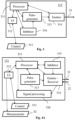
- a remote sensing set 1 compliant with the invention comprises an emission device 11 for emitting pulsed waves 21 towards one or more objects 2 on which measurements are intended to be carried out via a propagation medium 20, and a reception device 12 for receiving waves 22 transmitted by the object(s) 2 upon receiving the waves 21.
- the object 2 illustrated in a generic manner can notably consist in a solid object, airborne molecules or particles, a fluid such as for instance oil, living beings such as for instance schools of fish.
- the medium 20 can in particular consist in the atmosphere or the ocean.
- the waves 21 received by the object 2 generate waves 23 that can be notably reflected, backscattered or emitted by fluorescence.
- the waves 21, 22 and 23 can be of any type, and notably acoustic or electromagnetic - such as radio or light waves. Only a part, generally small, of the waves 23 reaches the reception device 12 as the waves 22.
- the devices 11 and 12 are represented side by side on Figure 1 , but can also be distant from each other. They are thus preferably connected by a remote wired or wireless communication system - for example via a 3G or LTE (for "Long Term Evolution") cell network, a cable transmission associated with local wireless transmissions of the WiFi type, or any other means.
- a remote wired or wireless communication system for example via a 3G or LTE (for "Long Term Evolution”) cell network, a cable transmission associated with local wireless transmissions of the WiFi type, or any other means.
- the emission device 11, noted 111 includes a pulse generator 313 and an emitter 314 receiving pulse signals from the generator 313, for example in electronic form, and emitting the waves 21 in function of those signals. It comprises also one or more processor(s) 311 connected to all the modules of the device 111 requiring control or command operations.
- One or more user interface(s) 312 (Ul), linked notably to the processor 311, allow a user to enter or obtain control or monitoring information 511.
- User interface means here as hereinbelow any appropriate means for entering of retrieving data, information and/or instructions, notably any visual, tactile and/or audio capacities that can encompass notably a screen, a keyboard, a trackball, a touchpad, a touchscreen, a loudspeaker, or a voice recognition system.
- the emission device 111 further comprises a pulse inhibitor 315, which can act on the emitter 314 so as to prevent the transmission of part of the pulse signals, notably according to determined inhibition periods.
- the reception device 12, noted 121 in the first embodiment, comprises as for it a receiver 324 of the waves 22, a spectral filter 325 enabling to select considered frequency ranges, and a signal processing unit 326, dedicated to processing the data from the filter 325.
- the device 121 also includes a processor 321 and a user interface 322, which allows users to manage control or monitoring information 521 and to obtain measurements results 52.
- the devices 111 and 121 are represented as separate entities, they are linked one to the other and can notably be embodied in a same apparatus.
- the processors 311 and 321 can be merged, as well as the user interfaces 312 and 322.
- a common interface can also be utilised in some cases for emitting and receiving waves, such as for example antennas, insofar as that interface is suitable for both types of operations.
- the respective interfaces are distinct.
- bistatic or multistatic radars or sonars are advantageously employed.
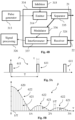
- the emission device differs from the preceding one in that it comprises a pulse inhibitor 316 configured for acting upstream of the emitter 314 on the pulse generator 313.
- the emission and reception operations are coupled via signal interference.
- That embodiment is particularly adapted to a lidar using optical heterodyne detection.
- That set 131 comprises like for the emission and reception devices of the first embodiment a processor 331 and a user interface 332, allowing to manage control or monitoring information 531 and to obtain measurement data 52 related to remote sensing. It also comprises the pulse generator 313, the inhibitor 315 (which is acting directly at the emission level in this embodiment) and the signal processing unit 326.
- the specificities of that second embodiment are due to the presence of an emitter-receiver 334 grouping the emission functions of the emitter 314 and the reception functions of receiver 324 and having a coherent detection.
- the waves generated by the emitter 314 on the basis of the pulse signals transmitted by the pulse generator 313 are subject to a partial extraction in addition to the emitted waves 21, by a separator 335.
- the latter communicates the waves to a modulator 336, which transforms the received signal in an appropriate way according to a process known by a person skilled in the art, typically by an offset to a determined frequency.
- the output from the modulator 336 and the signal captured by the receiver 324 are transmitted to an interferometer 337, which in the process indicated above generates a term oscillating around the offset frequency (heterodyne frequency).
- a heterodyne signal, carrying the useful information, can thus be extracted from the interferometer by electronic filtering in the neighbourhood of that frequency.
- the modulator 336 is absent,
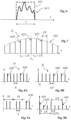
- a periodic rectangular pulse signal takes the form of a repeated gate function P, as visible on Figure 5A , which comprises rectangular units 611, each having a duration ⁇ , and being consecutively spaced one period T apart.
- P a repeated gate function
- the Fourier transform of such a function is given by a function P ⁇ (represented on Figure 5B ), centred on frequency 0 and comprising frequency peaks 621 consecutively spaced one pulse frequency 1/T apart.
- That envelope admits then a main lobe 620 decreasing in frequency down to zero at frequency 1/ ⁇ , followed by globally decreasing lobes 622, each of which covers a frequency range comprised between multiples of 1/ ⁇ and reaching zero at its ends.
- a high ratio of the pulse period T to the pulse duration ⁇ yields a higher number of significant frequency peaks (in the example represented on Figure 5B , that ratio is worth 10).
- the behaviour of the function P ⁇ is similar, in a whole frequency range centered on zero and sufficiently low with respect to 1/ ⁇ , to a sequence of unitary frequency pulses corresponding to instantaneous pulse signals.
- the periodically applied pulses are equated to instantaneous signals instead of gates ( Figure 8A ).
- the corresponding time function D (repeated Dirac distributions) is thus defined by a succession of peaks 630 spaced the pulse period T apart.
- the resulting Fourier transform ( Figure 8B ) is a function D ⁇ comprising an infinite sequence of frequency peaks 640 spaced the pulse frequency 1/T apart.
- the periodic repetition of peaks at the frequency 1/T excites not only the concerned frequency, but also all its multiple frequencies. That phenomena is attenuated more or less quickly in practice in the presence of gate functions, due to the amplitude decrease expressed by the cardinal sine.
- a first example of pulse inhibition illustrated on Figure 9A
- one pulse out of three is removed in the repetition of the peaks 630.
- the result in frequency terms given on Figure 9B , shows that the signal is transformed by the decrease of the peaks 641 located at frequencies multiple of 1/T and by the emergence of new frequency peaks 642.
- the latter are located at frequencies corresponding to a partition into three sections of the frequency ranges bounded by the multiples of the pulse frequency 1/T. More precisely, the peaks 641 reach 2/3 of the amplitude of the peaks of the function D, while the peaks 642 represent 1/3 of that value.
- the introduction of the inhibition pulses therefore leads to an internal spreading between the peaks distributed according to multiples of the pulse frequency 1/T.
- the capability to excite at the same time the pulse frequency and frequencies that are worth the third thereof or their multiples is remarkable as such.
- the loading frequency spectrum relies on the pulse repetition frequency, for example for fast pulses without intra-pulse modulation, it is thereby made possible by a unique wave emission towards an object to access simultaneously information that would normally require more complex implementations or successive measurements over time.
- a gain in measurement speed can then be obtained, regarding notably mobile objects or complex measurements.
- a high pulse repetition frequency is often desirable.
- the pulse inhibition method is then likely to allow in some cases to mitigate the disturbing effects of the pulses without undermining significantly the advantages of fast pulses. Indeed, it amounts to distributing the energy linked to high pulse frequency contents towards lower frequencies, presently down to three times lower in the illustrated example.
- a pulse inhibition is applied with a single period higher than 3T, of the type KxT with K being an integer greater than 3.
- a frequency spectrum is then obtained, in which the multiples of 1/T are weighted by a factor equal to (K-1)/K with respect to the reference signal D, and the other multiples of 1/(KT) are weighted by a factor 1/K.
- K thus leads to maintaining an all the higher relative weight at the pulse frequency 1/T while involving a larger number of frequencies, but at a relative level of presence in the spectrum that decreases in a sensibly hyperbolic way with K (the ratio of the two levels being worth 1/(K-1)).
- the frequency coverage is thus sensibly refined, by a factor of 35, while making possible a preservation of a high data acquisition pace and a good representation of the pulse frequency in the spectrum.
- the representation of the interspersed frequencies is however relatively weak, the highest relative level corresponding to a factor 1 ⁇ 4 with respect to the peaks associated with the multiples of the pulse frequencies.
- Figures 11A and 11B correspond to periods 3T and 5T, and lead to introducing frequency multiples of 1/(15T) in the spectrum, also according to four distinct levels but closer together than previously:
- the frequency pulse spectrum extends to the elementary frequency equal to the quotient of 1/T by Q 1 ⁇ Q 2 ⁇ Q 3 ⁇ ... ⁇ Q N , and to its multiples.
- the pairwise coprime factors therefore offer a wide range of adjustment possibilities, with effects on the emitted spectrum that are likely to be potentially well managed.
- the simplicity of the frequency level distribution formulas can indeed constitute a precious help in the choice of the parameters.
- the frequency pulse spectrum extends to the elementary frequency equal to the quotient of 1/T by the least common multiple of those factors, and to its multiples.
- the factors associated with the frequency peaks for the pulse inhibitions can be obtained in several manners. One of them consists in obtaining them numerically by Fourier transform.
- Another one consists in applying analytically a Fourier transform to the developments linked to the Dirac distribution sequences, by using the facts that the sum of the roots of unity is worth 0 and that a truncated sequence of Dirac distributions can be replaced with differences between the completed sequence and sequences corresponding to the truncation.
- a possible operation of the remote sensing set 1 comprises the following steps, illustrated on Figure 13 :
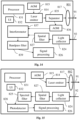
- a coherent detection lidar 801 represented on Figure 14 comprises, in addition to a processor 831 and a user interface 832 (the relations of which with the other elements are not reproduced on the figure), a pulse laser emitter 814, having a variable attenuator.
- the laser can consist for example in a neodymium-based power laser used at 1064 nm, but multiple other implementations remain within the scope of the present disclosure, including notably Rayleigh or Mie lidars, Raman, Fluorescence or Differential absorption lidars. Its average power is for example between 100 and 300 mW, and the emitted pulses have a pulse duration in the order of picoseconds with a pulse repetition frequency comprised between 100 kHz and 1 GHz.
- the obtained laser pulses deliver for example 10 to 50 mJ per pulse.
- Lasers allowing very short high power pulses are also judicious choices for implementing the described processes, including Q-switched or mode-locked lasers.
- the lidar 801 further comprises a separator 835 downstream of the emitter 814 and enabling to separate the emitted beam by reserving a part extracted from that beam to an acousto-optic modulator (AOM) or Bragg cell 836. That modulator 836 is able to apply a predefined frequency offset, allowing to perform an interferometry with received beams.
- Optics 817 are provided for shaping the main laser beam output from the separator 835, before an emission as waves 91.
- the lidar 801 also comprises a second AOM 815, provided for acting on the laser emitter 814 so as to exclude emissions corresponding to the multiples of the repetition frequency T that are predefined for the inhibition.
- Multiple means other than a Bragg cell can be employed for preventing the transmission corresponding to those inhibition periods, including mechanical means such as shutters, chopper wheels or rotating mirrors, or electro-optic or acousto-optic means such as a Pockels cell or a Kerr cell.
- the lidar 801 further comprises a light collector or collecting optics 824 provided for receiving light beams 92 output from the objects to be probed, followed by a spatial filter 827.
- a photodetector serving as an interferometer 837 is provided for collecting the signals output from the filter 827, together with those coming from the modulator 836 and representative of the emitted beams.
- a bandpass filter 839 is adapted to receive the signal output from the interferometer and to extract therefrom a heterodyne signal, communicated to a signal processing unit 826.
- lidar 802 with incoherent detection is represented on Figure 15 .
- it does not include an interferometry system (separator 835, AOM 836, interferometer 837, bandpass filter 839) but a spectral narrow-band filter 825 downstream of the spatial filter 827.
- a photodetector 828 is provided for receiving the obtained signal and transmitting the detection result to the signal processing unit 826.
- FIG. 16 Another application example of the present disclosure concerns a pulse multistatic radar 840, represented on Figure 16 . Further to a processor 841 and a user interface 842 (the relations of which with the other elements are not reproduced on the figure), it includes an emission block 85 and a reception block 86.
- Any frequency ranges can be concerned by the present disclosure, notably comprised between 1 and 100 GHz.
- the emission block 85 comprises a radio emitter 854 fed by a pulse generator 853 via an amplifier 857.
- the pulse generator 853 comprises a permanent oscillator 8531, such as for example a klystron, and a modulator 8532 of the signals emitted by that oscillator 8531.
- the modulator is for example a commutator of the thyratron type, but in some embodiments, its function is fulfilled by the oscillator 8531 itself, consisting in a klystron.
- the pulses produced by the pulse generator 853 have for example a duration in the order of 1 ⁇ s.
- An electronic control unit 856 allows to control the pulses produced by the generator 853, and notably to exclude the pulse inhibition periods.
- the emission block 85 also comprises a waveguide 858 provided for receiving the pulse signal output from the emitter 854 and for transmitting it to an antenna 859 for emitting waves 95 towards the objects to be probed.
- the reception block 86 includes an antenna 869 for receiving waves 96 from the objects to be probed, together with a radio receiver 864.
- the output of that receiver 864 is submitted to a filter 865 before being transmitted to a signal processing unit 866.
- FIG. 17 An additional implementation represented on Figure 17 regards a bistatic active sonar 870.
- the latter includes, further to a processor 871 and a user interface 872 (the relations of which with the other elements are not reproduced on the figure), an emission block 88 and a reception block 89.
- the sonar 870 enables emissions at frequencies comprised between 10 and 100 kHz.
- the emission block 88 comprises a sonar projector 880, adapted to generate pulse signals intended for an antenna 889 made up of hydrophones, for transmitting acoustic waves 98.
- the sonar projector 880 includes a signal generator 883 under the control of an electronic control unit 886. The latter is able to act on the projector 880 so as to prevent the transmission of pulse signals corresponding to the inhibition periods.
- the projector 880 also comprises successively, downstream from the signal generator 883, an amplifier 887, an electroacoustic transducer 888, for example piezoelectric or magnetostriction-based, and a beam generator 884. The latter is able to transmit the emission signals to the hydrophones 889.
- the reception block 89 includes hydrophones 899 able to receive the acoustic waves 99 received as echoes from objects to be probed, an analog-to-digital converter 894 required for exploiting the signals and a signal processing unit 896.
Landscapes
- Engineering & Computer Science (AREA)
- Physics & Mathematics (AREA)
- Radar, Positioning & Navigation (AREA)
- Remote Sensing (AREA)
- Computer Networks & Wireless Communication (AREA)
- General Physics & Mathematics (AREA)
- Electromagnetism (AREA)
- Acoustics & Sound (AREA)
- Optical Radar Systems And Details Thereof (AREA)
Claims (17)
- Emissionsvorrichtung zur Fernerkundung (11; 111; 112; 131; 801; 802; 85; 88), umfassend:- mindestens einen Impulsgenerator (313; 814; 853; 883, 887), der dazu ausgelegt ist, periodisch Impulssignale (611; 613; 630) in elementaren Zeitfenstern (τ) über einen repräsentativen Zeitbereich zu erzeugen, wobei die Zeitfenster nacheinander um eine Impulsperiode (T) voneinander beabstandet sind,- mindestens einen Wellenemitter (314; 334; 814; 854; 884), der dazu geeignet ist, Wellen (21; 91; 95; 98) in Richtung mindestens eines von der Emissionsvorrichtung entfernten Messobjekts (2) zu emittieren, um die Überwachung von Wellen (22; 92; 96; 99) mit einem Frequenzinhalt zu ermöglichen, die von dem mindestens einen Objekt beim Empfangen mindestens eines Teils der von der Vorrichtung emittierten Wellen übertragen werden, wobei der mindestens eine Emitter mit dem mindestens einen Impulsgenerator gekoppelt ist, so dass die emittierten Wellen den über den repräsentativen Zeitbereich erzeugten Impulssignalen entsprechen,- mindestens einen Prozessor (311), der zum Einstellen von Parametern geeignet ist, die zur Erzeugung von Messinformationen über das mindestens eine Messobjekt aus der Wellenüberwachung geeignet sind, basierend auf mindestens einem Teil des Frequenzinhalts,wobei die mindestens eine Impulsgenerator, mindestens ein Wellenemitter und mindestens ein Prozessor speziell angepasst sind, so dass die Impulsperiode zu dem mindestens einen Teil des Frequenzinhalts beiträgt, auf dem die Erzeugung der Messinformationen basiert,dadurch gekennzeichnet, dass die Emissionsvorrichtung mindestens ein Impulshemmungssystem (315; 316; 815; 856; 886) umfasst, das konfiguriert ist, um periodisch die Emission der Wellen durch die Emissionsvorrichtung gemäß mindestens einer Hemmungsperiode zu verhindern, die eine ganze Anzahl der Impulsperiode (T) ist und mindestens dem Dreifachen der Impulsperiode entspricht, wobei die mindestens eine Impulsgenerator, mindestens ein Wellenemitter und mindestens ein Prozessor speziell angepasst sind, so dass die mindestens eine Hemmungsperiode ebenfalls zu dem mindestens einen Teil des Frequenzinhalts beiträgt, auf dem die Erzeugung der Messinformationen basiert.
- Emissionsvorrichtung nach Anspruch 1, dadurch gekennzeichnet, dass das mindestens eine Hemmungssystem (315; 316; 815; 856; 886) so konfiguriert ist, dass die mindestens eine Hemmungsperiode mindestens zwei unterschiedliche Hemmungsperioden umfasst, wobei keine der unterschiedlichen Hemmungsperioden ein Vielfaches einer anderen der unterschiedlichen Hemmungsperioden ist.
- Emissionsvorrichtung nach Anspruch 2, dadurch gekennzeichnet, dass das mindestens eine Hemmungssystem (315; 316; 815; 856; 886) so konfiguriert ist, dass die unterschiedlichen Hemmungsperioden (5T, 7T; 3T, 5T) Verhältnisse in Bezug auf die Impulsperiode (T) aufweisen, die paarweise teilerfremd sind.
- Emissionsvorrichtung nach einem der vorhergehenden Ansprüche, dadurch gekennzeichnet, dass das mindestens eine Hemmungssystem (315; 316; 815; 856; 886) konfiguriert ist, um periodisch die Emission der Wellen (21; 91; 95; 98) durch die Emissionsvorrichtung für eines der Impulssignale aus der ganzen Anzahl, die jeder der mindestens eine Hemmungsperiode zugeordnet ist, zu verhindern.
- Emissionsvorrichtung nach einem der vorhergehenden Ansprüche, dadurch gekennzeichnet, dass die von der Emissionsvorrichtung emittierten Wellen (21; 91; 95; 98) über jedes der Impulssignale unmoduliert sind.
- Emissionsvorrichtung nach einem der vorhergehenden Ansprüche, dadurch gekennzeichnet, dass die elementaren Zeitfenster eine Impulsdauer (τ) aufweisen, wobei die Emissionsvorrichtung so konfiguriert ist, dass die von der Emissionsvorrichtung emittiert Wellen (21; 91; 95; 98) umfassen mindestens eine Modulation mit einer Frequenz (ν0), die höher ist als der Kehrwert der Impulsdauer (1/τ).
- Emissionsvorrichtung nach einem der vorhergehenden Ansprüche, dadurch gekennzeichnet, dass das mindestens eine Hemmungssystem (316; 856; 886) so angepasst ist, dass es mit dem Impulsgenerator (313; 814; 853; 883, 887) zusammenarbeitet, so dass die Impulssignale werden gemäß der mindestens einen Hemmungsperiode abgeschnitten.
- Emissionsvorrichtung nach einem der vorhergehenden Ansprüche, dadurch gekennzeichnet, dass das mindestens Hemmungssystem (315; 815) so angepasst ist, dass es mit dem Wellenemitter (314; 334; 814) zusammenarbeitet, so dass die Emission der Wellen durch den Emitter wird für die Wellen entsprechend der Hemmungsperiode inaktiviert.
- Empfangsset für die Fernerkundung (12; 121; 131; 801; 802; 86; 89), umfassend:- mindestens ein Empfänger (324; 334; 824; 864; 899) von Wellen mit einem Frequenzinhalt, die von mindestens einem Objekt (2), beim Empfang von Wellen (21; 91; 95; 98), die von mindestens einer Emissionsvorrichtung (11; 111; 112; 131; 801; 802; 85; 88) emittiertet werden, durch das Objekt, übertragen werden, wobei der Empfänger angepasst ist, um Signale zu erzeugen, die den empfangenen Wellen entsprechen,- mindestens eine Signalverarbeitungseinheit (326; 826; 866; 896), die mit dem mindestens einen Wellenempfänger gekoppelt ist, zum Empfangen und Verarbeiten der Signale konfiguriert ist, um Messinformationen (52) zu erzeugen, die sich auf das mindestens eine Objekt beziehen, basierend auf mindestens einen Teil des Frequenzinhalts,- mindestens ein System zur Frequenzbetrachtung (325; 335, 336, 337; 825; 835, 836, 837; 865; 894), gekoppelt mit mindestens einem der mindestens einem Empfänger und mindestens einer Verarbeitungseinheit, das konfiguriert ist, um Zumindest ein Teil des Frequenzinhalts der übertragenen Wellen zu berücksichtigen, um die Messinformationen zu erzeugen, wobei das Frequenzbetrachtungssystem angepasst ist, um eine Impulsperiode (T) der emittierten Wellen zu berücksichtigen, so dass die Impulsperiode zu den mindestens einen Teil des Frequenzinhalts, auf dem die Erzeugung der Messinformationen basiert, beiträgt,dadurch gekennzeichnet, dass das System zur Frequenzbetrachtung so konfiguriert ist, dass es mindestens eine Hemmungsperiode berücksichtigt, die eine ganze Anzahl der Impulsperiode (T) ist und mindestens dem Dreifachen der Impulsperiode entspricht, so dass die mindestens eine Hemmungsperiode auch zu dem mindestens einen Teil des Frequenzinhalts beiträgt, auf dem die Erzeugung der Messinformationen basiert.
- Empfangsset nach Anspruch 9, dadurch gekennzeichnet, dass das System zur Frequenzbetrachtung so konfiguriert ist, dass die mindestens eine Hemmungsperiode mindestens zwei unterschiedliche Hemmungsperioden umfasst, wobei keine der unterschiedlichen Hemmungsperioden ein Vielfaches einer anderen der unterschiedlichen Hemmungsperioden ist.
- Empfangsset nach Anspruch 9 oder 10, dadurch gekennzeichnet, dass der Empfangsset an die Wellen angepasst ist, die von dem mindestens einem Objekt (2) übertragen werden, wenn mindestens ein Teil der Wellen (21; 91; 95; 98) empfangen wird, die von der mindestens einen Emissionsvorrichtung (11; 111; 112; 131; 801; 802; 85; 88) emittiert werden, wobei die mindestens eine Emissionsvorrichtung einem der Ansprüche 3 bis 6 entspricht.
- Fernerkundungsset (334; 801), dadurch gekennzeichnet, dass es mindestens eine Emissionsvorrichtung nach einem der Ansprüche 1 bis 8, mindestens ein Empfangsset nach einem der Ansprüche 9 bis 11 und mindestens ein System (335, 336, 337; 835, 836, 837) zum Koppeln der von dem mindestens einen Empfänger empfangenen Wellen (22; 92) mit mindestens einem Teil der von dem Emitter emittierten Wellen (21; 91) umfasst, um zu erzeugen Interferenzen zwischen den Wellen, wobei die Signalverarbeitungseinheit (326; 826) des Empfangssets angepasst ist, um die Interferenzen zum Erzeugen der Messinformationen (52) basierend auf dem mindestens einen Teil des Frequenzinhalts auszunutzen.
- Fernerkundungsvorrichtung, dadurch gekennzeichnet, dass sie mindestens eine der Emissionsvorrichtungen nach einem der Ansprüche 1 bis 8, ein Empfangsset nach einem der Ansprüche 9 bis 11 und einen Fernerkundungsset nach Anspruch 12 umfasst, und dass die Vorrichtung aus einem Lidar (801; 802), einem Radar (840), einem aktiven Sonar (870) und einem Ultraschallinstrument ausgewählt ist.
- Emissionsprozess zur Fernerkundung, einschließlich:- periodisches Erzeugen von Impulssignalen (611; 613; 630) in elementaren Zeitfernstern (τ) über einen repräsentativen Zeitbereich, wobei die Zeitfernstern nacheinander um eine Impulsperiode (T) voneinander beabstandet sind,- Aussenden von Wellen (21; 91; 95; 98) entsprechend den über den repräsentativen Zeitbereich erzeugten Impulssignalen in Richtung mindestens eines entfernten Messobjekts (2), um die Überwachung von Wellen (22; 92; 96; 99) mit einem Frequenzinhalt, die von dem mindestens einen Objekt beim Empfang mindestens eines Teils der emittierten Wellen übertragen werden, zu ermöglichen,- Einstellen von Parametern, die zur Erzeugung von Messinformationen über das mindestens eine Messobjekt aus der Wellenüberwachung geeignet sind, basierend auf mindestens einem Teil des Frequenzinhalts,wobei die Impulssignale, Wellen und Parameter speziell angepasst werden, so dass die Impulsperiode zu dem mindestens einen Teil des Frequenzinhalts beiträgt, auf dem die Erzeugung der Messinformationen basiert,dadurch gekennzeichnet, dass der Prozess das periodische Verhindern der Emission der Wellen gemäß mindestens einer Hemmungsperiode (3T, 4T, 5T, 6T, 7T) umfasst, die eine ganze Anzahl der Impulsperiode (T) ist und mindestens dem Dreifachen der Impulsperiode entspricht, wobei die Impulssignale, Wellen und Parameter speziell angepasst werden, so dass die mindestens eine Hemmungsperiode auch zu dem mindestens einen Teil des Frequenzinhalts beiträgt, auf dem die Erzeugung der Messinformationen basiert,wobei der Emissionsprozess vorteilhafterweise von einer Emissionsvorrichtung nach einem der Ansprüche 1 bis 8 ausgeführt wird.
- Empfangsprozess zur Fernerkundung, einschließlich:- Empfangen von Wellen mit einem Frequenzinhalt, die von mindestens einem Objekt (2), beim Empfang von Wellen (21; 91; 95; 98), die von mindestens einer Emissionsvorrichtung (11; 111; 112; 131; 801; 802; 85; 88) emittierten werden, durch das Objekt, übertragen werden,- Erzeugen von Signalen, die den empfangenen Wellen entsprechen,- Empfangen und Verarbeiten der Signale, um Messinformation (52) zu erzeugen, die sich auf das mindestens eine Objekt beziehen, basierend auf mindestens einem Teil des Frequenzinhalts,wobei der Prozess derart ist, dass zum Erzeugen der Messinformationen eine Impulsperiode (T) der emittierten Wellen berücksichtigt wird, so dass die Impulsperiode zu dem mindestens einen Teil des Frequenzinhalts beiträgt, auf dem das Erzeugen der Messinformationen basiert,dadurch gekennzeichnet, dass der Prozess die Berücksichtigung umfasst, dass mindestens eine Hemmungsperiode eine ganze Anzahl der Impulsperiode (T) ist und mindestens dem Dreifachen der Impulsperiode entspricht, so dass die mindestens eine Hemmungsperiode auch zu dem mindestens einen Teil des Frequenzinhalts beiträgt, auf dem die Erzeugung der Messinformationen basiert,wobei der Empfangsprozess vorteilhafterweise von einem Empfangsset nach einem der Ansprüche 9 bis 11 ausgeführt wird.
- Computerprogramm, umfassend einen Softwarecode, der angepasst ist, um die Schritte zum Einstellen von Parametern und zum periodischen Verhindern der Emission von Wellen in einem Emissionsprozess zur Fernerkundung nach Anspruch 14 durchzuführen, oder um dem Schritt des Verarbeitens von Signalen durchzuführen, um Messinformationen in einen Empfangsprozess zur Fernerkundung nach Anspruch 15 zu erzeugen, wenn das Computerprogramm von einem Prozessor ausgeführt wird.
- Signal (22; 92; 96; 99) mit einem Frequenzinhalt, das aus Wechselwirkungen zwischen einem Messobjekt (2) und Wellen (21; 91; 95; 98), die von dem Messobjekt empfangen werden, resultiert, wobei das Signal zur Erzeugung von Messinformationen über das Messobjekt basierend auf mindestens einem Teil des Frequenzinhalts geeignet ist, wobei die empfangenen Wellen Impulssignalen (611; 613; 630) entsprechen, die periodisch in elementaren Zeitfernstern (τ), die nacheinander um eine Impulsperiode (T) voneinander beabstandet sind, erzeugt werden, wobei die Impulsperiode zu dem mindestens einen Teil des Frequenzinhalts beiträgt,dadurch gekennzeichnet, dass das Signal aus den Wechselwirkungen zwischen dem Messobjekt und den empfangenen Wellen resultiert, die durch Wellenhemmung gemäß mindestens einer Hemmungsperiode beeinflusst werden, wobei die mindestens eine Hemmungsperiode eine ganze Anzahl der Impulsperiode (T) ist und mindestens dem Dreifachen der Impulsperiode entspricht, und auch zu dem mindestens einen Teil des Frequenzinhalts beiträgt,wobei das Signal aus den Wechselwirkungen zwischen dem Messobjekt (2) und den Wellen erhalten wird, die von einer Emissionsvorrichtung nach einem der Ansprüche 1 bis 6 oder von einer Fernerkundungsvorrichtung (801; 802; 840; 870) nach Anspruch 13 erzeugt werden.
Applications Claiming Priority (2)
| Application Number | Priority Date | Filing Date | Title |
|---|---|---|---|
| FR1570033 | 2015-09-03 | ||
| PCT/EP2016/025094 WO2017059961A1 (en) | 2015-09-03 | 2016-09-01 | Remote sensing by periodically inhibited pulse signals |
Publications (3)
| Publication Number | Publication Date |
|---|---|
| EP3345016A1 EP3345016A1 (de) | 2018-07-11 |
| EP3345016B1 true EP3345016B1 (de) | 2023-12-27 |
| EP3345016C0 EP3345016C0 (de) | 2023-12-27 |
Family
ID=55361863
Family Applications (1)
| Application Number | Title | Priority Date | Filing Date |
|---|---|---|---|
| EP16763200.9A Active EP3345016B1 (de) | 2015-09-03 | 2016-09-01 | Fernmessung durch periodisch inhibierte pulssignale |
Country Status (3)
| Country | Link |
|---|---|
| US (1) | US10823832B2 (de) |
| EP (1) | EP3345016B1 (de) |
| WO (1) | WO2017059961A1 (de) |
Families Citing this family (15)
| Publication number | Priority date | Publication date | Assignee | Title |
|---|---|---|---|---|
| US10261179B2 (en) | 2016-04-07 | 2019-04-16 | Uhnder, Inc. | Software defined automotive radar |
| US9846228B2 (en) | 2016-04-07 | 2017-12-19 | Uhnder, Inc. | Software defined automotive radar systems |
| US9772397B1 (en) | 2016-04-25 | 2017-09-26 | Uhnder, Inc. | PMCW-PMCW interference mitigation |
| US9753121B1 (en) * | 2016-06-20 | 2017-09-05 | Uhnder, Inc. | Power control for improved near-far performance of radar systems |
| US11454697B2 (en) | 2017-02-10 | 2022-09-27 | Uhnder, Inc. | Increasing performance of a receive pipeline of a radar with memory optimization |
| WO2018146530A1 (en) | 2017-02-10 | 2018-08-16 | Uhnder, Inc. | Reduced complexity fft-based correlation for automotive radar |
| US9971020B1 (en) | 2017-02-10 | 2018-05-15 | Uhnder, Inc. | Radar data buffering |
| DE102017222043A1 (de) | 2017-12-06 | 2019-06-06 | Osram Gmbh | Verfahren zum betreiben einer sensoranordnung mit mindestens zwei lidar-sensoren und sensoranordnung |
| US11105890B2 (en) | 2017-12-14 | 2021-08-31 | Uhnder, Inc. | Frequency modulated signal cancellation in variable power mode for radar applications |
| US11474225B2 (en) | 2018-11-09 | 2022-10-18 | Uhnder, Inc. | Pulse digital mimo radar system |
| US11681017B2 (en) | 2019-03-12 | 2023-06-20 | Uhnder, Inc. | Method and apparatus for mitigation of low frequency noise in radar systems |
| US11953615B2 (en) | 2020-01-13 | 2024-04-09 | Uhnder Inc. | Method and system for antenna array calibration for cross-coupling and gain/phase variations in radar systems |
| CN111766597B (zh) * | 2020-07-08 | 2022-05-13 | 哈尔滨理工大学 | 调频连续波激光测距差拍信号测频方法及装置 |
| WO2023100108A1 (en) | 2021-12-02 | 2023-06-08 | Uhnder, Inc. | Radar system with enhanced processing for increased contrast ratio, improved angular separability and elimination of ghost targets |
| WO2023162057A1 (ja) * | 2022-02-24 | 2023-08-31 | 三菱電機株式会社 | レーダシステム |
Family Cites Families (11)
| Publication number | Priority date | Publication date | Assignee | Title |
|---|---|---|---|---|
| US3631490A (en) * | 1969-03-17 | 1971-12-28 | Sperry Rand Corp | Signal processor for reducing clutter and eliminating range ambiguities in target detection systems |
| US4721958A (en) * | 1985-10-23 | 1988-01-26 | Trw Inc. | Real-time pulse processor |
| US4931800A (en) * | 1989-05-12 | 1990-06-05 | Raytheon Company | Stagger compensated moving target detector |
| US6556621B1 (en) * | 2000-03-29 | 2003-04-29 | Time Domain Corporation | System for fast lock and acquisition of ultra-wideband signals |
| US7145954B1 (en) * | 2000-06-12 | 2006-12-05 | Time Domain Corporation | Method and apparatus for mapping pulses to a non-fixed layout |
| US6717992B2 (en) * | 2001-06-13 | 2004-04-06 | Time Domain Corporation | Method and apparatus for receiving a plurality of time spaced signals |
| US7436876B2 (en) * | 2002-11-15 | 2008-10-14 | Time Domain Corporation | System and method for fast acquisition of ultra wideband signals |
| FR2848675B1 (fr) * | 2002-12-17 | 2005-05-06 | Thales Sa | Procede de mesure de frequence doppler par emission de trains d'impulsions lacunaires |
| US7315280B2 (en) * | 2004-05-25 | 2008-01-01 | Bae Systems Information And Electronics Systems Integration Inc. | Coherent geolocation system |
| US9268194B2 (en) | 2006-10-02 | 2016-02-23 | PM & AM Research | Method and technique to control laser effects through tuning of parameters such as repetition rate |
| ITPD20130190A1 (it) | 2013-07-05 | 2015-01-06 | Istituto Naz Di Fisica Nuclea Re | Metodo e sistema per caratterizzare impulsi laser brevi e ultrabrevi emessi ad elevata frequenza di ripetizione |
-
2016
- 2016-09-01 EP EP16763200.9A patent/EP3345016B1/de active Active
- 2016-09-01 WO PCT/EP2016/025094 patent/WO2017059961A1/en not_active Ceased
- 2016-09-01 US US15/755,742 patent/US10823832B2/en active Active
Non-Patent Citations (1)
| Title |
|---|
| None * |
Also Published As
| Publication number | Publication date |
|---|---|
| US10823832B2 (en) | 2020-11-03 |
| US20180239009A1 (en) | 2018-08-23 |
| WO2017059961A1 (en) | 2017-04-13 |
| EP3345016A1 (de) | 2018-07-11 |
| EP3345016C0 (de) | 2023-12-27 |
Similar Documents
| Publication | Publication Date | Title |
|---|---|---|
| EP3345016B1 (de) | Fernmessung durch periodisch inhibierte pulssignale | |
| US11125879B2 (en) | Method for processing a signal arising from coherent lidar and associated lidar system | |
| US10670720B2 (en) | Method and system for using square wave digital chirp signal for optical chirped range detection | |
| CA2570428C (en) | Passive distance measurement using spectral phase gradients | |
| US11500062B2 (en) | Acceleration-based fast SOI processing | |
| US11243307B2 (en) | Method for processing a signal from a coherent lidar in order to reduce noise and related lidar system | |
| US10527717B2 (en) | Binary phase shift keying (BPSK) on orthogonal carriers for multi-channel IM-CW CO2 absorption or Lidar/Radar/Sonar mapping applications | |
| CN104215959A (zh) | 一种多机动目标径向初速度和径向加速度的估计方法 | |
| Illig et al. | FMCW optical ranging technique in turbid waters | |
| CN104111450B (zh) | 一种利用双脉冲探测目标微多普勒特征的方法及系统 | |
| Zhu et al. | High anti-interference 3D imaging LIDAR system based on digital chaotic pulse position modulation | |
| CN108398691B (zh) | 一种差频信号产生装置及方法 | |
| CN208488545U (zh) | 一种差频信号产生装置及系统 | |
| Chester | A Parameterized Simulation of Doppler Lidar | |
| RU2621319C1 (ru) | Способ и устройство измерения дальности в двухчастотном нелинейном радиолокаторе | |
| Cai et al. | The laser linewidth effect on the image quality of phase coded synthetic aperture ladar | |
| Totems et al. | Advanced signal processing methods for pulsed laser vibrometry | |
| RU2533198C1 (ru) | Способ управления величиной разрешающей способности радиолокационной станции | |
| RU2807316C1 (ru) | Способ определения параметров движения высокоскоростного воздушного объекта | |
| RU2755518C1 (ru) | Радиолокационная станция | |
| RU2535302C1 (ru) | Система ближней локации для обнаружения объектов | |
| Mullen et al. | Full scale hybrid lidar-radar system | |
| CN121578329A (zh) | 一种高空间分辨率测风激光雷达装置 | |
| CN117782522A (zh) | 动态消光比的测试装置和方法 | |
| Flanegan | Frequency modulation spectroscopy techniques for detection of water vapor on Mars |
Legal Events
| Date | Code | Title | Description |
|---|---|---|---|
| STAA | Information on the status of an ep patent application or granted ep patent |
Free format text: STATUS: THE INTERNATIONAL PUBLICATION HAS BEEN MADE |
|
| PUAI | Public reference made under article 153(3) epc to a published international application that has entered the european phase |
Free format text: ORIGINAL CODE: 0009012 |
|
| STAA | Information on the status of an ep patent application or granted ep patent |
Free format text: STATUS: REQUEST FOR EXAMINATION WAS MADE |
|
| 17P | Request for examination filed |
Effective date: 20180322 |
|
| AK | Designated contracting states |
Kind code of ref document: A1 Designated state(s): AL AT BE BG CH CY CZ DE DK EE ES FI FR GB GR HR HU IE IS IT LI LT LU LV MC MK MT NL NO PL PT RO RS SE SI SK SM TR |
|
| AX | Request for extension of the european patent |
Extension state: BA ME |
|
| DAV | Request for validation of the european patent (deleted) | ||
| DAX | Request for extension of the european patent (deleted) | ||
| STAA | Information on the status of an ep patent application or granted ep patent |
Free format text: STATUS: EXAMINATION IS IN PROGRESS |
|
| 17Q | First examination report despatched |
Effective date: 20200220 |
|
| GRAP | Despatch of communication of intention to grant a patent |
Free format text: ORIGINAL CODE: EPIDOSNIGR1 |
|
| STAA | Information on the status of an ep patent application or granted ep patent |
Free format text: STATUS: GRANT OF PATENT IS INTENDED |
|
| INTG | Intention to grant announced |
Effective date: 20201016 |
|
| GRAJ | Information related to disapproval of communication of intention to grant by the applicant or resumption of examination proceedings by the epo deleted |
Free format text: ORIGINAL CODE: EPIDOSDIGR1 |
|
| STAA | Information on the status of an ep patent application or granted ep patent |
Free format text: STATUS: EXAMINATION IS IN PROGRESS |
|
| GRAP | Despatch of communication of intention to grant a patent |
Free format text: ORIGINAL CODE: EPIDOSNIGR1 |
|
| STAA | Information on the status of an ep patent application or granted ep patent |
Free format text: STATUS: GRANT OF PATENT IS INTENDED |
|
| INTC | Intention to grant announced (deleted) | ||
| INTG | Intention to grant announced |
Effective date: 20210311 |
|
| GRAS | Grant fee paid |
Free format text: ORIGINAL CODE: EPIDOSNIGR3 |
|
| GRAA | (expected) grant |
Free format text: ORIGINAL CODE: 0009210 |
|
| STAA | Information on the status of an ep patent application or granted ep patent |
Free format text: STATUS: THE PATENT HAS BEEN GRANTED |
|
| AK | Designated contracting states |
Kind code of ref document: B1 Designated state(s): AL AT BE BG CH CY CZ DE DK EE ES FI FR GB GR HR HU IE IS IT LI LT LU LV MC MK MT NL NO PL PT RO RS SE SI SK SM TR |
|
| REG | Reference to a national code |
Ref country code: GB Ref legal event code: FG4D |
|
| REG | Reference to a national code |
Ref country code: AT Ref legal event code: REF Ref document number: 1452302 Country of ref document: AT Kind code of ref document: T Effective date: 20211215 Ref country code: CH Ref legal event code: EP |
|
| APBM | Appeal reference recorded |
Free format text: ORIGINAL CODE: EPIDOSNREFNO |
|
| REG | Reference to a national code |
Ref country code: IE Ref legal event code: FG4D |
|
| REG | Reference to a national code |
Ref country code: DE Ref legal event code: R096 Ref document number: 602016066828 Country of ref document: DE |
|
| PUAC | Information related to the publication of a b1 document modified or deleted |
Free format text: ORIGINAL CODE: 0009299EPPU |
|
| STAA | Information on the status of an ep patent application or granted ep patent |
Free format text: STATUS: GRANT OF PATENT IS INTENDED |
|
| REG | Reference to a national code |
Ref country code: CH Ref legal event code: PK Free format text: DIE ERTEILUNG WURDE VOM EPA WIDERRUFEN. |
|
| DB1 | Publication of patent cancelled |
Effective date: 20211224 |
|
| REG | Reference to a national code |
Ref country code: DE Ref legal event code: R107 Ref document number: 602016066828 Country of ref document: DE |
|
| REG | Reference to a national code |
Ref country code: AT Ref legal event code: REZ Ref document number: 1452302 Country of ref document: AT Kind code of ref document: T Effective date: 20211201 |
|
| APAF | Appeal reference modified |
Free format text: ORIGINAL CODE: EPIDOSCREFNE |
|
| APBX | Invitation to file observations in appeal sent |
Free format text: ORIGINAL CODE: EPIDOSNOBA2E |
|
| APBZ | Receipt of observations in appeal recorded |
Free format text: ORIGINAL CODE: EPIDOSNOBA4E |
|
| GBPC | Gb: european patent ceased through non-payment of renewal fee |
Effective date: 20220901 |
|
| GRAJ | Information related to disapproval of communication of intention to grant by the applicant or resumption of examination proceedings by the epo deleted |
Free format text: ORIGINAL CODE: EPIDOSDIGR1 |
|
| GRAP | Despatch of communication of intention to grant a patent |
Free format text: ORIGINAL CODE: EPIDOSNIGR1 |
|
| INTG | Intention to grant announced |
Effective date: 20230714 |
|
| GRAS | Grant fee paid |
Free format text: ORIGINAL CODE: EPIDOSNIGR3 |
|
| GRAA | (expected) grant |
Free format text: ORIGINAL CODE: 0009210 |
|
| STAA | Information on the status of an ep patent application or granted ep patent |
Free format text: STATUS: THE PATENT HAS BEEN GRANTED |
|
| AK | Designated contracting states |
Kind code of ref document: B1 Designated state(s): AL AT BE BG CH CY CZ DE DK EE ES FI FR GB GR HR HU IE IS IT LI LT LU LV MC MK MT NL NO PL PT RO RS SE SI SK SM TR |
|
| REG | Reference to a national code |
Ref country code: CH Ref legal event code: EP |
|
| REG | Reference to a national code |
Ref country code: DE Ref legal event code: R096 Ref document number: 602016066828 Country of ref document: DE |
|
| U01 | Request for unitary effect filed |
Effective date: 20231227 |
|
| REG | Reference to a national code |
Ref country code: NO Ref legal event code: T2 Effective date: 20231227 |
|
| U07 | Unitary effect registered |
Designated state(s): AT BE BG DE DK EE FI FR IT LT LU LV MT NL PT SE SI Effective date: 20240108 |
|
| PG25 | Lapsed in a contracting state [announced via postgrant information from national office to epo] |
Ref country code: ES Free format text: LAPSE BECAUSE OF FAILURE TO SUBMIT A TRANSLATION OF THE DESCRIPTION OR TO PAY THE FEE WITHIN THE PRESCRIBED TIME-LIMIT Effective date: 20231227 |
|
| PG25 | Lapsed in a contracting state [announced via postgrant information from national office to epo] |
Ref country code: ES Free format text: LAPSE BECAUSE OF FAILURE TO SUBMIT A TRANSLATION OF THE DESCRIPTION OR TO PAY THE FEE WITHIN THE PRESCRIBED TIME-LIMIT Effective date: 20231227 |
|
| PG25 | Lapsed in a contracting state [announced via postgrant information from national office to epo] |
Ref country code: RS Free format text: LAPSE BECAUSE OF FAILURE TO SUBMIT A TRANSLATION OF THE DESCRIPTION OR TO PAY THE FEE WITHIN THE PRESCRIBED TIME-LIMIT Effective date: 20231227 Ref country code: HR Free format text: LAPSE BECAUSE OF FAILURE TO SUBMIT A TRANSLATION OF THE DESCRIPTION OR TO PAY THE FEE WITHIN THE PRESCRIBED TIME-LIMIT Effective date: 20231227 |
|
| PG25 | Lapsed in a contracting state [announced via postgrant information from national office to epo] |
Ref country code: CZ Free format text: LAPSE BECAUSE OF FAILURE TO SUBMIT A TRANSLATION OF THE DESCRIPTION OR TO PAY THE FEE WITHIN THE PRESCRIBED TIME-LIMIT Effective date: 20231227 |
|
| PG25 | Lapsed in a contracting state [announced via postgrant information from national office to epo] |
Ref country code: SK Free format text: LAPSE BECAUSE OF FAILURE TO SUBMIT A TRANSLATION OF THE DESCRIPTION OR TO PAY THE FEE WITHIN THE PRESCRIBED TIME-LIMIT Effective date: 20231227 |
|
| PG25 | Lapsed in a contracting state [announced via postgrant information from national office to epo] |
Ref country code: SM Free format text: LAPSE BECAUSE OF FAILURE TO SUBMIT A TRANSLATION OF THE DESCRIPTION OR TO PAY THE FEE WITHIN THE PRESCRIBED TIME-LIMIT Effective date: 20231227 Ref country code: SK Free format text: LAPSE BECAUSE OF FAILURE TO SUBMIT A TRANSLATION OF THE DESCRIPTION OR TO PAY THE FEE WITHIN THE PRESCRIBED TIME-LIMIT Effective date: 20231227 Ref country code: RO Free format text: LAPSE BECAUSE OF FAILURE TO SUBMIT A TRANSLATION OF THE DESCRIPTION OR TO PAY THE FEE WITHIN THE PRESCRIBED TIME-LIMIT Effective date: 20231227 Ref country code: CZ Free format text: LAPSE BECAUSE OF FAILURE TO SUBMIT A TRANSLATION OF THE DESCRIPTION OR TO PAY THE FEE WITHIN THE PRESCRIBED TIME-LIMIT Effective date: 20231227 |
|
| PG25 | Lapsed in a contracting state [announced via postgrant information from national office to epo] |
Ref country code: PL Free format text: LAPSE BECAUSE OF FAILURE TO SUBMIT A TRANSLATION OF THE DESCRIPTION OR TO PAY THE FEE WITHIN THE PRESCRIBED TIME-LIMIT Effective date: 20231227 |
|
| PG25 | Lapsed in a contracting state [announced via postgrant information from national office to epo] |
Ref country code: PL Free format text: LAPSE BECAUSE OF FAILURE TO SUBMIT A TRANSLATION OF THE DESCRIPTION OR TO PAY THE FEE WITHIN THE PRESCRIBED TIME-LIMIT Effective date: 20231227 |
|
| REG | Reference to a national code |
Ref country code: DE Ref legal event code: R097 Ref document number: 602016066828 Country of ref document: DE |
|
| U20 | Renewal fee for the european patent with unitary effect paid |
Year of fee payment: 9 Effective date: 20240906 |
|
| PLBE | No opposition filed within time limit |
Free format text: ORIGINAL CODE: 0009261 |
|
| STAA | Information on the status of an ep patent application or granted ep patent |
Free format text: STATUS: NO OPPOSITION FILED WITHIN TIME LIMIT |
|
| 26N | No opposition filed |
Effective date: 20240930 |
|
| U20 | Renewal fee for the european patent with unitary effect paid |
Year of fee payment: 10 Effective date: 20250807 |
|
| REG | Reference to a national code |
Ref country code: CH Ref legal event code: U11 Free format text: ST27 STATUS EVENT CODE: U-0-0-U10-U11 (AS PROVIDED BY THE NATIONAL OFFICE) Effective date: 20251001 |
|
| PGFP | Annual fee paid to national office [announced via postgrant information from national office to epo] |
Ref country code: MC Payment date: 20250814 Year of fee payment: 10 Ref country code: NO Payment date: 20250818 Year of fee payment: 10 |
|
| PGFP | Annual fee paid to national office [announced via postgrant information from national office to epo] |
Ref country code: GB Payment date: 20250815 Year of fee payment: 10 |
|
| PGFP | Annual fee paid to national office [announced via postgrant information from national office to epo] |
Ref country code: IE Payment date: 20250815 Year of fee payment: 10 |
|
| PGFP | Annual fee paid to national office [announced via postgrant information from national office to epo] |
Ref country code: CH Payment date: 20251001 Year of fee payment: 10 |
|
| PG25 | Lapsed in a contracting state [announced via postgrant information from national office to epo] |
Ref country code: CY Free format text: LAPSE BECAUSE OF FAILURE TO SUBMIT A TRANSLATION OF THE DESCRIPTION OR TO PAY THE FEE WITHIN THE PRESCRIBED TIME-LIMIT; INVALID AB INITIO Effective date: 20160901 |
|
| PG25 | Lapsed in a contracting state [announced via postgrant information from national office to epo] |
Ref country code: HU Free format text: LAPSE BECAUSE OF FAILURE TO SUBMIT A TRANSLATION OF THE DESCRIPTION OR TO PAY THE FEE WITHIN THE PRESCRIBED TIME-LIMIT; INVALID AB INITIO Effective date: 20160901 |