EP3345945B1 - Monomère modifié, polymère à base de diènes conjugué modifié le comprenant et procédé de préparation associé - Google Patents
Monomère modifié, polymère à base de diènes conjugué modifié le comprenant et procédé de préparation associé Download PDFInfo
- Publication number
- EP3345945B1 EP3345945B1 EP17844647.2A EP17844647A EP3345945B1 EP 3345945 B1 EP3345945 B1 EP 3345945B1 EP 17844647 A EP17844647 A EP 17844647A EP 3345945 B1 EP3345945 B1 EP 3345945B1
- Authority
- EP
- European Patent Office
- Prior art keywords
- conjugated diene
- carbon atoms
- modified conjugated
- monomer
- based polymer
- Prior art date
- Legal status (The legal status is an assumption and is not a legal conclusion. Google has not performed a legal analysis and makes no representation as to the accuracy of the status listed.)
- Active
Links
Classifications
-
- C—CHEMISTRY; METALLURGY
- C07—ORGANIC CHEMISTRY
- C07C—ACYCLIC OR CARBOCYCLIC COMPOUNDS
- C07C211/00—Compounds containing amino groups bound to a carbon skeleton
- C07C211/01—Compounds containing amino groups bound to a carbon skeleton having amino groups bound to acyclic carbon atoms
- C07C211/20—Compounds containing amino groups bound to a carbon skeleton having amino groups bound to acyclic carbon atoms of an acyclic unsaturated carbon skeleton
- C07C211/22—Compounds containing amino groups bound to a carbon skeleton having amino groups bound to acyclic carbon atoms of an acyclic unsaturated carbon skeleton containing at least two amino groups bound to the carbon skeleton
-
- C—CHEMISTRY; METALLURGY
- C07—ORGANIC CHEMISTRY
- C07F—ACYCLIC, CARBOCYCLIC OR HETEROCYCLIC COMPOUNDS CONTAINING ELEMENTS OTHER THAN CARBON, HYDROGEN, HALOGEN, OXYGEN, NITROGEN, SULFUR, SELENIUM OR TELLURIUM
- C07F7/00—Compounds containing elements of Groups 4 or 14 of the Periodic Table
- C07F7/02—Silicon compounds
- C07F7/08—Compounds having one or more C—Si linkages
- C07F7/18—Compounds having one or more C—Si linkages as well as one or more C—O—Si linkages
- C07F7/1804—Compounds having Si-O-C linkages
-
- C—CHEMISTRY; METALLURGY
- C08—ORGANIC MACROMOLECULAR COMPOUNDS; THEIR PREPARATION OR CHEMICAL WORKING-UP; COMPOSITIONS BASED THEREON
- C08C—TREATMENT OR CHEMICAL MODIFICATION OF RUBBERS
- C08C19/00—Chemical modification of rubber
- C08C19/22—Incorporating nitrogen atoms into the molecule
-
- C—CHEMISTRY; METALLURGY
- C08—ORGANIC MACROMOLECULAR COMPOUNDS; THEIR PREPARATION OR CHEMICAL WORKING-UP; COMPOSITIONS BASED THEREON
- C08C—TREATMENT OR CHEMICAL MODIFICATION OF RUBBERS
- C08C19/00—Chemical modification of rubber
- C08C19/25—Incorporating silicon atoms into the molecule
-
- C—CHEMISTRY; METALLURGY
- C08—ORGANIC MACROMOLECULAR COMPOUNDS; THEIR PREPARATION OR CHEMICAL WORKING-UP; COMPOSITIONS BASED THEREON
- C08C—TREATMENT OR CHEMICAL MODIFICATION OF RUBBERS
- C08C19/00—Chemical modification of rubber
- C08C19/28—Reaction with compounds containing carbon-to-carbon unsaturated bonds
-
- C—CHEMISTRY; METALLURGY
- C08—ORGANIC MACROMOLECULAR COMPOUNDS; THEIR PREPARATION OR CHEMICAL WORKING-UP; COMPOSITIONS BASED THEREON
- C08C—TREATMENT OR CHEMICAL MODIFICATION OF RUBBERS
- C08C19/00—Chemical modification of rubber
- C08C19/30—Addition of a reagent which reacts with a hetero atom or a group containing hetero atoms of the macromolecule
- C08C19/42—Addition of a reagent which reacts with a hetero atom or a group containing hetero atoms of the macromolecule reacting with metals or metal-containing groups
- C08C19/44—Addition of a reagent which reacts with a hetero atom or a group containing hetero atoms of the macromolecule reacting with metals or metal-containing groups of polymers containing metal atoms exclusively at one or both ends of the skeleton
-
- C—CHEMISTRY; METALLURGY
- C08—ORGANIC MACROMOLECULAR COMPOUNDS; THEIR PREPARATION OR CHEMICAL WORKING-UP; COMPOSITIONS BASED THEREON
- C08F—MACROMOLECULAR COMPOUNDS OBTAINED BY REACTIONS ONLY INVOLVING CARBON-TO-CARBON UNSATURATED BONDS
- C08F236/00—Copolymers of compounds having one or more unsaturated aliphatic radicals, at least one having two or more carbon-to-carbon double bonds
- C08F236/02—Copolymers of compounds having one or more unsaturated aliphatic radicals, at least one having two or more carbon-to-carbon double bonds the radical having only two carbon-to-carbon double bonds
- C08F236/04—Copolymers of compounds having one or more unsaturated aliphatic radicals, at least one having two or more carbon-to-carbon double bonds the radical having only two carbon-to-carbon double bonds conjugated
- C08F236/10—Copolymers of compounds having one or more unsaturated aliphatic radicals, at least one having two or more carbon-to-carbon double bonds the radical having only two carbon-to-carbon double bonds conjugated with vinyl-aromatic monomers
-
- C—CHEMISTRY; METALLURGY
- C08—ORGANIC MACROMOLECULAR COMPOUNDS; THEIR PREPARATION OR CHEMICAL WORKING-UP; COMPOSITIONS BASED THEREON
- C08L—COMPOSITIONS OF MACROMOLECULAR COMPOUNDS
- C08L15/00—Compositions of rubber derivatives
-
- C—CHEMISTRY; METALLURGY
- C08—ORGANIC MACROMOLECULAR COMPOUNDS; THEIR PREPARATION OR CHEMICAL WORKING-UP; COMPOSITIONS BASED THEREON
- C08K—Use of inorganic or non-macromolecular organic substances as compounding ingredients
- C08K3/00—Use of inorganic substances as compounding ingredients
- C08K3/18—Oxygen-containing compounds, e.g. metal carbonyls
- C08K3/20—Oxides; Hydroxides
- C08K3/22—Oxides; Hydroxides of metals
- C08K2003/2296—Oxides; Hydroxides of metals of zinc
-
- Y—GENERAL TAGGING OF NEW TECHNOLOGICAL DEVELOPMENTS; GENERAL TAGGING OF CROSS-SECTIONAL TECHNOLOGIES SPANNING OVER SEVERAL SECTIONS OF THE IPC; TECHNICAL SUBJECTS COVERED BY FORMER USPC CROSS-REFERENCE ART COLLECTIONS [XRACs] AND DIGESTS
- Y02—TECHNOLOGIES OR APPLICATIONS FOR MITIGATION OR ADAPTATION AGAINST CLIMATE CHANGE
- Y02T—CLIMATE CHANGE MITIGATION TECHNOLOGIES RELATED TO TRANSPORTATION
- Y02T10/00—Road transport of goods or passengers
- Y02T10/80—Technologies aiming to reduce greenhouse gasses emissions common to all road transportation technologies
- Y02T10/86—Optimisation of rolling resistance, e.g. weight reduction
Definitions
- the present invention relates to a modified conjugated diene-based polymer including a repeating unit derived a conjugated diene-based monomer, and a method for preparing the polymer.
- a modified conjugated diene-based polymer having modulational stability represented by wet skid resistance as well as low rolling resistance, and excellent abrasion resistance and tensile properties is required as a rubber material for tires.
- Natural rubbers, polyisoprene rubbers, or polybutadiene rubbers are known as rubber materials having low hysteresis loss, but these rubbers have a limitation of low wet skid resistance.
- modified conjugated diene-based polymers or copolymers such as styrene-butadiene rubbers (hereinafter, referred to as "SBR") and butadiene rubbers (hereinafter, referred to as "BR”), are prepared by emulsion polymerization or solution polymerization to be used as rubbers for tires.
- the greatest advantage of the solution polymerization in comparison to the emulsion polymerization is that the vinyl structure content and the styrene content, which specify physical properties of the rubber, may be arbitrarily adjusted and its molecular weight and physical properties may be controlled by coupling or modification.
- the SBR prepared by the solution polymerization is widely used as a rubber material for tires because it is easy to change a structure of the finally prepared SBR or BR, and movement of chain terminals may be reduced and a coupling force with a filler such as silica and carbon black may be increased by coupling or modification of the chain terminals.
- solution-polymerized SBR is used as the rubber material for tires, since a glass transition temperature of the rubber is increased by increasing the vinyl content in the SBR, physical properties such as running resistance and braking force, required for tires may be controlled, and fuel consumption may also be reduced by appropriately adjusting the glass transition temperature.
- the solution-polymerized SBR is prepared by using an anionic polymerization initiator and is being used by coupling or modifying the chain terminals of the polymer thus formed using various modifiers. For example, U.S. Patent No.
- 4,397,994 discloses a method of coupling active anions of the chain terminals of a polymer obtained by polymerizing styrene-butadiene using alkyllithium which is a monofunctional initiator in a non-polar solvent, using a binder such as a tin compound.
- silica are being used as a reinforcing filler of a tire tread, wherein, if the silica is used as the reinforcing filler, low hysteresis loss and wet skid resistance may be improved.
- the silica having a hydrophilic surface has a low affinity with a rubber in comparison to the carbon black having a hydrophobic surface, dispersibility may be poor, and thus, there is a need to use a separate silane coupling agent to improve the dispersibility or provide coupling between the silica and the rubber.
- EP 1 457 501 A1 discloses a conjugated diolefin (co)polymer rubber formed from either a conjugated diolefin or a conjugated diolefin and an aromatic vinyl compound.
- the present invention has been devised to solve the above-mentioned problems of the conventional technique, and described herein is a modification monomer having small steric hindrance and containing two or more amine groups.
- An object of the present invention is to provide a modified conjugated diene-based polymer with a high viscosity, having excellent rolling resistance and increased reaction efficiency or coupling efficiency with a modifier by including a repeating unit derived from the modification monomer described herein.
- Another object of the present invention is to provide a method for preparing the modified conjugated diene-based polymer.
- a modified conjugated diene-based polymer comprising a repeating unit derived from a conjugated diene-based monomer and a repeating unit derived from a modification monomer represented by the following Formula 1: in Formula 1,
- the modified conjugated diene-based polymer has excellent rolling resistance properties, and particularly, an increased modification ratio or coupling efficiency during performing additional modification reaction or coupling reaction with a modifier, and has effect of showing high viscosity.
- the term "modification monomer” may mean a comonomer which is capable of being copolymerized with a conjugated diene-based monomer during polymerizing a conjugated diene-based polymer, and may mean that the comonomer includes a modification functional group for modifying the properties of a conjugated diene-based polymer.
- the modification monomer may be, for example, a modification monomer constituting the repeating unit of a modified conjugated diene-based polymer, and in this case, effects such that rolling resistance is excellent, steric hindrance is insignificant, and thus, efficiency of a modification reaction or a coupling reaction with an additionally introduced modifier is very excellent, are achieved.
- derived unit and "derived functional group” may represent a component or a structure comes from a certain material, or the material itself.
- the modification monomer described herein may be a modification monomer represented by the following Formula 1:
- R 1 may be a divalent hydrocarbon group of 1 to 10 carbon atoms, a heteroatom-containing divalent hydrocarbon group of 1 to 10 carbon atoms, or a linker represented by the following Formula 2
- R 2 to R 5 may be each independently hydrogen, a monovalent hydrocarbon group of 1 to 10 carbon atoms, or a heteroatom-containing monovalent hydrocarbon group of 1 to 10 carbon atoms, and one or more of R 1 to R 5 are required to be hydrocarbon groups including an unsaturated bond, where if R 2 to R 5 do not include an unsaturated bond, R 1 may be required to be a linker represented by the following Formula 2:
- R 10 and R 11 may be each independently a single bond, a divalent hydrocarbon group of 1 to 5 carbon atoms, or a heteroatom-containing divalent hydrocarbon group of 1 to 5 carbon atoms
- R 12 and R 13 may be each independently hydrogen, a monovalent hydrocarbon group of 1 to 5 carbon atoms, or a heteroatom-containing monovalent hydrocarbon group of 1 to 5 carbon atoms.
- R 1 may be a divalent hydrocarbon group of 1 to 5 carbon atoms, a heteroatom-containing divalent hydrocarbon group of 1 to 5 carbon atoms, or a linker represented by Formula 2 above
- R 2 to R 5 may be each independently hydrogen, a monovalent hydrocarbon group of 1 to 5 carbon atoms, or a heteroatom-containing monovalent hydrocarbon group of 1 to 5 carbon atoms, and one or more of R 1 to R 5 are required to be a hydrocarbon group including an unsaturated bond, where if R 2 to R 5 do not include an unsaturated bond, R 1 may be required to be a linker represented by Formula 2, and in Formula 2, R 10 and R 11 may be each independently a single bond, or a divalent hydrocarbon group of 1 to 3 carbon atoms, and R 12 and R 13 may be each independently hydrogen, or a monovalent hydrocarbon group of 1 to 5 carbon atoms.
- R 1 may be a linker represented by Formula 2 above, and R 2 to R 5 may be each independently hydrogen, or a monovalent hydrocarbon group of 1 to 5 carbon atoms, and in Formula 2, R 10 and R 11 may be each independently a single bond, or a divalent hydrocarbon group of 1 to 3 carbon atoms, and R 12 and R 13 may be each independently hydrogen, or a monovalent hydrocarbon group of 1 to 3 carbon atoms.
- two or more amine groups are included in the modification monomer and effects such that affinity with a filler is excellent, and coupling efficiency during additional modification reaction or coupling reaction with a modifier is excellent due to insignificant steric hindrance, are achieved.
- the modification monomer includes one or more unsaturated bond
- this unsaturated bond may be a polymerization reactive functional group for participating in polymerization as a monomer during performing anionic polymerization of a conjugated diene-based monomer
- the unsaturated bond may be, for example, a double bond or a triple bond, particularly, a double bond.
- the unsaturated bond may be an unsaturated bond between carbon-carbon and an unsaturated bond between carbon-nitrogen, particularly, an unsaturated bond between carbon-carbon.
- the heteroatom may be, for example, one kind of heteroatom selected from the group consisting of a nitrogen atom, an oxygen atom and a sulfur atom, and the heteroatom-containing divalent hydrocarbon group or monovalent hydrocarbon group may include one to three, one or two, or one of the heteroatom.
- the term "monovalent hydrocarbon group” may mean a monovalent atomic group in which carbon and hydrogen are bonded, such as a monovalent alkyl group, alkenyl group, alkynyl group, cycloalkyl group, cycloalkyl group including one or more unsaturated bonds, and aryl group.
- divalent hydrocarbon group may mean a divalent atomic group in which carbon and hydrogen are bonded, such as a divalent alkylene group, alkenylene group, alkynylene group, cycloalkylene group, cycloalkylene group including one or more unsaturated bonds and arylene group.
- the modification monomer represented by Formula 1 may be represented by the following Formula 1-1:
- the modification monomer represented by Formula 1-1 may be one or more selected from the group consisting of the following Formulae 1a to 1e:
- the modified conjugated diene-based polymer according to the present invention includes a repeating unit derived from a conjugated diene-based monomer and a repeating unit derived from a modification monomer represented by the following Formula 1:
- the repeating unit of the conjugated diene-based monomer may mean a repeating unit formed by the conjugated diene-based monomer during polymerization, and the conjugated diene-based monomer may be, for example, one or more selected from the group consisting of 1,3-butadiene, 2,3-dimethyl-1,3-butadiene, piperylene, 3-butyl-1,3-octadiene, isoprene, 2-phenyl-1,3-butadiene, and 2-halo-1,3-butadiene (halo means halogen atom).
- a modified conjugated diene-based copolymer may be, for example, a copolymer further including a repeating unit derived from an aromatic vinyl monomer together with the repeating unit derived from the conjugated diene-based monomer and the repeating unit derived from the modification monomer.
- the repeating unit derived from the aromatic vinyl based monomer may mean a repeating unit formed by an aromatic vinyl monomer during polymerization, and the aromatic vinyl monomer may include, for example, one or more selected from the group consisting of styrene, ⁇ -methylstyrene, 3-methylstyrene, 4-methylstyrene, 4-propylstyrene, 1-vinylnaphthalene, 4-cyclohexylstyrene, 4-(p-methylphenyl)styrene, and 1-vinyl-5-hexylnaphthalene.
- a modified conjugated diene-based polymer including the repeating unit derived from the conjugated diene-based monomer, the repeating unit derived from the modification monomer and the repeating unit derived from the aromatic vinyl monomer may be, for example, a block copolymer forming each block in a polymer, or a random copolymer in which each repeating unit is arranged in disorder.
- the repeating unit derived from the modification monomer may be included at the terminal part of the modified conjugated diene-based polymer, and in this case, the terminal part of the modified conjugated diene-based polymer is end-capped with the repeating unit derived from the modification monomer, thereby achieving excellent affinity with a filler and excellent coupling efficiency during additional modification reaction or coupling reaction with a modifier due to insignificant steric hindrance.
- the modified conjugated diene-based polymer may include the repeating unit derived from the modification monomer at the terminal part of the random copolymer in which the repeating unit derived from the conjugated diene-based monomer and the repeating unit derived from the aromatic vinyl monomer are arranged in disorder.
- the repeating unit derived from the modification monomer may be included by 0.01 wt% to 10 wt%, 0.05 wt% to 8 wt%, or 0.1 wt% to 5 wt% based on the total weight of the repeating unit derived from each monomer which constitutes the modified conjugated diene-based polymer, and within this range, effects of excellent rolling resistance, wet skid resistance and abrasion resistance may be achieved.
- the modified conjugated diene-based polymer may include a functional group derived from a modifier at the terminal thereof.
- the functional group derived from a modifier may mean a functional group in a polymer, which is produced by the reaction of the active part of a conjugated diene-based polymer with a modifier, and from the functional group, effects of improving the dispersibility and processability of a conjugated diene-based polymer and increasing mechanical properties such as rolling resistance and wet skid resistance may be achieved.
- the modifier according to an embodiment of the present invention may be an alkoxysilane-based modifier, and in a particular embodiment, the alkoxysilane-based modifier may be a modifier represented by the following Formula 3:
- R 6 may be an alkylene group of 1 to 10 carbon atoms
- R 7 and R 8 may be each independently an alkyl group of 1 to 10 carbon atoms
- R 9 may be hydrogen, an alkyl group of 1 to 10 carbon atoms, or a divalent, trivalent, or tetravalent alkylsilyl group which is unsubstituted or substituted with an alkyl group of 1 to 10 carbon atoms
- a and m may be each independently an integer selected from 1 to 3
- n may be an integer selected from 0 to 2, where if n is 2, a plurality of R 9 groups may be the same or different.
- R 7 and R 8 may be each independently hydrogen, or an alkyl group of 1 to 5 carbon atoms
- R 9 may be hydrogen, or an alkyl group of 1 to 5 carbon atoms
- R 6 may be an alkylene group of 1 to 5 carbon atoms
- a may be an integer of 2 or 3
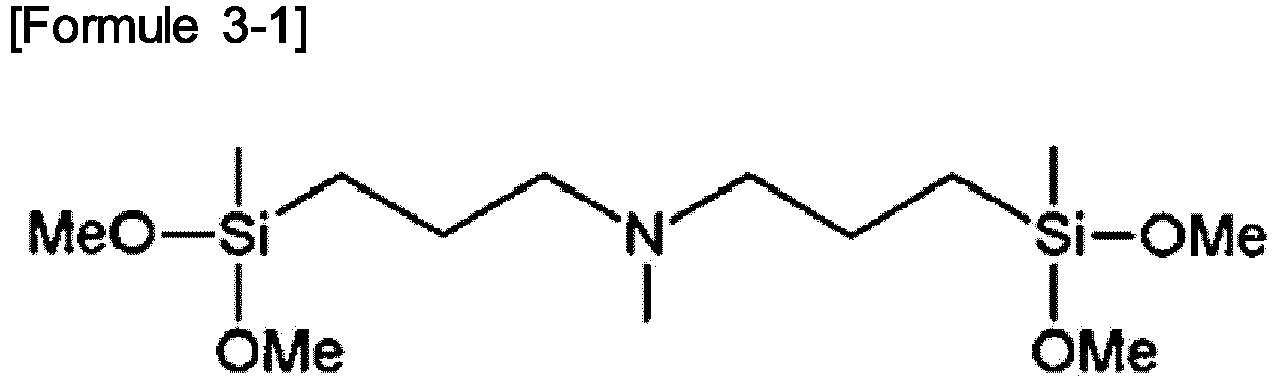
- the modifier represented by Formula 3 may be one selected from the group consisting of the modifiers represented by the following Formulae 3-1 to 3-27:
- Me is a methyl group
- Et is an ethyl group
- Pr is a propyl group.
- the modifier may be a modifier represented by the following Formula 4 or Formula 5:
- R 14 may be an alkylene group of 1 to 12 carbon atoms
- R 15 and R 16 may be each independently an alkyl group of 1 to 20 carbon atoms or an aryl group
- R 17 , R 18 and R 19 may be each independently an alkyl group of 1 to 20 carbon atoms or an aryl group, or two thereof may be combined with each other to form a ring including a silicon atom to which two thereof are combined
- e may be an integer of 1 to 2
- g may be an integer of 1 to 2
- f may be an integer of 1 to 10.
- the modifier represented by Formula 4 or Formula 5 may be one selected from the group consisting of N,N-bis(trimethylsilyl)aminopropylmethyldimethoxysilane, 1-trimethylsilyl-2,2-dimethoxy-1-aza-2-silacyclopentane, N,N-bis(trimethylsilyl)aminopropyltrimethoxysilane, N,N-bis(trimethylsilyl)aminopropyltriethoxysilane, N,N-bis(trimethylsilyl)aminopropylmethyldiethoxysilane, N,N-bis(trimethylsilyl)aminoethyltrimethoxysilane, N,N-bis(trimethylsilyl)aminoethyltriethoxysilane, N,N-bis(trimethylsilyl)aminoethylmethyldimethoxysilane and N,N-bis(trimethylsilyl)aminoe
- the modified conjugated diene-based polymer according to an embodiment of the present invention may have a number average molecular weight (Mn) of 10,000 g/mol to 2,000,000 g/mol, 100,000 g/mol to 1,000,000 g/mol, or 200,000 g/mol to 500,000 g/mol, and within this range, effects of excellent rolling resistance and wet skid resistance may be achieved.
- Mn number average molecular weight
- the modified conjugated diene-based polymer may have molecular weight distribution (Mw/Mn) of 1.0 to 5.0, 1.2 to 3.0, or 1.5 to 2.5, and within this range, effect of excellent balance between physical properties may be achieved.
- the modified conjugated diene-based polymer may have mooney viscosity of 10 to 200, 10 to 100, or 20 to 80, and within this range, effects of excellent processability and productivity may be achieved.
- the modified conjugated diene-based polymer may have a vinyl content of 10 wt% or more, 60 wt% or less, or 20 wt% to 50 wt%, and within this range, the glass transition temperature may be adjusted in an appropriate range, and effects of excellent rolling resistance, wet skid resistance and a low fuel consumption ratio may be achieved.
- the vinyl content may mean the amount of not 1,4-added but 1,2-added conjugated diene-based monomer based on 100 wt% of a conjugated diene-based copolymer composed of a monomer having a vinyl group, an aromatic vinyl-based monomer and a modification monomer.
- a method for preparing a modified conjugated diene-based polymer according to the present invention may include a step of polymerizing conjugated diene-based monomers, or an aromatic vinyl-based monomer and a conjugated diene-based monomer, in a hydrocarbon solvent comprising an organometal compound, to prepare an active polymer which is coupled with an alkali metal (S1); and a step of reacting the active polymer and a modification monomer represented by the following Formula 1 for end-capping a terminal of the active polymer with the modification monomer (S2):
- the hydrocarbon solvent is not specifically limited, but may be, for example, one or more selected from the group consisting of n-pentane, n-hexane, n-heptane, isooctane, cyclohexane, toluene, benzene and xylene.
- the organometal compound may be used in 0.01 mmol to 10 mmol, 0.05 mmol to 5 mmol, 0.1 mmol to 2 mmol, or 0.1 mmol to 1 mmol based on total 100 g of the monomer.
- the organometal compound may be, for example, one or more selected from the group consisting of methyllithium, ethyllithium, propyllithium, n-butyllithium, s-butyllithium, t-butyllithium, hexyllithium, n-decyllithium, t-octyllithium, phenyllithium, 1-naphthyl lithium, n-eicosyl lithium, 4-butylphenyl lithium, 4-tolyl lithium, cyclohexyl lithium, 3,5-di-n-heptylcyclohexyl lithium, 4-cyclopentyl lithium, naphthyl sodium, naphthyl potassium, lithium alkoxide, sodium alkoxide, potassium alkoxide, lithium sulfonate, sodium sulfonate, potassium sulfonate, lithium amide, sodium amide, potassium amide, and lithium isopropylamide.
- the polymerization of step (S1) may be performed by including a polar additive, and the polar additive may be added in an amount of 0.001 g to 50 g, 0.001 g to 10 g, or 0.005 g to 0.1 g based on total 100 g of the monomer.
- the polar additive may be one or more selected from the group consisting of tetrahydrofuran, ditetrahydrofurylpropane, diethyl ether, cycloamyl ether, dipropyl ether, ethylene dimethyl ether, diethyl glycol, dimethyl ether, tert-butoxy ethoxy ethane, bis(3-dimethylaminoethyl) ether, (dimethylaminoethyl) ethyl ether, trimethylamine, triethylamine, tripropylamine, and tetramethylethylenediamine, preferably, triethylamine or tetramethylethylenediamine, and may be the same as or different from a polar additive which may be injected during preparing the aminosilane-based compound.
- the reaction rates thereof may be compensated, and effect of inducing the easy formation of a random copolymer may be achieved.
- the polymerization of step (S1) may be, for example, an anionic polymerization, and particularly, a living anionic polymerization by which an anionic active part is formed at the polymerization terminal through a propagation reaction by anions.
- the polymerization of step (S1) may be a polymerization with heating, an isothermal polymerization, or a polymerization at a constant temperature (adiabatic polymerization).
- the polymerization at a constant temperature means a polymerization method including a step of polymerizing using self-generated heat of reaction without optionally applying heat after adding an organometal compound
- the polymerization with heating means a polymerization method including injecting the organometal compound and then, increasing the temperature by optionally applying heat.
- the isothermal polymerization means a polymerization method by which the temperature of a polymer is kept constant by increasing heat by applying heat or taking heat after adding the organometal compound.
- the polymerization of step (S1) may be conducted in a temperature range of -20°C to 200°C, 0°C to 150°C, or 10°C to 120°C.
- the active polymer prepared by step (S1) may mean a polymer in which a polymer anion and an organometallic cation are coupled.
- the modification monomer of step (S2) may be injected in an amount of 0.01 wt% to 10 wt%, 0.05 wt% to 8 wt%, or 0.1 wt% to 5 wt% based on the total monomer amount of the conjugated diene-based monomer and the modification monomer, or the conjugated diene-based monomer, the aromatic vinyl-based monomer and the modification monomer.
- the method for preparing a modified conjugated diene-based polymer of the present invention may include a step (S3) of reacting the active polymer which is end-capped in step (S2) with a modifier.
- the modifier may be, for example, an alkoxysilane-based modifier, and particularly, the alkoxysilane-based modifier may be a modifier represented by the following Formula 3:
- the alkoxysilane-based modifier may be a modifier represented by the following Formula 4 or Formula 5:
- the molar ratio of the organometal compound and the modifier may be 1:0.1 to 1:10, or 1:0.3 to 1:3, and within this range, modification reaction may be performed with optimal performance, and a conjugated diene-based polymer with a high modification ratio may be obtained.
- the reaction of step (S3) is a modification reaction for introducing a functional group derived from a modifier to the active polymer, and the reaction may be performed at 0°C to 90°C for 1 minute to 5 hours.
- the method for preparing a modified conjugated diene-based polymer may be performed by a batch type polymerization method or a continuous type polymerization method including one or more reactors.
- the method for preparing a modified conjugated diene-based polymer may further include, for example, one or more steps among recovering and drying steps of a solvent and an unreacted monomer after step (S2) or step (S3) of the present invention according to need.
- a rubber composition including the modified conjugated diene-based polymer is provided.
- the rubber composition may include the modified conjugated diene-based polymer in an amount of 10 wt% or more, 10 wt% to 100 wt%, or 20 wt% to 90 wt%. Within the range, effects of excellent mechanical properties such as tensile strength and abrasion resistance, and excellent balance between each of physical properties may be achieved.
- the rubber composition may further include other rubber components, if necessary, in addition to the modified and conjugated diene-based polymer, and, in this case, the rubber component may be included in an amount of 90 wt% or less based on the total weight of the rubber composition.
- the other rubber components may be included in an amount of 1 part by weight to 900 parts by weight based on 100 parts by weight of the modified and conjugated diene-based copolymer.
- the rubber component may be, for example, a natural rubber or a synthetic rubber, particularly, a natural rubber (NR) including cis-1,4-polyisoprene; a modified natural rubber which is obtained by modifying or purifying a common natural rubber, such as an epoxidized natural rubber (ENR), a deproteinized natural rubber (DPNR), and a hydrogenated natural rubber; and a synthetic rubber such as a styrene-butadiene copolymer (SBR), a polybutadiene (BR), a polyisoprene (IR), a butyl rubber (IIR), an ethylenepropylene copolymer, a polyisobutylene-co-isoprene, a neoprene, a poly(ethylene-co-propylene), a poly(styrene-co-butadiene), a poly(styrene-co-isoprene), a poly(styrene-co-is
- the rubber composition may, for example, include 0.1 parts by weight to 200 parts by weight, or 10 parts by weight to 120 parts by weight of a filler based on 100 parts by weight of the modified conjugated diene-based polymer of the present invention.
- the filler may particularly be, for example, a silica-based filler, particularly, wet silica (hydrated silicate), dry silica (anhydrous silicate), calcium silicate, aluminum silicate, or colloid silica.
- the filler may be wet silica which has the most significant compatible effect of improving effect of destruction characteristics and wet grip.
- the rubber composition may further include a carbon black-based filler, if needed.
- silane coupling agent for the improvement of reinforcing and low exothermic properties may be used together.
- the silane coupling agent may include bis(3-triethoxysilylpropyl)tetrasulfide, bis(3-triethoxysilylpropyl)trisulfide, bis(3-triethoxysilylpropyl)disulfide, bis(2-triethoxysilylethyl)tetrasulfide, bis(3-trimethoxysilylpropyl)tetrasulfide, bis(2-trimethoxysilylethyl)tetrasulfide, 3-mercaptopropyltrimethoxysilane, 3-mercaptopropyltriethoxysilane, 2-mercaptoethyltrimethoxysilane, 2-mercaptoethyltriethoxysilane, 3-trimethoxysilyl
- the silane coupling agent may be bis(3-triethoxysilylpropyl)polysulfide or 3-trimethoxysilylpropylbenzothiazyltetrasulfide in consideration of the improving effect of reinforcing properties.
- a modified conjugated diene-based polymer in which a functional group having high affinity with silica is introduced into an active part as a rubber component is used, and the mixing amount of a silane coupling agent may be smaller than a common case.
- the silane coupling agent may be used in an amount of 1 part by weight to 20 parts by weight, or 5 parts by weight to 15 parts by weight based on 100 parts by weight of silica, and within this range, effect as a coupling agent may be sufficiently exhibited, and the gelation of the rubber component may be prevented.
- the rubber composition according to an embodiment of the present invention may be sulfur crosslinkable, and may further include a vulcanizing agent.
- the vulcanizing agent may particularly be a sulfur powder and may be included in an amount of 0.1 parts by weight to 10 parts by weight based on 100 parts by weight of a rubber component. With the amount in the above range, elasticity and strength required for a vulcanized rubber composition may be secured, and at the same time, a low fuel consumption ratio may be excellent.
- the rubber composition according to an embodiment of the present invention may further include various additives used in a common rubber industry in addition to the above-described components, particularly, a vulcanization accelerator, a process oil, a plasticizer, an antiaging agent, a scorch preventing agent, a zinc white, stearic acid, a thermosetting resin, or a thermoplastic resin.
- various additives used in a common rubber industry particularly, a vulcanization accelerator, a process oil, a plasticizer, an antiaging agent, a scorch preventing agent, a zinc white, stearic acid, a thermosetting resin, or a thermoplastic resin.
- the vulcanization accelerator may use, for example, thiazole-based compounds such as 2-mercaptobenzothiazole (M), dibenzothiazyldisulfide (DM), and N-cyclohexyl-2-benzothiazylsulfenamide (CZ), or guanidine-based compounds such as diphenylguanidine (DPG), and may be included in an amount of 0.1 parts by weight to 5 parts by weight based on 100 parts by weight of the rubber component.
- M 2-mercaptobenzothiazole
- DM dibenzothiazyldisulfide
- CZ N-cyclohexyl-2-benzothiazylsulfenamide
- guanidine-based compounds such as diphenylguanidine (DPG)
- the process oil acts as a softener in a rubber composition and may include, for example, a paraffin-based, naphthene-based, or aromatic compound, and an aromatic process oil may be used in consideration of tensile strength and abrasion resistance, and a naphthene-based or paraffin-based process oil may be used in consideration of hysteresis loss and properties at a low temperature.
- the process oil may be included, for example, in an amount of 100 parts by weight or less based on 100 parts by weight of the rubber component. With the amount in the above-described range, the deterioration of tensile strength and low exothermic properties (low fuel consumption ratio) of the vulcanized rubber may be prevented.
- the antiaging agent may include, for example, N-isopropyl-N'-phenyl-p-phenylenediamine, N-(1,3-dimethylbutyl)-N'-phenyl-p-phenylenediamine, 6-ethoxy-2,2,4-trimethyl-1,2-dihydroquinoline, or a condensate of diphenylamine and acetone at a high temperature, and may used in an amount of 0.1 parts by weight to 6 parts by weight based on 100 parts by weight of the rubber component.
- the rubber composition according to an embodiment of the present invention may be obtained by mulling using a mulling apparatus such as a banbury mixer, a roll, and an internal mixer according to mixing prescription.
- a rubber composition having low exothermic properties and good abrasion resistance may be obtained by a vulcanization process after a molding process.
- the rubber composition may be useful to the manufacture each member for tires such as a tire tread, an under tread, a side wall, a carcass coating rubber, a belt coating rubber, a bead filler, a chafer, and a bead coating rubber, or to the manufacture of rubber products in various industries such as a dustproof rubber, a belt conveyor, and a hose.
- the present invention provides a tire manufactured using the rubber composition.
- the tire may include a tire or a tire tread.
- a modified conjugated diene-based polymer was prepared by conducting the same method as in Example 1 except for injecting the same amount of N,N,N',N'-tetraethylethene-1,1-diamine instead of N,N,N,N-tetramethylethene-1,1-diamine in Example 1.
- a modified conjugated diene-based polymer was prepared by conducting the same method as in Example 1 except for injecting 1.2 g of bis(methyldiethoxysilylpropyl)-N-methylamine instead of 1 g of bis(methyldimethoxysilylpropyl)-N-methylamine in Example 1.
- a modified conjugated diene-based polymer was prepared by conducting the same method as in Example 1 except for injecting 1.2 g of 1-trimethylsilyl-2,2-dimethoxy-1-aza-2-silacyclopentane instead of 1 g of bis(methyldimethoxysilylpropyl)-N-methylamine in Example 1.
- a modified conjugated diene-based polymer was prepared by conducting the same method as in Example 1 except for injecting 0.7 g of N,N-diethylaminopropyltriethoxysilane instead of 1 g of bis(methyldimethoxysilylpropyl)-N-methylamine in Example 1.
- a modified conjugated diene-based polymer was prepared by conducting the same method as in Example 1 except for injecting 10 g of a mixture of 3-(2-pyrrolidinoethyl)styrene and 4-(2-pyrrolidinoethyl)styrene instead of N,N,N',N'-tetramethylethene-1,1-diamine, and not injecting bis(methyldimethoxysilylpropyl)-N-methylamine in Example 1.
- a modified conjugated diene-based polymer was prepared by conducting the same method as in Example 1 except for injecting 10 g of a mixture of 3-(2-pyrrolidinoethyl)styrene and 4-(2-pyrrolidinoethyl)styrene instead of N,N,N',N'-tetramethylethene-1,1-diamine in Example 1.
- a modified conjugated diene-based polymer was prepared by conducting the same method as in Example 1 except for not injecting N,N,N',N'-tetramethylethene-1,1-diamine in Example 1.
- a modified conjugated diene-based polymer was prepared by conducting the same method as in Example 1 except for injecting N,N,N',N'-tetramethylethane-1,1-diamine instead of N,N,N',N'-tetramethylethene-1,1-diamine in Example 1.
- the weight average molecular weight (Mw), and the number average molecular weight (Mn) were measured by gel permeation chromatography (GPC) analysis, and the molecular weight distribution (MWD, Mw/Mn) was obtained by the calculation from each of the measured molecular weights.
- GPC gel permeation chromatography
- Mw/Mn molecular weight distribution
- the mooney viscosity (MV, (ML1+4, @100°C) MU) was measured by using MV-2000 (ALPHA Technologies Co., Ltd.) using Large Rotor at a rotor speed of 2 ⁇ 0.02 rpm at 100°C. In this case, a specimen used was stood at room temperature (23 ⁇ 3°C) for 30 minutes or more, and 27 ⁇ 3 g of the specimen was collected and put in a die cavity, and then, Platen was operated for measurement for 4 minutes.
- the coupling efficiency utilized a value according to Mathematical Equation 1 below by distinguishing maximum peak molecular weights (Mp) according to GPC before and after modification.
- Coupling efficiency Mp after modification Mp before modification [Table 1] Division Example Comparative Example 1 2 3 4 5 1 2 3 4 Mn 32 31 29 33 33 22 24 27 26 MWD 1.71 1.72 1.73 1.68 1.65 1.50 1.78 1.69 1.72 MV 50 52 48 55 54 30 42 53 52 Coupling efficiency 2.0 1.9 1.7 2.3 1.7 - 1.2 1.8 1.5
- the rubber specimen was mulled via a first stage mulling and a second stage mulling.
- a raw rubber styrene-butadiene copolymer
- a filler a filler
- an organosilane coupling agent a process oil
- a zinc white, stearic acid an antioxidant
- an antiaging agent wax and an accelerator
- the temperature of the mulling apparatus was controlled to 140°C
- a first compound mixture was obtained at a discharge temperature of 140°C to 160°C.
- the first compound mixture was cooled to room temperature, and the first compound mixture, sulfur and a vulcanization accelerator were added to the mulling apparatus and mixed at a temperature of 50°C or less to obtain a second compound mixture. Then, a curing process was performed at 160°C to 180°C for 20 to 30 minutes to manufacture a rubber specimen.
- the tensile properties were measured by manufacturing each specimen for test and measuring tensile stress when elongated by 300% (300% modulus) of each specimen according to an ASTM 412 tensile test method. Particularly, measurement of tensile properties was performed by using a Universal Test machin 4204 tensile tester (Instron Co., Ltd.) at room temperature at a rate of 50 cm/min.
- Abrasion amount of a load of 6 pounds with 1,000 rotations was measured and indexed based on the resultant value of Comparative Example 3 according to Mathematical Equation 2.
- Abrasion amount is denominator, and with the increase of a index value, abrasion resistance becomes better.
- Abrasion index Standard abrasion value ⁇ Measured abrasion value Standard abrasion value ⁇ 100 + 100
- Viscoelasticity properties were obtained by measuring tan ⁇ while changing deformation at each measurement temperature (-60°C to 60°C) and a frequency of 10 Hz with a twist mode by using a dynamic mechanical analyzer (TA Co., Ltd.), and indexing based on the resultant value of Comparative Example 3 according to Mathematical Equations 3 and 4. If the tan ⁇ index at a low temperature of 0°C is high, it means that wet skid resistance is good, and if the tan ⁇ index at a high temperature of 60°C is high, it means that hysteresis loss is small and low rolling resistance (fuel consumption ratio) is excellent.
- the modified conjugated diene-based polymers of Examples 1 to 5 which included a repeating unit derived from the modification monomer according to the present invention were found to have improved tensile properties and abrasion resistance, and markedly improved viscoelasticity properties when compared to modified or unmodified conjugated diene-based polymers of Comparative Examples 1 to 4, which did not include a repeating unit derived from the modification monomer of the present invention.
- the modified conjugated diene-based polymers of Example 1 and Example 2 which included a repeating unit derived from the modification monomer according to the present invention were found to have improved tensile properties and abrasion resistance, and particularly, markedly improved viscoelasticity properties when compared to Comparative Example 3, which did not include a repeating unit derived from the modification monomer of the present invention.
- Example 1 which included a repeating unit derived from the modification monomer according to the present invention, was found to have markedly improved tensile properties, abrasion resistance, and viscoelasticity properties when compared to the modified conjugated diene-based polymer of Comparative Example 4, which was prepared under the same conditions except for the modification monomer.
- Comparative Example 1 in which a styrene-based modification monomer was injected instead of the modification monomer according to the present invention and modification reaction by a modifier was not performed, was found to have very inferior tensile properties, abrasion resistance and viscoelasticity properties.
- Comparative Example 2 in which a styrene-based modification monomer was injected instead of the modification monomer according to the present invention and modification reaction by a modifier was performed, was found to have inferior tensile properties and abrasion resistance.
Landscapes
- Chemical & Material Sciences (AREA)
- Organic Chemistry (AREA)
- Health & Medical Sciences (AREA)
- Chemical Kinetics & Catalysis (AREA)
- Medicinal Chemistry (AREA)
- Polymers & Plastics (AREA)
- General Chemical & Material Sciences (AREA)
- Addition Polymer Or Copolymer, Post-Treatments, Or Chemical Modifications (AREA)
- Compositions Of Macromolecular Compounds (AREA)
Claims (10)
- Polymère à base de diène conjugué modifié comprenant une unité de répétition dérivée d'un monomère à base de diène conjugué et une unité de répétition dérivée d'un monomère de modification représentée par la formule 1 ci-après :
 R1 est un groupe hydrocarboné divalent de 1 à 10 atomes de carbone ou un lieur représenté par la formule 2,R2 à R5 sont chacun indépendamment un hydrogène ou un groupe hydrocarboné monovalent de 1 à 10 atomes de carbone, etun ou plusieurs de R1 à R5 doivent être un groupe hydrocarboné incluant une liaison carbone-carbone insaturée où, si R2 à R5 n'incluent pas la liaison insaturée, R1 doit être un lieur représenté par la formule 2 ci-après :
 dans la formule 2,R10 et R11 sont chacun indépendamment une liaison simple ou un groupe hydrocarboné divalent de 1 à 5 atomes de carbone,R12 et R13 sont chacun indépendamment un hydrogène ou un groupe hydrocarboné monovalent de 1 à 5 atomes de carbone, dans lequel l'unité de répétition dérivée du monomère de modification est incluse dans une quantité comprise entre 0,01 % en poids et 10 % en poids sur la base du poids total de l'unité de répétition dérivée de chaque monomère qui constitue le polymère à base de diène conjugué modifié, etl'unité de répétition dérivée du monomère de modification est comprise dans une partie extrémité du polymère à base de diène conjugué modifié.
- Polymère à base de diène conjugué modifié selon la revendication 1, dans lequel le polymère à base de diène conjugué modifié comprend en outre une unité de répétition dérivée d'un monomère de vinyle aromatique.
- Polymère à base de diène conjugué modifié selon la revendication 1, dans lequel le polymère à base de diène conjugué modifié comprend un groupe fonctionnel dérivé d'un agent de modification dans une partie extrémité de celui-ci.
- Polymère à base de diène conjugué modifié selon la revendication 3, dans lequel l'agent modifiant est un agent modifiant à base d'alkoxysilane, et
dans lequel l'agent modifiant à base d'alkoxysilane est un agent modifiant représenté par la formule 3 ci-après :
R6 est un groupe alkylène de 1 à 10 atomes de carbone, R7 et R8 sont chacun indépendamment un groupe alkyle de 1 à 10 atomes de carbone, R9 est un hydrogène, un groupe alkyle de 1 à 10 atomes de carbone ou un groupe alkylsilyle divalent, trivalent ou tétravalent qui est non substitué ou substitué par un groupe alkyle de 1 à 10 atomes de carbone, a et m sont chacun indépendamment un nombre entier sélectionné de 1 à 3, et n est un nombre entier sélectionné de 0 à 2 où, si n est 2, une pluralité de groupes R9 peuvent être identiques ou différents. - Polymère à base de diène conjugué modifié selon la revendication 4, dans lequel l'agent modifiant représenté par la formule 3 est sélectionné dans le groupe constitué d'agents modifiants représentés par les formules 3-1, 3-2, 3-10, 3-11, 3-22 et 3-23 ci-après :


- Polymère à base de diène conjugué modifié selon la revendication 1, comprenant en outre un groupe fonctionnel dérivé d'un agent de modification représenté par la formule 4 ou la formule 5 ci-après à une extrémité :


 R14 est un groupe alkylène de 1 à 12 atomes de carbone,R15 et R16 sont chacun indépendamment un groupe alkyle de 1 à 20 atomes de carbone ou un groupe aryle,R17, R18 et R19 sont chacun indépendamment un groupe alkyle de 1 à 20 atomes de carbone ou un groupe aryle ou deux d'entre eux peuvent être combinés l'un avec l'autre pour former un cycle incluant un atome de silicium auquel deux d'entre eux sont combinés,e est un nombre entier de 1 to 2, g est un nombre entier de 1 à 2 et f est un nombre entier de 1 à 10.
- Polymère à base de diène conjugué modifié selon la revendication 6, dans lequel l'agent modifiant représenté par la formule 4 ou la formule 5 est sélectionné dans le groupe constitué de N,N-bis(triméthylsilyl)aminopropylméthyldiméthoxysilane, 1-triméthylsilyl-2,2-diméthoxy-1-aza-2-silacyclopentane, N,N-bis(triméthylsilyl)aminopropyltriméthoxysilane, N,N-bis(triméthylsilyl)aminopropyltriéthoxysilane, N,N-bis(triméthylsilyl)aminopropylméthyldiéthoxysilane, N,N-bis(triméthylsilyl)aminoéthyltriméthoxysilane, N,N-bis(triméthylsilyl)aminoéthyltriéthoxysilane, N,N-bis(triméthylsilyl)aminoéthylméthyldiméthoxysilane et N,N-bis(triméthylsilyl)aminoéthylméthyldiéthoxysi lane.
- Procédé de préparation d'un polymère à base de diène conjugué modifié, le procédé consistant à :polymériser des monomères à base de diène conjugué ou un monomère à base de vinyle aromatique et un monomère à base de diène conjugué dans un solvant hydrocarboné comprenant un composé organométallique comprenant un métal alcalin pour préparer un polymère actif qui est couplé avec un métal alcalin (S1) ; etfaire réagir le polymère actif et un monomère de modification représenté par la formule 1 ci-après pour le coiffage d'extrémité du polymère actif avec le monomère de modification (S2) :
 R1 est un groupe hydrocarboné divalent de 1 à 10 atomes de carbone ou un lieur représenté par la formule 2,R2 à R5 sont chacun indépendamment un hydrogène ou un groupe hydrocarboné monovalent de 1 à 10 atomes de carbone, etun ou plusieurs de R1 à R5 doivent être un groupe hydrocarboné incluant une liaison carbone-carbone insaturée où, si R2 à R5 n'incluent pas la liaison insaturée, R1 doit être un lieur représenté par la formule 2 ci-après :
 R10 et R11 sont chacun indépendamment une liaison simple ou un groupe hydrocarboné divalent de 1 à 5 atomes de carbone, etR12 et R13 sont chacun indépendamment un hydrogène ou un groupe hydrocarboné monovalent de 1 à 5 atomes de carbone,dans lequel l'unité de répétition dérivée du monomère de modification est incluse dans une quantité comprise entre 0,01 % en poids et 10 % en poids sur la base du poids total de l'unité de répétition dérivée de chaque monomère qui constitue le polymère à base de diène conjugué modifié.
- Procédé de préparation d'un polymère à base de diène conjugué modifié selon la revendication 8, dans lequel le procédé comprend une étape (S3) consistant à faire réagir le polymère actif qui est coiffé à l'étape (S2) avec un agent modifiant.
- Procédé de préparation d'un polymère à base de diène conjugué modifié selon la revendication 9, dans lequel l'agent modifiant est un agent modifiant à base d'alkoxysilane.
Applications Claiming Priority (3)
| Application Number | Priority Date | Filing Date | Title |
|---|---|---|---|
| KR20160151390 | 2016-11-14 | ||
| KR1020170097141A KR102036026B1 (ko) | 2016-11-14 | 2017-07-31 | 변성 단량체, 이를 포함하는 변성 공액디엔계 중합체 및 이의 제조방법 |
| PCT/KR2017/011550 WO2018088710A1 (fr) | 2016-11-14 | 2017-10-18 | Monomère modifié, polymère à base de diènes conjugué modifié le comprenant et procédé de préparation associé |
Publications (3)
| Publication Number | Publication Date |
|---|---|
| EP3345945A1 EP3345945A1 (fr) | 2018-07-11 |
| EP3345945A4 EP3345945A4 (fr) | 2018-11-07 |
| EP3345945B1 true EP3345945B1 (fr) | 2022-11-30 |
Family
ID=62109853
Family Applications (1)
| Application Number | Title | Priority Date | Filing Date |
|---|---|---|---|
| EP17844647.2A Active EP3345945B1 (fr) | 2016-11-14 | 2017-10-18 | Monomère modifié, polymère à base de diènes conjugué modifié le comprenant et procédé de préparation associé |
Country Status (2)
| Country | Link |
|---|---|
| EP (1) | EP3345945B1 (fr) |
| WO (1) | WO2018088710A1 (fr) |
Family Cites Families (10)
| Publication number | Priority date | Publication date | Assignee | Title |
|---|---|---|---|---|
| NL86588C (fr) | 1980-09-20 | |||
| US4338428A (en) * | 1981-08-14 | 1982-07-06 | The Upjohn Company | Novel polyamides from ketene-aminals |
| ATE427969T1 (de) * | 2001-09-27 | 2009-04-15 | Jsr Corp | (co)polymerkautschuk auf basis von konjugiertem diolefin, verfahren zur herstellung von (co)polymerkautschuk, kautschukzusammensetzung, verbundwerkstoff und reifen |
| US6933358B2 (en) | 2002-08-16 | 2005-08-23 | The Goodyear Tire & Rubber Company | Functionalized monomers for synthesis of rubbery polymers |
| JP5615585B2 (ja) * | 2010-04-14 | 2014-10-29 | 旭化成ケミカルズ株式会社 | 変性共役ジエン重合体、その製造方法、変性共役ジエン系重合体組成物、及びタイヤ |
| EA201490496A1 (ru) * | 2011-08-26 | 2014-08-29 | Асахи Касеи Кемикалз Корпорейшн | Способ получения модифицированных полимеров сопряженных диенов, модифицированные полимеры сопряженных диенов, композиции модифицированных полимеров сопряженных диенов, композиции каучука и автомобильные шины |
| JP2015000922A (ja) * | 2013-06-14 | 2015-01-05 | 住友ゴム工業株式会社 | トラック・バスタイヤのキャップトレッド用ゴム組成物及びトラック・バスタイヤ |
| WO2015056878A1 (fr) * | 2013-10-17 | 2015-04-23 | 주식회사 엘지화학 | Polymère à base d'un diène conjugué et à fonction terminale, et procédé de production |
| KR101508465B1 (ko) * | 2013-10-17 | 2015-04-14 | 주식회사 엘지화학 | 말단 기능성 공액 디엔계 중합체 및 이의 제조방법 |
| JP6575237B2 (ja) * | 2014-10-06 | 2019-09-18 | 住友ゴム工業株式会社 | ゴム組成物および空気入りタイヤ |
-
2017
- 2017-10-18 EP EP17844647.2A patent/EP3345945B1/fr active Active
- 2017-10-18 WO PCT/KR2017/011550 patent/WO2018088710A1/fr not_active Ceased
Also Published As
| Publication number | Publication date |
|---|---|
| WO2018088710A1 (fr) | 2018-05-17 |
| EP3345945A1 (fr) | 2018-07-11 |
| EP3345945A4 (fr) | 2018-11-07 |
Similar Documents
| Publication | Publication Date | Title |
|---|---|---|
| EP3333199B1 (fr) | Polymère à base de diène conjugué modifié et procédé de préparation associé | |
| EP3296322B1 (fr) | Polymère de diène conjugué modifié, procédé de production associé et modificateur | |
| EP3792291B1 (fr) | Procédé de préparation d'un polymère modifié à base de diènes conjugués | |
| EP3372622B1 (fr) | Polymère modifié à base de diène conjugué et son procédé de préparation | |
| EP3281958B1 (fr) | Agent de modification et polymère à base de diène conjugué modifié produit à l'aide de celui-ci | |
| EP3269742B1 (fr) | Initiateur de polymérisation, polymère à base de diène conjugué modifié, et leurs procédés de préparation | |
| KR102736089B1 (ko) | 변성 공액디엔계 중합체, 이의 제조방법 및 이를 포함하는 고무 조성물 | |
| EP3312199B1 (fr) | Modificateur à base d'azasilane et procédé de préparation d'un polymère à base de diène conjugué modifié à l'aide de celui-ci | |
| EP3372621B1 (fr) | Polymère à base de diène conjugué modifié et procédé de préparation de ce dernier | |
| EP3536722A1 (fr) | Polymère à base de diène conjugué modifié et composition de caoutchouc le comprenant | |
| EP3296324B1 (fr) | Nouveau composé contenant un groupe silyle, polymère de diène conjugué modifié, et procédé de préparation associé | |
| EP3971238B1 (fr) | Agent de modification, et polymère de diène conjugué modifié produit à l'aide de celui-ci | |
| KR102744316B1 (ko) | 변성 공액디엔계 중합체, 이의 제조방법 및 이를 포함하는 고무 조성물 | |
| EP4506372A1 (fr) | Polymère à base de diène conjugué modifié et son procédé de production | |
| KR102727040B1 (ko) | 변성 공액디엔계 중합체, 이의 제조방법 및 이를 포함하는 고무 조성물 | |
| EP3919532A1 (fr) | Polymère à base de diène conjugué modifié, son procédé de production, et composition de caoutchouc le comprenant | |
| US10662143B2 (en) | Modification monomer, modified conjugated diene-based polymer including the same and method for preparing the polymer | |
| EP3345941B1 (fr) | Modificateur, polymère modifié à base de diène conjugué et son procédé de préparation | |
| EP4442716A1 (fr) | Agent de modification, polymère à base de diène conjugué modifié le comprenant et procédé de préparation de polymère | |
| EP3486279B1 (fr) | Modificateur, son procédé de préparation et polymère à base de diène conjugué modifié le comportant | |
| EP3916027A1 (fr) | Polymère à base de diène conjugué modifié, procédé de production de celui-ci et composition de caoutchouc le comprenant | |
| KR102165117B1 (ko) | 변성 공액디엔계 중합체 및 이의 제조방법 | |
| KR102910987B1 (ko) | 변성 공액디엔계 중합체, 이의 제조방법 및 이를 포함하는 고무 조성물 | |
| KR102917754B1 (ko) | 변성 공액디엔계 중합체, 이의 제조방법 및 이를 포함하는 고무 조성물 | |
| KR102918322B1 (ko) | 변성 공액디엔계 중합체, 이의 제조방법 및 이를 포함하는 고무 조성물 |
Legal Events
| Date | Code | Title | Description |
|---|---|---|---|
| STAA | Information on the status of an ep patent application or granted ep patent |
Free format text: STATUS: UNKNOWN |
|
| STAA | Information on the status of an ep patent application or granted ep patent |
Free format text: STATUS: THE INTERNATIONAL PUBLICATION HAS BEEN MADE |
|
| PUAI | Public reference made under article 153(3) epc to a published international application that has entered the european phase |
Free format text: ORIGINAL CODE: 0009012 |
|
| STAA | Information on the status of an ep patent application or granted ep patent |
Free format text: STATUS: REQUEST FOR EXAMINATION WAS MADE |
|
| 17P | Request for examination filed |
Effective date: 20180309 |
|
| AK | Designated contracting states |
Kind code of ref document: A1 Designated state(s): AL AT BE BG CH CY CZ DE DK EE ES FI FR GB GR HR HU IE IS IT LI LT LU LV MC MK MT NL NO PL PT RO RS SE SI SK SM TR |
|
| AX | Request for extension of the european patent |
Extension state: BA ME |
|
| REG | Reference to a national code |
Ref country code: DE Ref legal event code: R079 Ref document number: 602017064215 Country of ref document: DE Free format text: PREVIOUS MAIN CLASS: C08F0236140000 Ipc: C07C0211220000 |
|
| A4 | Supplementary search report drawn up and despatched |
Effective date: 20181009 |
|
| RIC1 | Information provided on ipc code assigned before grant |
Ipc: C08F 226/02 20060101ALN20181002BHEP Ipc: C08L 15/00 20060101ALN20181002BHEP Ipc: C07F 7/18 20060101ALI20181002BHEP Ipc: C08F 4/46 20060101ALI20181002BHEP Ipc: C08C 19/25 20060101ALI20181002BHEP Ipc: C08F 236/06 20060101ALN20181002BHEP Ipc: C08F 236/14 20060101ALI20181002BHEP Ipc: C08F 212/08 20060101ALN20181002BHEP Ipc: C07C 211/22 20060101AFI20181002BHEP Ipc: C08C 19/22 20060101ALI20181002BHEP Ipc: C08K 3/36 20060101ALN20181002BHEP Ipc: C08C 19/44 20060101ALI20181002BHEP Ipc: C08F 4/48 20060101ALN20181002BHEP Ipc: C08F 2/06 20060101ALI20181002BHEP |
|
| DAV | Request for validation of the european patent (deleted) | ||
| DAX | Request for extension of the european patent (deleted) | ||
| STAA | Information on the status of an ep patent application or granted ep patent |
Free format text: STATUS: EXAMINATION IS IN PROGRESS |
|
| 17Q | First examination report despatched |
Effective date: 20201111 |
|
| GRAP | Despatch of communication of intention to grant a patent |
Free format text: ORIGINAL CODE: EPIDOSNIGR1 |
|
| STAA | Information on the status of an ep patent application or granted ep patent |
Free format text: STATUS: GRANT OF PATENT IS INTENDED |
|
| INTG | Intention to grant announced |
Effective date: 20220916 |
|
| GRAS | Grant fee paid |
Free format text: ORIGINAL CODE: EPIDOSNIGR3 |
|
| GRAA | (expected) grant |
Free format text: ORIGINAL CODE: 0009210 |
|
| STAA | Information on the status of an ep patent application or granted ep patent |
Free format text: STATUS: THE PATENT HAS BEEN GRANTED |
|
| AK | Designated contracting states |
Kind code of ref document: B1 Designated state(s): AL AT BE BG CH CY CZ DE DK EE ES FI FR GB GR HR HU IE IS IT LI LT LU LV MC MK MT NL NO PL PT RO RS SE SI SK SM TR |
|
| REG | Reference to a national code |
Ref country code: CH Ref legal event code: EP Ref country code: GB Ref legal event code: FG4D |
|
| REG | Reference to a national code |
Ref country code: AT Ref legal event code: REF Ref document number: 1534601 Country of ref document: AT Kind code of ref document: T Effective date: 20221215 Ref country code: DE Ref legal event code: R096 Ref document number: 602017064215 Country of ref document: DE |
|
| REG | Reference to a national code |
Ref country code: IE Ref legal event code: FG4D |
|
| REG | Reference to a national code |
Ref country code: LT Ref legal event code: MG9D |
|
| REG | Reference to a national code |
Ref country code: NL Ref legal event code: MP Effective date: 20221130 |
|
| PG25 | Lapsed in a contracting state [announced via postgrant information from national office to epo] |
Ref country code: SE Free format text: LAPSE BECAUSE OF FAILURE TO SUBMIT A TRANSLATION OF THE DESCRIPTION OR TO PAY THE FEE WITHIN THE PRESCRIBED TIME-LIMIT Effective date: 20221130 Ref country code: PT Free format text: LAPSE BECAUSE OF FAILURE TO SUBMIT A TRANSLATION OF THE DESCRIPTION OR TO PAY THE FEE WITHIN THE PRESCRIBED TIME-LIMIT Effective date: 20230331 Ref country code: NO Free format text: LAPSE BECAUSE OF FAILURE TO SUBMIT A TRANSLATION OF THE DESCRIPTION OR TO PAY THE FEE WITHIN THE PRESCRIBED TIME-LIMIT Effective date: 20230228 Ref country code: LT Free format text: LAPSE BECAUSE OF FAILURE TO SUBMIT A TRANSLATION OF THE DESCRIPTION OR TO PAY THE FEE WITHIN THE PRESCRIBED TIME-LIMIT Effective date: 20221130 Ref country code: FI Free format text: LAPSE BECAUSE OF FAILURE TO SUBMIT A TRANSLATION OF THE DESCRIPTION OR TO PAY THE FEE WITHIN THE PRESCRIBED TIME-LIMIT Effective date: 20221130 Ref country code: ES Free format text: LAPSE BECAUSE OF FAILURE TO SUBMIT A TRANSLATION OF THE DESCRIPTION OR TO PAY THE FEE WITHIN THE PRESCRIBED TIME-LIMIT Effective date: 20221130 |
|
| REG | Reference to a national code |
Ref country code: AT Ref legal event code: MK05 Ref document number: 1534601 Country of ref document: AT Kind code of ref document: T Effective date: 20221130 |
|
| PG25 | Lapsed in a contracting state [announced via postgrant information from national office to epo] |
Ref country code: RS Free format text: LAPSE BECAUSE OF FAILURE TO SUBMIT A TRANSLATION OF THE DESCRIPTION OR TO PAY THE FEE WITHIN THE PRESCRIBED TIME-LIMIT Effective date: 20221130 Ref country code: PL Free format text: LAPSE BECAUSE OF FAILURE TO SUBMIT A TRANSLATION OF THE DESCRIPTION OR TO PAY THE FEE WITHIN THE PRESCRIBED TIME-LIMIT Effective date: 20221130 Ref country code: LV Free format text: LAPSE BECAUSE OF FAILURE TO SUBMIT A TRANSLATION OF THE DESCRIPTION OR TO PAY THE FEE WITHIN THE PRESCRIBED TIME-LIMIT Effective date: 20221130 Ref country code: IS Free format text: LAPSE BECAUSE OF FAILURE TO SUBMIT A TRANSLATION OF THE DESCRIPTION OR TO PAY THE FEE WITHIN THE PRESCRIBED TIME-LIMIT Effective date: 20230330 Ref country code: HR Free format text: LAPSE BECAUSE OF FAILURE TO SUBMIT A TRANSLATION OF THE DESCRIPTION OR TO PAY THE FEE WITHIN THE PRESCRIBED TIME-LIMIT Effective date: 20221130 Ref country code: GR Free format text: LAPSE BECAUSE OF FAILURE TO SUBMIT A TRANSLATION OF THE DESCRIPTION OR TO PAY THE FEE WITHIN THE PRESCRIBED TIME-LIMIT Effective date: 20230301 |
|
| PG25 | Lapsed in a contracting state [announced via postgrant information from national office to epo] |
Ref country code: NL Free format text: LAPSE BECAUSE OF FAILURE TO SUBMIT A TRANSLATION OF THE DESCRIPTION OR TO PAY THE FEE WITHIN THE PRESCRIBED TIME-LIMIT Effective date: 20221130 |
|
| PG25 | Lapsed in a contracting state [announced via postgrant information from national office to epo] |
Ref country code: SM Free format text: LAPSE BECAUSE OF FAILURE TO SUBMIT A TRANSLATION OF THE DESCRIPTION OR TO PAY THE FEE WITHIN THE PRESCRIBED TIME-LIMIT Effective date: 20221130 Ref country code: RO Free format text: LAPSE BECAUSE OF FAILURE TO SUBMIT A TRANSLATION OF THE DESCRIPTION OR TO PAY THE FEE WITHIN THE PRESCRIBED TIME-LIMIT Effective date: 20221130 Ref country code: EE Free format text: LAPSE BECAUSE OF FAILURE TO SUBMIT A TRANSLATION OF THE DESCRIPTION OR TO PAY THE FEE WITHIN THE PRESCRIBED TIME-LIMIT Effective date: 20221130 Ref country code: DK Free format text: LAPSE BECAUSE OF FAILURE TO SUBMIT A TRANSLATION OF THE DESCRIPTION OR TO PAY THE FEE WITHIN THE PRESCRIBED TIME-LIMIT Effective date: 20221130 Ref country code: CZ Free format text: LAPSE BECAUSE OF FAILURE TO SUBMIT A TRANSLATION OF THE DESCRIPTION OR TO PAY THE FEE WITHIN THE PRESCRIBED TIME-LIMIT Effective date: 20221130 Ref country code: AT Free format text: LAPSE BECAUSE OF FAILURE TO SUBMIT A TRANSLATION OF THE DESCRIPTION OR TO PAY THE FEE WITHIN THE PRESCRIBED TIME-LIMIT Effective date: 20221130 |
|
| PG25 | Lapsed in a contracting state [announced via postgrant information from national office to epo] |
Ref country code: SK Free format text: LAPSE BECAUSE OF FAILURE TO SUBMIT A TRANSLATION OF THE DESCRIPTION OR TO PAY THE FEE WITHIN THE PRESCRIBED TIME-LIMIT Effective date: 20221130 Ref country code: AL Free format text: LAPSE BECAUSE OF FAILURE TO SUBMIT A TRANSLATION OF THE DESCRIPTION OR TO PAY THE FEE WITHIN THE PRESCRIBED TIME-LIMIT Effective date: 20221130 |
|
| REG | Reference to a national code |
Ref country code: DE Ref legal event code: R097 Ref document number: 602017064215 Country of ref document: DE |
|
| PLBE | No opposition filed within time limit |
Free format text: ORIGINAL CODE: 0009261 |
|
| STAA | Information on the status of an ep patent application or granted ep patent |
Free format text: STATUS: NO OPPOSITION FILED WITHIN TIME LIMIT |
|
| 26N | No opposition filed |
Effective date: 20230831 |
|
| PG25 | Lapsed in a contracting state [announced via postgrant information from national office to epo] |
Ref country code: SI Free format text: LAPSE BECAUSE OF FAILURE TO SUBMIT A TRANSLATION OF THE DESCRIPTION OR TO PAY THE FEE WITHIN THE PRESCRIBED TIME-LIMIT Effective date: 20221130 |
|
| PG25 | Lapsed in a contracting state [announced via postgrant information from national office to epo] |
Ref country code: MC Free format text: LAPSE BECAUSE OF FAILURE TO SUBMIT A TRANSLATION OF THE DESCRIPTION OR TO PAY THE FEE WITHIN THE PRESCRIBED TIME-LIMIT Effective date: 20221130 |
|
| REG | Reference to a national code |
Ref country code: CH Ref legal event code: PL |
|
| REG | Reference to a national code |
Ref country code: BE Ref legal event code: MM Effective date: 20231031 |
|
| PG25 | Lapsed in a contracting state [announced via postgrant information from national office to epo] |
Ref country code: LU Free format text: LAPSE BECAUSE OF NON-PAYMENT OF DUE FEES Effective date: 20231018 |
|
| PG25 | Lapsed in a contracting state [announced via postgrant information from national office to epo] |
Ref country code: LU Free format text: LAPSE BECAUSE OF NON-PAYMENT OF DUE FEES Effective date: 20231018 |
|
| PG25 | Lapsed in a contracting state [announced via postgrant information from national office to epo] |
Ref country code: CH Free format text: LAPSE BECAUSE OF NON-PAYMENT OF DUE FEES Effective date: 20231031 |
|
| PG25 | Lapsed in a contracting state [announced via postgrant information from national office to epo] |
Ref country code: CH Free format text: LAPSE BECAUSE OF NON-PAYMENT OF DUE FEES Effective date: 20231031 |
|
| PG25 | Lapsed in a contracting state [announced via postgrant information from national office to epo] |
Ref country code: BE Free format text: LAPSE BECAUSE OF NON-PAYMENT OF DUE FEES Effective date: 20231031 |
|
| PG25 | Lapsed in a contracting state [announced via postgrant information from national office to epo] |
Ref country code: IE Free format text: LAPSE BECAUSE OF NON-PAYMENT OF DUE FEES Effective date: 20231018 |
|
| PG25 | Lapsed in a contracting state [announced via postgrant information from national office to epo] |
Ref country code: IE Free format text: LAPSE BECAUSE OF NON-PAYMENT OF DUE FEES Effective date: 20231018 |
|
| PG25 | Lapsed in a contracting state [announced via postgrant information from national office to epo] |
Ref country code: BG Free format text: LAPSE BECAUSE OF FAILURE TO SUBMIT A TRANSLATION OF THE DESCRIPTION OR TO PAY THE FEE WITHIN THE PRESCRIBED TIME-LIMIT Effective date: 20221130 |
|
| PG25 | Lapsed in a contracting state [announced via postgrant information from national office to epo] |
Ref country code: BG Free format text: LAPSE BECAUSE OF FAILURE TO SUBMIT A TRANSLATION OF THE DESCRIPTION OR TO PAY THE FEE WITHIN THE PRESCRIBED TIME-LIMIT Effective date: 20221130 |
|
| PG25 | Lapsed in a contracting state [announced via postgrant information from national office to epo] |
Ref country code: CY Free format text: LAPSE BECAUSE OF FAILURE TO SUBMIT A TRANSLATION OF THE DESCRIPTION OR TO PAY THE FEE WITHIN THE PRESCRIBED TIME-LIMIT; INVALID AB INITIO Effective date: 20171018 |
|
| PG25 | Lapsed in a contracting state [announced via postgrant information from national office to epo] |
Ref country code: HU Free format text: LAPSE BECAUSE OF FAILURE TO SUBMIT A TRANSLATION OF THE DESCRIPTION OR TO PAY THE FEE WITHIN THE PRESCRIBED TIME-LIMIT; INVALID AB INITIO Effective date: 20171018 |
|
| PGFP | Annual fee paid to national office [announced via postgrant information from national office to epo] |
Ref country code: IT Payment date: 20250924 Year of fee payment: 9 |
|
| PGFP | Annual fee paid to national office [announced via postgrant information from national office to epo] |
Ref country code: GB Payment date: 20250922 Year of fee payment: 9 |
|
| PGFP | Annual fee paid to national office [announced via postgrant information from national office to epo] |
Ref country code: FR Payment date: 20250925 Year of fee payment: 9 |
|
| PG25 | Lapsed in a contracting state [announced via postgrant information from national office to epo] |
Ref country code: TR Free format text: LAPSE BECAUSE OF FAILURE TO SUBMIT A TRANSLATION OF THE DESCRIPTION OR TO PAY THE FEE WITHIN THE PRESCRIBED TIME-LIMIT Effective date: 20221130 |
|
| PGFP | Annual fee paid to national office [announced via postgrant information from national office to epo] |
Ref country code: DE Payment date: 20250922 Year of fee payment: 9 |