EP3346028A1 - Selbstanordnende und selbstheilende nanopartikelbasierte katalysatorfilme für alkalische elektrolyseure - Google Patents
Selbstanordnende und selbstheilende nanopartikelbasierte katalysatorfilme für alkalische elektrolyseure Download PDFInfo
- Publication number
- EP3346028A1 EP3346028A1 EP17150558.9A EP17150558A EP3346028A1 EP 3346028 A1 EP3346028 A1 EP 3346028A1 EP 17150558 A EP17150558 A EP 17150558A EP 3346028 A1 EP3346028 A1 EP 3346028A1
- Authority
- EP
- European Patent Office
- Prior art keywords
- self
- electrolyser
- particles
- electrodes
- catalyst
- Prior art date
- Legal status (The legal status is an assumption and is not a legal conclusion. Google has not performed a legal analysis and makes no representation as to the accuracy of the status listed.)
- Withdrawn
Links
Images






Classifications
-
- C—CHEMISTRY; METALLURGY
- C25—ELECTROLYTIC OR ELECTROPHORETIC PROCESSES; APPARATUS THEREFOR
- C25B—ELECTROLYTIC OR ELECTROPHORETIC PROCESSES FOR THE PRODUCTION OF COMPOUNDS OR NON-METALS; APPARATUS THEREFOR
- C25B1/00—Electrolytic production of inorganic compounds or non-metals
- C25B1/01—Products
- C25B1/02—Hydrogen or oxygen
- C25B1/04—Hydrogen or oxygen by electrolysis of water
-
- C—CHEMISTRY; METALLURGY
- C25—ELECTROLYTIC OR ELECTROPHORETIC PROCESSES; APPARATUS THEREFOR
- C25B—ELECTROLYTIC OR ELECTROPHORETIC PROCESSES FOR THE PRODUCTION OF COMPOUNDS OR NON-METALS; APPARATUS THEREFOR
- C25B11/00—Electrodes; Manufacture thereof not otherwise provided for
- C25B11/04—Electrodes; Manufacture thereof not otherwise provided for characterised by the material
- C25B11/051—Electrodes formed of electrocatalysts on a substrate or carrier
- C25B11/073—Electrodes formed of electrocatalysts on a substrate or carrier characterised by the electrocatalyst material
- C25B11/075—Electrodes formed of electrocatalysts on a substrate or carrier characterised by the electrocatalyst material consisting of a single catalytic element or catalytic compound
-
- C—CHEMISTRY; METALLURGY
- C25—ELECTROLYTIC OR ELECTROPHORETIC PROCESSES; APPARATUS THEREFOR
- C25B—ELECTROLYTIC OR ELECTROPHORETIC PROCESSES FOR THE PRODUCTION OF COMPOUNDS OR NON-METALS; APPARATUS THEREFOR
- C25B9/00—Cells or assemblies of cells; Constructional parts of cells; Assemblies of constructional parts, e.g. electrode-diaphragm assemblies; Process-related cell features
- C25B9/17—Cells comprising dimensionally-stable non-movable electrodes; Assemblies of constructional parts thereof
- C25B9/19—Cells comprising dimensionally-stable non-movable electrodes; Assemblies of constructional parts thereof with diaphragms
-
- C—CHEMISTRY; METALLURGY
- C25—ELECTROLYTIC OR ELECTROPHORETIC PROCESSES; APPARATUS THEREFOR
- C25B—ELECTROLYTIC OR ELECTROPHORETIC PROCESSES FOR THE PRODUCTION OF COMPOUNDS OR NON-METALS; APPARATUS THEREFOR
- C25B9/00—Cells or assemblies of cells; Constructional parts of cells; Assemblies of constructional parts, e.g. electrode-diaphragm assemblies; Process-related cell features
- C25B9/17—Cells comprising dimensionally-stable non-movable electrodes; Assemblies of constructional parts thereof
- C25B9/19—Cells comprising dimensionally-stable non-movable electrodes; Assemblies of constructional parts thereof with diaphragms
- C25B9/23—Cells comprising dimensionally-stable non-movable electrodes; Assemblies of constructional parts thereof with diaphragms comprising ion-exchange membranes in or on which electrode material is embedded
-
- C—CHEMISTRY; METALLURGY
- C25—ELECTROLYTIC OR ELECTROPHORETIC PROCESSES; APPARATUS THEREFOR
- C25B—ELECTROLYTIC OR ELECTROPHORETIC PROCESSES FOR THE PRODUCTION OF COMPOUNDS OR NON-METALS; APPARATUS THEREFOR
- C25B9/00—Cells or assemblies of cells; Constructional parts of cells; Assemblies of constructional parts, e.g. electrode-diaphragm assemblies; Process-related cell features
- C25B9/70—Assemblies comprising two or more cells
- C25B9/73—Assemblies comprising two or more cells of the filter-press type
-
- Y—GENERAL TAGGING OF NEW TECHNOLOGICAL DEVELOPMENTS; GENERAL TAGGING OF CROSS-SECTIONAL TECHNOLOGIES SPANNING OVER SEVERAL SECTIONS OF THE IPC; TECHNICAL SUBJECTS COVERED BY FORMER USPC CROSS-REFERENCE ART COLLECTIONS [XRACs] AND DIGESTS
- Y02—TECHNOLOGIES OR APPLICATIONS FOR MITIGATION OR ADAPTATION AGAINST CLIMATE CHANGE
- Y02E—REDUCTION OF GREENHOUSE GAS [GHG] EMISSIONS, RELATED TO ENERGY GENERATION, TRANSMISSION OR DISTRIBUTION
- Y02E60/00—Enabling technologies; Technologies with a potential or indirect contribution to GHG emissions mitigation
- Y02E60/30—Hydrogen technology
- Y02E60/36—Hydrogen production from non-carbon containing sources, e.g. by water electrolysis
Definitions
- the invention provides self-assembling and self-healing nanoparticle-based catalyst films that can be formed on the electrodes of alkaline electrolysers.
- an electrocatalytic device comprising an electrolytic cell divided into anode and cathode chambers by an exchange membrane, said anode and cathode chambers being provided with electrodes immersed in electrolytic suspensions, wherein the electrolytic suspensions comprise surface charged catalytic particles forming self-healing films on the electrodes, and the use of the device as electrolyser, preferably for electrolysis of water.
- Electrochemical water splitting that consists of reduction and oxidation of water in separate compartments is a promising method for the conversion of electrical energy into hydrogen ( Du, P. & Eisenberg, R.; Energy Environ. Sci. 5:6012-6021 (2012 )).
- a suspension solution electrocatalytic device is described, the electrolytic cell of which is divided into anode and cathode chambers by a proton exchange matrix, said anode and cathode chambers comprising an anode sidewall and a cathode bottom, respectively, and said cathode chamber being provided with a microsphere suspension such as a molybdenum carbid gravity microspheres that intermittently touch the cathode material.
- self-assembled catalyst films possess self-healing properties as long as particles are present in the electrolyte, which is a unique feature of this preparation technique.
- the proof-of-concept was demonstrated in a non-zero gap alkaline electrolyser using state-of-the-art catalyst powders, NiFe LDH and Ni x B for anode and cathode, respectively.
- Catalyst films remained stable for at least three weeks at current densities ranging between 50 - 100 mA/cm 2 . The invention thus provides
- the aspect (1) of the invention provides for an electrocatalytic device comprising an electrolytic cell divided into anode and cathode chambers by an exchange membrane, said anode and cathode chambers being provided with electrodes, wherein one or both of said electrodes are immersed in electrolytic suspensions, and wherein the electrolytic suspensions comprise surface-charged catalytic particles forming self-assembling and self-healing films on the electrodes.
- the surface-charged catalytic particles are directly added into the electrolyte reservoirs of the device and form suspensions that are pumped through the cell.
- the surface-charged catalytic particles may be micro- or nanoparticles having a diameter from 1 nm to 1000 nm, and/or may have a shape of 0-dimensions (including, but not limited to quantum dots), 1-dimension (including, but not limited to nanowire), 2-dimensions (including, but not limited to nanosheet), or 3-dimensions (including, but not limited to nano- to micro-particles).
- the negatively surface-charged particles are immobilized and forming a film on the surface of the positively charged electrode, such as an electrolyser anode, and the positively surface-charged particles are immobilized and forming a film on the surface of the negatively charged electrode, such as an electrolyser cathode, driven by electrostatic forces.
- a hydrogen evolution reaction (HER) catalysts that possess positively charged surfaces, including transition metal borides, phosphides, sulphides and selenides which contain at least one metal or a mixture of metals (including, but not limited to CO 2 B, CO x P and Ni x B), form films on the surface of the negatively charged electrode.
- oxygen evolution reaction (OER) catalysts that possess negatively charged surfaces, including transition metal oxides, hydroxides and oxyhydroxide which contain at least one metal or a mixture of metals, form films on the surface of the positively charged electrode.
- OER oxygen evolution reaction
- NiFe LDH particles and Ni x B particles are immobilized and form films on the electrolyser anode and cathode, respectively. It is to be noted that the films formed on the electrodes possess self-healing properties and remained stable for at least three weeks at current densities ranging between 50 - 100 mA/cm 2 .
- the device is an electrolyser that possesses electrodes made from Ni, Ti, stainless steel and/or carbon, in the form of foil, foam, felt, cloth and mesh. It is preferred that in such electrolyser the cell further comprises gas outlets, such as oxygen and hydrogen outlets.
- the aspect (2) of the invention provides for the use of the device of aspect (1) as defined hereinbefore as electrolyser.
- the device is used for the electrolysis of water.
- the device is used for the electrolysis of aqueous alkaline solutions.
- Ni x B that is an extremely active catalyst for HER and OER ( Liang, Y.
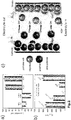
- Figure 4d shows the differences in U cell in the presence and absence of suspended particles at various current densities showing the clear benefit of having particles in the electrolyte.
- the current density was maintained at 0.1 A cm -2 in the presence of particles and U cell remained at about 2.25 V over the entire period of time.
- the electrolyser operated for 22 days over which time the catalyst films remained active (U cell of an electrolyser without catalyst films is displayed in Figure 4e for comparison).
- the three weeks test allows us to rule out major corrosion issue.
- the calculated corrosion rate of the anode current collector revealed that the Faradaic efficiency of the anode was above 99.5 % (see Examples, Section 5).
- Ni current collectors are used in commercial electrolysers due to its high corrosion resistance in alkaline media ( Holladay, J. D. et al.; Catal. Today 139:244-260 (2009 )).
- the cell voltage of the electrolyser was improved by employing a more active catalyst film for HER.
- a stable cell voltage of 2.05 V over 48 hours was obtained at 0.1 A/cm 2 when using NiFe LDH and Co x P on the anode and cathode, respectively ( Fig 16 ).
- This value represents an improvement of 200 mV and 750 mV versus NiFe LDH@Ni//Ni x B@Ni and Ni//Ni electrolysers, respectively. Further improvements are expected by optimizing the engineering of the system since the proof-of-concept was demonstrated using a home-made non-zero gap electrolyser operating at room temperature.
- stage 5 The different stages during the formation of self-assembled catalyst films are illustrated in Figure 5 .
- U cell is defined by the HER and OER activity of the initial Ni anode //Ni cathode electrolyser at a constant current density.
- stage 2 the catalyst powder is added into the electrolyte forming a suspension that is pumped through the cell. Driven by electrostatic interaction, catalytic particles from suspension self-assemble on the electrode surface forming the catalyst film.
- U cell drops as the catalyst films are been formed (stage 2) until it reaches a steady state.
- U cell remains at constant value as long as particles are present in the electrolyte enabled by the self-healing process of the catalyst film.
- Stage 4 occurs when the suspension is replaced by particle-free electrolyte losing the self-healing feature. Catalytic particles are slowly removed from the catalyst film leading to an increase in U cell . As in stage 2, U cell decreases when catalyst powder is again added to the electrolyte. And U cell stabilizes remaining at a constant value as long as particles are present in the electrolyte (stage 3).
- the proof-of-concept was achieved in a home-made non-zero gap alkaline electrolyser using state-of-the-art catalyst powders, NiFe LDH and Ni x B for anode and cathode, respectively.
- the catalyst films formed on the Ni electrodes of this electrolyser were stable for at least 22 days.
- CoMn LDH synthesis was synthesised according to the procedure proposed by Song and Hu ( Song, F. & Hu, X.; J. Am. Chem. Soc. 136:16481-16484 (2014 )). Briefly, under N 2 atmosphere Co(NO 3 ) 2 •6H 2 O (1.085 g, 3.75 mmol), Mn(NO 3 ) 2 •4H 2 O (0.4705 g, 1.875 mmol), NaNO 3 (0.765 g, 9 mmol) and NH 4 F (0.925 g, 25 mmol) were dissolved in ultra pure nitrogen purged water (500 ml).
- Ni x B synthesis Aqueous NiCl 2 •6H 2 O (20 ml, 0.5 M) in a round-bottomed Schlenk flask was deaerated by means of a Schlenk vacuum technique, flushed with argon and maintained at 0 °C using an ice-bath. NaBH 4 (1.0 M) in NaOH (0.1 M), separately deaerated and flushed with argon, was slowly added to the NiCl 2 •6H 2 O by means of a syringe. The reaction equation is given in equation (1) ( Ganem, B. & Osby, J. O.; Chem. Rev. 86:763-780 (1986 )). 2NiCl 2 + 4NaBH 4 + 9H 2 O ⁇ Ni x B + 4NaCl + 12.5H 2 + 3B(OH) 3 (1)
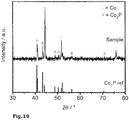
- Co x P synthesis Cobalt phosphide (Co x P) was prepared by thermal decomposition of Bis(triphenylphosphine)cobalt(II)dichloride [(C 6 H 5 ) 3 P] 2 CoCl 2 , under a reductive atmosphere constituted of H 2 (25%) in N 2 at 400 °C for 2 h ( Masa, J. et al.; ACS Energy Lett., 1192-1198 (2016 )). For XRD see Figure 19 .
- Electrochemical measurements All electrochemical measurements were conducted in alkaline media (3 M KOH) at room temperature.
- electrolyser a home-made, non-zero gap electrolyser, see Examples, Fig 6 and Fig 7
- a BioLogic VMP3 multi-channel potentiostst/galvanostat (Biologic, France) was used.
- Ni foil 0.1 mm thick, 99.2 % Ni and a surface area exposed to electrolyte of 4.1 cm 2
- Anodic and cathodic compartments were separated by an anion exchange membrane (fumasep ® FAA-3-PK-130, Fumatech).
- a two-channel Minipuls3 peristaltic pump (Gilson Inc., USA) was used to separately pump anolyte and catholyte through the system at a flow rate of 30 ml/min.
- Catalyst powders were directly added to either the anolyte or the catholyte.
- the concentration of catalyst in the electrolyte was about 1.3 mg/ml.
- the catalyst suspensions were stirred to prevent settling of the particles.
- the pH of the electrolyte was kept constant manually.
- Zeta potential determination The zeta potentials of the different catalysts were measured in aqueous 3 M KOH medium using a Malvern Zetasizer Nano ZS (Malvern Instruments Ltd, UK), equipped with a He-Ne-laser with a wavelength of 633 nm, using the laser doppler micro electrophoresis.
- X-ray photoelectron spectroscopy XPS spectra were recorded using a UHV set-up equipped with a Gammadata-Scienta SES 2002 analyzer. The base pressure in the measurement chamber was 5 ⁇ 10 -10 mbar. Monochromatic Al K ⁇ (1486.6 eV; 14.5 kV; 30 mA) was used as incident radiation, and a pass energy of 200 eV was chosen resulting in an effective instrument resolution higher than 0.6 eV. Charging effects were compensated using a flood gun, and binding energies were calibrated based on positioning the main C 1s peak originating from carbon contaminations at 284.5 eV.
- Example 1 Electrolyser system.
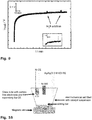
- the setup of the home-made, non-zero gap, alkaline electrolyser used in this work is shown in Figure 6 .
- the electrolyte was pumped through the cell in two separate circuits, i.e. anolyte and catholyte circuit, to prevent mixing of particles and gases.
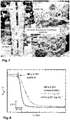
- FIG. 8 shows the evolution of the cell voltage over time upon addition of NiFe LDH for two different concentrations of particles in suspension (1.3 and 2.67 mg/ml). The total drop in cell voltage did not increase with increasing concentration of catalyst, which indicates that the activity of the catalyst film does not improve for higher concentration. What it does change is the time needed for the formation of a self-assembling film; the higher concentration, the faster formation.
- Example 3 Absence of formation of Ni x B catalyst on the anode.
- Ni x B is a state-of-the-art catalyst for OER that has positive zeta potential (surface positively charged).
- Ni x B powder was added to the anolyte reservoir while the electrolyser was operating.
- the formation of self-assembling catalyst films leads to a significant decrease in the cell voltage of the electrolyser as shown in Figure 1 .
- the addition of Ni x B in the anolyte reservoir did not change the cell voltage (see Figure 9 ). This indicates that catalyst film was not formed when Ni x B was added to the anodic compartment supporting the electrostatic nature of the film formation. In addition, a film was not seen on the anode after disassembling the electrolyser.
- Example 4 Mechanism of the formation of self-assembling catalyst films.
- the mechanism of the formation of self-assembling catalyst films is based on electrostatic interaction between the surfaces of the current collector and the suspended particle.
- the surface charge of the electrode is dependent on the applied polarization with respect to its potential of zero charge.
- the potential of zero charge of Ni electrodes (pzc Ni ) in alkaline media was reported to be +80 mV vs. Ag/AgCl in 3 M KCl ( Kang, J. et al., Corros. Sci. 50:3576-3580 (2008 ), McCafferty, E., Electrochim. Acta 55:1630-1637 (2010 )). Therefore, the surface of Ni is positively and negatively charged when the electrode is polarized at higher and lower potentials than +80 mV vs.
- the anode and cathode are positively and negatively charged, respectively, during electrolysis.
- the surface charge of suspended particles can be determined by measuring the zeta potential. Zeta potential values of -26.3 ⁇ 3.5 mV (NiFe LDH), -55 ⁇ 4.5 mV (CoMn LDH), +104.3 ⁇ 3.1 mV (Ni x B) and +110.7 ⁇ 3.8 mV (Co x P) were obtained in alkaline media (3 M KOH). According to the proposed immobilization mechanism, the polarisation of the electrode with respect to its potential of zero charge (pzc) enables tuning the surface from positively to negatively charged and vice versa.
- the immobilization was carried out using a three-electrode configuration where a piece of Ni foil (surface area of ca . 4 cm 2 ), a piece of Ni foil in a separate compartment filled with particle free electrolyte and a Ag/AgCl (3 M KCl) electrode acted as working electrode (WE), counter electrode (CE) and reference electrode (RE), respectively.
- a suspension of particles (1.3 mg/ml) in 3 M KOH and particle-free 3 M KOH were used as electrolyte in the WE and CE compartments, respectively.
- the suspension was continuously stirred to provide a homogenous suspension during immobilization and to increase the collision frequency of particles at the electrode.
- the immobilization potential was applied to the WE for 60 min.
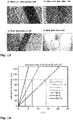
- the electrodes were taken from the suspension, and thoroughly rinsed with deionized water and then dried in air. Visual inspection of the electrodes revealed formation of films which covered the entire area immersed in the suspension ( Figure 11 ).
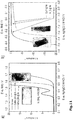
- the catalytic activity of the modified electrodes was electrochemically investigated towards the specific reaction, either HER or OER ( Figure 11 ).
- Linear sweep voltammograms (LSV) in 3 M KOH showed that the activity of all modified electrodes was higher than that of bare Ni electrode indicating the formation of a catalyst film.
- LSVs were recorded within the specific potential window for HER or OER at a scan rate of 5 mV/s.
- the uncompensated resistance was determined by means of electrochemical impedance spectroscopy (EIS) using an ac perturbation of 10 mV (rms) at open circuit potential in the frequency range from 100 kHz to 10 Hz.
- Electrodes modified with catalyst films that were prepared using a three-electrode cell showed similar catalytic activity than that of electrodes modified with catalyst films that were prepared using an electrolyser ( Figure 12 ).
- Electrodes modified using electrolysers were electrochemically characterized.
- the activity of these modified electrodes towards either HER or OER was studied using a three-electrode configuration.
- Figure 12 shows that the trend in the activity of modified electrodes was consistent with that observed in i) electrodes modified using a three-electrode cell and ii) the electrolyser (the corresponding cell voltage).
- Visual inspection of the modified electrode after evaluation in three-electrode configuration revealed the loss of catalyst material from the films ( Figure 13 ), which indicates that interaction electrode - particle was not strong (covalent). The presence of particles suspended in the electrolyte that enables self-healing of the films is thus required for achieving long-term performance.
- Example 6 Corrosion rate of the anode Ni current collector at 50 mA/cm 2 .
- the current (electrons) originate from the most favourable electrochemical reaction.
- the oxidation of transition metals in the collector takes place at lower potentials than OER.
- the corrosion of the current collector may simultaneously occur with OER in an electrolyser.
- the Faraday efficiency quantifies how much of the applied current goes to the oxidation of the current collector instead of evolution of oxygen. Faraday efficiency can thus help estimating the durability of an electrode.
- Metallic Ni can be oxidized to Ni 3+ under the anodic condition of the anode.
- Ni current collectors are used in commercial electrolysers due to its high corrosion resistance in alkaline media ( Holladay, J. D. et al.; Catal. Today 139:244-260 (2009 )). It should be noted that the oxidation of the catalyst itself (20 mg of NiFe LDH) takes place in 1 min at 50 mA/cm 2 (net current of 200 mA).
- Example 7 Operation of NiFe LDH@Ni//Co x P@Ni alkaline electrolyser.
- NiFe LDH, CoMn LDH, Ni x B (Ni x B-300) and Co x P are shown in figures 16 to 19 , respectively.
- the sample used in the Ni x B-300 study broad and poorly defined peaks were obtained which is likely due to the small crystal size.
- the sample was annealed at higher temperature (i.e. 600 °C, Ni x B-600) to increase the crystal size leading to better resolution of the peaks.
- the main components of Ni x B were metallic Ni, ⁇ -Ni(OH) 2 and a mixture of Ni 2 B and Ni 3 B.
Landscapes
- Chemical & Material Sciences (AREA)
- Engineering & Computer Science (AREA)
- Chemical Kinetics & Catalysis (AREA)
- Electrochemistry (AREA)
- Materials Engineering (AREA)
- Metallurgy (AREA)
- Organic Chemistry (AREA)
- Inorganic Chemistry (AREA)
- Electrolytic Production Of Non-Metals, Compounds, Apparatuses Therefor (AREA)
Priority Applications (3)
| Application Number | Priority Date | Filing Date | Title |
|---|---|---|---|
| EP17150558.9A EP3346028A1 (de) | 2017-01-06 | 2017-01-06 | Selbstanordnende und selbstheilende nanopartikelbasierte katalysatorfilme für alkalische elektrolyseure |
| PCT/EP2018/050208 WO2018127536A1 (en) | 2017-01-06 | 2018-01-04 | Self-assembling and self-healing nanoparticle-based catalyst films for alkaline electrolysers |
| EP18700976.6A EP3565916B1 (de) | 2017-01-06 | 2018-01-04 | Selbstanordnende und selbstheilende nanopartikelbasierte katalysatorfilme für alkalische elektrolyseure |
Applications Claiming Priority (1)
| Application Number | Priority Date | Filing Date | Title |
|---|---|---|---|
| EP17150558.9A EP3346028A1 (de) | 2017-01-06 | 2017-01-06 | Selbstanordnende und selbstheilende nanopartikelbasierte katalysatorfilme für alkalische elektrolyseure |
Publications (1)
| Publication Number | Publication Date |
|---|---|
| EP3346028A1 true EP3346028A1 (de) | 2018-07-11 |
Family
ID=57749874
Family Applications (2)
| Application Number | Title | Priority Date | Filing Date |
|---|---|---|---|
| EP17150558.9A Withdrawn EP3346028A1 (de) | 2017-01-06 | 2017-01-06 | Selbstanordnende und selbstheilende nanopartikelbasierte katalysatorfilme für alkalische elektrolyseure |
| EP18700976.6A Active EP3565916B1 (de) | 2017-01-06 | 2018-01-04 | Selbstanordnende und selbstheilende nanopartikelbasierte katalysatorfilme für alkalische elektrolyseure |
Family Applications After (1)
| Application Number | Title | Priority Date | Filing Date |
|---|---|---|---|
| EP18700976.6A Active EP3565916B1 (de) | 2017-01-06 | 2018-01-04 | Selbstanordnende und selbstheilende nanopartikelbasierte katalysatorfilme für alkalische elektrolyseure |
Country Status (2)
| Country | Link |
|---|---|
| EP (2) | EP3346028A1 (de) |
| WO (1) | WO2018127536A1 (de) |
Families Citing this family (3)
| Publication number | Priority date | Publication date | Assignee | Title |
|---|---|---|---|---|
| JP7474436B2 (ja) * | 2020-03-09 | 2024-04-25 | デノラ・ペルメレック株式会社 | アルカリ水電解方法及びアルカリ水電解用アノード |
| AU2022305969A1 (en) * | 2021-07-06 | 2024-02-08 | Avium Llc | In situ catalyst deposition and utilization |
| CN115772690B (zh) * | 2022-12-01 | 2024-12-10 | 湖南大学 | 一种通过碰撞电化学合成金属包覆的纳米颗粒的方法和装置 |
Citations (4)
| Publication number | Priority date | Publication date | Assignee | Title |
|---|---|---|---|---|
| US20080280172A1 (en) * | 2007-05-08 | 2008-11-13 | Quantumsphere, Inc. | Electro-catalytic recharging composition |
| US20090145772A1 (en) * | 2007-12-11 | 2009-06-11 | Gm Global Technology Operation, Inc. | Method of treating nanoparticles using an intermittently processing electrochemical cell |
| DE102014226464A1 (de) * | 2014-12-18 | 2016-06-23 | RUHR-UNIVERSITäT BOCHUM | Metallboride, mit strickstoff dotierte metallboride und bor enthaltende metall-nanopartikel für wasserspaltung und sauerstoffreduktion |
| CN105714326A (zh) | 2016-03-31 | 2016-06-29 | 华南理工大学 | 悬浮电催化解水产氢装置 |
-
2017
- 2017-01-06 EP EP17150558.9A patent/EP3346028A1/de not_active Withdrawn
-
2018
- 2018-01-04 EP EP18700976.6A patent/EP3565916B1/de active Active
- 2018-01-04 WO PCT/EP2018/050208 patent/WO2018127536A1/en not_active Ceased
Patent Citations (4)
| Publication number | Priority date | Publication date | Assignee | Title |
|---|---|---|---|---|
| US20080280172A1 (en) * | 2007-05-08 | 2008-11-13 | Quantumsphere, Inc. | Electro-catalytic recharging composition |
| US20090145772A1 (en) * | 2007-12-11 | 2009-06-11 | Gm Global Technology Operation, Inc. | Method of treating nanoparticles using an intermittently processing electrochemical cell |
| DE102014226464A1 (de) * | 2014-12-18 | 2016-06-23 | RUHR-UNIVERSITäT BOCHUM | Metallboride, mit strickstoff dotierte metallboride und bor enthaltende metall-nanopartikel für wasserspaltung und sauerstoffreduktion |
| CN105714326A (zh) | 2016-03-31 | 2016-06-29 | 华南理工大学 | 悬浮电催化解水产氢装置 |
Non-Patent Citations (39)
| Title |
|---|
| "Editorial. Hydrogen on the rise", NAT. ENERGY, vol. 1, 2016, pages 16127 |
| BALEJ, J., COLLECT. CZECH. CHEM. COMMUN., vol. 61, 1996, pages 1549 - 1562 |
| CHU, S.; MAJUMDAR, A, NATURE, vol. 488, 2012, pages 294 - 303 |
| DAI, X ET AL., ACS APPL. MATER. INTERFACES, vol. 8, 2016, pages 6439 - 6448 |
| DI TANG ET AL., ACS APPL. MATER. INTERFACES, vol. 6, 2014, pages 7918 - 7925 |
| DI TANG ET AL: "Carbon Quantum Dot/NiFe Layered Double-Hydroxide Composite as a Highly Efficient Electrocatalyst for Water Oxidation", ACS APPLIED MATERIALS AND INTERFACES, vol. 6, no. 10, 28 May 2014 (2014-05-28), US, pages 7918 - 7925, XP055374973, ISSN: 1944-8244, DOI: 10.1021/am501256x * |
| DINCER, I., RENEW. SUST. ENERG. REV, vol. 4, 2000, pages 157 - 175 |
| DU, P.; EISENBERG, R., ENERGY ENVIRON. SCI., vol. 5, 2012, pages 6012 - 6021 |
| GALAN-MASCAROS, J. R., CHEMELECTROCHEM, vol. 2, 2015, pages 37 - 50 |
| GANEM, B; OSBY, J. O., CHEM. REV., vol. 86, 1986, pages 763 - 780 |
| GENG, J. ET AL., CHEMSUSCHEM, vol. 8, 2015, pages 659 - 664 |
| HAMER, W. J.; WU, Y.-C., J. PHYS. CHEM. REF. DATA, vol. 1, 1972, pages 1047 |
| HATZELL, K. B ET AL., ELECTROCHIM. ACTA, vol. 111, 2013, pages 888 - 897 |
| HATZELL, K. B. ET AL., CHEM. SOC. REV, vol. 44, 2015, pages 8664 - 8687 |
| HOLLADAY, J. D ET AL., CATAL. TODAY, vol. 139, 2009, pages 244 - 260 |
| HU, W.-H. ET AL., CARBON, vol. 100, 2016, pages 236 - 242 |
| JIANG, J. ET AL., J. POWER SOURCES, vol. 278, 2015, pages 445 - 451 |
| KANG, J ET AL., CORROS. SCI, vol. 50, 2008, pages 3576 - 3580 |
| KANG, J. ET AL., CORROS. SCI., vol. 50, 2008, pages 3576 - 3580 |
| KONKENA, B ET AL., NAT COMMS, vol. 7, 2016, pages 12269 |
| LIANG, Y. ET AL., NANOTECHNOLOGY, vol. 27, 2016 |
| LIU, L. ET AL., J. MATER. CHEM. A, vol. 2, 2014, pages 16224 - 16229 |
| LU, X.; ZHAO, C., NAT. COMMUN., vol. 6, 2015, pages 6616 |
| LUTTERMAN, D. A ET AL., J. AM. CHEM. SOC., vol. 131, 2009, pages 3838 - 3839 |
| MASA, J ET AL., ADV. ENERGY MATER, vol. 6, 2016 |
| MASA, J. ET AL., ACS ENERGY LETT., 2016, pages 1192 - 1198 |
| MCCAFFERTY, E., ELECTROCHIM. ACTA, vol. 55, 2010, pages 1630 - 1637 |
| MCCRORY, C. C. L ET AL., J. AM. CHEM. SOC., vol. 135, 2013, pages 16977 - 16987 |
| MOUSTY, C; WALCARIUS, A., J. SOLID STATE ELECTROCHEM, vol. 19, 2015, pages 1905 - 1931 |
| NG, J. W. D. ET AL., NAT. ENERGY, vol. 1, 2016, pages 16053 |
| PENG, Q. ET AL., J. VAC. SCI. TECHNOL. A, vol. 30, 2012, pages 10803 |
| PICKRAHN, K. L. ET AL., ADV. ENERGY MATER, vol. 2, 2012, pages 1269 - 1277 |
| PINTADO, S ET AL., J. AM. CHEM. SOC., vol. 135, 2013, pages 13270 - 13273 |
| SONG, F.; HU, X., J. AM. CHEM. SOC., vol. 136, 2014, pages 16481 - 16484 |
| SONG, F.; HU, X., NAT. COMMUN., vol. 5, 2014, pages 4477 |
| WANG, L ET AL., ACS APPLIED MATERIALS & INTERFACES, vol. 8, 2016, pages 16736 - 16743 |
| WANG, W.; TAO, N., ANAL. CHEM., vol. 86, 2014, pages 2 - 14 |
| XIAO, X. ET AL., J. AM. CHEM. SOC., vol. 130, 2008, pages 16669 - 16677 |
| ZOU, X. ET AL., J. AM. CHEM. SOC., vol. 135, 2013, pages 17242 - 17245 |
Also Published As
| Publication number | Publication date |
|---|---|
| EP3565916A1 (de) | 2019-11-13 |
| EP3565916B1 (de) | 2020-12-16 |
| WO2018127536A1 (en) | 2018-07-12 |
Similar Documents
| Publication | Publication Date | Title |
|---|---|---|
| Sun et al. | Hydrogen generation from ammonia electrolysis on bifunctional platinum nanocubes electrocatalysts | |
| Chunduri et al. | A unique amorphous cobalt-phosphide-boride bifunctional electrocatalyst for enhanced alkaline water-splitting | |
| US11326265B2 (en) | Highly sustained electrodes and electrolytes for salty alkaline and neutral water splitting | |
| Yu et al. | Bifunctional catalysts for overall water splitting: CoNi oxyhydroxide nanosheets electrodeposited on titanium sheets | |
| Yan et al. | Co9S8 nanowires@ NiCo LDH nanosheets arrays on nickel foams towards efficient overall water splitting | |
| Zhu et al. | Phase-controlled synthesis and the phase-dependent HER and OER performances of nickel selenide nanosheets prepared by an electrochemical deposition route | |
| Liu et al. | Amorphous iron-nickel phosphide nanocone arrays as efficient bifunctional electrodes for overall water splitting | |
| Fiameni et al. | The HER in alkaline media on Pt-modified three-dimensional Ni cathodes | |
| US11692276B2 (en) | Alkaline water electrolysis method, and anode for alkaline water electrolysis | |
| Maheskumar et al. | Construction of heterostructure interface with FeNi2S4 and CoFe nanowires as an efficient bifunctional electrocatalyst for overall water splitting and urea electrolysis | |
| Hyun et al. | Hierarchical nickel–cobalt dichalcogenide nanostructure as an efficient electrocatalyst for oxygen evolution reaction and a Zn–Air battery | |
| KR102298298B1 (ko) | 비스무트계 클로라이드-저장 전극 | |
| Jin et al. | Self-supported CoFe LDH/Co 0.85 Se nanosheet arrays as efficient electrocatalysts for the oxygen evolution reaction | |
| Abdollahi et al. | Electrodeposition of Ni-Fe on graphite rod as an efficient and binder-free electrocatalyst for oxygen and hydrogen evolution reactions | |
| Chen et al. | Nickel selenide from single-molecule electrodeposition for efficient electrocatalytic overall water splitting | |
| Tan et al. | Improving activity of Ni3P/Mn hybrid film via electrochemical tuning for water splitting under simulated industrial environment | |
| Dong et al. | Engineering of P vacancies and phosphate on Fe-doped Ni2P nanosheet arrays for enhanced oxygen evolution | |
| EP3565916B1 (de) | Selbstanordnende und selbstheilende nanopartikelbasierte katalysatorfilme für alkalische elektrolyseure | |
| US20230407490A1 (en) | A water electrolyzer system | |
| Zhang et al. | Bifunctional nanoporous Ni-Zn electrocatalysts with super-aerophobic surface for high-performance hydrazine-assisted hydrogen production | |
| Pan et al. | Nickel-supported PdM (M= Au and Ag) nanodendrites as formate oxidation (electro) catalytic anodes for direct fuel cells and hydrogen generation at room temperature | |
| Yao et al. | Coupling SnS 2 and rGO aerogel to CuS for enhanced light-assisted OER electrocatalysis | |
| Zheng et al. | Defective layered NiFe double hydroxides anchored on self-supported CoNi-nitrogen doped carbon nanotube composite as advanced electrocatalyst for oxygen evolution reaction | |
| Ghanem et al. | Modification of nickel foam with nickel phosphate catalyst layer via anodizing for boosting the electrocatalytic urea oxidation and hydrogen evolution reactions | |
| US20250354279A1 (en) | Composite for electrocatalysis and preparation method thereof |
Legal Events
| Date | Code | Title | Description |
|---|---|---|---|
| PUAI | Public reference made under article 153(3) epc to a published international application that has entered the european phase |
Free format text: ORIGINAL CODE: 0009012 |
|
| STAA | Information on the status of an ep patent application or granted ep patent |
Free format text: STATUS: THE APPLICATION HAS BEEN PUBLISHED |
|
| AK | Designated contracting states |
Kind code of ref document: A1 Designated state(s): AL AT BE BG CH CY CZ DE DK EE ES FI FR GB GR HR HU IE IS IT LI LT LU LV MC MK MT NL NO PL PT RO RS SE SI SK SM TR |
|
| AX | Request for extension of the european patent |
Extension state: BA ME |
|
| STAA | Information on the status of an ep patent application or granted ep patent |
Free format text: STATUS: THE APPLICATION IS DEEMED TO BE WITHDRAWN |
|
| 18D | Application deemed to be withdrawn |
Effective date: 20190112 |