EP3347220B1 - Kunststoffglasuroberflächen von heckklappen - Google Patents
Kunststoffglasuroberflächen von heckklappen Download PDFInfo
- Publication number
- EP3347220B1 EP3347220B1 EP16767372.2A EP16767372A EP3347220B1 EP 3347220 B1 EP3347220 B1 EP 3347220B1 EP 16767372 A EP16767372 A EP 16767372A EP 3347220 B1 EP3347220 B1 EP 3347220B1
- Authority
- EP
- European Patent Office
- Prior art keywords
- component
- plastic glazing
- translucent
- tailgate
- vehicle
- Prior art date
- Legal status (The legal status is an assumption and is not a legal conclusion. Google has not performed a legal analysis and makes no representation as to the accuracy of the status listed.)
- Active
Links
Images



Classifications
-
- B—PERFORMING OPERATIONS; TRANSPORTING
- B32—LAYERED PRODUCTS
- B32B—LAYERED PRODUCTS, i.e. PRODUCTS BUILT-UP OF STRATA OF FLAT OR NON-FLAT, e.g. CELLULAR OR HONEYCOMB, FORM
- B32B27/00—Layered products comprising a layer of synthetic resin
-
- B—PERFORMING OPERATIONS; TRANSPORTING
- B60—VEHICLES IN GENERAL
- B60J—WINDOWS, WINDSCREENS, NON-FIXED ROOFS, DOORS, OR SIMILAR DEVICES FOR VEHICLES; REMOVABLE EXTERNAL PROTECTIVE COVERINGS SPECIALLY ADAPTED FOR VEHICLES
- B60J1/00—Windows; Windscreens; Accessories therefor
- B60J1/18—Windows; Windscreens; Accessories therefor arranged at the vehicle rear
-
- B—PERFORMING OPERATIONS; TRANSPORTING
- B29—WORKING OF PLASTICS; WORKING OF SUBSTANCES IN A PLASTIC STATE IN GENERAL
- B29C—SHAPING OR JOINING OF PLASTICS; SHAPING OF MATERIAL IN A PLASTIC STATE, NOT OTHERWISE PROVIDED FOR; AFTER-TREATMENT OF THE SHAPED PRODUCTS, e.g. REPAIRING
- B29C45/00—Injection moulding, i.e. forcing the required volume of moulding material through a nozzle into a closed mould; Apparatus therefor
- B29C45/0005—Injection moulding, i.e. forcing the required volume of moulding material through a nozzle into a closed mould; Apparatus therefor using fibre reinforcements
-
- B—PERFORMING OPERATIONS; TRANSPORTING
- B29—WORKING OF PLASTICS; WORKING OF SUBSTANCES IN A PLASTIC STATE IN GENERAL
- B29C—SHAPING OR JOINING OF PLASTICS; SHAPING OF MATERIAL IN A PLASTIC STATE, NOT OTHERWISE PROVIDED FOR; AFTER-TREATMENT OF THE SHAPED PRODUCTS, e.g. REPAIRING
- B29C45/00—Injection moulding, i.e. forcing the required volume of moulding material through a nozzle into a closed mould; Apparatus therefor
- B29C45/02—Transfer moulding, i.e. transferring the required volume of moulding material by a plunger from a "shot" cavity into a mould cavity
-
- B—PERFORMING OPERATIONS; TRANSPORTING
- B32—LAYERED PRODUCTS
- B32B—LAYERED PRODUCTS, i.e. PRODUCTS BUILT-UP OF STRATA OF FLAT OR NON-FLAT, e.g. CELLULAR OR HONEYCOMB, FORM
- B32B27/00—Layered products comprising a layer of synthetic resin
- B32B27/06—Layered products comprising a layer of synthetic resin as the main or only constituent of a layer, which is next to another layer of the same or of a different material
- B32B27/08—Layered products comprising a layer of synthetic resin as the main or only constituent of a layer, which is next to another layer of the same or of a different material of synthetic resin
-
- B—PERFORMING OPERATIONS; TRANSPORTING
- B32—LAYERED PRODUCTS
- B32B—LAYERED PRODUCTS, i.e. PRODUCTS BUILT-UP OF STRATA OF FLAT OR NON-FLAT, e.g. CELLULAR OR HONEYCOMB, FORM
- B32B27/00—Layered products comprising a layer of synthetic resin
- B32B27/36—Layered products comprising a layer of synthetic resin comprising polyesters
- B32B27/365—Layered products comprising a layer of synthetic resin comprising polyesters comprising polycarbonates
-
- B—PERFORMING OPERATIONS; TRANSPORTING
- B60—VEHICLES IN GENERAL
- B60J—WINDOWS, WINDSCREENS, NON-FIXED ROOFS, DOORS, OR SIMILAR DEVICES FOR VEHICLES; REMOVABLE EXTERNAL PROTECTIVE COVERINGS SPECIALLY ADAPTED FOR VEHICLES
- B60J1/00—Windows; Windscreens; Accessories therefor
- B60J1/004—Mounting of windows
- B60J1/006—Mounting of windows characterised by fixation means such as clips, adhesive, etc.
-
- B—PERFORMING OPERATIONS; TRANSPORTING
- B60—VEHICLES IN GENERAL
- B60J—WINDOWS, WINDSCREENS, NON-FIXED ROOFS, DOORS, OR SIMILAR DEVICES FOR VEHICLES; REMOVABLE EXTERNAL PROTECTIVE COVERINGS SPECIALLY ADAPTED FOR VEHICLES
- B60J3/00—Antiglare equipment associated with windows or windscreens; Sun visors for vehicles
- B60J3/007—Sunglare reduction by coatings, interposed foils in laminar windows, or permanent screens
-
- B—PERFORMING OPERATIONS; TRANSPORTING
- B60—VEHICLES IN GENERAL
- B60Q—ARRANGEMENT OF SIGNALLING OR LIGHTING DEVICES, THE MOUNTING OR SUPPORTING THEREOF OR CIRCUITS THEREFOR, FOR VEHICLES IN GENERAL
- B60Q1/00—Arrangement of optical signalling or lighting devices, the mounting or supporting thereof or circuits therefor
- B60Q1/0029—Spatial arrangement
- B60Q1/0035—Spatial arrangement relative to the vehicle
-
- B—PERFORMING OPERATIONS; TRANSPORTING
- B60—VEHICLES IN GENERAL
- B60Q—ARRANGEMENT OF SIGNALLING OR LIGHTING DEVICES, THE MOUNTING OR SUPPORTING THEREOF OR CIRCUITS THEREFOR, FOR VEHICLES IN GENERAL
- B60Q1/00—Arrangement of optical signalling or lighting devices, the mounting or supporting thereof or circuits therefor
- B60Q1/26—Arrangement of optical signalling or lighting devices, the mounting or supporting thereof or circuits therefor the devices being primarily intended to indicate the vehicle, or parts thereof, or to give signals, to other traffic
-
- F—MECHANICAL ENGINEERING; LIGHTING; HEATING; WEAPONS; BLASTING
- F21—LIGHTING
- F21S—NON-PORTABLE LIGHTING DEVICES; SYSTEMS THEREOF; VEHICLE LIGHTING DEVICES SPECIALLY ADAPTED FOR VEHICLE EXTERIORS
- F21S43/00—Signalling devices specially adapted for vehicle exteriors, e.g. brake lamps, direction indicator lights or reversing lights
- F21S43/20—Signalling devices specially adapted for vehicle exteriors, e.g. brake lamps, direction indicator lights or reversing lights characterised by refractors, transparent cover plates, light guides or filters
- F21S43/26—Refractors, transparent cover plates, light guides or filters not provided in groups F21S43/235 - F21S43/255
-
- F—MECHANICAL ENGINEERING; LIGHTING; HEATING; WEAPONS; BLASTING
- F21—LIGHTING
- F21S—NON-PORTABLE LIGHTING DEVICES; SYSTEMS THEREOF; VEHICLE LIGHTING DEVICES SPECIALLY ADAPTED FOR VEHICLE EXTERIORS
- F21S43/00—Signalling devices specially adapted for vehicle exteriors, e.g. brake lamps, direction indicator lights or reversing lights
- F21S43/20—Signalling devices specially adapted for vehicle exteriors, e.g. brake lamps, direction indicator lights or reversing lights characterised by refractors, transparent cover plates, light guides or filters
- F21S43/281—Materials thereof; Structures thereof; Properties thereof; Coatings thereof
- F21S43/28131—Structures comprising multiple layers
-
- B—PERFORMING OPERATIONS; TRANSPORTING
- B29—WORKING OF PLASTICS; WORKING OF SUBSTANCES IN A PLASTIC STATE IN GENERAL
- B29C—SHAPING OR JOINING OF PLASTICS; SHAPING OF MATERIAL IN A PLASTIC STATE, NOT OTHERWISE PROVIDED FOR; AFTER-TREATMENT OF THE SHAPED PRODUCTS, e.g. REPAIRING
- B29C45/00—Injection moulding, i.e. forcing the required volume of moulding material through a nozzle into a closed mould; Apparatus therefor
- B29C45/14—Injection moulding, i.e. forcing the required volume of moulding material through a nozzle into a closed mould; Apparatus therefor incorporating preformed parts or layers, e.g. injection moulding around inserts or for coating articles
- B29C45/14688—Coating articles provided with a decoration
-
- B—PERFORMING OPERATIONS; TRANSPORTING
- B29—WORKING OF PLASTICS; WORKING OF SUBSTANCES IN A PLASTIC STATE IN GENERAL
- B29C—SHAPING OR JOINING OF PLASTICS; SHAPING OF MATERIAL IN A PLASTIC STATE, NOT OTHERWISE PROVIDED FOR; AFTER-TREATMENT OF THE SHAPED PRODUCTS, e.g. REPAIRING
- B29C45/00—Injection moulding, i.e. forcing the required volume of moulding material through a nozzle into a closed mould; Apparatus therefor
- B29C45/16—Making multilayered or multicoloured articles
-
- B—PERFORMING OPERATIONS; TRANSPORTING
- B29—WORKING OF PLASTICS; WORKING OF SUBSTANCES IN A PLASTIC STATE IN GENERAL
- B29K—INDEXING SCHEME ASSOCIATED WITH SUBCLASSES B29B, B29C OR B29D, RELATING TO MOULDING MATERIALS OR TO MATERIALS FOR MOULDS, REINFORCEMENTS, FILLERS OR PREFORMED PARTS, e.g. INSERTS
- B29K2069/00—Use of PC, i.e. polycarbonates or derivatives thereof, as moulding material
-
- B—PERFORMING OPERATIONS; TRANSPORTING
- B29—WORKING OF PLASTICS; WORKING OF SUBSTANCES IN A PLASTIC STATE IN GENERAL
- B29L—INDEXING SCHEME ASSOCIATED WITH SUBCLASS B29C, RELATING TO PARTICULAR ARTICLES
- B29L2031/00—Other particular articles
- B29L2031/30—Vehicles, e.g. ships or aircraft, or body parts thereof
-
- B—PERFORMING OPERATIONS; TRANSPORTING
- B32—LAYERED PRODUCTS
- B32B—LAYERED PRODUCTS, i.e. PRODUCTS BUILT-UP OF STRATA OF FLAT OR NON-FLAT, e.g. CELLULAR OR HONEYCOMB, FORM
- B32B2307/00—Properties of the layers or laminate
- B32B2307/40—Properties of the layers or laminate having particular optical properties
- B32B2307/41—Opaque
-
- B—PERFORMING OPERATIONS; TRANSPORTING
- B32—LAYERED PRODUCTS
- B32B—LAYERED PRODUCTS, i.e. PRODUCTS BUILT-UP OF STRATA OF FLAT OR NON-FLAT, e.g. CELLULAR OR HONEYCOMB, FORM
- B32B2307/00—Properties of the layers or laminate
- B32B2307/40—Properties of the layers or laminate having particular optical properties
- B32B2307/412—Transparent
-
- B—PERFORMING OPERATIONS; TRANSPORTING
- B32—LAYERED PRODUCTS
- B32B—LAYERED PRODUCTS, i.e. PRODUCTS BUILT-UP OF STRATA OF FLAT OR NON-FLAT, e.g. CELLULAR OR HONEYCOMB, FORM
- B32B2307/00—Properties of the layers or laminate
- B32B2307/40—Properties of the layers or laminate having particular optical properties
- B32B2307/414—Translucent
-
- B—PERFORMING OPERATIONS; TRANSPORTING
- B32—LAYERED PRODUCTS
- B32B—LAYERED PRODUCTS, i.e. PRODUCTS BUILT-UP OF STRATA OF FLAT OR NON-FLAT, e.g. CELLULAR OR HONEYCOMB, FORM
- B32B2605/00—Vehicles
- B32B2605/006—Transparent parts other than made from inorganic glass, e.g. polycarbonate glazings
-
- Y—GENERAL TAGGING OF NEW TECHNOLOGICAL DEVELOPMENTS; GENERAL TAGGING OF CROSS-SECTIONAL TECHNOLOGIES SPANNING OVER SEVERAL SECTIONS OF THE IPC; TECHNICAL SUBJECTS COVERED BY FORMER USPC CROSS-REFERENCE ART COLLECTIONS [XRACs] AND DIGESTS
- Y10—TECHNICAL SUBJECTS COVERED BY FORMER USPC
- Y10T—TECHNICAL SUBJECTS COVERED BY FORMER US CLASSIFICATION
- Y10T428/00—Stock material or miscellaneous articles
- Y10T428/24—Structurally defined web or sheet [e.g., overall dimension, etc.]
- Y10T428/24802—Discontinuous or differential coating, impregnation or bond [e.g., artwork, printing, retouched photograph, etc.]
Definitions
- the present disclosure relates to tailgates and, specifically, to surfaces of a plastic glazing of a tailgate including textures and/or patterns.
- Vehicles such as sports utility vehicles (“SUVs”), vans, hatchbacks, and the like include a structural component known as a tailgate.
- the tailgate is provided to open or close an opening formed at a rear portion of a vehicle.
- the tailgate is typically hinged to the main vehicle body, for example, along its upper end, such that it can swing open and close.
- Examples of tailgates include a rear door tailgate or a truck lid tailgate.
- the tailgate may support one or more other vehicle components, such as a rear glass window and one or more light assemblies (e.g., a supplemental brake light, a puddle light).
- the tailgate may also be adjacent to body cavities into which rear lamp units are inserted. These parts and other parts may add to the cost and complexity of assembling a vehicle
- An example of a plastic glazing for a tailgate is known from Japanese patent application No. JP 2014 091342 A .
- Light assemblies in vehicles comprise a large number of separate components.
- a typical vehicle may have several different types of lights, including, for example, parking lights, turn indicator lights, brake lights, and the like. Each of these lights may be made from many parts. These parts add to the cost and complexity of assembling a vehicle. Accordingly, as recognized in U.S. Patent No. 7048423 (“the '423 Patent”), it desirable to have a lighting assembly with fewer parts.
- the '423 Patent discloses an integrated light assembly including a plurality of lamps 210, 216 enclosed in a housing 202, which may serve as a lens for the lamps, and mounted on a substrate 204.
- the lamps 210, 216 share a common substrate and lens, the additional cost of having a separate lamp assembly is eliminated.
- This structure disclosed in the '423 Patent has many drawbacks. For one, because multiple lamps are mounted together in a single housing without sidewalls or reflectors for directing the angle of their light, the structure does not account for haziness issues. Moreover, if two lights of varying color are mounted in the housing, the structure disclosed in the '423 Patent does not have a way of preventing color overlap. These drawbacks may limit the use of such a light assembly in a vehicle under state and federal regulations governing vehicle lighting requirements. Thus, while the '423 Patent discloses an integrated part for a vehicle, its application may be limited.
- seams and openings between separate vehicle components may also add to the cost of assembling, sealing and/or insulating an interior of the vehicle and/or its components. Moreover such seams and openings may cause aerodynamic inefficiencies and disturb the vehicle's overall aesthetical appearance. Additional components may also be required to connect separate vehicle components to one another, which may add to the overall weight of a vehicle.
- a vehicle may have window may include an outer fritted region or a region having a dot pattern. These opaque regions are typically formed of a thin layer of adhesive film. Over time, however, the adhesive behind this thin layer of film may wear away and the film may detach from the surface of a window, thereby deteriorating the component's overall aesthetic appeal and/or exposing concealed components.
- the present disclosure aims to solve these problems and other problems in the prior art.
- this disclosure in one aspect, relates to vehicle components, including tailgates, and to surfaces of a plastic glazing of a tailgate including textures and/or patterns.
- problems and/or objectives for improvement with respect to a tailgate including plastic glazing may include providing a tailgate that integrates one or more other components of a vehicle, thereby reducing a total number of components of a vehicle and reducing the complexity and cost of assembling a vehicle.
- Such problems and/or objectives for improvement also may include providing a tailgate that reduces a number of inhomogeneities, seams, and other faults along a surface of a vehicle, thereby increasing an aesthetic appearance of the vehicle and increasing aerodynamic performance.
- Such problems and/or objectives for improvement further may include providing a tailgate that conceals one or more other features of a vehicle, such as, for example, a light assembly or unit, thereby increasing an aesthetic appearance of the vehicle.
- problems and/or objectives for improvement with respect to a tailgate may also include providing a tailgate having a texture and/or pattern that conceals a rubber seal, wire or adhesive behind a window of a vehicle.
- the text and/or pattern may be injection molded into the tailgate such that it is durable and resistant to environmental factors.
- problems and/or objectives for improvement also may include methods for manufacturing a tailgate having a texture and/or pattern that reduces labor costs and increases production rate. Such a method may involve using multi-shot injection molding machines that automate and decrease production times.
- a plastic glazing comprising: a translucent component, wherein a portion of the translucent component forms a rear window of the vehicle; a colored component molded onto the translucent component, wherein the colored component functions as a lens of a light unit; a non-transparent component molded onto the translucent component and the colored component, wherein an overlapping portion of the translucent component and the non-transparent component forms a blackout region proximate to the rear window, wherein the plastic glazing is of one-piece molded plastic construction, wherein the non-transparent component forms a pattern in the blackout region, wherein the blackout region is formed in the shape of a halftone pattern.
- Systems and methods disclosed herein provide a tailgate or lift gate and, in particular, a tailgate having a plastic glazing having a one-piece monolithic construction.
- the one-piece monolithic structure can be fabricated in one piece using an injection molding process.
- Vehicles of a hatchback or van configuration typically include an access opening at their rear and a tailgate that selectively opens and closes the access opening.
- the tailgate may be mounted on the main body of the vehicle using a hinged connection. As such, the tailgate may operate like a hinged flap, which swings open and close along the hinged connection.
- the tailgate is typically operated manually but may also be operated electronically using a power actuator.
- the tailgate may support one or more other vehicle components such as a rear window, a logo or marking, a light assembly or unit, a license plate holder, etc. These components are usually attached to the tailgate using screws or other connectors or an adhesive. In its closed position, the tailgate may also be adjacent to one or more cavities in the body of the vehicle for receiving a rear lamp unit or other light unit.
- systems and methods disclosed herein may provide an integrated tailgate assembly including and/or integrating one or more other vehicle components.
- systems and methods disclosed herein may provide a tailgate having a plastic glazing including a rear window.
- the plastic glazing of the tailgate may be constructed of a thermoplastic polymer including a portion that is clear as the rear window.
- additional vehicle components may also be included in the plastic glazing.
- Such components may include, for example, a colored translucent portion for a rear light unit; an additional translucent portion for a courtesy light, a license plate light, or other light unit; a cavity and fixation unit (e.g., a threaded hole, a hook or clip) for supporting a light unit; a cavity and fixation unit for supporting a license plate; a textured and/or raised region for a logo or other marking; a spoiler or other aerodynamic feature; an opening that serves as a ventilation opening; and the like.
- a colored translucent portion for a rear light unit an additional translucent portion for a courtesy light, a license plate light, or other light unit
- a cavity and fixation unit e.g., a threaded hole, a hook or clip
- Systems and methods disclosed herein may also provide a tailgate that reduces a number of inhomogeneities, seams, and other disruptions, interruptions, and gaps along a surface of a vehicle, thereby increasing an aesthetic appearance of the vehicle and increasing aerodynamic performance.
- Systems and methods disclosed herein further may provide a tailgate that conceals one or more other features of a vehicle, such as, for example, a light unit, thereby increasing an aesthetic appearance of the vehicle.
- a plastic glazing of a tailgate may be formed via a three-shot injection molding process.
- a clear thermoplastic polymer may be injected to form a shell or outline of the plastic glazing.
- a colored thermoplastic polymer may be injected to form one or more colored regions in the plastic glazing.
- a red thermoplastic polymer may be injected to form a red translucent region to serve as the lens for a rear light of a vehicle.
- a non-transparent thermoplastic may be injected to form a blackout region (e.g., opaque or substantially opaque region) of the plastic glazing. The blackout region may form a border around a rear window.
- Systems and methods disclosed herein may also provide a plastic glazing of a tailgate having a textured surface or a pattern.
- the textured surface or pattern may be disposed on a window or adjacent to a window formed in the plastic glazing.
- the window may be formed by a clear translucent portion of the plastic glazing.
- the textured surface or pattern may conceal one or more other vehicle components, such as, for example, electric wiring.
- the textured surface or pattern may also conceal any adhesive of fixation mechanisms used to attach the plastic glazing to a housing unit or other component of the tailgate.
- the textured surface or pattern may be provided on an interior surface of a portion of the plastic glazing near the edges of the window.
- the textured surface or pattern may be formed by a non-transparent thermoplastic polymer forming a blackout region on or adjacent to the window. In other aspects, the textured surface or pattern may be formed by a translucent thermoplastic polymer that forms the window. In still other aspect, the textured surface or pattern may be formed by a film disposed on a thermoplastic layer of the plastic glazing.
- the plastic glazing 100 may be a one-piece monolithic structure formed of one or more thermoplastic polymers.
- suitable thermoplastic polymers include: polycarbonate, polyester carbonate, poly methyl methacrylate, and the like.
- the plastic glazing 100 may be formed of a polycarbonate.
- the plastic glazing 100 can have an outer surface that is seamless, i.e., lacking any visual openings, junctions, disruptions, interruptions, gaps, or the like.
- the plastic glazing 100 has a first colored portion 102 that functions as a portion of a right tail lamp of the vehicle, and a second colored portion 104 that functions as a portion of a left tail lamp of the vehicle.
- the colored portions 102, 104 can function as lenses of the tail lamps of the vehicle.
- the plastic glazing 100 also has a third portion 106 for an additional light unit such as, for example, an axillary brake light or a courtesy light.
- the plastic glazing 100 also includes a clear translucent portion 108 that functions as a rear window of the vehicle, and a colored non-transparent portion 110.
- the colored non-transparent portion may be strategically placed to hide one or more structures positioned behind the plastic glazing 100.
- the housing unit 200 may be formed of a fiber-reinforced polymer.
- the housing unit 200 may be formed of a long-glass fiber-reinforced polypropylene such as, for example, SABIC® STAMAXTM plastic.
- the housing unit 200 comprises one or more cavities for receiving a light unit.
- the housing unit 200 comprises a first cavity 212 for receiving a first light unit 202, a second cavity 214 for receiving a second light unit 204, and a third cavity 216 for receiving a third light unit 206.
- the light units 202, 204, 206 can be fixed directly onto the housing unit 200 via access doors and/or using mechanical fasteners (e.g., screw, bolt, and the like).
- the cavities 212, 214, 216 can prevent light from the light units from bleeding outside of a confined space.
- additional cavities may be formed next to the cavities 212, 214, 216 for holding additional light units, and the cavities would prevent the light generated by one light unit from bleeding into a space reserved for another light unit.
- the light units 202, 204, 206 may be a single type of light unit.
- the light units 202, 204, 206 can be brake light units.
- the light units 202, 204, 206 may comprise more than one kind of light unit.
- the light units 202, 204 can be brake light units, and the light unit 206 can be a courtesy light unit.
- the plastic glazing 100 may be secured to the housing unit 200 such that the light units 202, 204, 206 are disposed between the plastic glazing 100 and the housing unit 200.
- the plastic glazing 100 may be secured to the housing unit 200 such that the light units 202, 204, 206 are disposed behind the portions 102, 104, 106 (depicted in FIG 1 ).
- the light unit 202 may be disposed behind the first colored portion 102
- the light unit 204 may be disposed behind the second colored portion 104
- the light unit 206 may be disposed behind the third portion 106.
- Light emitted from the light units 202, 204, 206 through the portions 102, 104, 106 of the plastic glazing 100 may be emitted as a colored light in accordance with certain international standards governing vehicle lighting such as, for example, ECE Regulation No. 48 and SAE Standard J578.
- the portions 102, 104 can function as the lens for the vehicle's tail lamps. Accordingly, light emitted from the light units 202, 204 through the portions 102, 104 may be red.
- the light emitted through the portions 102, 104 may have chromaticity coordinates (x,y) that fall within the chromaticity area defined for the color red in ECE Regulation No. 48, as set forth above.
- portions 102, 104 and the light units 202, 204 are described herein as producing a red light, one of ordinary skill in the art would appreciate that the portions 102, 104 and the light units 202, 204 may also be designed to produce lights having other colors, such as, for example, yellow or amber. These colors are also defined in ECE Regulation No. 48 as well as in other international standards.
- the housing unit 200 also includes an opening 208.
- the opening 208 may line up with the clear translucent portion 108 of the plastic glazing 100.
- the opening 208 allows an individual's view through the translucent portion 108 (which, as described above, may function as the rear window of the vehicle) to remain unobstructed.
- Each of the light units 202, 204, 206 may include one or more light components such as, for example, an incandescent lamp, an electroluminescent lamp, a gas discharge lamp, and the like. Because the light units 202, 204, 206 are secured directly onto the housing unit 200, a separate housing for each light unit 202, 204, 206 may not be needed. Thus, the housing unit 200, which serves as the structural carrier for the plastic glazing 100 of the tailgate, integrates a housing function of a light unit.
- the portions 102, 104, 106 may function as the lens of a light unit-i.e., the portion 102 may function as the lens for the light unit 202, the portion 104 may function as the lens for the light unit 204, and the portion 106 may function as the lens for the light unit 206-a separate lens for each light units 202, 204, 206 also may not be needed.
- the plastic glazing 100 may be secured to the housing unit 200 using an adhesive and/or a mechanical fastening system (e.g., a screw bolt or clip fastening system).
- the adhesive used may be a commercially available adhesive that is typically used in the automotive industry for the adhesive bonding of plastic components. Such adhesives may include, for example, wet adhesives, contact adhesives, hot-melt adhesives, or reaction adhesives.
- the thickness of the adhesive required may vary depending on the specific geometries of the plastic glazing 100 and the housing unit 200. When the adhesive is a hot-melt adhesive that can be processed under thermoplastic conditions, it may be possible to bond the plastic glazing 100, the housing unit 200, and the hot-melt adhesive together during a multi-shot injection molding process.
- tailgate including the plastic glazing 100 and the housing unit 200 is depicted as having three light units 202, 204, 206, one of ordinary skill in the art would appreciate that the tailgate can comprise less or more light units.
- Such light units may include, for example, license plate lamps, turn signal lamps, backup lamps, and the like.
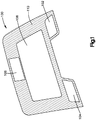
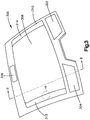
- the plastic glazing 300 may be similar to the plastic glazing 100 depicted in FIG. 1 but may include additional sections 312, 314.
- the plastic glazing 300 may be of one-piece monolithic molded plastic construction, and may have an outer surface that is substantially free of any inhomogeneities, seams, and other disruptions, interruptions, and gaps.
- the plastic glazing 300 may have two colored translucent portions 302, 304 that function as lens of tail lamp units of the vehicle.
- the plastic glazing 300 may also have an additional clear or colored portion 306 that functions as a lens of an additional light unit.
- the plastic glazing 300 may further have a clear translucent portion 308 that functions as a rear window of the vehicle, and a non-transparent portion 310.
- the non-transparent portion 310 may surround the clear translucent portion 308, thereby outlining the rear window of the vehicle.
- the plastic glazing 300 may also have sections 312, 314, which may include a textured surface and/or a pattern.
- plastic glazing 300 is depicted with two sections 312, 314 that may include a textured surface or a pattern
- a plastic glazing such as the plastic glazing 300 of FIG. 3 can include sections other than the sections 312, 314 that may include a textured surface or a pattern.
- Such sections may be disposed along a top of bottom edge of a translucent portion corresponding to the rear window.
- sections 312, 314 and any such additional sections may form a continuous region surrounding a translucent portion corresponding to the rear window of the plastic glazing.
- the section 312, 314 may be wider or narrower, or comprise a different shape, than how they are depicted in FIG. 3 .
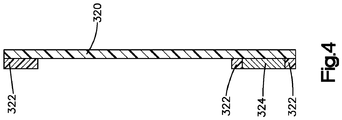
- FIG 4 depicts a cross-sectional view of the plastic glazing 300 along the line B-B.
- the plastic glazing 300 may comprise multiple thermoplastic polymers.
- the plastic glazing 300 may comprise a clear translucent component 320, a dark component 322, and a colored component 324.
- the dark component 322 may be black (e.g., blackout) or be another color and/or effect.
- Each component may be formed by a different thermoplastic polymer such as, for example, different colored polycarbonate resins.
- the translucent component 320 may be formed of a clear thermoplastic polymer to provide a clear unobstructed view there through.
- the translucent component 310 may comprise a certain degree of color but nonetheless retain sufficient transparency to allow a high degree of light transmittance.
- the translucent component 310 can comprise a tint, such as a grey, green, or brown tint.
- the dark component 322 may be a black or other colored non-transparent thermoplastic polymer that is configured to control light transmission through the translucent component 320.
- the dark component 322 may be optimally positioned on the plastic glazing 300 to conceal one or more vehicle components disposed behind the plastic glazing 300 such as, for example, a housing unit.
- the dark component 322 may also conceal any adhesive or fixation mechanisms used to attach the plastic glazing to a housing unit or other component of the tailgate.
- the translucent component 320 may be in a first layer, and the dark component 322 and the colored component 324 may be in a second layer separate from the first.
- the translucent component 320, the dark component 322, and the colored component 324 may have the same thickness or different thicknesses.
- the translucent component 320 may have a thickness that is greater than that of the dark component 322 and the colored component 324.
- the translucent component 320 can have a greater thickness in order to provide structural strength to the plastic glazing 300.
- the thickness of the dark component 322 may be increased in order to provide additional structural support to an outer panel of the plastic glazing 300 along which the dark component 322 is disposed.
- the translucent component 320 may define a panel or overall shell of the plastic glazing 300.
- the dark component 322 and the colored component 324 may be disposed behind the translucent component 320 towards an interior of a vehicle. By being disposed behind the translucent component 320, the dark component 322 and the colored component 324 can be protected from weathering effects. Moreover, the dark component 322 and the colored component 324 would not create any inhomogeneities or raised portions on a surface of the vehicle.
- a first portion of the clear translucent component 320 that does not overlap the dark component 322 and the colored component 324 in the longitudinal direction may form the translucent portion 308 that functions as the rear window of the vehicle.
- the colored component 324 and a second portion of the clear translucent component 320 that overlaps the colored component 324 in the longitudinal direction may form the colored portion 304 that functions as a lens of a tail lamp unit.
- the dark component 322 and additional portions of the clear translucent component 320 that overlap the dark component 322 in the longitudinal direction may form the non-transparent portion 310.
- the plastic glazing 300 may be manufactured or produced using an injection molding technique.
- the plastic glazing 300 may be produced using a three-shot injection molding technique.
- the three-shot injection molding technique may use a mold cavity that can be altered between different volumes.
- the mold cavity may be an example of a molding apparatus.
- the mold cavity may be set to a first volume for receiving a first shot of material.
- the first shot of material may form the translucent component 320.
- the mold cavity may be set to a volume corresponding to that of the translucent component 320.
- a first material may be injected into the mold cavity to form the translucent component 320.
- the first material may be a clear, translucent thermoplastic polymer such as, for example, a clear polycarbonate. After the first shot has been injected, the mold cavity may be changed from its first volume into a second volume.
- the next shot of material may form the colored component 324.
- the mold cavity can be set to a volume corresponding to that of the colored component 324.
- a second material may be injected into the mold cavity to form the colored component 324.
- the second material may be a similar type of material as the first material so that heat released by the second material along the edge of the first material may melt and fuse (i.e., combine) the colored component 324 to the clear translucent component 320.
- the first material is a clear polycarbonate
- the second material may be a colored polycarbonate, such as, for example, a red polycarbonate.
- the mold cavity can be changed from its second volume to a third volume.
- the third and final shot of material may form the dark component 322.
- the mold cavity can be set to a volume corresponding to that of the dark component 322. Such may involve taking into account the portion of the cavity already filled by the first and second shots.
- a third material may be injected into the mold cavity to form the dark component 322.
- the third material also may be a similar type of material as the first and second materials such that heat released by the third material along the end of the first and second materials may melt and fuse the other components to the dark component 322. After the third shot, the entire molded assembly may be left to cool.
- the order of the second shot and the third shot can be changed.
- the third material for forming the dark component 322 canbe injected during the second shot.
- the mold cavity canbe adjusted first to a volume corresponding to the dark component 322 and then to a volume corresponding to the colored component 324.
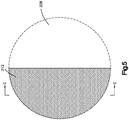
- FIGS. 5-11 present alternative embodiments of a region labeled A (depicted in FIG 3 ) of the second exemplary plastic glazing 300.
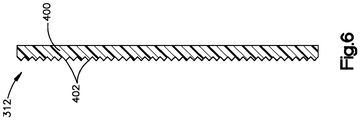
- FIGS. 5 and 6 show a first embodiment where the section 312 has a textured surface.
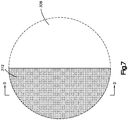
- FIGS. 7 and 8 show a second embodiment where the section 312 has a pattern.
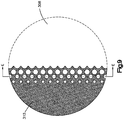
- FIGS. 9-11 show a third embodiment where the section 312 has an inverted frit pattern.
- the section 312 of the plastic glazing 300 has a textured surface.
- the textured surface is disposed next to the translucent portion 308.
- FIG 6 shows a cross-sectional view of the section 312 along line C-C depicted in FIG 5 .
- the section 312 may be formed of a translucent component 400.
- the translucent component 400 cancorrespond to the translucent component 320 depicted in FIG 4 .
- the translucent component 400 may be a separate region of the same translucent component 320.
- the translucent component 400 may have a textured surface having a plurality of raised structures 402.
- the raised structures may be microstructures.
- the plurality of raised structures 402 may be disposed on a side of the translucent component 400 towards an interior of the vehicle. As such, the plurality of raised structures 402 would not be subject to environmental factors on the outside of the vehicle.
- the plurality of raised structures 402 may reduce a degree of transparency of the translucent component 400 due to their influence on the passage of light through the translucent component 400.
- the plurality of raised structures 402 can scatter and/or diffuse light, thereby reducing the visibility of items disposed on either side of the translucent component 400 from the other side.
- the plurality of raised structures 402 can help to conceal a vehicle component located behind the section 312.
- Such may include, for example, a housing unit of the tailgate, adhesives or other fixation mechanisms used to attach the plastic glazing to the housing unit, wires around an edge of a rear window of a vehicle, and the like.
- a dark component such as, for example, the dark component 322 described above with respect to FIG 4
- a dark component e.g., the dark component 322
- a translucent component e.g., the translucent component 320
- the addition of the dark component may add to the weight of a vehicle.
- the dark component may completely eliminate the passage of light through the translucent component 400 into the interior of the vehicle, thereby creating a darker environment within the vehicle.
- a textured surface such as the textured surface depicted in FIGS. 5 and 6 having the plurality of raised structures 402.
- the textured surface would be formed on an existing component (i.e., the translucent component 400), and therefore would not add to the overall weight of the vehicle.
- the textured surface can also be adjusted to allow an optimal degree of light through into the interior of the vehicle.
- the plurality of raised structures 402 may be formed when the translucent component 400 is molded using an injection molding technique.
- the translucent component 320 may be formed using an injection molding technique, whereby a first cavity is configured to receive a shot of clear translucent material.
- the translucent component 400 may be formed using a mold cavity that is configured to receive a shot of clear translucent material.
- the clear translucent material may be, for example, a clear polycarbonate resin.
- the mold cavity may comprise a surface having a plurality of indentations that is configured to form the plurality of raised structures 402.
- textured surface depicted in FIGS. 5 and 6 is shown to have a plurality of lines or ridges, one of ordinary skill in the art would appreciate that other types of textures, including textures formed of dots and other types of structures can also be used.
- FIG 7 an alternative embodiment of the section 312 is depicted.
- the section 312 depicted in FIG 7 has a pattern.
- FIG 8 depicts a cross-sectional view of the section 312 including the pattern.
- the section 312 may comprise a translucent component 502 and a patterned film 506.
- the translucent component 502 may correspond to the translucent component 320 depicted in FIG 4 (i.e., be a separate region of the same translucent component 320).
- the patterned film 506 comprises the pattern, which is visible through the translucent component 502 (as shown in FIG 7 ).
- the patterned film 506 can be disposed behind the translucent component 502 towards an interior of the vehicle.
- the pattern of the patterned film 506 may also conceal a vehicle component located behind the section 312. Such may include, for example, a housing unit of the tailgate, adhesives or other fixation mechanisms used to attach the plastic glazing to the housing unit, wires around an edge of a rear window of a vehicle, and the like.
- the patterned film may include translucent and non-transparent portions.
- the patterned film may allow for the inclusion of complex patterns that may not be easily injection molded using a single-colored component such as, for example, a dark component (e.g., the dark component 322).
- the patterned film may also remove the need for a dark component (e.g., the dark component 322), which may reduce an overall weight of the vehicle.
- the section 312 may be formed as part of an injection molding process for forming the plastic glazing 300, similar to the one described above with respect to FIG 4 .
- the specific type of injection molding process may be referred to as film insert molding, also known as in-mold decoration.
- Each of the translucent component 502 and the patterned film 506 may be a polycarbonate resin or other thermoplastic polymer. In a preferred aspect, both components are formed using the same thermoplastic polymer to enable optimal bonding between the separate components.
- the pattern on the patterned film 506 may be ink printed onto a first surface.
- the ink printed onto the first surface of the patterned film 506 may comprise a polymer resin such as, for example, a polycarbonate resin.
- the ink may be applied onto the first surface of the patterned film 506 via screen printing, although other method of printing known to those skill in the art are also acceptable, such as but not limited to mask/spray in-jet, and pad or tampon printing. Once the ink is printed, drying should be thorough to ensure that any retained solvent is removed from the print. Residual or retained solvent may cause problems at a later stage with cracking/crazing of the polycarbonate itself due to solvent damage.
- the inks may be thermally cured by being exposed to an elevated temperature for a period of time.
- a printed ink can be substantially cured upon exposure to about 90-125°C for about 20-60 minutes.
- the thickness of the cured ink print is typically about 4 micrometers to 20 micrometers, with between about 8 micrometers to 18 micrometers being preferred.
- the patterned film 506 may be trimmed to a desired shape.
- the patterned film 506 may be trimmed such that it conforms to an area corresponding to the section 312.
- the thickness of the patterned film 506 is approximately 0.05 to 2 millimeters. The small thickness allows the patterned film 506 to be shaped prior to being bonded to one or more other components (e.g., the translucent component 502).
- the patterned film 506 can be placed into a first mold cavity for receiving a material for forming the translucent component 502. Since the section 312 does not cover an entire surface of the translucent component 320 (of which a region is the translucent component 502), the patterned film 506 may only cover a portion of the first mold cavity.
- the patterned film 506 may be placed into the mold cavity such that the printed ink pattern is disposed towards a wall of the cavity. Through such placement, the ink pattern may be shielded from the heat of the shot of material forming the translucent component 502.
- the patterned film 506 may be held to the wall of the cavity by vacuum or any other means known to those skilled in the art of film insert molding.
- the shot of material for forming the translucent component 502 When the shot of material for forming the translucent component 502 is injected into the mold cavity, it would bond with a second surface of the patterned film 506 that does not have the ink pattern.
- the heat from the shot of material forming the translucent component 502 may melt the film layer, thereby causing the two layers to bond together when they cool.
- the first mold cavity can be adjusted to a second mold cavity (i.e., the volume of the mold cavity may be changed from a first volume to a second volume).
- FIG 9 another alternative embodiment of the section 312 is depicted.
- the section 312 depicted in FIG 9 has a halftone pattern, such as, for example, an inverted frit or dot pattern.
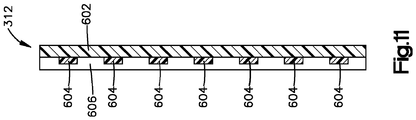
- FIG 10 depicts a cross-sectional view of the section 312 including the halftone pattern.
- the section 312 comprises a translucent component 602 and a dark component 604.
- the translucent component 602 may correspond to the translucent component 320 depicted in FIG 4 (i.e., be a separate region of the same translucent component 320).
- the dark component 604 may correspond to the dark component 322 depicted in FIG 4 (i.e., be a separate region of the same dark component 322).
- the dark component 604 may be formed in the shape of the halftone pattern.
- the dark component 604 can be disposed behind the translucent component 602 toward an interior of the vehicle.
- the dark component 604 can be bonded to the translucent component 602 in an injection molding process.
- Such a bonding process may comprise a polymerization where a molecules of the first material and molecules of the second material react together to form polymer chains.
- a multi-shot injection technique may be used to form the plastic glazing 300.
- a clear translucent material may be injected into a mold cavity having a first volume to form the translucent component.
- the mold cavity may be adjusted to a second volume and so on and so forth for receiving additional shots of material.
- a black or other colored opaque material may be injected to the mold cavity such that it binds with the clear translucent material.
- the two materials may bind together through melt bonding. That is, heat from the injected opaque material may melt a surface of the already set clear translucent material such that a bond is formed between the two materials when they cool down.
- the shape of the dark component 604 (or the section 312) may be formed by using a mold cavity that has a volume that is accordingly shaped.
- the inverted frit pattern of FIG 9 may be formed using a single continuous section of the dark component 604.
- a traditional frit pattern which includes a number of separate dot formations, would require a plurality of separate injection points.
- the inverted frit pattern of FIG 9 while achieving a similar purpose as the traditional frit pattern, removes the need for having multiple injection points.
- halftone pattern depicted in FIG 9 is an inverted dot pattern
- other halftone patterns both inverted and non-inverted, can be used.
- Such a pattern may also be designed such that it allows the formation of a single connected region of blackout (e.g., the dark component 604).
- the tailgate assembles disclosed herein may also include additional layers on top of the thermoplastic polymer layers.
- a protective layer such as a weathering layer may be added to a surface of the plastic glazing.
- An example of such a layer is depicted as item 606 in FIG 11 , where such a layer is applied to an interior surface of the plastic glazing.
- such a layer may be applied to both the interior and exterior surface of the plastic glazing, or to only the exterior surface of the plastic glazing.
- the layer preferably comprises either a polyurethane coating or a combination of an acrylic primer and a silicone hard-coat. Alternatively, other coating systems may be used.
- an acrylic primer includes Exatec® SHP 9X, which is commercially available from Exatec, LLC (Wixom, Ml) and distributed by General Electric Silicones (Waterford, NY).
- the primer is coated on the plastic glazing of the tailgate, air dried, and then thermally cured between about 80°C and 130°C for between about 20 to 80 minutes and more preferably at about 120°C for about 60 minutes.
- a silicone hard-coat is then applied over the primer layer and is air dried before curing at preferably between about 80°C. and 130°C for between about 20 to 80 minutes and more preferably at about 100°C for about 30 minutes.
- a preferred silicone hard-coat used in the present invention is available from Exatec, LLC and distributed by General Electric Silicones as Exatec® SHX.
- an abrasion resistance layer can also be applied to a surface of the plastic tailgate or even to another protective layer, such as the weathering layer described above.
- specific examples of possible inorganic coatings comprising the abrasion resistant layer include, but are not limited to, aluminum oxide, barium fluoride, boron nitride, hafnium oxide, lanthanum fluoride, magnesium fluoride, magnesium oxide, scandium oxide, silicon monoxide, silicon dioxide, silicon nitride, silicon oxy-nitride, silicon oxy-carbide, silicon carbide, hydrogenated silicon oxy-carbide, tantalum oxide, titanium oxide, tin oxide, indium tin oxide, yttrium oxide, zinc oxide, zinc selenide, zinc sulfide, zirconium oxide, zirconium titanate, or glass, and mixtures or blends thereof.
- the abrasion resistant layer may be applied by any technique known to those skilled in the art. These techniques include deposition from reactive species, such as those employed in vacuum-assisted deposition processes, and atmospheric coating processes, such as those used to apply sol-gel coatings to substrates.
- an additional layer for adding more support to the thermoplastic polymer layers may also be added to an interior surface of the plastic glazing.
- This additional layer may be formed of a plastic, a metal, or other material for increasing the structural strength of the tailgate.
- systems and methods disclosed herein may alternately comprise, consist of, or consist essentially of, any appropriate components herein disclosed.
- the invention may additionally, or alternatively, be designed so as to be devoid, or substantially free, of any components used in the prior art compositions or that are otherwise not necessary to the achievement of the function and/or objectives of the present invention.
Landscapes
- Engineering & Computer Science (AREA)
- Mechanical Engineering (AREA)
- General Engineering & Computer Science (AREA)
- Manufacturing & Machinery (AREA)
- Injection Moulding Of Plastics Or The Like (AREA)
- Lighting Device Outwards From Vehicle And Optical Signal (AREA)
Claims (15)
- Kunststoffverglasung (308) einer Heckklappe (300) eines Fahrzeugs, wobei die Kunststoffverglasung Folgendes umfasst:eine durchscheinende Komponente (320, 602), die in einem ersten Schuss geformt wurde, wobei ein Teil der durchscheinenden Komponente eine Heckscheibe des Fahrzeugs bildet;eine farbige Komponente (324), die in einem zweiten Schuss auf die durchscheinende Komponente geformt wurde, wobei die farbige Komponente als Linse einer Lichteinheit fungiert; undeine nicht transparente Komponente (310), die in einem dritten Schuss auf die durchscheinende Komponente und die farbige Komponente geformt wurde,wobei ein überlappender Teil der durchscheinenden Komponente und der nicht transparenten Komponente einen Verdunkelungsbereich (322, 604) nahe der Heckscheibe bildet,wobei die Kunststoffverglasung aus einer einteiligen geformten Kunststoffkonstruktion besteht undwobei die nicht transparente Komponente ein Muster im Verdunkelungsbereich bildet, wobei der Verdunkelungsbereich in Form eines Halbtonmusters ausgebildet ist.
- Kunststoffverglasung nach Anspruch 1, wobei jeweils die durchscheinende Komponente und die nicht transparente Komponente ein Polycarbonat umfassen.
- Kunststoffverglasung nach Anspruch 1 oder 2, wobei das Muster von einer Außenseite des Fahrzeugs sichtbar ist.
- Kunststoffverglasung nach einem der Ansprüche 1 bis 3, wobei der Verdunkelungsbereich dafür konfiguriert ist, einen Klebstoff zu verbergen.
- Kunststoffverglasung nach einem der Ansprüche 1 bis 4, wobei das Halbtonmuster Teil eines einzelnen verbundenen Verdunkelungsbereichs ist.
- Kunststoffverglasung nach einem der Ansprüche 1 bis 5, wobei das Halbtonmuster ein umgekehrtes Frittenmuster ist.
- Kunststoffverglasung nach Anspruch 6, wobei das umgekehrte Frittenmuster unter Verwendung eines einzelnen durchgehenden Abschnitts des Verdunkelungsbereichs gebildet wird.
- Kunststoffverglasung nach einem der Ansprüche 1 bis 7, wobei die Kunststoffverglasung zur Befestigung an einer Gehäuseeinheit (200) der Heckklappe konfiguriert ist, wobei der Verdunkelungsbereich dafür konfiguriert ist, einen Klebstoff zu verbergen, der die Gehäuseeinheit an der Kunststoffverglasung befestigt.
- Kunststoffverglasung nach einem der Ansprüche 1 bis 8, die ferner eine Schutzschicht auf einer Oberfläche der Kunststoffverglasung umfasst.
- Kunststoffverglasung nach Anspruch 9, wobei die Schutzschicht auf einer Innen-und/oder Außenfläche der Kunststoffverglasung vorgesehen ist.
- Kunststoffverglasung nach einem der Ansprüche 9 oder 10, wobei die Schutzschicht eine Verwitterungsschicht ist und eine Polyurethanbeschichtung oder eine Kombination einer Acrylgrundierung und einer Silikonhartbeschichtung umfasst.
- Kunststoffverglasung nach einem der Ansprüche 1 bis 11, wobei die nicht durchscheinende Komponente hinter der durchscheinenden Komponente in Richtung eines Innenraums des Fahrzeugs angeordnet ist.
- Heckklappe, die die Kunststoffverglasung nach Anspruch 1 umfasst, wobei das Material der durchscheinenden Komponente (320, 602) von einem ähnlichen Materialtyp ist wie das Material der farbigen Komponente (324), so dass die vom Material der farbigen Komponente entlang der Materialkante der durchscheinenden Komponente abgegebene Wärme die farbige Komponente (324) mit der durchscheinenden Komponente (320, 602) verschmilzt.
- Heckklappe nach Anspruch 13, wobei das Material der nicht transparenten Komponente (310) von einem ähnlichen Materialtyp ist wie das Material der farbigen Komponente (324), so dass die vom Material der nicht transparenten Komponente entlang der Materialkante der farbigen Komponente abgegebene Wärme die farbige Komponente (324) mit der nicht transparenten Komponente (310) verschmilzt.
- Heckklappe nach Anspruch 13, wobei Material der nicht transparenten Komponente (310) von einem ähnlichen Materialtyp ist wie das Material der durchscheinenden Komponente (320, 602), so dass die vom Material der nicht transparenten Komponente entlang der Materialkante der durchscheinenden Komponente abgegebene Wärme die durchscheinende Komponente (320, 602) mit der nicht transparenten Komponente (310) verschmilzt.
Applications Claiming Priority (2)
| Application Number | Priority Date | Filing Date | Title |
|---|---|---|---|
| US201562215085P | 2015-09-07 | 2015-09-07 | |
| PCT/IB2016/055333 WO2017042698A1 (en) | 2015-09-07 | 2016-09-07 | Surfaces of plastic glazing of tailgates |
Publications (2)
| Publication Number | Publication Date |
|---|---|
| EP3347220A1 EP3347220A1 (de) | 2018-07-18 |
| EP3347220B1 true EP3347220B1 (de) | 2021-04-14 |
Family
ID=56958969
Family Applications (1)
| Application Number | Title | Priority Date | Filing Date |
|---|---|---|---|
| EP16767372.2A Active EP3347220B1 (de) | 2015-09-07 | 2016-09-07 | Kunststoffglasuroberflächen von heckklappen |
Country Status (4)
| Country | Link |
|---|---|
| US (5) | US10434846B2 (de) |
| EP (1) | EP3347220B1 (de) |
| CN (1) | CN108025625B (de) |
| WO (1) | WO2017042698A1 (de) |
Families Citing this family (10)
| Publication number | Priority date | Publication date | Assignee | Title |
|---|---|---|---|---|
| US9333289B1 (en) * | 2015-01-16 | 2016-05-10 | Plas-Tech Engineering, Inc. | Tamper evident closure container |
| CN108025624B (zh) | 2015-09-07 | 2021-04-27 | 沙特基础工业全球技术公司 | 车辆的后挡板的塑料装配玻璃 |
| EP3347183B1 (de) | 2015-09-07 | 2020-12-16 | SABIC Global Technologies B.V. | Kunststoffverglasung von heckklappen mit einem beleuchtungssystem |
| WO2017042699A1 (en) | 2015-09-07 | 2017-03-16 | Sabic Global Technologies B.V. | Molding of plastic glazing of tailgates |
| WO2017042698A1 (en) | 2015-09-07 | 2017-03-16 | Sabic Global Technologies B.V. | Surfaces of plastic glazing of tailgates |
| JP6732912B2 (ja) | 2015-11-23 | 2020-07-29 | サビック グローバル テクノロジーズ ビー.ブイ. | プラスチックグレージングを有するウィンドウ用の点灯システム |
| JP6737748B2 (ja) * | 2017-08-30 | 2020-08-12 | 本田技研工業株式会社 | 車両用外板パネル及び車両用外板パネルの製造方法 |
| CN109228829A (zh) * | 2018-08-10 | 2019-01-18 | 扬州沃盛车业制造有限公司 | 工程车驾驶室贴玻工艺 |
| WO2021052114A1 (zh) * | 2019-09-19 | 2021-03-25 | 宁波信泰机械有限公司 | 一种高集成度的塑料尾门 |
| FR3150567B1 (fr) * | 2023-06-30 | 2025-10-24 | Valeo Vision | Dispositif lumineux pour véhicule comprenant un film décoratif. |
Family Cites Families (269)
| Publication number | Priority date | Publication date | Assignee | Title |
|---|---|---|---|---|
| GB1329505A (en) | 1970-06-10 | 1973-09-12 | Saint Gobain | Tempered glass sheet incorporating a destruction device |
| FR2268425B1 (de) | 1974-04-19 | 1977-10-14 | Saint Gobain | |
| JPS6022520A (ja) | 1983-07-13 | 1985-02-05 | Nippon Denso Co Ltd | 車両用換気機構 |
| FR2549482B1 (fr) | 1983-07-22 | 1986-09-26 | Saint Gobain Vitrage | Couche transparente en matiere plastique resistant a l'embuage et procede de fabrication |
| FR2571323B1 (fr) | 1984-10-04 | 1987-01-30 | Saint Gobain Vitrage | Dispositif automatique d'actionnement des organes de nettoyage d'un vitrage de vehicule automobile |
| EP0267331A1 (de) | 1986-11-10 | 1988-05-18 | Donnelly Corporation | Beleuchtete Tafelanordnung |
| US4645970A (en) | 1984-11-05 | 1987-02-24 | Donnelly Corporation | Illuminated EL panel assembly |
| EP0252123B1 (de) | 1985-12-23 | 1990-08-08 | Libbey-Owens-Ford Co. | Zusammenbauverfahren eines fahrzeugs aus modularen komponenten |
| US4765672A (en) | 1985-12-23 | 1988-08-23 | Libbey-Owens-Ford Co. | Windshield and leaf screen assembly and method of making the same |
| US4712287A (en) | 1986-05-23 | 1987-12-15 | Libbey-Owens-Ford Co. | Method of assembling a vehicle from modular components |
| US4792425A (en) | 1985-12-23 | 1988-12-20 | Libbey-Owens-Ford Co. | Method of making a windshield and leaf screen assembly |
| US4778366A (en) | 1985-12-23 | 1988-10-18 | Libbey-Owens-Ford Co. | Molding apparatus for forming an integral windshield gasket and leaf screen assembly |
| CA1268969A (en) | 1986-01-15 | 1990-05-15 | Sanford Cobb, Jr. | Totally internally reflecting light conduit |
| FR2596750B1 (fr) | 1986-04-03 | 1988-06-03 | Saint Gobain Vitrage | Dispositif de formage du verre |
| US5060440A (en) | 1986-04-18 | 1991-10-29 | Libbey-Owens-Ford Co. | Encapsulated window with hinge |
| US4880267A (en) | 1986-09-17 | 1989-11-14 | Mazda Motor Corporation | Back door structure for a motor vehicle |
| DE3637622A1 (de) | 1986-11-05 | 1988-05-19 | Ford Werke Ag | Doppelwandiges karosseriebauteil aus kunststoff fuer kraftfahrzeuge |
| DE3730346A1 (de) | 1987-09-10 | 1989-03-30 | Ver Glaswerke Gmbh | Glasscheibe fuer ein kraftfahrzeug |
| FR2624850B1 (fr) | 1987-12-22 | 1990-04-27 | Saint Gobain Vitrage | Procede et dispositif pour le refroidissement de feuilles de verre bombees |
| FR2635319B1 (fr) | 1988-07-20 | 1992-07-24 | Saint Gobain Vitrage | Vitrage muni d'une couche antigivre |
| US5324374A (en) | 1988-07-27 | 1994-06-28 | Saint Gobain Vitrage | Laminated glass with an electroconductive layer |
| US5101325A (en) | 1990-03-20 | 1992-03-31 | General Electric Company | Uniform illumination of large, thin surfaces particularly suited for automotive applications |
| US5411696A (en) | 1990-12-27 | 1995-05-02 | Tokai Kogyo Kabushiki Kaisha | Process of making a panel unit |
| US5352010A (en) | 1992-03-10 | 1994-10-04 | Brodie James L | Post attached structures for window assemblies |
| FR2695117B1 (fr) | 1992-08-28 | 1994-12-02 | Saint Gobain Vitrage Int | Procédé de traitement de couches minces à propriétés de conduction électrique et/ou de réflexion dans l'infra-rouge. |
| US5544458A (en) | 1993-03-05 | 1996-08-13 | Donnelly Corporation | Vehicle panel assembly |
| CZ291294A3 (en) | 1993-03-26 | 1995-08-16 | Saint Gobain Vitrage | Process for producing enamelled laminated glass part and enamelled composition for making the same |
| US5449213A (en) | 1993-05-26 | 1995-09-12 | Aluminum Company Of America | Movable body panel for a vehicle and related method |
| US5400225A (en) | 1993-10-06 | 1995-03-21 | Currie; Joseph E. | Optical fiber illumination device |
| US5780965A (en) | 1993-12-09 | 1998-07-14 | Key Plastics, Inc. | Three dimensional electroluminescent display |
| FR2717339B3 (fr) | 1994-03-08 | 1996-05-24 | Saint Gobain Vitrage | Etanchéité d'une liaison électrique d'un vitrage. |
| US5757127A (en) | 1994-06-10 | 1998-05-26 | Nippondenso Co., Ltd. | Transparent thin-film EL display apparatus with ambient light adaptation means |
| FR2721253B1 (fr) | 1994-06-16 | 1996-10-11 | Saint Gobain Vitrage | Vitrage feuilleté équipé d'une bande périphérique et méthode de fabrication de ce vitrage. |
| US5505023A (en) | 1994-07-19 | 1996-04-09 | Libbey-Owens-Ford Co. | Slide glass mechanism and seal system for vehicular backlite |
| US5660573A (en) | 1994-09-08 | 1997-08-26 | Butt; James H. | Electroluminescent lamp with controlled field intensity for displaying graphics |
| FR2727107B1 (fr) | 1994-11-21 | 1996-12-27 | Saint Gobain Vitrage | Vitrage muni d'au moins une couche mince et son procede d'obtention |
| US5726953A (en) | 1995-04-07 | 1998-03-10 | Metro-Mark, Incorporated | Electroluminescent lamp with buried indiciae and method for making same |
| FR2738813B1 (fr) | 1995-09-15 | 1997-10-17 | Saint Gobain Vitrage | Substrat a revetement photo-catalytique |
| US20020018344A1 (en) * | 1996-03-08 | 2002-02-14 | Thomas & Betts International | Overhead luminaire |
| FR2746811B1 (fr) | 1996-04-02 | 1998-04-30 | Saint Gobain Vitrage | Composition pour un revetement non-mouillable, procede de traitement d'un vitrage a l'aide de la composition et produits obtenue |
| US5669693A (en) | 1996-04-17 | 1997-09-23 | Hughes Electronics | Holographic thin taillamp |
| US5772304A (en) | 1996-10-02 | 1998-06-30 | Raytheon Company | Optical fiber-to-planar lightpipe grooved optical coupler |
| FR2756292B1 (fr) | 1996-11-26 | 1998-12-24 | Saint Gobain Vitrage | Procede de preparation d'une feuille en matiere plastique, cette feuille et vitrage la comportant |
| DE19706043A1 (de) | 1996-12-12 | 1998-06-18 | Brose Fahrzeugteile | Kunststoffscheibe für eine Kraftfahrzeugtür |
| US5890796A (en) | 1997-01-16 | 1999-04-06 | Ford Global Technologies, Inc. | Laser illuminated lighting system utilizing a diffractive optical element |
| US5887393A (en) | 1997-03-05 | 1999-03-30 | Excel Industries, Inc. | Plastic glazing window module |
| US5857770A (en) | 1997-03-24 | 1999-01-12 | Ford Motor Company | Laser illuminated vehicle lighting system utilizing a turning prism |
| FR2762541B1 (fr) | 1997-04-24 | 1999-07-02 | Saint Gobain Vitrage | Procede de fabrication d'un vitrage feuillete |
| JP3784497B2 (ja) | 1997-05-29 | 2006-06-14 | 三菱エンジニアリングプラスチックス株式会社 | 熱可塑性樹脂製グレージング材およびその製造方法 |
| FR2766198B1 (fr) | 1997-07-15 | 2003-11-14 | Saint Gobain Vitrage | Vitrage plastique, notamment pour l'automobile et procede pour sa fabrication |
| US6965196B2 (en) | 1997-08-04 | 2005-11-15 | Lumimove, Inc. | Electroluminescent sign |
| EP1021311B1 (de) | 1997-10-06 | 2003-07-23 | Decoma International Inc. | Paneelzusammenbau mit integriertem stop-signal |
| FR2779990B1 (fr) | 1998-06-19 | 2000-07-21 | Saint Gobain Vitrage | Vitrage en matiere plastique avec ajout de matiere plastique surmoule |
| DE29820304U1 (de) | 1998-11-12 | 1999-01-07 | TRW Automotive Safety Systems GmbH, 63743 Aschaffenburg | Kraftfahrzeugemblem |
| FR2787350B1 (fr) | 1998-12-21 | 2002-01-04 | Saint Gobain Vitrage | Vitrage a revetement mesoporeux fonctionnel, notamment hydrophobe |
| FR2789382B1 (fr) | 1999-02-05 | 2002-02-08 | Saint Gobain Vitrage | Vitrage feuillete a tenue elevee aux crash-tests |
| FR2791147B1 (fr) | 1999-03-19 | 2002-08-30 | Saint Gobain Vitrage | Dispositif electrochimique du type dispositif electrocommandable a proprietes optiques et/ou energetiques variables |
| JP2000301985A (ja) | 1999-04-22 | 2000-10-31 | Toyota Autom Loom Works Ltd | バックウインド用樹脂窓及びその製造方法 |
| FR2792628B1 (fr) | 1999-04-22 | 2001-06-15 | Saint Gobain Vitrage | Substrat texture susceptible de constituer un vitrage, procede pour son obtention |
| FR2793105B1 (fr) | 1999-04-30 | 2001-06-01 | Saint Gobain Vitrage | Vitrages chauffants, en particulier pour vehicules |
| DE19921646A1 (de) * | 1999-05-10 | 2000-11-16 | Herberts Gmbh & Co Kg | Für Kraftfahrzeuge geeignete dekorativ lackierte Kunststoff-Formteile |
| US7976916B2 (en) | 1999-05-25 | 2011-07-12 | Saint-Gobain Vitrage | Refrigerated display case having a transparent insulating glazing unit |
| EP1222084A4 (de) | 1999-10-13 | 2008-07-02 | Exatec Llc | Fahrzeugfenster mit markierung der umrandung und herstellungsverfahren |
| FR2806076B1 (fr) | 2000-03-08 | 2002-09-20 | Saint Gobain Vitrage | Substrat transparent revetu d'une couche polymere |
| US6224135B1 (en) | 2000-05-07 | 2001-05-01 | John W. Rehkopf | Air deflector for motor vehicles |
| US6241302B1 (en) | 2000-05-07 | 2001-06-05 | John W. Rehkopf | Air deflector for motor vehicles |
| FR2809388B1 (fr) | 2000-05-23 | 2002-12-20 | Saint Gobain Vitrage | Vitrage comprenant au moins une couche a proprietes thermochromes |
| FR2811316B1 (fr) | 2000-07-06 | 2003-01-10 | Saint Gobain | Substrat texture transparent et procedes pour l'obtenir |
| US6468677B1 (en) | 2000-08-01 | 2002-10-22 | Premark Rwp Holdings Inc. | Electroluminescent high pressure laminate |
| US7018057B2 (en) | 2000-08-23 | 2006-03-28 | Vtec Technologies, Llc | Transparent plastic optical components and abrasion resistant polymer substrates and methods for making the same |
| JP2002157903A (ja) | 2000-11-16 | 2002-05-31 | Ichikoh Ind Ltd | 車両用灯具 |
| US20020110693A1 (en) * | 2000-12-14 | 2002-08-15 | Richard David A. | Glazing unit and method of making the same |
| FR2821320B1 (fr) | 2001-02-26 | 2003-06-06 | Plastic Omnium Cie | Encadrement de vitre d'habitacle de vehicule automobile et ouvrant comportant un tel encadrement |
| FR2821785B1 (fr) | 2001-03-09 | 2004-06-04 | Saint Gobain | Procede de fabrication de vitrages en matiere plastique |
| JP4354185B2 (ja) | 2001-03-22 | 2009-10-28 | ルミムーブ, インコーポレイテッド | 照明ディスプレイシステムおよびプロセス |
| US7048400B2 (en) | 2001-03-22 | 2006-05-23 | Lumimove, Inc. | Integrated illumination system |
| US6461028B1 (en) | 2001-06-15 | 2002-10-08 | Chin-Jeng Huang | Vehicle side bumper and signal light assembly |
| FR2827855B1 (fr) | 2001-07-25 | 2004-07-02 | Saint Gobain | Vitrage muni d'un empilement de couches minces reflechissant les infrarouges et/ou le rayonnement solaire |
| DE10147537A1 (de) | 2001-09-26 | 2003-04-17 | Freeglass Gmbh & Co Kg | Verfahren zum Herstellen einer Kunststoffscheibe mit einer Leitstruktur und Kunststoffscheibe mit eingebetteten Drähten |
| US7048423B2 (en) | 2001-09-28 | 2006-05-23 | Visteon Global Technologies, Inc. | Integrated light and accessory assembly |
| US7137718B2 (en) | 2001-10-31 | 2006-11-21 | 3M Innovative Properties Company | Automotive lamp |
| US7469450B2 (en) | 2001-11-09 | 2008-12-30 | Dura Global Technologies, Inc. | Articulated window panel with hidden hinge for vehicles |
| DE10160806A1 (de) | 2001-12-11 | 2003-06-26 | Saint Gobain Sekurit D Gmbh | Heizscheibe mit einer elektrisch leitenden Oberflächenbeschichtung |
| US6908204B2 (en) | 2002-02-02 | 2005-06-21 | Edward Robert Kraft | Flat panel luminaire having embedded light guides |
| AU2003231543A1 (en) | 2002-04-30 | 2003-11-17 | Idemitsu Kosan Co., Ltd | Resinous interior member of opening/closing body, mold therefor and method of molding the same |
| GB0216787D0 (en) | 2002-07-19 | 2002-08-28 | Pilkington Plc | Laminated glazing panel |
| JP4067387B2 (ja) | 2002-11-08 | 2008-03-26 | アルプス電気株式会社 | 導光材および照明装置 |
| US7011983B2 (en) | 2002-12-20 | 2006-03-14 | General Electric Company | Large organic devices and methods of fabricating large organic devices |
| BE1015302A3 (fr) | 2003-01-10 | 2005-01-11 | Glaverbel | Vitrage comportant des composants electroniques. |
| FR2852951B1 (fr) | 2003-03-26 | 2007-02-16 | Saint Gobain | Procede de bombage de feuilles de verre par pressage et aspiration |
| EP1644220A1 (de) | 2003-07-02 | 2006-04-12 | Koninklijke Philips Electronics N.V. | Kraftfahrzeug mit beleuchtungssystem für heckleuchte und kennzeichen mit led und lichtleiter |
| JP2005038831A (ja) | 2003-07-03 | 2005-02-10 | Olympus Corp | 光学装置、照明装置、及びカラー照明装置 |
| JP4242743B2 (ja) | 2003-09-30 | 2009-03-25 | ダイキョーニシカワ株式会社 | 車両のドア構造 |
| JP2005158362A (ja) | 2003-11-21 | 2005-06-16 | Stanley Electric Co Ltd | 車両用灯具 |
| FR2863210B1 (fr) | 2003-12-08 | 2006-02-03 | Valeo Systemes Dessuyage | Ouvrant comportant des moyens de fixation d'accessoires realises d'une seule piece par moulage |
| DE102004004360B4 (de) | 2004-01-29 | 2007-01-25 | Dr.Ing.H.C. F. Porsche Ag | Kraftfahrzeug mit einer Luftleiteinrichtung |
| FR2866643B1 (fr) | 2004-02-24 | 2006-05-26 | Saint Gobain | Substrat, notamment verrier, a surface hydrophobe, avec une durabilite amelioree des proprietes hydrophobes |
| US7024822B2 (en) | 2004-03-04 | 2006-04-11 | Dura Global Technologies, Inc. | Articulating window hinges and articulating window assemblies |
| US7100328B2 (en) | 2004-03-04 | 2006-09-05 | Dura Global Technologies, Inc. | Articulating window panel with hidden hinge for vehicles |
| US7048422B1 (en) | 2004-03-16 | 2006-05-23 | Stephen Solomon | Light emitting signaling apparatus |
| DE102004044035B4 (de) | 2004-09-09 | 2007-05-31 | MöllerTech GmbH | Bauteil aus Kunststoff, insbesondere Verkleidungsteil für den KFZ-Innenraum |
| FR2875669B1 (fr) | 2004-09-17 | 2007-07-06 | Saint Gobain | Structure chauffante electrique |
| FR2879131B1 (fr) | 2004-12-14 | 2010-12-17 | Saint Gobain | Vitrage complexe constitue d'au moins deux elements vitres contigus et procede de realisation de ce vitrage complexe. |
| FR2881422B1 (fr) | 2005-01-31 | 2007-03-16 | Saint Gobain | Pose de film antigivre sur substrat transparent |
| WO2006091959A2 (en) | 2005-02-24 | 2006-08-31 | Exatec, Llc | Decorated two component window assemby and method of manufacture |
| BE1016540A3 (fr) | 2005-03-10 | 2007-01-09 | Glaverbel | Vitrage automobile a diffusion selective. |
| CA2603382A1 (en) | 2005-03-12 | 2006-09-21 | 3M Innovative Properties Company | Illumination devices and methods for making the same |
| US20060209551A1 (en) | 2005-03-18 | 2006-09-21 | Robert Schwenke | Light emissive plastic glazing |
| FR2884147B3 (fr) | 2005-04-11 | 2008-06-13 | Saint Gobain | Substrat microbicide |
| GB2442364A (en) | 2005-04-11 | 2008-04-02 | Saint Gobain | Microbicidal substrate |
| WO2006114543A1 (fr) | 2005-04-26 | 2006-11-02 | Saint-Gobain Glass France | Vitrage comportant un dispositif electronique et procede de lecture-ecriture des informations incluses dans ce dispositif |
| EP1888996B1 (de) | 2005-06-10 | 2017-12-13 | Saint-Gobain Ceramics and Plastics, Inc. | Durchsichtiger keramikverbundstoff |
| JP4585390B2 (ja) | 2005-06-23 | 2010-11-24 | アルプス電気株式会社 | 環状導光体 |
| FR2888082B1 (fr) | 2005-06-30 | 2007-08-24 | Saint Gobain | Vitrage chauffant feuillete ayant un confort de vision ameliore |
| US8216679B2 (en) * | 2005-07-27 | 2012-07-10 | Exatec Llc | Glazing system for vehicle tops and windows |
| DE102005047500B4 (de) * | 2005-10-04 | 2013-12-05 | Ems-Chemie Ag | Kunststoffbauteil mit Sichtteil und Lichtquelle |
| FR2892594B1 (fr) | 2005-10-21 | 2007-12-07 | Saint Gobain | Structure lumineuse comportant au moins une diode electroluminescente, sa fabrication et ses applications |
| JP4375749B2 (ja) | 2005-11-22 | 2009-12-02 | 本田技研工業株式会社 | 車両の樹脂製ガーニッシュ構造 |
| JP4733009B2 (ja) | 2006-01-30 | 2011-07-27 | 豊田合成株式会社 | 車両用灯具 |
| FR2899954B1 (fr) | 2006-04-13 | 2008-06-06 | Saint Gobain | Panneau lumineux |
| FR2903340B1 (fr) * | 2006-07-06 | 2012-04-13 | Peugeot Citroen Automobiles Sa | Procede de fabrication d'une glace de dispositif d'eclairage et/ou de signalisation integree a un element de carrosserie, et ensemble obtenu par ce procede |
| EP1892182A1 (de) | 2006-08-21 | 2008-02-27 | ArvinMeritor GmbH | Durchsichtiges und verbundartiges Karosserieanbauteil, Zwischenprodukt und Verfahren zum Herstellen eines solchen Karosserieanbauteils |
| US8525402B2 (en) | 2006-09-11 | 2013-09-03 | 3M Innovative Properties Company | Illumination devices and methods for making the same |
| KR101302229B1 (ko) | 2006-10-16 | 2013-09-02 | (주)엘지하우시스 | 에어스포일러 일체형 플라스틱 재질의 자동차용 윈도우 |
| JP4678364B2 (ja) | 2006-12-05 | 2011-04-27 | スタンレー電気株式会社 | 光源装置及び車両前照灯 |
| US7883249B2 (en) | 2006-12-11 | 2011-02-08 | Toyoda Gosei Co., Ltd. | Lighting device for vehicle |
| FR2909921B1 (fr) | 2006-12-15 | 2012-05-25 | Saint Gobain | Vitrage fonctionnalise |
| DE102006062272A1 (de) | 2006-12-22 | 2008-06-26 | Bayerische Motoren Werke Ag | Fahrzeugleuchte |
| DE102007005551A1 (de) | 2007-01-25 | 2008-07-31 | Schefenacker Vision Systems Germany Gmbh | Leuchte für Fahrzeuge, vorzugsweise für Kraftfahrzeuge |
| JP4780788B2 (ja) | 2007-01-31 | 2011-09-28 | スタンレー電気株式会社 | Led灯具ユニット |
| DE102007008833A1 (de) | 2007-02-23 | 2008-08-28 | Saint-Gobain Sekurit Deutschland Gmbh & Co. Kg | Transparente Scheibe mit einer beheizbaren Beschichtung |
| US7712933B2 (en) | 2007-03-19 | 2010-05-11 | Interlum, Llc | Light for vehicles |
| US8408773B2 (en) | 2007-03-19 | 2013-04-02 | Innotec Corporation | Light for vehicles |
| FR2913972B1 (fr) | 2007-03-21 | 2011-11-18 | Saint Gobain | Procede de fabrication d'un masque pour la realisation d'une grille |
| US20080254299A1 (en) | 2007-04-13 | 2008-10-16 | General Electric Company | Scratch-resistant Layered Composite and Articles |
| EP1992478A1 (de) | 2007-05-18 | 2008-11-19 | LYTTRON Technology GmbH | Verbundglaselement, bevorzugt Verbundsicherheitsglaselement, mit integrierter Elektrolumineszenz (EL)-Leuchtstruktur |
| JP4663680B2 (ja) | 2007-05-22 | 2011-04-06 | 豊田合成株式会社 | 車両用灯具 |
| JP4984058B2 (ja) | 2007-05-25 | 2012-07-25 | スタンレー電気株式会社 | 光源装置及び車両前照灯 |
| US8179034B2 (en) | 2007-07-13 | 2012-05-15 | 3M Innovative Properties Company | Light extraction film for organic light emitting diode display and lighting devices |
| FR2922859B1 (fr) | 2007-10-31 | 2010-02-19 | Plastic Omnium Cie | Ensemble d'un caisson de hayon et d'une piece destinee a etre rapportee sur le caisson |
| DE102008004942A1 (de) | 2007-12-10 | 2009-06-25 | Saint-Gobain Sekurit Deutschland Gmbh & Co. Kg | Mehrschichtelement mit einer ersten transparenten Flächenelektrode |
| EP2227512A1 (de) | 2007-12-18 | 2010-09-15 | Lumimove, Inc., Dba Crosslink | Flexible elektrolumineszenzvorrichtungen und systeme |
| FR2925483B1 (fr) | 2007-12-20 | 2010-01-08 | Saint Gobain | Vitrage decoratif. |
| FR2985496B1 (fr) | 2008-03-10 | 2015-02-06 | Plastic Omnium Cie | Ensemble d'un panneau d'ouvrant et d'elements de renfort. |
| JP5152572B2 (ja) | 2008-03-24 | 2013-02-27 | スタンレー電気株式会社 | 車両前照灯 |
| WO2009143627A1 (en) | 2008-05-30 | 2009-12-03 | Magna International Inc. | Composite liftgate system |
| FR2932418B1 (fr) | 2008-06-12 | 2013-10-11 | Plastic Omnium Cie | Ouvrant, notamment hayon, de vehicule |
| DE102008036283B4 (de) | 2008-08-04 | 2017-06-29 | Dr. Ing. H.C. F. Porsche Aktiengesellschaft | Heckseitige Luftleitvorrichtung für ein Kraftfahrzeug |
| JP5091808B2 (ja) | 2008-09-02 | 2012-12-05 | 株式会社小糸製作所 | 車両用灯具 |
| US7828373B2 (en) | 2008-09-24 | 2010-11-09 | Ford Global Technologies, Llc | Polycarbonate panel assembly for a vehicle |
| FR2936358B1 (fr) | 2008-09-24 | 2011-01-21 | Saint Gobain | Procede de fabrication d'un masque a ouvertures submillimetriques pour grille electroconductrice submillimetrique, masque a ouverture submillimetriques, grille electroconductrice submillimetrique. |
| FR2936360B1 (fr) | 2008-09-24 | 2011-04-01 | Saint Gobain | Procede de fabrication d'un masque a ouvertures submillimetriques pour grille electroconductrice submillimetrique, masque et grille electroconductrice submillimetrique. |
| FR2936362B1 (fr) | 2008-09-25 | 2010-09-10 | Saint Gobain | Procede de fabrication d'une grille submillimetrique electroconductrice revetue d'une grille surgrille, grille submillimetrique electroconductrice revetue d'une surgrille |
| FR2936361B1 (fr) | 2008-09-25 | 2011-04-01 | Saint Gobain | Procede de fabrication d'une grille submillimetrique electroconductrice, grille submillimetrique electroconductrice |
| FR2937710B1 (fr) | 2008-10-27 | 2013-05-17 | Saint Gobain | Module a diodes electroluminescentes pour vehicule, support a diodes, fabrications |
| CN102245414B (zh) * | 2008-12-12 | 2013-11-13 | 大协西川株式会社 | 车辆用后背门 |
| JP5275776B2 (ja) | 2008-12-17 | 2013-08-28 | 株式会社小糸製作所 | 車両用灯具 |
| US7922374B2 (en) | 2008-12-22 | 2011-04-12 | GM Global Technology Operations LLC | Vehicle lamp assembly |
| TWI338637B (en) | 2008-12-29 | 2011-03-11 | Univ Nat Central | Automobile lamp |
| US8272770B2 (en) | 2009-01-02 | 2012-09-25 | Rambus International Ltd. | TIR switched flat panel display |
| JP4771262B2 (ja) | 2009-02-16 | 2011-09-14 | 関東自動車工業株式会社 | バックドア |
| JP4915706B2 (ja) | 2009-04-15 | 2012-04-11 | 関東自動車工業株式会社 | バックドア及びその分解方法 |
| JP2010260519A (ja) | 2009-05-11 | 2010-11-18 | Kanto Auto Works Ltd | バックドア |
| FR2945480B1 (fr) | 2009-05-18 | 2015-05-15 | Plastic Omnium Cie | Ouvrant de vehicule muni de charniere. |
| JP2011051544A (ja) | 2009-09-04 | 2011-03-17 | Kanto Auto Works Ltd | バックドア |
| JP2011057188A (ja) | 2009-09-14 | 2011-03-24 | Kanto Auto Works Ltd | 樹脂製ドアの配設構造 |
| DE102009046343A1 (de) | 2009-11-03 | 2011-05-05 | Brose Fahrzeugteile Gmbh & Co. Kommanditgesellschaft, Hallstadt | Strukturrahmenmodul für eine Fahrzeugtür |
| RU2537011C2 (ru) | 2009-11-25 | 2014-12-27 | Вебер Отомотив Аг-Холдинг | Задняя дверь для автомобиля, изготовленная из усиленного волокном термопластика |
| FR2953677B1 (fr) | 2009-12-04 | 2020-11-06 | Saint Gobain | Vitrage a fils conducteurs integres par ultrasons |
| JP2011121479A (ja) | 2009-12-10 | 2011-06-23 | Kanto Auto Works Ltd | バックドアの建て付け調整方法 |
| JP2011126388A (ja) | 2009-12-16 | 2011-06-30 | Kanto Auto Works Ltd | バックドアの構造 |
| DE102009058788A1 (de) | 2009-12-18 | 2011-06-22 | Volkswagen AG, 38440 | Scheibe für ein Kraftfahrzeug und Verfahren zum Herstellen dieser Scheibe |
| JP2011136606A (ja) | 2009-12-25 | 2011-07-14 | Kanto Auto Works Ltd | 樹脂製バックドアの補強構造 |
| US8480272B2 (en) | 2010-01-22 | 2013-07-09 | Gregory A. Day | Vehicle exterior lighting system |
| FR2955539B1 (fr) | 2010-01-26 | 2016-03-25 | Saint Gobain | Vitrage lumineux de vehicule, fabrications |
| FR2955530B1 (fr) | 2010-01-26 | 2015-11-20 | Saint Gobain | Vitrage lumineux de vehicule, fabrications |
| FR2955915B1 (fr) | 2010-02-01 | 2012-03-09 | Saint Gobain | Vitrage multiple lumineux a diodes electroluminescentes |
| JP5418381B2 (ja) | 2010-04-12 | 2014-02-19 | トヨタ自動車株式会社 | バックドア構造 |
| FR2961151B1 (fr) | 2010-06-15 | 2012-06-15 | Peugeot Citroen Automobiles Sa | Hayon arriere de vehicule automobile a peau exterieure et doublure interieure moulees et equipees de conduit(s) moule(s) pour l'alimentation en liquide de lavage |
| JP5557641B2 (ja) | 2010-07-29 | 2014-07-23 | ダイハツ工業株式会社 | 車両用ドア |
| JP5645552B2 (ja) | 2010-08-27 | 2014-12-24 | ダイハツ工業株式会社 | 車両のバックドア装置 |
| JP5649045B2 (ja) | 2010-09-16 | 2015-01-07 | ダイハツ工業株式会社 | 車両のバックドア装置 |
| KR101219341B1 (ko) | 2010-09-28 | 2013-01-21 | 현대자동차주식회사 | 자동차용 발광 가니쉬 |
| DE102010042939A1 (de) | 2010-10-26 | 2012-04-26 | Bayer Materialscience Aktiengesellschaft | Fugenlose Heckklappe |
| FR2968631B1 (fr) | 2010-12-10 | 2012-12-14 | Peugeot Citroen Automobiles Sa | Sous-ensemble, notamment de vehicule, a peau externe et structure interne fixees par cordon de colle |
| US8646829B2 (en) | 2010-12-16 | 2014-02-11 | Magna International Inc. | Composite lift gate deformable section |
| FR2969045B1 (fr) | 2010-12-16 | 2013-06-14 | Peugeot Citroen Automobiles Sa | Sous-ensemble, notamment de vehicule, a peau externe et structure interne fixees par cordon de colle. |
| FR2969141B1 (fr) | 2010-12-20 | 2012-12-21 | Saint Gobain | Vitrage de securite |
| JP5669260B2 (ja) | 2010-12-21 | 2015-02-12 | ダイハツ工業株式会社 | 車両のバックドア装置 |
| FR2970671B1 (fr) | 2011-01-21 | 2016-12-30 | Saint Gobain | Vitrage lumineux |
| FR2971387B1 (fr) | 2011-02-04 | 2014-08-08 | Saint Gobain | Element chauffant a couche |
| US8585263B2 (en) | 2011-03-04 | 2013-11-19 | Michael Shipman | Illuminated vehicular sign |
| US9365449B2 (en) | 2011-03-09 | 2016-06-14 | Empire Technology Development Llc | Selective light transmitting window glazings and methods of design and manufacture |
| EP2689633B1 (de) | 2011-03-22 | 2016-11-09 | Saint-Gobain Glass France | Verfahren und anordnung zum enteisen einer transparenten scheibe mit elektrischer heizeinrichtung |
| JP5681014B2 (ja) | 2011-03-30 | 2015-03-04 | マツダ株式会社 | 車両用リフトゲート構造 |
| JP5681015B2 (ja) | 2011-03-30 | 2015-03-04 | マツダ株式会社 | 車両用リフトゲート構造 |
| JP5726592B2 (ja) | 2011-03-30 | 2015-06-03 | マツダ株式会社 | 車両用リフトゲート構造 |
| CN103477252A (zh) | 2011-04-22 | 2013-12-25 | 夏普株式会社 | 透镜和光源单元 |
| JP5769005B2 (ja) | 2011-05-13 | 2015-08-26 | 日立化成株式会社 | 自動車用バックドア |
| FR2976439A1 (fr) | 2011-06-07 | 2012-12-14 | Saint Gobain | Element chauffant a couche |
| JP5660321B2 (ja) | 2011-06-07 | 2015-01-28 | 三菱自動車工業株式会社 | 車両の後部構造 |
| FR2976341B1 (fr) | 2011-06-09 | 2013-05-31 | Saint Gobain | Dispositif d'eclairage a diodes electroluminescentes |
| JP5889404B2 (ja) | 2011-06-10 | 2016-03-22 | サン−ゴバン グラス フランスSaint−Gobain Glass France | 安全機能を備えた加熱可能な合わせガラス |
| JP5769515B2 (ja) | 2011-06-27 | 2015-08-26 | ダイキョーニシカワ株式会社 | 車両用バックドア |
| FR2978525B1 (fr) | 2011-07-29 | 2018-05-18 | Saint-Gobain Glass France | Vitrage multiple lumineux de meuble |
| FR2978524B1 (fr) | 2011-07-29 | 2013-07-05 | Saint Gobain | Vitrage lumineux de vehicule, fabrications |
| FR2978379B1 (fr) | 2011-07-29 | 2014-03-14 | Saint Gobain | Vitrage lumineux de vehicule, fabrication |
| CN103717392B (zh) | 2011-08-05 | 2016-02-03 | 三菱工程塑料株式会社 | 面板和面板设置结构 |
| JP5779045B2 (ja) | 2011-08-25 | 2015-09-16 | スタンレー電気株式会社 | 車両用灯具 |
| DE202011110333U1 (de) | 2011-09-23 | 2013-08-13 | Saint-Goban Glass France | Fehlerstrom-Sicherheitsabschaltung für Elektrofahrzeuge |
| EP2574142A1 (de) | 2011-09-23 | 2013-03-27 | Saint-Gobain Glass France | Fehlerstrom-Sicherheitsabschaltung für Elektrofahrzeuge |
| FR2980833A1 (fr) | 2011-09-29 | 2013-04-05 | Saint Gobain | Vitrage eclairant |
| FR2981295B1 (fr) | 2011-10-14 | 2020-02-21 | Saint-Gobain Glass France | Fabrication d'un vitrage feuillete |
| FR2982197B1 (fr) | 2011-11-07 | 2013-11-15 | Saint Gobain | Vehicule automobile avec vitrage repetiteur de clignotant |
| FR2982196B1 (fr) | 2011-11-07 | 2015-07-17 | Saint Gobain | Vitrage de signalisation lumineuse pour vehicule |
| JP5991458B2 (ja) | 2011-11-24 | 2016-09-14 | スタンレー電気株式会社 | 車両用灯具ユニット |
| FR2983976B1 (fr) | 2011-12-13 | 2017-10-20 | Optinvent | Guide optique a elements de guidage superposes et procede de fabrication |
| JP5672614B2 (ja) | 2011-12-15 | 2015-02-18 | トヨタ自動車東日本株式会社 | バックドア補強構造 |
| FR2984251B1 (fr) | 2011-12-19 | 2014-01-10 | Saint Gobain | Vitrage eclairant pour vehicule |
| JP5704080B2 (ja) | 2012-01-16 | 2015-04-22 | 豊田合成株式会社 | 車両用樹脂ウィンドウ |
| FR2986186B1 (fr) | 2012-01-26 | 2014-09-05 | Saint Gobain | Vitrage eclairant pour vehicule |
| JP5937836B2 (ja) | 2012-02-07 | 2016-06-22 | 株式会社小糸製作所 | 車両用灯具 |
| FR2986854B1 (fr) | 2012-02-13 | 2014-02-14 | Saint Gobain | Vitrage eclairant |
| FR2989041B1 (fr) | 2012-04-10 | 2014-12-05 | Saint Gobain | Vitrage eclairant pour vehicule |
| EP2836383B1 (de) | 2012-04-13 | 2018-07-25 | Tiercon Corp. | Dachspoilermontagesystem |
| JP2013230716A (ja) | 2012-04-27 | 2013-11-14 | Hitachi Chemical Co Ltd | 樹脂製バックドア |
| JP5891101B2 (ja) | 2012-04-27 | 2016-03-22 | ダイキョーニシカワ株式会社 | 車両用バックドアのドアインナーパネルの成形装置及び成形方法 |
| JP2013230717A (ja) | 2012-04-27 | 2013-11-14 | Hitachi Chemical Co Ltd | 樹脂製バックドア用アウタパネル |
| FR2990379B1 (fr) | 2012-05-10 | 2014-04-25 | Saint Gobain | Vitrage eclairant avec deflecteur incorpore |
| JP5952086B2 (ja) | 2012-05-24 | 2016-07-13 | スタンレー電気株式会社 | 車両用灯具 |
| JP6116823B2 (ja) | 2012-06-29 | 2017-04-19 | 株式会社小糸製作所 | 車両用灯具および窓ユニット |
| FR2993203B1 (fr) | 2012-07-11 | 2014-07-18 | Saint Gobain | Vitrage lumineux |
| FR2994125B1 (fr) | 2012-08-01 | 2014-08-22 | Peugeot Citroen Automobiles Sa | Vitrage apte a produire un faisceau de lumiere selon une direction donnee au moyen de leds integrees. |
| FR2994889B1 (fr) | 2012-09-04 | 2014-11-21 | Saint Gobain | Vitrage eclaire avec intercalaire de feuilletage imprime |
| FR2994893B1 (fr) | 2012-09-06 | 2015-07-17 | Saint Gobain | Vitrage eclairant |
| JP5880382B2 (ja) | 2012-10-09 | 2016-03-09 | トヨタ自動車株式会社 | 車両用樹脂バックドア構造 |
| FR2996803B1 (fr) | 2012-10-12 | 2014-11-21 | Saint Gobain | Fabrication d'un vitrage feuillete muni d'un conducteur electrique |
| KR101849834B1 (ko) | 2012-10-19 | 2018-05-30 | 쌩-고벵 글래스 프랑스 | Led 조립체를 갖는 중합체성 차창 |
| CN103772921B (zh) | 2012-10-22 | 2016-06-29 | 黑龙江鑫达企业集团有限公司 | 一种玻璃纤维增强聚对苯二甲酸乙二醇酯/聚碳酸酯合金 |
| US9010839B2 (en) | 2012-10-24 | 2015-04-21 | Sabic Global Technologies B.V. | Vehicle side door structure and method of making and using the same |
| JP2014091342A (ja) | 2012-10-31 | 2014-05-19 | Daihatsu Motor Co Ltd | 車両用樹脂ガラス |
| JP6004910B2 (ja) | 2012-11-21 | 2016-10-12 | ダイキョーニシカワ株式会社 | 車両用バックドアの補強構造 |
| JP5903374B2 (ja) | 2012-11-26 | 2016-04-13 | ダイキョーニシカワ株式会社 | 車両用バックドア |
| JP5518989B2 (ja) | 2012-12-25 | 2014-06-11 | ダイキョーニシカワ株式会社 | 車両用ドア |
| JP6051070B2 (ja) | 2013-02-20 | 2016-12-21 | ダイキョーニシカワ株式会社 | 車両の窓部材固定構造 |
| JP5945238B2 (ja) | 2013-03-11 | 2016-07-05 | 株式会社豊田自動織機 | 車両用灯具および車両のリアパネル |
| GB2513620B (en) | 2013-05-01 | 2019-04-10 | Ford Global Tech Llc | A motor vehicle plastic body panel |
| FR3010381B1 (fr) | 2013-09-09 | 2017-05-05 | Plastic Omnium Cie | Becquet pour hayon de vehicule automobile |
| CN105636810B (zh) | 2013-10-07 | 2019-03-08 | 沙特基础全球技术有限公司 | 用于车辆的车辆部件及其制造方法和包括车辆部件的车辆 |
| US20150153014A1 (en) | 2013-11-21 | 2015-06-04 | Ford Global Technologies, Llc | Luminescent elongated light assembly |
| FR3014034B1 (fr) | 2013-11-29 | 2016-02-05 | Peugeot Citroen Automobiles Sa | Lunette arriere en matiere plastique integrant un troisieme feu stop pour vehicule automobile |
| CN203655050U (zh) | 2013-12-12 | 2014-06-18 | 振石集团华美复合新材料有限公司 | 一种模压玻璃钢后举门 |
| CN203713981U (zh) | 2013-12-19 | 2014-07-16 | 全耐塑料公司 | 机动车关闭件的结构部件及包含该部件的机动车关闭件 |
| DE102014104157A1 (de) | 2014-03-26 | 2015-10-01 | Dr. Ing. H.C. F. Porsche Aktiengesellschaft | Heckseitige Luftleitvorrichtung |
| US20150274066A1 (en) | 2014-03-28 | 2015-10-01 | GM Global Technology Operations LLC | Vehicle trim panels with interior illumination systems |
| US10186763B2 (en) | 2015-02-05 | 2019-01-22 | Fujikura Ltd. | Vehicle-mounted antenna device |
| FR3037873B1 (fr) | 2015-06-29 | 2017-08-18 | Plastic Omnium Cie | Hayon de vehicule automobile comprenant un caisson en matiere plastique |
| WO2017042699A1 (en) | 2015-09-07 | 2017-03-16 | Sabic Global Technologies B.V. | Molding of plastic glazing of tailgates |
| EP3347183B1 (de) | 2015-09-07 | 2020-12-16 | SABIC Global Technologies B.V. | Kunststoffverglasung von heckklappen mit einem beleuchtungssystem |
| WO2017042698A1 (en) * | 2015-09-07 | 2017-03-16 | Sabic Global Technologies B.V. | Surfaces of plastic glazing of tailgates |
| FR3040970B1 (fr) | 2015-09-14 | 2017-10-06 | Plastic Omnium Cie | Becquet pour vehicule automobile avec dispositif de nettoyage de lunette arriere |
| JP6732912B2 (ja) | 2015-11-23 | 2020-07-29 | サビック グローバル テクノロジーズ ビー.ブイ. | プラスチックグレージングを有するウィンドウ用の点灯システム |
| US9821862B2 (en) | 2016-04-15 | 2017-11-21 | GM Global Technology Operations LLC | Plasma actuator for vehicle aerodynamic drag reduction |
| US9937855B2 (en) | 2016-06-02 | 2018-04-10 | Ford Global Technologies, Llc | Automotive window glazings |
| US9637184B1 (en) | 2016-08-05 | 2017-05-02 | Utility Trailer Manufacturing Company | Rear fairing system for a vehicle |
| DE102016115238A1 (de) | 2016-08-17 | 2018-02-22 | Dr. Ing. H.C. F. Porsche Aktiengesellschaft | Verfahren für ein Einstellen einer Anstellposition eines Heckspoilers eines Fahrzeugs |
| US10184635B2 (en) | 2016-10-24 | 2019-01-22 | Varroc Lighting Systems, s.r.o. | Light device |
| KR102357646B1 (ko) | 2020-07-20 | 2022-02-07 | 엘지전자 주식회사 | 리니어 압축기 |
| KR102881964B1 (ko) | 2020-11-17 | 2025-11-05 | 현대자동차주식회사 | 입체 패턴을 그라데이션으로 발광시키는 차량용 패널 |
-
2016
- 2016-09-07 WO PCT/IB2016/055333 patent/WO2017042698A1/en not_active Ceased
- 2016-09-07 US US15/756,649 patent/US10434846B2/en active Active
- 2016-09-07 CN CN201680056432.1A patent/CN108025625B/zh active Active
- 2016-09-07 EP EP16767372.2A patent/EP3347220B1/de active Active
-
2019
- 2019-08-07 US US16/534,446 patent/US10717348B2/en active Active
-
2020
- 2020-06-25 US US16/912,198 patent/US11458709B2/en active Active
-
2022
- 2022-09-12 US US17/942,817 patent/US11845240B2/en active Active
-
2023
- 2023-11-02 US US18/386,406 patent/US12330397B2/en active Active
Non-Patent Citations (1)
| Title |
|---|
| None * |
Also Published As
| Publication number | Publication date |
|---|---|
| US10717348B2 (en) | 2020-07-21 |
| US20190359036A1 (en) | 2019-11-28 |
| WO2017042698A1 (en) | 2017-03-16 |
| CN108025625B (zh) | 2021-06-29 |
| US11458709B2 (en) | 2022-10-04 |
| CN108025625A (zh) | 2018-05-11 |
| US11845240B2 (en) | 2023-12-19 |
| US20230001672A1 (en) | 2023-01-05 |
| EP3347220A1 (de) | 2018-07-18 |
| US20180244136A1 (en) | 2018-08-30 |
| US12330397B2 (en) | 2025-06-17 |
| US10434846B2 (en) | 2019-10-08 |
| US20200324628A1 (en) | 2020-10-15 |
| US20240059051A1 (en) | 2024-02-22 |
Similar Documents
| Publication | Publication Date | Title |
|---|---|---|
| US12330397B2 (en) | Three shot plastic tailgate | |
| US12390967B2 (en) | Molding of plastic glazing of tailgates | |
| US10597097B2 (en) | Aerodynamic features of plastic glazing of tailgates | |
| US10948152B2 (en) | Lighting systems of tailgates with plastic glazing | |
| KR102684004B1 (ko) | 발광형 자동차 글레이징 유닛 | |
| US10166706B2 (en) | Method for producing a plastic vehicle part | |
| JP6732912B2 (ja) | プラスチックグレージングを有するウィンドウ用の点灯システム | |
| CN201619514U (zh) | 中央高位刹车灯及包括其的车辆 | |
| EA039365B1 (ru) | Полимерное стекло с коэкструдированным уплотняющим профилем |
Legal Events
| Date | Code | Title | Description |
|---|---|---|---|
| STAA | Information on the status of an ep patent application or granted ep patent |
Free format text: STATUS: THE INTERNATIONAL PUBLICATION HAS BEEN MADE |
|
| PUAI | Public reference made under article 153(3) epc to a published international application that has entered the european phase |
Free format text: ORIGINAL CODE: 0009012 |
|
| STAA | Information on the status of an ep patent application or granted ep patent |
Free format text: STATUS: REQUEST FOR EXAMINATION WAS MADE |
|
| 17P | Request for examination filed |
Effective date: 20180315 |
|
| AK | Designated contracting states |
Kind code of ref document: A1 Designated state(s): AL AT BE BG CH CY CZ DE DK EE ES FI FR GB GR HR HU IE IS IT LI LT LU LV MC MK MT NL NO PL PT RO RS SE SI SK SM TR |
|
| AX | Request for extension of the european patent |
Extension state: BA ME |
|
| DAV | Request for validation of the european patent (deleted) | ||
| DAX | Request for extension of the european patent (deleted) | ||
| STAA | Information on the status of an ep patent application or granted ep patent |
Free format text: STATUS: EXAMINATION IS IN PROGRESS |
|
| 17Q | First examination report despatched |
Effective date: 20200305 |
|
| GRAP | Despatch of communication of intention to grant a patent |
Free format text: ORIGINAL CODE: EPIDOSNIGR1 |
|
| STAA | Information on the status of an ep patent application or granted ep patent |
Free format text: STATUS: GRANT OF PATENT IS INTENDED |
|
| INTG | Intention to grant announced |
Effective date: 20201030 |
|
| GRAS | Grant fee paid |
Free format text: ORIGINAL CODE: EPIDOSNIGR3 |
|
| GRAA | (expected) grant |
Free format text: ORIGINAL CODE: 0009210 |
|
| STAA | Information on the status of an ep patent application or granted ep patent |
Free format text: STATUS: THE PATENT HAS BEEN GRANTED |
|
| AK | Designated contracting states |
Kind code of ref document: B1 Designated state(s): AL AT BE BG CH CY CZ DE DK EE ES FI FR GB GR HR HU IE IS IT LI LT LU LV MC MK MT NL NO PL PT RO RS SE SI SK SM TR |
|
| REG | Reference to a national code |
Ref country code: GB Ref legal event code: FG4D |
|
| REG | Reference to a national code |
Ref country code: CH Ref legal event code: EP |
|
| REG | Reference to a national code |
Ref country code: DE Ref legal event code: R096 Ref document number: 602016056106 Country of ref document: DE |
|
| REG | Reference to a national code |
Ref country code: IE Ref legal event code: FG4D |
|
| REG | Reference to a national code |
Ref country code: AT Ref legal event code: REF Ref document number: 1382037 Country of ref document: AT Kind code of ref document: T Effective date: 20210515 |
|
| REG | Reference to a national code |
Ref country code: LT Ref legal event code: MG9D |
|
| REG | Reference to a national code |
Ref country code: AT Ref legal event code: MK05 Ref document number: 1382037 Country of ref document: AT Kind code of ref document: T Effective date: 20210414 |
|
| REG | Reference to a national code |
Ref country code: NL Ref legal event code: MP Effective date: 20210414 |
|
| PG25 | Lapsed in a contracting state [announced via postgrant information from national office to epo] |
Ref country code: LT Free format text: LAPSE BECAUSE OF FAILURE TO SUBMIT A TRANSLATION OF THE DESCRIPTION OR TO PAY THE FEE WITHIN THE PRESCRIBED TIME-LIMIT Effective date: 20210414 Ref country code: NL Free format text: LAPSE BECAUSE OF FAILURE TO SUBMIT A TRANSLATION OF THE DESCRIPTION OR TO PAY THE FEE WITHIN THE PRESCRIBED TIME-LIMIT Effective date: 20210414 Ref country code: FI Free format text: LAPSE BECAUSE OF FAILURE TO SUBMIT A TRANSLATION OF THE DESCRIPTION OR TO PAY THE FEE WITHIN THE PRESCRIBED TIME-LIMIT Effective date: 20210414 Ref country code: HR Free format text: LAPSE BECAUSE OF FAILURE TO SUBMIT A TRANSLATION OF THE DESCRIPTION OR TO PAY THE FEE WITHIN THE PRESCRIBED TIME-LIMIT Effective date: 20210414 Ref country code: AT Free format text: LAPSE BECAUSE OF FAILURE TO SUBMIT A TRANSLATION OF THE DESCRIPTION OR TO PAY THE FEE WITHIN THE PRESCRIBED TIME-LIMIT Effective date: 20210414 Ref country code: BG Free format text: LAPSE BECAUSE OF FAILURE TO SUBMIT A TRANSLATION OF THE DESCRIPTION OR TO PAY THE FEE WITHIN THE PRESCRIBED TIME-LIMIT Effective date: 20210714 |
|
| PG25 | Lapsed in a contracting state [announced via postgrant information from national office to epo] |
Ref country code: PT Free format text: LAPSE BECAUSE OF FAILURE TO SUBMIT A TRANSLATION OF THE DESCRIPTION OR TO PAY THE FEE WITHIN THE PRESCRIBED TIME-LIMIT Effective date: 20210816 Ref country code: NO Free format text: LAPSE BECAUSE OF FAILURE TO SUBMIT A TRANSLATION OF THE DESCRIPTION OR TO PAY THE FEE WITHIN THE PRESCRIBED TIME-LIMIT Effective date: 20210714 Ref country code: PL Free format text: LAPSE BECAUSE OF FAILURE TO SUBMIT A TRANSLATION OF THE DESCRIPTION OR TO PAY THE FEE WITHIN THE PRESCRIBED TIME-LIMIT Effective date: 20210414 Ref country code: RS Free format text: LAPSE BECAUSE OF FAILURE TO SUBMIT A TRANSLATION OF THE DESCRIPTION OR TO PAY THE FEE WITHIN THE PRESCRIBED TIME-LIMIT Effective date: 20210414 Ref country code: SE Free format text: LAPSE BECAUSE OF FAILURE TO SUBMIT A TRANSLATION OF THE DESCRIPTION OR TO PAY THE FEE WITHIN THE PRESCRIBED TIME-LIMIT Effective date: 20210414 Ref country code: LV Free format text: LAPSE BECAUSE OF FAILURE TO SUBMIT A TRANSLATION OF THE DESCRIPTION OR TO PAY THE FEE WITHIN THE PRESCRIBED TIME-LIMIT Effective date: 20210414 Ref country code: GR Free format text: LAPSE BECAUSE OF FAILURE TO SUBMIT A TRANSLATION OF THE DESCRIPTION OR TO PAY THE FEE WITHIN THE PRESCRIBED TIME-LIMIT Effective date: 20210715 Ref country code: IS Free format text: LAPSE BECAUSE OF FAILURE TO SUBMIT A TRANSLATION OF THE DESCRIPTION OR TO PAY THE FEE WITHIN THE PRESCRIBED TIME-LIMIT Effective date: 20210814 |
|
| REG | Reference to a national code |
Ref country code: DE Ref legal event code: R097 Ref document number: 602016056106 Country of ref document: DE |
|
| PG25 | Lapsed in a contracting state [announced via postgrant information from national office to epo] |
Ref country code: RO Free format text: LAPSE BECAUSE OF FAILURE TO SUBMIT A TRANSLATION OF THE DESCRIPTION OR TO PAY THE FEE WITHIN THE PRESCRIBED TIME-LIMIT Effective date: 20210414 Ref country code: ES Free format text: LAPSE BECAUSE OF FAILURE TO SUBMIT A TRANSLATION OF THE DESCRIPTION OR TO PAY THE FEE WITHIN THE PRESCRIBED TIME-LIMIT Effective date: 20210414 Ref country code: SK Free format text: LAPSE BECAUSE OF FAILURE TO SUBMIT A TRANSLATION OF THE DESCRIPTION OR TO PAY THE FEE WITHIN THE PRESCRIBED TIME-LIMIT Effective date: 20210414 Ref country code: SM Free format text: LAPSE BECAUSE OF FAILURE TO SUBMIT A TRANSLATION OF THE DESCRIPTION OR TO PAY THE FEE WITHIN THE PRESCRIBED TIME-LIMIT Effective date: 20210414 Ref country code: CZ Free format text: LAPSE BECAUSE OF FAILURE TO SUBMIT A TRANSLATION OF THE DESCRIPTION OR TO PAY THE FEE WITHIN THE PRESCRIBED TIME-LIMIT Effective date: 20210414 Ref country code: DK Free format text: LAPSE BECAUSE OF FAILURE TO SUBMIT A TRANSLATION OF THE DESCRIPTION OR TO PAY THE FEE WITHIN THE PRESCRIBED TIME-LIMIT Effective date: 20210414 Ref country code: EE Free format text: LAPSE BECAUSE OF FAILURE TO SUBMIT A TRANSLATION OF THE DESCRIPTION OR TO PAY THE FEE WITHIN THE PRESCRIBED TIME-LIMIT Effective date: 20210414 |
|
| PLBE | No opposition filed within time limit |
Free format text: ORIGINAL CODE: 0009261 |
|
| STAA | Information on the status of an ep patent application or granted ep patent |
Free format text: STATUS: NO OPPOSITION FILED WITHIN TIME LIMIT |
|
| 26N | No opposition filed |
Effective date: 20220117 |
|
| REG | Reference to a national code |
Ref country code: CH Ref legal event code: PL |
|
| REG | Reference to a national code |
Ref country code: BE Ref legal event code: MM Effective date: 20210930 |
|
| PG25 | Lapsed in a contracting state [announced via postgrant information from national office to epo] |
Ref country code: IS Free format text: LAPSE BECAUSE OF FAILURE TO SUBMIT A TRANSLATION OF THE DESCRIPTION OR TO PAY THE FEE WITHIN THE PRESCRIBED TIME-LIMIT Effective date: 20210814 Ref country code: MC Free format text: LAPSE BECAUSE OF FAILURE TO SUBMIT A TRANSLATION OF THE DESCRIPTION OR TO PAY THE FEE WITHIN THE PRESCRIBED TIME-LIMIT Effective date: 20210414 Ref country code: AL Free format text: LAPSE BECAUSE OF FAILURE TO SUBMIT A TRANSLATION OF THE DESCRIPTION OR TO PAY THE FEE WITHIN THE PRESCRIBED TIME-LIMIT Effective date: 20210414 |
|
| PG25 | Lapsed in a contracting state [announced via postgrant information from national office to epo] |
Ref country code: LU Free format text: LAPSE BECAUSE OF NON-PAYMENT OF DUE FEES Effective date: 20210907 Ref country code: IT Free format text: LAPSE BECAUSE OF FAILURE TO SUBMIT A TRANSLATION OF THE DESCRIPTION OR TO PAY THE FEE WITHIN THE PRESCRIBED TIME-LIMIT Effective date: 20210414 Ref country code: IE Free format text: LAPSE BECAUSE OF NON-PAYMENT OF DUE FEES Effective date: 20210907 Ref country code: BE Free format text: LAPSE BECAUSE OF NON-PAYMENT OF DUE FEES Effective date: 20210930 |
|
| PG25 | Lapsed in a contracting state [announced via postgrant information from national office to epo] |
Ref country code: LI Free format text: LAPSE BECAUSE OF NON-PAYMENT OF DUE FEES Effective date: 20210930 Ref country code: CH Free format text: LAPSE BECAUSE OF NON-PAYMENT OF DUE FEES Effective date: 20210930 |
|
| PG25 | Lapsed in a contracting state [announced via postgrant information from national office to epo] |
Ref country code: HU Free format text: LAPSE BECAUSE OF FAILURE TO SUBMIT A TRANSLATION OF THE DESCRIPTION OR TO PAY THE FEE WITHIN THE PRESCRIBED TIME-LIMIT; INVALID AB INITIO Effective date: 20160907 |
|
| PG25 | Lapsed in a contracting state [announced via postgrant information from national office to epo] |
Ref country code: CY Free format text: LAPSE BECAUSE OF FAILURE TO SUBMIT A TRANSLATION OF THE DESCRIPTION OR TO PAY THE FEE WITHIN THE PRESCRIBED TIME-LIMIT Effective date: 20210414 |
|
| P01 | Opt-out of the competence of the unified patent court (upc) registered |
Effective date: 20230529 |
|
| PG25 | Lapsed in a contracting state [announced via postgrant information from national office to epo] |
Ref country code: MK Free format text: LAPSE BECAUSE OF FAILURE TO SUBMIT A TRANSLATION OF THE DESCRIPTION OR TO PAY THE FEE WITHIN THE PRESCRIBED TIME-LIMIT Effective date: 20210414 |
|
| PG25 | Lapsed in a contracting state [announced via postgrant information from national office to epo] |
Ref country code: MT Free format text: LAPSE BECAUSE OF FAILURE TO SUBMIT A TRANSLATION OF THE DESCRIPTION OR TO PAY THE FEE WITHIN THE PRESCRIBED TIME-LIMIT Effective date: 20210414 |
|
| PGFP | Annual fee paid to national office [announced via postgrant information from national office to epo] |
Ref country code: DE Payment date: 20250929 Year of fee payment: 10 |
|
| PGFP | Annual fee paid to national office [announced via postgrant information from national office to epo] |
Ref country code: GB Payment date: 20250929 Year of fee payment: 10 |
|
| PGFP | Annual fee paid to national office [announced via postgrant information from national office to epo] |
Ref country code: FR Payment date: 20250925 Year of fee payment: 10 |
|
| PG25 | Lapsed in a contracting state [announced via postgrant information from national office to epo] |
Ref country code: TR Free format text: LAPSE BECAUSE OF FAILURE TO SUBMIT A TRANSLATION OF THE DESCRIPTION OR TO PAY THE FEE WITHIN THE PRESCRIBED TIME-LIMIT Effective date: 20210414 |