EP3348242B1 - Compresse chauffante - Google Patents
Compresse chauffante Download PDFInfo
- Publication number
- EP3348242B1 EP3348242B1 EP16843985.9A EP16843985A EP3348242B1 EP 3348242 B1 EP3348242 B1 EP 3348242B1 EP 16843985 A EP16843985 A EP 16843985A EP 3348242 B1 EP3348242 B1 EP 3348242B1
- Authority
- EP
- European Patent Office
- Prior art keywords
- heat
- moisture absorption
- adhesive layer
- layer
- absorption layer
- Prior art date
- Legal status (The legal status is an assumption and is not a legal conclusion. Google has not performed a legal analysis and makes no representation as to the accuracy of the status listed.)
- Active
Links
Images


Classifications
-
- A—HUMAN NECESSITIES
- A61—MEDICAL OR VETERINARY SCIENCE; HYGIENE
- A61F—FILTERS IMPLANTABLE INTO BLOOD VESSELS; PROSTHESES; DEVICES PROVIDING PATENCY TO, OR PREVENTING COLLAPSING OF, TUBULAR STRUCTURES OF THE BODY, e.g. STENTS; ORTHOPAEDIC, NURSING OR CONTRACEPTIVE DEVICES; FOMENTATION; TREATMENT OR PROTECTION OF EYES OR EARS; BANDAGES, DRESSINGS OR ABSORBENT PADS; FIRST-AID KITS
- A61F7/00—Heating or cooling appliances for medical or therapeutic treatment of the human body
- A61F7/02—Compresses or poultices for effecting heating or cooling
- A61F7/03—Compresses or poultices for effecting heating or cooling thermophore, i.e. self-heating, e.g. using a chemical reaction
- A61F7/032—Compresses or poultices for effecting heating or cooling thermophore, i.e. self-heating, e.g. using a chemical reaction using oxygen from the air, e.g. pocket-stoves
- A61F7/034—Flameless
-
- A—HUMAN NECESSITIES
- A61—MEDICAL OR VETERINARY SCIENCE; HYGIENE
- A61F—FILTERS IMPLANTABLE INTO BLOOD VESSELS; PROSTHESES; DEVICES PROVIDING PATENCY TO, OR PREVENTING COLLAPSING OF, TUBULAR STRUCTURES OF THE BODY, e.g. STENTS; ORTHOPAEDIC, NURSING OR CONTRACEPTIVE DEVICES; FOMENTATION; TREATMENT OR PROTECTION OF EYES OR EARS; BANDAGES, DRESSINGS OR ABSORBENT PADS; FIRST-AID KITS
- A61F7/00—Heating or cooling appliances for medical or therapeutic treatment of the human body
- A61F7/02—Compresses or poultices for effecting heating or cooling
- A61F7/03—Compresses or poultices for effecting heating or cooling thermophore, i.e. self-heating, e.g. using a chemical reaction
-
- A—HUMAN NECESSITIES
- A61—MEDICAL OR VETERINARY SCIENCE; HYGIENE
- A61P—SPECIFIC THERAPEUTIC ACTIVITY OF CHEMICAL COMPOUNDS OR MEDICINAL PREPARATIONS
- A61P17/00—Drugs for dermatological disorders
-
- A—HUMAN NECESSITIES
- A61—MEDICAL OR VETERINARY SCIENCE; HYGIENE
- A61P—SPECIFIC THERAPEUTIC ACTIVITY OF CHEMICAL COMPOUNDS OR MEDICINAL PREPARATIONS
- A61P43/00—Drugs for specific purposes, not provided for in groups A61P1/00-A61P41/00
-
- A—HUMAN NECESSITIES
- A61—MEDICAL OR VETERINARY SCIENCE; HYGIENE
- A61F—FILTERS IMPLANTABLE INTO BLOOD VESSELS; PROSTHESES; DEVICES PROVIDING PATENCY TO, OR PREVENTING COLLAPSING OF, TUBULAR STRUCTURES OF THE BODY, e.g. STENTS; ORTHOPAEDIC, NURSING OR CONTRACEPTIVE DEVICES; FOMENTATION; TREATMENT OR PROTECTION OF EYES OR EARS; BANDAGES, DRESSINGS OR ABSORBENT PADS; FIRST-AID KITS
- A61F7/00—Heating or cooling appliances for medical or therapeutic treatment of the human body
- A61F7/02—Compresses or poultices for effecting heating or cooling
- A61F2007/0203—Cataplasms, poultices or compresses, characterised by their contents; Bags therefor
- A61F2007/0206—Cataplasms, poultices or compresses, characterised by their contents; Bags therefor containing organic solids or fibres
- A61F2007/0207—Plants, dried plants, seeds or fruits
-
- A—HUMAN NECESSITIES
- A61—MEDICAL OR VETERINARY SCIENCE; HYGIENE
- A61F—FILTERS IMPLANTABLE INTO BLOOD VESSELS; PROSTHESES; DEVICES PROVIDING PATENCY TO, OR PREVENTING COLLAPSING OF, TUBULAR STRUCTURES OF THE BODY, e.g. STENTS; ORTHOPAEDIC, NURSING OR CONTRACEPTIVE DEVICES; FOMENTATION; TREATMENT OR PROTECTION OF EYES OR EARS; BANDAGES, DRESSINGS OR ABSORBENT PADS; FIRST-AID KITS
- A61F7/00—Heating or cooling appliances for medical or therapeutic treatment of the human body
- A61F7/02—Compresses or poultices for effecting heating or cooling
- A61F2007/0203—Cataplasms, poultices or compresses, characterised by their contents; Bags therefor
- A61F2007/022—Bags therefor
-
- A—HUMAN NECESSITIES
- A61—MEDICAL OR VETERINARY SCIENCE; HYGIENE
- A61F—FILTERS IMPLANTABLE INTO BLOOD VESSELS; PROSTHESES; DEVICES PROVIDING PATENCY TO, OR PREVENTING COLLAPSING OF, TUBULAR STRUCTURES OF THE BODY, e.g. STENTS; ORTHOPAEDIC, NURSING OR CONTRACEPTIVE DEVICES; FOMENTATION; TREATMENT OR PROTECTION OF EYES OR EARS; BANDAGES, DRESSINGS OR ABSORBENT PADS; FIRST-AID KITS
- A61F7/00—Heating or cooling appliances for medical or therapeutic treatment of the human body
- A61F7/02—Compresses or poultices for effecting heating or cooling
- A61F2007/0225—Compresses or poultices for effecting heating or cooling connected to the body or a part thereof
- A61F2007/0226—Compresses or poultices for effecting heating or cooling connected to the body or a part thereof adhesive, self-sticking
-
- A—HUMAN NECESSITIES
- A61—MEDICAL OR VETERINARY SCIENCE; HYGIENE
- A61F—FILTERS IMPLANTABLE INTO BLOOD VESSELS; PROSTHESES; DEVICES PROVIDING PATENCY TO, OR PREVENTING COLLAPSING OF, TUBULAR STRUCTURES OF THE BODY, e.g. STENTS; ORTHOPAEDIC, NURSING OR CONTRACEPTIVE DEVICES; FOMENTATION; TREATMENT OR PROTECTION OF EYES OR EARS; BANDAGES, DRESSINGS OR ABSORBENT PADS; FIRST-AID KITS
- A61F7/00—Heating or cooling appliances for medical or therapeutic treatment of the human body
- A61F7/02—Compresses or poultices for effecting heating or cooling
- A61F2007/0244—Compresses or poultices for effecting heating or cooling with layers
- A61F2007/0246—Compresses or poultices for effecting heating or cooling with layers with a layer having high heat transfer capability
-
- A—HUMAN NECESSITIES
- A61—MEDICAL OR VETERINARY SCIENCE; HYGIENE
- A61F—FILTERS IMPLANTABLE INTO BLOOD VESSELS; PROSTHESES; DEVICES PROVIDING PATENCY TO, OR PREVENTING COLLAPSING OF, TUBULAR STRUCTURES OF THE BODY, e.g. STENTS; ORTHOPAEDIC, NURSING OR CONTRACEPTIVE DEVICES; FOMENTATION; TREATMENT OR PROTECTION OF EYES OR EARS; BANDAGES, DRESSINGS OR ABSORBENT PADS; FIRST-AID KITS
- A61F7/00—Heating or cooling appliances for medical or therapeutic treatment of the human body
- A61F7/02—Compresses or poultices for effecting heating or cooling
- A61F2007/0244—Compresses or poultices for effecting heating or cooling with layers
- A61F2007/0257—Compresses or poultices for effecting heating or cooling with layers with a fluid impermeable layer
-
- A—HUMAN NECESSITIES
- A61—MEDICAL OR VETERINARY SCIENCE; HYGIENE
- A61F—FILTERS IMPLANTABLE INTO BLOOD VESSELS; PROSTHESES; DEVICES PROVIDING PATENCY TO, OR PREVENTING COLLAPSING OF, TUBULAR STRUCTURES OF THE BODY, e.g. STENTS; ORTHOPAEDIC, NURSING OR CONTRACEPTIVE DEVICES; FOMENTATION; TREATMENT OR PROTECTION OF EYES OR EARS; BANDAGES, DRESSINGS OR ABSORBENT PADS; FIRST-AID KITS
- A61F7/00—Heating or cooling appliances for medical or therapeutic treatment of the human body
- A61F7/02—Compresses or poultices for effecting heating or cooling
- A61F2007/0244—Compresses or poultices for effecting heating or cooling with layers
- A61F2007/026—Compresses or poultices for effecting heating or cooling with layers with a fluid absorbing layer
-
- A—HUMAN NECESSITIES
- A61—MEDICAL OR VETERINARY SCIENCE; HYGIENE
- A61F—FILTERS IMPLANTABLE INTO BLOOD VESSELS; PROSTHESES; DEVICES PROVIDING PATENCY TO, OR PREVENTING COLLAPSING OF, TUBULAR STRUCTURES OF THE BODY, e.g. STENTS; ORTHOPAEDIC, NURSING OR CONTRACEPTIVE DEVICES; FOMENTATION; TREATMENT OR PROTECTION OF EYES OR EARS; BANDAGES, DRESSINGS OR ABSORBENT PADS; FIRST-AID KITS
- A61F7/00—Heating or cooling appliances for medical or therapeutic treatment of the human body
- A61F7/02—Compresses or poultices for effecting heating or cooling
- A61F2007/0261—Compresses or poultices for effecting heating or cooling medicated
-
- A—HUMAN NECESSITIES
- A61—MEDICAL OR VETERINARY SCIENCE; HYGIENE
- A61F—FILTERS IMPLANTABLE INTO BLOOD VESSELS; PROSTHESES; DEVICES PROVIDING PATENCY TO, OR PREVENTING COLLAPSING OF, TUBULAR STRUCTURES OF THE BODY, e.g. STENTS; ORTHOPAEDIC, NURSING OR CONTRACEPTIVE DEVICES; FOMENTATION; TREATMENT OR PROTECTION OF EYES OR EARS; BANDAGES, DRESSINGS OR ABSORBENT PADS; FIRST-AID KITS
- A61F7/00—Heating or cooling appliances for medical or therapeutic treatment of the human body
- A61F7/02—Compresses or poultices for effecting heating or cooling
- A61F7/03—Compresses or poultices for effecting heating or cooling thermophore, i.e. self-heating, e.g. using a chemical reaction
- A61F7/032—Compresses or poultices for effecting heating or cooling thermophore, i.e. self-heating, e.g. using a chemical reaction using oxygen from the air, e.g. pocket-stoves
- A61F7/034—Flameless
- A61F2007/036—Fuels
- A61F2007/038—Carbon or charcoal, e.g. active
Definitions
- the present invention relates to a heat-generating device. More specifically, the present invention relates to a heat-generating device with which a warm sensation is persistently perceived, and which can effectively exert a heating effect.
- heat-generating devices that use an exothermic composition that generates heat upon contact with air have been extensively used not only as warming devices for protection from the cold and the like, but also as therapeutic devices and the like for promoting blood circulation, relieving pain, and the like.
- Disposable body warmers for example, which have excellent portability, and are inexpensive, are suitably used as warming devices, therapeutic devices, and the like.
- heat-generating devices each having an adhesive layer which are designed to be readily fixable to skin, have also been extensively used.
- Patent Literature 1 discloses a heat-generating device having an adhesive layer containing an active ingredient.
- Patent Literature 1 also discloses that a warming component can be used as an active ingredient contained in the adhesive layer.
- Such a heat-generating device including an adhesive layer containing a warming agent is expected to have an improved heating effect.
- Patent Literature 2 discloses a thermal instrument that can be handily used and can effectively provide a temperature stimulus to a site of the skin to which it is applied.
- Patent Literature 3 discloses a foot warming heat generating body having excellent shape holding properties and capable of continuing the heat generation over a long period of time by using a heat generating composition having excellent shape holding properties and capable of causing the heat generation without necessity of the removal of water such as water absorption and dehydration by a substrate after molding.
- Patent Literature 4 discloses a heat generation device capable of easing a cool feeling when plastering it to a skin, effectively warming the skin, effectively supplying an oil content to the skin, easing the cool feeling after peeling it off from the skin, and, even after the use, having a high hyperthermic effect.
- Patent Literature 5 discloses a steam-generative warming device having a steam generating element that releases steam in association with heat generation accompanying the oxidation of an oxidizable metal.
- An object of the present invention is to provide a heat-generating device with which a warm sensation is persistently perceived, and which can effectively exert a heating effect.
- the inventor of the present invention conducted extensive research to solve the aforementioned problem, and found that a heat-generating device that is used by being attached to skin, which comprises the following features (1) to (3), has improved persistence of a perceived warm sensation, and can exert a markedly high heating effect:
- the heat-generating device of the present invention allows a user to persistently perceive a warm sensation imparted by the heat-generating portion and a warm sensation imparted by the warming agent.
- This persistence of the warm sensation depends on the unique structure of the heat-generating device of the present invention, and is believed to be achieved by repetition of (1) to (4): (1) sweat is produced from the skin due to the warm sensation imparted by the heat-generating portion; (2) the sweat is absorbed by the moisture absorption layer; (3) the warm sensation imparted by the warming agent is enhanced via the absorbed sweat; and (4) when the user becomes perceptually used to the warm sensation, the user predominantly perceives the warm sensation imparted by the heat-generating portion.
- the heat-generating device of the present invention allows a user to persistently perceive a warm sensation imparted by the heat-generating portion and a warm sensation imparted by the warming agent, and thus, can be suitably used as therapeutic devices for promoting blood circulation, reducing stiff shoulders, relieving pain, and the like. Furthermore, the heat-generating device of the present invention can suppress stickiness due to sweat during use, and can prevent removal from the skin, and thus, can provide an excellent feel in use.
- the heat-generating device of the present invention is a heat-generating device that is used by being attached to skin, which comprises a heat-generating portion 1 that generates heat to be delivered to skin, a housing 2 that contains the heat-generating portion 1, and has a skin attachment surface that is attachable to the skin, and an adhesive layer 3 provided on the skin attachment surface of the housing 2.
- a packaging material 21 constituting the skin attachment surface of the housing 2 is formed of a laminated sheet consisting of a moisture absorption layer 211 that absorbs moisture and a moisture barrier layer 212 that blocks penetration of moisture in which the moisture absorption layer and the moisture barrier layer are laminated in this order from the adhesive layer 3, the adhesive layer 3 is partially provided on a surface of the moisture absorption layer 211, and a warming agent that allows an enhanced warm sensation to be perceived in the presence of moisture is contained in at least one of the adhesive layer 3 and the moisture absorption layer 211.
- the heat-generating device of the present invention will be hereinafter described in detail.
- the term “warm sensation” refers to a sensation concerning the warmth that is perceived when the heat-generating device is attached to the skin
- heating effect refers to physiological effects (such as promoting blood circulation, reducing stiff shoulders, and relieving pain) that are produced at the site of the skin where the heat-generating device is attached, by means of the physical generation of heat from the heat-generating device and the above-described warm sensation.
- the heat-generating device of the present invention comprises, as a heat-generating element, the heat-generating portion 1 that generates heat to be delivered to skin.
- the heat-generating portion 1 serves to generate heat, and impart a warm sensation.
- the heat-generating portion 1 is not particularly limited in heat-generating mechanism so long as it can generate heat, and deliver it to the skin; examples of the heat-generating portion 1 include an exothermic composition that generates heat upon contact with oxygen; a current-carrying heat-generating element that generates heat by passage of current; a heat-generating element that generates heat when irradiated with microwaves; and a heat-generating element that generates heat using a liquid, semi-solid, or solid thermal storage material.
- an exothermic composition that generates heat upon contact with oxygen which is disposable, is suitably used as the heat-generating portion 1 in view of safety, heat-generation efficiency, convenience, and the like.
- composition of the exothermic composition that generates heat upon contact with oxygen is not particularly limited, and may be any composition that is conventionally used for disposable body warmers and the like.
- One suitable example of the exothermic composition that generates heat upon contact with oxygen is a composition containing an oxidizable metal, an oxidation promoter, and water.
- the oxidizable metal is oxidized by contact with oxygen, and serves as a heat-generating source by oxidative heat. While the oxidizable metal is not particularly limited in type so long as it can generate heat by oxidation, examples of oxidizable metals include metals such as iron (reduced iron, cast iron, atomized iron, and electrolytic iron), aluminum, zinc, manganese, magnesium, and calcium. These oxidizable metals may be used alone, or in combination of two or more.
- the oxidizable metal is not particularly limited in shape, the oxidizable metal is preferably in the form of a powder, particles, or fibers, and more preferably a powder, for example, from the viewpoint of heat-generation efficiency.
- an iron powder is preferred, for example, from the viewpoint of safety, handleability, and the like.
- the particle diameter is, for example, 0.01 to 1000 ⁇ m, preferably 0.1 to 500 ⁇ m, more preferably 0.5 to 300 ⁇ m, and still more preferably 30 to 250 ⁇ m, although not particularly limited thereto.
- the particle diameter of the oxidizable metal in the form of a powder is a value measured in accordance with "dry sieving test" defined in JIS 8815-1994: "Test sieving - General requirements".
- the content of the oxidizable metal in the exothermic composition may be determined as appropriate in accordance with the heat-generating properties to be imparted, it is, for example, 20 to 80 wt%, preferably 25 to 70 wt%, and more preferably 30 to 60 wt%.
- the oxidation promoter serves to hold oxygen, and supplies oxygen to the oxidizable metal.
- the oxidation promoter is not particularly limited in type so long as it can hold oxygen and supplies oxygen to the oxidizable metal
- examples of oxidation promoters include carbon materials such as activated carbon, carbon black, acetylene black, bamboo charcoal, wood charcoal, coffee grounds charcoal, graphite, coal, coconut husk charcoal, bituminous coal, peat, and lignite. These oxidation promoters may be used alone, or in combination of two or more.
- activated carbon carbon black, bamboo charcoal, wood charcoal, and coffee grounds charcoal are preferred, and activated carbon is more preferred, for example.
- the oxidation promoter is not particularly limited in shape, the oxidation promoter is preferably in the form of a powder, particles, or fibers, and more preferably a powder, for example, from the viewpoint of heat-generation efficiency.
- the particle diameter is, for example, 0.001 to 1000 ⁇ m, preferably 0.005 to 500 ⁇ m, and more preferably 0.01 to 200 ⁇ m, although not particularly limited thereto.
- the particle diameter of the oxidation promoter in the form of a powder is a value measured in accordance with "dry sieving test" defined in JIS 8815-1994: “Test sieving - General requirements”.
- the content of the oxidation promoter in the exothermic composition may be determined as appropriate in accordance with the heat-generating properties and the like to be imparted, it is, for example, 1 to 30 wt%, preferably 3 to 25 wt%, and more preferably 5 to 23 wt%.
- the proportion of the oxidation promoter to the oxidizable metal in the exothermic composition may be determined as appropriate in accordance with the heat-generating properties to be imparted, the proportion of the oxidation promoter is, for example, 2 to 60 parts by weight, preferably 5 to 50 parts by weight, and more preferably 10 to 40 parts by weight, per 100 parts by weight of the oxidizable metal.
- water serves to oxidize the oxidizable metal together with oxygen.
- Any of distilled water, ion-exchange water, pure water, ultrapure water, tap water, industrial water, and the like may be used as water.
- the content of water in the exothermic composition may be determined as appropriate in accordance with the heat-generating properties to be imparted, it is, for example, 5 to 50 wt%, preferably 10 to 40 wt%, and more preferably 15 to 35 wt%.
- the exothermic composition may contain a water-soluble salt, as required, in addition to the above-described components.
- the water-soluble salt can promote oxidation of the oxidizable metal.
- water-soluble salt is not particularly limited in type
- examples of water-soluble salts include sulfates, hydrogen carbonates, chlorides, or hydroxides of alkali metals (such as sodium and potassium), alkaline earth metals (such as calcium and magnesium), or heavy metals (such as iron, copper, aluminum, zinc, nickel, silver, and barium).
- alkali metals such as sodium and potassium
- alkaline earth metals such as calcium and magnesium
- heavy metals such as iron, copper, aluminum, zinc, nickel, silver, and barium
- chlorides such as sodium chloride, potassium chloride, calcium chloride, magnesium chloride, and iron(II, III) chloride are preferred, and sodium chloride is more preferred, for example, from the viewpoint of conductivity, chemical stability, and the like.
- These water-soluble salts may be used alone, or in combination of two or more.
- the content of the water-soluble salt may be determined as appropriate in accordance with the heat-generating properties to be imparted; for example, the content is 0.1 to 10 wt%, preferably 0.5 to 7 wt%, and more preferably 1 to 5 wt%.
- the exothermic composition may also contain a water-retaining agent, as required.
- the water-retaining agent serves to hold water, and supplies water to the oxidation reaction field.
- water-retaining agent examples include, although not particularly limited to, inorganic porous materials such as vermiculite, perlite, calcium silicate, magnesium silicate, kaolin, talc, smectite, mica, bentonite, calcium carbonate, silica gel, alumina, zeolite, silicon dioxide, and diatomaceous earth; organic materials such as pulp, wood flour (sawdust), cotton, starches, and celluloses; and water-absorbing resins such as polyacrylic acid-based resins, polysulfonic acid-based resins, maleic anhydride-based resins, polyacrylamide-based resins, polyvinyl alcohol-based resins, polyethylene oxide-based resins, polyaspartic acid-based resins, polyglutamic acid-based resins, and polyalginic acid-based resins. These water-retaining agents may be used alone, or in combination of two or more.
- inorganic porous materials such as vermiculite, perlite, calcium silicate, magnesium silicate, ka
- vermiculite, polyacrylic acid-based resins, wood flour, and pulp are preferred; and vermiculite and polyacrylic acid-based resins are more preferred, for example.
- an inorganic porous material is used as the water-retaining agent, it can ensure a path through which air flows in the exothermic composition.
- the particle diameter of the water-retaining agent is, for example, 0.1 to 3000 ⁇ m, preferably 0.5 to 1000 ⁇ m, and more preferably 1 to 1000 ⁇ m, although not particularly limited thereto.
- the particle diameter of the water-retaining agent is a value measured in accordance with "dry sieving test" defined in JIS 8815-1994: "Test sieving - General requirements”.
- the content of the water-retaining agent may be determined as appropriate in accordance with the heat-generating properties to be imparted; for example, the content is 1 to 20 wt%, preferably 3 to 15 wt%, and more preferably 5 to 10 wt%.
- the exothermic composition may also contain other additives such as a metal-ion sequestering agent, a fragrance, a thickener, an excipient, a surfactant, and a hydrogen generation inhibitor, as required.
- the exothermic composition may be prepared by mixing predetermined amounts of the above-described components. While the exothermic composition may be prepared in the presence of oxygen, it is preferably prepared under reduced pressure or an inert gas atmosphere.
- the heat-generating portion 1 is designed to generate heat at an appropriate temperature when the heat-generating device of the present invention is attached to the skin.
- the maximum reached temperature of the heat-generating device of the present invention may be determined as appropriate in accordance with the skin site to which the heat-generating device is to be applied, the warm sensation or heating effect to be imparted, and the like; for example, the maximum reached temperature is about 32 to 85°C, and preferably about 34 to 70°C.
- the maximum reached temperature is a value measured in accordance with the method defined in JIS S4100: 2007.
- the heat-generating device of the present invention comprises the housing 2 that contains the heat-generating portion 1.
- the housing 2 has a housing portion 22 to contain the heat-generating portion 1.
- the packaging material 21 disposed on the skin attachment surface (hereinafter sometimes referred to as the "skin attachment surface-side packaging material") of the housing 2 is formed of a laminated sheet consisting of the moisture absorption layer 211 that absorbs moisture and the moisture barrier layer 212 that blocks penetration of moisture in which the moisture absorption layer and the moisture barrier layer are laminated in this order from the adhesive layer 3.
- the moisture barrier layer 212 which is laminated over the entire surface of the moisture absorption layer 211, is configured to block sweat absorbed by the moisture absorption layer 211 from penetrating inside the housing portion 22 or opposite to the skin attachment surface of the housing 2.
- the moisture absorption layer 211 serves to absorb sweat due to the warm sensation through the portions not having the adhesive layer 3 (moisture absorption layer exposure region) to enhance the warm sensation imparted by the warming agent, thereby improving the persistence of the warm sensation.
- the moisture absorption layer 211 also serves to absorb sweat through the portions not having the adhesive layer 3 (moisture absorption layer exposure region), thereby suppressing stickiness due to sweat during use, and providing an excellent feel in use.
- the material constituting the moisture absorption layer 211 is not particularly limited so long as it has water-absorbing properties, examples of materials include fibrous materials, water-absorbing resin materials, and sponge-like resin materials.
- the moisture absorption layer 211 can be formed using, for example, a method that involves bonding a sheet formed of any of these materials to the moisture barrier layer 212; or a method that involves applying or loading any of these materials onto or into the moisture barrier layer 212 to form the moisture absorption layer.
- a fibrous sheet is preferred as a preferred form of the moisture absorption layer 211, from the viewpoint of the feel in use, adhesion to the adhesive layer 3, and the like.
- fibrous sheets used as the moisture absorption layer 211 include nonwoven fabrics and woven fabrics.
- the fibrous sheet is preferably a nonwoven fabric, for example, from the viewpoint of the feel in use.
- fibers constituting the fibrous sheet include, although not particularly limited to, synthetic fibers such as polyethylene terephthalate, polybutylene terephthalate, nylon, polypropylene, polyethylene, vinylon, rayon, acrylic, acetate, and polyvinyl chloride; natural fibers such as cotton, hemp, silk, and paper; and mixtures of these fibers.
- synthetic fibers such as polyethylene terephthalate, polybutylene terephthalate, nylon, polypropylene, polyethylene, vinylon, rayon, acrylic, acetate, and polyvinyl chloride
- natural fibers such as cotton, hemp, silk, and paper
- mixtures of these fibers such as cotton, hemp, silk, and paper
- polyethylene terephthalate, nylon, and polypropylene are preferred, and polyethylene terephthalate
- the fibrous sheet used as the moisture absorption layer 211 may also be loaded with a water-absorbing resin (including a superabsorbent resin (SAP)), as required, to enhance the water absorbency.
- a water-absorbing resin including a superabsorbent resin (SAP)
- the weight per unit area of the fibrous sheet used as the moisture absorption layer 211 is, for example, 10 to 100 g/m 2 , preferably 15 to 70 g/m 2 , and more preferably 20 to 50 g/m2, although not particularly limited thereto.
- the moisture barrier layer 212 serves to prevent sweat from penetrating inside the housing 2 or to the outside opposite to the skin attachment surface of the housing 2, from the moisture absorption layer 211 that has absorbed the sweat, thereby preventing a decrease in the persistence of the warm sensation.
- the material constituting the moisture barrier layer 212 is not particularly limited, examples of materials include a resin layer formed of a thermoplastic resin, a vapor-deposited film, and a metal foil film.
- the moisture barrier layer 212 may have a single layer structure composed of one layer only, or may have a multilayer structure composed of two or more layers formed of the same or different materials. From the viewpoint of the ease of manufacture and the like of the housing 2, at least one layer constituting the moisture barrier layer 212 is preferably a resin layer formed of a thermoplastic resin.
- thermoplastic resins forming the resin layer used as the moisture barrier layer 212 include polyethylene terephthalate, polyacrylonitrile, ethylene-vinyl alcohol copolymer, polyethylene, polypropylene, ethylene-vinyl acetate copolymer, polyamide, polyurethane, polystyrene, polyvinyl alcohol, polyvinyl chloride, polyvinylidene chloride, and polycarbonate.
- thermoplastic resins polyethylene terephthalate, polyacrylonitrile, ethylene-vinyl alcohol copolymer, polyethylene, polypropylene, and ethylene vinyl acetate copolymer are preferred, for example.
- a resin layer formed of a thermoplastic resin is provided as the moisture barrier layer 212, one such resin layer may be formed, or two or more such resin layers may be formed using the same or different resins.
- the thickness per layer may be determined as appropriate in accordance with the number of layers constituting the moisture barrier layer 212 and the like; for example, the thickness is 10 to 100 ⁇ m, preferably 15 to 70 ⁇ m, and more preferably 20 to 50 ⁇ m.
- the material constituting the vapor-deposited film used as the moisture barrier layer 212 is not particularly limited so long as it can block penetration of moisture, examples of materials include metals such as aluminum, chromium, zinc, gold, silver, platinum, and nickel; inorganic oxides such as silicon dioxide, titanium oxide, aluminum oxide, and zirconium oxide; and inorganic fluorides such as magnesium fluoride.
- the thickness of the vapor-deposited film is not particularly limited so long as it can suppress penetration of moisture, it is, for example, 50 to 5000 angstroms, and preferably 100 to 1000 angstroms.
- the vapor-deposited film can be formed by depositing any of the above-described materials onto the resin layer formed of a thermoplastic resin or the moisture absorption layer 211, using a known vapor deposition method such as physical vapor deposition or chemical vapor deposition.
- Examples of the metal foil film used as the moisture barrier layer 212 include an aluminum foil film and a stainless steel foil film. Among these metal foil films, an aluminum foil film is preferred, for example.
- the thickness of the metal foil film is not particularly limited, it is, for example, 5 to 50 ⁇ m, and preferably 5 to 15 ⁇ m.
- the metal foil film can be laminated to the resin layer formed of a thermoplastic resin or the moisture absorption layer 211 in accordance with a known lamination method such as dry lamination, extrusion lamination, or thermal lamination.
- the skin attachment surface-side packaging material 21 may also have a warming agent barrier function to block penetration of the warming agent contained in the moisture absorption layer 211 and/or the adhesive layer 3.
- This warming agent barrier function can prevent transfer of the warming agent contained in the moisture absorption layer 211 and/or the adhesive layer 3 opposite to the skin attachment surface, which allows the persistence of the warm sensation to be further improved, and allows a significant heating effect to be markedly exerted.
- At least one layer constituting the moisture barrier layer 212 may be formed of a material having both the moisture barrier function and the warming agent barrier function.
- Specific examples of the moisture barrier layer 212 having the warming agent barrier function include a resin layer formed of a thermoplastic resin having the warming agent barrier function (hereinafter sometimes referred to as the "warming agent barrier resin"), the vapor-deposited film, and the metal foil film.
- warming agent barrier resin is not particularly limited in type so long as it can block penetration of the warming agent
- examples of warming agent barrier resins include polyethylene terephthalate, polyacrylonitrile, and ethylene-vinyl alcohol copolymer.
- polyethylene terephthalate is preferred, for example.
- a moisture barrier layer 212a formed of a warming agent barrier resin it is preferred that a moisture barrier layer 212b formed of a thermoplastic resin having excellent heat sealability be laminated in advance to the moisture barrier layer 212a.
- thermoplastic resins having excellent heat sealability include polyethylene and polypropylene.
- the moisture barrier layer 212a formed of a warming agent barrier resin is preferably disposed near the skin attachment surface.
- Suitable layer structures of the skin attachment surface-side packaging material 21 include a laminated structure in which the moisture barrier layer 212b formed of a thermoplastic resin having excellent heat sealability (polyethylene and/or polypropylene), the moisture barrier layer 212a formed of a warming agent barrier resin, and the moisture absorption layer 211 are laminated in this order from the housing portion 22 toward the adhesive layer 3; and a laminated structure in which the moisture barrier layer 212b formed of polyethylene and/or polypropylene, the vapor-deposited film, or the metal foil film, and the moisture absorption layer 211 are laminated in this order from the housing portion 22 toward the adhesive layer 3.
- the moisture barrier layer 212b formed of a thermoplastic resin having excellent heat sealability (polyethylene and/or polypropylene), the moisture barrier layer 212a formed of a warming agent barrier resin, and the moisture absorption layer 211 are laminated in this order from the housing portion 22 toward the adhesive layer 3.
- a packaging material 23 disposed opposite to the skin attachment surface may be formed of the same material as that of a non-skin attachment surface-side packaging material of the packaging material 2 used in a conventional heat-generating device.
- the non-skin attachment surface-side packaging material 23 needs to be air-permeable; however, when a composition other than the exothermic composition is used as the heat-generating portion 1, the non-skin attachment surface-side packaging material 23 may be either air-permeable or air-impermeable.
- the non-skin attachment surface-side packaging material 23 that is air-permeable may be formed of an air-permeable resin layer 231 and a fibrous base material 232, for example.
- thermoplastic resins examples include polyethylene, polypropylene, ethylene-vinyl acetate copolymer, polyethylene terephthalate, polyacrylonitrile, ethylene-vinyl alcohol copolymer, polyamide, polyurethane, polystyrene, polyvinyl alcohol, polyvinyl chloride, polyvinylidene chloride, and polycarbonate.
- thermoplastic resins polyethylene, polypropylene, and ethylene-vinyl acetate copolymer are preferred, for example.
- the air-permeable resin layer 231 may specifically be a resin film provided with pores to ensure air permeability.
- the shape, size, and number of pores provided in the resin film may be determined as appropriate in accordance with the degree of air permeability to be imparted to the housing 2.
- the thickness of the air-permeable resin layer 231 may be determined as appropriate in accordance with the layer structure and the like of the non-skin attachment surface-side packaging material 23, it is, for example, 15 to 150 ⁇ m, preferably 30 to 100 ⁇ m, and more preferably 50 to 80 ⁇ m.
- the fibrous base material 232 used in the non-skin attachment surface-side packaging material 23 include nonwoven fabrics and woven fabrics.
- the fibrous base material 232 is preferably a nonwoven fabric, for example, from the viewpoint of the feel in use and the like.
- materials constituting the fibrous base material 232 include, although not particularly limited to, synthetic fibers such as polyethylene terephthalate, polybutylene terephthalate, nylon, polypropylene, polyethylene, vinylon, rayon, acrylic, acetate, and polyvinyl chloride; natural fibers such as cotton, hemp, silk, and paper; and mixtures of these fibers.
- synthetic fibers such as polyethylene terephthalate, polybutylene terephthalate, nylon, polypropylene, polyethylene, vinylon, rayon, acrylic, acetate, and polyvinyl chloride
- natural fibers such as cotton, hemp, silk, and paper
- polyethylene terephthalate, nylon, and polypropylene are preferred, and polyethylene terephthalate and
- the weight per unit area of the fibrous base material 232 may be determined as appropriate in accordance with the layer structure and the like of the non-skin attachment surface-side packaging material, it is, for example, 1 to 100 g/m 2 , preferably 5 to 70 g/m 2 , and more preferably 10 to 50 g/m 2 .
- Specific layer structures of the non-skin attachment surface-side packaging material 23 that is air-permeable include a single layer structure composed of the air-permeable resin layer 231 or the fibrous base material 232; and a multilayer structure composed of layers of the same material or a combination of two or more different materials of the air-permeable resin layer 231 and the fibrous base material 232.
- preferred layer structures include a single layer structure composed of the air-permeable resin layer 231; and a laminated structure in which the air-permeable resin layer 231 and the fibrous base material 232 are laminated in this order from the inside of the housing 2 toward the outside.
- the air-permeable resin layer 231 and the fibrous base material 232 can be laminated to each other, using a known lamination method such as dry lamination, extrusion lamination, or thermal lamination.
- the layer structure, the material to be used, and the like may be the same as those described for the skin attachment surface-side packaging material 21.
- the vapor-deposited film and the metal foil film are not required in the non-skin attachment surface-side packaging material 23 that is air-impermeable.
- the housing 2 used in the present invention is formed by bonding the skin attachment surface-side packaging material 21 and the non-skin attachment surface-side packaging material 23 around the region that defines the housing portion 22 that contains the heat-generating portion 1.
- Examples of methods for bonding the skin attachment surface-side packaging material 21 and the non-skin attachment surface-side packaging material 23 include, although not particularly limited to, a method that involves heat-sealing them by using the moisture barrier layer 212 included in the skin attachment surface-side packaging material 21 and/or the resin layer included in the non-skin attachment surface-side packaging material 23; and a method that involves bonding them with an adhesive.
- the amount of the exothermic composition to be contained in the housing portion 22 of the housing 2 may be determined as appropriate in accordance with the skin site to which the heat-generating device is to be attached, the heat-generating properties of the exothermic composition, and the like; for example, the amount of the exothermic composition may be about 0.01 to 1.5 g, preferably about 0.05 to 1 g, and more preferably about 0.1 to 0.8 g, per cm 2 area of the skin attachment surface-side packaging material 21 in the region that forms the housing portion 22.
- the number of housing portions 22 that contain the heat-generating portion 1 is not particularly limited, and may be one or more than one, and is determined as appropriate in accordance with the skin site to which the heat-generating device is to be attached, for example.
- the size or the shape of the housing portion 22 is not particularly limited, and may be determined as appropriate in accordance with the shape of the skin site to which the heat-generating device is to be attached, for example.
- the adhesive layer 3 is partially provided on the surface of the moisture absorption layer 211 (i.e., on the skin attachment surface of the housing 2).
- the region where the adhesive layer 3 is formed hereinafter sometimes referred to as the "adhesive layer formation region 3X"
- the region where the moisture absorption layer 211 is exposed hereinafter, the "moisture absorption layer exposure region 211X”
- the adhesive layer formation region 3X serves to fix the heat-generating device to the skin
- the moisture absorption layer exposure region 211X serves to absorb sweat.
- the adhesive layer 3 is formed using an adhesive as a base.
- An adhesive refers to a composition containing a polymer that exhibits adhesion (adhesive polymer) in the presence of an oil or another solvent, for example, wherein the adhesive polymer is dispersed or dissolved in the oil or other solvent, for example, such that the composition exhibits adhesion.
- adhesive polymers contained in adhesives are known, and adhesives used in adhesive layers for conventional disposable body warmers can be used in the present invention.
- Specific examples of types of adhesives include rubber-based adhesives, acrylic-based adhesives, silicone-based adhesives, and urethane-based adhesives.
- adhesive polymers contained in rubber-based adhesives include polystyrene-polybutadiene-polystyrene-based copolymer, polystyrene-polyisoprene-polystyrene-based copolymer, polystyrene-polyethylene-polybutylene-polystyrene copolymer, and polystyrene-polyethylene-polypropylene-polystyrene copolymer.
- silicone-based adhesives include addition reaction-curing silicone-based adhesives and peroxide-curing silicone-based adhesives.
- acrylic-based adhesives include (meta)acrylic polymers containing acrylic monomers as structural units, such as methyl acrylate, ethyl acrylate, 2-ethylhexyl acrylate, and butyl acrylate.
- urethane-based adhesives include urethane resins obtained by reacting polyols such as polyether polyols, polyester polyols, polycarbonate polyols, and polycaprolactone polyols with polyisocyanates such as diphenylmethane diisocyanate, tolylene diisocyanate, and hexamethylene diisocyanate.
- polyols such as polyether polyols, polyester polyols, polycarbonate polyols, and polycaprolactone polyols
- polyisocyanates such as diphenylmethane diisocyanate, tolylene diisocyanate, and hexamethylene diisocyanate.
- These adhesives may be used alone, or in combination of two or more.
- rubber-based adhesives are preferred, for example.
- the adhesive layer 3 may be formed of an adhesive only, or may contain other components such as the warming agent described below.
- the content of the adhesive in the adhesive layer 3 may be determined as appropriate in accordance with the adhesion to the skin, the ratio of the adhesive layer formation region, and the like; for example, the content is 60 to 99.9 wt%, preferably 70 to 99 wt%, and more preferably 80 to 98 wt%.
- the adhesive layer 3 is preferably provided at least within a bottom surface region of the housing portion 22 that contains the heat-generating portion 1 in the housing 2. While the shape of the adhesive layer formation region of the adhesive layer 3 is not particularly limited so long as the adhesive layer 3 is partially provided on the surface of the moisture absorption layer 211, examples of shapes include a stripe shape, a dot shape, a grid shape, a mesh shape, and a frame shape surrounding the edge of the moisture absorption layer.
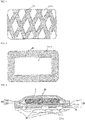
- Fig. 1 shows an exemplary embodiment in which the adhesive layer formation region 3X is formed in the form of stripes.
- the stripe width of the adhesive layer formation region 3X may be determined as appropriate in accordance with the skin site to which the heat-generating device is to be attached, the size of the heat-generating device, and the like; for example, the stripe width is about 1 to 100 mm, and preferably about 3 to 30 mm.
- Fig. 2 shows an exemplary embodiment in which the adhesive layer formation region 3X is formed in the form of dots. While Fig. 2 shows an embodiment in which circular dots are arranged, the dot shape may be any of oval, polygonal, indefinite, and the like.
- the area per dot may be determined as appropriate in accordance with the skin site to which the heat-generating device is to be attached, the size of the heat-generating device, and the like; for example, the area per dot is about 5 to 10000 mm 2 , and preferably about 500 to 3000 mm 2 .
- Fig. 3 shows an exemplary embodiment in which the adhesive layer formation region 3X is formed in the form of a grid.
- the area per square may be determined as appropriate in accordance with the skin site to which the heat-generating device is to be attached, the size of the heat-generating device, and the like; for example, the area per square is about 1 to 3000 mm 2 , and preferably about 10 to 1000 mm 2 .
- Fig. 4 shows an exemplary embodiment in which the adhesive layer formation region 3X is formed in the form of a mesh.
- the line width forming the mesh may be determined as appropriate in accordance with the skin site to which the heat-generating device is to be attached, the size of the heat-generating device, and the like; for example, the line width is about 1 to 100 mm, and preferably about 3 to 30 mm.
- Fig. 5 shows an exemplary embodiment in which the adhesive layer formation region 3X is formed in the form of a frame.
- the width of the frame may be determined as appropriate in accordance with the skin site to which the heat-generating device is to be attached, the size of the heat-generating device, and the like; for example, the width of the frame is about 1 to 100 mm, and preferably about 3 to 50 mm.
- the moisture absorption layer exposure region 211X formed preferably communicates with the edge of the moisture absorption layer 211.
- the moisture absorption layer exposure region 211X communicates with the edge of the moisture absorption layer 211, a path through which air flows can be ensured when the heat-generating device is attached to the skin, which allows stickiness due to sweat during use to be suppressed even more effectively.
- Specific examples of embodiments in which the moisture absorption layer exposure region 211X communicates with the edge of the moisture absorption layer 211 include an embodiment in which the adhesive layer 3 is formed in the form of stripes or dots.
- the area ratio of the adhesive layer formation region 3X to the moisture absorption layer exposure region 211X may be determined as appropriate in accordance with the adhesion to the skin to which the heat-generating device is to be attached and the like; for example, the area ratio of the adhesive layer formation region 3X to the moisture absorption layer exposure region 211X is typically 100:5-2000, preferably 100:10-400, more preferably 100:25-150, and particularly preferably 100:25-66.7.
- the amount of the adhesive layer 3 to be applied may be determined as appropriate in accordance with the adhesion to the skin to which the heat-generating device is to be attached, the ratio of the adhesive layer formation region 3X, and the like; for example, the amount of the adhesive layer 3 to be applied in the adhesive layer formation region 3X is typically 20 to 150 g/m 2 , preferably 40 to 120 g/m 2 , and more preferably 60 to 100 g/m 2 .
- the adhesive layer 3 is formed by application to the moisture absorption layer 211 of the skin attachment surface-side packaging material 21 constituting the housing 2, using a known coating method.
- a warming agent that allows an enhanced warm sensation to be perceived in the presence of moisture is contained in at least one of the adhesive layer 3 and the moisture absorption layer 211.
- the warming agent imparts a warm sensation, and contributes to the exertion of an excellent heating effect.
- the "warming agent that allows an enhanced warm sensation to be perceived in the presence of moisture” refers to a warming agent that allows a perceived warm sensation to be enhanced in the presence of moisture, compared to that in the absence of moisture, among warming agents that impart a warm sensation to the skin.
- warming agent that allows an enhanced warm sensation to be perceived in the presence of moisture
- specific examples of warming agents include capsaicin, nonanoic acid vanillylamide, sage, caffeine, tocopherol nicotinate, nicotinic acid benzyl ester, vanillyl ethyl ether, vanillyl propyl ether, vanillyl butyl ether, vanillyl pentyl ether, vanillyl hexyl ether, vanillyl butyl ether acetate, gingerol, Capsicum annuum extract, and ginger extract.
- These warming agents may be used alone, or in combination of two or more.
- Capsicum annuum extract is a component obtained by extraction treatment of Capsicum annuum.
- Capsicum annuum to be used as the raw material of the Capsicum annuum extract may be in a dried or undried state.
- Capsicum annuum to be used as the raw material of the Capsicum annuum extract may also be subjected to a treatment such as pulverization or chopping.
- Capsicum annuum to be used as the raw material of the Capsicum annuum extract may also be subjected to an enzyme treatment in advance, using an enzyme such as a carbohydrase, a protease, a lipase, or a nuclease.
- extraction solvents used for the extraction treatment of Capsicum annuum include water and hydrated ethanol (ethanol content: about 30 to 95 wt%).
- the extraction treatment may be performed, for example, for about 10 seconds to 24 hours, preferably about 1 minute to 6 hours, using about 100 to 100000 ml, preferably about 100 to 10000 ml, of an extraction solvent per kg of Capsicum annuum, at a temperature of about 5 to 120°C, preferably about 10 to 70°C.
- the extract obtained by the extraction treatment of Capsicum annuum is concentrated or dried to obtain Capsicum annuum extract.
- the extract obtained by the extraction treatment of Capsicum annuum may be subjected to a treatment such as removal of insoluble substances or sterilization, as required.
- Capsicum annuum extract to be used as the warming agent may be in a dried state or a hydrous state, it is preferably in a dried state.
- ginger extract is a component obtained by extraction treatment of ginger.
- the ginger to be used as the raw material of the ginger extract may be in a dried or undried state.
- the ginger to be used as the raw material of the ginger extract may also be subjected to a treatment such as pulverization or chopping.
- the ginger to be used as the raw material of the ginger extract may also be subjected to an enzyme treatment in advance, using an enzyme such as a carbohydrase, a protease, a lipase, or a nuclease.
- extraction solvents used for the extraction treatment of ginger include water and hydrated ethanol (ethanol content: about 30 to 95 wt%).
- the extraction treatment may be performed, for example, for about 10 seconds to 24 hours, preferably about 1 minute to 6 hours, using about 100 to 100000 ml, preferably about 100 to 10000 ml, of an extraction solvent per kg of ginger, at a temperature of about 5 to 120°C, preferably about 10 to 70°C.
- the extract obtained by the extraction treatment of ginger is concentrated or dried to obtain ginger extract.
- the extract obtained by the extraction treatment of ginger may be subjected to a treatment such as removal of insoluble substances or sterilization, as required.
- ginger extract to be used as the warming agent may be in a dried state or a hydrous state, it is preferably in a dried state.
- capsaicin, nonanoic acid vanillylamide, and ginger extract are preferred, for example, from the viewpoint of further improving the persistence of the warm sensation to be perceived, and exerting a higher heating effect.
- the warming agent may be contained in either one of the adhesive layer 3 and the moisture absorption layer 211, or may be contained in both these layers.
- the warming agent is preferably contained at least in the adhesive layer 3, from the viewpoint of further enhancing the warm sensation to be perceived, and further improving the heating effect.
- the content of the warming agent in the adhesive layer 3 and/or the moisture absorption layer 211 may be determined as appropriate in accordance with the type of the warming agent to be used, the type of the layer that is to contain the warming agent, and the like.
- the content of the warming agent in the adhesive layer 3 is, for example, 0.0001 to 10 wt%, preferably 0.0005 to 8 wt%, and more preferably 0.001 to 5 wt%.
- the content of the warming agent represents a value calculated on a dry weight basis, where an extract is used.
- the amount of the warming agent to be contained per unit area of the moisture absorption layer 211 is, for example, 0.0005 to 500 mg/cm 2 , preferably 0.001 to 300 mg/cm 2 , and more preferably 0.005 to 150 mg/cm 2 .
- an adhesive layer composition may be prepared by mixing the warming agent and an adhesive used as a base of the adhesive layer 3, and applying the composition onto the moisture absorption layer 211.
- the warming agent may be loaded into the moisture absorption layer, using, for example, a method that involves spraying a solution containing the warming agent onto the moisture absorption layer 211 or a method that involves immersing the moisture absorption layer 211 in a solution containing the warming agent.
- the adhesive layer 3 and/or the moisture absorption layer 211 may contain other pharmacological components and cosmetic components, as required, in addition to the warming agent.
- pharmacological components and cosmetic components include blood circulation promoters such as acid mucopolysaccharides, chamomile, Aesculus hippocastanum, ginkgo, Hamamelis virginiana extract, grapefruit extract, rosemary extract, lemon extract, vitamin E, and nicotinic acid derivatives; moisturizers such as glycerol, ceramide, collagen, hyaluronic acid, and squalane; fatigue recovery agents such as basil extract and juniper extract; analgesics such as indomethacin, diclofenac, flurbiprofen, ketoprofen, piroxicam, felbinac, methyl salicylate, and glycol salicylate; slimming agents such as tea extract, ginseng root extract, Aesculus hippocastanum, aminophylline, aescin, anthocyanidin
- pharmacological components and cosmetic components may be contained in any of the adhesive layer 3 and the moisture absorption layer 211, they are preferably contained in the adhesive layer 3, from the viewpoint of effectively achieving their pharmacological effects or cosmetic effects.
- pharmacological components and cosmetic components may be used alone, or in combination of two or more.
- the content of the pharmacological components and cosmetic components in the adhesive layer 3 and/or the moisture absorption layer 211 may be determined as appropriate in accordance with the pharmacological effects or cosmetic effects to be imparted.
- the method for incorporating these components into the adhesive layer 3 and/or the moisture absorption layer 211 is the same as that described for the warming agent.
- a releasable release layer may be provided, as required, on the surface (the side to be attached to the skin) of the adhesive layer 3.
- the release layer When the release layer is provided, it can prevent the adhesive layer during storage from drying, prevent volatilization of the warming agent during storage, and prevent a decrease in handleability due to the adhesion of the adhesive layer, for example.
- release layers include resin films such as polyethylene terephthalate, polyacrylonitrile, ethylene-vinyl alcohol copolymer, and polypropylene; and paper that has been subjected to a treatment for imparting release properties, such as a silicone treatment.
- a resin film is used as the release layer, the resin film may be subjected to a treatment for imparting release properties, such as a silicone treatment.
- resin films such as polyethylene terephthalate, polyacrylonitrile, and ethylene-vinyl alcohol copolymer are suitable in that they can suppress adsorption of the active ingredient in the adhesive layer 3.
- Fig. 6 shows a schematic view of a cross-sectional structure of one preferred embodiment of the heat-generating device of the present invention.
- the edge of the skin attachment surface-side packaging material 21 and the edge of the non-skin attachment surface-side packaging material 23 are bonded with each other to form the housing 2 having the housing portion 22.
- an exothermic composition that generates heat upon contact with oxygen is contained as the heat-generating portion 1 in the housing 2.
- the skin attachment surface-side packaging material 21 of the housing 2 is composed of a laminated sheet in which the moisture barrier layer 212b formed of a thermoplastic resin having excellent sealability (polyethylene and/or polypropylene), the moisture barrier layer 212a formed of a warming agent barrier resin, and the moisture absorption layer 211 are laminated in this order from the housing portion 22 toward the skin attachment surface.
- the non-skin attachment surface-side packaging material 23 of the housing 2 is formed of a laminated sheet in which the air-permeable resin layer 231 and the fibrous base material 232 are laminated in this order from the housing portion 22 toward the outside.
- the adhesive layer 3 is partially provided on the surface of the moisture absorption layer 211 constituting the skin attachment surface-side packaging material 21.
- the release layer is not shown for convenience sake.
- the heat-generating device of the present invention is used as a warming device or a therapeutic device for the body, by attaching the adhesive layer to the skin.
- the heat-generating device of the present invention can exert a markedly high heating effect, it is particularly suitable for use as a therapeutic device for promoting blood circulation, relieving pain, reducing stiff shoulders, and the like.
- Examples of skin sites to which the heat-generating device of the present invention is to be applied include, although not particularly limited to, eye, face, neck, shoulder, waist, back, abdomen, buttocks, arm, leg, and sole.
- the heat-generating device of the present invention is packaged in a packaging material having oxygen barrier properties, and provided in a state where the exothermic composition is not brought into contact with air.
- the packaging material is opened at the time of use, the exothermic composition is brought into contact with air, and initiates heat generation.
- Heat-generating devices (Examples 1 to 4 and Comparative Examples 1 to 6) having different area ratios of the adhesive layer formation region to the moisture absorption layer exposure region were produced, and each of the heat-generating devices was evaluated for the persistence of the warm sensation, adhesion to the skin, and feel in use.
- the method for producing each of the heat-generating devices, evaluation methods, and the like are as described below.
- a skin attachment surface-side packaging material (a rectangle with a length of 13 cm and a width of 9.5 cm) was prepared which was formed of an air-impermeable laminated sheet in which a polyethylene film, a polyethylene terephthalate film, and a nonwoven fabric (made of polyethylene terephthalate) were laminated in this order.
- the partial formation of the adhesive layer was performed such that the adhesive layer formation region was formed in the form of four stripes in the longitudinal direction, and the moisture absorption layer (nonwoven fabric) exposure region was formed in the form of three stripes, each between the stripes of the adhesive layer formation region, wherein the stripe width of the adhesive layer formation region was 19 mm, the width of the moisture absorption layer (nonwoven fabric) exposure region was 6.3 mm, and the area ratio of the adhesive layer formation region to the moisture absorption layer exposure region was 80:20.
- Capsaicin (trade name "Capsaicin” from Alps Pharmaceutical Ind. Co., Ltd.) 0.01 wt% Rubber-based adhesive 99.99 wt% Total 100 wt%
- a release layer formed of a silicone-treated polyethylene terephthalate film (a rectangle with a length of 13 cm and a width of 9.5 cm) was bonded to the adhesive layer on the skin attachment surface-side packaging material.
- a non-skin attachment surface-side packaging material (a rectangle with a length of 13 cm and a width of 9.5 cm) which was formed of an air-permeable laminated sheet in which a polyethylene film with pores and a nonwoven fabric (made of polyethylene terephthalate) were laminated.
- an exothermic composition was prepared by mixing 22 g of an iron powder, 6 g of activated carbon, and 10 g of a water-soluble salt/water-retaining agent/water mixture (a mixture of sodium chloride, a water-absorbing resin, vermiculite, water, and the like; water content: 8.5 g).
- a water-soluble salt/water-retaining agent/water mixture a mixture of sodium chloride, a water-absorbing resin, vermiculite, water, and the like; water content: 8.5 g.
- a heat-generating device was produced under the same conditions as those in Example 1 above, except that the partial formation of the adhesive layer on the skin attachment surface-side packaging material was performed such that the stripe width of the adhesive layer formation region was 14.25 mm, the width of the moisture absorption layer (nonwoven fabric) exposure region was 12.7 mm, and the area ratio of the adhesive layer formation region to the moisture absorption layer exposure region was 60:40.
- a heat-generating device was produced under the same conditions as those in Example 1 above, except that the partial formation of the adhesive layer on the skin attachment surface-side packaging material was performed such that the stripe width of the adhesive layer formation region was 9.5 mm, the width of the moisture absorption layer (nonwoven fabric) exposure region was 19 mm, and the area ratio of the adhesive layer formation region to the moisture absorption layer exposure region was 40:60.
- a heat-generating device was produced under the same conditions as those in Example 1 above, except that the adhesive layer formation region was formed over the entire surface of the nonwoven fabric of the skin attachment surface-side packaging material (i.e., the area ratio of the adhesive layer formation region to the moisture absorption layer exposure region was 100:0).
- Each of the heat-generating devices was attached to waist parts of ten subjects. After two hours from the attachment, the perceived warm sensation, the adhesion to the skin, and the feel in use were scored in accordance with the following determination criteria. For each item of evaluation, an average score of 2 points or more and 3 points or less was determined as "A”, an average score of 1 point or more and less than 2 points was determined as "B”, an average score of 0.5 point or more and less than 1 point was determined as "C”, and an average score of less than 0.5 point was determined as D.
- Heat-generating devices (Examples 2 and 4 and Comparative Examples 2 to 6) having different structures of the skin attachment surface-side packaging material and having different components contained in the adhesive layer were produced, and each of the heat-generating devices was evaluated for the persistence of the warm sensation, adhesion to the skin, and feel in use.
- the method for producing each of the heat-generating devices of Example 4 and Comparative Examples 2 to 6, evaluation methods, and the like are as described below.
- a heat-generating device was produced under the same conditions as those described in Example 2 above, except that an adhesive layer was formed using an adhesive layer-forming composition B of the composition shown below.
- Nonanoic acid vanillylamide (trade name "Nonanoic acid vanillylamide” from Nagaoka & Co., Ltd.) 0.001 wt% Rubber-based adhesive 99.999 wt% Total 100 wt%
- a skin attachment surface-side packaging material (a rectangle with a length of 13 cm and a width of 9.5 cm) which was formed of an air-impermeable laminated sheet in which a polyethylene film and a polyethylene terephthalate film were laminated in this order.
- a heat-generating device was produced under the same conditions as those described in Example 2 above, except that an adhesive layer was partially formed on the surface of the polyethylene terephthalate film of the skin attachment surface-side packaging material.
- An air-permeable skin attachment surface-side packaging material (a rectangle with a length of 13 cm and a width of 9.5 cm) formed of a nonwoven fabric (made of polyethylene terephthalate) only was prepared.
- An adhesive layer was partially formed on one surface of the skin attachment surface-side packaging material, under the same conditions as those described in Example 2 above.
- a non-skin attachment surface-side packaging material (a rectangle with a length of 13 cm and a width of 9.5 cm) was prepared which was formed of an air-impermeable laminated sheet in which a polyethylene film and a nonwoven fabric (made of polyethylene terephthalate) were laminated.
- a heat-generating device containing the exothermic composition in a housing portion (length: 12 cm, width: 8.5 cm) was produced under the same conditions as those described in Example 2 above, except that the edge of the polyethylene film of the skin attachment surface-side packaging material and the edge of the non-skin attachment surface-side packaging material were bonded with a spray adhesive.
- a heat-generating device was produced under the same conditions as those described in Example 2 above, except that an adhesive layer was formed using an adhesive layer-forming composition C of the composition shown below.
- a heat-generating device was produced under the same conditions as those described in Comparative Example 2 above, except that an adhesive layer was formed using the adhesive layer-forming composition C shown above.
- a heat-generating device was produced under the same conditions as those described in Example 2 above, except that an adhesive layer was formed using only the rubber-based adhesive shown above.
- Each of the heat-generating devices was evaluated for the persistence of the warm sensation, adhesion to the skin, feel in use, and lumbago-relieving effect.
- the persistence of the warm sensation was evaluated using, as a reference, the warm sensation perceived with the heat-generating device of Comparative Example 6.
- the adhesion to the skin and the feel in use were evaluated using the same methods as those described in Test Example 1 above.
- the method for evaluating the lumbago-relieving effect is as described below.
- Each of the heat-generating devices was attached to waist parts of ten subjects suffering from lumbago for eight hours. After eight hours from the attachment, the lumbago-relieving effect was scored in accordance with the following determination criteria. Using an average score for Comparative Example 6 as 100, an average score of 95 points or more and less than 105 points was determined as "C”, an average score of 105 points or more and less than 250 points was determined as "B”, and an average score of 250 points or more and 400 points or less was determined as "A".
- Fig. 7 shows changes with time in the average value of skin blood flow rate of the six subjects. The results confirmed that the heat-generating device of Example 1 provides an improved blood flow rate, compared to the heat-generating device of Comparative Example 1, and can exert an excellent heating effect.
Landscapes
- Health & Medical Sciences (AREA)
- Engineering & Computer Science (AREA)
- Life Sciences & Earth Sciences (AREA)
- Animal Behavior & Ethology (AREA)
- General Health & Medical Sciences (AREA)
- Public Health (AREA)
- Veterinary Medicine (AREA)
- Physics & Mathematics (AREA)
- Thermal Sciences (AREA)
- Biomedical Technology (AREA)
- Heart & Thoracic Surgery (AREA)
- Vascular Medicine (AREA)
- Emergency Medicine (AREA)
- Nuclear Medicine, Radiotherapy & Molecular Imaging (AREA)
- Organic Chemistry (AREA)
- Chemical & Material Sciences (AREA)
- Chemical Kinetics & Catalysis (AREA)
- General Chemical & Material Sciences (AREA)
- Medicinal Chemistry (AREA)
- Pharmacology & Pharmacy (AREA)
- Bioinformatics & Cheminformatics (AREA)
- Dermatology (AREA)
- Thermotherapy And Cooling Therapy Devices (AREA)
- Materials For Medical Uses (AREA)
- Medicinal Preparation (AREA)
- Acyclic And Carbocyclic Compounds In Medicinal Compositions (AREA)
- Medicines That Contain Protein Lipid Enzymes And Other Medicines (AREA)
Claims (9)
- Dispositif générateur de chaleur qui est utilisé en étant relié à de la peau, comprenant :une portion génératrice de chaleur (1) qui génère de la chaleur devant être fournie à de la peau ;un logement (2) qui contient la portion génératrice de chaleur (1) et a une surface de liaison à la peau qui peut être reliée à la peau ; etune couche adhésive (3) prévue sur la surface de liaison à la peau du logement (2),dans lequel un matériau d'emballage constituant la surface de liaison à la peau du logement (2) est formé d'une feuille stratifiée constituée d'une couche d'absorption d'humidité (211) qui absorbe l'humidité et d'une couche barrière à l'humidité (212) qui bloque la pénétration d'humidité dans laquelle la couche d'absorption d'humidité (211) et la couche barrière à l'humidité (212) sont stratifiées dans cet ordre depuis la couche adhésive (3),la couche barrière à l'humidité (212) est stratifiée sur la surface entière de la couche d'absorption d'humidité (211),la couche adhésive (3) est partiellement prévue sur une surface de la couche d'absorption d'humidité (211),la région où la couche adhésive (3) est formée et la région où la couche d'absorption d'humidité (211) est exposée sont observées, telles que vues depuis la surface de liaison à la peau, etun agent chauffant qui permet à une sensation de chaleur amplifiée d'être perçue en présence d'humidité est contenu dans au moins une de la couche adhésive (3) et de la couche d'absorption d'humidité (211).
- Dispositif générateur de chaleur selon la revendication 1, dans lequel, sur la surface de la couche d'absorption d'humidité (211), un rapport d'aire d'une région de formation de couche adhésive où la couche adhésive (3) est formée par rapport à une région d'exposition de couche d'absorption d'humidité où la couche d'absorption d'humidité (211) est exposée est de 100/5 à 2000.
- Dispositif générateur de chaleur selon la revendication 1 ou 2, dans lequel, sur la surface de la couche d'absorption d'humidité (211), la région d'exposition de couche d'absorption d'humidité où la couche d'absorption d'humidité (211) est exposée communique avec un bord de la couche d'absorption d'humidité (211).
- Dispositif générateur de chaleur selon l'une quelconque des revendications 1 à 3, dans lequel le matériau d'emballage constituant la surface de liaison à la peau du logement (2) a une fonction de barrière pour bloquer la pénétration de l'agent chauffant.
- Dispositif générateur de chaleur selon la revendication 4, dans lequel la couche barrière à l'humidité (212) contient une couche de résine formée de polyéthylène téréphtalate, polyacrylonitrile ou d'un copolymère d'éthylène-alcool de vinyle ; un film déposé par évaporation sous vide ; et/ou un film de feuille métallique.
- Dispositif générateur de chaleur selon l'une quelconque des revendications 1 à 5, dans lequel la couche d'absorption d'humidité (211) est une feuille fibreuse.
- Dispositif générateur de chaleur selon l'une quelconque des revendications 1 à 6, dans lequel l'agent chauffant est contenu dans la couche adhésive (3).
- Dispositif générateur de chaleur selon l'une quelconque des revendications 1 à 7, dans lequel l'agent chauffant est au moins un sélectionné parmi le groupe constitué de la capsaïcine, du vanillylamide d'acide nonanoïque, de la sauge, de la caféine, du nicotinate de tocophérol, de l'ester benzylique d'acide nicotinique, de l'éther vanillyléthylique, de l'éther vanillylpropylique, de l'éther vanillylbutylique, de l'éther vanillylpentylique, de l'éther vanillylhexylique, de l'acétate d'éther vanillylbutylique, du gingérol, d'un extrait de Capsicum annuum et d'un extrait de gingembre.
- Dispositif générateur de chaleur selon l'une quelconque des revendications 1 à 8, dans lequel la portion génératrice de chaleur (1) est une composition exothermique qui génère de la chaleur dès le contact avec de l'oxygène, et le logement (2) est au moins partiellement perméable à l'air.
Applications Claiming Priority (3)
| Application Number | Priority Date | Filing Date | Title |
|---|---|---|---|
| PCT/JP2015/075811 WO2017042948A1 (fr) | 2015-09-11 | 2015-09-11 | Compresse chauffante |
| PCT/JP2015/075810 WO2017042947A1 (fr) | 2015-09-11 | 2015-09-11 | Compresse chauffante |
| PCT/JP2016/063610 WO2017043119A1 (fr) | 2015-09-11 | 2016-05-02 | Compresse chauffante |
Publications (3)
| Publication Number | Publication Date |
|---|---|
| EP3348242A1 EP3348242A1 (fr) | 2018-07-18 |
| EP3348242A4 EP3348242A4 (fr) | 2019-04-17 |
| EP3348242B1 true EP3348242B1 (fr) | 2022-06-29 |
Family
ID=58240705
Family Applications (1)
| Application Number | Title | Priority Date | Filing Date |
|---|---|---|---|
| EP16843985.9A Active EP3348242B1 (fr) | 2015-09-11 | 2016-05-02 | Compresse chauffante |
Country Status (6)
| Country | Link |
|---|---|
| US (1) | US11241331B2 (fr) |
| EP (1) | EP3348242B1 (fr) |
| JP (1) | JP6998206B2 (fr) |
| KR (1) | KR20180053693A (fr) |
| CN (1) | CN108289754B (fr) |
| WO (1) | WO2017043119A1 (fr) |
Families Citing this family (13)
| Publication number | Priority date | Publication date | Assignee | Title |
|---|---|---|---|---|
| WO2016134245A1 (fr) | 2015-02-19 | 2016-08-25 | Candesant Biomedical | Dispositifs médicaux de génération de chaleur et procédés de traitement les utilisant |
| JP6750007B2 (ja) | 2016-05-02 | 2020-09-02 | 小林製薬株式会社 | 発熱具 |
| KR102051327B1 (ko) * | 2018-05-30 | 2019-12-03 | 김재형 | 음이온 및 원적외선을 방사하는 발열팩 |
| WO2020129408A1 (fr) * | 2018-12-19 | 2020-06-25 | 花王株式会社 | Ustensile chauffant |
| JP7343975B2 (ja) * | 2018-12-28 | 2023-09-13 | 小林製薬株式会社 | 温熱治療用の医療機器 |
| US11272829B2 (en) * | 2019-04-02 | 2022-03-15 | Dorai Home, Inc. | Drying appliance |
| US12213638B2 (en) * | 2019-04-02 | 2025-02-04 | Dorai Home, Inc. | Dish rack |
| KR200491961Y1 (ko) * | 2019-10-22 | 2020-07-07 | 주식회사 피부다움 | 발열 패치 및 이를 이용하는 마사지 패치 |
| CN110025480B (zh) * | 2019-05-21 | 2023-11-10 | 程勇 | 双发热灸贴及具有它的自发热热灸包 |
| KR20220114014A (ko) | 2019-12-10 | 2022-08-17 | 캔디샌트 바이오메디컬 인코포레이티드 | 열 생성을 위한 의료 장치 및 이를 이용한 치료 방법 |
| EP4192727B1 (fr) * | 2020-08-04 | 2024-09-25 | Politecnico di Milano | Gilet de sauvetage gonflable |
| WO2022169369A1 (fr) * | 2021-02-02 | 2022-08-11 | Thermosaver As | Sac de sauvetage |
| CN120241365A (zh) * | 2025-05-23 | 2025-07-04 | 泰州鑫晟航电子科技有限公司 | 一种基于中医的热敷自动恒温装置 |
Citations (1)
| Publication number | Priority date | Publication date | Assignee | Title |
|---|---|---|---|---|
| EP2581065A1 (fr) * | 2010-06-09 | 2013-04-17 | Kao Corporation | Outil chauffant générateur de vapeur d'eau |
Family Cites Families (13)
| Publication number | Priority date | Publication date | Assignee | Title |
|---|---|---|---|---|
| JPH08291054A (ja) * | 1995-04-21 | 1996-11-05 | Sekisui Chem Co Ltd | 外用剤 |
| GB2303208B (en) * | 1995-07-08 | 1998-01-21 | Akio Usui | Viscous liquid exothermic composition,exothermic device made thereof and manufacturing method of exothermic device |
| JP3429147B2 (ja) | 1996-11-21 | 2003-07-22 | 三宝化学株式会社 | 温感型湿布 |
| JP2002177313A (ja) * | 2000-12-15 | 2002-06-25 | Kao Corp | 温熱具 |
| JP2003336042A (ja) * | 2002-05-20 | 2003-11-28 | Maikooru Kk | 吸水性ポリマー入り発熱組成物及び発熱体 |
| JP3097002U (ja) * | 2003-04-08 | 2004-01-15 | 桐灰化学株式会社 | 貼付型カイロ |
| EP1782774A4 (fr) * | 2004-07-14 | 2007-12-26 | Mycoal Prod Corp | Élément chauffant et processus de production de cet élément chauffant |
| US20080257333A1 (en) * | 2004-07-14 | 2008-10-23 | Mycoal Products Corporation | Foot Warming Heat Generating Body and Process for Producing Foot Warming Heat Generating Body |
| US9242119B2 (en) | 2010-06-04 | 2016-01-26 | Bayer Healthcare Llc | Activity delivery progress monitor |
| JP2014008288A (ja) * | 2012-06-29 | 2014-01-20 | Kiribai Kagaku Kk | 発熱具 |
| JPWO2014157726A1 (ja) | 2013-03-29 | 2017-02-16 | 興和株式会社 | 発熱組成物およびそれを用いた使い捨てカイロ |
| CN204121446U (zh) * | 2014-08-06 | 2015-01-28 | 陈蕾 | 一种自发热保温立体面膜 |
| CN204274756U (zh) * | 2014-08-27 | 2015-04-22 | 贵州高澄医疗器械有限公司 | 一种自发热式理疗贴 |
-
2016
- 2016-05-02 JP JP2017538882A patent/JP6998206B2/ja active Active
- 2016-05-02 WO PCT/JP2016/063610 patent/WO2017043119A1/fr not_active Ceased
- 2016-05-02 EP EP16843985.9A patent/EP3348242B1/fr active Active
- 2016-05-02 CN CN201680065917.7A patent/CN108289754B/zh not_active Expired - Fee Related
- 2016-05-02 KR KR1020187010144A patent/KR20180053693A/ko not_active Ceased
- 2016-05-02 US US15/759,048 patent/US11241331B2/en active Active
Patent Citations (1)
| Publication number | Priority date | Publication date | Assignee | Title |
|---|---|---|---|---|
| EP2581065A1 (fr) * | 2010-06-09 | 2013-04-17 | Kao Corporation | Outil chauffant générateur de vapeur d'eau |
Also Published As
| Publication number | Publication date |
|---|---|
| US11241331B2 (en) | 2022-02-08 |
| KR20180053693A (ko) | 2018-05-23 |
| US20190038458A1 (en) | 2019-02-07 |
| JPWO2017043119A1 (ja) | 2018-08-09 |
| EP3348242A4 (fr) | 2019-04-17 |
| WO2017043119A1 (fr) | 2017-03-16 |
| JP6998206B2 (ja) | 2022-01-18 |
| CN108289754B (zh) | 2021-09-07 |
| CN108289754A (zh) | 2018-07-17 |
| EP3348242A1 (fr) | 2018-07-18 |
Similar Documents
| Publication | Publication Date | Title |
|---|---|---|
| US11241331B2 (en) | Heating compress | |
| JP6750007B2 (ja) | 発熱具 | |
| JP5415526B2 (ja) | 可搬式湿熱システム | |
| CN104394814B (zh) | 发热器具 | |
| JP6456705B2 (ja) | 発熱具 | |
| TW200404570A (en) | Carbon dioxide agent for external use and the stuff for preparation of the same | |
| WO2010067761A1 (fr) | Instrument générateur de chaleur | |
| JP4093346B2 (ja) | 美顔用発熱体 | |
| WO2006006662A1 (fr) | Élément chauffant | |
| JP4323155B2 (ja) | 発熱体 | |
| US10993833B2 (en) | Heat generator | |
| JP7071824B2 (ja) | 発熱具 | |
| JP2003116902A (ja) | 機能性シート | |
| WO2006006649A1 (fr) | Composition exothermique humide et comprimée, article exothermique et procédé de production d’une composition exothermique humide et comprimée | |
| JP7008504B2 (ja) | 発熱具 | |
| WO2017191681A1 (fr) | Générateur de chaleur | |
| JP2026016709A (ja) | 発熱具 | |
| JP2026016708A (ja) | 発熱具 | |
| HK1204255B (en) | Heat generation tool |
Legal Events
| Date | Code | Title | Description |
|---|---|---|---|
| STAA | Information on the status of an ep patent application or granted ep patent |
Free format text: STATUS: THE INTERNATIONAL PUBLICATION HAS BEEN MADE |
|
| PUAI | Public reference made under article 153(3) epc to a published international application that has entered the european phase |
Free format text: ORIGINAL CODE: 0009012 |
|
| STAA | Information on the status of an ep patent application or granted ep patent |
Free format text: STATUS: REQUEST FOR EXAMINATION WAS MADE |
|
| 17P | Request for examination filed |
Effective date: 20180322 |
|
| AK | Designated contracting states |
Kind code of ref document: A1 Designated state(s): AL AT BE BG CH CY CZ DE DK EE ES FI FR GB GR HR HU IE IS IT LI LT LU LV MC MK MT NL NO PL PT RO RS SE SI SK SM TR |
|
| AX | Request for extension of the european patent |
Extension state: BA ME |
|
| DAV | Request for validation of the european patent (deleted) | ||
| DAX | Request for extension of the european patent (deleted) | ||
| A4 | Supplementary search report drawn up and despatched |
Effective date: 20190318 |
|
| RIC1 | Information provided on ipc code assigned before grant |
Ipc: A61F 7/03 20060101AFI20190312BHEP |
|
| STAA | Information on the status of an ep patent application or granted ep patent |
Free format text: STATUS: EXAMINATION IS IN PROGRESS |
|
| 17Q | First examination report despatched |
Effective date: 20191113 |
|
| GRAP | Despatch of communication of intention to grant a patent |
Free format text: ORIGINAL CODE: EPIDOSNIGR1 |
|
| STAA | Information on the status of an ep patent application or granted ep patent |
Free format text: STATUS: GRANT OF PATENT IS INTENDED |
|
| INTG | Intention to grant announced |
Effective date: 20211220 |
|
| GRAS | Grant fee paid |
Free format text: ORIGINAL CODE: EPIDOSNIGR3 |
|
| GRAA | (expected) grant |
Free format text: ORIGINAL CODE: 0009210 |
|
| STAA | Information on the status of an ep patent application or granted ep patent |
Free format text: STATUS: THE PATENT HAS BEEN GRANTED |
|
| AK | Designated contracting states |
Kind code of ref document: B1 Designated state(s): AL AT BE BG CH CY CZ DE DK EE ES FI FR GB GR HR HU IE IS IT LI LT LU LV MC MK MT NL NO PL PT RO RS SE SI SK SM TR |
|
| REG | Reference to a national code |
Ref country code: CH Ref legal event code: EP |
|
| REG | Reference to a national code |
Ref country code: DE Ref legal event code: R096 Ref document number: 602016073214 Country of ref document: DE |
|
| REG | Reference to a national code |
Ref country code: AT Ref legal event code: REF Ref document number: 1500813 Country of ref document: AT Kind code of ref document: T Effective date: 20220715 |
|
| REG | Reference to a national code |
Ref country code: IE Ref legal event code: FG4D |
|
| REG | Reference to a national code |
Ref country code: LT Ref legal event code: MG9D |
|
| PG25 | Lapsed in a contracting state [announced via postgrant information from national office to epo] |
Ref country code: SE Free format text: LAPSE BECAUSE OF FAILURE TO SUBMIT A TRANSLATION OF THE DESCRIPTION OR TO PAY THE FEE WITHIN THE PRESCRIBED TIME-LIMIT Effective date: 20220629 Ref country code: NO Free format text: LAPSE BECAUSE OF FAILURE TO SUBMIT A TRANSLATION OF THE DESCRIPTION OR TO PAY THE FEE WITHIN THE PRESCRIBED TIME-LIMIT Effective date: 20220929 Ref country code: LT Free format text: LAPSE BECAUSE OF FAILURE TO SUBMIT A TRANSLATION OF THE DESCRIPTION OR TO PAY THE FEE WITHIN THE PRESCRIBED TIME-LIMIT Effective date: 20220629 Ref country code: HR Free format text: LAPSE BECAUSE OF FAILURE TO SUBMIT A TRANSLATION OF THE DESCRIPTION OR TO PAY THE FEE WITHIN THE PRESCRIBED TIME-LIMIT Effective date: 20220629 Ref country code: GR Free format text: LAPSE BECAUSE OF FAILURE TO SUBMIT A TRANSLATION OF THE DESCRIPTION OR TO PAY THE FEE WITHIN THE PRESCRIBED TIME-LIMIT Effective date: 20220930 Ref country code: FI Free format text: LAPSE BECAUSE OF FAILURE TO SUBMIT A TRANSLATION OF THE DESCRIPTION OR TO PAY THE FEE WITHIN THE PRESCRIBED TIME-LIMIT Effective date: 20220629 Ref country code: BG Free format text: LAPSE BECAUSE OF FAILURE TO SUBMIT A TRANSLATION OF THE DESCRIPTION OR TO PAY THE FEE WITHIN THE PRESCRIBED TIME-LIMIT Effective date: 20220929 |
|
| REG | Reference to a national code |
Ref country code: NL Ref legal event code: MP Effective date: 20220629 |
|
| REG | Reference to a national code |
Ref country code: AT Ref legal event code: MK05 Ref document number: 1500813 Country of ref document: AT Kind code of ref document: T Effective date: 20220629 |
|
| PG25 | Lapsed in a contracting state [announced via postgrant information from national office to epo] |
Ref country code: RS Free format text: LAPSE BECAUSE OF FAILURE TO SUBMIT A TRANSLATION OF THE DESCRIPTION OR TO PAY THE FEE WITHIN THE PRESCRIBED TIME-LIMIT Effective date: 20220629 Ref country code: LV Free format text: LAPSE BECAUSE OF FAILURE TO SUBMIT A TRANSLATION OF THE DESCRIPTION OR TO PAY THE FEE WITHIN THE PRESCRIBED TIME-LIMIT Effective date: 20220629 |
|
| PG25 | Lapsed in a contracting state [announced via postgrant information from national office to epo] |
Ref country code: NL Free format text: LAPSE BECAUSE OF FAILURE TO SUBMIT A TRANSLATION OF THE DESCRIPTION OR TO PAY THE FEE WITHIN THE PRESCRIBED TIME-LIMIT Effective date: 20220629 |
|
| PG25 | Lapsed in a contracting state [announced via postgrant information from national office to epo] |
Ref country code: SM Free format text: LAPSE BECAUSE OF FAILURE TO SUBMIT A TRANSLATION OF THE DESCRIPTION OR TO PAY THE FEE WITHIN THE PRESCRIBED TIME-LIMIT Effective date: 20220629 Ref country code: SK Free format text: LAPSE BECAUSE OF FAILURE TO SUBMIT A TRANSLATION OF THE DESCRIPTION OR TO PAY THE FEE WITHIN THE PRESCRIBED TIME-LIMIT Effective date: 20220629 Ref country code: RO Free format text: LAPSE BECAUSE OF FAILURE TO SUBMIT A TRANSLATION OF THE DESCRIPTION OR TO PAY THE FEE WITHIN THE PRESCRIBED TIME-LIMIT Effective date: 20220629 Ref country code: PT Free format text: LAPSE BECAUSE OF FAILURE TO SUBMIT A TRANSLATION OF THE DESCRIPTION OR TO PAY THE FEE WITHIN THE PRESCRIBED TIME-LIMIT Effective date: 20221031 Ref country code: ES Free format text: LAPSE BECAUSE OF FAILURE TO SUBMIT A TRANSLATION OF THE DESCRIPTION OR TO PAY THE FEE WITHIN THE PRESCRIBED TIME-LIMIT Effective date: 20220629 Ref country code: EE Free format text: LAPSE BECAUSE OF FAILURE TO SUBMIT A TRANSLATION OF THE DESCRIPTION OR TO PAY THE FEE WITHIN THE PRESCRIBED TIME-LIMIT Effective date: 20220629 Ref country code: AT Free format text: LAPSE BECAUSE OF FAILURE TO SUBMIT A TRANSLATION OF THE DESCRIPTION OR TO PAY THE FEE WITHIN THE PRESCRIBED TIME-LIMIT Effective date: 20220629 |
|
| PG25 | Lapsed in a contracting state [announced via postgrant information from national office to epo] |
Ref country code: PL Free format text: LAPSE BECAUSE OF FAILURE TO SUBMIT A TRANSLATION OF THE DESCRIPTION OR TO PAY THE FEE WITHIN THE PRESCRIBED TIME-LIMIT Effective date: 20220629 Ref country code: IS Free format text: LAPSE BECAUSE OF FAILURE TO SUBMIT A TRANSLATION OF THE DESCRIPTION OR TO PAY THE FEE WITHIN THE PRESCRIBED TIME-LIMIT Effective date: 20221029 |
|
| REG | Reference to a national code |
Ref country code: DE Ref legal event code: R097 Ref document number: 602016073214 Country of ref document: DE |
|
| PG25 | Lapsed in a contracting state [announced via postgrant information from national office to epo] |
Ref country code: AL Free format text: LAPSE BECAUSE OF FAILURE TO SUBMIT A TRANSLATION OF THE DESCRIPTION OR TO PAY THE FEE WITHIN THE PRESCRIBED TIME-LIMIT Effective date: 20220629 |
|
| PG25 | Lapsed in a contracting state [announced via postgrant information from national office to epo] |
Ref country code: DK Free format text: LAPSE BECAUSE OF FAILURE TO SUBMIT A TRANSLATION OF THE DESCRIPTION OR TO PAY THE FEE WITHIN THE PRESCRIBED TIME-LIMIT Effective date: 20220629 Ref country code: CZ Free format text: LAPSE BECAUSE OF FAILURE TO SUBMIT A TRANSLATION OF THE DESCRIPTION OR TO PAY THE FEE WITHIN THE PRESCRIBED TIME-LIMIT Effective date: 20220629 |
|
| PLBE | No opposition filed within time limit |
Free format text: ORIGINAL CODE: 0009261 |
|
| STAA | Information on the status of an ep patent application or granted ep patent |
Free format text: STATUS: NO OPPOSITION FILED WITHIN TIME LIMIT |
|
| 26N | No opposition filed |
Effective date: 20230330 |
|
| PG25 | Lapsed in a contracting state [announced via postgrant information from national office to epo] |
Ref country code: SI Free format text: LAPSE BECAUSE OF FAILURE TO SUBMIT A TRANSLATION OF THE DESCRIPTION OR TO PAY THE FEE WITHIN THE PRESCRIBED TIME-LIMIT Effective date: 20220629 |
|
| REG | Reference to a national code |
Ref country code: DE Ref legal event code: R119 Ref document number: 602016073214 Country of ref document: DE |
|
| REG | Reference to a national code |
Ref country code: CH Ref legal event code: PL |
|
| PG25 | Lapsed in a contracting state [announced via postgrant information from national office to epo] |
Ref country code: MC Free format text: LAPSE BECAUSE OF FAILURE TO SUBMIT A TRANSLATION OF THE DESCRIPTION OR TO PAY THE FEE WITHIN THE PRESCRIBED TIME-LIMIT Effective date: 20220629 |
|
| GBPC | Gb: european patent ceased through non-payment of renewal fee |
Effective date: 20230502 |
|
| REG | Reference to a national code |
Ref country code: BE Ref legal event code: MM Effective date: 20230531 |
|
| PG25 | Lapsed in a contracting state [announced via postgrant information from national office to epo] |
Ref country code: MC Free format text: LAPSE BECAUSE OF FAILURE TO SUBMIT A TRANSLATION OF THE DESCRIPTION OR TO PAY THE FEE WITHIN THE PRESCRIBED TIME-LIMIT Effective date: 20220629 Ref country code: LU Free format text: LAPSE BECAUSE OF NON-PAYMENT OF DUE FEES Effective date: 20230502 Ref country code: LI Free format text: LAPSE BECAUSE OF NON-PAYMENT OF DUE FEES Effective date: 20230531 Ref country code: IT Free format text: LAPSE BECAUSE OF FAILURE TO SUBMIT A TRANSLATION OF THE DESCRIPTION OR TO PAY THE FEE WITHIN THE PRESCRIBED TIME-LIMIT Effective date: 20220629 Ref country code: CH Free format text: LAPSE BECAUSE OF NON-PAYMENT OF DUE FEES Effective date: 20230531 |
|
| REG | Reference to a national code |
Ref country code: IE Ref legal event code: MM4A |
|
| PG25 | Lapsed in a contracting state [announced via postgrant information from national office to epo] |
Ref country code: IE Free format text: LAPSE BECAUSE OF NON-PAYMENT OF DUE FEES Effective date: 20230502 |
|
| PG25 | Lapsed in a contracting state [announced via postgrant information from national office to epo] |
Ref country code: IE Free format text: LAPSE BECAUSE OF NON-PAYMENT OF DUE FEES Effective date: 20230502 Ref country code: DE Free format text: LAPSE BECAUSE OF NON-PAYMENT OF DUE FEES Effective date: 20231201 Ref country code: GB Free format text: LAPSE BECAUSE OF NON-PAYMENT OF DUE FEES Effective date: 20230502 |
|
| PG25 | Lapsed in a contracting state [announced via postgrant information from national office to epo] |
Ref country code: FR Free format text: LAPSE BECAUSE OF NON-PAYMENT OF DUE FEES Effective date: 20230531 Ref country code: BE Free format text: LAPSE BECAUSE OF NON-PAYMENT OF DUE FEES Effective date: 20230531 |
|
| PG25 | Lapsed in a contracting state [announced via postgrant information from national office to epo] |
Ref country code: BG Free format text: LAPSE BECAUSE OF FAILURE TO SUBMIT A TRANSLATION OF THE DESCRIPTION OR TO PAY THE FEE WITHIN THE PRESCRIBED TIME-LIMIT Effective date: 20220629 |
|
| PG25 | Lapsed in a contracting state [announced via postgrant information from national office to epo] |
Ref country code: BG Free format text: LAPSE BECAUSE OF FAILURE TO SUBMIT A TRANSLATION OF THE DESCRIPTION OR TO PAY THE FEE WITHIN THE PRESCRIBED TIME-LIMIT Effective date: 20220629 |
|
| PG25 | Lapsed in a contracting state [announced via postgrant information from national office to epo] |
Ref country code: CY Free format text: LAPSE BECAUSE OF FAILURE TO SUBMIT A TRANSLATION OF THE DESCRIPTION OR TO PAY THE FEE WITHIN THE PRESCRIBED TIME-LIMIT; INVALID AB INITIO Effective date: 20160502 |
|
| PG25 | Lapsed in a contracting state [announced via postgrant information from national office to epo] |
Ref country code: HU Free format text: LAPSE BECAUSE OF FAILURE TO SUBMIT A TRANSLATION OF THE DESCRIPTION OR TO PAY THE FEE WITHIN THE PRESCRIBED TIME-LIMIT; INVALID AB INITIO Effective date: 20160502 |
|
| PG25 | Lapsed in a contracting state [announced via postgrant information from national office to epo] |
Ref country code: TR Free format text: LAPSE BECAUSE OF FAILURE TO SUBMIT A TRANSLATION OF THE DESCRIPTION OR TO PAY THE FEE WITHIN THE PRESCRIBED TIME-LIMIT Effective date: 20220629 |