EP3348286B1 - Poröser komplex und knochenregenerationsmaterial - Google Patents
Poröser komplex und knochenregenerationsmaterial Download PDFInfo
- Publication number
- EP3348286B1 EP3348286B1 EP16844359.6A EP16844359A EP3348286B1 EP 3348286 B1 EP3348286 B1 EP 3348286B1 EP 16844359 A EP16844359 A EP 16844359A EP 3348286 B1 EP3348286 B1 EP 3348286B1
- Authority
- EP
- European Patent Office
- Prior art keywords
- collagen
- porous composite
- ocp
- octacalcium phosphate
- agglomerated particles
- Prior art date
- Legal status (The legal status is an assumption and is not a legal conclusion. Google has not performed a legal analysis and makes no representation as to the accuracy of the status listed.)
- Active
Links
Images


Classifications
-
- A—HUMAN NECESSITIES
- A61—MEDICAL OR VETERINARY SCIENCE; HYGIENE
- A61L—METHODS OR APPARATUS FOR STERILISING MATERIALS OR OBJECTS IN GENERAL; DISINFECTION, STERILISATION OR DEODORISATION OF AIR; CHEMICAL ASPECTS OF BANDAGES, DRESSINGS, ABSORBENT PADS OR SURGICAL ARTICLES; MATERIALS FOR BANDAGES, DRESSINGS, ABSORBENT PADS OR SURGICAL ARTICLES
- A61L27/00—Materials for grafts or prostheses or for coating grafts or prostheses
- A61L27/02—Inorganic materials
- A61L27/12—Phosphorus-containing materials, e.g. apatite
-
- A—HUMAN NECESSITIES
- A61—MEDICAL OR VETERINARY SCIENCE; HYGIENE
- A61L—METHODS OR APPARATUS FOR STERILISING MATERIALS OR OBJECTS IN GENERAL; DISINFECTION, STERILISATION OR DEODORISATION OF AIR; CHEMICAL ASPECTS OF BANDAGES, DRESSINGS, ABSORBENT PADS OR SURGICAL ARTICLES; MATERIALS FOR BANDAGES, DRESSINGS, ABSORBENT PADS OR SURGICAL ARTICLES
- A61L27/00—Materials for grafts or prostheses or for coating grafts or prostheses
-
- A—HUMAN NECESSITIES
- A61—MEDICAL OR VETERINARY SCIENCE; HYGIENE
- A61L—METHODS OR APPARATUS FOR STERILISING MATERIALS OR OBJECTS IN GENERAL; DISINFECTION, STERILISATION OR DEODORISATION OF AIR; CHEMICAL ASPECTS OF BANDAGES, DRESSINGS, ABSORBENT PADS OR SURGICAL ARTICLES; MATERIALS FOR BANDAGES, DRESSINGS, ABSORBENT PADS OR SURGICAL ARTICLES
- A61L27/00—Materials for grafts or prostheses or for coating grafts or prostheses
- A61L27/14—Macromolecular materials
- A61L27/22—Polypeptides or derivatives thereof, e.g. degradation products
- A61L27/24—Collagen
-
- A—HUMAN NECESSITIES
- A61—MEDICAL OR VETERINARY SCIENCE; HYGIENE
- A61L—METHODS OR APPARATUS FOR STERILISING MATERIALS OR OBJECTS IN GENERAL; DISINFECTION, STERILISATION OR DEODORISATION OF AIR; CHEMICAL ASPECTS OF BANDAGES, DRESSINGS, ABSORBENT PADS OR SURGICAL ARTICLES; MATERIALS FOR BANDAGES, DRESSINGS, ABSORBENT PADS OR SURGICAL ARTICLES
- A61L27/00—Materials for grafts or prostheses or for coating grafts or prostheses
- A61L27/40—Composite materials, i.e. containing one material dispersed in a matrix of the same or different material
- A61L27/42—Composite materials, i.e. containing one material dispersed in a matrix of the same or different material having an inorganic matrix
- A61L27/425—Composite materials, i.e. containing one material dispersed in a matrix of the same or different material having an inorganic matrix of phosphorus containing material, e.g. apatite
-
- A—HUMAN NECESSITIES
- A61—MEDICAL OR VETERINARY SCIENCE; HYGIENE
- A61L—METHODS OR APPARATUS FOR STERILISING MATERIALS OR OBJECTS IN GENERAL; DISINFECTION, STERILISATION OR DEODORISATION OF AIR; CHEMICAL ASPECTS OF BANDAGES, DRESSINGS, ABSORBENT PADS OR SURGICAL ARTICLES; MATERIALS FOR BANDAGES, DRESSINGS, ABSORBENT PADS OR SURGICAL ARTICLES
- A61L27/00—Materials for grafts or prostheses or for coating grafts or prostheses
- A61L27/40—Composite materials, i.e. containing one material dispersed in a matrix of the same or different material
- A61L27/44—Composite materials, i.e. containing one material dispersed in a matrix of the same or different material having a macromolecular matrix
- A61L27/46—Composite materials, i.e. containing one material dispersed in a matrix of the same or different material having a macromolecular matrix with phosphorus-containing inorganic fillers
-
- A—HUMAN NECESSITIES
- A61—MEDICAL OR VETERINARY SCIENCE; HYGIENE
- A61L—METHODS OR APPARATUS FOR STERILISING MATERIALS OR OBJECTS IN GENERAL; DISINFECTION, STERILISATION OR DEODORISATION OF AIR; CHEMICAL ASPECTS OF BANDAGES, DRESSINGS, ABSORBENT PADS OR SURGICAL ARTICLES; MATERIALS FOR BANDAGES, DRESSINGS, ABSORBENT PADS OR SURGICAL ARTICLES
- A61L27/00—Materials for grafts or prostheses or for coating grafts or prostheses
- A61L27/50—Materials characterised by their function or physical properties, e.g. injectable or lubricating compositions, shape-memory materials, surface modified materials
- A61L27/56—Porous materials, e.g. foams or sponges
-
- A—HUMAN NECESSITIES
- A61—MEDICAL OR VETERINARY SCIENCE; HYGIENE
- A61P—SPECIFIC THERAPEUTIC ACTIVITY OF CHEMICAL COMPOUNDS OR MEDICINAL PREPARATIONS
- A61P19/00—Drugs for skeletal disorders
- A61P19/08—Drugs for skeletal disorders for bone diseases, e.g. rachitism, Paget's disease
-
- A—HUMAN NECESSITIES
- A61—MEDICAL OR VETERINARY SCIENCE; HYGIENE
- A61P—SPECIFIC THERAPEUTIC ACTIVITY OF CHEMICAL COMPOUNDS OR MEDICINAL PREPARATIONS
- A61P41/00—Drugs used in surgical methods, e.g. surgery adjuvants for preventing adhesion or for vitreum substitution
-
- A—HUMAN NECESSITIES
- A61—MEDICAL OR VETERINARY SCIENCE; HYGIENE
- A61P—SPECIFIC THERAPEUTIC ACTIVITY OF CHEMICAL COMPOUNDS OR MEDICINAL PREPARATIONS
- A61P43/00—Drugs for specific purposes, not provided for in groups A61P1/00-A61P41/00
-
- A—HUMAN NECESSITIES
- A61—MEDICAL OR VETERINARY SCIENCE; HYGIENE
- A61L—METHODS OR APPARATUS FOR STERILISING MATERIALS OR OBJECTS IN GENERAL; DISINFECTION, STERILISATION OR DEODORISATION OF AIR; CHEMICAL ASPECTS OF BANDAGES, DRESSINGS, ABSORBENT PADS OR SURGICAL ARTICLES; MATERIALS FOR BANDAGES, DRESSINGS, ABSORBENT PADS OR SURGICAL ARTICLES
- A61L2400/00—Materials characterised by their function or physical properties
- A61L2400/08—Methods for forming porous structures using a negative form which is filled and then removed by pyrolysis or dissolution
-
- A—HUMAN NECESSITIES
- A61—MEDICAL OR VETERINARY SCIENCE; HYGIENE
- A61L—METHODS OR APPARATUS FOR STERILISING MATERIALS OR OBJECTS IN GENERAL; DISINFECTION, STERILISATION OR DEODORISATION OF AIR; CHEMICAL ASPECTS OF BANDAGES, DRESSINGS, ABSORBENT PADS OR SURGICAL ARTICLES; MATERIALS FOR BANDAGES, DRESSINGS, ABSORBENT PADS OR SURGICAL ARTICLES
- A61L2430/00—Materials or treatment for tissue regeneration
- A61L2430/02—Materials or treatment for tissue regeneration for reconstruction of bones; weight-bearing implants
Definitions
- the present invention relates to a porous composite and a bone regeneration material comprising the porous composite.
- OCP octacalcium phosphate
- HA HA and ⁇ -tricalcium phosphate
- PTL Patent Literature
- OCP which is an inorganic substance
- using a composite of OCP and collagen as a bone regeneration material has been proposed (see, for example, PTL 1).
- Non-patent Literature (NPL) 1 and NPL 2 disclose that a composite of OCP and collagen is useful as a bone regeneration material in dogs and humans, respectively. In the study of the composite of OCP and collagen as a bone regeneration material, only OCP particles having a particle size of 300 to 500 ⁇ m were used.
- Non-patent Literature (NPL) 3 discloses a comparison of an in vivo-implanted composite of OCP and collagen and an in vivo-implanted porous material consisting only of collagen in terms of bone regeneration. NPL 3 discloses that a porous material consisting only of collagen does not bring about sufficient bone regeneration.
- NPL Non-patent Literature
- OCP When implanted in vivo, OCP is known to convert to a bioanalogue hydroxyapatite and have excellent osteoconduction, i.e., promote bone formation by activating osteoblasts present in bone tissue. It has been reported that the implanted OCP itself actually has bioabsorbability in vivo and promotes bone regeneration. It has also been reported that OCP has a higher ability to promote differentiation of osteoblasts from preosteoblasts than HA. In a bone regeneration material comprising a composite of OCP and collagen as well, OCP exhibits bioabsorbability and has an excellent ability to promote bone regeneration and osteoblast differentiation as described above.
- bone regeneration takes a relatively long period of time, i.e., several weeks to several months, although it may vary depending on the site, size, shape, etc., of the bone defect.
- an object of the present invention is to provide a porous composite comprising OCP and collagen, in which OCP is uniformly dispersed while OCP is maintained as large agglomerated particles. Another object is to provide a bone regeneration material comprising the porous composite.
- the present inventors carried out extensive research and found that a porous composite that has excellent uniform dispersibility of OCP and that comprises OCP and collagen in a sufficiently mixed state can be obtained by controlling the level of stirring within a specific range when a mixing step of OCP and collagen is performed in the process of producing a porous composite comprising OCP and collagen.
- the present inventors provide inventions represented by the following.
- a porous composite comprising octacalcium phosphate and collagen, characterized in that
- agglomerated particles of OCP which have a large particle size, and OCP microparticles are uniformly dispersed. This can prevent fluctuations in osteoconduction derived from non-uniformity of the porous composite, and OCP can be expected to exert an excellent effect of promoting bone regeneration over a prolonged period of time. Furthermore, due to the uniform dispersion of OCP, the obtained porous composite can have a higher compressive modulus (Young's modulus). Therefore, a porous composite can be provided that has excellent processability and that is less likely to be damaged. A bone regeneration material comprising the porous composite can also be provided.
- the porous composite of the present invention is a porous composite comprising OCP and collagen (an OCP/collagen composite).
- a preferred embodiment of the porous composite of the present invention is a porous composite in which collagen has a three-dimensional sponge-like structure and fine particles of OCP are present in the sponge-like structure, while agglomerate particles of OCP having a size of at least 100 ⁇ m or more are present.
- the bone regeneration material comprising the porous composite of the present invention, which has a porous structure allows osteoblasts to migrate into the porous composite, thus forming an internal bone that promotes new bone formation.
- OCP (Ca 8 H 2 (PO 4 ) 6 •5H 2 O) can be prepared by various known methods.
- OCP can be prepared by the drop method of LeGeros ( LeGeros R.Z., Calcif Tissue Int 37: 194-197, 1985 ) or the method using a synthesizing apparatus (three-way pipe) disclosed in PTL 6.
- OCP can be prepared by a mixing method.
- OCP can be obtained, for example, by mixing an aqueous sodium dihydrogen phosphate solution and an aqueous calcium acetate solution under appropriate conditions and collecting the generated precipitate.
- the OCP obtained from the precipitate is dried, pulverized using an electric mill or the like, and used in the form of a particulate powder.
- the particle size is preferably in the range of 10 to 1000 ⁇ m, more preferably 100 to 500 ⁇ m, and even more preferably 300 to 500 um.
- the particle size can be classified, for example, by sieving based on the size of the sieve openings.
- the source, properties, etc., of the collagen are not particularly limited.
- Various collagens can be used.
- Preferably used is enzyme-solubilized collagen that is obtained by solubilizing collagen with a protease (e.g., pepsin or pronase) and from which telopeptides have been removed.
- the type of collagen is preferably type-I, type-II, type-III, or type-IV collagen, which are fibrous collagens.
- Type-I collagen which is abundant in vivo, or a mixture of type-I collagen and type-III collagen, is particularly preferable.
- the raw material of the collagen is not particularly limited.
- Collagen derived from the skin, bone, tendon, or the like of pigs or cows, the scales of fish, etc. can be preferably used.
- Collagen which is an organism-derived component, has a feature of high safety.
- enzyme-solubilized collagen is also less allergenic and is thus particularly preferable.
- Commercially available collagen can also be used.
- the mixing ratio of OCP to collagen in the porous composite of the present invention can be appropriately adjusted according to the desired shape-imparting properties, operability, biocompatibility, etc.
- the mixing ratio of calcium phosphate to 1 part by weight of collagen is preferably 0.5 to 35 parts by weight, more preferably 1 to 20 parts by weight, and even more preferably 2 to 10 parts by weight. If the amount of OCP is less than 0.5 parts by weight per part by weight of collagen, the obtained composite may have a poor bone regeneration function. If the amount of OCP is more than 35 parts by weight, poor shape-imparting properties may result.
- a feature of the porous composite of the present invention is that in an image obtained by enlarging a 5.0-mm ⁇ 5.0-mm range of a plane of the porous composite 15 times with a scanning electron microscope (SEM), agglomerated particles of OCP have a fractal dimension (D) of 0.70 or more, and preferably 0.80 or more.
- a larger fractal dimension (D) indicates a better dispersed state of agglomerated particles of OCP.
- the fractal dimension (D) is less than 0.60, uniform osteoconduction may not occur at the site to which the porous composite is applied. Furthermore, a sustained effect of OCP may not be expectable. In particular, to continuously promote osteoconduction over a period of several weeks to several months required for bone regeneration, the uniform presence of large agglomerated particles, which prevents OCP from disappearing soon, is considered to be important. OCP also functions to reinforce the strength of the skeletal structure of collagen in the porous composite. As described below, a lower fractal dimension of agglomerated particles of OCP reduces the compressive modulus. A low compressive modulus results in less operating ease in filling a bone defect site.
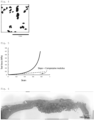
- the fractal dimension (D) is calculated in the following manner.
- a cross-sectional photograph of the porous composite is taken with a scanning electron microscope (SEM) in such a manner that the photograph includes at least a 5.0-mm ⁇ 5.0-mm square range that is a plane of the porous composite.
- SEM scanning electron microscope
- Fractal dimension (D) is calculated by the following method. All the image processing steps shown below are performed by using an image processing software ImageJ (Ver. 1.48 or later).
- Step (4) may be performed before step (2).
- Step (4) can be performed by an image processing software other than ImageJ, such as Windows Paint.
- image processing software other than ImageJ, such as Windows Paint.
- the portions containing the agglomerated particles of OCP can be first smeared with black and the other portions can be in white color, or only the portions occupied by agglomerated particles can be smeared with white and the other portions can be in black color.
- the image is then captured into ImageJ and subjected to step (2) and subsequent steps.
- step (3) of reversing the color tones is unnecessary.
- the porous composite of the present invention is such that in an image obtained by enlarging a 5.0-mm ⁇ 5.0-mm range of a plane of the porous composite 15 times with a scanning electron microscope (SEM), the area fraction of the area occupied by agglomerated particles of OCP to the total area, set to 1, is preferably 0.05 or more but 0.40 or less, more preferably 0.10 or more but 0.30 or less, and even more preferably 0.15 or more but 0.25 or less.
- the area fraction of the agglomerated particles of OCP can be obtained from the area fraction of the area occupied by the agglomerated particles of OCP to the area of each block calculated in the process of calculating the fractal dimension (D) .
- the area of the agglomerated particles of OCP having a length of 300 ⁇ m or more preferably accounts for 75% or more, more preferably 85% or more, and even more preferably 90% or more, of the total area of the agglomerated particles of OCP.
- the presence of relatively large agglomerated particles of 300 ⁇ m or more in a specific proportion or higher can continuously promote osteoconduction over a long period of time, and also plays an important role in reinforcing the strength of the skeletal structure of collagen of the porous composite.
- the total area of the agglomerated particles of OCP herein refers to the total of the areas occupied by all the visually detectable particles in the above SEM image.
- Having a length of 300 ⁇ m or more means that in the SEM image, the distance between a line tangent to the contour of an agglomerated particle and another tangent line drawn in parallel with the first tangent line so as to have the longest interval therebetween is 300 ⁇ m or more.
- the proportion of the agglomerated particles of 300 ⁇ m or more is calculated by the following method.
- the porous composite of the present invention is such that in an image obtained by enlarging a 5.0-mm ⁇ 5.0-mm range of a plane of the porous composite 15 times with a scanning electron microscope (SEM), the area of c) portions consisting of collagen accounts for 5% or less of the total area of a) portions consisting of agglomerated particles of octacalcium phosphate, b) portions consisting of octacalcium phosphate microparticles and collagen, and the c) portions consisting of collagen.
- SEM scanning electron microscope
- the porous composite according to a preferred embodiment of the present invention comprises a) portions consisting of agglomerated particles of OCP, b) portions consisting of OCP microparticles and collagen, and c) portions consisting of collagen.
- a) portions consisting of agglomerated particles of OCP refer to portions in which calcium phosphate aggregates and particulates can be confirmed with the naked eye in a 15-fold enlarged SEM image of the porous composite. In the SEM image, the portions a) are usually represented in a color close to white. When the portions a) are subjected to elemental analysis, large amounts of calcium Ca and phosphorus P are detected.
- Portions consisting of OCP microparticles and collagen refer to portions in which fine OCP particles of less than 100 ⁇ m or the like are present in a sponge-like structure of collagen, and OCP microparticles are difficult to be confirmed with the naked eye in a 15-fold enlarged SEM image.
- portions consisting of OCP microparticles and collagen are usually less bright than a) portions consisting of agglomerated particles of OCP and are represented in gray to white color. When the portions b) are subjected to elemental analysis, carbon C, calcium Ca, and phosphorus P are detected.
- Portions consisting of collagen refer to portions in which only a trace of or no OCP microparticles are present in a sponge-like structure of collagen. In the SEM image, c) portions consisting of collagen are represented in a dark color close to black. When the portions c) are subjected to elemental analysis, carbon C is detected and calcium Ca and phosphorus P are scarcely detected.
- the area percentage of the portions consisting of collagen is determined by the following method.
- step (2) When binarization in step (2) cannot be performed because of the color tones of the SEM image, or when the portions consisting of collagen are confused with the portions other than the portions consisting of collagen, only the portions consisting of collagen can be first smeared with black and the other portions can be in white color, or only the portions consisting of collagen can be smeared with white and the other portions can be in black color.
- the resulting image is then captured into ImageJ and subjected to step (2) and subsequent steps.
- the step of reversing the color tones is necessary between processes (2) and (3).
- the area percentage of the portions consisting of collagen is 5% or less, preferably 4% or less, and even more preferably 3% or less, based on the total area of the analysis image.
- the porous composite has a non-uniform structure and may have reduced osteoconduction. Further, when the portions consisting of collagen account for more than 5%, the compressive modulus is significantly reduced.
- the area of agglomerated particles having a length of 300 ⁇ m or more accounts for 75% or more of the total area of the agglomerated particles of OCP. More preferably, the area of agglomerated particles having a length of 300 ⁇ m or more accounts for 85% or more. Even more preferably, the fractal dimension (D) is 0.80 or more and the area of agglomerated particles having a length of 300 ⁇ m or more accounts for 90% or more.
- the porous composite preferably has a compressive modulus of 0.05 MPa or more, more preferably 0.08 to 0.30 MPa, and even more preferably 0.10 to 0.20 MPa.
- the compressive strength is less than 0.05 MPa, the workability of the porous composite tends to be reduced.
- the upper limit of the compressive modulus is not particularly specified, it is preferably 0.30 MPa or less in terms of operating ease in filling a bone defect site.
- the compressive modulus in the present invention is measured by the following method.
- a cylindrical sample having a diameter of 8.5 mm and a length of 15 mm is immersed in a phosphate buffered saline (10 mM sodium phosphate, 0.14 M sodium chloride, pH 7.4) at a temperature of 25°C and a humidity of 65% for 30 minutes.
- the water on the surface of the sample is then lightly blotted.
- a uniaxial load is applied to the sample using a precision universal tester (Autograph AGS-J, produced by Shimadzu Corporation, load cell capacity: 1 kN).
- an upper platen material: stainless steel, inner diameter: 100 mm, thickness: 25 mm
- the compressive modulus is calculated from the slope of the initial linear portion of the obtained stress-strain curve.
- the porous composite of the present invention preferably has a pore size of 3 to 40 ⁇ m. If the pore size is more than 40 ⁇ m, the strength of the porous composite tends to be reduced. On the other hand, if the pore size is less than 3 ⁇ m, it is difficult for bone metabolic cells, such as osteoblasts, to migrate into the porous composite, and the effect of promoting bone regeneration may be reduced.
- the porous composite of the present invention more preferably has a pore size of 5 to 20 ⁇ m.
- the pore size is measured by pore distribution measurement using a mercury porosimeter. Specifically, it is measured by the following method.
- samples are dried at a constant temperature of 120°C for 4 hours.
- the pore distribution of pores having a diameter of 0.0018 to 200 ⁇ m is determined under the following conditions by the mercury intrusion method using the following measurement device.
- Measurement device AutoPore IV 9520 (produced by Micromeritics) Measurement conditions:
- the pore size in the present invention refers to a value of micropore size showing the maximum value of the peak having the largest area in the pore distribution curve obtained from the measured pressure by the mercury intrusion method.
- the porosity (void ratio) of the porous composite is preferably 80 to 99%, and more preferably 85 to 98%.
- the shape of the porous composite of the present invention is preferably a rectangular parallelepiped (block body), a cylinder, a tablet, or a granule.
- the porous composite preferably has a size of greater than or equal to 5 mm ⁇ 5 mm ⁇ 5 mm. In general, the upper limit is preferably in the range of 100 mm ⁇ 100 mm ⁇ 100 mm.
- the rectangular parallelepiped is not limited to a cube.
- the porous composite is cylindrical, the porous composite preferably has a diameter of 5 to 50 mm and a height in the range of 1 to 50 mm.
- the shape of the granule is not limited to spheres, and may be indefinite; however, the porous composite preferably has a diameter of 0.1 to 10 mm.
- the porous composite of the present invention is used by filling a bone defect site with the porous composite.
- the bone defect site can be filled with the porous composite as is, or after the porous composite is cut into an appropriate shape.
- the bone defect site can be filled with the porous composite after the porous composite is immersed in blood, physiological saline, or the like and the porous composite is confirmed to have sponge-like elasticity.
- the method for producing the porous composite of the present invention is a production method comprising mixing OCP with collagen.
- the following production method can be used.
- OCP is added to a solution of gelled collagen having a concentration of 0.1 to 5 wt.% and a pH of 7 to 8, and kneaded to prepare a mixture of OCP and collagen.
- the mixture is molded in a suitable mold, frozen, and freeze-dried to obtain a composite.
- the obtained composite is optionally subjected to heat dehydration crosslinking treatment, and further sterilized by a conventional sterilization method (e.g., ⁇ -ray irradiation, electron beam irradiation, or ethylene oxide gas).
- a conventional sterilization method e.g., ⁇ -ray irradiation, electron beam irradiation, or ethylene oxide gas.
- stirrers with impellers such as propeller-type stirrers with 2 to 4 blades or paddle-type stirrers, or rotating/revolving mixers can be used.
- stirring is preferably performed at 100 to 300 rpm for 15 to 300 seconds, and more preferably at 100 to 300 rpm for 30 to 120 seconds.
- stirring is preferably performed at 500 to 1500 rpm for 30 to 300 seconds, and more preferably at 500 to 1500 rpm for 45 to 120 seconds.
- the step of kneading collagen and OCP can also be manually performed by using a spatula or the like.
- the stirring is preferably performed at a constant rate for 30 to 120 seconds.
- the stirring time is appropriately adjusted according to the rotational speed.
- the method for producing the porous composite of the present invention preferably comprises a step of freeze-drying after a gel, sol, or liquid containing OCP and collagen is rapidly frozen by immersion in a liquid refrigerant.
- the liquid refrigerant is a liquid having a temperature lower than the freezing temperature of the gel, sol, or liquid containing OCP and collagen. Examples of such liquids include methanol, ethanol, acetone, acetonitrile, and liquid nitrogen.
- the temperature of the liquid refrigerant is preferably -20°C or less, more preferably -40°C or less, and still more preferably -80°C or less.
- Rapidly freezing the gel, sol, or liquid containing octacalcium phosphate and collagen by immersion in a liquid refrigerant is considered to reduce the pore size of the resulting porous composite.
- the porous composite of the present invention is preferably subjected to heat treatment or dehydrothermal crosslinking treatment.
- the heat treatment leads to a collapse of a part of the OCP molecular structure, thus facilitating the migration of osteogenic cells and promoting bone regeneration, while allowing collagen to crosslink to enhance shape retention.
- the temperature of the heat treatment is preferably 50 to 200°C, and more preferably 60 to 180°C.
- the heat treatment is preferably performed under reduced pressure.
- the pressure is preferably 0 to 3000 Pa, and more preferably 0 to 300 Pa.
- the treatment time of the heat treatment is preferably 2 hours to 10 days, and more preferably 12 hours to 5 days.
- the porous composite of the present invention may contain, in addition to OCP and collagen, for example, cytokine (e.g., bone morphogenetic protein-2, transforming growth factor ⁇ 1, etc.) having a bone-forming ability. Containing such cytokine can increase the bone regeneration speed.
- cytokine e.g., bone morphogenetic protein-2, transforming growth factor ⁇ 1, etc.
- the porous composite of the present invention may further contain other components that are commonly used in this field.
- components include bioabsorbable polymers (e.g., polyglycolic acid, polylactic acid, polylactic acid-polyethylene glycol copolymer, etc.), bioabsorbable calcium phosphates other than OCP (e.g., ⁇ -TCP), and non-resorbable calcium phosphates (e.g., hydroxyapatite).
- the present invention further relates to a bone regeneration material containing the porous composite.
- the bone regeneration material can be used, for example, for bone defect repair in the dental oral surgery field and orthopedic surgery field, and bone defect repair after craniotomy or thoracotomy.
- a bone defect caused by periodontal disease, a cystic cavity, an atrophic alveolar ridge, a cleft jaw, a tooth-extraction cavity, or the like is filled with a bone regeneration material comprising the porous composite, an excellent bone regeneration effect can be confirmed after several weeks to several months.
- the bone defect site can be filled with the bone regeneration material of the present invention to thereby promote bone regeneration.
- liquid 1 and liquid 2 for preparation of OCP were prepared in the following manner.
- liquid 1 was placed in a separable flask, and heated to 70°C using a mantle heater.
- liquid 1 was stirred at a rate of 250 rpm using a stirrer (MAZELA Z, produced by Tokyo Rikakikai Co., Ltd.) equipped with stirring blades (blade diameter: 12 cm)
- stirrer MAZELA Z, produced by Tokyo Rikakikai Co., Ltd.
- stirring blades blades
- the precipitate produced in the above mixture was filtered through a membrane filter (pore size: 3 pm; A300A293C, produced by Advantec Toyo Kaisha, Ltd.) and collected.
- the collected precipitate was dispersed in 1500 mL of distilled water and washed by stirring for 15 minutes. Such filtering and washing steps were further repeated 3 times.
- the washed precipitate was dried in a constant temperature dryer at 30°C for 24 hours.
- the dried precipitate was ground with an electric mill and then classified to a particle size of 300 to 500 ⁇ m using sieves, thus obtaining a powder.
- the obtained powder was subjected to dry-heat sterilization at 120°C for 2 hours.
- pig dermis-derived collagen comprising type-I collagen and type-III collagen (NMP Collagen PS, produced by NH Foods Ltd.) was dissolved in 200 parts by weight of distilled water cooled to 4°C, thus obtaining a collagen solution in a concentration of about 0.5 wt.%. While the solution temperature was maintained at 4°C, an aqueous sodium hydroxide solution was added to the collagen aqueous solution, and the pH was adjusted to about 7.4 to obtain a collagen suspension.
- NMP Collagen PS produced by NH Foods Ltd.
- the collagen suspension was placed in a centrifuge bottle and centrifuged by a centrifugal separator (GRX-250, produced by Tomy Seiko Co., Ltd.) at a centrifugal force of 7,000 ⁇ g for 20 minutes.
- the supernatant was removed so that the resulting collagen suspension contained collagen in an amount of 3 wt.%, thus obtaining a collagen gel.
- the gel was placed in a plastic container having a cylindrical inner space (inner diameter: 8.5 mm, volume: about 3.0 cm 3 ) and centrifuged at a centrifugal force of 230 ⁇ g for 1 minute and defoamed.
- the container was hermetically sealed and rapidly frozen by dipping in a large excess of -80°C-cooled methanol relative to the volume of the product to be frozen. After opening the container, the frozen product was dried by a lyophilizer (-10°C, 48 hours) and molded. The molded product was then heated at 150°C under reduced pressure for 24 hours for dehydrothermal crosslinking. The obtained cylindrical product was cut to a thickness of 1.5 mm or 15 mm with a surgical knife and finally irradiated with electron beams (15 kGy) for sterilization. A porous composite of Example 1 was thus obtained.
- a porous composite was obtained in Example 2 in the same manner as in Example 1 except that a collagen gel and OCP were mixed at a rotational speed of 300 rpm for 300 seconds using a stirrer with blades.
- a porous composite was obtained in Example 3 in the same manner as in Example 1 except that a collagen gel and OCP were mixed at a rotational speed of 1000 rpm for 60 seconds using a rotating/revolving mixer (Awatori Rentaro ARE-310, produced by Thinky Corporation).
- a porous composite was obtained in Comparative Example 1 in the same manner as in Example 1 except that a collagen gel and OCP were mixed at a rotational speed of 100 rpm for 15 seconds using a stirrer with blades.
- a porous composite was obtained in Comparative Example 2 in the same manner as in Example 1 except that a collagen gel and OCP were mixed at a rotational speed of 300 rpm for 900 seconds using a stirrer with blades.
- a porous composite was obtained in Comparative Example 3 in the same manner as in Example 1 except that a collagen gel and OCP were mixed at a rotational speed of 300 rpm for 15 seconds using a rotating/revolving mixer.
- a porous composite was obtained in Comparative Example 4 in the same manner as in Example 1 except that a collagen gel and OCP were mixed at a rotational speed of 2000 rpm for 900 seconds using a rotating/revolving mixer.
- Analysis image was inside of an about 5-mm-square area freely-selected from the cross-section of the sample (hereinafter referred to as analysis image), which was used for analysis.
- the fractal dimension (D) was used to quantify the degree of dispersion of OCP particles on a collagen matrix.
- the fractal dimension (D) was calculated by the following procedure: All the image processing steps shown below were performed using ImageJ image processing software.
- the proportion of the OCP particles of 300 ⁇ m or more is calculated by the following procedure:
- the particle size in this measurement is defined as the distance between a line tangent to the contour of an agglomerated particle and another tangent line drawn in parallel with the first tangent line so as to have the longest interval therebetween, which is 300 ⁇ m or more.
- the proportion of collagen portions is calculated from the analysis image.
- the proportion of collagen portions was calculated by the following procedure:
- a cylindrical sample having a diameter of 8.5 mm and a height of 15 mm was immersed in a phosphate buffered saline (10 mM sodium phosphate, 0.14 M sodium chloride, pH 7.4) at a temperature of 25°C and a humidity of 65% for 30 minutes. The water on the surface of the sample was then lightly blotted. A uniaxial load was applied to the sample using a precision universal tester (Autograph AGS-J, produced by Shimadzu Corporation, load cell capacity: 1 kN).
- samples were dried at a constant temperature of 120°C for 4 hours.
- pore distribution of pores having a pore diameter of 0.0036 to 200 ⁇ m was determined under the following conditions by the mercury intrusion method using the following measurement device.
- Table 1 shows the measurement results of the fractal dimension (D), proportion of OCP particles of 300 ⁇ m or more, proportion of collagen portions, porosity, and compressive modulus.
- Table 1 Mixing method Stirring rate Time Fractal dimension Proportion of particles of 300 ⁇ m or more (%) Proportion of collagen portions (%) Porosity (%) Compressive modulus (MPa) Comparative Example 1 Stirrer, 4 blades 100 rpm 15 seconds 0.78 96.3 11.6 95 0.064 Example 1 Stirrer, 4 blades 300 rpm 60 seconds 0.80 93.1 2.6 97 0.107 Example 2 Stirrer, 4 blades 300 rpm 300 seconds 1.19 88.8 0 96 0.105 Comparative Example 2 Stirrer, 4 blades 300 rpm 900 seconds 0.56 88.2 0 97 0.045 Comparative Example 3 Rotating/ revolving mixer 300 rpm 15 seconds 0.53 90.1 45.2 97 0.034 Example 3 Rotating/ revolving mixer 1000 rpm 60 seconds 0.97 91.6 0 98
- the sample obtained in Comparative Example 1 had a fractal dimension of 0.78.
- the proportion of particles of 300 ⁇ m or more was 96%. OCP particles were uniformly dispersed while the predetermined particle size was maintained. However, due to slightly insufficient stirring, the proportion of collagen portions was 11% and sufficient mixing was not achieved.
- the sample obtained in Comparative Example 2 was such that the proportion of particles of 300 ⁇ m or more was 88% and no portion consisting only of collagen existed. Sufficient mixing was achieved while the predetermined particle size was maintained. Surprisingly, however, excessive stirring resulted in disproportional presence of OCP particles in the peripheral portion of the disk, and the sample of Comparative Example 2 had a low fractal dimension of 0.56 or less.
- Comparative Example 3 The sample obtained in Comparative Example 3 was such that the proportion of particles of 300 ⁇ m or more was 90% and the predetermined particle size was maintained. However, the fractal dimension was as low as 0.53 and the collagen portions accounted for 45%, which is a very high proportion. These results suggest that clearly insufficient stirring resulted under such stirring conditions.
- the sample obtained in Comparative Example 4 had a fractal dimension of 0.68 and no portion consisting only of collagen existed. Although uniform dispersion of OCP particles and sufficient mixing were observed, the proportion of the particles of 300 ⁇ m or more was 74% and maintaining the predetermined particle size was difficult. This is presumably because OCP particles were disintegrated by long-term vigorous stirring and the proportion of the particles of 300 ⁇ m or more decreased.
- the samples obtained in Examples 1 to 3 had a compressive modulus of about 0.1 MPa, which is 1.6 to 3.1 times as high as the compressive modulus of the samples obtained in Comparative Examples 1 to 4. This is presumably because in Examples 1 to 3, OCP particles were uniformly dispersed in the entire composite and there was only a small portion in which OCP and collagen were insufficiently mixed and OCP thus functioned efficiently as a reinforcer.
- Example 1 Male SD rats (12 weeks old) were used as test animals. The rats were intraperitoneally anesthetized, and skin and periosteal incisions were made in the calvarium region of each rat to expose the calvarium. A standardized full-thickness bone defect (diameter: about 9 mm), for which spontaneous recovery could not be expected, was created in each rat.
- One of the disc-shaped porous composites produced in Example 1, Example 2, Comparative Example 3, and Comparative Example 4 was implanted into the bone defect of each rat.
- One rat each was used for the test of implanting the porous composites produced in Examples 1 and 2 and Comparative Example 4, whereas two rats were used in the test of implanting the porous composite produced in Comparative Example 3. After each sample was implanted, the periosteum and skin were sutured and the surgery was completed. The observation period after surgery was 10 weeks for each group.
- tissue slices with a thickness of 6 ⁇ m were prepared by cutting in the frontal plane and stained with hematoxylin-eosin (HE) to prepare tissue samples.
- HE hematoxylin-eosin
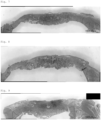
- Figs. 6 to 10 show the results of each group.
- Examples 1 and 2 uniform dispersion of the agglomerated particles of OCP can be confirmed.
- new bone was observed in many portions within the bone defect region and the other portions were also observed to be occupied with connective tissue associated with bone regeneration.
- the porous composite of Example 2 was implanted, many portions within the entire bone defect portion were occupied with new bone.
- the boundary between the defect portion and the bone bed is blurred and active bone regeneration is exhibited.
- the size of agglomerated particles of OCP become smaller. Further, migration of new bone tissue into the agglomerated particles of OCP can also be observed. The results suggest that OCP exerts sustained effects and effectively acts during the period.
- the porous composite of the present invention and the bone regeneration material comprising the porous composite has high bone regeneration capacity and appropriate mechanical strength. Therefore, the bone regeneration material is useful mainly for bone defect repair in the dental oral surgery field and orthopedic surgery field.
Landscapes
- Health & Medical Sciences (AREA)
- Chemical & Material Sciences (AREA)
- Life Sciences & Earth Sciences (AREA)
- Veterinary Medicine (AREA)
- Public Health (AREA)
- General Health & Medical Sciences (AREA)
- Medicinal Chemistry (AREA)
- Animal Behavior & Ethology (AREA)
- Transplantation (AREA)
- Epidemiology (AREA)
- Oral & Maxillofacial Surgery (AREA)
- Dermatology (AREA)
- Engineering & Computer Science (AREA)
- Inorganic Chemistry (AREA)
- Materials Engineering (AREA)
- Composite Materials (AREA)
- Bioinformatics & Cheminformatics (AREA)
- Pharmacology & Pharmacy (AREA)
- Chemical Kinetics & Catalysis (AREA)
- General Chemical & Material Sciences (AREA)
- Nuclear Medicine, Radiotherapy & Molecular Imaging (AREA)
- Organic Chemistry (AREA)
- Dispersion Chemistry (AREA)
- Physical Education & Sports Medicine (AREA)
- Biophysics (AREA)
- Surgery (AREA)
- Orthopedic Medicine & Surgery (AREA)
- Rheumatology (AREA)
- Materials For Medical Uses (AREA)
Claims (15)
- Ein poröser Verbundstoff, umfassend Octacalciumphosphat und Kollagen, dadurch gekennzeichnet, dassin einem Bild, erhalten durch 15-fache Vergrößerung eines Bereichs von 5,0 mm × 5,0 mm einer Ebene des porösen Verbundstoffs mit einem Rasterelektronenmikroskop (SEM),agglomerierte Octacalciumphosphat-Teilchen eine fraktale Dimension (D) von 0,70 oder mehr aufweisen; unddie Fläche von (c) Anteilen, die aus Kollagen bestehen, 5% oder weniger der Gesamtfläche an (a) Anteilen, die aus agglomerierten Octacalciumphosphat-Teilchen bestehen, (b) Anteilen, die aus Octacalciumphosphat-Mikroteilchen und Kollagen bestehen, und den (c) Anteilen, die aus Kollagen bestehen, ausmacht; undder Verbundstoff durch Steuern des Rührgrades innerhalb eines spezifischen Bereichs erhältlich ist, wenn ein Mischschritt von Octacalciumphosphat und Kollagen in dem Verfahren zur Herstellung eines porösen Verbundstoffs, der das Octacalciumphosphat und das Kollagen umfasst, durch Kneten von Kollagen und Octacalciumphosphat unter Verwendung eines Rührers mit Rührflügel und Durchführen von Rühren bei 100 bis 300 UpM für 15 bis 300 Sekunden oder unter Verwendung eines rotierenden und sich drehenden Mischers und Durchführen von Rühren bei 500 bis 1500 UpM für 30 bis 300 Sekunden durchgeführt wird.
- Der poröse Verbundstoff nach Anspruch 1, wobei die Fläche an agglomerierten Octacalciumphosphat-Teilchen mit einer Länge von 300 µm oder mehr 75% oder mehr der Gesamtfläche der agglomerierten Octacalciumphosphat-Teilchen ausmacht.
- Der poröse Verbundstoff nach Anspruch 1 oder 2, wobei die fraktale Dimension (D) 0,80 oder mehr beträgt.
- Der poröse Verbundstoff nach einem der Ansprüche 1 bis 3, wobei die Fläche der (c) Anteile, die aus Kollagen bestehen, 4% oder weniger, bezogen auf die Gesamtfläche des Analysebildes, ausmacht.
- Der poröse Verbundstoff nach einem der Ansprüche 1 bis 3, wobei die Fläche an (c) Anteilen, die aus Kollagen bestehen, 3% oder weniger, bezogen auf die Gesamtfläche des Analysebildes, ausmacht.
- Der poröse Verbundstoff nach Anspruch 2, wobei die Fläche der agglomerierten Octacalciumphosphat-Teilchen mit einer Länge von 300 µm oder mehr 85% oder mehr ausmacht.
- Der poröse Verbundstoff nach Anspruch 2, wobei die fraktale Dimension (D) 0,80 oder mehr beträgt und die Fläche an agglomerierten Octacalciumphosphat-Teilchen mit einer Länge von 300 µm oder mehr 90% oder mehr ausmacht.
- Der poröse Verbundstoff nach einem der Ansprüche 1 bis 7, wobei das Mischverhältnis von Octacalciumphosphat zu 1 Gewichtsteil Kollagen 0,5 bis 35 Gewichtsteile beträgt.
- Der poröse Verbundstoff nach einem der Ansprüche 1 bis 7, wobei das Mischverhältnis von Octacalciumphosphat zu 1 Gewichtsteil Kollagen 1 bis 20 Gewichtsteile beträgt.
- Der poröse Verbundstoff nach einem der Ansprüche 1 bis 7, wobei das Mischverhältnis von Octacalciumphosphat zu 1 Gewichtsteil Kollagen 2 bis 10 Gewichtsteile beträgt.
- Der poröse Verbundstoff nach einem der Ansprüche 1 bis 10, wobei der poröse Verbundstoff einen Kompressionsmodul von 0,08 MPa oder mehr aufweist.
- Ein Knochenregenerationsmaterial, umfassend den porösen Verbundstoff nach einem der Ansprüche 1 bis 11.
- Ein Verfahren zur Herstellung des porösen Verbundstoffs nach Anspruch 1, wobei das Verfahren einen Schritt des Knetens von Kollagen und Octacalciumphosphat unter Verwendung eines Rührers mit Rührflügel und Durchführen von Rühren bei 100 bis 300 UpM für 15 bis 300 Sekunden oder unter Verwendung eines rotierenden und sich drehenden Mischers und Durchführen von Rühren bei 500 bis 1500 UpM für 30 bis 300 Sekunden umfasst.
- Das Verfahren nach Anspruch 13, wobei der Schritt des Knetens von Kollagen und Octacalciumphosphat den Rührer mit Rührflügel verwendet und Rühren bei 100 bis 300 UpM für 30 bis 120 Sekunden durchgeführt wird, oder einen rotierenden und sich drehenden Mischer verwendet und Rühren bei 500 bis 1500 UpM für 45 bis 120 Sekunden durchgeführt wird.
- Das Verfahren nach Anspruch 13 oder 14, wobei der Rührer mit Rührflügel ausgewählt ist aus Propellerrührern mit 2 bis 4 Flügeln und Schaufelrührern.
Applications Claiming Priority (3)
| Application Number | Priority Date | Filing Date | Title |
|---|---|---|---|
| JP2015176454A JP5900691B1 (ja) | 2015-09-08 | 2015-09-08 | 多孔質複合体および骨再生材料 |
| JP2015176455A JP5900692B1 (ja) | 2015-09-08 | 2015-09-08 | 多孔質複合体および骨再生材料 |
| PCT/JP2016/076227 WO2017043498A1 (ja) | 2015-09-08 | 2016-09-07 | 多孔質複合体および骨再生材料 |
Publications (4)
| Publication Number | Publication Date |
|---|---|
| EP3348286A1 EP3348286A1 (de) | 2018-07-18 |
| EP3348286A4 EP3348286A4 (de) | 2018-08-22 |
| EP3348286A8 EP3348286A8 (de) | 2019-01-09 |
| EP3348286B1 true EP3348286B1 (de) | 2024-11-06 |
Family
ID=58239862
Family Applications (1)
| Application Number | Title | Priority Date | Filing Date |
|---|---|---|---|
| EP16844359.6A Active EP3348286B1 (de) | 2015-09-08 | 2016-09-07 | Poröser komplex und knochenregenerationsmaterial |
Country Status (5)
| Country | Link |
|---|---|
| US (1) | US10512709B2 (de) |
| EP (1) | EP3348286B1 (de) |
| ES (1) | ES3012401T3 (de) |
| TW (1) | TWI611804B (de) |
| WO (1) | WO2017043498A1 (de) |
Families Citing this family (2)
| Publication number | Priority date | Publication date | Assignee | Title |
|---|---|---|---|---|
| JP7412700B2 (ja) * | 2020-01-23 | 2024-01-15 | 東洋紡株式会社 | 多孔質複合体 |
| JPWO2024189842A1 (de) * | 2023-03-15 | 2024-09-19 |
Family Cites Families (13)
| Publication number | Priority date | Publication date | Assignee | Title |
|---|---|---|---|---|
| US4888366A (en) | 1984-10-24 | 1989-12-19 | Collagen Corporation | Inductive collagen-based bone repair preparations |
| JPH0670113A (ja) | 1991-06-27 | 1994-03-11 | Sony Corp | 静止画伝送システム |
| JP4226830B2 (ja) | 2002-03-11 | 2009-02-18 | 独立行政法人科学技術振興機構 | 複合生体材料の生分解性制御 |
| US7229971B2 (en) | 2002-03-11 | 2007-06-12 | Japan Science And Technology Agency | Regulation of biodegradability of composite biomaterials |
| JP4643166B2 (ja) | 2004-03-30 | 2011-03-02 | 独立行政法人物質・材料研究機構 | アパタイト/コラーゲン複合体繊維を含む多孔体の平均気孔径制御方法 |
| JP5046511B2 (ja) * | 2004-11-19 | 2012-10-10 | 日本ハム株式会社 | 硬組織代替性担体材料 |
| FR2879433B1 (fr) | 2004-12-17 | 2008-01-04 | Gen Electric | Procede pour determiner une geometrie d'acquisition d'un systeme medical |
| US7842737B2 (en) | 2006-09-29 | 2010-11-30 | Abbott Cardiovascular Systems Inc. | Polymer blend-bioceramic composite implantable medical devices |
| JP2009132601A (ja) | 2007-11-01 | 2009-06-18 | Hoya Corp | アパタイト/コラーゲン複合体繊維を含む多孔体及びその製造方法 |
| JP2010273847A (ja) | 2009-05-28 | 2010-12-09 | Tokyo Institute Of Technology | 高密度多孔質複合体 |
| JP6265665B2 (ja) | 2013-09-11 | 2018-01-24 | 国立大学法人東北大学 | 骨接合部再生材料 |
| SG11201704277XA (en) * | 2014-11-27 | 2017-06-29 | Toyo Boseki | Porous composite, bone regeneration material, and method for producing porous composite |
| SG11201708129QA (en) * | 2015-04-08 | 2017-11-29 | Toyo Boseki | Porous composite, bone regeneration material, and method for producing porous composite |
-
2016
- 2016-09-07 WO PCT/JP2016/076227 patent/WO2017043498A1/ja not_active Ceased
- 2016-09-07 ES ES16844359T patent/ES3012401T3/es active Active
- 2016-09-07 US US15/757,705 patent/US10512709B2/en active Active
- 2016-09-07 EP EP16844359.6A patent/EP3348286B1/de active Active
- 2016-09-07 TW TW105128939A patent/TWI611804B/zh active
Also Published As
| Publication number | Publication date |
|---|---|
| EP3348286A8 (de) | 2019-01-09 |
| TW201716071A (zh) | 2017-05-16 |
| EP3348286A1 (de) | 2018-07-18 |
| US20190038801A1 (en) | 2019-02-07 |
| TWI611804B (zh) | 2018-01-21 |
| US10512709B2 (en) | 2019-12-24 |
| EP3348286A4 (de) | 2018-08-22 |
| ES3012401T3 (en) | 2025-04-09 |
| WO2017043498A1 (ja) | 2017-03-16 |
Similar Documents
| Publication | Publication Date | Title |
|---|---|---|
| EP3225259B1 (de) | Poröser verbundkörper, knochenregenerationsmaterial und verfahren zur herstellung des porösen verbundkörpers | |
| CN109876190A (zh) | 三维生物打印墨水的制备方法及其应用 | |
| JP5981025B2 (ja) | 組織修復材 | |
| EP3348286B1 (de) | Poröser komplex und knochenregenerationsmaterial | |
| JP5881206B2 (ja) | 骨再生材料 | |
| JP7412700B2 (ja) | 多孔質複合体 | |
| EP2301591A1 (de) | Knochenprothesenmaterial und verfahren zu dessen herstellung | |
| JP5900691B1 (ja) | 多孔質複合体および骨再生材料 | |
| WO2019077806A1 (ja) | 骨補填材および骨補填材の製造方法 | |
| RU2482880C1 (ru) | Способ получения пористого костного биокомпозита | |
| EP3281647A1 (de) | Poröser verbundkörper, knochenregenerationsmaterial und verfahren zur herstellung des porösen verbundkörpers | |
| JP5900692B1 (ja) | 多孔質複合体および骨再生材料 | |
| JP7177588B2 (ja) | 骨補填材および骨補填材の製造方法 | |
| JP4671596B2 (ja) | 多孔質骨修復材料およびその製造方法 | |
| JPH06296678A (ja) | 骨欠損部、骨空隙部及び骨吸収部充填材の製造法 | |
| RU2788658C2 (ru) | Регенеративный материал соединительных тканей, способ получения регенеративного материала, применение регенеративного материала, имплантат | |
| WO2024189842A1 (ja) | 歯根膜再生材料 | |
| Junior et al. | Physical Characterization of Biphasic Materials With Different Granulation Sizes and Their Influence on Bone Repair and Inflammation in Rat Calvaria | |
| 장경제 | Development and Characteristics of 2D/3D Engineered Scaffolds through Bioprocessing of Equine Bone-derived Hydroxyapatites for Bone Tissue Engineering | |
| CN111569150A (zh) | 具备骨诱导活性的同种骨修复材料及其制法及其用途 |
Legal Events
| Date | Code | Title | Description |
|---|---|---|---|
| STAA | Information on the status of an ep patent application or granted ep patent |
Free format text: STATUS: THE INTERNATIONAL PUBLICATION HAS BEEN MADE |
|
| PUAI | Public reference made under article 153(3) epc to a published international application that has entered the european phase |
Free format text: ORIGINAL CODE: 0009012 |
|
| STAA | Information on the status of an ep patent application or granted ep patent |
Free format text: STATUS: REQUEST FOR EXAMINATION WAS MADE |
|
| 17P | Request for examination filed |
Effective date: 20180329 |
|
| AK | Designated contracting states |
Kind code of ref document: A1 Designated state(s): AL AT BE BG CH CY CZ DE DK EE ES FI FR GB GR HR HU IE IS IT LI LT LU LV MC MK MT NL NO PL PT RO RS SE SI SK SM TR |
|
| AX | Request for extension of the european patent |
Extension state: BA ME |
|
| A4 | Supplementary search report drawn up and despatched |
Effective date: 20180720 |
|
| RIC1 | Information provided on ipc code assigned before grant |
Ipc: A61L 27/00 20060101AFI20180716BHEP |
|
| RAP1 | Party data changed (applicant data changed or rights of an application transferred) |
Owner name: TOYOBO CO., LTD. |
|
| DAV | Request for validation of the european patent (deleted) | ||
| DAX | Request for extension of the european patent (deleted) | ||
| STAA | Information on the status of an ep patent application or granted ep patent |
Free format text: STATUS: EXAMINATION IS IN PROGRESS |
|
| 17Q | First examination report despatched |
Effective date: 20191018 |
|
| RAP3 | Party data changed (applicant data changed or rights of an application transferred) |
Owner name: TOYOBO CO., LTD. |
|
| REG | Reference to a national code |
Ref country code: DE Ref legal event code: R079 Free format text: PREVIOUS MAIN CLASS: A61L0027000000 Ipc: A61P0043000000 Ref document number: 602016090160 Country of ref document: DE |
|
| RIC1 | Information provided on ipc code assigned before grant |
Ipc: A61P 41/00 20060101ALI20240326BHEP Ipc: A61P 19/08 20060101ALI20240326BHEP Ipc: A61L 27/56 20060101ALI20240326BHEP Ipc: A61L 27/46 20060101ALI20240326BHEP Ipc: A61L 27/00 20060101ALI20240326BHEP Ipc: A61P 43/00 20060101AFI20240326BHEP |
|
| GRAP | Despatch of communication of intention to grant a patent |
Free format text: ORIGINAL CODE: EPIDOSNIGR1 |
|
| STAA | Information on the status of an ep patent application or granted ep patent |
Free format text: STATUS: GRANT OF PATENT IS INTENDED |
|
| INTG | Intention to grant announced |
Effective date: 20240513 |
|
| GRAS | Grant fee paid |
Free format text: ORIGINAL CODE: EPIDOSNIGR3 |
|
| P01 | Opt-out of the competence of the unified patent court (upc) registered |
Free format text: CASE NUMBER: APP_48306/2024 Effective date: 20240822 |
|
| GRAA | (expected) grant |
Free format text: ORIGINAL CODE: 0009210 |
|
| STAA | Information on the status of an ep patent application or granted ep patent |
Free format text: STATUS: THE PATENT HAS BEEN GRANTED |
|
| AK | Designated contracting states |
Kind code of ref document: B1 Designated state(s): AL AT BE BG CH CY CZ DE DK EE ES FI FR GB GR HR HU IE IS IT LI LT LU LV MC MK MT NL NO PL PT RO RS SE SI SK SM TR |
|
| REG | Reference to a national code |
Ref country code: GB Ref legal event code: FG4D |
|
| REG | Reference to a national code |
Ref country code: CH Ref legal event code: EP |
|
| REG | Reference to a national code |
Ref country code: DE Ref legal event code: R096 Ref document number: 602016090160 Country of ref document: DE |
|
| REG | Reference to a national code |
Ref country code: IE Ref legal event code: FG4D |
|
| REG | Reference to a national code |
Ref country code: NL Ref legal event code: FP |
|
| REG | Reference to a national code |
Ref country code: LT Ref legal event code: MG9D |
|
| REG | Reference to a national code |
Ref country code: ES Ref legal event code: FG2A Ref document number: 3012401 Country of ref document: ES Kind code of ref document: T3 Effective date: 20250409 |
|
| PG25 | Lapsed in a contracting state [announced via postgrant information from national office to epo] |
Ref country code: PT Free format text: LAPSE BECAUSE OF FAILURE TO SUBMIT A TRANSLATION OF THE DESCRIPTION OR TO PAY THE FEE WITHIN THE PRESCRIBED TIME-LIMIT Effective date: 20250306 Ref country code: HR Free format text: LAPSE BECAUSE OF FAILURE TO SUBMIT A TRANSLATION OF THE DESCRIPTION OR TO PAY THE FEE WITHIN THE PRESCRIBED TIME-LIMIT Effective date: 20241106 Ref country code: IS Free format text: LAPSE BECAUSE OF FAILURE TO SUBMIT A TRANSLATION OF THE DESCRIPTION OR TO PAY THE FEE WITHIN THE PRESCRIBED TIME-LIMIT Effective date: 20250306 |
|
| PG25 | Lapsed in a contracting state [announced via postgrant information from national office to epo] |
Ref country code: FI Free format text: LAPSE BECAUSE OF FAILURE TO SUBMIT A TRANSLATION OF THE DESCRIPTION OR TO PAY THE FEE WITHIN THE PRESCRIBED TIME-LIMIT Effective date: 20241106 |
|
| REG | Reference to a national code |
Ref country code: AT Ref legal event code: MK05 Ref document number: 1738724 Country of ref document: AT Kind code of ref document: T Effective date: 20241106 |
|
| PG25 | Lapsed in a contracting state [announced via postgrant information from national office to epo] |
Ref country code: BG Free format text: LAPSE BECAUSE OF FAILURE TO SUBMIT A TRANSLATION OF THE DESCRIPTION OR TO PAY THE FEE WITHIN THE PRESCRIBED TIME-LIMIT Effective date: 20241106 |
|
| PG25 | Lapsed in a contracting state [announced via postgrant information from national office to epo] |
Ref country code: NO Free format text: LAPSE BECAUSE OF FAILURE TO SUBMIT A TRANSLATION OF THE DESCRIPTION OR TO PAY THE FEE WITHIN THE PRESCRIBED TIME-LIMIT Effective date: 20250206 |
|
| PG25 | Lapsed in a contracting state [announced via postgrant information from national office to epo] |
Ref country code: LV Free format text: LAPSE BECAUSE OF FAILURE TO SUBMIT A TRANSLATION OF THE DESCRIPTION OR TO PAY THE FEE WITHIN THE PRESCRIBED TIME-LIMIT Effective date: 20241106 Ref country code: GR Free format text: LAPSE BECAUSE OF FAILURE TO SUBMIT A TRANSLATION OF THE DESCRIPTION OR TO PAY THE FEE WITHIN THE PRESCRIBED TIME-LIMIT Effective date: 20250207 Ref country code: AT Free format text: LAPSE BECAUSE OF FAILURE TO SUBMIT A TRANSLATION OF THE DESCRIPTION OR TO PAY THE FEE WITHIN THE PRESCRIBED TIME-LIMIT Effective date: 20241106 |
|
| PG25 | Lapsed in a contracting state [announced via postgrant information from national office to epo] |
Ref country code: PL Free format text: LAPSE BECAUSE OF FAILURE TO SUBMIT A TRANSLATION OF THE DESCRIPTION OR TO PAY THE FEE WITHIN THE PRESCRIBED TIME-LIMIT Effective date: 20241106 |
|
| PG25 | Lapsed in a contracting state [announced via postgrant information from national office to epo] |
Ref country code: RS Free format text: LAPSE BECAUSE OF FAILURE TO SUBMIT A TRANSLATION OF THE DESCRIPTION OR TO PAY THE FEE WITHIN THE PRESCRIBED TIME-LIMIT Effective date: 20250206 |
|
| PG25 | Lapsed in a contracting state [announced via postgrant information from national office to epo] |
Ref country code: SM Free format text: LAPSE BECAUSE OF FAILURE TO SUBMIT A TRANSLATION OF THE DESCRIPTION OR TO PAY THE FEE WITHIN THE PRESCRIBED TIME-LIMIT Effective date: 20241106 |
|
| PG25 | Lapsed in a contracting state [announced via postgrant information from national office to epo] |
Ref country code: DK Free format text: LAPSE BECAUSE OF FAILURE TO SUBMIT A TRANSLATION OF THE DESCRIPTION OR TO PAY THE FEE WITHIN THE PRESCRIBED TIME-LIMIT Effective date: 20241106 |
|
| PG25 | Lapsed in a contracting state [announced via postgrant information from national office to epo] |
Ref country code: EE Free format text: LAPSE BECAUSE OF FAILURE TO SUBMIT A TRANSLATION OF THE DESCRIPTION OR TO PAY THE FEE WITHIN THE PRESCRIBED TIME-LIMIT Effective date: 20241106 |
|
| PG25 | Lapsed in a contracting state [announced via postgrant information from national office to epo] |
Ref country code: RO Free format text: LAPSE BECAUSE OF FAILURE TO SUBMIT A TRANSLATION OF THE DESCRIPTION OR TO PAY THE FEE WITHIN THE PRESCRIBED TIME-LIMIT Effective date: 20241106 |
|
| PG25 | Lapsed in a contracting state [announced via postgrant information from national office to epo] |
Ref country code: SK Free format text: LAPSE BECAUSE OF FAILURE TO SUBMIT A TRANSLATION OF THE DESCRIPTION OR TO PAY THE FEE WITHIN THE PRESCRIBED TIME-LIMIT Effective date: 20241106 |
|
| PG25 | Lapsed in a contracting state [announced via postgrant information from national office to epo] |
Ref country code: CZ Free format text: LAPSE BECAUSE OF FAILURE TO SUBMIT A TRANSLATION OF THE DESCRIPTION OR TO PAY THE FEE WITHIN THE PRESCRIBED TIME-LIMIT Effective date: 20241106 |
|
| REG | Reference to a national code |
Ref country code: DE Ref legal event code: R097 Ref document number: 602016090160 Country of ref document: DE |
|
| PG25 | Lapsed in a contracting state [announced via postgrant information from national office to epo] |
Ref country code: SE Free format text: LAPSE BECAUSE OF FAILURE TO SUBMIT A TRANSLATION OF THE DESCRIPTION OR TO PAY THE FEE WITHIN THE PRESCRIBED TIME-LIMIT Effective date: 20241106 |
|
| PLBE | No opposition filed within time limit |
Free format text: ORIGINAL CODE: 0009261 |
|
| STAA | Information on the status of an ep patent application or granted ep patent |
Free format text: STATUS: NO OPPOSITION FILED WITHIN TIME LIMIT |
|
| PGFP | Annual fee paid to national office [announced via postgrant information from national office to epo] |
Ref country code: NL Payment date: 20250814 Year of fee payment: 10 |
|
| PGFP | Annual fee paid to national office [announced via postgrant information from national office to epo] |
Ref country code: DE Payment date: 20250730 Year of fee payment: 10 |
|
| 26N | No opposition filed |
Effective date: 20250807 |
|
| PGFP | Annual fee paid to national office [announced via postgrant information from national office to epo] |
Ref country code: IT Payment date: 20250825 Year of fee payment: 10 |
|
| PGFP | Annual fee paid to national office [announced via postgrant information from national office to epo] |
Ref country code: GB Payment date: 20250731 Year of fee payment: 10 |
|
| PGFP | Annual fee paid to national office [announced via postgrant information from national office to epo] |
Ref country code: FR Payment date: 20250808 Year of fee payment: 10 |
|
| PGFP | Annual fee paid to national office [announced via postgrant information from national office to epo] |
Ref country code: ES Payment date: 20251013 Year of fee payment: 10 |