EP3348651A1 - Schneller antimikrobieller empfindlichkeitsnachweis und phylogenetische identifizierung - Google Patents
Schneller antimikrobieller empfindlichkeitsnachweis und phylogenetische identifizierung Download PDFInfo
- Publication number
- EP3348651A1 EP3348651A1 EP17151531.5A EP17151531A EP3348651A1 EP 3348651 A1 EP3348651 A1 EP 3348651A1 EP 17151531 A EP17151531 A EP 17151531A EP 3348651 A1 EP3348651 A1 EP 3348651A1
- Authority
- EP
- European Patent Office
- Prior art keywords
- sequence
- seq
- primer
- sequence identity
- extension
- Prior art date
- Legal status (The legal status is an assumption and is not a legal conclusion. Google has not performed a legal analysis and makes no representation as to the accuracy of the status listed.)
- Withdrawn
Links
- 0 CCC(C)(CC1)C2C11C2C1C(C1)C11*C1 Chemical compound CCC(C)(CC1)C2C11C2C1C(C1)C11*C1 0.000 description 5
Images






Classifications
-
- C—CHEMISTRY; METALLURGY
- C12—BIOCHEMISTRY; BEER; SPIRITS; WINE; VINEGAR; MICROBIOLOGY; ENZYMOLOGY; MUTATION OR GENETIC ENGINEERING
- C12Q—MEASURING OR TESTING PROCESSES INVOLVING ENZYMES, NUCLEIC ACIDS OR MICROORGANISMS; COMPOSITIONS OR TEST PAPERS THEREFOR; PROCESSES OF PREPARING SUCH COMPOSITIONS; CONDITION-RESPONSIVE CONTROL IN MICROBIOLOGICAL OR ENZYMOLOGICAL PROCESSES
- C12Q1/00—Measuring or testing processes involving enzymes, nucleic acids or microorganisms; Compositions therefor; Processes of preparing such compositions
- C12Q1/68—Measuring or testing processes involving enzymes, nucleic acids or microorganisms; Compositions therefor; Processes of preparing such compositions involving nucleic acids
- C12Q1/6876—Nucleic acid products used in the analysis of nucleic acids, e.g. primers or probes
- C12Q1/6888—Nucleic acid products used in the analysis of nucleic acids, e.g. primers or probes for detection or identification of organisms
- C12Q1/689—Nucleic acid products used in the analysis of nucleic acids, e.g. primers or probes for detection or identification of organisms for bacteria
-
- C—CHEMISTRY; METALLURGY
- C12—BIOCHEMISTRY; BEER; SPIRITS; WINE; VINEGAR; MICROBIOLOGY; ENZYMOLOGY; MUTATION OR GENETIC ENGINEERING
- C12Q—MEASURING OR TESTING PROCESSES INVOLVING ENZYMES, NUCLEIC ACIDS OR MICROORGANISMS; COMPOSITIONS OR TEST PAPERS THEREFOR; PROCESSES OF PREPARING SUCH COMPOSITIONS; CONDITION-RESPONSIVE CONTROL IN MICROBIOLOGICAL OR ENZYMOLOGICAL PROCESSES
- C12Q1/00—Measuring or testing processes involving enzymes, nucleic acids or microorganisms; Compositions therefor; Processes of preparing such compositions
- C12Q1/68—Measuring or testing processes involving enzymes, nucleic acids or microorganisms; Compositions therefor; Processes of preparing such compositions involving nucleic acids
- C12Q1/6844—Nucleic acid amplification reactions
- C12Q1/686—Polymerase chain reaction [PCR]
-
- C—CHEMISTRY; METALLURGY
- C12—BIOCHEMISTRY; BEER; SPIRITS; WINE; VINEGAR; MICROBIOLOGY; ENZYMOLOGY; MUTATION OR GENETIC ENGINEERING
- C12Q—MEASURING OR TESTING PROCESSES INVOLVING ENZYMES, NUCLEIC ACIDS OR MICROORGANISMS; COMPOSITIONS OR TEST PAPERS THEREFOR; PROCESSES OF PREPARING SUCH COMPOSITIONS; CONDITION-RESPONSIVE CONTROL IN MICROBIOLOGICAL OR ENZYMOLOGICAL PROCESSES
- C12Q2600/00—Oligonucleotides characterized by their use
- C12Q2600/106—Pharmacogenomics, i.e. genetic variability in individual responses to drugs and drug metabolism
-
- C—CHEMISTRY; METALLURGY
- C12—BIOCHEMISTRY; BEER; SPIRITS; WINE; VINEGAR; MICROBIOLOGY; ENZYMOLOGY; MUTATION OR GENETIC ENGINEERING
- C12Q—MEASURING OR TESTING PROCESSES INVOLVING ENZYMES, NUCLEIC ACIDS OR MICROORGANISMS; COMPOSITIONS OR TEST PAPERS THEREFOR; PROCESSES OF PREPARING SUCH COMPOSITIONS; CONDITION-RESPONSIVE CONTROL IN MICROBIOLOGICAL OR ENZYMOLOGICAL PROCESSES
- C12Q2600/00—Oligonucleotides characterized by their use
- C12Q2600/112—Disease subtyping, staging or classification
-
- C—CHEMISTRY; METALLURGY
- C12—BIOCHEMISTRY; BEER; SPIRITS; WINE; VINEGAR; MICROBIOLOGY; ENZYMOLOGY; MUTATION OR GENETIC ENGINEERING
- C12Q—MEASURING OR TESTING PROCESSES INVOLVING ENZYMES, NUCLEIC ACIDS OR MICROORGANISMS; COMPOSITIONS OR TEST PAPERS THEREFOR; PROCESSES OF PREPARING SUCH COMPOSITIONS; CONDITION-RESPONSIVE CONTROL IN MICROBIOLOGICAL OR ENZYMOLOGICAL PROCESSES
- C12Q2600/00—Oligonucleotides characterized by their use
- C12Q2600/136—Screening for pharmacological compounds
-
- C—CHEMISTRY; METALLURGY
- C12—BIOCHEMISTRY; BEER; SPIRITS; WINE; VINEGAR; MICROBIOLOGY; ENZYMOLOGY; MUTATION OR GENETIC ENGINEERING
- C12Q—MEASURING OR TESTING PROCESSES INVOLVING ENZYMES, NUCLEIC ACIDS OR MICROORGANISMS; COMPOSITIONS OR TEST PAPERS THEREFOR; PROCESSES OF PREPARING SUCH COMPOSITIONS; CONDITION-RESPONSIVE CONTROL IN MICROBIOLOGICAL OR ENZYMOLOGICAL PROCESSES
- C12Q2600/00—Oligonucleotides characterized by their use
- C12Q2600/156—Polymorphic or mutational markers
-
- C—CHEMISTRY; METALLURGY
- C12—BIOCHEMISTRY; BEER; SPIRITS; WINE; VINEGAR; MICROBIOLOGY; ENZYMOLOGY; MUTATION OR GENETIC ENGINEERING
- C12Q—MEASURING OR TESTING PROCESSES INVOLVING ENZYMES, NUCLEIC ACIDS OR MICROORGANISMS; COMPOSITIONS OR TEST PAPERS THEREFOR; PROCESSES OF PREPARING SUCH COMPOSITIONS; CONDITION-RESPONSIVE CONTROL IN MICROBIOLOGICAL OR ENZYMOLOGICAL PROCESSES
- C12Q2600/00—Oligonucleotides characterized by their use
- C12Q2600/16—Primer sets for multiplex assays
Definitions
- the present invention relates to a molecular method for determining in a bacterial sample both the phylogenetic background and the antibiotic resistances of bacterial strains and to a kit for performing the method.
- the responsibility of clinical microbiology laboratories is (i) to identify the bacterial strain, (ii) to perform antibiotic susceptibility testing (AST) and (iii) to provide a surveillance infrastructure.
- the diagnostic laboratories report to clinicians in the hospitals or to practitioners in order to guide them in their treatment choice or the implementation of hygiene measures.
- the method is a gene-detection-based high-density molecular method which tests for a plethora of genetic determinants to provide timely information on resistance profiles as well as on phylogenetic origin.
- the method of the present invention has several advantages. As compared to the previously developed molecular methods of resistance testing, the method of the present invention can be applied very broadly to any gram-negative bacterial pathogen as it is not restricted to the detection of specific and species-related genetic determinants. Instead, the method of the present invention comprises a multitude of genetic markers that can be found in various combinations in gram-negative multidrug-resistant bacterial pathogens of diverse species. Furthermore, the method of the present invention may be applied on the MassARRAY (Agena Bioscience) which involves a multiplex PCR coupled with mass spectrometry technology. This technology is robust and rapid and most importantly allows for the detection of many markers at reasonable costs.
- MassARRAY Genea Bioscience
- SNPs single nucleotide polymorphisms
- US 8,247,170 B2 describes detection of penicillin tolerance in Group B Streptococcus via SNPs in the gene encoding penicillin binding protein 4.
- US 8,741,563 B2 describes correlation between metronidazole resistance in Trichomonas vaginalis and SNPs in tvntr 4 and tvntr 6 genes.
- US 2012/0009572 A1 describes detection of Methicillin resistance in Staphylococcus aureus via SNPs in the gene encoding penicillin binding protein 3.
- all these attempts are limited to detection of resistance of known bacterial species against specific antibiotic drugs.
- none of these methods provides information on the phylogenetic origin of the bacterial strain.
- the problem is in particular solved by a method for determining from a bacterial sample information on both the phylogenetic origin and the antibiotic resistances of bacterial strains, the method comprising the steps of:
- Sequence information that can be used for the purpose of comparison is known for a plethora of isolates of many bacterial species and is available in from databases well known to the person skilled in the art.
- the variants or homologous coding sequences have a sequence identity with the coding sequences as depicted in SEQ ID NOs: 87-93 of at least 90%, more preferably of at least 95%, more preferably of at least 98%, even more preferably of at least 99%.
- % sequence identity is well known in the art and is very familiar to the skilled person. Briefly, when a nucleotide sequence is compared by alignment to a sequence as given in the sequence listing of the present invention, the number of nucleotides that are identical in both sequences can be easily identified. The term “% sequence identity” describes the ratio of this number of identical nucleotides to the total number of nucleotide residues of the nucleotide sequence of the present invention as given in the sequence listing.
- the percentage of nucleotide residues that are the same may be determined, when the sequences are compared and aligned for maximum correspondence, for example by using a sequence comparison algorithm as known in the art.
- the bacterial strains are multi-drug resistant.
- the bacterial strain contains at least 3, more preferably at least 4, more preferably at least 5, more preferably at least 6 and even more preferably all 7 coding sequences of SEQ ID NOs: 87-93 indicated above.
- the bacterial sample that is analyzed with the method of the present invention may be any sample that contains bacterial DNA in an amount sufficient for subsequent analysis.
- the sample is derived from the human or animal body.
- the sample may for example be a blood sample, a urine sample, a fecal sample, a saliva sample, a sample from a smear test of skin or mucosa or a sample of wound secretion.
- the sample can be easily derived from the human or animal body without greater efforts.
- the above described samples may be further processed by isolation of bacteria and/or bacterial DNA in order to obtain the bacterial sample to be analyzed by the method of the present invention.
- Step A) of the method of the present invention may include any processes that enable detection of the nucleotides being present at the indicated positions.
- the present inventors found that the pattern of single nucleotide polymorphisms (SNPs) at the indicated positions in resistance conferring genes enables determination of information on both the phylogenetic origin and antibiotic resistances of bacterial strains in a surprisingly sensitive manner.
- SNPs single nucleotide polymorphisms
- the respective SNP pattern forms a " molecular fingerprint" that is extremely useful for early diagnosis of infectious diseases. So far, identification of phylogenetic origin of bacterial isolates was rather focused on SNPs in housekeeping genes.
- opportunistic bacterial pathogens have acquired distinct sets of resistance conferring genes, a part of which surprisingly exhibits substantial variation to such an extent that obtaining information on phylogenetic origin is enabled by determining the specific SNP pattern of selected positions in those genes.
- the pattern of the nucleotides described under step A) above was found to have sufficient discriminative power for distinguishing clonal lineages within species.
- determination of the clonal lineage may also contribute to tracking the course of infection spreading, which may help to optimize infection management and improve hygienic standards.
- the method can be excellently applied to all multi-drug resistant bacterial isolates.
- the bacterial strains are multi-drug resistant.
- the bacterial strain is a gram-negative bacterium.
- the bacterial strain is a multi-drug resistant gram-negative bacterium.
- the genus of the multi-drug resistant bacterial strain is selected from the group consisting of Klebsiella, Pseudomonas and Acinetobacter .
- the multi-drug resistant bacterial strain belongs to the genus Klebsiella .
- the multi-drug resistant bacterial strain is a Klebsiella pneumoniae strain.
- the bacterial strain is a gram-positive bacterium.
- step A) All genes listed under step A) above are related to antibiotic resistance in bacteria.
- KPC-2, NDM-1, OXA-9 and OXA-48 are carbapenemases
- CTX-M-9 and CTX-M-15 are beta-lactamases
- AAC(6')-lb-cr is an aminoglycoside-modifying enzyme.
- the SNPs and mutations utilized according to step A) described above are summarized in the following table 1.
- the nucleotide position is the position of the respective nucleotide in the indicated coding sequences of SEQ ID NOs: 87-93.
- KPC-2 (SEQ ID NO:87) 814 C or T C indicates KPC-2 group; T indicates KPC-3 group NDM-1 (SEQ ID NO:88) 82 C or G C indicates NDM-1 and others; G indicates NDM-2 OXA-9 (SEQ ID NO:89) 104 T No SNP at this position; rather detection of T indicates presence of OXA-9 gene OXA-48 (SEQ ID NO:90) 186 G or A G indicates OXA-48 and others; A indicates OXA-54 CTX-M-9 (SEQ ID NO:91) 556 C or G C indicates CTX-M-9; G indicates CTX-M-45 CTX-M-15 (SEQ ID NO:92) 453 C or T C indicates CTX-M-15 and others; T indicates CTX-M-10/34/53 AAC(6')-lb-cr (SEQ ID NO:93) 223 A or C or T A or C indicates AAC(6
- DNA is isolated from the bacterial sample in an initial step. Isolation of DNA from the sample may be performed by any suitable DNA isolation method. Such methods are well known to the skilled person and typically include cell lysis followed by DNA isolation either by DNA precipitation, by phenol-chloroform extraction or by adsorption of DNA to specific DNA binding matrices as for example a silica gel.
- bacterial DNA comprising the nucleotides of interest is amplified prior to determination of the nucleotides.
- DNA amplification is done by polymerase chain reaction (PCR).
- the PCR is a multiplex PCR, thus enabling amplification of several different DNA sequences simultaneously.
- the present inventors developed primer sets that are useful for amplification of relevant regions of bacterial DNA with high specificity and sensitivity, particularly in multiplex PCR reactions. Sequences that are preferably comprised by these PCR primers are presented in the sequence listing of the present invention and are summarized in the following table 2. The sequences indicated in table 2 are most preferred.
- variants having a sequence identity of at least 80%, more preferably at least 85% more preferably at least 90%, more preferably at least 94% with the sequences indicated in table 2 are also preferable sequences of the present invention.
- Table 2 Primer name SEQ ID NO: Comprised sequence (5'-3') KPC-2 forward 46 CTATTGTGTTGGCCGTCTAC KPC-2 reverse 47 AATCCCTCGAGCGCGAGTCT NDM-1 forward 48 CCAATATTATGCACCCGGTC NDM-1 reverse 49 GAGCTGGCGGAAAACCAGAT OXA-9 forward 51 ATGTTGGTGTTCGTTTCCGC OXA-9 reverse 52 GTTTAAAAGACGAGCACGGA OXA-48 forward 54 GAGAATAAGCAGCAAGGAT OXA-48 reverse 55 CCATCCCACTTAAAGACTTG CTX-M-9 forward 57 GTTTCGTCTGGATCGCACTG CTX-M-9 reverse 58 TGGGTTTCGCCCAGCGCAT CTX-M-15 forward 60 GCGCTACAGTACAGCGATAA CT
- DNA fragments containing the SNP positions of the present invention can be excellently amplified, in particular as PCR products.
- the amplifying primers do not only comprise the sequences indicated in table 2 or variants having a sequence identity of at least 80%, more preferably at least 85% more preferably at least 90%, more preferably at least 94% therewith but even consist of these sequences.
- the present inventors found that the amplification is advantageously balanced if the amplification primers additionally comprise nucleotides at the 5'-end. Furthermore, this increases the masses of unused primers (out of the mass range on the spectra).
- the amplification primers comprise at least 5, more preferably at least 8, more preferably at least 9, more preferably at least 10 and even more preferably exactly 10 additional nucleotides at the 5'-end.
- the number of additional nucleotides at the 5'-end should be limited and therefore the amplification primers preferably comprise at most 20, more preferably at most 15, more preferably at most 12, more preferably at most 11 and even more preferably at most 10 additional nucleotides at the 5'-end.
- Sequences that are comprised in most preferred amplification primers of the present invention are summarized in the following table 3.
- variants having a sequence identity of at least 80%, more preferably at least 85% more preferably at least 90%, more preferably at least 95% with the sequences indicated in table 3 are also preferable sequences of the present invention.
- Table 3 Primer name SEQ ID NO: Comprised sequence (5'-3') KPC-2 long forward 1 ACGTTGGATGCTATTGTGTTGGCCGTCTAC KPC-2 long reverse 2 ACGTTGGATGAATCCCTCGAGCGCGAGTCT NDM-1 long forward 4 ACGTTGGATGCCAATATTATGCACCCGGTC NDM-1 long reverse 5 ACGTTGGATGGAGCTGGCGGAAAACCAGAT OXA-9 long forward 7 ACGTTGGATGATGTTGGTGTTCGTTTCCGC OXA-9 long reverse 8 ACGTTGGATGGTTTAAAAGACGAGCACGGA OXA-48 long forward 10 ACGTTGGATGGAATAAGCAGCAAGGAT OXA-48 long reverse 11 ACGTTGGATGCCATCCCACTTAAAGACTTG CTX-M-9 long forward 13
- the amplifying primers do not only comprise the sequences indicated in table 3 or variants having a sequence identity of at least 80%, more preferably at least 85% more preferably at least 90%, more preferably at least 95% therewith but even consist of these sequences.
- the problem of the present invention is also solved by a method for determining from a bacterial sample information on both the phylogenetic origin and the antibiotic resistances of bacterial strains, the method comprising the step of:
- All primers of the primer pairs indicated under points a. to h. above may comprise a sequence having at least 80%, more preferably at least 85%, more preferably at least 90%, more preferably at least 94% sequence identity with the sequences of the indicated SEQ ID NOs.
- the PCR reaction of each primer pair may be performed in a separate tube.
- 8 separate PCR reactions may be performed.
- it is preferable that the number of separate PCR reactions is reduced in order to save time and resources.
- all PCR reactions are performed in a single tube.
- the forward and reverse primers do not only comprise the sequences of SEQ ID NOs: 46-49, 51, 52, 54, 55, 57, 58, 60-63, 65, 66 as indicated above or variants having a sequence identity of at least 80%, more preferably at least 85% more preferably at least 90%, more preferably at least 94% therewith but even consist of these sequences.
- the present inventors found that the amplification is advantageously balanced if the forward and reverse primers additionally comprise nucleotides at the 5'-end. Furthermore, this increases the masses of unused primers (out of the mass range on the spectra).
- a particular preferred method of the present invention for determining from a bacterial sample information on both the phylogenetic origin and the antibiotic resistances of bacterial strains comprises the step of:
- All primers of the primer pairs indicated under points a. to h. above may comprise a sequence having at least 80%, more preferably at least 85%, more preferably at least 90%, more preferably at least 95% sequence identity with the sequences of the indicated SEQ ID NOs.
- the PCR reaction of each primer pair may be performed in a separate tube.
- 8 separate PCR reactions may be performed.
- it is preferable that the number of separate PCR reactions is reduced in order to save time and resources.
- all PCR reactions are performed in a single tube.
- the forward and reverse primers do not only comprise the sequences of SEQ ID NOs: 1, 2, 4, 5, 7, 8, 10, 11, 13, 14, 16, 17, 19, 20, 22, 23 as indicated above or variants having a sequence identity of at least 80%, more preferably at least 85% more preferably at least 90%, more preferably at least 95% therewith but even consist of these sequences.
- the step of performing PCR reactions comprising primer pairs 1 to 8 preferably results in PCR products, in particular in amplification of regions of interest comprised in the KPC-2 coding sequence (SEQ ID NO:87), the NDM-1 coding sequence (SEQ ID NO:88), the OXA-9 coding sequence (SEQ ID NO:89), the OXA-48 coding sequence (SEQ ID NO:90), the CTX-M-9 coding sequence (SEQ ID NO:91), the CTX-M-15 coding sequence (SEQ ID NO:92), and the AAC(6')-lb-cr coding sequence (SEQ ID NO:93), or in variants or homologous coding sequences having at least 80%, more preferably at least 90%, more preferably at least 95%, more preferably at least 98%, even more preferably at least 99% sequence identity with the indicated coding sequences in case the respective coding sequences are present in the analyzed sample.
- primer pair 1 results in amplification of a region comprising the nucleotide at position 814 of the KPC-2 coding sequence (SEQ ID NO:87)
- primer pair 2 results in amplification of a region comprising the nucleotide at position 82 of the NDM-1 coding sequence (SEQ ID NO:88)
- primer pair 3 results in amplification of a region comprising the nucleotide at position 104 of the OXA-9 coding sequence (SEQ ID NO:89)
- primer pair 4 results in amplification of a region comprising the nucleotide at position 186 of the OXA-48 coding sequence (SEQ ID NO:90)
- primer pair 5 results in amplification of a region comprising the nucleotide at position 556 of the CTX-M-9 coding sequence (SEQ ID NO:91)
- primer pair 6 results in amplification of a region comprising the nucleotide at position 453 of the CTX-M-15 coding sequence (SEQ ID NO
- the methods of the present invention preferably comprise the additional step of:
- an extension primer is allowed to bind to the PCR product of primer pair 1
- another extension primer is allowed to bind to the PCR product of primer pair 2
- another extension primer is allowed to bind to the PCR product of primer pair 3
- another extension primer is allowed to bind to the PCR product of primer pair 4
- another extension primer is allowed to bind to the PCR product of primer pair 5
- another extension primer is allowed to bind to the PCR product of primer pair 6
- another extension primer is allowed to bind to the PCR product of primer pair 7
- another extension primer is allowed to bind to the PCR product of primer pair 8.
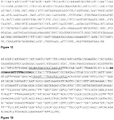
- Exemplary binding regions of extension primers are illustrated in figure 1 .
- Sequences that are preferably comprised by these extension primers are presented in the sequence listing of the present invention and are summarized in the following table 4.
- the sequences indicated in table 4 are most preferred. However, variants having a sequence identity of at least 80%, more preferably at least 85% more preferably at least 90%, more preferably at least 93% with the sequences indicated in table 4 are also preferable sequences of the present invention.
- the following the following extension primers are allowed to bind to the PCR products obtained from the PCR reactions of step A):
- All primers indicated under points a. to h. above may comprise a sequence having at least 80%, more preferably at least 85%, more preferably at least 90%, more preferably at least 93% sequence identity with the sequences of the indicated SEQ ID NOs.
- the extension primers do not only comprise the sequences indicated in table 4 or variants having a sequence identity of at least 80%, more preferably at least 85% more preferably at least 90%, more preferably at least 93% therewith but even consist of these sequences.
- the present inventors found that it may be advantageous if non-complementary bases are added at the 5'-end of the primer so that each primer has a detectable different mass.
- the extension primers comprise at least 1, more preferably at least 2 non-complementary bases at the 5'-end.
- the number of non-complementary bases at the 5'-end should be limited.
- the extension primers comprise at most 10, more preferably at most 5, more preferably at most 4 non-complementary bases at the 5'-end. It was found that non-complementary bases at the 5'-end are particularly preferred for NDM-1 extension primers, OXA-9 extension primers, OXA-48 extension primers, CTX-M-9 extension primers and AAC(6')-lb-cr (223) extension primers.
- Sequences that are comprised in most preferred extension primers of the present invention comprising non-complementary bases at the 5'-end are summarized in the following table 5. However, variants having a sequence identity of at least 80%, more preferably at least 85% more preferably at least 90%, more preferably at least 93% with the sequences indicated in table 5 are also preferable sequences of the present invention.
- the following extension primers are allowed to bind to the PCR products obtained from the PCR reactions of step A):
- All primers indicated under points a. to h. above may comprise a sequence having at least 80%, more preferably at least 85%, more preferably at least 90%, more preferably at least 93% sequence identity with the sequences of the indicated SEQ ID NOs.
- the extension primers indicated in table 5 do not only comprise the sequences indicated in table 5 or variants having a sequence identity of at least 80%, more preferably at least 85% more preferably at least 90%, more preferably at least 93% therewith but even consist of these sequences.
- the methods of the present invention preferably comprise the additional step of:
- the elongation of all extension primers is performed in a single tube, more preferably in the same tube, in which the PCR reactions have been performed.
- the methods of the present invention comprise the additional step of:
- the nucleotide is determined by mass spectrometry.
- the masses of the elongated extension primers are preferably determined by mass spectrometry. This enables identification of the nucleotide that has been added to the extension primer by comparison of the added mass with the known masses of the different nucleotides.
- the methods of the present invention comprise the additional step of:
- the PCR reactions of the methods of the present invention described above may additionally comprise further primer pairs. These additional primer pairs may result in amplification of further regions of interest of resistance conferring genes and/or in amplification of regions of interest of genes that do not confer resistance, in particular of house-keeping genes.
- the present inventors found that the identification of the phylogenetic origin can be particularly preferably improved if the results obtained from analysis of the coding sequences of the antibiotic resistance conferring genes (SEQ ID NOs: 87-93) are combined with phylogenetic information obtained by analysis of species-specific phylogeny markers, in particular of house-keeping genes. This is shown exemplarily in the present description for Klebsiella pneumoniae .
- sequences that are preferably comprised by these additional PCR primers are presented in the sequence listing of the present invention and are summarized in the following table 6.
- the sequences indicated in table 6 are most preferred. However, variants having a sequence identity of at least 80%, more preferably at least 85% more preferably at least 90%, more preferably at least 94% with the sequences indicated in table 6 are also preferable sequences of the present invention.
- DNA fragments containing the SNP positions of the present invention can be excellently amplified, in particular as PCR products.
- the amplifying primers do not only comprise the sequences indicated in table 6 or variants having a sequence identity of at least 80%, more preferably at least 85% more preferably at least 90%, more preferably at least 94% therewith but even consist of these sequences.
- the present inventors found that the amplification is advantageously balanced if the amplification primers additionally comprise nucleotides at the 5'-end.
- the amplification primers comprise at least 5, more preferably at least 8, more preferably at least 9, more preferably at least 10 and even more preferably exactly 10 additional nucleotides at the 5'-end.
- the number of additional nucleotides at the 5'-end should be limited and therefore the amplification primers preferably comprise at most 20, more preferably at most 15, more preferably at most 12, more preferably at most 11 and even more preferably at most 10 additional nucleotides at the 5'-end.
- Sequences that are comprised in most preferred amplification primers of the present invention are summarized in the following table 7. However, variants having a sequence identity of at least 80%, more preferably at least 85% more preferably at least 90%, more preferably at least 95% with the sequences indicated in table 7 are also preferable sequences of the present invention.
- the amplifying primers do not only comprise the sequences indicated in table 7 or variants having a sequence identity of at least 80%, more preferably at least 85% more preferably at least 90%, more preferably at least 95% therewith but even consist of these sequences.
- the PCR reactions of step A) of the methods of the present invention described above for determining in a bacterial sample information on both the phylogenetic origin and the antibiotic resistances of bacterial strains additionally comprise at least one, more preferably at least two, more preferably at least three, more preferably at least four, more preferably at least five, more preferably all six of the following primer pairs:
- All primers of the primer pairs indicated under points i. to n. above may comprise a sequence having at least 80%, more preferably at least 85%, more preferably at least 90%, more preferably at least 94% sequence identity with the sequences of the indicated SEQ ID NOs.
- the PCR reaction of each primer pair may be performed in a separate tube.
- 14 separate PCR reactions may be performed with primer pairs 1 to 14 described above.
- it is preferable that the number of separate PCR reactions is reduced in order to save time and resources.
- all PCR reactions are performed in a single tube.
- the forward and reverse primers of primer pairs 9 to 14 do not only comprise the sequences of SEQ ID NOs: 67, 68, 73, 74, 76, 77, 79, 80, 82-85 as indicated above or variants having a sequence identity of at least 80%, more preferably at least 85% more preferably at least 90%, more preferably at least 94% therewith but even consist of these sequences.
- the present inventors found that the amplification is advantageously balanced if the forward and reverse primers additionally comprise nucleotides at the 5'-end. Furthermore, this increases the masses of unused primers (out of the mass range on the spectra).
- the PCR reactions of step A) of the methods of the present invention described above for determining in a bacterial sample information on both the phylogenetic origin and the antibiotic resistances of bacterial strains additionally comprise at least one, more preferably at least two, more preferably at least three, more preferably at least four, more preferably at least five, more preferably all six of the following primer pairs:
- All primers of the primer pairs indicated under points i. to n. above may comprise a sequence having at least 80%, more preferably at least 85%, more preferably at least 90%, more preferably at least 95% sequence identity with the sequences of the indicated SEQ ID NOs.
- the PCR reaction of each primer pair may be performed in a separate tube.
- 14 separate PCR reactions may be performed with primer pairs 1 to 14 described above.
- it is preferable that the number of separate PCR reactions is reduced in order to save time and resources.
- all PCR reactions are performed in a single tube.
- the forward and reverse primers do not only comprise the sequences of SEQ ID NOs: 25, 26, 31, 32, 34, 35, 37, 38, 40, 41, 43, 44 as indicated above or variants having a sequence identity of at least 80%, more preferably at least 85% more preferably at least 90%, more preferably at least 95% therewith but even consist of these sequences.
- primer pair 9 results in amplification of a region comprising the nucleotide at position 420 and at position 456 of the gapA coding sequence (SEQ ID NO:28)
- primer pair 10 results in amplification of a region comprising the nucleotide at position 1608 of the infB coding sequence (SEQ ID NO:29)
- primer pair 11 results in amplification of a region comprising the nucleotide at position 633 of the mdh coding sequence (SEQ ID NO:70)
- primer pair 12 results in amplification of a region comprising the nucleotide at position 732 of the phoE coding sequence (SEQ ID NO:71)
- primer pair 13 results in amplification of a region comprising the nucleotide at position 867 of the phoE coding sequence (SEQ ID NO:71)
- primer pair 14 results in amplification of a region comprising the nucleotide at position 1819 of the rpoB coding sequence (SEQ ID NO
- extension primers are preferably allowed to bind to the PCR products obtained from the PCR reactions of primer pairs 9 to 14, wherein preferably at least one, more preferably exactly one extension primer is binding to each of the obtained PCR products.
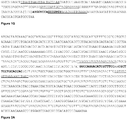
- exactly one extension primer is binding to the PCR products obtained from the PCR reactions of primer pairs 10 to 14 and exactly two extension primers are binding to the PCR products obtained from the PCR reactions of primer pair 9. Exemplary binding regions of extension primers are shown in figure 2 .
- Sequences that are preferably comprised by these extension primers are presented in the sequence listing of the present invention and are summarized in the following table 8.
- the sequences indicated in table 8 are most preferred. However, variants having a sequence identity of at least 80%, more preferably at least 85% more preferably at least 90%, more preferably at least 93% with the sequences indicated in table 8 are also preferable sequences of the present invention.
- the letter "I" in the sequences in table 8 indicates inosine.
- At least one, more preferably at least two, more preferably at least three, more preferably at least four, more preferably at least five, more preferably at least six, more preferably all seven of the following extension primers are allowed to bind to the PCR products obtained from the PCR reactions of step A) in addition to the extension primers of the antibiotic resistance markers as indicated above:
- All primers indicated under points i. to o. above may comprise a sequence having at least 80%, more preferably at least 85%, more preferably at least 90%, more preferably at least 93% sequence identity with the sequences of the indicated SEQ ID NOs.
- the extension primers do not only comprise the sequences indicated in table 8 or variants having a sequence identity of at least 80%, more preferably at least 85% more preferably at least 90%, more preferably at least 93% therewith but even consist of these sequences.
- the present inventors found that it may be advantageous if non-complementary bases are added at the 5'-end of the primer so that each primer has a detectable different mass.
- the extension primers comprise at least 1, more preferably at least 2 non-complementary bases at the 5'-end.
- the number of non-complementary bases at the 5'-end should be limited.
- the extension primers comprise at most 10, more preferably at most 5, more preferably at most 4 non-complementary bases at the 5'-end. It was found that non-complementary bases at the 5'-end are particularly preferred for gapA (420) extension primers, gapA (456) extension primers, infB (1608) extension primers, mdh (633) extension primers, phoE (732) extension primers and rpoB (1819) extension primers.
- Sequences that are comprised in most preferred extension primers of the present invention comprising non-complementary bases at the 5'-end are summarized in the following table 9. However, variants having a sequence identity of at least 80%, more preferably at least 85% more preferably at least 90%, more preferably at least 93% with the sequences indicated in table 5 are also preferable sequences of the present invention.
- the letter "I" in the sequences in table 9 indicates inosine.
- At least one, more preferably at least two, more preferably at least three, more preferably at least four, more preferably at least five, more preferably at least six, more preferably all seven of the following extension primers are allowed to bind to the PCR products obtained from the PCR reactions of step A) in addition to the extension primers of the antibiotic resistance markers as indicated above:
- All primers indicated under points i. to o. above may comprise a sequence having at least 80%, more preferably at least 85%, more preferably at least 90%, more preferably at least 93% sequence identity with the sequences of the indicated SEQ ID NOs.
- the extension primers indicated in table 9 do not only comprise the sequences indicated in table 9 or variants having a sequence identity of at least 80%, more preferably at least 85% more preferably at least 90%, more preferably at least 93% therewith but even consist of these sequences.
- the extension primers described above are preferably elongated at the 3'-end by at least one nucleotide, preferably by exactly one nucleotide.
- the elongation of all extension primers is performed in a single tube, more preferably in the same tube, in which the PCR reactions have been performed.
- the at least one nucleotide preferably exactly one nucleotide that has been added to the extension primer is determined.
- the nucleotide is determined by mass spectrometry.
- the masses of the elongated extension primers are preferably determined by mass spectrometry. This enables identification of the nucleotide that has been added to the extension primer by comparison of the added mass with the known masses of the different nucleotides.
- step E) of the methods of the present invention information on the phylogenetic origin is preferably determined based on a comparison of the pattern of the determined nucleotides with respective predetermined patterns of bacterial strain, which phylogenetic origin is known.
- the present inventors have found that determination of information on the phylogenetic origin by the method of the present invention can be further improved if additional information on phylogenetic origin is generated from PCR reactions comprising at least one of primer pairs 9 to 14 in addition to primer pairs 1 to 8 described above.
- the primers of the present invention have length of at most 100 nucleotides, more preferably at most 50 nucleotides, more preferably at most 40 nucleotides.
- the nucleotide being present at certain position may be determined by any known sequencing method such as Sanger sequencing (dideoxy chain-termination method), Maxam-Gilbert sequencing, shotgun sequencing and next-generation sequencing methods such as pyrosequencing.
- Sanger sequencing deoxy chain-termination method
- Maxam-Gilbert sequencing shotgun sequencing
- next-generation sequencing methods such as pyrosequencing.
- the present inventors found that specifically satisfying results with regard to costs as well as specificity and sensitivity of detection are obtained when the nucleotides being present at certain positions are determined by a method that comprises a step of detection by mass spectrometry.
- a preferred mass spectrometry based detection method is MALDI-TOF (Matrix-Assisted Laser Desorption/Ionization-Time Of Flight).
- determination of nucleotides involves PCR based DNA amplification and subsequent detection of the nucleotide by mass spectrometry.
- determination of the nucleotides involves a process, which will in the following be termed " MassArray ".
- MassArray relevant regions of bacterial DNA containing SNPs of interest are amplified by PCR in a first step.
- an extension primer binding to the DNA of interest just downstream of the nucleotide to be determined is elongated by at least one nucleotide at its 3'-end.
- Such elongated extension primer is then analyzed by mass spectrometry in order to determine the nucleotide that has been added to the primer and which is complementary to the nucleotide of interest, thus allowing determination of the nucleotide of interest.
- the extension primer is elongated by exactly one nucleotide. This is preferably achieved by use of chain terminating nucleotides, thus by nucleotides that prevent further elongation of the extension primer once they have been added to the 3'-end of the primer.
- Chain terminating nucleotides of the present invention are for example dideoxynucleotides (ddNTPs).
- ddNTPs dideoxynucleotides
- particularly preferred chain terminating nucleotides of the present invention are acyclonucleotides (acyNTPs).
- Acyclonucleotides are chain terminators that lack a ribose 3'-OH required for further extension. Once an acyclonucleotide is incorporated by a DNA polymerase, the substrate can no longer be further extended. Acyclonucleotides are especially useful in applications with archaeon DNA polymerases, more preferably with Therminator DNA Polymerase.
- Therminator DNA polymerase is an engineered enzyme with an increased capacity to incorporate analogs with altered sugars, such as ribonucleotides, dideoxynucleotides, 2' deoxynucleotides and especially acyclo-base analogs.
- MassArray is a preferred technology for determination of the nucleotide of interest, particularly in combination with multiplex PCR, because it is rapid and robust and allows for the detection of many nucleotides of interest at reasonable costs.
- the present inventors found that the extension primers described above are specifically suitable for detection of the nucleotides of interest by MassArray.
- the methods of the present invention may comprise determination of nucleotides present at further gene positions. Determination of more nucleotides renders the method more laborious and complex. However, on the other hand, sensitivity of determination of information on phylogenetic origin and/or antibiotic resistances may be further enhanced by determination of more nucleotides.
- the pattern of determined nucleotides of the present invention is very specific for individual bacterial isolates.
- information on the phylogenetic origin of a bacterial isolate can be determined in addition to the antibiotic resistances by comparison of the pattern of the determined nucleotides with respective predetermined patterns of bacterial strains, of which phylogenetic origin and antibiotic resistances are known.
- the present invention also comprises a kit for performing the method of the invention, wherein the kit comprises
- the variants or homologous coding sequences have a sequence identity with the coding sequences as depicted in SEQ ID NOs: 87-93 of at least 90%, more preferably of at least 95%, more preferably of at least 98%, even more preferably of at least 99%.
- the present invention also relates to a kit comprising
- All primers of the primer pairs indicated under points a. to h. above may comprise a sequence having at least 80%, more preferably at least 85%, more preferably at least 90%, more preferably at least 94% sequence identity with the sequences of the indicated SEQ ID NOs.
- the kit additionally comprises
- All primers indicated under points a. to h. above may comprise a sequence having at least 80%, more preferably at least 85%, more preferably at least 90%, more preferably at least 93% sequence identity with the sequences of the indicated SEQ ID NOs.
- the amplification primers do not only comprise the sequences indicated above or variants having a sequence identity of at least 80%, more preferably at least 85% more preferably at least 90%, more preferably at least 94% therewith but even consist of these sequences.
- the present inventors found that the amplification is advantageously balanced if the amplification primers additionally comprise nucleotides at the 5'-end. Furthermore, this increases the masses of unused primers (out of the mass range on the spectra).
- the extension primers do not only comprise the sequences indicated above or variants having a sequence identity of at least 80%, more preferably at least 85% more preferably at least 90%, more preferably at least 93% therewith but even consist of these sequences.
- the present inventors found that it may be advantageous if non-complementary bases are added at the 5'-end of the primers so that each primer has a detectable different mass.
- kits of the present invention are kits for performing the methods of the invention, wherein the kit comprises
- All primers of the primer pairs indicated under points a. to h. above may comprise a sequence having at least 80%, more preferably at least 85%, more preferably at least 90%, more preferably at least 95% sequence identity with the sequences of the indicated SEQ ID NOs.
- the kit additionally comprises
- All primers indicated under points a. to h. above may comprise a sequence having at least 80%, more preferably at least 85%, more preferably at least 90%, more preferably at least 93% sequence identity with the sequences of the indicated SEQ ID NOs.
- the amplifying primers do not only comprise the sequences indicated above or variants having a sequence identity of at least 80%, more preferably at least 85% more preferably at least 90%, more preferably at least 95% therewith but even consist of these sequences.
- the extension primers indicated above do not only comprise the sequences indicated above or variants having a sequence identity of at least 80%, more preferably at least 85% more preferably at least 90%, more preferably at least 93% therewith but even consist of these sequences.
- kits of the present invention comprise further primers.
- the kits of the invention additionally comprise
- All primers of the primer pairs indicated under points i. to n. above may comprise a sequence having at least 80%, more preferably at least 85%, more preferably at least 90%, more preferably at least 94% sequence identity with the sequences of the indicated SEQ ID NOs.
- the forward and reverse primers of primer pairs 9 to 14 do not only comprise the sequences of SEQ ID NOs: 67, 68, 73, 74, 76, 77, 79, 80, 82-85 as indicated above or variants having a sequence identity of at least 80%, more preferably at least 85% more preferably at least 90%, more preferably at least 94% therewith but even consist of these sequences.
- the present inventors found that the amplification is advantageously balanced if the forward and reverse primers additionally comprise nucleotides at the 5'-end. Furthermore, this increases the masses of unused primers (out of the mass range on the spectra).
- a particularly preferred kit of the present invention comprises
- All primers of the primer pairs indicated under points i. to n. above may comprise a sequence having at least 80%, more preferably at least 85%, more preferably at least 90%, more preferably at least 95% sequence identity with the sequences of the indicated SEQ ID NOs.
- the forward and reverse primers do not only comprise the sequences of SEQ ID NOs: 25, 26, 31, 32, 34, 35, 37, 38, 40, 41, 43, 44 as indicated above or variants having a sequence identity of at least 80%, more preferably at least 85% more preferably at least 90%, more preferably at least 95% therewith but even consist of these sequences.
- kits of the invention further comprise extension primers corresponding to primer pairs 9 to 14, wherein both gapA (420) and gapA (456) extension primer correspond to primer pair 9.
- the kits comprise
- All primers indicated under points i. to o. above may comprise a sequence having at least 80%, more preferably at least 85%, more preferably at least 90%, more preferably at least 93% sequence identity with the sequences of the indicated SEQ ID NOs.
- the extension primers do not only comprise the sequences indicated above or variants having a sequence identity of at least 80%, more preferably at least 85% more preferably at least 90%, more preferably at least 93% therewith but even consist of these sequences.
- the present inventors found that it may be advantageous if non-complementary bases are added at the 5'-end of the primers so that each primer has a detectable different mass.
- a particularly preferred kit of the present invention comprises
- All primers indicated under points i. to o. above may comprise a sequence having at least 80%, more preferably at least 85%, more preferably at least 90%, more preferably at least 94% sequence identity with the sequences of the indicated SEQ ID NOs.
- the extension primers indicated above do not only comprise the sequences indicated above or variants having a sequence identity of at least 80%, more preferably at least 85% more preferably at least 90%, more preferably at least 93% therewith but even consist of these sequences.
- a particularly preferred kit of the present invention comprises
- All primers of the primer pairs indicated under points a. to n. above may comprise a sequence having at least 80%, more preferably at least 85%, more preferably at least 90%, more preferably at least 95% sequence identity with the sequences of the indicated SEQ ID NOs and all extension primers indicated under points a. to o. above may comprise a sequence having at least 80%, more preferably at least 85%, more preferably at least 90%, more preferably at least 93% sequence identity with the sequences of the indicated SEQ ID NOs.
- the primers indicated above do not only comprise the sequences indicated above or variants having the indicated sequence identity therewith but even consist of these sequences.
- kits of the present invention may further comprise reagents for performing a PCR reaction.
- the kit further comprises at least one reagent selected from the group consisting of buffer solution, deoxynucleotides (dNTPs) and DNA polymerase. More preferably, the kit comprises buffer solution, deoxynucleotides (dNTPs) and DNA polymerase.
- the DNA polymerase is selected from the group consisting of Taq polymerase, Pwo polymerase and Pfu polymerase. Pfu polymerase is most preferred because it creates very little mutations during DNA amplification.
- the kit further comprises chain terminating nucleotides.
- Preferred chain terminating nucleotides of the present invention are acyclonucleotides (acyNTPs). Acyclonucleotides enable elongation of extension primers by exactly one nucleotide.
- the kit may comprise ddNTPs as chain terminating nucleotides instead of acyNTPs.
- the kit further comprises an archaeon DNA polymerase, more preferably Therminator DNA Polymerase.
- the present invention also comprises the use of the above described methods for determining from a bacterial sample information on both the phylogenetic origin and the antibiotic resistances of bacterial strains.
- the present invention also comprises a method of diagnosis of a disease based on the information on both the phylogenetic origin and/or antibiotic resistances of the bacterial strain determined by the methods of the present invention described above.
- the method of diagnosis of a disease preferably comprises the step of identifying the disease based on the determined information on both the phylogenetic origin and antibiotic resistances of the bacterial strain.
- the present invention also comprises a method of treatment of a disease comprising the step of identifying a suitable drug for treatment of the disease based on the diagnosis of the disease by means of the method of the present invention and preferably the additional step of administering the identified drug to a patient in need thereof.
- the present invention also comprises a method of infection management comprising the step of tracking the course of infection spreading based on the information on the phylogenetic origin and/or antibiotic resistances of the bacterial strain determined by the methods of the present invention described above.
- the method comprises the additional step of improving hygienic standards based on the information obtained on the course of infection spreading.
- the 8 universal resistance markers of the present invention for gram-negative bacteria (position 814 of the KPC-2 coding sequence (SEQ ID NO:87), position 82 of the NDM-1 coding sequence (SEQ ID NO:88), position 104 of the OXA-9 coding sequence (SEQ ID NO:89), position 186 of the OXA-48 coding sequence (SEQ ID NO:90), position 556 of the CTX-M-9 coding sequence (SEQ ID NO:91), position 453 of the CTX-M-15 coding sequence (SEQ ID NO:92), position 223 of the AAC(6')-lb-cr coding sequence (SEQ ID NO:93) and position 454 of the AAC(6')-lb-cr coding sequence (SEQ ID NO:93)) have been tested for their ability to enable phylogenetic analysis.
- 93 sequenced K. pneumoniae isolates were investigated.
- Extension primers were allowed to bind to the PCR products obtained from the PCR reactions.
- Extension primers were elongated at the 3'-end by exactly one nucleotide.
- the elongated extension primers were analyzed by mass spectrometry and the nucleotide that has been added to the extension primers was determined.
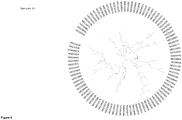
- a phylogenetic tree was generated in MEGA6 using Neighbor Joining without bootstrapping. The resulting tree is shown in figure 3 .
- the tree is based only on the resistance markers (SNP) including information about presence and absence of genes.
- SNP resistance markers
- the data show that information on the phylogenetic origin is derived from the analysis of the resistance markers of the present invention. Not every isolate was distinguishable but a satisfactory phylogenetic determination was achieved.
- the analysis of the resistance markers of the present invention can be used to identify common and divergent patterns between different strains that were subjected to the analysis of the resistance markers. This information can be used to identify the phylogenetic relatedness of the strains. Many strains can be distinguished by the use of the resistance markers (SNP) including information about presence and absence of genes, however for some of the strains this information is not sufficient to differentiate them.
- SNP resistance markers
- Extension primers were allowed to bind to the PCR products obtained from the PCR reactions.
- Extension primers were elongated at the 3'-end by exactly one nucleotide.
- the elongated extension primers were analyzed by mass spectrometry and the nucleotide that has been added to the extension primers was determined.
- Information on the phylogenetic origin of the bacterial strains was determined based on a comparison of the pattern of the determined nucleotides with respective predetermined patterns of bacterial strains, which phylogenetic origin was known.
- a phylogenetic tree was generated in MEGA6 using Neighbor Joining without bootstrapping.
- the resulting tree is shown in figure 4 .
- the tree is based only on the phylogeny markers (SNP) including information about presence and absence of genes.
- SNP phylogeny markers
- testing the 7 phylogenetic markers results in an improved resolution of the phylogenetic analysis.
- the results were not optimal. In particular, several distinct isolates were not distinguishable
Landscapes
- Chemical & Material Sciences (AREA)
- Life Sciences & Earth Sciences (AREA)
- Organic Chemistry (AREA)
- Proteomics, Peptides & Aminoacids (AREA)
- Analytical Chemistry (AREA)
- Zoology (AREA)
- Wood Science & Technology (AREA)
- Health & Medical Sciences (AREA)
- Engineering & Computer Science (AREA)
- Microbiology (AREA)
- Immunology (AREA)
- Molecular Biology (AREA)
- Biotechnology (AREA)
- Biophysics (AREA)
- Physics & Mathematics (AREA)
- Biochemistry (AREA)
- Bioinformatics & Cheminformatics (AREA)
- General Engineering & Computer Science (AREA)
- General Health & Medical Sciences (AREA)
- Genetics & Genomics (AREA)
- Chemical Kinetics & Catalysis (AREA)
- Measuring Or Testing Involving Enzymes Or Micro-Organisms (AREA)
Priority Applications (4)
| Application Number | Priority Date | Filing Date | Title |
|---|---|---|---|
| EP17151531.5A EP3348651A1 (de) | 2017-01-13 | 2017-01-13 | Schneller antimikrobieller empfindlichkeitsnachweis und phylogenetische identifizierung |
| PCT/EP2018/050890 WO2018130692A1 (en) | 2017-01-13 | 2018-01-15 | Rapid antimicrobial susceptibility testing and phylogenetic identification |
| EP18701420.4A EP3568491A1 (de) | 2017-01-13 | 2018-01-15 | Schneller antimikrobieller empfindlichkeitsnachweis und phylogenetische identifizierung |
| US16/477,794 US20190345542A1 (en) | 2017-01-13 | 2018-01-15 | Rapid antimicrobial susceptibility testing and phylogenetic identification |
Applications Claiming Priority (1)
| Application Number | Priority Date | Filing Date | Title |
|---|---|---|---|
| EP17151531.5A EP3348651A1 (de) | 2017-01-13 | 2017-01-13 | Schneller antimikrobieller empfindlichkeitsnachweis und phylogenetische identifizierung |
Publications (1)
| Publication Number | Publication Date |
|---|---|
| EP3348651A1 true EP3348651A1 (de) | 2018-07-18 |
Family
ID=57821835
Family Applications (2)
| Application Number | Title | Priority Date | Filing Date |
|---|---|---|---|
| EP17151531.5A Withdrawn EP3348651A1 (de) | 2017-01-13 | 2017-01-13 | Schneller antimikrobieller empfindlichkeitsnachweis und phylogenetische identifizierung |
| EP18701420.4A Withdrawn EP3568491A1 (de) | 2017-01-13 | 2018-01-15 | Schneller antimikrobieller empfindlichkeitsnachweis und phylogenetische identifizierung |
Family Applications After (1)
| Application Number | Title | Priority Date | Filing Date |
|---|---|---|---|
| EP18701420.4A Withdrawn EP3568491A1 (de) | 2017-01-13 | 2018-01-15 | Schneller antimikrobieller empfindlichkeitsnachweis und phylogenetische identifizierung |
Country Status (3)
| Country | Link |
|---|---|
| US (1) | US20190345542A1 (de) |
| EP (2) | EP3348651A1 (de) |
| WO (1) | WO2018130692A1 (de) |
Families Citing this family (3)
| Publication number | Priority date | Publication date | Assignee | Title |
|---|---|---|---|---|
| US11053532B2 (en) | 2017-04-19 | 2021-07-06 | CAP Diagnostics, LLC | Methods for treating polymicrobial infections |
| US20210172000A1 (en) * | 2017-04-19 | 2021-06-10 | CAP Diagnostics, LLC, dba Pathnostics | Methods and systems for preparing therapeutic solutions for polymicrobial infections |
| US20240301477A1 (en) * | 2019-12-03 | 2024-09-12 | Ramja Genosensor Private Limited | A biosensor device, system and kit for detecting infection and antimicrobial resistance |
Citations (6)
| Publication number | Priority date | Publication date | Assignee | Title |
|---|---|---|---|---|
| US20120009572A1 (en) | 2010-05-07 | 2012-01-12 | Medical Diagnostic Laboratories, Llc | Novel single nucleotide polymorphisms and community-associated methicillin-resistant staphylococcus aureus |
| WO2012027302A2 (en) * | 2010-08-21 | 2012-03-01 | The Regents Of The University Of California | Systems and methods for detecting antibiotic resistance |
| WO2012032158A1 (en) * | 2010-09-10 | 2012-03-15 | Inserm | Method for detecting the presence of bacterial strains resistant to antibiotics in a biological sample |
| US8247170B2 (en) | 2008-05-16 | 2012-08-21 | Medical Diagnostic Laboratories, Llc | Detection of penicillin tolerance in Group B Streptococcus: single nucleotide polymorphisms in penicillin binding protein 4 |
| US8741563B2 (en) | 2011-11-23 | 2014-06-03 | Medical Diagnostic Laboratories, Llc | Metronidazole resistance in trichomonas vaginalis and single nucleotide polymorphisms |
| WO2016045857A1 (en) * | 2014-09-25 | 2016-03-31 | Siemens Aktiengesellschaft | Genetic testing for predicting resistance of klebsiella species against antimicrobial agents |
-
2017
- 2017-01-13 EP EP17151531.5A patent/EP3348651A1/de not_active Withdrawn
-
2018
- 2018-01-15 US US16/477,794 patent/US20190345542A1/en not_active Abandoned
- 2018-01-15 WO PCT/EP2018/050890 patent/WO2018130692A1/en not_active Ceased
- 2018-01-15 EP EP18701420.4A patent/EP3568491A1/de not_active Withdrawn
Patent Citations (6)
| Publication number | Priority date | Publication date | Assignee | Title |
|---|---|---|---|---|
| US8247170B2 (en) | 2008-05-16 | 2012-08-21 | Medical Diagnostic Laboratories, Llc | Detection of penicillin tolerance in Group B Streptococcus: single nucleotide polymorphisms in penicillin binding protein 4 |
| US20120009572A1 (en) | 2010-05-07 | 2012-01-12 | Medical Diagnostic Laboratories, Llc | Novel single nucleotide polymorphisms and community-associated methicillin-resistant staphylococcus aureus |
| WO2012027302A2 (en) * | 2010-08-21 | 2012-03-01 | The Regents Of The University Of California | Systems and methods for detecting antibiotic resistance |
| WO2012032158A1 (en) * | 2010-09-10 | 2012-03-15 | Inserm | Method for detecting the presence of bacterial strains resistant to antibiotics in a biological sample |
| US8741563B2 (en) | 2011-11-23 | 2014-06-03 | Medical Diagnostic Laboratories, Llc | Metronidazole resistance in trichomonas vaginalis and single nucleotide polymorphisms |
| WO2016045857A1 (en) * | 2014-09-25 | 2016-03-31 | Siemens Aktiengesellschaft | Genetic testing for predicting resistance of klebsiella species against antimicrobial agents |
Non-Patent Citations (14)
| Title |
|---|
| A. D. KENNEDY ET AL: "Epidemic community-associated methicillin-resistant Staphylococcus aureus: Recent clonal expansion and diversification", PROCEEDINGS NATIONAL ACADEMY OF SCIENCES PNAS, vol. 105, no. 4, 29 January 2008 (2008-01-29), US, pages 1327 - 1332, XP055228900, ISSN: 0027-8424, DOI: 10.1073/pnas.0710217105 * |
| A. VAN BELKUM ET AL: "Next-Generation Antimicrobial Susceptibility Testing", JOURNAL OF CLINICAL MICROBIOLOGY, vol. 51, no. 7, 1 July 2013 (2013-07-01), pages 2018 - 2024, XP055209077, ISSN: 0095-1137, DOI: 10.1128/JCM.00313-13 * |
| BARISIC IVAN ET AL: "Fast and highly specific DNA-based multiplex detection on a solid support", APPLIED MICROBIOLOGY AND BIOTECHNOLOGY, vol. 99, no. 1, 4 December 2014 (2014-12-04), SPRINGER, DE, pages 413 - 423, XP035422316, ISSN: 0175-7598, [retrieved on 20141204], DOI: 10.1007/S00253-014-6246-X * |
| BENJAMIN P. HOWDEN ET AL: "Evolution of Multidrug Resistance during Staphylococcus aureus Infection Involves Mutation of the Essential Two Component Regulator WalKR", PLOS PATHOGENS, vol. 7, no. 11, 10 November 2011 (2011-11-10), pages 1 - 15, XP055169475, DOI: 10.1371/journal.ppat.1002359 * |
| BIALEK-DAVENET SUZANNE ET AL: "Development of a multiplex PCR assay for identification of Klebsiella pneumoniae hypervirulent clones of capsular serotype K2.", JOURNAL OF MEDICAL MICROBIOLOGY, vol. 63, no. Pt 12, December 2014 (2014-12-01), pages 1608 - 1614, XP002769515, ISSN: 1473-5644 * |
| BRUCHMANN SEBASTIAN ET AL: "Deep transcriptome profiling of clinical Klebsiella pneumoniae isolates reveals strain and sequence type-specific adaptation.", ENVIRONMENTAL MICROBIOLOGY, vol. 17, no. 11, November 2015 (2015-11-01), pages 4690 - 4710, XP002769518, ISSN: 1462-2920 * |
| FRANK R. DELEO ET AL: "Molecular dissection of the evolution of carbapenem-resistant multilocus sequence type 258 Klebsiella pneumoniae", PROCEEDINGS NATIONAL ACADEMY OF SCIENCES PNAS, vol. 111, no. 13, 17 March 2014 (2014-03-17), US, pages 4988 - 4993, XP055223634, ISSN: 0027-8424, DOI: 10.1073/pnas.1321364111 * |
| GARZA-RAMOS ULISES ET AL: "Development of a multiplex-PCR probe system for the proper identification of Klebsiella variicola.", BMC MICROBIOLOGY, vol. 15, 64, 13 March 2015 (2015-03-13), pages 1 - 14, XP021218984, ISSN: 1471-2180, DOI: 10.1186/s12866-015-0396-6 * |
| KRIS M. WEIGEL ET AL: "Molecular Viability Testing of Bacterial Pathogens from a Complex Human Sample Matrix", PLOS ONE, vol. 8, no. 1, E54886, 24 January 2013 (2013-01-24), pages 1 - 8, XP055336360, DOI: 10.1371/journal.pone.0054886 * |
| M. R. PULIDO ET AL: "Progress on the development of rapid methods for antimicrobial susceptibility testing", JOURNAL OF ANTIMICROBIAL CHEMOTHERAPY., vol. 68, no. 12, 30 June 2013 (2013-06-30), GB, pages 2710 - 2717, XP055319458, ISSN: 0305-7453, DOI: 10.1093/jac/dkt253 * |
| M.W. SYRMIS ET AL: "Comparison of a multiplexed MassARRAY system with real-time allele-specific PCR technology for genotyping of methicillin-resistant Staphylococcus aureus", CLINICAL MICROBIOLOGY AND INFECTION., vol. 17, no. 12, 1 December 2011 (2011-12-01), United Kingdom, Switzerland, pages 1804 - 1810, XP055229274, ISSN: 1198-743X, DOI: 10.1111/j.1469-0691.2011.03521.x * |
| MELANIE W SYRMIS ET AL: "A comparison of two informative SNP-based strategies for typing Pseudomonas aeruginosa isolates from patients with cystic fibrosis", BMC INFECTIOUS DISEASES, vol. 14, no. 1, 5 June 2014 (2014-06-05), BIOMED CENTRAL, LONDON, GB, pages 307, XP021187485, ISSN: 1471-2334, DOI: 10.1186/1471-2334-14-307 * |
| MICHAL WOZNIAK ET AL: "An approach to identifying drug resistance associated mutations in bacterial strains", BMC GENOMICS, vol. 13, no. Suppl 7, 7 December 2012 (2012-12-07), BIOMED CENTRAL LTD, LONDON, UK, pages S23, XP021127984, ISSN: 1471-2164, DOI: 10.1186/1471-2164-13-S7-S23 * |
| WOODFORD NEIL ET AL: "Multiplex PCR for rapid detection of genes encoding CTX-M extended-spectrum (beta)-lactamases.", THE JOURNAL OF ANTIMICROBIAL CHEMOTHERAPY, vol. 57, no. 1, January 2006 (2006-01-01), pages 154 - 155, XP002769516, ISSN: 0305-7453 * |
Also Published As
| Publication number | Publication date |
|---|---|
| US20190345542A1 (en) | 2019-11-14 |
| EP3568491A1 (de) | 2019-11-20 |
| WO2018130692A1 (en) | 2018-07-19 |
Similar Documents
| Publication | Publication Date | Title |
|---|---|---|
| Jordan et al. | Evaluating the near-term infant for early onset sepsis: progress and challenges to consider with 16S rDNA polymerase chain reaction testing | |
| Poyart et al. | Rapid and accurate species-level identification of coagulase-negative staphylococci by using the sodA gene as a target | |
| Capurro et al. | Comparison of a commercialized phenotyping system, antimicrobial susceptibility testing, and tuf gene sequence-based genotyping for species-level identification of coagulase-negative staphylococci isolated from cases of bovine mastitis | |
| Ikryannikova et al. | Misidentification of alpha-hemolytic streptococci by routine tests in clinical practice | |
| US20220325324A1 (en) | Systems and methods for the detection of infectious diseases | |
| EP1529847B1 (de) | Verfahren zur identifizierung von Methicilin resistente Stapylococcus aureus (MRSA) | |
| Hung et al. | Using groEL as the target for identification of Enterococcus faecium clades and 7 clinically relevant Enterococcus species | |
| Redkar et al. | DNA fingerprinting of Candida rugosa via repetitive sequence-based PCR | |
| EP1478777B1 (de) | Genetischer Marker zur Differenzierung von Mycobakterien | |
| US11993812B2 (en) | Systems and methods of diagnosing and characterizing infections | |
| US20190345542A1 (en) | Rapid antimicrobial susceptibility testing and phylogenetic identification | |
| Krawczyk et al. | Evaluation of a novel method based on amplification of DNA fragments surrounding rare restriction sites (ADSRRS fingerprinting) for typing strains of vancomycin-resistant Enterococcus faecium | |
| KR101373756B1 (ko) | 황색포도상구균의 분자적 동정을 위한 프라이머 및 이를 이용한 황색포도상구균 동정 방법 | |
| DE69629886T2 (de) | Nachweis von Enterobakterien | |
| ES3051413T3 (en) | Primer set for detecting candida auris, candida auris detection kit, and method for detecting candida auris | |
| Couzinet et al. | High-density DNA probe arrays for identification of staphylococci to the species level | |
| US7883870B2 (en) | Molecular identification of Staphylococcus-genus bacteria | |
| Casey et al. | RAPD for the typing of coagulase-negative staphylococci implicated in catheter-related bloodstream infection | |
| Krawczyk et al. | ADSRRS-fingerprinting and PCR MP techniques for studies of intraspecies genetic relatedness in Staphylococcus aureus | |
| US20050239067A1 (en) | Method of detecting and quantifying hemolysin-producing bacteria by overwhelmingly detecting and quantifying thermostable hemolysin-related genes (tdh-related hemolysin genes) of food poisoning bacteria | |
| Fadhil et al. | Multiple–loci number analyses of variable-number tandem repeat of molecular detection of Staphylococcus aureus isolates | |
| US20090253129A1 (en) | Identification of usa300 community-associated methicillin-resistant staphylococcus aureus | |
| Golidonova et al. | Optimized multilocus sequence analysis for laboratory identification of pathogens of ixodid tick-borne borreliosis | |
| US5789171A (en) | Use of cna, fnba, fnbb, and hlb, gene probes for the strain-specific identification of Staphylococcus aureus | |
| Wojtasik et al. | Trinucleotide repeat sequence-based PCR as a potential approach for genotyping Mycobacterium gordonae strains |
Legal Events
| Date | Code | Title | Description |
|---|---|---|---|
| PUAI | Public reference made under article 153(3) epc to a published international application that has entered the european phase |
Free format text: ORIGINAL CODE: 0009012 |
|
| STAA | Information on the status of an ep patent application or granted ep patent |
Free format text: STATUS: THE APPLICATION HAS BEEN PUBLISHED |
|
| AK | Designated contracting states |
Kind code of ref document: A1 Designated state(s): AL AT BE BG CH CY CZ DE DK EE ES FI FR GB GR HR HU IE IS IT LI LT LU LV MC MK MT NL NO PL PT RO RS SE SI SK SM TR |
|
| AX | Request for extension of the european patent |
Extension state: BA ME |
|
| STAA | Information on the status of an ep patent application or granted ep patent |
Free format text: STATUS: THE APPLICATION IS DEEMED TO BE WITHDRAWN |
|
| 18D | Application deemed to be withdrawn |
Effective date: 20190119 |