EP3348875A1 - Stufenloses getriebe und fehlfunktionbestimmungsverfahren dafür - Google Patents
Stufenloses getriebe und fehlfunktionbestimmungsverfahren dafür Download PDFInfo
- Publication number
- EP3348875A1 EP3348875A1 EP16844270.5A EP16844270A EP3348875A1 EP 3348875 A1 EP3348875 A1 EP 3348875A1 EP 16844270 A EP16844270 A EP 16844270A EP 3348875 A1 EP3348875 A1 EP 3348875A1
- Authority
- EP
- European Patent Office
- Prior art keywords
- pressure
- rotation speed
- failure
- output rotation
- speed sensor
- Prior art date
- Legal status (The legal status is an assumption and is not a legal conclusion. Google has not performed a legal analysis and makes no representation as to the accuracy of the status listed.)
- Withdrawn
Links
- 230000005540 biological transmission Effects 0.000 title claims abstract description 65
- 238000000034 method Methods 0.000 title claims description 10
- 230000007257 malfunction Effects 0.000 title 1
- 230000001105 regulatory effect Effects 0.000 claims abstract description 13
- 230000002401 inhibitory effect Effects 0.000 claims 1
- 238000010586 diagram Methods 0.000 description 5
- 230000002159 abnormal effect Effects 0.000 description 1
- 239000000969 carrier Substances 0.000 description 1
- 238000002485 combustion reaction Methods 0.000 description 1
- 238000010276 construction Methods 0.000 description 1
- 230000006866 deterioration Effects 0.000 description 1
- 239000003112 inhibitor Substances 0.000 description 1
- 239000002184 metal Substances 0.000 description 1
Images


Classifications
-
- F—MECHANICAL ENGINEERING; LIGHTING; HEATING; WEAPONS; BLASTING
- F16—ENGINEERING ELEMENTS AND UNITS; GENERAL MEASURES FOR PRODUCING AND MAINTAINING EFFECTIVE FUNCTIONING OF MACHINES OR INSTALLATIONS; THERMAL INSULATION IN GENERAL
- F16H—GEARING
- F16H61/00—Control functions within control units of change-speed- or reversing-gearings for conveying rotary motion ; Control of exclusively fluid gearing, friction gearing, gearings with endless flexible members or other particular types of gearing
- F16H61/12—Detecting malfunction or potential malfunction, e.g. fail safe ; Circumventing or fixing failures
-
- F—MECHANICAL ENGINEERING; LIGHTING; HEATING; WEAPONS; BLASTING
- F16—ENGINEERING ELEMENTS AND UNITS; GENERAL MEASURES FOR PRODUCING AND MAINTAINING EFFECTIVE FUNCTIONING OF MACHINES OR INSTALLATIONS; THERMAL INSULATION IN GENERAL
- F16H—GEARING
- F16H37/00—Combinations of mechanical gearings, not provided for in groups F16H1/00 - F16H35/00
- F16H37/02—Combinations of mechanical gearings, not provided for in groups F16H1/00 - F16H35/00 comprising essentially only toothed or friction gearings
- F16H37/021—Combinations of mechanical gearings, not provided for in groups F16H1/00 - F16H35/00 comprising essentially only toothed or friction gearings toothed gearing combined with continuously variable friction gearing
- F16H37/022—Combinations of mechanical gearings, not provided for in groups F16H1/00 - F16H35/00 comprising essentially only toothed or friction gearings toothed gearing combined with continuously variable friction gearing the toothed gearing having orbital motion
-
- F—MECHANICAL ENGINEERING; LIGHTING; HEATING; WEAPONS; BLASTING
- F16—ENGINEERING ELEMENTS AND UNITS; GENERAL MEASURES FOR PRODUCING AND MAINTAINING EFFECTIVE FUNCTIONING OF MACHINES OR INSTALLATIONS; THERMAL INSULATION IN GENERAL
- F16H—GEARING
- F16H59/00—Control inputs to control units of change-speed- or reversing-gearings for conveying rotary motion
- F16H59/36—Inputs being a function of speed
- F16H59/38—Inputs being a function of speed of gearing elements
- F16H59/40—Output shaft speed
-
- F—MECHANICAL ENGINEERING; LIGHTING; HEATING; WEAPONS; BLASTING
- F16—ENGINEERING ELEMENTS AND UNITS; GENERAL MEASURES FOR PRODUCING AND MAINTAINING EFFECTIVE FUNCTIONING OF MACHINES OR INSTALLATIONS; THERMAL INSULATION IN GENERAL
- F16H—GEARING
- F16H61/00—Control functions within control units of change-speed- or reversing-gearings for conveying rotary motion ; Control of exclusively fluid gearing, friction gearing, gearings with endless flexible members or other particular types of gearing
- F16H61/0021—Generation or control of line pressure
-
- F—MECHANICAL ENGINEERING; LIGHTING; HEATING; WEAPONS; BLASTING
- F16—ENGINEERING ELEMENTS AND UNITS; GENERAL MEASURES FOR PRODUCING AND MAINTAINING EFFECTIVE FUNCTIONING OF MACHINES OR INSTALLATIONS; THERMAL INSULATION IN GENERAL
- F16H—GEARING
- F16H61/00—Control functions within control units of change-speed- or reversing-gearings for conveying rotary motion ; Control of exclusively fluid gearing, friction gearing, gearings with endless flexible members or other particular types of gearing
- F16H61/66—Control functions within control units of change-speed- or reversing-gearings for conveying rotary motion ; Control of exclusively fluid gearing, friction gearing, gearings with endless flexible members or other particular types of gearing specially adapted for continuously variable gearings
- F16H61/662—Control functions within control units of change-speed- or reversing-gearings for conveying rotary motion ; Control of exclusively fluid gearing, friction gearing, gearings with endless flexible members or other particular types of gearing specially adapted for continuously variable gearings with endless flexible members
-
- F—MECHANICAL ENGINEERING; LIGHTING; HEATING; WEAPONS; BLASTING
- F16—ENGINEERING ELEMENTS AND UNITS; GENERAL MEASURES FOR PRODUCING AND MAINTAINING EFFECTIVE FUNCTIONING OF MACHINES OR INSTALLATIONS; THERMAL INSULATION IN GENERAL
- F16H—GEARING
- F16H61/00—Control functions within control units of change-speed- or reversing-gearings for conveying rotary motion ; Control of exclusively fluid gearing, friction gearing, gearings with endless flexible members or other particular types of gearing
- F16H61/66—Control functions within control units of change-speed- or reversing-gearings for conveying rotary motion ; Control of exclusively fluid gearing, friction gearing, gearings with endless flexible members or other particular types of gearing specially adapted for continuously variable gearings
- F16H61/662—Control functions within control units of change-speed- or reversing-gearings for conveying rotary motion ; Control of exclusively fluid gearing, friction gearing, gearings with endless flexible members or other particular types of gearing specially adapted for continuously variable gearings with endless flexible members
- F16H61/66254—Control functions within control units of change-speed- or reversing-gearings for conveying rotary motion ; Control of exclusively fluid gearing, friction gearing, gearings with endless flexible members or other particular types of gearing specially adapted for continuously variable gearings with endless flexible members controlling of shifting being influenced by a signal derived from the engine and the main coupling
- F16H61/66259—Control functions within control units of change-speed- or reversing-gearings for conveying rotary motion ; Control of exclusively fluid gearing, friction gearing, gearings with endless flexible members or other particular types of gearing specially adapted for continuously variable gearings with endless flexible members controlling of shifting being influenced by a signal derived from the engine and the main coupling using electrical or electronical sensing or control means
-
- F—MECHANICAL ENGINEERING; LIGHTING; HEATING; WEAPONS; BLASTING
- F16—ENGINEERING ELEMENTS AND UNITS; GENERAL MEASURES FOR PRODUCING AND MAINTAINING EFFECTIVE FUNCTIONING OF MACHINES OR INSTALLATIONS; THERMAL INSULATION IN GENERAL
- F16H—GEARING
- F16H61/00—Control functions within control units of change-speed- or reversing-gearings for conveying rotary motion ; Control of exclusively fluid gearing, friction gearing, gearings with endless flexible members or other particular types of gearing
- F16H61/70—Control functions within control units of change-speed- or reversing-gearings for conveying rotary motion ; Control of exclusively fluid gearing, friction gearing, gearings with endless flexible members or other particular types of gearing specially adapted for change-speed gearing in group arrangement, i.e. with separate change-speed gear trains arranged in series, e.g. range or overdrive-type gearing arrangements
- F16H61/702—Control functions within control units of change-speed- or reversing-gearings for conveying rotary motion ; Control of exclusively fluid gearing, friction gearing, gearings with endless flexible members or other particular types of gearing specially adapted for change-speed gearing in group arrangement, i.e. with separate change-speed gear trains arranged in series, e.g. range or overdrive-type gearing arrangements using electric or electrohydraulic control means
-
- F—MECHANICAL ENGINEERING; LIGHTING; HEATING; WEAPONS; BLASTING
- F16—ENGINEERING ELEMENTS AND UNITS; GENERAL MEASURES FOR PRODUCING AND MAINTAINING EFFECTIVE FUNCTIONING OF MACHINES OR INSTALLATIONS; THERMAL INSULATION IN GENERAL
- F16H—GEARING
- F16H59/00—Control inputs to control units of change-speed- or reversing-gearings for conveying rotary motion
- F16H59/68—Inputs being a function of gearing status
- F16H2059/683—Sensing pressure in control systems or in fluid-controlled devices, e.g. by pressure sensors
-
- F—MECHANICAL ENGINEERING; LIGHTING; HEATING; WEAPONS; BLASTING
- F16—ENGINEERING ELEMENTS AND UNITS; GENERAL MEASURES FOR PRODUCING AND MAINTAINING EFFECTIVE FUNCTIONING OF MACHINES OR INSTALLATIONS; THERMAL INSULATION IN GENERAL
- F16H—GEARING
- F16H61/00—Control functions within control units of change-speed- or reversing-gearings for conveying rotary motion ; Control of exclusively fluid gearing, friction gearing, gearings with endless flexible members or other particular types of gearing
- F16H61/12—Detecting malfunction or potential malfunction, e.g. fail safe ; Circumventing or fixing failures
- F16H2061/1232—Bringing the control into a predefined state, e.g. giving priority to particular actuators or gear ratios
-
- F—MECHANICAL ENGINEERING; LIGHTING; HEATING; WEAPONS; BLASTING
- F16—ENGINEERING ELEMENTS AND UNITS; GENERAL MEASURES FOR PRODUCING AND MAINTAINING EFFECTIVE FUNCTIONING OF MACHINES OR INSTALLATIONS; THERMAL INSULATION IN GENERAL
- F16H—GEARING
- F16H61/00—Control functions within control units of change-speed- or reversing-gearings for conveying rotary motion ; Control of exclusively fluid gearing, friction gearing, gearings with endless flexible members or other particular types of gearing
- F16H61/12—Detecting malfunction or potential malfunction, e.g. fail safe ; Circumventing or fixing failures
- F16H2061/1256—Detecting malfunction or potential malfunction, e.g. fail safe ; Circumventing or fixing failures characterised by the parts or units where malfunctioning was assumed or detected
- F16H2061/1284—Detecting malfunction or potential malfunction, e.g. fail safe ; Circumventing or fixing failures characterised by the parts or units where malfunctioning was assumed or detected the failing part is a sensor
Definitions
- the present invention relates to a technique that determines a failure of such as a sensor and a solenoid valve in a belt continuously variable transmission (hereinafter referred to as "CVT").
- CVT continuously variable transmission
- a CVT is constituted of a primary pulley and a secondary pulley whose groove widths are changeable and a belt stretched around between the primary pulley and the secondary pulley. Changing the groove widths of the respective pulleys changes contact radiuses between the belt and the respective pulleys, thus changing a speed ratio steplessly.
- the groove widths of the primary pulley and the secondary pulley are changed by primary pressure and secondary pressure supplied to respective oil chambers of these pulleys. By these hydraulic pressures, the belt is sandwiched by the primary pulley and by the secondary pulley.
- JP2002-228674A discloses an automatic transmission that determines whether an output rotation speed sensor of the transmission has a failure or not and when the automatic transmission determines that the output rotation speed sensor has a failure, the automatic transmission executes a predetermined fail-safe control (for example, a gear position is fixed to a third speed).
- the predetermined fail-safe control is executed in such case.
- a primary pressure solenoid valve which adjusts primary pressure
- a secondary pressure solenoid valve which adjust secondary pressure
- a line pressure solenoid valve which adjusts line pressure becoming source pressure of these pressures
- the fail-safe control to stop the energization to these solenoid valves is executed. This increases the respective primary pressure, secondary pressure, and line pressure and fixes the speed ratio of the CVT, thus maintaining a vehicle in a runnable state.
- the fail-safe control stops the energization to the respective solenoid valves and these output hydraulic pressures become the maximum. Accordingly, an increase in rotation speed of an engine increases generated hydraulic pressure of an oil pump and increases the primary pressure.
- the instruction value deviates from actual pressure and when the primary pressure solenoid valve is determined to have a failure on the basis of this difference, although the primary pressure solenoid valve does not have a failure, the primary pressure solenoid valve is determined to have a failure.
- the primary pressure solenoid valve is also determined to have a failure, it is determined that a failure occurs at a plurality of sites, and a fail-safe control for double failure is executed.
- the fail-safe control for double failure is a control that fixes a gear position of the sub-transmission mechanism to a second speed and performs torque down of the engine.
- This control aims to safely evacuate a vehicle to a safe location.
- the execution of this control largely affects power performance of the vehicle; therefore, the execution of such control on the basis of an erroneous determination result is not preferable in some cases.
- the present invention has been made in view of such technical problem, and it is an object of the present invention to prevent an erroneous determination that a primary pressure solenoid valve has a failure while the primary pressure solenoid valve does not have a failure in the case where an output rotation speed sensor is determined to have a failure.
- a belt continuously variable transmission including a pressure regulating valve configured to adjust a primary pressure supplied to a primary pulley to be an instruction pressure; a primary pressure sensor configured to detect the primary pressure; an output rotation speed sensor configured to detect an output rotation speed of the belt continuously variable transmission; and a controller is provided.
- the controller is configured to determine whether the output rotation speed sensor has a failure or not on the basis of a detected value by the output rotation speed sensor; and if the output rotation speed sensor is determined to have a failure, execute a fail-safe control which controls the pressure regulating valve such that the primary pressure becomes a predetermined high pressure regardless of the instruction pressure and inhibit a failure determination of the pressure regulating valve on the basis of a difference between the instruction pressure and a detected value by the primary pressure sensor.
- a failure determination method of the belt continuously variable transmission corresponding to this configuration is provided.
- the failure determination of the primary pressure regulation valve is not performed; therefore, the primary pressure solenoid valve is not erroneously determined to have a failure while the primary pressure regulation valve is normal.
- FIG. 1 is a schematic configuration diagram of a vehicle on which a belt continuously variable transmission according to the embodiment of the present invention is mounted.
- This vehicle includes an engine 1 as a power source. Output rotation of the engine 1 is transmitted to driving wheels 7 via a torque converter 2, a first gear train 3, a transmission 4, a second gear train 5, and a differential gear 6.
- a parking mechanism 8 that mechanically unrotatably locks an output shaft of the transmission 4 in parking is disposed on the second gear train 5.
- the engine 1 is an internal combustion engine such as a gasoline engine and a diesel engine.
- An engine controller 13 controls a rotation speed and a torque of the engine 1.
- the torque converter 2 includes a lock-up clutch 2a.
- lock-up clutch 2a When the lock-up clutch 2a is engaged, slip at the torque converter 2 disappears to ensure improving transmission efficiency of the torque converter 2.
- the vehicle includes an oil pump 10 driven using a part of power of the engine 1, a hydraulic control circuit 11 that regulates hydraulic pressure from the oil pump 10 to supply the hydraulic pressure to each part of the transmission 4, and a transmission controller 12 that controls the hydraulic control circuit 11.
- the transmission 4 is a continuously variable transmission including a variator 20 and a sub-transmission mechanism 30 disposed in series with respect to the variator 20.
- “Disposed in series” means that the variator 20 and the sub-transmission mechanism 30 are disposed in series in a power transmission path from the engine 1 up to the driving wheels 7. While in this example, the sub-transmission mechanism 30 is disposed at an output side of the variator 20, the sub-transmission mechanism 30 may be disposed at the input side.
- the variator 20 is a continuously variable transmission mechanism including a primary pulley 21, a secondary pulley 22, and a belt 23 stretched between the pulleys 21 and 22.
- the pulleys 21 and 22 include fixed conical plates 21f and 22f, movable conical plates 21m and 22m disposed in a state where sheave surfaces are opposed to the fixed conical plates 21f and 22f to form grooves with the fixed conical plates 21f and 22f, and hydraulic cylinders 21p and 22p disposed at back surfaces of the movable conical plates 21m and 22m to axially displace the movable conical plates 21m and 22m, respectively. While a metal belt, a rubber belt, a chain belt, and a similar belt can be used as the belt 23, the belt 23 is not specifically limited to them.
- Adjusting hydraulic pressure (a primary pressure Ppri and a secondary pressure Psec) supplied to the pulleys 21 and 22 changes force that the belt 23 is sandwiched by the pulleys 21 and 22 to change a torque capacity (a transmissive maximum torque) of the variator 20, and changes groove widths to change contact radiuses of the belt 23 and the respective pulleys 21 and 22, thus a speed ratio of the variator 20 steplessly changes.
- the sub-transmission mechanism 30 is a transmission mechanism having two stages for forward and one stage for backward.
- the sub-transmission mechanism 30 includes a Ravigneaux planetary gear mechanism 31 where carriers of two planetary gears are coupled, and a plurality of friction elements (a Low brake 32, a High clutch 33, and a Rev brake 34). Adjusting hydraulic pressure supplied to the friction elements 32 to 34 to change engagement states of the friction elements 32 to 34 changes a gear position of the sub-transmission mechanism 30.
- the transmission controller 12 includes a storage device including a CPU, and a RAM and a ROM, input/output interfaces, and a bus that mutually couples them.
- the input signals include the following signals:
- the storage device of the transmission controller 12 stores a shift control program of the transmission 4 and a shift map used in this shift control program.
- the transmission controller 12 reads the shift control program stored in the storage device to cause the CPU to execute this shift control program, thus performing a predetermined arithmetic process to signals input via the input interface.
- the transmission controller 12 sets an instruction pressure of the hydraulic pressure supplied to each part of the transmission 4 and outputs the set instruction pressure to the hydraulic control circuit 11 via the input/output interfaces.
- the transmission controller 12 outputs an engine control signal (for example, a torque down signal) to the engine controller 13 as necessary.
- the hydraulic control circuit 11 includes a plurality of flow paths and a plurality of hydraulic control valves.
- the hydraulic control circuit 11 controls the plurality of hydraulic control valves on the basis of the instruction pressure from the transmission controller 12 to switch a supply passage of the hydraulic pressure and generates the hydraulic pressure according to the instruction pressure to supply the hydraulic pressure to each part of the transmission 4. This performs a shift of the variator 20, the change of the gear position of the sub-transmission mechanism 30, capacity control of the respective friction elements 32 to 34, and an engagement or a disengagement of the lock-up clutch 2a.
- FIG. 2 illustrates a part related to the shift of the variator 20 in the hydraulic control circuit 11.
- a line pressure solenoid valve 61 is a drain-pressure-regulating solenoid valve that drains a part of a discharge pressure of the oil pump 10 and reduces the pressure to regulate the line pressure PL to the instruction pressure.
- a primary pressure solenoid valve 62 and a secondary pressure solenoid valve 63 are drain-pressure-regulating solenoid valves that drain a part of the line pressure PL and reduce the pressure using the line pressure PL as a source pressure to regulate the primary pressure Ppri and the secondary pressure Psec to the respective instruction pressures.
- the solenoid valves 61 to 63 respectively include feedback circuits 61f, 62f, and 63f that return the hydraulic pressure after the pressure regulation to the pressure regulating valves and perform the feedback control on the hydraulic pressure after the pressure regulation such that the hydraulic pressures become the instruction pressures.
- the instruction pressures are instructed to the solenoid valves 61 to 63 in the form of instruction currents to the solenoid valves 61 to 63.
- the solenoid valves 61 to 63 are normal high solenoid valves where respective output hydraulic pressures relative to input hydraulic pressures become the maximum at the instruction current of 0 mA.
- the hydraulic control circuit 11 can independently adjust the primary pressure Ppri and the secondary pressure Psec using the line pressure PL as the source pressure.
- the transmission controller 12 monitors and determines whether, for example, the sensors 41 to 48 and the solenoid valves 61 to 63 are normal or not, and when the transmission controller 12 determines that any part has a failure, the transmission controller 12 performs the fail-safe control according to the failure part.
- the transmission controller 12 determines whether the output rotation speed sensor 43 has a failure or not on the basis of the signal from the output rotation speed sensor 43. If the transmission controller 12 cannot obtain the signal from the output rotation speed sensor 43 or the signal has an abnormal value, it is considered that a signal line is disconnected or the sensor itself has a failure; therefore, the output rotation speed sensor 43 is determined to have a failure.
- the transmission controller 12 determines that the output rotation speed sensor 43 has a failure, the transmission controller 12 sets the instruction currents to the respective solenoid valves to 0 mA such that the output hydraulic pressure of the solenoid valves 61 to 63 relative to the input hydraulic pressure becomes the maximum regardless of the instruction pressures. That is, the transmission controller 12 cuts off the currents to the solenoid valves 61 to 63, increases the primary pressure Ppri, the secondary pressure Psec, and the line pressure PL, and fixes the speed ratio of the variator 20.
- the transmission controller 12 uses a predetermined low vehicle speed (for example, 10 km/h) as an alternative value of the detected value by the output rotation speed sensor 43 for various controls.
- the transmission controller 12 determines whether the solenoid valves 61 to 63 have a failure or not on the basis of a difference between the instruction pressure and the detected values (the actual pressures) by sensors 51 to 53.
- a region where a deviation between the instruction pressure and the detected value is large is preset as a failure region.
- the transmission controller 12 determines that the solenoid valve as the determination target has a failure.
- the transmission controller 12 determines that any of the solenoid valves 61 to 63 has a failure, the transmission controller 12 executes the fail-safe control according to the solenoid valve determined to have a failure. For example, when the transmission controller 12 determines that the primary pressure solenoid valve 62 has a failure, the transmission controller 12 sets the instruction current to the secondary pressure solenoid valve 63 to 0 mA, that is, cuts off the current to the secondary pressure solenoid valve 63 to increase the secondary pressure Psec.
- the transmission controller 12 determines that a double failure indicative of failures at a plurality of sites occurs, the transmission controller 12 executes a fail-safe control for double failure to safely evacuate the vehicle to a safe location.
- the transmission controller 12 fixes the gear position of the sub-transmission mechanism 30 to the second speed and instructs the execution of the torque down of the engine 1 to the engine controller 13.
- the failure determination of the primary pressure solenoid valve 62 on the basis of the difference between the instruction pressure and the detected value is executed when the output rotation speed sensor 43 is determined to have a failure and the fail-safe control is executed, although the primary pressure solenoid valve 62 does not have a failure, the primary pressure solenoid valve 62 is erroneously determined to have a failure and the fail-safe control for double failure is possibly executed.
- FIG. 4 illustrates the state in such case.
- the instruction currents to the respective solenoids are set to 0 mA such that the output hydraulic pressures of the solenoid valves 61 to 63 relative to the input hydraulic pressures become the maximum regardless of the instruction pressures to increase the line pressure PL, the primary pressure Ppri, and the secondary pressure Psec.
- the use of the predetermined low vehicle speed for control is performed at the same time.
- the normal primary pressure solenoid valve 62 is also determined to have a failure.
- the fail-safe control for double failure is executed.
- the fail-safe control for double failure is the fail-safe control putting emphasis on safety, the fail-safe control for double failure largely affects the running performance and the execution of such control on the basis of the erroneous determination result is not preferable.
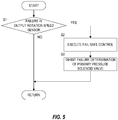
- the transmission controller 12 determines that the output rotation speed sensor 43 has a failure, the transmission controller 12 inhibits the failure determination of the primary pressure sensor on the basis of the difference between the instruction pressure and the detected pressure.
- FIG. 5 illustrates a process content of the transmission controller 12 for such operation.
- the transmission controller 12 determines that the output rotation speed sensor 43 has a failure
- the transmission controller 12 advances the process from Step S1 to Steps S2 and S3.
- the failure determination of the primary pressure solenoid valve 62 is not performed; therefore, the primary pressure solenoid valve 62 is not erroneously determined to have a failure while the primary pressure solenoid valve 62 is normal.
- the state is not determined as the double failure, the fail-safe control for double failure is not executed, the sub-transmission mechanism 30 is not fixed to the second speed, and the running performance does not largely lower.
- the transmission controller 12 executes the fail-safe control according to the failure site as described above.
- the fail-safe control in execution is terminated at the timing.
- whether the sensors, the solenoid valves, or similar devices have a failure or not is determined again.
- the fail-safe control is executed again.
- the embodiment sets the instruction currents to the respective solenoid valves 61 to 63 to 0 mA corresponding to the maximum pressure when the output rotation speed sensor 43 is determined to have a failure
- the line pressure PL, the primary pressure Ppri, and the secondary pressure Psec can be increased up to the predetermined high pressures and the speed ratio can be fixed.
- the instruction current is not limited to 0 mA corresponding to the maximum pressure and may be a value larger than 0 mA.
Landscapes
- Engineering & Computer Science (AREA)
- General Engineering & Computer Science (AREA)
- Mechanical Engineering (AREA)
- Control Of Transmission Device (AREA)
Applications Claiming Priority (2)
| Application Number | Priority Date | Filing Date | Title |
|---|---|---|---|
| JP2015179519 | 2015-09-11 | ||
| PCT/JP2016/075634 WO2017043409A1 (ja) | 2015-09-11 | 2016-09-01 | ベルト無段変速機及びその故障判断方法 |
Publications (2)
| Publication Number | Publication Date |
|---|---|
| EP3348875A1 true EP3348875A1 (de) | 2018-07-18 |
| EP3348875A4 EP3348875A4 (de) | 2018-09-12 |
Family
ID=58239644
Family Applications (1)
| Application Number | Title | Priority Date | Filing Date |
|---|---|---|---|
| EP16844270.5A Withdrawn EP3348875A4 (de) | 2015-09-11 | 2016-09-01 | Stufenloses getriebe und fehlfunktionbestimmungsverfahren dafür |
Country Status (5)
| Country | Link |
|---|---|
| US (1) | US20180283541A1 (de) |
| EP (1) | EP3348875A4 (de) |
| JP (1) | JP6554545B2 (de) |
| CN (1) | CN108027054A (de) |
| WO (1) | WO2017043409A1 (de) |
Families Citing this family (4)
| Publication number | Priority date | Publication date | Assignee | Title |
|---|---|---|---|---|
| GB2568925B (en) * | 2017-11-30 | 2022-09-28 | Trw Ltd | Power-assisted steering assembly |
| JP6559816B1 (ja) * | 2018-02-08 | 2019-08-14 | 株式会社Subaru | 無段変速機の制御装置、無段変速機、および無段変速機の制御方法 |
| JP6973186B2 (ja) * | 2018-03-05 | 2021-11-24 | トヨタ自動車株式会社 | 車両の制御装置 |
| CN109185450A (zh) * | 2018-08-29 | 2019-01-11 | 汽解放汽车有限公司 | 一种机械式自动变速器换挡故障处理方法 |
Family Cites Families (14)
| Publication number | Priority date | Publication date | Assignee | Title |
|---|---|---|---|---|
| JPS6253248A (ja) * | 1985-08-30 | 1987-03-07 | Fuji Heavy Ind Ltd | 無段変速機の制御装置 |
| JPS62143744A (ja) * | 1985-12-19 | 1987-06-27 | Fuji Heavy Ind Ltd | 車両用無段変速機の変速比制御装置 |
| JPH03213770A (ja) * | 1990-01-18 | 1991-09-19 | Fuji Heavy Ind Ltd | 無段変速機の制御装置 |
| JP2001214970A (ja) * | 1999-11-22 | 2001-08-10 | Mitsubishi Motors Corp | 車両用油圧式無段変速機の変速制御装置 |
| JP3591395B2 (ja) * | 1999-11-22 | 2004-11-17 | 三菱自動車工業株式会社 | 車両用油圧式無段変速機の変速制御装置 |
| KR100411056B1 (ko) * | 2000-12-27 | 2003-12-18 | 현대자동차주식회사 | 자동차 변속기의 출력축 회전속도 검출센서의 고장 진단방법 |
| JP4107484B2 (ja) * | 2002-09-27 | 2008-06-25 | ジヤトコ株式会社 | Vベルト式無段自動変速機の変速制御装置 |
| JP2005291111A (ja) * | 2004-03-31 | 2005-10-20 | Jatco Ltd | 車両用ベルト式無段変速機の入力トルク制御装置 |
| JP4781336B2 (ja) * | 2007-09-10 | 2011-09-28 | トヨタ自動車株式会社 | 油圧制御装置 |
| JP4678417B2 (ja) * | 2008-04-18 | 2011-04-27 | トヨタ自動車株式会社 | 油圧制御装置 |
| JP5170255B2 (ja) * | 2008-12-02 | 2013-03-27 | トヨタ自動車株式会社 | シーブ位置決め装置 |
| CN102906466A (zh) * | 2010-05-21 | 2013-01-30 | 丰田自动车株式会社 | 车辆用变速控制装置 |
| JP2013072479A (ja) * | 2011-09-27 | 2013-04-22 | Toyota Motor Corp | 車両用無段変速機の制御装置 |
| EP2833027A4 (de) * | 2012-03-28 | 2016-07-13 | Jatco Ltd | Stufenloses getriebe und leitungsdrucksteuerungsverfahren dafür |
-
2016
- 2016-09-01 CN CN201680052383.4A patent/CN108027054A/zh active Pending
- 2016-09-01 US US15/758,486 patent/US20180283541A1/en not_active Abandoned
- 2016-09-01 WO PCT/JP2016/075634 patent/WO2017043409A1/ja not_active Ceased
- 2016-09-01 EP EP16844270.5A patent/EP3348875A4/de not_active Withdrawn
- 2016-09-01 JP JP2017539143A patent/JP6554545B2/ja active Active
Also Published As
| Publication number | Publication date |
|---|---|
| JPWO2017043409A1 (ja) | 2018-06-28 |
| EP3348875A4 (de) | 2018-09-12 |
| CN108027054A (zh) | 2018-05-11 |
| JP6554545B2 (ja) | 2019-07-31 |
| WO2017043409A1 (ja) | 2017-03-16 |
| US20180283541A1 (en) | 2018-10-04 |
Similar Documents
| Publication | Publication Date | Title |
|---|---|---|
| JP4238895B2 (ja) | 車両用無段変速機の変速制御装置 | |
| EP3348875A1 (de) | Stufenloses getriebe und fehlfunktionbestimmungsverfahren dafür | |
| EP3348876A1 (de) | Stufenloses getriebe und fehlfunktionbestimmungsverfahren dafür | |
| JP4939915B2 (ja) | 無段変速機の制御装置 | |
| JP6364542B2 (ja) | 変速機の制御装置及び変速機の制御方法 | |
| JP6353971B2 (ja) | 変速機の制御装置及び変速機の制御方法 | |
| KR102004634B1 (ko) | 변속기의 제어 장치 및 변속기의 제어 방법 | |
| JP6379279B2 (ja) | 変速機の制御装置及び変速機の制御方法 | |
| JP6543540B2 (ja) | ベルト無段変速機及びその故障判断方法 | |
| JP4680615B2 (ja) | 無段変速機の変速制御装置 | |
| JP6364541B2 (ja) | 変速機の制御装置及び変速機の制御方法 | |
| WO2017043340A1 (ja) | 自動変速機及び自動変速機の故障判断方法 | |
| JP6379280B2 (ja) | 変速機の制御装置及び変速機の制御方法 | |
| JP5817583B2 (ja) | 無段変速機の制御装置 | |
| JP2008101716A (ja) | 車両用無段変速機の制御装置 |
Legal Events
| Date | Code | Title | Description |
|---|---|---|---|
| PUAI | Public reference made under article 153(3) epc to a published international application that has entered the european phase |
Free format text: ORIGINAL CODE: 0009012 |
|
| 17P | Request for examination filed |
Effective date: 20180319 |
|
| AK | Designated contracting states |
Kind code of ref document: A1 Designated state(s): AL AT BE BG CH CY CZ DE DK EE ES FI FR GB GR HR HU IE IS IT LI LT LU LV MC MK MT NL NO PL PT RO RS SE SI SK SM TR |
|
| AX | Request for extension of the european patent |
Extension state: BA ME |
|
| A4 | Supplementary search report drawn up and despatched |
Effective date: 20180813 |
|
| RIC1 | Information provided on ipc code assigned before grant |
Ipc: F16H 59/40 20060101ALI20180807BHEP Ipc: F16H 61/12 20100101AFI20180807BHEP Ipc: F16H 61/662 20060101ALI20180807BHEP |
|
| DAV | Request for validation of the european patent (deleted) | ||
| DAX | Request for extension of the european patent (deleted) | ||
| 17Q | First examination report despatched |
Effective date: 20190208 |
|
| STAA | Information on the status of an ep patent application or granted ep patent |
Free format text: STATUS: THE APPLICATION HAS BEEN WITHDRAWN |
|
| 18W | Application withdrawn |
Effective date: 20190314 |