EP3349680B1 - Verfahren zur erzeugung eines flexiblen bogenmodells der zähne zur verwendung in der restaurativen zahnmedizin - Google Patents
Verfahren zur erzeugung eines flexiblen bogenmodells der zähne zur verwendung in der restaurativen zahnmedizin Download PDFInfo
- Publication number
- EP3349680B1 EP3349680B1 EP16847113.4A EP16847113A EP3349680B1 EP 3349680 B1 EP3349680 B1 EP 3349680B1 EP 16847113 A EP16847113 A EP 16847113A EP 3349680 B1 EP3349680 B1 EP 3349680B1
- Authority
- EP
- European Patent Office
- Prior art keywords
- arch
- points
- tooth
- full
- model
- Prior art date
- Legal status (The legal status is an assumption and is not a legal conclusion. Google has not performed a legal analysis and makes no representation as to the accuracy of the status listed.)
- Active
Links
Images

Classifications
-
- A—HUMAN NECESSITIES
- A61—MEDICAL OR VETERINARY SCIENCE; HYGIENE
- A61C—DENTISTRY; APPARATUS OR METHODS FOR ORAL OR DENTAL HYGIENE
- A61C13/00—Dental prostheses; Making same
- A61C13/0003—Making bridge-work, inlays, implants or the like
- A61C13/0004—Computer-assisted sizing or machining of dental prostheses
-
- A—HUMAN NECESSITIES
- A61—MEDICAL OR VETERINARY SCIENCE; HYGIENE
- A61C—DENTISTRY; APPARATUS OR METHODS FOR ORAL OR DENTAL HYGIENE
- A61C13/00—Dental prostheses; Making same
- A61C13/34—Making or working of models, e.g. preliminary castings, trial dentures; Dowel pins [4]
Definitions
- the invention relates to techniques for creating flexible arch models of teeth for use in restorative dentistry and, more particularly, to a method for automated creation of flexible arch models of teeth for use in digital restorative design.
- tooth shapes are typically generated based on a small set of sample tooth shapes called library teeth.
- library teeth are stored in tooth libraries and manipulated using 3D digital editing techniques that are equivalent to the physical processes of sculpting in wax and clay ( i.e., by adding or removing material digitally from areas on the surface of the model in a manner analogous to adding or removing wax in physical modeling). This allows for a wide variation, but provides no means for assuring that the result continues to be a natural tooth shape.
- Techniques for making the tooth models using statistical techniques have been described by the present inventors in U.S. Patent Application Serial No. 14/609,774, filed January 30, 2015 .
- bridges and arch models encompassing multiple teeth.
- bridges and arches are significantly more complicated than crowns as there are additional anatomical constraints amongst the respective teeth in the arch model.
- WO2011/089470 discloses a method for constructing flat or cup templates on transparent bases or integrated into software, suitable for arch design or construction.
- ACM anatomical crown model
- the methods described herein address the two main technical challenges of obtaining dentition information of a scanned (digitized) dental arch and enforcing anatomical constraints between the consecutive restorative units and hence pave the way for furthering the level of automation in digital restorative dentistry.
- the methods described herein provide a full dental arch model available for use toward digital restoration design.
- Existing software tools treat each crown model separately and do not allow two or more crown units to vary together and to be constrained in an anatomically correct relationship between each other or in the context of the whole dental arch.
- the arch model described herein addresses these issues by implementing a Flexible Arch Model (FAM) that incorporates a correct anatomical relationship of two or more restorative units based on a statistical analysis of many digitized dental arches.
- FAM Flexible Arch Model
- FAM addresses the problems of the prior art by creating a full arch model comprising the upper and lower jaw in a correct relative position.
- the upper and lower jaw in the arch model includes a set of complete 3D geometry of individual tooth models.
- the arch model is as flexible as possible to change its overall shape (width, size, curve of Wilson, curve of Spee, etc .) within a reasonable range based on a small set of parameters.
- An algorithm has also been developed to fit the constructed arch model to an arbitrary digitized scan of the upper and lower arch of a patient's mouth whether the scan consists of a complete set of teeth or a partial set of teeth. This fitting process is about finding an optimal set of arch parameters and transform parameters that provide the closest match to the target arch scan.
- An analytical model (including a non-uniform rational basis spline or NURBS) may be used to represent a dental arch with a small number of parameters such as overall width, height, depth (i.e. bounding box) and curvatures on an important area. Such an approach is desirable because it would be more intuitive to control the arch shape based on those parameters instead of performing a statistical analysis.
- PCA principal component analysis
- the inventors use principal component analysis (PCA) in an exemplary embodiment of a statistic model suitable to build a new arch model because it is difficult to constrain the shape of the arch to be within an anatomical (realistic) shape based on the range of analytical parameters. Those constraints are embedded in a statistical model inherently.
- the inventors recognized that there is a need for more than a 3D curve for the arch model that can be used for a variety of applications more effectively.
- the model should be able to represent location and size of each tooth in the arch, the alignment of cusps, and occlusal surface that would reflect dental anatomical features such as the curve of Spee and the curve of Wilson.
- the inventors have recognized in their prior work with ACMs that an individual crown can be constrained to be within the subspace of tooth shape built by k-means clustering. A similar constraint can be established if a statistical method is performed on many samples of real dental arches. This is a natural extension of ACM to represent a full dental arch using ACM as a building block. The inventors call this statistical dental arch model Flexible Arch Model (FAM) and believe that FAM can be used to solve a lot of challenging problems in digital dentistry including automatic creation of a multi-unit restorative dental structure.
- FAM is computed to capture and parameterize the variations of the multiple real dental arches in a training set. To perform this, the well-known PCA statistical method is used in an exemplary embodiment, though other statistical models such as k-means clustering could be used.
- the overall procedure to build the FAM includes the steps of acquiring multiple sets of digitized dental arches with a pair of maxillary (upper) and mandibular (lower) jaws in the right relative position (correct anatomical relationship).
- the multiple sets of digitized dental arches may be obtained by scanning upper and lower source dental arches separately and computing a correct bite registration of individual upper and lower arch scans, where the multiple sets of digitized dental arches include a set of complete 3D geometry of individual tooth models.
- the next step includes gathering a pre-defined set of landmark points on the occlusal surface of each arch all in the same order and same corresponding positions across multiple samples, using a manual process.
- the landmark points include at least 4 points on the occlusal surface of individual posterior teeth, 2 points on an incisal edge, and 2 points on a cingulum area of anterior teeth.
- the gathered vectors of landmark points (V 1 , V 2 , ..., V N ) are used to perform Principal Component Analysis in an exemplary embodiment to create a linear subspace of the feature points with the basis of principal components (or eigenvectors) found during the PCA procedure.
- an arbitrary set of landmark points on a pair of upper and lower arches can be reconstructed by a linear combination of the statistical modeling coefficients (such as in PCA) to create a linear subspace of arch feature points within a reasonable range of variations captured from the training samples.
- the reconstructed landmark points can be used to build a full arch tooth model with individual crown models fit to a given set of arch points.
- using the feature points to construct the full arch tooth model with individual crown models comprises using the feature points to find a similarity transform from corresponding feature points on an anatomical crown model (ACM), using the found similarity transform to align each ACM to reconstructed arch points of the full arch tooth model initially, and for each ACM having adjacent teeth on both sides, measuring an amount of gap or overlap and computing an optimal new position for the tooth and scaling the tooth in a way that minimizes an amount of gap or overlap on both sides of the tooth.
- the similarity transform may be obtained by using a Procrustes analysis between two corresponding point sets.
- Further exemplary embodiments include fitting the constructed full arch tooth model to an arbitrary arch scan of a patient's mouth by calculating a set of parameters for the full arch tooth model that minimizes a penalty function between a target arch of the arbitrary arch scan and each respective parameter by building a full arch tooth model using initial parameters, computing the penalty function between the target arch and the respective parameter, modifying the respective parameter to reduce the penalty function, iterating to find a lowest penalty function, and using the respective parameters to update the full arch tooth model.
- the parameters may include statistical modeling coefficients of the full arch tooth model and rigid transformation data.
- E ( ⁇ , ⁇ ) is minimized in terms of transformation parameters ( ⁇ ) and statistical parameters of the full arch tooth model ( ⁇ ) to be found, where F i ( ⁇ , ⁇ ) is a point on the surface of the full arch tooth model at given optimization parameters and S i ( ⁇ , ⁇ ) is a corresponding point on a surface of a target arch scan.
- Missing teeth on the target arch scan may be accounted for by aligning an average full arch tooth model to the target arch by a rough estimation and classifying a tooth on the target arch scan as "missing" if a closest point from a tooth in the full arch tooth model to the target arch scan is greater than a pre-determined threshold value.
- the invention further includes a system having a processor and instructions stored in a memory that when executed by the processor implement the methods described herein.
- PCA Principal Component Analysis
- PCA is not the only statistical modeling approach that can be used to generate an adequate dental arch model for use with the FAM method and other statistical models (e.g., k-means clustering) may be readily substituted for PCA herein.
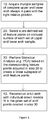
- the flow diagram of Figure 1 is implemented in software loaded onto a computer processor in an exemplary embodiment.
- the instructions comprising the computer software are stored in a memory element and loaded into a computer processor that executes the instructions to implement the method exemplified by the flow diagram of Figure 1 .
- the computer processor is in operative communication with an instruction memory (both not shown) with instructions for implementing an operating system and application programs for implementing the techniques for creating a full arch model as described with respect to Figure 1 .
- the processor may include a standardized processor, a specialized processor, a microprocessor, or the like.
- the processor executes instructions including, for example, instructions for implementing the techniques described in more detail below.
- the instruction memory stores the instructions that may be executed by the processor and may include computer readable storage media in the form of volatile and/or nonvolatile memory such as random access memory (RAM), read only memory (ROM), cache, Flash memory, a hard disk, or any other suitable storage component. As described herein, a computer readable storage media does not include a modulated data signal.
- the instruction memory may be a separate component in communication with the processor, while in another embodiment, the instruction memory may be integrated into the processor.
- the first step in building the FAM is to acquire at step 10 multiple sets of digitized dental arches with a pair of maxillary (upper) and mandibular (lower) jaws in the right relative position (correct anatomical relationship).
- this process requires multiple scanning of the source dental arches.
- the upper and lower arches would need to be scanned separately, and additional scanning of the combined upper and lower arches should be used to compute the correct bite registration of the individual upper and lower arch scans.
- the relative position and the number of scans may be varied so long as full, consistent data sets of the dental arches are obtained.
- a pre-defined set of landmark points on the occlusal surface of each arch is gathered in the same order and same corresponding positions across multiple samples, typically using a manual process.
- the vectors of landmark points (V 1 , V 2 , ..., V N ) gathered in step 20 are then used at step 30 to perform Principal Component Analysis (or k-means clustering or other form of statistical analysis) in an exemplary embodiment to create a linear subspace of the feature points with the basis of principal components (or eigenvectors) found during the PCA procedure.
- Principal Component Analysis or k-means clustering or other form of statistical analysis
- an arbitrary set of landmark points on a pair of upper and lower arches are reconstructed at step 40 by a linear combination of the principal components (when PCA is used as the statistical model) within a reasonable range of variations captured from the training samples.
- the reconstructed landmark points are used to build a full set of tooth models in a dental arch. This method of reconstructing the full geometry of a dental arch will be described in more detail below.
- the FAM so constructed includes two parts.
- the first part includes principal components (when PCA is used as the statistical model) of a set of feature points that represents important features of each tooth in a full dental arch per arch type (upper or lower).
- Each sample of the training set of the statistical model e.g ., PCA
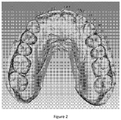
- Figure 2 shows a typical set of feature points (1-56) selected from an upper arch scan. The main purpose of this step is to capture variations and constraints in the overall shape of the arch (not detailed individual shape of teeth) and relative positioning among teeth in the arch.
- the full geometry of an arbitrary dental arch can be constructed by the computational counterpart of FAM using the second part of FAM, which is a fast computational model that provides an alignment of individual ACMs to the given set of feature points generated by the first part of FAM.
- Part 1 of FAM is rather straightforward and it can be computed by a mathematical procedure for statistical modeling, for example, the procedure called PCA noted above, once the full set of manually picked individual feature points across many full dental arches ( e.g . 100) is obtained. At least 4 points on the occlusal surface of individual posterior teeth, 2 points on the incisal edge and 2 points on the cingulum area of anterior teeth should be collected to make the algorithm work with sufficient particularity as described in Part 2.
- Part 2 of FAM is more challenging to establish.
- a full set of individual crown models (ACM) are aligned that approximate the given set of feature points in the arch and also look natural with proper relationship between adjacent units by a very fast computational operation. This operation needs to be performed fast enough so that it could be used as an iterative operational unit to solve a bigger numerical optimization problem.
- An algorithm has been developed to meet the requirements of part 2 of FAM and includes the following steps.
- the 4 (or more) points on the occlusal surface (incisal/lingual surface for anterior) of an individual tooth in the arch are used to find a similarity transform from the corresponding feature points on the ACM.
- a Procrustes analysis is used to find such a similarity transform (rigid transform + uniform scaling) between two corresponding point sets.
- a Procrustes analysis is a form of statistical shape analysis used to analyze the distribution of a set of shapes by optimally superimposing the shapes until they have similar placement and size and then minimizing a measure of shape difference called the Procrustes distance between the shapes.
- the similarity transform found between each tooth in the arch and ACM is used to align each ACM to the reconstructed arch points initially, which may leave a space or overlap between two adjacent ACMs after the alignment.
- the FAM so constructed allows one, given a set of a small number of ( e.g . ⁇ 5-15) statistical modeling coefficients (such as in PCA), to reconstruct any arbitrary shape of a full (upper or lower) arch that consists of average ACMs with enough constraints that would make the entire arch look natural.
- the reconstruction step is performed very fast and may be used as a part of a bigger numerical optimization problem.
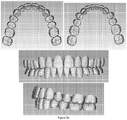
- Figure 3b illustrates the variations in the first three modes of the FAM constructed based on PCA.
- Two images in each row show -/+3 times of standard deviation from the average arch model in the specific mode.
- the variation in the overall arch size is captured in the first mode and the variation in the relative distance between two molars is captured in the second mode.
- the third mode captures the variation in the relative position between the upper and lower jaw.
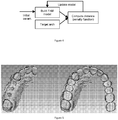
- the process includes building FAM model based on initial parameters, computing the distance (penalty function) between the target arch and the FAM parameter, modifying the FAM parameters to reduce the penalty function, and iterating the loop to find the lowest penalty function (best fit).
- the optimization parameters include statistical modeling coefficients of FAM and rigid transformation (rotation and translation) data. The FAM reconstructed by the optimization parameters and the stored target arch data are compared to compute a distance between corresponding feature points and the optimization parameters so determined are fed back to the FAM to update the model.
- Eq. 1 is the cost (penalty) function that is to be minimized in terms of the transformation parameters ( ⁇ ) and the statistical parameters of the arch model ( ⁇ ) to be found, where F i ( ⁇ , ⁇ ) is a point on the surface of FAM at the given optimization parameters and S i ( ⁇ , ⁇ ) is a corresponding point on the surface of the target arch scan.
- Eq. 1 One of the main challenges in computing the cost function (Eq. 1) is to find the corresponding N surface points between FAM and the target arch scan automatically.
- One has complete knowledge on the feature points of FAM e.g. the location of a cusp point of tooth #5).
- ICP Iterative Closest Point
- the correspondence between the two sets of point clouds is established on the fly by finding the closest point to the target set from any point of the reference set at each iteration. Additionally, to take missing teeth on the arch scan into account, the average FAM is aligned to the target arch by a rough estimation and a tooth on the arch scan is classified as "missing” if the closest point from the tooth in FAM to the arch scan is greater than a pre-determined threshold value. The surface points of FAM on the classified "missing" tooth would not be included in the computation of the cost function (Eq. 1).
- a step that does not have an obvious solution in the optimization framework described herein is the initial estimation of the optimization parameters.
- the pre-alignment step i.e. estimating the transformation parameters
- the pre-alignment step is important for the subsequent iterative process to converge to the optimal solution.
- This minimal set of corresponding feature points could be found either manually or automatically utilizing some 3D feature detection algorithms.
- the inventors use implant locations that are detected automatically during the arch scan process and use a subsequent in-house dental feature detection algorithm to identify this minimal set of feature correspondence.
- the proposed fitting method still can be developed with other feature detection algorithms or even by establishing the minimum set of correspondence in a manual manner.
- Figure 5 shows the results of the optimization process for a partial arch scan with a space for three missing teeth, which demonstrates the ability of the fitting algorithm that works with only a small portion of a full arch scan and extrapolates the rest of the arch based on the available fitting area.
- This fitting algorithm generally finds an optimal set of arch parameters and transform parameters that provide the closest match to the target arch scan.
- an existing anatomical (statistical) crown model (based on k-means clustering or other statistical model known to those skilled in the art) is used with a new statistical arch model including average and statistical modeling (e.g ., PCA) components of landmark points of many real arch scans and a computational model that aligns average crown models to a set of arch feature points.
- a fitting method is also used to fit the arch model to an arbitrary real arch scan.
- the resulting modified FAM is then optimized to fit to the real arch scan of the patient's mouth to create a customized arch for the patient.
- the methods and models described herein may be used for dental feature detection, crown initialization, and automated design of arches.
- the approach described herein adds value to digital dentistry by advancing techniques for automated processing of patient specific dentition environment.
- the methods described herein address errors caused by how the upper and lower jaw come together and reduces the amount of scan data needed by using an underlying statistical model framework for the scan data.
- the novel processing steps described herein thus improve the functioning of the computer by speeding up the processing for arch model creation while increasing the accuracy of the resulting arch model.
Landscapes
- Health & Medical Sciences (AREA)
- Oral & Maxillofacial Surgery (AREA)
- Dentistry (AREA)
- Epidemiology (AREA)
- Life Sciences & Earth Sciences (AREA)
- Animal Behavior & Ethology (AREA)
- General Health & Medical Sciences (AREA)
- Public Health (AREA)
- Veterinary Medicine (AREA)
- Dental Tools And Instruments Or Auxiliary Dental Instruments (AREA)
Claims (16)
- Verfahren zum Erstellen eines Vollbogenmodells, das einen oberen und unteren Kiefer in einer korrekten anatomischen Beziehung unter Verwendung einer statistischen Technik umfasst, die auf einen Satz von einzelnen Zahnmodellen angewendet wird, umfassend die folgenden Schritte:Erfassen von mehreren Sätzen digitalisierter Zahnbögen mit einem Paar aus Ober- und Unterkiefer in einer korrekten anatomischen Beziehung (10);Sammeln eines vordefinierten Satzes an Orientierungspunkten auf der okklusalen Oberfläche jedes Bogens in derselben Reihenfolge und denselben entsprechenden Positionen über mehrere Proben (20);Verwenden des gesammelten Satzes an Orientierungspunkten, um statistische Modellierung durchzuführen, um einen linearen Unterraum der Bogenmerkmalpunkte (30) zu erstellen; undVerwenden der Merkmalpunkte, um ein Vollbogen-Zahnmodell mit einzelnen Kronenmodellen zu konstruieren, die zu einem bestimmten Satz an Bogenpunkten (40) passen.
- Verfahren nach Anspruch 1, wobei das Erfassen der mehreren Sätze digitalisierter Zahnbögen das getrennte Scannen oberer und unterer Quellzahnbögen und das Berechnen einer korrekten Bissregistrierung einzelner oberer und unterer Bogenscans umfasst.
- Verfahren nach Anspruch 2, wobei die mehreren Sätze digitalisierter Zahnbögen einen Satz kompletter 3D-Geometrie einzelner Zahnmodelle beinhalten.
- Verfahren nach Anspruch 1, wobei das Sammeln des vordefinierten Satzes an Orientierungspunkten N Paare von oberen und unteren Bögen in einem Schulungssatz umfasst, die für ein ites Paar von Bögen einen Vektor von M Orientierungspunkten wie folgt definieren:

- Verfahren nach Anspruch 4, wobei die Orientierungspunkte zumindest 4 Punkte auf der okklusalen Oberfläche einzelner posteriorer Zähne, 2 Punkte auf einer Inzisalkante und 2 Punkte auf einem Cingulum-Bereich der anterioren Zähne umfassen.
- Verfahren nach Anspruch 1, wobei die statistische Modellierung unter Verwendung von Principal Component Analysis (PCA) durchgeführt wird, um einen linearen Unterraum der Merkmalpunkte mit der Basis von Hauptkomponenten oder Eigenvektoren zu erstellen, die während eines PCA-Verfahrens gefunden wurden.
- Verfahren nach Anspruch 1, wobei die Verwendung der Merkmalpunkte zum Konstruieren des Vollbogen-Zahnmodells mit einzelnen Kronenmodellen die Schritte der Verwendung der Merkmalpunkte zum Finden einer Ähnlichkeitstransformation von entsprechenden Merkmalpunkten auf einem anatomischen Kronenmodell (ACM), der Verwendung der gefundenen Ähnlichkeitstransformation zum anfänglichen Ausrichten jedes ACM zu rekonstruierten Bogenpunkten des Vollbogen-Zahnmodells und für jedes ACM, das benachbarte Zähne an beiden Seiten aufweist, das Messen eines Betrags des Spalts oder der Überlappung und das Berechnen einer optimalen neuen Position für den Zahn und das Skalieren des Zahns auf eine Weise, die einen Betrag des Spalts oder der Überlappung an beiden Seiten des Zahns minimiert, umfasst.
- Verfahren nach Anspruch 7, wobei die Ähnlichkeitstransformation durch Verwendung einer Procrustes-Analyse zwischen zwei entsprechenden Punktsätzen erzielt wird.
- Verfahren nach Anspruch 1, ferner umfassend das Anpassen des konstruierten Vollbogen-Zahnmodells an einen willkürlichen Bogenscan des Mundes eines Patienten.
- Verfahren nach Anspruch 9, wobei ein Satz von Parametern für das Vollbogen-Zahnmodell berechnet wird, die eine Straffunktion zwischen einem Zielbogen des willkürlichen Bogenscans und jedem jeweiligen Parameter durch Erstellen eines Vollbogen-Zahnmodells unter Verwendung der anfänglichen Parameter, das Berechnen der Straffunktion zwischen dem Zielbogen und dem jeweiligen Parameter, das Modifizieren des jeweiligen Parameters, um die Straffunktion zu verringern, das Iterieren, um eine niedrigste Straffunktion zu finden, und das Verwenden der jeweiligen Parameter, um das Vollbogen-Zahnmodell zu aktualisieren, minimieren.
- Verfahren nach Anspruch 10, wobei die Parameter statistische Modellierungskoeffizienten des Vollbogen-Zahnmodells und der starren Transformationsdaten beinhalten.
- Verfahren nach Anspruch 11, wobei die Straffunktion lautet:

- Verfahren nach Anspruch 12, wobei die fehlenden Zähne auf dem Zielbogenscan durch Ausrichten eines durchschnittlichen Vollbogen-Zahnmodells zum Zielbogen durch eine grobe Schätzung und Klassifizieren eines Zahns auf dem Zielbogenscan als "fehlend" berücksichtigt werden, wenn ein nähester Punkt von einem Zahn im Vollbogen-Zahnmodell zum Zielbogenscan größer ist als ein vorbestimmter Schwellenwert.
- System, das ein Vollbogenmodell erstellt, das einen oberen und unteren Kiefer in einer korrekten anatomischen Beziehung unter Verwendung einer statistischen Technik umfasst, die auf einen Satz von einzelnen Zahnmodellen angewendet wird, umfassend:einen Prozessor; undeinen Speicher, der Anweisungen zum Ausführen durch den Prozessor speichert, wobei die Anweisungen, wenn sie ausgeführt werden, den Prozessor veranlassen, ein Verfahren zu implementieren, das die folgenden Schritte beinhaltet:Erfassen von mehreren Sätzen digitalisierter Zahnbögen mit einem Paar aus Ober- und Unterkiefer in einer korrekten anatomischen Beziehung (10),Sammeln eines vordefinierten Satzes an Orientierungspunkten auf der okklusalen Oberfläche jedes Bogens in derselben Reihenfolge und denselben entsprechenden Positionen über mehrere Proben (20),Verwenden des gesammelten Satzes an Orientierungspunkten, um statistische Modellierung durchzuführen, um einen linearen Unterraum der Bogenmerkmalpunkte (30) zu erstellen, undVerwenden der Merkmalpunkte, um ein Vollbogen-Zahnmodell mit einzelnen Kronenmodellen zu konstruieren, die zu einem bestimmten Satz an Bogenpunkten (40) passen.
- System nach Anspruch 14, wobei der Speicher ferner Anweisungen beinhaltet, die bei Ausführung durch den Prozessor den zusätzlichen Schritt des getrennten Scannens oberer und unterer Quellzahnbögen und Berechnen einer korrekten Bissregistrierung einzelner oberer und unterer Bogenscans implementieren, wobei die mehreren Sätze digitalisierter Zahnbögen einen Satz vollständiger 3D-Geometrie einzelner Zahnmodelle beinhalten;
wobei der Speicher ferner Anweisungen beinhaltet, die bei Ausführung durch den Prozessor den Schritt des Sammelns des vordefinierten Satzes an Orientierungspunkten von N Paaren von oberen und unteren Bögen in einem Schulungssatz implementieren, indem für ein ites Paar von Bögen ein Vektor von M Orientierungspunkten wie folgt definiert wird:
wobei die statistische Modellierung unter Verwendung von Principal Component Analysis (PCA)-Software durchgeführt wird, die einen linearen Unterraum der Merkmalpunkte mit der Basis von Hauptkomponenten oder Eigenvektoren erstellt, die während eines PCA-Verfahrens gefunden wurden;
wobei der Speicher ferner Anweisungen beinhaltet, die bei Ausführung durch den Prozessor den Schritt der Verwendung der Merkmalpunkte zum Konstruieren des Vollbogen-Zahnmodells mit einzelnen Kronenmodellen durch Ausführung der Anweisungen zum Implementieren der Schritte der Verwendung der Merkmalpunkte zum Finden einer Ähnlichkeitstransformation von entsprechenden Merkmalpunkten auf einem anatomischen Kronenmodell (ACM), der Verwendung der gefundenen Ähnlichkeitstransformation zum anfänglichen Ausrichten jedes ACM zu rekonstruierten Bogenpunkten des Vollbogen-Zahnmodells und für jedes ACM, das benachbarte Zähne an beiden Seiten aufweist, das Messen eines Betrags des Spalts oder der Überlappung und das Berechnen einer optimalen neuen Position für den Zahn und das Skalieren des Zahns auf eine Weise, die einen Betrag des Spalts oder der Überlappung an beiden Seiten des Zahns minimiert, implementieren; oder
wobei der Speicher ferner Anweisungen beinhaltet, die bei Ausführung durch den Prozessor den weiteren Schritt des Anpassens des konstruierten Vollbogen-Zahnmodells an einen willkürlichen Bogenscan des Mundes eines Patienten implementiert, wobei ein Satz von Parametern für das Vollbogen-Zahnmodell berechnet wird, die eine Straffunktion zwischen einem Zielbogen des willkürlichen Bogenscans und jedem jeweiligen Parameter durch Erstellen eines Vollbogen-Zahnmodells unter Verwendung der anfänglichen Parameter, das Berechnen der Straffunktion zwischen dem Zielbogen und dem jeweiligen Parameter, das Modifizieren des jeweiligen Parameters, um die Straffunktion zu verringern, das Iterieren, um eine niedrigste Straffunktion zu finden, und das Verwenden der jeweiligen Parameter, um das Vollbogen-Zahnmodell zu aktualisieren, minimieren. - System nach Anspruch 15, wobei die Parameter statistische Modellierungskoeffizienten des Vollbogen-Zahnmodells und der starren Transformationsdaten beinhalten, und wobei die Straffunktion lautet:

Applications Claiming Priority (2)
| Application Number | Priority Date | Filing Date | Title |
|---|---|---|---|
| US14/853,284 US9814549B2 (en) | 2015-09-14 | 2015-09-14 | Method for creating flexible arch model of teeth for use in restorative dentistry |
| PCT/US2016/051431 WO2017048668A1 (en) | 2015-09-14 | 2016-09-13 | Method for creating flexible arch model of teeth for use in restorative dentistry |
Publications (3)
| Publication Number | Publication Date |
|---|---|
| EP3349680A1 EP3349680A1 (de) | 2018-07-25 |
| EP3349680A4 EP3349680A4 (de) | 2019-04-17 |
| EP3349680B1 true EP3349680B1 (de) | 2020-07-22 |
Family
ID=58257822
Family Applications (1)
| Application Number | Title | Priority Date | Filing Date |
|---|---|---|---|
| EP16847113.4A Active EP3349680B1 (de) | 2015-09-14 | 2016-09-13 | Verfahren zur erzeugung eines flexiblen bogenmodells der zähne zur verwendung in der restaurativen zahnmedizin |
Country Status (4)
| Country | Link |
|---|---|
| US (1) | US9814549B2 (de) |
| EP (1) | EP3349680B1 (de) |
| JP (1) | JP6770573B2 (de) |
| WO (1) | WO2017048668A1 (de) |
Families Citing this family (20)
| Publication number | Priority date | Publication date | Assignee | Title |
|---|---|---|---|---|
| US8108189B2 (en) * | 2008-03-25 | 2012-01-31 | Align Technologies, Inc. | Reconstruction of non-visible part of tooth |
| US10410430B2 (en) * | 2016-02-12 | 2019-09-10 | 3M Innovative Properties Company | Synchronization and animation of views showing digital 3D models of teeth |
| EP3443537A1 (de) | 2016-04-11 | 2019-02-20 | 3Shape A/S | Verfahren zur ausrichtung digitaler darstellungen des kiefers eines patienten |
| DE102017203475A1 (de) * | 2017-03-03 | 2018-09-06 | Sirona Dental Systems Gmbh | Verfahren zur Konstruktion einer Restauration |
| WO2019053949A1 (ja) * | 2017-09-14 | 2019-03-21 | 株式会社ジーシー | 咬合圧解析装置、咬合圧解析プログラム、及び咬合圧解析方法 |
| US11039905B2 (en) * | 2017-11-06 | 2021-06-22 | Dds Company | Prosthesis design method and system based on arch line |
| EP3527164B1 (de) * | 2018-02-16 | 2021-05-26 | Global Dental Science LLC | Anatomische echtzeitanpassung |
| US11534272B2 (en) * | 2018-09-14 | 2022-12-27 | Align Technology, Inc. | Machine learning scoring system and methods for tooth position assessment |
| EP3671557B1 (de) * | 2018-12-20 | 2025-03-12 | RaySearch Laboratories AB | Datenerweiterung |
| KR20220056234A (ko) | 2019-09-05 | 2022-05-04 | 덴츠플라이 시로나 인코포레이티드 | 맞춤형 치과용 오브젝트의 즉각적인 자동화 설계를 위한 방법, 시스템 및 디바이스 |
| CN113223140B (zh) * | 2020-01-20 | 2025-05-13 | 杭州朝厚信息科技有限公司 | 利用人工神经网络生成牙科正畸治疗效果的图像的方法 |
| WO2021177699A1 (ko) * | 2020-03-03 | 2021-09-10 | 엘지전자 주식회사 | 청소기 스테이션, 청소기 시스템 및 청소기 스테이션의 제어방법 |
| WO2022020267A1 (en) * | 2020-07-21 | 2022-01-27 | Get-Grin Inc. | Systems and methods for modeling dental structures |
| CN112927374B (zh) * | 2021-03-16 | 2023-08-01 | 业成科技(成都)有限公司 | 齿模对准方法及牙齿结构、三维模型对准方法及结构件 |
| US11364103B1 (en) | 2021-05-13 | 2022-06-21 | Oxilio Ltd | Systems and methods for determining a bite position between teeth of a subject |
| US12186153B2 (en) * | 2021-09-17 | 2025-01-07 | Dentsply Sirona Inc. | Automated tooth administration in a dental restoration workflow |
| US20240197449A1 (en) * | 2022-12-15 | 2024-06-20 | Align Technology, Inc. | Methods and apparatuses for matching jaws virtual dental model using teeth reference points |
| CA3249345A1 (en) * | 2023-07-24 | 2025-10-30 | Disney Enterprises, Inc. | Anatomically constrained implicit shape models |
| CN119424010A (zh) * | 2023-08-07 | 2025-02-14 | 杭州朝厚信息科技有限公司 | 产生表示目标牙齿布局的数字数据集的方法 |
| CN119424006A (zh) * | 2023-08-07 | 2025-02-14 | 杭州朝厚信息科技有限公司 | 产生表示目标牙齿布局的数字数据集的方法 |
Family Cites Families (16)
| Publication number | Priority date | Publication date | Assignee | Title |
|---|---|---|---|---|
| US7362890B2 (en) * | 2001-05-24 | 2008-04-22 | Astra Tech Inc. | Registration of 3-D imaging of 3-D objects |
| DE10252298B3 (de) | 2002-11-11 | 2004-08-19 | Mehl, Albert, Prof. Dr. Dr. | Verfahren zur Herstellung von Zahnersatzteilen oder Zahnrestaurationen unter Verwendung elektronischer Zahndarstellungen |
| US20040166462A1 (en) | 2003-02-26 | 2004-08-26 | Align Technology, Inc. | Systems and methods for fabricating a dental template |
| US9504541B2 (en) | 2006-01-05 | 2016-11-29 | Dentsply International Inc. | Method and system for designing custom restorations for dental implants |
| GB0707454D0 (en) * | 2007-04-18 | 2007-05-23 | Materialise Dental Nv | Computer-assisted creation of a custom tooth set-up using facial analysis |
| WO2008141996A2 (en) * | 2007-05-18 | 2008-11-27 | Nordic Bioscience Imaging A/S | Semi-automatic contour detection |
| US8591225B2 (en) | 2008-12-12 | 2013-11-26 | Align Technology, Inc. | Tooth movement measurement by automatic impression matching |
| US8108189B2 (en) | 2008-03-25 | 2012-01-31 | Align Technologies, Inc. | Reconstruction of non-visible part of tooth |
| US9503282B2 (en) * | 2008-09-19 | 2016-11-22 | 3M Innovative Properties Company | Methods and systems for determining the positions of orthodontic appliances |
| US20110110575A1 (en) | 2009-11-11 | 2011-05-12 | Thiagarajar College Of Engineering | Dental caries detector |
| IT1397464B1 (it) * | 2010-01-19 | 2013-01-16 | Magni | Metodo per la costruzione di dime piane e dime calotte su basette trasparenti o integrate in un software atte alla progettazione o costruzione di arcate. |
| DE102010002484B4 (de) | 2010-03-01 | 2019-10-17 | Josef Schweiger | Verfahren, Vorrichtung und Computerprogramm zur Erzeugung eines zur Herstellung eines Zahnersatzes geeigneten Zahndatensatzes |
| GB201115265D0 (en) | 2011-09-05 | 2011-10-19 | Materialise Dental Nv | A method and system for 3d root canal treatment planning |
| US20140379356A1 (en) | 2013-06-20 | 2014-12-25 | Rohit Sachdeva | Method and system for integrated orthodontic treatment planning using unified workstation |
| US9626462B2 (en) * | 2014-07-01 | 2017-04-18 | 3M Innovative Properties Company | Detecting tooth wear using intra-oral 3D scans |
| US9737257B2 (en) * | 2015-01-30 | 2017-08-22 | 3M Innovative Properties Company | Estimating and predicting tooth wear using intra-oral 3D scans |
-
2015
- 2015-09-14 US US14/853,284 patent/US9814549B2/en active Active
-
2016
- 2016-09-13 JP JP2018511387A patent/JP6770573B2/ja active Active
- 2016-09-13 EP EP16847113.4A patent/EP3349680B1/de active Active
- 2016-09-13 WO PCT/US2016/051431 patent/WO2017048668A1/en not_active Ceased
Non-Patent Citations (1)
| Title |
|---|
| None * |
Also Published As
| Publication number | Publication date |
|---|---|
| EP3349680A1 (de) | 2018-07-25 |
| EP3349680A4 (de) | 2019-04-17 |
| US20170071706A1 (en) | 2017-03-16 |
| WO2017048668A1 (en) | 2017-03-23 |
| JP2018530372A (ja) | 2018-10-18 |
| JP6770573B2 (ja) | 2020-10-14 |
| US9814549B2 (en) | 2017-11-14 |
Similar Documents
| Publication | Publication Date | Title |
|---|---|---|
| EP3349680B1 (de) | Verfahren zur erzeugung eines flexiblen bogenmodells der zähne zur verwendung in der restaurativen zahnmedizin | |
| JP7386215B2 (ja) | 歯列メッシュ矯正具除去のための方法および装置 | |
| US11896455B2 (en) | Method and system for braces removal from dentition mesh | |
| JP7289026B2 (ja) | ハイブリッドメッシュセグメンテーションのための方法及び装置 | |
| US7844429B2 (en) | System and method for three-dimensional complete tooth modeling | |
| Wu et al. | Model-based teeth reconstruction | |
| CN107595413B (zh) | 牙齿预备引导件 | |
| EP2134290B1 (de) | Computergestützte erstellung der zahnstruktur eines individuums über gesichtsanalyse | |
| US6227850B1 (en) | Teeth viewing system | |
| EP3346943B1 (de) | Verfahren und system für eine hybride maschenaufteilung | |
| JP2019518552A (ja) | 歯科修復物の形状、位置及び向きの少なくとも1つの推定方法 | |
| US20230419631A1 (en) | Guided Implant Surgery Planning System and Method | |
| CN117934885B (zh) | 基于cbct数据与三维面扫数据的坐标自动匹配方法及系统 | |
| Jiang et al. | Robust tooth surface reconstruction by iterative deformation | |
| WO2024227363A1 (zh) | 三维牙齿模型的牙齿排列方法、装置以及电子设备 | |
| Ben-Hamadou et al. | Teeth3DS+: an extended benchmark for intraoral 3D scans analysis | |
| EP4640179A1 (de) | Computer-implementierte verfahren, 3d cad system und vorrichtungen zur schätzung eines oder mehrerer skalierungsfaktoren zur abbildung zwischen einem digitalen 2d-bild eines gebisses und einem digitalen 3d-modell eines gebisses und kiefers | |
| CN120131242A (zh) | 一种三维牙颌模型深覆盖畸形量化方法及相关装置 | |
| CN118634032A (zh) | 用于生成用于患者的目标拔除对象的虚拟拔除过程的模型的方法和系统 | |
| CN119359754B (zh) | 义齿边缘线确定方法、装置、计算机设备及存储介质 | |
| CN121942047A (zh) | 正畸与牙科修复联合处理 | |
| BR102024004817A2 (pt) | Método e sistema para geração de um modelo para uso em um procedimento de extração virtual de um objeto de extração alvejado em um paciente | |
| BR102024004817B1 (pt) | Método e sistema para geração de um modelo para uso em um procedimento de extração virtual de um objeto de extração alvejado em um paciente |
Legal Events
| Date | Code | Title | Description |
|---|---|---|---|
| STAA | Information on the status of an ep patent application or granted ep patent |
Free format text: STATUS: THE INTERNATIONAL PUBLICATION HAS BEEN MADE |
|
| PUAI | Public reference made under article 153(3) epc to a published international application that has entered the european phase |
Free format text: ORIGINAL CODE: 0009012 |
|
| STAA | Information on the status of an ep patent application or granted ep patent |
Free format text: STATUS: REQUEST FOR EXAMINATION WAS MADE |
|
| 17P | Request for examination filed |
Effective date: 20180301 |
|
| AK | Designated contracting states |
Kind code of ref document: A1 Designated state(s): AL AT BE BG CH CY CZ DE DK EE ES FI FR GB GR HR HU IE IS IT LI LT LU LV MC MK MT NL NO PL PT RO RS SE SI SK SM TR |
|
| AX | Request for extension of the european patent |
Extension state: BA ME |
|
| DAV | Request for validation of the european patent (deleted) | ||
| DAX | Request for extension of the european patent (deleted) | ||
| A4 | Supplementary search report drawn up and despatched |
Effective date: 20190314 |
|
| RIC1 | Information provided on ipc code assigned before grant |
Ipc: A61C 19/04 20060101ALI20190308BHEP Ipc: A61C 13/00 20060101AFI20190308BHEP Ipc: G06F 17/50 20060101ALI20190308BHEP |
|
| REG | Reference to a national code |
Ref country code: DE Ref legal event code: R079 Ref document number: 602016040572 Country of ref document: DE Free format text: PREVIOUS MAIN CLASS: A61C0003000000 Ipc: A61C0013000000 |
|
| GRAP | Despatch of communication of intention to grant a patent |
Free format text: ORIGINAL CODE: EPIDOSNIGR1 |
|
| STAA | Information on the status of an ep patent application or granted ep patent |
Free format text: STATUS: GRANT OF PATENT IS INTENDED |
|
| RIC1 | Information provided on ipc code assigned before grant |
Ipc: G06F 17/18 20060101ALI20200113BHEP Ipc: A61C 13/00 20060101AFI20200113BHEP Ipc: A61C 19/04 20060101ALI20200113BHEP |
|
| INTG | Intention to grant announced |
Effective date: 20200211 |
|
| GRAS | Grant fee paid |
Free format text: ORIGINAL CODE: EPIDOSNIGR3 |
|
| GRAA | (expected) grant |
Free format text: ORIGINAL CODE: 0009210 |
|
| STAA | Information on the status of an ep patent application or granted ep patent |
Free format text: STATUS: THE PATENT HAS BEEN GRANTED |
|
| AK | Designated contracting states |
Kind code of ref document: B1 Designated state(s): AL AT BE BG CH CY CZ DE DK EE ES FI FR GB GR HR HU IE IS IT LI LT LU LV MC MK MT NL NO PL PT RO RS SE SI SK SM TR |
|
| REG | Reference to a national code |
Ref country code: GB Ref legal event code: FG4D |
|
| REG | Reference to a national code |
Ref country code: CH Ref legal event code: EP Ref country code: CH Ref legal event code: NV Representative=s name: E. BLUM AND CO. AG PATENT- UND MARKENANWAELTE , CH |
|
| REG | Reference to a national code |
Ref country code: DE Ref legal event code: R096 Ref document number: 602016040572 Country of ref document: DE |
|
| REG | Reference to a national code |
Ref country code: AT Ref legal event code: REF Ref document number: 1292664 Country of ref document: AT Kind code of ref document: T Effective date: 20200815 |
|
| REG | Reference to a national code |
Ref country code: SE Ref legal event code: TRGR |
|
| REG | Reference to a national code |
Ref country code: IE Ref legal event code: FG4D |
|
| REG | Reference to a national code |
Ref country code: LT Ref legal event code: MG4D |
|
| REG | Reference to a national code |
Ref country code: AT Ref legal event code: MK05 Ref document number: 1292664 Country of ref document: AT Kind code of ref document: T Effective date: 20200722 |
|
| PG25 | Lapsed in a contracting state [announced via postgrant information from national office to epo] |
Ref country code: LT Free format text: LAPSE BECAUSE OF FAILURE TO SUBMIT A TRANSLATION OF THE DESCRIPTION OR TO PAY THE FEE WITHIN THE PRESCRIBED TIME-LIMIT Effective date: 20200722 Ref country code: PT Free format text: LAPSE BECAUSE OF FAILURE TO SUBMIT A TRANSLATION OF THE DESCRIPTION OR TO PAY THE FEE WITHIN THE PRESCRIBED TIME-LIMIT Effective date: 20201123 Ref country code: HR Free format text: LAPSE BECAUSE OF FAILURE TO SUBMIT A TRANSLATION OF THE DESCRIPTION OR TO PAY THE FEE WITHIN THE PRESCRIBED TIME-LIMIT Effective date: 20200722 Ref country code: GR Free format text: LAPSE BECAUSE OF FAILURE TO SUBMIT A TRANSLATION OF THE DESCRIPTION OR TO PAY THE FEE WITHIN THE PRESCRIBED TIME-LIMIT Effective date: 20201023 Ref country code: FI Free format text: LAPSE BECAUSE OF FAILURE TO SUBMIT A TRANSLATION OF THE DESCRIPTION OR TO PAY THE FEE WITHIN THE PRESCRIBED TIME-LIMIT Effective date: 20200722 Ref country code: ES Free format text: LAPSE BECAUSE OF FAILURE TO SUBMIT A TRANSLATION OF THE DESCRIPTION OR TO PAY THE FEE WITHIN THE PRESCRIBED TIME-LIMIT Effective date: 20200722 Ref country code: NO Free format text: LAPSE BECAUSE OF FAILURE TO SUBMIT A TRANSLATION OF THE DESCRIPTION OR TO PAY THE FEE WITHIN THE PRESCRIBED TIME-LIMIT Effective date: 20201022 Ref country code: BG Free format text: LAPSE BECAUSE OF FAILURE TO SUBMIT A TRANSLATION OF THE DESCRIPTION OR TO PAY THE FEE WITHIN THE PRESCRIBED TIME-LIMIT Effective date: 20201022 Ref country code: AT Free format text: LAPSE BECAUSE OF FAILURE TO SUBMIT A TRANSLATION OF THE DESCRIPTION OR TO PAY THE FEE WITHIN THE PRESCRIBED TIME-LIMIT Effective date: 20200722 |
|
| PG25 | Lapsed in a contracting state [announced via postgrant information from national office to epo] |
Ref country code: RS Free format text: LAPSE BECAUSE OF FAILURE TO SUBMIT A TRANSLATION OF THE DESCRIPTION OR TO PAY THE FEE WITHIN THE PRESCRIBED TIME-LIMIT Effective date: 20200722 Ref country code: PL Free format text: LAPSE BECAUSE OF FAILURE TO SUBMIT A TRANSLATION OF THE DESCRIPTION OR TO PAY THE FEE WITHIN THE PRESCRIBED TIME-LIMIT Effective date: 20200722 Ref country code: LV Free format text: LAPSE BECAUSE OF FAILURE TO SUBMIT A TRANSLATION OF THE DESCRIPTION OR TO PAY THE FEE WITHIN THE PRESCRIBED TIME-LIMIT Effective date: 20200722 Ref country code: IS Free format text: LAPSE BECAUSE OF FAILURE TO SUBMIT A TRANSLATION OF THE DESCRIPTION OR TO PAY THE FEE WITHIN THE PRESCRIBED TIME-LIMIT Effective date: 20201122 |
|
| PG25 | Lapsed in a contracting state [announced via postgrant information from national office to epo] |
Ref country code: NL Free format text: LAPSE BECAUSE OF FAILURE TO SUBMIT A TRANSLATION OF THE DESCRIPTION OR TO PAY THE FEE WITHIN THE PRESCRIBED TIME-LIMIT Effective date: 20200722 |
|
| REG | Reference to a national code |
Ref country code: DE Ref legal event code: R097 Ref document number: 602016040572 Country of ref document: DE |
|
| PG25 | Lapsed in a contracting state [announced via postgrant information from national office to epo] |
Ref country code: SM Free format text: LAPSE BECAUSE OF FAILURE TO SUBMIT A TRANSLATION OF THE DESCRIPTION OR TO PAY THE FEE WITHIN THE PRESCRIBED TIME-LIMIT Effective date: 20200722 Ref country code: EE Free format text: LAPSE BECAUSE OF FAILURE TO SUBMIT A TRANSLATION OF THE DESCRIPTION OR TO PAY THE FEE WITHIN THE PRESCRIBED TIME-LIMIT Effective date: 20200722 Ref country code: RO Free format text: LAPSE BECAUSE OF FAILURE TO SUBMIT A TRANSLATION OF THE DESCRIPTION OR TO PAY THE FEE WITHIN THE PRESCRIBED TIME-LIMIT Effective date: 20200722 Ref country code: DK Free format text: LAPSE BECAUSE OF FAILURE TO SUBMIT A TRANSLATION OF THE DESCRIPTION OR TO PAY THE FEE WITHIN THE PRESCRIBED TIME-LIMIT Effective date: 20200722 Ref country code: CZ Free format text: LAPSE BECAUSE OF FAILURE TO SUBMIT A TRANSLATION OF THE DESCRIPTION OR TO PAY THE FEE WITHIN THE PRESCRIBED TIME-LIMIT Effective date: 20200722 |
|
| PLBE | No opposition filed within time limit |
Free format text: ORIGINAL CODE: 0009261 |
|
| STAA | Information on the status of an ep patent application or granted ep patent |
Free format text: STATUS: NO OPPOSITION FILED WITHIN TIME LIMIT |
|
| PG25 | Lapsed in a contracting state [announced via postgrant information from national office to epo] |
Ref country code: AL Free format text: LAPSE BECAUSE OF FAILURE TO SUBMIT A TRANSLATION OF THE DESCRIPTION OR TO PAY THE FEE WITHIN THE PRESCRIBED TIME-LIMIT Effective date: 20200722 |
|
| REG | Reference to a national code |
Ref country code: BE Ref legal event code: MM Effective date: 20200930 |
|
| 26N | No opposition filed |
Effective date: 20210423 |
|
| PG25 | Lapsed in a contracting state [announced via postgrant information from national office to epo] |
Ref country code: SK Free format text: LAPSE BECAUSE OF FAILURE TO SUBMIT A TRANSLATION OF THE DESCRIPTION OR TO PAY THE FEE WITHIN THE PRESCRIBED TIME-LIMIT Effective date: 20200722 Ref country code: LU Free format text: LAPSE BECAUSE OF NON-PAYMENT OF DUE FEES Effective date: 20200913 |
|
| PG25 | Lapsed in a contracting state [announced via postgrant information from national office to epo] |
Ref country code: IE Free format text: LAPSE BECAUSE OF NON-PAYMENT OF DUE FEES Effective date: 20200913 Ref country code: SI Free format text: LAPSE BECAUSE OF FAILURE TO SUBMIT A TRANSLATION OF THE DESCRIPTION OR TO PAY THE FEE WITHIN THE PRESCRIBED TIME-LIMIT Effective date: 20200722 Ref country code: BE Free format text: LAPSE BECAUSE OF NON-PAYMENT OF DUE FEES Effective date: 20200930 |
|
| REG | Reference to a national code |
Ref country code: NL Ref legal event code: MP Effective date: 20200722 |
|
| PG25 | Lapsed in a contracting state [announced via postgrant information from national office to epo] |
Ref country code: TR Free format text: LAPSE BECAUSE OF FAILURE TO SUBMIT A TRANSLATION OF THE DESCRIPTION OR TO PAY THE FEE WITHIN THE PRESCRIBED TIME-LIMIT Effective date: 20200722 Ref country code: MT Free format text: LAPSE BECAUSE OF FAILURE TO SUBMIT A TRANSLATION OF THE DESCRIPTION OR TO PAY THE FEE WITHIN THE PRESCRIBED TIME-LIMIT Effective date: 20200722 Ref country code: CY Free format text: LAPSE BECAUSE OF FAILURE TO SUBMIT A TRANSLATION OF THE DESCRIPTION OR TO PAY THE FEE WITHIN THE PRESCRIBED TIME-LIMIT Effective date: 20200722 |
|
| PG25 | Lapsed in a contracting state [announced via postgrant information from national office to epo] |
Ref country code: MK Free format text: LAPSE BECAUSE OF FAILURE TO SUBMIT A TRANSLATION OF THE DESCRIPTION OR TO PAY THE FEE WITHIN THE PRESCRIBED TIME-LIMIT Effective date: 20200722 Ref country code: MC Free format text: LAPSE BECAUSE OF FAILURE TO SUBMIT A TRANSLATION OF THE DESCRIPTION OR TO PAY THE FEE WITHIN THE PRESCRIBED TIME-LIMIT Effective date: 20200722 |
|
| P01 | Opt-out of the competence of the unified patent court (upc) registered |
Free format text: CASE NUMBER: UPC_APP_412929/2023 Effective date: 20230509 |
|
| REG | Reference to a national code |
Ref country code: DE Ref legal event code: R082 Ref document number: 602016040572 Country of ref document: DE Ref country code: DE Ref legal event code: R082 Ref document number: 602016040572 Country of ref document: DE Representative=s name: VENNER SHIPLEY GERMANY LLP, DE |
|
| REG | Reference to a national code |
Ref country code: DE Ref legal event code: R082 Ref document number: 602016040572 Country of ref document: DE Representative=s name: VENNER SHIPLEY GERMANY LLP, DE |
|
| REG | Reference to a national code |
Ref country code: CH Ref legal event code: U11 Free format text: ST27 STATUS EVENT CODE: U-0-0-U10-U11 (AS PROVIDED BY THE NATIONAL OFFICE) Effective date: 20251001 |
|
| PGFP | Annual fee paid to national office [announced via postgrant information from national office to epo] |
Ref country code: DE Payment date: 20250820 Year of fee payment: 10 |
|
| PGFP | Annual fee paid to national office [announced via postgrant information from national office to epo] |
Ref country code: IT Payment date: 20250820 Year of fee payment: 10 |
|
| PGFP | Annual fee paid to national office [announced via postgrant information from national office to epo] |
Ref country code: GB Payment date: 20250822 Year of fee payment: 10 |
|
| PGFP | Annual fee paid to national office [announced via postgrant information from national office to epo] |
Ref country code: FR Payment date: 20250820 Year of fee payment: 10 |
|
| PGFP | Annual fee paid to national office [announced via postgrant information from national office to epo] |
Ref country code: SE Payment date: 20250820 Year of fee payment: 10 |
|
| PGFP | Annual fee paid to national office [announced via postgrant information from national office to epo] |
Ref country code: CH Payment date: 20251001 Year of fee payment: 10 |