EP3349713B1 - Septum qui décontamine par interaction avec un élément de pénétration - Google Patents
Septum qui décontamine par interaction avec un élément de pénétration Download PDFInfo
- Publication number
- EP3349713B1 EP3349713B1 EP16847342.9A EP16847342A EP3349713B1 EP 3349713 B1 EP3349713 B1 EP 3349713B1 EP 16847342 A EP16847342 A EP 16847342A EP 3349713 B1 EP3349713 B1 EP 3349713B1
- Authority
- EP
- European Patent Office
- Prior art keywords
- needle
- septum
- penetrating element
- penetration
- exterior surface
- Prior art date
- Legal status (The legal status is an assumption and is not a legal conclusion. Google has not performed a legal analysis and makes no representation as to the accuracy of the status listed.)
- Active
Links
Images


Classifications
-
- A—HUMAN NECESSITIES
- A61—MEDICAL OR VETERINARY SCIENCE; HYGIENE
- A61J—CONTAINERS SPECIALLY ADAPTED FOR MEDICAL OR PHARMACEUTICAL PURPOSES; DEVICES OR METHODS SPECIALLY ADAPTED FOR BRINGING PHARMACEUTICAL PRODUCTS INTO PARTICULAR PHYSICAL OR ADMINISTERING FORMS; DEVICES FOR ADMINISTERING FOOD OR MEDICINES ORALLY; BABY COMFORTERS; DEVICES FOR RECEIVING SPITTLE
- A61J1/00—Containers specially adapted for medical or pharmaceutical purposes
- A61J1/14—Details; Accessories therefor
- A61J1/1406—Septums, pierceable membranes
-
- A—HUMAN NECESSITIES
- A61—MEDICAL OR VETERINARY SCIENCE; HYGIENE
- A61J—CONTAINERS SPECIALLY ADAPTED FOR MEDICAL OR PHARMACEUTICAL PURPOSES; DEVICES OR METHODS SPECIALLY ADAPTED FOR BRINGING PHARMACEUTICAL PRODUCTS INTO PARTICULAR PHYSICAL OR ADMINISTERING FORMS; DEVICES FOR ADMINISTERING FOOD OR MEDICINES ORALLY; BABY COMFORTERS; DEVICES FOR RECEIVING SPITTLE
- A61J1/00—Containers specially adapted for medical or pharmaceutical purposes
- A61J1/14—Details; Accessories therefor
- A61J1/20—Arrangements for transferring or mixing fluids, e.g. from vial to syringe
- A61J1/2003—Accessories used in combination with means for transfer or mixing of fluids, e.g. for activating fluid flow, separating fluids, filtering fluid or venting
- A61J1/2006—Piercing means
- A61J1/201—Piercing means having one piercing end
Definitions
- the present invention relates (i) to devices and methods for decontaminating a surface, such as a cylindrical or frustoconical surface of a filling needle, by pure physical interaction with a wiping ring defined by a penetrable septum, (ii) to such a septum that is penetrable by a needle or other penetrating element; (iii) to devices and methods for decontaminating a filling needle, such as a closed filling needle, by interaction with a septum penetrable by the needle, where the resulting penetration hole in the septum is self-closing and re-sealable, such as hermetic resealing by thermal, chemical or mechanical resealing; and (iv) to devices and methods that enable sterile transfer of a product from within a closed needle or other closed penetration element into another closed sterile member or device, such as a sterile connector, connecting member or container.
- a device is disclosed in the US2007225635 .
- a typical septum such as stopper used to seal a vial or other device, is made of a material with some elongation property, such as an elastomer, or a rubber-like material, such as thermoplastic elastomer or silicone.
- the septum comprises an exterior surface defining a penetration zone that is penetrable by a needle, and an interior flange located on the underside of the septum that is received within, or otherwise attached to seal an opening in the vial or other type of device.
- the septum typically defines a flat exterior surface and a certain wall thickness in and around the penetration zone.
- a septum is penetrable by a needle or other penetrating element and decontaminates by interaction between the septum and penetrating element.
- the septum comprises a peripheral portion extending about a periphery of the septum, an exterior surface located on the external side of the septum that may be exposed to a contaminated environment, and an internal surface that may be exposed to a sterile chamber or other sterile environment.
- a penetration area or portion of the septum extends between the exterior and interior surfaces, is spaced inwardly of the peripheral portion, and is penetrable by the needle or other penetrating element.
- a flex portion of the septum is located between the penetration area and the peripheral portion.
- a thicker portion of the septum extends between the flex portion and the penetration area, and preferably defines a thicker portion between the exterior and interior surfaces relative to the flex portion.
- the flex portion is flexible inwardly relative to the peripheral portion during penetration of the penetration area by a needle or other penetrating element, and the penetration portion physically interacts with and decontaminates the needle or other penetrating element.
- the thicker portion extends annularly about the penetration portion.
- the septum defines an axis of symmetry
- the flex portion is located on one side of a plane that is substantially normal to the axis of symmetry, and at least a portion of the interior surface defining the thicker portion is located on an opposite side of the plane relative to the flex portion.
- the interior surface of the thicker portion is spaced below the plane, and the interior surface of the flex portion is spaced above the plane.
- the thicker portion is defined by a curvilinear-shaped interior surface.
- the thicker portion is defined by a substantially dome-shaped interior surface.
- the dome-shaped interior surface defines a recess, such as a substantially concave-shaped recess, at the penetration area.
- the thicker portion is defined by a substantially toroidal-shaped, semi-toroidal-shaped, or partial toroidal-shaped interior surface.
- the thicker portion is substantially convex-shaped in cross section, and preferably defines an annularly extending, substantially convex lobe that depends downwardly and extends between the flex and penetration portions.
- the penetration area defines a reduced thickness between the exterior and interior surfaces as compared to the thicker portion.
- the exterior surface is one or more of substantially dome-shaped and substantially convex-shaped.
- the penetration area is defined by a recess in the exterior surface.
- the recess is substantially conically shaped.
- the recess is substantially frustoconically shaped.
- the recess defines a substantially planar base portion forming a penetrable exterior surface of the penetration area.
- the flex portion includes a groove in the exterior surface extending about the thicker portion between the thicker portion and the peripheral portion.
- the groove extends annularly about the thicker portion and extends radially between the peripheral portion and the thicker portion.
- the groove is substantially v-shaped or u-shaped in cross section.
- both the exterior surface and the interior surface at the thicker portion are approximately dome-shaped.
- the exterior surface is approximately convex-shaped, and the interior surface at the thicker portion is also approximately convex-shaped.
- the flex portion defines an annular recess extending between the peripheral portion and the thicker portion. In some such embodiments, the annular recess is approximately concave-shaped in cross section.
- the thicker portion is configured / adapted to one or more of (i) reduce strain on the interior surface of the penetration area as compared to the exterior surface of the penetration area during penetration by the needle or other penetrating element; (ii) apply an annular zone of relatively high radial pressure between an exterior surface of the penetration area and the needle or other penetrating element, as compared to the radial pressure between an interior surface of the penetration area and the needle or other penetrating element during penetration by the needle or other penetrating element; and (iii) space the exterior surface at the penetration portion from the interior surface during penetration by the needle or other penetrating element to thereby provide a zone or ring of safety between the exterior and interior surfaces where the needle or other penetrating element penetrates the penetration area.
- the peripheral portion is one or more of co-molded with, overmolded to, or fixedly secured to, a mounting surface of a device.
- the device may take the form of any of numerous different devices that are currently known or that later become known, including devices with storage chambers sealed with respect to the ambient atmosphere by one or more septa, such as vials, syringes, bottles, containers, tubes, and dispensers, and connectors, such as sterile connectors where the septum forms a part of a female connector that is penetrated by a male connector to form a sterile connection between the male and female connectors, and to transfer a product or fluid through the sterile connection
- septa such as vials, syringes, bottles, containers, tubes, and dispensers
- connectors such as sterile connectors where the septum forms a part of a female connector that is penetrated by a male connector to form a sterile connection between the male and female connectors, and to transfer a product or fluid through the sterile connection
- the penetration portion is configured such that an aperture formed in the septum by the needle or other penetrating element closes or seals progressively in a direction from the interior surface of the septum toward the exterior surface of the septum as the needle or other penetrating element is withdrawn from the septum.
- the septum is configured to prevent liquid or contaminants from passing or flowing from the exterior surface of the septum to the interior surface of the septum as the needle or other penetrating element is withdrawn from the septum.
- the septum may also be configured to move liquid film or contaminants from one or more of (i) a surface of the needle or other penetrating element or (ii) the penetration portion and toward the exterior surface of the septum during withdrawal of the needle or other penetrating element from the septum.
- a septum is penetrable by a needle or other penetrating element and decontaminates by interaction between the septum and penetrating element.
- the septum comprises: (i) first means extending about a periphery of the septum for attaching the septum to a device; (ii) second means extending between exterior and interior surfaces of the septum that is spaced inwardly of the first means for penetration by the needle or other penetrating element and for physically interacting with and decontaminating the needle or other penetrating element; (iii) third means located between the first means and the second means for flexing inwardly relative to the first means during penetration of the second means by a needle or other penetrating element; and (iv) fourth means extending between the second means and the third means for one or more of (a) reducing strain on the interior surface of the second means as compared to the exterior surface of the second means during penetration by the needle or other penetrating element, (b) applying an annular zone of relatively high
- the first means is a peripheral portion of the septum
- the second means a penetration portion or area of the septum
- the third means is a flex portion of the septum
- the fourth means is an increased thickness or thicker portion of the septum.
- a method such as a method of decontaminating a needle or other penetrable element by physical interaction between the needle or other penetrating element during penetration of a septum, comprises the following steps:
- the method further comprises reducing the strain, or incurring a lower strain, on the interior surface of the penetration area as compared to the exterior surface of the penetration area, during penetration by the needle or other penetrating element.
- Such embodiments may further comprise preventing the exterior surface of the penetration area from invaginating, curling or rolling inwardly at or about the penetration hole about the needle as the needle or other penetrating element pierces through the interior surface of the penetration area.
- Such embodiments may further comprise preventing any germs, bacteria or other contaminants on the exterior surface at the penetration hole from being placed in communication with, and contaminating the interior of the septum, or the environment of the interior surface of the septum, such as a sterile chamber of a device.
- Some embodiments further comprise spacing the exterior surface at the penetration area from the interior surface thereof during penetration by the needle or other penetrating element, and providing a zone or ring of safety between the exterior and interior surfaces at the interface of the needle or other penetrating element.
- the zone or ring of safety prevents any germs, bacteria or other contaminants on the exterior surface at the penetration hole from being placed in communication with, and contaminating the interior of the septum, or the environment of the interior surface of the septum, such as a sterile chamber of a device.
- the method further comprises withdrawing the needle or other penetrating element from the septum, and, during this withdrawing, applying a zone of relatively high, approximately radial pressure onto the needle or other penetrating element at or near the exterior surface of the penetration portion, and applying a zone of relatively lower, approximately radial pressure onto the needle or other penetrating element at or near the internal surface of the penetration portion.
- the method may further comprise progressively wiping the needle or other penetrating element and thereby preventing liquid or contaminants from passing or flowing from the exterior surface of the penetration portion or the exterior surface of the needle or other penetrating element to the interior surface of the penetration portion.
- the step of wiping during the withdrawing step includes wiping the needle or other penetrating element in a direction from the interior surface of the septum toward the exterior surface of the septum.
- the method further comprises progressively closing or sealing an aperture formed in the septum by the needle or other penetrating element in a direction from the interior surface of the penetration portion toward the exterior surface of the penetration portion.
- the method may comprise moving liquid film or contaminants from one or more of (i) a surface of the needle or other penetrating element or (ii) the penetration portion and toward the exterior surface of the penetration portion during withdrawal of the needle or other penetrating element from the septum.
- the thicker portion reduces the strain on the interior surface of the penetration area as compared to the exterior surface of the penetration area during penetration thereof by the needle or other penetrating element.
- the exterior surface is generally prevented from invaginating, curling or rolling inwardly at the penetration hole about the needle. This in turn prevents or reduces any germs, bacteria or other contaminants on the exterior surface at the penetration hole from being placed in communication with, and contaminating the interior of the septum, or the environment of the interior surface of the septum.
- dome-, convex- or other curvilinear-shaped exterior surface of the septum in cooperation with the increased thickness portion, applies an annular zone or ring of relatively high radial pressure between the exterior surface of the penetration area and the needle or other penetrating element, as compared to the radial pressure between the interior surface of the penetration area and the needle or other penetrating element during penetration by the needle or other penetrating element.
- the annular ring of relatively high, radially-directed pressure is applied to the tip of the needle or other penetrating element at the interface of the pierced external surface of the septum as the tip penetrates the septum.
- the annular ring of relatively high, radially-directed pressure consecutively or progressively wipes the entire surface of the penetrating element that contacts the septum as it penetrates through the septum.
- the annular ring of relatively high pressure actively wipes the surface(s) of the penetrating element, starting at the tip as it penetrates the septum, and then progressively moves along the surfaces of the penetrating element as they penetrate the septum, to thereby decontaminate the penetrating element through such physical interaction between the septum and penetrating element.
- strain reduction of the interior sterile layer enabled by the thicker portion spaces the external contaminated surface at the penetration portion from the sterile interior surface during penetration by the needle or other penetrating element, and thereby provides a zone or ring of safety between the exterior and interior surfaces in the penetration portion.
- the needle or other penetrating element penetrates the penetration area, it stretches the material of the penetration area, thereby reducing the density of germs by surface elongation.
- the thicker portion about the penetration area by elastic radial deformation, maintains sufficient inward or radially-directed pressure to generally prevent the depressed external surface from invaginating into the sterile inner cavity, and increases the zone or ring of safety between the exterior and interior surfaces at the interface between the needle or other penetrating element and the septum.
- the deformation as a whole is engineered to provide a relatively high pressure interface between the septum and penetrating element, the dynamics of which applies a wiping wave along the surfaces of the penetrating element as it penetrates through the septum, to thereby decontaminate the surfaces through such physical interaction, such as by the stress and friction at the interface.
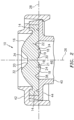
- a septum is indicated generally by the reference numeral 10.
- the septum 10 is penetrable by a needle 12 or other penetrating element, and as described further below, is decontaminated by interaction between the septum and penetrating element.
- the septum 10 comprises a peripheral portion 14 extending about a periphery of the septum, an exterior surface 16 located on one side of the septum, and an interior surface 18 located on an opposite side of the septum.
- a penetration area or portion 20 of the septum extends between the exterior and interior surfaces 16 and 18, respectively, is spaced inwardly of the peripheral portion 14, and is penetrable by the needle 12 or other penetrating element.
- a flex portion 22 of the septum is located between the penetration portion 20 and the peripheral portion 14.
- a thicker portion 24 of the septum extends between the flex portion 22 and the penetration portion 20, and defines an increased thickness between the exterior and interior surfaces 16 and 18, respectively, relative to the flex portion 22.
- the flex portion 22 is flexible inwardly relative to the peripheral portion 14 during penetration of the penetration portion 20 by the needle 12 or other penetration element, and as described further below, the penetration portion 20 physically interacts with and decontaminates the needle 12 or other penetration element.
- the thicker portion 24 extends annularly about the penetration portion 20.
- the septum 10 defines an axis of symmetry 26, the flex portion 22 is located on one side of a plane 28 that is substantially normal to the axis of symmetry 26, and at least a portion of the interior surface 18 defining the thicker portion 24 is located on an opposite side of the plane 28 relative to the flex portion.
- the interior surface 18 of the thicker portion 24 is spaced below the plane 28, and the interior surface of the flex portion 22 is spaced above the plane.
- the thicker portion 24 is defined by a curvilinear-shaped interior surface 18. In the illustrated embodiment, the thicker portion 24 is defined by a substantially dome-shaped interior surface 18.
- the dome-shaped thicker portion is defined by a substantially toroidal-shaped interior surface 21 formed on the underside of the septum, and includes a recess 30 on the underside of the penetration portion 20.
- the surface may also be semi-toroidal, partially toroidal, or any other configuration known to those of skill in the art having the characteristics described herein.
- the term toroidal shaped is used in the remainder of this application to include semi-toroidal and partial toroidal shapes.
- the toroidal-shaped thicker portion 24 is substantially convex-shaped in cross section, and defines in cross section two substantially convex, downwardly depending lobes 19 with the recess 30 formed therebetween. As shown in FIG.
- each lobe 19 is defined by a single radial curve "R." As shown in FIGS. 2 and 3 , the toroidal-shaped lobes 19 extend downwardly below the plane 28, whereas the flex portion 22 is located above the plane 28. As shown typically in FIG. 3 , the thicker portion 24 defines a thickness T1 in the axial direction that is greater than the thickness T2 of the flex portion 22 in the axial direction.
- the thickness T1 may beat least about 10% greater, can be at least about 20% greater, can also be at least about 25% greater, and can even beat least about 30% greater, than the thickness T2.
- the additional thickness provided by the thickness T1 coupled with the radial curvature of R (or other substantially dome-shaped or substantially toroidal-shaped configuration), reduces the strain on the interior surface as compared to the exterior surface at the penetration site, provides an annular zone or ring of safety between the exterior and interior surfaces at the penetration site, and facilitates formation of the annular ring of relatively high radial pressure for wiping and decontaminating the needle or other penetration element during penetration.
- the thicker portion 24 of the septum may take any of numerous different configurations or shapes that are currently known or that later become known.
- the interior surface could be a convex shape without the recess at the penetration portion, such as a convex shape defined by a single radius of curvature.
- the penetration portion 20 defines a reduced thickness between the exterior and interior surfaces 16 and 18, respectively, as compared to the thicker portion 24.
- the exterior surface 16 is both substantially dome-shaped and substantially convex-shaped.
- the penetration portion 20 is defined by a recess 32 in the exterior surface.
- the recess 32 is substantially frustoconically-shaped.
- the recess 32 defines an included angle A.
- the included angle A is about equal to or slightly greater than (e.g., about 1/2° to about 10° greater than) the included angle of the tip 36 of the needle 20.
- the recess 32 defines a substantially planar base portion 34 forming a penetrable exterior surface of the penetration portion 20.
- the penetration portion 20 may take any of numerous different configurations or shapes that are currently known or that later become known.
- the exterior surface 16 of the septum may define a dome shape without a recess at the penetration portion (e.g., with a substantially flat or dome shape at the penetration portion), or with a different recess shape or configuration than that shown.
- a conically-shaped recess is that it allows the penetration portion to substantially mate with or contact the needle tip when the needle tip engages the septum to facilitate intimate contact between the penetration portion and needle tip and to thereby enhance the wiping and decontamination effect.
- the recess (on both the upper and underside of the penetration portion) provides for a reduced thickness at the base 34 of the penetration portion and, in turn, allows for a reduced penetration force by the needle as compared to septa defining thicker penetration portions. This reduced penetration force can assist in preventing invagination, curling, or rolling inwardly at the penetration hole about the needle.
- the flex portion 22 includes an annular recess or groove 38 in the interior surface 18 extending about the thicker portion 24 between the thicker portion and the peripheral portion 14.
- the groove 38 extends annularly about the thicker portion 24 and extends radially between the peripheral portion 14 and the thicker portion 24.
- the groove 38 is substantially v-shaped in cross-section.
- the groove or recess of the flex portion may take any of numerous different shapes or configurations that are currently known, or that later become known, such as a u-shape or a concave shape, so as to facilitate flexing of the septum and engagement of the needle or like penetrating element 12 by the thicker portion 24 during penetration of the penetration portion 20.
- the thicker portion 24 extends below the base of the annular recess 38 of the flex portion 22 by an axial thickness T3.
- the additional thickness T3 can be at least about 5%, at least about 10%, at least about 15%, and even at least about 20%, of the thickness T1 of the thicker portion 24.
- the septum 10 is fixedly secured to the mouth of a vial 40 by a snap ring 42.
- the peripheral portion 14 is seated on an annular flange 44 at the mouth of the vial, and is compressed between the snap ring 42 and mounting flange 44 to form a compression seal and thereby seal a sterile interior chamber 46 of the vial from ambient atmosphere, such as to form a hermetic seal.
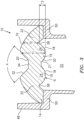
- a septum 10 is mounted with a port 48 of a pouch (not shown).
- the peripheral portion 14 of the septum is seated on an annular flange 50 of the port 48 to thereby seal a sterile interior chamber 52 of the pouch from the ambient atmosphere, such as to form a hermetic seal.
- the peripheral portion 14 need not be compressed.
- the peripheral portion 14 (along with the septum itself) is co-molded with the port, such as by over-molding the septum and its peripheral portion 14 to the annular flange 50 of the port to thereby fixedly secure, and seal the peripheral portion of the septum to the mounting flange of the port.
- the septa of FIGS. 2 and 3 are the same in material respects except for the shape of the peripheral portion 14. In FIGS.
- the peripheral portion 14 is configured for mounted to the vial 40 and forming a compression seal between the vial mounting surface 44 and snap ring 42; whereas in FIG. 3 , the peripheral portion 14 is configured for comolding with the annular flange 50 of the port 48.
- the peripheral portion may take any of numerous different shapes or configuration that are currently known, or that later become known, to allow use of the septa with any of numerous different devices that are currently known or that later become known, and to allow attachment of the septa to any such device in accordance with any of numerous different processes or mechanisms that are currently known, or that later become known.
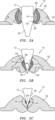
- FIGS. 4A through 4C the tip 36 of the needle 12 is shown progressively penetrating through the penetration portion 20 of the septum 10.
- the different shading illustrates the different levels of pressure in and about the penetration portion of the septum during penetration by the needle.
- the innermost, horizontally shaded region 54 is at the highest or a relatively high pressure
- the unshaded zone or region 56 is at a lower pressure than the horizontally shaded zone 54
- the zone or region with vertical shading 58 is at a lower pressure than the unshaded zone or region 56
- the zone or region with hatched shading 60 is at a lower pressure than the zone or region with vertical shading 58
- the zone or region with backward slanted shading 66 is at a lower pressure than the zone or region with hatched shading 60
- the zone or region with forward slanted shading 62 is at a lower pressure than the zone or region with backward slanted shading 66.
- the zones or regions are shown having uniform shading within each zone or region, the pressure within each zone or region may vary.
- the boundaries between each zone and region are demarcated as discrete cut-offs, there may be progressive variations in pressure, i.e., without sharp cut-offs between different zones or regions.
- the following pressures are exerted on the septum or needle in each of the regions or zones: Depiction of Region Pressure (MPa) Horizontal 0.50-0.63 Clear 0.43-0.50 Vertical 0.23-0.43 Hatched 0.14-0.23 Backward Slanted 0.03-0.14 Forward Slanted 0-0.03
- the horizontal or red zone 54 defines an annular zone of relatively high, approximately radial pressure between the exterior surface 16 of the penetration portion 20 and the needle 36, as compared to the approximately radial pressure in the forward slanted or purple zone 62 between the interior surface 18 of the penetration portion 20 and the needle 12, during penetration by the needle.
- the portion of the septum surrounding recess 32 provides a radially-inward force against the needle. This force creates friction with the needle 12 that wipes the needle 12 when it is inserted.
- the annular ring of relatively high pressure at the interface of the interior surface of the penetration portion and the needle wipes the entire surface of the needle as it penetrates through the penetration portion.
- the annular ring of approximately radially directed, relatively high pressure causes the penetration portion to wipe the surface(s) of the needle, and thereby decontaminate the needle through such physical interaction between the septum and penetrating element.
- the thicker portion 24 of the septum reduces the strain on the interior surface 18 of the penetration portion as compared to the exterior surface 16 of the penetration portion during penetration by the needle 12. This is demonstrated in FIGS. 4A-C by the lower radial pressure at the interior surface 18 of the septum as compared to the exterior surface 16.
- the exterior surface 16 is restricted or prevented from invaginating, curling or rolling inwardly due to downward deformation of the septum 10 by the downward force of the needle 12 at the penetration hole about the needle. This, in turn, prevents or reduces any germs, bacteria or other contaminants on the exterior surface at the penetration hole from being placed in communication with, and contaminating the interior of the septum, or the interior chamber of the device that the septum is mounted to.
- the thicker portion 24 spaces the exterior surface 16 at the penetration portion 20 from the interior surface 18 thereof during penetration by the needle 12 to thereby provide an annular zone or ring of safety 64 between the exterior and interior surfaces 16, 18 where the needle 12 penetrates the penetration portion 20.
- the needle 12 As the needle 12 penetrates the penetration portion, it stretches the material of the penetration portion, thereby reducing the cross-sectional thickness of the penetration portion 20 at the interface between the needle and penetration portion 20.
- the additional thickness T1 provided by the thicker portion 24 about the penetration portion 20 maintains sufficient spacing between the exterior and interior surfaces 16 and 18, respectively, at the interface between the needle 12 and the septum 10, to thereby provide a ring or zone of safety 64 that prevents or reduces any germs, bacteria or other contaminants that might exist on the exterior surface 16 from migrating or otherwise passing through to the interior surface 18 of the septum 10.
- the relatively high pressure interface between the septum 10 and needle 12 provides a relatively high pressure wiping wave along the surfaces of the needle as it penetrates through the penetration portion 20 of the septum 10 to thereby decontaminate the surfaces through physical interaction, such as by the stress and friction at the interface.
- This wiping wave is further illustrated by the progressive movement of the highest pressure zone 54 from lowest portion of the tip 36 in FIG 4A , to an intermediate portion in FIG. 4B , to an upper portion of the tip in FIG. 4C . Contaminants are carried by this wiping wave from the bottom of tip 36 to a point within the ring or zone of safety 64, and ultimately away from the interior surface 18 of the septum 10.
- FIGS. 5A-5C the tip 36 of the needle 12 is shown progressively withdrawing from the penetration portion 20 of the septum 10.
- the different types of shading illustrate the different levels of pressure in and about the penetration portion of the septum during withdrawal of the needle.
- the same patterns of shading that were used in FIGS. 4A-4C are used in FIGS. 5A-5C .
- the zones or regions are shown having uniform shading within each zone or region, the pressure within each zone or region may vary.
- the boundaries between each zone and region are demarcated as discrete cut-offs, there may be progressive variations in pressure, i.e., without sharp cut-offs between different zones or regions.
- liquid film can remain on the surface of the needle.
- this liquid film could become exposed to the atmosphere and pick up contaminants. These contaminants could, in turn, flow through the liquid film and into the container, e.g., by dripping, thus contaminating the substance in the container.
- FIGS. 5A-5C prevents or reduces this retrograde contamination.
- ring of safety 64 maintains a tight seal of material against the needle, helping to prevent liquid or contaminants from passing through the ring of safety into the container.
- the aperture formed by the penetration of the needle 12 closes from an interior to an exterior direction. That is, the bottom portion of the septum (near interior surface 18) is sealed, even though the needle remains within the upper portion of the septum 10 (near exterior surface 16).
- the radial force exerted by the septum which is greater than merely the restorative force of the elastic of the septum, closes the hole in the septum.
- the tapered shape of the needle facilitates this closure by causing the needle to be withdrawn from the septum progressively. As the needle is further withdrawn, correspondingly higher portions of the septum (toward the exterior surface 16) are sealed.
- the septum design including recess 32, generates a wiping action.
- the configuration of the septum e.g., the ring of safety, causes the septum to exert a radially-inward force against the needle that is greater than merely the elastic restorative force of the septum material.
- This radially-inward force in combination with the progressive (upward) closing of the hole in the septum, creates a wiping wave that wipes the needle in an upward direction, toward the exterior of the septum, and pushes liquid film and contaminants on the needle or at the interface of the septum 10 and needle 12 upwardly and outwardly out of the septum aperture.
- FIGS. 5A-5C show the region of higher pressure / ring of safety progressing toward the exterior surface 16 of the septum 10 as the needle 12 is withdrawn.
- the resulting needle or penetration hole in the septa is self-resealed.
- This self-resealing occurs due to the elastic nature of the septum material, and the radial compression applied to such hole due to the dome or other curvilinear shapes of the exterior and/or interior surfaces of the septum.
- the self-resealing feature further protects the interior of the container from contamination.
- the septa of the present invention may take the form or appearance of any septum that having the above-described features.
- the septa may take the appearance of any of the septa disclosed in U.S. Patent Application No. 29/539,571, entitled “Septum,” filed September 15, 2015 .
- the septa of the present invention may be used with or in any of numerous different devices, filled in any of numerous different filling apparatus, and filled in accordance with any of numerous different filling methods, including the devices, apparatus and methods disclosed in the following co-pending patent applications: U.S. Patent Application No. 14/214,890, filed March 15, 2014 , which claims benefit under 35 U.S.C. ⁇ 119(e) to U.S. Provisional Patent Application No. 61/798,210, filed March 15, 2013 ; U.S. Patent Application No. 14/990,778, filed January 7, 2016 , which claims benefit under 35 U.S.C. ⁇ 119(e) to U.S. Provisional Patent Application No. 62/100,725, filed January 7, 2015 ; U.S.
- septa of the present invention may be used in or as part of any of numerous different sterile connectors or other types of connectors, including any of the connectors disclosed in the following co-pending patent applications: U.S. Patent Application No. 13/864,919, filed April 17, 2014 , which claims benefit under 35 U.S.C. ⁇ 119(e) to U.S. Provisional Patent Application No.
- the septa may be made of any of numerous different materials, such as any of numerous different natural or synthetic elastic materials, such as rubber, thermoplastic, silicone, or any of numerous different combinations or blends of one or more of the foregoing, that are currently known.
- the external shape and appearance of the septa may differ from the external shape and/or appearance illustrated herein.
- the septa may be configured for resealing with any of numerous different resealing mechanisms or processes that are currently known.
- the septa may be configured for resealing through use of a liquid sealant, as disclosed in U.S. Patent Application No. 13/861,502, filed April 12, 2013 , now U.S. Patent No. 8,966,866, issued March 3, 2015 .
- the septa may also be configured for resealing by mechanical, chemical or thermal resealing, where the thermal resealing may be induced with any of numerous different energy sources or devices that are currently known or that later become known, such as by laser or ultrasonic mechanisms.
Landscapes
- Health & Medical Sciences (AREA)
- Pharmacology & Pharmacy (AREA)
- Life Sciences & Earth Sciences (AREA)
- Animal Behavior & Ethology (AREA)
- General Health & Medical Sciences (AREA)
- Public Health (AREA)
- Veterinary Medicine (AREA)
- Physics & Mathematics (AREA)
- Fluid Mechanics (AREA)
- Infusion, Injection, And Reservoir Apparatuses (AREA)
- Medical Preparation Storing Or Oral Administration Devices (AREA)
Claims (15)
- Septum (10) comprenant :une section périphérique (14) s'étendant autour d'une périphérie du septum (10), une surface extérieure (16) située sur une face extérieure du septum (10), et une surface intérieure (18) située sur une face opposée du septum (10) ;une section de pénétration non percée (20) pénétrable par une aiguille (12) ou un autre élément de pénétration s'étendant entre les surfaces extérieure et intérieure (16,18) et qui est espacée vers l'intérieur de la section périphérique (14) et est pénétrable par l'aiguille (12) ou un autre élément de pénétration ;une section de flexion (22) située entre la section de pénétration (20) et la section périphérique (14) ; etune section à épaisseur accrue (24) s'étendant entre la section de flexion (22) et la section de pénétration (20), et définissant une épaisseur accrue entre les surfaces extérieure et intérieure (16,18) par rapport à la section de flexion (22), la section de flexion (22) étant flexible vers l'intérieur par rapport à la section périphérique (14) pendant la pénétration de la section de pénétration (20) par une aiguille (12) ou un autre élément de pénétration, et la section de pénétration (20) interagissant physiquement avec et décontaminant l'aiguille (12) ou l'autre élément de pénétration ;le septum (10) étant configuré pour décontaminer une aiguille (12) ou un autre élément de pénétration pendant la pénétration de la section de pénétration (20) avec celle-ci par interaction entre le septum (10) et ladite aiguille (12) ou l'autre élément de pénétration.
- Septum (10) selon la revendication 1, dans lequel la section à épaisseur accrue (24) est définie par une surface intérieure (18) qui est (a) sensiblement en forme de dôme, (b) toroïdale, semi-toroïdale ou partiellement toroïdale par sa forme ; et/ou (c) de forme curviligne.
- Septum (10) selon la revendication 1 ou 2, dans lequel la section de pénétration (20) définit une épaisseur réduite entre les surfaces extérieure et intérieure (16,18) comparativement à la section à épaisseur accrue (24) .
- Septum (10) selon l'une quelconque des revendications 1 à 3, dans lequel la section de pénétration (20) définit un retrait (32) dans la surface extérieure (16), le retrait (32) étant sensiblement de forme conique, étant sensiblement de forme frustoconique, ou définissant une base sensiblement planaire (34) formant une surface extérieure pénétrable de la section de pénétration (20) .
- Septum (10) selon l'une quelconque des revendications 1 à 4, dans lequel la section de flexion (22) inclut un retrait ou une gorge (38) dans la surface intérieure (18) s'étendant autour de la section à épaisseur accrue (24) entre la section à épaisseur accrue (24) et la section périphérique (14), de préférence s'étendant annulairement autour de la section à épaisseur accrue (24) et radialement entre la section périphérique (14) et la section à épaisseur accrue (24), le retrait ou la gorge (38) de la section de flexion (22) étant plus préférentiellement sensiblement en forme de V, sensiblement en forme de U ou sensiblement en forme concave en section transversale.
- Septum (10) selon la revendication 5, dans lequel la surface intérieure de la section à épaisseur accrue (24) s'étend axialement depuis une base du retrait ou de la gorge (38) de la section de flexion (22) dans un sens opposé à la surface extérieure (16) et définit ainsi une épaisseur accrue (T1) autour de la section de pénétration (20) .
- Septum (10) selon l'une quelconque des revendications 1 à 6, dans lequel la section à épaisseur accrue (24) est configurée pour (i) réduire la contrainte sur la surface intérieure de la section de pénétration (20) comparativement à la surface extérieure de la section de pénétration (20) pendant sa pénétration par l'aiguille (12) ou un autre élément de pénétration ; (ii) appliquer une zone annulaire de pression radiale relativement élevée entre une surface extérieure de la section de pénétration (20) et de l'aiguille (12) ou d'un autre élément de pénétration comparativement à la pression radiale entre une surface intérieure extérieure de la section de pénétration (20) et l'aiguille (12) ou d'un autre élément de pénétration pendant sa pénétration par l'aiguille (12) ou un autre élément de pénétration ; et/ou (iii) espacer la surface extérieure de la section de pénétration (20) de sa surface intérieure pendant sa pénétration par l'aiguille (12) ou un autre élément de pénétration
- Septum (10) selon l'une quelconque des revendications 1 à 7, dans lequel le septum est configuré pour (a) empêcher du liquide ou des contaminants extérieurs aiguille (12) ou un autre élément de pénétration de passer ou de s'écouler vers la surface intérieure (18) du septum (10) lorsque l'aiguille (12) ou un autre élément de pénétration est retiré du septum (10) et/ou (b) déplacer du liquide ou des contaminants depuis (i) une surface extérieure de l'aiguille (12) ou d'un autre élément de pénétration et/ou (ii) la section de pénétration (20) et vers la surface extérieure (16) du septum (10) pendant le retrait de l'aiguille (12) ou d'un autre élément de pénétration hors du septum (10).
- Septum (10) selon l'une quelconque des revendications 1 à 8, dans lequel le septum (10) est configuré pour appliquer sur l'aiguille (12) ou un autre élément de pénétration une pression d'au moins 0,4 MPa.
- Utilisation d'un septum (10) selon l'une quelconque des revendications précédentes, pénétrable par une aiguille ou un autre élément de pénétration, pour décontaminer l'élément de pénétration par interaction.
- Procédé comprenant :la pénétration d'une section de pénétration (20) d'un septum (10) selon l'une quelconque des revendications 1 à 9 avec une aiguille (12) ou un autre élément de pénétration ;pendant ladite étape de pénétration, l'application d'une zone de pression approximativement radiale relativement élevée sur l'aiguille (12) ou un autre élément de pénétration sur ou à proximité de la surface extérieure de la section de pénétration (20), et l'application d'une zone de pression approximativement radiale relativement faible sur l'aiguille (12) ou un autre élément de pénétration sur ou à proximité de la surface intérieure de la section de pénétration (20) ; etl'essuyage progressif d'une surface extérieure de l'aiguille (12) ou d'un autre élément de pénétration au moins dans la zone de pression approximativement radiale relativement élevée lorsque l'aiguille (12) ou un autre élément de pénétration pénètre à travers le septum (10) et ainsi la décontamination de l'aiguille (12) ou d'un autre élément de pénétration qui a pénétré le septum (10).
- Procédé selon la revendication 11, comprenant en outre la réduction de la contrainte et/ou l'application d'une plus faible contrainte sur la surface intérieure de la section de pénétration (20) comparativement à la surface extérieure de la section de pénétration (20) pendant sa pénétration par l'aiguille (12) ou un autre élément de pénétration.
- Procédé selon la revendication 11 ou 12, dans lequel la pression approximativement radiale relativement élevée appliquée pendant l'étape d'application dans la zone de pression radiale relativement élevée est d'au moins 0,4 MPa.
- Procédé selon l'une quelconque des revendications 11 à 13, comprenant en outre :le retrait de l'aiguille (12) ou d'un autre élément de pénétration hors du septum (10) ;pendant ladite étape de retrait, l'application d'une zone de pression approximativement radiale relativement élevée sur l'aiguille (12) ou un autre élément de pénétration sur ou à proximité de la surface extérieure de la section de pénétration (20), et l'application d'une zone de pression approximativement radiale relativement faible sur l'aiguille (12) ou un autre élément de pénétration sur ou à proximité de la surface extérieure de la section de pénétration (20) ; etl'essuyage progressif d'une surface extérieure de l'aiguille (12) ou d'un autre élément de pénétration pendant l'étape de retrait en empêchant ainsi du liquide ou des contaminants de passer à travers ou de s'écouler depuis la surface extérieure de la section de pénétration (20) ou une surface extérieure de l'aiguille (12) ou d'un autre élément de pénétration vers la surface intérieure (18) de la section de pénétration (20), l'étape d'essuyage incluant de préférence l'essuyage de l'aiguille (12) ou d'un autre élément de pénétration dans un sens allant d'une surface intérieure (18) du septum (10) vers une surface extérieure (16) du septum (10).
- Procédé selon l'une quelconque des revendications 11 à 14, comprenant en outre le déplacement de liquide ou de contaminants depuis (i) une surface de l'aiguille (12) ou d'un autre élément de pénétration et/ou (ii) de la section de pénétration (20) vers la surface extérieure de la section de pénétration (20) pendant le retrait de l'aiguille (12) ou d'un autre élément de pénétration hors du septum (10).
Applications Claiming Priority (2)
| Application Number | Priority Date | Filing Date | Title |
|---|---|---|---|
| US201562219035P | 2015-09-15 | 2015-09-15 | |
| PCT/US2016/052019 WO2017049015A1 (fr) | 2015-09-15 | 2016-09-15 | Septum qui décontamine par interaction avec un élément de pénétration |
Publications (4)
| Publication Number | Publication Date |
|---|---|
| EP3349713A1 EP3349713A1 (fr) | 2018-07-25 |
| EP3349713A4 EP3349713A4 (fr) | 2019-05-01 |
| EP3349713C0 EP3349713C0 (fr) | 2023-11-01 |
| EP3349713B1 true EP3349713B1 (fr) | 2023-11-01 |
Family
ID=58256980
Family Applications (1)
| Application Number | Title | Priority Date | Filing Date |
|---|---|---|---|
| EP16847342.9A Active EP3349713B1 (fr) | 2015-09-15 | 2016-09-15 | Septum qui décontamine par interaction avec un élément de pénétration |
Country Status (7)
| Country | Link |
|---|---|
| US (2) | US9931274B2 (fr) |
| EP (1) | EP3349713B1 (fr) |
| JP (3) | JP7053456B2 (fr) |
| KR (1) | KR20180054681A (fr) |
| CN (1) | CN108135776B (fr) |
| CA (1) | CA3002966A1 (fr) |
| WO (1) | WO2017049015A1 (fr) |
Families Citing this family (11)
| Publication number | Priority date | Publication date | Assignee | Title |
|---|---|---|---|---|
| JP7053456B2 (ja) * | 2015-09-15 | 2022-04-12 | ドクター ピー インスティチュート エルエルシー | 貫入要素との相互作用によって汚染除去する隔壁 |
| WO2018132540A1 (fr) * | 2017-01-12 | 2018-07-19 | Becton Dickinson and Company Limited | Membrane résistante à la contrainte de système fermé |
| EP3672681B1 (fr) * | 2017-08-22 | 2024-09-25 | Roche Diabetes Care GmbH | Septum auto-obturant |
| US20190076566A1 (en) * | 2017-09-14 | 2019-03-14 | Mikael NAYGAUZ | Decontamination device for pharmaceutical vessels |
| US11467136B2 (en) * | 2017-12-20 | 2022-10-11 | Chromatography Research Supplies, Inc. | Chambered septum |
| USD842351S1 (en) * | 2018-01-23 | 2019-03-05 | Topline Corporation | Toroidal shaped particle impact damper |
| EP4051367A1 (fr) * | 2019-12-12 | 2022-09-07 | Fresenius Medical Care Holdings, Inc. | Orifice d'injection destiné au raccordement à un récipient de fluide médical et ses procédés de production |
| EP4212251A4 (fr) * | 2020-09-10 | 2024-10-16 | Bottless Co., Ltd. | Récipient de stockage et procédé d'injection de liquide en son sein |
| WO2024015088A1 (fr) * | 2022-07-15 | 2024-01-18 | Integrated Liner Technologies, Inc. | Bouchons exempts de substance polyfluoroalkyle |
| WO2024211726A2 (fr) | 2023-04-07 | 2024-10-10 | Integrated Liner Technologies, Inc. | Ensemble capuchon et ses procédés d'utilisation |
| US12526920B1 (en) | 2024-01-12 | 2026-01-13 | Topline Corporation | Indium-niobium superconducting solder columns for cryogenic and quantum computer applications and methods for making same |
Family Cites Families (70)
| Publication number | Priority date | Publication date | Assignee | Title |
|---|---|---|---|---|
| US2364126A (en) | 1941-12-09 | 1944-12-05 | Cantor Abraham | Receptacle closure |
| US2395149A (en) | 1944-09-11 | 1946-02-19 | John E B Shaw | Parenteral bottle construction |
| US3637102A (en) | 1970-05-25 | 1972-01-25 | Continental Can Co | Closures for aseptic filled containers |
| US4545497A (en) | 1984-11-16 | 1985-10-08 | Millipore Corporation | Container cap with frangible septum |
| US4834152A (en) | 1986-02-27 | 1989-05-30 | Intelligent Medicine, Inc. | Storage receptacle sealing and transfer apparatus |
| US4671331A (en) | 1986-03-13 | 1987-06-09 | Lyphomed, Inc. | Cover for medicinal vial |
| US5679399A (en) | 1987-07-17 | 1997-10-21 | Bio Barrier, Inc. | Method of forming a membrane, especially a latex or polymer membrane, including multiple discrete layers |
| US4954149A (en) | 1989-10-25 | 1990-09-04 | Merlin Instrument Company | Injection septum |
| US5632396A (en) | 1993-05-06 | 1997-05-27 | Becton, Dickinson And Company | Combination stopper-shield closure |
| ATE202754T1 (de) | 1994-03-02 | 2001-07-15 | Tl Systems Corp | Füllungsvorrichtung für sterile flaschen |
| US7033339B1 (en) * | 1998-05-29 | 2006-04-25 | Becton Dickinson And Company (Part Interest) | Self sealing luer receiving stopcock |
| US5531810A (en) * | 1994-09-21 | 1996-07-02 | Merlin Instrument Company | Injection septum with dust wiper |
| US5656035A (en) | 1995-04-25 | 1997-08-12 | Avoy; Donald R. | Refillable fibrinogen dispensing kit |
| US5584850A (en) | 1995-05-25 | 1996-12-17 | Applied Medical Resources Corporation | Trocar having an anti-inversion seal |
| US6145688A (en) | 1996-07-17 | 2000-11-14 | Smith; James C. | Closure device for containers |
| US5931828A (en) | 1996-09-04 | 1999-08-03 | The West Company, Incorporated | Reclosable vial closure |
| US5957898A (en) * | 1997-05-20 | 1999-09-28 | Baxter International Inc. | Needleless connector |
| ES2325466T3 (es) * | 1998-05-29 | 2009-09-04 | Lawrence A. Lynn | Receptor luer y metodo para la transferencia de fluidos. |
| US6604561B2 (en) | 2000-02-11 | 2003-08-12 | Medical Instill Technologies, Inc. | Medicament vial having a heat-sealable cap, and apparatus and method for filling the vial |
| US7669390B2 (en) | 2004-03-08 | 2010-03-02 | Medical Instill Technologies, Inc. | Method for molding and assembling containers with stoppers and filling same |
| US7243689B2 (en) | 2000-02-11 | 2007-07-17 | Medical Instill Technologies, Inc. | Device with needle penetrable and laser resealable portion and related method |
| US7707807B2 (en) | 2004-03-08 | 2010-05-04 | Medical Instill Technologies, Inc. | Apparatus for molding and assembling containers with stoppers and filling same |
| US6478775B1 (en) | 2000-10-02 | 2002-11-12 | Genyx Medical Inc. | Device for delivering non-biodegradable bulking composition to a urological site |
| US6387078B1 (en) | 2000-12-21 | 2002-05-14 | Gillespie, Iii Richard D. | Automatic mixing and injecting apparatus |
| JP2003070877A (ja) * | 2001-09-04 | 2003-03-11 | Ohtsu Tire & Rubber Co Ltd :The | 針刺し栓およびその製造方法 |
| US7186236B2 (en) * | 2001-09-07 | 2007-03-06 | Medtronic Minimed, Inc. | Infusion device and inlet structure for same |
| US6902207B2 (en) | 2002-05-01 | 2005-06-07 | Medtronic Minimed, Inc. | Self sealing disconnect device |
| AU2003251594A1 (en) | 2002-06-19 | 2004-01-06 | Medical Instill Technologies, Inc. | Sterile filling machine having needle filling station within e-beam chamber |
| BRPI0313992B1 (pt) | 2002-09-03 | 2015-07-21 | Medical Instill Tech Inc | Conjunto de frasco para armazenar uma substância e métodos para fabricar e encher o mesmo |
| CN101596962B (zh) | 2003-01-28 | 2011-03-23 | 因斯蒂尔医学技术有限公司 | 具有可热封帽的药剂瓶以及灌装该药剂瓶的设备和方法 |
| US7628184B2 (en) | 2003-11-07 | 2009-12-08 | Medical Instill Technologies, Inc. | Adjustable needle filling and laser sealing apparatus and method |
| US7096896B2 (en) | 2004-03-05 | 2006-08-29 | Medical Instill Technologies, Inc. | Apparatus and method for needle filling and laser resealing |
| TWI243064B (en) | 2004-05-21 | 2005-11-11 | Ming-Jeng Shiu | Injector for single use |
| AU2005269529A1 (en) | 2004-07-27 | 2006-02-09 | Eli Lilly And Company | Multiple septum cartridge for medication dispensing device |
| DE102004051300C5 (de) | 2004-10-20 | 2013-01-24 | Fresenius Kabi Deutschland Gmbh | Verschlusskappe für mit medizinischen Flüssigkeiten befüllte Behältnisse |
| CN101107176B (zh) | 2004-12-04 | 2012-04-18 | 因斯蒂尔医学技术有限公司 | 柔性袋和阀的组件以及储存和分配流体的设备和方法 |
| AU2006332049A1 (en) | 2005-01-25 | 2007-08-23 | Medical Instill Technologies, Inc. | Container and closure assembly for a fat containing liquid product |
| US7648491B2 (en) | 2005-05-13 | 2010-01-19 | Bob Rogers | Medical substance transfer system |
| GB0510057D0 (en) | 2005-05-17 | 2005-06-22 | Glaxosmithkline Biolog Sa | Novel device |
| SE528731C2 (sv) | 2005-06-08 | 2007-02-06 | Eco Lean Res & Dev As | Anordning för fyllning av en förpackning av kollapsande slag |
| US7803140B2 (en) * | 2005-07-06 | 2010-09-28 | Icu Medical, Inc. | Medical connector with closeable male luer |
| ATE408557T1 (de) | 2005-07-28 | 2008-10-15 | Indag Gmbh | Vorrichtung und verfahren zum abfüllen |
| US20070225635A1 (en) * | 2006-03-16 | 2007-09-27 | Lynn Lawrence A | Mechanically anti-infective access system and method |
| CA2648750C (fr) | 2006-04-10 | 2012-03-27 | Medical Instill Technologies, Inc. | Conteneur pret a boire avec tetine, partie pouvant etre penetree par une aiguille et liberee au laser, et procede associe |
| US8621944B2 (en) | 2007-04-17 | 2014-01-07 | Siemens Healthcare Diagnostics Inc. | Actuated septa and systems and methods using the same |
| US7967037B2 (en) | 2007-06-14 | 2011-06-28 | Calgary Scale Services (1988) Ltd. | Apparatus and system for dispensing liquids |
| EP2207427B1 (fr) | 2007-10-04 | 2017-05-03 | Medical Instill Technologies, Inc. | Appareil et procédé de formulation et de remplissage aseptique de produits liquides |
| WO2009052521A1 (fr) | 2007-10-18 | 2009-04-23 | Py Daniel C | Récipient comprenant une fermeture et bouchon amovible refermable pour contenir de manière étanche une substance dans celui, et procédé correspondant |
| US8573421B2 (en) | 2007-10-26 | 2013-11-05 | Medical Instill Technologies, Inc. | Dispenser with plural product chambers for separate storage and intermixing of products prior to use, and related method |
| US7905527B1 (en) | 2008-02-11 | 2011-03-15 | The United States Of America As Represented By The Secretary Of The Navy | Harness assembly for use in underwater recovery operations |
| US8613367B2 (en) | 2008-08-29 | 2013-12-24 | Saint-Gobain Performance Plastics Corporation | Sealing assembly and method of making such assembly |
| US8454579B2 (en) * | 2009-03-25 | 2013-06-04 | Icu Medical, Inc. | Medical connector with automatic valves and volume regulator |
| WO2011006131A1 (fr) | 2009-07-09 | 2011-01-13 | Onpharma Inc. | Procédés et appareil pour tamponner des solutions parentérales |
| JP6282112B2 (ja) | 2010-04-05 | 2018-02-21 | ダニエル ピーワイ | 懸案の屈曲可能リングを備える無菌コネクタ及び方法 |
| WO2011137413A1 (fr) | 2010-04-30 | 2011-11-03 | Medical Instill Technologies, Inc. | Récipient pour produit prêt-à-servir et procédé afférent |
| WO2012013585A1 (fr) | 2010-07-26 | 2012-02-02 | Sanofi-Aventis Deutschland Gmbh | Co-administration de deux médicaments dans une seule injection |
| WO2012145434A1 (fr) | 2011-04-18 | 2012-10-26 | Dr. Py Institute, Llc | Aiguille pourvue d'une fermeture et procédé associé |
| EP2723395B1 (fr) | 2011-06-21 | 2017-08-09 | Daniel Py | Dispositif et procédé de stérilisation d'injection de stérilisant fluide |
| CN104470641B (zh) | 2012-01-20 | 2017-06-27 | 皮博士研究所有限责任公司 | 具有共同模制的封闭件、单向阀、可变容积储存室以及防喷特征的装置及相关方法 |
| KR101775386B1 (ko) | 2012-04-17 | 2017-09-06 | 닥터.피와이 인스터튜트, 엘엘씨 | 자가 폐쇄 커넥터 |
| BR112014027280A2 (pt) | 2012-05-01 | 2017-06-27 | Py Dr Inst Llc | dispositivo para conexão ou enchimento e método |
| US10351271B2 (en) | 2012-05-01 | 2019-07-16 | Dr. Py Institute Llc | Device for connecting or filling and method |
| WO2013176587A1 (fr) | 2012-05-21 | 2013-11-28 | Carmel Pharma Ab | Bouchon de protection |
| JP2015519182A (ja) * | 2012-06-13 | 2015-07-09 | ドクター ピー インスティチュート エルエルシー | 貫通可能隔膜及びクロージャを有する装置、ならびに針 |
| FR2994392B1 (fr) * | 2012-08-10 | 2014-08-08 | Cair L G L | Connecteur a usage medical |
| EP2759285A1 (fr) | 2013-01-28 | 2014-07-30 | Becton Dickinson France | Adaptateur pour couplage avec un récipient médical |
| WO2014145313A2 (fr) * | 2013-03-15 | 2014-09-18 | Dr. Py Institute, Llc | Dispositif et procédé de remplissage contrôlé et non-classifié |
| US9347923B1 (en) | 2015-01-12 | 2016-05-24 | Sandia Corporation | Colorometric detection of water using MOF-polymer films and composites |
| CN107531546B (zh) * | 2015-04-21 | 2020-11-27 | 旭硝子欧洲玻璃公司 | 可化学回火的玻璃板 |
| JP7053456B2 (ja) * | 2015-09-15 | 2022-04-12 | ドクター ピー インスティチュート エルエルシー | 貫入要素との相互作用によって汚染除去する隔壁 |
-
2016
- 2016-09-15 JP JP2018513828A patent/JP7053456B2/ja active Active
- 2016-09-15 CN CN201680060546.3A patent/CN108135776B/zh active Active
- 2016-09-15 KR KR1020187010259A patent/KR20180054681A/ko not_active Withdrawn
- 2016-09-15 US US15/267,131 patent/US9931274B2/en active Active
- 2016-09-15 CA CA3002966A patent/CA3002966A1/fr not_active Abandoned
- 2016-09-15 EP EP16847342.9A patent/EP3349713B1/fr active Active
- 2016-09-15 WO PCT/US2016/052019 patent/WO2017049015A1/fr not_active Ceased
-
2018
- 2018-04-03 US US15/944,094 patent/US10688020B2/en active Active
-
2022
- 2022-03-31 JP JP2022057992A patent/JP2022084914A/ja active Pending
-
2023
- 2023-11-13 JP JP2023192724A patent/JP2024010236A/ja active Pending
Also Published As
| Publication number | Publication date |
|---|---|
| JP2018534008A (ja) | 2018-11-22 |
| EP3349713A1 (fr) | 2018-07-25 |
| KR20180054681A (ko) | 2018-05-24 |
| EP3349713C0 (fr) | 2023-11-01 |
| JP2022084914A (ja) | 2022-06-07 |
| WO2017049015A1 (fr) | 2017-03-23 |
| US9931274B2 (en) | 2018-04-03 |
| JP2024010236A (ja) | 2024-01-23 |
| JP7053456B2 (ja) | 2022-04-12 |
| EP3349713A4 (fr) | 2019-05-01 |
| US20170071826A1 (en) | 2017-03-16 |
| CN108135776A (zh) | 2018-06-08 |
| CN108135776B (zh) | 2024-07-30 |
| CA3002966A1 (fr) | 2017-03-23 |
| US20180353378A1 (en) | 2018-12-13 |
| US10688020B2 (en) | 2020-06-23 |
Similar Documents
| Publication | Publication Date | Title |
|---|---|---|
| US10688020B2 (en) | Septum that decontaminates by interaction with penetrating element | |
| US8783484B2 (en) | Septa | |
| KR101319416B1 (ko) | 용기 어셈블리 및 그 압력 반응성 관통가능한 캡 | |
| CA2243408C (fr) | Fermeture etanche de caoutchouc pour seringue/contenant | |
| US6662957B2 (en) | Container having closure with elastomeric diaphragm and barrier cup | |
| KR101215752B1 (ko) | 의료용 액체가 채워지는 수용기용 밀폐 캡 | |
| US5314084A (en) | Two piece all plastic seal | |
| RU2464211C1 (ru) | Повторно закрываемая торцевая крышка банки с поворотным открывающе-закрывающим ушком и банка для напитка, оснащенная повторно закрываемой торцевой крышкой | |
| KR102491967B1 (ko) | 양압음료용 밀폐용기 및 그 제조방법 | |
| EP3447000B1 (fr) | Bouchon et récipient de décharge | |
| NZ247767A (en) | Infusion stopper and spike for parenteral liquid in vial: inwardly directed annular protrusion on stopper skirt portion forms secondary seal with spike | |
| JP2015051375A5 (ja) | 充填方法および容器、再封止可能部材 | |
| CN105073590B (zh) | 用于封闭流体制剂容器的固定装置 | |
| US20220023609A1 (en) | Dual ended disinfecting cap for stopcock valves | |
| JP2018534008A5 (fr) | ||
| JP6168272B2 (ja) | 口部密封機構 | |
| US20030201239A1 (en) | Radially compressed self-sealing septum | |
| JP2024510885A (ja) | 薬剤の管理用容器を閉鎖するためのキャップ及びその製造方法 | |
| WO2025261886A1 (fr) | Cartouche contenant un fluide pharmaceutique et procédé de fermeture d'une seconde ouverture de la cartouche | |
| NZ206470A (en) | Moulded plastics press-in nozzle for metal container |
Legal Events
| Date | Code | Title | Description |
|---|---|---|---|
| STAA | Information on the status of an ep patent application or granted ep patent |
Free format text: STATUS: THE INTERNATIONAL PUBLICATION HAS BEEN MADE |
|
| PUAI | Public reference made under article 153(3) epc to a published international application that has entered the european phase |
Free format text: ORIGINAL CODE: 0009012 |
|
| STAA | Information on the status of an ep patent application or granted ep patent |
Free format text: STATUS: REQUEST FOR EXAMINATION WAS MADE |
|
| 17P | Request for examination filed |
Effective date: 20180413 |
|
| AK | Designated contracting states |
Kind code of ref document: A1 Designated state(s): AL AT BE BG CH CY CZ DE DK EE ES FI FR GB GR HR HU IE IS IT LI LT LU LV MC MK MT NL NO PL PT RO RS SE SI SK SM TR |
|
| AX | Request for extension of the european patent |
Extension state: BA ME |
|
| DAV | Request for validation of the european patent (deleted) | ||
| DAX | Request for extension of the european patent (deleted) | ||
| A4 | Supplementary search report drawn up and despatched |
Effective date: 20190401 |
|
| RIC1 | Information provided on ipc code assigned before grant |
Ipc: A61J 1/14 20060101AFI20190326BHEP Ipc: A61J 1/20 20060101ALI20190326BHEP Ipc: G01N 30/18 20060101ALI20190326BHEP Ipc: A61M 39/04 20060101ALI20190326BHEP |
|
| REG | Reference to a national code |
Ref country code: HK Ref legal event code: DE Ref document number: 1258828 Country of ref document: HK |
|
| GRAP | Despatch of communication of intention to grant a patent |
Free format text: ORIGINAL CODE: EPIDOSNIGR1 |
|
| STAA | Information on the status of an ep patent application or granted ep patent |
Free format text: STATUS: GRANT OF PATENT IS INTENDED |
|
| INTG | Intention to grant announced |
Effective date: 20230509 |
|
| GRAS | Grant fee paid |
Free format text: ORIGINAL CODE: EPIDOSNIGR3 |
|
| GRAA | (expected) grant |
Free format text: ORIGINAL CODE: 0009210 |
|
| STAA | Information on the status of an ep patent application or granted ep patent |
Free format text: STATUS: THE PATENT HAS BEEN GRANTED |
|
| AK | Designated contracting states |
Kind code of ref document: B1 Designated state(s): AL AT BE BG CH CY CZ DE DK EE ES FI FR GB GR HR HU IE IS IT LI LT LU LV MC MK MT NL NO PL PT RO RS SE SI SK SM TR |
|
| REG | Reference to a national code |
Ref country code: GB Ref legal event code: FG4D |
|
| REG | Reference to a national code |
Ref country code: CH Ref legal event code: EP |
|
| REG | Reference to a national code |
Ref country code: DE Ref legal event code: R096 Ref document number: 602016083900 Country of ref document: DE |
|
| REG | Reference to a national code |
Ref country code: IE Ref legal event code: FG4D |
|
| U01 | Request for unitary effect filed |
Effective date: 20231129 |
|
| U07 | Unitary effect registered |
Designated state(s): AT BE BG DE DK EE FI FR IT LT LU LV MT NL PT SE SI Effective date: 20231212 |
|
| PG25 | Lapsed in a contracting state [announced via postgrant information from national office to epo] |
Ref country code: GR Free format text: LAPSE BECAUSE OF FAILURE TO SUBMIT A TRANSLATION OF THE DESCRIPTION OR TO PAY THE FEE WITHIN THE PRESCRIBED TIME-LIMIT Effective date: 20240202 |
|
| PG25 | Lapsed in a contracting state [announced via postgrant information from national office to epo] |
Ref country code: IS Free format text: LAPSE BECAUSE OF FAILURE TO SUBMIT A TRANSLATION OF THE DESCRIPTION OR TO PAY THE FEE WITHIN THE PRESCRIBED TIME-LIMIT Effective date: 20240301 |
|
| PG25 | Lapsed in a contracting state [announced via postgrant information from national office to epo] |
Ref country code: ES Free format text: LAPSE BECAUSE OF FAILURE TO SUBMIT A TRANSLATION OF THE DESCRIPTION OR TO PAY THE FEE WITHIN THE PRESCRIBED TIME-LIMIT Effective date: 20231101 |
|
| PG25 | Lapsed in a contracting state [announced via postgrant information from national office to epo] |
Ref country code: IS Free format text: LAPSE BECAUSE OF FAILURE TO SUBMIT A TRANSLATION OF THE DESCRIPTION OR TO PAY THE FEE WITHIN THE PRESCRIBED TIME-LIMIT Effective date: 20240301 Ref country code: GR Free format text: LAPSE BECAUSE OF FAILURE TO SUBMIT A TRANSLATION OF THE DESCRIPTION OR TO PAY THE FEE WITHIN THE PRESCRIBED TIME-LIMIT Effective date: 20240202 Ref country code: ES Free format text: LAPSE BECAUSE OF FAILURE TO SUBMIT A TRANSLATION OF THE DESCRIPTION OR TO PAY THE FEE WITHIN THE PRESCRIBED TIME-LIMIT Effective date: 20231101 |
|
| PG25 | Lapsed in a contracting state [announced via postgrant information from national office to epo] |
Ref country code: RS Free format text: LAPSE BECAUSE OF FAILURE TO SUBMIT A TRANSLATION OF THE DESCRIPTION OR TO PAY THE FEE WITHIN THE PRESCRIBED TIME-LIMIT Effective date: 20231101 Ref country code: PL Free format text: LAPSE BECAUSE OF FAILURE TO SUBMIT A TRANSLATION OF THE DESCRIPTION OR TO PAY THE FEE WITHIN THE PRESCRIBED TIME-LIMIT Effective date: 20231101 Ref country code: NO Free format text: LAPSE BECAUSE OF FAILURE TO SUBMIT A TRANSLATION OF THE DESCRIPTION OR TO PAY THE FEE WITHIN THE PRESCRIBED TIME-LIMIT Effective date: 20240201 Ref country code: HR Free format text: LAPSE BECAUSE OF FAILURE TO SUBMIT A TRANSLATION OF THE DESCRIPTION OR TO PAY THE FEE WITHIN THE PRESCRIBED TIME-LIMIT Effective date: 20231101 |
|
| PG25 | Lapsed in a contracting state [announced via postgrant information from national office to epo] |
Ref country code: CZ Free format text: LAPSE BECAUSE OF FAILURE TO SUBMIT A TRANSLATION OF THE DESCRIPTION OR TO PAY THE FEE WITHIN THE PRESCRIBED TIME-LIMIT Effective date: 20231101 |
|
| PG25 | Lapsed in a contracting state [announced via postgrant information from national office to epo] |
Ref country code: SK Free format text: LAPSE BECAUSE OF FAILURE TO SUBMIT A TRANSLATION OF THE DESCRIPTION OR TO PAY THE FEE WITHIN THE PRESCRIBED TIME-LIMIT Effective date: 20231101 |
|
| PG25 | Lapsed in a contracting state [announced via postgrant information from national office to epo] |
Ref country code: SM Free format text: LAPSE BECAUSE OF FAILURE TO SUBMIT A TRANSLATION OF THE DESCRIPTION OR TO PAY THE FEE WITHIN THE PRESCRIBED TIME-LIMIT Effective date: 20231101 Ref country code: SK Free format text: LAPSE BECAUSE OF FAILURE TO SUBMIT A TRANSLATION OF THE DESCRIPTION OR TO PAY THE FEE WITHIN THE PRESCRIBED TIME-LIMIT Effective date: 20231101 Ref country code: RO Free format text: LAPSE BECAUSE OF FAILURE TO SUBMIT A TRANSLATION OF THE DESCRIPTION OR TO PAY THE FEE WITHIN THE PRESCRIBED TIME-LIMIT Effective date: 20231101 Ref country code: CZ Free format text: LAPSE BECAUSE OF FAILURE TO SUBMIT A TRANSLATION OF THE DESCRIPTION OR TO PAY THE FEE WITHIN THE PRESCRIBED TIME-LIMIT Effective date: 20231101 |
|
| REG | Reference to a national code |
Ref country code: DE Ref legal event code: R097 Ref document number: 602016083900 Country of ref document: DE |
|
| PLBE | No opposition filed within time limit |
Free format text: ORIGINAL CODE: 0009261 |
|
| STAA | Information on the status of an ep patent application or granted ep patent |
Free format text: STATUS: NO OPPOSITION FILED WITHIN TIME LIMIT |
|
| 26N | No opposition filed |
Effective date: 20240802 |
|
| U20 | Renewal fee for the european patent with unitary effect paid |
Year of fee payment: 9 Effective date: 20240927 |
|
| U1K | Transfer of rights of the unitary patent after the registration of the unitary effect |
Owner name: GETINGE ASEPTIC SOLUTIONS, LLC; US |
|
| PG25 | Lapsed in a contracting state [announced via postgrant information from national office to epo] |
Ref country code: MC Free format text: LAPSE BECAUSE OF FAILURE TO SUBMIT A TRANSLATION OF THE DESCRIPTION OR TO PAY THE FEE WITHIN THE PRESCRIBED TIME-LIMIT Effective date: 20231101 |
|
| REG | Reference to a national code |
Ref country code: CH Ref legal event code: PL |
|
| REG | Reference to a national code |
Ref country code: GB Ref legal event code: 732E Free format text: REGISTERED BETWEEN 20250417 AND 20250423 |
|
| PG25 | Lapsed in a contracting state [announced via postgrant information from national office to epo] |
Ref country code: CH Free format text: LAPSE BECAUSE OF NON-PAYMENT OF DUE FEES Effective date: 20240930 |
|
| PG25 | Lapsed in a contracting state [announced via postgrant information from national office to epo] |
Ref country code: IE Free format text: LAPSE BECAUSE OF NON-PAYMENT OF DUE FEES Effective date: 20240915 |
|
| PGFP | Annual fee paid to national office [announced via postgrant information from national office to epo] |
Ref country code: GB Payment date: 20250827 Year of fee payment: 10 |
|
| U20 | Renewal fee for the european patent with unitary effect paid |
Year of fee payment: 10 Effective date: 20250929 |
|
| PG25 | Lapsed in a contracting state [announced via postgrant information from national office to epo] |
Ref country code: CY Free format text: LAPSE BECAUSE OF FAILURE TO SUBMIT A TRANSLATION OF THE DESCRIPTION OR TO PAY THE FEE WITHIN THE PRESCRIBED TIME-LIMIT; INVALID AB INITIO Effective date: 20160915 |
|
| PG25 | Lapsed in a contracting state [announced via postgrant information from national office to epo] |
Ref country code: HU Free format text: LAPSE BECAUSE OF FAILURE TO SUBMIT A TRANSLATION OF THE DESCRIPTION OR TO PAY THE FEE WITHIN THE PRESCRIBED TIME-LIMIT; INVALID AB INITIO Effective date: 20160915 |
|
| REG | Reference to a national code |
Ref country code: HK Ref legal event code: WD Ref document number: 1258828 Country of ref document: HK |
|
| PG25 | Lapsed in a contracting state [announced via postgrant information from national office to epo] |
Ref country code: TR Free format text: LAPSE BECAUSE OF FAILURE TO SUBMIT A TRANSLATION OF THE DESCRIPTION OR TO PAY THE FEE WITHIN THE PRESCRIBED TIME-LIMIT Effective date: 20231101 |