EP3350472B1 - Palier amortisseur muni d'un boîtier et d'un couvercle - Google Patents
Palier amortisseur muni d'un boîtier et d'un couvercle Download PDFInfo
- Publication number
- EP3350472B1 EP3350472B1 EP16763502.8A EP16763502A EP3350472B1 EP 3350472 B1 EP3350472 B1 EP 3350472B1 EP 16763502 A EP16763502 A EP 16763502A EP 3350472 B1 EP3350472 B1 EP 3350472B1
- Authority
- EP
- European Patent Office
- Prior art keywords
- housing
- cover
- damping element
- damper bearing
- contact surfaces
- Prior art date
- Legal status (The legal status is an assumption and is not a legal conclusion. Google has not performed a legal analysis and makes no representation as to the accuracy of the status listed.)
- Active
Links
Images

Classifications
-
- F—MECHANICAL ENGINEERING; LIGHTING; HEATING; WEAPONS; BLASTING
- F16—ENGINEERING ELEMENTS AND UNITS; GENERAL MEASURES FOR PRODUCING AND MAINTAINING EFFECTIVE FUNCTIONING OF MACHINES OR INSTALLATIONS; THERMAL INSULATION IN GENERAL
- F16F—SPRINGS; SHOCK-ABSORBERS; MEANS FOR DAMPING VIBRATION
- F16F1/00—Springs
- F16F1/36—Springs made of rubber or other material having high internal friction, e.g. thermoplastic elastomers
- F16F1/38—Springs made of rubber or other material having high internal friction, e.g. thermoplastic elastomers with a sleeve of elastic material between a rigid outer sleeve and a rigid inner sleeve or pin, i.e. bushing-type
-
- F—MECHANICAL ENGINEERING; LIGHTING; HEATING; WEAPONS; BLASTING
- F16—ENGINEERING ELEMENTS AND UNITS; GENERAL MEASURES FOR PRODUCING AND MAINTAINING EFFECTIVE FUNCTIONING OF MACHINES OR INSTALLATIONS; THERMAL INSULATION IN GENERAL
- F16F—SPRINGS; SHOCK-ABSORBERS; MEANS FOR DAMPING VIBRATION
- F16F9/00—Springs, vibration-dampers, shock-absorbers, or similarly-constructed movement-dampers using a fluid or the equivalent as damping medium
- F16F9/32—Details
- F16F9/3271—Assembly or repair
-
- B—PERFORMING OPERATIONS; TRANSPORTING
- B29—WORKING OF PLASTICS; WORKING OF SUBSTANCES IN A PLASTIC STATE IN GENERAL
- B29C—SHAPING OR JOINING OF PLASTICS; SHAPING OF MATERIAL IN A PLASTIC STATE, NOT OTHERWISE PROVIDED FOR; AFTER-TREATMENT OF THE SHAPED PRODUCTS, e.g. REPAIRING
- B29C65/00—Joining or sealing of preformed parts, e.g. welding of plastics materials; Apparatus therefor
- B29C65/02—Joining or sealing of preformed parts, e.g. welding of plastics materials; Apparatus therefor by heating, with or without pressure
- B29C65/06—Joining or sealing of preformed parts, e.g. welding of plastics materials; Apparatus therefor by heating, with or without pressure using friction, e.g. spin welding
- B29C65/0609—Joining or sealing of preformed parts, e.g. welding of plastics materials; Apparatus therefor by heating, with or without pressure using friction, e.g. spin welding characterised by the movement of the parts to be joined
- B29C65/0636—Orbital
-
- B—PERFORMING OPERATIONS; TRANSPORTING
- B29—WORKING OF PLASTICS; WORKING OF SUBSTANCES IN A PLASTIC STATE IN GENERAL
- B29C—SHAPING OR JOINING OF PLASTICS; SHAPING OF MATERIAL IN A PLASTIC STATE, NOT OTHERWISE PROVIDED FOR; AFTER-TREATMENT OF THE SHAPED PRODUCTS, e.g. REPAIRING
- B29C66/00—General aspects of processes or apparatus for joining preformed parts
- B29C66/90—Measuring or controlling the joining process
-
- B—PERFORMING OPERATIONS; TRANSPORTING
- B60—VEHICLES IN GENERAL
- B60G—VEHICLE SUSPENSION ARRANGEMENTS
- B60G13/00—Resilient suspensions characterised by arrangement, location or type of vibration dampers
- B60G13/001—Arrangements for attachment of dampers
- B60G13/003—Arrangements for attachment of dampers characterised by the mounting on the vehicle body or chassis of the damper unit
-
- C—CHEMISTRY; METALLURGY
- C08—ORGANIC MACROMOLECULAR COMPOUNDS; THEIR PREPARATION OR CHEMICAL WORKING-UP; COMPOSITIONS BASED THEREON
- C08G—MACROMOLECULAR COMPOUNDS OBTAINED OTHERWISE THAN BY REACTIONS ONLY INVOLVING UNSATURATED CARBON-TO-CARBON BONDS
- C08G18/00—Polymeric products of isocyanates or isothiocyanates
- C08G18/06—Polymeric products of isocyanates or isothiocyanates with compounds having active hydrogen
- C08G18/08—Processes
- C08G18/14—Manufacture of cellular products
-
- C—CHEMISTRY; METALLURGY
- C08—ORGANIC MACROMOLECULAR COMPOUNDS; THEIR PREPARATION OR CHEMICAL WORKING-UP; COMPOSITIONS BASED THEREON
- C08K—Use of inorganic or non-macromolecular organic substances as compounding ingredients
- C08K7/00—Use of ingredients characterised by shape
- C08K7/02—Fibres or whiskers
- C08K7/04—Fibres or whiskers inorganic
- C08K7/14—Glass
-
- F—MECHANICAL ENGINEERING; LIGHTING; HEATING; WEAPONS; BLASTING
- F16—ENGINEERING ELEMENTS AND UNITS; GENERAL MEASURES FOR PRODUCING AND MAINTAINING EFFECTIVE FUNCTIONING OF MACHINES OR INSTALLATIONS; THERMAL INSULATION IN GENERAL
- F16F—SPRINGS; SHOCK-ABSORBERS; MEANS FOR DAMPING VIBRATION
- F16F1/00—Springs
- F16F1/36—Springs made of rubber or other material having high internal friction, e.g. thermoplastic elastomers
- F16F1/38—Springs made of rubber or other material having high internal friction, e.g. thermoplastic elastomers with a sleeve of elastic material between a rigid outer sleeve and a rigid inner sleeve or pin, i.e. bushing-type
- F16F1/3842—Method of assembly, production or treatment; Mounting thereof
-
- F—MECHANICAL ENGINEERING; LIGHTING; HEATING; WEAPONS; BLASTING
- F16—ENGINEERING ELEMENTS AND UNITS; GENERAL MEASURES FOR PRODUCING AND MAINTAINING EFFECTIVE FUNCTIONING OF MACHINES OR INSTALLATIONS; THERMAL INSULATION IN GENERAL
- F16F—SPRINGS; SHOCK-ABSORBERS; MEANS FOR DAMPING VIBRATION
- F16F9/00—Springs, vibration-dampers, shock-absorbers, or similarly-constructed movement-dampers using a fluid or the equivalent as damping medium
- F16F9/32—Details
- F16F9/54—Arrangements for attachment
-
- B—PERFORMING OPERATIONS; TRANSPORTING
- B29—WORKING OF PLASTICS; WORKING OF SUBSTANCES IN A PLASTIC STATE IN GENERAL
- B29K—INDEXING SCHEME ASSOCIATED WITH SUBCLASSES B29B, B29C OR B29D, RELATING TO MOULDING MATERIALS OR TO MATERIALS FOR MOULDS, REINFORCEMENTS, FILLERS OR PREFORMED PARTS, e.g. INSERTS
- B29K2677/00—Use of PA, i.e. polyamides, e.g. polyesteramides or derivatives thereof, for preformed parts, e.g. for inserts
-
- B—PERFORMING OPERATIONS; TRANSPORTING
- B29—WORKING OF PLASTICS; WORKING OF SUBSTANCES IN A PLASTIC STATE IN GENERAL
- B29L—INDEXING SCHEME ASSOCIATED WITH SUBCLASS B29C, RELATING TO PARTICULAR ARTICLES
- B29L2031/00—Other particular articles
- B29L2031/04—Bearings
-
- B—PERFORMING OPERATIONS; TRANSPORTING
- B60—VEHICLES IN GENERAL
- B60G—VEHICLE SUSPENSION ARRANGEMENTS
- B60G2204/00—Indexing codes related to suspensions per se or to auxiliary parts
- B60G2204/10—Mounting of suspension elements
- B60G2204/12—Mounting of springs or dampers
- B60G2204/128—Damper mount on vehicle body or chassis
-
- B—PERFORMING OPERATIONS; TRANSPORTING
- B60—VEHICLES IN GENERAL
- B60G—VEHICLE SUSPENSION ARRANGEMENTS
- B60G2204/00—Indexing codes related to suspensions per se or to auxiliary parts
- B60G2204/40—Auxiliary suspension parts; Adjustment of suspensions
- B60G2204/41—Elastic mounts, e.g. bushings
-
- B—PERFORMING OPERATIONS; TRANSPORTING
- B60—VEHICLES IN GENERAL
- B60G—VEHICLE SUSPENSION ARRANGEMENTS
- B60G2206/00—Indexing codes related to the manufacturing of suspensions: constructional features, the materials used, procedures or tools
- B60G2206/01—Constructional features of suspension elements, e.g. arms, dampers, springs
- B60G2206/70—Materials used in suspensions
- B60G2206/71—Light weight materials
- B60G2206/7101—Fiber-reinforced plastics [FRP]
-
- B—PERFORMING OPERATIONS; TRANSPORTING
- B60—VEHICLES IN GENERAL
- B60G—VEHICLE SUSPENSION ARRANGEMENTS
- B60G2206/00—Indexing codes related to the manufacturing of suspensions: constructional features, the materials used, procedures or tools
- B60G2206/01—Constructional features of suspension elements, e.g. arms, dampers, springs
- B60G2206/70—Materials used in suspensions
- B60G2206/73—Rubber; Elastomers
-
- B—PERFORMING OPERATIONS; TRANSPORTING
- B60—VEHICLES IN GENERAL
- B60G—VEHICLE SUSPENSION ARRANGEMENTS
- B60G2206/00—Indexing codes related to the manufacturing of suspensions: constructional features, the materials used, procedures or tools
- B60G2206/01—Constructional features of suspension elements, e.g. arms, dampers, springs
- B60G2206/80—Manufacturing procedures
- B60G2206/82—Joining
- B60G2206/8201—Joining by welding
- B60G2206/82013—Friction or heat welding
-
- C—CHEMISTRY; METALLURGY
- C08—ORGANIC MACROMOLECULAR COMPOUNDS; THEIR PREPARATION OR CHEMICAL WORKING-UP; COMPOSITIONS BASED THEREON
- C08G—MACROMOLECULAR COMPOUNDS OBTAINED OTHERWISE THAN BY REACTIONS ONLY INVOLVING UNSATURATED CARBON-TO-CARBON BONDS
- C08G2110/00—Foam properties
- C08G2110/0008—Foam properties flexible
-
- C—CHEMISTRY; METALLURGY
- C08—ORGANIC MACROMOLECULAR COMPOUNDS; THEIR PREPARATION OR CHEMICAL WORKING-UP; COMPOSITIONS BASED THEREON
- C08G—MACROMOLECULAR COMPOUNDS OBTAINED OTHERWISE THAN BY REACTIONS ONLY INVOLVING UNSATURATED CARBON-TO-CARBON BONDS
- C08G2110/00—Foam properties
- C08G2110/0041—Foam properties having specified density
- C08G2110/0066—≥ 150kg/m3
-
- C—CHEMISTRY; METALLURGY
- C08—ORGANIC MACROMOLECULAR COMPOUNDS; THEIR PREPARATION OR CHEMICAL WORKING-UP; COMPOSITIONS BASED THEREON
- C08G—MACROMOLECULAR COMPOUNDS OBTAINED OTHERWISE THAN BY REACTIONS ONLY INVOLVING UNSATURATED CARBON-TO-CARBON BONDS
- C08G2350/00—Acoustic or vibration damping material
-
- F—MECHANICAL ENGINEERING; LIGHTING; HEATING; WEAPONS; BLASTING
- F16—ENGINEERING ELEMENTS AND UNITS; GENERAL MEASURES FOR PRODUCING AND MAINTAINING EFFECTIVE FUNCTIONING OF MACHINES OR INSTALLATIONS; THERMAL INSULATION IN GENERAL
- F16F—SPRINGS; SHOCK-ABSORBERS; MEANS FOR DAMPING VIBRATION
- F16F2224/00—Materials; Material properties
- F16F2224/02—Materials; Material properties solids
- F16F2224/0241—Fibre-reinforced plastics [FRP]
-
- F—MECHANICAL ENGINEERING; LIGHTING; HEATING; WEAPONS; BLASTING
- F16—ENGINEERING ELEMENTS AND UNITS; GENERAL MEASURES FOR PRODUCING AND MAINTAINING EFFECTIVE FUNCTIONING OF MACHINES OR INSTALLATIONS; THERMAL INSULATION IN GENERAL
- F16F—SPRINGS; SHOCK-ABSORBERS; MEANS FOR DAMPING VIBRATION
- F16F2224/00—Materials; Material properties
- F16F2224/02—Materials; Material properties solids
- F16F2224/025—Elastomers
-
- F—MECHANICAL ENGINEERING; LIGHTING; HEATING; WEAPONS; BLASTING
- F16—ENGINEERING ELEMENTS AND UNITS; GENERAL MEASURES FOR PRODUCING AND MAINTAINING EFFECTIVE FUNCTIONING OF MACHINES OR INSTALLATIONS; THERMAL INSULATION IN GENERAL
- F16F—SPRINGS; SHOCK-ABSORBERS; MEANS FOR DAMPING VIBRATION
- F16F2226/00—Manufacturing; Treatments
-
- F—MECHANICAL ENGINEERING; LIGHTING; HEATING; WEAPONS; BLASTING
- F16—ENGINEERING ELEMENTS AND UNITS; GENERAL MEASURES FOR PRODUCING AND MAINTAINING EFFECTIVE FUNCTIONING OF MACHINES OR INSTALLATIONS; THERMAL INSULATION IN GENERAL
- F16F—SPRINGS; SHOCK-ABSORBERS; MEANS FOR DAMPING VIBRATION
- F16F2226/00—Manufacturing; Treatments
- F16F2226/04—Assembly or fixing methods; methods to form or fashion parts
- F16F2226/048—Welding
Definitions
- the present invention relates to a damper bearing comprising a hollow housing for receiving a damping element and a cover for fixing the damping element in the housing, the housing and the cover being made of plastic.
- Damper bearings are used in automobiles within the chassis and are generally known. They are used in particular in motor vehicles as vibration-damping components. They take over the connection of the shock absorber to the body and / or chassis components. Such an elastic coupling isolates vibrations that are caused by the road and are transmitted via the wheel and shock absorber, as well as vibrations that are caused by the shock absorber.
- the coupling is designed in such a way that cardanic movements of the shock absorber are made possible and the requirements for force-displacement identifications in the axial, radial and cardanic directions are met.
- axial and radial identifiers significantly influence driving behavior and must be precisely coordinated.
- the interaction of shock absorber and damper bearing has a decisive influence on driving comfort, driving safety, roll and pitch support as well as the reduction in the effects of wheel picking and body tremors.
- damper bearings are known, both with regard to the materials used and with regard to manufacturing processes.
- the damping element is usually placed in a hollow cylindrical housing and then the housing is closed with a cover.
- the housing usually has a collar, into the inner diameter of which the cover is pressed.
- the collar of the housing is higher than the lid.
- the protruding area of the collar is folded over after the cover is pressed on by rolling or flanging.
- the lid is firmly fixed in its position.
- a disadvantage of this known method is that the rolling of the edge of the housing limits the forces which can occur during driving. The strength of the bearing is therefore limited by the strength of the rolled edge. In addition, "rolling up" the edge during continuous operation can limit the durability of the bearing.
- Damper bearings are known as an alternative to fastening the cover by rolling or flanging, in which the cover is otherwise positively connected to the housing, for example in the form of a bayonet catch or by screwing.
- integral connections are known, for example by welding the cover to the housing.
- DE 10 2007 003 207 A1 for example, a damper bearing with a housing, a bearing element and a cover, the bearing element being fixed in the housing by the cover.
- the cover is usually welded to the housing by means of laser beam welding.
- the DE 103 35 956 , DE 10 2007 003 207 A1 , DE 102012 001 299 A1 and the DE 4321 874 A1 name different welding techniques for the connection of elements of a spring construction.
- the object was to provide damper bearings in which a defined pre-compression of the damping element can be set and which are nevertheless easy to manufacture and inexpensive to manufacture.
- Damper bearings comprise a hollow housing for receiving a damping element and a cover which is suitable for fixing the damping element in the housing.
- Housing and cover are made of plastic.
- the connection between the housing and the cover is made cohesively by a welding process which is based on a relative movement between the housing and the cover, orbital welding being used.
- the housing and cover are welded at the contact surfaces provided.
- the contact surfaces of the housing and the cover provided for the integral connection are designed to be rotationally symmetrical.
- the rotational symmetry defines an axis of rotation.
- the terms “radial” and “axial” are used in relation to this axis of rotation.
- the contact surfaces of the housing and the cover are preferably spaced apart from the outer surface of the damping element with respect to the axis of rotation in the radial direction. This ensures that the plastic mass of the weld seam that occurs during welding does not come into direct contact with the damping element, which could have a negative effect on the damping properties.
- the contact surfaces are also separated from the outer surface of the damping element by a separating element. The separating element can completely or partially fill the distance between the damping element and the contact surface.
- the separating element is particularly preferably designed as a groove or web, in particular as an annular groove or annular web.
- the groove or the web can be continuous or interrupted.
- the term “ring-shaped” is not restrictive understand.
- the term “separating element” used in the singular should not be read restrictively in this regard.
- the radial and axial extent of the groove or of the web is preferably dimensioned such that the plastic mass of the weld seam that arises during welding can be at least partially, but in particular completely, absorbed in the volume defined by the contact surfaces and the groove or web.
- the separating element is preferably integrally connected to the housing and / or the cover.
- it can be part of the injection mold with which the housing or cover are produced.
- the contact surfaces of the housing and the cover are conically shaped.
- a distance and / or a separating element can be provided as described above.
- the housing and the lid can be made of the same or different plastics.
- the only requirement is that the respective contact surfaces can form a cohesive connection due to a relative movement, which is the case, for example, with thermoplastics.
- material properties such as strength and rigidity, fiber-reinforced plastic materials are preferred.
- Housing and cover are particularly preferably produced on the basis of the same plastic matrix, it being possible for the fiber content in the housing and in the cover to be the same or different.
- the housing and the cover are made on the basis of fiber-reinforced polyamide with a fiber content of more than 20%, preferably more than 30%, particularly preferably more than 40%.
- the fiber content is to be understood in terms of volume.
- the damper bearing according to the invention is suitable for accommodating at least one damping element in its housing, which can be fixed in the housing with the cover.
- the damping element can be in one part or in several parts and based on known materials such as rubber or polyisocyanate polyaddition products.
- the damping element is based on elastomers based on cellular polyisocyanate polyaddition products, particularly preferably based on cellular polyurethane elastomers, which may contain polyurea structures.
- Cellular means that the cells preferably have a diameter of 0.01 mm to 0.5 mm, particularly preferably of 0.01 mm to 0.15 mm.
- the polyisocyanate polyaddition products particularly preferably have at least one of the following material properties: a density according to DIN EN ISO 845 of between 270 and 900 kg / m3, a tensile strength according to DIN EN ISO 1798 of ⁇ 2.0 N / mm2, an elongation at break according to DIN EN ISO 1798 of ⁇ 200% or a tear resistance according to DIN ISO 34-1 B (b) of ⁇ 8 N / mm.
- a polyisocyanate polyaddition product has two, more preferably three of these material properties, particularly preferred embodiments have all four of the material properties mentioned.
- Elastomers based on polyisocyanate polyaddition products and their production are generally known and can be described in many different ways, for example in EP 62 835 A1 , EP 36 994 A2 , EP 250 969 A1 , EP 1 171 515 A1 , DE 195 48 770 A1 and DE 195 48 771 A1 .
- the housing is designed such that, after welding to the cover, the axial expansion of the cavity of the housing is from 50% to 95% of the height of the damping element, so that the damping element is pre-compressed.
- the pre-compression is preferably chosen to be greater the more the damping element is loaded in the axial direction when it is used in the vehicle and is thus moved. This ensures that the damping element remains in contact with the inside of the housing and / or the cover even under heavy loads.
- the damping element comprises an insert which is suitable for fastening a piston rod of a shock absorber thereon.
- the insert is advantageously made of metal, for example steel or aluminum. It can also be made of a hard plastic, for example a fiber-reinforced polyamide.
- the damper bearing according to the invention is advantageously used as a thrust bearing within the chassis of a motor vehicle.
- the piston rod of a shock absorber is preferably attached to the insert.
- Another object of the invention is a method for producing a damper bearing, which comprises a hollow housing for receiving a damping element and a cover for fixing the damping element in the housing, the housing and the cover being made of plastic.
- the housing and cover are first brought into contact at the contact surfaces provided for this purpose. Subsequently, a relative movement between the housing and the cover is generated which, due to the energy input into the contact surfaces, leads to the housing and the cover being welded integrally, with orbital welding being used.
- oscillating friction welding preferably linear oscillating friction welding, or, according to the invention, orbital welding is used.
- these welding processes have the advantage of being able to be used even for non-rotationally symmetrical geometries of the surfaces to be welded.
- Orbital welding as is carried out in ISO 15620, is preferred. Depending on the design of the components, either single orbital welding, in which only one component vibrates, or multi-orbital friction welding, in which both components to be welded vibrate, is used. Orbital welding has the advantage that the components to be connected do not have to be rotationally symmetrical. With orbital welding, the axes of the surface to be welded move in the same plane.
- Orbital welding is particularly preferably used for rotationally symmetrical contact surfaces.
- damping element Since the damping element is usually to be preloaded, there is also contact between the cover and the damping element during welding. In order to reduce the likelihood of possible thermal or mechanical damage to the damping element during welding, welding methods are particularly preferred which only have a slight effect on the damping element, for example orbital welding.
- the relative movement of the components to be welded is set so that they weld together, but due to its elasticity the damping element only experiences so little movement that the thermoplastic component heats up only so little that there is no connection.
- the thermal and mechanical damage to the damping element is reduced, ideally completely prevented.
- the depth of penetration of the cover into the cavity of the housing is measured during the relative movement.
- the measurement can be carried out, for example, by detecting a change in the distance between the tools (change in path) or a change in the forces to be applied.
- the change determined by measurement technology is particularly preferably used in order to set a predetermined compression of the damping element. This can be achieved, for example, by detecting the change in the distance between two tools and the pressure forces of the tools to be applied during the relative movement be adapted such that a predetermined depth of penetration of the cover into the cavity of the housing is reached at the end of the welding process.
- Known methods can be used for the software and / or hardware implementation.
- damper bearings according to the invention have the particular advantage that, due to the variable welding depth of the cover, the pre-compression of the damping element can be set to a defined value.
- the selected methods ensure that there is no connection between the damping element and the add-on parts, even with higher preload.
- the method according to the invention is also suitable for series production, so that simple and inexpensive manufacture of the damper bearings in reproducibly high quality is possible.
- a damper bearing according to the invention is shown in a top view in the fully assembled state.
- the damper bearing comprises a housing 1, which is intended to be mounted on the body of a motor vehicle via three flanges with through holes.
- a cavity In the center of the housing 1 there is a cavity in which a damping element 5 is received.
- the damping element 5 is fixed with a cover 3 in the cavity of the housing.
- the top of the lid is flush with the top of the housing.
- this version is not mandatory.
- the top of the cover can also protrude beyond the housing or be recessed into the cavity.
- the housing 1 and the cover 3 are made of plastic, in the example shown polyamide (PA 6.6) with a volume-related glass fiber content of 50%.
- the connection between the housing and the cover is made cohesively by a welding process that is based on a relative movement between the housing and the cover.
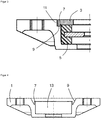
- Fig. 2 shows a longitudinal section through the damper bearing according to Fig. 1 .
- the damping element 5 is clamped between the housing base and the cover 3.
- the damping element 5 is designed as a hollow cylinder which has an annular groove in the center in the axial direction, in which an insert 15 is arranged. This insert 15 is used to attach the piston rod of a shock absorber to it.
- Fig. 3 shows an enlarged section of the representation of Fig. 2 .
- the outside diameter of the cover 3 is smaller than the inside diameter of the housing 1 in the area provided for receiving the cover 3.
- an annular gap 11 thus results between the cover 3 and the housing 1.
- the cover 3 has an annular groove on its underside, which faces the damping element 5.
- the area of the cover between the groove and its outer edge has a greater thickness than the inner area of the cover.
- the edge of the cover thus projects downward in the axial direction beyond the inner region of the cover.
- the lower ring surface of this edge represents the contact surface on the cover side, which is provided for welding to the housing.
- the housing 1 In the radial direction from the cavity in which the damping element 5 is arranged, the housing 1 initially has an annular web 7, which is followed by an annular groove. The bottom of this groove represents the housing-side contact surface 9, which is provided for welding to the cover.
- the 1 to 3 show the damper bearing in the assembled state.
- housing 1 and cover 3 were brought into contact at the abovementioned contact surfaces and then a relative movement was generated between the housing and cover.
- the relative movement causes an energy input in the form of friction in the contact surfaces, which leads to the plastic material melting at the contact surfaces and being welded integrally.
- the plastic material resulting from the melting remains in the area of the groove in the housing due to the shape of the cover and housing and is prevented by the web 7, which acts as a separating element, from coming into contact with the damping element 5. Impairment of the damping element 5 by the welding process is thereby minimized and, at best, completely avoided.
- the cover 3 is pressed in the direction of the housing base. The extent to which the cover penetrates into the cavity of the housing is measured. The welding process is continued until a predetermined pre-compression of the damping element 5 is reached.
- a longitudinal section through a housing 1 of a further example of a damper bearing according to the invention is shown.
- This damper bearing differs from the damper bearing according to Example 1 essentially in the shape of the contact surfaces 9 intended for welding.
- the contact surfaces of the housing and cover, which in FIG Fig. 4 are not shown, are conical in shape.
- the contact surface 9 of the housing is separated from the cavity 13 of the housing provided for receiving the damping element by an annular web 7.
- the housing and cover are brought into contact at the contact surfaces and then a relative movement is generated between the housing and cover.
- the plastic material on the conical contact surfaces melts as a result of the energy input and is bonded together.
- the area intended for fusing is larger due to the conical design. As in example 1, this will be Damping element protected from the melting material, since this remains in the annular groove that is formed between the web 7 and the contact surfaces.
Landscapes
- Engineering & Computer Science (AREA)
- General Engineering & Computer Science (AREA)
- Mechanical Engineering (AREA)
- Chemical & Material Sciences (AREA)
- Chemical Kinetics & Catalysis (AREA)
- Health & Medical Sciences (AREA)
- Manufacturing & Machinery (AREA)
- Medicinal Chemistry (AREA)
- Polymers & Plastics (AREA)
- Organic Chemistry (AREA)
- Vehicle Body Suspensions (AREA)
- Support Of The Bearing (AREA)
- Vibration Dampers (AREA)
- Mounting Of Bearings Or Others (AREA)
Claims (10)
- Palier amortisseur comprenant un boîtier creux (1) pour la réception d'un élément amortisseur (5), ainsi qu'un couvercle (3) pour la fixation de l'élément amortisseur (5) dans le boîtier (1), le boîtier (1) et le couvercle (3) étant fabriqués en matière plastique, caractérisé en ce que la liaison entre le boîtier (1) et le couvercle (3) est réalisée par accouplement de matières par un processus de soudage, qui repose sur un mouvement relatif entre le boîtier (1) et le couvercle (3), le soudage orbital étant utilisé.
- Palier amortisseur selon la revendication 1, dans lequel les surfaces de contact prévues pour la liaison par accouplement de matières du boîtier (1) et du couvercle (3) sont configurées sous forme symétrique par rotation.
- Palier amortisseur selon l'une quelconque des revendications précédentes, dans lequel les surfaces de contact du boîtier (1) et du couvercle (3) sont espacées de la surface extérieure de l'élément amortisseur (5) dans la direction radiale par rapport à l'axe de rotation, et sont séparées par un élément de séparation (7).
- Palier amortisseur selon la revendication 3, dans lequel l'élément de séparation (7) est configuré sous la forme d'une rainure ou d'une traverse.
- Palier amortisseur selon l'une quelconque des revendications précédentes, dans lequel les surfaces de contact du boîtier (1) et du couvercle (3) sont de forme conique.
- Palier amortisseur selon l'une quelconque des revendications précédentes, dans lequel le boîtier (1) et le couvercle (3) sont fabriqués à base de polyamide renforcé par des fibres ayant une proportion de fibres de plus de 20 %, de préférence de plus de 30 %, de manière particulièrement préférée de plus de 40 %.
- Palier amortisseur selon l'une quelconque des revendications précédentes, dans lequel l'élément amortisseur est à base d'un produit de polyaddition de polyisocyanate cellulaire.
- Procédé de fabrication d'un palier amortisseur, qui comprend un boîtier creux (1) pour la réception d'un élément amortisseur (5), ainsi qu'un couvercle (3) pour la fixation de l'élément amortisseur (5) dans le boîtier (1), le boîtier (1) et le couvercle (3) étant fabriqués en matière plastique, caractérisé en ce que le boîtier et le couvercle sont mis en contact au niveau de surfaces de contact prévues pour cela, puis un mouvement relatif entre le boîtier et le couvercle est généré, qui conduit en raison de l'apport d'énergie dans les surfaces de contact à ce que le boîtier et le couvercle se soudent par accouplement de matières, le soudage orbital étant utilisé.
- Procédé selon la revendication 8, dans lequel la profondeur de pénétration du couvercle (3) dans la cavité du boîtier (1) pendant le mouvement relatif est déterminée par mesure.
- Procédé selon la revendication 9, dans lequel la modification déterminée par mesure est utilisée pour ajuster une compression prédéterminée de l'élément amortisseur (5).
Applications Claiming Priority (2)
| Application Number | Priority Date | Filing Date | Title |
|---|---|---|---|
| DE102015217605 | 2015-09-15 | ||
| PCT/EP2016/071014 WO2017045978A1 (fr) | 2015-09-15 | 2016-09-07 | Palier amortisseur muni d'un boîtier et d'un couvercle |
Publications (2)
| Publication Number | Publication Date |
|---|---|
| EP3350472A1 EP3350472A1 (fr) | 2018-07-25 |
| EP3350472B1 true EP3350472B1 (fr) | 2020-04-22 |
Family
ID=56896540
Family Applications (1)
| Application Number | Title | Priority Date | Filing Date |
|---|---|---|---|
| EP16763502.8A Active EP3350472B1 (fr) | 2015-09-15 | 2016-09-07 | Palier amortisseur muni d'un boîtier et d'un couvercle |
Country Status (4)
| Country | Link |
|---|---|
| US (1) | US20180266509A1 (fr) |
| EP (1) | EP3350472B1 (fr) |
| CN (1) | CN108027001B (fr) |
| WO (1) | WO2017045978A1 (fr) |
Families Citing this family (6)
| Publication number | Priority date | Publication date | Assignee | Title |
|---|---|---|---|---|
| DE102016122155A1 (de) * | 2016-11-17 | 2018-05-17 | Vibracoustic Gmbh | Dämpferlager und Verfahren zum Herstellen eines Dämpferlagers |
| FR3069898B1 (fr) * | 2017-08-02 | 2019-12-27 | Sogefi Suspensions | Palier pour barre stabilisatrice muni d'une contreplaque |
| DE102018211118A1 (de) * | 2018-07-05 | 2020-01-09 | Thyssenkrupp Bilstein Gmbh | Dämpfervorrichtung, Verfahren zur Herstellung einer Dämpfervorrichtung |
| KR20200023779A (ko) * | 2018-08-27 | 2020-03-06 | 주식회사 만도 | 전자제어장치 |
| DE202019106036U1 (de) | 2019-10-30 | 2019-12-02 | Vibracoustic Ag | Lagerstrukturbauteil |
| BE1027881B1 (nl) * | 2019-12-18 | 2021-07-27 | Atlas Copco Airpower Nv | Compressorinrichting en inrichting uitgerust met een lagerdemper |
Family Cites Families (15)
| Publication number | Priority date | Publication date | Assignee | Title |
|---|---|---|---|---|
| US4350777A (en) | 1980-03-28 | 1982-09-21 | Bayer Aktiengesellschaft | Impermeable molded articles of cellular polyurethane elastomers produced with organofunctional polysiloxane-derivatives and their use as spring elements |
| DE3113690A1 (de) | 1981-04-04 | 1982-10-28 | Elastogran GmbH, 2844 Lemförde | "verfahren zur herstellung von geschlossenzelligen polyurethan-formteilen mit einer verdichteten randzone" |
| DE3621040A1 (de) | 1986-06-24 | 1988-01-07 | Bayer Ag | Verfahren zur herstellung und polysiloxan-ionomeren, polysiloxan-ionomere und ihre verwendung zur herstellung von zelligen polyurethanelastomeren |
| DE4321874A1 (de) | 1993-07-01 | 1995-01-12 | Ver Foerderung Inst Kunststoff | Verfahren und Vorrichtung zum Steuern und Regeln von Prozeßparametern beim Ultraschallschweißen |
| DE19548771A1 (de) | 1995-12-23 | 1997-06-26 | Basf Ag | Mikrozelluläres, harnstoffgruppenhaltiges Polyurethanelastomer |
| DE19548770A1 (de) | 1995-12-23 | 1997-06-26 | Basf Ag | Mikrozelluläres, harnstoffgruppenhaltiges Polyurethanelastomer |
| JP3777262B2 (ja) * | 1998-12-16 | 2006-05-24 | 日信工業株式会社 | 樹脂製部品 |
| DE50000706D1 (de) | 1999-04-15 | 2002-12-05 | Basf Ag | Zellige polyisocyanat-polyadditionsprodukte |
| DE19919573A1 (de) * | 1999-04-29 | 2000-11-02 | Wolf Woco & Co Franz J | Drehstabschulterlager |
| DE10227978B4 (de) * | 2002-06-22 | 2005-12-29 | Zf Boge Elastmetall Gmbh | Dämfungselement |
| DE10335956A1 (de) * | 2003-08-04 | 2005-02-24 | Basf Ag | Federkonstruktion |
| DE102007003207A1 (de) * | 2006-02-24 | 2007-08-30 | Basf Ag | Dämpferlager |
| EP1878560A1 (fr) * | 2006-07-12 | 2008-01-16 | Basf Aktiengesellschaft | Matériau composite de plastique-caoutchouc et son procédé de fabrication |
| DE102012001299A1 (de) * | 2012-01-25 | 2013-07-25 | Basf Se | Dämpferlager mit konturierter Innenfläche des Gehäuses |
| DE102012002433B4 (de) * | 2012-02-08 | 2019-11-07 | Volkswagen Aktiengesellschaft | Dämpferlager für eine Kolbenstange eines Schwingungsdämpfers sowie Kraftfahrzeug mit einem solchen Dämpferlager |
-
2016
- 2016-09-07 EP EP16763502.8A patent/EP3350472B1/fr active Active
- 2016-09-07 US US15/758,432 patent/US20180266509A1/en not_active Abandoned
- 2016-09-07 WO PCT/EP2016/071014 patent/WO2017045978A1/fr not_active Ceased
- 2016-09-07 CN CN201680053728.8A patent/CN108027001B/zh active Active
Non-Patent Citations (1)
| Title |
|---|
| None * |
Also Published As
| Publication number | Publication date |
|---|---|
| CN108027001B (zh) | 2021-05-11 |
| WO2017045978A1 (fr) | 2017-03-23 |
| EP3350472A1 (fr) | 2018-07-25 |
| US20180266509A1 (en) | 2018-09-20 |
| CN108027001A (zh) | 2018-05-11 |
Similar Documents
| Publication | Publication Date | Title |
|---|---|---|
| EP3350472B1 (fr) | Palier amortisseur muni d'un boîtier et d'un couvercle | |
| EP2697084B1 (fr) | Système de palier pour un ressort du train de roulement d'un véhicule | |
| DE68902107T2 (de) | Obere gelenkverbindung zwischen einer feder-daempfer-einheit und dem rahmen eines kraftfahrzeugs. | |
| DE102006016060B4 (de) | Radialgelenk und Verfahren zur Herstellung eines derartigen Radialgelenkes für ein Kraftfahrzeug | |
| EP3464929B1 (fr) | Élément de ressort pour un amortisseur de véhicule automobile, ainsi que amortisseur de véhicule automobile et utilisation de l'élément de ressort | |
| DE102018221463B4 (de) | Luftfederanordnung mit einem Stützring aus Kunststoffmaterial und Verfahren zum Befestigen eines Balgs an eine obere Kappe mit solch einem Stützring | |
| WO2019068790A1 (fr) | Jambe de suspension pneumatique avec un couvercle de suspension pneumatique en matière plastique | |
| DE102016219474B4 (de) | Aktuator und Verfahren zur Herstellung eines Aktuators | |
| DE10335956A1 (de) | Federkonstruktion | |
| DE102013217321A1 (de) | Endteile und Gasfeder-Anordnungen mit denselben | |
| DE102012018883B4 (de) | Zusatzfeder | |
| DE102009022841B4 (de) | Elastisches Federbeinkopflager für ein Kraftfahrzeug und Verfahren zum Einstellen einer Druckvorspannung in einem elastischen Ringkörper des Federbeinkopflagers | |
| DE102007003207A1 (de) | Dämpferlager | |
| EP2646706B1 (fr) | Palier amortisseur avec insert profilé | |
| DE102017203537B3 (de) | Verfahren zur Herstellung einer Blattfeder, sowie Blattfeder und Radaufhängung | |
| EP3541643A1 (fr) | Palier d'amortisseur et procédé de fabrication d'un palier d'amortisseur | |
| DE19742955A1 (de) | Augenlager und Verfahren zu dessen Herstellung | |
| DE202021103783U1 (de) | Elastomer-Metall-Lager | |
| DE10250436B3 (de) | Lagerung für eine Kolbenstange | |
| DE102006021816B3 (de) | Gleiteinrichtung, insbesondere für bewegliche Fahrzeugteile | |
| EP1878560A1 (fr) | Matériau composite de plastique-caoutchouc et son procédé de fabrication | |
| DE10309202A1 (de) | Federkonstruktion | |
| DE102004002369B4 (de) | Federkonstruktion enthaltend formschlüssig fixiertes Rundlager insbesondere für Automobilfahrwerk | |
| DE102021118280B4 (de) | Elastomer-Metall-Lager und Verfahren zu dessen Herstellung | |
| DE102018202353A1 (de) | Vorprodukt mit einem lasttragenden Bauteil sowie Verfahren zur Anpassung besagten lasttragenden Bauteils an eine Lastanforderung |
Legal Events
| Date | Code | Title | Description |
|---|---|---|---|
| STAA | Information on the status of an ep patent application or granted ep patent |
Free format text: STATUS: THE INTERNATIONAL PUBLICATION HAS BEEN MADE |
|
| PUAI | Public reference made under article 153(3) epc to a published international application that has entered the european phase |
Free format text: ORIGINAL CODE: 0009012 |
|
| STAA | Information on the status of an ep patent application or granted ep patent |
Free format text: STATUS: REQUEST FOR EXAMINATION WAS MADE |
|
| 17P | Request for examination filed |
Effective date: 20180416 |
|
| AK | Designated contracting states |
Kind code of ref document: A1 Designated state(s): AL AT BE BG CH CY CZ DE DK EE ES FI FR GB GR HR HU IE IS IT LI LT LU LV MC MK MT NL NO PL PT RO RS SE SI SK SM TR |
|
| AX | Request for extension of the european patent |
Extension state: BA ME |
|
| DAV | Request for validation of the european patent (deleted) | ||
| DAX | Request for extension of the european patent (deleted) | ||
| GRAP | Despatch of communication of intention to grant a patent |
Free format text: ORIGINAL CODE: EPIDOSNIGR1 |
|
| STAA | Information on the status of an ep patent application or granted ep patent |
Free format text: STATUS: GRANT OF PATENT IS INTENDED |
|
| INTG | Intention to grant announced |
Effective date: 20191204 |
|
| GRAS | Grant fee paid |
Free format text: ORIGINAL CODE: EPIDOSNIGR3 |
|
| GRAA | (expected) grant |
Free format text: ORIGINAL CODE: 0009210 |
|
| STAA | Information on the status of an ep patent application or granted ep patent |
Free format text: STATUS: THE PATENT HAS BEEN GRANTED |
|
| AK | Designated contracting states |
Kind code of ref document: B1 Designated state(s): AL AT BE BG CH CY CZ DE DK EE ES FI FR GB GR HR HU IE IS IT LI LT LU LV MC MK MT NL NO PL PT RO RS SE SI SK SM TR |
|
| REG | Reference to a national code |
Ref country code: CH Ref legal event code: EP |
|
| REG | Reference to a national code |
Ref country code: IE Ref legal event code: FG4D Free format text: LANGUAGE OF EP DOCUMENT: GERMAN |
|
| REG | Reference to a national code |
Ref country code: DE Ref legal event code: R096 Ref document number: 502016009672 Country of ref document: DE |
|
| REG | Reference to a national code |
Ref country code: AT Ref legal event code: REF Ref document number: 1260528 Country of ref document: AT Kind code of ref document: T Effective date: 20200515 |
|
| REG | Reference to a national code |
Ref country code: LT Ref legal event code: MG4D |
|
| REG | Reference to a national code |
Ref country code: NL Ref legal event code: MP Effective date: 20200422 |
|
| PG25 | Lapsed in a contracting state [announced via postgrant information from national office to epo] |
Ref country code: PT Free format text: LAPSE BECAUSE OF FAILURE TO SUBMIT A TRANSLATION OF THE DESCRIPTION OR TO PAY THE FEE WITHIN THE PRESCRIBED TIME-LIMIT Effective date: 20200824 Ref country code: NO Free format text: LAPSE BECAUSE OF FAILURE TO SUBMIT A TRANSLATION OF THE DESCRIPTION OR TO PAY THE FEE WITHIN THE PRESCRIBED TIME-LIMIT Effective date: 20200722 Ref country code: GR Free format text: LAPSE BECAUSE OF FAILURE TO SUBMIT A TRANSLATION OF THE DESCRIPTION OR TO PAY THE FEE WITHIN THE PRESCRIBED TIME-LIMIT Effective date: 20200723 Ref country code: NL Free format text: LAPSE BECAUSE OF FAILURE TO SUBMIT A TRANSLATION OF THE DESCRIPTION OR TO PAY THE FEE WITHIN THE PRESCRIBED TIME-LIMIT Effective date: 20200422 Ref country code: LT Free format text: LAPSE BECAUSE OF FAILURE TO SUBMIT A TRANSLATION OF THE DESCRIPTION OR TO PAY THE FEE WITHIN THE PRESCRIBED TIME-LIMIT Effective date: 20200422 Ref country code: IS Free format text: LAPSE BECAUSE OF FAILURE TO SUBMIT A TRANSLATION OF THE DESCRIPTION OR TO PAY THE FEE WITHIN THE PRESCRIBED TIME-LIMIT Effective date: 20200822 Ref country code: SE Free format text: LAPSE BECAUSE OF FAILURE TO SUBMIT A TRANSLATION OF THE DESCRIPTION OR TO PAY THE FEE WITHIN THE PRESCRIBED TIME-LIMIT Effective date: 20200422 Ref country code: FI Free format text: LAPSE BECAUSE OF FAILURE TO SUBMIT A TRANSLATION OF THE DESCRIPTION OR TO PAY THE FEE WITHIN THE PRESCRIBED TIME-LIMIT Effective date: 20200422 |
|
| PG25 | Lapsed in a contracting state [announced via postgrant information from national office to epo] |
Ref country code: LV Free format text: LAPSE BECAUSE OF FAILURE TO SUBMIT A TRANSLATION OF THE DESCRIPTION OR TO PAY THE FEE WITHIN THE PRESCRIBED TIME-LIMIT Effective date: 20200422 Ref country code: HR Free format text: LAPSE BECAUSE OF FAILURE TO SUBMIT A TRANSLATION OF THE DESCRIPTION OR TO PAY THE FEE WITHIN THE PRESCRIBED TIME-LIMIT Effective date: 20200422 Ref country code: BG Free format text: LAPSE BECAUSE OF FAILURE TO SUBMIT A TRANSLATION OF THE DESCRIPTION OR TO PAY THE FEE WITHIN THE PRESCRIBED TIME-LIMIT Effective date: 20200722 Ref country code: RS Free format text: LAPSE BECAUSE OF FAILURE TO SUBMIT A TRANSLATION OF THE DESCRIPTION OR TO PAY THE FEE WITHIN THE PRESCRIBED TIME-LIMIT Effective date: 20200422 |
|
| PG25 | Lapsed in a contracting state [announced via postgrant information from national office to epo] |
Ref country code: AL Free format text: LAPSE BECAUSE OF FAILURE TO SUBMIT A TRANSLATION OF THE DESCRIPTION OR TO PAY THE FEE WITHIN THE PRESCRIBED TIME-LIMIT Effective date: 20200422 |
|
| REG | Reference to a national code |
Ref country code: DE Ref legal event code: R097 Ref document number: 502016009672 Country of ref document: DE |
|
| PG25 | Lapsed in a contracting state [announced via postgrant information from national office to epo] |
Ref country code: CZ Free format text: LAPSE BECAUSE OF FAILURE TO SUBMIT A TRANSLATION OF THE DESCRIPTION OR TO PAY THE FEE WITHIN THE PRESCRIBED TIME-LIMIT Effective date: 20200422 Ref country code: RO Free format text: LAPSE BECAUSE OF FAILURE TO SUBMIT A TRANSLATION OF THE DESCRIPTION OR TO PAY THE FEE WITHIN THE PRESCRIBED TIME-LIMIT Effective date: 20200422 Ref country code: ES Free format text: LAPSE BECAUSE OF FAILURE TO SUBMIT A TRANSLATION OF THE DESCRIPTION OR TO PAY THE FEE WITHIN THE PRESCRIBED TIME-LIMIT Effective date: 20200422 Ref country code: SM Free format text: LAPSE BECAUSE OF FAILURE TO SUBMIT A TRANSLATION OF THE DESCRIPTION OR TO PAY THE FEE WITHIN THE PRESCRIBED TIME-LIMIT Effective date: 20200422 Ref country code: EE Free format text: LAPSE BECAUSE OF FAILURE TO SUBMIT A TRANSLATION OF THE DESCRIPTION OR TO PAY THE FEE WITHIN THE PRESCRIBED TIME-LIMIT Effective date: 20200422 Ref country code: IT Free format text: LAPSE BECAUSE OF FAILURE TO SUBMIT A TRANSLATION OF THE DESCRIPTION OR TO PAY THE FEE WITHIN THE PRESCRIBED TIME-LIMIT Effective date: 20200422 Ref country code: DK Free format text: LAPSE BECAUSE OF FAILURE TO SUBMIT A TRANSLATION OF THE DESCRIPTION OR TO PAY THE FEE WITHIN THE PRESCRIBED TIME-LIMIT Effective date: 20200422 |
|
| PG25 | Lapsed in a contracting state [announced via postgrant information from national office to epo] |
Ref country code: SK Free format text: LAPSE BECAUSE OF FAILURE TO SUBMIT A TRANSLATION OF THE DESCRIPTION OR TO PAY THE FEE WITHIN THE PRESCRIBED TIME-LIMIT Effective date: 20200422 Ref country code: PL Free format text: LAPSE BECAUSE OF FAILURE TO SUBMIT A TRANSLATION OF THE DESCRIPTION OR TO PAY THE FEE WITHIN THE PRESCRIBED TIME-LIMIT Effective date: 20200422 |
|
| PLBE | No opposition filed within time limit |
Free format text: ORIGINAL CODE: 0009261 |
|
| STAA | Information on the status of an ep patent application or granted ep patent |
Free format text: STATUS: NO OPPOSITION FILED WITHIN TIME LIMIT |
|
| 26N | No opposition filed |
Effective date: 20210125 |
|
| REG | Reference to a national code |
Ref country code: CH Ref legal event code: PL |
|
| GBPC | Gb: european patent ceased through non-payment of renewal fee |
Effective date: 20200907 |
|
| PG25 | Lapsed in a contracting state [announced via postgrant information from national office to epo] |
Ref country code: SI Free format text: LAPSE BECAUSE OF FAILURE TO SUBMIT A TRANSLATION OF THE DESCRIPTION OR TO PAY THE FEE WITHIN THE PRESCRIBED TIME-LIMIT Effective date: 20200422 |
|
| REG | Reference to a national code |
Ref country code: BE Ref legal event code: MM Effective date: 20200930 |
|
| PG25 | Lapsed in a contracting state [announced via postgrant information from national office to epo] |
Ref country code: LU Free format text: LAPSE BECAUSE OF NON-PAYMENT OF DUE FEES Effective date: 20200907 |
|
| PG25 | Lapsed in a contracting state [announced via postgrant information from national office to epo] |
Ref country code: FR Free format text: LAPSE BECAUSE OF NON-PAYMENT OF DUE FEES Effective date: 20200930 |
|
| PG25 | Lapsed in a contracting state [announced via postgrant information from national office to epo] |
Ref country code: IE Free format text: LAPSE BECAUSE OF NON-PAYMENT OF DUE FEES Effective date: 20200907 Ref country code: LI Free format text: LAPSE BECAUSE OF NON-PAYMENT OF DUE FEES Effective date: 20200930 Ref country code: GB Free format text: LAPSE BECAUSE OF NON-PAYMENT OF DUE FEES Effective date: 20200907 Ref country code: BE Free format text: LAPSE BECAUSE OF NON-PAYMENT OF DUE FEES Effective date: 20200930 Ref country code: CH Free format text: LAPSE BECAUSE OF NON-PAYMENT OF DUE FEES Effective date: 20200930 |
|
| PG25 | Lapsed in a contracting state [announced via postgrant information from national office to epo] |
Ref country code: TR Free format text: LAPSE BECAUSE OF FAILURE TO SUBMIT A TRANSLATION OF THE DESCRIPTION OR TO PAY THE FEE WITHIN THE PRESCRIBED TIME-LIMIT Effective date: 20200422 Ref country code: MT Free format text: LAPSE BECAUSE OF FAILURE TO SUBMIT A TRANSLATION OF THE DESCRIPTION OR TO PAY THE FEE WITHIN THE PRESCRIBED TIME-LIMIT Effective date: 20200422 Ref country code: CY Free format text: LAPSE BECAUSE OF FAILURE TO SUBMIT A TRANSLATION OF THE DESCRIPTION OR TO PAY THE FEE WITHIN THE PRESCRIBED TIME-LIMIT Effective date: 20200422 |
|
| PG25 | Lapsed in a contracting state [announced via postgrant information from national office to epo] |
Ref country code: MK Free format text: LAPSE BECAUSE OF FAILURE TO SUBMIT A TRANSLATION OF THE DESCRIPTION OR TO PAY THE FEE WITHIN THE PRESCRIBED TIME-LIMIT Effective date: 20200422 Ref country code: MC Free format text: LAPSE BECAUSE OF FAILURE TO SUBMIT A TRANSLATION OF THE DESCRIPTION OR TO PAY THE FEE WITHIN THE PRESCRIBED TIME-LIMIT Effective date: 20200422 |
|
| REG | Reference to a national code |
Ref country code: AT Ref legal event code: MM01 Ref document number: 1260528 Country of ref document: AT Kind code of ref document: T Effective date: 20210907 |
|
| PG25 | Lapsed in a contracting state [announced via postgrant information from national office to epo] |
Ref country code: AT Free format text: LAPSE BECAUSE OF NON-PAYMENT OF DUE FEES Effective date: 20210907 |
|
| PGFP | Annual fee paid to national office [announced via postgrant information from national office to epo] |
Ref country code: DE Payment date: 20250926 Year of fee payment: 10 |