EP3352004A1 - Wavelenght conversion member and blacklight unit including the same - Google Patents
Wavelenght conversion member and blacklight unit including the same Download PDFInfo
- Publication number
- EP3352004A1 EP3352004A1 EP18152028.9A EP18152028A EP3352004A1 EP 3352004 A1 EP3352004 A1 EP 3352004A1 EP 18152028 A EP18152028 A EP 18152028A EP 3352004 A1 EP3352004 A1 EP 3352004A1
- Authority
- EP
- European Patent Office
- Prior art keywords
- glass
- wavelength converter
- wavelength
- container member
- concave groove
- Prior art date
- Legal status (The legal status is an assumption and is not a legal conclusion. Google has not performed a legal analysis and makes no representation as to the accuracy of the status listed.)
- Granted
Links
Images





Classifications
-
- H—ELECTRICITY
- H10—SEMICONDUCTOR DEVICES; ELECTRIC SOLID-STATE DEVICES NOT OTHERWISE PROVIDED FOR
- H10H—INORGANIC LIGHT-EMITTING SEMICONDUCTOR DEVICES HAVING POTENTIAL BARRIERS
- H10H20/00—Individual inorganic light-emitting semiconductor devices having potential barriers, e.g. light-emitting diodes [LED]
- H10H20/80—Constructional details
- H10H20/85—Packages
- H10H20/851—Wavelength conversion means
- H10H20/8514—Wavelength conversion means characterised by their shape, e.g. plate or foil
-
- F—MECHANICAL ENGINEERING; LIGHTING; HEATING; WEAPONS; BLASTING
- F21—LIGHTING
- F21K—NON-ELECTRIC LIGHT SOURCES USING LUMINESCENCE; LIGHT SOURCES USING ELECTROCHEMILUMINESCENCE; LIGHT SOURCES USING CHARGES OF COMBUSTIBLE MATERIAL; LIGHT SOURCES USING SEMICONDUCTOR DEVICES AS LIGHT-GENERATING ELEMENTS; LIGHT SOURCES NOT OTHERWISE PROVIDED FOR
- F21K9/00—Light sources using semiconductor devices as light-generating elements, e.g. using light-emitting diodes [LED] or lasers
- F21K9/60—Optical arrangements integrated in the light source, e.g. for improving the colour rendering index or the light extraction
- F21K9/64—Optical arrangements integrated in the light source, e.g. for improving the colour rendering index or the light extraction using wavelength conversion means distinct or spaced from the light-generating element, e.g. a remote phosphor layer
-
- G—PHYSICS
- G02—OPTICS
- G02B—OPTICAL ELEMENTS, SYSTEMS OR APPARATUS
- G02B26/00—Optical devices or arrangements for the control of light using movable or deformable optical elements
- G02B26/007—Optical devices or arrangements for the control of light using movable or deformable optical elements the movable or deformable optical element controlling the colour, i.e. a spectral characteristic, of the light
-
- C—CHEMISTRY; METALLURGY
- C09—DYES; PAINTS; POLISHES; NATURAL RESINS; ADHESIVES; COMPOSITIONS NOT OTHERWISE PROVIDED FOR; APPLICATIONS OF MATERIALS NOT OTHERWISE PROVIDED FOR
- C09K—MATERIALS FOR MISCELLANEOUS APPLICATIONS, NOT PROVIDED FOR ELSEWHERE
- C09K11/00—Luminescent materials, e.g. electroluminescent or chemiluminescent
- C09K11/08—Luminescent materials, e.g. electroluminescent or chemiluminescent containing inorganic luminescent materials
- C09K11/64—Luminescent materials, e.g. electroluminescent or chemiluminescent containing inorganic luminescent materials containing aluminium
- C09K11/641—Chalcogenides
- C09K11/642—Chalcogenides with zinc or cadmium
-
- G—PHYSICS
- G02—OPTICS
- G02B—OPTICAL ELEMENTS, SYSTEMS OR APPARATUS
- G02B26/00—Optical devices or arrangements for the control of light using movable or deformable optical elements
- G02B26/02—Optical devices or arrangements for the control of light using movable or deformable optical elements for controlling the intensity of light
-
- G—PHYSICS
- G02—OPTICS
- G02B—OPTICAL ELEMENTS, SYSTEMS OR APPARATUS
- G02B5/00—Optical elements other than lenses
- G02B5/20—Filters
- G02B5/22—Absorbing filters
- G02B5/223—Absorbing filters containing organic substances, e.g. dyes, inks or pigments
-
- G—PHYSICS
- G02—OPTICS
- G02B—OPTICAL ELEMENTS, SYSTEMS OR APPARATUS
- G02B6/00—Light guides; Structural details of arrangements comprising light guides and other optical elements, e.g. couplings
- G02B6/0001—Light guides; Structural details of arrangements comprising light guides and other optical elements, e.g. couplings specially adapted for lighting devices or systems
- G02B6/0011—Light guides; Structural details of arrangements comprising light guides and other optical elements, e.g. couplings specially adapted for lighting devices or systems the light guides being planar or of plate-like form
- G02B6/0066—Light guides; Structural details of arrangements comprising light guides and other optical elements, e.g. couplings specially adapted for lighting devices or systems the light guides being planar or of plate-like form characterised by the light source being coupled to the light guide
- G02B6/0068—Arrangements of plural sources, e.g. multi-colour light sources
-
- G—PHYSICS
- G02—OPTICS
- G02F—OPTICAL DEVICES OR ARRANGEMENTS FOR THE CONTROL OF LIGHT BY MODIFICATION OF THE OPTICAL PROPERTIES OF THE MEDIA OF THE ELEMENTS INVOLVED THEREIN; NON-LINEAR OPTICS; FREQUENCY-CHANGING OF LIGHT; OPTICAL LOGIC ELEMENTS; OPTICAL ANALOGUE/DIGITAL CONVERTERS
- G02F1/00—Devices or arrangements for the control of the intensity, colour, phase, polarisation or direction of light arriving from an independent light source, e.g. switching, gating or modulating; Non-linear optics
- G02F1/01—Devices or arrangements for the control of the intensity, colour, phase, polarisation or direction of light arriving from an independent light source, e.g. switching, gating or modulating; Non-linear optics for the control of the intensity, phase, polarisation or colour
- G02F1/13—Devices or arrangements for the control of the intensity, colour, phase, polarisation or direction of light arriving from an independent light source, e.g. switching, gating or modulating; Non-linear optics for the control of the intensity, phase, polarisation or colour based on liquid crystals, e.g. single liquid crystal display cells
- G02F1/133—Constructional arrangements; Operation of liquid crystal cells; Circuit arrangements
- G02F1/1333—Constructional arrangements; Manufacturing methods
- G02F1/1335—Structural association of cells with optical devices, e.g. polarisers or reflectors
- G02F1/1336—Illuminating devices
- G02F1/133615—Edge-illuminating devices, i.e. illuminating from the side
-
- G—PHYSICS
- G02—OPTICS
- G02F—OPTICAL DEVICES OR ARRANGEMENTS FOR THE CONTROL OF LIGHT BY MODIFICATION OF THE OPTICAL PROPERTIES OF THE MEDIA OF THE ELEMENTS INVOLVED THEREIN; NON-LINEAR OPTICS; FREQUENCY-CHANGING OF LIGHT; OPTICAL LOGIC ELEMENTS; OPTICAL ANALOGUE/DIGITAL CONVERTERS
- G02F1/00—Devices or arrangements for the control of the intensity, colour, phase, polarisation or direction of light arriving from an independent light source, e.g. switching, gating or modulating; Non-linear optics
- G02F1/35—Non-linear optics
- G02F1/353—Frequency conversion, i.e. wherein a light beam is generated with frequency components different from those of the incident light beams
-
- H—ELECTRICITY
- H10—SEMICONDUCTOR DEVICES; ELECTRIC SOLID-STATE DEVICES NOT OTHERWISE PROVIDED FOR
- H10H—INORGANIC LIGHT-EMITTING SEMICONDUCTOR DEVICES HAVING POTENTIAL BARRIERS
- H10H20/00—Individual inorganic light-emitting semiconductor devices having potential barriers, e.g. light-emitting diodes [LED]
- H10H20/80—Constructional details
- H10H20/85—Packages
- H10H20/851—Wavelength conversion means
-
- H—ELECTRICITY
- H10—SEMICONDUCTOR DEVICES; ELECTRIC SOLID-STATE DEVICES NOT OTHERWISE PROVIDED FOR
- H10H—INORGANIC LIGHT-EMITTING SEMICONDUCTOR DEVICES HAVING POTENTIAL BARRIERS
- H10H20/00—Individual inorganic light-emitting semiconductor devices having potential barriers, e.g. light-emitting diodes [LED]
- H10H20/80—Constructional details
- H10H20/85—Packages
- H10H20/851—Wavelength conversion means
- H10H20/8511—Wavelength conversion means characterised by their material, e.g. binder
- H10H20/8512—Wavelength conversion materials
- H10H20/8513—Wavelength conversion materials having two or more wavelength conversion materials
-
- G—PHYSICS
- G02—OPTICS
- G02B—OPTICAL ELEMENTS, SYSTEMS OR APPARATUS
- G02B6/00—Light guides; Structural details of arrangements comprising light guides and other optical elements, e.g. couplings
- G02B6/0001—Light guides; Structural details of arrangements comprising light guides and other optical elements, e.g. couplings specially adapted for lighting devices or systems
- G02B6/0011—Light guides; Structural details of arrangements comprising light guides and other optical elements, e.g. couplings specially adapted for lighting devices or systems the light guides being planar or of plate-like form
- G02B6/0013—Means for improving the coupling-in of light from the light source into the light guide
- G02B6/0023—Means for improving the coupling-in of light from the light source into the light guide provided by one optical element, or plurality thereof, placed between the light guide and the light source, or around the light source
-
- G—PHYSICS
- G02—OPTICS
- G02F—OPTICAL DEVICES OR ARRANGEMENTS FOR THE CONTROL OF LIGHT BY MODIFICATION OF THE OPTICAL PROPERTIES OF THE MEDIA OF THE ELEMENTS INVOLVED THEREIN; NON-LINEAR OPTICS; FREQUENCY-CHANGING OF LIGHT; OPTICAL LOGIC ELEMENTS; OPTICAL ANALOGUE/DIGITAL CONVERTERS
- G02F1/00—Devices or arrangements for the control of the intensity, colour, phase, polarisation or direction of light arriving from an independent light source, e.g. switching, gating or modulating; Non-linear optics
- G02F1/01—Devices or arrangements for the control of the intensity, colour, phase, polarisation or direction of light arriving from an independent light source, e.g. switching, gating or modulating; Non-linear optics for the control of the intensity, phase, polarisation or colour
- G02F1/13—Devices or arrangements for the control of the intensity, colour, phase, polarisation or direction of light arriving from an independent light source, e.g. switching, gating or modulating; Non-linear optics for the control of the intensity, phase, polarisation or colour based on liquid crystals, e.g. single liquid crystal display cells
- G02F1/133—Constructional arrangements; Operation of liquid crystal cells; Circuit arrangements
- G02F1/1333—Constructional arrangements; Manufacturing methods
- G02F1/1335—Structural association of cells with optical devices, e.g. polarisers or reflectors
- G02F1/1336—Illuminating devices
- G02F1/133602—Direct backlight
- G02F1/133609—Direct backlight including means for improving the color mixing, e.g. white
-
- G—PHYSICS
- G02—OPTICS
- G02F—OPTICAL DEVICES OR ARRANGEMENTS FOR THE CONTROL OF LIGHT BY MODIFICATION OF THE OPTICAL PROPERTIES OF THE MEDIA OF THE ELEMENTS INVOLVED THEREIN; NON-LINEAR OPTICS; FREQUENCY-CHANGING OF LIGHT; OPTICAL LOGIC ELEMENTS; OPTICAL ANALOGUE/DIGITAL CONVERTERS
- G02F1/00—Devices or arrangements for the control of the intensity, colour, phase, polarisation or direction of light arriving from an independent light source, e.g. switching, gating or modulating; Non-linear optics
- G02F1/01—Devices or arrangements for the control of the intensity, colour, phase, polarisation or direction of light arriving from an independent light source, e.g. switching, gating or modulating; Non-linear optics for the control of the intensity, phase, polarisation or colour
- G02F1/13—Devices or arrangements for the control of the intensity, colour, phase, polarisation or direction of light arriving from an independent light source, e.g. switching, gating or modulating; Non-linear optics for the control of the intensity, phase, polarisation or colour based on liquid crystals, e.g. single liquid crystal display cells
- G02F1/133—Constructional arrangements; Operation of liquid crystal cells; Circuit arrangements
- G02F1/1333—Constructional arrangements; Manufacturing methods
- G02F1/1335—Structural association of cells with optical devices, e.g. polarisers or reflectors
- G02F1/1336—Illuminating devices
- G02F1/133614—Illuminating devices using photoluminescence, e.g. phosphors illuminated by UV or blue light
-
- G—PHYSICS
- G02—OPTICS
- G02F—OPTICAL DEVICES OR ARRANGEMENTS FOR THE CONTROL OF LIGHT BY MODIFICATION OF THE OPTICAL PROPERTIES OF THE MEDIA OF THE ELEMENTS INVOLVED THEREIN; NON-LINEAR OPTICS; FREQUENCY-CHANGING OF LIGHT; OPTICAL LOGIC ELEMENTS; OPTICAL ANALOGUE/DIGITAL CONVERTERS
- G02F2201/00—Constructional arrangements not provided for in groups G02F1/00 - G02F7/00
- G02F2201/16—Constructional arrangements not provided for in groups G02F1/00 - G02F7/00 series; tandem
-
- G—PHYSICS
- G02—OPTICS
- G02F—OPTICAL DEVICES OR ARRANGEMENTS FOR THE CONTROL OF LIGHT BY MODIFICATION OF THE OPTICAL PROPERTIES OF THE MEDIA OF THE ELEMENTS INVOLVED THEREIN; NON-LINEAR OPTICS; FREQUENCY-CHANGING OF LIGHT; OPTICAL LOGIC ELEMENTS; OPTICAL ANALOGUE/DIGITAL CONVERTERS
- G02F2202/00—Materials and properties
- G02F2202/04—Materials and properties dye
- G02F2202/046—Materials and properties dye fluorescent
-
- G—PHYSICS
- G02—OPTICS
- G02F—OPTICAL DEVICES OR ARRANGEMENTS FOR THE CONTROL OF LIGHT BY MODIFICATION OF THE OPTICAL PROPERTIES OF THE MEDIA OF THE ELEMENTS INVOLVED THEREIN; NON-LINEAR OPTICS; FREQUENCY-CHANGING OF LIGHT; OPTICAL LOGIC ELEMENTS; OPTICAL ANALOGUE/DIGITAL CONVERTERS
- G02F2202/00—Materials and properties
- G02F2202/36—Micro- or nanomaterials
-
- Y—GENERAL TAGGING OF NEW TECHNOLOGICAL DEVELOPMENTS; GENERAL TAGGING OF CROSS-SECTIONAL TECHNOLOGIES SPANNING OVER SEVERAL SECTIONS OF THE IPC; TECHNICAL SUBJECTS COVERED BY FORMER USPC CROSS-REFERENCE ART COLLECTIONS [XRACs] AND DIGESTS
- Y02—TECHNOLOGIES OR APPLICATIONS FOR MITIGATION OR ADAPTATION AGAINST CLIMATE CHANGE
- Y02B—CLIMATE CHANGE MITIGATION TECHNOLOGIES RELATED TO BUILDINGS, e.g. HOUSING, HOUSE APPLIANCES OR RELATED END-USER APPLICATIONS
- Y02B20/00—Energy efficient lighting technologies, e.g. halogen lamps or gas discharge lamps
Definitions
- One or more aspects of one or more embodiments of the present invention relate to a wavelength conversion member and a backlight unit including the wavelength conversion member.
- the display panel of a liquid crystal display device commonly includes two substrates, each provided with an electric field-generating electrode, and a liquid crystal layer disposed (e.g., positioned) between the two substrates.
- the liquid crystal display device generally requires a backlight unit for providing light to the display panel, because the image on the liquid crystal display is generated by rearranging the liquid crystals in the liquid crystal layer using the electric field-generating electrode, to adjust the amount of light passing through the display panel.
- the backlight unit may include a light source for emitting light and a light guide plate for guiding the light provided from the light source. Since the light provided from the backlight unit passes through the display panel and contributes to displaying the image, the color purity of the light provided from the backlight unit may be an important factor in determining the display quality of the liquid crystal display device. Thus, there is a need to develop a method for further improving the color purity of the light provided by the backlight unit.
- White light emitted by the light source may include intrinsic wavelengths of red, green, and blue. However, white light emitted by a comparative light source may be mixed with light in an unintentional (e.g., undesirable) wavelength band, which may cause degradation of display quality of the display device.
- One or more aspects of one or more embodiments of the present invention are directed toward a wavelength conversion member which can generate high-purity white light.
- One or more aspects of one or more embodiments of the present invention are directed toward a backlight unit, which can provide high-purity white light, which can minimize (or reduce) the light loss between a wavelength conversion member and a light guide plate by accurately maintaining the alignment state between the wavelength conversion member and the light guide plate even when an external impact is applied, and which can maximize (or improve) color conversion efficiency.
- the wavelength conversion member may include: a first wavelength converter extending in a first direction and containing a first wavelength converting material; a second wavelength converter extending in the first direction and containing a second wavelength converting material different from the first wavelength converting material; a first container member extending in the first direction and providing a space for accommodating the first wavelength converter; and a second container member extending in the first direction and providing a space for accommodating the second wavelength converter, wherein each of the first container member and the second container member has a first side and a second side, wherein the second container member is adjacent to the first container member in a second direction, crossing the first direction, the first side of the first container member and the second side of the second container member facing each other and together forming a contact surface between the first container member and the second container member, and wherein the first container member and the second container member are at least partially fusion-bonded to each other.
- the contact surface between the first container member and the second container member may include: a first portion where there is a physical boundary between the first container member and the second container member; a second portion where there is substantially nophysical boundary between the first container member and the second container member; and a third portion overlapping the first wavelength converter, and wherein the first portion, the second portion, and the third portion may be aligned along a third direction, crossing the first and second directions, and a part of the first portion may be located between the second portion and the third portion.
- the part of the first portion located between the second portion and the third portion may have a width of 50 ⁇ m or more
- the second portion may have a width of 60 ⁇ m to 120 ⁇ m
- a seed-like structure may exist in the vicinity of the second portion
- the seed-like structure may have an elongated shape having a major axis and a minor axis.
- the first wavelength converter may further comprise metal particles selected from aluminum oxide particles and silicon oxide particles, and the second wavelength converter may not contain metal particles.
- the first wavelength converter may be surrounded by the first container member, and the second wavelength converter may be surrounded by the second container member.
- the first side of the first container member may have a first concave groove for accommodating the first wavelength converter
- the second side of the second container member, facing the first container member may have a second concave groove for accommodating the second wavelength converter
- a gap may be formed between the first wavelength converter and the second wavelength converter by the first and second concave grooves.
- the wavelength conversion member may further comprise: a first cover member adjacent to the second side of the first container member, opposite the first side of the first container member, and sealing the first wavelength converter; and a second cover member adjacent to the first side of the second container member, opposite the second side of the second container member, and sealing the second wavelength converter, wherein the second side of the first container member may have a first concave groove for accommodating the first wavelength converter, and the first side of the second container member may have a second concave groove for accommodating the second wavelength converter.
- the wavelength conversion member may further comprise: a cover member adjacent to the second side of the first container member, opposite the first side of the first container member, and sealing the first wavelength converter, wherein the second side of the first container member may have a first concave groove for accommodating the first wavelength converter, and the second side of the second container member, facing the first side of the first container member, may have a second concave groove for accommodating the second wavelength converter, and the second wavelength converter may be surrounded by the first side of the first container member and the first side of the second container member, opposite the second side of the second container member.
- a wavelength conversion member comprising: a first glass extending in a first direction and having a first side and a second side, opposite the first side; a second glass extending in a first direction and having a first side and a second side, opposite the first side, the second glass being adjacent to the first glass in a second direction, crossing the first direction, and at least partially in direct contact with the first glass, the first side of the first glass and the second side of the second glass facing each other and together forming a contact surface between the first glass and the second glass; a first wavelength converter interposed in the second glass adjacent to the contact surface between the first glass and the second glass, the first wavelength converter containing a first wavelength converting material; and a second wavelength converter interposed in the second glass adjacent to the first side of the second glass, the second wavelength converter containing a second wavelength converting material different from the first wavelength converting material.
- the first glass and the second glass may be at least partially fusion-bonded to each other, and wherein the contact surface between the first glass and the second glass may include: a first portion where there is a physical boundary between the first glass and the second glass; a second portion where there is substantially no physical boundary between the first glass and the second glass; and a third portion overlapping the first wavelength converter, and wherein a part of the first portion may be located between the second portion and the third portion.
- the first side of the first glass may be substantially flat, the second side of the second glass, facing the first glass, may have a first concave groove, the first side of the second glass may have a second concave groove, the first wavelength converter may be inserted in the first concave groove, and the second wavelength converter may be inserted in the second concave groove.
- a gap may be formed between the first glass and the first wavelength converter by the first concave groove.
- the wavelength conversion member may further comprise: a third glass adjacent to the second wavelength converter in the second direction and at least partially in direct contact with the second glass, wherein the first side of the first glass may be substantially flat, the second side of the second glass, facing the first glass, may have a first concave groove, the first side of the second glass may have a second concave groove, and a side of the third glass facing the second glass may be substantially flat, and wherein the first wavelength converter may be inserted in the first concave groove, and the second wavelength converter may be inserted in the second concave groove.
- the wavelength conversion member may further comprise a third glass between the first wavelength converter and the second wavelength converter and at least partially in direct contact with the second glass, wherein the first side of the first glass may be substantially flat, a second side of the second glass, facing the first glass, may have a first concave groove, a first side of the third glass, facing the second wavelength converter, may have a second concave groove, the first wavelength converter may be inserted in the first concave groove, and the second wavelength converter may be inserted in the second concave groove.
- the first side of the first glass may have a concave groove
- a second side of the second glass, facing the first glass may be substantially flat
- the first wavelength converter may be inserted in the concave groove
- the first wavelength converter and the second glass may directly face each other, but a gap may be formed between the first wavelength converter and the second glass.
- a backlight unit may include: a light guide plate having a light incoming surface; a light source adjacent to the light incoming surface of the light guide plate and configured to emit light toward the light guide plate; and a wavelength conversion member between the light guide plate and the light source and including a red wavelength converter containing a red wavelength converting material, a green wavelength converter containing a green wavelength converting material, a first glass providing a space for accommodating the red wavelength converter, and a second glass providing a space for accommodating the green wavelength converter, the second glass being at least partially in direct contact with the first glass, wherein light emitted from the light source sequentially passes through the red wavelength converter and the green wavelength converter to be incident on the light incoming surface.
- the second glass and the light guide plate may be coupled with each other by at least partial fusion-bonding.
- the light emitted by the light source may be blue light
- the red wavelength converter may further contain metal particles selected from aluminum oxide particles and silicon oxide particles
- the green wavelength converter may do not contain metal particles.
- first, second, third, etc. may be used herein to describe various elements, components, regions, layers and/or sections, these elements, components, regions, layers and/or sections should not be limited by these terms. These terms are only used to distinguish one element, component, region, layer or section from another element, component, region, layer or section. Thus, a first element, component, region, layer or section discussed below could be termed a second element, component, region, layer or section without departing from the teachings of the invention.
- spatially relative terms such as “below,” “lower,” “under,” “above,” “upper” and the like, may be used herein for ease of description to describe the relationship of one element or feature to another element(s) or feature(s) as illustrated in the figures. It will be understood that the spatially relative terms are intended to encompass different orientations of the device in use or operation, in addition to the orientation depicted in the figures. For example, if the device in the figures is turned over, elements described as “below” or “beneath” relative to other elements or features would then be oriented “above” relative to the other elements or features. Thus, the example term “below” can encompass both a top and a bottom orientation of the corresponding element. The device may be otherwise oriented (rotated 90 degrees or at other orientations) and the spatially relative descriptors used herein interpreted accordingly.
- the first direction X may refer to any one direction in the plane
- the second direction Y may refer to a direction intersecting the first direction X in the plane
- Z may refer to a direction perpendicular to the plane.
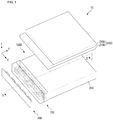
- FIG. 1 is a perspective view of a display device according to an embodiment of the present invention.
- FIG. 2 is a sectional view taken along the line II-II' of FIG. 1 .
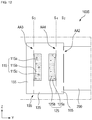
- FIG. 3A is an enlarged sectional view of portion A of FIG. 2 .
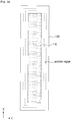
- FIG. 3B is a plane view of the first glass of FIG. 2
- the display device 10 includes a backlight unit 1000 and a display panel 2000 disposed (e.g., positioned) on the backlight unit 1000.
- the display panel 2000 may be an element capable of realizing image display (e.g., capable of displaying images).
- the display panel 2000 may be a liquid crystal display panel, an organic light-emitting display panel, a plasma display panel, or the like.
- the display panel 2000 may include a lower substrate 2100 and an upper substrate 2200 facing each other, and a liquid crystal layer interposed between the lower substrate 2100 and the upper substrate 2200.
- the lower substrate 2100 and the upper substrate 2200 may each independently include a plurality of pixel electrodes, a switching element for controlling the pixel electrodes, a gate line for transmitting a signal for controlling the switching element, and a data line.
- the planar area of the lower substrate 2100 may be larger than the planar area of the upper substrate 2200.
- the width of the lower substrate 2100 in the second direction Y may be greater than the width of the upper substrate 2200 in the second direction Y.
- the lower substrate 2100 may protrude toward a wavelength conversion member 100 as compared with the upper substrate 2200.
- the display panel 2000 and the backlight unit 1000 may be connected (or coupled) with each other using a connecting member.
- the backlight unit 1000 may be accommodated in a frame mold, and the display panel 2000 may be disposed on the frame mold or connected (coupled) with the frame mold.
- the backlight unit 1000 and the display panel 2000 may be connected with each other using a bonding resin.
- the backlight unit 1000 and the display panel 2000 may be connected with each other by bringing an upper surface of a light guide plate 200 of the backlight unit 1000 and a lower surface of the lower substrate 2100 of the display panel into direct contact with each other.
- the backlight unit 1000 includes the light guide plate 200, a light source unit 300 disposed adjacent to the light guide plate 200, and the wavelength conversion member 100 disposed between the light guide plate 200 and the light source unit 300.
- the light guide plate 200 may guide the light provided from the light source unit 300 and transmit the guided light toward the display panel 2000 located over the backlight unit 1000.
- the side surface of the light guide plate 200, adjacent to the light source unit 300 may form a light incoming surface
- the upper surface of the light guide plate 200 may form a light outgoing surface.
- the light incoming through the side face (the light incoming surface) of the light guide plate 200 may travel in the light guide plate 200 through total reflection, and at least a part of the light guided through the total reflection may leave through the upper surface (the light outgoing surface) of the light guide plate 200.
- a scattering pattern or a concavo-convex pattern may be formed on the lower surface of the light guide plate 200 to change the path of the light guided in the light guide plate 200.
- the material of the light guide plate 200 is not particularly limited as long as it is a material having high light transmittance and capable of guiding the light provided from the light source unit 300 without substantial light loss.
- the light guide plate 200 may be made of a glass material or a plastic material such as polycarbonate, polystyrene, and/or polyethylene terephthalate.
- the light source unit 300 may be disposed adjacent to the side surface (e.g., the light incoming surface) of the light guide plate 200.
- the light source unit 300 may be spaced apart from the light incoming surface of the light guide plate 200 by a set distance.
- the light source unit 300 may include a light source circuit substrate 310 and a light source 320 mounted on the light source circuit substrate 310.
- the light source circuit substrate 310 may be configured to be connected to an external power source or the like, in order to provide a signal and power necessary for driving the light source 320.
- the light source circuit board 310 may have a plate shape extending (elongated) in an approximately first direction X.
- the light source 320 may be disposed on the light source circuit board 310.
- a plurality of light sources 320 may be disposed on the light source circuit board 310 and the plurality of light sources 320 may be spaced apart from each other along the extension direction of the light source circuit board 310, for example, along the first direction X.
- the light source 320 may be a light emitting diode (LED).
- the light source 320 may be a light emitting diode that emits blue light.
- the light source 320 may emit blue light having a single peak wavelength located within a wavelength range of about 430 nm to 470 nm. About 80% or more of the light emitted by the light source 320 may be within a wavelength range of 430 nm to 470 nm.
- the light source 320 may be a light emitting diode that emits light in the ultraviolet wavelength band.
- the wavelength conversion member 100 may be disposed between the light guide plate 200 and the light source unit 300, for example, between the light guide plate 200 and the light source 320.
- the wavelength conversion member 100 may extend along a direction in which the plurality of light sources are arranged to be spaced apart from each other, for example, along the first direction X.
- the wavelength conversion member 100 may be spaced apart from the light source unit 300 by a predetermined (or set) distance. Since the wavelength conversion member 100 and the light source unit 300 are spaced apart from each other, it is possible to minimize (or reduce) the damage of a first wavelength converter 110 and a second wavelength converter 120 in the wavelength conversion member 100 that may result due to the heat emitted from the light source unit 300.
- the wavelength conversion member 100 may include a first wavelength converter 110 for converting the wavelength of transmitted light, a second wavelength converter 120 for converting the wavelength of transmitted light, a first glass 130 for providing a space for accommodating the first wavelength converter 110, and a second glass 140 for providing a space for accommodating the second wavelength converter 120.
- Each of the first wavelength converter 110 and the second wavelength converter 120 may convert the wavelength of the transmitted light.
- each of the first wavelength converter 110 and the second wavelength converter 120 may be a wavelength shifting member capable of shifting the peak wavelength of transmitted light.
- the first wavelength converter 110 may include a first base resin 110a and a first wavelength converting material 110b dispersed in the first base resin 110a, and may further include metal particles 110c dispersed in the first base resin 110a.
- the second wavelength converter 120 may include a second base resin 120a and a second wavelength converting material 120b dispersed in the second base resin 120a.
- the second wavelength converting material 120b may be different from the first wavelength converting material 110b.
- the first base resin 110a and the second base resin 120a may occupy most of the volume of the first wavelength converter 110 and the second wavelength converter 120, respectively.
- Each of the first base resin 110a and the second base resin 120a may be made of a material having high light transmittance and capable of uniformly dispersing the wavelength converting material and/or the metal particles.
- the first base resin 110a and the second base resin 120a may be made of the same or different materials.
- each of the first base resin 110a and the second base resin 120a may be a (meth)acrylate resin, an epoxy resin, a urethane resin, and/or a polyimide resin.
- Each of the first base resin 110a and the second base resin 120a may be a thermosetting resin or an ultraviolet curable resin.
- the first wavelength converting material 110b and the second wavelength converting material 120b may each emit light having a specific peak wavelength.
- each of the first wavelength converting material 110b and the second wavelength converting material 120b may be a material that converts incident light into light having a specific peak wavelength, and then emits the light.
- the first wavelength converting material 110b may emit red light
- the second wavelength converting material 120b may emit green light.
- Examples of the first wavelength converting material 110b and the second wavelength converting material 120b may include a fluorescent material and a quantum dot material, but are not limited thereto.
- the quantum dot material light having a specific peak wavelength can be emitted in the course of transferring electrons from the conduction band to the valence band.
- the quantum dot material may have a core-shell structure.
- the core may be a semiconductor nanocrystalline material. Examples of the core of the quantum dot material include Si-based nanocrystals, II-VI group-based compound nanocrystals, and III-V group-based compound nanocrystals, but the present invention is not limited thereto.
- each of the first wavelength converting material 110b and the second wavelength converting material 120b may include a core made of any one of cadmium selenide (CdSe), cadmium telluride (CdTe), cadmium sulfide (CdS), and indium phosphide (InP), and an outer shell made of zinc sulfide (ZnS).
- CdSe cadmium selenide
- CdTe cadmium telluride
- CdS cadmium sulfide
- InP indium phosphide
- ZnS zinc sulfide
- the average diameter of the particles of the first wavelength converting material 110b may be larger than the average diameter of the particles of the second wavelength converting material 120b.
- the average diameter of all the wavelength converting materials in the first wavelength converter 110 (if two or more first wavelength converting materials are included) may be about 55 ⁇ to 65 ⁇
- the average diameter of all the wavelength converting materials in the second wavelength converter 120 (if two or more second wavelength converting materials are included) may be about 40 ⁇ to 50 ⁇ .
- the wavelength converting material in the first wavelength converter 110 may be composed of only the first wavelength converting material 110b that emits red light
- the wavelength converting material in the second wavelength converter 120 may be composed of only the second wavelength converting material 120b that emits green light.
- the blue light emitted by the light source 320 may sequentially pass through the first wavelength converter 110 and the second wavelength converter 120.
- at least a part of the blue light emitted from the light source 320 may be converted into red light having a peak wavelength located within a wavelength range of about 610 nm to 650 nm by the first wavelength converter 110, and at least a part of the blue light emitted from the light source 320 may pass through the first wavelength converter 110 as it is (without being converted).
- At least a part of the light that passed through the first wavelength converter 110 may be further converted into green light having a peak wavelength located within a wavelength range of about 530 nm to 570 nm by the second wavelength converter 120, and at least a part of the light that passed through the first wavelength converter 110 may pass through the second wavelength converter 120 as it is (without being converted).
- the light converted by the first wavelength converter 110 and the second wavelength converter 120 may have a strong intensity peak wavelength in a narrow wavelength range, such light (after passing through the first wavelength converter 110 and the second wavelength converter 120) may have an intrinsic wavelength of a specific color and have excellent (or suitable) color purity.
- the light emitted by the light source 320 after passing through the wavelength conversion member 100, may be a high-purity white light only having a peak of a red intrinsic wavelength, a peak of a green intrinsic wavelength, and a peak of a blue intrinsic wavelength.
- the first wavelength converter 110 may further include metal particles 110c dispersed in the first base resin 110a.
- the metal particles 110c in the first wavelength converter 110 can further increase the color conversion efficiency of the wavelength conversion member 100.
- the metal particles 110c may be metal particles capable of scattering light in a long wavelength band such as green light and/or red light, without substantially scattering light in a short wavelength band such as blue light.
- the metal particles 110c may be aluminum oxide (Al 2 O 3 ) particles and/or silicon oxide (SiO 2 ) particles.
- the average diameter of the metal particles 110c may be about 10 ⁇ m to 100 ⁇ m.
- the metal particles 110c that do not substantially scatter light in a short wavelength band.
- the metal particles When such metal particles are disposed (placed) in the first wavelength converter 110, they may cause the scattering of red light emitted by the first wavelength converting material 110b, while also ensuring that a sufficient amount of blue light can pass through the first wavelength converter 110, without wavelength conversion, and can then be converted into green light by the second wavelength converter 120.
- the second wavelength converter 120 may include only the second base resin 120a and the second wavelength converting material 120b, without substantially including the metal particles.
- Each of the first wavelength converter 110 and the second wavelength converter 120 may have a thickness t 110 in the third direction Z, and the thickness t 110 of each of the first wavelength converter 110 and the second wavelength converter 120 may be greater than a width W 320 of the light-emitting surface of the light source 320 in the third direction Z.
- the width W 320 of the light source 320 may be about 1.5 mm to 2.5 mm
- the thickness t 110 of each of the first wavelength converter 110 and the second wavelength converter 120 may be about 2.5 mm to 4 mm.
- the first glass 130 and the second glass 140 may each be a container member capable of accommodating the first wavelength converter 110 and the second wavelength converter 120, respectively.
- Each of the first glass 130 and the second glass 140 may have a tubular shape having an inner hollow structure and extending in the first direction X, and each of the first wavelength converter 110 and the second wavelength converter 120 may be inserted into the hollow structure.
- FIG. 1 illustrates a case where the first wavelength converter 110 and the second wavelength converter 120 extend in the first direction X, and the wavelength conversion member 100 comprises one of each, but, in another embodiment, the plurality of first wavelength converters 110 and/or the plurality of second wavelength converters 120 may be arranged in the first direction X and spaced apart from each, for example, so as to be arranged at positions corresponding to the light sources 320.
- Each of the first glass 130 and the second glass 140 may be made of a glass material having relatively high light transmittance.
- the first glass 130 and the second glass 140 may be made of the same material or different materials.
- the first wavelength converter 110 may be accommodated by the first glass 130. On a sectional view taken along a direction perpendicular to the extending direction of the wavelength conversion member 100 (here, perpendicular to the first direction X), the first wavelength converter 110 may be completely surrounded by the first glass 130. With such arrangement, it may be possible to prevent or reduce the possibility of the first wavelength converter 110 from being contaminated and/or denatured by external moisture or impurities, and to improve the durability and lifetime of the wavelength conversion member 100.
- the second wavelength converter 120 may be accommodated by the second glass 140.
- the second wavelength converter 120 On a sectional view taken along a direction perpendicular to the extending direction of the wavelength conversion member 100 (here, perpendicular to the first direction X), the second wavelength converter 120 may be completely surrounded by the second glass 140. With such arrangement, it may be possible to prevent or reduce the possibility of the second wavelength converter 120 from being contaminated and/or denatured by external moisture or impurities, and to improve the durability and lifetime of the wavelength conversion member 100.
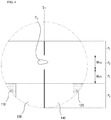
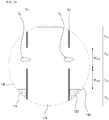
- FIG. 4 is an enlarged sectional view of portion B (a portion where the first glass 130 and the second glass 140 are connected or coupled) of FIG. 3A .
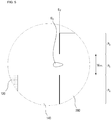
- FIG. 5 is an enlarged sectional view of portion C (a portion where the second glass 140 and the light guide plate 200 are connected or coupled) of FIG. 3A .
- the first glass 130 and the second glass 140 may be connected or coupled to be at least partially in direct contact with each other.
- the first glass 130 and the second glass 140 may be at least partially fusion-bonded to each other.
- the first glass 130 and the second glass 140 may be integrated (e.g., coupled) by at least partial fusion-bonding.
- fusion-bonded may refer to two materials being integrally connected or coupled to each other by, for example, welding.
- the contact surface S 1 between the first glass 130 and the second glass 140 includes a first portion P 1 where there is a physical boundary between the first glass 130 and the second glass 140, a second portion P 2 where there is substantially no physical boundary between the first portion 130 and the second glass 140, and a third portion P 3 overlapping the first and second wavelength converters 110 and 120 in the second direction Y.
- substantially no physical boundary between two components may refer to there being no naked-eye distinguishable boundary.
- the second portion P 2 may be a junction region between the first glass 130 and the second glass 140.
- the glass material of the first glass 130 and the glass material of the second glass 140 may be at least partially mixed, and thus the boundary between the first glass 130 and the second glass 140 may disappear.
- at least a part of the glass material of the first glass 130 may penetrate into the second glass 140 to be mixed with the glass material of the second glass 140, and/or at least a part of the glass material of the second glass 140 may penetrate into the first glass 130 to be mixed with the glass material of the first glass 130.
- the width W P2 of the second portion P 2 of the contact surface S 1 between the first glass 130 and the second glass 140 may refer to the width of the junction region and may be 60 ⁇ m to 120 ⁇ m, or 70 ⁇ m to 100 ⁇ m.
- the term "junction" may refer to a region in which two components are in direct contact with each other.
- a seed-like structure D 1 may exist in the vicinity of the second portion P 2 .
- the seed-like structure D 1 may be formed in the process of joining the first glass 130 and the second glass 140 together.
- the first glass 130 and the second glass 140 may be joined using a laser having a pulse width of about 10 femtoseconds to 50 femtoseconds.
- the pulse width of the laser is set within the above range, even when the first glass 130 and/or the second glass 140 is irradiated with the laser to allow the laser to pass through the first glass 130 and/or the second glass 140, it is possible to prevent or reduce the possibility of the other parts of the glass, other than the intended junction region, from being deformed in shape, structure, physical properties, density of the glass material, and/or the like, thereby improving the reliability and durability of the backlight unit.
- the seed-like structure D 1 may have an elongated shape having a major axis (e.g., abscissa axis illustrated in the drawing) and a minor axis (e.g., ordinate axis illustrated in the drawing).
- the seed-like structure D 1 may be asymmetric with respect to the minor axis.
- the seed-like structure D 1 may be in a state in which the minor axis is aligned in a direction parallel to the contact surface S 1 , but the present invention is not limited thereto.
- the length of the minor axis of the seed-like structure D 1 may be about 10 ⁇ m to 20 ⁇ m.
- the first portion P 1 , the second portion P 2 , and the third portion P 3 may be located at substantially the same level (e.g., substantially aligned along the third direction Z), where the first portion P 1 may be located between the second portion P 2 and the third portion P 3 .
- the second portion P 2 where there is substantially no physical boundary between the first glass 130 and the second glass 140 (i.e. the junction region) may be spaced apart from the first wavelength converter 110 and the second wavelength converter 120 in the third direction Z.
- the shortest distance in the third direction Z (W P1 ) between the second portion P 2 and each of the first wavelength converter 110 and the second wavelength converter 120 may be about 50 ⁇ m or more.
- the width of the first portion P 1 may be about 50 ⁇ m or more.
- the second portion P 2 is spaced apart from the wavelength converters by 50 ⁇ m or more, it may be possible to prevent or reduce the possibility of the first wavelength converter 110 and/or the second wavelength converter 120 from being damaged by the high-temperature heat generated in the process of joining the first glass 130 and the second glass 140.
- the first portion P 1 and the second portion P 2 may differ from each other in terms of light transmittance, refractive index, and/or density of glass material.
- the wavelength conversion member 100 includes a first glass 130 for accommodating/sealing the first wavelength converter 110 and a second glass 140 for accommodating/sealing the second wavelength converter 120, and the first glass 130 and the second glass 140 are formed as an integrated module, thereby converting the light provided from the light source 320 into high-purity white light.
- the first wavelength converter 110 which may be a red wavelength conversion member
- the second wavelength converter 120 which may be a green wavelength conversion member
- the first wavelength converter 110 which may be a red wavelength conversion member
- the second wavelength converter 120 which may be a green wavelength conversion member
- first glass 130 accommodating the first wavelength converter 110 and the second glass 140 accommodating the second wavelength converter 120 are arranged to be at least partially in direct contact with each other without physical boundary, no (or reduced) deformation occurs in the junction region between the first glass 130 and the second glass 140, even when the wavelength conversion member 100 is heated by the heat emitted from the light source 320, thereby improving durability and reliability.
- the wavelength conversion member 100 and the light guide plate 200 may be connected to be at least partly in direct contact with each other.
- the second glass 140 of the wavelength conversion member 100 and the light-incoming surface of the light guide plate 200 may be at least partially fusion-bonded to each other. That is, the wavelength conversion member 100 and the light guide plate 200 may be integrated by at least partial fusion-bonding.
- the contact surface S 2 between the second glass 140 and the light guide plate 200 may include a fourth portion P 4 where there is a physical boundary between the second glass 140 and the light guide plate 200 and a fifth portion P 5 where there is substantially no physical boundary between the second glass 140 and the light guide plate 200.
- the fifth portion P 5 may be a junction region between the second glass 140 and the light guide plate 200.
- the width W P5 of the fifth portion P 5 (in the third direction Z) of the contact surface S 2 between the second glass 140 and the light guide plate 200 (i.e. the width of the junction region) may be 60 ⁇ m to 120 ⁇ m, or 70 ⁇ m to 100 ⁇ m.
- a seed-like structure D 2 may exist in the vicinity of the fifth portion P 5 .
- the seed-like structure D 2 may be formed in the process of joining the second glass 140 and the light guide plate 200 together.
- the second glass 140 and the light guide plate 200 may be joined using a laser having a pulse width of about 10 femtoseconds to 50 femtoseconds.
- the seed-like structure D 2 may have an elongated shape having a major axis and a minor axis.
- the seed-like structure D 2 may be asymmetric with respect to the minor axis.
- the length of the minor axis of the seed-like structure D 2 may be about 10 ⁇ m to 20 ⁇ m.
- the fourth portion P 4 and the fifth portion P 5 may be located at substantially the same level (e.g., substantially aligned along the third direction Z), and the fifth portion P 5 may not overlap the second wavelength converter 120 in the second direction Y.
- the fifth portion P 5 where there is substantially no physical boundary between the second glass 140 and the light guide plate 200 (i.e. the junction region) may not overlap the second wavelength converter 120 in a sectional view (e.g., as illustrated in FIG. 5 ). Since the fifth portion P 5 and the second wavelength converter 120 do not overlap each other, it may be possible to prevent or reduce the possibility that the laser beam used in the process of joining the first glass 130 and the second glass 140 may pass through the second wavelength converter 120 and damage the second wavelength converter 120.
- the fourth portion P 4 and the fifth portion P 5 may differ from each other in terms of light transmittance, refractive index, and/or density of glass material.
- the backlight unit 1000 may be configured such that the wavelength conversion member 100 accommodating the plurality of wavelength converters is integrated with the light guide plate 200 to form a module.
- the backlight unit 1000 or the display device including the backlight unit 1000 it may be possible to prevent or reduce the misalignment between the wavelength conversion member 100 and the light guide plate 200, and thus it may be possible to prevent or reduce the possibility of the light emitted from the light source 320 from being incident on the light guide plate 200 without first passing through the wavelength conversion member 100. Further, it may be possible to prevent or reduce the possibility of the light passing through the wavelength conversion member 100 and from being leaked without being incident on the light guide plate 200.
- the wavelength conversion member 100 accommodating the plurality of wavelength converters and the light guide plate 200 are connected to be at least partially in direct contact with each other without physical boundary, deformation that may otherwise occur in the junction region between the wavelength conversion member 100 and the light guide plate 200 may be prevented or reduced, even when the wavelength conversion member 100 and the light guide plate 200 are heated by the heat emitted from the light source 320.
- the durability and reliability of the backlight unit 1000 may be improved.
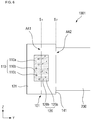
- FIG. 6 is an enlarged sectional view of a backlight unit according to another embodiment of the present invention.
- a backlight unit 1001 includes a wavelength conversion member 101 including a first wavelength converter 110, a second wavelength converter 120, a first glass 131 providing a space for accommodating the first wavelength converter 110, and a second glass 141 providing a space for accommodating the second wavelength converter 120.
- the backlight unit 1001 according to this embodiment is different from the backlight unit 1000 according to the embodiment of FIG. 1 in that trench-shaped concave grooves extending in the first direction X are formed on any one side of the first glass 131 and the second glass 141, and the first wavelength converter 110 and the second wavelength converter 120 are inserted into the concave grooves.
- Each of the first wavelength converter 110 and the second wavelength converter 120 may convert the wavelength of transmitted light.
- the first wavelength converter 110 may be a red wavelength converter
- the second wavelength converter 120 may be a green wavelength converter. Since the first wavelength converter 110 and the second wavelength converter 120 have been described above with reference to, for example, FIG. 1 , a detailed description thereof will not be provided again.
- the first glass 131 and the second glass 141 may be container members that accommodate the first wavelength converter 110 and the second wavelength converter 120, respectively.
- one side (right side in the drawing) of the first glass 131, facing the second glass 141 may have a concave groove extending along the extension direction of the wavelength conversion member 1001 (e.g., along the first direction X), and the other side (left side in the drawing) of the second glass 141, facing the first glass 131, may have a concave groove extending along the first direction X.
- the first wavelength converter 110 and the second wavelength converter 120 may be inserted into the concave grooves of the first glass 131 and the second glass 141, respectively.
- the first wavelength converter 110 and the second wavelength converter 120 may directly face each other, and may be at least partially in direct contact with each other.
- the first wavelength converter 110 and the second wavelength converter 120 may be accommodated by the first glass 131 and the second glass 141, respectively.
- the first glass 131 and the second glass 141 may be at least partially in direct contact with each other.
- the first glass 131 and the second glass 141 may be at least partially fusion-bonded to each other.
- the contact surface S 1 between the first glass 131 and the second glass 141 may include a portion where there is substantially no physical boundary therebetween (herein, referred to as a junction region AA1). Since the junction region AA1 between the first glass 131 and the second glass 141 is substantially similar to the junction region between the first glass 130 and the second glass 140 described above with reference to FIG. 4 and the like, a detailed description thereof will not be provided again.
- the wavelength conversion member 101 and the light guide plate 200 may be at least partially in direct contact with each other.
- the second glass 141 of the wavelength conversion member 101 and the light incoming surface of the light guide plate 200 may be at least partially fusion-bonded to each other.
- the contact surface S 2 between the second glass 141 and the light guide plate 200 may include a portion where there is substantially no physical boundary therebetween (herein, referred to as a junction region AA2). Since the junction region AA2 between the second glass 141 and the light guide plate 200 is substantially similar to the junction region between the second glass 140 and the light guide plate 200 described above with reference to FIG. 5 and the like, a detailed description thereof will not be provided again.
- FIG. 7 is an enlarged sectional view of a backlight unit according to another embodiment of the present invention.
- a backlight unit 1002 includes a wavelength conversion member 102 including a first wavelength converter 112 and a second wavelength converter 122.
- the backlight unit 1002 according to this embodiment is different from the backlight unit 1001 according to the embodiment of FIG. 6 in that there is a gap AG formed between the first wavelength converter 112 and the second wavelength converter 122.
- the first wavelength converter 112 is inserted into the concave groove of the first glass 131, but the first wavelength converter 112 may not completely fill the concave groove of the first glass 131. That is, the volume occupied by the first wavelength converter 112 may be smaller than the volume of the space provided by the concave groove of the first glass 131. Further, the second wavelength converter 122 is inserted into the concave groove of the second glass 141, but the first wavelength converter 112 may not completely fill the concave groove of the second glass 141.
- nitrogen gas (N 2 ) or an air layer may be interposed in the gap AG.
- the gap AG may form a low refractive index region having a lower refractive index than those of the first wavelength conversion unit 112, the second wavelength conversion unit 122, the first glass 131, and the second glass 141.
- the red light and blue light that pass through the first wavelength converter 112 may then pass through the gap AG, a low refractive index region, before passing through the second wavelength converter 122, thereby maximizing photo-excitation efficiency.
- the color conversion efficiency can be further improved by forming the gap AG between the first wavelength converter 112 and the second wavelength converter 122.
- a light outgoing direction may be controlled..
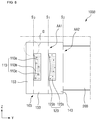
- FIG. 8 is an enlarged sectional view of a backlight unit according to another embodiment of the present invention.
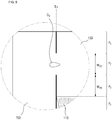
- FIG. 9 is an enlarged sectional view of portion D of FIG. 8 .
- a backlight unit 1003 includes a wavelength conversion member 103 including a first wavelength converter 113, a second wavelength converter 123, a first glass 133 providing a space for accommodating the first wavelength converter 113, and a second glass 143 providing a space for accommodating the second wavelength converter 123.
- the backlight unit 1003 according to this embodiment is different from the backlight unit 1000 according to the embodiment of FIG. 1 and the like in that it further includes a third glass 153 sealing the first wavelength converter 113.
- Each of the first wavelength converter 113 and the second wavelength converter 123 may convert the wavelength of transmitted light.
- the first wavelength converter 113 may be a red wavelength converter
- the second wavelength converter 123 may be a green wavelength converter. Since the first wavelength converter 113 and the second wavelength converter 123 are substantially similar to the first wavelength converter 110 and the second wavelength converter 120, respectively, that have been described with reference to FIG. 1 and the like, a detailed description thereof will not be provided again.
- the first glass 133 and the second glass 143 may be container members that accommodate the first wavelength converter 113 and the second wavelength converter 123, respectively, and the third glass 153 may be a cover member sealing the first wavelength converter 113.
- one side (right side in the drawing) of the third glass 153, facing the first glass 133 may be substantially flat.
- the side of the first glass 133 facing the third glass 153 (left side in the drawing) may have a concave groove
- the side of the second glass 143 facing the first glass 133 (left side in the drawing) may have a concave groove.
- the first wavelength converter 113 may be inserted into the concave groove of the first glass 133, and may be completely surrounded by the first glass 133 and the third glass 153.
- the second wavelength converter 123 may be inserted into the concave groove of the second glass 143, and may completely surrounded by the first glass 133 and the second glass 143.
- the first glass 133 and the third glass 153 may be at least partially in direct contact with each other.
- the first glass 133 and the third glass 153 may be at least partially fusion-bonded to each other.
- the contact surface S 3 between the first glass 133 and the third glass 153 includes a sixth portion P 6 where there is a physical boundary between the first glass 133 and the third glass 153, a seventh portion P 7 where there is substantially no physical boundary between the first glass 133 and the third glass 153, and an eighth portion P 8 overlapping the first wavelength converter 113 in the second direction Y.
- the width W P7 of the seventh portion P 7 of the contact surface S 3 between the first glass 133 and the third glass 153 may be 60 ⁇ m to 120 ⁇ m, or 70 ⁇ m to 100 ⁇ m.
- a seed-like structure D 3 may exist in the vicinity of the seventh portion P 7 .
- the seed-like structure D 3 may be formed in the process of joining the first glass 133 and the third glass 153 together.
- the first glass 133 and the third glass 153 may be joined using a laser having a pulse width of about 10 femtoseconds to 50 femtoseconds.
- the seed-like structure D 3 may have an elongated shape having a major axis and a minor axis.
- the seed-like structure D 3 may be asymmetric with respect to the minor axis.
- the length of the minor axis of the seed-like structure D 3 may be about 10 ⁇ m to 20 ⁇ m.
- the sixth portion P 6 , the seventh portion P 7 , and the eighth portion P 8 may be located at substantially the same level (e.g., substantially aligned along the third direction Z), and the sixth portion P 6 may be located between the seventh portion P 7 and the eighth portion P 8 .
- the seventh portion P 7 between the first glass 133 and the third glass 153 i.e. the junction region
- the shortest distance W P6 (in the third direction Z) between the seventh portion P 7 and the first wavelength converter 113 may be about 50 ⁇ m or more.
- junction region AA1 between the first glass 133 and the second glass 143 and the junction region AA2 between the second glass 143 and the light guide plate 200 have been described above with reference to FIGS. 4 and 5 , a detailed description thereof will not be provided again.
- FIG. 8 illustrates a case where a gap is formed between the first wavelength converter 113 and the third glass 153, and a gap is formed between the second wavelength converter 123 and the first glass 133.
- the first wavelength converter 113 may completely fill a space between the first glass 133 and the third glass 153 (e.g., there may be no gap between the the first wavelength converter 113 and the third glass 153)
- the second wavelength converter 123 may completely fill a space between the first glass 133 and the second glass 143 (e.g., there may be no gap between the second wavelength converter 123 and the first glass 133).
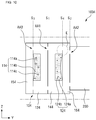
- FIG. 10 is an enlarged sectional view of a backlight unit according to another embodiment of the present invention.
- FIG. 11 is an enlarged sectional view of portion E of FIG. 10 .
- a backlight unit 1004 includes a wavelength conversion member 104 including a first wavelength converter 114, a second wavelength converter 124, a first glass 134 providing a space for accommodating the first wavelength converter 114, and a second glass 144 providing a space for accommodating the second wavelength converter 124.
- the backlight unit 1004 according to this embodiment is different from the backlight unit 1000 according to the embodiment of FIG. 1 and the like in that it further include a third glass 154 sealing the first wavelength converter 114 and a fourth glass 164 sealing the second wavelength converter 124.
- Each of the first wavelength converter 114 and the second wavelength converter 124 may convert the wavelength of transmitted light.
- the first wavelength converter 114 may be a red wavelength converter
- the second wavelength converter 124 may be a green wavelength converter. Since the first wavelength converter 114 and the second wavelength converter 124 are substantially similar to the first wavelength converter 110 and the second wavelength converter 120, respectively, that have been described above with reference to FIG. 1 and the like, a detailed description thereof will not be provided again.
- the first glass 134 and the second glass 144 may be container members that accommodate the first wavelength converter 114 and the second wavelength converter 124, respectively, and the third glass 154 and the fourth glass 164 may be cover members sealing the first wavelength converter 114 and the second wavelength converter 124, respectively.
- one side of the third glass 154 facing the first glass 134 may be substantially flat.
- the side of the first glass 134 facing the third glass 154 may have a concave groove, and the other side of the first glass 134, facing the second glass 144 (right side in the drawing), may be substantially flat.
- the side of the second glass 144 facing the fourth glass 164 may have a concave groove
- the other side of the fourth glass 164, facing the second glass 144 may be substantially flat.
- the first wavelength converter 114 may be inserted into the concave groove of the first glass 134, and may be completely surrounded by the first glass 134 and the third glass 154.
- the second wavelength converter 124 may be inserted into the concave groove of the second glass 144, and may be completely surrounded by the second glass 144 and the fourth glass 164.
- the light guide plate 200 may be at least partially in direct contact with the fourth glass 164, instead of the second glass 144.
- the second glass 144 and the fourth glass 164 may be at least partially in direct contact with each other.
- the second glass 144 and the fourth glass 164 may be at least partially fusion-bonded to each other.
- the contact surface S 4 between the second glass 144 and the fourth glass 164 may include a ninth portion P 9 where there is a physical boundary between the second glass 144 and the fourth glass 164, a tenth portion P 10 where there is substantially no physical boundary between the second glass 144 and the fourth glass 164, and an eleventh portion P 11 overlapping the second wavelength converter 124 in the second direction Y.
- the width W P10 of the tenth portion P 10 of the contact surface S 4 between the second glass 144 and the fourth glass 164 (herein, the tenth portion P 10 may be referred to as the junction region) may be 60 ⁇ m to 120 ⁇ m, or 70 ⁇ m to 100 ⁇ m.
- a seed-like structure D 4 may exist in the vicinity of the tenth portion P 10 .
- the seed-like structure D 4 may be formed in the process of joining the second glass 144 and the fourth glass 164 together.
- the second glass 144 and the fourth glass 164 may be joined using a laser having a pulse width of about 10 femtoseconds to 50 femtoseconds.
- the seed-like structure D 4 may have an elongated shape having a major axis and a minor axis.
- the seed-like structure D 4 may be asymmetric with respect to the minor axis.
- the length of the minor axis of the seed-like structure D 4 may be about 10 ⁇ m to 20 ⁇ m.
- the ninth portion P 9 , the tenth portion P 10 , and the eleventh portion P 11 may be located at substantially the same level (e.g., substantially aligned along the third direction Z), and the ninth portion P 9 may be located between the tenth portion P 10 and the eleventh portion P 11 .
- the tenth portion P 10 between the second glass 144 and the fourth glass 164 (the junction region) may be spaced apart from the second wavelength converter 124 in the third direction Z.
- the shortest distance W P9 (in the third direction Z) between the tenth portion P 10 and the second wavelength converter 124 may be about 50 ⁇ m or more.
- junction region AA1 between the first glass 134 and the second glass 144, the junction region AA2 between the fourth glass 164 and the light guide plate 200, and the junction region AA3 between the first glass 134 and the third glass 154 are substantially similar to the corresponding junction regions described above (e.g., with reference to FIGS. 4 , 5 , and 8 ), a detailed description thereof will not be provided again.
- FIG. 10 illustrates a case where a gap is formed between the first wavelength converter 114 and the third glass 154 and a gap is formed between the second wavelength converter 124 and the fourth glass 164
- the first wavelength converter 114 may completely fill a space between the first glass 134 and the third glass 154 (e.g., there may be no gap between the first wavelength converter 114 and the third glass 154)
- the second wavelength converter 124 may completely fill a space between the second glass 144 and the fourth glass 164 (e.g., there may be no gap between the second wavelength converter 124 and the fourth glass 164).
- FIG. 12 is an enlarged sectional view of a backlight unit according to another embodiment of the present invention.
- a backlight unit 1005 according to this embodiment is different from the backlight unit 1004 according to the embodiment of FIG. 10 and the like in that a first wavelength converter 115 and a second wavelength converter 125 of a wavelength conversion member 105 are both inserted in one first glass 135.
- the first glass 135 may be a container member that accommodates the first wavelength converter 115 and the second wavelength converter 125, and the third glass 155 and the fourth glass 165 may be cover members sealing the first wavelength converter 115 and the second wavelength converter 125.
- the first glass 135 may be integrally formed.
- the light transmittance, refractive index and/or density of a glass material in the first glass 135 may be uniform.
- the side of the third glass 155 facing the first glass 135 may be substantially flat. Further, the side of the first glass 135 facing the third glass 155 (left side in the drawing), and the side of the first glass 135 facing the fourth glass 165 (right side in the drawing), may have concave grooves, respectively. Further, the side of the fourth glass 165 facing the first glass 135 (left side in the drawing), may be substantially flat.
- the first wavelength converter 115 may be inserted into the concave groove of the side of the first glass 135 facing the third glass 155, and the second wavelength converter 125 may be inserted into the concave groove of the side of the first glass 135 facing the fourth glass 165.
- the first wavelength converter 115 may be surrounded by the first glass 135 and the third glass 155 and the second wavelength converter 125 may be surrounded by the first glass 135 and the fourth glass 165.
- junction region AA2 between the fourth glass 165 and the light guide plate 200 Since the junction region AA2 between the fourth glass 165 and the light guide plate 200, the junction region AA3 between the first glass 135 and the third glass 155, and the junction region AA4 between the first glass 135 and the fourth glass 165 are substantially similar to the corresponding junction regions that have been described above (e.g., with reference to FIGS. 5 , 8 , and 10 ), a detailed description thereof will not be provided again.
- FIG. 13 is an enlarged sectional view of a backlight unit according to another embodiment of the present invention.
- FIG. 14 is an enlarged sectional view of portion F of FIG. 13 .
- a backlight unit 1006 includes a wavelength conversion member 106 including a first wavelength converter 116, a second wavelength converter 126, a first glass 136 providing a space for accommodating the first wavelength converter 116, and a second glass 146 providing a space for accommodating the second wavelength converter 126.
- the backlight unit 1006 according to this embodiment is different from the backlight unit 1001 according to the embodiment of FIG. 6 and the like in that it further includes a fifth glass 176 interposed (positioned) between the first wavelength converter 116 and the second wavelength converter 126.
- the first glass 136 and the second glass 146 may be container members that accommodate the first wavelength converter 116 and the second wavelength converter 126, respectively, and the fifth glass 176 may be a spacer member that spaces the first wavelength converter 116 and the second wavelength converter 126 from each other by a predetermined (or set) distance.
- the side of the first glass 136 facing the fifth glass 176 may have a concave groove extending along the extension direction of the wavelength conversion member 106 (here, along the first direction X), and the side of the second glass 146 facing the fifth glass 176 (left side in the drawing), may have a concave groove extending along the first direction X.
- both the side of the fifth glass 176 facing the first glass 136 (left side in the drawing) and the side of the fifth glass 176 facing the second glass 146 (right side in the drawing) may be substantially flat.
- the first wavelength converter 116 and the second wavelength converter 126 may be inserted into the respective concave grooves.
- the first wavelength converter 116 may be surrounded by the first glass 136 and the fifth glass 176
- the second wavelength converter 126 may be surrounded by the second glass 146 and the fifth glass 176.
- first glass 136 and the fifth glass 176 may be at least partially in direct contact with each other, and the second glass 146 and the fifth glass 176 may be at least partially in direct contact with each other.
- first glass 136 and the fifth glass 176 may be at least partially fusion-bonded to each other, and the second glass 146 and the fifth glass 176 may be at least partially fusion-bonded to each other.
- the contact surface S 5 between the first glass 136 and the fifth glass 176 and the contact surface S 6 between the second glass 146 and the fifth glass 176 may each include, in the second direction Y, a twelfth portion P 12 where there is a physical boundary between the respective adjacent glasses, a thirteenth portion P 13 where there is substantially no physical boundary between the respective adjacent glasses, and a fourteenth portion P 14 overlapping the wavelength converters 116 and 126.
- the width W P13 of the thirteenth portion P 13 (herein, the thirteenth portion P 13 may be referred to as the junction region) may be 60 ⁇ m to 120 ⁇ m, or 70 ⁇ m to 100 ⁇ m.
- Seed-like structures D 5 and D 6 may exist in the vicinity of the thirteenth portion P 13 of the contact surface S 5 between the first glass 136 and the fifth glass 176 and in the vicinity of the thirteenth portion P 13 of the contact surface S 6 between the second glass 146 and the fifth glass 176, respectively.
- the seed-like structures D 5 and D 6 may be formed in the process of joining the respective adjacent glasses together.
- the first glass 136 and the fifth glass 176, and the second glass 146 and the fifth glass 176 may be joined using a laser having a pulse width of about 10 femtoseconds to 50 femtoseconds, respectively.
- Each of the seed-like structures D 5 and D 6 may have an elongated shape having a major axis and a minor axis.
- Each of the seed-like structures D 5 and D 6 may be asymmetric with respect to the minor axis.
- the length of the minor axis of each of the seed-like structures D 5 and D 6 may be about 10 ⁇ m to 20 ⁇ m.
- the wavelength conversion member according to an embodiment of the present invention can convert the light provided from a light source into high-purity white light.
- the backlight unit according to an embodiment of the present invention can provide high-purity white light using the wavelength conversion member, can minimize or reduce the light loss between a wavelength conversion member and a light guide plate by accurately maintaining the alignment state between the wavelength conversion member and the light guide plate, even when an external impact is applied, and can maximize or improve color conversion efficiency.
- any numerical range recited herein is intended to include all sub-ranges of the same numerical precision subsumed within the recited range.
- a range of "1.0 to 10.0" is intended to include all subranges between (and including) the recited minimum value of 1.0 and the recited maximum value of 10.0, that is, having a minimum value equal to or greater than 1.0 and a maximum value equal to or less than 10.0, such as, for example, 2.4 to 7.6.
- Any maximum numerical limitation recited herein is intended to include all lower numerical limitations subsumed therein and any minimum numerical limitation recited in this specification is intended to include all higher numerical limitations subsumed therein. Accordingly, Applicant reserves the right to amend this specification, including the claims, to expressly recite any sub-range subsumed within the ranges expressly recited herein.
Landscapes
- Physics & Mathematics (AREA)
- Nonlinear Science (AREA)
- Optics & Photonics (AREA)
- General Physics & Mathematics (AREA)
- Chemical & Material Sciences (AREA)
- Engineering & Computer Science (AREA)
- Mathematical Physics (AREA)
- Crystallography & Structural Chemistry (AREA)
- Inorganic Chemistry (AREA)
- Materials Engineering (AREA)
- Organic Chemistry (AREA)
- Astronomy & Astrophysics (AREA)
- Spectroscopy & Molecular Physics (AREA)
- Microelectronics & Electronic Packaging (AREA)
- General Engineering & Computer Science (AREA)
- Liquid Crystal (AREA)
- Optical Filters (AREA)
Abstract
Description
- One or more aspects of one or more embodiments of the present invention relate to a wavelength conversion member and a backlight unit including the wavelength conversion member.
- The importance of a display device, for example, a liquid crystal display device has increased with the development of media and electronic methods of communication. The display panel of a liquid crystal display device commonly includes two substrates, each provided with an electric field-generating electrode, and a liquid crystal layer disposed (e.g., positioned) between the two substrates. The liquid crystal display device generally requires a backlight unit for providing light to the display panel, because the image on the liquid crystal display is generated by rearranging the liquid crystals in the liquid crystal layer using the electric field-generating electrode, to adjust the amount of light passing through the display panel.
- Generally, the backlight unit may include a light source for emitting light and a light guide plate for guiding the light provided from the light source. Since the light provided from the backlight unit passes through the display panel and contributes to displaying the image, the color purity of the light provided from the backlight unit may be an important factor in determining the display quality of the liquid crystal display device. Thus, there is a need to develop a method for further improving the color purity of the light provided by the backlight unit.
- White light emitted by the light source may include intrinsic wavelengths of red, green, and blue. However, white light emitted by a comparative light source may be mixed with light in an unintentional (e.g., undesirable) wavelength band, which may cause degradation of display quality of the display device.
- One or more aspects of one or more embodiments of the present invention are directed toward a wavelength conversion member which can generate high-purity white light.
- One or more aspects of one or more embodiments of the present invention are directed toward a backlight unit, which can provide high-purity white light, which can minimize (or reduce) the light loss between a wavelength conversion member and a light guide plate by accurately maintaining the alignment state between the wavelength conversion member and the light guide plate even when an external impact is applied, and which can maximize (or improve) color conversion efficiency.
- However, aspects of embodiments of the present invention are not restricted to the one set forth herein. The above-described aspect and other aspects of the present invention will become more apparent to one of ordinary skill in the art to which the present invention pertains by referencing the detailed description of the present invention given below.
- According to an example embodiment of the invention, there is provided a wavelength conversion member. The wavelength conversion member may include: a first wavelength converter extending in a first direction and containing a first wavelength converting material; a second wavelength converter extending in the first direction and containing a second wavelength converting material different from the first wavelength converting material; a first container member extending in the first direction and providing a space for accommodating the first wavelength converter; and a second container member extending in the first direction and providing a space for accommodating the second wavelength converter, wherein each of the first container member and the second container member has a first side and a second side, wherein the second container member is adjacent to the first container member in a second direction, crossing the first direction, the first side of the first container member and the second side of the second container member facing each other and together forming a contact surface between the first container member and the second container member, and wherein the first container member and the second container member are at least partially fusion-bonded to each other.
- In an example embodiment, the contact surface between the first container member and the second container member may include: a first portion where there is a physical boundary between the first container member and the second container member; a second portion where there is substantially nophysical boundary between the first container member and the second container member; and a third portion overlapping the first wavelength converter, and wherein the first portion, the second portion, and the third portion may be aligned along a third direction, crossing the first and second directions, and a part of the first portion may be located between the second portion and the third portion.
- In an example embodiment, the part of the first portion located between the second portion and the third portion may have a width of 50 µm or more, the second portion may have a width of 60 µm to 120 µm, a seed-like structure may exist in the vicinity of the second portion, and the seed-like structure may have an elongated shape having a major axis and a minor axis.
- In an example embodiment, the first wavelength converter may further comprise metal particles selected from aluminum oxide particles and silicon oxide particles, and the second wavelength converter may not contain metal particles.
- In an example embodiment, the first wavelength converter may be surrounded by the first container member, and the second wavelength converter may be surrounded by the second container member.
- In an example embodiment, the first side of the first container member may have a first concave groove for accommodating the first wavelength converter, and the second side of the second container member, facing the first container member, may have a second concave groove for accommodating the second wavelength converter.
- In an example embodiment, a gap may be formed between the first wavelength converter and the second wavelength converter by the first and second concave grooves.
- In an example embodiment, the wavelength conversion member may further comprise: a first cover member adjacent to the second side of the first container member, opposite the first side of the first container member, and sealing the first wavelength converter; and a second cover member adjacent to the first side of the second container member, opposite the second side of the second container member, and sealing the second wavelength converter, wherein the second side of the first container member may have a first concave groove for accommodating the first wavelength converter, and the first side of the second container member may have a second concave groove for accommodating the second wavelength converter.
- In an example embodiment, the wavelength conversion member may further comprise: a cover member adjacent to the second side of the first container member, opposite the first side of the first container member, and sealing the first wavelength converter, wherein the second side of the first container member may have a first concave groove for accommodating the first wavelength converter, and the second side of the second container member, facing the first side of the first container member, may have a second concave groove for accommodating the second wavelength converter, and the second wavelength converter may be surrounded by the first side of the first container member and the first side of the second container member, opposite the second side of the second container member.
- According to another example embodiment of the invention, a wavelength conversion member, comprising: a first glass extending in a first direction and having a first side and a second side, opposite the first side; a second glass extending in a first direction and having a first side and a second side, opposite the first side, the second glass being adjacent to the first glass in a second direction, crossing the first direction, and at least partially in direct contact with the first glass, the first side of the first glass and the second side of the second glass facing each other and together forming a contact surface between the first glass and the second glass; a first wavelength converter interposed in the second glass adjacent to the contact surface between the first glass and the second glass, the first wavelength converter containing a first wavelength converting material; and a second wavelength converter interposed in the second glass adjacent to the first side of the second glass, the second wavelength converter containing a second wavelength converting material different from the first wavelength converting material.
- In an example embodiment, the first glass and the second glass may be at least partially fusion-bonded to each other, and wherein the contact surface between the first glass and the second glass may include: a first portion where there is a physical boundary between the first glass and the second glass; a second portion where there is substantially no physical boundary between the first glass and the second glass; and a third portion overlapping the first wavelength converter, and wherein a part of the first portion may be located between the second portion and the third portion.
- In an example embodiment, the first side of the first glass may be substantially flat, the second side of the second glass, facing the first glass, may have a first concave groove, the first side of the second glass may have a second concave groove, the first wavelength converter may be inserted in the first concave groove, and the second wavelength converter may be inserted in the second concave groove.
- In an example embodiment, a gap may be formed between the first glass and the first wavelength converter by the first concave groove.
- In an example embodiment, the wavelength conversion member may further comprise: a third glass adjacent to the second wavelength converter in the second direction and at least partially in direct contact with the second glass, wherein the first side of the first glass may be substantially flat, the second side of the second glass, facing the first glass, may have a first concave groove, the first side of the second glass may have a second concave groove, and a side of the third glass facing the second glass may be substantially flat, and wherein the first wavelength converter may be inserted in the first concave groove, and the second wavelength converter may be inserted in the second concave groove.
- In an example embodiment, the wavelength conversion member may further comprise a third glass between the first wavelength converter and the second wavelength converter and at least partially in direct contact with the second glass, wherein the first side of the first glass may be substantially flat, a second side of the second glass, facing the first glass, may have a first concave groove, a first side of the third glass, facing the second wavelength converter, may have a second concave groove, the first wavelength converter may be inserted in the first concave groove, and the second wavelength converter may be inserted in the second concave groove.
- In an example embodiment, the first side of the first glass may have a concave groove, a second side of the second glass, facing the first glass, may be substantially flat, and the first wavelength converter may be inserted in the concave groove.
- In an example embodiment, the first wavelength converter and the second glass may directly face each other, but a gap may be formed between the first wavelength converter and the second glass.
- According to an example embodiment of the invention, there is provided a backlight unit. The backlight unit may include: a light guide plate having a light incoming surface; a light source adjacent to the light incoming surface of the light guide plate and configured to emit light toward the light guide plate; and a wavelength conversion member between the light guide plate and the light source and including a red wavelength converter containing a red wavelength converting material, a green wavelength converter containing a green wavelength converting material, a first glass providing a space for accommodating the red wavelength converter, and a second glass providing a space for accommodating the green wavelength converter, the second glass being at least partially in direct contact with the first glass, wherein light emitted from the light source sequentially passes through the red wavelength converter and the green wavelength converter to be incident on the light incoming surface.
- In an example embodiment, the second glass and the light guide plate may be coupled with each other by at least partial fusion-bonding.
- In an example embodiment, the light emitted by the light source may be blue light, the red wavelength converter may further contain metal particles selected from aluminum oxide particles and silicon oxide particles, and the green wavelength converter may do not contain metal particles.
- The above-described aspect and other aspects and features of the present invention will become more apparent by describing in more detail example embodiments of the present disclosure, with reference to the attached drawings, in which:
-
FIG. 1 is a perspective view of a display device according to an embodiment of the present invention; -
FIG. 2 is a sectional view taken along the line II-II' ofFIG. 1 ; -
FIG. 3A is an enlarged sectional view of portion A ofFIG. 2 ; -
FIG. 3B is a plane view of the first glass ofFIG. 2 -
FIG. 4 is an enlarged sectional view of portion B ofFIG. 3A ; -
FIG. 5 is an enlarged sectional view of portion C ofFIG. 3A ; -
FIG. 6 is an enlarged sectional view of a backlight unit according to another embodiment of the present invention; -
FIG. 7 is an enlarged sectional view of a backlight unit according to another embodiment of the present invention; -
FIG. 8 is an enlarged sectional view of a backlight unit according to another embodiment of the present invention; -
FIG. 9 is an enlarged sectional view of portion D ofFIG. 8 ; -
FIG. 10 is an enlarged sectional view of a backlight unit according to another embodiment of the present invention; -
FIG. 11 is an enlarged sectional view of portion E ofFIG. 10 ; -
FIG. 12 is an enlarged sectional view of a backlight unit according to another embodiment of the present invention; -
FIG. 13 is an enlarged sectional view of a backlight unit according to another embodiment of the present invention; and -
FIG. 14 is an enlarged sectional view of portion F ofFIG. 13 . - Features of the present invention and methods of accomplishing the same may be understood more readily by reference to the following detailed description of example embodiments and the accompanying drawings. The invention may, however, be embodied in many different forms and should not be construed as being limited to the embodiments set forth herein. Rather, these embodiments are provided so that this disclosure will be thorough and complete and will fully convey the concept of the invention to those skilled in the art, and the invention will only be defined by the appended claims and equivalents thereof.
- It will be understood that when an element or layer is referred to as being "on," "connected to" or "coupled to" another element or layer, the element or layer can be directly on, connected or coupled to another element or layer, or intervening elements or layers may be present. In contrast, when an element is referred to as being "directly on," "directly connected to" or "directly coupled to" another element or layer, there are no intervening elements or layers present. As used herein, "connected" may refer to elements being physically, electrically and/or fluidly connected to each other.
- Like numbers refer to like elements throughout. As used herein, the term "and/or" includes any and all combinations of one or more of the associated listed items. Expressions such as "at least one of," "one of," and "selected from," when preceding a list of elements, modify the entire list of elements and do not modify the individual elements of the list. Further, the use of "may" when describing embodiments of the present invention refers to "one or more embodiments of the present invention."
- It will be understood that, although the terms first, second, third, etc., may be used herein to describe various elements, components, regions, layers and/or sections, these elements, components, regions, layers and/or sections should not be limited by these terms. These terms are only used to distinguish one element, component, region, layer or section from another element, component, region, layer or section. Thus, a first element, component, region, layer or section discussed below could be termed a second element, component, region, layer or section without departing from the teachings of the invention.
- Spatially relative terms, such as "below," "lower," "under," "above," "upper" and the like, may be used herein for ease of description to describe the relationship of one element or feature to another element(s) or feature(s) as illustrated in the figures. It will be understood that the spatially relative terms are intended to encompass different orientations of the device in use or operation, in addition to the orientation depicted in the figures. For example, if the device in the figures is turned over, elements described as "below" or "beneath" relative to other elements or features would then be oriented "above" relative to the other elements or features. Thus, the example term "below" can encompass both a top and a bottom orientation of the corresponding element. The device may be otherwise oriented (rotated 90 degrees or at other orientations) and the spatially relative descriptors used herein interpreted accordingly.
- The terminology used herein is for the purpose of describing particular embodiments only and is not intended to be limiting. As used herein, the singular forms "a," "an" and "the" are intended to include the plural forms as well, including "at least one," unless the context clearly indicates otherwise. It will be further understood that the terms "comprises," "comprising," "includes" and/or "including," when used in this specification, specify the presence of stated features, integers, operations, elements, and/or components, but do not preclude the presence or addition of one or more other features, integers, steps, operations, elements, components, and/or groups thereof. "At least one" is not to be construed as limiting "a" or "an." "Or" means "and/or."
- In this specification, the first direction X may refer to any one direction in the plane, the second direction Y may refer to a direction intersecting the first direction X in the plane, and Z may refer to a direction perpendicular to the plane.
- Hereinafter, embodiments of the present invention will be described with reference to the attached drawings.
-
FIG. 1 is a perspective view of a display device according to an embodiment of the present invention.FIG. 2 is a sectional view taken along the line II-II' ofFIG. 1 .FIG. 3A is an enlarged sectional view of portion A ofFIG. 2 .FIG. 3B is a plane view of the first glass ofFIG. 2 - Referring to
FIGS. 1 to 3B , thedisplay device 10 according to this embodiment includes abacklight unit 1000 and adisplay panel 2000 disposed (e.g., positioned) on thebacklight unit 1000. Thedisplay panel 2000 may be an element capable of realizing image display (e.g., capable of displaying images). For example, thedisplay panel 2000 may be a liquid crystal display panel, an organic light-emitting display panel, a plasma display panel, or the like. - In an example embodiment where the
display panel 2000 is a liquid crystal display panel, thedisplay panel 2000 may include alower substrate 2100 and anupper substrate 2200 facing each other, and a liquid crystal layer interposed between thelower substrate 2100 and theupper substrate 2200. Thelower substrate 2100 and theupper substrate 2200 may each independently include a plurality of pixel electrodes, a switching element for controlling the pixel electrodes, a gate line for transmitting a signal for controlling the switching element, and a data line. The planar area of thelower substrate 2100 may be larger than the planar area of theupper substrate 2200. For example, the width of thelower substrate 2100 in the second direction Y may be greater than the width of theupper substrate 2200 in the second direction Y. In an embodiment, thelower substrate 2100 may protrude toward awavelength conversion member 100 as compared with theupper substrate 2200. - The
display panel 2000 and thebacklight unit 1000 may be connected (or coupled) with each other using a connecting member. For example, thebacklight unit 1000 may be accommodated in a frame mold, and thedisplay panel 2000 may be disposed on the frame mold or connected (coupled) with the frame mold. In another embodiment, thebacklight unit 1000 and thedisplay panel 2000 may be connected with each other using a bonding resin. In another embodiment, thebacklight unit 1000 and thedisplay panel 2000 may be connected with each other by bringing an upper surface of alight guide plate 200 of thebacklight unit 1000 and a lower surface of thelower substrate 2100 of the display panel into direct contact with each other. - The
backlight unit 1000 according to this embodiment includes thelight guide plate 200, alight source unit 300 disposed adjacent to thelight guide plate 200, and thewavelength conversion member 100 disposed between thelight guide plate 200 and thelight source unit 300. - The
light guide plate 200 may guide the light provided from thelight source unit 300 and transmit the guided light toward thedisplay panel 2000 located over thebacklight unit 1000. For example, the side surface of thelight guide plate 200, adjacent to thelight source unit 300, may form a light incoming surface, and the upper surface of thelight guide plate 200 may form a light outgoing surface. The light incoming through the side face (the light incoming surface) of thelight guide plate 200 may travel in thelight guide plate 200 through total reflection, and at least a part of the light guided through the total reflection may leave through the upper surface (the light outgoing surface) of thelight guide plate 200. In an embodiment, a scattering pattern or a concavo-convex pattern may be formed on the lower surface of thelight guide plate 200 to change the path of the light guided in thelight guide plate 200. - The material of the
light guide plate 200 is not particularly limited as long as it is a material having high light transmittance and capable of guiding the light provided from thelight source unit 300 without substantial light loss. For example, thelight guide plate 200 may be made of a glass material or a plastic material such as polycarbonate, polystyrene, and/or polyethylene terephthalate. - The
light source unit 300 may be disposed adjacent to the side surface (e.g., the light incoming surface) of thelight guide plate 200. Thelight source unit 300 may be spaced apart from the light incoming surface of thelight guide plate 200 by a set distance. In an example embodiment, thelight source unit 300 may include a lightsource circuit substrate 310 and alight source 320 mounted on the lightsource circuit substrate 310. - The light
source circuit substrate 310 may be configured to be connected to an external power source or the like, in order to provide a signal and power necessary for driving thelight source 320. The lightsource circuit board 310 may have a plate shape extending (elongated) in an approximately first direction X. - The
light source 320 may be disposed on the lightsource circuit board 310. A plurality oflight sources 320 may be disposed on the lightsource circuit board 310 and the plurality oflight sources 320 may be spaced apart from each other along the extension direction of the lightsource circuit board 310, for example, along the first direction X. In an embodiment, thelight source 320 may be a light emitting diode (LED). - In an example embodiment, the
light source 320 may be a light emitting diode that emits blue light. For example, thelight source 320 may emit blue light having a single peak wavelength located within a wavelength range of about 430 nm to 470 nm. About 80% or more of the light emitted by thelight source 320 may be within a wavelength range of 430 nm to 470 nm. In another embodiment, thelight source 320 may be a light emitting diode that emits light in the ultraviolet wavelength band. - The
wavelength conversion member 100 may be disposed between thelight guide plate 200 and thelight source unit 300, for example, between thelight guide plate 200 and thelight source 320. Thewavelength conversion member 100 may extend along a direction in which the plurality of light sources are arranged to be spaced apart from each other, for example, along the first direction X. Thewavelength conversion member 100 may be spaced apart from thelight source unit 300 by a predetermined (or set) distance. Since thewavelength conversion member 100 and thelight source unit 300 are spaced apart from each other, it is possible to minimize (or reduce) the damage of afirst wavelength converter 110 and asecond wavelength converter 120 in thewavelength conversion member 100 that may result due to the heat emitted from thelight source unit 300. - The
wavelength conversion member 100 may include afirst wavelength converter 110 for converting the wavelength of transmitted light, asecond wavelength converter 120 for converting the wavelength of transmitted light, afirst glass 130 for providing a space for accommodating thefirst wavelength converter 110, and asecond glass 140 for providing a space for accommodating thesecond wavelength converter 120. - Each of the
first wavelength converter 110 and thesecond wavelength converter 120 may convert the wavelength of the transmitted light. For example, each of thefirst wavelength converter 110 and thesecond wavelength converter 120 may be a wavelength shifting member capable of shifting the peak wavelength of transmitted light. Thefirst wavelength converter 110 may include afirst base resin 110a and a firstwavelength converting material 110b dispersed in thefirst base resin 110a, and may further includemetal particles 110c dispersed in thefirst base resin 110a. Thesecond wavelength converter 120 may include asecond base resin 120a and a secondwavelength converting material 120b dispersed in thesecond base resin 120a. The secondwavelength converting material 120b may be different from the firstwavelength converting material 110b. - The
first base resin 110a and thesecond base resin 120a may occupy most of the volume of thefirst wavelength converter 110 and thesecond wavelength converter 120, respectively. Each of thefirst base resin 110a and thesecond base resin 120a may be made of a material having high light transmittance and capable of uniformly dispersing the wavelength converting material and/or the metal particles. Thefirst base resin 110a and thesecond base resin 120a may be made of the same or different materials. For example, each of thefirst base resin 110a and thesecond base resin 120a may be a (meth)acrylate resin, an epoxy resin, a urethane resin, and/or a polyimide resin. Each of thefirst base resin 110a and thesecond base resin 120a may be a thermosetting resin or an ultraviolet curable resin. - The first
wavelength converting material 110b and the secondwavelength converting material 120b may each emit light having a specific peak wavelength. For example, each of the firstwavelength converting material 110b and the secondwavelength converting material 120b may be a material that converts incident light into light having a specific peak wavelength, and then emits the light. In an example embodiment, the firstwavelength converting material 110b may emit red light, and the secondwavelength converting material 120b may emit green light. - Examples of the first
wavelength converting material 110b and the secondwavelength converting material 120b may include a fluorescent material and a quantum dot material, but are not limited thereto. In the case of the quantum dot material, light having a specific peak wavelength can be emitted in the course of transferring electrons from the conduction band to the valence band. The quantum dot material may have a core-shell structure. The core may be a semiconductor nanocrystalline material. Examples of the core of the quantum dot material include Si-based nanocrystals, II-VI group-based compound nanocrystals, and III-V group-based compound nanocrystals, but the present invention is not limited thereto. As a non-limiting example, each of the firstwavelength converting material 110b and the secondwavelength converting material 120b may include a core made of any one of cadmium selenide (CdSe), cadmium telluride (CdTe), cadmium sulfide (CdS), and indium phosphide (InP), and an outer shell made of zinc sulfide (ZnS). - The average diameter of the particles of the first
wavelength converting material 110b may be larger than the average diameter of the particles of the secondwavelength converting material 120b. For example, the average diameter of all the wavelength converting materials in the first wavelength converter 110 (if two or more first wavelength converting materials are included) may be about 55 Å to 65 Å, and the average diameter of all the wavelength converting materials in the second wavelength converter 120 (if two or more second wavelength converting materials are included) may be about 40 Å to 50 Å. As a non-limiting example, the wavelength converting material in thefirst wavelength converter 110 may be composed of only the firstwavelength converting material 110b that emits red light, and the wavelength converting material in thesecond wavelength converter 120 may be composed of only the secondwavelength converting material 120b that emits green light. - In an example embodiment where the
light source 320 emits blue light having a single peak wavelength located within a wavelength range of about 430 nm to 470 nm, the blue light emitted by thelight source 320 may sequentially pass through thefirst wavelength converter 110 and thesecond wavelength converter 120. In this case, at least a part of the blue light emitted from thelight source 320 may be converted into red light having a peak wavelength located within a wavelength range of about 610 nm to 650 nm by thefirst wavelength converter 110, and at least a part of the blue light emitted from thelight source 320 may pass through thefirst wavelength converter 110 as it is (without being converted). In addition, at least a part of the light that passed through thefirst wavelength converter 110 may be further converted into green light having a peak wavelength located within a wavelength range of about 530 nm to 570 nm by thesecond wavelength converter 120, and at least a part of the light that passed through thefirst wavelength converter 110 may pass through thesecond wavelength converter 120 as it is (without being converted). - Since the light converted by the
first wavelength converter 110 and thesecond wavelength converter 120 has a strong intensity peak wavelength in a narrow wavelength range, such light (after passing through thefirst wavelength converter 110 and the second wavelength converter 120) may have an intrinsic wavelength of a specific color and have excellent (or suitable) color purity. For example, the light emitted by thelight source 320, after passing through thewavelength conversion member 100, may be a high-purity white light only having a peak of a red intrinsic wavelength, a peak of a green intrinsic wavelength, and a peak of a blue intrinsic wavelength. - In some embodiments, the
first wavelength converter 110 may further includemetal particles 110c dispersed in thefirst base resin 110a. Themetal particles 110c in thefirst wavelength converter 110 can further increase the color conversion efficiency of thewavelength conversion member 100. Themetal particles 110c may be metal particles capable of scattering light in a long wavelength band such as green light and/or red light, without substantially scattering light in a short wavelength band such as blue light. For example, themetal particles 110c may be aluminum oxide (Al2O3) particles and/or silicon oxide (SiO2) particles. The average diameter of themetal particles 110c may be about 10 µm to 100 µm. Unlike, for example, titanium oxide (TiO2) particles that scatter light in a short wavelength band, themetal particles 110c that do not substantially scatter light in a short wavelength band. When such metal particles are disposed (placed) in thefirst wavelength converter 110, they may cause the scattering of red light emitted by the firstwavelength converting material 110b, while also ensuring that a sufficient amount of blue light can pass through thefirst wavelength converter 110, without wavelength conversion, and can then be converted into green light by thesecond wavelength converter 120. As a result, the color conversion efficiency of thewavelength conversion member 100 may be improved. In some embodiments, thesecond wavelength converter 120 may include only thesecond base resin 120a and the secondwavelength converting material 120b, without substantially including the metal particles. - Each of the
first wavelength converter 110 and thesecond wavelength converter 120 may have a thickness t110 in the third direction Z, and the thickness t110 of each of thefirst wavelength converter 110 and thesecond wavelength converter 120 may be greater than a width W320 of the light-emitting surface of thelight source 320 in the third direction Z. For example, the width W320 of thelight source 320 may be about 1.5 mm to 2.5 mm, and the thickness t110 of each of thefirst wavelength converter 110 and thesecond wavelength converter 120 may be about 2.5 mm to 4 mm. Thus, it may be possible to prevent or reduce the leakage of the light emitted from thelight source 320 before the light is color-converted by thefirst wavelength converter 110 and thesecond wavelength converter 120. - The
first glass 130 and thesecond glass 140 may each be a container member capable of accommodating thefirst wavelength converter 110 and thesecond wavelength converter 120, respectively. Each of thefirst glass 130 and thesecond glass 140 may have a tubular shape having an inner hollow structure and extending in the first direction X, and each of thefirst wavelength converter 110 and thesecond wavelength converter 120 may be inserted into the hollow structure.FIG. 1 illustrates a case where thefirst wavelength converter 110 and thesecond wavelength converter 120 extend in the first direction X, and thewavelength conversion member 100 comprises one of each, but, in another embodiment, the plurality offirst wavelength converters 110 and/or the plurality ofsecond wavelength converters 120 may be arranged in the first direction X and spaced apart from each, for example, so as to be arranged at positions corresponding to thelight sources 320. - Each of the
first glass 130 and thesecond glass 140 may be made of a glass material having relatively high light transmittance. Thefirst glass 130 and thesecond glass 140 may be made of the same material or different materials. - The
first wavelength converter 110 may be accommodated by thefirst glass 130. On a sectional view taken along a direction perpendicular to the extending direction of the wavelength conversion member 100 (here, perpendicular to the first direction X), thefirst wavelength converter 110 may be completely surrounded by thefirst glass 130. With such arrangement, it may be possible to prevent or reduce the possibility of thefirst wavelength converter 110 from being contaminated and/or denatured by external moisture or impurities, and to improve the durability and lifetime of thewavelength conversion member 100. - The
second wavelength converter 120 may be accommodated by thesecond glass 140. On a sectional view taken along a direction perpendicular to the extending direction of the wavelength conversion member 100 (here, perpendicular to the first direction X), thesecond wavelength converter 120 may be completely surrounded by thesecond glass 140. With such arrangement, it may be possible to prevent or reduce the possibility of thesecond wavelength converter 120 from being contaminated and/or denatured by external moisture or impurities, and to improve the durability and lifetime of thewavelength conversion member 100. - Hereinafter, a connection relationship between the
first glass 130 andsecond glass 140 of thebacklight unit 1000 and a connection relationship between thesecond glass 140 andlight guide plate 200 of thebacklight unit 1000 will be described in more detail with reference toFIGS. 4 and5 . -
FIG. 4 is an enlarged sectional view of portion B (a portion where thefirst glass 130 and thesecond glass 140 are connected or coupled) ofFIG. 3A .FIG. 5 is an enlarged sectional view of portion C (a portion where thesecond glass 140 and thelight guide plate 200 are connected or coupled) ofFIG. 3A . - Referring to
FIGS. 1 to 5 , thefirst glass 130 and thesecond glass 140 may be connected or coupled to be at least partially in direct contact with each other. For example, thefirst glass 130 and thesecond glass 140 may be at least partially fusion-bonded to each other. In an embodiment, thefirst glass 130 and thesecond glass 140 may be integrated (e.g., coupled) by at least partial fusion-bonding. As used herein, "fusion-bonded" may refer to two materials being integrally connected or coupled to each other by, for example, welding. - The contact surface S1 between the
first glass 130 and thesecond glass 140 includes a first portion P1 where there is a physical boundary between thefirst glass 130 and thesecond glass 140, a second portion P2 where there is substantially no physical boundary between thefirst portion 130 and thesecond glass 140, and a third portion P3 overlapping the first andsecond wavelength converters first glass 130 and thesecond glass 140. For example, in the second portion P2 of the contact surface S1 between thefirst glass 130 and thesecond glass 140, the glass material of thefirst glass 130 and the glass material of thesecond glass 140 may be at least partially mixed, and thus the boundary between thefirst glass 130 and thesecond glass 140 may disappear. As a non-limiting example, at least a part of the glass material of thefirst glass 130 may penetrate into thesecond glass 140 to be mixed with the glass material of thesecond glass 140, and/or at least a part of the glass material of thesecond glass 140 may penetrate into thefirst glass 130 to be mixed with the glass material of thefirst glass 130. - The width WP2 of the second portion P2 of the contact surface S1 between the
first glass 130 and thesecond glass 140 may refer to the width of the junction region and may be 60 µm to 120 µm, or 70 µm to 100 µm. In this specification, the term "junction" may refer to a region in which two components are in direct contact with each other. A seed-like structure D1 may exist in the vicinity of the second portion P2. The seed-like structure D1 may be formed in the process of joining thefirst glass 130 and thesecond glass 140 together. In an example embodiment, thefirst glass 130 and thesecond glass 140 may be joined using a laser having a pulse width of about 10 femtoseconds to 50 femtoseconds. When the pulse width of the laser is set within the above range, even when thefirst glass 130 and/or thesecond glass 140 is irradiated with the laser to allow the laser to pass through thefirst glass 130 and/or thesecond glass 140, it is possible to prevent or reduce the possibility of the other parts of the glass, other than the intended junction region, from being deformed in shape, structure, physical properties, density of the glass material, and/or the like, thereby improving the reliability and durability of the backlight unit. - The seed-like structure D1 may have an elongated shape having a major axis (e.g., abscissa axis illustrated in the drawing) and a minor axis (e.g., ordinate axis illustrated in the drawing). The seed-like structure D1 may be asymmetric with respect to the minor axis. The seed-like structure D1 may be in a state in which the minor axis is aligned in a direction parallel to the contact surface S1, but the present invention is not limited thereto. The length of the minor axis of the seed-like structure D1 may be about 10 µm to 20 µm.
- In the example embodiment, the first portion P1, the second portion P2, and the third portion P3 may be located at substantially the same level (e.g., substantially aligned along the third direction Z), where the first portion P1 may be located between the second portion P2 and the third portion P3. In some embodiments, the second portion P2 where there is substantially no physical boundary between the
first glass 130 and the second glass 140 (i.e. the junction region) may be spaced apart from thefirst wavelength converter 110 and thesecond wavelength converter 120 in the third direction Z. For example, the shortest distance in the third direction Z (WP1) between the second portion P2 and each of thefirst wavelength converter 110 and thesecond wavelength converter 120 may be about 50 µm or more. For example, the width of the first portion P1 (WP1) may be about 50 µm or more. When the second portion P2 is spaced apart from the wavelength converters by 50 µm or more, it may be possible to prevent or reduce the possibility of thefirst wavelength converter 110 and/or thesecond wavelength converter 120 from being damaged by the high-temperature heat generated in the process of joining thefirst glass 130 and thesecond glass 140. In some embodiments, the first portion P1 and the second portion P2 may differ from each other in terms of light transmittance, refractive index, and/or density of glass material. - In an example embodiment where the
first glass 130 and thesecond glass 140 have a shape extending in the first direction X, the junction region may be located at both a pair of long sides and a pair of short sides, may be located at only a pair of long sides, or may be located at only a pair of short sides. That is, the shape of the junction region may be an approximately "▭" shape or an approximately "=" shape. - The
wavelength conversion member 100 according to an embodiment includes afirst glass 130 for accommodating/sealing thefirst wavelength converter 110 and asecond glass 140 for accommodating/sealing thesecond wavelength converter 120, and thefirst glass 130 and thesecond glass 140 are formed as an integrated module, thereby converting the light provided from thelight source 320 into high-purity white light. Further, thefirst wavelength converter 110, which may be a red wavelength conversion member, and thesecond wavelength converter 120, which may be a green wavelength conversion member, are spaced apart from each other, and the light emitted from thelight source 320 sequentially passes through thefirst wavelength converter 110 and thesecond wavelength converter 120, thereby further improving color conversion efficiency. For example, when the red wavelength converting material and the green wavelength converting material are mixed in one base resin, color conversion efficiency can be improved, compared to when the green wavelength converter and the red wavelength converter are sequentially arranged. - Further, since the
first glass 130 accommodating thefirst wavelength converter 110 and thesecond glass 140 accommodating thesecond wavelength converter 120 are arranged to be at least partially in direct contact with each other without physical boundary, no (or reduced) deformation occurs in the junction region between thefirst glass 130 and thesecond glass 140, even when thewavelength conversion member 100 is heated by the heat emitted from thelight source 320, thereby improving durability and reliability. - In an embodiment, the
wavelength conversion member 100 and thelight guide plate 200 may be connected to be at least partly in direct contact with each other. For example, thesecond glass 140 of thewavelength conversion member 100 and the light-incoming surface of thelight guide plate 200 may be at least partially fusion-bonded to each other. That is, thewavelength conversion member 100 and thelight guide plate 200 may be integrated by at least partial fusion-bonding. - The contact surface S2 between the
second glass 140 and thelight guide plate 200 may include a fourth portion P4 where there is a physical boundary between thesecond glass 140 and thelight guide plate 200 and a fifth portion P5 where there is substantially no physical boundary between thesecond glass 140 and thelight guide plate 200. For example, the fifth portion P5 may be a junction region between thesecond glass 140 and thelight guide plate 200. - The width WP5 of the fifth portion P5 (in the third direction Z) of the contact surface S2 between the
second glass 140 and the light guide plate 200 (i.e. the width of the junction region) may be 60 µm to 120 µm, or 70 µm to 100 µm. A seed-like structure D2 may exist in the vicinity of the fifth portion P5. The seed-like structure D2 may be formed in the process of joining thesecond glass 140 and thelight guide plate 200 together. In an example embodiment, thesecond glass 140 and thelight guide plate 200 may be joined using a laser having a pulse width of about 10 femtoseconds to 50 femtoseconds. The seed-like structure D2 may have an elongated shape having a major axis and a minor axis. The seed-like structure D2 may be asymmetric with respect to the minor axis. The length of the minor axis of the seed-like structure D2 may be about 10 µm to 20 µm. - In the example embodiment, the fourth portion P4 and the fifth portion P5 may be located at substantially the same level (e.g., substantially aligned along the third direction Z), and the fifth portion P5 may not overlap the
second wavelength converter 120 in the second direction Y. For example, the fifth portion P5 where there is substantially no physical boundary between thesecond glass 140 and the light guide plate 200 (i.e. the junction region) may not overlap thesecond wavelength converter 120 in a sectional view (e.g., as illustrated inFIG. 5 ). Since the fifth portion P5 and thesecond wavelength converter 120 do not overlap each other, it may be possible to prevent or reduce the possibility that the laser beam used in the process of joining thefirst glass 130 and thesecond glass 140 may pass through thesecond wavelength converter 120 and damage thesecond wavelength converter 120. In some embodiments, the fourth portion P4 and the fifth portion P5 may differ from each other in terms of light transmittance, refractive index, and/or density of glass material. - The
backlight unit 1000 according to an embodiment may be configured such that thewavelength conversion member 100 accommodating the plurality of wavelength converters is integrated with thelight guide plate 200 to form a module. Thus, even when an external impact is applied to thebacklight unit 1000 or the display device including thebacklight unit 1000, it may be possible to prevent or reduce the misalignment between thewavelength conversion member 100 and thelight guide plate 200, and thus it may be possible to prevent or reduce the possibility of the light emitted from thelight source 320 from being incident on thelight guide plate 200 without first passing through thewavelength conversion member 100. Further, it may be possible to prevent or reduce the possibility of the light passing through thewavelength conversion member 100 and from being leaked without being incident on thelight guide plate 200. Thus, it may be possible to increase the coupling efficiency between thewavelength conversion member 100 and thelight guide plate 200. Consequently, desired (or suitable) color conversion efficiency may be exhibited. In addition, a defect in which color balance is collapsed (e.g., when an intrinsic wavelength of a specific color is relatively prominent) can be minimized or reduced. - In addition, since the
wavelength conversion member 100 accommodating the plurality of wavelength converters and thelight guide plate 200 are connected to be at least partially in direct contact with each other without physical boundary, deformation that may otherwise occur in the junction region between thewavelength conversion member 100 and thelight guide plate 200 may be prevented or reduced, even when thewavelength conversion member 100 and thelight guide plate 200 are heated by the heat emitted from thelight source 320. Thus, the durability and reliability of thebacklight unit 1000 may be improved. - Hereinafter, backlight units according to other embodiments of the present invention will be described. However, a description of the same or similar features or elements as those described in connection with the
backlight unit 1000 according to the embodiment ofFIG. 1 will not be provided, as descriptions of these elements should be apparent to those skilled in the art from the corresponding descriptions provided above and from the accompanying drawings. -
FIG. 6 is an enlarged sectional view of a backlight unit according to another embodiment of the present invention. - Referring to
FIG. 6 , abacklight unit 1001 includes awavelength conversion member 101 including afirst wavelength converter 110, asecond wavelength converter 120, afirst glass 131 providing a space for accommodating thefirst wavelength converter 110, and asecond glass 141 providing a space for accommodating thesecond wavelength converter 120. Thebacklight unit 1001 according to this embodiment is different from thebacklight unit 1000 according to the embodiment ofFIG. 1 in that trench-shaped concave grooves extending in the first direction X are formed on any one side of thefirst glass 131 and thesecond glass 141, and thefirst wavelength converter 110 and thesecond wavelength converter 120 are inserted into the concave grooves. - Each of the
first wavelength converter 110 and thesecond wavelength converter 120 may convert the wavelength of transmitted light. For example, thefirst wavelength converter 110 may be a red wavelength converter, and thesecond wavelength converter 120 may be a green wavelength converter. Since thefirst wavelength converter 110 and thesecond wavelength converter 120 have been described above with reference to, for example,FIG. 1 , a detailed description thereof will not be provided again. - The
first glass 131 and thesecond glass 141 may be container members that accommodate thefirst wavelength converter 110 and thesecond wavelength converter 120, respectively. In an example embodiment, one side (right side in the drawing) of thefirst glass 131, facing thesecond glass 141, may have a concave groove extending along the extension direction of the wavelength conversion member 1001 (e.g., along the first direction X), and the other side (left side in the drawing) of thesecond glass 141, facing thefirst glass 131, may have a concave groove extending along the first direction X. - The
first wavelength converter 110 and thesecond wavelength converter 120 may be inserted into the concave grooves of thefirst glass 131 and thesecond glass 141, respectively. Thefirst wavelength converter 110 and thesecond wavelength converter 120 may directly face each other, and may be at least partially in direct contact with each other. Thefirst wavelength converter 110 and thesecond wavelength converter 120 may be accommodated by thefirst glass 131 and thesecond glass 141, respectively. On a sectional view taken along the extension direction of thewavelength conversion member 1001, that is, along a direction perpendicular to the first direction X, thefirst wavelength converter 110 and thesecond wavelength converter 120 may be completely surrounded by thefirst glass 131 and thesecond glass 141. - The
first glass 131 and thesecond glass 141 may be at least partially in direct contact with each other. For example, thefirst glass 131 and thesecond glass 141 may be at least partially fusion-bonded to each other. The contact surface S1 between thefirst glass 131 and thesecond glass 141 may include a portion where there is substantially no physical boundary therebetween (herein, referred to as a junction region AA1). Since the junction region AA1 between thefirst glass 131 and thesecond glass 141 is substantially similar to the junction region between thefirst glass 130 and thesecond glass 140 described above with reference toFIG. 4 and the like, a detailed description thereof will not be provided again. - In an embodiment, the
wavelength conversion member 101 and thelight guide plate 200 may be at least partially in direct contact with each other. For example, thesecond glass 141 of thewavelength conversion member 101 and the light incoming surface of thelight guide plate 200 may be at least partially fusion-bonded to each other. The contact surface S2 between thesecond glass 141 and thelight guide plate 200 may include a portion where there is substantially no physical boundary therebetween (herein, referred to as a junction region AA2). Since the junction region AA2 between thesecond glass 141 and thelight guide plate 200 is substantially similar to the junction region between thesecond glass 140 and thelight guide plate 200 described above with reference toFIG. 5 and the like, a detailed description thereof will not be provided again. -
FIG. 7 is an enlarged sectional view of a backlight unit according to another embodiment of the present invention. - Referring to
FIG. 7 , abacklight unit 1002 according to this embodiment includes awavelength conversion member 102 including afirst wavelength converter 112 and asecond wavelength converter 122. Thebacklight unit 1002 according to this embodiment is different from thebacklight unit 1001 according to the embodiment ofFIG. 6 in that there is a gap AG formed between thefirst wavelength converter 112 and thesecond wavelength converter 122. - In an example embodiment, the
first wavelength converter 112 is inserted into the concave groove of thefirst glass 131, but thefirst wavelength converter 112 may not completely fill the concave groove of thefirst glass 131. That is, the volume occupied by thefirst wavelength converter 112 may be smaller than the volume of the space provided by the concave groove of thefirst glass 131. Further, thesecond wavelength converter 122 is inserted into the concave groove of thesecond glass 141, but thefirst wavelength converter 112 may not completely fill the concave groove of thesecond glass 141. - In an embodiment, nitrogen gas (N2) or an air layer may be interposed in the gap AG. The gap AG may form a low refractive index region having a lower refractive index than those of the first
wavelength conversion unit 112, the secondwavelength conversion unit 122, thefirst glass 131, and thesecond glass 141. The red light and blue light that pass through thefirst wavelength converter 112 may then pass through the gap AG, a low refractive index region, before passing through thesecond wavelength converter 122, thereby maximizing photo-excitation efficiency. Thus, the color conversion efficiency can be further improved by forming the gap AG between thefirst wavelength converter 112 and thesecond wavelength converter 122. Furthermore, by using the shape of the exposed surface (the surface facing the gap AG) of thefirst wavelength converter 112 and the shape of the exposed surface (the surface facing the gap AG) of thesecond wavelength converter 122, a light outgoing direction may be controlled.. -
FIG. 8 is an enlarged sectional view of a backlight unit according to another embodiment of the present invention.FIG. 9 is an enlarged sectional view of portion D ofFIG. 8 . - Referring to
FIGS. 8 and9 , abacklight unit 1003 according to this embodiment includes awavelength conversion member 103 including afirst wavelength converter 113, asecond wavelength converter 123, afirst glass 133 providing a space for accommodating thefirst wavelength converter 113, and asecond glass 143 providing a space for accommodating thesecond wavelength converter 123. Thebacklight unit 1003 according to this embodiment is different from thebacklight unit 1000 according to the embodiment ofFIG. 1 and the like in that it further includes athird glass 153 sealing thefirst wavelength converter 113. - Each of the
first wavelength converter 113 and thesecond wavelength converter 123 may convert the wavelength of transmitted light. For example, thefirst wavelength converter 113 may be a red wavelength converter, and thesecond wavelength converter 123 may be a green wavelength converter. Since thefirst wavelength converter 113 and thesecond wavelength converter 123 are substantially similar to thefirst wavelength converter 110 and thesecond wavelength converter 120, respectively, that have been described with reference toFIG. 1 and the like, a detailed description thereof will not be provided again. - The
first glass 133 and thesecond glass 143 may be container members that accommodate thefirst wavelength converter 113 and thesecond wavelength converter 123, respectively, and thethird glass 153 may be a cover member sealing thefirst wavelength converter 113. In an example embodiment, one side (right side in the drawing) of thethird glass 153, facing thefirst glass 133, may be substantially flat. Further, the side of thefirst glass 133 facing the third glass 153 (left side in the drawing) may have a concave groove, and the side of thesecond glass 143 facing the first glass 133 (left side in the drawing) may have a concave groove. Thefirst wavelength converter 113 may be inserted into the concave groove of thefirst glass 133, and may be completely surrounded by thefirst glass 133 and thethird glass 153. Thesecond wavelength converter 123 may be inserted into the concave groove of thesecond glass 143, and may completely surrounded by thefirst glass 133 and thesecond glass 143. - The
first glass 133 and thethird glass 153 may be at least partially in direct contact with each other. For example, thefirst glass 133 and thethird glass 153 may be at least partially fusion-bonded to each other. The contact surface S3 between thefirst glass 133 and thethird glass 153 includes a sixth portion P6 where there is a physical boundary between thefirst glass 133 and thethird glass 153, a seventh portion P7 where there is substantially no physical boundary between thefirst glass 133 and thethird glass 153, and an eighth portion P8 overlapping thefirst wavelength converter 113 in the second direction Y. - The width WP7 of the seventh portion P7 of the contact surface S3 between the
first glass 133 and the third glass 153 (herein, the seventh portion P7 may be referred to as the junction region) may be 60 µm to 120 µm, or 70 µm to 100 µm. A seed-like structure D3 may exist in the vicinity of the seventh portion P7. The seed-like structure D3 may be formed in the process of joining thefirst glass 133 and thethird glass 153 together. In an example embodiment, thefirst glass 133 and thethird glass 153 may be joined using a laser having a pulse width of about 10 femtoseconds to 50 femtoseconds. The seed-like structure D3 may have an elongated shape having a major axis and a minor axis. The seed-like structure D3 may be asymmetric with respect to the minor axis. The length of the minor axis of the seed-like structure D3 may be about 10 µm to 20 µm. - In the example embodiment, the sixth portion P6, the seventh portion P7, and the eighth portion P8 may be located at substantially the same level (e.g., substantially aligned along the third direction Z), and the sixth portion P6 may be located between the seventh portion P7 and the eighth portion P8. For example, the seventh portion P7 between the
first glass 133 and the third glass 153 (i.e. the junction region) may be spaced apart from thefirst wavelength converter 113 in the third direction Z. The shortest distance WP6 (in the third direction Z) between the seventh portion P7 and thefirst wavelength converter 113 may be about 50 µm or more. - Since the junction region AA1 between the
first glass 133 and thesecond glass 143 and the junction region AA2 between thesecond glass 143 and thelight guide plate 200 have been described above with reference toFIGS. 4 and5 , a detailed description thereof will not be provided again. -
FIG. 8 illustrates a case where a gap is formed between thefirst wavelength converter 113 and thethird glass 153, and a gap is formed between thesecond wavelength converter 123 and thefirst glass 133. However, thefirst wavelength converter 113 may completely fill a space between thefirst glass 133 and the third glass 153 (e.g., there may be no gap between the thefirst wavelength converter 113 and the third glass 153), and thesecond wavelength converter 123 may completely fill a space between thefirst glass 133 and the second glass 143 (e.g., there may be no gap between thesecond wavelength converter 123 and the first glass 133). -
FIG. 10 is an enlarged sectional view of a backlight unit according to another embodiment of the present invention.FIG. 11 is an enlarged sectional view of portion E ofFIG. 10 . - Referring to
FIGS. 10 and11 , abacklight unit 1004 according to this embodiment includes awavelength conversion member 104 including afirst wavelength converter 114, asecond wavelength converter 124, afirst glass 134 providing a space for accommodating thefirst wavelength converter 114, and asecond glass 144 providing a space for accommodating thesecond wavelength converter 124. Thebacklight unit 1004 according to this embodiment is different from thebacklight unit 1000 according to the embodiment ofFIG. 1 and the like in that it further include athird glass 154 sealing thefirst wavelength converter 114 and afourth glass 164 sealing thesecond wavelength converter 124. - Each of the
first wavelength converter 114 and thesecond wavelength converter 124 may convert the wavelength of transmitted light. For example, thefirst wavelength converter 114 may be a red wavelength converter, and thesecond wavelength converter 124 may be a green wavelength converter. Since thefirst wavelength converter 114 and thesecond wavelength converter 124 are substantially similar to thefirst wavelength converter 110 and thesecond wavelength converter 120, respectively, that have been described above with reference toFIG. 1 and the like, a detailed description thereof will not be provided again. - The
first glass 134 and thesecond glass 144 may be container members that accommodate thefirst wavelength converter 114 and thesecond wavelength converter 124, respectively, and thethird glass 154 and thefourth glass 164 may be cover members sealing thefirst wavelength converter 114 and thesecond wavelength converter 124, respectively. In an example embodiment, one side of thethird glass 154 facing the first glass 134 (right side in the drawing), may be substantially flat. Further, the side of thefirst glass 134 facing the third glass 154 (left side in the drawing), may have a concave groove, and the other side of thefirst glass 134, facing the second glass 144 (right side in the drawing), may be substantially flat. Further, the side of thesecond glass 144 facing the fourth glass 164 (right side in the drawing), may have a concave groove, and the other side of thefourth glass 164, facing the second glass 144 (left side in the drawing), may be substantially flat. Thefirst wavelength converter 114 may be inserted into the concave groove of thefirst glass 134, and may be completely surrounded by thefirst glass 134 and thethird glass 154. Thesecond wavelength converter 124 may be inserted into the concave groove of thesecond glass 144, and may be completely surrounded by thesecond glass 144 and thefourth glass 164. In this embodiment, thelight guide plate 200 may be at least partially in direct contact with thefourth glass 164, instead of thesecond glass 144. - The
second glass 144 and thefourth glass 164 may be at least partially in direct contact with each other. For example, thesecond glass 144 and thefourth glass 164 may be at least partially fusion-bonded to each other. The contact surface S4 between thesecond glass 144 and thefourth glass 164 may include a ninth portion P9 where there is a physical boundary between thesecond glass 144 and thefourth glass 164, a tenth portion P10 where there is substantially no physical boundary between thesecond glass 144 and thefourth glass 164, and an eleventh portion P11 overlapping thesecond wavelength converter 124 in the second direction Y. - The width WP10 of the tenth portion P10 of the contact surface S4 between the
second glass 144 and the fourth glass 164 (herein, the tenth portion P10 may be referred to as the junction region) may be 60 µm to 120 µm, or 70 µm to 100 µm. A seed-like structure D4 may exist in the vicinity of the tenth portion P10. The seed-like structure D4 may be formed in the process of joining thesecond glass 144 and thefourth glass 164 together. In an example embodiment, thesecond glass 144 and thefourth glass 164 may be joined using a laser having a pulse width of about 10 femtoseconds to 50 femtoseconds. The seed-like structure D4 may have an elongated shape having a major axis and a minor axis. The seed-like structure D4 may be asymmetric with respect to the minor axis. The length of the minor axis of the seed-like structure D4 may be about 10 µm to 20 µm. - In the example embodiment, the ninth portion P9, the tenth portion P10, and the eleventh portion P11 may be located at substantially the same level (e.g., substantially aligned along the third direction Z), and the ninth portion P9 may be located between the tenth portion P10 and the eleventh portion P11. In other words, the tenth portion P10 between the
second glass 144 and the fourth glass 164 (the junction region) may be spaced apart from thesecond wavelength converter 124 in the third direction Z. The shortest distance WP9 (in the third direction Z) between the tenth portion P10 and thesecond wavelength converter 124 may be about 50 µm or more. - Since the junction region AA1 between the
first glass 134 and thesecond glass 144, the junction region AA2 between thefourth glass 164 and thelight guide plate 200, and the junction region AA3 between thefirst glass 134 and thethird glass 154 are substantially similar to the corresponding junction regions described above (e.g., with reference toFIGS. 4 ,5 , and8 ), a detailed description thereof will not be provided again. - While
FIG. 10 illustrates a case where a gap is formed between thefirst wavelength converter 114 and thethird glass 154 and a gap is formed between thesecond wavelength converter 124 and thefourth glass 164, embodiments of the present disclosure are not limited thereto. For example, thefirst wavelength converter 114 may completely fill a space between thefirst glass 134 and the third glass 154 (e.g., there may be no gap between thefirst wavelength converter 114 and the third glass 154), and thesecond wavelength converter 124 may completely fill a space between thesecond glass 144 and the fourth glass 164 (e.g., there may be no gap between thesecond wavelength converter 124 and the fourth glass 164). -
FIG. 12 is an enlarged sectional view of a backlight unit according to another embodiment of the present invention. - Referring to
FIG. 12 , abacklight unit 1005 according to this embodiment is different from thebacklight unit 1004 according to the embodiment ofFIG. 10 and the like in that afirst wavelength converter 115 and asecond wavelength converter 125 of awavelength conversion member 105 are both inserted in onefirst glass 135. - The
first glass 135 may be a container member that accommodates thefirst wavelength converter 115 and thesecond wavelength converter 125, and thethird glass 155 and thefourth glass 165 may be cover members sealing thefirst wavelength converter 115 and thesecond wavelength converter 125. Thefirst glass 135 may be integrally formed. For example, the light transmittance, refractive index and/or density of a glass material in thefirst glass 135 may be uniform. - In an example embodiment, the side of the
third glass 155 facing the first glass 135 (right side in the drawing), may be substantially flat. Further, the side of thefirst glass 135 facing the third glass 155 (left side in the drawing), and the side of thefirst glass 135 facing the fourth glass 165 (right side in the drawing), may have concave grooves, respectively. Further, the side of thefourth glass 165 facing the first glass 135 (left side in the drawing), may be substantially flat. Thefirst wavelength converter 115 may be inserted into the concave groove of the side of thefirst glass 135 facing thethird glass 155, and thesecond wavelength converter 125 may be inserted into the concave groove of the side of thefirst glass 135 facing thefourth glass 165. Thefirst wavelength converter 115 may be surrounded by thefirst glass 135 and thethird glass 155 and thesecond wavelength converter 125 may be surrounded by thefirst glass 135 and thefourth glass 165. - Since the junction region AA2 between the
fourth glass 165 and thelight guide plate 200, the junction region AA3 between thefirst glass 135 and thethird glass 155, and the junction region AA4 between thefirst glass 135 and thefourth glass 165 are substantially similar to the corresponding junction regions that have been described above (e.g., with reference toFIGS. 5 ,8 , and10 ), a detailed description thereof will not be provided again. -
FIG. 13 is an enlarged sectional view of a backlight unit according to another embodiment of the present invention.FIG. 14 is an enlarged sectional view of portion F ofFIG. 13 . - Referring to
FIGS. 13 and14 , abacklight unit 1006 according to this embodiment includes awavelength conversion member 106 including afirst wavelength converter 116, asecond wavelength converter 126, afirst glass 136 providing a space for accommodating thefirst wavelength converter 116, and asecond glass 146 providing a space for accommodating thesecond wavelength converter 126. Thebacklight unit 1006 according to this embodiment is different from thebacklight unit 1001 according to the embodiment ofFIG. 6 and the like in that it further includes afifth glass 176 interposed (positioned) between thefirst wavelength converter 116 and thesecond wavelength converter 126. - The
first glass 136 and thesecond glass 146 may be container members that accommodate thefirst wavelength converter 116 and thesecond wavelength converter 126, respectively, and thefifth glass 176 may be a spacer member that spaces thefirst wavelength converter 116 and thesecond wavelength converter 126 from each other by a predetermined (or set) distance. In an example embodiment, the side of thefirst glass 136 facing the fifth glass 176 (right side in the drawing), may have a concave groove extending along the extension direction of the wavelength conversion member 106 (here, along the first direction X), and the side of thesecond glass 146 facing the fifth glass 176 (left side in the drawing), may have a concave groove extending along the first direction X. Further, both the side of thefifth glass 176 facing the first glass 136 (left side in the drawing) and the side of thefifth glass 176 facing the second glass 146 (right side in the drawing), may be substantially flat. - The
first wavelength converter 116 and thesecond wavelength converter 126 may be inserted into the respective concave grooves. Thefirst wavelength converter 116 may be surrounded by thefirst glass 136 and thefifth glass 176, and thesecond wavelength converter 126 may be surrounded by thesecond glass 146 and thefifth glass 176. - In an example embodiment, the
first glass 136 and thefifth glass 176 may be at least partially in direct contact with each other, and thesecond glass 146 and thefifth glass 176 may be at least partially in direct contact with each other. For example, thefirst glass 136 and thefifth glass 176 may be at least partially fusion-bonded to each other, and thesecond glass 146 and thefifth glass 176 may be at least partially fusion-bonded to each other. - In an example embodiment, the contact surface S5 between the
first glass 136 and thefifth glass 176 and the contact surface S6 between thesecond glass 146 and thefifth glass 176 may each include, in the second direction Y, a twelfth portion P12 where there is a physical boundary between the respective adjacent glasses, a thirteenth portion P13 where there is substantially no physical boundary between the respective adjacent glasses, and a fourteenth portion P14 overlapping thewavelength converters - The width WP13 of the thirteenth portion P13 (herein, the thirteenth portion P13 may be referred to as the junction region) may be 60 µm to 120 µm, or 70 µm to 100 µm. Seed-like structures D5 and D6 may exist in the vicinity of the thirteenth portion P13 of the contact surface S5 between the
first glass 136 and thefifth glass 176 and in the vicinity of the thirteenth portion P13 of the contact surface S6 between thesecond glass 146 and thefifth glass 176, respectively. The seed-like structures D5 and D6 may be formed in the process of joining the respective adjacent glasses together. In an example embodiment, thefirst glass 136 and thefifth glass 176, and thesecond glass 146 and thefifth glass 176 may be joined using a laser having a pulse width of about 10 femtoseconds to 50 femtoseconds, respectively. Each of the seed-like structures D5 and D6 may have an elongated shape having a major axis and a minor axis. Each of the seed-like structures D5 and D6 may be asymmetric with respect to the minor axis. The length of the minor axis of each of the seed-like structures D5 and D6 may be about 10 µm to 20 µm. - As described above, the wavelength conversion member according to an embodiment of the present invention can convert the light provided from a light source into high-purity white light.
- The backlight unit according to an embodiment of the present invention can provide high-purity white light using the wavelength conversion member, can minimize or reduce the light loss between a wavelength conversion member and a light guide plate by accurately maintaining the alignment state between the wavelength conversion member and the light guide plate, even when an external impact is applied, and can maximize or improve color conversion efficiency.
- The effects of the present invention are not limited by the foregoing, and other various effects are envisioned herein.
- As used herein, the terms "use," "using," and "used" may be considered synonymous with the terms "utilize," "utilizing," and "utilized," respectively.
- In addition, the terms "substantially," "about," and similar terms are used as terms of approximation and not as terms of degree, and are intended to account for the inherent deviations in measured or calculated values that would be recognized by those of ordinary skill in the art.
- Also, any numerical range recited herein is intended to include all sub-ranges of the same numerical precision subsumed within the recited range. For example, a range of "1.0 to 10.0" is intended to include all subranges between (and including) the recited minimum value of 1.0 and the recited maximum value of 10.0, that is, having a minimum value equal to or greater than 1.0 and a maximum value equal to or less than 10.0, such as, for example, 2.4 to 7.6. Any maximum numerical limitation recited herein is intended to include all lower numerical limitations subsumed therein and any minimum numerical limitation recited in this specification is intended to include all higher numerical limitations subsumed therein. Accordingly, Applicant reserves the right to amend this specification, including the claims, to expressly recite any sub-range subsumed within the ranges expressly recited herein.
Claims (20)
- A wavelength conversion member (100), comprising:a first wavelength converter (110) extending in a first direction (X) and comprising a first wavelength converting material (110b);a second wavelength converter (120) extending in the first direction (X) and comprising a second wavelength converting material (120b) different from the first wavelength converting material (110b);characterized bya first container member (130) extending in the first direction (X) and providing a space for accommodating the first wavelength converter (110); anda second container member (140) extending in the first direction (X) and providing a space for accommodating the second wavelength converter (120),wherein each of the first container member (130) and the second container member (140) has a first side and a second side,wherein the second container member (140) is adjacent to the first container member (130) in a second direction, crossing the first direction (X), the first side of the first container member (130) and the second side of the second container member (140) facing each other and together forming a contact surface between the first container member (130) and the second container member (140), andthe first container member (130) and the second container member (140) are at least partially fusion-bonded to each other.
- The wavelength conversion member (100) of claim 1,
wherein the contact surface between the first container member (130) and the second container member (140) comprises:a first portion (P1) where there is a physical boundary between the first container member (130) and the second container member (140);a second portion (P2)where there is substantially no physical boundary between the first container member (130) and the second container member (140); anda third portion (P3) overlapping the first wavelength converter (110), andwherein the first portion (P1), the second portion (P2), and the third portion (P3) are aligned along a third direction (Z), crossing the first and second directions (X, Y), anda part of the first portion (P1) is located between the second portion (P2) and the third portion (P3). - The wavelength conversion member (100) of at least one of claims 1 or 2,
wherein the part of the first portion (P1) located between the second portion (P2) and the third portion (P3) has a width of 50 µm or more,
the second portion (P2) has a width of 60 µm to 120 µm,
a seed-like structure (D1) exists in the vicinity of the second portion (P2), and the seed-like structure (D1) has an elongated shape having a major axis and a minor axis. - The wavelength conversion member (100) of claim 2,
wherein the first wavelength converter (110) further comprises metal particles (110c) selected from aluminum oxide particles and silicon oxide particles, and
the second wavelength converter (120) does not comprise metal particles. - The wavelength conversion member (100) of at least one of claims 1 to 4,
wherein the first wavelength converter (110) is surrounded by the first container member (130), and
the second wavelength converter (120) is surrounded by the second container member (140). - The wavelength conversion member (100) of at least one of claims 1 to 5,
wherein the first side of the first container member (131) has a first concave groove for accommodating the first wavelength converter (112), and
the second side of the second container member(141), facing the first container member (131), has a second concave groove for accommodating the second wavelength converter (122). - The wavelength conversion member (102) of claim 6,
wherein a gap (AG) is formed between the first wavelength converter (112) and the second wavelength converter (122) by the first and second concave grooves. - The wavelength conversion member (100) of at least one of claims 2 to 7, further comprising:a first cover member adjacent to the second side of the first container member (133), opposite the first side of the first container member (133), and sealing the first wavelength converter (113); anda second cover member adjacent to the first side of the second container member (143), opposite the second side of the second container member (143), and sealing the second wavelength converter (123),wherein the second side of the first container member (133) has a first concave groove for accommodating the first wavelength converter (113), andthe first side of the second container member (143) has a second concave groove for accommodating the second wavelength converter (123).
- The wavelength conversion member (100) of at least one of claims 2 to 8, further comprising:a cover member adjacent to the second side of the first container member (133), opposite the first side of the first container member (133), and sealing the first wavelength converter (113),wherein the second side of the first container member (133) has a first concave groove for accommodating the first wavelength converter (113), andthe second side of the second container member (143), facing the first side of the first container member (133), has a second concave groove for accommodating the second wavelength converter (123), andthe second wavelength converter (123) is surrounded by the first side of the first container member (133) and the first side of the second container member (143), opposite the second side of the second container member (143).
- A wavelength conversion member, comprising:a first glass (133) extending in a first direction (X) and having a first side and a second side, opposite the first side;a second glass (143) extending in a first direction (X1) and having a first side and a second side, opposite the first side, the second glass (143) being adjacent to the first glass (133) in a second direction, crossing the first direction, and at least partially in direct contact with the first glass (133), the first side of the first glass (133) and the second side of the second glass (143) facing each other and together forming a contact surface (S3) between the first glass (133) and the second glass;a first wavelength converter (113) interposed in the second glass (143) adjacent to the contact surface (S3) between the first glass (133) and the second glass (143), the first wavelength converter (113) comprising a first wavelength converting material; anda second wavelength converter (123) interposed in the second glass (143) adjacent to the first side of the second glass(143), the second wavelength converter (123) comprising a second wavelength converting material different from the first wavelength converting material.
- The wavelength conversion member of claim 10,
wherein the first glass (133) and the second glass (143) are at least partially fusion-bonded with each other, and
wherein the contact surface between the first glass (133) and the second glass (143) comprises:a first portion (P1) where there is a physical boundary between the first glass (133) and the second glass (143);a second portion (P2) where there is substantially no physical boundary between the first glass (133) and the second glass (143); anda third portion (P3) overlapping the first wavelength converter (113), andwherein a part of the first portion (P1) is located between the second portion (P2) and the third portion (P3). - The wavelength conversion member of of at least one claims 10 or 11,
wherein the first side of the first glass (133) is substantially flat,
the second side of the second glass (143), facing the first glass (133), has a first concave groove,
the first side of the second glass (143) has a second concave groove,
the first wavelength converter (113) is inserted in the first concave groove, and
the second wavelength converter (123) is inserted in the second concave groove. - The wavelength conversion member of at least one of claims 10 to 12, wherein a gap (AG) is formed between the first glass (133) and the first wavelength converter (113) by the first concave groove.
- The wavelength conversion member of at least one of claims 10 to 13, further comprising:a third glass (153) adjacent to the second wavelength converter (123) in the second direction and at least partially in direct contact with the second glass (143),wherein the first side of the first glass (133) is substantially flat,the second side of the second glass, facing the first glass (133), has a first concave groove,a side of the third glass (153) facing the second glass (143) has a second concave groove, andwherein, the first wavelength converter (113) is inserted in the first concave groove, andthe second wavelength converter (123) is inserted in the second concave groove.
- The wavelength conversion member of at least one of claims 11 to 14, further comprising a third glass (153) between the first wavelength converter (113) and the second wavelength converter (123) and at least partially in direct contact with the second glass (143),
wherein the first side of the first glass (133) is substantially flat,
a second side of the second glass (143), facing the first glass (133), has a first concave groove,
a first side of the third glass (153), facing the second wavelength converter (123), has a second concave groove,
the first wavelength converter (113) is inserted in the first concave groove, and
the second wavelength converter (123) is inserted in the second concave groove. - The wavelength conversion member of of at least one claims 11 to 15,
wherein the first side of the first glass (133) has a concave groove,
a second side of the second glass (143), facing the first glass (133), is substantially flat, and
the first wavelength converter is inserted in the concave groove. - The wavelength conversion member of claim 16,
wherein the first wavelength converter (113) and the second glass (143) directly face each other, but a gap (AG) is formed between the first wavelength converter (113) and the second glass (143). - A backlight unit (1004), comprising:a light guide plate having a light incoming surface;a light source adjacent to the light incoming surface of the light guide plate and configured to emit light toward the light guide plate; anda wavelength converter member (104) as per at at least one of claims 1 to 14the wavelength conversion member (104) between the light guide plate (200) and the light source and comprising a red wavelength converter comprising a red wavelength converting material, a green wavelength converter comprising a green wavelength converting material, a first glass (134) providing a space for accommodating the red wavelength converter, and a second glass (144) providing a space for accommodating the green wavelength converter, the second glass (144) being at least partially in direct contact with the first glass,wherein light emitted from the light source sequentially passes through the red wavelength converter and the green wavelength converter to be incident on the light incoming surface.
- The backlight unit of claim 18,
wherein the second glass (144) and the light guide plate (200) are coupled with each other by at least partial fusion-bonding. - The backlight unit of claim 19,
wherein the light emitted by the light source is blue light,
the red wavelength converter further contains metal particles selected from aluminum oxide particles and silicon oxide particles, and
the green wavelength converter does not contain metal particles.
Applications Claiming Priority (1)
| Application Number | Priority Date | Filing Date | Title |
|---|---|---|---|
| KR1020170010302A KR102689844B1 (en) | 2017-01-23 | 2017-01-23 | Wavelength conversion member and backlight unit including the same |
Publications (2)
| Publication Number | Publication Date |
|---|---|
| EP3352004A1 true EP3352004A1 (en) | 2018-07-25 |
| EP3352004B1 EP3352004B1 (en) | 2021-04-21 |
Family
ID=61002878
Family Applications (1)
| Application Number | Title | Priority Date | Filing Date |
|---|---|---|---|
| EP18152028.9A Active EP3352004B1 (en) | 2017-01-23 | 2018-01-17 | Wavelenght conversion member and backlight unit including the same |
Country Status (4)
| Country | Link |
|---|---|
| US (1) | US10386024B2 (en) |
| EP (1) | EP3352004B1 (en) |
| KR (1) | KR102689844B1 (en) |
| CN (1) | CN108346734B (en) |
Cited By (1)
| Publication number | Priority date | Publication date | Assignee | Title |
|---|---|---|---|---|
| EP3330786A3 (en) * | 2016-11-30 | 2018-09-12 | Samsung Display Co., Ltd. | Backlight unit, display and manufacturing method of display device |
Families Citing this family (2)
| Publication number | Priority date | Publication date | Assignee | Title |
|---|---|---|---|---|
| KR20180083011A (en) * | 2017-01-11 | 2018-07-20 | 삼성디스플레이 주식회사 | Light source unit, display device including the same and manufacturing method of the display device |
| WO2018187819A1 (en) | 2017-04-03 | 2018-10-11 | Intematix Corporation | Color liquid crystal displays and display backlights |
Citations (4)
| Publication number | Priority date | Publication date | Assignee | Title |
|---|---|---|---|---|
| WO2012105746A1 (en) * | 2011-01-31 | 2012-08-09 | Lg Innotek Co., Ltd. | Optical member and display device including the same |
| WO2013012193A2 (en) * | 2011-07-20 | 2013-01-24 | Lg Innotek Co., Ltd. | Optical member and display device having the same |
| US20160054503A1 (en) * | 2014-08-19 | 2016-02-25 | Shenzhen China Star Optoelectronics Technology Co. Ltd. | Backlight Module and Liquid Crystal Display Device |
| US20160139319A1 (en) * | 2014-11-14 | 2016-05-19 | Shenzhen China Star Optoelectronics Technology Co., Ltd. | Backlight module and liquid crystal display device |
Family Cites Families (27)
| Publication number | Priority date | Publication date | Assignee | Title |
|---|---|---|---|---|
| US6501091B1 (en) | 1998-04-01 | 2002-12-31 | Massachusetts Institute Of Technology | Quantum dot white and colored light emitting diodes |
| JP2006173324A (en) * | 2004-12-15 | 2006-06-29 | Nichia Chem Ind Ltd | Light emitting device |
| US7356054B2 (en) * | 2004-12-17 | 2008-04-08 | Nichia Corporation | Light emitting device |
| US7682850B2 (en) * | 2006-03-17 | 2010-03-23 | Philips Lumileds Lighting Company, Llc | White LED for backlight with phosphor plates |
| EP2240819A1 (en) * | 2008-01-03 | 2010-10-20 | Koninklijke Philips Electronics N.V. | Display device and illumination device |
| US8491816B2 (en) * | 2008-02-07 | 2013-07-23 | Mitsubishi Chemical Corporation | Semiconductor light emitting device, backlight, color image display device and phosphor to be used for them |
| RU2518184C2 (en) * | 2008-03-07 | 2014-06-10 | Конинклейке Филипс Электроникс Н.В. | Variable colour light-emitting device |
| KR100982991B1 (en) * | 2008-09-03 | 2010-09-17 | 삼성엘이디 주식회사 | Light emitting device including quantum dot wavelength converter, method of manufacturing quantum dot wavelength converter and quantum dot wavelength converter |
| US8294168B2 (en) | 2010-06-04 | 2012-10-23 | Samsung Electronics Co., Ltd. | Light source module using quantum dots, backlight unit employing the light source module, display apparatus, and illumination apparatus |
| KR101210158B1 (en) * | 2010-11-04 | 2012-12-07 | 엘지이노텍 주식회사 | Display device and method of fabricating light transforming member |
| WO2012088404A1 (en) * | 2010-12-23 | 2012-06-28 | Qd Vision, Inc. | Quantum dot containing optical element |
| KR20120106012A (en) * | 2011-03-17 | 2012-09-26 | 삼성전자주식회사 | Light emitting device package |
| CN103597568B (en) * | 2011-04-01 | 2016-08-17 | 纳晶科技股份有限公司 | White light emitting device |
| CN202065823U (en) * | 2011-05-13 | 2011-12-07 | 京东方科技集团股份有限公司 | White light LED and device thereof |
| KR101877489B1 (en) | 2011-10-31 | 2018-07-13 | 엘지이노텍 주식회사 | Display |
| JP2013149729A (en) * | 2012-01-18 | 2013-08-01 | Fujifilm Corp | Quantum dot structure, wavelength conversion element, and photoelectric conversion device |
| JP2014082416A (en) * | 2012-10-18 | 2014-05-08 | Sharp Corp | Light-emitting device |
| CN105493301A (en) * | 2013-07-08 | 2016-04-13 | 皇家飞利浦有限公司 | Wavelength converted semiconductor light emitting device |
| WO2015057930A1 (en) * | 2013-10-17 | 2015-04-23 | Nanosys, Inc. | Light emitting diode (led) devices |
| US20150192272A1 (en) * | 2014-01-06 | 2015-07-09 | John S. Berg | System for producing color transformable light |
| EP3105798A1 (en) * | 2014-02-11 | 2016-12-21 | Philips Lighting Holding B.V. | A wavelength converting element, a light emitting module and a luminaire |
| CN105444044A (en) * | 2014-09-24 | 2016-03-30 | 青岛海信电器股份有限公司 | LED luminescent device, backlight unit and display panel |
| CN105444045A (en) * | 2014-09-24 | 2016-03-30 | 青岛海信电器股份有限公司 | LED luminescent device, a backlight unit and a display panel |
| JP2016072076A (en) * | 2014-09-30 | 2016-05-09 | 日亜化学工業株式会社 | Backlight device |
| WO2016106119A1 (en) * | 2014-12-22 | 2016-06-30 | 3M Innovative Properties Company | Downconversion film element |
| KR20160090453A (en) * | 2015-01-21 | 2016-08-01 | 삼성디스플레이 주식회사 | Quantum dot panel, light unit and display device including the same |
| WO2016171109A1 (en) * | 2015-04-20 | 2016-10-27 | シャープ株式会社 | Lighting device, display device, and television reception device |
-
2017
- 2017-01-23 KR KR1020170010302A patent/KR102689844B1/en active Active
-
2018
- 2018-01-12 US US15/870,725 patent/US10386024B2/en not_active Expired - Fee Related
- 2018-01-17 EP EP18152028.9A patent/EP3352004B1/en active Active
- 2018-01-23 CN CN201810062709.2A patent/CN108346734B/en active Active
Patent Citations (4)
| Publication number | Priority date | Publication date | Assignee | Title |
|---|---|---|---|---|
| WO2012105746A1 (en) * | 2011-01-31 | 2012-08-09 | Lg Innotek Co., Ltd. | Optical member and display device including the same |
| WO2013012193A2 (en) * | 2011-07-20 | 2013-01-24 | Lg Innotek Co., Ltd. | Optical member and display device having the same |
| US20160054503A1 (en) * | 2014-08-19 | 2016-02-25 | Shenzhen China Star Optoelectronics Technology Co. Ltd. | Backlight Module and Liquid Crystal Display Device |
| US20160139319A1 (en) * | 2014-11-14 | 2016-05-19 | Shenzhen China Star Optoelectronics Technology Co., Ltd. | Backlight module and liquid crystal display device |
Cited By (3)
| Publication number | Priority date | Publication date | Assignee | Title |
|---|---|---|---|---|
| EP3330786A3 (en) * | 2016-11-30 | 2018-09-12 | Samsung Display Co., Ltd. | Backlight unit, display and manufacturing method of display device |
| US10663647B2 (en) | 2016-11-30 | 2020-05-26 | Samsung Display Co., Ltd. | Backlight unit, display device and manufacturing method of display device |
| US11035999B2 (en) | 2016-11-30 | 2021-06-15 | Samsung Display Co., Ltd. | Backlight unit, display device and manufacturing method of display device |
Also Published As
| Publication number | Publication date |
|---|---|
| US20180210125A1 (en) | 2018-07-26 |
| US10386024B2 (en) | 2019-08-20 |
| EP3352004B1 (en) | 2021-04-21 |
| CN108346734B (en) | 2023-09-22 |
| KR20180087487A (en) | 2018-08-02 |
| CN108346734A (en) | 2018-07-31 |
| KR102689844B1 (en) | 2024-07-29 |
Similar Documents
| Publication | Publication Date | Title |
|---|---|---|
| US12288834B2 (en) | Light emitting device, light emitting diode package, backlight unit, and liquid crystal display | |
| US10451790B2 (en) | Lighting device, display device, and television device that reduce unevenness in displayed color | |
| US9223081B2 (en) | Optical member and display device including the same | |
| EP2734893B1 (en) | Display device | |
| EP2734894B1 (en) | Display device | |
| CN105988243B (en) | Optical member, backlight unit and display device | |
| US9720160B2 (en) | Display device and optical member | |
| US9557467B2 (en) | Display device | |
| US11692688B2 (en) | Light emitting module, surface light source, and a method of manufacturing light emitting module | |
| US20180095329A1 (en) | Lighting device, display device, and television device | |
| US10545278B2 (en) | Optical member and display including the same | |
| US10386024B2 (en) | Wavelength conversion member having two different wavelength converting materials and backlight unit including the same | |
| US9405051B2 (en) | Backlight assembly and display device having the same | |
| US10578790B2 (en) | Light source unit, display device including the light source unit, and manufacturing method of the display device | |
| US20190221719A1 (en) | Backlight source | |
| KR20160049082A (en) | Liquid crystal display device | |
| EP3699488B1 (en) | Display device | |
| JP2017027839A (en) | Lighting apparatus and display | |
| CN108027117B (en) | Illumination device, display device, and television receiver | |
| KR20190087069A (en) | Light emitting diode device and back-light unit comprising thereof | |
| US20190170924A1 (en) | Backlight unit having a light guide plate with a patterned capping layer and display device including the same | |
| US20220382106A1 (en) | Light emitting module and optical lens thereof | |
| CN117080349A (en) | Light-emitting module and manufacturing method of light-emitting module | |
| KR20130057904A (en) | Optical member and display device |
Legal Events
| Date | Code | Title | Description |
|---|---|---|---|
| PUAI | Public reference made under article 153(3) epc to a published international application that has entered the european phase |
Free format text: ORIGINAL CODE: 0009012 |
|
| STAA | Information on the status of an ep patent application or granted ep patent |
Free format text: STATUS: THE APPLICATION HAS BEEN PUBLISHED |
|
| AK | Designated contracting states |
Kind code of ref document: A1 Designated state(s): AL AT BE BG CH CY CZ DE DK EE ES FI FR GB GR HR HU IE IS IT LI LT LU LV MC MK MT NL NO PL PT RO RS SE SI SK SM TR |
|
| AX | Request for extension of the european patent |
Extension state: BA ME |
|
| STAA | Information on the status of an ep patent application or granted ep patent |
Free format text: STATUS: REQUEST FOR EXAMINATION WAS MADE |
|
| 17P | Request for examination filed |
Effective date: 20180903 |
|
| RBV | Designated contracting states (corrected) |
Designated state(s): AL AT BE BG CH CY CZ DE DK EE ES FI FR GB GR HR HU IE IS IT LI LT LU LV MC MK MT NL NO PL PT RO RS SE SI SK SM TR |
|
| STAA | Information on the status of an ep patent application or granted ep patent |
Free format text: STATUS: EXAMINATION IS IN PROGRESS |
|
| 17Q | First examination report despatched |
Effective date: 20190502 |
|
| REG | Reference to a national code |
Ref country code: DE Ref legal event code: R079 Ref document number: 602018015682 Country of ref document: DE Free format text: PREVIOUS MAIN CLASS: G02F0001133500 Ipc: G02F0001133570 |
|
| GRAP | Despatch of communication of intention to grant a patent |
Free format text: ORIGINAL CODE: EPIDOSNIGR1 |
|
| STAA | Information on the status of an ep patent application or granted ep patent |
Free format text: STATUS: GRANT OF PATENT IS INTENDED |
|
| RIC1 | Information provided on ipc code assigned before grant |
Ipc: G02F 1/13357 20060101AFI20200831BHEP |
|
| INTG | Intention to grant announced |
Effective date: 20201001 |
|
| GRAJ | Information related to disapproval of communication of intention to grant by the applicant or resumption of examination proceedings by the epo deleted |
Free format text: ORIGINAL CODE: EPIDOSDIGR1 |
|
| STAA | Information on the status of an ep patent application or granted ep patent |
Free format text: STATUS: EXAMINATION IS IN PROGRESS |
|
| GRAS | Grant fee paid |
Free format text: ORIGINAL CODE: EPIDOSNIGR3 |
|
| STAA | Information on the status of an ep patent application or granted ep patent |
Free format text: STATUS: GRANT OF PATENT IS INTENDED |
|
| GRAP | Despatch of communication of intention to grant a patent |
Free format text: ORIGINAL CODE: EPIDOSNIGR1 |
|
| INTC | Intention to grant announced (deleted) | ||
| GRAA | (expected) grant |
Free format text: ORIGINAL CODE: 0009210 |
|
| STAA | Information on the status of an ep patent application or granted ep patent |
Free format text: STATUS: THE PATENT HAS BEEN GRANTED |
|
| INTG | Intention to grant announced |
Effective date: 20210310 |
|
| AK | Designated contracting states |
Kind code of ref document: B1 Designated state(s): AL AT BE BG CH CY CZ DE DK EE ES FI FR GB GR HR HU IE IS IT LI LT LU LV MC MK MT NL NO PL PT RO RS SE SI SK SM TR |
|
| REG | Reference to a national code |
Ref country code: GB Ref legal event code: FG4D |
|
| REG | Reference to a national code |
Ref country code: CH Ref legal event code: EP |
|
| REG | Reference to a national code |
Ref country code: DE Ref legal event code: R096 Ref document number: 602018015682 Country of ref document: DE Ref country code: IE Ref legal event code: FG4D Ref country code: NL Ref legal event code: FP |
|
| REG | Reference to a national code |
Ref country code: AT Ref legal event code: REF Ref document number: 1385262 Country of ref document: AT Kind code of ref document: T Effective date: 20210515 |
|
| REG | Reference to a national code |
Ref country code: LT Ref legal event code: MG9D |
|
| REG | Reference to a national code |
Ref country code: AT Ref legal event code: MK05 Ref document number: 1385262 Country of ref document: AT Kind code of ref document: T Effective date: 20210421 |
|
| PG25 | Lapsed in a contracting state [announced via postgrant information from national office to epo] |
Ref country code: HR Free format text: LAPSE BECAUSE OF FAILURE TO SUBMIT A TRANSLATION OF THE DESCRIPTION OR TO PAY THE FEE WITHIN THE PRESCRIBED TIME-LIMIT Effective date: 20210421 Ref country code: BG Free format text: LAPSE BECAUSE OF FAILURE TO SUBMIT A TRANSLATION OF THE DESCRIPTION OR TO PAY THE FEE WITHIN THE PRESCRIBED TIME-LIMIT Effective date: 20210721 Ref country code: AT Free format text: LAPSE BECAUSE OF FAILURE TO SUBMIT A TRANSLATION OF THE DESCRIPTION OR TO PAY THE FEE WITHIN THE PRESCRIBED TIME-LIMIT Effective date: 20210421 Ref country code: FI Free format text: LAPSE BECAUSE OF FAILURE TO SUBMIT A TRANSLATION OF THE DESCRIPTION OR TO PAY THE FEE WITHIN THE PRESCRIBED TIME-LIMIT Effective date: 20210421 Ref country code: LT Free format text: LAPSE BECAUSE OF FAILURE TO SUBMIT A TRANSLATION OF THE DESCRIPTION OR TO PAY THE FEE WITHIN THE PRESCRIBED TIME-LIMIT Effective date: 20210421 |
|
| PG25 | Lapsed in a contracting state [announced via postgrant information from national office to epo] |
Ref country code: GR Free format text: LAPSE BECAUSE OF FAILURE TO SUBMIT A TRANSLATION OF THE DESCRIPTION OR TO PAY THE FEE WITHIN THE PRESCRIBED TIME-LIMIT Effective date: 20210722 Ref country code: IS Free format text: LAPSE BECAUSE OF FAILURE TO SUBMIT A TRANSLATION OF THE DESCRIPTION OR TO PAY THE FEE WITHIN THE PRESCRIBED TIME-LIMIT Effective date: 20210821 Ref country code: PL Free format text: LAPSE BECAUSE OF FAILURE TO SUBMIT A TRANSLATION OF THE DESCRIPTION OR TO PAY THE FEE WITHIN THE PRESCRIBED TIME-LIMIT Effective date: 20210421 Ref country code: LV Free format text: LAPSE BECAUSE OF FAILURE TO SUBMIT A TRANSLATION OF THE DESCRIPTION OR TO PAY THE FEE WITHIN THE PRESCRIBED TIME-LIMIT Effective date: 20210421 Ref country code: PT Free format text: LAPSE BECAUSE OF FAILURE TO SUBMIT A TRANSLATION OF THE DESCRIPTION OR TO PAY THE FEE WITHIN THE PRESCRIBED TIME-LIMIT Effective date: 20210823 Ref country code: NO Free format text: LAPSE BECAUSE OF FAILURE TO SUBMIT A TRANSLATION OF THE DESCRIPTION OR TO PAY THE FEE WITHIN THE PRESCRIBED TIME-LIMIT Effective date: 20210721 Ref country code: RS Free format text: LAPSE BECAUSE OF FAILURE TO SUBMIT A TRANSLATION OF THE DESCRIPTION OR TO PAY THE FEE WITHIN THE PRESCRIBED TIME-LIMIT Effective date: 20210421 Ref country code: SE Free format text: LAPSE BECAUSE OF FAILURE TO SUBMIT A TRANSLATION OF THE DESCRIPTION OR TO PAY THE FEE WITHIN THE PRESCRIBED TIME-LIMIT Effective date: 20210421 |
|
| REG | Reference to a national code |
Ref country code: DE Ref legal event code: R097 Ref document number: 602018015682 Country of ref document: DE |
|
| PG25 | Lapsed in a contracting state [announced via postgrant information from national office to epo] |
Ref country code: CZ Free format text: LAPSE BECAUSE OF FAILURE TO SUBMIT A TRANSLATION OF THE DESCRIPTION OR TO PAY THE FEE WITHIN THE PRESCRIBED TIME-LIMIT Effective date: 20210421 Ref country code: DK Free format text: LAPSE BECAUSE OF FAILURE TO SUBMIT A TRANSLATION OF THE DESCRIPTION OR TO PAY THE FEE WITHIN THE PRESCRIBED TIME-LIMIT Effective date: 20210421 Ref country code: RO Free format text: LAPSE BECAUSE OF FAILURE TO SUBMIT A TRANSLATION OF THE DESCRIPTION OR TO PAY THE FEE WITHIN THE PRESCRIBED TIME-LIMIT Effective date: 20210421 Ref country code: EE Free format text: LAPSE BECAUSE OF FAILURE TO SUBMIT A TRANSLATION OF THE DESCRIPTION OR TO PAY THE FEE WITHIN THE PRESCRIBED TIME-LIMIT Effective date: 20210421 Ref country code: ES Free format text: LAPSE BECAUSE OF FAILURE TO SUBMIT A TRANSLATION OF THE DESCRIPTION OR TO PAY THE FEE WITHIN THE PRESCRIBED TIME-LIMIT Effective date: 20210421 Ref country code: SM Free format text: LAPSE BECAUSE OF FAILURE TO SUBMIT A TRANSLATION OF THE DESCRIPTION OR TO PAY THE FEE WITHIN THE PRESCRIBED TIME-LIMIT Effective date: 20210421 Ref country code: SK Free format text: LAPSE BECAUSE OF FAILURE TO SUBMIT A TRANSLATION OF THE DESCRIPTION OR TO PAY THE FEE WITHIN THE PRESCRIBED TIME-LIMIT Effective date: 20210421 |
|
| PLBE | No opposition filed within time limit |
Free format text: ORIGINAL CODE: 0009261 |
|
| STAA | Information on the status of an ep patent application or granted ep patent |
Free format text: STATUS: NO OPPOSITION FILED WITHIN TIME LIMIT |
|
| 26N | No opposition filed |
Effective date: 20220124 |
|
| PG25 | Lapsed in a contracting state [announced via postgrant information from national office to epo] |
Ref country code: IS Free format text: LAPSE BECAUSE OF FAILURE TO SUBMIT A TRANSLATION OF THE DESCRIPTION OR TO PAY THE FEE WITHIN THE PRESCRIBED TIME-LIMIT Effective date: 20210821 Ref country code: AL Free format text: LAPSE BECAUSE OF FAILURE TO SUBMIT A TRANSLATION OF THE DESCRIPTION OR TO PAY THE FEE WITHIN THE PRESCRIBED TIME-LIMIT Effective date: 20210421 |
|
| PG25 | Lapsed in a contracting state [announced via postgrant information from national office to epo] |
Ref country code: IT Free format text: LAPSE BECAUSE OF FAILURE TO SUBMIT A TRANSLATION OF THE DESCRIPTION OR TO PAY THE FEE WITHIN THE PRESCRIBED TIME-LIMIT Effective date: 20210421 |
|
| PG25 | Lapsed in a contracting state [announced via postgrant information from national office to epo] |
Ref country code: MC Free format text: LAPSE BECAUSE OF FAILURE TO SUBMIT A TRANSLATION OF THE DESCRIPTION OR TO PAY THE FEE WITHIN THE PRESCRIBED TIME-LIMIT Effective date: 20210421 |
|
| REG | Reference to a national code |
Ref country code: CH Ref legal event code: PL |
|
| REG | Reference to a national code |
Ref country code: BE Ref legal event code: MM Effective date: 20220131 |
|
| PG25 | Lapsed in a contracting state [announced via postgrant information from national office to epo] |
Ref country code: LU Free format text: LAPSE BECAUSE OF NON-PAYMENT OF DUE FEES Effective date: 20220117 |
|
| PG25 | Lapsed in a contracting state [announced via postgrant information from national office to epo] |
Ref country code: BE Free format text: LAPSE BECAUSE OF NON-PAYMENT OF DUE FEES Effective date: 20220131 |
|
| PG25 | Lapsed in a contracting state [announced via postgrant information from national office to epo] |
Ref country code: LI Free format text: LAPSE BECAUSE OF NON-PAYMENT OF DUE FEES Effective date: 20220131 Ref country code: CH Free format text: LAPSE BECAUSE OF NON-PAYMENT OF DUE FEES Effective date: 20220131 |
|
| PG25 | Lapsed in a contracting state [announced via postgrant information from national office to epo] |
Ref country code: IE Free format text: LAPSE BECAUSE OF NON-PAYMENT OF DUE FEES Effective date: 20220117 |
|
| P01 | Opt-out of the competence of the unified patent court (upc) registered |
Effective date: 20230516 |
|
| PG25 | Lapsed in a contracting state [announced via postgrant information from national office to epo] |
Ref country code: HU Free format text: LAPSE BECAUSE OF FAILURE TO SUBMIT A TRANSLATION OF THE DESCRIPTION OR TO PAY THE FEE WITHIN THE PRESCRIBED TIME-LIMIT; INVALID AB INITIO Effective date: 20180117 |
|
| PG25 | Lapsed in a contracting state [announced via postgrant information from national office to epo] |
Ref country code: MK Free format text: LAPSE BECAUSE OF FAILURE TO SUBMIT A TRANSLATION OF THE DESCRIPTION OR TO PAY THE FEE WITHIN THE PRESCRIBED TIME-LIMIT Effective date: 20210421 Ref country code: CY Free format text: LAPSE BECAUSE OF FAILURE TO SUBMIT A TRANSLATION OF THE DESCRIPTION OR TO PAY THE FEE WITHIN THE PRESCRIBED TIME-LIMIT Effective date: 20210421 |
|
| PG25 | Lapsed in a contracting state [announced via postgrant information from national office to epo] |
Ref country code: MT Free format text: LAPSE BECAUSE OF FAILURE TO SUBMIT A TRANSLATION OF THE DESCRIPTION OR TO PAY THE FEE WITHIN THE PRESCRIBED TIME-LIMIT Effective date: 20210421 |
|
| PG25 | Lapsed in a contracting state [announced via postgrant information from national office to epo] |
Ref country code: TR Free format text: LAPSE BECAUSE OF FAILURE TO SUBMIT A TRANSLATION OF THE DESCRIPTION OR TO PAY THE FEE WITHIN THE PRESCRIBED TIME-LIMIT Effective date: 20210421 |
|
| PGFP | Annual fee paid to national office [announced via postgrant information from national office to epo] |
Ref country code: GB Payment date: 20251222 Year of fee payment: 9 |
|
| PGFP | Annual fee paid to national office [announced via postgrant information from national office to epo] |
Ref country code: FR Payment date: 20251223 Year of fee payment: 9 Ref country code: NL Payment date: 20251223 Year of fee payment: 9 |
|
| PGFP | Annual fee paid to national office [announced via postgrant information from national office to epo] |
Ref country code: DE Payment date: 20251222 Year of fee payment: 9 |