EP3352887B1 - Procédé d'élimination de composés volatils pour des émulsions - Google Patents
Procédé d'élimination de composés volatils pour des émulsions Download PDFInfo
- Publication number
- EP3352887B1 EP3352887B1 EP16781234.6A EP16781234A EP3352887B1 EP 3352887 B1 EP3352887 B1 EP 3352887B1 EP 16781234 A EP16781234 A EP 16781234A EP 3352887 B1 EP3352887 B1 EP 3352887B1
- Authority
- EP
- European Patent Office
- Prior art keywords
- membrane
- sweep
- emulsion
- volatile
- fluid
- Prior art date
- Legal status (The legal status is an assumption and is not a legal conclusion. Google has not performed a legal analysis and makes no representation as to the accuracy of the status listed.)
- Active
Links
Images

Classifications
-
- B—PERFORMING OPERATIONS; TRANSPORTING
- B01—PHYSICAL OR CHEMICAL PROCESSES OR APPARATUS IN GENERAL
- B01D—SEPARATION
- B01D61/00—Processes of separation using semi-permeable membranes, e.g. dialysis, osmosis or ultrafiltration; Apparatus, accessories or auxiliary operations specially adapted therefor
- B01D61/36—Pervaporation; Membrane distillation; Liquid permeation
- B01D61/362—Pervaporation
-
- B—PERFORMING OPERATIONS; TRANSPORTING
- B01—PHYSICAL OR CHEMICAL PROCESSES OR APPARATUS IN GENERAL
- B01D—SEPARATION
- B01D61/00—Processes of separation using semi-permeable membranes, e.g. dialysis, osmosis or ultrafiltration; Apparatus, accessories or auxiliary operations specially adapted therefor
- B01D61/24—Dialysis ; Membrane extraction
- B01D61/246—Membrane extraction
- B01D61/2461—Membrane extraction comprising multiple membrane extraction steps
-
- B—PERFORMING OPERATIONS; TRANSPORTING
- B01—PHYSICAL OR CHEMICAL PROCESSES OR APPARATUS IN GENERAL
- B01D—SEPARATION
- B01D61/00—Processes of separation using semi-permeable membranes, e.g. dialysis, osmosis or ultrafiltration; Apparatus, accessories or auxiliary operations specially adapted therefor
- B01D61/36—Pervaporation; Membrane distillation; Liquid permeation
- B01D61/362—Pervaporation
- B01D61/3621—Pervaporation comprising multiple pervaporation steps
-
- B—PERFORMING OPERATIONS; TRANSPORTING
- B01—PHYSICAL OR CHEMICAL PROCESSES OR APPARATUS IN GENERAL
- B01D—SEPARATION
- B01D63/00—Apparatus in general for separation processes using semi-permeable membranes
- B01D63/02—Hollow fibre modules
-
- B—PERFORMING OPERATIONS; TRANSPORTING
- B01—PHYSICAL OR CHEMICAL PROCESSES OR APPARATUS IN GENERAL
- B01D—SEPARATION
- B01D69/00—Semi-permeable membranes for separation processes or apparatus characterised by their form, structure or properties; Manufacturing processes specially adapted therefor
- B01D69/02—Semi-permeable membranes for separation processes or apparatus characterised by their form, structure or properties; Manufacturing processes specially adapted therefor characterised by their properties
-
- B—PERFORMING OPERATIONS; TRANSPORTING
- B01—PHYSICAL OR CHEMICAL PROCESSES OR APPARATUS IN GENERAL
- B01D—SEPARATION
- B01D71/00—Semi-permeable membranes for separation processes or apparatus characterised by the material; Manufacturing processes specially adapted therefor
- B01D71/06—Organic material
- B01D71/70—Polymers having silicon in the main chain, with or without sulfur, nitrogen, oxygen or carbon only
-
- C—CHEMISTRY; METALLURGY
- C08—ORGANIC MACROMOLECULAR COMPOUNDS; THEIR PREPARATION OR CHEMICAL WORKING-UP; COMPOSITIONS BASED THEREON
- C08J—WORKING-UP; GENERAL PROCESSES OF COMPOUNDING; AFTER-TREATMENT NOT COVERED BY SUBCLASSES C08B, C08C, C08F, C08G or C08H
- C08J3/00—Processes of treating or compounding macromolecular substances
- C08J3/02—Making solutions, dispersions, lattices or gels by other methods than by solution, emulsion or suspension polymerisation techniques
- C08J3/03—Making solutions, dispersions, lattices or gels by other methods than by solution, emulsion or suspension polymerisation techniques in aqueous media
-
- B—PERFORMING OPERATIONS; TRANSPORTING
- B01—PHYSICAL OR CHEMICAL PROCESSES OR APPARATUS IN GENERAL
- B01D—SEPARATION
- B01D2311/00—Details relating to membrane separation process operations and control
- B01D2311/04—Specific process operations in the feed stream; Feed pretreatment
-
- B—PERFORMING OPERATIONS; TRANSPORTING
- B01—PHYSICAL OR CHEMICAL PROCESSES OR APPARATUS IN GENERAL
- B01D—SEPARATION
- B01D2311/00—Details relating to membrane separation process operations and control
- B01D2311/06—Specific process operations in the permeate stream
-
- B—PERFORMING OPERATIONS; TRANSPORTING
- B01—PHYSICAL OR CHEMICAL PROCESSES OR APPARATUS IN GENERAL
- B01D—SEPARATION
- B01D2311/00—Details relating to membrane separation process operations and control
- B01D2311/10—Temperature control
- B01D2311/103—Heating
- B01D2311/1032—Heating or reheating between serial separation steps
-
- B—PERFORMING OPERATIONS; TRANSPORTING
- B01—PHYSICAL OR CHEMICAL PROCESSES OR APPARATUS IN GENERAL
- B01D—SEPARATION
- B01D2311/00—Details relating to membrane separation process operations and control
- B01D2311/10—Temperature control
- B01D2311/106—Cooling
-
- B—PERFORMING OPERATIONS; TRANSPORTING
- B01—PHYSICAL OR CHEMICAL PROCESSES OR APPARATUS IN GENERAL
- B01D—SEPARATION
- B01D2311/00—Details relating to membrane separation process operations and control
- B01D2311/13—Use of sweep gas
-
- B—PERFORMING OPERATIONS; TRANSPORTING
- B01—PHYSICAL OR CHEMICAL PROCESSES OR APPARATUS IN GENERAL
- B01D—SEPARATION
- B01D2315/00—Details relating to the membrane module operation
- B01D2315/24—Counter-current operation
-
- B—PERFORMING OPERATIONS; TRANSPORTING
- B01—PHYSICAL OR CHEMICAL PROCESSES OR APPARATUS IN GENERAL
- B01D—SEPARATION
- B01D2325/00—Details relating to properties of membranes
- B01D2325/38—Hydrophobic membranes
-
- C—CHEMISTRY; METALLURGY
- C08—ORGANIC MACROMOLECULAR COMPOUNDS; THEIR PREPARATION OR CHEMICAL WORKING-UP; COMPOSITIONS BASED THEREON
- C08J—WORKING-UP; GENERAL PROCESSES OF COMPOUNDING; AFTER-TREATMENT NOT COVERED BY SUBCLASSES C08B, C08C, C08F, C08G or C08H
- C08J2383/00—Characterised by the use of macromolecular compounds obtained by reactions forming in the main chain of the macromolecule a linkage containing silicon with or without sulfur, nitrogen, oxygen, or carbon only; Derivatives of such polymers
- C08J2383/04—Polysiloxanes
Definitions
- WO 2015/147920 is from the same applicant.
- the document discloses the removal of octamethyltetracyclosiloxane from PDMS mixture using dense silicone hollow fiber membranes and polydimethylsiloxane (PDMS) as sweep fluid.
- the temperature of the feed fluid was 38°C and the membrane has a thickness of 1-300 ⁇ m.
- the feed fluid is "free of an organopolysiloxane emulsion".
- the term "free of an organopolysiloxane emulsion” is defined as that less than 30wt% are an emulsion including organopolysiloxane.
- the sweep liquid can be regenerated for reuse, using a second module, i.e. a desorption module. The regenerated sweep liquid is recirculated to the absorption step.
- US 6 075 073 A discloses the separation of hydrocarbon solvents from rubber emulsions, e.g. butylrubber using e.g. pervaporation.
- a sweep fluid can be used for enhancing permeation, the membrane can be e.g. dense PDMS.
- Examples 2,5 of US 6 075 073 A mentions the recirculation of feed and example 5 also of the sweep fluid. The document teaches that the recirculation serves to remove residual solvent.
- US 5 263 409 teaches the removal of bittering agents from a feed.
- the document teaches the recirculation of the feed and the recirculation of the extraction liquid.
- Bittering agents are extracted via membrane extraction into the extraction liquid and stripped in a second membrane module using a basic aqueous stripping medium.
- the membranes are hollow fiber membranes.
- DE 199 19 490 A1 discloses a first membrane extraction and second membrane extraction, i.e. back extraction, to remove positively charged substance from a liquid mixture.
- the feed is recirculated, the extraction liquid is regenerated via back extraction and recirculated.
- WO2014052423 discloses a method with a first step of contacting a feed, that can be a liquid or a gas, with a first side of a membrane and contacting the second side with an organosilicone absorbent as extraction liquid.
- the document further teaches that the absorbent can be regenerated via desorption and the regenerated absorbent can be reused in the method.
- the document further discloses cross-linked silicone hollow fiber membranes for the first step.
- WO2014052419 is a family member of WO2014052423 and discloses a membrane extraction process and teaches that a sweep liquid including an organosilicone can be used to remove gases such as volatile siloxanes from a feed mixture.
- the sweep liquid enhances the flux of the gas across the membrane.
- the feed liquid can comprise a liquid component.
- the membranes used are PDMS based hollow fibers.
- the feed contains gas components and a liquid, that the process can be used for removal of volatile organic components. Further the document teaches the regeneration and reuse of the sweep fluid using absorption and desorption cycles.
- the present invention provides a method of separating a volatile compound from a liquid feed mixture comprising an emulsion, the emulsion comprising an organopolysiloxane polymer, the method comprising:
- the first membranes can have a thickness of about 1 ⁇ m to about 300 ⁇ m, and the emulsion has a temperature of about 0 °C to about 200 °C; and the retentate mixture is depleted in the volatile compound by 1 wt% to about 99.99 wt%, as compared to the liquid feed mixture.
- the sweep medium such as a fluid or liquid
- the methods of the present invention can be utilized to efficiently remove cyclosiloxanes and linear siloxanes, from a liquid feed mixture comprising an emulsion.
- the present methods and systems can be carried out under relatively mild conditions by controlling such parameters as module temperature, feed pressure, permeate pressure, sweep medium temperature, sweep medium flow rate, feed mixture temperature, and feed mixture flow rate. This causes less degradation or destabilization of the mixture and loss of desired components than other methods that include harsher temperatures and vacuum techniques.
- Use of vacuum, even with a membrane tends to be poorly selective in removing volatiles components, and results in thickening or destabilization of the emulsion due to the concurrent loss of water. Vacuum also can introduce significant equipment, operating and maintenance costs.
- the present methods provide a clog and leak resistant membrane system requiring less maintenance and having superior separation abilities including greater efficiency and greater degree of separation.
- the small footprint and modularity of the membrane process affords greater volumetric efficiency, energy efficiency or reliability than batch operations such as pot stripping, rotary evaporators, steam strippers, and continuous or semi-continuous operations such as wiped film evaporators that require more moving parts.
- batch operations such as pot stripping, rotary evaporators, steam strippers, and continuous or semi-continuous operations such as wiped film evaporators that require more moving parts.
- the absence of pores in a porous support contributes to less fouling and less mass transfer resistance from condensation of absorbates in the pores of the support.
- Described herein are also methods and systems that can remove volatile compounds from a mixture at least one of under more mild processing conditions, more safely, more reliably and more efficiently than other processes, for example, using less energy, using less time, less extreme temperature and pressure ranges that may cause degradation, or with lower cost, or with greater separation selectivity of volatile compounds relative to other components such as water.
- the methods and systems of the present invention can further remove other impurities, such as residual solvents and odors.
- the steps can be carried out in any order without departing from the principles of the invention, except when a temporal or operational sequence is explicitly recited. Furthermore, specified steps can be carried out concurrently unless explicit claim language recites that they be carried out separately. For example, a claimed step of doing X and a claimed step of doing Y can be conducted simultaneously within a single operation, and the resulting process will fall within the literal scope of the claimed process.
- substantially refers to a majority of, or mostly, as in at least about 50%, 60%, 70%, 80%, 90%, 95%, 96%, 97%, 98%, 99%, 99.5%, 99.9%, 99.99%, or at least about 99.999% or more.
- organic group refers to but is not limited to any carbon-containing functional group.
- an oxygen-containing group such as an alkoxy group, aryloxy group, aralkyloxy group, oxo(carbonyl) group, a carboxyl group including a carboxylic acid, carboxylate, and a carboxylate ester
- a sulfur-containing group such as an alkyl and aryl sulfide group
- other heteroatom-containing groups such as an alkyl and aryl sulfide group.
- Non-limiting examples of organic groups include OR, OOR, OC(O)N(R) 2 , CN, CF 3 , OCF 3 , R, C(O), methylenedioxy, ethylenedioxy, N(R) 2 , SR, SOR, SO 2 R, SO 2 N(R) 2 , SO 3 R, C(O)R, C(O)C(O)R, C(O)CH 2 C(O)R, C(S)R, C(O)OR, OC(O)R, C(O)N(R) 2 , OC(O)N(R) 2 , C(S)N(R) 2 , (CH 2 ) 0-2 N(R)C(O)R, (CH 2 ) 0-2 N(R)N(R) 2 , N(R)N(R)C(O)R, N(R)N(R)C(O)OR, N(R)N(R)CON(R) 2 , N(R)SO 2 R
- substituted refers to an organic group as defined herein or molecule in which one or more hydrogen atoms contained therein are replaced by one or more non-hydrogen atoms.
- functional group or “substituent” as used herein refers to a group that can be or is substituted onto a molecule or onto an organic group.
- substituents or functional groups include, but are not limited to, a halogen (e.g., F, Cl, Br, and I); an oxygen atom in groups such as hydroxyl groups, alkoxy groups, aryloxy groups, aralkyloxy groups, oxo(carbonyl) groups, carboxyl groups including carboxylic acids, carboxylates, and carboxylate esters; a sulfur atom in groups such as thiol groups, alkyl and aryl sulfide groups, sulfoxide groups, sulfone groups, sulfonyl groups, and sulfonamide groups; a nitrogen atom in groups such as amines, hydroxylamines, nitriles, nitro groups, N-oxides, hydrazides, azides, and enamines; and other heteroatoms in various other groups.
- a halogen e.g., F, Cl, Br, and I
- an oxygen atom in groups such as hydroxyl
- Non-limiting examples of substituents J that can be bonded to a substituted carbon (or other) atom include F, Cl, Br, I, OR, OC(O)N(R) 2 , CN, NO, NO 2 , ONO 2 , azido, CF 3 , OCF 3 , R, O (oxo), S (thiono), C(O), S(O), methylenedioxy, ethylenedioxy, N(R) 2 , SR, SOR, SO 2 R, SO 2 N(R) 2 , SO 3 R, C(O)R, C(O)C(O)R, C(O)CH 2 C(O)R, C(S)R, C(O)OR, OC(O)R, C(O)N(R) 2 , OC(O)N(R) 2 , C(S)N(R) 2 , (CH 2 ) 0-2 N(R)C(O)R, (CH 2 )N(R)N(R) 2
- alkyl refers to straight chain and branched alkyl groups and cycloalkyl groups having from 1 to 40 carbon atoms, 1 to about 20 carbon atoms, 1 to 12 carbons or, in some embodiments, from 1 to 8 carbon atoms.
- straight chain alkyl groups include those with from 1 to 8 carbon atoms such as methyl, ethyl, n-propyl, n-butyl, n-pentyl, n-hexyl, n-heptyl, and n-octyl groups.
- branched alkyl groups include, but are not limited to, isopropyl, iso-butyl, sec-butyl, t-butyl, neopentyl, isopentyl, and 2,2-dimethylpropyl groups.
- alkyl encompasses n-alkyl, isoalkyl, and anteisoalkyl groups as well as other branched chain forms of alkyl.
- Representative substituted alkyl groups can be substituted one or more times with any of the groups listed herein, for example, amino, hydroxy, cyano, carboxy, nitro, thio, alkoxy, and halogen groups.
- alkenyl refers to straight and branched chain and cyclic alkyl groups as defined herein, except that at least one double bond exists between two carbon atoms.
- alkenyl groups have from 2 to 40 carbon atoms, or 2 to about 20 carbon atoms, or 2 to 12 carbons or, in some embodiments, from 2 to 8 carbon atoms.
- polysiloxane material of any viscosity that includes at least one siloxane monomer that is bonded via a Si-O-Si bond to three or four other siloxane monomers.
- the polysiloxane material includes T or Q groups, as defined herein.
- cur refers to exposing to radiation in any form, heating, or allowing to undergo a physical or chemical reaction that results in hardening or an increase in viscosity.
- dense membrane refers to gas or liquid components sorbing into the membrane at the upstream side, diffusing through the membrane, and desorbing at the downstream side by means, for example, of a solution-diffusion mechanism.
- the term refers to a membrane that has at least one layer that prevents direct contact of liquid components from the first side of the membrane with components (liquid or gas) on the second side of the membrane.
- a dense membrane can be substantially nonporous.
- pore refers to a depression, slit, or hole of any size or shape in a solid object.
- a pore can run all the way through an object.
- a pore can intersect other pores.
- free-standing or “unsupported” refers to a membrane with the majority of the surface area on each of the two major sides of the membrane not contacting a substrate, whether the substrate is porous or not.
- a membrane that is “free-standing” or “unsupported” can be 100% not supported on both major sides.
- a membrane that is “free-standing” or “unsupported” can be supported at the edges or at the minority (e.g., less than about 50%) of the surface area on either or both major sides of the membrane.
- supported refers to a membrane with the majority of the surface area on at least one of the two major sides contacting a substrate, whether the substrate is porous or not.
- a membrane that is “supported” can be 100% supported on at least one side.
- a membrane that is “supported” can be supported at any suitable location at the majority (e.g., more than about 50%) of the surface area on either or both major sides of the membrane.
- a mixture of gases A and B can be enriched in gas A if the concentration or quantity of gas A is increased, for example by selective permeation of gas A through a membrane to add gas A to the mixture, or for example by selective permeation of gas B through a membrane to take gas B away from the mixture.
- a first gas component moves across a membrane into a fluid on the other side, the fluid is enriched in the first gas component, and the combination of the fluid and the gas that permeated the membrane can be referred to as the permeate.
- deplete refers to decreasing in quantity or concentration, such as of a liquid, gas, or solute.
- a mixture of gases A and B can be depleted in gas B if the concentration or quantity of gas B is decreased, for example by selective permeation of gas B through a membrane to take gas B away from the mixture, or for example by selective permeation of gas A through a membrane to add gas A to the mixture.
- selectivity refers to the ratio of permeability of the faster permeating gas or vapor over the slower permeating gas or vapor, measured at the same temperature (assumed to be room temperature unless otherwise specified).
- P x can also be expressed as V ⁇ /(A ⁇ t ⁇ p), wherein P x is the permeability for a gas X in the membrane, V is the volume of gas X which permeates through the membrane, ⁇ is the thickness of the membrane, A is the area of the membrane, t is time, ⁇ p is the pressure difference of the gas X at the retente and permeate side.
- room temperature refers to ambient temperature, which can be, for example, between about 15 °C and about 28 °C.
- gas as used herein includes vapor phase materials.
- desorption or "desorb” as used herein refers to ejecting an absorbed component.
- the method can include contacting a first side of a first membrane with a liquid feed mixture including a polymer and at least one volatile compound.
- the method can also include contacting a second side of the membrane with a sweep medium including at least one sweep fluid that may be a sweep gas or a sweep liquid.
- the contacting of the feed mixture with the first side of the membrane and the contacting of the sweep medium with the second side of the membrane can produce a permeate mixture on the second side of the membrane and a retentate mixture on the first side of the membrane, wherein the permeate mixture is enriched in the volatile compound, and the retentate mixture is depleted in the volatile compound.
- the method provides a more energy efficient, convenient, and mild means to remove volatile compounds, than known methods such as pot stripping and wiped film evaporators.
- the method enhances the stability of the emulsion relative to other techniques by reducing the amount of water removed during the process, and eliminates or reduces the need to add water back into the emulsion product.
- the membrane is a dense silicone hollow fiber membrane, and the feed fluid contains a mixture of an organopolysiloxane polymer with a volatile linear- or cyclo- siloxane.
- the method can provide effective reduction in the volatile compound at a lower temperature or vacuum level than in a bulk stripping operation.
- a sweep medium comprising an organosilicon fluid is used to sweep the shell-side or bore-side of a hollow fiber membrane module to remove the volatile compound from another liquid.
- the sweep fluid is regenerated for re-use through the use of a second membrane module or membrane-free desorption module.
- the volatile compounds are desorbed from the sweep fluid using a higher temperature than used during the absorption, optionally without the use of a vacuum pump.
- the absorption can be performed with at least one of a colder temperature of the sweep fluid and a lower pressure of the sweep fluid, while during desorption at least one of a higher temperature of the sweep fluid and a higher pressure of the sweep fluid is used.
- the method can be used to strip ring-opening equilibration products, ring-opening non-equilibrium products, hydrosilylation products, free radical polymerization products, linear addition products, condensation products, hydrolysis products, (bulk polymerization, solution polymerization, heterophase polymerization including emulsions and dispersion polymerization) products or can be used to recover cyclosiloxanes or other volatile oligosiloxanes from a variety of wastestreams.
- the method provides a greater selectivity of volatile siloxanes over other emulsion components, for example water or water vapor, relative to other techniques such as vacuum stripping and evaporation via a wiped film evaporator.
- a module can mean any apparatus, including a membrane, in desorption proceses and equipment such as falling film evaporators, distillation columns, spray towers, membranes, and can comprise the use of heat, vacuum, or gas sweeps to regenerate the sweep fluid.
- the desorption module can utilize any variety of methods and devices, including combinations thereof, known for regeneration, desorption, or stripping of a solute from a fluid.
- the sweep fluid is a liquid
- any suitable method of direct contacting can be used to contact the liquid sweep fluid with a desorbing medium.
- direct contacting can include flowing a gas over the absorbent fluid or bubbling directly into the absorbent fluid.
- the contacting can include contacting in a packed bed column or tower with any appropriate packing material (for example, random or structured packing or other packing material), a trayed tower column or tower with any appropriate tray type such as a sieve tray, valve tray, or bubble cap tray with any appropriate tray spacing and feed stream positions, a distillation column or tower with any appropriate tray type such as a sieve tray, valve tray, or bubble cap tray with any appropriate tray spacing and feed stream positions, a liquid spray column or tower with any appropriate packing material, for example random or structured packing or other packing material, a centrifugal contactor, a rotating surface such as a wheel or tray, a falling film device that features one or more immobile surfaces that permits gas contact with a falling thin film of liquid, across a porous polymeric or inorganic membrane, or any combination thereof.
- any appropriate packing material for example, random or structured packing or other packing material
- a trayed tower column or tower with any appropriate tray type such as a sieve tray, valve tray, or bubble cap tray with any appropriate tray spacing and feed stream
- the regeneration can include a condenser, a cold trap, solid sorbents, or any other vapor recovery process, including combinations thereof, to selectively reduce the level of the of the one or more volatile compounds in the sweep fluid to render it sufficiently sorptive for re-use.
- Described herein is also a method, that can separate one or more than one volatile compound from the liquid feed mixture.
- the removal can include decreasing the concentration of a volatile compound in the feed mixture, or the removal can include the removal of substantially all of a volatile compound from the feed mixture.
- substantially all of one volatile compound is removed, while only part of another volatile compound is removed.
- the concentration of one volatile compound can be decreased by a first amount, while the concentration of another volatile compound can be decreased by a second amount that is the same or different than the first amount.
- the method can remove any suitable amount of the one or more volatile compounds from the feed mixture.
- the retentate mixture is depleted in the one or more volatile compounds by more than 99.99 wt%, or by 100% (within experimental detection limits). That is, less than 0.01 wt% of the volatile compounds remain in the feed mixture or emulsion. In some embodiments, the retentate mixture is depleted in one or more volatile siloxanes by more than 99.99 wt% so that less than 0.01 wt% of the volatile siloxanes, or less than the detectable limit of the volatile siloxanes, remain in the feed mixture or emulsion.
- the retentate mixture is depleted in the one or more volatile siloxanes by 1 wt% to 99.99 wt%, as compared to the liquid feed mixture, 40 wt% to 99 wt%, 70 wt% to 95 wt%, or 1 wt% or less, 2 wt%, 3, 4, 5, 10, 15, 20, 25, 30, 35, 40, 45, 50, 55, 60, 65, 70, 71, 72, 73, 74, 75, 76, 77, 78, 79, 80, 81, 82, 83, 84, 85, 86, 87, 88, 89, 90, 91, 92, 93, 94, 95, 96, 97, 98, 99, 99.5 wt%, or about 99.99 wt% or more.
- the present invention provides methods of using a membrane in combination with a sweep medium.
- the sweep medium is contacted to the permeate side of a membrane to help sweep away some or substantially all of one or more volatile compounds that permeate through the membrane into the permeate side, thus helping maintain a strong driving force for mass transfer of volatile compounds across the membrane.
- the liquid feed mixture on one side of the membrane and the sweep medium on the other side of the membrane can have any suitable flow configuration with respect to one another. The movement of the feed mixture and sweep medium with respect to one another can lessen the concentration of the volatile compound immediately adjacent the membrane, which can increase the rate of transfer of the volatile compound across the membrane.
- the amount of the feed mixture and sweep medium contacting the membrane over a given time can be increased or maximized, which can improve the separation performance of the membrane by increasing or optimizing the transfer of the volatile compound across the membrane.
- the feed mixture and sweep medium flow in similar directions. In other examples, the feed mixture and sweep medium flow in at least one of countercurrent or crosscurrent flow.
- Flow configurations can include multiple flow patterns, for example 10, 20 30 40, 50, 60, 70, 80, or 90% of the feed mixture and sweep medium can have a crosscurrent flow while the other 90, 80, 70, 60, 50, 40, 30, 20, or 10% of the feed mixture and sweep medium have a countercurrent flow, a similar flow direction (e.g., co-current flow), or a radial flow direction with respect to one another (e.g., bore flow along length while sweep flow is along a radial direction). Any suitable combination of flow patterns is encompassed within embodiments of the present invention.
- the flow rate of the feed mixture on one side of a membrane, and the flow rate of the sweep medium on the other side of the membrane can be varied independently to give any suitable feed mixture to sweep medium flow ratio for a membrane system.
- the optimal feed mixture to sweep liquid flow ratio can be different from the optimal ratio for a process where the volatile compound is removed from the feed mixture into a sweep medium.
- the feed mixture can be contacted to the membrane (e.g., one or more membranes) in any suitable fashion.
- the feed mixture can be allowed to contact the membrane at a pressure such that there is a positive gradient in partial pressure of the at least one volatile compound across the membrane to drive the permeation of the at least one volatile compound into the permeate side of the membrane.
- the feed mixture is allowed to contact the membrane at approximately ambient pressure.
- both the feed mixture/retentate side and the permeate side are kept near ambient pressure, but a sweep fluid or gas introduced to the permeate side has a pressure and flow rate such that a positive partial pressure gradient of the volatile compound is maintained.
- the feed mixture is allowed to contact the membrane such that a pressure difference between the first and second sides of the membrane occurs.
- the pressure difference can be such that the pressure of the feed mixture (on the first side of the membrane) is greater than the pressure at the second side of the membrane.
- the pressure difference is caused by the pressure of the feed mixture being at above ambient pressure; in such examples, the pressure of the feed mixture can be raised above ambient pressure using any suitable means, such as with a pump.
- the pressure difference is caused by the pressure at the second side of the membrane being at or below ambient pressure; in such examples, the pressure of the second side of the membrane can be reduced below ambient pressure using any suitable device such as a blower or vacuum pump.
- a combination of lower than ambient pressure at the second side of the membrane, and higher than ambient pressure at the first side of the membrane contributes to the pressure difference across the membrane.
- a higher than ambient pressure on the first side of the membrane can be achieved by pumping feed mixture to the first side of the membrane and restricting the exit pathway of the retentate mixture from the membrane.
- Described herein is a method for separating one or more volatile compounds from a feed mixture including contacting a second side of the membrane with a sweep medium.
- the contacting of the second side of the membrane with the sweep medium and the first side of the membrane with the feed mixture produces a permeate mixture on the second side of the membrane and a retentate mixture on the first side of the membrane.
- the permeate mixture is enriched in the volatile compound; the sweep medium has at least one of a higher concentration or a greater quantity of the volatile compound therein after being contacted with the membrane as compared to the concentration before being contacted with the membrane.
- the retentate mixture is depleted in the volatile compound; the feed mixture has at least one of a lower concentration or a smaller quantity of the volatile compound therein after being contacted with the membrane as compared to the concentration or quantity of the volatile compound before being contacted with the membrane (as the feed mixture).
- the temperature of the feed mixture can be adjusted to provide a desired degree of separation, depending on the nature of the sweep medium and the membrane.
- the temperature of the feed mixture can be any suitable temperature, such as about room temperature to about 150 °C, about 20 °C to about 120 °C, about -40 °C to about 250 °C, about 30 °C to about 150 °C, about 40 °C to about 110 °C, about 50 °C to about 90 °C, or about room temperature, or about -40 °C or less, or about -35 °C, -30, -25, - 20, -15, -10, -5, 0, 5, 10, 15, 20, 25, 30, 35, 40, 45, 50, 55, 60, 65, 70, 75, 78, 80, 83, 85, 90, 93, 95, 100, 105, 110, 115, 120, 125, 130, 135, 140, 145, 150, 155, 160, 170, 180, 190, 200, 210, 220, 230,
- the sweep medium can be introduced to the second side of the membrane at a favorable temperature and pressure to achieve a more rapid transfer of the one or more volatile compounds from the fluid into the sweep medium, e.g., to increase the flux of the one or more volatile compounds across the membrane.
- the sweep medium can be any suitable temperature during the contacting, such as about -60 °C to about 150 °C, about -30 °C to about 150 °C, about -20 °C to about 150 °C, about -10 °C to about 150 °C, about 0 °C to about 150 °C, about 10 °C to about 150 °C, about 20 °C to about 150 °C, about 10 °C to about 110 °C, about 20 °C to about 100 °C, about 10 °C to about 90 °C, or about -60 °C or less, or about -55 °C, -50, -45, -40, -35, -30, -25, -20, -15, -10, -5, 0, 5, 10, 15, 20, 25, 30, 40, 50, 55, 60, 65, 70, 75, 80, 85, 90, 95, 100, 105, 110, 115, 120, 125, 130, 135, 140, 145 °C, or about 150 °C or
- the feed mixture can have any suitable pressure during the contacting with the first side of the membrane.
- the pressure of the feed mixture can be 0.01 bar to about 100,000 bar, or about 0.5 bar to about 5 bar, or about 0.01 bar or less, 0.05, 0.1, 0.2, 0.4, 0.6, 0.8, 1.0, 1.2, 1.4, 1.6, 1.8, 2, 2.5, 3, 3.5, 4, 4.5, 5, 6, 7, 8, 9, 10, 12, 14, 16, 18, 20, 25, 30, 40, 50, 75, 100, 150, 200, 250, 500, 750, 1,000, 1,500, 2,500, 5,000, 10,000, 50,000, or about 100,000 bar or more.
- the sweep medium can have any suitable pressure during the contacting with the first side of the membrane.
- the pressure of the sweep medium can be about 0.000,01 bar to about 100 bar, or about 0.001 bar to about 10 bar, or about 0.000,01 bar or less, about 0.000,1 bar, 0.001, 0.01, 0.1, 0.2, 0.4, 0.6, 0.8, 1.0, 1.2, 1.4, 1.6, 1.8, 2, 2.5, 3, 3.5, 4, 4.5, 5, 6, 7, 8, 9, 10, 12, 14, 16, 18, 20, 25, 30, 40, 50, 75, or about 100 bar or more.
- the pressure differential between the feed mixture and the sweep medium can be any suitable pressure differential, such that the method can be carried out as described herein.
- the pressure differential between the feed mixture and the sweep medium can be about 0, about 0.000,01 bar to about 100,000 bar, or about 0.01 bar to about 10,000 bar, or about 0.000,01 bar or less, about 0.000,1 bar, 0.001, 0.01, 0.1, 0.2, 0.4, 0.6, 0.8, 1.0, 1.2, 1.4, 1.6, 1.8, 2, 2.5, 3, 3.5, 4, 4.5, 5, 6, 7, 8, 9, 10, 12, 14, 16, 18, 20, 25, 30, 40, 50, 75, 100, 150, 200, 250, 500, 750, 1,000, 1,500, 2,500, 5,000, 10,000, 50,000, or about 100,000 bar or more.
- the rate of separation of the volatile compound component from the feed mixture can be decreased.
- the flow rate of the feed mixture and the sweep medium can be adjusted such that efficient and effective separation of the one or more volatile compounds occurs.
- the flow rate of the feed mixture can be about 0.001 L/min to about 100,000 L/min, about 0.1 L/min to about 100 L/min, or about 0.001 L/min or less, 0.01 L/min, 0.1, 1, 2, 4, 6, 8, 10, 15, 20, 25, 50, 75, 100, 150, 200, 250, 500, 750, 1,000, 1,500, 2,500, 5,000, 7,500, 10,000, 15,000, 20,000, 25,000, 50,000, 75,000, or about 100,000 L/min or more.
- the flow rate of the sweep medium can be 0.001 L/min to about 100,000 L/min, about 0.1 L/min to about 100 L/min, or about 0.001 L/min or less, 0.01 L/min, 0.1, 1, 2, 4, 6, 8, 10, 15, 20, 25, 50, 75, 100, 150, 200, 250, 500, 750, 1,000, 1,500, 2,500, 5,000, 7,500, 10,000, 15,000, 20,000, 25,000, 50,000, 75,000, or about 100,000 L/min or more.
- the present invention provides a combination of removing at least one volatile compound from a feed mixture using a sweep medium and removing the at least one volatile compound from the used sweep medium such as by use of a second membrane or via another suitable means.
- the method includes recirculating the restored sweep medium permeate into contact with the second side of the membrane, allowing reuse of the sweep medium, such as by recirculating the desorbed permeate mixture into contact with the second side of the first membrane.
- Such reuse can enhance efficiency of the separation of the one or more volatile compound from the feed mixture, and can occur for multiple cycles (e.g., about 2, 3, 4, 5, 10, 100, 1000, or more cycles).
- Desorbing the one or more volatile compounds can include contacting a first side of a second membrane with the permeate mixture and contacting a second side of the second membrane with a sweep medium.
- the sweep medium used in the second process can be the same as or different from the sweep medium used in the first process. Feed mixture and volatile compound.
- the liquid feed mixture includes at least one volatile compound selected from a volatile linear or cyclosiloxane and an emulsion comprising an organopolysiloxane polymer.
- the feed mixture can be a composition formed by a one or more chemical reactions that form the emulsion having the polymer, wherein at least one of the one or more volatile compounds are desired products or wherein at least one of the one or more volatile compounds are side-products.
- the emulsion may be any type of emulsion.
- the emulsion may be a water-in-oil, oil-in-water, water-in-oil-in water, or oil-in-water-in-oil emulsion.
- the emulsion is a water continuous organic emulsion.
- the dispersed phase in the emulsion contains at least one organic oil.
- the organic emulsion may be selected from a latex.
- suitable synthetic organic latices include; styrene, styrenebutadiene, styrene-acrylate, acrylonitrile, acrylonitrile-butadiene, acrylics, polyvinyl acetate, polyacrylate, polyurethane, epoxy, alkyd.
- Representative, non-limiting examples of commercially available lattices useful as the water continuous emulsion in the present process includes the series of lattices sold by BASF under the tradename Joncryl ® , such as Joncryl ® 77 (BASF).
- the organic emulsion is an emulsion of a natural oil, such as pine oil.
- a natural oil such as pine oil.
- a representative, non-limiting examples of commercially available natural oil emulsions useful as the water continuous emulsion in the present process includes; Pinesol ® .
- the organic emulsion may also be an emulsion of wax, such as Michem ® Wax Emulsion.
- the organic emulsion may also be a PTFE dispersion.
- the emulsion includes one or more organopolysiloxanes.
- the organopolysiloxane can have a linear, branched, cyclic, or resinous structure.
- the organopolysiloxane can be a homopolymer or a copolymer.
- the organopolysiloxane compound can be a disiloxane, trisiloxane, or polysiloxane.
- the polymer is an alkyl-substituted, aryl-substituted, haloalkyl substituted, haloaryl-substituted or H-substituted organopolysiloxane, such as polydimethylsiloxane, polymethylhydridosiloxane, polymethylvinylsiloxane, polymethylphenylsiloxane, polydiphenylsiloxane, and copolymers thereof.
- the organopolysiloxane can be substituted with any suitable organic functional group or substituent, or with an organic polymer or organic oligomer, such as various structures of silicone-organic copolymers.
- an organopolysiloxane can include a compound of the formula R x 3 SiO(R x 2 SiO) ⁇ SiR x 3 or (R x 3 SiO 1/2 ) w (R x 3 SiO 2/2 ) x (R x 3 SiO 3/2 ) y (SiO 4/2 ) z .
- the variable ⁇ can have an average value of about zero or greater, and up to about 1,000,000. 0 ⁇ w ⁇ 0.95, 0 ⁇ x ⁇ 1, 0 ⁇ y ⁇ 1, 0 ⁇ z ⁇ 0.95, and w+x+y+z ⁇ 1.
- Each R x is independently a monovalent functional group, such as -H, substituted or unsubstituted (C 1 -C 20 )alkyl (e.g., methyl, ethyl, propyl, pentyl, octyl, undecyl, octadecyl), substituted or unsubstituted (C 6 -C 20 )aryl (e.g., phenyl, tolyl, xylyl, benzyl, 2-phenylethyl), substituted or unsubstituted (C 2 -C 20 )alkenyl, halogen, (C 1 - 20 )alkoxy, vinyl, allyl, hexenyl, substitute
- Each Rx may also be an organic group, or a group of formula RY-Q, wherein Q comprises an organic group such as carboxy, halogen, substituted or unsubstituted amine (primary, secondary or tertiary), vinyl, allyl, anhydride, mercapto, acrylate, methacrylate, acrylamide, oligoether, polyether, isocyanate, epoxy, cycloepoxy, hydroxyl, halogen, carboxylate, anhydride, isocyanate, sulfide, and naturally occurring or biologically derived groups (e.g., saccharides, peptides, celluloses), an ionic group (e.g., ammonium), cyano(C 1 -C 20 )alkyl (e.g., cyanoethyl group, a cyanopropyl), and substituted or unsubstituted (C 1 -C 20 )hydrocarbyl interrupted or terminated with 0, 1, 2, or 3 groups
- variable RY is independently a divalent spacer that is a substituted or unsubstituted alkylene group of 1 to 12 carbon atoms or a group of formula (R 9 O) p , where R 9 is a divalent organic group such as an alkylene group of 1 to 12 carbon atoms, subscript p is an integer ranging from 1 to 50, and each R 9 O may be the same or different.
- RY is methylene, ethylene, or propylene.
- variable R x can also each independently include other organic functional groups such as glycidyl, amine, ether, cyanate ester, isocyano, ester, alkoxy, acyloxy, carboxylic acid, carboxylate salt, succinate, anhydride, mercapto, sulfide, ketoxime, azide, phosphonate, phosphine, masked isocyano, hydroxyl, and combinations thereof.
- the variable R x can also include cycloalkyl groups including, but not limited to, a cyclohexyl group.
- the variable R x can an alkyloxypoly(oxylalkylene) group such as propyloxypoly(oxyethylene), propyloxypoly(oxypropylene), propyloxy-poly(oxypropylene)-co-poly(oxyethylene), halogen substituted versions thereof, and combinations thereof.
- the variable R x can include a halogenated hydrocarbon group including, but not limited to, 3,3,3-trifluoropropyl, 3-chloropropyl, dichlorophenyl, and 6,6,6,5,5,4,4,3,3-nonafluorohexyl groups, and combinations thereof.
- variable R x can include carbazole groups such as 3-(N-carbazolyl)propyl, arylamino-functional groups such as 4-(N, N-diphenylamino)phenyl-3-propyl, and halogenated hydrocarbon groups such as 3,3,3-trifluoropropyl, 3-chloropropyl, dichlorophenyl, and 6,6,6,5,5,4,4,3,3-nonafluorohexyl.
- carbazole groups such as 3-(N-carbazolyl)propyl
- arylamino-functional groups such as 4-(N, N-diphenylamino)phenyl-3-propyl
- halogenated hydrocarbon groups such as 3,3,3-trifluoropropyl, 3-chloropropyl, dichlorophenyl, and 6,6,6,5,5,4,4,3,3-nonafluorohexyl.
- the organopolysiloxane can be a dimethylvinyl-terminated dimethyl siloxane, dimethylvinylated and trimethylated silica, tetramethyl tetravinyl cyclotetrasiloxane, dimethylvinylsiloxy-terminated polydimethylsiloxane, trimethylsiloxy-terminated polydimethylsiloxane-polymethylvinylsiloxane copolymer, dimethylvinylsiloxy-terminated polydimethylsiloxane-polymethylvinylsiloxane copolymer, or tetramethyldivinyldisiloxane.
- the vinyl groups of the structures in the preceding list can be substituted with allyl, hexenyl, acrylic, methacrylic or other hydrosilylation-reactive or free-radical polymerizable unsaturated groups, such as acryloxypropyl and methacryloxypropyl groups.
- the organopolysiloxane can include an oligomeric dimethylsiloxane(D)-methylvinylsiloxane(D Vi ) diol.
- the organopolysiloxane can be an organohydrogensiloxane, such as 1,1,3,3-tetramethyldisiloxane, 1,1,3,3-tetraphenyldisiloxane, phenyltris(dimethylsiloxy)silane, 1,3,5-trimethylcyclotrisiloxane, a trimethylsiloxy-terminated poly(methylhydrogensiloxane), a trimethylsiloxy-terminated poly(dimethylsiloxane/methylhydrogensiloxane), a dimethylhydrogensiloxy-terminated poly(methylhydrogensiloxane), a methylhydrogensiloxy-terminated polydimethylsiloxane, or dimethylhydrogensiloxy-terminated poly(dimethylsiloxane/methylhydrogensiloxane).
- organohydrogensiloxane such as 1,1,3,3-tetramethyldisiloxane, 1,1,3,3-t
- the organopolysiloxane includes a compound formed by copolymerizing organic compounds having polymeric backbones with the organopolysiloxane compound such that there is an average of at least one free radical polymerizable group per copolymer.
- Suitable organic compounds include, but are not limited to, hydrocarbon based polymers such as polyisobutylene, polybutadienes, polyisoprenes, polyolefins such as polyethylene, polypropylene and polyethylene polypropylene copolymers, polystyrenes, styrene butadiene, and acrylonitrile butadiene styrene, polyacrylates, polyethers such as polyethylene oxide and polypropyleneoxide, polyesters such as polyethylene terephthalate and polybutylene terephthalate, polyamides, polycarbonates, polyimides, polyureas, polymethacrylates, partially fluorinated or perfluorinated polymers such as polytetrafluoroethylene, fluorinated rubbers, terminally unsaturated hydrocarbons, olefins, polyolefins, and combinations thereof.
- hydrocarbon based polymers such as polyisobutylene, polybutadienes, polyisoprenes, poly
- the organic compound can also include a copolymer including polymers having multiple organic functionality, multiple organopolysiloxane functionality, and combinations of organopolysiloxanes with the organic compounds.
- the copolymer may include repeating units in a random, grafted, or blocked arrangement.
- the feed mixture comprises the emulsion, wherein the emulsion is present at 0.1 to 99.9 wt%, 90 wt%, 80 wt%, 70 wt%, 60 wt%, 50 wt%, 40 wt%, 30 wt%, 25, 20, 15, 10, 8, 6, 4, 2, 1, 0.5, or 0.1 of the feed mixture.
- the liquid feed mixture can be 50 vol% or more liquid, or about 55 vol%, 60, 65, 70, 75, 80, 85, 90, 95, 96, 97, 98, 99, 99.5, 99.9, or about 99.99 vol% liquid, with the remainder gaseous phase.
- the one or more volatile compounds can independently be in a liquid phase, gaseous or vaporous phase, or a combination thereof.
- the volatile compound is a linear siloxane or cyclosiloxane.
- a cyclosiloxane can be substituted or unsubstituted and can have about 4-20 -Si-O- units in the one or more polysiloxane rings of the cyclosiloxane.
- the cyclosiloxane has a single ring having about 4, 5, 6, 7, 8, 9, 10, 11, 12, or about 13 -Si-O-.
- the volatile siloxane can be hexamethyldisiloxane, octamethyltrisiloxane, decamethyltetrasiloxane, dodecamethylpentasiloxane, hexamethylcyclosiloxane (D3), octamethyltetracyclosiloxane (D4), decamethylpentacyclosiloxane (D5), dodecamethylhexacyclosiloxane (D6), and higher oligomers of linear and cyclic polydimethylsiloxanes, or a combination thereof.
- the volatile siloxane can have the formula M-D' x -M, M-D x -D' y -M, M'-D x -M', M'-D x -D' y -M', D x , D y , D' x , or D' y , wherein M represents [O 0.5 Si(Me) 3 ], -D- is [OSi(Me) 2 ], wherein M' or D' denotes a substituted M or D group, wherein the one or more substituents can be any one or more suitable substituents, such as -H, halogen, (C 1 -C 20 )alkyl, (C 6 -C 20 )aryl, (C 2 -C 20 )alkenyl, halogen-substituted (C 1 - 20 )alkyl or (C 6 -C 20 )aryl (e.g., trifluoropropyl),
- the method includes contacting a second side of the membrane with a sweep medium.
- the sweep medium comprises.
- the organosilicon fluid is an absorbent.
- the organosilicon fluid can include at least one of an organosiloxane and an organosilane.
- the organosilicon fluid is substantially non-volatile and having a modest moderate viscosity, such as 10 to 500 cP at 1 rad/s, to be pumpable and stable at the temperatures of use without using excessive energy to convey the fluid.
- the sweep fluid can be substantially non-reactive with the volatile compounds being absorbed, and optionally non-reactive with the other components of the feed mixture.
- the sweep fluid may include mixtures of any the aforementioned sweep fluids.
- the sweep fluid is selected from an organosiloxane and an organosilane with the proviso that the sweep liquid comprises less than 10% (w/w), alternatively 0 to 10% (w/w), alternatively less than 5% (w/w), alternatively from 0 to 5% (w/w), alternatively less than 1% (w/w), alternatively from 0 to 1% (w/w), alternatively the sweep liquid is substantially-free of liquid hydrocarbon or other silicon-free organic liquids as measured prior to contacting the second side of the membrane.
- substantially-free with respect to the amount of liquid hydrocarbon, means containing less than 1% (w/w), alternatively less than 0.5% (w/w), alternatively having no detectable amount of liquid hydrocarbon.
- the sweep fluid is an organosilcon fluid
- the organosilicon fluid includes at least one organosilicon compound, and can additionally include any other suitable compound, including any suitable organic or inorganic component, including components that do not include silicon, including any suitable solvent or non-solvent.
- the organosilicon fluid can be, for example, a silane (e.g, an organosilane), a polysilane (e.g., an organopolysilane), a siloxane (e.g., an organosiloxane such as an organomonosiloxane or an organopolysiloxane), or a polysiloxane (e.g., an organopolysiloxane), such as any suitable one of such compound as known in the art.
- the organosilane can be a monosilane, disilane, trisilane, or polysilane.
- the organosiloxane can be a disiloxane, trisiloxane, or polysiloxane.
- the structure of the organosilicon compound can be linear, branched, cyclic, or resinous. Cyclosilanes and cyclosiloxanes can have from 3 to 12 silicon atoms, alternatively from 3 to 10 silicon atoms, alternatively from 3 to 4 silicon atoms.
- the sweep medium has properties that allow it to absorb the one or more volatile compounds or volatile siloxanes at a suitable rate, and at sufficient quantity, such that a sufficiently efficient separation process occurs.
- the sweep medium has properties that allow it to desorb the one or more volatile compounds to achieve a suitably low concentration of the one or more volatile compounds in the sweep medium over a suitably short period of time, such that a sufficiently efficient separation process occurs.
- the sweep medium has properties under the independently chosen process conditions (pressure, temperature, concentrations, flow rates, liquid/gas ratios and membrane areas) that allow it to both absorb and desorb the one or more volatile compounds over suitable lengths of time and in suitably large volumes, such that a sufficiently efficient absorption and desorption occur.
- sweep media such as liquids including organosilicon fluids
- Some sweep medium can be advantageously better suited for absorption, desorption, or for absorption/desorption loops, than those used in other methods for separation of a volatile compound from a liquid feed mixture, giving a more energy efficient or cost effective method than the other methods. It will be appreciated that depending on the use for the sweep medium, certain characteristics may be more valuable. When sweep medium is recycled, an effective combination of beneficial absorptive properties and desorptive properties is desirable.
- the organosilicon fluid can include an organosilicon (e.g., an organopolysiloxane, an organosiloxane, or an organosilane) having at least one silicon-bonded substituent chosen from substituted or unsubstituted (C 1 -C 20 )alkyl, methyl, ethyl, propyl, butyl, substituted or unsubstituted (C 6 -C 20 )aryl, phenyl, substituted or unsubstituted (C 2 -C 20 )alkynyl, halogen-substituted (C 1 - 20 )alkyl (e.g., trifluoromethyl, trifluoropropyl, nonafluorohexyl) or (C 6 -C 20 )aryl (e.g., pentafluorophenyl), oligoether, polyether (e.g., poly(oxy(C 2 - 5 )al
- one or more silicon-bonded substituents are bonded to non-terminal silicon atoms.
- the absorbent organosilicon fluid can have sufficient functionality such that it can absorb at least some of the first component, such as about 0.1 wt% or less, or about 1 wt%, 2, 3, 4, 5, 10, 20, 30, 40, 50, 60, 70, 80, 90, 95, 96, 97, 98, 99, or about 99.9 wt% or more, such as about 1-99.9999 wt%, 1-40 wt%, 1-20 wt%, 1-10 wt%, 40-99.999 wt%, or about 50-99.99 wt%.
- An organosilicon compound can contain an average of about 0.001 mole% to about 100 mole% of a non-alkyl or non-methyl silicon-bonded group, such as about 0.001 mole% or less, or about 0.01, 0.1, 0.5, 1, 2, 3, 4, 5, 6, 8, 10, 12, 14, 16, 18, 20, 25, 30, 40, 50, 60, 70, 80, 90, 95, 96, 97, 98, 99, or about 99.9 mole% or more, wherein in an organopolysiloxane, the mole percent of silicon-bonded functional groups is the ratio of the number of moles of siloxane units in the organopolysiloxane having the silicon-bonded group to the total number of moles of siloxane units in the organopolysiloxane, multiplied by 100.
- the absorbent organosilicon fluid can be a substituted or unsubstituted polydi((C 1 -C 10 )hydrocarbyl)siloxane (wherein each hydrocarbyl is independently selected at each occurrence, and is optionally free of aliphatic unsaturation).
- the organosilicon fluid is an organosilane fluid.
- an organosilane can have the formula R 1 3 Si-R 2 -SiR 1 3 , wherein R 1 is silicon-bonded substituent chosen from substituted or unsubstituted (C 1 -C 20 )alkyl (e.g., methyl, ethyl, propyl, butyl), substituted or unsubstituted (C 6 -C 20 )aryl (e.g., phenyl), substituted or unsubstituted (C 2 -C 20 )alkynyl or (C 2 -C 20 )alkenyl , halogen-substituted (C 1 - 20 )alkyl (e.g., trifluoromethyl, trifluoropropyl, nonafluorohexyl), halogen-substituted (C 6 -C 20 )aryl (e.g., penta
- the organosilicon fluid can include or can be an organosiloxane fluid.
- the organosiloxane fluid can include an organopolysiloxane compound.
- An organopolysiloxane compound can be nonfunctionalized, having only alkyl groups substituted to each siloxy group.
- the organopolysiloxane compound has an average of at least one, two, or more than two non-alkyl (e.g., non-methyl) functional groups per molecule.
- the organopolysiloxane compound can have a linear, branched, cyclic, or resinous structure.
- the organopolysiloxane compound can be a homopolymer or a copolymer.
- the organopolysiloxane compound can be a disiloxane, trisiloxane, or polysiloxane.
- the organosilicon fluid includes predominantly one or more organopolysiloxanes.
- the silicone fluid can include 0.1 wt% or less organopolysiloxane, or 1 wt%, 2, 3, 4, 5, 10, 20, 30, 40, 50, 60, 70, 80, 90, 95, 96, 97, 97, 98, 99, or about 99.9 wt% or more organopolysiloxanes.
- the silicone fluid can include about 1-99.9999 wt%, 40-99.999 wt%, or about 60-99.99 wt% organopolysiloxanes.
- absorbent organosilicon fluids can include one or more of a polydimethylsiloxane, polydiethylsiloxane, polymethylphenylsiloxane, polydiphenylsiloxane, tetra-n-butylsilane, pentafluorophenyltrimethylsilane, 1,3-diphenyl-1,1,3,3,-tetramethyldisiloxane, octamethyl-T-8-silsesquioxane, phenyltris(trimethylsiloxy)silane, tetrakis(trimethylsiloxy)silane, 1,1,3,3-tetraphenyldimethyldisiloxane, 1,1,5,5-tetraphenyl-1,3,3,5-tetramethyltrisiloxane, nonafluorohexyltrimethylsilane,trifluoromethyltrimethylsilane, and 3,5,7-triphenylnonamethyl
- the sweep medium can be pre-charged with a suitable level of the volatile compound component at a level suitable for efficient operation of the absorption process with a desorption or regeneration process.
- the sweep medium may also optionally contain heat stabilizers, antifoams, rheology modifiers, corrosion inhibitors, acid scavengers, base scavengers, dyes, pigments, surfactants, or a combination thereof, such as to make the solution more amenable to extended use and monitoring.
- Different sweep media can have different abilities to absorb certain volatile compounds, with regard to the volume of the volatile compound that can be absorbed, and the concentration of a volatile compound at which the sweep medium begins to become saturated with the volatile compound. As the sweep medium becomes saturated with the particular volatile compound, the rate of absorption can decrease. When the sweep medium is relatively depleted of the particular volatile compound, as compared to the concentration at which saturation begins to occur, the rate of absorption of the volatile compound can be higher. Therefore, to maximize the efficiency of the removal of the one or more volatile compounds from the feed mixture, the sweep medium can be depleted in the one or more volatile compounds (as compared to a saturated or semi-saturated state).
- the first membrane is a dense silicone hollow fibre membrane.
- the first dense hollow fiber membrane or the second membrane can be a single membrane, or a bank or array of membranes.
- the membrane may be a hydrophobic membrane.
- the membrane may comprise hydrophilic materials, hydrophobic materials and combinations thereof.
- the one or more membranes can be selectively permeable to any one or more volatile compounds in the feed mixture.
- the fibers can collectively have a bore-side and a shell-side (e.g., such as in a particular hollow fiber membrane module), wherein at least one of 1) the first side of the hollow fiber membrane is the bore-side and the second side of the hollow fiber membrane is the shell-side, and 2) the first side of the hollow fiber membrane is the shell-side and the second side of the hollow fiber membrane is the bore-side.
- a shell-side e.g., such as in a particular hollow fiber membrane module
- Embodiments of the membrane can include, but are not limited to, a cured product of a silicone composition, such a cured product of an organopolysiloxane composition.
- a cured product of a silicone composition such a cured product of an organopolysiloxane composition.
- Various methods of curing can be used, including any suitable method of curing, including for example hydrosilylation curing, condensation curing, free-radical curing, amine-epoxy curing, radiation curing, cooling, or any combination thereof.
- Embodiments of the membrane can include other hydrophobic coatings, such as fluorinated polymers and copolymers and silicone polymers.
- Embodiments of the membrane can include a selective dense layer supported on a porous support material.
- Embodiments of the membrane can include a porous support material that is not susceptible to penetration of the liquid phase of the feed or sweep streams.
- the one or more membranes can have any suitable thickness.
- the one or more membranes have a thickness of 1 ⁇ m to 20 ⁇ m, or 2, 3, 4, 5, 6, 7, 8, 9, 10, 11, 12, 13, 14, or 15 ⁇ m to 20 ⁇ m.
- the one or more membranes have a thickness of 0.1 ⁇ m to 300 ⁇ m, or 10, 15, 20, 25, or 30 ⁇ m to 200 ⁇ m.
- the one or more membranes have a thickness of 0.01 ⁇ m to 2000 ⁇ m, or 0.01 ⁇ m or less, 0.1 ⁇ m, 1 2, 3, 4, 5, 10, 15, 20, 25, 30, 40, 50, 60, 70, 80, 90, 100, 110, 120, 130, 140, 150, 160, 170, 180, 190, 200, 210, 220, 230, 240, 250, 260, 270, 280, 290, 300, 350, 400, 500, 600, 700, 800, 900, 1000, 1250, 1500, 1750 ⁇ m, or 2000 ⁇ m or more.
- the one or more membranes can be selectively permeable to one substance over another.
- the one or more membranes are selectively permeable to one volatile compound over other volatile compound or over other materials in the feed mixture.
- the membrane has a permeability coefficient of the one or more volatile compound of about 0.001 or less, or at least about 0.01 Barrer, 0.1, 1, 5, 10, 20, 30, 40, 50, 60, 70, 80, 90, 100, 120, 140, 160, 180, 200, 240, 280, 300, 400, 500, 600, 700, 800, 900, 1000, 1200, 1400, 1600, 1800, 2000, 5000, 10000, 50000, 100000 or at least about 200000 Barrer, when tested at room temperature without the sweep medium present.
- the membrane modules may be equipped with spacers, channels, baffles, and other flow altering components.
- the membrane is provided in a hollow fiber membrane module, that can contain a plurality of first hollow fiber membranes, each fiber having a bore side and a shell side.
- the fibers in a hollow fiber membrane module can collectively have a bore side and a shell side accessible through a single connector on each side of the module.
- the fibers in a hollow fiber membrane module can have a bore side and a shell side accessible through multiple connectors placed at various points in the module.
- the feed mixture can be contacted to the bore side of the one or more hollow fiber membranes, and the sweep medium can be contacted to the shell side.
- the feed mixture can be contacted to the shell side of the one or more hollow fiber membranes, and the sweep medium can be contacted to the bore side.
- the one or more membranes can be free-standing or supported by a porous substrate.
- the total pressure on either side of the one or more membranes can be about the same.
- the total pressure on the feed and retentate side of the one or more membranes can be higher than the total pressure on the permeate side of the one or more membranes.
- the total pressure on the permeate side of the one or more membranes can be higher than the total pressure on the retentate side of the one or more membranes.
- any number of membranes can be used to accomplish the separation. Any combination of free-standing and supported membranes can be used. Any suitable surface area of the one or more membranes can be used.
- the surface area of each membrane, or the total surface area of the membranes can be about 0.01 m 2 , 0.1, 1, 2, 3, 4, 5, 10, 100, 200, 300, 400, 500, 600, 700, 800, 900, 1000, 1200, 1400, 1600, 1800, 2000, 2200, 2400, 2600, 2800, 3000, 3200, 3400, 3800, 4000, 5000, 10,000, 50,000, 100,000, 500,000, or about 1,000,000 m 2 .
- hollow tube or fiber membranes can be used.
- 1 hollow tube or fiber membrane, 2, 3, 4, 5, 10, 20, 50, 100, 500, 1000, 2000, 5000, 10,000, 100,000 or about 1,000,000 hollow tube or fiber membranes can be used together as the one or more membranes.
- the one or more membranes are crosslinked silicone or organopolysiloxane hollow tube or fiber membranes.
- the one or more membranes are one or more free standing hollow tube or fiber membranes (e.g., having no porous support).
- the one or more membranes are crosslinked silicone or organopolysiloxane free standing hollow tube or fiber membranes (e.g., having no porous support).
- the one or more hollow tube or fiber membranes can be in the form of a modular cartridge, such that the one or more membranes can be easily replaced or maintained.
- the inside of the one or more hollow tube or fiber membranes can be the first side of the one or more membranes, and the outside of the one or more hollow tube or fiber membranes can be the second side of the one or more membranes.
- the outside of the one or more hollow tube or fiber membranes can be the first side of the one or more membranes, and the inside of the one or more hollow tube or fiber membranes can be the second side of the one or more membranes.
- a pressure difference is maintained between the first and second side of the one or more hollow tube or fiber membranes.
- various embodiments of the present invention can provide a module that allows limited or no heat transfer from the sweep medium to the feed components or retentate components or vice versa. In other embodiments, various embodiments of the present invention can provide a module that allows substantial heat transfer from the medium to the feed components or retentate components or vice versa. For example, the present invention can provide a system that allows concurrent heat and mass exchange between the feed composition and the sweep medium.
- the membrane is supported on a porous or highly permeable non-porous substrate.
- the substrate can be any suitable substrate.
- a supported membrane has the majority of the surface area of at least one of the two major sides of the membrane contacting a porous or highly permeable non-porous substrate.
- a supported membrane on a porous substrate can be referred to as a composite membrane, where the membrane is a composite of the dense membrane and the porous substrate.
- the porous substrate on which the supported membrane is located can allow gases or liquids to pass through the pores and to reach the membrane.
- the supported membrane can be attached (e.g., adhered) to the porous substrate.
- the supported membrane can be in contact with the substrate without being adhered.
- the porous substrate can be partially integrated, fully integrated, or not integrated into the membrane.
- the supported membrane can have a porous, hydrophobic support with a hydrophobic, permeable dense coating layer, such as a siloxane film.
- the porous support may be a hydrophilic polymer that has been surface modified to resist the intrusion of water and other liquids into the pores.
- the membrane is unsupported, also referred to as free-standing.
- the majority of the surface area on each of the two major sides of a membrane that is free-standing is not contacting a substrate, whether the substrate is porous or not.
- a membrane that is free-standing can be 100% unsupported.
- a membrane that is free-standing can be supported at the edges or at the minority (e.g., less than 50%) of the surface area on either or both major sides of the membrane.
- the one or more membranes can include the cured product of an organosilicon composition.
- the organosilicon composition can be any suitable organosilicon composition.
- the curing of the organosilicon composition gives a cured product of the organosilicon composition.
- the curable organosilicon composition includes at least one suitable organopolysiloxane compound.
- the silicone composition includes suitable ingredients to allow the composition to be curable in any suitable fashion.
- the organosilicon composition can include any suitable additional ingredients, including any suitable organic or inorganic component, including components that do not include silicon, or including components that do not include a polysiloxane structure.
- the cured product of the silicone composition includes a polysiloxane.
- the curable silicon composition can include molecular components that have properties that allow the composition to be cured.
- the properties that allow the silicone composition to be cured are specific functional groups.
- an individual compound contains functional groups or has properties that allow the silicone composition to be cured by one or more curing methods.
- one compound can contain functional groups or have properties that allow the silicone composition to be cured in one fashion, while another compound can contain functional groups or have properties that allow the silicone composition to be cured in the same or a different fashion.
- the functional groups that allow for curing can be located at pendant or, if applicable, terminal positions in the compound.
- the curable silicon composition can include an organosilicon compound.
- the organosilicon compound can be any organosilicon compound.
- the organosilicon compound can be, for example, a silane (e.g, an organosilane), a polysilane (e.g., an organopolysilane), a siloxane (e.g., an organosiloxane such as an organomonosiloxane or an organopolysiloxane), a polysiloxane (e.g., an organopolysiloxane), or a polysiloxane-organic copolymer, such as any suitable one of such compound as known in the art.
- the curable silicone composition can contain any number of suitable organosilicon compounds, and any number of suitable organic compounds.
- An organosilicon compound can include any functional group that allows for curing.
- the organosilicon compound can include a silicon-bonded hydrogen atom, such as organohydrogensilane or an organohydrogensiloxane.
- the organosilicon compound can include an alkenyl group, such as an organoalkenylsilane or an organoalkenyl siloxane.
- the organosilicon compound can include any functional group that allows for curing.
- the organosilane can be a monosilane, disilane, trisilane, or polysilane.
- the organosiloxane can be a disiloxane, trisiloxane, or polysiloxane.
- the structure of the organosilicon compound can be linear, branched, cyclic, or resinous.
- Cyclosilanes and cyclosiloxanes can have from 3 to 12 silicon atoms, alternatively from 3 to 10 silicon atoms, alternatively from 3 to 4 silicon atoms.
- the organosilicon compound can be an organopolysiloxane compound.
- the organopolysiloxane compound has an average of at least one, two, or more than two functional groups that allow for curing.
- the organopolysiloxane compound can have a linear, branched, cyclic, or resinous structure.
- the organopolysiloxane compound can be a homopolymer or a copolymer.
- the organopolysiloxane compound can be a disiloxane, trisiloxane, or polysiloxane.
- the organopolysiloxane compound can be a single organopolysiloxane or a combination including two or more organopolysiloxanes that differ in at least one of the following properties: structure, viscosity, average molecular weight, siloxane units, and sequence.
- a feed mixture of a previously untreated (product as-received) aqueous silicone microemulsion comprising a high viscosity internal phase of polydimethylsiloxane in 60 wt % water in a 500 ml separatory funnel was pre-heated to 35 °C and fed into the bore side of a silicone hollow fiber membrane module having a membrane surface area of 2500 cm2 (MedArray, Inc. Permselect PDMSXA-2500). The feed fluid exiting the membrane module was recycled back to the feed reservoir continuously.
- All but one of the ports on the shell side of the module were sealed off to allow vacuum to be applied to the shell side using a rotary vacuum pump with a dry ice/isopropanol cold trap to collect condensable volatiles in the permeate.
- the vacuum stream exited the shell on the opposite end of the feed, resulting in a radial counter flow pattern.
- the process was allowed to run continuously for a given time until the feed emulsion viscosity became too high to pass through the bore of the fibers due to loss of water through the membrane.
- the resulting product was analyzed by gas chromatography (GC) to determine D4 and D5 content using the method of Reference Example 1, along with an unstripped sample to determine the original D4 and D5 content.
- GC gas chromatography
- a feed mixture of a previously untreated (product as-received) aqueous silicone microemulsion comprising a high viscosity internal phase of polydimethylsiloxane in 60 wt % water (same starting material as used in Comparative Example 1) in a 500 ml separatory funnel was pre-heated to 35 °C and fed into the shell side of a 2500 cm2 membrane identical to that used in Comparative Example 1.
- the feed fluid exiting the membrane module was recycled back to the feed reservoir continuously.
- the feed end side port on the lumen side of the module was sealed off to allow vacuum to be applied to the shell side in a radial counter-flow pattern using a rotary vacuum pump with a dry ice/isopropanol cold trap to collect condensable volatiles in the permeate.
- the process was allowed to run continuously for a given time until the feed emulsion viscosity became too high to pass through the bore of the fibers due to loss of water through the membrane.
- the resulting product was analyzed by GC to determine D4 and D5 content using the method of Reference Example 1, along with an unstripped sample to determine the original D4 and D5 content.
- sample was treated with 5mL methanol and 10mL hexane along with dodecane as an internal standard. The samples were shaken for ⁇ 2 hours at room temperature. Then 5mL of water was added and the samples were shaken briefly by hand. The samples were then centrifuged and the hexane layer (top) was withdrawn and analyzed using gas chromatography with flame ionization detection. Peaks were identified by retention time matching to reference materials and are tentative. D4 and D5 were quantified using experimental response factors relative to the internal standard. The derivatization was prepared by taking 1mL of the hexane phase from the MMB and treated with 200 uL HDMZ and incubated at room temperature for at least 1 hour before analysis.
- Reference Example 2 Non-volatile Content Determination via microwave method
- Reference Example 3 Non-volatile Content Determination via open cup method
- NVC (wt%) (1 - (W i - W f )/(W i ))*100%.
- Example 1 Removing cyclosiloxanes from a silicone emulsion via sorbent liquid membrane contacting using 2 membrane modules
- a membrane contacting system was created as shown schematically in Figure 1 , featuring two silicone hollow fiber membrane modules (MedArray PermSelect 2500 cm2 membrane area). One module serves as the absorber reducting volatile siloxanes from the emulsion feed, while the second module serves as a desorber to regenerate the sorbent liquid sweep fluid.
- One module serves as the absorber reducting volatile siloxanes from the emulsion feed, while the second module serves as a desorber to regenerate the sorbent liquid sweep fluid.
- a previously untreated (product as-received aqueous silicone microemulsion comprising a high viscosity internal phase of polydimethylsiloxane in 60 wt % water was pre-heated by passing through a section of 1 ⁇ 4" stainless steel tubing wrapped with heat tape to 35 °C and fed into the bore side of an absorption module from a first separatory 500 ml funnel that served as the feed reservoir.
- cSt polydimethylsiloxane fluid (Dow Corning Corp.) as the sorbent liquid was fed counter-current into the shell side of an absorption module from a second 500 ml separatory funnel to provide the driving force for permeation of cyclosiloxanes through the silicone membrane. Both fluids (the emulsion and sweep) were fed counter-current to each other through the membrane module using a multi-cassetted peristaltic pump at a flow rate of 15 ml/min. Prior to entering the absorption module, the sorbent sweep fluid was cooled to about 20 °C by passing through a copper coil immersed in an ice bath.
- the sweep fluid Upon exiting the absorber, the sweep fluid was heated to 75 °C prior to entering the bore side of the desorption module, then recirculated continuously back through the cooling coil to the absorber.
- the feed fluid exiting the absorption module was recirculated continuously to the feed reservoir for 7 hours until the process was stopped, and samples taken for analysis by gas chromatography (GC).
- GC gas chromatography
- the resulting product was analyzed by GC to determine D4 and D5 content using the method of Reference Example 1, along with an unstripped sample to determine the original D4 and D5 content.
- the samples were also tested for NVC according to the method of Reference Method 2 to determine amount of water loss from the emulsion. If needed any water collected in the second separatory funnel could be decanted back into the feed reservoir to minimize viscosity changes resulting from the permeation of water through the membrane.
- Example 2 Removing cyclosiloxanes from a silicone emulsion via sorbent liquid membrane contacting
- Example 1 The method of Example 1 was repeated feeding the same emulsion that was treated in the previous run but by feeding the emulsion at a temperature of 45 °C into the absorber.
- Example 3 The method of Example 2 was repeated but using an emulsion feed temperature of 55 °C.
- Examples 4 - 22 Removing cyclosiloxanes from a silicone emulsion via sorbent liquid membrane contacting with a direct contact column for regenerating the silicone sorbent sweep fluid
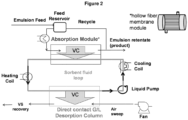
- a membrane contacting system was created similar to that shown in Figure 2 , featuring a silicone hollow fiber membrane module (MedArray PermSelect 2500 cm2 membrane area) as the absorber for removal of volatile siloxanes from the emulsion feed, and a Vigreux distillation column instead of the second membrane module as the desorber for regenerating the silicone sorbent sweep fluid.
- a silicone hollow fiber membrane module MedArray PermSelect 2500 cm2 membrane area
- a previously untreated (product as-received) aqueous silicone microemulsion comprising a high viscosity internal phase of polydimethylsiloxane in 60 wt % water was pre-heated by passing through a section of 1 ⁇ 4" stainless steel tubing wrapped with heat tape and fed into the bore side of an absorption module from a first separatory 500 ml funnel that served as the feed reservoir.
- cSt polydimethylsiloxane fluid (Dow Corning Corp.) as the sorbent liquid was fed counter-current into the shell side of an absorption module from a second 500 ml separatory funnel to provide the driving force for permeation of cyclosiloxanes through the silicone membrane. Both fluids (the emulsion and sweep) were fed counter-current to each other through the membrane module using a multi-cassetted peristaltic pump at a flow rate of ⁇ 14 ml/min. Prior to entering the absorption module, the sorbent sweep fluid was heated by passing through a stainless steel coil wrapped with heat tape.
- the sweep fluid Upon exiting the absorber, the sweep fluid was heated by passing through a section of 1 ⁇ 4" stainless steel tubing wrapped with heat tape prior to entering the top of a Vigreux Distillation Column outfitted with dry N2 sweep gas, then recirculated continuously back through the heating coil to the absorber.
- the feed fluid exiting the absorption module was recirculated continuously to the feed reservoir until the process was stopped, and samples taken for analysis by gas chromatography (GC).
- GC gas chromatography
- the emulsion in reservoir following the preceding run was used as the feed at the feed temperature noted in Table 2.
- the resulting product was analyzed by GC to determine D4 and D5 content using the method of Reference Example 1, along with an unstripped sample to determine the original D4 and D5 content. If needed any water collected in the second separatory funnel could be decanted back into the feed reservoir to minimize viscosity changes resulting from the permeation of water through the membrane.
- Results are shown for Examples 4-22 in Table 2 for the different feed, sweep, and desorber temperature conditions. These results demonstrate feasibility of reducing both D4 and D5 levels in an emulsion well below 0.1 wt % using an embodiment of this invention.
- Table 2 Summary of Examples 4 - 22, Note: 1 Torr corrresponds to 1.33 mbar Sample Feed Temp (°C) Pump Flow Rate (ml/min) Fluid Sweep Temp.
- Example #5 (°C) Permeate Pressure (Torr) Time (hrs.) Product D4 (wt%) Product D5 (wt%) Viscosity Change Example #4 35 14.1 22.3 760 2 1.03 0.82 Stable Example #5 45 14.1 22.5 760 2 0.93 0.82 Stable Example #6 55 14.1 22.6 760 2 0.8 0.82 Stable Example #7 65 14.1 23.2 760 2 0.48 0.77 Stable Example #8 65 14.1 23.5 760 2 0.42 0.77 Stable Example #9 65 14.1 23.7 760 2 0.33 0.75 Stable Example #10 75 14.1 23.2 760 6 0.11 0.64 Stable Example #11 65 14.1 23.6 760 2 0.07 0.61 Stable Example #12 65 14.1 22.8 760 2 0.06 0.59 Stable Example #13 85 14.1 23 760 2 0.03 0.53 Stable Example #14 85 14.1 23.1 760 2 0.02 0.53 Stable Example #15 85 14.1 37.7 760 2 ⁇ 0.01 0.48 Stable Example #16 85 14.1 49.2
- a membrane contacting system was constructed featuring a silicone hollow fiber membrane module (MedArray PermSelect 7500 cm 2 membrane area) as the absorber for removal of volatile organic compounds from the emulsion feed.
- the emulsion feed comprised Pine-Sol brand (Clorox Co.) Multi-Surface cleaning emulsion which was deliberately contaminated with a model VOC (0.52 wt % n-octane determined by GC chromatogram, n-octane from Acros Organics (97 wt%)) by vigorous mixing to disperse the n-octane in the emulsion.
- the contaminated emulsion sample was pre-heated to 70 °C by passing through a section of 1 ⁇ 4" stainless steel tubing wrapped with heat tape and then passed into the bore side of an absorption module from a first separatory 500 ml funnel that serves as the feed reservoir.
- 50 cSt polydimethylsiloxane fluid (Dow Corning Corp.) as the sorbent liquid was fed counter-current into the shell side of an absorption module from a second 500 ml separatory funnel to provide the driving force for permeation of the VOC through the silicone membrane.
- Both fluids (the emulsion and sweep) were fed counter-current to each other through the membrane module using a multi-cassetted peristaltic pump.
- the 50 cSt polydimethylsiloxane fluid and Pine-Sol cleaning emulsion flow rates were 19.8 g/min and 13.9 g/min, respectively.
- the sorbent sweep fluid Prior to entering the absorption module, the sorbent sweep fluid was heated to 70 °C by passing through a stainless steel coil wrapped with heat tape. Upon exiting the absorber, the sweep fluid was recycled back to a second 500 ml separatory funnel.
- the feed fluid exiting the absorption module was recirculated continuously to the feed reservoir until the process was stopped, and the resulting product samples were taken for analysis by gas chromatography (GC).
- GC gas chromatography
- the resulting product samples and an unstripped product sample were analyzed by GC, using the method of Reference Example 1, to determine VOC content of the product samples and the unstripped sample. (If needed, any water collected in the second separatory funnel could be decanted back into the feed reservoir to minimize viscosity changes resulting from the permeation of water through the
- the emulsion sample contained no detectable n-octane as determined by the GC chromatogram compared to an initial n-octane concentration of 0.52% (w/w).
- the sweep fluid which initially had no n-octane peak in the GC chromatogram, showed a peak associated with n-octane corresponding to an n-octane concentration of 0.31% (w/w), confirming sorption of the VOC into the sorbent sweep fluid.
- a membrane contacting system was constructed featuring a silicone hollow fiber membrane module (MedArray PermSelect 7500 cm 2 membrane area) as the absorber for removal of volatile organic compounds from the emulsion feed.
- the emulsion feed comprised interior eggshell white latex complete stain blocking paint and primer (Glidden) which was deliberately contaminated with a model VOC (0.60 wt. % n-octane) by mixing in a Hauschild mixer for a total of 60 s to disperse the n-octane in the emulsion.
- the contaminated emulsion sample was pre-heated to 70 °C by passing through a section of 1 ⁇ 4 inch (0.64 cm) stainless steel tubing wrapped with heat tape and fed into the shell side of an absorption module from a first 500 ml separatory funnel that served as the feed reservoir.
- 50 cSt polydimethylsiloxane fluid (Dow Corning Corp.) as the sorbent liquid was fed counter-current into the bore side of an absorption module from a second 500 ml separatory funnel to provide the driving force for permeation of the VOC through the silicone membrane.
- Both fluids (the emulsion and sweep) were fed counter-current to each other through the membrane module using a multi-cassetted peristaltic pump.
- the 50 cSt polydimethylsiloxane fluid and Glidden latex paint emulsion flow rates are 19.8 g/min and 7.7 g/min, respectively.
- the sorbent sweep fluid Prior to entering the absorption module, the sorbent sweep fluid was heated to 70 °C by passing through a stainless steel coil wrapped with heat tape. Upon exiting the absorber, the sweep fluid was recycled back to the second 500 ml separatory funnel. The feed fluid exiting the absorption module was recirculated continuously to the feed reservoir until the process was stopped, when samples taken for analysis by gas chromatography (GC). The resulting product and an unstripped sample were analyzed by GC using the method of Reference Example 1 to determine the original VOC content and that of the sample. If needed, any water collected in the second separatory funnel could be decanted back into the feed reservoir to minimize viscosity changes resulting from the permeation of water through the membrane.
- GC gas chromatography
- the emulsion sample after running the process for 68 minutes showed a reduction in n-octane concentration from 0.60 wt. % to 0.28 weight (wt.) percent (%).
- the sweep fluid which initially had no n-octane peak in the GC chromatogram, showed a peak associated with n-octane corresponding to an n-octane concentration of 0.20 wt. % after running the process for 68 minutes, confirming adsorption of the VOC into the sorbent sweep fluid.
- a membrane contacting system is created similar to that shown in Figure 2 , featuring a silicone hollow fiber membrane module (MedArray PermSelect 2500 cm2 membrane area) as the absorber for removal of volatile organic compounds from the emulsion feed, and a Vigreux distillation column instead of the second membrane module as the desorber for regenerating the silicone sorbent sweep fluid.
- the emulsion feed comprises pasteurized and homogenized Vitamin D milk (Kroger) which is deliberately contaminated with a model VOC (0.5 wt. % n-octane) by mixing in a Hauschild mixer for 30 s to disperse the n-octane in the emulsion.
- the contaminated milk sample is pre-heated by passing through a section of 1 ⁇ 4" stainless steel tubing wrapped with heat tape and feed into the bore side of an absorption module from a first separatory 500 ml funnel that serves as the feed reservoir.
- 50 cSt polydimethylsiloxane fluid (Dow Corning Corp.) as the sorbent liquid is fed counter-current into the shell side of an absorption module from a second 500 ml separatory funnel to provide the driving force for permeation of the VOC through the silicone membrane.
- the fluids are fed using a multi-cassetted peristaltic pump at a flow rate of ⁇ 17 ml/min.
- the sorbent sweep fluid Prior to entering the absorption module, the sorbent sweep fluid is heated by passing through a stainless steel coil wrapped with heat tape. Upon exiting the absorber, the sweep fluid is heated by passing through a section of 1 ⁇ 4" stainless steel tubing wrapped with heat tape prior to entering the top of a Vigreux Distillation Column outfitted with dry N2 sweep gas, then recirculates continuously back through the heating coil to the absorber.
- the feed fluid exiting the absorption module is recirculated continuously to the feed reservoir until the process is stopped, and samples taken for analysis by gas chromatography (GC). The resulting product is analyzed by GC to determine VOC content using the method of Reference Example 1, along with an unstripped sample to determine the original VOC content. If needed any water collected in the second separatory funnel could be decanted back into the feed reservoir to minimize viscosity changes resulting from the permeation of water through the membrane.
- GC gas chromatography
- the resulting sample is collected and tested.
- the milk sample after running the process for 1 hour shows a significant reduction in the starting concentration of n-octane without significant change in appearance or viscosity.
- the sweep fluid which initially has no n-octane peak in the GC chromatogram shows a peak associated with n-octane, confirming adsorption of the VOC into the sorbent sweep fluid.
Landscapes
- Chemical & Material Sciences (AREA)
- Chemical Kinetics & Catalysis (AREA)
- Engineering & Computer Science (AREA)
- Water Supply & Treatment (AREA)
- Health & Medical Sciences (AREA)
- Dispersion Chemistry (AREA)
- Medicinal Chemistry (AREA)
- Polymers & Plastics (AREA)
- Organic Chemistry (AREA)
- Urology & Nephrology (AREA)
- Separation Using Semi-Permeable Membranes (AREA)
Claims (7)
- Procédé de séparation d'un composé volatil à partir d'un mélange d'alimentation liquide comprenant une émulsion, l'émulsion comprenant un polymère organopolysiloxane, le procédé comprenant :la mise en contact d'un premier côté d'une première membrane à fibres creuses de silicone dense à l'intérieur d'un module d'absorption, le mélange d'alimentation liquide comprenant l'émulsion ayant au moins un composé volatil, dans lequel le composé volatil est choisi parmi un siloxane linéaire ou cyclosiloxane volatil ; etla mise en contact d'un second côté de la première membrane à fibres creuses de silicone dense dans le module d'absorption avec un milieu de balayage comprenant un fluide de balayage, pour produire un mélange de perméat sur le second côté de la première membrane et un mélange de rétentat comprenant l'émulsion sur le premier côté de la première membrane, dans lequel le mélange de perméat est enrichi en composé volatil, et le mélange de rétentat est appauvri en composé volatil ;dans lequel le fluide de balayage est régénéré par désorption des composés volatils par l'utilisation d'un module de désorption à membrane ou sans membrane, à l'aide d'une température plus élevée que celle utilisée lors de l'absorption, et amené à recirculer en contact avec le second côté de la première membrane dense ; etdans lequel le fluide d'alimentation sortant du module d'absorption est amené à recirculer en continu vers le premier côté de la première membrane dense jusqu'à ce que le processus soit arrêté ;dans lequel le fluide de balayage comprend un fluide d'organosilicium.
- Procédé selon la revendication 1, dans lequel la membrane a un support poreux.
- Procédé selon l'une quelconque des revendications précédentes, comportant une ou plusieurs des limitations a) à c) :a) dans lequel la première membrane est hydrophobe,b) dans lequel la première membrane a une épaisseur d'environ 0,01 µm à environ 300 µm,c) dans lequel le module d'absorption comprend un faisceau desdites premières membranes à fibres creuses, dans lequel les fibres ont collectivement un côté trou et un côté enveloppe, dans lequel au moins l'un parmile premier côté de la membrane à fibres creuses est le côté trou et le second côté de la membrane à fibres creuses est le côté enveloppe, etle premier côté de la membrane à fibres creuses est le côté enveloppe et le second côté de la membrane à fibres creuses est le côté trou.
- Procédé selon l'une quelconque des revendications précédentes, dans lequel le mélange de rétentat est appauvri en siloxane volatil de 1 % en poids à 99,99 % en poids, par rapport au mélange d'alimentation liquide.
- Procédé selon la revendication 1, dans lequel le fluide d'organosilicium comprend au moins un groupe lié à du silicium choisi parmi un hydrocarbyle en C1-C20 substitué ou non substitué, interrompu ou terminé par 0, 1, 2, ou 3 groupes choisis parmi -O-, -NH-, et -S-, alkyle en C1-C20 substitué ou non substitué, aryle en C6-C20 substitué ou non substitué, et un polyéther substitué ou non substitué.
- Procédé selon la revendication 1, dans lequel le cyclosiloxane est un cyclosiloxane substitué ou non substitué ayant 3 à 20 unités -Si-O- dans son cycle ou ses cycles.
- Procédé selon la revendication 1, dans lequel la première membrane a une épaisseur de 1 µm à 300 µm, et l'émulsion a une température de 20 °C à 120 °C.
Applications Claiming Priority (2)
| Application Number | Priority Date | Filing Date | Title |
|---|---|---|---|
| US201562232121P | 2015-09-24 | 2015-09-24 | |
| PCT/US2016/053227 WO2017053647A1 (fr) | 2015-09-24 | 2016-09-23 | Procédé d'élimination de composés volatils pour des émulsions |
Publications (2)
| Publication Number | Publication Date |
|---|---|
| EP3352887A1 EP3352887A1 (fr) | 2018-08-01 |
| EP3352887B1 true EP3352887B1 (fr) | 2024-09-04 |
Family
ID=57130445
Family Applications (1)
| Application Number | Title | Priority Date | Filing Date |
|---|---|---|---|
| EP16781234.6A Active EP3352887B1 (fr) | 2015-09-24 | 2016-09-23 | Procédé d'élimination de composés volatils pour des émulsions |
Country Status (5)
| Country | Link |
|---|---|
| US (1) | US10537853B2 (fr) |
| EP (1) | EP3352887B1 (fr) |
| JP (1) | JP6725665B2 (fr) |
| CN (1) | CN108136334B (fr) |
| WO (1) | WO2017053647A1 (fr) |
Families Citing this family (3)
| Publication number | Priority date | Publication date | Assignee | Title |
|---|---|---|---|---|
| TWI763658B (zh) * | 2016-03-18 | 2022-05-11 | 美商恩特葛瑞斯股份有限公司 | 用於排氣、除氣及薄膜蒸餾方法中之疏水性聚乙烯膜 |
| US10663389B2 (en) * | 2018-03-29 | 2020-05-26 | The United States Of America As Represented By The Secretary Of The Army | Spectroscopic membrane permeation cell for simultaneous measurements of gas permeation rates and infrared reflection absorption spectroscopic analysis of membrane surfaces |
| PL4251392T3 (pl) * | 2020-11-25 | 2025-04-28 | Borealis Ag | Usuwanie zapachów z poliolefinowych odpadów pokonsumenckich |
Citations (3)
| Publication number | Priority date | Publication date | Assignee | Title |
|---|---|---|---|---|
| DE19919490B4 (de) * | 1999-04-29 | 2005-04-14 | Forschungszentrum Jülich GmbH | Verfahren zur Abtrennung organischer Substanzen aus einem wässrigen Gemisch |
| EP1434830B1 (fr) * | 2001-10-01 | 2009-11-18 | Dow Corning Corporation | Procede pour produire une emulsion d'un adhesif autocollant a base de silicone |
| WO2014052419A1 (fr) * | 2012-09-26 | 2014-04-03 | Dow Corning Corporation | Procédé de séparation d'un gaz à l'aide d'au moins une membrane en contact avec un liquide à base d'organosilicium |
Family Cites Families (9)
| Publication number | Priority date | Publication date | Assignee | Title |
|---|---|---|---|---|
| US5263409A (en) | 1992-04-24 | 1993-11-23 | Bend Research, Inc. | Membrane extraction of citrus bittering agents |
| EP0824034A3 (fr) * | 1996-08-14 | 1998-05-06 | Bend Research, Inc. | Système pour la perméation de vapeur |
| JP3872577B2 (ja) | 1996-10-22 | 2007-01-24 | 財団法人石油産業活性化センター | 有機液体混合物の分離方法 |
| US6075073A (en) * | 1998-08-20 | 2000-06-13 | Apex Medical Technologies, Inc. | Latices from emulsified hydrocarbon rubber solutions by membrane separation |
| WO2001044350A1 (fr) | 1999-12-14 | 2001-06-21 | Apex Medical Technologies, Inc. | Latex obtenus par separation membranaire de solutions d'elastomeres hydrocarbones emulsionnes |
| US20020165505A1 (en) * | 2001-03-01 | 2002-11-07 | Gee Ronald Paul | Pervaporation separation of volatile siloxanes from emulsions |
| US7365220B2 (en) * | 2005-09-29 | 2008-04-29 | Momentive Performance Materials Inc. | Process for the recovery of alkoxysilanes obtained from the direct reaction of silicon with alkanols |
| US20080210540A1 (en) * | 2007-01-17 | 2008-09-04 | Dieterle Rex A | Separation and dewatering of organic solvents by integrating distillation and membrane separation operations |
| WO2015147920A1 (fr) * | 2014-03-25 | 2015-10-01 | Dow Corning Corporation | Procédé de séparation de siloxane volatil d'un mélange d'alimentation |
-
2016
- 2016-09-23 CN CN201680052718.2A patent/CN108136334B/zh active Active
- 2016-09-23 US US15/741,931 patent/US10537853B2/en active Active
- 2016-09-23 EP EP16781234.6A patent/EP3352887B1/fr active Active
- 2016-09-23 WO PCT/US2016/053227 patent/WO2017053647A1/fr not_active Ceased
- 2016-09-23 JP JP2018531318A patent/JP6725665B2/ja active Active
Patent Citations (3)
| Publication number | Priority date | Publication date | Assignee | Title |
|---|---|---|---|---|
| DE19919490B4 (de) * | 1999-04-29 | 2005-04-14 | Forschungszentrum Jülich GmbH | Verfahren zur Abtrennung organischer Substanzen aus einem wässrigen Gemisch |
| EP1434830B1 (fr) * | 2001-10-01 | 2009-11-18 | Dow Corning Corporation | Procede pour produire une emulsion d'un adhesif autocollant a base de silicone |
| WO2014052419A1 (fr) * | 2012-09-26 | 2014-04-03 | Dow Corning Corporation | Procédé de séparation d'un gaz à l'aide d'au moins une membrane en contact avec un liquide à base d'organosilicium |
Also Published As
| Publication number | Publication date |
|---|---|
| CN108136334B (zh) | 2021-09-21 |
| US10537853B2 (en) | 2020-01-21 |
| CN108136334A (zh) | 2018-06-08 |
| EP3352887A1 (fr) | 2018-08-01 |
| JP6725665B2 (ja) | 2020-07-22 |
| WO2017053647A1 (fr) | 2017-03-30 |
| JP2018528861A (ja) | 2018-10-04 |
| US20180200675A1 (en) | 2018-07-19 |
Similar Documents
| Publication | Publication Date | Title |
|---|---|---|
| EP2900354B1 (fr) | Procédé de séparation d'un gaz à l'aide d'au moins une membrane en contact avec un liquide à base d'organosilicium | |
| Yahaya | Separation of volatile organic compounds (BTEX) from aqueous solutions by a composite organophilic hollow fiber membrane-based pervaporation process | |
| EP3352887B1 (fr) | Procédé d'élimination de composés volatils pour des émulsions | |
| KR102186340B1 (ko) | 가교결합된 탄성중합체 수착제를 사용하여 혼합물 내의 휘발성 성분을 고갈시키는 방법 및 상기 방법을 실시하기 위한 장치 | |
| US20150231556A1 (en) | Method Of Manufacturing A Silicone Membrane | |
| KR101144105B1 (ko) | 휘발성 유기화합물 분리 회수용 중공사막 | |
| US9962657B2 (en) | Method of and system for separating volatile siloxane from feed mixture | |
| KR20140034699A (ko) | 액체로부터 휘발성 유기 화합물을 제거하기 위한 다중 멤브레인 | |
| Nigiz et al. | Removal of acetone from wastewater by POSS loaded PDMS membrane | |
| Uragami | Pervaporation and Evapomeation with Si‐Containing Polymers | |
| Meares | Separation by membranes | |
| JPH067654A (ja) | 有機蒸気回収方法 |
Legal Events
| Date | Code | Title | Description |
|---|---|---|---|
| STAA | Information on the status of an ep patent application or granted ep patent |
Free format text: STATUS: THE INTERNATIONAL PUBLICATION HAS BEEN MADE |
|
| PUAI | Public reference made under article 153(3) epc to a published international application that has entered the european phase |
Free format text: ORIGINAL CODE: 0009012 |
|
| STAA | Information on the status of an ep patent application or granted ep patent |
Free format text: STATUS: REQUEST FOR EXAMINATION WAS MADE |
|
| 17P | Request for examination filed |
Effective date: 20180423 |
|
| AK | Designated contracting states |
Kind code of ref document: A1 Designated state(s): AL AT BE BG CH CY CZ DE DK EE ES FI FR GB GR HR HU IE IS IT LI LT LU LV MC MK MT NL NO PL PT RO RS SE SI SK SM TR |
|
| AX | Request for extension of the european patent |
Extension state: BA ME |
|
| DAV | Request for validation of the european patent (deleted) | ||
| DAX | Request for extension of the european patent (deleted) | ||
| STAA | Information on the status of an ep patent application or granted ep patent |
Free format text: STATUS: EXAMINATION IS IN PROGRESS |
|
| 17Q | First examination report despatched |
Effective date: 20190717 |
|
| P01 | Opt-out of the competence of the unified patent court (upc) registered |
Effective date: 20230526 |
|
| GRAP | Despatch of communication of intention to grant a patent |
Free format text: ORIGINAL CODE: EPIDOSNIGR1 |
|
| STAA | Information on the status of an ep patent application or granted ep patent |
Free format text: STATUS: GRANT OF PATENT IS INTENDED |
|
| INTG | Intention to grant announced |
Effective date: 20240409 |
|
| GRAS | Grant fee paid |
Free format text: ORIGINAL CODE: EPIDOSNIGR3 |
|
| GRAA | (expected) grant |
Free format text: ORIGINAL CODE: 0009210 |
|
| STAA | Information on the status of an ep patent application or granted ep patent |
Free format text: STATUS: THE PATENT HAS BEEN GRANTED |
|
| AK | Designated contracting states |
Kind code of ref document: B1 Designated state(s): AL AT BE BG CH CY CZ DE DK EE ES FI FR GB GR HR HU IE IS IT LI LT LU LV MC MK MT NL NO PL PT RO RS SE SI SK SM TR |
|
| REG | Reference to a national code |
Ref country code: GB Ref legal event code: FG4D |
|
| REG | Reference to a national code |
Ref country code: CH Ref legal event code: EP |
|
| REG | Reference to a national code |
Ref country code: IE Ref legal event code: FG4D |
|
| REG | Reference to a national code |
Ref country code: DE Ref legal event code: R096 Ref document number: 602016089249 Country of ref document: DE |
|
| REG | Reference to a national code |
Ref country code: LT Ref legal event code: MG9D |
|
| REG | Reference to a national code |
Ref country code: NL Ref legal event code: MP Effective date: 20240904 |
|
| PG25 | Lapsed in a contracting state [announced via postgrant information from national office to epo] |
Ref country code: NO Free format text: LAPSE BECAUSE OF FAILURE TO SUBMIT A TRANSLATION OF THE DESCRIPTION OR TO PAY THE FEE WITHIN THE PRESCRIBED TIME-LIMIT Effective date: 20241204 |
|
| PG25 | Lapsed in a contracting state [announced via postgrant information from national office to epo] |
Ref country code: FI Free format text: LAPSE BECAUSE OF FAILURE TO SUBMIT A TRANSLATION OF THE DESCRIPTION OR TO PAY THE FEE WITHIN THE PRESCRIBED TIME-LIMIT Effective date: 20240904 Ref country code: PL Free format text: LAPSE BECAUSE OF FAILURE TO SUBMIT A TRANSLATION OF THE DESCRIPTION OR TO PAY THE FEE WITHIN THE PRESCRIBED TIME-LIMIT Effective date: 20240904 Ref country code: GR Free format text: LAPSE BECAUSE OF FAILURE TO SUBMIT A TRANSLATION OF THE DESCRIPTION OR TO PAY THE FEE WITHIN THE PRESCRIBED TIME-LIMIT Effective date: 20241205 |
|
| PG25 | Lapsed in a contracting state [announced via postgrant information from national office to epo] |
Ref country code: BG Free format text: LAPSE BECAUSE OF FAILURE TO SUBMIT A TRANSLATION OF THE DESCRIPTION OR TO PAY THE FEE WITHIN THE PRESCRIBED TIME-LIMIT Effective date: 20240904 |
|
| PG25 | Lapsed in a contracting state [announced via postgrant information from national office to epo] |
Ref country code: LV Free format text: LAPSE BECAUSE OF FAILURE TO SUBMIT A TRANSLATION OF THE DESCRIPTION OR TO PAY THE FEE WITHIN THE PRESCRIBED TIME-LIMIT Effective date: 20240904 |
|
| PG25 | Lapsed in a contracting state [announced via postgrant information from national office to epo] |
Ref country code: HR Free format text: LAPSE BECAUSE OF FAILURE TO SUBMIT A TRANSLATION OF THE DESCRIPTION OR TO PAY THE FEE WITHIN THE PRESCRIBED TIME-LIMIT Effective date: 20240904 |
|
| PG25 | Lapsed in a contracting state [announced via postgrant information from national office to epo] |
Ref country code: ES Free format text: LAPSE BECAUSE OF FAILURE TO SUBMIT A TRANSLATION OF THE DESCRIPTION OR TO PAY THE FEE WITHIN THE PRESCRIBED TIME-LIMIT Effective date: 20240904 Ref country code: RS Free format text: LAPSE BECAUSE OF FAILURE TO SUBMIT A TRANSLATION OF THE DESCRIPTION OR TO PAY THE FEE WITHIN THE PRESCRIBED TIME-LIMIT Effective date: 20241204 |
|
| PG25 | Lapsed in a contracting state [announced via postgrant information from national office to epo] |
Ref country code: RS Free format text: LAPSE BECAUSE OF FAILURE TO SUBMIT A TRANSLATION OF THE DESCRIPTION OR TO PAY THE FEE WITHIN THE PRESCRIBED TIME-LIMIT Effective date: 20241204 Ref country code: PL Free format text: LAPSE BECAUSE OF FAILURE TO SUBMIT A TRANSLATION OF THE DESCRIPTION OR TO PAY THE FEE WITHIN THE PRESCRIBED TIME-LIMIT Effective date: 20240904 Ref country code: NO Free format text: LAPSE BECAUSE OF FAILURE TO SUBMIT A TRANSLATION OF THE DESCRIPTION OR TO PAY THE FEE WITHIN THE PRESCRIBED TIME-LIMIT Effective date: 20241204 Ref country code: LV Free format text: LAPSE BECAUSE OF FAILURE TO SUBMIT A TRANSLATION OF THE DESCRIPTION OR TO PAY THE FEE WITHIN THE PRESCRIBED TIME-LIMIT Effective date: 20240904 Ref country code: HR Free format text: LAPSE BECAUSE OF FAILURE TO SUBMIT A TRANSLATION OF THE DESCRIPTION OR TO PAY THE FEE WITHIN THE PRESCRIBED TIME-LIMIT Effective date: 20240904 Ref country code: GR Free format text: LAPSE BECAUSE OF FAILURE TO SUBMIT A TRANSLATION OF THE DESCRIPTION OR TO PAY THE FEE WITHIN THE PRESCRIBED TIME-LIMIT Effective date: 20241205 Ref country code: FI Free format text: LAPSE BECAUSE OF FAILURE TO SUBMIT A TRANSLATION OF THE DESCRIPTION OR TO PAY THE FEE WITHIN THE PRESCRIBED TIME-LIMIT Effective date: 20240904 Ref country code: ES Free format text: LAPSE BECAUSE OF FAILURE TO SUBMIT A TRANSLATION OF THE DESCRIPTION OR TO PAY THE FEE WITHIN THE PRESCRIBED TIME-LIMIT Effective date: 20240904 Ref country code: BG Free format text: LAPSE BECAUSE OF FAILURE TO SUBMIT A TRANSLATION OF THE DESCRIPTION OR TO PAY THE FEE WITHIN THE PRESCRIBED TIME-LIMIT Effective date: 20240904 |
|
| REG | Reference to a national code |
Ref country code: AT Ref legal event code: MK05 Ref document number: 1719775 Country of ref document: AT Kind code of ref document: T Effective date: 20240904 |
|
| PG25 | Lapsed in a contracting state [announced via postgrant information from national office to epo] |
Ref country code: NL Free format text: LAPSE BECAUSE OF FAILURE TO SUBMIT A TRANSLATION OF THE DESCRIPTION OR TO PAY THE FEE WITHIN THE PRESCRIBED TIME-LIMIT Effective date: 20240904 |
|
| PG25 | Lapsed in a contracting state [announced via postgrant information from national office to epo] |
Ref country code: IS Free format text: LAPSE BECAUSE OF FAILURE TO SUBMIT A TRANSLATION OF THE DESCRIPTION OR TO PAY THE FEE WITHIN THE PRESCRIBED TIME-LIMIT Effective date: 20250104 Ref country code: PT Free format text: LAPSE BECAUSE OF FAILURE TO SUBMIT A TRANSLATION OF THE DESCRIPTION OR TO PAY THE FEE WITHIN THE PRESCRIBED TIME-LIMIT Effective date: 20250106 |
|
| PG25 | Lapsed in a contracting state [announced via postgrant information from national office to epo] |
Ref country code: SM Free format text: LAPSE BECAUSE OF FAILURE TO SUBMIT A TRANSLATION OF THE DESCRIPTION OR TO PAY THE FEE WITHIN THE PRESCRIBED TIME-LIMIT Effective date: 20240904 Ref country code: RO Free format text: LAPSE BECAUSE OF FAILURE TO SUBMIT A TRANSLATION OF THE DESCRIPTION OR TO PAY THE FEE WITHIN THE PRESCRIBED TIME-LIMIT Effective date: 20240904 |
|
| PG25 | Lapsed in a contracting state [announced via postgrant information from national office to epo] |
Ref country code: EE Free format text: LAPSE BECAUSE OF FAILURE TO SUBMIT A TRANSLATION OF THE DESCRIPTION OR TO PAY THE FEE WITHIN THE PRESCRIBED TIME-LIMIT Effective date: 20240904 Ref country code: AT Free format text: LAPSE BECAUSE OF FAILURE TO SUBMIT A TRANSLATION OF THE DESCRIPTION OR TO PAY THE FEE WITHIN THE PRESCRIBED TIME-LIMIT Effective date: 20240904 |
|
| PG25 | Lapsed in a contracting state [announced via postgrant information from national office to epo] |
Ref country code: CZ Free format text: LAPSE BECAUSE OF FAILURE TO SUBMIT A TRANSLATION OF THE DESCRIPTION OR TO PAY THE FEE WITHIN THE PRESCRIBED TIME-LIMIT Effective date: 20240904 |
|
| PG25 | Lapsed in a contracting state [announced via postgrant information from national office to epo] |
Ref country code: IT Free format text: LAPSE BECAUSE OF FAILURE TO SUBMIT A TRANSLATION OF THE DESCRIPTION OR TO PAY THE FEE WITHIN THE PRESCRIBED TIME-LIMIT Effective date: 20240904 Ref country code: SK Free format text: LAPSE BECAUSE OF FAILURE TO SUBMIT A TRANSLATION OF THE DESCRIPTION OR TO PAY THE FEE WITHIN THE PRESCRIBED TIME-LIMIT Effective date: 20240904 |
|
| REG | Reference to a national code |
Ref country code: CH Ref legal event code: PL |
|
| PG25 | Lapsed in a contracting state [announced via postgrant information from national office to epo] |
Ref country code: LU Free format text: LAPSE BECAUSE OF NON-PAYMENT OF DUE FEES Effective date: 20240923 |
|
| REG | Reference to a national code |
Ref country code: DE Ref legal event code: R097 Ref document number: 602016089249 Country of ref document: DE |
|
| PG25 | Lapsed in a contracting state [announced via postgrant information from national office to epo] |
Ref country code: MC Free format text: LAPSE BECAUSE OF FAILURE TO SUBMIT A TRANSLATION OF THE DESCRIPTION OR TO PAY THE FEE WITHIN THE PRESCRIBED TIME-LIMIT Effective date: 20240904 |
|
| PG25 | Lapsed in a contracting state [announced via postgrant information from national office to epo] |
Ref country code: DK Free format text: LAPSE BECAUSE OF FAILURE TO SUBMIT A TRANSLATION OF THE DESCRIPTION OR TO PAY THE FEE WITHIN THE PRESCRIBED TIME-LIMIT Effective date: 20240904 |
|
| REG | Reference to a national code |
Ref country code: BE Ref legal event code: MM Effective date: 20240930 |
|
| PLBE | No opposition filed within time limit |
Free format text: ORIGINAL CODE: 0009261 |
|
| STAA | Information on the status of an ep patent application or granted ep patent |
Free format text: STATUS: NO OPPOSITION FILED WITHIN TIME LIMIT |
|
| PG25 | Lapsed in a contracting state [announced via postgrant information from national office to epo] |
Ref country code: BE Free format text: LAPSE BECAUSE OF NON-PAYMENT OF DUE FEES Effective date: 20240930 |
|
| PG25 | Lapsed in a contracting state [announced via postgrant information from national office to epo] |
Ref country code: CH Free format text: LAPSE BECAUSE OF NON-PAYMENT OF DUE FEES Effective date: 20240930 |
|
| PG25 | Lapsed in a contracting state [announced via postgrant information from national office to epo] |
Ref country code: IE Free format text: LAPSE BECAUSE OF NON-PAYMENT OF DUE FEES Effective date: 20240923 |
|
| 26N | No opposition filed |
Effective date: 20250605 |
|
| PG25 | Lapsed in a contracting state [announced via postgrant information from national office to epo] |
Ref country code: SE Free format text: LAPSE BECAUSE OF FAILURE TO SUBMIT A TRANSLATION OF THE DESCRIPTION OR TO PAY THE FEE WITHIN THE PRESCRIBED TIME-LIMIT Effective date: 20240904 |
|
| PGFP | Annual fee paid to national office [announced via postgrant information from national office to epo] |
Ref country code: DE Payment date: 20250702 Year of fee payment: 10 |
|
| PGFP | Annual fee paid to national office [announced via postgrant information from national office to epo] |
Ref country code: GB Payment date: 20250703 Year of fee payment: 10 |
|
| PGFP | Annual fee paid to national office [announced via postgrant information from national office to epo] |
Ref country code: FR Payment date: 20250808 Year of fee payment: 10 |
|
| PG25 | Lapsed in a contracting state [announced via postgrant information from national office to epo] |
Ref country code: CY Free format text: LAPSE BECAUSE OF FAILURE TO SUBMIT A TRANSLATION OF THE DESCRIPTION OR TO PAY THE FEE WITHIN THE PRESCRIBED TIME-LIMIT; INVALID AB INITIO Effective date: 20160923 |
|
| PG25 | Lapsed in a contracting state [announced via postgrant information from national office to epo] |
Ref country code: HU Free format text: LAPSE BECAUSE OF FAILURE TO SUBMIT A TRANSLATION OF THE DESCRIPTION OR TO PAY THE FEE WITHIN THE PRESCRIBED TIME-LIMIT; INVALID AB INITIO Effective date: 20160923 |