EP3354064B1 - Verfahren und system zur übertragung von steuerinformationen für benutzergerät - Google Patents
Verfahren und system zur übertragung von steuerinformationen für benutzergerät Download PDFInfo
- Publication number
- EP3354064B1 EP3354064B1 EP16847700.8A EP16847700A EP3354064B1 EP 3354064 B1 EP3354064 B1 EP 3354064B1 EP 16847700 A EP16847700 A EP 16847700A EP 3354064 B1 EP3354064 B1 EP 3354064B1
- Authority
- EP
- European Patent Office
- Prior art keywords
- harq processes
- harq
- processes
- dci
- transmission
- Prior art date
- Legal status (The legal status is an assumption and is not a legal conclusion. Google has not performed a legal analysis and makes no representation as to the accuracy of the status listed.)
- Active
Links
Images


Classifications
-
- H—ELECTRICITY
- H04—ELECTRIC COMMUNICATION TECHNIQUE
- H04L—TRANSMISSION OF DIGITAL INFORMATION, e.g. TELEGRAPHIC COMMUNICATION
- H04L1/00—Arrangements for detecting or preventing errors in the information received
- H04L1/12—Arrangements for detecting or preventing errors in the information received by using return channel
- H04L1/16—Arrangements for detecting or preventing errors in the information received by using return channel in which the return channel carries supervisory signals, e.g. repetition request signals
- H04L1/18—Automatic repetition systems, e.g. Van Duuren systems
- H04L1/1822—Automatic repetition systems, e.g. Van Duuren systems involving configuration of automatic repeat request [ARQ] with parallel processes
-
- H—ELECTRICITY
- H04—ELECTRIC COMMUNICATION TECHNIQUE
- H04W—WIRELESS COMMUNICATION NETWORKS
- H04W72/00—Local resource management
- H04W72/20—Control channels or signalling for resource management
- H04W72/23—Control channels or signalling for resource management in the downlink direction of a wireless link, i.e. towards a terminal
-
- H—ELECTRICITY
- H04—ELECTRIC COMMUNICATION TECHNIQUE
- H04L—TRANSMISSION OF DIGITAL INFORMATION, e.g. TELEGRAPHIC COMMUNICATION
- H04L1/00—Arrangements for detecting or preventing errors in the information received
- H04L1/12—Arrangements for detecting or preventing errors in the information received by using return channel
- H04L1/16—Arrangements for detecting or preventing errors in the information received by using return channel in which the return channel carries supervisory signals, e.g. repetition request signals
- H04L1/18—Automatic repetition systems, e.g. Van Duuren systems
- H04L1/1867—Arrangements specially adapted for the transmitter end
- H04L1/1887—Scheduling and prioritising arrangements
-
- H—ELECTRICITY
- H04—ELECTRIC COMMUNICATION TECHNIQUE
- H04L—TRANSMISSION OF DIGITAL INFORMATION, e.g. TELEGRAPHIC COMMUNICATION
- H04L1/00—Arrangements for detecting or preventing errors in the information received
- H04L1/12—Arrangements for detecting or preventing errors in the information received by using return channel
- H04L1/16—Arrangements for detecting or preventing errors in the information received by using return channel in which the return channel carries supervisory signals, e.g. repetition request signals
- H04L1/18—Automatic repetition systems, e.g. Van Duuren systems
- H04L1/1867—Arrangements specially adapted for the transmitter end
- H04L1/189—Transmission or retransmission of more than one copy of a message
-
- H—ELECTRICITY
- H04—ELECTRIC COMMUNICATION TECHNIQUE
- H04L—TRANSMISSION OF DIGITAL INFORMATION, e.g. TELEGRAPHIC COMMUNICATION
- H04L1/00—Arrangements for detecting or preventing errors in the information received
- H04L1/12—Arrangements for detecting or preventing errors in the information received by using return channel
- H04L1/16—Arrangements for detecting or preventing errors in the information received by using return channel in which the return channel carries supervisory signals, e.g. repetition request signals
- H04L1/18—Automatic repetition systems, e.g. Van Duuren systems
- H04L1/1812—Hybrid protocols; Hybrid automatic repeat request [HARQ]
-
- H—ELECTRICITY
- H04—ELECTRIC COMMUNICATION TECHNIQUE
- H04L—TRANSMISSION OF DIGITAL INFORMATION, e.g. TELEGRAPHIC COMMUNICATION
- H04L1/00—Arrangements for detecting or preventing errors in the information received
- H04L1/12—Arrangements for detecting or preventing errors in the information received by using return channel
- H04L1/16—Arrangements for detecting or preventing errors in the information received by using return channel in which the return channel carries supervisory signals, e.g. repetition request signals
- H04L1/18—Automatic repetition systems, e.g. Van Duuren systems
- H04L1/1867—Arrangements specially adapted for the transmitter end
- H04L1/1896—ARQ related signaling
Definitions
- the present invention pertains in general to wireless communication systems operating according to standards such as the Long Term Evolution (LTE), and in particular to mechanisms for transmitting control information for Category M User Equipment (UE).
- LTE Long Term Evolution
- UE User Equipment
- LTE Long Term Evolution
- MTC machine-type-communication
- M2M machine-to-machine
- 3 rd Generation Partnership Project has considered such possibilities, for example in connection with "low-cost” or "limited capability” User Equipment (UE), also referred to as a CAT-M UE.
- UE User Equipment
- the 3GPP (Third Generation Partnership Project) standards committees have recognized the need for LTE to support very large numbers of M2M UEs and have identified objectives for modifications to the existing LTE standards designed to support very large numbers of M2M UEs. Common requirements for such modifications are that they maintain compatibility with existing devices and limit the impact of M2M traffic on the high data rate and low latency requirements of current and future users.
- time diversity can reduce transmission time by 35% when UEs are in deep coverage holes, for example UEs that are located indoors. This has been discussed in 3GPP TSG RAN WG1 Meeting #82, August 24th-28th 2015 - R1-154489 . However unless multiple Hybrid Automatic Repeat Request (HARQ) processes are supported, the UE transmission speed will be reduced. However, it is not obvious how the timing of the Downlink Control Information (DCI) for Uplink (UL) and Downlink (DL) grants can be sent and managed especially for Half-Duplex Frequency Division Duplexing (HD-FDD) UEs which cannot listen to the M-PDCCH (CAT M-Physical Downlink Control Channel) when transmitting.
- DCI Downlink Control Information
- DL Downlink
- HD-FDD Half-Duplex Frequency Division Duplexing
- US 2014/362832 discloses systems and method to improve the reception of UL transmission, for example in power or coverage limited situations.
- a WTRU may modify procedures to increase the available signal energy for reception at an eNB and/or to make more efficient use of the available signal energy at the receiver for processing UL transmissions.
- methods for increasing UL link coverage include modifying HARQ timing (e.g., shorter HARQ), using longer TTIs, use of dedicated PUSCH allocations, use of new PUSCH modulations, enhanced reference signal design, UL macro diversity reception for PUSCH, utilizing protocol reduction techniques, ensuring in-order packet delivery, and/or utilizing a configuration for coverage limited/power limited modes of operation.
- commencement of uplink transmissions associated with a Grant occur as soon as possible.
- MARVELL "Number of HARQ Processes When in Coverage Enhancement"
- 3GPP DRAFT R1-154476 of August 23, 2015 considers the number of HARQ processes that should be supported when the UE is operating in Coverage Enhancement.
- US 2013/016686 discloses a method, system and apparatus of multi-subframe scheduling.
- the method of multi-subframe scheduling comprises: sending a terminal a continuous scheduling indication, a first HARQ process number corresponding to a first scheduled subframe, and a scheduling configuration parameter of multi-subframe scheduling; acquiring a second HARQ process number corresponding to a currently-scheduling subframe according to the first HARQ process number corresponding to the first scheduled subframe and the continuous scheduling indication, and performing a data packet transmission of the corresponding second HARQ process number in the currently-scheduling subframe by using the scheduling configuration parameter, each scheduled subframe of the multi-subframe scheduling carrying one data packet, and each scheduled subframe of the multi-subframe scheduling using the scheduling configuration parameter.
- the disclosed method, system and apparatus of multi-subframe scheduling may save control signaling overhead of the system and improve spectrum efficiency of the system.
- An object of the present invention is to provide a method and system for transmitting control information for User Equipment.
- method for facilitating time diversity of HARQ processes in a LTE system according to claim 1.
- a system comprising an evolved Node B (eNB) and a user equipment (UE) in a Long Term Evolution (LTE) system according to claim 2.
- eNB evolved Node B
- UE user equipment
- the present invention provides a method and system for transmitting control information for Category M User Equipment (UE).
- UE User Equipment
- HARQ Hybrid Automatic Repeat Request
- HD-FDD Half-Duplex Frequency Division Duplexing
- SINR Signal to Interference and Noise Ratio
- a Type I HARQ process adds both error detecting (ED) code and forward error correction (FEC) information to each message prior to transmission.
- ED error detecting
- FEC forward error correction
- the receiver first decodes the error-correction code. If the channel quality is good enough, all transmission errors should be correctable, and the receiver can obtain the correct data block. If the channel quality is bad, and not all transmission errors can be corrected, the receiver will detect this situation using the error-detection code, then the received coded data block is rejected and a re-transmission is requested by the receiver.
- the message originator alternates between message bits along with error detecting parity bits and only FEC parity bits. When the first transmission is received error free, the FEC parity bits are never sent. Also, two consecutive transmissions can be combined for error correction if neither is error free.
- the transmission of DCI messages on the CAT M-Physical Downlink Control Channel (M-PDCCH) by the evolved NodeB (eNB) is used as an identifier to define subsequent transmission of a HARQ process which will be transmitted on the Physical Uplink Shared Channel (PUSCH) by the eNB.
- M-PDCCH Physical Downlink Control Channel
- PUSCH Physical Uplink Shared Channel
- one or more DCI messages are transmitted 10 by the eNB wherein the DCI message(s) is indicative of multiple HARQ processes.
- the eNB subsequently transmits 15 the HARQ processes, wherein transmitting of the HARQ processes includes interleaving the HARQ messages based on the one or more DCI messages.
- one or more DCI messages are provided to support time diversity with multiple HARQs, wherein the one or more DCI messages can be used to define the temporal transmission of the multiple HARQs. According to embodiments, one or more DCI messages can be used to define the temporal transmission of a single HARQ repeated over time.
- the repeated transmission of HARQ processes to a UE are interleaved over time, wherein the DCI message can provide details to the UE indicative of the manner in which the HARQ processes are interleaved.
- the HARQ interleaving interval for example the number of subframes required for the interval, is determined to be at least long enough for the UE to decode a DCI message.
- this interval will include the time for decoding the DCI plus the time required for the UE to switch from transmission mode (Tx) to receiving mode (Rx) and back to transmission mode.
- the eNB sends a DCI message to the UE at intervals during which the eNB has not assigned an Uplink (UL) message or optionally not assigned a Downlink (DL) message.
- the UE when the UE does not have an UL assignment in an interval, the UE can be configured to switch back to Rx and listen on the M-PDCCH for a DCI message.
- the DCI message assigns resources which are sufficient for transmission which are equivalent to at least (HARQ# - 1)*(HARQ Interleaving Interval).
- FIG. 2 illustrates a HARQ for a legacy scenario when a UE is in normal coverage where one subframe is used to send Physical Uplink Shared Channel (PUSCH) data, in accordance with embodiments of the present invention.
- the HARQ process is not interleaved, which is a result of the HARQ process requiring only one subframe.
- 1 HARQ process is transmitted without time diversity.
- the eNB transmits four DCI messages 110, 150 on the M-PDCCH, wherein these DCI messages are at least indicative of the sequence of the HARQ process 112, 152 which will subsequently be transmitted by the eNB on the PUSCH.
- the methods illustrated in Figures 3 to 7 use an example where the UE is sending 1200 bits which are broken into 4 transmission blocks (TBs) of 300 bits each where each TB requires 320 repetitions and where the DCI requires 32 repetitions at an aggregation level of 24 and therefore requires 32 SF.
- TBs transmission blocks
- FIG. 3 illustrates a transmission when 1 HARQ process is used for extreme coverage requiring 320 repeats and no HARQ interleaving is used, in accordance with embodiments of the present invention.
- the eNB transmits a DCI message 200 on the M-PDCCH, which is indicative of the HARQ which will subsequently be transmitted on the PUSCH.
- the HARQ 202 is transmitted for 10 blocks, each block being equivalent to 32 subframes.
- the eNB Upon completion of the first transmission of a HARQ process the eNB transmits another DCI message 210 which is indicative of a second transmission of a HARQ process 212 which will be transmitted subsequently on the PUSCH.
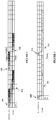
- FIG. 4 illustrates a situation where 4 HARQ processes are interleaved with an interleave interval of 32 subframes (SF), in accordance with some embodiments of the present invention.
- each square represents a HARQ interleaving interval which is 32 subframes, however it would be readily understood that greater than or less than 32 subframes may be used for this interval.
- the length of the interleaving interval needs to be sufficient for the UE to decode a DCI message and also include sufficient time for the UE to switch from Tx to Rx and back to Tx. This switching time can typically be approximately 2 subframes (SF).
- each of the squares represents 32 subframes, and accordingly the time diversity duration is a total of 96 subframes (3*32) 310 .
- the eNB transmits DCI messages on the M-PDCCH in four sequential blocks, each block being 32SF.
- These DCI messages are indicative of the sequence of transmission of the HARQ processes that will be transmitted by the eNB on the PUSCH.
- the DCI messages 300 indicate that the HARQ processes will be transmitted in the sequence H1, H2, H3 and H4.
- the DCI messages thus convey the information to the UE that when listening to the PUSCH the HARQ processes will be received in this sequence.
- the first set of HARQ processes 302 are transmitted in this order followed by the second set of HARQ processes 304 , third set of HARQ processes 306 and fourth set of HARQ processes 308 .
- the eNB may assign the same amount of UL resources for each HARQ process. In this scenario all of the HARQ processes will end at the same time and thus can also start as illustrated in Figure 4 .
- the HARQ processes may start and end at different times. These instances can result in a more complicated transmission sequence. Examples of transmission sequences wherein HARQ processes start and end at different time are illustrated in Figures 5 and 6 .
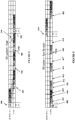
- the eNB waits for all the HARQ processes to be completed before starting any new HARQ processes, in this manner the HARQ processes will remain synchronized.
- all HARQ processes need to finish before one or more DCI messages can be sent and new HARQ processes can start.
- this configuration can result in some SF being unused. Therefore, as some SF are left unused waiting for processes to end, the throughput to the UE can be reduced and thus latency can increase. This method is illustrated in Figure 5 .
- HARQ processes H1 and H2 require 10 repetitions before completion, whereas HARQ processes H3 and H4 only require 7 repetitions before completion.
- H1-7 400 and H2-7 402 continue through repetition 8 410 , repetition 9 414 and repetition 10 418 to complete these two HARQ processes.
- HARQ processes H3 and H4 are completed upon transmission of H3-7 404 and H4-7 408 .
- the intervening transmission blocks 415, 417 and 419 separating the repetitions of the transmission of HARQ processes H1 and H2 are unused.
- subsequent HARQ processes are initiated by the transmission of DCI messages 420 which are indicative of the HARQ processes to be subsequently transmitted, resulting in a synchronous start of the new HARQ processes 422 .
- the eNB does not wait for HARQ processes to complete and can start new HARQ processes after other processes have been completed resulting in a mixed start of new HARQ processes. This method is illustrated in Figure 6 .
- Figure 6 illustrates HARQ process transmission sequences that are initially the same as that illustrated in Figure 5 .
- HARQ processes H1 and H2 require 10 repetitions before completion
- HARQ processes H3 and H4 only require 7 repetitions before completion.
- H1-7 400 and H2-7 402 continue through repetition 8 410 , repetition 9 414 and repetition 10 418 to complete these two HARQ processes.
- HARQ processes H3 and H4 are completed upon transmission of H3-7 404 and H4-7 408 .
- the eNB transmits two DCI messages 520 which are indicative of new HARQ processes namely H5 and H6.
- the eNB transmits the first repetition of the new HARQ processes 522 which have been illustrated in Figure 6 as H5-1 and H6-1.
- the transmission blocks that were previously left unused during the completion of HARQ processes H1 and H2 and illustrated in Figure 5 the embodiment illustrated in Figure 6 defines a manner in which these transmission blocks can be utilized.
- the eNB upon completion of the tenth repetition 418 of HARQ processes H1 and H2 as well as the subsequent transmission of the second repetition 524 of HARQ processes H5 and H6, during the transmission blocks between the transmission of H6-2 and H5-3, the eNB transmits two DCI messages 540 which are indicative of new HARQ processes namely H7 and H8. The eNB subsequently transmits the HARQ processes on the PUSCH. As illustrated, for this example the HARQ processes transmitted are the third repetition 525 of H5 and H6 followed by the first repetition 542 of H7 and H8 followed by the fourth repetition 526 of H5 and H6. It would be readily understood that Figure 6 does not illustrate the complete transmissions of the HARQ processes but is used to illustrate the concept of a mixed start of new HARQ processes in accordance with embodiments of the present invention.
- the UE when the UE does not have any PUSCH data to transmit, it switches to Rx in order to listen to the M-PDCCH for DCI messages.
- DCI message H5 and DCI message H6 need to be configured such that they can be decoded within one HARQ interleaving interval, in order for the sequencing illustrated in this figure to be suitable.
- individual UE resources for example memory and processing resources, which are used for the HARQ processes, are to be suitably available for subsequent HARQ processes to commence.
- the resources used therefor can subsequently be used for the commencement of H5 and H6.
- the resources used thereby can be subsequently used for H7 and H8.
- the interleaving interval can be longer than illustrated in the example discussed above.
- the length of the interleaving interval can be configured to be dynamic such that the interleaving interval can be changed relative to the level of deep coverage required by the UE receiving the transmissions.
- the DCI message format in order to reduce the number of DCI messages that are transmitted, can be configured to contain the DCI message associated with multiple HARQ processes.
- This integration of multiple DCI messages into a single DCI message transmission may be suitable in the "start" scenario, for example when all of the HARQ processes are to start sequentially.
- the DCI message transmitted can include the DCI information that is associated with all four of the HARQ processes.
- DCI message 600 includes the HARQ information for H1, H2, H3 and H4, wherein on the subsequent time block, the eNB commences the transmission of the interleaved HARQ processes, namely the first set of HARQ processes 610 , the second set of HARQ processes 620 , the third set of HARQ processes 630 and so on as illustrated.
- Figure 7 does not illustrate the complete transmissions of the HARQ processes but is used to illustrate the concept of a single DCI message indicative of plural HARQ processes.
- the starting position of each PUSCH is based on a variable K, for example HARQ-2 commences at K from the end of the DCI message, HARQ-3 commences 2K from the end of the DCI message, and HARQ-4 commences 3K from the end of the DCI message.
- K has been illustrated as 32 SF, however the selection of the variable K can be dependent on the type of coverage being provided and the like as previously discussed.
- time diversity for the HARQ process when or if the eNB utilizes time diversity for the HARQ process can be an eNB implementation choice.
- an eNB can initially choose to not utilize time diversity due to increased development time, however the eNB can subsequently determine that time diversity to the HARQ processes is to be used in order to reduce UE power consumption and increase PUSCH efficiency.
- supporting time diversity for example transmission gaps, for example as illustrated in Figure 5
- the number of repeats required at high coverage can be very large (e.g. 300) which can "lock" resources far into the future where network loading is still unknown. Allowing gaps in the transmission can allow the eNB some scheduling flexibility to interleave legacy traffic with the high coverage traffic.
- the DCI messages that are used for coverage enhancement scenarios will need to support at least Variable Forward Scheduling and Time Diversity Enabled.
- the DCI message in Variable Forward Scheduling, can be configured to schedule the PUSCH a variable number of SFs (or DTX intervals) in the future.
- the resolution of forward scheduling could be DTX Intervals thus only 2 DCI message bits can be needed.
- Supporting Variable Forward Scheduling also provides additional scheduling flexibility to the eNB. Accordingly with optimization, Variable Forward Scheduling may require 2 additional bits in the DCI message.
- At least 1 bit within the DCI message needs to indicate if time diversity is enabled.
- the Time Diversity Duration i.e. the gaps between transmissions
- the Time Diversity Duration may be fixed at 3 x DTX Interval or maybe variable.
- 2 DCI message bits may specify values between 0 (Time diversity not enabled) and 3 (wherein 1 to 3, indicate the multiplier for the DTX Interval). Accordingly, Time Diversity configuration may require 1 or 2 DCI message bits.
- An apparatus may take the form of a communication device in a wireless communication system supporting HARQ, such as an LTE wireless communication system.
- the communication device is a wireless subscriber terminal, such as a user equipment (UE), handheld cell phone, PDA, M2M device, or the like.
- the communication device is a base station, such as an eNB.
- a communication device may comprise various structural elements, such as a power source, microprocessor, memory, signal processing section, radiofrequency (RF) electronics section, antenna, and the like.
- an existing communication device such as a UE, M2M device, eNB, or the like, which is configured to operate in a wireless communication system such as an LTE system, may be further configured to perform various operations such as transmitting DCI messages, and HARQ processes, in accordance with the present invention.
- Such configuration may be via new software routines loaded into memory of the device and used to guide operation thereof, or similarly via new firmware routines loaded into memory for use by appropriate components such as a microcontroller or digital signal processor.
- configuration may be performed by incorporating appropriate specialized hardware, such as electronic components, microcontrollers, logic arrays, signal processing electronics, or the like, into the device.
- appropriate specialized hardware such as electronic components, microcontrollers, logic arrays, signal processing electronics, or the like.
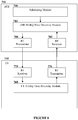
- FIG 8 illustrates a system comprising an Evolved Node B (eNB) 700 and a user equipment (UE) 750 in a Long Term Evolution (LTE) wireless communication system.
- the UE 750 comprises a UE HARQ time diversity module 760 , which is configured to receive DCIs for the HARQ processes from the eNB and determine from same if time diversity has been enabled for the HARQ processes.
- the UE 750 further comprises various other features such as a wireless communication module, comprising a RF transmitter 770 and RF receiver 775 , the wireless communication module configured to facilitate communication with the eNB via an appropriate protocol, such as LTE.
- Other functionalities of a UE configured to operate in accordance with a standard such as LTE would be readily understood by a worker skilled in the art.
- the eNB 700 comprises an eNB HARQ time diversity module 710 , which is configured to determine and act up on the use of time diversity with respect to multiple HARQ processes.
- the eNB 700 further comprises various other features such as a wireless communication module, comprising a RF transmitter 780 and RF receiver 785 , the wireless communication module configured to facilitate communication with the UE via an appropriate protocol, such as LTE.
- the eNB further comprises a scheduling module 790 which is configured to perform resource assignment scheduling and rescheduling, as would be readily understood by a worker skilled in the art.
- Other functionalities of an eNB configured to operate in accordance with a standard such as LTE would be readily understood by a worker skilled in the art.
- Acts associated with the method described herein can be implemented as coded instructions in a computer program product.
- the computer program product is a computer-readable medium upon which software code is recorded to execute the method when the computer program product is loaded into memory and executed on the microprocessor of the wireless communication device.
- Acts associated with the method described herein can be implemented as coded instructions in plural computer program products. For example, a first portion of the method may be performed using one computing device, and a second portion of the method may be performed using another computing device, server, or the like.
- each computer program product is a computer-readable medium upon which software code is recorded to execute appropriate portions of the method when a computer program product is loaded into memory and executed on the microprocessor of a computing device.
- each step of the method may be executed on any computing device, such as a personal computer, server, PDA, or the like and pursuant to one or more, or a part of one or more, program elements, modules or objects generated from any programming language, such as C++, Java, PL/1, or the like.
- each step, or a file or object or the like implementing each said step may be executed by special purpose hardware or a circuit module designed for that purpose.
Landscapes
- Engineering & Computer Science (AREA)
- Computer Networks & Wireless Communication (AREA)
- Signal Processing (AREA)
- Mobile Radio Communication Systems (AREA)
Claims (4)
- Verfahren zum Begünstigen von Zeitdiversität von hybriden automatischen Wiederholungsanfrage-Prozessen (HARQ-Prozessen) in einem Long-Term-Evolution-System (LTE-System) mit Endgeräten (UEs) für Halbduplex-Frequenzduplex (HD-FDD), wobei das Verfahren umfasst:Senden (10), mittels einer evolved Node B Basisstation (eNB; 700), mehrerer Downlink-Steuerungsinformationsnachrichten (DCI-Nachrichten; 300), die mehrere HARQ-Prozesse (302, 304, 306, 308) anzeigen; undEmpfangen (15) der HARQ-Prozesse (10) mittels des eNB (700), wobei das Empfangen (15) der HARQ-Prozesse (10) ein Interleaving der HARQ-Prozesse (10) auf Grundlage der mehreren DCI-Nachrichten (300) umfasst, wobei eine Abfolge des Absendens der DCI-Nachrichten eine Abfolge eines Empfangs von mehreren Wiederholungen der HARQ-Prozesse anzeigt, wobei ein erster HARQ-Prozess vor einem zweiten HARQ-Prozess abgeschlossen wird und wobei nach dem Abschluss der mehreren HARQ-Prozesse mindestens ein neuer HARQ-Prozess begonnen wird.
- Long-Term-Evolution-System (LTE-System) das ein Endgerät (UE) für Halbduplex-Frequenzduplex (HD-FDD) nach Anspruch 4 und eine evolved Node B Basisstation (eNB; 700) aufweist, mit:einem Prozessor; undeinem maschinenlesbaren Speicher, der maschinenausführbare Befehle speichert, die bei Ausführung durch den Prozessor das eNB dazu einrichten, Folgendes auszuführen:Senden (10) mehrerer Downlink-Steuerungsinformationsnachrichten (DCI-Nachrichten; 300), die mehrere hybride automatische Wiederholungsanfrage-Prozesse (HARQ-Prozesse; 302, 304, 306, 308) anzeigen; undEmpfangen (15) der HARQ-Prozesse (302, 304, 306, 308), wobei das Empfangen der HARQ-Prozesse ein Interleaving der HARQ-Prozesse auf Grundlage der mehreren DCI-Nachrichten (300) umfasst, wobei eine Abfolge des Absendens der DCI-Nachrichten eine Abfolge eines Empfangs von mehreren Wiederholungen der HARQ-Prozesse anzeigt, wobei ein erster HARQ-Prozess vor einem zweiten HARQ-Prozess abgeschlossen ist und wobei nach dem Abschluss der mehreren HARQ-Prozesse mindestens ein neuer HARQ-Prozess begonnen wird.
- Verfahren zum Begünstigen von Zeitdiversität von hybriden automatischen Wiederholungsanfrage-Prozessen (HARQ-Prozessen) in einem Long-Term-Evolution-System (LTE-System) mit Endgeräten (UEs) für Halbduplex-Frequenzduplex (HD-FDD), wobei das Verfahren umfasst:Empfangen, mittels eines Endgeräts (UE; 750), mehrerer Downlink-Steuerungsinformationsnachrichten (DCI-Nachrichten; 300), die mehrere HARQ-Prozesse (302, 304, 306, 308) anzeigen; undSenden der HARQ-Prozesse (302, 304, 306, 308) durch das UE (750), wobei das Senden der HARQ-Prozesse ein Senden von HARQ-Prozessen mit einem Interleaving auf Grundlage der mehreren DCI-Nachrichten (300) umfasst, wobei eine Abfolge eines Empfangs der DCI-Nachrichten eine Abfolge eines Absendens von mehreren Wiederholungen der HARQ-Prozesse anzeigt, wobei ein erster HARQ-Prozess vor einem zweiten HARQ-Prozess abgeschlossen wird und wobei nach dem Abschluss der mehreren HARQ-Prozesse mindestens ein neuer HARQ-Prozess empfangen wird.
- Endgerät (UE; 750) für Halbduplex-Frequenzduplex (HD-FDD) in einem Long-Term-Evolution-System (LTE-System), wobei das UE (750) aufweist:einen Prozessor, undeinen maschinenlesbaren Speicher, der maschinenausführbare Befehle speichert, die bei Ausführung durch den Prozessor das UE (750) dazu einrichten, Folgendes auszuführen:Empfangen mehrerer Downlink-Steuerungsinformationsnachrichten (DCI-Nachrichten; 300), die mehrere hybride automatische Wiederholungsanfrage-Prozesse (HARQ-Prozesse; 302, 304, 306, 308) anzeigen; undSenden der HARQ-Prozesse (302, 304, 306, 308), wobei das Senden der HARQ-Prozesse ein Senden von HARQ-Prozessen mit einem Interleaving auf Grundlage der mehreren DCI-Nachrichten (300) umfasst, wobei eine Abfolge eines Empfangs der DCI-Nachrichten eine Abfolge eines Absendens von mehreren Wiederholungen der HARQ-Prozesse anzeigt, wobei ein erster HARQ-Prozess vor einem zweiten HARQ-Prozess abgeschlossen ist und wobei nach dem Abschluss der mehreren HARQ-Prozesse mindestens ein neuer HARQ-Prozess empfangen wird.
Applications Claiming Priority (2)
| Application Number | Priority Date | Filing Date | Title |
|---|---|---|---|
| US201562232330P | 2015-09-24 | 2015-09-24 | |
| PCT/CA2016/051124 WO2017049413A1 (en) | 2015-09-24 | 2016-09-23 | Method and system for transmitting control information for user equipment |
Publications (3)
| Publication Number | Publication Date |
|---|---|
| EP3354064A1 EP3354064A1 (de) | 2018-08-01 |
| EP3354064A4 EP3354064A4 (de) | 2019-04-24 |
| EP3354064B1 true EP3354064B1 (de) | 2021-01-20 |
Family
ID=58385467
Family Applications (1)
| Application Number | Title | Priority Date | Filing Date |
|---|---|---|---|
| EP16847700.8A Active EP3354064B1 (de) | 2015-09-24 | 2016-09-23 | Verfahren und system zur übertragung von steuerinformationen für benutzergerät |
Country Status (3)
| Country | Link |
|---|---|
| US (1) | US10225829B2 (de) |
| EP (1) | EP3354064B1 (de) |
| WO (1) | WO2017049413A1 (de) |
Families Citing this family (9)
| Publication number | Priority date | Publication date | Assignee | Title |
|---|---|---|---|---|
| EP3354064B1 (de) | 2015-09-24 | 2021-01-20 | Sierra Wireless, Inc. | Verfahren und system zur übertragung von steuerinformationen für benutzergerät |
| CN113630219B (zh) | 2016-01-11 | 2024-01-23 | 瑞典爱立信有限公司 | 具有传输间隙的数据块重复 |
| US11419131B2 (en) | 2018-08-09 | 2022-08-16 | Sierra Wireless, Inc. | Method and apparatus for multi-transport block grant transmissions |
| CN113039732A (zh) * | 2018-09-06 | 2021-06-25 | 诺基亚通信公司 | Acqi解码置信度检测 |
| US11258570B2 (en) * | 2018-12-13 | 2022-02-22 | Apple Inc. | Joint optimization of bandwidth part, search space and connected mode discontinuous reception operation in 5G New Radio |
| WO2021062551A1 (en) | 2019-10-03 | 2021-04-08 | Sierra Wireless, Inc. | Method and apparatus for facilitating transmissions in a wireless communication system |
| US11575472B2 (en) | 2020-02-27 | 2023-02-07 | Sierra Wireless, Inc. | Methods and apparatuses for supporting multi transport block grant data transmission |
| US11785594B2 (en) * | 2020-03-16 | 2023-10-10 | Qualcomm Incorporated | Multi-downlink control information message related to physical uplink shared channels |
| KR20240052474A (ko) * | 2022-10-14 | 2024-04-23 | 삼성전자주식회사 | 무선 통신 시스템에서 에너지 세이빙을 지원하기 위한 방법 및 장치 |
Family Cites Families (26)
| Publication number | Priority date | Publication date | Assignee | Title |
|---|---|---|---|---|
| EP1936853B1 (de) * | 2006-12-20 | 2018-11-21 | Panasonic Intellectual Property Corporation of America | Vermeidung von Feedbackkollisionen in Mobilkommunikationen |
| US20090307554A1 (en) * | 2008-04-25 | 2009-12-10 | Interdigital Patent Holdings, Inc. | Method and apparatus for performing a bundled transmission |
| KR20100011879A (ko) * | 2008-07-25 | 2010-02-03 | 엘지전자 주식회사 | 무선 통신 시스템에서 데이터 수신 방법 |
| US20100064061A1 (en) * | 2008-09-05 | 2010-03-11 | Apple Inc. | Providing substantially immediate action in response to input event |
| US9294219B2 (en) * | 2008-09-30 | 2016-03-22 | Qualcomm Incorporated | Techniques for supporting relay operation in wireless communication systems |
| SG174384A1 (en) * | 2009-03-16 | 2011-10-28 | Research In Motion Ltd | Harq process number management for downlink carrier aggregation |
| KR20120016072A (ko) * | 2009-03-30 | 2012-02-22 | 리서치 인 모션 리미티드 | 컴포넌트 반송파 재할당 동안 harq 전송을 지원하는 시스템 및 방법 |
| WO2010120808A1 (en) * | 2009-04-13 | 2010-10-21 | Research In Motion Limited | System and method for semi-synchronous hybrid automatic repeat request |
| US20100281486A1 (en) * | 2009-05-04 | 2010-11-04 | HT mMobile Inc. | Enhanced scheduling, priority handling and multiplexing method and system |
| KR101670747B1 (ko) * | 2009-06-30 | 2016-10-31 | 엘지전자 주식회사 | 제어 신호 자원의 유연한 할당 |
| CN101651995A (zh) * | 2009-09-21 | 2010-02-17 | 中兴通讯股份有限公司 | 一种下行控制信息的传输方法及传输系统 |
| CN102202408B (zh) * | 2010-03-22 | 2014-01-01 | 华为技术有限公司 | 多子帧调度方法、系统和设备 |
| JP5752783B2 (ja) * | 2010-03-31 | 2015-07-22 | サムスン エレクトロニクス カンパニー リミテッド | マルチ−セルtdd通信システムにおける応答信号の送信に対するリソースインデクシング |
| EP2798764B1 (de) * | 2011-12-30 | 2019-05-22 | Nokia Technologies Oy | Verfahren und vorrichtung zur erhöhung der reichweite |
| CN104254995B (zh) * | 2012-01-24 | 2018-05-11 | 交互数字专利控股公司 | 用于改善的上行链路覆盖的系统和方法 |
| US9215058B2 (en) * | 2012-03-06 | 2015-12-15 | Blackberry Limited | Enhanced PHICH transmission for LTE-advanced |
| US20150305003A1 (en) * | 2012-10-31 | 2015-10-22 | Tao Chen | Multiplexed transmission of data from multiple harq processes for a switching operation |
| US9397796B2 (en) * | 2013-03-13 | 2016-07-19 | Samsung Electronics Co., Ltd. | Computing and transmitting channel state information in adaptively configured TDD communication systems |
| US9538503B2 (en) * | 2013-03-28 | 2017-01-03 | Samsung Electronics Co., Ltd. | Aggregation of FDD and TDD cells |
| US9608774B2 (en) * | 2013-10-03 | 2017-03-28 | Qualcomm Incorporated | Opportunistic HARQ repetition for coverage enhancement |
| US20150098370A1 (en) * | 2013-10-04 | 2015-04-09 | Industrial Technology Research Institute | Method of Handling HARQ Resource for FDD Carrier and Related Communication Device |
| US20150200751A1 (en) * | 2014-01-10 | 2015-07-16 | Sharp Laboratories Of America, Inc. | Enhanced pucch reporting for carrier aggregation |
| US9408158B2 (en) * | 2014-03-14 | 2016-08-02 | Sharp Laboratories Of America, Inc. | Systems and methods for feedback reporting |
| US9912504B2 (en) * | 2014-07-31 | 2018-03-06 | Futurewei Technologies, Inc. | System and method for multiple carrier transmission |
| WO2016048066A1 (en) * | 2014-09-25 | 2016-03-31 | Samsung Electronics Co., Ltd. | Method and apparatus for device-to-device harq process management |
| EP3354064B1 (de) | 2015-09-24 | 2021-01-20 | Sierra Wireless, Inc. | Verfahren und system zur übertragung von steuerinformationen für benutzergerät |
-
2016
- 2016-09-23 EP EP16847700.8A patent/EP3354064B1/de active Active
- 2016-09-23 WO PCT/CA2016/051124 patent/WO2017049413A1/en not_active Ceased
- 2016-09-26 US US15/276,053 patent/US10225829B2/en active Active
Non-Patent Citations (1)
| Title |
|---|
| None * |
Also Published As
| Publication number | Publication date |
|---|---|
| US20170094644A1 (en) | 2017-03-30 |
| EP3354064A1 (de) | 2018-08-01 |
| US10225829B2 (en) | 2019-03-05 |
| WO2017049413A1 (en) | 2017-03-30 |
| EP3354064A4 (de) | 2019-04-24 |
Similar Documents
| Publication | Publication Date | Title |
|---|---|---|
| EP3354064B1 (de) | Verfahren und system zur übertragung von steuerinformationen für benutzergerät | |
| AU2022224872B2 (en) | Method and apparatus for partial retransmission in wireless cellular communication system | |
| US11576199B2 (en) | Systems and methods for grant-free uplink transmissions | |
| EP3892049B1 (de) | Verfahren und vorrichtungen zum senden/empfangen von steuerinformationen in einem drahtloskommunikationssystem | |
| US10298362B2 (en) | Method and apparatus for partial retransmission in wireless cellular communication system | |
| CN108574987B (zh) | 传输信息的方法和装置 | |
| KR20230054818A (ko) | 무선 통신 시스템에서 채널 접속 방법 및 장치 | |
| US12382437B2 (en) | Method and apparatus for transmitting and receiving downlink control information in wireless communication system | |
| EP4214998B1 (de) | Verfahren und vorrichtung zur uplink-übertragung | |
| CN114128189A (zh) | 用于在无线通信系统中发送/接收上行链路控制信息的方法和设备 | |
| CN113541869B (zh) | 通信系统中的终端、基站及其执行的方法 | |
| EP3304786B1 (de) | Vorrichtung und verfahren zur handhabung der konfiguration von bündelgrössen | |
| CN111435885B (zh) | 用于传输数据的方法、通信设备和网络设备 | |
| KR20190007976A (ko) | 무선 통신 시스템에서 하향링크 제어 채널 수신 시간 설정 방법 및 장치 | |
| KR20170128209A (ko) | 저비용 사용자 장비들을 위한 하향링크 제어 채널들의 전송 | |
| US11212042B2 (en) | Method and apparatus for performing communication in wireless communication system | |
| CN102164029B (zh) | Ack/nack反馈信息的传输方法和设备 | |
| CN113316908A (zh) | 用于在通信系统中发送或接收反馈信息的方法和装置 | |
| US20230254850A1 (en) | Method and apparatus for scheduling data channel | |
| US12574158B2 (en) | Method and apparatus for feeding back HARQ-ACK in wireless communication system | |
| EP4478638A1 (de) | Verfahren und vorrichtung zum senden/empfangen von harq-ack-informationen in einem drahtloskommunikationssystem | |
| KR20230129521A (ko) | 업링크 제어 정보(uci) 전송 방법 및 장치 | |
| KR20160134497A (ko) | 면허 및 비면허 대역을 지원하는 네트워크에서 통신 노드의 동작 방법 | |
| CN118077289A (zh) | 一种码本调度方法及装置 |
Legal Events
| Date | Code | Title | Description |
|---|---|---|---|
| STAA | Information on the status of an ep patent application or granted ep patent |
Free format text: STATUS: THE INTERNATIONAL PUBLICATION HAS BEEN MADE |
|
| PUAI | Public reference made under article 153(3) epc to a published international application that has entered the european phase |
Free format text: ORIGINAL CODE: 0009012 |
|
| STAA | Information on the status of an ep patent application or granted ep patent |
Free format text: STATUS: REQUEST FOR EXAMINATION WAS MADE |
|
| 17P | Request for examination filed |
Effective date: 20180418 |
|
| AK | Designated contracting states |
Kind code of ref document: A1 Designated state(s): AL AT BE BG CH CY CZ DE DK EE ES FI FR GB GR HR HU IE IS IT LI LT LU LV MC MK MT NL NO PL PT RO RS SE SI SK SM TR |
|
| AX | Request for extension of the european patent |
Extension state: BA ME |
|
| DAV | Request for validation of the european patent (deleted) | ||
| DAX | Request for extension of the european patent (deleted) | ||
| A4 | Supplementary search report drawn up and despatched |
Effective date: 20190327 |
|
| RIC1 | Information provided on ipc code assigned before grant |
Ipc: H04W 28/12 20090101AFI20190321BHEP Ipc: H04L 1/18 20060101ALI20190321BHEP Ipc: H04W 28/04 20090101ALI20190321BHEP |
|
| GRAP | Despatch of communication of intention to grant a patent |
Free format text: ORIGINAL CODE: EPIDOSNIGR1 |
|
| STAA | Information on the status of an ep patent application or granted ep patent |
Free format text: STATUS: GRANT OF PATENT IS INTENDED |
|
| INTG | Intention to grant announced |
Effective date: 20200325 |
|
| GRAJ | Information related to disapproval of communication of intention to grant by the applicant or resumption of examination proceedings by the epo deleted |
Free format text: ORIGINAL CODE: EPIDOSDIGR1 |
|
| STAA | Information on the status of an ep patent application or granted ep patent |
Free format text: STATUS: REQUEST FOR EXAMINATION WAS MADE |
|
| INTC | Intention to grant announced (deleted) | ||
| GRAP | Despatch of communication of intention to grant a patent |
Free format text: ORIGINAL CODE: EPIDOSNIGR1 |
|
| STAA | Information on the status of an ep patent application or granted ep patent |
Free format text: STATUS: GRANT OF PATENT IS INTENDED |
|
| INTG | Intention to grant announced |
Effective date: 20200911 |
|
| GRAS | Grant fee paid |
Free format text: ORIGINAL CODE: EPIDOSNIGR3 |
|
| GRAA | (expected) grant |
Free format text: ORIGINAL CODE: 0009210 |
|
| STAA | Information on the status of an ep patent application or granted ep patent |
Free format text: STATUS: THE PATENT HAS BEEN GRANTED |
|
| AK | Designated contracting states |
Kind code of ref document: B1 Designated state(s): AL AT BE BG CH CY CZ DE DK EE ES FI FR GB GR HR HU IE IS IT LI LT LU LV MC MK MT NL NO PL PT RO RS SE SI SK SM TR |
|
| REG | Reference to a national code |
Ref country code: GB Ref legal event code: FG4D |
|
| REG | Reference to a national code |
Ref country code: CH Ref legal event code: EP |
|
| REG | Reference to a national code |
Ref country code: DE Ref legal event code: R096 Ref document number: 602016051837 Country of ref document: DE |
|
| REG | Reference to a national code |
Ref country code: AT Ref legal event code: REF Ref document number: 1357417 Country of ref document: AT Kind code of ref document: T Effective date: 20210215 |
|
| REG | Reference to a national code |
Ref country code: IE Ref legal event code: FG4D |
|
| REG | Reference to a national code |
Ref country code: NL Ref legal event code: MP Effective date: 20210120 |
|
| REG | Reference to a national code |
Ref country code: LT Ref legal event code: MG9D |
|
| REG | Reference to a national code |
Ref country code: AT Ref legal event code: MK05 Ref document number: 1357417 Country of ref document: AT Kind code of ref document: T Effective date: 20210120 |
|
| PG25 | Lapsed in a contracting state [announced via postgrant information from national office to epo] |
Ref country code: NO Free format text: LAPSE BECAUSE OF FAILURE TO SUBMIT A TRANSLATION OF THE DESCRIPTION OR TO PAY THE FEE WITHIN THE PRESCRIBED TIME-LIMIT Effective date: 20210420 Ref country code: PT Free format text: LAPSE BECAUSE OF FAILURE TO SUBMIT A TRANSLATION OF THE DESCRIPTION OR TO PAY THE FEE WITHIN THE PRESCRIBED TIME-LIMIT Effective date: 20210520 Ref country code: FI Free format text: LAPSE BECAUSE OF FAILURE TO SUBMIT A TRANSLATION OF THE DESCRIPTION OR TO PAY THE FEE WITHIN THE PRESCRIBED TIME-LIMIT Effective date: 20210120 Ref country code: GR Free format text: LAPSE BECAUSE OF FAILURE TO SUBMIT A TRANSLATION OF THE DESCRIPTION OR TO PAY THE FEE WITHIN THE PRESCRIBED TIME-LIMIT Effective date: 20210421 Ref country code: HR Free format text: LAPSE BECAUSE OF FAILURE TO SUBMIT A TRANSLATION OF THE DESCRIPTION OR TO PAY THE FEE WITHIN THE PRESCRIBED TIME-LIMIT Effective date: 20210120 Ref country code: LT Free format text: LAPSE BECAUSE OF FAILURE TO SUBMIT A TRANSLATION OF THE DESCRIPTION OR TO PAY THE FEE WITHIN THE PRESCRIBED TIME-LIMIT Effective date: 20210120 Ref country code: BG Free format text: LAPSE BECAUSE OF FAILURE TO SUBMIT A TRANSLATION OF THE DESCRIPTION OR TO PAY THE FEE WITHIN THE PRESCRIBED TIME-LIMIT Effective date: 20210420 |
|
| PG25 | Lapsed in a contracting state [announced via postgrant information from national office to epo] |
Ref country code: AT Free format text: LAPSE BECAUSE OF FAILURE TO SUBMIT A TRANSLATION OF THE DESCRIPTION OR TO PAY THE FEE WITHIN THE PRESCRIBED TIME-LIMIT Effective date: 20210120 Ref country code: LV Free format text: LAPSE BECAUSE OF FAILURE TO SUBMIT A TRANSLATION OF THE DESCRIPTION OR TO PAY THE FEE WITHIN THE PRESCRIBED TIME-LIMIT Effective date: 20210120 Ref country code: RS Free format text: LAPSE BECAUSE OF FAILURE TO SUBMIT A TRANSLATION OF THE DESCRIPTION OR TO PAY THE FEE WITHIN THE PRESCRIBED TIME-LIMIT Effective date: 20210120 Ref country code: PL Free format text: LAPSE BECAUSE OF FAILURE TO SUBMIT A TRANSLATION OF THE DESCRIPTION OR TO PAY THE FEE WITHIN THE PRESCRIBED TIME-LIMIT Effective date: 20210120 Ref country code: SE Free format text: LAPSE BECAUSE OF FAILURE TO SUBMIT A TRANSLATION OF THE DESCRIPTION OR TO PAY THE FEE WITHIN THE PRESCRIBED TIME-LIMIT Effective date: 20210120 |
|
| PG25 | Lapsed in a contracting state [announced via postgrant information from national office to epo] |
Ref country code: IS Free format text: LAPSE BECAUSE OF FAILURE TO SUBMIT A TRANSLATION OF THE DESCRIPTION OR TO PAY THE FEE WITHIN THE PRESCRIBED TIME-LIMIT Effective date: 20210520 |
|
| REG | Reference to a national code |
Ref country code: DE Ref legal event code: R097 Ref document number: 602016051837 Country of ref document: DE |
|
| PG25 | Lapsed in a contracting state [announced via postgrant information from national office to epo] |
Ref country code: CZ Free format text: LAPSE BECAUSE OF FAILURE TO SUBMIT A TRANSLATION OF THE DESCRIPTION OR TO PAY THE FEE WITHIN THE PRESCRIBED TIME-LIMIT Effective date: 20210120 Ref country code: EE Free format text: LAPSE BECAUSE OF FAILURE TO SUBMIT A TRANSLATION OF THE DESCRIPTION OR TO PAY THE FEE WITHIN THE PRESCRIBED TIME-LIMIT Effective date: 20210120 Ref country code: SM Free format text: LAPSE BECAUSE OF FAILURE TO SUBMIT A TRANSLATION OF THE DESCRIPTION OR TO PAY THE FEE WITHIN THE PRESCRIBED TIME-LIMIT Effective date: 20210120 |
|
| PLBE | No opposition filed within time limit |
Free format text: ORIGINAL CODE: 0009261 |
|
| STAA | Information on the status of an ep patent application or granted ep patent |
Free format text: STATUS: NO OPPOSITION FILED WITHIN TIME LIMIT |
|
| PG25 | Lapsed in a contracting state [announced via postgrant information from national office to epo] |
Ref country code: DK Free format text: LAPSE BECAUSE OF FAILURE TO SUBMIT A TRANSLATION OF THE DESCRIPTION OR TO PAY THE FEE WITHIN THE PRESCRIBED TIME-LIMIT Effective date: 20210120 Ref country code: RO Free format text: LAPSE BECAUSE OF FAILURE TO SUBMIT A TRANSLATION OF THE DESCRIPTION OR TO PAY THE FEE WITHIN THE PRESCRIBED TIME-LIMIT Effective date: 20210120 Ref country code: SK Free format text: LAPSE BECAUSE OF FAILURE TO SUBMIT A TRANSLATION OF THE DESCRIPTION OR TO PAY THE FEE WITHIN THE PRESCRIBED TIME-LIMIT Effective date: 20210120 |
|
| 26N | No opposition filed |
Effective date: 20211021 |
|
| PG25 | Lapsed in a contracting state [announced via postgrant information from national office to epo] |
Ref country code: ES Free format text: LAPSE BECAUSE OF FAILURE TO SUBMIT A TRANSLATION OF THE DESCRIPTION OR TO PAY THE FEE WITHIN THE PRESCRIBED TIME-LIMIT Effective date: 20210120 Ref country code: AL Free format text: LAPSE BECAUSE OF FAILURE TO SUBMIT A TRANSLATION OF THE DESCRIPTION OR TO PAY THE FEE WITHIN THE PRESCRIBED TIME-LIMIT Effective date: 20210120 |
|
| PG25 | Lapsed in a contracting state [announced via postgrant information from national office to epo] |
Ref country code: SI Free format text: LAPSE BECAUSE OF FAILURE TO SUBMIT A TRANSLATION OF THE DESCRIPTION OR TO PAY THE FEE WITHIN THE PRESCRIBED TIME-LIMIT Effective date: 20210120 |
|
| PG25 | Lapsed in a contracting state [announced via postgrant information from national office to epo] |
Ref country code: IT Free format text: LAPSE BECAUSE OF FAILURE TO SUBMIT A TRANSLATION OF THE DESCRIPTION OR TO PAY THE FEE WITHIN THE PRESCRIBED TIME-LIMIT Effective date: 20210120 |
|
| REG | Reference to a national code |
Ref country code: CH Ref legal event code: PL |
|
| REG | Reference to a national code |
Ref country code: BE Ref legal event code: MM Effective date: 20210930 |
|
| PG25 | Lapsed in a contracting state [announced via postgrant information from national office to epo] |
Ref country code: IS Free format text: LAPSE BECAUSE OF FAILURE TO SUBMIT A TRANSLATION OF THE DESCRIPTION OR TO PAY THE FEE WITHIN THE PRESCRIBED TIME-LIMIT Effective date: 20210520 Ref country code: MC Free format text: LAPSE BECAUSE OF FAILURE TO SUBMIT A TRANSLATION OF THE DESCRIPTION OR TO PAY THE FEE WITHIN THE PRESCRIBED TIME-LIMIT Effective date: 20210120 |
|
| PG25 | Lapsed in a contracting state [announced via postgrant information from national office to epo] |
Ref country code: LU Free format text: LAPSE BECAUSE OF NON-PAYMENT OF DUE FEES Effective date: 20210923 Ref country code: IE Free format text: LAPSE BECAUSE OF NON-PAYMENT OF DUE FEES Effective date: 20210923 Ref country code: BE Free format text: LAPSE BECAUSE OF NON-PAYMENT OF DUE FEES Effective date: 20210930 |
|
| PG25 | Lapsed in a contracting state [announced via postgrant information from national office to epo] |
Ref country code: LI Free format text: LAPSE BECAUSE OF NON-PAYMENT OF DUE FEES Effective date: 20210930 Ref country code: CH Free format text: LAPSE BECAUSE OF NON-PAYMENT OF DUE FEES Effective date: 20210930 |
|
| PG25 | Lapsed in a contracting state [announced via postgrant information from national office to epo] |
Ref country code: HU Free format text: LAPSE BECAUSE OF FAILURE TO SUBMIT A TRANSLATION OF THE DESCRIPTION OR TO PAY THE FEE WITHIN THE PRESCRIBED TIME-LIMIT; INVALID AB INITIO Effective date: 20160923 |
|
| PG25 | Lapsed in a contracting state [announced via postgrant information from national office to epo] |
Ref country code: NL Free format text: LAPSE BECAUSE OF NON-PAYMENT OF DUE FEES Effective date: 20210120 Ref country code: CY Free format text: LAPSE BECAUSE OF FAILURE TO SUBMIT A TRANSLATION OF THE DESCRIPTION OR TO PAY THE FEE WITHIN THE PRESCRIBED TIME-LIMIT Effective date: 20210120 |
|
| P01 | Opt-out of the competence of the unified patent court (upc) registered |
Effective date: 20230526 |
|
| PG25 | Lapsed in a contracting state [announced via postgrant information from national office to epo] |
Ref country code: MK Free format text: LAPSE BECAUSE OF FAILURE TO SUBMIT A TRANSLATION OF THE DESCRIPTION OR TO PAY THE FEE WITHIN THE PRESCRIBED TIME-LIMIT Effective date: 20210120 |
|
| PG25 | Lapsed in a contracting state [announced via postgrant information from national office to epo] |
Ref country code: TR Free format text: LAPSE BECAUSE OF FAILURE TO SUBMIT A TRANSLATION OF THE DESCRIPTION OR TO PAY THE FEE WITHIN THE PRESCRIBED TIME-LIMIT Effective date: 20210120 |
|
| PG25 | Lapsed in a contracting state [announced via postgrant information from national office to epo] |
Ref country code: MT Free format text: LAPSE BECAUSE OF FAILURE TO SUBMIT A TRANSLATION OF THE DESCRIPTION OR TO PAY THE FEE WITHIN THE PRESCRIBED TIME-LIMIT Effective date: 20210120 |
|
| PGFP | Annual fee paid to national office [announced via postgrant information from national office to epo] |
Ref country code: DE Payment date: 20250929 Year of fee payment: 10 |
|
| PGFP | Annual fee paid to national office [announced via postgrant information from national office to epo] |
Ref country code: GB Payment date: 20250929 Year of fee payment: 10 |
|
| PGFP | Annual fee paid to national office [announced via postgrant information from national office to epo] |
Ref country code: FR Payment date: 20250925 Year of fee payment: 10 |