EP3355992B1 - Haarwuchsmittel sowie verfahren zu seiner herstellung und verwendung des mittels zur prophylaktischen behandlung von haarausfall - Google Patents
Haarwuchsmittel sowie verfahren zu seiner herstellung und verwendung des mittels zur prophylaktischen behandlung von haarausfall Download PDFInfo
- Publication number
- EP3355992B1 EP3355992B1 EP16793737.4A EP16793737A EP3355992B1 EP 3355992 B1 EP3355992 B1 EP 3355992B1 EP 16793737 A EP16793737 A EP 16793737A EP 3355992 B1 EP3355992 B1 EP 3355992B1
- Authority
- EP
- European Patent Office
- Prior art keywords
- hair
- weight
- parts
- agent
- extract
- Prior art date
- Legal status (The legal status is an assumption and is not a legal conclusion. Google has not performed a legal analysis and makes no representation as to the accuracy of the status listed.)
- Active
Links
Images


Classifications
-
- A—HUMAN NECESSITIES
- A61—MEDICAL OR VETERINARY SCIENCE; HYGIENE
- A61Q—SPECIFIC USE OF COSMETICS OR SIMILAR TOILETRY PREPARATIONS
- A61Q7/00—Preparations for affecting hair growth
-
- A—HUMAN NECESSITIES
- A61—MEDICAL OR VETERINARY SCIENCE; HYGIENE
- A61K—PREPARATIONS FOR MEDICAL, DENTAL OR TOILETRY PURPOSES
- A61K8/00—Cosmetics or similar toiletry preparations
-
- A—HUMAN NECESSITIES
- A61—MEDICAL OR VETERINARY SCIENCE; HYGIENE
- A61P—SPECIFIC THERAPEUTIC ACTIVITY OF CHEMICAL COMPOUNDS OR MEDICINAL PREPARATIONS
- A61P17/00—Drugs for dermatological disorders
- A61P17/14—Drugs for dermatological disorders for baldness or alopecia
-
- A—HUMAN NECESSITIES
- A61—MEDICAL OR VETERINARY SCIENCE; HYGIENE
- A61Q—SPECIFIC USE OF COSMETICS OR SIMILAR TOILETRY PREPARATIONS
- A61Q5/00—Preparations for care of the hair
-
- A—HUMAN NECESSITIES
- A61—MEDICAL OR VETERINARY SCIENCE; HYGIENE
- A61K—PREPARATIONS FOR MEDICAL, DENTAL OR TOILETRY PURPOSES
- A61K2800/00—Properties of cosmetic compositions or active ingredients thereof or formulation aids used therein and process related aspects
- A61K2800/10—General cosmetic use
Definitions
- the present invention relates to a hair restorer and a method for its production and the use of the agent for the prophylactic treatment of hair loss.
- Hair loss is a widespread phenomenon that occurs in both men and women and can lead to alopecia.
- Reasons for hair loss include a. Genetic predisposition, the influence of androgenic hormones in particular, infections in the hair follicle or the scalp, due to the effects of drugs, but also mechanical effects. Infectious diseases, stress and intoxication can also lead to hair loss.
- Bald spots on the head, receding hairlines or bald spots are considered unattractive.
- a large number of hair restorers are available on the market that are intended to maintain healthy, thick hair.
- hardly any funds can do justice to this task, and if success has been achieved, then only through expensive products that contain active ingredients that are not free from side effects and that are only effective for hereditary, hormonal hair loss (e.g. Minoxidil).
- cystine and B vitamins are recommended for diffuse hair loss.
- these ingredients are only suitable for promoting the health of regrowing skin, hair and fingernails, but not for replenishing bald spots or bald spots on the head with hair.
- US2010 / 0247428 relates to a hair restorer containing as active component, rarely earth elements as well as praseodymium, promethium, europium, terbium, dysprosium, thulium, yttrium, lanthanum, samarium, gadolinium, ruthenium and mixtures of the above, salts or oxides of these elements.
- excipients that can be included in the agent, such as mung bean and menthol.
- the hair restorer according to the invention is usually in the form of a combination of the active ingredients mentioned under A, B, C and D in the form of an aqueous, alcoholic or aqueous-alcoholic solution.
- further alcohols which are added to the agent according to the invention, for example as components or extractants of components C and / or D, can also be contained.
- the agent according to the invention contains menthol as component A.
- the menthol can be used as a mixture of enantiomers or in the form of a pure stereoisomer, such as (-) - menthol, (+) - menthol, (+) - isomenthol, (-) - isomenthol, (+) - neomenthol, (-) -Neomenthol, (+) - Neoisomenthol, (-) - Neoisomenthol and any mixtures of the above.
- Menthol (levomenthol), which is also found in many essential oils, is preferably used. Menthol is preferably contained in the agent according to the invention in an amount from 0.001 to 0.99 parts by weight, in particular from 0.005 to 0.99 parts by weight, based on 100 parts by weight of the finished agent.
- Another component is a pressed juice or extract from bamboo (component B).
- Aqueous extracts or aqueous-alcoholic extracts or aqueous-organic or alcoholic extracts of bamboo are preferably used.
- Commercially available bamboo extract or pressed juice from bamboo suitable for topical application is preferably used in the agent according to the invention in an amount of 0.1 to 3 parts by weight, based on 100 parts by weight of the finished agent.
- Component C is pressed juice or extracts of legumes. Legumes are characterized by their high protein content. Suitable legumes, their pressed juice or Extracts that can be used in the context of the present invention are beans, peas, peanuts, gorse, chickpeas, clover, lentils, lupins, soybeans, and / or vetch. Mixtures of pressed juices and extracts from various legumes can also be used. Component C is contained in the agent according to the invention preferably in an amount of 5 to 10 parts by weight, based on 100 parts by weight of the finished agent.
- the agent according to the invention contains an extract or pressed juice from herbs as component D.
- Angelica root, horehound, basil, lavender, oregano, quendel, rosemary and / or thyme can be named as suitable herbs.
- Component D is preferably used in the form of an alcoholic or aqueous-alcoholic herbal extract.
- Component D is preferably used in the form of a commercially available extract or pressed juice in an amount of 2 to 10 parts by weight, based on 100 parts by weight of the finished agent.
- the extracts can be prepared with water and polar or non-polar organic solvents and mixtures thereof in a manner known to the person skilled in the art. Extracts that can be obtained by extraction with an alcohol or water / alcohol mixtures, as well as pressed juice, are preferred.
- Monohydric or polyhydric alkyl alcohols can be used as alcohols, for example methanol, ethanol, propanol, i-propyl alcohol, glycol, propylene glycol and / or glycerine,
- Both the extracts in the original extraction agent and the extracts / press juice in water or other organic solvents and / or their mixture, in particular ethanol and ethanol / water mixtures, can be used.
- Components B, C and D are preferably contained in total in an amount of 3 to 20 parts by weight, based on 100 parts by weight, in particular in an amount of 3 to 20 parts by weight, based on 100 parts by weight of the finished agent .
- the plant extracts used are commercially available products which usually contain the plant ingredients in a concentration between 0.005 and 0.05% by weight, in particular between 0.01 and 0.03% by weight in an aqueous, alcoholic or aqueous-alcoholic Solution included.
- the agent according to the invention is usually used topically, simply by spraying or dropping the agent into the hair, on the scalp or on areas of skin on which hair growth has been ceased for a long time or hair loss is particularly pronounced and is to be reactivated there again , Massaging, applying and / or kneading is applied. After application of the agent, it is usually not necessary to rinse the hair or the scalp again or to treat it with other additional agents in order to achieve a positive effect.
- the agent according to the invention can remain on the hair.
- the agent according to the invention can be present in any preparation suitable for the treatment of hair and / or scalp or incorporated into such a preparation, in particular as a shampoo, hair conditioner, hair treatment, gel, foam, hair oil, spray and / or hair cream. Hair cream is particularly suitable for prophylactic treatment. Agents which are used for prophylactic treatment can contain the above-mentioned ingredients in a lower concentration than agents which are used directly for the treatment of hair loss or of bald spots on the head.
- the agent according to the invention is particularly preferably in the form of a hair serum / hair tonic which can remain on the hair after use.
- a hair serum / hair tonic which can remain on the hair after use.
- Such a formulation is preferably used at room temperature.
- the tonic / serum contains a mixture of water and ethanol, the content of ethanol preferably being in the range from about 8% to 25%.
- the pH of the agent according to the invention is preferably in the acidic range, in particular between 4.5 and 6.5. Any acid or base that can be used for cosmetic purposes can be used to establish the pH.
- acids are used that are also taken in as part of normal food intake and have positive effects on the human organism.
- the acids can also act as acid buffers in combination with other components. Examples of suitable acids are acetic acid, lactic acid, tartaric acid, citric acid, malic acid, ascorbic acid and gluconic acid. In the context of the present invention, the use of citric acid and lactic acid is particularly preferred.
- the agent according to the invention can contain surfactants, for example nonionic, anionic, zwitterionic and ampholytic surfactants, nonionic polymers, preservatives, thickeners, structuring agents, hair conditioning compounds, vitamins and provitamins, fragrances such as perfume oils, pH stabilizers, UV absorbers as well as solvents and solubilizers as well contain fiber structure-improving agents, anti-dandruff agents, light protection agents, consistency enhancers, fats and waxes, complexing agents, swelling and penetrating agents, etc.
- surfactants for example nonionic, anionic, zwitterionic and ampholytic surfactants, nonionic polymers, preservatives, thickeners, structuring agents, hair conditioning compounds, vitamins and provitamins, fragrances such as perfume oils, pH stabilizers, UV absorbers as well as solvents and solubilizers as well contain fiber structure-improving agents, anti-dandruff agents, light protection agents, consistency enhancers, fats and waxes
- compositions A to D include green tea, oak bark, nettle, witch hazel, hops, henna, chamomile, burdock root, horsetail, hawthorn, linden blossom, almond, aloe vera, spruce needle, horse chestnut , Konjac root, sandalwood, juniper, coconut, mango, apricot, lime, wheat, kiwi, melon, orange, grapefruit, sage, birch, mallow, cuckoo herb, yarrow, lemon balm, restock, coltsfoot, marshmallow, meristem, ginseng and ginger of extracts, pressed juices or in the form of powders or in any other form.
- the method according to the invention for producing the hair restorer is preferably carried out at room temperature, i. H. usually carried out at 20 ° C.
- menthol is not added.
- Components B, C and D and the other ingredients can be contained in the agent in the same amounts as are given above for a composition of components A, B, C and D.
- a clear preliminary solution is first produced from menthol and alcohol.
- the water preheated to 20 ° C. is then added.
- the pH of the solution obtained is adjusted to 5.0 with citric acid.
- the other ingredients are added to the solution separately one after the other and with constant stirring.
- the pH of the finished solution is 5.0, the viscosity at 20 ° C 1.00 mPa ⁇ s.
- a serum according to preparation 1 was applied to a total of 30 test persons (20 men and 10 women) with an average hair loss of 100 hairs per day over a period of three months. The subjects were between 25 and 65 years old.
- the test parameter was the reduction in the hair that fell out daily, which was quantified by counting the hairs that fell out.
- the subjects were randomly divided into two groups.
- One group of 15 test persons (10 men and 5 women) was administered the serum according to the above example, the second group of 15 test persons (10 men and 5 women) used a placebo, i. H. a product with no effect.
- the serum was applied twice a day, morning and evening, for 30 days. On days 27 to 30, the test subjects collected the hair they had lost while combing from the brush.
- Group A who had treated the scalp with the serum according to the above example, showed a significant reduction in hair loss; after just one month of treatment with the serum, hair loss fell by 28%, after two months by 33% and after three months 38%.
- Example 1 The results of Example 1 are in Figure 1 shown.
- a serum according to preparation 1 was applied to a total of 30 test persons (20 men and 10 women) with an average hair loss of 100 hairs per day over a period of three months. The subjects were between 25 and 65 years old.
- the serum was applied twice a day, morning and evening.
- test subjects were randomly divided into two groups.
- One group of 15 test subjects (10 men and 5 women) was administered the serum according to the above example, a second group of 15 test subjects used a placebo, i. H. a product with no effect.
- the serum according to the above example was applied to the defined zone twice a day, in the morning and in the evening. After 7 and after 21 days, 20 hairs with skin were plucked from the defined scalp area, placed in an RNAse-free tube and immediately frozen to ⁇ 80 ° C. (T 1 ).
- the collected samples T 0 and T 1 were analyzed for their gene expression rate using RT-PCR.
- the selected genes are important for hair growth, hair pigmentation and the shine of the hair.
- VEGF vascular endotelial growth factor
- MTT- vascular endotelial growth factor
- the cells were starved in serum for 18 hours in order to stop the cell proliferation and incubated with the test substance according to preparation 1 for 72 hours.
- the mixture was then added to a nutrient solution of MTT: DMEM (1: 2) and the cells were incubated for four hours at 37 ° C. in the dark.
- the reaction was stopped, the supernatant was removed, DMSO added and incubated for a further ten minutes.
- the absorption was then measured at 550 nm.
- the absorption of untreated cells was taken as 100% viability (control).
- the anagen phase is the active growth phase of the hair follicle.
- the hair root cell divides quickly.
- the telogen phase is the resting phase of the hair follicle. At the end of the telogenic phase, the hair is shed and the hair follicle re-enters the anagen phase.
- the hair density, the proportion of hair in the anagen and telogen phases and the growth coefficient (A / T) were determined.
- a defined area of the scalp on the back of the head with an area of about 2 cm 2 was treated with preparation 1 twice a day, in the morning and in the evening, for 20 weeks.
- the test group consisted of 17 people between the ages of 25 and 65, ten of whom were male and seven were female.
- test subjects were in a group of ⁇ 20% in the telogen phase and had a hair seal of ⁇ 150 hairs / cm 2 .
- test subjects came with freshly washed hair. No additional products were applied after shampooing. All parameters were determined and the area on the back of the head to be examined was identified. The hair was shaved on the defined area and captured using a Nikon D90 Canfield Epiflash photomicroscope.
- test subjects were examined again, the area defined on the first day was localized, the hair was shaved and an image analysis of the defined area was carried out.
- the test subjects were examined again; no further products had been applied to the freshly washed hair.
- the area defined on the first day was localized, the hair density, the density of the hair in the anagen phase and the density of the hair in the telogen phase were determined.
Landscapes
- Health & Medical Sciences (AREA)
- Life Sciences & Earth Sciences (AREA)
- Veterinary Medicine (AREA)
- Animal Behavior & Ethology (AREA)
- General Health & Medical Sciences (AREA)
- Public Health (AREA)
- Dermatology (AREA)
- Engineering & Computer Science (AREA)
- Epidemiology (AREA)
- Bioinformatics & Cheminformatics (AREA)
- Birds (AREA)
- Chemical & Material Sciences (AREA)
- Chemical Kinetics & Catalysis (AREA)
- General Chemical & Material Sciences (AREA)
- Medicinal Chemistry (AREA)
- Nuclear Medicine, Radiotherapy & Molecular Imaging (AREA)
- Organic Chemistry (AREA)
- Pharmacology & Pharmacy (AREA)
- Cosmetics (AREA)
Description
- Die vorliegende Erfindung betrifft ein Haarwuchsmittel sowie ein Verfahren zu seiner Herstellung und die Verwendung des Mittels zur prophylaktischen Behandlung von Haarausfall.
- Haarausfall ist ein weitverbreitetes Phänomen, das sowohl bei Personen männlichen und weiblichen Geschlechts auftritt und zur Alopezie führen kann. Gründe für den Haarausfall sind u. a. genetische Veranlagung, der Einfluss insbesondere androgener Hormone, Infektionen im Haarwurzelbereich oder der Kopfhaut, durch Medikamenteneinwirkung, aber auch mechanische Einwirkung. Ferner können auch Infektionskrankheiten, Stress und Intoxikationen zu Haarausfall führen.
- Aber auch Witterungseinflüsse und/oder eine häufig ungesunde Lebensführung schlagen sich zunehmend in der Widerstandskraft der Haarwurzeln nieder, u. a. trocknet die Kopfhaut aus, spannt und verliert an Elastizität und in der Konsequenz auch an Haaren.
- Kahle Stellen auf dem Kopf, Geheimratsecken oder Glatzen gelten als unattraktiv. Im Handel wird eine Vielzahl von Haarwuchsmitteln angeboten, die das gesunde, dichte Haar erhalten sollen. Dieser Aufgabe werden jedoch kaum Mittel gerecht und wenn Erfolge zu verzeichnen sind, so nur durch teure Produkte, die Aktivstoffe enthalten, die nicht frei von Nebenwirkungen sind und die auch nur wirksam bei erblichem, hormonell bedingtem Haarausfall sind (z. B. Minoxidil).
- Bei diffusem Haarausfall werden Produkte empfohlen, die Zystin und B-Vitamine enthalten. Diese Bestandteile sind jedoch lediglich geeignet, die Gesundheit von nachwachsender Haut, Haaren und Fingernägeln zu fördern, jedoch nicht, Glatzen oder kahle Stellen auf dem Kopf wieder mit Haar zu füllen.
-
US2010/0247428 betrifft ein Haarwuchsmittel enthaltend als aktive Komponente, selten Erdelemente sowie Praseodym, Promethium, Europium, Terbium, Dysprosium, Thulium, Yttrium, Lanthan, Samarium, Gadolinium, Ruthenium und Gemischen der voranstehenden, Salze oder Oxide dieser Elemente. - Eine Vielzahl von Hilfsstoffen, die in dem Mittel enthalten sein können, sowie Mungbohne und Menthol.
- Es besteht nach wie vor ein Bedart an Mitteln, die den Haarwuchs tordern und so Glatzen und kahle Stellen auf dem Kopf wieder mit Haar gefüllt werden, und auch zur prophylaktischen Behandlung von Haarausfall geeignet sind.
- Gegenstand der vorliegenden Erfindung ist demgemäß ein Haarwuchsmittel auf der Basis einer alkoholischen, wässrigen und/oder wässrig-alkoholischen Lösung enthaltend
- A) 0,001 bis 0,99 Gew.-Anteile, bezogen auf Gewichtsteile des fertigen Mittels, Menthol
- B) 0,1 bis 3 Gew.-Anteile, bezogen auf 100 Gewichtsteile des fertigen Mittels, Bambus-Extrakt oder Presssaft aus Bambus
- C) 5 bis 10 Gew.-Anteile, bezogen auf 100 Gewichtsteile des fertigen Mittels, Hülsenfrüchte-Extrakt oder Presssaft von Hülsenfrüchten
- D) 2 bis 10 Gew.-Anteile, bezogen auf 100 Gewichtsteile des fertigen Mittels, Kräuterextrakte oder Presssaft aus Kräutern.
- Es wurde überraschenderweise gefunden, dass bei der Applikation eines Mittels enthaltend die oben genannten Wirkstoffe A bis D das Haarwachstum bei Menschen, die unter Haarausfall leiden oder kahle Stellen auf dem Kopf haben, deutlich verbessert werden kann und kahle Stellen deutlich verringert werden können.
- Das erfindungsgemäße Haarwuchsmittel liegt üblicherweise in Form einer Kombination der unter A, B, C und D genannten Wirkstoffe in Form einer wässrigen, alkoholischen oder wässrig-alkoholischen Lösung vor. Darüber hinaus können noch weitere Alkohole, die beispielsweise als Komponenten oder Extraktionsmittel der Komponenten C und/oder D dem erfindungsgemäßen Mittel zugeführt werden, enthalten sein.
- Als Komponente A enthält das erfindungsgemäße Mittel Menthol. Das Menthol kann als Enantiomeren-Gemisch oder in Form eines reinen Stereoisomeren eingesetzt werden, wie (-)-Menthol, (+)-Menthol, (+)-Isomenthol, (-)-Isomenthol, (+)-Neomenthol, (-)-Neomenthol, (+)-Neoisomenthol, (-)-Neoisomenthol sowie in beliebigen Gemischen der voranstehenden. Vorzugsweise wird das auch in vielen ätherischen Ölen vorkommende (-)Menthol (Levomenthol) eingesetzt. Vorzugsweise ist Menthol in dem erfindungsgemäßen Mittel in einer Menge von 0,001 bis 0,99 Gew.-Anteile, insbesondere von 0,005 bis 0,99 Gew.-Anteile, bezogen auf 100 Gewichtsteile des fertigen Mittels, enthalten.
- Ein weiterer Bestandteil ist ein Presssaft bzw. Extrakt aus Bambus (Komponente B). Bevorzugt werden wässrige Extrakte oder wässrig-alkoholische Extrakte oder wässrigorganische oder alkoholische Extrakte von Bambus eingesetzt. Vorzugsweise wird im Handel erhältlicher und für die topische Anwendung geeigneter Bambus-Extrakt oder Presssaft aus Bambus in dem erfindungsgemäßen Mittel in einer Menge von 0,1 bis 3 Gew.-Anteile, bezogen auf 100 Gewichtsteile des fertigen Mittels, verwendet.
- Die Komponente C ist Presssaft oder Extrakte von Hülsenfrüchten. Hülsenfrüchte zeichnen sich durch ihren hohen Proteingehalt aus. Geeignete Hülsenfrüchte, deren Presssaft oder Extrakte im Rahmen der vorliegenden Erfindung eingesetzt werden können, sind Bohnen, Erbsen, Erdnüsse, Ginster, Kichererbsen, Klee, Linsen, Lupinen, Sojabohnen, und/oder Wicke. Auch Gemische von Presssäften und Extrakten von verschiedenen Hülsenfrüchten können eingesetzt werden. Die Komponente C ist in dem erfindungsgemäßen Mittel vorzugsweise in einer Menge von 5 bis 10 Gew.-Anteilen, bezogen auf 100 Gewichtsteile des fertigen Mittels, enthalten.
- Als Komponente D enthält das erfindungsgemäße Mittel einen Extrakt oder Presssaft aus Kräutern. Als geeignete Kräuter können Angelikawurzel, Andornkraut, Basilikum, Lavendel, Oregano, Quendel, Rosmarin und/oder Thymian genannt werden. Die Komponente D wird vorzugsweise in Form eines alkoholischen oder wässrig-alkoholischen Kräuterextrakten eingesetzt. Vorzugsweise wird die Komponente D in Form eines handelsüblichen Extrakts oder Presssaftes in einer Menge von 2 bis 10 Gew.-Anteilen, bezogen auf 100 Gewichtsteile des fertigen Mittels, verwendet.
- Die Extrakte können mit Wasser sowie polaren oder unpolaren organischen Lösungsmitteln sowie Mischungen davon in dem Fachmann bekannter Weise hergestellt werden. Extrakte, die durch Extraktion mit einem Alkohol oder Wasser/Alkohol-Mischungen erhalten werden können, sowie Presssaft, sind bevorzugt. Als Alkohole können ein- oder mehrwertige Alkylalkohole verwendet werden, beispielsweise Methanol Ethanol, Propanol, i-Propylalkohol, Glykol, Propylenglykol und/oder Glycerin,
- Es können sowohl die Extrakte im ursprünglichen Extraktionsmittel als auch Extrakte/Presssaft in Wasser oder anderen organischen Lösungsmitteln und/oder deren Gemisch, insbesondere Ethanol sowie Ethanol/Wasser-Mischungen, eingesetzt werden.
- Es ist nicht unbedingt erforderlich, frisch hergestellte Presssäfte oder Extrakte einzusetzen, auch im Handel erhältliche Presssäfte oder Extrakte sind im Rahmen der vorliegenden Erfindung geeignet.
- Die Komponenten B, C und D sind insgesamt vorzugsweise in einer Menge von 3 bis 20 Gew.-Anteilen, bezogen auf 100 Gewichtsanteile, insbesondere in einer Menge von 3 bis 20 Gew.-Anteilen, bezogen auf 100 Gewichtsanteile, des fertigen Mittels, enthalten. Die eingesetzten Pflanzenextrakte sind im Handel erhältliche Produkte, die üblicherweise die pflanzlichen Inhaltsstoffe in einer Konzentration zwischen 0,005 und 0,05 Gew.-%, insbesondere zwischen 0,01 und 0,03 Gew.-% in einer wässrigen, alkoholischen oder wässrig-alkoholischen Lösung enthalten.
- Die Anwendung des erfindungsgemäßen Mittels erfolgt üblicherweise topisch, wobei das Mittel einfach ins Haar, auf die Kopfhaut bzw. auf Hautstellen, auf denen der Haarwuchs seit Längerem eingestellt ist bzw. der Haarausfall besonders deutlich ist und dort wieder reaktiviert werden soll, durch Sprühen, Auftröpfeln, Einmassieren, Auftragen und/oder Kneten appliziert wird. Nach Applikation des Mittels ist es zumeist nicht notwendig, das Haar bzw. die Kopfhaut noch einmal auszuspülen oder mit weiteren zusätzlichen Mitteln zu behandeln, um eine positive Wirkung zu erreichen. Das erfindungsgemäße Mittel kann auf dem Haar verbleiben.
- Das erfindungsgemäße Mittel kann in jeder, für die Behandlung von Haaren und/oder Kopfhaut geeigneten Zubereitung vorliegen bzw. in einer solche Zubereitung eingearbeitet werden, insbesondere als Shampoo, Haarspülung, Haarkur, Gel, Schaum, Haaröl, Spray und/oder Haarcreme. Haarcreme eignet sich insbesondere für prophylaktische Behandlung. Mittel, die zur prophylaktischen Behandlung verwendet werden, können die oben genannten Inhaltsstoffe in einer geringeren Konzentration enthalten als Mittel, die unmittelbar der Behandlung von Haarausfall oder von kahlen Stellen am Kopf eingesetzt werden.
- Das erfindungsgemäße Mittel liegt besonders bevorzugt als Haarserum/Haartonikum vor, das nach der Anwendung auf dem Haar verbleiben kann. Eine solche Formulierung wird vorzugsweise bei Raumtemperatur angewendet. Das Tonikum/Serum enthält ein Gemisch aus Wasser und Ethanol, wobei der Gehalt an Ethanol vorzugsweise im Bereich von etwa 8 % bis 25 % liegt. Der pH-Wert des erfindungsgemäßen Mittels liegt vorzugsweise im sauren Bereich, insbesondere zwischen 4,5 und 6,5. Zur Herstellung des pH-Wertes kann jede für kosmetische Zwecke verwendbare Säure oder Base verwendet werden. Üblicherweise werden Säuren verwendet, die auch im Rahmen der üblichen Nahrungsaufnahme aufgenommen werden und positive Auswirkungen auf den menschlichen Organismus haben. Die Säuren können auch in Kombination mit weiteren Komponenten als Säure-Puffer wirken. Beispiele für geeignete Säuren sind Essigsäure, Milchsäure, Weinsäure, Zitronensäure, Äpfelsäure, Ascorbinsäure und Gluconsäure. Im Rahmen der vorliegenden Erfindung ist die Verwendung von Zitronensäure und Milchsäure besonders bevorzugt.
- Als weitere Wirk-, Hilfs- und Zusatzstoffe kann das erfindungsgemäße Mittel Tenside, beispielsweise nichtionische, anionische, zwitterionische und ampholytische Tenside, nichtionische Polymere, Konservierungsmittel, Verdickungsmittel, Strukturantien, haarkonditionierende Verbindungen, Vitamine und Provitamine, Duftstoffe, wie Parfümöle, pH-Stabilisatoren, UV-Absorber sowie Lösungsmittel und Lösungsvermittler sowie faserstrukturverbessernde Wirkstoffe, Anti-Schuppen-Wirkstoffe, Lichtschutzmittel, Konsistenzgeber, Fette und Wachse, Komplexbildner, Quell- und Penetrationsstoffe usw. enthalten.
- Als weitere pflanzliche Zusatzstoffe, die in Ergänzung zu den Komponenten A bis D enthalten sein können, können grüner Tee, Eichenrinde, Brennnessel, Hamamelis, Hopfen, Henna, Kamille, Klettenwurzel, Schachtelhalm, Weißdorn, Lindenblüten, Mandel, Aloe Vera, Fichtennadel, Rosskastanie, Konjakwurzel, Sandelholz, Wacholder, Kokosnuss, Mango, Aprikose, Limone, Weizen, Kiwi, Melone, Orange, Grapefruit, Salbei, Birke, Malve, Wiesenschaumkraut, Schafgarbe, Melisse, Hauhechel, Huflattich, Eibisch, Meristem, Ginseng und Ingwerwurzel in Form von Extrakten, Presssäften oder auch in Form von Pulvern oder in sonstiger Form eingesetzt werden.
- Ein weiterer Gegenstand der vorliegenden Erfindung ist ein Verfahren zur Herstellung des erfindungsgemäßen Mittels, welches die Verfahrensschritte umfasst
- a) Herstellen einer Lösung aus Menthol in Wasser, Alkohol oder einem Gemisch aus Wasser und Alkohol,
- b) Einstellen des pH-Werts auf einen Bereich zwischen 4,5 und 6,5,
- c) Hinzufügen der Inhaltsstoffe der Komponenten C und D und ggf. weiterer Komponenten unter Rühren.
- Das erfindungsgemäße Verfahren zur Herstellung des Haarwuchsmittels wird vorzugsweise bei Raumtemperatur, d. h. in der Regel bei 20 °C, durchgeführt.
- In einer weiteren möglichen Ausführungsform enthält das erfindungsgemäße Haarwuchsmittel auf der Basis einer alkoholischen, wässrigen und/oder wässrig-alkoholischen Lösung die Komponenten B, C und D,
- B) Bambus-Extrakt oder Presssaft aus Bambus
- C) Hülsenfrüchte-Extrakt oder Presssaft von Hülsenfrüchten
- D) Kräuterextrakte oder Presssaft aus Kräutern.
- In dieser Ausführungsform wird auf den Zusatz von Menthol verzichtet. Die Komponenten B, C und D sowie die weiteren Inhaltsstoffe können in den gleichen Mengen, wie sie oben zu einer Zusammensetzung aus den Komponenten A, B, C und D angegeben sind, in dem Mittel enthalten sein.
-
61,740 Wasser Aqua 18,000 Alkohol Alcohol denat. 7,000 Pflanzenextrakt Sojabohne, Kichererbse, Linse Aqua, Alkohol denat. Glycine Max (Soybean) Seed Extract Cicer Arietinum Seed Extract, Lens Esculenta (Lentil) Seed Extract 5,000 Pflanzenextrakt Angelika, Andorn, Thymian Aqua, Propylene Glycol, Angelica Archangelica Extract, Marrubium Vulgare Extract, Thymus Vulare (Thyme) Extrakt) 2,000 Nutrilan® Keratin W PP Hydrolyzed Keratin 1,000 Cremophor RH 410 PEG-40 Hydrogenated Castor Oil 1,000 Kamillenextrakt Chamomilla Recutita Flower Extract 1,000 Brennessel-Extrakt Aqua, Alcohol, Urtica Dioica ( Nettle) Leaf Extract 1,000 Bambus Extrakt GW Aqua, Glycerin, Bambusa Vulgaris Leaf Extract 0,800 Dermosoft ® decalact deo Sodium Caproyl/Lauroyl Lactylate; Triethylcitrate; Salvia Officinalis (Sage) Oil 0,500 Panthenol Panthenol 0,200 Naturex C 100 Polyquaternium 37, Propylene Glycol Dicaprylate/Dicaprate, PEG-1 Trideceth 6, Hydroxyethylcellulose 0,200 PÖ Cucumber-Melon Parfum 0,200 Plantacare 818 Coco-Glucoside 0,100 Aloe Vera freezed dried powder 200:1 Aloe Barbadensis Leaf Juice Pwder 0,100 Konjak Mannan Gel Powder Amorphophallus Konjac Root Powder 0,100 Uvinul MS 40 Benzophenone-4 0,020 Menthol Menthol 0,010 Milchsäure Lactic Acid 0,010 Lactose Milchzucker 0,010 Äpfelsäure Malic Acid 0.010 Zitronensäure Citric Acid - Zur Herstellung der Zubereitung 1 wird zunächst eine klare Vorlösung aus Menthol und Alkohol hergestellt. Anschließend wird das auf 20 °C vortemperierte Wasser zugefügt. Der pH-Wert der erhaltenen Lösung wird mit Zitronensäure auf 5,0 eingestellt. Die weiteren Inhaltsstoffe werden nacheinander separat und unter ständigem Rühren zu der Lösung zugegeben. Der pH-Wert der fertigen Lösung ist 5,0, die Viskosität bei 20 °C 1,00 mPa·s.
- Ein Serum gemäß Zubereitung 1 wurde insgesamt 30 Probanden (20 Männer und 10 Frauen) mit einem durchschnittlichen Haarausfall von 100 Haaren pro Tag über einen Zeitraum von drei Monaten appliziert. Die Probanden waren zwischen 25 und 65 Jahre alt.
- Es wurden zweimal täglich je 0,5 ml der Zusammensetzung aufgetragen.
- Testparameter war die Reduzierung des täglich ausgefallenen Haares, was durch Zählen der ausgefallenen Haare quantifiziert wurde.
- Die Probanden wurden willkürlich in zwei Gruppen aufgeteilt. Einer Gruppe von 15 Probanden (10 Männer und 5 Frauen) wurde das Serum gemäß obigem Beispiel verabreicht, die zweite Gruppe von 15 Probanden (10 Männer und 5 Frauen) verwendete ein Placebo, d. h. ein Produkt ohne Wirkung.
- Zu Beginn der Studie, an den Tagen 0 bis 3, wurde die Zahl der ausgefallenen Haare gezählt, diese Haare wurden in Briefumschlägen abgegeben. Das Zählen der Haare erfolgte während der drei Tage durch morgendliches und abendliches Kämmen des Haares und Sammeln der Haare aus dem Kamm.
- Über 30 Tage wurde zweimal täglich, morgens und abends, das Serum appliziert. An den Tagen 27 bis 30 sammelten die Probanden die beim Kämmen verlorenen Haare aus der Bürste.
- Am Tag 31 wurden die Haare gezählt. Das Sammeln der Haare erfolgte noch zweimal während der Tage 57 bis 60 und 87 bis 90. An den Tagen 61 und 91 wurde das gesammelte Haar gezählt.
- Die Gruppe A, die die Kopfhaut mit dem Serum gemäß obigem Beispiel behandelt hatte, zeigte eine deutliche Reduzierung des Haarausfalls, bereits nach einem Monat der Behandlung mit dem Serum sank der Haarausfall um 28 %, nach zwei Monaten um 33 % und nach drei Monaten um 38 %.
- Die Gruppe B, die ein Placebo anwendete, zeigte keine Verringerung des Haarausfalls.
- Die Ergebnisse des Beispiels 1 sind in
Figur 1 dargestellt. - Ein Serum gemäß Zubereitung 1 wurde insgesamt 30 Probanden (20 Männer und 10 Frauen) mit einem durchschnittlichen Haarausfall von 100 Haaren pro Tag über einen Zeitraum von drei Monaten appliziert. Die Probanden waren zwischen 25 und 65 Jahre alt.
- Das Serum wurde zweimal täglich, morgens und abends, aufgetragen.
- Die Probanden wurden willkürlich in zwei Gruppen aufgeteilt. Einer Gruppe von 15 Probanden (10 Männer und 5 Frauen) wurde das Serum gemäß obigem Beispiel verabreicht, eine zweite Gruppe von 15 Probanden verwendete ein Placebo, d. h. ein Produkt ohne Wirkung.
- Die Probanden wurden angewiesen, keine Haarmittel, die Östrogene enthielten, Therapeutika mit Einfluss auf das Haarwachstum und Haarshampoo, das Koffein enthielt, bis zum Abschluss der Studie zu verwenden.
- Vor der Behandlung wurden 20 Haare mit Haarwurzel aus der definierten Fläche der Kopfhaut entfernt, gemeinsam in ein RNA-Röhrchen gegeben und sofort auf -80 °C tiefgefroren (T0 = Kontrollprobe).
- Das Serum gemäß obigem Beispiel wurde jeweils zweimal am Tag, jeweils morgens und abends, auf die definierte Zone aufgebracht. Nach 7 und nach 21 Tagen wurden jeweils 20 Haare mit Haut von der definierten Kopfhautfläche gezupft, in ein RNAse-freies Röhrchen gegeben und sofort auf-80 °C gefroren (T1).
- Die gesammelten Proben T0 und T1 wurden auf ihre Genexpressionsgeschwindigkeit unter Verwendung von RT-PCR analysiert. Die selektierten Gene sind wichtig für das Haarwachstum, die Haarpigmentierung und den Glanz des Haares.
- Nach 21 Tagen Behandlung mit dem Serum wurden die Gene untersucht, die wichtig für die Induzierung der Wachstumsphase der Haarfollikel und der Entwicklung des Haars sind. Das Ergebnis zeigt, dass die Wirkung auf die Genexpression die Wirkung auf das Haarwachstum nicht vom Geschlecht oder Alter abhängt.
- Gruppe B zeigte keine Wirkung auf die Genexpression.
- Die Ergebnisse sind in
Figur 2 grafisch dargestellt. - 4%iges Serum gemäß Zubereitung 1, das Extrakt gemäß Zubereitung 1 wurde lyophilisiert und in DMSO resuspendiert.
- Untersucht wurden humane Zellen der dermalen Papille (hDPC). Testparameter waren VEGF (vaskulärer endotelialer Wachstumsfaktor) der als positive Kontrolle der Zellproliferation verwendet wurde, sowie MTT-(3-(4,5-Dimethyltiazol-2-yl)-2,5-Diphenyltetrazoliumbromid)-Assay. Die Zellen wurden über 18 Stunden im Serum ausgehungert, um die Zellproliferation zu stoppen und mit der Testsubstanz gemäß Zubereitung 1 über 72 Stunden inkubiert. Danach wurde das Gemisch zu einer Nährlösung von MTT:DMEM (1 : 2) gegeben und die Zellen wurden vier Stunden bei 37 °C bei Dunkelheit inkubiert. Die Reaktion wurde gestoppt, der Überstand wurde entfernt, DMSO zugefügt und für weitere zehn Minuten inkubiert. Anschließend wurde die Absorption bei 550 nm gemessen. Die Absorption von unbehandelten Zellen wurde als 100%ige Lebensfähigkeit (Kontrolle) gesetzt.
- Es wurde festgestellt, dass das Serum gemäß Zubereitung 1 signifikant die Proliferation von Zellen der dermalen Papille stimuliert. Die grafische Darstellung des Ergebnisses aus Beispiel 3 ist in
Figur 3 wiedergegeben. - Die Wirkung auf den Haarausfall der Zubereitung 1 wurde unter Verwendung der Fototrichogramm-Technik aufgezeichnet.
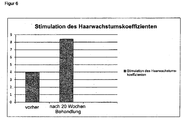
- Die Anagenphase ist die aktive Wachstumsphase der Haarfollikel. Die Haarwurzelzelle teilt sich schnell. Die telogene Phase ist die Ruhephase der Haarfollikel. Am Ende der telogenen Phase wird das Haar abgeworfen und das Haarfollikel tritt erneut in die anagene Phase ein. Die Haardichte, der Anteil des Haars in der anagenen und der telogenen Phase und der Wachstumskoeffizient (A/T) wurde bestimmt.
- Ein definierter Bereich der Kopfhaut am Hinterkopf von einer Fläche von etwa 2 cm2 wurde über 20 Wochen zweimal täglich, morgens und abends, mit der Zubereitung 1 behandelt. Die Versuchsgruppe bestand aus 17 Personen im Alter zwischen 25 und 65, davon waren zehn Personen männlich und sieben Personen weiblich.
- Die Versuchspersonen befanden sich jeweils in einer Gruppe von ≥ 20 % in der telogenen Phase und wiesen eine Haardichtung von ≥ 150 Haaren/cm2 auf.
- Am ersten Tag kamen die Probanden mit frisch gewaschenem Haar. Nach dem Shampoonieren wurden keine zusätzlichen Produkte aufgebracht. Es wurden alle Parameter bestimmt und die zu untersuchende Fläche am Hinterkopf identifiziert. Das Haar wurde an der definierten Fläche rasiert und unter Verwendung eines Fotomikroskops Nikon D90 Canfield Epiflash erfasst.
- Nach zwei Tagen wurde die frisch gewaschene vom ersten Tag definierte Fläche erneut untersucht und entsprechend erfasst.
- Bestimmung der Haarformel über die Haardichte, Dichte des Haars in der anagenen Phase und Dichte des Haars in der telogenen Phase, anschließend zweimal täglich Anwenden der Zubereitung 1.
- Nach 20 Wochen wurden die Probanden erneut untersucht, die am ersten Tag definierte Fläche wurde lokalisiert, das Haar wurde rasiert und eine Bildanalyse der definierten Fläche durchgeführt.
- Am zweiten Tag der Woche 20 wurden die Probanden erneut untersucht, auf das frisch gewaschene Haar waren keine weiteren Produkte aufgetragen worden. Die am ersten Tag definierte Fläche wurde lokalisiert, die Haardichte, Dichte des Haars in der anagenen Phase und Dichte des Haars in der telogenen Phase wurde bestimmt.
- Die Messungen wurden mittels Fototrichogramm durchgeführt, nämlich mit einer Nikon D80-Kamera verbunden mit Canfield Epiflash ausgestattet mit zoom lenses. Es wurden folgende Parameter evaluiert:
- Kapillardichte: Gesamtzahl des Haars an der untersuchten Fläche pro cm2
- Dichte des Haars in der anagenen Phase (A) Anteil in % und Dichte des Haars in der telogenen Phase (T)
- Wachstumsfaktor (A/T)
- Es wurde festgestellt, dass nach Anwendung der Zubereitung 1 über 20 Wochen zweimal am Tag eine deutliche Steigerung des Wachstumsfaktors von 93 % beobachtet wurde. 93 % der Probanden zeigte eine positive Wirkung der Zubereitung 1. Die Ergebnisse sind in den
Figuren 4, 5 und6 dargestellt.
Claims (6)
- Haarwuchsmittel auf Basis einer wässrigen, alkoholischen und/oder wässrig-alkoholischen Lösung enthaltendA) 0,001 bis 0,99 Gew.-Anteile, bezogen auf 100 Gewichtsteile des fertigen Mittels, Menthol,B) 0,1 bis 3 Gew.-Anteile, bezogen auf 100 Gewichtsteile des fertigen Mittels, Presssaft von Bambus oder Bambus-Extrakt,C) 5 bis 10 Gew.-Anteile, bezogen auf 100 Gewichtsteile des fertigen Mittels, Hülsenfrüchte-Extrakt oder Presssaft von Hülsenfrüchten,D) 2 bis 10 Gew.-Anteile, bezogen auf 100 Gewichtsteile des fertigen Mittels Kräuterextrakte oder Presssaft aus Kräutern.
- Mittel nach Anspruch 1, dadurch gekennzeichnet, dass die Hülsenfrüchte der Komponente C ausgewählt sind aus Bohnen, Erbsen, Erdnüsse, Ginster, Kichererbsen, Klee, Linsen, Lupinen, Sojabohnen, und/oder Wicke.
- Mittel nach einem der Ansprüche 1 oder 2, dadurch gekennzeichnet, dass die Kräuter der Komponente D ausgewählt sind aus Angelikawurzel, Andornkraut, Basilikum, Lavendel, Oregano, Quendel, Rosmarin und/oder Thymian.
- Mittel nach einem der Ansprüche 1 bis 3, dadurch gekennzeichnet, dass der pH-Wert im sauren Bereich, insbesondere zwischen 4,5 und 6,5 liegt.
- Mittel nach einem der Ansprüche 1 bis 4, dadurch gekennzeichnet, dass die Komponenten B, C und D in einer solchen Menge eingesetzt werden, dass die aktiven Komponenten insgesamt in einer Menge von 3 bis 20 Gew.-%, bezogen auf das fertige Mittel, enthalten sind.
- Verfahren zur Herstellung eines Haarwuchsmittels nach einem der Ansprüche 1 bis 5, welches die Verfahrensschritte umfassta) Herstellen einer Lösung aus Menthol in Wasser, Alkohol oder einem Gemisch aus Wasser und Alkohol,b) Einstellen des pH-Werts auf einen Bereich zwischen 4,5 und 6,5,c) Hinzufügen der Inhaltsstoffe der Komponenten C und D und ggf. weiterer Komponenten unter Rühren.
Priority Applications (1)
| Application Number | Priority Date | Filing Date | Title |
|---|---|---|---|
| PL16793737T PL3355992T3 (pl) | 2015-10-02 | 2016-09-30 | Środek na porost włosów, metoda jego produkcji i zastosowanie środka do profilaktycznego leczenia wypadania włosów |
Applications Claiming Priority (2)
| Application Number | Priority Date | Filing Date | Title |
|---|---|---|---|
| DE102015116746.8A DE102015116746A1 (de) | 2015-10-02 | 2015-10-02 | Haarwuchsmittel sowie Verfahren zu seiner Herstellung und Verwendung des Mittels zur prophylaktischen Behandlung von Haarausfall |
| PCT/DE2016/100460 WO2017054806A1 (de) | 2015-10-02 | 2016-09-30 | Haarwuchsmittel sowie verfahren zu seiner herstellung und verwendung des mittels zur prophylaktischen behandlung von haarausfall |
Publications (2)
| Publication Number | Publication Date |
|---|---|
| EP3355992A1 EP3355992A1 (de) | 2018-08-08 |
| EP3355992B1 true EP3355992B1 (de) | 2020-12-16 |
Family
ID=57256013
Family Applications (1)
| Application Number | Title | Priority Date | Filing Date |
|---|---|---|---|
| EP16793737.4A Active EP3355992B1 (de) | 2015-10-02 | 2016-09-30 | Haarwuchsmittel sowie verfahren zu seiner herstellung und verwendung des mittels zur prophylaktischen behandlung von haarausfall |
Country Status (5)
| Country | Link |
|---|---|
| EP (1) | EP3355992B1 (de) |
| DE (1) | DE102015116746A1 (de) |
| ES (1) | ES2858310T3 (de) |
| PL (1) | PL3355992T3 (de) |
| WO (1) | WO2017054806A1 (de) |
Families Citing this family (1)
| Publication number | Priority date | Publication date | Assignee | Title |
|---|---|---|---|---|
| EP4389179B1 (de) * | 2021-08-18 | 2026-03-18 | Hou, Mau-Sheng | Kosmetisches behandlungsverfahren und formulierung für kopfhaut und haar sowie produkt daraus |
Family Cites Families (12)
| Publication number | Priority date | Publication date | Assignee | Title |
|---|---|---|---|---|
| JP4496063B2 (ja) * | 2004-11-19 | 2010-07-07 | 花王株式会社 | 養毛・育毛料 |
| DE102005036160A1 (de) * | 2005-08-02 | 2007-04-05 | Merz Pharma Gmbh & Co. Kgaa | Hydrophile bzw. ambiphile Grundlagen und Zubereitungen auf natürlicher Basis sowie deren Anwendung |
| JP4757665B2 (ja) * | 2006-03-08 | 2011-08-24 | 株式会社アドバンジェン | ササエキス含有育毛剤組成物 |
| KR100769260B1 (ko) * | 2006-08-25 | 2007-10-22 | 주식회사 태웅이엘에스 | 희토원소를 함유하는 모발 개선용 조성물 |
| EP1900356A1 (de) * | 2006-09-08 | 2008-03-19 | Arcon International GmbH | Bockshornkleesamenextrakt |
| DE102006050398A1 (de) * | 2006-10-20 | 2008-04-24 | Henkel Kgaa | Kosmetisches Mittel enthaltend Purin und/oder Purinderivat und Taurin |
| DE102008012988A1 (de) * | 2008-03-07 | 2009-09-10 | S.W. Patentverwertungs Ltd. | Zusammensetzung und Verwendungen zur Beeinflussung des Haarwachstums |
| DE102009049957A1 (de) * | 2009-10-19 | 2011-04-21 | Manuela Suleika Hartmann | Mittel zur Förderung des Haarwuchses |
| FR2953722B1 (fr) * | 2009-12-16 | 2012-03-09 | Expanscience Lab | Composition comprenant au moins un sucre en c7 pour le traitement de l'alopecie, pour le traitement cosmetique des phaneres, et pour le soin des cheveux, cils ou ongles |
| KR101029973B1 (ko) * | 2010-08-26 | 2011-04-20 | 노현순 | 헤어 스타일링 기능이 우수한 탈모방지 조성물 및 이를 포함하는 헤어토닉 |
| JP6083938B2 (ja) * | 2012-03-02 | 2017-02-22 | 共栄化学工業株式会社 | 毛髪化粧料 |
| ES2701758T3 (es) * | 2013-02-27 | 2019-02-25 | Symrise Ag | Extracto de jengibre para la protección de citoblastos |
-
2015
- 2015-10-02 DE DE102015116746.8A patent/DE102015116746A1/de not_active Withdrawn
-
2016
- 2016-09-30 WO PCT/DE2016/100460 patent/WO2017054806A1/de not_active Ceased
- 2016-09-30 PL PL16793737T patent/PL3355992T3/pl unknown
- 2016-09-30 EP EP16793737.4A patent/EP3355992B1/de active Active
- 2016-09-30 ES ES16793737T patent/ES2858310T3/es active Active
Non-Patent Citations (1)
| Title |
|---|
| None * |
Also Published As
| Publication number | Publication date |
|---|---|
| WO2017054806A1 (de) | 2017-04-06 |
| ES2858310T3 (es) | 2021-09-30 |
| PL3355992T3 (pl) | 2021-06-14 |
| EP3355992A1 (de) | 2018-08-08 |
| DE102015116746A1 (de) | 2017-04-06 |
Similar Documents
| Publication | Publication Date | Title |
|---|---|---|
| US8715714B2 (en) | Uses of rare earth elements for hair improvement | |
| JP5868572B2 (ja) | 化粧品組成物、その製造方法、および用途 | |
| KR101997177B1 (ko) | 두피 및 모발 상태 개선용 샴푸 조성물 | |
| KR102165565B1 (ko) | 기미, 잡티 개선 효과가 우수한 화장료 조성물 | |
| KR102443708B1 (ko) | 탈모방지 및 두피개선을 위한 모발용 화장료 조성물 | |
| JP6977233B2 (ja) | 頭部用組成物 | |
| EP1179334A2 (de) | Haartonikum zur Vorbeugung oder Behandlung von Haarausfall | |
| DE69819006T2 (de) | Verwendung von ginsenoside rb1 zur stimulierung der elastinsynthese | |
| DE558509T1 (de) | Anwendug der saponine von medicago für die herstellung von kosmetischen oder pharmazeutischen namentlich dermatologischen zusammensetzungen welche die erneuerung der epidermis fördern,das wiederwachstum der haare stimulieren oder ihren ausfall verzögern. | |
| DE69821769T2 (de) | Verwendung von polygonatum extrakten, um die hautelastin-synthese zu stimulieren | |
| CN115120547A (zh) | 一种无刺激毛发修护组合物及防脱洗发露 | |
| JP2008184441A (ja) | 細胞増殖促進用皮膚外用剤 | |
| DE102010038235A1 (de) | Neue Verwendung eines Extraktes aus der Orchidee Vanda coerulea | |
| CN113425661A (zh) | 一种具有清洁修护功效的植物组合物及其应用 | |
| WO2016139125A1 (de) | Kosmetische mittel mit bio-aktivstoff und einem dipeptid | |
| KR20140145278A (ko) | 피부 수렴 및 탄력 효과를 갖는 승마 추출물, 산수유 추출물 및 현초 추출물을 함유하는 화장료 조성물. | |
| EP2764894B1 (de) | Verfahren und Zusammensetzungen zur Verbesserung der Haarqualität mithilfe von Brombeerextrakt | |
| KR102303252B1 (ko) | 탈모 방지 및 발모 개선용 모발 화장료 조성물 | |
| WO2017054806A1 (de) | Haarwuchsmittel sowie verfahren zu seiner herstellung und verwendung des mittels zur prophylaktischen behandlung von haarausfall | |
| KR102569171B1 (ko) | 모발 톤업 샴푸 조성물, 이를 이용한 모발 톤업 샴푸 및 이의 제조방법 | |
| DE102018213658A1 (de) | Verwendung spezieller Haarpflegemittel zur Verhinderung vorzeitigen Haarverlustes | |
| US20070207114A1 (en) | Hair Growth Agent Composition | |
| JP2938253B2 (ja) | 発毛・育毛料 | |
| EP1089708B1 (de) | Verwendung von mindestens einem, aus dem kern der frucht des mirabellenbaums gewonnenen lipidextrakt | |
| KR20050098583A (ko) | 옥죽 파우더를 함유하는 피부보습용 화장료 조성물 |
Legal Events
| Date | Code | Title | Description |
|---|---|---|---|
| STAA | Information on the status of an ep patent application or granted ep patent |
Free format text: STATUS: UNKNOWN |
|
| STAA | Information on the status of an ep patent application or granted ep patent |
Free format text: STATUS: THE INTERNATIONAL PUBLICATION HAS BEEN MADE |
|
| PUAI | Public reference made under article 153(3) epc to a published international application that has entered the european phase |
Free format text: ORIGINAL CODE: 0009012 |
|
| STAA | Information on the status of an ep patent application or granted ep patent |
Free format text: STATUS: REQUEST FOR EXAMINATION WAS MADE |
|
| 17P | Request for examination filed |
Effective date: 20180430 |
|
| AK | Designated contracting states |
Kind code of ref document: A1 Designated state(s): AL AT BE BG CH CY CZ DE DK EE ES FI FR GB GR HR HU IE IS IT LI LT LU LV MC MK MT NL NO PL PT RO RS SE SI SK SM TR |
|
| AX | Request for extension of the european patent |
Extension state: BA ME |
|
| DAV | Request for validation of the european patent (deleted) | ||
| DAX | Request for extension of the european patent (deleted) | ||
| GRAJ | Information related to disapproval of communication of intention to grant by the applicant or resumption of examination proceedings by the epo deleted |
Free format text: ORIGINAL CODE: EPIDOSDIGR1 |
|
| GRAP | Despatch of communication of intention to grant a patent |
Free format text: ORIGINAL CODE: EPIDOSNIGR1 |
|
| RIC1 | Information provided on ipc code assigned before grant |
Ipc: A61Q 7/00 20060101ALI20200617BHEP Ipc: A61Q 5/00 20060101AFI20200617BHEP Ipc: A61K 8/00 20060101ALI20200617BHEP Ipc: A61K 8/9789 20170101ALI20200617BHEP Ipc: A61P 17/14 20060101ALI20200617BHEP |
|
| INTG | Intention to grant announced |
Effective date: 20200710 |
|
| INTC | Intention to grant announced (deleted) | ||
| REG | Reference to a national code |
Ref country code: DE Ref legal event code: R079 Ref document number: 502016012004 Country of ref document: DE Free format text: PREVIOUS MAIN CLASS: A61Q0005000000 Ipc: A61K0031045000 |
|
| GRAP | Despatch of communication of intention to grant a patent |
Free format text: ORIGINAL CODE: EPIDOSNIGR1 |
|
| STAA | Information on the status of an ep patent application or granted ep patent |
Free format text: STATUS: GRANT OF PATENT IS INTENDED |
|
| INTG | Intention to grant announced |
Effective date: 20200904 |
|
| RIC1 | Information provided on ipc code assigned before grant |
Ipc: A61K 36/185 20060101ALI20200824BHEP Ipc: A61Q 5/00 20060101ALI20200824BHEP Ipc: A61K 36/899 20060101ALI20200824BHEP Ipc: A61K 8/00 20060101ALI20200824BHEP Ipc: A61K 31/045 20060101AFI20200824BHEP Ipc: A61Q 7/00 20060101ALI20200824BHEP Ipc: A61K 8/9789 20170101ALI20200824BHEP Ipc: A61P 17/14 20060101ALI20200824BHEP |
|
| GRAS | Grant fee paid |
Free format text: ORIGINAL CODE: EPIDOSNIGR3 |
|
| GRAA | (expected) grant |
Free format text: ORIGINAL CODE: 0009210 |
|
| STAA | Information on the status of an ep patent application or granted ep patent |
Free format text: STATUS: THE PATENT HAS BEEN GRANTED |
|
| AK | Designated contracting states |
Kind code of ref document: B1 Designated state(s): AL AT BE BG CH CY CZ DE DK EE ES FI FR GB GR HR HU IE IS IT LI LT LU LV MC MK MT NL NO PL PT RO RS SE SI SK SM TR |
|
| REG | Reference to a national code |
Ref country code: GB Ref legal event code: FG4D Free format text: NOT ENGLISH |
|
| REG | Reference to a national code |
Ref country code: DE Ref legal event code: R096 Ref document number: 502016012004 Country of ref document: DE |
|
| REG | Reference to a national code |
Ref country code: IE Ref legal event code: FG4D Free format text: LANGUAGE OF EP DOCUMENT: GERMAN |
|
| REG | Reference to a national code |
Ref country code: AT Ref legal event code: REF Ref document number: 1344945 Country of ref document: AT Kind code of ref document: T Effective date: 20210115 |
|
| REG | Reference to a national code |
Ref country code: NL Ref legal event code: FP |
|
| PG25 | Lapsed in a contracting state [announced via postgrant information from national office to epo] |
Ref country code: NO Free format text: LAPSE BECAUSE OF FAILURE TO SUBMIT A TRANSLATION OF THE DESCRIPTION OR TO PAY THE FEE WITHIN THE PRESCRIBED TIME-LIMIT Effective date: 20210316 Ref country code: RS Free format text: LAPSE BECAUSE OF FAILURE TO SUBMIT A TRANSLATION OF THE DESCRIPTION OR TO PAY THE FEE WITHIN THE PRESCRIBED TIME-LIMIT Effective date: 20201216 Ref country code: FI Free format text: LAPSE BECAUSE OF FAILURE TO SUBMIT A TRANSLATION OF THE DESCRIPTION OR TO PAY THE FEE WITHIN THE PRESCRIBED TIME-LIMIT Effective date: 20201216 Ref country code: GR Free format text: LAPSE BECAUSE OF FAILURE TO SUBMIT A TRANSLATION OF THE DESCRIPTION OR TO PAY THE FEE WITHIN THE PRESCRIBED TIME-LIMIT Effective date: 20210317 |
|
| PG25 | Lapsed in a contracting state [announced via postgrant information from national office to epo] |
Ref country code: BG Free format text: LAPSE BECAUSE OF FAILURE TO SUBMIT A TRANSLATION OF THE DESCRIPTION OR TO PAY THE FEE WITHIN THE PRESCRIBED TIME-LIMIT Effective date: 20210316 Ref country code: LV Free format text: LAPSE BECAUSE OF FAILURE TO SUBMIT A TRANSLATION OF THE DESCRIPTION OR TO PAY THE FEE WITHIN THE PRESCRIBED TIME-LIMIT Effective date: 20201216 Ref country code: SE Free format text: LAPSE BECAUSE OF FAILURE TO SUBMIT A TRANSLATION OF THE DESCRIPTION OR TO PAY THE FEE WITHIN THE PRESCRIBED TIME-LIMIT Effective date: 20201216 |
|
| PG25 | Lapsed in a contracting state [announced via postgrant information from national office to epo] |
Ref country code: HR Free format text: LAPSE BECAUSE OF FAILURE TO SUBMIT A TRANSLATION OF THE DESCRIPTION OR TO PAY THE FEE WITHIN THE PRESCRIBED TIME-LIMIT Effective date: 20201216 |
|
| REG | Reference to a national code |
Ref country code: LT Ref legal event code: MG9D |
|
| PG25 | Lapsed in a contracting state [announced via postgrant information from national office to epo] |
Ref country code: RO Free format text: LAPSE BECAUSE OF FAILURE TO SUBMIT A TRANSLATION OF THE DESCRIPTION OR TO PAY THE FEE WITHIN THE PRESCRIBED TIME-LIMIT Effective date: 20201216 Ref country code: PT Free format text: LAPSE BECAUSE OF FAILURE TO SUBMIT A TRANSLATION OF THE DESCRIPTION OR TO PAY THE FEE WITHIN THE PRESCRIBED TIME-LIMIT Effective date: 20210416 Ref country code: SK Free format text: LAPSE BECAUSE OF FAILURE TO SUBMIT A TRANSLATION OF THE DESCRIPTION OR TO PAY THE FEE WITHIN THE PRESCRIBED TIME-LIMIT Effective date: 20201216 Ref country code: EE Free format text: LAPSE BECAUSE OF FAILURE TO SUBMIT A TRANSLATION OF THE DESCRIPTION OR TO PAY THE FEE WITHIN THE PRESCRIBED TIME-LIMIT Effective date: 20201216 Ref country code: CZ Free format text: LAPSE BECAUSE OF FAILURE TO SUBMIT A TRANSLATION OF THE DESCRIPTION OR TO PAY THE FEE WITHIN THE PRESCRIBED TIME-LIMIT Effective date: 20201216 Ref country code: SM Free format text: LAPSE BECAUSE OF FAILURE TO SUBMIT A TRANSLATION OF THE DESCRIPTION OR TO PAY THE FEE WITHIN THE PRESCRIBED TIME-LIMIT Effective date: 20201216 Ref country code: LT Free format text: LAPSE BECAUSE OF FAILURE TO SUBMIT A TRANSLATION OF THE DESCRIPTION OR TO PAY THE FEE WITHIN THE PRESCRIBED TIME-LIMIT Effective date: 20201216 |
|
| REG | Reference to a national code |
Ref country code: DE Ref legal event code: R097 Ref document number: 502016012004 Country of ref document: DE |
|
| PG25 | Lapsed in a contracting state [announced via postgrant information from national office to epo] |
Ref country code: IS Free format text: LAPSE BECAUSE OF FAILURE TO SUBMIT A TRANSLATION OF THE DESCRIPTION OR TO PAY THE FEE WITHIN THE PRESCRIBED TIME-LIMIT Effective date: 20210416 |
|
| REG | Reference to a national code |
Ref country code: ES Ref legal event code: FG2A Ref document number: 2858310 Country of ref document: ES Kind code of ref document: T3 Effective date: 20210930 |
|
| PLBE | No opposition filed within time limit |
Free format text: ORIGINAL CODE: 0009261 |
|
| STAA | Information on the status of an ep patent application or granted ep patent |
Free format text: STATUS: NO OPPOSITION FILED WITHIN TIME LIMIT |
|
| PG25 | Lapsed in a contracting state [announced via postgrant information from national office to epo] |
Ref country code: AL Free format text: LAPSE BECAUSE OF FAILURE TO SUBMIT A TRANSLATION OF THE DESCRIPTION OR TO PAY THE FEE WITHIN THE PRESCRIBED TIME-LIMIT Effective date: 20201216 |
|
| 26N | No opposition filed |
Effective date: 20210917 |
|
| PG25 | Lapsed in a contracting state [announced via postgrant information from national office to epo] |
Ref country code: DK Free format text: LAPSE BECAUSE OF FAILURE TO SUBMIT A TRANSLATION OF THE DESCRIPTION OR TO PAY THE FEE WITHIN THE PRESCRIBED TIME-LIMIT Effective date: 20201216 |
|
| REG | Reference to a national code |
Ref country code: DE Ref legal event code: R082 Ref document number: 502016012004 Country of ref document: DE Representative=s name: JANKE SCHOLL PATENTANWAELTE PARTG MBB, DE |
|
| PG25 | Lapsed in a contracting state [announced via postgrant information from national office to epo] |
Ref country code: SI Free format text: LAPSE BECAUSE OF FAILURE TO SUBMIT A TRANSLATION OF THE DESCRIPTION OR TO PAY THE FEE WITHIN THE PRESCRIBED TIME-LIMIT Effective date: 20201216 |
|
| REG | Reference to a national code |
Ref country code: CH Ref legal event code: PL |
|
| PG25 | Lapsed in a contracting state [announced via postgrant information from national office to epo] |
Ref country code: IS Free format text: LAPSE BECAUSE OF FAILURE TO SUBMIT A TRANSLATION OF THE DESCRIPTION OR TO PAY THE FEE WITHIN THE PRESCRIBED TIME-LIMIT Effective date: 20210416 Ref country code: MC Free format text: LAPSE BECAUSE OF FAILURE TO SUBMIT A TRANSLATION OF THE DESCRIPTION OR TO PAY THE FEE WITHIN THE PRESCRIBED TIME-LIMIT Effective date: 20201216 |
|
| PG25 | Lapsed in a contracting state [announced via postgrant information from national office to epo] |
Ref country code: IE Free format text: LAPSE BECAUSE OF NON-PAYMENT OF DUE FEES Effective date: 20210930 |
|
| PG25 | Lapsed in a contracting state [announced via postgrant information from national office to epo] |
Ref country code: LI Free format text: LAPSE BECAUSE OF NON-PAYMENT OF DUE FEES Effective date: 20210930 Ref country code: CH Free format text: LAPSE BECAUSE OF NON-PAYMENT OF DUE FEES Effective date: 20210930 |
|
| REG | Reference to a national code |
Ref country code: AT Ref legal event code: MM01 Ref document number: 1344945 Country of ref document: AT Kind code of ref document: T Effective date: 20210930 |
|
| PG25 | Lapsed in a contracting state [announced via postgrant information from national office to epo] |
Ref country code: AT Free format text: LAPSE BECAUSE OF NON-PAYMENT OF DUE FEES Effective date: 20210930 |
|
| PG25 | Lapsed in a contracting state [announced via postgrant information from national office to epo] |
Ref country code: CY Free format text: LAPSE BECAUSE OF FAILURE TO SUBMIT A TRANSLATION OF THE DESCRIPTION OR TO PAY THE FEE WITHIN THE PRESCRIBED TIME-LIMIT Effective date: 20201216 |
|
| PG25 | Lapsed in a contracting state [announced via postgrant information from national office to epo] |
Ref country code: HU Free format text: LAPSE BECAUSE OF FAILURE TO SUBMIT A TRANSLATION OF THE DESCRIPTION OR TO PAY THE FEE WITHIN THE PRESCRIBED TIME-LIMIT; INVALID AB INITIO Effective date: 20160930 |
|
| PGFP | Annual fee paid to national office [announced via postgrant information from national office to epo] |
Ref country code: NL Payment date: 20230921 Year of fee payment: 8 Ref country code: LU Payment date: 20230920 Year of fee payment: 8 |
|
| PGFP | Annual fee paid to national office [announced via postgrant information from national office to epo] |
Ref country code: PL Payment date: 20230828 Year of fee payment: 8 Ref country code: BE Payment date: 20230921 Year of fee payment: 8 |
|
| PG25 | Lapsed in a contracting state [announced via postgrant information from national office to epo] |
Ref country code: MK Free format text: LAPSE BECAUSE OF FAILURE TO SUBMIT A TRANSLATION OF THE DESCRIPTION OR TO PAY THE FEE WITHIN THE PRESCRIBED TIME-LIMIT Effective date: 20201216 |
|
| PG25 | Lapsed in a contracting state [announced via postgrant information from national office to epo] |
Ref country code: TR Free format text: LAPSE BECAUSE OF FAILURE TO SUBMIT A TRANSLATION OF THE DESCRIPTION OR TO PAY THE FEE WITHIN THE PRESCRIBED TIME-LIMIT Effective date: 20201216 |
|
| PG25 | Lapsed in a contracting state [announced via postgrant information from national office to epo] |
Ref country code: MT Free format text: LAPSE BECAUSE OF FAILURE TO SUBMIT A TRANSLATION OF THE DESCRIPTION OR TO PAY THE FEE WITHIN THE PRESCRIBED TIME-LIMIT Effective date: 20201216 |
|
| PGFP | Annual fee paid to national office [announced via postgrant information from national office to epo] |
Ref country code: DE Payment date: 20240916 Year of fee payment: 9 |
|
| PGFP | Annual fee paid to national office [announced via postgrant information from national office to epo] |
Ref country code: GB Payment date: 20240927 Year of fee payment: 9 |
|
| PGFP | Annual fee paid to national office [announced via postgrant information from national office to epo] |
Ref country code: FR Payment date: 20240927 Year of fee payment: 9 |
|
| PGFP | Annual fee paid to national office [announced via postgrant information from national office to epo] |
Ref country code: IT Payment date: 20240926 Year of fee payment: 9 |
|
| PGFP | Annual fee paid to national office [announced via postgrant information from national office to epo] |
Ref country code: ES Payment date: 20241018 Year of fee payment: 9 |
|
| REG | Reference to a national code |
Ref country code: NL Ref legal event code: MM Effective date: 20241001 |
|
| PG25 | Lapsed in a contracting state [announced via postgrant information from national office to epo] |
Ref country code: LU Free format text: LAPSE BECAUSE OF NON-PAYMENT OF DUE FEES Effective date: 20240930 |
|
| PG25 | Lapsed in a contracting state [announced via postgrant information from national office to epo] |
Ref country code: NL Free format text: LAPSE BECAUSE OF NON-PAYMENT OF DUE FEES Effective date: 20241001 |
|
| REG | Reference to a national code |
Ref country code: BE Ref legal event code: MM Effective date: 20240930 |
|
| PG25 | Lapsed in a contracting state [announced via postgrant information from national office to epo] |
Ref country code: BE Free format text: LAPSE BECAUSE OF NON-PAYMENT OF DUE FEES Effective date: 20240930 |
|
| PG25 | Lapsed in a contracting state [announced via postgrant information from national office to epo] |
Ref country code: PL Free format text: LAPSE BECAUSE OF NON-PAYMENT OF DUE FEES Effective date: 20240930 |