EP3356584B1 - Fileuse portable et ses procédés d'utilisation - Google Patents
Fileuse portable et ses procédés d'utilisation Download PDFInfo
- Publication number
- EP3356584B1 EP3356584B1 EP16852579.8A EP16852579A EP3356584B1 EP 3356584 B1 EP3356584 B1 EP 3356584B1 EP 16852579 A EP16852579 A EP 16852579A EP 3356584 B1 EP3356584 B1 EP 3356584B1
- Authority
- EP
- European Patent Office
- Prior art keywords
- gas
- spinneret
- syringe
- inner needle
- spinning solution
- Prior art date
- Legal status (The legal status is an assumption and is not a legal conclusion. Google has not performed a legal analysis and makes no representation as to the accuracy of the status listed.)
- Active
Links
Images




Classifications
-
- D—TEXTILES; PAPER
- D01—NATURAL OR MAN-MADE THREADS OR FIBRES; SPINNING
- D01D—MECHANICAL METHODS OR APPARATUS IN THE MANUFACTURE OF ARTIFICIAL FILAMENTS, THREADS, FIBRES, BRISTLES OR RIBBONS
- D01D5/00—Formation of filaments, threads, or the like
-
- D—TEXTILES; PAPER
- D01—NATURAL OR MAN-MADE THREADS OR FIBRES; SPINNING
- D01D—MECHANICAL METHODS OR APPARATUS IN THE MANUFACTURE OF ARTIFICIAL FILAMENTS, THREADS, FIBRES, BRISTLES OR RIBBONS
- D01D5/00—Formation of filaments, threads, or the like
- D01D5/04—Dry spinning methods
-
- D—TEXTILES; PAPER
- D01—NATURAL OR MAN-MADE THREADS OR FIBRES; SPINNING
- D01F—CHEMICAL FEATURES IN THE MANUFACTURE OF ARTIFICIAL FILAMENTS, THREADS, FIBRES, BRISTLES OR RIBBONS; APPARATUS SPECIALLY ADAPTED FOR THE MANUFACTURE OF CARBON FILAMENTS
- D01F1/00—General methods for the manufacture of artificial filaments or the like
- D01F1/02—Addition of substances to the spinning solution or to the melt
- D01F1/10—Other agents for modifying properties
-
- D—TEXTILES; PAPER
- D01—NATURAL OR MAN-MADE THREADS OR FIBRES; SPINNING
- D01F—CHEMICAL FEATURES IN THE MANUFACTURE OF ARTIFICIAL FILAMENTS, THREADS, FIBRES, BRISTLES OR RIBBONS; APPARATUS SPECIALLY ADAPTED FOR THE MANUFACTURE OF CARBON FILAMENTS
- D01F6/00—Monocomponent artificial filaments or the like of synthetic polymers; Manufacture thereof
- D01F6/58—Monocomponent artificial filaments or the like of synthetic polymers; Manufacture thereof from homopolycondensation products
- D01F6/66—Monocomponent artificial filaments or the like of synthetic polymers; Manufacture thereof from homopolycondensation products from polyethers
-
- D—TEXTILES; PAPER
- D04—BRAIDING; LACE-MAKING; KNITTING; TRIMMINGS; NON-WOVEN FABRICS
- D04H—MAKING TEXTILE FABRICS, e.g. FROM FIBRES OR FILAMENTARY MATERIAL; FABRICS MADE BY SUCH PROCESSES OR APPARATUS, e.g. FELTS, NON-WOVEN FABRICS; COTTON-WOOL; WADDING ; NON-WOVEN FABRICS FROM STAPLE FIBRES, FILAMENTS OR YARNS, BONDED WITH AT LEAST ONE WEB-LIKE MATERIAL DURING THEIR CONSOLIDATION
- D04H1/00—Non-woven fabrics formed wholly or mainly of staple fibres or like relatively short fibres
- D04H1/70—Non-woven fabrics formed wholly or mainly of staple fibres or like relatively short fibres characterised by the method of forming fleeces or layers, e.g. reorientation of fibres
- D04H1/72—Non-woven fabrics formed wholly or mainly of staple fibres or like relatively short fibres characterised by the method of forming fleeces or layers, e.g. reorientation of fibres the fibres being randomly arranged
- D04H1/728—Non-woven fabrics formed wholly or mainly of staple fibres or like relatively short fibres characterised by the method of forming fleeces or layers, e.g. reorientation of fibres the fibres being randomly arranged by electro-spinning
-
- A—HUMAN NECESSITIES
- A61—MEDICAL OR VETERINARY SCIENCE; HYGIENE
- A61L—METHODS OR APPARATUS FOR STERILISING MATERIALS OR OBJECTS IN GENERAL; DISINFECTION, STERILISATION OR DEODORISATION OF AIR; CHEMICAL ASPECTS OF BANDAGES, DRESSINGS, ABSORBENT PADS OR SURGICAL ARTICLES; MATERIALS FOR BANDAGES, DRESSINGS, ABSORBENT PADS OR SURGICAL ARTICLES
- A61L2400/00—Materials characterised by their function or physical properties
- A61L2400/12—Nanosized materials, e.g. nanofibres, nanoparticles, nanowires, nanotubes; Nanostructured surfaces
-
- D—TEXTILES; PAPER
- D01—NATURAL OR MAN-MADE THREADS OR FIBRES; SPINNING
- D01D—MECHANICAL METHODS OR APPARATUS IN THE MANUFACTURE OF ARTIFICIAL FILAMENTS, THREADS, FIBRES, BRISTLES OR RIBBONS
- D01D5/00—Formation of filaments, threads, or the like
- D01D5/0007—Electro-spinning
- D01D5/0015—Electro-spinning characterised by the initial state of the material
- D01D5/003—Electro-spinning characterised by the initial state of the material the material being a polymer solution or dispersion
-
- D—TEXTILES; PAPER
- D01—NATURAL OR MAN-MADE THREADS OR FIBRES; SPINNING
- D01D—MECHANICAL METHODS OR APPARATUS IN THE MANUFACTURE OF ARTIFICIAL FILAMENTS, THREADS, FIBRES, BRISTLES OR RIBBONS
- D01D5/00—Formation of filaments, threads, or the like
- D01D5/0007—Electro-spinning
- D01D5/0061—Electro-spinning characterised by the electro-spinning apparatus
-
- D—TEXTILES; PAPER
- D01—NATURAL OR MAN-MADE THREADS OR FIBRES; SPINNING
- D01D—MECHANICAL METHODS OR APPARATUS IN THE MANUFACTURE OF ARTIFICIAL FILAMENTS, THREADS, FIBRES, BRISTLES OR RIBBONS
- D01D5/00—Formation of filaments, threads, or the like
- D01D5/12—Stretch-spinning methods
- D01D5/14—Stretch-spinning methods with flowing liquid or gaseous stretching media, e.g. solution-blowing
-
- D—TEXTILES; PAPER
- D10—INDEXING SCHEME ASSOCIATED WITH SUBLASSES OF SECTION D, RELATING TO TEXTILES
- D10B—INDEXING SCHEME ASSOCIATED WITH SUBLASSES OF SECTION D, RELATING TO TEXTILES
- D10B2509/00—Medical; Hygiene
Definitions
- U.S. Patent No. 8,641,960 describes a method for producing micro and nanofibers from a polymer solution.
- the method uses a compound nozzle with at least one internal concentric nozzle, whereby the simultaneous ejection of polymer solution from the internal nozzle with ejection of a pressurized gas from the external nozzle produces polymer fibers that may be collected on a target.
- the prior art depicts a bulky blow spinning device, and rules out the use of electricity, such as in biological applications.
- U.S. Patent Publication No. 2005/0073075 describes a method for industrial-scale electro-blowing of fibers onto a collector.
- the method uses a series of spinnerets and gas orifices to eject polymer streams into an electric field.
- the prior art is also dependent on bulky machinery to produce the fibers, and the electric field is dependent on an array of electrodes generating an electrostatic differential between the spinnerets and the collector.
- the present invention provides portable devices and systems for electrofocused blow spinning (EFBS), and methods for using the same.
- the devices of the invention are convenient to carry and use and are able to aerodynamically spin a variety of materials.
- the invention relates to a handheld electrofocused blow spinning (EFBS) device, comprising: a spinneret comprising an outer sheath and an inner needle; a syringe, capable of holding spinning solution, fluidly connected to the spinneret inner needle; at least one gas regulator; and a gas supply fluidly connected to the syringe and the spinneret outer sheath, such that the gas supply is capable of simultaneously pressurizing the syringe and propelling gas out of the spinneret outer sheath; and a power source and a high voltage power supply.
- EFBS electrofocused blow spinning
- the inner needle is electrically conductive.
- the device further comprises a power source and a high voltage power supply.
- the power source and the high voltage power supply are electrically connected to the inner needle.
- the gas supply comprises a pressurized cartridge of gas.
- the gas is selected from the group consisting of CO 2 , N 2 , NO, and air.
- the gas supply comprises an air pump.
- the pump is selected from the group consisting of a syringe pump, a peristaltic pump, a diaphragm pump, and a vane pump.
- the spinning solution comprises a plant protein, an animal protein, a synthetic polymer, or any combination thereof.
- the plant protein comprises water-soluble soy protein, or a bioactive component thereof.
- the spinning solution further comprises a high-molecular weight polymer.
- the high-molecular weight polymer is polyethylene oxide.
- the disclosure relates to a method not according to the invention of dressing a wound in a subject, the method comprising the steps of: loading a syringe with a wound dressing solution; connecting the syringe to a syringe adapter and a tube that is fluidly connected to a spinneret comprising an outer sheath and an inner needle; providing a flow of gas through the outer sheath of the spinneret; providing a flow of gas to the syringe adapter to dispense the wound dressing solution through the inner needle of the spinneret; and spinning the wound dressing solution onto a wound surface.
- the wound dressing solution comprises a plant protein, an animal protein, a synthetic polymer, or any combination thereof.
- the plant protein comprises water-soluble soy proteins, or a bioactive component thereof.
- the wound dressing solution further comprises a high-molecular weight polymer.
- the high-molecular weight polymer is polyethylene oxide.
- the gas is selected from the group consisting of CO 2 , N 2 , NO, and air.
- the flow of gas through the outer sheath of the spinneret has a pressure between 3 and 5 psi.
- the dispensation of wound dressing solution through the inner needle of the spinneret has a flow rate of 1.5 mL/hr.
- the disclosure relates to a method not according to the invention of repairing a compromised material surface, the method comprising the steps of: loading a syringe with a repair solution; connecting the syringe to a syringe adapter and a tube that is fluidly connected to a spinneret comprising an outer sheath and an inner needle; providing a flow of gas through the outer sheath of the spinneret; providing a flow of gas to the syringe adapter to dispense the repair solution through the inner needle of the spinneret; and spinning the repair solution onto the compromised material surface.
- the compromised material surface is not electrically charged.
- the invention in another aspect, relates to a method of preparing a fabric on a surface, the method comprising the steps of: loading a syringe with a spinning solution; connecting the syringe to a syringe adapter and a tube that is fluidly connected to a spinneret comprising an outer sheath and an inner needle; providing a flow of gas through the outer sheath of the spinneret; providing a flow of gas to the syringe adapter to dispense the spinning solution through the inner needle of the spinneret; spinning the repair solution onto the surface to form a fabric; and separating the fabric from the surface.
- the method further comprises a step of treating the fabric in a vacuum oven.
- the present invention provides portable electrofocused blow spinning (EFBS) devices, systems, and methods for using the same.
- EFBS portable electrofocused blow spinning
- the devices of the invention are convenient to carry and use in clinical/physician's office setting and are able to aerodynamically spin non-woven fabric-like structures out of a variety of materials, such as, but not limited to plant or animal protein and synthetic polymers in a mobile setting.
- an element means one element or more than one element.
- dressing refers broadly to materials when prepared for, and applied to, a wound for protection, absorbance, drainage, etc.
- blow spinning refers to methods wherein materials are streamed, sprayed, sputtered or dripped toward a target substrate.
- the materials can be aerodynamically guided in the direction of a target substrate by one or more sources of pressurized gas streams.
- electrofocused blow spinning refers to blow spinning methods wherein an electric field is provided solely to improve the focusing of a material stream towards a target substrate, rather than a necessary element to generate a stream of polymer such as in electrospinning.
- electrofocused is not limited to the specific examples set forth herein, and it includes any means of using an electrical field for depositing a material on a target.
- wound is used to refer broadly to injuries to the skin and subcutaneous tissue initiated in different ways (e.g., pressure sores from extended bed rest and wounds induced by trauma) and with varying characteristics. Wounds are generally classified into one of four grades depending on the depth of the wound: Grade I: wounds limited to the epithelium; Grade II: wounds extending into the dermis; Grade III: wounds extending into the subcutaneous tissue; and Grade IV (or full-thickness wounds), which are wounds in which bones are exposed (e.g., a bony pressure point such as the greater trochanter or the sacrum).
- Grade I wounds limited to the epithelium
- Grade II wounds extending into the dermis
- Grade III wounds extending into the subcutaneous tissue
- Grade IV or full-thickness wounds
- range format is merely for convenience and brevity and should not be construed as an inflexible limitation on the scope of the invention. Accordingly, the description of a range should be considered to have specifically disclosed all the possible subranges as well as individual numerical values within that range. For example, description of a range such as from 1 to 6 should be considered to have specifically disclosed subranges such as from 1 to 3, from 1 to 4, from 1 to 5, from 2 to 4, from 2 to 6, from 3 to 6, etc., as well as individual numbers within that range, for example, 1, 2, 2.7, 3, 4, 5, 5.3, 6, and any whole and partial increments there between. This applies regardless of the breadth of the range.
- Non-limiting examples of solvents include: N,N-Dimethyl formamide (DMF), tetrahydrofuran (THF), methylene chloride, dioxane, ethanol, hexafluoroisopropanol (HFIP), chloroform, glacial acetic acid, water, and combinations thereof.
- any solvents may also be used as cosolvents.
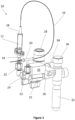
- Syringe 12 is attached to handheld EFBS device 10 and actuated by syringe adapter 14. Syringe 12 is fluidly connected to tube 16 to dispense the spinning solution to spinneret 20. In some embodiments, syringe 12 is tipped with needle 18 to facilitate the fluid connection to tube 16. Syringe 12 and needle 18 can be any suitable size.
- the size of syringe 12 and needle 18 will depend on the amount of spinning solution to be dispensed. In certain embodiments, syringe 12, needle 18, tube 16, or any combinations thereof are easily removable for purposes of changing spinning solution, refilling spinning solution, cleaning the components, or replacing the components.
- Syringe adapter 14 is attached to handheld EFBS device 10 by first compression fitting 22 and first valve 24.
- Spinneret 20 is attached to handheld EFBS device 10 by second compression fitting 23 and second valve 25.
- First valve 24 and second valve 25 can be any suitable valve that provides an airtight fit, such as a ball valve, a globe valve, a pinch valve, a needle valve, and the like.
- First compression fitting 22 and second compression fitting 23 can be any suitable fitting that releasably and fluidly joins two lumens, such as a push-to-connect fitting, a quick-disconnect fitting, a threaded fitting, and the like.
- Compression fittings allow for releasable airtight connections, and valves provide an adjustable airtight fit to reduce the loss of pressurized gas. These features facilitate the connection and disconnection of entire fluid paths, allowing for quick and simple interchanging of parts to suit material use and application.
- Cartridge 32 comprises a source of portable pressurized gas and is loaded into cartridge regulator 30.
- Cartridge 32 can comprise any suitable pressurized gas, preferably an inert gas or a biologically compatible gas.
- pressurized gas include CO 2 , N 2 , NO, ambient air, and the like.
- Cartridge regulator 30 controls the output of pressurized gas from cartridge 32.
- handheld EFBS device 10 comprises a single cartridge 32.
- a single cartridge 32 provides a split source of pressurized gas to all of the components of handheld EFBS device 10.
- a handheld EFBS device 10 comprises fitting 26 connected to cartridge regulator 30 and splits the gas flow to simultaneously propel solution out of spinneret 20 and to drive syringe 12.
- handheld EFBS device 10 comprises a plurality of cartridges (not shown).
- a handheld EFBS device may comprise a cartridge for each element that is drivable by pressurized gas.
- Each cartridge may comprise additional fittings, gas lines, and valves for independently driving, e.g., a syringe adapter and a spinneret.
- Each cartridge may also comprise additional gas regulators for separately controlling the outputs of pressurized gas.
- the handheld EFBS device may comprise one or more controllers for receiving inputs and automating the various electrical components.
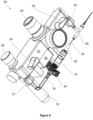
- Handheld EFBS device 50 comprises an alternative layout of the components of handheld EFBS device 10.
- Handheld EFBS device 50 features a rearrangement of gas regulator 28 to dispense gas into spinneret 20, and of cartridge regulator 30 to dispense gas into syringe adapter 14 to drive the plunger of syringe 12 and dispense the spinning solution within.
- Handheld EFBS device 50 also features an additional enclosure 52, which covers certain parts including first valve 24, second valve 25, and fitting 26.
- the handheld EFBS devices of the present invention comprise a powered pump, such as a powered positive displacement air pump (not shown).
- a powered positive displacement air pump provides an alternative source of gas flow that can utilize ambient air to drive the components of the handheld EFBS devices of the present invention instead of relying on a pressurized cartridge.
- positive displacement air pumps include syringe pumps, peristaltic pumps, diaphragm pumps, and vane pumps.
- Spinneret 20 comprises outer sheath 40 and inner needle 42.
- the tip of inner needle 42 extends past the opening of outer sheath 40.
- the tip of inner needle 42 can extend 1 mm past the opening of outer sheath 40.
- the distance between the tip of inner needle 42 and outer sheath 40 is adjustable.
- Outer sheath 40 and inner needle 42 can comprise any suitable size and shape.
- the diameter of the opening of outer sheath 40 can be between 0.5 and 2.5 mm, and the size of inner needle 42 can be between 20 and 30 gauge.
- Outer sheath 40 can comprise any suitable material.
- outer sheath 40 can comprise plastics, glass, metals, and the like.
- Inner needle 42 can comprise any suitable material, such as a metal or a plastic.
- inner needle 42 comprises an electrically conductive material.
- Inner needle 42 is fluidly connected to tube 16 and provides for spinning solution flow 46 through its lumen.
- inner needle 42 can be nonconductive, such as in the context of a non-electric blow spinning device.
- Outer sheath 40 is fluidly connected to pressurized gas from cartridge 32 and provides for gas flow 44 through its lumen.
- outer sheath 40 and inner needle 42 are easily removable for purposes of changing part width and length, cleaning the components, or replacing the components.
- outer sheath 40 can comprise typical pipette tips and inner needle 42 can comprise typical cannulated needles.
- spinneret 20 further comprises inner needle 42a.
- Inner needle 42a is fluidly connected to inner needle 42 and provides a lumen bridging the spinning fluid pathway between tube 16 and inner needle 42.
- inner needle 42a and inner needle 42 are connected by a length of polymer tube.
- Inner needle 42a is preferably not exposed to the exterior of spinneret 20, such that no user contact may be made with inner needle 42a during use of the device.
- Inner needle 42a may then be connected to a high voltage supply to provide a spinning fluid stream with a charge, while protecting a user from directly contacting any exposed electrically powered part.
- the handheld EFBS devices of the present invention further comprise a power source 34 and high voltage power supply 36.
- Power source 34 provides electricity to high voltage power supply 36, and can comprise any suitable portable source of power, such as a battery.
- High voltage power supply 36 accepts electricity from power source 34 and outputs electricity at high voltage.
- the voltage output can be between 100V and 30kV.
- the voltage output from high voltage power supply 36 is electrically connected to inner needle 42, such that a high voltage may be applied to spinning solution flow 46.
- power source 34 may also provide power to additional components, such as an electric pump.
- the handheld EFBS devices of the present invention are small, lightweight, and portable for easy transport and use in any location, such as in the field.
- the small size and weight allows operators to manipulate the devices with one hand or two hands. Due to the devices' portability and ease of use, an operator may directly handle the devices to deposit electrofocused blow-spun materials onto any surface, such as wounds or skin.
- the handheld EFBS devices of the present invention comprise additional features for ease of use and handling.
- the handheld EFBS devices may further comprise a handle or a grip to enable a user to comfortably hold and direct the spinneret.
- Other features may include enclosures or housings that at least partially encase the device as desired to improve aesthetics, durability, and comfort.
- the enclosures or housings may include one or more slots for easily engaging and disengaging the various portable and exchangeable components of the handheld EFBS devices, such as a portable power source, a portable syringe, and a portable gas cartridge.
- devices encompassed by the present invention are not limited to the particular embodiments depicted in Figure 1 through Figure 5 . Rather, devices within the scope of the present invention may comprise the components disclosed herein arranged in any number of suitable configurations. Devices within the scope of the present invention may further comprise additional components such as digital readouts, flow sensors, pressure sensors, voltmeters, and the like.
- the invention provides paradigmatic methods for using the handheld EFBS devices of the present invention.
- the methods use the handheld EFBS devices to dispense a non-woven fabric-like structure onto a surface, such as a wound, for enhanced wound healing.
- the methods are particularly advantageous in situations where rapid deployment of a flexible wound coating cannot be accomplished with premade wound dressings.
- Method 100 begins with step 110, wherein a syringe is loaded with spinning solution.
- the spinning solution can be any suitable solution, selected based on the composition of the desired non-woven fabric-like structure.
- the syringe is connected to a syringe adapter and to a tube that is fluidly connected to a spinneret comprising an outer sheath and an inner needle.
- a voltage is provided to the inner needle of the spinneret.
- a flow of gas is provided through the outer sheath of the spinneret.
- step 140 a flow of gas is provided to the syringe adapter to dispense the spinning solution through the inner needle of the spinneret.
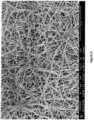
- step 150 the spinning solution is deposited onto a surface. Upon leaving the spinneret, the spinning solution is reduced to fibers ranging from under 1 micron to a couple microns in diameter.
- the method provides for the portable deposition of a solute-water mixture onto a wound as a wound dressing.
- the solute can be any suitable solute, such as plant-derived water-soluble proteins including highly-purified water-soluble soy protein isolate (WSsoy).
- the WSsoy mixture can comprise any suitable WSsoy amount, such as a range between 1% and 80% by weight. In certain embodiments, the WSsoy mixture may comprise between 5% and 25% WSsoy by weight. In one embodiment, the WSsoy mixture may comprise WSsoy at 8% weight. In another embodiment, the WSsoy mixture may comprise WSsoy at 10% weight and 1.5% polyethylene oxide.
- the flow rate of the soy-water mixture through the inner needle of the spinneret can be between 0.1 mL/hr and 5 mL/hr, as controlled by the pressure of the gas from cartridge regulators and valves. In some embodiments, the flow rate of soy-water mixture through the inner needle of the spinneret is 0.5 mL/hr. In some embodiments, the flow rate of soy-water mixture through the inner needle of the spinneret is 1.5 mL/hr.
- the pressure of gas delivered through the outer sheath of the spinneret can be controlled by a gas regulator to be between 1 and 60 psi. In some embodiments, the pressure of gas delivered through the outer sheath of the spinneret is 20 psi.
- the pressure of gas delivered through the outer sheath of the spinneret is between 3 and 5 psi. In some embodiments, wherein a voltage is applied to the inner needle of the spinneret, the voltage can be between 1 and 30kV. In certain embodiments, a 5kV voltage is applied to the inner needle of the spinneret.
- the spinning solution may further comprise an additional polymer.
- polymers include: polyurethane, polysiloxane or silicone, polyethylene, polyvinyl pyrrolidone (PVP), poly(2-hydroxy ethyl methacrylate), poly(N-vinyl pyrrolidone), polymethyl methacrylate, polyvinyl alcohol (PVA), polyacrylic acid, polyacrylamide, polyethylene-co-vinyl acetate, polyethylene glycol (PEG), polyethylene oxide (PEO), polymethacrylic acid, polylactide (PLA), polyglycolide (PGA), poly(lactic-co-glycolic acid) (PLGA), polystyrene, polyanhydride, polyorthoester, polycarbonate, and the like.
- the spinning solution may further comprise an additional therapeutic.
- therapeutics include: anesthetics, antiallergics, antihistamines, antipruritics, muscle relaxants, analgesics, antipyretics, vitamins, antimicrobial agents, antiseptics, disinfectants, fungicides, ectoparasiticides, antiparasitics, alkaloids, salts, ions, anti-inflammatories, wound healing agents, plant extracts, growth factors, polycarbonates, extracellular matrix (ECM) constituents such as ECM proteins, emollients, antibacterial or antiviral agents, tranquilizers, antitussives, nanoparticles such as silver ions, stem cells, epithelial cells, endothelial cells, and the like.
- ECM extracellular matrix
- the spinning solution may further comprise an additional animal or plant protein.
- additional animal or plant protein include: gelatin, Matrigel, keratin, collagen, elastin, fibrin, hyaluronic acid, glycosaminoglycan, proteoglycan, fibronectin, vitronectin, laminin, chitosan, and soy-chitosan.
- resultant fabric is not irritating to the wound bed, is highly flexible, and is biodegradable, negating the need for removal and avoiding unnecessary debridement of the wound bed. Furthermore, the dispensed material is environmentally friendly and does not require any toxic solvents.
- the methods of the present invention also encompass the fabrication of wound dressings beforehand.
- the methods of the present invention may be performed on any surface, smooth or textured, to generate a non-woven fabric-like structure of any shape, size, thickness, or texture.
- the non-woven fabric-like structure may be removed from the target surface and kept for later use.
- the fabric-like structure may be further treated after fabrication.
- the fabric-like structure may be treated in a vacuum oven after fabrication, wherein the vacuum oven treatment improves robustness and enables the fabric-like structure to remain in a nano-fibrous mesh for a longer period of time in aqueous conditions.
- Vacuum oven treatment also enables crosslinking without additional compounds, wherein the fabric-like structure slowly forms into a gel-like substance in water, while a non-crosslinked structure merely dissolves in water.
- the invention relates to methods for aerodynamically spinning any solution onto any substrate, such as for immediate covering, sealing, patching, or reinforcing the said intact or compromised substrates. While traditional spinning methods generally use a charged substrate in a controlled environment, the methods of the present invention use handheld EFBS devices to deposit spinning solutions onto charged and uncharged flat, textured, or 3D substrates in a variety of environments.
- Example 1 Atomization of soy-water mixture for use as a portable bandage treatment
- Modified water-soluble purified soy protein isolates that have recently become available can be dissolved into solution and applied to a wound by spraying. In a simple context this can enable rapid application of a gel-like solution. However, with the inclusion of a second high-molecular weight polymer, such as polyethylene oxide (PEO), the atomized drops can dry into a fabric which can bandage a wound directly. Considering that the soy product has demonstrated wound healing efficacy in other contexts, this may enable a single step wound treatment option, one that both protects the wound and also hastens and enhances repair ( Har-el, Y., Gerstenhaber, J. A., Brodsky, R., Huneke, R. B., and Lelkes, P. I.
- Electrospun soy protein scaffolds as wound dressings Enhanced reepithelialization in a porcine model of wound healing, Wound Medicine 5, 9-15 ).
- controlled nozzle design can allow for fabric formation spontaneously, in order to better coat the target wound, a high voltage (5kV) is applied to the polymer stream in order to attract the fibers to the target (similar to the application of flocking).
- This has been accomplished using a handheld device electrofocused blow spinning device.
- the fabric can be prepared on a separate target using alternative forms of attraction (such as airflow) and then applied to the wound as a bandage, or cut to pieces and applied as traditional flocking.
- a solution is produced that can be aerosolized or sprayed into fibers.
- this solution is pushed through an external mix nozzle created from a central 30 gauge needle forming the inner lumen surrounded by a P100 pipette tip forming a narrow concentric lumen 1 mm behind the needle tip.
- Fluid is delivered to the central lumen at 0.5 mL/hr and gas is delivered to the outer lumen at 20 psi.
- the tip design only requires high shear forces at the tip of the needle. As such, the tight fit of the needle with the pipette tip allows fairly low airflow to enable fiber production.
- the airflow required is below the detection limit of the measuring device employed ( ⁇ 0.5 L/min).
- the spray is reduced to fibers of the soy material ranging (depending on the setup) from under 1 micron to a couple microns in diameter.
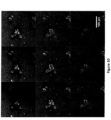
- a significantly sized fabric of ⁇ 250 micron thickness can be completed on bare skin in under 5 minutes ( Figure 7 , outlined region).
- the fibers Due to the airflow and the extremely low weight of the fibers, without further system modification the fibers will not deposit directly on a surface. Instead the fibers will blow around the surface.
- the airflow can be minimized, and by inducing a charge on the fibers after they are formed, the fibers can rapidly collect on the surface by electrostatic interaction. This has so far been accomplished by a high voltage/low amperage generator set to 5kV. Fabrics have been formed without the use of the voltage source, but are built up more slowly on the target as most of the fabric tends to create a sort of veil around it due to aerodynamic forces.
- the aerodynamic system can be assembled into a portable, lightweight, handheld apparatus.
- this system consists of a 16g CO 2 cylinder with a pressure regulator outputting the 20 psi required for the soy atomization, a second low pressure regulator used to pump the soy fluid to the mix needle, and a 5kV high voltage power supply powered from a 9V battery.
- the entire system can be contained entirely in a purpose-made aerosol can.
- Electrospun fibers have been demonstrated to be useful in wound healing applications due to the ability to use biodegradable materials with cell/ECM-relevant sizes ( Frohbergh, M. E., Katsman, A., Botta, G. P., Lazarovici, P., Schauer, C. L., Wegst, U. G., and Lelkes, P. I. (2012) Electrospun hydroxyapatite-containing chitosan nanofibers crosslinked with genipin for bone tissue engineering, Biomaterials 33, 9167-9178 ; Frohbergh, M. E., Katsman, A., Mondrinos, M. J., Stabler, C.
- the invention alleviates the need for electroprocessing in fiber generation; rather it provides for a simple, single application to enhance wound healing while protecting the wound bed. This can be accomplished in a mobile situation in a rapid manner enabling a conformal coating, especially of geometrically complex surfaces, that cannot be accomplished easily with pre-made bandages. It provides a fabric which is not irritating to the wound bed, is highly flexible, and does not need to be removed as it is biodegradable, avoiding unnecessary debridement of the wound bed. The fabric provided is environmentally friendly and does not require any toxic solvents during creation for either the operator or for the wound bed.
- inventions of the device and method include, for example, first aid responder bandage application for large wounds (including burns); use at home as a bandaging device; and use in a hospital or chronic care setting for the bandaging of wounds.
Landscapes
- Engineering & Computer Science (AREA)
- Textile Engineering (AREA)
- Mechanical Engineering (AREA)
- Chemical & Material Sciences (AREA)
- Chemical Kinetics & Catalysis (AREA)
- General Chemical & Material Sciences (AREA)
- Manufacturing & Machinery (AREA)
- Spinning Methods And Devices For Manufacturing Artificial Fibers (AREA)
- Nonwoven Fabrics (AREA)
- Spinning Or Twisting Of Yarns (AREA)
Claims (8)
- Dispositif manuel de filage par soufflage électrofocalisé (EFBS), comprenant :une filière comprenant une gaine extérieure et une aiguille intérieure ;une seringue, capable de contenir une solution de filage, reliée fluidiquement à l'aiguille intérieure de la filière ;au moins un régulateur de gaz ;une alimentation en gaz reliée fluidiquement à la seringue et à la gaine extérieure de filière, de telle sorte que l'alimentation en gaz puisse simultanément pressuriser la seringue et propulser le gaz hors de la gaine extérieure de filière ; etune source d'énergie et une alimentation haute tension.
- Dispositif selon la revendication 1, l'aiguille intérieure étant électriquement conductrice.
- Dispositif selon la revendication 1, la source d'énergie et l'alimentation haute tension étant connectées électriquement à l'aiguille interne.
- Dispositif selon la revendication 1, l'alimentation en gaz comprenant une cartouche pressurisée de gaz, éventuellement le gaz étant choisi dans le groupe constitué par le CO2, le N2, le NO et l'air.
- Dispositif selon la revendication 1, l'alimentation en gaz comprenant une pompe à air, éventuellement la pompe étant choisie dans le groupe constitué d'un pousse-seringue, d'une pompe péristaltique, d'une pompe à diaphragme et d'une pompe à palettes.
- Dispositif selon la revendication 1, la solution de filage comprenant une protéine végétale, une protéine animale, un polymère synthétique, ou toute combinaison de ceux-ci, éventuellement la protéine végétale comprenant une protéine de soja soluble dans l'eau, ou un composant bioactif de celle-ci, en outre éventuellement la solution de filage comprenant en outre un polymère de poids moléculaire élevé, éventuellement le polymère de poids moléculaire élevé étant de l'oxyde de polyéthylène.
- Procédé de préparation d'un tissu sur une surface à l'aide du dispositif selon la revendication 1, le procédé comprenant les étapes de :chargement d'une seringue avec une solution de filage ;raccordement de la seringue à un adaptateur de seringue et à un tube qui est raccordé fluidiquement à une filière comprenant une gaine extérieure et une aiguille intérieure ;fourniture d'un flux de gaz à travers la gaine extérieure de la filière ;fourniture d'un flux de gaz à l'adaptateur de seringue pour distribuer la solution de filage à travers l'aiguille intérieure de la filière ;filage de la solution de filage sur la surface pour former un tissu ; etséparation du tissu de la surface.
- Procédé selon la revendication 7, comprenant en outre une étape de traitement du tissu dans un four à vide.
Priority Applications (1)
| Application Number | Priority Date | Filing Date | Title |
|---|---|---|---|
| EP25165629.4A EP4589060A3 (fr) | 2015-09-29 | 2016-09-29 | Centrifugeuse portable et procédés d'utilisation |
Applications Claiming Priority (4)
| Application Number | Priority Date | Filing Date | Title |
|---|---|---|---|
| US201562234270P | 2015-09-29 | 2015-09-29 | |
| US201562256485P | 2015-11-17 | 2015-11-17 | |
| US201662335212P | 2016-05-12 | 2016-05-12 | |
| PCT/US2016/054410 WO2017059050A1 (fr) | 2015-09-29 | 2016-09-29 | Fileuse portable et ses procédés d'utilisation |
Related Child Applications (1)
| Application Number | Title | Priority Date | Filing Date |
|---|---|---|---|
| EP25165629.4A Division EP4589060A3 (fr) | 2015-09-29 | 2016-09-29 | Centrifugeuse portable et procédés d'utilisation |
Publications (3)
| Publication Number | Publication Date |
|---|---|
| EP3356584A1 EP3356584A1 (fr) | 2018-08-08 |
| EP3356584A4 EP3356584A4 (fr) | 2019-06-12 |
| EP3356584B1 true EP3356584B1 (fr) | 2025-03-26 |
Family
ID=58427941
Family Applications (2)
| Application Number | Title | Priority Date | Filing Date |
|---|---|---|---|
| EP25165629.4A Pending EP4589060A3 (fr) | 2015-09-29 | 2016-09-29 | Centrifugeuse portable et procédés d'utilisation |
| EP16852579.8A Active EP3356584B1 (fr) | 2015-09-29 | 2016-09-29 | Fileuse portable et ses procédés d'utilisation |
Family Applications Before (1)
| Application Number | Title | Priority Date | Filing Date |
|---|---|---|---|
| EP25165629.4A Pending EP4589060A3 (fr) | 2015-09-29 | 2016-09-29 | Centrifugeuse portable et procédés d'utilisation |
Country Status (6)
| Country | Link |
|---|---|
| US (2) | US12031252B2 (fr) |
| EP (2) | EP4589060A3 (fr) |
| KR (2) | KR102657608B1 (fr) |
| AU (1) | AU2016330955A1 (fr) |
| IL (1) | IL258429B (fr) |
| WO (1) | WO2017059050A1 (fr) |
Families Citing this family (7)
| Publication number | Priority date | Publication date | Assignee | Title |
|---|---|---|---|---|
| EP4589060A3 (fr) * | 2015-09-29 | 2025-09-17 | Temple University Of The Commonwealth System Of Higher Education | Centrifugeuse portable et procédés d'utilisation |
| CN107201558A (zh) * | 2017-06-28 | 2017-09-26 | 黄辉 | 一种手持喷枪式静电纺丝装置 |
| US12209330B1 (en) * | 2019-07-10 | 2025-01-28 | American Nano Llc | Electrospinning apparatus and methods |
| CN112725908A (zh) * | 2020-12-23 | 2021-04-30 | 青岛大学 | 一种便携式溶液喷射纺丝装置 |
| CA3210262A1 (fr) | 2021-03-02 | 2022-09-09 | Karen Lozano | Appareil de poche/portatif pour la production de fibres fines |
| US12550916B2 (en) | 2022-06-28 | 2026-02-17 | Board Of Regents, The University Of Texas System | Nanofiber systems as meat substitute |
| CN118600569B (zh) * | 2024-03-25 | 2026-04-14 | 中国科学院重庆绿色智能技术研究院 | 一种用于伤口敷料的便携式低电压静电纺丝装置 |
Family Cites Families (23)
| Publication number | Priority date | Publication date | Assignee | Title |
|---|---|---|---|---|
| NZ187979A (en) * | 1977-07-29 | 1982-05-31 | Ici Ltd | Centrifugal spinning of fibres from liquid |
| ATE156022T1 (de) | 1992-09-25 | 1997-08-15 | Oneil Alexander G B | Flüssigkeitsabgabevorrichtung |
| ES2227624T3 (es) * | 1995-12-07 | 2005-04-01 | Bristol-Myers Squibb Company | Dispositivo para aplicar una mezcla de dos componentes liquidos. |
| EP1177383A4 (fr) | 1999-04-23 | 2004-08-04 | Technol Co Ltd Dovicom | Compresseur de petite taille |
| US7309498B2 (en) | 2001-10-10 | 2007-12-18 | Belenkaya Bronislava G | Biodegradable absorbents and methods of preparation |
| US7935418B2 (en) * | 2002-06-28 | 2011-05-03 | Mosaic Systems B.V. | Functional porous fibres |
| US7662332B2 (en) | 2003-10-01 | 2010-02-16 | The Research Foundation Of State University Of New York | Electro-blowing technology for fabrication of fibrous articles and its applications of hyaluronan |
| CN103862681A (zh) | 2005-10-17 | 2014-06-18 | 阿克伦大学 | 生产多功能聚合膜的混合制造平台 |
| US7837656B2 (en) * | 2006-03-27 | 2010-11-23 | Tyco Healthcare Group Lp | Dual air regulated spray applicator |
| JP2010065366A (ja) | 2008-08-11 | 2010-03-25 | Jfe Chemical Corp | 繊維製造装置及び繊維製造方法 |
| WO2010059127A1 (fr) | 2008-11-20 | 2010-05-27 | National University Of Singapore | Appareil d'électrofilage portable |
| BRPI0903844B1 (pt) * | 2009-06-15 | 2021-03-02 | Empresa Brasileira De Pesquisa Agropecuária - Embrapa | método e aparelho para produzir mantas de micro e/ou nanofibras a partir de polímeros |
| US8641960B1 (en) | 2009-09-29 | 2014-02-04 | The United States Of America, As Represented By The Secretary Of Agriculture | Solution blow spinning |
| WO2011100743A2 (fr) * | 2010-02-15 | 2011-08-18 | Cornell University | Appareil d'électrofilage et nanofibres produites avec celui-ci |
| US10987093B2 (en) * | 2010-04-05 | 2021-04-27 | Neomend, Inc. | Method and apparatus for wound sealant application |
| GB201117295D0 (en) | 2011-10-07 | 2011-11-16 | Neotherix Ltd | Compressible dressing |
| WO2013122923A1 (fr) | 2012-02-13 | 2013-08-22 | The University Of Akron | Procédés et appareil pour la production de fibres multicomposant |
| WO2014160045A1 (fr) * | 2013-03-14 | 2014-10-02 | Cornell University | Appareils et procédés d'électrofilature |
| JP5948370B2 (ja) | 2013-08-08 | 2016-07-06 | 花王株式会社 | ナノファイバ製造装置、ナノファイバの製造方法及びナノファイバ成型体 |
| EP3218536B1 (fr) * | 2014-11-11 | 2019-05-15 | Nanomedic Technologies Ltd. | Dispositif d'électrofilage portatif |
| SG10201500962PA (en) * | 2015-02-06 | 2016-09-29 | Tungray Singapore Pte Ltd | Electrospinning Spinneret |
| US10278685B2 (en) * | 2015-04-01 | 2019-05-07 | Covidien Lp | Electrospinning device and method for applying polymer to tissue |
| EP4589060A3 (fr) * | 2015-09-29 | 2025-09-17 | Temple University Of The Commonwealth System Of Higher Education | Centrifugeuse portable et procédés d'utilisation |
-
2016
- 2016-09-29 EP EP25165629.4A patent/EP4589060A3/fr active Pending
- 2016-09-29 WO PCT/US2016/054410 patent/WO2017059050A1/fr not_active Ceased
- 2016-09-29 US US15/764,476 patent/US12031252B2/en active Active
- 2016-09-29 KR KR1020187012177A patent/KR102657608B1/ko active Active
- 2016-09-29 EP EP16852579.8A patent/EP3356584B1/fr active Active
- 2016-09-29 KR KR1020247011964A patent/KR20240050484A/ko not_active Ceased
- 2016-09-29 AU AU2016330955A patent/AU2016330955A1/en not_active Abandoned
-
2018
- 2018-03-28 IL IL258429A patent/IL258429B/en unknown
-
2024
- 2024-06-24 US US18/751,834 patent/US20250019879A1/en active Pending
Also Published As
| Publication number | Publication date |
|---|---|
| EP3356584A1 (fr) | 2018-08-08 |
| US20200240059A1 (en) | 2020-07-30 |
| US20250019879A1 (en) | 2025-01-16 |
| IL258429B (en) | 2021-12-01 |
| AU2016330955A1 (en) | 2018-05-17 |
| IL258429A (en) | 2018-05-31 |
| EP4589060A2 (fr) | 2025-07-23 |
| KR102657608B1 (ko) | 2024-04-15 |
| US12031252B2 (en) | 2024-07-09 |
| KR20240050484A (ko) | 2024-04-18 |
| KR20180063206A (ko) | 2018-06-11 |
| EP4589060A3 (fr) | 2025-09-17 |
| EP3356584A4 (fr) | 2019-06-12 |
| WO2017059050A1 (fr) | 2017-04-06 |
Similar Documents
| Publication | Publication Date | Title |
|---|---|---|
| US20250019879A1 (en) | Portable spinner and methods of use | |
| US11413439B2 (en) | Apparatus for applying an electrically spun fiber | |
| US10640888B1 (en) | Method and apparatus for accumulating cross-aligned fiber in an electrospinning device | |
| US12270126B2 (en) | Wound dressing | |
| EP1377420A2 (fr) | Appareil d'electrofilage portatif | |
| US10995425B2 (en) | Method and apparatus for fabricating a multifunction fiber membrane | |
| AU2009335119A1 (en) | System for providing fluid flow to nerve tissues | |
| US11186925B2 (en) | System for nano-coating a substrate | |
| CN104862787A (zh) | 可实现多材料分区电纺的系统和方法 | |
| Wang et al. | The interface effect of electrospun fiber promotes wound healing | |
| KR101635032B1 (ko) | 이동식 전기방사장치 | |
| WO2014118584A1 (fr) | Distribution de liquides chargés électriquement | |
| CN103418026A (zh) | 可悬浮皮肤组织工程纳米纤维支架及其制备方法 | |
| CN116549824A (zh) | 一种用于抗菌抗炎的便携式伤口治疗设备 | |
| WO2025172904A1 (fr) | Dispositif portatif et procédés de distribution d'un ou de plusieurs agents de cicatrisation de plaie | |
| CN116966011B (zh) | 一种加速烧烫伤恢复的防护系统 | |
| TWI423829B (zh) | 傷口癒合支架及其製造方法 | |
| Ramalingam et al. | Nanofibers: general aspects and applications |
Legal Events
| Date | Code | Title | Description |
|---|---|---|---|
| STAA | Information on the status of an ep patent application or granted ep patent |
Free format text: STATUS: THE INTERNATIONAL PUBLICATION HAS BEEN MADE |
|
| PUAI | Public reference made under article 153(3) epc to a published international application that has entered the european phase |
Free format text: ORIGINAL CODE: 0009012 |
|
| STAA | Information on the status of an ep patent application or granted ep patent |
Free format text: STATUS: REQUEST FOR EXAMINATION WAS MADE |
|
| 17P | Request for examination filed |
Effective date: 20180427 |
|
| AK | Designated contracting states |
Kind code of ref document: A1 Designated state(s): AL AT BE BG CH CY CZ DE DK EE ES FI FR GB GR HR HU IE IS IT LI LT LU LV MC MK MT NL NO PL PT RO RS SE SI SK SM TR |
|
| AX | Request for extension of the european patent |
Extension state: BA ME |
|
| DAV | Request for validation of the european patent (deleted) | ||
| DAX | Request for extension of the european patent (deleted) | ||
| A4 | Supplementary search report drawn up and despatched |
Effective date: 20190509 |
|
| RIC1 | Information provided on ipc code assigned before grant |
Ipc: D01D 5/00 20060101ALN20190503BHEP Ipc: D01D 5/14 20060101AFI20190503BHEP |
|
| STAA | Information on the status of an ep patent application or granted ep patent |
Free format text: STATUS: EXAMINATION IS IN PROGRESS |
|
| 17Q | First examination report despatched |
Effective date: 20240313 |
|
| REG | Reference to a national code |
Ref country code: DE Ref legal event code: R079 Free format text: PREVIOUS MAIN CLASS: D01D0005140000 Ipc: D04H0001728000 Ref country code: DE Ref legal event code: R079 Ref document number: 602016091706 Country of ref document: DE Free format text: PREVIOUS MAIN CLASS: D01D0005140000 Ipc: D04H0001728000 |
|
| GRAP | Despatch of communication of intention to grant a patent |
Free format text: ORIGINAL CODE: EPIDOSNIGR1 |
|
| STAA | Information on the status of an ep patent application or granted ep patent |
Free format text: STATUS: GRANT OF PATENT IS INTENDED |
|
| RIC1 | Information provided on ipc code assigned before grant |
Ipc: D01D 5/00 20060101ALI20240930BHEP Ipc: D01D 5/14 20060101ALI20240930BHEP Ipc: D01D 5/04 20060101ALI20240930BHEP Ipc: D01F 6/66 20060101ALI20240930BHEP Ipc: D01F 1/10 20060101ALI20240930BHEP Ipc: D04H 1/728 20120101AFI20240930BHEP |
|
| INTG | Intention to grant announced |
Effective date: 20241017 |
|
| GRAS | Grant fee paid |
Free format text: ORIGINAL CODE: EPIDOSNIGR3 |
|
| GRAA | (expected) grant |
Free format text: ORIGINAL CODE: 0009210 |
|
| STAA | Information on the status of an ep patent application or granted ep patent |
Free format text: STATUS: THE PATENT HAS BEEN GRANTED |
|
| AK | Designated contracting states |
Kind code of ref document: B1 Designated state(s): AL AT BE BG CH CY CZ DE DK EE ES FI FR GB GR HR HU IE IS IT LI LT LU LV MC MK MT NL NO PL PT RO RS SE SI SK SM TR |
|
| REG | Reference to a national code |
Ref country code: GB Ref legal event code: FG4D |
|
| REG | Reference to a national code |
Ref country code: CH Ref legal event code: EP |
|
| REG | Reference to a national code |
Ref country code: DE Ref legal event code: R096 Ref document number: 602016091706 Country of ref document: DE |
|
| REG | Reference to a national code |
Ref country code: IE Ref legal event code: FG4D |
|
| P01 | Opt-out of the competence of the unified patent court (upc) registered |
Free format text: CASE NUMBER: APP_14614/2025 Effective date: 20250325 |
|
| PG25 | Lapsed in a contracting state [announced via postgrant information from national office to epo] |
Ref country code: RS Free format text: LAPSE BECAUSE OF FAILURE TO SUBMIT A TRANSLATION OF THE DESCRIPTION OR TO PAY THE FEE WITHIN THE PRESCRIBED TIME-LIMIT Effective date: 20250626 |
|
| PG25 | Lapsed in a contracting state [announced via postgrant information from national office to epo] |
Ref country code: FI Free format text: LAPSE BECAUSE OF FAILURE TO SUBMIT A TRANSLATION OF THE DESCRIPTION OR TO PAY THE FEE WITHIN THE PRESCRIBED TIME-LIMIT Effective date: 20250326 |
|
| REG | Reference to a national code |
Ref country code: LT Ref legal event code: MG9D |
|
| PG25 | Lapsed in a contracting state [announced via postgrant information from national office to epo] |
Ref country code: NO Free format text: LAPSE BECAUSE OF FAILURE TO SUBMIT A TRANSLATION OF THE DESCRIPTION OR TO PAY THE FEE WITHIN THE PRESCRIBED TIME-LIMIT Effective date: 20250626 |
|
| PG25 | Lapsed in a contracting state [announced via postgrant information from national office to epo] |
Ref country code: HR Free format text: LAPSE BECAUSE OF FAILURE TO SUBMIT A TRANSLATION OF THE DESCRIPTION OR TO PAY THE FEE WITHIN THE PRESCRIBED TIME-LIMIT Effective date: 20250326 |
|
| PG25 | Lapsed in a contracting state [announced via postgrant information from national office to epo] |
Ref country code: LV Free format text: LAPSE BECAUSE OF FAILURE TO SUBMIT A TRANSLATION OF THE DESCRIPTION OR TO PAY THE FEE WITHIN THE PRESCRIBED TIME-LIMIT Effective date: 20250326 |
|
| PG25 | Lapsed in a contracting state [announced via postgrant information from national office to epo] |
Ref country code: GR Free format text: LAPSE BECAUSE OF FAILURE TO SUBMIT A TRANSLATION OF THE DESCRIPTION OR TO PAY THE FEE WITHIN THE PRESCRIBED TIME-LIMIT Effective date: 20250627 Ref country code: BG Free format text: LAPSE BECAUSE OF FAILURE TO SUBMIT A TRANSLATION OF THE DESCRIPTION OR TO PAY THE FEE WITHIN THE PRESCRIBED TIME-LIMIT Effective date: 20250326 |
|
| REG | Reference to a national code |
Ref country code: NL Ref legal event code: MP Effective date: 20250326 |
|
| PG25 | Lapsed in a contracting state [announced via postgrant information from national office to epo] |
Ref country code: NL Free format text: LAPSE BECAUSE OF FAILURE TO SUBMIT A TRANSLATION OF THE DESCRIPTION OR TO PAY THE FEE WITHIN THE PRESCRIBED TIME-LIMIT Effective date: 20250326 |
|
| PG25 | Lapsed in a contracting state [announced via postgrant information from national office to epo] |
Ref country code: SE Free format text: LAPSE BECAUSE OF FAILURE TO SUBMIT A TRANSLATION OF THE DESCRIPTION OR TO PAY THE FEE WITHIN THE PRESCRIBED TIME-LIMIT Effective date: 20250326 |
|
| REG | Reference to a national code |
Ref country code: AT Ref legal event code: MK05 Ref document number: 1779064 Country of ref document: AT Kind code of ref document: T Effective date: 20250326 |
|
| REG | Reference to a national code |
Ref country code: CH Ref legal event code: U11 Free format text: ST27 STATUS EVENT CODE: U-0-0-U10-U11 (AS PROVIDED BY THE NATIONAL OFFICE) Effective date: 20251001 |
|
| PG25 | Lapsed in a contracting state [announced via postgrant information from national office to epo] |
Ref country code: SM Free format text: LAPSE BECAUSE OF FAILURE TO SUBMIT A TRANSLATION OF THE DESCRIPTION OR TO PAY THE FEE WITHIN THE PRESCRIBED TIME-LIMIT Effective date: 20250326 |
|
| PG25 | Lapsed in a contracting state [announced via postgrant information from national office to epo] |
Ref country code: ES Free format text: LAPSE BECAUSE OF FAILURE TO SUBMIT A TRANSLATION OF THE DESCRIPTION OR TO PAY THE FEE WITHIN THE PRESCRIBED TIME-LIMIT Effective date: 20250326 Ref country code: PT Free format text: LAPSE BECAUSE OF FAILURE TO SUBMIT A TRANSLATION OF THE DESCRIPTION OR TO PAY THE FEE WITHIN THE PRESCRIBED TIME-LIMIT Effective date: 20250728 |
|
| PGFP | Annual fee paid to national office [announced via postgrant information from national office to epo] |
Ref country code: DE Payment date: 20250929 Year of fee payment: 10 |
|
| PG25 | Lapsed in a contracting state [announced via postgrant information from national office to epo] |
Ref country code: IT Free format text: LAPSE BECAUSE OF FAILURE TO SUBMIT A TRANSLATION OF THE DESCRIPTION OR TO PAY THE FEE WITHIN THE PRESCRIBED TIME-LIMIT Effective date: 20250326 Ref country code: PL Free format text: LAPSE BECAUSE OF FAILURE TO SUBMIT A TRANSLATION OF THE DESCRIPTION OR TO PAY THE FEE WITHIN THE PRESCRIBED TIME-LIMIT Effective date: 20250326 |
|
| PGFP | Annual fee paid to national office [announced via postgrant information from national office to epo] |
Ref country code: GB Payment date: 20250929 Year of fee payment: 10 |
|
| PG25 | Lapsed in a contracting state [announced via postgrant information from national office to epo] |
Ref country code: AT Free format text: LAPSE BECAUSE OF FAILURE TO SUBMIT A TRANSLATION OF THE DESCRIPTION OR TO PAY THE FEE WITHIN THE PRESCRIBED TIME-LIMIT Effective date: 20250326 |
|
| PGFP | Annual fee paid to national office [announced via postgrant information from national office to epo] |
Ref country code: FR Payment date: 20250925 Year of fee payment: 10 |
|
| PG25 | Lapsed in a contracting state [announced via postgrant information from national office to epo] |
Ref country code: EE Free format text: LAPSE BECAUSE OF FAILURE TO SUBMIT A TRANSLATION OF THE DESCRIPTION OR TO PAY THE FEE WITHIN THE PRESCRIBED TIME-LIMIT Effective date: 20250326 |
|
| PGFP | Annual fee paid to national office [announced via postgrant information from national office to epo] |
Ref country code: IE Payment date: 20250929 Year of fee payment: 10 |
|
| PG25 | Lapsed in a contracting state [announced via postgrant information from national office to epo] |
Ref country code: RO Free format text: LAPSE BECAUSE OF FAILURE TO SUBMIT A TRANSLATION OF THE DESCRIPTION OR TO PAY THE FEE WITHIN THE PRESCRIBED TIME-LIMIT Effective date: 20250326 |
|
| PG25 | Lapsed in a contracting state [announced via postgrant information from national office to epo] |
Ref country code: SK Free format text: LAPSE BECAUSE OF FAILURE TO SUBMIT A TRANSLATION OF THE DESCRIPTION OR TO PAY THE FEE WITHIN THE PRESCRIBED TIME-LIMIT Effective date: 20250326 |
|
| PG25 | Lapsed in a contracting state [announced via postgrant information from national office to epo] |
Ref country code: IS Free format text: LAPSE BECAUSE OF FAILURE TO SUBMIT A TRANSLATION OF THE DESCRIPTION OR TO PAY THE FEE WITHIN THE PRESCRIBED TIME-LIMIT Effective date: 20250726 |
|
| REG | Reference to a national code |
Ref country code: DE Ref legal event code: R097 Ref document number: 602016091706 Country of ref document: DE |
|
| PG25 | Lapsed in a contracting state [announced via postgrant information from national office to epo] |
Ref country code: DK Free format text: LAPSE BECAUSE OF FAILURE TO SUBMIT A TRANSLATION OF THE DESCRIPTION OR TO PAY THE FEE WITHIN THE PRESCRIBED TIME-LIMIT Effective date: 20250326 |
|
| PGFP | Annual fee paid to national office [announced via postgrant information from national office to epo] |
Ref country code: CH Payment date: 20251001 Year of fee payment: 10 |
|
| PG25 | Lapsed in a contracting state [announced via postgrant information from national office to epo] |
Ref country code: CZ Free format text: LAPSE BECAUSE OF FAILURE TO SUBMIT A TRANSLATION OF THE DESCRIPTION OR TO PAY THE FEE WITHIN THE PRESCRIBED TIME-LIMIT Effective date: 20250326 |
|
| PLBE | No opposition filed within time limit |
Free format text: ORIGINAL CODE: 0009261 |
|
| STAA | Information on the status of an ep patent application or granted ep patent |
Free format text: STATUS: NO OPPOSITION FILED WITHIN TIME LIMIT |
|
| REG | Reference to a national code |
Ref country code: CH Ref legal event code: L10 Free format text: ST27 STATUS EVENT CODE: U-0-0-L10-L00 (AS PROVIDED BY THE NATIONAL OFFICE) Effective date: 20260211 |
|
| 26N | No opposition filed |
Effective date: 20260105 |