EP3358542B1 - Procédé permettant de prédire un comportement de trafic dans un réseau routier - Google Patents
Procédé permettant de prédire un comportement de trafic dans un réseau routier Download PDFInfo
- Publication number
- EP3358542B1 EP3358542B1 EP17154100.6A EP17154100A EP3358542B1 EP 3358542 B1 EP3358542 B1 EP 3358542B1 EP 17154100 A EP17154100 A EP 17154100A EP 3358542 B1 EP3358542 B1 EP 3358542B1
- Authority
- EP
- European Patent Office
- Prior art keywords
- tag
- cluster
- traffic
- tags
- significance value
- Prior art date
- Legal status (The legal status is an assumption and is not a legal conclusion. Google has not performed a legal analysis and makes no representation as to the accuracy of the status listed.)
- Active
Links
Images



Classifications
-
- G—PHYSICS
- G08—SIGNALLING
- G08G—TRAFFIC CONTROL SYSTEMS
- G08G1/00—Traffic control systems for road vehicles
- G08G1/01—Detecting movement of traffic to be counted or controlled
- G08G1/0104—Measuring and analyzing of parameters relative to traffic conditions
- G08G1/0125—Traffic data processing
- G08G1/0129—Traffic data processing for creating historical data or processing based on historical data
-
- G—PHYSICS
- G01—MEASURING; TESTING
- G01C—MEASURING DISTANCES, LEVELS OR BEARINGS; SURVEYING; NAVIGATION; GYROSCOPIC INSTRUMENTS; PHOTOGRAMMETRY OR VIDEOGRAMMETRY
- G01C21/00—Navigation; Navigational instruments not provided for in groups G01C1/00 - G01C19/00
- G01C21/24—Navigation; Navigational instruments not provided for in groups G01C1/00 - G01C19/00 specially adapted for cosmonautical navigation
-
- G—PHYSICS
- G01—MEASURING; TESTING
- G01C—MEASURING DISTANCES, LEVELS OR BEARINGS; SURVEYING; NAVIGATION; GYROSCOPIC INSTRUMENTS; PHOTOGRAMMETRY OR VIDEOGRAMMETRY
- G01C21/00—Navigation; Navigational instruments not provided for in groups G01C1/00 - G01C19/00
- G01C21/26—Navigation; Navigational instruments not provided for in groups G01C1/00 - G01C19/00 specially adapted for navigation in a road network
- G01C21/28—Navigation; Navigational instruments not provided for in groups G01C1/00 - G01C19/00 specially adapted for navigation in a road network with correlation of data from several navigational instruments
- G01C21/30—Map- or contour-matching
- G01C21/32—Structuring or formatting of map data
-
- G—PHYSICS
- G06—COMPUTING OR CALCULATING; COUNTING
- G06N—COMPUTING ARRANGEMENTS BASED ON SPECIFIC COMPUTATIONAL MODELS
- G06N20/00—Machine learning
-
- G—PHYSICS
- G08—SIGNALLING
- G08G—TRAFFIC CONTROL SYSTEMS
- G08G1/00—Traffic control systems for road vehicles
- G08G1/01—Detecting movement of traffic to be counted or controlled
-
- G—PHYSICS
- G08—SIGNALLING
- G08G—TRAFFIC CONTROL SYSTEMS
- G08G1/00—Traffic control systems for road vehicles
- G08G1/01—Detecting movement of traffic to be counted or controlled
- G08G1/0104—Measuring and analyzing of parameters relative to traffic conditions
- G08G1/0108—Measuring and analyzing of parameters relative to traffic conditions based on the source of data
- G08G1/0116—Measuring and analyzing of parameters relative to traffic conditions based on the source of data from roadside infrastructure, e.g. beacons
-
- G—PHYSICS
- G08—SIGNALLING
- G08G—TRAFFIC CONTROL SYSTEMS
- G08G1/00—Traffic control systems for road vehicles
- G08G1/01—Detecting movement of traffic to be counted or controlled
- G08G1/0104—Measuring and analyzing of parameters relative to traffic conditions
- G08G1/0125—Traffic data processing
-
- G—PHYSICS
- G08—SIGNALLING
- G08G—TRAFFIC CONTROL SYSTEMS
- G08G1/00—Traffic control systems for road vehicles
- G08G1/01—Detecting movement of traffic to be counted or controlled
- G08G1/0104—Measuring and analyzing of parameters relative to traffic conditions
- G08G1/0125—Traffic data processing
- G08G1/0133—Traffic data processing for classifying traffic situation
-
- G—PHYSICS
- G08—SIGNALLING
- G08G—TRAFFIC CONTROL SYSTEMS
- G08G1/00—Traffic control systems for road vehicles
- G08G1/065—Traffic control systems for road vehicles by counting the vehicles in a section of the road or in a parking area, i.e. comparing incoming count with outgoing count
-
- G—PHYSICS
- G08—SIGNALLING
- G08G—TRAFFIC CONTROL SYSTEMS
- G08G1/00—Traffic control systems for road vehicles
- G08G1/09—Arrangements for giving variable traffic instructions
- G08G1/0962—Arrangements for giving variable traffic instructions having an indicator mounted inside the vehicle, e.g. giving voice messages
-
- G—PHYSICS
- G09—EDUCATION; CRYPTOGRAPHY; DISPLAY; ADVERTISING; SEALS
- G09B—EDUCATIONAL OR DEMONSTRATION APPLIANCES; APPLIANCES FOR TEACHING, OR COMMUNICATING WITH, THE BLIND, DEAF OR MUTE; MODELS; PLANETARIA; GLOBES; MAPS; DIAGRAMS
- G09B29/00—Maps; Plans; Charts; Diagrams, e.g. route diagram
Definitions
- the invention relates to a method of predicting a traffic behaviour in a road system on the basis of a set of traffic profiles, each of which represents a traffic measure of vehicles in the road system recorded over time, wherein one or more pre-defined tags associated with a time of recording of the specific traffic profile is/are attributed to said traffic profile.
- the invention thus concerns the field of measuring and evaluating vehicle traffic behaviour, for example traffic behaviour on a main street of a city.
- vehicle traffic behaviour for example traffic behaviour on a main street of a city.
- the aim is to estimate the traffic behaviour for a certain day or time-window in the future. This can be used to predict which road will be congested or blocked at a certain time, e.g., for freighters planning the transportation of cargo or families planning their vacation.
- different routes or times at which to travel on this street can then be chosen, whereby in any case the start-to-end journey time for a vehicle can be reduced.
- known methods of traffic prediction use a similarity clustering of the recorded profiles and an assigning of characteristic vectors ("labels") of tags to the clusters, which tags can be queried to identify a cluster of traffic profiles as a predicted traffic behaviour for a certain day, e.g., a specific weekday, a "rainy" day, etc.
- the invention sets its aim to create a more reliable and quicker method for determining labels of clusters, which can then be used to find a predicted traffic behaviour for a specific request.
- the steps of grouping, calculating the significance value for a variable and calculating the significance value for a tag are repeated until no more traffic profiles are available for grouping.
- sub-cluster after sub-cluster is created and evaluated for each variable to obtain all significant tags of the cluster.
- all of the above-mentioned steps can be repeated for each variable occurring in a cluster to yield the broadest set of significant tags.
- a significance value of a tag combination is calculated for a tag that had the highest significance value during the "first-level” evaluation, while its significance value was still below a threshold value but preferably above a further "lower boundary” threshold level.
- the significance value is determined in combination with all remaining tags or just in combination with the most common of these remaining tags.
- a tag which has been used as a characteristic vector in the "first-level" evaluation is not considered to be a remaining tag.
- significance values for all tags of this cluster are calculated. Thereby, it is not possible to miss out on characteristic vectors whose underlying tags are not very common in this cluster but still describe contents of this cluster accurately. For example, if the tag "Christmas” is the only tag within a cluster, the characteristic value "Christmas” is still significant for this cluster when the tag "Christmas” is a unique tag amongst the entire set of traffic profiles. Alternatively, only the most common or only arbitrary tags are evaluated. The cluster can thus be assigned a label which is derived in a fast, systematic, and reliable manner.
- the threshold value is lowered and it is again checked if the significance value of each tag (or tag combination) is higher than the threshold value to assign this tag (or tag combination) as a characteristic vector to this cluster.
- the significance value of each tag or tag combination can be determined by a variety of statistical analyses.
- the significance value of each tag or tag combination, respectively is calculated by means of a Chi-squared statistic.
- the Chi-squared statistic is especially preferred in this method since it gives a highly accurate representation of the significance of a tag or tag combination within a cluster while at the same time considering tags or tag combinations of other clusters.
- Pearson's Chi-squared statistic is used.
- the significance values of the tags or tag combinations are also used when checking whether a request tag matches a characteristic vector.
- the determined significance value can thus be used twice in the method, firstly when labelling the clusters and secondly when determining the matching cluster. This is advantageous because characteristic vectors with higher significance values are more likely to match a tag of the request than characteristic vectors with lower significance values.
- At least one tag indicates a day of the week, a month of the year, a week of the month, a school vacation indication, or a special holiday indication of said time of recording.
- tags can, e.g., be automatically generated by associating an attribute of a calendar to a traffic profile.
- the calendar can be defined in advance, in real-time, or in retrospect, and it is also possible to subsequently add tags to traffic profiles when they first occur in a request.
- a road system 1 with a plurality of roads 2 is depicted on which vehicles 3 travel in directions R.
- the road system 1 is equipped with at least one traffic measuring device 4, which can be, for example, used for measuring traffic flow on a road 2 or on an intersection of roads 2.
- the traffic measuring device 4 may be mounted on a gantry 5 spanning the road 2 or may alternatively be mounted roadside.
- the traffic measuring device 4 can be embodied as any type known in the state of the art, e.g., as inductive loops, radar devices, light barriers, video processing cameras, or as wireless readers that read a radio response of so-called onboard-units (OBUs) carried by the vehicles 3.
- OBUs onboard-units
- the traffic measuring device 4 records the traffic flow v/t - or equivalent measurement values as described above - per time t over a predefined time-span of, e.g., 24 hours as a traffic profile 6 ( Fig. 2 ).
- a predefined time-span of, e.g., 24 hours e.g., 24 hours
- shorter time-spans could be used, too, for example only the most interesting time-spans of, e.g., 6, 12 or 18 hours of a day.
- the traffic measuring device 4 records said traffic profiles 6 over an extended period of time, e.g., day after day for a whole year or longer.
- a traffic profile can be made up of discrete samples, e.g., one sample each 5 min, 15 min, or each hour, or can be an at least partially smooth curve over time.
- each traffic measuring device 4 records a set of traffic profiles 6 for its road 2 or intersection of roads 2 and stores it in a database 7 via a data connection 8.
- a processor 9 is connected to the database 7 via a connection 10 for further processing of the traffic profiles 6, as will be described in the following.
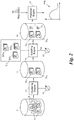
- Fig. 2 shows a clustering engine 11, which can be part of the aforementioned processor 9.
- the clustering engine 11 obtains traffic profiles 6 from the database 7 and clusters these traffic profiles 6 into at least one or at least two clusters CL 1 , CL 2 ..., generally CL i .
- the clustering algorithm used in the clustering engine 11 can be of any type known in the state of the art, for example a hierarchical agglomerative clustering algorithm.
- the traffic profiles 6 might need to be pre-processed such that they contain, e.g., 96 time samples each at 15 minute intervals.
- filters can be employed to deal with local anomalies occurring in the traffic profiles 6.
- the clustering engine 11 outputs clusters CL i , each comprising multiple traffic profiles 6 that are similar to each other, to a database 12.
- This database 12 can be the same as the database 7 or a subset thereof.
- the clustering engine 11 can be controlled by means of a control setting input 13 to adjust clustering parameters.
- a labelling engine 14 is employed to assign a label L 1 , L 2 , ..., generally L i , to each cluster CL i , wherein each label L i consists of at least one characteristic vector CV 1 , CV 2 , ..., generally CV j .
- the labels L i should reflect the contents of the clusters CL i as accurately as possible.
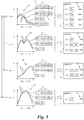
- the method steps performed by the labelling engine 14 will now be described in detail by means of Fig. 3 , which shows four exemplary clusters CL i , CL 2 , CL 3 , CL 4 output by the clustering engine 11.
- Diagram 15 maps the time t on the horizontal axis and the traffic flow in vehicles per time v/t on the vertical axis. It can further be seen that each of the four exemplary traffic profiles 6 can have one or more, in the present example two to four, pre-defined tags T attributed thereto.
- the tags T attributed to a traffic profile 6 are associated in some way with the time of recording said traffic profile 6.
- a tag T can indicate a day of the week, a month of the year, a week of the month, a school vacation indication, a special holiday indication, a road condition, or a weather condition at the time-span over which its traffic profile 6 had been recorded.
- tags T can be attributed to the traffic profile 6 directly at the time of recording by means of the traffic measuring device 4, at the database 7, or even after clustering at the database 12.
- the corresponding devices 4, 7, 12 can each comprise a clock, calendar, weather station, or any means to receive environmental or road condition data.
- tags T can be attributed to the traffic profiles 6 in retrospect, for example by means of calendars of the databases 7, 12. Calendar, weather, environmental, or road condition information can be attributed in retrospect, for example if a week or a month later information arises that the road on which the traffic flow has been recorded was damaged or under construction.
- Tags T can even be attributed to the traffic profiles 6 during the step of labelling by means of the labelling engine 14, which can have its own calendar or data inputs for this purpose.
- a first traffic profile 6 of the first cluster CL 1 has the tags “Monday”, “rain”, “normal day (no holiday)", and “June”.
- a second traffic profile 6 of this cluster has different tags T, here "Monday”, “sunny”, “normal day (no holiday)", and "July”, and so forth.
- the labelling engine 14 To extract a label L i that most accurately describes a cluster CL i out of all the tags T of this cluster CL i , the labelling engine 14 firstly calculates a significance value SV for at least some of the tags T within this cluster CL i .
- the significance values SV of all tags T of all traffic profiles 6 of a cluster CL i are calculated, while in other embodiments significance values SV are calculated for only the most common tags T of the traffic profiles 6 of a cluster CL i .
- the labelling engine 14 obtains a threshold value TH from a threshold input 15.
- the threshold input 15 can be adjusted manually or digitally if it is connected to computer. If the significance value SV of a tag T within a cluster CL i lies above the threshold TH, a characteristic vector CV j comprising this tag T is assigned to this cluster CL i , see Fig. 3 on the right.
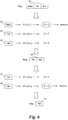
- Fig. 4 shows an example of how to generate the label L i corresponding to the second cluster CL 2 and second label L 2 of Fig. 3 .
- significance values SV of three tags "holiday”, “Sunday”, and "July” have been calculated.
- TH threshold value
- this method can be performed also for tag combinations TC comprising three or more tags T, for example when the significance value SV of a two-tag combination TC again lies in a specific range of thresholds values.
- tag combinations of any length can be assigned to a cluster CL i as characteristic vectors CV j .
- tags T are specific values of so-called variables V, e.g., variables V can be "weekday”, “special day”, “school vacation day”, “month”, “month week”, and/or "weather condition”.
- variables V can be "weekday”, “special day”, “school vacation day”, “month”, “month week”, and/or "weather condition”.
- the tags T are in turn assigned to each variable V, e.g., tags "Mon”, “Tue”, Wed”, ... to the variable “weekday”, tags “holiday”, “pre-holiday”, ... to the variable "special day”, "Yes", “No” to the variable "school vacation day” and so forth.
- steps two and three are repeated for the sub-cluster SCL i until there are no more variables V or traffic profiles 6 to analyze.
- a sixth step the fifth step is repeated for the next sub-cluster SCL i in increasing significance order. This time, not only its own traffic profiles 6 are considered but also the items of the previously analyzed sub-clusters SCL i that were not significant. In this way, all "significant" sub-clusters SCL i for the first level can be computed, and the corresponding tags T are added as a label to the initial cluster CL i .
- a seventh step the process is repeated for each sub-cluster SCL i in the next level to determine new "child sub-clusters", considering only the characteristics or variables that have not been analyzed before.
- the characteristic vector CV j whose tag T or tag combination TC has the lower significance value SV can be deleted from the label L i of this cluster CL i .
- a dissimilarity measure D is calculated for each of the clusters CL i .
- the dissimilarity measure D is a measure of how much the traffic profiles 6 of a specific cluster CL i differ from the traffic profiles 6 of the reference cluster (here: CL 1 ).
- CL 1 traffic profiles 6 of the reference cluster
- the dissimilarity measure D is independent from the number N of traffic profiles 6 in a cluster CL i and only represents a difference of the average, modal, or median value, or there like, of traffic profiles 6 between clusters CL i .
- Any measure of (dis)similarity between curves known in the state of the art can be used as the dissimilarity measure D such as, for example, an L2 norm, an L1 norm, or hybrid norms.
- Steps 19 and 20 can, e.g., be performed in the processor 9 or in the labelling engine 14.
- step 22 either the whole matching cluster CL i or an average traffic profile or any other data derived from this matching cluster CL i can be output by the prediction engine 17 as the predicted traffic behaviour PTB for the request Req.
- step 21 no matching characteristic vector CV j can be found amongst the clusters CL i (branch "N"), one of the request tags RT is eliminated from the request Req in a step 23, and step 21 is repeated.
- the step 23 of removing a request tag RT from the request Req is described in detail by means of an example shown in Fig. 6 , which again uses the exemplary clusters of Fig. 3 .
- the request Req comprises the request tags "Wednesday”, "holiday”, and "rain”.
- the step 21 is checked whether the combination of these three request tags RT appears in any of the labels L i of the four clusters CL i , see the four labels L 1 , L 2 , L 3 , L 4 on the right side of Fig. 3 .
- no characteristic vector CV j can be found that comprises the three request tags RT.
- request tags RT do not occur in a characteristic vector CV j that contains only this request tag RT in any of the clusters CL i because either this tag of the request is not present in any of the tags T of the traffic profiles 6 that are used to create the clusters CL i or because this tag T is only used in a characteristic vector CV j in a combination with a further tag T.
- this characteristic vector CV j and in turn the underlying cluster CL i and its dissimilarity measure D is chosen, for which, e.g., the significance value SV of the characteristic vector CV j is higher or which has a higher or lower number N of traffic profiles 6. For example, in Fig.
- the one with the high number N of traffic profiles 6 can be determined as the matching cluster and the other one discarded.
Landscapes
- Physics & Mathematics (AREA)
- General Physics & Mathematics (AREA)
- Engineering & Computer Science (AREA)
- Analytical Chemistry (AREA)
- Chemical & Material Sciences (AREA)
- Remote Sensing (AREA)
- Radar, Positioning & Navigation (AREA)
- Theoretical Computer Science (AREA)
- Mathematical Physics (AREA)
- Automation & Control Theory (AREA)
- Software Systems (AREA)
- Artificial Intelligence (AREA)
- General Engineering & Computer Science (AREA)
- Computing Systems (AREA)
- Medical Informatics (AREA)
- Astronomy & Astrophysics (AREA)
- Evolutionary Computation (AREA)
- Data Mining & Analysis (AREA)
- Computer Vision & Pattern Recognition (AREA)
- Business, Economics & Management (AREA)
- Educational Administration (AREA)
- Educational Technology (AREA)
- Traffic Control Systems (AREA)
Claims (12)
- Procédé de prédiction d'un comportement du trafic dans un système routier, comprenant les étapes suivantes effectuées par au moins un processeur (9, 11, 14, 17) connecté à une base de données (7, 12, 16) qui contient un ensemble de profils de trafic (6), chaque profil de trafic (6) représentant une mesure du trafic de véhicules (3) dans le système routier (1) enregistré au cours du temps (t) sous forme d'une courbe d'échantillonnage ou lissée, une ou plusieurs étiquettes (T) prédéfinies associées avec un temps d'enregistrement du profil de trafic (6) respectif étant attribuées audit profil de trafic (6) :le groupement des profils de trafic (6) avec leurs étiquettes (T) dans au moins un groupe (CLi) en ce qui concerne la similitude en utilisant des mesures de distance calculées entre les courbes des profils de trafic (6), chaque groupe (CLi) comprenant multiples profils de trafic (6) qui sont similaires les uns aux autres dans leurs courbes ;pour au moins une étiquette (T) dans chaque groupe (CLi), le calcul d'une valeur de signification (SV) au moyen d'une analyse statistique ;si la valeur de signification (SV) d'une étiquette (T) est supérieure à une valeur de seuil (TH), l'association de cette étiquette (T) à ce groupe (CLi) sous forme d'un vecteur caractéristique (CVj) ;dans un moteur de prédiction, la réception d'une demande (Req) ayant une ou plusieurs étiquettes de demande (RT) pour déterminer un groupe (CLi) correspondant ;la détermination d'un groupe (CLi) au moyen de la mise en correspondance de l'étiquette/des étiquettes de demande (RT) avec les vecteurs caractéristiques (CVj) des groupes (CLi) ; etla production d'un comportement de trafic prédit (PTB) sur la base du groupe (CLi) déterminé.
- Procédé selon la revendication 1, dans lequel chaque étiquette (T) est l'une des valeurs spécifiques d'une variable (V) qui peut avoir plusieurs telles valeurs spécifiques, et dans lequel il y a au moins deux telles variables auxquelles des étiquettes sont associées sous forme de valeurs spécifiques de celles-ci, le procédé comprenant les nouvelles étapes :pour au moins une variable (V) dans chaque groupe (CLi) le calcul d'une valeur de signification (SV) ; etpour au moins une étiquette (T) associée à la variable (V) avec la valeur de signification (SV) la plus élevée de chaque groupe (CLi), le calcul de la valeur de signification (SV).
- Procédé selon la revendication 2, où le procédé comprend les nouvelles étapes :le groupement de tous les profils de trafic (6) qui ne contiennent pas d'étiquette (T) dont la valeur de signification (SV) se situe au-dessus de ladite valeur de seuil (TH) en un sous-groupe (SCLi) ;pour au moins une variable dans le sous-groupe (SCLi), le calcul d'une valeur de signification (SV) ; etpour une étiquette (T) associée à la variable (V) avec la valeur de signification (SV) la plus élevée du sous-groupe (SCLi), le calcul de la valeur de signification (SV).
- Procédé selon la revendication 3, dans lequel les étapes de regroupement, de calcul de la valeur de signification (SV) pour une variable (V) et de calcul d'une valeur de signification (SV) pour une étiquette (T) sont répétées jusqu'à ce qu'il n'y ait plus de profil de trafic (6) disponible pour le regroupement.
- Procédé selon l'une quelconque des revendications 1 à 4, dans lequel, pour au moins une étiquette (T) dont la valeur de signification (SV) se situe en-dessous dudit seuil (TH), une valeur de signification (SV) d'une combinaison de ladite étiquette (T) avec une autre étiquette (T) est calculée, et, si ladite valeur de signification (SV) de ladite combinaison d'étiquettes (TC) se situe au-dessus du seuil (TH), l'association de ladite combinaison d'étiquettes (TC) au groupe (CLi) de ladite étiquette (T) sous forme d'un nouveau vecteur caractéristique (CVj).
- Procédé selon l'une quelconque des revendications 1 à 5, dans lequel, pour chaque groupe (CLi), des valeurs de signification (SV) sont calculées pour toutes les étiquettes (T) de ce groupe (CLi).
- Procédé selon l'une quelconque des revendications 1 à 6, dans lequel, lorsque deux groupes (CLi) seraient associés au même vecteur caractéristique (CVj), la valeur de seuil est abaissée et on vérifie encore une fois si la valeur de signification (SV) de chaque étiquette (T) ou combinaison d'étiquettes (TC), respectivement, est plus élevée que la valeur de seuil (TH) pour associer cette étiquette (T) ou combinaison d'étiquettes (TC), respectivement, sous forme d'un vecteur caractéristique (CVj) à ce groupe (CLi).
- Procédé selon l'une quelconque des revendications 1 à 7, dans lequel la valeur de signification (SV) de chaque étiquette (T) ou combinaison d'étiquettes (TC), respectivement, est calculée au moyen d'une statistique de test khi-carré.
- Procédé selon l'une quelconque des revendications 1 à 8, dans lequel les valeurs de signification (SV) des étiquettes (T) ou des combinaisons d'étiquettes (TC) sont utilisées lors de la vérification si une étiquette de demande (RT) correspond à un vecteur caractéristique (CVj).
- Procédé selon l'une quelconque des revendications 1 à 9, dans lequel chaque profil de trafic (6) représente la mesure du trafic de véhicules (3) dans le système routier (1) sur un intervalle de temps de 24 heures.
- Procédé selon l'une quelconque des revendications 1 à 10, dans lequel au moins une étiquette (T) indique un jour de la semaine, un mois de l'année, une semaine de l'année, une indication de vacances scolaires, ou une indication d'un jour de vacances spécial dudit temps d'enregistrement.
- Procédé selon l'une quelconque des revendications 1 à 11, dans lequel au moins une étiquette (T) indique un état de la route ou une condition météorologique audit temps d'enregistrement.
Priority Applications (10)
| Application Number | Priority Date | Filing Date | Title |
|---|---|---|---|
| ES17154100T ES2858448T3 (es) | 2017-02-01 | 2017-02-01 | Un procedimiento para predecir un comportamiento del tráfico en un sistema de carreteras |
| EP17154100.6A EP3358542B1 (fr) | 2017-02-01 | 2017-02-01 | Procédé permettant de prédire un comportement de trafic dans un réseau routier |
| AU2018215876A AU2018215876B2 (en) | 2017-02-01 | 2018-01-23 | A method of predicting a traffic behaviour in a road system |
| BR112019012828-0A BR112019012828B1 (pt) | 2017-02-01 | 2018-01-23 | Método para prever um comportamento de tráfego em um sistema rodoviário |
| US16/476,837 US11670163B2 (en) | 2017-02-01 | 2018-01-23 | Method of predicting a traffic behaviour in a road system |
| CA3046873A CA3046873A1 (fr) | 2017-02-01 | 2018-01-23 | Procede de prediction d'un comportement de circulation dans un systeme routier |
| PCT/EP2018/051549 WO2018141582A1 (fr) | 2017-02-01 | 2018-01-23 | Procédé de prédiction d'un comportement de circulation dans un système routier |
| MX2019008852A MX2019008852A (es) | 2017-02-01 | 2018-01-23 | Metodo para predecir un comportamiento de trafico en un sistema de carretera. |
| RU2019124238A RU2747317C2 (ru) | 2017-02-01 | 2018-01-23 | Способ прогнозирования характера движения в дорожной системе |
| ZA201905061A ZA201905061B (en) | 2017-02-01 | 2019-07-31 | A method of predicting a traffic behaviour in a road system |
Applications Claiming Priority (1)
| Application Number | Priority Date | Filing Date | Title |
|---|---|---|---|
| EP17154100.6A EP3358542B1 (fr) | 2017-02-01 | 2017-02-01 | Procédé permettant de prédire un comportement de trafic dans un réseau routier |
Publications (2)
| Publication Number | Publication Date |
|---|---|
| EP3358542A1 EP3358542A1 (fr) | 2018-08-08 |
| EP3358542B1 true EP3358542B1 (fr) | 2020-12-09 |
Family
ID=57960293
Family Applications (1)
| Application Number | Title | Priority Date | Filing Date |
|---|---|---|---|
| EP17154100.6A Active EP3358542B1 (fr) | 2017-02-01 | 2017-02-01 | Procédé permettant de prédire un comportement de trafic dans un réseau routier |
Country Status (9)
| Country | Link |
|---|---|
| US (1) | US11670163B2 (fr) |
| EP (1) | EP3358542B1 (fr) |
| AU (1) | AU2018215876B2 (fr) |
| CA (1) | CA3046873A1 (fr) |
| ES (1) | ES2858448T3 (fr) |
| MX (1) | MX2019008852A (fr) |
| RU (1) | RU2747317C2 (fr) |
| WO (1) | WO2018141582A1 (fr) |
| ZA (1) | ZA201905061B (fr) |
Families Citing this family (5)
| Publication number | Priority date | Publication date | Assignee | Title |
|---|---|---|---|---|
| EP3358542B1 (fr) | 2017-02-01 | 2020-12-09 | Kapsch TrafficCom AG | Procédé permettant de prédire un comportement de trafic dans un réseau routier |
| US11495125B2 (en) * | 2019-03-01 | 2022-11-08 | Ford Global Technologies, Llc | Detecting changed driving conditions |
| CN112216113B (zh) * | 2020-10-16 | 2021-07-27 | 温州职业技术学院 | 基于密度峰值的交通流量数据聚类方法 |
| CN113538947A (zh) * | 2021-06-15 | 2021-10-22 | 南京航空航天大学 | 车联网中一种采用交互多模型的雷达目标路径处理方法 |
| CN114898556B (zh) * | 2022-05-11 | 2023-09-29 | 华南理工大学 | 一种基于多尺度计算的数字路网交通状态推算方法 |
Family Cites Families (63)
| Publication number | Priority date | Publication date | Assignee | Title |
|---|---|---|---|---|
| US3663937A (en) * | 1970-06-08 | 1972-05-16 | Thiokol Chemical Corp | Intersection ingress-egress automatic electronic traffic monitoring equipment |
| DE19643454C2 (de) * | 1996-10-10 | 2003-08-21 | Mannesmann Ag | Verfahren und Vorrichtung zur Übermittlung von Daten zur Verkehrslagebeurteilung |
| US6542808B2 (en) * | 1999-03-08 | 2003-04-01 | Josef Mintz | Method and system for mapping traffic congestion |
| ES2284862T3 (es) * | 2001-02-09 | 2007-11-16 | Yosef Mintz | Procedimiento y sistema mejorado para cartografiar predicciones de trafico con respecto a aplicaciones telematicas y de orientacion en ruta. |
| WO2005013063A2 (fr) * | 2003-07-25 | 2005-02-10 | Landsonar, Inc. | Systeme et procede pour determiner une heure de depart recommandee |
| JP2006079483A (ja) * | 2004-09-13 | 2006-03-23 | Hitachi Ltd | 交通情報提供装置,交通情報提供方法 |
| US7912627B2 (en) * | 2006-03-03 | 2011-03-22 | Inrix, Inc. | Obtaining road traffic condition data from mobile data sources |
| US8014936B2 (en) * | 2006-03-03 | 2011-09-06 | Inrix, Inc. | Filtering road traffic condition data obtained from mobile data sources |
| US7912628B2 (en) * | 2006-03-03 | 2011-03-22 | Inrix, Inc. | Determining road traffic conditions using data from multiple data sources |
| US8417442B2 (en) * | 2006-09-19 | 2013-04-09 | Intuitive Control Systems, Llc | Collection, monitoring, analyzing and reporting of traffic data via vehicle sensor devices placed at multiple remote locations |
| DE102008021260A1 (de) * | 2008-04-29 | 2009-11-05 | Bayerische Motoren Werke Aktiengesellschaft | Verfahren zur Güteprüfung von Verkehrsstörungsmeldeverfahren |
| CN101739819A (zh) * | 2009-11-19 | 2010-06-16 | 北京世纪高通科技有限公司 | 预测交通流的方法和装置 |
| US8396663B2 (en) * | 2009-12-15 | 2013-03-12 | Navteq B.V. | Speed profile dictionary |
| US8798897B2 (en) * | 2010-11-01 | 2014-08-05 | International Business Machines Corporation | Real-time traffic analysis through integration of road traffic prediction and traffic microsimulation models |
| EP2663971A1 (fr) * | 2010-11-15 | 2013-11-20 | Image Sensing Systems, Inc. | Système de détection de la circulation hybride et procédé associé |
| US9472097B2 (en) * | 2010-11-15 | 2016-10-18 | Image Sensing Systems, Inc. | Roadway sensing systems |
| US8892345B2 (en) * | 2011-04-08 | 2014-11-18 | Here Global B.V. | Trend based predictive traffic |
| US8554456B2 (en) * | 2011-07-05 | 2013-10-08 | International Business Machines Corporation | Intelligent traffic control mesh |
| EP2827317B1 (fr) * | 2012-03-16 | 2020-01-08 | Nissan Motor Co., Ltd | Dispositif permettant de déterminer la sensibilité à la prédiction de situations inattendues |
| WO2013134863A1 (fr) * | 2012-03-16 | 2013-09-19 | Green Owl Solutions Inc. | Systèmes et procédés pour délivrer à des dispositifs mobiles un contenu très significatif relatif à un trajet |
| US9412212B2 (en) * | 2012-03-16 | 2016-08-09 | Nissan Motor Co., Ltd. | Unexpectedness prediction sensitivity determination apparatus |
| DE102012204306A1 (de) * | 2012-03-19 | 2013-09-19 | Bayerische Motoren Werke Aktiengesellschaft | Verfahren zur Steuerung eines Bereitstellens von Verkehrsinformationsdaten zur Aktualisierung einer Verkehrsinformation |
| US20130297387A1 (en) * | 2012-05-01 | 2013-11-07 | Joseph Michael | Systems and methods for monitoring, managing, and facilitating communications and/or transactions relating to transportation infrastructure utilization |
| DE102012207864A1 (de) * | 2012-05-11 | 2013-11-14 | Robert Bosch Gmbh | Verfahren zum Reduzieren einer Staugefahr |
| US8760314B2 (en) * | 2012-06-11 | 2014-06-24 | Apple Inc. | Co-operative traffic notification |
| US9053632B2 (en) * | 2012-06-29 | 2015-06-09 | International Business Machines Corporation | Real-time traffic prediction and/or estimation using GPS data with low sampling rates |
| US8892343B2 (en) * | 2012-07-31 | 2014-11-18 | Hewlett-Packard Development Company, L.P. | Determining a spatiotemporal impact of a planned event on traffic |
| WO2014124039A1 (fr) * | 2013-02-06 | 2014-08-14 | Iteris, Inc. | Estimation de l'état du trafic avec intégration de données de trafic, météorologiques, d'incident, d'état de la chaussée et d'opérations routières |
| US9437107B2 (en) * | 2013-03-15 | 2016-09-06 | Inrix, Inc. | Event-based traffic routing |
| US9390622B2 (en) * | 2013-04-16 | 2016-07-12 | International Business Machines Corporation | Performing-time-series based predictions with projection thresholds using secondary time-series-based information stream |
| US9262915B2 (en) * | 2013-05-09 | 2016-02-16 | KERBspace, Inc | Intelligent urban communications portal and methods |
| US9293040B2 (en) * | 2013-07-01 | 2016-03-22 | Iteris, Inc. | Data quality assessment and real-time evaluation of GPS probe data |
| US9187099B2 (en) * | 2013-10-17 | 2015-11-17 | Richard M. Powers | Systems and methods for predicting weather performance for a vehicle |
| US9368027B2 (en) * | 2013-11-01 | 2016-06-14 | Here Global B.V. | Traffic data simulator |
| US9123239B2 (en) * | 2014-01-21 | 2015-09-01 | Iteris, Inc. | Estimation of hourly traffic flow profiles using speed data and annual average daily traffic data |
| US9536424B2 (en) * | 2014-02-10 | 2017-01-03 | Here Global B.V. | Adaptive traffic dynamics prediction |
| DE102014208524B4 (de) * | 2014-05-07 | 2025-10-30 | Robert Bosch Gmbh | Ortsgebundene verkehrsanalyse mit erkennung eines verkehrspfads |
| US9430944B2 (en) * | 2014-11-12 | 2016-08-30 | GM Global Technology Operations LLC | Method and apparatus for determining traffic safety events using vehicular participative sensing systems |
| US20180299284A1 (en) * | 2014-12-02 | 2018-10-18 | Kevin Sunlin Wang | Method and System For Avoidance of Accidents |
| US9518837B2 (en) * | 2014-12-02 | 2016-12-13 | Here Global B.V. | Monitoring and visualizing traffic surprises |
| US9564048B2 (en) * | 2014-12-18 | 2017-02-07 | Sap Se | Origin destination estimation based on vehicle trajectory data |
| US9875654B2 (en) * | 2015-01-30 | 2018-01-23 | Siemens Aktiengesellschaft | Real-time monitoring and diagnostic processing of traffic control data |
| US9569960B2 (en) * | 2015-02-24 | 2017-02-14 | Here Global B.V. | Method and apparatus for providing traffic jam detection and prediction |
| US9965952B2 (en) * | 2015-03-16 | 2018-05-08 | International Business Machines Corporation | Road condition management |
| US11482100B2 (en) * | 2015-03-28 | 2022-10-25 | Intel Corporation | Technologies for detection of anomalies in vehicle traffic patterns |
| WO2017015297A1 (fr) * | 2015-07-19 | 2017-01-26 | Safer Place Ltd. | Système de contrôle routier à flux multiples pour scénarios complexes |
| HUE038758T2 (hu) * | 2015-09-21 | 2018-11-28 | Urban Software Inst Gmbh | Számítógépi rendszer és eljárás forgalmi rendszer monitorozására |
| GB201519202D0 (en) * | 2015-10-30 | 2015-12-16 | Optasense Holdings Ltd | Monitoring traffic flow |
| WO2017076439A1 (fr) * | 2015-11-04 | 2017-05-11 | Telefonaktiebolaget Lm Ericsson (Publ) | Procédé de transmission d'informations portant sur le trafic et dispositif, programme informatique et progiciel informatique |
| US20170161614A1 (en) * | 2015-12-07 | 2017-06-08 | Rapidsos, Inc. | Systems and methods for predicting emergency situations |
| TWI619036B (zh) * | 2016-02-22 | 2018-03-21 | 財團法人資訊工業策進會 | 交通時間預測系統、交通時間預測方法以及交通模型建立方法 |
| US9792575B2 (en) * | 2016-03-11 | 2017-10-17 | Route4Me, Inc. | Complex dynamic route sequencing for multi-vehicle fleets using traffic and real-world constraints |
| EP3267418A1 (fr) * | 2016-07-06 | 2018-01-10 | Volvo Car Corporation | Procédé permettant d'effectuer une analyse de la circulation en temps réel des données relatives à des feux de signalisation |
| JP7028167B2 (ja) * | 2016-07-13 | 2022-03-02 | 日本電気株式会社 | 交通制御支援システム、交通制御支援方法およびプログラム |
| US11715369B2 (en) * | 2016-08-15 | 2023-08-01 | University Of Southern California | Latent space model for road networks to predict time-varying traffic |
| CN106251625B (zh) * | 2016-08-18 | 2019-10-01 | 上海交通大学 | 大数据环境下立体城市交通路网全局状态预测方法 |
| US10749807B2 (en) * | 2016-08-30 | 2020-08-18 | Here Global B.V. | Wireless network optimization |
| CN106373396A (zh) * | 2016-09-26 | 2017-02-01 | 北京东土科技股份有限公司 | 基于智能交通云控制系统的控制服务器 |
| KR102652023B1 (ko) * | 2016-10-28 | 2024-03-26 | 삼성에스디에스 주식회사 | 실시간 교통 정보 제공 방법 및 장치 |
| EP3535727A1 (fr) * | 2016-11-07 | 2019-09-11 | Swiss Reinsurance Company Ltd. | Système et procédé de prédiction de risques absolus et relatifs d'accidents de voiture |
| EP3333823B1 (fr) * | 2016-12-07 | 2024-01-10 | Yunex GmbH | Pronostic d'une signalisation d'une installation de signaux lumineux au moyen de l'intelligence artificielle |
| US10215579B2 (en) * | 2016-12-14 | 2019-02-26 | Samsung Electronics Co., Ltd. | Method and apparatus for estimating driving information |
| EP3358542B1 (fr) | 2017-02-01 | 2020-12-09 | Kapsch TrafficCom AG | Procédé permettant de prédire un comportement de trafic dans un réseau routier |
-
2017
- 2017-02-01 EP EP17154100.6A patent/EP3358542B1/fr active Active
- 2017-02-01 ES ES17154100T patent/ES2858448T3/es active Active
-
2018
- 2018-01-23 WO PCT/EP2018/051549 patent/WO2018141582A1/fr not_active Ceased
- 2018-01-23 AU AU2018215876A patent/AU2018215876B2/en active Active
- 2018-01-23 CA CA3046873A patent/CA3046873A1/fr active Pending
- 2018-01-23 RU RU2019124238A patent/RU2747317C2/ru active
- 2018-01-23 MX MX2019008852A patent/MX2019008852A/es unknown
- 2018-01-23 US US16/476,837 patent/US11670163B2/en active Active
-
2019
- 2019-07-31 ZA ZA201905061A patent/ZA201905061B/en unknown
Non-Patent Citations (2)
| Title |
|---|
| WEIJERMARS W ET AL: "Analyzing highway flow patterns using cluster analysis", 2005 IEEE INTELLIGENT TRANSPORTATION SYSTEMS CONFERENCE (ITSC) ; VIENNA, AUSTRIA; 13 - 16 SEPTEMBER 2005, EEE, PISCATAWAY, NJ, USA, 13 September 2005 (2005-09-13), pages 831 - 836, XP010843132, ISBN: 978-0-7803-9215-1, DOI: 10.1109/ITSC.2005.1520157 * |
| WENDY WEIJERMARS: "Analysis of urban traffic patterns using clustering", 13 April 2007 (2007-04-13), XP055694323, Retrieved from the Internet <URL:https://ris.utwente.nl/ws/portalfiles/portal/6069766/thesis_Weijermars.pdf> * |
Also Published As
| Publication number | Publication date |
|---|---|
| BR112019012828A2 (pt) | 2019-11-26 |
| EP3358542A1 (fr) | 2018-08-08 |
| US11670163B2 (en) | 2023-06-06 |
| ES2858448T3 (es) | 2021-09-30 |
| WO2018141582A1 (fr) | 2018-08-09 |
| MX2019008852A (es) | 2019-09-11 |
| ZA201905061B (en) | 2020-11-25 |
| AU2018215876B2 (en) | 2023-05-11 |
| RU2747317C2 (ru) | 2021-05-04 |
| US20190378406A1 (en) | 2019-12-12 |
| CA3046873A1 (fr) | 2018-08-09 |
| RU2019124238A (ru) | 2021-02-01 |
| RU2019124238A3 (fr) | 2021-02-10 |
| AU2018215876A1 (en) | 2019-06-20 |
Similar Documents
| Publication | Publication Date | Title |
|---|---|---|
| US11670163B2 (en) | Method of predicting a traffic behaviour in a road system | |
| US11250031B2 (en) | Method of predicting a traffic behaviour in a road system | |
| CN110264709A (zh) | 基于图卷积网络的道路的交通流量的预测方法 | |
| CN104834977A (zh) | 基于距离度量学习的交通警情等级预测方法 | |
| CN115083173B (zh) | 一种基于电警数据的单点定时信号控制时段划分方法 | |
| CN111199247B (zh) | 一种公交运行仿真方法 | |
| CN117273589A (zh) | 一种基于人工智能的智慧物流运输管理系统 | |
| CN112926809B (zh) | 一种基于聚类和改进的xgboost的航班流量预测方法及系统 | |
| CN110598775A (zh) | 基于模糊聚类和bp神经网络的预测方法、系统及存储介质 | |
| Pinelli et al. | A methodology for denoising and generating bus infrastructure data | |
| CN111951551B (zh) | 一种利用射频识别检测交通拥堵程度的方法 | |
| CN114627642A (zh) | 一种交通拥堵识别方法及装置 | |
| CN120375602A (zh) | 一种基于大数据采集的实时交通管理系统及方法 | |
| CN114184202A (zh) | 路径规划方法及装置 | |
| CN117421454B (zh) | 基于知识图谱的学校路段交通拥堵重点车辆识别方法 | |
| Loubesi et al. | Road trafficking description and short term travel time forecasting, with a classification method | |
| CN115083147B (zh) | 目的地预测方法、装置以及车辆 | |
| Pincay et al. | Forecasting Travel Times with Space Partitioning Methods. | |
| BR112019012828B1 (pt) | Método para prever um comportamento de tráfego em um sistema rodoviário | |
| He et al. | Sampling method applied to the clustering of temporal patterns of public transit smart card users | |
| BR112019012832B1 (pt) | Método para prever um comportamento de tráfego em um sistema rodoviário | |
| CN117315943B (zh) | 一种超限运输违法监测分析与预警方法及系统 | |
| CN115829154A (zh) | 客流预测方法、装置、设备及存储介质 | |
| Prasetyo et al. | Mitigating Holiday Congestion: An Event-Aware Deep Learning Framework for Traffic Spike Prediction in Indonesia | |
| CN121581742A (zh) | 多式联运一单制物流追溯方法及系统 |
Legal Events
| Date | Code | Title | Description |
|---|---|---|---|
| PUAI | Public reference made under article 153(3) epc to a published international application that has entered the european phase |
Free format text: ORIGINAL CODE: 0009012 |
|
| STAA | Information on the status of an ep patent application or granted ep patent |
Free format text: STATUS: THE APPLICATION HAS BEEN PUBLISHED |
|
| AK | Designated contracting states |
Kind code of ref document: A1 Designated state(s): AL AT BE BG CH CY CZ DE DK EE ES FI FR GB GR HR HU IE IS IT LI LT LU LV MC MK MT NL NO PL PT RO RS SE SI SK SM TR |
|
| AX | Request for extension of the european patent |
Extension state: BA ME |
|
| STAA | Information on the status of an ep patent application or granted ep patent |
Free format text: STATUS: REQUEST FOR EXAMINATION WAS MADE |
|
| 17P | Request for examination filed |
Effective date: 20180808 |
|
| RBV | Designated contracting states (corrected) |
Designated state(s): AL AT BE BG CH CY CZ DE DK EE ES FI FR GB GR HR HU IE IS IT LI LT LU LV MC MK MT NL NO PL PT RO RS SE SI SK SM TR |
|
| STAA | Information on the status of an ep patent application or granted ep patent |
Free format text: STATUS: EXAMINATION IS IN PROGRESS |
|
| 17Q | First examination report despatched |
Effective date: 20200213 |
|
| GRAP | Despatch of communication of intention to grant a patent |
Free format text: ORIGINAL CODE: EPIDOSNIGR1 |
|
| STAA | Information on the status of an ep patent application or granted ep patent |
Free format text: STATUS: GRANT OF PATENT IS INTENDED |
|
| RIC1 | Information provided on ipc code assigned before grant |
Ipc: G08G 1/01 20060101AFI20200707BHEP |
|
| INTG | Intention to grant announced |
Effective date: 20200722 |
|
| GRAS | Grant fee paid |
Free format text: ORIGINAL CODE: EPIDOSNIGR3 |
|
| GRAA | (expected) grant |
Free format text: ORIGINAL CODE: 0009210 |
|
| STAA | Information on the status of an ep patent application or granted ep patent |
Free format text: STATUS: THE PATENT HAS BEEN GRANTED |
|
| AK | Designated contracting states |
Kind code of ref document: B1 Designated state(s): AL AT BE BG CH CY CZ DE DK EE ES FI FR GB GR HR HU IE IS IT LI LT LU LV MC MK MT NL NO PL PT RO RS SE SI SK SM TR |
|
| REG | Reference to a national code |
Ref country code: GB Ref legal event code: FG4D |
|
| REG | Reference to a national code |
Ref country code: AT Ref legal event code: REF Ref document number: 1344200 Country of ref document: AT Kind code of ref document: T Effective date: 20201215 Ref country code: CH Ref legal event code: EP |
|
| REG | Reference to a national code |
Ref country code: DE Ref legal event code: R096 Ref document number: 602017029082 Country of ref document: DE |
|
| REG | Reference to a national code |
Ref country code: IE Ref legal event code: FG4D |
|
| REG | Reference to a national code |
Ref country code: SE Ref legal event code: TRGR |
|
| PG25 | Lapsed in a contracting state [announced via postgrant information from national office to epo] |
Ref country code: RS Free format text: LAPSE BECAUSE OF FAILURE TO SUBMIT A TRANSLATION OF THE DESCRIPTION OR TO PAY THE FEE WITHIN THE PRESCRIBED TIME-LIMIT Effective date: 20201209 Ref country code: NO Free format text: LAPSE BECAUSE OF FAILURE TO SUBMIT A TRANSLATION OF THE DESCRIPTION OR TO PAY THE FEE WITHIN THE PRESCRIBED TIME-LIMIT Effective date: 20210309 Ref country code: GR Free format text: LAPSE BECAUSE OF FAILURE TO SUBMIT A TRANSLATION OF THE DESCRIPTION OR TO PAY THE FEE WITHIN THE PRESCRIBED TIME-LIMIT Effective date: 20210310 Ref country code: FI Free format text: LAPSE BECAUSE OF FAILURE TO SUBMIT A TRANSLATION OF THE DESCRIPTION OR TO PAY THE FEE WITHIN THE PRESCRIBED TIME-LIMIT Effective date: 20201209 |
|
| PG25 | Lapsed in a contracting state [announced via postgrant information from national office to epo] |
Ref country code: BG Free format text: LAPSE BECAUSE OF FAILURE TO SUBMIT A TRANSLATION OF THE DESCRIPTION OR TO PAY THE FEE WITHIN THE PRESCRIBED TIME-LIMIT Effective date: 20210309 Ref country code: LV Free format text: LAPSE BECAUSE OF FAILURE TO SUBMIT A TRANSLATION OF THE DESCRIPTION OR TO PAY THE FEE WITHIN THE PRESCRIBED TIME-LIMIT Effective date: 20201209 |
|
| REG | Reference to a national code |
Ref country code: NL Ref legal event code: MP Effective date: 20201209 |
|
| PG25 | Lapsed in a contracting state [announced via postgrant information from national office to epo] |
Ref country code: NL Free format text: LAPSE BECAUSE OF FAILURE TO SUBMIT A TRANSLATION OF THE DESCRIPTION OR TO PAY THE FEE WITHIN THE PRESCRIBED TIME-LIMIT Effective date: 20201209 Ref country code: HR Free format text: LAPSE BECAUSE OF FAILURE TO SUBMIT A TRANSLATION OF THE DESCRIPTION OR TO PAY THE FEE WITHIN THE PRESCRIBED TIME-LIMIT Effective date: 20201209 |
|
| REG | Reference to a national code |
Ref country code: LT Ref legal event code: MG9D |
|
| PG25 | Lapsed in a contracting state [announced via postgrant information from national office to epo] |
Ref country code: RO Free format text: LAPSE BECAUSE OF FAILURE TO SUBMIT A TRANSLATION OF THE DESCRIPTION OR TO PAY THE FEE WITHIN THE PRESCRIBED TIME-LIMIT Effective date: 20201209 Ref country code: SK Free format text: LAPSE BECAUSE OF FAILURE TO SUBMIT A TRANSLATION OF THE DESCRIPTION OR TO PAY THE FEE WITHIN THE PRESCRIBED TIME-LIMIT Effective date: 20201209 Ref country code: PT Free format text: LAPSE BECAUSE OF FAILURE TO SUBMIT A TRANSLATION OF THE DESCRIPTION OR TO PAY THE FEE WITHIN THE PRESCRIBED TIME-LIMIT Effective date: 20210409 Ref country code: SM Free format text: LAPSE BECAUSE OF FAILURE TO SUBMIT A TRANSLATION OF THE DESCRIPTION OR TO PAY THE FEE WITHIN THE PRESCRIBED TIME-LIMIT Effective date: 20201209 Ref country code: LT Free format text: LAPSE BECAUSE OF FAILURE TO SUBMIT A TRANSLATION OF THE DESCRIPTION OR TO PAY THE FEE WITHIN THE PRESCRIBED TIME-LIMIT Effective date: 20201209 Ref country code: CZ Free format text: LAPSE BECAUSE OF FAILURE TO SUBMIT A TRANSLATION OF THE DESCRIPTION OR TO PAY THE FEE WITHIN THE PRESCRIBED TIME-LIMIT Effective date: 20201209 Ref country code: EE Free format text: LAPSE BECAUSE OF FAILURE TO SUBMIT A TRANSLATION OF THE DESCRIPTION OR TO PAY THE FEE WITHIN THE PRESCRIBED TIME-LIMIT Effective date: 20201209 |
|
| PG25 | Lapsed in a contracting state [announced via postgrant information from national office to epo] |
Ref country code: PL Free format text: LAPSE BECAUSE OF FAILURE TO SUBMIT A TRANSLATION OF THE DESCRIPTION OR TO PAY THE FEE WITHIN THE PRESCRIBED TIME-LIMIT Effective date: 20201209 |
|
| REG | Reference to a national code |
Ref country code: DE Ref legal event code: R097 Ref document number: 602017029082 Country of ref document: DE |
|
| PG25 | Lapsed in a contracting state [announced via postgrant information from national office to epo] |
Ref country code: IS Free format text: LAPSE BECAUSE OF FAILURE TO SUBMIT A TRANSLATION OF THE DESCRIPTION OR TO PAY THE FEE WITHIN THE PRESCRIBED TIME-LIMIT Effective date: 20210409 Ref country code: MC Free format text: LAPSE BECAUSE OF FAILURE TO SUBMIT A TRANSLATION OF THE DESCRIPTION OR TO PAY THE FEE WITHIN THE PRESCRIBED TIME-LIMIT Effective date: 20201209 |
|
| REG | Reference to a national code |
Ref country code: ES Ref legal event code: FG2A Ref document number: 2858448 Country of ref document: ES Kind code of ref document: T3 Effective date: 20210930 |
|
| PLBE | No opposition filed within time limit |
Free format text: ORIGINAL CODE: 0009261 |
|
| STAA | Information on the status of an ep patent application or granted ep patent |
Free format text: STATUS: NO OPPOSITION FILED WITHIN TIME LIMIT |
|
| REG | Reference to a national code |
Ref country code: BE Ref legal event code: MM Effective date: 20210228 |
|
| PG25 | Lapsed in a contracting state [announced via postgrant information from national office to epo] |
Ref country code: LU Free format text: LAPSE BECAUSE OF NON-PAYMENT OF DUE FEES Effective date: 20210201 Ref country code: LI Free format text: LAPSE BECAUSE OF NON-PAYMENT OF DUE FEES Effective date: 20210228 Ref country code: IT Free format text: LAPSE BECAUSE OF FAILURE TO SUBMIT A TRANSLATION OF THE DESCRIPTION OR TO PAY THE FEE WITHIN THE PRESCRIBED TIME-LIMIT Effective date: 20201209 Ref country code: AL Free format text: LAPSE BECAUSE OF FAILURE TO SUBMIT A TRANSLATION OF THE DESCRIPTION OR TO PAY THE FEE WITHIN THE PRESCRIBED TIME-LIMIT Effective date: 20201209 Ref country code: CH Free format text: LAPSE BECAUSE OF NON-PAYMENT OF DUE FEES Effective date: 20210228 |
|
| 26N | No opposition filed |
Effective date: 20210910 |
|
| GBPC | Gb: european patent ceased through non-payment of renewal fee |
Effective date: 20210309 |
|
| PG25 | Lapsed in a contracting state [announced via postgrant information from national office to epo] |
Ref country code: SI Free format text: LAPSE BECAUSE OF FAILURE TO SUBMIT A TRANSLATION OF THE DESCRIPTION OR TO PAY THE FEE WITHIN THE PRESCRIBED TIME-LIMIT Effective date: 20201209 Ref country code: DK Free format text: LAPSE BECAUSE OF FAILURE TO SUBMIT A TRANSLATION OF THE DESCRIPTION OR TO PAY THE FEE WITHIN THE PRESCRIBED TIME-LIMIT Effective date: 20201209 |
|
| PG25 | Lapsed in a contracting state [announced via postgrant information from national office to epo] |
Ref country code: GB Free format text: LAPSE BECAUSE OF NON-PAYMENT OF DUE FEES Effective date: 20210309 Ref country code: IE Free format text: LAPSE BECAUSE OF NON-PAYMENT OF DUE FEES Effective date: 20210201 |
|
| PG25 | Lapsed in a contracting state [announced via postgrant information from national office to epo] |
Ref country code: IS Free format text: LAPSE BECAUSE OF FAILURE TO SUBMIT A TRANSLATION OF THE DESCRIPTION OR TO PAY THE FEE WITHIN THE PRESCRIBED TIME-LIMIT Effective date: 20210409 |
|
| PG25 | Lapsed in a contracting state [announced via postgrant information from national office to epo] |
Ref country code: BE Free format text: LAPSE BECAUSE OF NON-PAYMENT OF DUE FEES Effective date: 20210228 |
|
| REG | Reference to a national code |
Ref country code: AT Ref legal event code: UEP Ref document number: 1344200 Country of ref document: AT Kind code of ref document: T Effective date: 20201209 |
|
| P01 | Opt-out of the competence of the unified patent court (upc) registered |
Effective date: 20230513 |
|
| PG25 | Lapsed in a contracting state [announced via postgrant information from national office to epo] |
Ref country code: CY Free format text: LAPSE BECAUSE OF FAILURE TO SUBMIT A TRANSLATION OF THE DESCRIPTION OR TO PAY THE FEE WITHIN THE PRESCRIBED TIME-LIMIT Effective date: 20201209 |
|
| PG25 | Lapsed in a contracting state [announced via postgrant information from national office to epo] |
Ref country code: HU Free format text: LAPSE BECAUSE OF FAILURE TO SUBMIT A TRANSLATION OF THE DESCRIPTION OR TO PAY THE FEE WITHIN THE PRESCRIBED TIME-LIMIT; INVALID AB INITIO Effective date: 20170201 |
|
| PG25 | Lapsed in a contracting state [announced via postgrant information from national office to epo] |
Ref country code: MK Free format text: LAPSE BECAUSE OF FAILURE TO SUBMIT A TRANSLATION OF THE DESCRIPTION OR TO PAY THE FEE WITHIN THE PRESCRIBED TIME-LIMIT Effective date: 20201209 |
|
| PG25 | Lapsed in a contracting state [announced via postgrant information from national office to epo] |
Ref country code: MT Free format text: LAPSE BECAUSE OF FAILURE TO SUBMIT A TRANSLATION OF THE DESCRIPTION OR TO PAY THE FEE WITHIN THE PRESCRIBED TIME-LIMIT Effective date: 20201209 |
|
| PGFP | Annual fee paid to national office [announced via postgrant information from national office to epo] |
Ref country code: ES Payment date: 20250331 Year of fee payment: 9 |
|
| PG25 | Lapsed in a contracting state [announced via postgrant information from national office to epo] |
Ref country code: TR Free format text: LAPSE BECAUSE OF FAILURE TO SUBMIT A TRANSLATION OF THE DESCRIPTION OR TO PAY THE FEE WITHIN THE PRESCRIBED TIME-LIMIT Effective date: 20201209 |
|
| PGFP | Annual fee paid to national office [announced via postgrant information from national office to epo] |
Ref country code: SE Payment date: 20260218 Year of fee payment: 10 |
|
| PGFP | Annual fee paid to national office [announced via postgrant information from national office to epo] |
Ref country code: DE Payment date: 20260218 Year of fee payment: 10 |
|
| PGFP | Annual fee paid to national office [announced via postgrant information from national office to epo] |
Ref country code: AT Payment date: 20260219 Year of fee payment: 10 |
|
| PGFP | Annual fee paid to national office [announced via postgrant information from national office to epo] |
Ref country code: FR Payment date: 20260218 Year of fee payment: 10 |