EP3359912B1 - Méthode et système d'analyse de l'état d'un pneu - Google Patents
Méthode et système d'analyse de l'état d'un pneu Download PDFInfo
- Publication number
- EP3359912B1 EP3359912B1 EP16781192.6A EP16781192A EP3359912B1 EP 3359912 B1 EP3359912 B1 EP 3359912B1 EP 16781192 A EP16781192 A EP 16781192A EP 3359912 B1 EP3359912 B1 EP 3359912B1
- Authority
- EP
- European Patent Office
- Prior art keywords
- tyre
- flash
- light
- images
- flashes
- Prior art date
- Legal status (The legal status is an assumption and is not a legal conclusion. Google has not performed a legal analysis and makes no representation as to the accuracy of the status listed.)
- Active
Links
Images






Classifications
-
- G—PHYSICS
- G01—MEASURING; TESTING
- G01M—TESTING STATIC OR DYNAMIC BALANCE OF MACHINES OR STRUCTURES; TESTING OF STRUCTURES OR APPARATUS, NOT OTHERWISE PROVIDED FOR
- G01M17/00—Testing of vehicles
- G01M17/007—Wheeled or endless-tracked vehicles
- G01M17/02—Tyres
- G01M17/027—Tyres using light, e.g. infrared, ultraviolet or holographic techniques
-
- B—PERFORMING OPERATIONS; TRANSPORTING
- B60—VEHICLES IN GENERAL
- B60C—VEHICLE TYRES; TYRE INFLATION; TYRE CHANGING; CONNECTING VALVES TO INFLATABLE ELASTIC BODIES IN GENERAL; DEVICES OR ARRANGEMENTS RELATED TO TYRES
- B60C11/00—Tyre tread bands; Tread patterns; Anti-skid inserts
- B60C11/24—Wear-indicating arrangements
- B60C11/246—Tread wear monitoring systems
-
- G—PHYSICS
- G01—MEASURING; TESTING
- G01B—MEASURING LENGTH, THICKNESS OR SIMILAR LINEAR DIMENSIONS; MEASURING ANGLES; MEASURING AREAS; MEASURING IRREGULARITIES OF SURFACES OR CONTOURS
- G01B11/00—Measuring arrangements characterised by the use of optical techniques
- G01B11/22—Measuring arrangements characterised by the use of optical techniques for measuring depth
-
- G—PHYSICS
- G01—MEASURING; TESTING
- G01B—MEASURING LENGTH, THICKNESS OR SIMILAR LINEAR DIMENSIONS; MEASURING ANGLES; MEASURING AREAS; MEASURING IRREGULARITIES OF SURFACES OR CONTOURS
- G01B11/00—Measuring arrangements characterised by the use of optical techniques
- G01B11/24—Measuring arrangements characterised by the use of optical techniques for measuring contours or curvatures
- G01B11/2433—Measuring arrangements characterised by the use of optical techniques for measuring contours or curvatures for measuring outlines by shadow casting
-
- G—PHYSICS
- G06—COMPUTING OR CALCULATING; COUNTING
- G06T—IMAGE DATA PROCESSING OR GENERATION, IN GENERAL
- G06T7/00—Image analysis
- G06T7/0002—Inspection of images, e.g. flaw detection
-
- G—PHYSICS
- G06—COMPUTING OR CALCULATING; COUNTING
- G06T—IMAGE DATA PROCESSING OR GENERATION, IN GENERAL
- G06T7/00—Image analysis
- G06T7/50—Depth or shape recovery
- G06T7/507—Depth or shape recovery from shading
-
- G—PHYSICS
- G06—COMPUTING OR CALCULATING; COUNTING
- G06T—IMAGE DATA PROCESSING OR GENERATION, IN GENERAL
- G06T2207/00—Indexing scheme for image analysis or image enhancement
- G06T2207/10—Image acquisition modality
- G06T2207/10141—Special mode during image acquisition
- G06T2207/10152—Varying illumination
-
- G—PHYSICS
- G06—COMPUTING OR CALCULATING; COUNTING
- G06T—IMAGE DATA PROCESSING OR GENERATION, IN GENERAL
- G06T2207/00—Indexing scheme for image analysis or image enhancement
- G06T2207/30—Subject of image; Context of image processing
- G06T2207/30248—Vehicle exterior or interior
- G06T2207/30252—Vehicle exterior; Vicinity of vehicle
-
- H—ELECTRICITY
- H04—ELECTRIC COMMUNICATION TECHNIQUE
- H04N—PICTORIAL COMMUNICATION, e.g. TELEVISION
- H04N7/00—Television systems
- H04N7/18—Closed-circuit television [CCTV] systems, i.e. systems in which the video signal is not broadcast
- H04N7/188—Capturing isolated or intermittent images triggered by the occurrence of a predetermined event, e.g. an object reaching a predetermined position
Definitions
- This invention relates to a method and apparatus for assessing the condition of a vehicle tyre on a wheel, whilst the wheel is rotating and the vehicle is moving.
- the invention is concerned with measuring the depth of tread on the tyre.
- US 2012/0020526 discloses a system and method related thereto, for automatically inspecting at least one tire of a moving vehicle.
- a system is disclosed in US 5987978 for measuring the tread depth of a tyre.
- a light source is used to illuminate a tyre obliquely, in such a way that shadows are formed within the recessed portions of the tread pattern.
- a second light source is provided for illuminating the tyre from a different direction.
- the first and second light sources may be arranged to operate in an alternating sequence and may be arranged such that the light they produce comes from opposing directions. Those portions of the tyre which are illuminated will reflect a greater intensity of light than those portions at the bottom of the treads which are in a shadowed region.
- the reflected light patterns when the tyre is illuminated from each side it is possible to work out the depth of the tread. It is stated that as the tyre wears, the depth of the tread grooves decreases and eventually they will wear down to such an extent that light can be reflected from the bottom of the grooves. It is stated that once this occurs, the width of the shadow is directly related to the depth of the tread.
- the reflected light is directed towards a camera, where the image is captured and sent to a data processor for processing.
- the apparatus of US 5987978 does not measure the tread depth of a tyre at multiple positions around its circumference, whilst the tyre is rotating and moving along a surface. Instead, the tyre may be rotated on a test bed such as a rolling road, or a sensor may be moved around the periphery of a tyre, for example during a roadside inspection.
- US 8542881 there is disclosed a computer vision aided automated tyre inspection system for in-motion inspection of vehicle tyres.
- a camera at an image acquisition station captures digital images of tyres of an approaching vehicle, and in particular the treads and sidewalls as the vehicle passes through an inspection station. There is a light at the image acquisition station, and this may also be physically separate from the image acquisition station. Sufficient images are captured to cover an entire revolution of a tyre. It is stated that the images are analysed to determine tyre tread depth. There is no disclosure of how the tread depth is measured, using the images.
- WO2015/059457 there is disclosed a system for measuring the depth of tread of a tyre on a wheel of a vehicle whilst the wheel is rotating and moving along the ground.
- a camera captures images whilst the tyre rotates for at least the major part of its circumference.
- Light sources are spaced longitudinally and are directed at an acute angle to the path of the tyre, to illuminate the tyre whilst images are captured.
- the images are analysed by data processing apparatus and the tread depth is determined from the length of shadows in the gaps between tread blocks.
- the light sources are activated and de-activated sequentially in accordance with signals from longitudinally spaced sensors which detect the presence of the tyre, so that when an image is captured of a portion of the tyre tread, only one light source is activated to illuminate that portion of the tyre tread.
- the speed of the vehicle is determined, and the sequence of activation and de-activation of the flash units sequentially is time-based.
- FIG. 1 is an illustration of a first embodiment of a system, in diagrammatic form.
- a truck 1 has ten wheels indicated at 2, and is travelling in a direction indicated by arrow A.
- two imaging devices Positioned below the level of the truck body are two imaging devices in the form of digital still cameras 3 and 4, respectively directed at an acute angle at wheels on the left hand side of the truck and the right hand side of the truck.
- a first series of flash units F1, F2, F3 and F4 are arranged longitudinally spaced along a line running generally parallel to the path of movement of the truck, outside the left hand side of the truck.
- a second series of flash units F5, F6, F7 and F8 are arranged longitudinally spaced along a line running generally parallel to the path of movement of the truck, outside the right hand side of the truck.
- Each flash unit consists of two xenon flash tubes, described in more detail below, and effectively operates as a single source of light.
- the wheel 2 is fitted with a pneumatic rubber tyre 5 and rotates in the direction of arrow B, whilst moving in a longitudinal direction over a base 6 as indicated by arrow A. Both cameras image a region 7 of the tyre beneath the bodywork of the truck 1.
- the right hand side of the vehicle is illustrated diagrammatically, with camera 4 shown; the other side corresponds.
- Figure 3 illustrates diagrammatically the left hand side, showing how the flash unit F4 is used to illuminate the region 7 of the tyre, whilst the camera 3 captures an image.
- a data processing unit 8 which also receives the image data from the cameras and can manipulate the data and calculate tread depths.
- Image data and other data can be displayed on a screen 9.
- Figure 4 shows a portion of the tyre 5, which has blocks of tread 10 separated by gaps 11.
- Figure 5 shows how shadows are formed when the surface of the tyre 5 is illuminated by a flash unit such as F1.
- a shadow portion 12 extending down the side of the tread gap 11, and a shadow portion 13 extending part way across the base. As the depth of the tread gap 11 becomes less, with wear of the tyre, both shadows shorten.
- the flash units are operated under the control of the data processing unit 8. It will be appreciated that the data processing unit could comprise a number of separate pieces of equipment linked together to perform the functions required by a method in accordance with the invention.
- Figure 6 shows an alternative arrangement similar to Figure 2 , in which the camera 4 is recessed below the surface 6.
- the camera may be covered by a window 14 of toughened glass or the like, so that it will not be damaged by the wheel and tyre passing overhead.
- Figure 7 illustrates a system for detecting the distance of an object O.
- An observation plane OP is arranged at an acute angle ⁇ to the path of movement B of a tyre.
- the distance D1 from the observation plane to a starting point, P1, where the taking of images is triggered, is known from a calibration step.
- the distance D2 can be calculated.
- a camera will be positioned on the observation plane and the true distance L will be related to the distance apparent on the image, such as a number of pixels.
- the direction the lens of the camera is facing will be at the angle ⁇ to the path of movement B.
- the object O could be anything suitable, such as the centre of the wheel as identified in the images.
- Figure 8 shows the arrangement of the camera 3 and the flash units F1 to F4 in more detail.
- the arrangement for the camera 4 and flash units F5 to F8 corresponds.
- the path of travel of a tyre being imaged is indicated at C.
- the field of view of the camera is indicated by segment 15 and is arranged so that over a considerable length of its path or travel, the tyre lies within this field of view.
- the flash units F1 to F2 are positioned at equal spacings along a line 16 which is parallel to line of travel C of the tyre, and displaced to the left of that line of travel.
- the flash units F1, F2, F3 and F4 illuminate segments marked respectively as 17, 18, 19 and 20. These segments of illumination overlap and are directed at acute angles to the path of travel of the tyre. Between them, the segments of illumination cover the entire path of travel of the tyre which falls within the field of view of the camera.
- sensors S1, S2, S3 and S4 which detect the presence of the wheel / tyre.
- the sensors are all in communication with the data processing 8.
- the flash units F1 to F4 are not activated.
- sensor S1 This communicates with the data processing unit and activates flash unit F1.
- sensor S2 which causes flash unit F2 to be activated.
- sensor S3 which causes flash unit F3 to be activated.
- sensor S4 which causes flash unit F4 to be activated.
- a flash unit Once a flash unit has been activated it produces a series of flashes of light for a predetermined period of time, at a predetermined flash rate, for example generating a burst over a period of about 0.1 second to about 1 second, at a flash rate of about 25 flashes per second, i.e. flashes fired at 40 ms intervals.
- the width of each flash pulse will be, for example, between 135 ⁇ s and 150 ⁇ s.
- the flash unit will then be deactivated to provide time to recharge. Typically this may take about a second and in some embodiments the flash unit will be activated for about a second and then deactivated for at least about a second before being activated again. In some cases a flash unit will not be activated again unless another tyre is detected by the associated sensor.
- the arrangement is such that the flash pulses produced by flash unit F2 are generated in the spaces between the individual pulses produced by flash units F1 and F3; and the flash pulses produced by flash unit F4 are generated in the spaces between the individual pulses produced by flash unit F3.
- two adjacent flash units do not produce individual pulses at the same time and a portion of a tyre is not illuminated by two flash units at the same moment in time. For this reason, it is not necessary to deactivate one flash unit when the tyre moves into an area of overlap between the coverage of two flash units, before the next flash unit in the series is activated.
- a fifth sensor S5 is provided which detect the presence of the wheel / tyre as it leaves the region where images are being captured.
- a speed sensor 21 which can be in the form of two closely spaced road mounted pressure switches. This can feed speed information to the data processing unit 8, to adjust the parameters of the system.
- This sensor may also provide information about the number of axles and the spacing between the axles.
- a further image capturing device 22 which captures data about the vehicle which can also be fed to the data processing unit 8 to identify the type of vehicle.
- this can be used to detect the speed. As the distances between all of the sensors S1 to S5 are known, a check can be kept on speed as a vehicle progresses.
- the data processing unit contains a module which produces signals which are fed to the flash units F1 to F8 and to the imaging devices 3 and 4. These signals control when the imaging device captures images; when the flash units are activated and de-activated; and the timing of the individual pulses when a flash unit is activated.
- the image capture device must be synchronised with the production of the individual flashes of light when flash units are activated.
- Figure 9 shows the sequence of activation and deactivation of the flash units F1 and F2, with respect to time.
- the flash unit F1 has periods 23 of activation, lasting for one second, alternating with periods 24 of de-activation lasting for one second.
- Flash unit F2 has periods 25 of activation, lasting for one second, alternating with periods 26 of de-activation lasting for one second.
- the activation periods 25 of flash unit F2 are displaced in time from the activation periods 23 of flash unit F1, as activation of F2 commences later than activation of F2.
- the activation periods of F1 and F2 are displaced, there is a zone marked 27 where both flash units are activated.
- FIG. 10 shows zone of overlap in more detail.
- the flash unit F1 When flash F1 is activated, for periods 23, the flash unit F1 emits a series of pulses of light P, which are separated by intervals G. There is then a period 24 of deactivation when no pulses are emitted.
- Flash unit F2 remains in a period 26 of deactivation after flash unit F1 has been activated, but whilst flash unit F1 is still in a period of activation 23, flash unit F2 enters a period of activation 25 and this results in a region of overlap 27 when both flash units F1 and F2 are in a state of activation.
- flash unit F2 When activated, flash unit F2 also emits a series of pulses of light P, which are separated by intervals G, and the profile of this series of pulses matches that of flash unit F1.
- the series of pulses emitted by flash unit F2 when activated is out of phase with the series of pulses emitted by flash unit F1 when activated, so that the pulses P emitted by flash unit F2 are emitted in the intervals G between pulses emitted by flash unit F1, and vice versa.
- the pulses of the two flash units do not coincide. In this manner, the tyre is not illuminated by two flash units at the same time.
- FIG 11 shows a layout of a system for use with a heavy goods vehicle (HGV).
- V represents a centre line V of a vehicle which is moving.
- Target areas for imaging are shown as A1, A2, A3 and A4.These are illuminated by four longitudinally spaced, rearward facing flash units 28, 29, 30 and 31 which are arranged along the centre line V, respectively illuminating primarily target areas A1, A2, A3 and A4.
- the target areas are also illuminated by four longitudinally spaced forward facing flash units 32, 33, 34 and 35, respectively illuminating primarily target areas A1, A2, A3 and A4.
- the flash units are operated in sequence as noted earlier, and the flashes are out of phase as necessary if they are activated at the same time.
- the rear facing flash units may be operated out of phase with the front facing flash units, so that each rear flash unit is initiated at a 1/50 th delay with respect to the front facing camera units.
- Images are captured by rear facing cameras 36 and 37, and front facing cameras 38 and 39.
- rear facing flash unit 40 and front facing flash unit 41 As well as rear facing camera 42 and front facing camera 43. They provide a close coupled system closer to the wheels of a vehicle, which can image difficult areas. Typically the amount of coverage is limited but at least some images can be captured.
- FIG 12 shows an HGV 44 which is driven through the system illustrated in Figure 11 .
- the arrangement is duplicated for the other side of the vehicle by a mirror image of the arrangement shown in Figure 11 .
- Tyre T5 is likely to be a difficult one to image as it is obstructed by tyres T4 and T6.
- the system provides coverage around the circumference for all tyres except T5, where the close coupled system provides 20° of coverage and the other cameras cannot image the tyre at all.
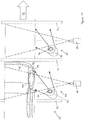
- FIG 13 shows a schematic top view representation of an embodiment of a side wall imaging system 45 in accordance with aspects of the present invention.
- the imaging system 45 comprises a first imaging section 46 and a second imaging section 47 for imaging a wheel on a vehicle 48 as it drives past.
- the first imaging section 46 comprises a first camera 49 and first and second flash units 50, 51.
- First camera 49 is positioned so that the top half 52 of the vehicle tyre 53 passes through the camera's field of view 54 as the vehicle 48 drives past.
- First and second flash units 50, 51 are positioned to illuminate the side wall 55 of the vehicle tyre 53.
- the first flash unit 50 is positioned to illuminate a near end 56 of the tyre 53, while flash unit 51 is positioned to illuminate a far side 57 of the tyre 53. Illumination across the tyre 53 while the vehicle 48 drives past can thus be achieved by activating both side flash units 50, 51 at the same time.
- the first and second flash units 50, 51 are positioned to direct flashes of light on to the side wall 55 surface at an angle of approximately 40° to the vehicle direction of travel (shown by arrow 60).
- the angle of incidence of the light to the direction of travel is in the range 30° to 50°, although other angles are possible.
- the illumination from the flashes causes shadows to be cast by embossed markings on the side wall 55 surface and by any damage in the side wall 55, such as cracks or bulges.
- a first sensor 58 detects when the vehicle is approaching the field of view 54 of the first camera 49, and then activates the flash units 50, 51 and the camera 49 to begin the imaging process as the vehicle passes the sensor 58.
- a second sensor 59 detects when the vehicle has exited the field of view 54 of the first camera 49, and deactivates the first camera 49 and the first and second flash units 50, 51.
- the first camera is positioned approximately 1.8 metres from the position of the vehicle tyre 53 when the system is in use. At this distance, the field of view of the camera is approximately 0.5 metres across.
- the first and second flash units are positioned approximately 0.5 metres and 0.2 metres respectively from the tyre when the system is in use. Having one side flash unit closer to the tyre than the other flash unit provides the advantage that the closer flash unit can illuminate tyres that are smaller and farther anyway.
- the second imaging section 47 comprises a second camera 61 and third and fourth flash units 62, 63. These components are arranged in the same manner as the first camera 49 and the first and second flash units 50, 51 of the first imaging section 46, but laterally displaced in the direction of travel by approximately 1 metre.
- the second sensor 59 which detects that the vehicle has left the first imaging section 46, also serves to determine that the vehicle has entered the second imaging section 47. When this happens, the second camera 61, and the third and fourth flash units 62, 63, are activated in a similar manner to that described previously with reference to the first imaging section 46.
- the tyre 53 rotates so that a different portion of the side wall 55 is positioned at the top of the tyre. Accordingly, the portion of the side wall 55 that is in the field of view of the second camera 61 is different from the portion that was in the field of view of the first camera 49. In this way, the second camera 61 is able to image a different portion of the side wall 55 from that imaged by the first camera 49.
- a third sensor 64 detects when the vehicle has moved out of the field of view of the second camera 61, and deactivates the second camera 61 and the third and fourth flash units 62, 63 when the vehicle exits the second imaging section 47.
- the cameras 49, 61 are JAI GigE GO-5000M-PGE cameras, which record at 23 frames per second, with a camera exposure of 200 microseconds at 5 megapixels, and use a 50mm lens (e.g. Kowa LM50HC-SW 14.50 horizontal view with 1" sensor). It will be appreciated that different cameras with other specifications could be used in this or in other embodiments.
- Figure 14 shows an alternative embodiment of a side wall imaging system 65.
- the system 65 comprises a first imaging section 66 and a second imaging section 67.
- the first and second imaging sections 66, 67 comprise respective first and second camera 68, 69, which are arranged in the same manner as the first and second cameras in the embodiment of Figure 13 .
- the imaging system 65 also comprises first, second and third sensors, 70, 71, 72 which are arranged and function in the same manner as the sensors of Figure 13 .
- the imaging system 65 functions in the same manner as the imaging system 45 of Figure 13 to image the side wall 73 of a tyre 74 on a vehicle 75, except that only one flash unit is provided in each imaging section, i.e. there is one flash unit per camera.
- First flash unit 76 in the first imaging section 66 is provided with a first parabolic reflector 77 and is positioned and angled so as to direct a beam of light onto the tyre 74 at an angle of incidence of approximately 35° to the vehicle's direction of travel as indicated by the arrow 78.
- the angle of incidence is between 20° and 50°, although other angles are possible.
- the light beam produced by the first flash unit 76 is directed by the first parabolic reflector 77 towards a far end 79 of the tyre 74. This helps to produce a more even intensity of light over the side wall surface as the brightest part of the light beam is directed onto the farthest part of the tyre.
- the use of the parabolic reflector 77 means that the illumination provided by the single flash unit 76 is sufficient to illuminate the entire side wall. This is in contrast with the embodiment of Figure 13 , where two flash units without parabolic reflectors are used to fully illuminate the portion of the side wall that is imaged by the camera.
- the parabolic reflector 77 also enables tyres that are smaller and/or farther away to be illuminated without the need for two side flash units per tyre. In other embodiments, e.g. the embodiment of Figure 13 , this may be achieved by having a side flash unit positioned closer to the vehicle.
- a second flash unit 80 is provided, with a corresponding second parabolic reflector 81.
- the second flash unit 80 and second reflector 81 are arranged in the same position as the first flash unit 76 and the first reflector 77, except that they are displaced laterally approximately 1 metre in the direction of travel 78.
- the second imaging section 67 thus operates in an equivalent manner to the first imaging section 66, but as the tyre has rotated due to the vehicle moving forward (as explained above), a different portion of the side wall 73 is imaged by the second camera 69.
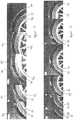
- Figure 15 shows a series of images obtained using the first camera in the embodiment shown in Figure 14 .
- Each of the successive images shown in Figure 15 corresponds to a frame of the recording of the first camera. It will be appreciated that not all of the images captured by the camera are shown in Figure 15 , as the first camera records at 23 frames per second.
- the images selected represent a range of image capture times from the point at which the tyre enters the camera's field of view to the time that its leaves.
- Each image in Figure 15 shows the upper part of a wheel 82 with its tyre 83 under the vehicle wheel arch 84.
- the text 85 "UNIROYAL" is visible, indicating that the tyre is of the UniroyalTM brand.
- additional embossed markings are also visible, which can be read from the images using image analysis software. The data extracted from this text can be used to identify the tyre specification.
- Figure 16 shows a similar series of images taken using the second camera in the embodiment of Figure 14 . Between the first and second cameras, the wheel has rotated as the vehicle moved forward and so the images of Figure 16 show the portion of the side wall that is not visible in the images of Figure 15 .
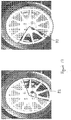
- Figure 17 shows two images of the wheel 82 that has been imaged in Figure 15 and 16 .
- a dotted line shows the major sector imaged by the first camera, as shown in Figure 15 .
- a dotted line shows the major sector imaged by the second camera, as shown in Figure 16 . It can be seen from these images that the images of the first and second camera together cover the entire tyre side wall, with some overlap.
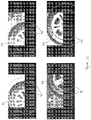
- Figure 18 shows four example images, each of a different tyre 86, 87, 88, 89, obtained using the system depicted in Figure 14 .
- Image analysis software has been used to identify the tyre in the image and to extrapolate the position of the whole tyre. The extrapolated position is shown in each image using white circles 90 which indicate the inner edge and periphery of the tyre.
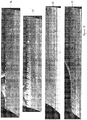
- the image software can be used to unwrap the tyre to show the entire side wall as a single elongate image. This is shown in Figure 19 .
- the four images correspond to a respective tyre as shown in Figure 18 .
- Having an unwrapped image of the side wall can assist with assessment of side wall damage, as the entire side wall is visible in a single image. It can also assist with the extraction of data from embossed markings on the side wall, as in the unwrapped images, the text can be viewed upright in a rectilinear format, which may help with, for example, optical character recognition for reading the data.
- Figures 20 to 26 show example side wall images obtained using a system in accordance with the present invention.
- FIG 20 the top half of a side wall 91 has been imaged.
- embossed text 92 can be seen.
- the text has been illuminated by a flash of light from a flash unit so that the embossed text casts shadows, creating contrasting regions of shadow and light causing the text to be clearly visible in the image.
- a reflection 93 of the flash of light can be seen in the bodywork of the car.
- Figure 21 shows another example of a side wall 94 that has been imaged in accordance with the present invention. Again, embossed text 95 can be seen on the side wall 94.
- Figure 22 shows a further example of a side wall 96 that has been imaged, with embossed text 97.
- logos On some of the side walls, there are also logos - for example, the logo 98 visible in Figure 22 .
- Image analysis of logos, pictograms, and similar markings may also be carried out by image analysis software to identify a tyre or otherwise obtain information related to it.
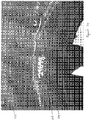
- Figure 23 shows an example of an image of a side wall 99 of a tyre, where the side wall has been damaged.
- the damage is visible as cracking 100 in the region of a side wall wear indicator 101.
- the wear indicator is provided in the tyre to provide an early indication that the thickness of the side wall is being reduced, and that a tyre will soon need to be replaced.
- Figure 24 shows another example of damage in the side wall 102 of a tyre. Cracking 103 is visible in the region of the tyre bead 104.
- Figure 25 shows an image of a tyre side wall 105 showing damage 106 resulting from retread failure, i.e. where replacement tread has been applied to a worn tyre to repair it, but the new tread has become detached from the tyre body.
- Figure 26 shows a further image of a tyre side wall 107 showing a tyre zipper rupture, i.e. a circumferential rupture in the mid side wall of the tyre.
Landscapes
- Physics & Mathematics (AREA)
- General Physics & Mathematics (AREA)
- Engineering & Computer Science (AREA)
- Mechanical Engineering (AREA)
- Computer Vision & Pattern Recognition (AREA)
- Theoretical Computer Science (AREA)
- Quality & Reliability (AREA)
- Length Measuring Devices By Optical Means (AREA)
- Stroboscope Apparatuses (AREA)
- Tires In General (AREA)
Claims (13)
- Procédé d'évaluation de l'état d'un pneumatique sur une roue (2) qui est montée sur un véhicule (1), tandis que le véhicule est en train de se déplacer et que le pneumatique est en train d'être entraîné en rotation et de se déplacer longitudinalement suivant une trajectoire de déplacement, la périphérie du pneumatique comportant des sections de bande de roulement qui sont séparées par des espaces de bande de roulement ; dans lequel le procédé comprend :l'utilisation d'un dispositif de prise d'image (3) pour capturer des images d'une pluralité de différentes sections de la périphérie du pneumatique tandis que le pneumatique réalise une révolution ;les images étant capturées tandis que des unités de flash espacées longitudinalement (F1, F2, F3, F4) sont activées de manière à ce qu'elles éclairent des sections de la périphérie du pneumatique ;les unités de flash étant positionnées sur un côté de la trajectoire de déplacement (A) du pneumatique et dirigeant de la lumière selon un angle aigu par rapport à la trajectoire de déplacement du pneumatique, la lumière ayant pour effet que des ombres sont projetées dans les espaces de bande de roulement entre les sections de bande de roulement ;et les images sont analysées par un appareil de traitement de données qui détermine l'étendue des ombres dans les espaces de bande de roulement de manière à fournir une indication de la profondeur des espaces de bande de roulement ; dans lequel :chaque unité de flash a pour effet qu'une série de flashs de lumière est produite lorsque l'unité de flash est activée, chaque flash de lumière de la série étant séparé du flash de lumière suivant de la série par un intervalle ;dans lequel pour de quelconques unités de flash (F1, F2, F3, F4) qui sont activées en même temps et qui éclairent des sections en chevauchement de la périphérie du pneumatique, les séries respectives de flashs sont déphasées de sorte que les flashs de lumière en provenance d'une unité de flash sont émis dans les intervalles entre les flashs de lumière en provenance de l'autre ou de chaque autre unité de flash ; et dans lequel :
la capture des images est synchronisée avec la production des flashs de lumière respectifs lorsque les unités de flash (F1, F2, F3, F4) sont activées. - Procédé tel que revendiqué selon la revendication 1, dans lequel chaque unité de flash (F1, F2, F3, F4), lorsqu'elle est activée, produit une série d'impulsions sensiblement identiques qui sont séparées par des intervalles qui sont sensiblement identiques.
- Procédé tel que revendiqué selon la revendication 2, dans lequel le dispositif de prise d'image (3) capture les images à une fréquence qui est sensiblement le double de la fréquence à laquelle les impulsions sont produites lorsqu'une unité de flash est activée.
- Procédé tel que revendiqué selon l'une quelconque des revendications qui précèdent, dans lequel un système de commande envoie des signaux de déclenchement pour délivrer des flashs depuis les unités de flash (F1, F2, F3, F4) et également des signaux de déclenchement pour forcer le dispositif de prise d'image (3) à capturer des images.
- Procédé tel que revendiqué selon l'une quelconque des revendications qui précèdent, dans lequel un système de détection de vitesse détecte la vitesse du véhicule, et la fréquence à laquelle les flashs sont délivrés par les unités de flash (F1, F2, F3, F4) et la fréquence à laquelle les images sont capturées par le dispositif de prise d'image (3) sont modifiées en fonction de la vitesse du véhicule.
- Procédé tel que revendiqué selon la revendication 5, dans lequel la fréquence à laquelle les flashs sont délivrés par les unités de flash (F1, F2, F3, F4) et la fréquence à laquelle les images sont capturées par le dispositif de prise d'image (3) sont à une première valeur si la vitesse du véhicule est en deçà d'une vitesse prédéterminée et sont à une seconde valeur plus élevée si la vitesse du véhicule est à la vitesse prédéterminée ou au-delà de celle-ci.
- Procédé tel que revendiqué selon la revendication 5, dans lequel la fréquence à laquelle les flashs sont délivrés par les unités de flash (F1, F2, F3, F4) et la fréquence à laquelle les images sont capturées par le dispositif de prise d'image (3) sont directement rapportées à la vitesse du véhicule.
- Procédé tel que revendiqué selon l'une quelconque des revendications qui précèdent, dans lequel le dispositif de prise d'image (3) capture les images tandis que le pneumatique mène à terme au moins une partie essentielle d'une révolution complète.
- Procédé tel que revendiqué selon l'une quelconque des revendications qui précèdent, comprenant en outre la prise d'image d'au moins une partie d'une paroi latérale du pneumatique en utilisant une pluralité de dispositifs de prise d'image de paroi latérale espacés longitudinalement de manière à capturer les images d'une pluralité de différentes sections de la paroi latérale du pneumatique tandis que le pneumatique réalise une révolution, les images étant capturées tandis que des unités de flash latérales espacées longitudinalement sont activées de manière à ce qu'elles éclairent des sections de la paroi latérale du pneumatique, les unités de flash latérales étant positionnées sur un côté de la trajectoire de déplacement du pneumatique et dirigeant de la lumière sur la paroi latérale du pneumatique selon un angle aigu par rapport à la trajectoire de déplacement longitudinale, dans lequel chaque unité de flash latérale a pour effet qu'une série de flashs de lumière est produite lorsque l'unité de flash latérale est activée, chaque flash de lumière de la série étant séparé du flash de lumière suivant de la série par un intervalle.
- Système pour évaluer l'état d'un pneumatique sur une roue qui est montée sur un véhicule, tandis que le véhicule est en train de se déplacer et que le pneumatique est en train d'être entraîné en rotation et de se déplacer longitudinalement suivant une trajectoire de déplacement, la périphérie du pneumatique comportant des sections de bande de roulement qui sont séparées par des espaces de bande de roulement ; le système comprenant :des unités de flash espacées longitudinalement (F1, F2, F3, F4) qui sont positionnées sur un côté de la trajectoire de déplacement du pneumatique et qui dirigent de la lumière selon un angle aigu par rapport à la trajectoire de déplacement du pneumatique, la lumière ayant pour effet que des ombres sont projetées dans les espaces de bande de roulement entre les sections de bande de roulement ;un dispositif de prise d'image (3) qui est agencé de manière à ce qu'il capture des images d'une pluralité de différentes sections de la périphérie du pneumatique tandis que le pneumatique réalise une révolution ;les images étant capturées tandis que les unités de flash espacées longitudinalement sont activées de manière à ce qu'elles éclairent des sections de la périphérie du pneumatique ; etun appareil de traitement de données qui est agencé de manière à ce qu'il analyse les images et à ce qu'il détermine l'étendue d'ombres dans les espaces de bande de roulement de manière à ce qu'il fournisse une indication de la profondeur des espaces de bande de roulement ;dans lequel chaque unité de flash a pour effet qu'une série de flashs de lumière est produite lorsque l'unité de flash est activée, chaque flash de lumière de la série étant séparé du flash de lumière suivant de la série par un intervalle ; dans lequel :
pour de quelconques unités de flash (F1, F2, F3, F4) qui sont activées en même temps et qui éclairent des sections en chevauchement de la périphérie du pneumatique, les unités de flash sont configurées de manière à ce qu'elles émettent les séries respectives de flashs de lumière en déphasage de telle sorte que les flashs de lumière en provenance d'une unité de flash soient émis dans les intervalles entre les flashs de lumière en provenance de l'autre ou de chaque autre unité de flash ; et dans lequel :
le dispositif de prise d'image (3) est configuré de manière à ce qu'il soit synchronisé avec la production des flashes de lumière respectifs lorsque les unités de flash sont activées. - Système selon la revendication 10, comprenant un système de détection de vitesse qui est configuré de manière à ce qu'il détecte une vitesse du véhicule et une fréquence à laquelle des flashes sont délivrés par les unités de flash (F1, F2, F3, F4) ;
dans lequel le dispositif de prise d'image (3) est configuré de manière à ce qu'il fasse varier la fréquence à laquelle les images sont capturées en fonction de la vitesse du véhicule. - Système selon la revendication 11, dans lequel ladite fréquence à laquelle les flashs sont délivrés par les unités de flash (F1, F2, F3, F4) et ladite fréquence à laquelle les images sont capturées par le dispositif de prise d'image (3) sont à une première valeur si la vitesse du véhicule est en deçà d'une vitesse prédéterminée et sont à une seconde valeur plus élevée si la vitesse du véhicule est à la vitesse prédéterminée ou au-delà de celle-ci.
- Système selon la revendication 11, dans lequel ladite fréquence à laquelle les flashs sont délivrés par les unités de flash et ladite fréquence à laquelle les images sont capturées par le dispositif de prise d'image (3) sont directement rapportées à la vitesse du véhicule.
Priority Applications (2)
| Application Number | Priority Date | Filing Date | Title |
|---|---|---|---|
| PL16781192T PL3359912T3 (pl) | 2015-10-09 | 2016-10-10 | Sposób i układ do analizy stanu opony |
| EP19151458.7A EP3489623A1 (fr) | 2015-10-09 | 2016-10-10 | Méthode et system pour imager une paroi latérale d'un pneumatique |
Applications Claiming Priority (2)
| Application Number | Priority Date | Filing Date | Title |
|---|---|---|---|
| GBGB1517926.0A GB201517926D0 (en) | 2015-10-09 | 2015-10-09 | Tyre condition analysis |
| PCT/GB2016/053148 WO2017060739A1 (fr) | 2015-10-09 | 2016-10-10 | Analyse de l'état d'un pneu |
Related Child Applications (2)
| Application Number | Title | Priority Date | Filing Date |
|---|---|---|---|
| EP19151458.7A Division EP3489623A1 (fr) | 2015-10-09 | 2016-10-10 | Méthode et system pour imager une paroi latérale d'un pneumatique |
| EP19151458.7A Division-Into EP3489623A1 (fr) | 2015-10-09 | 2016-10-10 | Méthode et system pour imager une paroi latérale d'un pneumatique |
Publications (2)
| Publication Number | Publication Date |
|---|---|
| EP3359912A1 EP3359912A1 (fr) | 2018-08-15 |
| EP3359912B1 true EP3359912B1 (fr) | 2020-01-01 |
Family
ID=55130846
Family Applications (2)
| Application Number | Title | Priority Date | Filing Date |
|---|---|---|---|
| EP19151458.7A Withdrawn EP3489623A1 (fr) | 2015-10-09 | 2016-10-10 | Méthode et system pour imager une paroi latérale d'un pneumatique |
| EP16781192.6A Active EP3359912B1 (fr) | 2015-10-09 | 2016-10-10 | Méthode et système d'analyse de l'état d'un pneu |
Family Applications Before (1)
| Application Number | Title | Priority Date | Filing Date |
|---|---|---|---|
| EP19151458.7A Withdrawn EP3489623A1 (fr) | 2015-10-09 | 2016-10-10 | Méthode et system pour imager une paroi latérale d'un pneumatique |
Country Status (13)
| Country | Link |
|---|---|
| US (1) | US10605697B2 (fr) |
| EP (2) | EP3489623A1 (fr) |
| JP (1) | JP6765728B2 (fr) |
| KR (1) | KR102578773B1 (fr) |
| CN (1) | CN108369088B (fr) |
| AU (1) | AU2016335369B2 (fr) |
| BR (1) | BR112018006997B1 (fr) |
| CA (1) | CA3000974C (fr) |
| ES (1) | ES2773106T3 (fr) |
| GB (1) | GB201517926D0 (fr) |
| PL (1) | PL3359912T3 (fr) |
| WO (1) | WO2017060739A1 (fr) |
| ZA (1) | ZA201803052B (fr) |
Cited By (1)
| Publication number | Priority date | Publication date | Assignee | Title |
|---|---|---|---|---|
| SE2450755A1 (en) * | 2024-07-03 | 2025-11-18 | Wheelscanning Sweden AB | Vehicle inspection system and method for inspecting a sidewall of a tire in such a system |
Families Citing this family (28)
| Publication number | Priority date | Publication date | Assignee | Title |
|---|---|---|---|---|
| RU2696343C2 (ru) | 2014-12-22 | 2019-08-01 | Пирелли Тайр С.П.А. | Способ и устройство для контроля шин на производственной линии |
| CN107110639B (zh) * | 2014-12-22 | 2020-10-09 | 倍耐力轮胎股份公司 | 用于检查轮胎生产线上的轮胎的装置 |
| US10670497B2 (en) * | 2015-12-16 | 2020-06-02 | Pirelli Tyre S.P.A | Device and method for analysis of tyres comprising first and second image acquistion systems |
| MX378779B (es) | 2015-12-16 | 2025-03-10 | Pirelli | Método y aparato para revisar neumáticos. |
| EP3397938B1 (fr) | 2015-12-28 | 2019-08-28 | Pirelli Tyre S.p.A. | Appareil de controle de pneus |
| US10809158B2 (en) | 2015-12-28 | 2020-10-20 | Pirelli Tyre S.P.A. | Apparatus and method for checking tyres |
| ITUA20162722A1 (it) * | 2016-04-19 | 2017-10-19 | Butler Eng And Marketing S P A | Dispositivo e metodo per l'analisi e il rilevamento di caratteristiche geometriche di un oggetto |
| BR112019016620A2 (pt) * | 2017-02-13 | 2020-03-31 | Wheelright Limited | Scanner de linha de piso |
| GB201706800D0 (en) * | 2017-04-28 | 2017-06-14 | Gould Daniel George | Method and apparatus for vehicle damage mapping |
| IT201800004673A1 (it) * | 2018-04-18 | 2019-10-18 | Procedimento e sistema per la rilevazione di difetti in uno pneumatico | |
| JP7030614B2 (ja) * | 2018-05-25 | 2022-03-07 | 株式会社ブリヂストン | タイヤ状態管理システム及びタイヤ状態管理プログラム |
| JP6985979B2 (ja) * | 2018-05-25 | 2021-12-22 | 株式会社ブリヂストン | タイヤ状態推定システム及びタイヤ状態推定プログラム |
| GB2580675A (en) | 2019-01-23 | 2020-07-29 | Wheelright Ltd | Tyre sidewall imaging method |
| GB2585633B (en) | 2019-05-14 | 2021-09-22 | Wheelright Ltd | Tyre sidewall imaging method |
| US11614380B2 (en) | 2019-07-02 | 2023-03-28 | Hunter Engineering Company | System and method for acquisition of tire sidewall data from a moving vehicle |
| US11338621B2 (en) | 2019-11-26 | 2022-05-24 | Hunter Engineering Company | Drive-over tire tread measurement system for heavy-duty multi-axle vehicles |
| CN110843428B (zh) * | 2019-12-23 | 2024-06-04 | 吉林大学 | 一种基于图像识别的随车轮胎内侧损伤检测装置 |
| JP7445117B2 (ja) * | 2019-12-26 | 2024-03-07 | 横浜ゴム株式会社 | タイヤ摩耗度判定装置、タイヤ摩耗度判定方法及びプログラム |
| EP4107475A4 (fr) * | 2020-02-21 | 2023-12-27 | Tyrata, Inc. | Système de banc de roulage magnétique permettant la mesure de l'épaisseur/de la profondeur de la bande de roulement d'un pneu |
| CN114001969A (zh) * | 2020-07-28 | 2022-02-01 | 威马智慧出行科技(上海)有限公司 | 车辆检测系统、方法及车辆 |
| US11562472B2 (en) * | 2020-09-30 | 2023-01-24 | Uveye Ltd. | System of tread depth estimation and method thereof |
| US12142005B2 (en) * | 2020-10-13 | 2024-11-12 | Autobrains Technologies Ltd | Camera based distance measurements |
| WO2022102571A1 (fr) * | 2020-11-10 | 2022-05-19 | 株式会社村田製作所 | Dispositif d'observation de pneu |
| JP2022087995A (ja) * | 2020-12-02 | 2022-06-14 | 日野自動車株式会社 | 車両検査装置 |
| US12188845B1 (en) | 2020-12-17 | 2025-01-07 | Hunter Engineering Company | System and method for capturing tire sidewall data from a moving vehicle |
| JP2023039726A (ja) * | 2021-09-09 | 2023-03-22 | Toyo Tire株式会社 | タイヤ溝深さ表示方法およびタイヤ溝深さ表示装置 |
| KR20240041143A (ko) * | 2022-09-22 | 2024-03-29 | 현대자동차주식회사 | 트레드 홈의 깊이 측정 장치, 방법 및 컴퓨터로 판독 가능한 저장 매체 |
| KR102939366B1 (ko) * | 2023-12-28 | 2026-03-16 | 주식회사 오씨모바일 | 타이어 스캐너 |
Family Cites Families (14)
| Publication number | Priority date | Publication date | Assignee | Title |
|---|---|---|---|---|
| SE368736B (fr) * | 1972-10-25 | 1974-07-15 | Hernsjoe Handels Ab | |
| US5987978A (en) * | 1997-04-02 | 1999-11-23 | Assembly Technology & Test Ltd. | Apparatus for testing tire tread depth |
| US6560883B2 (en) | 2000-06-28 | 2003-05-13 | Snap-On Technologies, Inc. | Method and system for conducting wheel alignment |
| DE102004050355A1 (de) | 2004-10-15 | 2006-04-27 | Steinbichler Optotechnik Gmbh | Verfahren und Vorrichtung zum Prüfen der Oberfläche eines Reifens |
| US7107138B2 (en) * | 2004-11-02 | 2006-09-12 | Joseph Edward Currie | Automotive speed control disable switch |
| EP1845338B1 (fr) * | 2006-04-13 | 2013-07-17 | Snap-on Equipment Srl a unico socio | Procédé de lecture optique de la surface de la chape du pneu d'une roue de véhicule |
| JP4480773B2 (ja) * | 2008-04-01 | 2010-06-16 | トヨタ自動車株式会社 | タイヤ種別判別方法、並びにこれを用いた車両検査方法及び装置 |
| US7975540B2 (en) | 2008-04-24 | 2011-07-12 | Rite-Solutions, Inc. | Methods and apparatus for tire tread measurement |
| EP2141475B1 (fr) * | 2008-07-03 | 2013-03-27 | Snap-on Equipment Srl a unico socio | Appareil pour déterminer l'état d'une chape de pneu d'une roue de véhicule |
| DE102009016498A1 (de) * | 2009-04-08 | 2010-10-21 | Ventech Gmbh | Verfahren und Vorrichtung zum Ermitteln der Profiltiefe eines Fahrzeugreifens |
| US8542881B2 (en) * | 2010-07-26 | 2013-09-24 | Nascent Technology, Llc | Computer vision aided automated tire inspection system for in-motion inspection of vehicle tires |
| WO2014117870A1 (fr) * | 2013-02-04 | 2014-08-07 | Me-Inspection Sk | Procédé, agencement de mesure et système servant à inspecter un objet tridimensionnel |
| DE102013207374A1 (de) | 2013-04-23 | 2014-10-23 | Robert Bosch Gmbh | Vorrichtung und Verfahren zum Erkennen von Beschriftungen auf Fahrzeugreifen |
| GB201318824D0 (en) * | 2013-10-24 | 2013-12-11 | Wheelright Ltd | Tyre condition analysis |
-
2015
- 2015-10-09 GB GBGB1517926.0A patent/GB201517926D0/en not_active Ceased
-
2016
- 2016-10-10 CA CA3000974A patent/CA3000974C/fr active Active
- 2016-10-10 EP EP19151458.7A patent/EP3489623A1/fr not_active Withdrawn
- 2016-10-10 JP JP2018516835A patent/JP6765728B2/ja active Active
- 2016-10-10 EP EP16781192.6A patent/EP3359912B1/fr active Active
- 2016-10-10 KR KR1020187013114A patent/KR102578773B1/ko active Active
- 2016-10-10 PL PL16781192T patent/PL3359912T3/pl unknown
- 2016-10-10 US US15/766,739 patent/US10605697B2/en active Active
- 2016-10-10 WO PCT/GB2016/053148 patent/WO2017060739A1/fr not_active Ceased
- 2016-10-10 CN CN201680072212.8A patent/CN108369088B/zh active Active
- 2016-10-10 ES ES16781192T patent/ES2773106T3/es active Active
- 2016-10-10 BR BR112018006997-3A patent/BR112018006997B1/pt active IP Right Grant
- 2016-10-10 AU AU2016335369A patent/AU2016335369B2/en active Active
-
2018
- 2018-05-09 ZA ZA2018/03052A patent/ZA201803052B/en unknown
Non-Patent Citations (1)
| Title |
|---|
| None * |
Cited By (2)
| Publication number | Priority date | Publication date | Assignee | Title |
|---|---|---|---|---|
| SE2450755A1 (en) * | 2024-07-03 | 2025-11-18 | Wheelscanning Sweden AB | Vehicle inspection system and method for inspecting a sidewall of a tire in such a system |
| SE547738C2 (en) * | 2024-07-03 | 2025-11-18 | Wheelscanning Sweden AB | Vehicle inspection system and method for inspecting a sidewall of a tire in such a system |
Also Published As
| Publication number | Publication date |
|---|---|
| CA3000974A1 (fr) | 2017-04-13 |
| CA3000974C (fr) | 2023-10-10 |
| CN108369088A (zh) | 2018-08-03 |
| ZA201803052B (en) | 2023-12-20 |
| PL3359912T3 (pl) | 2020-07-13 |
| EP3489623A1 (fr) | 2019-05-29 |
| JP6765728B2 (ja) | 2020-10-07 |
| ES2773106T3 (es) | 2020-07-09 |
| CN108369088B (zh) | 2020-05-08 |
| AU2016335369A1 (en) | 2018-05-24 |
| AU2016335369B2 (en) | 2020-12-10 |
| WO2017060739A1 (fr) | 2017-04-13 |
| US20180299352A1 (en) | 2018-10-18 |
| EP3359912A1 (fr) | 2018-08-15 |
| HK1251292A1 (en) | 2019-01-25 |
| JP2018537655A (ja) | 2018-12-20 |
| US10605697B2 (en) | 2020-03-31 |
| BR112018006997A2 (pt) | 2018-10-16 |
| KR102578773B1 (ko) | 2023-09-15 |
| BR112018006997B1 (pt) | 2022-10-11 |
| GB201517926D0 (en) | 2015-11-25 |
| KR20180071285A (ko) | 2018-06-27 |
Similar Documents
| Publication | Publication Date | Title |
|---|---|---|
| EP3359912B1 (fr) | Méthode et système d'analyse de l'état d'un pneu | |
| CN110057601B (zh) | 用于轮胎状况分析的方法和装置 | |
| US8621919B2 (en) | Method and apparatus for determining the tread depth of a vehicle tire | |
| CN101311669B (zh) | 安装或拆卸汽车轮胎的方法和设备 | |
| CN104662390B (zh) | 用于自动地光学检查车辆的至少一个车轮的胎面花纹的方法和系统 | |
| US20210155055A1 (en) | Drive-Over Tire Tread Measurement System For Heavy-Duty Multi-Axle Vehicles | |
| CN104937366A (zh) | 用于进行车辆测量的方法和装置 | |
| CN102812326B (zh) | 用于控制测量系统的方法和用于实施所述方法的测量系统 | |
| HK1251292B (en) | Method and system for tyre condition analysis | |
| HK40010426B (zh) | 用於轮胎状况分析的方法和装置 | |
| HK40010426A (en) | Method and device for tyre condition analysis |
Legal Events
| Date | Code | Title | Description |
|---|---|---|---|
| STAA | Information on the status of an ep patent application or granted ep patent |
Free format text: STATUS: THE INTERNATIONAL PUBLICATION HAS BEEN MADE |
|
| PUAI | Public reference made under article 153(3) epc to a published international application that has entered the european phase |
Free format text: ORIGINAL CODE: 0009012 |
|
| STAA | Information on the status of an ep patent application or granted ep patent |
Free format text: STATUS: REQUEST FOR EXAMINATION WAS MADE |
|
| 17P | Request for examination filed |
Effective date: 20180501 |
|
| AK | Designated contracting states |
Kind code of ref document: A1 Designated state(s): AL AT BE BG CH CY CZ DE DK EE ES FI FR GB GR HR HU IE IS IT LI LT LU LV MC MK MT NL NO PL PT RO RS SE SI SK SM TR |
|
| AX | Request for extension of the european patent |
Extension state: BA ME |
|
| DAV | Request for validation of the european patent (deleted) | ||
| DAX | Request for extension of the european patent (deleted) | ||
| REG | Reference to a national code |
Ref country code: HK Ref legal event code: DE Ref document number: 1251292 Country of ref document: HK |
|
| STAA | Information on the status of an ep patent application or granted ep patent |
Free format text: STATUS: EXAMINATION IS IN PROGRESS |
|
| 17Q | First examination report despatched |
Effective date: 20190124 |
|
| REG | Reference to a national code |
Ref country code: DE Ref legal event code: R079 Ref document number: 602016027409 Country of ref document: DE Free format text: PREVIOUS MAIN CLASS: G01B0011060000 Ipc: G01B0011240000 |
|
| GRAP | Despatch of communication of intention to grant a patent |
Free format text: ORIGINAL CODE: EPIDOSNIGR1 |
|
| STAA | Information on the status of an ep patent application or granted ep patent |
Free format text: STATUS: GRANT OF PATENT IS INTENDED |
|
| RIC1 | Information provided on ipc code assigned before grant |
Ipc: G01M 17/02 20060101ALI20190624BHEP Ipc: G01B 11/24 20060101AFI20190624BHEP Ipc: B60C 11/24 20060101ALI20190624BHEP |
|
| INTG | Intention to grant announced |
Effective date: 20190711 |
|
| GRAS | Grant fee paid |
Free format text: ORIGINAL CODE: EPIDOSNIGR3 |
|
| GRAA | (expected) grant |
Free format text: ORIGINAL CODE: 0009210 |
|
| STAA | Information on the status of an ep patent application or granted ep patent |
Free format text: STATUS: THE PATENT HAS BEEN GRANTED |
|
| AK | Designated contracting states |
Kind code of ref document: B1 Designated state(s): AL AT BE BG CH CY CZ DE DK EE ES FI FR GB GR HR HU IE IS IT LI LT LU LV MC MK MT NL NO PL PT RO RS SE SI SK SM TR |
|
| REG | Reference to a national code |
Ref country code: GB Ref legal event code: FG4D |
|
| REG | Reference to a national code |
Ref country code: CH Ref legal event code: EP Ref country code: AT Ref legal event code: REF Ref document number: 1220299 Country of ref document: AT Kind code of ref document: T Effective date: 20200115 |
|
| REG | Reference to a national code |
Ref country code: IE Ref legal event code: FG4D |
|
| REG | Reference to a national code |
Ref country code: DE Ref legal event code: R096 Ref document number: 602016027409 Country of ref document: DE |
|
| REG | Reference to a national code |
Ref country code: CH Ref legal event code: NV Representative=s name: SERVOPATENT GMBH, CH |
|
| REG | Reference to a national code |
Ref country code: NL Ref legal event code: FP |
|
| REG | Reference to a national code |
Ref country code: CH Ref legal event code: PCAR Free format text: NEW ADDRESS: WANNERSTRASSE 9/1, 8045 ZUERICH (CH) |
|
| REG | Reference to a national code |
Ref country code: ES Ref legal event code: FG2A Ref document number: 2773106 Country of ref document: ES Kind code of ref document: T3 Effective date: 20200709 |
|
| REG | Reference to a national code |
Ref country code: LT Ref legal event code: MG4D |
|
| PG25 | Lapsed in a contracting state [announced via postgrant information from national office to epo] |
Ref country code: RS Free format text: LAPSE BECAUSE OF FAILURE TO SUBMIT A TRANSLATION OF THE DESCRIPTION OR TO PAY THE FEE WITHIN THE PRESCRIBED TIME-LIMIT Effective date: 20200101 Ref country code: NO Free format text: LAPSE BECAUSE OF FAILURE TO SUBMIT A TRANSLATION OF THE DESCRIPTION OR TO PAY THE FEE WITHIN THE PRESCRIBED TIME-LIMIT Effective date: 20200401 Ref country code: FI Free format text: LAPSE BECAUSE OF FAILURE TO SUBMIT A TRANSLATION OF THE DESCRIPTION OR TO PAY THE FEE WITHIN THE PRESCRIBED TIME-LIMIT Effective date: 20200101 Ref country code: PT Free format text: LAPSE BECAUSE OF FAILURE TO SUBMIT A TRANSLATION OF THE DESCRIPTION OR TO PAY THE FEE WITHIN THE PRESCRIBED TIME-LIMIT Effective date: 20200527 Ref country code: LT Free format text: LAPSE BECAUSE OF FAILURE TO SUBMIT A TRANSLATION OF THE DESCRIPTION OR TO PAY THE FEE WITHIN THE PRESCRIBED TIME-LIMIT Effective date: 20200101 |
|
| PG25 | Lapsed in a contracting state [announced via postgrant information from national office to epo] |
Ref country code: IS Free format text: LAPSE BECAUSE OF FAILURE TO SUBMIT A TRANSLATION OF THE DESCRIPTION OR TO PAY THE FEE WITHIN THE PRESCRIBED TIME-LIMIT Effective date: 20200501 Ref country code: BG Free format text: LAPSE BECAUSE OF FAILURE TO SUBMIT A TRANSLATION OF THE DESCRIPTION OR TO PAY THE FEE WITHIN THE PRESCRIBED TIME-LIMIT Effective date: 20200401 Ref country code: SE Free format text: LAPSE BECAUSE OF FAILURE TO SUBMIT A TRANSLATION OF THE DESCRIPTION OR TO PAY THE FEE WITHIN THE PRESCRIBED TIME-LIMIT Effective date: 20200101 Ref country code: LV Free format text: LAPSE BECAUSE OF FAILURE TO SUBMIT A TRANSLATION OF THE DESCRIPTION OR TO PAY THE FEE WITHIN THE PRESCRIBED TIME-LIMIT Effective date: 20200101 Ref country code: GR Free format text: LAPSE BECAUSE OF FAILURE TO SUBMIT A TRANSLATION OF THE DESCRIPTION OR TO PAY THE FEE WITHIN THE PRESCRIBED TIME-LIMIT Effective date: 20200402 Ref country code: HR Free format text: LAPSE BECAUSE OF FAILURE TO SUBMIT A TRANSLATION OF THE DESCRIPTION OR TO PAY THE FEE WITHIN THE PRESCRIBED TIME-LIMIT Effective date: 20200101 |
|
| REG | Reference to a national code |
Ref country code: DE Ref legal event code: R097 Ref document number: 602016027409 Country of ref document: DE |
|
| PG25 | Lapsed in a contracting state [announced via postgrant information from national office to epo] |
Ref country code: DK Free format text: LAPSE BECAUSE OF FAILURE TO SUBMIT A TRANSLATION OF THE DESCRIPTION OR TO PAY THE FEE WITHIN THE PRESCRIBED TIME-LIMIT Effective date: 20200101 Ref country code: SM Free format text: LAPSE BECAUSE OF FAILURE TO SUBMIT A TRANSLATION OF THE DESCRIPTION OR TO PAY THE FEE WITHIN THE PRESCRIBED TIME-LIMIT Effective date: 20200101 Ref country code: EE Free format text: LAPSE BECAUSE OF FAILURE TO SUBMIT A TRANSLATION OF THE DESCRIPTION OR TO PAY THE FEE WITHIN THE PRESCRIBED TIME-LIMIT Effective date: 20200101 Ref country code: SK Free format text: LAPSE BECAUSE OF FAILURE TO SUBMIT A TRANSLATION OF THE DESCRIPTION OR TO PAY THE FEE WITHIN THE PRESCRIBED TIME-LIMIT Effective date: 20200101 Ref country code: RO Free format text: LAPSE BECAUSE OF FAILURE TO SUBMIT A TRANSLATION OF THE DESCRIPTION OR TO PAY THE FEE WITHIN THE PRESCRIBED TIME-LIMIT Effective date: 20200101 |
|
| PLBE | No opposition filed within time limit |
Free format text: ORIGINAL CODE: 0009261 |
|
| STAA | Information on the status of an ep patent application or granted ep patent |
Free format text: STATUS: NO OPPOSITION FILED WITHIN TIME LIMIT |
|
| REG | Reference to a national code |
Ref country code: AT Ref legal event code: MK05 Ref document number: 1220299 Country of ref document: AT Kind code of ref document: T Effective date: 20200101 |
|
| 26N | No opposition filed |
Effective date: 20201002 |
|
| PG25 | Lapsed in a contracting state [announced via postgrant information from national office to epo] |
Ref country code: AT Free format text: LAPSE BECAUSE OF FAILURE TO SUBMIT A TRANSLATION OF THE DESCRIPTION OR TO PAY THE FEE WITHIN THE PRESCRIBED TIME-LIMIT Effective date: 20200101 |
|
| PG25 | Lapsed in a contracting state [announced via postgrant information from national office to epo] |
Ref country code: SI Free format text: LAPSE BECAUSE OF FAILURE TO SUBMIT A TRANSLATION OF THE DESCRIPTION OR TO PAY THE FEE WITHIN THE PRESCRIBED TIME-LIMIT Effective date: 20200101 |
|
| PG25 | Lapsed in a contracting state [announced via postgrant information from national office to epo] |
Ref country code: MC Free format text: LAPSE BECAUSE OF FAILURE TO SUBMIT A TRANSLATION OF THE DESCRIPTION OR TO PAY THE FEE WITHIN THE PRESCRIBED TIME-LIMIT Effective date: 20200101 |
|
| REG | Reference to a national code |
Ref country code: BE Ref legal event code: MM Effective date: 20201031 |
|
| PG25 | Lapsed in a contracting state [announced via postgrant information from national office to epo] |
Ref country code: BE Free format text: LAPSE BECAUSE OF NON-PAYMENT OF DUE FEES Effective date: 20201031 |
|
| PG25 | Lapsed in a contracting state [announced via postgrant information from national office to epo] |
Ref country code: MT Free format text: LAPSE BECAUSE OF FAILURE TO SUBMIT A TRANSLATION OF THE DESCRIPTION OR TO PAY THE FEE WITHIN THE PRESCRIBED TIME-LIMIT Effective date: 20200101 Ref country code: CY Free format text: LAPSE BECAUSE OF FAILURE TO SUBMIT A TRANSLATION OF THE DESCRIPTION OR TO PAY THE FEE WITHIN THE PRESCRIBED TIME-LIMIT Effective date: 20200101 |
|
| PG25 | Lapsed in a contracting state [announced via postgrant information from national office to epo] |
Ref country code: MK Free format text: LAPSE BECAUSE OF FAILURE TO SUBMIT A TRANSLATION OF THE DESCRIPTION OR TO PAY THE FEE WITHIN THE PRESCRIBED TIME-LIMIT Effective date: 20200101 Ref country code: AL Free format text: LAPSE BECAUSE OF FAILURE TO SUBMIT A TRANSLATION OF THE DESCRIPTION OR TO PAY THE FEE WITHIN THE PRESCRIBED TIME-LIMIT Effective date: 20200101 |
|
| P01 | Opt-out of the competence of the unified patent court (upc) registered |
Effective date: 20230603 |
|
| REG | Reference to a national code |
Ref country code: CH Ref legal event code: U11 Free format text: ST27 STATUS EVENT CODE: U-0-0-U10-U11 (AS PROVIDED BY THE NATIONAL OFFICE) Effective date: 20251101 |
|
| PGFP | Annual fee paid to national office [announced via postgrant information from national office to epo] |
Ref country code: LU Payment date: 20251022 Year of fee payment: 10 Ref country code: NL Payment date: 20251021 Year of fee payment: 10 |
|
| PGFP | Annual fee paid to national office [announced via postgrant information from national office to epo] |
Ref country code: DE Payment date: 20251021 Year of fee payment: 10 |
|
| PGFP | Annual fee paid to national office [announced via postgrant information from national office to epo] |
Ref country code: GB Payment date: 20251022 Year of fee payment: 10 |
|
| PGFP | Annual fee paid to national office [announced via postgrant information from national office to epo] |
Ref country code: IT Payment date: 20251021 Year of fee payment: 10 |
|
| PGFP | Annual fee paid to national office [announced via postgrant information from national office to epo] |
Ref country code: FR Payment date: 20251030 Year of fee payment: 10 |
|
| PGFP | Annual fee paid to national office [announced via postgrant information from national office to epo] |
Ref country code: TR Payment date: 20251006 Year of fee payment: 10 |
|
| PGFP | Annual fee paid to national office [announced via postgrant information from national office to epo] |
Ref country code: CH Payment date: 20251101 Year of fee payment: 10 |
|
| PGFP | Annual fee paid to national office [announced via postgrant information from national office to epo] |
Ref country code: IE Payment date: 20251024 Year of fee payment: 10 Ref country code: CZ Payment date: 20251002 Year of fee payment: 10 |
|
| PGFP | Annual fee paid to national office [announced via postgrant information from national office to epo] |
Ref country code: PL Payment date: 20251003 Year of fee payment: 10 |
|
| PGFP | Annual fee paid to national office [announced via postgrant information from national office to epo] |
Ref country code: ES Payment date: 20251216 Year of fee payment: 10 |