EP3360357B1 - Funkzugangsknoten und verfahren zum betreiben desselben - Google Patents
Funkzugangsknoten und verfahren zum betreiben desselben Download PDFInfo
- Publication number
- EP3360357B1 EP3360357B1 EP16775348.2A EP16775348A EP3360357B1 EP 3360357 B1 EP3360357 B1 EP 3360357B1 EP 16775348 A EP16775348 A EP 16775348A EP 3360357 B1 EP3360357 B1 EP 3360357B1
- Authority
- EP
- European Patent Office
- Prior art keywords
- cell
- cells
- radio access
- access node
- communication device
- Prior art date
- Legal status (The legal status is an assumption and is not a legal conclusion. Google has not performed a legal analysis and makes no representation as to the accuracy of the status listed.)
- Active
Links
Images





Classifications
-
- H—ELECTRICITY
- H04—ELECTRIC COMMUNICATION TECHNIQUE
- H04L—TRANSMISSION OF DIGITAL INFORMATION, e.g. TELEGRAPHIC COMMUNICATION
- H04L63/00—Network architectures or network communication protocols for network security
- H04L63/06—Network architectures or network communication protocols for network security for supporting key management in a packet data network
- H04L63/062—Network architectures or network communication protocols for network security for supporting key management in a packet data network for key distribution, e.g. centrally by trusted party
-
- H—ELECTRICITY
- H04—ELECTRIC COMMUNICATION TECHNIQUE
- H04W—WIRELESS COMMUNICATION NETWORKS
- H04W12/00—Security arrangements; Authentication; Protecting privacy or anonymity
- H04W12/03—Protecting confidentiality, e.g. by encryption
- H04W12/033—Protecting confidentiality, e.g. by encryption of the user plane, e.g. user's traffic
-
- H—ELECTRICITY
- H04—ELECTRIC COMMUNICATION TECHNIQUE
- H04W—WIRELESS COMMUNICATION NETWORKS
- H04W12/00—Security arrangements; Authentication; Protecting privacy or anonymity
- H04W12/03—Protecting confidentiality, e.g. by encryption
- H04W12/037—Protecting confidentiality, e.g. by encryption of the control plane, e.g. signalling traffic
-
- H—ELECTRICITY
- H04—ELECTRIC COMMUNICATION TECHNIQUE
- H04W—WIRELESS COMMUNICATION NETWORKS
- H04W12/00—Security arrangements; Authentication; Protecting privacy or anonymity
- H04W12/04—Key management, e.g. using generic bootstrapping architecture [GBA]
- H04W12/041—Key generation or derivation
-
- H—ELECTRICITY
- H04—ELECTRIC COMMUNICATION TECHNIQUE
- H04W—WIRELESS COMMUNICATION NETWORKS
- H04W12/00—Security arrangements; Authentication; Protecting privacy or anonymity
- H04W12/04—Key management, e.g. using generic bootstrapping architecture [GBA]
- H04W12/043—Key management, e.g. using generic bootstrapping architecture [GBA] using a trusted network node as an anchor
- H04W12/0433—Key management protocols
-
- H—ELECTRICITY
- H04—ELECTRIC COMMUNICATION TECHNIQUE
- H04W—WIRELESS COMMUNICATION NETWORKS
- H04W12/00—Security arrangements; Authentication; Protecting privacy or anonymity
- H04W12/08—Access security
-
- H—ELECTRICITY
- H04—ELECTRIC COMMUNICATION TECHNIQUE
- H04W—WIRELESS COMMUNICATION NETWORKS
- H04W12/00—Security arrangements; Authentication; Protecting privacy or anonymity
- H04W12/10—Integrity
-
- H—ELECTRICITY
- H04—ELECTRIC COMMUNICATION TECHNIQUE
- H04W—WIRELESS COMMUNICATION NETWORKS
- H04W36/00—Hand-off or reselection arrangements
- H04W36/0005—Control or signalling for completing the hand-off
- H04W36/0011—Control or signalling for completing the hand-off for data sessions of end-to-end connection
- H04W36/0033—Control or signalling for completing the hand-off for data sessions of end-to-end connection with transfer of context information
- H04W36/0038—Control or signalling for completing the hand-off for data sessions of end-to-end connection with transfer of context information of security context information
Definitions
- This disclosure relates to a radio access node in a communication network and a method of operating the same, and in particular relates to a radio access node that supports a plurality of cells.
- a trend in today's networks is for the operator to add more frequencies and reduce the size of cells to increase the capacity of mobile broadband.
- This leads to an increase in UE (User Equipment) reconfigurations and mobility actions. Examples of reconfigurations are when UEs are connected to multiple cells simultaneously, and the eNB (the node with which the UEs communicate over the air interface, and that controls a set of cells) may then enable and disable connectivity with the UE through the set of cells it controls.
- UE User Equipment
- MFBI Multi Frequency Band Indicators
- the present disclosure relates to security when a UE connects to an eNB through one of a number of cells.
- the present disclosure relates to a problem during handover between cells that arises, for example, due to the way in which security of handovers in LTE is tied to the EARFCN.
- Outlines of security in LTE and handovers in LTE are presented below, however this disclosure should not be interpreted as only applying to LTE.
- the communication between the UE and the eNB is encrypted and partially integrity protected.
- the integrity and encryption keys are derived from a common root key called the K eNB which is shared between the UE and the eNB.
- the K eNB can be said to be used to protect traffic, and this should be understood as meaning that the K eNB is used to derive encryption and integrity keys that are used to encrypt and integrity protect traffic.
- the integrity protection and encryption keys are derived from the K eNB and an identifier for which integrity or encryption algorithm the key should be used with.
- the K eNB is unique to the UE-eNB pair.
- the same K eNB is never used to protect the traffic between the UE and two different eNBs, and, likewise, the same K eNB is not used to protect traffic between two different UEs and the network.
- the rationale behind this design is to prevent an attacker that has gained access to or knowledge of a K eNB that is used between a UE and a first eNB to have any use for that K eNB when attempting to break encryption or integrity on traffic between the UE and a physically different eNB.
- K eNB is changed during handover between two eNBs.
- K eNB is actually changed on all intra-LTE handovers (e.g. handover between cells), even when the source eNB and target eNB is the same node.
- the uniqueness of the UE-K eNB pair during handover is achieved by the fact that the UE and source eNB derive a new K eNB (denoted K eNB *) from the current K eNB , the Physical Cell Identifier (PCI) of the target primary cell (PCell) and the target physical cell downlink frequency.
- K eNB * the K eNB
- PCI Physical Cell Identifier
- PCell the target primary cell
- PCell target physical cell downlink frequency
- KDF key derivation function
- a handover between two eNBs without core network involvement a so-called X2 handover, is described below with reference to Figure 1 .
- Handovers can be performed after the UE has completed all necessary procedures to activate Radio Resource Control (RRC) and Non-Access Stratum (NAS) security.
- RRC Radio Resource Control
- NAS Non-Access Stratum
- the X2 handover is initiated by the source eNB 1 calculating a K eNB * key from the currently active K eNB , shared between the source eNB 1 and the UE 2, and sending it together with the UE security capabilities to the target eNB 3 in a handover request message 4.
- the target eNB 3 replies with the required configuration information 5 for the UE connection. This information includes the chosen algorithms that the target eNB 3 and the UE 2 shall use.
- the source eNB 1 then forwards the reply to the UE 2 (signal 6), and the UE 2 confirms the handover with a completion message 7 to the target eNB 3.
- the target eNB 3 retrieves a new key called the Next Hop key (NH) from a Mobility Management Entity (MME).
- the NH is derived from a key K ASME (a base key that is shared by the UE and MME) and the NH is used as a basis for the calculation of K eNB * in the next handover event.
- PCI Physical Cell Identifier
- EARFCN-DL of the primary cell PCell
- the first of the problems is the prevention of the ability to quickly move or resume a UE session between cells. This is becoming increasingly important in order to fit with traffic patterns associated with short data bursts.
- the traffic bursts may be sent from the UE to the eNB over one of many cells controlled by the eNB.
- the encryption is tied to the primary cell (via the use of the EARFCN-DL of the primary cell and the PCI in the derivation of the key K eNB )
- each time the UE reconnects in another cell a key renegotiation must be performed before traffic can resume.
- MFBI provides the possibility that one cell can belong to multiple bands, even though it is only serving one physical frequency. Since the EARFCN of a cell is unique per band, this means that the EARFCN-DL of the cell may differ, depending on which band the UE uses. Consequently, if an eNB wants to enable and/or disable bearers on different frequencies an intra-eNB or intra-cell handover is required according to current standards, and hence the buffering and re-encryption issues remain.
- the EARFCN-DL binding to K eNB prevents multi-connectivity being used in a flexible way, e.g. switching freely between PCells without having to suspend all sessions and negotiate a new encryption key.
- SCells can be reconfigured without suspending the user plane traffic, but when the PCell changes then all user plane traffic must be suspended (even for cells that have good connectivity).
- FIG. 2 An example is shown in Figure 2 where a UE 8 and radio access network, RAN (represented by eNB 9) performs key renegotiation when the UE 8 moves between cell 1 (10-1) and cell 2 (10-2), e.g. when the UE 8 is at location A.
- the eNB 9 and UE 8 first suspend all radio bearers in the session, then any already-ciphered Packet Data Convergence Protocol (PDCP) packets that are not confirmed as received by the UE must be de-ciphered and re-ciphered using the new encryption key. Once reconfiguration is complete the data session can be resumed.
- PDCP Packet Data Convergence Protocol
- Multicarrier means that a UE can be connected to more than one cell at the same time and use the combined bandwidth to schedule the UE.
- the UE must have one primary cell but can have several secondary cells.
- the Physical cell ID of the PCell is used as the input parameter for the K eNB generation, and the EARFCN-DL is taken from the frequency of the PCell as well.
- Figure 3 shows an eNB 9 that is controlling four cells, 10-1, 10-2, 10-3 and 10-4.
- the Figure illustrates a handover-chain scenario with a UE 8 in three different locations, A, B and C where the binding of the K eNB to the PCI and EARFCN-DL creates a highly inefficient process.
- the UE 8 is connected to cell 1 (10-1) and 4 (10-4)
- the UE 8 is connected to cell 1 (10-1), 3 (10-3) and 4 (10-4)
- at location C the UE 8 is connected to cell 2 (10-2), 3 (10-3) and 4 (10-4).
- the fifth problem is an additional problem that MFBI has introduced and results from the fact that carrier aggregation is only supported between a limited set of bands (also to reduce UE cost). Since the standard has defined that the UE should initially be configured with the EARFCN-DL of the primary band (if supported by the UE), it may prove that carrier aggregation between that band (of the PCell) and a potential SCell is not supported, but where one of the additional bands of the PCell can be combined with the potential SCell.
- the EARFCN-DL of the PCell has to be changed. That is achieved by performing a procedure called intra-cell handover, and is the same mechanism that is used for key-change-on-the-fly to update the K eNB and hence implicitly the encryption key. In terms of signalling this intra-cell handover looks like a handover, but no change of PCell has actually been made.
- NEC corporation "Security aspects for independent PDCP", 3GPP draft; R2-132675_security, 3rd generation partnership project (3GPP), mobile competence centre; 650, route des lucioles; F- 06921 sophia-antipolis cedex; France, vol. RAN WG2, no. Barcelona, Spain; 20130819-20130823 9 August 2013 (2013-08-09), XP050718276 discloses two types of security options for dual connectivity.
- the invention is defined by the independent claims. Furthermore, embodiments of the invention are defined by the claims. According to a first aspect, there is provided a method of operating a first radio access node in a communication network.
- the first radio access node supports a plurality of cells that are divided into one or more groups of cells, where at least a first group of cells comprises more than one cell.
- the method comprises determining a first base key for a communication device that is to connect to the first radio access node via a first cell in a first group of cells; wherein the first base key is determined from an identifier for the first group of cells; using the first base key to determine a first encryption key that is to be used to encrypt communications between the communication device and the first radio access node via the first cell; and in the event that the communication device is to connect to the first radio access node via a second cell in the first group of cells, using the first encryption key to encrypt communications between the communication device and the first radio access node via the second cell.
- a first radio access node for use in a communication network.
- the first radio access node supports a plurality of cells that are divided into one or more groups of cells, where at least a first group of cells comprises more than one cell.
- the first radio access node is adapted or configured to (or comprises one or more modules configured to) determine a first base key for a communication device that is to connect to the first radio access node via a first cell in a first group of cells; wherein the first base key is determined from an identifier for the first group of cells; use the first base key to determine a first encryption key that is to be used to encrypt communications between the communication device and the first radio access node via the first cell; use the first encryption key to encrypt communications between the communication device and the first radio access node in the event that the communication device is to connect to the first radio access node via a second cell in the first group of cells.
- a first radio access node for use in a communication network.
- the first radio access node comprises a processor and a memory, said memory containing instructions executable by said processor whereby said first radio access node is operative to perform the method according to the first aspect set out above.
- a method of operating a communication device comprises determining a first base key for a first cell in a first group of cells from an identifier for the first group of cells, the first group of cells being supported by a first radio access node; using the first base key to determine a first encryption key that is to be used to encrypt communications between the communication device and the first radio access node via the first cell; and, in the event that the communication device is to connect to a second cell in the first group of cells, using the first encryption key to encrypt communications between the communication device and the first radio access node via the second cell.
- a communication device is adapted or configured to (or comprises one or more modules configured to) determine a first base key for a first cell in a first group of cells from an identifier for the first group of cells, wherein the first group of cells are supported by a first radio access node; use the first base key to determine a first encryption key that is to be used to encrypt communications between the communication device and the first radio access node via the first cell; and use the first encryption key to encrypt communications between the communication device and the first radio access node in the event that the communication device is to connect to a second cell in the first group of cells.
- a communication device comprising a processor and a memory, said memory containing instructions executable by said processor whereby said communication device is operative to perform the method according to the fourth aspect set out above.
- a method of operating a node in a communication network comprises determining a first base key for use by a first radio access node and a communication device that is to connect to the first radio access node via a first cell in a first group of cells, wherein the first radio access node supports a plurality of cells that are divided into one or more groups of cells, where at least the first group of cells comprises more than one cell, and wherein the first base key is determined from an identifier for the first group of cells.
- a node for use in a communication network.
- the node is adapted or configured to (or comprises one or more modules configured to) determine a first base key for use by a first radio access node and a communication device that is to connect to the first radio access node via a first cell in a first group of cells, wherein the first radio access node supports a plurality of cells that are divided into one or more groups of cells, where at least a first group of cells comprises more than one cell, and wherein the first base key is determined from an identifier for the first group of cells.
- a node for use in a communication network.
- the node comprises a processor and a memory, said memory containing instructions executable by said processor whereby said node is operative to perform the method according to the seventh aspect set out above.
- a computer program product comprising a non-transitory computer readable medium having computer readable code embodied therein.
- the computer readable code is configured such that, on execution by a suitable computer or processor, the computer or processor is caused to perform any of the method aspects set out above.
- Hardware implementation may include or encompass, without limitation, digital signal processor (DSP) hardware, a reduced instruction set processor, hardware (e.g., digital or analog) circuitry including but not limited to application specific integrated circuit(s) (ASIC) and/or field programmable gate array(s) (FPGA(s)), and (where appropriate) state machines capable of performing such functions.
- DSP digital signal processor
- ASIC application specific integrated circuit
- FPGA field programmable gate array
- a computer is generally understood to comprise one or more processors, one or more processing units, one or more processing modules or one or more controllers, and the terms computer, processor, processing unit, processing module and controller may be employed interchangeably.
- the functions may be provided by a single dedicated computer, processor, processing unit, processing module or controller, by a single shared computer, processor, processing unit, processing module or controller, or by a plurality of individual computers, processors, processing units, processing modules or controllers, some of which may be shared or distributed.
- these terms also refer to other hardware capable of performing such functions and/or executing software, such as the example hardware recited above.
- UE user equipment
- UE user equipment
- a UE herein may comprise a UE (in its general sense) capable of operating or at least performing measurements in one or more frequencies, carrier frequencies, component carriers or frequency bands. It may be a "UE” operating in single- or multi-radio access technology (RAT) or multi-standard mode.
- RAT radio access technology
- terminal device As well as “UE”, the general terms “terminal device”, “communication device” and “wireless communication device” are used in the following description, and it will be appreciated that such a device may or may not be 'mobile' in the sense that it is carried by a user. Instead, the term “terminal device” (and the alternative general terms set out above) encompasses any device that is capable of communicating with communication networks that operate according to one or more mobile communication standards, such as the Global System for Mobile communications, GSM, UMTS, Long-Term Evolution, LTE, etc.
- a UE may comprise a Universal Subscription Identity Module (USIM) on a smart-card or implemented directly in the UE, e.g., as software or as an integrated circuit. The operations described herein may be partly or fully implemented in the USIM or outside of the USIM.
- USIM Universal Subscription Identity Module
- One or more cells are associated with a base station, where a base station comprises in a general sense any network node transmitting radio signals in the downlink and/or receiving radio signals in the uplink.
- Some example base stations, or terms used for describing base stations are eNodeB, eNB, NodeB, macro/micro/pico/femto radio base station, home eNodeB (also known as femto base station), relay, repeater, sensor, transmitting-only radio nodes or receiving-only radio nodes.
- a base station may operate or at least perform measurements in one or more frequencies, carrier frequencies or frequency bands and may be capable of carrier aggregation. It may also be a single-radio access technology (RAT), multi-RAT, or multi-standard node, e.g., using the same or different base band modules for different RATs.
- RAT single-radio access technology
- multi-RAT multi-RAT
- multi-standard node e.g., using the same or different base band modules for different RAT
- the signalling described is either via direct links or logical links (e.g. via higher layer protocols and/or via one or more network nodes).
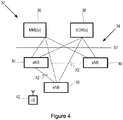
- FIG. 4 shows an example diagram of an evolved Universal Mobile Telecommunications System (UMTS) Terrestrial Radio Access Network (E-UTRAN) architecture as part of an LTE-based communications system 32 to which the techniques described herein can be applied.
- Nodes in a core network 34 part of the system 32 include one or more Mobility Management Entities (MMEs) 36, a key control node for the LTE access network, and one or more Serving Gateways (SGWs) 38 which route and forward user data packets while acting as a mobility anchor. They communicate with base stations or radio access nodes 40 referred to in LTE as eNBs, over an interface, for example an S1 interface.
- the eNBs 40 can include the same or different categories of eNBs, e.g.
- the eNBs 40 communicate with each other over an inter-node interface, for example an X2 interface.
- the S1 interface and X2 interface are defined in the LTE standard.
- a UE 42 is shown, and a UE 42 can receive downlink data from and send uplink data to one of the base stations 40, with that base station 40 being referred to as the serving base station of the UE 42.
- FIG. 5 shows a communication device/terminal device (UE) 42 that can be adapted or configured to operate according to one or more of the non-limiting example embodiments described.
- the UE 42 comprises a processor or processing unit 50 that controls the operation of the UE 42.
- the processing unit 50 is connected to a transceiver unit 52 (which comprises a receiver and a transmitter) with associated antenna(s) 54 which are used to transmit signals to and receive signals from a radio access node 40 in the network 32.
- the UE 42 also comprises a memory or memory unit 56 that is connected to the processing unit 50 and that contains instructions or computer code executable by the processing unit 50 and other information or data required for the operation of the UE 42.
- FIG. 6 shows a radio access node (for example a cellular network base station such as a NodeB or an eNodeB, eNB) that can be adapted or configured to operate according to the example embodiments described.
- the radio access node 40 comprises a processor or processing unit 60 that controls the operation of the radio access node 40.
- the processing unit 60 is connected to a transceiver unit 62 (which comprises a receiver and a transmitter) with associated antenna(s) 64 which are used to transmit signals to, and receive signals from, UEs 42 in the network 32.
- the radio access node 40 also comprises a memory or memory unit 66 that is connected to the processing unit 60 and that contains instructions or computer code executable by the processing unit 60 and other information or data required for the operation of the radio access node 40.
- the radio access node 40 also includes components and/or circuitry 68 for allowing the radio access node 40 to exchange information with another radio access node 40 (for example via an X2 interface), and/or with a core network node 36, 38 (for example via an S1 interface).
- base stations for use in other types of network e.g. UTRAN or WCDMA RAN
- a radio access node 40 can be implemented as a number of distributed functions in the radio access network (RAN).
- FIG. 7 shows a core network node 36, 38 that can be used in the example embodiments described.
- the node 36, 38 could be an MME 36, an SGW 38, or another type of core network node (e.g. a radio network controller, RNC).
- the node 36, 38 comprises a processing unit 70 that controls the operation of the node 36, 38.
- the processing unit 70 is connected to interface components and/or circuitry 72 for allowing the node 36, 38 to exchange information with network nodes in the radio access network (RAN), for example radio access nodes 40, which it is associated (which is typically via the S1 interface) and/or with other nodes in the core network part of the network.
- the node 36, 38 also comprises a memory unit 74 that is connected to the processing unit 70 and that stores program and other information and data required for the operation of the node 36, 38.
- LTE Long Term Evolution
- UEs user equipments
- the techniques described herein provide a simple and fast way to allow a UE to enable and disable connectivity to an eNB through multiple cells (including PCells) that may have different EARFCN-DL, without having to reconfigure the encryption too frequently, for example in a deployment scenario where PDCP is centralized or when several eNBs are allocated in the same hardware equipment.
- PCells including PCells
- Currently such an action requires re-keying and hence causes significant processing delays and the need to storage packets in a buffer.
- the cells are grouped into one or more groups. These groups are referred to herein as "security areas", although this name should not be seen as limiting. Each group can comprise more than one cell, and it is possible for all of the cells of an eNB to be in the same group. At least a first group of cells comprises more than one cell, and in some embodiments, each group comprises at least two cells.
- Each of the security areas (groups) is given a respective identifier that is referred to herein as a "security area identifier". Thus, a "security area identifier" may be shared by two or more physical cells or beams.
- the particular cells that belong to the same security area may be determined, e.g., based on whether the encryption of the traffic for the collection of cells is performed within the same secure environment.
- an eNB may have a distributed architecture, where the encryption is performed in physically different hardware, and the main gain of changing K eNB at a handover is, as pointed out above, to protect keys that are used in different physical eNBs (or physically different entities performing the functions of a distributed eNB implementation).
- an Access Stratum (AS)-base key for example K eNB and encryption keys derived from it, for a particular communication device/terminal device (UE) can be reused by the UE in each of the cells of the security area (group).
- AS Access Stratum
- the eNB 40 within a given security area, uses the same K eNB , and encryption key derived from it, for a specific UE (and likewise the UE uses the same K eNB , and encryption keys derived from it, for the different cells in the security area). It will be appreciated that if the same integrity or encryption algorithm is used and the K eNB remains the same, then the encryption key and integrity key will also remain the same.
- This reuse of the keys enables the UE to move (e.g., handover) between cells in a group without the eNB 40 or UE 42 having to reconfigure the AS-base key, K eNB , or an associated encryption key, and hence the eNB can seamlessly activate and deactivate cells for a UE inside the security area in a very fast and flexible way. If the UE moves (e.g., hands-over) to a cell that is in a different security area (e.g.
- a new AS-base key (denoted K eNB *) is derived by the relevant eNB 40 and the UE 42, along with a new encryption key, for use by the UE in that other security area. It will be appreciated that the UE and the eNB may share more than one K eNB at any given time.
- the UE can reconnect to any cell within a particular security area and resume the current configuration, which comprises continuing to use the same K eNB and encryption key. This reduces the setup delay considerably, thereby improving the end user experience and performance.
- FIG. 8 An exemplary grouping of cells into two groups for an eNB 40 is shown in Figure 8 .
- the eNB 40 has six cells, labelled Cell 1 to Cell 6.
- Cells 1-4 are grouped into one security area 80
- Cells 5 and 6 are grouped into a second security area 82.
- Cells 1-6 are shown as generally covering a respective geographical area, it is possible that two or more of the cells could substantially spatially overlap (for example if they use different frequencies).
- the eNB 40 can inform the UE about which security area a certain cell belongs to, and the identifier for the security area.
- This information can be communicated to the UE in one of a number of ways, for example in system control information (e.g., in a System Information Block, SIB) or in dedicated UE signalling (e.g., Radio Resource Control (RRC), Radio Link Control (RLC), or Medium Access Control (MAC) signalling).
- SIB System Information Block
- RRC Radio Resource Control
- RLC Radio Link Control
- MAC Medium Access Control
- the security configuration is, for all practical purposes, made distinct to the security area by making the AS-base key dependent on the security area itself.
- the AS-base key can be made dependent on the security area by deriving the AS-base key using the security area identifier as an input to the key-generation function.
- the AS-base key can be generated from different types of existing key material. For example, it can be generated from a previous AS-base key (e.g., a K eNB , and the new AS-base key would then correspond to the K eNB *). It could also be generated from an NH value or K ASME , as described above.
- the AS-base key can be derived from such previous keys using a Key Derivation Function (KDF), for example, HMAC-SHA256.
- KDF Key Derivation Function
- an eNB may prepare a number of potential target cells for handover. During the preparation, the eNB will provide the potential target cells with keying material to be used with the UE in case the UE is handed over to that particular target cell. To avoid an eNB of a potential target cell that is not selected for handover getting the keying material (e.g. K eNB *) that is used between the actual target cell and the UE, the source eNB individually calculates the keying material for each potential target cell. Specifically, the source eNB includes the PCI and EARFCN-DL for the target cell in the key material calculation.
- the keying material e.g. K eNB *
- the result is that two or more prepared target cells that belong to different security areas will get different K eNB *s. This ensures that if an attacker that gets hold of the K eNB * of one of the prepared target cells, this will not jeopardise the security of the K eNB *s of the other prepared target cells.
- AS-base key KDF(K eNB , S), where KDF is as defined in 3GPP TS 33.401 referenced above, K eNB is the currently active K eNB , and S is the set of parameters FC, P0, L0 encoded as defined in 3GPP TS 33.401, where FC is a functional code, P0 is an encoding of the security area identifier and L0 is the length of the encoding of the security area identifier in octets.
- FC is a functional code
- P0 is an encoding of the security area identifier
- L0 is the length of the encoding of the security area identifier in octets.
- the security area identifier may be encoded as an integer, a bit-string, an ASCII string or other representation. The important part is that the same security area identifier is not used for two security areas that can be simultaneously prepared for handover of a UE, as described above.
- the security area identifier is used to generate the AS-base key instead of a cell identity (e.g. the PCI) and frequency (e.g. the EARFCN-DL).
- a cell identity e.g. the PCI
- frequency e.g. the EARFCN-DL
- the security area identifier might not be the only input to the AS-base key generation function, and it is possible for the AS-base key to be derived using other parameters in addition to the security area identifier.
- the eNB 40 may establish a connection to the UE via one or more cells and release these connections using the same K eNB (or at least the same encryption key) each time.
- an eNB 40 can be understood (and implemented) as a number of distributed functions, and the location of the security handling (i.e. PDCP and RRC) in the radio access network can decide how big the security areas can be without breaking any security principles.
- the security handling i.e. PDCP and RRC
- the radio access node 40 (which is also referred to as the first radio access node below) supports a plurality of cells that are divided into one or more groups of cells. Each group may comprise more than one cell, with at least a first group of cells comprising more than one cell and each group has a respective identifier.
- the first radio access node 40 determines a first base key, referred to as a first AS-base key (e.g. a K eNB ) below for a communication device 42 that is to connect to the first radio access node 40 via a first cell in the first group of cells (e.g. via Cell 1 in security area 80 in Figure 8 ).
- a first AS-base key e.g. a K eNB
- the first AS-base key is determined from an identifier for the first group of cells (i.e. the security area identifier described above).
- the first AS-base key is determined without using an identifier that is unique to the first cell (e.g. a PCI) and/or an identifier of the frequency to be used in the first cell (e.g. an EARFCN-DL).
- the first radio access node 40 uses the first AS-base key to determine a first encryption key that is to be used to encrypt communications between the communication device 42 and the first radio access node 40 via the first cell.
- the first encryption key can be used to encrypt communications, e.g. user plane data or control plane data, between the communication device 42 and the radio access node 40.
- respective encryption keys can be derived from the first AS-base key for encrypting each of user plane data and control plane data.
- step 905 which can be performed during a handover procedure to a second cell, it is determined whether the second cell that is in the first group of cells (e.g. one of Cells 2-4 in security area 80 in Figure 8 ).
- the radio access node 40 uses the first encryption key to encrypt communications between the communication device 42 and the radio access node 40 via the second cell (step 907).
- a new base key e.g. K eNB *
- the first radio access node 40 determines a second (AS-)base key for the communication device 42 for use with the second cell (step 909).
- the first radio access node 40 can determine the second base key from an identifier for the group of cells that the second cell is part of (e.g. from the identifier for security area 82 in Figure 8 if the second cell is Cell 5 or Cell 6) and the first AS-base key.
- the second cell could be a cell in security area 82 in Figure 8 (i.e. a cell that also is supported by the first radio access node), or the second cell could be a cell that is supported by a different (second) radio access node.
- the first radio access node 40 can determine whether the second cell is a cell that is supported by the first radio access node.
- the radio access node 40 uses the second base key to determine a second encryption key that is to be used to encrypt communications between the communication device 42 and the first radio access node 40 via the second cell (step 911).
- the second base key determined in step 909 is sent by the first radio access node to the second radio access node (i.e. step 911 as shown in Figure 9 is not performed in this case).
- the second radio access node uses the received second base key to determine a second encryption key that is to be used to encrypt communications between the communication device 42 and the second radio access node via the second cell.
- the first radio access node can send an indication of the identifier for the first group of cells to the communication device 42 (so that the communication device 42 can also determine the first base key).
- Figure 10 illustrates a method of operating a communication device (e.g. a UE) 42 according to the techniques presented herein.
- the communication device 42 is being served by a first radio access node 40 (e.g. an eNB) that supports a plurality of cells that are divided into one or more groups of cells.
- Each group may comprise more than one cell, with at least a first group of cells comprising more than one cell, and each group has a respective identifier.
- the communication device 42 determines a first base key, referred to as a first AS-base key (e.g. K eNB ) below for the first cell (step 1001).
- a first AS-base key e.g. K eNB
- the first base key is determined from an identifier for the first group of cells (i.e. the security area identifier described above).
- the first AS-base key is determined without using an identifier that is unique to the first cell (e.g. a PCI) and/or an identifier of the frequency to be used in the first cell (e.g. an EARFCN-DL).
- the communication device 42 uses the first AS-base key to determine a first encryption key that is to be used to encrypt communications between the communication device 42 and the first radio access node 40 via the first cell.
- the first encryption key can be used to encrypt communications, e.g. user plane data or control plane data, between the communication device 42 and the first radio access node 40 via the first cell.
- respective encryption keys can be derived from the first AS-base key for encrypting each of user plane data and control plane data.
- step 1005 which can be performed during a handover procedure to a second cell, it is determined whether the second cell is in the first group of cells (e.g. one of Cells 2-4 in security area 80 in Figure 8 ).
- the communication device 42 uses the first encryption key to encrypt communications between the communication device 42 and the first radio access node 40 via the second cell (step 1007).
- a new AS-base key e.g. K eNB *
- the communication device 42 uses the first encryption key to encrypt communications between the communication device 42 and the first radio access node 40 via the second cell (step 1007).
- the communication device 42 determines a second AS-base key to use with that cell (step 1009).
- the communication device 42 can determine the second AS-base key from an identifier for the group of cells that the second cell is part of (e.g. from the identifier for security area 82 in Figure 8 if the second cell is Cell 5 or Cell 6) and the first AS-base key.
- the second cell could be a cell in security area 82 in Figure 8 (i.e. a cell that also is supported by the first radio access node), or the second cell could be a cell that is supported by a different (second) radio access node.
- the communication device 42 uses the second AS-base key to determine a second encryption key that is to be used to encrypt communications via the second cell (step 1011). This second encryption key can then be used to encrypt communications via the second cell.
- the communication device 42 can receive an indication of the identifier for the first group of cells from the first radio access node 40. In alternative embodiments, the communication device 42 can receive an indication of the identifier for the first group of cells from a node other than the first radio access node 40.
- FIG. 11 An exemplary method of operating a network node according to another embodiment of the techniques described herein is shown in Figure 11 .
- This method relates to the operation of a node that is responsible for generating the base key from the security area identifier (if not the radio access node that is supporting the first cell that the communication device 42 is to communicate via), and thus could be a node in the core network part of the communication network (and for example the node could be an MME 36), or a node in the RAN of the communication network (e.g. an eNB 40, or a function or component that is part of a distributed eNB architecture).
- the network node determines a first base key for use by the first radio access node and the communication device.
- the first base key is determined from an identifier for the first group of cells.
- the base key is to be used for determining an encryption key that is to be used to encrypt communications between the communication device and the first radio access node via the first cell.
- the network node can send the first base key to the first radio access node via an inter-node interface (e.g. inter-node interface 68 or inter-node interface 72).
- an inter-node interface e.g. inter-node interface 68 or inter-node interface 72.
- Figure 12 is a block diagram of a first radio access node 40 according to another embodiment.
- the first radio access node 40 is for use in a communication network 32, and supports a plurality of cells that are divided into one or more groups 80, 82 of cells, wherein at least a first group 80, 82 of cells comprises more than one cell.
- the first radio access node 40 comprises a processor 1201 and a memory 1202.
- the memory 1202 contains instructions executable by the processor 1201 such that the first radio access node 40 is operative to determine a first base key for a communication device 42 that is to connect to the first radio access node 40 via a first cell in the first group of cells, where the first base key is determined from an identifier for the first group of cells; use the first base key to determine a first encryption key that is to be used to encrypt communications between the communication device 42 and the first radio access node 40 via the first cell; and use the first encryption key to encrypt communications between the communication device 42 and the first radio access node 40 in the event that the communication device 42 is to connect to the first radio access node 40 via a second cell in the first group of cells.
- Figure 13 is a block diagram of a communication device 42 according to another embodiment.
- the communication device 42 comprises a processor 1301 and a memory 1302.
- the memory 1302 contains instructions executable by the processor 1301 whereby the communication device 42 is operative to determine a first base key for a first cell in a first group of cells from an identifier for the first group of cells, where the first group of cells are supported by a first radio access node 40; use the first base key to determine a first encryption key that is to be used to encrypt communications between the communication device 42 and the first radio access node 40 via the first cell; and use the first encryption key to encrypt communications between the communication device 42 and the first radio access node 40 in the event that the communication device 42 is to connect to a second cell in the first group of cells.
- Figure 14 is a block diagram of a node according to another embodiment.
- This node could be a node in the core network part of the communication network (and for example the node could be an MME 36), or a node in the RAN of the communication network (e.g. an eNB 40, or a function or component that is part of a distributed eNB architecture).
- the node 40 is for use in a communication network 32 and comprises a processor 1401 and a memory 1402.
- the memory 1402 contains instructions executable by the processor 1401 such that the node is operative to determine a first base key for use by a first radio access node 40 and a communication device 42 that is to connect to the first radio access node 40 via a first cell in a first group of cells, where the first radio access node 40 supports a plurality of cells that are divided into one or more groups of cells, with at least the first group of cells comprising more than one cell, and where the first base key is determined from an identifier for the first group of cells.
- FIG. 15 is a block diagram of a first radio access node 40 according to yet another embodiment.
- the first radio access node 40 is for use in a communication network 32, and supports a plurality of cells that are divided into one or more groups 80, 82 of cells, wherein at least a first group 80, 82 of cells comprises more than one cell.
- the first radio access node 40 comprises a determining module 1501 configured to determine a first base key for a communication device 42 that is to connect to the first radio access node 40 via a first cell in the first group of cells, where the first base key is determined from an identifier for the first group of cells; a first using module 1502 configured to use the first base key to determine a first encryption key that is to be used to encrypt communications between the communication device 42 and the first radio access node 40 via the first cell; and a second using module 1503 configured to use the first encryption key to encrypt communications between the communication device 42 and the first radio access node 40 in the event that the communication device 42 is to connect to the first radio access node 40 via a second cell in the first group of cells.
- FIG 16 is a block diagram of a communication device 42 according to yet another embodiment.
- the communication device 42 comprises a determining module 1601 configured to determine a first base key for a first cell in a first group of cells from an identifier for the first group of cells, where the first group of cells are supported by a first radio access node 40; a first using module 1602 configured to use the first base key to determine a first encryption key that is to be used to encrypt communications between the communication device 42 and the first radio access node 40 via the first cell; and a second using module 1603 configured to use the first encryption key to encrypt communications between the communication device 42 and the first radio access node 40 in the event that the communication device 42 is to connect to a second cell in the first group of cells.
- Figure 17 is a block diagram of a node according to yet another embodiment.
- This node could be a node in the core network part of the communication network (and for example the node could be an MME 36), or a node in the RAN of the communication network (e.g. an eNB 40, or a function or component that is part of a distributed eNB architecture).
- the node 40 is for use in a communication network 32 and comprises a determining module 1701 configured to determine a first base key for use by a first radio access node 40 and a communication device 42 that is to connect to the first radio access node 40 via a first cell in a first group of cells, where the first radio access node 40 supports a plurality of cells that are divided into one or more groups of cells, with at least the first group of cells comprising more than one cell, and where the first base key is determined from an identifier for the first group of cells.
- Embodiments of the techniques described herein can provide a number of advantages.
- the techniques can provide the ability to combine several cells into a secure area within which the UE can securely move, switch or reconnect between the cells with minimum delay and low signalling cost.
- the techniques can also improve PDCP performance at packet forwarding (reduces processor requirements and buffering) since the same encryption key is used in the target and source cells.
- the techniques enable multi-connectivity in a more flexible way (UE and eNB can swap between PCell and SCell without key reconfiguration).
- MFBI can be enhanced, where the EARFCN-DL of the PCell can be changed without requiring key reconfiguration. It is possible to reconnect fast even if the PCell is not the same as before.
- the techniques enable the possibility of using the already configured encryption in UE to send small data packets without having to go from IDLE to CONNECTED mode, still with the same level of security as CONNECTED.
- the network can be configured during cell planning so that the K eNB is only changed when the risk level is too high. For example, there is no need to change the K eNB for security purposes when performing a handover between two cells belonging to the same physical eNB.
- the techniques enable a simpler architecture that allows for a better split of user and control plane. Overall the techniques simplify key handling for the UE and RAN and reduces core network signalling at reconnect within the same security area.
Landscapes
- Engineering & Computer Science (AREA)
- Computer Security & Cryptography (AREA)
- Computer Networks & Wireless Communication (AREA)
- Signal Processing (AREA)
- Computer Hardware Design (AREA)
- Computing Systems (AREA)
- General Engineering & Computer Science (AREA)
- Mobile Radio Communication Systems (AREA)
Claims (17)
- Verfahren des Betreibens eines ersten Funkzugangsknotens in einem Kommunikationsnetzwerk, wobei der erste Funkzugangsknoten eine Vielzahl von Zellen unterstützt, die in eine oder mehrere Gruppen von Zellen aufgeteilt sind, wobei mindestens eine erste Gruppe von Zellen mehr als eine Zelle umfasst, wobei das Verfahren Folgendes umfasst:Bestimmen (901) eines ersten Zugangsschicht (access stratum, AS) -Basisschlüssels für eine Kommunikationsvorrichtung, die mit dem ersten Funkzugangsknoten über eine erste Zelle in der ersten Gruppe von Zellen verbinden soll; wobei der erste AS-Basisschlüssel unter Verwendung einer Sicherheitsbereichskennung der ersten Gruppe von Zellen ohne eine physische Zellkennung (physical cell identifier, PCI) und eine Downlink-Zielfrequenz einer physischen Zelle (target physical cell downlink frequency, EARFCN-DL) der ersten Zelle bestimmt wird;Verwenden (903) des ersten AS-Basisschlüssels, um einen ersten Verschlüsselungsschlüssel zu bestimmen, der verwendet werden soll, um Kommunikationen zwischen der Kommunikationsvorrichtung und dem ersten Funkzugangsknoten über die erste Zelle zu verschlüsseln; undim Fall, dass die Kommunikationsvorrichtung mit dem ersten Funkzugangsknoten über eine zweite Zelle in der ersten Gruppe von Zellen verbinden soll, Verwenden (907) des ersten Verschlüsselungsschlüssels, um Kommunikationen zwischen der Kommunikationsvorrichtung und dem ersten Funkzugangsknoten über die zweite Zelle zu verschlüsseln.
- Verfahren nach Anspruch 1, wobei das Verfahren ferner den folgenden Schritt umfasst:Bestimmen (905), ob die Kommunikationsvorrichtung mit einer zweiten Zelle in der ersten Gruppe von Zellen verbinden soll;und wobei der Schritt des Verwendens (907) des ersten Verschlüsselungsschlüssels durchgeführt wird, wenn bestimmt ist, dass die zweite Zelle in der ersten Gruppe von Zellen ist.
- Verfahren nach Anspruch 2, wobei, wenn bestimmt ist, dass die Kommunikationsvorrichtung mit einer zweiten Zelle verbinden soll, die nicht in der ersten Gruppe von Zellen ist, das Verfahren ferner die folgenden Schritte umfasst:
Bestimmen (909) eines zweiten Zugangsschicht (AS) - Basisschlüssels für die Kommunikationsvorrichtung unter Verwendung einer Sicherheitsbereichskennung der Gruppe von Zellen, der die zweite Zelle angehört, wobei der zweite AS-Basisschlüssel ohne Verwendung der PCI und EARFCN-DL der zweiten Zelle bestimmt wird. - Verfahren nach Anspruch 3, wobei das Verfahren ferner die folgenden Schritte umfasst:Bestimmen, ob die zweite Zelle eine Zelle ist, die durch den ersten Funkzugangsknoten unterstützt wird;wenn die zweite Zelle eine Zelle ist, die durch den ersten Funkzugangsknoten unterstützt wird, Verwenden (911) des zweiten AS-Basisschlüssels, um einen zweiten Verschlüsselungsschlüssel zu bestimmen, der verwendet werden soll, um Kommunikationen zwischen der Kommunikationsvorrichtung und dem ersten Funkzugangsknoten über die zweite Zelle zu verschlüsseln, und Verwenden des zweiten Verschlüsselungsschlüssels, um Kommunikationen zwischen der Kommunikationsvorrichtung und dem ersten Funkzugangsknoten über die zweite Zelle zu verschlüsseln; undwenn die zweite Zelle eine Zelle ist, die nicht durch den ersten Funkzugangsknoten unterstützt wird, Senden des zweiten AS-Basisschlüssels an den Funkzugangsknoten, der die zweite Zelle unterstützt.
- Verfahren nach einem der Ansprüche 1-4, wobei das Verfahren ferner den folgenden Schritt umfasst:
Senden einer Angabe der Sicherheitsbereichskennung der ersten Gruppe von Zellen an die Kommunikationsvorrichtung. - Verfahren des Betreibens einer Kommunikationsvorrichtung, wobei das Verfahren Folgendes umfasst:Bestimmen (1001) eines ersten Zugangsschicht (AS) - Basisschlüssels für eine erste Zelle in einer ersten Gruppe von Zellen unter Verwendung einer Sicherheitsbereichskennung der ersten Gruppe von Zellen ohne eine physische Zellkennung (PCI) und eine Downlink-Zielfrequenz einer physischen Zelle (EARFCN-DL) der ersten Zelle, wobei die erste Gruppe von Zellen durch einen ersten Funkzugangsknoten unterstützt wird;Verwenden (1003) des ersten AS-Basisschlüssels, um einen ersten Verschlüsselungsschlüssel zu bestimmen, der verwendet werden soll, um Kommunikationen zwischen der Kommunikationsvorrichtung und dem ersten Funkzugangsknoten über die erste Zelle zu verschlüsseln; undim Fall, dass die Kommunikationsvorrichtung mit einer zweiten Zelle in der ersten Gruppe von Zellen verbinden soll, Verwenden (1007) des ersten Verschlüsselungsschlüssels, um Kommunikationen zwischen der Kommunikationsvorrichtung und dem ersten Funkzugangsknoten über die zweite Zelle zu verschlüsseln.
- Verfahren nach Anspruch 6, wobei das Verfahren ferner den folgenden Schritt umfasst:Bestimmen (1005), ob die Kommunikationsvorrichtung mit einer zweiten Zelle in der ersten Gruppe von Zellen verbinden soll;und wobei der Schritt des Verwendens (1007) des ersten Verschlüsselungsschlüssels durchgeführt wird, wenn bestimmt ist, dass die zweite Zelle in der ersten Gruppe von Zellen ist.
- Verfahren nach Anspruch 7, wobei, wenn bestimmt ist, dass die Kommunikationsvorrichtung mit einer zweiten Zelle verbinden soll, die nicht in der ersten Gruppe von Zellen ist, das Verfahren ferner die folgenden Schritte umfasst:Bestimmen (1009) eines zweiten Zugangsschicht (AS) - Basisschlüssels unter Verwendung einer Sicherheitsbereichskennung der Gruppe von Zellen, der die zweite Zelle angehört, wobei der zweite AS-Basisschlüssel ohne Verwendung der PCI und der EARFCN-DL der zweiten Zelle bestimmt wird;Verwenden (1011) des zweiten AS-Basisschlüssels, um einen zweiten Verschlüsselungsschlüssel zu bestimmen; undVerwenden des zweiten Verschlüsselungsschlüssels, um Kommunikationen über die zweite Zelle zu verschlüsseln.
- Verfahren nach einem der Ansprüche 6-8, wobei das Verfahren ferner den folgenden Schritt umfasst:
Empfangen einer Angabe der Sicherheitsbereichskennung der ersten Gruppe von Zellen von dem ersten Funkzugangsknoten. - Erster Funkzugangsknoten (40) zur Verwendung in einem Kommunikationsnetzwerk (32), wobei der erste Funkzugangsknoten (40) eine Vielzahl von Zellen unterstützt, die in eine oder mehrere Gruppen von Zellen aufgeteilt sind, wobei mindestens eine erste Gruppe von Zellen mehr als eine Zelle umfasst, wobei der erste Funkzugangsknoten (40) für Folgendes angepasst ist:Bestimmen eines ersten Zugangsschicht (AS) - Basisschlüssels für eine Kommunikationsvorrichtung (42), die mit dem ersten Funkzugangsknoten (40) über eine erste Zelle in der ersten Gruppe von Zellen verbinden soll; wobei der erste AS-Basisschlüssel unter Verwendung einer Sicherheitsbereichskennung der ersten Gruppe von Zellen ohne eine physische Zellkennung (PCI) und eine Downlink-Zielfrequenz einer physischen Zelle (EARFCN-DL) der ersten Zelle bestimmt wird;Verwenden des ersten AS-Basisschlüssels, um einen ersten Verschlüsselungsschlüssel zu bestimmen, der verwendet werden soll, um Kommunikationen zwischen der Kommunikationsvorrichtung (42) und dem ersten Funkzugangsknoten (40) über die erste Zelle zu verschlüsseln; undVerwenden des ersten Verschlüsselungsschlüssels, um Kommunikationen zwischen der Kommunikationsvorrichtung (42) und dem ersten Funkzugangsknoten (40) im Fall, dass die Kommunikationsvorrichtung (42) mit dem ersten Funkzugangsknoten (40) über eine zweite Zelle in der ersten Gruppe von Zellen verbinden soll, zu verschlüsseln.
- Erster Funkzugangsknoten (40) nach Anspruch 10, wobei der erste Funkzugangsknoten (40) ferner für Folgendes angepasst ist:Bestimmen, ob die Kommunikationsvorrichtung (42) mit einer zweiten Zelle in der ersten Gruppe von Zellen verbinden soll;und wobei der erste Funkzugangsknoten (40) angepasst ist, um den ersten Verschlüsselungsschlüssel zu verwenden, um Kommunikationen zwischen der Kommunikationsvorrichtung (42) und dem ersten Funkzugangsknoten (40) zu verschlüsseln, wenn bestimmt ist, dass die zweite Zelle in der ersten Gruppe von Zellen ist.
- Erster Funkzugangsknoten (40) nach Anspruch 11, wobei der erste Funkzugangsknoten (40) ferner für Folgendes angepasst ist:
Bestimmen eines zweiten Zugangsschicht (AS) - Basisschlüssels für die Kommunikationsvorrichtung (42) unter Verwendung einer Sicherheitsbereichskennung der Gruppe von Zellen, der die zweite Zelle angehört, wenn bestimmt ist, dass die Kommunikationsvorrichtung (42) mit einer zweiten Zelle verbinden soll, die nicht in der ersten Gruppe von Zellen ist, wobei der zweite AS-Basisschlüssel ohne Verwendung der PCI und EARFCN-DL der zweiten Zelle bestimmt wird. - Erster Funkzugangsknoten (40) nach Anspruch 12, wobei der erste Funkzugangsknoten (40) ferner für Folgendes angepasst ist:Bestimmen, ob die zweite Zelle eine Zelle ist, die durch den ersten Funkzugangsknoten (40) unterstützt wird;Verwenden des zweiten AS-Basisschlüssels, um einen zweiten Verschlüsselungsschlüssel zu bestimmen, der verwendet werden soll, um Kommunikationen zwischen der Kommunikationsvorrichtung (42) und dem ersten Funkzugangsknoten (40) über die zweite Zelle zu verschlüsseln, und Verwenden des zweiten Verschlüsselungsschlüssels, um Kommunikationen zwischen der Kommunikationsvorrichtung (42) und dem ersten Funkzugangsknoten (40) über die zweite Zelle zu verschlüsseln, wenn die zweite Zelle eine Zelle ist, die durch den ersten Funkzugangsknoten (40) unterstützt wird; undSenden des zweiten AS-Basisschlüssels an den Funkzugangsknoten (40), der die zweite Zelle unterstützt, wenn die zweite Zelle eine Zelle ist, die nicht durch den ersten Funkzugangsknoten (40) unterstützt wird.
- Erster Funkzugangsknoten (40) nach einem der Ansprüche 10-13, wobei der erste Funkzugangsknoten (40) ferner für Folgendes angepasst ist:
Senden einer Angabe der Sicherheitsbereichskennung der ersten Gruppe von Zellen an die Kommunikationsvorrichtung (42). - Kommunikationsvorrichtung (42), wobei die Kommunikationsvorrichtung (42) für Folgendes angepasst ist:Bestimmen eines ersten Zugangsschicht (AS) - Basisschlüssels für eine erste Zelle in einer ersten Gruppe von Zellen von einer Sicherheitsbereichskennung der ersten Gruppe von Zellen ohne eine physische Zellkennung (PCI) und eine Downlink-Zielfrequenz einer physischen Zelle (EARFCN-DL) der ersten Zelle, wobei die erste Gruppe von Zellen durch einen ersten Funkzugangsknoten (40) unterstützt wird;Verwenden des ersten AS-Basisschlüssels, um einen ersten Verschlüsselungsschlüssel zu bestimmen, der verwendet werden soll, um Kommunikationen zwischen der ersten Kommunikationsvorrichtung (42) und dem ersten Funkzugangsknoten (40) über die erste Zelle zu verschlüsseln; undVerwenden des ersten Verschlüsselungsschlüssels, um Kommunikationen zwischen der Kommunikationsvorrichtung (42) und dem ersten Funkzugangsknoten (40) im Fall, dass die Kommunikationsvorrichtung (42) mit einer zweiten Zelle in der ersten Gruppe von Zellen verbinden soll, zu verschlüsseln.
- Kommunikationsvorrichtung (42) nach Anspruch 15, wobei die Kommunikationsvorrichtung (42) ferner für Folgendes angepasst ist:Bestimmen, ob die Kommunikationsvorrichtung (42) mit einer zweiten Zelle in der ersten Gruppe von Zellen verbinden soll;und wobei die Kommunikationsvorrichtung (42) angepasst ist, um den ersten Verschlüsselungsschlüssel zu verwenden, um Kommunikationen zwischen der Kommunikationsvorrichtung (42) und dem ersten Funkzugangsknoten (40) zu verschlüsseln, wenn bestimmt ist, dass die zweite Zelle in der ersten Gruppe von Zellen ist.
- Kommunikationsvorrichtung (42) nach Anspruch 16, wobei die Kommunikationsvorrichtung (42) ferner für Folgendes angepasst ist:Bestimmen eines zweiten Zugangsschicht (AS) - Basisschlüssels unter Verwendung einer Sicherheitsbereichskennung der Gruppe von Zellen, der die zweite Zelle angehört, wenn bestimmt ist, dass die Kommunikationsvorrichtung (42) mit einer zweiten Zelle verbinden soll, die nicht in der ersten Gruppe von Zellen ist, wobei der zweite AS-Basisschlüssel ohne Verwendung der PCI und EARFCN-DL der zweiten Zelle bestimmt wird;Verwenden des zweiten AS-Basisschlüssels, um einen zweiten Verschlüsselungsschlüssel zu bestimmen; undVerwenden des zweiten Verschlüsselungsschlüssels, um Kommunikationen über die zweite Zelle zu verschlüsseln.
Applications Claiming Priority (2)
| Application Number | Priority Date | Filing Date | Title |
|---|---|---|---|
| US201562239062P | 2015-10-08 | 2015-10-08 | |
| PCT/SE2016/050880 WO2017061925A1 (en) | 2015-10-08 | 2016-09-20 | A radio access node and a method of operating the same |
Publications (2)
| Publication Number | Publication Date |
|---|---|
| EP3360357A1 EP3360357A1 (de) | 2018-08-15 |
| EP3360357B1 true EP3360357B1 (de) | 2021-01-06 |
Family
ID=57047267
Family Applications (1)
| Application Number | Title | Priority Date | Filing Date |
|---|---|---|---|
| EP16775348.2A Active EP3360357B1 (de) | 2015-10-08 | 2016-09-20 | Funkzugangsknoten und verfahren zum betreiben desselben |
Country Status (3)
| Country | Link |
|---|---|
| US (1) | US20180324160A1 (de) |
| EP (1) | EP3360357B1 (de) |
| WO (1) | WO2017061925A1 (de) |
Families Citing this family (7)
| Publication number | Priority date | Publication date | Assignee | Title |
|---|---|---|---|---|
| US11374941B2 (en) * | 2015-11-02 | 2022-06-28 | Telefonaktiebolaget Lm Ericsson (Publ) | Wireless communications |
| DE102017109415A1 (de) * | 2017-05-03 | 2018-11-08 | Krohne Messtechnik Gmbh | Elektrisches Gerät und Speichersystem mit einem elektrischen Gerät |
| US11297493B2 (en) * | 2017-08-03 | 2022-04-05 | Huawei Technologies Co., Ltd. | Data transmission method, related device, and communications system |
| CN112703770B (zh) * | 2019-01-11 | 2023-11-10 | Oppo广东移动通信有限公司 | 一种rrc连接重建方法及装置、网络设备 |
| US11026131B1 (en) * | 2019-12-03 | 2021-06-01 | Sprint Spectrum L.P. | Dynamic carrier reconfiguration to facilitate voice-over-packet communication in response to predicted uplink intermodulation distortion |
| US11805453B2 (en) * | 2020-07-02 | 2023-10-31 | Qualcomm Incorporated | Security key in layer 1 (L1) and layer 2 (L2) based mobility |
| WO2025065185A1 (en) * | 2023-09-25 | 2025-04-03 | Nec Corporation | Devices and methods of communication |
Family Cites Families (1)
| Publication number | Priority date | Publication date | Assignee | Title |
|---|---|---|---|---|
| WO2015037926A1 (en) * | 2013-09-11 | 2015-03-19 | Samsung Electronics Co., Ltd. | Method and system to enable secure communication for inter-enb transmission |
-
2016
- 2016-09-20 WO PCT/SE2016/050880 patent/WO2017061925A1/en not_active Ceased
- 2016-09-20 EP EP16775348.2A patent/EP3360357B1/de active Active
- 2016-09-20 US US15/766,685 patent/US20180324160A1/en not_active Abandoned
Non-Patent Citations (1)
| Title |
|---|
| None * |
Also Published As
| Publication number | Publication date |
|---|---|
| WO2017061925A1 (en) | 2017-04-13 |
| US20180324160A1 (en) | 2018-11-08 |
| EP3360357A1 (de) | 2018-08-15 |
Similar Documents
| Publication | Publication Date | Title |
|---|---|---|
| US20240305978A1 (en) | Radio access nodes and terminal devices in a communication network | |
| US11758443B2 (en) | Nodes for use in a communication network and methods of operating the same | |
| EP4319300B1 (de) | Funknetzwerkknoten, benutzergerät und darin ausgeführte verfahren | |
| EP3360357B1 (de) | Funkzugangsknoten und verfahren zum betreiben desselben | |
| EP2965554B1 (de) | Verfahren und system zur ermöglichung einer sicheren kommunikation für eine inter-enb-übertragung | |
| US10064051B2 (en) | Dual connectivity mode of operation of a user equipment in a wireless communication network | |
| KR102178000B1 (ko) | 통신 네트워크에서 사용하기 위한 네트워크 노드, 통신 디바이스 및 이를 동작시키는 방법들 | |
| BR112022015856B1 (pt) | Nó de rede de rádio, equipamento de usuário, métodos relacionados e meio de armazenamento |
Legal Events
| Date | Code | Title | Description |
|---|---|---|---|
| STAA | Information on the status of an ep patent application or granted ep patent |
Free format text: STATUS: THE INTERNATIONAL PUBLICATION HAS BEEN MADE |
|
| PUAI | Public reference made under article 153(3) epc to a published international application that has entered the european phase |
Free format text: ORIGINAL CODE: 0009012 |
|
| STAA | Information on the status of an ep patent application or granted ep patent |
Free format text: STATUS: REQUEST FOR EXAMINATION WAS MADE |
|
| 17P | Request for examination filed |
Effective date: 20180326 |
|
| AK | Designated contracting states |
Kind code of ref document: A1 Designated state(s): AL AT BE BG CH CY CZ DE DK EE ES FI FR GB GR HR HU IE IS IT LI LT LU LV MC MK MT NL NO PL PT RO RS SE SI SK SM TR |
|
| AX | Request for extension of the european patent |
Extension state: BA ME |
|
| DAV | Request for validation of the european patent (deleted) | ||
| DAX | Request for extension of the european patent (deleted) | ||
| STAA | Information on the status of an ep patent application or granted ep patent |
Free format text: STATUS: EXAMINATION IS IN PROGRESS |
|
| 17Q | First examination report despatched |
Effective date: 20190424 |
|
| GRAP | Despatch of communication of intention to grant a patent |
Free format text: ORIGINAL CODE: EPIDOSNIGR1 |
|
| STAA | Information on the status of an ep patent application or granted ep patent |
Free format text: STATUS: GRANT OF PATENT IS INTENDED |
|
| GRAS | Grant fee paid |
Free format text: ORIGINAL CODE: EPIDOSNIGR3 |
|
| RIC1 | Information provided on ipc code assigned before grant |
Ipc: H04W 12/00 20090101ALI20201023BHEP Ipc: H04W 12/10 20090101ALI20201023BHEP Ipc: H04L 29/06 20060101ALI20201023BHEP Ipc: H04W 36/00 20090101ALI20201023BHEP Ipc: H04W 12/04 20090101ALI20201023BHEP Ipc: H04W 12/02 20090101AFI20201023BHEP Ipc: H04W 12/08 20090101ALI20201023BHEP |
|
| GRAA | (expected) grant |
Free format text: ORIGINAL CODE: 0009210 |
|
| STAA | Information on the status of an ep patent application or granted ep patent |
Free format text: STATUS: THE PATENT HAS BEEN GRANTED |
|
| INTG | Intention to grant announced |
Effective date: 20201110 |
|
| AK | Designated contracting states |
Kind code of ref document: B1 Designated state(s): AL AT BE BG CH CY CZ DE DK EE ES FI FR GB GR HR HU IE IS IT LI LT LU LV MC MK MT NL NO PL PT RO RS SE SI SK SM TR |
|
| REG | Reference to a national code |
Ref country code: GB Ref legal event code: FG4D |
|
| REG | Reference to a national code |
Ref country code: AT Ref legal event code: REF Ref document number: 1353681 Country of ref document: AT Kind code of ref document: T Effective date: 20210115 Ref country code: CH Ref legal event code: EP |
|
| REG | Reference to a national code |
Ref country code: DE Ref legal event code: R096 Ref document number: 602016051047 Country of ref document: DE |
|
| REG | Reference to a national code |
Ref country code: IE Ref legal event code: FG4D |
|
| REG | Reference to a national code |
Ref country code: NL Ref legal event code: FP |
|
| REG | Reference to a national code |
Ref country code: AT Ref legal event code: MK05 Ref document number: 1353681 Country of ref document: AT Kind code of ref document: T Effective date: 20210106 |
|
| REG | Reference to a national code |
Ref country code: LT Ref legal event code: MG9D |
|
| PG25 | Lapsed in a contracting state [announced via postgrant information from national office to epo] |
Ref country code: BG Free format text: LAPSE BECAUSE OF FAILURE TO SUBMIT A TRANSLATION OF THE DESCRIPTION OR TO PAY THE FEE WITHIN THE PRESCRIBED TIME-LIMIT Effective date: 20210406 Ref country code: LT Free format text: LAPSE BECAUSE OF FAILURE TO SUBMIT A TRANSLATION OF THE DESCRIPTION OR TO PAY THE FEE WITHIN THE PRESCRIBED TIME-LIMIT Effective date: 20210106 Ref country code: NO Free format text: LAPSE BECAUSE OF FAILURE TO SUBMIT A TRANSLATION OF THE DESCRIPTION OR TO PAY THE FEE WITHIN THE PRESCRIBED TIME-LIMIT Effective date: 20210406 Ref country code: PT Free format text: LAPSE BECAUSE OF FAILURE TO SUBMIT A TRANSLATION OF THE DESCRIPTION OR TO PAY THE FEE WITHIN THE PRESCRIBED TIME-LIMIT Effective date: 20210506 Ref country code: FI Free format text: LAPSE BECAUSE OF FAILURE TO SUBMIT A TRANSLATION OF THE DESCRIPTION OR TO PAY THE FEE WITHIN THE PRESCRIBED TIME-LIMIT Effective date: 20210106 Ref country code: HR Free format text: LAPSE BECAUSE OF FAILURE TO SUBMIT A TRANSLATION OF THE DESCRIPTION OR TO PAY THE FEE WITHIN THE PRESCRIBED TIME-LIMIT Effective date: 20210106 Ref country code: GR Free format text: LAPSE BECAUSE OF FAILURE TO SUBMIT A TRANSLATION OF THE DESCRIPTION OR TO PAY THE FEE WITHIN THE PRESCRIBED TIME-LIMIT Effective date: 20210407 |
|
| PG25 | Lapsed in a contracting state [announced via postgrant information from national office to epo] |
Ref country code: RS Free format text: LAPSE BECAUSE OF FAILURE TO SUBMIT A TRANSLATION OF THE DESCRIPTION OR TO PAY THE FEE WITHIN THE PRESCRIBED TIME-LIMIT Effective date: 20210106 Ref country code: PL Free format text: LAPSE BECAUSE OF FAILURE TO SUBMIT A TRANSLATION OF THE DESCRIPTION OR TO PAY THE FEE WITHIN THE PRESCRIBED TIME-LIMIT Effective date: 20210106 Ref country code: LV Free format text: LAPSE BECAUSE OF FAILURE TO SUBMIT A TRANSLATION OF THE DESCRIPTION OR TO PAY THE FEE WITHIN THE PRESCRIBED TIME-LIMIT Effective date: 20210106 Ref country code: AT Free format text: LAPSE BECAUSE OF FAILURE TO SUBMIT A TRANSLATION OF THE DESCRIPTION OR TO PAY THE FEE WITHIN THE PRESCRIBED TIME-LIMIT Effective date: 20210106 Ref country code: SE Free format text: LAPSE BECAUSE OF FAILURE TO SUBMIT A TRANSLATION OF THE DESCRIPTION OR TO PAY THE FEE WITHIN THE PRESCRIBED TIME-LIMIT Effective date: 20210106 |
|
| PG25 | Lapsed in a contracting state [announced via postgrant information from national office to epo] |
Ref country code: IS Free format text: LAPSE BECAUSE OF FAILURE TO SUBMIT A TRANSLATION OF THE DESCRIPTION OR TO PAY THE FEE WITHIN THE PRESCRIBED TIME-LIMIT Effective date: 20210506 |
|
| REG | Reference to a national code |
Ref country code: DE Ref legal event code: R097 Ref document number: 602016051047 Country of ref document: DE |
|
| PG25 | Lapsed in a contracting state [announced via postgrant information from national office to epo] |
Ref country code: CZ Free format text: LAPSE BECAUSE OF FAILURE TO SUBMIT A TRANSLATION OF THE DESCRIPTION OR TO PAY THE FEE WITHIN THE PRESCRIBED TIME-LIMIT Effective date: 20210106 Ref country code: EE Free format text: LAPSE BECAUSE OF FAILURE TO SUBMIT A TRANSLATION OF THE DESCRIPTION OR TO PAY THE FEE WITHIN THE PRESCRIBED TIME-LIMIT Effective date: 20210106 Ref country code: SM Free format text: LAPSE BECAUSE OF FAILURE TO SUBMIT A TRANSLATION OF THE DESCRIPTION OR TO PAY THE FEE WITHIN THE PRESCRIBED TIME-LIMIT Effective date: 20210106 |
|
| PLBE | No opposition filed within time limit |
Free format text: ORIGINAL CODE: 0009261 |
|
| STAA | Information on the status of an ep patent application or granted ep patent |
Free format text: STATUS: NO OPPOSITION FILED WITHIN TIME LIMIT |
|
| PG25 | Lapsed in a contracting state [announced via postgrant information from national office to epo] |
Ref country code: DK Free format text: LAPSE BECAUSE OF FAILURE TO SUBMIT A TRANSLATION OF THE DESCRIPTION OR TO PAY THE FEE WITHIN THE PRESCRIBED TIME-LIMIT Effective date: 20210106 Ref country code: RO Free format text: LAPSE BECAUSE OF FAILURE TO SUBMIT A TRANSLATION OF THE DESCRIPTION OR TO PAY THE FEE WITHIN THE PRESCRIBED TIME-LIMIT Effective date: 20210106 Ref country code: SK Free format text: LAPSE BECAUSE OF FAILURE TO SUBMIT A TRANSLATION OF THE DESCRIPTION OR TO PAY THE FEE WITHIN THE PRESCRIBED TIME-LIMIT Effective date: 20210106 |
|
| 26N | No opposition filed |
Effective date: 20211007 |
|
| PG25 | Lapsed in a contracting state [announced via postgrant information from national office to epo] |
Ref country code: AL Free format text: LAPSE BECAUSE OF FAILURE TO SUBMIT A TRANSLATION OF THE DESCRIPTION OR TO PAY THE FEE WITHIN THE PRESCRIBED TIME-LIMIT Effective date: 20210106 Ref country code: ES Free format text: LAPSE BECAUSE OF FAILURE TO SUBMIT A TRANSLATION OF THE DESCRIPTION OR TO PAY THE FEE WITHIN THE PRESCRIBED TIME-LIMIT Effective date: 20210106 |
|
| PG25 | Lapsed in a contracting state [announced via postgrant information from national office to epo] |
Ref country code: SI Free format text: LAPSE BECAUSE OF FAILURE TO SUBMIT A TRANSLATION OF THE DESCRIPTION OR TO PAY THE FEE WITHIN THE PRESCRIBED TIME-LIMIT Effective date: 20210106 |
|
| PG25 | Lapsed in a contracting state [announced via postgrant information from national office to epo] |
Ref country code: IT Free format text: LAPSE BECAUSE OF FAILURE TO SUBMIT A TRANSLATION OF THE DESCRIPTION OR TO PAY THE FEE WITHIN THE PRESCRIBED TIME-LIMIT Effective date: 20210106 |
|
| REG | Reference to a national code |
Ref country code: CH Ref legal event code: PL |
|
| REG | Reference to a national code |
Ref country code: BE Ref legal event code: MM Effective date: 20210930 |
|
| PG25 | Lapsed in a contracting state [announced via postgrant information from national office to epo] |
Ref country code: IS Free format text: LAPSE BECAUSE OF FAILURE TO SUBMIT A TRANSLATION OF THE DESCRIPTION OR TO PAY THE FEE WITHIN THE PRESCRIBED TIME-LIMIT Effective date: 20210506 Ref country code: MC Free format text: LAPSE BECAUSE OF FAILURE TO SUBMIT A TRANSLATION OF THE DESCRIPTION OR TO PAY THE FEE WITHIN THE PRESCRIBED TIME-LIMIT Effective date: 20210106 |
|
| PG25 | Lapsed in a contracting state [announced via postgrant information from national office to epo] |
Ref country code: LU Free format text: LAPSE BECAUSE OF NON-PAYMENT OF DUE FEES Effective date: 20210920 Ref country code: IE Free format text: LAPSE BECAUSE OF NON-PAYMENT OF DUE FEES Effective date: 20210920 Ref country code: FR Free format text: LAPSE BECAUSE OF NON-PAYMENT OF DUE FEES Effective date: 20210930 Ref country code: BE Free format text: LAPSE BECAUSE OF NON-PAYMENT OF DUE FEES Effective date: 20210930 |
|
| PG25 | Lapsed in a contracting state [announced via postgrant information from national office to epo] |
Ref country code: LI Free format text: LAPSE BECAUSE OF NON-PAYMENT OF DUE FEES Effective date: 20210930 Ref country code: CH Free format text: LAPSE BECAUSE OF NON-PAYMENT OF DUE FEES Effective date: 20210930 |
|
| PG25 | Lapsed in a contracting state [announced via postgrant information from national office to epo] |
Ref country code: CY Free format text: LAPSE BECAUSE OF FAILURE TO SUBMIT A TRANSLATION OF THE DESCRIPTION OR TO PAY THE FEE WITHIN THE PRESCRIBED TIME-LIMIT Effective date: 20210106 |
|
| PG25 | Lapsed in a contracting state [announced via postgrant information from national office to epo] |
Ref country code: HU Free format text: LAPSE BECAUSE OF FAILURE TO SUBMIT A TRANSLATION OF THE DESCRIPTION OR TO PAY THE FEE WITHIN THE PRESCRIBED TIME-LIMIT; INVALID AB INITIO Effective date: 20160920 |
|
| PG25 | Lapsed in a contracting state [announced via postgrant information from national office to epo] |
Ref country code: MK Free format text: LAPSE BECAUSE OF FAILURE TO SUBMIT A TRANSLATION OF THE DESCRIPTION OR TO PAY THE FEE WITHIN THE PRESCRIBED TIME-LIMIT Effective date: 20210106 |
|
| PG25 | Lapsed in a contracting state [announced via postgrant information from national office to epo] |
Ref country code: MT Free format text: LAPSE BECAUSE OF FAILURE TO SUBMIT A TRANSLATION OF THE DESCRIPTION OR TO PAY THE FEE WITHIN THE PRESCRIBED TIME-LIMIT Effective date: 20210106 |
|
| PGFP | Annual fee paid to national office [announced via postgrant information from national office to epo] |
Ref country code: DE Payment date: 20250929 Year of fee payment: 10 |
|
| PGFP | Annual fee paid to national office [announced via postgrant information from national office to epo] |
Ref country code: NL Payment date: 20250926 Year of fee payment: 10 |
|
| PGFP | Annual fee paid to national office [announced via postgrant information from national office to epo] |
Ref country code: GB Payment date: 20250929 Year of fee payment: 10 |
|
| PG25 | Lapsed in a contracting state [announced via postgrant information from national office to epo] |
Ref country code: TR Free format text: LAPSE BECAUSE OF FAILURE TO SUBMIT A TRANSLATION OF THE DESCRIPTION OR TO PAY THE FEE WITHIN THE PRESCRIBED TIME-LIMIT Effective date: 20210106 |