EP3360944A2 - Matière abrasive - Google Patents
Matière abrasive Download PDFInfo
- Publication number
- EP3360944A2 EP3360944A2 EP18155624.2A EP18155624A EP3360944A2 EP 3360944 A2 EP3360944 A2 EP 3360944A2 EP 18155624 A EP18155624 A EP 18155624A EP 3360944 A2 EP3360944 A2 EP 3360944A2
- Authority
- EP
- European Patent Office
- Prior art keywords
- abrasive
- granules
- bodies
- grains
- agglomerated
- Prior art date
- Legal status (The legal status is an assumption and is not a legal conclusion. Google has not performed a legal analysis and makes no representation as to the accuracy of the status listed.)
- Withdrawn
Links
- 239000006061 abrasive grain Substances 0.000 claims abstract description 31
- 239000000919 ceramic Substances 0.000 claims abstract description 26
- 239000011230 binding agent Substances 0.000 claims abstract description 21
- 239000008187 granular material Substances 0.000 claims description 30
- 238000000034 method Methods 0.000 claims description 19
- 239000010433 feldspar Substances 0.000 claims description 16
- 238000004519 manufacturing process Methods 0.000 claims description 15
- 239000004927 clay Substances 0.000 claims description 13
- 239000010431 corundum Substances 0.000 claims description 13
- 229910052593 corundum Inorganic materials 0.000 claims description 13
- 238000005245 sintering Methods 0.000 claims description 13
- 239000011148 porous material Substances 0.000 claims description 12
- 238000010304 firing Methods 0.000 claims description 11
- 239000000203 mixture Substances 0.000 claims description 11
- 230000008569 process Effects 0.000 claims description 11
- 239000000463 material Substances 0.000 claims description 8
- 238000002156 mixing Methods 0.000 claims description 8
- 235000019589 hardness Nutrition 0.000 claims description 7
- 239000008247 solid mixture Substances 0.000 claims description 6
- 229920003002 synthetic resin Polymers 0.000 claims description 6
- 239000000057 synthetic resin Substances 0.000 claims description 6
- HBMJWWWQQXIZIP-UHFFFAOYSA-N silicon carbide Chemical compound [Si+]#[C-] HBMJWWWQQXIZIP-UHFFFAOYSA-N 0.000 claims description 5
- 229910010271 silicon carbide Inorganic materials 0.000 claims description 5
- 239000011248 coating agent Substances 0.000 claims description 4
- 238000000576 coating method Methods 0.000 claims description 4
- 238000001035 drying Methods 0.000 claims description 4
- 239000000853 adhesive Substances 0.000 claims description 3
- 230000001070 adhesive effect Effects 0.000 claims description 3
- 239000010453 quartz Substances 0.000 claims description 3
- VYPSYNLAJGMNEJ-UHFFFAOYSA-N silicon dioxide Inorganic materials O=[Si]=O VYPSYNLAJGMNEJ-UHFFFAOYSA-N 0.000 claims description 3
- TWNQGVIAIRXVLR-UHFFFAOYSA-N oxo(oxoalumanyloxy)alumane Chemical compound O=[Al]O[Al]=O TWNQGVIAIRXVLR-UHFFFAOYSA-N 0.000 claims description 2
- 235000013339 cereals Nutrition 0.000 description 19
- 238000000227 grinding Methods 0.000 description 18
- 239000003082 abrasive agent Substances 0.000 description 9
- 230000008901 benefit Effects 0.000 description 8
- 239000002245 particle Substances 0.000 description 8
- 230000000052 comparative effect Effects 0.000 description 3
- 235000011837 pasties Nutrition 0.000 description 3
- 239000011435 rock Substances 0.000 description 3
- 238000012360 testing method Methods 0.000 description 3
- QCWXUUIWCKQGHC-UHFFFAOYSA-N Zirconium Chemical compound [Zr] QCWXUUIWCKQGHC-UHFFFAOYSA-N 0.000 description 2
- MCMNRKCIXSYSNV-UHFFFAOYSA-N Zirconium dioxide Chemical compound O=[Zr]=O MCMNRKCIXSYSNV-UHFFFAOYSA-N 0.000 description 2
- 230000006978 adaptation Effects 0.000 description 2
- PNEYBMLMFCGWSK-UHFFFAOYSA-N aluminium oxide Inorganic materials [O-2].[O-2].[O-2].[Al+3].[Al+3] PNEYBMLMFCGWSK-UHFFFAOYSA-N 0.000 description 2
- 230000000694 effects Effects 0.000 description 2
- 238000002474 experimental method Methods 0.000 description 2
- 235000013312 flour Nutrition 0.000 description 2
- 238000005469 granulation Methods 0.000 description 2
- 230000003179 granulation Effects 0.000 description 2
- 238000010438 heat treatment Methods 0.000 description 2
- 229920000728 polyester Polymers 0.000 description 2
- 239000008262 pumice Substances 0.000 description 2
- 229920005989 resin Polymers 0.000 description 2
- 239000011347 resin Substances 0.000 description 2
- 239000000126 substance Substances 0.000 description 2
- 229910052726 zirconium Inorganic materials 0.000 description 2
- 206010006784 Burning sensation Diseases 0.000 description 1
- FGUUSXIOTUKUDN-IBGZPJMESA-N C1(=CC=CC=C1)N1C2=C(NC([C@H](C1)NC=1OC(=NN=1)C1=CC=CC=C1)=O)C=CC=C2 Chemical compound C1(=CC=CC=C1)N1C2=C(NC([C@H](C1)NC=1OC(=NN=1)C1=CC=CC=C1)=O)C=CC=C2 FGUUSXIOTUKUDN-IBGZPJMESA-N 0.000 description 1
- OKTJSMMVPCPJKN-UHFFFAOYSA-N Carbon Chemical compound [C] OKTJSMMVPCPJKN-UHFFFAOYSA-N 0.000 description 1
- 206010013786 Dry skin Diseases 0.000 description 1
- 235000002918 Fraxinus excelsior Nutrition 0.000 description 1
- 241000519995 Stachys sylvatica Species 0.000 description 1
- 239000011149 active material Substances 0.000 description 1
- 238000005054 agglomeration Methods 0.000 description 1
- 230000004520 agglutination Effects 0.000 description 1
- 230000002776 aggregation Effects 0.000 description 1
- 238000013459 approach Methods 0.000 description 1
- 239000002956 ash Substances 0.000 description 1
- 230000015572 biosynthetic process Effects 0.000 description 1
- 230000009172 bursting Effects 0.000 description 1
- 229910010293 ceramic material Inorganic materials 0.000 description 1
- 239000002131 composite material Substances 0.000 description 1
- 238000001816 cooling Methods 0.000 description 1
- 238000009826 distribution Methods 0.000 description 1
- 239000004744 fabric Substances 0.000 description 1
- 239000007789 gas Substances 0.000 description 1
- 230000003993 interaction Effects 0.000 description 1
- 230000001788 irregular Effects 0.000 description 1
- 239000007788 liquid Substances 0.000 description 1
- 238000003754 machining Methods 0.000 description 1
- 235000012054 meals Nutrition 0.000 description 1
- 238000012545 processing Methods 0.000 description 1
- 238000012216 screening Methods 0.000 description 1
- 238000000926 separation method Methods 0.000 description 1
- 239000007858 starting material Substances 0.000 description 1
- 230000003746 surface roughness Effects 0.000 description 1
- 239000004753 textile Substances 0.000 description 1
Images



Classifications
-
- B—PERFORMING OPERATIONS; TRANSPORTING
- B24—GRINDING; POLISHING
- B24D—TOOLS FOR GRINDING, BUFFING OR SHARPENING
- B24D11/00—Constructional features of flexible abrasive materials; Special features in the manufacture of such materials
-
- B—PERFORMING OPERATIONS; TRANSPORTING
- B24—GRINDING; POLISHING
- B24D—TOOLS FOR GRINDING, BUFFING OR SHARPENING
- B24D3/00—Physical features of abrasive bodies, or sheets, e.g. abrasive surfaces of special nature; Abrasive bodies or sheets characterised by their constituents
- B24D3/02—Physical features of abrasive bodies, or sheets, e.g. abrasive surfaces of special nature; Abrasive bodies or sheets characterised by their constituents the constituent being used as bonding agent
- B24D3/04—Physical features of abrasive bodies, or sheets, e.g. abrasive surfaces of special nature; Abrasive bodies or sheets characterised by their constituents the constituent being used as bonding agent and being essentially inorganic
- B24D3/14—Physical features of abrasive bodies, or sheets, e.g. abrasive surfaces of special nature; Abrasive bodies or sheets characterised by their constituents the constituent being used as bonding agent and being essentially inorganic ceramic, i.e. vitrified bondings
- B24D3/18—Physical features of abrasive bodies, or sheets, e.g. abrasive surfaces of special nature; Abrasive bodies or sheets characterised by their constituents the constituent being used as bonding agent and being essentially inorganic ceramic, i.e. vitrified bondings for porous or cellular structure
-
- C—CHEMISTRY; METALLURGY
- C09—DYES; PAINTS; POLISHES; NATURAL RESINS; ADHESIVES; COMPOSITIONS NOT OTHERWISE PROVIDED FOR; APPLICATIONS OF MATERIALS NOT OTHERWISE PROVIDED FOR
- C09K—MATERIALS FOR MISCELLANEOUS APPLICATIONS, NOT PROVIDED FOR ELSEWHERE
- C09K3/00—Materials not provided for elsewhere
- C09K3/14—Anti-slip materials; Abrasives
- C09K3/1409—Abrasive particles per se
-
- C—CHEMISTRY; METALLURGY
- C09—DYES; PAINTS; POLISHES; NATURAL RESINS; ADHESIVES; COMPOSITIONS NOT OTHERWISE PROVIDED FOR; APPLICATIONS OF MATERIALS NOT OTHERWISE PROVIDED FOR
- C09K—MATERIALS FOR MISCELLANEOUS APPLICATIONS, NOT PROVIDED FOR ELSEWHERE
- C09K3/00—Materials not provided for elsewhere
- C09K3/14—Anti-slip materials; Abrasives
- C09K3/1436—Composite particles, e.g. coated particles
Definitions
- the invention relates to an abrasive for machining a workpiece surface.
- Such an abrasive is known in the art and is used to machine the surface of a workpiece.
- the abrasive comprises a backing layer and a plurality of agglomerated abrasive articles.
- the abrasive bodies are arranged on the carrier layer and bonded in each case by means of a binder, so that agglomerated abrasive bodies are formed.
- the abrasive comprises a fixing layer for fixing the abrasive particles on the carrier layer.
- agglomerate or agglomerated abrasive article is to be understood as meaning a combination of at least a plurality of abrasive grains and a binder which is produced by a corresponding manufacturing process or a buildup agglomeration.
- agglomerated abrasive bodies The principal advantage of agglomerated abrasive bodies is, in particular, that abrasives provided therewith have a better service life compared to conventional abrasives provided with simple abrasive grain size.
- the ground surface is relatively constant over the entire grinding process in terms of surface roughness and microsection. This is accomplished by breaking up spent, dull grain from the agglomerated abrasive article and releasing adjacent or underlying unconsumed abrasive grain.
- Agglomerated abrasives of known abrasives are usually bound by means of synthetic resin as a binder.
- synthetic resin as a binder.
- such a composite using resin does not have a satisfactory life and satisfactory grinding performance.
- the invention is therefore based on the object to provide an abrasive with agglomerated abrasive bodies and a method for producing agglomerated abrasive articles, which overcome the disadvantages of the prior art, in particular by ensuring an improved life and improved grinding performance.
- an abrasive article comprising a carrier layer, a multiplicity of agglomerated abrasive particles which are arranged on the carrier layer and in each case comprise bonded abrasive grains by means of a binder, and a fixing layer for fixing the abrasive articles on the carrier layer.
- the abrasive according to the invention is characterized in that the binder is a ceramic mass and the agglomerated abrasive particles are formed as sintered agglomerated abrasive bodies.
- an active coating of the abrasive substance formed essentially from the abrasive bodies or the abrasive particles are removed in the direction of the carrier layer.
- the binder is a ceramic mass which, after sintering, serves to form agglomerated grinding bodies.
- the sintering leads to the advantage that the starting materials of the abrasive particles can be brought together in a simple and durable manner.
- the sintered ceramic mass also leaves open the possibility of porosity, which can make the abrasive body for liquids and gases throughout. Such advantages are not achievable with the commonly used synthetic resin as a binder.
- the abrasive article comprises abrasive grains of at least one kind of grain selected from the group consisting of silicon carbide, alumina, corundum, and / or ceramic corundum.
- Silicon Carbide is characterized by a crystalline structure and is very hard and hardly tough, which is why abrasive grains of silicon carbide are sharp-edged, brittle and fragile.
- Corundum and alumina have an irregular, crystalline structure and are less hard, but tougher than silicon carbide, which is why their shape tends to be wedge-shaped. This forms a blocky grain.
- zirconium corundum has a uniform, crystalline structure and is similarly hard, but tougher than corundum and aluminum oxide.
- Abrasive grains of zirconium corundum usually have a wedge-shaped, curly, teardrop shape and are self-sharpening.
- Ceramic corundum has a microcrystalline structure and is comparatively hard and tough like zirconia corundum. However, ceramic corundum tends to form sharp-edged, pointed grain, which is also self-sharpening. By a combination of different types of grain within an abrasive body, an adaptation of the abrasive to different requirements can be made possible.
- each abrasive article comprises different types of grains whose abrasive grains have different grain sizes. It has been shown in experiments that this will improve the life of the abrasive and allow improved matching of the abrasive to the desired application.
- the fixing layer is formed from synthetic resin.
- the technical advantage of the interaction of the binder of ceramic material and the fixing layer of synthetic resin can be seen in particular in that such an embodiment can be produced by means of known manufacturing processes.
- the ceramic composition comprises feldspar and / or clay.
- all ceramic masses which have a paste-like consistency and thus enable a mixing process with abrasive grains can be used for the production of ceramic-bonded agglomerates.
- Particularly suitable for this purpose have shown ceramic compositions with feldspar and / or clay.
- the ceramic composition comprises a feldspar mixture which comprises feldspars of different hardness, and / or a clay mixture which comprises clays of different quartz fractions and / or hardnesses.
- a feldspar mixture which comprises feldspars of different hardness
- a clay mixture which comprises clays of different quartz fractions and / or hardnesses.
- the mixing ratio (in% by volume or% by weight) of feldspar to clay is between 90:10 and 70:30, in particular 80:20.
- the advantage of such a mixing ratio can be seen in that the strength of the granules can be varied.
- the abrasive article further comprises pores within the ceramic composition.
- Such pores allow further adaptation to the application and life of the abrasive.
- rock flour and pumice have proven to be particularly advantageous.
- any substance that can be ashes is suitable.
- the dough is to be understood as meaning the mixture of the stated contents which serves for the formation of the ceramic mass.
- Granules should be understood to mean a spatially delimited connection of at least several abrasive grains and a binder, which serves as an intermediate and is processed into abrasive bodies during further processing. Under firing, any heating process, e.g. Sintering fall, which serves to form abrasive bodies according to the invention
- a burnout material with a pore volume of 60% to 80%, preferably 70% is selected in step a).
- the burnout material can be, for example, a highly porous rock flour with a pore volume of about 70% or else pumice or another suitable pore former.
- step b) the viscosity of the dough produced is a pasty viscosity.
- a mixing process in step b) can be improved, resulting in a homogeneous dough.
- the pasty mass or the dough can subsequently be brought into different shapes, such as, for example, plates, strands, spheres or the like.
- step c) granulation of the dough is carried out by means of coating presses through a perforated medium with holes whose respective diameter is between 1.5 and 1.8 mm, on a grain layer corresponding to the selected abrasive grains for the production of granules.
- firing takes place in three stages in step f).
- a first stage is heated to an approach temperature of 600 ° C within about five hours.
- a second stage is heated to a sintering temperature between 1190 ° C and 1230 ° C and this temperature is then maintained for 10 minutes.
- the sintering temperature is reduced to a target temperature of 50 ° C.
- the dried and loosely sprinkled on a firing plate and / or scattered granules can be fired according to the appropriate temperature program of the feldspar and / or clay type used.
- the advantage of such a sintering step is that due to the slow heating time to 600 ° C., the moisture contained in the bond is expelled slowly and bursting of the granules can be prevented.
- FIG. 1 shows a schematic sectional view of a portion of an abrasive 2 according to the invention.
- the abrasive 2 comprises a carrier layer 4, which may be formed, for example, from textile.
- the abrasive 2 also comprises a plurality of agglomerated abrasive bodies 6, of which in FIG. 1 a single abrasive body 6 is shown.
- the abrasive body 6 is arranged on the carrier layer 4 and comprises bonded abrasive grains 8, 10, 12 by means of a binder.
- the abrasive 2 comprises a fixing layer 16, which serves to fix the abrasive body 6 on the carrier layer 4.
- the abrasive body 6 comprises abrasive grains 8, 10, 12 of different types of grains, wherein the abrasive grains 8, 10, 12 also have different grain sizes.
- the size of the abrasive grains can vary between P60 and P1200.
- the binder bonding the abrasive grains 8, 10, and 12 is formed as a ceramic mass 7, and the agglomerated abrasive body 6 is thus formed as a sintered abrasive article 6 made by a sintering process.
- the ceramic mass 7 of the binder comprises a feldspar mixture comprising feldspars of different hardness and a clay mixture comprising clays of different quartz proportions and hardnesses.
- the mixing ratio of feldspar to clay in the ceramic mass 7 can be between 90:10 and 70:30, preferably 80:20.
- the abrasive body 6 has pores 18 within the ceramic mass 7.
- the fixing layer 16 is formed of synthetic resin and covers the carrier layer 4 and the abrasive grain 8 at least in sections.
- the abrasive article of the invention (“lattice granules”) was compared with a reference abrasive grade CS326.
- abrasive grade CS326 Such an abrasive is marketed, for example, as a broadband abrasive from Klingspor AG and comprises as a abrasive active material resin-bound corundum agglomerates. These agglomerates are applied to a carrier layer of polyester fabric.
- the reference abrasive for the comparative test had a grade of P180.
- the abrasive according to the invention which was compared with the reference abrasive, had the following properties: Grain: corundum agglomerate, backing: polyester and grade P180.
- FIG. 2a now shows the Abschliffumble the reference abrasive CS 326 P180 (dashed line) compared to the abrasive grit granules according to the invention (solid line).
- the cycles are plotted against the cut-off amount [g] on the Y-axis. It turns out that after just one cycle, the abrasive according to the invention produced a cut-off amount of about 112 g, while the reference abrasive produced only about 88 g of cut-to-size. After about 6 cycles, the abrading amounts of the two abrasives equalize and remain similar until about 14 cycles.
- the reference abrasive begins to produce less abrasive than the abrasive of the invention, with the reference abrasive experiencing a sharp decrease in the amount of abrasive from about 20 cycles. After about 21 cycles, the reference abrasive only produces about 41g of sanding.
- the abrasive according to the invention has higher Abschliffmengen over the entire test period and produced only at the 65th cycle a Abschliffmenge of 41g.
- FIG. 2b shows a comparison of Ra values (arithmetic mean of roughness) of the two compared abrasives, wherein the X-axis is plotted against the roughness [ ⁇ m] on the Y-axis.
- FIG. 2b illustrates that the reference abrasive (CS 326 Y) after a first cycle has an Ra value of about 1.6 ⁇ m versus a Ra value of about 3.05 of the abrasive article of the present invention. After about five cycles, the reference abrasive has an Ra value of only still about 1.25 microns, while this value is reached by the abrasive according to the invention after 65 cycles.
- abrasive grains and burnout material are first mixed to produce a solid mixture.
- feldspar and clay as well as a binder and an adhesive are mixed into the solid mixture to produce a dough which may be highly viscous.
- a granulation of the dough is carried out by means of coating presses through a perforated medium with holes whose diameter is between 1.5 and 1.8 mm, to a granular layer corresponding to the selected abrasive grains for the production of granules and / or a scattering.
- the granules are dried, which is in FIG. 3 is shown. In the FIG.
- the burnout material may be a highly porous rock meal having a pore volume of about 70%.
- This firing process can be a sintering process and can be carried out in three stages, being heated in a first stage within about five hours to a starting temperature of 600 ° C, heated in a second stage to a sintering temperature between 1.190 ° C and 1230 ° C and this Temperature is then maintained for 10 minutes, and in a third stage, the sintering temperature is reduced to a target temperature of 50 ° C.
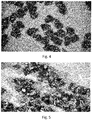
- the finished fired or sintered grinding wheels are in FIG. 4 exemplified as a grit of grit P80.
- the fired grinding wheels were previously sieved, so that the in FIG. 4 shown abrasive bodies at their longest point about 1.18 to 1.4 mm long.
- FIG. 5 A detailed view of in FIG. 4 shown abrasive body is in FIG. 5 displayed.
- abrasive particles can be screened to a desired size, washed, rinsed and / or dried.
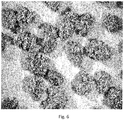
- FIG. 6 now shows grinding wheel of grade P180, with the individual grinding wheels have a length of 1.18 to 1.4 mm.
- FIGS. 7 and 8 each a plan view of the active layer of an abrasive.
- FIG. 7 is the lattice granules of a grit with the grain size P80 shown, whose grinding wheels have a diameter of 0.8 to 1 mm.
- FIG. 8 shows a grid granulate of a grit with a grain size of P180.
Landscapes
- Chemical & Material Sciences (AREA)
- Engineering & Computer Science (AREA)
- Materials Engineering (AREA)
- Organic Chemistry (AREA)
- Mechanical Engineering (AREA)
- Composite Materials (AREA)
- Ceramic Engineering (AREA)
- Inorganic Chemistry (AREA)
- Polishing Bodies And Polishing Tools (AREA)
Applications Claiming Priority (1)
| Application Number | Priority Date | Filing Date | Title |
|---|---|---|---|
| DE102017102500 | 2017-02-08 |
Publications (2)
| Publication Number | Publication Date |
|---|---|
| EP3360944A2 true EP3360944A2 (fr) | 2018-08-15 |
| EP3360944A3 EP3360944A3 (fr) | 2018-10-03 |
Family
ID=61188634
Family Applications (1)
| Application Number | Title | Priority Date | Filing Date |
|---|---|---|---|
| EP18155624.2A Withdrawn EP3360944A3 (fr) | 2017-02-08 | 2018-02-07 | Matière abrasive |
Country Status (1)
| Country | Link |
|---|---|
| EP (1) | EP3360944A3 (fr) |
Family Cites Families (2)
| Publication number | Priority date | Publication date | Assignee | Title |
|---|---|---|---|---|
| DE20122729U1 (de) * | 2000-10-06 | 2007-06-06 | 3M Innovative Properties Co., St. Paul | Keramische Aggregatteilchen |
| EP1326940B1 (fr) * | 2000-10-16 | 2010-03-31 | 3M Innovative Properties Company | Procede de fabrication de particules d'agregat de ceramique |
-
2018
- 2018-02-07 EP EP18155624.2A patent/EP3360944A3/fr not_active Withdrawn
Non-Patent Citations (1)
| Title |
|---|
| None |
Also Published As
| Publication number | Publication date |
|---|---|
| EP3360944A3 (fr) | 2018-10-03 |
Similar Documents
| Publication | Publication Date | Title |
|---|---|---|
| DE69515180T2 (de) | Schlufprodukt | |
| EP3645653B1 (fr) | Grain abrasif céramique moulé | |
| DE10392644B4 (de) | Beschichteter schleifartikel und verfahren zur herstellung | |
| AT515258B1 (de) | Verfahren zur Herstellung von Schleifkörpern | |
| DE69811778T2 (de) | Schleifprodukte | |
| EP3013919B1 (fr) | Élément abrasif | |
| AT515587B1 (de) | Schleifteilchenagglomerat | |
| DE69125086T2 (de) | Mit erodierbaren Konglomeraten überzogener Schleifkörper und Verfahren zu seiner Herstellung | |
| DE202014101739U1 (de) | Schleifkorn mit Knoten und Fortsätzen | |
| WO2001079135A1 (fr) | CORPS MOULES MICROCRISTALLINS A BASE DE α-A12O3, PROCEDE PERMETTANT DE LES PRODUIRE ET LEUR UTILISATION | |
| EP2692816A1 (fr) | Grain abrasif avec corps plats se pénétrant | |
| DE2224589A1 (de) | Schleifmittel und verfahren zu dessen herstellung | |
| EP0826758B1 (fr) | Elément de coupe composite contenant des particules de diamant et son procédé de préparation | |
| EP2391482B1 (fr) | Meule comprenant des concepatacles vegetals comme materiel de remplissage et procede de sa fabrication | |
| DE2730848A1 (de) | Glasgebundenes schleifmittel | |
| DE2350139A1 (de) | Schleifmittel | |
| AT506893B1 (de) | Zweifärbiges keramikformteil | |
| DE2921341C2 (de) | Schleifmaterial und Verfahren zu seiner Herstellung | |
| DE2339507B2 (de) | Schleifkoerper bzw. schleifmittel | |
| WO2002016082A1 (fr) | Outil de rodage | |
| EP2653265B1 (fr) | Agent abrasif et outil de rectification | |
| EP3590658B1 (fr) | Procédé de fabrication de corps abrasif fin | |
| DE1167725B (de) | Aluminiumoxydhaltige Schleifkoerner zur Herstellung von Schleifscheiben u. dgl. | |
| DE1592088A1 (de) | Verfahren zur Herstellung von druck- und abriebfesten Kugeln | |
| DD239754A1 (de) | Schleifkoerper mit kuenstlich erhoehter porositaet und ein verfahren zu ihrer herstellung |
Legal Events
| Date | Code | Title | Description |
|---|---|---|---|
| PUAI | Public reference made under article 153(3) epc to a published international application that has entered the european phase |
Free format text: ORIGINAL CODE: 0009012 |
|
| STAA | Information on the status of an ep patent application or granted ep patent |
Free format text: STATUS: THE APPLICATION HAS BEEN PUBLISHED |
|
| AK | Designated contracting states |
Kind code of ref document: A2 Designated state(s): AL AT BE BG CH CY CZ DE DK EE ES FI FR GB GR HR HU IE IS IT LI LT LU LV MC MK MT NL NO PL PT RO RS SE SI SK SM TR |
|
| AX | Request for extension of the european patent |
Extension state: BA ME |
|
| PUAL | Search report despatched |
Free format text: ORIGINAL CODE: 0009013 |
|
| AK | Designated contracting states |
Kind code of ref document: A3 Designated state(s): AL AT BE BG CH CY CZ DE DK EE ES FI FR GB GR HR HU IE IS IT LI LT LU LV MC MK MT NL NO PL PT RO RS SE SI SK SM TR |
|
| AX | Request for extension of the european patent |
Extension state: BA ME |
|
| RIC1 | Information provided on ipc code assigned before grant |
Ipc: B24D 3/18 20060101ALI20180829BHEP Ipc: C09K 3/14 20060101AFI20180829BHEP Ipc: B24D 11/00 20060101ALI20180829BHEP Ipc: B24D 3/14 20060101ALI20180829BHEP |
|
| STAA | Information on the status of an ep patent application or granted ep patent |
Free format text: STATUS: THE APPLICATION IS DEEMED TO BE WITHDRAWN |
|
| 18D | Application deemed to be withdrawn |
Effective date: 20190404 |