EP3362841B1 - Procédé permettant de fabriquer une lentille à addition progressive ophtalmique pour un porteur hypermétrope et presbyte - Google Patents
Procédé permettant de fabriquer une lentille à addition progressive ophtalmique pour un porteur hypermétrope et presbyte Download PDFInfo
- Publication number
- EP3362841B1 EP3362841B1 EP16778850.4A EP16778850A EP3362841B1 EP 3362841 B1 EP3362841 B1 EP 3362841B1 EP 16778850 A EP16778850 A EP 16778850A EP 3362841 B1 EP3362841 B1 EP 3362841B1
- Authority
- EP
- European Patent Office
- Prior art keywords
- lens
- acu
- asr
- acuity
- logmar
- Prior art date
- Legal status (The legal status is an assumption and is not a legal conclusion. Google has not performed a legal analysis and makes no representation as to the accuracy of the status listed.)
- Active
Links
Images






Classifications
-
- G—PHYSICS
- G02—OPTICS
- G02C—SPECTACLES; SUNGLASSES OR GOGGLES INSOFAR AS THEY HAVE THE SAME FEATURES AS SPECTACLES; CONTACT LENSES
- G02C7/00—Optical parts
- G02C7/02—Lenses; Lens systems ; Methods of designing lenses
- G02C7/024—Methods of designing ophthalmic lenses
- G02C7/028—Special mathematical design techniques
-
- G—PHYSICS
- G02—OPTICS
- G02C—SPECTACLES; SUNGLASSES OR GOGGLES INSOFAR AS THEY HAVE THE SAME FEATURES AS SPECTACLES; CONTACT LENSES
- G02C7/00—Optical parts
- G02C7/02—Lenses; Lens systems ; Methods of designing lenses
- G02C7/06—Lenses; Lens systems ; Methods of designing lenses bifocal; multifocal ; progressive
- G02C7/061—Spectacle lenses with progressively varying focal power
- G02C7/063—Shape of the progressive surface
- G02C7/066—Shape, location or size of the viewing zones
Definitions
- the invention relates generally to the field of vision improvement and more specifically concerns a method for providing an ophthalmic progressive addition lens for a farsighted and presbyopic wearer as defined in the claims.
- spectacles lenses are manufactured on request in accordance with specifications intrinsic to individual wearers. Such specifications generally encompass a medical prescription made by an ophthalmologist or an eye care practitioner.
- a farsighted wearer has a positive optical power correction for far vision.
- a farsighted wearer has a prescribed far vision mean refractive power which is greater or equal to plus 1 Diopter.
- the value of the power correction is different for far vision and near vision, due to the difficulties of accommodation in near vision.
- the prescription thus comprises a far-vision power value and an addition representing the power increment between far vision and near vision.
- the addition is qualified as prescribed addition ADD p .
- a problem that the invention aims to solve is thus to enhance the wearer's visual comfort.
- a subject of the invention is a method for providing an ophthalmic progressive addition lens for a farsighted and presbyopic wearer which has a prescribed far vision mean refractive power greater or equal to plus 1 Diopter and a non nil prescribed addition, ADD p , said lens having a mean refractive power, PPO( ⁇ , ⁇ ), a module of resulting astigmatism, ASR( ⁇ , ⁇ ), an acuity loss value ACU( ⁇ , ⁇ ), where said ( ⁇ , ⁇ ) functions are determined in as-worn conditions of the lens by the wearer, and a first acuity criterion, AcuityCriterion1 which fulfils following requirement: AcuityCriterion 1 ⁇ 44 D 2 .
- AcuityCriterion1 is defined as a combination of PPO( ⁇ , ⁇ ), ASR( ⁇ , ⁇ ), ADD p , and ACU( ⁇ , ⁇ ).
- AcuityCriterion1 fulfils following requirement: AcuityCriterion 1 ⁇ 46.5 D 2 .deg.
- AcuityCriterion1 fulfils following requirement: AcuityCriterion1 ⁇ 49 D 2 .deg.
- a threshold value of an acuity criterion is suitable to characterize ophthalmic progressive addition lens for a farsighted and presbyopic wearer where the wearer's visual comfort is enhanced in view of known prior art ophthalmic progressive addition lens.
- the method according to the present invention provides a lens which is further characterized by a meridian line, ML( ⁇ , ⁇ ), a fitting cross, FC( ⁇ FC , ⁇ FC ), said ( ⁇ , ⁇ ) functions being determined in as-worn conditions of the lens by the wearer for gaze directions ( ⁇ , ⁇ ) joining the center of rotation of the eye, CRE, and the lens, where ⁇ is a lowering angle in degree and ⁇ is an azimuth angle in degree and wherein:
- the method can provide a lens which fulfills at least one of the following requirements:
- the present invention also provides a method implemented by computer means for providing an ophthalmic progressive addition lens to a farsighted and presbyopic wearer having a prescribed far vision mean refractive power greater or equal to plus 1 Diopter and a non nil prescribed addition, ADD p , comprising the step of calculating a mean refractive power repartition, PPO( ⁇ , ⁇ ), a module of resulting astigmatism repartition, ASR( ⁇ , ⁇ ), an acuity loss value repartition ACU( ⁇ , ⁇ ), where said ( ⁇ , ⁇ ) functions are calculated in as-worn conditions of the lens by the wearer, so as to fulfil following requirement of a first acuity criterion, AcuityCriterion1: AcuityCriterion 1 ⁇ 44 D 2 .
- AcuityCriterion1 is defined as a combination of PPO( ⁇ , ⁇ ), ASR( ⁇ , ⁇ ), ADD p , and ACU( ⁇ , ⁇ ).
- the method claimed further comprises the following steps:
- Prescription data refers to one or more data obtained for the wearer and indicating for at least an eye, preferably for each eye, a prescribed sphere SPH p , and/or a prescribed astigmatism value CYL p and a prescribed axis AXIS p suitable for correcting the ametropia of each eye for the wearer and, if suitable, a prescribed addition ADD p suitable for correcting the presbyopia of each of his eyes.
- the lens may be a standard lens but also a lens for information glasses, wherein the lens comprises means for displaying information in front of the eye.
- the lens may also be suitable for sunglasses or not. All ophthalmic lenses provided by the method of the invention may be paired so as to form a pair of lenses (left eye LE, right eye RE).
- a "gaze direction” is identified by a couple of angle values ( ⁇ , ⁇ ), wherein said angles values are measured with regard to reference axes centered on the center of rotation of the eye, commonly named as "CRE". More precisely, figure 1 represents a perspective view of such a system illustrating parameters ⁇ and ⁇ used to define a gaze direction.
- Figure 2 is a view in the vertical plane parallel to the antero-posterior axis of the wearer's head and passing through the center of rotation of the eye in the case when the parameter ⁇ is equal to 0. The center of rotation of the eye is labeled CRE.
- the axis CRE-F' shown on Figure 2 in a dot-dash line, is the horizontal axis passing through the center of rotation of the eye and extending in front of the wearer - that is the axis CRE-F' corresponding to the primary gaze direction.
- the lens is placed and centered in front of the eye such that the axis CRE-F' cuts the front surface of the lens on a point called the fitting cross, which is, in general, present on lenses to enable the positioning of lenses in a frame by an optician.
- the point of intersection of the rear surface of the lens and the axis CRE-F' is the point, O.
- a value of radius q' of 25.5 mm corresponds to a usual value and provides satisfying results when wearing the lenses. Other value of radius q' may be chosen.
- a given gaze direction corresponds to a position of the eye in rotation around CRE and to a point J (see figure 2 ) of the vertex sphere;
- the angle ⁇ is the angle formed between the axis CRE-F' and the projection of the straight line CRE-J on the horizontal plane comprising the axis CRE-F'; this angle appears on the scheme on Figure 1 .
- the angle ⁇ is the angle formed between the axis CRE-J and the projection of the straight line CRE-J on the horizontal plane comprising the axis CRE-F'; this angle appears on the scheme on Figures 1 and 2 .
- a given gaze view thus corresponds to a point J of the vertex sphere or to a couple ( ⁇ , ⁇ ).
- the image of a point M in the object space, located at a given object distance is formed between two points S and T corresponding to minimum and maximum distances JS and JT, which would be the sagittal and tangential local focal lengths.
- the image of a point in the object space at infinity is formed, at the point F'.
- the distance D corresponds to the rear frontal plane of the lens.
- a mean refractive power PPO( ⁇ , ⁇ ) For each gaze direction ( ⁇ , ⁇ ), a mean refractive power PPO( ⁇ , ⁇ ), a module of astigmatism ASR( ⁇ , ⁇ ) and an axis AXE( ⁇ , ⁇ ) of this astigmatism, and a module of resulting (also called residual or unwanted) astigmatism ASR( ⁇ , ⁇ ) are defined.
- Astigmatism refers to astigmatism generated by the lens, or to residual astigmatism (resulting astigmatism) which corresponds to the difference between the prescribed astigmatism (wearer astigmatism) and the lens-generated astigmatism; in each case, with regards to amplitude or both amplitude and axis;
- Ergorama is a function associating to each gaze direction the usual distance of an object point. Typically, in far vision following the primary gaze direction, the object point is at infinity. In near vision, following a gaze direction essentially corresponding to an angle ⁇ of the order of 35° and to an angle ⁇ of the order of 5° in absolute value towards the nasal side, the object distance is of the order of 30 to 50 cm.
- US patent US-A-6,318,859 may be considered. This document describes an ergorama, its definition and its modeling method. For a method of the invention, points may be at infinity or not. Ergorama may be a function of the wearer's ametropia.
- An object point M at an object distance given by the ergorama is considered for a gaze direction ( ⁇ , ⁇ ).
- the object proximity can be considered as the inverse of the distance between the object point and the front surface of the lens, on the corresponding light ray.
- the image of a point M having a given object proximity is formed between two points S and T which correspond respectively to minimal and maximal focal distances (which would be sagittal and tangential focal distances).
- an optical power PPO as the sum of the image proximity and the object proximity.
- PPO ProxO + ProxI
- the optical power is also called refractive power.
- This definition corresponds to the astigmatism of a ray beam created by the lens.
- the resulting astigmatism ASR is defined for every gaze direction through the lens as the difference between the actual astigmatism value AST for this gaze direction and the prescribed astigmatism for the same lens.
- the residual astigmatism (resulting astigmatism) ASR more precisely corresponds to module of the vectorial difference between actual (AST, AXE) and prescription data (CYL p , AXIS p ).
- the characterization of the lens refers to the ergorama-eye-lens system described above.
- the term 'lens' is used in the description but it has to be understood as the 'ergorama-eye-lens system'.
- the values in optic terms can be expressed for gaze directions.
- Conditions suitable to determine of the ergorama-eye-lens system are called in the frame present invention "as-worn conditions".
- a "far-vision gaze direction”, referred as FVGD, is defined for a lens, as the vision gaze direction corresponding to the far vision (distant) reference point and thus ( ⁇ FV , ⁇ FV ), where the mean refractive power is substantially equal to the mean prescribed power in far vision, the mean prescribed power being equal to SPH p +(CYL p /2).
- far-vision is also referred to as distant-vision.
- a "near-vision gaze direction”, referred as NVGD, is defined for a lens, as the vision gaze direction corresponding to the near vision (reading) reference point, and thus ( ⁇ NV , ⁇ NV ), where the refractive power is substantially equal to the prescribed power in far vision plus the prescribed addition, ADD p .
- FCGD fitting-cross gaze direction
- the "meridian line”, referred as M L ( ⁇ , ⁇ ), of a progressive lens is a line defined from top to bottom of the lens and passing through the fitting cross where one can see clearly an object point.
- Said meridian line is defined on the basis of the repartition of module of resulting astigmatism, ASR, over the ( ⁇ , ⁇ ) domain and substantially correspond to the center of the two central iso-module of resulting astigmatism values which value is equal to 0.25 Diopter.
- the meridian line is calculated according to following method:
- the meridian line is finally defined as being the line built when following the three segments d1, d2, d3.
- Micro-markings also called “alignment reference marking” have been made mandatory on progressive lenses by the harmonized standards ISO 13666:2012 (“Alignment reference marking: permanent markings provided by the manufacturer to establish the horizontal alignment of the lens or lens blank, or to re-establish other reference points") and ISO 8990-2 ("Permanent marking: the lens has to provide at least following permanent markings: alignment reference markings comprising two markings distant from 34 mm one of each other, equidistant from a vertical plane passing through the fitting cross or the prism reference point"). Micro-markings that are defined the same way are also usually made on complex surfaces, such as on a front surface of a lens with a front surface comprising a progressive or regressive front surface.
- Temporal markings may also be applied on at least one of the two surfaces of the lens, indicating positions of control points (reference points) on the lens, such as a control point for far-vision, a control point for near-vision, a prism reference point and a fitting cross for instance.
- the prism reference point PRP is considered here at the midpoint of the straight segment which connects the micro-markings. If the temporary markings are absent or have been erased, it is always possible for a skilled person to position the control points on the lens by using a mounting chart and the permanent micro-markings.
- standard ISO 10322-2 requires micro-markings to be applied. The centre of the aspherical surface of a semi-finished lens blank can therefore be determined as well as a referential as described above.
- Figure 3 shows field vision zones of an ophthalmic progressive addition lens 30 where said lens comprises a far vision (distant vision) zone 32 located in the upper part of the lens, a near vision zone 36 located in the lower part of the lens and an intermediate zone 34 situated between the far vision zone 32 and the near vision zone 36.
- the meridian line is referred as 38.
- AC%( ⁇ , ⁇ ) is an acuity function defined as a function of both mean refractive power, PPO( ⁇ , ⁇ ), and module of resulting astigmatism, ASR( ⁇ , ⁇ ); where:
- Bibliographical reference of such an acuity loss definition can be found in following document: Fauquier, C., et al. "Influence of combined power error and astigmatism on visual acuity.” Vision Science and Its Applications, OSA Technical Digest Series. Washington, DC: Optical Society of America (1995): 151-4 .
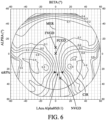
- Acuity loss values ACU( ⁇ , ⁇ ) of the example lens are plotted in the background of figures 4 to 11 and curves indicates iso-acuity loss values where there is an increment of 0.1 logMAR between neighbouring curves of different acuity loss values.
- LAcuSub85(0.1) is the angular extent (in deg 2 ) of the zone (in grey on the figure) between the two central neighbouring curves of acuity loss equal to 0.1 logMAR, said angular extent being calculated inside the circle CIR, and for lowering angle ⁇ more than ⁇ 85% (i.e. for ⁇ ⁇ ⁇ 85%), where ⁇ 85% is defined as the lowering angle where 85% of the prescribed addition is perceived by the wearer on the meridian line.
- LAcuSub85(0.2) is the angular extent (in deg 2 ) of the zone (in grey on the figure) between the two central neighbouring curves of acuity loss equal to 0.2 logMAR, said angular extent being calculated inside the circle CIR, and for lowering angle ⁇ more than ⁇ 85% (i.e. for ⁇ ⁇ ⁇ 85%).
- LAcuSubFC(0.1) is the angular extent (in deg 2 ) of the zone (in grey on the figure) between the two central neighbouring curves of acuity loss equal to 0.1 logMAR, said angular extent being calculated inside the circle CIR, and for ⁇ more than ⁇ FC (i.e. for ⁇ ⁇ ⁇ FC ).
- LAcuSubFC(0.2) is the angular extent (in deg 2 ) of the zone (in grey on the figure) between the two central neighbouring curves of acuity loss equal to 0.2 logMAR, said angular extent being calculated inside the circle CIR, and for ⁇ more than ⁇ FC (i.e. for ⁇ ⁇ ⁇ FC ).
- LAcuDomain(0.1) is the angular extent (in deg 2 ) of the zone (in grey on the figure) between the two central neighbouring curves of acuity loss equal to 0.1 logMAR, said angular extent being calculated inside the whole circle CIR.
- LAcuDomain(0.2) is the angular extent (in deg 2 ) of the zone (in grey on the figure) between the two central neighbouring curves of acuity loss equal to 0.2 logMAR, said angular extent being calculated inside the whole circle CIR.
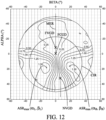
- Figure 12 shows how to calculate criterion PeaksMean; the module of resulting astigmatism values of the example lens are plotted in the background of figure 12 and curves indicates iso-module of resulting astigmatism values where there is an increment of 0.25 Diopter between neighbouring curves of different module of resulting astigmatism values.
- PeaksMean is the mean maximum module of resulting astigmatism (in Diopter) which is equal to [ASR max ( ⁇ L , ⁇ L ) + ASR max ( ⁇ R , ⁇ R )]/2, where ASR max ( ⁇ L , ⁇ L ) is the maximum module of resulting astigmatism on a side (left side) of the meridian line, and ASR max ( ⁇ R , ⁇ R ) is the maximum module of resulting astigmatism on the other side (right side) of the meridian line that are both determined inside the circle, CIR.
- Figure 13 shows the variation of object proximity ProxO as a function of the lowering angle ⁇ used to define the ergorama in view of US patent US-A-6,318,859 .
- the ergorama used in the frame of the present invention is defined thanks to following data, where object proximity values are given for lowering angles ⁇ : Alpha [deg] ProxO [D] -50 0 -40 0 -30 0 -20 0 -10 0 0 10 1.65 20 2.54 30 2.78 40 2.93 50 2.98
- Figures 14 to 17 give optical characteristics of an ophthalmic progressive addition lens according to the prior art, hereafter referred as "PA_lens”.
- Figures 18 to 21 give optical characteristics of an ophthalmic progressive addition lens provided by the method according to the invention, hereafter referred as "INV_lens".
- Figures 14 and 18 represent the mean refractive power repartition profile, PPO, as a function of the lowering angle ⁇ , along the meridian line, for respectively the prior art ophthalmic progressive addition lens and the ophthalmic progressive addition lens provided by the method according to the present invention. Lowering angles corresponding to ⁇ 85% and to ⁇ 15% are indicated.
- Figures 15 and 19 represent the mean refractive power repartition, PPO, over the ( ⁇ , ⁇ ) domain, for respectively the prior art ophthalmic progressive addition lens and the ophthalmic progressive addition lens provided by the method according to the present invention.
- Curves indicates iso-mean refractive power values where there is an increment of 0.25 Diopter between neighbouring curves of different module of resulting astigmatism values.
- Figures 16 and 20 represent respectively the module of resulting astigmatism repartition, ASR, over the ( ⁇ , ⁇ ) domain, for respectively the prior art ophthalmic progressive addition lens and the ophthalmic progressive addition lens provided by the method according to the present invention.
- Curves indicates iso-module of resulting astigmatism values where there is an increment of 0.25 Diopter between neighbouring curves of different module of resulting astigmatism values.
- Figures 17 and 21 represent respectively the acuity loss value repartition ACU, over the ( ⁇ , ⁇ ) domain, for respectively the prior art ophthalmic progressive addition lens and the ophthalmic progressive addition lens provided by the method according to the present invention.
- Curves indicates iso-acuity loss values where there is an increment of 0.1 logMAR between neighbouring curves of different module of resulting astigmatism values.
- the inventors have done tests that demonstrate that the chosen threshold value of AcuityCriterion 1, and optionally the chosen threshold values of AcuityCriterion2 and/or AcuityCriterion3 and/or AcuityCriterion4 and/or AcuityCriterion5 and/or AcuityCriterion6, is (are) suitable for providing to a farsighted and presbyopic wearer an ophthalmic progressive addition lens where the wearer's visual comfort is enhanced in view of known prior art ophthalmic progressive addition lens.
Landscapes
- Physics & Mathematics (AREA)
- Health & Medical Sciences (AREA)
- Ophthalmology & Optometry (AREA)
- General Health & Medical Sciences (AREA)
- General Physics & Mathematics (AREA)
- Optics & Photonics (AREA)
- Mathematical Physics (AREA)
- Eyeglasses (AREA)
- Medicines That Contain Protein Lipid Enzymes And Other Medicines (AREA)
Claims (7)
- Procédé mis en œuvre par des moyens informatiques permettant de fournir une lentille ophtalmique à addition progressive à un porteur presbyte et hypermétrope ayant une puissance de réfraction moyenne de vision de loin prescrite supérieure ou égale à plus 1 dioptries et une addition prescrite non nulle, ADDp, comprenant l'étape de calcul d'une répartition de puissance de réfraction moyenne, PPO(α, β), un module de répartition de l'astigmatisme résultant, ASR(α, β), une répartition de valeur de perte d'acuité ACU(α, β), où lesdites fonctions (α, β) sont calculées dans des conditions de port de la lentille par le porteur, de façon à remplir l'exigence suivante d'un premier critère d'acuité, AcuityCriterion1 :AcuityCriterion1 ≥ 44 D2.deg ;« D » fait référence à dioptrie, « deg » à degré, AcuityCriterion1 est défini en tant que combinaison de PPO(α, β), ASR(α, β), ADDp et ACU(α, β) et dans lequel le procédé comprend en outre les étapes suivantes :. le calcul ou la définition d'une ligne méridienne, ML(α, β),. le calcul ou la définition d'une croix d'ajustement, FC(αFC, βFC),. le calcul de la puissance de réfraction moyenne, PPO(α, β), et du module d'astigmatisme résultant, ASR(α, β), déterminé dans des conditions de port de la lentille par le porteur pour des directions de regard (α, β) rejoignant le centre de rotation de l'œil, CRE, et la lentille, où α est un angle d'abaissement en degré et β est un angle d'azimut en degré, une valeur de perte d'acuité ACU(α, β) est exprimée en logMAR et définie en fonction de l'équation suivante :
 . AC%(a, β) = 100 - 63 x P(α, β) - 44,3 x ASR(α, β) + 7,2 x P(α, β)2 + 19,5 x P(α, β) x ASR(α, β) + ASR(α, β)2 ; lorsque P(α, β) ≥ 0 ; et. AC%(a, β) = 100 - 44,3 x ASR(α, β) + ASR(α, β)2 ; lorsque P(α, β) < 0 ;. P(α, β) = PPO(α, β) - PPO(α, β_α_mer) ;. β_α_mer est la valeur de l'angle d'azimut β sur la ligne méridienne, ML(α, β), au niveau de l'angle d'abaissement α ;et où AcuityCriterion1 = Numerator1/Denominator ;. Numerator1 = LAcuSub85(0,1) x LAcuAlpha85(0,1) x ADDp 4 ;. Denominator = PeaksMean2 x PVL2 ;. LAcuSub85(0,1) est l'extension angulaire (en deg2) de la zone où ACU(α, β) ≤ 0,1 logMAR, à l'intérieur d'un cercle, CIR, centré sur (α, β) = (12,0), dont le rayon est de 35 degrés, et où α ≥ α85%, α85% étant l'angle d'abaissement où 85% de l'addition prescrite est perçue par le porteur sur la ligne méridienne ;. LAcuAlpha85(0,1) est la largeur d'acuité (en deg) à α85% entre deux lignes de perte d'iso-acuité correspondant à 0,1 logMAR et est égal à :
β+(ACU(α85%, β) = 0,1) - β-(ACU(α85%, β) = 0,1), où β+ est supérieur à β_α_mer(α85%) et β- est inférieur à β_α_mer(α85%) ;. PVL est la longueur de variation de puissance est exprimée en deg et définie comme étant égale à (α85% - α15%), α15% étant l'angle d'abaissement où 15% de l'addition prescrite est perçue par le porteur sur la ligne méridienne ;. PeaksMean est le module maximum moyen de l'astigmatisme résultant (en dioptrie) qui est égal à [ASRmax(αL, βL) + ASRmax(αR, βR)]/ 2, où ASRmax(αL, βL) est le module maximum de l'astigmatisme résultant sur un côté (côté gauche) de la ligne méridienne, et ASRmax(αR, βR) est le module maximum de l'astigmatisme résultant sur l'autre côté (côté droit) de la ligne méridienne qui sont toutes les deux déterminées à l'intérieur d'un cercle, CIR, centré sur (α, β) = (12,0), dont le rayon est de 35 degrés. - Procédé permettant de fournir une lentille ophtalmique à addition progressive selon la revendication 1, selon laquelle on calcule la lentille de façon à remplir l'exigence suivante d'un deuxième critère d'acuité, AcuityCriterion2 :
AcuityCriterion2 ≥ 105 D2.deg, où :• •
•Numerator2 = LAcuSub85 (0,2) x LAcuAlpha85(0,2) x ADDp 4 • LAcuSub85(0,2) est l'extension angulaire (en deg2) de la zone où ACU(α, β) ≤ 0,2 logMAR, à l'intérieur d'un cercle, CIR, centré sur (α, β) = (12,0), dont le rayon est de 35 degrés, et où α ≥ α85% ;• LAcuAlpha85(0,2) est la largeur d'acuité (en deg) à α85% entre deux lignes de perte d'iso-acuité correspondant à 0,2 logMAR et est égal à β+(ACU(α85%, β) = 0,2) - β-(ACU(α85%, β) = 0,2), où β+ est supérieur à β_α_mer(α85%) et β- est inférieur à β_α_mer(α85%). - Procédé permettant de fournir une lentille ophtalmique à addition progressive selon l'une quelconque des revendications 1 à 2, selon laquelle on calcule la lentille de façon à remplir l'exigence suivante d'un troisième critère d'acuité, AcuityCriterion3 :
AcuityCriterion3 ≥ 3,9 D, où :• •
• • LAcuSubFC(0,1) est l'extension angulaire (en deg2) de la zone où ACU(α, β) ≤ 0,1 logMAR, à l'intérieur d'un cercle, CIR, centré sur (α, β) = (12,0), dont le rayon est de 35 degrés, et où α ≥ αFC.
 - Procédé permettant de fournir une lentille ophtalmique à addition progressive selon l'une quelconque des revendications 1 à 3, selon laquelle on calcule la lentille de façon à remplir l'exigence suivante d'un quatrième critère d'acuité, AcuityCriterion4 :
AcuityCriterion4 ≥ 6,1 D, où :• • Numerator4 = LAcuSubFC(0,2) x ADDp 3 ;• LAcuSubFC(0,2) est l'extension angulaire (en deg2) de la zone où ACU(α, β) ≤ 0,2 logMAR, à l'intérieur d'un cercle, CIR, centré sur (α, β) = (12,0), dont le rayon est de 35 degrés, et où α ≥ αFC.
 - Procédé permettant de fournir une lentille ophtalmique à addition progressive selon l'une quelconque des revendications 1 à 4, selon laquelle on calcule la lentille de façon à remplir l'exigence suivante d'un cinquième critère d'acuité, AcuityCriterion5 :
AcuityCriterion5 ≥ 8,5 D, où :• •
• • LAcuDomain(0,1) est l'extension angulaire (en deg2) de la zone où ACU(α, β) ≤ 0,1 logMAR, à l'intérieur d'un cercle, CIR, centré sur (α, β) = (12,0), dont le rayon est de 35 degrés.
 - Procédé permettant de fournir une lentille ophtalmique à addition progressive selon l'une quelconque des revendications 1 à 5, selon laquelle on calcule la lentille de façon à remplir l'exigence suivante d'un sixième critère d'acuité, AcuityCriterion6 :
AcuityCriterion6 ≥ 12,5 D, où :• •
• • LAcuDomain(0,2) est l'extension angulaire (en deg2) de la zone où ACU(α, β) ≤ 0,2 logMAR, à l'intérieur d'un cercle, CIR, centré sur (α, β) = (12,0), dont le rayon est de 35 degrés.
 - Procédé permettant de fournir une lentille ophtalmique à addition progressive selon l'une quelconque des revendications 1 à 6, selon laquelle le procédé comprend une routine d'optimisation où au moins une cible est choisie au sein de l'exigence d'un critère d'acuité choisi dans la liste se composant de AcuityCriterion1, AcuityCriterion2, AcuityCriterion3, AcuityCriterion4, AcuityCriterion5, AcuityCriterion6.
Applications Claiming Priority (3)
| Application Number | Priority Date | Filing Date | Title |
|---|---|---|---|
| EP15306647 | 2015-10-15 | ||
| EP15306891 | 2015-11-27 | ||
| PCT/EP2016/074296 WO2017064037A1 (fr) | 2015-10-15 | 2016-10-11 | Verre ophtalmique à foyer progressif pour porteur hypermétrope et presbyte, et procédé de fabrication d'un tel verre |
Publications (2)
| Publication Number | Publication Date |
|---|---|
| EP3362841A1 EP3362841A1 (fr) | 2018-08-22 |
| EP3362841B1 true EP3362841B1 (fr) | 2024-06-12 |
Family
ID=57121279
Family Applications (1)
| Application Number | Title | Priority Date | Filing Date |
|---|---|---|---|
| EP16778850.4A Active EP3362841B1 (fr) | 2015-10-15 | 2016-10-11 | Procédé permettant de fabriquer une lentille à addition progressive ophtalmique pour un porteur hypermétrope et presbyte |
Country Status (7)
| Country | Link |
|---|---|
| US (1) | US11067830B2 (fr) |
| EP (1) | EP3362841B1 (fr) |
| JP (1) | JP6920288B2 (fr) |
| CN (1) | CN108474961B (fr) |
| BR (1) | BR112018007455B1 (fr) |
| CA (1) | CA3001719C (fr) |
| WO (1) | WO2017064037A1 (fr) |
Families Citing this family (2)
| Publication number | Priority date | Publication date | Assignee | Title |
|---|---|---|---|---|
| TWI748538B (zh) * | 2020-06-30 | 2021-12-01 | 華美光學科技股份有限公司 | 漸進多焦點鏡片 |
| TWI753564B (zh) * | 2020-09-07 | 2022-01-21 | 大葉大學 | 無累進狹帶之漸進多焦點鏡片 |
Family Cites Families (15)
| Publication number | Priority date | Publication date | Assignee | Title |
|---|---|---|---|---|
| US4861153A (en) * | 1986-12-19 | 1989-08-29 | American Optical Corporation | Progressive addition spectacle lens |
| FR2753805B1 (fr) | 1996-09-20 | 1998-11-13 | Essilor Int | Jeu de lentilles ophtalmiques multifocales progressives |
| KR100530628B1 (ko) * | 2001-04-26 | 2005-11-23 | 호야 가부시키가이샤 | 안경렌즈설계방법 및 안경렌즈 |
| FR2881846B1 (fr) * | 2005-02-08 | 2007-05-11 | Essilor Int | Procede de definition d'une face supplementaire pour lunettes |
| FR2894038B1 (fr) | 2005-11-29 | 2008-03-07 | Essilor Int | Lentille ophtalmique. |
| WO2009057709A1 (fr) * | 2007-10-31 | 2009-05-07 | Hoya Corporation | Procédé d'évaluation de verre de lunettes, procédé de mise au point de verre de lunettes, procédé de fabrication de verre de lunettes, système de fabrication de verre de lunettes et verre de lunettes |
| PT2486443T (pt) * | 2009-10-07 | 2018-03-09 | Essilor Int | Método de determinar uma lente e uma função ótica |
| AU2011361299B2 (en) * | 2011-03-07 | 2015-08-20 | Essilor International | A method for determining a progressive ophthalmic lens |
| EP2506063A1 (fr) * | 2011-03-31 | 2012-10-03 | ESSILOR INTERNATIONAL (Compagnie Générale d'Optique) | Lentille ophtalmique progressive |
| WO2014001490A1 (fr) * | 2012-06-29 | 2014-01-03 | Essilor International (Compagnie Generale D'optique) | Processus de détermination de paire de lentilles ophtalmiques progressives |
| WO2014001491A1 (fr) * | 2012-06-29 | 2014-01-03 | Essilor International (Compagnie Generale D'optique) | Procédé de détermination d'une paire de verres ophtalmiques progressifs |
| EP2752703A1 (fr) * | 2013-01-07 | 2014-07-09 | ESSILOR INTERNATIONAL (Compagnie Générale d'Optique) | Lentille ophtalmique présentant au moins une zone stable |
| WO2014128033A1 (fr) * | 2013-02-20 | 2014-08-28 | Essilor International (Compagnie Generale D'optique) | Paire de lentilles ophtalmiques progressives |
| CN104995549B (zh) * | 2013-02-20 | 2017-07-11 | 依视路国际集团(光学总公司) | 一副渐进式眼镜片 |
| BR112016010723A8 (pt) | 2013-11-25 | 2018-08-14 | Essilor Int | Método para prover a um usuário uma lente oftálmica de óculos progressiva personalizada |
-
2016
- 2016-10-11 EP EP16778850.4A patent/EP3362841B1/fr active Active
- 2016-10-11 BR BR112018007455-1A patent/BR112018007455B1/pt active IP Right Grant
- 2016-10-11 CA CA3001719A patent/CA3001719C/fr active Active
- 2016-10-11 US US15/768,060 patent/US11067830B2/en active Active
- 2016-10-11 CN CN201680059658.7A patent/CN108474961B/zh active Active
- 2016-10-11 JP JP2018519734A patent/JP6920288B2/ja active Active
- 2016-10-11 WO PCT/EP2016/074296 patent/WO2017064037A1/fr not_active Ceased
Also Published As
| Publication number | Publication date |
|---|---|
| JP6920288B2 (ja) | 2021-08-18 |
| JP2018530788A (ja) | 2018-10-18 |
| WO2017064037A1 (fr) | 2017-04-20 |
| CN108474961B (zh) | 2019-11-15 |
| US20190265513A1 (en) | 2019-08-29 |
| BR112018007455B1 (pt) | 2022-10-11 |
| BR112018007455A2 (pt) | 2018-10-23 |
| EP3362841A1 (fr) | 2018-08-22 |
| CA3001719C (fr) | 2023-12-19 |
| US11067830B2 (en) | 2021-07-20 |
| CA3001719A1 (fr) | 2017-04-20 |
| CN108474961A (zh) | 2018-08-31 |
Similar Documents
| Publication | Publication Date | Title |
|---|---|---|
| EP3362842B1 (fr) | Procédé permettant de fabriquer une lentille à addition progressive ophtalmique et pour un porteur emmétrope et presbyte | |
| EP3362846B1 (fr) | Lentille à addition progressive ophtalmique pour un porteur myope et presbyte ; procédé permettant de fabriquer une telle lentille | |
| EP3201683B1 (fr) | Système de distribution de lentille multifocale pour fournir à un utilisateur une lentille ophtalmique de lunettes progressives personnalisées | |
| EP3362841B1 (fr) | Procédé permettant de fabriquer une lentille à addition progressive ophtalmique pour un porteur hypermétrope et presbyte | |
| EP3362843B1 (fr) | Procédé permettant de fabriquer une lentille à addition progressive ophtalmique pour un porteur myope et presbyte | |
| EP3362847B1 (fr) | Procédé permettant de fabriquer une lentille à addition progressive ophtalmique et pour un porteur emmétrope et presbyte | |
| US12061382B2 (en) | Progressive ophthalmic lens |
Legal Events
| Date | Code | Title | Description |
|---|---|---|---|
| STAA | Information on the status of an ep patent application or granted ep patent |
Free format text: STATUS: UNKNOWN |
|
| STAA | Information on the status of an ep patent application or granted ep patent |
Free format text: STATUS: THE INTERNATIONAL PUBLICATION HAS BEEN MADE |
|
| PUAI | Public reference made under article 153(3) epc to a published international application that has entered the european phase |
Free format text: ORIGINAL CODE: 0009012 |
|
| STAA | Information on the status of an ep patent application or granted ep patent |
Free format text: STATUS: REQUEST FOR EXAMINATION WAS MADE |
|
| 17P | Request for examination filed |
Effective date: 20180615 |
|
| AK | Designated contracting states |
Kind code of ref document: A1 Designated state(s): AL AT BE BG CH CY CZ DE DK EE ES FI FR GB GR HR HU IE IS IT LI LT LU LV MC MK MT NL NO PL PT RO RS SE SI SK SM TR |
|
| AX | Request for extension of the european patent |
Extension state: BA ME |
|
| DAV | Request for validation of the european patent (deleted) | ||
| DAX | Request for extension of the european patent (deleted) | ||
| STAA | Information on the status of an ep patent application or granted ep patent |
Free format text: STATUS: EXAMINATION IS IN PROGRESS |
|
| 17Q | First examination report despatched |
Effective date: 20220105 |
|
| P01 | Opt-out of the competence of the unified patent court (upc) registered |
Effective date: 20230525 |
|
| GRAP | Despatch of communication of intention to grant a patent |
Free format text: ORIGINAL CODE: EPIDOSNIGR1 |
|
| STAA | Information on the status of an ep patent application or granted ep patent |
Free format text: STATUS: GRANT OF PATENT IS INTENDED |
|
| INTG | Intention to grant announced |
Effective date: 20230927 |
|
| GRAJ | Information related to disapproval of communication of intention to grant by the applicant or resumption of examination proceedings by the epo deleted |
Free format text: ORIGINAL CODE: EPIDOSDIGR1 |
|
| STAA | Information on the status of an ep patent application or granted ep patent |
Free format text: STATUS: EXAMINATION IS IN PROGRESS |
|
| GRAP | Despatch of communication of intention to grant a patent |
Free format text: ORIGINAL CODE: EPIDOSNIGR1 |
|
| STAA | Information on the status of an ep patent application or granted ep patent |
Free format text: STATUS: GRANT OF PATENT IS INTENDED |
|
| INTC | Intention to grant announced (deleted) | ||
| INTG | Intention to grant announced |
Effective date: 20240215 |
|
| GRAS | Grant fee paid |
Free format text: ORIGINAL CODE: EPIDOSNIGR3 |
|
| GRAA | (expected) grant |
Free format text: ORIGINAL CODE: 0009210 |
|
| STAA | Information on the status of an ep patent application or granted ep patent |
Free format text: STATUS: THE PATENT HAS BEEN GRANTED |
|
| AK | Designated contracting states |
Kind code of ref document: B1 Designated state(s): AL AT BE BG CH CY CZ DE DK EE ES FI FR GB GR HR HU IE IS IT LI LT LU LV MC MK MT NL NO PL PT RO RS SE SI SK SM TR |
|
| REG | Reference to a national code |
Ref country code: GB Ref legal event code: FG4D |
|
| REG | Reference to a national code |
Ref country code: CH Ref legal event code: EP |
|
| REG | Reference to a national code |
Ref country code: DE Ref legal event code: R096 Ref document number: 602016087956 Country of ref document: DE |
|
| REG | Reference to a national code |
Ref country code: IE Ref legal event code: FG4D |
|
| PG25 | Lapsed in a contracting state [announced via postgrant information from national office to epo] |
Ref country code: BG Free format text: LAPSE BECAUSE OF FAILURE TO SUBMIT A TRANSLATION OF THE DESCRIPTION OR TO PAY THE FEE WITHIN THE PRESCRIBED TIME-LIMIT Effective date: 20240612 |
|
| PG25 | Lapsed in a contracting state [announced via postgrant information from national office to epo] |
Ref country code: FI Free format text: LAPSE BECAUSE OF FAILURE TO SUBMIT A TRANSLATION OF THE DESCRIPTION OR TO PAY THE FEE WITHIN THE PRESCRIBED TIME-LIMIT Effective date: 20240612 Ref country code: HR Free format text: LAPSE BECAUSE OF FAILURE TO SUBMIT A TRANSLATION OF THE DESCRIPTION OR TO PAY THE FEE WITHIN THE PRESCRIBED TIME-LIMIT Effective date: 20240612 |
|
| REG | Reference to a national code |
Ref country code: LT Ref legal event code: MG9D |
|
| PG25 | Lapsed in a contracting state [announced via postgrant information from national office to epo] |
Ref country code: GR Free format text: LAPSE BECAUSE OF FAILURE TO SUBMIT A TRANSLATION OF THE DESCRIPTION OR TO PAY THE FEE WITHIN THE PRESCRIBED TIME-LIMIT Effective date: 20240913 |
|
| REG | Reference to a national code |
Ref country code: NL Ref legal event code: MP Effective date: 20240612 |
|
| PG25 | Lapsed in a contracting state [announced via postgrant information from national office to epo] |
Ref country code: ES Free format text: LAPSE BECAUSE OF FAILURE TO SUBMIT A TRANSLATION OF THE DESCRIPTION OR TO PAY THE FEE WITHIN THE PRESCRIBED TIME-LIMIT Effective date: 20240612 |
|
| PG25 | Lapsed in a contracting state [announced via postgrant information from national office to epo] |
Ref country code: LV Free format text: LAPSE BECAUSE OF FAILURE TO SUBMIT A TRANSLATION OF THE DESCRIPTION OR TO PAY THE FEE WITHIN THE PRESCRIBED TIME-LIMIT Effective date: 20240612 |
|
| PG25 | Lapsed in a contracting state [announced via postgrant information from national office to epo] |
Ref country code: NO Free format text: LAPSE BECAUSE OF FAILURE TO SUBMIT A TRANSLATION OF THE DESCRIPTION OR TO PAY THE FEE WITHIN THE PRESCRIBED TIME-LIMIT Effective date: 20240912 Ref country code: LV Free format text: LAPSE BECAUSE OF FAILURE TO SUBMIT A TRANSLATION OF THE DESCRIPTION OR TO PAY THE FEE WITHIN THE PRESCRIBED TIME-LIMIT Effective date: 20240612 Ref country code: HR Free format text: LAPSE BECAUSE OF FAILURE TO SUBMIT A TRANSLATION OF THE DESCRIPTION OR TO PAY THE FEE WITHIN THE PRESCRIBED TIME-LIMIT Effective date: 20240612 Ref country code: GR Free format text: LAPSE BECAUSE OF FAILURE TO SUBMIT A TRANSLATION OF THE DESCRIPTION OR TO PAY THE FEE WITHIN THE PRESCRIBED TIME-LIMIT Effective date: 20240913 Ref country code: FI Free format text: LAPSE BECAUSE OF FAILURE TO SUBMIT A TRANSLATION OF THE DESCRIPTION OR TO PAY THE FEE WITHIN THE PRESCRIBED TIME-LIMIT Effective date: 20240612 Ref country code: ES Free format text: LAPSE BECAUSE OF FAILURE TO SUBMIT A TRANSLATION OF THE DESCRIPTION OR TO PAY THE FEE WITHIN THE PRESCRIBED TIME-LIMIT Effective date: 20240612 Ref country code: BG Free format text: LAPSE BECAUSE OF FAILURE TO SUBMIT A TRANSLATION OF THE DESCRIPTION OR TO PAY THE FEE WITHIN THE PRESCRIBED TIME-LIMIT Effective date: 20240612 Ref country code: RS Free format text: LAPSE BECAUSE OF FAILURE TO SUBMIT A TRANSLATION OF THE DESCRIPTION OR TO PAY THE FEE WITHIN THE PRESCRIBED TIME-LIMIT Effective date: 20240912 |
|
| PG25 | Lapsed in a contracting state [announced via postgrant information from national office to epo] |
Ref country code: NL Free format text: LAPSE BECAUSE OF FAILURE TO SUBMIT A TRANSLATION OF THE DESCRIPTION OR TO PAY THE FEE WITHIN THE PRESCRIBED TIME-LIMIT Effective date: 20240612 |
|
| REG | Reference to a national code |
Ref country code: AT Ref legal event code: MK05 Ref document number: 1694751 Country of ref document: AT Kind code of ref document: T Effective date: 20240612 |
|
| PG25 | Lapsed in a contracting state [announced via postgrant information from national office to epo] |
Ref country code: NL Free format text: LAPSE BECAUSE OF FAILURE TO SUBMIT A TRANSLATION OF THE DESCRIPTION OR TO PAY THE FEE WITHIN THE PRESCRIBED TIME-LIMIT Effective date: 20240612 |
|
| PG25 | Lapsed in a contracting state [announced via postgrant information from national office to epo] |
Ref country code: PT Free format text: LAPSE BECAUSE OF FAILURE TO SUBMIT A TRANSLATION OF THE DESCRIPTION OR TO PAY THE FEE WITHIN THE PRESCRIBED TIME-LIMIT Effective date: 20241014 |
|
| PG25 | Lapsed in a contracting state [announced via postgrant information from national office to epo] |
Ref country code: PT Free format text: LAPSE BECAUSE OF FAILURE TO SUBMIT A TRANSLATION OF THE DESCRIPTION OR TO PAY THE FEE WITHIN THE PRESCRIBED TIME-LIMIT Effective date: 20241014 |
|
| PG25 | Lapsed in a contracting state [announced via postgrant information from national office to epo] |
Ref country code: PL Free format text: LAPSE BECAUSE OF FAILURE TO SUBMIT A TRANSLATION OF THE DESCRIPTION OR TO PAY THE FEE WITHIN THE PRESCRIBED TIME-LIMIT Effective date: 20240612 |
|
| PG25 | Lapsed in a contracting state [announced via postgrant information from national office to epo] |
Ref country code: EE Free format text: LAPSE BECAUSE OF FAILURE TO SUBMIT A TRANSLATION OF THE DESCRIPTION OR TO PAY THE FEE WITHIN THE PRESCRIBED TIME-LIMIT Effective date: 20240612 |
|
| PG25 | Lapsed in a contracting state [announced via postgrant information from national office to epo] |
Ref country code: IS Free format text: LAPSE BECAUSE OF FAILURE TO SUBMIT A TRANSLATION OF THE DESCRIPTION OR TO PAY THE FEE WITHIN THE PRESCRIBED TIME-LIMIT Effective date: 20241012 Ref country code: AT Free format text: LAPSE BECAUSE OF FAILURE TO SUBMIT A TRANSLATION OF THE DESCRIPTION OR TO PAY THE FEE WITHIN THE PRESCRIBED TIME-LIMIT Effective date: 20240612 |
|
| PG25 | Lapsed in a contracting state [announced via postgrant information from national office to epo] |
Ref country code: CZ Free format text: LAPSE BECAUSE OF FAILURE TO SUBMIT A TRANSLATION OF THE DESCRIPTION OR TO PAY THE FEE WITHIN THE PRESCRIBED TIME-LIMIT Effective date: 20240612 |
|
| PG25 | Lapsed in a contracting state [announced via postgrant information from national office to epo] |
Ref country code: RO Free format text: LAPSE BECAUSE OF FAILURE TO SUBMIT A TRANSLATION OF THE DESCRIPTION OR TO PAY THE FEE WITHIN THE PRESCRIBED TIME-LIMIT Effective date: 20240612 Ref country code: SK Free format text: LAPSE BECAUSE OF FAILURE TO SUBMIT A TRANSLATION OF THE DESCRIPTION OR TO PAY THE FEE WITHIN THE PRESCRIBED TIME-LIMIT Effective date: 20240612 |
|
| PG25 | Lapsed in a contracting state [announced via postgrant information from national office to epo] |
Ref country code: SM Free format text: LAPSE BECAUSE OF FAILURE TO SUBMIT A TRANSLATION OF THE DESCRIPTION OR TO PAY THE FEE WITHIN THE PRESCRIBED TIME-LIMIT Effective date: 20240612 |
|
| PG25 | Lapsed in a contracting state [announced via postgrant information from national office to epo] |
Ref country code: SM Free format text: LAPSE BECAUSE OF FAILURE TO SUBMIT A TRANSLATION OF THE DESCRIPTION OR TO PAY THE FEE WITHIN THE PRESCRIBED TIME-LIMIT Effective date: 20240612 Ref country code: SK Free format text: LAPSE BECAUSE OF FAILURE TO SUBMIT A TRANSLATION OF THE DESCRIPTION OR TO PAY THE FEE WITHIN THE PRESCRIBED TIME-LIMIT Effective date: 20240612 Ref country code: RO Free format text: LAPSE BECAUSE OF FAILURE TO SUBMIT A TRANSLATION OF THE DESCRIPTION OR TO PAY THE FEE WITHIN THE PRESCRIBED TIME-LIMIT Effective date: 20240612 Ref country code: PL Free format text: LAPSE BECAUSE OF FAILURE TO SUBMIT A TRANSLATION OF THE DESCRIPTION OR TO PAY THE FEE WITHIN THE PRESCRIBED TIME-LIMIT Effective date: 20240612 Ref country code: IS Free format text: LAPSE BECAUSE OF FAILURE TO SUBMIT A TRANSLATION OF THE DESCRIPTION OR TO PAY THE FEE WITHIN THE PRESCRIBED TIME-LIMIT Effective date: 20241012 Ref country code: EE Free format text: LAPSE BECAUSE OF FAILURE TO SUBMIT A TRANSLATION OF THE DESCRIPTION OR TO PAY THE FEE WITHIN THE PRESCRIBED TIME-LIMIT Effective date: 20240612 Ref country code: CZ Free format text: LAPSE BECAUSE OF FAILURE TO SUBMIT A TRANSLATION OF THE DESCRIPTION OR TO PAY THE FEE WITHIN THE PRESCRIBED TIME-LIMIT Effective date: 20240612 Ref country code: AT Free format text: LAPSE BECAUSE OF FAILURE TO SUBMIT A TRANSLATION OF THE DESCRIPTION OR TO PAY THE FEE WITHIN THE PRESCRIBED TIME-LIMIT Effective date: 20240612 |
|
| PG25 | Lapsed in a contracting state [announced via postgrant information from national office to epo] |
Ref country code: IT Free format text: LAPSE BECAUSE OF FAILURE TO SUBMIT A TRANSLATION OF THE DESCRIPTION OR TO PAY THE FEE WITHIN THE PRESCRIBED TIME-LIMIT Effective date: 20240612 |
|
| REG | Reference to a national code |
Ref country code: DE Ref legal event code: R097 Ref document number: 602016087956 Country of ref document: DE |
|
| PG25 | Lapsed in a contracting state [announced via postgrant information from national office to epo] |
Ref country code: DK Free format text: LAPSE BECAUSE OF FAILURE TO SUBMIT A TRANSLATION OF THE DESCRIPTION OR TO PAY THE FEE WITHIN THE PRESCRIBED TIME-LIMIT Effective date: 20240612 |
|
| PLBE | No opposition filed within time limit |
Free format text: ORIGINAL CODE: 0009261 |
|
| STAA | Information on the status of an ep patent application or granted ep patent |
Free format text: STATUS: NO OPPOSITION FILED WITHIN TIME LIMIT |
|
| 26N | No opposition filed |
Effective date: 20250313 |
|
| REG | Reference to a national code |
Ref country code: CH Ref legal event code: PL |
|
| PG25 | Lapsed in a contracting state [announced via postgrant information from national office to epo] |
Ref country code: MC Free format text: LAPSE BECAUSE OF FAILURE TO SUBMIT A TRANSLATION OF THE DESCRIPTION OR TO PAY THE FEE WITHIN THE PRESCRIBED TIME-LIMIT Effective date: 20240612 |
|
| PG25 | Lapsed in a contracting state [announced via postgrant information from national office to epo] |
Ref country code: LU Free format text: LAPSE BECAUSE OF NON-PAYMENT OF DUE FEES Effective date: 20241011 Ref country code: BE Free format text: LAPSE BECAUSE OF NON-PAYMENT OF DUE FEES Effective date: 20241031 |
|
| PG25 | Lapsed in a contracting state [announced via postgrant information from national office to epo] |
Ref country code: CH Free format text: LAPSE BECAUSE OF NON-PAYMENT OF DUE FEES Effective date: 20241031 |
|
| REG | Reference to a national code |
Ref country code: BE Ref legal event code: MM Effective date: 20241031 |
|
| PG25 | Lapsed in a contracting state [announced via postgrant information from national office to epo] |
Ref country code: SE Free format text: LAPSE BECAUSE OF FAILURE TO SUBMIT A TRANSLATION OF THE DESCRIPTION OR TO PAY THE FEE WITHIN THE PRESCRIBED TIME-LIMIT Effective date: 20240612 |
|
| PG25 | Lapsed in a contracting state [announced via postgrant information from national office to epo] |
Ref country code: IE Free format text: LAPSE BECAUSE OF NON-PAYMENT OF DUE FEES Effective date: 20241011 |
|
| PGFP | Annual fee paid to national office [announced via postgrant information from national office to epo] |
Ref country code: DE Payment date: 20251029 Year of fee payment: 10 |
|
| PGFP | Annual fee paid to national office [announced via postgrant information from national office to epo] |
Ref country code: GB Payment date: 20251027 Year of fee payment: 10 |
|
| PGFP | Annual fee paid to national office [announced via postgrant information from national office to epo] |
Ref country code: FR Payment date: 20251027 Year of fee payment: 10 |
|
| PG25 | Lapsed in a contracting state [announced via postgrant information from national office to epo] |
Ref country code: CY Free format text: LAPSE BECAUSE OF FAILURE TO SUBMIT A TRANSLATION OF THE DESCRIPTION OR TO PAY THE FEE WITHIN THE PRESCRIBED TIME-LIMIT; INVALID AB INITIO Effective date: 20161011 |
|
| PG25 | Lapsed in a contracting state [announced via postgrant information from national office to epo] |
Ref country code: HU Free format text: LAPSE BECAUSE OF FAILURE TO SUBMIT A TRANSLATION OF THE DESCRIPTION OR TO PAY THE FEE WITHIN THE PRESCRIBED TIME-LIMIT; INVALID AB INITIO Effective date: 20161011 |