EP3364151B1 - Procédé d'étalonnage de précision pour système de mesure d'attitude - Google Patents
Procédé d'étalonnage de précision pour système de mesure d'attitude Download PDFInfo
- Publication number
- EP3364151B1 EP3364151B1 EP16854769.3A EP16854769A EP3364151B1 EP 3364151 B1 EP3364151 B1 EP 3364151B1 EP 16854769 A EP16854769 A EP 16854769A EP 3364151 B1 EP3364151 B1 EP 3364151B1
- Authority
- EP
- European Patent Office
- Prior art keywords
- data
- ellipsoid
- accelerometer
- matrix
- calculated
- Prior art date
- Legal status (The legal status is an assumption and is not a legal conclusion. Google has not performed a legal analysis and makes no representation as to the accuracy of the status listed.)
- Not-in-force
Links
- 238000000034 method Methods 0.000 title claims description 85
- 238000005259 measurement Methods 0.000 title description 11
- 239000011159 matrix material Substances 0.000 claims description 114
- 238000004364 calculation method Methods 0.000 description 60
- 238000000354 decomposition reaction Methods 0.000 description 14
- 230000009191 jumping Effects 0.000 description 14
- 239000012482 calibration solution Substances 0.000 description 4
- 239000000243 solution Substances 0.000 description 3
- 235000008694 Humulus lupulus Nutrition 0.000 description 2
- 230000005856 abnormality Effects 0.000 description 2
- 230000001133 acceleration Effects 0.000 description 2
- 238000005516 engineering process Methods 0.000 description 2
- 238000013528 artificial neural network Methods 0.000 description 1
- 230000009286 beneficial effect Effects 0.000 description 1
- 230000001419 dependent effect Effects 0.000 description 1
- 238000001914 filtration Methods 0.000 description 1
- 238000004519 manufacturing process Methods 0.000 description 1
- 238000011160 research Methods 0.000 description 1
Images


Classifications
-
- G—PHYSICS
- G01—MEASURING; TESTING
- G01C—MEASURING DISTANCES, LEVELS OR BEARINGS; SURVEYING; NAVIGATION; GYROSCOPIC INSTRUMENTS; PHOTOGRAMMETRY OR VIDEOGRAMMETRY
- G01C17/00—Compasses; Devices for ascertaining true or magnetic north for navigation or surveying purposes
- G01C17/38—Testing, calibrating, or compensating of compasses
-
- G—PHYSICS
- G01—MEASURING; TESTING
- G01C—MEASURING DISTANCES, LEVELS OR BEARINGS; SURVEYING; NAVIGATION; GYROSCOPIC INSTRUMENTS; PHOTOGRAMMETRY OR VIDEOGRAMMETRY
- G01C25/00—Manufacturing, calibrating, cleaning, or repairing instruments or devices referred to in the other groups of this subclass
-
- G—PHYSICS
- G01—MEASURING; TESTING
- G01C—MEASURING DISTANCES, LEVELS OR BEARINGS; SURVEYING; NAVIGATION; GYROSCOPIC INSTRUMENTS; PHOTOGRAMMETRY OR VIDEOGRAMMETRY
- G01C25/00—Manufacturing, calibrating, cleaning, or repairing instruments or devices referred to in the other groups of this subclass
- G01C25/005—Manufacturing, calibrating, cleaning, or repairing instruments or devices referred to in the other groups of this subclass initial alignment, calibration or starting-up of inertial devices
-
- G—PHYSICS
- G01—MEASURING; TESTING
- G01P—MEASURING LINEAR OR ANGULAR SPEED, ACCELERATION, DECELERATION, OR SHOCK; INDICATING PRESENCE, ABSENCE, OR DIRECTION, OF MOVEMENT
- G01P15/00—Measuring acceleration; Measuring deceleration; Measuring shock, i.e. sudden change of acceleration
- G01P15/18—Measuring acceleration; Measuring deceleration; Measuring shock, i.e. sudden change of acceleration in two or more dimensions
-
- G—PHYSICS
- G01—MEASURING; TESTING
- G01P—MEASURING LINEAR OR ANGULAR SPEED, ACCELERATION, DECELERATION, OR SHOCK; INDICATING PRESENCE, ABSENCE, OR DIRECTION, OF MOVEMENT
- G01P21/00—Testing or calibrating of apparatus or devices covered by the preceding groups
Definitions
- the present invention relates to the field of measuring device attitude, particularly to a precision calibration method of attitude measuring systems.
- the attitude measuring systems have a wide variety of applications in many industrial fields.
- the measuring systems are a set of apparatuses for measuring spatial attitudes of an object (i.e. pitch angle, transverse roll angle, and course angle).
- various types of attitude measuring systems have begun to enter the daily life of huge numbers of families.
- Taking mobile phones as an example most smart phones currently on the market have built-in accelerometers, gyroscopes, and electronic compasses, which constitute a simple and low-cost attitude measuring system.
- the built-in sensors of most attitude measuring systems have low accuracy and stability, thereby causing non-ideal measuring results of the entire attitude measuring system.
- calibrating the sensor without changing the hardware of the system is a very practical manner to improve the measurement accuracy of the whole system.
- studying the low-cost calibration method of attitude measuring systems is very worthwhile in practice.
- the present invention provides a precision calibration method of attitude measuring systems, which has a reliable calibration result, high accuracy, and less time consumption.
- the advantages of the present invention are as below.
- the method of ellipsoid fitting is used to calibrate the electronic compass and the acceleration in the attitude measuring system.
- the recursive processing is conducted in the ellipsoid fitting algorithm such that the internal CPU of the attitude measuring system does not need to store the data of all points previously collected by the sensor during the data processing. Only the matrix previously obtained by recurrence and the current measurement result are required to be stored. Therefore, under the same hardware environment, the ellipsoid fitting method can handle more values, thereby improving the precision of the ellipsoid fitting.
- the CPU can only conduct the fitting operation based on a few sample points.
- the fitting precision is limited.
- the present invention improved a large-scale of matrix operation in the ellipsoid fitting algorithm and optimized the calculation procedure, such that the calculation of the ellipsoid fitting is reduced by over 90 percent.
- operating the fitting algorithm one time would consume 563 ms.
- the improved algorithm only consumes 14 ms.
- the strategy in which the measured data is used for calibrating is employed, such that the fault-tolerant capability of the calibration is improved.
- the requirement of initial calibration is reduced, and the operation complexity for the user is simplified.
- a precision calibration method of an attitude measuring system includes the following steps:
- ⁇ 1 is an eigenvector corresponding to the maximum eigenvalue of the matrix C 1 -1 ( S 1 - S 2 S 4 -1 S 2 T ).
- ⁇ 1 is an eigenvector corresponding to the maximum eigenvalue of the matrix C 1 -1 ( S 1 - S 2 S 4 -1 S 2 T ).
- Step S2 compensating the original accelerometer data by the calculated ellipsoid parameter.
- Step S3 calibrating the electronic compass via the ellipsoid fitting model according to the compensated accelerometer data
- Step S3 calibrating the electronic compass via the ellipsoid fitting model according to the compensated accelerometer data further comprises the following steps:
- ⁇ 1 is an eigenvector corresponding to the maximum eigenvalue of the matrix C 1 -1 (S 1 - S 2 S 4 -1 S 2 T ).
- Step S4 compensating the original data of the electronic compass by the calculated ellipsoid parameter.
- Step S5 calculating the attitude according to the compensated accelerometer data and the compensated electronic compass data.
- a precision calibration method of an attitude measuring system includes the following steps:
- Step S2 calibrating a zero-deviation, a scale coefficient, and a non-orthogonal angle between axes of an accelerometer of the attitude measuring system via an ellipsoid fitting model;
- calibrating a zero-deviation, a scale coefficient, and a non-orthogonal angle between axes of an accelerometer of the attitude measuring system via an ellipsoid fitting model further includes the following steps:
- ⁇ 1 is an eigenvector corresponding to the maximum eigenvalue of the matrix C 1 -1 ( S 1 - S 2 S 4 -1 S 2 T ).
- ⁇ 1 is an eigenvector corresponding to the maximum eigenvalue of the matrix C 1 -1 ( S 1 - S 2 S 4 -1 S 2 T ).
- Step S3 compensating the original accelerometer data by the calculated ellipsoid parameter.
- Step S4 calibrating the electronic compass via the ellipsoid fitting model according to the compensated accelerometer data
- Step S4 calibrating the electronic compass via the ellipsoid fitting model according to the compensated accelerometer data further comprises the following steps:
- ⁇ 1 is an eigenvector corresponding to the maximum eigenvalue of the matrix C 1 -1 (S 1 - S 2 S 4 -1 S 2 T ).
- Step S5 compensating the original data of the electronic compass by the calculated ellipsoid parameter.
- Step S6 calculating the attitude according to the compensated accelerometer data and the compensated electronic compass data.
- a precision calibration method of an attitude measuring system includes the following steps:
- step S3 calibrating a zero-deviation, a scale coefficient, and a non-orthogonal angle between axes of an accelerometer of the attitude measuring system via an ellipsoid fitting model further comprises the following steps:
- ⁇ 1 is an eigenvector corresponding to the maximum eigenvalue of the matrix C 1 -1 ( S 1 - S 2 S 4 -1 S 2 T ).
- ⁇ 1 is an eigenvector corresponding to the maximum eigenvalue of the matrix C 1 -1 ( S 1 - S 2 S 4 -1 S 2 T ).
- Step S4 compensating the original accelerometer data by the calculated ellipsoid parameter.
- Step S5 calibrating the electronic compass via the ellipsoid fitting model according to the compensated accelerometer data
- Step S5 calibrating the electronic compass via the ellipsoid fitting model according to the compensated accelerometer data further comprises the following steps:
- ⁇ 1 is an eigenvector corresponding to the maximum eigenvalue of the matrix C 1 -1 (S 1 - S 2 S 4 -1 S 2 T ) .
- ⁇ 1 is an eigenvector corresponding to the maximum eigenvalue of the matrix C 1 -1 (S 1 - S 2 S 4 -1 S 2 T ) .
- Step S6 compensating the original data of the electronic compass by the calculated ellipsoid parameter.
- Step S7 calculating the attitude according to the compensated accelerometer data and the compensated electronic compass data.
- a precision calibration method of an attitude measuring system includes the following steps:
- Step S3 calibrating a zero-deviation, a scale coefficient, and a non-orthogonal angle between axes of an accelerometer of the attitude measuring system via an ellipsoid fitting model;
- step S3 calibrating a zero-deviation, a scale coefficient, and a non-orthogonal angle between axes of an accelerometer of the attitude measuring system via an ellipsoid fitting model further comprises the following steps:
- ⁇ 1 is an eigenvector corresponding to the maximum eigenvalue of the matrix C 1 -1 (S 1 - S 2 S 4 -1 S 2 T ).
- Step S4 after the new accelerometer data is collected, correcting the newly collected data by the ellipsoid parameter.
- Step S5 compensating the original accelerometer data by the calculated ellipsoid parameter.
- Step S6 calibrating the electronic compass via the ellipsoid fitting model according to the compensated accelerometer data
- Step S6 calibrating the electronic compass via the ellipsoid fitting model according to the compensated accelerometer data further comprises the following steps:
- ⁇ 1 is an eigenvector corresponding to the maximum eigenvalue of the matrix C 1 -1 ( S 1 - S 2 S 4 -1 S 2 T ).
- ⁇ 1 is an eigenvector corresponding to the maximum eigenvalue of the matrix C 1 -1 ( S 1 - S 2 S 4 -1 S 2 T ).
- Step S7 compensating the original data of the electronic compass by the calculated ellipsoid parameter.
- Step S8 calculating the attitude according to the compensated accelerometer data and the compensated electronic compass data.
- a precision calibration method of an attitude measuring system includes the following steps:
- Step S3 calibrating a zero-deviation, a scale coefficient, and a non-orthogonal angle between axes of an accelerometer of the attitude measuring system via an ellipsoid fitting model;
- step S3 calibrating a zero-deviation, a scale coefficient, and a non-orthogonal angle between axes of an accelerometer of the attitude measuring system via an ellipsoid fitting model further comprises the following steps:
- ⁇ 1 is an eigenvector corresponding to the maximum eigenvalue of the matrix C 1 -1 (S 1 - S 2 S 4 -1 S 2 T ).
- Step S4 after the new accelerometer data is collected, correcting the newly collected data by the ellipsoid parameter.
- Step S5 compensating the original accelerometer data by the calculated ellipsoid parameter.
- Step S6 calibrating the electronic compass via the ellipsoid fitting model according to the compensated accelerometer data
- Step S6 calibrating the electronic compass via the ellipsoid fitting model according to the compensated accelerometer data further comprises the following steps:
- ⁇ 1 is an eigenvector corresponding to the maximum eigenvalue of the matrix C 1 -1 ( S 1 - S 2 S 4 -1 S 2 T ).
- ⁇ 1 is an eigenvector corresponding to the maximum eigenvalue of the matrix C 1 -1 ( S 1 - S 2 S 4 -1 S 2 T ).
- Step S7 compensating the original data of the electronic compass by the calculated ellipsoid parameter.
- Step S8 after the new electronic compass data is collected, correcting the newly collected data by the ellipsoid parameter.
- Step S9 calculating the attitude according to the compensated accelerometer data and the compensated electronic compass data.
- a precision calibration method of an attitude measuring system includes the following steps:
- Step S3 calibrating a zero-deviation, a scale coefficient, and a non-orthogonal angle between axes of an accelerometer of the attitude measuring system via an ellipsoid fitting model;
- calibrating a zero-deviation, a scale coefficient, and a non-orthogonal angle between axes of an accelerometer of the attitude measuring system via an ellipsoid fitting model further comprises the following steps:
- ⁇ 1 is an eigenvector corresponding to the maximum eigenvalue of the matrix C 1 -1 ( S 1 - S 2 S 4 -1 S 2 T ).
- Step S4 after the new accelerometer data is collected, correcting the newly collected data by the ellipsoid parameter.
- Step S5 compensating the original accelerometer data by the calculated ellipsoid parameter.
- Step S6 calibrating the electronic compass via the ellipsoid fitting model according to the compensated accelerometer data
- Step S6 calibrating the electronic compass via the ellipsoid fitting model according to the compensated accelerometer data further comprises the following steps:
- ⁇ 1 is an eigenvector corresponding to the maximum eigenvalue of the matrix C 1 -1 ( S 1 - S 2 S 4 -1 S 2 T ).
- ⁇ 1 is an eigenvector corresponding to the maximum eigenvalue of the matrix C 1 -1 ( S 1 - S 2 S 4 -1 S 2 T ).
- Step S7 compensating the original data of the electronic compass by the calculated ellipsoid parameter.
- Step S8 after the new electronic compass data is collected, correcting the newly collected data by the ellipsoid parameter.
- Step S9 calculating the attitude according to the compensated accelerometer data and the compensated electronic compass data.
- Step S10 updating the ellipsoid parameter using the measured date during the measuring process of the electronic compass, so as to enhance the accuracy of the ellipsoid parameter.
- a precision calibration method of an attitude measuring system includes the following steps:
- Step S3 calibrating a zero-deviation, a scale coefficient, and a non-orthogonal angle between axes of an accelerometer of the attitude measuring system via an ellipsoid fitting model;
- step S3 calibrating a zero-deviation, a scale coefficient, and a non-orthogonal angle between axes of an accelerometer of the attitude measuring system via an ellipsoid fitting model further comprises the following steps:
- ⁇ 1 is an eigenvector corresponding to the maximum eigenvalue of the matrix C 1 -1 ( S 1 - S 2 S 4 -1 S 2 T ) .
- ⁇ 1 is an eigenvector corresponding to the maximum eigenvalue of the matrix C 1 -1 ( S 1 - S 2 S 4 -1 S 2 T ) .
- Step S4 after the new accelerometer data is collected, correcting the newly collected data by the ellipsoid parameter.
- Step S5 compensating the original accelerometer data by the calculated ellipsoid parameter.
- Step S6 calibrating the electronic compass via the ellipsoid fitting model according to the compensated accelerometer data
- Step S6 calibrating the electronic compass via the ellipsoid fitting model according to the compensated accelerometer data further comprises the following steps:
- ⁇ 1 is an eigenvector corresponding to the maximum eigenvalue of the matrix C 1 -1 ( S 1 - S 2 S 4 -1 S 2 T ).
- ⁇ 1 is an eigenvector corresponding to the maximum eigenvalue of the matrix C 1 -1 ( S 1 - S 2 S 4 -1 S 2 T ).
- Step S7 compensating the original data of the electronic compass by the calculated ellipsoid parameter.
- Step S8 after the new electronic compass data is collected, correcting the newly collected data by the ellipsoid parameter.
- Step S9 calculating the attitude according to the compensated accelerometer data and the compensated electronic compass data.
- Step S10 removing the hopped calculation point in the collected electronic compass by means of a statistical rule.
- Step S11 updating the ellipsoid parameter using the measured date during the measuring process of the electronic compass, so as to enhance the accuracy of the ellipsoid parameter.
- the advantages of the present invention are as below.
- the method of ellipsoid fitting is used to calibrate the electronic compass and the acceleration in the attitude measuring system.
- the recursive processing is conducted in the ellipsoid fitting algorithm such that the internal CPU of the attitude measuring system does not need to store the data of all points previously collected by the sensor during the data processing. Only the matrix previously obtained by recurrence and the current measurement result are required to be stored. Therefore, under the same hardware environment, the ellipsoid fitting method can handle more values, thereby improving the precision of the ellipsoid fitting.
- the CPU can only conduct the fitting operation based on a few sample points.
- the fitting precision is limited.
- the present invention improved a large-scale of matrix operation in the ellipsoid fitting algorithm, and optimized the calculation procedure, such that the calculation of the ellipsoid fitting is reduced by over 90 percent.
- operating the fitting algorithm one time would consume 563 ms.
- the improved algorithm only consumes 14 ms.
- the strategy in which the measured data is used for calibrating is employed, such that the fault-tolerant capability of the calibration is improved.
- the requirement of initial calibration is reduced, and the operation complexity for the user is simplified.
Landscapes
- Engineering & Computer Science (AREA)
- Radar, Positioning & Navigation (AREA)
- Remote Sensing (AREA)
- Physics & Mathematics (AREA)
- General Physics & Mathematics (AREA)
- Manufacturing & Machinery (AREA)
- Length Measuring Devices With Unspecified Measuring Means (AREA)
- Navigation (AREA)
Claims (5)
- Procédé d'étalonnage de précision d'un système de mesure d'attitude dans lequel le procédé comprend les étapes suivantes :étalonner une déviation nulle, un coefficient d'échelle et un angle non orthogonal entre les axes d'un accéléromètre du système de mesure d'attitude via un modèle d'ajustement ellipsoïdal ;compenser les données originales de l'accéléromètre en utilisant un paramètre ellipsoïde calculé ;étalonner une boussole électronique via le modèle d'ajustement ellipsoïdal ;compenser les données de la boussole électronique originale par le paramètre ellipsoïde calculé, etcalculer une attitude en fonction des données compensées de l'accéléromètre et des données compensées de la boussole électronique,dans lequel avant que l'étape d'étalonner la déviation nulle, le coefficient d'échelle et le angle non orthogonal entre les axes d'accéléromètre du système de mesure d'attitude via le modèle d'ajustement ellipsoïdal est effectué; l'étape suivante est effectuée :
effectuer un étalonnage horizontal de l'accéléromètre afin d'éliminer une déviation nulle originale de l'accéléromètre,dans lequel après l'étape d'effectuer l'étalonnage horizontal de l'accéléromètre afin d'éliminer la déviation nulle originale de l'accéléromètre est effectuée, l'étape suivante est effectuée :collecter des données à trois axes de l'accéléromètre dans une période de temps, dans lequel les données à trois axes sont enregistrées comme [Ax0, Ay0,Az0]T, et la déviation nulle est enregistrée comme B = [Ax0, Ay0, Az0]T - [0 0 g]T, etcaractérisé en ce que, l'étape d'étalonner la déviation nulle, le coefficient d'échelle et le angle non orthogonal entre les axes d'accéléromètre du système de mesure d'attitude via le modèle d'ajustement ellipsoïdal comprend en outre les étapes suivantes:régler d'un vecteur de paramètre ellipsoïde approprié, enregistré sous la forme α= [a b c d e f k l m n]T;régler un nombre d'itérations d'étalonnage à n, en étendant une première valeur [Ax0, Ay0,Az0]T collectées à partir d'accéléromètre à un vecteur colonne à dix dimensions D1, et calculer une matrice S1, dans laquelle le D1 est enregistré comme D1 = [Ax1 2 Ay1 2 Az1 2 Ax1 Ay1 Ax1 Az1 Ay1 Az1 Ax1 Ay1 Az1 1], S1=D1TD1;si les temps de collecte des données à trois axes de l'accéléromètre n'atteignent pas n, mise à jour d'une matrice S en utilisant les données de l'accéléromètre nouvellement collectées Dk, dans lequel Sk = Sk-1 + Dk TDk;après que la matrice S a été calculée, en introduisant une matrice de restriction ellipsoïdale C et en divisant la matrice S en blocs en même temps, dans lequel
 diviser la matrice S en blocs :


 calculer le vecteur d'ajustement de l'ellipsoïde par les équations suivantes :
 après que α 1 a été calculé, calculer α 2 par les équations ci-dessus, de sorte que chaque paramètre du vecteur d'ajustement de l'ellipsoïde est calculé, dans lequel α = [ α 1 T α 2 T ] T = [a b c de f k l m n]T;en outre, par référence à une correspondance physique réelle, les coefficients d'échelle à trois axes kx, ky, kz, les angles non orthogonaux entre les axes δxy , δyz, δxz , et les déviations nulles résiduelles bx, by, bz peuvent être calculées par les équations suivantes :


- Procédé d'étalonnage de précision de la revendication 1 caractérisé en ce que, après l'étape d'étalonner la déviation nulle, le coefficient d'échelle et le angle non orthogonal entre les axes d'accéléromètre du système de mesure d'attitude via le modèle d'ajustement ellipsoïdal ; l'étape suivante est effectuée :
après que de nouvelles données d'accéléromètre aient été collectées, en corrigeant les données nouvellement collectées à l'aide du paramètre ellipsoïde. - Procédé d'étalonnage de précision de la revendication 2 caractérisé en ce que, l'étape d'étalonnage de la boussole électronique via le modèle d'ajustement ellipsoïdal en fonction des données compensées de l'accéléromètre comprend en outre les étapes suivantes :régler le vecteur de paramètre ellipsoïde approprié, enregistré sous la forme α= [a b c d e f k l m n]T;collecter les données à trois axes de la boussole électronique dans une période de temps, et effectuer une opération de traitement anti-débordement sur les données collectées, dans lequel les données à trois axes sont enregistrées comme [Hx0 Hy0 Hz0]T;régler le nombre d'itérations d'étalonnage à n, en étendant une première valeur [Hx1, Hy1, Hz1]T collectées à partir de la boussole électronique vers un vecteur colonne à dix dimensions D1, et calculer une matrice S1, dans lequel le D1 est enregistré comme D1 = [Hx1 2 Hy1 2 Hz1 2 Hx1 Hy1 Hx1 Hz1 Hy1 Hz1 Hx1 Hy1 Hz1 1], dans lequel S1=D1TD1;si les temps de collecte des données à trois axes de la boussole électronique n'atteignent pas n, mise à jour de la matrice S en utilisant les données de la boussole nouvellement collectées Dk, dans lequel Sk = Sk-1 + Dk T Dk;après que la matrice S a été calculée, en introduisant la matrice de restriction ellipsoïdale C et en divisant la matrice S en blocs en même temps, dans lequel

 diviser la matrice S en blocs :


 calculer le vecteur d'ajustement de l'ellipsoïde par les équations suivantes :
 après que α1 a été calculé, calculer α2 par les équations ci-dessus, de sorte que chaque paramètre du vecteur d'ajustement de l'ellipsoïde est calculé, dans lequel α = [ α 1 T α 2 T ]T = [a b c d e f k l m n]T;en outre, par référence à la correspondance physique réelle, les coefficients d'échelle à trois axes kx, ky, kz, les angles non orthogonaux entre les axes δxy , δyz, δxz , et les déviations nulles résiduelles bx, by, bz peuvent être calculées par les équations suivantes :
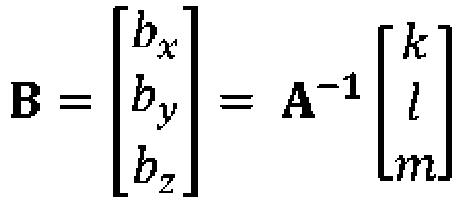

- Procédé d'étalonnage de précision de la revendication 3 caractérisé en ce que, après l'étape d'étalonnage de la boussole électronique en fonction des données de l'accéléromètre compensé via le modèle d'ajustement ellipsoïdal, l'étape suivante est effectuée :
après que de nouvelles données de boussole électronique aient été collectées, en corrigeant les données nouvellement collectées à l'aide du paramètre ellipsoïde. - Procédé d'étalonnage de précision de la revendication 4 caractérisé en ce que, après l'étape de calculer l'attitude en fonction des données compensées de l'accéléromètre et les données compensées de la boussole électronique, l'étape suivante est effectuée :
calculer de nouveaux paramètres ellipsoïdes à l'aide de la boussole électronique en utilisant des données mesurées au cours d'un processus de mesure.
Applications Claiming Priority (2)
| Application Number | Priority Date | Filing Date | Title |
|---|---|---|---|
| CN201510665021.XA CN105352487B (zh) | 2015-10-13 | 2015-10-13 | 一种姿态测量系统的精度校准方法 |
| PCT/CN2016/088303 WO2017063386A1 (fr) | 2015-10-13 | 2016-07-04 | Procédé d'étalonnage de précision pour système de mesure d'attitude |
Publications (3)
| Publication Number | Publication Date |
|---|---|
| EP3364151A1 EP3364151A1 (fr) | 2018-08-22 |
| EP3364151A4 EP3364151A4 (fr) | 2019-06-19 |
| EP3364151B1 true EP3364151B1 (fr) | 2020-11-25 |
Family
ID=55328497
Family Applications (1)
| Application Number | Title | Priority Date | Filing Date |
|---|---|---|---|
| EP16854769.3A Not-in-force EP3364151B1 (fr) | 2015-10-13 | 2016-07-04 | Procédé d'étalonnage de précision pour système de mesure d'attitude |
Country Status (6)
| Country | Link |
|---|---|
| US (1) | US10605619B2 (fr) |
| EP (1) | EP3364151B1 (fr) |
| KR (1) | KR102008597B1 (fr) |
| CN (1) | CN105352487B (fr) |
| RU (1) | RU2662458C1 (fr) |
| WO (1) | WO2017063386A1 (fr) |
Families Citing this family (24)
| Publication number | Priority date | Publication date | Assignee | Title |
|---|---|---|---|---|
| CN105352487B (zh) * | 2015-10-13 | 2018-06-15 | 上海华测导航技术股份有限公司 | 一种姿态测量系统的精度校准方法 |
| CN106556383B (zh) * | 2016-12-02 | 2019-05-07 | 上海华测导航技术股份有限公司 | 一种rtk倾斜补偿测量精度验证的方法 |
| CN106979775B (zh) * | 2017-04-28 | 2019-07-30 | 江苏号百信息服务有限公司 | 一种电子罗盘阶跃时平滑滤波的方法 |
| CN107479079A (zh) * | 2017-07-13 | 2017-12-15 | 临沂大学 | 一种基于pdr与led结合的方法 |
| CN107656227B (zh) * | 2017-09-21 | 2019-10-11 | 大连理工大学 | 基于Levenberg-Marquardt算法的磁力计校准方法 |
| DE102017220867A1 (de) * | 2017-11-22 | 2019-05-23 | Robert Bosch Gmbh | Verfahren zum automatischen Kalibrieren und Verfahren zum Verwenden eines Beschleunigungssensors |
| US20190346897A1 (en) * | 2018-05-13 | 2019-11-14 | Sean Joseph Rostami | Introspective Power Method |
| CN109188422B (zh) * | 2018-08-08 | 2023-01-06 | 中国航空工业集团公司雷华电子技术研究所 | 一种基于lu分解的卡尔曼滤波目标跟踪方法 |
| CN109470277B (zh) * | 2018-12-26 | 2022-09-13 | 湖南航天机电设备与特种材料研究所 | 非正交角度测量装置标定系数的测定方法及系统 |
| CN112146678B (zh) * | 2019-06-27 | 2022-10-11 | 华为技术有限公司 | 一种确定校准参数的方法及电子设备 |
| CN111765879A (zh) * | 2019-11-29 | 2020-10-13 | 深圳市瑞芬科技有限公司 | 一种三维电子罗盘装置及实用校准方法 |
| CN112325901B (zh) * | 2020-09-28 | 2022-09-16 | 中国船舶重工集团公司第七0七研究所 | 一种平台式惯导系泊状态下计算方位陀螺仪标度的方法 |
| CN112284366B (zh) * | 2020-10-26 | 2022-04-12 | 中北大学 | 一种基于tg-lstm神经网络的偏振光罗盘航向角误差校正方法 |
| CN112284421B (zh) * | 2020-11-02 | 2021-03-19 | 蘑菇车联信息科技有限公司 | 一种imu内参调整方法及相关装置 |
| CN112596015B (zh) * | 2020-12-28 | 2024-09-17 | 上海矽睿科技股份有限公司 | 三轴磁传感器的测试方法及系统 |
| CN113124905B (zh) * | 2021-04-27 | 2022-10-28 | 西安电子科技大学 | 一种用于多轴惯性姿态传感器精度评估的自动测量方法 |
| CN113985494A (zh) * | 2021-10-13 | 2022-01-28 | 哈尔滨工程大学 | 一种基于无迹卡尔曼算法海底地震计中电子罗盘误差补偿方法 |
| CN114264997B (zh) * | 2021-12-14 | 2024-03-22 | 武汉联影生命科学仪器有限公司 | 梯度灵敏度校准方法、装置及磁共振设备 |
| CN114485728A (zh) * | 2022-01-04 | 2022-05-13 | 中国煤炭科工集团太原研究院有限公司 | 一种捷联惯导系统现场快速自标定方法 |
| CN114924096A (zh) * | 2022-04-14 | 2022-08-19 | 北京中弘泰科科技有限公司 | 一种mems加速度计精度自动标定系统 |
| CN116224468B (zh) * | 2023-05-10 | 2023-08-22 | 华中光电技术研究所(中国船舶集团有限公司第七一七研究所) | 一种陆地重力仪标定方法及标定系数 |
| CN119619949B (zh) * | 2024-12-02 | 2025-09-16 | 北京航空航天大学 | 一种基于拉依达准则优化椭球拟合的磁力计校准方法 |
| CN119748444B (zh) * | 2024-12-24 | 2025-10-21 | 中国人民解放军陆军军事交通学院军事交通运输研究所 | 一种轮式移动机械臂协调控制方法、系统及装置 |
| CN119958608B (zh) * | 2025-01-22 | 2025-10-24 | 北京航空航天大学 | 一种用于原子自旋惯性测量的抽运-检测非正交角标定方法 |
Family Cites Families (19)
| Publication number | Priority date | Publication date | Assignee | Title |
|---|---|---|---|---|
| JPH0625671B2 (ja) * | 1987-08-28 | 1994-04-06 | 日本航空電子工業株式会社 | 慣性航法装置 |
| RU2098764C1 (ru) * | 1996-05-29 | 1997-12-10 | Русланов Александр Семенович | Способ определения местоположения подвижных объектов и устройство для его реализации |
| CA2253052A1 (fr) * | 1997-01-31 | 1998-10-29 | Greenfield Enterprises, Inc. | Procede et systeme de navigation |
| US7376507B1 (en) * | 2004-05-27 | 2008-05-20 | Sandia Corporation | Geophysics-based method of locating a stationary earth object |
| US7275008B2 (en) * | 2005-09-02 | 2007-09-25 | Nokia Corporation | Calibration of 3D field sensors |
| US7451549B1 (en) * | 2006-08-09 | 2008-11-18 | Pni Corporation | Automatic calibration of a three-axis magnetic compass |
| US8005635B2 (en) * | 2007-08-14 | 2011-08-23 | Ching-Fang Lin | Self-calibrated azimuth and attitude accuracy enhancing method and system (SAAAEMS) |
| DE102008042989A1 (de) * | 2008-10-21 | 2010-04-22 | Robert Bosch Gmbh | Elektronischer Kompass |
| US8645093B2 (en) * | 2009-11-04 | 2014-02-04 | Qualcomm Incorporated | Calibrating multi-dimensional sensor for offset, sensitivity, and non-orthogonality |
| CN102252689A (zh) * | 2010-05-19 | 2011-11-23 | 北京国浩传感器技术研究院(普通合伙) | 一种基于磁传感器的电子罗盘校准方法 |
| US20130185018A1 (en) * | 2010-10-01 | 2013-07-18 | Hua Sheng | Apparatuses and Methods for Estimating the Yaw Angle of a Device in a Gravitational Reference System Using Measurements of Motion Sensors and a Magnetometer Attached to the Device |
| KR101209571B1 (ko) * | 2010-10-20 | 2012-12-07 | 한국과학기술연구원 | 자동 교정 방법 및 장치 |
| US9810549B2 (en) * | 2011-01-06 | 2017-11-07 | University Of Utah Research Foundation | Systems, methods, and apparatus for calibration of and three-dimensional tracking of intermittent motion with an inertial measurement unit |
| US9541393B2 (en) * | 2011-06-30 | 2017-01-10 | Qualcomm Incorporated | Reducing power consumption or error of digital compass |
| US9683865B2 (en) * | 2012-01-26 | 2017-06-20 | Invensense, Inc. | In-use automatic calibration methodology for sensors in mobile devices |
| KR101503046B1 (ko) * | 2013-08-22 | 2015-03-24 | 한국과학기술연구원 | 다축 감지 장치 및 이의 교정 방법 |
| CN103776451B (zh) | 2014-03-04 | 2016-11-09 | 哈尔滨工业大学 | 一种基于mems的高精度三维姿态惯性测量系统以及测量方法 |
| CN104898681B (zh) * | 2015-05-04 | 2017-07-28 | 浙江工业大学 | 一种采用三阶近似毕卡四元数的四旋翼飞行器姿态获取方法 |
| CN105352487B (zh) | 2015-10-13 | 2018-06-15 | 上海华测导航技术股份有限公司 | 一种姿态测量系统的精度校准方法 |
-
2015
- 2015-10-13 CN CN201510665021.XA patent/CN105352487B/zh active Active
-
2016
- 2016-07-04 RU RU2017125953A patent/RU2662458C1/ru not_active IP Right Cessation
- 2016-07-04 KR KR1020177023778A patent/KR102008597B1/ko not_active Expired - Fee Related
- 2016-07-04 WO PCT/CN2016/088303 patent/WO2017063386A1/fr not_active Ceased
- 2016-07-04 US US15/542,931 patent/US10605619B2/en active Active
- 2016-07-04 EP EP16854769.3A patent/EP3364151B1/fr not_active Not-in-force
Non-Patent Citations (1)
| Title |
|---|
| None * |
Also Published As
| Publication number | Publication date |
|---|---|
| KR102008597B1 (ko) | 2019-08-07 |
| CN105352487B (zh) | 2018-06-15 |
| US10605619B2 (en) | 2020-03-31 |
| US20180010923A1 (en) | 2018-01-11 |
| CN105352487A (zh) | 2016-02-24 |
| WO2017063386A1 (fr) | 2017-04-20 |
| EP3364151A1 (fr) | 2018-08-22 |
| EP3364151A4 (fr) | 2019-06-19 |
| RU2662458C1 (ru) | 2018-07-26 |
| KR20170105619A (ko) | 2017-09-19 |
Similar Documents
| Publication | Publication Date | Title |
|---|---|---|
| EP3364151B1 (fr) | Procédé d'étalonnage de précision pour système de mesure d'attitude | |
| CN108827299B (zh) | 一种基于改进四元数二阶互补滤波的飞行器姿态解算方法 | |
| Wu et al. | Fast complementary filter for attitude estimation using low-cost MARG sensors | |
| CN103153790B (zh) | 使用运动传感器和附接至装置的磁力计的测量数据估计该装置在重力参照系中的偏航角的设备和方法 | |
| CN103954286B (zh) | 微小卫星磁传感器多误差模型在轨迭代标定方法 | |
| CN103940433B (zh) | 一种基于改进的自适应平方根ukf算法的卫星姿态确定方法 | |
| CN103017763A (zh) | 状态估计设备和偏移更新方法 | |
| CN103808349B (zh) | 矢量传感器的误差校正方法和装置 | |
| CN110440827B (zh) | 一种参数误差的标定方法、装置及存储介质 | |
| CN109000639B (zh) | 乘性误差四元数地磁张量场辅助陀螺的姿态估计方法及装置 | |
| CN111189474A (zh) | 基于mems的marg传感器的自主校准方法 | |
| CN105066996B (zh) | 自适应矩阵卡尔曼滤波姿态估计方法 | |
| CN103218482A (zh) | 一种动力学系统中不确定参数的估计方法 | |
| CN102654515B (zh) | 三轴加速度传感器的z敏感轴的校准方法 | |
| Chen et al. | High-precision geomagnetic directional technology based on sensor error correction and adaptive hybrid filter | |
| Chou et al. | Two‐step optimal filter design for the low‐cost attitude and heading reference systems | |
| CN114089244B (zh) | 一种捷联三轴磁强计两步标定方法 | |
| Dan et al. | Application Of Strongly Tracking Kalman Filter In MEMS Gyroscope Bias Compensation | |
| CN109737940A (zh) | 一种电子罗盘实时自由校准方法及装置 | |
| Sun et al. | A magnetic vector aided calibration method for MEMS gyroscope | |
| Rupniewski | SVD calibration of inertial sensors | |
| Cardoni et al. | Imu user transparent tiny neural self-calibration | |
| CN116482405B (zh) | 一种基于admm算法的加速度计标定的方法及系统 | |
| CN121275034B (zh) | 一种惯性测量单元故障诊断方法及系统 | |
| Zhou et al. | Parameter determination and analysis of first-order gaussian-markov error model based on smartphone barometer |
Legal Events
| Date | Code | Title | Description |
|---|---|---|---|
| STAA | Information on the status of an ep patent application or granted ep patent |
Free format text: STATUS: THE INTERNATIONAL PUBLICATION HAS BEEN MADE |
|
| PUAI | Public reference made under article 153(3) epc to a published international application that has entered the european phase |
Free format text: ORIGINAL CODE: 0009012 |
|
| STAA | Information on the status of an ep patent application or granted ep patent |
Free format text: STATUS: REQUEST FOR EXAMINATION WAS MADE |
|
| 17P | Request for examination filed |
Effective date: 20170726 |
|
| AK | Designated contracting states |
Kind code of ref document: A1 Designated state(s): AL AT BE BG CH CY CZ DE DK EE ES FI FR GB GR HR HU IE IS IT LI LT LU LV MC MK MT NL NO PL PT RO RS SE SI SK SM TR |
|
| AX | Request for extension of the european patent |
Extension state: BA ME |
|
| DAV | Request for validation of the european patent (deleted) | ||
| DAX | Request for extension of the european patent (deleted) | ||
| A4 | Supplementary search report drawn up and despatched |
Effective date: 20190516 |
|
| RIC1 | Information provided on ipc code assigned before grant |
Ipc: G01P 21/00 20060101ALI20190510BHEP Ipc: G01C 17/38 20060101ALI20190510BHEP Ipc: G01C 25/00 20060101ALI20190510BHEP Ipc: G01P 15/18 20130101ALN20190510BHEP Ipc: G01C 17/00 20060101AFI20190510BHEP |
|
| STAA | Information on the status of an ep patent application or granted ep patent |
Free format text: STATUS: EXAMINATION IS IN PROGRESS |
|
| 17Q | First examination report despatched |
Effective date: 20191105 |
|
| RIC1 | Information provided on ipc code assigned before grant |
Ipc: G01P 21/00 20060101ALI20191210BHEP Ipc: G01C 17/38 20060101AFI20191210BHEP Ipc: G01C 25/00 20060101ALI20191210BHEP Ipc: G01P 15/18 20130101ALN20191210BHEP |
|
| REG | Reference to a national code |
Ref country code: DE Ref legal event code: R079 Ref document number: 602016048783 Country of ref document: DE Free format text: PREVIOUS MAIN CLASS: G01C0017000000 Ipc: G01C0017380000 |
|
| RIC1 | Information provided on ipc code assigned before grant |
Ipc: G01C 25/00 20060101ALI20200121BHEP Ipc: G01P 15/18 20130101ALN20200121BHEP Ipc: G01P 21/00 20060101ALI20200121BHEP Ipc: G01C 17/38 20060101AFI20200121BHEP |
|
| RIN1 | Information on inventor provided before grant (corrected) |
Inventor name: ZHAO, WENLONG Inventor name: SHEN, XUEFENG Inventor name: DAI, WENDING Inventor name: YUE, QIANG Inventor name: TU, RUI |
|
| GRAP | Despatch of communication of intention to grant a patent |
Free format text: ORIGINAL CODE: EPIDOSNIGR1 |
|
| STAA | Information on the status of an ep patent application or granted ep patent |
Free format text: STATUS: GRANT OF PATENT IS INTENDED |
|
| INTG | Intention to grant announced |
Effective date: 20200317 |
|
| GRAS | Grant fee paid |
Free format text: ORIGINAL CODE: EPIDOSNIGR3 |
|
| GRAA | (expected) grant |
Free format text: ORIGINAL CODE: 0009210 |
|
| STAA | Information on the status of an ep patent application or granted ep patent |
Free format text: STATUS: THE PATENT HAS BEEN GRANTED |
|
| AK | Designated contracting states |
Kind code of ref document: B1 Designated state(s): AL AT BE BG CH CY CZ DE DK EE ES FI FR GB GR HR HU IE IS IT LI LT LU LV MC MK MT NL NO PL PT RO RS SE SI SK SM TR |
|
| REG | Reference to a national code |
Ref country code: GB Ref legal event code: FG4D |
|
| REG | Reference to a national code |
Ref country code: CH Ref legal event code: EP |
|
| REG | Reference to a national code |
Ref country code: DE Ref legal event code: R096 Ref document number: 602016048783 Country of ref document: DE |
|
| REG | Reference to a national code |
Ref country code: AT Ref legal event code: REF Ref document number: 1338836 Country of ref document: AT Kind code of ref document: T Effective date: 20201215 |
|
| REG | Reference to a national code |
Ref country code: IE Ref legal event code: FG4D |
|
| REG | Reference to a national code |
Ref country code: AT Ref legal event code: MK05 Ref document number: 1338836 Country of ref document: AT Kind code of ref document: T Effective date: 20201125 |
|
| REG | Reference to a national code |
Ref country code: NL Ref legal event code: MP Effective date: 20201125 |
|
| PG25 | Lapsed in a contracting state [announced via postgrant information from national office to epo] |
Ref country code: NO Free format text: LAPSE BECAUSE OF FAILURE TO SUBMIT A TRANSLATION OF THE DESCRIPTION OR TO PAY THE FEE WITHIN THE PRESCRIBED TIME-LIMIT Effective date: 20210225 Ref country code: RS Free format text: LAPSE BECAUSE OF FAILURE TO SUBMIT A TRANSLATION OF THE DESCRIPTION OR TO PAY THE FEE WITHIN THE PRESCRIBED TIME-LIMIT Effective date: 20201125 Ref country code: PT Free format text: LAPSE BECAUSE OF FAILURE TO SUBMIT A TRANSLATION OF THE DESCRIPTION OR TO PAY THE FEE WITHIN THE PRESCRIBED TIME-LIMIT Effective date: 20210325 Ref country code: GR Free format text: LAPSE BECAUSE OF FAILURE TO SUBMIT A TRANSLATION OF THE DESCRIPTION OR TO PAY THE FEE WITHIN THE PRESCRIBED TIME-LIMIT Effective date: 20210226 Ref country code: FI Free format text: LAPSE BECAUSE OF FAILURE TO SUBMIT A TRANSLATION OF THE DESCRIPTION OR TO PAY THE FEE WITHIN THE PRESCRIBED TIME-LIMIT Effective date: 20201125 |
|
| PG25 | Lapsed in a contracting state [announced via postgrant information from national office to epo] |
Ref country code: AT Free format text: LAPSE BECAUSE OF FAILURE TO SUBMIT A TRANSLATION OF THE DESCRIPTION OR TO PAY THE FEE WITHIN THE PRESCRIBED TIME-LIMIT Effective date: 20201125 Ref country code: BG Free format text: LAPSE BECAUSE OF FAILURE TO SUBMIT A TRANSLATION OF THE DESCRIPTION OR TO PAY THE FEE WITHIN THE PRESCRIBED TIME-LIMIT Effective date: 20210225 Ref country code: PL Free format text: LAPSE BECAUSE OF FAILURE TO SUBMIT A TRANSLATION OF THE DESCRIPTION OR TO PAY THE FEE WITHIN THE PRESCRIBED TIME-LIMIT Effective date: 20201125 Ref country code: LV Free format text: LAPSE BECAUSE OF FAILURE TO SUBMIT A TRANSLATION OF THE DESCRIPTION OR TO PAY THE FEE WITHIN THE PRESCRIBED TIME-LIMIT Effective date: 20201125 Ref country code: IS Free format text: LAPSE BECAUSE OF FAILURE TO SUBMIT A TRANSLATION OF THE DESCRIPTION OR TO PAY THE FEE WITHIN THE PRESCRIBED TIME-LIMIT Effective date: 20210325 Ref country code: SE Free format text: LAPSE BECAUSE OF FAILURE TO SUBMIT A TRANSLATION OF THE DESCRIPTION OR TO PAY THE FEE WITHIN THE PRESCRIBED TIME-LIMIT Effective date: 20201125 |
|
| REG | Reference to a national code |
Ref country code: LT Ref legal event code: MG9D |
|
| PG25 | Lapsed in a contracting state [announced via postgrant information from national office to epo] |
Ref country code: HR Free format text: LAPSE BECAUSE OF FAILURE TO SUBMIT A TRANSLATION OF THE DESCRIPTION OR TO PAY THE FEE WITHIN THE PRESCRIBED TIME-LIMIT Effective date: 20201125 |
|
| PG25 | Lapsed in a contracting state [announced via postgrant information from national office to epo] |
Ref country code: CZ Free format text: LAPSE BECAUSE OF FAILURE TO SUBMIT A TRANSLATION OF THE DESCRIPTION OR TO PAY THE FEE WITHIN THE PRESCRIBED TIME-LIMIT Effective date: 20201125 Ref country code: EE Free format text: LAPSE BECAUSE OF FAILURE TO SUBMIT A TRANSLATION OF THE DESCRIPTION OR TO PAY THE FEE WITHIN THE PRESCRIBED TIME-LIMIT Effective date: 20201125 Ref country code: SM Free format text: LAPSE BECAUSE OF FAILURE TO SUBMIT A TRANSLATION OF THE DESCRIPTION OR TO PAY THE FEE WITHIN THE PRESCRIBED TIME-LIMIT Effective date: 20201125 Ref country code: LT Free format text: LAPSE BECAUSE OF FAILURE TO SUBMIT A TRANSLATION OF THE DESCRIPTION OR TO PAY THE FEE WITHIN THE PRESCRIBED TIME-LIMIT Effective date: 20201125 Ref country code: SK Free format text: LAPSE BECAUSE OF FAILURE TO SUBMIT A TRANSLATION OF THE DESCRIPTION OR TO PAY THE FEE WITHIN THE PRESCRIBED TIME-LIMIT Effective date: 20201125 Ref country code: RO Free format text: LAPSE BECAUSE OF FAILURE TO SUBMIT A TRANSLATION OF THE DESCRIPTION OR TO PAY THE FEE WITHIN THE PRESCRIBED TIME-LIMIT Effective date: 20201125 |
|
| REG | Reference to a national code |
Ref country code: DE Ref legal event code: R097 Ref document number: 602016048783 Country of ref document: DE |
|
| PG25 | Lapsed in a contracting state [announced via postgrant information from national office to epo] |
Ref country code: DK Free format text: LAPSE BECAUSE OF FAILURE TO SUBMIT A TRANSLATION OF THE DESCRIPTION OR TO PAY THE FEE WITHIN THE PRESCRIBED TIME-LIMIT Effective date: 20201125 |
|
| PLBE | No opposition filed within time limit |
Free format text: ORIGINAL CODE: 0009261 |
|
| STAA | Information on the status of an ep patent application or granted ep patent |
Free format text: STATUS: NO OPPOSITION FILED WITHIN TIME LIMIT |
|
| PG25 | Lapsed in a contracting state [announced via postgrant information from national office to epo] |
Ref country code: IT Free format text: LAPSE BECAUSE OF FAILURE TO SUBMIT A TRANSLATION OF THE DESCRIPTION OR TO PAY THE FEE WITHIN THE PRESCRIBED TIME-LIMIT Effective date: 20201125 Ref country code: AL Free format text: LAPSE BECAUSE OF FAILURE TO SUBMIT A TRANSLATION OF THE DESCRIPTION OR TO PAY THE FEE WITHIN THE PRESCRIBED TIME-LIMIT Effective date: 20201125 Ref country code: NL Free format text: LAPSE BECAUSE OF FAILURE TO SUBMIT A TRANSLATION OF THE DESCRIPTION OR TO PAY THE FEE WITHIN THE PRESCRIBED TIME-LIMIT Effective date: 20201125 |
|
| 26N | No opposition filed |
Effective date: 20210826 |
|
| PG25 | Lapsed in a contracting state [announced via postgrant information from national office to epo] |
Ref country code: SI Free format text: LAPSE BECAUSE OF FAILURE TO SUBMIT A TRANSLATION OF THE DESCRIPTION OR TO PAY THE FEE WITHIN THE PRESCRIBED TIME-LIMIT Effective date: 20201125 |
|
| PG25 | Lapsed in a contracting state [announced via postgrant information from national office to epo] |
Ref country code: ES Free format text: LAPSE BECAUSE OF FAILURE TO SUBMIT A TRANSLATION OF THE DESCRIPTION OR TO PAY THE FEE WITHIN THE PRESCRIBED TIME-LIMIT Effective date: 20201125 |
|
| REG | Reference to a national code |
Ref country code: DE Ref legal event code: R119 Ref document number: 602016048783 Country of ref document: DE |
|
| REG | Reference to a national code |
Ref country code: CH Ref legal event code: PL |
|
| GBPC | Gb: european patent ceased through non-payment of renewal fee |
Effective date: 20210704 |
|
| PG25 | Lapsed in a contracting state [announced via postgrant information from national office to epo] |
Ref country code: MC Free format text: LAPSE BECAUSE OF FAILURE TO SUBMIT A TRANSLATION OF THE DESCRIPTION OR TO PAY THE FEE WITHIN THE PRESCRIBED TIME-LIMIT Effective date: 20201125 |
|
| REG | Reference to a national code |
Ref country code: BE Ref legal event code: MM Effective date: 20210731 |
|
| PG25 | Lapsed in a contracting state [announced via postgrant information from national office to epo] |
Ref country code: LI Free format text: LAPSE BECAUSE OF NON-PAYMENT OF DUE FEES Effective date: 20210731 Ref country code: GB Free format text: LAPSE BECAUSE OF NON-PAYMENT OF DUE FEES Effective date: 20210704 Ref country code: DE Free format text: LAPSE BECAUSE OF NON-PAYMENT OF DUE FEES Effective date: 20220201 Ref country code: CH Free format text: LAPSE BECAUSE OF NON-PAYMENT OF DUE FEES Effective date: 20210731 |
|
| PG25 | Lapsed in a contracting state [announced via postgrant information from national office to epo] |
Ref country code: IS Free format text: LAPSE BECAUSE OF FAILURE TO SUBMIT A TRANSLATION OF THE DESCRIPTION OR TO PAY THE FEE WITHIN THE PRESCRIBED TIME-LIMIT Effective date: 20210325 Ref country code: LU Free format text: LAPSE BECAUSE OF NON-PAYMENT OF DUE FEES Effective date: 20210704 Ref country code: FR Free format text: LAPSE BECAUSE OF NON-PAYMENT OF DUE FEES Effective date: 20210731 |
|
| PG25 | Lapsed in a contracting state [announced via postgrant information from national office to epo] |
Ref country code: IE Free format text: LAPSE BECAUSE OF NON-PAYMENT OF DUE FEES Effective date: 20210704 Ref country code: BE Free format text: LAPSE BECAUSE OF NON-PAYMENT OF DUE FEES Effective date: 20210731 |
|
| PG25 | Lapsed in a contracting state [announced via postgrant information from national office to epo] |
Ref country code: CY Free format text: LAPSE BECAUSE OF FAILURE TO SUBMIT A TRANSLATION OF THE DESCRIPTION OR TO PAY THE FEE WITHIN THE PRESCRIBED TIME-LIMIT Effective date: 20201125 |
|
| PG25 | Lapsed in a contracting state [announced via postgrant information from national office to epo] |
Ref country code: HU Free format text: LAPSE BECAUSE OF FAILURE TO SUBMIT A TRANSLATION OF THE DESCRIPTION OR TO PAY THE FEE WITHIN THE PRESCRIBED TIME-LIMIT; INVALID AB INITIO Effective date: 20160704 |
|
| PG25 | Lapsed in a contracting state [announced via postgrant information from national office to epo] |
Ref country code: MK Free format text: LAPSE BECAUSE OF FAILURE TO SUBMIT A TRANSLATION OF THE DESCRIPTION OR TO PAY THE FEE WITHIN THE PRESCRIBED TIME-LIMIT Effective date: 20201125 |
|
| PG25 | Lapsed in a contracting state [announced via postgrant information from national office to epo] |
Ref country code: TR Free format text: LAPSE BECAUSE OF FAILURE TO SUBMIT A TRANSLATION OF THE DESCRIPTION OR TO PAY THE FEE WITHIN THE PRESCRIBED TIME-LIMIT Effective date: 20201125 |
|
| PG25 | Lapsed in a contracting state [announced via postgrant information from national office to epo] |
Ref country code: MT Free format text: LAPSE BECAUSE OF FAILURE TO SUBMIT A TRANSLATION OF THE DESCRIPTION OR TO PAY THE FEE WITHIN THE PRESCRIBED TIME-LIMIT Effective date: 20201125 |