EP3364609A1 - Kommunikationssystem, adressbenachrichtigungsvorrichtung, kommunikationssteuerungsvorrichtung, endgerät, kommunikationsverfahren und programm - Google Patents
Kommunikationssystem, adressbenachrichtigungsvorrichtung, kommunikationssteuerungsvorrichtung, endgerät, kommunikationsverfahren und programm Download PDFInfo
- Publication number
- EP3364609A1 EP3364609A1 EP16855497.0A EP16855497A EP3364609A1 EP 3364609 A1 EP3364609 A1 EP 3364609A1 EP 16855497 A EP16855497 A EP 16855497A EP 3364609 A1 EP3364609 A1 EP 3364609A1
- Authority
- EP
- European Patent Office
- Prior art keywords
- address
- terminal
- communication
- notification apparatus
- addresses
- Prior art date
- Legal status (The legal status is an assumption and is not a legal conclusion. Google has not performed a legal analysis and makes no representation as to the accuracy of the status listed.)
- Granted
Links
Images





Classifications
-
- H—ELECTRICITY
- H04—ELECTRIC COMMUNICATION TECHNIQUE
- H04L—TRANSMISSION OF DIGITAL INFORMATION, e.g. TELEGRAPHIC COMMUNICATION
- H04L61/00—Network arrangements, protocols or services for addressing or naming
- H04L61/09—Mapping addresses
- H04L61/25—Mapping addresses of the same type
- H04L61/2503—Translation of Internet protocol [IP] addresses
- H04L61/2546—Arrangements for avoiding unnecessary translation
-
- H—ELECTRICITY
- H04—ELECTRIC COMMUNICATION TECHNIQUE
- H04L—TRANSMISSION OF DIGITAL INFORMATION, e.g. TELEGRAPHIC COMMUNICATION
- H04L61/00—Network arrangements, protocols or services for addressing or naming
- H04L61/09—Mapping addresses
- H04L61/25—Mapping addresses of the same type
- H04L61/2503—Translation of Internet protocol [IP] addresses
- H04L61/256—NAT traversal
- H04L61/2575—NAT traversal using address mapping retrieval, e.g. simple traversal of user datagram protocol through session traversal utilities for NAT [STUN]
-
- H—ELECTRICITY
- H04—ELECTRIC COMMUNICATION TECHNIQUE
- H04L—TRANSMISSION OF DIGITAL INFORMATION, e.g. TELEGRAPHIC COMMUNICATION
- H04L61/00—Network arrangements, protocols or services for addressing or naming
- H04L61/09—Mapping addresses
- H04L61/25—Mapping addresses of the same type
- H04L61/2503—Translation of Internet protocol [IP] addresses
- H04L61/2521—Translation architectures other than single NAT servers
- H04L61/2535—Multiple local networks, e.g. resolving potential IP address conflicts
-
- H—ELECTRICITY
- H04—ELECTRIC COMMUNICATION TECHNIQUE
- H04L—TRANSMISSION OF DIGITAL INFORMATION, e.g. TELEGRAPHIC COMMUNICATION
- H04L61/00—Network arrangements, protocols or services for addressing or naming
- H04L61/09—Mapping addresses
- H04L61/25—Mapping addresses of the same type
- H04L61/2503—Translation of Internet protocol [IP] addresses
- H04L61/256—NAT traversal
- H04L61/2567—NAT traversal for reachability, e.g. inquiring the address of a correspondent behind a NAT server
-
- H—ELECTRICITY
- H04—ELECTRIC COMMUNICATION TECHNIQUE
- H04L—TRANSMISSION OF DIGITAL INFORMATION, e.g. TELEGRAPHIC COMMUNICATION
- H04L61/00—Network arrangements, protocols or services for addressing or naming
- H04L61/09—Mapping addresses
- H04L61/25—Mapping addresses of the same type
- H04L61/2503—Translation of Internet protocol [IP] addresses
- H04L61/256—NAT traversal
- H04L61/2589—NAT traversal over a relay server, e.g. traversal using relay for network address translation [TURN]
-
- H—ELECTRICITY
- H04—ELECTRIC COMMUNICATION TECHNIQUE
- H04L—TRANSMISSION OF DIGITAL INFORMATION, e.g. TELEGRAPHIC COMMUNICATION
- H04L2101/00—Indexing scheme associated with group H04L61/00
- H04L2101/60—Types of network addresses
- H04L2101/677—Multiple interfaces, e.g. multihomed nodes
-
- H—ELECTRICITY
- H04—ELECTRIC COMMUNICATION TECHNIQUE
- H04L—TRANSMISSION OF DIGITAL INFORMATION, e.g. TELEGRAPHIC COMMUNICATION
- H04L61/00—Network arrangements, protocols or services for addressing or naming
- H04L61/09—Mapping addresses
- H04L61/25—Mapping addresses of the same type
- H04L61/2503—Translation of Internet protocol [IP] addresses
- H04L61/2514—Translation of Internet protocol [IP] addresses between local and global IP addresses
Definitions
- the present invention relates to a technique for performing P2P communication between terminals.
- P2P communication using WebRTC or the like is generally performed via the Internet.
- a packet transmitted from the terminal A is sent to a router for Internet connection of an ISP (Internet Service Provider) via an access network, and is sent from the router to the Internet. Then, the packet arrives at the router of an ISP on the terminal B side and is delivered to the terminal B via an access network.
- ISP Internet Service Provider
- the P2P communication as described above for example, if the use ISP of the terminal A is different from the use ISP of the terminal B, even when the terminal A and the terminal B are located at geographically close positions (example: within the same city), there is a possibility that the P2P communication between the terminal A and the terminal B is performed via a point of connection between ISPs at a remote place or via an IX.
- the present invention has been made in view of the above-problem, and an object of the present invention is to provide a technique in which a communication route used for P2P communication between terminals is properly selected.
- a communication system including a first address notification apparatus provided in a first communication network, and a second address notification apparatus provided in a second communication network, wherein the first address notification apparatus includes means that receives an address request from a terminal that can communicate with the first address notification apparatus and with the second address notification apparatus, obtains a source address from the address request, and transmits a response including the source address to the terminal, and the second address notification apparatus includes means that receives an address request from the terminal, obtains a source address from the address request, and transmits a response including the source address to the terminal.
- an address notification apparatus functioning as a first address notification apparatus provided in a first communication network in a communication system including the first address notification apparatus provided in the first communication network, and a second address notification apparatus provided in a second communication network, including:
- a communication control apparatus for use in a communication system including the communication control apparatus, a first address notification apparatus provided in a first communication network, and a second address notification apparatus provided in a second communication apparatus, including:
- a terminal that performs control communication with a communication system including a communication control apparatus, a first address notification apparatus provided in a first communication network, and a second address notification apparatus provided in a second communication network, including:
- a communication method executed in a communication system including a first address notification apparatus provided in a first communication network, and a second address notification apparatus provided in a second communication network, wherein the first address notification apparatus receives an address request from a terminal that can communicate with the first address notification apparatus and with the second address notification apparatus, obtains a source address from the address request, and transmits a response including the source address to the terminal, and the second address notification apparatus receives an address request from the terminal, obtains a source address from the address request, and transmits a response including the source address to the terminal.
- a communication system including a first communication control apparatus and a first address notification apparatus that are provided in a first communication network, and a second communication control apparatus and a second address notification apparatus that are provided in a second communication network, each of the first communication control apparatus and the second communication control apparatus including relay means that receives a set of addresses from a terminal that can communicate with the first address notification apparatus and the second address notification apparatus, and transmits the set of addresses to a communication partner terminal that is a communication partner of the terminal, wherein the set of addresses includes an address obtained from a response to an address request that is transmitted to the first address notification apparatus from the terminal, and an address obtained from a response to an address request that is transmitted to the second address notification apparatus from the terminal.
- a communication route used for P2P communication between terminals is properly selected.
- IP address In P2P communication described in the present embodiment, a pair of an IP address and a port number is used for specifying a destination of communication and the like.
- a pair of an IP address and a port number is referred to as "address”. This may be referred to as "transport address”.
- IP address it is described as “IP address”, “IPv4 address”, “IPv6 address” and the like.
- Fig. 1 is an overall configuration diagram of a communication system according to an embodiment of the present invention.
- the communication system according to the present embodiment includes a first communication network 10 and a second communication network 20.
- IP addresses used for packet routing are different.
- IP addresses used for packet routing
- IP addresses are different
- IP address used in a global network such as the Internet
- IP address used in a network which is physically or logically separated from the global network, which is a closed network such as VPN, for example.
- Each of the first communication network 10 and the second communication network 20 are not limited to a specific type of network, but in the present embodiment, for example, it is assumed that the first communication network 10 is an access network (example: NGN (Next Generation Network) network), and the second communication network 20 is the Internet. However, there are other use cases, which are described later.
- the first communication network 10 and the second communication network 20 are illustrated separately for the sake of convenience.
- the number of communication networks is not limited to two, and three or more communication networks may be provided.
- the communication system is provided with a terminal 40A and a terminal 40B which are terminals that perform P2P communication.
- each terminal is a terminal such as a general PC, a smartphone, a mobile phone, or IoT/M2M device such as sensor/actuator or the like, equipped with a browser or software having a WebRTC communication function corresponding to a browser, and video call and the like is performed by P2P communication using WebRTC.
- this is merely an example, and communication of data may be performed by P2P communication.
- voice call may be performed by P2P communication.
- video, data and voice and the like are collectively referred to as "media”.
- the communication system is provided with a signaling server 30.
- the signaling server 30 is an apparatus for relaying a control signal between the terminal 40A and the terminal 40B for the terminal 40A and the terminal 40B to establish a communication route (channel).
- a communication route channel
- the signaling server 30 performs exchange of address candidates collected by each terminal between the terminal 40A and the terminal 40B, and the like.
- Each of the terminal 40A and the terminal 40B registers to the signaling server 30 and communicates with the signaling server 30.
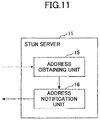
- Each STUN server is a server having a function of STUN described in the non-patent document 1, for example.
- each STUN server includes a function for receiving a binding request transmitted from a terminal, obtaining a source address from the packet of the request, including the source address in a binding response (address response) and transmitting the binding response to the source address.
- the source address is an external address after NAT conversion, for example. Accordingly, the terminal can know the external address of itself. By reporting the address to a communication partner, the communication partner can know the destination address to the terminal. If the NAT apparatus does not exist, a host address assigned to the terminal itself may be included in the binding response and the binding response may be returned.
- the address included in the binding response and returned to the terminal is referred to as "Reflexive Transport Address”.
- each terminal collects usable addresses by STUN, TURN, or the like, exchanges the collected addresses among terminals, performs connection check (hole punching) to each other, and performs communication by selecting an address of the highest priority from among addresses by which communication can be performed.
- the priority order of selection for example, the address of itself is the highest (that is, the case in which local communication is performed without passing though the NAT apparatus), an external address notified by the STUN server is the next, and an address for performing communication via the TURN server is the next. More specific examples will be described later. In the present embodiment, for convenience, TURN is not considered.
- the type (Type) of the address of the terminal itself is called “host”, and the type (Type) of the address of STUN is called “server reflexive".
- "Server reflexive” may be described as “srflx” by omitting a part.
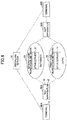
- a basic procedure example of ICE executed between the terminal 40A and the terminal 40B in the present embodiment is described. Note that this procedure is merely an example. Instead of the procedure shown in Fig. 2 , for example, a procedure may be used in which an obtained candidate is immediately sent to the partner to perform connection check immediately. The procedure shown in Fig. 2 is executed via the signaling server 30, but the description of the signaling server 30 is omitted.
- the above example is an example of a method of sending a binding request by directly designating the address (IP address) of the STUN server.
- a method may be used in which a STUN server of a destination is designated by FQDN, and the IP address is resolved by a DNS server.
- the terminal 40A obtains an address (host) A, a first address (srflx) A, and a second address (srflx) A.
- an address of a port indicate by C corresponds to the address (host) A
- an address of a port indicate by D corresponds to the second address (srflx) A
- an address of a port indicate by E corresponds to the first address (srflx) A.
- the address (host) A that is an address of host may exist for each of the first communication network 10 and the second communication network 20. That is, the first address (host) A and the second address (host) A may be acquired as addresses of the host. In this example, a case where one address (host) A is acquired as the address of host is shown as an example.
- the terminal 40A calculates a score corresponding to priority of each collected address.
- a method described in section 4.1.2 of the non-patent document 2 can be used. More specifically, the score is calculated from a value of host preference according to the type (host, srflx and the like) (example: host:128, srflx:100) and a value of Local Preference according to an address family (IPv4, IPv6).
- the method of calculating the score is not limited to the method described in Section 4.1.2 of Non-Patent Document 2.
- the value of Local preference it is recommended to use higher value for IPv6 than a value for IPv4 in non-patent document 2, and this recommendation is followed in this embodiment.
- step S102 the terminal 40A transmits addresses (referred to as address candidates) collected in step S101 to the terminal 40B together with the calculated scores.
- addresses referred to as address candidates
- SDP Session Description Protocol
- step S102 the terminal 40A transmits, to the terminal 40B, "the address (host) A and the score, the first address (srflx) A and the score, the second address (srflx) A and the score" as address candidates.
- step S103 the terminal 40B that receives the SDP offer including the address candidates obtains an address (host) B, a first address (srflx) B and a second address (srflx) B and calculates each score in the same way as address collection and score calculation in the terminal 40A side.
- step S104 the terminal 40B transmits "the address (host) B and the score, the first address (srflx) B and the score, the second address (srflx) B and the score" to the terminal 40A as SDP answers.
- each of the terminal 40A and the terminal 40B has its own address candidates and address candidates of the other party. Then, each of the terminal 40A and the terminal 40B generates a combination (set) of address pairs each being a pair of one address of itself and one address of the other party, and calculates scores of each address pair to arrange them in an priority order (this is referred to as a check list).
- the method described in section 5.7.2 of the non-patent document 2 can be used for the scoring. In this method, basically, as the score of each address forming the pair is higher, higher score can be obtained. However, performing scoring by the method described in 5.7.2 of Non-Patent Document 2 is merely an example, and scoring may be performed by another method.
- each of the terminal 40A and the terminal 40B performs connection check for each address pair.
- the connection check hole punching using a binding request of STUN is executed.
- the terminal 40A transmits a binding request to a destination address (referred to as address B) of the terminal 40B in an address pair, and when the terminal 40A receives a binding response, the terminal 40A obtains an address (reflexive address) (this is referred to as address A) included in the binding response.
- address A a destination address included in the binding response.
- connection check may be performed only from the terminal 40A (controlling agent).
- Connection check is performed by the above-mentioned method, and for example, the terminal 40A (controlling agent) determines to use, for media communication, an address pair of the highest priority from among address pairs by which connection check succeeds, and notifies the terminal 40B (controlled agent) of the address pair. If the address pair can be used (example: if the address pair is included in address pairs by which connection check from the terminal 40B succeeded), the terminal 40B may determine to use the address pair. Also in the terminal 40B, processing similar to that of the terminal 40A may be executed, and the terminal 40B may decide an address pair for transmission from the terminal 40B. After that, P2P communication using the determined address pair is executed (step S106). For example, the terminal 40A transmits media to a destination address of the determined address pair, and the terminal 40B transmits media to a destination address of the determined address pair.
- the address pair used for transmission from the terminal 40A and the address pair used for transmission from the terminal 40B may be the same or different.
- the address determination method as described above is merely an example and the address may be determined by another method.
- a first example and a second example which are more specific operation examples are described.
- the first communication network 10 is a network (example: NGN network) that performs routing of packets using IPv6 addresses and the second communication network 20 is a network (example: the Internet) that performs routing of packets using IPv4 addresses.
- the terminal 40A collects addresses.
- the terminal 40A is assigned a private (local) IPv4 address and a private IPv6 address from the NAT apparatus 50A, and it is assumed that the IPv4 address and the IPv6 address are obtained as host addresses. These are described as “IPv4 (host) A” and “IPv6 (host) A”.
- the terminal 40A transmits a binding request to each of the STUN server 21 and the STUN server 11, and receives a binding response from each of them, thereby acquiring IPv4 (srflx) A and IPv6 (srflx) A.
- the terminal 40A calculates the score of each collected address.
- the score is calculated in the order of the size of the score indicated as "IPv6 (host) A> IPv4 (host) A> IPv6 (srflx) A> IPv4 (srflx) A".
- step S203 address collection is performed by the terminal 40B, and in step S204, the terminal 40B transmits to the terminal 40A a message including "the IPv6 (host) B and the score, the IPv4 (host) B and the score, the IPv6 (srflx) B and the score, the IPv4 (srflx) B and the score".
- each of the terminal 40A and the terminal 40B has its own address candidates and address candidates of the partner. Then, each of the terminal 40A and the terminal 40B generates a set of address pairs each being a pair of one own address and one partner address, calculates a score for each address pair, arranges the pairs in priority order to make it a check list.
- the conventional technique does not have, in which the STUN server is provided in each of the first communication network 10 and the second communication network 20, it is possible to execute P2P communication between the terminal 40A and the terminal 40B by a route via the first communication network 10 (example: NGN network).
- the first communication network 10 is a network (example: NGN network) in which packet routing is performed using an IPv6 address (this is referred to as first IPv6 address)
- the second communication network 20 is a network (example: the Internet) in which packet routing is performed using an IPv6 address (this is referred to as second IPv6 address) of an address band different from that of the first IPv6 address.
- step S301 the terminal 40A collects addresses.
- a second IPv6 address used in the second communication network 20 is assigned to the terminal 40A and the second IPv6 address is obtained as a host address. This is described as "second IPv6 (host) A". Similar formats are used for others.
- the terminal 40A transmits a binding request to each of the STUN server 21 and the STUN server 11, and receives a binding response from each of them to obtain a second IPv6 (srflx) A and a first IPv6 (srflx) A.
- a pair including the first IPv6 (srflx) B as a destination address becomes the highest score definitely when the terminal 40A calculates the score of the pair of the destination address and the source address.
- step S305 the terminal 40B collects addresses, and in step S306, the terminal 40B transmits a message including "the second IPv6 (host) B and the score 200, the first IPv6 (srflx) B and the score 100" as address candidates.
- the signaling server 30 may also transmit the address candidates "the second IPv6 (host) B and the score 100, the first IPv6 (srflx) B and the score 200" with the converted scores to the terminal 40B. Accordingly, the terminal 40B can use scores after score conversion for source addresses (own addresses) when performing scoring of address pairs. However, the address candidates with the converted scores may not be transmitted to the terminal 40B. In this case, conversion of score is performed such that score conversion functions effectively even if the score after score conversion is not used as to the source address.
- each of the terminal 40A and the terminal 40B has its own address candidates and address candidates of the partner. Then, each of the terminal 40A and the terminal 40B generates a set of address pairs each being a pair of one own address and one partner address, calculates a score for each address pair, arranges the pairs in priority order to make it a check list.
- connection check is performed in step S309.
- connection check succeeds in both of the pair of the first IPv6 (srflx) A and the first IPv6 (srflx) B and the pair of second IPv6 (host) A and the second IPv6 (host) B in the terminal 40A.
- the score of the pair of the first IPv6 (srflx) A and the first IPv6 (srflx) B is higher than the score of the pair of second IPv6 (host) A and the second IPv6 (host) B.
- step S310 the terminal 40A determines the pair of the first IPv6 (srflx) A and the first IPv6 (srflx) B as an address pair for media transmission. Also in the terminal 40B, the address pair is determined in the same procedure, and the P2P communication is started in step S311. Or, the address pair determined by the terminal 40A is notified to the terminal 40B, and the terminal 40B may use the address pair.
- a conversion method may be adopted to convert a score of an address corresponding to a network through which P2P communication is desired to be passed to a high score (example: to a score of the highest priority).
- the signaling server 30 performs score conversion so as to enable P2P communication between the terminal 40A and the terminal 40B to be executed via a route passing through the first communication network 10 (example: NGN network).
- the signaling server 30 may perform address conversion such that the score of the address of the second communication network 20 side becomes higher.
- the signaling server 30 having functions of the second example may be used.
- the signaling server 30 confirms that the score of the address of the first communication network 10 is higher, determines that score conversion is unnecessary, and transfers the address candidates without score conversion.
- the configuration shown in Fig. 1 described so far corresponds to a case, as an example, in which the first communication network 10 is an access network, and the second communication network 20 is the Internet.
- both of the terminal 40A and the terminal 40B belong to the same access network (the first communication network 10) .
- the technique according to the present embodiment can be applied not only to the case where the terminal 40 A and the terminal 40 B belong to the same access network.
- the technique can be also applied to a case in which both the terminals belong to different access networks, and connect to the Internet via these access networks respectively.
- P2P connection check pieces of address information that the both terminals obtain from STUN servers in the access networks respectively are exchanged using the signaling server 30, and P2P connection check is performed. Then, for example, if access networks are inter-connected, or the like, P2P communication via the access networks is executed. On the other hand, if inter-connection or the like is not performed, P2P connection check of another address (for example, internet address) is performed, and if communication is available, connection via the network of the address is established. That is, communication via a connectable network (example: the Internet) can be automatically established as a fallback destination, and service availability is improved.
- a connectable network example: the Internet
- connection check on the first communication network 10 succeeds.
- connection via the first communication network 10 is rejected.
- P2P communication via the first communication network 10 is not permitted as a policy of the first communication network 10.
- connection is established if P2P connection is possible by another address. That is, by the present embodiment, communication via the second communication network 20 (example : the Internet) as a fallback destination can be automatically established, and service availability improves.
- the second communication network 20 example : the Internet
- the first communication network 10 is an access network such as the NGN network and the like, and that the second communication network 20 is the Internet.
- the first communication network 10 may be a closed network such as VPN and the second communication network 20 may be the Internet.
- An example of VPN is IP-VPN using MPLS technology.
- both the first communication network 10 and the second communication network 20 may be IPv4 or IPv6, or one may be IPv4 and the other may be IPv6.
- the signaling server 30 may perform address conversion such that the score of the address on the side of the second communication network 20 becomes high (the score conversion in S303, S307 in Fig. 4 ).
- the setting in the signaling server 30 may be changed so as to perform address conversion such that the score of the address in the first communication network 10 side becomes high.
- score conversion reference information stored in the after-mentioned data storage unit 33 of the signaling server 30 may be set as information indicating that address conversion is performed such that the score of the address in the first communication network 10 side becomes high.
- the technique of the present embodiment it is possible to control the traffic route in the same manner as the hybrid WAN or the like which is a use case realized by the SD-WAN (Software Defined WAN) technology simply by controlling the signaling server 30.
- SD-WAN Software Defined WAN
- Such traffic routing control can be realized by SDN (Software-Defined Network) after deploying SD-WAN controller and SD-WAN edges.
- SDN Software-Defined Network
- the STUN server 11 may be placed only in the first communication network 10 (example: access network).
- P2P connection check between the terminals is performed by the address of the host and the address that can be collected from the STUN server 11 in the first communication network 10.
- P2P communication using the address of host cannot be performed. Therefore, in this case, as long as the P2P communication via the first communication network 10 is not restricted, P2P communication by an address collectable from the STUN server 11, that is, P2P communication via the first communication network 10 is performed.
- the signaling server 30 may be provided in each network. That is, in the example shown in Fig. 8 , a signaling server 30-1 is provided in the first communication network 10, and a signaling server 30-2 is provided in the second communication network 20.
- the first communication network 10 may be an access network such as the NGN network and the like, or a closed network as described with reference to Fig. 6 , or another network.
- the second communication network 20 is assumed to be the Internet, it may be a network other than the Internet.
- both the first communication network 10 and the second communication network 20 may be IPv4 or IPv6, or one may be IPv4 and the other may be IPv6 .
- any of the operation that does not perform the score conversion as described in the first example and the operation that performs the score conversion as described in the second example can be applied.
- each of the terminal 40A and the terminal 40B registers to each of the signaling server 30-1 and the signaling server 30-2, respectively, and communicates with each of the signaling server 30-1 and the signaling server 30-2.
- the terminal 40A and the terminal 40B executes the operation of the sequence described with reference to Fig. 3 using the signaling server 30-1 and executes the operation of the sequence described with reference to Fig. 3 using the signaling server 30-2.
- the address collection (S201, S203) of the side of the terminal itself may be performed for each of the signaling server 30-1 and the signaling server 30-2, or may be performed once for the signaling server 30-1 and the signaling server 30-2.
- P2P communication connections are P2P communication connection established between the terminal 40A and the terminal 40B by the sequence using the signaling server 30-1 and P2P communication connection established between the terminal 40A and the terminal 40B by the sequence using the signaling server 30-2.
- the terminal 40A disconnects one of the two different P2P communication connections.
- the terminal 40A disconnects one at random since the score of the address pair is expected to be the same between the two different P2P communication connections.
- the terminal 40A may perform one P2P communication connection using an address pair of higher score from among the address pair determined by the sequence using the signaling server 30-1 and the address pair determined by the sequence using the signaling server 30-2.
- the terminal 40A and the terminal 40B executes the operation of the sequence described with reference to Fig. 4 using the signaling server 30-1, and also executes the operation of the sequence described with reference to Fig. 4 using the signaling server 30-2.
- the address collection (S301, S305) of the side of the terminal itself may be performed for each of the signaling server 30-1 and the signaling server 30-2, or may be performed once for the signaling server 30-1 and the signaling server 30-2.
- the terminal 40A disconnects one of the two different P2P communication connections.
- the terminal 40A disconnects one at random since the score of the address pair is expected to be the same between the two different P2P communication connections.
- the terminal 40A (or the terminal 40B) disconnects, for example, a P2P communication connection of lower score of address pair between the two different P2P communication connections.
- one P2P communication connection may be disconnected based on the score, or a communication network to disconnect may be predetermined so that a P2P communication connection via the communication network may be disconnected.
- the terminal 40A may perform one P2P communication connection using an address pair of higher score from among the address pair determined by the sequence using the signaling server 30-1 and the address pair determined by the sequence using the signaling server 30-2.
- Fig. 9 shows a configuration example of the terminal 40 (A, B) that executes processing described in the present embodiment. Since the terminal 40A and the terminal 40B have the same configuration, it is described as “terminal 40 (A, B)". In the following description, it is described as "terminal 40".
- the terminal 40 includes a control communication unit 41, a media communication unit 42, and a data storage unit 43.
- the control communication unit 41 determines an address to be used for P2P communication of media (video, voice, data and the like) by performing transmission and reception of a control signal with the STUN servers 11 and 21, and the signaling servers 30, 30-1, and 30-2.
- the media communication unit 42 performs P2P communication by using the address determined by the control communication unit 41.
- a user When designating the STUN server 11, 21 using a FQDN, for example, a user enters the FQDN in the control communication unit 41. Or, the FQDN is stored in the data storage unit 43 and the control communication unit 41 obtains the FQDN from the data storage unit 43. Then, the control communication unit 41 accesses the DNS server using the address of the DNS server stored in the data storage unit 43 to perform address resolution and accesses the STUN server 11, 21.
- the terminal 40 in the present embodiment can be realized, for example, by causing a computer to execute a program which describes the process content described in the present embodiment. More specifically, the functions of the terminal 40 can be realized by executing a program corresponding to processes performed by the terminal 40 by using hardware resources such as a CPU, a memory, and a hard disk and the like in the computer.
- the program can be saved and distributed by recording the program in a computer readable recording medium (such as portable memory). Also, the program can be provided via a network such as the Internet, an electronic mail and the like.
- the signaling server 30 in the present embodiment can be realized, for example, by causing one or more computers to execute a program which describes the process content described in the present embodiment. More specifically, the functions of the signaling server 30 can be realized by executing a program corresponding to processes performed by the signaling server 30 by using hardware resources such as a CPU, a memory, and a hard disk and the like in the computer.
- the program can be saved and distributed by recording the program in a computer readable recording medium (such as portable memory). Also, the program can be provided via a network such as the Internet, an electronic mail and the like.
- the STUN server 11 in the present embodiment can be realized, for example, by causing one or more computers to execute a program which describes the process content described in the present embodiment. More specifically, the functions of the STUN server 11 can be realized by executing a program corresponding to processes performed by the STUN server 11 by using hardware resources such as a CPU, a memory, and a hard disk and the like in the computer.
- the program can be saved and distributed by recording the program in a computer readable recording medium (such as portable memory). Also, the program can be provided via a network such as the Internet, an electronic mail and the like.
- a communication system including a first address notification apparatus provided in a first communication network, and a second address notification apparatus provided in a second communication network
- the first address notification apparatus includes means that receives an address request from a terminal that can communicate with the first address notification apparatus and with the second address notification apparatus, obtains a source address from the address request, and transmits a response including the source address to the terminal
- the second address notification apparatus includes means that receives an address request from the terminal, obtains a source address from the address request, and transmits a response including the source address to the terminal.
- the communication control apparatus may further includes conversion means that converts a score of at least one address among scores indicating priority added to each address of the set of addresses such that communication between the terminal and the communication partner terminal passes through a predetermined communication network.
- a terminal that performs control communication with a communication system including a communication control apparatus, a first address notification apparatus provided in a first communication network, and a second address notification apparatus provided in a second communication network, including:
Landscapes
- Engineering & Computer Science (AREA)
- Computer Networks & Wireless Communication (AREA)
- Signal Processing (AREA)
- Data Exchanges In Wide-Area Networks (AREA)
- Small-Scale Networks (AREA)
Applications Claiming Priority (2)
| Application Number | Priority Date | Filing Date | Title |
|---|---|---|---|
| JP2015203061 | 2015-10-14 | ||
| PCT/JP2016/080450 WO2017065244A1 (ja) | 2015-10-14 | 2016-10-13 | 通信システム、アドレス通知装置、通信制御装置、端末、通信方法、及びプログラム |
Publications (3)
| Publication Number | Publication Date |
|---|---|
| EP3364609A1 true EP3364609A1 (de) | 2018-08-22 |
| EP3364609A4 EP3364609A4 (de) | 2019-04-17 |
| EP3364609B1 EP3364609B1 (de) | 2020-09-16 |
Family
ID=58043327
Family Applications (1)
| Application Number | Title | Priority Date | Filing Date |
|---|---|---|---|
| EP16855497.0A Active EP3364609B1 (de) | 2015-10-14 | 2016-10-13 | Kommunikationssystem, adressbenachrichtigungsvorrichtung, kommunikationssteuerungsvorrichtung, endgerät, kommunikationsverfahren und programm |
Country Status (5)
| Country | Link |
|---|---|
| US (1) | US11388138B2 (de) |
| EP (1) | EP3364609B1 (de) |
| JP (2) | JP6082156B1 (de) |
| CN (1) | CN108141409B (de) |
| WO (1) | WO2017065244A1 (de) |
Families Citing this family (12)
| Publication number | Priority date | Publication date | Assignee | Title |
|---|---|---|---|---|
| JP6749281B2 (ja) * | 2017-03-23 | 2020-09-02 | エヌ・ティ・ティ・コミュニケーションズ株式会社 | IoTデバイス、シグナリングサーバ、メッセージバス管理サーバ、コネクション形成方法、及びプログラム |
| US10951890B1 (en) | 2017-05-16 | 2021-03-16 | Parsec Cloud, Inc. | Low-latency, peer-to-peer streaming video |
| JP6995365B2 (ja) | 2018-06-01 | 2022-01-14 | 甲賀電子株式会社 | NGNを介してIPv6によるピア・ツー・ピア通信を行う方法 |
| JP6766110B2 (ja) * | 2018-09-20 | 2020-10-07 | エヌ・ティ・ティ・コミュニケーションズ株式会社 | 制御装置、制御方法、及びプログラム |
| US11288871B2 (en) * | 2019-11-08 | 2022-03-29 | Fujifilm Business Innovation Corp. | Web-based remote assistance system with context and content-aware 3D hand gesture visualization |
| JP2021087036A (ja) * | 2019-11-25 | 2021-06-03 | 日本放送協会 | 受信装置、配信システム、及びプログラム |
| JP7402697B2 (ja) * | 2020-01-17 | 2023-12-21 | キヤノン株式会社 | 通信装置、制御方法、及びプログラム |
| CN113014544B (zh) * | 2021-01-25 | 2023-02-10 | 阳光凯讯(北京)科技有限公司 | 基于webRtc无中心媒体链路建立方法及装置 |
| CN113315823A (zh) * | 2021-05-21 | 2021-08-27 | 广州赞赏信息科技有限公司 | 一种低延迟音视频传输方法 |
| JP7639625B2 (ja) | 2021-09-15 | 2025-03-05 | トヨタ自動車株式会社 | 中継サーバを用いたピア・ツー・ピア通信システム |
| WO2024084633A1 (ja) * | 2022-10-19 | 2024-04-25 | 株式会社システムデザイン | 通信確立システム |
| WO2024242607A1 (en) | 2023-05-21 | 2024-11-28 | Uxstream Ab | System and method for real-time applications over wireless networks |
Family Cites Families (15)
| Publication number | Priority date | Publication date | Assignee | Title |
|---|---|---|---|---|
| US7302496B1 (en) * | 2002-11-12 | 2007-11-27 | Cisco Technology, Inc. | Arrangement for discovering a localized IP address realm between two endpoints |
| JP4269226B2 (ja) * | 2003-11-14 | 2009-05-27 | ソニー株式会社 | 情報通信システムおよび方法、情報処理装置および方法、プログラム並びに記録媒体 |
| US8065418B1 (en) * | 2004-02-02 | 2011-11-22 | Apple Inc. | NAT traversal for media conferencing |
| US7536467B2 (en) * | 2004-04-20 | 2009-05-19 | Microsoft Corporation | Peer-to-peer (P2P) mobility system, and method |
| US7620033B2 (en) * | 2004-05-21 | 2009-11-17 | Alcatel-Lucent Usa Inc. | Method for optimal path selection in traversal of packets through network address translators |
| CN101179581B (zh) * | 2007-12-13 | 2010-06-09 | 北京邮电大学 | 一种采用ice中继候选地址进行媒体传输的方法 |
| US20090319674A1 (en) | 2008-06-24 | 2009-12-24 | Microsoft Corporation | Techniques to manage communications between relay servers |
| US7962621B2 (en) * | 2009-01-13 | 2011-06-14 | Microsoft Corporation—One Microsoft Way | Policy service system architecture for sessions created using STUN |
| JP2011188358A (ja) * | 2010-03-10 | 2011-09-22 | Panasonic Corp | Vpn装置及びip通信装置 |
| KR101176144B1 (ko) * | 2010-11-30 | 2012-08-22 | 삼성에스디에스 주식회사 | 다중 네트워크 환경에서의 피어-투-피어 접속 시스템 및 방법 |
| JP2014135592A (ja) | 2013-01-09 | 2014-07-24 | Sony Corp | 情報処理装置、情報処理方法及び情報処理システム |
| JP6277676B2 (ja) | 2013-10-31 | 2018-02-14 | 富士通株式会社 | ルータ装置、通信経路選択方法および通信経路選択プログラム |
| JP2015153076A (ja) * | 2014-02-13 | 2015-08-24 | 日本電信電話株式会社 | 通信装置、方法及びプログラム |
| TWI527407B (zh) * | 2014-03-18 | 2016-03-21 | 國立交通大學 | 會談感知的網路位址轉換穿透方法 |
| US10171511B2 (en) * | 2014-09-25 | 2019-01-01 | Microsoft Technology Licensing, Llc | Media session between network endpoints |
-
2016
- 2016-10-13 EP EP16855497.0A patent/EP3364609B1/de active Active
- 2016-10-13 WO PCT/JP2016/080450 patent/WO2017065244A1/ja not_active Ceased
- 2016-10-13 US US15/767,909 patent/US11388138B2/en active Active
- 2016-10-13 JP JP2016201841A patent/JP6082156B1/ja active Active
- 2016-10-13 CN CN201680059664.2A patent/CN108141409B/zh active Active
-
2017
- 2017-01-19 JP JP2017007953A patent/JP6434063B2/ja active Active
Also Published As
| Publication number | Publication date |
|---|---|
| JP2017077028A (ja) | 2017-04-20 |
| CN108141409B (zh) | 2020-12-01 |
| EP3364609A4 (de) | 2019-04-17 |
| JP2017076974A (ja) | 2017-04-20 |
| US20180302370A1 (en) | 2018-10-18 |
| JP6434063B2 (ja) | 2018-12-05 |
| JP6082156B1 (ja) | 2017-02-15 |
| WO2017065244A1 (ja) | 2017-04-20 |
| EP3364609B1 (de) | 2020-09-16 |
| US11388138B2 (en) | 2022-07-12 |
| CN108141409A (zh) | 2018-06-08 |
Similar Documents
| Publication | Publication Date | Title |
|---|---|---|
| EP3364609B1 (de) | Kommunikationssystem, adressbenachrichtigungsvorrichtung, kommunikationssteuerungsvorrichtung, endgerät, kommunikationsverfahren und programm | |
| US9515995B2 (en) | Method and apparatus for network address translation and firewall traversal | |
| JP5335881B2 (ja) | 多重ネットワーク環境におけるピア・ツー・ピア接続システム及び方法 | |
| KR101501973B1 (ko) | 중계 서버 및 중계 통신 시스템 | |
| WO2011071190A2 (en) | Networking method of communication apparatus, communication apparatus and storage medium | |
| KR101455229B1 (ko) | 중계 서버 및 중계 통신 시스템 | |
| CN103959720B (zh) | 中继服务器以及中继通信系统 | |
| WO2017135254A1 (ja) | 端末、中継装置選択装置、通信方法、中継装置選択方法、及びプログラム | |
| JP5621639B2 (ja) | 中継サーバ及び中継通信システム | |
| SG190809A1 (en) | Relay server and relay communication system | |
| US9226223B2 (en) | Network connection system of network electronic device and method allowing a terminal device to access an electronic device connected behind a router without a NAT loopback function | |
| CN106254433B (zh) | 一种建立tcp通信连接的方法及装置 | |
| US9755928B2 (en) | Method, server and apparatus for establishing point-to-point connection | |
| US8737413B2 (en) | Relay server and relay communication system | |
| EP3264730A1 (de) | Verfahren und vorrichtung für endgeräteanwendung mit zugriff auf nas | |
| CN105991629A (zh) | Tcp连接建立方法及装置 | |
| JP2013175938A (ja) | 通信装置、通信方法、及びプログラム | |
| JP2014003392A (ja) | 制御ノード及び通信制御方法 | |
| JP6913132B2 (ja) | データ送信補助方法 | |
| JP2011176383A (ja) | 通信装置、通信システム、通信方法、及び通信プログラム。 | |
| JP2007274063A (ja) | 通信装置、通信方法および記録媒体 | |
| JP2014216680A (ja) | 疎通確認装置、ネットワークシステム、疎通確認方法、および疎通確認プログラム | |
| JP2009239786A (ja) | 中継装置 | |
| JP2013141058A (ja) | 中継サーバ及び中継通信システム |
Legal Events
| Date | Code | Title | Description |
|---|---|---|---|
| STAA | Information on the status of an ep patent application or granted ep patent |
Free format text: STATUS: THE INTERNATIONAL PUBLICATION HAS BEEN MADE |
|
| PUAI | Public reference made under article 153(3) epc to a published international application that has entered the european phase |
Free format text: ORIGINAL CODE: 0009012 |
|
| STAA | Information on the status of an ep patent application or granted ep patent |
Free format text: STATUS: REQUEST FOR EXAMINATION WAS MADE |
|
| 17P | Request for examination filed |
Effective date: 20180427 |
|
| AK | Designated contracting states |
Kind code of ref document: A1 Designated state(s): AL AT BE BG CH CY CZ DE DK EE ES FI FR GB GR HR HU IE IS IT LI LT LU LV MC MK MT NL NO PL PT RO RS SE SI SK SM TR |
|
| AX | Request for extension of the european patent |
Extension state: BA ME |
|
| DAV | Request for validation of the european patent (deleted) | ||
| DAX | Request for extension of the european patent (deleted) | ||
| A4 | Supplementary search report drawn up and despatched |
Effective date: 20190320 |
|
| RIC1 | Information provided on ipc code assigned before grant |
Ipc: H04L 12/70 20130101AFI20190314BHEP |
|
| STAA | Information on the status of an ep patent application or granted ep patent |
Free format text: STATUS: EXAMINATION IS IN PROGRESS |
|
| 17Q | First examination report despatched |
Effective date: 20191111 |
|
| GRAP | Despatch of communication of intention to grant a patent |
Free format text: ORIGINAL CODE: EPIDOSNIGR1 |
|
| STAA | Information on the status of an ep patent application or granted ep patent |
Free format text: STATUS: GRANT OF PATENT IS INTENDED |
|
| INTG | Intention to grant announced |
Effective date: 20200416 |
|
| GRAS | Grant fee paid |
Free format text: ORIGINAL CODE: EPIDOSNIGR3 |
|
| GRAA | (expected) grant |
Free format text: ORIGINAL CODE: 0009210 |
|
| STAA | Information on the status of an ep patent application or granted ep patent |
Free format text: STATUS: THE PATENT HAS BEEN GRANTED |
|
| RAP1 | Party data changed (applicant data changed or rights of an application transferred) |
Owner name: NTT COMMUNICATIONS CORPORATION |
|
| AK | Designated contracting states |
Kind code of ref document: B1 Designated state(s): AL AT BE BG CH CY CZ DE DK EE ES FI FR GB GR HR HU IE IS IT LI LT LU LV MC MK MT NL NO PL PT RO RS SE SI SK SM TR |
|
| REG | Reference to a national code |
Ref country code: GB Ref legal event code: FG4D |
|
| REG | Reference to a national code |
Ref country code: CH Ref legal event code: EP |
|
| REG | Reference to a national code |
Ref country code: DE Ref legal event code: R096 Ref document number: 602016044274 Country of ref document: DE |
|
| REG | Reference to a national code |
Ref country code: IE Ref legal event code: FG4D |
|
| REG | Reference to a national code |
Ref country code: AT Ref legal event code: REF Ref document number: 1315156 Country of ref document: AT Kind code of ref document: T Effective date: 20201015 |
|
| PG25 | Lapsed in a contracting state [announced via postgrant information from national office to epo] |
Ref country code: FI Free format text: LAPSE BECAUSE OF FAILURE TO SUBMIT A TRANSLATION OF THE DESCRIPTION OR TO PAY THE FEE WITHIN THE PRESCRIBED TIME-LIMIT Effective date: 20200916 Ref country code: GR Free format text: LAPSE BECAUSE OF FAILURE TO SUBMIT A TRANSLATION OF THE DESCRIPTION OR TO PAY THE FEE WITHIN THE PRESCRIBED TIME-LIMIT Effective date: 20201217 Ref country code: SE Free format text: LAPSE BECAUSE OF FAILURE TO SUBMIT A TRANSLATION OF THE DESCRIPTION OR TO PAY THE FEE WITHIN THE PRESCRIBED TIME-LIMIT Effective date: 20200916 Ref country code: BG Free format text: LAPSE BECAUSE OF FAILURE TO SUBMIT A TRANSLATION OF THE DESCRIPTION OR TO PAY THE FEE WITHIN THE PRESCRIBED TIME-LIMIT Effective date: 20201216 Ref country code: NO Free format text: LAPSE BECAUSE OF FAILURE TO SUBMIT A TRANSLATION OF THE DESCRIPTION OR TO PAY THE FEE WITHIN THE PRESCRIBED TIME-LIMIT Effective date: 20201216 Ref country code: HR Free format text: LAPSE BECAUSE OF FAILURE TO SUBMIT A TRANSLATION OF THE DESCRIPTION OR TO PAY THE FEE WITHIN THE PRESCRIBED TIME-LIMIT Effective date: 20200916 |
|
| REG | Reference to a national code |
Ref country code: AT Ref legal event code: MK05 Ref document number: 1315156 Country of ref document: AT Kind code of ref document: T Effective date: 20200916 |
|
| REG | Reference to a national code |
Ref country code: NL Ref legal event code: MP Effective date: 20200916 |
|
| PG25 | Lapsed in a contracting state [announced via postgrant information from national office to epo] |
Ref country code: LV Free format text: LAPSE BECAUSE OF FAILURE TO SUBMIT A TRANSLATION OF THE DESCRIPTION OR TO PAY THE FEE WITHIN THE PRESCRIBED TIME-LIMIT Effective date: 20200916 Ref country code: RS Free format text: LAPSE BECAUSE OF FAILURE TO SUBMIT A TRANSLATION OF THE DESCRIPTION OR TO PAY THE FEE WITHIN THE PRESCRIBED TIME-LIMIT Effective date: 20200916 |
|
| REG | Reference to a national code |
Ref country code: LT Ref legal event code: MG4D |
|
| PG25 | Lapsed in a contracting state [announced via postgrant information from national office to epo] |
Ref country code: CZ Free format text: LAPSE BECAUSE OF FAILURE TO SUBMIT A TRANSLATION OF THE DESCRIPTION OR TO PAY THE FEE WITHIN THE PRESCRIBED TIME-LIMIT Effective date: 20200916 Ref country code: RO Free format text: LAPSE BECAUSE OF FAILURE TO SUBMIT A TRANSLATION OF THE DESCRIPTION OR TO PAY THE FEE WITHIN THE PRESCRIBED TIME-LIMIT Effective date: 20200916 Ref country code: PT Free format text: LAPSE BECAUSE OF FAILURE TO SUBMIT A TRANSLATION OF THE DESCRIPTION OR TO PAY THE FEE WITHIN THE PRESCRIBED TIME-LIMIT Effective date: 20210118 Ref country code: LT Free format text: LAPSE BECAUSE OF FAILURE TO SUBMIT A TRANSLATION OF THE DESCRIPTION OR TO PAY THE FEE WITHIN THE PRESCRIBED TIME-LIMIT Effective date: 20200916 Ref country code: SM Free format text: LAPSE BECAUSE OF FAILURE TO SUBMIT A TRANSLATION OF THE DESCRIPTION OR TO PAY THE FEE WITHIN THE PRESCRIBED TIME-LIMIT Effective date: 20200916 Ref country code: EE Free format text: LAPSE BECAUSE OF FAILURE TO SUBMIT A TRANSLATION OF THE DESCRIPTION OR TO PAY THE FEE WITHIN THE PRESCRIBED TIME-LIMIT Effective date: 20200916 |
|
| PG25 | Lapsed in a contracting state [announced via postgrant information from national office to epo] |
Ref country code: AT Free format text: LAPSE BECAUSE OF FAILURE TO SUBMIT A TRANSLATION OF THE DESCRIPTION OR TO PAY THE FEE WITHIN THE PRESCRIBED TIME-LIMIT Effective date: 20200916 Ref country code: AL Free format text: LAPSE BECAUSE OF FAILURE TO SUBMIT A TRANSLATION OF THE DESCRIPTION OR TO PAY THE FEE WITHIN THE PRESCRIBED TIME-LIMIT Effective date: 20200916 Ref country code: ES Free format text: LAPSE BECAUSE OF FAILURE TO SUBMIT A TRANSLATION OF THE DESCRIPTION OR TO PAY THE FEE WITHIN THE PRESCRIBED TIME-LIMIT Effective date: 20200916 Ref country code: PL Free format text: LAPSE BECAUSE OF FAILURE TO SUBMIT A TRANSLATION OF THE DESCRIPTION OR TO PAY THE FEE WITHIN THE PRESCRIBED TIME-LIMIT Effective date: 20200916 Ref country code: IS Free format text: LAPSE BECAUSE OF FAILURE TO SUBMIT A TRANSLATION OF THE DESCRIPTION OR TO PAY THE FEE WITHIN THE PRESCRIBED TIME-LIMIT Effective date: 20210116 |
|
| REG | Reference to a national code |
Ref country code: CH Ref legal event code: PL |
|
| REG | Reference to a national code |
Ref country code: DE Ref legal event code: R097 Ref document number: 602016044274 Country of ref document: DE |
|
| PG25 | Lapsed in a contracting state [announced via postgrant information from national office to epo] |
Ref country code: SK Free format text: LAPSE BECAUSE OF FAILURE TO SUBMIT A TRANSLATION OF THE DESCRIPTION OR TO PAY THE FEE WITHIN THE PRESCRIBED TIME-LIMIT Effective date: 20200916 Ref country code: LU Free format text: LAPSE BECAUSE OF NON-PAYMENT OF DUE FEES Effective date: 20201013 Ref country code: MC Free format text: LAPSE BECAUSE OF FAILURE TO SUBMIT A TRANSLATION OF THE DESCRIPTION OR TO PAY THE FEE WITHIN THE PRESCRIBED TIME-LIMIT Effective date: 20200916 |
|
| REG | Reference to a national code |
Ref country code: BE Ref legal event code: MM Effective date: 20201031 |
|
| PLBE | No opposition filed within time limit |
Free format text: ORIGINAL CODE: 0009261 |
|
| STAA | Information on the status of an ep patent application or granted ep patent |
Free format text: STATUS: NO OPPOSITION FILED WITHIN TIME LIMIT |
|
| 26N | No opposition filed |
Effective date: 20210617 |
|
| PG25 | Lapsed in a contracting state [announced via postgrant information from national office to epo] |
Ref country code: LI Free format text: LAPSE BECAUSE OF NON-PAYMENT OF DUE FEES Effective date: 20201031 Ref country code: SI Free format text: LAPSE BECAUSE OF FAILURE TO SUBMIT A TRANSLATION OF THE DESCRIPTION OR TO PAY THE FEE WITHIN THE PRESCRIBED TIME-LIMIT Effective date: 20200916 Ref country code: BE Free format text: LAPSE BECAUSE OF NON-PAYMENT OF DUE FEES Effective date: 20201031 Ref country code: CH Free format text: LAPSE BECAUSE OF NON-PAYMENT OF DUE FEES Effective date: 20201031 Ref country code: DK Free format text: LAPSE BECAUSE OF FAILURE TO SUBMIT A TRANSLATION OF THE DESCRIPTION OR TO PAY THE FEE WITHIN THE PRESCRIBED TIME-LIMIT Effective date: 20200916 |
|
| PG25 | Lapsed in a contracting state [announced via postgrant information from national office to epo] |
Ref country code: IE Free format text: LAPSE BECAUSE OF NON-PAYMENT OF DUE FEES Effective date: 20201013 Ref country code: FR Free format text: LAPSE BECAUSE OF NON-PAYMENT OF DUE FEES Effective date: 20201116 Ref country code: IT Free format text: LAPSE BECAUSE OF FAILURE TO SUBMIT A TRANSLATION OF THE DESCRIPTION OR TO PAY THE FEE WITHIN THE PRESCRIBED TIME-LIMIT Effective date: 20200916 |
|
| PG25 | Lapsed in a contracting state [announced via postgrant information from national office to epo] |
Ref country code: TR Free format text: LAPSE BECAUSE OF FAILURE TO SUBMIT A TRANSLATION OF THE DESCRIPTION OR TO PAY THE FEE WITHIN THE PRESCRIBED TIME-LIMIT Effective date: 20200916 Ref country code: MT Free format text: LAPSE BECAUSE OF FAILURE TO SUBMIT A TRANSLATION OF THE DESCRIPTION OR TO PAY THE FEE WITHIN THE PRESCRIBED TIME-LIMIT Effective date: 20200916 Ref country code: CY Free format text: LAPSE BECAUSE OF FAILURE TO SUBMIT A TRANSLATION OF THE DESCRIPTION OR TO PAY THE FEE WITHIN THE PRESCRIBED TIME-LIMIT Effective date: 20200916 |
|
| PG25 | Lapsed in a contracting state [announced via postgrant information from national office to epo] |
Ref country code: MK Free format text: LAPSE BECAUSE OF FAILURE TO SUBMIT A TRANSLATION OF THE DESCRIPTION OR TO PAY THE FEE WITHIN THE PRESCRIBED TIME-LIMIT Effective date: 20200916 |
|
| PG25 | Lapsed in a contracting state [announced via postgrant information from national office to epo] |
Ref country code: NL Free format text: LAPSE BECAUSE OF NON-PAYMENT OF DUE FEES Effective date: 20200923 |
|
| PGFP | Annual fee paid to national office [announced via postgrant information from national office to epo] |
Ref country code: DE Payment date: 20241018 Year of fee payment: 9 |
|
| PGFP | Annual fee paid to national office [announced via postgrant information from national office to epo] |
Ref country code: GB Payment date: 20241030 Year of fee payment: 9 |
|
| REG | Reference to a national code |
Ref country code: DE Ref legal event code: R081 Ref document number: 602016044274 Country of ref document: DE Owner name: NTT DOCOMO BUSINESS, INC., JP Free format text: FORMER OWNER: NTT COMMUNICATIONS CORP., TOKYO, JP |