EP3364832B1 - Interface utilisateur de machine de préparation de boisson - Google Patents
Interface utilisateur de machine de préparation de boisson Download PDFInfo
- Publication number
- EP3364832B1 EP3364832B1 EP16782070.3A EP16782070A EP3364832B1 EP 3364832 B1 EP3364832 B1 EP 3364832B1 EP 16782070 A EP16782070 A EP 16782070A EP 3364832 B1 EP3364832 B1 EP 3364832B1
- Authority
- EP
- European Patent Office
- Prior art keywords
- beverage
- foodstuff
- container
- control system
- user
- Prior art date
- Legal status (The legal status is an assumption and is not a legal conclusion. Google has not performed a legal analysis and makes no representation as to the accuracy of the status listed.)
- Active
Links
Images



Classifications
-
- A—HUMAN NECESSITIES
- A47—FURNITURE; DOMESTIC ARTICLES OR APPLIANCES; COFFEE MILLS; SPICE MILLS; SUCTION CLEANERS IN GENERAL
- A47J—KITCHEN EQUIPMENT; COFFEE MILLS; SPICE MILLS; APPARATUS FOR MAKING BEVERAGES
- A47J31/00—Apparatus for making beverages
- A47J31/44—Parts or details or accessories of beverage-making apparatus
- A47J31/52—Alarm-clock-controlled mechanisms for coffee- or tea-making apparatus ; Timers for coffee- or tea-making apparatus; Electronic control devices for coffee- or tea-making apparatus
-
- A—HUMAN NECESSITIES
- A47—FURNITURE; DOMESTIC ARTICLES OR APPLIANCES; COFFEE MILLS; SPICE MILLS; SUCTION CLEANERS IN GENERAL
- A47J—KITCHEN EQUIPMENT; COFFEE MILLS; SPICE MILLS; APPARATUS FOR MAKING BEVERAGES
- A47J27/00—Cooking-vessels
-
- A—HUMAN NECESSITIES
- A47—FURNITURE; DOMESTIC ARTICLES OR APPLIANCES; COFFEE MILLS; SPICE MILLS; SUCTION CLEANERS IN GENERAL
- A47J—KITCHEN EQUIPMENT; COFFEE MILLS; SPICE MILLS; APPARATUS FOR MAKING BEVERAGES
- A47J31/00—Apparatus for making beverages
-
- A—HUMAN NECESSITIES
- A47—FURNITURE; DOMESTIC ARTICLES OR APPLIANCES; COFFEE MILLS; SPICE MILLS; SUCTION CLEANERS IN GENERAL
- A47J—KITCHEN EQUIPMENT; COFFEE MILLS; SPICE MILLS; APPARATUS FOR MAKING BEVERAGES
- A47J31/00—Apparatus for making beverages
- A47J31/44—Parts or details or accessories of beverage-making apparatus
-
- A—HUMAN NECESSITIES
- A47—FURNITURE; DOMESTIC ARTICLES OR APPLIANCES; COFFEE MILLS; SPICE MILLS; SUCTION CLEANERS IN GENERAL
- A47J—KITCHEN EQUIPMENT; COFFEE MILLS; SPICE MILLS; APPARATUS FOR MAKING BEVERAGES
- A47J31/00—Apparatus for making beverages
- A47J31/44—Parts or details or accessories of beverage-making apparatus
- A47J31/52—Alarm-clock-controlled mechanisms for coffee- or tea-making apparatus ; Timers for coffee- or tea-making apparatus; Electronic control devices for coffee- or tea-making apparatus
- A47J31/525—Alarm-clock-controlled mechanisms for coffee- or tea-making apparatus ; Timers for coffee- or tea-making apparatus; Electronic control devices for coffee- or tea-making apparatus the electronic control being based on monitoring of specific process parameters
-
- A—HUMAN NECESSITIES
- A47—FURNITURE; DOMESTIC ARTICLES OR APPLIANCES; COFFEE MILLS; SPICE MILLS; SUCTION CLEANERS IN GENERAL
- A47J—KITCHEN EQUIPMENT; COFFEE MILLS; SPICE MILLS; APPARATUS FOR MAKING BEVERAGES
- A47J31/00—Apparatus for making beverages
- A47J31/44—Parts or details or accessories of beverage-making apparatus
- A47J31/52—Alarm-clock-controlled mechanisms for coffee- or tea-making apparatus ; Timers for coffee- or tea-making apparatus; Electronic control devices for coffee- or tea-making apparatus
- A47J31/525—Alarm-clock-controlled mechanisms for coffee- or tea-making apparatus ; Timers for coffee- or tea-making apparatus; Electronic control devices for coffee- or tea-making apparatus the electronic control being based on monitoring of specific process parameters
- A47J31/5255—Alarm-clock-controlled mechanisms for coffee- or tea-making apparatus ; Timers for coffee- or tea-making apparatus; Electronic control devices for coffee- or tea-making apparatus the electronic control being based on monitoring of specific process parameters of flow rate
-
- A—HUMAN NECESSITIES
- A47—FURNITURE; DOMESTIC ARTICLES OR APPLIANCES; COFFEE MILLS; SPICE MILLS; SUCTION CLEANERS IN GENERAL
- A47J—KITCHEN EQUIPMENT; COFFEE MILLS; SPICE MILLS; APPARATUS FOR MAKING BEVERAGES
- A47J36/00—Parts, details or accessories of cooking-vessels
-
- A—HUMAN NECESSITIES
- A47—FURNITURE; DOMESTIC ARTICLES OR APPLIANCES; COFFEE MILLS; SPICE MILLS; SUCTION CLEANERS IN GENERAL
- A47J—KITCHEN EQUIPMENT; COFFEE MILLS; SPICE MILLS; APPARATUS FOR MAKING BEVERAGES
- A47J36/00—Parts, details or accessories of cooking-vessels
- A47J36/32—Time-controlled igniting mechanisms or alarm devices
-
- G—PHYSICS
- G05—CONTROLLING; REGULATING
- G05B—CONTROL OR REGULATING SYSTEMS IN GENERAL; FUNCTIONAL ELEMENTS OF SUCH SYSTEMS; MONITORING OR TESTING ARRANGEMENTS FOR SUCH SYSTEMS OR ELEMENTS
- G05B19/00—Program-control systems
- G05B19/02—Program-control systems electric
- G05B19/04—Program control other than numerical control, i.e. in sequence controllers or logic controllers
- G05B19/042—Program control other than numerical control, i.e. in sequence controllers or logic controllers using digital processors
-
- G—PHYSICS
- G05—CONTROLLING; REGULATING
- G05B—CONTROL OR REGULATING SYSTEMS IN GENERAL; FUNCTIONAL ELEMENTS OF SUCH SYSTEMS; MONITORING OR TESTING ARRANGEMENTS FOR SUCH SYSTEMS OR ELEMENTS
- G05B2219/00—Program-control systems
- G05B2219/20—Pc systems
- G05B2219/26—Pc applications
- G05B2219/2645—Vending, distribute drinks
Definitions
- the present invention relates to a beverage or foodstuff preparation machine and in particular to a user interface for control of said machine.
- Increasingly machines for the preparation of a beverage or foodstuff are configured to operate using a container that comprises a single-serving of a beverage or foodstuff material, e.g. coffee, tea, ice cream, yoghurt.
- the machine may be configured for preparation by processing said material in the container, e.g. with the addition of fluid, such as milk or water, and the application of mixing thereto, such a machine is disclosed in PCT/EP13/072692 .
- the machine may be configured for preparation by at least partially extracting an ingredient of the material from the container, e.g. by dissolution or brewing, and expelling it into a receptacle for end user consumption. Examples of the latter such machines are provided in EP 2393404 A1 , EP 2470053 A1 , WO 2009/113035 .
- the aforesaid machines comprise a component processing unit, which is operable to process the said material via the application of a fluid (typically water) to the desired beverage or foodstuff.
- a control system controls the component processing unit to execute a preparation process.
- a preparation process has associated therewith many parameters that may be adjusted for user preference, e.g. temperature, volume, strength, start/stop.
- the control system comprises a user interface for user adjustment of the many parameters.
- Examples of user interfaces for adjustment of parameters associated with a preparation process are provided in EP 2571409 , CH 693016 , US6732634 and 2155023 .
- known user interfaces of such machines comprise mechanically actuated units and/or devices that require a touch input, e.g. one or a combination of: buttons; dials; switches; and graphical screens with touch sensing.
- a drawback with such user interfaces is that they can be unsightly.
- a further drawback is that they can be expensive to produce.
- a yet further drawback is that they can occupy/require a large amount of space on the machine.
- a yet further drawback is that with repetitive use, particularly in a commercial environment, they can become unhygienic and difficult to clean.
- a yet further drawback is that they can be uninteresting for a user to operate.
- WO 2012/072767 A1 describes a machine for preparing a beverage from an ingredient supplied within a capsule.
- the machine comprises a sensing arrangement for sensing a user-request by a user-actuation of the sensing arrangement, wherein the sensing arrangement may be a photosensive user-selector.
- An object of the invention is to provide a beverage or foodstuff preparation machine with a user interface that that can adjust parameters associated with a beverage preparation process which is hygienic to use.
- Objects of the invention are achieved by: the beverage or foodstuff preparation machine according to claim 1; and the method according to claim 14.
- control system operable to provide feedback to a user
- the control system is configured to: sense as input, using the contactless sensor, said body part of a user (i.e. an interaction by the user using said body part with the user interface); and in response to change a value of a parameter associated with (e.g. use in) the preparation process and to indicate via the feedback unit the change in value.
- the feedback unit and contactless sensor are generally arranged discrete from each other. Typically the value is changed from a stored value to a different stored value.
- the body part is typically a hand of a user.
- the user interface is stimulating for the end user and convenient to operate.
- the parameter (e.g. one or more values thereof) is preferably stored on a memory unit of the control system.
- the parameter preferably comprises a variable that can be changed in value to achieve a different characteristic of the prepared food stuff or beverage, e.g. the parameter is preferably used in the preparation process to control the component preparation unit, such as the fluid heater and/or pump.
- the parameter may for example be a recipe for quantity of an added component (e.g. water or milk) or a processing instruction (e.g. a time duration for a particular phase of the preparation process, at temperature or a volume).
- the parameter may be one or a combination of: beverage or foodstuff volume (e.g. cup fil size); beverage or foodstuff temperature; beverage or foodstuff strength; pressure during the preparation process; flow rate during the preparation process; pre-wetting time (e.g. for ground coffee); brewing time.
- the contactless sensor may be configured to sense a one of a: proximity; movement; gesture of the body part of the user.
- the contactless sensor may comprise one of a: proximity sensor; a movement sensor; a gesture sensor.
- the contactless sensor comprises a proximity sensor.
- the proximity sensor may be configured for proximity detection by one or a combination selected from a group consisting of: electromagnetic field; electromagnetic radiation (infrared); capacitance; induction; photoelectric. It is preferable that the proximity sensor is an optical, infra-red sensor.
- the feedback unit may comprise an audio indicator, such as an alarm or pre-recorded verbal instruction.
- the feedback unit may comprise a visual indicator, such as a light source that may comprise an LED (light emitting diode) or bulb or lamp.
- the feedback unit may comprise a plurality (e.g. 2, 3, 4, 5 or more) visual indicators, which may be arranged discrete from each other. Each visual indicator may be to indicate a separate value or a change in value of the parameter (e.g. each visual indicator is associated with a particular value).
- Each indicator may comprise a light source with separate or integrated indicia.
- the control system may be configured, for a subsequent preparation process executed without input sensed by the contactless sensor (i.e. an interaction of a body part of a user sensed during a preparation process), to use a previous value or a default value for the parameter and to indicate via the feedback unit said previous value of the parameter.
- the control system may be configured, for each input sensed by the contactless sensor (i.e. each interaction from a body part of a user, which is intended to interact with the user interface), to increment the parameter to the next of a plurality of stored values (e.g. the parameters can be cycled through in a loop by a plurality of sensed inputs, whereby each change in value is indicated by the feedback unit).
- a configuration is particular advantageous (for sensors in proximity or motion detection configuration) since a single contactless sensor can be utilised, thereby reducing cost. In a less cost effective example two such sensors are used: one to increment the parameter up and one to increment down.
- the control system may be configured to sense subsequent (i.e. each) inputs from a body part (i.e. to determine subsequent interactions made by a user via a body part) by: the removal and introduction of the body part in the operative range of the sensor (e.g. introduction and removal comprises a single interaction); a duration the body part is maintained in the operative range of the contactless sensor, i.e. by time intervals (the longer the body part is maintained in the operative range of the sensor the more interactions are determined, e.g. one interaction is determined for each second; or by another suitable manner (such as changing the distance between the body part and the sensor).
- the contactless sensor is generally a proximity sensor.
- Such configuration of the control system is advantageous since more than one sensor is obviated. The invention is thus more cost effective.
- the control system may be configured to enable incrementing of said parameter if an input is sensed by the contactless sensor within a first predetermined amount of time (such as 2.5, 5, 7.5, 10, 15, or any value between 2.5 and 15 seconds) from execution of a preparation process (i.e. the incrementing is not enabled if no input is sensed within the first predetermined amount of time).
- a first predetermined amount of time such as 2.5, 5, 7.5, 10, 15, or any value between 2.5 and 15 seconds
- the control system may be configured to stop the preparation process if: an input is sensed by the contactless sensor after the first predetermined amount of time; and optionally if said input is sensed less than second predetermined amount of time from execution of a preparation process, whereby the second predetermined amount of time is greater than the first predetermined amount of time (e.g. it is greater than by 2.5, 5, 7.5, 10, 15, or any value between 2.5 and 15 seconds. In this way the first and second predetermined amount of time bound a time envelope for stoppage of a preparation process.
- the control system may be configured to restart the preparation process if an input (i.e. a further input) is sensed by the contactless sensor within a third predetermined amount of time from stoppage of the preparation process (e.g. 2.5, 5, 7.5, 10, 15, or any value between 2.5 and 15 seconds).
- the component processing unit may comprise one of an: an extraction unit; a dissolution unit; a mixing unit.
- the component processing unit may further comprise a fluid supply that is operable to supply fluid to the aforesaid unit.
- the fluid supply comprises a fluid pump and a fluid heater.
- the aforesaid units may be configured for operation with a container containing beverage or foodstuff material.
- the beverage or foodstuff preparation machine comprises a container transmission unit arranged to receive a container from a user (e.g. is comprises a movable container support which is exposed with respect to a housing of the machine) and operable to effect transfer of a received container to component processing unit.
- the control system may further comprise a container detection unit to detect a container received by the container transmission unit.
- the detection unit may comprise an inductive sensor to sense a metallic portion (e.g. a body or lid portion of a capsule) of a metallic container.
- the detection unit may comprise an optical sensor or other suitable sensor.
- the control system may be configured, upon detection of a container received by container transmission unit, to control the container transmission unit to effect said transfer.
- the container transmission unit may optionally comprise a covering member configured to cover the detection unit to prevent accidental triggering of said transfer and a preparation process.
- the contactless sensor comprises (i.e. exclusively or in addition to one of the other sensor types) a proximity sensor operable to identify a distance of a body part of a user.
- the control unit may be configured to determine if said body part is within a first distance range or a second (i.e. non overlapping) distance range, which is different to the first distance range.
- the first distance range may be associated with the aforesaid input sensing, i.e. those to change the value of the parameter.
- the first distance range may be a distance distal said sensor, e.g. greater than directly at or 5 cm or 10 cm from the contactless sensor and optionally up to the nominal range of the sensor.
- the second distance range may be a distance proximal said sensor, e.g. a directly at (e.g. a user placed their hand directly over the sensor) or less than 5 cm or 10 cm from the sensor.
- a method of preparing a beverage or foodstuff preferably using the beverage or foodstuff preparation machine as defined according to any feature of the first aspect.
- the method comprising: executing on said machine a preparation process comprising a control system thereof controlling a component processing unit to prepare said beverage or foodstuff; sensing by a contactless sensor of the control system a body part of a user; changing, in response to said sensing, a value of a parameter associated with the preparation process; and indicating, via the feedback unit, the change in value.
- the method may further comprise operating the beverage or foodstuff preparation machine in accordance with any feature of the first aspect.
- a beverage or foodstuff preparation system 2 comprises at a first level thereof: a beverage or foodstuff preparation machine 4; a container 6, which are described following.
- the beverage or foodstuff preparation machine 4 is operable to process a beverage or foodstuff component, which may comprise a container containing a portion of beverage or foodstuff material (hereon material), or the material in situ, to a foodstuff and/or beverage for consumption by eating and/or drinking.
- processing comprises the addition of fluid, such as water or milk to said material.
- a foodstuff material as defined herein may comprise a substance capable of being processed to a nutriment generally for eating, which may be chilled or hot, non-exhaustive examples of which are: yoghurt; mousse; parfait; soup; ice cream; sorbet; custard; smoothies.
- the foodstuff prepared is a liquid or a gel.
- a beverage material as defined herein may comprise a substance capable of being processed to a potable substance, which may be chilled or hot, non-exhaustive examples of which are: tea; coffee, including ground coffee; hot chocolate; milk; cordial. It will be appreciated that there is a degree of overlap between both definitions, i.e. a said machine 4 can prepare both a foodstuff and a beverage.
- the preparation machine 4 is generally dimensioned for use on a work top, i.e. it is less than 70 cm in length, width and height.
- the preparation machine 4 comprises at a first level thereof: a housing 10; a component processing unit 14; and a control system 16, which are described sequentially as follows.
- the component processing unit 14 comprises at a second level of the preparation machine 4 a fluid supply 12 that is operable to supply fluid to the container 6.
- the fluid is in general water or milk, the fluid maybe conditioned (i.e. heated or cooled).
- the fluid supply 12 typically comprises at a third level of the preparation machine 4: a reservoir 20 for containing fluid, which in most applications is 1 - 5 litres of fluid; a fluid pump 22, such as a reciprocating or rotary pump that may be driven by an electrical motor or an induction coil; an optional fluid heater 24, which generally comprises an in-line, thermo block type heater; an outlet for supplying the fluid.
- the reservoir 20, fluid pump 22, fluid heater 24, and outlet are in fluid communication with each other in any suitable order and form a fluid line.
- the extraction unit may alternatively operate by centrifugation as disclosed for example in EP 2594171 A1 .
- the component processing unit 14 is generally operable to prepare material stored in a container 6 that is a receptacle, such as a cup, pot or other suitable receptacle configured to hold approximately 150 - 350 ml of prepared product.
- the component processing unit 14 comprises a mixing unit which comprises: agitator unit; an optional auxiliary product unit; thermal exchanger; receptacle support, which will be described sequentially.
- the agitator unit is operable to agitate material within the receptacle for at least partial preparation thereof.
- the agitator unit may comprise any suitable mixing arrangement, e.g. a: planetary mixer; spiral mixer; vertical cut mixer.
- the agitator unit comprises: an implement for mixing having a mixing head for contact with the material; and a drive unit, such as an electric motor or solenoid, to drive the mixing implement.
- the mixing head comprises an agitator that rotates with a radial angular velocity W1 on an offset shaft that rotates with gyration angular velocity W2, such an arrangement is disclosed in PCT/EP13/072692 .
- the thermal exchanger is operable to transfer and/or extract thermal energy from the receptacle.
- thermal energy it may comprise a heater such as thermo block.
- heat pump such as a refrigeration-type cycle heat pump.
- the receptacle support is operable to support the container during a preparation process such that the container remains stationary during agitation of the material therein by the agitator unit.
- the receptacle support preferably is thermally associated with the thermal exchanger such that transfer of thermal energy can occur with a supported receptacle.
- the mixing unit comprises a dispensing mechanism operable to dispense from a reservoir a single serving of the associated material into the receptacle, where it is prepared and/or to prepare the material in situ before dispensing into the receptacle.
- a dispensing mechanism operable to dispense from a reservoir a single serving of the associated material into the receptacle, where it is prepared and/or to prepare the material in situ before dispensing into the receptacle.
- the beverage or foodstuff preparation machine 4 may comprise a container transmission unit 48, which is operable to receive a container 6 from a user and transfer said container 6 to the component processing unit 14.
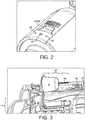
- a container transmission unit 48 is shown in figures 2 and 3 , which show said unit 48 adapted for a container 6 that is a capsule.
- the container transmission unit 48 typically comprises: a movable container support 50; an actuation unit 52 to actuate said support 50.
- the movable container support 50 is operable to move between a container receiving position and a container transmission position, whereby when moved from the former to the latter of said positions a received container 6 is transferred to the component processing unit 14.
- said support 50 may be configured to transition between said positions in a sliding and/or rotating or other manner.
- the support 50 is slideable and is shown in the container transmission position.
- the movable container support 50 is arranged above the component processing unit 14, such that a container is transmitted by gravity from said support 50 to said unit 14.
- the actuation unit 52 is operable to drive the support 50 between said positions, and may comprise various actuators and/or mechanisms coupled thereto depending on the configuration of the support, e.g.: a linear or rotary actuator that is driven by an electrical motor (not shown).
- the actuation unit 52 is controlled by the control system 16 as will be discussed.
- the control system 16 is operable to control the component processing unit 14 to execute a preparation process, which comprises the preparation of the beverage/foodstuff.
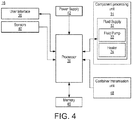
- the control system 16 typically comprises: a user interface 36; a processor 38; optional sensors 40; a power supply 42, which are described sequentially.
- Optional sensors 40 are operatively connected to the processor 38 to provide an input for monitoring said process.
- the sensors 40 typically comprise one or more of the following: fluid temperature sensors; fluid level sensors; position sensors e.g. for sensing a position of the extraction unit 26; flow rate and/or volume sensors.
- the control system 16 comprises the user interface 36 to receive user instructions for control of a preparation process, wherein the user interface 36 comprises: a contactless sensor 56 operable to sense without physical contact between said sensor and a user a body part of a user; and a feedback unit 58 operable to provide feedback to a user, an example arrangement of the user interface is shown in figure 2 .
- the contactless sensor 56 and feedback unit 58 are typically connected to the processor as shown generally with respect to the user interface 36 in figure 4 .
- the operative, i.e. nominal, range of the contactless sensor 56 is 0.5 - 1 meter away from the sensor (otherwise, in the instance of a proximity sensor for example, the sensor could be triggered by items placed above the machine).
- the proximity sensor may be configured for proximity detection by one or a combination selected from a group consisting of: electromagnetic field; electromagnetic radiation (infrared); capacitance; induction; photoelectric. It is preferable that the proximity sensor is an optical and infra-red sensor, a suitable example is ST Microelectronics VL6180.
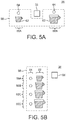
- the visual indicators 60 may further comprise indicia 62 to indicate the change in value of the parameter.
- the indicia 62 may be: arranged on or arranged in operative proximity to the light source 64; or displayed by the light source (e.g. the light source is configured or is programmable to display a particular object).
- the indicia 62 generally comprise an image e.g.: a receptacle fill volume if the aforesaid parameter is a volume of the prepared beverage or foodstuff; a colour to indicated hot or colour (e.g. respective red or blue) temperature if the aforesaid parameter is temperature of a prepared beverage or foodstuff.
- the aforesaid indicating a difference in the value of the parameter may comprise indicating the difference in the actual value or indicating a representative difference.
- a unit change of the volume of a beverage or foodstuff is displayed in cm 3 (e.g. ⁇ 10cm 3 ); a unit change of the temperature of a beverage or foodstuff is displayed ° C (e.g. ⁇ 2° C).
- a change of the volume of a beverage or foodstuff is displayed as a slide bar that moves along an axis representing volume change; a change of the temperature of a beverage or foodstuff is displayed as slide bar that moves along an axis representing hot and cold temperature change.
- the aforesaid indicating the value the parameter is changed to may comprise indicating the actual value or a representative amount of the parameter assumes.
- the actual volume of a beverage or foodstuff is displayed in cm 3 ; the actual temperature of a beverage or foodstuff is displayed in ° C.
- a receptacle with a fill level associated with the actual fill level is displayed or a slide bar that moves along an axis representing volume; a the temperature of a beverage or foodstuff is displayed as slide bar that moves along an axis representing hot and cold temperature.
- the parameter is volume and it is preferred to indicate a value the parameter is changed to.
- the following examples use such a configuration, although they may be adapted for other parameters and indications thereof.
- the control system 16 may be configured to implement various logic conditions associated with the contactless sensor 56 sensing interactions of a body part of the user and subsequent control of a preparation process and the feedback unit 58. These logic conditions are optionally combined for descriptive purposes in figure 6 for a general preparation process 66.
- block 68 is initially executed which comprises indicating to a user via the feedback unit 58 a current value of the parameter.
- control system 16 may be configured to determine whether a body part of a user is sensed (e.g. if a hand of a user is placed within operative range of the contactless sensor 56 when in proximity confirmation), and if the body part is sensed (i.e. an interaction is made by the user) then to execute block 72, which comprises incrementing the parameter to the next in a sequence of a plurality of stored values.
- a first sensing of a body part causes the visual indicator 60A only to emit light and a first value for the parameter selected
- a second sensing i.e. a further interaction made by a user
- a third sensing of a body part causes the visual indicator 60A only to emit light and the first value for the parameter selected; the cycle being repeated with further sensing.
- a first sensing of a body part causes the visual indicator 60A only to emit light and a first value for the parameter selected
- a second sensing i.e. a further interaction made by a user
- the visual indicator 60B causes the visual indicator 60B only to emit light and a second value for the parameter selected
- a third sensing of a body part causes the visual indicator 60C only to emit light and a third value for the parameter selected
- a fourth sensing of a body part causes the visual indicator 60D only to emit light and a forth value for the parameter selected; the cycle being repeated with further sensing.
- First and subsequent sensing of a body part of a user may be determined by the control system 16 in various ways depending on the particular configuration of the contactless sensor 56.
- the control system may be able to distinguish between subsequent interactions by a user based on: the removal and introduction of the body part in the operative range of the sensor (e.g. introduction and removal comprises a single interaction); time intervals (the longer the body part is maintained in the operative range of the sensor the more interactions are determined, e.g. one interaction is determined for each second; or by another suitable manner (such as changing the distance between the body part and the sensor). It is preferred to use the removal and reintroduction approach. Distinguishing between interactions may also be achieved using more than one such sensor (e.g. one sensor sense an interaction in its operative range to cycle up and the other to cycle down) although a single sensor solution is preferable due to cost.
- control system may be able to distinguish between subsequent interactions by a user based on the aforesaid removal and introduction of the body part in the operative range of the sensor.
- control system may be able to distinguish between subsequent interactions by a user based on the switching between identifiable gestures.
- the cycling of the value of the parameter is indicated by the looping of condition 70 and block 72.
- the loop typically comprises re-executing block 68 such that the change in value of the parameter is indicated to the user.
- control system 16 may be configured to enable the aforesaid incrementing of the value of the said parameter if an interaction from a body part is sensed within a first predetermined amount of time of execution of a preparation process (e.g. 2.5 or 5 or 10 or 15 seconds, which is typically measured using the clock of the processor 38). Otherwise the parameter may not be adjustable.
- a first predetermined amount of time of execution of a preparation process e.g. 2.5 or 5 or 10 or 15 seconds, which is typically measured using the clock of the processor 38. Otherwise the parameter may not be adjustable.
- control system only accept commands to adjust the said parameter when it is possible for it to be adjusted, e.g.: after the first predetermined amount of time the beverage or foodstuff may have been prepared to a volume greater than indicated by one or more of the visual indicators 60 of the feedback unit 58; after the first predetermined amount of time the beverage or foodstuff may have been prepared to a temperature greater or less than indicated by one or more of the visual indicators 60 of the feedback unit 58.
- control system 16 may be configured such that a value for the parameter used in the subsequent preparation process is: a default value; or the value used in the previous preparation process; or if an interaction from a body part has been sensed according to condition 70 and the value of the parameter changed according to block 72, then the incremented next stored value of the parameter.
- the control system 16 is configured to indicate via the feedback unit the value of the parameter to be used.
- control system 16 may be configured determine if an interaction body part has been made after the aforesaid first predetermined amount of time and if true then to execute block 78 to stop the preparation process. In this way the interaction of the user by their body part functions to switch off a preparation process rather than adjust a parameter.
- the range of functions of the user interface 36 is increased.
- an interaction from a body part sensed after the first predetermined amount of time may have no effect.
- control system 16 may be configured to effect the said stopping (i.e. block 78) of the preparation process only if said interaction from a body part is sensed less than a second predetermined amount of time from start of the preparation process, whereby the second predetermined amount of time is greater than the first predetermined amount of time, e.g. it may be 10 or 15 or 20 seconds. In this way it is not possible to stop a preparation process which is complete/nearly complete.
- the control system 16 may be configured to continue and complete the preparation process if no interactions from body parts are sensed after the first predetermined amount of time and optionally if no interactions from body parts are sensed before the second predetermined amount of time, as indicated by the false connection of condition 76 to block 80.
- control system 16 may be configured to restart the preparation process if a further interaction of a body part is sensed within a third predetermined amount of time from the stopping of the preparation process, e.g. 2.5 or 5 or 10 seconds. In figure 6 the latter is indicated by condition 82 and restart by block 84. In this way a user can restart the preparation process if they decide they have stopped it too early. With such a condition the preparation process generally continues from the point of termination using the same value of the parameter.
- a further interactions of a body part sensed may effect stopping of the preparation process in accordance with the aforesaid stopping condition, (as indicated by the loop from block 84 to condition 76 in figure 6 ).
- the time duration of the preparation process may be considered stopped for the purpose of the logic conditions (e.g. the determination of lapse of the second predetermined amount of time) until the preparation process restarted.
- the control system 16 may be configured to implement further various logic conditions, which for descriptive purposes are shown in figure 7 and figure 8 . These logic conditions are optionally combined with any of those discussed in the above (as shown in figure 6 ). Initially those logic conditions with reference to figure 7 will be described.
- control system 16 may be configured to control the transmission unit 48 to transfer a received container 6 to the component processing unit 14, e.g. by control of the actuator unit 52, which actuates the movable container support 50.
- control system 16 may in particular be configured to determine if an interaction of a body part is sensed by the contactless sensor 56. If true then block 88 is executed to control the container transmission unit 48 to effect transfer of a container to the component processing unit 14. In this way a user can control the machine 4 to execute a preparation process with any container they supply to the container transmission unit 48.
- the interaction of the body part associated with condition 86 may be a body part sensed at any distance or within the latter described first and/or second distance ranges. An advantage of requiring the interaction is made within the second distance range is that there is less accidental triggering.
- the control system 16 may optionally comprise a container detection unit 54 operable to detect a container 6.
- the container detection unit 54 is arranged to detect a container 6 on the movable container support 50, accordingly it may be arranged on said support 50 (as shown in figure 3 ) or in operative proximity thereto.
- the said unit 54 is operable to detect a metallic container 6, hence it may comprise an inductive sensor. In other examples it may comprise an optical or other suitable sensor.
- control system 16 may be configured to determine if a container 6 is detected by the container detection unit 54, and if true then to execute block 88 to transfer a container to the component processing unit 14.
- control system 16 is configured to execute the preparation process 66.
- block 92 comprises the machine 4 being switched on, e.g. by receiving a user command from a component of the user interface 36, such as a switch (not shown);
- block 94 comprises the control system 16 receiving the aforesaid switch on command and subsequently powering up the relevant components of the machine 4 from a switched off or standby state (e.g. by heating the fluid heater 24 to a particular temperature).
- the control system 16 may be configured to indicate power up by the feedback unit 58, e.g. by one or more of the visual indicators 60 thereof flashing.
- control system 16 Following completion of power up conditions 86 and 90 are typically processed with a Boolean OR operator.
- the control system 16 generally maintains the machine 4 powered up for a fourth predetermined amount of time (such as 2 - 10 minutes) as indicated by condition 96.
- a fourth predetermined amount of time such as 2 - 10 minutes
- the control system 16 searches for conditions 86 and 90 (as indicated by the loop from block 96), if neither conditions are true within the predetermined amount of time, then the control system 16 can switch the relevant components of the machine 4 off or to a standby mode as indicated by block 98.
- Figure 8 illustrates further logic conditions which may optionally be executed within the loop around condition 70 of figure 6 (i.e. before condition 70).
- the contactless sensor 56 may be operable to identify a distance of an interaction of a body part from said sensor.
- the control system 16 may be configured to determine if said body part is within a first distance range or a second (i.e. non overlapping) distance range, which is different to the first distance range.
- the first distance range may be associated with the aforesaid body part interactions, i.e. those associated with the conditions in figure 6 .
- the first distance range may be a distance distal said sensor, e.g. greater than directly at or 5 cm or 10 cm from the contactless sensor (and up to the nominal range of the sensor).
- the second distance range may be a distance proximal said sensor, e.g. directly at (e.g. a user placed their hand directly over the contactless sensor) or less than 5 cm or 10 cm from the contactless sensor.
- control system 16 may be configured to operate in a user programmable mode (as indicated by block 102).
- a user programmable mode typically comprises user defining one of the aforesaid stored values for the parameter as indicated by block 104.
- the value is assigned in association with one of the visual indicators 60 of the feedback unit 58.
- a value for the parameter is determined based on a duration of the interaction of the body part and/or at a stage in a preparation process when said interaction of the body part is made/removed.
- the user may maintain the aforesaid interaction of the body part whilst one of the visual indicators 60 is indicated and the receptacle is being filled; and when the user removes the interaction the volume value that has been filled is stored on the memory unit 46 in association with the particular visual indicator 60.
- a value of a parameter associated with an indicated visual indicator 60 may be user defined based on a duration of the interaction, e.g. a longer interaction equates to a higher temperature or the converse.
Landscapes
- Engineering & Computer Science (AREA)
- Food Science & Technology (AREA)
- Physics & Mathematics (AREA)
- Fluid Mechanics (AREA)
- General Physics & Mathematics (AREA)
- Automation & Control Theory (AREA)
- Apparatus For Making Beverages (AREA)
Claims (14)
- Machine de préparation de boisson ou de produit alimentaire (4) comprenant :une unité de traitement de composant (14) configurée pour un fonctionnement avec un récipient (6) contenant un matériau de boisson ou de produit alimentaire pour traiter ledit matériau de boisson ou de produit alimentaire pour préparer une boisson ou un produit alimentaire à partir de celui-ci ;une unité de transmission de récipient (48) agencée pour recevoir un récipient (6) provenant d'un utilisateur et opérationnelle pour réaliser un transfert d'un récipient reçu (6) vers l'unité de traitement de composant (14), etun système de commande (16) opérationnel pour exécuter un processus de préparation comprenant la commande de ladite unité de traitement de composant (14) pour préparer la boisson ou le produit alimentaire, le système de commande (16) comprenant une interface utilisateur (36), dans laquelle l'interface utilisateur (36) comprend :un capteur sans contact (56) opérationnel pour détecter, sans contact physique, une partie de corps d'un utilisateur ;une unité de rétroaction (58) opérationnelle pour fournir une rétroaction à un utilisateur, etune unité de détection (54) pour détecter un récipient (6) reçu par l'unité de transmission de récipient (48), dans laquelle le système de commande (16) est configuré :pour commander l'unité de transmission de récipient (48) lors d'une détection d'un récipient (6) reçu par ladite unité de transmission de récipient (48), pour réaliser ledit transfert et pour exécuter le processus de préparation ;pour détecter en guise d'entrée, en utilisant le capteur sans contact (56), ladite partie de corps d'un utilisateur et en réponse pour changer une valeur d'un paramètre associé au processus de préparation ; etpour indiquer par l'intermédiaire de l'unité de rétroaction (58) le changement de valeur.
- Machine de préparation de boisson ou de produit alimentaire (4) selon la revendication 1, dans laquelle le paramètre est stocké sur une unité de mémoire du système de commande (16) et comprend une variable dont la valeur peut être changée pour obtenir une caractéristique différente de la boisson ou du produit alimentaire préparé(e), il peut s'agir de l'un ou d'une combinaison choisi(e) dans un groupe constitué de : volume de boisson ou de produit alimentaire ; température de boisson ou de produit alimentaire ; intensité de boisson ou de produit alimentaire ; pression pendant le processus de préparation ; débit pendant le processus de préparation ; temps d'infusion.
- Machine de préparation de boisson ou de produit alimentaire (4) selon l'une quelconque des revendications précédentes, dans laquelle le capteur sans contact (56) comprend un capteur de proximité, qui peut être configuré pour une détection de proximité par l'un ou par une combinaison choisi dans un groupe constitué de : champ électromagnétique ; rayonnement électromagnétique ; infrarouge ; capacité ; induction ; photoélectrique, de préférence il s'agit d'un capteur optique à infrarouge.
- Machine de préparation de boisson ou de produit alimentaire (4) selon l'une quelconque des revendications précédentes, dans laquelle l'unité de rétroaction (58) comprend un indicateur visuel (60).
- Machine de préparation de boisson ou de produit alimentaire (4) selon la revendication 4, dans laquelle l'unité de rétroaction (56) comprend une pluralité d'indicateurs visuels (60A, 60B, 60C, 60D), moyennant quoi chaque indicateur visuel (60A ; 60B ; 60C ; 60D) indique une valeur indépendante ou un changement de valeur du paramètre.
- Machine de préparation de boisson ou de produit alimentaire (4) selon l'une quelconque des revendications précédentes, dans laquelle le système de commande (16) est configuré, pour un processus de préparation ultérieur exécuté sans entrée détectée par le capteur sans contact (56), pour utiliser une valeur précédente pour le paramètre ou une valeur par défaut et pour indiquer par l'intermédiaire de l'unité de rétroaction (58) ladite valeur précédente du paramètre.
- Machine de préparation de boisson ou de produit alimentaire (4) selon l'une quelconque des revendications précédentes, dans laquelle le système de commande (16) est configuré, pour chaque entrée provenant d'une partie de corps détectée par le capteur sans contact (56), pour incrémenter le paramètre sur la suivante d'une pluralité de valeurs enregistrées.
- Machine de préparation de boisson ou de produit alimentaire (4) selon la revendication 7, dans laquelle le système de commande (16) est configuré pour détecter des entrées ultérieures provenant d'une partie de corps par : le retrait et l'introduction de la partie de corps dans la plage opérationnelle du capteur sans contact (56) ; une durée pendant laquelle la partie de corps est maintenue dans la plage opérationnelle du capteur sans contact (56).
- Machine de préparation de boisson ou de produit alimentaire (4) selon les revendications 7 ou 8, dans laquelle le système de commande (16) est configuré pour permettre une incrémentation dudit paramètre si une entrée est détectée par le capteur sans contact (56) au sein d'un premier laps de temps prédéterminé à partir de l'exécution d'un processus de préparation.
- Machine de préparation de boisson ou de produit alimentaire (4) selon la revendication 9, dans laquelle le système de commande (16) est configuré pour arrêter le processus de préparation si : une entrée est détectée après le premier laps de temps prédéterminé ; et facultativement si ladite entrée est détectée moins d'un deuxième laps de temps prédéterminé à partir de l'exécution du processus de préparation, moyennant quoi le deuxième laps de temps prédéterminé est supérieur au premier laps de temps prédéterminé.
- Machine de préparation de boisson ou de produit alimentaire (4) selon la revendication 10, dans laquelle le système de commande (16) est configuré pour redémarrer le processus de préparation si une entrée est détectée au sein d'un troisième laps de temps prédéterminé commençant à partir de l'arrêt du processus de préparation.
- Machine de préparation de boisson ou de produit alimentaire (4) selon l'une quelconque des revendications précédentes, dans laquelle le système de commande (16) est configuré pour commander l'unité de transmission de récipient (48) pour réaliser un transfert d'un récipient reçu (6) vers l'unité de traitement de composant (14) si une entrée est détectée par le capteur sans contact (56).
- Machine de préparation de boisson ou de produit alimentaire (4) selon l'une quelconque des revendications précédentes, dans laquelle le capteur sans contact (56) comprend un capteur de proximité opérationnel pour identifier une distance d'une partie de corps d'un utilisateur par rapport audit capteur et le système de commande (16) est configuré pour déterminer si ladite partie de corps est à une première plage de distance ou une deuxième plage de distance, qui est différente de la première plage de distance, le système de commande (16) est configuré pour fonctionner dans un mode programmable par l'utilisateur si ladite partie de corps est déterminée au sein de la deuxième et plage de distance, ledit mode programmable par l'utilisateur comprenant un utilisateur définissant une valeur pour le paramètre.
- Procédé de préparation d'une boisson ou d'un produit alimentaire en utilisant une machine de préparation de boisson ou de produit alimentaire (4), le procédé comprenant :la réception d'un récipient (6) provenant d'un utilisateur par une unité de transmission de récipient (48) de la machine de préparation de boisson ou de produit alimentaire (4) et le transfert dudit récipient (6) vers une unité de traitement de composant (14) de la machine de préparation de boisson ou de produit alimentaire (4) ;l'exécution sur ladite machine (4) d'un processus de préparation comprenant un système de commande (16) de celle-ci commandant ladite unité de traitement de composant (14) pour préparer ladite boisson ou ledit produit alimentaire ;la détection par un capteur sans contact (56) du système de commande (16) d'une partie de corps d'un utilisateur ;le changement, en réponse à ladite détection, d'une valeur d'un paramètre associé au processus de préparation ; etl'indication, par l'intermédiaire d'une unité de rétroaction (58) de la machine de préparation de boisson ou de produit alimentaire (4), du changement de valeur.
Applications Claiming Priority (2)
| Application Number | Priority Date | Filing Date | Title |
|---|---|---|---|
| EP15191220 | 2015-10-23 | ||
| PCT/EP2016/074915 WO2017067896A1 (fr) | 2015-10-23 | 2016-10-18 | Interface utilisateur de machine de préparation de boisson |
Publications (2)
| Publication Number | Publication Date |
|---|---|
| EP3364832A1 EP3364832A1 (fr) | 2018-08-29 |
| EP3364832B1 true EP3364832B1 (fr) | 2021-04-28 |
Family
ID=54360141
Family Applications (1)
| Application Number | Title | Priority Date | Filing Date |
|---|---|---|---|
| EP16782070.3A Active EP3364832B1 (fr) | 2015-10-23 | 2016-10-18 | Interface utilisateur de machine de préparation de boisson |
Country Status (6)
| Country | Link |
|---|---|
| US (1) | US12042086B2 (fr) |
| EP (1) | EP3364832B1 (fr) |
| CN (2) | CN116392018A (fr) |
| ES (1) | ES2877520T3 (fr) |
| PT (1) | PT3364832T (fr) |
| WO (1) | WO2017067896A1 (fr) |
Families Citing this family (17)
| Publication number | Priority date | Publication date | Assignee | Title |
|---|---|---|---|---|
| WO2019050834A1 (fr) * | 2017-09-05 | 2019-03-14 | Keurig Green Mountain, Inc. | Procédé et appareil pour le réglage de paramètres d'infusion pendant la distribution |
| ES2755598A1 (es) * | 2018-10-22 | 2020-04-22 | Crem Int Spain S L | Maquina y procedimiento para preparacion de bebidas calientes |
| CN111184437A (zh) * | 2018-11-15 | 2020-05-22 | 施特里克斯有限公司 | 手势控制的液体加热器具及用于其的手势控制的方法 |
| FR3094191B1 (fr) * | 2019-03-29 | 2021-04-09 | Seb Sa | Appareil electromenager |
| KR20220002979A (ko) * | 2019-05-03 | 2022-01-07 | 제이티 인터내셔널 소시에떼 아노님 | 검출기가 있는 이동식 마개를 갖는 에어로졸 발생 장치 |
| KR102851242B1 (ko) * | 2020-03-24 | 2025-08-27 | 노바델타-코메르시오 이 인더스트리아 드 카페즈, 엘디에이 | 비터치 상호작용을 갖는 식품 제조 시스템 및 식품 제조 방법 |
| WO2021194363A1 (fr) * | 2020-03-24 | 2021-09-30 | Novadelta - Comércio E Indústria De Cafés, Lda | Système et procédés de préparation de produits comestibles avec agencements d'accès sensible |
| US20230183054A1 (en) * | 2020-05-12 | 2023-06-15 | General Beverage S.R.L. | Dispenser for the delivery of beverages and related delivery method |
| US11274028B2 (en) * | 2020-06-05 | 2022-03-15 | International H2O Inc. | Contactless interface for a beverage dispenser |
| US20220112069A1 (en) * | 2020-10-14 | 2022-04-14 | Wilbur Curtis Co., Inc. | Touchless Dispense System With Safety Feature |
| WO2022266157A1 (fr) * | 2021-06-15 | 2022-12-22 | Lvd Aquisition, Llc | Dispositif et procédé de distribution de boisson sans contact |
| CN116998883A (zh) * | 2022-04-29 | 2023-11-07 | 广东美的生活电器制造有限公司 | 饮水管理方法、装置、系统、电子设备及存储介质 |
| CN117492396B (zh) * | 2023-11-03 | 2024-04-05 | 广州技诺智能设备有限公司 | 一种咖啡机的供水控制电路及其系统 |
| WO2025155326A1 (fr) | 2024-01-18 | 2025-07-24 | Sharkninja Operating Llc | Préparation de machines à boisson pour infusion de boissons froides |
| US12575692B2 (en) | 2024-01-18 | 2026-03-17 | Sharkninja Operating Llc | Suggesting coffee bean grind size for beverage machines |
| US12369741B1 (en) | 2024-01-18 | 2025-07-29 | Sharkninja Operating Llc | Preventing coffee bean grinder jamming |
| US12168600B1 (en) | 2024-02-19 | 2024-12-17 | Brio Water Technology, Inc. | Variable temperature control assembly for a water dispenser |
Family Cites Families (24)
| Publication number | Priority date | Publication date | Assignee | Title |
|---|---|---|---|---|
| US2155023A (en) | 1935-06-27 | 1939-04-18 | Ray W Springer | Antisqueak strip |
| US4400194A (en) | 1982-02-10 | 1983-08-23 | Ppg Industries, Inc. | Method and apparatus for producing heat-strengthened glass sheets having improved break patterns |
| CH693016A5 (de) | 1998-02-25 | 2003-01-31 | Jura Elektroapparate Ag | Steuerungsvorrichtung für Elektroapparate, insbesondere für Kaffeemaschinen. |
| DE20100700U1 (de) | 2001-01-16 | 2001-03-22 | Eugster/Frismag Ag, Romanshorn | Kaffeegetränkzubereitungsautomat, insbesondere Espressoautomat |
| CA2390411A1 (fr) * | 2002-06-03 | 2003-12-03 | Alwin Manufacturing Company, Incorporated | Distributeur automatique |
| US7507430B2 (en) * | 2005-06-10 | 2009-03-24 | Concordia Coffee Company, Inc. | Method for preparing a heated flavored beverage |
| EP1749464A1 (fr) | 2005-08-01 | 2007-02-07 | Saeco IPR Limited | Panneau de commande pour machine automatique à préparer des boissons chaudes et machine automatique comprenant ce panneau de commande |
| RU2501512C2 (ru) | 2008-03-14 | 2013-12-20 | Мокофе Аг | Устройство и капсула для приготовления напитка |
| RU2544762C2 (ru) * | 2008-07-09 | 2015-03-20 | Нестек С.А. | Эргономичный экранный интерфейс для машины приготовления напитков |
| US20100116842A1 (en) * | 2008-11-10 | 2010-05-13 | Automatic Bar Controls, Inc. | Reconfigurable control panel for a beverage dispenser |
| US9265376B2 (en) | 2009-02-06 | 2016-02-23 | Nestec S.A. | Device and method using centrifugation for extracting a liquid and heat loss compensating means |
| CN104545474B (zh) | 2009-08-28 | 2017-05-31 | 雀巢产品技术援助有限公司 | 通过离心法制备饮料的胶囊系统 |
| WO2011144720A1 (fr) | 2010-05-21 | 2011-11-24 | Nestec S.A. | Interface ergonomique de distributeur |
| AU2011334909A1 (en) * | 2010-12-01 | 2013-06-13 | Nestec S.A. | Ergonomic user-interface for motorised ingredient chamber |
| AU2011334912A1 (en) * | 2010-12-01 | 2013-06-13 | Nestec S.A. | Simple user-interface for a beverage machine |
| BR112014005656A2 (pt) * | 2011-09-15 | 2017-03-28 | Koninklijke Philips Nv | sistema com uma interface de usuário sem contato; software de controle em um meio legível por computador; método para permitir que um usuário controle uma funcionalidade de um sistema através de uma interação sem contato com o sistema; e interface de usuário |
| US20150135962A1 (en) | 2012-04-25 | 2015-05-21 | Nestec S.A. | User-Programmable Capsule, Device for Programming Capsules and Beverage Preparation Machine |
| DE102012105787A1 (de) * | 2012-06-29 | 2014-01-02 | Eugster/Frismag Ag Elektrohaushaltgeräte | System und Verfahren zum Zubereiten eines Getränks |
| WO2014008926A1 (fr) * | 2012-07-10 | 2014-01-16 | Foster Jody James | Système pour la préparation de biberons |
| US9828710B2 (en) * | 2012-11-26 | 2017-11-28 | Abm International, Inc. | System and method for capturing thread from an entraining air flow |
| US9511988B2 (en) * | 2012-12-27 | 2016-12-06 | Lancer Corporation | Touch screen for a beverage dispensing system |
| NL2011234C2 (en) * | 2013-07-29 | 2015-02-02 | Koninkl Douwe Egberts Bv | Beverage preparation system and method for preparing a beverage. |
| KR102370809B1 (ko) * | 2014-07-09 | 2022-03-07 | 소시에떼 데 프로듀이 네슬레 소시에떼아노님 | 음료 제조 기계의 캡슐 처리 유닛 |
| US9713225B2 (en) * | 2014-08-01 | 2017-07-18 | Cree, Inc. | Overheating safety device and luminaire |
-
2016
- 2016-10-18 CN CN202310310352.6A patent/CN116392018A/zh active Pending
- 2016-10-18 US US15/769,643 patent/US12042086B2/en active Active
- 2016-10-18 EP EP16782070.3A patent/EP3364832B1/fr active Active
- 2016-10-18 CN CN201680060907.4A patent/CN108135397A/zh active Pending
- 2016-10-18 WO PCT/EP2016/074915 patent/WO2017067896A1/fr not_active Ceased
- 2016-10-18 ES ES16782070T patent/ES2877520T3/es active Active
- 2016-10-18 PT PT167820703T patent/PT3364832T/pt unknown
Non-Patent Citations (1)
| Title |
|---|
| None * |
Also Published As
| Publication number | Publication date |
|---|---|
| CN108135397A (zh) | 2018-06-08 |
| PT3364832T (pt) | 2021-06-24 |
| US12042086B2 (en) | 2024-07-23 |
| ES2877520T3 (es) | 2021-11-17 |
| EP3364832A1 (fr) | 2018-08-29 |
| US20180303283A1 (en) | 2018-10-25 |
| CN116392018A (zh) | 2023-07-07 |
| WO2017067896A1 (fr) | 2017-04-27 |
Similar Documents
| Publication | Publication Date | Title |
|---|---|---|
| EP3364832B1 (fr) | Interface utilisateur de machine de préparation de boisson | |
| AU2016202874B2 (en) | A beverage preparation system | |
| JP2013544601A (ja) | 飲料機の為の簡単なユーザー・インターフェース | |
| JP2014208281A (ja) | 飲料装置のためのユーザフレンドリなインタフェース | |
| RU2684013C2 (ru) | Устройство для приготовления напитка с изменяемой конфигурацией | |
| EP3998915B1 (fr) | Machine, système et procédé de préparation de produits alimentaires liquides | |
| CN108471900B (zh) | 具有粉末容器的饮料分配器 | |
| CA2988041C (fr) | Systeme de commande pour pompe de machine de preparation de boissons | |
| EP3364828B1 (fr) | Machine de préparation de boisson à fonctionnalité extensible | |
| EP3999440B1 (fr) | Récipient, système et procédé de préparation de produits alimentaires fluides | |
| EP3998914B1 (fr) | Système, machine et récipient de préparation de produits alimentaires fluides |
Legal Events
| Date | Code | Title | Description |
|---|---|---|---|
| STAA | Information on the status of an ep patent application or granted ep patent |
Free format text: STATUS: UNKNOWN |
|
| STAA | Information on the status of an ep patent application or granted ep patent |
Free format text: STATUS: THE INTERNATIONAL PUBLICATION HAS BEEN MADE |
|
| PUAI | Public reference made under article 153(3) epc to a published international application that has entered the european phase |
Free format text: ORIGINAL CODE: 0009012 |
|
| STAA | Information on the status of an ep patent application or granted ep patent |
Free format text: STATUS: REQUEST FOR EXAMINATION WAS MADE |
|
| 17P | Request for examination filed |
Effective date: 20180523 |
|
| AK | Designated contracting states |
Kind code of ref document: A1 Designated state(s): AL AT BE BG CH CY CZ DE DK EE ES FI FR GB GR HR HU IE IS IT LI LT LU LV MC MK MT NL NO PL PT RO RS SE SI SK SM TR |
|
| AX | Request for extension of the european patent |
Extension state: BA ME |
|
| DAV | Request for validation of the european patent (deleted) | ||
| DAX | Request for extension of the european patent (deleted) | ||
| RAP1 | Party data changed (applicant data changed or rights of an application transferred) |
Owner name: SOCIETE DES PRODUITS NESTLE S.A. |
|
| GRAP | Despatch of communication of intention to grant a patent |
Free format text: ORIGINAL CODE: EPIDOSNIGR1 |
|
| STAA | Information on the status of an ep patent application or granted ep patent |
Free format text: STATUS: GRANT OF PATENT IS INTENDED |
|
| INTG | Intention to grant announced |
Effective date: 20201118 |
|
| GRAS | Grant fee paid |
Free format text: ORIGINAL CODE: EPIDOSNIGR3 |
|
| GRAA | (expected) grant |
Free format text: ORIGINAL CODE: 0009210 |
|
| STAA | Information on the status of an ep patent application or granted ep patent |
Free format text: STATUS: THE PATENT HAS BEEN GRANTED |
|
| AK | Designated contracting states |
Kind code of ref document: B1 Designated state(s): AL AT BE BG CH CY CZ DE DK EE ES FI FR GB GR HR HU IE IS IT LI LT LU LV MC MK MT NL NO PL PT RO RS SE SI SK SM TR |
|
| REG | Reference to a national code |
Ref country code: GB Ref legal event code: FG4D |
|
| REG | Reference to a national code |
Ref country code: CH Ref legal event code: EP |
|
| REG | Reference to a national code |
Ref country code: AT Ref legal event code: REF Ref document number: 1386144 Country of ref document: AT Kind code of ref document: T Effective date: 20210515 |
|
| REG | Reference to a national code |
Ref country code: DE Ref legal event code: R096 Ref document number: 602016056974 Country of ref document: DE |
|
| REG | Reference to a national code |
Ref country code: IE Ref legal event code: FG4D |
|
| REG | Reference to a national code |
Ref country code: NL Ref legal event code: FP |
|
| REG | Reference to a national code |
Ref country code: PT Ref legal event code: SC4A Ref document number: 3364832 Country of ref document: PT Date of ref document: 20210624 Kind code of ref document: T Free format text: AVAILABILITY OF NATIONAL TRANSLATION Effective date: 20210617 |
|
| REG | Reference to a national code |
Ref country code: LT Ref legal event code: MG9D |
|
| PG25 | Lapsed in a contracting state [announced via postgrant information from national office to epo] |
Ref country code: FI Free format text: LAPSE BECAUSE OF FAILURE TO SUBMIT A TRANSLATION OF THE DESCRIPTION OR TO PAY THE FEE WITHIN THE PRESCRIBED TIME-LIMIT Effective date: 20210428 Ref country code: LT Free format text: LAPSE BECAUSE OF FAILURE TO SUBMIT A TRANSLATION OF THE DESCRIPTION OR TO PAY THE FEE WITHIN THE PRESCRIBED TIME-LIMIT Effective date: 20210428 Ref country code: BG Free format text: LAPSE BECAUSE OF FAILURE TO SUBMIT A TRANSLATION OF THE DESCRIPTION OR TO PAY THE FEE WITHIN THE PRESCRIBED TIME-LIMIT Effective date: 20210728 Ref country code: HR Free format text: LAPSE BECAUSE OF FAILURE TO SUBMIT A TRANSLATION OF THE DESCRIPTION OR TO PAY THE FEE WITHIN THE PRESCRIBED TIME-LIMIT Effective date: 20210428 |
|
| REG | Reference to a national code |
Ref country code: ES Ref legal event code: FG2A Ref document number: 2877520 Country of ref document: ES Kind code of ref document: T3 Effective date: 20211117 |
|
| PG25 | Lapsed in a contracting state [announced via postgrant information from national office to epo] |
Ref country code: PL Free format text: LAPSE BECAUSE OF FAILURE TO SUBMIT A TRANSLATION OF THE DESCRIPTION OR TO PAY THE FEE WITHIN THE PRESCRIBED TIME-LIMIT Effective date: 20210428 Ref country code: NO Free format text: LAPSE BECAUSE OF FAILURE TO SUBMIT A TRANSLATION OF THE DESCRIPTION OR TO PAY THE FEE WITHIN THE PRESCRIBED TIME-LIMIT Effective date: 20210728 Ref country code: RS Free format text: LAPSE BECAUSE OF FAILURE TO SUBMIT A TRANSLATION OF THE DESCRIPTION OR TO PAY THE FEE WITHIN THE PRESCRIBED TIME-LIMIT Effective date: 20210428 Ref country code: SE Free format text: LAPSE BECAUSE OF FAILURE TO SUBMIT A TRANSLATION OF THE DESCRIPTION OR TO PAY THE FEE WITHIN THE PRESCRIBED TIME-LIMIT Effective date: 20210428 Ref country code: GR Free format text: LAPSE BECAUSE OF FAILURE TO SUBMIT A TRANSLATION OF THE DESCRIPTION OR TO PAY THE FEE WITHIN THE PRESCRIBED TIME-LIMIT Effective date: 20210729 Ref country code: IS Free format text: LAPSE BECAUSE OF FAILURE TO SUBMIT A TRANSLATION OF THE DESCRIPTION OR TO PAY THE FEE WITHIN THE PRESCRIBED TIME-LIMIT Effective date: 20210828 Ref country code: LV Free format text: LAPSE BECAUSE OF FAILURE TO SUBMIT A TRANSLATION OF THE DESCRIPTION OR TO PAY THE FEE WITHIN THE PRESCRIBED TIME-LIMIT Effective date: 20210428 |
|
| PG25 | Lapsed in a contracting state [announced via postgrant information from national office to epo] |
Ref country code: SM Free format text: LAPSE BECAUSE OF FAILURE TO SUBMIT A TRANSLATION OF THE DESCRIPTION OR TO PAY THE FEE WITHIN THE PRESCRIBED TIME-LIMIT Effective date: 20210428 Ref country code: SK Free format text: LAPSE BECAUSE OF FAILURE TO SUBMIT A TRANSLATION OF THE DESCRIPTION OR TO PAY THE FEE WITHIN THE PRESCRIBED TIME-LIMIT Effective date: 20210428 Ref country code: DK Free format text: LAPSE BECAUSE OF FAILURE TO SUBMIT A TRANSLATION OF THE DESCRIPTION OR TO PAY THE FEE WITHIN THE PRESCRIBED TIME-LIMIT Effective date: 20210428 Ref country code: EE Free format text: LAPSE BECAUSE OF FAILURE TO SUBMIT A TRANSLATION OF THE DESCRIPTION OR TO PAY THE FEE WITHIN THE PRESCRIBED TIME-LIMIT Effective date: 20210428 Ref country code: CZ Free format text: LAPSE BECAUSE OF FAILURE TO SUBMIT A TRANSLATION OF THE DESCRIPTION OR TO PAY THE FEE WITHIN THE PRESCRIBED TIME-LIMIT Effective date: 20210428 Ref country code: RO Free format text: LAPSE BECAUSE OF FAILURE TO SUBMIT A TRANSLATION OF THE DESCRIPTION OR TO PAY THE FEE WITHIN THE PRESCRIBED TIME-LIMIT Effective date: 20210428 |
|
| REG | Reference to a national code |
Ref country code: DE Ref legal event code: R097 Ref document number: 602016056974 Country of ref document: DE |
|
| PLBE | No opposition filed within time limit |
Free format text: ORIGINAL CODE: 0009261 |
|
| STAA | Information on the status of an ep patent application or granted ep patent |
Free format text: STATUS: NO OPPOSITION FILED WITHIN TIME LIMIT |
|
| 26N | No opposition filed |
Effective date: 20220131 |
|
| PG25 | Lapsed in a contracting state [announced via postgrant information from national office to epo] |
Ref country code: IS Free format text: LAPSE BECAUSE OF FAILURE TO SUBMIT A TRANSLATION OF THE DESCRIPTION OR TO PAY THE FEE WITHIN THE PRESCRIBED TIME-LIMIT Effective date: 20210828 Ref country code: AL Free format text: LAPSE BECAUSE OF FAILURE TO SUBMIT A TRANSLATION OF THE DESCRIPTION OR TO PAY THE FEE WITHIN THE PRESCRIBED TIME-LIMIT Effective date: 20210428 |
|
| PG25 | Lapsed in a contracting state [announced via postgrant information from national office to epo] |
Ref country code: MC Free format text: LAPSE BECAUSE OF FAILURE TO SUBMIT A TRANSLATION OF THE DESCRIPTION OR TO PAY THE FEE WITHIN THE PRESCRIBED TIME-LIMIT Effective date: 20210428 |
|
| PG25 | Lapsed in a contracting state [announced via postgrant information from national office to epo] |
Ref country code: LU Free format text: LAPSE BECAUSE OF NON-PAYMENT OF DUE FEES Effective date: 20211018 |
|
| PG25 | Lapsed in a contracting state [announced via postgrant information from national office to epo] |
Ref country code: IE Free format text: LAPSE BECAUSE OF NON-PAYMENT OF DUE FEES Effective date: 20211018 |
|
| REG | Reference to a national code |
Ref country code: AT Ref legal event code: UEP Ref document number: 1386144 Country of ref document: AT Kind code of ref document: T Effective date: 20210428 |
|
| PG25 | Lapsed in a contracting state [announced via postgrant information from national office to epo] |
Ref country code: HU Free format text: LAPSE BECAUSE OF FAILURE TO SUBMIT A TRANSLATION OF THE DESCRIPTION OR TO PAY THE FEE WITHIN THE PRESCRIBED TIME-LIMIT; INVALID AB INITIO Effective date: 20161018 |
|
| PG25 | Lapsed in a contracting state [announced via postgrant information from national office to epo] |
Ref country code: CY Free format text: LAPSE BECAUSE OF FAILURE TO SUBMIT A TRANSLATION OF THE DESCRIPTION OR TO PAY THE FEE WITHIN THE PRESCRIBED TIME-LIMIT Effective date: 20210428 |
|
| P01 | Opt-out of the competence of the unified patent court (upc) registered |
Effective date: 20230623 |
|
| PG25 | Lapsed in a contracting state [announced via postgrant information from national office to epo] |
Ref country code: MK Free format text: LAPSE BECAUSE OF FAILURE TO SUBMIT A TRANSLATION OF THE DESCRIPTION OR TO PAY THE FEE WITHIN THE PRESCRIBED TIME-LIMIT Effective date: 20210428 |
|
| PG25 | Lapsed in a contracting state [announced via postgrant information from national office to epo] |
Ref country code: MT Free format text: LAPSE BECAUSE OF FAILURE TO SUBMIT A TRANSLATION OF THE DESCRIPTION OR TO PAY THE FEE WITHIN THE PRESCRIBED TIME-LIMIT Effective date: 20210428 |
|
| PGFP | Annual fee paid to national office [announced via postgrant information from national office to epo] |
Ref country code: NL Payment date: 20250912 Year of fee payment: 10 Ref country code: IT Payment date: 20250922 Year of fee payment: 10 |
|
| PGFP | Annual fee paid to national office [announced via postgrant information from national office to epo] |
Ref country code: GB Payment date: 20250904 Year of fee payment: 10 Ref country code: BE Payment date: 20250917 Year of fee payment: 10 |
|
| PGFP | Annual fee paid to national office [announced via postgrant information from national office to epo] |
Ref country code: FR Payment date: 20250908 Year of fee payment: 10 |
|
| REG | Reference to a national code |
Ref country code: CH Ref legal event code: U11 Free format text: ST27 STATUS EVENT CODE: U-0-0-U10-U11 (AS PROVIDED BY THE NATIONAL OFFICE) Effective date: 20251101 |
|
| PGFP | Annual fee paid to national office [announced via postgrant information from national office to epo] |
Ref country code: PT Payment date: 20251020 Year of fee payment: 10 |
|
| PGFP | Annual fee paid to national office [announced via postgrant information from national office to epo] |
Ref country code: DE Payment date: 20250902 Year of fee payment: 10 |
|
| PGFP | Annual fee paid to national office [announced via postgrant information from national office to epo] |
Ref country code: AT Payment date: 20250925 Year of fee payment: 10 |
|
| PGFP | Annual fee paid to national office [announced via postgrant information from national office to epo] |
Ref country code: TR Payment date: 20251009 Year of fee payment: 10 |
|
| PGFP | Annual fee paid to national office [announced via postgrant information from national office to epo] |
Ref country code: CH Payment date: 20251101 Year of fee payment: 10 |
|
| PGFP | Annual fee paid to national office [announced via postgrant information from national office to epo] |
Ref country code: ES Payment date: 20251104 Year of fee payment: 10 |