EP3365191B1 - Procédé de traitement d'un élément de support, installation pour un véhicule automobile et système pour un véhicule automobile - Google Patents
Procédé de traitement d'un élément de support, installation pour un véhicule automobile et système pour un véhicule automobile Download PDFInfo
- Publication number
- EP3365191B1 EP3365191B1 EP15791534.9A EP15791534A EP3365191B1 EP 3365191 B1 EP3365191 B1 EP 3365191B1 EP 15791534 A EP15791534 A EP 15791534A EP 3365191 B1 EP3365191 B1 EP 3365191B1
- Authority
- EP
- European Patent Office
- Prior art keywords
- holding element
- window
- plastic
- motor vehicle
- pane
- Prior art date
- Legal status (The legal status is an assumption and is not a legal conclusion. Google has not performed a legal analysis and makes no representation as to the accuracy of the status listed.)
- Active
Links
Images



Classifications
-
- B—PERFORMING OPERATIONS; TRANSPORTING
- B60—VEHICLES IN GENERAL
- B60J—WINDOWS, WINDSCREENS, NON-FIXED ROOFS, DOORS, OR SIMILAR DEVICES FOR VEHICLES; REMOVABLE EXTERNAL PROTECTIVE COVERINGS SPECIALLY ADAPTED FOR VEHICLES
- B60J7/00—Non-fixed roofs; Roofs with movable panels, e.g. rotary sunroofs
- B60J7/02—Non-fixed roofs; Roofs with movable panels, e.g. rotary sunroofs of sliding type, e.g. comprising guide shoes
- B60J7/04—Non-fixed roofs; Roofs with movable panels, e.g. rotary sunroofs of sliding type, e.g. comprising guide shoes with rigid plate-like element or elements, e.g. open roofs with harmonica-type folding rigid panels
-
- B—PERFORMING OPERATIONS; TRANSPORTING
- B60—VEHICLES IN GENERAL
- B60J—WINDOWS, WINDSCREENS, NON-FIXED ROOFS, DOORS, OR SIMILAR DEVICES FOR VEHICLES; REMOVABLE EXTERNAL PROTECTIVE COVERINGS SPECIALLY ADAPTED FOR VEHICLES
- B60J1/00—Windows; Windscreens; Accessories therefor
- B60J1/004—Mounting of windows
- B60J1/006—Mounting of windows characterised by fixation means such as clips, adhesive, etc.
-
- B—PERFORMING OPERATIONS; TRANSPORTING
- B29—WORKING OF PLASTICS; WORKING OF SUBSTANCES IN A PLASTIC STATE IN GENERAL
- B29C—SHAPING OR JOINING OF PLASTICS; SHAPING OF MATERIAL IN A PLASTIC STATE, NOT OTHERWISE PROVIDED FOR; AFTER-TREATMENT OF THE SHAPED PRODUCTS, e.g. REPAIRING
- B29C44/00—Shaping by internal pressure generated in the material, e.g. swelling or foaming ; Producing porous or cellular expanded plastics articles
- B29C44/02—Shaping by internal pressure generated in the material, e.g. swelling or foaming ; Producing porous or cellular expanded plastics articles for articles of definite length, i.e. discrete articles
- B29C44/12—Incorporating or moulding on preformed parts, e.g. inserts or reinforcements
- B29C44/1271—Incorporating or moulding on preformed parts, e.g. inserts or reinforcements the preformed parts being partially covered
-
- B—PERFORMING OPERATIONS; TRANSPORTING
- B29—WORKING OF PLASTICS; WORKING OF SUBSTANCES IN A PLASTIC STATE IN GENERAL
- B29K—INDEXING SCHEME ASSOCIATED WITH SUBCLASSES B29B, B29C OR B29D, RELATING TO MOULDING MATERIALS OR TO MATERIALS FOR MOULDS, REINFORCEMENTS, FILLERS OR PREFORMED PARTS, e.g. INSERTS
- B29K2075/00—Use of PU, i.e. polyureas or polyurethanes or derivatives thereof, as moulding material
-
- B—PERFORMING OPERATIONS; TRANSPORTING
- B29—WORKING OF PLASTICS; WORKING OF SUBSTANCES IN A PLASTIC STATE IN GENERAL
- B29L—INDEXING SCHEME ASSOCIATED WITH SUBCLASS B29C, RELATING TO PARTICULAR ARTICLES
- B29L2031/00—Other particular articles
- B29L2031/30—Vehicles, e.g. ships or aircraft, or body parts thereof
- B29L2031/3002—Superstructures characterized by combining metal and plastics, i.e. hybrid parts
Definitions
- the present invention relates to a method for machining a holding element and to an arrangement and a system for a motor vehicle, which are suitable for enabling safe and reliable machining of a window pane for the motor vehicle.
- panes for motor vehicles are prepared for further processing, for example by means of foaming.
- components are connected to the pane, which, for example, enable the pane to be attached to the body of the motor vehicle.
- this can relate to the joining of glass panes and plastic components which are to be positioned on the glass pane.
- foaming is for example in the document DE 200 06 238 U1 described.
- the document too DE 196 37 793 C1 describes foaming around a pane of glass.
- the pane to be processed is usually brought into contact with metal holding brackets and positioned accordingly for the foaming.
- the mounting brackets are manually provided with foam tapes.
- foam tapes are glued to the surface of the bracket that faces the pane to be placed in order to act as a buffer to avoid contact between metal and glass.
- Foam tapes can usually be adapted accordingly for different holding angles and, due to the manual application, only offer limited, reproducible positioning accuracy.
- a method for processing and applying a holding element for a motor vehicle comprises providing a holding element with a contact surface which is designed to bear against a window, and providing a pumpable substance with predetermined material properties.
- the method further includes a machine application of the substance to at least one predetermined position on the contact surface of the holding element and thereby initiating a self-foaming process, so that, depending on the material properties of the substance, a plastic molded part with a predetermined elasticity is formed so that when the pane rests against the holding element to form a predetermined distance between the disk and the holding element and to counteract tension forces between the disk and the holding element during further processing of the disk.
- the plastic molding is also formed so that it when the disk rests against the holding element, it extends only between the disk and the holding element.
- the method described enables safe and reliable machining of panes and plate-shaped workpieces for motor vehicles in a cost-effective manner.
- the holding element provided with a plastic molded part realizes, for example, a secure contact for a pane to be machined, so that a secure hold on the pane with a predetermined distance between the holding element and pane is made possible in a simple manner and damage caused by tension forces is counteracted. Reliable positioning of the pane, for example for a subsequent foaming process, can thus be achieved and a contribution is made to reducing the likelihood of scratches, cracks and splintering of the adjacent pane.
- the machine application of the pumpable substance enables time-saving and process-reliable application of the substance, which realizes a controlled and reliable formation of the plastic molded part and, in particular, ensures beneficial reproducibility with regard to the shape and position of the plastic molded part to be formed.
- positioning errors of the plastic molded part to be formed are avoided, which are difficult to prevent, for example, when manually gluing foam tapes on.
- the plastic molded part counteracts tension forces when the pane is in contact with and further processing and forms a defined distance between the holding element and the pane.
- Tension forces can arise in particular due to subsequent process steps in that, for example, the pane and the holding element are foamed and, due to a shrinkage behavior of such a foaming, tension forces are generated between the holding element and the pane.
- tension forces can be counteracted in a targeted manner and a safe distance can be set between the holding element and the pane in order to specifically distance the holding element from the pane and direct contact and damage to the pane such as breaking glass.
- the holding element can be designed in one piece or also have several holding components which are separate from one another and which realize a stable hold of the pane to be processed.
- One or more plastic molded parts are then formed on the contact surfaces of the respective holding components and allow the holding element to be at a desired distance from the pane.
- the holding element can also be arranged on several sides of the adjacent pane so that, for example, in the case of a multi-piece holding element, some holding components implement a support for an underside of the pane, while further holding components are arranged on side surfaces and / or an upper side of the pane in order to to ensure a reliable hold and to prepare the pane to be processed for further processing, such as connecting it to a body of a motor vehicle.
- the holding components each contact surfaces of the pane by means of their plastic molded parts and are safely and reliably spaced apart.
- the plastic molded part on the contact surface of the holding element realizes an elastic element in at least one position provided for this and acts as a buffer between the holding element and the pane, in particular to prevent direct contact between the holding element and the pane.
- the material properties of the plastic molded part to be formed depend on those of the substance to be applied, which is applied to the contact surface of the holding element with the desired meterability, for example, in the context of an injection molding process by means of an injection or pumping tool capable of this. After the substance has emerged from the respective tool and applied to the contact surface of the holding element, a self-foaming process initiated and thereby formed the plastic molding.
- the molded plastic part is thus implemented as the final state of the self-foaming process and, in particular, has a defined height with regard to a desired elasticity, in order to achieve a predetermined distance between the holding element and the adjacent pane.
- providing the pumpable substance includes providing a first component and a second component, each with predefined material properties.
- the application of the substance consequently comprises applying the first component and second component at at least one predetermined position on the contact surface of the holding element and thereby initiating a self-foaming process so that a plastic molded part with predetermined elasticity is formed depending on the respective material properties of the first and second component.
- the material properties of the molded plastic part are correspondingly dependent on those of the first and second components that form the molded plastic part, for example in the context of an injection molding process.
- the first and second components have predetermined material properties in order to realize a desired design of the plastic molded part with a predetermined geometry.
- the first and second components are designed as liquid or pumpable materials with a predetermined viscosity, which are applied to the contact surface of the holding element by means of an injection molding tool.
- the first and second components are provided in respective material containers and are supplied to a mixing head via feed lines for application to the contact surface of the holding element and applied by means of a metering nozzle.
- the first and second components are provided reactively with a predetermined quantity ratio and are applied at the desired position on the contact surface of the holding element by means of the dosing nozzle, so that the self-foaming process for forming the plastic molded part is only initiated immediately after the application of the first and second components.
- the substance to be applied or the first and second components enable the plastic molded part to be designed with any desired geometries, so that an elastic element can be applied specifically to the positions on the contact surface of the holding element at which a buffer and a defined distance between the pane and the Holding element is useful, for example, to compensate for local voltage peaks.
- an elastic element can be applied specifically to the positions on the contact surface of the holding element at which a buffer and a defined distance between the pane and the Holding element is useful, for example, to compensate for local voltage peaks.
- the pumpable substance and, accordingly, the first and second components advantageously have a certain degree of meterability in order to enable the plastic molded part to be applied and formed economically and in a controlled manner.
- a part of the contact surface of the holding element is specifically wetted.
- the substance or the two components can deliberately dissolve to a certain extent, so that after a few minutes, for example, 50% of a crosslinking reaction is complete and a base area of the molded plastic part is cured.
- a predetermined height of the plastic molding is then formed, for example, which relates to a surface normal of the contact surface and realizes a predetermined distance between the holding element and the adjacent pane .
- the first and second components are applied in droplet form to one or more predetermined positions on the contact surface of the holding element by means of a spray gun or dosing nozzle and produce point or cylindrical plastic molded parts that are essentially independent of the geometry of the holding element.
- the method comprises providing the first component as an isocyanate and the second component as a polyol.
- the method includes applying the first and second components and thereby forming the molded plastic part from polyurethane.
- Isocyanate and polyol enable the first and second components to be applied and the molded plastic part to be formed in a two-component injection molding process.
- the isocyanate and polyol are matched to one another with predetermined material properties and provided and injected at a predetermined position on the contact surface of the holding element.
- the polyol is provided as a workable second component with regard to its composition in particular to initiate a desired self-foaming process.
- the polyol has, for example, a predetermined amount of water that reacts in contact with the isocyanate and the self-foaming process and thus the formation of the Plastic molding initiated.
- the first and / or second component can have blowing agents in order to specifically influence the self-foaming process.
- the isocyanate and polyol have predetermined material properties, in particular with regard to elasticity, pumpability, meterability and viscosity.
- the two components are provided in such a way that the plastic molded part to be formed has a desired adhesive behavior on the holding element, which is made of metal or has metal, for example.
- the first and second components are provided as isocyanate and polyol in particular in such a way that the molded plastic part is formed from polyurethane.
- the method includes applying the pumpable substance or applying the first and second components in each case at two or more predetermined, mutually spaced positions on the contact surface of the holding element, so that a plurality of mutually separate plastic molded parts is formed.
- plastic molded parts separated from one another can also be formed on the contact surface of the holding element in order to achieve a reliable distance between the holding element and the pane to be machined as well as secure contact between the holding element and the pane.
- hemispherical plastic molded parts are formed at predetermined positions on the holding element, at which the contact surface is raised compared to a substantial plane of extent, in order to prevent direct contact between the holding element and the disk and to counteract local voltage peaks.
- the plastic molded parts can be formed in a material-saving manner at the positions at which a distance between the pane and the holding element is beneficial. This can contribute to a cost-effective and time-saving production process for the holding elements and a pane to be foamed and furthermore have an advantageous effect on the construction of motor vehicles.
- the method includes providing a holding element that is designed as a circumferential frame and applying the substance or the first and second components to the contact surface of the holding element and thereby forming the plastic molded part as a continuous circumferential plastic element.
- Such a circumferential molded plastic part realizes, for example, a reliable and stable system in order to be able to safely distance the retaining element from the window in a foamed-in state and to enable the ready-to-use window to be specifically tied to the body of the motor vehicle.
- a self-contained plastic molded part also performs a sealing function and seals an outside area from an inside area. Such a sealing effect can also be used in other areas in which, in particular, glass-metal combinations are used.
- the circumferential, frame-shaped holding element can be designed as a one-piece frame or made up of a plurality of holding components that are connected to one another in a non-positive, positive or material fit.
- One such The holding element thus forms a stable base body for applying and designing the plastic molded part as a continuous, circumferential plastic element.
- the method includes applying the substance or the first and second components to the contact surface of the holding element and thereby forming the plastic molded part as a continuous plastic element and forming a cavity.
- the method includes providing the holding element with a recess and / or making a recess in the holding element, which recess penetrates the holding element in the region of the cavity.
- a continuous molded plastic part can also be formed on the contact surface of the holding element, which creates a reliable distance between the pane and the holding element in contact and seals a cavity between the pane and the holding element.
- the cavity is delimited by the plastic molded part and is sealed off from an outside area by this. In this way, it is possible to dispense with the use of a sealing tape in order to delimit predetermined areas and to seal them against undesired influences.
- Such a continuous plastic element thus forms a sealing barrier which, based on the application described, can be applied in a controlled manner and, in particular, mechanically and reliably.
- the plastic molded part can be formed with the desired height, so that a predetermined distance between the pane and the holding element that is in contact can be achieved.
- the height of the plastic molded part relates, for example, to a normal to the plane of extension of the contact surface of the holding element and can be usefully adapted to a provided installation space.
- the molded plastic part can be continuous and self-contained on the contact surface of the holding element, or it is continuous with two free ends.
- the plastic molded part can also extend beyond an edge of the contact surface or of the holding element and, in cooperation with adjacent components, seal a cavity.
- cavities of surfaces to be foamed or glued can be delimited and sealed, the continuous plastic element forming a predetermined tightness depending on the predetermined material properties of the pumpable substance or the first and second components.
- a recess which penetrates the holding element in the region of the cavity makes it possible to fill the cavity with self-foaming material even when the disk is in an arranged or resting state on the holding element.
- polyurethane can also be introduced into the cavity subsequently.
- the method comprises providing a pane to be processed for the motor vehicle, positioning the pane and positioning the holding element with the plastic molded part on the pane.
- the method comprises foaming around the holding element and thereby forming a foaming that couples the holding element to the pane.
- the method is expanded to the effect that the pre-machined holding element is used for reliable foaming of the pane and is coupled to it.
- a prefabricated module for a motor vehicle is realized in which the pane, the holding element and possibly other components are connected to one another.
- the foamed holding element realizes, for example, an assembly interface that enables the pane to be tied to a body of the motor vehicle.
- An arrangement according to the invention for a motor vehicle comprises a holding element with a contact surface, which is designed to abut against a window, and a plastic molded part which is formed from a pumpable substance by means of a self-foaming process at at least one predetermined position on the contact surface of the holding element in order to to form a predetermined distance between the pane and the holding element when the pane rests against the holding element and to counteract tension forces between the pane and the holding element during further processing of the pane.
- the molded plastic part has polyurethane.
- Polyurethane is an exemplary material from which the molded plastic part can be produced in a simple and inexpensive manner by means of the pumpable substance, in particular by means of the first and second components.
- other materials are also possible which, by means of the substance or a first and second component, enable a plastic molded part to be formed with a predetermined elasticity in order to achieve a predetermined distance between the pane and the holding element and to reliably protect the pane from damage by tension forces.
- two or more plastic molded parts that are separate from one another are formed on the contact surface of the holding element.
- the holding element is designed as a circumferential frame and the plastic molded part is designed as a continuous circumferential plastic element.
- a system according to the invention for a motor vehicle comprises one of the arrangements described above, a pane for the motor vehicle and a foam covering that couples the retaining element to the pane so that the pane can be tied to a body of the motor vehicle.
- the system thus realizes a cost-effectively manufacturable module which can be arranged on the body for the construction of the motor vehicle by means of the assembly interface.
- Figure 1 shows, in a perspective view, schematically a system for a motor vehicle 1 which comprises a window 3 and an arrangement 10.
- the pane 3 is arranged in a vehicle roof 17 of the motor vehicle 1 and, for example, realizes part of a displaceable cover 4 in order to selectively release and close a roof opening of the vehicle roof 17.
- the system also has a foam covering 13 which is formed circumferentially on an edge of the pane 3 and which couples the arrangement 10 to a body 15 of the motor vehicle 1.
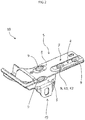
- Figure 2 shows in a perspective view an embodiment of the arrangement 10 with a holding element 5 which is implemented in the form of a holding bracket and which is designed to rest against the pane 3.
- the holding element 5 has a contact surface 7, which can also be referred to as the surface of the holding element 5 and which has several elevations 8.
- plastic molded parts 9 are arranged at predetermined positions, which are formed in a controlled manner by means of a self-foaming process.
- a substance is provided which is designed to be pumpable and meterable with predetermined material properties, in particular with regard to its viscosity.
- Such a substance comprises, for example, a first component K1 and a second component K2, each with predetermined material properties, which, coordinated with one another, enable the molded plastic parts 9 to be formed in a controlled and reliable manner by means of a self-foaming process.
- the plastic molded parts 9 have a predetermined elasticity so that when the disc 3 or another plate-shaped workpiece for the motor vehicle 1 on the holding element 5 to realize a desired distance between the window 3 and the holding element 5 and to counteract tension forces between the window 3 and the holding element 5 during further processing of the window 3, such as foaming.
- the plastic molded parts 9 prevent direct contact between the adjacent pane 3 and the holding element 5 or at least reduce a direct contact area in order to compensate for local stress peaks and prevent damage to the adjacent pane 3.
- the holding element 5 also has an assembly interface 19 which enables the system with the holding element 5 and the foamed pane 3 to be connected to the body 15 of the motor vehicle 1.
- the arrangement 10 has, for example, six mutually separate holding elements 5 which, as in FIG Figure 2 shown, can each be implemented as a bracket and allow reliable foaming of the pane 3 and the connection of the system to the body 15 of the motor vehicle 1.
- Figure 3A shows a perspective view of another exemplary embodiment of the arrangement 10 with a holding element 5.
- the plastic molded part 9 is designed as a continuous plastic element that encloses a cavity 16.
- the cavity 16 is delimited by the plastic molded part 9, so that the plastic molded part 9 forms a barrier.
- the cavity 16 is enclosed by the plastic molded part 9 and is sealed off from an outside area by this.
- the holding element 5 has a recess 6 which penetrates the holding element 5 in the region of the cavity 16.
- the holding element 5 already has such a recess 6 when it is provided, or it is introduced into the holding element 5 at a predetermined position during the machining of the holding element 5.
- the plastic molded part 9 is not self-contained but has two free ends.
- the plastic molded part 9 then seals the cavity 16 together with a further element which is arranged adjacent to the free ends during operation.
- the continuous molded plastic part 9 thus realizes a particularly reliable distance between the disk 3 and the adjacent holding element 5 and seals the cavity 16 between the disk 3 and the holding element 5 against undesirable external influences. In this way, it is possible to dispense with the use of a sealing tape in order to delimit and seal predetermined areas.
- Such a continuous plastic element 9 thus forms a sealing barrier, which can be formed with the desired height depending on predetermined process parameters, such as an application speed of the provided substance or the first and second components K1 and K2, so that a predetermined distance between the pane 3 and the adjacent holding element 5 can be realized.
- the height of the plastic molded part 9 relates, for example, to a surface normal to the essential plane of extent of the contact surface 7 of the holding element 5.
- Figure 3B shows a further exemplary embodiment of a continuous, self-contained plastic molded part 9 which surrounds a cavity 16.
- the design of the plastic molded part 9 can be adapted in a simple manner with regard to a required geometry and shape.
- FIG. 11 shows a schematic flow diagram for a method for processing the holding element 5 and for producing the arrangement 10, as exemplified in FIG Figure 2 and Figure 3A are illustrated.
- the arrangement 10 can be foamed, for example, so that the preprocessed holding element 5 is connected to the pane 3 and a system is implemented for the motor vehicle 1, which as a module, as exemplified in FIG Figure 1 shown, can be attached to the body 15.
- a first step S1 the holding element 5 and the substance to be applied or the first and second components K1 and K2 are provided for forming the plastic molded part or parts 9.
- the substance or the first and second components K1 and K2 each have predefined material properties which are predefined, provided and coordinated with one another in particular with regard to subsequent steps of the method. This applies, among other things, to the one to be initiated self-foaming process and the formation of the plastic molded parts 9 with a given geometry and desired material properties.
- the first component K1 and the second component K2 are applied to the contact surface 7 of the holding element 5 in at least one predetermined position, for example on an elevation 8.
- Such an application takes place, for example, as part of an injection molding process in which the first and second components K1 and K2 are applied by means of an injection molding tool.
- the first and second components K1 and K2 are provided in respective material containers and are supplied to a mixing head via feed lines for application to the contact surface 7 of the holding element 5 and applied by means of a metering nozzle.
- the first and second components K1 and K2 are reactively provided with a predetermined quantity ratio and applied by means of the dosing nozzle at the desired position on the contact surface 7 of the holding element 5, so that the self-foaming one only immediately after the application of the first and second components K1 and K2 Process for forming the plastic molded part 9 is initiated.
- the first and second components K1, K2 each have a corresponding viscosity or toughness.
- the first and second components K1, K2 are, for example, flowable and / or pumpable and thus enable a controlled application with reliable metering.
- a further step S5 represents the self-foaming process, which is achieved by applying the first and second Component K1, K2 is initiated.
- the first and second components K1, K2 make contact and mix, for example immediately after exiting a dosing nozzle.
- the plastic molded part (s) 9 is designed with a predetermined elasticity and geometry in order to achieve a predetermined distance when the pane 3 rests against the holding element 5 and tension forces between the pane 3 and the holding element 5, in particular when the pane 3 is foamed and the holding element 5 to be able to counteract.
- the first component K1 is provided as isocyanate and the second component K2 is provided as a polyol and form the plastic molded parts 9 from polyurethane.
- the first and second components K1 and K2 can in particular be applied to the contact surface 7 of the holding element 5 by machine. In this way, a time-saving and process-reliable application of the first and second components K1 and K2 is made possible, which realize a controlled and reliable formation of the plastic molded parts 9 and in particular enable reproducibility with regard to the shape and position of the plastic molded parts 9 to be formed.
- the first and second components K1 and K2 are applied by means of a spray gun in the form of drops at several predetermined positions on the contact surface 7 of the holding element 5 and realize punctiform or cylindrical plastic molded parts 9.
- the formation of the plastic molded parts 9 is essentially independent of the geometry of the holding element 5 and a material and time-saving application is made possible, since the plastic molded parts 9 can be specifically formed at the positions that are required for a safe and reliable installation of the disc 3 are required.
- a time-consuming adaptation of the plastic molded parts 9 to the geometry of the holding element 5 is not necessary, as is the case, for example, with prefabricated contact elements.
- the holding element 5 provided with plastic molded parts 9 thus forms a gentle abutment with predetermined elasticity for the pane 3 to be processed, so that, for example, a reliable and safe distance from the pane 3 for a subsequent foaming process is achieved.
- the plastic molded parts 9 each realize as an elastic element at the predetermined positions on the contact surface 7 of the holding element 5 a buffer between the holding element 5 and the adjacent pane 3.
- metallic holding elements 5 and panes 3 made of glass, there is direct contact between the holding element 5 and the pane 3 to prevent damage to the adjacent disc 3.
- a plurality of plastic parts 9 can be formed, which are arranged spaced apart from one another on the contact surface 7 of the holding element 5, as in the exemplary embodiment according to FIG Figure 2 is shown.
- the molded plastic part 9 can be designed as a continuous plastic element on the contact surface 7 of the holding element 5, which is, for example, self-contained and has a cavity 16 includes, as in the embodiments according to Figures 3A and 3B is shown.
- the holding element 5 provided already has a recess 6 which penetrates the holding element 5 in the region of the cavity 16.
- the recess 6 is introduced into the holding element 5 as part of the method so that it penetrates the contact surface 7 of the holding element 5 in the region of the cavity 16.
- the recess 6 also makes it possible to subsequently fill the cavity 16 with self-foaming material when the disk 3 is in an arranged or resting state on the holding element 5.
- polyurethane can also be introduced into the cavity 16 subsequently.
- the pane 3 to be machined is provided for the motor vehicle 1 and for foaming, the holding element (s) 5 with one or more plastic molded parts 9 are positioned on or on the window 3 so that the respective contact surface 7 of the holding elements 5 of the Disk 3 is facing.
- the pane 3 and the holding elements 5 are then foamed and a foam covering 13 is formed as a result, which couples the holding elements 5 to the pane 3.
- the preprocessed holding elements 5 are coupled to the pane 3 and thus, for example, a prefabricated system or module is implemented for the motor vehicle 1, as in the exemplary embodiment according to FIG Figure 1 is shown.
- a prefabricated system or module is implemented for the motor vehicle 1, as in the exemplary embodiment according to FIG Figure 1 is shown.
Landscapes
- Engineering & Computer Science (AREA)
- Mechanical Engineering (AREA)
- Casting Or Compression Moulding Of Plastics Or The Like (AREA)
- Body Structure For Vehicles (AREA)
- Window Of Vehicle (AREA)
Claims (15)
- Procédé de traitement d'un élément de retenue (5) destiné à un véhicule automobile (1), le procédé comprenant les étapes suivantes- fournir un élément de retenue (5) pourvu d'une surface d'appui (7) qui est conçu pour venir en appui sur une vitre (3),- fournir une substance apte au pompage qui présente des propriétés de matière prédéterminées, et- appliquer mécaniquement la substance prévue à au moins une position prédéterminée sur la surface d'appui (7) de l'élément de retenue (5) et démarrer ainsi un processus d'auto-moussage de façon à former, en fonction des propriétés de matière de la substance, une pièce moulée (9) en matière plastique présentant une élasticité prédéterminée afin de ménager, lorsque la vitre (3) est en appui sur l'élément de retenue (5), une distance prédéterminée entre la vitre (3) et l'élément de retenue (5) et de s'opposer à des forces de tension entre la vitre (3) et l'élément de retenue (5), la pièce moulée (9) en matière plastique étant conçue de façon à s'étendre lorsque la vitre (3) est en appui sur l'élément de retenue (5), uniquement entre la vitre (3) et l'élément de retenue (5).
- Procédé selon la revendication 1, la fourniture d'une substance apte au pompage qui présente des propriétés de matière prédéterminées et l'application de la substance fournie comprennent les étapes suivantes :- fournir un premier composant (K1) et un deuxième composant (K2), qui présentent chacun des propriétés de matière prédéterminées, et- appliquer mécaniquement le premier composant (K1) et le deuxième composant (K2) à au moins une position prédéterminée sur la surface d'appui (7) de l'élément de retenue (5) et démarrer ainsi un processus d'auto-moussage de façon à former, en fonction des propriétés de matière respectives des premier et deuxième composants (Kl, K2), une pièce moulée (9) en matière plastique qui présente une élasticité prédéterminée.
- Procédé selon la revendication 1 ou 2, comprenant la fourniture du premier composant (Kl) sous forme d'isocyanate et du deuxième composant (K2) sous forme de polyol.
- Procédé selon la revendication 3 comprenant les étapes suivantes
appliquer les premier et deuxième composants (K1, K2) et former ainsi la pièce moulée (9) en matière plastique à partir de polyuréthane. - Procédé selon l'une des revendications 1 à 4, comprenant l'étape suivante
appliquer de la substance apte au pompage à deux positions prédéterminées ou plus espacées les unes des autres sur la surface d'appui (7) de l'élément de retenue (5) de façon à former une pluralité de pièces moulées en plastique (9). - Procédé selon l'une des revendications 1 à 4, comprenant les étapes suivantes- fournir un élément de retenue (5) qui est conçu comme un cadre périphérique, et- appliquer la substance sur la surface d'appui (7} de l'élément de retenue (5) et former ainsi la pièce moulée (9) en matière plastique sous la forme d'un élément en matière plastique périphérique continu.
- Procédé selon l'une des revendications 1 à 4, comprenant les étapes suivantes
appliquer la substance sur la surface d'appui (7) de l'élément de retenue (5) et former ainsi une pièce moulée (9) en matière plastique sous la forme d'un élément en matière plastique continu et former une cavité (16). - Procédé selon la revendication 7 comprenant les étapes suivantes
pourvoir l'élément de retenue (5) d'un évidement (6) et/ou ménager dans l'élément de retenue (5) un évidement (6) qui pénètre dans l'élément de retenue (5) au niveau de la cavité (16). - Procédé selon l'une des revendications 1 à 8, comprenant les étapes suivantes- fournir une vitre à traiter (3) destinée au véhicule automobile (1),- positionner la vitre (3), et- positionner l'élément de retenue (5) avec la pièce moulée (9) en matière plastique en appui sur la vitre (3) .
- Procédé selon la revendication 9 comprenant les étapes suivantes
faire mousser l'élément de retenue (5) et former ainsi une mousse (13) qui accouple l'élément de retenue (5) à la vitre (3). - Ensemble (10) destiné à un véhicule automobile (1) et comprenant- un élément de retenue (5) pourvu d'une surface d'appui (7) qui est conçue pour venir en appui sur une vitre (3), et- une pièce moulée (9) en matière plastique destinée, lorsque la vitre (3) est en appui sur l'élément de retenue (5), à former une distance prédéterminée entre la vitre (3) et l'élément de retenue (5) et à s'opposer à des forces de tension entre la vitre (3) et l'élément de retenue (5), la pièce moulée (9) en matière plastique étant conçue de façon à s'étendre, lorsque la vitre (3) est en appui sur l'élément de retenue (5), uniquement entre la vitre (3) et l'élément de retenue (5), caractérisé en ce que la pièce moulée (9) en matière plastique est appliquée mécaniquement et est formée à partir d'une substance apte au pompage au moyen d'un processus d'auto-moussage à au moins une position prédéterminée sur la surface d'appui (7) de l'élément de retenue (5).
- Ensemble (10) selon la revendication 11, deux pièces moulées (9) en matière plastique ou plus, séparées les unes des autres, sont formées sur la surface d'appui (7) de l'élément de retenue (5).
- Ensemble (10) selon la revendication 11 ou 12, l'élément de retenue (5) étant conçu sous forme d'un cadre périphérique et la pièce moulée (9) en matière plastique étant conçue sous forme d'un élément en matière plastique périphérique continu.
- Ensemble (10) selon la revendication 11 ou 12, la pièce moulée (9) en matière plastique étant conçue sous forme d'un élément en matière plastique continu pourvu d'une cavité (16).
- Système destiné à un véhicule automobile (1) et comprenant- un ensemble (10) selon l'une des revendications 11 à 14,- la vitre (3) destinée au véhicule automobile (1), et- une mousse (13) qui accouple l'élément de retenue (5) à la vitre (3) afin de relier la vitre (3) à une carrosserie (15) du véhicule automobile (1).
Applications Claiming Priority (1)
| Application Number | Priority Date | Filing Date | Title |
|---|---|---|---|
| PCT/EP2015/074637 WO2017067608A1 (fr) | 2015-10-23 | 2015-10-23 | Procédé de traitement d'un élément de support, installation pour un véhicule automobile et système pour un véhicule automobile |
Publications (2)
| Publication Number | Publication Date |
|---|---|
| EP3365191A1 EP3365191A1 (fr) | 2018-08-29 |
| EP3365191B1 true EP3365191B1 (fr) | 2020-09-16 |
Family
ID=54478718
Family Applications (1)
| Application Number | Title | Priority Date | Filing Date |
|---|---|---|---|
| EP15791534.9A Active EP3365191B1 (fr) | 2015-10-23 | 2015-10-23 | Procédé de traitement d'un élément de support, installation pour un véhicule automobile et système pour un véhicule automobile |
Country Status (2)
| Country | Link |
|---|---|
| EP (1) | EP3365191B1 (fr) |
| WO (1) | WO2017067608A1 (fr) |
Cited By (1)
| Publication number | Priority date | Publication date | Assignee | Title |
|---|---|---|---|---|
| DE102022122934A1 (de) * | 2022-09-09 | 2024-03-14 | Dr. Ing. H.C. F. Porsche Aktiengesellschaft | Schraubeinleger zur Befestigung einer Glasscheibe |
Families Citing this family (1)
| Publication number | Priority date | Publication date | Assignee | Title |
|---|---|---|---|---|
| DE102019122207A1 (de) * | 2019-08-19 | 2021-02-25 | Webasto SE | Anordnung für ein Fahrzeugdach, Verfahren zum Herstellen einer Anordnung für ein Fahrzeugdach und Fahrzeugdach für ein Kraftfahrzeug |
Family Cites Families (3)
| Publication number | Priority date | Publication date | Assignee | Title |
|---|---|---|---|---|
| DE19637793C1 (de) * | 1996-09-17 | 1997-11-13 | Webasto Systemkomponenten Gmbh | Deckel für ein Fahrzeugdach |
| DE20006238U1 (de) | 2000-04-07 | 2001-05-17 | BBG Braunsberger GmbH & Co. KG, 87719 Mindelheim | Abdichteinrichtung für Einlegeteile in einem Schäumwerkzeug |
| DE102013106192B4 (de) * | 2013-06-13 | 2016-02-18 | Roof Systems Germany Gmbh | Verfahren und Vorrichtung zur Herstellung eines Fahrzeugkarosserie-Anbauteils |
-
2015
- 2015-10-23 EP EP15791534.9A patent/EP3365191B1/fr active Active
- 2015-10-23 WO PCT/EP2015/074637 patent/WO2017067608A1/fr not_active Ceased
Non-Patent Citations (1)
| Title |
|---|
| None * |
Cited By (2)
| Publication number | Priority date | Publication date | Assignee | Title |
|---|---|---|---|---|
| DE102022122934A1 (de) * | 2022-09-09 | 2024-03-14 | Dr. Ing. H.C. F. Porsche Aktiengesellschaft | Schraubeinleger zur Befestigung einer Glasscheibe |
| DE102022122934B4 (de) * | 2022-09-09 | 2025-08-21 | Dr. Ing. H.C. F. Porsche Aktiengesellschaft | Schraubeinleger zur Befestigung einer Glasscheibe, Glaselement, Fahrzeug und Herstellungsverfahren |
Also Published As
| Publication number | Publication date |
|---|---|
| EP3365191A1 (fr) | 2018-08-29 |
| WO2017067608A1 (fr) | 2017-04-27 |
Similar Documents
| Publication | Publication Date | Title |
|---|---|---|
| EP2168750B1 (fr) | Procédé de fabrication d'une pièce de moulage par injection dotée d'une garniture de fixation installée dedans | |
| WO1995021749A1 (fr) | Procede de production et de montage d'une vitre avec cadre, notamment dans une partie de vehicule | |
| DE112012001291T5 (de) | Verfahren zur Bildung von Klebestrukturen und dadurch gebildete Klebestrukturen | |
| EP2508377A2 (fr) | Unité de vitre avec un joint d'étanchéité pour fenêtre de véhicules automobiles | |
| DE212013000078U1 (de) | Windschutzscheibendichtung | |
| DE102016103745B4 (de) | Formwerkzeug zum Fixieren eines Einsatzes in einer Ausnehmung eines tafelartigen Werkstücks sowie Fahrzeugdachelement | |
| DE102011050752B4 (de) | Scheibeneinheit eines Fahrzeugfensters, insbesondere eines Seitenfensters | |
| EP0614775B1 (fr) | Fenêtre pour véhicule | |
| EP3365191B1 (fr) | Procédé de traitement d'un élément de support, installation pour un véhicule automobile et système pour un véhicule automobile | |
| DE2853767A1 (de) | Verfahren zum abdichten von leuchten oder scheinwerfern von kraftfahrzeugen o.dgl. | |
| DE102017120028A1 (de) | Deckel für ein Fahrzeugdach eines Kraftfahrzeugs, Verfahren zum Herstellen eines Deckels sowie Vorrichtung zum Herstellen eines Deckels | |
| DE102007022385A1 (de) | Hybridbauteilherstellungsverfahren | |
| WO2024068814A1 (fr) | Élément latéral en plastique creux et procédé de production d'un tel élément latéral en plastique creux | |
| EP1459881B1 (fr) | Procédé pour la fabrication d'une pièce de carosserie de véhicule | |
| EP1920899A1 (fr) | Procédé destiné à la fabrication de composants hybrides en matière synthétique, outil correspondant et utilisation d'un tel outil | |
| EP3181386B1 (fr) | Élément en verre pour toit de véhicule, procédé et outil destinés à fabriquer un élément en verre de toit de véhicule | |
| DE102015100968A1 (de) | Verfahren zur Herstellung einer Kraftfahrzeugkarosserie in Mischbauweise | |
| DE102014118029A1 (de) | Profilstrang und verfahren zum herstellen eines profilstrangs | |
| EP2644930A2 (fr) | Palier et son procédé de fabrication | |
| EP0679546B1 (fr) | Fenêtre pour carrosserie de véhicule automobile | |
| DE102005006794B4 (de) | Mehrfachkomponenten-Spritzverfahren zur Bildung eines aus mehreren Komponenten bestehenden Körpers | |
| DE19721566B4 (de) | Verfahren zur Herstellung eines Scheibenkörpers mit einem durch Umspritzung angeformten Rahmen aus weichelastischem Material | |
| EP3710339B1 (fr) | Dispositif de renforcement, d'étanchéité ou d'amortissement d'un élément structurel | |
| DE29704030U1 (de) | Glasverbundteil, insbesondere Glasschiebedach für Kraftfahrzeuge | |
| DE202014106259U1 (de) | Geruchsverschluss mit integriertem Dichtungselement |
Legal Events
| Date | Code | Title | Description |
|---|---|---|---|
| STAA | Information on the status of an ep patent application or granted ep patent |
Free format text: STATUS: THE INTERNATIONAL PUBLICATION HAS BEEN MADE |
|
| PUAI | Public reference made under article 153(3) epc to a published international application that has entered the european phase |
Free format text: ORIGINAL CODE: 0009012 |
|
| STAA | Information on the status of an ep patent application or granted ep patent |
Free format text: STATUS: REQUEST FOR EXAMINATION WAS MADE |
|
| 17P | Request for examination filed |
Effective date: 20180328 |
|
| AK | Designated contracting states |
Kind code of ref document: A1 Designated state(s): AL AT BE BG CH CY CZ DE DK EE ES FI FR GB GR HR HU IE IS IT LI LT LU LV MC MK MT NL NO PL PT RO RS SE SI SK SM TR |
|
| AX | Request for extension of the european patent |
Extension state: BA ME |
|
| DAV | Request for validation of the european patent (deleted) | ||
| DAX | Request for extension of the european patent (deleted) | ||
| GRAP | Despatch of communication of intention to grant a patent |
Free format text: ORIGINAL CODE: EPIDOSNIGR1 |
|
| STAA | Information on the status of an ep patent application or granted ep patent |
Free format text: STATUS: GRANT OF PATENT IS INTENDED |
|
| INTG | Intention to grant announced |
Effective date: 20200504 |
|
| GRAS | Grant fee paid |
Free format text: ORIGINAL CODE: EPIDOSNIGR3 |
|
| GRAA | (expected) grant |
Free format text: ORIGINAL CODE: 0009210 |
|
| STAA | Information on the status of an ep patent application or granted ep patent |
Free format text: STATUS: THE PATENT HAS BEEN GRANTED |
|
| AK | Designated contracting states |
Kind code of ref document: B1 Designated state(s): AL AT BE BG CH CY CZ DE DK EE ES FI FR GB GR HR HU IE IS IT LI LT LU LV MC MK MT NL NO PL PT RO RS SE SI SK SM TR |
|
| REG | Reference to a national code |
Ref country code: GB Ref legal event code: FG4D Free format text: NOT ENGLISH |
|
| REG | Reference to a national code |
Ref country code: CH Ref legal event code: EP |
|
| REG | Reference to a national code |
Ref country code: DE Ref legal event code: R096 Ref document number: 502015013479 Country of ref document: DE |
|
| REG | Reference to a national code |
Ref country code: IE Ref legal event code: FG4D Free format text: LANGUAGE OF EP DOCUMENT: GERMAN |
|
| REG | Reference to a national code |
Ref country code: AT Ref legal event code: REF Ref document number: 1313849 Country of ref document: AT Kind code of ref document: T Effective date: 20201015 |
|
| PG25 | Lapsed in a contracting state [announced via postgrant information from national office to epo] |
Ref country code: SE Free format text: LAPSE BECAUSE OF FAILURE TO SUBMIT A TRANSLATION OF THE DESCRIPTION OR TO PAY THE FEE WITHIN THE PRESCRIBED TIME-LIMIT Effective date: 20200916 Ref country code: NO Free format text: LAPSE BECAUSE OF FAILURE TO SUBMIT A TRANSLATION OF THE DESCRIPTION OR TO PAY THE FEE WITHIN THE PRESCRIBED TIME-LIMIT Effective date: 20201216 Ref country code: FI Free format text: LAPSE BECAUSE OF FAILURE TO SUBMIT A TRANSLATION OF THE DESCRIPTION OR TO PAY THE FEE WITHIN THE PRESCRIBED TIME-LIMIT Effective date: 20200916 Ref country code: GR Free format text: LAPSE BECAUSE OF FAILURE TO SUBMIT A TRANSLATION OF THE DESCRIPTION OR TO PAY THE FEE WITHIN THE PRESCRIBED TIME-LIMIT Effective date: 20201217 Ref country code: BG Free format text: LAPSE BECAUSE OF FAILURE TO SUBMIT A TRANSLATION OF THE DESCRIPTION OR TO PAY THE FEE WITHIN THE PRESCRIBED TIME-LIMIT Effective date: 20201216 Ref country code: HR Free format text: LAPSE BECAUSE OF FAILURE TO SUBMIT A TRANSLATION OF THE DESCRIPTION OR TO PAY THE FEE WITHIN THE PRESCRIBED TIME-LIMIT Effective date: 20200916 |
|
| REG | Reference to a national code |
Ref country code: NL Ref legal event code: MP Effective date: 20200916 |
|
| PG25 | Lapsed in a contracting state [announced via postgrant information from national office to epo] |
Ref country code: LV Free format text: LAPSE BECAUSE OF FAILURE TO SUBMIT A TRANSLATION OF THE DESCRIPTION OR TO PAY THE FEE WITHIN THE PRESCRIBED TIME-LIMIT Effective date: 20200916 Ref country code: RS Free format text: LAPSE BECAUSE OF FAILURE TO SUBMIT A TRANSLATION OF THE DESCRIPTION OR TO PAY THE FEE WITHIN THE PRESCRIBED TIME-LIMIT Effective date: 20200916 |
|
| REG | Reference to a national code |
Ref country code: LT Ref legal event code: MG4D |
|
| PG25 | Lapsed in a contracting state [announced via postgrant information from national office to epo] |
Ref country code: CZ Free format text: LAPSE BECAUSE OF FAILURE TO SUBMIT A TRANSLATION OF THE DESCRIPTION OR TO PAY THE FEE WITHIN THE PRESCRIBED TIME-LIMIT Effective date: 20200916 Ref country code: SM Free format text: LAPSE BECAUSE OF FAILURE TO SUBMIT A TRANSLATION OF THE DESCRIPTION OR TO PAY THE FEE WITHIN THE PRESCRIBED TIME-LIMIT Effective date: 20200916 Ref country code: PT Free format text: LAPSE BECAUSE OF FAILURE TO SUBMIT A TRANSLATION OF THE DESCRIPTION OR TO PAY THE FEE WITHIN THE PRESCRIBED TIME-LIMIT Effective date: 20210118 Ref country code: RO Free format text: LAPSE BECAUSE OF FAILURE TO SUBMIT A TRANSLATION OF THE DESCRIPTION OR TO PAY THE FEE WITHIN THE PRESCRIBED TIME-LIMIT Effective date: 20200916 Ref country code: EE Free format text: LAPSE BECAUSE OF FAILURE TO SUBMIT A TRANSLATION OF THE DESCRIPTION OR TO PAY THE FEE WITHIN THE PRESCRIBED TIME-LIMIT Effective date: 20200916 Ref country code: LT Free format text: LAPSE BECAUSE OF FAILURE TO SUBMIT A TRANSLATION OF THE DESCRIPTION OR TO PAY THE FEE WITHIN THE PRESCRIBED TIME-LIMIT Effective date: 20200916 |
|
| PG25 | Lapsed in a contracting state [announced via postgrant information from national office to epo] |
Ref country code: ES Free format text: LAPSE BECAUSE OF FAILURE TO SUBMIT A TRANSLATION OF THE DESCRIPTION OR TO PAY THE FEE WITHIN THE PRESCRIBED TIME-LIMIT Effective date: 20200916 Ref country code: AL Free format text: LAPSE BECAUSE OF FAILURE TO SUBMIT A TRANSLATION OF THE DESCRIPTION OR TO PAY THE FEE WITHIN THE PRESCRIBED TIME-LIMIT Effective date: 20200916 Ref country code: IS Free format text: LAPSE BECAUSE OF FAILURE TO SUBMIT A TRANSLATION OF THE DESCRIPTION OR TO PAY THE FEE WITHIN THE PRESCRIBED TIME-LIMIT Effective date: 20210116 Ref country code: PL Free format text: LAPSE BECAUSE OF FAILURE TO SUBMIT A TRANSLATION OF THE DESCRIPTION OR TO PAY THE FEE WITHIN THE PRESCRIBED TIME-LIMIT Effective date: 20200916 |
|
| REG | Reference to a national code |
Ref country code: CH Ref legal event code: PL |
|
| REG | Reference to a national code |
Ref country code: DE Ref legal event code: R097 Ref document number: 502015013479 Country of ref document: DE |
|
| PG25 | Lapsed in a contracting state [announced via postgrant information from national office to epo] |
Ref country code: MC Free format text: LAPSE BECAUSE OF FAILURE TO SUBMIT A TRANSLATION OF THE DESCRIPTION OR TO PAY THE FEE WITHIN THE PRESCRIBED TIME-LIMIT Effective date: 20200916 Ref country code: SK Free format text: LAPSE BECAUSE OF FAILURE TO SUBMIT A TRANSLATION OF THE DESCRIPTION OR TO PAY THE FEE WITHIN THE PRESCRIBED TIME-LIMIT Effective date: 20200916 Ref country code: LU Free format text: LAPSE BECAUSE OF NON-PAYMENT OF DUE FEES Effective date: 20201023 |
|
| REG | Reference to a national code |
Ref country code: BE Ref legal event code: MM Effective date: 20201031 |
|
| PLBE | No opposition filed within time limit |
Free format text: ORIGINAL CODE: 0009261 |
|
| STAA | Information on the status of an ep patent application or granted ep patent |
Free format text: STATUS: NO OPPOSITION FILED WITHIN TIME LIMIT |
|
| 26N | No opposition filed |
Effective date: 20210617 |
|
| PG25 | Lapsed in a contracting state [announced via postgrant information from national office to epo] |
Ref country code: CH Free format text: LAPSE BECAUSE OF NON-PAYMENT OF DUE FEES Effective date: 20201031 Ref country code: DK Free format text: LAPSE BECAUSE OF FAILURE TO SUBMIT A TRANSLATION OF THE DESCRIPTION OR TO PAY THE FEE WITHIN THE PRESCRIBED TIME-LIMIT Effective date: 20200916 Ref country code: BE Free format text: LAPSE BECAUSE OF NON-PAYMENT OF DUE FEES Effective date: 20201031 Ref country code: SI Free format text: LAPSE BECAUSE OF FAILURE TO SUBMIT A TRANSLATION OF THE DESCRIPTION OR TO PAY THE FEE WITHIN THE PRESCRIBED TIME-LIMIT Effective date: 20200916 Ref country code: LI Free format text: LAPSE BECAUSE OF NON-PAYMENT OF DUE FEES Effective date: 20201031 |
|
| PG25 | Lapsed in a contracting state [announced via postgrant information from national office to epo] |
Ref country code: IT Free format text: LAPSE BECAUSE OF FAILURE TO SUBMIT A TRANSLATION OF THE DESCRIPTION OR TO PAY THE FEE WITHIN THE PRESCRIBED TIME-LIMIT Effective date: 20200916 Ref country code: IE Free format text: LAPSE BECAUSE OF NON-PAYMENT OF DUE FEES Effective date: 20201023 |
|
| REG | Reference to a national code |
Ref country code: AT Ref legal event code: MM01 Ref document number: 1313849 Country of ref document: AT Kind code of ref document: T Effective date: 20201023 |
|
| PG25 | Lapsed in a contracting state [announced via postgrant information from national office to epo] |
Ref country code: AT Free format text: LAPSE BECAUSE OF NON-PAYMENT OF DUE FEES Effective date: 20201023 |
|
| PG25 | Lapsed in a contracting state [announced via postgrant information from national office to epo] |
Ref country code: TR Free format text: LAPSE BECAUSE OF FAILURE TO SUBMIT A TRANSLATION OF THE DESCRIPTION OR TO PAY THE FEE WITHIN THE PRESCRIBED TIME-LIMIT Effective date: 20200916 Ref country code: MT Free format text: LAPSE BECAUSE OF FAILURE TO SUBMIT A TRANSLATION OF THE DESCRIPTION OR TO PAY THE FEE WITHIN THE PRESCRIBED TIME-LIMIT Effective date: 20200916 Ref country code: CY Free format text: LAPSE BECAUSE OF FAILURE TO SUBMIT A TRANSLATION OF THE DESCRIPTION OR TO PAY THE FEE WITHIN THE PRESCRIBED TIME-LIMIT Effective date: 20200916 |
|
| PG25 | Lapsed in a contracting state [announced via postgrant information from national office to epo] |
Ref country code: MK Free format text: LAPSE BECAUSE OF FAILURE TO SUBMIT A TRANSLATION OF THE DESCRIPTION OR TO PAY THE FEE WITHIN THE PRESCRIBED TIME-LIMIT Effective date: 20200916 |
|
| PG25 | Lapsed in a contracting state [announced via postgrant information from national office to epo] |
Ref country code: NL Free format text: LAPSE BECAUSE OF NON-PAYMENT OF DUE FEES Effective date: 20200923 |
|
| PGFP | Annual fee paid to national office [announced via postgrant information from national office to epo] |
Ref country code: GB Payment date: 20231025 Year of fee payment: 9 |
|
| PGFP | Annual fee paid to national office [announced via postgrant information from national office to epo] |
Ref country code: FR Payment date: 20231023 Year of fee payment: 9 Ref country code: DE Payment date: 20231018 Year of fee payment: 9 |
|
| REG | Reference to a national code |
Ref country code: DE Ref legal event code: R119 Ref document number: 502015013479 Country of ref document: DE |
|
| GBPC | Gb: european patent ceased through non-payment of renewal fee |
Effective date: 20241023 |
|
| PG25 | Lapsed in a contracting state [announced via postgrant information from national office to epo] |
Ref country code: DE Free format text: LAPSE BECAUSE OF NON-PAYMENT OF DUE FEES Effective date: 20250501 |
|
| PG25 | Lapsed in a contracting state [announced via postgrant information from national office to epo] |
Ref country code: GB Free format text: LAPSE BECAUSE OF NON-PAYMENT OF DUE FEES Effective date: 20241023 |
|
| PG25 | Lapsed in a contracting state [announced via postgrant information from national office to epo] |
Ref country code: FR Free format text: LAPSE BECAUSE OF NON-PAYMENT OF DUE FEES Effective date: 20241031 |