EP3365335B1 - 2-aryl- und 2-heteroaryl-substituierte 2-pyridazin-3(2h)-on-verbindungen als inhibitoren von fgfr-tyrosinkinasen - Google Patents
2-aryl- und 2-heteroaryl-substituierte 2-pyridazin-3(2h)-on-verbindungen als inhibitoren von fgfr-tyrosinkinasen Download PDFInfo
- Publication number
- EP3365335B1 EP3365335B1 EP16791228.6A EP16791228A EP3365335B1 EP 3365335 B1 EP3365335 B1 EP 3365335B1 EP 16791228 A EP16791228 A EP 16791228A EP 3365335 B1 EP3365335 B1 EP 3365335B1
- Authority
- EP
- European Patent Office
- Prior art keywords
- years
- alkyl
- pyrazol
- amino
- cancer
- Prior art date
- Legal status (The legal status is an assumption and is not a legal conclusion. Google has not performed a legal analysis and makes no representation as to the accuracy of the status listed.)
- Active
Links
Classifications
-
- C—CHEMISTRY; METALLURGY
- C07—ORGANIC CHEMISTRY
- C07D—HETEROCYCLIC COMPOUNDS
- C07D403/00—Heterocyclic compounds containing two or more hetero rings, having nitrogen atoms as the only ring hetero atoms, not provided for by group C07D401/00
- C07D403/14—Heterocyclic compounds containing two or more hetero rings, having nitrogen atoms as the only ring hetero atoms, not provided for by group C07D401/00 containing three or more hetero rings
-
- A—HUMAN NECESSITIES
- A61—MEDICAL OR VETERINARY SCIENCE; HYGIENE
- A61K—PREPARATIONS FOR MEDICAL, DENTAL OR TOILETRY PURPOSES
- A61K31/00—Medicinal preparations containing organic active ingredients
- A61K31/33—Heterocyclic compounds
- A61K31/395—Heterocyclic compounds having nitrogen as a ring hetero atom, e.g. guanethidine or rifamycins
- A61K31/495—Heterocyclic compounds having nitrogen as a ring hetero atom, e.g. guanethidine or rifamycins having six-membered rings with two or more nitrogen atoms as the only ring heteroatoms, e.g. piperazine or tetrazines
- A61K31/50—Pyridazines; Hydrogenated pyridazines
- A61K31/501—Pyridazines; Hydrogenated pyridazines not condensed and containing further heterocyclic rings
-
- A—HUMAN NECESSITIES
- A61—MEDICAL OR VETERINARY SCIENCE; HYGIENE
- A61K—PREPARATIONS FOR MEDICAL, DENTAL OR TOILETRY PURPOSES
- A61K31/00—Medicinal preparations containing organic active ingredients
- A61K31/33—Heterocyclic compounds
- A61K31/395—Heterocyclic compounds having nitrogen as a ring hetero atom, e.g. guanethidine or rifamycins
- A61K31/535—Heterocyclic compounds having nitrogen as a ring hetero atom, e.g. guanethidine or rifamycins having six-membered rings with at least one nitrogen and one oxygen as the ring hetero atoms, e.g. 1,2-oxazines
- A61K31/5375—1,4-Oxazines, e.g. morpholine
- A61K31/5377—1,4-Oxazines, e.g. morpholine not condensed and containing further heterocyclic rings, e.g. timolol
-
- A—HUMAN NECESSITIES
- A61—MEDICAL OR VETERINARY SCIENCE; HYGIENE
- A61K—PREPARATIONS FOR MEDICAL, DENTAL OR TOILETRY PURPOSES
- A61K45/00—Medicinal preparations containing active ingredients not provided for in groups A61K31/00 - A61K41/00
- A61K45/06—Mixtures of active ingredients without chemical characterisation, e.g. antiphlogistics and cardiaca
-
- A—HUMAN NECESSITIES
- A61—MEDICAL OR VETERINARY SCIENCE; HYGIENE
- A61P—SPECIFIC THERAPEUTIC ACTIVITY OF CHEMICAL COMPOUNDS OR MEDICINAL PREPARATIONS
- A61P35/00—Antineoplastic agents
-
- C—CHEMISTRY; METALLURGY
- C07—ORGANIC CHEMISTRY
- C07D—HETEROCYCLIC COMPOUNDS
- C07D401/00—Heterocyclic compounds containing two or more hetero rings, having nitrogen atoms as the only ring hetero atoms, at least one ring being a six-membered ring with only one nitrogen atom
- C07D401/14—Heterocyclic compounds containing two or more hetero rings, having nitrogen atoms as the only ring hetero atoms, at least one ring being a six-membered ring with only one nitrogen atom containing three or more hetero rings
-
- C—CHEMISTRY; METALLURGY
- C07—ORGANIC CHEMISTRY
- C07D—HETEROCYCLIC COMPOUNDS
- C07D413/00—Heterocyclic compounds containing two or more hetero rings, at least one ring having nitrogen and oxygen atoms as the only ring hetero atoms
- C07D413/14—Heterocyclic compounds containing two or more hetero rings, at least one ring having nitrogen and oxygen atoms as the only ring hetero atoms containing three or more hetero rings
-
- C—CHEMISTRY; METALLURGY
- C12—BIOCHEMISTRY; BEER; SPIRITS; WINE; VINEGAR; MICROBIOLOGY; ENZYMOLOGY; MUTATION OR GENETIC ENGINEERING
- C12Q—MEASURING OR TESTING PROCESSES INVOLVING ENZYMES, NUCLEIC ACIDS OR MICROORGANISMS; COMPOSITIONS OR TEST PAPERS THEREFOR; PROCESSES OF PREPARING SUCH COMPOSITIONS; CONDITION-RESPONSIVE CONTROL IN MICROBIOLOGICAL OR ENZYMOLOGICAL PROCESSES
- C12Q1/00—Measuring or testing processes involving enzymes, nucleic acids or microorganisms; Compositions therefor; Processes of preparing such compositions
- C12Q1/68—Measuring or testing processes involving enzymes, nucleic acids or microorganisms; Compositions therefor; Processes of preparing such compositions involving nucleic acids
- C12Q1/6876—Nucleic acid products used in the analysis of nucleic acids, e.g. primers or probes
- C12Q1/6883—Nucleic acid products used in the analysis of nucleic acids, e.g. primers or probes for diseases caused by alterations of genetic material
- C12Q1/6886—Nucleic acid products used in the analysis of nucleic acids, e.g. primers or probes for diseases caused by alterations of genetic material for cancer
-
- G—PHYSICS
- G01—MEASURING; TESTING
- G01N—INVESTIGATING OR ANALYSING MATERIALS BY DETERMINING THEIR CHEMICAL OR PHYSICAL PROPERTIES
- G01N33/00—Investigating or analysing materials by specific methods not covered by groups G01N1/00 - G01N31/00
- G01N33/48—Biological material, e.g. blood, urine; Haemocytometers
- G01N33/50—Chemical analysis of biological material, e.g. blood, urine; Testing involving biospecific ligand binding methods; Immunological testing
- G01N33/53—Immunoassay; Biospecific binding assay; Materials therefor
- G01N33/575—Immunoassay; Biospecific binding assay; Materials therefor for cancer
Definitions
- the present disclosure relates to novel compounds which exhibit inhibition of fibroblast growth factor receptor tyrosine kinases (FGFRs), in particular FGFR1, FGFR2, FGFR3 and/or FGFR4, pharmaceutical compositions comprising the compounds, to processes for making the compounds, and the use of the compounds in therapy. More particularly, it relates to 2-aryl- and 2-heteroaryl-substituted 2-pyridazin-3(2H)-one compounds useful in the treatment or prevention of diseases which can be treated with an FGFR inhibitor, including diseases mediated by FGFR tyrosine kinases.
- FGFRs fibroblast growth factor receptor tyrosine kinases
- Fibroblast growth factors and their receptors (FGFRs) regulate a wide range of physiologic cellular processes, such as embryonic development, differentiation, proliferation, survival, migration, and angiogenesis.
- the FGF family comprises 18 secreted ligands (FGFs) which are readily sequestered to the extracellular matrix by heparin sulfate proteoglycans (HPSGs).
- FGFs secreted ligands
- HPSGs heparin sulfate proteoglycans
- FGFs are released from the extracellular matrix by proteases or specific FGF-binding proteins, with the liberated FGFs subsequently binding to a cell surface FGF-receptor (FGFR) in a ternary complex consisting of FGF, FGFR and HPSG ( Beenken, A., Nat. Rev. Drug Discov. 2009; 8:235-253 ).
- FGFRs There are five FGFRs, of which four (FGFRs 1-4) are highly conserved single-pass transmembrane tyrosine kinase receptors ( Eswarakumar, V.P., Cytokine Growth Factor Rev., 2005; 16:139-149 ).
- the binding of an FGF to an FGFR leads to receptor dimerization and transphosphorylation of tyrosine kinase domains ( Dieci, M.V., et al., Cancer Discov. 2013; 3:264-279 ; Korc, N., and Friesel, R.E., Curr. Cancer Drug Targets 2009; 5:639-651 ).
- Activation of downstream signaling occurs via the intracellular receptor substrate FGFR substrate 2 (FRS2) and phospholipase C ⁇ (PLC- ⁇ ), leading to subsequent upregulation of RAS/mitogen-activated protein kinase (MAPK) and phosphoinositide 3-kinase (PI3K)/AKT signaling pathways.
- FAS2 FGFR substrate 2
- PLC- ⁇ phospholipase C ⁇
- Other pathways can be activated, including STAT-dependent signaling ( Turner, N., Grose, R., Nat. Ref. Cancer 2010; 10:116-129 ; Brooks, N.S., et al., Clin Cancer Res. 2012; 18:1855-1862 ; Divmann, R., et al., Ann. Oncol. 2014; 25:552-563 ).
- FGFR signaling components are frequently altered in human cancer, and several preclinical models have provided compelling evidence for the oncogenic potential of aberrant FGFR signaling in carcinogenesis, thereby validating FGFR signaling as an attractive target for cancer treatment.
- FGFR signaling is dysregulated and drive cancer
- mechanisms by which FGFR signaling is dysregulated and drive cancer include activating mutations, FGFR gene amplification, chromosomal translocations, autocrine and paracrine signaling, and altered FGFR splicing.
- WO2013/130976 relates to compounds which are useful for the treatment of hyperproliferative, pain and inflammatory diseases.
- WO2014/011900 relates to inhibitors of FGFR, pharmaceutical compositions including such compounds, and methods of using such compounds and compositions to inhibit the activity of tyrosine kinase.
- WO2015/144804 relates to a combination of a first compound which is a FGFR inhibitor; and a second compound which is a cMet inhibitor.
- the combination is for use in the treatment of a proliferative disorder, in particular for use in the treatment of cancer.
- 2-aryl- and 2-heteroaryl-substituted 2-pyridazin-3(2H)-one compounds are inhibitors of FGFR1, FGFR2, FGFR3 and/or FGFR4, which are useful in the treatment or prevention of diseases which can be treated with an inhibitor of FGFR1, FGFR2, FGFR3 and/or FGFR4, including diseases mediated by FGFR1, FGFR2, FGFR3 and/or FGFR4.
- composition comprising a compound of the invention or a pharmaceutically acceptable salt or solvate thereof, and a pharmaceutically acceptable diluent or carrier.
- Also provided herein is a process for preparing a compound of Formula I or a pharmaceutically acceptable salt or solvate thereof, comprising:
- a compound of Formula I or a pharmaceutically acceptable salt or solvate thereof exhibits potent and selective FGFR inhibition. In some embodiments, said inhibition occurs with relative sparing of FGFR1 inhibition. In certain embodiments, a compound of Formula I or a pharmaceutically acceptable salt or solvate thereof exhibits a relatively high potency for FGFR2 and FGFR3 (e.g., FGFR3, e.g., FGFR3-TACC3 fusion). In certain embodiments, a compound of Formula I or a pharmaceutically acceptable salt or solvate thereof provides dose-dependent inhibition of tumor growth in RT112/84 FGFR3-TACC3 xenografts.
- a compound of Formula I or a pharmaceutically acceptable salt or solvate thereof exhibits (independently) greater selectivity for FGFR2 and/or FGFR3 (e.g., FGFR3) as compared to FGFR1 (e.g., exhibits greater selectivity for FGFR3 over FGFR1 in enzyme and cellbased assays e.g., exhibit greater cytotoxicity for FGFR2/3 than FGFR1 mutant cells). See Lewin, et al, Journal of Clinical Oncolgy, 2015, 22, 3372 .
- administration of a compound of Formula I or a pharmaceutically acceptable salt or solvate thereof results in less hyperphosphatemia than administration of a pan-FGFR inhibitor (e.g., a pan-FGFR inhibitor, which when compared with the Formula I compounds described herein, exhibits less selectivity for FGFR2 and/or FGFR3 (e.g., FGFR3) as compared to FGFR1; e.g., a pan-FGFR inhibitor that is less sparing of FGFR1 inhibition than the Formula I compounds described herein).
- a pan-FGFR inhibitor e.g., a pan-FGFR inhibitor, which when compared with the Formula I compounds described herein, exhibits less selectivity for FGFR2 and/or FGFR3 (e.g., FGFR3) as compared to FGFR1; e.g., a pan-FGFR inhibitor that is less sparing of FGFR1 inhibition than the Formula I compounds described herein).
- a compound of Formula I or a pharmaceutically acceptable salt or solvate thereof can provide greater dosing/regimen flexibilityand/or efficacy than, for example, a pan-FGFR inhibitor (e.g., a pan-FGFR inhibitor, which whencompared with the Formula I compounds described herein, exhibits less selectivity for FGFR2 and/or FGFR3 (e.g., FGFR3) as compared to FGFR1; e.g., a pan-FGFR inhibitor that is less sparing of FGFR1 inhibition than the Formula I compounds described herein).
- a pan-FGFR inhibitor e.g., a pan-FGFR inhibitor, which whencompared with the Formula I compounds described herein, exhibits less selectivity for FGFR2 and/or FGFR3 (e.g., FGFR3) as compared to FGFR1; e.g., a pan-FGFR inhibitor that is less sparing of FGFR1 inhibition than the Formula I compounds described herein).
- the compounds described herein can be administered at higher doses and/or with increased frequencies, thereby providing higher drug exposure/target coverage, and done so with reduced risk of causing unwanted (e.g., abnormal) increases in blood phosphate levels, which in some instances can necessitate administration of phosphate binders and/or temporary (e.g., drug holidays) or permanent cessation of therapy to allow phosphate levels to return to normal.
- methoxyethyl comprises an ethyl backbone with a methoxy substituent.
- halogen as used herein means -F (sometimes referred to herein as "fluoro” or fluoros"), -Cl, -Br and -I.
- C1-C3 alkyl and “C1-C6 alkyl” as used herein refer to a monovalent, saturated linear or branched hydrocarbon chains having from one to three and one to six carbon atoms, respectively. Examples include, but are not limited to, methyl, ethyl, 1-propyl, isopropyl, 1-butyl, isobutyl, sec -butyl, tert -butyl, 2-methyl-2-propyl, pentyl, pentan-3-yl and hexyl.
- hydroxy(C1-C6 alkyl)- refers to a monovalent, saturated linear or branched hydrocarbon chain having from one to six carbon atoms, wherein any one of the carbon atoms is substituted with a hydroxy (-OH) group.
- dihydroxy(C1-C6 alkyl)- and "dihydroxy(C3-C6 alkyl)-” as used herein refers to a monovalent, saturated linear or branched hydrocarbon chain having from one to six carbon atoms or three to six carbon atoms, respectively, wherein any two of the carbon atoms are each substituted with a hydroxy group, provided that both hydroxy groups are not attached to the same carbon atom.
- cyano(C1-C6 alkyl)- refers to a monovalent, saturated linear or branched hydrocarbon chain having from one to six carbon atoms, wherein any one of the carbon atoms is substituted with a cyano (-CN) group.
- C1-C3 alkoxy and “C1-C6 alkoxy” as used herein refer to groups that have the formula, -OR, wherein R is “C1-C3 alkyl” and “C1-C6 alkyl”, respectively, as defined herein.
- Illustrative examples include, but are not limited to, methoxy, ethoxy, propoxy, 2-propoxy, butoxy, tert -butoxy, pentyloxy, and hexyloxy.
- (C1-C6 alkoxy)(C1-C6 alkyl)- refers to a monovalent, saturated linear or branched hydrocarbon chain having from one to six carbon atoms, wherein any one of the carbon atoms is substituted with a C1-C6 alkoxy group as defined herein.
- C3-C6 cycloalkyl refers to a monovalent, monocyclic, saturated hydrocarbon ring having from three to six ring atoms. Illustrative examples include, but are not limited to, cyclopropyl and cyclobutyl.
- C3-C6 cycloalkoxy refers to a group having the formula, -OR', wherein R' is "C3-C6 cycloalkyl” as defined herein.
- C3-C6 cycloalkoxy)C1-C6 alkyl- refers to a monovalent, saturated linear or branched hydrocarbon chain having from one to six carbon atoms, wherein any one of the carbon atoms is substituted with a C3-C6 cycloalkoxy group as defined herein.
- heterocyclic refers to a saturated, monovalent, monocyclic ring having the indicated number of total ring atoms, in which at least one of the ring atoms is a heteroatom (e.g., Nor O).
- heterospirocyclic ring refers to a bicyclic, saturated, spiro-C-fused (i.e., the two rings share a common carbon atom) heterocyclic ring system having from seven to ten total ring atoms, wherein from one to two of the ring atoms is a heteroatom independently selected from the group consisting of N and O, provided that the heteroatoms are not adjacent to one another.
- Each ring independently contains from 3 to 7 ring atoms, and when two of the ring atoms are heteroatoms, each of the heteroatoms can be present in the same ring, or each can be present in a different ring.
- Examples include 7-oxa-4-azaspiro[2.5]octane, 2-azaspiro[3.3]heptane, 2,6-diazaspiro[3.3]heptane, 2,5-diazaspiro[3.4]octane, 2,6-diazaspiro[3.4]octane, 1,6-diazaspiro[3.4]octane, 1,7-diazaspiro[4.4]nonane, 2,7-diazaspiro[4.4]nonane, 2,7-diazaspiro[3.5]nonane, 2,6-diazaspiro[3.5]nonane, 2,5-diazaspiro[3.5]nonane, 1,7-diazaspiro[3.5]nonane, 1,6-diazaspiro[3.5]nonane, 2,8-diazaspiro[4.5]decane, 1,8-diazaspiro[4.5]de
- (C3-C4)cycloalkyl refers collectively to the cyclopropyl and cyclobutyl rings.
- heteroaryl refers to an aromatic, monovalent or divalent, monocyclic or bicyclic ring having the indicated number of total ring atoms, in which at least one of the ring atoms is a heteroatom (e.g., N or O).
- tautomer refers to compounds whose structures differ markedly in arrangement of atoms, but which exist in easy and rapid equilibrium, and it is to be understood that compounds of the present invention may be depicted as different tautomers, and when compounds have tautomeric forms, all tautomeric forms are intended to be within the scope of the invention, and the naming of the compounds does not exclude any tautomer.
- X is N.
- X is CH.
- Ring A is pyrazolyl optionally substitutedwith one R 1 group, wherein said pyrazolyl ring is a pyrazolyl ring represented by the structure wherein the wavy line indicates the point of attachment to the 6-membered ring comprising X and the asterisk indicates the point of attachment to R 1 , wherein each R 1 group is independently selected from the groupconsisting of (a) hydrogen, (b) C1-C6 alkyl (optionally substituted with 1-3 fluoros), (c)hydroxy(C1-C6 alkyl)- (optionally substituted with 1-3 fluoros), (e) cyano(C1-C6 alkyl)-, (g)(C1-C3 alkoxy)C1-C6 alkyl-(optionally substituted with 1-3 fluoros), (h) (C3-C6 cycloalkyl)(CH 2 ) n - where n is 0-3 and said cycloalkyl is optional
- R 1 is hydrogen
- R 1 is C1-C6 alkyl optionally substituted with 1-3 fluoros.
- R 1 include methyl, isopropyl, isobutyl, pentan-3-yl, 2,2- difluoroethyl, and 3,3,3-trifluoroethyl.
- R 1 is C1-C6 alkyl optionally substituted with1-3 fluoros.
- Ring A is substituted with one R 1 group independently selected from C1-C6 alkyl optionally substituted with 1-3 fluoros.
- Ring A is substitutedwith one methyl groups.
- R 1 is hydroxy(C1-C6 alkyl)- optionally substituted with 1-3 fluoros. In certain embodiments of Formula I , R 1 is hydroxy(C3-C6 alkyl)-optionally substituted with 1-3 fluoros. In certain embodiments of Formula I , R 1 is hydroxy(C1-C6 alkyl) optionally substituted with 1-3 fluoros. Examples of R 1 include the structures:
- R 1 is dihydroxy(C1-C6 alkyl)- optionally substituted with 1-3 fluoros. In certain embodiments of Formula I , R 1 is dihydroxy(C1-C6 alkyl)-optionally substituted with 1-3 fluoros. In certain embodiments, R 1 is dihydroxy(C3-C6 alkyl)-. Examples of R 1 include the structures:
- R 1 is cyano(C1-C6 alkyl)-. In certain embodiments of Formula I , R 1 is cyano(C1-C6 alkyl)-.
- R 1 includes the structure:
- R 1 is R a R b N(C1-C6 alkyl)-, where R a and R b are independently hydrogen or C1-C6 alkyl optionally substituted with F, OH or C1-C6 alkoxy.
- R 1 is R a R b N(C1-C6 alkyl)-.Examples of R 1 include the structures:
- R 1 is (C1-C3 alkoxy)C1-C6 alkyl- optionally substituted with 1-3 fluoros. In certain embodiments of Formula I , R 1 is (C1-C3alkoxy)C1-C6 alkyl- optionally substituted with 1-3 fluoros. Examples of R 1 include the structures:
- R 1 is (C3-C6 cycloalkyl)(CH 2 ) n - where n is 0-3 and said cycloalkyl is optionally substituted with CN, OH, R a R b N-, (1-3C)alkyl, or (1-3C)alkoxy.
- R 1 is (C3-C6 cycloalkyl)(CH 2 ) n - where n is 0-3 and said cycloalkyl is optionally substituted with CN.
- n is 0 or 1.
- R 1 is (C3-C6 cycloalkyl)(CH 2 ) n -. Examples of R 1 include the structures:
- substituents independently selected from the group consisting of fluoro, HO, C1-C6 alkyl (optionally substituted with 1-3 fluoros), (
- R 1 is hetCyc 1 (CH 2 ) m -, where m is 0-3, and hetCyc 1 is azetidinyl, piperidinyl or morpholinyl optionally substituted with one or more substituents independently selected from the group consisting of C1-C6 alkyl (optionally substituted with 1-3 fluoros) and (C1-C6 alkoxy)C1-C6 alkyl- (optionally substituted with 1-3 fluoros).
- R 1 is hetCyc 1 (CH 2 ) m .
- m is 0, 1 or 2.
- m is 0.
- m is 1.
- m is 2.
- R 1 when represented by hetCyc 1 (CH 2 ) m - include the structures:
- R 1 is hetCyc 2 (CH 2 ) p - where p is 0 or 1, and hetCyc 2 is a 7-10 membered heterospirocyclic ring having 1-2 ring heteroatoms independently selected from N and O, wherein said heterospirocyclic ring is unsubstituted.
- R 1 is hetCyc 2 (CH 2 ) p -.
- R 1 is represented by hetCyc 2 (CH 2 ) p - include the structures:
- R 1 is hetAr 1 (CH 2 ) q - where q is 1 or 2 and hetAr 1 is a 6-membered heteroaryl ring having 1-2 ring nitrogen atoms, wherein said ring is optionally substituted with one or more substituents independently selected from C1-C6 alkyl and halogen.
- R 1 is hetAr 1 (CH 2 ) q -.
- R 1 is represented by hetAr 1 (CH 2 ) q - include the structures:
- R 1 is halogen. In certain embodiments when R 1 is halogen. Examples of R 1 include F, Cl and Br. In one embodimentof Formula I , R 1 is F.
- substituents independently selected from the group consisting of fluoro, HO, C1-C6 alkyl (optionally substituted with 1-3 fluoros), (
- substituents independently selected from the group consisting of fluoro, HO, C1-C6 alkyl (optionally substituted with 1-3 fluoros), (C1-C6 alkoxy)C1-C6 alkyl- (optionally substituted with 1-3 fluoros), (C3-C6 cycloalkoxy)C1-C6 alkyl-,hydroxy(C1
- hetCyc 1 is piperidinyl or morpholinyl optionally substituted with one or more substituents independently selected from the group consisting of C1-C6 alkyl (optionally substituted with 1-3 fluoros) and (C1-C6 alkoxy)C1-C6 alkyl- (optionally substituted with 1-3 fluoros).
- Ring A is pyrazolyl optionally substituted with one R 1 groups wherein said pyrazolyl ring is a pyrazolyl ring represented by the structure wherein the wavy line indicates the point of attachment to the 6-membered ring comprising X and the asterisk indicates the point of attachment to R 1 , wherein R 1 is selected from the group consisting of (b) C1-C6 alkyl (optionally substituted with 1-3 fluoros), (c) hydroxy(C1-C6 alkyl)-(optionally substituted with 1-3 fluoros), (e) cyano(C1-C6 alkyl)-, (f) R a R b N(C1-C6 alkyl)-, (h) (C3-C6 cycloalkyl)(CH 2 ) n - where n is 0-3 and said cycloalkyl is optionally substituted with CN,OH, R a R b N-, (1-3C
- Ring A is pyrazolyl, which may be represented by the structure:
- R 1 is selected from (a) hydrogen, (b) C1-C6 alkyl (optionally substituted with 1-3 fluoros), (c) hydroxy(C1-C6 alkyl)-(optionally substituted with 1-3 fluoros), (e) cyano(C1-C6 alkyl), (g) (C1-C3 alkoxy)C1- C6 alkyl-(optionally substituted with 1-3 fluoros), (h) (C3-C6 cycloalkyl)(CH 2 ) n - where n is 0-3and said cycloalkyl is optionally substituted with CN, OH, R a R b N-, (1-3C)alkyl or (1-3C)alkoxy, (i) hetCyc 1 (CH 2 ) m - where m is 0-3,
- Ring A is pyrazolyl, wherein RingA and R 1 together may be represented by the structure: wherein the wavy line indicates the point of attachment to the 6-membered ring comprising X, wherein R 1 is selected from (a) hydrogen, (b) C1-C6 alkyl (optionally substituted with 1-3 fluoros), (c) hydroxy(C1-C6 alkyl)- (optionally substituted with 1-3 fluoros), (e) cyano(C1-C6 alkyl)-, (g) (C1-C3 alkoxy)C1-C6 alkyl- (optionally substituted with 1-3 fluoros), (h) (C3-C6 cycloalkyl)(CH 2 ) n - where n is 0-3 and said cycloalkyl is optionally substitutedwith CN, OH, R a R b N-, (1-3C)alkyl or (1-3C)alkoxy, (i) het
- R 2 when represented by Ar 1 include the structures:
- hetAr 2 examples include:
- R 3 is H.
- R 3 is C1-C4 alkyl.
- Non-limiting examples include methyl, ethyl, propyl, isopropyl and isobutyl.
- R 3 is (C3-C4)cycloalkyl. In certain embodiments of Formula I , R 3 is cyclopropyl. In certain embodiments of Formula I , R 3 is cyclobutyl.
- Compounds of Formula I include compounds of Formula I-A , wherein:
- R 2 is Ar 1 , wherein Ar 1 is as defined for Formula I-A .
- R 3 is hydrogen
- R 3 is C 1-C4 alkyl.
- R 3 is (C3-C4)cycloalkyl.
- R 3 is C1-C4 alkyl.
- R 3 is (C3-C4)cycloalkyl.
- R 1 is C1-C6 alkyl (optionally substituted with 1-3 fluoros).
- R 1 is hydroxy(C1-C6 alkyl)- (optionally substituted with 1-3 fluoros).
- R 1 is cyano(C1-C6 alkyl)-.
- R 1 is R a R b N(C1-C6 alkyl)-.
- R 1 is (C3-C6 cycloalkyl)(CH 2 ) n - where n is 0-3 and said cycloalkyl is optionally substituted with CN, OH, R a R b N-, (1-3C)alkyl or (1-3C)alkoxy,
- R 1 is hetCyc 1 (CH 2 ) m - where m is 0-3. In one embodiment, m is 0, 1 or 2. In one embodiment, m is 0. In one embodiment, m is 1. In one embodiment, m is 2.
- R 1 is hetCyc 2 (CH 2 ) p - where p is 0 or 1.
- R 2 is Ar 1 , wherein Ar 1 is phenyl optionally substituted with one or more groups independently selected from halogen, C1-C3 alkyl (optionally substituted with 1-3 fluoros), and C1-C3 alkoxy (optionally substituted with 1-3 fluoros); R 3 is hydrogen; and R 1 is hydroxy(C1-C6 alkyl)- (optionally substituted with 1-3 fluoros).
- R 2 is Ar 1 , wherein Ar 1 is phenyl optionally substituted with one or more groups independently selected from halogen, C1-C3 alkyl (optionally substituted with 1-3 fluoros), and C1-C3 alkoxy (optionally substituted with 1-3 fluoros); R 3 is hydrogen; and R 1 is cyano(C1-C6 alkyl)-.
- said cycloalkyl is unsubstituted.
- said cycloalkyl is substituted with CN.
- n is 0.
- n is 1.
- m is 0, 1 or 2.
- m is 0.
- m is 1.
- m is 2.
- hetCyc 1 is piperidinyl.
- Compounds of Formula I include compounds of Formula I-C , wherein:
- Ar 1 is phenyl substituted with one or more groups independently selected from halogen and C1-C3 alkoxy.
- R 2 is Ar 1 , wherein Ar 1 is phenyl optionally substituted with one or more groups independently selected from halogen, C1-C3 alkyl (optionally substituted with 1-3 fluoros), and C1-C3 alkoxy (optionally substituted with 1-3 fluoros).
- R 3 is hydrogen
- R 3 is C1-C4 alkyl.
- R 3 is (C3-C4)cycloalkyl.
- R 1 is independently selected from (b) C1-C6 alkyl (optionally substituted with 1-3 fluoros) and (i) hetCyc 1 (CH 2 ) m - where m is 0-3; and hetCyc 1 is defined for Formula I-C .
- certain compounds provided herein may contain one or more centers of asymmetry and may therefore be prepared and isolated in a mixture of isomers such as a racemic mixture, or in an enantiomerically pure form.
- the compounds of Formula I or their salts may be isolated in the form of solvates, and accordingly that any such solvate is included within the scope of the present invention.
- compounds of Formula I and salts thereof can exist in unsolvated as well as solvated forms with pharmaceutically acceptable solvents such as water, ethanol, and the like.
- the compounds of Formula I include pharmaceutically acceptable salts thereof.
- the compounds of Formula I also include other salts of such compounds which are not necessarily pharmaceutically acceptable salts, and which may be useful as intermediates for preparing and/or purifying compounds of Formula I and/or for separating enantiomers of compounds of Formula I.
- Non-limiting examples of salts include monochloride, dichloride, trifluoroacetic acid, and di-trifluoroacetic acid salts of compounds of Formula I.
- the compounds of Formula I include the compounds of Examples 1- 62 and stereoisomers and pharmaceutically acceptable salts and solvates thereof.
- the compounds of Examples 1-83 are in the free base form.
- the compounds of Examples 1-83 are monochloride, dichloride, trifluoroacetic acid, or di-trifluoroacetic acid salts.
- pharmaceutically acceptable indicates that the substance or composition is compatible chemically and/or toxicologically, with the other ingredients comprising a formulation, and/or the patient being treated therewith.
- Compounds provided herein may also contain unnatural proportions of atomic isotopes at one or more of the atoms that constitute such compounds. That is, an atom, in particular when mentioned in relation to a compound according to Formula I , comprises all isotopes and isotopic mixtures of that atom, either naturally occurring or synthetically produced, either with natural abundance or in an isotopically enriched form.
- the compounds provided herein therefore also comprise compounds with one or more isotopes of one or more atom, and mixtures thereof, including radioactive compounds, wherein one or more non-radioactive atoms has been replaced by one of its radioactive enriched isotopes.
- Radiolabeled compounds are useful as therapeutic agents, e.g., cancer therapeutic agents, research reagents, e.g., assay reagents, and diagnostic agents, e.g., in vivo imaging agents. All isotopic variations of the compounds provided herein, whether radioactive or not, are intended to be encompassed within the scope of the present invention.
- Schemes 1 and 1A show general methods for preparing the compounds provided herein as well as key intermediates. For a more detailed description of the individual reaction steps, see the Examples section below. Those skilled in the art will appreciate that other synthetic routes may be used to synthesize the inventive compounds. Although specific starting materials and reagents are depicted in the Schemes and discussed below, other starting materials and reagents can be easily substituted to provide a variety of derivatives and/or reaction conditions. In addition, many of the compounds prepared by the methods described below can be further modified in light of this disclosure using conventional chemistry well known to those skilled in the art.
- Scheme 1 shows a general scheme for the synthesis of compound 9 where X, R 1 , R 2 , R 3 , Ring A and z are as defined for Formula I .
- Compound 3 where R 3 is as defined for Formula I , may be obtained by treating compound 1 (commercially available or prepared according to Scheme 2) with boronic acid 2 , where R 2 is as defined for Formula I , in the presence of Cu(II) catalyst such as cupric acetate and a ligand such as pyridine.
- Cu(II) catalyst such as cupric acetate and a ligand such as pyridine.
- Compound 3 may be reacted with a dioxoborinane, such as bis(pinacolato)diboron, using appropriate Suzuki coupling reaction conditions (e.g., in the presence of a palladium (II) catalyst such as Pd(OAc) 2 , Pd 2 (dba) 3 , Pd(PPh 3 ) 4 or Pd(Dppf) 2 and optionally in the presence of a suitable ligand such as XPhos and in the presence of an inorganic base such as potassium acetate or sodium carbonate), to provide compound 4 where R 2 and R 3 are as defined for Formula I.
- a palladium (II) catalyst such as Pd(OAc) 2 , Pd 2 (dba) 3 , Pd(PPh 3 ) 4 or Pd(Dppf) 2
- a suitable ligand such as XPhos
- an inorganic base such as potassium acetate or sodium carbonate
- Compound 4 may be reacted with compound 5 (prepared as described below) where X, Ring A, R 1 and z are as defined for Formula I , using appropriate Suzuki coupling reaction conditions (e.g., in the presence of a palladium (II) catalyst such as Pd(PPh 3 ) 4 , Pd(Dppf) 2 , Pd(OAc) 2 , or Pd 2 (dba) 3 , and an inorganic base such as potassium carbonate or sodium carbonate) to provide compound 9.
- a palladium (II) catalyst such as Pd(PPh 3 ) 4 , Pd(Dppf) 2 , Pd(OAc) 2 , or Pd 2 (dba) 3
- an inorganic base such as potassium carbonate or sodium carbonate
- Compound 5 may be prepared by reacting compound 6 (where R 1 , Ring A and z are as defined for Formula I ) with compound 7 (where X is as defined for Formula I ) to provide compound 8 , which may subsequently be brominated using standard conditions to provide compound 5.
- compound 8 which may subsequently be brominated using standard conditions to provide compound 5.
- Scheme 1A shows a general scheme for the synthesis of compound 9B where X, R 2 and R 3 are as defined for Formula I , z is 1 and R 1 is a piperidine substituted with C1-C6 alkyl (optionally substituted with 1-3 fluoros), (C1-C3 alkoxy)C1-C6 alkyl (optionally substituted with 1-3 fluoros) or hydroxy(C1-C6 alkyl).
- Compound 9A where X, R 2 and R 3 are as defined for Formula I , z is 1 and R 1 is a piperidine substituted with C1-C6 alkyl (optionally substituted with 1-3 fluoros), (C1-C3 alkoxy)C1-C6 alkyl (optionally substituted with 1-3 fluoros) or hydroxy(C1-C6 alkyl), prepared as described in Scheme 1 , may be reacted with a compound having the formula R x -Y, where R x is C1-C6 alkyl (optionally substituted with 1-3 fluoros), (C1-C3 alkoxy)C1-C6 alkyl (optionally substituted with 1-3 fluoros) or hydroxy(C1-C6 alkyl), and Y is a leaving group such as a halogen or a tosylate, under standard alkylation reaction conditions, for example in the presence of an inorganic base such as potassium carbonate, to provide compound 9B .
- test compounds to act as inhibitors of FGFR1, FGFR2 and/or FGFR3 may be demonstrated by the assay described in Example A. IC 50 s are shown in Table F.
- Compounds of Formula I have been found to inhibit FGFR1, FGFR2 and/or FGFR3, and are therefore believed to be useful for treating diseases and disorders which can be treated with an inhibitor of FGFR1, FGFR2, FGFR3 and/or FGFR4, such as FGFR-associated diseases and disorders, e.g., proliferative disorders such as cancers, including hematological cancers and solid tumors.
- FGFR-associated diseases and disorders e.g., proliferative disorders such as cancers, including hematological cancers and solid tumors.
- Compounds of Formula I are useful for preventing diseases and disorders as defined herein (for example cancer).
- preventing means the prevention of the recurrence or spread, in whole or in part, of the disease or condition as described herein, or a symptom thereof.
- a noun represents one or more of the particular noun.
- a cell represents “one or more cells.”
- treat or “treatment” refer to therapeutic or palliative measures.
- Beneficial or desired clinical results include, but are not limited to, alleviation, in whole or in part, of symptoms associated with a disease or disorder or condition, diminishment of the extent of disease, stabilized (i.e., not worsening) state of disease, delay or slowing of disease progression, amelioration or palliation of the disease state (e.g., one or more symptoms of the disease), and remission (whether partial or total).
- Treatment can also mean prolonging survival as compared to expected survival if not receiving treatment.
- FGFR-associated disease or disorder refers to diseases or disorders associated with or having a dysregulation of a FGFR gene, a FGFR protein, or the expression or activity, or level of the same (e.g., one or more of the same) (e.g., any of the types of dysregulation of an FGFR gene, a FGFR protein, or expression or activity, or level of the same, described herein).
- a non-limiting example of an FGFR-associated disease or disorder is an FGFR-associated cancer.
- FGFR-associated cancer shall be defined to include cancers associated with or having dysregulation of a FGFR gene, a FGFR protein, or expression or activity, or level of the same (e.g., any of types of dysregulation of a FGFR gene, a FGFR protein, or expression or activity, or level of the same, described herein). Examplesof a FGFR-associated cancer are described herein.
- the term "subject,” “individual,” or “patient,” used interchangeably, refers to any animal, including mammals such as mice, rats, other rodents, rabbits,dogs, cats, swine, cattle, sheep, horses, primates, and humans.
- the patient is a human.
- the subject has experienced and/or exhibited at least one symptom of the disease or disorder to be treated and/or prevented.
- the subject has been identified or diagnosed as having a cancer with dysregulation of a FGFR gene, aFGFR protein, or expression or activity, or level of the same (a FGFR-associated cancer) (e.g., asdetermined using a regulatory agency-approved, e.g., FDA-approved, assay or kit).
- the subject has a tumor that is positive for dysregulation of a FGFR gene, a FGFR protein, or expression or activity, or level of the same (e.g., as determined using a regulatory agency-approved assay or kit).
- the subject can be a subject with a tumor(s) that is positive for dysregulation of a FGFR gene, a FGFR protein, or expression or activity, or level of the same (e.g.,identified as positive using a regulatory agency-approved, e.g., FDA-approved, assay or kit).
- Thesubject can be a subject whose tumors have dysregulation of a FGFR gene, a FGFR protein, or expression or activity, or a level of the same (e.g., where the tumor is identified as such using a regulatory agency-approved, e.g., FDA-approved, kit or assay).
- the subject is suspected of having a FGFR-associated cancer.
- the subject has a clinicalrecord indicating that the subject has a tumor that has dysregulation of a FGFR gene, a FGFR protein, or expression or activity, or level of the same (and optionally the clinical record indicatesthat the subject should be treated with any of the compositions provided herein).
- FGFR or "FGFR protein” includes any of the FGFR proteins described herein (e.g., a FGFR1, a FGFR2, a FGFR3 or a FGFR4 protein, or isoforms thereof).
- FGFR gene includes any of the FGFR genes described herein (e.g., a FGFR1, a FGFR2, a FGFR3 gene, or a FGFR4 gene).
- wildtype or wild-type describes a nucleic acid (e.g., a FGFR gene or a FGFR mRNA) or protein (e.g., a FGFR protein) that is found in a subject that does not have a FGFR-associated disease, e.g., a FGFR-associated cancer (and optionally also does not have an increased risk of developing a FGFR-associated disease and/or is not suspected of having a FGFR-associated disease), or is found in a cell or tissue from a subject that does not have a FGFR-associated disease, e.g., a FGFR-associated cancer (and optionally also does not have an increased risk of developing a FGFR-associated disease and/or is not suspected of having a FGFR-associated disease).
- a FGFR-associated disease e.g., a FGFR-associated cancer
- regulatory agency is a country's agency for the approval of the medical use of pharmaceutical agents with the country.
- regulatory agency is the U.S. Food and Drug Administration (FDA).
- the phrase "dysregulation of a FGFR gene, a FGFR protein, or expression or activity, or level of the same” is a genetic mutation (e.g., a FGFR gene translocation that results in the expression of a fusion protein, a deletion in a FGFR gene that results in the expression of a FGFR protein that includes a deletion of at least one amino acid as compared to the wild-type FGFR protein, or a mutation in a FGFR gene that results in the expression of a FGFR protein with one or more point mutations, an alternative spliced version of a FGFR mRNA that results in a FGFR protein that results in the deletion of at least one amino acid in the FGFR protein as compared to the wild-type FGFR protein), or a FGFR gene amplification that results in overexpression of a FGFR protein) or an autocrine activity resulting from the overexpression of a FGFR gene a cell, that results in a pathogenic increase in the activity
- a dysregulation of a FGFR gene, a FGFR protein, or expression or activity, or level of the same can be a mutation in a FGFR1, FGFR2, FGFR3, or FGFR4 gene that encodes a FGFR protein that is constitutively active or has increased activity as compared to a protein encoded by a FGFR1, FGFR2, FGFR3, or FGFR4 gene that does not include the mutation.
- a dysregulation of a FGFR gene, a FGFR protein, or expression or activity, or level of the same can be the result of a gene or chromosome translocation which results in the expression of a fusion protein that contains a first portion of FGFR1, FGFR2, FGFR3, or FGFR4 that includes a functional kinase domain, and a second portion of a partner protein (i.e., that is not FGFR1, FGFR2, FGFR3, or FGFR4).
- dysregulation of a FGFR gene, a FGFR protein, or expression or activity can be a result of a gene translation of one FGFR1 gene with another FGFR1 gene.
- Non-limiting examples of fusion proteins that are a result of a FGFR gene translocation are described in Table 3.
- a dysregulation of a FGFR gene, a FGFR protein, or expression or activity, or level of the same can, e.g., include a mutation(s) in a FGFR1, FGFR2, FGFR3, or FGFR4 gene that results in a FGFR1, FGFR2, FGFR3, or FGFR4 protein containing at least one (e.g., two, three, four, or five) point mutations (e.g., one of more of the point mutations listed in Table 1).
- a dysregulation of a FGFR gene, a FGFR protein, or expression or activity, or level of the same can be a mutation in a FGFR1, FGFR2, FGFR3, or FGFR4 gene that results in a deletion of one or more contiguous amino acids (e.g., at least two, at least three, at least four, at least 5, at least 6, at least 7, at least 8, at least 9, at least 10, at least 15, at least 20, at least 30, at least 40, at least 50, at least 60, at least 70, at least 80, at least 90, at least 100, at least 110, at least 120, at least 130, at least 140, at least 150, at least 160, at least 170, at least 180, at least 190, at least 200, at least 210, at least 220, at least 230, at least 240, at least 250, at least 260, at least 270, at least 280, at least 290, at least 300, at least 310, at least 320, at least 330, at least 340, at least
- a dysregulation of a FGFR gene, a FGFR protein, or expression or activity, or level of the same can include an alternate spliced form of a FGFR mRNA.
- a dysregulation of a FGFR gene, a FGFR protein, or expression or activity, or level of the same includes an amplification of a FGFR gene (e.g., one, two, three, or four additional copies of a FGFR1, FGFR2, FGFR3, and/or FGFR4 gene) that can result, e.g., in an autocrine expression of a FGFR gene in a cell.
- mammal refers to a warm-blooded animal that has or is at risk of developing a disease described herein and includes, but is not limited to, guinea pigs, dogs, cats, rats, mice, hamsters, and primates, including humans.
- time of survival means the length of time between the identification or diagnosis of cancer (e.g., any of the cancers described herein) in a subject or patient by a medical professional and the time of death of the subject or patient (caused by the cancer). Methods of increasing the time of survival in a subject or patient having a cancer are described herein.
- tumor is an art known term and means the formation of an additional tumor (e.g., a solid tumor) at a site distant from a primary tumor in a subject or patient, where the additional tumor includes the same or similar cancer cells as the primary tumor.
- additional tumor e.g., a solid tumor
- risk of developing a metastasis means the risk that a subject or patient having a primary tumor will develop an additional tumor (e.g., a solid tumor) at a site distant from a primary tumor in a subject or patient over a set period of time, where the additional tumor includes the same or similar cancer cells as the primary tumor.
- additional tumor e.g., a solid tumor
- risk of developing additional metastases means the risk that a subject or patient having a primary tumor and one or more additional tumors at sites distant from the primary tumor (where the one or more additional tumors include the same or similar cancer cells as the primary tumor) will develop one or more further tumors distant from the primary tumor, where the further tumors include the same or similar cancer cells as the primary tumor. Methods for reducing the risk of developing additional metastasis are described herein.
- angiogenesis-related disorder means a disease characterized in part by an increased number or size of blood vessels in a tissue in a subject or patient, as compared to a similar tissue from a subject not having the disease.
- angiogenesis-related disorders include: cancer (e.g., any of the exemplary cancers described herein, such as prostate cancer, lung cancer, breast cancer, bladder cancer, renal cancer, colon cancer, gastric cancer, pancreatic cancer, ovarian cancer, melanoma, hepatoma, sarcoma, and lymphoma), exudative macular degeneration, proliferative diabetic diabetic retinopathy, ischemic retinopathy, retinopathy of prematurity, neovascular glaucoma, crizis rubeosis, corneal neovascularization, cyclitis, sickle cell retinopathy, and pterygium.
- cancer e.g., any of the exemplary cancers described herein, such as prostate cancer, lung cancer,
- resistant cancer cell to an anti-cancer drug means a cancer cell that demonstrates an increased rate of growth and/or proliferation in the presence of an anti-cancer drug as compared to the rate of growth and/or proliferation of a similar cancer cell (or an average rate of growth and/or proliferation of a population of a similar cancer cells).
- a cancer cell that demonstrates an increased rate of growth and/or proliferation in the presence of an anticancer drug can be present in a patient or a subject (e.g., a patient or a subject having a FGFR-associated cancer).
- increasing sensitivity to an anti-cancer drug means a decrease in the rate of growth and/or proliferation of a resistant cancer cell (to an anti-cancer drug) when contacted with the anti-cancer drug and at least one of the compounds described herein, as compared to the rate of growth and/or proliferation of a resistant cancer cell when contacted with the anti-cancer drug alone.
- the FGFR receptors (FGFR1, FGFR2, FGFR3, and FGFR4) share several structural features in common, including three extracellular immunoglobulin-like (Ig) domains, a hydrophobic transmembrane domain, and an intracellular split tyrosine kinase domain with a 14-amino acid insertion ( Johnson et al., Adv. Cancer Res. 60:1-40, 1993 ; and Wilkie et al., Curr. Biol. 5:500-507, 1995 ).
- Ig immunoglobulin-like domains
- a hydrophobic transmembrane domain an intracellular split tyrosine kinase domain with a 14-amino acid insertion
- Protein sequences for FGFR proteins and nucleic acids encoding FGFR proteins are known in the art.
- Exemplary amino acid sequences for exemplary wildtype isoforms of FGFR1 are SEQ ID NO: 1 and SEQ ID NO: 2.
- Exemplary amino acid sequences for exemplary wildtype isoforms of FGFR2 are SEQ ID NO: 2 and SEQ ID NO: 3.
- Exemplary amino acid sequences for exemplary wildtype isoforms of FGFR3 are SEQ ID NO: 5 and SEQ ID NO: 6.
- Exemplary amino acid sequences for exemplary wildypte isoforms of FGFR4 are SEQ ID NO: 7 and SEQ ID NO: 8.
- FGFRs regulates key biological processes including cell proliferation, survival, migration, and differentiation.
- Dysregulation of a FGFR gene, a FGFR protein, or expression or activity, or level of the same has been associated with many types of cancer.
- dysregulation of FGFRs can occur by multiple mechanisms, such as FGFR gene overexpression, FGFR gene amplification, activating mutations (e.g., point mutations or truncations), and chromosomal rearrangements that lead to FGFR fusion proteins.
- Dysregulation of a FGFR gene, a FGFR protein, or expression or activity, or level of the same can result in (or cause in part) the development of a variety of different FGFR-associated cancers.
- Non-limiting examples of the types of FGFR-associated cancers and the dysregulation of a FGFR gene, a FGFR protein, or expression or activity, or level of the same, that causes (or causes in part) the development of the FGFR-associated cancers are listed in Tables A-D.
- dysregulation of a FGFR1 gene, a FGFR1 protein, or expression or activity, or level of the same can include FGFR1 gene amplification, a FGFR1 gene fusion from those listed in Table C, and/or one or more point mutations selected from those listed in Table A (e.g., one of more of T141R, R445W, N546K, K656E, and G818R).
- Dysregulation of a FGFR2 gene, a FGFR2 protein, or expression or activity, or level of the same can, e.g., include FGFR2 gene amplification, a FGFR2 gene fusion from those listed in Table C, and/or one or more point mutations selected from those listed in Table A (e.g., one or more of S252W, P253R, A315T, D336N, Y375C, C382R, V395D, D471N, I547V, N549K, N549K, N549Y, and K659E).
- Dysregulation of a FGFR3 gene, a FGFR3 protein, or expression or activity, or level of the same can, e.g., include FGFR3 gene amplification, a FGFR3 gene fusion from those listed in Table C, and/or one or more point mutations selected from those listed in Table A (e.g., one or more of S131L, R248C, S249C, G370C, S371C, Y373C, G380R, R399C, E627K, K650E, K650M, V677I, and D785Y).
- FGFR3 gene amplification e.g., one or more of S131L, R248C, S249C, G370C, S371C, Y373C, G380R, R399C, E627K, K650E, K650M, V677I, and D785Y.
- Dysregulation of a FGFR4 gene, a FGFR4 protein, or expression or activity, or level of the same can, e.g., include FGFR4 gene amplification and/or one or more point mutations selected from those listed in Table A (e.g., one or more of R183S, R394Q, D425N, V510L, and R610H).
- FGFR mutations that confer constitutive activation have been described in anumber of congenital skeletal disorders ( Turner N, Grose R., Nat Rev Cancer 2010; 10:116-129 ).
- FGFRs have been identified as among the most commonly mutated kinase genes in human cancers,with mutations in FGFR2 and FGFR3 being most prevalent ( Turner N., Grose R., Nat Rev Cancer2010; 10:116-129 ).
- approximately 50% to 60% of non-muscle invasive and 17% ofhighgrade bladder cancers possess FGFR3 mutations that cause constitutive FGFR dimerization and activation ( Cappeln D. et al., Nat Genet 1999; 23:18-20 ).
- FGFR2 mutations located in the extracellular and kinase domains of the receptor have been described in 12% of endometrial carcinomas ( Dutt A. et al., Proc Natl Acad Sci USA 2008; 105:8713-8717 ).
- the FGFR2 mutations found in endometrial cancer confer sensitivity to FGFR inhibition ( Dutt A. et al., Proc Natl Acad Sci USA 2008; 105:8713-8717 ).
- FGFR2 mutations have been described in 5% of squamous non-small cell lung cancers (NSCLC; Hammerman P.
- FGFR1, FGFR2, FGFR3, and/or FGFR4 can include one, two, three, four, five, six, seven,eight, nine, ten, eleven, twelve, thirteen, fourteen, fifteen, sixteen, seventeen, eighteen, nineteen, or twenty different point mutations (as compared to an appropriate corresponding wildtype FGFR1, FGFR2, FGFR3, or FGFR4 amino acid sequence, respectively).
- point mutations in FGFR1, FGFR2, FGFR3, or FGFR4 that are thought to cause (or cause in- part) a FGFR-associated cancer are listed in Table A. Table A.
- each point mutation listed above in each isoform of FGFR1, FGFR2, FGFR3, and FGFR4 can be identified by first identifying the isoform(s) of FGFR1, FGFR2, FGFR3, or FGFR4 which correspond to the specific point mutation listed above (by amino acid position and starting aminoacid), and then aligning the amino acid sequence of identified isoform(s) of FGFR1, FGFR2, FGFR3, or FGFR4 with the amino acid sequences of the other isoforms of FGFR1, FGFR2, FGFR3, or FGFR4.
- FGFR gene amplification often leads to FGFR overexpression, which can provoke ligand-independent signaling.
- amplification of the genomic locus of FGFR1 (8p11-12) occurs in approximately 10% of predominantly estrogen receptor (ER)-positive patients ( Taylor JG, et al., J Clin Invest 2009; 119:3395-4307 ).
- ER estrogen receptor
- FGFR1 has been found to be amplified in 22% of squamous NSCLC ( Weiss J, et al., Sci Transl Med 2010; 2:62ra93 ), and these amplifications seem to confer dependence upon FGFR signaling. Unlike the broad amplicon containing FGFR1 found in breast cancers, the amplicon in lung is more focal; it remains to be seen if these differences influence the degree of oncogenic addiction to FGFR1. FGFR2 amplifications have been reported in up to 10% of gastric cancers, most of which are diffuse-type with relatively poor prognosis ( Kunii K, et al., Cancer Res 2008; 68:2340-2348 ).
- FGFR2 amplification is accompanied by deletion of the coding exon located proximal to the C-terminus ( Ueda T, et al., Cancer Res 1999; 59:6080-6086 ). This deletion impedes receptor internalization, thereby contributing to constitutive activation of the receptor.
- the presence of FGFR2 gene amplifications in gastric cancer is associated with sensitivity to inhibition of FGFR signaling by tyrosine kinase inhibitors and monoclonal antibodiesin preclinical models ( Zhao G, et al., Mol Cancer Ther 2011; 10:2200-2210 ; Zhao WM, et al., Clin Cancer Res 2010; 16:5750-5758 ).
- Non-limiting examples of FGFR-associated cancers that are caused (or caused in-part) by the amplification and/or overexpression of the FGFR1 gene, theFGFR2 gene, the FGFR3 gene, or the FGFR4 gene are listed in Table B. Table B.
- Breast cancer or carcinoma e.g., hormone receptor-positive breast cancer, ductal carcinoma in situ (breast)
- pancreatic ductal adenocarcinoma pancreatic exocrine carcinoma
- smoking-associated lung cancer small cell lung cancer, lung adenocarcinoma, non-small cell lung cancer, squamous cell lung cancer or carcinoma, prostate cancer or carcinoma, ovarian cancer, fallopian tube carcinoma, bladder cancer, rhabdomyosarcoma, head and neck carcinoma (e.g., head and neck squamous cell carcinoma), esophageal cancer (e.g., esophageal squamous cell carcinoma), sarcoma (e.g., osteosarcoma), hepatocellular carcinoma, renal cell carcinoma, colorectal cancer (e.g., color
- FGFR translocations have been identified to play a role in defects in development and in a wide range of malignancies, whereby chromosomal rearrangement results in a nucleic acid sequence encoding a fusion protein that includes a kinase domain of an FGFR protein and an amino acid sequence from a partner protein.
- fusion proteins are located in the cytosol, do not undergo lysosomal degradation, are not susceptible to feedback inhibition, and are permanently dimerized in the absence of ligand.
- Such translocations can lead to FGFR overexpression, permanent dimerization of the fusion protein-FGFR complex, and continuous signaling.
- the mechanism of proliferation is dependent on the type of fusion protein and seems to be disease specific ( Jackson CC, et al., Hum Pathol 2010;41:461-476 ).
- a t(4;14) intergenic translocation bringing FGFR3 and the adjacent Multiple Myeloma SET domain ( MMSET ) gene under the control of the Ig heavy chain ( IGH ) promoter, has been identified in 10% to 20% of multiple myelomas and is associated with poor prognosis and dependence upon FGFR signaling ( Chesi M, et al., Nat Genet 1997;16:260-264 ; Qing J, et al., J Clin Invest 2009; 119:1216-1229 ).
- FGFR3 translocations are rarely found in prodromal conditions of multiple myeloma, implicating these translocations in the conversion to full multiple myeloma. Additional examples of FGFR fusion proteins and the specific FGFR-associated cancers that they cause (or cause in part) are listed in Table C. The expression of FGFR fusion proteins can, e.g., cause (or cause in part) cholangiocarcinoma, bladder cancer, lung cancer, and breast cancer. Additional examples of FGFR fusion proteins are known in the art. Table C.
- FGFR Fusion Proteins FGFR Fusion Partner FGFR-Associated Cancer FGFR1 TACC1 Glioblastoma multiforme FGFR1 FGFR1 Urothelial carcinoma FGFR1 ZMYM2 8p11 myeloproliferative syndrome, ALL, CMD, T-lymphoblastic lymphoma, AML 2 FGFR1 CNTRL Stem cell myeloproliferative disorders, EMS, AML, CML, T-cell lymphoma FGFR1 FGFR10P2 Myeloproliferative disorders, myeloproliferative disorder stem cell leukemia/lymphoma syndrome, acute myeloid leukemia, 8p11 myeloproliferative disorder, AML, MPN FGFR1 FGFR10P(FOP) Myeloproliferative disorders, e.g., acute myeloid leukemia, T-cell lymphoma, B-cell lymphoma, 8p11 myeloproliferative disorder FGFR
- FGF5 overexpression has been associated with a number of tumor cell lines (lung, esophagus, melanoma, colon, and prostate; Hanada K, etal., Cancer Res 2001;61:5511-5516 ), and in hepatocellular carcinomas (HCC), the upregulation of FGF2, 8, 17, and 18 initiates autocrine growth stimulation, cell survival, and neoangiogenesis ( Uematsu S, et al., J Gastroenterol Hepatol 2005;20:583-588 ; Hu MC, et al., Mol Cell Biol 1998;18:6063-6074 ; Kin M, et al.,.
- HCC has been found to develop in transgenic mice overexpressing the hormonal FGF19 ( Nicholes K, et al., Am J Pathol 2002; 160:2295-2307 ), and FGF19 is foundon an amplicon on chromosome 11q that also invariably contains the adjacent FGF3, FGF4, and Cyclin D1 ( CCND1 ) genes.
- This amplicon is found in various diseases, including head and neck squamous cell carcinoma, breast cancer, and squamous NSCLC.
- FGFs Paracrine production of FGFs has also been reported in multiple tumor types. High levels of serum FGF2 have been observed in small cell lung cancer and are associated with a poor prognosis ( Ruotsalainen T, et al., Cancer Epidemiol Biomarkers Prev 2002;11:1492-1495 ), possibly because of an FGF2-mediated cytoprotective effect, whereby the expression of antiapoptotic proteins are upregulated, promoting resistance to current anticancer treatments ( Pardo OE, et al., EMBO J 2006;25:3078-3088 ).
- altered splicing of FGFR mRNAs is another mechanism by which ligand-dependent signaling is upregulated.
- Altered FGFR mRNA splicing can allow tumor cells to be stimulated by a broader range of FGFs than would be capable under normal physiologic conditions ( Zhang X, et al., J Biol Chem 2006; 281:15694-15700 ).
- Altered splicing of the IgIII domains in FGFRs 1, 2, and 3 can switch receptor binding affinity in cancer cells towards FGFs found in the healthy stroma, creating an aberrant paracrine signaling loop ( Wesche J, Haglund K, Haugsten EM.
- FGFR-associated cancers include urothelial carcinoma, breast carcinoma or cancer (e.g., hormone receptor-positive breast cancer, triple-negative breast cancer, neuroendocrine carcinoma of the breast, mammary carcinoma), endometriod endometrialcancer or endometrial cancer (e.g., endometrial adenocarcinoma), ovarian carcinoma or cancer (e.g., ovarian serous cancer), brain cancer (e.g., glioneural tumors, glioma, pilocytic astrocytoma, rosette-forming glioneural tumor), cholangiocarcinoma (e.g., intrahepatic cholangiocarcinoma, metastatic cholangiocarcinoma, medulloblastoma), gastric or stomach cancer (e.g., gastric adenocarcinoma), gastrointestinal stromal tumors, lung cancer (e.g., non-small cell lung carcinomaor lung large cell carcinoma, smoking-associated lung cancer,
- Additional FGFR-associated diseases that are caused by dysregulation of FGFR are listed in Table D.
- a subject having any of the additional FGFR- associated diseases described herein or known in the art can be treated by administering to the subject a therapeutically effective amount of a compound of General Formula I (e.g., any of the exemplary compounds described herein). Table D.
- Additional FGFR-associated diseases caused or caused in part by deregulation of a FGFR FGFR FGFR1 A344G Jackson-Weiss Syndrome FGFR1 P252R Pfeiffer Syndrome 1,8 FGFR1 Splice-site mutation (c.91+2T>A) Hypogonadotropic Hypogonadism 2 FGFR1 G48S Hypogonadotropic Hypogonadism 2 with or without anosmia G70R N77K R78C G97D Y99C C101F V102I V116I N117S D129A A167S V174A C178S D224H Y228D G237D G237S I239T L245P R250Q R250W R254Q G270D V273M E274G V273M E274G C277Y P283R S332C Y339C L342S A343V S346C G348R P366L R470L P483T A520T I5
- FGFR-associated disorder e.g., any of the cancers described herein
- a FGFR-associated disorder can have one or more of the point mutations listed in Table D.
- the compounds described herein may be for use in a methods of treating a subject that include identifying a subject having one or more of the point mutations listed in Table D, and administering to the identified subject a therapeutically effective amount of a compound of General Formula I (e.g., any of the exemplary compounds described herein), or a pharmaceutically acceptable salt of solvate thereof.
- the compounds described herein may be for use in a methods of treating a subject that include administering to a subject identified as having one or more of the point mutations listed in Table D a therapeuticallyeffective amount of a compound of General Formula I (e.g., any of the exemplary compounds described herein).
- Table E e.g., any of the exemplary compounds described herein.
- FGFR1 V561M 3 In vitro study FGFR1 N546K 5 In vitro study V561M 5 FGFR1 V561M 7 In vitro study Y563C 7 FGFR2 M536I 1 In vitro study M538I 1 I548V 1 N550H 1 N550K 1 N550S 1 V565I 1 E566G 1 L618M 1 K642N 1 K660E 1 E719G 1 Y770IfsX14 1 FGFR2 N550H 2 In vitro study V565I 2 E566G 2 K660M 2 K660N 2 FGFR2 V562L 4 In vitro study V564F 4 FGFR3 V555M 6 KMS-11 myeloma cell line derivative FGFR4 G388R 8 Breast cancer
- the compounds described herein may be for use in a method for treating a subject diagnosed with a FGFR-associated disorder (e.g., a FGFR-associated cancer), that include administering to the subject a therapeutically effective amount of a compound of General Formula I (e.g., any of the exemplary compounds described herein), or a pharmaceutically acceptable salt or solvate thereof.
- a FGFR-associated disorder e.g., a FGFR-associated cancer
- the FGFR-associated cancer can be any of exemplary FGFR-associated cancers described herein.
- the compounds of the present invention are useful for treating a FGFR-associated disease (e.g., a FGFR-associated cancer) in combination with one or more additional therapeutic agents or therapies that work by the same or a different mechanism ofaction.
- a FGFR-associated disease e.g., a FGFR-associated cancer
- additional therapeutic agents or therapies that work by the same or a different mechanism ofaction.
- the additional therapeutic agent(s) may be selected from the group of: receptor tyrosine kinase-targeted therapeutic agents, including cabozantinib, crizotinib, erlotinib, gefitinib, imatinib, lapatinib, nilotinib, pazopanib, pertuzumab, regorafenib, and sunitinib.
- receptor tyrosine kinase-targeted therapeutic agents including cabozantinib, crizotinib, erlotinib, gefitinib, imatinib, lapatinib, nilotinib, pazopanib, pertuzumab, regorafenib, and sunitinib.
- the additional therapeutic agent(s) may be selected from signal transduction pathway inhibitors, including, e.g., Ras-Raf-MEK-ERK pathway inhibitors (e.g., sorafenib, trametinib, or vemurafenib), PI3K-Akt-mTOR-S6K pathway inhibitors (e.g., everolimus, rapamycin, perifosine, or temsirolimus) and modulators of the apoptosis pathway (e.g., obataclax).
- Ras-Raf-MEK-ERK pathway inhibitors e.g., sorafenib, trametinib, or vemurafenib
- PI3K-Akt-mTOR-S6K pathway inhibitors e.g., everolimus, rapamycin, perifosine, or temsirolimus
- modulators of the apoptosis pathway e.g.,
- the additional therapeutic agent(s) may be selected from the groupof: cytotoxic chemotherapeutics, including, e.g., arsenic trioxide, bleomycin, cabazitaxel, capecitabine, carboplatin, cisplatin, cyclophosphamide, cytarabine, dacarbazine, daunorubicin, docetaxel, doxorubicin, etoposide, fluorouracil, gemcitabine, irinotecan, lomustine, methotrexate,mitomycin C, oxaliplatin, paclitaxel, pemetrexed, temozolomide, and vincristine.
- cytotoxic chemotherapeutics including, e.g., arsenic trioxide, bleomycin, cabazitaxel, capecitabine, carboplatin, cisplatin, cyclophosphamide, cytarabine, daca
- the additional therapeutic agent(s) may be selected from the groupof angiogenesis-targeted therapies, including e.g., aflibercept and bevacizumab.
- the additional therapeutic agent(s) is selected from the groupof immune-targeted agents, e.g., including aldesleukin, ipilimumab, lambrolizumab, nivolumab, and sipuleucel-T.
- immune-targeted agents e.g., including aldesleukin, ipilimumab, lambrolizumab, nivolumab, and sipuleucel-T.
- the additional therapeutic agent(s) may be selected from agents active against the downstream FGFR pathway, including, e.g., Ras, MEK, JNK, and p38 kinase inhibitor.
- the additional therapeutic agent or therapy may be radiotherapy, including, e.g., radioiodide therapy, external-beam radiation, and radium 223 therapy.
- the additional therapeutic agent(s) includes any one of the above listed therapies ortherapeutic agents which are standards of care in cancers wherein the cancer has a dysregulation of a FGFR gene, a FGFR protein, or expression or activity, or level of the same.
- Methods of detecting dysregulation of a FGFR gene, a FGFR protein, or expression or activity, or level of the same include, e.g., detection of FGFR gene translocations, e.g., using Fluorescent In Situ Hybridization (FISH) (e.g., the commercially available kits from Empire Genomics and Cell Signaling Technology).
- FISH Fluorescent In Situ Hybridization
- a pharmaceutical combination for use in treating cancer e.g., a FGFR-associated cancer
- cancer e.g., a FGFR-associated cancer
- a pharmaceutical combination for use in treating cancer which comprises (a) a compound of General Formula I (e.g., any of the exemplary compounds described herein), or a pharmaceutically acceptable salt or solvate thereof, (b) an additional therapeutic agent and (c) optionally at least one pharmaceutically acceptable carrier (e.g., for simultaneous, separate or sequential use for the treatment of a cancer), wherein the amounts of the compound of General Formula I, or the pharmaceutically acceptable salt or solvate thereof and of the additional therapeutic agent are together effective in treating said cancer.
- a pharmaceutically acceptable carrier e.g., for simultaneous, separate or sequential use for the treatment of a cancer
- the additional therapeutic agent may be selected from radiotherapy (e.g., radioiodide therapy, external-beam radiation, or radium 223 therapy), cytotoxic chemotherapeutics (e.g., arsenic trioxide, bleomycin, cabazitaxel, capecitabine, carboplatin, cisplatin, cyclophosphamide, cytarabine, dacarbazine, daunorubicin, docetaxel, doxorubicin, etoposide, fluorouracil, gemcitabine, irinotecan, lomustine, methotrexate,mitomycin C, oxaliplatin, paclitaxel, pemetrexed, temozolomide, or vincristine); tyrosine kinase targeted-therapeutics (e.g., afatinib, cabozantinib, cetuximab, crizotinib, dabrafen
- immune-targeted therapies e.g., aldesleukin, interferon alfa-2b, ipilimumab, lambrolizumab, nivolumab, prednisone, or sipuleucel-T
- angiogenesis-targeted therapies e.g., aflibercept or bevacizumab.
- a compound of General Formula I for use in treating a FGFR-associated disease (e.g., a FGFR-associated cancer) in a subjectidentified or diagnosed as having a FGFR-associated disease (e.g., a FGFR-associated cancer) (e.g., a subject that has been identified or diagnosed as having a FGFR-associated cancer throughthe use of a regulatory agency-approved, e.g., FDA-approved, kit for identifying dysregulation ofa FGFR gene, a FGFR protein, or expression or activity, or level of the same,, in a subject or a biopsy sample from the subject) (e.g., any of the FGFR-associated cancers described herein or known in the art).
- a regulatory agency-approved e.g., FDA-approved, kit for identifying dysregulation ofa FGFR gene, a FGFR protein, or expression or activity, or level of the same, in a subject or a biopsy sample from the subject
- a compound of General Formula I for use in treating a FGFR-associated disease (e.g., FGFR- associated cancer) in a subject identified or diagnosed as having a FGFR-associated disease (e.g.,a FGFR-associated cancer) through a step of performing an assay (e.g., an in vitro assay) (e.g., an assay that utilizes next generation sequencing, immunohistochemistry, or break apart FISH analysis) (e.g., using a regulatory agency-approved, e.g., FDA-approved, kit) on a sample obtainedfrom the subject to determine whether the subject has dysregulation of a FGFR gene, a FGFR protein, or expression or activity, or level of the same, where the presence of dysregulation of a FGFR gene, a FGFR protein, or expression or activity, or level of the same, identifies that the subject has a FGFR-associated disease (e.g., FGFR- associated cancer) in a subject identified or diagnosed as having a FG
- the uses described herein may further include recording in the subject's clinical record (e.g., a computer readable medium) that the subject determined to have dysregulation of a FGFR gene, a FGFR protein, or expression or activity, or level of the same, through the performance of the assay, should be administered a compound of General Formula I (e.g., any of the exemplary compounds described herein), or a pharmaceutically acceptable salt or solvate thereof.
- a compound of General Formula I e.g., any of the exemplary compounds described herein
- a pharmaceutically acceptable salt or solvate thereof e.g., any of the exemplary compounds described herein
- the subject may have been identified or diagnosed as having a cancer with dysregulation of a FGFR gene, a FGFR protein, or expression or activity, or level of the same (e.g., as determined using a regulatory agency-approved, e.g., FDA-approved, assay or kit).
- the subject may have a tumor that is positive for dysregulation of a FGFR gene, a FGFR protein, or expression or activity, or level of the same (e.g., as determined using a regulatory agency-approved assay or kit).
- the subject can be a subject with a tumor(s) that is positive for dysregulation of a FGFR gene, a FGFR protein, or expression or activity, or level of the same (e.g., identified as positive using a regulatory agency-approved, e.g., FDA-approved, assay or kit).
- the subject can be a subject whose tumors have dysregulation of a FGFR gene, a FGFR protein, or expression or activity, or a level of the same (e.g., where the tumor is identified as such using a regulatory agency-approved, e.g., FDA-approved, kit or assay).
- the subject is suspected of having a FGFR-associated cancer.
- the subject has a clinical record indicating that the subject has a tumor that has dysregulation of a FGFR gene, a FGFR protein, or expression or activity, or level of the same (and optionally the clinical record indicates that the subject should be treated with any of the compositions provided herein).
- a compound of General Formula I e.g., any of the exemplary compounds described herein, or a pharmaceutically acceptable salt or solvate thereof, for use in the treatment of a a FGFR-associated disease (e.g., FGFR-associated cancer) in a subject having a clinical record that indicates that the subject has dysregulation of a FGFR gene, a FGFR protein, or expression or activity, or level of the same.
- a FGFR-associated disease e.g., FGFR-associated cancer
- Some of these uses can further include: a step of performing an assay (e.g., an in vitro assay) (e.g., an assay that utilizes next generation sequencing, immunohistochemistry, or break apart FISH analysis) (e.g., using a regulatory agency-approved, e.g., FDA-approved, kit) on a sample obtained from the subject to determine whether the subject has dysregulation of a FGFR gene, a FGFR protein, or expression or activity, or level of the same, and recording information in a subject's clinical file (e.g., a computer-readable medium) that the subject has been identified to have dysregulation of a FGFR gene, a FGFR protein, or expressionor activity, or level of the same.
- an assay e.g., an in vitro assay
- a regulatory agency-approved e.g., FDA-approved, kit
- Also described herein are in vitro methods of selecting a compound for use in a treatment for a subject that include selecting a treatment including administration of a therapeutically effective amount of a compound of General Formula I (e.g., any of the exemplary compounds described herein), or a pharmaceutically acceptable salt or solvate thereof, for a subject identified or diagnosed as having a FGFR-associated disease (e.g., a FGFR-associated cancer) (e.g., a subject that has been identified or diagnosed as having a FGFR-associated cancer through the use of a regulatory agency-approved, e.g., FDA-approved, kit for identifying dysregulation of a FGFR gene, a FGFR protein, or expression or activity, or level of the same, in a subject or a biopsy sample from the subject) (e.g., any of the FGFR-associated cancers described herein or known inthe art).
- a FGFR-associated disease e.g., a FGFR-associated cancer
- an assay e.g., an in vitro assay
- an assay e.g.,
- a FGFR-associated disorder e.g., a FGFR-associated cancer
- identifying or diagnosing a subject as having a FGFR-associated disease can include a step of performing an assay (e.g., an in vitro assay) (e.g., an assay that utilizes next generation sequencing, immunohistochemistry, or break apart FISH analysis) (e.g., using a regulatory agency-approved, e.g., FDA-approved, kit) on a sample obtained from the subject to determine whether the subject has dysregulation of a FGFR gene, a FGFR protein, or expression or activity, or level of the same, and identifying or diagnosing a subject determined to have dysregulation of a FGFR gene, a FGFR protein, or expression or activity, or level of the same, as having a FGFR-associated disorder (e.g., a FGFR-associated cancer).
- the selecting a treatment can be used as part of a clinical study that includes administration of various treatments of an FGFR-associated disorder (e.g.
- an assay used to determine whether the subject has dysregulation of a FGFR gene, a FGFR protein, or expression or activity, or level of the same, using a sample can include, for example, next generation sequencing, immunohistochemistry, fluorescence microscopy, break apart FISH analysis, Southern blotting, Western blotting, FACS analysis, Northern blotting, and PCR-based amplification (e.g., RT-PCR
- the assays are typically performed, e.g., with at least one labelled nucleic acid probe or at least one labelled antibody or antigen-binding fragment thereof.
- Assays can utilize other detection methods known in the art for detecting dysregulation of a FGFR gene, a FGFR protein, or expression or activity, or levels of the same (see, e.g., the references cited herein).
- Exemplary assays for detecting dysregulation of a FGFR gene, a FGFR protein, or expression or activity, or levels of the same are commercially available, e.g., FGFR Pathway Mutation PCR Array (Qiagen), HTG Edge FGFR Expression Assay (HTG Molecular Diagnostics), HTScan ® FGF Receptor 1 Kinase Assay Kit (Cell Signaling Technology), Vysis LSI IGH/FGFR3 Dual Color, Dual Fusion Translocation Probe (Abbott Molecular), FGFR1 FISH Probe (Empire Genomics), FGFR1 FISH (Sonic Genomics), FISH IGH/FGFR3 (Quest Diagnostics), FGFR1 (8p11) [RUO] (Leica Biosystems), FGFR1 Break Apart FISH Probe (Empire Genomics), FGFR2/CEN10p FISH Probe (Abnova Corporation), FGFR2 (10q26) [ASR] (Leica Biosystems), Anti-FGFR-4 (IN), Z-F
- Also described herein is a compound of General Formula I or pharmaceutically acceptable salt or solvate thereof for use in increasing the time of remission of a FGFR-associated cancer in a patient.
- the increase in the time of remission is compared to a control patient (e.g., a patient or a population ofpatients having the same or a similar type of FGFR-associated cancer).
- the patient is not yet in remission.
- the patient is already in remission.
- the increase in remission is a statistically significant increase.
- the increase in the time of remission is about 1 day to about 10 years, about 9.5 years, about 9 years, about 8.5 years, about 8 years, about 7.5 years, about 7 years, about 6.5 years, about 6 years, about 5.5 years, about 5 years, about 4.5 years, about 4 years, about 3.5 years, about 3 years, about 2.5 years, about 2 years, about 1.5 years, about 1 year, about 10 months, about 8 months, about 6 months, about 4 months, about 2 months, about 1 month, or about 2 weeks; about 2 weeks to about 10 years, about 9.5 years, about 9 years, about 8.5 years, about 8 years, about 7.5 years, about 7 years, about 6.5 years, about 6 years, about 5.5 years, about 5 years, about 4.5 years, about 4 years, about 3.5 years, about 3 years, about 2.5 years, about 2 years, about 1.5 years, about 1 year, about 10 months, about 8 months, about 6 months, about 4 months, about 2 months, or about 1 month; about 1 month to about 10 years, about 9.5 years,
- a PET scan, MRI, CT scan, ultrasound, and X-ray of the patient's body may be obtained, and such data can be used to determine whether or not a patient is in remission.
- diagnostic tests can be performed on samples from a patient (e.g., a blood sample or a biopsy) to determine whether or not the patient is still in remission.
- a compound of General Formula I or a pharmaceutically acceptable salt or solvate thereof for use in increasing the time of survival of a patient having a FGFR- associated cancer.
- the increase in the time of survival may be compared to a control patient (e.g.,a patient or a population of patients having the same or a similar type of FGFR-associated cancer).
- the patient can have an early stage of a FGFR-associated cancer (e.g., Stage 1or 2).
- the patient can have a late stage of a FGFR-associated cancer (e.g., Stage 3 or 4).
- the increase in the time of survival is a statistically significant increase.
- the increase in the time of survival is about 1 day to about 40 years, about 38 years, about 36 years, about 34 years, about 32 years, about 30 years, about 28 years, about 26 years, about 24 years, about 22 years, about 20 years, about 18 years, about 16 years, about 14 years, about 12 years, about 10 years, about 9.5 years, about 9 years, about 8.5 years, about 8 years, about 7.5 years, about 7 years, about 6.5 years, about 6 years, about 5.5 years, about 5 years, about 4.5 years, about 4 years, about 3.5 years, about 3 years, about 2.5 years, about 2 years, about 1.5 years, about 1 year, about 10 months, about 8 months, about 6 months, about 4 months, about 2 months, about 1 month, or about 2 weeks; about 2 weeks to about 40 years, about 38 years, about 36 years, about 34 years, about 32 years, about 30 years, about 28 years, about 26 years, about 24 years, about 22 years, about 20 years, about 18 years, about 16 years, about 14 years, about 12 years, about 10 years, about
- Also described herein is a compound of General Formula I or a pharmaceutically acceptable salt or solvate thereof for use in decreasing the risk of developing a metastasis or an additionalmetastasis in a patient having a FGFR-associated cancer.
- the decrease in the risk of developing a metastasis or an additional metastasis in a patient having a FGFR- associated cancer can be compared to the risk of developing a metastasis or an additional metastasis in the patient prior to treatment, or as compared to a patient or a population of patientshaving a similar or the same FGFR-associated cancer that has received no treatment or a differenttreatment.
- the decrease in the risk of developing a metastasis or an additional metastasis can be about 1% to about 99%, about 95%, about 90%, about 85%, about 80%, about 75%, about 70%, about 65%, about 60%, about 55%, about 50%, about 45%, about 40%, about 35%, about 30%, about 25%, about 20%, about 15%, about 10%, or about 5%; about 5% to about 99%, about 95%, about 90%, about 85%, about 80%, about 75%, about 70%, about 65%, about 60%, about 55%, about 50%, about 45%, about 40%, about 35%, about 30%, about 25%, about 20%, about 15%, or about 10%; about 10% to about 99%, about 95%, about 90%, about 85%, about 80%, about 75%, about 70%, about 65%, about 60%, about 55%, about 50%, about 45%, about 40%, about 35%, about 30%, about 25%, about 20%, about 15%, or about 10%; about 10% to about 99%, about 95%, about 90%, about
- the risk of developing a metastasis or an additional metastasis is over about 2 weeks, 1 month, 1.5 months, 2 months, 2.5 months, 3 months, 3.5 months, 4 months, 4.5 months, 5 months, 5.5 months, 6 months, 6.5 months, 7 months, 7.5 months, 8 months, 8.5 months, 9 months, 9.5 months, 10 months, 10.5 months, 11 months, 11.5 months, 12 months, 1.5 years, 2 years, 2.5 years, 3 years, 3.5 years, 4 years, 4.5 years, 5 years, 5.5 years, 6 years, 6.5 years, 7 years, 7.5 years, 8 years, 8.5 years, 9 years, 9.5 years, or 10 years.
- the compounds of General Formula I or pharmaceutically acceptable salt or solvate thereof may be for use in methods of increasing sensitivity of a resistant cancer cell to an anti-cancer drug wherein said methods include: selecting, identifying, or diagnosing a patient as having a resistant cancer cell (e.g., a resistant FGFR-associated cancer cell, e.g., a cancer cell identified as having one or more of the point mutations listed in Table E), and administering to the selected, identified, or diagnosed subject a therapeutically effective amount of a compound of General Formula I or apharmaceutically acceptable salt or solvate thereof.
- a resistant cancer cell e.g., a resistant FGFR-associated cancer cell, e.g., a cancer cell identified as having one or more of the point mutations listed in Table E
- administering to the selected, identified, or diagnosed subject a therapeutically effective amount of a compound of General Formula I or apharmaceutically acceptable salt or solvate thereof.
- the compounds of General Formula I or pharmaceutically acceptable salts or solvates thereof may also be for use in methods of increasing sensitivity of a resistant cancer cell to an anti-cancer drug wherein said methods include administering to a patient having a resistant cancer cell to an anti-cancer drug a therapeutically effective amount of a compound of General Formula I or a pharmaceutically acceptable salt or solvate thereof. These methods further include administering the anti-cancer drug to the patient.
- the anti-cancer drug can be co-administered with the compound of General Formula I or a pharmaceutically acceptable salt or solvate thereof.
- theanti-cancer drug can be administered at substantially the same time as the compound of General Formula I or a pharmaceutically acceptable salt or solvate thereof.
- a first doseof the compound of General Formula I is administered prior to the first dose of the anti-cancer compound. In some examples, a first dose of the anti-cancer compound is administered prior to the first dose of the compound of General Formula I or a pharmaceutically acceptable salt or solvate thereof.
- the increase in the sensitivity of the resistant cancer cell to theanti-cancer drug can result in a decrease in the rate of growth and/or proliferation of the resistant cancer cell when contacted with the anti-cancer drug and at least one of the compounds described herein, of between about 1% to about 100%, 95%, 90%, 85%, 80%, 75%, 70%, 65%, 60%, 55%, 50%, 45%, 40%, 35%, 30%, 25%, 20%, 15%, 10%, or 5%; about 2% to about 100%, 95%, 90%, 85%, 80%, 75%, 70%, 65%, 60%, 55%, 50%, 45%, 40%, 35%, 30%, 25%, 20%, 15%, 10%, or 5%; about 3% to about 100%, 95%, 90%, 85%, 80%, 75%, 70%, 65%, 60%, 55%, 50%, 45%, 40%, 35%, 30%, 25%, 20%, 15%, 10%, or 5%; about 5% to about 100%, 95%, 90%, 85%, 80%, 75%, 70%, 65%, 60%,
- a compound of General Formula I or a pharmaceutically acceptable salt or solvent thereof for use in treating an angiogenesis-related disorder in a patient.
- the treating can result in a decrease in the diameter of a blood vessel and/or a decrease in the number of blood vessels in a tissue in need of a reduction in the number of blood vessels (e.g., as compared to the diameter of the blood vessel and/or the number of blood vessels in the tissue in the patient prior to treatment).
- the treatment can result in, e.g., a decrease in the diameter of a blood vessel of about 1% to about 80%, 75%, 70%, 65%, 60%, 55%, 50%, 45%, 40%, 35%, 30%, 25%, 20%, 15%, 10%, or 5%; about 2% to about 80%, 75%, 70%, 65%, 60%, 55%, 50%, 45%, 40%, 35%, 30%, 25%, 20%, 15%, 10%, or 5%; about 3% to about 80%, 75%, 70%, 65%, 60%, 55%, 50%, 45%, 40%, 35%, 30%, 25%, 20%, 15%, 10%, or 5%; about 5% to about 80%, 75%, 70%, 65%, 60%, 55%, 50%, 45%, 40%, 35%, 30%, 25%, 20%, 15%, or 10%; about 10% to about 80%, 75%, 70%, 65%, 60%, 55%, 50%, 45%, 40%, 35%, 30%, 25%, 20%, 15%, or 10%; about 10% to about 80%, 75%, 70%,
- the methods can result in, e.g., a decrease in the number of blood vessels in a tissue in need of a reduction in the number of blood vessels of about 5% to about 80%, 75%, 70%, 65%, 60%, 55%, 50%, 45%, 40%, 35%, 30%, 25%, 20%, 15%, or 10%; about 10% to about 80%, 75%, 70%, 65%, 60%, 55%, 50%, 45%, 40%, 35%, 30%, 25%, 20%, or 15%; about 15% to about 80%, 75%, 70%, 65%, 60%, 55%, 50%, 45%, 40%, 35%, 30%, 25%, or 20%; about 20% or about 80%, 75%, 70%, 65%, 60%, 55%, 50%, 45%, 40%, 35%, 30%, or 25%; about 25% to about 80%, 75%, 70%, 65%, 60%, 55%, 50%, 45%, 40%, 35%, 30%, or 25%; about 25% to about 80%, 75%, 70%, 65%, 60%, 55%, 50%, 45%, 40%, 3
- Thecompounds for use can also result in a decrease in the rate of formation of new blood vessels in a tissue in need thereof in a patient having an angiogenesis-related disorder (e.g., as compared to the rate of formation of new blood vessels in the tissue in thepatient prior to treatment, or the rate of formation of new blood vessels in a patient or a populationof patients having the same or similar angiogenesis-related disorder).
- angiogenesis-related disorder e.g., as compared to the rate of formation of new blood vessels in the tissue in thepatient prior to treatment, or the rate of formation of new blood vessels in a patient or a populationof patients having the same or similar angiogenesis-related disorder.
- the decrease in the rate of formation of a new blood vessels in a tissue in need thereof in a patient having an angiogenesis- related disorder can be about 1% to about 100%, 95%, 90%, 85%, 80%, 75%, 70%, 65%, 60%, 55%, 50%, 45%, 40%, 35%, 30%, 25%, 20%, 15%, 10%, or 5%; about 5% to about 100%, 95%, 90%, 85%, 80%, 75%, 70%, 65%, 60%, 55%, 50%, 45%, 40%, 35%, 30%, 25%, 20%, 15%, or 10%; about 10% to about 100%, 95%, 90%, 85%, 80%, 75%, 70%, 65%, 60%, 55%, 50%, 45%, 40%, 35%, 30%, 25%, 20%, or 15%; about 15% to 100%, 95%, 90%, 85%, 80%, 75%, 70%, 65%, 60%, 55%, 50%, 45%, 40%, 35%, 30%, 25%, 20%, or 15%; about 15% to 100%, 95%, 90%, 85%, 80%,
- composition of the invention for use in a method for treating an FGFR-associated cancer in a patient in need thereof, the method comprising: (a) determining if the cancer in the patient is an FGFR-associated cancer (e.g.,using a regulatory-agency approved, e.g., FDA-approved, kit for identifying dysregulation of dysregulation of a FGFR gene, a FGFR protein, or expression or activity or level of any of the same, in a patient or a biopsy sample from the patient, or by performing any of the non-limiting examples of assays described herein); and (b) if the cancer in the patient is determined to be an FGFR-associated cancer, administering to the patient a therapeutically effective amount of a compound of Formula I or a pharmaceutically acceptable salt or solvate thereof, or a pharmaceutical composition as described herein.
- a regulatory-agency approved e.g., FDA-approved, kit for identifying dysregulation of dysregulation of a FGFR gene, a FGFR protein, or expression or
- a compound of Formula I or a pharmaceutically acceptablesalt or solvate thereof, or a pharmaceutical composition as described herein for use in treating an FGFR-associated cancer e.g., any of the FGFR- associated cancers described herein
- an assay e.g., an in vitro assay
- an assay that utilizes next generation sequencing, immunohistochemistry, or break apart FISH analysis e.g., using a regulatory agency-approved, e.g., FDA-approved kit
- an assay e.g., an in vitro assay
- an assay that utilizes next generation sequencing, immunohistochemistry, or break apart FISH analysis e.g., using a regulatory agency-approved, e.g., FDA-approved kit
- the patient has dysregulation of a FGFR gene, a FGFR protein, or expression or activity or level of any of the same, where the presence of dysregulation of a FGFRgene, a FGFR protein, or expression or activity or level of any of the same
- the uses described herein may further include recording in the patient's clinical record (e.g., a computer readablemedium) that the patient determined to have dysregulation of a FGFR gene, a FGFR protein, orexpression or activity or level of any of the same, through the performance of the assay, should beadministered a compound of Formula I or a pharmaceutically acceptable salt or solvate thereof.
- a clinical record e.g., a computer readablemedium
- a cancer e.g., an FGFR-associated cancer
- a patient identified or diagnosed as having an FGFR-associated cancer e.g., apatient that has been identified or diagnosed as having an FGFR-associated cancer through the useof a regulatory agency-approved, e.g., FDA-approved, kit for identifying dysregulation of a FGFRgene, a FGFR protein, or expression or activity or level of any of the same, in a patient or a biopsysample from the sample
- a regulatory agency-approved e.g., FDA-approved, kit for identifying dysregulation of a FGFRgene, a FGFR protein, or expression or activity or level of any of the same, in a patient or a biopsysample from the sample
- any of the FGFR-associated cancers described herein or known inthe art e.g., any of the FGFR-associated cancers described herein or known inthe art.
- the patient may have been identified or diagnosed as having a cancer with dysregulation of a FGFR gene, a FGFR protein, or expression or activity or level of any of the same (e.g., as determined using a regulatoryagency-approved, e.g., FDA-approved, assay or kit).
- the patient may have a tumor that is positive for dysregulation of a FGFR gene, a FGFR protein, or expression or activity or level of any of the same (e.g., as determined using a regulatory-agency-approved assay or kit).
- the patient may be a patient with a tumor(s) that is positive for dysregulation of a FGFR gene, a FGFR protein, or expression or activity or level of any of the same (e.g., identifiedas positive using a regulatory agency-approved, e.g., FDA-approved, assay or kit).
- the patient can be a patient whose tumors have dysregulation of a FGFR gene, a FGFR protein, or expression or activity or level of any of the same (e.g., where the tumor is identified as such using a regulatory agency-approved, e.g., FDA-approved, kit or assay).
- the patient may be suspected of having an FGFR-associated cancer.
- the patient may have a clinical record indicating that the patient has a tumor that has dysregulation of a FGFR gene, a FGFR protein, or expression or activity or level of any of the same (and optionally the clinical record indicates that the patient should be treated with any of the compounds of Formula I or a pharmaceutically acceptable salts or solvates thereof or compositions provided herein).
- the cancer may be a hematological cancer.
- the cancer e.g., an FGFR-associated cancer
- the cancer e.g., FGFR- associated cancer
- tumorigenesis may vary between different cancer types, the cellular and molecular mechanisms required for metastasis appear to be similar for all solid tumor types.
- the cancer cells lose growth inhibitory response, undergo alterations in adhesiveness and produce enzymes that can degrade extracellular matrix components. This leads to detachment of tumor cells from the original tumor, infiltration into the circulation through newly formed vasculature (e.g., lymph vessels or blood vessels), migration and extravasation of the tumor cells at favorable distant sites, where they may form colonies.
- vasculature e.g., lymph vessels or blood vessels
- FGFR proteins have been implicated for a role in metastasis ( Qian et al., Oncogene 33:3411-3421, 2014 ).
- compounds of General Formula I or pharmaceutically acceptable salts or solvates thereof for use in methods for inhibiting, preventing, aiding inthe prevention, or decreasing the symptoms of metastasis of a cancer (e.g., a FGFR-associatedcancer) in a patient in need thereof, the method comprising administering to the patient atherapeutically effective amount of a compound of Formula I or a pharmaceutically acceptable saltor solvate thereof.
- a cancer e.g., a FGFR-associatedcancer
- Such methods can be used in the treatment of one or more of the cancersdescribed herein.
- the cancer may be an FGFR-associated cancer.
- the compound of Formula I or a pharmaceutically acceptable salt or solvate thereof may be used in combination with an additional therapy or another therapeutic agent, including achemotherapeutic agent, such as a kinase inhibitor.
- a method for inhibiting activity of FGFR1, FGFR2, FGFR3 and/or FGFR4 in a mammalian cell comprising contacting the cell with a compound of Formula I or a pharmaceutically acceptable salt or solvate thereof.
- the contacting may be performed in vitro.
- the mammalian cell may be a mammalian cancer cell.
- the mammalian cancer cell may be any cancer as described herein.
- the mammalian cancer cell may be an FGFR-associated cancer cell.
- contacting refers to the bringing together of indicated moieties in an in vitro system or an in vivo system.
- "contacting" an FGFR with a compound provided herein includes the administration of a compound provided herein to an individual or patient, such as a human, having FGFR1, FGFR2, FGFR3 and/or FGFR4, as well as, for example, introducing a compound provided herein into a sample containing a cellular or purified preparation containing the FGFR1, FGFR2, FGFR3 and/or FGFR4.
- compositions provided herein may be, for example, surgery, radiotherapy, and chemotherapeutic agents, such as kinase inhibitors, signal transduction inhibitors and/or monoclonal antibodies.
- chemotherapeutic agents such as kinase inhibitors, signal transduction inhibitors and/or monoclonal antibodies.
- Compounds of Formula I therefore may also be useful as adjuvants to cancer treatment, that is, they can be used in combination with one or more additional therapies or therapeutic agents, for example a chemotherapeutic agent that works by the same or by a different mechanism of action.
- the compound of Formula I (or a pharmaceutically acceptable salt or solvate thereof) is administered in combinationwith a therapeutically effective amount of at least one additional therapeutic agent selected from one or more additional therapies or therapeutic (e.g., chemotherapeutic) agents.
- Non-limiting examples of additional therapeutic agents include: receptor tyrosine kinase-targeted therapeutic agents, such as afatinib, cabozantinib, cetuximab, crizotinib, dabrafenib, erlotinib, gefitinib,imatinib, lapatinib, lestaurtinib, nilotinib, pazopanib, panitumumab, pertuzumab, sunitinib, AG 879, AZ-23, AZ623, Gö 6976, GNF-5837, GTx-186, GW 441756, LOXO-101, MGCD516, RPI-1, RXDX101, and TSR-011; FGFR-targeted therapeutic agents, such as signal transduction pathway inhibitors, such as Ras-Raf-MEK-ERK pathway inhibitors (e.g., binimetinib, selumetinib,
- cytotoxic chemotherapeutics such as arsenic trioxide, bleomycin, cabazitaxel, capecitabine, carboplatin, cisplatin, cyclophosphamide, cytarabine, dacarbazine, daunorubicin, docetaxel, doxorubicin, etoposide, fluorouracil, gemcitabine, irinotecan, lomustine, methotrexate, mitomycin C, oxaliplatin, paclitaxel, pemetrexed, temozolomide, and vincristine; angiogenesis-targeted therapies, such as aflibercept and bevacizumab; immune-targeted agents, such as aldesleukin, interferon alfa-2b, ipilimumab, lambrolizumab, nivolumab, prednisone, sipuleucel-T; radiotherapy
- FGFR inhibitors such as those described, for example, LY2874455 (Lilly), dovitinib (TKI258) (Novartis), BGJ398 (Novartis), AZD4547 (AstraZeneca), ponatinib (Ariad), E-3810 (EOS), JNJ-42756493 (Astex/Janssen), and ARQ 087 (ArQule).
- the amount of a compound of Formula I or a pharmaceutically acceptable salt or solvate thereof is, in combination with the at least one additional therapeutic agent, effective in treating the cancer (e.g., an FGFR-associated cancer).
- the at least one additional therapeutic agent may be administered with a compound of Formula I or a pharmaceutically acceptable salt or solvate thereof as part of the same or separate dosage forms, via the same or different routes of administration, and on the same or different administration schedules according to standard pharmaceutical practice known to one skilled in the art.
- a pharmaceutical combination for use in treating cancer in a patient in need thereof which comprises (a) a compound of Formula I or a pharmaceutically acceptable salt or solvate thereof, (b) at least one additional therapeutic agent (e.g., any of the exemplary additional therapeutic agents described herein or known in the art), and (c) optionally at least one pharmaceutically acceptable carrier for simultaneous, separate or sequential use for the treatment of cancer, wherein the amounts of the compound of Formula I or pharmaceutically acceptable salt or solvate thereof and of the additional therapeutic agent are together effective in treating the cancer; (ii) a pharmaceutical composition comprising such a combination.
- the patient is a human.
- pharmaceutical combination refers to a pharmaceutical therapy resulting from the mixing or combining of more than one active ingredient and includes both fixed and non-fixed combinations of the active ingredients.
- fixed combination means that a compound of Formula I or a pharmaceutically acceptable salt or solvate thereof and at least one additional therapeutic agent (e.g., a chemotherapeutic agent), are both administered to a patient simultaneously in the form of a single composition or dosage.
- non-fixed combination means that a compound of Formula I or a pharmaceutically acceptable salt or solvate thereof and at least one additional therapeutic agent (e.g., chemotherapeutic agent) are administered to a patient as separate compositions or dosages, either simultaneously, concurrently or sequentially with variable intervening time limits, wherein such administration provides effective levels of the two or more compounds in the body of the patient.
- additional therapeutic agent e.g., chemotherapeutic agent
- cocktail therapies e.g. the administration of three or more active ingredients
- the compound of Formula I or pharmaceutically acceptable salt or solvate thereof, and the additionaltherapeutic agent are administered simultaneously as separate dosages.
- the compound of Formula I or pharmaceutically acceptable salt or solvate thereof, and the additionaltherapeutic agent are administered as separate dosages sequentially in any order, in jointly therapeutically effective amounts, e.g. in daily or intermittently dosages.
- compound of Formula I or pharmaceutically acceptable salt or solvate thereof, and the additionaltherapeutic agent are administered simultaneously as a combined dosage.
- the compound of Formula I or a pharmaceutically acceptablesalt or solvate thereof is useful in the treatment of an FGFR-associated disease or disorder as definedhereinabove.
- the compounds of Formula I or pharmaceutically acceptable salts or solvates thereof may be for use in methods of treating a FGFR-associated disease (e.g., a FGFR-associated cancer, e.g., any of the FGFR-associated cancers described herein or known in the art) in a patient that include: (a) administering to a patient identified or diagnosed as having anFGFR-associated disease (e.g., an FGFR-associated cancer) one or more doses of a first FGFR inhibitor over a treatment period; (b) determining a level of phosphate in a biological sample including blood, serum, or plasma obtained from the patient after the treatment period; (c) selectinga patient having an elevated level of phosphate in the biological sample as compared to a reference level of phosphate; and (d) ceasing administration of the first FGFR inhibitor (or instructing the selected patient to cease administration) and initiating administration of a therapeutically effectiveamount of a compound of Formula I or pharmaceutically acceptable salt or solvate thereof, or
- the treatment period can be from about1 day to about 30 days (e.g., from about 1 day to about 15 days; e.g. about 7 days; e.g., from about16 days to about 30 days, e.g., about 21 days).
- the treatment period can be from 30 days to about 12 months (e.g., from about 30 days to about 9 months, from about 30 days to about 6 months, from about 30 days to about 120 days, from about30 days to about 90 days, from about 30 days to about 60 days).
- the treatment period is 7 days or more or 21 days or more (e.g., more than 7 days or more than 21 daysto about 12 months, more than 7 days or more than 21 days to about 9 months, more than 7 days or more than 21 days to about 6 months, more than 7 days or more than 21 days to about 120 days,more than 7 days or more than 21 days to about 90 days, more than 7 days or more than 21 days to about 60 days, more than 7 days or more than 21 days to about 30 days).
- the treatment period may be at least or about 1 day, at least or about 2 days, at least or about 3 days, at least or about 4 days, at least or about 5 days, at least or about 6 days, at least or about 7 days, at least or about 8 days, at least or about 9 days, at least or about 10 days, at least or about 11 days, at least or about 12 days, at least or about13 days, at least or about 14 days, at least or about 15 days, at least or about 16 days, at least or about 17 days, at least or about 18 days, at least or about 19 days, at least or about 20 days, at leastor about 21 days, at least or about 22 days, at least or about 23 days, at least or about 24 days, at least or about 25 days, at least or about 26 days, at least or about 27 days, at least or about 28 days,at least or about 29 days, at least or about 30 days, at least or about 31 days, at least or about 45 days, at least or about 60 days, at least or about 90 days, at least or about 120 days, at least or about
- first FGFR inhibitor means an FGFR inhibitor that is not a compound of Formula I or a salt or solvate thereof, or a pharmaceutical composition that includes a compound of Formula I or a salt or solvate thereof.
- first FGFR inhibitor include JNJ-42756493 or BGJ398.
- the treatment period may be at least 7 days (e.g., at least or about8 days, at least or about 9 days, at least or about 10 days, at least or about 11 days, at least or about12 days, at least or about 13 days, at least or about 14 days, at least or about 15 days, at least or about 16 days, at least or about 17 days, at least or about 18 days, at least or about 19 days, at leastor about 20 days, at least or about 21 days, at least or about 22 days, at least or about 23 days, at least or about 24 days, at least or about 25 days, at least or about 26 days, at least or about 27 days,at least or about 28 days, at least or about 29 days, or at least or about 30 days), the FGFR inhibitoris JNJ-42756493, and a daily dose of about 6 mg to about 12 mg (e.g., about 6 mg to about 11 mg,about 10 mg, about 9 mg, about 8 mg, or about 7 mg; about 7 mg to about 12 mg, about 11 mg, about 10 mg, about 9 mg
- the treatment period may be at least 21 days (e.g., at least or about22 days, at least or about 23 days, at least or about 24 days, at least or about 25 days, at least or about 26 days, at least or about 27 days, at least or about 28 days, at least or about 29 days, at leastor about 30 days, at least or about 31 days, at least or about 32 days, at least or about 33 days, at least or about 34 days, at least or about 35 days, at least or about 36 days, at least or about 37 days,at least or about 38 days, at least or about 39 days, or at least or about 40 days) the first FGFR is BGJ398, and a daily dose of about 50 mg to about 125 mg (e.g., about 50 mg to about 120 mg, about 115 mg, about 110 mg, about 105 mg, about 100 mg, about 95 mg, about 90 mg, about 85 mg, about 80 mg, about 75 mg, about 70 mg, about 65 mg, about 60 mg, or about 55 mg; about 55 mg to about 120 mg, about 115
- Hyperphosphatemia refers to an abnormally elevated level of phosphate in the blood.
- the presence of hyperphosphatemia in a subject canbe determined by measuring a level(s) of phosphate in a biological sample including blood, serum,or plasma (e.g., peripheral blood) obtained from the patient after a particular treatment period (e.g., any of the treatment periods described herein).
- Determining the phosphate level in peripheral blood can be achieved using conventional methods known in the art (see, e.g., serum phosphate test offered, e.g., by the Mayo Clinic Laboratories, which utilizes the Roche Phosphorus reagent (Roche Diagnostics, Inc.; the test is based on the reaction of phosphate with ammonium molybdateto form ammonium phosphomolybdate (without reduction)).
- serum phosphate test offered, e.g., by the Mayo Clinic Laboratories, which utilizes the Roche Phosphorus reagent (Roche Diagnostics, Inc.; the test is based on the reaction of phosphate with ammonium molybdateto form ammonium phosphomolybdate (without reduction)).
- the serum phosphate level exhibited by a subject may be at least or about 5 mg/dL, at least or about 5.5 mg/dL, at least or about 6.0 mg/dL, at least or about 6.5 mg/dL,at least or about 7.0 mg/dL, at least or about 7.5 mg/dL, at least or about 8.0 mg/dL, at least or about 8.5 mg/dL, at least or about 9.0 mg/dL, at least or about 9.5 mg/dL, at least or about 10 mg/dL, at least or about 10.5 mg/dL, at least or about 11 mg/dL, at least or about 11.5 mg/dL, at least or about 12 mg/dL, at least or about 12.5 mg/dL, at least or about 13 mg/dL, at least or about 13.5 mg/dL, at least or about 14 mg/dL,
- Thereference level of phosphate can be the level in a healthy subject or the average level in a population of healthy subjects (e.g., subjects not having hyperphosphatemia or a subjects not at risk for developing hyperphosphatemia, such as those having a serum phosphate level of from about 2.0 mg/dL to about 5.0 mg/dL; e.g., from about 2.5 mg/dL to about 4.5 mg/dL).
- the step (c) may further include selecting a patient having an elevated level of phosphate in the biological sample as compared to a reference level of phosphate(e.g., any of the reference level of phosphate described herein) and one or both of: (i) a calcium- phosphate product (serum calcium in mg/dL x serum phosphate in mg/dL) of at least or about 50 mg 2 /dL 2 (e.g., at least or about 52 mg 2 /dL 2 , at least or about 54 mg 2 /dL 2 , at least or about 56 mg 2 /dL 2 , at least or about 58 mg 2 /dL 2 , at least or about 60 mg 2 /dL 2 , at least or about 62 mg 2 /dL 2 , at least or about 64 mg 2 /dL 2 , at least or about 66 mg 2 /dL 2 , at least or about 68 mg 2 /dL 2 , at least orabout 70 mg 2 /dL
- Exemplary assays for determining the calcium level of a biological sample including blood, serum, or plasma are commercially available from BioVision Inc. (Milpitas, CA) and Sigma-Aldrich (St. Louis, MO).
- Exemplary assays for determining the creatinine level in a biological sample including blood, serum, or plasma are commercially available from BioVision Inc. (Milpitas, CA) and Diazyme (Poway, CA).
- the subject may exhibit a serum phosphate level of greater than about 7.0 mg/dL (e.g., a serum phosphate level of greater than 7 mg/dL lasting formore than 7 days despite phosphate-lowering therapies).
- the subject may exhibit a serum phosphate level of greater than about 9.0 mg/dL (e.g., a serum phosphate level ofgreater than about 9.0 mg/dL for any duration despite phosphate-lowering therapies).
- the subject may exhibit a serum phosphate level of greater than about 10.0 mg/dL (e.g., a serum phosphate level of greater than about 10.0 mg/dL for any duration).
- the patient may be administered a therapeutically effective amount of a phosphate binder over the treatment period.
- phosphate binders include aluminum salts (e.g., Alucaps and Basaljel), calcium carbonate (e.g., Calcichew and Titralac), calcium acetate (e.g., Lenal Ace and PhosLo), sevelamer hydrochloride (e.g., Renegel or Renvela), and lanthanum carbonate (e.g., Fosrenol).
- the patient may be administered a therapeutically effective amount of a phosphate binder each day over the treatment period.
- the phosphate binder can be administered at a total daily dose of about 2.0 g toabout 5.0 g (e.g., about 2.0 g to about 4.8 g, about 4.6 g, about 4.4 g, about 4.2 g, about 4.0 g, about 3.8 g, about 3.6 g, about 3.4 g, about 3.2 g, about 3.0 g, about 2.8 g, about 2.6 g, about 2.4 g, or about 2.2 g; about 2.2 g to about 5.0 g, about 4.8 g, about 4.6 g, about 4.4 g, about 4.2 g, about 4.0 g, about 3.8 g, about 3.6 g, about 3.4 g, about 3.2, about 3.0 g, about 2.8 g, about 2.6 g, or about 2.4 g; about 2.4 to about 5.0 g, about 4.8 g, about 4.6 g, about 4.4 g, about 4.2 g, about 4.0 g, about 3.8
- Step (d) may further include ceasingadministration of the phosphate binder to the selected patient or instructing the selected patient tocease administration of the phosphate binder.
- Step (d) may further include administering a decreased dose of the phosphate binder to the selected patientrelative to the dose of the phosphate binder administered to the patient over the treatment period.
- the compounds of Formula I or pharmaceutically acceptable salts or solvates thereof may be for use in methods of treating a FGFR-associated cancer (e.g., anyof the FGFR-associated cancers described herein or known in the art) in a patient wherein said methods includeadministering a therapeutically effective dose of a compound of Formula I or a pharmaceuticallyacceptable salt or solvate thereof, or a pharmaceutical composition including a compound ofFormula I or a pharmaceutically acceptable salt or solvate thereof, to a patient identified ordiagnosed as having an FGFR-associated cancer over a treatment period of at least 8 days, where the patient is determined to have about the same or a decreased level of phosphate in one or morebiological sample(s) including blood, serum, or plasma obtained from the patient over thetreatment period as compared to a reference level of phosphate (e.g., any of the reference levels ofphosphate described herein).
- a FGFR-associated cancer e.g., anyof the FGFR-associated cancers described
- the patient may be identified or diagnosed as having a FGFR-associated cancer using any of the methods describedherein or known in the art. These methods can further includeidentifying or diagnosing a subject as having a FGFR-associated cancer using any of the methodsdescribed herein or known in the art.
- the treatment period of at least 8 days may be any of the exemplary treatment periods (or ranges of treatment periods) described herein.
- the patient is administered a daily dose of a compound of Formula I or apharmaceutically acceptable salt or solvate thereof, or or a pharmaceutical composition includinga compound of Formula I or a pharmaceutically acceptable salt or solvate thereof (e.g., any of thepharmaceutical compositions described herein) over the treatment period.
- the patient may be administered a low dose of aphosphate binder (e.g., any of the exemplary phosphate binders described herein or known in the art) over the treatment period.
- aphosphate binder e.g., any of the exemplary phosphate binders described herein or known in the art
- the phosphate binder is sevelamer hydrochloride.
- the lose dose of the phosphate binder can be a total daily administration of about 0.1 g to about 2.0 g (e.g., about 0.1 g to about 1.9 g, about 1.8 g., about 1.7 g, about 1.6 g, about 1.5 g, about 1.4 g, about 1.3 g, about 1.2 g, about 1.1 g, about 1.0 g, about 0.9 g, about 0.8 g, about 0.7 g, about 0.6 g, about 0.5 g, about 0.4 g, about 0.3 g, or about 0.2 g; about 0.2 g to about 1.9 g, about 1.8 g., about 1.7 g, about 1.6 g, about 1.5 g, about 1.4 g, about 1.3 g, about 1.2 g, about 1.1 g, about 1.0 g, about 0.9 g, about 0.8 g, about 0.7 g, about 1.4 g, about 1.3 g, about 1.2 g, about 1.1
- the patient may be determined to have about the same or a decreased level of phosphate in one or more (e.g., two, three, four, five, or six) biological sample(s)including blood, serum, or plasma obtained from the patient at 1 day, 2 days, 3 days, 4 days, 5 days, 6 days, 7 days (1 week), 8 days, 9 days, 10 days, 11 days, 12 days, 13 days, 14 days (2 weeks), 15 days, 16 days, 17 days, 18 days, 19 days, 20 days, 21 days, 22 days, 23 days, 24 days, 25 days, 26 days, 27 days, 28 days, 29 days, 30 days, 31 days, 32 days, 33 days, 34 days, 35 days, 36 days, 37 days, 38 days, 39 days, 40 days, 41 days, 42 days, 43 days, 44 days, 45 days, 46 days, 47 days, 48 days, 49 days, 50 days, 51 days, 52 days, 53 days, 54 days, 55 days, 56 days, 57 days, 58 days, 59 days, 60 days, 61 days, 62 days, 63
- the compounds of Formula I or pharmaceutically acceptable salts or solvates thereof, or pharmaceutical compositions including a compound of Formula I or pharmaceutically acceptable salts or solvates thereof may be for use in methods of treating a FGFR-associated cancer (e.g., any of the FGFR-associated cancers described herein or known in the art) that include administering a therapeutically effective dose of a compound of Formula I or a pharmaceutically acceptable salt or solvate thereof, or a pharmaceutical composition including a compound of Formula I or a pharmaceutically acceptable salt or solvate thereof (e.g., any of the pharmaceutical compositions described herein) to a patient identified or diagnosed as having an FGFR-associated cancer over atreatment period (e.g., any of the treatment periods described herein), wherein the patient is not administered a phosphate binder (e.g., any of the phosphate binders described herein or known in the art) over or during the treatment period.
- a phosphate binder e.g., any of the phosphate bind
- the patient may be identified or diagnosed as having a FGFR-associated cancer using any of the methods described herein or known in the art. SThese methods can further include identifying or diagnosing a subject as having a FGFR-associated cancer using any of the methods described herein or known in the art.
- the treatment period can beany of the exemplary treatment periods described herein or any of the exemplary ranges of treatment periods described herein.
- the patient may be administered a daily doseof a compound of Formula I or a pharmaceutically acceptable salt or solvate thereof, or a pharmaceutical composition including a compound of Formula I or a pharmaceutically acceptable salt or solvate thereof (e.g., any of the pharmaceutical compositions described herein) over the treatment period.
- the compounds of Formula I or pharmaceutically acceptable salts or solvates thereof may be for use in methods of treating a FGFR-associated cancer (e.g., any FGFR-associated cancer described herein or known in the art) in a patient wherein said methods include administering a therapeutically effective dose of a compound of Formula I or pharmaceutically acceptable salt or solvate thereof, or a pharmaceutical composition including a compound of Formula I or a pharmaceutically acceptable salt or solvate thereof (e.g., any of the pharmaceutical compositions described herein) to a patient identified or diagnosed as having an FGFR-associated cancer over a treatment period (e.g., any of the treatment periods described herein), wherein the patient is further administered a low dose of a phosphate binder (e.g., any of the phosphate binders described herein, e.g., sevelamer hydrochloride) (e.g., any of the low doses of a phosphate binder described herein) over or over at least a part of the treatment period
- the methods can further include identifying or diagnosing a subject as having a FGFR- associated cancer using any of the methods described herein or known in the art.
- the treatment period can be any of the exemplary treatment periods described hereinor any of the exemplary ranges of treatment periods described herein.
- the patient may be administered a daily dose of a compound of Formula I or a pharmaceutically acceptablesalt or solvate thereof, or a pharmaceutical composition including a compound of Formula I or a pharmaceutically acceptable salt or solvate thereof (e.g., any of the pharmaceutical compositions described herein) over the treatment period.
- the compounds of Formula I or pharmaceutically acceptable salts or solvates thereof may be for use in methods of treating a patient having a FGFR-associated cancer (e.g., any of the FGFR-associated cancers described herein or known in the art) wherein said methods include administering a therapeutically effective dose of a compound of Formula I or a pharmaceutically acceptable salt or solvate thereof, or a pharmaceutical composition including a compound of Formula I of a pharmaceutically acceptable salt or solvate thereof (e.g., any of the pharmaceuticalcompositions described herein) to a patient identified or diagnosed as having an FGFR-associatedcancer over a treatment period (e.g., any of the treatment periods described herein), where the patient does not experience or is less likely to experience one or more (e.g., two, three, four, five,six, seven, eight, or nine) of soft tissue calcification, stomatitis, dry mouth, nail changes, fatigue, asthenia, anorexia, malaise, and muscle aches over the treatment period or
- the methods can further include identifying or diagnosing a subject as having a FGFR-associated cancer using any of the methods described herein or known in the art.
- Thetreatment period can be any of the exemplary treatment periods described herein or any of the exemplary ranges of treatment periods described herein.
- the patient may be administered a daily dose of a compound of Formula I or a pharmaceutically acceptable salt or solvate thereof, or a pharmaceutical composition including a compound of Formula I or a pharmaceutically acceptable salt or solvate thereof (e.g., any of the pharmaceutical compositions described herein) over the treatment period.
- the patient is not administered a phosphatebinder (e.g., any of the phosphate binders described herein or known in the art) during the treatmentperiod.
- the patient can be, e.g., less likely to experience one or more (e.g., two,three, four, five, six, seven, eight, or nine) of soft tissue calcification, stomatitis, dry mouth, nail changes, fatigue, asthenia, anorexia, malaise, and muscle aches over the treatment period or after the treatment period (e.g., as compared to a patient or a population of patients having the same FGFR-associated cancer and administered a therapeutically effective dose of a FGFR inhibitor thatis not a compound of Formula I or a pharmaceutically acceptable salt or solvate thereof, or a pharmaceutical composition including a compound of Formula I or a pharmaceutically acceptable salt or solvate thereof, and is not administered a phosphate binder, over the same treatment period).
- a phosphatebinder e.g
- the patient is administered a low dose of aphosphate binder (e.g., any of the phosphate binders described herein, e.g., sevelamer hydrochloride) (e.g., any of the exemplary low doses of a phosphate binder described herein).
- aphosphate binder e.g., any of the phosphate binders described herein, e.g., sevelamer hydrochloride
- the patient can be, e.g., less likely to experience one or more (e.g., two, three, four,five, six, seven, eight, or nine) of soft tissue calcification, stomatitis, dry mouth, nail changes, fatigue, asthenia, anorexia, malaise, and muscle aches over the treatment period or after the treatment period (e.g., as compared to a patient or a population of patients having the same FGFR-associated cancer and administered a therapeutically effective dose of a FGFR inhibitor that is not a compound of Formula I or a pharmaceutically acceptable salt or solvate thereof, or a pharmaceutical composition including a compound of Formula I or a pharmaceutically acceptablesalt or solvate thereof, and is administered the same low dose of phosphate binder, over the same treatment period).
- one or more e.g., two, three, four,five, six, seven, eight, or nine
- the level of soft tissue calcification can be detected/determined in a patient by a medical professional using, e.g., ultrasound, radiography, computed tomography, and magnetic resonance imaging.
- the level of stomatitis, dry mouth, nail changes, fatigue, asthenia, anorexia, malaise, and muscle aches in a patient can be determined by a medical professional through the physical examination of the patient and/or interviewing the patient (e.g., using a survey).
- the patient is less likely to experience one or more (e.g., two, three, four, five, six, seven, eight, or nine) of soft tissue calcification, stomatitis, dry mouth, nail changes, fatigue, asthenia, anorexia, malaise, and muscle aches over the treatment period or after the treatment period (e.g., as compared to a patient or a population of patients having the same FGFR-associated cancer and administered a therapeutically effective dose of a FGFR inhibitor that is not a compound of Formula I or a pharmaceutically acceptable salt or solvate thereof, or a pharmaceutical composition including a compound of Formula I or a pharmaceutically acceptable salt or solvate thereof, and is administered the same low dose of phosphate binder, over the same treatment period).
- one or more e.g., two, three, four, five, six, seven, eight, or nine
- the phrase "effective amount” means an amount of compound that, when administered to a patient in need of such treatment, is sufficient to (i) treat a particular disease, condition, or disorder mediated by FGFR1, FGFR2 FGFR3 and/or FGFR4, (ii) attenuate, ameliorate, or eliminate one or more symptoms of the particular disease, condition, or disorder, or (iii) delay the onset of one or more symptoms of the particular disease, condition, or disorder described herein.
- the amount of a compound of Formula I that will correspond to such an amount will vary depending upon factors such as the particular compound, disease condition and its severity, the identity (e.g., weight) of the patient in need of treatment, but can nevertheless be routinely determined by one skilled in the art.
- compositions When employed as pharmaceuticals, the compounds provided herein can be administered in the form of pharmaceutical compositions. These compositions can be prepared in a manner well known in the pharmaceutical art, and can be administered by a variety of routes, depending upon whether local or systemic treatment is desired and upon the area to be treated. Administration may be topical (including transdermal, epidermal, ophthalmic and to mucous membranes including intranasal, vaginal and rectal delivery), pulmonary (e.g., by inhalation or insufflation of powders or aerosols, including by nebulizer; intratracheal or intranasal), oral or parenteral.
- topical including transdermal, epidermal, ophthalmic and to mucous membranes including intranasal, vaginal and rectal delivery
- pulmonary e.g., by inhalation or insufflation of powders or aerosols, including by nebulizer; intratracheal or intranasal
- oral or parenteral e.
- Parenteral administration includes intravenous, intraarterial, subcutaneous, intraperitoneal intramuscular or injection or infusion; or intracranial, e.g., intrathecal or intraventricular, administration.
- Parenteral administration can be in the form of a single bolus dose, or may be, for example, by a continuous perfusion pump.
- Pharmaceutical compositions and formulations for topical administration may include transdermal patches, ointments, lotions, creams, gels, drops, suppositories, sprays, liquids and powders. Conventional pharmaceutical carriers, aqueous, powder or oily bases, thickeners and the like may be necessary or desirable
- compositions which contain, as the active ingredient, a compound as provided herein or a pharmaceutically acceptable salt or solvate thereof, in combination with one or more pharmaceutically acceptable carriers (excipients).
- the composition is suitable for topical administration.
- the active ingredient is typically mixed with an excipient, diluted by an excipient or enclosed within such a carrier in the form of, for example, a capsule, sachet, paper, or other container.
- the excipient serves as a diluent, it can be a solid, semi-solid, or liquid material, which acts as a vehicle, carrier or medium for the active ingredient.
- compositions can be in the form of tablets, pills, powders, lozenges, sachets, cachets, elixirs, suspensions, emulsions, solutions, syrups, aerosols (as a solid or in a liquid medium), ointments containing, for example, up to 10% by weight of the active compound, soft and hard gelatin capsules, suppositories, sterile injectable solutions, and sterile packaged powders.
- the composition is formulated for oral administration.
- the composition is formulated as a tablet or capsule.
- compositions comprising a compound provided herein or a pharmaceutically acceptable salt or solvate thereof can be formulated in a unit dosage form, each dosage containing from about 5 to about 1,000 mg (1 g), more usually about 100 mg to about 500 mg, of the active ingredient.
- unit dosage form refers to physically discrete units suitable as unitary dosages for human subjects and other patients, each unit containing a predetermined quantity of active material (i.e., a compound for Formula I as provided herein) calculated to produce the desired therapeutic effect, in association with a suitable pharmaceutical excipient.
- the compositions provided herein contain from about 5 mg to about 50 mg of the active ingredient.
- the active ingredient contains from about 5 mg to about 50 mg.
- One having ordinary skill in the art will appreciate that this embodies compounds or compositions containing about 5 mg to about 10 mg, about 10 mg to about 15 mg, about 15 mg to about 20 mg, about 20 mg to about 25 mg, about 25 mg to about 30 mg, about 30 mg to about 35 mg, about 35 mg to about 40 mg, about 40 mg to about 45 mg, or about 45 mg to about 50 mg of the active ingredient.
- compositions provided herein contain from about 50 mg to about 500 mg of the active ingredient.
- the active ingredient contains from about 50 mg to about 500 mg of the active ingredient.
- One having ordinary skill in the art will appreciate that this embodies compounds or compositions containing about 50 mg to about 100 mg, about 100 mg to about 150 mg, about 150 mg to about 200 mg, about 200 mg to about 250 mg, about 250 mg to about 300 mg, about 350 mg to about 400 mg, or about 450 mg to about 500 mg of the active ingredient.
- the compositions provided herein contain from about 500 mg to about 1,000 mg of the active ingredient.
- the active ingredient contains from about 500 mg to about 1,000 mg of the active ingredient.
- this embodies compounds or compositions containing about 500 mg to about 550 mg, about 550 mg to about 600 mg, about 600 mg to about 650 mg, about 650 mg to about 700 mg, about 700 mg to about 750 mg, about 750 mg to about 800 mg, about 800 mg to about 850 mg, about 850 mg to about 900 mg, about 900 mg to about 950 mg, or about 950 mg to about 1,000 mg of the active ingredient.
- the active compound may be effective over a wide dosage range and is generally administered in a pharmaceutically effective amount. It will be understood, however, that the amount of the compound actually administered will usually be determined by a physician, according to the relevant circumstances, including the condition to be treated, the chosen route of administration, the actual compound administered, the age, weight, and response of the individual patient, the severity of the patient's symptoms, and the like.
- the active compound is administered at a dosage of from about 0.001 mg/Kg to about 500 mg/Kg (e.g., from about 0.001 mg/Kg to about 200 mg/Kg; from about 0.01 mg/Kg to about 200 mg/Kg; from about 0.01 mg/Kg to about 150 mg/Kg; from about 0.01 mg/Kg to about 100 mg/Kg; from about 0.01 mg/Kg to about 50 mg/Kg; from about 0.01 mg/Kg to about 10 mg/Kg; from about 0.01 mg/Kg to about 5 mg/Kg; from about 0.01 mg/Kg to about 1 mg/Kg; from about 0.01 mg/Kg to about 0.5 mg/Kg; from about 0.01 mg/Kg to about 0.1 mg/Kg; from about 0. 0.01 mg/Kg to about 500 mg/Kg (e.g., from about 0.001 mg/Kg to about 200 mg/Kg; from about 0.01 mg/Kg to about 200 mg/Kg; from about 0.01
- kits useful, for example, in the treatment of FGFR-associated diseases or disorders, such as cancer which include one or more containers containing a pharmaceutical composition comprising a therapeutically effective amount of a compound provided herein.
- kits can further include, if desired, one or more of various conventional pharmaceutical kit components, such as, for example, containers with one or more pharmaceutically acceptable carriers, additional containers, etc., as will be readily apparent to those skilled in the art.
- Instructions, either as inserts or as labels, indicating quantities of the components to be administered, guidelines for administration, and/or guidelines for mixing the components, can also be included in the kit.
- Step 1 Preparation of 2-(4-(4,4,5,5-tetramethyl-1,3,2-dioxaborolan-2-yl)-1H-pyrazol-1-yl)acetonitrile.
- a solution of 4-(4,4,5,5-tetramethyl-1,3,2-dioxaborolan-2-yl)-1H-pyrazole (5.11 g, 26.3 mmol) in DMF (50 mL) was treated with bromoacetonitrile (2.20 mL, 31.6 mmol) and K 2 CO 3(s) (5.46 g, 39.5 mmol). The resulting suspension was stirred for 24 h at 100 °C.
- Step 2 Preparation of 2-methyl-2-(4-(4,4,5,5-tetramethyl-1,3,2-dioxaborolan-2-yl)-1H-pyrazol-1-yl)propanenitrile.
- Step 1 Tert-butyl 4-(4-(5-amino-6-bromopyrazin-2-yl)-1H-pyrazol-1-yl)piperidine-1-carboxylate (Intermediate L19; 2.0 g, 4.7 mmol) was treated with TFA (5 mL) and stirred at ambient temperature. After 30 minutes, the TFA was removed in vacuo and the residue was treated with 4N HCl in dioxane (50 mL) to form the HCl salt.
- Step 2 3-Bromo-5-(1-(piperidin-4-yl)-1H-pyrazol-4-yl) pyrazin-2-amine dihydrochloride (1.9 g, 4.797 mmol) was dissolved in DMF (100 mL) and treated with K 2 CO 3 (2.652 g, 19.19 mmol). The mixture was cooled to 0°C and treated dropwise with 1-bromo-2-methoxyethane (0.4508 ml, 4.797 mmol) while maintaining the internal temperature at 0 °C, and then allowed to warm to ambient temperature while stirring for 72 hours. The reaction mixture was poured into ice water (1.0 L) and extracted with 5% IPA in DCM.
- 6-chloro-2-(3-ethoxy-5-(trifluoromethoxy)phenyl)pyridazin-3(2H)-one was made according to the procedure of Intermediate X2 substituting (3-methoxy-5-(trifluoromethoxy)phenyl)boronic acid for (3-ethoxy-5-(trifluoromethoxy)phenyl)boronic acid.
- 6-chloro-2-(3-methoxy-5-(trifluoromethyl)phenyl)pyridazin-3(2H)-one was made according to the procedure for Intermediate X2, substituting (3-methoxy-5-(trifluoromethoxy)phenyl)boronic acid for (3-methoxy-5-(trifluoromethyl)phenyl)boronic acid.
- 6-chloro-2-(2-chloro-3-methoxyphenyl)pyridazin-3(2H)-one was made according to the procedure for Intermediate X2, substituting (3-methoxy-5-(trifluoromethoxy)phenyl)boronic acid for (2-chloro-3-methoxyphenyl)boronic acid.
- Step 1 Preparation of (3-cyano-5-methoxyphenyl)boronic acid.
- a mixture of 3-methoxy-5-(4,4,5,5-tetramethyl-1,3,2-dioxaborolan-2-yl)benzonitrile (0.450 g, 1.74 mmol), sodium periodate (1.11 g, 5.21 mmol) and 1 M CH 3 COONH 4(aq) (3.47 mL, 3.47 mmol) in acetone (7 mL) was stirred 3 h at ambient temperature. The reaction was quenched with 4 M HCl (aq) (1 mL) then stirred for 20 min. The mixture was then diluted with EtOAc and extracted with water and brine, then dried over anhydrous Na 2 SO 4(s) , filtered and concentrated under vacuum to afford the title compound (0.300 g, 98% yield).
- Step 2 Preparation of 3-(3-chloro-6-oxopyridazin-1(6H)-yl)-5-methoxybenzonitrile.
- Step 1 Preparation of (2-fluoro-3,5-dimethoxyphenyl)hydrazine.
- the resulting reaction mixture then was treated with SnCl 2 •H 2 O (2.64 g, 11.7 mmol), and stirred overnight at ambient temperature.
- the reaction mixture then was filtered, washing the solids with water.
- Step 2 Preparation of 1-(2-fluoro-3,5-dimethoxyphenyl)-1,2-dihydropyridazine-3,6-dione.
- a solution of furan-2,5-dione (0.381 g, 3.89 mmol) and (2-fluoro-3,5-dimethoxyphenyl)hydrazine (from step 1; 0.724 g, 3.89 mmol) in EtOH (absolute; 19.4 mL) was heated for 1 day at 95 °C then treated with 6 N HCl in iPrOH (2.5 mL). After 3 h the reaction mixture was concentrated under vacuum. The resulting residue was suspended in DCM and the insoluble material was removed by filtration.
- Step 3 Preparation of 6-chloro-2-(2-fluoro-3,5-dimethoxyphenyl)pyridazin-3(2H)-one.
- a solution of 1-(2-fluoro-3,5-dimethoxyphenyl)-1,2-dihydropyridazine-3,6-dione (140 mg, 0.526 mmol) in POCl 3 (490 ⁇ L, 5.26 mmol) was heated at 85°C for 1 h. The reaction mixture was then concentrated under vacuum, and the resulting residue was partitioned between EtOAc and saturated NaHCO 3(aq) . The phases were separated and treated independently.
- Step 1 Preparation of 1-(2-fluoro-5-methoxyphenyl)-1,2-dihydropyridazine-3,6- dione.
- the reaction mixture was concentrated under vacuum, and the resulting residue was purified by silica chromatography (0-100% EtOAc / hexanes as the gradient eluent) to cleanly afford the title compound (300 mg, 49% yield).
- MS (apci) m/z 237.0 (M+H).
- Step 2 Preparation of 6-chloro-2-(2-fluoro-5-methoxyphenyl)pyridazin-3(2H)- one.
- a solution of 1-(2-fluoro-5-methoxyphenyl)-1,2-dihydropyridazine-3,6-dione (90 mg, 0.38 mmol) in POCl 3 (355 ⁇ L, 3.8 mmol) was heated at 85°C for 1 h.
- the reaction mixture was then concentrated under vacuum, and the resulting residue was partitioned between EtOAc and saturated NaHCO 3(aq) .
- the phases were separated and treated independently.
- the aqueous extracts were washed with EtOAc (2x), and the organic extracts from the wash were combined with the original organic extract.
- Step 1 Preparation of 6-chloro-3-methoxy-4-methylpyridazine.
- a solution of 2,2,6,6-tetramethylpiperidine (12.9 ml, 76.1 mmol) in THF (100 mL) was sparged with N 2(g) then cooled to -78 °C.
- the -78 °C solution was treated slowly with 2.5 M n-butyllithium in hexane (30.4 mL, 76.1 mmol) then warmed to 0 °C and stirred for 1 h.
- reaction mixture was cooled to -78 °C then treated with a 0.46 M solution of 3-Chloro-6-methoxypyridazine in THF (75 mL, 34.6 mmol). After stirring at -78 °C for 1 h, the reaction mixture was treated with iodomethane (4.74 mL, 76.1 mmol), and stirred for an additional 30 min at -78 °C. The reaction mixture was quenched with saturated NH 4 Cl (aq) (50 mL), warmed to ambient temperature, diluted with water (50 mL) and extracted with EtOAc (2 x 250 mL).
- Step 2 Preparation of 6-chloro-4-methylpyridazin-3(2H)-one.
- a solution of 6-chloro-3-methoxy-4-methylpyridazine (3.31 g, 20.9 mmol) in 4:1 dioxane: water (100 mL) was treated with 12.0 M HCl (aq) (1.91 mL, 23.0 mmol) and stirred for 60 h at 60 °C.
- the reaction mixture was concentrated under vacuum, and the resulting crude residue was purified by silica chromatography (1-30% DCM/MeOH with 2% NH 4 OH as the gradient eluent) to afford the title compound (2.99 g, 99% yield).
- 1 H NMR 400 MHz, DMSO-d 6 ) ⁇ 13.03 (s, 1H), 7.44 (s, 1H), 2.05 (s, 3H).
- Step 1 Preparation of (3-methylquinolin-7-yl)boronic acid: A solution of 7-bromo-3-methylquinoline (258 mg, 1.16 mmol), 5,5,5',5'-tetramethyl-2,2'-bi(1,3,2-dioxaborinane) (656 mg, 2.90 mmol), PdCl2(dppf)*dcm (47.4 mg, 0.0581 mmol), and KOAc (342 mg, 3.49 mmol) in dioxane (5809 ⁇ L, 1.16 mmol) was sparged with N 2(g) for 5 min at ambient temperature and then heated at 90 °C overnight.
- Step 2 Preparation of: 6-chloro-2-(3-methylquinolin-7-yl)pyridazin-3(2H)-one: A mixture of 6-chloropyridazin-3(2H)-one (0.140 g, 1.07 mmol),(3-methylquinolin-7-yl)boronic acid, (0.221 g, 1.18 mmol), Cu(OAc)2 (0.0390 g, 0.215 mmol) and pyridine(0.191 ml, 2.36 mmol) in DCM (10.7 mL, 1.07 mmol) was stirred at room temperature overnight. The reaction mixture was partitioned between EtOAc and water.
- Step 1 Preparation of methyl 3-(3-(2-aminopyridin-3-yl)-6-oxopyridazin-1(6H)-yl)benzoate.
- a solution of methyl 3-(3-chloro-6-oxopyridazin-1(6H)-yl)benzoate (Intermediate X16; 531.9 mg, 2.010 mmol) in 4:1 dioxane:water (15 mL) was treated with t-butyl 3-(4,4,5,5-tetramethyl-1,3,2-dioxaborolan-2-yl)pyridin-2-ylcarbamate (643.5 mg, 2.010 mmol), Pd(PPh 3 ) 4 (232.2 mg, 0.2010 mmol), K 2 CO 3(s) (833.3 mg, 6.029 mmol).
- Step 2 Preparation of methyl 3-(3-(2-amino-5-bromopyridin-3-yl)-6-oxopyridazin-1(6H)-yl)benzoate .
- MS (apci) m/z 403.0 [(M+H)+2], 401.0 (M+H), with Br pattern.
- Step 3 Preparation of 3-(3-(2-amino-5-bromopyridin-3-yl)-6-oxopyridazin-1(6H)-yl)benzoic acid.
- a solution of methyl 3-(3-(2-amino-5-bromopyridin-3-yl)-6-oxopyridazin-1(6H)-yl)benzoate (from step 2; 142.8 mg, 0.3559 mmol) in 1:1 THF:MeOH (3.6 mL) was treated with 2 M KOH (aq) (889.8 ⁇ L, 1.780 mmol) then stirred for 1 h at 70 °C. After cooling to ambient temperature, the reaction mixture was diluted with water (10 mL).
- Step 4 Preparation of 3-(3-(2-amino-5-bromopyridin-3-yl)-6-oxopyridazin-1 (6H)-yl)-N-methylbenzamide.
- a solution of methyl 3-(3-(2-amino-5-bromopyridin-3-yl)-6-oxopyridazin-1(6H)-yl)benzoic acid (from step 3; 93.8 mg, 0.242 mmol) in DMF (2.5 mL) was treated with methylamine hydrochloride (49.1 mg, 0.727 mmol), HATU (110 mg, 0.291 mmol), and DIPEA (211 ⁇ L, 1.21 mmol).
- Step 1 Preparation of 6-(2-aminopyridin-3-yl)-2-(3,5-dimethoxyphenyl)pyridazin-3(2H)-one .
- a solution of t-Butyl 3-(4,4,5,5-tetramethyl-1,3,2-dioxaborolan-2-yl)pyridin-2-ylcarbamate (923.4 mg, 2.884 mmol) in 4:1 dioxane:water (15 mL) was treated with 6-chloro-2-(3,5-dimethoxyphenyl)pyridazin-3(2H)-one (Intermediate X8; 807.5 mg, 3.028 mmol), Pd(PPh 3 ) 4 (333.2 mg, 0.2884 mmol), K 2 CO 3(s) (1195 mg, 8.652 mmol).
- Step 2 Preparation of 6-(2-aminopyridin-3-yl)-2-(2,6-dichloro-3,5-dimethoxyphenyl)pyridazin-3(2II)-one.
- Step 3 Preparation of 6-(2-amino-5-bromopyridin-3-yl)-2-(2,6-dichloro-3,5-dimethoxyphenyl)pyridazin-3(2H)-one.
- Step 1 Preparation of tert-butyl (R)-2-((4-(5-amino-6-(1-(3,5-dimethoxyphenyl)-6-oxo-1,6-dihydropyridazin-3-yl)pyrazin-2-yl)-1H-pyrazol-1-yl)methyl)-5,5-dimethylmorpholine-4-carboxylate.
- Step 2 Preparation of (R)-6-(3-amino-6-(1-((5,5-dimethylmorpholin-2-yl)methyl)-1H-pyrazol-4-yl)pyrazin-2-yl)-2-(3,5-dimethoxyphenyl)pyridazin-3(2H)-one.
- Step 1 Preparation of tert-butyl (S)-2-((4-(5-amino-6-(1-(3,5-dimethoxyphenyl)-6-oxo-1,6-dihydropyridazin-3-yl)pyrazin-2-yl)-1H-pyrazol-1-yl)methyl)-5,5-dimethylmorpholine-4-carboxylate.
- Step 2 Preparation of (S)-6-(3-amino-6-(1-((5,5-dimethylmorpholin-2-yl)methyl)-1H-pyrazol-4-yl)pyrazin-2-yl)-2-(3,5-dimethoxyphenyl)pyridazin-3(2H)-one.
- the title compound was prepared and isolated according to the method described in step 2 of Example 26, using the crude residue from step 1 and neutralizing with 1 M NaOH (aq) instead of NaHCO 3(aq) resulting in a 46% yield (39 mg,).
- MS (apci) m/z 519.2 (M+H).
- Step 1 Preparation of tert-butyl (2S,5R)-2-((4-(5-amino-6-(1-(3,5-dimethoxyphenyl)-6-oxo-1,6-dihydropyridazin-3-yl)pyrazin-2-yl)-1H-pyrazol-1-yl)methyl)-5-methylmorpholine-4-carboxylate.
- Step 2 Preparation of 6-(3-amino-6-(1-(((2S,5R)-5-methylmorpholin-2-yl)methyl)-1H-pyrazol-4-yl)pyrazin-2-yl)-2-(3,5-dimethoxyphenyl)pyridazin-3(2H)-one.
- the title compound was prepared, isolated, purified and neutralized according to the method described in step 2 of Example 26, with the exception that the reaction was allowed to stir 2 d at ambient temperature prior to isolation/ purification (7.0 mg, 84% yield).
- MS (apci) m/z 505.2 (M+H).
- Step 1 Preparation of tert-butyl (R)-6-((4-(5-amino-6-(1-(3,5-dimethoxyphenyl)-6-oxo-1,6-di h ydropyri dazi n-3 -yl)pyrazin-2-yl)-1 H-pyrazol-1 -yl)methyl)-7-oxa-4-azaspiro[2.5]octane-4-carboxylate.
- Step 2 Preparation of (R)-6-(6-(1-((7-oxa-4-azaspiro[2.5]octan-6-yl)methyl)-1H-pyrazol-4-yl)-3-aminopyrazin-2-yl)-2-(3,5-dimethoxyphenyl)pyridazin-3(2H)-one.
- Step 1 Preparation of tert-butyl (2R,5R)-2-((4-(5-amino-6-(1-(3,5-dimethoxyphenyl)-6-oxo-1,6-dihydropyridazin-3-yl)pyrazin-2-yl)-1H-pyrazol-1-yl)methyl)-5-methylmorpholine-4-carboxylate.
- Step 2 Preparation of 6-(3-amino-6-(1-(((2R,5R)-5-methylmorpholin-2-yl)methyl)-1H-pyrazol-4-yl)pyrazin-2-yl)-2-(3,5-dimethoxyphenyl)pyridazin-3(2H)-one.
- the title compound was prepared, isolated, purified according to the method described in step 2 of Example 26 which provided the title compound in 91% yield (17.4 mg).
- MS (apci) m/z 505.2 (M+H).
- Step 1 Preparation of tert-butyl 4-(4-(5-amino-6-(1-(3,5-dimethoxyphenyl)-6-oxo-16-dihydropyridazin-3-yl)pyrazin-2-yl)-1H-pyrazol-1-yl)piperidine-1-carboxylate.
- Step 2 Preparation of 6-(3-amino-6-(1-(piperidin-4-yl)-1H-pyrazol-4-yl)pyrazin-2-yl)-2-(3,5-dimethoxyphenyl)pyridazin-3(2H)-one.
- the tert-butyl 4-(4-(5-amino-6-(1-(3,5-dimethoxyphenyl)-6-oxo-1,6-dihydropyridazin-3-yl)pyrazin-2-yl)-1H-pyrazol-1-yl)piperidine-1-carboxylate was dissolved in 1:1 TFA:DCM (5.0 mL) then stirred 30 min at ambient temperature.
- the reaction mixture was concentrated under vacuum then purified by C18 reverse phase chromatography (5-95% water-ACN w/ 0.1% TFA as the gradient eluent) to afford the title compound as a TFA salt.
- the TFA salt was dissolved in 4:1 DCM:iPrOH (50 mL) and extracted with saturated NaHCO 3(aq) (1 x 25 mL). The organic extracts were dried over anhydrous Na 2 SO 4(s) , filtered and concentrated under vacuum to afford the title compound along with imine contaminants. The residue then was dissolved in 1:1:1 TFA:ACN:water (6 mL) and stirred for 15 min at ambient temperature then concentrated under vacuum.
- Step 1 Preparation of tert-butyl 4-(4-(5-amino-6-(1-(5-methoxy-2-methylphenyl)-6-oxo-1,6-dihydropyridazin-3-yl)pyrazin-2-yl)-1H-pyrazol-1-yl)piperidine-1-carboxylate.
- Step 2 Preparation of 6-(3-amino-6-(1-(piperidin-4-yl)-1H-pyrazol-4-yl)pyrazin-2-yl)-2-(5-methoxy-2-methylphenyl)pyridazin-3(2H)-one.
- the tert-butyl 4-(4-(5-amino-6-(1-(5-methoxy-2-methylphenyl)-6-oxo-1,6-dihydropyridazin-3-yl)pyrazin-2-yl)-1H-pyrazol-1-yl)piperidine-1-carboxylate was dissolved in 1:1 TFA:DCM (5.0 mL) then stirred 1 h at ambient temperature.
- Step 1 Preparation of tert-butyl 4-(4-(5-amino-6-(1-(2-fluoro-5-methoxyphenyl)-6-oxo-1,6-dihydropyridazin-3-yl)pyrazin-2-yl)-1H-pyrazol-1-yl)piperidine-1-carboxylate.
- Step 2 Preparation of 6-(3-amino-6-(1-(piperidin-4-yl)-1H-pyrazol-4-yl)pyrazin-2-yl)-2-(2-fluoro-5-methoxyphenyl)pyridazin-3(2H)-one.
- Step 1 Preparation of tert-butyl 4-(4-(5-amino-6-(1-(2-fluoro-3,5-dimethoxyphenyl)-6-oxo-1,6-dihydropyridazin-3-yl)pyrazin-2-yl)-1H-pyrazol-1-yl)piperidine-1-carboxylate.
- Step 2 Preparation of 6-(3-amino-6-(1-(piperidin-4-yl)-1H-pyrazol-4-yl)pyrazin-2-yl)-2-(2-fluoro-3,5-dimethoxyphenyl)pyridazin-3(2H)-one.
- the resulting mixture was sparged with Ar (g) , then sealed and stirred for 16 h at 100 °C. After cooling to ambient temperature, the reaction mixture was diluted with 4:1 DCM: iPrOH (50 mL), and extracted with water (2 x 25 mL). The organic extracts were dried over anhydrous Na 2 SO 4(s) , filtered and concentrated under vacuum. The resulting crude residue was purified by silica chromatography (5-75% DCM/Acetone as the gradient eluent). The chromatographic fractions containing the title compound were combined, concentrated under vacuum then triturated with DCM (20 mL). The resulting suspension was filtered and the solids collected were dried under vacuum to cleanly afford the title compound (90.8 mg, 54% yield).
- Example 44 The following compounds shown in Table 4 were prepared according the method used for the synthesis of Example 44 using 3-bromo-5-(1-methyl-1H-pyrazol-4-yl)pyrazin-2-amine (Intermediate L2) and 2-(3,5-dimethoxyphenyl)-4-alkyl-6-(4,4,5,5-tetramethyl-1,3,2-dioxaborolan-2-yl)pyridazin-3(2H)-one (Intermediates R25, R27). Reaction progression in each was followed by LCMS and reaction time was adjusted as necessary. All compounds were purified using a method similar to that used in Example 44 utilizing the appropriate gradient eluent.
- Example 47 The following compounds shown in Table 5 were prepared according the method used for the synthesis of Example 47 using 3-bromo-5-(1-methyl-1H-pyrazol-4-yl)pyrazin-2-amine (Intermediate L2) and 2-(3,5-dimethoxyphenyl)-4-alkyl-6-(4,4,5,5-tetramethyl-1,3,2-dioxaborolan-2-yl)pyridazin-3(2H)-one (Intermediates R22, R24). Reaction progression in each was followed by LCMS and reaction time was adjusted as necessary. All compounds were purified using a method similar to that used in Example 47 utilizing the appropriate gradient eluent.
- Step 1 Preparation of tert-butyl 4-(4-(5-amino-6-(1-(3,5-dimethoxyphenyl)-5-methyl-6-oxo-1,6-dihydropyridazin-3-yl)pyrazin-2-yl)-1H-pyrazol-1-yl)piperidine-1-carboxylate .
- Step 2 Preparation of 6-(3-amino-6-(1-(piperidin-4-yl)-1H-pyrazol-4-yl)pyrazin-2-yl)-2-(3,5-dimethoxyphenyl)-4-methylpyridazin-3(2H)-one dihydrochloride salt.
- tert-butyl 4-(4-(5-amino-6-(1-(3,5-dimethoxyphenyl)-5-methyl-6-oxo-1,6-dihydropyridazin-3-yl)pyrazin-2-yl)-1H-pyrazol-1-yl)piperidine-1-carboxylate (420 mg, 0.713 mmol) was dissolved in TFA (2.0 mL) then stirred 2 h at ambient temperature. The reaction mixture was concentrated under vacuum then dissolved in DCM (2 mL) and treated with 2 N HCl in dioxane (5 mL).
- Step 1 Preparation of tert-butyl 4-(4-(5-amino-6-(1-(5-(methoxycarbonyl)-2-methylphenyl)-5-methyl-6-oxo-1,6-dihydropyridazin-3-yl)pyrazin-2-yl)-1H-pyrazol-1-yl)piperidine-1-carboxylate.
- Step 2 Preparation of 3-(3-(3-amino-6-(1-(1-(tert-butoxycarbonyl)piperidin-4-yl)-1H-pyrazol-4-yl)pyrazin-2-yl)-5-methyl-6-oxopyridazin-1(6H)-yl)-4-methylbenzoic acid.
- Step 3 Preparation of tert-butyl 4-(4-(5-amino-6-(5-methyl-1-(2-methyl-5-(methylcarbamoyl)phenyl)-6-oxo-1,6-dihydropyridazin-3-yl)pyrazin-2-yl)-1H-pyrazol-1-yl)piperidine-1-carboxylate.
- Step 4 Preparation of 3-(3-(3-amino-6-(1-(piperidin-4-yl)-1H-pyrazol-4-yl)pyrazin-2-yl)-5-methyl-6-oxopyridazin-1(6H)-yl)-N,4-dimethylbenzamide dihydrochloride salt.
- the resulting mixture was sparged with Ar (g) , then sealed and stirred for 16 h at 100 °C. After cooling to ambient temperature, the reaction mixture was diluted with 4:1 DCM: iPrOH (50 mL), and extracted with water (2 x 25 mL). The organic extracts were dried over anhydrous Na 2 SO 4(s) , filtered and concentrated under vacuum. The resulting crude residue was purified by C18 reverse phase chromatography (5-95% water-ACN with 0.1% TFA as the gradient eluent) to afford the title compound as a TFA salt. The TFA salt was dissolved in 4:1 DCM:iPrOH (50 mL) and extracted with saturated NaHCO 3(aq) (1 x 25 mL).
- Step 1 Preparation of tert-butyl 4-(4-(6-amino-5-(1-(3,5-dimethoxyphenyl)-6-oxo-1.6-dihydropyridazin-3-yl)pyridin-3-yl)-1H-pyrazol-1-yl)piperidine-1-carboxylate.
- Step 2 Preparation of 6-(2-amino-5-(1-(piperidin-4-yl)-1H-pyrazol-4-yl)pyridin-3-yl)-2-(3,5-dimethoxyphenyl)pyridazin-3(2H)-one.
- tert-butyl 4-(4-(6-amino-5-(1-(3,5-dimethoxyphenyl)-6-oxo-1,6-dihydropyridazin-3-yl)pyridin-3-yl)-1H-pyrazol-1-yl)piperidine-1-carboxylate was dissolved in 1:1 TFA:DCM (15.0 mL) then stirred 30 min at ambient temperature.
- the reaction mixture was directly purified by silica chromatography (1-30% DCM-MeOH w/ 2% NH 4 OH as the gradient eluent).
- the chromatographic fractions containing the title compound were combined then re-purified using C18 reverse phase chromatography (5-95% water-ACN w/ 0.1% TFA as the gradient eluent) to afford the title compound as a TFA salt.
- the TFA salt was dissolved in 4:1 DCM:iPrOH (50 mL) and extracted with saturated NaHCO 3(aq) (1 x 25 mL). The organic extracts were dried over anhydrous Na 2 SO 4(s) , filtered and concentrated under vacuum to cleanly afford the title compound (46.9 mg, 34% yield).
- Step 1 Preparation of tert-butyl 4-(4-(6-amino-5-(1-(2,6-dichloro-3,5-dimethoxyphenyl)-6-oxo-1,6-dihydropyridazin-3-yl)pyridin-3-yl)-1H-pyrazol-1-yl)piperidine-1-carboxylate.
- Step 2 Preparation of 6-(2-amino-5-(1-(piperidin-4-yl)-1H-pyrazol-4-yl)pyridin-3-yl)-2-(2,6-dichloro-3,5-dimethoxyphenyl)pyridazin-3(2H)-one.
- Step 1 Preparation of tert-butyl 4-(4-(6-amino-5-(1-(3-(methylcarbamoyl)phenyl)-6-oxo-1,6-dihydropyridazin-3-yl)pyridin-3-yl)-1H-pyrazol-1-yl)piperidine-1-carboxylate.
- Step 2 Preparation of 3-(3-(2-amino-5-(1-(piperidin-4-yl)-1H-pyrazol-4-yl)pyridin-3-yl)-6-oxopyridazin-1(6H)-yl)-N-methylbenzamide.
- tert-Butyl 4-(4-(6-amino-5-(1-(3-(methylcarbamoyl)phenyl)-6-oxo-1,6-dihydropyridazin-3-yl)pyridin-3-yl)-1H-pyrazol-1-yl)piperidine-1-carboxylate was dissolved in 1:1 TFA:DCM (1.2 mL) then stirred 30 min at ambient temperature.
- Step 1 Preparation of tert-butyl 4-(4-(5-amino-6-(1-(3-methylquinolin-7-yl)-6-oxo-1,6-dihydropyridazin-3-yl)pyrazin-2-yl)-1H-pyrazol-1-yl)piperidine-1-carboxylate: A suspension of tert-butyl 4-(4-(5-amino-6-bromopyrazin-2-yl)-1H-pyrazol-1-yl)piperidine-1-carboxylate (Intermediate L19; 25.640 mg, 0.060570 mmol), 2-(3-methylquinolin-7-yl)-6-(4,4,5,5-tetramethyl-1,3,2-dioxaborolan-2-yl)pyridazin-3(2H)-one (Intermediate R30; 33 mg, 0.1 mmol), Na 2 CO 3 (90.855 ⁇ L, 0.18171 mmol), and
- Step 2 Preparation of 6-(3-amino-6-(1-(piperidin-4-yl)-1H-pyrazol-4-yl)pyrazin-2-yl)-2-(3-methylquinolin-7-yl)pyridazin-3(2H)-one bis(2,2,2-trifluoroacetate): tert-butyl 4-(4-(5-amino-6-(1-(3-methylquinolin-7-yl)-6-oxo-1,6-dihydropyridazin-3-yl)pyrazin-2-yl)-1H-pyrazol-1-yl)piperidine-1-carboxylate (12 mg, 0.021 mmol) was dissolved in 1:1 TFA/DCM (2.0 mL) and stirred at ambient temperature for 6 h.
- Step 1 A mixture of tert-butyl 4-(4-(5-amino-6-bromopyrazin-2-yl)-1H-pyrazol-1-yl)piperidine-1-carboxylate (Intermediate L19; 0.225 g, 0.532 mmol), 2-(2,6-dichloro-3,5-dimethoxyphenyl)-4-methyl-6-(4,4,5,5-tetramethyl-1,3,2-dioxaborolan-2-yl)pyridazin-3(2H)-one (Intermediate R16; 0.234 g, 0.532 mmol), Pd(PPh 3 ) 4 (0.0461 g, 0.0399 mmol) and 2 M solution of Na 2 CO 3 (0.558 mL, 1.12 mmol) in dioxane (3 mL) was stirred at 90 °C for 8 hours.
- Step 2 A mixture of tert-butyl 4-(4-(5-amino-6-(1-(2,6-dichloro-3,5-dimethoxyphenyl)-5-methyl-6-oxo-1,6-dihydropyridazin-3-yl)pyrazin-2-yl)-1H-pyrazol-1-yl)piperidine-1-carboxylate (0.213 g, 0.324 mmol) in TFA (1.5 ml) and DCM (1.62 ml) was stirred at room temperature for 30 min and then concentrated. The residue was partitioned between DCM and aqueous saturated Na 2 CO 3 .
- Step 3 1-bromo-2-methoxyethane (0.009365 ml, 0.09965 mmol) was added to 6-(3-amino-6-(1-(piperidin-4-yl)-1H-pyrazol-4-yl)pyrazin-2-yl)-2-(2,6-dichloro-3,5-dimethoxyphenyl)-4-methylpyridazin-3(2H)-one (0.0505 g, 0.09059 mmol) and K 2 CO 3 (0.03756 g, 0.2718 mmol) in DMF (0.9059 ml) at room temperature. The reaction mixture was stirred for 3 days. The mixture was taken up in DCM and extracted with water.
- Step 1 To a solution of 6-chloro-2-(3,5-dimethoxyphenyl)pyridazin-3(2H)-one (0.505 g, 1.89 mmol) in acetonitrile (18.9 mL, 1.89 mmol) was added1-bromopyrrolidine-2,5-dione (0.337 g, 1.89 mmol) at 0°C. The reaction mixture was warmed to ambient temperature after 10 minutes and stirred for 2.5 hours. The mixture was partitioned between EtOAc and water. The combined organic phases were washed with water and brine, dried over Na 2 SO 4 , filtered and concentrated in vacuo.
- Step 2 To a solution of 2-(2-bromo-3,5-dimethoxyphenyl)-6-chloropyridazin-3(2H)-one (0.308 g, 0.891 mmol) in THF (5.94 ml, 0.891 mmol) was added methylzinc(II) chloride (0.446 mL, 0.891 mmol) and the mixture was sparged with Ar for 15 min.
- Bis(tri-t-butylphosphine) Pd(0) (0.0455 g, 0.0891 mmol) was added and the reaction mixture was heated to 60°C under N 2 for 3 hours.
- Step 3 To a solution of 6-chloro-2-(3,5-dimethoxy-2-methylphenyl)pyridazin-3(2H)-one (0.031 g, 0.11 mmol) and 4,4,4',4',5,5,5',5'-octamethyl-2,2'-bi(1,3,2-dioxaborolane) (0.042 g, 0.17 mmol) in 1,4-dioxane (1.1 mL, 0.11 mmol) was added potassium acetate (0.033 g, 0.33 mmol) and the mixture was sparged with Ar for 5 mins.
- Step 4 To a solution of 3-bromo-5-(1-(1-(2-methoxyethyl)piperidin-4-yl)-1H-pyrazol-4-yl)pyrazin-2-amine (Intermediate L22; 0.034 g, 0.089 mmol) and 2-(3,5-dimethoxy-2-methylphenyl)-6-(4,4,5,5-tetramethyl-1,3,2-dioxaborolan-2-yl)pyridazin-3(2H)-one (0.040 g, 0.11 mmol) in 1,4-dioxane (0.89 mL, 0.089 mmol) was added sodium carbonate (0.13 mL, 0.27 mmol) and the reaction mixture was sparged with Ar for 5 mins.
- Tetrakis(triphenylphosphine)palladium(0) (0.0049 g, 0.0042 mmol) was added and the reaction mixture was sparged with Ar. The reaction was sealed, heated to 100°C and stirred for 2.5 hrs. The reaction was cooled to ambient temperature and purified by reverse phase chromatography (5-95 % ACN:water with 0.1% TFA) to provide the title compound (0.020 g, 0.037 mmol, 41% yield) as a yellow powder.
- MS (apci) m/z 589.2 [(M+H)+4], 587.2 [(M+H)+2], 585.1 (M+H) with di Cl pattern.
- Tetrakis(triphenylphosphine)Palladium(0) (0.0051 g, 0.0044 mmol) was added and the reaction mixture was sparged with Ar. The reaction was sealed, heated to 100°C and stirred for 2.5 hrs. The mixture was cooled to ambient temperature and purified by flash chromatography (1-9% MeOH in DCM) to yield the title compound (0.018 g, 0.034 mmol, 62% yield) as a yellow powder.
- MS (apci) m/z 535.1 [(M+H)+4], 533.1 [(M+H)+2], 531.2 (M+H) with di Cl pattern.
- Example 69 The following compounds shown in Table 6 were prepared according the method used for the synthesis of Example 69 using 6-(3-amino-6-bromopyrazin-2-yl)-2-(2,6-dichloro-3,5-dimethoxyphenyl)pyridazin-3(2H)-one (Intermediate M3; 0.026 g, 0.055 mmol). Reaction progression in each was followed by LCMS and reaction time was adjusted as necessary. All compounds were purified using a method similar to that used in either Example 68 or Example 69 utilizing the appropriate gradient eluent. Table 6 Ex.
- Tetrakis(Triphenylphosphine)Palladium(0) (0.0131 g, 0.0113 mmol) was added and the reaction mixture was sparged with Ar. The reaction was sealed, heated to 100°C and stirred for 2 hrs. The mixture was cooled to ambient temperature and purified by flash chromatography (1-9% MeOH in DCM) to yield the title compound (0.0256 g, 0.0469 mmol, 33.1% yield) as a yellow powder.
- MS (apci) m/z 549.1 [(M+H)+4], 547.1 [(M+H)+2], 545.2 (M+H) with di Cl pattern.
- Step 1 To a solution of 6-(3-amino-6-bromopyrazin-2-yl)-2-(2,6-dichloro-3,5-dimethoxyphenyl)-4-methylpyridazin-3(2H)-one (Intermediate M4; 0.120 g, 0.246 mmol) in 1,4-dioxane (2.46 ml, 0.246 mmol) was added sodium carbonate (0.370 mL, 0.739 mmol) and tert-butyl 3-(4-(4,4,5,5-tetramethyl-1,3,2-dioxaborolan-2-yl)-1H-pyrazol-1-yl)azetidine-1-carboxylate (0.103 g, 0.296 mmol) and the reaction mixture was sparged with Ar.
- Step 2 2,2,2-Trifluoroacetic acid (1.0 ml, 0.10 mmol) was added to a solution of tert-butyl 3-(4-(5-amino-6-(1-(2,6-dichloro-3,5-dimethoxyphenyl)-5-methyl-6-oxo-1,6-dihydropyridazin-3-yl)pyrazin-2-yl)-1H-pyrazol-1-yl)azetidine-1-carboxylate (0.065 g, 0.10 mmol) in dichloromethane (1.0 mL, 0.10 mmol) at ambient temperature for 3.5 hrs. The mixture was partitioned between DCM and aqueous saturated Na 2 CO 3 .
- Step 1 A glass pressure tube was charged with Intermediate R18 [crude 2-(3,5-dimethoxyphenyl)-4-methyl-6-(4,4,5,5-tetramethyl-1,3,2-dioxaborolan-2-yl)pyridazin-3(2H)-one] (660 mg, 1.77 mmol), Intermediate L21 [tert-butyl 4-(4-(6-amino-5-bromopyridin-3-yl)-1H-pyrazol-1-yl)piperidine-1-carboxylate] (749 mg, 1.77 mmol), Pd(Ph 3 P) 4 (205 mg, 0.177 mmol), sodium carbonate 2M in water (2660 ⁇ L, 5.32 mmol) and 1,4-dioxane (3546 ⁇ L, 1.77 mmol).
- Intermediate R18 Crude 2-(3,5-dimethoxyphenyl)-4-methyl-6-(4,4,5,5-tetramethyl-1,3,2-dioxaborolan-2
- the mixture was purged with N 2 for 6 minutes.
- the tube was sealed with a Teflon screw cap and heated at 90 °C with vigorous stirring for 16 hours.
- the mixture was cooled to RT, diluted with DCM (100 mL) and washed with water.
- the organic phase was separated, dried (MgSO 4 ), filtered and concentrated in vacuo.
- Step 2 Neat TFA (3 mL) was added to the tert-butyl 4-(4-(6-amino-5-(1-(3,5-dimethoxyphenyl)-5-methyl-6-oxo-1,6-dihydropyridazin-3-yl)pyridin-3-yl)-1H-pyrazol-1-yl)piperidine-1-carboxylate (600 mg, 1.02 mmol). The mixture was stirred at RT for 1 hour. The TFA was removed in vacuo and the residue was treated with 4N HCl in dioxane (5 mL). The mixture was stirred at RT for 15 minutes and the solvent was removed in vacuo.
- Step 1 A mixture of Intermediate L19 (228 mg, 0.538 mmol), Intermediate R29 (212 mg, 0.538 mmol), K 2 CO 3 (2M, 807 ⁇ L, 1.61 mmol) and Pd(Ph 3 P) 4 (31.1 mg, 0.027 mmol) in dioxane (2.7 mL, 0.54 mmol) was sparged with nitrogen and heated at 80°C for 3 h. The reaction mixture was partitioned between ethyl acetate and water. The aqueous layer was extracted with EtOAc. The combined organic layers were dried and concentrated.
- Step 2 tert-butyl 4-(4-(5-amino-6-(1-(2,6-difluoro-3,5-dimethoxyphenyl)-6-oxo-1,6-dihydropyridazin-3-yl)pyrazin-2-yl)-1H-pyrazol-1-yl)piperidine-1-carboxylate was stirred in a solution of 1:1 DCM/TFA (10 mL) for 1 h. The mixture was concentrated at 50 °C. The residue was diluted with MeOH (5 mL) and 6N HCl/iPrOH (5 mL) was added.
- Step 3 To a suspension of 6-(3-amino-6-(1-(piperidin-4-yl)-1H-pyrazol-4-yl)pyrazin-2-yl)-2-(2,6-difluoro-3,5-dimethoxyphenyl)pyridazin-3(2H)-one hydrochloride salt (31.8 mg, 0.062 mmol) and K 2 CO 3 (43.0 mg, 0.312 mmol) in DMF (1246 ⁇ L, 0.062 mmol) was added 2-bromoethyl methyl ether (7.01 ⁇ L, 0.075 mmol) and the resulting mixture was stirred at RT for 1 d.
- Step 1 A mixture of Intermediate L19 (262 mg, 0.620 mmol), Intermediate R28 (236 mg, 0.620 mmol), K 2 CO 3 (2 M, 930 ⁇ L, 1.86 mmol) and Pd(Ph 3 P) 4 (35.8 mg, 0.031 mmol) in dioxane (3.1 mL, 0.62 mmol) was sparged with nitrogen and heated at 80°C for 3 h. The reaction was partitioned between ethyl acetate and water. The combined organic layers were dried over Na 2 SO 4 , filtered and concentrated.
- Step 3 To a suspension of 6-(3-amino-6-(1-(piperidin-4-yl)-1H-pyrazol-4-yl)pyrazin-2-yl)-2-(2-chloro-6-fluoro-3-methoxyphenyl)pyridazin-3(2H)-one (25.3 mg, 0.051 mmol) and K 2 CO 3 (35.2 mg, 0.255 mmol) in DMF (1.0 ml, 0.051 mmol) was added 2-bromoethyl methyl ether (5.74 ⁇ l, 0.06 mmol) and the resulting mixture was stirred at RT for 1d.
- FGFR1, 2 and 3 kinase activity was measured by the Invitrogen LanthaScreen TM Assay technology which directly measures the amount of substrate phosphorylation by TR-FRET using a fluorescein-labeled peptide and Europium-labeled antibody.
- FGFR1 kinase activity 200 pM His-tagged recombinant human FGFR1 catalytic domain (amino acids 308-731) (Life Technologies Cat. No. PR4660A) was incubated with 100 nM Alexa Fluor ® 647-Poly-GT Peptide Substrate (Life Technologies Cat. No. PV5836) and ATP in the presence of Mg ++ , along with test compound in a buffer consisting of 250 mM HEPES, 25 mM MgCl 2 , 0.05% TritonX-100, pH 7.5, and 2% DMSO.
- a buffer consisting of 250 mM HEPES, 25 mM MgCl 2 , 0.05% TritonX-100, pH 7.5, and 2% DMSO.
- FGFR2 kinase activity 200 pM His-tagged recombinant human FGFR2 cytoplasmic domain (amino acids 403-822), (Life Technologies Cat. No. PR5332A); 20 minutes incubation at 22 °C, 60 minute detection incubation at 22 °C.
- FGFR3 kinase activity 750 pM N-terminal GST-HIS6 fusion protein with a 3C cleavage site recombinant human FGFR3 (amino acids R397-T806) (ProQinase Cat. No. 1068-0000-1); 10 minutes incubation at 22°C, 60 minute detection incubation at 22 °C.
- IC 50 's of compounds tested in the assay of Example A Ex. # FGFR1 Enz FRET IC50 (nM) [AVERAGE] FGFR2 Enz FRET IC50 (nM) [AVERAGE] FGFR3 Enz FRET IC50 (nM) [AVERAGE] 1 18.1 3.4 4.3 2 259.6 60.4 69.1 3 4749.7 1963.4 4121.7 4 15.4 2.8 2.4 5 17.0 3.2 2.9 6 22.2 6.4 11.2 7 14.5 6.5 10.7 8 N/A 120.0 176.7 9 N/A 1055.6 4251.3 10 N/A 214.7 293.0 11 143.2 23.7 22.6 12 838.2 150.6 191.5 13 316.3 64.3 15.1 14 6.3 1.6 1.7 15 17.4 3.7 7.0 16 22.8 5.6 10.6 17 79.2 10.2 3.8 18 47.7 8.5 8.7 19 15.1 2.8 2.2 20
Landscapes
- Chemical & Material Sciences (AREA)
- Health & Medical Sciences (AREA)
- Organic Chemistry (AREA)
- Life Sciences & Earth Sciences (AREA)
- General Health & Medical Sciences (AREA)
- Medicinal Chemistry (AREA)
- Pharmacology & Pharmacy (AREA)
- Animal Behavior & Ethology (AREA)
- Public Health (AREA)
- Veterinary Medicine (AREA)
- Epidemiology (AREA)
- Immunology (AREA)
- Engineering & Computer Science (AREA)
- Proteomics, Peptides & Aminoacids (AREA)
- Pathology (AREA)
- Analytical Chemistry (AREA)
- Molecular Biology (AREA)
- Zoology (AREA)
- Genetics & Genomics (AREA)
- Wood Science & Technology (AREA)
- Physics & Mathematics (AREA)
- Biochemistry (AREA)
- Biotechnology (AREA)
- Microbiology (AREA)
- Urology & Nephrology (AREA)
- Biomedical Technology (AREA)
- Hematology (AREA)
- Hospice & Palliative Care (AREA)
- Oncology (AREA)
- General Engineering & Computer Science (AREA)
- Biophysics (AREA)
- Bioinformatics & Cheminformatics (AREA)
- Nuclear Medicine, Radiotherapy & Molecular Imaging (AREA)
- Chemical Kinetics & Catalysis (AREA)
- General Chemical & Material Sciences (AREA)
- Cell Biology (AREA)
- General Physics & Mathematics (AREA)
- Food Science & Technology (AREA)
- Pharmaceuticals Containing Other Organic And Inorganic Compounds (AREA)
- Plural Heterocyclic Compounds (AREA)
Claims (26)
- Verbindung der allgemeinen Formel I:
 XN oder CH ist;Ring A ein Pyrazolylring ist, der durch die Struktur
 z 1 ist;jedes R1 unabhängig aus der Gruppe ausgewählt ist, bestehend aus:(a) Wasserstoff;(b) C1-C6-Alkyl, optional substituiert mit 1-3 Fluor,(c) Hydroxy(C1-C6-alkyl)-, optional substituiert mit 1-3 Fluor,(d) Dihydroxy(C1-C6-alkyl)- optional substituiert mit 1-3 Fluor,(e) Cyan(C1-C6-Alkyl)-,(f) RaRbN(C1-C6-Alkyl)-,(g) (C1-C3-Alkoxy)C1-C6-alkyl-, optional substituiert mit 1-3 Fluor,(h) (C3-C6-Cycloalkyl)(CH2)n-, wobei n 0-3 ist und das Cycloalkyl optional mit CN, OH, RaRbN-, (1-3C)Alkyl oder (1-3C)Alkoxy substituiert ist;(i) hetCyc1(CH2)m-, wobei m 0-3 ist,(j) hetCyc2(CH2)p-, wobei p 0 oder 1 ist,(k) hetAr1(CH2)q- wobei q 1 oder 2 ist,(l) Halogen, und(m) hetCyc1C(=O)CH2-;hetCyc1 ein 4-7-gliedriger gesättigter heterocyclischer Ring mit 1-2 Ringheteroatomen ist, die unabhängig voneinander aus N und O ausgewählt sind, wobei der heterocyclische Ring optional mit einem oder mehreren Substituenten substituiert ist, die unabhängig voneinander aus der Gruppe ausgewählt sind, die aus Fluor, HO, C1-C6-Alkyl (optional substituiert mit 1-3 Fluor), (C1-C6-Alkoxy)C1-C6-alkyl- (optional substituiert mit 1-3 Fluor), (C3-C6-Cycloalkoxy)C1-C6-alkyl-, Hydroxy(C1-C6-alkyl)-, RcRdN- und (C1-C6-Alkyl)C(=O)-besteht;hetCyc2 ein 7-10-gliedriger heterospirocyclischer Ring mit 1-2 Ringheteroatomen ist, die unabhängig voneinander aus N und O ausgewählt sind, wobei der heterospirocyclische Ring optional mit einem oder mehreren Substituenten substituiert ist, die unabhängig voneinander aus der Gruppe ausgewählt sind, die aus C1-C6-Alkyl (optional substituiert mit 1-3 Fluor), (C1-C6-Alkoxy)C1-C6-alkyl- (optional substituiert mit 1-3 Fluor), (C3-C6-Cycloalkoxy)C1-C6-alkyl-, Hydroxy(C1-C6-alkyl)-, RcRdN- und (C1-C6-Alkyl)C(=O)- besteht;hetAr1 ein 6-gliedriger Heteroarylring mit 1-2 Ringstickstoffatomen ist, wobei der Ring optional mit einem oder mehreren Substituenten substituiert ist, die unabhängig voneinander aus C1-C6-Alkyl und Halogen ausgewählt sind;R2 Ar1 oder hetAr2 ist;Ar1 Phenyl ist, das mit einer oder mehreren Gruppen substituiert ist, die unabhängig voneinander aus Halogen, Cyan, C1-C3-Alkyl, C1-C3-Alkoxy, (C1-C3-Alkyl)NHC(=O)-, (C1-C3-Alkyl)C(=O)NH-, (Cyclopropyl)C(=O)NH- und (Cyclopropyl)NHC(=O)- ausgewählt sind, wobei jeder der C1-C3-Alkyl- und C1-C3-Alkoxyteile optional mit 1-3 Fluor substituiert ist;hetAr2 ein 6- bis 10-gliedriger Heteroarylring mit 1 bis 2 Ringstickstoffatomen ist, wobei der Ring optional mit einer oder mehreren Gruppen substituiert ist, die unabhängig voneinander aus Halogen, C1-C3-Alkyl, C1-C3-Alkoxy, (C1-C3-Alkyl)NHC(=O)-, (C1-C3-Alkyl)C(=O)NH-, (C3-C4-Cycloalkyl)C(=O)NH- und (C3-C4-Cycloalkyl)NHC(=O)-ausgewählt sind, wobei jeder der C1-C3-Alkyl- und C1-C3-Alkoxyteile optional mit 1 bis 3 Fluor substituiert ist;R3 H, C1-C4-Alkyl oder (C3-C4)-Cycloalkyl ist; undRa, Rb, Rc und Rd unabhängig voneinander Wasserstoff oder C1-C6-Alkyl sind, optional substituiert mit F, OH oder C1-C6-Alkoxy; odereine Verbindung, die

- Verbindung nach Anspruch 1, wobei R1 aus der Gruppe ausgewählt ist, bestehend aus:(a) Wasserstoff;(b) C1-C6-Alkyl (optional substituiert mit 1-3 Fluor);(c) Hydroxy(C1-C6-alkyl)- (optional substituiert mit 1-3 Fluor);(e) Cyan(C1-C6-Alkyl)-;(g) (C1-C3-Alkoxy)Cl-C6-alkyl- (optional substituiert mit 1-3 Fluor);(h) (C3-C6-Cycloalkyl)(CH2)n-, wobei n 0-3 ist und das Cycloalkyl optional mit CN, OH, RaRbN-, (1-3C)Alkyl oder (1-3C)Alkoxy substituiert ist;(i) hetCyc1(CH2)m-, wobei m 0-3 ist,(j) hetCyc2(CH2)p-, wobei p 0 oder 1 ist,(l) Halogen, und(m) hetCyc1C(=O)CH2-.
- Verbindung nach Anspruch 1, wobei R1 aus der Gruppe ausgewählt ist, bestehend aus:(b) C1-C6-Alkyl (optional substituiert mit 1-3 Fluor),(c) Hydroxy(C1-C6-alkyl)- (optional substituiert mit 1-3 Fluor),(e) Cyan(C1-C6-Alkyl)-,(f) RaRbN(C1-C6-Alkyl)-,(h) (C3-C6-Cycloalkyl)(CH2)n-, wobei n 0-3 ist und das Cycloalkyl optional mit CN, OH, RaRbN-, (1-3C)Alkyl oder (1-3C)Alkoxy substituiert ist;(i) hetCyc1(CH2)m-, wobei m 0-3 ist,(j) hetCyc2(CH2)p-, wobei p 0 oder 1 ist und(m) hetCyc1C(=O)CH2-.
- Verbindung nach Anspruch 1, wobei R1 RaRbN(C1-C6-Alkyl)- ist, wobei Ra und Rb unabhängig voneinander Wasserstoff oder C1-C6-Alkyl sind, das optional mit F, OH oder C1-C6-Alkoxy substituiert ist.
- Verbindung nach Anspruch 1, wobei R1 (C1-C3-Alkoxy)C1-C6-Alkyl ist, das optional mit 1-3 Fluor substituiert ist.
- Verbindung nach Anspruch 1, wobei R1 C3-C6-Cycloalkyl)(CH2)n- ist, wobei n 0-3 ist und das Cycloalkyl optional mit CN, OH, RaRbN-, (1-3C)Alkyl oder (1-3C)Alkoxy substituiert ist.
- Verbindung nach Anspruch 1, wobei R1 hetcyc1(CH2)m- ist, wobei m 0-3 ist und hetCyc1 ein 4-7-gliedriger gesättigter heterocyclischer Ring mit 1-2 Ringheteroatomen ist, die unabhängig voneinander aus N und O ausgewählt sind, wobei der heterocyclische Ring optional mit einem oder mehreren Substituenten substituiert ist, die unabhängig voneinander aus der Gruppe ausgewählt sind, die aus Fluor, HO, C1-C6-Alkyl (optional substituiert mit 1-3 Fluor), (C1-C6-Alkoxy)C1-C6-alkyl- (optional substituiert mit 1-3 Fluor), (C3-C6-Cycloalkoxy)C1-C6-alkyl-, Hydroxy(C1-C6-alkyl)-, RcRdN- und (C1-C6-Alkyl)C(=O)- besteht.
- Verbindung nach Anspruch 1, wobei R1 hetCyc2(CH2)p- ist, wobei p 0 oder 1 ist, und hetCyc2 ein 7-10-gliedriger heterospirocyclischer Ring mit 1-2 Ringheteroatomen ist, die unabhängig voneinander aus N und O ausgewählt sind, wobei der heterospirocyclische Ring optional mit einem oder mehreren Substituenten substituiert ist, die unabhängig voneinander aus der Gruppe ausgewählt sind, die aus C1-C6-Alkyl (optional substituiert mit 1-3 Fluor), (C1-C6-Alkoxy)C1-C6-alkyl- (optional substituiert mit 1-3 Fluor), (C3-C6-Cycloalkoxy)C1-C6-alkyl-, Hydroxy(C1-C6-alkyl)-, RcRdN- und (C1-C6-Alkyl)C(=O)- besteht.
- Verbindung nach Anspruch 1, wobei R1 hetAr1(CH2)q- ist, wobei q 1 oder 2 ist und hetAr1 ein 6-gliedriger Heteroarylring mit 1-2 Ringstickstoffatomen ist, wobei der Ring optional mit einem oder mehreren Substituenten substituiert ist, die unabhängig voneinander aus C1-C6-Alkyl und Halogen ausgewählt sind.
- Verbindung nach Anspruch 1, wobei die Verbindung aus der Gruppe ausgewählt ist, bestehend aus:
Beispiel # Struktur Name 1 
6-(3-Amino-6-(1-methyl-1H-pyrazol-4-yl)pyrazin-2-yl)-2-(3,5-dimethoxyphenyl)pyridazin-3(2H)-on 2 
6-(3-Amino-6-(1-methyl-1H-pyrazol-4-yl)pyrazin-2-yl)-2-(3-methoxyphenyl)pyridazin-3(2H)-on 3 
6-(3-Amino-6-(1-methyl-1H-pyrazol-4-yl)pyrazin-2-yl)-2-(3,4-dimethoxyphenyl)pyridazin-3(2H)-on 4 
1-((4-(5-Amino-6-(1-(3,5-dimethoxyphenyl)-6-oxo-1,6-dihydropyridazin-3- yl)pyrazin-2-yl)-1H-pyrazol-1-yl)methyl)cyclopropane-1-carbonitril 5 
6-(3-Amino-6-(1-(4,4,4-trifluor-2-hydroxybutyl)-1H-pyrazol-4-yl)pyrazin-2-yl)-2-(3,5-dimethoxyphenyl)pyridazin-3 (2H)-on 6 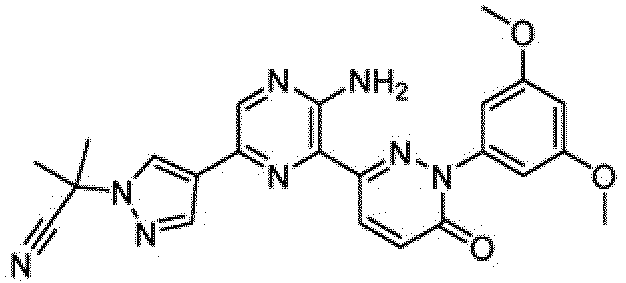
2-(4-(5-Amino-6-(1-(3,5-dimethoxyphenyl)-6-oxo-1,6-dihydropyridazin-3-yl)pyrazin-2-yl)-1H-pyrazol-1-yl)-2-methylpropanenitril 7 
6-(3-Amino-6-(1-(1-hydroxy-2-methylpropan-2-yl)-1H-pyrazol-4-yl)pyrazin-2-yl)-2-(3,5-dimethoxyphenyl)pyridazin-3 (2H)-on 8 
6-(3-Amino-6-(1-methyl-1H-pyrazol-4-yl)pyrazin-2-yl)-2-(3-methoxy-5-(trifluormethoxy)phenyl)pyridaz in-3(2H)-on-2,2,2-trifluoracetatsalz 9 
6-(3-Amino-6-(1-methyl-1H-pyrazol-4-yl)pyrazin-2-yl)-2-(3-ethoxy-5-(trifluoromethoxy)phenyl)pyrida zin-3(2H)-on-2,2,2-trifluoracetatsalz 10 
6-(3-Amino-6-(1-methyl-1H-pyrazol-4-yl)pyrazin-2-yl)-2-(3-methoxy-5-(trifluoromethyl)phenyl)pyridazi n-3(2H)-on-2,2,2-trifluoracetatsalz 11 
6-(3-Amino-6-(1-methyl-1H-pyrazol-4-yl)pyrazin-2-yl)-2-(2-chlor-3-methoxyphenyl)pyridazin-3 (2H)-on-2,2,2-trifluoracetatsalz 12 
6-(3-Amino-6-(1-methyl-1H-pyrazol-4-yl)pyrazin-2-yl)-2-(o-tolyl)pyridazin-3(2H)-on-2,2,2-trifluoracetatsalz 13 
3-(3-(3-Amino-6-(1-methyl-1H-pyrazol-4-yl)pyrazin-2-yl)-6-oxopyridazin-1(6H)-yl)-5-methoxybenzonitril-2,2,2-trifluoracetatsalz 14 
6-(3-amino-6-(1-methyl-1H-pyrazol-4-yl)pyrazin-2-yl)-2-(2-chlor-3,5-dimethoxyphenyl)pyridazin-3(2H)-on-(2,2,2-trifluoracetat)salz 15 
6-(3-Amino-6-(1-isopropyl-1H-pyrazol-4-yl)pyrazin-2-yl)-2-(3,5-dimethoxyphenyl)pyridazin-3(2H)-on-2,2,2-trifluoracetat 16 
6-(3-Amino-6-(1-(pentan-3 -yl)-1H-pyrazol-4-yl)pyrazin-2-yl)-2-(3,5 -dimethoxyphenyl)pyridazin-3 (2H)-on-2,2,2-trifluoracetatsalz 17 
6-(3-Amino-6-(1-(cyclopropylmethyl)-1H-pyrazol-4-yl)pyrazin-2-yl)-2-(3,5-dimethoxyphenyl)pyridazin-3(2H)-on-2,2,2-trifluoracetatsalz 18 
6-(3-Amino-6-(1-(2-hydroxy-2-methylpropyl)-1H-pyrazol-4-yl)pyrazin-2-yl)-2-(3,5-dimethoxyphenyl)pyridazin-3(2H)-on-2,2,2-trifluoracetatsalz 19 
6-(3-Amino-6-(1-(2-morpholinoethyl)-1H-pyrazol-4-yl)pyrazin-2-yl)-2-(3,5-dimethoxyphenyl)pyridazin-3(2H)-on 20 
6-(3-Amino-6-(1-methyl-1H-pyrazol-4-yl)pyrazin-2-yl)-2-(3-isopropoxy-5-methoxyphenyl)pyri dazin-3(2H)-on 21 
6-(3-Amino-6-(1-isobutyl-1H-pyrazol-4-yl)pyrazin-2-yl)-2-(3,5-dimethoxyphenyl)pyridazin-3 (2H)-on 22 
6-(3-Amino-6-(1-cyclobutyl-1H-pyrazol-4-yl)pyrazin-2-yl)-2-(3,5-dimethoxyphenyl)pyridazin-3 (2H)-on 23 
6-(3-Amino-6-(1-methyl-1H-pyrazol-4-yl)pyrazin-2-yl)-2-(2,6-dichloro-3,5-dimethoxyphenyl)pyridazin-3 (2H)-on 24 
6-(3-Amino-6-(1-methyl-1H-pyrazol-4-yl)pyrazin-2-yl)-2-(2-bromo-3,5-dimethoxyphenyl)pyridazin-3(2H)-on-2,2,2-trifluoracetatsalz 25 
6-(3-Amino-6-(1-methyl-1H-pyrazol-4-yl)pyrazin-2-yl)-2-(2,6-dibromo-3,5-dimethoxyphenyl)pyridazin-3(2H)-on-2,2,2-trifluoracetatsalz 26 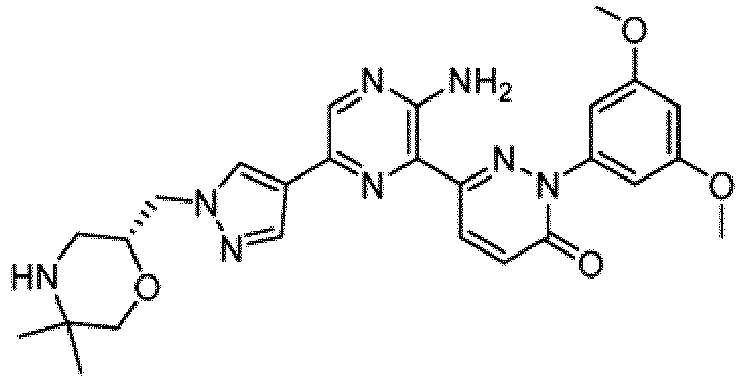
(R)-6-(3-Amino-6-(1-((5,5-dimethylmorpholin-2-yl)methyl)-1H-pyrazol-4-yl)pyrazin-2-yl)-2-(3,5-dimethoxyphenyl)pyridazin-3 (2H)-on 27 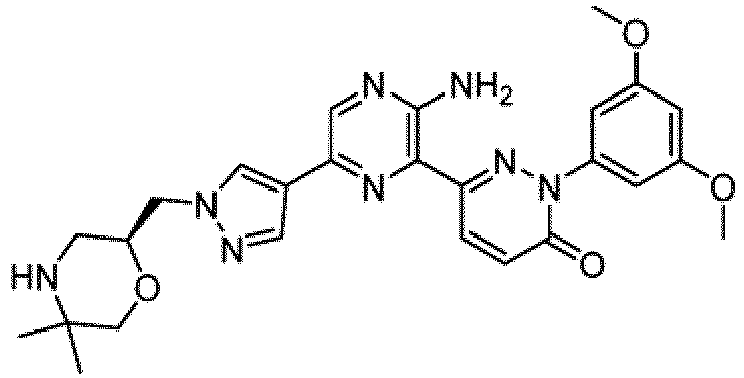
(S)-6-(3-Amino-6-(1-((5,5-dimethylmorpholin-2-yl)methyl)-1H-pyrazol-4-yl)pyrazin-2-yl)-2-(3,5-dimethoxyphenyl)pyridazin-3 (2H)-on 28 
6-(3-Amino-6-(1-(((2S,5R)-5-methylmorpholin-2-yl)methyl)-1H-pyrazol-4-yl)pyrazin-2-yl)-2-(3,5-dimethoxyphenyl)pyridazin-3 (2H)-on 29 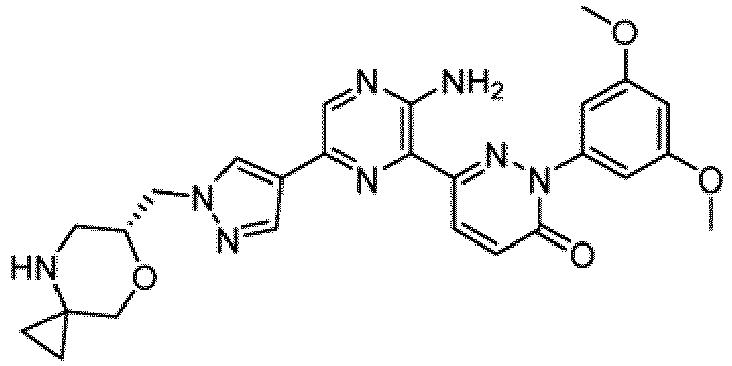
(R)-6-(6-(1-((7-Oxa-4-azaspiro[2.5]octan-6-yl)methyl)-1H-pyrazol-4-yl)-3-aminopyrazin-2-yl)-2-(3,5- dimethoxyphenyl)pyridazin-3(2H)-on 30 
6-(3-Amino-6-(1-(((2R,5R)-5-methylmorpholin-2-yl)methyl)-1H-pyrazol-4-yl)pyrazin-2-yl)-2-(3,5 -dimethoxyphenyl)pyridazin-3(2H)-on 31 
6-(3-Amino-6-(1-(piperidin-4-yl)-1H-pyrazol-4-yl)pyrazin-2-yl)-2-(3,5-dimethoxyphenyl)pyridazin-3(2H)-on 32 
6-(3-Amino-6-(1-(1-methylpiperidin-4-yl)-1H-pyrazol-4-yl)pyrazin-2-yl)-2-(3,5 -dimethoxyphenyl)pyridazin-3(2H)-on 33 
6-(3-Amino-6-(1-(1-(2-methoxyethyl)piperidin-4-yl)-1H-pyrazol-4-yl)pyrazin-2-yl)-2-(3,5-dimethoxyphenyl)pyridazin-3(2H)-on 34 
6-(3-Amino-6-(1-(1-(2-(trifluormethoxy)ethyl)piperidin-4-yl)-1H-pyrazol-4-yl)pyrazin-2-yl)-2-(3,5-dimethoxyphenyl)pyridazin-3 (2H)-on-2,2,2-trifluoracetatsalz 35 
6-(3-Amino-6-(1-(1-(2,2-difluorethyl)piperidin-4-yl)-1H-pyrazol-4-yl)pyrazin-2-yl)-2-(3,5 -dimethoxyphenyl)pyridazin-3 (2H)-on-2,2,2-trifluoracetatsalz 36 
6-(3-Amino-6-(1-(1-(2,2,2-trifluorethyl)piperidin-4-yl)-1H-pyrazol-4-yl)pyrazin-2-yl)-2-(3,5 -dimethoxyphenyl)pyridazin-3 (2H)-on 37 
6-(3-Amino-6-(1-(piperidin-4-yl)-1H-pyrazol-4-yl)pyrazin-2-yl)-2-(5-methoxy-2-methylphenyl)pyridazin-3 (2H)-on 38 
6-(3-Amino-6-(1-(1-methylpiperidin-4-yl)-1H-pyrazol-4-yl)pyrazin-2-yl)-2-(5-methoxy-2-methylphenyl)pyridazin-3 (2H)-on 39 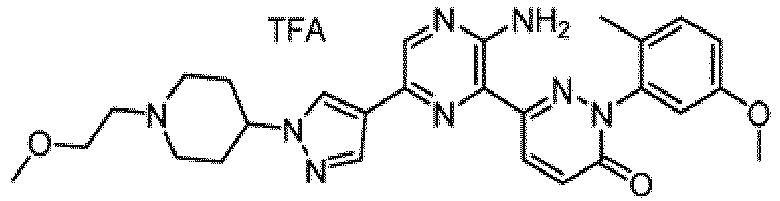
6-(3-Amino-6-(1-(1-(2-methoxyethyl)piperidin-4-yl)-1Hpyrazol-4-yl)pyrazin-2-yl)-2-(5-methoxy-2-methylphenyl)pyridazin-3 (2H)-on-2,2,2-trifluoracetatsalz 40 
6-(3-Amino-6-(1-(piperidin-4-yl)-1H-pyrazol-4-yl)pyrazin-2-yl)-2-(2-fluor-5-methoxyphenyl)pyridazin-3(2H)-on 41 
6-(3-Amino-6-(1-(piperidin-4-yl)-1H-pyrazol-4-yl)pyrazin-2-yl)-2-(2-fluor-3,5-dimethoxyphenyl)pyridazin-3(2H)-on 42 
6-(3-Amino-6-(1-(1-(2-methoxyethyl)piperidin-4-yl)-1H-pyrazol-4-yl)pyrazin-2-yl)-2-(2-fluor-3,5-dimethoxyphenyl)pyridazin-3(2H)-on-2,2,2-trifluoracetatsalz 43 
6-(3-Amino-6-(1-methyl-1H-pyrazol-4-yl)pyrazin-2-yl)-2-(3,5-dimethoxyphenyl)-4-methylpyridazin-3 (2H)-on 44 
6-(3-Amino-6-(1-methyl-1H-pyrazol-4-yl)pyrazin-2-yl)-2-(3,5-dimethoxyphenyl)-4-ethylpyridazin-3(2H)-on-2,2,2-trifluoracetatsalz 45 
6-(3-Amino-6-(1-methyl-1H-pyrazol-4-yl)pyrazin-2-yl)-2-(3,5-dimethoxyphenyl)-4-propylpyridazin-3 (2H)-on-2,2,2-trifluoracetatsalz 46 
6-(3-Amino-6-(1-methyl-1H-pyrazol-4-yl)pyrazin-2-yl)-2-(3,5-dimethoxyphenyl)-4-isobutylpyridazin-3 (2H)-on-2,2,2-trifluoracetatsalz 47 
6-(3-Amino-6-(1-methyl-1H-pyrazol-4-yl)pyrazin-2-yl)-2-(3,5-dimethoxyphenyl)-4-isopropylpyridazin-3 (2H)-on 48 
6-(3-Amino-6-(1-methyl-1H-pyrazol-4-yl)pyrazin-2-yl)-4-cyclopropyl-2-(3,5-dimethoxyphenyl)pyridazin-3(2H)-on 49 
6-(3-Amino-6-(1-methyl-1H-pyrazol-4-yl)pyrazin-2-yl)-4-cyclobutyl-2-(3,5-dimethoxyphenyl)pyridazin-3 (2H)-on 50 
6-(3-Amino-6-(1-(piperidin-4-yl)-1H-pyrazol-4-yl)pyrazin-2-yl)-2-(3,5-dimethoxyphenyl)-4-methylpyridazin-3(2H)-ondihydrochloridsalz 51 
6-(3-Amino-6-(1-(1-(2-methoxyethyl)piperidin-4-yl)-1H-pyrazol-4-yl)pyrazin-2-yl)-2-(3,5-dimethoxyphenyl)-4-methylpyridazin-3(2H)-on 52 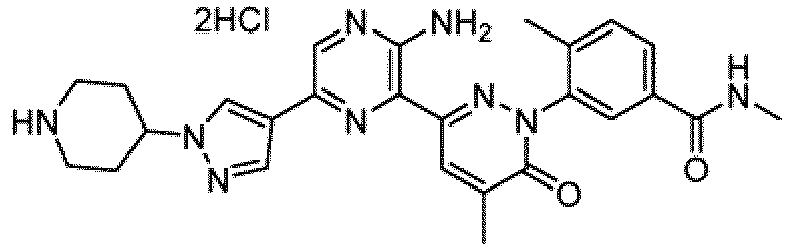
3-(3-(3-Amino-6-(1-(piperidin-4-yl)-1H-pyrazol-4-yl)pyrazin-2-yl)-5-methyl-6-oxopyridazin-1(6H)-yl)-N,4-dimethylbenzamiddihydrochlori dsalz 53 
6-(2-Amino-5-(1-methyl-1H-pyrazol-4-yl)pyridin-3-yl)-2-(3,5-dimethoxyphenyl)pyridazin-3 (2H)-on 54 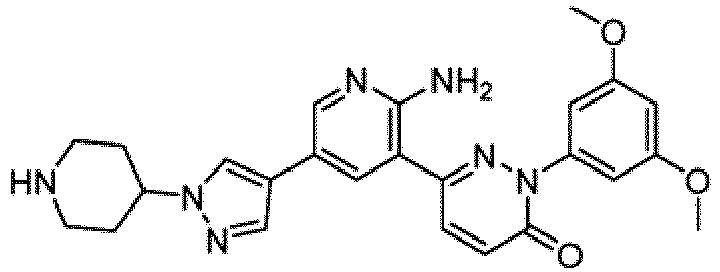
6-(2-Amino-5-(1-(piperidin-4-yl)-1H-pyrazol-4-yl)pyridin-3-yl)-2-(3,5-dimethoxyphenyl)pyridazin-3 (2H)-on 55 
6-(2-Amino-5-(1-(1-methylpiperidin-4-yl)-1H-pyrazol-4-yl)pyridin-3-yl)-2-(3,5-dimethoxyphenyl)pyridazin-3 (2H)-on 56 
6-(2-Amino-5-(1-(1-(2-methoxyethyl)piperidin-4-yl)-1H-pyrazol-4-yl)pyridin-3-yl)-2-(3,5-dimethoxyphenyl)pyridazin-3 (2H)-on 57 
6-(2-Amino-5-(1-methyl-1H-pyrazol-4-yl)pyridin-3-yl)-2-(2,6-dichlor-3,5-dimethoxyphenyl)pyridazin-3 (2H)-on 58 
6-(2-Amino-5-(1-(piperidin-4-yl)-1H-pyrazol-4-yl)pyridin-3-yl)-2-(2,6-dichlor-3,5-dimethoxyphenyl)pyridazin-3(2H)-on 59 
6-(2-Amino-5-(1-(lmethylpiperidin-4-yl)-1H-pyrazol-4-yl)pyridin-3-yl)-2-(2,6-dichlor-3,5-dimethoxyphenyl)pyridazin-3 (2H)-on 60 
6-(2-Amino-5-(1-(1-(2-methoxyethyl)piperidin-4-yl)-1H-pyrazol-4-yl)pyridin-3-yl)-2-(2,6-dichlor-3,5-dimethoxyphenyl)pyridazin-3 (2H)-on 61 
3-(3-(2-Amino-5-(1-(piperidin-4-yl)-1H-pyrazol-4-yl)pyridin-3-yl)-6-oxopyridazin-1(6H)-yl)-N-methylbenzamid 62 
3-(3-(2-Amino-5-(1-(1-(2-methoxyethyl)piperidin-4-yl)-1Hpyrazol-4-yl)pyridin-3-yl)-6-oxopyridazin-1(6H)-yl)-N-methylbenzamid-2,2,2-trifluoracetatsalz 63 
6-(3-Amino-6-(1-(piperidin-4-yl)-1H-pyrazol-4-yl)pyrazin-2-yl)-2-(3-methylchinolin-7-yl)pyridazin-3(2H)-on-bis(2,2,2-trifluoroacetat) 64 
6-(3-Amino-6-(1-(1-(2-methoxyethyl)piperidin-4-yl)-1H-pyrazol-4-yl)pyrazin-2-yl)-2-(3-methylchinolin-7-yl)pyridazin-3(2H)-on 65 
(S)-6-(3-Amino-6-(1-((4,5,5-trimethylmorpholin-2-yl)methyl)-1H-pyrazol-4-yl)pyrazin-2-yl)-2-(3,5-dimethoxyphenyl)pyridazin-3 (2H)-on-2,2,2-trifluoracetate 66 
6-(3-Amino-6-(1-(1-(2-methoxyethyl)piperidin-4-yl)-1Hpyrazol-4-yl)pyrazin-2-yl)-2-(2,6-dichlor-3,5-dimethoxyphenyl)-4-methylpyridazin-3 (2H)-on 67 
6-(3-Amino-6-(1-(1-(2-methoxyethyl)piperidin-4-yl)-1H-pyrazol-4-yl)pyrazin-2-yl)-2-(3,5-dimethoxy-2-methylphenyl)pyridazin-3 (2H)-on 68 
6-(3-Amino-6-(1-(2-oxo-2-(piperidin-1-yl)ethyl)-1H-pyrazol-4-yl)pyrazin-2-yl)-2-(2,6-dichlor-3,5-dimethoxyphenyl)pyridazin-3(2H)-on 69 
6-(3-Amino-6-(1-(2-(dimethylamino)ethyl)-1H-pyrazol-4-yl)pyrazin-2-yl)-2-(2,6-dichlor-3,5-dimethoxyphenyl)pyridazin-3(2H)-on 70 
6-(3-Amino-6-(1-methyl-3-(trifluoromethyl)-1H-pyrazol-4-yl)pyrazin-2-yl)-2-(2,6-dichlor-3,5-dimethoxyphenyl)pyridazin-3 (2H)-on 71 
6-(3-Amino-6-(1,3,5-trimethyl-1H-pyrazol-4-yl)pyrazin-2-yl)-2-(2,6-dichlor-3,5-dimethoxyphenyl)pyridazin-3(2H)-on 72 
6-(3-Amino-6-(1-(1-hydroxy-2-methylpropan-2-yl)-1H-pyrazol-4-yl)pyrazin-2-yl)-2-(2,6-dichlor-3,5-dimethoxyphenyl)pyridazin-3(2H)-on 73 
6-(3-Amino-6-(1-isopropyl-1H-pyrazol-4-yl)pyrazin-2-yl)-2-(2,6-dichlor-3,5-dimethoxyphenyl)pyridazin-3(2H)-on 74 
6-(3-Amino-6-(1-cyclopropyl-1H-pyrazol-4-yl)pyrazin-2-yl)-2-(2,6-dichlor-3,5-dimethoxyphenyl)pyridazin-3(2H)-on 75 
6-(3-Amino-6-(1-(azetidin-3 -yl)-1H-pyrazol-4-yl)pyrazin-2-yl)-2-(2,6-dichlor-3,5-dimethoxyphenyl)pyridazin-3(2H)-on 76 
6-(3-Amino-6-(1-(2-(dimethylamino)ethyl)-1H-pyrazol-4-yl)pyrazin-2-yl)-2-(2,6-dichlor-3,5-dimethoxyphenyl)-4-methylpyridazin-3(2H)-on 77 
6-(3-Amino-6-(1-(azetidin-3-yl)-1H-pyrazol-4-yl)pyrazin-2-yl)-2-(2,6-dichlor-3,5-dimethoxyphenyl)-4-methylpyridazin-3 (2H)-on 78 
6-(3-Amino-6-(1-(1-(2-methoxyethyl)azetidin-3 -yl)-1Hpyrazol-4-yl)pyrazin-2-yl)-2-(2,6-dichlor-3,5-dimethoxyphenyl)-4-methylpyridazin-3 (2H)-on 79 
6-(3-Amino-6-(1-(1-(2-ethoxyethyl)azetidin-3-yl)-1H-pyrazol-4-yl)pyrazin-2-yl)-2-(2,6-dichlor-3,5-dimethoxyphenyl)-4-methylpyridazin-3 (2H)-on 80 
3-(3-(3-Amino-6-(1-(1-(2-methoxyethyl)piperidin-4-yl)-1H-pyrazol-4-yl)pyrazin-2-yl)-5-methyl-6-oxopyridazin-1(6H)-yl)-N,4-dimethylbenzamid 81 
6-(2-Amino-5-(1-(piperidin-4-yl)-1H-pyrazol-4-yl)pyridin-3-yl)-2-(3,5-dimethoxyphenyl)-4-methylpyridazin-3 (2H)-ondihydrochlorid 82 
6-(3-Amino-6-(1-(1-(2-methoxyethyl)piperidin-4-yl)-1H-pyrazol-4-yl)pyrazin-2-yl)-2-(2,6-difluor-3,5-dimethoxyphenyl)pyridazin-3(2H)-on 83 
6-(3-Amino-6-(1-(1-(2-methoxyethyl)piperidin-4-yl)-1H-pyrazol-4-yl)pyrazin-2-yl)-2-(2-chlor-6-fluor-3-methoxyphenyl)pyri dazin-3(2H)-on - Pharmazeutische Zusammensetzung, umfassend eine Verbindung nach einem der Ansprüche 1-10 oder ein pharmazeutisch unbedenkliches Salz oder Solvat davon und einen pharmazeutisch unbedenklichen Träger oder Hilfsstoff.
- Verfahren zum Herstellen einer Verbindung der Formel I oder eines pharmazeutisch unbedenklichen Salzes davon nach Anspruch 1, umfassend:(a) Reagieren einer Verbindung mit der Formel 5:
 wobei X, R1, Ring A und z wie für Formel I definiert sind, mit einer Verbindung der Formel 4:
 wobei R2 wie in Formel I definiert ist, in der Gegenwart eines Palladium(II)-Katalysators und einer anorganischen Base; oder(b) für eine Verbindung der Formel I, wobei X, R2 und R3 wie in Anspruch 1 definiert sind, z 1 ist und R1 ein Piperidin ist, das mit C1-C6-Alkyl (optional substituiert mit 1-3 Fluor), (C1-C3-Alkoxy)C1-C6-Alkyl (optional substituiert mit 1-3 Fluor) oder Hydroxy(C1-C6-Alkyl) substituiert ist, Reagieren einer Verbindung mit der Formel 9A:Entfernen etwaiger Schutzgruppen, falls vorhanden, und optionales Ausbilden eines pharmazeutisch unbedenklichen Salzes.
- Zusammensetzung für die Verwendung bei der Behandlung von Krebs bei einem Patienten, der dessen bedarf, wobei die Zusammensetzung eine therapeutisch wirksame Menge einer Verbindung nach einem der Ansprüche 1-10 oder ein pharmazeutisch unbedenkliches Salz oder Solvat davon oder eine pharmazeutische Zusammensetzung nach Anspruch 11 umfasst.
- Zusammensetzung für die Verwendung in einem Verfahren zum Behandeln eines FGFR-assoziierten Krebses bei einem Patienten, wobei das Verfahren umfasst:Bestimmen, ob der Krebs in dem Patienten ein FGFR-assoziierter Krebs ist; undVerabreichen an einen Patienten, bei dem bestimmt wurde, dass er einen FGFR-assoziierten Krebs hat, einer therapeutisch wirksamen Menge einer Verbindung nach einem der Ansprüche 1-10 oder eines pharmazeutisch unbedenklichen Salzes oder Solvats davon oder eine pharmazeutische Zusammensetzung nach Anspruch 11.
- Zusammensetzung für die Verwendung nach Anspruch 14, wobei der Schritt des Bestimmens, ob der Krebs in dem Patienten ein FGFR-assoziierter Krebs ist, das Durchführen eines Assays zum Nachweisen einer Dysregulation in einem FGFR-Gen, einem FGFR-Protein oder der Expression oder Aktivität oder des Spiegels eines derselben in einer Probe von dem Patienten umfasst.
- Zusammensetzung für die Verwendung nach Anspruch 15, wobei der Assay aus der Gruppe ausgewählt ist, die aus Sequenzierung, Immunhistochemie, enzymgekoppeltem Immunadsorbentassay und Fluoreszenz-in-situ-Hybridisierung (FISH) besteht, wobei die FISH optional eine Break-Apart-FISH-Analyse ist, oder wobei die Sequenzierung Pyrosequenzierung oder Sequenzierung der nächsten Generation ist.
- Zusammensetzung für die Verwendung nach einem der Ansprüche 15-16, wobei die Dysregulation in
einem FGFR-Gen, einem FGFR-Protein oder der Expression oder Aktivität oder dem Spiegel eines derselben eine oder mehrere Punktmutationen in dem FGFR-Gen sind. - Zusammensetzung für die Verwendung nach Anspruch 17, wobei das FGFR-Gen FGFR1 ist und die eine oder mehreren Punktmutationen in dem FGFR1-Gen für die Translation eines FGFR1-Proteins mit einer oder mehreren Aminosäuresubstitutionen an einer oder mehreren der folgenden Aminosäurepositionen führt: 25, 70, 78, 125, 126, 141, 150, 252, 253, 268, 330, 334, 374, 381, 392, 393, 428, 429, 430, 431, 445, 471, 544, 546, 561, 563, 574, 576, 596, 598, 608, 610, 653, 654, 655, 656, 658, 661, 662, 664 und 818, wobei die eine oder die mehreren Punktmutationen in dem FGFR1-Gen optional für die Translation eines FGFR1-Proteins mit einer oder mehreren der folgenden Aminosäuresubstitutionen führt: P25Q, G70R, R78H, S125L, T141R, P150S, P126S, P252S, P252T, P252R, P253R, A268S, N330I, E334Q, Y374C, C381R, V392A, V393A, S428F, A429S, S430F, A431S, R445W, W471L, N544K, N546K, N544K, N546K, V561M, Y563C, R574W, R576W, K596N, K598N, G608D, G610D, K653I, K654E, K654D, K654M, K654N, K655I, K656E, K656M, K656N, T656P, K656D, T658P, R661P, V662L, V664L, und G818R.
- Zusammensetzung für die Verwendung nach Anspruch 17, wobei das FGFR-Gen FGFR2 ist und die eine oder mehreren Punktmutationen in dem FGFR2-Gen für die Translation eines FGFR2-Proteins mit einer oder mehreren Aminosäuresubstitutionen an einer oder mehreren der folgenden Aminosäurepositionen führt: 24, 71, 77, 97, 101, 116, 138, 156, 160, 186, 190, 203, 210, 211, 212, 213, 219, 227, 247, 248, 251, 252, 253, 256, 267, 271, 272, 276, 278, 281, 283, 289, 290, 302, 305, 310, 314, 315, 320, 334, 336, 338, 340, 341, 342, 344, 347, 352, 354, 361, 370, 371, 372, 373, 375, 376, 380, 381, 382, 383, 389, 390, 391, 392, 395, 396, 397, 398, 405, 406, 420, 421, 462, 463, 470, 471, 474, 475, 476, 479, 480, 496, 526, 527, 530, 531, 536, 537, 538, 544, 545, 547, 548, 549, 550, 551, 552, 562, 564, 565, 566, 574, 575, 582, 583, 584, 585, 587, 588, 589, 590, 591, 602, 603, 612, 618, 620, 621, 625, 626, 636, 637, 640, 641, 642, 643, 648, 649, 659, 660, 664, 665, 659, 688, 689, 701, 702, 708, 709, 719, 759, 760, 770, 771, 772, 773, 777, 778, 786, 787, 847, 870 und 1487, wobei die eine oder die mehreren Punktmutationen in dem FGFR2-Gen optional zu der Translation eines FGFR2-Proteins mit einer oder mehreren der folgenden Aminosäuresubstitutionen führen: S24F, M71T, V77M, A97T, D101Y, E116K, D138N, E160A, W156*, E160A, M186T, R190G, R203H, R203C, R210Q, N211I, Q212K, H213Y, E219K, G227E, D247Y, V248D, R251Q, S252L S252W, S252F, P253L, P253R, P253S, P256S, S267P, G271E, G272V, F276V, C278F, Y281C, D283N, Q289P, W290C, G302W, G305R, K310R, A314D, A315T, S320C, D334N, D336N, G336R, G338R, Y338C, Y338H, Y340C, Y340H, C340F, C340R, C340S, C340W, C340Y, T341P, C342F, C342R, C342S, C342W, C342Y, A344G, A344P, S347C, S352C, S354C, Q361R, T370R, T371R, S372C, S373C, Y375C, Y376C, I380V, I381V, C382R, C383R, A389T, A390T, M391R, M392R, V395D, V396D, L397M, L398M, K405E, K406E, K420I, K421I, G462E, G463E, E470Q, E471Q, D471N, W474X, E475K, E476K, D479N, D480N, R496T, K526E, K527E, D530N, D531N, M536I, M537I, M538I, H544Q, H545Q, I547V, I547D, I547V, l548D, I548V, N549D, N549K, N549Y, N549H, N550D, N550K, N550H, N550S, L551I, L552I, V562L, V564F, V565I, E566G, E574K, E575K, P582L, P583L, G583W, G583V, M584V, G584W, G584V, M585V, S587C, S588C, Y588D, Y589D, I590M, I591M, D602E, D603E, R612T, L618M, Q620K, Q621K, R625T, R626T, E636K, E637K, M640I, M641I, K641R, I642V, K642R, I643V, A648T, K641R, K642R, K642N, A648T, A649T, K659E, K659M, K659N, K660E, K660M, K660N, R664W, R665W, S688F, S689F, G701S, G702S, P708S, P709S, E719G, R759X, R759Q, R760Q, L770V, L771V, L772F, L773F, E777K, E778K, T786K, T787K, G847A, G870C und G1487C.
- Zusammensetzung für die Verwendung nach Anspruch 17, wobei das FGFR-Gen FGFR3 ist und die eine oder mehreren Punktmutationen in dem FGFR3-Gen für die Translation eines FGFR3-Proteins mit einer oder mehreren Aminosäuresubstitutionen an einer oder mehreren der folgenden Aminosäurepositionen führt: 79, 131, 197, 209, 216, 222, 228, 235, 241, 248, 249, 250, 283, 306, 322, 341, 349, 368, 370, 371, 372, 373, 375, 376, 377, 378, 379, 380, 381, 382, 384, 386, 388, 391, 393, 399, 401, 413, 415, 433, 435, 441, 452, 466, 468, 540, 542, 555, 603, 605, 617, 627, 630, 646, 648, 650, 652, 677, 679, 686, 697, 699, 715, 717, 726, 742, 746, 785, 787, 794, 795, 796, 797, 807, 809, 1114, 1124, 1144, 1178 und 1954, wobei die eine oder die mehreren Punktmutationen in dem FGFR3-Gen optional zu der Translation eines FGFR3-Proteins mit einer oder mehreren der folgenden Aminosäuresubstitutionen führen: T79S, S131L, G197S, Q209H, E216K, D222N, C228R, G235D, Y241C, R248C, R248H, S248C, S249C, P250R, P283S, V306I, E322K, A341T, H349Y, E368K, G370C, E370K, S371C, G372C, Y373C, S373C, Y375C, G375C, 1376C, G377C, l378C, Y379C, G380R, Y381C, G382R, G382D, G382E, G382R, G384D, F384L, F386L, F388L, A391E, A393E, R399C, R401C, K413N, K415N, S433C, S435C, A441T, A452S, E466K, E468K, N540S, N540K, N540T, N540V, N542S, N542K, N542T, N542V, V555M, R603Q, R605Q, D617G, E627K, V630M, D646Y, D648Y, K650M, K650E, K650Q, K650N, K650T, K652M, K652E, K652N, K652T, K652Q, K652T, V667I, V677I, V679I, E686K, G697C, G699C, K715M, K717M, A717T, l726F, C742T, C746G, D785Y, T787K, L794R, L795A, L796R, L797A, 807R, 807C, 807G, 807T, 807R, 809C, 809G, 809R, 809T, G1114T, A1124G, und A1954G.
- Zusammensetzung für die Verwendung nach Anspruch 17, wobei das FGFR-Gen FGFR4 ist und die eine oder mehreren Punktmutationen in dem FGFR4-Gen für die Translation eines FGFR4-Proteins mit einer oder mehreren Aminosäuresubstitutionen an einer oder mehreren der folgenden Aminosäurepositionen führt: 56, 59, 72, 112, 122, 144, 175, 183, 326, 232, 234, 367, 388, 394, 425, 434, 444, 484, 495, 510, 514, 535, 536, 543, 550, 554, 568, 574, 576, 583, 596, 610, 614, 616, 631, 636, 641, 671, 672, 681, 689, 712, 716, 729, 732, 738 und 772, wobei die eine oder die mehreren Punktmutationen in dem FGFR4-Gen optional zu der Translation eines FGFR4-Proteins mit einer oder mehreren der folgenden Aminosäuresubstitutionen führt: C56S, R59W, R72L, T122A, Q144E, A175T, R183S, G183C, S232I, R234H, E326K, Y367C, G388R, R394Q, D425N, R434Q, A444T, A484T, N495D, N495K, V510M, V510L, V510E, V510L, A514V, 535K, N535D, N535K, G536D, P543Q, V550M, V550E, V550L, A554V, P568Q, A574S, R576G, G576D, P583Q, G596C, R610H, A614S, R616G, D631N, G636C, E641K, D671N, P672T, E681K, A689G, P712T, P716R, A729G, S732N, Q738K, und S772N.
- Zusammensetzung für die Verwendung nach einem der Ansprüche 15-16, wobei die Dysregulation eines FGFR-Gens, eines FGFR-Proteins oder der Expression oder der Aktivität oder des Spiegels eines derselben eine Chromosomentranslokation ist, die zu der Expression eines FGFR-Fusionsproteins führt, wobei das FGFR-Fusionsprotein optional ein FGFR1-Fusionsprotein ist, das einen Fusionspartner umfasst, der aus der Gruppe ausgewählt ist, bestehend aus: TACC1, FGFR1, ZMYM2, CNTRL, FGFR10P2, FGFR10P, ZNF198/RAMP/FIM/ZMYM2, FGFR1OP1, CEP110/CEP1/Centriolin, BCR, LRRFIP1, CPSF6, BAG4, ERLIN2, TRIM24/TIF1, MYO18A, CPSF6, HERV-K, PLAG1, CUX1, FOXO1, SQSTM1, FN1, NUP98, RANBP2/NUP358, TPR, ZNF703, NTM, ZNF343, FOP2, OP2, TKD und ADAM32, oder wobei das FGFR-Fusionsprotein ein FGFR2-Fusionsprotein ist, das einen Fusionspartner umfasst, der aus der Gruppe ausgewählt ist, bestehend aus: CCAR2, CD44, BICC1, SLC45A3, AFF3, CASP7, CCDC6, KIAA1598/SHOOTIN1, KIAA1967, OFD1, CIT, AHCYL1, PPHLN1, TACC3, MGEA5, FAM76A, FRAG1, NPM1, TACC2, C10orf68, NCALD, NOL4, PPAPDC1A, PARK2, ZDHHC6, TXLNA, KCTD1, BICC1 Typ 2, CCDC147, VCL, BUB1, CDCA8, DNAH5, FGFR2-OGDH, CCDC3, KIAA217, und KIAA1598, oder wobei das FGFR-Fusionsprotein ein FGFR3-Fusionsprotein ist, das einen Fusionspartner umfasst, der aus der Gruppe ausgewählt ist, bestehend aus: ELAVL3, TACC3, BAIAP2L1, IGH, MMSET, TEL/ETV6, JAKMIP1, TNIP2, WHSC1, ADD 1 und RANBP17.
- Zusammensetzung für die Verwendung nach einem der Ansprüche 14-22, wobei der FGFR-assoziierte Krebs aus der Gruppe ausgewählt ist, bestehend aus: Urothelkarzinom, Brustkarzinom oder -krebs, endometrialem Endometriumkrebs oder endometrialiem Krebs, Eierstockkarzinom oder -krebs, Hirnkrebs, Cholangiokarzinom oder intrahepatischem Cholangiokarzinom, Magen- oder Darmkrebs, gastrointestinale Stromatumoren, Lungenkrebs, Bauchspeicheldrüsenkrebs, Prostatakrebs, kolorektalem Karzinom oder -krebs, Rektalkrebs, Nierenzellkarzinom, neuroendokrinem Karzinom, kopf-Hals- (Plattenepithel-) Karzinom oder adenoidzystischem Kopf-Hals-Karzinom, Hautkrebs, Leiomyosarkom, Sarkom, Osteosarkom, Blasenkrebs, Rhabdomyosarkom oder embryonalem Rhabdomyosarkom, Speiseröhrenkrebs, hepatozellulärem Karzinom oder Leberkrebs, Speicheldrüsentumore, Glioblatoma multiforme, myxoidem Lipokarzinom, Mundhöhlenkrebs, Schilddrüsenkrebs oder -karzinom, anaplastischem Schilddrüsenkarzinom, adenoidzystischem Karzinom, Glioblastoma multiforme, myeloproliferativer Störung/hämatologischer Malignität, phosphaturischem mesenchymalem Tumor, Gebärmutterhalskrebs, Gallenblasenkrebs, spermatozytärem Seminom, seborrhoischer Keratose, Hodenkrebs, Eileiterkrebs, Karzinom unbekannter Ursache, Karzinom des gastroösophagealen Übergangs, analem Plattenepithelkarzinom, Hämangioendotheliom, Gebärmutterkarzinom oder Gebärmutterkrebs, Karzinoid, Peritonealkarzinom, Nebennierenkarzinom, Knochenkrebs, peripherem Nervenscheidentumor, Gliom oder Paragangliom, rosettenausbildendem glioneuralem Tumor, Lymphoepitheliom, Lymphoepitheliom, Mesotheliom, dysembryoplastischem neuroepithelialem Tumor und entdifferenziertem Liposarkom, wobei die myeloproliferative Störung/hämatologische Malignität optional aus der Gruppe ausgewählt ist, bestehend aus: multiplem Myelom, myeloproliferativem 8p11-Syndrom, myeloproliferativen Stammzellstörungen, myeloproliferativer Störung, Stammzell-Leukämie/Lymphom-Syndrom, myeloproliferativem Neoplasma (MPN), chronischer myeloproliferativer Störung (CMD), Lymphom, T-Zell-Lymphom, B-Zell-Lymphom, T-lymphoblastischem Lymphom, MPN T-lymphoblastischem Lymphom, Eosinophilie-Myalgie-Syndrom (EMS), Leukämie, akuter lymphatischer Leukämie (ALL), akuter myeloischer Leukämie (AML) und chronischer myeloischer Leukämie (CML).
- Zusammensetzung für die Verwendung nach einem der Ansprüche 13-23, ferner umfassend das Verabreichen einer zusätzlichen Therapie oder eines zusätzlichen therapeutischen Mittels an den Patienten, wobei die zusätzliche Therapie oder das zusätzliche therapeutische Mittel optional aus Strahlentherapie, zytotoxischen Chemotherapeutika, auf Kinasen zielgerichteten Therapeutika, Apoptosemodulatoren, Signaltransduktionsinhibitoren, auf das Immunsystem zielgerichteten Therapien und auf die Angiogenese zielgerichteten Therapien ausgewählt ist, wobei das zusätzliche therapeutische Mittel optional aus einem oder mehreren auf Kinasen zielgerichteten Therapeutika ausgewählt ist.
- In-vitro-Verfahren zum Inhibieren der FGFR-Aktivität in einer Säugetierzelle, wobei das Verfahren das Inberührungbringen der Säugetierzelle mit einer Verbindung nach einem der Ansprüche 1-10 oder einem pharmazeutisch unbedenklichen Salz oder Solvat davon oder einer pharmazeutischen Zusammensetzung nach Anspruch 11 umfasst.
- Verfahren nach Anspruch 25, wobei die Säugetierzelle eine Säugetierkrebszelle ist, optional wobei die Säugetierkrebszelle eine FGFR-assoziierte Säugetierkrebszelle ist, optional wobei die FGFR-assoziierte Krebszelle eine Dysregulation eines FGFR-Gens, eines FGFR-Proteins oder der Expression oder der Aktivität oder des Spiegels eines derselben aufweist, wobei die Dysregulation in einem FGFR-Gen, einem FGFR-Protein oder der Expression oder der Aktivität oder des Spiegels eines derselben eine oder mehrere Punktmutationen in dem FGFR-Gen ist.
Applications Claiming Priority (2)
| Application Number | Priority Date | Filing Date | Title |
|---|---|---|---|
| US201562245956P | 2015-10-23 | 2015-10-23 | |
| PCT/US2016/058549 WO2017070708A1 (en) | 2015-10-23 | 2016-10-24 | 2-aryl- and 2-heteroaryl-substituted 2-pyridazin-3(2h)-one compounds as inhibitors of fgfr tyrosine kinases |
Publications (2)
| Publication Number | Publication Date |
|---|---|
| EP3365335A1 EP3365335A1 (de) | 2018-08-29 |
| EP3365335B1 true EP3365335B1 (de) | 2024-02-14 |
Family
ID=57233921
Family Applications (1)
| Application Number | Title | Priority Date | Filing Date |
|---|---|---|---|
| EP16791228.6A Active EP3365335B1 (de) | 2015-10-23 | 2016-10-24 | 2-aryl- und 2-heteroaryl-substituierte 2-pyridazin-3(2h)-on-verbindungen als inhibitoren von fgfr-tyrosinkinasen |
Country Status (6)
| Country | Link |
|---|---|
| US (2) | US10208024B2 (de) |
| EP (1) | EP3365335B1 (de) |
| AU (1) | AU2016341445B2 (de) |
| CA (1) | CA3002560A1 (de) |
| MX (1) | MX382526B (de) |
| WO (1) | WO2017070708A1 (de) |
Families Citing this family (47)
| Publication number | Priority date | Publication date | Assignee | Title |
|---|---|---|---|---|
| CA2876689C (en) | 2012-06-13 | 2022-04-26 | Incyte Corporation | Substituted tricyclic compounds as fgfr inhibitors |
| NZ703495A (en) | 2012-07-11 | 2018-02-23 | Blueprint Medicines Corp | Inhibitors of the fibroblast growth factor receptor |
| PH12015502383B1 (en) | 2013-04-19 | 2023-02-03 | Incyte Holdings Corp | Bicyclic heterocycles as fgfr inhibitors |
| PT3395814T (pt) | 2013-10-25 | 2022-07-27 | Blueprint Medicines Corp | Inibidores do recetor do fator de crescimento de fibroblastos |
| WO2015108992A1 (en) | 2014-01-15 | 2015-07-23 | Blueprint Medicines Corporation | Heterobicyclic compounds and their use as fgfr4 receptor inhibitors |
| US10851105B2 (en) | 2014-10-22 | 2020-12-01 | Incyte Corporation | Bicyclic heterocycles as FGFR4 inhibitors |
| MA41551A (fr) | 2015-02-20 | 2017-12-26 | Incyte Corp | Hétérocycles bicycliques utilisés en tant qu'inhibiteurs de fgfr4 |
| CA2976790C (en) | 2015-02-20 | 2024-02-27 | Incyte Corporation | Bicyclic heterocycles as fgfr inhibitors |
| EP3365335B1 (de) * | 2015-10-23 | 2024-02-14 | Array Biopharma, Inc. | 2-aryl- und 2-heteroaryl-substituierte 2-pyridazin-3(2h)-on-verbindungen als inhibitoren von fgfr-tyrosinkinasen |
| KR20250007056A (ko) * | 2016-03-04 | 2025-01-13 | 다이호야쿠힌고교 가부시키가이샤 | 악성 종양 치료용 제제 및 조성물 |
| US11883404B2 (en) | 2016-03-04 | 2024-01-30 | Taiho Pharmaceuticals Co., Ltd. | Preparation and composition for treatment of malignant tumors |
| CN110022900A (zh) | 2016-09-08 | 2019-07-16 | 蓝图药品公司 | 成纤维细胞生长因子受体4抑制剂与细胞周期蛋白依赖性激酶抑制剂的组合 |
| EP3824906A1 (de) | 2016-12-21 | 2021-05-26 | Amgen Inc. | Anti-tnf alpha antikörperformulierungen |
| AR111960A1 (es) | 2017-05-26 | 2019-09-04 | Incyte Corp | Formas cristalinas de un inhibidor de fgfr y procesos para su preparación |
| JOP20190280A1 (ar) | 2017-06-02 | 2019-12-02 | Janssen Pharmaceutica Nv | مثبطات fgfr2 لعلاج سرطان الأوعية الصفراوية |
| CN111683928B (zh) * | 2018-02-08 | 2021-12-10 | 漳州片仔癀药业股份有限公司 | 作为fgfr抑制剂的吡嗪-2(1h)-酮类化合物 |
| KR102956194B1 (ko) * | 2018-05-04 | 2026-04-23 | 인사이트 코포레이션 | Fgfr 억제제의 염 |
| RS66310B1 (sr) | 2018-05-04 | 2025-01-31 | Incyte Corp | Čvrsti oblici inhibitora fgfr i procesi za njegovu pripremu |
| KR20210064274A (ko) * | 2018-09-21 | 2021-06-02 | 얀센 파마슈티카 엔.브이. | 담관암종의 치료 |
| US12351571B2 (en) | 2018-12-19 | 2025-07-08 | Array Biopharma Inc. | Substituted quinoxaline compounds as inhibitors of FGFR tyrosine kinases |
| WO2020131627A1 (en) | 2018-12-19 | 2020-06-25 | Array Biopharma Inc. | Substituted pyrazolo[1,5-a]pyridine compounds as inhibitors of fgfr tyrosine kinases |
| BR112021015686A2 (pt) * | 2019-02-12 | 2021-10-26 | Janssen Pharmaceutica N.V. | Tratamento de câncer |
| WO2020170355A1 (ja) * | 2019-02-20 | 2020-08-27 | 大鵬薬品工業株式会社 | Fgfr1変異腫瘍の治療方法 |
| WO2020185532A1 (en) | 2019-03-08 | 2020-09-17 | Incyte Corporation | Methods of treating cancer with an fgfr inhibitor |
| CA3129665A1 (en) | 2019-03-21 | 2020-09-24 | Onxeo | A dbait molecule in combination with kinase inhibitor for the treatment of cancer |
| MX2021011926A (es) | 2019-03-29 | 2021-11-03 | Janssen Pharmaceutica Nv | Inhibidores de fgfr tirosina cinasa para el tratamiento de carcinoma urotelial. |
| WO2021007269A1 (en) | 2019-07-09 | 2021-01-14 | Incyte Corporation | Bicyclic heterocycles as fgfr inhibitors |
| WO2021023193A1 (zh) | 2019-08-08 | 2021-02-11 | 漳州片仔癀药业股份有限公司 | 吡嗪-2(1h)-酮类化合物的制备方法 |
| WO2021023195A1 (zh) * | 2019-08-08 | 2021-02-11 | 漳州片仔癀药业股份有限公司 | 吡嗪-2(1h)-酮类化合物的d晶型及其制备方法 |
| US11680061B2 (en) | 2019-08-08 | 2023-06-20 | Zhangzhou Pien Tze Huang Pharmaceutical Co., Ltd. | Crystal forms C and E of pyrazin-2(1H)-one compound and preparation method therefor |
| WO2021023192A1 (zh) * | 2019-08-08 | 2021-02-11 | 漳州片仔癀药业股份有限公司 | 吡嗪-2(1h)-酮类化合物的a晶型和b晶型及其制备方法 |
| US12122767B2 (en) | 2019-10-01 | 2024-10-22 | Incyte Corporation | Bicyclic heterocycles as FGFR inhibitors |
| GEP20247679B (en) | 2019-10-14 | 2024-10-10 | Incyte Corp | Bicyclic heterocycles as fgfr inhibitors |
| US11566028B2 (en) | 2019-10-16 | 2023-01-31 | Incyte Corporation | Bicyclic heterocycles as FGFR inhibitors |
| KR20220098759A (ko) | 2019-11-08 | 2022-07-12 | 인쎄름 (엥스띠뛰 나씨오날 드 라 쌍떼 에 드 라 흐쉐르슈 메디깔) | 키나제 억제제에 대해 내성을 획득한 암의 치료 방법 |
| WO2021113479A1 (en) | 2019-12-04 | 2021-06-10 | Incyte Corporation | Tricyclic heterocycles as fgfr inhibitors |
| MX2022006691A (es) | 2019-12-04 | 2022-09-19 | Incyte Corp | Derivados de un inhibidor de receptores del factor de crecimiento de fibroblastos (fgfr). |
| US12012409B2 (en) | 2020-01-15 | 2024-06-18 | Incyte Corporation | Bicyclic heterocycles as FGFR inhibitors |
| WO2021148581A1 (en) | 2020-01-22 | 2021-07-29 | Onxeo | Novel dbait molecule and its use |
| KR20230152652A (ko) * | 2020-12-11 | 2023-11-03 | 에라스카, 아이엔씨. | 암 치료를 위한 병용 요법 |
| CN117083283A (zh) * | 2020-12-11 | 2023-11-17 | 医睿世康药业研发公司 | 用于癌症治疗的联合疗法 |
| CA3202267A1 (en) * | 2020-12-18 | 2022-06-23 | Riccardo Panicucci | Methods of treating achondroplasia |
| CN112957368A (zh) * | 2021-04-02 | 2021-06-15 | 南昌大学 | 一种司维拉姆的新用途 |
| EP4323405A1 (de) | 2021-04-12 | 2024-02-21 | Incyte Corporation | Kombinationstherapie mit einem fgfr-inhibitor und einem auf nectin-4 abzielenden mittel |
| CA3220274A1 (en) | 2021-06-09 | 2022-12-15 | Incyte Corporation | Tricyclic heterocycles as fgfr inhibitors |
| TW202313610A (zh) | 2021-06-09 | 2023-04-01 | 美商英塞特公司 | 作為fgfr抑制劑之三環雜環 |
| US20260152503A1 (en) * | 2022-03-31 | 2026-06-04 | Acerand Therapeutics (Hong Kong) Limited | Spirobicyclic compounds |
Family Cites Families (54)
| Publication number | Priority date | Publication date | Assignee | Title |
|---|---|---|---|---|
| US4304777A (en) | 1979-08-30 | 1981-12-08 | Sterling Drug Inc. | 6-(Pyridinyl)-3(2H)-pyridazinones and their use as cardiotonics |
| US4305943A (en) | 1980-04-28 | 1981-12-15 | Sterling Drug Inc. | 4-Amino-6-(pyridinyl)-3(2H)-pyridazinones and their use as cardiotonics |
| US4826835A (en) | 1985-10-23 | 1989-05-02 | Rorer Pharmaceutical Corporation | Pyridyl-pyridazinone and pyridyl-pyrazolinone compounds and their use in the treatment of congestive heart failure |
| WO1989008108A1 (en) | 1988-02-23 | 1989-09-08 | Rorer International (Overseas) Inc. | Pyridyl-pyridazinone and pyridyl-pyrazolinone compounds and their use in the treatment of congestive heart failure |
| DE4127404A1 (de) | 1991-08-19 | 1993-02-25 | Thomae Gmbh Dr K | Cyclische iminoderivate, diese verbindungen enthaltende arzneimittel und verfahren zu ihrer herstellung |
| WO2004022540A2 (en) | 2002-09-06 | 2004-03-18 | Fujisawa Pharmaceutical Co., Ltd. | Pyridazinone and pyridone derivatives as adenosine antagonists |
| EP1737841A1 (de) | 2004-04-01 | 2007-01-03 | Astellas Pharma Inc. | Pyrazinderivate und deren pharmazeutische verwendung als adenosinantagonisten |
| US7696352B2 (en) | 2004-06-18 | 2010-04-13 | Millennium Pharmaceuticals, Inc. | Factor Xa inhibitors |
| US20080090827A1 (en) | 2004-11-30 | 2008-04-17 | Artesian Therapeutics, Inc. | Compounds With Mixed Pde-Inhibitory and Beta-Adrenergic Antagonist or Partial Agonist Activity For Treatment of Heart Failure |
| AU2006325746A1 (en) | 2005-12-14 | 2007-06-21 | Bristol-Myers Squibb Company | Six-membered heterocycles useful as serine protease inhibitors |
| US20110008347A1 (en) | 2006-12-01 | 2011-01-13 | Agency For Science ,Technology And Research | Cancer-related protein kinases |
| EA200900821A1 (ru) | 2006-12-22 | 2010-02-26 | Новартис Аг | Производные 1-аминометил-l-фенилциклогексана как ингибиторы дпп-iv (дипептидилпептидазы-iv) |
| DE102007025717A1 (de) | 2007-06-01 | 2008-12-11 | Merck Patent Gmbh | Arylether-pyridazinonderivate |
| GB0720038D0 (en) | 2007-10-12 | 2007-11-21 | Astex Therapeutics Ltd | New compounds |
| CA2723237A1 (en) | 2008-05-06 | 2009-11-12 | Peter A. Blomgren | Substituted amides, method of making, and use as btk inhibitors |
| EP2328586A2 (de) | 2008-05-20 | 2011-06-08 | Cephalon, Inc. | Substituierte pyridazinon-derivate als histamin-3(h3)-rezeptor-liganden |
| JP2010013369A (ja) | 2008-07-01 | 2010-01-21 | Astellas Pharma Inc | ピラジン誘導体の製造法 |
| WO2010056875A1 (en) | 2008-11-12 | 2010-05-20 | Cgi Pharmaceuticals, Inc. | Pyridazinones and their use as btk inhibitors |
| PT2370413E (pt) | 2008-12-08 | 2015-10-23 | Arena Pharm Inc | Moduladores do recetor da prostaciclina (pgi2) úteis para o tratamento de distúrbios relacionados com o mesmo |
| EP2196465A1 (de) | 2008-12-15 | 2010-06-16 | Almirall, S.A. | (3-oxo)pyridazin-4-ylurea-Derivate als PDE4 Hemmern |
| KR101483215B1 (ko) | 2010-01-29 | 2015-01-16 | 한미약품 주식회사 | 단백질 키나아제 저해활성을 갖는 비시클릭 헤테로아릴 유도체 |
| GB201020179D0 (en) | 2010-11-29 | 2011-01-12 | Astex Therapeutics Ltd | New compounds |
| JP6036693B2 (ja) | 2011-08-05 | 2016-11-30 | アステラス製薬株式会社 | 新規fgfr4変異体の検出法 |
| KR20140052032A (ko) | 2011-08-17 | 2014-05-02 | 에프. 호프만-라 로슈 아게 | 브루톤 티로신 키나아제의 억제제 |
| GB201118656D0 (en) | 2011-10-28 | 2011-12-07 | Astex Therapeutics Ltd | New compounds |
| UA111756C2 (uk) | 2011-11-03 | 2016-06-10 | Ф. Хоффманн-Ля Рош Аг | Сполуки гетероарилпіридону та азапіридону як інгібітори тирозинкінази брутона |
| US8669251B2 (en) | 2011-11-03 | 2014-03-11 | Genentech, Inc. | 8-fluorophthalazin-1(2H)-one compounds |
| PE20150666A1 (es) * | 2012-03-01 | 2015-05-06 | Array Biopharma Inc | Inhibidores de serina/treonina cinasa |
| US9254288B2 (en) | 2012-05-07 | 2016-02-09 | The Translational Genomics Research Institute | Susceptibility of tumors to tyrosine kinase inhibitors and treatment thereof |
| GB201209613D0 (en) | 2012-05-30 | 2012-07-11 | Astex Therapeutics Ltd | New compounds |
| NZ703495A (en) * | 2012-07-11 | 2018-02-23 | Blueprint Medicines Corp | Inhibitors of the fibroblast growth factor receptor |
| EP4223770A3 (de) | 2012-11-05 | 2023-10-18 | Foundation Medicine, Inc. | Neuartige fusionsmoleküle und verwendungen davon |
| CA2898326C (en) | 2013-01-18 | 2022-05-17 | Foundation Medicine, Inc. | Methods of treating cholangiocarcinoma |
| JP6483624B2 (ja) | 2013-02-07 | 2019-03-13 | メルク パテント ゲゼルシャフト ミット ベシュレンクテル ハフツングMerck Patent Gesellschaft mit beschraenkter Haftung | ピリダジノン−アミド誘導体 |
| US9242969B2 (en) | 2013-03-14 | 2016-01-26 | Novartis Ag | Biaryl amide compounds as kinase inhibitors |
| HK1214820A1 (zh) | 2013-07-03 | 2016-08-05 | 豪夫迈.罗氏有限公司 | 杂芳基吡啶酮和氮杂-吡啶酮酰胺化合物 |
| JP6084292B2 (ja) | 2013-07-18 | 2017-02-22 | 大鵬薬品工業株式会社 | Fgfr阻害剤耐性癌の治療薬 |
| US10323285B2 (en) | 2013-09-09 | 2019-06-18 | Nantomics, Llc | Proteomics analysis and discovery through DNA and RNA sequencing, systems and methods |
| CN105793251B (zh) | 2013-12-05 | 2018-10-12 | 豪夫迈·罗氏有限公司 | 具有亲电子官能性的杂芳基吡啶酮和氮杂-吡啶酮化合物 |
| EP3089970B1 (de) | 2013-12-09 | 2018-10-17 | AbbVie Inc. | Dihydropyridinon- und dihydropyridazinonderivate als bromdomänenhemmer |
| IL274464B2 (en) | 2013-12-11 | 2023-08-01 | Accuragen Holdings Ltd | Preparations and methods for the detection of rare sequence variants |
| WO2015099127A1 (ja) | 2013-12-27 | 2015-07-02 | 中外製薬株式会社 | Fgfrゲートキーパー変異遺伝子およびそれを標的とする医薬 |
| CN103772352B (zh) | 2014-01-16 | 2017-01-18 | 四川百利药业有限责任公司 | 哒嗪酮类衍生物及其制备方法和用途 |
| US20160340742A1 (en) | 2014-02-04 | 2016-11-24 | Mayo Foundation For Medical Education And Research | Method of Identifying Tyrosine Kinase Receptor Rearrangements in Patients |
| BR112016022056B1 (pt) * | 2014-03-26 | 2023-04-11 | Astex Therapeutics Limited | Combinação, composição farmacêutica, uso de uma combinação ou uma composição farmacêutica, e, produto farmacêutico |
| WO2015150900A2 (en) | 2014-03-31 | 2015-10-08 | Debiopharm International Sa | Fgfr fusions |
| WO2015160634A1 (en) | 2014-04-16 | 2015-10-22 | Merck Sharp & Dohme Corp. | Factor ixa inhibitors |
| WO2015160636A1 (en) | 2014-04-16 | 2015-10-22 | Merck Sharp & Dohme Corp. | Factor ixa inhibitors |
| CN107427524A (zh) | 2014-08-28 | 2017-12-01 | 翁科埃斯克斯有限公司 | 利用包含噻吩并三唑并二氮杂*化合物的药物组合物治疗急性髓细胞白血病或急性淋巴性白血病的方法 |
| JP6636014B2 (ja) | 2014-09-12 | 2020-01-29 | ノバルティス アーゲー | Rafキナーゼ阻害剤としての化合物および組成物 |
| JP2018027019A (ja) | 2014-11-26 | 2018-02-22 | 国立研究開発法人国立がん研究センター | 胆道がんにおける新規治療標的融合遺伝子 |
| AU2015371312B2 (en) | 2014-12-24 | 2022-01-27 | Genentech, Inc. | Therapeutic, diagnostic and prognostic methods for cancer of the bladder |
| WO2016139227A1 (en) | 2015-03-03 | 2016-09-09 | INSERM (Institut National de la Santé et de la Recherche Médicale) | Fgfr3 antagonists |
| EP3365335B1 (de) * | 2015-10-23 | 2024-02-14 | Array Biopharma, Inc. | 2-aryl- und 2-heteroaryl-substituierte 2-pyridazin-3(2h)-on-verbindungen als inhibitoren von fgfr-tyrosinkinasen |
-
2016
- 2016-10-24 EP EP16791228.6A patent/EP3365335B1/de active Active
- 2016-10-24 AU AU2016341445A patent/AU2016341445B2/en not_active Ceased
- 2016-10-24 CA CA3002560A patent/CA3002560A1/en active Pending
- 2016-10-24 WO PCT/US2016/058549 patent/WO2017070708A1/en not_active Ceased
- 2016-10-24 MX MX2018004892A patent/MX382526B/es unknown
- 2016-10-24 US US15/333,148 patent/US10208024B2/en active Active
-
2019
- 2019-02-14 US US16/276,326 patent/US10766881B2/en active Active
Also Published As
| Publication number | Publication date |
|---|---|
| US20190300511A1 (en) | 2019-10-03 |
| US10208024B2 (en) | 2019-02-19 |
| US20170260168A1 (en) | 2017-09-14 |
| WO2017070708A1 (en) | 2017-04-27 |
| MX2018004892A (es) | 2018-12-10 |
| EP3365335A1 (de) | 2018-08-29 |
| AU2016341445A1 (en) | 2018-05-10 |
| CA3002560A1 (en) | 2017-04-27 |
| US10766881B2 (en) | 2020-09-08 |
| AU2016341445B2 (en) | 2020-08-27 |
| MX382526B (es) | 2025-03-13 |
Similar Documents
| Publication | Publication Date | Title |
|---|---|---|
| US10766881B2 (en) | 2-aryl- and 2-heteroaryl-substituted 2-pyridazin-3(2H)-one compounds as inhibitors of FGFR tyrosine kinases | |
| EP3843850B1 (de) | Pyrazolo[3,4-b]pyridin-verbindungen als inhibitoren von tam- und met-kinasen | |
| EP4667464A1 (de) | Azolylpyridinpyridazinonamid als sos1-inhibitor | |
| EP3571203B1 (de) | Substituierte pyrazolo[1,5-a]pyrazin verbindungen als ret kinase inhibitoren | |
| EP3523302B1 (de) | Substituierte pyrazolo[1,5-a]pyridin verbindungen als ret kinase inhibitoren | |
| EP3630761B1 (de) | Kras-g12c-inhibitoren und verfahren zu deren verwendung | |
| CA3087578C (en) | Substituted pyrazolo[3,4-d]pyrimidine compounds as ret kinase inhibitors | |
| JP6997876B2 (ja) | Retキナーゼ阻害剤としての置換ピラゾリル[4,3-c]ピリジン化合物 | |
| JP2022515197A (ja) | がんを治療するためのfgfr阻害剤としての7-((3,5-ジメトキシフェニル)アミノ)キノキサリン誘導体 | |
| EP3849986B1 (de) | Kondensierte heterocyclische verbindungen als ret-kinasehemmer | |
| CN104936953B (zh) | 化合物 | |
| BR112019019101A2 (pt) | compostos macrocíclicos como inibidores de ros1 cinase | |
| EP3753939A1 (de) | Substituierte pyrazolo[1,5-a]pyridin verbindungen als ret kinase inhibitoren | |
| KR20210013071A (ko) | Erbb 수용체 억제제 | |
| CN108026095B (zh) | 新化合物 | |
| US20230115528A1 (en) | Indazole compounds | |
| AU2014206781B2 (en) | Methods of treatment of fibrosis and cancers | |
| KR20180052631A (ko) | 비-헤테로아릴 치환된 1,4-벤조디아제핀 및 암의 치료를 위한 이의 용도 | |
| WO2022055963A1 (en) | Heterocyclic pericondensed cdc7 kinase inhibitors for the treatment of cancer | |
| WO2014139391A1 (en) | Substituted pyridine compounds as kinases inhibitors | |
| HK40027266B (en) | Kras g12c inhibitors and methods of using the same | |
| HK40027266A (en) | Kras g12c inhibitors and methods of using the same | |
| HK40015968B (en) | Azaindoles as inhibitors of hpk1 | |
| HK40004737B (en) | Substituted pyrazolo[1,5-a]pyridine compounds as ret kinase inhibitors | |
| HK40004737A (en) | Substituted pyrazolo[1,5-a]pyridine compounds as ret kinase inhibitors |
Legal Events
| Date | Code | Title | Description |
|---|---|---|---|
| STAA | Information on the status of an ep patent application or granted ep patent |
Free format text: STATUS: UNKNOWN |
|
| STAA | Information on the status of an ep patent application or granted ep patent |
Free format text: STATUS: THE INTERNATIONAL PUBLICATION HAS BEEN MADE |
|
| PUAI | Public reference made under article 153(3) epc to a published international application that has entered the european phase |
Free format text: ORIGINAL CODE: 0009012 |
|
| STAA | Information on the status of an ep patent application or granted ep patent |
Free format text: STATUS: REQUEST FOR EXAMINATION WAS MADE |
|
| 17P | Request for examination filed |
Effective date: 20180522 |
|
| AK | Designated contracting states |
Kind code of ref document: A1 Designated state(s): AL AT BE BG CH CY CZ DE DK EE ES FI FR GB GR HR HU IE IS IT LI LT LU LV MC MK MT NL NO PL PT RO RS SE SI SK SM TR |
|
| AX | Request for extension of the european patent |
Extension state: BA ME |
|
| DAV | Request for validation of the european patent (deleted) | ||
| DAX | Request for extension of the european patent (deleted) | ||
| REG | Reference to a national code |
Ref country code: HK Ref legal event code: DE Ref document number: 1260275 Country of ref document: HK |
|
| STAA | Information on the status of an ep patent application or granted ep patent |
Free format text: STATUS: EXAMINATION IS IN PROGRESS |
|
| 17Q | First examination report despatched |
Effective date: 20200414 |
|
| P01 | Opt-out of the competence of the unified patent court (upc) registered |
Effective date: 20230404 |
|
| GRAP | Despatch of communication of intention to grant a patent |
Free format text: ORIGINAL CODE: EPIDOSNIGR1 |
|
| STAA | Information on the status of an ep patent application or granted ep patent |
Free format text: STATUS: GRANT OF PATENT IS INTENDED |
|
| INTG | Intention to grant announced |
Effective date: 20230906 |
|
| GRAS | Grant fee paid |
Free format text: ORIGINAL CODE: EPIDOSNIGR3 |
|
| GRAA | (expected) grant |
Free format text: ORIGINAL CODE: 0009210 |
|
| STAA | Information on the status of an ep patent application or granted ep patent |
Free format text: STATUS: THE PATENT HAS BEEN GRANTED |
|
| AK | Designated contracting states |
Kind code of ref document: B1 Designated state(s): AL AT BE BG CH CY CZ DE DK EE ES FI FR GB GR HR HU IE IS IT LI LT LU LV MC MK MT NL NO PL PT RO RS SE SI SK SM TR |
|
| REG | Reference to a national code |
Ref country code: GB Ref legal event code: FG4D |
|
| REG | Reference to a national code |
Ref country code: CH Ref legal event code: EP |
|
| REG | Reference to a national code |
Ref country code: DE Ref legal event code: R096 Ref document number: 602016085784 Country of ref document: DE |
|
| REG | Reference to a national code |
Ref country code: IE Ref legal event code: FG4D |
|
| REG | Reference to a national code |
Ref country code: LT Ref legal event code: MG9D |
|
| REG | Reference to a national code |
Ref country code: NL Ref legal event code: MP Effective date: 20240214 |
|
| PG25 | Lapsed in a contracting state [announced via postgrant information from national office to epo] |
Ref country code: IS Free format text: LAPSE BECAUSE OF FAILURE TO SUBMIT A TRANSLATION OF THE DESCRIPTION OR TO PAY THE FEE WITHIN THE PRESCRIBED TIME-LIMIT Effective date: 20240614 |
|
| PG25 | Lapsed in a contracting state [announced via postgrant information from national office to epo] |
Ref country code: LT Free format text: LAPSE BECAUSE OF FAILURE TO SUBMIT A TRANSLATION OF THE DESCRIPTION OR TO PAY THE FEE WITHIN THE PRESCRIBED TIME-LIMIT Effective date: 20240214 |
|
| PG25 | Lapsed in a contracting state [announced via postgrant information from national office to epo] |
Ref country code: GR Free format text: LAPSE BECAUSE OF FAILURE TO SUBMIT A TRANSLATION OF THE DESCRIPTION OR TO PAY THE FEE WITHIN THE PRESCRIBED TIME-LIMIT Effective date: 20240515 |
|
| REG | Reference to a national code |
Ref country code: AT Ref legal event code: MK05 Ref document number: 1656959 Country of ref document: AT Kind code of ref document: T Effective date: 20240214 |
|
| PG25 | Lapsed in a contracting state [announced via postgrant information from national office to epo] |
Ref country code: HR Free format text: LAPSE BECAUSE OF FAILURE TO SUBMIT A TRANSLATION OF THE DESCRIPTION OR TO PAY THE FEE WITHIN THE PRESCRIBED TIME-LIMIT Effective date: 20240214 Ref country code: RS Free format text: LAPSE BECAUSE OF FAILURE TO SUBMIT A TRANSLATION OF THE DESCRIPTION OR TO PAY THE FEE WITHIN THE PRESCRIBED TIME-LIMIT Effective date: 20240514 Ref country code: NL Free format text: LAPSE BECAUSE OF FAILURE TO SUBMIT A TRANSLATION OF THE DESCRIPTION OR TO PAY THE FEE WITHIN THE PRESCRIBED TIME-LIMIT Effective date: 20240214 |
|
| PG25 | Lapsed in a contracting state [announced via postgrant information from national office to epo] |
Ref country code: ES Free format text: LAPSE BECAUSE OF FAILURE TO SUBMIT A TRANSLATION OF THE DESCRIPTION OR TO PAY THE FEE WITHIN THE PRESCRIBED TIME-LIMIT Effective date: 20240214 |
|
| PG25 | Lapsed in a contracting state [announced via postgrant information from national office to epo] |
Ref country code: AT Free format text: LAPSE BECAUSE OF FAILURE TO SUBMIT A TRANSLATION OF THE DESCRIPTION OR TO PAY THE FEE WITHIN THE PRESCRIBED TIME-LIMIT Effective date: 20240214 |
|
| PG25 | Lapsed in a contracting state [announced via postgrant information from national office to epo] |
Ref country code: RS Free format text: LAPSE BECAUSE OF FAILURE TO SUBMIT A TRANSLATION OF THE DESCRIPTION OR TO PAY THE FEE WITHIN THE PRESCRIBED TIME-LIMIT Effective date: 20240514 Ref country code: NO Free format text: LAPSE BECAUSE OF FAILURE TO SUBMIT A TRANSLATION OF THE DESCRIPTION OR TO PAY THE FEE WITHIN THE PRESCRIBED TIME-LIMIT Effective date: 20240514 Ref country code: NL Free format text: LAPSE BECAUSE OF FAILURE TO SUBMIT A TRANSLATION OF THE DESCRIPTION OR TO PAY THE FEE WITHIN THE PRESCRIBED TIME-LIMIT Effective date: 20240214 Ref country code: LT Free format text: LAPSE BECAUSE OF FAILURE TO SUBMIT A TRANSLATION OF THE DESCRIPTION OR TO PAY THE FEE WITHIN THE PRESCRIBED TIME-LIMIT Effective date: 20240214 Ref country code: IS Free format text: LAPSE BECAUSE OF FAILURE TO SUBMIT A TRANSLATION OF THE DESCRIPTION OR TO PAY THE FEE WITHIN THE PRESCRIBED TIME-LIMIT Effective date: 20240614 Ref country code: HR Free format text: LAPSE BECAUSE OF FAILURE TO SUBMIT A TRANSLATION OF THE DESCRIPTION OR TO PAY THE FEE WITHIN THE PRESCRIBED TIME-LIMIT Effective date: 20240214 Ref country code: GR Free format text: LAPSE BECAUSE OF FAILURE TO SUBMIT A TRANSLATION OF THE DESCRIPTION OR TO PAY THE FEE WITHIN THE PRESCRIBED TIME-LIMIT Effective date: 20240515 Ref country code: FI Free format text: LAPSE BECAUSE OF FAILURE TO SUBMIT A TRANSLATION OF THE DESCRIPTION OR TO PAY THE FEE WITHIN THE PRESCRIBED TIME-LIMIT Effective date: 20240214 Ref country code: ES Free format text: LAPSE BECAUSE OF FAILURE TO SUBMIT A TRANSLATION OF THE DESCRIPTION OR TO PAY THE FEE WITHIN THE PRESCRIBED TIME-LIMIT Effective date: 20240214 Ref country code: BG Free format text: LAPSE BECAUSE OF FAILURE TO SUBMIT A TRANSLATION OF THE DESCRIPTION OR TO PAY THE FEE WITHIN THE PRESCRIBED TIME-LIMIT Effective date: 20240214 Ref country code: AT Free format text: LAPSE BECAUSE OF FAILURE TO SUBMIT A TRANSLATION OF THE DESCRIPTION OR TO PAY THE FEE WITHIN THE PRESCRIBED TIME-LIMIT Effective date: 20240214 |
|
| PG25 | Lapsed in a contracting state [announced via postgrant information from national office to epo] |
Ref country code: PL Free format text: LAPSE BECAUSE OF FAILURE TO SUBMIT A TRANSLATION OF THE DESCRIPTION OR TO PAY THE FEE WITHIN THE PRESCRIBED TIME-LIMIT Effective date: 20240214 Ref country code: PT Free format text: LAPSE BECAUSE OF FAILURE TO SUBMIT A TRANSLATION OF THE DESCRIPTION OR TO PAY THE FEE WITHIN THE PRESCRIBED TIME-LIMIT Effective date: 20240614 |
|
| PG25 | Lapsed in a contracting state [announced via postgrant information from national office to epo] |
Ref country code: SE Free format text: LAPSE BECAUSE OF FAILURE TO SUBMIT A TRANSLATION OF THE DESCRIPTION OR TO PAY THE FEE WITHIN THE PRESCRIBED TIME-LIMIT Effective date: 20240214 Ref country code: PT Free format text: LAPSE BECAUSE OF FAILURE TO SUBMIT A TRANSLATION OF THE DESCRIPTION OR TO PAY THE FEE WITHIN THE PRESCRIBED TIME-LIMIT Effective date: 20240614 Ref country code: PL Free format text: LAPSE BECAUSE OF FAILURE TO SUBMIT A TRANSLATION OF THE DESCRIPTION OR TO PAY THE FEE WITHIN THE PRESCRIBED TIME-LIMIT Effective date: 20240214 Ref country code: LV Free format text: LAPSE BECAUSE OF FAILURE TO SUBMIT A TRANSLATION OF THE DESCRIPTION OR TO PAY THE FEE WITHIN THE PRESCRIBED TIME-LIMIT Effective date: 20240214 |
|
| PG25 | Lapsed in a contracting state [announced via postgrant information from national office to epo] |
Ref country code: DK Free format text: LAPSE BECAUSE OF FAILURE TO SUBMIT A TRANSLATION OF THE DESCRIPTION OR TO PAY THE FEE WITHIN THE PRESCRIBED TIME-LIMIT Effective date: 20240214 |
|
| PG25 | Lapsed in a contracting state [announced via postgrant information from national office to epo] |
Ref country code: SM Free format text: LAPSE BECAUSE OF FAILURE TO SUBMIT A TRANSLATION OF THE DESCRIPTION OR TO PAY THE FEE WITHIN THE PRESCRIBED TIME-LIMIT Effective date: 20240214 |
|
| PG25 | Lapsed in a contracting state [announced via postgrant information from national office to epo] |
Ref country code: EE Free format text: LAPSE BECAUSE OF FAILURE TO SUBMIT A TRANSLATION OF THE DESCRIPTION OR TO PAY THE FEE WITHIN THE PRESCRIBED TIME-LIMIT Effective date: 20240214 Ref country code: CZ Free format text: LAPSE BECAUSE OF FAILURE TO SUBMIT A TRANSLATION OF THE DESCRIPTION OR TO PAY THE FEE WITHIN THE PRESCRIBED TIME-LIMIT Effective date: 20240214 |
|
| PG25 | Lapsed in a contracting state [announced via postgrant information from national office to epo] |
Ref country code: SK Free format text: LAPSE BECAUSE OF FAILURE TO SUBMIT A TRANSLATION OF THE DESCRIPTION OR TO PAY THE FEE WITHIN THE PRESCRIBED TIME-LIMIT Effective date: 20240214 |
|
| PG25 | Lapsed in a contracting state [announced via postgrant information from national office to epo] |
Ref country code: SM Free format text: LAPSE BECAUSE OF FAILURE TO SUBMIT A TRANSLATION OF THE DESCRIPTION OR TO PAY THE FEE WITHIN THE PRESCRIBED TIME-LIMIT Effective date: 20240214 Ref country code: SK Free format text: LAPSE BECAUSE OF FAILURE TO SUBMIT A TRANSLATION OF THE DESCRIPTION OR TO PAY THE FEE WITHIN THE PRESCRIBED TIME-LIMIT Effective date: 20240214 Ref country code: RO Free format text: LAPSE BECAUSE OF FAILURE TO SUBMIT A TRANSLATION OF THE DESCRIPTION OR TO PAY THE FEE WITHIN THE PRESCRIBED TIME-LIMIT Effective date: 20240214 Ref country code: EE Free format text: LAPSE BECAUSE OF FAILURE TO SUBMIT A TRANSLATION OF THE DESCRIPTION OR TO PAY THE FEE WITHIN THE PRESCRIBED TIME-LIMIT Effective date: 20240214 Ref country code: DK Free format text: LAPSE BECAUSE OF FAILURE TO SUBMIT A TRANSLATION OF THE DESCRIPTION OR TO PAY THE FEE WITHIN THE PRESCRIBED TIME-LIMIT Effective date: 20240214 Ref country code: CZ Free format text: LAPSE BECAUSE OF FAILURE TO SUBMIT A TRANSLATION OF THE DESCRIPTION OR TO PAY THE FEE WITHIN THE PRESCRIBED TIME-LIMIT Effective date: 20240214 |
|
| REG | Reference to a national code |
Ref country code: DE Ref legal event code: R097 Ref document number: 602016085784 Country of ref document: DE |
|
| PG25 | Lapsed in a contracting state [announced via postgrant information from national office to epo] |
Ref country code: IT Free format text: LAPSE BECAUSE OF FAILURE TO SUBMIT A TRANSLATION OF THE DESCRIPTION OR TO PAY THE FEE WITHIN THE PRESCRIBED TIME-LIMIT Effective date: 20240214 |
|
| PLBE | No opposition filed within time limit |
Free format text: ORIGINAL CODE: 0009261 |
|
| STAA | Information on the status of an ep patent application or granted ep patent |
Free format text: STATUS: NO OPPOSITION FILED WITHIN TIME LIMIT |
|
| PG25 | Lapsed in a contracting state [announced via postgrant information from national office to epo] |
Ref country code: IT Free format text: LAPSE BECAUSE OF FAILURE TO SUBMIT A TRANSLATION OF THE DESCRIPTION OR TO PAY THE FEE WITHIN THE PRESCRIBED TIME-LIMIT Effective date: 20240214 |
|
| 26N | No opposition filed |
Effective date: 20241115 |
|
| PG25 | Lapsed in a contracting state [announced via postgrant information from national office to epo] |
Ref country code: SI Free format text: LAPSE BECAUSE OF FAILURE TO SUBMIT A TRANSLATION OF THE DESCRIPTION OR TO PAY THE FEE WITHIN THE PRESCRIBED TIME-LIMIT Effective date: 20240214 |
|
| REG | Reference to a national code |
Ref country code: DE Ref legal event code: R119 Ref document number: 602016085784 Country of ref document: DE |
|
| REG | Reference to a national code |
Ref country code: CH Ref legal event code: PL |
|
| GBPC | Gb: european patent ceased through non-payment of renewal fee |
Effective date: 20241024 |
|
| PG25 | Lapsed in a contracting state [announced via postgrant information from national office to epo] |
Ref country code: MC Free format text: LAPSE BECAUSE OF FAILURE TO SUBMIT A TRANSLATION OF THE DESCRIPTION OR TO PAY THE FEE WITHIN THE PRESCRIBED TIME-LIMIT Effective date: 20240214 |
|
| PG25 | Lapsed in a contracting state [announced via postgrant information from national office to epo] |
Ref country code: DE Free format text: LAPSE BECAUSE OF NON-PAYMENT OF DUE FEES Effective date: 20250501 |
|
| PG25 | Lapsed in a contracting state [announced via postgrant information from national office to epo] |
Ref country code: GB Free format text: LAPSE BECAUSE OF NON-PAYMENT OF DUE FEES Effective date: 20241024 |
|
| PG25 | Lapsed in a contracting state [announced via postgrant information from national office to epo] |
Ref country code: LU Free format text: LAPSE BECAUSE OF NON-PAYMENT OF DUE FEES Effective date: 20241024 Ref country code: BE Free format text: LAPSE BECAUSE OF NON-PAYMENT OF DUE FEES Effective date: 20241031 |
|
| PG25 | Lapsed in a contracting state [announced via postgrant information from national office to epo] |
Ref country code: FR Free format text: LAPSE BECAUSE OF NON-PAYMENT OF DUE FEES Effective date: 20241031 |
|
| PG25 | Lapsed in a contracting state [announced via postgrant information from national office to epo] |
Ref country code: CH Free format text: LAPSE BECAUSE OF NON-PAYMENT OF DUE FEES Effective date: 20241031 |
|
| REG | Reference to a national code |
Ref country code: BE Ref legal event code: MM Effective date: 20241031 |
|
| PG25 | Lapsed in a contracting state [announced via postgrant information from national office to epo] |
Ref country code: IE Free format text: LAPSE BECAUSE OF NON-PAYMENT OF DUE FEES Effective date: 20241024 |
|
| PG25 | Lapsed in a contracting state [announced via postgrant information from national office to epo] |
Ref country code: CY Free format text: LAPSE BECAUSE OF FAILURE TO SUBMIT A TRANSLATION OF THE DESCRIPTION OR TO PAY THE FEE WITHIN THE PRESCRIBED TIME-LIMIT; INVALID AB INITIO Effective date: 20161024 |
|
| PG25 | Lapsed in a contracting state [announced via postgrant information from national office to epo] |
Ref country code: HU Free format text: LAPSE BECAUSE OF FAILURE TO SUBMIT A TRANSLATION OF THE DESCRIPTION OR TO PAY THE FEE WITHIN THE PRESCRIBED TIME-LIMIT; INVALID AB INITIO Effective date: 20161024 |
|
| REG | Reference to a national code |
Ref country code: HK Ref legal event code: WD Ref document number: 1260275 Country of ref document: HK |
|
| PG25 | Lapsed in a contracting state [announced via postgrant information from national office to epo] |
Ref country code: TR Free format text: LAPSE BECAUSE OF FAILURE TO SUBMIT A TRANSLATION OF THE DESCRIPTION OR TO PAY THE FEE WITHIN THE PRESCRIBED TIME-LIMIT Effective date: 20240214 |