EP3365428B1 - Procédés de production de cellules épithéliales sensorielles et de neurones sensoriels de l'oreille interne chez l'homme - Google Patents
Procédés de production de cellules épithéliales sensorielles et de neurones sensoriels de l'oreille interne chez l'homme Download PDFInfo
- Publication number
- EP3365428B1 EP3365428B1 EP16858294.8A EP16858294A EP3365428B1 EP 3365428 B1 EP3365428 B1 EP 3365428B1 EP 16858294 A EP16858294 A EP 16858294A EP 3365428 B1 EP3365428 B1 EP 3365428B1
- Authority
- EP
- European Patent Office
- Prior art keywords
- cells
- aggregates
- cell
- otic
- days
- Prior art date
- Legal status (The legal status is an assumption and is not a legal conclusion. Google has not performed a legal analysis and makes no representation as to the accuracy of the status listed.)
- Active
Links
Images












Classifications
-
- C—CHEMISTRY; METALLURGY
- C12—BIOCHEMISTRY; BEER; SPIRITS; WINE; VINEGAR; MICROBIOLOGY; ENZYMOLOGY; MUTATION OR GENETIC ENGINEERING
- C12N—MICROORGANISMS OR ENZYMES; COMPOSITIONS THEREOF; PROPAGATING, PRESERVING, OR MAINTAINING MICROORGANISMS; MUTATION OR GENETIC ENGINEERING; CULTURE MEDIA
- C12N5/00—Undifferentiated human, animal or plant cells, e.g. cell lines; Tissues; Cultivation or maintenance thereof; Culture media therefor
- C12N5/06—Animal cells or tissues; Human cells or tissues
- C12N5/0602—Vertebrate cells
- C12N5/0618—Cells of the nervous system
- C12N5/062—Sensory transducers, e.g. photoreceptors; Sensory neurons, e.g. for hearing, taste, smell, pH, touch, temperature, pain
-
- C—CHEMISTRY; METALLURGY
- C12—BIOCHEMISTRY; BEER; SPIRITS; WINE; VINEGAR; MICROBIOLOGY; ENZYMOLOGY; MUTATION OR GENETIC ENGINEERING
- C12N—MICROORGANISMS OR ENZYMES; COMPOSITIONS THEREOF; PROPAGATING, PRESERVING, OR MAINTAINING MICROORGANISMS; MUTATION OR GENETIC ENGINEERING; CULTURE MEDIA
- C12N5/00—Undifferentiated human, animal or plant cells, e.g. cell lines; Tissues; Cultivation or maintenance thereof; Culture media therefor
- C12N5/06—Animal cells or tissues; Human cells or tissues
- C12N5/0602—Vertebrate cells
- C12N5/0603—Embryonic cells ; Embryoid bodies
- C12N5/0606—Pluripotent embryonic cells, e.g. embryonic stem cells [ES]
-
- C—CHEMISTRY; METALLURGY
- C12—BIOCHEMISTRY; BEER; SPIRITS; WINE; VINEGAR; MICROBIOLOGY; ENZYMOLOGY; MUTATION OR GENETIC ENGINEERING
- C12N—MICROORGANISMS OR ENZYMES; COMPOSITIONS THEREOF; PROPAGATING, PRESERVING, OR MAINTAINING MICROORGANISMS; MUTATION OR GENETIC ENGINEERING; CULTURE MEDIA
- C12N2501/00—Active agents used in cell culture processes, e.g. differentation
- C12N2501/10—Growth factors
- C12N2501/115—Basic fibroblast growth factor (bFGF, FGF-2)
-
- C—CHEMISTRY; METALLURGY
- C12—BIOCHEMISTRY; BEER; SPIRITS; WINE; VINEGAR; MICROBIOLOGY; ENZYMOLOGY; MUTATION OR GENETIC ENGINEERING
- C12N—MICROORGANISMS OR ENZYMES; COMPOSITIONS THEREOF; PROPAGATING, PRESERVING, OR MAINTAINING MICROORGANISMS; MUTATION OR GENETIC ENGINEERING; CULTURE MEDIA
- C12N2501/00—Active agents used in cell culture processes, e.g. differentation
- C12N2501/10—Growth factors
- C12N2501/15—Transforming growth factor beta (TGF-β)
-
- C—CHEMISTRY; METALLURGY
- C12—BIOCHEMISTRY; BEER; SPIRITS; WINE; VINEGAR; MICROBIOLOGY; ENZYMOLOGY; MUTATION OR GENETIC ENGINEERING
- C12N—MICROORGANISMS OR ENZYMES; COMPOSITIONS THEREOF; PROPAGATING, PRESERVING, OR MAINTAINING MICROORGANISMS; MUTATION OR GENETIC ENGINEERING; CULTURE MEDIA
- C12N2501/00—Active agents used in cell culture processes, e.g. differentation
- C12N2501/10—Growth factors
- C12N2501/155—Bone morphogenic proteins [BMP]; Osteogenins; Osteogenic factor; Bone inducing factor
-
- C—CHEMISTRY; METALLURGY
- C12—BIOCHEMISTRY; BEER; SPIRITS; WINE; VINEGAR; MICROBIOLOGY; ENZYMOLOGY; MUTATION OR GENETIC ENGINEERING
- C12N—MICROORGANISMS OR ENZYMES; COMPOSITIONS THEREOF; PROPAGATING, PRESERVING, OR MAINTAINING MICROORGANISMS; MUTATION OR GENETIC ENGINEERING; CULTURE MEDIA
- C12N2501/00—Active agents used in cell culture processes, e.g. differentation
- C12N2501/40—Regulators of development
- C12N2501/415—Wnt; Frizzeled
-
- C—CHEMISTRY; METALLURGY
- C12—BIOCHEMISTRY; BEER; SPIRITS; WINE; VINEGAR; MICROBIOLOGY; ENZYMOLOGY; MUTATION OR GENETIC ENGINEERING
- C12N—MICROORGANISMS OR ENZYMES; COMPOSITIONS THEREOF; PROPAGATING, PRESERVING, OR MAINTAINING MICROORGANISMS; MUTATION OR GENETIC ENGINEERING; CULTURE MEDIA
- C12N2506/00—Differentiation of animal cells from one lineage to another; Differentiation of pluripotent cells
- C12N2506/02—Differentiation of animal cells from one lineage to another; Differentiation of pluripotent cells from embryonic cells
-
- C—CHEMISTRY; METALLURGY
- C12—BIOCHEMISTRY; BEER; SPIRITS; WINE; VINEGAR; MICROBIOLOGY; ENZYMOLOGY; MUTATION OR GENETIC ENGINEERING
- C12N—MICROORGANISMS OR ENZYMES; COMPOSITIONS THEREOF; PROPAGATING, PRESERVING, OR MAINTAINING MICROORGANISMS; MUTATION OR GENETIC ENGINEERING; CULTURE MEDIA
- C12N2533/00—Supports or coatings for cell culture, characterised by material
- C12N2533/50—Proteins
- C12N2533/52—Fibronectin; Laminin
-
- C—CHEMISTRY; METALLURGY
- C12—BIOCHEMISTRY; BEER; SPIRITS; WINE; VINEGAR; MICROBIOLOGY; ENZYMOLOGY; MUTATION OR GENETIC ENGINEERING
- C12N—MICROORGANISMS OR ENZYMES; COMPOSITIONS THEREOF; PROPAGATING, PRESERVING, OR MAINTAINING MICROORGANISMS; MUTATION OR GENETIC ENGINEERING; CULTURE MEDIA
- C12N2533/00—Supports or coatings for cell culture, characterised by material
- C12N2533/90—Substrates of biological origin, e.g. extracellular matrix, decellularised tissue
-
- C—CHEMISTRY; METALLURGY
- C12—BIOCHEMISTRY; BEER; SPIRITS; WINE; VINEGAR; MICROBIOLOGY; ENZYMOLOGY; MUTATION OR GENETIC ENGINEERING
- C12N—MICROORGANISMS OR ENZYMES; COMPOSITIONS THEREOF; PROPAGATING, PRESERVING, OR MAINTAINING MICROORGANISMS; MUTATION OR GENETIC ENGINEERING; CULTURE MEDIA
- C12N5/00—Undifferentiated human, animal or plant cells, e.g. cell lines; Tissues; Cultivation or maintenance thereof; Culture media therefor
- C12N5/06—Animal cells or tissues; Human cells or tissues
- C12N5/0602—Vertebrate cells
- C12N5/0607—Non-embryonic pluripotent stem cells, e.g. MASC
Definitions
- kits for directing differentiation of human pluripotent stem cells into inner ear sensory epithelia and sensory neurons More particularly, provided herein are methods for obtaining three-dimensional cultures comprising human pluripotent stem cell-derived pre-otic epithelium, otic vesicles, and inner ear sensory epithelia containing hair cells and supporting cells as well as sensory neurons innervating the sensory epithelia.
- US 9,157,064 describes a method of generating inner ear cells from pluripotent stem cells in vitro characterized by three steps, first the formation of pre-placodal ectodermal cells, then a population comprising otic progenitor cells and finally a population comprising inner ear cells.
- Ronaghi (2014) describes the generation of inner ear hair cells from human embryonic stem cells (hESCs) using a 42-day sequential protocol.
- the present invention is based at least in part on the Inventors' discovery that human pluripotent stem cell-derived precursor cells cultured under conditions that are permissive towards differentiation and remodeling form highly uniform compositions of inner ear tissue that recapitulate the complexity and organization of human inner ear sensory epithelia and include functional hair cells.
- the Inventors discovered that it was possible to produce complex human tissues having the uniformity necessary for large-scale, quantitative in vitro modeling and screening applications.
- the present invention relates to compositions including three-dimensional tissue constructs and cultures and methods of using such compositions as highly uniform models of human inner ear tissue and for screening drug candidates.
- provided herein are methods of efficiently and reproducibly producing and expanding complex, organized human inner ear sensory tissue suitable as a source of human hair cells for transplantation, as a model for understanding sensory deficits, and as a platform for screening drug candidates.
- An important advantage of the methods and systems provided herein is the ability to generate complex tissue constructs comprising multiple functional cell types from a single cell source.
- the methods and systems provided herein faithfully recapitulate in vivo development of complex, organized inner ear structural layers.
- the present invention provides a scalable and robust system for generating human inner ear sensory tissue as well as an important opportunity to study such tissues in an in vitro human model.
- methods of the present invention are useful for identifying materials and combinatorial strategies for human tissue engineering.
- the methods provided herein comprise differentiating human pluripotent stem cells under conditions that promote differentiation of the pluripotent stem cells into inner ear sensory tissue.
- cells of inner ear sensory tissue are identified by their surface phenotype, by the ability to respond to growth factors, and being able to differentiate in vivo or in vitro into particular cell lineages.
- a method of obtaining human inner ear sensory tissue comprises aggregating human pluripotent stem cells into spheroids and culturing the spheroids for about three to four days in the presence of in a culture medium comprising factors that promote induction of non-neural epithelium (NNE).
- a culture medium comprises or consists essentially of the following chemically defined components: bone morphogenetic protein-4 (BMP4) and an inhibitor of transforming growth factor beta (TGF ⁇ ) signaling such as, for example, SB-431542 (“SB”), whereby at least a subset of the pluripotent stem cells are induced to differentiate to form a core of mesodermal cells within each aggregate.
- aggregates comprising a core of mesodermal cells are cultured in the presence of BMP4 and an inhibitor of TGF ⁇ signaling (e.g., SB) for about 8 days to about 10 days.
- SB-43 1542 is a specific inhibitor of the activin receptor-like kinase receptors ALK5, ALK4, and ALK7.
- NNE cells formed according to the culture step outlined above are cultured in the presence of a combination of Fibroblast Growth Factor (FGF) (e.g., FGF-2) and an inhibitor of bone morphogenetic protein (BMP) signaling, whereby the NNE cells differentiate into a pre-otic epithelium, also known as a otic-epibranchial progenitor domain (OEPD), from which the otic placode is derived.
- FGF Fibroblast Growth Factor
- BMP bone morphogenetic protein
- OEPD otic-epibranchial progenitor domain
- the OEPD is thickened relative to NNE cells cultured in the presence of a TGFB-signaling inhibitor alone and expresses a combination of posterior placode markers, such as PAX8, SOX2, TFAP2, ECAD, and NCAD.
- Inhibitors of BMP signaling appropriate for use according to the methods provided herein include, without limitation, LDN-193189 and SB-431542.
- LDN-193189 is a selective BMP signaling inhibitor that inhibits the transcriptional activity of the BMP type I receptors ALK2 and ALK3.
- aggregates comprising pre-otic epithelium are embedded in a semi-solid culture medium such as, for example, a semi-solid composition of extracellular matrix proteins.
- a semi-solid culture medium such as, for example, a semi-solid composition of extracellular matrix proteins.
- the embedded aggregates are then cultured in the presence of a Wnt agonist until pre-otic epithelium self-assembles into organized otic vesicles.
- aggregates comprising pre-otic epithelium are cultured in the presence of a Wnt agonist for about 10 days to about 14 days (e.g., about 10, 11, 12, 13, or 14 days).
- Otic vesicle-laden aggregates are further cultured for at least about 40 days (e.g., about 40 days, about 45 days, about 50 days, about 60 days, about 65 days, about 70 days, about 75 days, or more), during which inner ear organoids comprising mechanosensory cells (e.g., hair cells) are obtained.
- inner ear organoids comprising mechanosensory cells (e.g., hair cells) are obtained.
- Hair cells are specialized mechanosensory receptor cells of the vertebrate inner ear and lateral line organs that mediate hearing and balance.
- a confluent culture of pluripotent stem cells can be chemically, enzymatically or mechanically dissociated from a surface, such as Matrigel ® into clumps, aggregates, or single cells.
- the dissociated cells (as clumps, aggregates, or single cells) are plated onto a surface in a protein-free basal medium such as Dulbecco's Modified Eagle's Medium (DMEM)/F12, mTeSR TM (StemCell Technologies; Vancouver, British Columbia, Canada), and TeSR TM .
- DMEM Dulbecco's Modified Eagle's Medium
- mTeSR TM StemTeSR TM
- TeSR TM TeSR TM
- DMEM formulations suitable for use herein include, e.g ., X-Vivo (BioWhittaker, Walkersville, MD) and StemPro ® (Invitrogen; Carlsbad, CA).
- ROCK Rho kinase
- ROCK inhibitors such as ROCK inhibitors
- ROCK inhibitors are known to protect single cells and small aggregates of cells. See, e.g., US Patent Application Publication No. 2008/0171385 ; and Watanabe K, et al., "A ROCK inhibitor permits survival of dissociated human embryonic stem cells," Nat. Biotechnol. 25:681-686 (2007 ). ROCK inhibitors are shown below to significantly increase pluripotent cell survival on chemically defined surfaces.
- ROCK inhibitors suitable for use herein include, but are not limited to, (S)-(+)-2-methyl-1-[(4-methyl-5-isoquinolinyl)sulfonyl]homopiperazine dihydrochloride (informal name: H-1152), 1-(5-isoquinolinesulfonyl)piperazine hydrochloride (informal name: HA-100), 1-(5-isoquinolinesulfonyl)-2-methylpiperazine (informal name: H-7), 1-(5-isoquinolinesulfonyl)-3-methylpiperazine (informal name: iso H-7), N-2-(methylamino) ethyl-5-isoquinoline-sulfonamide dihydrochloride (informal name: H-8), N-(2-aminoethyl)-5-isoquinolinesulphonamide dihydrochloride (informal name: H-9), N-[2-p-bromo-cinnamylamin
- the kinase inhibitor can be provided at a concentration sufficiently high that the cells survive and remain attached to the surface.
- An inhibitor concentration between about 3 ⁇ M to about 10 ⁇ M can be suitable.
- undifferentiated cells typically detach, while differentiated cells remain attached to the defined surface.
- FGF-2 is an agonist of FGF signaling, and FGF signaling can be antagonized using, for example, the small molecule inhibitor PD-173074.
- BMP4 is an agonist of BMP signaling, and BMP signaling can be antagonized using, for example, the small molecule inhibitor LDN-193189.
- TGF ⁇ -1 and Activin A are agonists of TGF ⁇ signaling, and TGF ⁇ signaling can be antagonized using, for example, the small molecule inhibitor SB-431542.
- CHIR-99021 is an agonist of the Wnt/ ⁇ -catenin signaling pathway, and Wnt/ ⁇ -catenin signaling can be antagonized using, for example, the small molecule inhibitor XAV-939.
- Other Wnt agonists include inhibitors/antagonists of the molecule Glycogen Synthase Kinase 3 (GSK3).
- the semi-solid composition of extracellular matrix proteins is a commercially available product such as Geltrex ® basement membrane matrix.
- Geltrex ® basement membrane matrix is suitable for use with human pluripotent stem cell applications using StemPro ® hESC SFM or Essential 8 TM media systems.
- the semi-solid composition comprises two or more extra cellular matrix proteins such as, for example, laminin, entactin, vitronectin, fibronectin, a collagen, or combinations thereof.
- human pluripotent stem cells are cultured in a chemically-defined basal culture medium formulation comprising the defined components of culture medium "DF3S” as set forth in Chen et al., Nature Methods 8:424-429 (2011 ).
- culture medium “DF3S” as set forth in Chen et al., Nature Methods 8:424-429 (2011 ).
- E7 culture medium and “E7” are used interchangeably and refer to a chemically defined culture medium comprising or consisting essentially of DF3S supplemented to further comprise insulin (20 ⁇ g/mL), transferrin (10.67 ng/mL) and human Fibroblast Growth Factor 2 (FGF2) (100 ng/mL).
- E8 culture medium and “E8” are used interchangeably and refer to a chemically defined culture medium comprising or consisting essentially of DF3S supplemented by the addition of insulin (20 ⁇ g/mL), transferrin (10.67 ng/mL), human FGF2 (100 ng/mL), and human TGF ⁇ 1 (Transforming Growth Factor Beta 1) (1.75 ng/mL).
- any appropriate method can be used to detect expression of biological markers characteristic of cell types described herein.
- the presence or absence of one or more biological markers can be detected using, for example, RNA sequencing, immunohistochemistry, polymerase chain reaction, qRT-PCR, or other technique that detects or measures gene expression.
- a cell population obtained according to a method provided herein is evaluated for expression (or the absence thereof) of biological markers of pre-otic epithelial cells and otic placode such as Foxi1 , Dlx genes, Pax8, Pax2, Sox3, Eya1, Gata3, Gbx2, and Sox9.
- Quantitative methods for evaluating expression of markers at the protein level in cell populations are also known in the art.
- flow cytometry is used to determine the fraction of cells in a given cell population that express or do not express biological markers of interest. Differentiated cell identity is also associated with downregulation of pluripotency markers such as NANOG and OCT4 (relative to human ES cells or induced pluripotent stem cells).
- pluripotency markers such as NANOG and OCT4 (relative to human ES cells or induced pluripotent stem cells).
- pluripotent stem cells appropriate for use according to a method of the invention are cells having the capacity to differentiate into cells of all three germ layers. Suitable pluripotent cells for use herein include human induced pluripotent stem (iPS) cells. Disclosure of human embryonic stem cells (hESCs) is for reference only. As used herein, “embryonic stem cells” or “ESCs” mean a pluripotent cell or population of pluripotent cells derived from an inner cell mass of a blastocyst. See Thomson et al., Science 282:1145-1147 (1998 ).
- ESCs are commercially available from sources such as WiCell Research Institute (Madison, Wis.).
- induced pluripotent stem cells or “iPS cells” mean a pluripotent cell or population of pluripotent cells that may vary with respect to their differentiated somatic cell of origin, that may vary with respect to a specific set of potency-determining factors and that may vary with respect to culture conditions used to isolate them, but nonetheless are substantially genetically identical to their respective differentiated somatic cell of origin and display characteristics similar to higher potency cells, such as ESCs, as described herein. See, e.g., Yu et al., Science 318:1917-1920 (2007 ).
- Induced pluripotent stem cells exhibit morphological properties (e.g., round shape, large nucleoli and scant cytoplasm) and growth properties (e.g., doubling time of about seventeen to eighteen hours) akin to ESCs.
- iPS cells express pluripotent cell-specific markers (e.g., Oct-4, SSEA-3, SSEA-4, Tra-1-60 or Tra-1-81, but not SSEA-1).
- pluripotent stem cells are not immediately derived from embryos.
- the starting cell type for producing iPS cells is a non-pluripotent cell, such as a multipotent cell or terminally differentiated cell, such as somatic cells obtained from a post-natal individual.
- Human iPS cells can be used according to a method described herein to obtain primitive macrophages and microglial cells having the genetic complement of a particular human subject. For example, it may be advantageous to obtain inner ear sensory cells that exhibit one or more specific phenotypes associated with or resulting from a particular disease or disorder of the particular mammalian subject. In such cases, iPS cells are obtained by reprogramming a somatic cell of a particular human subject according to methods known in the art. See, for example, Yu et al., Science 324(5928):797-801 (2009 ); Chen et al., Nat.
- Induced pluripotent stem cell-derived inner ear sensory tissues can be used to screen drug candidates in tissue constructs that recapitulate inner ear sensory tissue in an individual having, for example, a particular disease.
- Subject-specific somatic cells for reprogramming into induced pluripotent stem cells can be obtained or isolated from a target tissue of interest by biopsy or other tissue sampling methods.
- subject-specific cells are manipulated in vitro prior to use in a three-dimensional tissue construct of the invention.
- subject-specific cells can be expanded, differentiated, genetically modified, contacted to polypeptides, nucleic acids, or other factors, cryo-preserved, or otherwise modified prior to introduction to a three-dimensional tissue construct.
- human pluripotent stem cells e.g ., human ESCs or iPS cells
- a feeder layer e.g., a fibroblast layer
- a conditioned medium e.g., a conditioned medium
- a culture medium comprising poorly defined or undefined components.
- the terms "chemically defined medium” and “chemically defined cultured medium” also refer to a culture medium containing formulations of fully disclosed or identifiable ingredients, the precise quantities of which are known or identifiable and can be controlled individually.
- a culture medium is not chemically defined if (1) the chemical and structural identity of all medium ingredients is not known, (2) the medium contains unknown quantities of any ingredients, or (3) both.
- Standardizing culture conditions by using a chemically defined culture medium minimizes the potential for lot-to-lot or batch-to-batch variations in materials to which the cells are exposed during cell culture. Accordingly, the effects of various differentiation factors are more predictable when added to cells and tissues cultured under chemically defined conditions.
- serum-free refers to cell culture materials that are free of serum obtained from animal (e.g ., fetal bovine) blood. In general, culturing cells or tissues in the absence of animal-derived materials (i.e., under xenogen-free conditions) reduces or eliminates the potential for cross-species viral or prion transmission.
- a medium consisting essentially of' means a medium that contains the specified ingredients and those that do not materially affect its basic characteristics.
- an effective amount means an amount of an agent sufficient to evoke a specified cellular effect according to the present invention.
- Example 1 Generation of inner ear organoids with functional hair cells from human pluripotent stem cells
- the human inner ear contains approximately 20,000 sensory hair cells that detect sound and movement via mechanosensitive stereocilia bundles 1 . Genetic mutations or environmental insults, such as loud noises, can cause irreparable damage to these hair cells, leading to dizziness or hearing loss 2,3 .
- PSCs mouse pluripotent stem cells
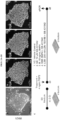
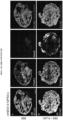
- the inner ear arises from the ectoderm layer and, in humans, produces the first terminally differentiated hair cells by ⁇ 52 days post conception (dpc) 16 . Beginning with pluripotent cells in the epiblast, inner ear induction is initiated ⁇ 12 dpc with formation of the ectoderm epithelium. Then, the epithelium splits into the non-neural ectoderm (also known as surface ectoderm) and the neuroectoderm ( FIGS. 1A, 1B ) .
- the non-neural ectoderm ultimately produces the inner ear as well as the epidermis of the skin; thus, in our initial experiments, we sought to establish a chemically defined 3D culture system for targeted derivation of non-neural ectoderm epithelia, from which we could derive inner ear organoids ( FIGS. 1A-1C ).
- Invitrogen 11905-031 100X 1X 2 ml BSA Sigma A1470 - 5 mg/ml 1 g Insulin Sigma I9278 10 mg/ml 7 ug/ml 140 ul Transferrin Sigma T8158 20 mg/ml 15 ug/ml 150 ul Thioglycerol Sigma M6145 11.5 M 450 uM 8 ul Normocin Invitrogen Ant-nr-1 50 mg/ml 100 ug/ml 400 ul
- LSB dual LDN/SB treatment referred to as LSB.
- LSB treatment to WA25 aggregates up-regulated neuroectoderm markers, such as PAX6 and N-cadherin (NCAD), and abolished TFAP2 and ECAD expression, suggesting that endogenous BMP signals drive non-neural conversion ( FIG. 1F ; FIGS. 7A-7D ).
- FIGS. 4D-4H We determined that the otic pit-like structures were PAX2 + PAX8 + SOX2 + SOX10 + JAG1 + , confirming otic identity ( FIGS. 4D-4H ). Interestingly, the otic pits were accompanied by migrating TFAP2 + SLUG + SOX10 + cranial neural crest-like cells that formed a mesenchyme around the otic pits, similar to the peri-otic mesenchyme in vivo ( FIGS. 4C-4F ).
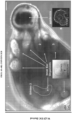
- vesicles with complex multi-chambered morphologies were visible through the aggregate surface ( FIG. 4J ).
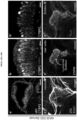
- a subset of vesicles in both WA25 and mND2-0 derived aggregates developed epithelia containing cells expressing multiple hair cell markers, including MYO7A, PCP4, ANXA4, SOX2, and CALB2 ( FIGS. 4K -Q; FIGS. 14A-14E ).
- the sensory-like epithelia also contained SOX2 + SOX10 + SPARCL1 + cells, reminiscent of supporting cells in the mammalian utricle 23 .
- the luminal cells in these epithelia had elongated morphologies with F-actin-rich apical junctions characteristic of inner ear sensory epithelia ( FIGS. 4L-4O ).
- the cells expressing hair cell markers also had F-actin-rich and espin (ESPN) + apical stereocilia bundles protruding into the vesicle lumen that were associated with an acetylated-alpha-Tubulin (TUBA4A) + kinocilium ( FIGS. 4M-4P , 4R ).
- FIGS. 5B-5D Immunostaining with hair cell markers, such as BRN3C and ESPN, confirmed the hair cell identity of eGFP + cells ( FIGS. 5E , 5F ).
- hair cell markers such as BRN3C and ESPN
- the seemingly low efficiency of hair cell induction may be due to our inability to detect organoids deep within the aggregates or it could indicate that the endogenous signals required for sensory epithelia formation vary from aggregate-to-aggregate.
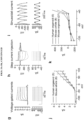
- the K + current amplitudes at nominal 100 mV were as follows: day 63: 399, 747, 340 pA; day 64: 4695, 2538, 2609 pA; day 67: 5198, 6528, 6127 pA. This is comparable to the average of 6099 pA for day 22 mouse organoid hair cells.
- Responses to step and sinusoidal current injection ( FIGS. 5H, 5I ) resembled that of rodent hair cells, with an initial peak then repolarization, and larger deflections to hyperpolarizing than depolarizing current. However, resting potential of the cells was consistently slightly higher than that seen in rodents: day 64: -43, -45; day 67: -48, -49 mV.
- the prominent sub-threshold inward rectifier current thought to be carried by Kir2.1 that develops early in hair cell differentiation and is present in all rodent vestibular hair cells and mouse organoid hair cells was absent or greatly reduced in human organoid cells ( FIG. 5K ) 24,25 . It is possible that development, expression, function, or modulation of Kir2.1 is different in human tissue. Importantly, the constricted lumen morphology seen in most >60-days-old organoids and in all of the organoids used for recording, made direct access to the hair bundles for mechanotransduction analysis challenging ( FIGS. 5B-5E ). Nonetheless, our data strongly suggest that the human organoids, like mouse inner ear organoids 25 , contain immature vestibular hair cells.
- hPSC-derived organoids appear to form only vestibular sensory epithelia by default; thus, additional signaling manipulation will be needed to initiate cochlear organogenesis 6,25 .
- this culture system will be a powerful tool for uncovering mechanisms of human inner ear development and testing potential inner ear therapies.
- hPSC culture Human PSCs (hESCs of the reference cell line WA25, passage 22-50; mND2-0 iPSCs, passage 28-46) were cultured in Essential 8 (E8) Medium or Essential 8 Flex Medium (E8f) (Invitrogen) supplemented with 100 ⁇ g/ml Normocin (Invivogen) on recombinant human Vitronectin-N (Invitrogen)-coated 6-well plates according to an established protocol 12,13 . At 80% confluency or every 4-5 days, the cells were passaged at a split ratio of 1:10-1:20 using an EDTA solution. Both cell lines were acquired from the WiCell Research Institute and arrived with a statement of verification and authenticity.
- hPSC differentiation To start differentiation, hPSC cells were dissociated with StemPro Accutase (Invitrogen) and distributed, 5,000 cells per well, onto 96-well V-bottom plates in E8 medium containing 20 ⁇ M Y-27632 (Stemgent) and Normocin.
- CDM Chemically Defined Medium
- Peprotech 4 ng ml -1 FGF-2 (Peprotech)
- 10 ⁇ M SB-431542 Stemgent
- 2.5 ng ml -1 BMP4 Stemgent
- GFR Growth Factor Reduced
- CDM contained a 50:50 mixture of F-12 Nutrient Mixture with GlutaMAX (Gibco) and Iscove's Modified Dulbecco's Medium with GlutaMAX (IMDM; Gibco) additionally supplemented with 0.5% Bovine Serum Albumin (BSA), 1X Chemically Defined Lipid Concentrate (Invitrogen), 7 ⁇ g ml -1 Insulin (Sigma), 15 ⁇ g ml -1 Transferrin (Sigma), 450 ⁇ M Mono-Thioglycerol, and Normocin (see Table 1 for a detailed formulation).
- CDM containing a 250 ng ml -1 FGF-2 (50 ng/ml final concentration) and 1 ⁇ M LDN-193189 (200 nM final concentration) was added to the pre-existing 100 ⁇ l of media in each well. After an additional 4 days (8 days total), 25 ⁇ l of CDM was added to the media.
- CDM containing a 18 ⁇ M CHIR99021 (3 ⁇ M final concentration; Stemgent) was added to the pre-existing 125 ⁇ l of media in each well-we determined that this treatment is optional for inner ear organoid production, but may improve induction of otic placode-like cells.
- Organoid Maturation Medium containing a 50:50 mixture of Advanced DMEM:F12 (Gibco) and Neurobasal Medium (Gibco) supplemented with 0.5X N2 Supplement (Gibco), 0.5X B27 without Vitamin A (Gibco), 1X GlutaMAX (Gibco), 0.1 mM ⁇ -Mercaptoethanol (Gibco), and Normocin (see Table 3 for a detailed formulation).
- OMM is a custom-made hybrid of two media previously used to generate cerebral and gastric organoids 6,7 .
- B27 without Vitamin A was used to limit the influence of endogenously produced retinoic acid.
- the aggregates were resuspended in ice cold undiluted GFR Matrigel and placed in approximately 25 ⁇ l droplets on the surface of a 100 mm bacterial culture plate. After at least 30 minutes of incubation at 37°C, the droplets were bathed in 10 ml of OMM containing 3 ⁇ M CHIR99021. For non-droplet otic induction, the aggregates were washed and plated individually into each well of a 24-well low cell adhesion plate in OMM containing 3 ⁇ M CHIR and 1% GFR Matrigel. After 18 days of differentiation, the CHIR was removed from the medium by washing and the droplet aggregates were moved to a floating culture.
- GFR Matrigel contains, ⁇ 0.1 pg ml -1 FGF-2, ⁇ 0.5 ng ml -1 EGF, 5 ng ml -1 IGF-1, ⁇ 5 pg ml -1 PDGF, ⁇ 0.2 ng ml -1 NGF, and 1.7 ng ml -1 TGF ⁇ .
- the TGF ⁇ in GFR Matrigel may have impacted cell fate specification on day 12 or later because we did not include a TGF ⁇ inhibitor in the media during that phase of culture.
- GFR Matrigel was chosen because it has been shown to be a reliable inducer of self-organizing epithelia from pluripotent stem cells in 3D culture 26 .
- GFR Matrigel is a more defined alternative to Matrigel, in which the concentration of growth factors, such as Egf, Igf1, Fgf2, and TGF ⁇ , have been minimized to levels that should have a negligible effect on cell fate specification.
- Other alternatives to Matrigel include, without limitation, synthetic hydrogels and recombinant protein-based matrices that support basement membrane formation and self-organization of differentiating PSCs into epithelia.
- a purified Laminin/Entactin complex may be a suitable, fully chemically defined alternative 27 .
- BSA was chosen as a cost-effective and easy to dissolve alternative to Human Serum Albumin and Polyvinyl Alcohol (PVA), respectively.
- PVA has been shown to be a suitable chemically defined substitute for BSA in CDM 28 .
- the following small molecules and recombinant proteins were used: recombinant human BMP4 (2.5-10 ng ml -1 ; Stemgent), human FGF-2 (25 ng ml -1 ; Peprotech), SB-431542 (10 ⁇ M; Tocris Bioscience), CHIR99021 (3 ⁇ M; Stemgent), and LDN-193189 (200 nM; Stemgent).
- Quantitative PCR Analysis was performed as previously described on an ABI PRISM 7900HT Sequence Detection System (Applied Biosystems) or a Bio-Rad CFX96 quantitative PCR machine (Bio-Rad) 6 . Data were normalized to L27 expression (internal control) and the fold change was calculated relative to Ct values from d0 WA25 aggregates using the ⁇ Ct method. Unless stated otherwise, data represent at least 3 separate biological samples from separate experiments. All indicators of statistical significance refer to comparisons between a given condition and the control group. Refer to Table 4 for primer details. Table 4.
- Data were acquired using an Axopatch 200B amplifier (Molecular Devices), filtered at 5000 Hz, then digitized at 20 kHz through a Digidata 1322A converter.
- the recording pipette solution contained (in mM): 135 KCl, 5 HEPES, 5 EGTA, 2.5 MgCl 2 , 2.5 K 2 -ATP, 0.1 CaCl 2 , adjusted with KOH to pH 7.4, -285 mmol kg -1 .
- the external solution contained: 137 NaCl, 5.8 KCl, 0.7 NaH 2 PO 4 , 10 HEPES, 1.3 CaCl 2 , 0.9 MgCl 2 , 5.6 Glucose, and was supplemented with vitamins and essential amino acids (Invitrogen, Carlsbad, CA), adjusted to pH 7.4 with NaOH, ⁇ 310 mmol kg -1 . Recordings were compensated 40% and cells were held at -66 mV for voltage clamp. Averages are reported ⁇ SEM.
- a 2A-eGFP-PGK-Puro cassette (Addgene #31938) 17 flanked by two 1kb homology arms PCR amplified from extracted WA25 hESC genomic DNA were cloned into a pUC19 backbone.
- the two gRNA vectors and the donor vector, as well as a vector expressing Cas9n under the control of CMV promoter (Addgene #41816) 18 were transfected into WA25 hESCs with 4D Nucleofector (Lonza) using the P3 Primary Cell 4D-Nucleofector X kit and Program CB-150.
- Genotypes of the clonal cell lines were analyzed by PCR amplification followed by gel electrophoresis, and by Sanger sequencing of total PCR amplicons or individual PCR amplicons cloned into TOPO vectors.
- Cell lines with bi-allelic 2A-eGFP integration were used for inner ear hair cell differentiation.
- images are representative of specimens obtained from at least 3 separate experiments.
- IHC analysis of aggregates between days 0-12 we typically sectioned 3-6 aggregates from each condition in each experiment. IHC analyses for later stages of the protocol were performed on at least 2 aggregates from each condition per experiment.
- the finalized culture method was successfully replicated 15 times by four independent investigators using the WA25 (wild-type or ATOH1-2A-eGFP) cell line. The method, with noted modifications, was replicated 3 times using the mND2-0 iPSC line.
- a replication was deemed successful by confirming pit/vesicle formation during days 12-18 and positively identifying inner ear organoids in at least one aggregate on days 50-100 of differentiation. Experiments were excluded from analysis if no pits were observed during days 12-18.
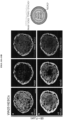
- Islet1+ (ISL1+) neuroblasts appear to delaminate from the otic vesicles ( FIGS. 16A-16B ).
- FIGS. 16A-16B We also see neuroblasts in DMSO-treated aggregates and in the non-otic interior of CHIR-treated aggregates ( FIG. 16A , arrowheads).
- CHIR-treated aggregates yield a mixture of otic (i.e. vesicle-derived) and epibranchial (i.e. epithelium-derived) neurons (see FIG. 4A ).
- NGN1 neurogenic factors Neurog1
- NGN2 Neurog2
- otic induced aggregates were plated on bacterial dishes in Matrigel droplets in medium containing 3 ⁇ M CHIR. See FIGS. 17A-17C .
- the aggregates were fixed and immunostained with antibodies for markers of sensory neurons, BRN3A and ⁇ III-Tubulin (TUJ1).
- BRN3A+ TUJ1+ neurons produced outgrowing processes with growth cones, confirming widespread sensory neurogenesis in the organoid cultures.
- FGF fibroblast growth factor
- ES cell culture in E8 medium on Vitronectin-coated plates (steps 1-7).
- We prefer this method of hPS cell maintenance because, in our hands, it reduces spontaneous differentiation with limited time and effort.
- Non-neural ectoderm and pre-otic induction steps 8-27.
- hPS cells are dissociated and distributed, 5,000 cells per well, onto 96-well V-bottom plates.
- E8 medium containing Y-27632 a potent ROCK signaling inhibitor.
- ROCK signaling inhibition has been shown to limit the amount of dissociation-induced apoptosis in hPS cells.
- SB treatment inhibits TGF ⁇ to induce ectoderm development.
- Endogenous BMP signaling generates non-neural rather than neural ectoderm.
- FGF-2 and LDN treatment induces pre-placodal development.
- the outer epithelium begins to express PAX8, indicating an oticepibranchial placode (OEPD)-like character.
- OEPD oticepibranchial placode
- CHIR treatment on day 8 induces small patches of PAX2+ cells, indicating the earliest signs of otic placode development by day 12.
- Otic prosensory vesicle and inner ear organoid formation steps 28-43.
- a low concentration of extracellular matrix proteins e.g., Matrigel TM
- Matrigel TM extracellular matrix proteins
- the Matrigel-embedded aggregates are cured onto the surface of bacterial dishes and bathed in a serum-free medium containing N2 and B27 supplement previously shown to support tissue self-organization (hereafter, Organoid Medium).
- This supportive environment causes numerous vesicles to bud-off of the epithelium between days 12-18. Otic vesicle formation was observed in >95% of the aggregates (>100 aggregates) across four independent experiments. Additionally, between days 12-18, neuroblasts delaminate from other parts of the epithelium and differentiate into sensory neurons. It is currently unclear whether these sensory neurons are epibranchial neurons such as those of cranial nerves VII, IX, and X, or inner ear neurons such as the vestibular or spiral ganglion neurons. Formation of a mesenchyme containing chondrocyte progenitor cells was also observed. It was unclear, however, whether the chondrocyte progenitor cells arose from ectodermal epithelium or another population of mesodermal cells.
- the Matrigel ® -embedded aggregates were removed from the stationary culture dish and pipetted into spinner flasks containing Organoid Medium devoid of any added growth factors or small molecules. After a total of 22 days, 10-30 vesicles were observed in each aggregate using phase contrast imaging. These vesicles expressed PAX2, PAX8, SOX2, and JAG1 protein indicating an otic cell fate. The vesicles appeared to grow slowly between days 22-35, and it became difficult to observe the vesicles using phase contrast imaging during this period due to the growing density of the mesenchymal cell mass in which they are embedded. By days 35-40, the vesicles were generally more apparent in the aggregate interior.
- the vesicles typically exhibited convoluted, multi-chambered morphologies, in contrast to the simple spherical and ovoid shaped otic vesicles.
- day 45 vesicles have developed MYO7A + hair cell-like cells and were identified as inner ear organoids.
- days 60-80 we observed MYO7A + hair cells with F-actin-rich and Espin + hair bundles, indicating a definitive hair cell identity.
- hPSC culture Human PSCs (hESCs of the reference cell line WA25, passage 22-50; mND2-0 iPSCs, passage 28-46) were cultured in Essential 8 (E8) Medium or Essential 8 Flex Medium (E8f) (Invitrogen) supplemented with 100 ⁇ g/ml Normocin (Invivogen) on recombinant human Vitronectin-N (Invitrogen)-coated 6-well plates according to an established protocol 12,13 . At 80% confluency or every 4-5 days, the cells were passaged at a split ratio of 1:10-1:20 using an EDTA solution. Both cell lines were acquired from the WiCell Research Institute and arrived with a statement of verification and authenticity.
- reagents used in this exemplary protocol are set forth in Table 6. Table 6.
- REAGENTS Ham's F-12 Nutrient Mixture (Gibco, cat. no. 31765-035) Iscove's Modified Dulbecco's Medium (IMDM) (Gibco, cat. no. 31980-030) Advanced DMEM/F 12 (Gibco, cat. no. 12491-015) 2-Mercaptoethanol (Gibco, cat. no. 21985-023) Normocin (Invivogen, cat. no. ant-nr-1) N2 Supplement (Gibco, cat. no. 17502-048) GlutaMax (Gibco, cat. no. 35050-079) Geltrex (Invitrogen, cat.
- Vitronectin Invitrogen, cat. no. A14700
- Chemically-defined lipid concentrate Invitrogen, cat. no. 11905-031
- Albumin from bovine serum BSA; Sigma, cat. no. A1470
- Insulin solution Sigma, cat. no. I9278
- Human Transferrin Sigma, cat. no. T8158
- 1-thioglycerol Sigma, cat. no. M1753
- Human BMP-7 Human FGF-3 (Biolegend, cat. no. 558002)
- FGF-2 Peprotech, cat. no. 100-18B
- SB-431542 in solution (Stemgent, cat. no.
- Human recombinant BMP7 stock solution (100 ng/ ⁇ L): In the biosafety cabinet, add 100 ⁇ L of sterile 4 mM HCl to 10 ⁇ g of BMP7; vortex the solution and spin down in a tabletop centrifuge. Store BMP4 solution in 5 ⁇ L aliquots at -20°C for 6 months or at -80°C for 1 year.
- Human recombinant FGF-2 stock solution 200 ng/ ⁇ L: In the biosafety cabinet, add 250 ⁇ L of sterile PBS or 5 mM Tris (pH 7.6) to 50 ⁇ g of FGF-2; vortex the solution and spin down in a tabletop centrifuge. Store FGF-2 solution in 6 ⁇ L aliquots at -20°C for 6 months or at - 80°C for 1 year.
- Human transferrin stock solution (20 mg/ml): In the biosafety cabinet, dissolve 100 mg of recombinant human transferrin in 5 ml of IMDM. To fully dissolve, vortex the tube and place it on a rotating shaker for 5-10 min at room temperature (RT). Store the transferrin solution in 150 ⁇ l aliquots at -20°C for 6 months or at -80°C for 1 year.
- EDTA Solution for passaging hES cells: In the biosafety cabinet, mix 50 ⁇ l of 0.5 M EDTA into 50 ml DPBS. Filter sterilize the solution. EDTA solution can be stored at RT for 6 months.
- CDM Chemically Defined Medium
- Differentiation CDM In a 50 mL conical tube, add 450 ⁇ L of ice cold Geltrex to 34.5 mL of ice cold CDM (1.25% final concentration). Vortex the tube well to fully dissolve the Geltrex. Place 30 mL of this solution in a new 50 mL conical tube. Add 0.6 ⁇ L of FGF-2 (4 ng/mL final concentration) and 30 ⁇ L of SB-431542 (10 ⁇ M final concentration). Vortex the tube well to mix. Differentiation CDM should be made fresh on day 0 of differentiation. Use the remaining 5 mL of CDM +Geltrex to wash the aggregates before plating.
- Organoid Maturation Medium To prepare 50 mL OMM, combine 24.5 mL Advanced DMEM/F12, 24.5 mL Neurobasal Medium, 500 ⁇ L B-27 Supplement without vitamin A, 500 ⁇ L GlutaMAX, 250 ⁇ L N2-supplement, and 100 ⁇ L Normocin in a sterile 50 mL conical tube. OMM can be used for up to 2 weeks if stored at 4°C. See Table 3 for a quick reference recipe.
- hES cell differentiation (day -2 to day 0): aggregation:
Landscapes
- Health & Medical Sciences (AREA)
- Engineering & Computer Science (AREA)
- Biomedical Technology (AREA)
- Life Sciences & Earth Sciences (AREA)
- Chemical & Material Sciences (AREA)
- Bioinformatics & Cheminformatics (AREA)
- Genetics & Genomics (AREA)
- Organic Chemistry (AREA)
- Zoology (AREA)
- Biotechnology (AREA)
- Wood Science & Technology (AREA)
- Neurology (AREA)
- Cell Biology (AREA)
- Biochemistry (AREA)
- Microbiology (AREA)
- General Health & Medical Sciences (AREA)
- General Engineering & Computer Science (AREA)
- Gynecology & Obstetrics (AREA)
- Developmental Biology & Embryology (AREA)
- Reproductive Health (AREA)
- Acoustics & Sound (AREA)
- Analytical Chemistry (AREA)
- Neurosurgery (AREA)
- Physics & Mathematics (AREA)
- Micro-Organisms Or Cultivation Processes Thereof (AREA)
- Peptides Or Proteins (AREA)
- Measuring Or Testing Involving Enzymes Or Micro-Organisms (AREA)
Claims (5)
- Procédé d'obtention d'une composition tridimensionnelle comprenant du tissu sensoriel de l'oreille interne humaine, le procédé comprenant les étapes de :(a) culture d'agrégats de cellules souches pluripotentes induites par l'homme dans un milieu de culture comprenant du FGF-2, du BMP4 et un inhibiteur à petite molécule de la signalisation du facteur de croissance transformant bêta (TGFβ) pendant quatre jours, dans lequel l'inhibiteur à petite molécule du TGFβ est le SB431542 ;(b) culture en outre des agrégats cultivés de (a) en présence d'un facteur de croissance des fibroblastes (FGF) et d'un inhibiteur à petite molécule de la signalisation de BMP pendant 4 jours, dans lequel l'inhibiteur à petite molécule de BMP est le LDN-193189 ;(c) mise en contact des agrégats davantage cultivés de (b) avec un agoniste de Wnt pendant 4 jours, dans lequel l'agoniste Wnt est un inhibiteur de GSK3, moyennant quoi les cellules à l'intérieur des agrégats mis en contact se différencient en cellules épithéliales préotiques ;(d) incorporation des cellules épithéliales préotiques dans un milieu de culture semi-solide comprenant une protéine de matrice extracellulaire et un extrait de membrane basale ;(e) culture des cellules épithéliales préotiques incorporées en présence d'un agoniste de Wnt pendant 6 jours, dans lequel l'agoniste de Wnt est un inhibiteur de GSK3 ; et(f) culture des cellules épithéliales pré-otiques incorporées de (e) pendant au moins 22 à 42 jours supplémentaires dans des conditions qui favorisent l'auto-assemblage de cellules épithéliales pré-otiques incorporées dans des vésicules otiques, moyennant quoi une composition tridimensionnelle comprenant du tissu sensoriel de l'oreille interne humaine est obtenue.
- Procédé selon la revendication 1, dans lequel l'inhibiteur de GSK3 est choisi dans le groupe constitué de CHIR99021, du chlorure de lithium (LiCl) et de la 6-bromoindirubine-3'-oxime (BIO).
- Procédé selon la revendication 1, dans lequel la composition tridimensionnelle comprend une ou plusieurs cellules mécanosensorielles.
- Procédé selon la revendication 1, dans lequel la composition tridimensionnelle comprend une ou plusieurs cellules neuronales sensorielles.
- Procédé selon la revendication 1, dans lequel la composition tridimensionnelle comprend une ou plusieurs cellules neuronales sensorielles qui forment des connexions synaptiques avec des cellules mécanosensorielles.
Applications Claiming Priority (2)
| Application Number | Priority Date | Filing Date | Title |
|---|---|---|---|
| US201562244568P | 2015-10-21 | 2015-10-21 | |
| PCT/US2016/058121 WO2017070471A1 (fr) | 2015-10-21 | 2016-10-21 | Procédés de production de cellules épithéliales sensorielles et de neurones sensoriels de l'oreille interne chez l'homme |
Publications (3)
| Publication Number | Publication Date |
|---|---|
| EP3365428A1 EP3365428A1 (fr) | 2018-08-29 |
| EP3365428A4 EP3365428A4 (fr) | 2019-03-20 |
| EP3365428B1 true EP3365428B1 (fr) | 2024-09-04 |
Family
ID=58557861
Family Applications (1)
| Application Number | Title | Priority Date | Filing Date |
|---|---|---|---|
| EP16858294.8A Active EP3365428B1 (fr) | 2015-10-21 | 2016-10-21 | Procédés de production de cellules épithéliales sensorielles et de neurones sensoriels de l'oreille interne chez l'homme |
Country Status (9)
| Country | Link |
|---|---|
| US (2) | US20190093072A1 (fr) |
| EP (1) | EP3365428B1 (fr) |
| JP (1) | JP6979946B2 (fr) |
| CN (1) | CN108291197B (fr) |
| AU (1) | AU2016341982B2 (fr) |
| CA (1) | CA3002162A1 (fr) |
| HK (1) | HK1256552A1 (fr) |
| SG (1) | SG11201803061UA (fr) |
| WO (1) | WO2017070471A1 (fr) |
Families Citing this family (31)
| Publication number | Priority date | Publication date | Assignee | Title |
|---|---|---|---|---|
| US9719068B2 (en) | 2010-05-06 | 2017-08-01 | Children's Hospital Medical Center | Methods and systems for converting precursor cells into intestinal tissues through directed differentiation |
| SG10201801654RA (en) | 2014-05-28 | 2018-04-27 | Childrens Hospital Med Ct | Methods and systems for converting precursor cells into gastric tissues through directed differentiation |
| AU2015331848B2 (en) | 2014-10-17 | 2022-03-03 | Children's Hospital Medical Center, D/B/A Cincinnati Children's Hospital Medical Center | In vivo model of human small intestine using pluripotent stem cells and methods of making and using same |
| KR20180105236A (ko) * | 2016-02-05 | 2018-09-27 | 메모리얼 슬로안-케터링 캔서 센터 | 줄기 세포-유래 외배엽 계통 전구체의 분화 방법 |
| US20190060371A1 (en) * | 2016-03-02 | 2019-02-28 | Frequency Therapeutics, Inc. | Methods for controlled proliferation of vestibular stem cells / generating inner ear hair cells using wnt and tgfbeta-inhibition |
| CN109415685B (zh) | 2016-05-05 | 2023-07-04 | 儿童医院医疗中心 | 用于体外制造胃底组织的方法和与其相关的组合物 |
| EP4553082A3 (fr) | 2016-11-04 | 2025-08-20 | Children's Hospital Medical Center | Compositions d'organoïdes hépatiques et leurs procédés de fabrication et d'utilisation |
| EP3548507A4 (fr) | 2016-12-05 | 2020-07-15 | Children's Hospital Medical Center | Organoïdes du côlon et leurs procédés de préparation et d'utilisation |
| JP7248586B2 (ja) | 2017-04-14 | 2023-03-29 | チルドレンズ ホスピタル メディカル センター | 複数ドナー幹細胞組成物およびそれを作製する方法 |
| EP3694603B1 (fr) | 2017-10-10 | 2026-04-08 | Children's Hospital Medical Center | Compositions de tissus oesophagiens et/ou d'organoïdes et leurs procédés de fabrication |
| US11773171B2 (en) | 2017-12-19 | 2023-10-03 | Surrozen Operating, Inc. | WNT surrogate molecules and uses thereof |
| CN111699003B (zh) | 2017-12-19 | 2024-05-03 | 瑟罗泽恩奥普瑞汀公司 | 抗lrp5/6抗体和使用方法 |
| CN117946267A (zh) | 2017-12-19 | 2024-04-30 | 瑟罗泽恩奥普瑞汀公司 | 抗卷曲蛋白抗体和使用方法 |
| EP3727394A4 (fr) | 2017-12-21 | 2021-09-08 | Children's Hospital Medical Center | Organoïdes humains numérisés et méthodes d'utilisation de ceux-ci |
| EP4678727A3 (fr) | 2018-07-26 | 2026-03-11 | Children's Hospital Medical Center | Tissus hépato-biliaire-pancréatiques et leurs procédés de fabrication |
| US11617745B2 (en) | 2018-08-17 | 2023-04-04 | Frequency Therapeutics, Inc. | Compositions and methods for generating hair cells by downregulating FOXO |
| CN109280634B (zh) * | 2018-08-31 | 2022-02-18 | 浙江大学 | 一种内耳毛细胞体外分离培养的方法 |
| CA3112026A1 (fr) | 2018-09-12 | 2020-03-19 | Children's Hospital Medical Center | Compositions d'organoides pour la production de cellules souches hematopoietiques et leurs derives |
| US12600943B2 (en) | 2019-02-01 | 2026-04-14 | The University Of Hong Kong | Innervated organoid compositions and methods of making same |
| US20220175884A1 (en) * | 2019-04-02 | 2022-06-09 | Surrozen Operating, Inc. | Modulation of wnt signaling in auditory disorders |
| AU2020283048A1 (en) | 2019-05-31 | 2021-12-23 | Children's Hospital Medical Center | Shaped organoid compositions and methods of making same |
| US12497597B2 (en) | 2019-05-31 | 2025-12-16 | Children's Hospital Medical Center | Methods of generating and expanding hematopoietic stem cells |
| JP2023106639A (ja) * | 2020-06-09 | 2023-08-02 | 株式会社オトリンク | 内耳前駆細胞の製造方法、内耳有毛細胞の製造方法、薬剤の評価方法、及び内耳細胞分化誘導用組成物 |
| CN111643671B (zh) * | 2020-06-22 | 2021-07-30 | 南京大学 | 一种促进毛细胞再生和听力恢复的组合物及其用途 |
| CN112608878B (zh) * | 2020-12-18 | 2022-06-14 | 复旦大学附属眼耳鼻喉科医院 | 一种体外耳蜗微器官功能单元及其三维构建方法和应用 |
| IL315142A (en) * | 2022-03-02 | 2024-10-01 | Lineage Cell Therapeutics Inc | Methods and compositions for treating hearing loss |
| CN114959045A (zh) * | 2022-06-30 | 2022-08-30 | 苏州睿明医学检验实验室有限公司 | Atoh1基因检测的特异性引物和探针、试剂盒及其检测方法 |
| EP4524242A1 (fr) * | 2022-11-11 | 2025-03-19 | Seoul National University R&DB Foundation | Procédé de différenciation de neurones viscéro-sensoriels à partir de cellules souches pluripotentes induites humaines |
| CN116036236B (zh) * | 2022-12-15 | 2025-08-26 | 东南大学 | 生物因子Sparcl1在促进内耳毛细胞再生的药物中的应用 |
| CN118773135A (zh) * | 2024-05-17 | 2024-10-15 | 上海健康医学院 | 一种人类多能干细胞诱导为类听觉神经元的方法 |
| CN120536366B (zh) * | 2025-07-28 | 2026-04-07 | 山东省第二人民医院(山东省耳鼻喉医院、山东省耳鼻喉研究所) | 一种构建内耳前体细胞及内耳类器官的方法和应用 |
Family Cites Families (26)
| Publication number | Priority date | Publication date | Assignee | Title |
|---|---|---|---|---|
| DE10162814B4 (de) | 2001-12-19 | 2005-06-23 | Henkel Kgaa | Rekonstruiertes Haarfollikelmodell |
| JP2004159471A (ja) * | 2002-11-08 | 2004-06-03 | Fuji Electric Fa Components & Systems Co Ltd | 自動力率調整装置 |
| US8673634B2 (en) | 2003-11-13 | 2014-03-18 | Massachusetts Eye & Ear Infirmary | Method for the treatment of hearing loss |
| US20060024278A1 (en) * | 2004-01-23 | 2006-02-02 | The General Hospital Corporation | Methods and products related to the production of inner ear hair cells |
| US20060035375A1 (en) * | 2004-08-16 | 2006-02-16 | Head Jonathan F | Method for selectively culturing epithelial or carcinoma cells |
| JP4565112B2 (ja) | 2004-09-15 | 2010-10-20 | 独立行政法人産業技術総合研究所 | 毛髪成長促進剤、発毛促進剤及び脱毛症治療剤 |
| EP2015781A4 (fr) | 2005-09-12 | 2009-12-23 | Univ Johns Hopkins | Compositions ayant une activité antiangiogénique et leurs utilisations |
| CN101431962A (zh) | 2006-02-07 | 2009-05-13 | 器官发生有限公司 | 生物工程化组织构建物及其心脏用途 |
| WO2008076556A2 (fr) | 2006-11-15 | 2008-06-26 | Massachusetts Eye & Ear Infirmary | Génération de cellules de l'oreille interne |
| WO2008089351A1 (fr) | 2007-01-17 | 2008-07-24 | Wisconsin Alumni Research Foundation | Culture améliorée de cellules souches |
| CA2676044C (fr) | 2007-01-30 | 2019-10-22 | University Of Georgia Research Foundation, Inc. | Cellules mesodermiques precoces, une population stable de cellules mesendodermiques qui a une utilite pour la generation de lignees endodermiques et mesodermiques et de cellules migratoires multipotentes (mmc) |
| CN102186969A (zh) | 2008-06-25 | 2011-09-14 | 国家健康与医学研究院 | 由人多能干细胞制备人皮肤替代品的方法 |
| AU2009274517B2 (en) * | 2008-07-25 | 2015-03-26 | The University Of Georgia Research Foundation, Inc. | Compositions for Mesoderm derived ISL1+ Multipotent cells (IMPs), epicardial progenitor cells (EPCs) and multipotent CXCR4+CD56+ cells (C56Cs) and methods of use |
| US20110321180A1 (en) | 2008-11-20 | 2011-12-29 | University Of Southern California | Compositions and methods to generate pilosebaceous units |
| WO2010077955A1 (fr) * | 2008-12-17 | 2010-07-08 | The Scripps Research Institute | Génération et entretien de cellules souches |
| EP2393917B1 (fr) | 2009-02-03 | 2016-04-06 | Koninklijke Nederlandse Akademie van Wetenschappen | Milieu de culture de cellules souches épithéliales et organoïdes comprenant lesdites cellules souches |
| WO2010096496A2 (fr) | 2009-02-17 | 2010-08-26 | Memorial Sloan-Kettering Cancer Center | Procédés de conversion neurale de cellules souches embryonnaires humaines |
| JP5902092B2 (ja) | 2009-10-19 | 2016-04-13 | セルラー ダイナミクス インターナショナル, インコーポレイテッド | 心筋細胞の生成 |
| DK3578988T3 (da) | 2010-05-25 | 2025-02-24 | Memorial Sloan Kettering Cancer Center | Fremgangsmåde til nociceptordifferentiering af humane embryonale stamceller og anvendelse heraf |
| US20120148541A1 (en) | 2010-10-28 | 2012-06-14 | University Of Southern California | Compositions and methods to generate pilosebaceous units |
| EP2667881A4 (fr) * | 2011-01-24 | 2015-04-22 | Univ Leland Stanford Junior | Procédés de génération de cellules de l'oreille interne in vitro |
| WO2013166488A1 (fr) | 2012-05-04 | 2013-11-07 | Indiana University Research & Technology Corporation | Procédés pour générer l'oreille interne et d'autres tissus dérivés de placode crânienne en utilisant des cellules souches pluripotentes |
| CN103785064B (zh) | 2013-08-26 | 2015-02-25 | 济南磐升生物技术有限公司 | 一种皮肤模型及应用 |
| CA2941004A1 (fr) * | 2014-03-04 | 2015-09-11 | Peter Flynn | Procedes ameliores de reprogrammation et plateformes de culture cellulaire |
| US10080771B2 (en) | 2015-01-28 | 2018-09-25 | The Trustees Of The University Of Pennsylvania | Compositions and methods for generation of human epithelial stem cells |
| SG11201803043VA (en) | 2015-10-21 | 2018-05-30 | Univ Indiana Res & Tech Corp | Derivation of human skin organoids from pluripotent stem cells |
-
2016
- 2016-10-21 SG SG11201803061UA patent/SG11201803061UA/en unknown
- 2016-10-21 WO PCT/US2016/058121 patent/WO2017070471A1/fr not_active Ceased
- 2016-10-21 CA CA3002162A patent/CA3002162A1/fr not_active Abandoned
- 2016-10-21 HK HK18115622.4A patent/HK1256552A1/zh unknown
- 2016-10-21 CN CN201680061915.0A patent/CN108291197B/zh active Active
- 2016-10-21 AU AU2016341982A patent/AU2016341982B2/en active Active
- 2016-10-21 EP EP16858294.8A patent/EP3365428B1/fr active Active
- 2016-10-21 US US15/769,254 patent/US20190093072A1/en not_active Abandoned
- 2016-10-21 JP JP2018520429A patent/JP6979946B2/ja active Active
-
2020
- 2020-08-10 US US16/989,554 patent/US12077778B2/en active Active
Also Published As
| Publication number | Publication date |
|---|---|
| CN108291197B (zh) | 2022-09-16 |
| JP2018531031A (ja) | 2018-10-25 |
| US20200370007A1 (en) | 2020-11-26 |
| US20190093072A1 (en) | 2019-03-28 |
| AU2016341982A1 (en) | 2018-05-10 |
| HK1256552A1 (zh) | 2019-09-27 |
| US12077778B2 (en) | 2024-09-03 |
| WO2017070471A1 (fr) | 2017-04-27 |
| JP6979946B2 (ja) | 2021-12-15 |
| CA3002162A1 (fr) | 2017-04-27 |
| EP3365428A1 (fr) | 2018-08-29 |
| SG11201803061UA (en) | 2018-05-30 |
| EP3365428A4 (fr) | 2019-03-20 |
| AU2016341982B2 (en) | 2022-07-07 |
| CN108291197A (zh) | 2018-07-17 |
Similar Documents
| Publication | Publication Date | Title |
|---|---|---|
| US12077778B2 (en) | Methods of generating human inner ear sensory epithelia and sensory neurons | |
| JP7088496B2 (ja) | 網膜組織の製造方法 | |
| JP2018531031A6 (ja) | ヒト内耳感覚上皮および感覚ニューロンを生成する方法 | |
| JP7742999B2 (ja) | 網膜組織の製造方法 | |
| JP6995314B2 (ja) | 網膜組織の製造法 | |
| US9458428B2 (en) | Methods and compositions for the rapid production of retinal pigmented epithelial cells from pluripotent cells | |
| CA3143449C (fr) | Production in vitro de cellules de precurseurs d'eminence ganglionnaire mediane | |
| JP7793137B2 (ja) | 背側化シグナル伝達物質又は腹側化シグナル伝達物質による錐体視細胞又は桿体視細胞の増加方法 | |
| KR102368751B1 (ko) | 모양체 주연부 간세포의 제조 방법 | |
| TWI903496B (zh) | 評價移植用神經視網膜之品質之方法及移植用神經視網膜片 | |
| WO2013166488A1 (fr) | Procédés pour générer l'oreille interne et d'autres tissus dérivés de placode crânienne en utilisant des cellules souches pluripotentes | |
| JP2018183137A (ja) | 多能性幹細胞から樹状分岐した集合管を伴う腎臓構造を作製する方法 | |
| US20220135940A1 (en) | Method for producing kidney structure having dendritically branched collecting duct from pluripotent stem cells | |
| EP3754014A1 (fr) | Procédé de préparation automatique de cellules de l'épithélium pigmentaire rétinien | |
| US20250034522A1 (en) | Method for separating pituitary cells and hypothalamic cells using cell surface marker | |
| JP2026067912A (ja) | Abcg2陽性角膜輪部幹細胞を得る又は維持する方法 | |
| CA3021828C (fr) | Procede de production de tissu retinien | |
| HK40029200A (en) | Method for producing retinal tissues | |
| HK1251249A1 (en) | Method for producing retinal pigment epithelial cells | |
| HK1251249B (en) | Method for producing retinal pigment epithelial cells |
Legal Events
| Date | Code | Title | Description |
|---|---|---|---|
| STAA | Information on the status of an ep patent application or granted ep patent |
Free format text: STATUS: THE INTERNATIONAL PUBLICATION HAS BEEN MADE |
|
| PUAI | Public reference made under article 153(3) epc to a published international application that has entered the european phase |
Free format text: ORIGINAL CODE: 0009012 |
|
| STAA | Information on the status of an ep patent application or granted ep patent |
Free format text: STATUS: REQUEST FOR EXAMINATION WAS MADE |
|
| 17P | Request for examination filed |
Effective date: 20180509 |
|
| AK | Designated contracting states |
Kind code of ref document: A1 Designated state(s): AL AT BE BG CH CY CZ DE DK EE ES FI FR GB GR HR HU IE IS IT LI LT LU LV MC MK MT NL NO PL PT RO RS SE SI SK SM TR |
|
| AX | Request for extension of the european patent |
Extension state: BA ME |
|
| RIN1 | Information on inventor provided before grant (corrected) |
Inventor name: KOEHLER, KARL, R. Inventor name: HASHINO, ERI |
|
| DAV | Request for validation of the european patent (deleted) | ||
| DAX | Request for extension of the european patent (deleted) | ||
| A4 | Supplementary search report drawn up and despatched |
Effective date: 20190220 |
|
| RIC1 | Information provided on ipc code assigned before grant |
Ipc: C12N 5/22 20060101ALI20190214BHEP Ipc: C12N 5/02 20060101AFI20190214BHEP Ipc: C12N 5/0793 20100101ALI20190214BHEP Ipc: C12N 5/0797 20100101ALI20190214BHEP |
|
| STAA | Information on the status of an ep patent application or granted ep patent |
Free format text: STATUS: EXAMINATION IS IN PROGRESS |
|
| 17Q | First examination report despatched |
Effective date: 20200323 |
|
| GRAP | Despatch of communication of intention to grant a patent |
Free format text: ORIGINAL CODE: EPIDOSNIGR1 |
|
| STAA | Information on the status of an ep patent application or granted ep patent |
Free format text: STATUS: GRANT OF PATENT IS INTENDED |
|
| INTG | Intention to grant announced |
Effective date: 20240426 |
|
| GRAS | Grant fee paid |
Free format text: ORIGINAL CODE: EPIDOSNIGR3 |
|
| GRAA | (expected) grant |
Free format text: ORIGINAL CODE: 0009210 |
|
| STAA | Information on the status of an ep patent application or granted ep patent |
Free format text: STATUS: THE PATENT HAS BEEN GRANTED |
|
| AK | Designated contracting states |
Kind code of ref document: B1 Designated state(s): AL AT BE BG CH CY CZ DE DK EE ES FI FR GB GR HR HU IE IS IT LI LT LU LV MC MK MT NL NO PL PT RO RS SE SI SK SM TR |
|
| REG | Reference to a national code |
Ref country code: GB Ref legal event code: FG4D |
|
| REG | Reference to a national code |
Ref country code: CH Ref legal event code: EP |
|
| P01 | Opt-out of the competence of the unified patent court (upc) registered |
Free format text: CASE NUMBER: APP_47933/2024 Effective date: 20240820 |
|
| REG | Reference to a national code |
Ref country code: IE Ref legal event code: FG4D |
|
| REG | Reference to a national code |
Ref country code: DE Ref legal event code: R096 Ref document number: 602016089285 Country of ref document: DE |
|
| REG | Reference to a national code |
Ref country code: LT Ref legal event code: MG9D |
|
| REG | Reference to a national code |
Ref country code: NL Ref legal event code: MP Effective date: 20240904 |
|
| PG25 | Lapsed in a contracting state [announced via postgrant information from national office to epo] |
Ref country code: NO Free format text: LAPSE BECAUSE OF FAILURE TO SUBMIT A TRANSLATION OF THE DESCRIPTION OR TO PAY THE FEE WITHIN THE PRESCRIBED TIME-LIMIT Effective date: 20241204 |
|
| PG25 | Lapsed in a contracting state [announced via postgrant information from national office to epo] |
Ref country code: GR Free format text: LAPSE BECAUSE OF FAILURE TO SUBMIT A TRANSLATION OF THE DESCRIPTION OR TO PAY THE FEE WITHIN THE PRESCRIBED TIME-LIMIT Effective date: 20241205 Ref country code: FI Free format text: LAPSE BECAUSE OF FAILURE TO SUBMIT A TRANSLATION OF THE DESCRIPTION OR TO PAY THE FEE WITHIN THE PRESCRIBED TIME-LIMIT Effective date: 20240904 Ref country code: PL Free format text: LAPSE BECAUSE OF FAILURE TO SUBMIT A TRANSLATION OF THE DESCRIPTION OR TO PAY THE FEE WITHIN THE PRESCRIBED TIME-LIMIT Effective date: 20240904 |
|
| PG25 | Lapsed in a contracting state [announced via postgrant information from national office to epo] |
Ref country code: BG Free format text: LAPSE BECAUSE OF FAILURE TO SUBMIT A TRANSLATION OF THE DESCRIPTION OR TO PAY THE FEE WITHIN THE PRESCRIBED TIME-LIMIT Effective date: 20240904 |
|
| PG25 | Lapsed in a contracting state [announced via postgrant information from national office to epo] |
Ref country code: LV Free format text: LAPSE BECAUSE OF FAILURE TO SUBMIT A TRANSLATION OF THE DESCRIPTION OR TO PAY THE FEE WITHIN THE PRESCRIBED TIME-LIMIT Effective date: 20240904 |
|
| PG25 | Lapsed in a contracting state [announced via postgrant information from national office to epo] |
Ref country code: HR Free format text: LAPSE BECAUSE OF FAILURE TO SUBMIT A TRANSLATION OF THE DESCRIPTION OR TO PAY THE FEE WITHIN THE PRESCRIBED TIME-LIMIT Effective date: 20240904 |
|
| PG25 | Lapsed in a contracting state [announced via postgrant information from national office to epo] |
Ref country code: ES Free format text: LAPSE BECAUSE OF FAILURE TO SUBMIT A TRANSLATION OF THE DESCRIPTION OR TO PAY THE FEE WITHIN THE PRESCRIBED TIME-LIMIT Effective date: 20240904 Ref country code: RS Free format text: LAPSE BECAUSE OF FAILURE TO SUBMIT A TRANSLATION OF THE DESCRIPTION OR TO PAY THE FEE WITHIN THE PRESCRIBED TIME-LIMIT Effective date: 20241204 |
|
| PG25 | Lapsed in a contracting state [announced via postgrant information from national office to epo] |
Ref country code: RS Free format text: LAPSE BECAUSE OF FAILURE TO SUBMIT A TRANSLATION OF THE DESCRIPTION OR TO PAY THE FEE WITHIN THE PRESCRIBED TIME-LIMIT Effective date: 20241204 Ref country code: PL Free format text: LAPSE BECAUSE OF FAILURE TO SUBMIT A TRANSLATION OF THE DESCRIPTION OR TO PAY THE FEE WITHIN THE PRESCRIBED TIME-LIMIT Effective date: 20240904 Ref country code: NO Free format text: LAPSE BECAUSE OF FAILURE TO SUBMIT A TRANSLATION OF THE DESCRIPTION OR TO PAY THE FEE WITHIN THE PRESCRIBED TIME-LIMIT Effective date: 20241204 Ref country code: LV Free format text: LAPSE BECAUSE OF FAILURE TO SUBMIT A TRANSLATION OF THE DESCRIPTION OR TO PAY THE FEE WITHIN THE PRESCRIBED TIME-LIMIT Effective date: 20240904 Ref country code: HR Free format text: LAPSE BECAUSE OF FAILURE TO SUBMIT A TRANSLATION OF THE DESCRIPTION OR TO PAY THE FEE WITHIN THE PRESCRIBED TIME-LIMIT Effective date: 20240904 Ref country code: GR Free format text: LAPSE BECAUSE OF FAILURE TO SUBMIT A TRANSLATION OF THE DESCRIPTION OR TO PAY THE FEE WITHIN THE PRESCRIBED TIME-LIMIT Effective date: 20241205 Ref country code: FI Free format text: LAPSE BECAUSE OF FAILURE TO SUBMIT A TRANSLATION OF THE DESCRIPTION OR TO PAY THE FEE WITHIN THE PRESCRIBED TIME-LIMIT Effective date: 20240904 Ref country code: ES Free format text: LAPSE BECAUSE OF FAILURE TO SUBMIT A TRANSLATION OF THE DESCRIPTION OR TO PAY THE FEE WITHIN THE PRESCRIBED TIME-LIMIT Effective date: 20240904 Ref country code: BG Free format text: LAPSE BECAUSE OF FAILURE TO SUBMIT A TRANSLATION OF THE DESCRIPTION OR TO PAY THE FEE WITHIN THE PRESCRIBED TIME-LIMIT Effective date: 20240904 |
|
| REG | Reference to a national code |
Ref country code: AT Ref legal event code: MK05 Ref document number: 1720423 Country of ref document: AT Kind code of ref document: T Effective date: 20240904 |
|
| PG25 | Lapsed in a contracting state [announced via postgrant information from national office to epo] |
Ref country code: NL Free format text: LAPSE BECAUSE OF FAILURE TO SUBMIT A TRANSLATION OF THE DESCRIPTION OR TO PAY THE FEE WITHIN THE PRESCRIBED TIME-LIMIT Effective date: 20240904 |
|
| PG25 | Lapsed in a contracting state [announced via postgrant information from national office to epo] |
Ref country code: IS Free format text: LAPSE BECAUSE OF FAILURE TO SUBMIT A TRANSLATION OF THE DESCRIPTION OR TO PAY THE FEE WITHIN THE PRESCRIBED TIME-LIMIT Effective date: 20250104 Ref country code: PT Free format text: LAPSE BECAUSE OF FAILURE TO SUBMIT A TRANSLATION OF THE DESCRIPTION OR TO PAY THE FEE WITHIN THE PRESCRIBED TIME-LIMIT Effective date: 20250106 |
|
| PG25 | Lapsed in a contracting state [announced via postgrant information from national office to epo] |
Ref country code: SM Free format text: LAPSE BECAUSE OF FAILURE TO SUBMIT A TRANSLATION OF THE DESCRIPTION OR TO PAY THE FEE WITHIN THE PRESCRIBED TIME-LIMIT Effective date: 20240904 Ref country code: RO Free format text: LAPSE BECAUSE OF FAILURE TO SUBMIT A TRANSLATION OF THE DESCRIPTION OR TO PAY THE FEE WITHIN THE PRESCRIBED TIME-LIMIT Effective date: 20240904 |
|
| PG25 | Lapsed in a contracting state [announced via postgrant information from national office to epo] |
Ref country code: EE Free format text: LAPSE BECAUSE OF FAILURE TO SUBMIT A TRANSLATION OF THE DESCRIPTION OR TO PAY THE FEE WITHIN THE PRESCRIBED TIME-LIMIT Effective date: 20240904 Ref country code: AT Free format text: LAPSE BECAUSE OF FAILURE TO SUBMIT A TRANSLATION OF THE DESCRIPTION OR TO PAY THE FEE WITHIN THE PRESCRIBED TIME-LIMIT Effective date: 20240904 |
|
| PG25 | Lapsed in a contracting state [announced via postgrant information from national office to epo] |
Ref country code: CZ Free format text: LAPSE BECAUSE OF FAILURE TO SUBMIT A TRANSLATION OF THE DESCRIPTION OR TO PAY THE FEE WITHIN THE PRESCRIBED TIME-LIMIT Effective date: 20240904 |
|
| PG25 | Lapsed in a contracting state [announced via postgrant information from national office to epo] |
Ref country code: SK Free format text: LAPSE BECAUSE OF FAILURE TO SUBMIT A TRANSLATION OF THE DESCRIPTION OR TO PAY THE FEE WITHIN THE PRESCRIBED TIME-LIMIT Effective date: 20240904 Ref country code: IT Free format text: LAPSE BECAUSE OF FAILURE TO SUBMIT A TRANSLATION OF THE DESCRIPTION OR TO PAY THE FEE WITHIN THE PRESCRIBED TIME-LIMIT Effective date: 20240904 |
|
| REG | Reference to a national code |
Ref country code: CH Ref legal event code: PL |
|
| REG | Reference to a national code |
Ref country code: DE Ref legal event code: R097 Ref document number: 602016089285 Country of ref document: DE |
|
| PG25 | Lapsed in a contracting state [announced via postgrant information from national office to epo] |
Ref country code: MC Free format text: LAPSE BECAUSE OF FAILURE TO SUBMIT A TRANSLATION OF THE DESCRIPTION OR TO PAY THE FEE WITHIN THE PRESCRIBED TIME-LIMIT Effective date: 20240904 |
|
| PG25 | Lapsed in a contracting state [announced via postgrant information from national office to epo] |
Ref country code: DK Free format text: LAPSE BECAUSE OF FAILURE TO SUBMIT A TRANSLATION OF THE DESCRIPTION OR TO PAY THE FEE WITHIN THE PRESCRIBED TIME-LIMIT Effective date: 20240904 |
|
| PLBE | No opposition filed within time limit |
Free format text: ORIGINAL CODE: 0009261 |
|
| STAA | Information on the status of an ep patent application or granted ep patent |
Free format text: STATUS: NO OPPOSITION FILED WITHIN TIME LIMIT |
|
| PG25 | Lapsed in a contracting state [announced via postgrant information from national office to epo] |
Ref country code: LU Free format text: LAPSE BECAUSE OF NON-PAYMENT OF DUE FEES Effective date: 20241021 Ref country code: BE Free format text: LAPSE BECAUSE OF NON-PAYMENT OF DUE FEES Effective date: 20241031 |
|
| PG25 | Lapsed in a contracting state [announced via postgrant information from national office to epo] |
Ref country code: CH Free format text: LAPSE BECAUSE OF NON-PAYMENT OF DUE FEES Effective date: 20241031 |
|
| REG | Reference to a national code |
Ref country code: BE Ref legal event code: MM Effective date: 20241031 |
|
| 26N | No opposition filed |
Effective date: 20250605 |
|
| PG25 | Lapsed in a contracting state [announced via postgrant information from national office to epo] |
Ref country code: SE Free format text: LAPSE BECAUSE OF FAILURE TO SUBMIT A TRANSLATION OF THE DESCRIPTION OR TO PAY THE FEE WITHIN THE PRESCRIBED TIME-LIMIT Effective date: 20240904 |
|
| PG25 | Lapsed in a contracting state [announced via postgrant information from national office to epo] |
Ref country code: IE Free format text: LAPSE BECAUSE OF NON-PAYMENT OF DUE FEES Effective date: 20241021 |
|
| PGFP | Annual fee paid to national office [announced via postgrant information from national office to epo] |
Ref country code: DE Payment date: 20251029 Year of fee payment: 10 |
|
| PGFP | Annual fee paid to national office [announced via postgrant information from national office to epo] |
Ref country code: GB Payment date: 20251027 Year of fee payment: 10 |
|
| PGFP | Annual fee paid to national office [announced via postgrant information from national office to epo] |
Ref country code: FR Payment date: 20251027 Year of fee payment: 10 |
|
| PG25 | Lapsed in a contracting state [announced via postgrant information from national office to epo] |
Ref country code: CY Free format text: LAPSE BECAUSE OF FAILURE TO SUBMIT A TRANSLATION OF THE DESCRIPTION OR TO PAY THE FEE WITHIN THE PRESCRIBED TIME-LIMIT; INVALID AB INITIO Effective date: 20161021 |
|
| PG25 | Lapsed in a contracting state [announced via postgrant information from national office to epo] |
Ref country code: HU Free format text: LAPSE BECAUSE OF FAILURE TO SUBMIT A TRANSLATION OF THE DESCRIPTION OR TO PAY THE FEE WITHIN THE PRESCRIBED TIME-LIMIT; INVALID AB INITIO Effective date: 20161021 |