EP3367158B1 - Darstellung von inhalt - Google Patents
Darstellung von inhalt Download PDFInfo
- Publication number
- EP3367158B1 EP3367158B1 EP17157594.7A EP17157594A EP3367158B1 EP 3367158 B1 EP3367158 B1 EP 3367158B1 EP 17157594 A EP17157594 A EP 17157594A EP 3367158 B1 EP3367158 B1 EP 3367158B1
- Authority
- EP
- European Patent Office
- Prior art keywords
- content
- rendering
- perception
- restricted
- time
- Prior art date
- Legal status (The legal status is an assumption and is not a legal conclusion. Google has not performed a legal analysis and makes no representation as to the accuracy of the status listed.)
- Active
Links
Images


Classifications
-
- G—PHYSICS
- G02—OPTICS
- G02B—OPTICAL ELEMENTS, SYSTEMS OR APPARATUS
- G02B27/00—Optical systems or apparatus not provided for by any of the groups G02B1/00 - G02B26/00, G02B30/00
- G02B27/0093—Optical systems or apparatus not provided for by any of the groups G02B1/00 - G02B26/00, G02B30/00 with means for monitoring data relating to the user, e.g. head-tracking, eye-tracking
-
- G—PHYSICS
- G02—OPTICS
- G02B—OPTICAL ELEMENTS, SYSTEMS OR APPARATUS
- G02B27/00—Optical systems or apparatus not provided for by any of the groups G02B1/00 - G02B26/00, G02B30/00
- G02B27/01—Head-up displays
- G02B27/017—Head mounted
-
- G—PHYSICS
- G06—COMPUTING OR CALCULATING; COUNTING
- G06F—ELECTRIC DIGITAL DATA PROCESSING
- G06F3/00—Input arrangements for transferring data to be processed into a form capable of being handled by the computer; Output arrangements for transferring data from processing unit to output unit, e.g. interface arrangements
- G06F3/01—Input arrangements or combined input and output arrangements for interaction between user and computer
- G06F3/011—Arrangements for interaction with the human body, e.g. for user immersion in virtual reality
- G06F3/012—Head tracking input arrangements
-
- G—PHYSICS
- G06—COMPUTING OR CALCULATING; COUNTING
- G06F—ELECTRIC DIGITAL DATA PROCESSING
- G06F3/00—Input arrangements for transferring data to be processed into a form capable of being handled by the computer; Output arrangements for transferring data from processing unit to output unit, e.g. interface arrangements
- G06F3/01—Input arrangements or combined input and output arrangements for interaction between user and computer
- G06F3/011—Arrangements for interaction with the human body, e.g. for user immersion in virtual reality
- G06F3/013—Eye tracking input arrangements
-
- G—PHYSICS
- G06—COMPUTING OR CALCULATING; COUNTING
- G06T—IMAGE DATA PROCESSING OR GENERATION, IN GENERAL
- G06T19/00—Manipulating three-dimensional [3D] models or images for computer graphics
- G06T19/006—Mixed reality
-
- G—PHYSICS
- G02—OPTICS
- G02B—OPTICAL ELEMENTS, SYSTEMS OR APPARATUS
- G02B27/00—Optical systems or apparatus not provided for by any of the groups G02B1/00 - G02B26/00, G02B30/00
- G02B27/01—Head-up displays
- G02B27/0101—Head-up displays characterised by optical features
- G02B2027/0138—Head-up displays characterised by optical features comprising image capture systems, e.g. camera
-
- G—PHYSICS
- G02—OPTICS
- G02B—OPTICAL ELEMENTS, SYSTEMS OR APPARATUS
- G02B27/00—Optical systems or apparatus not provided for by any of the groups G02B1/00 - G02B26/00, G02B30/00
- G02B27/01—Head-up displays
- G02B27/0101—Head-up displays characterised by optical features
- G02B2027/014—Head-up displays characterised by optical features comprising information/image processing systems
-
- G—PHYSICS
- G02—OPTICS
- G02B—OPTICAL ELEMENTS, SYSTEMS OR APPARATUS
- G02B27/00—Optical systems or apparatus not provided for by any of the groups G02B1/00 - G02B26/00, G02B30/00
- G02B27/01—Head-up displays
- G02B27/0101—Head-up displays characterised by optical features
- G02B2027/0141—Head-up displays characterised by optical features characterised by the informative content of the display
-
- G—PHYSICS
- G02—OPTICS
- G02B—OPTICAL ELEMENTS, SYSTEMS OR APPARATUS
- G02B27/00—Optical systems or apparatus not provided for by any of the groups G02B1/00 - G02B26/00, G02B30/00
- G02B27/01—Head-up displays
- G02B27/0179—Display position adjusting means not related to the information to be displayed
- G02B2027/0187—Display position adjusting means not related to the information to be displayed slaved to motion of at least a part of the body of the user, e.g. head, eye
-
- G—PHYSICS
- G06—COMPUTING OR CALCULATING; COUNTING
- G06F—ELECTRIC DIGITAL DATA PROCESSING
- G06F3/00—Input arrangements for transferring data to be processed into a form capable of being handled by the computer; Output arrangements for transferring data from processing unit to output unit, e.g. interface arrangements
- G06F3/01—Input arrangements or combined input and output arrangements for interaction between user and computer
- G06F3/011—Arrangements for interaction with the human body, e.g. for user immersion in virtual reality
Definitions
- the visual content observable by a user is framed by the rendering field of perception 20 at a position determined by the user's perception direction 10 (point of view).
- the audio content observable by a user is determined by the rendering field of perception 20 at a position determined by the user's perception direction 10 (point of view) and/or audio content observable by a user is determined by the user's perception direction 10 (point of view) and not the rendering field of perception 20.
- audio content observable by a user is audio coming from in front of the user and/or audio associated with an object in front of a user.
- the rendering field of perception 20 defines (determines) what portion of possible content is rendered and therefore what is or can be perceived from that perception direction 10.
- the observation field of perception 30 defines what is considered to be observed from that perception direction 10.
- the observation field of perception 30 is smaller than the rendering field of perception 20 and is centered within the rendering field of perception 20. This arrangement is based upon a model that assumes that a user focuses mostly on what content (visual content or audio content) is directly in front of the user. However, other arrangements are possible and the size and potion of the observation field of perception 30 may be defined other than by using the observation field of perception 30 and the perception direction 10.
- the observation field of perception 30 may be smaller than or the same size as the rendering field of perception 20.
- the observation field of perception 30 may be positioned anywhere within a boundary of the rendering field of perception 20.
- observation field of perception 30 and the rendering field of perception 20 remain of constant size and shape. However this is not essential and in other example embodiments one or both of the observation field of perception 30 and the rendering field of perception 20 may vary in time.
- the content 2 for rendering represents only a subset of all the content that is available for rendering across all perception directions 10.
- Portions of the virtual space that have been observed are adapted so that they are no longer observable as initially observed, while unobserved portions of the virtual space remain for observation, in the future, by the user without adaptation In this way, the information content that is available to a user will diminish over time. While content that has not yet been observed may retain its full information, content that has been observed may be adapted to lose information.
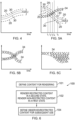
- the content 2 when first rendered includes content within the observation field of perception 30. Once content is rendered within the observation field of perception 30 it is considered observed and the content rendered within the observation field of perception 30 is observed content 32. Once observed, the observed content 32 within the observation field of perception 30 may be designated in whole or in part as restricted content. Once content is designated as restricted, its use may be restricted, for example as illustrated in Fig 5A .
- Observed content 32 may be designated as restricted content 34 when a threshold is exceeded or based on satisfaction of some other criterion or criteria.
- the threshold for designating observed content 32 as restricted content 34 may, for example, be based upon a number N (N ⁇ 1) of distinct times content has been observed content 32 or based on a cumulative duration content has been observed content 32.
- a distinct time may be a time separated from a preceding time by a minimum time duration or may be a time in a different session or may be a time separated from a preceding time by a minimum time duration and that is in a different session.
- a session is a period of persistent use without interruption it may, for example, be a content session (rendering of the same specific content only) or may be an application session (instantiation of the rendering application).
- the viewing direction A is restricted between 0-10 seconds and between 30-60 seconds, the content C(A[0-10]) and C(A[30-60]) is restricted, also the viewing direction B is restricted between 10-30 seconds, the content C(B[10-30]) and is restricted.
- the viewing direction A is restricted at x seconds and y seconds
- the content C(A[x]) and C(A[y]) is restricted content 34
- the viewing direction B ( t ) is restricted between x-y seconds
- the content C(B [x->y]) is restricted content 34.
- Fig 5C illustrates an example embodiment in which, when content has been designated as restricted content 34, the same or similar content is designated restricted content 34 for subsequent times. This may, for example, be achieved by using computer vision to identify portions of subsequent content that correspond to content previously designated as restricted 34. This may, for example be achieved by using feature extract and comparison or other techniques. Although, for the sake of convenience of illustration the content is displayed on a notional single 'content' axis that maps non-overlapping content to a different value, alternatively the single content axis may be multiple orthogonal axes.
- observed content 32 may be designated as restricted content 34 when a threshold is exceeded.
- the threshold for designating observed content 32 as restricted content 34 may, for example, be based upon a number N (N ⁇ 1) of distinct times content has been observed content 32 or based on a cumulative duration content has been observed content 32.
- each rendering up to and including an N th rendering of the observed content 32 is in the first state 41 and each rendering after and including an (N+1) th rendering of the observed content 32 is in the second state 42.
- a first rendering of the observed content 32 is in a first state 41 when the observed content 32 is first observed and any subsequent rendering of the observed content 32 is in the second state 42. Subsequent rendering may require there to be a delay of at least a predetermined duration.
- the content 2 for rendering is visual content
- the time-varying content 2 for rendering may be sound content.
- the rendering field of perception 20 may be a front field of hearing for the user.
- the second state may, for example, be a state that is less audible relative to the first state 41. For example, it may obscure content, remove content or have a lower intensity/volume or may be muted.
- the content C(A[0-10]), C(B[10-30] and C(A[30-60]) is not restricted.
- the observed content becomes restricted.
- content is designated as restricted content irrespective of its location within the rendering field of perception 20.
- content may be conditionally designated as restricted content such that it is treated as restricted content only when it occupies a certain location within the rendering field of perception 20.
- content for rendering may only be restricted content if it occupies a defined area in a plane orthogonal to the perception direction 10.
- a whole collection of content e.g. a visual object
- a whole collection of content e.g.
- the rendered sound space When a sound scene is rendered to a listener through a headset 200 using binaural audio coding, it may be desirable for the rendered sound space, the virtual space, to remain fixed in real space when the listener turns their head in space. This means the rendered sound space needs to be rotated relative to the head-mounted audio output device by the same amount in the opposite sense to the head rotation.
- the orientation of the rendered sound space tracks with the rotation of the listener's head (user perception direction) so that the rendered sound space remains fixed in space and does not move with the listener's head.
- the system may use a transfer function to perform a transformation that rotates the sound objects within the sound space, for example, a head-related transfer function (HRTF) interpolator may be used for binaural audio.
- HRTF head-related transfer function
- VBAP Vector-based amplitude panning,
- loudspeaker format e.g. 5.1
- the sender of the message and the receiver of the message may use different example embodiments of the same apparatus 200.
- circuitry refers to all of the following:
Landscapes
- Engineering & Computer Science (AREA)
- Physics & Mathematics (AREA)
- General Engineering & Computer Science (AREA)
- Theoretical Computer Science (AREA)
- General Physics & Mathematics (AREA)
- Human Computer Interaction (AREA)
- Optics & Photonics (AREA)
- Computer Graphics (AREA)
- Computer Hardware Design (AREA)
- Software Systems (AREA)
- User Interface Of Digital Computer (AREA)
Claims (14)
- Verfahren, das Folgendes umfasst:Erhalten einer Benutzerwahrnehmungsrichtung (10), wobei die Benutzerwahrnehmungsrichtung (10) eine Richtung einer Benutzerausrichtung oder eine Richtung eines Benutzerblicks ist;Rendern eines Abschnitts eines Inhalts (2) zum Rendern, der nicht als eingeschränkter Inhalt (34) definiert ist, in einem ersten Zustand (41) und eines Abschnitts des Inhalts (2) zum Rendern, der als eingeschränkter Inhalt (34) definiert ist, in einem zweiten Zustand (42), der sich vom ersten Zustand (41) unterscheidet, wobei ein Inhalt (2) zum Rendern ein visueller Inhalt und/oder ein Toninhalt ist; undVerwenden einer Kombination der Benutzerwahrnehmungsrichtung (10) und eines Betrachtungsfeldes der Wahrnehmung, um einen eingeschränkten Inhalt (34) zu definieren, wobei das Betrachtungsfeld definiert, was aus der Benutzerwahrnehmungsrichtung (10) als zu betrachten giltdadurch gekennzeichnet, dasseingeschränkter Inhalt (34) Inhalt (2) zum Rendern ist, der aus einer Benutzerwahrnehmungsrichtung (10) als zuvor zu betrachten gilt.
- Verfahren nach Anspruch 1, das das Verwenden einer Kombination aus der Benutzerwahrnehmungsrichtung und einem Renderfeld der Wahrnehmung umfasst, um den Inhalt zum Rendern zu definieren.
- Verfahren nach Anspruch 2, wobei das Renderfeld der Wahrnehmung eines von mehreren verschiedenen Ränderfeldern der Wahrnehmung ist, die sich überlappen, um eine visuelle Szene abzudecken, die sich in einer horizontalen Ebene um mindestens 180° und in einer vertikalen Ebene um mindestens 60° erstreckt.
- Verfahren nach einem der vorhergehenden Ansprüche, wobei das Betrachtungsfeld der Wahrnehmung mindestens in einer Dimension kleiner ist als das Renderfeld der Wahrnehmung oder wobei das Betrachtungsfeld der Wahrnehmung in allen Dimensionen kleiner ist als das Renderfeld der Wahrnehmung.
- Verfahren nach einem der vorhergehenden Ansprüche, wobei der zweite Zustand mit Bezug auf den ersten Zustand beschränkt ist und/oder der zweite Zustand einen geringeren Informationsinhalt aufweist als der erste Zustand.
- Verfahren nach einem der vorhergehenden Ansprüche, wobei der Inhalt zum Rendern ein Standbild ist, wobei das Verfahren das Verwenden einer Kombination der Benutzerwahrnehmungsrichtung und des Betrachtungsfeldes der Wahrnehmung über eine kumulative Betrachtungszeit umfasst, um einen eingeschränkten Inhalt des Standbilds zu definieren.
- Verfahren nach einem der Ansprüche 1 bis 5, wobei der Inhalt zum Rendern einen zeitlich variierenden Inhalt umfasst, wobei das Verfahren das Verwenden einer Kombination der Benutzerwahrnehmungsrichtung und des Betrachtungsfeldes der Wahrnehmung zu einer ersten relativen Zeit umfasst, um einen eingeschränkten Inhalt des zeitlich variierenden Inhalts für nachfolgende relative Zeiten zu definieren, wobei das Verfahren Folgendes umfasst:Verwenden einer Kombination einer Benutzerwahrnehmungsrichtung zu einer zweiten relativen Zeit, die der ersten relativen Zeit nachfolgt, und des Renderfeldes der Wahrnehmung, um einen Inhalt zum Rendern zur zweiten relativen Zeit zu definieren;Rendern eines Abschnitts des Inhalts zum Rendern, der nicht als eingeschränkter Inhalt definiert ist, in einem ersten Zustand zur zweiten relativen Zeit und Rendern eines Abschnitts des Inhalts zum Rendern, der als eingeschränkter Inhalt definiert ist, in einem zweiten Zustand zur zweiten relativen Zeit, der sich vom ersten Zustand unterscheidet, undVerwenden einer Kombination der Benutzerwahrnehmungsrichtung zur zweiten relativen Zeit und des Betrachtungsfeldes der Wahrnehmung, um eine Neudefinition des eingeschränkten Inhalts für relative Zeiten, die der zweiten relativen Zeit nachfolgen, zu ermöglichen.
- Verfahren nach einem der Ansprüche 1 bis 5, wobei der visuelle Bildinhalt zeitlich variierende Bilder zu verschiedenen relativen Zeiten umfasst, wobei das Verfahren das Verwenden einer Kombination einer Benutzerwahrnehmungsrichtung und eines Betrachtungsfeldes der Wahrnehmung zu einer relativen Zeit umfasst, um einen eingeschränkten Inhalt des Standbilds nur zu der Zeit und nicht zu einer anderen relativen Zeit zu definieren.
- Verfahren nach einem der vorhergehenden Ansprüche, das das Verwenden der Kombination der Benutzerwahrnehmungsrichtung und eines Betrachtungsfeldes der Wahrnehmung umfasst, um den betrachteten Inhalt zu definieren, wobei sich jedes Rendern bis einschließlich zu einem N-ten Rendern des betrachteten Inhalts im ersten Zustand befindet und sich jedes Rendern nach einschließlich einem (N+1)-ten Rendern des betrachteten Inhalts im zweiten Zustand befindet, und/oder das Verwenden der Kombination einer Benutzerwahrnehmungsrichtung und eines Betrachtungsfeldes der Wahrnehmung umfasst, um einen betrachteten Inhalt zu definieren, wobei sich das erste Rendern des betrachteten Inhalts im ersten Zustand befindet und sich jedes nachfolgende Ändern des betrachteten Inhalts im zweiten Zustand befindet.
- Verfahren nach einem der vorhergehenden Ansprüche, das Folgendes umfasst:Verwenden einer Kombination einer Benutzerwahrnehmungsrichtung und eines Anzeigesichtfeldes, um den visuellen Inhalt für eine Anzeige zu definieren;Anzeigen eines Abschnitts des visuellen Inhalts zum Anzeigen, der nicht als eingeschränkter visueller Inhalt definiert ist, in einem ersten Zustand und Anzeigen eines Abschnitts des visuellen Inhalts zum Anzeigen, der als eingeschränkter Inhalt definiert ist, in einem zweiten Zustand, der sich vom ersten Zustand unterscheidet; undVerwenden einer Kombination der Benutzerwahrnehmungsrichtung und eines Betrachtungssichtfeldes, um einen betrachteten Inhalt zu definieren, wobei die Definition eines betrachteten Inhalts verwendet wird, um eine Neudefinition des eingeschränkten Inhalts für eine nachfolgende Verwendung zu ermöglichen, wobei der visuelle Inhalt statisch ist und über die Zeit nicht variiert,
oderVerwenden einer Kombination der Benutzerwahrnehmungsrichtung zu einer ersten relativen Zeit und eines Anzeigesichtfeldes zu einer ersten relativen Zeit, um den visuellen Inhalt zum Anzeigen zur ersten Zeit zu definieren;Anzeigen eines Abschnitts des visuellen Inhalts zum Anzeigen, der zur ersten relativen Zeit nicht als eingeschränkter visueller Inhalt definiert ist, in einem ersten Zustand zur ersten relativen Zeit und Anzeigen eines Abschnitts des visuellen Inhalts zum Anzeigen, der zur ersten relativen Zeit als eingeschränkter visueller Inhalt definiert ist, in einem zweiten Zustand zur ersten Zeit undVerwenden einer Kombination der Benutzerwahrnehmungsrichtung und eines Betrachtungssichtfeldes, um einen betrachteten visuellen Inhalt zur ersten relativen Zeit zu definieren, wobei die Definition eines betrachteten Inhalts zur ersten relativen Zeit verwendet wird, um eine Neudefinition des eingeschränkten Inhalts zur ersten relativen Zeit für eine nachfolgende Verwendung zu ermöglichen, wobei der visuelle Inhalt variabel ist und über die Zeit variiert. - Verfahren nach einem der vorhergehenden Ansprüche, das Folgendes umfasst:Verwenden einer Kombination der Benutzerwahrnehmungsrichtung zu einer ersten relativen Zeit und eines vordereb Hörfeldes, um den Toninhalt zum Rendern zur ersten Zeit zu definieren;Rendern eines Abschnitts des Toninhalts zum Rendern, der für die erste relative Zeit nicht als eingeschränkter Toninhalt definiert ist, in einem ersten Zustand zur ersten relativen Zeit und Rendern eines Abschnitts des Toninhalts zum Rendern, der für die erste relative Zeit als eingeschränkter Toninhalt definiert ist, in einem zweiten Zustand zur ersten Zeit, der sich vom ersten Zustand unterscheidet; undVerwenden einer Kombination der Benutzerwahrnehmungsrichtung und eines vorderen Hörfeldes, um einen betrachteten Toninhalt zur ersten relativen Zeit zu definieren, wobei die Definition des betrachteten Toninhalts zur ersten relativen Zeit verwendet wird, um eine Neudefinition des eingeschränkten Toninhalts zur ersten relativen Zeit für eine nachfolgende Verwendung zu ermöglichen, wobei der Toninhalt variabel ist und über die Zeit variiert.
- Verfahren nach Anspruch 10 oder 11, wobei die relative Zeit eine Zeit während einer Wiedergabe eines gerenderten Inhalts ist.
- Datenverarbeitungsvorrichtung, die Mittel zum Durchführen der Verfahrensschritte von einem der Ansprüche 1 bis 12 umfasst.
- Computerprogramm, das Anweisungen umfasst, die, wenn das Programm von einem Computer ausgeführt wird, den Computer veranlassen, die Schritte des Verfahrens von einem der Verfahrensansprüche 1 bis 12 umzusetzen.
Priority Applications (3)
| Application Number | Priority Date | Filing Date | Title |
|---|---|---|---|
| EP17157594.7A EP3367158B1 (de) | 2017-02-23 | 2017-02-23 | Darstellung von inhalt |
| US16/487,596 US11868520B2 (en) | 2017-02-23 | 2018-02-20 | Rendering content |
| PCT/FI2018/050120 WO2018154178A1 (en) | 2017-02-23 | 2018-02-20 | Rendering content |
Applications Claiming Priority (1)
| Application Number | Priority Date | Filing Date | Title |
|---|---|---|---|
| EP17157594.7A EP3367158B1 (de) | 2017-02-23 | 2017-02-23 | Darstellung von inhalt |
Publications (2)
| Publication Number | Publication Date |
|---|---|
| EP3367158A1 EP3367158A1 (de) | 2018-08-29 |
| EP3367158B1 true EP3367158B1 (de) | 2025-04-09 |
Family
ID=58185304
Family Applications (1)
| Application Number | Title | Priority Date | Filing Date |
|---|---|---|---|
| EP17157594.7A Active EP3367158B1 (de) | 2017-02-23 | 2017-02-23 | Darstellung von inhalt |
Country Status (3)
| Country | Link |
|---|---|
| US (1) | US11868520B2 (de) |
| EP (1) | EP3367158B1 (de) |
| WO (1) | WO2018154178A1 (de) |
Families Citing this family (1)
| Publication number | Priority date | Publication date | Assignee | Title |
|---|---|---|---|---|
| CN112995551A (zh) * | 2021-02-05 | 2021-06-18 | 海信视像科技股份有限公司 | 一种声音控制方法及显示设备 |
Family Cites Families (15)
| Publication number | Priority date | Publication date | Assignee | Title |
|---|---|---|---|---|
| US20070245376A1 (en) * | 2006-04-13 | 2007-10-18 | Concert Technology Corporation | Portable media player enabled to obtain previews of media content |
| US20150309316A1 (en) * | 2011-04-06 | 2015-10-29 | Microsoft Technology Licensing, Llc | Ar glasses with predictive control of external device based on event input |
| US9122053B2 (en) * | 2010-10-15 | 2015-09-01 | Microsoft Technology Licensing, Llc | Realistic occlusion for a head mounted augmented reality display |
| US10120438B2 (en) | 2011-05-25 | 2018-11-06 | Sony Interactive Entertainment Inc. | Eye gaze to alter device behavior |
| US9897805B2 (en) * | 2013-06-07 | 2018-02-20 | Sony Interactive Entertainment Inc. | Image rendering responsive to user actions in head mounted display |
| US8799365B2 (en) * | 2011-09-28 | 2014-08-05 | Verizon Patent And Licensing Inc. | Broker-based management of mobile devices |
| ITTO20111150A1 (it) * | 2011-12-14 | 2013-06-15 | Univ Degli Studi Genova | Rappresentazione stereoscopica tridimensionale perfezionata di oggetti virtuali per un osservatore in movimento |
| WO2013093565A1 (en) * | 2011-12-22 | 2013-06-27 | Nokia Corporation | Spatial audio processing apparatus |
| US9230076B2 (en) * | 2012-08-30 | 2016-01-05 | Microsoft Technology Licensing, Llc | Mobile device child share |
| JP6174870B2 (ja) * | 2013-03-06 | 2017-08-02 | キヤノン株式会社 | 放射線撮像システム、制御装置、制御方法およびプログラム |
| US9984505B2 (en) * | 2014-09-30 | 2018-05-29 | Sony Interactive Entertainment Inc. | Display of text information on a head-mounted display |
| US9804669B2 (en) * | 2014-11-07 | 2017-10-31 | Eye Labs, Inc. | High resolution perception of content in a wide field of view of a head-mounted display |
| US9875346B2 (en) * | 2015-02-06 | 2018-01-23 | Apple Inc. | Setting and terminating restricted mode operation on electronic devices |
| CN107852521B (zh) * | 2015-08-07 | 2023-04-11 | 苹果公司 | 用于显示图像流的系统和方法 |
| US20180061084A1 (en) * | 2016-08-24 | 2018-03-01 | Disney Enterprises, Inc. | System and method of bandwidth-sensitive rendering of a focal area of an animation |
-
2017
- 2017-02-23 EP EP17157594.7A patent/EP3367158B1/de active Active
-
2018
- 2018-02-20 WO PCT/FI2018/050120 patent/WO2018154178A1/en not_active Ceased
- 2018-02-20 US US16/487,596 patent/US11868520B2/en active Active
Also Published As
| Publication number | Publication date |
|---|---|
| WO2018154178A1 (en) | 2018-08-30 |
| US11868520B2 (en) | 2024-01-09 |
| US20200057493A1 (en) | 2020-02-20 |
| EP3367158A1 (de) | 2018-08-29 |
Similar Documents
| Publication | Publication Date | Title |
|---|---|---|
| TWI712918B (zh) | 擴增實境的影像展示方法、裝置及設備 | |
| EP4005201B1 (de) | Verfahren, systeme und medien zur wiedergabe von immersivem videoinhalt mit fovea-meshes | |
| CN112987914A (zh) | 用于内容放置的方法和设备 | |
| US11287881B2 (en) | Presenting images on a display device | |
| WO2018069570A1 (en) | Display of visual data with a virtual reality headset | |
| CN114207557A (zh) | 虚拟和物理相机的位置同步 | |
| CN111656776A (zh) | 图像处理器、图像处理方法和程序 | |
| JP2023513318A (ja) | マルチメディアコンテンツ | |
| EP3367158B1 (de) | Darstellung von inhalt | |
| US10535179B2 (en) | Audio processing | |
| JP7740333B2 (ja) | 情報処理装置及び情報処理方法 | |
| CN109313823B (zh) | 信息处理装置、信息处理方法和计算机可读介质 | |
| CN116546179A (zh) | 图像处理装置、图像处理方法、以及存储介质 | |
| WO2018173445A1 (ja) | 情報処理装置、情報処理方法、情報処理システム、及びプログラム | |
| US20240221337A1 (en) | 3d spotlight | |
| EP4542986A2 (de) | Visuelle techniken für 3d-inhalt | |
| US20260094341A1 (en) | Viewer Motion Compensation | |
| KR20250087713A (ko) | Vr/ar 헤드셋의 제어 | |
| EP3576407A1 (de) | Stereoskopischer inhalt |
Legal Events
| Date | Code | Title | Description |
|---|---|---|---|
| PUAI | Public reference made under article 153(3) epc to a published international application that has entered the european phase |
Free format text: ORIGINAL CODE: 0009012 |
|
| STAA | Information on the status of an ep patent application or granted ep patent |
Free format text: STATUS: THE APPLICATION HAS BEEN PUBLISHED |
|
| AK | Designated contracting states |
Kind code of ref document: A1 Designated state(s): AL AT BE BG CH CY CZ DE DK EE ES FI FR GB GR HR HU IE IS IT LI LT LU LV MC MK MT NL NO PL PT RO RS SE SI SK SM TR |
|
| AX | Request for extension of the european patent |
Extension state: BA ME |
|
| STAA | Information on the status of an ep patent application or granted ep patent |
Free format text: STATUS: REQUEST FOR EXAMINATION WAS MADE |
|
| 17P | Request for examination filed |
Effective date: 20190227 |
|
| RBV | Designated contracting states (corrected) |
Designated state(s): AL AT BE BG CH CY CZ DE DK EE ES FI FR GB GR HR HU IE IS IT LI LT LU LV MC MK MT NL NO PL PT RO RS SE SI SK SM TR |
|
| STAA | Information on the status of an ep patent application or granted ep patent |
Free format text: STATUS: EXAMINATION IS IN PROGRESS |
|
| 17Q | First examination report despatched |
Effective date: 20190522 |
|
| RAP1 | Party data changed (applicant data changed or rights of an application transferred) |
Owner name: NOKIA TECHNOLOGIES OY |
|
| RIC1 | Information provided on ipc code assigned before grant |
Ipc: G02B 27/00 20060101ALI20230308BHEP Ipc: G06T 19/00 20110101ALI20230308BHEP Ipc: G06F 3/01 20060101ALI20230308BHEP Ipc: G03H 1/22 20060101ALI20230308BHEP Ipc: G03H 1/08 20060101ALI20230308BHEP Ipc: G02B 27/01 20060101AFI20230308BHEP |
|
| GRAP | Despatch of communication of intention to grant a patent |
Free format text: ORIGINAL CODE: EPIDOSNIGR1 |
|
| STAA | Information on the status of an ep patent application or granted ep patent |
Free format text: STATUS: GRANT OF PATENT IS INTENDED |
|
| INTG | Intention to grant announced |
Effective date: 20241030 |
|
| GRAS | Grant fee paid |
Free format text: ORIGINAL CODE: EPIDOSNIGR3 |
|
| GRAA | (expected) grant |
Free format text: ORIGINAL CODE: 0009210 |
|
| STAA | Information on the status of an ep patent application or granted ep patent |
Free format text: STATUS: THE PATENT HAS BEEN GRANTED |
|
| AK | Designated contracting states |
Kind code of ref document: B1 Designated state(s): AL AT BE BG CH CY CZ DE DK EE ES FI FR GB GR HR HU IE IS IT LI LT LU LV MC MK MT NL NO PL PT RO RS SE SI SK SM TR |
|
| REG | Reference to a national code |
Ref country code: GB Ref legal event code: FG4D |
|
| REG | Reference to a national code |
Ref country code: CH Ref legal event code: EP |
|
| REG | Reference to a national code |
Ref country code: DE Ref legal event code: R096 Ref document number: 602017088777 Country of ref document: DE |
|
| REG | Reference to a national code |
Ref country code: IE Ref legal event code: FG4D |
|
| REG | Reference to a national code |
Ref country code: NL Ref legal event code: MP Effective date: 20250409 |
|
| PG25 | Lapsed in a contracting state [announced via postgrant information from national office to epo] |
Ref country code: NL Free format text: LAPSE BECAUSE OF FAILURE TO SUBMIT A TRANSLATION OF THE DESCRIPTION OR TO PAY THE FEE WITHIN THE PRESCRIBED TIME-LIMIT Effective date: 20250409 |
|
| REG | Reference to a national code |
Ref country code: AT Ref legal event code: MK05 Ref document number: 1784037 Country of ref document: AT Kind code of ref document: T Effective date: 20250409 |
|
| PG25 | Lapsed in a contracting state [announced via postgrant information from national office to epo] |
Ref country code: FI Free format text: LAPSE BECAUSE OF FAILURE TO SUBMIT A TRANSLATION OF THE DESCRIPTION OR TO PAY THE FEE WITHIN THE PRESCRIBED TIME-LIMIT Effective date: 20250409 Ref country code: ES Free format text: LAPSE BECAUSE OF FAILURE TO SUBMIT A TRANSLATION OF THE DESCRIPTION OR TO PAY THE FEE WITHIN THE PRESCRIBED TIME-LIMIT Effective date: 20250409 Ref country code: PT Free format text: LAPSE BECAUSE OF FAILURE TO SUBMIT A TRANSLATION OF THE DESCRIPTION OR TO PAY THE FEE WITHIN THE PRESCRIBED TIME-LIMIT Effective date: 20250811 |
|
| REG | Reference to a national code |
Ref country code: LT Ref legal event code: MG9D |
|
| PG25 | Lapsed in a contracting state [announced via postgrant information from national office to epo] |
Ref country code: GR Free format text: LAPSE BECAUSE OF FAILURE TO SUBMIT A TRANSLATION OF THE DESCRIPTION OR TO PAY THE FEE WITHIN THE PRESCRIBED TIME-LIMIT Effective date: 20250710 Ref country code: NO Free format text: LAPSE BECAUSE OF FAILURE TO SUBMIT A TRANSLATION OF THE DESCRIPTION OR TO PAY THE FEE WITHIN THE PRESCRIBED TIME-LIMIT Effective date: 20250709 |
|
| PG25 | Lapsed in a contracting state [announced via postgrant information from national office to epo] |
Ref country code: PL Free format text: LAPSE BECAUSE OF FAILURE TO SUBMIT A TRANSLATION OF THE DESCRIPTION OR TO PAY THE FEE WITHIN THE PRESCRIBED TIME-LIMIT Effective date: 20250409 |
|
| PG25 | Lapsed in a contracting state [announced via postgrant information from national office to epo] |
Ref country code: BG Free format text: LAPSE BECAUSE OF FAILURE TO SUBMIT A TRANSLATION OF THE DESCRIPTION OR TO PAY THE FEE WITHIN THE PRESCRIBED TIME-LIMIT Effective date: 20250409 |
|
| PG25 | Lapsed in a contracting state [announced via postgrant information from national office to epo] |
Ref country code: HR Free format text: LAPSE BECAUSE OF FAILURE TO SUBMIT A TRANSLATION OF THE DESCRIPTION OR TO PAY THE FEE WITHIN THE PRESCRIBED TIME-LIMIT Effective date: 20250409 |
|
| PG25 | Lapsed in a contracting state [announced via postgrant information from national office to epo] |
Ref country code: AT Free format text: LAPSE BECAUSE OF FAILURE TO SUBMIT A TRANSLATION OF THE DESCRIPTION OR TO PAY THE FEE WITHIN THE PRESCRIBED TIME-LIMIT Effective date: 20250409 |
|
| PG25 | Lapsed in a contracting state [announced via postgrant information from national office to epo] |
Ref country code: RS Free format text: LAPSE BECAUSE OF FAILURE TO SUBMIT A TRANSLATION OF THE DESCRIPTION OR TO PAY THE FEE WITHIN THE PRESCRIBED TIME-LIMIT Effective date: 20250709 |
|
| PG25 | Lapsed in a contracting state [announced via postgrant information from national office to epo] |
Ref country code: IS Free format text: LAPSE BECAUSE OF FAILURE TO SUBMIT A TRANSLATION OF THE DESCRIPTION OR TO PAY THE FEE WITHIN THE PRESCRIBED TIME-LIMIT Effective date: 20250809 |
|
| PG25 | Lapsed in a contracting state [announced via postgrant information from national office to epo] |
Ref country code: LV Free format text: LAPSE BECAUSE OF FAILURE TO SUBMIT A TRANSLATION OF THE DESCRIPTION OR TO PAY THE FEE WITHIN THE PRESCRIBED TIME-LIMIT Effective date: 20250409 |
|
| REG | Reference to a national code |
Ref country code: DE Ref legal event code: R097 Ref document number: 602017088777 Country of ref document: DE |
|
| PG25 | Lapsed in a contracting state [announced via postgrant information from national office to epo] |
Ref country code: DK Free format text: LAPSE BECAUSE OF FAILURE TO SUBMIT A TRANSLATION OF THE DESCRIPTION OR TO PAY THE FEE WITHIN THE PRESCRIBED TIME-LIMIT Effective date: 20250409 Ref country code: SM Free format text: LAPSE BECAUSE OF FAILURE TO SUBMIT A TRANSLATION OF THE DESCRIPTION OR TO PAY THE FEE WITHIN THE PRESCRIBED TIME-LIMIT Effective date: 20250409 |
|
| PG25 | Lapsed in a contracting state [announced via postgrant information from national office to epo] |
Ref country code: CZ Free format text: LAPSE BECAUSE OF FAILURE TO SUBMIT A TRANSLATION OF THE DESCRIPTION OR TO PAY THE FEE WITHIN THE PRESCRIBED TIME-LIMIT Effective date: 20250409 |
|
| PG25 | Lapsed in a contracting state [announced via postgrant information from national office to epo] |
Ref country code: EE Free format text: LAPSE BECAUSE OF FAILURE TO SUBMIT A TRANSLATION OF THE DESCRIPTION OR TO PAY THE FEE WITHIN THE PRESCRIBED TIME-LIMIT Effective date: 20250409 |
|
| PG25 | Lapsed in a contracting state [announced via postgrant information from national office to epo] |
Ref country code: SK Free format text: LAPSE BECAUSE OF FAILURE TO SUBMIT A TRANSLATION OF THE DESCRIPTION OR TO PAY THE FEE WITHIN THE PRESCRIBED TIME-LIMIT Effective date: 20250409 Ref country code: RO Free format text: LAPSE BECAUSE OF FAILURE TO SUBMIT A TRANSLATION OF THE DESCRIPTION OR TO PAY THE FEE WITHIN THE PRESCRIBED TIME-LIMIT Effective date: 20250409 |
|
| PG25 | Lapsed in a contracting state [announced via postgrant information from national office to epo] |
Ref country code: IT Free format text: LAPSE BECAUSE OF FAILURE TO SUBMIT A TRANSLATION OF THE DESCRIPTION OR TO PAY THE FEE WITHIN THE PRESCRIBED TIME-LIMIT Effective date: 20250409 |
|
| PLBE | No opposition filed within time limit |
Free format text: ORIGINAL CODE: 0009261 |
|
| STAA | Information on the status of an ep patent application or granted ep patent |
Free format text: STATUS: NO OPPOSITION FILED WITHIN TIME LIMIT |
|
| REG | Reference to a national code |
Ref country code: CH Ref legal event code: L10 Free format text: ST27 STATUS EVENT CODE: U-0-0-L10-L00 (AS PROVIDED BY THE NATIONAL OFFICE) Effective date: 20260218 |
|
| 26N | No opposition filed |
Effective date: 20260112 |
|
| PGFP | Annual fee paid to national office [announced via postgrant information from national office to epo] |
Ref country code: GB Payment date: 20260106 Year of fee payment: 10 |
|
| PGFP | Annual fee paid to national office [announced via postgrant information from national office to epo] |
Ref country code: DE Payment date: 20260102 Year of fee payment: 10 |