EP3367290A1 - Systèmes, procédés et produits-programme informatiques pour combiner des technologies d'amélioration de la sphère privée - Google Patents
Systèmes, procédés et produits-programme informatiques pour combiner des technologies d'amélioration de la sphère privée Download PDFInfo
- Publication number
- EP3367290A1 EP3367290A1 EP18158954.0A EP18158954A EP3367290A1 EP 3367290 A1 EP3367290 A1 EP 3367290A1 EP 18158954 A EP18158954 A EP 18158954A EP 3367290 A1 EP3367290 A1 EP 3367290A1
- Authority
- EP
- European Patent Office
- Prior art keywords
- privacy
- pets
- pet
- data
- taxonomy
- Prior art date
- Legal status (The legal status is an assumption and is not a legal conclusion. Google has not performed a legal analysis and makes no representation as to the accuracy of the status listed.)
- Withdrawn
Links
Images





Classifications
-
- G—PHYSICS
- G06—COMPUTING OR CALCULATING; COUNTING
- G06F—ELECTRIC DIGITAL DATA PROCESSING
- G06F21/00—Security arrangements for protecting computers, components thereof, programs or data against unauthorised activity
- G06F21/60—Protecting data
-
- G—PHYSICS
- G06—COMPUTING OR CALCULATING; COUNTING
- G06F—ELECTRIC DIGITAL DATA PROCESSING
- G06F16/00—Information retrieval; Database structures therefor; File system structures therefor
- G06F16/90—Details of database functions independent of the retrieved data types
- G06F16/901—Indexing; Data structures therefor; Storage structures
- G06F16/9027—Trees
-
- G—PHYSICS
- G06—COMPUTING OR CALCULATING; COUNTING
- G06F—ELECTRIC DIGITAL DATA PROCESSING
- G06F16/00—Information retrieval; Database structures therefor; File system structures therefor
- G06F16/90—Details of database functions independent of the retrieved data types
- G06F16/903—Querying
- G06F16/90335—Query processing
- G06F16/90348—Query processing by searching ordered data, e.g. alpha-numerically ordered data
-
- G—PHYSICS
- G06—COMPUTING OR CALCULATING; COUNTING
- G06F—ELECTRIC DIGITAL DATA PROCESSING
- G06F17/00—Digital computing or data processing equipment or methods, specially adapted for specific functions
- G06F17/10—Complex mathematical operations
-
- H—ELECTRICITY
- H04—ELECTRIC COMMUNICATION TECHNIQUE
- H04L—TRANSMISSION OF DIGITAL INFORMATION, e.g. TELEGRAPHIC COMMUNICATION
- H04L63/00—Network architectures or network communication protocols for network security
- H04L63/20—Network architectures or network communication protocols for network security for managing network security; network security policies in general
- H04L63/205—Network architectures or network communication protocols for network security for managing network security; network security policies in general involving negotiation or determination of the one or more network security mechanisms to be used, e.g. by negotiation between the client and the server or between peers or by selection according to the capabilities of the entities involved
-
- H—ELECTRICITY
- H04—ELECTRIC COMMUNICATION TECHNIQUE
- H04W—WIRELESS COMMUNICATION NETWORKS
- H04W12/00—Security arrangements; Authentication; Protecting privacy or anonymity
- H04W12/03—Protecting confidentiality, e.g. by encryption
Definitions
- the present invention relates generally to software, and more particularly to analytics software such as IoT (internet of things) analytics.
- IoT internet of things
- Privacy metrics for IT systems are known including sophisticated privacy metrics like entropy, indistinguishability and weighting of goal values.
- Example PETs and application of privacy metrics thereto are described in Funke et al, "Constrained PET Composition for Measuring Enforced Privacy", 2017 , available on the Internet. Generally, what is to be achieved in terms of privacy is deemed a goal, whereas the technology used to achieve the goal/s is deemed a PET.
- PETs is used to denote the plural of PET (Privacy Enhancing Technologies).
- Privacy metrics for single PETs are known, such as Tor's set-based anonymity metric, and Delta-Privacy. Privacy metrics are used in the field to measure the fulfillment of a specific privacy goal a PET has (e.g. Unlinkability for Tor's set-based anonymity metric. Differential privacy and k-anonymity measure how uniquely identifiable a user is who stores a data-record in a database of other records).
- Certain embodiments seek to provide a Privacy Enhancing Technologies (PETs) combiner system typically characterized by a set-based taxonomy and/or composition algebra where Privacy Enhancing Technologies (PETs) are intended to include any typically well-defined, typically domain-specific technology operative to preserve privacy in computerized systems and technologies such as but not limited to Intelligent Software Agents (ISAs), networks, human computer interfaces, public key infrastructures, cryptography and data mining and matching.
- PTTs Privacy Enhancing Technologies
- Certain embodiments seek to enhance existing technologies such as but not limited to Heed, Heed verticals, Scale, CityMind, PBR, Smart Vehicles, with privacy features, in fields such as OTT content, (Social) IoT, or Smart Cities.
- Certain embodiments seek to provide a domain-independent solution operative to provide privacy-enhanced services composed out of multiple PETs, including formally describing properties of the composed PET system especially for use cases where PETs are dynamically selected and change on the fly, e.g. by contextual policy driven infrastructures.
- different PETs have different characteristics such as different scenarios, application domains, threat models, privacy goals etc. so, for example, when composing two PETs, PET1 on pseudonymity and PET2 on un-traceability, it is not necessarily the case that the resulting PET system preserves all properties of each the two individual PETs, PET1 and PET2. Instead, a weakness of one of the PETs, e.g. reversibility, may override the resilience of the other PET in the composed system.
- the composer system enable enforcing a freely configurable balance between user privacy and service provider business goals.
- the system employs a formal, set-based and domain-independent taxonomy model for PETs, and/or an algebra for constrained composition of PETs.
- the system is operative for measurement of enforced privacy in service infrastructures.
- Certain embodiments seek to provide a PET ecosystem, which would work similar to an online cell-app store (e.g. Apple AppStore / Google PlayStore), where contributors can curate values assigned to PETs.
- an online cell-app store e.g. Apple AppStore / Google PlayStore
- Certain embodiments seek to provide a system and method for fulfilling multiple privacy requirements or goals (e.g. unlinkability + confidentiality + awareness) including combining multiple raw or individual or basic PETs (for each of which, a formal definition of which privacy requirements are covered by that raw PET is available) and generating, computationally, a formal definition of which privacy requirements are and are not covered by this combination, since certain requirements might be perturbed by certain PET combination choices (e.g. if weak attributes taint stronger ones) which would, absent the system and methods shown and described herein, be unknown.
- multiple privacy requirements or goals e.g. unlinkability + confidentiality + awareness
- Certain embodiments are also applicable to areas of context other than privacy benefitting from formal building block composition, such as but not limited to (a) data analytics, where analytic modules, rather than PTEs are combined, e.g. into an analytics chain. and (b) business workflows, where workflow operations, rather than PETs, may be combined into a workflow, e.g. chain of workflow operations.
- fields and/or values of the taxonomy shown and described herein may be augmented or removed, and/or labels may be changed to labels meaningful in the analytics context and/or dimensions may be suitably classified, not necessarily as classified herein merely by way of example, as either properties or capabilities (or hybrid). Also, constrained unions may, if deemed useful, be suitably defined.
- taxonomy and associated algebra
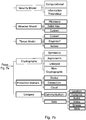
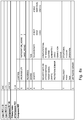
- the " taxonomy” may for example include any PET taxonomy which includes (a) dimensions, e.g. some or all of the dimensions of the taxonomy of Figs. 7a and 7b , taken together, and/or (b) treats some dimensions aka properties as unordered and others aka capabilities as ordered. Some or all capabilities may be quantified over infinite sets, such as the set of all natural numbers, rational numbers or irrational numbers e.g. In the illustrated example, Goals are quantified over the natural numbers. Some or all capabilities may be quantified over finite sets, e.g. in the illustrated example, Reversibility degree is ordered over ⁇ full, partial ⁇ .
- Reversibility is not inherently ordered over ⁇ full, partial ⁇ , and instead the order is introduced by the respective constrained set union that treats (say) "full” as bigger than “partial”.
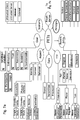
- the taxonomy of Figs. 7a and 7b taken together is an example taxonomy including 8 dimensions abbreviated a g s f p r t d respectively, each typically having descendant nodes including child (aka son) nodes.
- more or less dimensions may be provided.
- any one or more of the dimension sub-trees of Figs. 7a and 7b , taken together may be omitted.
- all of the dimensions of Figs. 7a and 7b , taken together, or any subset thereof may be provided.
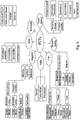
- the taxonomy of Fig. 6 may be employed, minus the Reversibility sub-tree and given a formalization of the taxonomy as sets.
- more or less dimensions may be provided to the taxonomy of Fig. 6 .
- any one or more of the dimension sub-trees of Fig. 6 may be omitted.
- dimension/s in Figs. 7a - 7b may be hybrid - neither pure property nor pure capability.
- “Degree” is a capability
- “Co-operational” and “Deniable” are properties. More generally, dimensions may be properties, capabilities or mixed aka hybrid.
- One use-case of the above system is as a middleware-component aka privacy middleware in a service-provisioning chain, which adds privacy features to usage of the services.
- Some or all of the services themselves may be agnostic to the existence of the PAPI system shown and described herein.
- Each service typically stores and processes end users' data.
- the privacy features may comprise privacy goals of PETs in the middleware such as, say, Unlinkability, Confidentiality, Indistinguishability (or may comprise other PET dimensions such as Aspects, Foundation, etc.).
- the PET Descriptions are provided by the middleware that may derive suitable PETs to use from a negotiated policy.
- the Configuration descriptions may then be delivered either at setup time or later during maintenance by the system administrator.
- a PET system description representing a PET system currently employed, may be delivered back to the middleware.
- the privacy metric if generated by the system of Fig. 5 may be fed to the privacy middleware, thereby to indicate the level of privacy that has been achieved. Both of these outputs, or either one, may be presented to the end user and/or service via a suitable user interface, to inform them of applied privacy measures.
- Service-providers (for a service aware of the middleware) may use the middleware to fulfill compliance requirements (GDPR).
- the service provider may provide its policies directly to the middleware to be used there or there may be a one-to-one mapping between middleware policies and service policies.
- one policy of the middleware may represent multiple policies in the service or vice versa
- one policy of the service may represent multiple policies in the middleware.
- Another use case in which the service provider is aware of the middleware is when the service provider incorporates the PAPI backend into the service provider's system, being directly responsible for some or all of its operation, policies, PETs.
- the service providers may be agnostic to or unaware of the existence of the privacy middleware in which case policy may be negotiated between a PAPI client (e.g. on the mobile phone) and a PAPI backend (e.g. in the Cloud), e.g. as described herein.
- the PAPI backend then ensures that the PAPI policies match the policies of the various services' providers.
- negotiation is not directly with the end-user, but rather with the end-user's device (which has PAPI installed).
- the end-user may, once or on occasion, select a subset of policies (from a given set of policies which may be presented e.g. as a list, via a suitable user interface) that s/he may agree to.
- This set of policies may then (typically automatically and in the background) be compared to the set of policies that are accepted by the service provider. If a matching policy is found (a policy both selected by the end-user and accepted by the service provider), that matching policy is selected. Otherwise, typically, the user either does not use the service or selects/is prompted to select more or other policies from the given set of policies.
- the given set of policies may for example be preinstalled with the client side PAPI installation. Alternatively or in addition, users may create their own policies. Also, policies may be exchanged with other users/ in a community of users.
- reversibility In privacy, reversibility is "undesirable" typically e.g. worse the higher its level is, i.e. full reversibility is bad for privacy while no reversibility is good for privacy i.e. it is typically not desirable for privacy measures to be reversible.
- the resulting PET system preserves all properties of each the two individual PETs, petl and pet2.
- a weakness of one of the PETS e.g. High reversibility, may override the resilience of the other PET in the composed system.
- This situation in which weaker attributes override stronger ones is an example of constrained composition or constrained union.
- the weakest link composition shown and described herein guarantees that the resulting PET system is "at least as strong as its weakest link" e.g. that a combined PET is at least as strong, along each dimension or along each capability, as the weakest value along that dimension or capability, possessed by any of the input PETs .
- weaker and stronger dimension d_w and d_s refer to dimensions whose strengths, for a given PET, are quantified as weaker and stronger respectively.
- the algebra automatically determines which attributes of individual PETs, petl and pet2 are preserved in the combined PET (the combination of petl and pet2) and which are not.
- the algebra achieves this by providing a suitable constrained union, e.g. the weakest link composition or strongest link composition or average goal strength composition, by way of example.
- a particular advantage of certain embodiments is that a new or legacy technology in fields such as OTT content or (Social) IoT may be conveniently provided with tailored privacy features.
- privacy goals such as but not limited to some or all of the following goals: Unlinkability, Indistinguishability, Confidentiality, Deniability, Trust-establishment, Awareness), are embedded in a privacy policy engine, and map to real-world privacy problems such as but not limited to Tracking/profiling of users, disclosure of sensitive data, mistrust due to intransparency, in any information communication technology (ICT).
- ICT information communication technology
- privacy goals may be enforced not only by "raw” PETs but also or alternatively by a combination of those "raw” privacy-preserving/enhancing technologies (PETs) that may be combined based on a policy that is specific to the service/ICT. This yields a computerized system that effectively maintains privacy of data stored therein or transmitted thereby.
- PETs privacy-preserving/enhancing technologies
- a computer program comprising computer program code means for performing any of the methods shown and described herein when the program is run on at least one computer; and a computer program product, comprising a typically non-transitory computer-usable or -readable medium e.g. non-transitory computer -usable or -readable storage medium, typically tangible, having a computer readable program code embodied therein, the computer readable program code adapted to be executed to implement any or all of the methods shown and described herein.
- the operations in accordance with the teachings herein may be performed by at least one computer specially constructed for the desired purposes or a general purpose computer specially configured for the desired purpose by at least one computer program stored in a typically non-transitory computer readable storage medium.
- the term "non-transitory” is used herein to exclude transitory, propagating signals or waves, but to otherwise include any volatile or non-volatile computer memory technology suitable to the application.
- processor/s, display and input means may be used to process, display e.g. on a computer screen or other computer output device, store, and accept information such as information used by or generated by any of the methods and apparatus shown and described herein; the above processor/s, display and input means including computer programs, in accordance with some or all of the embodiments of the present invention.
- Any or all functionalities of the invention shown and described herein, such as but not limited to operations within flowcharts, may be performed by any one or more of: at least one conventional personal computer processor, workstation or other programmable device or computer or electronic computing device or processor, either general-purpose or specifically constructed, used for processing; a computer display screen and/or printer and/or speaker for displaying; machine-readable memory such as optical disks, CDROMs, DVDs, BluRays, magnetic-optical discs or other discs; RAMs, ROMs, EPROMs, EEPROMs, magnetic or optical or other cards, for storing, and keyboard or mouse for accepting.
- Modules shown and described herein may include any one or combination or plurality of: a server, a data processor, a memory/computer storage, a communication interface, a computer program stored in memory/computer storage.
- processor is intended to include any type of computation or manipulation or transformation of data represented as physical, e.g. electronic, phenomena which may occur or reside e.g. within registers and /or memories of at least one computer or processor.
- processor is intended to include a plurality of processing units which may be distributed or remote
- server is intended to include plural typically interconnected modules running on plural respective servers, and so forth.
- the above devices may communicate via any conventional wired or wireless digital communication means, e.g. via a wired or cellular telephone network or a computer network such as the Internet.
- the apparatus of the present invention may include, according to certain embodiments of the invention, machine readable memory containing or otherwise storing a program of instructions which, when executed by the machine, implements some or all of the apparatus, methods, features and functionalities of the invention shown and described herein.
- the apparatus of the present invention may include, according to certain embodiments of the invention, a program as above which may be written in any conventional programming language, and optionally a machine for executing the program such as but not limited to a general purpose computer which may optionally be configured or activated in accordance with the teachings of the present invention. Any of the teachings incorporated herein may, wherever suitable, operate on signals representative of physical objects or substances.
- the term "computer” should be broadly construed to cover any kind of electronic device with data processing capabilities, including, by way of non-limiting example, personal computers, servers, embedded cores, computing system, communication devices, processors (e.g. digital signal processor (DSP), microcontrollers, field programmable gate array (FPGA), application specific integrated circuit (ASIC), etc.) and other electronic computing devices.
- DSP digital signal processor
- FPGA field programmable gate array
- ASIC application specific integrated circuit
- Any reference to a computer, controller or processor is intended to include one or more hardware devices e.g. chips, which may be co-located or remote from one another.
- Any controller or processor may for example comprise at least one CPU, DSP, FPGA or ASIC, suitably configured in accordance with the logic and functionalities described herein.
- an element or feature may exist is intended to include (a) embodiments in which the element or feature exists; (b) embodiments in which the element or feature does not exist; and (c) embodiments in which the element or feature exist selectably e.g. a user may configure or select whether the element or feature does or does not exist.
- Any suitable input device such as but not limited to a sensor, may be used to generate or otherwise provide information received by the apparatus and methods shown and described herein.
- Any suitable output device or display may be used to display or output information generated by the apparatus and methods shown and described herein.
- Any suitable processor/s may be employed to compute or generate information as described herein and/or to perform functionalities described herein and/or to implement any engine, interface or other system described herein.
- Any suitable computerized data storage e.g. computer memory may be used to store information received by or generated by the systems shown and described herein.
- Functionalities shown and described herein may be divided between a server computer and a plurality of client computers. These or any other computerized components shown and described herein may communicate between themselves via a suitable computer network.
- Methods and systems included in the scope of the present invention may include some (e.g. any suitable subset) or all of the functional blocks shown in the specifically illustrated implementations by way of example, in any suitable order e.g. as shown.
- Computational, functional or logical components described and illustrated herein can be implemented in various forms, for example, as hardware circuits such as but not limited to custom VLSI circuits or gate arrays or programmable hardware devices such as but not limited to FPGAs, or as software program code stored on at least one tangible or intangible computer readable medium and executable by at least one processor, or any suitable combination thereof.
- a specific functional component may be formed by one particular sequence of software code, or by a plurality of such, which collectively act or behave or act as described herein with reference to the functional component in question.
- the component may be distributed over several code sequences such as but not limited to objects, procedures, functions, routines and programs and may originate from several computer files which typically operate synergistically.
- Each functionality or method herein may be implemented in software, firmware, hardware or any combination thereof. Functionality or operations stipulated as being software-implemented may alternatively be wholly or fully implemented by an equivalent hardware or firmware module and vice-versa.
- Firmware implementing functionality described herein, if provided, may be held in any suitable memory device and a suitable processing unit (aka processor) may be configured for executing firmware code.
- processor a suitable processing unit
- certain embodiments described herein may be implemented partly or exclusively in hardware in which case some or all of the variables, parameters, and computations described herein may be in hardware.
- modules or functionality described herein may comprise a suitably configured hardware component or circuitry e.g. processor circuitry.
- modules or functionality described herein may be performed by a general purpose computer or more generally by a suitable microprocessor, configured in accordance with methods shown and described herein, or any suitable subset, in any suitable order, of the operations included in such methods, or in accordance with methods known in the art.
- Any logical functionality described herein may be implemented as a real time application if and as appropriate and which may employ any suitable architectural option such as but not limited to FPGA, ASIC or DSP or any suitable combination thereof.
- Any hardware component mentioned herein may in fact include either one or more hardware devices e.g. chips, which may be co-located or remote from one another.
- Any method described herein is intended to include within the scope of the embodiments of the present invention also any software or computer program performing some or all of the method's operations, including a mobile application, platform or operating system e.g. as stored in a medium, as well as combining the computer program with a hardware device to perform some or all of the operations of the method.
- Data may be stored on one or more tangible or intangible computer readable media stored at one or more different locations, different network nodes or different storage devices at a single node or location.
- Suitable computer data storage or information retention apparatus may include apparatus which is primary, secondary, tertiary or off-line; which is of any type or level or amount or category of volatility, differentiation, mutability, accessibility, addressability, capacity, performance and energy use; and which is based on any suitable technologies such as semiconductor, magnetic, optical, paper and others.
- workflow design realizing one, all or any subset of the following:
- a particular advantage of certain embodiments is that the IoT privacy architecture described allows PETs to achieve privacy based on their existing solutions.
- Policy determination may be based on policy context description matching to the context instance resolved for a data request.
- the policy module typically distinguishes between context descriptions and context instances.
- middleware is distributed to provide end-to-end privacy.
- Policy enforcement is typically end-to-end distributed, not limited to access control, and policies are bound to context modalities.
- privacy policies are bound to context modalities.
- enforcement mechanisms are end-to-end.
- a method and system for contextual policy based privacy enforcement using a distributed Privacy Enhancing Technology (PET) framework may be provided.
- PET Privacy Enhancing Technology
- a composed system may include two interacting modules: contextual privacy policies and privacy middleware.
- IoT characteristics e.g., resource constrained heterogeneous device and protocol landscape and IoT middleware, the following are sought:
- the architecture shown and described herein enhances privacy in service infrastructures end-to-end from devices (data source) to services (data sink) with distributed Privacy Enhancing Technology (PET) middleware.
- the middleware typically includes Privacy API (PAPI) and PAPI Backend components.
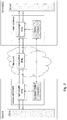
- Fig. 1 shows a generic service provisioning chain with bidirectional data flow (black solid arrows) from device client (left) over a network (center) to a service server (right) in the traditional scenario without privacy enhancement.
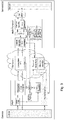
- Fig. 2 shows the privacy enhanced scenario with the two PAPI modules, together functioning as a distributed interceptor, in between.
- Data transfers (1) with payloads from client to server may be intercepted and transformed (from lightweight PETs to connection PETs to heavyweight PETs) without breaking the actual service.
- the client-side PAPI may apply a set of client-side PETs (4).
- PAPI tunnels the data e.g.
- the privatized data may be sent to the service end-point (7) and response returned (8) through PAPI to the client.
- the middlewares set of enabled PETs and their configuration is determined on the fly (3) according a contextual configuration policy (dotted control flow arrows and boxes).
- PAPI resolves per request in real-time the device/user's privacy context (2), e.g. location, time, client id, user id, etc., and determines a context matching policy locally (cached) or remotely with the policy service in PAPI Backend.
- the user's and regulatory privacy requirements associated with a policy may be negotiated out-of-band or in an authorized user interface in PAPI Backend.
- the middleware components may be deployed in arbitrary service layers, e.g. in/outside the service client, in/outside the device, in/outside the service network or in/outside the service server.
- control flows are also tunneled through the middleware.
- the backward/response flows may be treated with the same privacy enhancing chain as the forward flow, but in reverse order. Both control flow and response flow may have different PET chains than the forward flow and their respective PET chains may be different from each other.
- PAPI, PAPI Backend and their PETs may each function as independent services.
- the system is not limited to traditional client-server scenarios.
- the middleware e.g. PAPI
- PAPI Peer-to-Peer
- service cooperation scenarios the middleware typically privatizes communication from PAPI Backend to PAPI Backend instances and single PETs may be used as a service.
- PETs at the server side may be generally the same as for client-side PETs.
- the operation of PETs at the client side may vary, depending on the PET.
- PETs are black boxes with specified interfaces and functionality. Once selected, the data feeds into the PETs yielding results, and the respective results are returned to the system and /or to the next PET in the chain.
- PETs may be implemented as plug-ins, e.g. using a state of the art plugin-system such as provided by OSGI, JPF or Kharrat and Quadri.
- connection PETs typically run outside the client, e.g. as a cloud service.
- connection PETs are called after client side PETs and before server side PETs.
- the PAPI when operating on data, typically intercepts data from other applications on the device, and applies privacy measures via PETs, thereby to yield a "private" output, and forwards the private output to the originally intended recipients.
- Meta Data Adapter may be provided as libraries, services, plug-ins or in any other from by third-parties as part of their standard product portfolio or may be specifically built, using conventional meta-data techniques, by either third-parties or the instance that implements the PAPI system.
- the Meta Data Adapter may for example be operative for augmentation of data with suitable metadata, including receiving the data, identifying suitable metadata, e.g.
- the Dispatch module may include targeted forwarding based on payload type, e.g. by receiving data, determine type of payload (e.g. text, audio, video, ...), e.g. by inspection or by looking at the respective meta data, and forwarding to a target associated with the type (association given at setup time)
- payload type e.g. by receiving data, determine type of payload (e.g. text, audio, video, ...), e.g. by inspection or by looking at the respective meta data, and forwarding to a target associated with the type (association given at setup time)
- An Identity & Authentication Service may be provided, e.g. such as those provided by Google, Facebook or Twitter.
- Any suitable Identity & Authentication Software may be employed such as, say, Ping Identity: On-Prem and Cloud Based IDP (and SP) for Enterprise, OIDC/SAML/OAuth, software which provides email-based OIDC passwordless authentication such as Cierge, Keycloak being an example of Java-based OIDC/SAML IdP, Auth0 being another example of OIDC IdP and Gluu being another example of OIDC/SAML IdP.
- Any suitable programing language may be employed such as but not limited to C, C++, C#, Java, Scala or Kotlin. Suitable design patterns are known - e.g.
- Client, Server, Authentication, and Identity Provider components may use any standard state-of-the-art technologies. Any suitable technology may be used for interconnecting these functional components in a suitable sequence or order e.g. via a suitable API/Interface.
- state of the art tools such as but not limited to Apache Thrift and Avro which provide remote call support, may be employed.
- a standard communication protocol may be employed, such as but not limited to HTTP or MQTT, and may be combined with a standard data format, such as but not limited to JSON or XML.
- Interfaces 1.2, 1.3 and 6.1 deal with establishing / resolving pseudonyms.
- Interfaces 3, 3.1, 3.2, 3.3, 3.4, 3.5, and 3.6 deal with establishing / resolving policies and any suitable implementations for using policies may be employed.
- Interfaces 9 and 9.1 deal with data store access which may be standardized (e.g. SQL) or may be defined by a suitable data base technology.
- Interfaces 4, 5, 6, 7, and 8 deal with the traffic that is routed through a PET chain. Typically, the PET chain is embedded into a standard client-server setting and uses conventional protocols and data structures.
- Black dashed flows (arrows) and modules (blocks) like Trusted Third Party (TTP), Connection PETs and a Personal Data Store (PDS) may or may not be provided depending e.g. on the set of PETs and/or their respective infrastructure requirements.
- TTP Trusted Third Party
- PDS Personal Data Store
- PAPI Device layer middleware
- PPI Backend Service layer middleware
- Web Service with 2 PETs.
- Certain embodiments include mapping of contextual privacy requirements (e.g., weak/medium/strong confidentiality, usage and participation un-linkability, indistinguishability, trust, deniability and awareness) to PET configurations with fine-granular privacy goals.
- contextual privacy requirements e.g., weak/medium/strong confidentiality, usage and participation un-linkability, indistinguishability, trust, deniability and awareness
- policies may be bound to very fine-grained constraints e.g. may be made sensitive to all kinds of conditions. For example: Data is to be anonymized, if and only if user does not work daytime, and the device is off company premises, and/or data is to be left untouched if user is in a meeting, and/or data is to be dropped if user is in the bathroom and/or location blurring to be applied on Mondays or any operation applied to the data, given any other logical condition.
- PETs on all deployed devices may be centrally extended over the PAPI Backend's PET registry. Users and authorities may negotiate their privacy preferences for policies associated to their specific context instances, e.g. user id, in the PAPI Backend.
- a Content Agnostic PET typically comprises a PET which operates without knowledge of the actual content or format of the payload, e.g. does not need to look into the actual data and instead may operate on protocol level, may only work on meta data or may only work on the ASCII/binary representation of the payload without needing to understand it.
- the PAPI is typically deployed between a regular client and a regular server.
- the server response arrives e.g. from whatever server the client chooses to connect to.
- a web browser client
- the server's response may then be this web page (or access denied, or pop up for authentication or any other suitable response from the server to that request).
- Embodiments of the invention are applicable in any service infrastructure and may enable privacy sensitive service domains.
- one embodiment is the application in an Event Participation Tracking service where end-users, aka "customers", wish to track and measure quantity or quality of their live events, e.g. favorite concerts or activities based on corresponding emotions and feelings.
- This embodiment's service infrastructure is shown with PAPI as privacy enhancing middleware.
- Customers are equipped with wearables and mobile phones to collect, process and share personal data, e.g. heart rate, temperature, video, audio, location, social network events, etc.
- the service application transfers the data through PAPI to the service cloud to track and quantify events with analytics and artificial intelligence services.
- customers' privacy needs in sensitive contexts e.g. off topic encounters, bathroom breaks, etc. are considered automatically throughout the service provisioning chain owing to a negotiated privacy policy for these (composite) contexts in the PAPI Backend.
- the customer's identity is replaced with pseudonyms
- sensitive data is removed or perturbated (e.g. geolocation)
- the source network/IP of the device is anonymized (Tor)
- personal (inferred) data is encrypted and stored in the PDS to be shared only with customer consent, etc.
- privacy may require removal of whichever portions of data are not needed, blurring of whichever portions of the data do not need full accuracy, such that the blurred version is sufficient, and leaving untouched (only) whatever data is truly needed.
- a user sends data from application A to service C.
- This data is intercepted by middleware B, typically but not necessarily, the interception is transparent to A.
- Middleware B derives a configuration-policy (combination of PETs) from the user's chosen/assigned privacy policy (the policy is, once or occasionally, selected by the user from a given set of policies, e.g. prior to registering for service C).
- the middleware forwards the privatized data to end-service C.
- the PET Descriptions come from the privacy middleware that in turn derived the PETs to use from the negotiated policy.
- configuration descriptions are delivered either at setup time or later during maintenance by the system administrator.
- the PET system description is delivered back to the privacy middleware, representing the PET system currently employed.
- the privacy metric indicating the level of privacy that has be achieved is (also) given back to the privacy middleware.
- both outputs may be given to the end user or the service thereby to inform the user or service of applied privacy measures.
- Backward data flow from C to A may work analogously; response data from C typically goes through B where the data is privatized according to the established PETs that have been derived from the policy established during negotiation. From there, the data may be delivered to application A, where it is handled by A according to A's typical behavior.
- Figs. 1 -4 describe an example architecture where the PET composer system of Figs. 5 - 6 at hand may be embedded.
- the combiner manually e.g having a user feeding the combiner input PET descriptions, receiving the output descriptions, maybe repeatedly with different combinations of PETs until he is satisfied with the result. Then, based on the output, manually deploying the respective PETs in all needed locations, ensuring the user's client application (e.g. web browser) and server application (e.g. web server) still work and may even be agnostic to the existence of the privacy measures.
- the process may be repeated on context change to establish a context sensitive privacy enforcement.
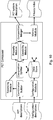
- the system typically includes a Taxonomy Module converting inputs to an internal taxonomy, a Composition Splitter dispatching between the different types of compositions, a Property Module for composing properties, a Capability Module for composing capabilities, a Composition Merger for assembling the different compositions, and a Metrics Module for computing the resulting privacy index.
- PETs Privacy-enhancing technologies
- Fig. 5 shows modules of a PET composer system, some or all of which may be provided e.g. for use in conjunction with the architecture of Figs. 1 -4 .
- the components, data, and flow may be as follows:
- the input (e.g. descriptions or data describing at least one PET) is provided to the Taxonomy Module of Fig. 5 in a predetermined internal data format e.g. as described herein or any suitable formalization of, e.g., the taxonomy of Figs. 7a - 7b . If this is not the case, the Taxonomy Module may convert the input into, e.g. the internal formal taxonomy of Figs. 7a - 7b . The Taxonomy Module stores the descriptions in the Data Store and forwards them to the Composition Splitter.
- a predetermined internal data format e.g. as described herein or any suitable formalization of, e.g., the taxonomy of Figs. 7a - 7b . If this is not the case, the Taxonomy Module may convert the input into, e.g. the internal formal taxonomy of Figs. 7a - 7b .
- the Taxonomy Module stores the descriptions in the Data
- the taxonomy typically includes binary attributes aka properties which each PET either has or does not have, as well as multi-level attributes, aka capabilities, whose levels indicate the "strength" of that attribute possessed by a given PET e.g. strong confidentiality vs. weak confidentiality.
- the "strength" of an attribute is a scalar indicating an ordinal level (aka value) of a certain attribute possessed by a given PET.
- the respective data structures may be those described below in the description of "Model Definition” herein.
- the state of the art teaches how to translate the formal definitions herein, for dimensions p, g, d, r, a, f etc., and their respective properties and capabilities, into computer legible data structures, using a suitable data format which may include attribute-value pairs, suitably nested. Since sets are prevalent in so many programming languages, any suitable constructs in any suitable programming language may be used to store these structures.
- JSON, XML, ASN.1 are not optimal for representation of the data structures in computer memory (as opposed to APIs).
- An example JSON structure or syntax, useful on the API level, for representing an individual PET using the taxonomy of Figs. 7a - 7b is provided below; additional information such as identifiers and/or time-stamps may be added for easier handling of the data within the system.
- JSON format may be allowed, e.g. use of arrays using square brackets.
- syntax may be extended (or shrunk) by adding (or removing) fields. The same is true for the possible values that may be assigned to the fields.
- the existing sub-fields for the PTM field and their possible values are those defined herein with reference to Figs. 7a - 7b , and in the description of "Model Definition" herein. The others are as follows:
- a Composition Splitter may be provided in Fig. 5 .
- the splitter inspects the incoming flow of PET descriptions and routes them depending on whether properties or capabilities of the PET are described (where distinguishing between properties and capabilities is explained herein e.g. with reference to Figs. 7a - 7b and in the description of "Model Definition” herein), sending properties or capabilities to the Property Module or Capability Module of Fig. 5 respectively.
- the Composition Splitter and Composition Merger are omitted, and the Property Module and Capability Module are merged into a property/capability module that directly acts upon properties and capabilities.
- inspecting data in a specified data format and splitting it according to given rule may be performed as is conventional, e.g. the rules may be:
- the Property Module of Fig. 5 merges PET properties e.g. using the Compositional PET Algebra described herein.
- a conventional set union may for example be employed, e.g. in software.
- the Capability Module of Fig. 5 merges PET capabilities e.g. using the Compositional PET Algebra described herein.
- Constrained set unions e.g. the weakest link constrained composition w described herein (in which a set-union is computed per property dimension but not, as described below, per-capability dimension) may for example be employed, e.g. in software.
- the Composition Merger of Fig. 5 assembles the composed PET properties and capabilities into one description representing the composed PET system; this description is then stored in the Data Store and/or forwarded to the Metrics Module of Fig. 5 and/or provided as a system output. This may be performed by conventional merging of the two disjoined data sets, both having the same specified data format (e.g. the taxonomy defined above), into a single data set of the same data format e.g. in software.
- the composed PET system may be described by the data structures defined for the Taxonomy Module of Figs. 7a - 7b .
- the same JSON structure may be used as defined above when describing the Taxonomy Module.
- the Metrics Module of Fig. 5 computes the resulting privacy index aka privacy metric, as described below.
- the Privacy Metric is stored into the Data Store and/or provided as a system output.
- the state of the art teaches how to translate the given mathematical formula into computer executable code and data structures.
- the actual result is a single number that may be encoded in any given way known in the art, such as using plain ASCII, JSON, XML, ASN.1 or others.
- a respective JSON structure for a privacy index for a single PET is shown as an example of a possible implementation. Additional information, such as identifiers, time-stamps and others, may be added for easier handling of the data within the system.
- Example configuration parameters include but are not limited to:
- the Configuration Module of Fig. 5 handles the configuration of the system. Typically, the configuration is read in, parsed and made available to the rest of the system.
- configuration management by the configuration module may be employed e.g. Java.util.properties, Apache Commons Configuration, Preferences API.
- the configuration format may for example be as follows:
- the Data Store of Fig. 5 typically holds persistent data of the system, including some or all of the PET descriptions, configuration and intermediate data produced by the components. All modules may have access to the Data Store. Communication with the data store may be standardized (e.g. SQL) or may be defined by a suitable data base technology. Generally, any suitable implementation for inter-component communication may be employed between the modules of Fig. 5 . For example, state of the art tools may be employed, such as but not limited to Apache Thrift and Avro which provide remote call support. Or, a standard communication protocol may be employed, such as but not limited to HTTP or MQTT, and may be combined with a standard data format, such as but not limited to JSON or XML.
- any state-of-the-art data store for discrete data is suitable such as but not limited to Files, Databases, Cloud Stores.
- Elasticsearch a distributed, multitenant-capable full-text search engine with an HTTP web interface and schema-free JSON documents which supports storage of JSON documents out of the box
- Elasticsearch a distributed, multitenant-capable full-text search engine with an HTTP web interface and schema-free JSON documents which supports storage of JSON documents out of the box
- a DB that has native XML support may be used, such as BaseX or eXist.
- suitable data stores may be used.
- JSON is a supported format
- Elasticsearch may be used.
- a DB that has native XML support may be used, such as BaseX or eXist.
- a PET System Description is an optional output of the system of Fig. 5 which typically includes a formal description of the composed PET.
- the data format may be that provided by the Composition Merger of Fig. 5 .
- the API outputs the composed PET in a specified data format e.g. the JSON used for PET input as described herein.
- Privacy Index is an optional output of the system which typically includes a respective privacy index for each PET.
- the data format is typically the format provided by the Metric Module. Conventional technology may be used to create a respective API to export the data structures, such as but not limited to REST, SOAP.
- the API outputs the privacy index in a specified data format (e.g. the JSON used for privacy index as described herein).
- Example use of the system of Fig. 5 may for example be useful for pace tracking / jogging / running use-cases, in which smart watches or smartphones are employed and a service is provided to end-users, such as for example a jogging route recommendation service.
- This service may compromise privacy. For example, data about an end-user's location is sensitive and undesired leaks should be prevented.
- Table 2 from the ARES paper "Constraint PET Composition Table", described herein, may be employed.
- the following PETs PI, P2, P5 may be employed:
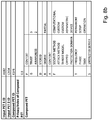
- Figs. 8a -8b are two respective examples of results generated by the system of Figs. 7a and 7b , taken together.
- Fig 8a shows a result (PET ABC123) of combining first and second input PETs, ABC and 123.
- the composed PETs privacy index is 0.14.
- This is a control PET that provides unlinkability by participation hiding and usage hiding, both with level 2. It works on processed data, is fully reversible, provides pseudonymity, is based on computational security and Pfitzmann attack model, has a customized threat model, uses asymmetric cryptography, covers all protection domains, makes use of a Trusted Third Party and tackles the "untrusted server" scenario.
- Fig 8b shows a result - PET E5F6 - of combining A1B2 and C3D4.
- PET E5F6's privacy index is 0.5.
- PET E5F6 is a context PET aiming at providing trust level 2 and awareness level 3 (to the user) which works on stored data and is partially reversible.
- PET E5F6 is based on computational security having a custom attacker model and a custom threat model which uses asymmetric cryptography and covers the protection domain "device" only.
- PET E5F6 makes use of a Trusted Third Party and tackles the "untrusted server" scenario.
- Any suitable method, even manual, may be employed, given a PET, to assign values to each attribute thereof.
- values may be assigned by an individual provider or developer of a PET, or by a community of privacy experts/PET developers, based on human expertise in the field of PETs, thereby to provide a formal description of the PET, using all or any portion or variation of the taxonomy of Figs. 7a - 7b , taken together.
- Fig. 1 typically employs a Taxonomy Extension shown in Figs. 7a - 7b , relative to Heurix et al's state of the art technology, shown in prior art Fig. 6 .
- Heurix et al. specify seven PET characteristic dimensions as shown in [A]: The embodiment of Aspect, Aim, Scenario, Foundation, Reversibility, TTP and Data.
- the embodiment of Figs. 7a - 7b renames the Aim dimension to Goal for distinct abbreviation; the characteristics are called PET privacy goals in the following.
- Figs. 7a - 7b is typically configured to distinguish PET characteristics that are either possessive properties (unordered set) or achievable capabilities (ordered set).
- dimensions with possessive properties are called property-dimensions, such as Foundation and Scenario, because their characteristics contain no semantic order.
- Dimensions with achievable capabilities are called capability-dimensions; e.g., goal characteristics may be extended with ordered strength levels (e.g.: weak, medium and strong) to quantify achievable privacy goals.
- ordered strength levels e.g.: weak, medium and strong
- Trust enhancing technologies and metrics to measure or increase trust in data and entities are typically provided. Therefore, the goal dimension is extended with trust and assume awareness, and trust enhancing technologies may be implemented as PETs in this model.
- Figs. 7a - 7b is typically configured to adopt this differentiation as Unlinkability sub-characteristics.
- PETs may differ in achieving a particular privacy goal. e.g., encryption as PET may provide weak or strong confidentiality, depending on the security parameters (key length, etc.).
- key length e.g., a particular privacy goal.
- all goal characteristics are extended with quantifiable strength levels over
- a new property-dimension called Principle is introduced in the embodiment of Figs. 7a - 7b , to describe legal and socio-economic PET properties, including whether the PET provides enforcement of fair information practice principles such as notice and choice. For example, all or any subset of the following characteristics are included:
- the Principle dimension may be used to bridge between non-technical and technical PET stakeholders. Furthermore, the principle dimension enables extensions for mappings between legal and technical privacy policies that are based on composed PET properties.
- the Foundation dimension is extended, in Figs. 7a - 7b , to include Category: Data (Location, Footprint, Audio, Video, Stream, Web) and Communication to capture data-specific application domains of PETs, as well as the Privacy Protection Domains: Cloud, Connection and Device. Attacker models are contained only implicitly in the Scenario dimension. For a more fine-grained definition of the attacker assumptions, some of the most common PETs underlying Attackers are added. The list of models is not complete, hence Custom is added to express undefined or unknown models.
- TTP and Scenario in the embodiment of Figs. 7a - 7b , TTP dimension characteristics None and None are typically removed because modeling the absence of characteristics is unnecessary in sets as described below.
- Mutual distrust in the Scenario dimension is the combination of Untrusted Client and Untrusted Server, hence are typically removed from Figs. 7a - 7b as well.
- the Reversibility dimension is especially notable in that it mixes capability and property characteristics. Cooperation contained in the original the characteristics Required and Not Required. Not Required may be removed. This leaves the sub-dimension with a single property. Hence, it moved up as a new Reversibility property called Co-operational.
- the Degree sub-dimension may be seen as capability set with the exception of the None and Deniable characteristic. None is obsolete and Deniable is a property of the reversibility, thus, it moves up.
- Degree is quantified by the two-element set ⁇ Full, Partial ⁇ .
- the usage of a finer grained quantifier set either finite, such as ⁇ Full, Largely, Medium, Barely ⁇ or infinite, such as or may be done.
- an order may still be defined e.g. by determining a ranking extending from a "biggest" down to a "smallest" element and including all elements.
- the order is defined by the number system itself.
- an order may be defined by bijective mapping to a number system and adopting the number system's order. An example for the latter is mapping all alphanumeric strings to by interpreting the strings' binary representation (e.g. ASCII) as a binary number.
- Fig. 9 summarizes definitions of dimensions as property vs. capability vs. hybrid according to an embodiment of the invention and lists the extended PET taxonomy dimensions of Figs. 7a - 7b and intuitive descriptions of possible uses of the dimensions which may be useful for human experts.
- the original Heurix et al taxonomy's expressiveness is generally preserved in Figs. 7a - 7b other than, typically, omission of only semantically redundant and non-characteristics. These characteristics may be expressed with absence in a set or combination of other characteristics.
- the extended taxonomy of Figs. 7a - 7b is even more expressive, having additional characteristics and quantifiable capabilities.
- Non-limiting examplesin include: Exchanging the minimum goal strength union Umin by the maximum goal strength union Umax as defined herein, removing the "Aspect" dimension including deleting the Aspect node and all its subnodes from the tree, adding a Cost dimension by adding a respective node directly under the "PETs" root node and defining child nodes under the Cost node e.g. "Expensive", "Reasonable, "Cheap".
- the Cost node may be directly quantified over the real numbers. In both cases, a suitable union over the new dimension is typically defined, or any other adaptation of the taxonomy and/or algebra shown and described herein.
- A is the Aspect dimension's property set.
- ANO Anonymity
- PSEUDO Pseudonymity
- k-anonymity provides weak indistinguishability for a small k, but strong for a big k. Such cases may be supported with "virtual" PETs that reflect the different strength levels.
- the complete taxonomy model may be defined as follows:
- PTM' the space of all possible PETs, is defined as:
- Combination of properties typically includes a relation on property-(sub)dimensional PTM characteristics using naive set union (U)
- Composition of capabilities typically includes a relation on capability-(sub)dimensional PTM characteristics using a C-constrained set union (U C ), where C is defined for the individual capability dimension.
- composition-function is a union of the PETs' dimensions.
- composition-function may be adjusted to reflect real-life constraints, when implementing the combination of multiple PETs, that are use-case specific. For example:
- the resulting privacy properties of an overall system which may include combinations of PETs, may be estimated based on the privacy metric shown and described herein which is derived from the algebra.
- PET algebra ⁇ PTM', ⁇ > is typically defined as:
- PTM' element composition typically results in another PTM' element.
- the relation is typically defined, as characteristic combination and composition of its terms.
- the weakest link constrained composition w may for example be ⁇ : P ′ ⁇ P ′ ⁇ P ⁇ P ′
- ⁇ P 1 , P 2 ⁇ P ′ : P P 1 ⁇ P 2 , G ′ ⁇ G ′ ⁇ G ⁇ G ′
- ⁇ G 1 , G 2 ⁇ G ′ : G G 1 ⁇ min G 2 , D ′ ⁇ D ′ ⁇ D ⁇ D ′
- ⁇ D 1 , D 2 ⁇ D ′ : D D 1 ⁇ D 2 , R ′ ⁇ R ′ ⁇ R ⁇ R ′
- ⁇ R 1 , R 2 ⁇ R ′ : R R 1 ⁇ to R 2 , A ′ ⁇ A ′ ⁇ A ⁇ A ′
- ⁇ A 1 , A 2 ⁇ A ′ : A A 1 ⁇ A 2 , F ′ ⁇ F ′ ⁇ F ⁇ F ′
- ⁇ For every property-dimension, ⁇ may be defined as set-union (combination). And for every capability dimension (Goal and Reversibility) this symbol may be defined as constraint union (U min and U TO ).
- the Goal sets may be united, typically, with a minimum strength level restriction.
- This decision typically means, though, that PETs with the same goals, but weaker strength levels semantically taint the composed system. Hence, privacy goals of the composition are typically downgraded in this embodiment.
- the Reversibility sets are typically united for their properties and for their capabilities with a trade-off (TO).
- the degree typically has two capability states: fully and partially.
- U TO computes their logical conjunction, e.g. composition of a fully reversible PET ⁇ Full Degree ⁇ with a co-operational, deniable and partial reversible PET ⁇ Partial Degree , Deniable, Co-operational ⁇ , results in ⁇ Co-operational, Deniable, Partially Degree ⁇ .
- PETs may be formally composed.
- Resulting PET systems typically contain, among others, composed goal characteristics that may be used to describe and estimate an underlying IT systems enforced privacy.
- the description herein relates to utilization of the Goal characteristics by way of example, but the description is applicable to other or all characteristics.
- the algebra is typically used to derive an enforceable privacy metric, that measures which privacy requirements are minimally covered by a combination of PETs, when used in an application-to-service data flow.
- Enforced privacy metric for a PETS P may be:
- x i ⁇ g(P) is the i-th goal's strength; gs(P) is the strength level weighted number of goals for a PETS P and
- the highest actually occurred Strength may be used as limiting element.
- Metrics for other PET dimensions may be defined analogously e.g. as follows: For capabilities that are quantified over number sets, such as ⁇ 1,2,3 ⁇ , N, R, Q, the formulas given above may be re-utilized (working on the capability in scope instead of G). For capabilities that are quantified over non-number sets, a bijective mapping to a number set may be applied to make that capability quantified over a number set. For properties may be treated as capabilities by assigning quantifiers to their values, then, and this way metrics may be computed as shown herein for capabilities.
- Use cases include but are not limited to:
- PET and Privacy Models are formalized using a flexible, general model including a formal PET algebra and composition, and are not specific to any particular definition of privacy or any particular privacy goals. Privacy metrics are general, rather than being tailored to specific domains.
- Heurix et al. propose a generic multi-dimensional PET taxonomy [A] to compare previously-thought incomparable PETs. Their model does not formalize the taxonomy, nor investigate composition of PETs such that combining with the relevant taxonomy formalization and/or composition investigation teachings herein is advantageous.
- PET Composition technologies may be combined with the teachings herein, such as but not limited to the following PET Composition technologies: [G] Yannis Tzitzikas, Anastasia Analyti, Nicolas Spyratos, and Panos Constantopoulos, [2004 ], An algebraic approach for specifying compound terms in faceted taxonomies.
- [G] Yannis Tzitzikas, Anastasia Analyti, Nicolas Spyratos, and Panos Constantopoulos, [2004 ] An algebraic approach for specifying compound terms in faceted taxonomies.
- Information Modelling and Knowledge Bases XV 13th European- Japanese Conference on Information Modelling and Knowledge Bases, EJC'03. 67-87 .
- metrics may be defined based on set-size, probability, entropy or Euclidean distance, e.g., for indistinguishability and anonymous communication. For example, the size of a subject set wherein an individual subject is not identifiable [B].
- This anonymity-set metric is applicable to Mix-Nets and DC-Nets. Indistinguishability may be measured with set and distance metrics as well, e.g., k-anonymity [I].
- Probability and entropy-based metrics such as the Shannon [J] or Rényi entropy [K] enable modeling of additional attacker knowledge to measure information-theoretic privacy. Rebollo et al.
- [M] propose a theoretical framework endowed with a general privacy definition in terms of the estimation error incurred by an attacker. Yet set-based privacy metrics are not applicable in arbitrary privacy domains and lack fine-grained attacker knowledge modeling. Indistinguishability based approaches have weaknesses against attackers capable of running statistical de-anonymization attacks resulting in reduced anonymity sets. Entropy approaches are heavily influenced by outliers. Therefore, each of these technologies may be improved by suitable combining with the teachings herein.
- IoT maps the real world into the virtual world with unique identifiable physical objects to virtual resources.
- RFID, Auto-ID and optical tags such as QR- or barcodes are among the technologies that may be employed to achieve this.
- Passive RFID and NFC chips in credit cards, door access cards or retail items may be used for tagging, identification and tracking of people and items.
- Interactions between objects, people, and the surrounding environment are captured via passive/active sensors and transferred with semantic analytics services to physical actuators and visual presentation.
- Autonomous, physical world events are reflected by virtual world events, e.g., haptic events with actuators or cognitive events with knowledge visualization, e.g.
- autonomous industrial control Industry 4.0, SCADA
- sensors for detecting pollution, radiation etc. smart city and environment
- participatory sensing with smartphone sensors e.g., microphone, gyroscope, and location
- cloud-based service architectures and social networks with virtual entities and events Any suitable communication technologies and protocols may be employed.
- Classical client-server and P2P communication may be used to connect devices and services over the Internet.
- Wireless physical layer communication technologies enable dynamic, mobile, M2M networks such as WSN, RSN, Mobile Ad Hoc Network (MANET), Vehicular Ad Hoc Network (VANET) and hybrid cloud-based infrastructures.
- Wireless technologies from low to high power consumption and connectivity range include NFC, Bluetooth (low energy), WiFi, WiMax, WiFi-Direct, ZigBee, Z-Wave, 3G, 4G, and LTE-Advanced.
- specialized application layer protocols may be employed, such as but not limited to RESTful HTTP or event-based/real-time protocols such as MQ Telemetry Transport (MQTT), Extensible Messaging and Presence Protocol (XMPP) and Web-Sockets.
- MQTT MQ Telemetry Transport
- XMPP Extensible Messaging and Presence Protocol
- Web-Sockets Web-Sockets.
- PET Privacy Enhancing Technology
- IoT inter alia and applicability may be improved using the methods shown and described herein e.g. to provide advanced IT systems using multiple PETs.
- These systems' privacy may or may not be quantified with a set-based privacy metric e.g. as described herein.
- Such systems are advantageous relative to conventional PETs such as, say, Tor's anonymous network communication or Differential Privacy-based privacy preserving analytics.
- the contextual and policy-based privacy architecture for IoT infrastructures shown and described herein is however merely by way of example, particularly since applicability of the PET taxonomy-based embodiments and algebra-based PET composition methods shown and described herein are not limited to mobile IoT or to IoT at all.
- Example PETs that may be composed or combined, using methods shown and described herein, are described e.g. in the Heurix publication mentioned herein. Examples include:
- Privacy(P) is the privacy score between [0,1] of an IT system using the PETS P where zero is defined to mean that none, or only PETs without privacy goals, are applied such that no technological provisions at all are provided, for the benefit of customers and service providers and other end-users of such an IT system.
- a score of one may be defined to mean maximal technical guaranteed privacy where all possible PET-based privacy technologies, mechanisms and/or privacy goals described herein are covered by the PETs deployed in the IT system.
- a particular advantage of certain embodiments is that this may occur even if the IT system was not designed a priori using "privacy by design" principles or other privacy policy compliance mechanisms, and, nonetheless, the resulting privacy is maximal.
- the privacy metric assumes that the PETs in P are correctly deployed in the system to enforce the respective privacy goals of each PET.
- the PET description input to the PET combiner of Fig. 5 comprises a nested attribute-value pair based representation (using a suitable predefined format for attribute-value pair based representation -- such as JSON or XML - and nested structures) of each of 2 or more privacy-enhancing technologies (any technical measure applied to data to preserve privacy of individuals or groups to whom the data pertains) which may be combined, where each attribute is an element of a PET taxonomy, such as that shown in Figs. 7a - 7b the PET system description output of Fig. 5 , comprises an attribute-value pair based representation (using a suitable predefined format such as JSON or XML), derived automatically by the system of Fig.
- a PET which comprises a composition of all of the two or more privacy-enhancing technologies whose descriptions were input to the system of Fig. 5 , where each attribute is again an element of a PET taxonomy such as that shown in Figs. 7a - 7b , taken together.
- a composition or combination of all of two or more privacy-enhancing technologies (aka "raw" PETs) is defined as application of all the raw technologies to a single body of data or application of all of the raw PETs to each data record in the body of data.
- a particular advantage of certain embodiments is the ability to compute whether or not, by applying several "raw" PETs, all privacy goals, fulfilled by the individual or raw PETs, are still fulfilled by the several PETs combined.
- the PETs are set based e.g. a PET is a set of attributes (P,G,D,R,A,F,T,S), each attribute being represented by a set of possible values, where values may themselves be sets and so on.
- the taxonomy may, if desired, be translated to JSON structures where each JSON structure is a tree of nested attribute-value pairs.
- JSON is one suitable representation of a set based PET system
- JSON is merely exemplary.
- JSON may not be used at all, or may be used for an API (e.g. API for exporting data structures) but not to store the taxonomy in memory, to represent the taxonomy in memory, set constructs provided by the utilized programming language may be employed, since JSON is usually not optimal, such as but not limited to
- This index typically indicates the level of privacy achieved by the composition of "input" PETs, typically relative to a maximum achievable level defined by what is representable by the taxonomy, i.e. the number of possible values for the dimension in which we compute the privacy index. For example, consider a privacy index for "goal" dimension assuming a combined PET with the following goals
- the Strength is defined over an infinite set (e.g. the natural numbers in the case at hand), the highest occurred Strength may be used as the reference. If the Strength set is finite, the highest possible Strength may be the reference for normalization.
- a user has the possibility to select the privacy policies he deems adequate from various available policies which may be presented via a GUI e.g. as a list.
- the user defines his requirements, since, for example, if the user has very relaxed privacy requirements he may express that by selecting a very relaxed policy and conversely, if the user has very strict privacy requirements, he selects a very strict policy.
- the middleware shown and described herein automatically selects the appropriate PETs to implement / enforce this policy. These PETs may then be combined using the algebra shown and described herein, yielding the level of privacy defined by the policy.
- the functionality of the system of fig. 5 may be executed, by calling the system of Fig. 1 for each possible 2 pair combination separately.
- the system may compute attributes for 1 combined PET which may then be used as input for the next round of combination, being in the same format as the input.
- the multi-step process may be this: call the system of Fig.
- the "do all combinations" feature may be implemented by adding a "Combination Builder” module ( Fig. 10 ), typically at the entry point to the system of Fig. 3 , that performs this multi-step process, e.g. by prior configuration, or responsive to an input which indicates which of all possible combinations to build.
- a “Combination Builder” module Fig. 10
- the functionality of the combination builder may be incorporated into the Taxonomy Module.
- Fig. 10 is a system which includes the combination builder but is not, of course, necessarily the most efficient architecture; the architecture may if desired be optimized conventionally.
- An advantage of the above flow is that PETs whose operation is well enough known to enable their evaluation in accordance with the taxonomy of Figs. 7a and 7b , taken together, even manually, may be used as building blocks to generate compositions of PETs. Such compositions are only useful if their privacy properties may be described, enabling end-users to select a composition suitable for their privacy requirements, by automatic or even by manual comparison between these compositions. Yet due to interactions between PETs, even a human expert or expert system capable of evaluating each of plural PETs, is not necessarily capable of directly evaluating a composition of the plural PETs. The system of Fig. 5 enables any composition or combination or superposition, of all or any subset of the plural PETs, to be evaluated.
- an end-user may select a composition of PETs to suit her or his requirements.
- the system may include a display generator operative to generate a table or graph or any other description of any or all compositions in which the end user is interested, e.g. as shown in the examples of Figs. 8a , 8b which may serve as an example display of the privacy properties of a hypothetical second composition of other PETs.
- each combination of PETs itself constitutes a PET, in effect, even though the PETs (e.g. programs, networks, libraries) are executed separately, one after another and even though the individual PETs need not be co-located on a single node in a communication network and instead may be scattered over the network.
- this system provides data regarding not only each of p plural "raw” or “known” or “input” PETs, but also regarding some or all compositions of the p PETs - yielding, in total, a large number of PETs whose properties according the taxonomy of Figs. 7a and 7b , taken together are all generated automatically, once the properties according the taxonomy of Figs. 7a and 7b , taken together of each of the raw PETs, is provided externally, either automatically or manually.
- references herein to the taxonomy of figs. 7a - 7b are not intended to be limiting since elements of the taxonomy may be cut and/or augmented and/or swapped.
- entire dimensions/sub-trees may be deleted.
- the dimension's descendant nodes may if desired be connected to node/s in the taxonomy tree that have not been deleted or deemed a dimension of their own.
- a goals dimension may be provided with only three nodes "Trust", “Awareness", “Deniability" which may suffice for given purposes or use-cases.
- a goals dimension with 9 nodes may be suitable for other use-cases.
- new dimensions each of which may be property or capability or hybrid may be added.
- a regular set union is typically added to the algebra
- a constrained union is typically added to the algebra.
- An example would be adding a "Cost" dimension, to reflect monetary implications, thereby typically giving rise to yet another constrained union: additive, e.g. instead of min, max, or average, sum up all the costs of the individual PETs to compute the cost of the resulting PET.
- additive e.g. instead of min, max, or average, sum up all the costs of the individual PETs to compute the cost of the resulting PET.
- It is also possible to convert property dimensions into capabilities and vice versa typically also introducing a respective change in the algebra, i.e. the corresponding regular set union/s become constrained or vice versa.
- a dimension's node as a dimension on its own (or vice versa - to re-define a dimension as a node of another dimension) e.g. removing "unlinkability” from the goals dimension and making “unlinkability” a new dimension, perhaps maintaining "unlinkability"'s sub-nodes “Participants” and "Usage”.
- a particular advantage of certain embodiments is that end-users do not (or need not since the system herein may be configured to allow users to choose to do this as an option for advanced users) directly upload or deal with PET descriptions in any way; instead PET descriptions are handled internally.
- Each module or component or processor may be centralized in a single physical location or physical device or distributed over several physical locations or physical devices.
- electromagnetic signals in accordance with the description herein.
- These may carry computer-readable instructions for performing any or all of the operations of any of the methods shown and described herein, in any suitable order including simultaneous performance of suitable groups of operations as appropriate; machine-readable instructions for performing any or all of the operations of any of the methods shown and described herein, in any suitable order; program storage devices readable by machine, tangibly embodying a program of instructions executable by the machine to perform any or all of the operations of any of the methods shown and described herein, in any suitable order i.e.
- a computer program product comprising a computer useable medium having computer readable program code, such as executable code, having embodied therein, and/or including computer readable program code for performing, any or all of the operations of any of the methods shown and described herein, in any suitable order; any technical effects brought about by any or all of the operations of any of the methods shown and described herein, when performed in any suitable order; any suitable apparatus or device or combination of such, programmed to perform, alone or in combination, any or all of the operations of any of the methods shown and described herein, in any suitable order; electronic devices each including at least one processor and/or cooperating input device and/or output device and operative to perform e.g.
- Any computer-readable or machine-readable media described herein is intended to include non-transitory computer- or machine-readable media.
- Any computations or other forms of analysis described herein may be performed by a suitable computerized method. Any operation or functionality described herein may be wholly or partially computer-implemented e.g. by one or more processors.
- the invention shown and described herein may include (a) using a computerized method to identify a solution to any of the problems or for any of the objectives described herein, the solution optionally including at least one of a decision, an action, a product, a service or any other information described herein that impacts, in a positive manner, a problem or objectives described herein; and (b) outputting the solution.
- the system may, if desired, be implemented as a web-based system employing software, computers, routers and telecommunications equipment as appropriate. Any suitable deployment may be employed to provide functionalities e.g. software functionalities shown and described herein.
- a server may store certain applications, for download to clients, which are executed at the client side, the server side serving only as a storehouse.
- Some or all functionalities e.g. software functionalities shown and described herein may be deployed in a cloud environment.
- Clients e.g. mobile communication devices such as smartphones may be operatively associated with, but external to, the cloud.
- the scope of the present invention is not limited to structures and functions specifically described herein and is also intended to include devices which have the capacity to yield a structure, or perform a function, described herein, such that even though users of the device may not use the capacity, they are, if they so desire, able to modify the device to obtain the structure or function.
- any "if -then" logic described herein is intended to include embodiments in which a processor is programmed to repeatedly determine whether condition x, which is sometimes true and sometimes false, is currently true or false, and to perform y each time x is determined to be true, thereby to yield a processor which performs y at least once, typically on an "if and only if' basis e.g. triggered only by determinations that x is true and never by determinations that x is false.
- a system embodiment is intended to include a corresponding process embodiment and vice versa.
- each system embodiment is intended to include a server-centered "view” or client centered “view”, or “view” from any other node of the system, of the entire functionality of the system, computer-readable medium, apparatus, including only those functionalities performed at that server or client or node.
- Features may also be combined with features known in the art and particularly, although not limited, to those described in the Background section or in publications mentioned therein.
- features of the invention including operations, which are described for brevity in the context of a single embodiment or in a certain order, may be provided separately or in any suitable subcombination, including with features known in the art (particularly although not limited to those described in the Background section or in publications mentioned therein) or in a different order.
- "e.g.” is used herein in the sense of a specific example which is not intended to be limiting.
- Each method may comprise some or all of the operations illustrated or described, suitably ordered e.g. as illustrated or described herein.
- Devices, apparatus or systems shown coupled in any of the drawings may in fact be integrated into a single platform in certain embodiments or may be coupled via any appropriate wired or wireless coupling such as but not limited to optical fiber, Ethernet, Wireless LAN, HomePNA, power line communication, cell phone, Smart Phone (e.g. iPhone), Tablet, Laptop, PDA, Blackberry GPRS, Satellite including GPS, or other mobile delivery.
- any appropriate wired or wireless coupling such as but not limited to optical fiber, Ethernet, Wireless LAN, HomePNA, power line communication, cell phone, Smart Phone (e.g. iPhone), Tablet, Laptop, PDA, Blackberry GPRS, Satellite including GPS, or other mobile delivery.
- functionalities described or illustrated as systems and sub-units thereof may also be provided as methods and operations therewithin
- functionalities described or illustrated as methods and operations therewithin may also be provided as systems and sub-units thereof.
- the scale used to illustrate various elements in the drawings is merely exemplary and/or appropriate for clarity of presentation and is not intended to be limiting. Headings
Landscapes
- Engineering & Computer Science (AREA)
- Theoretical Computer Science (AREA)
- Computer Security & Cryptography (AREA)
- Physics & Mathematics (AREA)
- Databases & Information Systems (AREA)
- General Engineering & Computer Science (AREA)
- General Physics & Mathematics (AREA)
- Data Mining & Analysis (AREA)
- Software Systems (AREA)
- Signal Processing (AREA)
- Computer Networks & Wireless Communication (AREA)
- Computer Hardware Design (AREA)
- Mathematical Physics (AREA)
- Bioethics (AREA)
- Health & Medical Sciences (AREA)
- General Health & Medical Sciences (AREA)
- Computational Linguistics (AREA)
- Computational Mathematics (AREA)
- Pure & Applied Mathematics (AREA)
- Mathematical Optimization (AREA)
- Computing Systems (AREA)
- Mathematical Analysis (AREA)
- Algebra (AREA)
- Housing For Livestock And Birds (AREA)
Applications Claiming Priority (1)
| Application Number | Priority Date | Filing Date | Title |
|---|---|---|---|
| US201762463874P | 2017-02-27 | 2017-02-27 |
Publications (1)
| Publication Number | Publication Date |
|---|---|
| EP3367290A1 true EP3367290A1 (fr) | 2018-08-29 |
Family
ID=61691195
Family Applications (1)
| Application Number | Title | Priority Date | Filing Date |
|---|---|---|---|
| EP18158954.0A Withdrawn EP3367290A1 (fr) | 2017-02-27 | 2018-02-27 | Systèmes, procédés et produits-programme informatiques pour combiner des technologies d'amélioration de la sphère privée |
Country Status (3)
| Country | Link |
|---|---|
| US (1) | US20180255106A1 (fr) |
| EP (1) | EP3367290A1 (fr) |
| IL (1) | IL257771A (fr) |
Cited By (1)
| Publication number | Priority date | Publication date | Assignee | Title |
|---|---|---|---|---|
| WO2023057037A1 (fr) * | 2021-10-04 | 2023-04-13 | Telefonaktiebolaget Lm Ericsson (Publ) | Gestion de fonctions de technologie d'amélioration de la confidentialité |
Families Citing this family (5)
| Publication number | Priority date | Publication date | Assignee | Title |
|---|---|---|---|---|
| US20190014095A1 (en) * | 2017-07-06 | 2019-01-10 | At&T Intellectual Property I, L.P. | Facilitating provisioning of an out-of-band pseudonym over a secure communication channel |
| SG10201806847PA (en) * | 2018-08-13 | 2020-03-30 | Mastercard International Inc | Methods and systems for facilitating migration to centralized compliance content for integration with a plurality of digital applications |
| JP7121276B2 (ja) * | 2018-09-19 | 2022-08-18 | 富士通株式会社 | データ管理レベル判定プログラム、およびデータ管理レベル判定方法 |
| US10929878B2 (en) * | 2018-10-19 | 2021-02-23 | International Business Machines Corporation | Targeted content identification and tracing |
| US11442960B2 (en) * | 2019-12-17 | 2022-09-13 | Verizon Patent And Licensing Inc. | Edge key value store for a distributed platform |
Citations (5)
| Publication number | Priority date | Publication date | Assignee | Title |
|---|---|---|---|---|
| US7072956B2 (en) | 2000-12-22 | 2006-07-04 | Microsoft Corporation | Methods and systems for context-aware policy determination and enforcement |
| US7748026B1 (en) | 2005-03-30 | 2010-06-29 | Sprint Communications Company L.P. | Transparent interceptors for privacy policy implementation |
| US20120259877A1 (en) | 2011-04-07 | 2012-10-11 | Infosys Technologies Limited | Methods and systems for runtime data anonymization |
| US20130340086A1 (en) | 2012-06-13 | 2013-12-19 | Nokia Corporation | Method and apparatus for providing contextual data privacy |
| US8661500B2 (en) | 2011-05-20 | 2014-02-25 | Nokia Corporation | Method and apparatus for providing end-to-end privacy for distributed computations |
-
2018
- 2018-02-27 IL IL257771A patent/IL257771A/en unknown
- 2018-02-27 EP EP18158954.0A patent/EP3367290A1/fr not_active Withdrawn
- 2018-02-27 US US15/906,387 patent/US20180255106A1/en not_active Abandoned
Patent Citations (5)
| Publication number | Priority date | Publication date | Assignee | Title |
|---|---|---|---|---|
| US7072956B2 (en) | 2000-12-22 | 2006-07-04 | Microsoft Corporation | Methods and systems for context-aware policy determination and enforcement |
| US7748026B1 (en) | 2005-03-30 | 2010-06-29 | Sprint Communications Company L.P. | Transparent interceptors for privacy policy implementation |
| US20120259877A1 (en) | 2011-04-07 | 2012-10-11 | Infosys Technologies Limited | Methods and systems for runtime data anonymization |
| US8661500B2 (en) | 2011-05-20 | 2014-02-25 | Nokia Corporation | Method and apparatus for providing end-to-end privacy for distributed computations |
| US20130340086A1 (en) | 2012-06-13 | 2013-12-19 | Nokia Corporation | Method and apparatus for providing contextual data privacy |
Non-Patent Citations (25)
| Title |
|---|
| A OLTRAMARI; D PIRAVIPERUMAL; F SCHAUB ET AL., PRIVONTO: A SEMANTIC FRAMEWORK FOR THE ANALYSIS OF PRIVACY POLICIES, 2017 |
| ANDREAS PFITZMANN; MARIT HANSEN: "Anonymity, Unlinkability, Undetectability, Unobservability, Pseudonymity, and Identity Management", A CONSOLIDATED PROPOSAL FOR TERMINOLOGY, 2008 |
| ANDREI SERJANTOV; GEORGE DANEZIS: "Privacy Enhancing Technologies", 2002, SPRINGER, article "Towards an information theoretic metric for anonymity", pages: 41 - 53 |
| BUSCHMANN, FRANK ET AL.: "Pattern-Oriented Software Architecture, Volume 1: A System of Patterns", vol. 1, 1996, JOHN WILEY & SONS |
| DANIEL KIFER; ASHWIN MACHANAVAJJHALA: "Pufferfish: A framework for mathematical privacy definitions", ACM TRANSACTIONS ON DATABASE SYSTEMS (TODS, vol. 39, no. 1, 2014, pages 3 |
| DAVID REBOLLO-MONEDERO; JAVIER PARRA-ARNAU; CLAUDIA DIAZ; JORDI FORNE: "On the measurement of privacy as an attackers estimation error", INTERNATIONAL JOURNAL OF INFORMATION SECURITY, vol. 12, no. 2, 2013, pages 129 - 149 |
| DOMINIK RAUB; RAINER STEINWANDT: "Emerging Trends in Information and Communication Security", 2006, SPRINGER, article "An algebra for enterprise privacy policies closed under composition and conjunction", pages: 130 - 144 |
| FUNKE ET AL., CONSTRAINED PET COMPOSITION FOR MEASURING ENFORCED PRIVACY, 2017 |
| GAMMA, ERICH ET AL.: "Design Patterns: Elements of Reusable Object-Oriented Software", 1995, ADDISON-WESLEY |
| HEURIX JOHANNES ET AL: "A taxonomy for privacy enhancing technologies", COMPUTERS & SECURITY, ELSEVIER SCIENCE PUBLISHERS. AMSTERDAM, NL, vol. 53, 20 May 2015 (2015-05-20), pages 1 - 17, XP029264285, ISSN: 0167-4048, DOI: 10.1016/J.COSE.2015.05.002 * |
| I. D. ADDO; S. I. AHAMED; S. S. YAU; A. BUDURU: "Reference Architecture for Privacy Preservation in Cloud-Based IoT Applications", IJSC, vol. 2, no. 4, October 2014 (2014-10-01) |
| JENS-MATTHIAS BOHLI; ANDREAS PASHALIDIS: "Relations Among Privacy Notions", ACM TRANS. INF. SYST. SECUR., vol. 14, no. 1, June 2011 (2011-06-01), pages 24 |
| JOHANNES HEURIX: "A taxonomy for privacy enhancing technologies", COMPUTERS & SECURITY, vol. 53, September 2015 (2015-09-01), pages 1 - 17, XP029264285, DOI: doi:10.1016/j.cose.2015.05.002 |
| JOHANNES HEURIX; PETER ZIMMERMANN; THOMAS NEUBAUER; STEFAN FENZ: "A taxonomy for privacy enhancing technologies", COMPUTERS & SECURITY, vol. 53, 2015, pages 1 - 17, XP029264285, DOI: doi:10.1016/j.cose.2015.05.002 |
| KIMMO HALUNEN; ANNI KARINSALO: "Measuring the value of privacy and the efficacy of PETs", PROCEEDING ECSA '17 PROCEEDINGS OF THE 11TH EUROPEAN CONFERENCE ON SOFTWARE ARCHITECTURE: COMPANION PROCEEDINGS, 11 September 2017 (2017-09-11), pages 132 - 135 |
| LATANYA SWEENEY: "k-anonymity: A model for protecting privacy", INTERNATIONAL JOURNAL OF UNCERTAINTY, FUZZINESS AND KNOWLEDGE-BASED SYSTEMS, vol. 10, no. 05, 2002, pages 557 - 570, XP055268614 |
| M. BARHAMGI; D. BENSLIMANE; S. OULMAKHZOUNE; N. CUPPENS-BOULAHIA; M. MRISSA; H. TAKTAK: "Secure and Privacy-preserving Execution Mode or Data Services", INTERNATIONAL CONFERENCE ON ADVANCED INFORMATION SYSTEMS ENGINEERING, 2013 |
| M. HENZE; L. HERMERSCHMIDT; D. KERPEN; R. HAUBLING; B. RUMPE; K. WEHRLE: "A Comprehensive Approach to Privacy in the Cloud-based Internet of Things", FUTURE GENERATION COMPUTER SYSTEMS, vol. 56, March 2016 (2016-03-01), pages 701 - 718, XP029341943, DOI: doi:10.1016/j.future.2015.09.016 |
| MICHAEL BACKES; ANIKET KATE; PRAVEEN MANOHARAN; SEBASTIAN MEISER; ESFANDIAR MOHAMMADI: "Computer Security Foundations Symposium (CSF), 2013 IEEE 26th", 2013, IEEE, article "AnoA: A framework for analyzing anonymous communication protocols", pages: 163 - 178 |
| NAIPENG DONG; HUGO JONKER; JUN PANG: "Computer Security- ESORICS", 2013, SPRINGER, article "Enforcing privacy in the presence of others: Notions, formalisations and relations", pages: 499 - 516 |
| P PULLONEN; R MATULEVICIUS; D BOGDANOV: "International Conference on ...", 2017, SPRINGER, article "PE-BPMN: Privacy-Enhanced Business Process Model and Notation" |
| RAUB DOMINIK ET AL: "An Algebra for Enterprise Privacy Policies Closed Under Composition and Conjunction", 6 June 2006, MEDICAL IMAGE COMPUTING AND COMPUTER-ASSISTED INTERVENTION - MICCAI 2015 : 18TH INTERNATIONAL CONFERENCE, MUNICH, GERMANY, OCTOBER 5-9, 2015; PROCEEDINGS; [LECTURE NOTES IN COMPUTER SCIENCE; LECT.NOTES COMPUTER], SPRINGER INTERNATIONAL PUBLISHING, CH, ISBN: 978-3-642-38287-1, ISSN: 0302-9743, XP047429723 * |
| SEBASTIAN CLAUB; STEFAN SCHIFFNER: "Structuring Anonymity Metrics. In Proceedings of the Second ACM Workshop on Digital Identity Management (DIM '06", 2006, ACM, pages: 55 - 62 |
| SEBASTIAN FUNKE ET AL: "Constrained PET Composition for Measuring Enforced Privacy", AVAILABILITY, RELIABILITY AND SECURITY, ACM, 2 PENN PLAZA, SUITE 701NEW YORKNY10121-0701USA, 29 August 2017 (2017-08-29), pages 1 - 10, XP058370949, ISBN: 978-1-4503-5257-4, DOI: 10.1145/3098954.3098968 * |
| TIM DE KLERK, HOW TO MEASURE PRIVACY: A STRUCTURED OVERVIEW OF ANALYSIS METHODS FOR PRIVACY-ENHANCING TECHNOLOGIES |
Cited By (1)
| Publication number | Priority date | Publication date | Assignee | Title |
|---|---|---|---|---|
| WO2023057037A1 (fr) * | 2021-10-04 | 2023-04-13 | Telefonaktiebolaget Lm Ericsson (Publ) | Gestion de fonctions de technologie d'amélioration de la confidentialité |
Also Published As
| Publication number | Publication date |
|---|---|
| IL257771A (en) | 2018-04-30 |
| US20180255106A1 (en) | 2018-09-06 |
Similar Documents
| Publication | Publication Date | Title |
|---|---|---|
| Bertino et al. | Big data security and privacy | |
| Abiodun et al. | A review on the security of the internet of things: Challenges and solutions | |
| Li et al. | Privacy in Internet of Things: From principles to technologies | |
| US20180255106A1 (en) | Systems, methods and computer program products for combining pets | |
| Karmakar et al. | ChainSure: Agent free insurance system using blockchain for healthcare 4.0 | |
| Gupta et al. | Proxy smart contracts for zero trust architecture implementation in Decentralised Oracle Networks based applications | |
| Khalil et al. | Leveraging a novel NFT-enabled blockchain architecture for the authentication of IoT assets in smart cities | |
| Alzoubi et al. | Contemporary Security Concerns in IoT-Based Devices with Healthcare System | |
| Kashif et al. | Differential privacy preserving based framework using blockchain for internet-of-things | |
| Kishor et al. | SPAM: an enhanced performance of security and privacy-aware model over split learning in consumer electronics | |
| Jakóbik | Big data security | |
| Lou et al. | Blockchain-based privacy-preserving data-sharing framework using proxy re-encryption scheme and interplanetary file system | |
| Pandey et al. | Privacy preserved data sharing using blockchain and support vector machine for industrial IOT applications | |
| Porkodi et al. | Secure data provenance in Internet of Things using hybrid attribute based crypt technique | |
| Chatterjee et al. | A framework for development of secure software | |
| EP2736002A1 (fr) | Méthode, système et produit programme d'ordinateur pour faire respecter l'accès aux attributs d'événements de flux d'événements dans un système de traitement d'événements complexes | |
| US20200374318A1 (en) | Information sharing with enhanced security | |
| Gattoju et al. | Design of ChaApache framework for securing Hadoop application in big data | |
| Saha et al. | AALMOND: decentralized adaptive access control of multiparty data sharing in industrial networks | |
| Li et al. | Blockchain and or based data sharing solution for internet of things | |
| Sun et al. | From Data Behavior to Code Analysis: A Multimodal Study on Security and Privacy Challenges in Blockchain-Based DApp | |
| Chattopadhyay et al. | Mobile agent security against malicious hosts: A survey | |
| Khan et al. | Advancing Secure and Efficient Sensor Data Integration in Smart Cities: A Blockchain-Based Approach | |
| Miloslavskaya et al. | Blockchain application for iot cybersecurity management | |
| Liao | Blockchain-enabled police management framework for securing police data |
Legal Events
| Date | Code | Title | Description |
|---|---|---|---|
| PUAI | Public reference made under article 153(3) epc to a published international application that has entered the european phase |
Free format text: ORIGINAL CODE: 0009012 |
|
| STAA | Information on the status of an ep patent application or granted ep patent |
Free format text: STATUS: THE APPLICATION HAS BEEN PUBLISHED |
|
| AK | Designated contracting states |
Kind code of ref document: A1 Designated state(s): AL AT BE BG CH CY CZ DE DK EE ES FI FR GB GR HR HU IE IS IT LI LT LU LV MC MK MT NL NO PL PT RO RS SE SI SK SM TR |
|
| AX | Request for extension of the european patent |
Extension state: BA ME |
|
| STAA | Information on the status of an ep patent application or granted ep patent |
Free format text: STATUS: THE APPLICATION IS DEEMED TO BE WITHDRAWN |
|
| 18D | Application deemed to be withdrawn |
Effective date: 20190301 |