EP3367647A1 - Procédé et système permettant de modifier une fonctionnalité de dispositif et dispositif ayant une fonctionnalité modifiable - Google Patents
Procédé et système permettant de modifier une fonctionnalité de dispositif et dispositif ayant une fonctionnalité modifiable Download PDFInfo
- Publication number
- EP3367647A1 EP3367647A1 EP17158189.5A EP17158189A EP3367647A1 EP 3367647 A1 EP3367647 A1 EP 3367647A1 EP 17158189 A EP17158189 A EP 17158189A EP 3367647 A1 EP3367647 A1 EP 3367647A1
- Authority
- EP
- European Patent Office
- Prior art keywords
- mobile device
- functionality
- changing
- image
- images
- Prior art date
- Legal status (The legal status is an assumption and is not a legal conclusion. Google has not performed a legal analysis and makes no representation as to the accuracy of the status listed.)
- Withdrawn
Links
Images


Classifications
-
- H—ELECTRICITY
- H04—ELECTRIC COMMUNICATION TECHNIQUE
- H04M—TELEPHONIC COMMUNICATION
- H04M1/00—Substation equipment, e.g. for use by subscribers
- H04M1/72—Mobile telephones; Cordless telephones, i.e. devices for establishing wireless links to base stations without route selection
- H04M1/724—User interfaces specially adapted for cordless or mobile telephones
- H04M1/72448—User interfaces specially adapted for cordless or mobile telephones with means for adapting the functionality of the device according to specific conditions
- H04M1/72454—User interfaces specially adapted for cordless or mobile telephones with means for adapting the functionality of the device according to specific conditions according to context-related or environment-related conditions
-
- H—ELECTRICITY
- H04—ELECTRIC COMMUNICATION TECHNIQUE
- H04M—TELEPHONIC COMMUNICATION
- H04M1/00—Substation equipment, e.g. for use by subscribers
- H04M1/72—Mobile telephones; Cordless telephones, i.e. devices for establishing wireless links to base stations without route selection
- H04M1/724—User interfaces specially adapted for cordless or mobile telephones
- H04M1/72448—User interfaces specially adapted for cordless or mobile telephones with means for adapting the functionality of the device according to specific conditions
- H04M1/72463—User interfaces specially adapted for cordless or mobile telephones with means for adapting the functionality of the device according to specific conditions to restrict the functionality of the device
-
- H—ELECTRICITY
- H04—ELECTRIC COMMUNICATION TECHNIQUE
- H04M—TELEPHONIC COMMUNICATION
- H04M2250/00—Details of telephonic subscriber devices
- H04M2250/52—Details of telephonic subscriber devices including functional features of a camera
Definitions
- the present invention relates to a method and a system for changing a device functionality in response to recognition of ambient environment with use of motion detection and image recognition, as well as to a device with a changeable functionality.
- a US patent US7856203 discloses a system for preventing drivers of a vehicle from cell phone texting while that vehicle is moving.
- This system comprises a motion detector and a moving vehicle contiguous interior compartment containing at least four courtesy signal transmitters and at least one conventional cell phone having a text keyboard, a microphone, and a courtesy signal receiver disposed in the microphone which is in the keyboard.
- This compartment may also have devices in it which control the speed and direction the moving vehicle will go, and if so, it may have a moving vehicle driver, who may also be the aforementioned cell phone user, located to operate these devices.
- the cell phone may enable or disable the keyboard based on courtesy signal transit times and the motion indicator, but this determination may be overridden by the cell phone service provider, or person of authority located in the vehicle contiguous interior compartment.
- a US patent US8527013 discloses systems, methods, and devices for controlling and limiting use of functions, such as calling, texting, chatting, emailing, Internet surfing, and similar applications, on a mobile device when the mobile device is in a moving vehicle, includes use of an on-board computer installed within the vehicle, a transmitter in electronic communication with the on-board computer that periodically transmits speed data of the vehicle to a receiver installed on the mobile device, wherein the mobile device includes suitable software and a rules-based policy that define and control when and which functions of the mobile device are disabled or interrupted by the software when the vehicle is in motion above a minimum threshold speed.
- Policies are set by default but may be customized for particular individuals, devices, or circumstances. Policies may also be customized for particular groups or subgroups of employees or contractors for company or legal compliance to reduce distracted driving.
- a US patent US8508379 discloses a method for motion-based disabling of messaging on a wireless communications device by differentiating a driver from a passenger.
- a wireless communications device When a wireless communications device is traveling at a speed exceeding a lower threshold but less than an upper threshold, the device is presumed to be traveling in a motor vehicle. The speed is determined on the basis of a GPS module in the device.
- access to certain device functions or applications such as e-mail, text messaging, etc. are limited by challenging the user of the device to respond to an ergonomic challenge that requires two-handed user input. Only if two-handed input is received will the wireless communications device grant access to e-mail or instant messaging.
- a method for changing a functionality of a mobile device comprising movement sensors and a camera, the method comprising the steps of: monitoring whether the mobile device is currently moving, using the movement sensors; upon detecting movement, capturing at least one image of the mobile device surrounding, using the camera; comparing the captured image to predefined images or patterns stored in a pattern images database; and upon detecting a match with a predetermined pattern image, changing the functionality of the mobile device.
- the step of changing the functionality of the mobile device may comprise limiting the functionality of a display module of the mobile device.
- the step of changing the functionality of the mobile device may comprise limiting the functionality of an audio module of the mobile device.
- the step of changing the functionality of the mobile device may comprise limiting the functionality of an input interface of the mobile device.
- the step of changing the functionality of the mobile device may comprise activating a selected module of the mobile device.
- the step of comparing can be performed by an image recognition unit of the mobile device.
- the step of comparing can be performed by transmitting the captured image to an external visual recognition service and receiving a response therefrom.
- Non-transitory computer readable storage medium comprising instructions that, when executed by a computer, enable changing a mobile device functionality according to the steps of the method as described above.
- a mobile device with a changeable functionality comprising: movement sensors; a camera; and a processor configured to perform the steps of the method as described above.
- a system for changing a functionality of a mobile device comprising: the mobile device as described above; and a visual remote service accessible for the mobile device via a network and configured to compare the captured image to predefined images or patterns stored in a pattern images database.
- these quantities take the form of electrical or magnetic signals capable of being stored, transferred, combined, compared, and otherwise manipulated in a computer system.
- these signals are referred to as bits, packets, messages, values, elements, symbols, characters, terms, numbers, or the like.
- a computer-readable (storage) medium typically may be non-transitory and/or comprise a non-transitory device.
- a non-transitory storage medium may include a device that may be tangible, meaning that the device has a concrete physical form, although the device may change its physical state.
- non-transitory refers to a device remaining tangible despite a change in state.
- Fig. 1 presents examples of application of a method for changing a device functionality, wherein a user 101A-101C being in motion uses a mobile device 110A-110C, being therefore also in motion.
- the user apart from calling, may use the mobile device for editing/receiving SMS/MMS messages, viewing audio/video contents, writing/receiving emails, browsing the Internet and/or similar activities.
- the mobile device captures images of surroundings and if the image is similar to an image stored in a device memory or is similar to representative patterns, then the functionality of the mobile device is changed, for example by blocking selected function(s) or switching the device to in a preset safety mode.
- the recognition of the images may be performed by the mobile device 110A-110C itself or the images captured by the device may be transmitted, for example via the Internet, to a remote visual recognition service 140.
- the remote visual recognition service 140 may comprise a pattern images database and functional blocks used for image recognition, similar to that as described with reference to the mobile device.
- Fig. 2A presents an overview of a typical mobile device.
- the mobile device 110 comprises a connectivity module 260 responsible for wirelessly receiving and/or transmitting data.
- the connectivity module 260 will be further presented with reference to Fig. 2C .
- a memory 204 is used for storing data (including images acquired by internal cameras and image patterns) as well as software executed by the processor 210 of the mobile device (for example, a visual recognition application).
- a clock module 203 is configured to provide clock reference for other modules of the system.
- a sensors module 230 comprises at least one sensor as will be presented with reference to Fig. 2B .
- a front and rear digital camera 207 is used for acquiring images of the surroundings.
- a display module 250 configured to display the graphical user interface (GUI) to the user
- an input interface 206 such as a keyboard, a touch input interface, a voice input interface and/or a gesture input interface
- an audio module 240 configured to generate audible signals and/or an external memory slot such as an SD card slot 205 configured to receive and operate an external memory unit.
- the mobile device may also comprise a power management module 220 cooperating with a battery 202.
- a bidirectional data bus 201 may be employed to enable communication between the modules and the processor 210 which further comprises a visual recognition manager 211 which manages the image acquired via the camera(s) 207, an image processing unit 213 for processing the image and an image recognition unit 212 for recognizing the image, wherein the image recognition unit 212 may comprise an internal pattern images database or may be configured to communicate with an external server 140.
- Fig. 2B presents in details a structure of a sensor module of the mobile device.
- the management of sensors may be controlled by a sensors aggregation unit 231, which serves as a bridge between each of the set of sensors and a client requesting data from respective sensors.
- the sensors may be any one of or any subgroup of the following sensors: a proximity sensor 236, a temperature sensor 237, a light intensity sensor 239, an accelerometer 233, an altimeter 232, a gyroscope 234, a magnetometer 235, and a camera sensor 238.
- the aforementioned sensors operate according to principles known in the prior art, in particular in the field of smartphones.
- Fig. 2C presents in details a structure of a connectivity module of the mobile device.
- the communication means may be any one of or any subgroup of the following: Wi-Fi 261, Bluetooth 262, FM radio 263, GPS 264, cellular telephony communication unit 265 (such as GSM, 3G, 4G and similar) communicating with a SIM card slot 266, or similar.
- the different communication means may be managed by an antenna switch 267 connected to an antenna module 268 that may comprise one or more types of antennas.
- Fig. 3 presents a main flowchart of consecutive steps of method for changing the device functionality.
- operations of the mobile device with changed (limited or extended) functionality are defined.
- properties of the defined operations with limited or extended functionality are configured.
- mobile device movement sensors are monitored in order to recognize the character or speed of the device movement.
- step 304 the images of the mobile device surroundings are captured and subsequently analyzed.
- step 305 the captured images are compared to predefined images or patterns stored in the mobile device memory or at a remote server.
- step 306 basing on the results of comparison of the captured images to the patterns and analysis of signals from the mobile device movement sensors, upon detecting a match with the predetermined pattern, the device functionality is changed, for example by executing the selected mobile device operation with a proper mode.
- Fig. 4A presents a procedure performed at the mobile device.
- an operating system of the mobile device checks if a functionality is enabled. If not, the procedure loops back awaiting the functionality to be enabled. If so, the procedure moves to step 402, wherein the mobile device movement sensors are monitored.
- step 403 it is determined whether the mobile device is in movement. If not, the procedure moves to step 408, wherein the operation of the mobile device is set to normal operation and the procedure loops back to step 403. Otherwise, if the mobile device is in motion, in step 404 the images from the camera are checked (analyzed) by the image recognition unit. By activating capture of the images when the device is in motion, power consumption is optimized by avoiding the need to capture images when the device is not moving.
- step 405 it is checked if the captured images match a particular pattern. If not, the mobile device remains in normal operation 407, otherwise in step 406 the mobile device operates in a changed functionality mode.
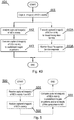
- Fig. 4B presents details of step 404 of Fig. 4A , which allows to analyze the images by one of two routes.
- the captured images are analyzed in step 442 by the mobile device.
- the captured images are compared to the predefined images or patterns stored in the memory of the mobile device (as an internal pattern images database).
- the captured images are transmitted to the remote visual recognition service 140 with a remote pattern images database.
- the mobile device awaits for a response from the visual recognition service.
- Fig. 5 presents a procedure conducted by a remote visual recognition service.
- the procedure 500 starts in step 501 wherein the captured images of the mobile device surroundings are received.
- step 502 the received captured images are analyzed.
- step 503 the received captured images of the mobile device surroundings are compared to predefined images or patterns stored in the pattern images database and the result of the comparison is sent to the mobile device.
- the surroundings images may match pattern images and be recognized as a street crossing, interior of a car or a plane, etc.
- the method for changing the mobile device functionality as presented herein allows to change operation of certain functionalities of the mobile device in order to increase safety of the user in various situations in which concentration is needed (for example while driving a car, crossing a street).
- the functionality may be limited by restricting access to at least one functionality selected from: display, audio, input interface.
- a display may be turned off or dimmed or disrupted.
- the audio may be turned off or tuned down.
- Touch input may be disabled.
- the functionality of the device can be extended, for example by activating a selected module that was disabled before - for example, by activating functions which were disabled due to low-power operation, by activating additional devices (such as e.g. a flashlight) or by activating additional input interface means (such as voice input or gesture input interface).
- additional devices such as e.g. a flashlight
- additional input interface means such as voice input or gesture input interface.
- some operations may be limited and some may be extended with respect to the operation before the change, for example text input can be disabled and voice input can be enabled.
- the aforementioned method for changing device functionality may be performed and/or controlled by one or more computer programs.
- Such computer programs are typically executed by utilizing the computing resources in a computing device.
- Applications are stored on a non-transitory medium.
- An example of a non-transitory medium is a non-volatile memory, for example a flash memory while an example of a volatile memory is RAM.
- the computer instructions are executed by a processor.
- These memories are exemplary recording media for storing computer programs comprising computer-executable instructions performing all the steps of the computer-implemented method according the technical concept presented herein.
Landscapes
- Engineering & Computer Science (AREA)
- Human Computer Interaction (AREA)
- Computer Networks & Wireless Communication (AREA)
- Signal Processing (AREA)
- Environmental & Geological Engineering (AREA)
- Telephone Function (AREA)
Priority Applications (1)
| Application Number | Priority Date | Filing Date | Title |
|---|---|---|---|
| EP17158189.5A EP3367647A1 (fr) | 2017-02-27 | 2017-02-27 | Procédé et système permettant de modifier une fonctionnalité de dispositif et dispositif ayant une fonctionnalité modifiable |
Applications Claiming Priority (1)
| Application Number | Priority Date | Filing Date | Title |
|---|---|---|---|
| EP17158189.5A EP3367647A1 (fr) | 2017-02-27 | 2017-02-27 | Procédé et système permettant de modifier une fonctionnalité de dispositif et dispositif ayant une fonctionnalité modifiable |
Publications (1)
| Publication Number | Publication Date |
|---|---|
| EP3367647A1 true EP3367647A1 (fr) | 2018-08-29 |
Family
ID=58212920
Family Applications (1)
| Application Number | Title | Priority Date | Filing Date |
|---|---|---|---|
| EP17158189.5A Withdrawn EP3367647A1 (fr) | 2017-02-27 | 2017-02-27 | Procédé et système permettant de modifier une fonctionnalité de dispositif et dispositif ayant une fonctionnalité modifiable |
Country Status (1)
| Country | Link |
|---|---|
| EP (1) | EP3367647A1 (fr) |
Citations (5)
| Publication number | Priority date | Publication date | Assignee | Title |
|---|---|---|---|---|
| US7856203B2 (en) | 1999-08-27 | 2010-12-21 | CourteousCellphones LLC (Texas) | System for inhibiting texting and similar distractions while driving moving vehicles |
| US20120214463A1 (en) * | 2010-11-05 | 2012-08-23 | Smith Michael J | Detecting use of a mobile device by a driver of a vehicle, such as an automobile |
| US8508379B2 (en) | 2009-02-06 | 2013-08-13 | Research In Motion Limited | Motion-based disabling of messaging on a wireless communications device by differentiating a driver from a passenger |
| US8527013B2 (en) | 2009-05-08 | 2013-09-03 | Obdedge, Llc | Systems, methods, and devices for policy-based control and monitoring of use of mobile devices by vehicle operators |
| US20140370869A1 (en) * | 2010-07-21 | 2014-12-18 | Shamim A. Naqvi | System and method for controlling mobile services using sensor information |
-
2017
- 2017-02-27 EP EP17158189.5A patent/EP3367647A1/fr not_active Withdrawn
Patent Citations (5)
| Publication number | Priority date | Publication date | Assignee | Title |
|---|---|---|---|---|
| US7856203B2 (en) | 1999-08-27 | 2010-12-21 | CourteousCellphones LLC (Texas) | System for inhibiting texting and similar distractions while driving moving vehicles |
| US8508379B2 (en) | 2009-02-06 | 2013-08-13 | Research In Motion Limited | Motion-based disabling of messaging on a wireless communications device by differentiating a driver from a passenger |
| US8527013B2 (en) | 2009-05-08 | 2013-09-03 | Obdedge, Llc | Systems, methods, and devices for policy-based control and monitoring of use of mobile devices by vehicle operators |
| US20140370869A1 (en) * | 2010-07-21 | 2014-12-18 | Shamim A. Naqvi | System and method for controlling mobile services using sensor information |
| US20120214463A1 (en) * | 2010-11-05 | 2012-08-23 | Smith Michael J | Detecting use of a mobile device by a driver of a vehicle, such as an automobile |
Similar Documents
| Publication | Publication Date | Title |
|---|---|---|
| US11140516B2 (en) | System and method for controlling mobile services using sensor information | |
| US12280737B1 (en) | Remote vehicle immobilizer | |
| US9743222B2 (en) | Method for controlling and an electronic device thereof | |
| US9414201B2 (en) | Information providing apparatus and method thereof | |
| US9730182B2 (en) | Mobile terminal and method of controlling the same | |
| EP3879509B1 (fr) | Dispositif électronique et procédé de fourniture de service véhicule-à-tout (v2x) le mettant en oeuvre | |
| US11176389B2 (en) | Non-intrusive intra-vehicular user location detection | |
| US8478257B2 (en) | Mobile terminal and control method thereof | |
| US9661126B2 (en) | Driving distraction reduction system and method | |
| KR20150130144A (ko) | 휴대 단말기 및 차량용 어플리케이션 제어 방법 | |
| US20150281430A1 (en) | Method and apparatus for providing information based on movement of an electronic device | |
| CA2978077C (fr) | Procede et appareil pour limiter la duree de distraction d'un utilisateur | |
| KR20100130483A (ko) | 차량 내비게이션 방법 및 그 장치 | |
| CN106878552A (zh) | 一种提醒方法及终端 | |
| EP3367647A1 (fr) | Procédé et système permettant de modifier une fonctionnalité de dispositif et dispositif ayant une fonctionnalité modifiable | |
| CN114348011A (zh) | 车辆控制方法、装置、车辆和存储介质 | |
| CN111649760A (zh) | 智能导航方法、系统、存储介质及移动终端 | |
| US20250390563A1 (en) | Device security via hardware channel lock | |
| KR20150046622A (ko) | 전자 기기 및 그 제어 방법 | |
| KR20250047209A (ko) | 공유 전자 디바이스 동작을 위한 시스템 및 방법 | |
| KR101178477B1 (ko) | 이동 통신 시스템에서의 위치 정보 전송 방법, 이를 이용하는 이동 통신 단말기 및 그 기록 매체 | |
| KR20140128116A (ko) | 애플리케이션 실행 방법, 그를 이용한 단말기 및 서버 장치 |
Legal Events
| Date | Code | Title | Description |
|---|---|---|---|
| PUAI | Public reference made under article 153(3) epc to a published international application that has entered the european phase |
Free format text: ORIGINAL CODE: 0009012 |
|
| STAA | Information on the status of an ep patent application or granted ep patent |
Free format text: STATUS: THE APPLICATION HAS BEEN PUBLISHED |
|
| AK | Designated contracting states |
Kind code of ref document: A1 Designated state(s): AL AT BE BG CH CY CZ DE DK EE ES FI FR GB GR HR HU IE IS IT LI LT LU LV MC MK MT NL NO PL PT RO RS SE SI SK SM TR |
|
| AX | Request for extension of the european patent |
Extension state: BA ME |
|
| STAA | Information on the status of an ep patent application or granted ep patent |
Free format text: STATUS: THE APPLICATION IS DEEMED TO BE WITHDRAWN |
|
| 18D | Application deemed to be withdrawn |
Effective date: 20190301 |