EP3367848B1 - Pièce auto-adhésive - Google Patents
Pièce auto-adhésive Download PDFInfo
- Publication number
- EP3367848B1 EP3367848B1 EP15808259.4A EP15808259A EP3367848B1 EP 3367848 B1 EP3367848 B1 EP 3367848B1 EP 15808259 A EP15808259 A EP 15808259A EP 3367848 B1 EP3367848 B1 EP 3367848B1
- Authority
- EP
- European Patent Office
- Prior art keywords
- patch
- adhesive
- main body
- peripheral region
- region
- Prior art date
- Legal status (The legal status is an assumption and is not a legal conclusion. Google has not performed a legal analysis and makes no representation as to the accuracy of the status listed.)
- Active
Links
Images


Classifications
-
- A—HUMAN NECESSITIES
- A47—FURNITURE; DOMESTIC ARTICLES OR APPLIANCES; COFFEE MILLS; SPICE MILLS; SUCTION CLEANERS IN GENERAL
- A47C—CHAIRS; SOFAS; BEDS
- A47C31/00—Details or accessories for chairs, beds, or the like, not provided for in other groups of this subclass, e.g. upholstery fasteners, mattress protectors, stretching devices for mattress nets
-
- B—PERFORMING OPERATIONS; TRANSPORTING
- B29—WORKING OF PLASTICS; WORKING OF SUBSTANCES IN A PLASTIC STATE IN GENERAL
- B29C—SHAPING OR JOINING OF PLASTICS; SHAPING OF MATERIAL IN A PLASTIC STATE, NOT OTHERWISE PROVIDED FOR; AFTER-TREATMENT OF THE SHAPED PRODUCTS, e.g. REPAIRING
- B29C73/00—Repairing of articles made from plastics or substances in a plastic state, e.g. of articles shaped or produced by using techniques covered by this subclass or subclass B29D
- B29C73/04—Repairing of articles made from plastics or substances in a plastic state, e.g. of articles shaped or produced by using techniques covered by this subclass or subclass B29D using preformed elements
- B29C73/10—Repairing of articles made from plastics or substances in a plastic state, e.g. of articles shaped or produced by using techniques covered by this subclass or subclass B29D using preformed elements using patches sealing on the surface of the article
-
- C—CHEMISTRY; METALLURGY
- C09—DYES; PAINTS; POLISHES; NATURAL RESINS; ADHESIVES; COMPOSITIONS NOT OTHERWISE PROVIDED FOR; APPLICATIONS OF MATERIALS NOT OTHERWISE PROVIDED FOR
- C09J—ADHESIVES; NON-MECHANICAL ASPECTS OF ADHESIVE PROCESSES IN GENERAL; ADHESIVE PROCESSES NOT PROVIDED FOR ELSEWHERE; USE OF MATERIALS AS ADHESIVES
- C09J7/00—Adhesives in the form of films or foils
- C09J7/20—Adhesives in the form of films or foils characterised by their carriers
- C09J7/21—Paper; Textile fabrics
-
- C—CHEMISTRY; METALLURGY
- C09—DYES; PAINTS; POLISHES; NATURAL RESINS; ADHESIVES; COMPOSITIONS NOT OTHERWISE PROVIDED FOR; APPLICATIONS OF MATERIALS NOT OTHERWISE PROVIDED FOR
- C09J—ADHESIVES; NON-MECHANICAL ASPECTS OF ADHESIVE PROCESSES IN GENERAL; ADHESIVE PROCESSES NOT PROVIDED FOR ELSEWHERE; USE OF MATERIALS AS ADHESIVES
- C09J7/00—Adhesives in the form of films or foils
- C09J7/30—Adhesives in the form of films or foils characterised by the adhesive composition
- C09J7/38—Pressure-sensitive adhesives [PSA]
- C09J7/381—Pressure-sensitive adhesives [PSA] based on macromolecular compounds obtained by reactions involving only carbon-to-carbon unsaturated bonds
- C09J7/385—Acrylic polymers
-
- B—PERFORMING OPERATIONS; TRANSPORTING
- B29—WORKING OF PLASTICS; WORKING OF SUBSTANCES IN A PLASTIC STATE IN GENERAL
- B29K—INDEXING SCHEME ASSOCIATED WITH SUBCLASSES B29B, B29C OR B29D, RELATING TO MOULDING MATERIALS OR TO MATERIALS FOR MOULDS, REINFORCEMENTS, FILLERS OR PREFORMED PARTS, e.g. INSERTS
- B29K2711/00—Use of natural products or their composites, not provided for in groups B29K2601/00 - B29K2709/00, for preformed parts, e.g. for inserts
- B29K2711/08—Leather
-
- B—PERFORMING OPERATIONS; TRANSPORTING
- B29—WORKING OF PLASTICS; WORKING OF SUBSTANCES IN A PLASTIC STATE IN GENERAL
- B29L—INDEXING SCHEME ASSOCIATED WITH SUBCLASS B29C, RELATING TO PARTICULAR ARTICLES
- B29L2031/00—Other particular articles
- B29L2031/44—Furniture or parts thereof
-
- C—CHEMISTRY; METALLURGY
- C09—DYES; PAINTS; POLISHES; NATURAL RESINS; ADHESIVES; COMPOSITIONS NOT OTHERWISE PROVIDED FOR; APPLICATIONS OF MATERIALS NOT OTHERWISE PROVIDED FOR
- C09J—ADHESIVES; NON-MECHANICAL ASPECTS OF ADHESIVE PROCESSES IN GENERAL; ADHESIVE PROCESSES NOT PROVIDED FOR ELSEWHERE; USE OF MATERIALS AS ADHESIVES
- C09J2301/00—Additional features of adhesives in the form of films or foils
- C09J2301/10—Additional features of adhesives in the form of films or foils characterized by the structural features of the adhesive tape or sheet
- C09J2301/12—Additional features of adhesives in the form of films or foils characterized by the structural features of the adhesive tape or sheet by the arrangement of layers
- C09J2301/122—Additional features of adhesives in the form of films or foils characterized by the structural features of the adhesive tape or sheet by the arrangement of layers the adhesive layer being present only on one side of the carrier, e.g. single-sided adhesive tape
-
- C—CHEMISTRY; METALLURGY
- C09—DYES; PAINTS; POLISHES; NATURAL RESINS; ADHESIVES; COMPOSITIONS NOT OTHERWISE PROVIDED FOR; APPLICATIONS OF MATERIALS NOT OTHERWISE PROVIDED FOR
- C09J—ADHESIVES; NON-MECHANICAL ASPECTS OF ADHESIVE PROCESSES IN GENERAL; ADHESIVE PROCESSES NOT PROVIDED FOR ELSEWHERE; USE OF MATERIALS AS ADHESIVES
- C09J2301/00—Additional features of adhesives in the form of films or foils
- C09J2301/10—Additional features of adhesives in the form of films or foils characterized by the structural features of the adhesive tape or sheet
- C09J2301/16—Additional features of adhesives in the form of films or foils characterized by the structural features of the adhesive tape or sheet by the structure of the carrier layer
-
- C—CHEMISTRY; METALLURGY
- C09—DYES; PAINTS; POLISHES; NATURAL RESINS; ADHESIVES; COMPOSITIONS NOT OTHERWISE PROVIDED FOR; APPLICATIONS OF MATERIALS NOT OTHERWISE PROVIDED FOR
- C09J—ADHESIVES; NON-MECHANICAL ASPECTS OF ADHESIVE PROCESSES IN GENERAL; ADHESIVE PROCESSES NOT PROVIDED FOR ELSEWHERE; USE OF MATERIALS AS ADHESIVES
- C09J2400/00—Presence of inorganic and organic materials
- C09J2400/20—Presence of organic materials
- C09J2400/26—Presence of textile or fabric
- C09J2400/263—Presence of textile or fabric in the substrate
Definitions
- the present invention relates to self-adhesive patches and in particular to self-adhesive patches suitable for repairing leather furniture and the like.
- Self-adhesive patches for repairing furniture upholstery, and methods ofrepairing furniture upholstery are disclosed in WO2010/001113 and are sold under the trade mark MASTAPLASTA (RTM). These patches are specifically designed to adhere strongly to furniture upholstery and remain attached despite the body heat of a person sitting upon the furniture. Nonetheless, they have found popularity outside use in patching furniture, also patching car interiors, bags and leather jackets, on occasion for aesthetic instead of repair purposes.
- WO2010/001113 The patches described in WO2010/001113 are described as having embossed stitching detail slightly inboard of their peripheries and being tooled to have clean defined edges. It is at these edges that there is the greatest likelihood of the patches peeling off the furniture, or the like, to which they are attached. Whilst use of particular adhesives defined in WO2010/001113 reduces the chance of peeling, it is still a possibility and this invention seeks to reduce that possibility.
- EP2158885A1 concerning a plaster intended to be stuck to skin
- WO2015/031389 concerning three-dimensional adhesive products such as adhesive medical devices.
- Having a thinner peripheral region reduces the chances of peeling (as the thinner region is less likely to catch on clothing or the like) and has the added advantage of creating an almost seamless attachment to the substrate, minimising visibility and creating a neat finish.
- the self-adhesive patch may be adapted to bond to leather.
- the self-adhesive patch may be a furniture patch.
- the peripheral region may extend around the entire periphery of the main body region and may entirely be thinner than the main body region.
- the peripheral region may be entirely thinner than the entirety of the main body region.
- the main body region may be provided with debossed regions which are thinner than the remainder of the main body region.
- the peripheral region may be thinner than the debossed regions of the main body region.
- the peripheral region may have a thickness substantially equal to the thickness of the debossed regions.
- the main body region may have a thickness of at least 1mm, e.g. between 1.0mm and 1.2mm, preferably about 1.1mm.
- the peripheral region may have a thickness of less than 1mm, e.g. between 0.5mm and 1.0mm, preferably about 0.7mm.
- the peripheral region may be denser than the main body region.
- a denser peripheral region is less likely to be damaged than a peripheral region that is thinner, but of the same density.
- the denser peripheral region may be debossed (i.e. formed by debossing).
- the peripheral region may be substantially coplanar with the main body region on the reverse side and in a different plane to the surface of the main body region on the obverse side. This arrangement creates a step between the peripheral region and the main body region, such that when attached, the main body region projects further outward from the object to which it is attached. Thus, the main body region is likely to deflect any article that might otherwise catch on the edge of the patch.
- the peripheral region may have a width of between 1 mm and 200mm, but preferably between 1mm and 10mm, more preferably between 2mm and 5mm, e.g. about 4mm. This width is sufficiently large that the peripheral region is noticeably distinct from the main body region, but small enough that most objects that might otherwise catch on the edge will be deflected by the thicker main body region.
- the patches may be circular and have a diameter of between 50mm and 150mm, e.g. between 70 and 100mm, such as about 80mm
- the patches may be rectangular and have a width of between 30mm and 100mm and a length of between 50mm and 150mm, e.g. about 60mm x 100mm.
- the area of the peripheral region may be from 5cm 2 to 15 cm 2 , such as between 7cm 2 and 10cm 2 , e.g. about 8cm 2 .
- the patch may be for repairing a region of furniture upholstery, wherein the region of the furniture upholstery comprises a defect and the patch can be applied to the region to conceal the defect.
- the furniture patch is particularly well-suited for use by heavily trafficked establishments, such as restaurants, pubs and bars, which are less likely to incur the expense and delay in re-upholstery, particularly when subsequent damage is likely.
- the furniture patch can be used where restoration of the furniture to its original aesthetic condition is not required, in other words where concealment of the defect in the upholstery would suffice.
- the defect may comprise a discontinuity in the upholstery.
- the defect would typically be a hole, cut or burn that would otherwise require expensive and time-consuming re-upholstery. Thus, the defects can be more easily dealt with.
- the defect may comprise a stain. Rather than trying to remove the stain, it could be concealed.
- the adhesive backing may comprise a pressure-sensitive adhesive. The user can press the patch onto the upholstery for adhesion, rather than having, for example, to heat it.
- the adhesive may comprise a high-strength acrylic adhesive. These adhesives have proven to particularly suitable for use in furniture patches.
- the adhesive has an adhesion to steel of at least around 66N/100mm.
- the adhesion to steel may be between around 66N/100mm and 120N/100mm.
- the adhesive may have a temperature resistance of at least 37°C. This makes the patch particularly suitable for use with furniture because the patch will remain adhered to the furniture when subjected to normal body heat temperatures.
- the temperature resistance is up to 82°C for long periods.
- the temperature resistance may be up to 121°C for shorter periods.
- the adhesive backing may comprise 3MTM adhesive 300. This adhesive has been proven to be particularly effective for use in the furniture patch.
- the adhesive backing may be formed from 3MTM adhesive tape 927, 950 or 950EK or 95623-M tape. These tapes have been proven to provide a particularly good bond to the furniture.
- the adhesive backing may extend to the outer periphery of the reverse side of the patch.
- the outer edge or periphery can be bonded well to the upholstery, which can make it less likely to peel away from the upholstery during use.
- the adhesive backing may cover the entire reverse side of the patch. This provides a uniform bonding surface across the back of the patch and can increase overall bonding strength to the upholstery. If the patch is being applied to a region containing a defect, the adhesive can overlie the defect, even if it is a discontinuity such as a hole.
- a release paper may overlie the adhesive backing.
- the adhesive backing can be uncovered just prior to adhesion to the upholstery to avoid causing degradation or loss of adhesive during transport and to maintain high bonding strength.
- the patch may be adherable to an external surface of the upholstery. This can facilitate the process of applying the patch, since it does not need to be adhered to an inner surface of the upholstery.
- a natural leather patch may be desirable for use with leather upholstery and may be seen to be a higher-end product.
- a patch comprising bonded or synthetic leather can be relatively inexpensive to manufacture.
- the synthetic leather may comprise a polycarbonate resin substrate and a polyurethane covering.
- the display surface comprises a substrate, a substrate coating and a backing.
- the backing may comprise polyester, cotton or a blend thereof.
- the display surface may visually contrast with the furniture upholstery adjacent the region. Rather than trying to match the patch with the upholstery, the patch would be a feature or focal point of the furniture.
- the display surface may include a decorative pattern.
- the patch would be more visually appealing or unique and/or may receive advertising.
- the upholstery may be leather. Leather upholstery can be expensive to repair so the patch may be particularly cost-effective.
- the patch may be pre-cut so that the area of the display surface is between 3cm 2 and 400cm 2 or between 27cm 2 and 200cm 2 .
- the user does not need to cut the patch to size since the pre-cut size should be sufficient for most standard repairs or concealments.
- a length of fabric may be laminated with a double sided adhesive tape under tension to provide the adhesive backing.
- the fabric may be debossed at a temperature of between 100 degrees C and 220 degrees C. This temperature achieves a good quality of debossing unlikely to damage/discolour inks or melt most suitable adhesives.
- the weight applied during debossing may be in the region of 1-2 tons.
- the pressure applied is preferably at least 34.5 bar (500psi), more preferably at least 169 bar (1000psi), and a weight as mentioned can provide a suitable pressure of between 69 bar (1000psi) and 275.8 bar (4000psi).
- the debossing may be conducted for a dwell time of 1-5 seconds. This timeframe, like the temperature range, achieves suitable results without damaging the adhesive.
- the method may comprise debossing using a heated die (e.g. one formed of heat-conducting metal), which may be heated to between 100 degrees C and 220 degrees C.
- a heated die e.g. one formed of heat-conducting metal
- the method may comprise providing a buffer, e.g. a nylon buffer in or adjacent to the die, the buffer defining the thickness of the peripheral region of the patch by defining the distance between the die and a ram that presses the fabric against the die.
- a buffer e.g. a nylon buffer in or adjacent to the die
- upholstered furniture, luggage or clothing garment according to claim 13.
- the patch of the third aspect may include any of the optional/preferred features of the first or second aspects.
- the item to which the patch is adhered is furniture
- it may be a seat such as a sofa, bar stool or vehicle seat.
- the garment may be a leather jacket or the luggage may be a handbag.
- the item may be upholstered furniture and the patch may be adhered to the upholstery (e.g. leather upholstery).
- the item may be the leather trim of a vehicle, a garment, such as a leather jacket, or an item of luggage, such as a handbag.
- the adhesive backing may comprise a pressure-sensitive adhesive and the method may comprise pressing the patch onto the item to conceal a defect in the region. This simplifies application of the patch.
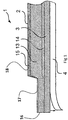
- a self-adhesive patch 1 has a display surface 2 on its upper or obverse face or side and an adhesive backing 3 in the form of an adhesive layer or an adhesive tape on its lower or reverse face or side.
- a peelable release paper 4 is provided on the adhesive layer 3.
- the patch 1 is typically made of synthetic (sometimes referred to as 'artificial') leather, which is particularly cost-effective and has good absorbent properties.
- the patch 1 could, alternatively or additionally, be made of natural or bonded (sometimes referred to as 'reconstituted') leather. If the leather, particularly synthetic leather, is artificially coloured, it can be thoroughly dyed to avoid any unsightly edging.
- the adhesive backing 3 is a pressure-sensitive adhesive which also conforms to the fire regulations for the upholstery and/or automotive industry.
- the adhesive 3 has strong and durable properties and can bond with various materials, such as leather upholstery.
- the adhesive 3 preferably extends to the outer periphery of the underside of the patch 1, and more preferably entirely covers the underside of the patch 1. This improves edge-to-edge adhesion to the upholstery.
- the release paper 4 is peeled away from the adhesive backing 3 and the patch 1 is pressed onto a region of upholstery to conceal part of the upholstery.
- the region being concealed typically surrounds a defect, but there may be another reason to conceal it such as for aesthetic improvement.
- the region to which the patch is to be applied may be cleaned prior to application of the patch 1 to improve adhesion.
- Adhesive Transfer Tapes 927, 950 and 950EK which are available from 3MTM, whose corporate headquarters are at 3M Corporate Headquarters, 3M Center, St. Paul, MN 55144-1000, USA, and a double-sided tape with product number 95623-M, which is available from DOFF Limited of Bromsgrove, UK
- 3MTM Adhesive Transfer Tapes with 3MTM Adhesive 300 offer adhesion to a wide variety of surfaces, including many plastics.
- This pressure-sensitive medium firm acrylic adhesive family features a very high initial adhesion and good shear holding power.
- tapes 927, 950 and 950EK use 3MTM's Adhesive 300, are clear in colour and none of them has an adhesive carrier.
- Tapes 927 and 950 have a tan-coloured paper release layer or liner 4, whereas Tape 950EK uses a white extensible Kraft paper.
- the approximate thicknesses of these tapes without the release liner 4 are: Tape 927 0.05mm (0.002in), Tape 950 0.13mm (0.005in) and Tape 950EK 0.13mm (0.005in). With the release liner, the respective thicknesses are: Tape 927 0.10mm (0.004in), Tape 950 0.10mm (0.004in) and Tape 950EK 0.15mm (0.006in).
- the respective Adhesion to Steel values are: Tape 927 66N/100mm (60oz/in), Tape 950 82N/100mm (75oz/in) and Tape 950EK 82N/100mm (75oz/in).
- the ideal working temperatures for these tapes is 21°C to 38°C (70°F to 100°F). This makes them suitable for use on furniture which will usually be at room temperature, but often raised to body heat temperatures when sat upon, which are usually around 37°C (99°F).
- their high-temperature operating range for long periods (days or weeks) is up to 82°C (180°F) for each of the tapes.
- Their high-temperature operating range for shorter periods (minutes or hours) is up to 121°C (250°F).
- the 95623-M tape from DOFF Limited of Bromsgrove, UK includes a solvent-free modified acrylic adhesive. It has an Adhesion to Steel (AFERA 4001) value of 30N/25mm. Its temperature resistance is -40°C (-40°F) to 95°C (203°F) for long periods and up to 120°C (248°F) for shorter periods. The total thickness of the tape, without a release paper, is 0.23mm (0.009 in).
- the synthetic leather comprises a substrate 13, a backing 14 and a coating 15 for the substrate.
- the AXIOM Plus and Soft Touch synthetic leathers have proven to be particularly suitable for use in the patch 1. They are both available from Awesome Fabrics of The Stables, Unit 12, The Stables, Grange Farm, Green End, Great Stukeley, Huntingdon, Cambridgeshire, PE28 4AE or Abbey Fabrics of Unit 26, Earith Business Park, Meadow Drove, Earith Cambridgeshire PE28 3QF.
- the substrate 13 is a polycarbonate resin
- the backing 14 with polyester/cotton backing and the coating 15 is polyurethane. Vinyl-coated fabrics and other fabrics are also suitable.
- the patch 1 is provided with a debossed peripheral region 17, extending inwardly from the outer edge 16.
- the peripheral region 17 is substantially thinner (in the "vertical" direction - assuming the patch 1 is placed with its backing 3 downwards) than the main body region 18 of the patch.
- the debossing also causes the peripheral region 17 to be denser than the main body region 18 of the patch, as the same original thickness of material is condensed into a smaller volume. Owing to its density, the peripheral region 17 is less likely to be damaged than a thinner peripheral region 17 of the same density.
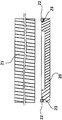
- Figures 2a to 2c show a square patch 10, a circular patch 11 and a rectangular patch 12 all having the same features and cross section described in relation to the patch 1 of figure 1 .
- the square patch 10 has a plain display surface 2, rounded corners and is around 7cm x 7cm in size.
- the circular patch 11 is between around 8cm and 14cm in diameter and its display surface 2 is plain once again.
- the rectangular patch 12 is between around 9cm x 3cm and around 20cm x 10cm.
- the rectangular patch 12 has rounded corners and its display surface 2 has debossed regions 19 also inboard of its peripheral region 17.
- Overall patch surface areas from around 3cm 2 to 400cm 2 are suitable for the patch 1.
- peripheral region 17 extends around the entire periphery of the main body region 18 and in is entirely be thinner than the main body region 18.
- peripheral region 17 is entirely thinner than the entirety of the main body region 18.
- the main body region 18 of the rectangular patch 12 is provided with debossed regions 19 which are thinner than the remainder of the main body region 18, having a thickness substantially equal to the thickness of the peripheral region 17.
- the main body region 18 has a thickness of 1.1mm, and the peripheral region 17 has a thickness of 0.7mm. Consequently, the main body region protrudes 0.4mm further out from the item to which the patch 1, 10, 11, 12 is attached. This creates a neater look and reduces the chances of the edge being caught and peeled away.
- Figure 5 shows the apparatus used to deboss the edges of the patches 1, 10, 11.
- the apparatus comprises a die 20, upon which part-finished patches 1a (shown in fig 4 ) are placed.
- the die 20 is provided with an upstanding rim 23, and a ram 21 is arranged to press down on the die 20.
- a replaceable spacer/buffer 22 (in this case formed of nylon), is arranged outside the rim 23 to space the die 20 from the ram 21, and thereby define the distance by which the rim 23 and the ram 21 are separated.
- the tape 3 (and release paper 4) is first laminated to the backing 14 of the fabric (e.g. synthetic leather that will make up the patch 1). This forms a length of part-formed patches 1a shown in figure 4 . The length of part-formed patches 1a is then placed on the die 20 with the display surface 2 facing downwards and the release paper 4 facing the ram 21.
- the fabric e.g. synthetic leather that will make up the patch 1).
- the die 20 is heated to between 120°C and 200°C, and the ram 20 is lowered towards the die 20 so as to squeeze, and hence deboss, the portion of the patch between the rim 23 and the ram 21 at a force on the outside of the patch 1a of around 1-2 tons, creating an applied pressure for a large patch size of 81.7 bar (1185psi) and for a small patch size of 245.2 bar (3556psi).
- the buffer/spacer 22 holds the rim 23 a predetermined distance from the ram 21 to determine the thickness of the debossed region 17 and the ram 21 is held in place for 1-5 seconds (to avoid melting the adhesive).
- the inside diameter of the rim 23, is, of course, sized to match the size of the main body region 18 of the patch 1, and no force is applied in this recessed region.
- the outer diameter of the rim 23, on the other hand, is designed to be larger than the outer diameter of the peripheral region 17. Accordingly, the part-formed patch is debossed beyond the peripheral region 17.
- the part-formed debossed patch 1a is then cut, using a cutting tool which cuts through the debossed "bleed" area to form a sharp outside edge 16, having a uniform distance from the main body region 18, such that the width of the debossed peripheral region 17 is constant.
- a typical width is about 4mm. This is sufficiently large that the peripheral region 17 is noticeably distinct from the main body region 18, but small enough that most objects that might otherwise catch on the edge will be deflected by the thicker main body region 18.
- a modified die would be used, having projections inward of the rim 23 to form a debossed shape 19 in the patch 12.
- the peripheral region 17 becomes coplanar with the main body region 18 on the reverse side (with the adhesive tape 3 remaining in the same position).
- the peripheral region 17 is in a different plane to the display surface 2 of the main body region 18 on the obverse side; the main body portion extending further from the coplanar reverse side.
- the patches 10, 11 , 12 can be provided in various colours, such as ivory, red, dark brown, tan and black.
- the main body regions 18 of the display surfaces 2 of the patches 10, 11, 12 can be plain or can include a patterned design, which may be applied by dyes, inks, laser or embossing/debossing.
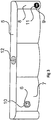
- FIG 3 shows square patch 10, circular patch 11 and rectangular patch 12 applied to a damaged sofa 5.
- the square patch 10 is applied to conceal a hole or rip 6 in one of the sofa's cushions 7.
- the circular patch 11 is applied to one of the sofa's arms 8 which has been damaged by a cigarette burn 9.
- the patches 10, 11 when so applied conceal the defects, i.e. the hole 6 and burn 9, in the sofa 5.
- the rectangular patch 12 is applied to the top of the central backrest of the sofa for aesthetic purposes, i.e. decoration.
- the patches 10, 11, 12 can instead visually contrast with the sofa 5 to draw attention to the region to which they are applied.
- a red synthetic leather circular patch having an unusual decorative pattern could be applied to a white leather sofa in a student bar as a focal point or unusual feature.
- the defect in the sofa 5 being caused by the furniture owner, the defect could be a natural imperfection in the upholstery only noticed after manufacture, damage caused while the sofa 5 is on display or may result from unavoidable degradation, in colour or texture after prolonged use.
- patches 1 , 10, 11, 12 have been described in relation to a sofa 5, they are equally suited for application to other items of furniture including, but not being limited to, seating on or in: public transport (buses, trains, planes, boats and the like), private vehicles (cars, motorbikes, boats and the like), commercial establishments (bars, pubs, restaurants, cinemas and the like) and domestic establishments (homes, caravans and the like).
- patches 1, 10, 11, 12 have been described as being adherable to furniture upholstery to conceal a region of the furniture upholstery, they could also be used to conceal a region of other articles comprising a flexible material layer, such as a synthetic or hide covering.
- articles include garments, for example leather jackets, trousers and the like, and fashion accessories, such as suitcases, handbags, gloves and the like.
Landscapes
- Chemical & Material Sciences (AREA)
- Organic Chemistry (AREA)
- Engineering & Computer Science (AREA)
- Mechanical Engineering (AREA)
- Chemical Kinetics & Catalysis (AREA)
- Adhesives Or Adhesive Processes (AREA)
- Details Of Garments (AREA)
- Laminated Bodies (AREA)
Claims (15)
- Pièce (1, 10, 11, 12) autoadhésive, comprenant une surface (2) d'affichage au recto et un dossier (3) adhésif au verso, le dossier adhésif étant conçu pour se lier à une tapisserie d'ameublement et analogue, dans lequel la pièce comprend une région (17) périphérique au bord extérieur de la pièce et une région (18) de corps principal à l'intérieur de la région (17) périphérique, la région (17) périphérique étant plus mince que la région (18) de corps principal, caractérisé en ce que la pièce comprend du cuir naturel, du cuir à relier ou du cuir synthétique.
- Pièce (1, 10, 11, 12) autoadhésive suivant la revendication 1, qui est conçue pour se lier à du cuir et/ou qui est une pièce d'ameublement.
- Pièce (1, 10, 11, 12) autoadhésive suivant l'une quelconque des revendications précédentes, dans lequel la région (17) périphérique s'étend autour de toute la périphérie de la région (18) de corps principal et est en son entier plus mince que la région (18) de corps principal et/ou dans laquelle la région (17) périphérique est en son entier plus mince que la région (18) de corps principal dans son entier ; et/ou dans lequel la région (18) de corps principal est pourvue de régions (19) déprimées, qui sont plus minces que le reste de la région (18) de corps principal, éventuellement dans laquelle la région (17) périphérique est plus mince que les régions (19) déprimées de la région (18) de corps principal ou dans laquelle la région (17) périphérique a une épaisseur sensiblement égale à l'épaisseur des régions (19) déprimées.
- Pièce (1, 10, 11, 12) autoadhésive suivant l'une quelconque des revendications précédentes, dans laquelle la région (18) de corps principal a une épaisseur comprise entre 1,0 mm et 1,2 mm ; et/ou dans laquelle la région (17) périphérique a une épaisseur comprise entre 0,5 mm et 1,0 mm.
- Pièce (1, 10, 11, 12) autoadhésive suivant l'une quelconque des revendications précédentes, dans laquelle la région (17) périphérique est plus dense que la région (18) de corps principal ; éventuellement dans laquelle la région (17) périphérique plus dense est déprimée.
- Pièce (1, 10, 11, 12) autoadhésive suivant l'une quelconque des revendications précédentes, dans laquelle la région (17) périphérique est sensiblement coplanaire à la région (18) de corps principal au verso et est dans un plan différent de la surface de la région (18) de corps principal au recto.
- Pièce (1, 10, 11, 12) autoadhésive suivant l'une quelconque des revendications précédentes, dans laquelle la région (17) périphérique a une largeur comprise entre 2 mm et 5 mm et/ou dans laquelle la surface de la région (17) périphérique est comprise entre 7 cm2 et 10 cm2 ; et/ou dans laquelle la surface de la surface (2) d'affichage est comprise entre 27 cm2 et 200 cm2.
- Pièce (1, 10, 11, 12) autoadhésive suivant l'une quelconque des revendications précédentes, qui est circulaire et a un diamètre compris entre 70 et 100 mm, ou qui est rectangulaire et a une largeur comprise entre 30 mm et 100 mm et une longueur comprise entre 50 mm et 150 mm.
- Pièce (1, 10, 11, 12) autoadhésive suivant l'une quelconque des revendications précédentes, dans laquelle l'adhésif comprend un adhésif acrylique de grande résistance ; et/ou dans laquelle l'adhésif a une résistance à la température d'au moins 82°C pendant de longues durées et d'au moins 121°C pendant des durées plus courtes ; et/ou dans laquelle le dossier adhésif s'étend vers la périphérie extérieure du verso de la pièce (1, 10, 11, 12) ; et/ou dans laquelle un papier (4) antiadhésif recouvre le dossier (3) adhésif.
- Procédé de formation d'une pièce (1, 10, 11, 12) suivant l'une quelconque des revendications précédentes, comprenant laminer un dossier (3) adhésif sur une étoffe, déprimer l'étoffe et couper l'étoffe pour former une pièce (1, 10, 11, 12) ayant une région (17) périphérique déprimée.
- Procédé suivant la revendication 10, comprenant laminer un coupon d'étoffe d'un ruban adhésif double face sous tension pour donner le dossier (3) adhésif.
- Procédé suivant la revendication 10 ou la revendication 11, comprenant déprimer l'étoffe à une température comprise entre 100 degrés C et 220 degrés C et/ou dans lequel une pression appliquée pendant la dépression est dans la plage de 69 à 276 bar (1000 à 4000 livres par pouce carré) ; et/ou dans laquelle on effectue la dépression pendant un temps de séjour de 1 à 5 secondes et/ou comprenant déprimer en utilisant une matrice (20) métallique conduisant la chaleur, qui est portée entre 100 degrés C et 220 degrés C ; et/ou comprenant prévoir un tampon en nylon au voisinage de la matrice (20), le tampon définissant l'épaisseur de la région périphérique de la pièce (1, 10, 11, 12).
- Ameublement, bagage ou vêtement d'habillage tapissé auquel est lié une pièce (1, 10, 11, 12) autoadhésive suivant l'une quelconque des revendications 1 à 9.
- Ameublement tapissé suivant la revendication 13, qui est un siège, vêtement suivant la revendication 13, qui est une veste en cuir, ou bagage suivant la revendication 13, qui est un sac à main.
- Procédé d'application d'une pièce (1, 10, 11, 12) autoadhésive suivant l'une quelconque des revendications 1 à 9, à un article comprenant : se procurer une pièce suivant l'une quelconque des revendications 1 à 9, ayant une surface (2) d'affichage au recto et un dossier (3) adhésif conçu pour se lier à une tapisserie d'ameublement et analogue au verso et faire adhérer la pièce à l'article pour dissimuler une région de l'article, dans lequel, éventuellement, l'article comprend un ameublement tapissé, dans lequel on fait adhérer la pièce (1, 10, 11, 12) à la tapisserie, ou dans laquelle la pièce est l'enjoliveur en cuir d'un véhicule, un vêtement, une veste en cuir, un article de bagage ou un sac à main.
Applications Claiming Priority (1)
| Application Number | Priority Date | Filing Date | Title |
|---|---|---|---|
| PCT/GB2015/053213 WO2017072472A1 (fr) | 2015-10-27 | 2015-10-27 | Pièce auto-adhésive |
Publications (2)
| Publication Number | Publication Date |
|---|---|
| EP3367848A1 EP3367848A1 (fr) | 2018-09-05 |
| EP3367848B1 true EP3367848B1 (fr) | 2020-03-18 |
Family
ID=54848849
Family Applications (1)
| Application Number | Title | Priority Date | Filing Date |
|---|---|---|---|
| EP15808259.4A Active EP3367848B1 (fr) | 2015-10-27 | 2015-10-27 | Pièce auto-adhésive |
Country Status (3)
| Country | Link |
|---|---|
| US (1) | US11166566B2 (fr) |
| EP (1) | EP3367848B1 (fr) |
| WO (1) | WO2017072472A1 (fr) |
Families Citing this family (4)
| Publication number | Priority date | Publication date | Assignee | Title |
|---|---|---|---|---|
| US11498294B1 (en) * | 2015-08-02 | 2022-11-15 | Anthony Scaturro | Material repair kit |
| US20190344539A1 (en) * | 2018-05-08 | 2019-11-14 | Crypton, Inc. | Treated fabrics and methods of forming same |
| US20190344550A1 (en) * | 2018-05-08 | 2019-11-14 | Crypton, Inc. | Treated fabrics and methods of forming same |
| US12490795B2 (en) * | 2023-12-26 | 2025-12-09 | Amer Sports Canada Inc. | Apparel patch |
Family Cites Families (3)
| Publication number | Priority date | Publication date | Assignee | Title |
|---|---|---|---|---|
| GB2461518B (en) | 2008-06-30 | 2013-03-13 | Donna Evelyn Clarke | Furniture patch |
| JP5285356B2 (ja) | 2008-08-28 | 2013-09-11 | 日東電工株式会社 | 貼付剤 |
| WO2015031389A2 (fr) | 2013-08-26 | 2015-03-05 | Lightside Md, Llc | Dispositifs de support adhésifs et procédés de fabrication et d'utilisation de ces derniers |
-
2015
- 2015-10-27 WO PCT/GB2015/053213 patent/WO2017072472A1/fr not_active Ceased
- 2015-10-27 EP EP15808259.4A patent/EP3367848B1/fr active Active
- 2015-10-27 US US15/769,843 patent/US11166566B2/en active Active
Non-Patent Citations (1)
| Title |
|---|
| None * |
Also Published As
| Publication number | Publication date |
|---|---|
| WO2017072472A1 (fr) | 2017-05-04 |
| US20180317666A1 (en) | 2018-11-08 |
| EP3367848A1 (fr) | 2018-09-05 |
| US11166566B2 (en) | 2021-11-09 |
Similar Documents
| Publication | Publication Date | Title |
|---|---|---|
| US11166566B2 (en) | Self-adhesive patch | |
| TWI325817B (en) | Decorative sheet, molded article, motor vehicle, and production method of molded article | |
| USD971560S1 (en) | Hair buff | |
| MX2008014916A (es) | Objeto moldeado que tiene elemento decorativo, y metodo de union de un elemento decorativo a un componente de vehiculo. | |
| US6322866B1 (en) | Appliques for garments and methods of making appliques | |
| US7387335B1 (en) | Disposable chair cover and method of using | |
| TW200944378A (en) | Decorative sheet, decorated formed product, method of making the decorative sheet and method of making the decorated formed product | |
| US2043809A (en) | Method of making cut-embossing stock sheets and article of manufacture | |
| JP2017533124A (ja) | 人工皮革ポリウレタン複合材料の次元的改良 | |
| WO2010001113A1 (fr) | Pièce pour meuble | |
| KR101759892B1 (ko) | 장식 밴드 제조 방법 | |
| TW200416130A (en) | Decoration sheet, molded article, automotive vehicle, and method for fabricating the molded article | |
| US20200121011A1 (en) | Decorative Patch Kit and Method | |
| TW200920613A (en) | Decorative sheet, formed product and vehicle | |
| JP5324104B2 (ja) | 装飾シートの製造方法 | |
| US8435634B2 (en) | Fabric batting tape | |
| JP2009006866A (ja) | 傷つき防止フィルム | |
| WO2004026060A2 (fr) | Casque moule | |
| JP6231968B2 (ja) | レザーの立体模様形成方法 | |
| US20050129894A1 (en) | Flexible plastic or vinyl sheeting coated with adhesive for refinishing | |
| KR101013149B1 (ko) | 접착용 스티커와 그 제조 방법 | |
| CN218432607U (zh) | 一种珍珠棉覆膜包装袋 | |
| KR102324093B1 (ko) | 가죽 제품용 메탈 장식 부착 방법 | |
| CA2124736C (fr) | Procede de fabrication d'un manchon forestier | |
| EP2566682A1 (fr) | Bande d'assemblage thermocollante en tricot |
Legal Events
| Date | Code | Title | Description |
|---|---|---|---|
| STAA | Information on the status of an ep patent application or granted ep patent |
Free format text: STATUS: THE INTERNATIONAL PUBLICATION HAS BEEN MADE |
|
| PUAI | Public reference made under article 153(3) epc to a published international application that has entered the european phase |
Free format text: ORIGINAL CODE: 0009012 |
|
| STAA | Information on the status of an ep patent application or granted ep patent |
Free format text: STATUS: REQUEST FOR EXAMINATION WAS MADE |
|
| 17P | Request for examination filed |
Effective date: 20180427 |
|
| AK | Designated contracting states |
Kind code of ref document: A1 Designated state(s): AL AT BE BG CH CY CZ DE DK EE ES FI FR GB GR HR HU IE IS IT LI LT LU LV MC MK MT NL NO PL PT RO RS SE SI SK SM TR |
|
| AX | Request for extension of the european patent |
Extension state: BA ME |
|
| DAV | Request for validation of the european patent (deleted) | ||
| DAX | Request for extension of the european patent (deleted) | ||
| STAA | Information on the status of an ep patent application or granted ep patent |
Free format text: STATUS: EXAMINATION IS IN PROGRESS |
|
| 17Q | First examination report despatched |
Effective date: 20190411 |
|
| GRAP | Despatch of communication of intention to grant a patent |
Free format text: ORIGINAL CODE: EPIDOSNIGR1 |
|
| STAA | Information on the status of an ep patent application or granted ep patent |
Free format text: STATUS: GRANT OF PATENT IS INTENDED |
|
| INTG | Intention to grant announced |
Effective date: 20190930 |
|
| GRAS | Grant fee paid |
Free format text: ORIGINAL CODE: EPIDOSNIGR3 |
|
| GRAA | (expected) grant |
Free format text: ORIGINAL CODE: 0009210 |
|
| STAA | Information on the status of an ep patent application or granted ep patent |
Free format text: STATUS: THE PATENT HAS BEEN GRANTED |
|
| AK | Designated contracting states |
Kind code of ref document: B1 Designated state(s): AL AT BE BG CH CY CZ DE DK EE ES FI FR GB GR HR HU IE IS IT LI LT LU LV MC MK MT NL NO PL PT RO RS SE SI SK SM TR |
|
| REG | Reference to a national code |
Ref country code: GB Ref legal event code: FG4D |
|
| REG | Reference to a national code |
Ref country code: DE Ref legal event code: R096 Ref document number: 602015049088 Country of ref document: DE |
|
| REG | Reference to a national code |
Ref country code: AT Ref legal event code: REF Ref document number: 1244909 Country of ref document: AT Kind code of ref document: T Effective date: 20200415 Ref country code: IE Ref legal event code: FG4D |
|
| PG25 | Lapsed in a contracting state [announced via postgrant information from national office to epo] |
Ref country code: NO Free format text: LAPSE BECAUSE OF FAILURE TO SUBMIT A TRANSLATION OF THE DESCRIPTION OR TO PAY THE FEE WITHIN THE PRESCRIBED TIME-LIMIT Effective date: 20200618 Ref country code: FI Free format text: LAPSE BECAUSE OF FAILURE TO SUBMIT A TRANSLATION OF THE DESCRIPTION OR TO PAY THE FEE WITHIN THE PRESCRIBED TIME-LIMIT Effective date: 20200318 Ref country code: RS Free format text: LAPSE BECAUSE OF FAILURE TO SUBMIT A TRANSLATION OF THE DESCRIPTION OR TO PAY THE FEE WITHIN THE PRESCRIBED TIME-LIMIT Effective date: 20200318 |
|
| REG | Reference to a national code |
Ref country code: NL Ref legal event code: MP Effective date: 20200318 |
|
| PG25 | Lapsed in a contracting state [announced via postgrant information from national office to epo] |
Ref country code: GR Free format text: LAPSE BECAUSE OF FAILURE TO SUBMIT A TRANSLATION OF THE DESCRIPTION OR TO PAY THE FEE WITHIN THE PRESCRIBED TIME-LIMIT Effective date: 20200619 Ref country code: BG Free format text: LAPSE BECAUSE OF FAILURE TO SUBMIT A TRANSLATION OF THE DESCRIPTION OR TO PAY THE FEE WITHIN THE PRESCRIBED TIME-LIMIT Effective date: 20200618 Ref country code: SE Free format text: LAPSE BECAUSE OF FAILURE TO SUBMIT A TRANSLATION OF THE DESCRIPTION OR TO PAY THE FEE WITHIN THE PRESCRIBED TIME-LIMIT Effective date: 20200318 Ref country code: LV Free format text: LAPSE BECAUSE OF FAILURE TO SUBMIT A TRANSLATION OF THE DESCRIPTION OR TO PAY THE FEE WITHIN THE PRESCRIBED TIME-LIMIT Effective date: 20200318 Ref country code: HR Free format text: LAPSE BECAUSE OF FAILURE TO SUBMIT A TRANSLATION OF THE DESCRIPTION OR TO PAY THE FEE WITHIN THE PRESCRIBED TIME-LIMIT Effective date: 20200318 |
|
| REG | Reference to a national code |
Ref country code: LT Ref legal event code: MG4D |
|
| PG25 | Lapsed in a contracting state [announced via postgrant information from national office to epo] |
Ref country code: NL Free format text: LAPSE BECAUSE OF FAILURE TO SUBMIT A TRANSLATION OF THE DESCRIPTION OR TO PAY THE FEE WITHIN THE PRESCRIBED TIME-LIMIT Effective date: 20200318 |
|
| PG25 | Lapsed in a contracting state [announced via postgrant information from national office to epo] |
Ref country code: SK Free format text: LAPSE BECAUSE OF FAILURE TO SUBMIT A TRANSLATION OF THE DESCRIPTION OR TO PAY THE FEE WITHIN THE PRESCRIBED TIME-LIMIT Effective date: 20200318 Ref country code: IS Free format text: LAPSE BECAUSE OF FAILURE TO SUBMIT A TRANSLATION OF THE DESCRIPTION OR TO PAY THE FEE WITHIN THE PRESCRIBED TIME-LIMIT Effective date: 20200718 Ref country code: SM Free format text: LAPSE BECAUSE OF FAILURE TO SUBMIT A TRANSLATION OF THE DESCRIPTION OR TO PAY THE FEE WITHIN THE PRESCRIBED TIME-LIMIT Effective date: 20200318 Ref country code: CZ Free format text: LAPSE BECAUSE OF FAILURE TO SUBMIT A TRANSLATION OF THE DESCRIPTION OR TO PAY THE FEE WITHIN THE PRESCRIBED TIME-LIMIT Effective date: 20200318 Ref country code: LT Free format text: LAPSE BECAUSE OF FAILURE TO SUBMIT A TRANSLATION OF THE DESCRIPTION OR TO PAY THE FEE WITHIN THE PRESCRIBED TIME-LIMIT Effective date: 20200318 Ref country code: EE Free format text: LAPSE BECAUSE OF FAILURE TO SUBMIT A TRANSLATION OF THE DESCRIPTION OR TO PAY THE FEE WITHIN THE PRESCRIBED TIME-LIMIT Effective date: 20200318 Ref country code: PT Free format text: LAPSE BECAUSE OF FAILURE TO SUBMIT A TRANSLATION OF THE DESCRIPTION OR TO PAY THE FEE WITHIN THE PRESCRIBED TIME-LIMIT Effective date: 20200812 Ref country code: RO Free format text: LAPSE BECAUSE OF FAILURE TO SUBMIT A TRANSLATION OF THE DESCRIPTION OR TO PAY THE FEE WITHIN THE PRESCRIBED TIME-LIMIT Effective date: 20200318 |
|
| REG | Reference to a national code |
Ref country code: AT Ref legal event code: MK05 Ref document number: 1244909 Country of ref document: AT Kind code of ref document: T Effective date: 20200318 |
|
| REG | Reference to a national code |
Ref country code: DE Ref legal event code: R097 Ref document number: 602015049088 Country of ref document: DE |
|
| PLBE | No opposition filed within time limit |
Free format text: ORIGINAL CODE: 0009261 |
|
| STAA | Information on the status of an ep patent application or granted ep patent |
Free format text: STATUS: NO OPPOSITION FILED WITHIN TIME LIMIT |
|
| PG25 | Lapsed in a contracting state [announced via postgrant information from national office to epo] |
Ref country code: IT Free format text: LAPSE BECAUSE OF FAILURE TO SUBMIT A TRANSLATION OF THE DESCRIPTION OR TO PAY THE FEE WITHIN THE PRESCRIBED TIME-LIMIT Effective date: 20200318 Ref country code: DK Free format text: LAPSE BECAUSE OF FAILURE TO SUBMIT A TRANSLATION OF THE DESCRIPTION OR TO PAY THE FEE WITHIN THE PRESCRIBED TIME-LIMIT Effective date: 20200318 Ref country code: ES Free format text: LAPSE BECAUSE OF FAILURE TO SUBMIT A TRANSLATION OF THE DESCRIPTION OR TO PAY THE FEE WITHIN THE PRESCRIBED TIME-LIMIT Effective date: 20200318 Ref country code: AT Free format text: LAPSE BECAUSE OF FAILURE TO SUBMIT A TRANSLATION OF THE DESCRIPTION OR TO PAY THE FEE WITHIN THE PRESCRIBED TIME-LIMIT Effective date: 20200318 |
|
| 26N | No opposition filed |
Effective date: 20201221 |
|
| PG25 | Lapsed in a contracting state [announced via postgrant information from national office to epo] |
Ref country code: PL Free format text: LAPSE BECAUSE OF FAILURE TO SUBMIT A TRANSLATION OF THE DESCRIPTION OR TO PAY THE FEE WITHIN THE PRESCRIBED TIME-LIMIT Effective date: 20200318 |
|
| REG | Reference to a national code |
Ref country code: DE Ref legal event code: R119 Ref document number: 602015049088 Country of ref document: DE |
|
| PG25 | Lapsed in a contracting state [announced via postgrant information from national office to epo] |
Ref country code: SI Free format text: LAPSE BECAUSE OF FAILURE TO SUBMIT A TRANSLATION OF THE DESCRIPTION OR TO PAY THE FEE WITHIN THE PRESCRIBED TIME-LIMIT Effective date: 20200318 |
|
| REG | Reference to a national code |
Ref country code: CH Ref legal event code: PL |
|
| PG25 | Lapsed in a contracting state [announced via postgrant information from national office to epo] |
Ref country code: MC Free format text: LAPSE BECAUSE OF FAILURE TO SUBMIT A TRANSLATION OF THE DESCRIPTION OR TO PAY THE FEE WITHIN THE PRESCRIBED TIME-LIMIT Effective date: 20200318 Ref country code: LU Free format text: LAPSE BECAUSE OF NON-PAYMENT OF DUE FEES Effective date: 20201027 |
|
| REG | Reference to a national code |
Ref country code: BE Ref legal event code: MM Effective date: 20201031 |
|
| PG25 | Lapsed in a contracting state [announced via postgrant information from national office to epo] |
Ref country code: DE Free format text: LAPSE BECAUSE OF NON-PAYMENT OF DUE FEES Effective date: 20210501 Ref country code: FR Free format text: LAPSE BECAUSE OF NON-PAYMENT OF DUE FEES Effective date: 20201031 |
|
| PG25 | Lapsed in a contracting state [announced via postgrant information from national office to epo] |
Ref country code: CH Free format text: LAPSE BECAUSE OF NON-PAYMENT OF DUE FEES Effective date: 20201031 Ref country code: BE Free format text: LAPSE BECAUSE OF NON-PAYMENT OF DUE FEES Effective date: 20201031 Ref country code: LI Free format text: LAPSE BECAUSE OF NON-PAYMENT OF DUE FEES Effective date: 20201031 |
|
| PG25 | Lapsed in a contracting state [announced via postgrant information from national office to epo] |
Ref country code: IE Free format text: LAPSE BECAUSE OF NON-PAYMENT OF DUE FEES Effective date: 20201027 |
|
| PG25 | Lapsed in a contracting state [announced via postgrant information from national office to epo] |
Ref country code: TR Free format text: LAPSE BECAUSE OF FAILURE TO SUBMIT A TRANSLATION OF THE DESCRIPTION OR TO PAY THE FEE WITHIN THE PRESCRIBED TIME-LIMIT Effective date: 20200318 Ref country code: MT Free format text: LAPSE BECAUSE OF FAILURE TO SUBMIT A TRANSLATION OF THE DESCRIPTION OR TO PAY THE FEE WITHIN THE PRESCRIBED TIME-LIMIT Effective date: 20200318 Ref country code: CY Free format text: LAPSE BECAUSE OF FAILURE TO SUBMIT A TRANSLATION OF THE DESCRIPTION OR TO PAY THE FEE WITHIN THE PRESCRIBED TIME-LIMIT Effective date: 20200318 |
|
| PG25 | Lapsed in a contracting state [announced via postgrant information from national office to epo] |
Ref country code: MK Free format text: LAPSE BECAUSE OF FAILURE TO SUBMIT A TRANSLATION OF THE DESCRIPTION OR TO PAY THE FEE WITHIN THE PRESCRIBED TIME-LIMIT Effective date: 20200318 Ref country code: AL Free format text: LAPSE BECAUSE OF FAILURE TO SUBMIT A TRANSLATION OF THE DESCRIPTION OR TO PAY THE FEE WITHIN THE PRESCRIBED TIME-LIMIT Effective date: 20200318 |
|
| PGFP | Annual fee paid to national office [announced via postgrant information from national office to epo] |
Ref country code: GB Payment date: 20251016 Year of fee payment: 11 |