EP3367890B1 - Photoaktivierbares arzneimittel zur verwendung in der strahlentherapie - Google Patents
Photoaktivierbares arzneimittel zur verwendung in der strahlentherapie Download PDFInfo
- Publication number
- EP3367890B1 EP3367890B1 EP16860690.3A EP16860690A EP3367890B1 EP 3367890 B1 EP3367890 B1 EP 3367890B1 EP 16860690 A EP16860690 A EP 16860690A EP 3367890 B1 EP3367890 B1 EP 3367890B1
- Authority
- EP
- European Patent Office
- Prior art keywords
- energy
- subject
- photoactivatable drug
- light
- applying
- Prior art date
- Legal status (The legal status is an assumption and is not a legal conclusion. Google has not performed a legal analysis and makes no representation as to the accuracy of the status listed.)
- Active
Links
Images







Classifications
-
- A—HUMAN NECESSITIES
- A61—MEDICAL OR VETERINARY SCIENCE; HYGIENE
- A61K—PREPARATIONS FOR MEDICAL, DENTAL OR TOILETRY PURPOSES
- A61K41/00—Medicinal preparations obtained by treating materials with wave energy or particle radiation ; Therapies using these preparations
- A61K41/0057—Photodynamic therapy with a photosensitizer, i.e. agent able to produce reactive oxygen species upon exposure to light or radiation, e.g. UV or visible light; photocleavage of nucleic acids with an agent
- A61K41/0066—Psoralene-activated UV-A photochemotherapy (PUVA-therapy), e.g. for treatment of psoriasis or eczema, extracorporeal photopheresis with psoralens or fucocoumarins
-
- A—HUMAN NECESSITIES
- A61—MEDICAL OR VETERINARY SCIENCE; HYGIENE
- A61K—PREPARATIONS FOR MEDICAL, DENTAL OR TOILETRY PURPOSES
- A61K31/00—Medicinal preparations containing organic active ingredients
- A61K31/33—Heterocyclic compounds
- A61K31/395—Heterocyclic compounds having nitrogen as a ring hetero atom, e.g. guanethidine or rifamycins
- A61K31/40—Heterocyclic compounds having nitrogen as a ring hetero atom, e.g. guanethidine or rifamycins having five-membered rings with one nitrogen as the only ring hetero atom, e.g. sulpiride, succinimide, tolmetin, buflomedil
- A61K31/403—Heterocyclic compounds having nitrogen as a ring hetero atom, e.g. guanethidine or rifamycins having five-membered rings with one nitrogen as the only ring hetero atom, e.g. sulpiride, succinimide, tolmetin, buflomedil condensed with carbocyclic rings, e.g. carbazole
-
- A—HUMAN NECESSITIES
- A61—MEDICAL OR VETERINARY SCIENCE; HYGIENE
- A61K—PREPARATIONS FOR MEDICAL, DENTAL OR TOILETRY PURPOSES
- A61K31/00—Medicinal preparations containing organic active ingredients
- A61K31/33—Heterocyclic compounds
- A61K31/395—Heterocyclic compounds having nitrogen as a ring hetero atom, e.g. guanethidine or rifamycins
- A61K31/40—Heterocyclic compounds having nitrogen as a ring hetero atom, e.g. guanethidine or rifamycins having five-membered rings with one nitrogen as the only ring hetero atom, e.g. sulpiride, succinimide, tolmetin, buflomedil
- A61K31/409—Heterocyclic compounds having nitrogen as a ring hetero atom, e.g. guanethidine or rifamycins having five-membered rings with one nitrogen as the only ring hetero atom, e.g. sulpiride, succinimide, tolmetin, buflomedil having four such rings, e.g. porphine derivatives, bilirubin, biliverdine
-
- A—HUMAN NECESSITIES
- A61—MEDICAL OR VETERINARY SCIENCE; HYGIENE
- A61K—PREPARATIONS FOR MEDICAL, DENTAL OR TOILETRY PURPOSES
- A61K31/00—Medicinal preparations containing organic active ingredients
- A61K31/33—Heterocyclic compounds
- A61K31/395—Heterocyclic compounds having nitrogen as a ring hetero atom, e.g. guanethidine or rifamycins
- A61K31/495—Heterocyclic compounds having nitrogen as a ring hetero atom, e.g. guanethidine or rifamycins having six-membered rings with two or more nitrogen atoms as the only ring heteroatoms, e.g. piperazine or tetrazines
- A61K31/505—Pyrimidines; Hydrogenated pyrimidines, e.g. trimethoprim
- A61K31/519—Pyrimidines; Hydrogenated pyrimidines, e.g. trimethoprim ortho- or peri-condensed with heterocyclic rings
- A61K31/525—Isoalloxazines, e.g. riboflavins, vitamin B2
-
- A—HUMAN NECESSITIES
- A61—MEDICAL OR VETERINARY SCIENCE; HYGIENE
- A61K—PREPARATIONS FOR MEDICAL, DENTAL OR TOILETRY PURPOSES
- A61K31/00—Medicinal preparations containing organic active ingredients
- A61K31/655—Azo (—N=N—), diazo (=N2), azoxy (>N—O—N< or N(=O)—N<), azido (—N3) or diazoamino (—N=N—N<) compounds
-
- A—HUMAN NECESSITIES
- A61—MEDICAL OR VETERINARY SCIENCE; HYGIENE
- A61K—PREPARATIONS FOR MEDICAL, DENTAL OR TOILETRY PURPOSES
- A61K33/00—Medicinal preparations containing inorganic active ingredients
- A61K33/02—Ammonia; Compounds thereof
-
- A—HUMAN NECESSITIES
- A61—MEDICAL OR VETERINARY SCIENCE; HYGIENE
- A61K—PREPARATIONS FOR MEDICAL, DENTAL OR TOILETRY PURPOSES
- A61K33/00—Medicinal preparations containing inorganic active ingredients
- A61K33/24—Heavy metals; Compounds thereof
-
- A—HUMAN NECESSITIES
- A61—MEDICAL OR VETERINARY SCIENCE; HYGIENE
- A61K—PREPARATIONS FOR MEDICAL, DENTAL OR TOILETRY PURPOSES
- A61K33/00—Medicinal preparations containing inorganic active ingredients
- A61K33/24—Heavy metals; Compounds thereof
- A61K33/242—Gold; Compounds thereof
-
- A—HUMAN NECESSITIES
- A61—MEDICAL OR VETERINARY SCIENCE; HYGIENE
- A61K—PREPARATIONS FOR MEDICAL, DENTAL OR TOILETRY PURPOSES
- A61K33/00—Medicinal preparations containing inorganic active ingredients
- A61K33/24—Heavy metals; Compounds thereof
- A61K33/244—Lanthanides; Compounds thereof
-
- A—HUMAN NECESSITIES
- A61—MEDICAL OR VETERINARY SCIENCE; HYGIENE
- A61N—ELECTROTHERAPY; MAGNETOTHERAPY; RADIATION THERAPY; ULTRASOUND THERAPY
- A61N5/00—Radiation therapy
- A61N5/06—Radiation therapy using light
- A61N5/0613—Apparatus adapted for a specific treatment
- A61N5/062—Photodynamic therapy, i.e. excitation of an agent
-
- A—HUMAN NECESSITIES
- A61—MEDICAL OR VETERINARY SCIENCE; HYGIENE
- A61N—ELECTROTHERAPY; MAGNETOTHERAPY; RADIATION THERAPY; ULTRASOUND THERAPY
- A61N5/00—Radiation therapy
- A61N5/06—Radiation therapy using light
- A61N5/0613—Apparatus adapted for a specific treatment
- A61N5/0624—Apparatus adapted for a specific treatment for eliminating microbes, germs, bacteria on or in the body
-
- A—HUMAN NECESSITIES
- A61—MEDICAL OR VETERINARY SCIENCE; HYGIENE
- A61N—ELECTROTHERAPY; MAGNETOTHERAPY; RADIATION THERAPY; ULTRASOUND THERAPY
- A61N5/00—Radiation therapy
- A61N5/10—X-ray therapy; Gamma-ray therapy; Particle-irradiation therapy
-
- A—HUMAN NECESSITIES
- A61—MEDICAL OR VETERINARY SCIENCE; HYGIENE
- A61K—PREPARATIONS FOR MEDICAL, DENTAL OR TOILETRY PURPOSES
- A61K2300/00—Mixtures or combinations of active ingredients, wherein at least one active ingredient is fully defined in groups A61K31/00 - A61K41/00
-
- A—HUMAN NECESSITIES
- A61—MEDICAL OR VETERINARY SCIENCE; HYGIENE
- A61K—PREPARATIONS FOR MEDICAL, DENTAL OR TOILETRY PURPOSES
- A61K31/00—Medicinal preparations containing organic active ingredients
- A61K31/33—Heterocyclic compounds
- A61K31/395—Heterocyclic compounds having nitrogen as a ring hetero atom, e.g. guanethidine or rifamycins
- A61K31/41—Heterocyclic compounds having nitrogen as a ring hetero atom, e.g. guanethidine or rifamycins having five-membered rings with two or more ring hetero atoms, at least one of which being nitrogen, e.g. tetrazole
- A61K31/425—Thiazoles
- A61K31/426—1,3-Thiazoles
-
- A—HUMAN NECESSITIES
- A61—MEDICAL OR VETERINARY SCIENCE; HYGIENE
- A61K—PREPARATIONS FOR MEDICAL, DENTAL OR TOILETRY PURPOSES
- A61K31/00—Medicinal preparations containing organic active ingredients
- A61K31/33—Heterocyclic compounds
- A61K31/395—Heterocyclic compounds having nitrogen as a ring hetero atom, e.g. guanethidine or rifamycins
- A61K31/435—Heterocyclic compounds having nitrogen as a ring hetero atom, e.g. guanethidine or rifamycins having six-membered rings with one nitrogen as the only ring hetero atom
- A61K31/47—Quinolines; Isoquinolines
-
- A—HUMAN NECESSITIES
- A61—MEDICAL OR VETERINARY SCIENCE; HYGIENE
- A61N—ELECTROTHERAPY; MAGNETOTHERAPY; RADIATION THERAPY; ULTRASOUND THERAPY
- A61N5/00—Radiation therapy
- A61N5/06—Radiation therapy using light
- A61N2005/065—Light sources therefor
-
- A—HUMAN NECESSITIES
- A61—MEDICAL OR VETERINARY SCIENCE; HYGIENE
- A61N—ELECTROTHERAPY; MAGNETOTHERAPY; RADIATION THERAPY; ULTRASOUND THERAPY
- A61N5/00—Radiation therapy
- A61N5/10—X-ray therapy; Gamma-ray therapy; Particle-irradiation therapy
- A61N2005/1092—Details
- A61N2005/1095—Elements inserted into the radiation path within the system, e.g. filters or wedges
-
- A—HUMAN NECESSITIES
- A61—MEDICAL OR VETERINARY SCIENCE; HYGIENE
- A61N—ELECTROTHERAPY; MAGNETOTHERAPY; RADIATION THERAPY; ULTRASOUND THERAPY
- A61N5/00—Radiation therapy
- A61N5/10—X-ray therapy; Gamma-ray therapy; Particle-irradiation therapy
- A61N2005/1092—Details
- A61N2005/1098—Enhancing the effect of the particle by an injected agent or implanted device
-
- B—PERFORMING OPERATIONS; TRANSPORTING
- B82—NANOTECHNOLOGY
- B82Y—SPECIFIC USES OR APPLICATIONS OF NANOSTRUCTURES; MEASUREMENT OR ANALYSIS OF NANOSTRUCTURES; MANUFACTURE OR TREATMENT OF NANOSTRUCTURES
- B82Y5/00—Nanobiotechnology or nanomedicine, e.g. protein engineering or drug delivery
-
- Y—GENERAL TAGGING OF NEW TECHNOLOGICAL DEVELOPMENTS; GENERAL TAGGING OF CROSS-SECTIONAL TECHNOLOGIES SPANNING OVER SEVERAL SECTIONS OF THE IPC; TECHNICAL SUBJECTS COVERED BY FORMER USPC CROSS-REFERENCE ART COLLECTIONS [XRACs] AND DIGESTS
- Y02—TECHNOLOGIES OR APPLICATIONS FOR MITIGATION OR ADAPTATION AGAINST CLIMATE CHANGE
- Y02A—TECHNOLOGIES FOR ADAPTATION TO CLIMATE CHANGE
- Y02A50/00—TECHNOLOGIES FOR ADAPTATION TO CLIMATE CHANGE in human health protection, e.g. against extreme weather
- Y02A50/30—Against vector-borne diseases, e.g. mosquito-borne, fly-borne, tick-borne or waterborne diseases whose impact is exacerbated by climate change
Definitions
- the present invention is related to a photoactivatable drug for treating a disorder or condition in a subject.
- Radioactive tracers such as 2-deoxy-2-[(18)F]fluoro-D-glucose ((18) (FDG)
- 18 F-FDG is a modified glucose molecule which accumulates at sites of upregulated metabolism, delineating proliferating and inflammed regions.
- CR Cherenkov radiation
- charged particles released upon radioactive decay may include electrons (such as ⁇ - particles, Auger electrons and conversion electrons), positrons ( ⁇ +), and ⁇ -particles.
- electrons such as ⁇ - particles, Auger electrons and conversion electrons
- positrons ⁇ +
- ⁇ -particles As these particles travel, the charged particles lose energy through interactions with the surrounding matter. In the biological context this matter is mostly water. At speeds below the speed of light in water, the randomly oriented polar water molecules will align with the passing of the charged particle. After the particle passes, these aligned water molecules along this path will relax back to a lowest energy state. In cases, when the particle is traveling at super-relativistic phase velocities (i.e. the particle travels faster than the speed of light in a particular), the polarized molecules relax by releasing energy in the form of visible radiation luminescence.
- the following background discussions describe the conventional understanding of 1) psoralens and their photoreactivity and 2) alkylating agents and their photoreactivity.
- the present invention can utilize those and other pathways to cause reactions of the photoreactive drugs with target cells.
- U.S. Pat. No. 6,235,508 describes that psoralens are naturally occurring compounds which have been used therapeutically for millennia in Asia and Africa.
- the action of psoralens and light has been used to treat vitiligo and psoriasis (PUVA therapy; Psoralen Ultra Violet A).
- Psoralen is capable of binding to nucleic acid double helices by intercalation between base pairs; adenine, guanine, cytosine and thymine (DNA) or uracil (RNA).
- psoralen in its excited state reacts with a thymine or uracil double bond and covalently attaches to both strands of a nucleic acid helix.
- the crosslinking reaction appears to be specific for a thymine (DNA) or a uracil (RNA) base. Binding may proceed when psoralen is intercalated in a site containing thymine or uracil, but an initial photoadduct must absorb a second UVA photon to react with a second thymine or uracil on the opposing strand of the double helix in order to crosslink each of the two strands of the double helix, as shown below. This is a sequential absorption of two single photons as shown, as opposed to simultaneous absorption of two or more photons.
- U.S. Pat. No. 4,748,120 of Wiesehan is an example of the use of certain substituted psoralens by a photochemical decontamination process for the treatment of blood or blood products.
- Additives such as antioxidants are sometimes used with psoralens, such as 8-MOP, AMT and I-IMT, to scavenge singlet oxygen and other highly reactive oxygen species formed during photoactivation of the psoralens. It is well known that UV activation creates such reactive oxygen species, which are capable of seriously damaging otherwise healthy cells Much of the viral deactivation may be the result of these reactive oxygen species rather than any effect of photoactivation of psoralens.
- photoactivatable compounds are derivatives of psoralen or coumarin, which are nucleic acid intercalators.
- this chemical pathway is likely to lead to the formation of a variety of ring-opened species, such as shown below for coumarin:
- U.S. Pat. No. 6,235,508 describes that 8-MOP and AMT are unacceptable photosensitizers, because each indiscriminately damages both cells and viruses.
- Studies of the effects of cationic side chains on furocoumarins as photosensitizers are reviewed in Psoralen DNA Photobiology, Vol. I, ed. F. Gaspano, CRC Press, Inc., Boca Raton, Fla., Chapter 2 .
- U.S. Pat. No. 6,235,508 gleans the following from this review: most of the amino compounds had a much lower ability to both bind and form crosslinks to DNA compared to 8-MOP, suggesting that the primary amino functionality is the preferred ionic species for both photobinding and crosslinking.
- U. S. Pat. No. 5,984,887 describes using extracorporeal photopheresis with 8-MOP to treat blood infected with CMV.
- the treated cells as well as killed and/or attenuated virus, peptides, native subunits of the virus itself (which are released upon cell break-up and/or shed into the blood) and/or pathogenic noninfectious viruses are then used to generate an immune response against the virus, which was not present prior to the treatment.
- INA is hydrophobic compound that preferentially partitions into lipid bilayers of the Ebola virus. These authors reported that the "INA treatment renders ZEBOV completely noninfectious without structural perturbation" and that "INA-inactivated ZEBOV was immunogenic and protected mice from lethal challenge.”
- U.S. Pat. No. 7,049,110 entitled “Inactivation of West Nile virus and malaria using photosensitizers” describes the inactivation of microorganisms in fluids or on surfaces, preferably the fluids that contain blood or blood products and biologically active proteins. An effective, non-toxic amount of a photosensitizer was added to the fluid, and the fluid was exposed to photoradiation sufficient to activate the photosensitizer whereby microorganisms were inactivated.
- the ⁇ 110 patent describes a7,8-dimethyl-10-ribityl isoalloxazine photosensitizers and other photosensitizers including endogenous alloxazine or isoalloxazine photosensitizers.
- the ⁇ 110 patent describes the treatment of a host carrying various microorganisms including viruses (both extracellular and intracellular), bacteria, bacteriophages, fungi, blood-transmitted parasites such as malaria, and protozoa.
- viruses include acquired immunodeficiency (HIV) virus, hepatitis A, B and C viruses, sinbis virus, cytomegaloviris, vesicular stomatitis virus, herpes simplex viruses, e.g.
- Bacteriophages include ⁇ X174, ⁇ 6, ⁇ , R17, T4, and T2.
- Exemplary bacteria include P. aeruginosa, S. aureus, S. epidermis, L. monocytogenes, E. coli, K. pneumonia and S. marcescens.
- One particular class of microorganisms is non-screened microorganisms-those microorganisms that are not screened by current blood banking processes. Some non-screened microorganisms include malaria and West Nile virus.
- One class of microorganisms includes those transmitted by mosquitoes, including malaria and West Nile virus.
- the ⁇ 110 patent describes that the preferable use endogenous photosensitizers, including endogenous photosensitizers which function by interfering with nucleic acid replication.
- endogenous photosensitizers including endogenous photosensitizers which function by interfering with nucleic acid replication.
- the chemistry believed to occur between 7,8-dimethyl-10-ribityl isoalloxazine and nucleic acids does not proceed via singlet oxygen-dependent processes (i.e. Type II mechanism), but rather by direct sensitizer-substrate interactions (Type I mechanisms).
- 7,8-dimethyl-10-ribityl isoalloxazine appears not to produce large quantities of singlet oxygen upon exposure to UV light, but rather exerts its effects through direct interactions with substrate (e.g., nucleic acids) through electron transfer reactions with excited state sensitizer species.
- U.S. Pat. No. 8,268,602 entitled “CELLUAR AND VIRAL INACTIVATION” describes procedures for providing compositions of inactivated viruses, bacteria, fungi, parasites and tumor cells that can be used as vaccines, as well as methods for making such inactivated viruses, bacteria, fungi, parasites and tumor cells are also provided. More specifically, the '602 patent describes methods for inactivating an infective agent or cancer cell that involve exposing the agent or cell to a hydrophobic photoactivatable compound, for example, 1,5-iodonaphthylazide (INA) activated by ultraviolet light.
- INA 1,5-iodonaphthylazide
- the present disclosure relates to the use of Cherenkov radiation (CR) to trigger light activation drugs inside a patient or subject.
- CR Cherenkov radiation
- the methods and systems of the present disclosure do not need or rely on light from radioactive traces to trigger light activation drugs.
- the methods described herein exploit the energy deposition properties of high energy X-rays, generated for example by linear accelerators to generate light inside the subject being treated and to thereby activate drugs in vivo.
- Therapeutical methods described herein are not part of the claimed invention and are presented for illustrative purposes only.
- the invention is a photoactivatable drug as defined by the set of claims which follow.
- a method for treating a subject with a disorder which provides within the subject at least one photoactivatable drug for treatment of the subject applies initiation energy from at least one source to generate inside the subject a preferential x-ray flux for generation of Cherenkov radiation (CR) light capable of activating the at least one photoactivatable drug, and from the CR light, activating inside the subject the at least one photoactivatable drug to thereby treat the disorder.
- CR Cherenkov radiation
- a system for treating a subject with a disorder which provides within the subject at least one photoactivatable drug for treatment of the subject, applies initiation energy from at least one source to generate inside the subject a preferential x-ray flux for Cherenkov radiation (CR) light capable of activating the at least one photoactivatable drug, and from the CR light, activating inside the subject the at least one photoactivatable drug to thereby treat the disorder.
- CR Cherenkov radiation
- Articles "a” and “an” are used herein to refer to one or to more than one (i.e. at least one) of the grammatical object of the article.
- an element means at least one element and can include more than one element.
- This invention describes an enhanced therapeutic paradigm for radiotherapy, where the therapeutic treatments are delivered as normal, but an additional highly localized damage component is generated through Cherenkov Light Activation of specific drugs that are activated by UV light.
- Cherenkov light activation solves the major technical limitation of these drugs (limited depth penetration of UV light) because Cherenkov UV radiation is produced naturally when high energy photons liberate secondary high energy electrons throughout the beam path in tissue. While other groups (Ran et al.
- the present invention in one embodiment provides a more effective treatment since the Cherenkov light intensity from a linear accelerator high energy photon or electron beam is an order of magnitude greater than that of PET radionuclides, and can be further optimized through techniques such as x-ray beam filtering (described below).
- Drugs that can be activated by Cherenkov light include any UV activated bio-therapeutic, of which psoralen is only one example. Other drugs which are activated by visible radiation may also be indirectly activated by down conversion of the Cherenkov UV light using the energy modulation agents described below.
- Psoralen is a biologically inert natural compound which transforms to a powerful anti-cancer therapeutic when photo-activated (illuminated with UV light). It has found wide clinical application in treatment sites amenable to UVA light exposure (skin cancer and extracorporeal photopheresis (ECP, FDA approved as UVADEX ® ). Use of more potent forms of psoralen such as AMT can also increase the bio-therapeutic effect.
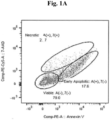
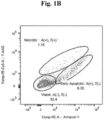
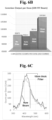
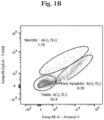
- FIG. 1A and 1B depict flow cytometry for 4T1 cells irradiated with 3.3Gy of 15MV photons with (A) and without (B) psoralen included. Psoralen was removed immediately following irradiation by washing the cells in media. The medium was removed from the well plates, leaving only those cells that are adhered to the plate surface.
- the increased early apoptotic signal in the A group with psoralen indicates the Cherenekov light activation of psoralen.
- the results shown are for flow cytometry (Annexin V and 7-AAD) measured at 72 hours after a 3.3Gy irradiation with 15 MV photons; with (A) and without (B) psoralen included. This shows a clear trend towards Annexin V positive when both psoralen and 15MV photons are present, indicating early apoptosis in these cells.
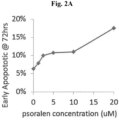
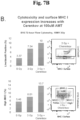
- Figure 2A depicts early apoptosis in 4T1 cells after irradiation with 3.3Gy or 15 MV photons, as a function of psoralen concentration.
- the increasing apoptosis as a function of psoralen concentration was not observed for the un-irradiated control, indicating Cherenkov light activation of psoralen.
- One embodiment of the invention optimizes the photon spectrum from the LINAC to achieve maximum useful UV light generation per unit dose (Gy). Spectrum modification is achieved utilizing low-atomic number filters (e.g. carbon) in-place of the conventional flattening filter, which preferentially absorbs low energy photons.
- Current medical LINACs contain a flattening filter made from aluminum and copper which flatten the beam through beam-hardening to achieve a flat profile at typical treatment depth of 10 cm.
- the flattening filter is placed in the photon beam path, located after the electron target. It serves to create a flat dose profile over a clinically useable treatment field size (e.g., up to 40 cm ⁇ 40 cm).
- Flattening filters are typically cone shaped; they attenuate the center of the field the greatest, so as to achieve the same fluence intensity on the central axis as at the field edge. They are typically composed of dense metals with high atomic weight (such as Tungsten), so as to achieve maximum attenuation in the smallest thickness necessary.
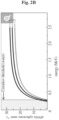
- Figure 2B is a plot showing the production of Cherenkov radiation in various dielectric media as a function of electron energy.
- a preferential x-ray flux in a target medium for inducing a biological change produces more Cherenkov radiation per x-ray dose than its original x-ray spectrum from its original source would have produced upon absorption in the same target medium.
- a preferential x-ray flux in a target medium for inducing a biological change produces between 5-10% more Cherenkov radiation per x-ray dose than its original x-ray spectrum from its original source would have produced upon absorption in the same target medium.
- a preferential x-ray flux in a target medium for inducing a biological change produces between 5-20% more Cherenkov radiation per x-ray dose than its original x-ray spectrum from its original source would have produced upon absorption in the same target medium.
- a preferential x-ray flux in a target medium for inducing a biological change produces between 5-50% more Cherenkov radiation per x-ray dose than its original x-ray spectrum from its original source would have produced upon absorption in the same target medium.
- a preferential x-ray flux has removed from its original source a higher percentage of lower energy x-rays that do not contribute to Cherenkov radiation (e.g. x-rays of 0.3 MeV or lower) than of higher energy x-rays (e.g. x-rays of 1 MeV or higher) which do contribute to Cherenkov radiation.
- a preferential x-ray flux has removed from its original source a higher percentage of lower energy x-rays that do not contribute to Cherenkov radiation (e.g. x-rays of 0.5 MeV or lower) than of higher energy x-rays (e.g. x-rays of 1 MeV or higher) which do contribute to Cherenkov radiation.
- Cherenkov radiation e.g. x-rays of 0.5 MeV or lower
- higher energy x-rays e.g. x-rays of 1 MeV or higher
- a preferential x-ray flux has removed from its original source a higher percentage of lower energy x-rays that do not contribute to Cherenkov radiation (e.g. x-rays of 1.0 MeV or lower) than of higher energy x-rays (e.g. x-rays of 5 MeV or higher) which do contribute to Cherenkov radiation.
- Cherenkov radiation e.g. x-rays of 1.0 MeV or lower
- higher energy x-rays e.g. x-rays of 5 MeV or higher
- a preferential x-ray flux has removed from its original source a higher percentage of lower energy x-rays that do not contribute to Cherenkov radiation (e.g. x-rays of 1.0 MeV or lower) than of higher energy x-rays (e.g. x-rays of 10 MeV or higher) which do contribute to Cherenkov radiation.
- Cherenkov radiation e.g. x-rays of 1.0 MeV or lower
- higher energy x-rays e.g. x-rays of 10 MeV or higher
- the low-atomic number filter would have a completely different purpose from the conventional flattening filter. More specifically, the purpose of the low-atomic number filter would be to alter the x-ray fluence spectrum of the LINAC beam in order to maximize Cherenkov light production in the tumor per unit dose of radiation.
- the low-atomic number filter of the invention would have a thickness and mass composition that would remove the lower energy x-ray photons that result in only a small amount of or no Cherenkov radiation from the beam while transmitting the higher energy x-ray photons.
- Low-atomic number filters (such for example filters made with a substantial fraction of carbon) would exhibit this kind of x-ray photon transmittance useful in the present invention. While not limited to the following thicknesses, depending on the materials selected, the thickness of the low mass filter preferentially absorbing lower energy x-rays can range from mm to cm or more in thickness.
- a preferential x-ray flux in a target medium for inducing a biological change produces more Cherenkov radiation per x-ray dose than its original x-ray spectrum filtered by a flattening filter would have produced upon absorption in the same target medium.
- the filter comprises a carbon filter (e.g., a graphite or amorphous carbon filter) having a thickness in the range of 0.5 to 50 cm, or 1 to 20 cm, or 2 to 10 cm, or 5 to 7 cm, or ranges in between and overlapping.
- the x-ray photons transit the thickness of the carbon filter where the lower energy x-ray photons are preferentially absorbed.
- the filter comprises a natural or synthetic polymer filter (e.g., a polyurethane filter or polytetrafluorethylene filter or a silicone filter) having a thickness in the range of 0.5 to 50 cm, or 1 to 20 cm, or 2 to 10 cm, or 5 to 7 cm, or ranges in between and overlapping.
- the x-ray photons transit the thickness of the polymer filter where the lower energy x-ray photons are preferentially absorbed.
- the invention utilizes "flattening filter free" radiotherapy beams, for which the flattening filter is eliminated.
- These beams have the advantage of increased dose rate and the passing of higher energy x-rays which would produce a higher percentage of Cherenkov radiation, but at the cost of the beam being un-flattened.
- this disadvantage can be offset using multi-leaf collimators which are common on modern linear accelerators.
- Another embodiment of the invention involves combining the bio-therapeutic Cherenkov radiation with fluorophores which capture the Cherenkov light emitted at wavelengths outside the range for drug activation, and re-emit at energies within the activation range.
- fluorophores capture portions of the Cherenkov spectrum and re-emit in the ultraviolet and the visible range which is useful for psoralen (or equivalent) activation.
- fluorophores that can absorb in the UV-blue range and emit at a lower energy (e.g., toward red) would be suitable for activating drugs that are sensitive to the visible light (i.e., for drugs which have peak absorption in the visible).
- organic molecules can be used that down-convert from X-Ray into UV and Visible.
- Organic compounds can be used to achieve the same down conversion.
- Anthracene and anthracene based compounds can be used.
- Anthracene exhibits a blue (400-500 nm peak) fluorescence under ultraviolet light.
- Antharacene also exhibits fluorescence under X-Ray energy.
- both x-rays in the target medium and Cherenkov radiation in the target medium can be down-converted to light matched to the photoactive drug or determined to be capable of activating the photoactive drug.
- plastic scintillators plastic scintillator fibers and related materials are made of polyvinyltoluene or styrene and fluors can be used. These and other formulations are commercially available, such as from Saint Gobain Crystals, as BC-414, BC-420, BC-422, or BCF-10. Phosphor Product Reference Peak Emission (nm) Organic BC-414 392 Organic BC-420 391 Organic BC-422 370
- polymers are able to emit in the visible range and these include: Phosphor (Fiber Forms) Product Reference Peak Emission (nm) # of Photons Per MeV Organic BCF-10 432 8000 Organic BC-420 435 8000 Organic BC-422 492 8000
- organic molecules could then be used to assist in activation of a drug such as psoralen because these organic molecules would be able to capture a part of the CR spectrum and a part of the x-rays escaping without use and provide an additional source of internal UV light generated inside the patient or subject.
- Another embodiment involves selection of the linear accelerator dose rate to optimize the drug activation by the Cherenkov light.
- the following examples are added by way of illustration and not limitation.
- the SBRT and SRS treatments are delivered as normal, but an additional highly localized "damage" component (due to photoactivation of psoralen for example) is generated through Cherenkov Light Activation of Psoralen (CLAP).
- CLAP Cherenkov Light Activation of Psoralen
- psoralen is a biologically inert natural compound which transforms to a powerful anti-cancer therapeutic when photo-activated (illuminated with LT light).
- psoralen in addition to the reaction pathways described in the background to activate psoralen, in one embodiment of the invention, under exposure to the Cherenkov radiation, psoralen can be made to form monoadducts or photoadducts 4',5' or photoadducts 3,4 or crosslink (where both types of photoadducts.
- the CLAP enhanced therapeutic treatment of the present invention addresses this limitation by using Cherenkov UV and blue radiation produced when high energy photons liberate secondary high energy electrons throughout the beam path in tissue.
- the Cherenkov light from radiotherapy can permit real-time surface dose measurements, thereby monitoring of the total Gy exposure.
- the Cherenkov light reflected off the surface of the patient can be imaged using a UV sensitive camera.
- the Cherenkov light is proportional to the radiation dose delivered. Workers have described in Medical Physics 38 (7) pages 4127-4132 (2011 ) this approach for determining a dose.
- SBRT/SRS treatments are delivered with an optimized LINAC photon spectrum (using for example the low-mass filter described above) and generate sufficient psoralen photo-activation which, in turn, produces a long-term immunogenic component induced by the patient's autoimmune response to the "damaged" cells.
- a system for imaging or treating a tumor in a human or animal body.
- the system includes a pharmaceutical carrier including a photoactivatable drug and an optional pharmaceutical carrier, an x-ray or high energy electron or proton source capable of producing energies for the x-rays, electrons, or protons which yield in a target material CR light, and a processor programmed to control a dose of x-rays or electrons to the tumor for production of CR light inside or in the vicinity of the tumor to activate the photoactivatable drug.
- a method described includes injecting into a vicinity of and inside the tumor a pharmaceutical carrier including the photoactivatable drug, applying x-ray or high energy electrons or protons to the tumor, and producing the CR light inside or in the vicinity of the tumor to activate the photoactivatable drug.
- the low mass filter predominantly transmits x-ray photons having energies predominantly greater than 0.5 MeV, or greater than 1.0 MeV, or greater than 1.5 MeV, or greater than 2.0 MeV.
- energy modulation agents e.g., phosphors or other down conversion media
- combinations of different down conversion media, upconversion media, combinations of different up conversion media, and/or combinations of different up and down conversion media are detailed below in the various embodiments.
- Radiation from the energy modulation agents can assist or supplement the CR radiation to alter the biological activity of the medium, as described in more detail below.
- a system for light stimulation within a medium has a high energy x-ray or electron or proton source which provides high energy x-rays or electrons or protons into the medium to be treated to produce CR light inside the medium to be treated, especially a biological medium.
- the tissue such that radiation dose can be maximized in the target area, while being minimized in skin and superficial dose.
- Such targeting can be preferably done with appropriate collimation, using as an associated imaging system, a fan beam or cone beam x-ray system, or combinations thereof.
- Other targeting mechanisms include axial and angular mA modulation of a Computed Tomograph (CT) system, and spectrum shaping through k-edge or crystalline filtering to "tune" the x-ray energy precisely to where the medium to be treated shows optimum CR light production or energy-converting or energy modulation agent in the medium shows maximum sensitivity.
- CT Computed Tomograph
- the initiation energy is capable of penetrating completely through the medium.
- the phrase "capable of penetrating completely through the medium” is used to refer to energy capable of penetrating a container to any distance necessary to activate the activatable agent within the medium. It is not required that the energy applied actually pass completely through the medium, merely that it be capable of doing so in order to permit penetration to any desired distance to internally generate CR light in a vicinity of the activatable agent, such as by targeting the focus of the x-ray beam and thus the desired x-ray dose in the desired tissue.
- the type of energy source chosen will depend on the medium itself.
- psoralen and psoralen derivatives are of interest for many of the biological applications of this invention.
- an initiation energy source can provide an energy that generates CR light to activate an activatable pharmaceutical agent to treat target cells within a subject.
- the initiation energy is applied indirectly to the activatable pharmaceutical agent, preferably in proximity to the target cells.
- the phrase “applied indirectly” when referring to the application of the initiation energy, means the penetration by the initiation energy into the subject beneath the surface of the subject and to the activatable pharmaceutical agent within a subject.
- subject is not intended to be limited to humans, but may also include animals, plants, or any suitable biological organism.
- cell proliferation disorder refers to any condition where the growth rate of a population of cells is less than or greater than a desired rate under a given physiological state and conditions. Although, preferably, the proliferation rate that would be of interest for treatment purposes is faster than a desired rate, slower than desired rate conditions may also be treated by methods of the invention.
- Exemplary cell proliferation disorders may include, but are not limited to, cancer, bacterial infection, immune rejection response of organ transplant, solid tumors, viral infection, autoimmune disorders (such as arthritis, lupus, inflammatory bowel disease, Sjogrens syndrome, multiple sclerosis) or a combination thereof, as well as aplastic conditions wherein cell proliferation is low relative to healthy cells, such as aplastic anemia.
- Particularly preferred cell proliferation disorders for treatment using the present methods are cancer, staphylococcus aureus (particularly antibiotic resistant strains such as methicillin resistant staphylococcus aureus or MRSA), and autoimmune disorders.
- an “activatable agent” is an agent that normally exists in an inactive state in the absence of an activation signal (e.g., one or more photons).
- an activation signal e.g., one or more photons.
- the agent is capable of producing a desired pharmacological, cellular, chemical, electrical, or mechanical effect in a medium (i.e. a predetermined change in the medium).
- Signals that may be used to activate a corresponding agent may include, but are not limited to, photons of specific wavelengths (e.g. x-rays, ultraviolet, or visible light).
- an activatable agent such as a photosensitizer
- UV-A radiation e.g., by UV-A radiation generated internally in the medium
- an activatable agent, such as a photosensitizer may be activated by UV-B or UV-C radiation. Once activated, the agent in its active-state may then directly proceed to produce a predetermined change.
- the activatable agent When activated, the activatable agent may effect changes that include, but are not limited to an increase in organism activity, a decrease in organism activity, apoptosis, and/or a redirection of metabolic pathways.
- an “activatable pharmaceutical agent” is an agent that normally exists in an inactive state in the absence of an activation signal. When the agent is activated, it is capable of affecting the desired pharmacological effect on a target cell (i.e. preferably a predetermined cellular change).
- a photoactive compound that achieves its pharmaceutical effect by binding (with mono adducts formation or cross links formation) to certain cellular structure in its active state may require physical proximity to the target cellular structure when the activation signal is delivered.
- Some examples of activating conditions may include, but are not limited to, temperature, pH, location, state of the cell, presence or absence of co-factors. Selection of an activatable pharmaceutical agent greatly depends on a number of factors such as the desired cellular change, the desired form of activation, as well as the physical and biochemical constraints that may apply.
- an activatable pharmaceutical agent may achieve its desired effect. Such mechanisms may include direct action on a predetermined target as well as indirect actions via alterations to the biochemical pathways.
- a preferred direct action mechanism is by binding the agent to a critical cellular structure such as nuclear DNA, mRNA, rRNA, ribosome, mitochondrial DNA, or any other functionally important structures,
- Indirect mechanisms may include modulation of or releasing metabolites upon activation to interfere with normal metabolic pathways, releasing chemical signals (e.g. agonists or antagonists) upon activation to alter the targeted cellular response, and other suitable biochemical or metabolic alterations.
- the activatable pharmaceutical agent is capable of chemically binding to the DNA or mitochondriat at a therapeutically effective amount.
- the activatable pharmaceutical agent preferably a photoactivatable agent, is exposed in situ to light internally generated for example by CR and/or an energy modulation agent.
- An activatable agent may be a small molecule; a biological molecule such as a protein, a nucleic acid or lipid; a supramolecular assembly; a nanoparticle; a nanostructure, or combinations thereof; or any other molecular entity having a pharmaceutical activity once activated.
- the activatable agent may be derived from a natural or synthetic origin. Any such molecular entity that may be activated by a suitable activation signal source to effect a predetermined cellular change may be advantageously employed in the invention.
- Suitable photoactive agents include, but are not limited to: psoralens and psoralen derivatives, pyrene cholesteryloleate, acridine, porphyrin, fluorescein, rhodamine, 16-diazorcortisone, ethidium, transition metal complexes of bleomycin, transition metal complexes of deglycobleomycin, organoplatinum complexes, alloxazines such as 7,8-dimethyl-10-ribityl isoalloxazine (riboflavin), 7,8,10-trimethylisoalloxazine (lumiflavin), 7,8-dimethylalloxazine (lumichrome), isoalloxazine-adenine dinucleotide (flavine adenine dinucleotide [FAD], alloxazine mononucleotide (also known as flavine mononucleotide [FMN] and riboflavine-5-phosphat
- Additional photoactive agents include, but are not limited to, carbene precursors, nitrene precursors, thio derivatives, benzophenones, and halogenated pyrimidines.
- photo-chemistries are routinely employed to achieve protein-DNA photocross-links but none has been achieved using an indirect method as presented herein, for example where X-Ray radiation is converted to UV radiation to activate the species and achieve DNA photocross-links.
- Endogenously-based derivatives include synthetically derived analogs and homologs of endogenous photoactivated molecules, which may have or lack lower (1 to 5 carbons) alkyl or halogen substituents of the photosensitizers from which they are derived, and which preserve the function and substantial non-toxicity. Endogenous molecules are inherently non-toxic and may not yield toxic photoproducts after photoradiation.
- exemplary cellular changes may include, but are not limited to, morphologic changes, apoptosis, necrosis, up-regulation of certain genes, down-regulation of certain genes, modulation of or secretion of cytokines, alteration of cytokine receptor responses, or a combination thereof.
- a preferred method of treating a cell proliferation disorder of the invention administers a photoactivatable agent to a patient, stimulates the photoactivatable agent by CR light to induce cell damage (or kill), and generates an auto vaccine effect.
- energy modulation agents may be included in the medium to be treated.
- the energy modulation agents could be used to supplement the internally generated CR by downconverion of x-rays into ultraviolet or visible light.
- the energy modulation agents could be used to down-convert a portion of the CR spectrum or up-convert a portion of the CR spectrum.
- an "energy modulation agent” refers to an agent that is capable of receiving an energy input from a source and then re-emitting a different energy to a receiving target. Energy transfer among molecules may occur in a number of ways. The form of energy may be electronic, thermal, electromagnetic, kinetic, or chemical in nature. Energy may be transferred from one molecule to another (intermolecular transfer) or from one part of a molecule to another part of the same molecule (intramolecular transfer). For example, a modulation agent may receive electromagnetic energy and re-emit the energy in the form of thermal energy which otherwise contributes to heating the environment in vicinity of the light emission. In various embodiments, the energy modulation agents receive higher energy (e.g.
- Quantum dots, semiconductor nanostructures and various materials related to quantum dots, semiconductor materials, etc. can be used as energy modulation agents.
- Scintillator materials can be used as energy modulation agents.
- Various scintillator materials can be used as energy modulation agents since they absorb X-ray and emit luminescence emission, which can be used to excite the PA system.
- single crystals of molybdates can be excited by X-ray and emit luminescence around 400 nm [ Mirkhin et al, Nuclear Instrum. Meth. In Physics Res. A, 486, 295 (2002 )].
- CdS or CsCl
- XEOL materials such as lanthanides or rare earth materials can be used as energy modulation agents.
- Suitable energy modulation agents include, but are not limited to, a phosphor, a scintillator, a biocompatible fluorescing metal nanoparticle, fluorescing dye molecule, gold nanoparticle, quantum dots, such as a water soluble quantum dot encapsulated by polyamidoamine dendrimers, a luciferase, a biocompatible phosphorescent molecule, a combined electromagnetic energy harvester molecule, an up-converter, a lanthanide chelate capable of intense luminescence, metals (gold, silver, etc); semiconductor materials; materials that exhibit X-ray excited luminescence (XEOL); organic solids, metal complexes, inorganic solids, crystals, rare earth materials (lanthanides), polymers, and materials that exhibit excitonic properties.
- quantum dots such as a water soluble quantum dot encapsulated by polyamidoamine dendrimers, a luciferase, a biocompatible phosphorescent molecule, a combined electromagnetic
- the energy modulation agents include down converters (such as for example phosphors which can convert x-ray or other high energy photon or particle into visible light. These down converters when used in combination can activate a variety of UV-stimulated photoreactions as well as activate any visible light activated reactions.
- luminescing particles can include gold particles (such as for example the nanoparticles of gold), BaFBr:Eu particles, CdSe particles, Y 2 O 3 :Eu 3+ particles, and/or other known stimulated luminescent materials such as for example ZnS: Mn 2+ ; ZnS: Mn 2+ ,Yb 3+ , Y 2 O 3 : Eu 3+ ; BaFBr:Tb 3+ ; and YF 3 :Tb 3 +.
- gold particles such as for example the nanoparticles of gold
- BaFBr:Eu particles such as for example the nanoparticles of gold
- CdSe particles CdSe particles
- Y 2 O 3 :Eu 3+ particles and/or other known stimulated luminescent materials
- other known stimulated luminescent materials such as for example ZnS: Mn 2+ ; ZnS: Mn 2+ ,Yb 3+ , Y 2 O 3 : Eu 3+ ; BaFBr:Tb
- downconverters include, but are not limited to: BaFCl:Eu 2+ , BaSO 4 - :Eu 2+ , LaOBr:Tm 3+ , YTaO 4 , YTaO 4 :Nb, CaWO 4 , LaOBr:Tb 3+ , Y 2 O 2 S:Tb 3+ , ZnS:Ag, (Zn,Cd)S:Ag, Gd 2 O 2 S:Tb 3+ , La 2 O 2 S:Tb 3+ .
- a downconverting energy modulation agent can comprise inorganic particulates selected from the group consisting of: metal oxides; metal sulfides; doped metal oxides; and mixed metal chalcogenides.
- the downconverting material can comprise at least one of Y 2 O 3 , Y 2 O 2 S, NaYF 4 , NaYbF 4 , YAG, YAP, Nd 2 O 3 , LaF 3 , LaCl 3 , La 2 O 3 , TiO 2 , LuPO 4 , YVO 4 , YbF 3 , YF 3 , Na-doped YbF 3 , ZnS; ZnSe; MgS; CaS; CaWO 4 , CaSiO 2 :Pb, and alkali lead silicate including compositions of SiO 2 , B 2 O 3 , Na 2 O, K 2 O, PbO, MgO, or Ag, and combinations or alloys or layers thereof.
- the downconverting material can include a dopant including at least one of Er, Eu, Yb, Tm, Nd, Mn Tb, Ce, Y, U, Pr, La, Gd and other rare-earth species or a combination thereof.
- the dopant can be included at a concentration of 0.01%-50% by mol concentration.
- the downconverting energy modulation agent can comprise materials such as ZnSeS:Cu, Ag, Ce, Tb; CaS: Ce,Sm; La 2 O 2 S:Tb; Y 2 O 2 S:Tb; Gd 2 O 2 S:Pr, Ce, F; LaPO 4 .
- the downconverting material can comprise phosphors such as ZnS:Ag and ZnS:Cu, Pb.
- the downconverting material can be alloys of the ZnSeS family doped with other metals.
- suitable materials include ZnSe x S y :Cu, Ag, Ce, Tb, where the following x, y values and intermediate values are acceptable: x:y; respectively 0:1; 0.1:0.9; 0.2:0.8; 0.3:0.7; 0.4:0.6; 0.5:0.5; 0.6:0.4; 0.7:0.3; 0.8:0.2; 0.9:0.1; and 1.0:0.0.
- the downconverting energy modulation agent can be materials such as sodium yttrium fluoride (NaYF 4 ), lanthanum fluoride (LaF 3 ), lanthanum oxysulfide (La 2 O 2 S), yttrium oxysulfide (Y 2 O 2 S), yttrium fluoride (YF 3 ), yttrium gallate, yttrium aluminum garnet (YAG), gadolinium fluoride (GdF 3 ), barium yttrium fluoride (BaYF 5 , BaY 2 F 8 ), gadolinium oxysulfide (Gd 2 O 2 S), calcium tungstate (CaWO 4 ), yttrium oxide:terbium (Yt 2 O 3 Tb), gadolinium oxysulphide:europium (Gd 2 O 2 S:Eu), lanthanum oxysulphide:europium (La 2 O 2 S:Eu), and gad
- the downconverting energy modulation agent can be near-infrared (NIR) downconversion (DC) phosphors such as KSrPO 4 :Eu 2+ , Pr 3+ , or NaGdF 4 :Eu or Zn 2 SiO 4 :Tb 3+ ,Yb 3+ or ⁇ -NaGdF 4 co-doped with Ce 3+ and Tb 3+ ions or Gd 2 O 2 S:Tm or BaYF 5 :Eu 3+ or other down converters which emit NIR from visible or UV light exposure (as in a cascade from x-ray to UV to NIR) or which emit NIR directly after x-ray or e-beam exposure.
- NIR near-infrared
- DC downconversion
- an up-converting energy modulation agent can be used which is activated by for example an infrared or near infrared source such as a laser.
- the up-converting energy modulation agent can be at least one of Y 2 O 3 , Y 2 O 2 S, NaYF 4 , NaYbF 4 , YAG, YAP, Nd 2 O 3 , LaF 3 , LaCl 3 , La 2 O 3 , TiO 2 , LuPO 4 , YVO 4 , YbF 3 , YF 3 , Na-doped YbF 3 , or SiO 2 or alloys or layers thereof.
- the luminescing particles (down converters, mixtures of down converters, up converters, mixtures of up converters, and combinations thereof) of the invention described here can be coated with insulator materials such as for example silica which will reduce the likelihood of any chemical interaction between the luminescing particles and the medium.
- insulator materials such as for example silica which will reduce the likelihood of any chemical interaction between the luminescing particles and the medium.
- silica for biological applications of inorganic nanoparticles, one of the major limiting factors is their toxicity.
- nanoparticles are more or less toxic.
- nanoparticles with toxicity as low as possible are desirable or else the nanoparticles have to remain separated from the medium.
- Pure TiO 2 , ZnO, and Fe 2 O 3 are biocompatible.
- CdTe and CdSe are toxic, while ZnS, CaS, BaS, SrS and Y 2 O 3 are less toxic.
- the toxicity of nanoparticles can result from their inorganic stabilizers, such as TGA, or from dopants such as Eu 2+ , Cr 3+ or Nd 3+ .
- Suitable energy modulation agents which would seem the most biocompatible are zinc sulfide, ZnS:Mn 2+ , ferric oxide, titanium oxide, zinc oxide, zinc oxide containing small amounts of Al 2 O 3 and AgI nanoclusters encapsulated in zeolite.
- lanthanum and gadolinium oxyhalides activated with thulium
- Er 3+ doped BaTiO 3 nanoparticles Yb 3+ doped CsMnCl 3 and RbMnCl 3
- BaFBr:Eu 2+ nanoparticles cesium iodide, bismuth germanate, cadmium tungstate, and CsBr doped with divalent Eu.
- the following luminescent polymers are also suitable as energy modulation agents: poly(phenylene ethynylene), poly(phenylene vinylene), poly(p-phenylene), poly(thiophene), poly(pyridyl vinylene), poly(pyrrole), poly(acetylene), poly(vinyl carbazole), poly(fluorenes), and the like, as well as copolymers and/or derivatives thereof.
- U.S. Pat. No. 7,008,559 describes the upconversion performance of ZnS where excitation at 767 nm produces emission in the visible range.
- the materials described in U.S. Pat. No. 7,008,559 including the ZnS as well as Er 3+ doped BaTiO 3 nanoparticles and Yb 3+ doped CsMnCl 3 are suitable in various embodiments of the invention,
- the up converters can be used in combination with the down converters (or mixtures of down converters) or in combination with various up converters.
- Various up converters suitable for this invention include CdTe, CdSe, ZnO, CdS, Y 2 O 3 , MgS, CaS, SrS and BaS.
- Such up conversion materials may be any semiconductor and more specifically, but not by way of limitation, sulfide, telluride, selenide, and oxide semiconductors and their nanoparticles, such as Zn 1-x Mn x S y , Zn 1-x Mn x Se y , Zn 1-x Mn x Te y , Cd 1-x MnS y , Cd 1-x Mn x Se y , Cd 1-x Mn x Te y , Pb 1-x Mn x S y , Pb 1-x Mn x Se y , Pb 1-x Mn x Te y , Mg 1-x MnS y , Ca 1-x Mn x S y , Ba 1-x Mn x S y , and Sr 1-x , etc.
- Additional conversion materials include insulating and nonconducting materials such as BaF 2 , BaFBr, and BaTiO 3 , to name but a few exemplary compounds.
- nanoparticles such as ZnS:Tb 3+ , Er 3+ ; ZnS:Tb 3+ ; Y 2 O 3 :Tb 3+ ; Y 2 O 3 :Tb 3+ , Er3 + ; ZnS:Mn 2+ ; ZnS:Mn,Er 3+ are known in the art to have two functions, capable of functioning for both down-conversion luminescence and upconversion luminescence.
- one embodiment of the invention described here coats these nanoparticles with silica.
- Silica is used as a coating material in a wide range of industrial colloid products from paints and magnetic fluids to high-quality paper coatings. Further, silica is both chemically and biologically inert and also is optically transparent.
- Other coatings suitable for this invention include a polymethyl methacrylate (PMMA) coating and an ethyl-cellulose coating.
- the energy modulation agent can be used alone or as a series of two or more energy modulation agents wherein the energy modulation agents provide an energy cascade from the light of the phosphors or scintillators.
- the first energy modulation agent in the cascade will absorb the CR, convert it to a different energy which is then absorbed by the second energy modulation in the cascade, and so forth until the end of the cascade is reached with the final energy modulation agent in the cascade emitting the energy necessary to activate the activatable pharmaceutical agent.
- a chemical reaction cascade can be triggered.
- the CR can activate a chemical which in turn can activate a bio-therapeutic in parallel to or independent of a photonic pathway.
- the energy modulation agents or the photoactivatable agent may further be coupled to a carrier for cellular targeting purposes.
- a UV-A emitting energy modulation agent may be concentrated in the tumor site by physical insertion or by conjugating the UV-A emitting energy modulation agent with a tumor specific carrier, such as an antibody, nucleic acid, peptide, a lipid, chitin or chitin-derivative, a chelate, a surface cell receptor, molecular imprints, aptamers, or other functionalized carrier that is capable of concentrating the UV-A emitting source in a specific target tumor.
- a tumor specific carrier such as an antibody, nucleic acid, peptide, a lipid, chitin or chitin-derivative, a chelate, a surface cell receptor, molecular imprints, aptamers, or other functionalized carrier that is capable of concentrating the UV-A emitting source in a specific target tumor.
- a method described utilizes the principle of energy transfer to and among molecular agents to control delivery and activation of cellular changes by irradiation such that delivery of the desired effect is more intensified, precise, and effective than the conventional techniques.
- At least one energy modulation agent can be administered to the subject which adsorbs, intensifies or modifies the CR into an energy that effects a predetermined cellular change in the target structure.
- the energy modulation agent may be located around, on, or in the target structure. Further, the energy modulation agent can transform CR into a photonic energy that effects a predetermined change in the target structure.
- the energy modulation agent decreases the wavelength of the CR (down convert). In another embodiment, the energy modulation agent can increase the wavelength of the CR (up convert).
- the energy modulation agent is one or more members selected from a biocompatible fluorescing metal nanoparticle, fluorescing metal oxide nanoparticle, fluorescing dye molecule, gold nanoparticle, silver nanoparticle, gold-coated silver nanoparticle, a water soluble quantum dot encapsulated by polyamidoamine dendrimers, a luciferase, a biocompatible phosphorescent molecule, a combined electromagnetic energy harvester molecule, and a lanthanide chelate exhibiting intense luminescence.
- photoactivatable agents may be stimulated by light from CR and/or light from the energy modulation agents, leading to subsequent irradiation, resonance energy transfer, exciton migration, electron injection, or chemical reaction, to an activated energy state that is capable of effecting the predetermined cellular change desired.
- the photoactivatable agent upon activation, binds to DNA or RNA or other structures in a cell.
- the activated energy state of the agent is capable of causing damage to cells, inducing apoptosis.
- the mechanism of apoptosis is associated with an enhanced immune response that reduces the growth rate of cell proliferation disorders and may shrink solid tumors, depending on the state of the patient's immune system, concentration of the agent in the tumor, sensitivity of the agent to stimulation, and length of stimulation.
- the light absorbing species include natural chromophores in tissue or exogenous dye compounds such as indocyanine green, naphthalocyanines, and porphyrins coordinated with transition metals and metallic nanoparticles and nanoshells of metals. Natural chromophores, however, suffer from very low absorption.
- the choice of the exogenous photothermal agents is made on the basis of their strong absorption cross sections and highly efficient light-to-heat conversion. This feature greatly minimizes the amount of energy needed to induce local damage of the diseased cells, making therapy method less invasive.
- microwave upconversion can be used to supplement the CR-driven activation.
- U.S. Pat. Appl. No. 20150283392 describes up and down conversion systems for production of emitted light from various energy sources including radio frequency, microwave energy and magnetic induction sources for upconversion.
- the systems described therein including the plasma-gas containing capsules can be used here.
- This up converting "capsule" structure once in the patient or subject can be exposed to a combination of microwave energy and/or high magnetic field in order to produce light (for example UV, VIS, or IR light or a combination thereof) from the plasma gas in the gas-filled container to activate a photoactivatable drug such as psoralen.
- the containers or capsules can include materials ("secondary electron emitters") which, upon exposure to x-rays (as from the CR radiation0 would assist in the generation of a gaseous plasma in the capsule.
- secondary electron emitters materials which, upon exposure to x-rays (as from the CR radiation0 would assist in the generation of a gaseous plasma in the capsule.
- the '392 application describes that, when inner walls of the gas containers are coated with a material that would generate secondary electrons upon X-Ray exposure, the secondary electrons enter into high energy excitations due to radio frequency RF and/or microwave MW energy, thereby producing lower power plasma ignitions. Higher energy excitations are possible in the presence of a magnetic field.
- the energy source can be an internal source of radiation, often referred to as Brachytherapy.
- Brachytherapy involves placing radiation sources as close as possible to the tumor site. Sometimes, these sources may be inserted directly into the tumor.
- the radioactive sources or isotopes are in the form of wires, seeds (or molds), or rods. This technique is commonly used in treating cancers of the cervix, uterus, vagina, rectum, eye, and certain head and neck cancers. It is also occasionally used to treat cancers of the breast, brain, skin, anus, esophagus, lung, bladder, and prostate.
- brachytherapy There are several types of brachytherapy characterized by different methods of placing radiation inside the body: interstitial brachytherapy, intracavitary brachytherapy, intraluminal radiation therapy, and radioactively tagged molecules given intravenously.
- brachytherapy can be combined with external beam radiation therapy to generate radiation around the treatment area with a boost of radiation delivered to the tumor area itself.
- the selection of radioactive seeds is known to those skilled in the art and typically based upon the anatomy of the treatment area, the energy of emission and the duration of treatment. In the present invention, these seeds can be used as the source of CR radiation or as a supplement to CR radiation.
- the photoactive drug molecules can be given to a patient by oral ingestion, skin application, or by intravenous injection.
- the photoactive drug molecules drugs travel through the blood stream inside the body towards the targeted tumor (either via passive or active targeting strategies).
- the invention treatment may also be used for inducing an auto vaccine effect for malignant cells, including those in solid tumors.
- any rapidly dividing cells or stem cells may be damaged by a systemic treatment, then it may be preferable to direct the stimulating energy directly toward the tumor, preventing damage to most normal, healthy cells or stem cells by avoiding photoactivation or resonant energy transfer of the photoactivatable agent.
- a treatment may be applied that slows or pauses mitosis.
- a treatment is capable of slowing the division of rapidly dividing healthy cells or stem cells during the treatment, without pausing mitosis of cancerous cells.
- a blocking agent is administered preferentially to malignant cells prior to administering the treatment that slows mitosis.
- an aggressive cell proliferation disorder can be treated with CR-activation of the photoactivatable agent which has a much higher rate of mitosis, which leads to selective destruction of a disproportionate share of the malignant cells during even a systemically administered treatment.
- Stem cells and healthy cells may be spared from wholesale programmed cell death, even if exposed to photoactivated agents, provided that such photoactivated agents degenerate from the excited state to a lower energy state prior to binding, mitosis or other mechanisms for creating damage to the cells of a substantial fraction of the healthy stem cells.
- an auto-immune response may not necessarily have to be induced.
- Methods may further include adding an additive to alleviate treatment side-effects.
- additives may include, but are not limited to, antioxidants, adjuvant, or combinations thereof.
- psoralen is used as the activatable pharmaceutical agent
- UV-A from CR is used as the activating energy
- antioxidants are added to reduce the unwanted side-effects of irradiation.
- the activatable pharmaceutical agent and derivatives thereof as well as the energy modulation agent and plasmonics compounds (discussed later) and structures, can be incorporated into pharmaceutical compositions suitable for administration.
- Such compositions typically comprise the activatable pharmaceutical agent and a pharmaceutically acceptable carrier.
- the pharmaceutical composition also comprises at least one additive having a complementary therapeutic or diagnostic effect, wherein the additive is one selected from an antioxidant, an adjuvant, or a combination thereof.
- pharmaceutically acceptable carrier is intended to include any and all solvents, dispersion media, coatings, antibacterial and antifungal agents, isotonic and absorption delaying agents, and the like, compatible with pharmaceutical administration.
- medical agents for pharmaceutically active substances is well known in the art. Except insofar as any conventional media or agent is incompatible with the active compound, use thereof in the compositions is contemplated.
- Supplementary active compounds can also be incorporated into the compositions. Modifications can be made to the compound of the invention to affect solubility or clearance of the compound. These molecules may also be synthesized with D-amino acids to increase resistance to enzymatic degradation. If necessary, the activatable pharmaceutical agent can be co-administered with a solubilizing agent, such as cyclodextran.
- a pharmaceutical composition of the invention can be formulated to be compatible with its intended route of administration.
- routes of administration include parenteral, e.g., intravenous, intradermal, subcutaneous, oral (e.g., inhalation), transdermal (topical), transmucosal, rectal administration, and direct injection into the affected area, such as direct injection into a tumor.
- Solutions or suspensions used for parenteral, intradermal, or subcutaneous application can include the following components: a sterile diluent such as water for injection, saline solution, fixed oils, polyethylene glycols, glycerin, propylene glycol or other synthetic solvents; antibacterial agents such as benzyl alcohol or methyl parabens; antioxidants such as ascorbic acid or sodium bisulfite; chelating agents such as ethylenediaminetetraacetic acid; buffers such as acetates, citrates or phosphates, and agents for the adjustment of tonicity such as sodium chloride or dextrose.
- the pH can be adjusted with acids or bases, such as hydrochloric acid or sodium hydroxide.
- the parenteral preparation can be enclosed in ampoules, disposable syringes or multiple dose vials made of glass or plastic.
- compositions suitable for injectable use include sterile aqueous solutions (where water soluble) or dispersions and sterile powders for the extemporaneous preparation of sterile injectable solutions or dispersion.
- suitable carriers include physiological saline, bacteriostatic water, or phosphate buffered saline (PBS).
- PBS phosphate buffered saline
- the composition must be sterile and should be fluid to the extent that easy syringability exists. It must be stable under the conditions of manufacture and storage and must be preserved against the contaminating action of microorganisms such as bacteria and fungi.
- the carrier can be a solvent or dispersion medium containing, for example, water, ethanol, polyol (for example, glycerol, propylene glycol, and liquid polyethylene glycol, and the like), and suitable mixtures thereof.
- the proper fluidity can be maintained, for example, by the use of a coating such as lecithin, by the maintenance of the required particle size in the case of dispersion and by the use of surfactants.
- Prevention of the action of microorganisms can be achieved by various antibacterial and antifungal agents, for example, parabens, chlorobutanol, phenol, ascorbic acid, thimerosal, and the like.
- isotonic agents for example, sugars, polyalcohols such as manitol, sorbitol, sodium chloride in the composition.
- Prolonged absorption of the injectable compositions can be brought about by including in the composition an agent which delays absorption, for example, aluminum monostearate and gelatin.
- Sterile injectable solutions can be prepared by incorporating the active compound (activatable drug and/or energy modulation agent) in the required amount in an appropriate solvent with one or a combination of ingredients enumerated above, as required, followed by filtered sterilization.
- dispersions are prepared by incorporating the active compound into a sterile vehicle that contains a basic dispersion medium and the required other ingredients from those enumerated above.
- methods of preparation are vacuum drying and freeze-drying that yields a powder of the active ingredient plus any additional desired ingredient from a previously sterile-filtered solution thereof.
- Oral compositions of the drug and/or energy modulation agent can generally include an inert diluent or an edible carrier.
- the oral compositions can be enclosed in gelatin capsules or compressed into tablets.
- the active compound can be incorporated with excipients and used in the form of tablets, troches, or capsules.
- Oral compositions can also be prepared using a fluid carrier for use as a mouthwash, wherein the compound in the fluid carrier is applied orally and swished and expectorated or swallowed.
- Pharmaceutically compatible binding agents, and/or adjuvant materials can be included as part of the composition.
- the tablets, pills, capsules, troches and the like can contain any of the following ingredients, or compounds of a similar nature: a binder such as microcrystalline cellulose, gum tragacanth or gelatin; an excipient such as starch or lactose, a disintegrating agent such as alginic acid, primogel, or corn starch; a lubricant such as magnesium stearate or Sterotes; a glidant such as colloidal silicon dioxide; a sweetening agent such as sucrose or saccharin; or a flavoring agent such as peppermint, methyl salicylate, or orange flavoring.
- a binder such as microcrystalline cellulose, gum tragacanth or gelatin
- an excipient such as starch or lactose, a disintegrating agent such as alginic acid, primogel, or corn starch
- a lubricant such as magnesium stearate or Sterotes
- a glidant such as colloidal silicon dioxide
- the compounds are delivered in the form of an aerosol spray from pressured container or dispenser which contains a suitable propellant, e.g., a gas such as carbon dioxide, or a nebulizer.
- a suitable propellant e.g., a gas such as carbon dioxide, or a nebulizer.
- Systemic administration of the activatable drug and/or energy modulation agent can also be by transmucosal or transdermal means.
- penetrants appropriate to the barrier to be permeated are used in the formulation.
- penetrants are generally known in the art, and include, for example, for transmucosal administration, detergents, bile salts, and fusidic acid derivatives.
- Transmucosal administration can be accomplished through the use of nasal sprays or suppositories.
- the active compounds drug and/or energy modulation agent
- the active compounds are formulated into ointments, salves, gels, or creams as generally known in the art.
- the compounds can also be prepared in the form of suppositories (e.g., with conventional suppository bases such as cocoa butter and other glycerides) or retention enemas for rectal delivery.
- suppositories e.g., with conventional suppository bases such as cocoa butter and other glycerides
- retention enemas for rectal delivery.
- the active compounds are prepared with carriers that will protect the compound against rapid elimination from the body, such as a controlled release formulation, including implants and microencapsulated delivery systems.
- a controlled release formulation including implants and microencapsulated delivery systems.
- Biodegradable, biocompatible polymers can be used, such as ethylene vinyl acetate, polyanhydrides, polyglycolic acid, collagen, polyorthoesters, and polylactic acid. Methods for preparation of such formulations will be apparent to those skilled in the art. The materials can also be obtained commercially.
- Liposomal suspensions (including liposomes targeted to infected cells with monoclonal antibodies to viral antigens) can also be used as pharmaceutically acceptable carriers. These can be prepared according to methods known to those skilled in the art, for example, as described in U.S. Pat. No 4 ,522 , 811 .
- Dosage unit form refers to physically discrete units suited as unitary dosages for the subject to be treated; each unit containing a predetermined quantity of active compound calculated to produce the desired therapeutic effect in association with the required pharmaceutical carrier.
- the specification for the dosage unit forms of the invention are dictated by and directly dependent on the unique characteristics of the active compound and the particular therapeutic effect to be achieved, and the limitations inherent in the art of compounding such an active compound for the treatment of individuals.
- compositions can be included in a container, pack, kit or dispenser together with instructions for administration.
- Methods of administering agents are not limited to the conventional means such as injection or oral infusion, but include more advanced and complex forms of energy transfer.
- genetically engineered cells that carry and express energy modulation agents may be used.
- Cells from the host may be transfected with genetically engineered vectors that express bioluminescent agents.
- Transfection may be accomplished via in situ gene therapy techniques such as injection of viral vectors or gene guns, or may be performed ex vivo by removing a sample of the host's cells and then returning to the host upon successful transfection.
- Such transfected cells may be inserted or otherwise targeted at the site where diseased cells are located.
- the order of administering the different agents is not particularly limited. It will be appreciated that different combinations of ordering may be advantageously employed depending on factors such as the absorption rate of the agents, the localization and molecular trafficking properties of the agents, and other pharmacokinetics or pharmacodynamics considerations.
- An advantage of the methods of this approach is that by using x-rays to generate Cherenkov radiation (CR) light inside a diseased site and specifically target cells affected by a cell proliferation disorder, such as rapidly dividing cells, and trigger a cellular change to the cells affected by the cell proliferation disorder, such as apoptosis, in these cells in situ , whereby the immune system of the host may be stimulated to have an immune response against the diseased cells.
- a cell proliferation disorder such as rapidly dividing cells
- Another object of the invention is to treat a condition by CR-activation, disorder or disease in a subject.
- exemplary conditions, disorders or diseases may include, but are not limited to, cancer, autoimmune diseases, cardiac ablasion (e.g., cardiac arrhythmiand atrial fibrillation), photoangioplastic conditions (e.g., de novo atherosclerosis, restinosis), intimal hyperplasia, arteriovenous fistula, macular degeneration, psoriasis, acne, hopeciareata, portwine spots, hair removal, rheumatoid and inflammatory arthritis, joint conditions, lymph node conditions, and cognitive and behavioral conditions.
- cardiac ablasion e.g., cardiac arrhythmiand atrial fibrillation
- photoangioplastic conditions e.g., de novo atherosclerosis, restinosis
- intimal hyperplasia arteriovenous fistula, macular degeneration, psoriasis, acne, hopeciareat
- a disease or condition refers to a condition, disorder or disease that may include, but are not limited to, cancer, soft and bone tissue injury, chronic pain, wound healing, nerve regeneration, viral and bacterial infections, fat deposits (liposuction), varicose veins, enlarged prostate, retinal injuries and other ocular diseases, Parkinson's disease, and behavioral, perceptional and cognitive disorders.
- exemplary conditions also may include nerve (brain) imaging and stimulation, a direct control of brain cell activity with light, control of cell death (apoptosis), and alteration of cell growth and division.
- target structure refers to an eukaryotic cell, prokaryotic cell, a subcellular structure, such as a cell membrane, a nuclear membrane, cell nucleus, nucleic acid, mitochondria, ribosome, or other cellular organelle or component, an extracellular structure, virus or prion, and combinations thereof.
- predetermined cellular change induced by the CR radiation will depend on the desired pharmaceutical outcome.
- exemplary cellular changes may include, but are not limited to, apoptosis, necrosis, up-regulation of certain genes, down-regulation of certain genes, secretion of cytokines, alteration of cytokine receptor responses, regulation of cytochrome c oxidase and flavoproteins, activation of mitochondria, stimulation antioxidant protective pathway, modulation of cell growth and division, alteration of firing pattern of nerves, alteration of redox properties, generation of reactive oxygen species, modulation of the activity, quantity, or number of intracellular components in a cell, modulation of the activity, quantity, or number of extracellular components produced by, excreted by, or associated with a cell, or a combination thereof.
- Predetermined cellular changes may or may not result in destruction or inactivation of the target structure.
- the photoactivatable agent can be a photocaged complex having an active agent contained within a photocage.
- the active agent can bulked up with other molecules that prevent it from binding to specific targets, thus masking its activity.
- the photocage complex is photoactivated by CR and/or light from the energy modulation agents, the bulk falls off, exposing the active agent.
- the photocage molecules can be photoactive (i.e. when photoactivated, they are caused to dissociate from the photocage complex, thus exposing the active agent within), or the active agent can be the photoactivatable agent (which when photoactivated causes the photocage to fall off), or both the photocage and the active agent are photoactivated, with the same or different wavelengths.
- a toxic chemotherapeutic agent can be photocaged, which will reduce the systemic toxicity when delivered. Once the agent is concentrated in the tumor, the agent is irradiated with an activation energy. This causes the "cage” to fall off, leaving a cytotoxic agent in the tumor cell.
- Suitable photocages include those disclosed by Young and Deiters in "Photochemical Control of Biological Processes", Org. Biomol. Chem., 5, pp. 999 - 1005 (2007 ) and " Photochemical Hammerhead Ribozyme Activation", Bioorganic & Medicinal Chemistry Letters, 16(10) ,pp. 2658-2661 (2006 ).
- the use of CR light for uncaging a compound or agent is used for elucidation of neuron functions and imaging, for example, two-photon glutamine uncaging ( Harvey CD, et al., Nature, 450:1195-1202 (2007 ); Eder M, et al., Rev. Neurosci., 15:167-183 (2004 )).
- Other signaling molecules can be released by UV light stimulation, e.g., GABA, secondary messengers (e.g., Ca 2+ and Mg 2+ ), carbachol, capsaicin, and ATP (Zhang F., et al., 2006). Chemical modifications of ion channels and receptors may be carried out to render them light-responsive.
- Ca 2+ is involved in controlling fertilization, differentiation, proliferation, apoptosis, synaptic plasticity, memory, and developing axons.
- Ca 2+ waves can be induced by UV irradiation (single-photon absorption) and NIR irradiation (two-photon absorption) by releasing caged Ca 2+ , an extracellular purinergic messenger InsP3 ( Braet K., et al., Cell Calcium, 33:37-48 (2003 )), or ion channel ligands (Zhang F., et al., 2006).
- a light-sensitive protein is introduced into cells or live subjects via number of techniques including electroporation, DNA microinjection, viral delivery, liposomal transfection, creation of transgenic lines and calcium-phosphate precipitation.
- lentiviral technology provides a convenient combination a conventional combination of stable long-term expression, ease of high-titer vector production and low immunogenicity.
- the light-sensitive protein may be, for example, channelrhodopsin-2 (ChR2) and chloride pump halorhodopsin (NpHR).
- the light protein encoding gene(s) along with a cell-specific promoter can be incorporated into the lentiviral vector or other vector providing delivery of the light-sensitive protein encoding gene into a target cell.
- ChR2 containing a light sensor and a cation channel provides electrical stimulation of appropriate speed and magnitude to activate neuronal spike firing, when the cells harboring Ch2R are pulsed with light.
- a lanthanide chelate capable of intense luminescence and excited by CR light can be used.
- a lanthanide chelator may be covalently joined to a coumarin or coumarin derivative or a quinolone or quinolone-derivative sensitizer.
- Sensitizers may be a 2-or 4-quinolone, a 2- or 4- coumarin, or derivatives or combinations of these examples.
- a carbostyril 124 (7-amino-4-methyl-2-quinolone), a coumarin 120 (7-amino-4-methyl-2-coumarin), a coumarin 124 (7-amino-4-(trifluoromethyl)-2-coumarin), aminoinethyltrimethylpsoralen or other similar sensitizer may be used.
- Chelates may be selected to form high affinity complexes with lanthanides, such as terbium or europium, through chelator groups, such as DTPA.
- Such chelates may be coupled to any of a wide variety of probes or carriers, and may be used for resonance energy transfer to a psoralen or psoralen-derivative, such as 8-MOP, or other photoactive molecules capable of binding DNA.
- a psoralen or psoralen-derivative such as 8-MOP
- the lanthanide chelate is localized at the site of the disease using an appropriate carrier molecule, particle or polymer, and a source of electromagnetic energy is introduced by minimally invasive procedures to irradiate the target structure, after exposure to the lanthanide chelate and a photoactive molecule.
- a biocompatible, endogenous fluorophore emitter can be selected to stimulate resonance energy transfer from the CR light to a photoactivatable molecule.
- a biocompatible emitter e.g. the phosphors or scintillators
- One or more halogen atoms may be added to any cyclic ring structure capable of intercalation between the stacked nucleotide bases in a nucleic acid (either DNA or RNA) to confer new photoactive properties to the intercalator.
- any intercalating molecule may be selectively modified by halogenation or addition of non-hydrogen bonding ionic substituents to impart advantages in its reaction photochemistry and its competitive binding affinity for nucleic acids over cell membranes or charged proteins, as is known in the art.
- the initiation energy source may be a linear accelerator equipped with at least kV image guided computer-control capability to deliver a precisely calibrated beam of radiation to a pre-selected coordinate.
- linear accelerators include the SMARTBEAMTM IMRT (intensity modulated radiation therapy) system (from Varian Medical Systems, Inc., Palo Alto, California) or Varian OBI technology (OBI stands for "On-board Imaging", and is found on many commercial models of Varian machines).
- the initiation energy source may be commercially available components of X-ray machines or non-medical X-ray machines. X-ray machines that produce from 10 to 150 keV X-rays are readily available in the marketplace.
- the General Electric DEFINIUM series or the Siemens MULTIX series are two non-limiting examples of typical X-ray machines designed for the medical industry, while the EAGLE PACK series from Smith Detection is an example of a non-medical X-ray machine.
- Another suitable commercially available device is the SIEMENS DEFINITION FLASH, (a CT system), by Siemens Medical Solutions.
- the invention is capable of performing its desired function when used in conjunction with commercial X-ray equipment.
- Current medical linear accelerators produce high energy electron and photon beams in the energy range 6-20 MeV,
- the threshold energy for Cherenkov production is ⁇ 0.8 MeV, with higher energies producing more Cherenkov radiation inside the medium.
- FIG. 3 illustrates a system according to one exemplary embodiment of the invention.
- an exemplary system according to one embodiment of the invention may have an initiation energy source 1 directed at the subject 4.
- An activatable pharmaceutical agent 2 and an energy modulation agent 3 can be administered to the subject 4.
- the initiation energy source may additionally be controlled by a computer system 5 that is capable of directing the delivery of the initiation energy (e.g., X-rays).
- dose calculation and robotic manipulation devices may also be included in the system to adjust the distance between the initiation energy source 1 and the subject 4 and/or to adjust the energy and/or dose of the initiation energy source such that the x-rays incident on the target site are within an energy band bounded by a lower energy threshold capable of inducing desirable reactions and an upper energy threshold leading to denaturization of the medium. Further refinements in the x-ray energy and dose can be had by adjusting the distance to the subject 5 or the intervening materials between the target site and the initiation energy source 1.
- a computer implemented system for designing and selecting suitable combinations of initiation energy source, energy transfer agent, and activatable pharmaceutical agent comprising: a central processing unit (CPU) having a storage medium on which is provided:
- the computer-implemented system may have a central processing unit (CPU) connected to a memory unit, configured such that the CPU is capable of processing user inputs and selecting a combination of initiation source (or initiation energies or distances), activatable pharmaceutical agent, and energy modulation or energy transfer agents for use in a method described.
- CPU central processing unit
- memory unit configured such that the CPU is capable of processing user inputs and selecting a combination of initiation source (or initiation energies or distances), activatable pharmaceutical agent, and energy modulation or energy transfer agents for use in a method described.
- the computer-implemented system includes (or is programmed to act as) an x-ray source (or high energy source such as an electron beam) control device configured to calculate an x-ray (radiation) exposure condition including a distance between the initiation energy source 1 and the subject 4 and the energy band bounded by the above-noted lower energy threshold capable of inducing desirable reactions and the above-noted upper energy threshold leading to denaturization of the medium.
- the control device operates the x-ray or high energy source (the initiation energy source 1) within the exposure condition to provide a requisite energy and/or dose of x-rays to the subject or a target site of the subject.
- the computer system 5 shown in FIG. 3 can include a central processing unit (CPU) having a storage medium on which is provided: a database of excitable compounds, a first computation module for a photoactivatable agent or energy transfer agent, and a second computation module predicting the requisite energy flux needed to sufficiently activate the energy transfer agent or photoactivatable agent.
- CPU central processing unit
- an exemplary system may have an initiation energy source 1 directed at a biological medium 4.
- Activatable agents 2 and an energy modulation agents 3 are dispersed throughout the biological medium 4.
- the initiation energy source 1 may additionally be connected via a network 8 to a computer system 5 capable of directing the delivery of the initiation energy.
- the energy modulation agents 3 are encapsulated energy modulation agents 6, depicted in FIG. 4 as silica encased energy modulation agents.
- initiation energy 7 in the form of radiation from the initiation energy source 1 permeated throughout the biological medium 4.
- the initiation energy source 1 can be an external energy source or an energy source located at least partially in the biological medium 4.
- activatable agents 2 and/or the energy modulation agents 3 can include plasmonics agents which enhance either the applied energy or the energy emitted from the energy modulation agents 3 so as to directly or indirectly produce a change in the biological medium.
- FIG. 5 illustrates a computer system 1201 for implementing various embodiments of the invention.
- the computer system 1201 may be used as the computer system 5 to perform any or all of the functions described above.
- the computer system 1201 includes a bus 1202 or other communication mechanism for communicating information, and a processor 1203 coupled with the bus 1202 for processing the information.
- the computer system 1201 also includes a main memory 1204, such as a random access memory (RAM) or other dynamic storage device (e.g., dynamic RAM (DRAM), static RAM (SRAM), and synchronous DRAM (SDRAM)), coupled to the bus 1202 for storing information and instructions to be executed by processor 1203.
- the main memory 1204 may be used for storing temporary variables or other intermediate information during the execution of instructions by the processor 1203.
- the computer system 1201 further includes a read only memory (ROM) 1205 or other static storage device (e.g., programmable read only memory (PROM), erasable PROM (EPROM), and electrically erasable PROM (EEPROM)) coupled to the bus 1202 for storing static information and instructions for the processor 1203.
- ROM read only memory
- PROM programmable read only memory
- EPROM erasable PROM
- EEPROM electrically erasable PROM
- the computer system 1201 also includes a disk controller 1206 coupled to the bus 1202 to control one or more storage devices for storing information and instructions, such as a magnetic hard disk 1207, and a removable media drive 1208 (e.g., floppy disk drive, read-only compact disc drive, read/write compact disc drive, compact disc jukebox, tape drive, and removable magneto-optical drive).
- a removable media drive 1208 e.g., floppy disk drive, read-only compact disc drive, read/write compact disc drive, compact disc jukebox, tape drive, and removable magneto-optical drive.
- the storage devices may be added to the computer system 1201 using an appropriate device interface (e.g., small computer system interface (SCSI), integrated device electronics (IDE), enhanced-IDE (E-IDE), direct memory access (DMA), or ultra-DMA).
- SCSI small computer system interface
- IDE integrated device electronics
- E-IDE enhanced-IDE
- DMA direct memory access
- ultra-DMA ultra-DMA
- the computer system 1201 may also include special purpose logic devices (e.g., application specific integrated circuits (ASICs)) or configurable logic devices (e.g., simple programmable logic devices (SPLDs), complex programmable logic devices (CPLDs), and field programmable gate arrays (FPGAs)).
- ASICs application specific integrated circuits
- SPLDs simple programmable logic devices
- CPLDs complex programmable logic devices
- FPGAs field programmable gate arrays
- the computer system 1201 may also include a display controller 1209 coupled to the bus 1202 to control a display, such as a cathode ray tube (CRT), for displaying information to a computer user.
- a display such as a cathode ray tube (CRT)
- the computer system includes input devices, such as a keyboard and a pointing device, for interacting with a computer user and providing information to the processor 1203.
- the pointing device for example, may be a mouse, a trackball, or a pointing stick for communicating direction information and command selections to the processor 1203 and for controlling cursor movement on the display.
- a printer may provide printed listings of data stored and/or generated by the computer system 1201.
- the computer system 1201 performs a portion or all of the processing steps (or functions) of this invention in response to the processor 1203 executing one or more sequences of one or more instructions contained in a memory, such as the main memory 1204. Such instructions may be read into the main memory 1204 from another computer readable medium, such as a hard disk 1207 or a removable media drive 1208.
- processors in a multi-processing arrangement may also be employed to execute the sequences of instructions contained in main memory 1204.
- hard-wired circuitry may be used in place of or in combination with software instructions. Thus, embodiments are not limited to any specific combination of hardware circuitry and software.
- the computer system 1201 includes at least one computer readable medium or memory for holding instructions programmed according to the teachings of the invention and for containing data structures, tables, records, or other data described herein,
- Examples of computer readable media are compact discs, hard disks, floppy disks, tape, magneto-optical disks, PROMs (EPROM, EEPROM, flash EPROM), DRAM, SRAM, SDRAM, or any other magnetic medium, compact discs (e.g., CD-ROM), or any other optical medium, or other physical medium with patterns of holes, a carrier wave (described below), or any other medium from which a computer can read.
- the invention Stored on any one or on a combination of computer readable media, the invention includes software for controlling the computer system 1201, for driving a device or devices for implementing the invention, and for enabling the computer system 1201 to interact with a human user.
- software may include, but is not limited to, device drivers, operating systems, development tools, and applications software.
- Such computer readable media further includes the computer program product of the invention for performing all or a portion (if processing is distributed) of the processing performed in implementing the invention.
- the computer code devices of the invention may be any interpretable or executable code mechanism, including but not limited to scripts, interpretable programs, dynamic link libraries (DLLs), Java classes, and complete executable programs. Moreover, parts of the processing of the invention may be distributed for better performance, reliability, and/or cost.
- Non-volatile media includes, for example, optical, magnetic disks, and magneto-optical disks, such as the hard disk 1207 or the removable media drive 1208.
- Volatile media includes dynamic memory, such as the main memory 1204.
- Transmission media includes coaxial cables, copper wire and fiber optics, including the wires that make up the bus 1202. Transmission media also may also take the form of acoustic or light waves, such as those generated during radio wave and infrared data communications.
- Various forms of computer readable media may be involved in carrying out one or more sequences of one or more instructions to processor 1203 for execution.
- the instructions may initially be carried on a magnetic disk of a remote computer.
- the remote computer can load the instructions for implementing all or a portion of the invention remotely into a dynamic memory and send the instructions for example over a telephone line using a modem.
- a modem local to the computer system 1201 may receive the data on the telephone line and use an infrared transmitter to convert the data to an infrared signal.
- An infrared detector coupled to the bus 1202 can receive the data carried in the infrared signal and place the data on the bus 1202.
- the bus 1202 carries the data to the main memory 1204, from which the processor 1203 retrieves and executes the instructions.
- the instructions received by the main memory 1204 may optionally be stored on storage device 1207 or 1208 either before or after execution by processor 1203.
- the computer system 1201 also includes a communication interface 1213 coupled to the bus 1202.
- the communication interface 1213 provides a two-way data communication coupling to a network link 1214 that is connected to, for example, a local area network (LAN) 1215, or to another communications network 1216 such as the Internet.
- the communication interface 1213 may be a network interface card to attach to any packet switched LAN.
- the communication interface 1213 may be an asymmetrical digital subscriber line (ADSL) card, an integrated services digital network (ISDN) card or a modem to provide a data communication connection to a corresponding type of communications line.
- Wireless links may also be implemented.
- the communication interface 1213 sends and receives electrical, electromagnetic or optical signals that carry digital data streams representing various types of information.
- the network link 1214 typically provides data communication through one or more networks to other data devices.
- the network link 1214 may provide a connection to another computer through a local network 1215 (e.g., a LAN) or through equipment operated by a service provider, which provides communication services through a communications network 1216.
- the local network 1214 and the communications network 1216 use, for example, electrical, electromagnetic, or optical signals that carry digital data streams, and the associated physical layer (e.g., CAT 5 cable, coaxial cable, optical fiber, etc).
- the signals through the various networks and the signals on the network link 1214 and through the communication interface 1213, which carry the digital data to and from the computer system 1201 may be implemented in baseband signals, or carrier wave based signals.
- the baseband signals convey the digital data as unmodulated electrical pulses that are descriptive of a stream of digital data bits, where the term "bits" is to be construed broadly to mean symbol, where each symbol conveys at least one or more information bits.
- the digital data may also be used to modulate a carrier wave, such as with amplitude, phase and/or frequency shift keyed signals that are propagated over a conductive media, or transmitted as electromagnetic waves through a propagation medium.
- the digital data may be sent as unmodulated baseband data through a "wired" communication channel and/or sent within a predetermined frequency band, different than baseband, by modulating a carrier wave.
- the computer system 1201 can transmit and receive data, including program code, through the network(s) 1215 and 1216, the network link 1214, and the communication interface 1213.
- the network link 1214 may provide a connection through a LAN 1215 to a mobile device 1217 such as a personal digital assistant (PDA) laptop computer, or cellular telephone.
- PDA personal digital assistant
- kits to facilitate application of the invention.
- a kit would comprise at least one activatable agent capable of producing a predetermined cellular change, optionally at least one energy modulation agent capable of activating the at least one activatable agent when energized, optionally at least one plasmonics agent that can enhance the CR light such that the CR light activates the at least one activatable agent which produces a change in the medium when activated, and containers suitable for storing the various agents in stable form, and further comprising instructions for administering the at least one activatable agent and/or at least one energy modulation agent to a medium, and for applying an initiation energy from an initiation energy source to activate the activatable agent.
- the instructions could be in any desired form, including but not limited to, printed on a kit insert, printed on one or more containers, as well as electronically stored instructions provided on an electronic storage medium, such as a computer readable storage medium. Also optionally included is a software package on a computer readable storage medium that permits the user to integrate the information and calculate a control dose, to calculate and control intensity of the irradiation source.
- a system for imaging or treating a tumor in a human or animal body includes a pharmaceutical carrier, a photoactivatable drug , one or more devices which infuse the tumor with the photoactivatable drug and the pharmaceutical carrier, an x-ray or high energy electron or proton source, and a processor programmed to control a dose of x-rays or electrons to the tumor for production of light inside the tumor by CR to activate the photoactivatable drug.
- the first system includes a mechanism configured to supply in the biological medium at least one of a plasmonics agent and a photoactivatable drug and an energy modulation agent.
- the plasmonics agent enhances or modifies energy in a vicinity of itself.
- the plasmonics agent enhances or modifies the CR such that the enhanced CR produces directly or indirectly the change in the medium.
- the system includes an initiation energy source configured to apply an initiation energy to the biological medium to activate the at least one activatable agent in the biological medium.
- the applied initiation energy or the CR interacts with the energy modulation agent to directly or indirectly produce the change in the medium by emitted light (UV and/or visible light) from the CR light or from the energy modulation agent.
- emitted light UV and/or visible light
- the energy modulation agent converts the applied initiation energy or the CR light and produces light (UV and/or visible light) at an energy to activate the drug or photoactivatable substance.
- the plasmonics agent (if present) can enhance the light from the at least one energy modulation agent or the CR light.
- the applied initiation energy source is an external initiation energy source.
- the systems described herein can further permit the at least one activatable agent to include a photoinitiator such as one of benzoin, substituted benzoins, alkyl ester substituted benzoins, Michler's ketone, dialkoxyacetophenones, diethoxyacetophenone, benzophenone, substituted benzophenones, acetophenone, substituted acetophenones, xanthone, substituted xanthones, benzoin methyl ether, benzoin ethyl ether, benzoin isopropyl ether, diethoxyxanthone, chloro-thio-xanthone, azo-bisisobutyronitrile, N-methyl diethanolaminebenzophenone, camphoquinone, peroxyester initiators, non-fluorene-carboxylic acid peroxyesters and mixtures thereof.
- a photoinitiator such as one of benzoin, substituted benzoins, alkyl este
- the systems described herein can also include a mechanism configured to provide in the medium plasmonics-agents including metal nanostructures such as for example nanospheres, nanorods, nanocubes, nanopyramids, nanoshells, multi-layer nanoshells, and combinations thereof.
- metal nanostructures such as for example nanospheres, nanorods, nanocubes, nanopyramids, nanoshells, multi-layer nanoshells, and combinations thereof.
- the article can include luminescent particles such as for example nanotubes, nanoparticles, chemiluminescent particles, and bioluminescent particles, and mixtures thereof.
- the article can include nanoparticles of semiconducting or metallic materials.
- the article can include chemiluminescent particles.
- the article can include plasmonics-agents including metal nanostructures such as for example nanospheres, nanorods, nanocubes, nanopyramids, nanoshells, multi-layer nanoshells, and combinations thereof.
- a subject is administered an activatable pharmaceutical agent, optionally along with at least one energy modulation agent capable of converting x-rays into a wavelength that will activate the activatable pharmaceutical agent.
- the subject is then placed into a source of x-rays or high energy particles which generate inside the subject CR. From the CR light, at least one photoactive drug is activated inside the subject to thereby treat the subject for a cell proliferation disorder.
- another aspect described here includes a method for treating a subject carrying a virus in which the method provides within the subject at least one photoactive drug for treatment of the subject carrying the virus and applies initiation energy from at least one source to a target inside the subject.
- the at least one photoactive drug is activated directly or indirectly at the target inside the subject by CR light or light from energy modulation agents to thereby treat the subject carrying the virus.
- Mechanisms included in the invention can involve photoactivation of a drug such as a psoralen or its derivatives or an alkylating agent.
- Mechanisms included in the invention can involve the formation of highly reactive oxygen species, such as singlet oxygen. Any of these mechanisms can be used in combination or selectively to treat a subject with a cell proliferation disorder, or who is carrying viruses and/or has associated disorders or symptoms thereof.
- the CR light can be used to activate an alkylating agent (e.g., iodonophthylazide) for its attachment to a virus.
- the CR light can be used to activate a psoralen (or a derivative or substitute thereof) for treatment of a bacterial infection or other disorders in the patient.
- one wavelength of the CR light can be used to activate an alkylating agent (e.g., iodonophthylazide) for its attachment to a virus, while another different wavelength of the CR light can be used to activate a psoralen (or a derivative or substitute thereof) for treatment of a bacterial infection or other disorders in the patient.
- one wavelength can be used to activate an alkylating agent or a psoralen, while another wavelength is used for a different purpose such as for example production of singlet oxygen (i.e., highly reactive oxygen species) or for production of sterilizing UV light or to promote cell growth or reduce inflammation, etc.
- one or more wavelengths of the CR light could be used for treatment a host or arrest of viruses such as Ebola, West Nile, encephalitis, HIV, etc., and/or for the regulation and control of biological responses having varying degrees of apoptosis (the process of programmed cell death PCD) and necrosis (the premature death of cells and living tissue typically from external factors).
- apoptosis the process of programmed cell death PCD
- necrosis the premature death of cells and living tissue typically from external factors.
- factors external to the cell or tissue such as infection, toxins, or trauma that result in the unregulated digestion of cell components.
- necrosis is a naturally occurring programmed and targeted cause of cellular death. While apoptosis often provides beneficial effects to the organism, necrosis is almost always detrimental and may be fatal.
- the alkylating agent can be at least one or more of drugs from the iodonophthylazide family, such as 1,5-iodonaphthylazide (INA).
- INA 1,5-iodonaphthylazide
- These photoactivatable compounds are non-toxic, hydrophobic compounds that can penetrate into the innermost regions of biological membrane bilayers and selectively accumulate in such inner membrane regions. Upon irradiation with CR light or light from energy modulation agents, generated inside or nearby the membrane region, it is believed that a reactive derivative of the compound is generated that binds to membrane proteins deep in the lipid bilayer.
- the inactivated agent constitutes a vaccine created inside the subject animal or bird or human with the vaccine specific to the viral or bacterial infection of the animal or bird or human.
- a photoactive drug such as a psoralen or its derivatives is used separately or in conjunction with at least one alkylating agent.
- the psoralen is photactivated inside the cell by ultraviolet or visible light generated within the cell or nearby the cell by the CR light or by light from energy modulation agents.
- the activated psoralen attaches to the virus's genetic contents, prevents its replication, and causes local cell death (one form of treatment).
- the psoralen-inactivated virus can induce an autoimmune response from the animal or bird or human resulting in the body effectively eliminating untreated viruses in other regions of the body.
- 1,5-iodonaphthyl azide INA
- INA is employed as a photoactivatable hydrophobic compound.
- INA is a nontoxic hydrophobic compound.
- the structure for 1,5-iodonaphthyl azide (INA) is provided below.
- the photoactivatable hydrophobic compounds Upon exposure to cells, the photoactivatable hydrophobic compounds can penetrate into the innermost regions of biological membrane bilayers and will accumulate selectively in these regions.
- ultraviolet light e.g., 320 to 400 nm
- a reactive derivative is generated that binds to membrane proteins deep in the lipid bilayer.
- the photoactivatable hydrophobic compounds of the invention can be used for inactivation of viruses, bacteria, parasites and tumor cells using visible light.
- a photosensitizer when visible light is used a photosensitizer, a chromophore is typically needed unless the photoactive drug is developed to be activated directly by visible light.
- a photosensitizer chromophore has an absorption maximum in the visible light range and can photosensitize the photoactivatable hydrophobic compounds of the invention.
- the photosensitizer chromophores have absorption maxima in the range of about 450 to about 525 nm or about 600 to about 700 nm.
- Suitable photosensitizer chromophores can include one or more of a porphyrin, chlorin, bacteriochlorin, purpurin, phthalocyanine, naphthalocyanine, merocyanines, carbocyanine, texaphyrin, non-tetrapyrrole, or other photosensitizers known in the art.
- Specific examples of photosensitizer chromophores include fluorescein, eosin, bodipy, nitro-benzo-diazol (NBD), erythrosine, acridine orange, doxorubicin, rhodamine 123, picoerythrin and the like.
- viruses, bacteria, parasites and tumor cells and other infectious structures and microorganisms can be inactivated by exposure to photoactivatable hydrophobic compounds which were themselves activated by light generated internally within the animal or bird or human subject by CR light or light from energy modulation agents or light from photosensitizer chromophores.
- the photoactivatable hydrophobic compound is 1,5-iodonaphthyl azide (INA) or a related compound.
- INA 1,5-iodonaphthyl azide
- the virus, parasite or tumor cell is contacted with the recently photoactivated hydrophobic compound, which was photoactivated by ultraviolet light generated internally using the energy modulation agents of the invention.
- the virus, parasite, tumor cell or other infectious structures and microorganisms are contacted with both the photoactivatable hydrophobic compound and a photosensitizer chromophore that absorbs visible light
- visible light generated internally by CR light or light from energy modulation agents or light from photosensitizer chromophores can photoactivate the photoactivatable hydrophobic compound.
- exposure to internally generated ultraviolet light directly photoactivates the photoactivatable hydrophobic compound within viral and cellular membranes.
- exposure to internally generated visible light first photoactivates the photosensitizer chromophore, which then activates or photosensitizes the photoactivatable hydrophobic compound within viral or cellular membranes.
- a reactive derivative of the photoactivatable hydrophobic compound is generated that binds to membrane proteins deep within the lipid bilayer. This process is believed to cause specific inactivation of integral membrane proteins embedded in the membrane, while maintaining the integrity and activity of proteins that protrude outside of the membrane.
- the invention with internally generated light can provide a method that can inactivate a wide variety of viruses, bacteria, parasites and tumor cells in a way that the inactivated species can be safely used as immunological compositions or vaccines to inhibit the disease they cause.
- the activated drug agents (generated indirectly from the CR light activating a photoactivatable drug) kill the organism or cell in a specific manner that maintains its structure and conformation.
- the structure of the inactivated virus/cell is similar to that of the live virus/cell.
- the immunogenicity of the organism or cell as a whole is maintained and can be safely used to stimulate the immune system of a subject animal or bird or patient.
- the inactivated viruses, bacteria, cancer cells, or parasites generated inside the animal or bird or human subject can be used for vaccination without causing disease or other negative side effects.
- the INA internal treatment procedures generate inactive viruses inside the subject that can be used in a manner similar to aldrithiol inactivated HIV (developed by the AIDS vaccine program SAIC).
- the INA-internal-inactivation procedures of this invention can be used in conjunction with aldrithiol inactivation procedures to generate inactive HIV that comply with the requirements of the FDA.
- two mechanistically independent methods of inactivation can be used to provide a prophylactic AIDS or HIV vaccine.
- prevention or treatment of microbial infections, viral infections, parasitic infections, prion infection or cancer is intended to include the alleviation of or diminishment of at least one symptom typically associated with the infection or cancer. Prevention or treatment also includes alleviation or diminishment of more than one symptom.
- treatment with the internally inactivated agents of the invention generates immunity in the animal or bird or human towards the agent while prevention by the inactivated agents of the invention substantially eliminates the symptoms associated with the infection or cancer.
- infections that can be treated by the present internally activated drug agents include infections by any target infectious organisms and structures that can infect a mammal or other animal or a bird.
- target infectious organisms and structures include, but are not limited to, any virus, bacterium, fungus, single cell organism, prion conformations or parasite that can infect an animal, including mammals.
- target microbial organisms include viruses, bacteria, fungi, yeast strains and other single cell organisms.
- the inactivated agents of the invention can give rise to immunity against both gram-negative and gram-positive bacteria.
- Exemplary viral infections that can be treated by this invention include infections by any virus that can infect animals (including but not limited to mammals or birds), including enveloped and non-enveloped viruses, DNA and RNA viruses, viroids, and prions.
- infections or unwanted levels of the following viruses and viral types can be treated internally: human immunodeficiency virus (HIV), simian immunodeficiency virus (SIV), hemorrhagic fever viruses, hepatitis A virus, hepatitis B virus, hepatitis C virus, poxviruses, herpes viruses, adenoviruses, papovaviruses, parvoviruses, reoviruses, orbiviruses, picornaviruses, rotaviruses, alphaviruses, rubiviruses, influenza virus type A and B, flaviviruses, coronaviruses, paramyxoviruses, morbilliviruses, pneumoviruses, rhab
- HBVs hemorrhagic fever viruses
- Chikungunya virus Japanese encephalitis virus
- Monkey pox virus variola virus
- Congo-Crimean hemorrhagic fever virus Junin virus
- Omsk hemorrhagic fever virus Venezuelan equine encephalitis virus
- Dengue fever virus Lassa fever virus
- Rift valley fever virus Western equine encephalitis virus
- Eastern equine encephalitis virus Lymphocytic choriomeningitis virus
- Russian Spring-Summer encephalitis virus White pox, Ebola virus, Machupo virus, Smallpox virus, Yellow fever virus, Hantaan virus, Marburg virus, and Tick-borne encephalitis virus.
- Aeromonas spp. including, for example, Aeromonas hydrophila, Aeromonas caviae and Aeromonas sobria
- Bacillus spp. including, for example, Bacillus cereus, Bacillus anthracis and Bacillus thuringiensis
- Bacteroides spp. including, for example, B. fragilis, B. thetaiotaomicron, B. vulgatus, B. ovatus, B. distasonis, B. uniformis, B. stercoris, B. eggerthii, B. merdae, and B.
- Campylobacter spp. including, for example, Campylobacter jejuni, Campylobacter laridis, and Campylobacter hyointestinalis
- Clostridium spp. such as the pathogenic clostridia including all types of Clostridium botulinum (including those in Groups I, II, III and IV, and including those that produce botulism A, B, C, D, E, F and G), all types of Clostridium tetani, all types of Clostridium difficile, and all types of Clostridium perfringens), Ebola spp. (e.g. EBOV Zaire), Enterobacter spp.
- EBOV Zaire Enterobacter spp.
- Enterobacter aerogenes also sometimes referred to as Klebsiella mobilis
- Enterobacter agglomerans also sometimes referred to as Pantoea agglomerans
- Enterobacter amnigenus Enterobacter asburiae
- Enterobacter cancerogenus also sometimes referred to as Enterobacter taylorae and/or Erwinia cancerogena
- Enterobacter cloacae Enterobacter cowanii
- Enterobacter dissolvens also sometimes referred to as Erwinia dissolvens
- Enterobacter gergoviae Enterobacter hormaechei
- Enterobacter intermedium Enterobacter intermedius
- Enterobacter kobei Enterobacter nimipressuralis
- Enterobacter sakazakii Enterobacter taylorae
- ETEC enterotoxigenic
- EPEC enteropathogenic
- EHEC enterohemorrhagic
- EIEC enteroinvasive
- Helicobacter spp. including, for example, Gastrospirillum hominis (also sometimes now referred to as Helicobacter heilmannii), Helicobacter spp. (including, for example, Helicobacter pylori and Helicobacter hepaticus), Klebsiella spp. (including, for example, Klebsiella pneumoniae, Klebsiella ozaenae, Klebsiella rhinoscleromatis, Klebsiella oxytoca, Klebsiella planticola, Klebsiella terrigena, and Klebsiella ornithinolytica), Salmonella spp. (including, for example, S. typhi and S. paratyphi A, B, and C, S.
- Shigella spp. including, for example, Shigella sonnei, Shigella boydii, Shigella flexneri, and Shigella dysenteriae
- Staphylococcus spp. including, for example, Staphylococcus aureus, methicillin-resistant Staphylococcus aureus (MRSA), Staphylococcus saprophyticus and Staphylococcus epidermis
- Streptococcus ssp including, for example, Shigella sonnei, Shigella boydii, Shigella flexneri, and Shigella dysenteriae
- Staphylococcus spp. including, for example, Staphylococcus aureus, methicillin-resistant Staphylococcus aureus (MRSA), Staphylococcus saprophyticus and Staphylococcus epidermis
- Streptococcus ssp including, for example, Staphylococcus aureus, meth
- Streptococcus pyogenes including Groups A (one species with 40 antigenic types, Streptococcus pyogenes), B, C, D (five species (Streptococcus faecalis, Streptococcus faecium, Streptococcus durans, Streptococcus avium, and Streptococcus bovis)), F, and G, including Streptococcus pneumoniae), Pseudomonas spp.
- Yersinia pestis including, for example, Yersinia pestis, Yersinia enterocolitica and Yersinia pseudotuberculosis
- Neisseria including, for example, Yersinia pestis, Yersinia enterocolitica and Yersinia pseudotuberculosis
- Neisseria Proteus, Citrobacter, Aerobacter
- Providencia Serratia
- Brucella Francisella tularensis
- Bacillus tularensis Bacillus tularensis
- Brucella tularensis also sometimes referred to as Pasteurella tularensis
- Bacillus tularensis Bacillus tularensis
- Brucella tularensis tularemia
- rabbit fever deerfly fever
- Ohara's disease Ohara's disease
- Francis disease and the like.
- various bacterial infections or unwanted levels of bacteria that can be treated, prevented or addressed by the present invention include but are not limited to those associated with anthrax (Bacillus anthracis), staph infections (Staphylococcus aureus), typhus (Salmonella typhi), food poisoning (Escherichia coli, such as 0157:H7), bascillary dysentery (Shigella dysenteria), pneumonia (Psuedomonas aerugenosa and/or Pseudomonas cepacia), cholera (Vibrio cholerae), ulcers (Helicobacter pylori), Bacillus cereus, Salmonella, Clostridium perfringens, Campylobacter, Listeria monocytogenes, Vibrio parahaemolyticus, botulism (Clostridium botulinum), smallpox (variola major), listeriosis (Listeria monocytogenes), tularemia (
- E. coli serotype 0157:H7 has been implicated in the pathogenesis of diarrhea, hemorrhagic colitis, hemolytic uremic syndrome (HUS) and thrombotic thrombocytopenic purpura (TTP).
- HUS hemolytic uremic syndrome
- TTP thrombotic thrombocytopenic purpura
- the internally inactivated agents of this invention are also active against drug-resistant and multiply-drug resistant strains of bacteria, for example, multiply-resistant strains of Staphylococcus aureus and vancomycin-resistant strains of Enterococcus faecium and Enterococcus faecalis.
- Fungal infections that can be treated or prevented by this invention include infections by fungi that infect a mammal or a bird, including Histoplasma capsulatum, Coccidioides immitis, Cryptococcus neoformans, Candida ssp. including Candida albicans, Aspergilli ssp. including Aspergillus fumigatus, Sporothrix, Trichophyton ssp., Fusarium ssp., Tricosporon ssp., Pneumocystis carinii, and Trichophyton mentagrophytes.
- infections or unwanted levels of target fungi can be treated, prevented or addressed by the present inactivated agents.
- Such fungi also include fungal pathogens that may have potential for use biological weapons, including Coccidioides immitis and Histoplasma capsulatum.
- Prions that are treatable in the invention are proteins that can access multiple conformations, at least one of which is beta-sheet rich, infectious and self-perpetuating in nature. These infectious proteins show several remarkable biological activities, including the ability to form multiple infectious prion conformations, also known as strains or variants, encoding unique biological phenotypes, and to establish and overcome prion species (transmission) barriers. See, e.g., Tessier et al., Unraveling infectious structures, strain variants and species barriers for the yeast prion [PSI+], Nat. Struct. Mol. Biol. 2009 Jun;16(6):598-605 .
- Solid mammalian tumors include cancers of the head and neck, lung, mesothelioma, mediastinum, esophagus, stomach, pancreas, hepatobiliary system, small intestine, colon, colorectal, rectum, anus, kidney, urethra, bladder, prostate, urethra, penis, testis, gynecological organs, ovaries, breast, endocrine system, skin central nervous system; sarcomas of the soft tissue and bone; and melanoma of cutaneous and intraocular origin.
- Hematological malignancies include childhood leukemia and lymphomas, Hodgkin's disease, lymphomas of lymphocytic and cutaneous origin, acute and chronic leukemia, plasma cell neoplasm and cancers associated with AIDS.
- a cancer at any stage of progression can be treated, such as primary, metastatic, and recurrent cancers. Both human and veterinary uses are contemplated.
- a method for treating a subject with a virus or a bacterium which 1) provides within lymph nodes of the subject at least one photoactive or photoactivatable drug for treatment of the virus or the bacterium, and 2) applies initiation energy from at least one source to the lymph nodes.
- the method 3) activates by the CR light directly or indirectly the at least one photoactive or photoactivatable drug at the target inside the lymph nodes.
- the method 4) reacts the activated drug with the virus or bacterium to inactivate the virus or the bacterium to thereby treat the subject.
- Figure 6A is a schematic of the experimental setup used to ascertain the relative Cherenkov radiation output (from different radiation filters) per x-ray dose (i.e., normalized to a standard x-ray flux).
- a linear accelerator MV x-ray source produced a spectrum of high energy x-rays which were transmitted through various "test" low radiation filters of the present invention.
- the resultant x-ray flux was then transmitted into a phantom (i.e., a 17.8 x 17.8 x 17.8 cm 3 container of water with 0.5g/L quinine sulfate booster).
- an ion chamber x-ray detector counted the x-rays, and an optical fiber collected UV-Vis Cherenkov light produced inside the quinine sulfate solution.
- the low atomic number or law mass radiation filters of the invention preferentially filter out low energy x-rays which deliver radiation dose but which result in little if any Cherenkov light.
- Figure 6B is a plot of the measured Cherenkov radiation output normalized to account for differences in the total x-ray dose having been transmitted into the quinine sulfate solution for the different filters: with no filter, with a 1 cm thick carbon filter, with a 2 cm thick carbon filter, and with a 10 cm thick polyurethane filter.
- the results in Figure 6B show that these test filters were effective in providing an x-ray spectrum of x-ray fluxes that preferentially generate more Cherenkov radiation.
- Figure 6C is a comparison of the UV-Vis Cherenkov light spectrum showing that the light produced has the same or nearly the same spectrum when no filter was used and when the 10 cm thick polyurethane filter was used.
- both x-ray flux from the above-noted linear accelerator and optionally UV-Vis Cherenkov light from the above-noted phantom were allowed to simultaneously expose proximate wells of B16 melanoma assay, with one cell receiving both x-rays and UV-Vis Cherenkov light and a proximate cell receiving only x-rays.
- Different concentrations of 4,5',8-trimethyl psoralen (TMP) are applied to different wells containing the B16 melanoma cells.
- the toxicity (cell kill) of the TMP in the different cells was measure to provide a baseline toxicity (no x-rays, no UV-Vis Cherenkov light).
- Figure 7A is a plot of cell kill as a function of TMP concentration with and without Cherenkov (i.e. with and without the UV-Vis Cherenkov light) after exposure to 6 MV x-rays at a 2 Gy dose.
- the cell kill was measured after a 48-hour incubation time.
- a CellTiter-Glo TM luminescence (cell viability) measurement versus concentration of TMP was made with or without Cherenkov light.
- the CellTiter-Glo TM luminescence technique involves the introduction of MTT (3-(4,5-dimethylthiazol-2-yl)-2,5-diphenyltetrazolium bromide) into the wells containing the B16 melanoma cells.
- Viable cells with active metabolism convert MTT into a purple colored formazan product with an absorbance maximum near 570 nm.
- the amount of the purple colored formazan product is proportional to the number of living cells. Accordingly, the quantity of formazan (presumed directly proportional to the number of viable cells) is measured by recording changes in absorbance at 570 nm using a plate reading spectrophotometer.
- Figure 7B is a plot of the flow cytometry data acquired from B16 melanoma cells indicating a similar effect to the cytotoxicity depicted in Figure 7A .
- MHC class I molecules present peptides to cytotoxic cells. Only peptides with the right length and sequence bind to the nascent MHC class I molecules in the assay. Accordingly, when cytotoxic products from cell kill of the B16 melanoma cells are present, these products will be bound to surface containing the MHC class I molecules, which was then evaluated by flow cytometry.
- the data of Figure 7B shows the results for a 15 MV X-ray exposure after a 72 hour incubation.
- the data of Figure 7C shows the results for the 15 MV X-ray exposure after the 72 hour incubation with the data presented in terms of cell kill.
- the relatively high MHC 1 expression (13.7 % vs. 8.01% and 5.46% for the controls with no Cherenkov and with no x-rays) is consistent with an immunogenic response.
Landscapes
- Health & Medical Sciences (AREA)
- Life Sciences & Earth Sciences (AREA)
- Animal Behavior & Ethology (AREA)
- Veterinary Medicine (AREA)
- Public Health (AREA)
- General Health & Medical Sciences (AREA)
- Chemical & Material Sciences (AREA)
- Medicinal Chemistry (AREA)
- Pharmacology & Pharmacy (AREA)
- Epidemiology (AREA)
- Biomedical Technology (AREA)
- Engineering & Computer Science (AREA)
- Inorganic Chemistry (AREA)
- Nuclear Medicine, Radiotherapy & Molecular Imaging (AREA)
- Pathology (AREA)
- Radiology & Medical Imaging (AREA)
- Dermatology (AREA)
- Molecular Biology (AREA)
- Biochemistry (AREA)
- Biophysics (AREA)
- Gastroenterology & Hepatology (AREA)
- Medicines That Contain Protein Lipid Enzymes And Other Medicines (AREA)
Claims (10)
- Photoaktivierbares Arzneimittel zur Verwendung bei der Behandlung eines Patienten mit einer Erkrankung, wobei die Verwendung umfasst:ein Bereitstellen mindestens eines photoaktivierbaren Arzneimittels in dem Patienten zur Behandlung des Patienten,ein Anlegen von Initiationsenergie aus mindestens einer Quelle, um in dem Patienten einen bevorzugten Röntgenfluss zur Erzeugung von Cherenkov-Strahlungslicht (CR-Licht) zu erzeugen, das in der Lage ist, das mindestens eine photoaktivierbare Arzneimittel zu aktivieren, undein Aktivieren des mindestens einen photoaktivierbaren Arzneimittels mittels des CR-Lichts im Inneren des Patienten, um dadurch die Erkrankung zu behandeln,wobei das Anlegen der Initiationsenergie ein Anlegen eines gefilterten Satzes von Röntgenstrahlen mit einer Energie von mindestens 0,5 MeV und weniger als 10 MeV auf das Patienten umfasst.
- Photoaktivierbares Arzneimittel zur Verwendung nach Anspruch 1, wobei das Anlegen ein Anlegen der Initiationsenergie durch einen Filter umfasst, der bevorzugt Röntgenstrahlen mit niedrigerer Energie entfernt, während er Röntgenstrahlen mit höherer Energie durchlässt.
- Photoaktivierbares Arzneimittel zur Verwendung nach Anspruch 1, wobei das Anlegen ein Anlegen der Initiationsenergie durch einen Filter mit geringer Masse umfasst, gegebenenfallswobei das Anlegen der Initiationsenergie durch einen Filter mit geringer Masse ein Anlegen der Initiationsenergie durch einen Abschnitt aus einem kohlenstoffhaltigen Material umfasst, der zwischen 1 cm und 20 cm dick ist, oderwobei das Anlegen der Initiationsenergie durch einen Filter mit geringer Masse ein Anlegen der Initiationsenergie durch einen Abschnitt aus einem kohlenstoffhaltigen Material umfasst, der zwischen 5 cm und 15 cm dick ist, oderwobei das Anlegen der Initiationsenergie durch einen Filter mit geringer Masse ein Anlegen der Initiationsenergie durch einen Abschnitt aus einem kohlenstoffhaltigen Material umfasst, der zwischen 7 cm und 12 cm dick ist, oderwobei das Anlegen der Initiationsenergie durch einen Filter mit geringer Masse ein Anlegen der Initiationsenergie durch einen Abschnitt aus einem kohlenstoffhaltigen Material umfasst, das mindestens eines von H, F, Si, N, P und B enthält, oderwobei das Anlegen der Initiationsenergie durch einen Filter mit geringer Masse ein Anlegen der Initiationsenergie durch einen Abschnitt aus einem kohlenstoffhaltigen Material umfasst, das in einer geringen Menge mindestens eines von H, F, Si, N, P und B enthält.
- Photoaktivierbares Arzneimittel zur Verwendung nach Anspruch 1, wobei das Aktivieren des mindestens einen photoaktivierbaren Arzneimittels im Inneren des Patienten ein Binden des photoaktivierbaren Arzneimittels an eine zelluläre Struktur umfasst, gegebenenfallswobei das Binden mindestens eines der folgenden umfasst: 1) ein Binden des photoaktivierbaren Arzneimittels an mindestens eines von einer Kern-DNA, einer mRNA, einer rRNA, einem Ribosom, einer mitochondrialen DNA und 2) ein Binden des photoaktivierbaren Arzneimittels an Lipiddoppelschichten eines Virus, oderwobei das Binden ein Binden des photoaktivierbaren Arzneimittels an Lipiddoppelschichten von mindestens einem Virus umfasst, das aus der Gruppe ausgewählt worden ist, die ein Ebola-Virus, ein Enzephalitis-Virus, ein West-Nil-Virus und ein HIV-Virus umfasst.
- Photoaktivierbares Arzneimittel zur Verwendung nach Anspruch 1, wobei die Verwendung ferner ein Aktivieren des mindestens einen photoaktivierbaren Arzneimittels im Inneren des Patienten ein Aktivieren eines Psoralens umfasst, oderdie Verwendung ferner das Aktivieren des mindestens einen photoaktivierbaren Arzneimittels im Inneren des Patienten ein Aktivieren von 8-MOP oder AMT umfasst, oderwobei das Aktivieren des mindestens einen photoaktivierbaren Arzneimittels im Inneren des Patienten ein Aktivieren eines Alkylierungsmittels umfasst, oderwobei das Aktivieren des mindestens einen photoaktivierbaren Arzneimittels im Inneren des Patienten ein Aktivieren von 1,5-lodonophthylazid umfasst, oderwobei das Aktivieren des mindestens einen photoaktivierbaren Arzneimittels im Inneren des Patienten ein Aktivieren eines Arzneimittels zur Behandlung von Zellproliferationsstörungen umfasst, oderwobei das Aktivieren des mindestens einen photoaktivierbaren Arzneimittels im Inneren des Patienten ein Aktivieren eines Arzneimittels zur Behandlung mindestens eines Virus oder eines Bakteriums umfasst, oderwobei die Verwendung ferner eine Energiemodulation des CR-Lichts mit einem Fluorophor umfasst, wobei die Verwendung gegebenenfalls ferner ein Aktivieren einer biologischen Reaktion im Inneren des Patienten umfasst, oder:wobei das Anlegen der Initiationsenergie ein Anlegen eines gefilterten Satzes von Röntgenstrahlen mit einer Energie von mindestens 1,0 MeV und weniger als 10 MeV auf den Patienten umfasst, oderwobei das Anlegen der Initiationsenergie ein Anlegen eines gefilterten Satzes von Röntgenstrahlen mit einer Energie von mindestens 1,5 MeV und weniger als 10 MeV auf den Patienten umfasst, oderwobei das Anlegen der Initiationsenergie ein Anlegen eines gefilterten Satzes von Röntgenstrahlen auf den Patienten mit einer Energie von mindestens 1,0 MeV und weniger als 10 MeV umfasst, oderwobei das Aktivieren des mindestens einen photoaktivierbaren Arzneimittels im Inneren des Patienten ein Aktivieren mindestens eines der folgenden umfasst: ein Photoaktivieren eines Arzneimittels, ein Sterilisieren der Zielstruktur, ein Photoaktivieren eines Psoralens, ein Photoaktivieren von lodonophthylazid, ein Erzeugen einer reaktiven Sauerstoffspezies oder eine Kombination davon, oderwobei das Aktivieren des mindestens einen photoaktivierbaren Arzneimittels im Inneren des Patienten ein Induzieren einer Autoimmunreaktion, ein Anregen eines DNA-Strangs einer Krebszelle, ein Umleiten eines Stoffwechselwegs, ein Hochregulieren von Genen, ein Herunterregulieren von Genen, ein Ausschütten von Zytokinen, ein Verändern von Zytokinrezeptorreaktionen, ein Freisetzen von Metaboliten, ein Erzeugen eines Impfstoffs oder eine Kombination davon umfasst,wobei das Aktivieren des mindestens einen photoaktivierbaren Arzneimittels im Inneren des Patienten ein Verändern einer zellulären Reaktion oder einer Stoffwechselrate der Zielstruktur umfasst.
- Photoaktivierbares Arzneimittel zur Verwendung nach Anspruch 1, wobei die Verwendung ferner eine Verabreichung mindestens eines Energiemodulationsmittels umfasst, welches das CR-Licht adsorbiert, verstärkt oder modifiziert.
- Photoaktivierbares Arzneimittel zur Verwendung nach Anspruch 6, wobei das Energiemodulationsmittel mindestens eines von einem biokompatiblen fluoreszierenden Metallnanopartikel, einem fluoreszierenden Metalloxidnanopartikel, einem fluoreszierenden mit Metall beschichteten Metalloxidnanopartikel, einem fluoreszierenden Farbstoffmolekül, einem Goldnanopartikel, einem Silbernanopartikel, einem mit Gold beschichteten Silbernanopartikel, einem wasserlöslichen Quantenpunkt, der von Polyamidoamindendrimeren eingekapselt ist, einer Luciferase, einem Fluorophor, einem fluoreszierenden Material, einem phosphoreszierenden Material, einem biokompatiblen phosphoreszierenden Molekül und einem Lanthanidchelat aufweist, oderwobei das Energiemodulationsmittel ein Abwärtswandlungsmittel aufweist, gegebenenfallswobei das Energiemodulationsmittel anorganische Materialien aufweist, die aus der Gruppe ausgewählt worden sind, die Metalloxide, Metallsulfide, dotierte Metalloxide und gemischte Metallchalkogeniden umfasst, oderwobei das Energiemodulationsmittel mindestens eines von Y2O3, Y2O2S, NaYF4, NaYbF4, YAG, YAP, Nd2O3, LaF3, LaCl3, La2O3, TiO2, LuPO4, YVO4, YbF3, YF3, mit Na dotiertes YbF3, ZnS, ZnSe, MgS, CaS, CaWO4, CaSiO2:Pb und Alkaliblei-Silikat, einschließlich Zusammensetzungen aus SiO2, B2O3, Na2O, K2O, PbO, MgO oder Ag und Kombinationen oder Legierungen oder Schichten davon, oderwobei das Energiemodulationsmittel mindestens eines von ZnSeS:Cu, Ag, Ce, Tb, CaS:Ce,Sm, La2O2S:Tb, Y2O2S:Tb, Gd2O2S:Pr, Ce, F, LaPO4 aufweist, oderwobei das Energiemodulationsmittel mindestens eines von ZnS:Ag, ZnS:Cu, Pb und Legierungen des ZnSeS aufweist, oderwobei das Energiemodulationsmittel mindestens eines von Natriumyttriumfluorid (NaYF4), Lanthanfluorid (LaF3), Lanthanoxysulfid (La2O2S), Yttriumoxysulfid (Y2O2S), Yttriumfluorid (YF3), Yttriumgallat, Yttriumaluminiumgranat (YAG), Gadoliniumfluorid (GdF3), Bariumyttriumfluorid (BaYF5, BaY2F8), Gadoliniumoxysulfid (Gd2O2S), Calciumwolframat (CaWO4), Yttriumoxid:Terbium (Yt2O3Tb), Gadoliniumoxysulfid:Europium (Gd2O2S:Eu), Lanthanoxysulfid:Europium (La2O2S:Eu) und Gadoliniumoxysulfid:Promethium, Cer, Fluor (Gd2O2S:Pr,Ce,F), YPO4:Nd, LaPO4:Pr, (Ca,Mg)SO4:Pb, YBO3:Pr, Y2SiO5:Pr, Y2Si2O7:Pr, SrLi2SiO4:Pr,Na und CaLi2SiO4:Pr, oderwobei das Energiemodulationsmittel mindestens eines von KSrPO4:Eu2+, Pr3+, NaGdF4:Eu, Zn2SiO4:Tb3+,Yb3+, β-NaGdF4, das mit Ce3+- und Tb3+-lonen co-dotiert ist, und Gd2O2S:Tm oder BaYF5:Eu3+ aufweist.
- Photoaktivierbares Arzneimittel zur Verwendung nach Anspruch 6, wobei das Energiemodulationsmittel ein Aufwärtswandlungsmittel umfasst, optional
wobei das Energiemodulationsmittel mindestens eines von Y2O3, Y2O2S, NaYF4, NaYbF4, YAG, YAP, Nd2O3, LaF3, LaCl3, La2O3, TiO2, LuPO4, YVO4, YbF3, YF3, mit Na dotiertes YbF3 oder SiO2 oder Legierungen oder Schichten davon aufweist. - Photoaktivierbares Arzneimittel zur Verwendung nach Anspruch 1, wobei die Verwendung ferner ein Bereitstellen eines plasmonischen Wirkstoffs umfasst, der das CR-Licht verstärkt oder modifiziert, wobei gegebenenfalls der plasmonische Wirkstoff Metallnanostrukturen aufweist, wobei gegebenenfalls die Metallnanostrukturen Nanokugeln, Nanostäbchen, Nanowürfel, Nanopyramiden, Nanoschalen, mehrschichtige Nanoschalen und Kombinationen davon sind.
- Photoaktivierbares Arzneimittel zur Verwendung nach Anspruch 1, wobei die Initiationsenergie mindestens eines oder mehrere von Röntgenstrahlen, Gammastrahlen, einem Elektronenstrahl oder einem Protonenstrahl umfasst, oderdie Verwendung ferner eine Behandlung mit der Cherenkov-Strahlung von mindestens einem Zustand umfasst, der aus der Gruppe ausgewählt worden ist, die Krebs, eine bakterielle Infektion, eine parasitäre Infektion, eine Prioneninfektion, eine Pilzinfektion, eine Immunabstoßungsreaktion, eine Autoimmunerkrankung und einen aplastischem Zustand umfasst, oderdie Verwendung ferner die Behandlung mit der Cherenkov-Strahlung von einer Erkrankung, einer Störung oder einer Krankheit umfasst, die aus der Gruppe ausgewählt worden ist, die eine Herzablation, eine photoangioplastische Erkrankung, eine Intimahyperplasie, einen arteriovenösen Fistel, eine Makuladegeneration, eine Psoriasis, eine Akne, eine Alopecia areata, Feuermale, eine Haarentfernung, Autoimmunerkrankungen, eine rheumatoide und entzündliche Arthritis, eine Verhaltens- und kognitive Störung/Erkrankung, eine Gelenkerkrankung, eine Parkinson-Krankheit, eine Netzhautverletzung und andere Augenerkrankungen, eine vergrößerte Prostata, Krampfadern, eine Verringerung oder Entfernung von Fettablagerungen (Liposuktion), eine Nervenregeneration, eine sensorische Regeneration/Wiederherstellung, eine Wundheilung, chronische Schmerzen, Erkrankungen des Knochengewebes, Erkrankungen des Weichgewebes und/oder Knorpels und Erkrankungen der Lymphknoten umfasst, oderwobei das mindestens eine photoaktivierbare Arzneimittel mindestens einen pharmazeutischen Wirkstoff umfasst, der aus der Gruppe ausgewählt worden ist, die ein Psoralen, ein Pyrencholesteryloat, ein Acridin, ein Porphyrin, ein Fluorescein, ein Rhodamin, ein 16-Diazorcortison, ein Ethidium, Übergangsmetallkomplexe von Bleomycin, Übergangsmetallkomplexe von Deglycobleomycin-Organoplatin-Komplexen, Alloxazine, ein Vitamin Ks, ein Vitamin L, Vitamin-Metabolite, einen Vitamin-Vorläufer, ein Naphthochinon, ein Naphthalin, ein Naphthol und Derivate davon mit planaren molekularen Konformationen, ein Porphorinporphyrin, einen Farbstoff und ein Phenothiazinderivat, ein Cumarin, ein Chinolon, ein Chinon und ein Anthrachinon umfasst, oderwobei der mindestens eine photoaktivierbare Wirkstoff ein oder mehrere von einem Psoralen, einem Cumarin, einem Porphyrin und einem lodonophthylazid oder einem Derivat davon aufweist, oderwobei der mindestens eine photoaktivierbare Wirkstoff mindestens einen pharmazeutischen Wirkstoff umfasst, der aus der Gruppe ausgewählt worden ist, die ein 7,8-Dimethyl-10-Ribityl, ein Isoalloxazin, ein 7,8,10-Trimethylisoalloxazin, ein 7,8-Dimethylalloxazin, ein Isoalloxazin-Adenin-Dinukleotid, ein Alloxazin-Mononukleotid, ein Aluminium(III)-Phthalocyanintetrasulonat, ein Hämatophorphyrin und ein Phthadocyanin umfasst, oderwobei der mindestens eine photoaktivierbare Wirkstoff ein Alkylierungsmittel und ein Psoralen aufweist.
Applications Claiming Priority (3)
| Application Number | Priority Date | Filing Date | Title |
|---|---|---|---|
| US201562246360P | 2015-10-26 | 2015-10-26 | |
| US201662326176P | 2016-04-22 | 2016-04-22 | |
| PCT/US2016/058868 WO2017075057A1 (en) | 2015-10-26 | 2016-10-26 | Methods for radiotherapy to trigger light activation drugs |
Publications (3)
| Publication Number | Publication Date |
|---|---|
| EP3367890A1 EP3367890A1 (de) | 2018-09-05 |
| EP3367890A4 EP3367890A4 (de) | 2019-07-24 |
| EP3367890B1 true EP3367890B1 (de) | 2024-12-04 |
Family
ID=58630751
Family Applications (1)
| Application Number | Title | Priority Date | Filing Date |
|---|---|---|---|
| EP16860690.3A Active EP3367890B1 (de) | 2015-10-26 | 2016-10-26 | Photoaktivierbares arzneimittel zur verwendung in der strahlentherapie |
Country Status (4)
| Country | Link |
|---|---|
| US (2) | US11135294B2 (de) |
| EP (1) | EP3367890B1 (de) |
| CA (1) | CA3003270A1 (de) |
| WO (1) | WO2017075057A1 (de) |
Families Citing this family (11)
| Publication number | Priority date | Publication date | Assignee | Title |
|---|---|---|---|---|
| EP3458155A4 (de) * | 2016-05-20 | 2020-01-29 | University Health Network | Vorrichtungen und verfahren für tscherenkow-aktivierte kerngerichtete fotodynamische therapie |
| WO2019014413A1 (en) * | 2017-07-12 | 2019-01-17 | Immunolight, Llc | RADIATION THERAPY METHODS FOR TRIGGERING ACTION OF PHOTO-ACTIVABLE MEDICAMENTS |
| RU176288U1 (ru) * | 2017-09-21 | 2018-01-15 | Общество С Ограниченной Ответственностью "Электронные Приборы" (Ооо "Электронные Приборы") | Ультрафиолетовый облучатель мононуклеарных клеток крови |
| CN112074234A (zh) * | 2018-05-21 | 2020-12-11 | 深圳帧观德芯科技有限公司 | 用于对前列腺进行成像的装置 |
| KR102582064B1 (ko) * | 2018-07-11 | 2023-09-25 | 한국과학기술연구원 | 근적외선 흡수 염료 함유 나노입자, 이의 제조방법, 및 이의 용도 |
| CA3131865A1 (en) * | 2019-03-04 | 2020-09-10 | Immunolight, Llc. | Energy augment structures for use with energy emitters and collectors |
| GB2595210B (en) * | 2020-05-12 | 2023-05-10 | Elekta ltd | Light detection apparatus and methods for a radiotherapy system |
| EP4074783A1 (de) * | 2021-04-13 | 2022-10-19 | Evonik Operations GmbH | Wasserbasierte härtbare zusammensetzung zur herstellung von beschichtungen mit leuchtstoffen |
| CN114736209B (zh) * | 2022-03-23 | 2023-04-11 | 江苏大学 | 一种卟啉锌铕磷簇材料及其制备方法和用途 |
| CN114949630B (zh) * | 2022-04-15 | 2023-07-21 | 南京航空航天大学 | 一种碳量子点薄膜制备方法及其在切伦科夫剂量监测中的应用 |
| WO2025063172A1 (ja) * | 2023-09-20 | 2025-03-27 | 国立大学法人大阪大学 | 電子ビーム照射装置及び電子ビーム照射方法 |
Family Cites Families (5)
| Publication number | Priority date | Publication date | Assignee | Title |
|---|---|---|---|---|
| US6670602B1 (en) * | 1998-06-03 | 2003-12-30 | Nikon Corporation | Scanning device and scanning method |
| WO2012159043A2 (en) * | 2011-05-19 | 2012-11-22 | The Trustees Of Dartmouth College | Method and system for using cherenkov radiation to monitor beam profiles and radiation therapy |
| WO2015183346A2 (en) * | 2014-01-31 | 2015-12-03 | Washington University | Imaging and treatment of pathophysiologic conditions by cerenkov radiation |
| WO2017019520A1 (en) * | 2015-07-24 | 2017-02-02 | Memorial Sloan Kettering Cancer Center | Compositions and methods of cerenkov targeted and activated imaging and therapeutics |
| WO2017173440A1 (en) * | 2016-04-01 | 2017-10-05 | Brigham And Women's Hospital, Inc. | Systems, methods, and biomaterials for radiation therapy |
-
2016
- 2016-10-26 EP EP16860690.3A patent/EP3367890B1/de active Active
- 2016-10-26 CA CA3003270A patent/CA3003270A1/en active Pending
- 2016-10-26 US US15/770,926 patent/US11135294B2/en active Active
- 2016-10-26 WO PCT/US2016/058868 patent/WO2017075057A1/en not_active Ceased
-
2021
- 2021-04-12 US US17/227,753 patent/US11786595B2/en active Active
Also Published As
| Publication number | Publication date |
|---|---|
| WO2017075057A1 (en) | 2017-05-04 |
| US20220062419A1 (en) | 2022-03-03 |
| CA3003270A1 (en) | 2017-05-04 |
| EP3367890A4 (de) | 2019-07-24 |
| US11135294B2 (en) | 2021-10-05 |
| US20180311355A1 (en) | 2018-11-01 |
| EP3367890A1 (de) | 2018-09-05 |
| US11786595B2 (en) | 2023-10-17 |
Similar Documents
| Publication | Publication Date | Title |
|---|---|---|
| US11786595B2 (en) | Methods for radiotherapy to trigger light activation drugs | |
| US20240042233A1 (en) | Tumor imaging with x-rays and other high energy sources using as contrast agents photon-emitting phosphors having therapeutic properties | |
| US11571587B2 (en) | Method for treating a disease, disorder, or condition using inhalation to administer an activatable pharmaceutical agent, an energy modulation agent, or both | |
| US10596387B2 (en) | Tumor imaging with X-rays and other high energy sources using as contrast agents photon-emitting phosphors having therapeutic properties | |
| US20210353954A1 (en) | Insertion devices and systems for production of emitted light internal to a medium and methods for their use | |
| CA2973200C (en) | Non-invasive systems and methods for treatment of a host carrying a virus with photoactivatable drugs | |
| TW200914054A (en) | Methods and systems for treating cell proliferation disorders using two-photon simultaneous absorption | |
| WO2019014413A1 (en) | RADIATION THERAPY METHODS FOR TRIGGERING ACTION OF PHOTO-ACTIVABLE MEDICAMENTS | |
| JP6965252B2 (ja) | X線ソラレン活性化がん治療(x−pact) |
Legal Events
| Date | Code | Title | Description |
|---|---|---|---|
| STAA | Information on the status of an ep patent application or granted ep patent |
Free format text: STATUS: THE INTERNATIONAL PUBLICATION HAS BEEN MADE |
|
| PUAI | Public reference made under article 153(3) epc to a published international application that has entered the european phase |
Free format text: ORIGINAL CODE: 0009012 |
|
| STAA | Information on the status of an ep patent application or granted ep patent |
Free format text: STATUS: REQUEST FOR EXAMINATION WAS MADE |
|
| 17P | Request for examination filed |
Effective date: 20180426 |
|
| AK | Designated contracting states |
Kind code of ref document: A1 Designated state(s): AL AT BE BG CH CY CZ DE DK EE ES FI FR GB GR HR HU IE IS IT LI LT LU LV MC MK MT NL NO PL PT RO RS SE SI SK SM TR |
|
| AX | Request for extension of the european patent |
Extension state: BA ME |
|
| RIN1 | Information on inventor provided before grant (corrected) |
Inventor name: BOURKE, FREDERIC, A. Inventor name: WALDER, HAROLD Inventor name: BEYER, WAYNE, F. Inventor name: FATHI, ZAKARYAE Inventor name: DEWHIRST, MARK, W. Inventor name: YOON, PAUL Inventor name: ADAMSON, JUSTUS Inventor name: OLDHAM, MARK |
|
| DAV | Request for validation of the european patent (deleted) | ||
| DAX | Request for extension of the european patent (deleted) | ||
| A4 | Supplementary search report drawn up and despatched |
Effective date: 20190621 |
|
| RIC1 | Information provided on ipc code assigned before grant |
Ipc: A61K 49/04 20060101ALI20190614BHEP Ipc: A61B 5/00 20060101AFI20190614BHEP Ipc: A61N 5/10 20060101ALI20190614BHEP Ipc: A61N 5/06 20060101ALI20190614BHEP Ipc: A61K 33/02 20060101ALI20190614BHEP Ipc: A61K 41/00 20060101ALI20190614BHEP Ipc: A61M 36/02 20060101ALI20190614BHEP |
|
| RAP3 | Party data changed (applicant data changed or rights of an application transferred) |
Owner name: DUKE UNIVERSITY Owner name: IMMUNOLIGHT, LLC. |
|
| STAA | Information on the status of an ep patent application or granted ep patent |
Free format text: STATUS: EXAMINATION IS IN PROGRESS |
|
| 17Q | First examination report despatched |
Effective date: 20220530 |
|
| GRAP | Despatch of communication of intention to grant a patent |
Free format text: ORIGINAL CODE: EPIDOSNIGR1 |
|
| STAA | Information on the status of an ep patent application or granted ep patent |
Free format text: STATUS: GRANT OF PATENT IS INTENDED |
|
| INTG | Intention to grant announced |
Effective date: 20240619 |
|
| RIN1 | Information on inventor provided before grant (corrected) |
Inventor name: BEYER, WAYNE F. Inventor name: FATHI, ZAKARYAE Inventor name: BOURKE, FREDERIC A. Inventor name: WALDER, HAROLD Inventor name: YOON, PAUL Inventor name: DEWHIRST, MARK W. Inventor name: ADAMSON, JUSTUS Inventor name: OLDHAM, MARK |
|
| GRAS | Grant fee paid |
Free format text: ORIGINAL CODE: EPIDOSNIGR3 |
|
| GRAA | (expected) grant |
Free format text: ORIGINAL CODE: 0009210 |
|
| STAA | Information on the status of an ep patent application or granted ep patent |
Free format text: STATUS: THE PATENT HAS BEEN GRANTED |
|
| P01 | Opt-out of the competence of the unified patent court (upc) registered |
Free format text: CASE NUMBER: APP_54164/2024 Effective date: 20241001 |
|
| AK | Designated contracting states |
Kind code of ref document: B1 Designated state(s): AL AT BE BG CH CY CZ DE DK EE ES FI FR GB GR HR HU IE IS IT LI LT LU LV MC MK MT NL NO PL PT RO RS SE SI SK SM TR |
|
| REG | Reference to a national code |
Ref country code: GB Ref legal event code: FG4D |
|
| REG | Reference to a national code |
Ref country code: CH Ref legal event code: EP |
|
| REG | Reference to a national code |
Ref country code: DE Ref legal event code: R096 Ref document number: 602016090534 Country of ref document: DE |
|
| REG | Reference to a national code |
Ref country code: IE Ref legal event code: FG4D |
|
| REG | Reference to a national code |
Ref country code: LT Ref legal event code: MG9D |
|
| REG | Reference to a national code |
Ref country code: NL Ref legal event code: MP Effective date: 20241204 |
|
| PG25 | Lapsed in a contracting state [announced via postgrant information from national office to epo] |
Ref country code: HR Free format text: LAPSE BECAUSE OF FAILURE TO SUBMIT A TRANSLATION OF THE DESCRIPTION OR TO PAY THE FEE WITHIN THE PRESCRIBED TIME-LIMIT Effective date: 20241204 |
|
| PG25 | Lapsed in a contracting state [announced via postgrant information from national office to epo] |
Ref country code: FI Free format text: LAPSE BECAUSE OF FAILURE TO SUBMIT A TRANSLATION OF THE DESCRIPTION OR TO PAY THE FEE WITHIN THE PRESCRIBED TIME-LIMIT Effective date: 20241204 |
|
| PG25 | Lapsed in a contracting state [announced via postgrant information from national office to epo] |
Ref country code: BG Free format text: LAPSE BECAUSE OF FAILURE TO SUBMIT A TRANSLATION OF THE DESCRIPTION OR TO PAY THE FEE WITHIN THE PRESCRIBED TIME-LIMIT Effective date: 20241204 |
|
| PG25 | Lapsed in a contracting state [announced via postgrant information from national office to epo] |
Ref country code: ES Free format text: LAPSE BECAUSE OF FAILURE TO SUBMIT A TRANSLATION OF THE DESCRIPTION OR TO PAY THE FEE WITHIN THE PRESCRIBED TIME-LIMIT Effective date: 20241204 |
|
| PG25 | Lapsed in a contracting state [announced via postgrant information from national office to epo] |
Ref country code: NO Free format text: LAPSE BECAUSE OF FAILURE TO SUBMIT A TRANSLATION OF THE DESCRIPTION OR TO PAY THE FEE WITHIN THE PRESCRIBED TIME-LIMIT Effective date: 20250304 |
|
| PG25 | Lapsed in a contracting state [announced via postgrant information from national office to epo] |
Ref country code: GR Free format text: LAPSE BECAUSE OF FAILURE TO SUBMIT A TRANSLATION OF THE DESCRIPTION OR TO PAY THE FEE WITHIN THE PRESCRIBED TIME-LIMIT Effective date: 20250305 Ref country code: LV Free format text: LAPSE BECAUSE OF FAILURE TO SUBMIT A TRANSLATION OF THE DESCRIPTION OR TO PAY THE FEE WITHIN THE PRESCRIBED TIME-LIMIT Effective date: 20241204 |
|
| PG25 | Lapsed in a contracting state [announced via postgrant information from national office to epo] |
Ref country code: RS Free format text: LAPSE BECAUSE OF FAILURE TO SUBMIT A TRANSLATION OF THE DESCRIPTION OR TO PAY THE FEE WITHIN THE PRESCRIBED TIME-LIMIT Effective date: 20250304 |
|
| PG25 | Lapsed in a contracting state [announced via postgrant information from national office to epo] |
Ref country code: NL Free format text: LAPSE BECAUSE OF FAILURE TO SUBMIT A TRANSLATION OF THE DESCRIPTION OR TO PAY THE FEE WITHIN THE PRESCRIBED TIME-LIMIT Effective date: 20241204 |
|
| REG | Reference to a national code |
Ref country code: AT Ref legal event code: MK05 Ref document number: 1747223 Country of ref document: AT Kind code of ref document: T Effective date: 20241204 |
|
| PG25 | Lapsed in a contracting state [announced via postgrant information from national office to epo] |
Ref country code: SM Free format text: LAPSE BECAUSE OF FAILURE TO SUBMIT A TRANSLATION OF THE DESCRIPTION OR TO PAY THE FEE WITHIN THE PRESCRIBED TIME-LIMIT Effective date: 20241204 |
|
| PG25 | Lapsed in a contracting state [announced via postgrant information from national office to epo] |
Ref country code: PL Free format text: LAPSE BECAUSE OF FAILURE TO SUBMIT A TRANSLATION OF THE DESCRIPTION OR TO PAY THE FEE WITHIN THE PRESCRIBED TIME-LIMIT Effective date: 20241204 |
|
| PG25 | Lapsed in a contracting state [announced via postgrant information from national office to epo] |
Ref country code: IS Free format text: LAPSE BECAUSE OF FAILURE TO SUBMIT A TRANSLATION OF THE DESCRIPTION OR TO PAY THE FEE WITHIN THE PRESCRIBED TIME-LIMIT Effective date: 20250404 |
|
| PG25 | Lapsed in a contracting state [announced via postgrant information from national office to epo] |
Ref country code: PT Free format text: LAPSE BECAUSE OF FAILURE TO SUBMIT A TRANSLATION OF THE DESCRIPTION OR TO PAY THE FEE WITHIN THE PRESCRIBED TIME-LIMIT Effective date: 20250404 |
|
| PG25 | Lapsed in a contracting state [announced via postgrant information from national office to epo] |
Ref country code: EE Free format text: LAPSE BECAUSE OF FAILURE TO SUBMIT A TRANSLATION OF THE DESCRIPTION OR TO PAY THE FEE WITHIN THE PRESCRIBED TIME-LIMIT Effective date: 20241204 |
|
| PG25 | Lapsed in a contracting state [announced via postgrant information from national office to epo] |
Ref country code: RO Free format text: LAPSE BECAUSE OF FAILURE TO SUBMIT A TRANSLATION OF THE DESCRIPTION OR TO PAY THE FEE WITHIN THE PRESCRIBED TIME-LIMIT Effective date: 20241204 Ref country code: AT Free format text: LAPSE BECAUSE OF FAILURE TO SUBMIT A TRANSLATION OF THE DESCRIPTION OR TO PAY THE FEE WITHIN THE PRESCRIBED TIME-LIMIT Effective date: 20241204 |
|
| PG25 | Lapsed in a contracting state [announced via postgrant information from national office to epo] |
Ref country code: SK Free format text: LAPSE BECAUSE OF FAILURE TO SUBMIT A TRANSLATION OF THE DESCRIPTION OR TO PAY THE FEE WITHIN THE PRESCRIBED TIME-LIMIT Effective date: 20241204 |
|
| PG25 | Lapsed in a contracting state [announced via postgrant information from national office to epo] |
Ref country code: CZ Free format text: LAPSE BECAUSE OF FAILURE TO SUBMIT A TRANSLATION OF THE DESCRIPTION OR TO PAY THE FEE WITHIN THE PRESCRIBED TIME-LIMIT Effective date: 20241204 |
|
| PG25 | Lapsed in a contracting state [announced via postgrant information from national office to epo] |
Ref country code: IT Free format text: LAPSE BECAUSE OF FAILURE TO SUBMIT A TRANSLATION OF THE DESCRIPTION OR TO PAY THE FEE WITHIN THE PRESCRIBED TIME-LIMIT Effective date: 20241204 |
|
| REG | Reference to a national code |
Ref country code: DE Ref legal event code: R097 Ref document number: 602016090534 Country of ref document: DE |
|
| PG25 | Lapsed in a contracting state [announced via postgrant information from national office to epo] |
Ref country code: SE Free format text: LAPSE BECAUSE OF FAILURE TO SUBMIT A TRANSLATION OF THE DESCRIPTION OR TO PAY THE FEE WITHIN THE PRESCRIBED TIME-LIMIT Effective date: 20241204 |
|
| PG25 | Lapsed in a contracting state [announced via postgrant information from national office to epo] |
Ref country code: DK Free format text: LAPSE BECAUSE OF FAILURE TO SUBMIT A TRANSLATION OF THE DESCRIPTION OR TO PAY THE FEE WITHIN THE PRESCRIBED TIME-LIMIT Effective date: 20241204 |
|
| PLBE | No opposition filed within time limit |
Free format text: ORIGINAL CODE: 0009261 |
|
| STAA | Information on the status of an ep patent application or granted ep patent |
Free format text: STATUS: NO OPPOSITION FILED WITHIN TIME LIMIT |
|
| 26N | No opposition filed |
Effective date: 20250905 |
|
| PGFP | Annual fee paid to national office [announced via postgrant information from national office to epo] |
Ref country code: DE Payment date: 20251029 Year of fee payment: 10 |
|
| PGFP | Annual fee paid to national office [announced via postgrant information from national office to epo] |
Ref country code: GB Payment date: 20251027 Year of fee payment: 10 |
|
| PGFP | Annual fee paid to national office [announced via postgrant information from national office to epo] |
Ref country code: FR Payment date: 20251027 Year of fee payment: 10 |
|
| PGFP | Annual fee paid to national office [announced via postgrant information from national office to epo] |
Ref country code: IE Payment date: 20251027 Year of fee payment: 10 |