EP3369488B1 - Verfahren zur kaskadenförmigen sortierung von mineralien - Google Patents
Verfahren zur kaskadenförmigen sortierung von mineralien Download PDFInfo
- Publication number
- EP3369488B1 EP3369488B1 EP18166364.2A EP18166364A EP3369488B1 EP 3369488 B1 EP3369488 B1 EP 3369488B1 EP 18166364 A EP18166364 A EP 18166364A EP 3369488 B1 EP3369488 B1 EP 3369488B1
- Authority
- EP
- European Patent Office
- Prior art keywords
- sorting
- group
- sensor
- reject
- accept
- Prior art date
- Legal status (The legal status is an assumption and is not a legal conclusion. Google has not performed a legal analysis and makes no representation as to the accuracy of the status listed.)
- Active
Links
Images




Classifications
-
- B—PERFORMING OPERATIONS; TRANSPORTING
- B07—SEPARATING SOLIDS FROM SOLIDS; SORTING
- B07C—POSTAL SORTING; SORTING INDIVIDUAL ARTICLES, OR BULK MATERIAL FIT TO BE SORTED PIECE-MEAL, e.g. BY PICKING
- B07C5/00—Sorting according to a characteristic or feature of the articles or material being sorted, e.g. by control effected by devices which detect or measure such characteristic or feature; Sorting by manually actuated devices, e.g. switches
- B07C5/04—Sorting according to size
-
- B—PERFORMING OPERATIONS; TRANSPORTING
- B07—SEPARATING SOLIDS FROM SOLIDS; SORTING
- B07C—POSTAL SORTING; SORTING INDIVIDUAL ARTICLES, OR BULK MATERIAL FIT TO BE SORTED PIECE-MEAL, e.g. BY PICKING
- B07C5/00—Sorting according to a characteristic or feature of the articles or material being sorted, e.g. by control effected by devices which detect or measure such characteristic or feature; Sorting by manually actuated devices, e.g. switches
- B07C5/36—Sorting apparatus characterised by the means used for distribution
-
- B—PERFORMING OPERATIONS; TRANSPORTING
- B07—SEPARATING SOLIDS FROM SOLIDS; SORTING
- B07C—POSTAL SORTING; SORTING INDIVIDUAL ARTICLES, OR BULK MATERIAL FIT TO BE SORTED PIECE-MEAL, e.g. BY PICKING
- B07C5/00—Sorting according to a characteristic or feature of the articles or material being sorted, e.g. by control effected by devices which detect or measure such characteristic or feature; Sorting by manually actuated devices, e.g. switches
- B07C5/34—Sorting according to other particular properties
-
- B—PERFORMING OPERATIONS; TRANSPORTING
- B07—SEPARATING SOLIDS FROM SOLIDS; SORTING
- B07C—POSTAL SORTING; SORTING INDIVIDUAL ARTICLES, OR BULK MATERIAL FIT TO BE SORTED PIECE-MEAL, e.g. BY PICKING
- B07C5/00—Sorting according to a characteristic or feature of the articles or material being sorted, e.g. by control effected by devices which detect or measure such characteristic or feature; Sorting by manually actuated devices, e.g. switches
- B07C5/34—Sorting according to other particular properties
- B07C5/342—Sorting according to other particular properties according to optical properties, e.g. colour
- B07C5/3425—Sorting according to other particular properties according to optical properties, e.g. colour of granular material, e.g. ore particles, grain
-
- B—PERFORMING OPERATIONS; TRANSPORTING
- B07—SEPARATING SOLIDS FROM SOLIDS; SORTING
- B07C—POSTAL SORTING; SORTING INDIVIDUAL ARTICLES, OR BULK MATERIAL FIT TO BE SORTED PIECE-MEAL, e.g. BY PICKING
- B07C5/00—Sorting according to a characteristic or feature of the articles or material being sorted, e.g. by control effected by devices which detect or measure such characteristic or feature; Sorting by manually actuated devices, e.g. switches
- B07C5/36—Sorting apparatus characterised by the means used for distribution
- B07C5/361—Processing or control devices therefor, e.g. escort memory
-
- B—PERFORMING OPERATIONS; TRANSPORTING
- B07—SEPARATING SOLIDS FROM SOLIDS; SORTING
- B07C—POSTAL SORTING; SORTING INDIVIDUAL ARTICLES, OR BULK MATERIAL FIT TO BE SORTED PIECE-MEAL, e.g. BY PICKING
- B07C5/00—Sorting according to a characteristic or feature of the articles or material being sorted, e.g. by control effected by devices which detect or measure such characteristic or feature; Sorting by manually actuated devices, e.g. switches
- B07C5/36—Sorting apparatus characterised by the means used for distribution
- B07C5/361—Processing or control devices therefor, e.g. escort memory
- B07C5/362—Separating or distributor mechanisms
Definitions
- sorting machines In the field of mineral sorting, sorting machines generally comprise a single stage of sensor arrays controlling via micro controller or other digital control system a matched array of diverters, usually air jets.
- Sensors can be of various forms, either photometric (light source and detector), radiometric (radiation detector), electromagnetic (source and detector or induced potential), or more high-energy electromagnetic source/detectors such as x-ray source/detector (fluorescence or transmission) or gamma-ray source/detector types.
- Matched sensor/diverter arrays are typically mounted onto a substrate, either vibrating feeder, belt conveyor or free-fall type, which transports the material to be sorted past the sensors and thus on to the diverters where the material is diverted.
- US Patent No. 7909169 discloses various embodiments of methods and systems for mining alluvial gold deposits.
- the methods comprise collecting feed from alluvium and washing the feed at high pressure.
- the feed is separated into a plurality of separate fractions.
- At least one fraction is transferred to a metal sensor system using a conveyer, wherein when gold is detected in a piece of the fraction, an air blast is targeted and delivered at the piece, with the air blast diverting the piece to a receiving container.
- WO2008/046136A1 discloses a method of sorting mined material for subsequent processing to recover valuable material, such as valuable metals, from the mined material.
- the method includes a combination of selective breakage of mined material (for example, by using microwaves and/ or high pressure grinding rolls), subsequent size separation, and then particle sorting of a coarse fraction of the separated material based on differential heating and thermal imaging.
- WO2011/150464A1 discloses a method of separating a mined material that comprises assessing the grade of successive segments of the mined material, and separating each segment on the basis of grade into a category that is at or above a grade threshold or a category that is below the grade threshold, according to the preamble of independent claim 1.
- WO99/22870A1 discloses a method for upgrading iron ore to decrease the amount of nonferrous materials therein, and to thereby increase the iron content thereof.
- the present invention provides a method of separating material as set out in claim 1. Further aspects of the present invention are set out in the remaining claims.
- Sorting is typically undertaken by one or more high-efficiency machines in a single stage, or in more sophisticated arrangements such as rougher/scavenger, rougher/cleaner or rougher/cleaner/scavenger.
- Sorter capacity is limited by several factors including microcontroller speed, belt or feeder width, and a typical requirement to a) segregate the feed over a limited particle size range, and b) separate individual particles in the feed apart from each other prior to sorting to ensure high efficiency separation (i.e., establishing a "mono-layer" of particles).
- the cascade-type sorting system comprises an array of discrete sensor/diverter (sorting) cells arranged in such a way as the sorting process occurs in a series of discrete steps comprising the sorting cells operating in parallel, until a final product of acceptable quality is separated from a final tailing or "reject" material stream.
- the sorting cascade may be preceded by size classification stages, typically one to remove fine material which is possibly not to be sorted, and a second stage to create both a coarse fraction suitable for treatment in a coarse-particle cascade, and a fine fraction suitable for treatment in a fine-particle cascade.
- the i th sorting cell receives a feed input, and from the feed input produces intermediate outputs which may either go to a further j th sorting cell or final outputs; the j th cell similarly may produce outputs which go to a further stage of sorting, or are combined with i th cell outputs to make a final product stream; similarly, individual output streams from i th and j th sorters can be sent to a further set of cells or are combined to make a final tailing stream.
- Individual sensor/diverter cells in the sorting system are controlled by individual embedded industrial computers embodying, e.g. rapid pattern recognition algorithms for mineral content analysis, and high speed control interfaces to pass instructions to high speed electromechanical diverters.
- the cascade may comprise numerous stages of sensor/diverter cells in series; stages may alternately comprise multiple channels of sensor/diverter cells in parallel.
- the sorting stages comprising the entire sorting cascade are coordinated by a marshaling computer (or computers) which provides the overall sorting algorithm and allows online adjustment of separation metrics across the entire cascade.
- the sensing algorithm deployed embodies concepts of mineral recognition adapted from biometric security.
- the sorting algorithm embodies iterative Bayesian probability algorithms governing particle recognition and diversion determining the configuration of sensing/sorting cells required to achieve a given objective.
- the techniques described herein may maximize the treatment capacity of a mineral sorting solution by embracing the imperfection of individual sensor/diverter cells through eliminating the need for a) a mono-layer of particles and b) the segregation of the particles in space in combination with the exploitation of a priori knowledge of the inherent imperfection of the sorting cells to determine the number of sorting stages to achieve an efficient and effective separation of minerals at the desired capacity.
- Fig. 1 illustrates an example of a single sensor/diverter (sorting) cell useful for understanding the invention.
- the sorting cell illustrated in Fig. 1 includes material feed stream 10, feed mechanism 20, sensor array comprising source array 40, detector array 50, and embedded computer 60 communicating via signal cable with a control enclosure comprising analogue to digital conversion stage 70, digital signal processing stage 80, and comparator function stage 90, connected to the diverter control stage comprising micro controller 100, programmable logic controller (“PLC”) 110, actuator array 120 and diverter gate array 130.
- PLC programmable logic controller
- the sensor element may be passive.
- signals analyzed by the digital signal processor 80 are compared via conditional random field-type pattern matching algorithm with nearest neighbor detection to a previously determined pattern in the comparator function stage 90 to determine whether the material meets or exceeds an acceptable content threshold, and control signals for acceptance or rejection of the material, as appropriate, are sent to the diverter array micro controller 100.
- feed material in material feed stream 10 entering the sorting cell may be separated into "accept” product 140 or "reject” product 150 streams based on mineral content determined by the sensor array 40, 50, and 60 and compared to a pre-determined value by the comparator function 90.
- Fig. 2 illustrates a mineral recognition algorithm useful for understanding the invention.
- the mineral recognition algorithm may include an analogue to digital conversion, Fourier analysis of spectrum, spectral pattern recognition algorithm, comparator function, and digital output stage.
- analogue signals of arbitrary waveform and frequency from the detector array 200 are converted by analogue to digital signal converter 210.
- Digital signals from the digital signal converter 210 are passed to the Fourier analysis stage where spectral data of amplitude/frequency or amplitude/wavelength format are generated by Fast Fourier Transform implemented on a field programmable gate array 220 or other suitable element(s), such as at least one digital signal processor (DSP), application specific integrated circuit (ASIC), any manner of processor (e.g. microprocessor), etc.
- DSP digital signal processor
- ASIC application specific integrated circuit
- processor e.g. microprocessor
- Arbitrary power spectra generated 230 in the Fourier Analysis stage 220 are compared to previously determined and known spectra 260.
- Spectra of desired material are recognized by conditional random field-type pattern matching algorithm ("CRF") with nearest neighbor detection 240 running on the embedded computer 250.
- CRF conditional random field-type pattern matching algorithm
- Other pattern matching algorithms are possible and the embodiments are not limited to CRF.
- Recognition of desired material results in "accept” instructions being passed from the embedded computer 250 to the diverter array 270 via the PLC 280. Recognition of undesired material results in “reject” instructions being passed to the diverter array 270, whereas recognition of desired material results in “accept” instructions being passed to the diverter array 270.
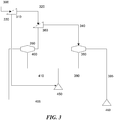
- Fig. 3 illustrates an example of an arrangement of sorting cascades operating in combination with a preceding size classification stage.
- the arrangement may include a fine removal stage, coarse/fine size classification, and both coarse and fine sorting cascades of arbitrary dimension.
- the coarse and the fine sorting cascades may both deliver appropriately classified material to either a final product or final tailing stream.
- Coarse and fine sorting cascades are controlled by the central marshaling computer which governs the macro behavior of the cascade according to pre-determined probabilities of correct sensing and diversion of "good” rocks to "good” destinations, and predetermined probabilities of sensing and diversion of "bad” rocks to “bad” destinations, treating rocks with a random distribution of "good” and “bad” values, and the spectral patterns sensed for "good” and “bad” rocks respectively have been determined through a priori characterization.
- the probability of correct separation is then used to determine the appropriate number of stages required for effective separation.
- the processes of a typical sorting cascade are described below in more detail in terms of Bayesian probability.
- Fig. 3 illustrates a mineral feed stream input into a size classification stage followed by multiple stages of sensor-based recognition, discrimination and diversion, useful for understanding the invention. These stages lead to two output mineral streams, a final product (or "accept”) stream, and a final tailings (or "reject”) stream.
- Mineral feed of arbitrary particle size distribution 300 is classified by a primary size classification stage 310.
- Fine material stream 330 from the size classification stage underflow can be taken to final product stream 450 or sorted.
- Overflow 320 from the primary size classification stage 310 is separated into a coarse stream 340 and fine stream 350 by the secondary size classification stage 360.
- Coarse material in the coarse stream 340 is sorted in a coarse sorting cascade 380, delivering a coarse product stream 390 and coarse tailings stream 395.
- Fine material in the fine stream 350 is sorted in a fine sorting cascade 400, delivering a fine product stream 410 and fine tailings stream 405.
- the number of stages in each coarse sorting cascade is determined by a cascade algorithm configured by a priori knowledge of the probability of correct sensing and diversion of "good” rocks to "good” destinations, and predetermined probabilities of sensing and diversion of "bad” rocks to "bad” destinations, and expected spectral patterns sensed for "good” and “bad” rocks respectively having been determined through a priori characterization.
- the configuration algorithm can be understood as a combination of iterated Bayesian probabilities, summarized in the form of parameters similar to those used in the biometric authentication industry, where the notions of False Acceptance, False Rejection and Equal Error Rate have isomorphic qualities.
- each rock of the stream will be categorized as being one of a predetermined set of types which are a priori ascertained by analysis of a representative sequence of similar rocks for calibration and evaluation purposes only.
- sorting plant comprised of a cascade of sensor/diverter cells where the sorting plant includes:
- the final destination of the sorter is defined to be the final destination of the rocks that come into the sorter.
- the probability P(Si* d
- P(Si* d
- t P C ij * d
- t where P(C ij * d
- a utility u(d; t) can be defined for each destination d and type t.
- a plant or parameter settings can be chosen to optimize the utility for maximum yield at maximum efficiency given a priori knowledge of the rocks.
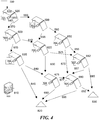
- Figure 4 illustrates an embodiment of a typical sorting cascade in more detail in accordance with the invention, comprising arrays of sorting cells in a calculated arrangement of stages delivering sorted material to final product and tailings streams.
- Fig. 4 illustrates an example of an arbitrary sorting cascade in accordance with the invention.
- the selected probability or number of stages shown is only one example - many others are possible.
- Any geometric configuration involving any number of sorting cells in any interconnection relationship thereamong is contemplated by this disclosure, as long as each sorting cell accepts input, and has a destination to which its output is directed, and behaves as parameterized.
- thresholding for initial cells in the particular embodiment may be different to that of subsequent cells in the embodiment as separation criteria refine over the progress of rocks towards "accept” or "reject" destinations in the cascade.
- mineral feed is delivered to the sorting cascade via the feed chutes 510 via gravity (or other mechanism).
- Material from the feed chute is delivered to the first stage sorting cell 520 comprising feed mechanism 530, sensor 540 and diverter 550 by gravity.
- First stage sorting cell 520 separates the feed material into accept and reject fractions 560 and 570, respectively.
- the accept fraction 560 is delivered to the next stage of sorting 580 similarly comprised to the previous sorting cell 520, where the material is again separated into accept fraction 590 and reject fraction 595.
- the reject fraction 570 is delivered to the next stage of sorting 600, which is similarly comprised to the first sorting cell 520, where the material is again separated into accept fraction 610 and reject fraction 615.
- the accept fraction 610 is delivered to the next stage of sorting 620, which is similarly comprised to the first sorting cell 520, where the material is again separated into accept fraction 625 and reject fraction 630.
- the reject fraction 615 is delivered to the next stage of sorting, sorting cell 635, which is similarly comprised to the first sorting cell 520, where the material is again separated into accept fraction 640 and reject fraction 645.
- Unit separation of material into accept and reject fractions occurs similarly through the cascade until the material is sorted into a final reject material delivered to the final reject stream 820, and a final accept material delivered to the final accept pile 830.
- Sorting cells such as sorting cells 520, 580, and 600 are controlled by individual embedded computers 701 ... 709 housing the pattern recognition algorithm 240. All embedded computers 701 ... 709 are controlled by a central marshaling computer 800 housing the cascade sorting algorithm 810 with a priori knowledge of the accept/reject probability. Alternatively, the embedded computers perform only basic functions (e.g., controlling material separation), but sensor data from each cell is sent to the central computer for analysis, e.g., pattern recognition, and the central computer sends accept/reject signals back to each embedded computer for controlling the diverters. Some or all sorting cells may include sensors, with all sensors being similar, but the system is configured to sense differing thresholds of a desired material or ore for each cell (e.g.
- sensors may differ from other sensors to, e.g., sense different materials in the rock (e.g. to identify two different, desirable materials in the material stream), or to employ different sensing techniques for sensing the same material (e.g. photometric, radiometric, and/or electromagnetic sensors).
- FIG. 5 illustrates a series of partition curves for the embodiment of the invention described in Figure 4 .
- a series of partition curves describing sorting Utility over a range of P(Si* d
- t) are shown.
- a partition curve for Utility > 0 .5 is shown.
- a partition curve for Utility > 0 .8 is shown.
- a partition curve for Utility > 0 .9 is shown.
- a partition curve for Utility approaching 1.0 is shown.
- the curves show that for values of Utility > 0 .5 that statistically acceptable sorting outcomes are achieved for values not much greater than 0.5 in a limited number of sorting stages. In this way, statistically acceptable sorting outcomes can be achieved over multiple stages of sorting steps of individually unacceptable sorting performance.
- variable chemical composition of unblended mineral samples or streams may be determined by exposing the mineral sample or stream to electromagnetic radiation and measuring a signal produced therefrom, such as an absorption, reflectance or Compton backscatter response.
- a machine comprising arrays of source-detector-type mineral sensors, coupled to high-speed, digital signal processing software incorporating rapid pattern recognition algorithms scans the ore stream in real-time and interprets the chemical composition of the ore.
- recognition and identification as used in biometric security are introduced.
- Automated digital signal analysis is conventionally applied for pattern recognition using an exact matched, or identified, signal.
- spectrum matching both wavelength and amplitude, or frequency and amplitude of an arbitrary power spectrum are to be matched.
- Traditional pattern matching requires comparison of every inbound spectrum to the sample spectrum to achieve an exact match and is computationally very intensive and time consuming and therefore not practical in high-speed mineral recognition applications.
- Recognition is hereby differentiated from identification, or matching, for the purpose of the present system.
- recognition is the verification of a claim of identity, while identification is the determination of identity.
- a sample In the laboratory, a sample might be subjected to, for example, an X-ray Fluorescence sensor for analytic purposes.
- a spectral pattern is created in the lab using analytical procedures (i.e., samples from the deposit of interest are characterized or identified using analytical procedures in the lab). This is to say that the objective of the sampling is to yield the most accurate and precise result: a sensor-based assay.
- a sensor-based assay In this way the identity of a mineral sample as determined by sensor-based techniques is a priori determined.
- This template is programmed into field units so that results from new samples can be compared to it in quasi- real time.
- the biometric analogy might go as follows: You are returning to your home country at one of its major international airports and have the option of using a kiosk equipped with an iris scanner. You simply approach the kiosk and present only your eye for examination by the scanner. The kiosk reads your iris and prints out a receipt with your name on it for you to present to a customs agent. The kiosk has clearly searched for a closest match to the sample you just provided, from a database of templates. You have been identified by the kiosk. Leaving aside the question of whether or not this is good security practice, it is clear that the kiosk is programmed to minimize the possibility of identity fraud ( i.e., the incidence of false acceptance ) .
- the biometric analogy might go as follows: You are returning to your home country at one of its major international airports and have the option of using a kiosk equipped with an iris scanner. You approach the kiosk and present your passport, thereby making an identity claim. You then present your eye for examination by the scanner. The kiosk reads your iris and compares the sample to a stored template (derived, perhaps, from information encrypted in your passport). Identity has been rapidly confirmed by recognition of the subject based on a priori knowledge of the subject content. This is analogous to the pattern recognition algorithm deployed in various embodiments of the present invention.
- the advanced pattern recognition methodology deployed involves pattern learning (or classification) of absorbed, reflected or backscattered energy from the irradiation of previously characterized mineral samples and pattern recognition comprising fuzzy analysis and resource-bounded matching of absorption, reflectance or backscattered spectra from newly irradiated mineral samples through a trained CRF algorithm.
- the algorithms that match of absorption, reflectance or backscattered spectra may be resource-bounded, meaning that energy physics determines when measurement of a sample is complete.
- CRF involves the "training" of the random field on known spectra, as well as the use of the random field under resource bounded conditions to rapidly recognize new spectra similar to the "trained" spectrum.
- the CRF algorithm deployed predicts a likely sequence of results for sequences of input samples analyzed.
- X an array observed spectral measurements with Y a corresponding array of random output spectra.
- (X,Y) is a conditional random field when the random variables Y v , conditioned on X, obey the Markov property p Yv
- X , Yw , w ⁇ v p Yv
- X is then modeled.
- Learning parameters ⁇ are then obtained by maximum likelihood learning for p Yi
- the learning, or characterization, phase involves identifying common characteristic spectra generated from a series of samples by repeated exposure of the spectral analyzer to the samples. These characteristic features may then be used for efficient and rapid spectrum recognition for new samples with similar spectra.
- Fig. 2 references a pattern recognition algorithm of the CRF-type, using back-propagation when in the training mode to define matching coefficients ⁇ for the conditional random field, which additionally incorporates pseudo-random sampling, and boundary detection comprising confirmation of the spectral upper and lower bounds.
- the system is trained to recognize the presence of a range of typical mineral constituents in a matrix such as iron, aluminum, silica and magnesium present in a sample which is moving with reference to the sensor, calculate the specific and total concentration of each element in the sample and compare it to the pre-defined spectrum of known material obtained during the "training" phase of the algorithm development.
- pattern recognition algorithms such as inter alia brute-force, nearest-neighbour, peak matching etc. may be used.
- embodiments of the present invention are not limited to the particular algorithm described. For example, the peak frequencies from a few samples with certain amplitudes may be identified, and then each sample may be analyzed for peaks near those frequencies and above a certain amplitude.
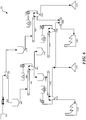
- Fig. 6 illustrates an example of an arrangement of a sorting system in an open pit mining application. Examples depicted in Fig. 6 may be used, for example to classify a pyrometallurgical process feed, a hydrometallurgical process feed and a waste product simultaneously from the same deposit.
- Typical bulk open pit mining equipment delivers unblended mineral feed to an ore sorting facility comprising arrays of electromagnetic sorting machines described.
- Saprolitic material produced by the sorting facility is delivered to pyrometallurgical plant 1080.
- Limonitic material simultaneously recovered by the sorting facility is delivered to hydrometallurgical plant 1150.
- Waste material simultaneously recovered by the sorting facility is delivered to waste piles 1070, 1040 for repatriation to the open pit.
- Unblended laterite material 910 from the open pit may be delivered by truck 920 to coarse separator 930. Fine fractions from separator 930 underflow may be passed to fine sorter feed bin 940 where material may be held prior to delivery to sorting conveyor 950. Material travelling on the sorting conveyor 950 may be scanned by an array of electromagnetic sensors 960. Results from the electromagnetic sensors 960 may be passed to controller 970 which compares the sensor results to pre-set values and may instruct the diverter 980 to divert the material according to its chemical content. High iron limonitic material may be diverted to limonite sorter 1090. High silica saprolitic material may be diverted to saprolite sorter feed bin 1160.
- High iron limonitic material from the sorting conveyor 950 may be passed to the limonite sorter feed bin 1090 where material is held prior to delivery to sorting conveyor 1100.
- Material traveling on the sorting conveyor 1100 may be scanned by an array of electromagnetic sensors 1110.
- Results from the electromagnetic sensors 1110 may be passed to controller 1120 which compares the sensor results to pre-set values and instructs diverter 1130 to divert the material according to its chemical content. Material not suitable for treatment is diverted to the waste pile 1140.
- Limonitic material suitable for treatment is passed via the limonite product conveyor to the hydrometallurgical facility 1150.
- high silica saprolitic material from the sorting conveyor 950 may be passed to saprolite sorter feed bin 1160 where material may be held prior to delivery to sorting conveyor 1170.
- Material travelling on the sorting conveyor may be scanned by an array of electromagnetic sensors 1180.
- Results from the electromagnetic sensors 1180 may be passed to the controller 1190 which compares the sensor results to pre-set values and instructs the diverter 1195 to divert the material according to its chemical content. Material not suitable for treatment is diverted to the waste pile 1140.
- Saprolitic material suitable for treatment is passed via the saprolite product conveyor 1060 to pyrometallurgical facility 1080.
- Coarse fractions from the separator 930 overflow may be passed to coarse sorter feed bin 1010 where material may be held prior to delivery to the sorting conveyor.
- Material traveling on sorting conveyor 1020 may scanned by an array of electromagnetic sensors 1030.
- Results from the array of electromagnetic sensors 1030 may be passed to controller 1040 which compares the sensor results to pre-set values and instructs the diverter array 1050 to divert the material according to its chemical content.
- High nickel saprolitic material may be diverted to saprolite product conveyor 1060.
- Low nickel, high iron and high silica material may be diverted to the waste pile 1070. Note that some elements may be combined together, such as a single controller that performs comparisons and instructs diverters.
- Fig. 7 is a flowchart having an example set of instructions for determining mineral content.
- the operations can be performed by various components such as processors, controllers, and/or other components.
- receiving operation 1210 response data from a mineral sample is received.
- the response data may be detected by a scanner that detects the response of the mineral sample to electromagnetic radiation (i.e., reflected or absorbed energy).
- An analog to digital converter may digitize the response data.
- the spectral characteristics of the mineral sample may be determined.
- a spectral analysis may be performed on the response data to determine characteristics of the mineral sample.
- Characteristics may include frequency, wavelength, and/or amplitude. In some embodiments, characteristics include other user-defined characteristics.
- a composition of the mineral sample is identified by comparing the characteristics of the mineral sample to characteristics of known mineral samples. Pattern matching algorithms may be used in identifying the composition.
- a composition value is assigned to the mineral sample.
- decision operation 1250 it is determined whether the composition value is within a predetermined tolerance of composition values.
- the assigned value of the composition is not within the predetermined tolerance (i.e., the characteristics do not fit with in a pattern), and, thus, the mineral sample is diverted to a waste pile.
- accept operation 1270 the assigned value of the composition is within the predetermined tolerance (i.e., the characteristics fit within a pattern), and thus, the mineral sample is diverted to a hydrometallurgical or pyrometallurgical process.
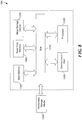
- Fig. 8 is an example of a computer system 1300 with which embodiments of the present invention may be utilized.
- the computer system includes a bus 1310, at least one processor 1320, at least one communication port 1330, a main memory 1340, a removable storage media 1350, a read only memory 1360, and a mass storage 1370.
- Processor(s) 1320 can be any known processor, such as, but not limited to, an Intel® Itanium® or Itanium 2® processor(s); AMD® Opteron® or Athlon MP® processor(s); or Motorola® lines of processors.
- Communication port(s) 1330 can be any of an RS-232 port for use with a modem-based dialup connection, a 10/100 Ethernet port, or a Gigabit port using copper or fiber. Communications may also take place over wireless interfaces.
- Communication port(s) 1330 may be chosen depending on a network such as a Local Area Network (LAN), Wide Area Network (WAN), or any network to which the computer system 1300 connects.
- LAN Local Area Network
- WAN Wide Area Network
- Main memory 1340 can be Random Access Memory (RAM) or any other dynamic storage device(s) commonly known in the art.
- Read only memory 1360 can be any static storage device(s) such as Programmable Read Only Memory (PROM) chips for storing static information such as instructions for processor 1320.
- PROM Programmable Read Only Memory
- Mass storage 1370 can be used to store information and instructions.
- hard disks such as the Adaptec® family of SCSI drives, an optical disc, an array of disks such as RAID, such as the Adaptec family of RAID drives, or any other mass storage devices may be used.
- Bus 1310 communicatively couples processor(s) 1320 with the other memory, storage and communication blocks.
- Bus 1310 can be a PCI /PCI-X or SCSI based system bus depending on the storage devices used.
- Removable storage media 1350 can be any kind of external hard-drives, floppy drives, IOMEGA® Zip Drives, Compact Disc - Read Only Memory (CD-ROM), Compact Disc - Re-Writable (CD-RW), and/or Digital Video Disk - Read Only Memory (DVD-ROM).
- CD-ROM Compact Disc - Read Only Memory
- CD-RW Compact Disc - Re-Writable
- DVD-ROM Digital Video Disk - Read Only Memory
- aspects of the invention may be practiced in the general context of computer-executable instructions, such as routines executed by a general-purpose data processing device, e.g., a server computer, wireless device or personal computer.
- a general-purpose data processing device e.g., a server computer, wireless device or personal computer.
- PDAs personal digital assistants
- wearable computers all manner of cellular or mobile phones (including Voice over IP (VoIP) phones), dumb terminals, multi-processor systems, microprocessor-based or programmable consumer electronics, set-top boxes, network PCs, mini-computers, mainframe computers, and the like.
- PDAs personal digital assistants
- VoIP Voice over IP
- dumb terminals multi-processor systems, microprocessor-based or programmable consumer electronics, set-top boxes, network PCs, mini-computers, mainframe computers, and the like.
- aspects of the invention can be embodied in a special purpose computer or data processor that is specifically programmed, configured, or constructed to perform one or more of the computer-executable instructions explained in detail herein. While aspects of the invention, such as certain functions, are described as being performed exclusively on a single device, the invention can also be practiced in distributed environments where functions or modules are shared among disparate processing devices, which are linked through a communications network, such as a Local Area Network (LAN), Wide Area Network (WAN), or the Internet. In a distributed computing environment, program modules may be located in both local and remote memory storage devices.
- LAN Local Area Network
- WAN Wide Area Network
- program modules may be located in both local and remote memory storage devices.
- aspects of the invention may be stored or distributed on tangible computer-readable media, including magnetically or optically readable computer discs, hard-wired or preprogrammed chips (e.g., EEPROM semiconductor chips), nanotechnology memory, biological memory, or other data storage media.
- computer implemented instructions, data structures, screen displays, and other data under aspects of the invention may be distributed over the Internet or over other networks (including wireless networks), on a propagated signal on a propagation medium (e.g., an electromagnetic wave(s), a sound wave, etc.) over a period of time, or they may be provided on any analog or digital network (packet switched, circuit switched, or other scheme).
- the words “comprise,” “comprising,” and the like are to be construed in an inclusive sense, as opposed to an exclusive or exhaustive sense; that is to say, in the sense of "including, but not limited to.”
- the terms “connected,” “coupled,” or any variant thereof means any connection or coupling, either direct or indirect, between two or more elements; the coupling or connection between the elements can be physical, logical, or a combination thereof.
- the words “herein,” “above,” “below,” and words of similar import, when used in this application refer to this application as a whole and not to any particular portions of this application.
Landscapes
- Sorting Of Articles (AREA)
- Information Retrieval, Db Structures And Fs Structures Therefor (AREA)
- Analysing Materials By The Use Of Radiation (AREA)
Claims (8)
- Verfahren zum Trennen von Material, das Folgendes umfasst:Aufnehmen von Material in einer ersten Sortierungszelle (520), wobei die erste Sortierungszelle einen ersten Sensor (540) und eine erste Umlenkeinheit (550) umfasst;Sortieren des Materials unter Verwendung des Sensors in eine erste akzeptierte Gruppe (560) und eine erste abgelehnte Gruppe (570) basierend auf einem Inhalt des aufgenommenen Materials;Aufnehmen der ersten akzeptierten Gruppe (560) in einer zweiten Sortierungszelle (580), wobei die zweite Sortierungszelle einen zweiten Sensor und eine zweite Umlenkeinheit umfasst;Sortieren der ersten akzeptierten Gruppe (560) unter Verwendung des zweiten Sensors in eine zweite akzeptierte Gruppe (590) und eine zweite abgelehnte Gruppe (595) basierend auf dem Inhalt;Aufnehmen der ersten abgelehnten Gruppe (570) in einer dritten Sortierungszelle (600), wobei die dritte Sortierungszelle einen dritten Sensor und eine dritte Umlenkeinheit aufweist; undSortieren der ersten abgelehnten Gruppe (570) unter Verwendung des dritten Sensors in eine dritte akzeptierte Gruppe (610) und eine dritte abgelehnte Gruppe (615) basierend auf dem Inhalt;wobei zumindest zwei aus der ersten Sortierungszelle, der zweiten Sortierungszelle und der dritten Sortierungszelle ausgelegt sind, um den Inhalt unterschiedlich zu sortieren;dadurch gekennzeichnet, dass das Verfahren ferner Folgendes umfasst:Vereinigen der dritten akzeptierten Gruppe (610) und der zweiten abgelehnten Gruppe (595);Aufnehmen der dritten akzeptierten Gruppe (610) und der zweiten abgelehnten Gruppe (595) in einer vierten Sortierungszelle (420), wobei die vierte Sortierungszelle einen vierten Sensor und eine vierte Umlenkeinheit umfasst; undSortieren der dritten akzeptierten Gruppe (610) und der zweiten abgelehnten Gruppe (595) unter Verwendung des vierten Sensors in eine vierte akzeptierte Gruppe (625) und eine vierte abgelehnte Gruppe (630) basierend auf dem Inhalt.
- Verfahren nach Anspruch 1, das ferner Folgendes umfasst:Vereinigen der zweiten akzeptierten Gruppe (590) und der vierten akzeptierten Gruppe (625), um eine Produktgruppe (830) zu bilden; undVereinigen der vierten abgelehnten Gruppe und der dritten abgelehnten Gruppe, um eine abgelehnte Gruppe (820) zu bilden.
- Verfahren nach Anspruch 2, das ferner Folgendes umfasst:Bestimmen einer Anzahl von Sortierungszellen, um das Material je nach einem gewünschten Nutzen zu trennen; undWiederholen der Aufnahme-, Sortierungs- und Vereinigungsschritte für die bestimmte Anzahl von Sortierungszellen.
- Verfahren nach Anspruch 3, wobei das Bestimmen der Anzahl von Sortierungszellen zum Trennen des Materials je nach dem gewünschten Nutzen auf einer Wahrscheinlichkeit des korrekten Bestimmens des Inhalts des Materials und einer Wahrscheinlichkeit des korrekten Umlenkens des Materials basierend auf dem Inhalt basiert.
- Verfahren nach Anspruch 1, wobei das Material Erz umfasst, wobei das Sortieren des Erzes in die erste akzeptierte Gruppe (560) und die erste abgelehnte Gruppe (570) unter Verwendung des ersten Sensors (540) basierend auf dem Inhalt des aufgenommenen Erzes Folgendes umfasst:das Aussetzen des ersten Sensors (540) gegenüber einer Mineralprobe des Erzes; unddas Messen einer Spektral-Antwort der Mineralprobe.
- Verfahren nach Anspruch 5, wobei das Sortieren des Erzes unter Verwendung des ersten Sensors (540) in die erste akzeptierte Gruppe (560) und die erste abgelehnte Gruppe (570) basierend auf dem Inhalt des aufgenommenen Erzes ferner Folgendes umfasst:Vergleichen der gemessenen Spektral-Antwort mit zuvor aufgezeichneten Antwortdaten von Mineralproben mit bekanntem Inhalt; undZuordnen eines Zusammensetzungswerts zu der Mineralprobe basierend auf dem Vergleich.
- Verfahren nach Anspruch 1, das ferner Folgendes umfasst:
vor dem Aufnehmen des Materials in der ersten Sortierungszelle (520) Klassifizieren des Materials in Feinfraktionen und Grobfraktionen. - Verfahren nach Anspruch 7, wobei die Feinfraktionen in der ersten Sortierungszelle (520) aufgenommen werden und wobei die Grobfraktionen ein einer anderen Sortierungszelle aufgenommen werden.
Applications Claiming Priority (3)
| Application Number | Priority Date | Filing Date | Title |
|---|---|---|---|
| US201261640752P | 2012-05-01 | 2012-05-01 | |
| PCT/CA2013/050336 WO2013163759A1 (en) | 2012-05-01 | 2013-05-01 | High capacity cascade-type mineral sorting machine and method |
| EP13784899.0A EP2844403B1 (de) | 2012-05-01 | 2013-05-01 | Maschine zur kaskadenförmigen sortierung von mineralien |
Related Parent Applications (2)
| Application Number | Title | Priority Date | Filing Date |
|---|---|---|---|
| EP13784899.0A Division-Into EP2844403B1 (de) | 2012-05-01 | 2013-05-01 | Maschine zur kaskadenförmigen sortierung von mineralien |
| EP13784899.0A Division EP2844403B1 (de) | 2012-05-01 | 2013-05-01 | Maschine zur kaskadenförmigen sortierung von mineralien |
Publications (2)
| Publication Number | Publication Date |
|---|---|
| EP3369488A1 EP3369488A1 (de) | 2018-09-05 |
| EP3369488B1 true EP3369488B1 (de) | 2021-06-23 |
Family
ID=49511733
Family Applications (2)
| Application Number | Title | Priority Date | Filing Date |
|---|---|---|---|
| EP18166364.2A Active EP3369488B1 (de) | 2012-05-01 | 2013-05-01 | Verfahren zur kaskadenförmigen sortierung von mineralien |
| EP13784899.0A Active EP2844403B1 (de) | 2012-05-01 | 2013-05-01 | Maschine zur kaskadenförmigen sortierung von mineralien |
Family Applications After (1)
| Application Number | Title | Priority Date | Filing Date |
|---|---|---|---|
| EP13784899.0A Active EP2844403B1 (de) | 2012-05-01 | 2013-05-01 | Maschine zur kaskadenförmigen sortierung von mineralien |
Country Status (8)
| Country | Link |
|---|---|
| US (3) | US9314823B2 (de) |
| EP (2) | EP3369488B1 (de) |
| AU (3) | AU2013255051B2 (de) |
| CA (1) | CA2871632C (de) |
| CL (1) | CL2014002925A1 (de) |
| DK (1) | DK2844403T3 (de) |
| PL (1) | PL2844403T3 (de) |
| WO (1) | WO2013163759A1 (de) |
Families Citing this family (19)
| Publication number | Priority date | Publication date | Assignee | Title |
|---|---|---|---|---|
| US11219927B2 (en) | 2011-06-29 | 2022-01-11 | Minesense Technologies Ltd. | Sorting materials using pattern recognition, such as upgrading nickel laterite ores through electromagnetic sensor-based methods |
| US9316537B2 (en) | 2011-06-29 | 2016-04-19 | Minesense Technologies Ltd. | Sorting materials using a pattern recognition, such as upgrading nickel laterite ores through electromagnetic sensor-based methods |
| EP3698889A1 (de) | 2011-06-29 | 2020-08-26 | Minesense Technologies Ltd. | Extraktion von abgebautem erz, mineralien oder anderen materialien mittels sensorbasierter sortierung |
| WO2013163759A1 (en) | 2012-05-01 | 2013-11-07 | Minesense Technologies Ltd. | High capacity cascade-type mineral sorting machine and method |
| AU2014339144B2 (en) * | 2013-10-22 | 2020-01-23 | Cgg Services Sa | Desktop hyperspectral spectra collection of geological material |
| US9457382B2 (en) * | 2014-06-19 | 2016-10-04 | ISO-Pacific Nuclear Assay Systems, Inc. | Soil sorting system |
| CN112536242B (zh) * | 2014-07-21 | 2023-08-04 | 感矿科技有限公司 | 来自废物矿物的粗矿石矿物的高容量分离 |
| US9884346B2 (en) | 2014-07-21 | 2018-02-06 | Minesense Technologies Ltd. | High capacity separation of coarse ore minerals from waste minerals |
| PL415405A1 (pl) * | 2015-12-21 | 2017-07-03 | Firefrog Media Spółka Z Ograniczoną Odpowiedzialnością | Sposób identyfikacji i segregacji artykułów przemysłowych |
| BR112018074796B1 (pt) * | 2016-05-30 | 2023-03-28 | Southern Innovation International Pty Ltd | Sistema e método de caracterização de material |
| CN106513336A (zh) * | 2016-10-11 | 2017-03-22 | 湖南超牌科技有限公司 | 风化长石加工方法及加工装置 |
| DE102018217548A1 (de) * | 2018-10-12 | 2020-04-16 | Helmholtz-Zentrum Dresden - Rossendorf E.V. | Verfahren zur gezielten Auswahl eines Sensors zur sensorbasierten Sortierung eines Materialgemisches durch Simulation der sensorbasierten Sortierung des Materialgemisches |
| SE544132C2 (en) * | 2019-07-29 | 2022-01-11 | Metso Sweden Ab | A beneficiation arrangement for use with geological material |
| BR112023012183A2 (pt) | 2020-12-21 | 2023-11-07 | Eco Metals Recovery Holding Ltd | Detecção e recuperação de metais a partir de minério |
| DE102021118108B4 (de) | 2021-07-13 | 2024-09-05 | TSR Recycling GmbH & Co. KG | Verbessertes Verfahren zur Herstellung von Schrottprodukten mit hohem Reinheitsgrad aus inhomogenem Inputmaterial |
| WO2023087118A1 (en) | 2021-11-22 | 2023-05-25 | Minesense Technologies Ltd. | Compositional multispectral and hyperspectral imaging systems for mining shovels and associated methods |
| EP4382216B1 (de) | 2022-12-08 | 2026-04-29 | Hydro Aluminium Recycling Deutschland GmbH | Verfahren und vorrichtung zum analysieren und sortieren von materialteilen |
| DE102024121667A1 (de) * | 2024-07-30 | 2026-02-05 | Smiths Detection Germany Gmbh | Sortiervorrichtung für ein Sortieren eines Materialgemenges |
| EP4729189A1 (de) * | 2024-10-17 | 2026-04-22 | Speira GmbH | Aufbereitungsanlage für schüttgut und verfahren zu deren steuerung |
Family Cites Families (125)
| Publication number | Priority date | Publication date | Assignee | Title |
|---|---|---|---|---|
| US719343A (en) * | 1899-04-03 | 1903-01-27 | Arthur Langerfeld | Separator. |
| GB1004222A (en) | 1961-12-22 | 1965-09-15 | Nat Res Dev | Improvements in or relating to separating mechanism in or for mixture separating apparatus |
| US3263160A (en) | 1962-11-28 | 1966-07-26 | Newmont Mining Corp | Time domain electromagnetic induction method and apparatus for detection of massive sulfide ore bodies utilizing pulses of asymmetric waveform |
| US3337328A (en) * | 1964-06-19 | 1967-08-22 | Univ Minnesota | Iron ore beneficiation process |
| US3655964A (en) | 1968-05-06 | 1972-04-11 | David Laurie Slight | Ionizing radiation apparatus and method for distinguishing between materials in a mixture |
| GB1246844A (en) | 1968-11-12 | 1971-09-22 | Sphere Invest Ltd | A new or improved method of and apparatus for sorting ores |
| US3747755A (en) | 1971-12-27 | 1973-07-24 | Massachusetts Inst Technology | Apparatus for determining diffuse and specular reflections of infrared radiation from a sample to classify that sample |
| US4030026A (en) | 1974-11-25 | 1977-06-14 | White's Electronics, Inc. | Sampling metal detector |
| US4006481A (en) | 1975-12-10 | 1977-02-01 | The Ohio State University | Underground, time domain, electromagnetic reflectometry for digging apparatus |
| US4241835A (en) | 1976-07-12 | 1980-12-30 | Geosource Inc. | Sorting apparatus |
| JPS5389701A (en) | 1977-01-18 | 1978-08-07 | Ito Seisakushiyo Kk | Audio system selector for trial listening |
| US4128803A (en) | 1977-04-29 | 1978-12-05 | Pni, Inc. | Metal detector system with ground effect rejection |
| US4236640A (en) | 1978-12-21 | 1980-12-02 | The Superior Oil Company | Separation of nahcolite from oil shale by infrared sorting |
| DE2907513C2 (de) | 1979-02-26 | 1982-11-11 | Battelle-Institut E.V., 6000 Frankfurt | Probenentnahmeverfahren zur Bestimmung der chemischen Zusammensetzung makroskopischer Bestandteile von Materialien |
| GB2046435B (en) * | 1979-03-01 | 1983-12-21 | Gen Mining & Finance Corp | Sorting ore |
| US4300097A (en) | 1979-07-27 | 1981-11-10 | Techna, Inc. | Induction balance metal detector with ferrous and non-ferrous metal identification |
| CA1194177A (en) | 1981-02-09 | 1985-09-24 | Kerr (Goring) Limited | Metal detection apparatus |
| US4365719A (en) * | 1981-07-06 | 1982-12-28 | Leonard Kelly | Radiometric ore sorting method and apparatus |
| US4507612A (en) | 1981-11-25 | 1985-03-26 | Teknetics, Inc. | Metal detector systems for identifying targets in mineralized ground |
| DE3228447C2 (de) | 1982-07-30 | 1986-04-10 | Vallon GmbH, 7412 Eningen | Meßverfahren zur Erkennung von metallischen Gegenständen und Metalldetektor zur Durchführung des Verfahrens |
| US4600356A (en) | 1984-01-27 | 1986-07-15 | Gas Research Institute | Underground pipeline and cable detector and process |
| GB2188727A (en) | 1986-04-03 | 1987-10-07 | De Beers Ind Diamond | Sorting ore particles |
| GB8625953D0 (en) | 1986-10-30 | 1986-12-03 | G B E International Plc | Programmable zone size in detection system |
| US5197607A (en) | 1988-09-06 | 1993-03-30 | Reinhold Hakansson | Method and apparatus for grading objects in accordance to size |
| US5236092A (en) * | 1989-04-03 | 1993-08-17 | Krotkov Mikhail I | Method of an apparatus for X-radiation sorting of raw materials |
| USRE36537E (en) | 1990-10-29 | 2000-02-01 | National Recovery Technologies, Inc. | Method and apparatus for sorting materials using electromagnetic sensing |
| GB2258171B (en) * | 1991-07-29 | 1995-01-18 | Shell Int Research | Processing complex mineral ores |
| US5523690A (en) | 1992-07-24 | 1996-06-04 | White's Electronics, Inc. | Metal detector with bivariate display |
| JPH0742201A (ja) | 1993-07-28 | 1995-02-10 | Komatsu Ltd | バケットの土量検知装置 |
| US5413222A (en) | 1994-01-21 | 1995-05-09 | Holder; Morris E. | Method for separating a particular metal fraction from a stream of materials containing various metals |
| US5850341A (en) | 1994-06-30 | 1998-12-15 | Caterpillar Inc. | Method and apparatus for monitoring material removal using mobile machinery |
| US5592092A (en) | 1994-10-28 | 1997-01-07 | Gas Research Institute | Pipe proximity warning device for accidental damage prevention mounted on the bucket of a backhoe |
| US5873470A (en) | 1994-11-02 | 1999-02-23 | Sortex Limited | Sorting apparatus |
| WO1997005969A1 (en) | 1995-08-09 | 1997-02-20 | Alcan International Limited | Method of sorting pieces of material |
| US6545240B2 (en) | 1996-02-16 | 2003-04-08 | Huron Valley Steel Corporation | Metal scrap sorting system |
| DE19736567C1 (de) | 1997-08-22 | 1998-11-26 | Select Ingenieurgesellschaft F | Einrichtung zu einer merkmalsbezogenen Sortierung von Produkten und Verfahren zu deren Betrieb |
| US5961055A (en) * | 1997-11-05 | 1999-10-05 | Iron Dynamics, Inc. | Method for upgrading iron ore utilizing multiple magnetic separators |
| US6140643A (en) * | 1999-03-09 | 2000-10-31 | Exxonmobil Upstream Research Company | Method for identification of unknown substances |
| AUPQ592600A0 (en) | 2000-02-29 | 2000-03-23 | Cea Technologies Inc. | Ground penetrating radar |
| NL1016916C2 (nl) | 2000-12-15 | 2002-07-02 | Univ Delft Tech | Werkwijze en inrichting voor het analyseren en het scheiden van materiaalstromen. |
| KR100508966B1 (ko) | 2001-07-06 | 2005-08-17 | 노우코우다이 티엘오 가부시키가이샤 | 토양특성 관측장치 및 토양특성 관측방법 |
| US6753957B1 (en) | 2001-08-17 | 2004-06-22 | Florida Institute Of Phosphate Research | Mineral detection and content evaluation method |
| US6693274B2 (en) | 2001-10-29 | 2004-02-17 | Fmc Technologies, Inc. | Method and system of sorting a plurality of received articles having varying size and shape |
| JP2003170122A (ja) | 2001-12-06 | 2003-06-17 | Satake Corp | 粒状物色彩選別機 |
| US7763820B1 (en) * | 2003-01-27 | 2010-07-27 | Spectramet, Llc | Sorting pieces of material based on photonic emissions resulting from multiple sources of stimuli |
| WO2005029016A2 (en) | 2003-03-13 | 2005-03-31 | University Of Florida | Material identification employing a grating spectrometer |
| US7341156B2 (en) * | 2003-11-17 | 2008-03-11 | Casella Waste Systems, Inc. | Systems and methods for sorting, collecting data pertaining to and certifying recyclables at a material recovery facility |
| CA2867540C (en) * | 2004-01-08 | 2017-06-27 | Fort Hills Energy L.P. | Tailings thickening and treatment with gas bubble injection |
| US7099433B2 (en) | 2004-03-01 | 2006-08-29 | Spectramet, Llc | Method and apparatus for sorting materials according to relative composition |
| US7564943B2 (en) | 2004-03-01 | 2009-07-21 | Spectramet, Llc | Method and apparatus for sorting materials according to relative composition |
| EP1571515A1 (de) | 2004-03-04 | 2005-09-07 | Leica Geosystems AG | Verfahren und Vorrichtung zur Verwaltung von Daten über die Fläche einer Baustelle |
| AU2005282702B2 (en) | 2004-09-01 | 2009-05-07 | Siemens Industry, Inc. | Autonomous loading shovel system |
| US8233667B2 (en) | 2004-09-07 | 2012-07-31 | Petro-Model Ehf | Apparatus and method for analysis of size, form and angularity and for compositional analysis of mineral and rock particles |
| US7970574B2 (en) | 2005-06-22 | 2011-06-28 | The Board Of Trustees Of The Leland Stanford Jr. University | Scalable sensor localization for wireless sensor networks |
| GB0512945D0 (en) | 2005-06-24 | 2005-08-03 | Oxford Instr Analytical Ltd | Method and apparatus for material identification |
| BRPI0618171A2 (pt) | 2005-11-04 | 2011-08-16 | Univ Queensland | método de determinação da presença de um mineral em um material |
| AU2006249259A1 (en) * | 2005-12-08 | 2007-06-28 | Opdetech Pty Ltd | Mineral separating means |
| MX2008012355A (es) | 2006-03-31 | 2009-02-16 | Coaltek Inc | Metodos y sistemas para mejorar propiedades de combustible solido. |
| US7956624B2 (en) | 2006-05-08 | 2011-06-07 | Kelly Beaulieu | Method and system for monitoring growth characteristics |
| DE102006025194A1 (de) | 2006-05-29 | 2007-12-06 | Endress + Hauser Conducta Gesellschaft für Mess- und Regeltechnik mbH + Co. KG | Induktiver Leitfähigkeitssensor |
| US7737379B2 (en) | 2006-07-19 | 2010-06-15 | Witdouck Calvin J | System and method for sorting larvae cocoons |
| BRPI0715926A2 (pt) | 2006-08-11 | 2013-10-01 | Univ Queenslad | mÉtodo e conjunto para anÁlise de rocha |
| US7797861B2 (en) | 2006-08-14 | 2010-09-21 | Wright Danny M | Resilient excavation bucket, excavation apparatus, and methods of use and manufacture thereof |
| US20080047170A1 (en) | 2006-08-24 | 2008-02-28 | Trimble Navigation Ltd. | Excavator 3D integrated laser and radio positioning guidance system |
| ES2341166B1 (es) * | 2006-10-16 | 2011-05-17 | Technological Resources Pty. Limited | Procedimiento de clasificacion de material extraido de minas. |
| US7430273B2 (en) * | 2007-02-23 | 2008-09-30 | Thermo Fisher Scientific Inc. | Instrument having X-ray fluorescence and spark emission spectroscopy analysis capabilities |
| EP2150348B1 (de) | 2007-04-18 | 2018-11-07 | Metso Minerals, Inc. | Benutzerschnittstelle für eine einrichtung zur verarbeitung von mineralien und abfallmaterial |
| DE202007008557U1 (de) | 2007-06-19 | 2008-10-30 | Liebherr-Werk Bischofshofen Ges.M.B.H. | System zum automatischen Bewegen von Material |
| US7909169B1 (en) | 2007-08-31 | 2011-03-22 | James Edward Slade | Methods and systems for recovering alluvial gold |
| US8186105B2 (en) | 2007-12-13 | 2012-05-29 | Wutpol, Inc. | Retractable load-bearing cover |
| EP2085772B8 (de) | 2008-02-04 | 2011-01-26 | Orexplore Ab | Vorrichtung und Verfahren zur Röntgenstrahlfluoreszenz-Analyse einer Mineralprobe |
| US7948237B2 (en) | 2008-02-25 | 2011-05-24 | Geotech Airborne Limited | Large airborne time-domain electromagnetic transmitter coil system and apparatus |
| CN101557452B (zh) | 2008-03-04 | 2013-06-05 | 悉尼大学 | 用于三维矿物学建模的扫描系统 |
| CA2629408A1 (en) | 2008-05-01 | 2009-11-01 | Andrew S. Bamber | Induction balance sensor |
| MX2010013578A (es) * | 2008-06-11 | 2011-03-21 | a valerio Thomas | Metodo y sistema para la recuperacion de metal de materiales reciclados procesados. |
| EP2141414A1 (de) | 2008-07-04 | 2010-01-06 | ABB Research LTD | Stapelkontrolle für eine Halde |
| AU2009291512B2 (en) | 2008-09-11 | 2014-09-18 | Technological Resources Pty. Limited | Sorting mined material |
| CN102187059B (zh) * | 2008-10-16 | 2015-02-18 | 技术资源有限公司 | 分选开采的、待开采的或堆存的材料以获得具有提高的经济价值的提高等级的材料的方法 |
| GB2464988B8 (en) | 2008-11-03 | 2013-02-20 | Miller Int Ltd | Coupler with coupling status sensors |
| DK2198983T3 (da) * | 2008-12-19 | 2011-12-12 | Omya Development Ag | Fremgangsmåde til separering af mineralske urenheder fra calciumcarbonat-holdige klippestykker ved røntgensortering |
| US9237284B2 (en) * | 2009-03-02 | 2016-01-12 | Flir Systems, Inc. | Systems and methods for processing infrared images |
| WO2010124338A1 (en) | 2009-05-01 | 2010-11-04 | The University Of Sydney | Planning system for autonomous operation |
| US8757523B2 (en) * | 2009-07-31 | 2014-06-24 | Thomas Valerio | Method and system for separating and recovering wire and other metal from processed recycled materials |
| US8818778B2 (en) | 2009-09-16 | 2014-08-26 | Chevron U.S.A. Inc. | Method for creating a 3D rock representation using petrophysical data |
| US8494220B2 (en) * | 2010-10-15 | 2013-07-23 | Nancy Kerr Del Grande | Temporal thermal imaging method for detecting subsurface objects and voids |
| JP4795472B2 (ja) | 2010-03-05 | 2011-10-19 | キヤノン株式会社 | X線撮像装置およびx線撮像方法 |
| RU2012144799A (ru) | 2010-03-23 | 2014-04-27 | Текнолоджикал Ресорсиз Пти. Лимитед | Сортировка добытого материала на основе двух или более свойств этого материала |
| WO2011120086A1 (en) | 2010-03-29 | 2011-10-06 | Datatrace Dna Pty Limited | A system for classification of materials using laser induced breakdown spectroscopy |
| KR101834300B1 (ko) | 2010-04-18 | 2018-03-06 | 미크로핀 에이/에스 | 굴착 및 유사 장비를 위한 위치결정 장치 |
| PE20130831A1 (es) | 2010-04-28 | 2013-08-17 | Tech Resources Pty Ltd | Clasificacion de material extraido de mina |
| BR112012030449B1 (pt) * | 2010-06-02 | 2021-06-08 | Technological Resources Pty. Limited | método para mineração e método e aparelho para separar material extraído |
| DE102010030908B4 (de) | 2010-07-02 | 2014-10-16 | Strube Gmbh & Co. Kg | Verfahren zur Klassifizierung in Saatgutpartien enthaltener Objekte, Sortierverfahren und zugehörige Vorrichtungen |
| WO2012005775A1 (en) | 2010-07-09 | 2012-01-12 | Los Alamos National Security, Llc | Laser induced breakdown spetroscopy instrumentation for real-time elemental analysis |
| AU2010227086B2 (en) | 2010-10-11 | 2012-09-13 | Crc Ore Ltd | A Method of Beneficiating Minerals |
| CA2813806C (en) | 2010-10-29 | 2018-12-11 | Technological Resources Pty. Limited | Method and system for tracking material |
| RU2438800C1 (ru) | 2010-11-19 | 2012-01-10 | Открытое Акционерное Общество "Научно-Производственное Предприятие "Буревестник" | Способ рентгенолюминесцентной сепарации минералов |
| US8600545B2 (en) * | 2010-12-22 | 2013-12-03 | Titanium Metals Corporation | System and method for inspecting and sorting particles and process for qualifying the same with seed particles |
| CN103328119A (zh) | 2011-02-02 | 2013-09-25 | 莱特拉姆有限责任公司 | 用于对制品进行分级并且选择性地对分级制品进行混合的系统和方法 |
| US8812149B2 (en) | 2011-02-24 | 2014-08-19 | Mss, Inc. | Sequential scanning of multiple wavelengths |
| EP3698889A1 (de) * | 2011-06-29 | 2020-08-26 | Minesense Technologies Ltd. | Extraktion von abgebautem erz, mineralien oder anderen materialien mittels sensorbasierter sortierung |
| US9316537B2 (en) * | 2011-06-29 | 2016-04-19 | Minesense Technologies Ltd. | Sorting materials using a pattern recognition, such as upgrading nickel laterite ores through electromagnetic sensor-based methods |
| AU2012283741A1 (en) | 2011-07-08 | 2014-01-16 | Technological Resources Pty. Limited | Sorting in a mining operation |
| AU2012286597A1 (en) | 2011-07-28 | 2014-01-16 | Technological Resources Pty. Limited | Sorting mined material |
| AU2012289834A1 (en) | 2011-08-04 | 2014-02-27 | Technological Resources Pty. Limited | Processing mined material |
| US8855809B2 (en) | 2011-09-01 | 2014-10-07 | Spectramet, Llc | Material sorting technology |
| WO2013078515A1 (en) | 2011-12-01 | 2013-06-06 | Technological Resources Pty Limited | A method and apparatus for sorting and upgrading mined material |
| US9114433B2 (en) | 2012-01-17 | 2015-08-25 | Mineral Separation Technologies, Inc. | Multi-fractional coal sorter and method of use thereof |
| WO2013163759A1 (en) | 2012-05-01 | 2013-11-07 | Minesense Technologies Ltd. | High capacity cascade-type mineral sorting machine and method |
| CA2871627C (en) | 2012-05-01 | 2017-06-20 | Minesense Technologies Ltd. | Sorting materials using pattern recognition, such as upgrading nickel laterite ores through electromagnetic sensor-based methods |
| US8664595B2 (en) | 2012-06-28 | 2014-03-04 | Fei Company | Cluster analysis of unknowns in SEM-EDS dataset |
| KR101402667B1 (ko) | 2012-07-27 | 2014-06-03 | 현대중공업 주식회사 | 굴삭기 선회각 계측 시스템 |
| WO2014052673A1 (en) | 2012-09-26 | 2014-04-03 | Panalytical Inc. | Multi-sensor analysis of complex geologic materials |
| US8937282B2 (en) | 2012-10-26 | 2015-01-20 | Fei Company | Mineral identification using mineral definitions including variability |
| US20140200054A1 (en) | 2013-01-14 | 2014-07-17 | Fraden Corp. | Sensing case for a mobile communication device |
| DE102013211184A1 (de) * | 2013-06-14 | 2014-12-31 | Siemens Aktiengesellschaft | Verfahren und Vorrichtungen zum Trennen von seltenerdhaltigem Primärerz |
| US20150004574A1 (en) | 2013-06-27 | 2015-01-01 | Caterpillar Inc. | Prioritizing Method of Operator Coaching On Industrial Machines |
| US20150085123A1 (en) | 2013-09-23 | 2015-03-26 | Motion Metrics International Corp. | Method and apparatus for monitoring a condition of an operating implement in heavy loading equipment |
| CL2014001897A1 (es) | 2014-07-18 | 2014-09-22 | Cadetech S A | Un sistema de monitoreo para la deteccion en forma automatica de elementos ferromagneticos ocultos en la carga de mineral, durante la carga y/o descarga de un contenedor, dicho sistema comprende al menos un sensor de campo magnetico, un computador, un canal de comunicacion de corto alcance, un visualizador, un canal de comunicacion de largo alcance, una fuente de energia, y sensores auxiliares. |
| US9884346B2 (en) * | 2014-07-21 | 2018-02-06 | Minesense Technologies Ltd. | High capacity separation of coarse ore minerals from waste minerals |
| CN112536242B (zh) | 2014-07-21 | 2023-08-04 | 感矿科技有限公司 | 来自废物矿物的粗矿石矿物的高容量分离 |
| KR102279393B1 (ko) | 2014-08-22 | 2021-07-21 | 삼성전자주식회사 | 냉장고 |
| US9989511B2 (en) | 2015-04-10 | 2018-06-05 | Caterpillar Inc. | Automated material tagging system |
| WO2016006716A1 (ja) | 2015-08-07 | 2016-01-14 | 株式会社小松製作所 | 作業車両 |
| US9785851B1 (en) * | 2016-06-30 | 2017-10-10 | Huron Valley Steel Corporation | Scrap sorting system |
| WO2018213863A1 (en) | 2017-05-23 | 2018-11-29 | Austin Engineering Ltd | Bucket |
-
2013
- 2013-05-01 WO PCT/CA2013/050336 patent/WO2013163759A1/en not_active Ceased
- 2013-05-01 EP EP18166364.2A patent/EP3369488B1/de active Active
- 2013-05-01 EP EP13784899.0A patent/EP2844403B1/de active Active
- 2013-05-01 CA CA2871632A patent/CA2871632C/en active Active
- 2013-05-01 US US13/875,105 patent/US9314823B2/en active Active
- 2013-05-01 DK DK13784899.0T patent/DK2844403T3/en active
- 2013-05-01 PL PL13784899T patent/PL2844403T3/pl unknown
- 2013-05-01 AU AU2013255051A patent/AU2013255051B2/en active Active
-
2014
- 2014-10-29 CL CL2014002925A patent/CL2014002925A1/es unknown
-
2016
- 2016-03-11 US US15/068,504 patent/US10029284B2/en active Active
- 2016-08-15 AU AU2016216528A patent/AU2016216528B2/en active Active
-
2018
- 2018-05-22 AU AU2018203576A patent/AU2018203576B2/en active Active
- 2018-06-26 US US16/018,335 patent/US11247240B2/en active Active
Non-Patent Citations (1)
| Title |
|---|
| None * |
Also Published As
| Publication number | Publication date |
|---|---|
| US10029284B2 (en) | 2018-07-24 |
| US20190134671A1 (en) | 2019-05-09 |
| CL2014002925A1 (es) | 2015-07-10 |
| US20160193630A1 (en) | 2016-07-07 |
| WO2013163759A1 (en) | 2013-11-07 |
| US9314823B2 (en) | 2016-04-19 |
| US20130292307A1 (en) | 2013-11-07 |
| EP2844403A4 (de) | 2016-07-13 |
| AU2018203576B2 (en) | 2020-07-23 |
| AU2013255051B2 (en) | 2016-05-19 |
| EP2844403A1 (de) | 2015-03-11 |
| EP2844403B1 (de) | 2018-06-20 |
| US11247240B2 (en) | 2022-02-15 |
| AU2016216528B2 (en) | 2018-03-15 |
| PL2844403T3 (pl) | 2019-01-31 |
| AU2016216528A1 (en) | 2016-09-08 |
| CA2871632C (en) | 2017-06-06 |
| AU2018203576A1 (en) | 2018-06-14 |
| CA2871632A1 (en) | 2013-11-07 |
| AU2013255051A1 (en) | 2014-11-13 |
| DK2844403T3 (en) | 2018-09-17 |
| EP3369488A1 (de) | 2018-09-05 |
Similar Documents
| Publication | Publication Date | Title |
|---|---|---|
| EP3369488B1 (de) | Verfahren zur kaskadenförmigen sortierung von mineralien | |
| US10259015B2 (en) | Sorting materials using pattern recognition, such as upgrading nickel laterite ores through electromagnetic sensor-based methods | |
| EP2844987B1 (de) | Sortieren von materialien durch mustererkennung, wie etwa aufwertung von nickellateriterzen durch elektromagnetische sensorbasierte verfahren | |
| US11219927B2 (en) | Sorting materials using pattern recognition, such as upgrading nickel laterite ores through electromagnetic sensor-based methods | |
| Maier et al. | A survey of the state of the art in sensor-based sorting technology and research | |
| CN102892521A (zh) | 基于两个或更多材料性质分选开采的材料 | |
| US12404114B2 (en) | Correction techniques for material classification | |
| CN102869459A (zh) | 对开采的材料进行分类 | |
| CN116933151B (zh) | 一种基于闪锌矿微量元素判别矿床类型方法 | |
| CN116106256A (zh) | 一种基于近红外塑料分类的优化系统及方法 | |
| Müller et al. | Sorting of Construction and Demolition Waste for coarse fractions | |
| Drumond et al. | Models for analysing the economic impact of ore sorting, using ROC curves |
Legal Events
| Date | Code | Title | Description |
|---|---|---|---|
| PUAI | Public reference made under article 153(3) epc to a published international application that has entered the european phase |
Free format text: ORIGINAL CODE: 0009012 |
|
| STAA | Information on the status of an ep patent application or granted ep patent |
Free format text: STATUS: THE APPLICATION HAS BEEN PUBLISHED |
|
| AC | Divisional application: reference to earlier application |
Ref document number: 2844403 Country of ref document: EP Kind code of ref document: P |
|
| AK | Designated contracting states |
Kind code of ref document: A1 Designated state(s): AL AT BE BG CH CY CZ DE DK EE ES FI FR GB GR HR HU IE IS IT LI LT LU LV MC MK MT NL NO PL PT RO RS SE SI SK SM TR |
|
| RAP1 | Party data changed (applicant data changed or rights of an application transferred) |
Owner name: MINESENSE TECHNOLOGIES LTD. |
|
| STAA | Information on the status of an ep patent application or granted ep patent |
Free format text: STATUS: REQUEST FOR EXAMINATION WAS MADE |
|
| 17P | Request for examination filed |
Effective date: 20190304 |
|
| RBV | Designated contracting states (corrected) |
Designated state(s): AL AT BE BG CH CY CZ DE DK EE ES FI FR GB GR HR HU IE IS IT LI LT LU LV MC MK MT NL NO PL PT RO RS SE SI SK SM TR |
|
| STAA | Information on the status of an ep patent application or granted ep patent |
Free format text: STATUS: EXAMINATION IS IN PROGRESS |
|
| 17Q | First examination report despatched |
Effective date: 20191106 |
|
| RIN1 | Information on inventor provided before grant (corrected) |
Inventor name: BAMBER, ANDREW Inventor name: CSINGER, ANDREW Inventor name: POOLE, DAVID |
|
| RIN1 | Information on inventor provided before grant (corrected) |
Inventor name: CSINGER, ANDREW Inventor name: BAMBER, ANDREW Inventor name: POOLE, DAVID |
|
| GRAP | Despatch of communication of intention to grant a patent |
Free format text: ORIGINAL CODE: EPIDOSNIGR1 |
|
| STAA | Information on the status of an ep patent application or granted ep patent |
Free format text: STATUS: GRANT OF PATENT IS INTENDED |
|
| INTG | Intention to grant announced |
Effective date: 20210226 |
|
| GRAS | Grant fee paid |
Free format text: ORIGINAL CODE: EPIDOSNIGR3 |
|
| GRAA | (expected) grant |
Free format text: ORIGINAL CODE: 0009210 |
|
| STAA | Information on the status of an ep patent application or granted ep patent |
Free format text: STATUS: THE PATENT HAS BEEN GRANTED |
|
| AC | Divisional application: reference to earlier application |
Ref document number: 2844403 Country of ref document: EP Kind code of ref document: P |
|
| AK | Designated contracting states |
Kind code of ref document: B1 Designated state(s): AL AT BE BG CH CY CZ DE DK EE ES FI FR GB GR HR HU IE IS IT LI LT LU LV MC MK MT NL NO PL PT RO RS SE SI SK SM TR |
|
| REG | Reference to a national code |
Ref country code: GB Ref legal event code: FG4D |
|
| REG | Reference to a national code |
Ref country code: CH Ref legal event code: EP |
|
| REG | Reference to a national code |
Ref country code: DE Ref legal event code: R096 Ref document number: 602013078095 Country of ref document: DE Ref country code: AT Ref legal event code: REF Ref document number: 1403847 Country of ref document: AT Kind code of ref document: T Effective date: 20210715 |
|
| REG | Reference to a national code |
Ref country code: IE Ref legal event code: FG4D |
|
| REG | Reference to a national code |
Ref country code: LT Ref legal event code: MG9D |
|
| PG25 | Lapsed in a contracting state [announced via postgrant information from national office to epo] |
Ref country code: HR Free format text: LAPSE BECAUSE OF FAILURE TO SUBMIT A TRANSLATION OF THE DESCRIPTION OR TO PAY THE FEE WITHIN THE PRESCRIBED TIME-LIMIT Effective date: 20210623 Ref country code: LT Free format text: LAPSE BECAUSE OF FAILURE TO SUBMIT A TRANSLATION OF THE DESCRIPTION OR TO PAY THE FEE WITHIN THE PRESCRIBED TIME-LIMIT Effective date: 20210623 Ref country code: FI Free format text: LAPSE BECAUSE OF FAILURE TO SUBMIT A TRANSLATION OF THE DESCRIPTION OR TO PAY THE FEE WITHIN THE PRESCRIBED TIME-LIMIT Effective date: 20210623 Ref country code: BG Free format text: LAPSE BECAUSE OF FAILURE TO SUBMIT A TRANSLATION OF THE DESCRIPTION OR TO PAY THE FEE WITHIN THE PRESCRIBED TIME-LIMIT Effective date: 20210923 |
|
| REG | Reference to a national code |
Ref country code: AT Ref legal event code: MK05 Ref document number: 1403847 Country of ref document: AT Kind code of ref document: T Effective date: 20210623 |
|
| PG25 | Lapsed in a contracting state [announced via postgrant information from national office to epo] |
Ref country code: GR Free format text: LAPSE BECAUSE OF FAILURE TO SUBMIT A TRANSLATION OF THE DESCRIPTION OR TO PAY THE FEE WITHIN THE PRESCRIBED TIME-LIMIT Effective date: 20210924 Ref country code: RS Free format text: LAPSE BECAUSE OF FAILURE TO SUBMIT A TRANSLATION OF THE DESCRIPTION OR TO PAY THE FEE WITHIN THE PRESCRIBED TIME-LIMIT Effective date: 20210623 Ref country code: SE Free format text: LAPSE BECAUSE OF FAILURE TO SUBMIT A TRANSLATION OF THE DESCRIPTION OR TO PAY THE FEE WITHIN THE PRESCRIBED TIME-LIMIT Effective date: 20210623 Ref country code: LV Free format text: LAPSE BECAUSE OF FAILURE TO SUBMIT A TRANSLATION OF THE DESCRIPTION OR TO PAY THE FEE WITHIN THE PRESCRIBED TIME-LIMIT Effective date: 20210623 Ref country code: NO Free format text: LAPSE BECAUSE OF FAILURE TO SUBMIT A TRANSLATION OF THE DESCRIPTION OR TO PAY THE FEE WITHIN THE PRESCRIBED TIME-LIMIT Effective date: 20210923 |
|
| REG | Reference to a national code |
Ref country code: NL Ref legal event code: MP Effective date: 20210623 |
|
| PG25 | Lapsed in a contracting state [announced via postgrant information from national office to epo] |
Ref country code: SM Free format text: LAPSE BECAUSE OF FAILURE TO SUBMIT A TRANSLATION OF THE DESCRIPTION OR TO PAY THE FEE WITHIN THE PRESCRIBED TIME-LIMIT Effective date: 20210623 Ref country code: SK Free format text: LAPSE BECAUSE OF FAILURE TO SUBMIT A TRANSLATION OF THE DESCRIPTION OR TO PAY THE FEE WITHIN THE PRESCRIBED TIME-LIMIT Effective date: 20210623 Ref country code: ES Free format text: LAPSE BECAUSE OF FAILURE TO SUBMIT A TRANSLATION OF THE DESCRIPTION OR TO PAY THE FEE WITHIN THE PRESCRIBED TIME-LIMIT Effective date: 20210623 Ref country code: EE Free format text: LAPSE BECAUSE OF FAILURE TO SUBMIT A TRANSLATION OF THE DESCRIPTION OR TO PAY THE FEE WITHIN THE PRESCRIBED TIME-LIMIT Effective date: 20210623 Ref country code: PT Free format text: LAPSE BECAUSE OF FAILURE TO SUBMIT A TRANSLATION OF THE DESCRIPTION OR TO PAY THE FEE WITHIN THE PRESCRIBED TIME-LIMIT Effective date: 20211025 Ref country code: RO Free format text: LAPSE BECAUSE OF FAILURE TO SUBMIT A TRANSLATION OF THE DESCRIPTION OR TO PAY THE FEE WITHIN THE PRESCRIBED TIME-LIMIT Effective date: 20210623 Ref country code: NL Free format text: LAPSE BECAUSE OF FAILURE TO SUBMIT A TRANSLATION OF THE DESCRIPTION OR TO PAY THE FEE WITHIN THE PRESCRIBED TIME-LIMIT Effective date: 20210623 Ref country code: AT Free format text: LAPSE BECAUSE OF FAILURE TO SUBMIT A TRANSLATION OF THE DESCRIPTION OR TO PAY THE FEE WITHIN THE PRESCRIBED TIME-LIMIT Effective date: 20210623 Ref country code: CZ Free format text: LAPSE BECAUSE OF FAILURE TO SUBMIT A TRANSLATION OF THE DESCRIPTION OR TO PAY THE FEE WITHIN THE PRESCRIBED TIME-LIMIT Effective date: 20210623 |
|
| PG25 | Lapsed in a contracting state [announced via postgrant information from national office to epo] |
Ref country code: PL Free format text: LAPSE BECAUSE OF FAILURE TO SUBMIT A TRANSLATION OF THE DESCRIPTION OR TO PAY THE FEE WITHIN THE PRESCRIBED TIME-LIMIT Effective date: 20210623 |
|
| REG | Reference to a national code |
Ref country code: DE Ref legal event code: R097 Ref document number: 602013078095 Country of ref document: DE |
|
| PG25 | Lapsed in a contracting state [announced via postgrant information from national office to epo] |
Ref country code: DK Free format text: LAPSE BECAUSE OF FAILURE TO SUBMIT A TRANSLATION OF THE DESCRIPTION OR TO PAY THE FEE WITHIN THE PRESCRIBED TIME-LIMIT Effective date: 20210623 |
|
| PLBE | No opposition filed within time limit |
Free format text: ORIGINAL CODE: 0009261 |
|
| STAA | Information on the status of an ep patent application or granted ep patent |
Free format text: STATUS: NO OPPOSITION FILED WITHIN TIME LIMIT |
|
| 26N | No opposition filed |
Effective date: 20220324 |
|
| PG25 | Lapsed in a contracting state [announced via postgrant information from national office to epo] |
Ref country code: AL Free format text: LAPSE BECAUSE OF FAILURE TO SUBMIT A TRANSLATION OF THE DESCRIPTION OR TO PAY THE FEE WITHIN THE PRESCRIBED TIME-LIMIT Effective date: 20210623 |
|
| PG25 | Lapsed in a contracting state [announced via postgrant information from national office to epo] |
Ref country code: IT Free format text: LAPSE BECAUSE OF FAILURE TO SUBMIT A TRANSLATION OF THE DESCRIPTION OR TO PAY THE FEE WITHIN THE PRESCRIBED TIME-LIMIT Effective date: 20210623 |
|
| REG | Reference to a national code |
Ref country code: CH Ref legal event code: PL |
|
| REG | Reference to a national code |
Ref country code: BE Ref legal event code: MM Effective date: 20220531 |
|
| PG25 | Lapsed in a contracting state [announced via postgrant information from national office to epo] |
Ref country code: MC Free format text: LAPSE BECAUSE OF FAILURE TO SUBMIT A TRANSLATION OF THE DESCRIPTION OR TO PAY THE FEE WITHIN THE PRESCRIBED TIME-LIMIT Effective date: 20210623 Ref country code: LU Free format text: LAPSE BECAUSE OF NON-PAYMENT OF DUE FEES Effective date: 20220501 Ref country code: LI Free format text: LAPSE BECAUSE OF NON-PAYMENT OF DUE FEES Effective date: 20220531 Ref country code: CH Free format text: LAPSE BECAUSE OF NON-PAYMENT OF DUE FEES Effective date: 20220531 |
|
| PG25 | Lapsed in a contracting state [announced via postgrant information from national office to epo] |
Ref country code: IE Free format text: LAPSE BECAUSE OF NON-PAYMENT OF DUE FEES Effective date: 20220501 |
|
| PG25 | Lapsed in a contracting state [announced via postgrant information from national office to epo] |
Ref country code: BE Free format text: LAPSE BECAUSE OF NON-PAYMENT OF DUE FEES Effective date: 20220531 |
|
| P01 | Opt-out of the competence of the unified patent court (upc) registered |
Effective date: 20230821 |
|
| PG25 | Lapsed in a contracting state [announced via postgrant information from national office to epo] |
Ref country code: HU Free format text: LAPSE BECAUSE OF FAILURE TO SUBMIT A TRANSLATION OF THE DESCRIPTION OR TO PAY THE FEE WITHIN THE PRESCRIBED TIME-LIMIT; INVALID AB INITIO Effective date: 20130501 |
|
| PG25 | Lapsed in a contracting state [announced via postgrant information from national office to epo] |
Ref country code: MK Free format text: LAPSE BECAUSE OF FAILURE TO SUBMIT A TRANSLATION OF THE DESCRIPTION OR TO PAY THE FEE WITHIN THE PRESCRIBED TIME-LIMIT Effective date: 20210623 Ref country code: CY Free format text: LAPSE BECAUSE OF FAILURE TO SUBMIT A TRANSLATION OF THE DESCRIPTION OR TO PAY THE FEE WITHIN THE PRESCRIBED TIME-LIMIT Effective date: 20210623 |
|
| PG25 | Lapsed in a contracting state [announced via postgrant information from national office to epo] |
Ref country code: TR Free format text: LAPSE BECAUSE OF FAILURE TO SUBMIT A TRANSLATION OF THE DESCRIPTION OR TO PAY THE FEE WITHIN THE PRESCRIBED TIME-LIMIT Effective date: 20210623 |
|
| PG25 | Lapsed in a contracting state [announced via postgrant information from national office to epo] |
Ref country code: MT Free format text: LAPSE BECAUSE OF FAILURE TO SUBMIT A TRANSLATION OF THE DESCRIPTION OR TO PAY THE FEE WITHIN THE PRESCRIBED TIME-LIMIT Effective date: 20210623 |
|
| PGFP | Annual fee paid to national office [announced via postgrant information from national office to epo] |
Ref country code: FR Payment date: 20250310 Year of fee payment: 13 |
|
| PGFP | Annual fee paid to national office [announced via postgrant information from national office to epo] |
Ref country code: GB Payment date: 20250313 Year of fee payment: 13 |
|
| PGFP | Annual fee paid to national office [announced via postgrant information from national office to epo] |
Ref country code: DE Payment date: 20250305 Year of fee payment: 13 |