EP3369844A1 - Wärmedämmschichtzusammensetzungen, verfahren zur herstellung davon und artikel damit - Google Patents
Wärmedämmschichtzusammensetzungen, verfahren zur herstellung davon und artikel damit Download PDFInfo
- Publication number
- EP3369844A1 EP3369844A1 EP18159402.9A EP18159402A EP3369844A1 EP 3369844 A1 EP3369844 A1 EP 3369844A1 EP 18159402 A EP18159402 A EP 18159402A EP 3369844 A1 EP3369844 A1 EP 3369844A1
- Authority
- EP
- European Patent Office
- Prior art keywords
- keggin
- coating
- clusters
- complexes
- component
- Prior art date
- Legal status (The legal status is an assumption and is not a legal conclusion. Google has not performed a legal analysis and makes no representation as to the accuracy of the status listed.)
- Granted
Links
Images


Classifications
-
- F—MECHANICAL ENGINEERING; LIGHTING; HEATING; WEAPONS; BLASTING
- F01—MACHINES OR ENGINES IN GENERAL; ENGINE PLANTS IN GENERAL; STEAM ENGINES
- F01D—NON-POSITIVE DISPLACEMENT MACHINES OR ENGINES, e.g. STEAM TURBINES
- F01D5/00—Blades; Blade-carrying members; Heating, heat-insulating, cooling or antivibration means on the blades or the members
- F01D5/12—Blades
- F01D5/28—Selecting particular materials; Particular measures relating thereto; Measures against erosion or corrosion
- F01D5/288—Protective coatings for blades
-
- C—CHEMISTRY; METALLURGY
- C23—COATING METALLIC MATERIAL; COATING MATERIAL WITH METALLIC MATERIAL; CHEMICAL SURFACE TREATMENT; DIFFUSION TREATMENT OF METALLIC MATERIAL; COATING BY VACUUM EVAPORATION, BY SPUTTERING, BY ION IMPLANTATION OR BY CHEMICAL VAPOUR DEPOSITION, IN GENERAL; INHIBITING CORROSION OF METALLIC MATERIAL OR INCRUSTATION IN GENERAL
- C23C—COATING METALLIC MATERIAL; COATING MATERIAL WITH METALLIC MATERIAL; SURFACE TREATMENT OF METALLIC MATERIAL BY DIFFUSION INTO THE SURFACE, BY CHEMICAL CONVERSION OR SUBSTITUTION; COATING BY VACUUM EVAPORATION, BY SPUTTERING, BY ION IMPLANTATION OR BY CHEMICAL VAPOUR DEPOSITION, IN GENERAL
- C23C4/00—Coating by spraying the coating material in the molten state, e.g. by flame, plasma or electric discharge
- C23C4/02—Pretreatment of the material to be coated, e.g. for coating on selected surface areas
-
- B—PERFORMING OPERATIONS; TRANSPORTING
- B05—SPRAYING OR ATOMISING IN GENERAL; APPLYING FLUENT MATERIALS TO SURFACES, IN GENERAL
- B05D—PROCESSES FOR APPLYING FLUENT MATERIALS TO SURFACES, IN GENERAL
- B05D1/00—Processes for applying liquids or other fluent materials
- B05D1/002—Processes for applying liquids or other fluent materials the substrate being rotated
- B05D1/005—Spin coating
-
- B—PERFORMING OPERATIONS; TRANSPORTING
- B05—SPRAYING OR ATOMISING IN GENERAL; APPLYING FLUENT MATERIALS TO SURFACES, IN GENERAL
- B05D—PROCESSES FOR APPLYING FLUENT MATERIALS TO SURFACES, IN GENERAL
- B05D1/00—Processes for applying liquids or other fluent materials
- B05D1/02—Processes for applying liquids or other fluent materials performed by spraying
- B05D1/04—Processes for applying liquids or other fluent materials performed by spraying involving the use of an electrostatic field
-
- B—PERFORMING OPERATIONS; TRANSPORTING
- B05—SPRAYING OR ATOMISING IN GENERAL; APPLYING FLUENT MATERIALS TO SURFACES, IN GENERAL
- B05D—PROCESSES FOR APPLYING FLUENT MATERIALS TO SURFACES, IN GENERAL
- B05D1/00—Processes for applying liquids or other fluent materials
- B05D1/36—Successively applying liquids or other fluent materials, e.g. without intermediate treatment
-
- C—CHEMISTRY; METALLURGY
- C01—INORGANIC CHEMISTRY
- C01F—COMPOUNDS OF THE METALS BERYLLIUM, MAGNESIUM, ALUMINIUM, CALCIUM, STRONTIUM, BARIUM, RADIUM, THORIUM, OR OF THE RARE-EARTH METALS
- C01F7/00—Compounds of aluminium
- C01F7/02—Aluminium oxide; Aluminium hydroxide; Aluminates
-
- C—CHEMISTRY; METALLURGY
- C09—DYES; PAINTS; POLISHES; NATURAL RESINS; ADHESIVES; COMPOSITIONS NOT OTHERWISE PROVIDED FOR; APPLICATIONS OF MATERIALS NOT OTHERWISE PROVIDED FOR
- C09D—COATING COMPOSITIONS, e.g. PAINTS, VARNISHES OR LACQUERS; FILLING PASTES; CHEMICAL PAINT OR INK REMOVERS; INKS; CORRECTING FLUIDS; WOODSTAINS; PASTES OR SOLIDS FOR COLOURING OR PRINTING; USE OF MATERIALS THEREFOR
- C09D1/00—Coating compositions, e.g. paints, varnishes or lacquers, based on inorganic substances
-
- C—CHEMISTRY; METALLURGY
- C09—DYES; PAINTS; POLISHES; NATURAL RESINS; ADHESIVES; COMPOSITIONS NOT OTHERWISE PROVIDED FOR; APPLICATIONS OF MATERIALS NOT OTHERWISE PROVIDED FOR
- C09D—COATING COMPOSITIONS, e.g. PAINTS, VARNISHES OR LACQUERS; FILLING PASTES; CHEMICAL PAINT OR INK REMOVERS; INKS; CORRECTING FLUIDS; WOODSTAINS; PASTES OR SOLIDS FOR COLOURING OR PRINTING; USE OF MATERIALS THEREFOR
- C09D201/00—Coating compositions based on unspecified macromolecular compounds
-
- C—CHEMISTRY; METALLURGY
- C09—DYES; PAINTS; POLISHES; NATURAL RESINS; ADHESIVES; COMPOSITIONS NOT OTHERWISE PROVIDED FOR; APPLICATIONS OF MATERIALS NOT OTHERWISE PROVIDED FOR
- C09D—COATING COMPOSITIONS, e.g. PAINTS, VARNISHES OR LACQUERS; FILLING PASTES; CHEMICAL PAINT OR INK REMOVERS; INKS; CORRECTING FLUIDS; WOODSTAINS; PASTES OR SOLIDS FOR COLOURING OR PRINTING; USE OF MATERIALS THEREFOR
- C09D5/00—Coating compositions, e.g. paints, varnishes or lacquers, characterised by their physical nature or the effects produced; Filling pastes
- C09D5/18—Fireproof paints including high temperature resistant paints
-
- C—CHEMISTRY; METALLURGY
- C23—COATING METALLIC MATERIAL; COATING MATERIAL WITH METALLIC MATERIAL; CHEMICAL SURFACE TREATMENT; DIFFUSION TREATMENT OF METALLIC MATERIAL; COATING BY VACUUM EVAPORATION, BY SPUTTERING, BY ION IMPLANTATION OR BY CHEMICAL VAPOUR DEPOSITION, IN GENERAL; INHIBITING CORROSION OF METALLIC MATERIAL OR INCRUSTATION IN GENERAL
- C23C—COATING METALLIC MATERIAL; COATING MATERIAL WITH METALLIC MATERIAL; SURFACE TREATMENT OF METALLIC MATERIAL BY DIFFUSION INTO THE SURFACE, BY CHEMICAL CONVERSION OR SUBSTITUTION; COATING BY VACUUM EVAPORATION, BY SPUTTERING, BY ION IMPLANTATION OR BY CHEMICAL VAPOUR DEPOSITION, IN GENERAL
- C23C28/00—Coating for obtaining at least two superposed coatings either by methods not provided for in a single one of groups C23C2/00 - C23C26/00 or by combinations of methods provided for in subclasses C23C and C25C or C25D
- C23C28/30—Coatings combining at least one metallic layer and at least one inorganic non-metallic layer
- C23C28/32—Coatings combining at least one metallic layer and at least one inorganic non-metallic layer including at least one pure metallic layer
- C23C28/321—Coatings combining at least one metallic layer and at least one inorganic non-metallic layer including at least one pure metallic layer with at least one metal alloy layer
- C23C28/3215—Coatings combining at least one metallic layer and at least one inorganic non-metallic layer including at least one pure metallic layer with at least one metal alloy layer at least one MCrAlX layer
-
- C—CHEMISTRY; METALLURGY
- C23—COATING METALLIC MATERIAL; COATING MATERIAL WITH METALLIC MATERIAL; CHEMICAL SURFACE TREATMENT; DIFFUSION TREATMENT OF METALLIC MATERIAL; COATING BY VACUUM EVAPORATION, BY SPUTTERING, BY ION IMPLANTATION OR BY CHEMICAL VAPOUR DEPOSITION, IN GENERAL; INHIBITING CORROSION OF METALLIC MATERIAL OR INCRUSTATION IN GENERAL
- C23C—COATING METALLIC MATERIAL; COATING MATERIAL WITH METALLIC MATERIAL; SURFACE TREATMENT OF METALLIC MATERIAL BY DIFFUSION INTO THE SURFACE, BY CHEMICAL CONVERSION OR SUBSTITUTION; COATING BY VACUUM EVAPORATION, BY SPUTTERING, BY ION IMPLANTATION OR BY CHEMICAL VAPOUR DEPOSITION, IN GENERAL
- C23C28/00—Coating for obtaining at least two superposed coatings either by methods not provided for in a single one of groups C23C2/00 - C23C26/00 or by combinations of methods provided for in subclasses C23C and C25C or C25D
- C23C28/30—Coatings combining at least one metallic layer and at least one inorganic non-metallic layer
- C23C28/34—Coatings combining at least one metallic layer and at least one inorganic non-metallic layer including at least one inorganic non-metallic material layer, e.g. metal carbide, nitride, boride, silicide layer and their mixtures, enamels, phosphates and sulphates
- C23C28/345—Coatings combining at least one metallic layer and at least one inorganic non-metallic layer including at least one inorganic non-metallic material layer, e.g. metal carbide, nitride, boride, silicide layer and their mixtures, enamels, phosphates and sulphates with at least one oxide layer
-
- C—CHEMISTRY; METALLURGY
- C23—COATING METALLIC MATERIAL; COATING MATERIAL WITH METALLIC MATERIAL; CHEMICAL SURFACE TREATMENT; DIFFUSION TREATMENT OF METALLIC MATERIAL; COATING BY VACUUM EVAPORATION, BY SPUTTERING, BY ION IMPLANTATION OR BY CHEMICAL VAPOUR DEPOSITION, IN GENERAL; INHIBITING CORROSION OF METALLIC MATERIAL OR INCRUSTATION IN GENERAL
- C23C—COATING METALLIC MATERIAL; COATING MATERIAL WITH METALLIC MATERIAL; SURFACE TREATMENT OF METALLIC MATERIAL BY DIFFUSION INTO THE SURFACE, BY CHEMICAL CONVERSION OR SUBSTITUTION; COATING BY VACUUM EVAPORATION, BY SPUTTERING, BY ION IMPLANTATION OR BY CHEMICAL VAPOUR DEPOSITION, IN GENERAL
- C23C28/00—Coating for obtaining at least two superposed coatings either by methods not provided for in a single one of groups C23C2/00 - C23C26/00 or by combinations of methods provided for in subclasses C23C and C25C or C25D
- C23C28/30—Coatings combining at least one metallic layer and at least one inorganic non-metallic layer
- C23C28/34—Coatings combining at least one metallic layer and at least one inorganic non-metallic layer including at least one inorganic non-metallic material layer, e.g. metal carbide, nitride, boride, silicide layer and their mixtures, enamels, phosphates and sulphates
- C23C28/345—Coatings combining at least one metallic layer and at least one inorganic non-metallic layer including at least one inorganic non-metallic material layer, e.g. metal carbide, nitride, boride, silicide layer and their mixtures, enamels, phosphates and sulphates with at least one oxide layer
- C23C28/3455—Coatings combining at least one metallic layer and at least one inorganic non-metallic layer including at least one inorganic non-metallic material layer, e.g. metal carbide, nitride, boride, silicide layer and their mixtures, enamels, phosphates and sulphates with at least one oxide layer with a refractory ceramic layer, e.g. refractory metal oxide, ZrO2, rare earth oxides or a thermal barrier system comprising at least one refractory oxide layer
-
- C—CHEMISTRY; METALLURGY
- C23—COATING METALLIC MATERIAL; COATING MATERIAL WITH METALLIC MATERIAL; CHEMICAL SURFACE TREATMENT; DIFFUSION TREATMENT OF METALLIC MATERIAL; COATING BY VACUUM EVAPORATION, BY SPUTTERING, BY ION IMPLANTATION OR BY CHEMICAL VAPOUR DEPOSITION, IN GENERAL; INHIBITING CORROSION OF METALLIC MATERIAL OR INCRUSTATION IN GENERAL
- C23C—COATING METALLIC MATERIAL; COATING MATERIAL WITH METALLIC MATERIAL; SURFACE TREATMENT OF METALLIC MATERIAL BY DIFFUSION INTO THE SURFACE, BY CHEMICAL CONVERSION OR SUBSTITUTION; COATING BY VACUUM EVAPORATION, BY SPUTTERING, BY ION IMPLANTATION OR BY CHEMICAL VAPOUR DEPOSITION, IN GENERAL
- C23C28/00—Coating for obtaining at least two superposed coatings either by methods not provided for in a single one of groups C23C2/00 - C23C26/00 or by combinations of methods provided for in subclasses C23C and C25C or C25D
- C23C28/30—Coatings combining at least one metallic layer and at least one inorganic non-metallic layer
- C23C28/34—Coatings combining at least one metallic layer and at least one inorganic non-metallic layer including at least one inorganic non-metallic material layer, e.g. metal carbide, nitride, boride, silicide layer and their mixtures, enamels, phosphates and sulphates
- C23C28/347—Coatings combining at least one metallic layer and at least one inorganic non-metallic layer including at least one inorganic non-metallic material layer, e.g. metal carbide, nitride, boride, silicide layer and their mixtures, enamels, phosphates and sulphates with layers adapted for cutting tools or wear applications
-
- C—CHEMISTRY; METALLURGY
- C23—COATING METALLIC MATERIAL; COATING MATERIAL WITH METALLIC MATERIAL; CHEMICAL SURFACE TREATMENT; DIFFUSION TREATMENT OF METALLIC MATERIAL; COATING BY VACUUM EVAPORATION, BY SPUTTERING, BY ION IMPLANTATION OR BY CHEMICAL VAPOUR DEPOSITION, IN GENERAL; INHIBITING CORROSION OF METALLIC MATERIAL OR INCRUSTATION IN GENERAL
- C23C—COATING METALLIC MATERIAL; COATING MATERIAL WITH METALLIC MATERIAL; SURFACE TREATMENT OF METALLIC MATERIAL BY DIFFUSION INTO THE SURFACE, BY CHEMICAL CONVERSION OR SUBSTITUTION; COATING BY VACUUM EVAPORATION, BY SPUTTERING, BY ION IMPLANTATION OR BY CHEMICAL VAPOUR DEPOSITION, IN GENERAL
- C23C4/00—Coating by spraying the coating material in the molten state, e.g. by flame, plasma or electric discharge
- C23C4/04—Coating by spraying the coating material in the molten state, e.g. by flame, plasma or electric discharge characterised by the coating material
- C23C4/10—Oxides, borides, carbides, nitrides or silicides; Mixtures thereof
-
- C—CHEMISTRY; METALLURGY
- C23—COATING METALLIC MATERIAL; COATING MATERIAL WITH METALLIC MATERIAL; CHEMICAL SURFACE TREATMENT; DIFFUSION TREATMENT OF METALLIC MATERIAL; COATING BY VACUUM EVAPORATION, BY SPUTTERING, BY ION IMPLANTATION OR BY CHEMICAL VAPOUR DEPOSITION, IN GENERAL; INHIBITING CORROSION OF METALLIC MATERIAL OR INCRUSTATION IN GENERAL
- C23C—COATING METALLIC MATERIAL; COATING MATERIAL WITH METALLIC MATERIAL; SURFACE TREATMENT OF METALLIC MATERIAL BY DIFFUSION INTO THE SURFACE, BY CHEMICAL CONVERSION OR SUBSTITUTION; COATING BY VACUUM EVAPORATION, BY SPUTTERING, BY ION IMPLANTATION OR BY CHEMICAL VAPOUR DEPOSITION, IN GENERAL
- C23C4/00—Coating by spraying the coating material in the molten state, e.g. by flame, plasma or electric discharge
- C23C4/04—Coating by spraying the coating material in the molten state, e.g. by flame, plasma or electric discharge characterised by the coating material
- C23C4/10—Oxides, borides, carbides, nitrides or silicides; Mixtures thereof
- C23C4/11—Oxides
-
- C—CHEMISTRY; METALLURGY
- C23—COATING METALLIC MATERIAL; COATING MATERIAL WITH METALLIC MATERIAL; CHEMICAL SURFACE TREATMENT; DIFFUSION TREATMENT OF METALLIC MATERIAL; COATING BY VACUUM EVAPORATION, BY SPUTTERING, BY ION IMPLANTATION OR BY CHEMICAL VAPOUR DEPOSITION, IN GENERAL; INHIBITING CORROSION OF METALLIC MATERIAL OR INCRUSTATION IN GENERAL
- C23C—COATING METALLIC MATERIAL; COATING MATERIAL WITH METALLIC MATERIAL; SURFACE TREATMENT OF METALLIC MATERIAL BY DIFFUSION INTO THE SURFACE, BY CHEMICAL CONVERSION OR SUBSTITUTION; COATING BY VACUUM EVAPORATION, BY SPUTTERING, BY ION IMPLANTATION OR BY CHEMICAL VAPOUR DEPOSITION, IN GENERAL
- C23C4/00—Coating by spraying the coating material in the molten state, e.g. by flame, plasma or electric discharge
- C23C4/18—After-treatment
-
- F—MECHANICAL ENGINEERING; LIGHTING; HEATING; WEAPONS; BLASTING
- F01—MACHINES OR ENGINES IN GENERAL; ENGINE PLANTS IN GENERAL; STEAM ENGINES
- F01D—NON-POSITIVE DISPLACEMENT MACHINES OR ENGINES, e.g. STEAM TURBINES
- F01D11/00—Preventing or minimising internal leakage of working-fluid, e.g. between stages
- F01D11/08—Preventing or minimising internal leakage of working-fluid, e.g. between stages for sealing space between rotor blade tips and stator
-
- F—MECHANICAL ENGINEERING; LIGHTING; HEATING; WEAPONS; BLASTING
- F01—MACHINES OR ENGINES IN GENERAL; ENGINE PLANTS IN GENERAL; STEAM ENGINES
- F01D—NON-POSITIVE DISPLACEMENT MACHINES OR ENGINES, e.g. STEAM TURBINES
- F01D25/00—Component parts, details, or accessories, not provided for in, or of interest apart from, other groups
- F01D25/005—Selecting particular materials
-
- F—MECHANICAL ENGINEERING; LIGHTING; HEATING; WEAPONS; BLASTING
- F01—MACHINES OR ENGINES IN GENERAL; ENGINE PLANTS IN GENERAL; STEAM ENGINES
- F01D—NON-POSITIVE DISPLACEMENT MACHINES OR ENGINES, e.g. STEAM TURBINES
- F01D9/00—Stators
- F01D9/02—Nozzles; Nozzle boxes; Stator blades; Guide conduits, e.g. individual nozzles
- F01D9/04—Nozzles; Nozzle boxes; Stator blades; Guide conduits, e.g. individual nozzles forming ring or sector
- F01D9/041—Nozzles; Nozzle boxes; Stator blades; Guide conduits, e.g. individual nozzles forming ring or sector using blades
-
- F—MECHANICAL ENGINEERING; LIGHTING; HEATING; WEAPONS; BLASTING
- F02—COMBUSTION ENGINES; HOT-GAS OR COMBUSTION-PRODUCT ENGINE PLANTS
- F02C—GAS-TURBINE PLANTS; AIR INTAKES FOR JET-PROPULSION PLANTS; CONTROLLING FUEL SUPPLY IN AIR-BREATHING JET-PROPULSION PLANTS
- F02C7/00—Features, components parts, details or accessories, not provided for in, or of interest apart form groups F02C1/00 - F02C6/00; Air intakes for jet-propulsion plants
- F02C7/24—Heat or noise insulation
-
- B—PERFORMING OPERATIONS; TRANSPORTING
- B05—SPRAYING OR ATOMISING IN GENERAL; APPLYING FLUENT MATERIALS TO SURFACES, IN GENERAL
- B05B—SPRAYING APPARATUS; ATOMISING APPARATUS; NOZZLES
- B05B5/00—Electrostatic spraying apparatus; Spraying apparatus with means for charging the spray electrically; Apparatus for spraying liquids or other fluent materials by other electric means
-
- B—PERFORMING OPERATIONS; TRANSPORTING
- B05—SPRAYING OR ATOMISING IN GENERAL; APPLYING FLUENT MATERIALS TO SURFACES, IN GENERAL
- B05B—SPRAYING APPARATUS; ATOMISING APPARATUS; NOZZLES
- B05B7/00—Spraying apparatus for discharge of liquids or other fluent materials from two or more sources, e.g. of liquid and air, of powder and gas
- B05B7/16—Spraying apparatus for discharge of liquids or other fluent materials from two or more sources, e.g. of liquid and air, of powder and gas incorporating means for heating or cooling the material to be sprayed
- B05B7/20—Spraying apparatus for discharge of liquids or other fluent materials from two or more sources, e.g. of liquid and air, of powder and gas incorporating means for heating or cooling the material to be sprayed by flame or combustion
-
- B—PERFORMING OPERATIONS; TRANSPORTING
- B05—SPRAYING OR ATOMISING IN GENERAL; APPLYING FLUENT MATERIALS TO SURFACES, IN GENERAL
- B05B—SPRAYING APPARATUS; ATOMISING APPARATUS; NOZZLES
- B05B7/00—Spraying apparatus for discharge of liquids or other fluent materials from two or more sources, e.g. of liquid and air, of powder and gas
- B05B7/16—Spraying apparatus for discharge of liquids or other fluent materials from two or more sources, e.g. of liquid and air, of powder and gas incorporating means for heating or cooling the material to be sprayed
- B05B7/22—Spraying apparatus for discharge of liquids or other fluent materials from two or more sources, e.g. of liquid and air, of powder and gas incorporating means for heating or cooling the material to be sprayed electrically, magnetically or electromagnetically, e.g. by arc
-
- F—MECHANICAL ENGINEERING; LIGHTING; HEATING; WEAPONS; BLASTING
- F05—INDEXING SCHEMES RELATING TO ENGINES OR PUMPS IN VARIOUS SUBCLASSES OF CLASSES F01-F04
- F05D—INDEXING SCHEME FOR ASPECTS RELATING TO NON-POSITIVE-DISPLACEMENT MACHINES OR ENGINES, GAS-TURBINES OR JET-PROPULSION PLANTS
- F05D2220/00—Application
- F05D2220/30—Application in turbines
- F05D2220/32—Application in turbines in gas turbines
-
- F—MECHANICAL ENGINEERING; LIGHTING; HEATING; WEAPONS; BLASTING
- F05—INDEXING SCHEMES RELATING TO ENGINES OR PUMPS IN VARIOUS SUBCLASSES OF CLASSES F01-F04
- F05D—INDEXING SCHEME FOR ASPECTS RELATING TO NON-POSITIVE-DISPLACEMENT MACHINES OR ENGINES, GAS-TURBINES OR JET-PROPULSION PLANTS
- F05D2230/00—Manufacture
- F05D2230/90—Coating; Surface treatment
-
- F—MECHANICAL ENGINEERING; LIGHTING; HEATING; WEAPONS; BLASTING
- F05—INDEXING SCHEMES RELATING TO ENGINES OR PUMPS IN VARIOUS SUBCLASSES OF CLASSES F01-F04
- F05D—INDEXING SCHEME FOR ASPECTS RELATING TO NON-POSITIVE-DISPLACEMENT MACHINES OR ENGINES, GAS-TURBINES OR JET-PROPULSION PLANTS
- F05D2260/00—Function
- F05D2260/20—Heat transfer, e.g. cooling
- F05D2260/231—Preventing heat transfer
-
- F—MECHANICAL ENGINEERING; LIGHTING; HEATING; WEAPONS; BLASTING
- F05—INDEXING SCHEMES RELATING TO ENGINES OR PUMPS IN VARIOUS SUBCLASSES OF CLASSES F01-F04
- F05D—INDEXING SCHEME FOR ASPECTS RELATING TO NON-POSITIVE-DISPLACEMENT MACHINES OR ENGINES, GAS-TURBINES OR JET-PROPULSION PLANTS
- F05D2300/00—Materials; Properties thereof
- F05D2300/60—Properties or characteristics given to material by treatment or manufacturing
- F05D2300/611—Coating
Definitions
- thermal barrier coating compositions relates to thermal barrier coating compositions, methods of manufacture thereof and articles comprising the same.
- the present disclosure relates to thermal barrier coating compositions designed to prevent infiltration and degradation by molten deposits formed from environmental contaminants.
- Gas turbine engines typically include a compressor to pressurize airflow, a combustor to burn a hydrocarbon fuel in the presence of the pressurized air, and a turbine to extract energy from the resultant combustion gases.
- the combustor and the turbine from the hot section of the engine and components therein often include protective multi-layer thermal barrier coatings (TBC).
- TBC protective multi-layer thermal barrier coatings
- the thermal insulation, radiant heat reflection, and oxidation protection provided by the TBC enables hot section components to survive higher operating temperatures, thereby increasing component lifetimes and improving engine durability.
- the TBC is typically a refractory ceramic material deposited on a bond coat to form what may be termed a TBC system.
- Bond coat materials widely used in TBC systems include oxidation-resistant overlay coatings such as MCrAlY (where M is iron, cobalt, nickel, platinum or mixtures thereof, Cr is chromium; Al is aluminum and Y is yttrium), and diffusion coatings such as diffusion aluminides that contain aluminum intermetallics.
- Ceramic materials and particularly binary yttria-stabilized zirconia (YSZ) are widely used as TBC materials because of their high temperature capability, low thermal conductivity, and relative ease of deposition such as by air plasma spraying (APS), flame spraying such as high-velocity oxy-fuel (HVOF), physical vapor deposition (PVD) and other techniques.
- APS air plasma spraying
- HVOF high-velocity oxy-fuel
- PVD physical vapor deposition
- these TBC coated hot section engine components can be susceptible to various modes of damage, including erosion, oxidation and corrosion from exposure to the gaseous products of combustion, foreign object damage and attack from environmental contaminants.
- CMAS referring to their mixed calcium magnesium aluminum silicon oxide or CaO-MgO-Al 2 O 3 -SiO 2 composition
- volcanic ash, or fly ash can adhere to the TBC surfaces of the hot section components.
- the interaction between the TBC and contaminants may result in premature TBC loss over the life of the components.
- CMAS particulates are often contained in the atmosphere of areas having fine sand and/or dust.
- CMAS infiltration is a phenomenon that is linked to TBC spallation.
- the CMAS may melt on the hot section components, which may lead to penetration of the porous, and strain tolerant, TBC microstructure. On cooling, this penetrated layer stiffens and the induced strain energy can lead to TBC spallation.
- Rare earth zirconates are often utilized to react with the encroaching CMAS melt which may decrease the depth of infiltration of the melt and hence the strain energy introduced into the coating to prevent extensive coating spallation.
- the formation and survival of this reaction layer is not readily controllable in service, as a number of extrinsic factors such as CMAS deposition rate, surface temperatures, airflow, erosion of the TBC, and foreign object damage may result in variation in penetration depth and the potential resultant damage.
- a process for coating a component comprising applying a bond coat on a substrate (e.g. a superalloy substrate) of a component; applying a thermal barrier material to the bond coat; and applying a coating (e.g. a coating as described herein) containing polynuclear aluminum oxide/hydroxide clusters, to the thermal barrier material.
- the polynuclear aluminum oxide/hydroxide clusters are Al 13 Keggin clusters having the formula [AlO 4 Al 12 (OH) 24 (H 2 O) 12 ] 7+ , or Al 13 Keggin complexes that are salts of the Al 13 Keggin clusters.
- an Al 13 Keggin complex has the formula ⁇ [AlO 4 Al 12 (OH) 24 (H 2 O) 12 ] 7+ *7NO 3 - ⁇ .
- the process further comprises obtaining the Al 13 Keggin clusters and/or the Al 13 Keggin complexes by base neutralization of an aluminum salt solution, where the salt solution comprises a total aluminum concentration of about 0.02 to about 2.0 moles/liter, to obtain an (OH - /Al) mole ratio of about 2.1 to about 2.6.
- the process further comprises obtaining the Al 13 Keggin clusters and/or the Al 13 Keggin complexes by base neutralization of an aluminum salt solution, where the salt solution comprises a total aluminum concentration of about 0.02 to about 2.0 moles/liter, to obtain an (OH - /Al) mole ratio of about 2.2 to about 2.4.
- the process further comprises preparing the coating from a solution that comprises the Al 13 Keggin clusters and/or the Al 13 Keggin complexes in an amount of about 0.007 to about 0.07 moles/liter of the solution; where the solution comprises water or an organic solvent.
- the process further comprises precipitating the Al 13 Keggin clusters and/or the Al 13 Keggin complexes from a solution and collecting the Al 13 Keggin clusters and/or the Al 13 Keggin complexes by filtration, and drying the solution to form Al 13 Keggin cluster and/or Al 13 Keggin complex powder.
- the process further comprises redissolving the Al 13 Keggin cluster and/or Al 13 Keggin complex powder in water with a polymeric binder to form the coating.
- the coating may be applied by painting, spraying, electrostatic spraying, or spin-coating.
- the process further comprises drying the Al 13 Keggin clusters to form a pre-condensed coating of hydrated pseudo-boehmite (AlOOH*H 2 O), aluminum trihydroxide, or a combination thereof.
- AlOOH*H 2 O hydrated pseudo-boehmite
- the process further comprises heat treating the coating to form a fully dense transition alumina coating, selected from the group consisting of ⁇ -Al 2 O 3 , ⁇ -Al 2 O 3 and ⁇ -Al 2 O 3 that has a thickness of about 1 to about 1000 nanometers.
- the process comprises coagulating the Al 13 Keggin clusters and/or the Al 13 Keggin complexes with an aqueous solution of sodium silicate (e.g. to form a hydroxy aluminosilicate compound), where the sodium silicate is present in an amount of about 0.01 to about 0.1 moles/liter to form a hydroxy aluminosilicate compound, where the sodium silicates comprise sodium meta-silicate, sodium orthosilicate, disodium disilicate, or a combination thereof.
- the Al/Si atomic ratio may range from about 5:1 to about 15:1.
- the coating comprises the Al 13 Keggin cluster and the hydroxy aluminosilicate compound.
- the coating may be applied by dipping, painting, spraying, electrostatic spraying, spin-coating, or a combination thereof.
- a gas turbine engine component e.g. formed according to the process herein described, comprising a superalloy substrate; a bond coat on the substrate; a thermal barrier material on the bond coat; and a coating containing polynuclear aluminum oxide/hydroxide clusters (e.g. as described herein) on the thermal barrier material.
- the polynuclear aluminum oxide/hydroxide clusters are Al 13 Keggin clusters having the formula [AlO 4 Al 12 (OH) 24 (H 2 O) 12 ] 7+ , or Al 13 Keggin complexes that are salts of the Al 13 Keggin clusters.
- an Al 13 Keggin complex has the formula ⁇ [AlO 4 Al 12 (OH) 24 (H 2 O) 12 ] 7+ *7NO 3 - ⁇ .
- the coating further comprises a hydroxy aluminosilicate compound, e.g. formed by coagulating the Al 13 Keggin clusters and/or the Al 13 Keggin complexes with an aqueous solution of sodium silicate, where the sodium silicate is present in an amount of about 0.01 to about 0.1 moles/liter in a solution that contains the Al 13 Keggin clusters and/or the Al 13 Keggin complexes, where the sodium silicates comprise sodium meta-silicate, sodium orthosilicate, disodium disilicate, or a combination thereof.
- a hydroxy aluminosilicate compound e.g. formed by coagulating the Al 13 Keggin clusters and/or the Al 13 Keggin complexes with an aqueous solution of sodium silicate, where the sodium silicate is present in an amount of about 0.01 to about 0.1 moles/liter in a solution that contains the Al 13 Keggin clusters and/or the Al 13 Keggin complexes, where the sodium silicates comprise sodium
- the coating comprises the Al 13 Keggin clusters and/or the Al 13 Keggin complexes in an amount of about 0.007 to about 0.07 moles/liter.
- the coating comprises a pre-condensed coating of hydrated pseudo-boehmite (AlOOH*H 2 O), aluminum trihydroxide, or a combination thereof, e.g. where the Al 13 Keggin clusters and/or the Al 13 Keggin complexes are dried to form a pre-condensed coating of hydrated pseudo-boehmite (AlOOH*H 2 O), aluminum trihydroxide, or a combination thereof.
- AlOOH*H 2 O hydrated pseudo-boehmite
- AlOOH*H 2 O aluminum trihydroxide
- the coating can be transformed to a fully dense transition alumina coating selected from the group consisting of ⁇ -Al 2 O 3 , ⁇ -Al 2 O 3 , or ⁇ -Al 2 O 3 , e.g. where the coating thickness is about 1 to about 1000 nanometers.
- the coating may consist of or comprise a fully dense transition alumina coating selected from the group consisting of ⁇ -Al 2 O 3 , ⁇ -Al 2 O 3 , or ⁇ -Al 2 O 3 .
- the coating may comprise a pre-condensed coating of hydrated pseudo-boehmite (AlOOH*H 2 O), aluminum trihydroxide, or a combination thereof.
- the coating may comprise a fully dense transition alumina coating selected from the group consisting of ⁇ -Al 2 O 3 , ⁇ -Al 2 O 3 and ⁇ -Al 2 O 3 , e.g. that has a thickness of about 1 to about 1000 nanometers.
- the coating may comprise a hydroxyl aluminosilicate compound.
- the coating or the hydroxyl aluminosilicate compound may comprise an Al/Si atomic ratio ranging from about 5:1 to 15:1.
- the coating thickness may be 1 to 1000 nanometers.
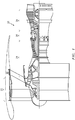
- FIG. 1 schematically illustrates a gas turbine engine 20.
- the gas turbine engine 20 is disclosed herein as a two-spool turbofan that generally incorporates a fan section 22, a compressor section 24, a combustor section 26 and a turbine section 28.
- the fan section 22 drives air along a bypass flowpath while the compressor section 24 drives air along a core flowpath for compression and communication into the combustor section 26 then expansion through the turbine section 28.
- turbofan Although depicted as a turbofan in the disclosed non-limiting embodiment, it should be understood that the concepts described herein are not limited to use with turbofans as the teachings may be applied to other types of turbomachinery to include, but not be limited to, low bypass augmented turbofans, turbojets, turboshafts, three-spool (plus fan) turbofans and industrial gas turbines.
- a process 100 according to one disclosed non-limiting embodiment for application of a coating 40 to a component 42 ( FIG. 3 ) subjected to high temperatures is schematically represented.
- the steps of the process 100 are schematically disclosed in terms of functional block diagrams as a flowchart. It should be appreciated that alternative of additional steps may be provided without departing from the teaching herein.
- Representative examples of the component 42 include but are not limited to combustor section 26 and/or turbine section 28 hardware, such as, augmentor components, combustor liners, blades, vanes, and blade outer air seals.
- the coating 40 as described herein is suitable for protection of a substrate 44 such as a nickel superalloy but while being described with reference to such superalloy gas turbine engine components, the teachings herein are generally applicable to any component on which a TBC may be used to protect the component from a high temperature environment, particularly environments containing CMAS.
- the polynuclear aluminum oxide/hydroxide cluster [AlO 4 Al 12 (OH) 24 (H 2 O) 12 ] 7+ is referred to as an Al 13 Keggin cluster.
- a liquid coating formulation formed from Al 13 and sodium silicate forms the polynuclear Al and Si oxide/hydroxide precursors.
- a pre-condensed Al or Al-Si oxide/hydroxide layer is formed from a dried coating of polynuclear Al and Si oxide/hydroxide precursors.
- a condensed alumina/aluminosilicate compound layer is formed by heat-treating the pre-condensed Al or Al-Si oxide/hydroxide layer.
- a glass-ceramic layer is formed from the reaction of alumina/aluminosilicate coating with CMAS.
- the process 100 initially includes the application of a bond coat 46 to a substrate 44 (see step 102 in the FIG. 3 ).
- the substrate 44 is subjected to cleaning and preparation prior to disposing the bond coat 46 on it.
- FIG. 3 is a cross-section through a component with an alumina/aluminosilicate compound layer that promotes CMAS crystallization to form a protective glass-ceramic seal.
- the bond coat 46 may include an aluminum-rich composition, such as an overlay coating or a diffusion coating such as a diffusion aluminide or a diffusion platinum aluminide having formulas such as MCrAlY, MCrAlY+Hf, and MCrAlY+Hf+Si, in which M denotes nickel, cobalt, iron, platinum or mixtures thereof; Cr denotes chromium; Al denotes aluminum; Y denotes yttrium; Hf denotes hafnium; and Si denotes silicon.
- MCrAlY materials are often referred to as overlay coatings because they are applied in a predetermined composition and do not interact significantly with the substrate 44 during the deposition process.
- One exemplary preferred MCrAlY+Hf+Si bond coat composition has a weight percent compositional range of about 5 to about 40 Cr, about 8 to about 35 Al, about 0.1 to about 2.0 Y, about 0.1 to about 2.0 Hf, about 0.1 to about 7 Si, with the balance being selected from the group consisting of Ni, Co and mixtures thereof.
- the bond coat material may include Al, PtAl, and the like, that are often referred to as diffusion coatings.
- the bond coat material may also include Al, PtAl, MCrAlY as described above, and the like, that are often referred to as cathodic arc coatings.
- the bond coat 46 may be applied by any method operable to produce a dense, uniform, adherent coating of the desired composition, such as, but not limited to, an overlay bond coat, diffusion bond coat, cathodic arc bond coat, and the like.
- Such techniques may include, but are not limited to, diffusion processes (e.g., inward, outward, and the like), low pressure plasma-spray, air plasma-spray, sputtering, cathodic arc, electron beam physical vapor deposition, high velocity plasma spray techniques (e.g., HVOF, HVAF, and the like), combustion processes, wire spray techniques, laser beam cladding, electron beam cladding, and the like.
- the particle size for the bond coat 46 may be of any suitable size, and may be between about 15 microns (0.015 mm) and about 60 microns (0.060 mm) with a mean particle size of about 25 microns (0.025 mm).
- the bond coat 46 may be applied to any suitable thickness, and may be about 5 mils (0.127 mm) to about 10 mils (0.254 mm) thick. In some embodiments, the thickness may be about 6 mils (0.152 mm) to about 7 mils (0.178 mm) thick.
- a thermal barrier material 48 ( FIG. 3 ) may be applied to the bond coat 46 (step 104).
- the thermal barrier material 48 may include a ceramic-based compound.
- Representative thermal barrier materials include, but are not limited to, a stabilized zirconate, a stabilized hafnate, combinations including at least one of the foregoing compounds, and the like, for example, yttria-stabilized zirconia, calcia-stabilized zirconia, magnesia-stabilized zirconia, yttria-stabilized hafnia, calcia-stabilized hafnia and magnesia-stabilized hafnia.
- Yttria-stabilized zirconia is commercially available as 7YSZ.
- One example preferred thermal barrier material 48 is a zirconia stabilized by between about 6 to about 8wt% yttria that is about 0.05 to about 5 mil (about 0.00127 to about 0.127 mm) in thickness deposited, nominally at about 1 to about 3 mil (about 0.0254 to about 0.0761 mm).
- the thermal barrier material 48 may be applied by various known methods. Suitable application methods include, but are not limited to, physical vapor deposition (e.g., electron beam), thermal spray (e.g., air plasma, high velocity oxygen fuel), sputtering, sol gel, slurry, combinations comprising at least one of the foregoing application processes, and the like.
- physical vapor deposition e.g., electron beam
- thermal spray e.g., air plasma, high velocity oxygen fuel
- sputtering e.g., sol gel, slurry, combinations comprising at least one of the foregoing application processes, and the like.
- FIG. 4 is a cross-section through the component showing the coating formulation containing polynuclear aluminum oxide/hydroxide clusters, referred to as 'Al 13 Keggin complexes' or 'Al 13 complexes', and silica oxide/hydroxide precursors.
- the coating is manufactured by reacting an aluminum salt with a base in a solution to produce an Al 13 cluster or an Al 13 complex.
- the coating may comprise the Al 13 cluster or the Al 13 complex in its original solution.
- the Al 13 cluster or the Al 13 complex may be precipitated from solution, purified and dried to form a powder.
- the powder may then be dissolved or suspended in another solution (a second solution) and disposed upon the thermal barrier coating to form the coating.
- a polymeric binder may be added to the second solution and disposed upon the thermal barrier coating to form the coating.
- the coating may be heat treated to volatilize solvents or to degrade the polymeric binder.
- the Al 13 cluster or a complex may be coagulated with a sodium silicate to form a hydroxy aluminosilicate.
- the hydroxy aluminosilicate along with the Al 13 cluster or complexes in solution may be applied as a coating and dried.
- a polymeric binder may be added to the solution containing the hydroxy aluminosilicate along with the Al 13 cluster or complexes.
- the Al 13 complexes aggregate to form hydrated pseudo-boehmite (AlOOH*H 2 O), aluminum trihydroxide, or a combination thereof.
- the coating can be transformed to a fully dense transition alumina coating comprising ⁇ -Al 2 O 3 , ⁇ -Al 2 O 3 , or ⁇ -Al 2 O 3 upon being heat treated.
- Preparation of the coating 40 is initiated via preparation of an aqueous aluminum salt solution (step 200; FIG. 4 ), containing a total Al concentration of about 0.02 to about 2.0 moles/liter.
- Aluminum salts can be used, either in conjunction with or in lieu of the aluminum nitrate, such as, for example: AlCl 3 , Al(CH 3 CO 2 ) 3 (aluminium triacetate), and Al[OCH(CH 3 )C 2 H 5 ] 3 (A1 tri sec-butoxide).
- the solution is slowly titrated with a base, such as, for example, about 0.1 to about 0.6 moles per liter, preferably about 0.2 to about 0.5 moles/liter sodium hydroxide, NaOH, solution at about 70°C, until the [OH - ]/[Al] molar ratio is between about 2.1 to about 2.6, preferably about 2.2 to about 2.4 and the pH is between about 4 to about 7.
- bases that can be used in the aqueous solution include NaOH, KOH, Mg(OH) 2 , Ca(OH) 2 , NaHCO 3 (sodium bicarbonate) and Na 2 CO 3 (sodium carbonate).
- Al 13 complexes of the Al 13 Keggin clusters may be formed and the salts are dependent upon the aluminum salt used to initiate the process of manufacturing the cluster. If other Al salts (other than aluminum nitrate) are used as precursors, the counter-ions in the Al 13 Keggin complex will be formed from the salt anions of the precursor. For example, ⁇ [AlO 4 Al 12 (OH) 24 (H 2 O) 12 ] 7+ *7Cl - ⁇ will be formed from AlCl 3 neutralization.
- the Al 13 cluster is the most prevalent large polynuclear Al species.
- Al 2 O 8 Al 28 (OH) 56 (H 2 O) 26 ] 18+ referred to as the 'Al 30 cluster', and is formed by the condensation of two Al 13 clusters bridged with 4 monomeric Al ions.
- the Al 13 clusters can also undergo condensation reactions to form higher molecular weight polymers, consisting of Al 13 repeating units, especially under alkaline conditions.
- Al 13 complexes can also be synthesized by electroless reduction of Al(NO 3 ) 3 or other aluminum salt solutions.
- the Al 13 complexes can be prepared by aqueous electrolysis using sacrificial Al anodes, following a similar method to Al electro-coagulation technologies employed for water purification.
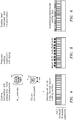
- the tailored surface passivation layer can be deposited directly from the aqueous solution or dispersion containing the metastable polynuclear Al oxide/hydroxide precursors, following the process flow diagram illustrated in FIG. 2 .
- the Al 13 clusters are all about 1.0 to about 1.8 nanometers (nm), preferably about 1.2 to about 1.7 nm in diameter and Al 30 clusters are all approximately 3 nm in length.
- the Al 13 repeating units can polymerize or flocculate to form higher molecular weight polymers, which will precipitate out of solution.
- the Al 13 clusters and complexes can be precipitated by raising the solution pH, and further separating them by drying or concentrating them by other methods.
- the precipitates can be purified by washing in ethanol and redissolved in a coating formulation comprising Al 13 cluster or complex concentrations of about 0.007 to about 0.07 moles/liter in an aqueous solution or in an organic solvent. This is detailed below.
- the coating can be deposited onto the thermal barrier coating from an aqueous solution or from a dispersion containing the reaction products of polynuclear Al and Si oxide/hydroxide precursors, having an Al/Si atomic ratio varying from about 5:1 to about 15:1.
- This is carried out by coagulating the Al 13 clusters with sodium silicate, where the sodium silicate is present in varying amounts of about 0.01 to about 0.1 moles/liter of an aqueous solution.
- the sodium silicates are sodium meta-silicate (Na 2 SiO 3 ), sodium orthosilicate (Na 4 SiO 4 ), and disodium disilicate (Na 2 Si 2 O 5 ).
- the sodium silicates are first dissolved in water to form polynuclear silicic acid clusters (Si x O y H z ).
- the silicic acid clusters react with the Al 13 clusters to form less soluble hydroxy aluminosilicate oligomers that vary in character with the Si/Al ratio, pH, and preparation conditions.
- the hydroxy aluminosilicate formation reduces the Al 13 concentration in proportion to the Si/Al ratio.
- the Al 13 /hydroxy aluminosilicate products are collected by filtration, purified by washing in ethanol and then dried.
- the Al 13 /hydroxy aluminosilicate products are re-suspended in water to form a coating liquid formulation (step 204; FIG. 5 ).
- the Al 13 or Al 13 /hydroxy aluminosilicate products can be reconstituted in an intermediate to high pH solution, concentrated aqueous solution or an organic solvent dispersion.
- the Al 13 or Al 13 /hydroxy aluminosilicate products are present in concentrations of about 0.007 to about 0.07 moles/liter of the solution.
- Solvents and dispersion media include, but are not limited to, water, alcohols (methanol, ethanol, isopropanol, butanol, and the like), acetic acid, formic acid, N, N-dimethylformamide, ethyl acetate, tetrahydrofuran, acetone, or a combination thereof.
- the coating solution or dispersion formula can also contain water-soluble or polar organic solvent-soluble polymeric binders, like poly(vinyl pyrrolidone), polyacrylamides, polyacrylates, poly(acrylic acids), poly(vinyl alcohol), poly(ethylene oxides) or poly(ethylene glycols), polyethyleneimines, polyurethanes, and polyamines.
- water-soluble or polar organic solvent-soluble polymeric binders like poly(vinyl pyrrolidone), polyacrylamides, polyacrylates, poly(acrylic acids), poly(vinyl alcohol), poly(ethylene oxides) or poly(ethylene glycols), polyethyleneimines, polyurethanes, and polyamines.
- the polymers can include thermoplastic polymers or thermosetting polymeric binders.
- Suitable non-water soluble thermoplastic polymeric binders include polyolefins, polystyrene, polymethylmethacrylate, polyimides, polysulfones, polyethersulfones, polyetherimides, polysiloxanes, polycarbonates, polyphenylene ethers, or the like, or a combination thereof.
- Suitable non-water soluble thermosetting polymeric binders include polyepoxides, phenolics, polyurethanes, polysiloxanes, polyisoprene, polybutadiene, or the like, or a combination thereof.
- ingredients like buffer species, co-coagulants, corrosion-inhibitors, chelating agents, or monomeric metal ions can be used to accelerate coagulation, deposition, and adhesion to the component substrate.
- the Al 13 or Al 13 /hydroxy aluminosilicate products are used in conjunction with a binder in an amount of 2 to 25 wt%, preferably 5 to 20 wt%, and more preferably 8 to 15 wt%, based on the total weight of the Al 13 or Al 13 /hydroxy aluminosilicate products and the binder.
- the liquid coating is then applied over the thermal barrier material 48 (Step 206; FIG. 5 ).
- the liquid coating is applied by dipping, painting, spraying, electrostatic spray, or spin-coating on the thermal barrier material 48.
- the viscosity of the precursor coating liquid is high enough to limit its infiltration into the thermal barrier material 48 intergranular gaps.
- the coating is dried, to form a pre-condensed Al or Al-Si oxide/hydroxide layer, depending on the original liquid coating composition.
- the Al 13 complexes may aggregate to form hydrated pseudo-boehmite (AlOOH*H 2 O) nanocrystallites and/or aluminum trihydroxide nanocrystallites that range from about 5 to about 500 nm in size, as well as amorphous phases.
- the mixed Al-Si oxides/hydroxides remain amorphous in character.
- the coating layer is then condensed by heating the component (Step 208; FIG. 6 ).
- the component may be heated to a temperature ranging between about 250 to about 500 °C for about two hours such as during a "green" run. During heating, ramp up over temperatures of about 100 to about 500 °C will cause any remaining water, ligands, and non-metallic counter-ions or additives present in the coating to desorb or to decompose.
- the pseudo-boehmite or aluminum trihydroxide transforms to a fully dense transition-alumina phase ( ⁇ -Al 2 O 3 , ⁇ -Al 2 O 3 or ⁇ -Al 2 O 3 ), and the Al-Si oxides/hydroxides transform to an amorphous aluminosilicate matrix.
- Full alumina nanocrystallite transformation to ⁇ -Al 2 O 3 is possible at temperatures above 1000 °C. Sintering can occur at even higher temperatures, ca. above 1100 °C.
- the condensed coating caps the intergranular gaps in the thermal barrier material 48 at their opening to the surface, providing a first level passivation protection to delay CMAS ingress (Step 300).
- the Al-rich nanocrystallites Once the Al-rich nanocrystallites are contacted by molten CMAS, they can initiate partial CMAS crystallization to a glass-ceramic type phase.
- the coating thickness is between about 1 to about 1000 nm.
- Nanocrystallites in contact with CMAS liquid can operate as nuclei that accelerate kinetics for crystallizing intrinsic CMAS phases, such as anorthrite [CaAl 2 Si 2 O 8 ], diopside [CaMgSi 2 O 6 ], and pseudo-wollastonite [CaSiO 3 ], and the like. Nanocrystallites can be dissolved in CMAS bulk, locally shifting reaction equilibria (Le Chatelier's principle) towards crystallization of Al-rich phases, such as: anorthrite, melilite [Ca 2 Al 2 SiO 7 ], spinel [MgAl 2 O 4 or MgAl 2 O 7 ].
- the glass-ceramic structure has significantly higher viscosity, prevents CMAS infiltration and dissolution into the thermal barrier material 48.
- the glass-ceramic forms a fully dense, impervious surface layer (glass-ceramics are used as sealants).
- Co-coagulants, counter-ions, or ligands are formulated in the coating 40 to tailor composition and properties of CMAS intrinsic crystallization products.
- Co-coagulants such as metal oxide clusters, including those formed with the oxides of the metals (Me): Si, Mo, W, V, Fe, Zn, and Cu, can be combined with Al 13 Keggin complexes to facilitate self-assembly into 3D structures, i.e., to form larger sized precipitates.
- the co-coagulants contain metal oxides, Me x O y , that are added so that the Al/Me atomic ratio is within the range of about 1.5:1 to about 15:1. These other metal oxides may modify the precipitate crystalline ordering, enhance phase transformation kinetics of the coating consolidation, and/or act as nucleation agents for CMAS crystallization.
- Polyaluminosilicate precipitates can be formed when a significant fraction of sodium silicate co-coagulants are combined with the Al 13 Keggin clusters, such as in the naturally occurring zunyite aluminosilicate halide mineral, Al 13 Si 5 O 20 (OH,F) 18 Cl, which contains a combination of Si 5 O 16 and Al 13 units.
- the coating 40 prepared from the Al 13 complexes or the Al 13 /aluminosilicate mixtures can either nucleate the crystallization of intrinsic CMAS phases, or locally shift the equilibria towards the formation of more stable phases containing Al and Si, such as: andalusite, kyanite or sillimanite (Al 2 SiO 5 ); and mullite (Al 6 Si 2 O 13 ).
- the Al 13 Keggin complexes and polyaluminosilicates can complex with metal ions (this is an important feature that is commonly used for water purification).
- Some transition metal ions e.g., Ti +3/+4 , Fe +2/+3 , and Mn +2/+4 , are known nucleation agents used commercially for CMAS crystallization to form glass-ceramic products.
- Pre-condensed Al 13 Keggin complexes seeded with these metal ions may release these ions or their oxides during subsequent condensation reactions or during contact with molten CMAS phases ( FIG. 7 ), in order that they can facilitate CMAS crystallization ( FIG. 3 ).
- the outer bound waters on the Al 13 Keggin complexes can be exchanged with other ligands, such as F ions, carboxylic acids, and alcohols, where the maximum substitution is determined by charge neutralization requirements. Substitution of negatively charged ligands, e.g., F and carboxylate ions, will reduce the number of counter-ions in the outer coordination sphere.
- ligands may be used to alter the Al 13 Keggin complexes or co-coagulant stability or reactivity, and solubility or dispersibility in the pre-condensed liquid coating, as well as possibly during subsequent condensation reactions.
Landscapes
- Chemical & Material Sciences (AREA)
- Engineering & Computer Science (AREA)
- Materials Engineering (AREA)
- Mechanical Engineering (AREA)
- Organic Chemistry (AREA)
- Inorganic Chemistry (AREA)
- Chemical Kinetics & Catalysis (AREA)
- Metallurgy (AREA)
- Physics & Mathematics (AREA)
- Plasma & Fusion (AREA)
- General Engineering & Computer Science (AREA)
- Life Sciences & Earth Sciences (AREA)
- Wood Science & Technology (AREA)
- Combustion & Propulsion (AREA)
- Ceramic Engineering (AREA)
- Geology (AREA)
- Other Surface Treatments For Metallic Materials (AREA)
Applications Claiming Priority (1)
| Application Number | Priority Date | Filing Date | Title |
|---|---|---|---|
| US15/449,673 US10968756B2 (en) | 2017-03-03 | 2017-03-03 | Thermal barrier coating compositions, methods of manufacture thereof and articles comprising the same |
Publications (2)
| Publication Number | Publication Date |
|---|---|
| EP3369844A1 true EP3369844A1 (de) | 2018-09-05 |
| EP3369844B1 EP3369844B1 (de) | 2022-09-21 |
Family
ID=61526722
Family Applications (1)
| Application Number | Title | Priority Date | Filing Date |
|---|---|---|---|
| EP18159402.9A Active EP3369844B1 (de) | 2017-03-03 | 2018-03-01 | Wärmedämmschichtzusammensetzungen, verfahren zur herstellung davon und artikel damit |
Country Status (2)
| Country | Link |
|---|---|
| US (2) | US10968756B2 (de) |
| EP (1) | EP3369844B1 (de) |
Cited By (1)
| Publication number | Priority date | Publication date | Assignee | Title |
|---|---|---|---|---|
| CN115432933A (zh) * | 2022-08-30 | 2022-12-06 | 电子科技大学 | 高抗弯强度玻璃陶瓷材料及其制备方法 |
Families Citing this family (3)
| Publication number | Priority date | Publication date | Assignee | Title |
|---|---|---|---|---|
| US11624288B2 (en) * | 2018-01-09 | 2023-04-11 | General Electric Company | Slotted ceramic coating with a reactive phase coating disposed thereon for improved CMAS resistance and methods of forming the same |
| EP4361400A1 (de) * | 2022-10-31 | 2024-05-01 | RTX Corporation | Dichtung mit beschichtung und herstellungsverfahren |
| US12228033B1 (en) * | 2023-10-13 | 2025-02-18 | Rtx Corporation | Blade outer air seal with machinable coating at sealing surfaces |
Citations (6)
| Publication number | Priority date | Publication date | Assignee | Title |
|---|---|---|---|---|
| US5660885A (en) * | 1995-04-03 | 1997-08-26 | General Electric Company | Protection of thermal barrier coating by a sacrificial surface coating |
| EP1428902A1 (de) * | 2002-12-12 | 2004-06-16 | General Electric Company | Durch infiltriertes Aluminiumoxid geschützte thermische Schutzbeschichtung und zugehöriges Herstellungsverfahren |
| US20050053735A1 (en) * | 2003-09-08 | 2005-03-10 | Ilford Imaging Switzerland Gmbh | Recording sheets for ink jet printing |
| EP1793011A2 (de) * | 2005-11-30 | 2007-06-06 | General Electric Company | Verfahren zur Herstellung einer infiltrationsresistenten Wärmedämmschicht |
| EP2233450A1 (de) * | 2009-03-27 | 2010-09-29 | Alstom Technology Ltd | Mehrlagiges thermisches Schutzsystem und deren Verwendung |
| WO2011159675A1 (en) * | 2010-06-14 | 2011-12-22 | State Of Oregon Acting By And Through The State Board Of Higher Education On Behalf Of Oregon State | Process to form aqueous precursor and aluminum oxide film |
Family Cites Families (1)
| Publication number | Priority date | Publication date | Assignee | Title |
|---|---|---|---|---|
| US6284682B1 (en) * | 1999-08-26 | 2001-09-04 | The University Of British Columbia | Process for making chemically bonded sol-gel ceramics |
-
2017
- 2017-03-03 US US15/449,673 patent/US10968756B2/en active Active
-
2018
- 2018-03-01 EP EP18159402.9A patent/EP3369844B1/de active Active
-
2021
- 2021-04-05 US US17/222,366 patent/US12392248B2/en active Active
Patent Citations (6)
| Publication number | Priority date | Publication date | Assignee | Title |
|---|---|---|---|---|
| US5660885A (en) * | 1995-04-03 | 1997-08-26 | General Electric Company | Protection of thermal barrier coating by a sacrificial surface coating |
| EP1428902A1 (de) * | 2002-12-12 | 2004-06-16 | General Electric Company | Durch infiltriertes Aluminiumoxid geschützte thermische Schutzbeschichtung und zugehöriges Herstellungsverfahren |
| US20050053735A1 (en) * | 2003-09-08 | 2005-03-10 | Ilford Imaging Switzerland Gmbh | Recording sheets for ink jet printing |
| EP1793011A2 (de) * | 2005-11-30 | 2007-06-06 | General Electric Company | Verfahren zur Herstellung einer infiltrationsresistenten Wärmedämmschicht |
| EP2233450A1 (de) * | 2009-03-27 | 2010-09-29 | Alstom Technology Ltd | Mehrlagiges thermisches Schutzsystem und deren Verwendung |
| WO2011159675A1 (en) * | 2010-06-14 | 2011-12-22 | State Of Oregon Acting By And Through The State Board Of Higher Education On Behalf Of Oregon State | Process to form aqueous precursor and aluminum oxide film |
Non-Patent Citations (1)
| Title |
|---|
| FOURNIER A C ET AL: "A multi-technique study of the effect of aqueous aluminium speciation on hydrolytic gelation of aluminium (oxy)hydroxide", JOURNAL OF COLLOID AND INTERFACE SCIENCE, ACADEMIC PRESS,INC, US, vol. 332, no. 1, 1 April 2009 (2009-04-01), pages 122 - 129, XP025909496, ISSN: 0021-9797, [retrieved on 20090203], DOI: 10.1016/J.JCIS.2008.12.042 * |
Cited By (2)
| Publication number | Priority date | Publication date | Assignee | Title |
|---|---|---|---|---|
| CN115432933A (zh) * | 2022-08-30 | 2022-12-06 | 电子科技大学 | 高抗弯强度玻璃陶瓷材料及其制备方法 |
| CN115432933B (zh) * | 2022-08-30 | 2023-08-04 | 电子科技大学 | 高抗弯强度玻璃陶瓷材料及其制备方法 |
Also Published As
| Publication number | Publication date |
|---|---|
| US20180252111A1 (en) | 2018-09-06 |
| US20230141706A1 (en) | 2023-05-11 |
| US12392248B2 (en) | 2025-08-19 |
| US10968756B2 (en) | 2021-04-06 |
| EP3369844B1 (de) | 2022-09-21 |
Similar Documents
| Publication | Publication Date | Title |
|---|---|---|
| US12392248B2 (en) | Thermal barrier coating compositions, methods of manufacture thereof and articles comprising the same | |
| EP3546615B1 (de) | Beschichtungssystem mit nukleierungsmittel | |
| JP5067775B2 (ja) | シリコン含有基材用の耐食ebcの結合コートおよび同物を製造するプロセス | |
| US20230002288A1 (en) | Cmas-resistant environmental barrier and thermal barrier coatings | |
| EP2766504B1 (de) | Wärmedämmende beschichtungssysteme und verfahren dafür | |
| US9920417B2 (en) | Article and method of making thereof | |
| EP2947173B1 (de) | Calcium-magnesium-aluminiumsilikat (cmas)-resistente wärmedämmschicht und beschichtungsverfahren dafür | |
| EP1666633B1 (de) | Schutz einer Wärmedämmschicht mit einer Opferbeschichtung | |
| EP1889949B1 (de) | Natriumhaltige Wärmedämmbeschichtung | |
| EP2503027A1 (de) | Heißkorrosionsbeständige Beschichtungen und damit geschützte Komponenten | |
| US20100129673A1 (en) | Reinforced oxide coatings | |
| JP2006347871A (ja) | シリコン含有基材用の耐食密封剤および同物を製造するプロセス | |
| JP2007008806A (ja) | シリコン含有基材の外部ebl用の耐食密封剤および同物を製造するプロセス | |
| JP2011508093A (ja) | Cmas浸透耐性を向上させる方法 | |
| US11655543B2 (en) | CMAS-resistant barrier coatings | |
| JP2020523488A (ja) | 被覆ターボ機械部品及び関連製造方法 | |
| CN112756232A (zh) | 修复涂层系统和方法 | |
| US12227464B2 (en) | CMAS-resistant environmental barrier coating system | |
| US20070224359A1 (en) | Method for preparing strain tolerant coatings by a sol-gel process | |
| EP3002348B1 (de) | Verfahren zum beschichten von gasturbinenmotorkomponenten mit mehrphasigen vorreagierten wärmedämmschichten und beschichtete gasturbinenmotorkomponenten | |
| EP2391591A1 (de) | Hochtemperaturstabile amorphe siliciumreiche aluminiumsilicate | |
| KR102796087B1 (ko) | 초합금 기재의 고온 부식 방지를 위한 크로메이트-무함유 세라믹 코팅 조성물 | |
| EP3926068A1 (de) | Cmas-resistentes wärmedämmbeschichtungssystem |
Legal Events
| Date | Code | Title | Description |
|---|---|---|---|
| PUAI | Public reference made under article 153(3) epc to a published international application that has entered the european phase |
Free format text: ORIGINAL CODE: 0009012 |
|
| STAA | Information on the status of an ep patent application or granted ep patent |
Free format text: STATUS: THE APPLICATION HAS BEEN PUBLISHED |
|
| AK | Designated contracting states |
Kind code of ref document: A1 Designated state(s): AL AT BE BG CH CY CZ DE DK EE ES FI FR GB GR HR HU IE IS IT LI LT LU LV MC MK MT NL NO PL PT RO RS SE SI SK SM TR |
|
| AX | Request for extension of the european patent |
Extension state: BA ME |
|
| STAA | Information on the status of an ep patent application or granted ep patent |
Free format text: STATUS: REQUEST FOR EXAMINATION WAS MADE |
|
| 17P | Request for examination filed |
Effective date: 20190305 |
|
| RBV | Designated contracting states (corrected) |
Designated state(s): AL AT BE BG CH CY CZ DE DK EE ES FI FR GB GR HR HU IE IS IT LI LT LU LV MC MK MT NL NO PL PT RO RS SE SI SK SM TR |
|
| STAA | Information on the status of an ep patent application or granted ep patent |
Free format text: STATUS: EXAMINATION IS IN PROGRESS |
|
| 17Q | First examination report despatched |
Effective date: 20200302 |
|
| RAP1 | Party data changed (applicant data changed or rights of an application transferred) |
Owner name: RAYTHEON TECHNOLOGIES CORPORATION |
|
| GRAP | Despatch of communication of intention to grant a patent |
Free format text: ORIGINAL CODE: EPIDOSNIGR1 |
|
| STAA | Information on the status of an ep patent application or granted ep patent |
Free format text: STATUS: GRANT OF PATENT IS INTENDED |
|
| RIC1 | Information provided on ipc code assigned before grant |
Ipc: C23C 4/18 20060101ALI20220225BHEP Ipc: C23C 4/11 20160101ALI20220225BHEP Ipc: C23C 4/10 20160101ALI20220225BHEP Ipc: B05B 7/22 20060101ALI20220225BHEP Ipc: B05B 7/20 20060101ALI20220225BHEP Ipc: B05B 5/025 20060101ALI20220225BHEP Ipc: B05B 5/00 20060101ALI20220225BHEP Ipc: C23C 4/02 20060101ALI20220225BHEP Ipc: C23C 28/00 20060101AFI20220225BHEP |
|
| INTG | Intention to grant announced |
Effective date: 20220406 |
|
| GRAS | Grant fee paid |
Free format text: ORIGINAL CODE: EPIDOSNIGR3 |
|
| GRAA | (expected) grant |
Free format text: ORIGINAL CODE: 0009210 |
|
| STAA | Information on the status of an ep patent application or granted ep patent |
Free format text: STATUS: THE PATENT HAS BEEN GRANTED |
|
| AK | Designated contracting states |
Kind code of ref document: B1 Designated state(s): AL AT BE BG CH CY CZ DE DK EE ES FI FR GB GR HR HU IE IS IT LI LT LU LV MC MK MT NL NO PL PT RO RS SE SI SK SM TR |
|
| REG | Reference to a national code |
Ref country code: GB Ref legal event code: FG4D |
|
| REG | Reference to a national code |
Ref country code: CH Ref legal event code: EP |
|
| REG | Reference to a national code |
Ref country code: DE Ref legal event code: R096 Ref document number: 602018040801 Country of ref document: DE |
|
| REG | Reference to a national code |
Ref country code: IE Ref legal event code: FG4D |
|
| REG | Reference to a national code |
Ref country code: AT Ref legal event code: REF Ref document number: 1520002 Country of ref document: AT Kind code of ref document: T Effective date: 20221015 |
|
| REG | Reference to a national code |
Ref country code: LT Ref legal event code: MG9D |
|
| REG | Reference to a national code |
Ref country code: NL Ref legal event code: MP Effective date: 20220921 |
|
| PG25 | Lapsed in a contracting state [announced via postgrant information from national office to epo] |
Ref country code: SE Free format text: LAPSE BECAUSE OF FAILURE TO SUBMIT A TRANSLATION OF THE DESCRIPTION OR TO PAY THE FEE WITHIN THE PRESCRIBED TIME-LIMIT Effective date: 20220921 Ref country code: RS Free format text: LAPSE BECAUSE OF FAILURE TO SUBMIT A TRANSLATION OF THE DESCRIPTION OR TO PAY THE FEE WITHIN THE PRESCRIBED TIME-LIMIT Effective date: 20220921 Ref country code: NO Free format text: LAPSE BECAUSE OF FAILURE TO SUBMIT A TRANSLATION OF THE DESCRIPTION OR TO PAY THE FEE WITHIN THE PRESCRIBED TIME-LIMIT Effective date: 20221221 Ref country code: LV Free format text: LAPSE BECAUSE OF FAILURE TO SUBMIT A TRANSLATION OF THE DESCRIPTION OR TO PAY THE FEE WITHIN THE PRESCRIBED TIME-LIMIT Effective date: 20220921 Ref country code: LT Free format text: LAPSE BECAUSE OF FAILURE TO SUBMIT A TRANSLATION OF THE DESCRIPTION OR TO PAY THE FEE WITHIN THE PRESCRIBED TIME-LIMIT Effective date: 20220921 Ref country code: FI Free format text: LAPSE BECAUSE OF FAILURE TO SUBMIT A TRANSLATION OF THE DESCRIPTION OR TO PAY THE FEE WITHIN THE PRESCRIBED TIME-LIMIT Effective date: 20220921 |
|
| REG | Reference to a national code |
Ref country code: AT Ref legal event code: MK05 Ref document number: 1520002 Country of ref document: AT Kind code of ref document: T Effective date: 20220921 |
|
| PG25 | Lapsed in a contracting state [announced via postgrant information from national office to epo] |
Ref country code: HR Free format text: LAPSE BECAUSE OF FAILURE TO SUBMIT A TRANSLATION OF THE DESCRIPTION OR TO PAY THE FEE WITHIN THE PRESCRIBED TIME-LIMIT Effective date: 20220921 Ref country code: GR Free format text: LAPSE BECAUSE OF FAILURE TO SUBMIT A TRANSLATION OF THE DESCRIPTION OR TO PAY THE FEE WITHIN THE PRESCRIBED TIME-LIMIT Effective date: 20221222 |
|
| PG25 | Lapsed in a contracting state [announced via postgrant information from national office to epo] |
Ref country code: SM Free format text: LAPSE BECAUSE OF FAILURE TO SUBMIT A TRANSLATION OF THE DESCRIPTION OR TO PAY THE FEE WITHIN THE PRESCRIBED TIME-LIMIT Effective date: 20220921 Ref country code: RO Free format text: LAPSE BECAUSE OF FAILURE TO SUBMIT A TRANSLATION OF THE DESCRIPTION OR TO PAY THE FEE WITHIN THE PRESCRIBED TIME-LIMIT Effective date: 20220921 Ref country code: PT Free format text: LAPSE BECAUSE OF FAILURE TO SUBMIT A TRANSLATION OF THE DESCRIPTION OR TO PAY THE FEE WITHIN THE PRESCRIBED TIME-LIMIT Effective date: 20230123 Ref country code: ES Free format text: LAPSE BECAUSE OF FAILURE TO SUBMIT A TRANSLATION OF THE DESCRIPTION OR TO PAY THE FEE WITHIN THE PRESCRIBED TIME-LIMIT Effective date: 20220921 Ref country code: CZ Free format text: LAPSE BECAUSE OF FAILURE TO SUBMIT A TRANSLATION OF THE DESCRIPTION OR TO PAY THE FEE WITHIN THE PRESCRIBED TIME-LIMIT Effective date: 20220921 Ref country code: AT Free format text: LAPSE BECAUSE OF FAILURE TO SUBMIT A TRANSLATION OF THE DESCRIPTION OR TO PAY THE FEE WITHIN THE PRESCRIBED TIME-LIMIT Effective date: 20220921 |
|
| PG25 | Lapsed in a contracting state [announced via postgrant information from national office to epo] |
Ref country code: SK Free format text: LAPSE BECAUSE OF FAILURE TO SUBMIT A TRANSLATION OF THE DESCRIPTION OR TO PAY THE FEE WITHIN THE PRESCRIBED TIME-LIMIT Effective date: 20220921 Ref country code: PL Free format text: LAPSE BECAUSE OF FAILURE TO SUBMIT A TRANSLATION OF THE DESCRIPTION OR TO PAY THE FEE WITHIN THE PRESCRIBED TIME-LIMIT Effective date: 20220921 Ref country code: IS Free format text: LAPSE BECAUSE OF FAILURE TO SUBMIT A TRANSLATION OF THE DESCRIPTION OR TO PAY THE FEE WITHIN THE PRESCRIBED TIME-LIMIT Effective date: 20230121 Ref country code: EE Free format text: LAPSE BECAUSE OF FAILURE TO SUBMIT A TRANSLATION OF THE DESCRIPTION OR TO PAY THE FEE WITHIN THE PRESCRIBED TIME-LIMIT Effective date: 20220921 |
|
| REG | Reference to a national code |
Ref country code: DE Ref legal event code: R097 Ref document number: 602018040801 Country of ref document: DE |
|
| P01 | Opt-out of the competence of the unified patent court (upc) registered |
Effective date: 20230520 |
|
| PG25 | Lapsed in a contracting state [announced via postgrant information from national office to epo] |
Ref country code: NL Free format text: LAPSE BECAUSE OF FAILURE TO SUBMIT A TRANSLATION OF THE DESCRIPTION OR TO PAY THE FEE WITHIN THE PRESCRIBED TIME-LIMIT Effective date: 20220921 Ref country code: AL Free format text: LAPSE BECAUSE OF FAILURE TO SUBMIT A TRANSLATION OF THE DESCRIPTION OR TO PAY THE FEE WITHIN THE PRESCRIBED TIME-LIMIT Effective date: 20220921 |
|
| PLBE | No opposition filed within time limit |
Free format text: ORIGINAL CODE: 0009261 |
|
| STAA | Information on the status of an ep patent application or granted ep patent |
Free format text: STATUS: NO OPPOSITION FILED WITHIN TIME LIMIT |
|
| PG25 | Lapsed in a contracting state [announced via postgrant information from national office to epo] |
Ref country code: DK Free format text: LAPSE BECAUSE OF FAILURE TO SUBMIT A TRANSLATION OF THE DESCRIPTION OR TO PAY THE FEE WITHIN THE PRESCRIBED TIME-LIMIT Effective date: 20220921 |
|
| 26N | No opposition filed |
Effective date: 20230622 |
|
| PG25 | Lapsed in a contracting state [announced via postgrant information from national office to epo] |
Ref country code: SI Free format text: LAPSE BECAUSE OF FAILURE TO SUBMIT A TRANSLATION OF THE DESCRIPTION OR TO PAY THE FEE WITHIN THE PRESCRIBED TIME-LIMIT Effective date: 20220921 |
|
| PG25 | Lapsed in a contracting state [announced via postgrant information from national office to epo] |
Ref country code: MC Free format text: LAPSE BECAUSE OF FAILURE TO SUBMIT A TRANSLATION OF THE DESCRIPTION OR TO PAY THE FEE WITHIN THE PRESCRIBED TIME-LIMIT Effective date: 20220921 |
|
| REG | Reference to a national code |
Ref country code: CH Ref legal event code: PL |
|
| REG | Reference to a national code |
Ref country code: BE Ref legal event code: MM Effective date: 20230331 |
|
| PG25 | Lapsed in a contracting state [announced via postgrant information from national office to epo] |
Ref country code: LU Free format text: LAPSE BECAUSE OF NON-PAYMENT OF DUE FEES Effective date: 20230301 |
|
| REG | Reference to a national code |
Ref country code: IE Ref legal event code: MM4A |
|
| PG25 | Lapsed in a contracting state [announced via postgrant information from national office to epo] |
Ref country code: LI Free format text: LAPSE BECAUSE OF NON-PAYMENT OF DUE FEES Effective date: 20230331 Ref country code: IE Free format text: LAPSE BECAUSE OF NON-PAYMENT OF DUE FEES Effective date: 20230301 Ref country code: CH Free format text: LAPSE BECAUSE OF NON-PAYMENT OF DUE FEES Effective date: 20230331 |
|
| PG25 | Lapsed in a contracting state [announced via postgrant information from national office to epo] |
Ref country code: BE Free format text: LAPSE BECAUSE OF NON-PAYMENT OF DUE FEES Effective date: 20230331 |
|
| PG25 | Lapsed in a contracting state [announced via postgrant information from national office to epo] |
Ref country code: IT Free format text: LAPSE BECAUSE OF FAILURE TO SUBMIT A TRANSLATION OF THE DESCRIPTION OR TO PAY THE FEE WITHIN THE PRESCRIBED TIME-LIMIT Effective date: 20220921 |
|
| PG25 | Lapsed in a contracting state [announced via postgrant information from national office to epo] |
Ref country code: BG Free format text: LAPSE BECAUSE OF FAILURE TO SUBMIT A TRANSLATION OF THE DESCRIPTION OR TO PAY THE FEE WITHIN THE PRESCRIBED TIME-LIMIT Effective date: 20220921 |
|
| PG25 | Lapsed in a contracting state [announced via postgrant information from national office to epo] |
Ref country code: BG Free format text: LAPSE BECAUSE OF FAILURE TO SUBMIT A TRANSLATION OF THE DESCRIPTION OR TO PAY THE FEE WITHIN THE PRESCRIBED TIME-LIMIT Effective date: 20220921 |
|
| PG25 | Lapsed in a contracting state [announced via postgrant information from national office to epo] |
Ref country code: CY Free format text: LAPSE BECAUSE OF FAILURE TO SUBMIT A TRANSLATION OF THE DESCRIPTION OR TO PAY THE FEE WITHIN THE PRESCRIBED TIME-LIMIT; INVALID AB INITIO Effective date: 20180301 |
|
| PG25 | Lapsed in a contracting state [announced via postgrant information from national office to epo] |
Ref country code: HU Free format text: LAPSE BECAUSE OF FAILURE TO SUBMIT A TRANSLATION OF THE DESCRIPTION OR TO PAY THE FEE WITHIN THE PRESCRIBED TIME-LIMIT; INVALID AB INITIO Effective date: 20180301 |
|
| REG | Reference to a national code |
Ref country code: DE Ref legal event code: R081 Ref document number: 602018040801 Country of ref document: DE Owner name: RTX CORPORATION (N.D.GES.D. STAATES DELAWARE),, US Free format text: FORMER OWNER: RAYTHEON TECHNOLOGIES CORPORATION, FARMINGTON, CT, US |
|
| PG25 | Lapsed in a contracting state [announced via postgrant information from national office to epo] |
Ref country code: TR Free format text: LAPSE BECAUSE OF FAILURE TO SUBMIT A TRANSLATION OF THE DESCRIPTION OR TO PAY THE FEE WITHIN THE PRESCRIBED TIME-LIMIT Effective date: 20220921 |
|
| PGFP | Annual fee paid to national office [announced via postgrant information from national office to epo] |
Ref country code: GB Payment date: 20260220 Year of fee payment: 9 |
|
| PGFP | Annual fee paid to national office [announced via postgrant information from national office to epo] |
Ref country code: DE Payment date: 20260219 Year of fee payment: 9 |
|
| PGFP | Annual fee paid to national office [announced via postgrant information from national office to epo] |
Ref country code: FR Payment date: 20260219 Year of fee payment: 9 |