EP3370126A2 - Procédé et système pour empêcher des interférences et commander les collisions d'éléments mécaniques - Google Patents
Procédé et système pour empêcher des interférences et commander les collisions d'éléments mécaniques Download PDFInfo
- Publication number
- EP3370126A2 EP3370126A2 EP18169119.7A EP18169119A EP3370126A2 EP 3370126 A2 EP3370126 A2 EP 3370126A2 EP 18169119 A EP18169119 A EP 18169119A EP 3370126 A2 EP3370126 A2 EP 3370126A2
- Authority
- EP
- European Patent Office
- Prior art keywords
- management
- control unit
- mechanical members
- phase
- current
- Prior art date
- Legal status (The legal status is an assumption and is not a legal conclusion. Google has not performed a legal analysis and makes no representation as to the accuracy of the status listed.)
- Granted
Links
Images


Classifications
-
- G—PHYSICS
- G05—CONTROLLING; REGULATING
- G05B—CONTROL OR REGULATING SYSTEMS IN GENERAL; FUNCTIONAL ELEMENTS OF SUCH SYSTEMS; MONITORING OR TESTING ARRANGEMENTS FOR SUCH SYSTEMS OR ELEMENTS
- G05B19/00—Program-control systems
- G05B19/02—Program-control systems electric
- G05B19/18—Numerical control [NC], i.e. automatically operating machines, in particular machine tools, e.g. in a manufacturing environment, so as to execute positioning, movement or co-ordinated operations by means of program data in numerical form
- G05B19/406—Numerical control [NC], i.e. automatically operating machines, in particular machine tools, e.g. in a manufacturing environment, so as to execute positioning, movement or co-ordinated operations by means of program data in numerical form characterised by monitoring or safety
- G05B19/4061—Avoiding collision or forbidden zones
-
- G—PHYSICS
- G05—CONTROLLING; REGULATING
- G05B—CONTROL OR REGULATING SYSTEMS IN GENERAL; FUNCTIONAL ELEMENTS OF SUCH SYSTEMS; MONITORING OR TESTING ARRANGEMENTS FOR SUCH SYSTEMS OR ELEMENTS
- G05B19/00—Program-control systems
- G05B19/02—Program-control systems electric
- G05B19/04—Program control other than numerical control, i.e. in sequence controllers or logic controllers
- G05B19/042—Program control other than numerical control, i.e. in sequence controllers or logic controllers using digital processors
- G05B19/0423—Input/output
- G05B19/0425—Safety, monitoring
-
- G—PHYSICS
- G05—CONTROLLING; REGULATING
- G05B—CONTROL OR REGULATING SYSTEMS IN GENERAL; FUNCTIONAL ELEMENTS OF SUCH SYSTEMS; MONITORING OR TESTING ARRANGEMENTS FOR SUCH SYSTEMS OR ELEMENTS
- G05B2219/00—Program-control systems
- G05B2219/30—Nc systems
- G05B2219/37—Measurements
- G05B2219/37622—Detect collision, blocking, stall by change, lag in position
-
- G—PHYSICS
- G05—CONTROLLING; REGULATING
- G05B—CONTROL OR REGULATING SYSTEMS IN GENERAL; FUNCTIONAL ELEMENTS OF SUCH SYSTEMS; MONITORING OR TESTING ARRANGEMENTS FOR SUCH SYSTEMS OR ELEMENTS
- G05B2219/00—Program-control systems
- G05B2219/30—Nc systems
- G05B2219/37—Measurements
- G05B2219/37632—By measuring current, load of motor
-
- G—PHYSICS
- G05—CONTROLLING; REGULATING
- G05B—CONTROL OR REGULATING SYSTEMS IN GENERAL; FUNCTIONAL ELEMENTS OF SUCH SYSTEMS; MONITORING OR TESTING ARRANGEMENTS FOR SUCH SYSTEMS OR ELEMENTS
- G05B2219/00—Program-control systems
- G05B2219/30—Nc systems
- G05B2219/49—Nc machine tool, till multiple
- G05B2219/49157—Limitation, collision, interference, forbidden zones, avoid obstacles
Definitions
- Embodiments of the present disclosure concern a method particularly suitable to prevent interferences and to control collisions between mechanical members moved by electric motors, which for example can be the brushless type.
- the embodiments described herein also concern the connected system operating in connection with a substantially sequential logic.
- Automation units comprising one or more operating units comprising a drive member, a mechanical member, a position detector mean, that is, an entity that simulates mathematically the position of the drive shaft.
- the mechanical members of the operating units are therefore normally moved by electric motors, and are connected to the shaft of the latter directly or by means of kinematic reduction units.
- the motors commanded by a central management and control unit, drive the operating units in pre-established cycles and in a coordinated manner, to obtain a desired interaction, for example so that they interact with a product in order to work it.
- known work units comprise clutches, mechanical releases or energy absorbers that intervene in the event of collisions in order to reduce damage.
- one purpose of the present invention is to provide a method to prevent interferences and to control collisions between the mechanical members of operating units without using clutches, mechanical releases or other.
- Another purpose of the present invention is to obtain a system for moving the mechanical members that is quick, coordinated and reliable, controlling, providing and/or preventing interference and detecting collisions quickly enough to prevent breakages.
- Another purpose of the present invention is to perfect a method to control interference and collisions which simplifies the mechanical members, making them more economical, easy to maintain, simple to calibrate and start the cycle.
- Another purpose is to be able to manage the operating units, performing interdependent processes, with high cadence, that is, up to 600 cycles per minute and more.
- mechanical member we mean cranks, pantographic systems, cams or other according to the specific requirements.
- the Applicant has devised, tested and embodied the present invention to overcome the shortcomings of the state of the art and to obtain these and other purposes and advantages.
- a method to prevent interferences and to control collisions is applied to an automation unit operating in connection with a substantially sequential logic.
- the automation unit comprises the control of a first operating unit with respect to a second operating unit or with respect to possible contrast elements.
- the mechanical members carry out their operating cycle in a region where interference or collisions can occur.
- the method comprises a first phase of preventing interferences in which the management and control unit detects the position of at least one shaft of the motor continuously or with a desired periodicity.
- the detection is made in relation to the point-by-point position of the mechanical member. Said detection is made considering the braking time and space of the specific operating unit, starting from its point-by-point dynamics. The position is detected and compared with the position of possible interference with possible contrast elements.
- the reciprocal point-by-point position of one mechanical member with respect to the other mechanical member is controlled continuously or according to said periodicity.
- the position of the mechanical members is detected by means of respective position detectors directly associated with the shafts of the electric motors, or with the mechanical members themselves or after a possible reduction, or again in relation to a position simulator, for example a mathematical position simulator.
- the position of the drive shafts is detected by controlling the temporal and point-by-point position inside the respective cycles.
- the cycle is divided into "n" sub-phases consisting of elementary angular units or units of time.
- the actual current is compared with the reference current, and the current supplied is limited point-by-point so that it does not exceed the expected point-by-point threshold.
- the current error in absolute terms is compared with a window of acceptability made from two thresholds applied to the theoretical point-by-point reference current, of which one is bigger and one is smaller than the reference current value. This allows to detect collisions in both acceleration and deceleration, as well as to detect if the mechanics change inertia suddenly, which effect is associable for example with a breakage.
- the management program of the two operating units provides all the physical conditions in which at least one operating unit can be, and situations that can lead to interference or collisions.
- the program comprises all the physical conditions of both operating units.
- the point-by-point detections of the position of both the drive shafts are made. Based on these detections, the management and control unit compares the point-by-point position of each operating unit in relation to the future position of possible interference. This comparison is done considering the dynamics with which the members are proceeding and the dynamics with which the members are able to stop, using the maximum allowed torque. If the point-by-point position of one operating unit, as the operating cycle continues, indicates the possibility of interference with the other operating unit, the management and control unit intervenes.
- the collisions control detects it and proceeds with the blocking, thus preventing possible breakages.
- the two controls can be independent even if they function simultaneously.
- the first control (first phase) manages the reciprocal point-by-point coplanar positions in view of the expected future positions. The management considers the possible braking space continuously, or the space for deceleration/acceleration, of one and/or the other operating unit.
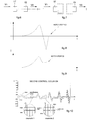
- the second control (second phase) manages the current supplied to the electric motors so that if the current, which must be near the theoretical reference value calculated as a function of the point-by-point inertia and point-by-point acceleration of the mechanical member, were to be outside the minimum-maximum band allowed for every sub-phase "n" of the cycle, or multiple of "n" (see fig. 10 ), the second control intervenes and proceeds with the blocking.
- the second control also limits the current to the maximum limit allowed point-by-point (point-by-point reference + max tolerance threshold).
- the theoretical reference current value is self-learnt as a function of the cadence of the cycle, the position of the sub-phase "n" and memorized in tables.
- the two controls are managed by the same program, but on two autonomous levels.
- the method also provides one or more central control units, or management and control units, which control and command the operating units.
- a method according to the present disclosure is used to prevent interferences and to control collisions between mechanical members of at least two operating units or at least one operating unit with respect to fixed positions for the execution of an operating cycle, wherein the at least one operating unit is associated with a position detector or a position simulator, and is equipped with at least one electric motor which drives a mechanical member.
- the method is managed by a management and control unit and provides that the control of the operating units occurs in two phases, of which a first phase of preventing interferences in which at a determinate instant of time the actual position of the mechanical member is verified as a function of the current dynamics and the braking or acceleration times and spaces, and a second phase of detecting the collisions in which, at a determinate instant of time, the actual intensity of current supplied to the at least one electric motor is verified, dividing said operating cycle into "n" sub-phases, in relation to every sub-phase "n” the actual current being compared with a reference current in order to identify a current error in absolute terms, the current error in absolute terms being compared with a window of acceptability made from two thresholds applied to the reference current value, of which one is bigger and one is smaller than the reference current value, limiting in the determinate instant of time the current supplied so that it does not exceed a threshold value defined for the determinate instant of time; wherein for each of the sub-phases "n"
- the reference currents are memorized in tables, using self-learning procedures, said tables being interrogated in order to obtain the reference to be used, comparing it with the actual value of current supplied.
- a method to prevent interferences and to control collisions between mechanical members of at least two operating units for executing an operating cycle is provided.
- Each of the at least two operating units is associated with a position detector or with a position simulator, and is equipped with at least one electric motor supplied with a corresponding current for driving a mechanical member.
- the method is managed by a management and control unit.
- the method comprises two phases:
- said first phase comprises detecting, at said determinate instant of time, the actual position of each of the mechanical members as a function of the current dynamics and the braking or acceleration times and spaces.
- said comparison in said first phase, is done by the management and control unit considering the dynamics with which the mechanical members are proceeding and the dynamics with which the mechanical members are able to stop, using the maximum allowed torque.
- control of the operating units occurs at the same time.
- the first phase is carried out continuously, taking into account the braking or acceleration time and space.
- the reference currents are memorized in tables, using self-learning procedures, said tables being interrogated in order to obtain the reference to be compared with the actual value of current supplied.
- the reference current is self-learnt by said management and control unit as a function of the cadence of the operating cycle and the sub-phase "n".
- a correction factor due to an acceleration in the operating cycle is added to said reference current, said acceleration relating to variations in speed of one of the eat least two operating units or during the stops and re-starts of the individual operating unit.
- an automation unit is provided.
- the automation unit comprises:
- said management and control unit is configured to detect, at said determinate instant of time, the actual position of each of the mechanical members as a function of the current dynamics and the braking or acceleration times and spaces.
- said management and control unit is configured to perform said comparison between the actual position of each of the mechanical members with the future position of possible interference of the mechanical members, by considering the dynamics with which the mechanical members are proceeding and the dynamics with which the mechanical members are able to stop, using the maximum allowed torque.
- said management and control unit is configured to perform a step of self-learning of the reference current value.
- said management and control unit is configured to memorize the reference currents in tables, using self-learning procedures, said tables being interrogated in order to obtain the reference to be compared with the actual value of current supplied.
- said management and control unit is configured to self-learn the reference current as a function of the cadence of the operating cycle and the sub-phase "n".
- the method to control interference and/or to control collisions is applied to an automation unit 10 which comprises an operating unit 11 that cooperates with a plurality of operating units 111, 112, 113, 114.
- the operating units 11, 111, 112, 113, 114 are governed by a management and control unit 13.
- the two methods can operate in different formulations, that is, they can:
- the operating unit 11 has a position detector so that it does not allow phase displacements or drifts, and an electric motor 15.
- the shaft of the electric motor 15 is connected to a mechanical member 17.
- another operating unit 111 is associated with its own position detector and an electric motor 21 directly connected to a mechanical member 23.
- the mechanical members 17 and 23 follow trajectories that interfere with each other (see fig. 2 ).
- the position detector can be associated with, or also with, the mechanical member 17, 23 or with the electric motor 15, 21.
- the position detector mean of the operating unit 11, 111 is suitable to communicate to the management and control unit 13 the point-by-point position of the mechanical members 17 or 23.
- the management and control unit 13 receives data from the position detector mean and processes them continuously, or according to a desired cadence.
- the management and control unit 13 has inside itself the operating diagrams of every operating unit 111, 112, 113 and 114. In the operating diagrams associated with the position of the individual drive shafts, or operating unit, a condition of possible interference is also provided.
- the management and control unit 13 on each occasion controls the position of each operating unit 11, 111, 112, 113 and 114, taking into account the braking time and space of both operating units 11, 111, 112, 113 and 114 in relation to another operating unit.
- the control thus occurs in pairs of operating units 11, 111, 112, 113 and 114, simultaneously and continuously, on both operating units 11, 111, 112, 113 and 114, analyzing both the reciprocal angular point-by-point position with respect to the theoretical coplanar position, and also the intensity of current absorbed.
- the management and control unit 13 controls the operating unit 11 with respect to the operating unit 111 and the operating unit 111 with respect to the operating unit 11; the operating unit 11 with respect to the operating unit 112 and the operating unit 112 with respect to the operating unit 11 etc.
- the management and control unit 13 thus performs indirectly a multiple control (with regard to the nearby mechanical members) of the position of every mechanical member 17, 23, verifying the point-by-point spatial position to control that there is no phase displacement between the point-by-point position and the theoretical one. If the phase displacement causes the point-by-point position to be located near where any interference can start, the program intervenes.
- the whole work cycle of each operating unit 11, 111, 112, 113 and 114 is divided into phases, each of which corresponds to an angular sector of the axis of the electric motors 15 and 21.
- the work cycle is divided into elementary angular units or sub-phases, which have limited amplitudes characterized by the formula ⁇ /n where ⁇ is the angle, which can be a round angle or more, necessary for the drive shaft to develop the work cycle, and n is the division factor or sub-phase.
- the work cycle can be divided into sub-phases "n" which are functions of the cycle time.
- the operating cycle can be expressed in "n" sub-phases directly derived from the cycle time.
- the sub-phases "n” depend on a mathematical entity.
- the operating cycle can be expressed in "n" sub-phases of a hypothetical mathematical entity or the round angle relating to an operating cycle, or again of another reference drive shaft to be followed, or of the drive shaft of the mechanical member itself.
- the management and control unit 13 comprises data memorization means in which the phases of the work cycle to be carried out are memorized, divided by elementary units.
- the management and control unit 13 therefore contains the specific positions of each phase and each sub-phase "n". It also contains other parameters of the operating units 11, 111 such as for example the inertia that the mechanical members 17 and 23 have on each occasion and the current with the values that are on each occasion minimum and maximum with respect to the design specifications.
- the interferences can be the absolute type ( figs. 3, 4 or 5 ) if the mechanical members 17 and 23 move along axes which form an angle other than zero, or relative ( figs. 6 and 7 ) if they move substantially on the same axis.
- Fig. 3 shows a pair of mechanical members 17 and 23.
- a first mechanical member 17 moves at speed V1 along a first axis X toward a second mechanical member 23 that moves at speed V2 along a second axis Y.
- the management and control unit 13 calculates, for every elementary unit "n" or multiple of "n”, taking into account the braking times and spaces, if there will be any interference between the two mechanical members 17 and 23. If so, the management and control unit 13 calculates the braking or acceleration space and time, guaranteed respectively of the first and/or second mechanical member 17, 23, and proceeds by staggering the intervention so as to prevent interference.
- a first mechanical member 17 rotating at peripheral speed, or moving at speed V1 can interfere with a second mechanical member 23, moving at speed V2.
- the management and control unit 13 performs the same operations as in the previous case.
- two mechanical members 17 and 23 move respectively at a first speed V1 and a second speed V2 on the same axis and in the same direction.
- the management and control unit 13 calculates the distance between the two mechanical members 17 and 23 and, depending on their dynamics and taking into account the stopping times and spaces, foresees if any interference will occur. If so, the management and control unit 13 calculates the stopping times and coordinates of at least one of the two mechanical members 17 and 23 to prevent the collision, and commands braking or acceleration.
- the braking or acceleration is actuated by supplying to the corresponding motor a current that, for example, can have the development shown in fig. 8 , for braking and clamping the mechanical member 17 or 23 by means of the electric motor 15 or 21.
- the current can have a development similar to that shown in fig. 9 in order to slow down or stop the mechanical member 17 or 23 due to a collision with infinite deceleration.
- the braking time and space of the interfering mechanical members 17 and 23 depends on the inertia they have and the intensity of the current that has been supplied to the electric motors 15 and 21 by the management and control unit 13.
- the management and control unit 13 manages and controls the reciprocal position of the mechanical members 17 and 23.
- the management and control unit 23 also memorizes in the internal memorization means the currents supplied by the motors during a normal cycle or self-learning cycle, depending on the cadence of the cycle. This mechanization is carried out so that it can be compared with the point-by-point currents; this comparison serves to deduce the possible error that could cause the control to intervene, immediately carrying out a deceleration or a stoppage of the mechanical members 17, 23 involved.
- This self-learning/memorization technique allows to manage friction, jogging, wear and replacements/substitutions in a transparent manner.
- the management and control unit 13 updates the database according to the information gathered by the position detectors and gets data from it in order to manage, in an efficient and point-by-point manner, the possible interferences or collisions between the mechanical members 17 and 23.
- the reference currents are memorized with self-learning procedures in tables associable with said database, said tables being interrogated in order to obtain the reference current to be used, comparing it with the actual value of current supplied.
- the self-learning action is performed in relation to each sub-phase "n”.
- a correction factor is added to the reference current, said correction factor being due to the acceleration or deceleration expected in the cycle (variations in cadence of the cycle or stops and re-starts of the individual operating unit).
- the collision control provides a current limit that the management and control unit 13 can effectively supply as a function of the sub-phases "n" or multiples of "n".
- the management and control unit assigns to each of the sub-phases "n” or multiple of "n” a determinate limit (min and max) of current intensity that must not be exceeded. If the current intensity goes beyond the window pre-determined on a theoretical level and memorized in the database (see fig. 10 ), the management and control unit 13 interprets this as a collision and immediately performs a deceleration or stoppage of the mechanical members involved, and possibly those connected.
- a determinate limit min and max
- the method to control the interference and collision of mechanical members moved by electric motors provides to consider individual pairs of operating units 11, 111.
- the method shown in fig. 11 includes a section associated with the first control, that is, an interference control 31, a section associated with the second control, that is, a collision control 33, and an extra section for managing errors 35.
- the extra section for managing errors 35 detects possible anomalies in functioning due to malfunctions or breakages inside the operating units 11, 111, 112, 113, 114 or the management and control unit 13.
- the interference control 31, the collision control 33 and the extra section for managing errors 35 occur in parallel and simultaneously; moreover, the interference control 31 occurs for every possible pair of operating units 11, 111, 112, 113, 114 that can interfere with each other.
Landscapes
- Engineering & Computer Science (AREA)
- Physics & Mathematics (AREA)
- General Physics & Mathematics (AREA)
- Automation & Control Theory (AREA)
- Human Computer Interaction (AREA)
- Manufacturing & Machinery (AREA)
- Control Of Multiple Motors (AREA)
- Control Of Position Or Direction (AREA)
- Safety Devices In Control Systems (AREA)
- Control Of Position, Course, Altitude, Or Attitude Of Moving Bodies (AREA)
- Air Bags (AREA)
- Feedback Control In General (AREA)
Priority Applications (2)
| Application Number | Priority Date | Filing Date | Title |
|---|---|---|---|
| EP20191333.2A EP3757699B1 (fr) | 2011-10-13 | 2012-10-11 | Procédé et système pour prévenir les interférences et détecter les collisions des éléments mécaniques |
| PL18169119T PL3370126T3 (pl) | 2011-10-13 | 2012-10-11 | Sposób i układ do zapobiegania kolidowaniu oraz do kontroli kolizji elementów mechanicznych |
Applications Claiming Priority (3)
| Application Number | Priority Date | Filing Date | Title |
|---|---|---|---|
| IT001868A ITMI20111868A1 (it) | 2011-10-13 | 2011-10-13 | Procedimento per il controllo dell'interferenza e/o collisione d'organi meccanici e sistema connesso |
| PCT/IB2012/002026 WO2013072725A1 (fr) | 2011-10-13 | 2012-10-11 | Procédé de prévention d'interférence et de détection de collision entre des éléments mécaniques |
| EP12794463.5A EP2766780B1 (fr) | 2011-10-13 | 2012-10-11 | Procédé de prévention d'interférence et de détection de collision entre des éléments mécaniques |
Related Parent Applications (1)
| Application Number | Title | Priority Date | Filing Date |
|---|---|---|---|
| EP12794463.5A Division EP2766780B1 (fr) | 2011-10-13 | 2012-10-11 | Procédé de prévention d'interférence et de détection de collision entre des éléments mécaniques |
Related Child Applications (1)
| Application Number | Title | Priority Date | Filing Date |
|---|---|---|---|
| EP20191333.2A Division EP3757699B1 (fr) | 2011-10-13 | 2012-10-11 | Procédé et système pour prévenir les interférences et détecter les collisions des éléments mécaniques |
Publications (3)
| Publication Number | Publication Date |
|---|---|
| EP3370126A2 true EP3370126A2 (fr) | 2018-09-05 |
| EP3370126A3 EP3370126A3 (fr) | 2018-10-10 |
| EP3370126B1 EP3370126B1 (fr) | 2020-08-19 |
Family
ID=44907975
Family Applications (3)
| Application Number | Title | Priority Date | Filing Date |
|---|---|---|---|
| EP18169119.7A Revoked EP3370126B1 (fr) | 2011-10-13 | 2012-10-11 | Procédé et système pour empêcher des interférences et commander les collisions d'éléments mécaniques |
| EP12794463.5A Revoked EP2766780B1 (fr) | 2011-10-13 | 2012-10-11 | Procédé de prévention d'interférence et de détection de collision entre des éléments mécaniques |
| EP20191333.2A Active EP3757699B1 (fr) | 2011-10-13 | 2012-10-11 | Procédé et système pour prévenir les interférences et détecter les collisions des éléments mécaniques |
Family Applications After (2)
| Application Number | Title | Priority Date | Filing Date |
|---|---|---|---|
| EP12794463.5A Revoked EP2766780B1 (fr) | 2011-10-13 | 2012-10-11 | Procédé de prévention d'interférence et de détection de collision entre des éléments mécaniques |
| EP20191333.2A Active EP3757699B1 (fr) | 2011-10-13 | 2012-10-11 | Procédé et système pour prévenir les interférences et détecter les collisions des éléments mécaniques |
Country Status (6)
| Country | Link |
|---|---|
| US (1) | US9176495B2 (fr) |
| EP (3) | EP3370126B1 (fr) |
| CN (1) | CN104137012B (fr) |
| IT (1) | ITMI20111868A1 (fr) |
| PL (3) | PL3370126T3 (fr) |
| WO (1) | WO2013072725A1 (fr) |
Families Citing this family (9)
| Publication number | Priority date | Publication date | Assignee | Title |
|---|---|---|---|---|
| ITMI20111868A1 (it) * | 2011-10-13 | 2013-04-14 | Gima Spa | Procedimento per il controllo dell'interferenza e/o collisione d'organi meccanici e sistema connesso |
| EP3360018B1 (fr) | 2015-10-06 | 2019-11-06 | Belimo Holding AG | Actionneur et procédé de fonctionnement associé |
| IT201700030602A1 (it) * | 2017-03-20 | 2018-09-20 | Giuliani S R L | Sistema per la misurazione della posizione di un organo meccanico e metodo per la misurazione della posizione di un organo meccanico |
| TWI656942B (zh) | 2018-01-12 | 2019-04-21 | 財團法人工業技術研究院 | 工具機防碰撞方法及工具機防碰撞系統 |
| JP6698724B2 (ja) * | 2018-03-06 | 2020-05-27 | ファナック株式会社 | 衝突位置推定装置及び機械学習装置 |
| SE544055C2 (en) * | 2018-06-26 | 2021-11-23 | Husqvarna Ab | A method for collision detection in a self-propelled robotic tool and a self-propelled robotic tool |
| IT201800007659A1 (it) * | 2018-07-31 | 2020-01-31 | Gd Spa | Procedimento per determinare la posizione degli attuatori di una macchina automatica per la produzione di articoli dell’industria del tabacco |
| DE102018008815A1 (de) | 2018-11-09 | 2020-05-14 | Focke & Co. (Gmbh & Co. Kg) | Verfahren zum Erkennen und/oder Vermeiden von Kollisionen von Maschinenorganen einer Verpackungsmaschine |
| CN115087378A (zh) * | 2019-12-20 | 2022-09-20 | 德沃康科技集团有限公司 | 电动家具驱动装置 |
Family Cites Families (18)
| Publication number | Priority date | Publication date | Assignee | Title |
|---|---|---|---|---|
| JPS62199338A (ja) * | 1986-02-27 | 1987-09-03 | Fanuc Ltd | 工具衝突自動防止方法 |
| JPH02146602A (ja) * | 1988-08-11 | 1990-06-05 | Fanuc Ltd | サーボモータにより駆動される被駆動体の衝突検出・停出方法 |
| JPH0682346A (ja) * | 1992-07-17 | 1994-03-22 | Fanuc Ltd | イナーシャ、外乱トルクの推定及び異常負荷検出方法 |
| DE69327436T2 (de) | 1992-09-14 | 2000-08-03 | Koninklijke Philips Electronics N.V., Eindhoven | Gerät, insbesondere zur Röntgen-Untersuchung, mit Anordnung zum Kollisionsschutz |
| KR0167021B1 (ko) * | 1993-03-15 | 1999-02-01 | 카타다 테쯔야 | 자동연삭장치 |
| JP2871993B2 (ja) * | 1993-03-31 | 1999-03-17 | 日本電気株式会社 | サーボモータの位置制御装置 |
| JP2002001633A (ja) * | 2000-06-19 | 2002-01-08 | Murata Mach Ltd | 異常負荷検知機能を備えた加工機 |
| JP4756618B2 (ja) | 2001-03-21 | 2011-08-24 | 株式会社ダイヘン | 多関節ロボットにおける衝突検出・停止制御法 |
| JP3878054B2 (ja) * | 2001-05-08 | 2007-02-07 | 三菱電機株式会社 | ロボット制御装置 |
| DE10133612A1 (de) | 2001-07-13 | 2003-02-06 | Prometec Gmbh | Numerische Steuerung für eine Werkzeugmaschine, sowie Verfahren zur numerischen Steuerung und Verfahren zur Überwachung einer Werkzeugmaschine |
| DE10144998A1 (de) | 2001-09-12 | 2003-05-08 | Kluft Werner | Ereignisdatenrekorder für Kollisions- bzw. Überlastsituationen an Werkzeugmaschinen |
| US6678582B2 (en) * | 2002-05-30 | 2004-01-13 | Kuka Roboter Gmbh | Method and control device for avoiding collisions between cooperating robots |
| WO2005009692A1 (fr) * | 2003-07-29 | 2005-02-03 | Matsushita Electric Industrial Co., Ltd. | Procede de commande du bras d'un robot et dispositif de commande associe |
| CN100584547C (zh) * | 2003-07-29 | 2010-01-27 | 松下电器产业株式会社 | 控制机械手的方法 |
| JP2007286904A (ja) * | 2006-04-17 | 2007-11-01 | Fanuc Ltd | 電動機の制御装置及び制御方法 |
| EP2068436B1 (fr) * | 2007-12-03 | 2013-07-17 | Roche Diagnostics GmbH | Procédé et dispositif destinés à détecter les pertes de pas d'un moteur pas à pas |
| CN201283508Y (zh) * | 2008-10-23 | 2009-08-05 | 宝山钢铁股份有限公司 | 冷锯进刀速度自动调整控制器 |
| ITMI20111868A1 (it) * | 2011-10-13 | 2013-04-14 | Gima Spa | Procedimento per il controllo dell'interferenza e/o collisione d'organi meccanici e sistema connesso |
-
2011
- 2011-10-13 IT IT001868A patent/ITMI20111868A1/it unknown
-
2012
- 2012-10-11 EP EP18169119.7A patent/EP3370126B1/fr not_active Revoked
- 2012-10-11 PL PL18169119T patent/PL3370126T3/pl unknown
- 2012-10-11 CN CN201280061055.2A patent/CN104137012B/zh active Active
- 2012-10-11 EP EP12794463.5A patent/EP2766780B1/fr not_active Revoked
- 2012-10-11 WO PCT/IB2012/002026 patent/WO2013072725A1/fr not_active Ceased
- 2012-10-11 US US14/351,778 patent/US9176495B2/en active Active
- 2012-10-11 PL PL20191333.2T patent/PL3757699T3/pl unknown
- 2012-10-11 PL PL12794463T patent/PL2766780T3/pl unknown
- 2012-10-11 EP EP20191333.2A patent/EP3757699B1/fr active Active
Also Published As
| Publication number | Publication date |
|---|---|
| EP3370126B1 (fr) | 2020-08-19 |
| EP2766780A1 (fr) | 2014-08-20 |
| EP3757699B1 (fr) | 2025-08-13 |
| WO2013072725A1 (fr) | 2013-05-23 |
| US9176495B2 (en) | 2015-11-03 |
| PL3757699T3 (pl) | 2025-10-06 |
| US20140316569A1 (en) | 2014-10-23 |
| EP3370126A3 (fr) | 2018-10-10 |
| PL3370126T3 (pl) | 2021-01-25 |
| ITMI20111868A1 (it) | 2013-04-14 |
| EP3757699C0 (fr) | 2025-08-13 |
| EP3757699A1 (fr) | 2020-12-30 |
| CN104137012A (zh) | 2014-11-05 |
| CN104137012B (zh) | 2017-09-05 |
| EP2766780B1 (fr) | 2018-05-02 |
| PL2766780T3 (pl) | 2018-10-31 |
Similar Documents
| Publication | Publication Date | Title |
|---|---|---|
| EP3370126B1 (fr) | Procédé et système pour empêcher des interférences et commander les collisions d'éléments mécaniques | |
| EP3460610B1 (fr) | Procédé et appareil pour diagnostiquer un système à moteur synchrone linéaire | |
| CN105247268B (zh) | 用于保护自动操作机器的设备和方法 | |
| US20190001504A1 (en) | Method For Detecting A Collision Of A Robot Arm With An Object, And A Robot With A Robot Arm | |
| US10434666B2 (en) | Industrial robot system optically indicating motion area of robot | |
| US10220862B2 (en) | Method for operating a transport assembly in the form of a linear stator linear motor | |
| US10345788B2 (en) | Robot system | |
| CA3050468A1 (fr) | Methode d`exploitation d`un moteur lineaire a stator long comprenant desunites de transport et une surveillance contre les collisions | |
| CN103309377B (zh) | 动力源的控制装置 | |
| CN103414408B (zh) | 一种开关磁阻电机位置信号在线故障诊断与容错控制方法 | |
| CN102208888A (zh) | 电动机驱动系统、电动机控制器和安全功能扩展器 | |
| US9914216B2 (en) | Robot control with improved safety | |
| US9764484B2 (en) | Industrial robot system optically indicating motion area of robot | |
| US20180207799A1 (en) | Trajectory determination method for non-productive movements | |
| EP0770027B1 (fr) | Detecteur de surcharge destine a des machines a servomoteurs | |
| CN104229370B (zh) | 一种具有转向功能的轨道穿梭车的定位装置及定位方法 | |
| CN107430393A (zh) | 数控装置 | |
| US10852708B2 (en) | Numerical control device | |
| JP2018118815A (ja) | エレベーター | |
| EP2517997B1 (fr) | Gestion d'une defaillance du dispositif de codage d'un système de commande d'un ascenseur | |
| CN109850705A (zh) | 电梯用控制装置 | |
| CN104932420A (zh) | 产生异常负荷时能够保护加工面的电动机控制装置 | |
| CN103872966B (zh) | 采用计算机控制多速电机或绕线转子电机变速的方法 | |
| KR101335258B1 (ko) | 로봇 제어 방법 및 로봇 시스템 | |
| ITBO20110095A1 (it) | Metodo di controllo della motorizzazione elettrica di una macchina automatica e macchina automatica con controllo della motorizzazione elettrica. |
Legal Events
| Date | Code | Title | Description |
|---|---|---|---|
| PUAI | Public reference made under article 153(3) epc to a published international application that has entered the european phase |
Free format text: ORIGINAL CODE: 0009012 |
|
| STAA | Information on the status of an ep patent application or granted ep patent |
Free format text: STATUS: THE APPLICATION HAS BEEN PUBLISHED |
|
| AC | Divisional application: reference to earlier application |
Ref document number: 2766780 Country of ref document: EP Kind code of ref document: P |
|
| AK | Designated contracting states |
Kind code of ref document: A2 Designated state(s): AL AT BE BG CH CY CZ DE DK EE ES FI FR GB GR HR HU IE IS IT LI LT LU LV MC MK MT NL NO PL PT RO RS SE SI SK SM TR |
|
| PUAL | Search report despatched |
Free format text: ORIGINAL CODE: 0009013 |
|
| AK | Designated contracting states |
Kind code of ref document: A3 Designated state(s): AL AT BE BG CH CY CZ DE DK EE ES FI FR GB GR HR HU IE IS IT LI LT LU LV MC MK MT NL NO PL PT RO RS SE SI SK SM TR |
|
| RIC1 | Information provided on ipc code assigned before grant |
Ipc: G05B 19/4061 20060101AFI20180906BHEP |
|
| STAA | Information on the status of an ep patent application or granted ep patent |
Free format text: STATUS: REQUEST FOR EXAMINATION WAS MADE |
|
| TPAC | Observations filed by third parties |
Free format text: ORIGINAL CODE: EPIDOSNTIPA |
|
| 17P | Request for examination filed |
Effective date: 20190410 |
|
| RBV | Designated contracting states (corrected) |
Designated state(s): AL AT BE BG CH CY CZ DE DK EE ES FI FR GB GR HR HU IE IS IT LI LT LU LV MC MK MT NL NO PL PT RO RS SE SI SK SM TR |
|
| STAA | Information on the status of an ep patent application or granted ep patent |
Free format text: STATUS: EXAMINATION IS IN PROGRESS |
|
| 17Q | First examination report despatched |
Effective date: 20190913 |
|
| RAP1 | Party data changed (applicant data changed or rights of an application transferred) |
Owner name: I.M.A. INDUSTRIA MACCHINE AUTOMATICHE S.P.A |
|
| RAP1 | Party data changed (applicant data changed or rights of an application transferred) |
Owner name: I.M.A. INDUSTRIA MACCHINE AUTOMATICHE S.P.A. |
|
| GRAP | Despatch of communication of intention to grant a patent |
Free format text: ORIGINAL CODE: EPIDOSNIGR1 |
|
| STAA | Information on the status of an ep patent application or granted ep patent |
Free format text: STATUS: GRANT OF PATENT IS INTENDED |
|
| INTG | Intention to grant announced |
Effective date: 20200311 |
|
| GRAS | Grant fee paid |
Free format text: ORIGINAL CODE: EPIDOSNIGR3 |
|
| GRAA | (expected) grant |
Free format text: ORIGINAL CODE: 0009210 |
|
| STAA | Information on the status of an ep patent application or granted ep patent |
Free format text: STATUS: THE PATENT HAS BEEN GRANTED |
|
| AC | Divisional application: reference to earlier application |
Ref document number: 2766780 Country of ref document: EP Kind code of ref document: P |
|
| AK | Designated contracting states |
Kind code of ref document: B1 Designated state(s): AL AT BE BG CH CY CZ DE DK EE ES FI FR GB GR HR HU IE IS IT LI LT LU LV MC MK MT NL NO PL PT RO RS SE SI SK SM TR |
|
| REG | Reference to a national code |
Ref country code: CH Ref legal event code: EP |
|
| REG | Reference to a national code |
Ref country code: DE Ref legal event code: R096 Ref document number: 602012071943 Country of ref document: DE |
|
| REG | Reference to a national code |
Ref country code: AT Ref legal event code: REF Ref document number: 1304660 Country of ref document: AT Kind code of ref document: T Effective date: 20200915 |
|
| REG | Reference to a national code |
Ref country code: IE Ref legal event code: FG4D |
|
| REG | Reference to a national code |
Ref country code: LT Ref legal event code: MG4D |
|
| REG | Reference to a national code |
Ref country code: NL Ref legal event code: MP Effective date: 20200819 |
|
| PG25 | Lapsed in a contracting state [announced via postgrant information from national office to epo] |
Ref country code: NO Free format text: LAPSE BECAUSE OF FAILURE TO SUBMIT A TRANSLATION OF THE DESCRIPTION OR TO PAY THE FEE WITHIN THE PRESCRIBED TIME-LIMIT Effective date: 20201119 Ref country code: FI Free format text: LAPSE BECAUSE OF FAILURE TO SUBMIT A TRANSLATION OF THE DESCRIPTION OR TO PAY THE FEE WITHIN THE PRESCRIBED TIME-LIMIT Effective date: 20200819 Ref country code: SE Free format text: LAPSE BECAUSE OF FAILURE TO SUBMIT A TRANSLATION OF THE DESCRIPTION OR TO PAY THE FEE WITHIN THE PRESCRIBED TIME-LIMIT Effective date: 20200819 Ref country code: PT Free format text: LAPSE BECAUSE OF FAILURE TO SUBMIT A TRANSLATION OF THE DESCRIPTION OR TO PAY THE FEE WITHIN THE PRESCRIBED TIME-LIMIT Effective date: 20201221 Ref country code: LT Free format text: LAPSE BECAUSE OF FAILURE TO SUBMIT A TRANSLATION OF THE DESCRIPTION OR TO PAY THE FEE WITHIN THE PRESCRIBED TIME-LIMIT Effective date: 20200819 Ref country code: HR Free format text: LAPSE BECAUSE OF FAILURE TO SUBMIT A TRANSLATION OF THE DESCRIPTION OR TO PAY THE FEE WITHIN THE PRESCRIBED TIME-LIMIT Effective date: 20200819 Ref country code: GR Free format text: LAPSE BECAUSE OF FAILURE TO SUBMIT A TRANSLATION OF THE DESCRIPTION OR TO PAY THE FEE WITHIN THE PRESCRIBED TIME-LIMIT Effective date: 20201120 Ref country code: BG Free format text: LAPSE BECAUSE OF FAILURE TO SUBMIT A TRANSLATION OF THE DESCRIPTION OR TO PAY THE FEE WITHIN THE PRESCRIBED TIME-LIMIT Effective date: 20201119 |
|
| REG | Reference to a national code |
Ref country code: AT Ref legal event code: MK05 Ref document number: 1304660 Country of ref document: AT Kind code of ref document: T Effective date: 20200819 |
|
| PG25 | Lapsed in a contracting state [announced via postgrant information from national office to epo] |
Ref country code: NL Free format text: LAPSE BECAUSE OF FAILURE TO SUBMIT A TRANSLATION OF THE DESCRIPTION OR TO PAY THE FEE WITHIN THE PRESCRIBED TIME-LIMIT Effective date: 20200819 Ref country code: RS Free format text: LAPSE BECAUSE OF FAILURE TO SUBMIT A TRANSLATION OF THE DESCRIPTION OR TO PAY THE FEE WITHIN THE PRESCRIBED TIME-LIMIT Effective date: 20200819 Ref country code: LV Free format text: LAPSE BECAUSE OF FAILURE TO SUBMIT A TRANSLATION OF THE DESCRIPTION OR TO PAY THE FEE WITHIN THE PRESCRIBED TIME-LIMIT Effective date: 20200819 Ref country code: IS Free format text: LAPSE BECAUSE OF FAILURE TO SUBMIT A TRANSLATION OF THE DESCRIPTION OR TO PAY THE FEE WITHIN THE PRESCRIBED TIME-LIMIT Effective date: 20201219 |
|
| PG25 | Lapsed in a contracting state [announced via postgrant information from national office to epo] |
Ref country code: SM Free format text: LAPSE BECAUSE OF FAILURE TO SUBMIT A TRANSLATION OF THE DESCRIPTION OR TO PAY THE FEE WITHIN THE PRESCRIBED TIME-LIMIT Effective date: 20200819 Ref country code: EE Free format text: LAPSE BECAUSE OF FAILURE TO SUBMIT A TRANSLATION OF THE DESCRIPTION OR TO PAY THE FEE WITHIN THE PRESCRIBED TIME-LIMIT Effective date: 20200819 Ref country code: RO Free format text: LAPSE BECAUSE OF FAILURE TO SUBMIT A TRANSLATION OF THE DESCRIPTION OR TO PAY THE FEE WITHIN THE PRESCRIBED TIME-LIMIT Effective date: 20200819 Ref country code: CZ Free format text: LAPSE BECAUSE OF FAILURE TO SUBMIT A TRANSLATION OF THE DESCRIPTION OR TO PAY THE FEE WITHIN THE PRESCRIBED TIME-LIMIT Effective date: 20200819 Ref country code: DK Free format text: LAPSE BECAUSE OF FAILURE TO SUBMIT A TRANSLATION OF THE DESCRIPTION OR TO PAY THE FEE WITHIN THE PRESCRIBED TIME-LIMIT Effective date: 20200819 |
|
| REG | Reference to a national code |
Ref country code: DE Ref legal event code: R026 Ref document number: 602012071943 Country of ref document: DE |
|
| PLBI | Opposition filed |
Free format text: ORIGINAL CODE: 0009260 |
|
| PLBI | Opposition filed |
Free format text: ORIGINAL CODE: 0009260 |
|
| PG25 | Lapsed in a contracting state [announced via postgrant information from national office to epo] |
Ref country code: AL Free format text: LAPSE BECAUSE OF FAILURE TO SUBMIT A TRANSLATION OF THE DESCRIPTION OR TO PAY THE FEE WITHIN THE PRESCRIBED TIME-LIMIT Effective date: 20200819 Ref country code: AT Free format text: LAPSE BECAUSE OF FAILURE TO SUBMIT A TRANSLATION OF THE DESCRIPTION OR TO PAY THE FEE WITHIN THE PRESCRIBED TIME-LIMIT Effective date: 20200819 Ref country code: ES Free format text: LAPSE BECAUSE OF FAILURE TO SUBMIT A TRANSLATION OF THE DESCRIPTION OR TO PAY THE FEE WITHIN THE PRESCRIBED TIME-LIMIT Effective date: 20200819 |
|
| REG | Reference to a national code |
Ref country code: CH Ref legal event code: PL |
|
| PLAX | Notice of opposition and request to file observation + time limit sent |
Free format text: ORIGINAL CODE: EPIDOSNOBS2 |
|
| 26 | Opposition filed |
Opponent name: G.D SOCIETA PER AZIONI Effective date: 20210511 |
|
| 26 | Opposition filed |
Opponent name: FOCKE & CO. (GMBH & CO. KG) Effective date: 20210514 |
|
| PG25 | Lapsed in a contracting state [announced via postgrant information from national office to epo] |
Ref country code: SK Free format text: LAPSE BECAUSE OF FAILURE TO SUBMIT A TRANSLATION OF THE DESCRIPTION OR TO PAY THE FEE WITHIN THE PRESCRIBED TIME-LIMIT Effective date: 20200819 Ref country code: LU Free format text: LAPSE BECAUSE OF NON-PAYMENT OF DUE FEES Effective date: 20201011 Ref country code: MC Free format text: LAPSE BECAUSE OF FAILURE TO SUBMIT A TRANSLATION OF THE DESCRIPTION OR TO PAY THE FEE WITHIN THE PRESCRIBED TIME-LIMIT Effective date: 20200819 |
|
| REG | Reference to a national code |
Ref country code: BE Ref legal event code: MM Effective date: 20201031 |
|
| GBPC | Gb: european patent ceased through non-payment of renewal fee |
Effective date: 20201119 |
|
| PG25 | Lapsed in a contracting state [announced via postgrant information from national office to epo] |
Ref country code: FR Free format text: LAPSE BECAUSE OF NON-PAYMENT OF DUE FEES Effective date: 20201019 |
|
| PG25 | Lapsed in a contracting state [announced via postgrant information from national office to epo] |
Ref country code: SI Free format text: LAPSE BECAUSE OF FAILURE TO SUBMIT A TRANSLATION OF THE DESCRIPTION OR TO PAY THE FEE WITHIN THE PRESCRIBED TIME-LIMIT Effective date: 20200819 Ref country code: LI Free format text: LAPSE BECAUSE OF NON-PAYMENT OF DUE FEES Effective date: 20201031 Ref country code: CH Free format text: LAPSE BECAUSE OF NON-PAYMENT OF DUE FEES Effective date: 20201031 Ref country code: BE Free format text: LAPSE BECAUSE OF NON-PAYMENT OF DUE FEES Effective date: 20201031 |
|
| PLBB | Reply of patent proprietor to notice(s) of opposition received |
Free format text: ORIGINAL CODE: EPIDOSNOBS3 |
|
| PG25 | Lapsed in a contracting state [announced via postgrant information from national office to epo] |
Ref country code: IE Free format text: LAPSE BECAUSE OF NON-PAYMENT OF DUE FEES Effective date: 20201011 |
|
| PG25 | Lapsed in a contracting state [announced via postgrant information from national office to epo] |
Ref country code: GB Free format text: LAPSE BECAUSE OF NON-PAYMENT OF DUE FEES Effective date: 20201119 |
|
| PG25 | Lapsed in a contracting state [announced via postgrant information from national office to epo] |
Ref country code: IS Free format text: LAPSE BECAUSE OF FAILURE TO SUBMIT A TRANSLATION OF THE DESCRIPTION OR TO PAY THE FEE WITHIN THE PRESCRIBED TIME-LIMIT Effective date: 20201219 Ref country code: TR Free format text: LAPSE BECAUSE OF FAILURE TO SUBMIT A TRANSLATION OF THE DESCRIPTION OR TO PAY THE FEE WITHIN THE PRESCRIBED TIME-LIMIT Effective date: 20200819 Ref country code: MT Free format text: LAPSE BECAUSE OF FAILURE TO SUBMIT A TRANSLATION OF THE DESCRIPTION OR TO PAY THE FEE WITHIN THE PRESCRIBED TIME-LIMIT Effective date: 20200819 Ref country code: CY Free format text: LAPSE BECAUSE OF FAILURE TO SUBMIT A TRANSLATION OF THE DESCRIPTION OR TO PAY THE FEE WITHIN THE PRESCRIBED TIME-LIMIT Effective date: 20200819 |
|
| PG25 | Lapsed in a contracting state [announced via postgrant information from national office to epo] |
Ref country code: MK Free format text: LAPSE BECAUSE OF FAILURE TO SUBMIT A TRANSLATION OF THE DESCRIPTION OR TO PAY THE FEE WITHIN THE PRESCRIBED TIME-LIMIT Effective date: 20200819 |
|
| RDAF | Communication despatched that patent is revoked |
Free format text: ORIGINAL CODE: EPIDOSNREV1 |
|
| APBM | Appeal reference recorded |
Free format text: ORIGINAL CODE: EPIDOSNREFNO |
|
| APBP | Date of receipt of notice of appeal recorded |
Free format text: ORIGINAL CODE: EPIDOSNNOA2O |
|
| APAH | Appeal reference modified |
Free format text: ORIGINAL CODE: EPIDOSCREFNO |
|
| APBQ | Date of receipt of statement of grounds of appeal recorded |
Free format text: ORIGINAL CODE: EPIDOSNNOA3O |
|
| P01 | Opt-out of the competence of the unified patent court (upc) registered |
Effective date: 20230508 |
|
| PLAB | Opposition data, opponent's data or that of the opponent's representative modified |
Free format text: ORIGINAL CODE: 0009299OPPO |
|
| R26 | Opposition filed (corrected) |
Opponent name: G.D SOCIETA PER AZIONI Effective date: 20210511 |
|
| APAH | Appeal reference modified |
Free format text: ORIGINAL CODE: EPIDOSCREFNO |
|
| REG | Reference to a national code |
Ref country code: DE Ref legal event code: R103 Ref document number: 602012071943 Country of ref document: DE Ref country code: DE Ref legal event code: R064 Ref document number: 602012071943 Country of ref document: DE |
|
| PGFP | Annual fee paid to national office [announced via postgrant information from national office to epo] |
Ref country code: DE Payment date: 20241011 Year of fee payment: 13 |
|
| APBU | Appeal procedure closed |
Free format text: ORIGINAL CODE: EPIDOSNNOA9O |
|
| PGFP | Annual fee paid to national office [announced via postgrant information from national office to epo] |
Ref country code: IT Payment date: 20241017 Year of fee payment: 13 |
|
| PGFP | Annual fee paid to national office [announced via postgrant information from national office to epo] |
Ref country code: PL Payment date: 20240923 Year of fee payment: 13 |
|
| RDAG | Patent revoked |
Free format text: ORIGINAL CODE: 0009271 |
|
| STAA | Information on the status of an ep patent application or granted ep patent |
Free format text: STATUS: PATENT REVOKED |
|
| REG | Reference to a national code |
Ref country code: CH Ref legal event code: PL |
|
| 27W | Patent revoked |
Effective date: 20250109 |