EP3372084A1 - Procédé oxydant pour la réduction ou l'élimination de matières organiques et/ou de substances inorganiques et/ou de micro-organismes dans un flux d'air - Google Patents
Procédé oxydant pour la réduction ou l'élimination de matières organiques et/ou de substances inorganiques et/ou de micro-organismes dans un flux d'air Download PDFInfo
- Publication number
- EP3372084A1 EP3372084A1 EP18160702.9A EP18160702A EP3372084A1 EP 3372084 A1 EP3372084 A1 EP 3372084A1 EP 18160702 A EP18160702 A EP 18160702A EP 3372084 A1 EP3372084 A1 EP 3372084A1
- Authority
- EP
- European Patent Office
- Prior art keywords
- aqueous solution
- chlorine dioxide
- clo
- air stream
- acid
- Prior art date
- Legal status (The legal status is an assumption and is not a legal conclusion. Google has not performed a legal analysis and makes no representation as to the accuracy of the status listed.)
- Granted
Links
Images


Classifications
-
- B—PERFORMING OPERATIONS; TRANSPORTING
- B01—PHYSICAL OR CHEMICAL PROCESSES OR APPARATUS IN GENERAL
- B01D—SEPARATION
- B01D53/00—Separation of gases or vapours; Recovering vapours of volatile solvents from gases; Chemical or biological purification of waste gases, e.g. engine exhaust gases, smoke, fumes, flue gases, aerosols
- B01D53/34—Chemical or biological purification of waste gases
- B01D53/38—Removing components of undefined structure
-
- A—HUMAN NECESSITIES
- A01—AGRICULTURE; FORESTRY; ANIMAL HUSBANDRY; HUNTING; TRAPPING; FISHING
- A01N—PRESERVATION OF BODIES OF HUMANS OR ANIMALS OR PLANTS OR PARTS THEREOF; BIOCIDES, e.g. AS DISINFECTANTS, AS PESTICIDES OR AS HERBICIDES; PEST REPELLANTS OR ATTRACTANTS; PLANT GROWTH REGULATORS
- A01N59/00—Biocides, pest repellants or attractants, or plant growth regulators containing elements or inorganic compounds
-
- B—PERFORMING OPERATIONS; TRANSPORTING
- B01—PHYSICAL OR CHEMICAL PROCESSES OR APPARATUS IN GENERAL
- B01D—SEPARATION
- B01D47/00—Separating dispersed particles from gases, air or vapours by liquid as separating agent
- B01D47/02—Separating dispersed particles from gases, air or vapours by liquid as separating agent by passing the gas or air or vapour over or through a liquid bath
Definitions
- the invention relates to an oxidative process for the reduction or elimination of organic matter and / or inorganic substances and / or microorganisms in an air stream, a use of an aqueous chlorite solution for the production of a chlorine dioxide-containing aqueous solution in a continuous process and an apparatus for carrying out a corresponding oxidative process.
- the house air enriches with organic and inorganic substances as well as microorganisms. These are, for example, foul smelling odors, ammonia, dust, spores and other gases or particles. So that the livestock in the stable building are continuously supplied with fresh air, it is necessary to remove the contaminated air from the stable building.
- the exhaust air is removed via a suction device from the stable room and either released through an exhaust chimney without further treatment in the atmosphere or worked up before releasing, whereby some impurities can be removed from the exhaust air.
- Mandatory compliance with limit values has been modified, inter alia, in the Ordinance on Authorized Installations dated 2 May 2013 (BGBI I p. 973, 3756), which was amended by Article 3 of the Ordinance of 28 April 2015 (Federal Law Gazette I p is described.
- a device for filtering a gas or for filtering the exhaust air is described from a building, wherein the gas is removed via a suction device from the building and is then passed through a chamber system formed of at least two chambers. These chambers are separated by an at least partially gas-permeable wall of a porous material which is exposed to a continuous moistening.
- the device described ensures extensive purification of the gas, in particular the exhaust air of a stable building.
- a process is described using peracetic acid compositions to remove odor compounds from the atmosphere or from an amount of gas, the odor compounds resulting from processing organic materials in medical practices or kitchens.
- an odor reduction process using liquid / ambient air or liquid / liquid processing to treat gaseous or other effluents containing odor compounds is described.
- the odor compounds may be organic compounds and / or inorganic compounds, in particular organic sulfur compounds, organic nitrogen compounds, organic oxygen compounds, ammonia, hydrogen sulfide, etc., and mixtures thereof.
- the exhaust air is subjected to a biological treatment in a first step.
- the exhaust air stream to be cleaned is passed through a biological treatment zone (bioscrubber) in which microorganisms grow on a carrier with a large surface area.
- the microorganisms are chosen so that they can absorb as completely as possible contained in the exhaust air stream containing unwanted compounds and metabolize.
- the microorganisms are flushed in countercurrent to the air stream with an aqueous rinsing liquid, for example, the Growth of the microorganisms needed nutrients can be added.
- This rinsing liquid can be collected in a sump and then at least partially reused for rinsing the microorganisms.
- the exhaust air is passed into a chemical treatment zone. A portion of the rinse liquid may be withdrawn from the sump and rinse liquid cycle to serve as a reactant in the generation of chlorine dioxide from the "acid-chlorite" reaction.
- the generated chlorine dioxide is - driven, for example, by introducing a gas - from the reaction solution and then passed in the gaseous state in the chemical treatment zone, where it is mixed with the exhaust air.
- the chlorine dioxide can oxidize any remaining unwanted compounds and is then removed together with the exhaust air via an outlet from the system. Recycling of the chlorine dioxide-containing reaction solution or of the chlorine dioxide-containing air stream does not take place.
- the reaction solution used to produce the chlorine dioxide gas is gradually led out of the system and replaced with new rinsing liquid from the sump.
- a disadvantage of the method described or the device described is that the system can not be put into operation directly, but first a growth of the microorganisms must take place, which can last up to one week.
- the microorganisms must be chosen so that they can remove the unwanted compounds as best as possible. Changing or adapting microorganism cultures to respond to changing exhaust conditions is not readily possible.
- the exhaust air to be cleaned must not contain harmful substances for the microorganisms - such as chlorine dioxide.
- the contamination of the biological treatment zone with chlorine dioxide gas from the downstream chemical treatment zone is structurally prevented by, for example, boundary layers.
- the object of the present invention was therefore to develop a method in which an effective reduction or elimination of organic substances and / or inorganic substances and / or microorganisms in an air stream can be achieved and the method can be carried out simultaneously cost-effectively and safely.
- Another object of the present invention is to design the method so that existing equipment can be easily retrofitted to significantly improve the efficiency of existing equipment through a simple conversion.
- an air flow can be effectively freed from organic substances and / or inorganic substances and / or microorganisms by an inventive method, wherein organic substances and / or inorganic substances are oxidized by the chlorine dioxide.
- the process removes dust, spores and other particles from the airflow.
- the chlorine dioxide also has a disinfecting effect, so that microorganisms, such as bacteria and / or fungi or their spores, can be killed.
- chlorine dioxide has the advantage that it at least partially passes into the gas phase during contacting of the aqueous solution containing chlorine dioxide with the air flow and thus also oxidizes substances. which are poorly water-soluble and can not be oxidized or only very poorly oxidized in the aqueous solution. Due to its low UV stability, chlorine dioxide is also readily degradable and any chlorine dioxide released is immediately decomposed.
- an air flow is understood to mean air of different humidity, which, according to the Mollier-h, x diagram, comprises aerosol-containing, water-saturated air above the wet-bulb temperature and which is saturated with water Q
- a method according to the invention is preferred, wherein the organic substances and / or inorganic substances in the generated air stream are selected from the group comprising organic pollutants and sulfur-containing pollutants.
- the inventive method is particularly well suited to remove organic pollutants and / or sulfur-containing pollutants from a stream of air.
- organic substances and / or inorganic substances in the air stream generated are selected from the group 2-methylpentane, 3-methylpentane, n-hexane, n-heptane, 2-methylheptane, 3-methylheptane, 1-octene, n-octane, n-nonane, 1-decene, n-decane, n-undecane, n-dodecane, n-tridecane, n-tetradecane, n- Pentadecane, n-hexadecane, 2,2,4-trimethylpentane, 2,2,4,6,6-pentamethylheptane, methylcyclopentane, cyclohexane, methylcyclohexane, trans-decalin, trim.
- Isobutene (CAS: 77-56-947), 4-vinylcyclohexene, cyclohexene, benzene, toluene, ethylbenzene, m / p-xylene, o-xylene, styrene, 1,2-diethylbenzene, n-propylbenzene, cumene (iso-propylbenzene ), 1,2,3-trimethylbenzene, 1,2,4-trimethylbenzene (pseudocumene), 1,3,5-trimethylbenzene (mesitylene), 1-ethyl-2-methylbenzene, 3-ethyltoluene (3-ethylmethylbenzene), 4 Ethyltoluene (4-ethylmethylbenzene), naphthalene, 4-phenylcyclohexene, phenylacetylene (ethynylbenzene), m-methylst
- organic substances and / or inorganic substances are selected from the group comprising hexanal, dimethyl disulfide, dimethyl trisulfide, acetic acid, propionic acid, isobutyric acid, butyric acid, pivalic acid, isovaleric acid, 2-methylbutyric acid, pentanoic acid, hexanoic acid, heptanoic acid, 2-ethylhexanoic acid, octanoic acid, dihydrogen sulfide and 4-methylvaleric acid.
- a method according to the invention is particularly preferred in which the TVOC value of the air stream comprising organic substances and / or inorganic substances and / or microorganisms is greater than 1 mg / m 3 , preferably greater than 3 mg / m 3 , particularly preferably greater than 10 mg / m 3 .
- a process according to the invention is particularly preferred in which the TVOC value of the air stream after carrying out the process is less than 1 mg / m 3 , preferably less than 0.3 mg / m 3 .
- a method according to the invention is correspondingly particularly preferred in which the TVOC value of the air stream comprising organic substances and / or inorganic substances and / or microorganisms is greater than 1 mg / m 3 , preferably greater than 3 mg / m 3 , particularly preferably greater than 10 mg / m 3 and the TVOC value of the air stream after carrying out the method is less than 1 mg / m 3 , preferably less than 0.2 mg / m 3 .
- the Total Volatile Organic Compounds (TVOC) value shall be determined in accordance with VDI Guideline 4300 (Sheet 6), Dec 2000: Indoor Air Pollution Measurement Strategy for Volatile Organic Compounds "DIN EN ISO 16017-1 of October 2003 (Sampling and analysis of volatile organic compounds by sorption tubes / thermal desorption / capillary gas chromatography Part 1: Sampling with a pump, sorbent TENAXTA, capillary column DB 624, detection: MS (IonTrap)” determined and is the sum of the VOC ("volatile organic compounds” or "volatile organic compounds”) and others in Substances detected in the sample which are identified only by comparison mass spectra (non-individually identified compounds).
- the ratio of volume flow of the air stream in m 3 / h to mass flow of the chlorine dioxide-containing aqueous solution in g ClO 2 / h between 4 m 3 / g ClO 2 and 1000 m 3 / g ClO 2 is preferably between 50 m 3 / g ClO 2 and 800 m 3 / g ClO 2 , more preferably between 100 m 3 / g ClO 2 and 600 m 3 / g ClO 2 .
- a method according to the invention is also preferred, wherein the concentration of the chlorine dioxide in the aqueous solution containing chlorine dioxide is between 2 mg / L and 8000 mg / L, preferably between 20 mg / L and 1000 mg / L, more preferably between 25 mg / L and 500 mg / L is located. It has been shown in our own investigations that at a chlorine dioxide concentration of less than 2 mg per liter of aqueous solution with a total volume of the aqueous phase of 2000 liters, the reduction or elimination of organic and / or inorganic substances and / or microorganisms in one Air flow of 40000 m 3 / h is often no longer sufficient.
- An inventive method is preferred in which the contacting of the chlorine dioxide-containing aqueous solution with the air flow takes place in countercurrent or in crossflow. Alternatively, contacting the chlorine dioxide-containing aqueous solution with the air stream may be done in cocurrent.
- the contacting of the chlorine dioxide-containing aqueous solution with the air stream is preferably carried out in a dip scrubber (bubble column), spray scrubber, random or bottom column scrubber, jet scrubber, vortex washer, rotary scrubber or Venturi scrubber, preferably in the spray scrubber, packed scrubber or Bodenkolonnenissescher.
- a dip scrubber bubble column
- spray scrubber random or bottom column scrubber
- jet scrubber jet scrubber
- vortex washer preferably in the spray scrubber
- rotary scrubber or Venturi scrubber preferably in the spray scrubber, packed scrubber or Bodenkolonnenissescher.
- a method according to the invention is also preferred, wherein the aqueous solution containing chlorine dioxide is obtained by oxidation of chlorite in an aqueous medium at a pH in the range from 1 to 8.5, preferably in the range below 6.95, particularly preferably in the range from 2 to 3 is prepared, preferably in a tubular reactor.
- chlorine dioxide can, for example, after the reaction 2 ClO 2 - + OCl - + 2H + ⁇ 2 ClO 2 + H 2 O + Cl - and depends strongly on the concentration of the reactants and the intermediates. If the dilution is too strong, the reaction does not take place or does not take place with sufficient conversion.
- the kinetics of the reaction to produce chlorine dioxide by oxidation of chlorite is also dependent on the pH. By controlling the pH, therefore, the rate of formation of the chlorine dioxide can be regulated. At alkaline pH, the formation reaction is slower, while it is faster at a pH in the range of 2 to 3.
- the pH of the washing liquid is preferably adjusted with a strong acid, preferably with sulfuric acid, hydrochloric acid or a mixture of sulfuric acid and hydrochloric acid.
- the pH of the washing liquid is adjusted with orthophosphoric acid or mixtures of orthophosphoric acid with hydrochloric acid and / or sulfuric acid.
- the pH of the aqueous solution is measured (at least) before the acid is fed, and the dosage of the acid supplied is adjusted as a function of the measured pH.
- the measurement of the pH is preferably carried out continuously with a pH electrode.
- a further advantage of the process according to the invention is therefore that the unreacted starting materials (eg chlorite, chloride) remain in the aqueous solution and can be reused after contacting the chlorine dioxide-containing aqueous solution with the air stream during preparation of the aqueous solution containing chlorine dioxide ,
- the amount of reagents required and in particular of required chlorite can be significantly reduced and the degree of conversion of the chlorite to chlorine dioxide can be increased by the increasing chloride concentration.
- the amount of wastewater that must be disposed of reduced.
- an inventive method is also preferred, wherein the oxidation of the chlorite by means of an oxidizing agent having a suitable redox potential, preferably with an oxo acid and / or an oxo acid anion, preferably with hypochlorous acid / hypochlorite or Peroxomonosschwefelklare / Peroxomonosulfat or Peroxodischwefelklastoff / peroxodisulfate or mixtures of peroxomonosulfuric-peroxodisulfuric / peroxomonosulfates-Peroxodisulfaten.
- oxo acids and / or oxo acid anions is intended to mean a system of protolysis equilibrium species derived from oxo acids (elemental acids) whose redox potential (oxidation potential) is suitable for the oxidation of chlorite to chlorine dioxide.
- the standard redox potential is 1.15 V for gaseous ClO 2 and 0.95 V for ClO 2 dissolved in water.
- the oxo acid used must therefore have a redox potential of this order of magnitude or above under the reaction conditions.
- oxo acid should also be used hereinafter to include in the protolysis equilibrium oxo acid anions, unless the context otherwise indicates.
- Suitable examples of oxo acids include hypochlorous acid, peroxomonosulfuric acid (Caro's acid), peroxodisulfuric acid, permanganic acid and other acids with sufficient redox potential. Of these, hypochlorous acid and peroxodisulfuric acid are preferred.
- the depleted of chlorine dioxide aqueous solution is divided into a main stream and a partial stream and the partial stream is used as an aqueous medium in preparing the chlorine dioxide-containing aqueous solution.
- the main stream or the partial flow takes place with the air flow.
- the subdivision into a main flow and a partial flow can be effected for example by a bypass or by a tube-in-tube system.
- the method according to the invention takes place after merging the main flow and the partial flow active mixing of the aqueous solution, preferably with a static mixer.
- the chlorine dioxide generation reaction is highly dependent on the concentration of reactants and intermediates. If the dilution is too strong, the reaction does not take place or with little conversion.
- Our own investigations have also shown that high chlorine dioxide yields of over 85% (based on the chlorite used) can be achieved if there is a comparison with the stoichiometrically required amount of multiple excess acid.
- a high concentration of chlorite in the reaction solution promotes chlorine dioxide formation and that even higher reaction temperatures accelerate chlorine dioxide formation.
- Our own investigations have shown that an excess of acid of 10 equivalents (per mole of chlorite 10 moles of H + ) is necessary to obtain a nearly complete conversion of the chlorite used to chlorine dioxide.
- an inventive method is therefore preferred in which the depleted aqueous solution in the reactor is so enriched with chlorite and acid that at least a two-fold molar excess acid to chlorite is present, preferably a two to tenfold molar excess is present, more preferably one two to fourfold molar excess.
- a five to tenfold molar excess of acid can be adjusted to chlorite.
- At least a portion of the aqueous solution is heated in order to increase the reaction rate during the chlorine dioxide production. It has proven to be advantageous if the substream is heated, preferably to a temperature of about 20 ° C, preferably above 25 ° C, more preferably above 30 ° C. Heating only the partial flow has the distribution, so that the energy consumption needed for heating can be reduced. In particular, when the process according to the invention is carried out at low outside temperatures (eg in winter), heating of the aqueous solution during the formation of chlorine dioxide is advantageous since this can increase the chlorine dioxide yield.
- Preferred according to the invention is a process wherein the recycled aqueous solution for pH adjustment is mixed with an acidic aqueous solution to give a pH adjusted, chlorine dioxide depleted aqueous solution which is thus mixed with chlorite and an oxidizer for the chlorite in that fresh chlorine dioxide forms in aqueous solution and an aqueous solution enriched in chlorine dioxide results, in which the ratio of volume flow of the air stream in m 3 / h to mass flow of the chlorine dioxide-containing aqueous solution in g ClO 2 / h is between 4 m 3 / g and 1000 m 3 / g, preferably between 50 m 3 / g and 800 m 3 / g, more preferably between 100 m 3 / g and 600 m 3 / g and wherein the aqueous solution enriched in chlorine dioxide is used to treat the air flow.
- Also preferred according to the invention is a process wherein the aqueous solution containing chlorine dioxide is present when the air stream is contacted (i) in droplet form or (ii) as a film in a porous body or filler through which the air stream flows.
- the contact surface between aqueous solution and air flow can be increased and the reduction or elimination of organic substances and / or inorganic substances and / or of microorganisms in the air stream is promoted.
- Chlorine dioxide which passes into the gas phase can then be re-absorbed by the aqueous solution or it remains in the gas phase and is passed out of the apparatus together with the outflowing air flow through the outlet.
- the process according to the invention can be carried out in customary chemical washing devices or recooling plants if the washing or cooling devices are modified accordingly.
- the modification is preferably carried out by a bypass or by the installation of a pipe-in-pipe system in the existing washing or cooling device. Due to this modification of existing plants, a new acquisition of a plant is not necessary. As a result, costs can be avoided.
- Preferred in accordance with the invention are processes in which the aqueous solution is buffered.
- the pH changes much less after addition of an acid or a base than would be the case in an unbuffered aqueous solution.
- the aqueous solution is buffered by adding to the aqueous solution as a buffering system a weak to medium strength acid with a suitable pKa value. It is preferred according to the invention that orthophosphoric acid is used as the medium-strength acid.
- the air stream is irradiated after discharging from the washing device with UV light.
- Exposure to UV light can decompose chlorine dioxide that may be in the cleaned air stream. This proves to be particularly advantageous if the system is operated at night, as due to the lack of solar radiation decomposition of chlorine dioxide by sunlight is not possible. Accordingly, irradiation with UV light is preferred, wherein the UV light has a suitable wavelength to decompose chlorine dioxide.
- the concentration of chlorine dioxide in the aqueous solution is measured.
- the measurement of the chlorine dioxide concentration (a) is carried out after discharging the chlorine dioxide-depleted aqueous solution from the apparatus and / or (b) prior to supplying the chlorine dioxide-containing aqueous solution to the apparatus.
- the in situ production of the chlorine dioxide can be controlled.
- the measurement of the chlorine dioxide concentration in the aqueous solution preferably takes place by means of amperometric, potentiostatic or photometric methods.
- the measurement of the chlorine dioxide concentration is particularly preferably carried out by means of direct photometric measurement.
- a preferred measuring method is in the patent DE 10 2014 000 651 B3 described. In the method described there no calibration is necessary.
- the aqueous solution is filtered continuously or discontinuously.
- the filtering is preferably carried out after discharging the aqueous solution from the apparatus.
- the scrubbing liquid is additionally admixed with an oxidizing agent, preferably selected from the list comprising ozone, hydrogen peroxide and peracids, preferably peracetic acid.
- an oxidizing agent preferably selected from the list comprising ozone, hydrogen peroxide and peracids, preferably peracetic acid.
- Another aspect of the present invention relates to a use of a chlorite aqueous solution for producing a chlorine dioxide-containing aqueous solution in a continuous process, wherein the produced chlorine dioxide-containing aqueous solution as a means for reducing or eliminating organic matter and / or inorganic matter and / or microorganisms is used in an air stream.
- a further aspect of the present invention relates to a device (10) for reducing or eliminating organic substances and / or inorganic substances and / or microorganisms in a continuously generated air stream (1), comprising an apparatus (2) for continuous (i) contacting the air stream (1) with an aqueous solution (3) and (ii) recycling at least a portion of the aqueous solution, wherein in the apparatus (2) a reactor (15) for generating chlorine dioxide is arranged so that recycled aqueous solution into it entry.
- the reactor (15) is a tube reactor (6).
- a further aspect of the present invention relates to a device (10) for reducing or eliminating organic substances and / or inorganic substances and / or microorganisms, preferably in a method according to the invention, in a continuously generated air stream (1) comprising an apparatus (2 ) for continuously (i) contacting the air stream (1) with an aqueous solution containing chlorine dioxide (3) and (ii) recycling at least a portion of the aqueous solution containing chlorine dioxide, wherein in the apparatus (2) a reactor (15) for generating Chlorine dioxide is arranged so that recycled aqueous solution, ie aqueous solution depleted in chlorine dioxide (5), enters it.
- the reactor (15) is a tube reactor (6).
- the reactor (15) is designed as a tube-in-tube system and the generation of chlorine dioxide is preferably carried out in the internal tube, which is designed as a tube reactor (6).
- This embodiment of the reactor is for example in the Figures 2 and 3 displayed.
- the tubular reactor (6) is preferably arranged in a partial flow.
- a device according to the invention is preferably designed such that the volume flow in the partial flow is lower than in the main flow.
- Another aspect of the present invention relates to a use of the device according to the invention in a method according to the invention.
- FIG. 1 schematically shows an embodiment of a device (10) according to the invention for carrying out a method according to the invention.
- the apparatus (2) is a chamber suitable for contacting the chlorine dioxide-containing aqueous solution with the air flow, so that the chlorine dioxide in the air stream containing organic substances and / or inorganic substances and / or microorganisms is oxidized and a chlorine dioxide depleted aqueous solution is formed ,
- the apparatus (2) is designed so that a ratio of the volume flow of the air flow in m 3 / h to mass flow of the chlorine dioxide-containing aqueous solution in g ClO 2 / h between 4 m 3 / g ClO 2 and 1000 m 3 / g ClO 2 can be adjusted.
- the contacting of the air stream (1) with the aqueous solution containing chlorine dioxide can be carried out, for example, in cocurrent, countercurrent or crossflow.
- the chamber (2) is a non-filled space, so that the aqueous solution containing chlorine dioxide when contacting the air flow is predominantly in droplet form.
- the chamber of the apparatus (2) is filled with packing, so that the aqueous solution containing chlorine dioxide when contacting the air flow is predominantly present as a film on the packing.
- the chamber is filled with tray columns.
- the aqueous solution (5) depleted of chlorine dioxide collects after washing and is then discharged via the outlet (14) from the apparatus for recycling in the reactor (15).
- the reactor (15) the production of a chlorine dioxide-containing aqueous solution or the recycle of the chlorine dioxide-depleted aqueous solution and substitution of the recycled aqueous solution as an aqueous medium in the preparation of the chlorine dioxide-containing aqueous solution.
- Via an inlet (11) is a generated air flow comprising organic substances and / or inorganic substances and / or microorganisms (1) supplied to the apparatus (2).
- the generation of the air flow (1) is in FIG.
- a (not shown here) process step for removing dust and / or for removing ammonia, preferably in an ammonia scrubber, are connected upstream.
- the air flow is directed through the sump as it enters the apparatus.
- an acid for regulating the pH of the chlorine dioxide-depleted aqueous solution (5) can be added via the inlet (18).
- the pH is adjusted to a range of 2 to 3.
- the chlorine dioxide depleted aqueous solution (5) is passed to the reactor (15), which in the present case is a tube-in-tube system.
- an inlet (20) for supplying chlorite (in the present case sodium chlorite) into the reactor (15) and an inlet (21) for supplying an oxidizing agent (in the present case sodium hypochlorite) are arranged in the reactor (15).
- the reactor (15) is equipped with flow resistors which achieve an improvement in the mixing in the reactor.
- the chlorine dioxide concentration of the aqueous solution with the sensor (17) is determined, and then the aqueous solution containing chlorine dioxide as aqueous solution (3) to the apparatus (2) via the inlet (12) at the top supplied and sprayed through a liquid distributor (19) in the apparatus.
- a drain (13) for discharging the air flow (4) from the apparatus (2) for further treatment (for example, for irradiation with UV light) or for release is arranged.
- FIG. 2 schematically shows an embodiment of a reactor (15), which is designed as a tube-in-tube system.
- a depleted in chlorine dioxide aqueous solution (5) is fed via an inlet (23) in the reactor (15).
- On the reactor (15) are an inlet (20) for supplying chlorite (in the present case sodium chlorite) via the line (7) in the tubular reactor (6) and an inlet (21) for supplying an oxidizing agent (in the present sodium hypochlorite) via the line ( 8) in the tubular reactor (6).
- chlorite in the present case sodium chlorite
- an oxidizing agent in the present sodium hypochlorite
- the pH of the aqueous solution with the Sensor (16) determines and then the aqueous solution as chlorine dioxide-containing aqueous solution (3) to the apparatus (2) via the outlet (22) discharged from the reactor (15).
- the sensor (16) controls the addition of a designated acid at (18) to the pH, after addition of the sodium chlorite solution at (20) and after addition of the sodium hypochlorite solution at (21) to a certain pH, such as 3, to adjust.
- FIG. 3 schematically shows an embodiment of a reactor (15), which is designed as a tube-in-tube system.
- a depleted in chlorine dioxide aqueous solution (5) is fed via an inlet (23) in the reactor (15).
- an inlet (20) for supplying chlorite (in the present case sodium chlorite) in the tubular reactor (6) and a feed (21) for supplying an oxidizing agent (in the present sodium hypochlorite) in the tubular reactor (6) are arranged.
- the interior of the tubular reactor (6) is filled with turbulence bodies (not shown).
- the aqueous solution is discharged as chlorine dioxide-containing aqueous solution (3) to the apparatus (2) via the outlet (22) from the reactor (15).
- the reactor (15) has a diameter of 110 mm.
- the tubular reactor (6) has a diameter of 32 mm at the inlet and tapers to a diameter of 25 mm.
- the total length of the reactor is present 1000 mm and the length of the tubular reactor is 500 mm.
- the air flow (1) is the exhaust air from a henhouse for chickens.
- the chlorine dioxide concentration of the aqueous solution was adjusted to 150 mg / L and 300 mg / L g per liter of aqueous solution and the pH of the aqueous solution was 2 to 3.
- the chlorine dioxide-containing aqueous solution in g ClO 2 / h was about 300 m 3 / g ClO 2 .
- the TVOC value of the exhaust air prior to carrying out the process according to the invention was 1.846 mg / m 3 and the exhaust air contained, among other compounds, hexanal, dimethyl disulfide, dimethyl trisulfide, acetic acid, propionic acid, isobutyric acid, butyric acid, pivalic acid, isovaleric acid, 2-methylbutyric acid, pentanoic acid, hexanoic acid , Heptanoic acid, 2-ethylhexanoic acid, octanoic acid and 4-methylvaleric acid.
- the TVOC value of the exhaust air after carrying out the process according to the invention was less than 1 mg / m 3 and the concentration of hexanal, dimethyl disulfide, dimethyl trisulfide, acetic acid, propionic acid, isobutyric acid, butyric acid, pivalic acid, isovaleric acid, 2-methylbutyric acid, pentanoic acid, hexanoic acid, Heptanoic acid, 2-ethylhexanoic acid, octanoic acid and 4-methylvaleric acid has fallen.
- the air flow (1) is the exhaust air from a henhouse for chickens.
- the chlorine dioxide concentration of the aqueous solution was adjusted to 40 mg / L and 80 mg / L g per liter of aqueous solution and the pH of the aqueous solution was 2 to 3.
- the chlorine dioxide-containing aqueous solution in g ClO 2 / h was about 300 m 3 / g ClO 2 .
- the TVOC value of the exhaust air prior to carrying out the process according to the invention was 1.094 mg / m 3 and the exhaust air contained, among other compounds, hexanal, dimethyl disulfide, dimethyl trisulfide, acetic acid, propionic acid, isobutyric acid, butyric acid, pivalic acid, isovaleric acid, 2-methylbutyric acid, pentanoic acid, hexanoic acid , Heptanoic acid, 2-ethylhexanoic acid, octanoic acid and 4-methylvaleric acid.
- the TVOC value of the exhaust air after carrying out the process according to the invention was less than 1 mg / m 3 and the concentration of hexanal, dimethyl disulfide, dimethyl trisulfide, acetic acid, propionic acid, isobutyric acid, butyric acid, pivalic acid, isovaleric acid, 2-methylbutyric acid, pentanoic acid, hexanoic acid, Heptanoic acid, 2-ethylhexanoic acid, octanoic acid and 4-methylvaleric acid has fallen.
- a device (10) according to FIG. 1 an oxidative process according to the invention for reducing or eliminating organic substances and / or inorganic substances and / or microorganisms in an air stream (1) was carried out.
- the air stream (1) was the exhaust air from a barn system for chickens, which has already passed an upstream acidic scrubber to remove the ammonia and dust content, and flows through the apparatus (2) at 40,000 m 3 / h.
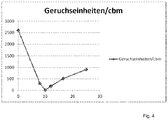
- the chlorine dioxide concentration of the aqueous solution (3) whose total volume in the apparatus (10) was 2,000 liters and entering the liquid distributor (19) at the inlet (12) was increased from 30.1 mg ClO 2 / L to 93.8 mg ClO 2 / L during the experiment.
- the pH of the aqueous solution was 2 to 3.
- the ratio of the volume flow of the air stream in m 3 / h to mass flow of the chlorine dioxide-containing aqueous solution in g ClO 2 / h was between about 670 m 3 / g ClO 2 and 210 m 3 / g ClO 2 .
- the odor units / cbm were determined olfactorily in the effluent air stream during the experiment.
- the volume flow of the total volume of 2000 liters in the device (10) is 2000 L / h.
- the aqueous solution (5) depleted of chlorine dioxide occurred over the entire cross section of the in FIG. 3 shown flow tube in the tube.
- a prefabricated sodium chlorite solution is introduced into the reactor by means of a pump (not shown).
- a prefabricated sodium hypochlorite solution is introduced into the reactor by means of a pump (not shown).
- the solution (5) was previously gem. (18).
- Fig.1 adjusted to a pH of about 2 with sulfuric acid.
- a sensor for measuring the pH (16) controls the addition of sulfuric acid (18). It comes in the tubular reactor (6), which is filled with Raschig rings to support the turbulence, to an intensive mixing of the reactants and the reaction according to 2 ClO 2 - + Cl 2 ⁇ 2 ClO 2 + 2 Cl - .
- the products leave the tubular reactor via a 25 mm cross-section and join with the main stream.
- illustration 1 which was prepared from the values of Table 1, clearly shows that the olfactory starting value of the raw gas from the stable exhaust air was 2600 odor units / cbm.
- the olfactory raw gas value in the clean gas drops to 3 odor units / cbm.
- a further increase in the chlorine dioxide mass flow increases the olfactory smell perception in the clean gas again.
- no raw gas odor is detected, but the smell of chlorine dioxide, which has not been consumed by the reaction with the odors.
Landscapes
- Chemical & Material Sciences (AREA)
- Engineering & Computer Science (AREA)
- Life Sciences & Earth Sciences (AREA)
- Chemical Kinetics & Catalysis (AREA)
- Health & Medical Sciences (AREA)
- Agronomy & Crop Science (AREA)
- Pest Control & Pesticides (AREA)
- Oil, Petroleum & Natural Gas (AREA)
- Analytical Chemistry (AREA)
- Environmental & Geological Engineering (AREA)
- Biomedical Technology (AREA)
- Inorganic Chemistry (AREA)
- General Chemical & Material Sciences (AREA)
- Plant Pathology (AREA)
- Dentistry (AREA)
- General Health & Medical Sciences (AREA)
- Wood Science & Technology (AREA)
- Zoology (AREA)
- Environmental Sciences (AREA)
- Treating Waste Gases (AREA)
Priority Applications (2)
| Application Number | Priority Date | Filing Date | Title |
|---|---|---|---|
| SI201830118T SI3372084T1 (sl) | 2017-03-08 | 2018-03-08 | Oksidativni postopek za zmanjšanje ali odstranjevanje organskih snovi in/ali anorganskih snovi in/ali mikroorganizmov v zračnem toku |
| PL18160702T PL3372084T3 (pl) | 2017-03-08 | 2018-03-08 | Sposób utleniający do zmniejszania lub usuwania substancji organicznych i/lub substancji nieorganicznych i/lub mikroorganizmów w strumieniu powietrza |
Applications Claiming Priority (1)
| Application Number | Priority Date | Filing Date | Title |
|---|---|---|---|
| DE102017104816.2A DE102017104816A1 (de) | 2017-03-08 | 2017-03-08 | Oxidatives Verfahren zur Verminderung oder Beseitigung von organischen Stoffen und/oder anorganischen Stoffen und/oder von Mikroorganismen in einem Luftstrom |
Publications (2)
| Publication Number | Publication Date |
|---|---|
| EP3372084A1 true EP3372084A1 (fr) | 2018-09-12 |
| EP3372084B1 EP3372084B1 (fr) | 2020-08-26 |
Family
ID=61599058
Family Applications (1)
| Application Number | Title | Priority Date | Filing Date |
|---|---|---|---|
| EP18160702.9A Active EP3372084B1 (fr) | 2017-03-08 | 2018-03-08 | Procédé oxydant pour la réduction ou l'élimination de matières organiques et/ou de substances inorganiques et/ou de micro-organismes dans un flux d'air |
Country Status (8)
| Country | Link |
|---|---|
| EP (1) | EP3372084B1 (fr) |
| DE (1) | DE102017104816A1 (fr) |
| DK (1) | DK3372084T3 (fr) |
| ES (1) | ES2827499T3 (fr) |
| HU (1) | HUE052546T2 (fr) |
| PL (1) | PL3372084T3 (fr) |
| PT (1) | PT3372084T (fr) |
| SI (1) | SI3372084T1 (fr) |
Cited By (2)
| Publication number | Priority date | Publication date | Assignee | Title |
|---|---|---|---|---|
| CN112999846A (zh) * | 2020-12-10 | 2021-06-22 | 福建皓尔宝科技集团有限公司 | 一种在线实时清除室内空气中二甲苯的组合物溶液及方法 |
| CN116272311A (zh) * | 2023-02-09 | 2023-06-23 | 山东大学 | 一种利用ClO2治理工业废气的方法 |
Citations (1)
| Publication number | Priority date | Publication date | Assignee | Title |
|---|---|---|---|---|
| US20070259416A1 (en) * | 2006-05-02 | 2007-11-08 | Parker Richard D | Gas treatment systems and methods |
-
2017
- 2017-03-08 DE DE102017104816.2A patent/DE102017104816A1/de not_active Withdrawn
-
2018
- 2018-03-08 PT PT181607029T patent/PT3372084T/pt unknown
- 2018-03-08 HU HUE18160702A patent/HUE052546T2/hu unknown
- 2018-03-08 ES ES18160702T patent/ES2827499T3/es active Active
- 2018-03-08 PL PL18160702T patent/PL3372084T3/pl unknown
- 2018-03-08 EP EP18160702.9A patent/EP3372084B1/fr active Active
- 2018-03-08 SI SI201830118T patent/SI3372084T1/sl unknown
- 2018-03-08 DK DK18160702.9T patent/DK3372084T3/da active
Patent Citations (1)
| Publication number | Priority date | Publication date | Assignee | Title |
|---|---|---|---|---|
| US20070259416A1 (en) * | 2006-05-02 | 2007-11-08 | Parker Richard D | Gas treatment systems and methods |
Cited By (3)
| Publication number | Priority date | Publication date | Assignee | Title |
|---|---|---|---|---|
| CN112999846A (zh) * | 2020-12-10 | 2021-06-22 | 福建皓尔宝科技集团有限公司 | 一种在线实时清除室内空气中二甲苯的组合物溶液及方法 |
| CN112999846B (zh) * | 2020-12-10 | 2024-04-09 | 福建皓尔宝科技集团有限公司 | 一种在线实时清除室内空气中二甲苯的组合物溶液及方法 |
| CN116272311A (zh) * | 2023-02-09 | 2023-06-23 | 山东大学 | 一种利用ClO2治理工业废气的方法 |
Also Published As
| Publication number | Publication date |
|---|---|
| EP3372084B1 (fr) | 2020-08-26 |
| PT3372084T (pt) | 2020-09-03 |
| HUE052546T2 (hu) | 2021-05-28 |
| ES2827499T3 (es) | 2021-05-21 |
| DK3372084T3 (da) | 2020-11-30 |
| DE102017104816A1 (de) | 2018-09-13 |
| PL3372084T3 (pl) | 2021-03-08 |
| SI3372084T1 (sl) | 2020-10-30 |
Similar Documents
| Publication | Publication Date | Title |
|---|---|---|
| DE2350498C3 (de) | Verfahren zur Entfernung von Schwefel- und Stickstoffoxyden oder nur Stickstoffoxyden aus Abgasen | |
| EP3071242B1 (fr) | Procédé de traitement oxydatif d'une phase liquide et/ou d'une phase gazeuse et/ou d'une phase solide | |
| DE69328732T2 (de) | Verfahren zum Zersetzen von organischen halogenierten flüchtigen Verbindungen in Wasser | |
| DE2511581A1 (de) | Verfahren zum nassreinigen von bei der entlueftung abgezogener luft und eine vorrichtung dafuer | |
| EP0328758B1 (fr) | Procédé et dispositif pour la purification biologique de gaz d'échappement | |
| DE102013006711A1 (de) | Neue Konzepte für die Wasserbehandlung, insbesondere Wasseraufbereitung und/oder -aufreinigung | |
| EP0132503B1 (fr) | Procédé pour éliminer des pollutions gazeuses, volatiles et/ou liquides du gaz d'échappement | |
| DE69502313T2 (de) | Verfahren zur biologischen Reinigung von Gasströmen | |
| WO2006134149A1 (fr) | Procede et systeme pour epurer par photocatalyse des eaux usees et de l'air vicie | |
| EP3372084B1 (fr) | Procédé oxydant pour la réduction ou l'élimination de matières organiques et/ou de substances inorganiques et/ou de micro-organismes dans un flux d'air | |
| EP0274986A1 (fr) | Procédé de purification de gaz d'échappement | |
| DE69506883T2 (de) | Verfahren und vorrichtung zur reinigung von gasen und flüssigkeiten | |
| EP0094573A1 (fr) | Dispositif pour l'épuration de l'air d'évacuation | |
| DE60205032T2 (de) | Photokatalysator und abgasreinigungsverfahren | |
| EP0277632A1 (fr) | Procédé pour la destruction catalytique de composés organiques et minéraux oxydables dans l'eau | |
| DE202011110582U1 (de) | Bioreaktor zur chemisch-biologischen Reinigung von Abgasen | |
| DE1203741B (de) | Verfahren zur Aufarbeitung von chlorwasserstoffhaltigen Abgasen | |
| DE2803789A1 (de) | Verfahren zum entfernen geloester organischer verunreinigungen aus abwasserstroemen | |
| DE1955179A1 (de) | Verfahren zur Rauchgasreinigung | |
| DE3780686T2 (de) | Verfahren und vorrichtung zum desodorisieren von luft. | |
| WO1995014639A1 (fr) | Procede de traitement d'eaux usees contenant des composes organiques et inorganiques | |
| EP0487834A1 (fr) | Procédé de lavage oxydant pour purifier des gaz d'échappement | |
| DE1293014B (de) | Verfahren zur Beseitigung unangenehmer Gerueche aus Abgasen | |
| DE2437110A1 (de) | Verfahren und vorrichtung zum abbau organischer stoffe | |
| DE4308159A1 (de) | Verfahren zum Abbau der CSB-Belastung in Abwasser |
Legal Events
| Date | Code | Title | Description |
|---|---|---|---|
| PUAI | Public reference made under article 153(3) epc to a published international application that has entered the european phase |
Free format text: ORIGINAL CODE: 0009012 |
|
| STAA | Information on the status of an ep patent application or granted ep patent |
Free format text: STATUS: THE APPLICATION HAS BEEN PUBLISHED |
|
| AK | Designated contracting states |
Kind code of ref document: A1 Designated state(s): AL AT BE BG CH CY CZ DE DK EE ES FI FR GB GR HR HU IE IS IT LI LT LU LV MC MK MT NL NO PL PT RO RS SE SI SK SM TR |
|
| AX | Request for extension of the european patent |
Extension state: BA ME |
|
| STAA | Information on the status of an ep patent application or granted ep patent |
Free format text: STATUS: REQUEST FOR EXAMINATION WAS MADE |
|
| 17P | Request for examination filed |
Effective date: 20181017 |
|
| RBV | Designated contracting states (corrected) |
Designated state(s): AL AT BE BG CH CY CZ DE DK EE ES FI FR GB GR HR HU IE IS IT LI LT LU LV MC MK MT NL NO PL PT RO RS SE SI SK SM TR |
|
| STAA | Information on the status of an ep patent application or granted ep patent |
Free format text: STATUS: EXAMINATION IS IN PROGRESS |
|
| 17Q | First examination report despatched |
Effective date: 20190306 |
|
| GRAP | Despatch of communication of intention to grant a patent |
Free format text: ORIGINAL CODE: EPIDOSNIGR1 |
|
| STAA | Information on the status of an ep patent application or granted ep patent |
Free format text: STATUS: GRANT OF PATENT IS INTENDED |
|
| INTG | Intention to grant announced |
Effective date: 20200408 |
|
| GRAS | Grant fee paid |
Free format text: ORIGINAL CODE: EPIDOSNIGR3 |
|
| GRAA | (expected) grant |
Free format text: ORIGINAL CODE: 0009210 |
|
| STAA | Information on the status of an ep patent application or granted ep patent |
Free format text: STATUS: THE PATENT HAS BEEN GRANTED |
|
| AK | Designated contracting states |
Kind code of ref document: B1 Designated state(s): AL AT BE BG CH CY CZ DE DK EE ES FI FR GB GR HR HU IE IS IT LI LT LU LV MC MK MT NL NO PL PT RO RS SE SI SK SM TR |
|
| REG | Reference to a national code |
Ref country code: GB Ref legal event code: FG4D Free format text: NOT ENGLISH |
|
| REG | Reference to a national code |
Ref country code: CH Ref legal event code: EP Ref country code: CH Ref legal event code: NV Representative=s name: E. BLUM AND CO. AG PATENT- UND MARKENANWAELTE , CH |
|
| REG | Reference to a national code |
Ref country code: PT Ref legal event code: SC4A Ref document number: 3372084 Country of ref document: PT Date of ref document: 20200903 Kind code of ref document: T Free format text: AVAILABILITY OF NATIONAL TRANSLATION Effective date: 20200827 |
|
| REG | Reference to a national code |
Ref country code: AT Ref legal event code: REF Ref document number: 1305479 Country of ref document: AT Kind code of ref document: T Effective date: 20200915 |
|
| REG | Reference to a national code |
Ref country code: IE Ref legal event code: FG4D Free format text: LANGUAGE OF EP DOCUMENT: GERMAN |
|
| REG | Reference to a national code |
Ref country code: DE Ref legal event code: R096 Ref document number: 502018002256 Country of ref document: DE |
|
| REG | Reference to a national code |
Ref country code: RO Ref legal event code: EPE |
|
| REG | Reference to a national code |
Ref country code: NL Ref legal event code: FP |
|
| REG | Reference to a national code |
Ref country code: DK Ref legal event code: T3 Effective date: 20201123 |
|
| REG | Reference to a national code |
Ref country code: SK Ref legal event code: T3 Ref document number: E 35559 Country of ref document: SK |
|
| REG | Reference to a national code |
Ref country code: SE Ref legal event code: TRGR |
|
| REG | Reference to a national code |
Ref country code: LT Ref legal event code: MG4D |
|
| REG | Reference to a national code |
Ref country code: GR Ref legal event code: EP Ref document number: 20200403055 Country of ref document: GR Effective date: 20201215 |
|
| PG25 | Lapsed in a contracting state [announced via postgrant information from national office to epo] |
Ref country code: BG Free format text: LAPSE BECAUSE OF FAILURE TO SUBMIT A TRANSLATION OF THE DESCRIPTION OR TO PAY THE FEE WITHIN THE PRESCRIBED TIME-LIMIT Effective date: 20201126 Ref country code: FI Free format text: LAPSE BECAUSE OF FAILURE TO SUBMIT A TRANSLATION OF THE DESCRIPTION OR TO PAY THE FEE WITHIN THE PRESCRIBED TIME-LIMIT Effective date: 20200826 Ref country code: HR Free format text: LAPSE BECAUSE OF FAILURE TO SUBMIT A TRANSLATION OF THE DESCRIPTION OR TO PAY THE FEE WITHIN THE PRESCRIBED TIME-LIMIT Effective date: 20200826 Ref country code: LT Free format text: LAPSE BECAUSE OF FAILURE TO SUBMIT A TRANSLATION OF THE DESCRIPTION OR TO PAY THE FEE WITHIN THE PRESCRIBED TIME-LIMIT Effective date: 20200826 |
|
| REG | Reference to a national code |
Ref country code: NO Ref legal event code: T2 Effective date: 20200826 |
|
| PG25 | Lapsed in a contracting state [announced via postgrant information from national office to epo] |
Ref country code: LV Free format text: LAPSE BECAUSE OF FAILURE TO SUBMIT A TRANSLATION OF THE DESCRIPTION OR TO PAY THE FEE WITHIN THE PRESCRIBED TIME-LIMIT Effective date: 20200826 Ref country code: RS Free format text: LAPSE BECAUSE OF FAILURE TO SUBMIT A TRANSLATION OF THE DESCRIPTION OR TO PAY THE FEE WITHIN THE PRESCRIBED TIME-LIMIT Effective date: 20200826 Ref country code: IS Free format text: LAPSE BECAUSE OF FAILURE TO SUBMIT A TRANSLATION OF THE DESCRIPTION OR TO PAY THE FEE WITHIN THE PRESCRIBED TIME-LIMIT Effective date: 20201226 |
|
| PG25 | Lapsed in a contracting state [announced via postgrant information from national office to epo] |
Ref country code: EE Free format text: LAPSE BECAUSE OF FAILURE TO SUBMIT A TRANSLATION OF THE DESCRIPTION OR TO PAY THE FEE WITHIN THE PRESCRIBED TIME-LIMIT Effective date: 20200826 Ref country code: SM Free format text: LAPSE BECAUSE OF FAILURE TO SUBMIT A TRANSLATION OF THE DESCRIPTION OR TO PAY THE FEE WITHIN THE PRESCRIBED TIME-LIMIT Effective date: 20200826 |
|
| REG | Reference to a national code |
Ref country code: ES Ref legal event code: FG2A Ref document number: 2827499 Country of ref document: ES Kind code of ref document: T3 Effective date: 20210521 |
|
| REG | Reference to a national code |
Ref country code: DE Ref legal event code: R097 Ref document number: 502018002256 Country of ref document: DE |
|
| REG | Reference to a national code |
Ref country code: HU Ref legal event code: AG4A Ref document number: E052546 Country of ref document: HU |
|
| PG25 | Lapsed in a contracting state [announced via postgrant information from national office to epo] |
Ref country code: AL Free format text: LAPSE BECAUSE OF FAILURE TO SUBMIT A TRANSLATION OF THE DESCRIPTION OR TO PAY THE FEE WITHIN THE PRESCRIBED TIME-LIMIT Effective date: 20200826 |
|
| PLBE | No opposition filed within time limit |
Free format text: ORIGINAL CODE: 0009261 |
|
| STAA | Information on the status of an ep patent application or granted ep patent |
Free format text: STATUS: NO OPPOSITION FILED WITHIN TIME LIMIT |
|
| 26N | No opposition filed |
Effective date: 20210527 |
|
| PG25 | Lapsed in a contracting state [announced via postgrant information from national office to epo] |
Ref country code: MC Free format text: LAPSE BECAUSE OF FAILURE TO SUBMIT A TRANSLATION OF THE DESCRIPTION OR TO PAY THE FEE WITHIN THE PRESCRIBED TIME-LIMIT Effective date: 20200826 |
|
| REG | Reference to a national code |
Ref country code: DE Ref legal event code: R081 Ref document number: 502018002256 Country of ref document: DE Owner name: KUEKE VERWALTUNGS GMBH & CO. KG, DE Free format text: FORMER OWNER: KUEKE, FRITZ, DR., 30916 ISERNHAGEN, DE |
|
| PGFP | Annual fee paid to national office [announced via postgrant information from national office to epo] |
Ref country code: SK Payment date: 20220301 Year of fee payment: 5 Ref country code: NO Payment date: 20220322 Year of fee payment: 5 Ref country code: LU Payment date: 20220322 Year of fee payment: 5 |
|
| PGFP | Annual fee paid to national office [announced via postgrant information from national office to epo] |
Ref country code: RO Payment date: 20230223 Year of fee payment: 6 Ref country code: IE Payment date: 20230320 Year of fee payment: 6 Ref country code: CZ Payment date: 20230227 Year of fee payment: 6 |
|
| PGFP | Annual fee paid to national office [announced via postgrant information from national office to epo] |
Ref country code: SI Payment date: 20230224 Year of fee payment: 6 Ref country code: SE Payment date: 20230315 Year of fee payment: 6 Ref country code: PT Payment date: 20230224 Year of fee payment: 6 Ref country code: PL Payment date: 20230221 Year of fee payment: 6 Ref country code: HU Payment date: 20230301 Year of fee payment: 6 Ref country code: GR Payment date: 20230317 Year of fee payment: 6 |
|
| PG25 | Lapsed in a contracting state [announced via postgrant information from national office to epo] |
Ref country code: CY Free format text: LAPSE BECAUSE OF FAILURE TO SUBMIT A TRANSLATION OF THE DESCRIPTION OR TO PAY THE FEE WITHIN THE PRESCRIBED TIME-LIMIT Effective date: 20200826 |
|
| PGFP | Annual fee paid to national office [announced via postgrant information from national office to epo] |
Ref country code: ES Payment date: 20230414 Year of fee payment: 6 |
|
| REG | Reference to a national code |
Ref country code: NO Ref legal event code: MMEP |
|
| REG | Reference to a national code |
Ref country code: SK Ref legal event code: MM4A Ref document number: E 35559 Country of ref document: SK Effective date: 20230308 |
|
| PG25 | Lapsed in a contracting state [announced via postgrant information from national office to epo] |
Ref country code: LU Free format text: LAPSE BECAUSE OF NON-PAYMENT OF DUE FEES Effective date: 20230308 |
|
| PG25 | Lapsed in a contracting state [announced via postgrant information from national office to epo] |
Ref country code: SK Free format text: LAPSE BECAUSE OF NON-PAYMENT OF DUE FEES Effective date: 20230308 |
|
| PG25 | Lapsed in a contracting state [announced via postgrant information from national office to epo] |
Ref country code: SK Free format text: LAPSE BECAUSE OF NON-PAYMENT OF DUE FEES Effective date: 20230308 Ref country code: NO Free format text: LAPSE BECAUSE OF NON-PAYMENT OF DUE FEES Effective date: 20230331 |
|
| PG25 | Lapsed in a contracting state [announced via postgrant information from national office to epo] |
Ref country code: MK Free format text: LAPSE BECAUSE OF FAILURE TO SUBMIT A TRANSLATION OF THE DESCRIPTION OR TO PAY THE FEE WITHIN THE PRESCRIBED TIME-LIMIT Effective date: 20200826 |
|
| PG25 | Lapsed in a contracting state [announced via postgrant information from national office to epo] |
Ref country code: MT Free format text: LAPSE BECAUSE OF FAILURE TO SUBMIT A TRANSLATION OF THE DESCRIPTION OR TO PAY THE FEE WITHIN THE PRESCRIBED TIME-LIMIT Effective date: 20200826 |
|
| PG25 | Lapsed in a contracting state [announced via postgrant information from national office to epo] |
Ref country code: PT Free format text: LAPSE BECAUSE OF NON-PAYMENT OF DUE FEES Effective date: 20240909 |
|
| PG25 | Lapsed in a contracting state [announced via postgrant information from national office to epo] |
Ref country code: CZ Free format text: LAPSE BECAUSE OF NON-PAYMENT OF DUE FEES Effective date: 20240308 |
|
| REG | Reference to a national code |
Ref country code: SE Ref legal event code: EUG |
|
| PG25 | Lapsed in a contracting state [announced via postgrant information from national office to epo] |
Ref country code: RO Free format text: LAPSE BECAUSE OF NON-PAYMENT OF DUE FEES Effective date: 20240308 Ref country code: PT Free format text: LAPSE BECAUSE OF NON-PAYMENT OF DUE FEES Effective date: 20240909 Ref country code: CZ Free format text: LAPSE BECAUSE OF NON-PAYMENT OF DUE FEES Effective date: 20240308 |
|
| PG25 | Lapsed in a contracting state [announced via postgrant information from national office to epo] |
Ref country code: HU Free format text: LAPSE BECAUSE OF NON-PAYMENT OF DUE FEES Effective date: 20240309 |
|
| PG25 | Lapsed in a contracting state [announced via postgrant information from national office to epo] |
Ref country code: HU Free format text: LAPSE BECAUSE OF NON-PAYMENT OF DUE FEES Effective date: 20240309 |
|
| PG25 | Lapsed in a contracting state [announced via postgrant information from national office to epo] |
Ref country code: GR Free format text: LAPSE BECAUSE OF NON-PAYMENT OF DUE FEES Effective date: 20241004 |
|
| PG25 | Lapsed in a contracting state [announced via postgrant information from national office to epo] |
Ref country code: IE Free format text: LAPSE BECAUSE OF NON-PAYMENT OF DUE FEES Effective date: 20240308 |
|
| PG25 | Lapsed in a contracting state [announced via postgrant information from national office to epo] |
Ref country code: IE Free format text: LAPSE BECAUSE OF NON-PAYMENT OF DUE FEES Effective date: 20240308 Ref country code: GR Free format text: LAPSE BECAUSE OF NON-PAYMENT OF DUE FEES Effective date: 20241004 |
|
| PG25 | Lapsed in a contracting state [announced via postgrant information from national office to epo] |
Ref country code: PL Free format text: LAPSE BECAUSE OF NON-PAYMENT OF DUE FEES Effective date: 20240308 |
|
| REG | Reference to a national code |
Ref country code: ES Ref legal event code: FD2A Effective date: 20250425 |
|
| PGFP | Annual fee paid to national office [announced via postgrant information from national office to epo] |
Ref country code: DE Payment date: 20250409 Year of fee payment: 8 |
|
| PG25 | Lapsed in a contracting state [announced via postgrant information from national office to epo] |
Ref country code: ES Free format text: LAPSE BECAUSE OF NON-PAYMENT OF DUE FEES Effective date: 20240309 |
|
| PGFP | Annual fee paid to national office [announced via postgrant information from national office to epo] |
Ref country code: IT Payment date: 20250331 Year of fee payment: 8 |
|
| PGFP | Annual fee paid to national office [announced via postgrant information from national office to epo] |
Ref country code: CH Payment date: 20250401 Year of fee payment: 8 |
|
| REG | Reference to a national code |
Ref country code: SI Ref legal event code: KO00 Effective date: 20240309 |
|
| PG25 | Lapsed in a contracting state [announced via postgrant information from national office to epo] |
Ref country code: SE Free format text: LAPSE BECAUSE OF NON-PAYMENT OF DUE FEES Effective date: 20240309 |
|
| PG25 | Lapsed in a contracting state [announced via postgrant information from national office to epo] |
Ref country code: TR Free format text: LAPSE BECAUSE OF FAILURE TO SUBMIT A TRANSLATION OF THE DESCRIPTION OR TO PAY THE FEE WITHIN THE PRESCRIBED TIME-LIMIT Effective date: 20200826 |
|
| REG | Reference to a national code |
Ref country code: CH Ref legal event code: U11 Free format text: ST27 STATUS EVENT CODE: U-0-0-U10-U11 (AS PROVIDED BY THE NATIONAL OFFICE) Effective date: 20260401 |
|
| PGFP | Annual fee paid to national office [announced via postgrant information from national office to epo] |
Ref country code: GB Payment date: 20260324 Year of fee payment: 9 |
|
| PGFP | Annual fee paid to national office [announced via postgrant information from national office to epo] |
Ref country code: DK Payment date: 20260323 Year of fee payment: 9 |
|
| PGFP | Annual fee paid to national office [announced via postgrant information from national office to epo] |
Ref country code: AT Payment date: 20260319 Year of fee payment: 9 |
|
| PGFP | Annual fee paid to national office [announced via postgrant information from national office to epo] |
Ref country code: BE Payment date: 20260323 Year of fee payment: 9 |
|
| PGFP | Annual fee paid to national office [announced via postgrant information from national office to epo] |
Ref country code: NL Payment date: 20260323 Year of fee payment: 9 |
|
| PGFP | Annual fee paid to national office [announced via postgrant information from national office to epo] |
Ref country code: FR Payment date: 20260324 Year of fee payment: 9 |