EP3372103A1 - Verfahren zur herstellung einer integrierten schuhgrundstruktur - Google Patents
Verfahren zur herstellung einer integrierten schuhgrundstruktur Download PDFInfo
- Publication number
- EP3372103A1 EP3372103A1 EP17169445.8A EP17169445A EP3372103A1 EP 3372103 A1 EP3372103 A1 EP 3372103A1 EP 17169445 A EP17169445 A EP 17169445A EP 3372103 A1 EP3372103 A1 EP 3372103A1
- Authority
- EP
- European Patent Office
- Prior art keywords
- weaving
- shoe upper
- shoe
- lining
- extension
- Prior art date
- Legal status (The legal status is an assumption and is not a legal conclusion. Google has not performed a legal analysis and makes no representation as to the accuracy of the status listed.)
- Granted
Links
Images




























Classifications
-
- D—TEXTILES; PAPER
- D04—BRAIDING; LACE-MAKING; KNITTING; TRIMMINGS; NON-WOVEN FABRICS
- D04B—KNITTING
- D04B1/00—Weft knitting processes for the production of fabrics or articles not dependent on the use of particular machines; Fabrics or articles defined by such processes
- D04B1/22—Weft knitting processes for the production of fabrics or articles not dependent on the use of particular machines; Fabrics or articles defined by such processes specially adapted for knitting goods of particular configuration
- D04B1/24—Weft knitting processes for the production of fabrics or articles not dependent on the use of particular machines; Fabrics or articles defined by such processes specially adapted for knitting goods of particular configuration wearing apparel
- D04B1/26—Weft knitting processes for the production of fabrics or articles not dependent on the use of particular machines; Fabrics or articles defined by such processes specially adapted for knitting goods of particular configuration wearing apparel stockings
-
- A—HUMAN NECESSITIES
- A43—FOOTWEAR
- A43B—CHARACTERISTIC FEATURES OF FOOTWEAR; PARTS OF FOOTWEAR
- A43B23/00—Uppers; Boot legs; Stiffeners; Other single parts of footwear
- A43B23/02—Uppers; Boot legs
- A43B23/0245—Uppers; Boot legs characterised by the constructive form
-
- A—HUMAN NECESSITIES
- A43—FOOTWEAR
- A43B—CHARACTERISTIC FEATURES OF FOOTWEAR; PARTS OF FOOTWEAR
- A43B13/00—Soles; Sole-and-heel integral units
- A43B13/38—Built-in insoles joined to uppers during the manufacturing process, e.g. structural insoles; Insoles glued to shoes during the manufacturing process
-
- A—HUMAN NECESSITIES
- A43—FOOTWEAR
- A43B—CHARACTERISTIC FEATURES OF FOOTWEAR; PARTS OF FOOTWEAR
- A43B23/00—Uppers; Boot legs; Stiffeners; Other single parts of footwear
- A43B23/02—Uppers; Boot legs
- A43B23/0205—Uppers; Boot legs characterised by the material
-
- A—HUMAN NECESSITIES
- A43—FOOTWEAR
- A43B—CHARACTERISTIC FEATURES OF FOOTWEAR; PARTS OF FOOTWEAR
- A43B23/00—Uppers; Boot legs; Stiffeners; Other single parts of footwear
- A43B23/02—Uppers; Boot legs
- A43B23/0205—Uppers; Boot legs characterised by the material
- A43B23/024—Different layers of the same material
-
- A—HUMAN NECESSITIES
- A43—FOOTWEAR
- A43B—CHARACTERISTIC FEATURES OF FOOTWEAR; PARTS OF FOOTWEAR
- A43B23/00—Uppers; Boot legs; Stiffeners; Other single parts of footwear
- A43B23/02—Uppers; Boot legs
- A43B23/0245—Uppers; Boot legs characterised by the constructive form
- A43B23/0255—Uppers; Boot legs characterised by the constructive form assembled by gluing or thermo bonding
-
- A—HUMAN NECESSITIES
- A43—FOOTWEAR
- A43B—CHARACTERISTIC FEATURES OF FOOTWEAR; PARTS OF FOOTWEAR
- A43B23/00—Uppers; Boot legs; Stiffeners; Other single parts of footwear
- A43B23/02—Uppers; Boot legs
- A43B23/04—Uppers made of one piece; Uppers with inserted gussets
-
- A—HUMAN NECESSITIES
- A43—FOOTWEAR
- A43B—CHARACTERISTIC FEATURES OF FOOTWEAR; PARTS OF FOOTWEAR
- A43B23/00—Uppers; Boot legs; Stiffeners; Other single parts of footwear
- A43B23/02—Uppers; Boot legs
- A43B23/04—Uppers made of one piece; Uppers with inserted gussets
- A43B23/042—Uppers made of one piece
-
- D—TEXTILES; PAPER
- D04—BRAIDING; LACE-MAKING; KNITTING; TRIMMINGS; NON-WOVEN FABRICS
- D04B—KNITTING
- D04B1/00—Weft knitting processes for the production of fabrics or articles not dependent on the use of particular machines; Fabrics or articles defined by such processes
- D04B1/22—Weft knitting processes for the production of fabrics or articles not dependent on the use of particular machines; Fabrics or articles defined by such processes specially adapted for knitting goods of particular configuration
- D04B1/24—Weft knitting processes for the production of fabrics or articles not dependent on the use of particular machines; Fabrics or articles defined by such processes specially adapted for knitting goods of particular configuration wearing apparel
-
- D—TEXTILES; PAPER
- D10—INDEXING SCHEME ASSOCIATED WITH SUBLASSES OF SECTION D, RELATING TO TEXTILES
- D10B—INDEXING SCHEME ASSOCIATED WITH SUBLASSES OF SECTION D, RELATING TO TEXTILES
- D10B2403/00—Details of fabric structure established in the fabric forming process
- D10B2403/03—Shape features
-
- D—TEXTILES; PAPER
- D10—INDEXING SCHEME ASSOCIATED WITH SUBLASSES OF SECTION D, RELATING TO TEXTILES
- D10B—INDEXING SCHEME ASSOCIATED WITH SUBLASSES OF SECTION D, RELATING TO TEXTILES
- D10B2501/00—Wearing apparel
- D10B2501/04—Outerwear; Protective garments
- D10B2501/043—Footwear
Definitions
- the present invention relates to a method for manufacturing an integral shoe embryo, and particularly to a method for manufacturing an integral shoe embryo including a reinforcement piece that reinforces structural strength of a shoe.
- the European Patent No. 2805638A1 discloses a footwear and knitting method for knitting a fabric. Although the footwear is seamlessly woven by a flat knitting machine, the footwear completed using the European Patent No. 2805638A1 is identical to the foregoing patents; that is, once the footwear is shaped, the shoe upper is formed merely by a piece of thin fabric. Such fabric provides limited structural strength and may not withstand frequent uses, in a way that the knitted shoe may not have a short lifespan.
- the European Patent No. 2805638A1 discloses that, one of the yarns (e.g., the second knitting yarn specified in the European Patent No. 2805638A1 ) used for weaving the knitted shoe is clad with a material having a lower melting point, such that the woven footwear may have a fixed shape through a thermal process.
- the structural strength formed by only at least two yarns adhered to each other still falls short in meeting requirements of numerous application scenarios.
- the present invention provides a method for manufacturing an integral shoe embryo.
- the method includes following steps.
- an initial shoe edge is woven by knitting at least two yarns in an interwoven manner.
- a first shoe upper connected to the initial shoe edge is woven by knitting the at least two yarns, weaving in a reverse direction is performed when a shoe upper stitch count is reached to weave a second shoe upper that faces the first shoe upper, and the first shoe upper is woven in a reverse direction again according to the shoe upper stitch count, hence cyclically weaving the first shoe upper and the second shoe upper.
- a reinforcement piece is woven by knitting at least one of the yarns when the shoe upper stitch count is reached in the shoe upper weaving step, weaving in a reverse direction is performed when an extension stitch count is reached while weaving the reinforcement piece, and the first shoe upper and the second shoe upper are woven by knitting the at least two yarns according to the shoe upper stitch count when the extension stitch count is again reached, hence cyclically weaving the reinforcement piece, the first shoe upper and the second shoe upper.
- the first shoe upper and the second shoe upper are cyclically woven by knitting the at least two yarns, and a shoe opening is formed.
- first shoe upper and the second shoe upper are folded from the shoe opening to locate the reinforcement piece in an in-shoe space defined by the overturned first shoe upper and second shoe upper to complete the shoe embryo.
- the reinforcement piece may be located at a vamp section or a heel section of the shoe embryo.
- the continual shoe upper weaving step further includes a sub-step, in which, another reinforcement piece is woven by knitting at least one of the yarns when the shoe upper stitch count is reached while weaving the first shoe upper or the second shoe upper, weaving in a reverse direction is performed when an extension stitch count is reached while weaving the another reinforcement piece, and the first shoe upper and the second shoe upper are woven by knitting the at least two yarns according to the shoe upper stitch count when the extension stitch count is again reached, hence cyclically weaving the another reinforcement piece, the first shoe upper ad the second shoe upper.
- the method before the interweaving step, further includes an outside-upper extension weaving step, in which an extension is woven by knitting at least one of the yarns. One knitted end of the extension is for continuing weaving the initial shoe edge.
- the extension may be a toe support piece disposed at a lower end of the in-shoe space or a sole piece adhered to the second shoe upper.
- one of the two yarns is clad with a hot melt layer.
- the extension stitch count is greater than the shoe upper stitch count.
- the present invention further provides another method including the following steps.
- an extension is woven by knitting at least one of at least two yarns.
- an initial shoe edge connected to the extension is woven by knitting the at least two yarns in an interwoven manner.
- a first shoe upper connected to the initial shoe edge is woven by knitting the at least two yarns, weaving in a reverse direction is performed when a shoe upper stitch count is reached to weave a second shoe upper that faces the first shoe upper by knitting the at least two yarns, and the first shoe upper is woven in a reverse direction according to the shoe upper stitch count, hence cyclically weaving the first shoe upper and the second shoe upper.
- a reinforcement piece is woven by knitting at least one of the yarns when the shoe upper stitch count is reached in the shoe upper weaving step, weaving in a reverse direction is performed when an extension stitch count is reached while weaving the reinforcement piece, and the first shoe upper and the second shoe upper are woven by knitting the at least two yarns according to the shoe upper stitch count when the extension stitch count is again reached, hence cyclically weaving the reinforcement piece, the first shoe upper and the second shoe upper.
- the first shoe upper and the second shoe upper are cyclically woven by knitting the at least two yarns.
- a first lining connected to the first shoe upper is woven by knitting the at least two yarns, weaving in a reverse direction is performed when the shoe upper stitch count is reached to weave a second lining that faces the first lining and is connected to the second shoe upper by knitting the at least two yarns, and the first lining is woven in a reverse direction according to the shoe upper stitch count, hence cyclically weaving the first lining and the second lining, with ends of the first lining and second lining forming a shoe opening.
- first lining and the second lining are folded from the shoe opening, and the first shoe upper and the second shoe upper are simultaneously drawn from the shoe opening for side overturning to locate the reinforcement piece and the extension in an in-shoe space defined by the overturned first shoe upper and second shoe upper.
- the extension may be a toe support piece disposed at a lower end of the in-shoe space or a sole piece adhered to the second shoe upper.
- a lining tucking step the overturned first lining and second lining are tucked towards the in-shoe space, and the ends of the first lining and second lining are secured at the lower end of the in-shoe space to complete a shoe embryo.
- the method further includes an outside-upper another extension weaving step, in which, another extension connected to the end of the first lining or the end of the second lining is woven by knitting at least one of the yarns. Further, in the lining tucking step, the another extension is tucked into the in-shoe opening together with the first lining and the second lining.
- the extension and the another extension are respectively the toe support piece disposed at the lower end of the in-shoe space and the sole piece adhered to the second lining.
- edges of the first lining and the second lining are sewn.
- the continual shoe upper weaving step further includes a sub-step, in which, another reinforcement piece is woven by knitting at least one of the yarns when the shoe upper stitch count is reached while weaving the first shoe upper or the second shoe upper, weaving in a reverse direction is performed when an extension stitch count is reached while weaving the another reinforcement piece, and the first shoe upper and the second shoe upper are woven by knitting the at least two yarns according to the shoe upper stitch count when the extension stitch count is again reached, hence cyclically weaving the another reinforcement piece, the first shoe upper ad the second shoe upper.
- one of the two yarns is clad with a hot melt layer.
- the extension stitch count is greater than the shoe upper stitch count.
- the weaving length of the extension is shorter than the weaving lengths of the first shoe upper and the second shoe upper.
- the present invention further provides another method including following steps.
- an extension is woven by knitting at least one of at least two yarns.
- an initial shoe edge connected to the extension is woven by knitting the at least two yarns in an interwoven manner.
- a first lining connected to the initial shoe edge is woven by knitting the at least two yarns, weaving in a reverse direction is performed when a shoe upper stitch count is reached to weave a second lining that faces the first lining, and the first lining is woven in a reverse direction according to the shoe upper stitch count, hence cyclically weaving the first lining and the second lining.
- a reinforcement piece weaving step a reinforcement piece is woven by knitting at least one of the yarns when the shoe upper stitch count is reached in the lining weaving step, weaving in a reverse direction is performed when an extension stitch count is reached while weaving the reinforcement piece, and the first lining and the second lining are woven by knitting the at least two yarns according to the shoe upper stitch count when the extension stitch count is again reached, hence cyclically weaving the reinforcement piece, the first shoe upper and the second shoe upper.
- the first lining and the second lining are cyclically woven by knitting the at least two yarns.
- a first shoe upper connected to the first lining is woven by knitting the at least two yarns, weaving in a reverse direction is performed when the shoe upper stitch count is reached to weave a second shoe upper that faces the first shoe upper and is connected to the second lining, and the first shoe upper is woven in a reverse direction according to the shoe upper stitch count, hence cyclically weaving the first shoe upper and the second shoe upper, with ends of the first shoe upper and the second shoe upper forming a shoe opening.
- the reinforcement piece is secured on the first lining, and the extension is folded to come into contact with the first lining or the second lining.
- first shoe upper and the second shoe upper are folded from the shoe opening to cause the overturned first shoe upper and second shoe upper to clad on the extension and the reinforcement piece, and the ends of the first shoe upper and the second shoe upper are connected to complete a shoe embryo.
- the extension may be a toe support piece disposed at a toe section of the shoe embryo and a sole piece adhered to the second shoe upper.
- the method further includes an outside-upper another extension weaving step, in which, another extension connected to the end of the first lining or the end of the second lining is woven by knitting at least one of the yarns.
- the another extension is stacked at the first shoe upper or the second shoe upper.
- the another extension serves as the toe support piece when stacked at the first shoe upper, or serves as the sole piece when stacked at the second shoe upper.
- the continual lining weaving step further includes a sub-step, in which, another reinforcement is woven by knitting at least one of the yarns when the shoe upper stitch count is reached while weaving the first lining or the second lining, weaving in a reverse direction is performed when an extension stitch count is reached while weaving the another reinforcement piece, and the first lining and the second lining are woven by knitting the at least two yarns according to the shoe upper stitch count when the extension stitch count is again reached, hence cyclically weaving the another reinforcement piece, the first lining and the second lining.
- one of the two yarns is clad with a hot melt layer.
- the extension stitch count is greater than the shoe upper stitch count.
- side overturning of the first shoe upper stops at a connecting position of the first shoe upper and the first lining
- side overturning of the second shoe upper stops at a connecting position of the second shoe upper and the second lining
- a reinforcement piece is integrally woven during the weaving process of a flat knitting machine, and the reinforcement piece is hidden in the in-shoe space or clamped between the first shoe upper and the first lining in the subsequent side overturning step.
- the manufactured shoe embryo is provided with reinforced structural strength through the reinforcement piece as well as better comfort for the foot using a shoe body manufactured from the shoe embryo.
- at least one extension may be integrally woven. The at least one extension further reinforces the structural strength or decorates an appearance of the shoe embryo.
- the present invention provides a method for manufacturing an integral shoe embryo. Steps associated with knitting in the method disclosed by the present invention are completed by a flat knitting machine 90, and performed by a front needle bed 901 and a back needle bed 902 of the flat knitting machine 90. Structural details of the front needle bed 901 and the back needle bed 902 are generally known to one person skilled in the art, and shall be omitted herein.
- An operating staff of the flat knitting machine 90 may configure the knitting scheduling of the front needle bed 901 and the back needle bed 902 according to the method of the present invention. Further, a yarn feeding mechanism 903 of the flat knitting machine 90 moves along a lateral track 904.
- the yarn feeding mechanism 903 moves from an initial position towards an ending position on the lateral track 904, and moves back from the ending position towards the initial position, hence cyclically causing the front needle bed 901 and the back needle bed 902 to weave a fabric. Further, the yarn feeding mechanism 903 is implemented in coordination with a nose (not shown), which controls the knitting operations of the front needle bed 901 and the back needle bed 902.
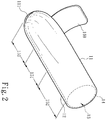
- the shoe embryo 10 is a semi-finished product integrally formed and woven by the flat knitting machine 90, and completed through a side overturning step.
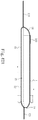
- the shoe embryo 10 includes a first shoe upper 11, a second shoe upper 12 that faces the first shoe upper 12, an in-shoe space 13 defined by the first shoe upper 11 and the second shoe upper 13, and a shoe opening 14 connected to the in-shoe space 13.
- the shoe embryo 10 of the present invention may be divided into a toe section 150, a vamp section 151 and a heel section 152 for illustration purposes in the description below.
- the method according to an embodiment includes following steps.
- an initial shoe edge 111 is woven by knitting at least two yarns 20 and 21 in an interwoven manner.
- a show upper weaving step S11 the first shoe upper 11 connected to the initial shoe edge 111 is woven by knitting the at least two yarns 20 and 21, weaving in a reverse direction is performed when a shoe upper stitch count is reached to weave the second shoe upper 12 that faces the first shoe upper 11 by knitting the two yarns 20 and 21, and the first shoe upper 11 is again woven in a reverse direction according to the shoe upper stitch count, hence cyclically weaving the first shoe upper 11 and the second shoe upper 12.
- a reinforcement piece 160 is woven by knitting at least one of the yarns 20 and 21 when the shoe upper stitch count is reached in the shoe upper weaving step S11, weaving in a reverse direction is performed when an extension stitch count is reached while weaving the reinforcement piece 160, and the first shoe upper 11 and the second shoe upper 12 are woven by knitting the at least two yarns 20 and 21 according to the shoe upper stitch count when the extension stitch count is again reached, hence cyclically weaving the reinforcement piece 160, the first shoe upper 11 and the second shoe upper 12.
- the first shoe upper 11 and the second shoe upper 12 are cyclically woven by knitting the two yarns 20 and 21, and the shoe opening 14 is formed.
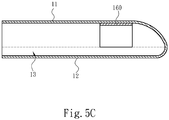
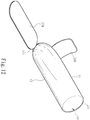
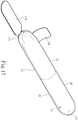
- first shoe upper 11 and the second shoe upper 12 are folded from the shoe opening 14 to locate the reinforcement piece 160 in the in-shoe space 13 defined by the overturned first shoe upper 11 and second shoe upper 12, thus completing the shoe embryo 10.
- the flat knitting machine 90 is configured with scheduling of the front needle bed 901 and the back needle bed 902 according to the method.
- the flat knitting machine 90 causes the front needle bed 901 and the back needle bed 902 to knit simultaneously to cause the two yarns 20 and 21 to be interwoven to form the initial shoe edge 111.
- unbroken-yarn weaving is continued to perform the shoe upper weaving step S11.
- the shoe upper weaving step S11 of the present invention is primarily implemented by a tubular method using the flat knitting machine 90.
- the front needle bed 901 weaves the first shoe upper 11 in an extended manner from an end of one side of the initial shoe edge 111.
- the flat knitting machine 90 continues unbroken-yarn weaving and performs yarn feeding in a reverse direction to cause the back needle bed 902 to continue weaving the second shoe upper 12 by knitting the two yarns 20 and 21.
- the flat knitting machine 90 performs weaving in a reverse direction, hence cyclically weaving the first shoe upper 11 and the second shoe upper 12.
- the shoe upper stitch count of the present invention may be a variable value instead of being limited to a constant value, and the variable value may be correspondingly set according to a shoe model to be later completed.
- the shoe upper stitch count of the toe section 150 is greater than the shoe upper stitch count of the vamp section 151.
- the weaving schedule of the shoe upper weaving step S11 is correspondingly designed according to the size of the shoe embryo 10.
- the two yarns 20 and 21 forming the shoe embryo 10 may be in different colors, which present different colors at inner and outer surfaces of the first shoe upper 11 and the second shoe upper 12.
- the two yarns 20 and 21 are in different colors, a technical front color of a fabric and a technical back color of the fabric are different.
- one of the two yarns 20 and 21 may be clad by a hot melt layer.
- the shoe embryo 10 when the shoe embryo 10 is completed, it may be placed into a mold and be appropriately heated to allow one of the yarns 20 and 21 clad with the hot melt layer to melt, and the shoe embryo 10 may then shape according to an appearance of the mold to complete a knitted shoe prototype 100.
- the two yarns 20 and 21 of the present invention may be intertwined from twisting.
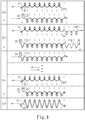
- a trigger point for entering the reinforcement piece weaving step S12 from the shoe upper weaving step S11 is determined according to the design of the shoe embryo 10. For example, when the back needle bed 902 reaches the shoe upper stitch count while weaving the second shoe upper 12, and the first shoe upper 11 and the second shoe upper 12 have reached predetermined lengths, the yarn feeding mechanism 903 is controlled to progress in a non-reversed direction and to weave the reinforcement piece 160 along the current weaving direction by knitting the at least one of the yarns 20 and 21.
- the flat knitting machine 90 controls the nose to weave in a non-reversed manner and the front needle bed 901 to weave the reinforcement piece 160, such that the reinforcement piece 160 protrudes from edges of the first shoe upper 11 and the second shoe upper 12 when the reinforcement piece 160 is completely woven to appear like a wing. Further, during the weaving process of the reinforcement piece 160, when the front needle bed 901 reaches the extension stitch count while weaving the reinforcement piece 160, the flat knitting machine 90 continues weaving the reinforcement piece 160 in a reverse direction.
- the flat knitting machine 90 controls the front needle bed 901 and the back needle bed 902 to continuously weave the first shoe upper 11 and the second shoe upper 12 by knitting the two yarns 20 and 21. Details of the weaving process of the first shoe upper 11 and the second shoe upper 12 are as described in shoe upper weaving step S11, and shall be omitted.
- the extension stitch count of the present invention may be adjusted according to the pattern of the reinforcement piece 160; that is, the extension stitch count may be a variable value. However, the extension stitch count is greater than the shoe upper stitch count.
- the length of the reinforcement piece 160 is made greater than the length of the first shoe upper 11 or the second shoe upper 12, so as to more substantially support the first shoe upper 12 or the second shoe upper 12.
- the continual shoe upper weaving step S13 follows the reinforcement piece weaving step S12. Details of the weaving process of the continual shoe upper weaving step S13 are similar to those of the shoe upper weaving step S11.
- the continual shoe upper weaving step S13 in continuation from a weaving ending point of the reinforcement piece weaving step S12, the front needle bed 901 and the back needle bed 902 continue weaving the first shoe upper 11 and the second shoe upper 12, and shape the shoe opening 14, with the side overturning step S14 performed next. Further, an end part of the weaving process of the continual shoe upper weaving step S13 may be conducted by a different weaving method to provide the shoe embryo 10 with a contracted opening (not shown).
- the implementation of the side overturning step S14 may be completed through a machine or a human operation without involving the flat knitting machine 90.
- the reinforcement piece 160 may be placed on the first shoe upper 11 or the second shoe upper 12, ends of the first shoe upper 11 and the second shoe upper 12 are held firmly, and the first shoe upper 11 and the second shoe upper 12 are folded from the shoe opening 14.
- the reinforcement piece 160 becomes located in the in-shoe space 13 defined by the overturned first shoe upper 11 and second shoe upper 12, hence completing the shoe embryo 10.
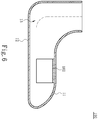
- an appropriate processing on the shoe embryo 10 e.g., a heating process or a paint spray process, a knitted shoe prototype 100 (as shown in Fig. 6 ) may be completed.
- a knitted shoe may then be manufactured by additionally adhering a shoe sole (not shown) to a lower surface of the knitted shoe prototype 100.
- the reinforcement piece 160 of the present invention may be stacked on the first shoe upper 11 or the second shoe upper 12 to provide support and reinforcement, and may be set and formed at the vamp section 151 or the heel section 152 according to actual requirements.
- the reinforcement piece 160 of the present invention is not limited to being implemented in a single quantity.
- the continual shoe upper weaving step S13 further includes a sub-step S131.
- another reinforcement piece 161 is woven by knitting at least one of the yarns 20 and 21 when the shoe upper stitch count is reached while weaving the first shoe upper 11 or the second shoe upper 12, weaving in a reverse direction is performed when the extension stitch count is reached while weaving the another reinforcement piece 161, and the first shoe upper 11 and the second shoe upper 12 are woven by knitting the at least two yarns 20 and 21 according to the shoe upper stitch count when the extension stitch count is again reached, hence cyclically weaving the another reinforcement piece 161, the first shoe upper 11 and the second shoe upper 12.
- the another reinforcement piece 161 is together placed with the reinforcement piece 160 into the in-shoe space 13 defined by the overturned first shoe upper 11 and second shoe upper 12, and together with the reinforcement piece 160 provide the shoe embryo 10 with
- the weaving method of the reinforcement piece 160 is not limited being performed by single-sided weaving shown in Fig. 4 , and may also be performed by dual-sided weaving, or in continuation of a tubular weaving approach of the first shoe upper 11 and the second shoe upper 12.
- the flat knitting machine 90 simultaneously controls the front needle bed 901 and the back needle bed 902 to weave the reinforcement piece 160.
- the flat knitting machine 90 utilizes the front needle bed 901 to perform an initial weaving process of the reinforcement piece 160, and then utilizes the back needle bed 902 to continue weaving the reinforcement piece 160 in a reverse direction when the front needle bed 901 reaches the extension stitch count.
- the reinforcement piece 160 appears as a tubular shape, and forms a space (not shown) that is in communication with the in-shoe space 13.
- the flat knitting machine 90 may suspend feeding of the yarn 20 (or 21), and feed a new yarn 22 to weave the reinforcement piece 160.
- Implementation details of adjusting such yarn feeding are generally known to one person skilled in the art, and shall be omitted herein.
- the color of the reinforcement piece 160 may be made different from that of the body of the shoe embryo 10 to provide the shoe embryo 10 with overall color variations.
- the method before the interleaving step S10, the method further includes an outside-upper extension weaving step S15, in which an extension 170 is woven by knitting at least one of the yarns 20 and 21.
- a weaving ending point of the extension 170 is for continuing weaving the initial shoe edge 111, and the extension 170 may serve as a toe support piece disposed at a lower end of the in-shoe space 13 or a sole piece adhered to the second shoe upper 12.
- the front needle bed 901 and the back needle bed 902 of the flat knitting machine 90 are set to first knit at least one of the yarns 20 and 21 at the beginning of weaving the shoe embryo 10 to form the extension 170.
- the stitch count of the extension 170 is determined with reference to the shoe upper stitch count of the first shoe upper 11 or the second shoe upper 12, such that the size of the woven extension 170 at least corresponds to the size of the first shoe upper 11. Further, during the process of weaving the extension 170, the length of the extension 170 may be adjusted according to whether the extension 170 is to serve as the toe support piece or the sole piece. Further, the length of the extension 170 serving as the toe support piece is shorter than the length of the extension serving as the sole piece.
- the interweaving step S10, the shoe upper weaving step S11, the reinforcement piece weaving step S12, the continual shoe upper weaving step S 13 and the side overturning step S 14 are performed.
- the extension 170 is first sewn or adhered according to application requirements, and is together with the reinforcement piece 160 placed into the in-shoe space 13 defined by the overturned first shoe upper 11 and second shoe upper 12.
- the weaving method of the extension 170 may be single-sided weaving or dual-sided weaving, and may further use a yarn different from those for weaving the first shoe upper 11 and the second shoe upper 12.
- at least one additional part having an identical pattern as the extension 170 may be woven in continuation from the extension 170. The additional part and the extension may be stacked to increase the structural strength provided by the extension 170.
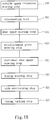
- the method includes following steps.
- An outside-upper extension weaving step S20 the extension 170 is woven by knitting at least one of the yarns 20 and 21.
- the initial shoe edge 111 connected to the extension 170 is woven by knitting the at least two yarns 20 and 21 in an interwoven manner.
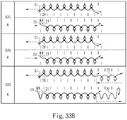
- a shoe upper weaving step S22 the first shoe upper 11 connected to the initial shoe edge 111 is woven by knitting the at least two yarns 20 and 21, weaving in a reverse direction is performed when the shoe upper stitch count is reached to weave the second shoe upper 12 that faces the first shoe upper 11 by knitting the two yarns 20 and 21, and the first shoe upper 11 is woven in a reverse direction according to the shoe upper stitch count, hence cyclically weaving the first shoe upper 11 and the second shoe upper 12.
- a reinforcement piece weaving step S23 the reinforcement piece 160 is woven by knitting at least one of the yarns 20 and 21 when the shoe upper stitch count is reached in the shoe upper weaving step S22, weaving in a reverse direction is performed when the extension stitch count is reached while weaving the reinforcement piece 160, and the first shoe upper 11 and the second shoe upper 12 are woven by knitting the at least two yarns 20 and 21 according to the shoe upper stitch count when the extension stitch count is again reached, hence cyclically weaving the reinforcement piece 160, the first shoe upper 11 and the second shoe upper 12.
- the first shoe upper 11 and the second shoe upper 12 are cyclically woven by knitting the two yarns 20 and 21.
- a first lining 18 connected to the first shoe upper 11 is woven by knitting the at least two yarns 20 and 21, weaving in a reverse direction is performed when the shoe upper stitch count is reached to weave a second lining 19 that faces the first lining 18 and is connected to the second shoe upper 12 by knitting the two yarns 20 and 21, and the first lining 18 is woven in a reverse direction according to the shoe upper stitch count, hence cyclically weaving the first lining 18 and the second lining 19. Ends of the first lining 18 and the second lining 19 form the shoe opening 14.
- a side overturning step S26 the first lining 18 and the second lining 19 are folded from the shoe opening 14, and the first shoe upper 11 and the second shoe upper 12 are simultaneously drawn to be overturned, so as to locate the reinforcement piece 160 and the extension 170 in the in-shoe space 13 defined by the overturned first shoe upper 11 and second shoe upper 12.
- the extension 170 may be the toe support piece disposed at the lower end of the in-shoe space 13 or the sole piece adhered to the second shoe upper 12.
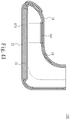
- a lining tucking step S27 the overturned first lining 18 and second lining 19 are tucked towards the in-shoe space 13, and ends of the first lining 18 and the second lining 19 are secured to the lower end of the in-shoe space 13 to complete the shoe embryo 10.
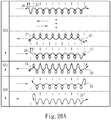
- the front needle bed 901 and the back needle bed 902 of the flat knitting machine 90 are set to first knit at least one of the yarns 20 and 21 at the beginning of weaving the shoe embryo 10 to form the extension 170.
- the flat knitting machine 90 causes the front needle bed 901 and the back needle bed 902 to knit simultaneously to cause the two yarns 20 and 21 to be interwoven to form the initial shoe edge 111.
- unbroken-yarn weaving is continued to perform the shoe upper weaving step S22.
- the front needle bed 901 weaves the first shoe upper 11 in an extended manner from an end of one side of the initial shoe edge 111.
- the flat knitting machine 90 continues unbroken-yarn weaving and performs yarn feeding in a reverse direction to cause the back needle bed 902 to continue weaving the second shoe upper 12 by knitting the two yarns 20 and 21.
- the flat knitting machine 90 performs weaving in a reverse direction, hence cyclically weaving the first shoe upper 11 and the second shoe upper 12.
- the reinforcement piece weaving step S23 is then performed.
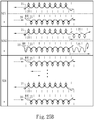
- the flat knitting machine 90 is at the weaving ending point of the first shoe upper 11 or the second shoe upper 12, the yarn feeding mechanism 903 is controlled to progress in a non-reversed direction, and the flat knitting machine 90 continues weaving the reinforcement piece 160 along the current weaving direction by knitting the at least one of the yarns 20 and 21.
- the flat knitting machine 90 controls the nose to progress in a non-reversed direction for weaving and the front needle bed 901 to weave the reinforcement piece 160, such that the woven reinforcement piece 160 protrudes from edges of the first shoe upper 11 and the second shoe upper.
- the flat knitting machine 90 continues weaving the reinforcement piece 160 in a reverse direction when the front needle bed 901 reaches the extension stitch count while weaving the reinforcement piece 160, and causes the front needle bed 901 and the back needle bed 902 to continue weaving the first shoe upper 11 and the second shoe upper 12 by knitting the two yarns 20 and 21 when the extension stitch count is again reached.
- Details of the weaving process of the first shoe upper 11 and the second shoe upper 12 are as described in the shoe upper weaving step S22, and shall be omitted herein.
- the extension stitch count is greater than the shoe upper stitch count.
- the continual shoe upper weaving step S24 is performed after the reinforcement piece weaving step S23 is completed.
- the continual shoe upper weaving step S24 is similar to the weaving method in the shoe upper weaving step S22.
- the continual shoe upper weaving step S24 from the weaving ending point of the reinforcement piece weaving step S23, the front needle bed 901 and the back needle bed 902 continue weaving the first shoe upper 11 and the second shoe upper 12.
- the lining weaving step S25 follows after the reinforcement piece weaving step S24 is completed.
- a weaving starting point is the end of the first shoe upper 11 or the second shoe upper 12, e.g., an intersection of the first shoe upper 11 and the second shoe upper 12.
- the flat knitting machine 90 causes the front needle bed 901 and the back needle bed 902 to weave the second lining 19 connected to the second shoe upper 12 by knitting the two yarns 20 and 21.
- the flat knitting machine 90 performs unbroken-yarn weaving and causes the yarn feeding mechanism 903 to perform yarn feeding in a reverse direction to weave the first lining 18 connected to the first shoe upper 11 by the front needle bed 901, hence cyclically weaving the first lining 18 and the second lining 19 in an unbroken-yarn manner to complete the weaving process.
- the weaving process of the second lining 19 is given as an example in this embodiment, the weaving sequences of the first lining 18 and the second lining 19 may be modified according to weaving scheduling settings in practice. Further, the weaving method of the first lining 18 and the second lining 19 may be identical to that of the first shoe upper 11 and the second shoe upper 12. Further, the weaving lengths of the first lining 18 and the second lining 19 may be similar to those of the first shoe upper 11 and the second shoe upper 12.
- the side overturning step S26 is performed after the weaving process of the lining weaving step S25 is completed.
- the side overturning step S26 may be completed through a machine or a human operation without involving the flat knitting machine 90.
- the reinforcement piece 160 is placed on the first shoe upper 11 or the second shoe upper 12, ends of the first lining 18 and the second lining 19 are held firmly, and the first lining 18 and the second lining 19 are folded from the shoe opening 14.
- the first shoe upper 11 and the second shoe upper 12 are simultaneously drawn to be overturned, so as to locate the reinforcement piece 160 and the extension 170 in the in-shoe space 13 defined by the overturned first shoe upper 11 and second shoe upper 12.
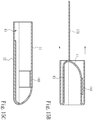
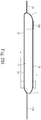
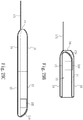
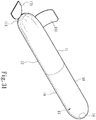
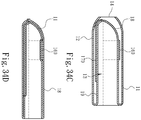
- the lining tucking step S27 is performed after the side overturning process is completed. During the implementation of the lining tucking step S27, edges of ends of the first lining 18 and the second lining 19 may be first sewn, i.e., the shoe opening 14 is sewn. The first lining 18 and the second lining 19 are then tucked into the in-shoe space 13 according to a method shown in Fig. 21C to Fig. 21D . The tucked-in first lining 18 and second lining 19 are secured at the lower end of the in-shoe space 13 to complete the shoe embryo 10, as shown in Fig. 21E .
- the two yarns 20 and 21 forming the shoe embryo 10 may be in different colors, which present different colors at inner and outer surfaces of the first shoe upper 11 and the second shoe upper 12.
- the two yarns 20 and 21 are in different colors, a technical front color of a fabric and a technical back color of the fabric are different.
- one of the two yarns 20 and 21 may be clad by a hot melt layer.
- the shoe embryo 10 when the shoe embryo 10 is completed, it may be placed into a mold and be appropriately heated to allow the yarn 20 (or 21) clad with the hot melt layer to melt, and the shoe embryo 10 may then shape according to an appearance of the mold to complete a knitted shoe prototype 100.
- the two yarns 20 and 21 of the present invention may be intertwined from twisting.
- the reinforcement piece 160 and the extension 170 are clamped among the first shoe upper 11, the second shoe upper 12, the first lining 18 and the second lining 19.
- the reinforcement piece 160 and the extension 170 cannot be directly contacted in the in-shoe space 13, so as to prevent direct damages of the reinforcement piece 160 and the extension 170 caused by wearing.
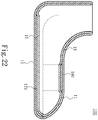
- the knitted shoe prototype 100 may be completed, as shown in Fig. 22 .
- at least one additional part having an identical pattern as the extension 170 may be woven in continuation from the extension 170. The additional part and the extension may be stacked to increase the structural strength provided by the extension 170.
- the continual shoe upper weaving step S24 further includes a sub-step S241.
- another reinforcement piece 161 is woven by knitting at least one of the yarns 20 and 21 when the shoe upper stitch count is reached while weaving the first shoe upper 11 or the second shoe upper 12, weaving in a reverse direction is performed when the extension stitch count is reached while weaving the another reinforcement piece 161, and the first shoe upper 11 and the second shoe upper 12 are woven by knitting the at least two yarns 20 and 21 according to the shoe upper stitch count when the extension stitch count is again reached, hence cyclically weaving the another reinforcement piece 161, the first shoe upper 11 and the second shoe upper 12.
- the another reinforcement piece 161 is together with the reinforcement piece 160 placed into the in-shoe space 13 defined by the overturned first shoe upper 11 and second shoe upper 12, and together with the reinforcement piece 160 provide the shoe embryo 10 with support.
- the method further includes an outside-upper another extension weaving step S28, in which another extension 171 connected to the end of the first lining 18 or the end of the second lining 19 is woven by knitting at least one of the yarns 20 and 21.
- the another extension 171 is together with the first lining 18 and the second lining 19 placed into the in-shoe space 13.
- the extension 170 and the another extension 171 are respectively the toe support piece disposed at the lower end of the in-shoe space 13 and the sole piece adhered to the second shoe upper 12.
- the flat knitting machine 90 performs unbroken-yarn weaving and weaves the another extension 171 at an edge of the first lining 18 or the second lining 19.
- the another extension 171 may be formed by single-sided weaving or dual-sided weaving, with associated details referred from the description on the weaving method of the reinforcement piece 160 of the present invention and omitted herein.
- the side overturning step S26 the another extension 171 is together overturned with the connected first lining 18 or second lining 19.
- the another extension 171 is together with the first lining 18 and the second lining 19 tucked into the in-shoe space 13.
- the another extension 171 serves as the toe support piece when disposed at a toe section of the shoe embryo 10, and serves as the sole piece when stacked on the second lining 19. Further, the weaving length of the extension 170 or the another extension 171 is shorter than the weaving lengths of the first shoe upper 11 and the second shoe upper 12.
- the method includes following steps.
- the extension 170 is woven by knitting at least one of the yarns 20 and 21.
- the initial shoe edge 111 connected to the extension 170 is woven by knitting the at least two yarns 20 and 21 in an interwoven manner.
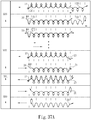
- a lining weaving step S32 the first lining 18 connected to the initial shoe edge 111 is woven by knitting the at least two yarns 20 and 21, weaving in a reverse direction is performed when the shoe upper stitch count is reached to weave the second lining 19 that faces the first lining 18 by knitting the two yarns 20 and 21, and the first lining 18 is woven in a reverse direction according to the shoe upper stitch count, hence cyclically weaving the first lining 18 and the second lining 19.
- a reinforcement piece weaving step S33 the reinforcement piece 160 is woven by knitting at least one of the yarns 20 and 21 when the shoe upper stitch count is reached in the lining weaving step S32, weaving in a reverse direction is performed when the extension stitch count is reached while weaving the reinforcement piece 160, and the first lining 18 and the second lining 19 are woven by knitting the at least two yarns 20 and 21 according to the shoe upper stitch count when the extension stitch count is again reached, hence cyclically weaving the reinforcement piece 160, the first lining 18 ad the second lining 19.
- the first lining 18 and the second lining 19 are cyclically woven by knitting the two yarns 20 and 21.
- a shoe upper weaving step S35 the first shoe upper 11 connected to the first lining 18 is woven by knitting the at least two yarns 20 and 21, weaving in a reverse direction is performed when the shoe upper stitch count is reached to weave the second shoe upper 12 that faces the first shoe upper 11 and is connected to the second lining 19 by knitting the two yarns 20 and 21, and the first shoe upper 11 is woven in a reverse direction according to the shoe upper stitch count, hence cyclically weaving the first shoe upper 11 and the second shoe upper 12. Further, ends of the first shoe upper 11 and the second shoe upper 12 form the shoe opening 14.
- a securing step S3 6 the reinforcement piece 160 is secured on the first lining 18, and the extension 170 is folded to come into contact with the first lining 18 or the second lining 19.
- the first shoe upper 11 and the second shoe upper 12 are folded from the shoe opening 14, such that the overturned first shoe upper 11 and second shoe upper 12 clad on the extension 170 and the reinforcement piece 160, and the ends of the first shoe upper 11 and the second shoe upper 12 are connected to complete the shoe embryo 10.
- the extension 170 may be the toe support piece disposed at a toe section 150 of the shoe embryo 10 or the sole piece adhered to the second shoe upper 12.
- the front needle bed 901 and the back needle bed 902 of the flat knitting machine 90 are set to first knit at least one of the yarns 20 and 21 at the beginning of weaving the shoe embryo 10 to form the extension 170.
- the interweaving step S31 is performed.
- the flat knitting machine 90 causes the front needle bed 901 and the back needle bed 902 to knit simultaneously to cause the two yarns 20 and 21 to be interwoven to form the initial shoe edge 111.
- unbroken-yarn weaving is continued to perform the lining weaving step S32.
- the front needle bed 901 weaves the first lining 18 in an extended manner from an end of one side of the initial shoe edge 111.
- the flat knitting machine 90 continues unbroken-yarn weaving and performs yarn feeding in a reverse direction to cause the back needle bed 902 to continue weaving the second lining 19 by knitting the two yarns 20 and 21.
- the flat knitting machine 90 performs weaving in a reverse direction, hence cyclically weaving the first lining 18 and the second lining 19
- the reinforcement piece weaving step S33 is then performed.
- the flat knitting machine 90 is at the weaving ending point of the first lining 18 or the second lining 19, the yarn feeding mechanism 903 is controlled to progress in a non-reversed direction, and the flat knitting machine 90 weaves the reinforcement piece 160 along the current weaving direction by knitting the at least one of the yarns 20 and 21.
- the flat knitting machine 90 controls the nose to progress in a non-reversed direction and weaves reinforcement piece 160 by the front needle bed 901, such that the woven reinforcement piece 160 protrudes from edges of the first shoe upper 11 and the second shoe upper 12.
- the flat knitting machine 90 continues weaving the reinforcement piece 160 in a reverse direction, and then causes the front needle bed 901 and the back needle bed 902 to continue weaving the first lining 18 and the second lining 19 by knitting the two yarns 20 and 21 when the extension stitch count is again reached.
- the weaving process of the first lining 18 and the second lining 19 is as described in the lining weaving step S32, and shall be omitted herein.
- the extension stitch count is greater than the shoe upper stitch count.
- the continual lining weaving step S34 is performed after the reinforcement piece weaving step S33 is completed, and is similar to the lining weaving step S32.
- the continual lining weaving step S34 the front needle bed 901 and the back needle bed 902 continue weaving from the weaving ending point of the reinforcement piece weaving step S33 to weave the first lining 18 and the second lining 19.
- the shoe upper weaving step S35 is performed after the continual lining weaving step S34 is completed.
- the weaving starting point of the shoe upper weaving step S35 is an end of the first lining 18 or the second lining 19, e.g., an intersection of the first lining 18 and the second lining 19.
- the flat knitting machine 90 causes the back needle bed 902 to weave the second shoe upper 12 connected to the second lining 19 by knitting the two yarns 20 and 21.
- the flat knitting machine 90 When the back needle bed 902 reaches the shoe upper stitch count while weaving the second shoe upper 12, the flat knitting machine 90 performs unbroken-yarn weaving and causes the yarn feeding mechanism 903 to perform yarn feeding in a reverse direction to weave the first shoe upper 11 connected to the first lining 18 by the front needle bed 901, hence cyclically weaving the first shoe upper 11 and the second shoe upper 12 in an unbroken-yarn manner to complete the weaving process.
- the weaving process of the first shoe upper 11 is given as an example in this embodiment, the weaving sequences of the first shoe upper 11 and the second shoe upper 12 may be modified according to weaving scheduling settings in practice. Further, the weaving lengths of the first lining 18 and the second lining 19 may be similar to those of the first shoe upper 11 and the second shoe upper 12.
- the securing step S36 is performed after the shoe upper weaving S35, and may be completed through a machine or a human operation without involving the flat knitting machine 90.
- the reinforcement piece 160 is secured on the first lining 18, and the extension 170 is folded to come into contact with the first lining 18 or the second lining 19 according to a set function of the extension 170.
- the extension 170 serves as a toe decoration piece when in contact with the first lining 18, or serves as the sole piece when in contact with the second lining 19.
- at least one additional part having an identical pattern as the extension 170 may be woven in continuation from the extension 170. The additional part and the extension may be stacked to increase the structural strength provided by the extension 170.
- the side overturning step S37 is performed after the securing step S36 is completed.
- ends of the first shoe upper 11 and the second shoe upper 12 are held firmly and are folded from the shoe opening 14, such that the overturned first shoe upper 11 and second shoe upper 12 clad on the extension 170 and the reinforcement piece 160.
- side overturning of the first shoe upper 11 stops at a connecting position of the first shoe upper 11 and the first lining 18, and side overturning of the second shoe upper 12 stops at a connecting position of the second shoe upper 12 and the second lining 19.
- the ends of the first shoe upper 11 and the second shoe upper 12 are connected to complete the shoe embryo 10.
- the two yarns 20 and 21 forming the shoe embryo 10 may be in different colors, which present different colors at inner and outer surfaces of the first shoe upper 11 and the second shoe upper 12.
- the two yarns 20 and 21 are in different colors, a technical front color of a fabric and a technical back color of the fabric are different.
- one of the two yarns 20 and 21 may be clad by a hot melt layer.
- the shoe embryo 10 when the shoe embryo 10 is completed, it may be placed into a mold and be appropriately heated to allow the yarn 20 (or 21) clad with the hot melt layer to melt, and the shoe embryo 10 may then shape according to an appearance of the mold to complete a knitted shoe prototype 100, as shown in Fig. 35 .
- the two yarns 20 and 21 of the present invention may be intertwined from twisting.
- the reinforcement piece 160 and the extension 170 are clamped among the first shoe upper 11, the second shoe upper 12, the first lining 18 and the second lining 19.
- the reinforcement piece 160 and the extension 170 cannot be directly contacted in the in-shoe space 13, so as to prevent direct damages of the reinforcement piece 160 and the extension 170 caused by wearing.
- an appropriate processing on the shoe embryo 10 e.g., a heating process or a paint spray process
- the knitted shoe prototype 100 may be completed, as shown in Fig. 35 .
- the continual lining weaving step S34 further includes a sub-step S341.
- another reinforcement piece 161 is woven by knitting at least one of the yarns 20 and 21 when the shoe upper stitch count is reached while weaving the first shoe upper 11 or the second shoe upper 12, weaving in a reverse direction is performed when the extension stitch count is reached while weaving the another reinforcement piece 161, and the first shoe upper 11 and the second shoe upper 12 are woven by knitting the at least two yarns 20 and 21 according to the shoe upper stitch count when the extension stitch count is again reached, hence cyclically weaving the another reinforcement piece 161, the first shoe upper 11 and the second shoe upper 12.
- the another reinforcement piece 161 and the reinforcement piece 160 are simultaneously secured on the first lining 18.
- the another reinforcement piece 161 is together with the reinforcement piece 160 clad by the first shoe upper 11.
- the structural strength of the shoe embryo 10 is increased.
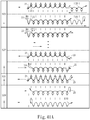
- the method further includes an outside-upper another extension weaving step S38, in which another extension 171 connected to the end of the first shoe upper 11 or the second shoe upper 12 is woven by knitting at least one of the yarns 20 and 21.
- the another extension 171 is stacked on the first shoe upper 11 or the second shoe upper after the first shoe upper 11 and the second shoe upper 12 are connected.
- the another extension 171 serves as the toe support piece when stacked on the first shoe upper 11, or serves as the sole piece when stacked on the second shoe upper 12.
- the another extension 171 is not adhered in the securing step S36, and is driven by the connected first shoe upper 11 or second shoe upper 12 to move towards the initial shoe edge 111.
- the first shoe upper 11 or the second shoe upper 12 moves to a predetermined level, after the ends of the first shoe upper 11 and the second shoe upper 12 are connected, the another extension 171 may become adhered to the first shoe upper 11 or the second shoe upper 12 to complete the shoe embryo 10.
- Fig. 43 shows the manufactured knitted shoe prototype 100 of the embodiment.
- the first shoe upper 11 and the second shoe upper 12 of the present invention may respectively be woven from different yarns (20 and 21). That is to say, if the needle beds (i.e., the front needle bed 901 and the back needle bed 902) perform weaving using different yarns, when the needle bed (e.g., the front needle bed 901) currently performing weaving reaches an end, yarn stitching and securing is assisted by a needle of the other needle bed (e.g., the back needle bed 902) at the opposite side, thereby interweaving the first shoe upper 11 and the second shoe upper 12 to form a tubular shape.
- the needle beds i.e., the front needle bed 901 and the back needle bed 902
Landscapes
- Engineering & Computer Science (AREA)
- Textile Engineering (AREA)
- Chemical & Material Sciences (AREA)
- Materials Engineering (AREA)
- Footwear And Its Accessory, Manufacturing Method And Apparatuses (AREA)
- Knitting Of Fabric (AREA)
Applications Claiming Priority (1)
| Application Number | Priority Date | Filing Date | Title |
|---|---|---|---|
| TW106108081A TWI667965B (zh) | 2017-03-10 | 2017-03-10 | Method for manufacturing integrally formed shoe blank |
Publications (2)
| Publication Number | Publication Date |
|---|---|
| EP3372103A1 true EP3372103A1 (de) | 2018-09-12 |
| EP3372103B1 EP3372103B1 (de) | 2021-04-21 |
Family
ID=58669715
Family Applications (1)
| Application Number | Title | Priority Date | Filing Date |
|---|---|---|---|
| EP17169445.8A Active EP3372103B1 (de) | 2017-03-10 | 2017-05-04 | Verfahren zur herstellung einer integrierten schuhgrundstruktur |
Country Status (4)
| Country | Link |
|---|---|
| US (3) | US10883207B2 (de) |
| EP (1) | EP3372103B1 (de) |
| ES (1) | ES2871061T3 (de) |
| TW (1) | TWI667965B (de) |
Cited By (1)
| Publication number | Priority date | Publication date | Assignee | Title |
|---|---|---|---|---|
| US12161194B2 (en) | 2020-02-25 | 2024-12-10 | Decathlon | Textile footwear item and method of manufacture |
Families Citing this family (4)
| Publication number | Priority date | Publication date | Assignee | Title |
|---|---|---|---|---|
| EP3629803B1 (de) * | 2017-05-31 | 2025-07-30 | NIKE Innovate C.V. | Strickkomponente für obermaterial eines schuhartikels |
| EP3629817B1 (de) * | 2017-05-31 | 2024-04-17 | NIKE Innovate C.V. | Gestrickte komponente für einen schuhartikel |
| FR3082103B1 (fr) | 2018-06-08 | 2020-08-28 | Decathlon Sa | Procede de fabrication d'une chaussure, et chaussure susceptible d'etre obtenue par ledit procede |
| IT202000001459A1 (it) * | 2020-01-24 | 2021-07-24 | Trere Innovation S R L | Struttura e procedimento di realizzazione di una scarpa con tomaia in maglia. |
Citations (12)
| Publication number | Priority date | Publication date | Assignee | Title |
|---|---|---|---|---|
| US20120255201A1 (en) * | 2011-04-08 | 2012-10-11 | Dashamerica, Inc. D/B/A Pearl Izumi Usa, Inc. | Seamless upper for footwear and method for making the same |
| US8572866B2 (en) | 2009-10-21 | 2013-11-05 | Nike, Inc. | Shoe with composite upper and foam element and method of making same |
| EP2805638A1 (de) | 2012-01-20 | 2014-11-26 | Shima Seiki Mfg., Ltd | Schuhwerk und strickverfahren für maschenware |
| US20150223561A1 (en) | 2014-02-07 | 2015-08-13 | Nike, Inc. | Sole structure for an article of footwear with extended plate |
| US20150250256A1 (en) | 2014-03-07 | 2015-09-10 | Nike, Inc. | Article of footwear with upper incorporating knitted component providing variable compression |
| WO2016009115A1 (fr) * | 2014-07-18 | 2016-01-21 | Salomon Sas. | Article chaussant à structure améliorée |
| US20160058099A1 (en) | 2014-08-29 | 2016-03-03 | Nike, Inc. | Article of Footwear Incorporating a Knitted Component with Monofilament Areas in Body and Heel Portions |
| US20160089578A1 (en) | 2013-05-31 | 2016-03-31 | Nike, Inc. | Thermoplastic Multi-Layer Golf Ball |
| EP3037012A1 (de) * | 2013-08-23 | 2016-06-29 | Shima Seiki Mfg., Ltd. | Schuhobermaterial und schuhobermaterialherstellungsverfahren |
| US20160208421A1 (en) | 2015-01-16 | 2016-07-21 | Nike, Inc. | Method of simultaneously knitting opposing sides of an article of footwear |
| US20160219966A1 (en) | 2015-01-30 | 2016-08-04 | Nike, Inc. | Method for forming a seamless knitted abutment |
| US20170000216A1 (en) | 2012-02-20 | 2017-01-05 | Nike, Inc. | Article of footwear incorporating a knitted component with a tongue |
Family Cites Families (23)
| Publication number | Priority date | Publication date | Assignee | Title |
|---|---|---|---|---|
| FR777533A (fr) * | 1934-08-22 | 1935-02-22 | Procédé de fabrication d'articles tricotés tels que bas, chaussettes, etc., et articles obtenus | |
| GB1253684A (en) * | 1967-10-27 | 1971-11-17 | Bentley Eng Co Ltd | Improvements relating to tubular knitted fabrics |
| JP2005508455A (ja) * | 2001-11-09 | 2005-03-31 | レジェンド・ケア・アイ・ピー・リミテッド | ソックス |
| US8225530B2 (en) * | 2006-11-10 | 2012-07-24 | Nike, Inc. | Article of footwear having a flat knit upper construction or other upper construction |
| US7748240B1 (en) * | 2009-03-04 | 2010-07-06 | James Paul Cherneski | Foot gripping garment |
| US9365960B2 (en) * | 2011-04-20 | 2016-06-14 | Nike, Inc. | Sock with zones of varying layers |
| US9498023B2 (en) * | 2012-11-20 | 2016-11-22 | Nike, Inc. | Footwear upper incorporating a knitted component with sock and tongue portions |
| GB2516028B8 (en) * | 2013-07-08 | 2017-08-23 | Wholeknit Int Co Ltd | Improved structure of shoe |
| US8997529B1 (en) * | 2014-02-03 | 2015-04-07 | Nike, Inc. | Article of footwear including a monofilament knit element with peripheral knit portions |
| JP6256991B2 (ja) * | 2014-05-28 | 2018-01-10 | 美津濃株式会社 | シューズのアッパーおよびそれを備えるシューズ |
| TW201632094A (zh) * | 2014-12-25 | 2016-09-16 | 島精機製作所股份有限公司 | 鞋之編織方法、鞋之製造方法、及鞋 |
| FR3031015B1 (fr) * | 2014-12-31 | 2017-04-28 | Salomon Sas | Procede de fabrication d'un article chaussant |
| EP3527099B1 (de) * | 2015-01-16 | 2022-12-14 | NIKE Innovate C.V. | Schuhwerk mit einem vorfusszehenschutz |
| CN107750132B (zh) * | 2015-05-29 | 2020-12-01 | 耐克创新有限合伙公司 | 具有带有单独固定的内侧部分和外侧部分的鞋面的鞋类制品 |
| JP6618300B2 (ja) * | 2015-08-27 | 2019-12-11 | 株式会社島精機製作所 | シューズ |
| US20170188661A1 (en) * | 2015-12-31 | 2017-07-06 | Action Sports Equipment, Inc. | Shoe wrap and method for manufacturing shoe |
| TWM533893U (en) * | 2016-08-10 | 2016-12-21 | Aknit Internat Ltd | One-piece vamp fabrics weaved by circular knitting machine |
| US10077512B2 (en) * | 2016-08-15 | 2018-09-18 | Aknit International Ltd. | Method for knitting integral shoe upper fabric by circular knitting machine and integral shoe upper fabric thereof |
| TWM535484U (zh) * | 2016-10-07 | 2017-01-21 | Hueite International Co Ltd | 全成型無車縫編織鞋之鞋面及以該鞋面所製成之鞋子 |
| US10842228B2 (en) * | 2016-11-22 | 2020-11-24 | Wholeknit International Co., Ltd. | Method for manufacturing shoe embryo tailored from tubular fabric and associated shoe embryo |
| US10316441B2 (en) * | 2016-12-16 | 2019-06-11 | The North Face Apparel Corp. | Footwear article including circular knit structures |
| CN108606409B (zh) * | 2017-01-10 | 2020-04-14 | 信泰(福建)科技有限公司 | 改进的百叶窗式立体条纹鞋面 |
| TWI632265B (zh) | 2017-03-10 | 2018-08-11 | 薩摩亞商紘織國際有限公司 | Method for integrally weaving an extended shoe with a flat knitting machine |
-
2017
- 2017-03-10 TW TW106108081A patent/TWI667965B/zh active
- 2017-04-26 US US15/497,965 patent/US10883207B2/en active Active
- 2017-05-04 EP EP17169445.8A patent/EP3372103B1/de active Active
- 2017-05-04 ES ES17169445T patent/ES2871061T3/es active Active
-
2020
- 2020-11-16 US US17/099,210 patent/US11555261B2/en active Active
-
2022
- 2022-11-15 US US17/987,215 patent/US11788218B2/en active Active
Patent Citations (12)
| Publication number | Priority date | Publication date | Assignee | Title |
|---|---|---|---|---|
| US8572866B2 (en) | 2009-10-21 | 2013-11-05 | Nike, Inc. | Shoe with composite upper and foam element and method of making same |
| US20120255201A1 (en) * | 2011-04-08 | 2012-10-11 | Dashamerica, Inc. D/B/A Pearl Izumi Usa, Inc. | Seamless upper for footwear and method for making the same |
| EP2805638A1 (de) | 2012-01-20 | 2014-11-26 | Shima Seiki Mfg., Ltd | Schuhwerk und strickverfahren für maschenware |
| US20170000216A1 (en) | 2012-02-20 | 2017-01-05 | Nike, Inc. | Article of footwear incorporating a knitted component with a tongue |
| US20160089578A1 (en) | 2013-05-31 | 2016-03-31 | Nike, Inc. | Thermoplastic Multi-Layer Golf Ball |
| EP3037012A1 (de) * | 2013-08-23 | 2016-06-29 | Shima Seiki Mfg., Ltd. | Schuhobermaterial und schuhobermaterialherstellungsverfahren |
| US20150223561A1 (en) | 2014-02-07 | 2015-08-13 | Nike, Inc. | Sole structure for an article of footwear with extended plate |
| US20150250256A1 (en) | 2014-03-07 | 2015-09-10 | Nike, Inc. | Article of footwear with upper incorporating knitted component providing variable compression |
| WO2016009115A1 (fr) * | 2014-07-18 | 2016-01-21 | Salomon Sas. | Article chaussant à structure améliorée |
| US20160058099A1 (en) | 2014-08-29 | 2016-03-03 | Nike, Inc. | Article of Footwear Incorporating a Knitted Component with Monofilament Areas in Body and Heel Portions |
| US20160208421A1 (en) | 2015-01-16 | 2016-07-21 | Nike, Inc. | Method of simultaneously knitting opposing sides of an article of footwear |
| US20160219966A1 (en) | 2015-01-30 | 2016-08-04 | Nike, Inc. | Method for forming a seamless knitted abutment |
Cited By (1)
| Publication number | Priority date | Publication date | Assignee | Title |
|---|---|---|---|---|
| US12161194B2 (en) | 2020-02-25 | 2024-12-10 | Decathlon | Textile footwear item and method of manufacture |
Also Published As
| Publication number | Publication date |
|---|---|
| TWI667965B (zh) | 2019-08-11 |
| US11555261B2 (en) | 2023-01-17 |
| US11788218B2 (en) | 2023-10-17 |
| US10883207B2 (en) | 2021-01-05 |
| ES2871061T3 (es) | 2021-10-28 |
| TW201726012A (zh) | 2017-08-01 |
| EP3372103B1 (de) | 2021-04-21 |
| US20210087722A1 (en) | 2021-03-25 |
| US20180255864A1 (en) | 2018-09-13 |
| US20230076496A1 (en) | 2023-03-09 |
Similar Documents
| Publication | Publication Date | Title |
|---|---|---|
| US11555261B2 (en) | Method for manufacturing integral shoe blank | |
| CN115211632B (zh) | 鞋面的制造方法 | |
| US10273605B2 (en) | Method for integrally weaving shoe embryo having extension by flat knitting machine | |
| KR101954655B1 (ko) | 슈즈 어퍼 및 슈즈 어퍼의 제조방법 | |
| EP3593664B1 (de) | An die form des fusses angepasster schuh | |
| EP3741246B1 (de) | Obermaterial | |
| US20180206585A1 (en) | Seamless 3D flat knit vamp and manufacturing method thereof | |
| CN105544080B (zh) | 成型针织鞋套及其织造方法、鞋体 | |
| CN107105821A (zh) | 穿在脚上的物品的编织方法、穿在脚上的物品的制造方法及穿在脚上的物品 | |
| JP2017095849A (ja) | 横編ジャカード方式で製織された接着性生地及びこれを利用した表面モルディング方法 | |
| CN114232187A (zh) | 包含针织元件的制品 | |
| CN108685277B (zh) | 一种以横编机一体编织具有延伸部分的鞋胚的方法 | |
| KR101848372B1 (ko) | 횡편 자카드 방식으로 직조된 접착성 원단 및 이를 이용한 표면 몰딩 방법 | |
| CN108691083B (zh) | 一体成型鞋胚的制造方法 | |
| JP2008007879A (ja) | プリーツ付布製品形成用布帛及びプリーツ付布製品の形成方法 | |
| IT202100020774A1 (it) | Procedimento per realizzare un manufatto tessile tubolare con una macchina tessile circolare per maglieria, e tomaia per calzatura realizzata mediante tale procedimento |
Legal Events
| Date | Code | Title | Description |
|---|---|---|---|
| PUAI | Public reference made under article 153(3) epc to a published international application that has entered the european phase |
Free format text: ORIGINAL CODE: 0009012 |
|
| STAA | Information on the status of an ep patent application or granted ep patent |
Free format text: STATUS: THE APPLICATION HAS BEEN PUBLISHED |
|
| AK | Designated contracting states |
Kind code of ref document: A1 Designated state(s): AL AT BE BG CH CY CZ DE DK EE ES FI FR GB GR HR HU IE IS IT LI LT LU LV MC MK MT NL NO PL PT RO RS SE SI SK SM TR |
|
| AX | Request for extension of the european patent |
Extension state: BA ME |
|
| STAA | Information on the status of an ep patent application or granted ep patent |
Free format text: STATUS: REQUEST FOR EXAMINATION WAS MADE |
|
| 17P | Request for examination filed |
Effective date: 20190312 |
|
| RBV | Designated contracting states (corrected) |
Designated state(s): AL AT BE BG CH CY CZ DE DK EE ES FI FR GB GR HR HU IE IS IT LI LT LU LV MC MK MT NL NO PL PT RO RS SE SI SK SM TR |
|
| GRAP | Despatch of communication of intention to grant a patent |
Free format text: ORIGINAL CODE: EPIDOSNIGR1 |
|
| STAA | Information on the status of an ep patent application or granted ep patent |
Free format text: STATUS: GRANT OF PATENT IS INTENDED |
|
| INTG | Intention to grant announced |
Effective date: 20201111 |
|
| GRAS | Grant fee paid |
Free format text: ORIGINAL CODE: EPIDOSNIGR3 |
|
| GRAA | (expected) grant |
Free format text: ORIGINAL CODE: 0009210 |
|
| STAA | Information on the status of an ep patent application or granted ep patent |
Free format text: STATUS: THE PATENT HAS BEEN GRANTED |
|
| AK | Designated contracting states |
Kind code of ref document: B1 Designated state(s): AL AT BE BG CH CY CZ DE DK EE ES FI FR GB GR HR HU IE IS IT LI LT LU LV MC MK MT NL NO PL PT RO RS SE SI SK SM TR |
|
| REG | Reference to a national code |
Ref country code: GB Ref legal event code: FG4D |
|
| REG | Reference to a national code |
Ref country code: CH Ref legal event code: EP Ref country code: CH Ref legal event code: NV Representative=s name: ISLER AND PEDRAZZINI AG, CH |
|
| REG | Reference to a national code |
Ref country code: DE Ref legal event code: R096 Ref document number: 602017036963 Country of ref document: DE Ref country code: IE Ref legal event code: FG4D |
|
| REG | Reference to a national code |
Ref country code: AT Ref legal event code: REF Ref document number: 1383710 Country of ref document: AT Kind code of ref document: T Effective date: 20210515 |
|
| REG | Reference to a national code |
Ref country code: LT Ref legal event code: MG9D |
|
| REG | Reference to a national code |
Ref country code: AT Ref legal event code: MK05 Ref document number: 1383710 Country of ref document: AT Kind code of ref document: T Effective date: 20210421 |
|
| REG | Reference to a national code |
Ref country code: NL Ref legal event code: MP Effective date: 20210421 |
|
| REG | Reference to a national code |
Ref country code: ES Ref legal event code: FG2A Ref document number: 2871061 Country of ref document: ES Kind code of ref document: T3 Effective date: 20211028 |
|
| PG25 | Lapsed in a contracting state [announced via postgrant information from national office to epo] |
Ref country code: NL Free format text: LAPSE BECAUSE OF FAILURE TO SUBMIT A TRANSLATION OF THE DESCRIPTION OR TO PAY THE FEE WITHIN THE PRESCRIBED TIME-LIMIT Effective date: 20210421 Ref country code: HR Free format text: LAPSE BECAUSE OF FAILURE TO SUBMIT A TRANSLATION OF THE DESCRIPTION OR TO PAY THE FEE WITHIN THE PRESCRIBED TIME-LIMIT Effective date: 20210421 Ref country code: AT Free format text: LAPSE BECAUSE OF FAILURE TO SUBMIT A TRANSLATION OF THE DESCRIPTION OR TO PAY THE FEE WITHIN THE PRESCRIBED TIME-LIMIT Effective date: 20210421 Ref country code: BG Free format text: LAPSE BECAUSE OF FAILURE TO SUBMIT A TRANSLATION OF THE DESCRIPTION OR TO PAY THE FEE WITHIN THE PRESCRIBED TIME-LIMIT Effective date: 20210721 Ref country code: LT Free format text: LAPSE BECAUSE OF FAILURE TO SUBMIT A TRANSLATION OF THE DESCRIPTION OR TO PAY THE FEE WITHIN THE PRESCRIBED TIME-LIMIT Effective date: 20210421 Ref country code: FI Free format text: LAPSE BECAUSE OF FAILURE TO SUBMIT A TRANSLATION OF THE DESCRIPTION OR TO PAY THE FEE WITHIN THE PRESCRIBED TIME-LIMIT Effective date: 20210421 |
|
| PG25 | Lapsed in a contracting state [announced via postgrant information from national office to epo] |
Ref country code: IS Free format text: LAPSE BECAUSE OF FAILURE TO SUBMIT A TRANSLATION OF THE DESCRIPTION OR TO PAY THE FEE WITHIN THE PRESCRIBED TIME-LIMIT Effective date: 20210821 Ref country code: LV Free format text: LAPSE BECAUSE OF FAILURE TO SUBMIT A TRANSLATION OF THE DESCRIPTION OR TO PAY THE FEE WITHIN THE PRESCRIBED TIME-LIMIT Effective date: 20210421 Ref country code: GR Free format text: LAPSE BECAUSE OF FAILURE TO SUBMIT A TRANSLATION OF THE DESCRIPTION OR TO PAY THE FEE WITHIN THE PRESCRIBED TIME-LIMIT Effective date: 20210722 Ref country code: PT Free format text: LAPSE BECAUSE OF FAILURE TO SUBMIT A TRANSLATION OF THE DESCRIPTION OR TO PAY THE FEE WITHIN THE PRESCRIBED TIME-LIMIT Effective date: 20210823 Ref country code: NO Free format text: LAPSE BECAUSE OF FAILURE TO SUBMIT A TRANSLATION OF THE DESCRIPTION OR TO PAY THE FEE WITHIN THE PRESCRIBED TIME-LIMIT Effective date: 20210721 Ref country code: PL Free format text: LAPSE BECAUSE OF FAILURE TO SUBMIT A TRANSLATION OF THE DESCRIPTION OR TO PAY THE FEE WITHIN THE PRESCRIBED TIME-LIMIT Effective date: 20210421 Ref country code: RS Free format text: LAPSE BECAUSE OF FAILURE TO SUBMIT A TRANSLATION OF THE DESCRIPTION OR TO PAY THE FEE WITHIN THE PRESCRIBED TIME-LIMIT Effective date: 20210421 Ref country code: SE Free format text: LAPSE BECAUSE OF FAILURE TO SUBMIT A TRANSLATION OF THE DESCRIPTION OR TO PAY THE FEE WITHIN THE PRESCRIBED TIME-LIMIT Effective date: 20210421 |
|
| REG | Reference to a national code |
Ref country code: DE Ref legal event code: R097 Ref document number: 602017036963 Country of ref document: DE |
|
| PG25 | Lapsed in a contracting state [announced via postgrant information from national office to epo] |
Ref country code: SK Free format text: LAPSE BECAUSE OF FAILURE TO SUBMIT A TRANSLATION OF THE DESCRIPTION OR TO PAY THE FEE WITHIN THE PRESCRIBED TIME-LIMIT Effective date: 20210421 Ref country code: SM Free format text: LAPSE BECAUSE OF FAILURE TO SUBMIT A TRANSLATION OF THE DESCRIPTION OR TO PAY THE FEE WITHIN THE PRESCRIBED TIME-LIMIT Effective date: 20210421 Ref country code: RO Free format text: LAPSE BECAUSE OF FAILURE TO SUBMIT A TRANSLATION OF THE DESCRIPTION OR TO PAY THE FEE WITHIN THE PRESCRIBED TIME-LIMIT Effective date: 20210421 Ref country code: EE Free format text: LAPSE BECAUSE OF FAILURE TO SUBMIT A TRANSLATION OF THE DESCRIPTION OR TO PAY THE FEE WITHIN THE PRESCRIBED TIME-LIMIT Effective date: 20210421 Ref country code: DK Free format text: LAPSE BECAUSE OF FAILURE TO SUBMIT A TRANSLATION OF THE DESCRIPTION OR TO PAY THE FEE WITHIN THE PRESCRIBED TIME-LIMIT Effective date: 20210421 Ref country code: CZ Free format text: LAPSE BECAUSE OF FAILURE TO SUBMIT A TRANSLATION OF THE DESCRIPTION OR TO PAY THE FEE WITHIN THE PRESCRIBED TIME-LIMIT Effective date: 20210421 Ref country code: MC Free format text: LAPSE BECAUSE OF FAILURE TO SUBMIT A TRANSLATION OF THE DESCRIPTION OR TO PAY THE FEE WITHIN THE PRESCRIBED TIME-LIMIT Effective date: 20210421 Ref country code: LU Free format text: LAPSE BECAUSE OF NON-PAYMENT OF DUE FEES Effective date: 20210504 |
|
| REG | Reference to a national code |
Ref country code: BE Ref legal event code: MM Effective date: 20210531 |
|
| PLBE | No opposition filed within time limit |
Free format text: ORIGINAL CODE: 0009261 |
|
| STAA | Information on the status of an ep patent application or granted ep patent |
Free format text: STATUS: NO OPPOSITION FILED WITHIN TIME LIMIT |
|
| GBPC | Gb: european patent ceased through non-payment of renewal fee |
Effective date: 20210721 |
|
| 26N | No opposition filed |
Effective date: 20220124 |
|
| PG25 | Lapsed in a contracting state [announced via postgrant information from national office to epo] |
Ref country code: IE Free format text: LAPSE BECAUSE OF NON-PAYMENT OF DUE FEES Effective date: 20210504 Ref country code: GB Free format text: LAPSE BECAUSE OF NON-PAYMENT OF DUE FEES Effective date: 20210721 |
|
| PG25 | Lapsed in a contracting state [announced via postgrant information from national office to epo] |
Ref country code: IS Free format text: LAPSE BECAUSE OF FAILURE TO SUBMIT A TRANSLATION OF THE DESCRIPTION OR TO PAY THE FEE WITHIN THE PRESCRIBED TIME-LIMIT Effective date: 20210821 Ref country code: FR Free format text: LAPSE BECAUSE OF NON-PAYMENT OF DUE FEES Effective date: 20210621 Ref country code: AL Free format text: LAPSE BECAUSE OF FAILURE TO SUBMIT A TRANSLATION OF THE DESCRIPTION OR TO PAY THE FEE WITHIN THE PRESCRIBED TIME-LIMIT Effective date: 20210421 |
|
| PG25 | Lapsed in a contracting state [announced via postgrant information from national office to epo] |
Ref country code: IT Free format text: LAPSE BECAUSE OF FAILURE TO SUBMIT A TRANSLATION OF THE DESCRIPTION OR TO PAY THE FEE WITHIN THE PRESCRIBED TIME-LIMIT Effective date: 20210421 Ref country code: BE Free format text: LAPSE BECAUSE OF NON-PAYMENT OF DUE FEES Effective date: 20210531 |
|
| PG25 | Lapsed in a contracting state [announced via postgrant information from national office to epo] |
Ref country code: CY Free format text: LAPSE BECAUSE OF FAILURE TO SUBMIT A TRANSLATION OF THE DESCRIPTION OR TO PAY THE FEE WITHIN THE PRESCRIBED TIME-LIMIT Effective date: 20210421 |
|
| PG25 | Lapsed in a contracting state [announced via postgrant information from national office to epo] |
Ref country code: HU Free format text: LAPSE BECAUSE OF FAILURE TO SUBMIT A TRANSLATION OF THE DESCRIPTION OR TO PAY THE FEE WITHIN THE PRESCRIBED TIME-LIMIT; INVALID AB INITIO Effective date: 20170504 |
|
| PG25 | Lapsed in a contracting state [announced via postgrant information from national office to epo] |
Ref country code: MK Free format text: LAPSE BECAUSE OF FAILURE TO SUBMIT A TRANSLATION OF THE DESCRIPTION OR TO PAY THE FEE WITHIN THE PRESCRIBED TIME-LIMIT Effective date: 20210421 |
|
| PG25 | Lapsed in a contracting state [announced via postgrant information from national office to epo] |
Ref country code: MT Free format text: LAPSE BECAUSE OF FAILURE TO SUBMIT A TRANSLATION OF THE DESCRIPTION OR TO PAY THE FEE WITHIN THE PRESCRIBED TIME-LIMIT Effective date: 20210421 |
|
| PGFP | Annual fee paid to national office [announced via postgrant information from national office to epo] |
Ref country code: DE Payment date: 20250402 Year of fee payment: 9 |
|
| PGFP | Annual fee paid to national office [announced via postgrant information from national office to epo] |
Ref country code: ES Payment date: 20250603 Year of fee payment: 9 |
|
| PGFP | Annual fee paid to national office [announced via postgrant information from national office to epo] |
Ref country code: CH Payment date: 20250601 Year of fee payment: 9 |
|
| PG25 | Lapsed in a contracting state [announced via postgrant information from national office to epo] |
Ref country code: TR Free format text: LAPSE BECAUSE OF FAILURE TO SUBMIT A TRANSLATION OF THE DESCRIPTION OR TO PAY THE FEE WITHIN THE PRESCRIBED TIME-LIMIT Effective date: 20210421 |