EP3372402A1 - Polymerwerkstoff und damit hergestellter behälter - Google Patents
Polymerwerkstoff und damit hergestellter behälter Download PDFInfo
- Publication number
- EP3372402A1 EP3372402A1 EP18160596.5A EP18160596A EP3372402A1 EP 3372402 A1 EP3372402 A1 EP 3372402A1 EP 18160596 A EP18160596 A EP 18160596A EP 3372402 A1 EP3372402 A1 EP 3372402A1
- Authority
- EP
- European Patent Office
- Prior art keywords
- abs
- mixture
- approximately
- plasticiser
- material according
- Prior art date
- Legal status (The legal status is an assumption and is not a legal conclusion. Google has not performed a legal analysis and makes no representation as to the accuracy of the status listed.)
- Withdrawn
Links
- 239000000463 material Substances 0.000 title claims abstract description 61
- 239000000203 mixture Substances 0.000 claims abstract description 37
- 229920000515 polycarbonate Polymers 0.000 claims abstract description 33
- 239000004417 polycarbonate Substances 0.000 claims abstract description 33
- 239000004676 acrylonitrile butadiene styrene Substances 0.000 claims abstract description 28
- 239000004014 plasticizer Substances 0.000 claims abstract description 23
- 238000004519 manufacturing process Methods 0.000 claims abstract description 11
- 239000011185 multilayer composite material Substances 0.000 claims abstract description 9
- XECAHXYUAAWDEL-UHFFFAOYSA-N acrylonitrile butadiene styrene Chemical compound C=CC=C.C=CC#N.C=CC1=CC=CC=C1 XECAHXYUAAWDEL-UHFFFAOYSA-N 0.000 claims description 25
- 229920000122 acrylonitrile butadiene styrene Polymers 0.000 claims description 25
- 229920006942 ABS/PC Polymers 0.000 claims description 12
- 238000000034 method Methods 0.000 claims description 10
- PPBRXRYQALVLMV-UHFFFAOYSA-N Styrene Chemical compound C=CC1=CC=CC=C1 PPBRXRYQALVLMV-UHFFFAOYSA-N 0.000 claims description 8
- 229920000642 polymer Polymers 0.000 claims description 8
- 239000005062 Polybutadiene Substances 0.000 claims description 7
- 238000001816 cooling Methods 0.000 claims description 7
- 229920002857 polybutadiene Polymers 0.000 claims description 7
- KAKZBPTYRLMSJV-UHFFFAOYSA-N Butadiene Chemical compound C=CC=C KAKZBPTYRLMSJV-UHFFFAOYSA-N 0.000 claims description 6
- 238000001125 extrusion Methods 0.000 claims description 6
- 238000001035 drying Methods 0.000 claims description 5
- NLHHRLWOUZZQLW-UHFFFAOYSA-N Acrylonitrile Chemical compound C=CC#N NLHHRLWOUZZQLW-UHFFFAOYSA-N 0.000 claims description 4
- 239000000654 additive Substances 0.000 claims description 4
- 239000000049 pigment Substances 0.000 claims description 4
- IISBACLAFKSPIT-UHFFFAOYSA-N bisphenol A Chemical compound C=1C=C(O)C=CC=1C(C)(C)C1=CC=C(O)C=C1 IISBACLAFKSPIT-UHFFFAOYSA-N 0.000 claims description 3
- BVKZGUZCCUSVTD-UHFFFAOYSA-N carbonic acid Chemical compound OC(O)=O BVKZGUZCCUSVTD-UHFFFAOYSA-N 0.000 claims description 2
- 238000000151 deposition Methods 0.000 claims description 2
- 238000002156 mixing Methods 0.000 claims description 2
- 239000008188 pellet Substances 0.000 claims description 2
- 239000002131 composite material Substances 0.000 claims 1
- 238000012360 testing method Methods 0.000 description 9
- 239000003795 chemical substances by application Substances 0.000 description 6
- 229920007019 PC/ABS Polymers 0.000 description 4
- 238000005452 bending Methods 0.000 description 3
- 150000002009 diols Chemical class 0.000 description 3
- 238000000465 moulding Methods 0.000 description 2
- 239000000126 substance Substances 0.000 description 2
- 229920001169 thermoplastic Polymers 0.000 description 2
- 229910019142 PO4 Inorganic materials 0.000 description 1
- WNLRTRBMVRJNCN-UHFFFAOYSA-N adipic acid Chemical class OC(=O)CCCCC(O)=O WNLRTRBMVRJNCN-UHFFFAOYSA-N 0.000 description 1
- 230000003796 beauty Effects 0.000 description 1
- 150000001875 compounds Chemical class 0.000 description 1
- 239000000470 constituent Substances 0.000 description 1
- 229920001577 copolymer Polymers 0.000 description 1
- 230000007547 defect Effects 0.000 description 1
- 238000013461 design Methods 0.000 description 1
- 235000014113 dietary fatty acids Nutrition 0.000 description 1
- 230000000694 effects Effects 0.000 description 1
- 230000001747 exhibiting effect Effects 0.000 description 1
- 239000004744 fabric Substances 0.000 description 1
- 229930195729 fatty acid Natural products 0.000 description 1
- 239000000194 fatty acid Substances 0.000 description 1
- -1 fatty acid esters Chemical class 0.000 description 1
- 230000009477 glass transition Effects 0.000 description 1
- 150000002314 glycerols Chemical class 0.000 description 1
- 238000009863 impact test Methods 0.000 description 1
- 239000002649 leather substitute Substances 0.000 description 1
- 238000011068 loading method Methods 0.000 description 1
- 238000012986 modification Methods 0.000 description 1
- 230000004048 modification Effects 0.000 description 1
- 235000021317 phosphate Nutrition 0.000 description 1
- 150000003013 phosphoric acid derivatives Chemical class 0.000 description 1
- 125000005498 phthalate group Chemical class 0.000 description 1
- 229920003023 plastic Polymers 0.000 description 1
- 239000004033 plastic Substances 0.000 description 1
- 229920000728 polyester Polymers 0.000 description 1
- 238000002360 preparation method Methods 0.000 description 1
- 230000000750 progressive effect Effects 0.000 description 1
- 238000012827 research and development Methods 0.000 description 1
- CXMXRPHRNRROMY-UHFFFAOYSA-N sebacic acid Chemical class OC(=O)CCCCCCCCC(O)=O CXMXRPHRNRROMY-UHFFFAOYSA-N 0.000 description 1
- 238000010583 slow cooling Methods 0.000 description 1
- 208000024891 symptom Diseases 0.000 description 1
- 239000012815 thermoplastic material Substances 0.000 description 1
- 239000004416 thermosoftening plastic Substances 0.000 description 1
Images


Classifications
-
- B—PERFORMING OPERATIONS; TRANSPORTING
- B32—LAYERED PRODUCTS
- B32B—LAYERED PRODUCTS, i.e. PRODUCTS BUILT-UP OF STRATA OF FLAT OR NON-FLAT, e.g. CELLULAR OR HONEYCOMB, FORM
- B32B27/00—Layered products comprising a layer of synthetic resin
- B32B27/06—Layered products comprising a layer of synthetic resin as the main or only constituent of a layer, which is next to another layer of the same or of a different material
- B32B27/08—Layered products comprising a layer of synthetic resin as the main or only constituent of a layer, which is next to another layer of the same or of a different material of synthetic resin
-
- B—PERFORMING OPERATIONS; TRANSPORTING
- B32—LAYERED PRODUCTS
- B32B—LAYERED PRODUCTS, i.e. PRODUCTS BUILT-UP OF STRATA OF FLAT OR NON-FLAT, e.g. CELLULAR OR HONEYCOMB, FORM
- B32B27/00—Layered products comprising a layer of synthetic resin
- B32B27/18—Layered products comprising a layer of synthetic resin characterised by the use of special additives
-
- B—PERFORMING OPERATIONS; TRANSPORTING
- B32—LAYERED PRODUCTS
- B32B—LAYERED PRODUCTS, i.e. PRODUCTS BUILT-UP OF STRATA OF FLAT OR NON-FLAT, e.g. CELLULAR OR HONEYCOMB, FORM
- B32B27/00—Layered products comprising a layer of synthetic resin
- B32B27/18—Layered products comprising a layer of synthetic resin characterised by the use of special additives
- B32B27/22—Layered products comprising a layer of synthetic resin characterised by the use of special additives using plasticisers
-
- B—PERFORMING OPERATIONS; TRANSPORTING
- B32—LAYERED PRODUCTS
- B32B—LAYERED PRODUCTS, i.e. PRODUCTS BUILT-UP OF STRATA OF FLAT OR NON-FLAT, e.g. CELLULAR OR HONEYCOMB, FORM
- B32B27/00—Layered products comprising a layer of synthetic resin
- B32B27/30—Layered products comprising a layer of synthetic resin comprising vinyl (co)polymers; comprising acrylic (co)polymers
- B32B27/302—Layered products comprising a layer of synthetic resin comprising vinyl (co)polymers; comprising acrylic (co)polymers comprising aromatic vinyl (co)polymers, e.g. styrenic (co)polymers
-
- B—PERFORMING OPERATIONS; TRANSPORTING
- B32—LAYERED PRODUCTS
- B32B—LAYERED PRODUCTS, i.e. PRODUCTS BUILT-UP OF STRATA OF FLAT OR NON-FLAT, e.g. CELLULAR OR HONEYCOMB, FORM
- B32B27/00—Layered products comprising a layer of synthetic resin
- B32B27/36—Layered products comprising a layer of synthetic resin comprising polyesters
-
- B—PERFORMING OPERATIONS; TRANSPORTING
- B32—LAYERED PRODUCTS
- B32B—LAYERED PRODUCTS, i.e. PRODUCTS BUILT-UP OF STRATA OF FLAT OR NON-FLAT, e.g. CELLULAR OR HONEYCOMB, FORM
- B32B2270/00—Resin or rubber layer containing a blend of at least two different polymers
-
- B—PERFORMING OPERATIONS; TRANSPORTING
- B32—LAYERED PRODUCTS
- B32B—LAYERED PRODUCTS, i.e. PRODUCTS BUILT-UP OF STRATA OF FLAT OR NON-FLAT, e.g. CELLULAR OR HONEYCOMB, FORM
- B32B2307/00—Properties of the layers or laminate
- B32B2307/50—Properties of the layers or laminate having particular mechanical properties
- B32B2307/558—Impact strength, toughness
-
- B—PERFORMING OPERATIONS; TRANSPORTING
- B32—LAYERED PRODUCTS
- B32B—LAYERED PRODUCTS, i.e. PRODUCTS BUILT-UP OF STRATA OF FLAT OR NON-FLAT, e.g. CELLULAR OR HONEYCOMB, FORM
- B32B2307/00—Properties of the layers or laminate
- B32B2307/70—Other properties
- B32B2307/732—Dimensional properties
-
- B—PERFORMING OPERATIONS; TRANSPORTING
- B32—LAYERED PRODUCTS
- B32B—LAYERED PRODUCTS, i.e. PRODUCTS BUILT-UP OF STRATA OF FLAT OR NON-FLAT, e.g. CELLULAR OR HONEYCOMB, FORM
- B32B2605/00—Vehicles
- B32B2605/08—Cars
Definitions
- the present description relates to a coextruded polymeric material, usable in particular for the manufacture of containers with high structural strength. More specifically, the invention relates to the technical sector of travel accessories and in particular a luggage item of the type that has a hard shell.
- a particularly widely used type of luggage items consists of suitcases with hard shell, be they of the traditional or trolley type.
- the shell typically made of plastic material, provides more protection to the content of the suitcase and at the same time it is less subject to wear than suitcases made of fabric or natural or synthetic leather.
- hard shell suitcases are recommended for air travel. It is well known that, in the operations of loading/unloading and re-delivery of the luggage, the luggage is thrown about and undergoes impacts against hard surfaces or sharp edges and it can suffer damages. Hard shell suitcases have been proven to be effective in minimising damages to the content of the suitcase itself.
- a purpose of the present invention is to make available a polymeric material suitable for the manufacture of containers, in particular luggage items, characterised by high impact resistance and at the same time by low cost.
- An object of the present invention then is a material as defined in general in claim 1 and more particularly in the claims from 2 to 9, whose text is an integral part of the present description.
- An additional object of the present invention is a container as defined in claim 11, having a hard shell made with the material of the claims from 1 to 9.
- Another object of the invention is a luggage item with hard shell as defined in claim 12, wherein the shell is made of the material of the claims from 1 to 9.
- Yet another object of the invention is a method for manufacturing the material of the invention in the form of plates, as defined in the claims from 14 to 19.
- the material of the invention can also be used in sectors other than luggage, in applications that require high impact resistance, for example in the automotive sector or more generally in means of transportation.
- An object of the invention will then be an item manufactured with the material according to the claim from 1 to 9 wherein said item is a part of a transportation means, in particular automotive.
- the polymeric material of the invention is a multilayer composite material, comprising at least one superficial layer of polycarbonate (PC) and at least one inner layer made of a mixture of acrylonitrile butadiene styrene (ABS) and polycarbonate comprising a plasticiser.
- PC polycarbonate
- ABS acrylonitrile butadiene styrene
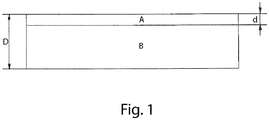
- Figure 1 shows, by way of example, the enlarged section of a plate of the material of the invention, in which the reference letter A indicates the outer layer and B indicates the inner layer.
- Polycarbonate is a thermoplastic polyester polymer of carbonic acid and a diol, with the general formula: in which R is the diradical of a diol.
- the mechanical properties such as elongation, breaking load, impact resistance and flexural strength, show rapid increase with molecular weight until reaching a plateau for molecular weight values around 22 000, weight for which good workability for extrusion and moulding is still assured.
- the glass transition temperature is 150°C, high if compared to that of many other polymers.
- a high value of Tg is a symptom of dimensional stability as well as of a considerable fracture resistance under load; it also determines the maximum limit value of the operating temperature of the material for maintaining the properties.
- the diol is bisphenol A.
- the polycarbonate used both in the outer layer A and in the inner layer B in this latter case in a mixture with ABS, has a number average molecular weight of approximately 20,000.
- the polycarbonate used as a constituent of the outer layer A provides the material with high scratch resistance properties.
- ABS Acrylonitrile butadiene styrene or ABS (chemical formula (C 8 H 8 ⁇ C 4 H 6 ⁇ C 3 H 3 N) n ) is a thermoplastic polymer used to create light and rigid objects.
- ABS is a copolymer derived from styrene polymerised together with acrylonitrile in the presence of polybutadiene, and therefore it can be defined as a ter-polymer.
- the proportions can vary in the following way:
- ABS preferably has a number average molecular weight of approximately 70,000.
- plasticisers for example chosen among organic phosphates, phthalates, adipates, sebacates, fatty acid esters, glycerol esters.
- a compound that has demonstrated a surprising plasticising effect in the material of the invention is polybutadiene, in particular polybutadiene with number average molecular weight of approximately 20,000.
- plasticiser as used in the present description and in the appended claims, means also a mixture of two or more plasticisers as defined above.
- the outer layer A is constituted by approximately 100% of PC.
- small quantities of additives can be present, in particular pigments, so as to provide the outer layer with a desired colour. The quantity of these additives falls within the normal percentages used for these substances.
- the inner layer B consists of an ABS/PC mixture in a weight ratio of between 25/75 and 35/65, more preferably approximately 30/70, and a plasticiser, more preferably polybutadiene, in a quantity between 1% and 3% by weight with respect to the weight of the ABS.
- the multilayer composite material is coextruded to form plates. These plates preferably have a thickness D of between 1.9 mm and 2.5 mm.
- the d/D thickness ratio between outer layer A and inner layer B is between 0.17:1 and 0.23:1, more preferably approximately 0.2:1.
- the multilayer material of the invention can also comprise more than 2 layers up to 5 layers, while maintaining the total thickness D of 1.9-2.5 mm.
- the additional layers in addition to the outer layer A and inner layer B can consist of the same materials described above or also of different materials, preferably selected among those compatible with the inner layer B.
- the material of the invention is a thermoplastic material that can be formed for moulding after softening so as to assume the desired shape of the item to be obtained.
- Said method comprises:
- Step i) of preparing the mixture of ABS/PC and plasticiser comprises the following operating sub-steps:
- the extrusion sub-step d) preferably takes place in a co-rotating non co-penetrating twin screw extruder, preferably at the speed of 200 rpm and with a temperature profile in the extrusion cylinder ("barrel") from 220°C to 250°C.
- barrel temperature profile in the extrusion cylinder
- An example of this extruder is shown schematically in figure 3 , where a single screw is visible, the other one being coupled to the first one on the same plane.
- the drying sub-step a) has been found to be extremely important to provide the high performance of the material of the invention. In known processes of this type, drying is carried out at approximately 85°C for approximately 6 hours. Instead, it has been observed that it is essential to prolong said drying for a much longer time, i.e. no less than 20 hours and preferably approximately 24 hours.
- Sub-step a) can be carried out on the ABS and PC polymers separately, or on an already formed mixture of the aforesaid polymers, possibly in the presence of the plasticiser. In this last case, then, the sub-steps a) and b) will be reversed.
- Step ii) of coextruding the mixture of step i) with PC to form a plate of multilayer composite material comprises the following operating sub-steps:
- the coextruding sub-step a') can preferably be carried out with extruders operating at 200 rpm and with a temperature profile from 220°C to 250°C.
- FIG. 4 An example of a typical co-extrusion apparatus is shown schematically in figure 4 .
- the rotational speed of the cylinder determines both the thickness and the draw ratio of the material.
- the rotational speed of the cylinder will preferably be between 5 and 10 rpm.
- thickness and draw ratio of the material combine with the properties dictated by the mixture in defining the final performance of the material.
- the cooling sub-step c') preferably takes place in an environment with controlled temperature, so as to obtain slow and progressive cooling, preferably in a time of approximately 15 minutes. This slow cooling has also been found important for the obtainment of the final characteristics of the material.
- the climate chamber will have an input temperature of approximately 150°C and an output temperature of approximately 50°C and it will preferably have intermediate portions in succession with temperatures respectively of approximately 125°C, 100°C and 75°C.
- the sub-step d') can comprise one of the following operations:
- the table shows the average values of some mechanical properties of ABS, PC and PC/ABS (70/30) without the addition of a plasticising agent. Significant variations in the properties are observed; in particular, they increase when PC is added to the ABS, as could easily be intuited.
- the material obtained (bearing the CARPISA GOTECHTM trademark) presents, as can be observed in the table, markedly superior mechanical properties compared both to ABS and to pure polycarbonate.
- the material according to the invention has impact resistance that is higher than 100 KJ/m 2 , preferably than approximately 150 KJ/m 2 .
- IMPACT RESISTANCE [KJ/m 2 ]
- BENDING RESISTANCE [MPa]
- ELONGATION AT BREAK [%]
- TENSILE STRENGTH [MPa]
- ABS 40 55 15 37 PC 88 80 63 62
- the suitcases subjected without internal load (i.e. empty) to a weight of approximately 100 kg applied exteriorly, exhibited a "crumpling" deformation which, upon eliminating the cause, disappeared. In other words, the suitcases return to their original shape without exhibiting any defect.
- Figure 2 shows a rigid suitcase, indicated in its entirety by the numeral 1, obtainable with the coextruded multilayer material according to the invention.
- the suitcase 1 is a trolley and comprises a pair of wheels 3 and a handle 4.
- the suitcase 1 comprises a main structure consisting of two half-shells 2, rotatably articulated with each other and able to define a closed structure that delimits a containment space.
- the suitcase 1 further comprises a closing device adapted to prevent/allow a relative rotation of said half shells 2.
- the closing device is a zipper 7 that joins the two half shells 2 along the respective edges, typically to reach in proximity to the articulation system.
- the closing device is a lock, in lieu of or in addition to the zipper.
- the two half shells 2 that constitute the structure of the suitcase 1 of the invention are made of the material described above.
- the material according to the invention consists of multilayer whose outer layer consists of 100% PC and the inner layer is made of a PC/ABS mixture with percentages of 70% and 30% by weight respectively charged with a plasticising agent, in particular polybutadiene with number average molecular weight of approximately 3,000, in a percentage of 3% by weight relative to the ABS component.
- a plasticising agent in particular polybutadiene with number average molecular weight of approximately 3,000, in a percentage of 3% by weight relative to the ABS component.
- the values shown in the table they refer to a multilayer in which the outer layer of polycarbonate constitutes 20% of the total thickness.
- plasticising agent was decisive to improve these mechanical properties (above all, impact resistance), which is an absolutely surprising finding, since from the prior art it was believed that the plasticising agent was solely useful to improve the rheological properties of the blend, and hence with an entirely different function.
- the coextruded multilayer material according to the invention can be used, in addition to the luggage field - in the fabrication of suitcases of various sizes, beauty cases, trunks, etc. - also for the fabrication of containers of various types.
- Another possible use for the material of the invention is in the sector of means of transportation, in particular for the fabrication of parts for which high impact resistance is required, for example bumpers, fender profiles, internal parts of the passenger compartment, etc.
Landscapes
- Laminated Bodies (AREA)
- Extrusion Moulding Of Plastics Or The Like (AREA)
Applications Claiming Priority (1)
| Application Number | Priority Date | Filing Date | Title |
|---|---|---|---|
| IT102017000025498A IT201700025498A1 (it) | 2017-03-08 | 2017-03-08 | Materiale polimerico e contenitore realizzato con tale materiale |
Publications (1)
| Publication Number | Publication Date |
|---|---|
| EP3372402A1 true EP3372402A1 (de) | 2018-09-12 |
Family
ID=59579833
Family Applications (1)
| Application Number | Title | Priority Date | Filing Date |
|---|---|---|---|
| EP18160596.5A Withdrawn EP3372402A1 (de) | 2017-03-08 | 2018-03-07 | Polymerwerkstoff und damit hergestellter behälter |
Country Status (2)
| Country | Link |
|---|---|
| EP (1) | EP3372402A1 (de) |
| IT (1) | IT201700025498A1 (de) |
Cited By (2)
| Publication number | Priority date | Publication date | Assignee | Title |
|---|---|---|---|---|
| JP2022070314A (ja) * | 2020-10-27 | 2022-05-13 | アジア・ラゲージ株式会社 | スーツケースの製造方法 |
| CN117887234A (zh) * | 2023-12-26 | 2024-04-16 | 上海普利特复合材料股份有限公司 | 一种高刚高韧低线膨的矿物填充pc/abs合金材料及其制备方法 |
Citations (4)
| Publication number | Priority date | Publication date | Assignee | Title |
|---|---|---|---|---|
| JPS5883044A (ja) * | 1981-11-12 | 1983-05-18 | Sumitomo Naugatuck Co Ltd | 熱可塑性樹脂組成物 |
| US20040101669A1 (en) * | 2002-11-26 | 2004-05-27 | Chang Jui Yang | Malti-layer board device for files or cases |
| WO2013020982A1 (de) * | 2011-08-08 | 2013-02-14 | Bayer Intellectual Property Gmbh | Gefüllte polymerzusammensetzung und coextrudierte platte erhältlich hieraus |
| CN104004333A (zh) * | 2014-05-05 | 2014-08-27 | 上海锦湖日丽塑料有限公司 | 高低温缺口冲击的pc/abs合金及其制备方法 |
-
2017
- 2017-03-08 IT IT102017000025498A patent/IT201700025498A1/it unknown
-
2018
- 2018-03-07 EP EP18160596.5A patent/EP3372402A1/de not_active Withdrawn
Patent Citations (4)
| Publication number | Priority date | Publication date | Assignee | Title |
|---|---|---|---|---|
| JPS5883044A (ja) * | 1981-11-12 | 1983-05-18 | Sumitomo Naugatuck Co Ltd | 熱可塑性樹脂組成物 |
| US20040101669A1 (en) * | 2002-11-26 | 2004-05-27 | Chang Jui Yang | Malti-layer board device for files or cases |
| WO2013020982A1 (de) * | 2011-08-08 | 2013-02-14 | Bayer Intellectual Property Gmbh | Gefüllte polymerzusammensetzung und coextrudierte platte erhältlich hieraus |
| CN104004333A (zh) * | 2014-05-05 | 2014-08-27 | 上海锦湖日丽塑料有限公司 | 高低温缺口冲击的pc/abs合金及其制备方法 |
Non-Patent Citations (1)
| Title |
|---|
| DATABASE WPI Week 201477, Derwent World Patents Index; AN 2014-V04140, XP002776332 * |
Cited By (2)
| Publication number | Priority date | Publication date | Assignee | Title |
|---|---|---|---|---|
| JP2022070314A (ja) * | 2020-10-27 | 2022-05-13 | アジア・ラゲージ株式会社 | スーツケースの製造方法 |
| CN117887234A (zh) * | 2023-12-26 | 2024-04-16 | 上海普利特复合材料股份有限公司 | 一种高刚高韧低线膨的矿物填充pc/abs合金材料及其制备方法 |
Also Published As
| Publication number | Publication date |
|---|---|
| IT201700025498A1 (it) | 2018-09-08 |
Similar Documents
| Publication | Publication Date | Title |
|---|---|---|
| KR101879981B1 (ko) | 열가소성 폴리우레탄 원사의 제조방법 | |
| CN102558798A (zh) | 一种车用聚乳酸复合材料及其制备方法 | |
| CN101628998B (zh) | 环保型低热值保温母粒、薄膜母粒及复合型薄膜 | |
| US9914808B2 (en) | Masterbatch for thermoplastic polyurethane yarn and method for manufacturing thermoplastic polyurethane yarn using the same | |
| EP3215568B1 (de) | Schlagzähmodifizierte transparente polyamidpolymerzusammensetzung | |
| JPH06509364A (ja) | サーモトロピック液晶性ポリマーの自己強化合成物 | |
| CN114605741B (zh) | 一种聚丙烯复合材料及其制备方法与应用 | |
| EP2985319B1 (de) | Verbundformmaterial, dessen verwendung zur herstellung eines extrusionsgeformten artikels, und herstellungsverfahren für das verbundformmaterial | |
| EP4086304B1 (de) | Zelluloseverstärktes polypropylenharzverbundmaterial, verfahren zu seiner herstellung und seine verwendung | |
| CN110358097B (zh) | 性能优良的pla基增容剂及其制备方法和应用 | |
| KR101452480B1 (ko) | 다중층 아크릴계 수지 필름 | |
| CN103740081A (zh) | 一种低气味、高抗冲pc/asa共混材料及其制备方法 | |
| CN111909460A (zh) | 一种耐刮擦低散发的汽车内饰pp复合材料及其制备方法 | |
| CN104629246A (zh) | 一种增韧耐磨合金材料及制备方法 | |
| CN102634188A (zh) | 应用于机械工业的橡塑三元复合材料及制作方法和应用 | |
| CN106751041B (zh) | 一种汽车内饰聚丙烯及其制备工艺 | |
| KR101935206B1 (ko) | 열가소성 폴리우레탄 원사 | |
| US10556982B2 (en) | Thermoplastic polyurethane resin composition having enhanced texture and durability and production method thereof | |
| JP5203315B2 (ja) | 多層延伸フィルム | |
| JP2005505446A (ja) | 成形品およびその生産用顆粒 | |
| CN116675965B (zh) | 一种高强韧聚乙醇酸复合材料及其制备方法和应用 | |
| JPS62116666A (ja) | 自己強化重合体複合物及びその製法 | |
| CN117844213A (zh) | 一种保温餐盒及其制备方法 | |
| Ramírez-Aguilar et al. | Successive self-nucleation and Annealing technique applied to polypropylene/butyl rubber composites: Recycling alternatives for vacuum bagging materials | |
| CN112625348B (zh) | 一种新能源汽车外饰用聚丙烯复合材料及其制备方法 |
Legal Events
| Date | Code | Title | Description |
|---|---|---|---|
| PUAI | Public reference made under article 153(3) epc to a published international application that has entered the european phase |
Free format text: ORIGINAL CODE: 0009012 |
|
| STAA | Information on the status of an ep patent application or granted ep patent |
Free format text: STATUS: THE APPLICATION HAS BEEN PUBLISHED |
|
| AK | Designated contracting states |
Kind code of ref document: A1 Designated state(s): AL AT BE BG CH CY CZ DE DK EE ES FI FR GB GR HR HU IE IS IT LI LT LU LV MC MK MT NL NO PL PT RO RS SE SI SK SM TR |
|
| AX | Request for extension of the european patent |
Extension state: BA ME |
|
| STAA | Information on the status of an ep patent application or granted ep patent |
Free format text: STATUS: THE APPLICATION IS DEEMED TO BE WITHDRAWN |
|
| 18D | Application deemed to be withdrawn |
Effective date: 20190313 |