EP3373116A1 - Actionneur de fibre pour rétroaction haptique - Google Patents
Actionneur de fibre pour rétroaction haptique Download PDFInfo
- Publication number
- EP3373116A1 EP3373116A1 EP18154748.0A EP18154748A EP3373116A1 EP 3373116 A1 EP3373116 A1 EP 3373116A1 EP 18154748 A EP18154748 A EP 18154748A EP 3373116 A1 EP3373116 A1 EP 3373116A1
- Authority
- EP
- European Patent Office
- Prior art keywords
- fiber actuator
- conductive element
- fiber
- haptic feedback
- polymeric layer
- Prior art date
- Legal status (The legal status is an assumption and is not a legal conclusion. Google has not performed a legal analysis and makes no representation as to the accuracy of the status listed.)
- Withdrawn
Links
Images

Classifications
-
- G—PHYSICS
- G06—COMPUTING OR CALCULATING; COUNTING
- G06F—ELECTRIC DIGITAL DATA PROCESSING
- G06F3/00—Input arrangements for transferring data to be processed into a form capable of being handled by the computer; Output arrangements for transferring data from processing unit to output unit, e.g. interface arrangements
- G06F3/01—Input arrangements or combined input and output arrangements for interaction between user and computer
- G06F3/016—Input arrangements with force or tactile feedback as computer generated output to the user
-
- H—ELECTRICITY
- H10—SEMICONDUCTOR DEVICES; ELECTRIC SOLID-STATE DEVICES NOT OTHERWISE PROVIDED FOR
- H10N—ELECTRIC SOLID-STATE DEVICES NOT OTHERWISE PROVIDED FOR
- H10N30/00—Piezoelectric or electrostrictive devices
- H10N30/20—Piezoelectric or electrostrictive devices with electrical input and mechanical output, e.g. functioning as actuators or vibrators
- H10N30/204—Piezoelectric or electrostrictive devices with electrical input and mechanical output, e.g. functioning as actuators or vibrators using bending displacement, e.g. unimorph, bimorph or multimorph cantilever or membrane benders
-
- A—HUMAN NECESSITIES
- A63—SPORTS; GAMES; AMUSEMENTS
- A63F—CARD, BOARD, OR ROULETTE GAMES; INDOOR GAMES USING SMALL MOVING PLAYING BODIES; VIDEO GAMES; GAMES NOT OTHERWISE PROVIDED FOR
- A63F13/00—Video games, i.e. games using an electronically generated display having two or more dimensions
- A63F13/25—Output arrangements for video game devices
- A63F13/28—Output arrangements for video game devices responding to control signals received from the game device for affecting ambient conditions, e.g. for vibrating players' seats, activating scent dispensers or affecting temperature or light
-
- B—PERFORMING OPERATIONS; TRANSPORTING
- B32—LAYERED PRODUCTS
- B32B—LAYERED PRODUCTS, i.e. PRODUCTS BUILT-UP OF STRATA OF FLAT OR NON-FLAT, e.g. CELLULAR OR HONEYCOMB, FORM
- B32B1/00—Layered products having a non-planar shape
- B32B1/08—Tubular products
-
- B—PERFORMING OPERATIONS; TRANSPORTING
- B32—LAYERED PRODUCTS
- B32B—LAYERED PRODUCTS, i.e. PRODUCTS BUILT-UP OF STRATA OF FLAT OR NON-FLAT, e.g. CELLULAR OR HONEYCOMB, FORM
- B32B27/00—Layered products comprising a layer of synthetic resin
- B32B27/06—Layered products comprising a layer of synthetic resin as the main or only constituent of a layer, which is next to another layer of the same or of a different material
-
- B—PERFORMING OPERATIONS; TRANSPORTING
- B32—LAYERED PRODUCTS
- B32B—LAYERED PRODUCTS, i.e. PRODUCTS BUILT-UP OF STRATA OF FLAT OR NON-FLAT, e.g. CELLULAR OR HONEYCOMB, FORM
- B32B27/00—Layered products comprising a layer of synthetic resin
- B32B27/28—Layered products comprising a layer of synthetic resin comprising synthetic resins not wholly covered by any one of the sub-groups B32B27/30 - B32B27/42
-
- B—PERFORMING OPERATIONS; TRANSPORTING
- B32—LAYERED PRODUCTS
- B32B—LAYERED PRODUCTS, i.e. PRODUCTS BUILT-UP OF STRATA OF FLAT OR NON-FLAT, e.g. CELLULAR OR HONEYCOMB, FORM
- B32B27/00—Layered products comprising a layer of synthetic resin
- B32B27/30—Layered products comprising a layer of synthetic resin comprising vinyl (co)polymers; comprising acrylic (co)polymers
- B32B27/304—Layered products comprising a layer of synthetic resin comprising vinyl (co)polymers; comprising acrylic (co)polymers comprising vinyl halide (co)polymers, e.g. PVC, PVDC, PVF, PVDF
-
- C—CHEMISTRY; METALLURGY
- C08—ORGANIC MACROMOLECULAR COMPOUNDS; THEIR PREPARATION OR CHEMICAL WORKING-UP; COMPOSITIONS BASED THEREON
- C08L—COMPOSITIONS OF MACROMOLECULAR COMPOUNDS
- C08L27/00—Compositions of homopolymers or copolymers of compounds having one or more unsaturated aliphatic radicals, each having only one carbon-to-carbon double bond, and at least one being terminated by a halogen; Compositions of derivatives of such polymers
- C08L27/02—Compositions of homopolymers or copolymers of compounds having one or more unsaturated aliphatic radicals, each having only one carbon-to-carbon double bond, and at least one being terminated by a halogen; Compositions of derivatives of such polymers not modified by chemical after-treatment
- C08L27/12—Compositions of homopolymers or copolymers of compounds having one or more unsaturated aliphatic radicals, each having only one carbon-to-carbon double bond, and at least one being terminated by a halogen; Compositions of derivatives of such polymers not modified by chemical after-treatment containing fluorine atoms
- C08L27/16—Homopolymers or copolymers or vinylidene fluoride
-
- C—CHEMISTRY; METALLURGY
- C08—ORGANIC MACROMOLECULAR COMPOUNDS; THEIR PREPARATION OR CHEMICAL WORKING-UP; COMPOSITIONS BASED THEREON
- C08L—COMPOSITIONS OF MACROMOLECULAR COMPOUNDS
- C08L65/00—Compositions of macromolecular compounds obtained by reactions forming a carbon-to-carbon link in the main chain; Compositions of derivatives of such polymers
-
- D—TEXTILES; PAPER
- D02—YARNS; MECHANICAL FINISHING OF YARNS OR ROPES; WARPING OR BEAMING
- D02G—CRIMPING OR CURLING FIBRES, FILAMENTS, THREADS, OR YARNS; YARNS OR THREADS
- D02G3/00—Yarns or threads, e.g. fancy yarns; Processes or apparatus for the production thereof, not otherwise provided for
- D02G3/44—Yarns or threads characterised by the purpose for which they are designed
- D02G3/441—Yarns or threads with antistatic, conductive or radiation-shielding properties
-
- D—TEXTILES; PAPER
- D03—WEAVING
- D03D—WOVEN FABRICS; METHODS OF WEAVING; LOOMS
- D03D1/00—Woven fabrics designed to make specified articles
- D03D1/0088—Fabrics having an electronic function
-
- G—PHYSICS
- G08—SIGNALLING
- G08B—SIGNALLING SYSTEMS, e.g. PERSONAL CALLING SYSTEMS; ORDER TELEGRAPHS; ALARM SYSTEMS
- G08B6/00—Tactile signalling systems, e.g. tactile personal calling systems
-
- H—ELECTRICITY
- H10—SEMICONDUCTOR DEVICES; ELECTRIC SOLID-STATE DEVICES NOT OTHERWISE PROVIDED FOR
- H10N—ELECTRIC SOLID-STATE DEVICES NOT OTHERWISE PROVIDED FOR
- H10N30/00—Piezoelectric or electrostrictive devices
- H10N30/60—Piezoelectric or electrostrictive devices having a coaxial cable structure
-
- H—ELECTRICITY
- H10—SEMICONDUCTOR DEVICES; ELECTRIC SOLID-STATE DEVICES NOT OTHERWISE PROVIDED FOR
- H10N—ELECTRIC SOLID-STATE DEVICES NOT OTHERWISE PROVIDED FOR
- H10N30/00—Piezoelectric or electrostrictive devices
- H10N30/702—Piezoelectric or electrostrictive devices based on piezoelectric or electrostrictive fibres
-
- B—PERFORMING OPERATIONS; TRANSPORTING
- B32—LAYERED PRODUCTS
- B32B—LAYERED PRODUCTS, i.e. PRODUCTS BUILT-UP OF STRATA OF FLAT OR NON-FLAT, e.g. CELLULAR OR HONEYCOMB, FORM
- B32B2255/00—Coating on the layer surface
- B32B2255/10—Coating on the layer surface on synthetic resin layer or on natural or synthetic rubber layer
-
- B—PERFORMING OPERATIONS; TRANSPORTING
- B32—LAYERED PRODUCTS
- B32B—LAYERED PRODUCTS, i.e. PRODUCTS BUILT-UP OF STRATA OF FLAT OR NON-FLAT, e.g. CELLULAR OR HONEYCOMB, FORM
- B32B2255/00—Coating on the layer surface
- B32B2255/20—Inorganic coating
- B32B2255/205—Metallic coating
-
- D—TEXTILES; PAPER
- D10—INDEXING SCHEME ASSOCIATED WITH SUBLASSES OF SECTION D, RELATING TO TEXTILES
- D10B—INDEXING SCHEME ASSOCIATED WITH SUBLASSES OF SECTION D, RELATING TO TEXTILES
- D10B2401/00—Physical properties
- D10B2401/16—Physical properties antistatic; conductive
-
- G—PHYSICS
- G06—COMPUTING OR CALCULATING; COUNTING
- G06F—ELECTRIC DIGITAL DATA PROCESSING
- G06F2203/00—Indexing scheme relating to G06F3/00 - G06F3/048
- G06F2203/01—Indexing scheme relating to G06F3/01
- G06F2203/013—Force feedback applied to a game
-
- G—PHYSICS
- G06—COMPUTING OR CALCULATING; COUNTING
- G06F—ELECTRIC DIGITAL DATA PROCESSING
- G06F2203/00—Indexing scheme relating to G06F3/00 - G06F3/048
- G06F2203/048—Indexing scheme relating to G06F3/048
- G06F2203/04809—Textured surface identifying touch areas, e.g. overlay structure for a virtual keyboard
-
- H—ELECTRICITY
- H10—SEMICONDUCTOR DEVICES; ELECTRIC SOLID-STATE DEVICES NOT OTHERWISE PROVIDED FOR
- H10N—ELECTRIC SOLID-STATE DEVICES NOT OTHERWISE PROVIDED FOR
- H10N30/00—Piezoelectric or electrostrictive devices
- H10N30/80—Constructional details
- H10N30/85—Piezoelectric or electrostrictive active materials
- H10N30/857—Macromolecular compositions
Definitions
- This disclosure relates to fiber actuators for providing haptic feedback, and haptic actuation resulting from mechanical and/or electrostatic (non-mechanical) feedback.
- Such fiber actuators are useful in structural materials, including as elements of wearables or accessories.
- Haptic feedback for use in wearables or accessories has traditionally been based on the use of eccentric rotating mass (ERM) motors and linear resonant actuators (LRA).
- ERP eccentric rotating mass
- LRA linear resonant actuators
- shape memory alloys have also been used in wearables, but again, power consumption often limits their applicability and ease of integration.
- This disclosure relates to fiber actuators for providing haptic feedback, wherein the fiber actuator may be used in various applications, such as wearables and accessory goods.
- Fiber actuators for providing haptic feedback to a user.
- Fiber actuators include, for example, a first conductive element, a polymeric layer concentrically disposed about the first conductive element and configured to deform so as to provide haptic feedback, and a second conductive element concentrically disposed about the polymeric layer.
- the fiber actuator has a substantially circular cross-section for substantially an entire length thereof.
- smart materials for providing haptic feedback which include, a structural material, and a fiber actuator associated with the structural material, which includes a first conductive element, a polymeric layer concentrically disposed about the first conductive element and configured to deform so as to provide haptic feedback, and a second conductive element concentrically disposed about the polymeric layer.
- the fiber actuator has a substantially circular cross-section for substantially an entire length thereof.
- the methods suitably include providing a fiber actuator as described herein, transmitting an actuation signal to a power source electrically coupled to the fiber actuator, and generating haptic feedback via the fiber actuator.
- fiber actuators for providing haptic feedback which include a first conductive element, a polymeric layer concentrically disposed about the first conductive element and configured to deform so as to provide haptic feedback, and a second conductive element concentrically disposed about the polymeric layer.
- smart materials for providing haptic feedback to a user which include a structural material and a fiber actuator, as described herein.
- fiber actuator(s) refers to a material having a cross-section that is substantially circular, and a length that is at least 2 or more times greater than its cross-section.
- the fiber actuators contain an inner or core material, which is surrounded, concentrically, by one or more layers of additional materials.
- smart material(s) refers to a material that is capable of being controlled such that the response and properties of the material change under the influence of an external stimulus.
- haptic feedback or “haptic feedback signal” refer to information such as vibration, texture, and/or heat, etc., that are transferred, via the sense of touch, from a fiber actuator and/or smart material as described herein, to a user.
- structural material means a material used in constructing a wearable, personal accessory, luggage, etc.
- structural materials include: fabrics and textiles, such as cotton, silk, wool, nylon, rayon, synthetics, flannel, linen, polyester, woven or blends of such fabrics, etc.; leather; suede; pliable metallic such as foil; Kevlar, etc.
- wearables include: clothing; footwear; prosthetics such as artificial limbs; headwear such as hats and helmets; athletic equipment worn on the body; protective equipment such as ballistic vests, helmets, and other body armor.
- Personal accessories include: eyeglasses; neckties and scarfs; belts and suspenders; jewelry such as bracelets, necklaces, and watches (including watch bands and straps); and wallets, billfolds, luggage tags, etc.
- Luggage includes: handbags, purses, travel bags, suitcases, backpacks, and including handles for such articles, etc.
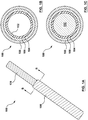
- FIG. 1A illustrates an exemplary fiber actuator 100 as described herein.
- FIG. 1B shows a section through line B-B of fiber actuator 100, in which a hollow core fiber is utilized or employed.
- FIG. 1C shows a cross-section through line B-B of fiber actuator 100, in which a solid core fiber is utilized or employed.
- fiber actuator 100 includes a first conductive element 102.
- first conductive element 102 forms a hollow core of fiber actuator 100, forming a substantially circular cross-section of the fiber actuator.
- first conductive element 102' is a solid core of fiber actuator 100, forming a substantially circular cross-section of the fiber actuator.
- fiber actuator 100 further includes a polymeric layer 104 concentrically disposed about first conductive element 102 and configured to deform so as to provide haptic feedback.
- first conductive element 102 essentially forms a coating or inner lining of polymeric layer 104, thereby providing the hollow core structure of fiber actuator 100.
- polymeric layer 104 is concentrically disposed about the solid core of first conductive element 102', forming a coating surrounding the solid core structure of fiber actuator 100.
- Fiber actuator 100 further includes a second conductive element 106, concentrically disposed about polymeric layer 104.
- second conductive element 106 is represented as a coating or layer surrounding polymeric layer 104.
- fiber actuator 100 whether including a solid or hollow core structure, has a substantially uniform cross-section for substantially an entire length of the fiber actuator, and in certain embodiments, has a substantially circular cross-section for substantially an entire length of the fiber actuator. It is this substantially uniform cross-section (and in embodiments the substantially circular cross-section) that provides fiber actuator 100 with one of its characteristics to allow for use or integration in structural materials, including wearables, as described herein.
- substantially uniform cross-section means that a section taken through the fiber has a cross-section that is uniform, i.e., within about 5-10% throughout "substantially an entire length" of the fiber actuator.
- substantially circular cross-section means that a section taken through the fiber has a diameter that is uniform, i.e., within about 5-10% throughout "substantially an entire length" of the fiber actuator. "Substantially an entire length” means at least 80-90% of the entire length of the fiber actuator.
- the fiber actuator has a cross-section, and suitably a diameter, that is uniform within about 1-5% (suitably within about 4%, about 3%, about 2% about 1% or about 0.5%) over at least about 90-95%, and suitably 95% or more (e.g., 96%, 97%, 98%, 99% or 100%) of the entire length of the fiber actuator.
- other cross-sections i.e., square, rectangular, triangular, oval, etc.
- Exemplary conductive elements for use in fiber actuator 100 include, but are not limited to, silver, gold, various conductive metals or polymers, including, Al, Cr, poly(3,4-ethylenedioxythiophene), polystyrene sulfonate (PEDOT:PSS), etc.).
- first conductive element 102' can be a solid wire or filament of a conductive element, including a gold or silver wire, etc.
- Polymeric layer 104 can then be disposed, coated or otherwise associated with the solid core to form the concentrically disposed structure.
- concentrically disposed refers to a layer(s) of material that is applied or coated on a structure, such that the layers have the same circular center when viewed in cross-section.
- first conductive element forms a hollow core
- the inner surface of polymeric layer 104 can be coated or covered with a film or coating of a metal or other material, to form first conductive element 102.
- second conductive element 106 can also be coated or disposed on polymeric layer 104, thereby forming the structure shown in FIG. 1B .
- a hollow polymeric fiber or filament can be prepared, using for example, a fiber spinning method wherein concentric cylinders are used, and a polymer fills in the gaps between the cylinders to form a hollow fiber, such as polymeric layer 104.
- First conductive element 102 can then be applied to the inner surface of polymeric layer 104 to form the hollow fiber structure.
- second conductive element 106 can be applied to the outer surface of the hollow fiber, polymeric layer 104, to form the structure shown in FIG. 1B .
- Methods of applying first and second conductive elements can include sputtering, dip-coating, spraying, electro-plating, painting, etc.
- surface patterning can be used to selectively etch the surface of polymeric layer 104 to increase the surface area or create a desired structure which can then be coated or covered with a thin film of conductive material to create the first and/or second conductive elements described herein.
- first 102 and/or second 106 conductive elements can be positioned over certain sections of the fiber actuator, with sections between the conductive elements in a non-active state (i.e., lacking one or more of the conductive elements).
- Fiber actuator 100 can be prepared with repeated sections of "active" - containing electrode(s) and "inactive," - lacking electrode(s) to provide a patterned fiber. Such patterning can occur, for example, over a stretch of about 1-5 cm with electrodes, about 1-5 cm without electrodes, and then repeated, etc.
- Electroactive polymers include polymers such as, but not limited to, poly(vinylidene fluoride), poly(pyrrole), poly(thiophene), poly(aniline) and mixtures, co-polymers, and derivatives thereof.
- Exemplary classes of electroactive polymers include dielectric and ionic polymers.
- a dielectric polymer (or dielectric elastomer) may be made to change shape in response to an electric field being generated between two electrodes that then squeezes the polymer.
- Dielectric polymers are capable of very high strains and are fundamentally a capacitor that changes its capacitance when a voltage is applied by allowing the polymer to compress in thickness and expand in area due to the electric field.
- An ionic polymer may undergo a change in shape or size due to displacement of ions inside the polymer.
- some ionic polymers require the presence of an aqueous environment to maintain an ionic flow.
- Methods of preparing electroactive polymers are known in the art, and can suitably include dissolving a desired polymer in a suitable solvent, and then casting the polymer in the desired shape (i.e., fiber or filament).
- the polymer may be drawn, or subjected to fiber spinning techniques, so as to be prepared with the desired filament (core or hollow structure) dimensions, as described herein.
- Additional methods include melt mixing, in which the polymer is heated above the softening/melting point, and then the polymer film is processed using film processing (casting or blowing) techniques.
- Polymer layer 104 will suitably have a thickness on the order of about 5 ⁇ m to millimeters, e.g., about 1 ⁇ m to 5 mm, about 1 ⁇ m to 1 mm, about 1 ⁇ m to 500 ⁇ m, or about 5 ⁇ m to about 500 ⁇ m, or about 10 ⁇ m to 500 ⁇ m, or about 1 ⁇ m to about 100 ⁇ m, though thicker or thinner polymer layers can also be utilized.
- First conductive element 102' in the form of a solid core structure, can have a diameter on the order of 5 ⁇ m to millimeters, e.g., about 1 ⁇ m to 10 mm, about 1 ⁇ m to 5 mm, about 1 ⁇ m to 1 mm, about 1 ⁇ m to 500 ⁇ m, or about 5 ⁇ m to about 500 ⁇ m, or about 10 ⁇ m to 500 ⁇ m, or about 1 ⁇ m to about 100 ⁇ m.
- first conductive element is in the form of a coating or layer, as in FIG.
- the thickness of the conductive element will generally be on the order of microns, suitably about 0.5 ⁇ m to about 500 ⁇ m, more suitably about 0.5 ⁇ m to about 100 ⁇ m, or about 0.5 ⁇ m to about 50 ⁇ m.
- the diameter of the fiber actuators 100 described herein is suitably on the order of 10's to 100's of microns, or up to millimeters, for example, on the order of about 1 ⁇ m to 10 mm, about 1 ⁇ m to 5 mm, about 1 ⁇ m to 1 mm, about 1 ⁇ m to 500 ⁇ m, or about 5 ⁇ m to about 500 ⁇ m, or about 10 ⁇ m to 500 ⁇ m, or about 1 ⁇ m to about 100 ⁇ m.
- the length of fiber actuators 100 can be on the order of microns to millimeters to centimeters to meters, depending on the ultimate application and use of the fiber actuator.
- compositions useful as polymer layer 104 include piezoelectric polymers and shape memory polymers.
- Exemplary piezoelectric materials include, but are not limited to, barium titanate, hydroxyapatite, apatite, lithium sulfate monohydrate, sodium potassium niobate, quartz, lead zirconium titanate (PZT), tartaric acid and polyvinylidene difluoride fibers.
- Other piezoelectric materials known in the art can also be used in the embodiments described herein.
- Shape memory polymers allow for programing of the polymer providing it with the ability to change shape from a first to a second shape.
- the shape-memory effect is not an intrinsic property, meaning that polymers do not display this effect by themselves.
- Shape memory results from a combination of polymer morphology and specific processing and can be understood as a polymer functionalization.
- conventional processing e.g. extruding or injection molding
- the polymer is formed into its initial, permanent shape B.
- programming the polymer sample is deformed and fixed into the temporary shape A.
- an external stimulus e.g., heat or electric field
- Shape-memory polymers can be elastic polymer networks that are equipped with suitable stimuli-sensitive switches.
- the polymer network consists of molecular switches and net points.
- the net points determine the permanent shape of the polymer network and can be a chemical (covalent bonds) or physical (intermolecular interactions) nature.
- Physical cross-linking is obtained in a polymer whose morphology consists of at least two segregated domains, as found for example in block copolymers. Additional information and examples of SMPs can be found in Shape Memory Polymers, MaterialsToday, Vol. 10, pages 20-28 (April 2007 ), the disclosure of which is incorporated by reference herein in its entirety.
- Transformation of SMPs from one or a first configuration to another or a second configuration is suitably controlled by controlling the temperature of the SMP in relation to its glass transition temperature (Tg). Raising the temperature of the SMP by heating it above its Tg, will cause the SMP actuator to transition to its second (memorized or original) configuration, resulting in activation or actuation of the multi-stable material and moving or transforming from a first stable configuration to a second stable configuration, and suitably to a third (and fourth, fifth etc., if desired) stable configuration.
- Exemplary shape memory polymers include various block copolymers, such as various poly(urethanes), poly(isoprene) and poly(ether esters), which have been programmed to have the required shape memory characteristics.
- polymeric layer 104 is suitably a soft polymer, including for example an electroactive polymer, or a shape memory polymer, configured to deform so as to provide haptic feedback.
- a soft polymer including for example an electroactive polymer, or a shape memory polymer, configured to deform so as to provide haptic feedback.
- “configured to deform” means that he polymer is shaped, formed, oriented or otherwise structured in the fiber actuator so as to be able to move, change shape, vibrate, elongate, contract, etc., so as to provide haptic feedback as the fiber actuator moves, changes shape, vibrates, elongates, contracts, etc.
- the malleability or flexibility of the polymer layer allows for it to deform or change shape in response to an electric field (and heating if required) applied between the first and second conductive elements.
- polymeric layer 104 can contract, causing the fiber actuator to shrink or deform in shape, or can expand, causing the fiber actuator to extend, contract or otherwise deform in shape.
- the amount of movement or deformation of fiber actuators in response to an electric field will be on the order of a few percent (0.5-5%) of the total diameter and/or length of the fiber actuator.
- fiber actuator 100 can be associated with a structural material 210, so as to form a smart material 200.
- structural material 210 can be a textile, including part of a wearable, as described herein.
- exemplary smart materials 200 include, for example, structural material 210 and fiber actuator 100 associated with the structural material.
- fiber actuator 100 can include first conductive element (102 if hollow fiber or 102' if solid core fiber) polymeric layer 104 concentrically disposed about the first conductive element and configured to deform so as to provide haptic feedback, and second conductive element 106 concentrically disposed about the polymeric layer.
- the fiber actuator has a substantially uniform cross-section, and in embodiments, a substantially circular cross-section, for substantially an entire length of the fiber. Exemplary materials for use as the conductive elements and the polymeric layers are described herein.
- fiber actuator 100 can be integrated into structural material 210.
- Fiber actuator 100 can be made part of structural material 210 during formation of structural material 210, such as during weaving or sewing of a textile, etc. That is, fiber actuator 100 can be directly sewn or weaved into a textile or fabric, for example, between two pieces of a textile, or as part of the structure of a structural material, including a textile, thereby integrating the fiber actuator into the structural material.
- fiber actuator 100 can be fixedly attached to structural material 210.
- fiber actuator 100 can be glued, taped, stitched, adhered, stapled, tacked, or otherwise attached to structural material 210.
- Fiber actuator 100 can also be integrated into, or on, various substrates, e.g., polymers such as rubbers, silicones, silicone elastomers, Teflon, or poly(ethylene terephthalate), etc., in the form of patches, ribbons or tapes that can then be attached to structural material 210 (e.g., adhered or sewn).
- fiber actuators In integrating fiber actuators into structural material 210, it is generally desirable to orient the fiber actuators in a parallel or other orientation such that when activated, their movement in concert results in movement of the structural material, rather than cancelling out their changes in shape or size.
- two sets of two-dimensional fiber sections can be prepared, however, and oriented in a perpendicular manner.
- a first set of fibers (or a mesh of fibers) can be actuated to provide actuation in a desired direction, followed by actuating the fibers in a second direction (including a perpendicular direction), and still provide the desired actuation.
- the number and concentration of fiber actuators 100 in structural material 210 will vary depending on the application and type of structural material 210 or smart material 200, but is in general on the order of one fiber actuator per square centimeter or one fiber actuator per square inch, but can be included at a higher density, e.g., on the order of 10's of fibers per square centimeter or square inch.
- power source 208 can be connected to fiber actuator 100, and suitably to one or both of the first and second conductive elements.
- power source 208 can be permanently connected to fiber actuator 100, or in other embodiments, can be separate from the fiber actuator, and later connected.
- the power source can be physically associated with the wearable, and attached as desired or required, to fiber actuator 100.
- the amount of power provided by power source 208 is suitably on the order of about 0.1 Watts (W) to about 10 W, or more suitably about 0.5 W to about 5 W, or about 1 W to about 5 W, or about 0.5 W, about 1 W, about 2 W, about 3 W, about 4 W or about 5 W.
- Exemplary power sources 208 including various battery packs as well as solar energy sources.
- Power source 208 can also include a re-chargeable system, for example, a system capable of recharging through the use of a piezoelectric material.
- polymeric layer 104 deforms in response to an electric field between first conductive element 102/102' and second conductive element 106. This can result in compression or expansion of polymeric layer 104, depending on the type of polymer selected, thereby providing motion or deformation of the fiber actuator.
- fiber actuator 100 can move or deform in a lateral direction 204 (i.e., across the width or diameter of the fiber actuator), and/or a longitudinal direction 202 (i.e., along the length of the fiber actuator).
- the deformation of fiber actuator 100 can result in movement or deformation of structural material 210, for example, as shown in FIG. 2B , as the structural material changes shape, moves, or otherwise deforms, thereby providing haptic feedback to a user (mechanical haptic feedback).
- fiber actuator 100 can further include an insulator layer 108, concentrically disposed about the second conductive element 106. As shown in FIG. 1A , insulator layer 108 can cover over at least a segment of the length of fiber actuator 100. Thus, as shown in FIG. 1A , fiber actuator 100 can include portions of the fiber, where the outer most layer is insulator layer 108, and other sections, where the outer most layer is second conductive element 106.
- Examples of material useful in forming insulator layer 108 include for example, polymeric materials, rubbers, plastics, ceramics etc..
- the materials selected for insulator layer 108 are suitably thin materials, on the order of 0.5 ⁇ m to 10 mm in thickness, more suitably about 0.5 ⁇ m to 1 mm, about 0.5 ⁇ m to 100 ⁇ m, or about 0.5 ⁇ m to 10 ⁇ m, and are selected so as to be flexible such that when fiber actuator 100 is part of a textile or fabric, including as a wearable, the materials can bend and conform to the various shapes necessary during wearing by a user, while still providing the desired haptic feedback.
- the fiber actuator can provide electrostatic feedback or an electrostatic interaction (i.e., non-mechanical haptic feedback) to a user, over the section or length of the fiber actuator that includes the insulator.
- haptic feedback can be provided via an electrostatic interaction or electrostatic feedback to the user.
- the electrostatic feedback can be in the form of a short vibration or pulse, or an extended vibration to the user.
- the frequency of the electrostatic feedback or interaction can be on the order of about 1 Hz to about 1000 Hz, more suitably about 1 Hz to about 500 Hz, about 1 Hz to about 200 Hz, about 10 Hz to about 200 Hz, about 10 Hz to about 100 Hz, or about 10 Hz, about 20 Hz, about 30 Hz, about 40 Hz, about 50 Hz, about 60 Hz, about 70 Hz, about 80 Hz, about 90 Hz or about 100 Hz.
- Haptic feedback can also be provided by the electrostatic interaction if a user simply approaches, or is near, the smart material or the fiber actuator, signaling a close proximity to the smart material, which may result in the electrostatic interaction and the haptic feedback therefrom.
- fiber actuator 100 can include both sections that have insulator 108, and sections that do not have insulator 108. Fiber actuators that have both sections can thus provide both an electrostatic interaction or electrostatic feedback (non-mechanical), as well as haptic feedback resulting from the deformation, movement or change in shape (mechanical) of fiber actuator 100.
- smart material 200 can include fiber actuators that include insulator 108, and fiber actuators that lack insulator 108, in the same smart material.
- the smart material can provide feedback via both electrostatic interaction or electrostatic feedback and haptic feedback resulting from the deformation, movement or change in shape of fiber actuator 100.
- Smart material 200 can comprise sections that include primarily one type of fiber actuator (e.g., lacking insulator 108) and sections that include primarily another type of fiber actuator (e.g., including insulator 108), thereby providing distinct sections of smart material 200 that provide different types of haptic feedback.
- the fiber actuators can be distributed throughout the smart material so that both movement/deformation-based haptic feedback and electrostatic-based haptic feedback can be provided in the same area of the smart material.
- power source 208 which is connected to first (102 or 102') and/or second conductive element 106, is also suitably connected to ground.
- first conductive element 102/102' can act as ground, with second conductive element being connected to power source 208 to provide electrostatic feedback to a user when the user contacts insulator layer 108.
- a user's body e.g., arm, leg, torso, head, neck, etc.
- a user's touch can act as ground for the electrostatic interaction, whereby the haptic feedback is provided or felt via the user's body, rather than through user's touch (or close approach).
- the haptic feedback in the form of an electrostatic interaction can be felt by either, or both, user's body and/or user's touch.
- smart material 200 and thus structural material 210, can be incorporated into or be part of wearable articles, such as, textiles, including shirts, blouses, hats, jackets, coats and pants/shorts, resulting in a wearable smart material.
- the structural materials can also be integrated into accessories, including various leather goods, including wallets and purses, handbags (including handles of such), backpacks, and jewelry, etc.
- exemplary methods include providing fiber actuator 100, which includes providing smart material 200, including fiber actuator 100 associated with or integrated into structural material 210, for example, as part of a wearable, accessory good, etc.
- fiber actuator 100 can include first conductive element (102 if hollow fiber or 102' if solid core fiber) polymeric layer 104 concentrically disposed about the first conductive element, and second conductive element 106 concentrically disposed about the polymeric layer.
- the fiber actuator has a substantially circular cross-section over substantially an entire length of the fiber. Exemplary materials for use as the conductive elements and polymeric layers are described herein.
- the methods further comprise transmitting an actuation signal 206, for example, as illustrated in FIG. 2A , to power source 208, which is electrically coupled to fiber actuator 100.
- the methods further comprise generating haptic feedback via the fiber actuator.
- generating haptic feedback includes generating an electric field between first conductive element (102 or 102') and second conductive element 106, resulting in deformation of polymeric layer 104.
- polymeric layer 104 which can be an electroactive polymer or a smart polymer, deforms, moves, changes shape, or otherwise reacts to the electric field causing movement of the fiber actuator, and in embodiments, movement of structural material 210, thereby providing haptic feedback to a user.
- the polymeric layer 104 can also deform or change shape in response to a change in temperature which results from the generation of the electric field.
- Such movement and haptic feedback is "mechanical" in nature, in that it is felt by the user as a movement, vibration or deformation of the fiber actuator, and thus the smart material/structural material.
- the generating haptic feedback includes generating an electrostatic feedback to the user.
- This electrostatic feedback can occur as a user interacts with the fiber actuator or the structural material, including both direct contact and close contact with the fiber actuator or the structural material.
- This electrostatic feedback is non-mechanical in nature as it results from electrostatic forces, rather than physical movement or deformation.
- Exemplary actuation signals 206 can be from a cellular phone, tablet, computer, car interface, smart device, game console, etc., and can indicate for example the receipt of a text message or e-mail, phone call, appointment, etc.
- a controller is also suitably included to provide an interface between a device, including an external device, and smart materials 200 and/or fiber actuators 100, as described herein.
- Components of a controller are well known in the art, and suitably include a bus, a processor, an input/output (I/O) controller and a memory, for example.
- a bus couples the various components of controller, including the I/O controller and memory, to the processor.
- the bus typically comprises a control bus, address bus, and data bus.
- the bus can be any bus or combination of busses suitable to transfer data between components in the controller.
- a processor can comprise any circuit configured to process information and can include any suitable analog or digital circuit.
- the processor can also include a programmable circuit that executes instructions. Examples of programmable circuits include microprocessors, microcontrollers, application specific integrated circuits (ASICs), programmable gate arrays (PGAs), field programmable gate arrays (FPGAs), or any other processor or hardware suitable for executing instructions.
- the processor can comprise a single unit, or a combination of two or more units, with the units physically located in a single controller or in separate devices.
- An I/O controller comprises circuitry that monitors the operation of the controller and peripheral or external devices.
- the I/O controller also manages data flow between the controller and peripherals or external devices.
- peripheral or external devices with the which I/O controller can interface include switches, sensors, external storage devices, monitors, input devices such as keyboards, mice or pushbuttons, external computing devices, mobile devices, and transmitters/receivers.
- the memory can comprise volatile memory such as random access memory (RAM), read only memory (ROM), electrically erasable programmable read only memory (EEPROM), flash memory, magnetic memory, optical memory or any other suitable memory technology.
- volatile memory such as random access memory (RAM), read only memory (ROM), electrically erasable programmable read only memory (EEPROM), flash memory, magnetic memory, optical memory or any other suitable memory technology.
- RAM random access memory
- ROM read only memory
- EEPROM electrically erasable programmable read only memory
- flash memory magnetic memory
- optical memory optical memory
- Memory can also comprise a combination of volatile and nonvolatile memory.
- the memory is configured to store a number of program modules for execution by the processor.
- the modules can, for example, include an event detection module, an effect determination module, and an effect control module.
- Each program module is a collection of data, routines, objects, calls and other instructions that perform one or more particular task. Although certain program modules are disclosed herein, the various instructions and tasks described for each module can, in various embodiments, be performed by a single program module, a different combination of modules, modules other than those disclosed herein, or modules executed by remote devices that are in communication with the controller.
- the controller which can include a wireless transceiver (including a Bluetooth or infrared transceiver), can be integrated into structural material 210 or can be separate from the structural material. In further embodiments, the controller can be on a separate device from the structural material, but is suitably connected via a wired or more suitably a wireless signal, so as to provide actuation signal 206 to the fiber actuators, power sources, and smart materials described herein.
- a wireless transceiver including a Bluetooth or infrared transceiver
- the controller can be on a separate device from the structural material, but is suitably connected via a wired or more suitably a wireless signal, so as to provide actuation signal 206 to the fiber actuators, power sources, and smart materials described herein.
- the controller can provide actuation signal 206 to an actuator drive circuit, which in turn communicates with power supply 208, of the smart materials or fiber actuators described herein, so as to provide haptic feedback to a user of a smart material or system as described herein.
- desired haptic feedback can occur, for example, when a mobile phone or other device to which a controller is paired via wireless connection receives a message or email.
- Additional examples include a controller being associated with devices such as game controllers, systems or consoles, computers, tablets, car or truck interfaces or computers, a health monitoring device, automated payment machines or kiosks, various keypad devices, televisions, various machinery, etc.
- the controller suitably provides actuation signal 206 to an actuator drive circuit, to provide haptic feedback to a user in response to a signal originated by or from an external device.
- the device can also be a part of the wearable on which the various components of the haptic feedback systems described herein are contained.
- the fiber actuators described herein can be made part of a watch band, where the face of the watch is a smart watch, for example, and the user sets the watch to provide haptic feedback via the fiber actuators integrated into the band (i.e., vibrate, motion, contraction etc., based on a received e-mail, alarm, other notification).
- Exemplary feedback or signals that can be provided by a device include, for example, indications of incoming messages or communication from a third party, warning signals, health status updates (i.e., blood pressure or heart palpitations), gaming interaction, driver awareness signals, computer prompts, etc.
- indications of incoming messages or communication from a third party include, for example, indications of incoming messages or communication from a third party, warning signals, health status updates (i.e., blood pressure or heart palpitations), gaming interaction, driver awareness signals, computer prompts, etc.
- the smart materials and components described herein can be integrated with or be part of a virtual reality or augmented reality system.
- the smart materials can provide haptic feedback to a user as he or she interacts with a virtual or augmented reality system, providing responses or feedback initiated by the virtual reality or augmented reality components and devices.
- the interaction between the user, fiber actuator 100 and an external device can occur via direct interaction between the user and fiber actuator 100 or smart material 200, which in turn provides a signal to an external device.
- a user can interact with a smart material in the form of a wearable on the user's body, by touching, swiping, pressing or otherwise touching the structural material of the wearable, which suitably includes the fiber actuators described herein. This interaction can result in a signal being transferred to an external device, demonstrating or confirming a user interaction has taken place.
- the actuation signal(s) described herein is transmitted to the power source. Movement is then generated in the fiber actuator, resulting in actuation of the structural material.
- an electrostatic interaction can also be generated upon user interaction, in embodiments where the fiber actuator is designed to provide electrostatic feedback. The combination of the movement of the fiber actuator, and/or the electrostatic interaction, provides haptic feedback to the user.
- the order, sequence, frequency, and intensity of both the movement of the fiber actuator and electrostatic interaction can be varied, depending on the type of interaction or the type of desired feedback.
- a user may experience haptic feedback from the movement of the fiber actuator, upon which the user may interact with the fiber actuator, or other fiber actuators in the smart material, creating an electrostatic interaction which provides additional, further haptic feedback.
- the user may interact with the structural material, which in turn provides an electrostatic interaction, and the structural material may further provide movement from the fiber actuator to provide the haptic feedback.
- the user can interact with a first fiber actuator, which provides a motion-based or mechanical haptic feedback indicating that the interaction has been successful, followed by an electrostatic interaction (non-mechanical feedback) from a second fiber actuator, indicating that, for example, a desired task has been completed.
- Examples of intensity, frequency and timing of the various haptic feedback are provided herein, and can be tailored as desired by the user or the device with which the user is interacting.
- Examples of devices and methods for activating or actuating the combined smart materials are described herein, and include various computers, mobile devices, gaming systems, automobiles, etc.
Landscapes
- Engineering & Computer Science (AREA)
- General Engineering & Computer Science (AREA)
- Theoretical Computer Science (AREA)
- Multimedia (AREA)
- General Physics & Mathematics (AREA)
- Physics & Mathematics (AREA)
- Human Computer Interaction (AREA)
- Chemical & Material Sciences (AREA)
- Textile Engineering (AREA)
- Mechanical Engineering (AREA)
- Health & Medical Sciences (AREA)
- Chemical Kinetics & Catalysis (AREA)
- Medicinal Chemistry (AREA)
- Polymers & Plastics (AREA)
- Organic Chemistry (AREA)
- User Interface Of Digital Computer (AREA)
Applications Claiming Priority (1)
| Application Number | Priority Date | Filing Date | Title |
|---|---|---|---|
| US15/454,362 US10007347B1 (en) | 2017-03-09 | 2017-03-09 | Fiber actuator for haptic feedback |
Publications (1)
| Publication Number | Publication Date |
|---|---|
| EP3373116A1 true EP3373116A1 (fr) | 2018-09-12 |
Family
ID=61157032
Family Applications (1)
| Application Number | Title | Priority Date | Filing Date |
|---|---|---|---|
| EP18154748.0A Withdrawn EP3373116A1 (fr) | 2017-03-09 | 2018-02-01 | Actionneur de fibre pour rétroaction haptique |
Country Status (5)
| Country | Link |
|---|---|
| US (3) | US10007347B1 (fr) |
| EP (1) | EP3373116A1 (fr) |
| JP (1) | JP2018153085A (fr) |
| KR (1) | KR20180103709A (fr) |
| CN (1) | CN108574038A (fr) |
Cited By (2)
| Publication number | Priority date | Publication date | Assignee | Title |
|---|---|---|---|---|
| CN113265721A (zh) * | 2021-04-19 | 2021-08-17 | 浙江大学 | 一种纤维状介电弹性体驱动器及其制备方法 |
| JPWO2021182208A1 (fr) * | 2020-03-09 | 2021-09-16 |
Families Citing this family (5)
| Publication number | Priority date | Publication date | Assignee | Title |
|---|---|---|---|---|
| US9830783B1 (en) * | 2014-09-24 | 2017-11-28 | Apple Inc. | Output devices for fabric-based electronic equipment |
| US20180258561A1 (en) * | 2017-03-09 | 2018-09-13 | Immersion Corporation | Bifunctional fiber for combined sensing and haptic feedback |
| US12371822B2 (en) | 2017-06-06 | 2025-07-29 | Welspun India Limited | Hygro textile structures and related processes |
| WO2019115516A1 (fr) * | 2017-12-12 | 2019-06-20 | Telas B.V. | Bas de contention amélioré |
| EP3637487A1 (fr) * | 2018-10-09 | 2020-04-15 | Nederlandse Organisatie voor toegepast- natuurwetenschappelijk onderzoek TNO | Transducteur piézoélectrique à cisaillement |
Citations (2)
| Publication number | Priority date | Publication date | Assignee | Title |
|---|---|---|---|---|
| WO2016175321A1 (fr) * | 2015-04-30 | 2016-11-03 | 帝人株式会社 | Élément piézoélectrique et dispositif l'utilisant |
| US20170029985A1 (en) * | 2014-04-16 | 2017-02-02 | Teijin Limited | Transducer including fibers and outputting and inputting an electric signal |
Family Cites Families (8)
| Publication number | Priority date | Publication date | Assignee | Title |
|---|---|---|---|---|
| WO2010018612A1 (fr) * | 2008-08-15 | 2010-02-18 | パナソニック株式会社 | Actuateur polymère conducteur, et procédé de fabrication associé |
| EP2192707A1 (fr) * | 2008-11-26 | 2010-06-02 | Nokia Siemens Networks OY | Procédé de calibrage d'une antenne active et antenne active |
| US8362882B2 (en) * | 2008-12-10 | 2013-01-29 | Immersion Corporation | Method and apparatus for providing Haptic feedback from Haptic textile |
| US8228127B2 (en) * | 2009-12-23 | 2012-07-24 | Sand 9, Inc. | Oscillators having arbitrary frequencies and related systems and methods |
| US8311083B2 (en) * | 2009-12-29 | 2012-11-13 | Texas Instruments Incorporated | Joint transmit and receive I/Q imbalance compensation |
| US8798534B2 (en) * | 2010-07-09 | 2014-08-05 | Digimarc Corporation | Mobile devices and methods employing haptics |
| WO2012061840A1 (fr) | 2010-11-05 | 2012-05-10 | Georgia Tech Research Corporation | Systèmes haptiques, et procédés utilisant la transmission de pression via un support flexible |
| ITRM20110461A1 (it) * | 2011-09-07 | 2013-03-08 | Pielleitalia S R L | "materiale composito comprendente uno strato di materiale piezoelettrico polimerico accoppiato con un substrato tessile e procedimento per realizzare detto materiale composito" |
-
2017
- 2017-03-09 US US15/454,362 patent/US10007347B1/en not_active Expired - Fee Related
-
2018
- 2018-01-30 CN CN201810088257.5A patent/CN108574038A/zh active Pending
- 2018-02-01 EP EP18154748.0A patent/EP3373116A1/fr not_active Withdrawn
- 2018-03-06 KR KR1020180026102A patent/KR20180103709A/ko not_active Withdrawn
- 2018-03-08 JP JP2018041400A patent/JP2018153085A/ja active Pending
- 2018-04-30 US US15/966,148 patent/US10281985B2/en active Active
-
2019
- 2019-03-26 US US16/364,270 patent/US10481695B2/en not_active Expired - Fee Related
Patent Citations (3)
| Publication number | Priority date | Publication date | Assignee | Title |
|---|---|---|---|---|
| US20170029985A1 (en) * | 2014-04-16 | 2017-02-02 | Teijin Limited | Transducer including fibers and outputting and inputting an electric signal |
| WO2016175321A1 (fr) * | 2015-04-30 | 2016-11-03 | 帝人株式会社 | Élément piézoélectrique et dispositif l'utilisant |
| EP3291317A1 (fr) * | 2015-04-30 | 2018-03-07 | Teijin Limited | Élément piézoélectrique et dispositif l'utilisant |
Non-Patent Citations (1)
| Title |
|---|
| SHAPE: "MaterialsToday", MEMORY POLYMERS, vol. 10, April 2007 (2007-04-01), pages 20 - 28 |
Cited By (2)
| Publication number | Priority date | Publication date | Assignee | Title |
|---|---|---|---|---|
| JPWO2021182208A1 (fr) * | 2020-03-09 | 2021-09-16 | ||
| CN113265721A (zh) * | 2021-04-19 | 2021-08-17 | 浙江大学 | 一种纤维状介电弹性体驱动器及其制备方法 |
Also Published As
| Publication number | Publication date |
|---|---|
| JP2018153085A (ja) | 2018-09-27 |
| KR20180103709A (ko) | 2018-09-19 |
| CN108574038A (zh) | 2018-09-25 |
| US10481695B2 (en) | 2019-11-19 |
| US10007347B1 (en) | 2018-06-26 |
| US20190235631A1 (en) | 2019-08-01 |
| US10281985B2 (en) | 2019-05-07 |
| US20180260028A1 (en) | 2018-09-13 |
Similar Documents
| Publication | Publication Date | Title |
|---|---|---|
| US10481695B2 (en) | Fiber actuator for haptic feedback | |
| US10055949B2 (en) | Adjustable haptic wearables | |
| US10366583B2 (en) | Bistable haptic feedback generator | |
| EP3382507A1 (fr) | Systèmes de rétroaction haptique multi-stables | |
| US10332365B2 (en) | Smart material for haptic feedback | |
| EP3327547A1 (fr) | Élastomères magnétosensibles pour rétroaction haptique | |
| EP3373115A1 (fr) | Fibre bifonctionnelle pour détection combinée et rétroaction haptique | |
| US20190346927A1 (en) | Smart material for electrostatic haptic feedback | |
| KR20180040506A (ko) | 얇은 전자기 햅틱 액추에이터 |
Legal Events
| Date | Code | Title | Description |
|---|---|---|---|
| PUAI | Public reference made under article 153(3) epc to a published international application that has entered the european phase |
Free format text: ORIGINAL CODE: 0009012 |
|
| STAA | Information on the status of an ep patent application or granted ep patent |
Free format text: STATUS: THE APPLICATION HAS BEEN PUBLISHED |
|
| AK | Designated contracting states |
Kind code of ref document: A1 Designated state(s): AL AT BE BG CH CY CZ DE DK EE ES FI FR GB GR HR HU IE IS IT LI LT LU LV MC MK MT NL NO PL PT RO RS SE SI SK SM TR |
|
| AX | Request for extension of the european patent |
Extension state: BA ME |
|
| STAA | Information on the status of an ep patent application or granted ep patent |
Free format text: STATUS: REQUEST FOR EXAMINATION WAS MADE |
|
| 17P | Request for examination filed |
Effective date: 20190312 |
|
| RBV | Designated contracting states (corrected) |
Designated state(s): AL AT BE BG CH CY CZ DE DK EE ES FI FR GB GR HR HU IE IS IT LI LT LU LV MC MK MT NL NO PL PT RO RS SE SI SK SM TR |
|
| RIC1 | Information provided on ipc code assigned before grant |
Ipc: H01L 41/08 20060101ALI20190621BHEP Ipc: A63F 13/28 20140101ALI20190621BHEP Ipc: H01L 41/193 20060101ALI20190621BHEP Ipc: A63F 13/285 20140101ALI20190621BHEP Ipc: D02G 3/44 20060101ALI20190621BHEP Ipc: D03D 1/00 20060101ALI20190621BHEP Ipc: H01L 41/087 20060101ALI20190621BHEP Ipc: G06F 3/01 20060101AFI20190621BHEP |
|
| STAA | Information on the status of an ep patent application or granted ep patent |
Free format text: STATUS: EXAMINATION IS IN PROGRESS |
|
| 17Q | First examination report despatched |
Effective date: 20190812 |
|
| STAA | Information on the status of an ep patent application or granted ep patent |
Free format text: STATUS: THE APPLICATION IS DEEMED TO BE WITHDRAWN |
|
| 18D | Application deemed to be withdrawn |
Effective date: 20200901 |