EP3373166A1 - Procede et systeme de mappage d'attributs d'entités - Google Patents
Procede et systeme de mappage d'attributs d'entités Download PDFInfo
- Publication number
- EP3373166A1 EP3373166A1 EP18160957.9A EP18160957A EP3373166A1 EP 3373166 A1 EP3373166 A1 EP 3373166A1 EP 18160957 A EP18160957 A EP 18160957A EP 3373166 A1 EP3373166 A1 EP 3373166A1
- Authority
- EP
- European Patent Office
- Prior art keywords
- probability distribution
- database
- global
- mapping
- data
- Prior art date
- Legal status (The legal status is an assumption and is not a legal conclusion. Google has not performed a legal analysis and makes no representation as to the accuracy of the status listed.)
- Withdrawn
Links
Images

Classifications
-
- G—PHYSICS
- G06—COMPUTING OR CALCULATING; COUNTING
- G06F—ELECTRIC DIGITAL DATA PROCESSING
- G06F16/00—Information retrieval; Database structures therefor; File system structures therefor
- G06F16/20—Information retrieval; Database structures therefor; File system structures therefor of structured data, e.g. relational data
- G06F16/21—Design, administration or maintenance of databases
- G06F16/215—Improving data quality; Data cleansing, e.g. de-duplication, removing invalid entries or correcting typographical errors
-
- G—PHYSICS
- G06—COMPUTING OR CALCULATING; COUNTING
- G06F—ELECTRIC DIGITAL DATA PROCESSING
- G06F16/00—Information retrieval; Database structures therefor; File system structures therefor
- G06F16/20—Information retrieval; Database structures therefor; File system structures therefor of structured data, e.g. relational data
- G06F16/22—Indexing; Data structures therefor; Storage structures
- G06F16/2228—Indexing structures
- G06F16/2246—Trees, e.g. B+trees
-
- G—PHYSICS
- G06—COMPUTING OR CALCULATING; COUNTING
- G06F—ELECTRIC DIGITAL DATA PROCESSING
- G06F16/00—Information retrieval; Database structures therefor; File system structures therefor
- G06F16/20—Information retrieval; Database structures therefor; File system structures therefor of structured data, e.g. relational data
- G06F16/24—Querying
- G06F16/245—Query processing
- G06F16/2457—Query processing with adaptation to user needs
- G06F16/24578—Query processing with adaptation to user needs using ranking
-
- G—PHYSICS
- G06—COMPUTING OR CALCULATING; COUNTING
- G06N—COMPUTING ARRANGEMENTS BASED ON SPECIFIC COMPUTATIONAL MODELS
- G06N7/00—Computing arrangements based on specific mathematical models
- G06N7/01—Probabilistic graphical models, e.g. probabilistic networks
Definitions
- the disclosure herein generally relate to data processing, and, more particularly, to a system and method for mapping heterogeneous data sources.
- a processor implemented method for mapping heterogeneous databases is provided. Initially, at least one local database as input is received as input, via one or more hardware processors, by a data mapping system. Further, at least one characteristic and at least one description corresponding to each of a plurality of product entries in the local database are extracted, via the one or more hardware processors, by the data mapping system. Further, by virtue of an automated mapping, contents of the at least one local database and corresponding global database are mapped, wherein the automated mapping involves the following steps:
- a first set of probability distribution and confidence value are generated by applying a Supervised Bayesian Model (SBM) on the at least one characteristic of each of the plurality of product entries in the local database and product data from the corresponding global database.
- SBM Supervised Bayesian Model
- UTS Unsupervised Textual Similarity
- a weighted confidence score and probability distribution are generated based on the first set of probability distribution and confidence value and the second set of probability distribution and confidence value, wherein the weighted confidence score and probability distribution indicate extent of similarity between the plurality of product entries in the local database and the product data from the corresponding global database.
- the local database and the global database are mapped based on the first set of probability distribution and confidence value, the second set of probability distribution and confidence value, and the weighted confidence score and probability distribution, via the one or more hardware processors, by the data mapping system, wherein data from the local database are mapped to corresponding data in the global database.
- a data mapping system in another aspect, includes at least one hardware processor; and a memory module storing a plurality of instructions.
- the plurality of instructions when executed, cause the hardware processor to receive at least one local database as input, using an Input/Output (I/O) interface of the data mapping system.
- I/O Input/Output
- a mapping module of the data mapping system then extracts at least one characteristic and at least one description corresponding to each of a plurality of product entries in the local database.
- the mapping module then performs an automated mapping between the local database and a corresponding global database, wherein the automated mapping further involves the following steps:
- a first set of probability distribution and confidence value are generated by applying a Supervised Bayesian Model (SBM) on the at least one characteristic of each of the plurality of product entries in the local database and data from corresponding global database. Further, a second set of probability distribution and confidence value are generated by applying an Unsupervised Textual Similarity (UTS) model on the at least one description of each of the plurality of product entries in the local database and product data from corresponding global database.
- UTS Unsupervised Textual Similarity
- a weighted confidence score and probability distribution are generated based on the first set of probability distribution and confidence value and the second set of probability distribution and confidence value, wherein the weighted confidence score and probability distribution indicate extent of similarity between the plurality of product entries in the local database and product data in the corresponding global database.
- the local database and the global database are mapped based on the first set of probability distribution and confidence value, the second set of probability distribution and confidence value, and the weighted confidence score and probability distribution, via the one or more hardware processors, by the data mapping system, wherein data from the local database are mapped to corresponding data in the global database.
- FIGS. 1 through FIG.2 where similar reference characters denote corresponding features consistently throughout the figures, there are shown preferred embodiments and these embodiments are described in the context of the following exemplary system and/or method.
- FIG. 1 is a block diagram of a data mapping system that performs the data processing, according to some embodiments of the present disclosure.
- the data mapping system includes an Input/Output (I/O) interface 101, a memory module 102, a mapping module 103, and a hardware processor 104.
- I/O Input/Output
- the components/terminologies as well as the number of each component of the data mapping system 100, as depicted in Fig. 1 are for illustration purpose only, and can vary as per implementation requirements/standards.
- the Input/Output (I/O) interface 101 is configured provide at least a channel for facilitating communication between the data mapping system 100 and at least one external entity.
- the external entity can be a user and/or a system.
- the I/O interface 101 can provide a suitable interface for a user to directly interact with the data mapping system 100 so as to provide input and/or to access output and/or to perform one or more action(s) related to the data processing being carried out by the data mapping system 100.
- the I/O interface 101 can be configured to provide at least one channel with suitable communication protocol(s) to facilitate communication components of the data mapping system 100.
- the I/O module 101 by interacting with the at least one external entity, collects a data sources that are to be processed further, as input.
- the data sources include at least one global data source and at least one local data source that need to be compared and mapped, during the data processing.
- the input is of heterogeneous nature.
- the data sources i.e. the global and local data sources
- the memory module 102 is configured to store any type of data associated with the data processing being handled by the data mapping system 100.
- the data sources collected as input for processing are stored in appropriate database(s) in the memory module 102.
- the data may be stored permanently and/or temporarily, as configured.
- the memory module 102 further stores result of data processing, which can be provided as output to a user, instantly and/or as and when required.
- the memory module 102 is further configured to provide access to all or selected contents stored, for a user, with or without performing an authentication check.
- the mapping module 103 is configured to collect local and global data bases from the memory module 102, and perform data processing to identify related contents in the databases being analyzed.
- the data in the data sources being analyzed are of heterogeneous nature.
- the global data source stores standard terminology and/or definition for a particular entity, wherein the 'entity' being referred to in this context maybe a product and/or process.
- a local data source being analyzed has a different terminology used for the same entity, along with a definition.
- the mapping module 103 by performing the data processing, identifies relationship between similar data in the local and global data sources, and accordingly performs mapping between the related data as identified during the data processing.
- the mapping module 103 can perform an automated mapping and/or a verified mapping.
- the mapping module 103 performs the automated mapping by combining a supervised Bayesian model and an unsupervised textual similarity model.
- the mapping module 103 also generates a confidence score for the relation/mapping identified using the automated mapping process.
- the confidence score represents extent of accuracy with respect to mapping done between the local and global databases. The confidence score thus generated is further used by the mapping module 103 to determine whether user intervention/supervision is required in the data mapping process or not.
- mapping module 103 can then allow/prompt a user to intervene and monitor the mapping process (i.e., verified mapping).
- the mapping module 103 can be further configured to perform fusion of the databases being mapped, based on one or more matching data found.
- the supervise Bayesian model and the Unsupervised Text Similarity (UTS) being used by the mapping module 103, for the automated mapping, are explained below (For example purpose, the Bayesian and UTS models are explained by considering global and local data sources having information related to characteristics such as but not limited to flavor, and brand, of one or more products): Consider two databases:
- Record matching is to be performed where products in local database are to be mapped to global characteristic values (for example, 'category', or 'global brand' and so on).
- each product I in L has two kind of information (1) 'M' Local characteristics and (2) Textual descriptions by retailers.
- value of global characteristic G j is predicted for each product in L.
- a learning Tree based Bayesian Networks (TBN) is used for structure learning, whereas for parameter learning and Bayesian inference, a probabilistic query based approach on the databases of conditional probability is used.
- Bayesian networks are associated with parameters known as conditional probability tables (CPT), where a CPT of a node indicates the probability that each value of a node can take given all combinations of values of its parent nodes.
- CPT conditional probability tables
- the number of bins grows exponentially as the number of parent nodes increases leaving fewer data instances in each bin for estimating the parameters.
- sparser structures often provide better estimation of the underlying distribution.
- Bayesian inferencing becomes conceptually and computationally intractable.
- tree-based structures are useful for density estimation from limited data and in the presence of higher number of states for facilitating faster inferencing.
- a greedy search may be used for this purpose, and score based approach is used for learning TBN structure.
- the mapping module 103 searches for directed graph with least cross-entropy, by flipping each edge directions sequentially to obtain 2 ⁇ directed graphs along with their corresponding TotalWeight (TW) calculated using Equation 1.
- TW TotalWeight
- the mapping module 103 By applying the supervised Bayesian Model on the characteristics extracted from the contents of the local database, the mapping module 103 generates a first set of confidence value and probability distribution.
- UTS approach is used to compute the probability q j , 1 l , q j , 2 l , .. q j , m j l of each possible state of the global characteristic Gj using retailer descriptions.
- each score s j , t l is converted into the probability q j , t l by using softmax scaling function.
- the mapping module 103 By applying the UTS model on the descriptions extracted from the contents of the local database, the mapping module 103 generates a second set of confidence value and probability distribution.
- the confidence value is compared with a threshold value of confidence value, wherein the threshold value of confidence value is pre-defined and configured with the data mapping system 100. If the confidence value is less than the threshold value, then the data mapping system 100 prompts a user to intervene and verify the mapping. If the confidence score is found to exceed the threshold value, then the mapping module 103 continues with the automated mapping process using the SBM and the UST models. The mapping module 103 can be further configured to perform fusion of the data sources based on mapping results.
- the hardware processor 104 (or a plurality of hardware processors) is configured to communicate with other components of the data mapping system 100, and perform one or more actions/steps as indicated by the corresponding component, by receiving appropriate data and/or control signals from the corresponding component.
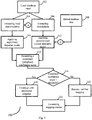
- FIG. 2 is a flow diagram 200 that depicts steps involved in the process of performing data processing using the data mapping system, in accordance with some embodiments of the present disclosure.
- a 'global database' which stores data such as but not limited to different characteristics and actual descriptions of at least 'A' is stored.
- the databases i.e. the global database and the one or more local databases are heterogeneous (i.e. there is no common key between the global and local databases)
- the data mapping system 100 uses the data processing described herein to perform data mapping between the global and local databases.
- the data mapping system 100 extracts (204) local characteristics of one or more products listed in the local database.
- the data mapping system 100 further extracts (206) descriptions of the one or more products listed in the local database.
- the data mapping system 100 also collects the global database (208) corresponding to the local database as input.
- the data mapping system 100 then applies (210) a Supervised Bayesian Model (SBM) on the extracted local characteristics and data from the global database, and generates a first set of probability distribution and a confidence value.
- SBM Supervised Bayesian Model
- UTS Unsupervised Textual Similarity
- the data mapping system 100 then processes the first set of probability distribution and the confidence value and the second set of probability distribution and the confidence value (an ensemble of the first and second set) to generate a combined confidence score.
- the combined confidence score represents extent of similarity between the data in the local database and that in the global database.
- the data mapping system 100 compares (216) the combined confidence score with a threshold score (referred to as 'threshold value').
- 'threshold value' a threshold score
- the combined confidence score exceeding the threshold value indicates higher accuracy in mapping, and in that case, the data mapping system 100 continues with (218) the automated mapping as explained in the aforementioned steps.
- the combined confidence score being less than the threshold value indicates that the accuracy of the automated mapping performed by the data mapping system 100 is less, and in that case, the data mapping system 100 performs (220) a verified mapping, wherein a user intervention maybe prompted during the mapping process. By performing one of the automated mapping and/or the verified mapping, the data mapping system 100 generates (222) mapping results.
- the data mapping system 100 can be used to fuse the global and local databases.
- the data mapping system 100 takes into consideration, a weighted ensemble of probability distribution from the SBM and UST models, as an input for fusion of the local and global databases.
- the embodiments of present disclosure herein addresses unresolved problem of data mapping.
- the embodiment thus provides mechanism to compare data sources which do not possess a joint key.
- the embodiments herein further provides a mechanism for fusion of data sources without a joint key, and which contain heterogeneous data.
- the hardware device can be any kind of device which can be programmed including e.g. any kind of computer like a server or a personal computer, or the like, or any combination thereof.
- the device may also include means which could be e.g. hardware means like e.g. an application-specific integrated circuit (ASIC), a field-programmable gate array (FPGA), or a combination of hardware and software means, e.g.
- ASIC application-specific integrated circuit
- FPGA field-programmable gate array
- the means can include both hardware means and software means.
- the method embodiments described herein could be implemented in hardware and software.
- the device may also include software means.
- the embodiments may be implemented on different hardware devices, e.g. using a plurality of CPUs.
- the embodiments herein can comprise hardware and software elements.
- the embodiments that are implemented in software include but are not limited to, firmware, resident software, microcode, etc.
- the functions performed by various modules described herein may be implemented in other modules or combinations of other modules.
- a computer-usable or computer readable medium can be any apparatus that can comprise, store, communicate, propagate, or transport the program for use by or in connection with the instruction execution system, apparatus, or device.
- a computer-readable storage medium refers to any type of physical memory on which information or data readable by a processor may be stored.
- a computer-readable storage medium may store instructions for execution by one or more processors, including instructions for causing the processor(s) to perform steps or stages consistent with the embodiments described herein.
- the term "computer-readable medium” should be understood to include tangible items and exclude carrier waves and transient signals, i.e., be non-transitory. Examples include random access memory (RAM), read-only memory (ROM), volatile memory, nonvolatile memory, hard drives, CD ROMs, DVDs, flash drives, disks, and any other known physical storage media.
Landscapes
- Engineering & Computer Science (AREA)
- Theoretical Computer Science (AREA)
- Physics & Mathematics (AREA)
- General Physics & Mathematics (AREA)
- Databases & Information Systems (AREA)
- Data Mining & Analysis (AREA)
- General Engineering & Computer Science (AREA)
- Software Systems (AREA)
- Computational Mathematics (AREA)
- Artificial Intelligence (AREA)
- Mathematical Optimization (AREA)
- Pure & Applied Mathematics (AREA)
- Computing Systems (AREA)
- Evolutionary Computation (AREA)
- Mathematical Physics (AREA)
- Mathematical Analysis (AREA)
- Quality & Reliability (AREA)
- Computational Linguistics (AREA)
- Probability & Statistics with Applications (AREA)
- Algebra (AREA)
- Information Retrieval, Db Structures And Fs Structures Therefor (AREA)
- Condensed Matter Physics & Semiconductors (AREA)
Applications Claiming Priority (1)
| Application Number | Priority Date | Filing Date | Title |
|---|---|---|---|
| IN201721008321 | 2017-03-09 |
Publications (1)
| Publication Number | Publication Date |
|---|---|
| EP3373166A1 true EP3373166A1 (fr) | 2018-09-12 |
Family
ID=61827469
Family Applications (1)
| Application Number | Title | Priority Date | Filing Date |
|---|---|---|---|
| EP18160957.9A Withdrawn EP3373166A1 (fr) | 2017-03-09 | 2018-03-09 | Procede et systeme de mappage d'attributs d'entités |
Country Status (7)
| Country | Link |
|---|---|
| US (1) | US10769157B2 (fr) |
| EP (1) | EP3373166A1 (fr) |
| JP (1) | JP2018170008A (fr) |
| AU (1) | AU2018201708A1 (fr) |
| BR (1) | BR102018004797A2 (fr) |
| CA (1) | CA2997888A1 (fr) |
| MX (1) | MX391785B (fr) |
Cited By (1)
| Publication number | Priority date | Publication date | Assignee | Title |
|---|---|---|---|---|
| US12461948B2 (en) | 2022-09-23 | 2025-11-04 | Here Global B.V. | Method, apparatus, and computer program product for map data conflation |
Families Citing this family (4)
| Publication number | Priority date | Publication date | Assignee | Title |
|---|---|---|---|---|
| CN111105435B (zh) * | 2018-10-25 | 2023-09-29 | 北京嘀嘀无限科技发展有限公司 | 标志物匹配方法、装置及终端设备 |
| CN110134965B (zh) * | 2019-05-21 | 2023-08-18 | 北京百度网讯科技有限公司 | 用于信息处理的方法、装置、设备和计算机可读存储介质 |
| CN112035561A (zh) * | 2020-07-22 | 2020-12-04 | 大箴(杭州)科技有限公司 | 数据处理方法、装置、存储介质及计算机设备 |
| US12307416B2 (en) * | 2022-01-31 | 2025-05-20 | Walmart Apollo, Llc | Methods and apparatus for automatic item mapping using machine learning processes |
Citations (1)
| Publication number | Priority date | Publication date | Assignee | Title |
|---|---|---|---|---|
| WO2014012576A1 (fr) * | 2012-07-16 | 2014-01-23 | Qatar Foundation | Procédé et système d'intégration de données dans une base de données |
Family Cites Families (7)
| Publication number | Priority date | Publication date | Assignee | Title |
|---|---|---|---|---|
| JP2003271656A (ja) * | 2002-03-19 | 2003-09-26 | Fujitsu Ltd | 関係付候補生成装置,関係付候補生成方法,関係付システム,関係付候補生成プログラムおよび同プログラムを記録したコンピュータ読取可能な記録媒体 |
| JP5241370B2 (ja) * | 2008-08-01 | 2013-07-17 | 三菱電機株式会社 | テーブル分類装置、テーブル分類方法及びテーブル分類プログラム |
| JP5515784B2 (ja) * | 2010-01-27 | 2014-06-11 | 富士通株式会社 | 類似度算出プログラムおよび類似度算出装置 |
| US9916538B2 (en) * | 2012-09-15 | 2018-03-13 | Z Advanced Computing, Inc. | Method and system for feature detection |
| JP5840110B2 (ja) * | 2012-11-05 | 2016-01-06 | 三菱電機株式会社 | 同一項目検出装置及びプログラム |
| US10467924B2 (en) * | 2013-09-20 | 2019-11-05 | Western Michigan University Research Foundation | Behavioral intelligence framework, content management system, and tool for constructing same |
| GB2536898A (en) * | 2015-03-30 | 2016-10-05 | Fujitsu Ltd | Reconciliation processing system, method, and program |
-
2018
- 2018-03-09 CA CA2997888A patent/CA2997888A1/fr active Pending
- 2018-03-09 EP EP18160957.9A patent/EP3373166A1/fr not_active Withdrawn
- 2018-03-09 JP JP2018043240A patent/JP2018170008A/ja active Pending
- 2018-03-09 MX MX2018002973A patent/MX391785B/es unknown
- 2018-03-09 BR BR102018004797-3A patent/BR102018004797A2/pt not_active Application Discontinuation
- 2018-03-09 AU AU2018201708A patent/AU2018201708A1/en not_active Abandoned
- 2018-03-13 US US15/920,094 patent/US10769157B2/en active Active
Patent Citations (1)
| Publication number | Priority date | Publication date | Assignee | Title |
|---|---|---|---|---|
| WO2014012576A1 (fr) * | 2012-07-16 | 2014-01-23 | Qatar Foundation | Procédé et système d'intégration de données dans une base de données |
Non-Patent Citations (3)
| Title |
|---|
| KARAMJIT SINGH ET AL: "Minimally-Supervised Attribute Fusion for Data Lakes", ARXIV.ORG, CORNELL UNIVERSITY LIBRARY, 201 OLIN LIBRARY CORNELL UNIVERSITY ITHACA, NY 14853, 4 January 2017 (2017-01-04), XP080739566 * |
| SINGH KARAMJIT ET AL: "Automated Product-Attribute Mapping", 7 October 2017, ECCV 2016 CONFERENCE; [LECTURE NOTES IN COMPUTER SCIENCE; LECT.NOTES COMPUTER], SPRINGER INTERNATIONAL PUBLISHING, CHAM, PAGE(S) 163 - 175, ISBN: 978-3-319-69952-3, ISSN: 0302-9743, XP047449379 * |
| YADAV SURYA ET AL: "Business data fusion", 2015 18TH INTERNATIONAL CONFERENCE ON INFORMATION FUSION (FUSION), ISIF, 6 July 2015 (2015-07-06), pages 1876 - 1885, XP033204864 * |
Cited By (1)
| Publication number | Priority date | Publication date | Assignee | Title |
|---|---|---|---|---|
| US12461948B2 (en) | 2022-09-23 | 2025-11-04 | Here Global B.V. | Method, apparatus, and computer program product for map data conflation |
Also Published As
| Publication number | Publication date |
|---|---|
| BR102018004797A2 (pt) | 2019-02-19 |
| US20180260396A1 (en) | 2018-09-13 |
| JP2018170008A (ja) | 2018-11-01 |
| AU2018201708A1 (en) | 2018-09-27 |
| US10769157B2 (en) | 2020-09-08 |
| CA2997888A1 (fr) | 2018-09-09 |
| MX391785B (es) | 2025-03-21 |
| MX2018002973A (es) | 2019-04-09 |
Similar Documents
| Publication | Publication Date | Title |
|---|---|---|
| AU2019236757B2 (en) | Self-Service Classification System | |
| CN110956224B (zh) | 评估模型生成、评估数据处理方法、装置、设备及介质 | |
| Tama et al. | An empirical comparison of classification techniques for next event prediction using business process event logs | |
| EP3373166A1 (fr) | Procede et systeme de mappage d'attributs d'entités | |
| US11461368B2 (en) | Recommending analytic tasks based on similarity of datasets | |
| US20250190459A1 (en) | Systems and methods for development, assessment, and/or monitoring of a generative ai system | |
| CN113792163B (zh) | 多媒体推荐方法、装置、电子设备及存储介质 | |
| Kim et al. | A generalised uncertain decision tree for defect classification of multiple wafer maps | |
| CN113392920B (zh) | 生成作弊预测模型的方法、装置、设备、介质及程序产品 | |
| Gallastegui et al. | Applying advanced sentiment analysis for strategic marketing insights: A case study of BBVA using machine learning techniques | |
| US20230281252A1 (en) | Systems and methods for machine learning-enhanced pairing of user search stimuli-to-online digital profile data | |
| Malini et al. | Opinion mining on movie reviews | |
| Saadallah | Online explainable model selection for time series forecasting | |
| Carvalho et al. | Using political party affiliation data to measure civil servants' risk of corruption | |
| US10606951B2 (en) | Optimizing resource allocation to a bid request response based on cognitive analysis of natural language documentation | |
| CN116955560B (zh) | 基于思考链和知识图谱的数据处理方法及系统 | |
| US12273356B2 (en) | Systems and methods for digital threat assessment and mitigation using t-digest score distribution representations and percentile-based threat scoring in a digital threat mitigation platform | |
| CN117668259B (zh) | 基于知识图谱的内外规数据联动分析方法及装置 | |
| CN115345687A (zh) | 一种跨网站商品对齐方法及装置 | |
| EP4307173A1 (fr) | Procédé et système de recommandation d'une combinaison optimale de circuits quantiques | |
| Zain et al. | Customer sentiment analysis through social media feedback: a case study on telecommunication company | |
| CN115660695A (zh) | 客服人员标签画像构建方法、装置、电子设备及存储介质 | |
| US11087085B2 (en) | Method and system for inferential data mining | |
| da Silva et al. | Customer churn prediction in e-commerce base using machine learning and LIME algorithm | |
| Subardjo et al. | Disocial media synchronization model: In association with developing small medium enterprise’s sales information system |
Legal Events
| Date | Code | Title | Description |
|---|---|---|---|
| PUAI | Public reference made under article 153(3) epc to a published international application that has entered the european phase |
Free format text: ORIGINAL CODE: 0009012 |
|
| STAA | Information on the status of an ep patent application or granted ep patent |
Free format text: STATUS: THE APPLICATION HAS BEEN PUBLISHED |
|
| AK | Designated contracting states |
Kind code of ref document: A1 Designated state(s): AL AT BE BG CH CY CZ DE DK EE ES FI FR GB GR HR HU IE IS IT LI LT LU LV MC MK MT NL NO PL PT RO RS SE SI SK SM TR |
|
| AX | Request for extension of the european patent |
Extension state: BA ME |
|
| STAA | Information on the status of an ep patent application or granted ep patent |
Free format text: STATUS: REQUEST FOR EXAMINATION WAS MADE |
|
| 17P | Request for examination filed |
Effective date: 20190312 |
|
| RBV | Designated contracting states (corrected) |
Designated state(s): AL AT BE BG CH CY CZ DE DK EE ES FI FR GB GR HR HU IE IS IT LI LT LU LV MC MK MT NL NO PL PT RO RS SE SI SK SM TR |
|
| STAA | Information on the status of an ep patent application or granted ep patent |
Free format text: STATUS: EXAMINATION IS IN PROGRESS |
|
| 17Q | First examination report despatched |
Effective date: 20210331 |
|
| STAA | Information on the status of an ep patent application or granted ep patent |
Free format text: STATUS: THE APPLICATION HAS BEEN WITHDRAWN |
|
| 18W | Application withdrawn |
Effective date: 20220328 |