EP3373202A1 - Procédé et système de vérification - Google Patents
Procédé et système de vérification Download PDFInfo
- Publication number
- EP3373202A1 EP3373202A1 EP18160570.0A EP18160570A EP3373202A1 EP 3373202 A1 EP3373202 A1 EP 3373202A1 EP 18160570 A EP18160570 A EP 18160570A EP 3373202 A1 EP3373202 A1 EP 3373202A1
- Authority
- EP
- European Patent Office
- Prior art keywords
- stimulus
- face
- movement
- human face
- model
- Prior art date
- Legal status (The legal status is an assumption and is not a legal conclusion. Google has not performed a legal analysis and makes no representation as to the accuracy of the status listed.)
- Granted
Links
Images






Classifications
-
- G—PHYSICS
- G06—COMPUTING OR CALCULATING; COUNTING
- G06V—IMAGE OR VIDEO RECOGNITION OR UNDERSTANDING
- G06V40/00—Recognition of biometric, human-related or animal-related patterns in image or video data
- G06V40/40—Spoof detection, e.g. liveness detection
- G06V40/45—Detection of the body part being alive
-
- G—PHYSICS
- G06—COMPUTING OR CALCULATING; COUNTING
- G06V—IMAGE OR VIDEO RECOGNITION OR UNDERSTANDING
- G06V40/00—Recognition of biometric, human-related or animal-related patterns in image or video data
- G06V40/10—Human or animal bodies, e.g. vehicle occupants or pedestrians; Body parts, e.g. hands
- G06V40/18—Eye characteristics, e.g. of the iris
-
- G—PHYSICS
- G06—COMPUTING OR CALCULATING; COUNTING
- G06T—IMAGE DATA PROCESSING OR GENERATION, IN GENERAL
- G06T7/00—Image analysis
- G06T7/20—Analysis of motion
- G06T7/246—Analysis of motion using feature-based methods, e.g. the tracking of corners or segments
- G06T7/251—Analysis of motion using feature-based methods, e.g. the tracking of corners or segments involving models
-
- G—PHYSICS
- G06—COMPUTING OR CALCULATING; COUNTING
- G06V—IMAGE OR VIDEO RECOGNITION OR UNDERSTANDING
- G06V40/00—Recognition of biometric, human-related or animal-related patterns in image or video data
- G06V40/10—Human or animal bodies, e.g. vehicle occupants or pedestrians; Body parts, e.g. hands
- G06V40/16—Human faces, e.g. facial parts, sketches or expressions
-
- G—PHYSICS
- G06—COMPUTING OR CALCULATING; COUNTING
- G06V—IMAGE OR VIDEO RECOGNITION OR UNDERSTANDING
- G06V40/00—Recognition of biometric, human-related or animal-related patterns in image or video data
- G06V40/10—Human or animal bodies, e.g. vehicle occupants or pedestrians; Body parts, e.g. hands
- G06V40/16—Human faces, e.g. facial parts, sketches or expressions
- G06V40/161—Detection; Localisation; Normalisation
-
- G—PHYSICS
- G06—COMPUTING OR CALCULATING; COUNTING
- G06V—IMAGE OR VIDEO RECOGNITION OR UNDERSTANDING
- G06V40/00—Recognition of biometric, human-related or animal-related patterns in image or video data
- G06V40/10—Human or animal bodies, e.g. vehicle occupants or pedestrians; Body parts, e.g. hands
- G06V40/16—Human faces, e.g. facial parts, sketches or expressions
- G06V40/161—Detection; Localisation; Normalisation
- G06V40/167—Detection; Localisation; Normalisation using comparisons between temporally consecutive images
-
- G—PHYSICS
- G06—COMPUTING OR CALCULATING; COUNTING
- G06V—IMAGE OR VIDEO RECOGNITION OR UNDERSTANDING
- G06V40/00—Recognition of biometric, human-related or animal-related patterns in image or video data
- G06V40/10—Human or animal bodies, e.g. vehicle occupants or pedestrians; Body parts, e.g. hands
- G06V40/16—Human faces, e.g. facial parts, sketches or expressions
- G06V40/174—Facial expression recognition
-
- G—PHYSICS
- G06—COMPUTING OR CALCULATING; COUNTING
- G06V—IMAGE OR VIDEO RECOGNITION OR UNDERSTANDING
- G06V40/00—Recognition of biometric, human-related or animal-related patterns in image or video data
- G06V40/10—Human or animal bodies, e.g. vehicle occupants or pedestrians; Body parts, e.g. hands
- G06V40/16—Human faces, e.g. facial parts, sketches or expressions
- G06V40/174—Facial expression recognition
- G06V40/176—Dynamic expression
-
- G—PHYSICS
- G06—COMPUTING OR CALCULATING; COUNTING
- G06T—IMAGE DATA PROCESSING OR GENERATION, IN GENERAL
- G06T2207/00—Indexing scheme for image analysis or image enhancement
- G06T2207/10—Image acquisition modality
- G06T2207/10004—Still image; Photographic image
-
- G—PHYSICS
- G06—COMPUTING OR CALCULATING; COUNTING
- G06T—IMAGE DATA PROCESSING OR GENERATION, IN GENERAL
- G06T2207/00—Indexing scheme for image analysis or image enhancement
- G06T2207/20—Special algorithmic details
- G06T2207/20081—Training; Learning
-
- G—PHYSICS
- G06—COMPUTING OR CALCULATING; COUNTING
- G06T—IMAGE DATA PROCESSING OR GENERATION, IN GENERAL
- G06T2207/00—Indexing scheme for image analysis or image enhancement
- G06T2207/30—Subject of image; Context of image processing
- G06T2207/30196—Human being; Person
- G06T2207/30201—Face
-
- G—PHYSICS
- G06—COMPUTING OR CALCULATING; COUNTING
- G06T—IMAGE DATA PROCESSING OR GENERATION, IN GENERAL
- G06T2207/00—Indexing scheme for image analysis or image enhancement
- G06T2207/30—Subject of image; Context of image processing
- G06T2207/30204—Marker
Definitions
- the present invention relates to a method of verifying that (or determining whether) a live human face is present. More particularly, the present invention relates to a method of verifying that (or determining whether) a live human face is present for use as part of a facial recognition system and/or method.
- the invention extends to a corresponding apparatus and system.
- Facial recognition also called face detection and verification
- Facial recognition systems are used in a variety of applications (including surveillance, biometric identification, biometric authentication or access control, gaming and virtual reality, and driver monitoring systems) as a way of verifying the identity of a user.
- Facial recognition systems typically involve enrolling an authorised user's face in a database, and, at a later time, automatically matching the authorised user's face presented to the system against one or more entries in the database based on a calculated index of similarity.
- Such systems may be vulnerable to 'spoof' or 'presentation' attacks, in which an attacker claims an authorised user's identity by presenting a falsified face of the authorised user to the system, for example by use of a mask, a photograph, a video, or a virtual reality representation of the authorised user's face. This may mean that otherwise accurate facial recognition systems suffer from security risks.
- a method of determining whether a live human face is present comprising: generating a stimulus; predicting, using a model, human face movement in response to said generated stimulus; presenting the stimulus to a face of a person; tracking a movement of the face in response to the stimulus using a camera; and determining whether a live human face is present by comparing the movement of the face against said prediction.
- a dynamic method i.e. that is not based on pre-determined scenarios, which may provide improved security.
- the model represents live human face movement in response to any generated and/or presented stimulus, optionally such that the model is a general model.
- the stimulus may be generated based on a varying parameter.
- the method may then comprise the further step of generating the varying parameter in dependence on one or more dynamic properties, which are preferably properties of a user device adapted to implement the method. At least one of the properties is preferably clock time, wherein the properties may further comprise one or more of: location; orientation; rotation; and acceleration.
- the varying parameter and/or the stimulus itself may be generated on the fly.
- the varying parameter comprises a random element.
- the stimulus is preferably a visual stimulus, which may be presented via a display, preferably a screen.
- the stimulus may be a (preferably continuously) moving stimulus, wherein the stimulus may move along a path which is generated in dependence on the varying parameter.
- the starting location and/or ending location of the path, as well as the the colour, luminance and/or orientation of the stimulus itself, may be generated in dependence on the varying parameter.
- the stimulus may vary in size.
- Tracking a movement of the face may comprise determining a location of a gaze on the screen; and tracking a movement of the location of the gaze.
- the model relates to a predicted correspondence distance and/or direction between a location of a gaze and a location of any stimulus at a particular time.
- calculating the correspondence distance and/or direction is performed at the same time as presenting the stimulus to the face.
- the stimulus may comprise a request that one or more particular expressions are performed.
- the model may then represent live human face movement during the performance of one or more particular expressions.
- a method of determining whether a live human face is present comprising: presenting a stimulus to a face of a person; the stimulus comprising a request that one or more particular expressions are performed; tracking a movement of the face in response to the stimulus using a camera; and determining whether a live human face is present by comparing the movement of the face against a model of live human face movement, wherein the model represents live human face movement in performing the one or more particular expressions.
- the model represents live human face movement of a particular person.
- the model may relate to a reference vector of a movement of one or more facial landmarks during the performance of the one or more particular expressions, optionally wherein tracking a movement of the face comprises determining a vector of a movement of one or more facial landmarks.
- the stimulus may comprise a request that one or more particular words are spoken or mouthed.
- the model optionally represents live human face movement in speaking or mouthing the one or more particular words.
- a method of determining whether a live human face is present comprising: presenting a stimulus to a face of a person; the stimulus comprising a request that one or more particular words are spoken or mouthed; tracking a movement of the face in response to the stimulus using a camera; and determining whether a live human face is present by comparing the movement of the face against a model of live human face movement, wherein the model represents live human face movement in speaking or mouthing the one or more particular words.
- the model may relate to live human lip movement, wherein tracking a movement of the face may comprise capturing visual data relating to a movement of the lips.
- the request is optionally formed as a question, wherein the one or more particular words are a possible answer to the question.
- the method may further comprise any or all of the steps of: receiving audio data related to the person's response to the stimulus using a microphone; performing speech-to-text analysis on the audio data; and comparing text of the audio data against a database of text related to the one or more particular words.
- the stimulus comprises an interactive object.
- the stimulus may optionally form part of a game.
- a method of determining whether a live human face is present comprising: presenting a stimulus forming part of a game to a face of a person; the stimulus comprising an interactive object; tracking a movement of the face in response to the stimulus using a camera; and determining whether a live human face is present by comparing the movement of the face against a model of live human face movement, wherein the model represents live human face movement in interacting with the interactive object.
- the game is optionally an augmented reality game, and the model optionally relates to the achievement of one or more objectives of the game.
- Determining whether a live human face is present may comprise determining whether the movement of the face is indicative of an interaction with the interactive object that causes one or more objectives of the game to be achieved.
- the model comprises historic data, for example historic data related to the face to which the stimulus is presented.
- the method further comprises collecting data related to the movement of the face for use in the model. Determining whether a live human face is present may comprise comparing the movement of the face against a threshold based on the model.
- the model is preferably a trained classifier, for example where the model includes a convolutional neural network.
- data related to the movement of the face is transmitted for remote processing.
- the method may comprise the further step of determining whether a live human face is present by determining whether the visual data indicates the presence of a three dimensional face.
- a method of determining whether a live human face is present comprising: using a camera, capturing visual data of a movement of a face relative to the camera; and determining whether a live human face is present by determining whether the visual data indicates the presence of a three dimensional face.
- the stimulus is presented to a face of a person.
- the stimulus may comprise a request that the camera and/or the face are moved, and/or a request that the camera and/or face are moved into a position for the camera to take a picture of the face.
- the movement may comprise a rotation of the camera and a rotation of the face, wherein the camera and the face may rotate so as to face each other.
- the movement may comprise an increase in distance between the camera and the face.
- Frames of the visual data may be sampled, where the sampled frames may comprise a frame relating to an initial position of the face; a frame relating to a final position of the face; and one or more frames relating to a transitory position of the face.
- Determining whether a live human face is present may comprise attempting to construct a three dimensional image using the sampled frames.
- attempting to construct a three dimensional image using the sampled frames further comprises receiving data from sensors of the or a user device adapted to implement the method, where such sensor data optionally relates to the orientation and/or position of the device.
- Visual data may be received using a camera of the user device adapted to implement the method.
- the user device is optionally calibrated using further sensors of the user device.
- a compensation may optionally be applied to the visual data, where the compensation is dependent on the user device.
- the user device may be one of: a smartphone; a laptop computer; a desktop computer; or a tablet computer.
- a method of verifying the identity of a user comprising performing a method as described herein; and verifying the identity of the user by comparing biometric information of the user (which optionally comprises the appearance of a user's face) against a database of biometric information of verified users.
- a system for determining whether a live human face is present comprising: means for displaying a stimulus; a camera for capturing visual data of a face; means for storing a model of live human face movement; and a processor adapted to execute a computer program product comprising software code adapted to carry out the method.
- apparatus for determining whether a live human face is present comprising: a module adapted to generate a stimulus; a module adapted to predict, using a model, human face movement in response to said generated stimulus; a module adapted to present a stimulus to a face of a person; a module adapted to track a movement of the face in response to the stimulus; and a module adapted to determine whether a live human face is present by comparing the movement of the face against said prediction.
- apparatus for determining whether a live human face is present comprising: a module adapted to present a stimulus to a face of a person, optionally wherein the stimulus comprises one or more of: a request that one or more particular expressions are performed; and a request that one or more particular words are spoken or mouthed; a module adapted to track a movement of the face in response to the stimulus; and a module adapted to determine whether a live human face is present by comparing the movement of the face against a model of live human face movement, wherein the model represents one or more of: live human face movement in response to any stimulus; live human face movement in performing the one or more particular expressions; and live human face movement in speaking or mouthing the one or more particular words.
- the apparatus may optionally further comprise a screen for displaying the stimulus and/or a data store for storing a model of live human face movement.
- apparatus for determining whether a live human face is present comprising: a module adapted to capture visual data of a movement of a face; and a module adapted to determine whether a live human face is present by determining whether the visual data indicates the presence of a three dimensional face.
- the apparatus may optionally further comprise a camera for capturing visual data of a face.
- the apparatus may be in the form of one or more of: smartphone; a laptop computer; a desktop computer; or a tablet computer; an automated passport control gate; and an entry system.
- a system for determining whether a live human face is present comprising: a user device, comprising: a module adapted to generate a stimulus; a module adapted to present a stimulus to a face of a person; a module adapted to track a movement of the face in response to the stimulus; and a remote prediction module adapted to predict, using a model, human face movement in response to said generated stimulus; a remote determination module adapted to determine whether a live human face is present by comparing the movement of the face against said prediction.
- a system for determining whether a live human face is present comprising: a user device, comprising: a module adapted to present a stimulus to a face of a person via a screen, optionally wherein the stimulus comprises one or more of: a request that one or more particular expressions are performed; and a request that one or more particular words are spoken or mouthed; a module adapted to track a movement of the face in response to the stimulus via a camera; and a remote determination module adapted to determine whether a live human face is present by comparing the movement of the face against a model of live human face movement, wherein the model represents one or more of: live human face movement in response to any stimulus; live human face movement in performing the one or more particular expressions; and live human face movement in speaking or mouthing the one or more particular words.
- a system for determining whether a live human face is present comprising: a user device, comprising a module adapted to capture visual data of a movement of a face via a camera; and a remote determination module adapted to determine whether a live human face is present by determining whether the visual data indicates the presence of a three dimensional face.
- the invention may provide various approaches to detect the presence of a live human face in front of a facial recognition or enrolment feature.
- Each of the approaches has their own respective advantages or robustness against specific set of attacks.
- the approaches may be combined to provide synergistic advantages.
- the invention also provides a computer program or a computer program product for carrying out any of the methods described herein, and/or for embodying any of the apparatus features described herein, and a computer readable medium having stored thereon a program for carrying out any of the methods described herein and/or for embodying any of the apparatus features described herein.
- the invention also provides a signal embodying a computer program or a computer program product for carrying out any of the methods described herein, and/or for embodying any of the apparatus features described herein, a method of transmitting such a signal, and a computer product having an operating system which supports a computer program for carrying out the methods described herein and/or for embodying any of the apparatus features described herein.
- live human face' preferably connotes an actual face of a living human (i.e. not a recording or any other kind of indirect representation of a face of a living human).
- the term 'location of gaze' or 'point of gaze' preferably connotes a point of regard and/or a location where a user is looking.
- the term 'path' preferably connotes a course or direction in which an object moves in any way, including by translation, rotation, reflection, changing in size, or as a result of any other geometric transformation.
- the term 'stimulus' preferably connotes a visual object or image and a path which the object or image follows.
- the term 'face' preferably connotes a human face which includes the eyes.
- the term 'face' is to be preferably understood to be interchangeable with the term 'head'.
- 'eyes' preferably connotes any periocular part of the human anatomy. Any reference to 'eyes' in the plural sense preferably also connotes a singular 'eye', and vice versa.
- any reference to 'movement of a face' in the context of a camera preferably connotes both movement of a face relative to a camera and movement of a camera relative to a face.
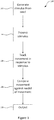
- Figure 1 is a flowchart which illustrates the main steps of a method 100 for determining whether a live human face is present, which may find particular use as an initial stage in facial recognition systems in order to defend such systems against presentation attacks.
- the method 100 is arranged to be implemented on a portable user device, such as a smartphone (or alternatively a tablet or laptop computer), although it will be appreciated that other implementations are of course possible.
- a visual stimulus is dynamically generated based on a varying parameter (or 'seed').
- a user of the user device and/or a face (or an object purporting to be a face) presented to the user device is presented with the stimulus on a screen of the user device.
- a movement of the user's face is tracked in response to the stimulus using visual data captured via a camera of the user device.
- typical user devices include a front-mounted camera (i.e. a camera arranged to face in the same direction as the screen), which may allow for the convenient acquisition of such visual data.
- a live human face is verified by comparing the tracked movement of the user's face against a pre-determined model of live human face movement, which is used to predict human face movement in response to the stimulus. If the tracked movement is determined to be sufficiently similar to the model of face movement, this indicates that a live human face is present. Tracking face movement in such a manner may allow a facial recognition system incorporating the method 100 to overcome presentation attacks, in particular those based on images or videos. An output 110 may then be produced, which may take the form of a message indicating that a real human face has been verified or has not been verified.
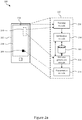
- the apparatus 200 is in the form of a user device 202 having a screen 204.
- An exemplary stimulus 206 is shown on the screen.
- the user device further includes a camera 208 for capturing visual data of the user's face.
- a schematic overview of the system memory or software architecture 250 of the user device 202 adapted to implement the method 100 is also shown. As illustrated, this includes a stimulus generation module 252 (configured to carry out the first step 102 of the method 100), a presentation module 254 (configured to carry out the second step 104 of the method 100), a tracking module 256 (configured to carry out the third step 106 of the method 100), a verification module (configured to carry out the fourth step 108 of the method 100), and a data store 260.
- the stimulus generation module 252 is arranged to generate the stimulus 206, which is presented on the screen 204 by the presentation module 254.
- the tracking module 256 then receives visual data from the camera relating to a movement of the user's face in response to the stimulus.
- the visual data is then compared against a model stored in the data store 260 by the verification module 258.
- the stimulus generation module is also connectable to the verification module and/or the data store so as to allow details of the stimulus to be used as an input to the model.
- sensors 210 of the user device which, as will be described in more data later on, provide inputs for the stimulus generation module 252 (for use as part of the varying parameter) and to the tracking module 256 (for use in calibration and/or pre-processing).
- the method 100 relates to tracking a user's gaze in relation to a stimulus.
- a user's viewpoint 214 and the corresponding location 212 of the user's gaze on the screen are shown schematically in Figure 2b .
- the stimulus 206 is generated dynamically (i.e. the stimulus is generated immediately before it is presented to the user - this may be referred to as 'generation on the fly'), which provides for added security (as opposed to using one of a number of predetermined stimuli, for example).
- the stimulus is configured to be visually salient to users (i.e. sufficiently different from its surroundings so as to attract a user's visual attention), causing a user's gaze to move towards the stimulus.
- the stimulus and the background on which the stimulus is provided are configured so that the stimulus stands out. This may be achieved, for example, by configuring the contrast between the stimulus and the background, the colour and luminescence of the stimulus and background, and the form, shape, and size of the stimulus accordingly.
- the stimulus 206 is arranged to move with respect to time along a path, which is generated (along with the overall shape and appearance of the stimulus) based on the varying parameter.
- the start location, end location, and the overall direction of the path are separate properties of the stimulus which are generated based on the varying parameter.
- the stimulus 206 moves at a sufficient speed such that a user's gaze can easily follow the stimulus while not overlapping the stimulus. Provided that the user continues to follow the moving stimulus with their gaze, the user's gaze will move along the same or a similar path to the stimulus while lagging behind the stimulus, as shown in the figure. As such, a distance c, referred to as the 'correspondence distance' separates the stimulus 206 and the user's gaze location 212 at any particular time while the stimulus is moving and the user is following the stimulus with their gaze.
- the fourth step 108 of the method 100 is implemented by receiving information relating to the location of the stimulus 206 on the screen 204 and the user's gaze location 212 on the screen 204 and, in an first step 302, calculating the correspondence distance c based on the location of the stimulus 206 on the screen 204 and the user's gaze location 212 on the screen 204, which is determined using visual data from the camera 208.
- the location of the stimulus 206 may be determined from data relating to the path of the stimulus at a particular time, which may be saved into a database when the stimulus is generated.
- the user's gaze location 212 on the screen 204 may be determined using the tracking module 256, which may use an eye-tracking software package such as PyGaze.
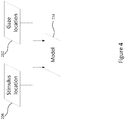
- a model 214 of live human face movement is a generic model of human face movement in response to any stimulus that could be generated and/or presented as part of the method 100. More particularly, the model is a model of gaze location relative to stimulus location at a particular time.
- the model 214 is a trained classifier based on a machine learning algorithm such as a convolutional neural network, which is trained based on historic data. The model 214 provides a prediction of the correspondence distance c for the particular properties of the generated stimulus 206 at a particular time.
- certain properties of the stimulus 206, an identifier of the stimulus, and/or the stimulus itself are, in use, used as an input to the model, which allows the model to produce a prediction that relates to the particular stimulus used.
- the location of the stimulus is provided to the model at the same time as it is presented to the user, allowing a 'live' prediction to be produced.
- the measured correspondence distance approximates the predicted correspondence within pre-determined confidence thresholds over a pre-determined time period, this indicates that a real user is genuinely following the stimulus with their gaze. As such, it can be determined that a real human face is present, which may be indicated as a positive output 306 in the output step 110.
- the confidence threshold is the 95 th percentile of data available from the model.
- the measured correspondence distance does not approximate the predicted correspondence distance within pre-determined confidence thresholds over a pre-determined time period, in particular in the case where the measured correspondence distance is much greater than the predicted correspondence data, this may indicate that a presentation attack is in progress.
- it may be possible to track a 'gaze' location and/or movement based on a falsified representation of a face that is presented to the user device, but such a falsified representation is either not able to follow the stimulus at all (in the case of an attack using an image or video) or is unable to follow the stimulus in a human-like way (in the case of a more sophisticated attack).
- a real human face is not present, which may be indicated as a negative output 308 in the output step 110.
- the correspondence distance is measured in real-time (or with a slight delay) as the stimulus is presented to the user, which may allow for more efficient processing as there is a reduced need to save data.
- the pre-determined time period may be the entire time during which the stimulus is presented to the user, where the correspondence distance must approximate the predicted correspondence distance for at least a predetermined portion of the time period in order for a live human face to be verified. The decision on whether a live human face is present may then take place after the stimulus is no longer presented to the user.
- the stimulus 206 moves continuously along the path at a relatively constant speed, which may allow for eye movement relative to a stimulus to be more easily modelled.
- the stimulus may move discontinuously and/or at a varying speed, which may further improve the security of the method 100 (while requiring a more detailed model).
- the model 214 is trained 'offline' using historic or training data relating to stimulus location on a screen and a user's gaze location.
- the model might only relate to correspondence distance, where a stimulus moves constantly at a predetermined speed. This may allow for the presence of a live human face to be verified without reference to the properties of the stimulus.
- Such a model typically assumes that the eye exactly follows a stimulus with a defined time delay, which is dependent on human reaction time and the properties of the user device (in particular, the accuracy of the camera and image processing components of the user device).
- the model may apply a predetermined compensation to training data and/or real data received from the user device, where the compensation is dependent on the processing power of the user device.
- the use of a compensation may allow data received from different user devices to be normalised.
- the model may relate to a correspondence distance in relation to specific properties of stimuli, such as speed, features of a path (such as start location, end location, or direction), and the appearance of the stimulus (for example, the use of stimulus paths involving tight corners may cause the correspondence distance to be reduced when the stimulus is around the corners).
- the stimulus generation module may provide information to the verification module 258.
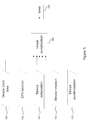
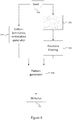
- the stimulus 206 is generated based on a varying parameter (or seed) 506.
- the seed 506 is generated based on a mathematical operation 504 (such as a linear combination) performed on a variety of dynamic properties 502 of the user device, including at least device clock time.
- a mathematical operation 504 such as a linear combination
- the properties 502 may also include those properties which are detectable using sensors of the device, such as location (provided by a satellite navigation system such as GPS), orientation, rotation or other movement, and acceleration.
- Other possible properties include ambient light, ambient sound, atmospheric pressure, ambient temperature, battery temperature, air humidity, and radiation level.
- the seed 506 (which is in the form of a string of digits) may be formed into an array 602 of unstructured data.
- a low pass filter 604 such as a Gaussian filter, is applied to the array 602. This assists in avoiding a disturbing stimulus which the user may find annoying and/or difficult to track.
- the filtered array is then used as an input to a pattern generator 608, which is arranged to perform one or more mathematical operations so as to produce the properties of the path of the stimulus as well as other properties of the stimulus (such as the background and/or any surrounding objects).
- the seed 506 itself is also used as an input to a further generator 606, which is arranged to determine at least the colour, luminance, and orientation of the stimulus.
- the colour, luminance, and orientation of the stimulus are used as inputs into the pattern generator 608, which generates the stimulus partially in dependence on such inputs (for example, the background to the stimulus may be selected so as to ensure that a contrast is provided with respect to the stimulus, increasing visual salience).
- each stimulus generated preferably has at least a unique path (which may be bounded by the screen, for example), while all of its other properties (for example, size, shape, and speed) may be generated from a list of predetermined properties based on the unique seed.
- the stimulus as a whole may be referred to as unique.
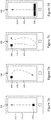
- a basic stimulus is shown, which moves by being translated continuously in one direction.
- the stimulus has a square shape, and is shown in a black colour on a white background.
- more complex stimuli are shown, each having an arcuate path along which the stimulus are translated.
- a bar-shaped stimulus is found, which is translated on a continuous path in one direction.
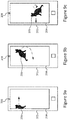
- FIG. 8a-d an example of an alternative stimulus 206 is shown, which moves along a path by increasing and decreasing in size.
- the stimulus 'grows' out of one corner of the screen, before 'shrinking' back into the same corner and disappearing in Figures 8c-d .
- a stimulus may changes in size while also moving by being translated across a screen.
- the stimulus 206 may take the form of an animated character such as a cat, which may 'walk' on from one side of the screen, and follow a path defined by the seed, optionally changing directions or performing animations along the way.
- an animated character such as a cat, which may 'walk' on from one side of the screen, and follow a path defined by the seed, optionally changing directions or performing animations along the way.
- the eye tracking aspects of the method 100 are based on visual data received from the camera 208, which is processed by the user device 200.
- the use of a user device which is typically manually held in a user's hand rather than being mounted statically with respect to a user's face as in many eye tracking applications, may cause the user's face and eyes to be misaligned with respect to the camera. This may lead to errors or inaccuracies in eye tracking.
- a stabilisation system for pre-processing visual data received from the camera in order to improve the accuracy of eye tracking in the method 100.
- information from sensors 1004 of the user device is used in order to obtain information about the position of the camera in relation to the user's face.
- Such information may relate to the properties described in relation to the generation of the seed, and in particular may include the proximity 1004a of the user device to surrounding objects (in particular the user's face), the orientation 1004b of the user device, and any movement 1004c of the user device (including rotation).
- the processor of the user device may pre-process 1006 the data by using the information 1004a, 1004b, 1004c to warp the visual data 1002 into a canonical position (i.e. a position in which the user's eyes are directly aligned with the camera).
- the warped visual data may then be provided to an eye-tracking module 1008.
- the pre-processing may alternatively occur away from the device, for example via a cloud server, where the user device transmits visual data to the server over an internet connection and receives the warped visual data as a response.
- the eye tracking processing may be performed on the user device (at the eye tracking module 1008), or alternatively may be performed on an offline server.
- the stimulus may be arranged to move in various different ways, which the model may take into account in determing whether a live human face in present.
- the stimulus may be arranged to grow or shrink in size at a varying speed and/or at a varying spatial frequency.
- the stimulus may also be arranged to 'blink' (i.e. appear or disappear), for example while moving and/or changing in colour.
- the stimulus may comprise a pattern having a visually salient area or section - for example, the stimulus may comprise a grid of objects, where one of the objects has a different orientation and/or is a different colour.
- Many other implementations of the stimulus are possible which are visually salient and allow the sure to easily (and trackably) follow the stimulus with their gaze.
- a correspondence vector may be used instead of the correspondence distance (i.e. both the magnitude of the correspondence distance and the direction between the gaze location 212 and stimulus location 206 is determined), which may allow for more sophisticated modelling and eye tracking.
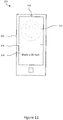
- the method 100 relates to tracking a user's expression in relation to a stimulus.
- the user device 200 is shown with a stimulus 206 presented on the screen 208.
- the stimulus is a written request to the user requesting that the user perform a particular expression (indicated as (X) in the Figure).
- the user's face 216 is also shown on the screen, where visual data relating to the user's face is captured using the camera 208, in order to encourage the user to perform the requested expression.
- the third step 106 of the method 100 is implemented by capturing visual data of the user's face (as the expression is performed, if the user is acting as requested by the stimulus).
- the visual data comprises a plurality of frames 1202 (i.e. N number of frames), which are continually captured for a pre-determined time period sufficient for a user to perform the requested expression.
- the method may include a further step of recognising when the user's movement between frames is reduced, which may indicate that a user has finished performing the expression, in which case the continual capture of frames 1202 is paused or halted.
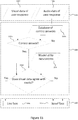
- the fourth step 108 of the method 100 is implemented by receiving information in the form of N frames 1202, in a first step 1204, generating one or more vectors of the movement of one or more facial landmarks which are identified in the frames.
- the facial landmarks are identifiable positions of the face which move as expressions are performed. Facial landmarks may include, for example, the eyelids, the corners of the eyes, eyebrows, the angle of the mouth, and the corners of the mouth, among many other examples.
- the vectors are generated by comparing at least the 0 th frame (i.e.
- a histogram of the vectors is computed. This allows a generalised 'signature vector' 1208 to be generated, which indicates the process of performing the expression for the particular expression and for the particular user.
- a model 214 of live human face movement which is arranged to provide a prediction of human face movement in response to the stimulus.
- the prediction is a reference vector for particular expressions which can be requested, such that each expression has corresponding data in the model.
- the model is a trained classifier. The similarity between the signature vector and the reference vector provided by the model is assessed by computing the Euclidean distance between the signature vector and the reference vector, and comparing the computed distance against a threshold.
- certain properties of the stimulus, the stimulus itself, and/or an identifier of the stimulus are used, in use, as an input to the model, which allows the model to recall (or, alternatively, generate) a particular reference vector that relates to the particular stimulus used.
- an identifier of the expression (rather than the associated stimulus) is used as an input to the model.
- the computed Euclidean distance is below the threshold (which corresponds to a pre-determined confidence threshold)
- a real human face is present, which may be indicated as a positive output 306 in the output step 110.
- a negative output 308 may be indicated in the output step 110, as this indicates that the user has not complied with the request presented in the stimulus, which may indicate that a spoof attack is in progress.
- the model may be arranged to generalise across different expressions, for example by observing a typical movement of a particular facial landmark across many (or any/all) expressions.
- a second step 1310 is performed, in which the captured visual data 1302 is compared against a model 214 of expected face movements.
- the model relates to predicted lip movements that are associated with any particular word or phrase that can be presented as part of the stimulus 206, such that each particular word or phrase has associated data in the model.
- the model is a trained classifier. Data for a particular word or phrase may be referenced by the model by using a corresponding identity of the stimulus (or word or phrase), certain properties of the stimulus, and/or the stimulus itself as one or more inputs to the model, in an analogous manner to that described with reference to models in other aspects.
- the similarity between lip movement in the visual data and the modelled lip data is assessed by comparing the movement of facial landmarks (in particular, those on or around the lips), as previously described If the visual data agrees with the modelled visual data within pre-determined confidence thresholds, this indicates that a real user has responded to the request presented in the stimulus by saying the requested word or phrase. As such, it can be determined that a real human face is present, which may be indicated as a positive output 306 in the output step 110.
- a requested phrase or answer to a question forming part of a stimulus may be generated dynamically as previously described, which may result in a nonsensical (and thus unpredictable) phrase being requested.
- the possible phrases or answers to questions may be bounded so as to produce more easily predictable (and thus more recognisable phrases).
- the possible stimuli may be selected from a list, where the selection is based on a seed, which is generated as previously described.
- the audio data 1304 may not be examined, and the method may use visual data 1302 alone. In such cases, it is sufficient for the user to mouth word or phrases rather than speak them.
- the model is a trained classifier, as previously described, where the certain properties of the stimulus, an identifier of the stimulus, and/or the stimulus itself is used as an input to the model to allow the model to recall data related to the particular stimulus.
- FIG. 14b a scenario in which a spoof face is presented is shown.
- the face does not move relative to the camera and so the game is failed, so a live human face is not detected.
- the stimuli (or stimulus) used are generated dynamically (as previously described), in order to ensure that the same scenario does not recur (or rarely recurs), which mitigates the possibility of an attack being based on a previous scenario.
- the model may then be configured to determining whether a live human face is present irrespective of the stimuli used (i.e. it is a general model).
- the method 100 relates to determining whether a live human face is present by constructing a three dimensional (3D) image. This may assist in overcoming attacks based on two dimensional (2D) representations of faces, such as printed photographs or still image or videos replayed on a display such as on a smartphone, tablet, laptop, TV.
- 3D three dimensional
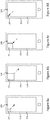
- FIG. 15a the position relative to a user 1500 of a user device 200 having a camera 208 is shown as a user is shown a stimulus requesting that the user take a picture of themselves (referred to as a 'selfie').
- the user is holding the user device in a normal standing reading position (which may be referred to as 'user mode'), in which the user holds the user device in their hand 1502 close towards their body at an upward angle, while the user's head 1504 is angled downwardly to view the user device.
- the user may then be invited to take a selfie via a stimulus shown on the screen 204 of the user device.
- Figure 15c shows the final position of the user device relative to the user (which may be referred to as 'selfie mode'), and Figure 15b shows a transitory state between user mode and selfie mode.
- the described movement of the user device allows a variety of frames of the user's face to be captured in different orientations, while ensuring that the whole face of the user is in frames. It will be appreciated that other requests other than the user being requested to take a selfie are also possible, including a simple request that the user moves the user device away from their face, around the face, or makes any other movement of the device relative to the face (or vice versa).
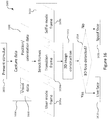
- a second step 1604 data related to the movement is captured by the user device.
- the captured data comprises visual data 1606 (captured via the camera 208) and data 1608 relating to the position and/or orientation of the user device, which is captured via sensors of the user device, such as an internal gyroscope, an accelerometer, and/or a position sensor.
- a 3D image of the user's face is constructed based on the selected frames.
- a wide range of existing tools and/or software packages can be used to calculate the 3D structure of the user's face from the motion, such as Theia.
- a stimulus may not be generated each time the method 100 is used, and one or more of a number of pre-determined template stimuli may be used instead.
- a correspondence vector may be used instead of the correspondence distance, which may allow for more sophisticated modelling and eye tracking.
- the method 100 described methods may be implemented on any kind of portable user device having a screen and a camera, such as a smartphone, a laptop computer, a desktop computer, or a tablet computer.
- the method 100 may be implemented using a static device, such as those that might be included as part of or in association with entry systems, doors, automated passport control gates, or any other kind of system or device (static or otherwise) implementing a facial recognition system.
- Any device or apparatus implementing the described methods method 100 may comprise a NFC reader adapted to read a NFC chip provided as part of an identity-certifying document (such as a passport), which may allow data provided in the NFC chip to be compared to a face of the user that is verified using the method 100 (as well as optionally allowing comparison between the data in the NFC chip and any photograph provided as part of the document).
- an identity-certifying document such as a passport
- movement of other parts of the face other than those described may be may be tracked.
- a movement of the user's brow may be tracked along with the user's eyes.
- the stimulus may be a message on screen inviting the user to perform a particular expression (for example, the message may display 'please smile'), whereupon a movement of part of the user's face in response to the stimulus is tracked and compared against a model to determine whether a live human face is present.
- the stimulus may be non-visual in nature - for example, the user device may play an audio message inviting the user to look in a particular direction.
Landscapes
- Engineering & Computer Science (AREA)
- Theoretical Computer Science (AREA)
- Multimedia (AREA)
- Physics & Mathematics (AREA)
- General Physics & Mathematics (AREA)
- Human Computer Interaction (AREA)
- Health & Medical Sciences (AREA)
- General Health & Medical Sciences (AREA)
- Oral & Maxillofacial Surgery (AREA)
- Ophthalmology & Optometry (AREA)
- Computer Vision & Pattern Recognition (AREA)
- User Interface Of Digital Computer (AREA)
- Image Analysis (AREA)
- Measurement Of The Respiration, Hearing Ability, Form, And Blood Characteristics Of Living Organisms (AREA)
Applications Claiming Priority (1)
| Application Number | Priority Date | Filing Date | Title |
|---|---|---|---|
| GB1703664.1A GB2560340A (en) | 2017-03-07 | 2017-03-07 | Verification method and system |
Publications (3)
| Publication Number | Publication Date |
|---|---|
| EP3373202A1 true EP3373202A1 (fr) | 2018-09-12 |
| EP3373202C0 EP3373202C0 (fr) | 2023-09-06 |
| EP3373202B1 EP3373202B1 (fr) | 2023-09-06 |
Family
ID=58544010
Family Applications (1)
| Application Number | Title | Priority Date | Filing Date |
|---|---|---|---|
| EP18160570.0A Active EP3373202B1 (fr) | 2017-03-07 | 2018-03-07 | Procédé et système de vérification |
Country Status (3)
| Country | Link |
|---|---|
| US (1) | US10853677B2 (fr) |
| EP (1) | EP3373202B1 (fr) |
| GB (1) | GB2560340A (fr) |
Cited By (3)
| Publication number | Priority date | Publication date | Assignee | Title |
|---|---|---|---|---|
| IT201800003102A1 (it) * | 2018-02-27 | 2019-08-27 | Osram Gmbh | Un procedimento per predire una traiettoria e un frustum di vista, corrispondente sistema e prodotto informatico |
| EP3647993A1 (fr) * | 2018-10-29 | 2020-05-06 | Onfido Ltd | Vérification interactive de l'utilisateur |
| EP4128142A4 (fr) * | 2020-03-27 | 2023-04-12 | Nec Corporation | Dispositif et procédé de traitement d'image, et support de stockage |
Families Citing this family (19)
| Publication number | Priority date | Publication date | Assignee | Title |
|---|---|---|---|---|
| IL282574B2 (en) | 2017-09-18 | 2023-10-01 | Element Inc | Methods, systems, and media for detecting spoofing in mobile authentication |
| US11144641B2 (en) * | 2019-02-21 | 2021-10-12 | Next Biometrics Group Asa | Method of detecting replay attacks in a fingerprint sensor system |
| CA3133229C (fr) | 2019-03-12 | 2023-04-04 | Element Inc. | Detection de mystification de reconnaissance faciale avec des dispositifs mobiles |
| JP2020154408A (ja) * | 2019-03-18 | 2020-09-24 | ソニーセミコンダクタソリューションズ株式会社 | 情報処理装置、情報処理方法、及び情報処理システム |
| CN112099725A (zh) * | 2019-06-17 | 2020-12-18 | 华为技术有限公司 | 一种数据处理方法、装置及计算机可读存储介质 |
| CN110473295B (zh) * | 2019-08-07 | 2023-04-25 | 重庆灵翎互娱科技有限公司 | 一种基于三维人脸模型进行美颜处理的方法和设备 |
| US11669607B2 (en) | 2019-08-29 | 2023-06-06 | PXL Vision AG | ID verification with a mobile device |
| US11507248B2 (en) | 2019-12-16 | 2022-11-22 | Element Inc. | Methods, systems, and media for anti-spoofing using eye-tracking |
| US11687778B2 (en) | 2020-01-06 | 2023-06-27 | The Research Foundation For The State University Of New York | Fakecatcher: detection of synthetic portrait videos using biological signals |
| CN111539249A (zh) * | 2020-03-11 | 2020-08-14 | 西安电子科技大学 | 多因子人脸活体检测系统和方法 |
| US11354940B2 (en) | 2020-03-31 | 2022-06-07 | Konica Minolta Business Solutions U.S.A., Inc. | Method and apparatus for foreground geometry and topology based face anti-spoofing |
| CN111914758A (zh) * | 2020-08-04 | 2020-11-10 | 成都奥快科技有限公司 | 一种基于卷积神经网络的人脸活体检测方法及装置 |
| CN112149610A (zh) * | 2020-10-09 | 2020-12-29 | 支付宝(杭州)信息技术有限公司 | 一种目标对象的识别的方法和系统 |
| US11715330B2 (en) * | 2020-12-29 | 2023-08-01 | Nec Corporation Of America | Liveness detection in an interactive video session |
| CN113361349B (zh) * | 2021-05-25 | 2023-08-04 | 北京百度网讯科技有限公司 | 人脸活体检测方法、装置、电子设备和存储介质 |
| US20230222197A1 (en) * | 2022-01-07 | 2023-07-13 | Jumio Corporation | Biometric Authentication Using Head-Mounted Devices |
| US12300035B1 (en) | 2022-03-30 | 2025-05-13 | Amazon Technologies, Inc. | Liveness detection based on motion, face, and context cues |
| US12333863B1 (en) * | 2022-06-27 | 2025-06-17 | Amazon Technologies, Inc. | Liveness detection based on gesture validation, facial expression analysis, and concurrency validation |
| US20240321004A1 (en) * | 2023-03-24 | 2024-09-26 | Konica Minolta Business Solutions U.S.A., Inc. | Method of management of a visitor workflow |
Citations (6)
| Publication number | Priority date | Publication date | Assignee | Title |
|---|---|---|---|---|
| US20120140993A1 (en) * | 2010-12-05 | 2012-06-07 | Unisys Corp. | Secure biometric authentication from an insecure device |
| US20140289834A1 (en) * | 2013-03-22 | 2014-09-25 | Rolf Lindemann | System and method for eye tracking during authentication |
| US8856541B1 (en) * | 2013-01-10 | 2014-10-07 | Google Inc. | Liveness detection |
| WO2014184436A1 (fr) * | 2013-05-17 | 2014-11-20 | Nokia Corporation | Procédé et appareil de reconnaissance d'utilisateur en direct |
| US20170024608A1 (en) * | 2015-07-20 | 2017-01-26 | International Business Machines Corporation | Liveness detector for face verification |
| WO2017025575A1 (fr) * | 2015-08-10 | 2017-02-16 | Yoti Ltd | Détection d'activité |
Family Cites Families (23)
| Publication number | Priority date | Publication date | Assignee | Title |
|---|---|---|---|---|
| US20100004977A1 (en) * | 2006-09-05 | 2010-01-07 | Innerscope Research Llc | Method and System For Measuring User Experience For Interactive Activities |
| US8296172B2 (en) * | 2006-09-05 | 2012-10-23 | Innerscope Research, Inc. | Method and system for determining audience response to a sensory stimulus |
| US8219438B1 (en) * | 2008-06-30 | 2012-07-10 | Videomining Corporation | Method and system for measuring shopper response to products based on behavior and facial expression |
| US8982160B2 (en) * | 2010-04-16 | 2015-03-17 | Qualcomm, Incorporated | Apparatus and methods for dynamically correlating virtual keyboard dimensions to user finger size |
| US20190034706A1 (en) * | 2010-06-07 | 2019-01-31 | Affectiva, Inc. | Facial tracking with classifiers for query evaluation |
| US8675926B2 (en) * | 2010-06-08 | 2014-03-18 | Microsoft Corporation | Distinguishing live faces from flat surfaces |
| US8957847B1 (en) * | 2010-12-28 | 2015-02-17 | Amazon Technologies, Inc. | Low distraction interfaces |
| TWI578977B (zh) * | 2011-04-07 | 2017-04-21 | 香港中文大學 | 視網膜圖像分析裝置 |
| CN103181180B (zh) * | 2011-07-29 | 2017-03-29 | 松下电器(美国)知识产权公司 | 提示控制装置以及提示控制方法 |
| US8437513B1 (en) * | 2012-08-10 | 2013-05-07 | EyeVerify LLC | Spoof detection for biometric authentication |
| US9230158B1 (en) * | 2012-12-18 | 2016-01-05 | Amazon Technologies, Inc. | Fraud detection for facial recognition systems |
| WO2015162605A2 (fr) * | 2014-04-22 | 2015-10-29 | Snapaid Ltd | Système et procédé de commande d'un appareil photo d'après un traitement d'une image capturée par un autre appareil photo |
| US9325939B2 (en) * | 2014-08-14 | 2016-04-26 | Verizon Patent And Licensing Inc. | Method and system for providing gaze-directed correction during a video conferencing session |
| CA2972821A1 (fr) * | 2014-12-31 | 2016-07-07 | Morphotrust Usa, Llc | Detection d'animation faciale |
| CN115457664A (zh) * | 2015-01-19 | 2022-12-09 | 创新先进技术有限公司 | 一种活体人脸检测方法及装置 |
| WO2016123635A1 (fr) * | 2015-01-31 | 2016-08-04 | Brian Lee Moffat | Commande d'un ordinateur par l'intermédiaire de distorsions de la géométrie faciale |
| CN106295287B (zh) * | 2015-06-10 | 2019-04-09 | 阿里巴巴集团控股有限公司 | 活体检测方法和装置以及身份认证方法和装置 |
| DE102016110903A1 (de) * | 2015-06-14 | 2016-12-15 | Facense Ltd. | Head-Mounted-Devices zur Messung physiologischer Reaktionen |
| US20170115742A1 (en) * | 2015-08-01 | 2017-04-27 | Zhou Tian Xing | Wearable augmented reality eyeglass communication device including mobile phone and mobile computing via virtual touch screen gesture control and neuron command |
| US9924866B2 (en) * | 2016-01-11 | 2018-03-27 | Heptagon Micro Optics Pte. Ltd. | Compact remote eye tracking system including depth sensing capacity |
| US10116695B1 (en) * | 2016-02-03 | 2018-10-30 | Symantec Corporation | Systems and methods for verifying that operators are human based on operator gaze |
| US11042729B2 (en) * | 2017-05-01 | 2021-06-22 | Google Llc | Classifying facial expressions using eye-tracking cameras |
| US10838490B2 (en) * | 2018-10-23 | 2020-11-17 | Microsoft Technology Licensing, Llc | Translating combinations of user gaze direction and predetermined facial gestures into user input instructions for near-eye-display (NED) devices |
-
2017
- 2017-03-07 GB GB1703664.1A patent/GB2560340A/en not_active Withdrawn
-
2018
- 2018-03-07 US US15/913,921 patent/US10853677B2/en active Active
- 2018-03-07 EP EP18160570.0A patent/EP3373202B1/fr active Active
Patent Citations (6)
| Publication number | Priority date | Publication date | Assignee | Title |
|---|---|---|---|---|
| US20120140993A1 (en) * | 2010-12-05 | 2012-06-07 | Unisys Corp. | Secure biometric authentication from an insecure device |
| US8856541B1 (en) * | 2013-01-10 | 2014-10-07 | Google Inc. | Liveness detection |
| US20140289834A1 (en) * | 2013-03-22 | 2014-09-25 | Rolf Lindemann | System and method for eye tracking during authentication |
| WO2014184436A1 (fr) * | 2013-05-17 | 2014-11-20 | Nokia Corporation | Procédé et appareil de reconnaissance d'utilisateur en direct |
| US20170024608A1 (en) * | 2015-07-20 | 2017-01-26 | International Business Machines Corporation | Liveness detector for face verification |
| WO2017025575A1 (fr) * | 2015-08-10 | 2017-02-16 | Yoti Ltd | Détection d'activité |
Non-Patent Citations (2)
| Title |
|---|
| ASAD ALI ET AL: "Liveness Detection Using Gaze Collinearity", EMERGING SECURITY TECHNOLOGIES (EST), 2012 THIRD INTERNATIONAL CONFERENCE ON, IEEE, 5 September 2012 (2012-09-05), pages 62 - 65, XP032248288, ISBN: 978-1-4673-2448-9, DOI: 10.1109/EST.2012.12 * |
| OLGA KAHM ET AL: "2D face liveness detection: An overview", BIOMETRICS SPECIAL INTEREST GROUP (BIOSIG), 2012 BIOSIG - PROCEEDINGS OF THE INTERNATIONAL CONFERENCE OF THE, IEEE, 6 September 2012 (2012-09-06), pages 1 - 12, XP032243124, ISBN: 978-1-4673-1010-9 * |
Cited By (7)
| Publication number | Priority date | Publication date | Assignee | Title |
|---|---|---|---|---|
| IT201800003102A1 (it) * | 2018-02-27 | 2019-08-27 | Osram Gmbh | Un procedimento per predire una traiettoria e un frustum di vista, corrispondente sistema e prodotto informatico |
| EP3647993A1 (fr) * | 2018-10-29 | 2020-05-06 | Onfido Ltd | Vérification interactive de l'utilisateur |
| WO2020089252A3 (fr) * | 2018-10-29 | 2020-09-17 | Onfido Ltd | Vérification interactive d'utilisateur |
| US11694474B2 (en) | 2018-10-29 | 2023-07-04 | Onfido Ltd. | Interactive user authentication |
| EP4128142A4 (fr) * | 2020-03-27 | 2023-04-12 | Nec Corporation | Dispositif et procédé de traitement d'image, et support de stockage |
| US11881056B2 (en) | 2020-03-27 | 2024-01-23 | Nec Corporation | Image processing device, image processing method, and storage medium |
| US12499714B2 (en) | 2020-03-27 | 2025-12-16 | Nec Corporation | Image processing device, image processing method, and storage medium |
Also Published As
| Publication number | Publication date |
|---|---|
| GB201703664D0 (en) | 2017-04-19 |
| US10853677B2 (en) | 2020-12-01 |
| EP3373202C0 (fr) | 2023-09-06 |
| US20180260643A1 (en) | 2018-09-13 |
| GB2560340A (en) | 2018-09-12 |
| EP3373202B1 (fr) | 2023-09-06 |
Similar Documents
| Publication | Publication Date | Title |
|---|---|---|
| EP3373202B1 (fr) | Procédé et système de vérification | |
| US12039454B2 (en) | Microexpression-based image recognition method and apparatus, and related device | |
| CN109902630B (zh) | 一种注意力判断方法、装置、系统、设备和存储介质 | |
| US10832039B2 (en) | Facial expression detection method, device and system, facial expression driving method, device and system, and storage medium | |
| US12236717B2 (en) | Spoof detection based on challenge response analysis | |
| CN105518708B (zh) | 用于验证活体人脸的方法、设备和计算机程序产品 | |
| JP2020194608A (ja) | 生体検知装置、生体検知方法、および、生体検知プログラム | |
| CN105426827A (zh) | 活体验证方法、装置和系统 | |
| CN108369785A (zh) | 活性检测 | |
| CN113920563B (zh) | 在线考试作弊识别方法、装置、计算机设备和存储介质 | |
| US20210350126A1 (en) | Iris authentication device, iris authentication method, and recording medium | |
| CN112017212A (zh) | 人脸关键点跟踪模型的训练、跟踪方法及系统 | |
| EP4544378A1 (fr) | Détection et suivi d'objet dans des dispositifs de réalité étendue | |
| CN113569794B (zh) | 一种人脸识别方法、装置、介质和移动设备 | |
| EP4224425A1 (fr) | Procédé et appareil pour déterminer une pose d'un objet suivi pendant un processus de suivi d'image | |
| CN115311323B (zh) | 一种基于双目视觉的轨迹检测方法和装置 | |
| US20250029425A1 (en) | Live human face detection method and apparatus, computer device, and storage medium | |
| CN116935156B (zh) | 一种人脸活化生成模型训练和人脸活化的方法及装置 | |
| KR20220083166A (ko) | 인체 추정 방법 및 장치 | |
| CN119296151A (zh) | 一种人脸识别方法、装置、计算机设备及存储介质 | |
| WO2024168396A1 (fr) | Détection faciale automatisée avec anti-mystification | |
| CN117935369A (zh) | 一种基于云考试的考生行为检测辅助监考方法及装置 | |
| US12014577B2 (en) | Spoof detection using catadioptric spatiotemporal corneal reflection dynamics | |
| CN209690934U (zh) | 一种人脸识别装置 | |
| CN121482839A (zh) | 对象检测方法、人脸识别方法及装置 |
Legal Events
| Date | Code | Title | Description |
|---|---|---|---|
| PUAI | Public reference made under article 153(3) epc to a published international application that has entered the european phase |
Free format text: ORIGINAL CODE: 0009012 |
|
| STAA | Information on the status of an ep patent application or granted ep patent |
Free format text: STATUS: THE APPLICATION HAS BEEN PUBLISHED |
|
| AK | Designated contracting states |
Kind code of ref document: A1 Designated state(s): AL AT BE BG CH CY CZ DE DK EE ES FI FR GB GR HR HU IE IS IT LI LT LU LV MC MK MT NL NO PL PT RO RS SE SI SK SM TR |
|
| AX | Request for extension of the european patent |
Extension state: BA ME |
|
| STAA | Information on the status of an ep patent application or granted ep patent |
Free format text: STATUS: REQUEST FOR EXAMINATION WAS MADE |
|
| 17P | Request for examination filed |
Effective date: 20190311 |
|
| RBV | Designated contracting states (corrected) |
Designated state(s): AL AT BE BG CH CY CZ DE DK EE ES FI FR GB GR HR HU IE IS IT LI LT LU LV MC MK MT NL NO PL PT RO RS SE SI SK SM TR |
|
| STAA | Information on the status of an ep patent application or granted ep patent |
Free format text: STATUS: EXAMINATION IS IN PROGRESS |
|
| 17Q | First examination report despatched |
Effective date: 20210518 |
|
| RAP1 | Party data changed (applicant data changed or rights of an application transferred) |
Owner name: ONFIDO LTD |
|
| REG | Reference to a national code |
Ref country code: DE Free format text: PREVIOUS MAIN CLASS: G06K0009000000 Ipc: G06V0040160000 Ref country code: DE Ref legal event code: R079 Ref document number: 602018056824 Country of ref document: DE Free format text: PREVIOUS MAIN CLASS: G06K0009000000 Ipc: G06V0040160000 |
|
| GRAP | Despatch of communication of intention to grant a patent |
Free format text: ORIGINAL CODE: EPIDOSNIGR1 |
|
| STAA | Information on the status of an ep patent application or granted ep patent |
Free format text: STATUS: GRANT OF PATENT IS INTENDED |
|
| 111Z | Information provided on other rights and legal means of execution |
Free format text: AL AT BE BG CH CY CZ DE DK EE ES FI FR GB GR HR HU IE IS IT LT LU LV MC MK MT NL NO PL PT RO RS SE SI SK SM TR Effective date: 20230110 |
|
| RIC1 | Information provided on ipc code assigned before grant |
Ipc: G06V 40/16 20220101AFI20230314BHEP |
|
| INTG | Intention to grant announced |
Effective date: 20230330 |
|
| GRAS | Grant fee paid |
Free format text: ORIGINAL CODE: EPIDOSNIGR3 |
|
| GRAA | (expected) grant |
Free format text: ORIGINAL CODE: 0009210 |
|
| STAA | Information on the status of an ep patent application or granted ep patent |
Free format text: STATUS: THE PATENT HAS BEEN GRANTED |
|
| AK | Designated contracting states |
Kind code of ref document: B1 Designated state(s): AL AT BE BG CH CY CZ DE DK EE ES FI FR GB GR HR HU IE IS IT LI LT LU LV MC MK MT NL NO PL PT RO RS SE SI SK SM TR |
|
| RAP3 | Party data changed (applicant data changed or rights of an application transferred) |
Owner name: ONFIDO LTD |
|
| REG | Reference to a national code |
Ref country code: GB Ref legal event code: FG4D |
|
| RIN1 | Information on inventor provided before grant (corrected) |
Inventor name: BEN ARBIA, MOHAMED Inventor name: SHEIKH FARIDUL, HASAN |
|
| REG | Reference to a national code |
Ref country code: CH Ref legal event code: EP |
|
| REG | Reference to a national code |
Ref country code: DE Ref legal event code: R096 Ref document number: 602018056824 Country of ref document: DE |
|
| REG | Reference to a national code |
Ref country code: IE Ref legal event code: FG4D |
|
| U01 | Request for unitary effect filed |
Effective date: 20230922 |
|
| U07 | Unitary effect registered |
Designated state(s): AT BE BG DE DK EE FI FR IT LT LU LV MT NL PT SE SI Effective date: 20230928 |
|
| PG25 | Lapsed in a contracting state [announced via postgrant information from national office to epo] |
Ref country code: GR Free format text: LAPSE BECAUSE OF FAILURE TO SUBMIT A TRANSLATION OF THE DESCRIPTION OR TO PAY THE FEE WITHIN THE PRESCRIBED TIME-LIMIT Effective date: 20231207 |
|
| PG25 | Lapsed in a contracting state [announced via postgrant information from national office to epo] |
Ref country code: RS Free format text: LAPSE BECAUSE OF FAILURE TO SUBMIT A TRANSLATION OF THE DESCRIPTION OR TO PAY THE FEE WITHIN THE PRESCRIBED TIME-LIMIT Effective date: 20230906 Ref country code: NO Free format text: LAPSE BECAUSE OF FAILURE TO SUBMIT A TRANSLATION OF THE DESCRIPTION OR TO PAY THE FEE WITHIN THE PRESCRIBED TIME-LIMIT Effective date: 20231206 Ref country code: HR Free format text: LAPSE BECAUSE OF FAILURE TO SUBMIT A TRANSLATION OF THE DESCRIPTION OR TO PAY THE FEE WITHIN THE PRESCRIBED TIME-LIMIT Effective date: 20230906 Ref country code: GR Free format text: LAPSE BECAUSE OF FAILURE TO SUBMIT A TRANSLATION OF THE DESCRIPTION OR TO PAY THE FEE WITHIN THE PRESCRIBED TIME-LIMIT Effective date: 20231207 |
|
| PG25 | Lapsed in a contracting state [announced via postgrant information from national office to epo] |
Ref country code: IS Free format text: LAPSE BECAUSE OF FAILURE TO SUBMIT A TRANSLATION OF THE DESCRIPTION OR TO PAY THE FEE WITHIN THE PRESCRIBED TIME-LIMIT Effective date: 20240106 |
|
| PG25 | Lapsed in a contracting state [announced via postgrant information from national office to epo] |
Ref country code: ES Free format text: LAPSE BECAUSE OF FAILURE TO SUBMIT A TRANSLATION OF THE DESCRIPTION OR TO PAY THE FEE WITHIN THE PRESCRIBED TIME-LIMIT Effective date: 20230906 |
|
| PG25 | Lapsed in a contracting state [announced via postgrant information from national office to epo] |
Ref country code: SM Free format text: LAPSE BECAUSE OF FAILURE TO SUBMIT A TRANSLATION OF THE DESCRIPTION OR TO PAY THE FEE WITHIN THE PRESCRIBED TIME-LIMIT Effective date: 20230906 Ref country code: RO Free format text: LAPSE BECAUSE OF FAILURE TO SUBMIT A TRANSLATION OF THE DESCRIPTION OR TO PAY THE FEE WITHIN THE PRESCRIBED TIME-LIMIT Effective date: 20230906 Ref country code: IS Free format text: LAPSE BECAUSE OF FAILURE TO SUBMIT A TRANSLATION OF THE DESCRIPTION OR TO PAY THE FEE WITHIN THE PRESCRIBED TIME-LIMIT Effective date: 20240106 Ref country code: ES Free format text: LAPSE BECAUSE OF FAILURE TO SUBMIT A TRANSLATION OF THE DESCRIPTION OR TO PAY THE FEE WITHIN THE PRESCRIBED TIME-LIMIT Effective date: 20230906 Ref country code: CZ Free format text: LAPSE BECAUSE OF FAILURE TO SUBMIT A TRANSLATION OF THE DESCRIPTION OR TO PAY THE FEE WITHIN THE PRESCRIBED TIME-LIMIT Effective date: 20230906 Ref country code: SK Free format text: LAPSE BECAUSE OF FAILURE TO SUBMIT A TRANSLATION OF THE DESCRIPTION OR TO PAY THE FEE WITHIN THE PRESCRIBED TIME-LIMIT Effective date: 20230906 |
|
| U20 | Renewal fee for the european patent with unitary effect paid |
Year of fee payment: 7 Effective date: 20240328 |
|
| PG25 | Lapsed in a contracting state [announced via postgrant information from national office to epo] |
Ref country code: PL Free format text: LAPSE BECAUSE OF FAILURE TO SUBMIT A TRANSLATION OF THE DESCRIPTION OR TO PAY THE FEE WITHIN THE PRESCRIBED TIME-LIMIT Effective date: 20230906 |
|
| REG | Reference to a national code |
Ref country code: DE Ref legal event code: R097 Ref document number: 602018056824 Country of ref document: DE |
|
| PLBE | No opposition filed within time limit |
Free format text: ORIGINAL CODE: 0009261 |
|
| STAA | Information on the status of an ep patent application or granted ep patent |
Free format text: STATUS: NO OPPOSITION FILED WITHIN TIME LIMIT |
|
| 26N | No opposition filed |
Effective date: 20240607 |
|
| REG | Reference to a national code |
Ref country code: CH Ref legal event code: PL |
|
| PG25 | Lapsed in a contracting state [announced via postgrant information from national office to epo] |
Ref country code: MC Free format text: LAPSE BECAUSE OF FAILURE TO SUBMIT A TRANSLATION OF THE DESCRIPTION OR TO PAY THE FEE WITHIN THE PRESCRIBED TIME-LIMIT Effective date: 20230906 |
|
| PG25 | Lapsed in a contracting state [announced via postgrant information from national office to epo] |
Ref country code: MC Free format text: LAPSE BECAUSE OF FAILURE TO SUBMIT A TRANSLATION OF THE DESCRIPTION OR TO PAY THE FEE WITHIN THE PRESCRIBED TIME-LIMIT Effective date: 20230906 |
|
| PG25 | Lapsed in a contracting state [announced via postgrant information from national office to epo] |
Ref country code: IE Free format text: LAPSE BECAUSE OF NON-PAYMENT OF DUE FEES Effective date: 20240307 |
|
| PG25 | Lapsed in a contracting state [announced via postgrant information from national office to epo] |
Ref country code: IE Free format text: LAPSE BECAUSE OF NON-PAYMENT OF DUE FEES Effective date: 20240307 Ref country code: CH Free format text: LAPSE BECAUSE OF NON-PAYMENT OF DUE FEES Effective date: 20240331 |
|
| U20 | Renewal fee for the european patent with unitary effect paid |
Year of fee payment: 8 Effective date: 20250325 |
|
| PG25 | Lapsed in a contracting state [announced via postgrant information from national office to epo] |
Ref country code: CY Free format text: LAPSE BECAUSE OF FAILURE TO SUBMIT A TRANSLATION OF THE DESCRIPTION OR TO PAY THE FEE WITHIN THE PRESCRIBED TIME-LIMIT; INVALID AB INITIO Effective date: 20180307 |
|
| PG25 | Lapsed in a contracting state [announced via postgrant information from national office to epo] |
Ref country code: HU Free format text: LAPSE BECAUSE OF FAILURE TO SUBMIT A TRANSLATION OF THE DESCRIPTION OR TO PAY THE FEE WITHIN THE PRESCRIBED TIME-LIMIT; INVALID AB INITIO Effective date: 20180307 |
|
| PG25 | Lapsed in a contracting state [announced via postgrant information from national office to epo] |
Ref country code: TR Free format text: LAPSE BECAUSE OF FAILURE TO SUBMIT A TRANSLATION OF THE DESCRIPTION OR TO PAY THE FEE WITHIN THE PRESCRIBED TIME-LIMIT Effective date: 20230906 |
|
| PGFP | Annual fee paid to national office [announced via postgrant information from national office to epo] |
Ref country code: GB Payment date: 20260324 Year of fee payment: 9 |
|
| U20 | Renewal fee for the european patent with unitary effect paid |
Year of fee payment: 9 Effective date: 20260323 |