EP3373252A1 - Système de commande intégral de passagers et de bagages - Google Patents
Système de commande intégral de passagers et de bagages Download PDFInfo
- Publication number
- EP3373252A1 EP3373252A1 EP16861663.9A EP16861663A EP3373252A1 EP 3373252 A1 EP3373252 A1 EP 3373252A1 EP 16861663 A EP16861663 A EP 16861663A EP 3373252 A1 EP3373252 A1 EP 3373252A1
- Authority
- EP
- European Patent Office
- Prior art keywords
- baggage
- passenger
- carry
- control
- payment
- Prior art date
- Legal status (The legal status is an assumption and is not a legal conclusion. Google has not performed a legal analysis and makes no representation as to the accuracy of the status listed.)
- Withdrawn
Links
Images





Classifications
-
- B—PERFORMING OPERATIONS; TRANSPORTING
- B64—AIRCRAFT; AVIATION; COSMONAUTICS
- B64F—GROUND OR AIRCRAFT-CARRIER-DECK INSTALLATIONS SPECIALLY ADAPTED FOR USE IN CONNECTION WITH AIRCRAFT; DESIGNING, MANUFACTURING, ASSEMBLING, CLEANING, MAINTAINING OR REPAIRING AIRCRAFT, NOT OTHERWISE PROVIDED FOR; HANDLING, TRANSPORTING, TESTING OR INSPECTING AIRCRAFT COMPONENTS, NOT OTHERWISE PROVIDED FOR
- B64F1/00—Ground or aircraft-carrier-deck installations
- B64F1/36—Other airport installations
- B64F1/368—Arrangements or installations for routing, distributing or loading baggage
-
- B—PERFORMING OPERATIONS; TRANSPORTING
- B64—AIRCRAFT; AVIATION; COSMONAUTICS
- B64F—GROUND OR AIRCRAFT-CARRIER-DECK INSTALLATIONS SPECIALLY ADAPTED FOR USE IN CONNECTION WITH AIRCRAFT; DESIGNING, MANUFACTURING, ASSEMBLING, CLEANING, MAINTAINING OR REPAIRING AIRCRAFT, NOT OTHERWISE PROVIDED FOR; HANDLING, TRANSPORTING, TESTING OR INSPECTING AIRCRAFT COMPONENTS, NOT OTHERWISE PROVIDED FOR
- B64F1/00—Ground or aircraft-carrier-deck installations
- B64F1/30—Ground or aircraft-carrier-deck installations for embarking or disembarking passengers
-
- B—PERFORMING OPERATIONS; TRANSPORTING
- B64—AIRCRAFT; AVIATION; COSMONAUTICS
- B64F—GROUND OR AIRCRAFT-CARRIER-DECK INSTALLATIONS SPECIALLY ADAPTED FOR USE IN CONNECTION WITH AIRCRAFT; DESIGNING, MANUFACTURING, ASSEMBLING, CLEANING, MAINTAINING OR REPAIRING AIRCRAFT, NOT OTHERWISE PROVIDED FOR; HANDLING, TRANSPORTING, TESTING OR INSPECTING AIRCRAFT COMPONENTS, NOT OTHERWISE PROVIDED FOR
- B64F1/00—Ground or aircraft-carrier-deck installations
- B64F1/36—Other airport installations
- B64F1/366—Check-in counters
-
- G—PHYSICS
- G01—MEASURING; TESTING
- G01G—WEIGHING
- G01G11/00—Apparatus for weighing a continuous stream of material during flow; Conveyor belt weighers
-
- G—PHYSICS
- G06—COMPUTING OR CALCULATING; COUNTING
- G06Q—INFORMATION AND COMMUNICATION TECHNOLOGY [ICT] SPECIALLY ADAPTED FOR ADMINISTRATIVE, COMMERCIAL, FINANCIAL, MANAGERIAL OR SUPERVISORY PURPOSES; SYSTEMS OR METHODS SPECIALLY ADAPTED FOR ADMINISTRATIVE, COMMERCIAL, FINANCIAL, MANAGERIAL OR SUPERVISORY PURPOSES, NOT OTHERWISE PROVIDED FOR
- G06Q20/00—Payment architectures, schemes or protocols
- G06Q20/08—Payment architectures
- G06Q20/20—Point-of-sale [POS] network systems
-
- G—PHYSICS
- G07—CHECKING-DEVICES
- G07B—TICKET-ISSUING APPARATUS; FARE-REGISTERING APPARATUS; FRANKING APPARATUS
- G07B15/00—Arrangements or apparatus for collecting fares, tolls or entrance fees at one or more control points
-
- G—PHYSICS
- G06—COMPUTING OR CALCULATING; COUNTING
- G06Q—INFORMATION AND COMMUNICATION TECHNOLOGY [ICT] SPECIALLY ADAPTED FOR ADMINISTRATIVE, COMMERCIAL, FINANCIAL, MANAGERIAL OR SUPERVISORY PURPOSES; SYSTEMS OR METHODS SPECIALLY ADAPTED FOR ADMINISTRATIVE, COMMERCIAL, FINANCIAL, MANAGERIAL OR SUPERVISORY PURPOSES, NOT OTHERWISE PROVIDED FOR
- G06Q2240/00—Transportation facility access, e.g. fares, tolls or parking
Definitions
- the present invention generally falls within the field of passenger transportation and, in a more particular manner, in the sector of devices and systems for supporting the passenger boarding process and baggage control in airports.
- the present invention relates to a system which integrates the entire process for managing the passenger and controlling their baggage in an airport scenario.
- the aeronautical sector is characterized by being a highly competitive sector where each of the airlines has to fight to earn a place in the market.
- the greatest efforts are focused on optimizing the operational processes over which the companies have control and correctly making use of the airport infrastructure in order to be able to reach the desired levels of efficiency and effectiveness. For this reason, the majority of them are focused on reducing the time that the airplane is on the ground ("turn-around" in aeronautical jargon) since the airline companies do not generate any revenue while they are on the ground, and, the longer they are parked, the more airport fees they have to pay.
- the turn-around time of an aircraft understood as the time that includes the arrival of the aircraft at the platform and the placement of the chocks until the removal thereof and the departure of the aircraft, is approximately 30-60 minutes and the crucial component of this process is the boarding of the passengers.
- the decrease in cost associated with the reduction of the boarding process for an active plane is 30$/minute.
- the decrease of one minute in the boarding process of each flight implies an annual cost reduction of $ 5,475,000 for an airline that operates 500 flights per day. For this reason, one of the main objectives of an airline company is to reduce the total turn-around time as much as possible.
- the passenger boarding is one of the critical activities within the turn-around process of an aircraft, since the boarding cannot start until the other activities have been finished.
- the total time of the boarding process depends on factors such as the size of the airplane, the airport infrastructure, the ground handling services, amount of staff and carry-on suitcases or the behavior of the passengers. Some factors are controllable and others are uncontrollable.
- the objective technical problem that is presented is to provide equipment with the capacity to integrate the means and the functions that enable the management of the passenger boarding process and the efficient control of their baggage, in order to automatically execute all the tasks that are currently performed manually by the aircraft ground handling companies.
- the present invention serves to solve the previously mentioned problem, resolving the drawbacks that the solutions mentioned in the state of the art have, by means of an automated and computerized system that facilitates compliance with the related carry-on baggage rules for the transportation companies (in particular airline companies), checking that the passenger meets those requirements regarding the same, while managing a safer and quicker boarding of the passenger.
- the integral control system of the boarding process for passengers with the carry-on baggage that they can optionally carry proposed herein is configured such that it enables a series of functions, with a flexible configuration for adapting it to the specific requirements of each company that offers the service of transporting passengers, which are executed automatically in a parallel manner in order to optimize/minimize the boarding time per passenger, and furthermore guaranteeing the compliance on behalf of the passengers with the requirements established in relation to carry-on baggage.
- the system also integrates communication with external systems into the process, from ones for information about the companies to ones for charging the fees established in the policies of the companies for charging services.
- the system offers the option of also keeping the passenger informed at all times, for example by means of a visual interface and issuing, at the end of the process, a ticket or receipt of the validity of their baggage and, in the case of it being needed for boarding, of the payment made by the passenger in the same place where this control process is performed.
- a centralized control of both the passenger and the characteristics of the carry-on baggage is performed which allows for a series of conditions to be defined, for each passenger record, which enable access to different areas of the airport that the airline or the airport entity wants to enable or control.
- the solutions of the state of the art are limited to a control of the baggage based exclusively on measuring weight and size of the baggage.
- the present invention classifies the carry-on baggage according to N levels or categories based on a series of characteristics, which are not limited only to dimensions and weight, rather that more factors can be analyzed (for example, even the color: "Red suitcases cannot go on”).
- weight is one of the parameters that can be controlled, but it is not essential; in fact, the weight parameter of the baggage can be simply a trigger for the measuring, but the weight value is not used unless the airline wants it to be taken into account, and, in that case, that value is handled in another part of the work flow in order to not influence the boarding time per passenger.
- the system implements a decision tree in order to classify each baggage category that is generalized, because it does not just examine if a piece of baggage exceeds certain dimensions or measurements in order to give a yes/no answer to enable the boarding.
- the present invention apart from analyzing whether or not a certain dimension is exceeded, analyzes the profile of that dimension in order to remove false negatives, and based on the profile that it has, different decisions can be made. This is achieved by means of a Classifier.
- a Classifier is an assembly of routines that enable the discrimination of a given object among certain categories (with a certain percentage of effectiveness), being based on learning or training, determined by a series of assemblies of objects of which the category to which they correspond is known.
- the system uses a Bayesian Classifier that enables it to be known, with an effectiveness of close to 95%, for example, by means of a photograph of the baggage, whether there is a suitcase, a backpack, a travel bag, etc., being able to make different decisions or different limits or characteristics based on the category or the type of baggage it is.
- One aspect of the invention relates to a passenger and baggage control system, comprising the following means:
- each control equipment located in a control point which the passenger accesses with their carry-on baggage (if they are carrying it), comprises an inner space for placing and analyzing that carry-on baggage, for which reason the inner space has at least one sensor for capturing at least one parameter of the carry-on baggage that is used in determining a category of the carry-on baggage.
- a classifier which goes inside the software (processing means), that can be configured from the control equipment, is what determines the category of the carry-on baggage, in order for it to then be compared with one or more conditions defined previously by the passenger and baggage transportation company.
- the access management subsystem is activated in order to enable or disable the access of the passenger to the corresponding area(s).
- the central computer system which centralizes information related to the control of passengers and baggage, is what provides information about which corresponding access area is enabled for that passenger.
- that central computer platform knows such data because it is connected by a network to a departure control system (DCS) of an airline.
- DCS departure control system
- the information is uploaded to the central computer platform by passing through intermediate batches by means of a plurality of asynchronous worker threads opened by each of control equipments.
- Figure 1 shows a diagram of the architecture of the integral control system for passengers and baggage, comprising four blocks that are different but connected to each other:
- the integral management system for passengers and carry-on baggage performs multiple operations among which are:
- Figure 2 shows the inner space 20 in which carry-on baggage 21 is placed and which has certain special features.
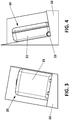
- the first one is that the inner space 20 has a base 22 that is tilted in one or two directions, for example as shown in Figures 3 and 4 , enabling the baggage to be positioned with respect to one or two fixed edges respectively. This facilitates the determination of the control areas.
- Said base 22 in turn rests on a scale or load cell, which has a dual use: on the one hand, it acts as a load cell and detects when the weight of the carry-on baggage is stable in order to launch the routines for classifying the baggage, and on the other hand, for capturing the weight thereof in case one of the conditions of the categories defined by the airline requires the use thereof (total weight, volume/weight ratio, etc.).
- a scale or load cell which has a dual use: on the one hand, it acts as a load cell and detects when the weight of the carry-on baggage is stable in order to launch the routines for classifying the baggage, and on the other hand, for capturing the weight thereof in case one of the conditions of the categories defined by the airline requires the use thereof (total weight, volume/weight ratio, etc.).
- the sensors 23 are arranged to recognize the baggage 21. Normally the sensors 23 used are several cameras: one of these placed in a fixed and particular position that enables a perspective of the baggage placed that is as complete as possible and the remaining
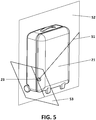
- a sensor 23 For example, as seen in Figure 5 , supposing that the direction of a sensor 23 is given by a vector 51 , Vector_Sensor (for example, in a webcam the vector 51 indicates towards where the webcam points, perpendicular to the lens thereof), the placement of the sensor 23 is such that the vector 51 is contained in a plane 53 that is at a distance of about ⁇ 10% of the dimension limit plane 52 that limits the maximum dimension to be controlled. Furthermore, these cameras can be repositioned based on the particular needs or conditions of each dimension.
- Vector_Sensor for example, in a webcam the vector 51 indicates towards where the webcam points, perpendicular to the lens thereof
- the placement of the sensor 23 is such that the vector 51 is contained in a plane 53 that is at a distance of about ⁇ 10% of the dimension limit plane 52 that limits the maximum dimension to be controlled.
- these cameras can be repositioned based on the particular needs or conditions of each dimension.
- the conditions in which said images are captured must be homogeneous.
- the inner space 20 where the carry-on baggage 21 is placed is conveniently illuminated such that the image capturing conditions are always as homogeneous as possible, regardless of the lighting conditions of the place in which the control equipment 12 is placed (common areas, brightly lit terminals, shadows caused by edges or by the passenger, etc.).
- Figures 6 and 7 show the lighting 24 of the inner space 20 and the possible location of two other cameras, the sensors 23' and 23" , which are placed in places of the inner space 20 that, together with the sensor 23 shown in Figure 5 , enable the three dimensions of the carry-on baggage 21 to be controlled.
- the sensor 23 controls the thickness dimension
- the sensor 23' controls the height
- the sensor 23" controls the width.
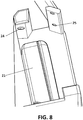
- Figure 8 shows that the inner space 20 has an additional camera 25 that captures the image of the carry-on baggage 21 for the classifier which determines a category of carry-on baggage 21.
- 3D cameras 25 such as Microsoft Kinect can be used in order to generate a three-dimensional reconstruction of the carry-on baggage 21 , so that it has the shape it has, the information from the 3D model generated can be analyzed and a result to said classification is provided by combining both technologies, on one hand classifiers, preferably Bayesian ones, and on the other, the flexibility that having the carry-on baggage 21 reconstructed in 3D gives.
- classifiers preferably Bayesian ones
- the equivalent rectangular volume that would occupy the same volume can even be taken out in order to simulate that it can be put in the bin, and playing with the densities (weight volume ratio) in order to make decisions.
- the control equipment 12 performs tasks which involves the control of a set of conditions that make up a category of carry-on baggage 21.
- the control equipment 12 checks one by one the specific conditions that correspond to said airline and, if applicable, to the type of carry-on baggage 21 introduced.
- Said conditions can be dimensions, weight, weight/volume ratio, color, shape, type of baggage, etc.
- the control process that the control equipment 12 carries out starts by capturing an image from at least one of the sensors 23 (camera in perspective). Using this image, a classification routine is launched in order to determine the type of carry-on baggage 21 placed in the inner space 20 , if necessary based on the set of categories defined by the airline (there will be airlines that will not want to discriminate characteristics by baggage type). Said classification routine offers the type of carry-on baggage 21 located in the inner space 20 as a result, for example if it is a small suitcase with wheels (trolley), a hand bag like a laptop case, travel bag, backpack, etc., using a set of parameters provided from the learning of the system as an input.
- This classification routine works by launching repeating classifiers that work by discriminating types of carry-on baggage by pairs. That is, first it discriminates, for example, trolleys from the rest; then backpacks from the rest (from what remains, removing the previous category), and so on. The order in which the classifiers in pairs are launched is based on what the optimal order that enables the effectiveness percentage of the classifier to be maximized (i.e., for example, that it knows to say that the carry-on baggage 21 located in the inner space 20 is a backpack with 98% effectiveness). Furthermore, a "smart classification" can be implemented such that upon providing the results of the control of the baggage, the passenger is shown a button with the result, and a series of buttons to correct the decision. Based on this it can progressively feed the learning of the classifiers based on all the decisions that the classifier has made and which ones were correct or incorrect.
- each of the conditions specified by the airline are then analyzed.
- the first conditions to be analyzed are the dimensional ones, because it can be decided based on these whether it is necessary to verify other ones (for example only controlling the weight if the baggage is larger than certain dimensions).
- sensor means of different kinds used in the inner space 20 to perform the measurement of the dimensions of the carry-on baggage 21 , such as infrared barriers, image sensors such as cameras, ultrasonic sensors, etc.
- Figure 9 shows examples of the case in which the condition to be analyzed is dimensional, in which case it would be performed as described below.
- the condition herein shown in the left and middle column of Figure 9
- the condition (height) is met
- the third example illustrated in the last column on the right of Figure 9
- An image from the sensor 23 is captured that corresponds to the dimension to be controlled for this condition.
- An image is obtained from said capturing that enables said dimension to be controlled as explained previously.
- the underlying idea of the dimensional control process is to analyze a certain area of the image, called the control area 60 , in order to evaluate whether the carry-on baggage 21 located in the inner space 20 invades said control area 60 , and in this case, how it invades the area 60.
- the control area 60 is a region of the photograph that includes the area in which the carry-on baggage 21 is exceeding the theoretical maximum dimensions.
- critical lines 61 are defined, which are the lines that define the maximum dimensions that are to be considered (with additional tolerances with respect to the maximum theoretical dimensions of the airline, for example).
- the image 62 , 62', 62" captured in each case, in Figure 6 , of the control area 60 is analyzed throughout said critical lines 61 in order to make a decision about the dimensional condition that is trying to be met.
- control volumes are used in which critical areas are analyzed.
- the 3D camera enables the volume to be reproduced in 3D and only one volume in 3D (the equivalent of the 2D photograph) would be necessary to analyze three control volumes with three critical planes.
- each camera or sensor 23 is configured during the configuration process for the control equipment 12 in which the cm/pixel scale is defined for a given resolution, for example 640x480px of the captured image, that is, to which pixel each measurement in cm corresponds (if the resolution is changed the cameras must be reconfigured). Furthermore, at least one pixel reference is configured to be able to reconstruct the Control Area upon taking each image, based on the maximum dimensions of each airline. In this manner, the pixels to be analyzed can be interpolated or extrapolated based on the dimensions in cm of each airline.
- the first step is to define the control area 60 based on the dimensional conditions of the airline in question that are to be controlled.
- a critical line 61 is defined that is the line inside the control area that is found at the distance of the maximum dimension allowed.
- a critical line 61 is defined for each dimension that is to be controlled by using the same control area 60.
- the control area 60 is passed through two filters.
- the first is a line filter (Edge detection) that gives as an output the lines that define the contours and the outlines of all the contents of the control area.
- the second is a grayscale filter, which transforms the contents of the control area into grayscale.
- an analysis of the critical line 61 is performed by extracting the cut-off points of the lines that are obtained from the first filter, analyzing the separation thereof and the average color (coming from the grayscale filter) between the cut-off points with the critical line.
- a percentage value of baggage that exceeds the critical line 60 is extracted. Having reached this point, if a certain percentage of the baggage (between 25 and 35%, which is a parameter that is adjustable as part of the configuration of each set of equipment) passes the critical line 61 , said baggage is susceptible to not meeting the maximum dimension condition that is being analyzed. Subsequently, if this is the case, a corrector filter is applied to the critical line 61.
- This corrector filter is based on the analysis of a distribution of color 63 of the critical line 61 , such that, depending on the shape in which the color or colors are distributed along the critical line 61 , it is decided whether or not the infringement condition of said maximum dimension should be corrected when it detects that what exceeds said dimension is, for example, from a strap that projects, or to maintain the infringement of the mentioned condition.
- the analysis of said color distribution 63 can be performed by means of the analysis of color curves pixel by pixel, or even using a classifier similar to those mentioned previously, which discriminates based on several types of color distribution that are accepted and not accepted.
- the control equipment 12 can control additional conditions specified by the transportation company. For example, if the condition to be controlled is the weight, the data of the weight of the baggage 21 is read directly from the scale situated in the inner space 20. If the condition to be controlled is, for example, the color of the baggage, the image captured by the sensor 23 is then analyzed, such that, by analyzing the image by means of certain filters and routines, the average or predominant color can be extracted from the carry-on baggage.
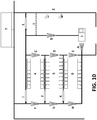
- FIG 10 shows an example of an application scenario of the invention, with the steps that a passenger follows in the boarding management process that the integral system that is described carries out automatically.
- the passenger first passes through a control and passenger access point 1 , where the allowances or pending payments, the ticket status or class, and the access of the passenger to the different boarding areas 4, 5, 6 are controlled, based on the profile of the passenger, allowing or denying said access by means of controlled access barriers A, B, C, D, F, G and H, which can be placed for this purpose and that are controlled by the access management subsystem 14.
- Said controlled access barriers A, B, C, D, F, G and H allow or deny the passage of the passenger simply by reading their boarding pass.
- the exit of the passengers that have already accessed some of the pre-boarding areas towards common areas (bathrooms, for example) and their reentry can be allowed without needing to pass through the passenger control point 1 again.
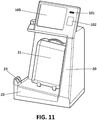
- Figure 11 shows the pieces of control equipment 12 that are arranged in the passenger control point 1 , comprising an inner space 20 with at least one sensor 23 for the analysis of the carry-on baggage 21 that the passenger places in the inner space 20 , and a boarding pass scanner or reader 101 and one or more passenger ID readers 102 which scans identification documents, such as National IDs, passports, etc., for the control of the passenger. Additionally, a screen 103 is provided in the passenger control point 1 for assisting the passenger and the user in using the system.
- the integral control system for passengers and baggage has, as shown in Figure 10 , one or several payment points 2 so that the passenger can satisfy the allowances or pending payments and a drop-off point for carry-on baggage to be checked 3.
- the system has as many boarding areas 4, 5, 6 as phases into which the airline or airport manager wants to divide the passageway for boarding the aircraft.
- the pre-boarding areas are placed such that, in the exemplary case shown in Figure 10 , the passengers in the boarding area 4 are those that board first (for example, passengers with priority boarding passes), those in area 5 board second (last seats in the aircraft) and those in area 6 board last (first seats of the aircraft), as an example.
- the passage to the different boarding areas 4, 5, 6 is enabled by means of the remote opening doors I, J and K.
- a certain passenger who does not have carry-on baggage or has small carry-on baggage meeting the conditions of the airline, arrives at the passenger control point 1. If they have carry-on baggage, they place it in the inner space 20 that is in that control point 1 , and follows the instructions on screen 83. If they do not have carry-on baggage, only their identification is scanned (passenger ID, passport, boarding pass).
- the passenger control point 1 enables their access to the pre-boarding area, showing the exact pre-boarding area corresponding to said passenger on the screen (for example, area 4, 5 or 6 ), enabling their access through the barrier A and in turn through the access barrier C, D or E that corresponds to the assigned pre-boarding area 4, 5 or 6. If the passenger wanted to access a pre-boarding area not enabled for him/her, the barrier would deny access for them.
- the payment point 2 issues both the receipt of the payment as well as the tag to be placed on the carry-on baggage in order to send it to the hold of the plane, this information being sent by means of the central computer platform 11 of the system to the computer system of the airline for the storage thereof (controlled tag numbering).
- the passenger Once the passenger has tagged their carry-on baggage, they then drop it off in the drop-off or baggage check-in area 3.
- the system enables the passenger to access the different pre-boarding areas through the barrier B, indicating to them, once they have paid, which area corresponds to them.
- the passenger accesses the assigned pre-boarding area 4, 5 or 6 that corresponds to them through the barrier B and the access barrier C, D or E.
- the passenger has baggage that must be checked, but this passenger has pre-paid the allowance fee and, therefore, does not have to pay in the payment point 2 (it could be due to the class or fee of the passenger including the checking of the luggage, or that the passenger has the charge for carry-on baggage allowances pre-authorized on their credit card).
- the passenger only needs to go to the payment point 2 to print the tag to be placed on their carry-on baggage and drop it off in the area enabled for dropping off baggage items to be checked 3. Once they have printed said tag in the payment point 2 , the access to the pre-boarding areas is enabled for them by the barrier B.
- the payment point 2 simply requests the boarding pass of the passenger to be scanned. Once scanned, it consults the information corresponding to it, the payment of pending allowances, etc., in the central computer platform 11 of the system.
- the payment point 2 has all the payments enabled that are considered appropriate, such as credit/debit card readers, payment in cash (coins/bills), contactless payment, etc.
- the payment point 2 sends, by following a similar process of asynchronous submission management, the update of the record of the passenger in which it is indicated to them if the allowance has been paid and the desired accesses are enabled for them.
- said payment point 2 can allow the passenger to pay for additional services that the airline may offer and that are not included in the ticket of the passenger, which could be access to VIP areas, priority boarding, etc. In this manner, a passenger without carry-on baggage allowances pending payment can also go to one of the enabled payment points 2 and buy or pay, for example, for access to the VIP area or priority boarding.
- the access management subsystem 14 of the proposed integral boarding management system first opens the remote opening door I, which only enables the passage to the boarding gate 7 for the passengers in said boarding area 4. Once it is decided that the second boarding area 5 may board, the access management subsystem 14 remotely opens the access door J , which allows the passengers from area 5 to pass through to the boarding gate 7. The access door I is still open, for which reason the passage through it is allowed. This continues as such, in order to allow boarding for as many areas as are enabled.
- the access management subsystem 14 opens the door L in order to allow the handling staff to retrieve all the carry-on baggage that must be checked in and have been dropped off in the drop-off area 3, without interfering with the boarding of the passengers, for which reason the time taken is minimized.
- This process determines the types of information to be uploaded or sent (for example, records to the data bases, photographs, XML objects for the DCS, etc.) and it opens an asynchronous worker thread 111, 112, 113 for each one of these types.
- asynchronous worker thread 111, 112, 113 for each one of these types.
- several parallel information sending or uploading processes are established, which are in continuous operation during the time that the boarding or the use of the equipment lasts, working in the following manner: Instead of the main control process 110 directly sending or uploading the information to where it corresponds, the information to be uploaded is stored in a batch or intermediate local repository 121, 122, 123.
- the images of the baggage items and/or passengers to be uploaded to the online control platform 11 are stored in an intermediate local repository 121 which is a local folder; the records of passengers and the DCS records are also stored in respective intermediate local repositories 122 and 123.
- each of the asynchronous threads 111, 112, 113 is permanently consulting the contents of said intermediate repositories 121, 122, 123 (each thread to the one it corresponds to), such that if there is information stored inside, it starts to send it or upload it 131, 132, 133, to where it corresponds (database, FTP server, DCS of the airline, etc.), following a FIFO structure that maintains the order in which the information was generated.
- the passenger control process 110 enables, in a first instance, a dual case:
- the order of the steps, 1 st Introducing Baggage ⁇ 2 nd Scanning Boarding Pass, which has been described can be reversed.
- the control equipment has the printing of the corresponding tags activated ("Cabin approved bag” tag, numbered "Bag Tag” tag, etc.) the routines necessary for said printing are started up.
- the numbered "Bag Tag” tags they must be printed following the standard IATA format, in addition to containing consecutive numbering unique to each airline.
- the centralized control platform 11 proceeds to consult with the computer system of the airline regarding the numbering to be printed, or numbering that is independent and consecutive for each airline but internal to the centralized control platform 11 , etc. is generated. In any of the ways, it then prints the corresponding tag, if appropriate.
- an "ACCEPT CHARGE" button is shown so that the passenger presses it and explicitly accepts said charge. This point is important as a remote payment solution, since by law, in order for the airline to charge a card it needs prior express approval, even though it has the data thereof beforehand. Having consolidated the acceptance of the charge, when applicable, and the removal of the tag for the carry-on baggage, if printed, it is indicated to the passenger that they can then remove their carry-on baggage 21 and introduce another item if they have several.
- the corresponding baggage control record as well as the images that were able to be taken of the carry-on baggage (and the passenger, when applicable), modifications of the record of the passenger such as the approval of the charge, approval of access to certain areas (or to the aircraft), etc. are all sent to the corresponding intermediate submission repository or repositories 121, 122, 123.
- control equipment 12 returns to the beginning of the passenger control process 110 in order to proceed with the next passenger.
Landscapes
- Engineering & Computer Science (AREA)
- Business, Economics & Management (AREA)
- General Physics & Mathematics (AREA)
- Physics & Mathematics (AREA)
- Aviation & Aerospace Engineering (AREA)
- Mechanical Engineering (AREA)
- Finance (AREA)
- Accounting & Taxation (AREA)
- Strategic Management (AREA)
- General Business, Economics & Management (AREA)
- Theoretical Computer Science (AREA)
- Management, Administration, Business Operations System, And Electronic Commerce (AREA)
- Time Recorders, Dirve Recorders, Access Control (AREA)
- Train Traffic Observation, Control, And Security (AREA)
Applications Claiming Priority (2)
| Application Number | Priority Date | Filing Date | Title |
|---|---|---|---|
| ES201531600A ES2562733B1 (es) | 2015-11-06 | 2015-11-06 | Sistema para el control integral de pasajeros y equipaje |
| PCT/ES2016/070787 WO2017077167A1 (fr) | 2015-11-06 | 2016-11-07 | Système de commande intégral de passagers et de bagages |
Publications (2)
| Publication Number | Publication Date |
|---|---|
| EP3373252A1 true EP3373252A1 (fr) | 2018-09-12 |
| EP3373252A4 EP3373252A4 (fr) | 2019-07-10 |
Family
ID=55407679
Family Applications (1)
| Application Number | Title | Priority Date | Filing Date |
|---|---|---|---|
| EP16861663.9A Withdrawn EP3373252A4 (fr) | 2015-11-06 | 2016-11-07 | Système de commande intégral de passagers et de bagages |
Country Status (13)
| Country | Link |
|---|---|
| US (1) | US20180322483A1 (fr) |
| EP (1) | EP3373252A4 (fr) |
| JP (1) | JP2019500710A (fr) |
| KR (1) | KR20180099648A (fr) |
| CN (1) | CN108463841A (fr) |
| AU (1) | AU2016347760A1 (fr) |
| BR (1) | BR112018009229A2 (fr) |
| CA (1) | CA3006923A1 (fr) |
| CO (1) | CO2018005172A2 (fr) |
| ES (1) | ES2562733B1 (fr) |
| IT (1) | IT201600111314A1 (fr) |
| MX (1) | MX2018005634A (fr) |
| WO (1) | WO2017077167A1 (fr) |
Cited By (24)
| Publication number | Priority date | Publication date | Assignee | Title |
|---|---|---|---|---|
| EP3656683A1 (fr) * | 2018-11-22 | 2020-05-27 | International Boarding Solutions S.L. | Système et procédé de contrôle de passagers et de bagages avant l'embarquement |
| IT201900003583A1 (it) * | 2019-03-12 | 2020-09-12 | C C M S R L | Stazione di verifica preliminare self-service del rispetto dei requisiti di un bagaglio da imbarcare su un mezzo di trasporto collettivo |
| EP4303794A1 (fr) * | 2022-07-08 | 2024-01-10 | Amadeus S.A.S. | Procédé d'identification des bagages et de rapprochement des bagages pour le transport public |
| WO2024163298A1 (fr) * | 2023-02-01 | 2024-08-08 | Mateer Craig | Enregistrement de passager à distance de branche de retour |
| WO2024163305A1 (fr) * | 2023-02-01 | 2024-08-08 | Mateer Craig | Transport et vérification automatisés de bagages à l'aide d'un message de source de bagage simulé |
| WO2024163195A1 (fr) * | 2023-02-01 | 2024-08-08 | Mateer Craig | Système et procédé de création d'un manifeste de bagage |
| US12112577B2 (en) | 2023-02-01 | 2024-10-08 | Craig Mateer | Optical character recognition of bag tag |
| US12112576B2 (en) | 2023-02-01 | 2024-10-08 | Craig Mateer | Manifest creation using optical character recognition |
| US12112578B2 (en) | 2023-02-01 | 2024-10-08 | Craig Mateer | System and method for creating luggage manifest using a b-type message and a passenger name record number |
| US12131588B2 (en) | 2023-02-01 | 2024-10-29 | Craig Mateer | System and method for creating luggage manifest using terminating B-type message |
| US12205411B2 (en) | 2023-02-01 | 2025-01-21 | Craig Mateer | De-personalized security screening image transfer |
| US12260681B2 (en) | 2023-02-01 | 2025-03-25 | Craig Mateer | Security, tracking device, and personal identifiable information |
| US12266219B2 (en) | 2023-02-01 | 2025-04-01 | Craig Mateer | Security, tracking device, and luggage recovery |
| US12266220B2 (en) | 2023-02-01 | 2025-04-01 | Craig Mateer | System and method for creating a luggage manifest |
| US12266221B2 (en) | 2023-02-01 | 2025-04-01 | Craig Mateer | Airport security screening assistant using flight manifest |
| US12272179B2 (en) | 2023-02-01 | 2025-04-08 | Craig Mateer | System and method for security screening integration for multiple modes of travel |
| US12361764B2 (en) | 2023-02-01 | 2025-07-15 | Craig Mateer | System and method for security screening |
| US12367713B2 (en) | 2023-02-01 | 2025-07-22 | Craig Mateer | Remote check-in using optical character recognition of bag tag |
| US12494087B2 (en) | 2023-02-01 | 2025-12-09 | Craig Mateer | System and method for creating luggage manifests |
| US12494088B2 (en) | 2023-02-01 | 2025-12-09 | Craig Mateer | System and method of creating luggage manifest using B-type message, airline code and flight data |
| US12499715B2 (en) | 2023-02-01 | 2025-12-16 | Craig Mateer | Security, Tracking Device, And More |
| US12505702B2 (en) | 2023-02-01 | 2025-12-23 | Craig Mateer | Security, tracking device, and more |
| US12518568B2 (en) | 2023-02-01 | 2026-01-06 | Craig Mateer | Security, luggage tracking, and machine learning models |
| US12592099B2 (en) | 2023-02-01 | 2026-03-31 | Craig Mateer | System and method for fraud prevention using security screening image |
Families Citing this family (17)
| Publication number | Priority date | Publication date | Assignee | Title |
|---|---|---|---|---|
| WO2020026368A1 (fr) | 2018-07-31 | 2020-02-06 | 日本電気株式会社 | Dispositif et procédé de traitement d'informations, et support d'enregistrement |
| KR102098960B1 (ko) * | 2018-12-05 | 2020-04-24 | 주식회사 카스 | 공항용 승객 수하물 체크 시스템 및 그 방법 |
| US11763209B1 (en) * | 2019-03-06 | 2023-09-19 | American Airlines, Inc. | Virtual measurement system for baggage management |
| FR3094114B1 (fr) * | 2019-03-22 | 2021-09-10 | Idemia Identity & Security France | Kit identification bagage |
| JP2020187387A (ja) * | 2019-05-09 | 2020-11-19 | パナソニックIpマネジメント株式会社 | 荷物料金精算システムおよび荷物料金精算方法 |
| CN110309772A (zh) * | 2019-06-28 | 2019-10-08 | 百度在线网络技术(北京)有限公司 | 值机服务提供方法、装置、设备和存储介质 |
| JP7227104B2 (ja) * | 2019-07-26 | 2023-02-21 | トヨタ自動車株式会社 | 作業量算出システム |
| EP4053769A4 (fr) * | 2019-10-31 | 2022-12-07 | NEC Corporation | Système de livraison de bagages, dispositif de gestion de livraison de bagages, procédé de livraison de bagages, et programme informatique |
| JP2021076494A (ja) * | 2019-11-11 | 2021-05-20 | 沖電気工業株式会社 | 寸法測定システム、寸法測定装置および寸法測定方法 |
| IT202000000097A1 (it) * | 2020-01-07 | 2020-04-07 | Lighthouse S P A | Sistema di controllo bagagli perfezionato |
| KR102719707B1 (ko) * | 2020-02-24 | 2024-10-21 | 이정엽 | 항공기 유상탑재 가치에 따른 항공수하물 유상탑재량 거래 시스템 및 방법 |
| US12172753B2 (en) * | 2021-01-07 | 2024-12-24 | The Boeing Company | Systems and methods for monitoring storage of carry-on items in storage bins of an aircraft |
| CN112732985B (zh) * | 2021-01-18 | 2024-07-19 | 中国民航信息网络股份有限公司 | 一种航段登机信息处理方法和装置 |
| IL288740A (en) * | 2021-12-06 | 2023-07-01 | Moldova Aviation Service 2001 Ltd | System and method for measuring an object |
| KR102451322B1 (ko) | 2022-01-06 | 2022-10-06 | 주식회사 아이트립 | Iata기준을 준수하는 수하물운송네트워크 서버구축을통한 편리한 항공여행서비스와 수하물태그 제공방법 및 그 시스템 |
| CN117421444B (zh) * | 2023-12-18 | 2024-03-15 | 民航成都电子技术有限责任公司 | 一种机场登机口电子屏信息推送方法、装置、介质及设备 |
| CN120068353B (zh) * | 2024-09-20 | 2025-08-29 | 中航信移动科技有限公司 | 不同类型行李的码放位置确定方法、电子设备及存储介质 |
Family Cites Families (8)
| Publication number | Priority date | Publication date | Assignee | Title |
|---|---|---|---|---|
| FR2929605B1 (fr) * | 2008-04-04 | 2010-08-27 | Ier | Procede et systeme de depose automatique d'objets en vue du transport desdits objets |
| US20110231212A1 (en) * | 2010-03-22 | 2011-09-22 | Hurley Chris | Internet based check in system and baggage drop |
| ES2389340B1 (es) * | 2011-03-28 | 2013-09-03 | Siemens Sa | Sistema de facturacion integral. |
| NL2008607C2 (en) * | 2012-04-05 | 2013-10-09 | Quintech Engineering Innovations B V | Method and system for depositing and checking of baggage into airline flights. |
| ES2461940B1 (es) * | 2013-10-08 | 2015-02-24 | Julio AUMENTE AUMENTE | Equipo de control y verificación de equipajes para viajeros |
| EP2886466A1 (fr) * | 2013-12-19 | 2015-06-24 | Siemens Aktiengesellschaft | Unité d'enregistrement |
| CN104599330A (zh) * | 2014-11-13 | 2015-05-06 | 安徽省新方尊铸造科技有限公司 | 一种基于虹膜识别技术的高速公路收费系统 |
| CN204399941U (zh) * | 2015-01-15 | 2015-06-17 | 昆山三迅电子科技有限公司 | 一种安检称重一体机 |
-
2015
- 2015-11-06 ES ES201531600A patent/ES2562733B1/es not_active Expired - Fee Related
-
2016
- 2016-11-04 IT IT102016000111314A patent/IT201600111314A1/it unknown
- 2016-11-07 JP JP2018543457A patent/JP2019500710A/ja active Pending
- 2016-11-07 MX MX2018005634A patent/MX2018005634A/es unknown
- 2016-11-07 KR KR1020187015693A patent/KR20180099648A/ko not_active Withdrawn
- 2016-11-07 US US15/773,806 patent/US20180322483A1/en not_active Abandoned
- 2016-11-07 CA CA3006923A patent/CA3006923A1/fr not_active Abandoned
- 2016-11-07 EP EP16861663.9A patent/EP3373252A4/fr not_active Withdrawn
- 2016-11-07 CN CN201680075590.1A patent/CN108463841A/zh active Pending
- 2016-11-07 BR BR112018009229A patent/BR112018009229A2/pt not_active Application Discontinuation
- 2016-11-07 WO PCT/ES2016/070787 patent/WO2017077167A1/fr not_active Ceased
- 2016-11-07 AU AU2016347760A patent/AU2016347760A1/en not_active Abandoned
-
2018
- 2018-05-17 CO CONC2018/0005172A patent/CO2018005172A2/es unknown
Cited By (28)
| Publication number | Priority date | Publication date | Assignee | Title |
|---|---|---|---|---|
| EP3656683A1 (fr) * | 2018-11-22 | 2020-05-27 | International Boarding Solutions S.L. | Système et procédé de contrôle de passagers et de bagages avant l'embarquement |
| WO2020104517A1 (fr) * | 2018-11-22 | 2020-05-28 | International Boarding Solutions S.L. | Système et procédé de contrôle des passagers et des bagages avant l'embarquement |
| IT201900003583A1 (it) * | 2019-03-12 | 2020-09-12 | C C M S R L | Stazione di verifica preliminare self-service del rispetto dei requisiti di un bagaglio da imbarcare su un mezzo di trasporto collettivo |
| EP4303794A1 (fr) * | 2022-07-08 | 2024-01-10 | Amadeus S.A.S. | Procédé d'identification des bagages et de rapprochement des bagages pour le transport public |
| WO2024163298A1 (fr) * | 2023-02-01 | 2024-08-08 | Mateer Craig | Enregistrement de passager à distance de branche de retour |
| WO2024163304A1 (fr) * | 2023-02-01 | 2024-08-08 | Mateer Craig | Recréation numérique de l'identifiant originel d'étiquette à bagage |
| WO2024163305A1 (fr) * | 2023-02-01 | 2024-08-08 | Mateer Craig | Transport et vérification automatisés de bagages à l'aide d'un message de source de bagage simulé |
| WO2024163195A1 (fr) * | 2023-02-01 | 2024-08-08 | Mateer Craig | Système et procédé de création d'un manifeste de bagage |
| US12112577B2 (en) | 2023-02-01 | 2024-10-08 | Craig Mateer | Optical character recognition of bag tag |
| US12112576B2 (en) | 2023-02-01 | 2024-10-08 | Craig Mateer | Manifest creation using optical character recognition |
| US12112578B2 (en) | 2023-02-01 | 2024-10-08 | Craig Mateer | System and method for creating luggage manifest using a b-type message and a passenger name record number |
| US12131588B2 (en) | 2023-02-01 | 2024-10-29 | Craig Mateer | System and method for creating luggage manifest using terminating B-type message |
| US12205411B2 (en) | 2023-02-01 | 2025-01-21 | Craig Mateer | De-personalized security screening image transfer |
| US12254719B2 (en) | 2023-02-01 | 2025-03-18 | Craig Mateer | Return leg passenger bag tag generation |
| US12260681B2 (en) | 2023-02-01 | 2025-03-25 | Craig Mateer | Security, tracking device, and personal identifiable information |
| US12266219B2 (en) | 2023-02-01 | 2025-04-01 | Craig Mateer | Security, tracking device, and luggage recovery |
| US12266220B2 (en) | 2023-02-01 | 2025-04-01 | Craig Mateer | System and method for creating a luggage manifest |
| US12266221B2 (en) | 2023-02-01 | 2025-04-01 | Craig Mateer | Airport security screening assistant using flight manifest |
| US12266222B2 (en) | 2023-02-01 | 2025-04-01 | Craig Mateer | System and method for creating luggage manifest using a B-type message and a passenger name record number |
| US12272179B2 (en) | 2023-02-01 | 2025-04-08 | Craig Mateer | System and method for security screening integration for multiple modes of travel |
| US12361764B2 (en) | 2023-02-01 | 2025-07-15 | Craig Mateer | System and method for security screening |
| US12367713B2 (en) | 2023-02-01 | 2025-07-22 | Craig Mateer | Remote check-in using optical character recognition of bag tag |
| US12494087B2 (en) | 2023-02-01 | 2025-12-09 | Craig Mateer | System and method for creating luggage manifests |
| US12494088B2 (en) | 2023-02-01 | 2025-12-09 | Craig Mateer | System and method of creating luggage manifest using B-type message, airline code and flight data |
| US12499715B2 (en) | 2023-02-01 | 2025-12-16 | Craig Mateer | Security, Tracking Device, And More |
| US12505702B2 (en) | 2023-02-01 | 2025-12-23 | Craig Mateer | Security, tracking device, and more |
| US12518568B2 (en) | 2023-02-01 | 2026-01-06 | Craig Mateer | Security, luggage tracking, and machine learning models |
| US12592099B2 (en) | 2023-02-01 | 2026-03-31 | Craig Mateer | System and method for fraud prevention using security screening image |
Also Published As
| Publication number | Publication date |
|---|---|
| US20180322483A1 (en) | 2018-11-08 |
| JP2019500710A (ja) | 2019-01-10 |
| EP3373252A4 (fr) | 2019-07-10 |
| ES2562733A1 (es) | 2016-03-07 |
| MX2018005634A (es) | 2019-04-29 |
| AU2016347760A1 (en) | 2018-06-14 |
| ES2562733B1 (es) | 2016-12-15 |
| WO2017077167A1 (fr) | 2017-05-11 |
| IT201600111314A1 (it) | 2018-05-04 |
| CO2018005172A2 (es) | 2018-10-10 |
| CA3006923A1 (fr) | 2017-05-11 |
| CN108463841A (zh) | 2018-08-28 |
| KR20180099648A (ko) | 2018-09-05 |
| BR112018009229A2 (pt) | 2019-03-19 |
Similar Documents
| Publication | Publication Date | Title |
|---|---|---|
| EP3373252A1 (fr) | Système de commande intégral de passagers et de bagages | |
| US9518861B2 (en) | Luggage control and verification system and methods of use | |
| EP3656683A1 (fr) | Système et procédé de contrôle de passagers et de bagages avant l'embarquement | |
| RU2616492C2 (ru) | Способ и система для приема и регистрации багажа на рейсах авиакомпаний | |
| EP3683722A1 (fr) | Identification et dimensionnement actifs | |
| US7677449B2 (en) | Automatic integrated sensing and access control | |
| US20170004384A1 (en) | Image based baggage tracking system | |
| EP2551804A1 (fr) | Kiosque de sécurité | |
| JPWO2005055151A1 (ja) | 搭乗セキュリティチェックシステムおよび方法ならびにコンピュータプログラム | |
| WO2007109607A2 (fr) | Système de criblage et de vérification | |
| US12190260B2 (en) | Virtual measurement system for baggage management | |
| KR101842270B1 (ko) | 안면 인식 정보를 이용한 항공권 발권 및 탑승시스템 및 이를 이용한 항공권 발권 및 탑승 방법 | |
| EP3113091A1 (fr) | Système de suivi de bagages à base d'image | |
| KR101966721B1 (ko) | 안면 인식 정보를 이용한 항공권 발권과 출국심사 및 탑승시스템 및 이를 이용한 항공권 발권과 출국심사 및 탑승 방법 | |
| KR101997110B1 (ko) | 안면 인식 정보 및 여권 정보를 이용한 항공권 발권 및 탑승시스템 및 이를 이용한 항공권 발권 및 탑승 방법 | |
| Gardt et al. | How Smart Airport is Paving the way for a Smart Access Concept: Technology’s Role in the Digital Ecosystem of the Access Control Process | |
| WO2025038554A1 (fr) | Plateforme et procédé d'entrée validée par un lieu de sport et de divertissement accélérée | |
| CN118799033A (zh) | 煤炭销售智慧云平台系统 | |
| Florén et al. | Playing tag with baggage: RFID technology in baggage handling at Stockholm Skavsta Airport | |
| HK1236665A (en) | Method and system for depositing and checking of baggage into airline flights | |
| HK1236665A1 (en) | Method and system for depositing and checking of baggage into airline flights | |
| HK1206313B (en) | Method and system for depositing and checking of baggage into airline flights | |
| HK1208655B (en) | Method for automatic baggage handling and associated system | |
| CA2772383A1 (fr) | Detection et controle d'acces automatiques integres |
Legal Events
| Date | Code | Title | Description |
|---|---|---|---|
| STAA | Information on the status of an ep patent application or granted ep patent |
Free format text: STATUS: THE INTERNATIONAL PUBLICATION HAS BEEN MADE |
|
| PUAI | Public reference made under article 153(3) epc to a published international application that has entered the european phase |
Free format text: ORIGINAL CODE: 0009012 |
|
| STAA | Information on the status of an ep patent application or granted ep patent |
Free format text: STATUS: REQUEST FOR EXAMINATION WAS MADE |
|
| 17P | Request for examination filed |
Effective date: 20180517 |
|
| AK | Designated contracting states |
Kind code of ref document: A1 Designated state(s): AL AT BE BG CH CY CZ DE DK EE ES FI FR GB GR HR HU IE IS IT LI LT LU LV MC MK MT NL NO PL PT RO RS SE SI SK SM TR |
|
| AX | Request for extension of the european patent |
Extension state: BA ME |
|
| DAV | Request for validation of the european patent (deleted) | ||
| DAX | Request for extension of the european patent (deleted) | ||
| A4 | Supplementary search report drawn up and despatched |
Effective date: 20190611 |
|
| RIC1 | Information provided on ipc code assigned before grant |
Ipc: B64F 1/36 20170101ALI20190604BHEP Ipc: G06Q 20/20 20120101ALI20190604BHEP Ipc: B64F 1/30 20060101ALI20190604BHEP Ipc: G07B 15/00 20110101AFI20190604BHEP |
|
| STAA | Information on the status of an ep patent application or granted ep patent |
Free format text: STATUS: THE APPLICATION IS DEEMED TO BE WITHDRAWN |
|
| 18D | Application deemed to be withdrawn |
Effective date: 20200109 |