EP3373864B1 - Implants d'articulation - Google Patents
Implants d'articulation Download PDFInfo
- Publication number
- EP3373864B1 EP3373864B1 EP16801112.0A EP16801112A EP3373864B1 EP 3373864 B1 EP3373864 B1 EP 3373864B1 EP 16801112 A EP16801112 A EP 16801112A EP 3373864 B1 EP3373864 B1 EP 3373864B1
- Authority
- EP
- European Patent Office
- Prior art keywords
- implant
- articulating
- bone
- cylindrical member
- bone implant
- Prior art date
- Legal status (The legal status is an assumption and is not a legal conclusion. Google has not performed a legal analysis and makes no representation as to the accuracy of the status listed.)
- Active
Links
Images





Classifications
-
- A—HUMAN NECESSITIES
- A61—MEDICAL OR VETERINARY SCIENCE; HYGIENE
- A61F—FILTERS IMPLANTABLE INTO BLOOD VESSELS; PROSTHESES; DEVICES PROVIDING PATENCY TO, OR PREVENTING COLLAPSING OF, TUBULAR STRUCTURES OF THE BODY, e.g. STENTS; ORTHOPAEDIC, NURSING OR CONTRACEPTIVE DEVICES; FOMENTATION; TREATMENT OR PROTECTION OF EYES OR EARS; BANDAGES, DRESSINGS OR ABSORBENT PADS; FIRST-AID KITS
- A61F2/00—Filters implantable into blood vessels; Prostheses, i.e. artificial substitutes or replacements for parts of the body; Appliances for connecting them with the body; Devices providing patency to, or preventing collapsing of, tubular structures of the body, e.g. stents
- A61F2/02—Prostheses implantable into the body
- A61F2/30—Joints
- A61F2/42—Joints for wrists or ankles; for hands, e.g. fingers; for feet, e.g. toes
- A61F2/4202—Joints for wrists or ankles; for hands, e.g. fingers; for feet, e.g. toes for ankles
-
- A—HUMAN NECESSITIES
- A61—MEDICAL OR VETERINARY SCIENCE; HYGIENE
- A61B—DIAGNOSIS; SURGERY; IDENTIFICATION
- A61B17/00—Surgical instruments, devices or methods
- A61B17/16—Instruments for performing osteoclasis; Drills or chisels for bones; Trepans
- A61B17/17—Guides or aligning means for drills, mills, pins or wires
- A61B17/1739—Guides or aligning means for drills, mills, pins or wires specially adapted for particular parts of the body
- A61B17/1775—Guides or aligning means for drills, mills, pins or wires specially adapted for particular parts of the body for the foot or ankle
-
- A—HUMAN NECESSITIES
- A61—MEDICAL OR VETERINARY SCIENCE; HYGIENE
- A61F—FILTERS IMPLANTABLE INTO BLOOD VESSELS; PROSTHESES; DEVICES PROVIDING PATENCY TO, OR PREVENTING COLLAPSING OF, TUBULAR STRUCTURES OF THE BODY, e.g. STENTS; ORTHOPAEDIC, NURSING OR CONTRACEPTIVE DEVICES; FOMENTATION; TREATMENT OR PROTECTION OF EYES OR EARS; BANDAGES, DRESSINGS OR ABSORBENT PADS; FIRST-AID KITS
- A61F2/00—Filters implantable into blood vessels; Prostheses, i.e. artificial substitutes or replacements for parts of the body; Appliances for connecting them with the body; Devices providing patency to, or preventing collapsing of, tubular structures of the body, e.g. stents
- A61F2/02—Prostheses implantable into the body
- A61F2/28—Bones
-
- A—HUMAN NECESSITIES
- A61—MEDICAL OR VETERINARY SCIENCE; HYGIENE
- A61F—FILTERS IMPLANTABLE INTO BLOOD VESSELS; PROSTHESES; DEVICES PROVIDING PATENCY TO, OR PREVENTING COLLAPSING OF, TUBULAR STRUCTURES OF THE BODY, e.g. STENTS; ORTHOPAEDIC, NURSING OR CONTRACEPTIVE DEVICES; FOMENTATION; TREATMENT OR PROTECTION OF EYES OR EARS; BANDAGES, DRESSINGS OR ABSORBENT PADS; FIRST-AID KITS
- A61F2/00—Filters implantable into blood vessels; Prostheses, i.e. artificial substitutes or replacements for parts of the body; Appliances for connecting them with the body; Devices providing patency to, or preventing collapsing of, tubular structures of the body, e.g. stents
- A61F2/02—Prostheses implantable into the body
- A61F2/30—Joints
-
- A—HUMAN NECESSITIES
- A61—MEDICAL OR VETERINARY SCIENCE; HYGIENE
- A61F—FILTERS IMPLANTABLE INTO BLOOD VESSELS; PROSTHESES; DEVICES PROVIDING PATENCY TO, OR PREVENTING COLLAPSING OF, TUBULAR STRUCTURES OF THE BODY, e.g. STENTS; ORTHOPAEDIC, NURSING OR CONTRACEPTIVE DEVICES; FOMENTATION; TREATMENT OR PROTECTION OF EYES OR EARS; BANDAGES, DRESSINGS OR ABSORBENT PADS; FIRST-AID KITS
- A61F2/00—Filters implantable into blood vessels; Prostheses, i.e. artificial substitutes or replacements for parts of the body; Appliances for connecting them with the body; Devices providing patency to, or preventing collapsing of, tubular structures of the body, e.g. stents
- A61F2/02—Prostheses implantable into the body
- A61F2/30—Joints
- A61F2/30721—Accessories
- A61F2/30734—Modular inserts, sleeves or augments, e.g. placed on proximal part of stem for fixation purposes or wedges for bridging a bone defect
-
- A—HUMAN NECESSITIES
- A61—MEDICAL OR VETERINARY SCIENCE; HYGIENE
- A61F—FILTERS IMPLANTABLE INTO BLOOD VESSELS; PROSTHESES; DEVICES PROVIDING PATENCY TO, OR PREVENTING COLLAPSING OF, TUBULAR STRUCTURES OF THE BODY, e.g. STENTS; ORTHOPAEDIC, NURSING OR CONTRACEPTIVE DEVICES; FOMENTATION; TREATMENT OR PROTECTION OF EYES OR EARS; BANDAGES, DRESSINGS OR ABSORBENT PADS; FIRST-AID KITS
- A61F2/00—Filters implantable into blood vessels; Prostheses, i.e. artificial substitutes or replacements for parts of the body; Appliances for connecting them with the body; Devices providing patency to, or preventing collapsing of, tubular structures of the body, e.g. stents
- A61F2/02—Prostheses implantable into the body
- A61F2/30—Joints
- A61F2/30721—Accessories
- A61F2/30749—Fixation appliances for connecting prostheses to the body
-
- A—HUMAN NECESSITIES
- A61—MEDICAL OR VETERINARY SCIENCE; HYGIENE
- A61F—FILTERS IMPLANTABLE INTO BLOOD VESSELS; PROSTHESES; DEVICES PROVIDING PATENCY TO, OR PREVENTING COLLAPSING OF, TUBULAR STRUCTURES OF THE BODY, e.g. STENTS; ORTHOPAEDIC, NURSING OR CONTRACEPTIVE DEVICES; FOMENTATION; TREATMENT OR PROTECTION OF EYES OR EARS; BANDAGES, DRESSINGS OR ABSORBENT PADS; FIRST-AID KITS
- A61F2/00—Filters implantable into blood vessels; Prostheses, i.e. artificial substitutes or replacements for parts of the body; Appliances for connecting them with the body; Devices providing patency to, or preventing collapsing of, tubular structures of the body, e.g. stents
- A61F2/02—Prostheses implantable into the body
- A61F2/30—Joints
- A61F2/30756—Cartilage endoprostheses
-
- A—HUMAN NECESSITIES
- A61—MEDICAL OR VETERINARY SCIENCE; HYGIENE
- A61F—FILTERS IMPLANTABLE INTO BLOOD VESSELS; PROSTHESES; DEVICES PROVIDING PATENCY TO, OR PREVENTING COLLAPSING OF, TUBULAR STRUCTURES OF THE BODY, e.g. STENTS; ORTHOPAEDIC, NURSING OR CONTRACEPTIVE DEVICES; FOMENTATION; TREATMENT OR PROTECTION OF EYES OR EARS; BANDAGES, DRESSINGS OR ABSORBENT PADS; FIRST-AID KITS
- A61F2/00—Filters implantable into blood vessels; Prostheses, i.e. artificial substitutes or replacements for parts of the body; Appliances for connecting them with the body; Devices providing patency to, or preventing collapsing of, tubular structures of the body, e.g. stents
- A61F2/02—Prostheses implantable into the body
- A61F2/30—Joints
- A61F2/46—Special tools for implanting artificial joints
- A61F2/4603—Special tools for implanting artificial joints for insertion or extraction of endoprosthetic joints or of accessories thereof
- A61F2/4606—Special tools for implanting artificial joints for insertion or extraction of endoprosthetic joints or of accessories thereof of wrists or ankles; of hands, e.g. fingers; of feet, e.g. toes
-
- A—HUMAN NECESSITIES
- A61—MEDICAL OR VETERINARY SCIENCE; HYGIENE
- A61F—FILTERS IMPLANTABLE INTO BLOOD VESSELS; PROSTHESES; DEVICES PROVIDING PATENCY TO, OR PREVENTING COLLAPSING OF, TUBULAR STRUCTURES OF THE BODY, e.g. STENTS; ORTHOPAEDIC, NURSING OR CONTRACEPTIVE DEVICES; FOMENTATION; TREATMENT OR PROTECTION OF EYES OR EARS; BANDAGES, DRESSINGS OR ABSORBENT PADS; FIRST-AID KITS
- A61F2/00—Filters implantable into blood vessels; Prostheses, i.e. artificial substitutes or replacements for parts of the body; Appliances for connecting them with the body; Devices providing patency to, or preventing collapsing of, tubular structures of the body, e.g. stents
- A61F2/02—Prostheses implantable into the body
- A61F2/30—Joints
- A61F2002/30001—Additional features of subject-matter classified in A61F2/28, A61F2/30 and subgroups thereof
- A61F2002/30003—Material related properties of the prosthesis or of a coating on the prosthesis
- A61F2002/30004—Material related properties of the prosthesis or of a coating on the prosthesis the prosthesis being made from materials having different values of a given property at different locations within the same prosthesis
- A61F2002/30011—Material related properties of the prosthesis or of a coating on the prosthesis the prosthesis being made from materials having different values of a given property at different locations within the same prosthesis differing in porosity
-
- A—HUMAN NECESSITIES
- A61—MEDICAL OR VETERINARY SCIENCE; HYGIENE
- A61F—FILTERS IMPLANTABLE INTO BLOOD VESSELS; PROSTHESES; DEVICES PROVIDING PATENCY TO, OR PREVENTING COLLAPSING OF, TUBULAR STRUCTURES OF THE BODY, e.g. STENTS; ORTHOPAEDIC, NURSING OR CONTRACEPTIVE DEVICES; FOMENTATION; TREATMENT OR PROTECTION OF EYES OR EARS; BANDAGES, DRESSINGS OR ABSORBENT PADS; FIRST-AID KITS
- A61F2/00—Filters implantable into blood vessels; Prostheses, i.e. artificial substitutes or replacements for parts of the body; Appliances for connecting them with the body; Devices providing patency to, or preventing collapsing of, tubular structures of the body, e.g. stents
- A61F2/02—Prostheses implantable into the body
- A61F2/30—Joints
- A61F2002/30001—Additional features of subject-matter classified in A61F2/28, A61F2/30 and subgroups thereof
- A61F2002/30108—Shapes
- A61F2002/30199—Three-dimensional shapes
- A61F2002/30224—Three-dimensional shapes cylindrical
-
- A—HUMAN NECESSITIES
- A61—MEDICAL OR VETERINARY SCIENCE; HYGIENE
- A61F—FILTERS IMPLANTABLE INTO BLOOD VESSELS; PROSTHESES; DEVICES PROVIDING PATENCY TO, OR PREVENTING COLLAPSING OF, TUBULAR STRUCTURES OF THE BODY, e.g. STENTS; ORTHOPAEDIC, NURSING OR CONTRACEPTIVE DEVICES; FOMENTATION; TREATMENT OR PROTECTION OF EYES OR EARS; BANDAGES, DRESSINGS OR ABSORBENT PADS; FIRST-AID KITS
- A61F2/00—Filters implantable into blood vessels; Prostheses, i.e. artificial substitutes or replacements for parts of the body; Appliances for connecting them with the body; Devices providing patency to, or preventing collapsing of, tubular structures of the body, e.g. stents
- A61F2/02—Prostheses implantable into the body
- A61F2/30—Joints
- A61F2002/30001—Additional features of subject-matter classified in A61F2/28, A61F2/30 and subgroups thereof
- A61F2002/30316—The prosthesis having different structural features at different locations within the same prosthesis; Connections between prosthetic parts; Special structural features of bone or joint prostheses not otherwise provided for
- A61F2002/30317—The prosthesis having different structural features at different locations within the same prosthesis
- A61F2002/30327—The prosthesis having different structural features at different locations within the same prosthesis differing in diameter
-
- A—HUMAN NECESSITIES
- A61—MEDICAL OR VETERINARY SCIENCE; HYGIENE
- A61F—FILTERS IMPLANTABLE INTO BLOOD VESSELS; PROSTHESES; DEVICES PROVIDING PATENCY TO, OR PREVENTING COLLAPSING OF, TUBULAR STRUCTURES OF THE BODY, e.g. STENTS; ORTHOPAEDIC, NURSING OR CONTRACEPTIVE DEVICES; FOMENTATION; TREATMENT OR PROTECTION OF EYES OR EARS; BANDAGES, DRESSINGS OR ABSORBENT PADS; FIRST-AID KITS
- A61F2/00—Filters implantable into blood vessels; Prostheses, i.e. artificial substitutes or replacements for parts of the body; Appliances for connecting them with the body; Devices providing patency to, or preventing collapsing of, tubular structures of the body, e.g. stents
- A61F2/02—Prostheses implantable into the body
- A61F2/30—Joints
- A61F2002/30001—Additional features of subject-matter classified in A61F2/28, A61F2/30 and subgroups thereof
- A61F2002/30316—The prosthesis having different structural features at different locations within the same prosthesis; Connections between prosthetic parts; Special structural features of bone or joint prostheses not otherwise provided for
- A61F2002/30329—Connections or couplings between prosthetic parts, e.g. between modular parts; Connecting elements
- A61F2002/30331—Connections or couplings between prosthetic parts, e.g. between modular parts; Connecting elements made by longitudinally pushing a protrusion into a complementarily-shaped recess, e.g. held by friction fit
-
- A—HUMAN NECESSITIES
- A61—MEDICAL OR VETERINARY SCIENCE; HYGIENE
- A61F—FILTERS IMPLANTABLE INTO BLOOD VESSELS; PROSTHESES; DEVICES PROVIDING PATENCY TO, OR PREVENTING COLLAPSING OF, TUBULAR STRUCTURES OF THE BODY, e.g. STENTS; ORTHOPAEDIC, NURSING OR CONTRACEPTIVE DEVICES; FOMENTATION; TREATMENT OR PROTECTION OF EYES OR EARS; BANDAGES, DRESSINGS OR ABSORBENT PADS; FIRST-AID KITS
- A61F2/00—Filters implantable into blood vessels; Prostheses, i.e. artificial substitutes or replacements for parts of the body; Appliances for connecting them with the body; Devices providing patency to, or preventing collapsing of, tubular structures of the body, e.g. stents
- A61F2/02—Prostheses implantable into the body
- A61F2/30—Joints
- A61F2/30721—Accessories
- A61F2002/30754—Implants for interposition between two natural articular surfaces
-
- A—HUMAN NECESSITIES
- A61—MEDICAL OR VETERINARY SCIENCE; HYGIENE
- A61F—FILTERS IMPLANTABLE INTO BLOOD VESSELS; PROSTHESES; DEVICES PROVIDING PATENCY TO, OR PREVENTING COLLAPSING OF, TUBULAR STRUCTURES OF THE BODY, e.g. STENTS; ORTHOPAEDIC, NURSING OR CONTRACEPTIVE DEVICES; FOMENTATION; TREATMENT OR PROTECTION OF EYES OR EARS; BANDAGES, DRESSINGS OR ABSORBENT PADS; FIRST-AID KITS
- A61F2/00—Filters implantable into blood vessels; Prostheses, i.e. artificial substitutes or replacements for parts of the body; Appliances for connecting them with the body; Devices providing patency to, or preventing collapsing of, tubular structures of the body, e.g. stents
- A61F2/02—Prostheses implantable into the body
- A61F2/30—Joints
- A61F2/30767—Special external or bone-contacting surface, e.g. coating for improving bone ingrowth
- A61F2/30771—Special external or bone-contacting surface, e.g. coating for improving bone ingrowth applied in original prostheses, e.g. holes or grooves
- A61F2002/3085—Special external or bone-contacting surface, e.g. coating for improving bone ingrowth applied in original prostheses, e.g. holes or grooves with a threaded, e.g. self-tapping, bone-engaging surface, e.g. external surface
-
- A—HUMAN NECESSITIES
- A61—MEDICAL OR VETERINARY SCIENCE; HYGIENE
- A61F—FILTERS IMPLANTABLE INTO BLOOD VESSELS; PROSTHESES; DEVICES PROVIDING PATENCY TO, OR PREVENTING COLLAPSING OF, TUBULAR STRUCTURES OF THE BODY, e.g. STENTS; ORTHOPAEDIC, NURSING OR CONTRACEPTIVE DEVICES; FOMENTATION; TREATMENT OR PROTECTION OF EYES OR EARS; BANDAGES, DRESSINGS OR ABSORBENT PADS; FIRST-AID KITS
- A61F2/00—Filters implantable into blood vessels; Prostheses, i.e. artificial substitutes or replacements for parts of the body; Appliances for connecting them with the body; Devices providing patency to, or preventing collapsing of, tubular structures of the body, e.g. stents
- A61F2/02—Prostheses implantable into the body
- A61F2/30—Joints
- A61F2/30767—Special external or bone-contacting surface, e.g. coating for improving bone ingrowth
- A61F2002/3092—Special external or bone-contacting surface, e.g. coating for improving bone ingrowth having an open-celled or open-pored structure
-
- A—HUMAN NECESSITIES
- A61—MEDICAL OR VETERINARY SCIENCE; HYGIENE
- A61F—FILTERS IMPLANTABLE INTO BLOOD VESSELS; PROSTHESES; DEVICES PROVIDING PATENCY TO, OR PREVENTING COLLAPSING OF, TUBULAR STRUCTURES OF THE BODY, e.g. STENTS; ORTHOPAEDIC, NURSING OR CONTRACEPTIVE DEVICES; FOMENTATION; TREATMENT OR PROTECTION OF EYES OR EARS; BANDAGES, DRESSINGS OR ABSORBENT PADS; FIRST-AID KITS
- A61F2/00—Filters implantable into blood vessels; Prostheses, i.e. artificial substitutes or replacements for parts of the body; Appliances for connecting them with the body; Devices providing patency to, or preventing collapsing of, tubular structures of the body, e.g. stents
- A61F2/02—Prostheses implantable into the body
- A61F2/30—Joints
- A61F2/42—Joints for wrists or ankles; for hands, e.g. fingers; for feet, e.g. toes
- A61F2/4202—Joints for wrists or ankles; for hands, e.g. fingers; for feet, e.g. toes for ankles
- A61F2002/4205—Tibial components
-
- A—HUMAN NECESSITIES
- A61—MEDICAL OR VETERINARY SCIENCE; HYGIENE
- A61F—FILTERS IMPLANTABLE INTO BLOOD VESSELS; PROSTHESES; DEVICES PROVIDING PATENCY TO, OR PREVENTING COLLAPSING OF, TUBULAR STRUCTURES OF THE BODY, e.g. STENTS; ORTHOPAEDIC, NURSING OR CONTRACEPTIVE DEVICES; FOMENTATION; TREATMENT OR PROTECTION OF EYES OR EARS; BANDAGES, DRESSINGS OR ABSORBENT PADS; FIRST-AID KITS
- A61F2/00—Filters implantable into blood vessels; Prostheses, i.e. artificial substitutes or replacements for parts of the body; Appliances for connecting them with the body; Devices providing patency to, or preventing collapsing of, tubular structures of the body, e.g. stents
- A61F2/02—Prostheses implantable into the body
- A61F2/30—Joints
- A61F2/42—Joints for wrists or ankles; for hands, e.g. fingers; for feet, e.g. toes
- A61F2/4202—Joints for wrists or ankles; for hands, e.g. fingers; for feet, e.g. toes for ankles
- A61F2002/4207—Talar components
Definitions
- the present disclosure relates to ankle bone implants for promoting bony in-growth.
- the closest prior art is document US 2010/0268337 A1 , which defines the preamble of claim 1.
- Osteochondral lesions are a common injury to the ankle and knee regions (as well as other joints) that can be caused by traumatic injury (e.g., a severe sprain). Osteochondral lesions are injuries to the articular joint surface that affect both the bone and the cartilage surrounding the bone. Such lesions can be present at the ankle joint, where the talus meets the tibia, or at the sub-talar joint, where the talus meets the calcaneous. In less severe cases, osteochondral lesions may be treated by restricting activity and simply allowing the injured cartilage and bone to heal. However, some cases will require surgical remedies. Some surgical remedies include conventional bone and cartilage grafting, debridement (i.e. removing damaged cartilage and bone), or microfracture of the lesion. These techniques may be ineffective in treating larger lesions.
- a problem to be solved can include a solution for effective surgical treatment of large cystic type-V lesions of the talus.
- the present disclosure provides such a solution through an implant intended for insertion into and replacement of the damaged region of the talus bone and cartilage that promotes bony in-growth while also providing for an articulable joint surface.
- the present disclosure provides for a bone implant that comprises a cylindrical member and an articulating member.
- the present disclosure provides for a system comprising a first bone implant and a second bone implant.
- the first bone implant can comprise a first cylindrical member and a first articulating member.
- the first cylindrical member can extend along a first implant axis from a first end to an opposed second end thereof.
- the first cylindrical member can have a void disposed therein extending from the first end towards the second end.
- the first cylindrical member can comprise an interconnected open-pore structure for promoting bone tissue in-growth.
- the first articulating member can comprise an articulating portion and a core portion extending away from the articulating portion.
- the first articulating member can be coupled to the first cylindrical member such that the core portion extends into the void disposed in the first cylindrical member and the articulating portion is positioned adjacent the first surface of the first cylindrical member and extends radially outward from the implant axis to cover the first surface of the first cylindrical member.
- the second bone implant can comprise a second cylindrical member and an articulating portion.
- the second cylindrical member can extend along a first implant axis from a first end to an opposed second end thereof.
- the second cylindrical member can comprise an interconnected open-pore structure for promoting bone tissue in-growth.
- the outer diameter of the first cylindrical member of the first bone implant can be less than the outer diameter of the second cylindrical member of the second bone implant.
- a method comprises preparing bone tunnels from outside of the bone to a point within the bone defect.
- These bone tunnels may be directed with the use of a guide that can contain a targeting arm on a multi-planar positioning jig.
- the target arm can be placed inside the joint at a position that is optimized for placement of the implant.
- the jig can then be positioned to contact a portion of the same bone at a point in which a small incision and bone tunnel can be created in order to access the bone defect.
- Bone tunnels can be created by placing guide wires and then drilling the bone with cannulated drills, reamers, or bone trephines once the guide wire is in place.
- the bone tunnel for the second bone and implant can be drilled through the initial bone tunnel of the first bone.
- the corresponding bone tunnels can be drilled into the second bone by rotating the joint and repositioning the lesion and second implant site to be in-line with the first bone tunnel in the first bone.
- multiple bone tunnels could be drilled in the first bone by repositioning the guide on the first bone and placing multiple guide wires and tunnels.
- the bone tunnels in the first bone may be the same size or slightly larger than the tunnel in the second bone. This can help make the insertion of the implant into the second bone easier. Insertion devices can assist with inserting the implants either through the bone tunnels or through the joint space. It is anticipated that final placement of the implants would occur through the bone tunnels.
- the present disclosure provides for an implant for insertion into and replacement of the damaged region of a talus bone and adjacent cartilage, the implant promoting bony in-growth while also providing for an articulable joint surface.
- Such implants can be used for surgical treatment of large, cystic lesions of the talus bone such as type-V lesions.
- the bone implant 100 (or 100' in all following instances) can be implanted in the talus in areas where osteochondral lesions are present.
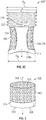
- the bone implant 100 can comprise a cylindrical member 102 and an articulating member 104.
- the cylindrical member 102 can extend along an implant axis 106 from a first end 108 to an opposed second end 110.
- the cylindrical member 102 can have a void 112 disposed therein that extends from the first end 108 towards the second end 110.
- the articulating member 104 can comprise an articulating portion 114 and a core portion 116 extending away from the articulating portion.
- the articulating member 104 can be coupled to the cylindrical member 102 such that the core portion 116 extends into the void 112 disposed in the cylindrical member 102 and the articulating portion 114 is positioned adjacent the first end 108 of the cylindrical member 102.
- the articulating portion 114 can extend radially outward from the implant axis 106 to cover the first end 108 of the cylindrical member 102.
- the articulating member 104 can be monolithic.
- the articulating member 104 can comprise at least one of polyethylene, cobalt chrome, ceramic, hydrogel, polyurethane, silicone, or PEEK.
- the articulating portion 114 can provide a surface to support articulation of a first bone (into which the implant 100 is implanted) and a second bone that is adjacent to the first bone. As illustrated in Figure 1 , the articulating portion 114 can have a generally planar articulating surface 118. As illustrated in Figure 2A , the articulating portion 214 of implant 200 can have an articulating surface 218a that is at least partially concave relative to a plane transverse to the implant axis 106. Additionally or alternatively, as illustrated in Figure 2B , the articulating portion 214 of implant 200' can have an articulating surface 218b that is at least partially convex relative to a plane transverse to the implant axis 206. Additionally, the void 212 disposed in the cylindrical member 202 and, additionally, the core portion 216 of the articulating member 204, can extend to the second end 210 of the cylindrical member 202.
- the implant 100' can have a helical thread 120 extending across at least a portion of the length of the cylindrical member 102.
- the helical thread 120 can be solid.
- the helical thread 120 can provide for benefits such as, for example and without limitation, initial stability, insertion options, and the like.
- the implant 200" can have a threaded member 220 coupled to the second end 210 of the cylindrical member 202.
- the threaded member 220 can be formed integrally with the cylindrical member 202, can be engageable with the cylindrical member 202, or can be a separate component from cylindrical member 202.
- the diameter of the threaded member D A can be greater than a diameter of the implant D B .
- Either or both of the helical thread 120 and the threaded member 220 can be combined with any example of an implant disclosed herein.
- the cylindrical member 102, 202 can comprise, in some examples, a material having interconnected open-pore structure for promoting bone tissue in-growth.
- the material can be at least one of stainless steel, titanium, titanium alloy, tantalum, polyether ether ketone (PEEK) and cobalt-chromium alloy.
- PEEK polyether ether ketone
- One suitable material comprises OsseoTi porous metal marketed by Zimmer Biomet (Warsaw, IN).
- OsseoTi comprises Ti6Al4V and can have a porous structure that generally mimics the porous structure of human cancellous bone.
- OsseoTi can be highly biocompatible and can have excellent corrosion resistance.
- the material can comprise Trabecular Metal, also marketed by Zimmer Biomet (Warsaw, IN).
- Such a material may be formed from a reticulated vitreous carbon foam substrate which can be infiltrated and coated with a biocompatible metal, such as tantalum, by a chemical vapor deposition ("CVD") process in the manner disclosed in detail in U.S. Patent No. 5,282,861 and in Levine, B.R., et al., "Experimental and Clinical Performance of Porous Tantalum in Orthopedic Surgery", Biomaterials 27 (2006) 4671-4681 , the disclosures of which are incorporated herein by reference.
- CVD chemical vapor deposition
- Such structures can be particularly suited for contacting bone and/or soft tissue, and in this regard, can be useful as bone substitutes and other implants and implant components that are receptive to cell and tissue ingrowth, for example, by allowing and promoting bony tissue or other tissue growth into the porous structure over time to enhance fixation (e.g ., osseointegration) between the implant and surrounding bodily structures.
- the cylindrical member 102, 202 can comprise biologics such as demineralized bone matrix (DBM), bone morphogenetic proteins (BMP) and antibiotics.
- the cylindrical member 102, 202 can comprise at least one of an anti-infective agent, an osteoconductive agent, an autologous blood product, a hydrogel, autologous cells, allogenic cells, peptides, and a bulk allograft.
- a bone implant 300 that can comprise a cylindrical member 302 that can extend along an implant axis 306 from a first end 308 to an opposed second end 310 thereof.
- Cylindrical member 302 can comprise any material or combination of materials described above with reference to cylindrical member 102, 202.
- the region proximate the first end 308 of the cylindrical member 302 can comprise an articulating portion 314.
- the articulating portion 314 can be formed monolithically with the cylindrical member 302.
- the articulating portion 314 can comprise a non-porous variant of the material of the cylindrical member 302 such as, for example and without limitation, a titanium alloy, a tantalum alloy, and the like.
- the articulating portion 314 can be formed from a different material than the cylindrical member 302.
- the articulating portion 314 can comprise cobalt chrome or other suitable metals.
- the articulating portion 314 can comprise an articulating surface 318 that can comprise a polished metal or metal alloy.
- a polished articulating surface 318 can aid in articulation of the bone implant with less friction with adjacent surfaces ( e.g ., another implant or adjacent bone), and result in a longer lifetime of the implant.
- the present disclosure also provides for a system 400 comprising a first implant 410 for implantation into a first bone 420 of a joint and a second implant 430 for implantation into a second bone 440 of a joint.
- the implants of the system are to be used with an ankle.
- the first bone 420 can be a talus and the second bone 440 can be either a calcaneous or a tibia.
- an implant or a system comprising two implants can facilitate articulation of the talus with the calcaneous (in which case the talus implant will be positioned in the lower region of the talus).
- an implant or a system comprising two implants can facilitate articulation of the talus with the tibia (in which case the talus implant will be positioned in the upper region of the talus).
- the first implant 410 and the second implant 430 can each comprise any of the implants described above with reference to Figures 1-3 . Further, the first implant 410 and the second implant 430 can be either the same as or different from each other.
- the articulating surface 412 of the first implant 410 can be at least partially convex and the articulating surface 432 of the second implant 430 can be at least partially concave (or vice-versa) in order to aid in more effective articulation of the implants with respect to one another.
- one or both of the articulating surfaces 412, 432 can be generally planar.
- one of the first or second articulating surfaces 412, 432 can comprise metal and the opposing first or second articulating surface can comprise polyethylene.
- each of the opposing first and second articulating surfaces 318, 338 can comprise metal, or each can comprise polyethylene.
- Figure 4 illustrates that articulating surface 412 of the first implant 410 directly opposes the articulating surface 432 of the second implant 430, this need not be the case.
- the articulating surface 512 of the first implant 510 can be at least partially offset from the articulating surface 532 of the second implant 530, such that each implant at least partially articulates in direct contact with bone or surrounding tissue.
- the bones of the foot could be rotated relative to one another to achieve alignment of the implants 520, 530 to ensure an optimal therapeutic result.
- a system 600 can comprise, e.g., five bone implants: two implants 602, 604 in a first bone of the joint, and three implants 606, 608, 610 in an opposing bone of the joint.
- multiple implants can be prepared through a single access hole.
- implants 606 and 608 can be prepared through the access hole associated with implant 602, and implant 602 subsequently prepared.
- implants 608 and 610 can be prepared through the access hole associated with implant 604, and implant 604 subsequently prepared.
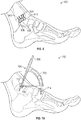
- a drill guide 700 can be provided.
- the drill guide 700 can comprise a main body 702, a slotted sleeve 704 and a foot 708.
- the main body 702 can be angularly adjustable to rotate about axis 712 to change the angle between the foot 708 and the sleeve 704.
- the main body 702 can be angularly adjustable to rotate about axis 714 to change the angle between the foot 708 and the sleeve 704 in a second plane.
- the sleeve 704 can comprise two slotted telescoping sleeves to facilitate adjustability and removal from guide pin 706 after the guide pin 706 is placed into bone.
- the foot 708 can have an insertion end that is open and slotted.
- the foot 708 can facilitate identification of the defect in the native bone.
- the guide foot can have a dimensions a and b that can each be larger than the corresponding implant dimensions to, for example, ensure proper spacing between multiple guide pins and holes for implants.
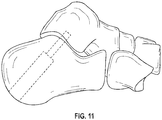
- FIG. 8A , 8B , 9 , and 11 illustrate one method for implanting bone implants.
- a drill having a first diameter D1 can make a first bore through a first bone of a joint and into the second bone of a joint opposite the first bone.
- a second drill having a second diameter D2 that is greater than the first diameter can make a counter bore into the first bone.
- the second implant can have a first diameter D1 corresponding to the first drill and can be inserted into a second bone of a joint.
- the first implant can have a second diameter D2 corresponding to the second drill and can be inserted into the first bone subsequent to insertion of the first implant.
- the first implant 810 can be implanted in the first bone that can be a talus 820 and the second implant 830 can be implanted in the second bone that can be a tibia 840.
- the first implant 910 can be implanted in first bone that can be a tibia 920 and a second implant 930 can be implanted in a second bone that can be a talus 940.
- the first implant 910 can be implanted in first bone that can be a tibia 920 and a second implant 930 can be implanted in a second bone that can be a talus 940.
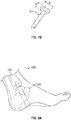
- the number and examples of implant access strategies are numerous and one or more access points can be used to implant one or more implants. Hole placements in Figure 10A and 10B are exemplary only and are not intended to be limiting.
- a method for implanting a bone implant can comprise placing wires or drill holes from the first bone to the second bone.
- the tibia is the first bone and the talus is the second bone (unless specified otherwise), however any of the recited combination disclosed herein or known in the art can be employed using the methods described herein.
- the wires or drill holes can be placed over areas of articular defects to be treated.
- the articular defect can be on either the first bone or the second bone of the joint ( e.g ., the tibia or the talus).
- the guide wire can be inserted into the joint space through the tibia.
- a first hole can be drilled with a cannulated drill through the tibia to the joint space.
- the wire and drill can be removed.
- the location of the talus defect can be maintained in line with the tibia hole and a second solid drill can drill into the talus to set the depth of the second implant.
- the depth of the second implant can be, for example, from about 10mm to about 20mm.
- a guide wire can be placed across the joint space and into the talus.
- the cannulated drill can drill through the tibia and into the talus to set the depth for an implant height for the second implant.
- a second guide pin can be used to facilitate placement of a second pin.
- the same guide or a second guide can be used for the placement of the second pin.
- the same tibial hole can be used to facilitate placement for a plurality of talus implants.
- the foot, with guide pins removed can be rotated to align a location for the second talus hole with the tibial hole and the guide. Then, the guide pin can be placed and the second talus hole can be drilled at the aligned location.
- a modular cutter or a reamer can be inserted into the joint space from a small incision.
- a cutter can be attached to a guide pin and can cut bone tissue to a desired depth in the talus and the tibia.
- a two-sided cutter can be used or a one-sided cutter can be used, requiring repositioning for each hole.
- Such methods are disclosed in U.S. Patent No. 9,301,766 .
- a drill guide such as the drill guide 700 illustrated in Figures 7A and 7B , comprising a drill over a pin 706 or wire
- a first drill 704a can be used to drill a first hole through the talus and into the tibia.
- the second drill 704b can have a second diameter that is greater than the first diameter and can drill into the tibia only. This method allows additional fixation on the tibial implant using, for example, one of the implants of Figures 1B and 2C .
- the joint between the calcaneous and the talus can be prepared and implanted similar to the talus/tibia examples above. If needed, a guide can be employed. The joint can be accessed and lesions identified. A guide wire can be placed. An implant hole or holes can be drilled.
- the calcaneous can be over drilled through the first cortex if an implant with adjustment or additional fixation is to be employed using, for example, one of the implants of Figures 1B and 2C .
- the terms “a” and “the” are used interchangeably, such that reference to “the bone implant” in a given example can refer to a bone implant described in a previous example that is optionally combined with the given example, or can refer to a separate bone implant entirely. Similarly “a bone implant” can refer to a newly introduced bone implant, or to a bone implant described in a previous example.
Landscapes
- Health & Medical Sciences (AREA)
- Orthopedic Medicine & Surgery (AREA)
- Life Sciences & Earth Sciences (AREA)
- Animal Behavior & Ethology (AREA)
- Public Health (AREA)
- Engineering & Computer Science (AREA)
- Biomedical Technology (AREA)
- Heart & Thoracic Surgery (AREA)
- Oral & Maxillofacial Surgery (AREA)
- Veterinary Medicine (AREA)
- General Health & Medical Sciences (AREA)
- Transplantation (AREA)
- Vascular Medicine (AREA)
- Cardiology (AREA)
- Surgery (AREA)
- Rheumatology (AREA)
- Dentistry (AREA)
- Nuclear Medicine, Radiotherapy & Molecular Imaging (AREA)
- Medical Informatics (AREA)
- Molecular Biology (AREA)
- Physical Education & Sports Medicine (AREA)
- Prostheses (AREA)
Claims (8)
- Greffon osseux (100; 100'; 200; 200'; 200", 300), comprenant :un élément cylindrique (102; 202; 302) s'étendant le long d'un axe de greffon (106; 206; 306) d'une première surface à une première extrémité (108; 308) à une deuxième extrémité opposée (110; 210; 310) dudit élément, l'élément cylindrique ayant un vide (112; 212) disposé à l'intérieur, s'étendant de la première extrémité vers la deuxième extrémité, l'élément cylindrique comprenant une structure à pores ouverts communicants pour favoriser l'interposition de tissu osseux ; etun élément d'articulation (104; 204) comprenant une partie d'articulation (114; 214; 314) et une partie centrale (116; 216) s'éloignant de la partie d'articulation, l'élément d'articulation étant couplé à l'élément cylindrique de telle sort que la partie centrale s'étend dans le vide disposé dans l'élément cylindrique et la partie d'articulation est positionnée à proximité immédiate de la première surface de l'élément cylindrique et s'étend radialement vers l'extérieur à partir de l'axe de greffon pour couvrir la première surface de l'élément cylindrique ;caractérisé en ce que le greffon osseux est un greffon osseux de cheville configuré pour être implanté dans l'astragale, le tibia ou le calcanéum et est formé de manière à être en contact avec un greffon osseux de cheville correspondant implantable dans un astragale, un tibia ou un calcanéum contigu pour faciliter l'articulation de l'astragale avec le tibia ou le calcanéum.
- Greffon osseux de cheville selon la revendication 1, dans lequel l'élément d'articulation est monolithique.
- Greffon osseux de cheville selon l'une quelconque des revendications 1-2, dans lequel l'élément d'articulation comprend au moins l'un du polyéthylène et du cobalt-chrome.
- Greffon osseux de cheville selon l'une quelconque des revendications 1-3, dans lequel une surface d'articulation de la partie d'articulation est au moins partiellement concave par rapport à un plan transversal à l'axe de greffon.
- Greffon osseux de cheville selon l'une quelconque des revendications 1-4, dans lequel une surface d'articulation de la partie d'articulation est au moins partiellement convexe par rapport à un plan transversal à l'axe de greffon.
- Greffon osseux selon l'une quelconque des revendications 1-5, dans lequel l'élément cylindrique comprend au moins l'un d'un alliage de titane et d'un alliage de tantale.
- Greffon osseux de cheville selon l'une quelconque des revendications 1-6, dans lequel le vide disposé dans l'élément cylindrique s'étend jusqu'à la deuxième surface opposée, et dans lequel le centre allongé de l'élément d'articulation s'étend jusqu'à la deuxième surface opposée de l'élément cylindrique.
- Greffon osseux de cheville selon la revendication 4, dans lequel la surface d'articulation au moins partiellement concave est formée de manière à être en contact avec une surface d'articulation au moins partiellement convexe du greffon osseux de cheville correspondant.
Applications Claiming Priority (2)
| Application Number | Priority Date | Filing Date | Title |
|---|---|---|---|
| US201562254282P | 2015-11-12 | 2015-11-12 | |
| PCT/US2016/061627 WO2017083718A1 (fr) | 2015-11-12 | 2016-11-11 | Implants d'articulation et méthodes |
Publications (2)
| Publication Number | Publication Date |
|---|---|
| EP3373864A1 EP3373864A1 (fr) | 2018-09-19 |
| EP3373864B1 true EP3373864B1 (fr) | 2019-12-11 |
Family
ID=57392072
Family Applications (1)
| Application Number | Title | Priority Date | Filing Date |
|---|---|---|---|
| EP16801112.0A Active EP3373864B1 (fr) | 2015-11-12 | 2016-11-11 | Implants d'articulation |
Country Status (7)
| Country | Link |
|---|---|
| US (1) | US11103358B2 (fr) |
| EP (1) | EP3373864B1 (fr) |
| JP (1) | JP7010818B2 (fr) |
| CN (1) | CN108366860B (fr) |
| AU (1) | AU2016353265B2 (fr) |
| CA (1) | CA3005228C (fr) |
| WO (1) | WO2017083718A1 (fr) |
Families Citing this family (4)
| Publication number | Priority date | Publication date | Assignee | Title |
|---|---|---|---|---|
| JP7010818B2 (ja) | 2015-11-12 | 2022-01-26 | バイオメット マニュファクチャリング,リミティド ライアビリティ カンパニー | 関節インプラント及び方法 |
| WO2017171707A1 (fr) * | 2016-03-28 | 2017-10-05 | Wright Medical Technology, Inc. | Plaque talar de resurfaçage antérieur |
| JP2024512752A (ja) * | 2021-03-30 | 2024-03-19 | パラゴン28・インコーポレイテッド | 整形外科用インプラントおよび方法 |
| CN113749832B (zh) * | 2021-09-22 | 2025-08-19 | 中国人民解放军陆军军医大学第一附属医院 | 一种电动骨膜和骨复合体移植套件及使用方法 |
Family Cites Families (23)
| Publication number | Priority date | Publication date | Assignee | Title |
|---|---|---|---|---|
| US5282861A (en) | 1992-03-11 | 1994-02-01 | Ultramet | Open cell tantalum structures for cancellous bone implants and cell and tissue receptors |
| US5489310A (en) * | 1994-06-27 | 1996-02-06 | Mikhail; W. E. Michael | Universal glenoid shoulder prosthesis and method for implanting |
| AU2118601A (en) | 1999-10-22 | 2001-05-08 | Mark A. Reiley | Ankle replacement system |
| US6626945B2 (en) | 2000-03-14 | 2003-09-30 | Chondrosite, Llc | Cartilage repair plug |
| US6939380B2 (en) | 2002-12-23 | 2005-09-06 | Depuy Products, Inc. | Mobile talar component for total ankle replacement implant |
| US20050288792A1 (en) * | 2004-06-23 | 2005-12-29 | Landes Mark D | Modular ankle prosthesis and associated method |
| US20090319045A1 (en) * | 2004-10-12 | 2009-12-24 | Truncale Katherine G | Cancellous constructs, cartilage particles and combinations of cancellous constructs and cartilage particles |
| WO2007108411A1 (fr) * | 2006-03-17 | 2007-09-27 | Hi-Lex Corporation | Materiel medical |
| CN101448533A (zh) * | 2006-03-17 | 2009-06-03 | Hi-Lex株式会社 | 医用材料 |
| US7753959B2 (en) | 2006-03-20 | 2010-07-13 | Biomet Manufacturing Corp. | Modular center pegged glenoid |
| US8425614B2 (en) * | 2006-03-20 | 2013-04-23 | Biomet Manufacturing Corp. | Modular center pegged glenoid |
| EP1911412B1 (fr) * | 2006-10-11 | 2011-04-13 | Astra Tech AB | Implant |
| US20090312842A1 (en) * | 2008-06-16 | 2009-12-17 | Predrag Bursac | Assembled Cartilage Repair Graft |
| US20100145451A1 (en) * | 2008-12-04 | 2010-06-10 | Derek Dee | Joint support and subchondral support system |
| US8556972B2 (en) * | 2009-04-02 | 2013-10-15 | Sevika Holding AG | Monolithic orthopedic implant with an articular finished surface |
| US20100256758A1 (en) | 2009-04-02 | 2010-10-07 | Synvasive Technology, Inc. | Monolithic orthopedic implant with an articular finished surface |
| TR200904029A2 (tr) | 2009-05-25 | 2009-10-21 | Murat Aydin Hali̇l | Bir biyomalzeme. |
| US20110035019A1 (en) * | 2009-07-09 | 2011-02-10 | Wright State University | Total ankle replacement system |
| FR2971144A1 (fr) * | 2011-02-08 | 2012-08-10 | Tornier Sa | Implant glenoidien pour prothese d'epaule et kit chirurgical |
| US20120245701A1 (en) | 2011-03-24 | 2012-09-27 | Rudolf Zak | Hemi Ankle Implant |
| US8728084B2 (en) | 2011-06-27 | 2014-05-20 | Biomet Sports Medicine, Llc | Apparatus for repairing bone defects |
| US9452056B2 (en) * | 2014-09-29 | 2016-09-27 | Biomet C.V. | Implants for fixation of the distal tibia |
| JP7010818B2 (ja) | 2015-11-12 | 2022-01-26 | バイオメット マニュファクチャリング,リミティド ライアビリティ カンパニー | 関節インプラント及び方法 |
-
2016
- 2016-11-11 JP JP2018524417A patent/JP7010818B2/ja active Active
- 2016-11-11 AU AU2016353265A patent/AU2016353265B2/en active Active
- 2016-11-11 CN CN201680072751.1A patent/CN108366860B/zh active Active
- 2016-11-11 WO PCT/US2016/061627 patent/WO2017083718A1/fr not_active Ceased
- 2016-11-11 CA CA3005228A patent/CA3005228C/fr active Active
- 2016-11-11 EP EP16801112.0A patent/EP3373864B1/fr active Active
- 2016-11-11 US US15/349,752 patent/US11103358B2/en active Active
Non-Patent Citations (1)
| Title |
|---|
| None * |
Also Published As
| Publication number | Publication date |
|---|---|
| EP3373864A1 (fr) | 2018-09-19 |
| CN108366860A (zh) | 2018-08-03 |
| US11103358B2 (en) | 2021-08-31 |
| US20170135821A1 (en) | 2017-05-18 |
| AU2016353265B2 (en) | 2019-08-29 |
| AU2016353265A1 (en) | 2018-06-07 |
| CN108366860B (zh) | 2020-03-03 |
| JP2018533433A (ja) | 2018-11-15 |
| WO2017083718A1 (fr) | 2017-05-18 |
| CA3005228A1 (fr) | 2017-05-18 |
| JP7010818B2 (ja) | 2022-01-26 |
| CA3005228C (fr) | 2020-12-22 |
Similar Documents
| Publication | Publication Date | Title |
|---|---|---|
| US20220296376A1 (en) | Ameliorating joint conditions including injuries and diseases | |
| JP6529717B2 (ja) | 第2関節窩プロテーゼをインプラントするためのシステム及び方法 | |
| CN103237514B (zh) | 利用压缩性植入物固定或融合骨的系统 | |
| ES2357319T3 (es) | Prótesis de articulación anclada por tornillo. | |
| JP4248968B2 (ja) | 関節の人工器官、股関節の人工器官、関節の人工器官用のベアリング | |
| CN102014800B (zh) | 局部关节表面置换植入物、仪器和方法 | |
| US4936848A (en) | Implant for vertebrae | |
| JP5095395B2 (ja) | 溝付き髄内ステム | |
| US20040225294A1 (en) | Acetabular reamer | |
| US20070185582A1 (en) | Methods and Devices for Resurfacing the Wrist Joint | |
| US20030050704A1 (en) | Prosthesis | |
| CN102985035A (zh) | 髋关节修正植入物及假体系统 | |
| JP3045511B2 (ja) | 人工腰関節およびその使用 | |
| US11273045B2 (en) | Motion toe systems and methods | |
| EP1884221A1 (fr) | Système intramédullaire à rigidité variable | |
| JP2001346818A (ja) | 大腿骨股関節補綴物 | |
| EP3373864B1 (fr) | Implants d'articulation | |
| JP2004130113A (ja) | セメント接合式プロテーゼキット | |
| JP2004141661A (ja) | インプラント及びその使用方法 | |
| US20230414230A1 (en) | Toe implant assemblies, kits, surgical methods, and methods of manufacturing | |
| US9474620B2 (en) | Talonavicular joint prosthesis and its method of implantation | |
| CN120324157B (zh) | 一种用于髋臼榫卯结构性植骨的套装器械及应用 | |
| JP2024518851A (ja) | プロテーゼ部品および/または生体インプラントの設置用キット |
Legal Events
| Date | Code | Title | Description |
|---|---|---|---|
| STAA | Information on the status of an ep patent application or granted ep patent |
Free format text: STATUS: UNKNOWN |
|
| STAA | Information on the status of an ep patent application or granted ep patent |
Free format text: STATUS: THE INTERNATIONAL PUBLICATION HAS BEEN MADE |
|
| PUAI | Public reference made under article 153(3) epc to a published international application that has entered the european phase |
Free format text: ORIGINAL CODE: 0009012 |
|
| STAA | Information on the status of an ep patent application or granted ep patent |
Free format text: STATUS: REQUEST FOR EXAMINATION WAS MADE |
|
| 17P | Request for examination filed |
Effective date: 20180612 |
|
| AK | Designated contracting states |
Kind code of ref document: A1 Designated state(s): AL AT BE BG CH CY CZ DE DK EE ES FI FR GB GR HR HU IE IS IT LI LT LU LV MC MK MT NL NO PL PT RO RS SE SI SK SM TR |
|
| AX | Request for extension of the european patent |
Extension state: BA ME |
|
| DAV | Request for validation of the european patent (deleted) | ||
| DAX | Request for extension of the european patent (deleted) | ||
| RIC1 | Information provided on ipc code assigned before grant |
Ipc: A61F 2/42 20060101ALI20190401BHEP Ipc: A61F 2/28 20060101AFI20190401BHEP |
|
| GRAP | Despatch of communication of intention to grant a patent |
Free format text: ORIGINAL CODE: EPIDOSNIGR1 |
|
| STAA | Information on the status of an ep patent application or granted ep patent |
Free format text: STATUS: GRANT OF PATENT IS INTENDED |
|
| INTG | Intention to grant announced |
Effective date: 20190516 |
|
| GRAS | Grant fee paid |
Free format text: ORIGINAL CODE: EPIDOSNIGR3 |
|
| GRAA | (expected) grant |
Free format text: ORIGINAL CODE: 0009210 |
|
| STAA | Information on the status of an ep patent application or granted ep patent |
Free format text: STATUS: THE PATENT HAS BEEN GRANTED |
|
| AK | Designated contracting states |
Kind code of ref document: B1 Designated state(s): AL AT BE BG CH CY CZ DE DK EE ES FI FR GB GR HR HU IE IS IT LI LT LU LV MC MK MT NL NO PL PT RO RS SE SI SK SM TR |
|
| REG | Reference to a national code |
Ref country code: GB Ref legal event code: FG4D |
|
| REG | Reference to a national code |
Ref country code: CH Ref legal event code: EP Ref country code: CH Ref legal event code: NV Representative=s name: MICHELI AND CIE SA, CH |
|
| REG | Reference to a national code |
Ref country code: AT Ref legal event code: REF Ref document number: 1211412 Country of ref document: AT Kind code of ref document: T Effective date: 20191215 |
|
| REG | Reference to a national code |
Ref country code: DE Ref legal event code: R096 Ref document number: 602016026138 Country of ref document: DE |
|
| REG | Reference to a national code |
Ref country code: IE Ref legal event code: FG4D |
|
| REG | Reference to a national code |
Ref country code: NL Ref legal event code: MP Effective date: 20191211 |
|
| REG | Reference to a national code |
Ref country code: LT Ref legal event code: MG4D |
|
| PG25 | Lapsed in a contracting state [announced via postgrant information from national office to epo] |
Ref country code: LT Free format text: LAPSE BECAUSE OF FAILURE TO SUBMIT A TRANSLATION OF THE DESCRIPTION OR TO PAY THE FEE WITHIN THE PRESCRIBED TIME-LIMIT Effective date: 20191211 Ref country code: SE Free format text: LAPSE BECAUSE OF FAILURE TO SUBMIT A TRANSLATION OF THE DESCRIPTION OR TO PAY THE FEE WITHIN THE PRESCRIBED TIME-LIMIT Effective date: 20191211 Ref country code: BG Free format text: LAPSE BECAUSE OF FAILURE TO SUBMIT A TRANSLATION OF THE DESCRIPTION OR TO PAY THE FEE WITHIN THE PRESCRIBED TIME-LIMIT Effective date: 20200311 Ref country code: LV Free format text: LAPSE BECAUSE OF FAILURE TO SUBMIT A TRANSLATION OF THE DESCRIPTION OR TO PAY THE FEE WITHIN THE PRESCRIBED TIME-LIMIT Effective date: 20191211 Ref country code: NO Free format text: LAPSE BECAUSE OF FAILURE TO SUBMIT A TRANSLATION OF THE DESCRIPTION OR TO PAY THE FEE WITHIN THE PRESCRIBED TIME-LIMIT Effective date: 20200311 Ref country code: GR Free format text: LAPSE BECAUSE OF FAILURE TO SUBMIT A TRANSLATION OF THE DESCRIPTION OR TO PAY THE FEE WITHIN THE PRESCRIBED TIME-LIMIT Effective date: 20200312 Ref country code: FI Free format text: LAPSE BECAUSE OF FAILURE TO SUBMIT A TRANSLATION OF THE DESCRIPTION OR TO PAY THE FEE WITHIN THE PRESCRIBED TIME-LIMIT Effective date: 20191211 |
|
| PG25 | Lapsed in a contracting state [announced via postgrant information from national office to epo] |
Ref country code: RS Free format text: LAPSE BECAUSE OF FAILURE TO SUBMIT A TRANSLATION OF THE DESCRIPTION OR TO PAY THE FEE WITHIN THE PRESCRIBED TIME-LIMIT Effective date: 20191211 Ref country code: HR Free format text: LAPSE BECAUSE OF FAILURE TO SUBMIT A TRANSLATION OF THE DESCRIPTION OR TO PAY THE FEE WITHIN THE PRESCRIBED TIME-LIMIT Effective date: 20191211 |
|
| PG25 | Lapsed in a contracting state [announced via postgrant information from national office to epo] |
Ref country code: AL Free format text: LAPSE BECAUSE OF FAILURE TO SUBMIT A TRANSLATION OF THE DESCRIPTION OR TO PAY THE FEE WITHIN THE PRESCRIBED TIME-LIMIT Effective date: 20191211 |
|
| PG25 | Lapsed in a contracting state [announced via postgrant information from national office to epo] |
Ref country code: CZ Free format text: LAPSE BECAUSE OF FAILURE TO SUBMIT A TRANSLATION OF THE DESCRIPTION OR TO PAY THE FEE WITHIN THE PRESCRIBED TIME-LIMIT Effective date: 20191211 Ref country code: PT Free format text: LAPSE BECAUSE OF FAILURE TO SUBMIT A TRANSLATION OF THE DESCRIPTION OR TO PAY THE FEE WITHIN THE PRESCRIBED TIME-LIMIT Effective date: 20200506 Ref country code: EE Free format text: LAPSE BECAUSE OF FAILURE TO SUBMIT A TRANSLATION OF THE DESCRIPTION OR TO PAY THE FEE WITHIN THE PRESCRIBED TIME-LIMIT Effective date: 20191211 Ref country code: NL Free format text: LAPSE BECAUSE OF FAILURE TO SUBMIT A TRANSLATION OF THE DESCRIPTION OR TO PAY THE FEE WITHIN THE PRESCRIBED TIME-LIMIT Effective date: 20191211 Ref country code: RO Free format text: LAPSE BECAUSE OF FAILURE TO SUBMIT A TRANSLATION OF THE DESCRIPTION OR TO PAY THE FEE WITHIN THE PRESCRIBED TIME-LIMIT Effective date: 20191211 Ref country code: ES Free format text: LAPSE BECAUSE OF FAILURE TO SUBMIT A TRANSLATION OF THE DESCRIPTION OR TO PAY THE FEE WITHIN THE PRESCRIBED TIME-LIMIT Effective date: 20191211 |
|
| PG25 | Lapsed in a contracting state [announced via postgrant information from national office to epo] |
Ref country code: IS Free format text: LAPSE BECAUSE OF FAILURE TO SUBMIT A TRANSLATION OF THE DESCRIPTION OR TO PAY THE FEE WITHIN THE PRESCRIBED TIME-LIMIT Effective date: 20200411 Ref country code: SK Free format text: LAPSE BECAUSE OF FAILURE TO SUBMIT A TRANSLATION OF THE DESCRIPTION OR TO PAY THE FEE WITHIN THE PRESCRIBED TIME-LIMIT Effective date: 20191211 Ref country code: SM Free format text: LAPSE BECAUSE OF FAILURE TO SUBMIT A TRANSLATION OF THE DESCRIPTION OR TO PAY THE FEE WITHIN THE PRESCRIBED TIME-LIMIT Effective date: 20191211 |
|
| REG | Reference to a national code |
Ref country code: DE Ref legal event code: R097 Ref document number: 602016026138 Country of ref document: DE |
|
| REG | Reference to a national code |
Ref country code: AT Ref legal event code: MK05 Ref document number: 1211412 Country of ref document: AT Kind code of ref document: T Effective date: 20191211 |
|
| PLBE | No opposition filed within time limit |
Free format text: ORIGINAL CODE: 0009261 |
|
| STAA | Information on the status of an ep patent application or granted ep patent |
Free format text: STATUS: NO OPPOSITION FILED WITHIN TIME LIMIT |
|
| REG | Reference to a national code |
Ref country code: DE Ref legal event code: R082 Ref document number: 602016026138 Country of ref document: DE Representative=s name: VENNER SHIPLEY GERMANY LLP, DE Ref country code: DE Ref legal event code: R082 Ref document number: 602016026138 Country of ref document: DE Representative=s name: VENNER SHIPLEY LLP, DE |
|
| PG25 | Lapsed in a contracting state [announced via postgrant information from national office to epo] |
Ref country code: DK Free format text: LAPSE BECAUSE OF FAILURE TO SUBMIT A TRANSLATION OF THE DESCRIPTION OR TO PAY THE FEE WITHIN THE PRESCRIBED TIME-LIMIT Effective date: 20191211 |
|
| 26N | No opposition filed |
Effective date: 20200914 |
|
| PG25 | Lapsed in a contracting state [announced via postgrant information from national office to epo] |
Ref country code: AT Free format text: LAPSE BECAUSE OF FAILURE TO SUBMIT A TRANSLATION OF THE DESCRIPTION OR TO PAY THE FEE WITHIN THE PRESCRIBED TIME-LIMIT Effective date: 20191211 Ref country code: SI Free format text: LAPSE BECAUSE OF FAILURE TO SUBMIT A TRANSLATION OF THE DESCRIPTION OR TO PAY THE FEE WITHIN THE PRESCRIBED TIME-LIMIT Effective date: 20191211 |
|
| PG25 | Lapsed in a contracting state [announced via postgrant information from national office to epo] |
Ref country code: IT Free format text: LAPSE BECAUSE OF FAILURE TO SUBMIT A TRANSLATION OF THE DESCRIPTION OR TO PAY THE FEE WITHIN THE PRESCRIBED TIME-LIMIT Effective date: 20191211 |
|
| PG25 | Lapsed in a contracting state [announced via postgrant information from national office to epo] |
Ref country code: PL Free format text: LAPSE BECAUSE OF FAILURE TO SUBMIT A TRANSLATION OF THE DESCRIPTION OR TO PAY THE FEE WITHIN THE PRESCRIBED TIME-LIMIT Effective date: 20191211 |
|
| PG25 | Lapsed in a contracting state [announced via postgrant information from national office to epo] |
Ref country code: MC Free format text: LAPSE BECAUSE OF FAILURE TO SUBMIT A TRANSLATION OF THE DESCRIPTION OR TO PAY THE FEE WITHIN THE PRESCRIBED TIME-LIMIT Effective date: 20191211 |
|
| PG25 | Lapsed in a contracting state [announced via postgrant information from national office to epo] |
Ref country code: LU Free format text: LAPSE BECAUSE OF NON-PAYMENT OF DUE FEES Effective date: 20201111 |
|
| REG | Reference to a national code |
Ref country code: BE Ref legal event code: MM Effective date: 20201130 |
|
| PG25 | Lapsed in a contracting state [announced via postgrant information from national office to epo] |
Ref country code: IE Free format text: LAPSE BECAUSE OF NON-PAYMENT OF DUE FEES Effective date: 20201111 |
|
| PG25 | Lapsed in a contracting state [announced via postgrant information from national office to epo] |
Ref country code: TR Free format text: LAPSE BECAUSE OF FAILURE TO SUBMIT A TRANSLATION OF THE DESCRIPTION OR TO PAY THE FEE WITHIN THE PRESCRIBED TIME-LIMIT Effective date: 20191211 Ref country code: MT Free format text: LAPSE BECAUSE OF FAILURE TO SUBMIT A TRANSLATION OF THE DESCRIPTION OR TO PAY THE FEE WITHIN THE PRESCRIBED TIME-LIMIT Effective date: 20191211 Ref country code: CY Free format text: LAPSE BECAUSE OF FAILURE TO SUBMIT A TRANSLATION OF THE DESCRIPTION OR TO PAY THE FEE WITHIN THE PRESCRIBED TIME-LIMIT Effective date: 20191211 |
|
| PG25 | Lapsed in a contracting state [announced via postgrant information from national office to epo] |
Ref country code: MK Free format text: LAPSE BECAUSE OF FAILURE TO SUBMIT A TRANSLATION OF THE DESCRIPTION OR TO PAY THE FEE WITHIN THE PRESCRIBED TIME-LIMIT Effective date: 20191211 |
|
| PG25 | Lapsed in a contracting state [announced via postgrant information from national office to epo] |
Ref country code: BE Free format text: LAPSE BECAUSE OF NON-PAYMENT OF DUE FEES Effective date: 20201130 |
|
| P01 | Opt-out of the competence of the unified patent court (upc) registered |
Effective date: 20230619 |
|
| REG | Reference to a national code |
Ref country code: CH Ref legal event code: U11 Free format text: ST27 STATUS EVENT CODE: U-0-0-U10-U11 (AS PROVIDED BY THE NATIONAL OFFICE) Effective date: 20251201 |
|
| PGFP | Annual fee paid to national office [announced via postgrant information from national office to epo] |
Ref country code: DE Payment date: 20251021 Year of fee payment: 10 |
|
| PGFP | Annual fee paid to national office [announced via postgrant information from national office to epo] |
Ref country code: GB Payment date: 20251114 Year of fee payment: 10 |
|
| PGFP | Annual fee paid to national office [announced via postgrant information from national office to epo] |
Ref country code: FR Payment date: 20251112 Year of fee payment: 10 |
|
| PGFP | Annual fee paid to national office [announced via postgrant information from national office to epo] |
Ref country code: CH Payment date: 20251201 Year of fee payment: 10 |