EP3375320B1 - Epiliervorrichtung und verfahren - Google Patents
Epiliervorrichtung und verfahren Download PDFInfo
- Publication number
- EP3375320B1 EP3375320B1 EP18162220.0A EP18162220A EP3375320B1 EP 3375320 B1 EP3375320 B1 EP 3375320B1 EP 18162220 A EP18162220 A EP 18162220A EP 3375320 B1 EP3375320 B1 EP 3375320B1
- Authority
- EP
- European Patent Office
- Prior art keywords
- disc
- axle
- axis
- pincers
- discs
- Prior art date
- Legal status (The legal status is an assumption and is not a legal conclusion. Google has not performed a legal analysis and makes no representation as to the accuracy of the status listed.)
- Active
Links
Images




Classifications
-
- A—HUMAN NECESSITIES
- A45—HAND OR TRAVELLING ARTICLES
- A45D—HAIRDRESSING OR SHAVING EQUIPMENT; EQUIPMENT FOR COSMETICS OR COSMETIC TREATMENTS, e.g. FOR MANICURING OR PEDICURING
- A45D26/00—Hair-singeing apparatus; Apparatus for removing superfluous hair, e.g. tweezers
- A45D26/0023—Hair-singeing apparatus; Apparatus for removing superfluous hair, e.g. tweezers with rotating clamping elements
- A45D26/0028—Hair-singeing apparatus; Apparatus for removing superfluous hair, e.g. tweezers with rotating clamping elements with rotating discs or blades
-
- A—HUMAN NECESSITIES
- A45—HAND OR TRAVELLING ARTICLES
- A45D—HAIRDRESSING OR SHAVING EQUIPMENT; EQUIPMENT FOR COSMETICS OR COSMETIC TREATMENTS, e.g. FOR MANICURING OR PEDICURING
- A45D26/00—Hair-singeing apparatus; Apparatus for removing superfluous hair, e.g. tweezers
- A45D26/0023—Hair-singeing apparatus; Apparatus for removing superfluous hair, e.g. tweezers with rotating clamping elements
-
- A—HUMAN NECESSITIES
- A45—HAND OR TRAVELLING ARTICLES
- A45D—HAIRDRESSING OR SHAVING EQUIPMENT; EQUIPMENT FOR COSMETICS OR COSMETIC TREATMENTS, e.g. FOR MANICURING OR PEDICURING
- A45D26/00—Hair-singeing apparatus; Apparatus for removing superfluous hair, e.g. tweezers
- A45D26/0023—Hair-singeing apparatus; Apparatus for removing superfluous hair, e.g. tweezers with rotating clamping elements
- A45D26/0033—Hair-singeing apparatus; Apparatus for removing superfluous hair, e.g. tweezers with rotating clamping elements with rollers
- A45D26/0038—Hair-singeing apparatus; Apparatus for removing superfluous hair, e.g. tweezers with rotating clamping elements with rollers power-driven
-
- A—HUMAN NECESSITIES
- A45—HAND OR TRAVELLING ARTICLES
- A45D—HAIRDRESSING OR SHAVING EQUIPMENT; EQUIPMENT FOR COSMETICS OR COSMETIC TREATMENTS, e.g. FOR MANICURING OR PEDICURING
- A45D26/00—Hair-singeing apparatus; Apparatus for removing superfluous hair, e.g. tweezers
- A45D2026/008—Details of apparatus for removing superfluous hair
Definitions
- the invention is directed to an epilating head for an epilating device especially to an epilating head comprising a group of pincer assemblies.
- Depilating devices use one of two methods for removing hair. In one method, the hair is cut, leaving the roots intact beneath the skin surface. In the other method, hair is removed by pulling it out from its roots.
- Disc mechanisms are often used. In general, these mechanisms include discs and associated pincer-like elements. When two pincer-like elements are brought close together, hair is trapped between them. The discs, which rotate and produce a torque, then uproot the hair trapped between their associated pincers. The pincer-like elements and their associated discs move in unison and all pincer-like elements within a fixed distance move close to their adjacent pincer-like elements synchronously. The forces required in such mechanisms are multiples of the number of pincers. In some of these depilatory devices, the disc mechanisms have cylindrical shapes. Other depilating devices which use disc mechanisms employ a large spring with bearings connected to its ends.
- the magnitude of the force is the same throughout the entire mechanism.
- the forces required in such mechanisms are relatively small and the energy required is not great.
- a depilatory device using a disc mechanism is subject to several constraints.
- the pincer-like elements associated with each disc must close quickly.
- the pressure exerted by each contacting pair of pincers must be neither too great nor too little. In the former case, the hair would be cut, while in the latter case, the hair would slide through without being pulled out at its roots.
- all the pincers associated with a row of discs must contact their adjacent pincers simultaneously.
- the contacting mechanism must be simple, operate reliably over time, and be easy to maintain.
- an epilator comprising a head for trapping hair for removal.
- the head comprises a rotating body that has as an axis of rotation and is adapted to be rotated by a motor.
- At least one pair of pincers is arranged at or in the rotating body.
- the pair of pincers is able to rotate in accordance with the rotation of the rotating body.
- At least their outermost ends are adapted to move towards each other and away from each other depending on the location of the rotating body.
- at least one intermediate member is provided which is arranged such that it is at least linearly moveable between the outermost ends of the pincers.
- the pair of pincers only extends on one side of the axis of rotation.
- One spring is located between the pair of pincers and is arranged to bias the pincers either away from each other or towards each other.
- At least one actuator is provided for the pair of pincers which can be supported to move along or parallel to the axis of rotation and engages a first pincer adjacent an end thereof being distal to the axis of rotation and a second pincer at or adjacent an end thereof being proximal to the axis of rotation.
- the epilating device includes a single housing that is shaped to be grasped by the hand of a user and which includes a drive source.
- the housing can carry a first epilation module provided at its top with a first plucking head that is driven by the drive source to effect the plucking of the body hairs.
- the first plucking head has a length defining there along a first epilation zone.
- a second epilation module to be carried on the housing that is provided at its top with a second plucking head that is driven commonly by the drive source to effect plucking of the body hairs.
- the second plucking head has a length defining there along a second epilation zone.
- EP 1 405 701 B1 relates to a linkage mechanism for a hair removal appliance, such as a powered or dry shaver or epilator, having a head rockably mounted on a body, and to such hair depilation apparatus.
- a hair removal appliance such as a powered or dry shaver or epilator
- the device and method realizes a rocking about a virtual pivot axis.
- WO 2005/063076 is directed to a depilator assembly for trapping hair for removal.
- the assembly includes a symmetric disc formed of two lobes and two pincers. At least two pressure-transferring protrusions and at least one rotation transferring protrusion are formed and positioned on a first face of said disc. Further rat least two pressure-transferring protrusions and at least two spacer elements are formed and positioned on a second face of said disc. The spacer elements being operative to prevent the accumulation of debris between adjacent discs and to allow for periodic tilting of the discs when pressure is provided to the depilator assembly.
- the second face of the disc further has formed therein at least one recess configured to accommodate said at least one rotation-transferring protrusions of a similar disc of an adjacent depilator assembly in force transferring engagement, such that, in response to a rotational force applied to said assembly at least one rotation-transferring protrusion is operative to transfer rotation to said adjacent assembly.
- WO 2015/121851 relates to an epilator comprising a pair of corresponding and separable epilator heads for trapping hair for removal.
- Each head has an exposed portion for allowing at least one or more parts of each head to get in touch with a user's skin.
- Each head has a rotating body having an axis of rotation and being adapted to be rotated by a driving unit, wherein the rotating body is adapted to trap the hair for removal at the exposed portion, and wherein the axis of the rotating body is essentially concave relative to the exposed portion of each head.
- the present invention is directed to an epilating head according to claim 1, a pincer assembly according to claim 14 and a method according to claim 15.
- the present invention is directed to an epilating head for an epilating device. It can comprise the following features or any subgroup thereof.
- the first disc can be configured to be rotatable around an axle of rotation or around an axis of rotation.
- the axle does not rotate and the disc can rotate around the axle or can be arranged on an element rotating together with the disc around the axle.
- the axle In the second case the axle can rotate itself.
- it is not curved, it could be made of segments or an elastic material in order to allow it to rotate.
- the disc can be arranged directly on the axle and rotate with axle.
- the pincers can rotate around the axle of rotation.
- the pincers can be arranged at least a counter element or a second disc with at least two counterparts or second disc pincers.
- the counter element or second disc can be configured to be rotatable around the axle or the axis, as described before.
- counter element or disc is not limited to a flat piece of material but can have a considerable thickness. Moreover, it can have any topography and not just two planes with protrusions, e.g. the protrusions being cold drawn or formed in a body.
- the first and the counter element or second discs can be configured so that a first pair is composed of one of the first disc pincers and of one of the counterparts or second disc pincer to form a first tweezer.
- a first pair is composed of one of the first disc pincers and of one of the counterparts or second disc pincer to form a first tweezer.
- neighboring pincers of different discs can form a tweezer.
- a second pair composed of one of the first disc pincers and one of the further counterparts or second disc pincer can form a second tweezer.
- the pincers formed at the discs can be provided in any way, either by providing a flat material, punch it and then deform the parts thereof into different directions or planes.
- the first and second tweezers can each be brought in an open condition over at least a first section of rotation around the axle or axis.
- the first and second tweezers each can be in a closed condition over a second section of rotation around the axle or axis.
- the opening of the tweezers is intended to happen when hair of a user is either brought into the tweezers or released from the tweezers once the hairs are plugged out.
- the closing is intended to primarily take place during the gripping of hair and the remaining in the closed position is intended to primarily take place when plugging or epilating/depilating of hair.
- the first and second tweezers can open and close at different times although they can open at similar or neighboring locations during rotation of the discs.
- the first tweezer and the second tweezer are at least one of axially offset, their envelopes of rotation are neighboring or their envelopes of rotation are side by side. Thus, they are offset and/or their envelopes of rotation do not coincide but are arranged in an axial neighborhood or side by side. This can ensure that the body or skin of a user will be depilated easier and more effectively as the device will treat a surface of the body or skin more equally and completely.
- the first disc pincers can be formed by first disc protrusions radially extending at least in part from the first disc.
- the second disc pincers are formed by second disc protrusions radially extending at least in part from the second disc. Neighboring first disc pincers and/or neighboring second disc pincers can be axially offset to each other. This can ensure that the tweezers formed by the pincers become active not at the same location of the skin but at neighboring locations. Thus the surface of a user's skin is more equally and completely treated over a width of the epilating head without making it necessary for the user to considerably move the device during use.
- the epilating device can also comprise a third disc with at least two third disc pincers. Also a further disc could be provided. Anyhow, the third disc can be rotatable around the axis or axle of rotation. In this case the first and the third discs can be configured that a third pair composed of one of the first disc pincers and one of the third disc pincers form a third tweezer and a fourth pair composed of one of the first disc pincers and one of the third disc pincers form a fourth tweezer.
- the third and fourth tweezers can be in an open condition over at least a first section of rotation around the axis or axle.
- the third and fourth tweezers can each or in groups be in a closed condition over a second section of rotation around the axis or axle.
- the third tweezer and the fourth tweezer can be at least one of axially offset, their envelopes of rotation are neighboring or their envelopes of rotation are side by side, as already further mentioned before.
- the first disc can have from 4 to 8 pincers and each of the second disc and the third disc can have from 2 to 4 pincers so that from 4 to 8 tweezers are formed.
- the first disc can have 6 pincers and each of the second disc and the third disc can have from 3 pincers so that 6 tweezers are formed.
- the epilating head according to the present invention can comprise 4 to 12 sets of first, second and third discs, preferably 6-10 sets of first, second and third discs, more preferably 8 sets of first, second and third discs. Any other number of sets can also be realized. These numbers of sets of discs can ensure a harmonious and equal treatment of the user's skin by a head.
- a head drum can be formed by a plurality of hub units each supporting a set of discs rotating around the axis or axle.
- At least one of the second disc and the third disc can have extensions formed at the pincers extending outwardly in the direction of rotation and adapted to assist in guiding hair into the tweezers, the extensions being inclined between 10-40° with respect to the plane of the pincers, preferably between 25-35°.
- the axis or axle of rotation is formed concave with respect to a side of use. It can thus better be adapted to the generally skin of a user that is generally convexly shaped.
- the tweezers can be adapted to be in an open condition over the first section of circumference of rotation around the axis or axle and in a closed condition over the second section of circumference of rotation around the axis or axle.
- Each of the first disc, the second disc and/or the third disc have an inner opening being adapted to support a coaxial support of the first disc, the second disc and/or the third disc.
- the opening can be round or can have any shape allowing a positively locking rotation with other elements or the axle.
- These can be slots, specific shapes of the holes etc. allowing for the engagement of correspondingly shaped elements.
- At least two hub units each can be adapted to be supported on the axis or axle and to rotate on the axis or axle. Further the hub unit can support the first disc, the second disc and/or the third disc, so that they rotate together with the respective hub unit.
- Each hub unit can further be configured to bring the tweezers each in an open condition over at least a first section of circumference of rotation and in a closed condition over at least a second section of circumference of rotation around the axis or axle. This can cause a periodic movement, deformation and preferably tilting of one, more than one or all of the discs.
- the axis or axle can be formed concave with respect to a side of use. At least two sets of hub units can be arranged on the axis or axle. In view of the concave shape of the axis or axle the hub units can each being configured to cause the tweezers in an open condition over at least a first section of circumference of rotation and in a closed condition over at least a second section of circumference of rotation around the axis or axle, preferably in or close to the side of use.
- a plurality of hub units can be arranged side by side on the axis or axle to form a rotating head drum.
- the hub units can have pressure-transferring protrusions on the side opposite to the side of the discs transferring pressure to the discs of the neighboring hub unit. This can further assist the tweezers of the neighboring hub unit to be in an open condition over the first section of circumference of rotation around the axis or axle and in a closed condition over the second section of circumference of rotation around the axis or axle.
- the head drum can further comprise at one end a second hub unit driving the head drum and forming an end section of a head drum with pressure-transferring protrusions transferring pressure onto a set of discs of the neighboring hub unit.
- a third hub unit can form the opposite end section and comprising a set of discs.
- At least two pressure-transferring protrusions can be formed and positioned on a side of the hub unit.
- the first to the third discs can be adapted to be positioned on one side of the hub unit. It can be further adapted for periodic tilting where in a first section of 360° rotational movement, the pressure-transferring protrusions from a similar adjacent pincer assembly are configured to press on at least one of the discs thereby to cause the discs to contact each other at their pincer surfaces trapping hair there between. In a second section, the contact between the pincer surfaces is adapted to be ceased releasing the trapped hair.
- the axis or axle can be formed as an arcuate axis or axle.
- the hub unit can comprise at least one rotation-transferring protrusion formed and positioned on one side. Further, at least one recess can be adapted to accommodate a rotation-transferring protrusion of the similar adjacent pincer assembly for transferring rotational momentum or movement and stacking the similar adjacent pincer assembly to the hub unit.
- the hub unit comprises at least three lower convex surfaces and at least three upper convex surfaces on the side of the hub unit hosting the discs. It can be adapted to elevate the second disc and the third disc from the one side of the hub unit respectively and result in a desired separation of the discs. It can further allow the periodic tilting of the units under the influence of the pressure transferring protrusions.
- the at least three lower convex surfaces can be three lower convex surfaces which are positioned 120° apart and/or wherein the at least three upper convex surfaces can be three upper convex surfaces which are positioned 120° apart.
- the upper convex surfaces can be adapted to be inserted through three slots that are comprised in the second disc.
- the at least two first pincers can be six first pincers which are positioned 60° apart.
- Three second pincers can be positioned 120° apart.
- the at least two third pincers can be three third pincers which are positioned 120° apart. This can also ensure a harmonious but nevertheless effective depilation of hair.
- Six tweezers can be a combination of one of the first pincers and one of the second pincers or a combination of one of the first pincers and one of the third pincers. All of the tweezers are axially offset from each other during the rotation of the pincer assembly around the arcuate axis or axle.
- a group of pincer assemblies can be mounted on the axis or axle and can be adapted to rotate around the axis or axle.
- the axis or axle can be an arcuate axis or axle that is configured to be fixed to a head base and a back base.
- the group of pincer assemblies can be adapted to be situated between a head gear and a backside unit that can be adapted to transfer an applied force to the group of pincer assemblies.
- the head gear can be further adapted to receive a rotational momentum or movement from an idler gear and transfer it to the group of pincer assemblies.
- the epilating head can further comprise a spring that is adapted to provide pressure to the group of pincer assemblies. A substantial part of the pressure can be applied to the most curved edge of the group of pincer assemblies.
- the driving unit can comprise a gear assembly, motor and/or a power source unit.
- the power source unit can comprise one or more batteries configured to supply the motor with power.
- the gear assembly can comprise a motor gear receiving a rotational momentum from the motor and/or a face gear transferring the rotational momentum to an idler gear via intermediate gears.
- the present invention is also directed to a method for operating an epilating head, especially an epilating head according to any of the relevant preceding claims.
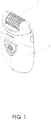
- Fig. 1 depicts an epilating device 1 comprising an epilating head 2 and driving unit 3.
- the epilating head 2 is adapted to be attached to the driving unit 3 and to receive at least one of rotational movement or torque from it.
- the driving unit 3 comprises two buttons for detaching the epilating head 2 and a controlling circuitry.
- the buttons are placed on the narrow sides of the driving unit 3. By pushing both buttons and shifting upwards the epilating head 2, the head can be detached.
- the controlling circuitry can be used to start, stop, and change a torque or speed of rotation of the driving unit and hence the epilating head 2.
- the epilating head comprises a substantially curved cylinder, arranged to epilate or tweeze user's hairs.
- the cylinder is situated on the upper part of the epilating head 2.
- a plastic cover is used to prevent unwanted user's contact with moving gears covers the left and right sides of the cylinder.
- the central part of the cylinder is adapted to be open and exposed to a user. This part is a working part arranged to depilate/epilate hairs by contact with user's skin and interaction with the hairs.
- Fig. 2 depicts an epilating head 2 and a driving unit 3 without their plastic covers, exposing their internal structure.
- the epilating head 2 comprises a gear assembly, arranged to transfer torque or a rotational movement from a motor 4 to the epilating head 2.
- One or more batteries 9 can drive the motor 4.
- the motor 4 meshes with the gear assembly by a motor gear 5, which in turn drive two small gears meshed with a face gear 6.
- the face gear 6 transfers torque and a rotational movement to an idler gear 7, which in turn meshes with a head gear 8.
- the head gear 8 is firmly attached to an epilating cylinder, setting it in motion.
- Fig. 3 depicts a more detailed view of an epilating head 2.
- An epilating cylinder is driven by a head gear 8, which is meshed with a gear assembly with an idler gear 7 that can be seen in the figure.
- the head gear 8 is attached to the side of the cylinder, where the head gear 8 and cylinder together are adapted to be fixed on a curved axle (not shown), which is connected to mobile back parts 12.
- the mobile back parts 12 are arranged to be a part of a head base 10. They are placed on the side edges of the head base 10.
- the head base 10 comprises one or more, preferably four latches situated on the bottom side of the head base 10.
- the epilating cylinder is made in the form of a group or set of pincer or tweezer assemblies 13 that are packed and held on a curved axle (not shown).
- a biasing spring 11, e.g., made of metal, or a frame is adapted to hold the group of the pincer assemblies 13. Instead also a rigid structure to hold the elements in place can be used.
- a single pincer assembly 13 is depicted. It comprises a hub unit 20, a first disc 21, a second disc 22, and a third disc 23.
- Each pincer assembly 13 is adapted to have six epilating tweezers, uniformly placed along the circumference of the cylinder but all or some of them having a different position to the axis of rotation.
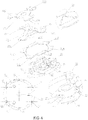
- Fig. 4 depicts a more detailed view of one pincer assembly 13 comprising a hub unit 20, the first disc 21, the second disc 22, and the third disc 23.
- the third disc 23 comprises pincers 23A, 23B, 23C, anvil or a second pincer 23B being placed on a medium or same level regarding the level of a middle section of the third part, a first pincer 23A on a level that is lower in the image shown or displaced to one side of the middle section of the third pincer 23, and a third pincer 23C on a level that is higher in the image shown or displaced to another side of the middle section of the third pincer 23.
- the second disc 22 is shaped similarly with a second pincer 22B on the same level, a first pincer 22A on a lower level and a third pincer 22C on a higher level than the respective middle section.
- the respective pincers 23A, 23B, 23C, 22A, 22B, 22C together provide a part of tweezers different in axial displacement to each other.
- the first disc comprises six anvils or pincers 21A, 21B, 21C, 21D, 21E, 21F, which are displaced or axially offset according to the corresponding pincer of the second or third discs, respectively.
- the hub unit 20 is adapted to regulate the distance of the first to third discs with respect to each other by controlling at least one of their axial displacements or their tilting on the axle.
- the displacement of the third disc 23 is achieved by means of three upper ball-shaped surfaces 28, which are placed on the top of upper ball-shaped surface supports 26. Also, the supports 26 prevent the second disc 22 from rotation, going through three slots 25 for the upper ball-shaped surface supports.
- the elevation of the slot unit 22 is achieved by means of three lower convex or ball-shaped surfaces 27.
- the hub unit 20 comprises topography with protrusions and indentations placed on the side of the hub unit 20 that keep the first disc 21 in the working position and prevent it from unwanted rotation. Moreover, the hub unit 20 comprises three protrusions 30 that engage a neighboring pack of hub unit and first to thirds discs in order to convey the rotational movement and torque. The protrusions 30 are formed at the base thereof additionally in order to prevent the third disc 23 from unwanted rotation. However, the rotation of the assembly comprising the hub unit 20 and the first to third discs 21 to 23 around the axle 36 is allowed.
- the enlarged view in Fig. 4 shown in the lower right part shows the different convex elements 27 and 28 that are positioned to support the respective discs accordingly.
- the protrusion 28 is located on a protrusion 26 that is configured to engage the respective cut-outs or recesses 25 in the center hole of the second disc 22 in order to allow a positive engagement of the second disc 22.
- the bottom view of the hub unit 20 is depicted in the left bottom corner.
- the protrusions 30 can be inserted into three cavities or recesses 31 of the next hub unit 20 to form a respective assembly.
- the hub unit 20 comprises six pressing protrusions 32, adapted to squeeze the pincer assembly 13 from the top when it is desired to activate the tweezers.
- Fig. 5 depicts an assembled single pincer assembly 13.
- the view from the top of a pincer assembly 13 can be seen.
- the view from the side of the pincer assembly 13 can be seen.
- the cross-section across line B-B is going through the centers of two assembled tweezers, two pressing protrusions 32, upper ball-shaped surface of protrusion 28, the center of the assembly, and lower ball-shaped surface 27.
- the cross-section can be seen in the second row of drawings in a tilted manner.
- the left tweezer which is squeezed, comprises a pincer 22C of the second disc 22 and a pincer 21E of the first disc 21.
- the right tweezer which is shown in an opened condition, comprises a lower pincer 21B of the first disc 21 and an upper pincer of the third disc 23.
- protrusions 30 protrude beyond the rest of the pack of elements in order to engage the neighboring pack.
- the cross-section D-D is going through the centers of two assembled tweezers, two pressing protrusions 32, upper ball-shaped surface 28, the center of the assembly, and lower ball-shaped surface 27.
- the respective cross-section is depicted to the right in the first row of drawings.
- the upper tweezer which is shown open for releasing hair, is composed of the pincer 22B and pincer 21A.
- the tweezer below which is shown in the closed position, is composed of the pincers 23C and 21D.
- the respective support and engagement of the first to the third discs can be further derived from these figures.
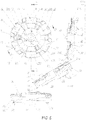
- Fig. 6 depicts an epilating head 2 without covers at the end.
- a front view is presented on the top of the page and the top view in the center.
- the two arrows each marked with a P show that a force or pressure is applied from the side onto the epilating head.
- this could be realized by a dense packing of the elements in the head or even a biasing arrangement by metallic side supporting structures acting similar to springs.
- the cross-section A-A is going through the center of an epilating cylinder.
- the respective cross-section can be seen on the bottom of the page.
- the epilating cylinder is assembled by a number of hub units and discs or pincer assemblies.
- the right part of the cylinder is shown without hub units 20, providing a detailed view of the internal structure, particularly of the arrangement of the discs.
- the group of pincer assemblies is arranged on a curved axle 36.
- the ends of the curved axle 36 are fixed in a head base 10 and mobile back part 12.
- the curved axle 36 is adapted to be fixed but the group of pincer assemblies 13 to rotate around the curved axle 36 as a whole driven by a head gear 8 which is meshed with a gear assembly 7.
- the spring 11 which made in the form of a metal frame, applies a squeezing force to both the head base 10 and mobile back part 12 in the P directions. Because of curvature, the upper part of the group of pincer assemblies exercises a maximal squeezing force but the opposite no pressure or less. Hence, the tweezers on the top site are squeezed and ones on the opposite site are opened or released. Therefore, the rotating group of pincer assemblies cause the trapping of hair, the epilating of user's hairs and the release thereof.
- Fig. 7 depicts an assembled single pincer assembly.
- the cross-section B-B has been made through the centers of two assembled tweezers being shown on top of the figure and the two pressing protrusions 32 and lower ball-shaped surface 27.
- the imaginary cut can be seen at the bottom left corner.
- the left tweezer is closed and/or squeezed, the right tweezer is opened and/or released.
- the cross-section is passing along a slot unit 22 showing its cutting.
- the cross-section C-C is going through the centers of two assembled tweezers, two pressing protrusions 32, and upper ball-shaped surface 28.
- the cross-section can be seen at the bottom right corner of Fig. 7 .
- the left tweezer is shown in the squeezed state, the right tweezer in the released state.
- Line 33 is drawn between two adjacent upper ball-shaped surfaces 28, showing two-point bending line of a top unit 23.
- the line is situated outside the center area occupied by a curved axle 36, hence its friction is reduced during the squeezing/releasing process.
- the imaginary line 34 is drawn between two adjacent lower ball-shaped surfaces 27, showing two-point bending line of a slot unit 22.
- the line is situated outside the center area occupied by the curved axle 36, hence its friction is reduced during the squeezing/releasing process.
- Fig. 8 depicts three adjacent pincer sets or assemblies 13 strung on a curved axle 36 and shown at the top left corner.
- the cross-section A-A is going through the curved axle 36.
- the cross-section can be seen at the bottom of the page, where the top tweezers are squeezed and the bottom ones released because of curvature of the curved axle 36 and squeezing force of a spring 11 (not shown).
- the cross-section B-B in Fig 8 shows the function of a generating protrusion 30 inserted into a recess or cavity 31.
- the generating protrusion 30 and cavity 31 still engage even in the status when neighboring sets are spaced from each other. In the opposite side they engage more clearly or deeply.
- the elevation of the generating protrusion 31 and the curvature of the curved axle 36 are designed to be high and big enough to allow the pincer assemblies 13 be substantially tightly squeezed on the top side and released on the bottom side.
- Fig. 9 shows perspective views of an assembly of elements 20 to 23 according to another embodiment of the invention.
- the hub unit 20 also takes the role of a counter element with counterparts 20A to 20F.
- These counterparts 20A to 20F cooperate with the pincers 22A to 22C as well as 23A to 23C to form tweezers.
- a third disc is not present but replaced by respective shapes of the hub unit's counterparts.
Landscapes
- Surgical Instruments (AREA)
Claims (15)
- Epilierkopf für eine Epiliervorrichtung, aufweisend:a. mindestens eine erste Scheibe (21) mit mindestens zwei ersten Scheibenzangenelement (21A; 21C; 21E), wobei die erste Scheibe um eine Drehachse oder Achse (36) drehbar ist;b. mindestens ein Gegenelement (20; 22) mit mindestens zwei Gegenstücken (20A-F; 22A-C), wobei das Gegenelement (20; 22) um die Achse oder Achse (36) drehbar ist;c. wobei die erste Scheibe (21) und das Gegenelement (20; 22) konfiguriert sind, dass eine erstes Pinzette (21A, 20A; 21A, 22A) aus einem der ersten Scheibenzangenelement (21A) und einem der Gegenstücke (20A-F; 22A-C) besteht und eine zweite Pinzette (21C, 20C; 21C, 22C) aus einem weiteren der ersten Scheibenzangenelemente (21C) und einem weiteren der Gegenstücke (20A-F; 22A-C) besteht;i. wobei die erste und zweite Pinzette (21A, 22A; 21C, 22C) jeweils über mindestens einen ersten Rotationsabschnitt um die Achse oder Achse (36) in einem offenen Zustand sind undii. wobei die erste und zweite Pinzette (21A, 22A; 21C, 22C) jeweils über einen zweiten Drehabschnitt um die Achse oder Achse (36) in einem geschlossenen Zustand sind;d. wobei die erste Pinzette (21A, 22A) und die zweite Pinzette (21C, 22C) axial versetzt sind oder ihre Rotationshüllen benachbart oder nebeneinander liegen.
- Epilierkopf nach Anspruch 1, wobei das Gegenelement (22) eine zweite Scheibe (22) ist und die Gegenstücke (22A-C) zweite Scheibenzangenelemente (22A, 22B, 22C) sind, wobei die erste und die zweite Scheibe (21, 22) konfiguriert ist, dass ein erstes Paar, das aus einer der ersten Scheibenzangenelementelemente (21A) und einer der zweiten Scheibenzangenelementelemente (22A) besteht, eine erste Pinzette (21A, 22A) und ein zweites Paar, das aus einer der zweiten Scheibenzangenelemente (21C) und einer der zweiten Scheibenzangenelemente (21C) besteht, eine zweite Pinzette (21C, 22C) bilden.
- Epilierkopf nach Anspruch 2, wobei die erste Scheibenzangenelemente (21A; 21C; 21E) durch erste Scheibenvorsprünge (21A; 21C; 21E) gebildet werden, die sich zumindest teilweise radial von der ersten Scheibe (21) erstrecken, und die zweite Scheibenzange (22A, 22B, 22C) durch zweite Scheibenvorsprünge (22A, 22B, 22C) gebildet ist, die sich radial zumindest teilweise von der zweiten Scheibe (22) erstrecken, und/oder wobei benachbarte erste Scheibenzangenelemente (21A); 21C; 21E) und/oder benachbarte zweite Scheibenzangenelemente (22A, 22B, 22C) zumindest axial zueinander versetzt und/oder ihre Rotationshüllen benachbart oder nebeneinander liegen.
- Epilierkopf nach einem der vorstehenden Ansprüche, ferner aufweisend:a. eine dritte Scheibe (23) mit mindestens zwei dritten Scheibenzangenelementen (23A; 23B; 23C), wobei die dritte Scheibe (23) um die Drehachse oder Achse (36) drehbar ist;b. wobei die erste und die dritte Scheibe (21, 23) konfiguriert sind, dass ein drittes Paar, das aus einer der ersten Scheibenzangenelemente (21B) und einer der dritten Scheibenzangenelemente (23A) besteht, eine dritte Pinzette (21B, 23A) bildet und ein viertes Paar, das aus einer der ersten Scheibenzangenelemente (21F) und einer der dritten Scheibenzangenelemente (23B) besteht, eine vierte Pinzette (21F, 23B) bildet;i. wobei die dritte und vierte Pinzette (21B, 23A; 21F, 23B) sich jeweils in einem offenen Zustand über mindestens einen ersten Drehabschnitt um die Achse oder Achse (36) befinden, undii. wobei die dritte und vierte Pinzette (21B, 23A; 21F, 23B) jeweils in einem geschlossenen Zustand über einen zweiten Drehabschnitt um die Achse oder Achse (36) befinden;c. wobei die dritte Pinzette (21B, 23A) und die vierte Pinzette (21F, 23B) axial versetzt sind oder ihre Rotationshüllen benachbart oder nebeneinander liegen.
- Epilierkopf nach einem der vorhergehenden Ansprüche und den Merkmalen des Anspruchs 4, wobei die erste Scheibe (21) 4 bis 8 Zangenelemente (21A-F) aufweist und die zweite Scheibe (22) und die dritte Scheibe (23) 2 bis 4 Zangenelemente, vorzugsweise 3 Zangenelemente, aufweist, so dass 4 bis 8 Pinzetten, vorzugsweise 6 Pinzetten, gebildet werden.
- Epilierkopf nach einem der beiden vorhergehenden Ansprüche, aufweisend 4 bis 12 Sätze erste, zweite und dritte Scheiben (21-23), vorzugsweise 6-10 Sätze erste, zweite und dritte Scheiben (21-23), vorzugsweise 8 Sätze erste, zweite und dritte Scheiben (21-23).
- Epilierkopf nach einem der vorhergehenden Ansprüche, ferner aufweisend eine Kopftrommel (20, 21-23), die durch eine Vielzahl von Nabeneinheiten (20) gebildet ist, die jeweils einen Satz von Scheiben (21-23) tragen, die sich um die Drehachse oder Achse (36) drehen.
- Epilierkopf nach einem der vier vorhergehenden Ansprüche, wobei mindestens eine der zweiten Scheibe (22) und der dritte Scheibe (23) Verlängerungen aufweisen, die an den Zangenelementen (22AC, 23A-C) ausgebildet sind, die sich in Drehrichtung nach außen erstrecken und geeignet sind, das Führen von Haaren in die Pinzette zu unterstützen, wobei die Verlängerungen zwischen 10-40° in Bezug auf die Ebene der Zangenelemente (22A-C, 23A-C), vorzugsweise zwischen 25-35° geneigt sind.
- Epilierkopf nach einem der vorhergehenden Ansprüche, worin die Drehachse oder Achse (36) in Bezug auf eine Verwendungsseite konkav ausgebildet und angepasst ist, um die Pinzette (21A, 22A; 21C, 22C) zu unterstützen, in einem offenen Zustand über den ersten Abschnitt des Umfangs der Drehung um die Drehachse oder Achse (36) und in einem geschlossenen Zustand über den zweiten Abschnitt des Umfangs der Drehung um die Drehachse oder Achse (36) zu sein.
- Epilierkopf nach einem der sechs vorhergehenden Ansprüche, ferner aufweisend mindestens zwei Nabeneinheiten (20), die jeweils geeignet sind, um auf der Achse oder Achse (36) abgestützt zu werden und sich auf der Drehachse oder Achse (36) zu drehen und die erste Scheibe (21), die zweite Scheibe (22) und die dritte Scheibe (23) weiter zu stützen, so dass sie sich zusammen mit der jeweiligen Nabeneinheit (20) drehen, wobei jede Nabeneinheit (20) ferner vorzugsweise zum Bringen der Pinzette (21AF, 22A-C, 23A-C) jeweils in einen geöffneten Zustand über mindestens einen ersten Abschnitt einer Rotation und in einen geschlossenen Zustand über mindestens einen zweiten Abschnitt einer Rotation über die Drehachse oder Achse (36) durch periodisches Kippen einer, mehrerer oder aller Scheiben (21-23) konfiguriert ist.
- Epilierkopf nach dem vorstehenden Ansprüche, wobei die Achse oder Achse (36) in Bezug auf eine Verwendungsseite konkav ausgebildet ist, wobei mindestens zwei Sätze von Nabeneinheiten (20) auf der Achse oder Achse (36) angeordnet sind und die Nabeneinheiten (20) angesichts der konkaven Form der Drehachse oder Achse (36) jeweils konfiguriert sind, um die Pinzette (21A-F, 22A-C, 23A-C) jeweils in geöffneten Zustand über mindestens einen ersten Abschnitt der Drehung und in geschlossenen Zustand über mindestens einen zweiten Abschnitt der Drehung um die Drehachse oder Achse (36), vorzugsweise in oder nahe der Seite der Verwendung zu bringen.
- Epilierkopf nach einem der vorhergehenden Ansprüche, wobei eine Vielzahl von Nabeneinheiten (20) nebeneinander auf der Drahachse oder Achse (36) angeordnet sind, um eine rotierende Kopftrommel zu bilden, wobei die Nabeneinheiten druckübertragende Vorsprünge (32) auf der Seite gegenüber der Seite der Scheiben (21-23) aufweisen, die Druck auf die Scheiben (21-23) der benachbarten Nabeneinheit (20) übertragen, um die Pinzette weiter zu unterstützen (21A, 22A; 21C, 22C) die benachbarte Nabeneinheit (20) in einen geöffneten Zustand über den ersten Abschnitt der Drehung um die Drehachse oder Achse (36) und in einen geschlossenen Zustand über den zweiten Abschnitt der Drehung um die Drehachse oder Achse (36) zu bringen.
- Epilierkopf nach einem der acht vorhergehenden Ansprüche, ferner aufweisend mindestens zwei druckübertragende Vorsprünge (32), die auf einer Seite (20B) der Nabeneinheit (20) ausgebildet und positioniert sind und/oder wobei die ersten bis dritten Scheiben (20-23) so ausgebildet sind, dass sie auf einer Seite der Nabeneinheit (20) positioniert werden können und für eine periodische Neigung in einem ersten Abschnitt einer 360°-Drehbewegung geeignet sind, wobei die druckübertragenden Vorsprünge (32) von einer ähnlichen benachbarten Zangenanordnung (13) konfiguriert sind, um auf mindestens eine der Scheiben (21, 22, 23) zu drücken, um dadurch zu bewirken, dass die Scheiben (21, 22, 23) einander an ihren Zangenflächen berühren und Haare greifen und wo in einem zweiten Abschnitt der Kontakt zwischen den Zangenoberflächen angepasst ist, um eingeschlossene Haare loszulassen.
- Zangenanordnung (13) nach einem der neun vorhergehenden Ansprüche, wobei die Nabeneinheit (20) mindestens drei untere konvexe Oberflächen (27) und mindestens drei obere konvexe Oberflächen (28) auf der Seite der Nabeneinheit (20) aufweist, die die Scheiben (21-23) aufnehmen, die geeignet sind, die zweite Scheibe (22) und die dritte Scheibe (23) von der einen Seite der Nabeneinheit (20) anzuheben bzw. eine Trennung (120) der Scheiben (21, 22, 23) zu bewirken und das periodische Kippen der Einheiten (22, 23) unter dem Einfluss der druckübertragenden Vorsprünge (32) zu ermöglichen.
- Verfahren zum Betreiben eines Epilierkopfes, aufweisend die Schritte von:a. Bereitstellen mindestens einer ersten Scheibe (21) mit mindestens zwei ersten Scheibenzangenelementen (21A; 21C; 21E), wobei die erste Scheibe um eine Drehachse oder Achse (36) dreht;b. Bereitstellen mindestens eines Gegenelements (20; 22) mit mindestens zwei Gegenstücken (20A-F; 22A-C), wobei sich das Gegenelement um die Drehachse oder Achse (36) dreht;c. Konfigurieren der ersten Scheibe (21) und des Gegenelements (20; 22), um eine erste Pinzette (21A, 20A; 21A, 22A) zu bilden, die aus einer der ersten Scheibenzangenelemente (21A) und einem der Gegenstücke (20A-F; 22A-C) besteht, und um eine zweite Pinzette (21C, 20C; 21C, 22C) zu bilden, die aus einer anderen der ersten Scheibenzangenelemente (21C) und einem anderen der Gegenstücke (20AF; 22A-C) besteht;i. wobei die erste und zweite Pinzette (21A, 22A; 21C, 22C) jeweils in einem offenen Zustand über mindestens einen ersten Umfangsabschnitt sind, wenn sie um die Drehachse oder Achse (36) gedreht werden, undii. wobei die erste und zweite Pinzette (21A, 22A; 21C, 22C) jeweils in einem geschlossenen Zustand über einen zweiten Umfangsabschnitt sind, wenn sie um die Drehachse oder Achse (36) gedreht werden;d. wobei die erste Pinzette (21A, 22A) und die zweite Pinzette (21C, 22C) axial versetzt sind oder ihre Rotationshüllen benachbart oder nebeneinander liegen.
Applications Claiming Priority (1)
| Application Number | Priority Date | Filing Date | Title |
|---|---|---|---|
| EP17161627 | 2017-03-17 |
Publications (2)
| Publication Number | Publication Date |
|---|---|
| EP3375320A1 EP3375320A1 (de) | 2018-09-19 |
| EP3375320B1 true EP3375320B1 (de) | 2019-11-20 |
Family
ID=58358496
Family Applications (1)
| Application Number | Title | Priority Date | Filing Date |
|---|---|---|---|
| EP18162220.0A Active EP3375320B1 (de) | 2017-03-17 | 2018-03-16 | Epiliervorrichtung und verfahren |
Country Status (2)
| Country | Link |
|---|---|
| EP (1) | EP3375320B1 (de) |
| CN (1) | CN108618339A (de) |
Families Citing this family (1)
| Publication number | Priority date | Publication date | Assignee | Title |
|---|---|---|---|---|
| EP3766376A1 (de) * | 2019-07-16 | 2021-01-20 | Koninklijke Philips N.V. | Epiliervorrichtung |
Family Cites Families (14)
| Publication number | Priority date | Publication date | Assignee | Title |
|---|---|---|---|---|
| IL89290A (en) | 1989-02-14 | 1992-08-18 | Dolev Moshe | Hair removal device |
| FR2675671B1 (fr) | 1991-04-25 | 1993-12-17 | Braun Ag | Appareil d'epilation. |
| IL103073A (en) | 1991-09-10 | 1995-11-27 | Philips Electronics Nv | Install a disc-type hair puller |
| DE69230781T2 (de) | 1991-12-23 | 2000-09-21 | Koninkl Philips Electronics Nv | Haarentfernungsgerät mit verdrehender Wirkung |
| US5196021A (en) | 1992-02-25 | 1993-03-23 | Perfect Lady Ltd. | Depilatory device |
| US5281233A (en) | 1993-02-12 | 1994-01-25 | Moshe Dolev | Disc assembly hair remover |
| DE4428892A1 (de) | 1994-08-18 | 1996-02-22 | Braun Ag | Epilationsgerät mit einem mehrschaligen Gehäuse |
| ATE218824T1 (de) | 1996-08-06 | 2002-06-15 | Braun Gmbh | Drehzylinder für ein epilationsgerät |
| TW443921B (en) | 1998-04-15 | 2001-07-01 | Matsushita Electric Works Ltd | Depilator |
| DE60204780T2 (de) | 2002-10-01 | 2006-05-18 | The Gillette Co., Boston | Gelenkgetriebe mit virtueller Schwenkachse für Haarentfernungsgerät mit Schwingkopf |
| IL159483A0 (en) | 2003-12-21 | 2004-06-01 | Epilady 2000 Llc | Hair removal system |
| US20100198233A1 (en) | 2007-07-18 | 2010-08-05 | Yehuda Poran | Epilator head for trapping hair and epilator with such head |
| US20120035621A1 (en) * | 2010-07-27 | 2012-02-09 | K.I.S. Ltd. | Hair removal device |
| CN105979818A (zh) | 2014-02-12 | 2016-09-28 | 埃普雷迪2000公司 | 具有一对可分离的头部的脱毛器 |
-
2018
- 2018-03-16 CN CN201810220383.1A patent/CN108618339A/zh not_active Withdrawn
- 2018-03-16 EP EP18162220.0A patent/EP3375320B1/de active Active
Non-Patent Citations (1)
| Title |
|---|
| None * |
Also Published As
| Publication number | Publication date |
|---|---|
| CN108618339A (zh) | 2018-10-09 |
| EP3375320A1 (de) | 2018-09-19 |
Similar Documents
| Publication | Publication Date | Title |
|---|---|---|
| JP2736797B2 (ja) | 脱毛器具 | |
| JP2738669B2 (ja) | 脱毛器具 | |
| EP1703821B1 (de) | Haarentfernungssystem | |
| EA008216B1 (ru) | Устройство для депиляции волос и способ для улучшенного охвата поверхности при депиляции | |
| EP1203544B1 (de) | Tragbares Epiliergerät | |
| JP3098971B2 (ja) | 脱毛装置 | |
| JP2798498B2 (ja) | 脱毛器具 | |
| US5112341A (en) | Hair removal device with central multiple-tweezer element | |
| EP3375320B1 (de) | Epiliervorrichtung und verfahren | |
| US5100413A (en) | Rotary head multi-tweezer hair removal device | |
| US6585743B2 (en) | Hair depilating device utilizing mechanism to spirally align coupled-tweezer elements | |
| EP1961328B1 (de) | Haarentfernungsvorrichtung | |
| US20070239174A1 (en) | Epilator with Glide Tweezers | |
| WO2009056923A2 (en) | Epilator head for trapping hair and facial epilator with such head | |
| US20100198233A1 (en) | Epilator head for trapping hair and epilator with such head | |
| CN101868162A (zh) | 用于具有拔除钳的脱毛设备的脱毛头 | |
| US5217469A (en) | Rotary head spring-loaded tweezer hair removal device | |
| CA2411234A1 (en) | Hair depilating device utilizing mechanism to spirally align coupled-tweezer elements | |
| CN104661561B (zh) | 具有枢转钳的均衡脱毛器 | |
| CN223554463U (zh) | 一种脱毛装置及脱毛器 | |
| CN213587647U (zh) | 脱毛头滚筒、脱毛头和脱毛设备 | |
| JP3475485B2 (ja) | 脱毛装置 | |
| JPH09121930A (ja) | 脱毛装置 | |
| JP2004105639A (ja) | 脱毛装置 |
Legal Events
| Date | Code | Title | Description |
|---|---|---|---|
| PUAI | Public reference made under article 153(3) epc to a published international application that has entered the european phase |
Free format text: ORIGINAL CODE: 0009012 |
|
| STAA | Information on the status of an ep patent application or granted ep patent |
Free format text: STATUS: THE APPLICATION HAS BEEN PUBLISHED |
|
| AK | Designated contracting states |
Kind code of ref document: A1 Designated state(s): AL AT BE BG CH CY CZ DE DK EE ES FI FR GB GR HR HU IE IS IT LI LT LU LV MC MK MT NL NO PL PT RO RS SE SI SK SM TR |
|
| AX | Request for extension of the european patent |
Extension state: BA ME |
|
| STAA | Information on the status of an ep patent application or granted ep patent |
Free format text: STATUS: REQUEST FOR EXAMINATION WAS MADE |
|
| 17P | Request for examination filed |
Effective date: 20190314 |
|
| RBV | Designated contracting states (corrected) |
Designated state(s): AL AT BE BG CH CY CZ DE DK EE ES FI FR GB GR HR HU IE IS IT LI LT LU LV MC MK MT NL NO PL PT RO RS SE SI SK SM TR |
|
| GRAP | Despatch of communication of intention to grant a patent |
Free format text: ORIGINAL CODE: EPIDOSNIGR1 |
|
| STAA | Information on the status of an ep patent application or granted ep patent |
Free format text: STATUS: GRANT OF PATENT IS INTENDED |
|
| INTG | Intention to grant announced |
Effective date: 20190703 |
|
| GRAS | Grant fee paid |
Free format text: ORIGINAL CODE: EPIDOSNIGR3 |
|
| GRAA | (expected) grant |
Free format text: ORIGINAL CODE: 0009210 |
|
| STAA | Information on the status of an ep patent application or granted ep patent |
Free format text: STATUS: THE PATENT HAS BEEN GRANTED |
|
| AK | Designated contracting states |
Kind code of ref document: B1 Designated state(s): AL AT BE BG CH CY CZ DE DK EE ES FI FR GB GR HR HU IE IS IT LI LT LU LV MC MK MT NL NO PL PT RO RS SE SI SK SM TR |
|
| REG | Reference to a national code |
Ref country code: GB Ref legal event code: FG4D |
|
| REG | Reference to a national code |
Ref country code: CH Ref legal event code: EP |
|
| REG | Reference to a national code |
Ref country code: IE Ref legal event code: FG4D |
|
| REG | Reference to a national code |
Ref country code: DE Ref legal event code: R096 Ref document number: 602018001218 Country of ref document: DE |
|
| REG | Reference to a national code |
Ref country code: AT Ref legal event code: REF Ref document number: 1203165 Country of ref document: AT Kind code of ref document: T Effective date: 20191215 |
|
| REG | Reference to a national code |
Ref country code: NL Ref legal event code: MP Effective date: 20191120 |
|
| REG | Reference to a national code |
Ref country code: LT Ref legal event code: MG4D |
|
| PG25 | Lapsed in a contracting state [announced via postgrant information from national office to epo] |
Ref country code: BG Free format text: LAPSE BECAUSE OF FAILURE TO SUBMIT A TRANSLATION OF THE DESCRIPTION OR TO PAY THE FEE WITHIN THE PRESCRIBED TIME-LIMIT Effective date: 20200220 Ref country code: FI Free format text: LAPSE BECAUSE OF FAILURE TO SUBMIT A TRANSLATION OF THE DESCRIPTION OR TO PAY THE FEE WITHIN THE PRESCRIBED TIME-LIMIT Effective date: 20191120 Ref country code: NL Free format text: LAPSE BECAUSE OF FAILURE TO SUBMIT A TRANSLATION OF THE DESCRIPTION OR TO PAY THE FEE WITHIN THE PRESCRIBED TIME-LIMIT Effective date: 20191120 Ref country code: LV Free format text: LAPSE BECAUSE OF FAILURE TO SUBMIT A TRANSLATION OF THE DESCRIPTION OR TO PAY THE FEE WITHIN THE PRESCRIBED TIME-LIMIT Effective date: 20191120 Ref country code: SE Free format text: LAPSE BECAUSE OF FAILURE TO SUBMIT A TRANSLATION OF THE DESCRIPTION OR TO PAY THE FEE WITHIN THE PRESCRIBED TIME-LIMIT Effective date: 20191120 Ref country code: LT Free format text: LAPSE BECAUSE OF FAILURE TO SUBMIT A TRANSLATION OF THE DESCRIPTION OR TO PAY THE FEE WITHIN THE PRESCRIBED TIME-LIMIT Effective date: 20191120 Ref country code: GR Free format text: LAPSE BECAUSE OF FAILURE TO SUBMIT A TRANSLATION OF THE DESCRIPTION OR TO PAY THE FEE WITHIN THE PRESCRIBED TIME-LIMIT Effective date: 20200221 Ref country code: NO Free format text: LAPSE BECAUSE OF FAILURE TO SUBMIT A TRANSLATION OF THE DESCRIPTION OR TO PAY THE FEE WITHIN THE PRESCRIBED TIME-LIMIT Effective date: 20200220 |
|
| PG25 | Lapsed in a contracting state [announced via postgrant information from national office to epo] |
Ref country code: HR Free format text: LAPSE BECAUSE OF FAILURE TO SUBMIT A TRANSLATION OF THE DESCRIPTION OR TO PAY THE FEE WITHIN THE PRESCRIBED TIME-LIMIT Effective date: 20191120 Ref country code: RS Free format text: LAPSE BECAUSE OF FAILURE TO SUBMIT A TRANSLATION OF THE DESCRIPTION OR TO PAY THE FEE WITHIN THE PRESCRIBED TIME-LIMIT Effective date: 20191120 Ref country code: IS Free format text: LAPSE BECAUSE OF FAILURE TO SUBMIT A TRANSLATION OF THE DESCRIPTION OR TO PAY THE FEE WITHIN THE PRESCRIBED TIME-LIMIT Effective date: 20200320 |
|
| PG25 | Lapsed in a contracting state [announced via postgrant information from national office to epo] |
Ref country code: AL Free format text: LAPSE BECAUSE OF FAILURE TO SUBMIT A TRANSLATION OF THE DESCRIPTION OR TO PAY THE FEE WITHIN THE PRESCRIBED TIME-LIMIT Effective date: 20191120 |
|
| PG25 | Lapsed in a contracting state [announced via postgrant information from national office to epo] |
Ref country code: EE Free format text: LAPSE BECAUSE OF FAILURE TO SUBMIT A TRANSLATION OF THE DESCRIPTION OR TO PAY THE FEE WITHIN THE PRESCRIBED TIME-LIMIT Effective date: 20191120 Ref country code: ES Free format text: LAPSE BECAUSE OF FAILURE TO SUBMIT A TRANSLATION OF THE DESCRIPTION OR TO PAY THE FEE WITHIN THE PRESCRIBED TIME-LIMIT Effective date: 20191120 Ref country code: CZ Free format text: LAPSE BECAUSE OF FAILURE TO SUBMIT A TRANSLATION OF THE DESCRIPTION OR TO PAY THE FEE WITHIN THE PRESCRIBED TIME-LIMIT Effective date: 20191120 Ref country code: RO Free format text: LAPSE BECAUSE OF FAILURE TO SUBMIT A TRANSLATION OF THE DESCRIPTION OR TO PAY THE FEE WITHIN THE PRESCRIBED TIME-LIMIT Effective date: 20191120 Ref country code: PT Free format text: LAPSE BECAUSE OF FAILURE TO SUBMIT A TRANSLATION OF THE DESCRIPTION OR TO PAY THE FEE WITHIN THE PRESCRIBED TIME-LIMIT Effective date: 20200412 Ref country code: DK Free format text: LAPSE BECAUSE OF FAILURE TO SUBMIT A TRANSLATION OF THE DESCRIPTION OR TO PAY THE FEE WITHIN THE PRESCRIBED TIME-LIMIT Effective date: 20191120 |
|
| REG | Reference to a national code |
Ref country code: AT Ref legal event code: MK05 Ref document number: 1203165 Country of ref document: AT Kind code of ref document: T Effective date: 20191120 |
|
| REG | Reference to a national code |
Ref country code: DE Ref legal event code: R097 Ref document number: 602018001218 Country of ref document: DE |
|
| PG25 | Lapsed in a contracting state [announced via postgrant information from national office to epo] |
Ref country code: SK Free format text: LAPSE BECAUSE OF FAILURE TO SUBMIT A TRANSLATION OF THE DESCRIPTION OR TO PAY THE FEE WITHIN THE PRESCRIBED TIME-LIMIT Effective date: 20191120 Ref country code: SM Free format text: LAPSE BECAUSE OF FAILURE TO SUBMIT A TRANSLATION OF THE DESCRIPTION OR TO PAY THE FEE WITHIN THE PRESCRIBED TIME-LIMIT Effective date: 20191120 |
|
| PLBE | No opposition filed within time limit |
Free format text: ORIGINAL CODE: 0009261 |
|
| STAA | Information on the status of an ep patent application or granted ep patent |
Free format text: STATUS: NO OPPOSITION FILED WITHIN TIME LIMIT |
|
| 26N | No opposition filed |
Effective date: 20200821 |
|
| PG25 | Lapsed in a contracting state [announced via postgrant information from national office to epo] |
Ref country code: MC Free format text: LAPSE BECAUSE OF FAILURE TO SUBMIT A TRANSLATION OF THE DESCRIPTION OR TO PAY THE FEE WITHIN THE PRESCRIBED TIME-LIMIT Effective date: 20191120 |
|
| PG25 | Lapsed in a contracting state [announced via postgrant information from national office to epo] |
Ref country code: PL Free format text: LAPSE BECAUSE OF FAILURE TO SUBMIT A TRANSLATION OF THE DESCRIPTION OR TO PAY THE FEE WITHIN THE PRESCRIBED TIME-LIMIT Effective date: 20191120 Ref country code: SI Free format text: LAPSE BECAUSE OF FAILURE TO SUBMIT A TRANSLATION OF THE DESCRIPTION OR TO PAY THE FEE WITHIN THE PRESCRIBED TIME-LIMIT Effective date: 20191120 Ref country code: AT Free format text: LAPSE BECAUSE OF FAILURE TO SUBMIT A TRANSLATION OF THE DESCRIPTION OR TO PAY THE FEE WITHIN THE PRESCRIBED TIME-LIMIT Effective date: 20191120 |
|
| REG | Reference to a national code |
Ref country code: BE Ref legal event code: MM Effective date: 20200331 |
|
| PG25 | Lapsed in a contracting state [announced via postgrant information from national office to epo] |
Ref country code: LU Free format text: LAPSE BECAUSE OF NON-PAYMENT OF DUE FEES Effective date: 20200316 |
|
| PG25 | Lapsed in a contracting state [announced via postgrant information from national office to epo] |
Ref country code: IE Free format text: LAPSE BECAUSE OF NON-PAYMENT OF DUE FEES Effective date: 20200316 |
|
| PG25 | Lapsed in a contracting state [announced via postgrant information from national office to epo] |
Ref country code: BE Free format text: LAPSE BECAUSE OF NON-PAYMENT OF DUE FEES Effective date: 20200331 |
|
| REG | Reference to a national code |
Ref country code: CH Ref legal event code: PL |
|
| PG25 | Lapsed in a contracting state [announced via postgrant information from national office to epo] |
Ref country code: LI Free format text: LAPSE BECAUSE OF NON-PAYMENT OF DUE FEES Effective date: 20210331 Ref country code: CH Free format text: LAPSE BECAUSE OF NON-PAYMENT OF DUE FEES Effective date: 20210331 |
|
| PG25 | Lapsed in a contracting state [announced via postgrant information from national office to epo] |
Ref country code: TR Free format text: LAPSE BECAUSE OF FAILURE TO SUBMIT A TRANSLATION OF THE DESCRIPTION OR TO PAY THE FEE WITHIN THE PRESCRIBED TIME-LIMIT Effective date: 20191120 Ref country code: MT Free format text: LAPSE BECAUSE OF FAILURE TO SUBMIT A TRANSLATION OF THE DESCRIPTION OR TO PAY THE FEE WITHIN THE PRESCRIBED TIME-LIMIT Effective date: 20191120 Ref country code: CY Free format text: LAPSE BECAUSE OF FAILURE TO SUBMIT A TRANSLATION OF THE DESCRIPTION OR TO PAY THE FEE WITHIN THE PRESCRIBED TIME-LIMIT Effective date: 20191120 |
|
| PG25 | Lapsed in a contracting state [announced via postgrant information from national office to epo] |
Ref country code: MK Free format text: LAPSE BECAUSE OF FAILURE TO SUBMIT A TRANSLATION OF THE DESCRIPTION OR TO PAY THE FEE WITHIN THE PRESCRIBED TIME-LIMIT Effective date: 20191120 |
|
| PGFP | Annual fee paid to national office [announced via postgrant information from national office to epo] |
Ref country code: FR Payment date: 20230327 Year of fee payment: 6 |
|
| PGFP | Annual fee paid to national office [announced via postgrant information from national office to epo] |
Ref country code: IT Payment date: 20230324 Year of fee payment: 6 Ref country code: DE Payment date: 20230328 Year of fee payment: 6 |
|
| P01 | Opt-out of the competence of the unified patent court (upc) registered |
Effective date: 20230523 |
|
| PGFP | Annual fee paid to national office [announced via postgrant information from national office to epo] |
Ref country code: GB Payment date: 20240326 Year of fee payment: 7 |
|
| REG | Reference to a national code |
Ref country code: DE Ref legal event code: R119 Ref document number: 602018001218 Country of ref document: DE |
|
| PG25 | Lapsed in a contracting state [announced via postgrant information from national office to epo] |
Ref country code: DE Free format text: LAPSE BECAUSE OF NON-PAYMENT OF DUE FEES Effective date: 20241001 |
|
| PG25 | Lapsed in a contracting state [announced via postgrant information from national office to epo] |
Ref country code: FR Free format text: LAPSE BECAUSE OF NON-PAYMENT OF DUE FEES Effective date: 20240331 |
|
| PG25 | Lapsed in a contracting state [announced via postgrant information from national office to epo] |
Ref country code: FR Free format text: LAPSE BECAUSE OF NON-PAYMENT OF DUE FEES Effective date: 20240331 Ref country code: DE Free format text: LAPSE BECAUSE OF NON-PAYMENT OF DUE FEES Effective date: 20241001 |
|
| PG25 | Lapsed in a contracting state [announced via postgrant information from national office to epo] |
Ref country code: IT Free format text: LAPSE BECAUSE OF NON-PAYMENT OF DUE FEES Effective date: 20240316 |
|
| GBPC | Gb: european patent ceased through non-payment of renewal fee |
Effective date: 20250316 |
|
| PG25 | Lapsed in a contracting state [announced via postgrant information from national office to epo] |
Ref country code: GB Free format text: LAPSE BECAUSE OF NON-PAYMENT OF DUE FEES Effective date: 20250316 |