EP3375603A1 - Dispositif formant tissu pourvu d'un tissu et d'une couche fonctionnelle pouvant mousser et/ou rendue moussante ainsi que procédé de fabrication d'un dispositif formant tissu pourvu d'un tissu et d'une couche fonctionnelle rendue moussante - Google Patents
Dispositif formant tissu pourvu d'un tissu et d'une couche fonctionnelle pouvant mousser et/ou rendue moussante ainsi que procédé de fabrication d'un dispositif formant tissu pourvu d'un tissu et d'une couche fonctionnelle rendue moussante Download PDFInfo
- Publication number
- EP3375603A1 EP3375603A1 EP18161286.2A EP18161286A EP3375603A1 EP 3375603 A1 EP3375603 A1 EP 3375603A1 EP 18161286 A EP18161286 A EP 18161286A EP 3375603 A1 EP3375603 A1 EP 3375603A1
- Authority
- EP
- European Patent Office
- Prior art keywords
- functional layer
- layer
- fabric
- pressure mixture
- functional
- Prior art date
- Legal status (The legal status is an assumption and is not a legal conclusion. Google has not performed a legal analysis and makes no representation as to the accuracy of the status listed.)
- Granted
Links
Images
Classifications
-
- B—PERFORMING OPERATIONS; TRANSPORTING
- B32—LAYERED PRODUCTS
- B32B—LAYERED PRODUCTS, i.e. PRODUCTS BUILT-UP OF STRATA OF FLAT OR NON-FLAT, e.g. CELLULAR OR HONEYCOMB, FORM
- B32B5/00—Layered products characterised by the non- homogeneity or physical structure, i.e. comprising a fibrous, filamentary, particulate or foam layer; Layered products characterised by having a layer differing constitutionally or physically in different parts
- B32B5/18—Layered products characterised by the non- homogeneity or physical structure, i.e. comprising a fibrous, filamentary, particulate or foam layer; Layered products characterised by having a layer differing constitutionally or physically in different parts characterised by features of a layer of foamed material
-
- B—PERFORMING OPERATIONS; TRANSPORTING
- B32—LAYERED PRODUCTS
- B32B—LAYERED PRODUCTS, i.e. PRODUCTS BUILT-UP OF STRATA OF FLAT OR NON-FLAT, e.g. CELLULAR OR HONEYCOMB, FORM
- B32B5/00—Layered products characterised by the non- homogeneity or physical structure, i.e. comprising a fibrous, filamentary, particulate or foam layer; Layered products characterised by having a layer differing constitutionally or physically in different parts
- B32B5/02—Layered products characterised by the non- homogeneity or physical structure, i.e. comprising a fibrous, filamentary, particulate or foam layer; Layered products characterised by having a layer differing constitutionally or physically in different parts characterised by structural features of a fibrous or filamentary layer
-
- B—PERFORMING OPERATIONS; TRANSPORTING
- B32—LAYERED PRODUCTS
- B32B—LAYERED PRODUCTS, i.e. PRODUCTS BUILT-UP OF STRATA OF FLAT OR NON-FLAT, e.g. CELLULAR OR HONEYCOMB, FORM
- B32B5/00—Layered products characterised by the non- homogeneity or physical structure, i.e. comprising a fibrous, filamentary, particulate or foam layer; Layered products characterised by having a layer differing constitutionally or physically in different parts
- B32B5/18—Layered products characterised by the non- homogeneity or physical structure, i.e. comprising a fibrous, filamentary, particulate or foam layer; Layered products characterised by having a layer differing constitutionally or physically in different parts characterised by features of a layer of foamed material
- B32B5/20—Layered products characterised by the non- homogeneity or physical structure, i.e. comprising a fibrous, filamentary, particulate or foam layer; Layered products characterised by having a layer differing constitutionally or physically in different parts characterised by features of a layer of foamed material foamed in situ
-
- B—PERFORMING OPERATIONS; TRANSPORTING
- B32—LAYERED PRODUCTS
- B32B—LAYERED PRODUCTS, i.e. PRODUCTS BUILT-UP OF STRATA OF FLAT OR NON-FLAT, e.g. CELLULAR OR HONEYCOMB, FORM
- B32B5/00—Layered products characterised by the non- homogeneity or physical structure, i.e. comprising a fibrous, filamentary, particulate or foam layer; Layered products characterised by having a layer differing constitutionally or physically in different parts
- B32B5/22—Layered products characterised by the non- homogeneity or physical structure, i.e. comprising a fibrous, filamentary, particulate or foam layer; Layered products characterised by having a layer differing constitutionally or physically in different parts characterised by the presence of two or more layers which are next to each other and are fibrous, filamentary, formed of particles or foamed
- B32B5/30—Layered products characterised by the non- homogeneity or physical structure, i.e. comprising a fibrous, filamentary, particulate or foam layer; Layered products characterised by having a layer differing constitutionally or physically in different parts characterised by the presence of two or more layers which are next to each other and are fibrous, filamentary, formed of particles or foamed one layer being formed of particles, e.g. chips, granules, powder
-
- B—PERFORMING OPERATIONS; TRANSPORTING
- B32—LAYERED PRODUCTS
- B32B—LAYERED PRODUCTS, i.e. PRODUCTS BUILT-UP OF STRATA OF FLAT OR NON-FLAT, e.g. CELLULAR OR HONEYCOMB, FORM
- B32B9/00—Layered products comprising a layer of a particular substance not covered by groups B32B11/00 - B32B29/00
- B32B9/02—Layered products comprising a layer of a particular substance not covered by groups B32B11/00 - B32B29/00 comprising animal or vegetable substances, e.g. cork, bamboo, starch
- B32B9/025—Layered products comprising a layer of a particular substance not covered by groups B32B11/00 - B32B29/00 comprising animal or vegetable substances, e.g. cork, bamboo, starch comprising leather
-
- C—CHEMISTRY; METALLURGY
- C14—SKINS; HIDES; PELTS; LEATHER
- C14B—MECHANICAL TREATMENT OR PROCESSING OF SKINS, HIDES OR LEATHER IN GENERAL; PELT-SHEARING MACHINES; INTESTINE-SPLITTING MACHINES
- C14B7/00—Special leathers and their manufacture
- C14B7/02—Composite leathers
-
- B—PERFORMING OPERATIONS; TRANSPORTING
- B32—LAYERED PRODUCTS
- B32B—LAYERED PRODUCTS, i.e. PRODUCTS BUILT-UP OF STRATA OF FLAT OR NON-FLAT, e.g. CELLULAR OR HONEYCOMB, FORM
- B32B2266/00—Composition of foam
- B32B2266/02—Organic
- B32B2266/0214—Materials belonging to B32B27/00
-
- B—PERFORMING OPERATIONS; TRANSPORTING
- B32—LAYERED PRODUCTS
- B32B—LAYERED PRODUCTS, i.e. PRODUCTS BUILT-UP OF STRATA OF FLAT OR NON-FLAT, e.g. CELLULAR OR HONEYCOMB, FORM
- B32B2437/00—Clothing
Definitions
- the invention relates to a fabric arrangement comprising a fabric and a foamable and / or foamed functional layer and to a method for producing a fabric arrangement comprising a fabric and a foamed functional layer.
- a fabric is typically coated by applying a print material to the fabric, the print material being firmly bonded to the fabric after a drying and fixing operation.
- garments or accessories are often provided for decorative purposes with raised characters or patterns.
- the application for these coatings is limited due to a comparatively small maximum layer thickness in such decorative applications.
- the application of the printing material with a greater layer thickness on a fabric, for example as a shock-absorbing protective layer, can not be realized at present, since stress cracks in the printing material occur in particular when drying thicker layers. The stress cracks result, for example, from a loss of moisture in a water-based printing material during drying, which reduces the volume of the printing material, which leads to porosity.
- the invention has for its object to provide a fabric assembly with a fabric and with a foamable and / or foamed functional layer and a method for producing a fabric assembly with a fabric and with a foamed functional layer, said disadvantages do not occur.
- the object is achieved in particular by providing a fabric arrangement with a fabric and with a foamable functional layer, which is firmly applied to a first side of the fabric. Additionally or alternatively, a fabric assembly with a Fabric and created with a foamed functional layer, which is firmly applied to a first side of the fabric.
- the functional layer has a first layer, wherein the first layer of the functional layer has a first pressure mixture with a foam.
- the foam comprises a binder and a plurality of plastic balls bonded in the binder and filled with a gas.
- the first pressure mixture has a flexibility additive that increases the extensibility of the functional layer, which comprises an acrylic acid ester copolymer.
- the fabric arrangement with the fabric and the foamable and / or foamed functional layer has advantages over the prior art. Due to the fact that the first pressure mixture has the additional flexibility in addition to the foam, a stretchability of the functional layer is increased to such an extent that significantly greater thicknesses of the functional layer can be realized without stress cracks in the functional layer
- a fabric arrangement according to the invention with a foamable functional layer is, in particular, a precursor of a fabric arrangement according to the invention with a foamed functional layer. It is preferably provided that the fabric arrangement with a foamable functional layer is at least partially produced by means of the inventive method described below, wherein in particular a foaming, in particular by thermal fixing and activating the fabric arrangement with the functional layer by heating, not or not yet complete is performed.
- a foaming in particular by thermal fixing and activating the fabric arrangement with the functional layer by heating, not or not yet complete is performed.
- the described advantages are realized when the functional layer of the fabric arrangement according to the invention is foamed.
- the foamed functional layer in particular a protective layer is advantageously realized, which dampens impact on a surface of the fabric arrangement.
- the foamed functional layer is in particular abrasion-resistant, slip-resistant, waterproof, and / or thermally insulating.
- the fabric arrangement with the foamed functional layer remains comparatively light. It preferably has defined flexible zones and / or defined rigid zones.
- surfaces of tissues can be contoured. By forming a three-dimensional surface of the foamed functional layer, in particular an acoustic effect of the fabric arrangement is realized, which for Sound insulation is suitable.
- the foamed functional layer it is possible in particular to realize a pleasant feel and an appealing, extraordinary appearance.
- An application of the fabric arrangement with the foamable and / or foamed functional layer is preferably realized in vehicles, in particular motor vehicles, aircraft or ships, for example in the field of interior design.
- an ergonomic design of seats or other usable space is realized.
- ventilation channels can be created on a surface of seats with the fabric arrangement by means of the functional layer.
- clothing especially protective clothing, and shoes, especially shoe soles.
- bags or rucksacks, in particular a back padding of the same, can be produced from the fabric arrangement according to the invention. This can also be provided for the upholstery of stroller or Babywickelunterlagen.
- furnishings in the private or commercial sector, in particular seating or storage containers using such a fabric arrangement can be produced. It is also possible to use the fabric arrangement with the functional layer in the area of the building equipment, in particular as a room divider, acoustic wall or panels.
- the fabric is preferably formed as a textile.
- the fabric is formed as leather, in particular as natural leather or artificial leather.
- it represents a substrate or a carrier material for the functional layer.
- the particularly foamed functional layer is firmly applied to the first side of the fabric such that the fabric with the functional layer can be mechanically deformed according to its intended use, without the functional layer of dissolves the tissue.
- the particular foamed functional layer is so firmly applied to the fabric that even a thermal load and / or exposure to liquid media according to a proper use are readily possible.
- the fabric is washable with the particular foamed functional layer, wherein - depending on the fabric and / or the functional layer - washing temperatures of up to 90 ° C can be realized.
- the functional layer in particular with the first layer, at least in some areas has a thickness of at least 1 mm to at most 20 mm, preferably to at most 15 mm, preferably to at most 10 mm, preferably a thickness of 1 mm, or 1.5 mm, or 3 mm, or 5 mm, or 7 mm, or 10 mm.
- the binder preferably has at least one constituent or consists of at least one constituent selected from a group consisting of an acrylate, a styrene, an acrylic acid, an ester, a copolymer, a polyester, a polyethylene, and a polyurethane.
- the binder comprises a polyurethane or consists of a polyurethane.
- the polyurethanes preferably have aliphatic and / or aromatic isocyanates, more preferably aliphatic isocyanates.
- the plastic balls are preferably distributed homogeneously in the binder.
- the plastic balls each have in particular a shell, which preferably comprises a polymer or consists of a polymer.
- the gas contained in the plastic balls expands especially when heated.
- the sheaths of the plastic balls are therefore preferably each stretchable, so that an expansion of the same during an expansion of the gas therein is possible.
- the sheaths of the plastic balls soften each time they are heated.
- the shells of the plastic balls are each gas-tight, which can expand without gas escaping from the plastic balls. It is in particular possible that the plastic balls each have a shape which deviates from a sphere, but essentially represents a spherical shape.
- the flexibility additive comprises an acrylic acid ester copolymer which is mixed with polyacrylic acid, in particular mixed.
- the flexibility additive comprises a synthetic resin dispersion or consists of a synthetic resin dispersion which is in particular formed as water-based, self-crosslinking, and / or heat-fixing flock adhesive, the flexibility additive preferably further comprising thickener systems and additives.
- the flexibility additive has a mass fraction of the first pressure mixture and / or a further pressure mixture of the fabric arrangement according to the invention, in particular a second pressure mixture or a base pressure mixture of at least 7% to at most 15%.
- the extensibility of the functional layer is advantageously increased, in particular stress cracks during drying of the functional layer, in particular of the first and / or one of the further pressure mixture can be prevented.
- the first pressure mixture comprises a foam additive comprising an aliphatic polyester urethane.
- the foam additive preferably has a polymer dispersion or consists of a polymer dispersion.
- the polymer dispersion is particularly preferably an aqueous polymer dispersion.
- the foam additive is preferably a buoyancy of the foam, in particular an expansion of the plastic balls, variably adjustable.
- an increased mass fraction of the foam additive on the pressure mixture, in particular the first and / or a further pressure mixture of the fabric arrangement according to the invention causes a reduction in the buoyancy of the foam when heated.
- An increased mass fraction of the foam additive on the pressure mixture thus causes in particular a smaller volume of the foamed functional layer, in particular a smaller thickness thereof.
- a reduced mass fraction of the foam additive on the pressure mixture, in particular the first and / or a further pressure mixture of the fabric arrangement according to the invention in particular causes a larger volume of the foamed functional layer, in particular a greater thickness thereof.
- the functional layer has a basis pressure mixture having a base layer, which is applied to the first side of the fabric on the fabric.
- the base layer of the functional layer preferably has a thickness which is less than a thickness of the first layer of the functional layer.
- the first layer of the functional layer in particular directly, is applied to the base layer of the functional layer.
- the base pressure mixture preferably has at least the foam and the flexibility additive. With particular preference the base pressure mixture with respect to a composition thereof, in particular the constituents and their mass fractions, is the same or at least similar to the first pressure mixture.
- the base layer of the functional layer has a thickness of at most 0.1 mm, more preferably of at most 0.05 mm, particularly preferably of at most 0.01 mm.
- the penetration of moisture, in particular an elution of the first layer of the functional layer, into the tissue is reduced, particularly preferably prevented.
- adhesion of the functional layer, in particular of the first layer thereof, on the fabric is increased by means of the base layer.
- the functional layer has at least one second layer having a second pressure mixture which is applied on a side of the first layer of the functional layer facing away from the fabric on the first layer of the functional layer.
- the second pressure mixture has at least the foam and the flexibility additive.
- the second pressure mixture additionally comprises the foam additive.
- the second pressure mixture with respect to a composition thereof, in particular the constituents and their mass fractions, is the same or at least similar to the first pressure mixture.
- the functional layer in particular with the first layer and / or the at least one second layer and / or the base layer, at least partially has a thickness of at least 1 mm to at most 20 mm, preferably to at most 15 mm, preferably to at most 10 mm, preferably a thickness of 1 mm, or 1.5 mm, or 3 mm, or 5 mm, or 7 mm, or 10 mm.
- the first and / or the at least one second layer of the functional layer at least one further component, which is selected from a group consisting of color pigments, cotton powder, cotton flakes, metal powder, metallic powder, plastic powder, plastic granules, a magnetic Material, glass powder, sand, an electrically conductive material, an electrical and / or electronic circuit, and a thermally conductive material.
- the first and / or the at least one second layer of the functional layer at least partially surrounds at least one element which is selected from a group consisting of a magnet, a wire, a rope, a heat-resistant component, an electrical and / or or electronic circuit, an LED, and a sensor.
- At least one further fabric is applied to the functional layer on the side of the functional layer opposite the fabric.
- at least one further tissue disposed within the functional layer, wherein the at least one further tissue in particular connects a first and a second layer of the functional layer.
- the several further tissues are connected to one another at least in regions, in particular by mutually different layers of the functional layer.
- the base pressure mixture, the first pressure mixture and the second pressure mixture each have a composition, wherein at least two of the respective compositions are different from each other.
- the base pressure mixture comprises a base composition, wherein the first pressure mixture has a first composition, and wherein the second pressure mixture has a second composition.
- at least two mutually different elements, each selected from a group consisting of the base composition, the first composition, and the second composition are different in composition from one another.
- a difference in the compositions of the type mentioned above is preferably due to an identity of constituents contained and / or the proportions of constituents contained therein.
- the base pressure mixture, the first pressure mixture and the second pressure mixture each have the same composition, in particular the same constituents and the same proportions of these constituents. Due to the specific composition of the base pressure mixture, the first pressure mixture and the second pressure mixture, the properties of the tissue arrangement can be advantageously adapted to the requirements of a specific application.
- An exemplary embodiment of the fabric arrangement is preferred, which is characterized in that a surface of the fabric is concavely curved on a second side of the fabric opposite the first side in an area opposite the functional layer.
- the resulting by the concave formation spaces and chambers can be compressed in an advantageous manner, with an additional damping effect of the functional layer is generated. Overall, a stretchability of the same can be increased by the concave formation of the tissue.
- extensibility increases with increasing concaved formation, while decreasing with decreasing concavity.
- An exemplary embodiment of the fabric arrangement is preferred, which is characterized in that the functional layer is divided into at least two segments which each extend over different regions of the first side of the fabric.
- the at least two segments are preferably connected to each other by a web, wherein in the region of the web, a thickness of the functional layer - is reduced to zero, if necessary.
- Each of the at least two segments preferably has in each case a concavely curved region, which is formed on the surface of the fabric on the second side of the fabric in each case in a region opposite to the at least two segments of the functional layer.
- the at least two segments each have a same shape.
- the at least two segments each have such a shape, which, in particular in combination with one another, enables a preferably complete covering of the tissue by means of the segments of the functional layer.
- the segments may each have an arbitrary shape, wherein they are preferably polygonal. Particularly preferably, a uniform pattern of the functional layer results from the at least two segments.
- the base layer and / or the first layer and / or the at least one second layer of the functional layer is / are applied in the region of the web.
- the functional layer is then in particular continuously applied to the fabric, as the web in each case represents only a reduction in the thickness of the functional layer.
- the at least two segments are connected to each other by a web, wherein in the region of the web no base layer, no first layer, and / or no second layer of the functional layer is applied.
- the webs are then each formed only by the tissue itself, wherein the applied on the fabric functional layer is then formed as a particular interrupted functional layer. Due to the segmentation of the functional layer, it is possible, in particular, to make the extensibility of the fabric corresponding to the requirements flexible, it also being possible to implement a different extensibility of the fabric depending on a stretching direction.
- the object is also achieved in particular by providing a method for producing a fabric arrangement with a fabric and with a foamed functional layer.
- the method provides a fabric arrangement according to one of the embodiments described above.
- a first step a first layer of the functional layer with a first pressure mixture is applied to a fabric on a first side thereof.
- the first pressure mixture has a foam and a flexibility additive which increases the extensibility of the functional layer.
- the foam has a binder and a plurality of gas filled plastic balls bonded in the binder.
- the flexibility additive comprises an acrylic acid ester copolymer.
- the first layer of the functional layer is dried.
- the fabric with the functional layer is thermally fixed and activated by heating it.
- the fabric and the first layer of the functional layer are permanently connected to each other.
- the plastic balls are expanded by heating the gas therein, wherein the first layer of the functional layer is permanently foamed.
- the fabric used is preferably a textile.
- Polyurethanes are preferably used as binders.
- the plastic balls are preferably filled with a gas which expands when heat is applied.
- the plastic balls preferably have polymer sheaths, which can be stretched in particular.
- an acrylic acid ester copolymer is used, which is preferably mixed with polyacrylic acid, in particular mixed.
- the flexibility additive is admixed to the foam in such an amount that the flexibility additive has a mass fraction of at least 7% to at most 15% of the pressure mixture, in particular the first and / or a further pressure mixture used in the process according to the invention, in particular a second pressure mixture or Base pressure mixture having.
- a high-speed stirrer is used for mixing the mentioned pressure mixture in order to obtain in particular a bubble-free pressure mixture.
- the first layer of the functional layer is applied to the fabric by means of a planographic printing process.
- the first printing mixture is applied to the fabric via a mask, preferably a screen or a stencil, preferably arranged on the fabric.
- the mask points preferably plastic, aluminum, steel, or stainless steel, or is made of plastic, aluminum, steel, or stainless steel.
- a planographic printing method is also known in particular as a through-printing method.
- a base layer of the functional layer is applied to the fabric in an analogous manner.
- the first layer is preferably applied in an analogous manner to the base layer, wherein the mask is then preferably placed on the base layer.
- at least one second layer of the functional layer is preferably applied in an analogous manner, wherein the at least one second layer is applied in particular to the first layer, and wherein the mask is then preferably placed on the first layer.
- the first layer of the functional layer is applied to the fabric by means of a stencil arranged on the fabric.
- the template is made of stainless steel, in particular V2A.
- the height of the template is preferably matched to an order height of the first layer of the functional layer.
- the template is preferably produced by means of laser cutting.
- patterns, structures, registration marks, characters or other markings are introduced into the first layer and / or further layers of the functional layer produced in the context of the method according to the invention, in particular at least one second layer or base layer.
- the template has a plurality of cutouts, whereby in particular a coherent pattern and / or a coherent structure of the functional layer can be realized.
- Cutouts arranged between the cutouts preferably have a width of at least 1 mm, particularly preferably of at least 2.5 mm.
- the cutouts preferably have sharp edges which in particular make it difficult to set the first printing mixture or further printing mixtures used in the context of the method according to the invention, in which case a clean printed image is achieved in particular.
- the template preferably has a high weight and a high rigidity, whereby in particular a uniform and good pressure of the same is realized on the fabric. In particular, this makes it difficult to slide the template on the tissue.
- the template has a wide edge, which preferably surrounds in particular the cutouts of the template, wherein the edge advantageously increases the stability of the template.
- This edge is particularly advantageous for a good incorporation of the first pressure mixture and / or the further pressure mixtures.
- the first pressure mixture is distributed on an upper end of the edge of the template. With a doctor blade, the first pressure mixture is then preferably pulled over the template from the upper end of the edge, wherein the cutouts of the template are filled with the first pressure mixture. If the stencil is removed from the fabric after the application of the first printing mixture on the fabric, in particular an excess remainder of the first printing mixture can adhere to the preferably flat region of the edge of the stencil, in particular without impairing a printed image on the fabric. In an advantageous embodiment of the method, a resting on the fabric underside of the template, which is formed in an advantageous manner surface, free of the first printing mixture, with a clean print image can be generated.
- a base layer of the functional layer is applied to the fabric in an analogous manner.
- the first layer is preferably applied in an analogous manner to the base layer, wherein the template is then preferably placed on the base layer.
- at least one second layer of the functional layer is preferably applied in an analogous manner, wherein the at least one second layer is applied in particular to the first layer, and wherein the template is then preferably placed on the first layer.
- the stencil is particularly insensitive to water or aqueous substances, which is advantageous in the application of water-based printing mixtures.
- a multiple use of the template for applying the first printing mixture and further used in the process of the invention printing mixtures, which are applied in particular already applied to the fabric layers of the functional layer is readily possible.
- the template described above preferably several layers of the functional layer are applied to the fabric.
- the stencil is in each case brought to a clean, dry and grease-free state before the application of a layer of the functional layer.
- the mask is clamped in such a printing device in a guide device.
- the mask is with various printing devices designed compatible. Use of suitable pressure devices can speed up the application of the functional layer and increase the quality of such a process.
- a functional layer of a fabric arrangement by juxtaposing a plurality of segments or groups of segments of the functional layer, wherein such segments or groups of segments are each produced by means of a mask, preferably a template.
- the segments are then preferably connected to each other by a narrow web.
- the first layer of the functional layer and / or a further layer of the functional layer, in particular at least one second layer or a base layer, is applied with a mask designed as a screen.
- these layers of the functional layer are each applied to the screen as a screen-printing film.
- the pressure mixture in particular the first pressure mixture, a second pressure mixture, or a base pressure mixture, applied directly to the fabric or an already applied layer of the functional layer, in particular, no mask is used.
- the fabric with the completely applied first layer of the functional layer is introduced into a drying device, in particular a drying cabinet. It is provided in particular that the tissue is arranged on a printing plate before the application of the first layer of the functional layer, wherein the pressure plate is introduced into the drying device after application of the first layer of the functional layer with the fabric and the first layer of the functional layer.
- the fabric with the first layer of the functional layer is preferably arranged horizontally in the drying device. If a plurality of tissue arrangements, in particular a plurality of pressure plates with tissues arranged thereon, are dried in the drying apparatus, then the plurality of tissue arrangements, in particular the plurality of pressure plates, are preferably arranged vertically spaced from one another.
- a preferably cool draft is generated in the drying device, whereby the particular wet first layer of the functional layer in an advantageous manner quickly and is dried evenly.
- too fast drying is prevented by means of the cool draft, whereby stress cracks in the functional layer can be prevented.
- a period of time for the drying of the first layer of the functional layer is predetermined as a function of a thickness of the first layer of functional layer.
- the fabric is dried with at least one, in particular on the first layer, finished applied second layer of the functional layer or a ready-applied base layer.
- a drying preferably according to the described type, in each case carried out after each application of a layer of the functional layer.
- the fabric arrangement with the fabric and with the first layer of the functional layer after being dried in particular, is thermally fixed and activated by heating.
- the functional layer has further layers, as will be explained below, in which case the fabric arrangement with the fabric and with the first layer and the further layers of the functional layer is thermally fixed and activated by heating.
- the thermal fixing and activation of the fabric arrangement with the fabric and with the functional layer by heating is then carried out in particular exactly once, namely preferably when all the layers of the functional layer are applied.
- the thermal fixing and activation is preferably carried out in a suitable oven.
- the thermal fixing and activating is preferably carried out at a temperature of at least 140 ° C to at most 170 ° C, more preferably from at least 150 ° C to at most 160 ° C.
- the oven is preheated to the temperature selected for fixing and activation.
- a period of time for thermal fixing and activation is preferably from at least 5 minutes to at most 7 minutes, preferably 6 minutes.
- foaming of the functional layer in particular the first layer and / or the at least one second layer and / or the base layer thereof, is effected.
- the functional layer expands in particular at a temperature from 140 ° C.
- the functional layer is foamed, in particular without separate air being added to the pressure mixture for foaming.
- the functional layer is introduced into a particular preheated oven and there thermally fixed and activated at a temperature of at least 165 ° C to at most 170 ° C.
- a velvety surface of the functional layer, in particular one - in relation to the tissue - uppermost layer of the same - produced in an advantageous manner.
- a connection between the fabric and the pressure mixture applied thereto, in particular the first pressure mixture or a base pressure mixture is fixed at least in certain areas.
- a connection between adjacent layers of the functional layer which are formed in particular as a first layer, as at least one second layer, or as a base layer, is preferably effected in each case.
- a volume of - before the thermal fixing and activating - still relatively thin dried layers of the functional layer is increased by the foaming.
- the fabric with the functional layer is preferably introduced in a suspended state in a particular preheated oven.
- the tissue is preferably arranged in the oven in such a way that a free space is realized adjacent to the applied functional layer, which is made possible in particular by the introduction of a plurality of tissues into the oven, preferably by means of suitable spacing devices which ensure a free space between the several tissue arrangements.
- suitable spacing devices which ensure a free space between the several tissue arrangements.
- the manifestation of the concave curvature is furthermore dependent, in particular, on a material of the fabric, in particular a stiffness thereof.
- a concave formation of the tissue on the second side thereof is more pronounced in thin and light tissues.
- the fabric acts like a reinforcement, which holds the functional layer in a certain position and shape.
- the functional layer remains deformable after foaming, especially while it is still hot.
- the fabric assembly is pressed or drawn with the fabric and with the functional layer after the thermal fixing and activation in a desired shape, this shape is held in particular until a cooling of the functional layer.
- the fabric arrangement largely retains this shape.
- the pressing or pulling of the fabric arrangement into a desired shape can be repeated several times, in particular following the thermal fixing and activation.
- a permanent connection of the fabric is realized with the functional layer, so that the fabric with the functional layer can be mechanically and / or thermally loaded without further, especially without the connection dissolves.
- a washing of the fabric with the functional layer is possible, wherein a washing temperature can be up to 90 ° C.
- the functional layer preferably has a thickness of at least 1 mm to at most 20 mm, preferably up to a maximum of 15 mm, preferably up to a maximum of 10 mm, after the thermal fixing and activation of the fabric with the functional layer, preferably a thickness of 1 mm, or 1.5 mm, or 3 mm, or 5 mm, or 7 mm, or 10 mm.
- the first pressure mixture and / or another pressure mixture used in the process according to the invention in particular a second pressure mixture or a base pressure mixture, mixed with at least one further component which is selected from a group consisting of color pigments, cotton powder, Cotton flakes, a metal powder, a metallic powder, a plastic powder, a plastic granules, a magnetic material, glass powder, sand, an electrically conductive material, an electrical and / or electronic circuit, and a thermally conductive material.
- the strength, appearance and / or feel of the functional layer can be varied by means of such a further component.
- An embodiment of the method is preferred, which is characterized in that a foam additive which comprises an aliphatic polyester urethane is added to the first pressure mixture.
- a foam additive which comprises an aliphatic polyester urethane is added to the first pressure mixture.
- further printing mixtures used in the process in particular a second pressure mixture or a base pressure mixture, likewise comprise the foam additive.
- a mass fraction of the foam additive on the pressure mixture of the functional layer expansion of the plastic balls due to heating in the context of thermal fixing and activating, and thus increasing the volume of the functional layer, is reduced.
- reducing the mass fraction of the foam additive to the pressure mixture of the functional layer in particular a greater expansion of the plastic balls by the thermal fixing and activating, thus increasing the volume of the functional layer causes.
- a maximum expansion of the plastic balls in particular a maximum increase in the volume of the functional layer, is effected if no foam additive is admixed with the pressure mixture of the functional layer.
- the foam and the foam additive are mixed together in a mass ratio of 1: 1, the flexibility additive with a mass fraction of 10% of the mass of this mixture being admixed with the foam and the foam additive.
- a composition leads in particular to a balanced degree of curing and foaming of the functional layer.
- the foam and the foam additive are mixed in a mass ratio of 1: 4, the flexibility additive with a mass fraction of 10% of the mass of this mixture being admixed with the foam and the foam additive.
- the functional layer in particular has a reduced rigidity and a reduced damping effect.
- no foam additive is admixed with the foam and the flexibility additive during the production of the pressure mixture.
- a maximum foaming of the functional layer is realized.
- the flexibility additive is admixed with a mass fraction of at least 7% to at most 15% of the first pressure mixture and / or another pressure mixture used in the context of the process according to the invention.
- a mass fraction of at least 7% to at most 15% of the first pressure mixture and / or another pressure mixture used in the context of the process according to the invention.
- At least one element is inserted into the functional layer so that it at least partially surrounds it, in particular it holds it.
- the at least one element is selected from a group consisting of a magnet, a wire, a rope, a heat-resistant component, an electrical and / or electronic circuit, an LED, and a sensor.
- the at least one element is inserted into the same after the application of the first or another layer of the functional layer.
- the first or further layer of the functional layer applied to the fabric, immediately after it has been applied is preferably kept at a temperature of preferably 20 ° C. for 10 minutes, the freshly applied layer of the functional layer preferably remaining moist on the surface as long as possible.
- the at least one element is used. After the thermal fixing and activating the at least one addressed element is firmly and securely clamped by the functional layer.
- tissue is fixed on a printing plate before the application of the first layer of the functional layer is arranged.
- the fabric preferably remains disposed on the printing plate at least until the first layer of the functional layer has dried.
- the fabric remains on the printing plate until the last applied, in particular the uppermost layer of the functional layer is dried.
- the pressure plate has a smooth surface on which the tissue is arranged, in particular, wrinkle-free.
- the tissue is arranged on the printing plate by means of a textile adhesive which is to be removed, in particular again.
- a textile adhesive is used, which is thermally fixed in particular by means of an iron, whereby an adhesion of the fabric is further increased on the printing plate.
- the pressure plate is preferably formed with a flat surface, which is preferably washable.
- the format of the printing plate preferably corresponds at least to the size of the mask used later, in particular the stencil or the screen.
- the printing plate is preferably, in particular with the tissue applied thereto with at least one layer of the functional layer to be dried, inserted into the drying device. Due to the fixed arrangement of the tissue on the printing plate, a uniform formation of the functional layer on the fabric is ensured in an advantageous manner, wherein a uniform foaming in the thermal fixing and activating can be ensured. For example, irregular foaming could be caused by tissue dislocation. Such a warp can be caused, for example, by the drying and the resulting loss of volume of the drying pressure mixture.
- a base layer of the functional layer with a base pressure mixture on the first side of the tissue is applied to the tissue.
- the base layer of the functional layer preferably has a thickness which is less than a thickness of the first layer of the functional layer.
- the base layer of the functional layer is subsequently dried.
- the first layer of the functional layer is then applied to the dried base layer of the functional layer.
- the fabric, the base layer of the functional layer and the first layer of the functional layer are permanently connected to each other by the thermal fixing and activating.
- the base pressure mixture used is preferably a pressure mixture which has at least the foam and / or the additional flexibility.
- the base layer of the functional layer is applied by means of a screen designed as a screen.
- a significantly lower thickness of the base layer compared to a thickness of the first layer of the functional layer, it is possible to press the base pressure mixture particularly deeply into the tissue.
- a distance between a particular used for applying the base layer doctor blade to the tissue is particularly low, so that a particularly high surface pressure can be applied by means of the doctor on the fabric, whereby the base pressure mixture particularly deep in the tissue is pushed in.
- the base layer acts as a kind of barrier layer, which preferably closes the surface on the first side of the fabric to be printed and prevents the functional layer applied to the base layer from being washed out.
- the base layer acts as a kind of barrier layer, which preferably closes the surface on the first side of the fabric to be printed and prevents the functional layer applied to the base layer from being washed out.
- special thin, delicate fabrics can be provided with the functional layer.
- the application of the base layer of the functional layer is carried out by screen printing.
- a screen used for this preferably has a template for the application of the base layer, wherein it is preferably applied and exposed with the template for the application of the base layer.
- graphic information about the later product has already been introduced into the original. By way of example, this allows information relating to a contour, seam or folding edges, positions, registration marks, a font, or a pattern to be printed in and / or printed on the base layer.
- the first layer of the functional layer is applied to the base layer.
- the Application of the first layer of the functional layer on the base layer is carried out in a manner analogous to the preferred embodiments of the method already described.
- a hardener is added to the base pressure mixture, as a result of which a wettability of the fabric and the adhesion properties of the functional layer, in particular the base layer, on the fabric are further improved.
- the drying of the first layer of the functional layer is preferably carried out analogously to the preferred embodiments of the method already described in connection with the drying of the first layer of the functional layer applied directly to the fabric.
- the thermal fixing and activating of the fabric with at least the base layer and the first layer of the functional layer is preferably carried out analogously to the already described preferred embodiments of the method.
- An embodiment of the method is preferred, which is characterized in that, after the first layer of the functional layer has dried, at least one second layer of the functional layer is applied to the first layer of the functional layer with a second pressure mixture which has at least the foam and the added flexibility , The at least one second layer of the functional layer is then preferably dried.
- a plurality of second layers of the functional layer are applied in particular to each other, wherein after applying each of the plurality of second layers, a drying of the last applied layer is carried out in each case.
- the thermal fixing and activating the first and the at least one second layer of the functional layer are permanently connected to each other, wherein the contained in the second pressure mixture in the foam plastic balls are expanded by heating the gas therein, and wherein the at least one second layer the functional layer is permanently foamed.
- the functional layer By producing the functional layer with more than one layer, it is advantageously possible to carry out a drying of the functional layer particularly efficiently and safely, since in each case only a comparatively small amount of moisture escapes from the functional layer must be, whereby a period of drying can be reduced.
- a period of time for the drying of a layer of the functional layer of the type described depends in particular on an application height thereof and / or a composition of the pressure mixture used for the layer.
- the application of the at least one second layer of the functional layer is preferably carried out analogously to the already performed application of the first layer of the functional layer, wherein the at least one second layer is applied in particular to the first layer.
- the at least one second layer of the functional layer is applied by means of the same mask, in particular stencil, as the first layer of the functional layer.
- the application of the at least one second layer of the functional layer to the application of the first layer of the functional layer is changed.
- a homogeneous structure of the first and the at least one second layer of the functional layer is produced by the thermal fixing and activating.
- a stiffness of the fabric can be set, in particular in the area of the fabric coated with the functional layer, wherein an increase in the application thickness leads to an increased stiffening and a reduced application thickness reduced stiffening of the tissue leads.
- a stiffness of the fabric in particular in the printed areas, can be increased. It is also advantageously possible to realize a plurality of layers of the functional layer, in particular with different thicknesses, colors, compositions and / or other properties.
- the fabric is pressed or pulled with the functional layer after thermal fixing and activation in a still heated state in a desired shape, and it is preferably kept in this shape until cooling.
- various configurations of the fabric with the foamed functional layer can be realized.
- An embodiment of the method is preferred, which is characterized in that the base pressure mixture, the first pressure mixture and the second pressure mixture are each provided with a specific composition, wherein at least two of the respective particular compositions are different from each other. In particular, at least two of the respective particular compositions differ from one another in their constituents and / or the proportions of their constituents.
- the base pressure mixture comprises a base composition, wherein the first pressure mixture has a first composition, and wherein the second pressure mixture has a second composition.
- at least two mutually different elements each selected from a group consisting of the base composition, the first composition and the second composition, with respect to their constituents and / or the proportions of their constituents are different from each other.
- the base pressure mixture, the first pressure mixture and the second pressure mixture are the same or at least similar to one another.
- the first pressure mixture and the second pressure mixture are the same or at least similar to each other, wherein the base pressure mixture is different from the first pressure mixture and the second pressure mixture.
- An embodiment of the method is preferred, which is characterized in that the fabric with the functional layer is further processed immediately before the thermal fixing and activating. Preferably, the further processed fabric with the functional layer is then thermally fixed and activated. Preferably, the fabric is further processed with the functional layer after drying the functional layer.
- a further processing of the fabric with the functional layer in this state is particularly advantageous because after drying the functional layer has lost in volume and thickness and is therefore easy to process. Furthermore, the functional layer is particularly flexible in this state, which further processing is easy and safe possible.
- a preferred embodiment of the method in connection with the production of a bag is shown:
- the preferably provided with a functional layer Fabric parts, especially textile parts, as well as other parts, such as zippers or other parts are assembled and sewn together.
- properties of the bag can be varied. If the seam is placed in a region of the fabric in which no functional layer is applied or a functional layer has only a small thickness, then in particular this region is also movable after the thermal fixing and activation. On the other hand, if the seam is set in the region of a functional layer of greater thickness, then a tension can be built up between the sewn parts after thermal fixing and activation, which in particular leads to a stiffening of this area.
- the further processed, in particular sewn parts of the bag are thermally fixed and activated in particular in an oven, wherein the functional layer is foamed onto the respective fabric parts of the bag.
- the thermal fixing and activation of the further processed fabric with the functional layer is carried out in particular analogous to the thermal fixing and activating according to one of the already described embodiments of the method.
- An embodiment of the method is preferred, which is characterized in that a tension is introduced into the fabric with the functional layer, which is at least temporarily present during the thermal fixing and activating.
- a tension is introduced into the fabric with the functional layer, which is at least temporarily present during the thermal fixing and activating.
- a permanent concave curvature of a surface of the fabric is set on a second side of the fabric opposite the first side in a region opposite the functional layer.
- the tension is introduced before the thermal fixing and activating the tissue with the functional layer in the tissue with the functional layer.
- the tensile stress is present during the entire thermal fixation and activation.
- the concave curvature of the surface of the fabric is enhanced when the tensile stress is reduced, in particular, the concave curvature of the fabric is reduced as the tensile stress is increased.
- a frame made of a heat-resistant material is preferably used, which preferably comprises wood or metal or consists of wood or metal.
- the fabric provided with the functional layer is introduced into this frame, in particular fixed therein.
- the fabric is preferably clamped to the frame, stapled or attached thereto with needles.
- the frame is designed to introduce a particular adjustable, preferably uniform tension in the tissue. In this way, a particular maximum contraction of the tissue can be influenced.
- an expression of the concave curvature during foaming is influenced.
- After fixing and activating the tissue with the functional layer preferably remains until it cools down in the frame, whereby a desired shape of the tissue, in particular a set concave curvature of the same, in particular can be obtained permanently.
- the comments made in connection with a single concave curvature apply in an analogous manner, in particular to all concave curvatures of the surface of the tissue which in each case lie opposite one of the segments of the functional layer on the second side of the tissue ,
- the fabric has a certain flexibility, whereby a concave curvature of the surface thereof is realized.
- a three-dimensional effect of the fabric with the functional layer is advantageously reinforced by movable intermediate spaces between segments of the functional layer, which act as hinges, and preferably make visible outer edges of the segments.
- a permanent concave curvature of the tissue with the functional layer during foaming is restricted or prevented by introducing into the tissue with the functional layer a sufficiently high tensile stress.
- an additional extensibility of the fabric over the concave curvatures in particular when initiating a tensile force, can advantageously be realized.
- the arched region of the fabric preferably returns to its original position as a result of a restoring force of the foamed functional layer.
- a firmer, stiffer tissue can only be concaved with a thicker functional layer, while a lighter fabric shows strong bulges on the second side even with a thinner functional layer.
- An embodiment of the method is preferred, which is characterized in that one or more than one further fabric is applied to the first layer of the functional layer and / or the at least one second layer of the functional layer before drying this layer (s). Preferably, by thermally fixing and activating, this layer (s) and the one or more other fabrics are permanently bonded together.
- a waiting time after completion of the application of the first and / or the at least one second layer of the functional layer to the application of the one or more further tissue is about 10 minutes, wherein preferably an ambient temperature is 20 ° C.
- the first and / or at least one second layer of the functional layer is still wet.
- the pressure mixture of the respectively uppermost, in particular still wet, layer of the functional layer can bond particularly well to the applied one or more further fabrics.
- the one or more than one other fabric then acts as a sort of cover of the functional layer.
- one or more than one further fabric is likewise provided with a base layer comprising a base printing mixture of the type already mentioned, whereby in particular the adhesion properties of the applied one or more further fabric with the still wet top or at least one second layer improve the functional layer.
- a sandwich structure can be realized, wherein two or more further fabrics are connected to one another by means of the functional layer or a plurality of functional layers arranged in each case between the fabrics, in particular by means of a plurality of layers of the functional layer.
- the applied layers of the functional layer act as a kind of glue and spacers for the other tissues.
- an increased rigidity of the fabric with the functional layer can be achieved in an advantageous manner by means of the sandwich construction.
- the flexibility of such a sandwich structure can be changed in particular by varying another tissue. For example, if a more stretchable fabric, for example, with a high stretch content, on one side of the Used sandwich construction, such a composite material is particularly flexible on the opposite side of the sandwich structure.
- a first further tissue is applied to the first further fabric, wherein a second further fabric is applied to the uppermost layer of the functional layer after application of the at least one further layer of the functional layer.
- the functional layer is applied to the fabric in such a way that at least two segments of the functional layer are formed, which each extend over different regions of the first side of the fabric.
- the at least two segments are each connected to each other by a web.
- a thickness of the functional layer is reduced in the region of the web.
- the at least two segments are applied to the fabric by means of a template, wherein the segments and the webs are formed when applying the functional layer by means of different spaced-apart cutouts in the template.
- the at least two segments are preferably realized by means of a plurality of stencils, in particular laid on one another, by means of which the functional layer is applied to the fabric.
- the functional layers of the at least two segments are preferably applied one after the other, in particular by applying the layers of the functional layer and drying them to the fabric. After drying these functional layers, they are thermally fixed and activated in particular in one pass.
- a first segment of the functional layer is applied to the tissue, but preferably not yet foamed, after which a second segment of the functional layer different from the first segment is applied to the tissue, and then preferably the first and the second segment foamed together.
- the at least two segments can each have an arbitrarily large area, so that the arrangement of a plurality of, in particular juxtaposed, segments is not required to realize the largest possible area of the functional layer.
- a segmentation of the functional layer into the at least two segments is carried out for functional, optical or other reasons.
- a convergence of the pressure mixture of the respective segments is prevented in an advantageous manner.
- a flexibility of the fabric arrangement with the fabric and the functional layer is advantageously influenced by an elasticity of the layer or of the layers of the functional layer, which can be varied in particular by different compositions of the respective printing mixtures.
- the flexibility of the fabric arrangement can be influenced by various, in particular geometric patterns and / or shapes of the foamed functional layer.
- the flexibility of the fabric arrangement can be influenced in particular by recesses realized in the functional layer by means of webs. The regions of these recesses remain flexible, in particular, even if the functional layer as a whole is made stiffer. If a stretchable fabric is used, its extensibility at least partially remains at least in areas with a thinner or interrupted functional layer, while the extensibility is limited, in particular, in the areas covered by the layers of the functional layer.
- An embodiment of the method is preferred, which is characterized in that the application of the base layer of the functional layer and / or the first layer of the functional layer and / or the at least one second layer of the functional layer is carried out by means of a method which is selected from a group consisting of a planographic printing process, a 3D printing process (three-dimensional printing process) and a direct printing process.
- the base layer is produced by means of a flat printing process designed as a screen printing method.
- the first and / or the at least one second layer realized by means of a template in a planographic printing process.
- the planographic printing method can be carried out by means of a carousel printing system, whereby in particular a serial application of functional layers on tissue is possible.
- the base layer, the first layer and / or the at least one second layer of the functional layer are applied to the fabric in the 3D printing method and the direct printing method without a mask, in particular designed as a stencil or screen.
- planographic printing method 3D printing method, or direct printing method
- the inventive method also has cost advantages, especially for small series or individual production compared to rotary printing process. These advantages result in particular from the costs of masks for planographic printing processes which are more favorable compared to rolls for rotary printing processes.
- planographic printing method, 3D printing method and direct printing method in comparison with rotary printing methods, larger design possibilities with respect to patterns of the functional layer result.
- the description of the fabric arrangement on the one hand and of the method on the other hand are to be understood as complementary to one another.
- Features of the fabric assembly that have been explained explicitly or implicitly in the context of the method are preferably individually or combined features of a preferred embodiment of the fabric assembly.
- Process steps that have been explained explicitly or implicitly in connection with the fabric arrangement are preferably individually or combined with each other Steps of a preferred embodiment of the method.
- This is preferably characterized by at least one method step, which is due to at least one feature of a preferred embodiment of the invention or preferred tissue arrangement.
- the fabric arrangement is preferably characterized by at least one feature which is due to at least one step of a preferred embodiment of the method according to the invention or a preferred embodiment.
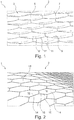
- FIG. 1 is a fabric assembly 2 with a fabric 1 and with a foamable and / or foamed functional layer 3, here with a foamed functional layer 3, which is firmly applied to a first side 5 of the fabric 1.
- the fabric arrangement 2 is shown here in a plan view of the first side 5 of the fabric 1.
- the functional layer 3 has a first layer 7.
- the embodiment according to FIG. 1 has by way of example no further layers of the functional layer 3, which are applied to the first layer 7. For this reason, the first layer 7 of the functional layer 3 in the plan view according to FIG. 1 visible, noticeable.
- the first layer 7 of the functional layer 3 has a first pressure mixture with a foam.
- the foam comprises a binder and a plurality of plastic balls bonded in the binder and filled with a gas.
- the first pressure mixture has a flexibility additive that increases the extensibility of the functional layer 3, which comprises an acrylic acid ester copolymer.
- the first pressure mixture preferably comprises a foam additive comprising an aliphatic polyester urethane.
- the functional layer 3 has at least one second layer having a second pressure mixture, which is applied to the first layer 7 of the functional layer 3 on a side of the first layer 7 of the functional layer 3 facing away from the fabric 1.
- the second pressure mixture preferably has at least the foam and the flexibility additive.
- the functional layer 3 is subdivided into at least two segments 9, 9 ', which each extend over different regions of the first side 5 of the fabric 1.
- the segments 9, 9 ' are each uniformly formed, wherein they are each formed as a hexagon.
- the at least two segments 9, 9 ' are each connected to one another by a web 11.
- the web 11 is in accordance with the embodiment FIG. 1 a part of the two segments 9, 9 'each side surrounding Umlaufstegs 11 ', wherein the circulating web 11' connects the segments 9, 9 'respectively with adjacent, in particular further segments.
- FIG. 1 a part of the two segments 9, 9 'each side surrounding Umlaufstegs 11 ', wherein the circulating web 11' connects the segments 9, 9 'respectively with adjacent, in particular further segments.
- a fabric assembly 2 which has a plurality of segments 9, 9 ', which are each formed uniformly, in particular hexagonal.
- the segments 9, 9 ' are connected to each other by means of webs 11 and / or circulating webs 11'.
- the circumferential webs 11 ' are also referred to below as webs.
- a thickness of the functional layer 3 is reduced in the region of the webs 11, 11 '.
- the functional layer 3 in the region of the webs 11, 11 'formed in particular reduced layer thickness, in particular, a continuous covering of the fabric 1 results through the functional layer 3.
- FIG. 2 is a second, the first side 5 opposite side 13 of the fabric 1 of the fabric assembly 2 shown in a plan view. Identical and functionally identical elements are provided with the same reference numerals, so that reference is made to the preceding description.
- the fabric 1 is here designed as a textile. Segment impressions 14 of the at least two segments 9, 9 'are visible here. The segments 9, 9 'interconnecting webs 11, 11' are in FIG. 2 as steg impressions 15 visible.
- a surface of the fabric 1 on the second, the first side 5 opposite side 13 of the fabric 1 in a functional layer 3 opposite region 16 is formed concave.
- a surface of the fabric 1 on the second side 13 of the fabric 1 is formed concavely in each case in a region 16 opposite the at least two segments 9, 9 'of the functional layer 3.
- each of the at least two segments 9, 9 'on the second side 13 is assigned a concavely formed segment embossing 14 in each of the regions 16.
- the concavely formed Segment josgonne 14 in the areas 16 are each uniform and hexagonal.
- the concavely formed segment embossings 14 in the regions 16 in each case in a central region thereof have a maximum depth of the concave curvature, as viewed by an observer.
- the concave arched segment embossings are 14 - from the perspective of Viewer - pushed in the direction of the fabric 1, and thus in particular relative to the web embossments 15 of the webs 11, 11 'displaced into the image surface inside.
- a method for producing a fabric arrangement 2, in particular a fabric arrangement 2 according to the invention, with a fabric 1 and with a foamed functional layer 3 is described:
- a first layer 7 of the functional layer 3 is applied with a first pressure mixture to the fabric 1 on a first side 5 of the fabric 1, wherein the first pressure mixture has a foam and a flexibility additive.
- the foam comprises a binder and a plurality of gas filled plastic balls bonded in the binder.
- the added flexibility causes an increase in extensibility of the functional layer 3 and includes an acrylic acid ester copolymer.
- the first layer 7 of the functional layer 3 is dried.
- the fabric 1 is thermally fixed to the functional layer 3 by heating and activated, wherein the fabric 1 and the first layer 7 of the functional layer 3 are permanently connected to each other.
- the plastic balls are expanded by heating the gas therein, wherein the first layer 7 of the functional layer 3 is permanently foamed.
- a foam additive is added to the first pressure mixture, which comprises an aliphatic polyester urethane.
- the fabric 1 is applied firmly prior to the application of the first layer 7 of the functional layer 3 on a - not shown in the figures - printing plate.
- the fabric 1 is applied to the printing plate at least until the first layer 7 of the functional layer 3 is dried.
- a base layer of the functional layer 3 with a base pressure mixture on the first side 5 of the fabric is preferred (not visible in the figures) 1 to the fabric 1 with a thickness which is less than a thickness of the first layer 7 of the functional layer 3, applied.
- the base layer of the functional layer 3 is subsequently dried.
- the fabric 1, the base layer of the functional layer 3 and the first layer 7 of the functional layer 3 are permanently connected to each other by the thermal fixing and activating.
- At least one second layer of the functional layer 3 is applied to the first layer 7 of the functional layer 3 with a second pressure mixture which has at least the foam and the added flexibility.
- the at least one second layer of the functional layer 3 is then preferably dried.
- the first layer 7 and the at least one second layer of the functional layer 3 are permanently connected to one another by the thermal fixing and activation.
- the plastic balls contained in the foam in the second pressure mixture are expanded by the heating of the gas therein, the at least one second layer of the functional layer 3 being permanently foamed.
- the base pressure mixture, the first pressure mixture, and the second pressure mixture are each provided with a particular composition, wherein at least two of the respective particular compositions are different from each other.
- the fabric 1 is further processed with the functional layer 3 immediately before the thermal fixing and activating.
- the further processed fabric 1 with the functional layer 3 is thermally fixed and activated in particular after completion of the further processing.
- a tension is introduced into the fabric 1 with the functional layer 3, which is present at least temporarily during the thermal fixing and activating.
- the first side 5 opposite side 13 of the fabric 1 in a functional layer 3 opposite region 16 is set a permanent concave curvature of a surface of the fabric 1.
- a permanent concave curvature of a surface of the fabric 1 is set in each case in a region 16 opposite a segment 9, 9 'of the functional layer 3.
- At least one further tissue is applied to the first layer 7 of the functional layer 3 and / or the at least one second layer of the functional layer 3 before drying this layer (s) 7.
- this layer (s) 7 and the at least one further fabric are in particular permanently connected to one another.
- the application of the base layer of the functional layer 3 and / or the first layer 7 of the functional layer 3 and / or the at least one second layer of the functional layer 3 is carried out by means of a method which is selected from a group consisting of a planographic printing method, a 3D printing method and a direct printing process.
Landscapes
- Chemical & Material Sciences (AREA)
- Engineering & Computer Science (AREA)
- Composite Materials (AREA)
- Manufacturing & Machinery (AREA)
- Mechanical Engineering (AREA)
- Organic Chemistry (AREA)
- Laminated Bodies (AREA)
Applications Claiming Priority (1)
| Application Number | Priority Date | Filing Date | Title |
|---|---|---|---|
| DE102017204233.8A DE102017204233A1 (de) | 2017-03-14 | 2017-03-14 | Gewebeanordnung mit einem Gewebe und einer aufschäumbaren und/oder aufgeschäumten Funktionsschicht sowie Verfahren zum Herstellen einer Gewebeanordnung mit einem Gewebe und einer aufgeschäumten Funktionsschicht |
Publications (2)
| Publication Number | Publication Date |
|---|---|
| EP3375603A1 true EP3375603A1 (fr) | 2018-09-19 |
| EP3375603B1 EP3375603B1 (fr) | 2022-10-26 |
Family
ID=61691647
Family Applications (1)
| Application Number | Title | Priority Date | Filing Date |
|---|---|---|---|
| EP18161286.2A Active EP3375603B1 (fr) | 2017-03-14 | 2018-03-12 | Agencement de tissu avec un tissu et une couche fonctionnelle moussable et/ou moussée ainsi que procédé de fabrication d'un agencement de tissu avec un tissu et une couche fonctionnelle moussée |
Country Status (2)
| Country | Link |
|---|---|
| EP (1) | EP3375603B1 (fr) |
| DE (1) | DE102017204233A1 (fr) |
Citations (1)
| Publication number | Priority date | Publication date | Assignee | Title |
|---|---|---|---|---|
| US6746774B1 (en) * | 1999-09-13 | 2004-06-08 | Philipp Schaefer | Leather and process for its production |
Family Cites Families (2)
| Publication number | Priority date | Publication date | Assignee | Title |
|---|---|---|---|---|
| DE3942851A1 (de) * | 1989-12-23 | 1991-06-27 | Beiersdorf Ag | Impraegnierlatex fuer pu-schaum |
| US7654660B2 (en) | 1994-11-07 | 2010-02-02 | Sawgrass Technologies, Inc. | Energy activated printing process |
-
2017
- 2017-03-14 DE DE102017204233.8A patent/DE102017204233A1/de not_active Withdrawn
-
2018
- 2018-03-12 EP EP18161286.2A patent/EP3375603B1/fr active Active
Patent Citations (1)
| Publication number | Priority date | Publication date | Assignee | Title |
|---|---|---|---|---|
| US6746774B1 (en) * | 1999-09-13 | 2004-06-08 | Philipp Schaefer | Leather and process for its production |
Also Published As
| Publication number | Publication date |
|---|---|
| DE102017204233A1 (de) | 2018-09-20 |
| EP3375603B1 (fr) | 2022-10-26 |
Similar Documents
| Publication | Publication Date | Title |
|---|---|---|
| DE3851269T2 (de) | Elastischer, laminierter, wasserdichter, feuchtigkeitsdurchlässiger Stoff. | |
| EP2646287B1 (fr) | Materiau stratifie | |
| DE60108170T2 (de) | Fussbodenbelag aus plastischem material und verfahren zu deren herstellung | |
| DE2626171A1 (de) | Belagmaterial und verfahren zu dessen herstellung | |
| EP3765640B1 (fr) | Matériau de couche et procédé de préparation d'un matériau de couche | |
| DE102011085494A1 (de) | Verfahren zur Herstellung von luftdurchlässigem Kunstleder | |
| DE102020209115A1 (de) | Innenraummaterial für Fahrzeuge | |
| EP3375603B1 (fr) | Agencement de tissu avec un tissu et une couche fonctionnelle moussable et/ou moussée ainsi que procédé de fabrication d'un agencement de tissu avec un tissu et une couche fonctionnelle moussée | |
| DE2632569A1 (de) | Nichtgewebter fussbodenbelag, insbesondere teppich | |
| DE1504356A1 (de) | Schaumstoffplatte mit eingepraegten Zierrillen und Verfahren zu ihrer Herstellung | |
| DE69628590T2 (de) | Verfahren zur herstellung eines dreidimensional geformten teppichs für kraftfahrzeuge | |
| EP1944141A2 (fr) | Procédé de fabrication de coques pour sièges | |
| EP2004864A1 (fr) | Expansion sans pression au moyen d'ir | |
| DE202006005330U1 (de) | Vorrichtung zum Aufbringen einer Beschichtung auf zumindest eine Seite eines Leders, und mittels einer solchen Vorrichtung hergestelltes, beschichtetes Leder | |
| DE69502018T2 (de) | Verfahren zur erzeugung von reliefmustern auf leder oder dergleichem | |
| DE102013003446A1 (de) | Verbundmaterial | |
| DE10129858A1 (de) | Oberflächenbeschichtung von akustisch wirksamen Schaumstoffmaterialien | |
| DE2930007A1 (de) | Verfahren zur herstellung einer beflockten bahn | |
| DE2108883C3 (de) | Schichtstoff | |
| DE3404545C2 (de) | Verfahren zur Herstellung eines Füllvliesstoff-Laminates | |
| DE1635217A1 (de) | Luftdurchlaessiger,mit einem Kunststoffbelag versehener Textilstoff | |
| EP3519621B1 (fr) | Feuille composite multicouche respirante et son procédé de fabrication | |
| DE69608908T2 (de) | Stoffe mit einer beschichtung eines durch dampf dissipierbaren klebstoffes | |
| DE2753179C2 (de) | Verfahren zur Herstellung von Vlieskunstleder | |
| DE2314690A1 (de) | Verfahren zur erzeugung einer biegsamenaussenhaut aus plastiziertem polyvenylchlorid |
Legal Events
| Date | Code | Title | Description |
|---|---|---|---|
| PUAI | Public reference made under article 153(3) epc to a published international application that has entered the european phase |
Free format text: ORIGINAL CODE: 0009012 |
|
| STAA | Information on the status of an ep patent application or granted ep patent |
Free format text: STATUS: THE APPLICATION HAS BEEN PUBLISHED |
|
| AK | Designated contracting states |
Kind code of ref document: A1 Designated state(s): AL AT BE BG CH CY CZ DE DK EE ES FI FR GB GR HR HU IE IS IT LI LT LU LV MC MK MT NL NO PL PT RO RS SE SI SK SM TR |
|
| AX | Request for extension of the european patent |
Extension state: BA ME |
|
| STAA | Information on the status of an ep patent application or granted ep patent |
Free format text: STATUS: REQUEST FOR EXAMINATION WAS MADE |
|
| 17P | Request for examination filed |
Effective date: 20190319 |
|
| RBV | Designated contracting states (corrected) |
Designated state(s): AL AT BE BG CH CY CZ DE DK EE ES FI FR GB GR HR HU IE IS IT LI LT LU LV MC MK MT NL NO PL PT RO RS SE SI SK SM TR |
|
| STAA | Information on the status of an ep patent application or granted ep patent |
Free format text: STATUS: EXAMINATION IS IN PROGRESS |
|
| 17Q | First examination report despatched |
Effective date: 20191114 |
|
| GRAP | Despatch of communication of intention to grant a patent |
Free format text: ORIGINAL CODE: EPIDOSNIGR1 |
|
| STAA | Information on the status of an ep patent application or granted ep patent |
Free format text: STATUS: GRANT OF PATENT IS INTENDED |
|
| INTG | Intention to grant announced |
Effective date: 20220408 |
|
| GRAS | Grant fee paid |
Free format text: ORIGINAL CODE: EPIDOSNIGR3 |
|
| RAP3 | Party data changed (applicant data changed or rights of an application transferred) |
Owner name: MUELLER, BASTIAN |
|
| RIN1 | Information on inventor provided before grant (corrected) |
Inventor name: MUELLER, BASTIAN |
|
| GRAA | (expected) grant |
Free format text: ORIGINAL CODE: 0009210 |
|
| STAA | Information on the status of an ep patent application or granted ep patent |
Free format text: STATUS: THE PATENT HAS BEEN GRANTED |
|
| AK | Designated contracting states |
Kind code of ref document: B1 Designated state(s): AL AT BE BG CH CY CZ DE DK EE ES FI FR GB GR HR HU IE IS IT LI LT LU LV MC MK MT NL NO PL PT RO RS SE SI SK SM TR |
|
| REG | Reference to a national code |
Ref country code: GB Ref legal event code: FG4D Free format text: NOT ENGLISH |
|
| REG | Reference to a national code |
Ref country code: CH Ref legal event code: EP |
|
| REG | Reference to a national code |
Ref country code: DE Ref legal event code: R096 Ref document number: 502018010890 Country of ref document: DE |
|
| REG | Reference to a national code |
Ref country code: AT Ref legal event code: REF Ref document number: 1526762 Country of ref document: AT Kind code of ref document: T Effective date: 20221115 |
|
| REG | Reference to a national code |
Ref country code: IE Ref legal event code: FG4D Free format text: LANGUAGE OF EP DOCUMENT: GERMAN |
|
| REG | Reference to a national code |
Ref country code: LT Ref legal event code: MG9D |
|
| REG | Reference to a national code |
Ref country code: NL Ref legal event code: MP Effective date: 20221026 |
|
| PG25 | Lapsed in a contracting state [announced via postgrant information from national office to epo] |
Ref country code: NL Free format text: LAPSE BECAUSE OF FAILURE TO SUBMIT A TRANSLATION OF THE DESCRIPTION OR TO PAY THE FEE WITHIN THE PRESCRIBED TIME-LIMIT Effective date: 20221026 |
|
| PG25 | Lapsed in a contracting state [announced via postgrant information from national office to epo] |
Ref country code: SE Free format text: LAPSE BECAUSE OF FAILURE TO SUBMIT A TRANSLATION OF THE DESCRIPTION OR TO PAY THE FEE WITHIN THE PRESCRIBED TIME-LIMIT Effective date: 20221026 Ref country code: PT Free format text: LAPSE BECAUSE OF FAILURE TO SUBMIT A TRANSLATION OF THE DESCRIPTION OR TO PAY THE FEE WITHIN THE PRESCRIBED TIME-LIMIT Effective date: 20230227 Ref country code: NO Free format text: LAPSE BECAUSE OF FAILURE TO SUBMIT A TRANSLATION OF THE DESCRIPTION OR TO PAY THE FEE WITHIN THE PRESCRIBED TIME-LIMIT Effective date: 20230126 Ref country code: LT Free format text: LAPSE BECAUSE OF FAILURE TO SUBMIT A TRANSLATION OF THE DESCRIPTION OR TO PAY THE FEE WITHIN THE PRESCRIBED TIME-LIMIT Effective date: 20221026 Ref country code: FI Free format text: LAPSE BECAUSE OF FAILURE TO SUBMIT A TRANSLATION OF THE DESCRIPTION OR TO PAY THE FEE WITHIN THE PRESCRIBED TIME-LIMIT Effective date: 20221026 Ref country code: ES Free format text: LAPSE BECAUSE OF FAILURE TO SUBMIT A TRANSLATION OF THE DESCRIPTION OR TO PAY THE FEE WITHIN THE PRESCRIBED TIME-LIMIT Effective date: 20221026 |
|
| PG25 | Lapsed in a contracting state [announced via postgrant information from national office to epo] |
Ref country code: RS Free format text: LAPSE BECAUSE OF FAILURE TO SUBMIT A TRANSLATION OF THE DESCRIPTION OR TO PAY THE FEE WITHIN THE PRESCRIBED TIME-LIMIT Effective date: 20221026 Ref country code: PL Free format text: LAPSE BECAUSE OF FAILURE TO SUBMIT A TRANSLATION OF THE DESCRIPTION OR TO PAY THE FEE WITHIN THE PRESCRIBED TIME-LIMIT Effective date: 20221026 Ref country code: LV Free format text: LAPSE BECAUSE OF FAILURE TO SUBMIT A TRANSLATION OF THE DESCRIPTION OR TO PAY THE FEE WITHIN THE PRESCRIBED TIME-LIMIT Effective date: 20221026 Ref country code: IS Free format text: LAPSE BECAUSE OF FAILURE TO SUBMIT A TRANSLATION OF THE DESCRIPTION OR TO PAY THE FEE WITHIN THE PRESCRIBED TIME-LIMIT Effective date: 20230226 Ref country code: HR Free format text: LAPSE BECAUSE OF FAILURE TO SUBMIT A TRANSLATION OF THE DESCRIPTION OR TO PAY THE FEE WITHIN THE PRESCRIBED TIME-LIMIT Effective date: 20221026 Ref country code: GR Free format text: LAPSE BECAUSE OF FAILURE TO SUBMIT A TRANSLATION OF THE DESCRIPTION OR TO PAY THE FEE WITHIN THE PRESCRIBED TIME-LIMIT Effective date: 20230127 |
|
| REG | Reference to a national code |
Ref country code: DE Ref legal event code: R097 Ref document number: 502018010890 Country of ref document: DE |
|
| PG25 | Lapsed in a contracting state [announced via postgrant information from national office to epo] |
Ref country code: SM Free format text: LAPSE BECAUSE OF FAILURE TO SUBMIT A TRANSLATION OF THE DESCRIPTION OR TO PAY THE FEE WITHIN THE PRESCRIBED TIME-LIMIT Effective date: 20221026 Ref country code: RO Free format text: LAPSE BECAUSE OF FAILURE TO SUBMIT A TRANSLATION OF THE DESCRIPTION OR TO PAY THE FEE WITHIN THE PRESCRIBED TIME-LIMIT Effective date: 20221026 Ref country code: EE Free format text: LAPSE BECAUSE OF FAILURE TO SUBMIT A TRANSLATION OF THE DESCRIPTION OR TO PAY THE FEE WITHIN THE PRESCRIBED TIME-LIMIT Effective date: 20221026 Ref country code: DK Free format text: LAPSE BECAUSE OF FAILURE TO SUBMIT A TRANSLATION OF THE DESCRIPTION OR TO PAY THE FEE WITHIN THE PRESCRIBED TIME-LIMIT Effective date: 20221026 Ref country code: CZ Free format text: LAPSE BECAUSE OF FAILURE TO SUBMIT A TRANSLATION OF THE DESCRIPTION OR TO PAY THE FEE WITHIN THE PRESCRIBED TIME-LIMIT Effective date: 20221026 |
|
| PG25 | Lapsed in a contracting state [announced via postgrant information from national office to epo] |
Ref country code: SK Free format text: LAPSE BECAUSE OF FAILURE TO SUBMIT A TRANSLATION OF THE DESCRIPTION OR TO PAY THE FEE WITHIN THE PRESCRIBED TIME-LIMIT Effective date: 20221026 Ref country code: AL Free format text: LAPSE BECAUSE OF FAILURE TO SUBMIT A TRANSLATION OF THE DESCRIPTION OR TO PAY THE FEE WITHIN THE PRESCRIBED TIME-LIMIT Effective date: 20221026 |
|
| PLBE | No opposition filed within time limit |
Free format text: ORIGINAL CODE: 0009261 |
|
| STAA | Information on the status of an ep patent application or granted ep patent |
Free format text: STATUS: NO OPPOSITION FILED WITHIN TIME LIMIT |
|
| 26N | No opposition filed |
Effective date: 20230727 |
|
| PG25 | Lapsed in a contracting state [announced via postgrant information from national office to epo] |
Ref country code: MC Free format text: LAPSE BECAUSE OF FAILURE TO SUBMIT A TRANSLATION OF THE DESCRIPTION OR TO PAY THE FEE WITHIN THE PRESCRIBED TIME-LIMIT Effective date: 20221026 |
|
| REG | Reference to a national code |
Ref country code: CH Ref legal event code: PL |
|
| P01 | Opt-out of the competence of the unified patent court (upc) registered |
Effective date: 20230929 |
|
| PG25 | Lapsed in a contracting state [announced via postgrant information from national office to epo] |
Ref country code: SI Free format text: LAPSE BECAUSE OF FAILURE TO SUBMIT A TRANSLATION OF THE DESCRIPTION OR TO PAY THE FEE WITHIN THE PRESCRIBED TIME-LIMIT Effective date: 20221026 |
|
| REG | Reference to a national code |
Ref country code: BE Ref legal event code: MM Effective date: 20230331 |
|
| PG25 | Lapsed in a contracting state [announced via postgrant information from national office to epo] |
Ref country code: LU Free format text: LAPSE BECAUSE OF NON-PAYMENT OF DUE FEES Effective date: 20230312 |
|
| REG | Reference to a national code |
Ref country code: IE Ref legal event code: MM4A |
|
| PG25 | Lapsed in a contracting state [announced via postgrant information from national office to epo] |
Ref country code: LI Free format text: LAPSE BECAUSE OF NON-PAYMENT OF DUE FEES Effective date: 20230331 Ref country code: IE Free format text: LAPSE BECAUSE OF NON-PAYMENT OF DUE FEES Effective date: 20230312 Ref country code: CH Free format text: LAPSE BECAUSE OF NON-PAYMENT OF DUE FEES Effective date: 20230331 |
|
| PG25 | Lapsed in a contracting state [announced via postgrant information from national office to epo] |
Ref country code: BE Free format text: LAPSE BECAUSE OF NON-PAYMENT OF DUE FEES Effective date: 20230331 |
|
| PG25 | Lapsed in a contracting state [announced via postgrant information from national office to epo] |
Ref country code: BG Free format text: LAPSE BECAUSE OF FAILURE TO SUBMIT A TRANSLATION OF THE DESCRIPTION OR TO PAY THE FEE WITHIN THE PRESCRIBED TIME-LIMIT Effective date: 20221026 |
|
| PG25 | Lapsed in a contracting state [announced via postgrant information from national office to epo] |
Ref country code: BG Free format text: LAPSE BECAUSE OF FAILURE TO SUBMIT A TRANSLATION OF THE DESCRIPTION OR TO PAY THE FEE WITHIN THE PRESCRIBED TIME-LIMIT Effective date: 20221026 |
|
| PG25 | Lapsed in a contracting state [announced via postgrant information from national office to epo] |
Ref country code: CY Free format text: LAPSE BECAUSE OF FAILURE TO SUBMIT A TRANSLATION OF THE DESCRIPTION OR TO PAY THE FEE WITHIN THE PRESCRIBED TIME-LIMIT; INVALID AB INITIO Effective date: 20180312 |
|
| PG25 | Lapsed in a contracting state [announced via postgrant information from national office to epo] |
Ref country code: HU Free format text: LAPSE BECAUSE OF FAILURE TO SUBMIT A TRANSLATION OF THE DESCRIPTION OR TO PAY THE FEE WITHIN THE PRESCRIBED TIME-LIMIT; INVALID AB INITIO Effective date: 20180312 |
|
| PG25 | Lapsed in a contracting state [announced via postgrant information from national office to epo] |
Ref country code: TR Free format text: LAPSE BECAUSE OF FAILURE TO SUBMIT A TRANSLATION OF THE DESCRIPTION OR TO PAY THE FEE WITHIN THE PRESCRIBED TIME-LIMIT Effective date: 20221026 |
|
| PGFP | Annual fee paid to national office [announced via postgrant information from national office to epo] |
Ref country code: GB Payment date: 20260227 Year of fee payment: 9 |
|
| PGFP | Annual fee paid to national office [announced via postgrant information from national office to epo] |
Ref country code: DE Payment date: 20260227 Year of fee payment: 9 |
|
| PGFP | Annual fee paid to national office [announced via postgrant information from national office to epo] |
Ref country code: AT Payment date: 20260227 Year of fee payment: 9 |
|
| PGFP | Annual fee paid to national office [announced via postgrant information from national office to epo] |
Ref country code: IT Payment date: 20260227 Year of fee payment: 9 |
|
| PGFP | Annual fee paid to national office [announced via postgrant information from national office to epo] |
Ref country code: FR Payment date: 20260227 Year of fee payment: 9 |