EP3375646A1 - Attribution d'un capteur de pneu à une position de pneu - Google Patents
Attribution d'un capteur de pneu à une position de pneu Download PDFInfo
- Publication number
- EP3375646A1 EP3375646A1 EP17160483.8A EP17160483A EP3375646A1 EP 3375646 A1 EP3375646 A1 EP 3375646A1 EP 17160483 A EP17160483 A EP 17160483A EP 3375646 A1 EP3375646 A1 EP 3375646A1
- Authority
- EP
- European Patent Office
- Prior art keywords
- tire
- wireless communication
- commercial vehicle
- communication signal
- sensor
- Prior art date
- Legal status (The legal status is an assumption and is not a legal conclusion. Google has not performed a legal analysis and makes no representation as to the accuracy of the status listed.)
- Granted
Links
Images




Classifications
-
- B—PERFORMING OPERATIONS; TRANSPORTING
- B60—VEHICLES IN GENERAL
- B60C—VEHICLE TYRES; TYRE INFLATION; TYRE CHANGING; CONNECTING VALVES TO INFLATABLE ELASTIC BODIES IN GENERAL; DEVICES OR ARRANGEMENTS RELATED TO TYRES
- B60C23/00—Devices for measuring, signalling, controlling, or distributing tyre pressure or temperature, specially adapted for mounting on vehicles; Arrangement of tyre inflating devices on vehicles, e.g. of pumps or of tanks; Tyre cooling arrangements
- B60C23/005—Devices specially adapted for special wheel arrangements
- B60C23/009—Devices specially adapted for special wheel arrangements having wheels on a trailer
-
- B—PERFORMING OPERATIONS; TRANSPORTING
- B60—VEHICLES IN GENERAL
- B60C—VEHICLE TYRES; TYRE INFLATION; TYRE CHANGING; CONNECTING VALVES TO INFLATABLE ELASTIC BODIES IN GENERAL; DEVICES OR ARRANGEMENTS RELATED TO TYRES
- B60C23/00—Devices for measuring, signalling, controlling, or distributing tyre pressure or temperature, specially adapted for mounting on vehicles; Arrangement of tyre inflating devices on vehicles, e.g. of pumps or of tanks; Tyre cooling arrangements
- B60C23/02—Signalling devices actuated by tyre pressure
- B60C23/04—Signalling devices actuated by tyre pressure mounted on the wheel or tyre
- B60C23/0408—Signalling devices actuated by tyre pressure mounted on the wheel or tyre transmitting the signals by non-mechanical means from the wheel or tyre to a vehicle body mounted receiver
- B60C23/0415—Automatically identifying wheel mounted units, e.g. after replacement or exchange of wheels
-
- B—PERFORMING OPERATIONS; TRANSPORTING
- B60—VEHICLES IN GENERAL
- B60C—VEHICLE TYRES; TYRE INFLATION; TYRE CHANGING; CONNECTING VALVES TO INFLATABLE ELASTIC BODIES IN GENERAL; DEVICES OR ARRANGEMENTS RELATED TO TYRES
- B60C23/00—Devices for measuring, signalling, controlling, or distributing tyre pressure or temperature, specially adapted for mounting on vehicles; Arrangement of tyre inflating devices on vehicles, e.g. of pumps or of tanks; Tyre cooling arrangements
- B60C23/02—Signalling devices actuated by tyre pressure
- B60C23/04—Signalling devices actuated by tyre pressure mounted on the wheel or tyre
- B60C23/0408—Signalling devices actuated by tyre pressure mounted on the wheel or tyre transmitting the signals by non-mechanical means from the wheel or tyre to a vehicle body mounted receiver
- B60C23/0415—Automatically identifying wheel mounted units, e.g. after replacement or exchange of wheels
- B60C23/0416—Automatically identifying wheel mounted units, e.g. after replacement or exchange of wheels allocating a corresponding wheel position on vehicle, e.g. front/left or rear/right
-
- B—PERFORMING OPERATIONS; TRANSPORTING
- B60—VEHICLES IN GENERAL
- B60C—VEHICLE TYRES; TYRE INFLATION; TYRE CHANGING; CONNECTING VALVES TO INFLATABLE ELASTIC BODIES IN GENERAL; DEVICES OR ARRANGEMENTS RELATED TO TYRES
- B60C23/00—Devices for measuring, signalling, controlling, or distributing tyre pressure or temperature, specially adapted for mounting on vehicles; Arrangement of tyre inflating devices on vehicles, e.g. of pumps or of tanks; Tyre cooling arrangements
- B60C23/02—Signalling devices actuated by tyre pressure
- B60C23/04—Signalling devices actuated by tyre pressure mounted on the wheel or tyre
- B60C23/0408—Signalling devices actuated by tyre pressure mounted on the wheel or tyre transmitting the signals by non-mechanical means from the wheel or tyre to a vehicle body mounted receiver
- B60C23/0422—Signalling devices actuated by tyre pressure mounted on the wheel or tyre transmitting the signals by non-mechanical means from the wheel or tyre to a vehicle body mounted receiver characterised by the type of signal transmission means
- B60C23/0433—Radio signals
- B60C23/0435—Vehicle body mounted circuits, e.g. transceiver or antenna fixed to central console, door, roof, mirror or fender
- B60C23/0437—Means for detecting electromagnetic field changes not being part of the signal transmission per se, e.g. strength, direction, propagation or masking
Definitions
- Exemplary embodiments of the invention relate inter alia to enabling assignment of a tire sensor to a wheel position.
- telematics units for commercial vehicles are known with which state information of the commercial vehicle can be detected and communicated, for example, via a mobile radio network to a remote server of a telematics service.
- the status information can be accessed and, for example, the state of the utility vehicle, the route of the utility vehicle and / or the environmental parameters of the goods transported by the utility vehicle can be monitored.
- An example of such state information is tire condition information based on tire parameter values acquired by tire sensors. In this case, the tire sensors and the tire parameter values detected by the tire sensors are each permanently assigned to a wheel position of the commercial vehicle.
- This assignment must be adjusted accordingly at each tire change and the associated change of the tire sensors, for example, to ensure an error-free monitoring of the tire based on the tire condition information.
- This adaptation is time-consuming and often not possible without auxiliary means such as an additional user device, so that an adjustment is often omitted, so that an error-free monitoring of the tire on the basis of the tire condition information is not possible.
- the present invention has, inter alia, the task of overcoming these problems.
- the method is, for example, a method for enabling assignment, in particular automatic allocation, of a tire sensor to a wheel position.
- the method is carried out, for example, by an apparatus (e.g., the inventive apparatus and / or a telematics unit of the utility vehicle disclosed below) and / or by means of a device (e.g., the inventive apparatus and / or telematics unit of the utility vehicle disclosed below).
- an apparatus e.g., the inventive apparatus and / or a telematics unit of the utility vehicle disclosed below
- a device e.g., the inventive apparatus and / or telematics unit of the utility vehicle disclosed below.
- a device is disclosed, wherein the device is set up to execute and / or control the method according to the invention or comprises respective means for carrying out and / or controlling the steps of the method according to the invention.
- the device is for example a device for enabling an association, in particular an automatic assignment, of a tire sensor to a wheel position.
- the means may comprise at least one memory having program instructions of a computer program (e.g., the computer program of the invention disclosed below) and at least one processor adapted to execute program instructions from the at least one memory.
- a device comprising at least one processor and at least one memory with program instructions, wherein the at least one memory and the program instructions are arranged, together with the at least one processor to cause the device, the inventive method execute and / or control.
- the means may further comprise one or more wireless communication means (eg one or more wireless communication interfaces) and / or one or more input and / or output means (eg one or more user interfaces such as a keyboard, a mouse, a touchpad, a screen , a touch-sensitive screen, a speaker, a microphone, etc.).
- wireless communication means eg one or more wireless communication interfaces
- input and / or output means eg one or more user interfaces such as a keyboard, a mouse, a touchpad, a screen , a touch-sensitive screen, a speaker, a microphone, etc.
- the device may also include other means not listed.
- the device according to the invention is preferably a telematics unit for a commercial vehicle.
- a telematics unit for a commercial vehicle is configured, for example, for detecting status information of the utility vehicle. Examples of such state information are: tank level information, tire information (e.g., tire pressure values and / or tire temperature values), humidity information, temperature information, door opening and closing information, and / or position information.
- the telematics unit can detect this status information by corresponding sensors and / or receive from corresponding sensors.
- the telematics unit of a commercial vehicle is configured, for example, for transmitting the acquired status information to a server of a telematics system and / or a telematics service.
- the server provides a user interface for accessing the state information over the Internet.
- a computer program comprises program instructions which are designed, when executed by at least one processor, to cause a device (eg the device according to the invention and / or a telematics unit for a commercial vehicle) to carry out the method according to the invention ,
- a device eg the device according to the invention and / or a telematics unit for a commercial vehicle
- the computer program is contained and / or stored on a computer-readable storage medium, for example.
- a computer-readable storage medium is meant, for example, a physical and / or accessible storage medium.
- a wireless communication signal such as the first wireless communication signal
- a radio signal for example a radio signal with a carrier frequency in the ISM (industrial, scientific and medical) band (eg a radio signal with a carrier frequency of 315 MHz, 433 MHz or 434 MHz).
- a wireless communication signal such as the first wireless communication signal can be obtained, for example, by a modulation method (eg amplitude modulation, amplitude shift keying or frequency shift keying) in which a useful signal (eg an analog or digital useful signal) changes a so-called carrier signal.
- a communication signal (eg, the first communication signal) contains a representation of a value (eg, a tire parameter value) and / or information (eg, an identifier) should accordingly be understood, for example, as meaning that the useful signal or a portion of the useful signal is the value and / or represents the information.
- the wireless communication signal is received such that it is further processable and / or a useful signal contained therein can be obtained (e.g., extracted) from the received wireless communication signal (e.g., by a demodulation technique).
- the utility vehicle's wireless communication devices are configured to receive a wireless communication signal from a tire sensor (eg, the first wireless communication signal of the first tire sensor) and receive (eg, extract) a payload to be transmitted from the received wireless communication signal (eg, a demodulator of the wireless communication signal means of communication).
- a tire sensor eg, the first wireless communication signal of the first tire sensor
- receive (eg, extract) a payload to be transmitted from the received wireless communication signal eg, a demodulator of the wireless communication signal means of communication.
- the means of communication of the commercial vehicle are, for example, communication means of a device arranged in and / or on the commercial vehicle, such as the device according to the invention (for example a telematics unit for a commercial vehicle).
- the communication means of the commercial vehicle comprise, for example, an antenna and / or a receiving circuit.
- Part of a receiving circuit for example, one or more mixers, one or more amplifiers and / or one or more demodulators.
- the receiving circuit is part of a transmitting-receiving circuit, for example.
- a commercial vehicle is for example a truck, a trailer or a semi-trailer.
- Commercial vehicles are intended in particular for the transport of goods, preferably general cargo, on public roads.
- the commercial vehicles on different types of structures, which serve to accommodate the goods to be transported in a hold.
- box bodies with solid side walls and a fixed roof are known which surround the cargo space. Since the box bodies are closed, box bodies are particularly suitable for the transport of moisture-sensitive and / or temperature-sensitive goods, so for example for the so-called dry transport and / or refrigerated transport.
- box bodies also known as tarpaulin structures are known in which the side walls and the roof are closed by at least one tarp.
- the end wall is usually formed in tarpaulin structures as a solid wall, while the rear wall is formed regularly by two gull-wing doors to load the cargo space from behind, if necessary.
- tarpaulin structures as a solid wall
- the rear wall is formed regularly by two gull-wing doors to load the cargo space from behind, if necessary.
- a wheel position of the commercial vehicle is intended, for example, to mean a mounting position for mounting a wheel on the utility vehicle, such as a wheel hub.
- a commercial vehicle has, for example, at least two different wheel positions.
- the first tire sensor is arranged, for example, on and / or in a tire of the utility vehicle. It should be understood by a tire of the commercial vehicle, for example, a tire of a mounted on the utility vehicle wheel.
- the tire is, for example, a commercial vehicle and / or truck tire, such as a tire (i.e., a tire filled with air and / or a gas, such as a pneumatic tire).
- the tire sensor may be part of a valve of a tire and / or arranged on a valve of a tire.
- the first tire sensor is configured to detect at least one tire parameter value of a tire parameter, such as a tire pressure (eg, a pressure inside a tire tire) and / or a tire temperature (eg, a temperature inside a tire tire) (eg, continuous or regular or irregular) To record time intervals).
- a tire pressure eg, a pressure inside a tire tire
- a tire temperature eg, a temperature inside a tire tire
- the first tire sensor includes means for detecting at least one tire parameter value of a tire parameter, such as a pressure sensor and / or a temperature sensor.
- the first tire sensor is configured, for example, to transmit the first wireless communication signal (for example, at regular or irregular intervals with a representation of the last detected at least one tire parameter value to send out).
- the tire sensor comprises communication means for transmitting the first wireless communication signal, such as a transmission circuit and / or an antenna.
- a transmission circuit are, for example, one or more mixers, one or more amplifiers and / or one or more modulators.
- the transmission circuit is part of a transmission-reception circuit, for example.
- the commercial vehicle may have other tires with further tire sensors in addition to a tire with the first tire sensor.
- Determining whether the first tire sensor can be assigned to a wheel position of the commercial vehicle takes place, for example, according to predetermined rules and / or a predetermined algorithm.
- a representation of the rules and / or algorithm may be stored in memory be stored device according to the invention, for example in the form of program instructions of a computer program.
- determining that the first tire sensor is assignable to a wheel position of the utility vehicle if the predetermined rules and / or the predetermined algorithm associate the first tire sensor with a wheel position of the utility vehicle. Otherwise, determining, for example, results in that the first tire sensor can not be assigned to a wheel position of the utility vehicle.
- the predetermined rules associate the first tire sensor based at least in part on the received parameter value of the first wireless communication signal and / or the representation of a tire parameter value of a wheel position contained in the first wireless communication signal.
- the predetermined algorithm includes provisions for determining an assignment of the first tire sensor to a wheel position based at least in part on the received parameter value of the first wireless communication signal and / or the representation of a tire parameter value contained in the first wireless communication signal, for example, the algorithm obtains the received parameter value of the first wireless Communication signal and / or contained in the first wireless communication signal representation of a tire parameter value as input values.
- That the determination is based at least in part on the at least one received parameter value of the first wireless communication signal and / or the at least one representation of a tire parameter value contained in the first wireless communication signal should be understood, for example, as determining at least the receive parameter value or the representation of a tire parameter value or both are taken into account.
- determining when determining, for example, also a plurality of receive parameter values, one or more receive parameters or multiple representations of tire parameter values of one or more tire parameters or any combinations thereof can be taken into account. For example, determining may be at least at all receive parameter values of one or more multiple reception parameters and / or all representations of tire parameter values acquired and / or determined during a given observation period.
- a receive parameter value is understood to mean a value of a parameter (i.e., receive parameter) characteristic of the receipt of a wireless communication signal by the wireless communication means of the commercial vehicle.
- a reception parameter are a reception frequency and / or a reception field strength and / or a reception signal strength of the first wireless communication signal.
- the wireless communication means may be configured to determine and / or detect one or more received parameter values of a wireless communication signal (e.g., the first wireless communication signal) (e.g., when the wireless communication signal is received by the wireless communication means). In this case, the determination or detection of the reception parameters can take place, for example, continuously or at regular or irregular intervals when receiving the wireless communication signal (for example the first wireless communication signal).
- a wireless communication path between the first tire sensor and the communication means for each wheel position of the commercial vehicle may have different transmission parameters, such that the reception parameter values of the first wireless communication signal are dependent on the wheel position and thus an assignment of the first tire sensor to a wheel position of the wheel Commercial vehicle allow.
- the attenuation of the first wireless communication signal along the wireless communication path between the first tire sensor and the communication means is different for each wheel position.
- the various transmission parameters may arise, for example, due to design-related obstacles (e.g., due to the frame of the commercial vehicle or other structural parts of the commercial vehicle) and / or the position and / or orientation of the communication means.
- a tire parameter value is meant a value of a parameter characteristic of the condition of the tire (ie tire parameter).
- a tire parameter examples of such a tire parameter are a temperature (eg a tire temperature) and / or a pressure (eg a tire pressure).
- a tire parameter value may also be dependent on the wheel position and thus enable an assignment of the first tire sensor to a wheel position of the commercial vehicle. For example, different tire temperature values may result for a tire without road contact (eg, a tire of a wheel on a raised lift axle of the utility vehicle) as compared to a tire having road contact.
- a representation of such a tire parameter value may be, for example described above, in the form of a payload signal (eg, a digital or analogue payload signal) representing the tire parameter value, to be included in the first wireless communication signal.
- Determining whether the first tire sensor is assignable to a wheel position of the utility vehicle may thus be independent of (e.g., stored and / or predetermined) association between the first tire sensor and / or an identification of the first tire sensor and a wheel position of the utility vehicle.
- determining whether the first tire sensor is assignable to a wheel position of the utility vehicle is based only on one or more received parameter values of the first wireless communication signal (eg, the at least one receive parameter value of the first wireless communication signal) and / or one or more of the first first representation of tire parameter values (eg, the at least one representation of a tire parameter value contained in the first wireless communication signal).
- the assignment of the first tire sensor to the wheel position of the utility vehicle can be effected, for example, by assigning the at least one representation of a tire parameter value contained in the first wireless communication signal and / or a representation of an identifier of the first tire sensor contained in the first wireless communication signal to this wheel position of the utility vehicle (Eg by an entry in a data structure such as a table and / or an array, which is stored for example in a memory of the device according to the invention).
- the first tire sensor can also be assigned to the wheel position of the commercial vehicle by processing (eg evaluating) and / or representing at least one representation of a tire parameter value contained in the first wireless communication signal as a representation of a tire parameter value of a tire at this wheel position of the commercial vehicle output (eg, by an output means such as a screen of the device according to the invention) and / or a corresponding output (eg, by an output means such as a screen of a user device) is effected.
- processing eg evaluating
- a corresponding output eg, by an output means such as a screen of a user device
- the assignment of the first tire sensor to the wheel position of the commercial vehicle is, for example, until the capture of a predetermined event (eg falling below a predetermined speed and / or stopping the utility vehicle and / or uncoupling the utility vehicle, if the utility vehicle is a trailer or a semitrailer, from a towing vehicle) and / or for a given period of time (eg, a predetermined time since the first tire sensor has been assigned to the wheel position of the commercial vehicle).
- a predetermined event eg falling below a predetermined speed and / or stopping the utility vehicle and / or uncoupling the utility vehicle, if the utility vehicle is a trailer or a semitrailer, from a towing vehicle
- a given period of time eg, a predetermined time since the first tire sensor has been assigned to the wheel position of the commercial vehicle.
- a speed should be understood to mean a (quantitative) speed information such as a speed value
- a movement should be understood to mean, for example, (qualitative) information as to whether the commercial vehicle is moving or at rest.
- the detection of a speed and / or a movement may, for example, be carried out by a speed sensor (for example a speed sensor of the device according to the invention).
- a speed sensor for example a speed sensor of the device according to the invention.
- a speed and / or a movement of the utility vehicle can be determined based on position information and / or acceleration information, for example.
- the acceleration information represents, for example, an acceleration profile (eg several consecutive acceleration values and for each acceleration value the respective detection time) of the commercial vehicle.
- the position information represents, for example, a plurality of positions of the commercial vehicle detected in succession as well as the respective detection time for each detected position.
- the device according to the invention comprises an acceleration sensor configured to detect the acceleration of the device according to the invention and / or a position sensor (eg a GPS sensor) configured to detect the position of the device according to the invention.
- a position sensor eg a GPS sensor
- the acceleration and / or the position of the device according to the invention corresponds to the acceleration and / or the position of the commercial vehicle.
- a position sensor and / or such an acceleration sensor may also be separate from the device according to the invention, for example, a position sensor and / or an acceleration sensor may also be part of the tire sensor.
- determining whether the first tire sensor is assignable to a wheel position of the utility vehicle is further based at least in part on a speed and / or a movement of the utility vehicle.
- the first tire sensor can only be assigned to a wheel position of the commercial vehicle if the speed (eg a last detected and / or determined speed) of the commercial vehicle is greater than or equal to a predetermined speed (eg 5 km / h, 10 km / h or 15 km / h) and / or when the utility vehicle is in motion (eg, when a last detected and / or determined movement of the utility vehicle indicates that the utility vehicle is moving).
- a predetermined speed eg 5 km / h, 10 km / h or 15 km / h
- the first tire sensor transmits the first wireless communication signal only when a motion sensor of the tire sensor (e.g., a speed sensor and / or an acceleration sensor) detects movement.
- a motion sensor of the tire sensor e.g., a speed sensor and / or an acceleration sensor
- the determination is made as to whether the first tire sensor can be assigned to a wheel position of the utility vehicle, only if the speed of the utility vehicle is greater than or equal to a predetermined speed and / or if the utility vehicle is in motion.
- the wireless communication means are inactive when the speed of the commercial vehicle is less than the predetermined speed and / or when the utility vehicle is at rest.
- the first wireless communication signal is ignored (eg discarded) if the speed of the commercial vehicle is less than the predetermined speed and / or if the commercial vehicle is at rest.
- the at least one receive parameter value of the first wireless communication signal represents a receive frequency and / or a receive field strength and / or a receive signal strength of the first wireless communication signal.
- the at least one reception parameter value of the first wireless communication signal is a value of a reception frequency and / or a reception field strength and / or a reception signal strength of the first wireless communication signal.
- a reception frequency may be understood to mean, for example, the frequency or the frequency distribution with which the first wireless communication signal is received by the wireless communication means (e.g., received within a certain period of time such as a predetermined observation period).
- the receiving frequency corresponds to the number of representations of a tire parameter value included in the wireless communication signal received by the wireless communication means (e.g., in a certain period of time such as a predetermined observation period).
- the receive frequency is increased by one each time the wireless communication signal is received with a representation of a tire parameter value.
- receiving the first wireless communication signal shall mean, for example, that the first wireless communication signal is received such that the representation of the tire parameter value (e.g., in the form of a payload signal) may be obtained from the received wireless communication signal (e.g., by a demodulation technique).
- the receiving frequency may be characteristic of the wireless communication path between the first tire sensor and the wireless communication means and thus for a wheel position of the commercial vehicle.
- the first wireless communication signal may be received by the wireless communication means only when the tire sensor is within a certain range due to the rotation of the tire when transmitting the wireless communication signal, the range being different for each wheel position of the utility vehicle can be (eg may be different sizes), so that for each wheel position of the commercial vehicle in each case a different reception frequency of the first wireless communication signal results (for example, if the first wireless communication signal from the tire sensor is transmitted at the same regular or irregular time intervals).
- the received field strength and / or the received signal strength correspond, for example, to the field strength and / or signal strength of the first wireless communication signal which can be detected and / or detected by the wireless communication means.
- the wireless communication means are arranged to detect the field strength and / or signal strength of the first wireless communication signal during reception of the first wireless communication signal.
- the reception field strength and / or the received signal strength can also be characteristic, for example, for the wireless communication path between the first tire sensor and the wireless communication means and thus for a wheel position of the utility vehicle.
- the wireless communication path has a different attenuation, such that a different reception field strength and / or received signal strength of the first wireless communication signal results for each wheel position of the commercial vehicle (eg, if the first wireless communication signal from the tire sensor coincides with the one same transmission power is sent).
- the at least one tire parameter value represents a temperature (e.g., a tire temperature) and / or a pressure (e.g., a tire pressure).
- the at least one tire parameter value is a temperature value (e.g., a tire temperature) and / or a pressure value (e.g., a tire pressure value).
- the first wireless communication signal further includes a representation of an identifier of the first tire sensor.
- the identifier is to be understood as meaning, for example, information by means of which the first tire sensor can be identified, such as a number (eg a serial number), a name (eg a name), an address (eg a device address and / or a hardware address). Address as a medium access control address) or a combination thereof.
- the first tire sensor is a tire sensor of the utility vehicle.
- a tire sensor of the utility vehicle is to be understood, for example, as a tire sensor which is arranged on and / or in a tire of the utility vehicle.
- determining whether the first tire sensor is assignable to a wheel position of the utility vehicle is based at least in part on a plurality of received parameter values of a reception parameter of the first wireless communication signal and / or multiple representations of a tire parameter value of a tire parameter included in the first wireless communication signal.
- the plurality of receive parameter values are obtained by continuously or periodically or irregularly spaced detecting and / or determining a receive parameter value of the receive parameter upon receipt of the first wireless communication signal.
- the plurality of representations of a tire parameter value correspond to the representations of a tire parameter value of a tire parameter included in the received first wireless communication signal.
- the first wireless communication signal is transmitted by the first tire sensor, for example, at regular or irregular time intervals, each with a representation of the most recently detected tire parameter value.
- the inventive method is further performed at least with a second wireless communication signal of a second tire sensor.
- the inventive method is performed in addition to the second wireless communication signal of a second tire sensor with one or more other wireless communication signals of one or more other tire sensors.
- first communication signal and the second wireless communication signal are different from each other, and the first tire sensor and the second tire sensor (and the other tire sensors, for example) are also different from each other.
- the second tire sensor (and, for example, the other tire sensors) is a tire sensor of the utility vehicle, which is arranged on and / or in another tire of the utility vehicle than the first tire sensor.
- the first tire sensor and the second tire sensor (and eg the further tire sensors) have at least the same transmission configuration in order to ensure, for example, that the first and the second wireless communication signal (and eg the further wireless communication signals) are comparable (eg at least substantially the same) to each other.
- Parameters, such as comparable (eg, at least substantially the same) time intervals and / or comparable (eg, at least substantially the same) transmission powers are emitted by the respective tire sensor. Accordingly, the disclosure for the first tire sensor and the first wireless communication signal should also be applied to the second tire sensor and the like second wireless communication signal (and eg the other tire sensors and the other wireless communication signals) apply.
- an expected received parameter value for a respective wheel position of the commercial vehicle should be understood, for example, as a reception parameter value of a reception parameter which is for a wireless communication signal which is arranged by a tire sensor which is arranged on and / or in a tire of a wheel of the commercial vehicle located at this wheel position, is sent out, is expected for this receive parameter.
- an expected tire parameter value for a respective wheel position of the utility vehicle shall be understood to mean a tire parameter value of a tire parameter expected for a tire of a wheel of the utility vehicle located at that wheel position for that tire parameter.
- determining whether the first tire sensor is assignable to a wheel position of the utility vehicle is further based at least in part on the expected receive parameter values and / or the expected tire parameter values.
- the determining may include, for example, a comparison with the expected receive parameter values and / or the expected tire parameter values.
- the at least one receive parameter value of the first wireless communication signal is compared to the expected receive parameter values, and / or the at least one representation of a tire parameter value included in the first wireless communication signal is compared to the expected tire parameter values. For example, if the determining is based at least in part on a plurality of received parameter values of a receiving parameter of the first wireless communication signal, an average and / or median of those received parameter values of the first wireless communication signal are compared with the received parameter values expected for that receiving parameter; and if the determining is based, at least in part, on a plurality of tire parameter parameter representations included in the first wireless communication signal For example, an average and / or a median of these representations are compared with the tire parameter values expected for that tire parameter.
- the first tire sensor is assignable to the wheel position of the utility vehicle for whose expected receive parameter value and / or expected tire parameter value there is the smallest deviation in the comparison.
- the expected receive parameter values and / or the expected tire parameter values may be determined, for example, by one or more simulations and / or by one or more tests.
- the received parameter value and / or tire parameter value expected for a respective wheel position of the commercial vehicle corresponds to the mean or median of the received parameter values and / or tire parameter values obtained in one or more simulations and / or tests for that wheel position.
- these expected receive parameter values and / or expected tire parameter values may be used for all commercial vehicles of the same commercial vehicle type. This is advantageous, for example, in order not to have to individually determine the expected receive parameter values and / or the expected tire parameter values for each commercial vehicle.
- the expected reception parameter values and / or the expected tire parameter values are stored in a memory of the device according to the invention.
- the expected receive parameter values and / or the expected tire parameter values are stored in memory during manufacture of the inventive device. It is understood, however, that the expected received parameter values and / or the expected tire parameter values can also be stored and / or changed in the memory after the device according to the invention has been manufactured.
- the expected received parameter values and / or the expected tire parameter values may also be determined during the method according to the invention and / or by the device according to the invention (for example during or after a calibration period).
- the first tire sensor is, for example, one of the tire sensors of the commercial vehicle.
- the plurality of wireless communication signals of different tire sensors of the commercial vehicle are received, for example, during a calibration period, wherein an assignment of the different tire sensors to the wheel positions of the commercial vehicle for the calibration period is predetermined.
- the assignment may be predetermined, for example, by a user input (e.g., at an input means such as a user interface of the inventive device and / or a user device communicatively connected to the inventive device).
- the assignment of the tire sensors of the tires mounted on the wheels of the commercial vehicle during initial manufacture during the production of the commercial vehicle is specified (eg stored in a memory of the device according to the invention for the calibration period), so that the calibration period, for example, to the production of the commercial vehicle followed.
- the calibration period can also be followed by another event in which an assignment of the different tire sensors to the wheel positions of the commercial vehicle is specified. Examples of such events may be, for example, a workshop visit and / or an inspection of the commercial vehicle.
- the calibration period starts when such an assignment is specified.
- the calibration period is started by a user input (for example at an input means such as a user interface of the device according to the invention and / or a user device communicatively connected to the device according to the invention).
- the calibration period ends when the commercial vehicle has traveled more than a predetermined travel time such as 1 h, 2 h, 4 h, 8 h or 24 h after the start of the calibration period.
- a predetermined travel time such as 1 h, 2 h, 4 h, 8 h or 24 h after the start of the calibration period.
- a fixed period of time such as, for example, 12 h, 1 d, 2 d or 7 d may also be predetermined as the calibration period.
- the expected receive parameter values may be based, at least in part, on receive parameter values of the plurality of wireless communication signals generated during the Calibration period were received.
- a received parameter value expected for a wheel position is determined to correspond to the average and / or median of the received parameter values of the wireless communication signal received from the tire sensor associated with that wheel position for the calibration period during the calibration period.
- the expected tire parameter values may be determined based at least in part on representations of tire parameter values included in the plurality of wireless communication signals. For example, a tire parameter value expected for a wheel position is determined to correspond to the average and / or median of the representations of tire parameter values contained in the wireless communication signal received during the calibration period from the tire sensor associated with that wheel position for the calibration period are.
- the expected receive parameter values and / or expected tire parameter values obtained by determining during or after the calibration period may be stored in a memory (e.g., a memory of the inventive apparatus).
- the determination of the expected receive parameters and / or the expected tire parameter values may further be based, at least in part, on a speed and / or movement of the commercial vehicle.
- the first tire sensor and the other tire sensors of the utility vehicle may emit the first wireless communication signal only when a motion sensor of the respective tire sensor (e.g., a speed sensor and / or an acceleration sensor) detects movement.
- a motion sensor of the respective tire sensor e.g., a speed sensor and / or an acceleration sensor
- the expected receiving parameters and / or the expected tire parameter values are determined only when the speed of the commercial vehicle is greater than or equal to a predetermined speed and / or when the commercial vehicle is in motion.
- the wireless communication means are inactive when the speed of the commercial vehicle is less than the predetermined speed and / or when the utility vehicle is at rest.
- the wireless communication signals of the tire sensors of the commercial vehicle are ignored (eg discarded) when the speed of the commercial vehicle is less than the predetermined speed and / or when the commercial vehicle is at rest.
- Determining during or after a calibration period is advantageous, for example, in order to be able to take into account structural features and / or peculiarities of the commercial vehicle. However, it is also associated with an increased expense over the above-described possibility in which the expected receive parameter values and / or the expected tire parameter values are determined by one or more simulations and / or by one or more tests.
- Fig. 1 is a schematic representation of an exemplary embodiment of a device according to the invention.
- the device according to the invention is in Fig. 1 represented as a telematics unit 1 for a commercial vehicle.
- the device comprises a processor 10 and, connected to the processor 10, a first memory as program and data memory 11, a second memory as main memory 12 and a first wireless communication interface 13 with an antenna 13a.
- a processor is meant, for example, a microprocessor, a microcontroller, a microcontroller, a digital signal processor (DSP), an application specific integrated circuit (ASIC) or a Field Programmable Gate Array (FPGA). It is understood that the telematics unit 1 can also comprise a plurality of processors 10.
- DSP digital signal processor
- ASIC application specific integrated circuit
- FPGA Field Programmable Gate Array
- Processor 10 executes program instructions stored in program memory 11 and stores, for example, intermediate results or the like in main memory 12.
- Program memory 11 contains, for example, program instructions of a computer program according to the invention which comprises program instructions which cause processor 10 to execute the method according to the invention (eg Method according to the in Fig. 3a and or 3b flowchart 300a and / or 300b) can be executed and / or controlled when the processor 10 executes these program instructions stored in program memory 11.
- Program memory 11 also contains, for example, the operating system of the telematics unit, which is loaded at least partially into main memory 12 when starting the telematics unit and executed by the processor 10.
- the operating system of the telematics unit which is loaded at least partially into main memory 12 when starting the telematics unit and executed by the processor 10.
- main memory 12 when starting the telematics unit at least part of the kernel of the operating system is loaded into the main memory 12 and executed by the processor 10.
- An example of an operating system is a Windows, UNIX, Linux, Android, Apple iOS, and / or MAC OS operating system.
- the operating system in particular allows the use of the telematics unit for data processing. It manages, for example, resources such as a main memory and a program memory, provides, inter alia, through programming interfaces other computer programs basic functions and controls the execution of computer programs.
- a program memory is, for example, a non-volatile memory such as a flash memory, a magnetic memory, an EEPROM memory (electrically erasable programmable read only memory) and / or an optical memory.
- a main memory is for example a volatile or non-volatile one Memory, in particular a random access memory (RAM) such as a static RAM memory (SRAM), a dynamic random access memory (DRAM), a ferroelectric RAM memory (FeRAM) and / or a magnetic RAM memory (MRAM) ,
- RAM random access memory
- SRAM static RAM memory
- DRAM dynamic random access memory
- FeRAM ferroelectric RAM memory
- MRAM magnetic RAM memory
- Main memory 12 and program memory 11 may also be formed as a memory. Alternatively, main memory 12 and / or program memory 11 may each be formed by a plurality of memories. Furthermore, main memory 12 and / or program memory 11 may also be part of the processor 10.
- the wireless communication interface has at least one receiving circuit. Part of a receiving circuit, for example, one or more mixers, one or more amplifiers and / or one or more demodulators.
- the receiving circuit is part of a transmitting-receiving circuit, for example.
- the wireless communication interface 13 is configured to receive a wireless communication signal of a tire sensor (eg, the one in FIG Fig. 2a illustrated tire sensors 21 and 23) and for obtaining (eg for extracting) a digital useful signal from the received wireless communication signal (eg by a demodulator).
- the wireless communication interface 13 is configured to determine and / or detect one or more receive parameter values of a wireless communication signal (eg, when the wireless communication signal is received by the wireless communication interface 13).
- the determination or detection of the reception parameters can be carried out, for example, continuously or at regular intervals when receiving the wireless communication signal.
- a value of a parameter characteristic for the reception of a wireless communication signal by the wireless communication interface 13 ie reception parameter
- should be understood as a reception parameter value. Examples of such a reception parameter are a reception frequency and / or a reception field strength and / or a reception signal strength of the wireless communication signal.
- processor 10 controls the optional wireless network interface 14 with an antenna 14a, which is designed, for example, as a GSM, UMTS and / or LTE interface.
- antenna 14a which is designed, for example, as a GSM, UMTS and / or LTE interface.
- processor 10 is set up to communicate with a server (eg the one in Fig. 2a represented server 4 of a telematics service) via a wireless communication network (eg, a GSM, UMTS and / or LTE network).
- a server eg the one in Fig. 2a represented server 4 of a telematics service
- a wireless communication network eg, a GSM, UMTS and / or LTE network.
- a wireless network interface may receive information (via a connection in a wireless communication network) and forward it to the processor (eg, in the form of a digital payload signal) and / or receive information from the processor (eg, in the form of a digital payload signal) and (via a link in a wireless communication network).
- the processor eg, in the form of a digital payload signal
- receive information from the processor eg, in the form of a digital payload signal
- a wireless network interface is a wireless communication network adapter.
- the components 10 to 14 of the telematics unit 1 are communicatively and / or operatively connected to one another, for example, via one or more bus systems (for example one or more serial and / or parallel bus connections).
- bus systems for example one or more serial and / or parallel bus connections.
- the telematics unit in addition to the components 10 to 14 other components such as input and output means and / or a speed sensor for detecting a speed or movement of the telematics unit and / or the commercial vehicle and / or a position sensor for detecting a position of the Telematics unit and / or the commercial vehicle may include.
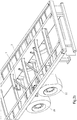
- Fig. 2a is a schematic representation of an exemplary embodiment of a commercial vehicle according to the invention in the form of a semi-trailer. 2
- the semitrailer 2 comprises, inter alia, the telematics unit 1 Fig. 1 , a wheel 20 having a first tire sensor 21, and a wheel 22 having an optional second tire sensor 23. It will be appreciated that the semi-trailer may include other wheels with other tire sensors. Preferably, each wheel of the utility vehicle has a tire sensor.
- the mounting position of the respective wheel also corresponds to a wheel position of the semitrailer 4.
- the tire sensors 21 and 23 are arranged, for example, inside a tire of the respective wheel of the commercial vehicle and are adapted, for example, to detect at least one tire pressure value of the tire in which they are located ( eg continuously or at regular intervals).
- the tire sensors 21 and 23 include a pressure sensor for detecting a tire pressure value.
- the tire sensors 21 and 23 are configured, for example, to transmit a wireless communication signal (eg at regular time intervals) with a representation of the last tire pressure value detected by the respective tire sensor. Further, the transmitted wireless communication signal of the tire sensors 21 and 23 may include a representation of an identifier of the respective tire sensor.
- the identifier is to be understood as meaning, for example, information by means of which the respective tire sensor can be identified, such as a number (eg a serial number), a name (eg a name), an address (eg a device address and / or a hardware address). Address as a medium access control address) or a combination thereof.
- the representation of the last tire pressure value respectively detected by the respective tire sensor and / or the identification of the tire sensor can be effected, for example, by a useful signal contained in the wireless communication signal or a portion of a useful signal contained therein, wherein the useful signal or the part of the Useful signal represents the last detected by the respective tire pressure sensor tire pressure value and / or the identifier of the tire sensor.
- the tire sensors include communication means for broadcasting a wireless communication signal such as a transmission circuit and / or an antenna.
- Part of a transmission circuit are, for example, one or more mixers, one or more amplifiers and / or one or more modulators.
- the transmission circuit is part of a transmission-reception circuit, for example.
- the tire sensors 21 and 23 have at least the same transmission configuration to ensure, for example, that the transmitted by the tire sensors 21 and 23 wireless communication signals with comparable (eg, at least substantially the same) parameters, such as comparable (eg, at least substantially equal) intervals and / or comparable (eg at least substantially the same) transmission powers are sent out.
- the tire sensors 21 and 23 are of the same type of tire sensor.
- the wireless communication section 13 is configured with the antenna 13 a of the telematics unit 1 to receive a wireless communication signal of the tire sensors 21 and 23.
- a wireless communication signal of the tire sensors 21 and 23 This is in Fig. 2a for example, indicated by the wireless communication path 24 between the first tire sensor 21 and the telematics unit 1 and the wireless communication path 25 between the second tire sensor 23 and the telematics unit 1.
- the tractor of the semitrailer 2 is in Fig. 2a exemplified and provided with the reference numeral 3.
- the server 4 is a server of a telematics service and is, for example, set up to provide a user interface for users of the telematics service.
- a user of the telematics service with a user device can access the user interface via the Internet and view status information of his commercial vehicles equipped with corresponding telematics units (eg the telematics unit 1) and / or configure the telematics units of his commercial vehicles (eg tire sensors for a calibration period) Assign wheel positions).
- the telematics unit 1 can transmit detected status information of the semitrailer 4, such as, for example, tire pressure information of the tires of the wheels 20 and 22 to the server 4.
- the wireless network connection 26 is, for example, a connection via a wireless communication network such as a GSM, UMTS and / or LTE network. It will be understood that the network connection 26 need not be exclusively wireless, but, for example, one or more wireless sections (eg, between the telematics unit 1 and a base station of a wireless communication network) and one or more wired sections (eg, between the base station and the server 4). may include.
- FIG. 3 shows a flowchart 300 with steps of an exemplary embodiment of a method according to the invention.
- a step 301 at least a first wireless communication signal of a first tire sensor is received by wireless communication means of a commercial vehicle.
- the first wireless communication signal is a wireless communication signal transmitted by the first tire sensor 21 of the semitrailer 2 and the communication means of the commercial vehicle is the wireless communication interface 13 of the telematics unit 1.
- the wireless communication interface 13 is configured for example Receiving a wireless communication signal from a tire sensor (eg, tire sensor 21) and obtaining (eg, extracting) a digital payload signal from the received wireless communication signal (eg, by a demodulator).
- a step 302 at least in part based on at least one received parameter value of the first wireless communication signal and / or at least one representation of a tire parameter value contained in the first wireless communication signal, it is determined whether the first tire sensor can be assigned to a wheel position of the commercial vehicle.
- the at least one receive parameter value is a receive parameter value acquired and / or determined upon receipt of the wireless communication signal by the wireless communication means.
- the wireless communication interface 13 may be configured to determine and / or detect one or more received parameter values of a wireless communication signal of the tire sensor 21 when the wireless communication signal of the tire sensor 21 is received by the wireless communication interface 13.
- a reception parameter value is to be understood, for example, as a reception frequency and / or a reception field strength and / or a reception signal strength of the wireless communication signal.
- a tire parameter value is meant a value of a parameter characteristic of the condition of a tire (i.e., tire parameter).
- a tire parameter examples of such a tire parameter are a temperature (e.g., a tire temperature) and / or a pressure (e.g., a tire pressure).
- a representation of such a tire parameter value may, for example, be contained in the form of a useful signal or a part of a useful signal in the first wireless communication signal, wherein the useful signal or the part of the useful signal represents the tire parameter value.
- the tire sensor 21 is configured to transmit a wireless communication signal (e.g., at regular time intervals) with a representation of the latest tire pressure value detected by the tire sensor 21.
- the determination in step 302 takes place, for example, according to predetermined rules and / or a predetermined algorithm.
- a representation of the rules and / or the algorithm may for example be stored in a memory (e.g., program memory 11) of the telematics unit 1, for example in the form of program instructions of a computer program.
- determining that the first tire sensor is assignable to a wheel position of the commercial vehicle if the predetermined rules and / or the predetermined algorithm, the first Assign tire sensor to a wheel position of the commercial vehicle. Otherwise, determining, for example, results in that the first tire sensor can not be assigned to a wheel position of the utility vehicle.
- step 302 is based at least in part on the at least one received parameter value of the first wireless communication signal and / or the at least one representation of a tire parameter value contained in the first wireless communication signal should be understood, for example, such that at least one of the received parameter value or the Representation of a tire parameter value or both are taken into account. It is understood that in determining, for example, a plurality of received parameter values or multiple representations of tire parameter values or any combinations thereof may be taken into account.
- FIG. 12 shows a flowchart 400 with steps of another exemplary embodiment of a method according to the invention.
- the steps 401 to 406 of the flowchart 400 are performed by the telematics unit 1, which is part of the semitrailer 2 (cf. Fig. 2a ) is to be executed.
- a step 401 at least one expected received parameter value is kept ready by the telematics unit 1 for each wheel position of the semitrailer 2.
- the expected receive parameter values are stored in a memory (e.g., program memory 11) of the telematics unit 1.
- an expected reception parameter value for a respective wheel position of the semitrailer 2 should be understood, for example, as a reception parameter value of a reception parameter for a wireless communication signal which is arranged by a tire sensor which is arranged on and / or in a tire of a wheel of the commercial vehicle located at this wheel position , is sent out, is expected for this receive parameter.
- the expected receive parameter values may be determined, for example, by one or more simulations and / or by one or more tests.
- the expected receive parameter value provided for a receive parameter for a respective wheel position of the semitrailer by the telematics unit 2 corresponds to the mean or median of received parameter values of the receive parameter obtained in one or more simulations and / or tests for that wheel position.
- these expected receive parameter values are used for all semi-trailer type semi-trailers 2 and, respectively stored in a memory of the telematics unit of the respective semitrailer (eg in the manufacture of the semitrailer).
- the expected received parameter values can also be determined by the telematics unit 2. This will be explained below with reference to steps 402 and 403 by way of example.
- a plurality of wireless communication signals of different tire sensors are received by wireless communication means of a commercial vehicle.
- the wireless communication means are the wireless communication interface 13 and the tire sensors are the tire sensors of the tires of the wheels of the semi-trailer 2.
- wireless communication signals of the tire sensors 21 and 23 are received by the wireless communication interface 13 in step 402.
- the plurality of wireless communication signals of various tire sensors of the semi-trailer 2 are received in step 402, for example during a calibration period, wherein an assignment of the different tire sensors to the wheel positions of the semi-trailer for the calibration period is predetermined.
- the assignment can be predetermined, for example, by a user input (for example on an input means such as a user interface of the telematics unit 1 and / or a user device communicatively connected to the telematics unit 1 via the server 4).
- the assignment of the tire sensors of the tires mounted on the wheels of the semitrailer 2 at initial assembly is predetermined in the manufacture of the semitrailer 2 and stored, for example, in a memory (e.g., program memory 11) of the telematics unit 1 for the calibration period.
- a memory e.g., program memory 11
- an association between the identifier of the respective tire sensor and the respective wheel position of the semitrailer 2 is stored in the memory of the telematics unit 1.
- the wireless communication signals of the tire sensors 21 and 23 may include a representation of the identifier of the respective tire sensor, such that a discrimination of the wireless communication signals and, for the calibration period, an association of the tire sensors based on the representation contained in the communication signals representations of the identifier of the respective tire sensor a wheel position is possible.
- the calibration period starts when an assignment is specified.
- the calibration period is started by a user input (for example at an input means such as a user interface of the telematics unit 1 and / or a user device communicatively connected to the telematics unit 1 via the server 4).
- the calibration period ends when the commercial vehicle has traveled more than a predetermined travel time such as 1 h, 2 h, 4 h, 8 h or 24 h after the start of the calibration period.
- a predetermined travel time such as 1 h, 2 h, 4 h, 8 h or 24 h after the start of the calibration period.
- a fixed period of time such as, for example, 12 h, 1 d, 2 d or 7 d may also be predetermined as the calibration period.
- step 403 for each wheel position of the commercial vehicle (i.e., semi-trailer 2), at least one expected receive parameter value for that receive parameter is determined based at least in part on receive parameter values of the plurality of wireless communication signals.
- the commercial vehicle i.e., semi-trailer 2
- a receive parameter value of a receive parameter expected for a wheel position is determined to correspond to the average and / or median of receive parameter values of that receive parameter of the wireless communication signal received from the tire sensor associated with that wheel position for the calibration period during the calibration period.
- step 403 for example, receive parameter values already held by the telematics unit 1 (for example stored in a memory of the telematics unit) may also be taken into account.
- the expected received parameter values determined in step 403 are stored, for example, in a memory (e.g., program memory 11) of the telematics unit 1.
- Determining during or after a calibration period is advantageous, for example, in order to be able to take into account constructional features and / or peculiarities of the semitrailer 2. However, it is also associated with an increased effort compared to the above-described possibility, in which the expected received parameter values are determined by one or more simulations and / or by one or more tests for all semi-trailer type semi-trailers 2.
- step 404 at least one wireless communication signal of a first tire sensor is received by wireless communication means of the utility vehicle.
- Step 404 corresponds to step 301 (see FIG. Fig. 3 ).
- the first tire sensor corresponds to the tire sensor 21 of the semitrailer 2 and the wireless communication means of the wireless communication interface 13 of the telematics unit 2.
- Step 405 it is determined, based at least in part on at least one receive parameter value of the first wireless communication signal and the expected receive parameter values, whether the first tire sensor is assignable to a wheel position of the commercial vehicle.
- Step 405 corresponds to step 302 (see FIG. Fig. 3 ).
- the determining may include, for example, comparing the at least one receive parameter value of the first wireless communication signal of the tire sensor 21 with the expected receive parameter values (i.e., the expected receive parameter values provided in step 401 and / or the expected receive parameter values determined in step 403).
- the determination in step 405 may also be based, for example, on a plurality of receive parameter values of a receive parameter of the first wireless communication signal that is detected (eg, continuously or at regular or irregular time intervals) upon receipt of the first wireless communication signal (eg, during a predetermined observation period) / or determined.
- a receive parameter of the first wireless communication signal that is detected (eg, continuously or at regular or irregular time intervals) upon receipt of the first wireless communication signal (eg, during a predetermined observation period) / or determined.
- an average value and / or a median of these receive parameter values of the first wireless communication signal are compared with the receive parameter values expected for this receive parameter. This is advantageous, for example, in order to avoid that the determination in step 405 is falsified by outliers or erroneously detected reception parameter values.
- the comparison for example, information about deviations from the expected reception parameter values may be obtained. For example, it is determined that the first tire sensor 21 is assignable to the wheel position of the semi-trailer 2, for whose expected receiving parameter value the least deviation results in the comparison.
- the determination in step 405 may be based, at least in part, on a speed and / or movement of the semitrailer 2. This is advantageous, for example, to avoid confusion with tire sensors of other commercial vehicles, when the commercial vehicle is parked in the vicinity of other commercial vehicles.
- the wireless communication interface 13 is inactive when the speed of the semi-trailer 2 is less than the predetermined speed and / or when the semi-trailer 2 is at rest.
- wireless communication signals from tire sensors are ignored (eg discarded) when the speed of the semitrailer 2 is less than the predetermined speed and / or when the semitrailer 2 is at rest.
- the telematics unit may comprise, for example, a speed sensor for detecting a speed and / or a movement of the semitrailer 2.
- a step 406 if it is determined that the first tire sensor is assignable to a wheel position of the utility vehicle, the first tire sensor is assigned to that wheel position of the utility vehicle.
- the tire sensor 21 is associated with the wheel position of the wheel 20 of the semi-trailer 20 so that the representation (s) of a tire parameter value included in the received first wireless communication signal is interpreted as tire condition information of the tire at that wheel position and communicated to the server 4, for example become.
- the assignment in step 406 takes place, for example, only for a limited period of time, for example, only while the utility vehicle is in motion.
- the steps 405 to 406 may be repeated, for example, for a wireless communication signal of the second tire sensor 23 or of another tire sensor in order to also associate this tire sensor with a wheel position of the semi-trailer 2.
- An example of a receive parameter is, for example, a receive frequency of the first wireless communication signal describing, for example, a frequency distribution of the representations of a tire parameter value contained in the first wireless communication signal (eg, during a predetermined observation period).
- a receive frequency of the first wireless communication signal describing, for example, a frequency distribution of the representations of a tire parameter value contained in the first wireless communication signal (eg, during a predetermined observation period).
- other physical quantities such as the field strength as a further receiving parameter or the temperature can be evaluated as tire parameters and taken into account in determining whether the tire sensor is assigned to a wheel position.
- the reception parameter values and / or the tire parameter values can be related to the wheel position, in particular after a long journey.
- the temperature can also give an indication of the tire position, since with existing lift axle the tires are loaded and heated differently, depending on which tires have contact with the ground.
- the wheel position of the tire sensor can be deduced by means of mathematical methods, such as averaging.
- the system can calibrate itself by matching the calculated and / or specific characteristics of the tire sensors with the expected reception parameter values and / or tire parameter values provided by the telematics unit.
Landscapes
- Engineering & Computer Science (AREA)
- Mechanical Engineering (AREA)
- Physics & Mathematics (AREA)
- Electromagnetism (AREA)
- Arrangements For Transmission Of Measured Signals (AREA)
Priority Applications (1)
| Application Number | Priority Date | Filing Date | Title |
|---|---|---|---|
| EP17160483.8A EP3375646B1 (fr) | 2017-03-13 | 2017-03-13 | Permettre d'associer un capteur de pneu à une position de roue |
Applications Claiming Priority (1)
| Application Number | Priority Date | Filing Date | Title |
|---|---|---|---|
| EP17160483.8A EP3375646B1 (fr) | 2017-03-13 | 2017-03-13 | Permettre d'associer un capteur de pneu à une position de roue |
Publications (3)
| Publication Number | Publication Date |
|---|---|
| EP3375646A1 true EP3375646A1 (fr) | 2018-09-19 |
| EP3375646C0 EP3375646C0 (fr) | 2024-06-26 |
| EP3375646B1 EP3375646B1 (fr) | 2024-06-26 |
Family
ID=58266997
Family Applications (1)
| Application Number | Title | Priority Date | Filing Date |
|---|---|---|---|
| EP17160483.8A Active EP3375646B1 (fr) | 2017-03-13 | 2017-03-13 | Permettre d'associer un capteur de pneu à une position de roue |
Country Status (1)
| Country | Link |
|---|---|
| EP (1) | EP3375646B1 (fr) |
Cited By (1)
| Publication number | Priority date | Publication date | Assignee | Title |
|---|---|---|---|---|
| CN111845218A (zh) * | 2020-06-15 | 2020-10-30 | 东风柳州汽车有限公司 | 一种基于车桥一侧为双胎的整车轮胎位置自动定位系统 |
Citations (4)
| Publication number | Priority date | Publication date | Assignee | Title |
|---|---|---|---|---|
| EP1616722A1 (fr) * | 2004-07-13 | 2006-01-18 | GM Global Technology Operations, Inc. | Procédé et système pour déterminer la position des roues dans un système de surveillance de pression des pneumatiques |
| US20080094197A1 (en) * | 2006-10-24 | 2008-04-24 | Tien-Tsai Huang | Tire pressure monitoring system with bidirectional communication function |
| US20090096599A1 (en) * | 2007-10-15 | 2009-04-16 | Stemco Lp | Identification and Monitoring of Vehicle Sensors |
| DE102011055886A1 (de) * | 2010-11-30 | 2012-05-31 | The Yokohama Rubber Co., Ltd. | Reifenzustandsüberwachungssystem und Montagepositionsermittlungsverfahren |
Family Cites Families (1)
| Publication number | Priority date | Publication date | Assignee | Title |
|---|---|---|---|---|
| US7574293B2 (en) * | 2004-02-19 | 2009-08-11 | Johnson Controls Technology Company | System and method for identifying tire position on a vehicle |
-
2017
- 2017-03-13 EP EP17160483.8A patent/EP3375646B1/fr active Active
Patent Citations (4)
| Publication number | Priority date | Publication date | Assignee | Title |
|---|---|---|---|---|
| EP1616722A1 (fr) * | 2004-07-13 | 2006-01-18 | GM Global Technology Operations, Inc. | Procédé et système pour déterminer la position des roues dans un système de surveillance de pression des pneumatiques |
| US20080094197A1 (en) * | 2006-10-24 | 2008-04-24 | Tien-Tsai Huang | Tire pressure monitoring system with bidirectional communication function |
| US20090096599A1 (en) * | 2007-10-15 | 2009-04-16 | Stemco Lp | Identification and Monitoring of Vehicle Sensors |
| DE102011055886A1 (de) * | 2010-11-30 | 2012-05-31 | The Yokohama Rubber Co., Ltd. | Reifenzustandsüberwachungssystem und Montagepositionsermittlungsverfahren |
Cited By (2)
| Publication number | Priority date | Publication date | Assignee | Title |
|---|---|---|---|---|
| CN111845218A (zh) * | 2020-06-15 | 2020-10-30 | 东风柳州汽车有限公司 | 一种基于车桥一侧为双胎的整车轮胎位置自动定位系统 |
| CN111845218B (zh) * | 2020-06-15 | 2022-04-26 | 东风柳州汽车有限公司 | 一种基于车桥一侧为双胎的整车轮胎位置自动定位系统 |
Also Published As
| Publication number | Publication date |
|---|---|
| EP3375646C0 (fr) | 2024-06-26 |
| EP3375646B1 (fr) | 2024-06-26 |
Similar Documents
| Publication | Publication Date | Title |
|---|---|---|
| EP3104340B1 (fr) | Procede et dispositif de deverrouillage et de verrouillage d'au moins une porte de vehicule pour une mise a disposition | |
| EP3352141B1 (fr) | Procédé d'identification d'un dispositif de montage | |
| DE102014108788A1 (de) | Gewichtsbestimmung durch reifendruckerfassung | |
| DE202015009959U1 (de) | Vorrichtung zum Überwachen des Betriebs eines Fahrzeugbremssystems | |
| DE102014219382A1 (de) | Sensorkalibrierung in einer Parkanlage | |
| DE112020005622B4 (de) | Informationsverarbeitungsvorrichtung, Informationsverarbeitungsverfahren und Computerprogramm | |
| DE102021110802A1 (de) | Systeme und verfahren zur fehlererkennung bei einer katalytischen reduktion (scr) | |
| DE102018003801A1 (de) | Verfahren und Steueranordnung zur Vorhersage einer Fehlfunktion einer Radlagereinheit einer Achse in einem Fahrzeug | |
| DE102019114628A1 (de) | Verfahren und Systeme zur Bestimmung der Bremsbelaglebensdauer | |
| DE102007051961B4 (de) | Einrichtung zum Überwachen von sich in einem ausgezeichneten Bereich, insbesondere einem Werksgelände oder einem Parkhaus befindlichen Fahrzeugen | |
| DE112017007213T5 (de) | Fahrzeuginsassenerkennung | |
| DE102016010792A1 (de) | Verfahren und Vorrichtung zur Ermittlung einer Fahrzeugmasse | |
| DE102014213270B4 (de) | Verfahren und Vorrichtung zum Überwachen eines zum Öffnen einer Klappe eines Fahrzeugs erforderlichen Raums | |
| EP3663730B1 (fr) | Procédé de détermination si un compartiment de chargement d'un véhicule utilitaire comporte une ou une pluralité de zones de compartiment de chargement utilisables pour un chargement supplémentaire | |
| DE102024100806A1 (de) | Systeme und verfahren zum selektiven anschalten von rdks-lernmodusvorgängen in einem fahrzeug | |
| EP3375646B1 (fr) | Permettre d'associer un capteur de pneu à une position de roue | |
| WO2024012928A1 (fr) | Procédé pour entraîner un réseau de neurones artificiels | |
| DE102018115424A1 (de) | Einstellen eines an einem Kraftfahrzeug angeordneten Abstandssensors | |
| DE102017204841A1 (de) | Temperatursensor für ein Fahrzeug | |
| DE102024119502A1 (de) | Systeme und verfahren zum überwachen von tieren in einer garage | |
| WO2017025495A1 (fr) | Dispositif et procédé pour climatiser un véhicule à moteur | |
| DE10238571A1 (de) | Verfahren und Vorrichtung zum Erkennen von fahrzeugeigenen Radelektronikeinheiten sowie Radelektronikeinheit | |
| EP3800811B1 (fr) | Détection d'un signal de brouillage radio et / ou d'un émetteur de brouillage | |
| DE102021115220B4 (de) | Verfahren und System zum Überwachen eines Objektbestandes in einem Laderaum für mit Beacon-Sendeeinrichtungen verbundene Objekte, Fahrzeug, Computerprogrammprodukt und computerlesbarer Datenträger | |
| EP4063204A1 (fr) | Surveillance d'un processus de chargement et/ou d'un processus de déchargement |
Legal Events
| Date | Code | Title | Description |
|---|---|---|---|
| PUAI | Public reference made under article 153(3) epc to a published international application that has entered the european phase |
Free format text: ORIGINAL CODE: 0009012 |
|
| STAA | Information on the status of an ep patent application or granted ep patent |
Free format text: STATUS: THE APPLICATION HAS BEEN PUBLISHED |
|
| AK | Designated contracting states |
Kind code of ref document: A1 Designated state(s): AL AT BE BG CH CY CZ DE DK EE ES FI FR GB GR HR HU IE IS IT LI LT LU LV MC MK MT NL NO PL PT RO RS SE SI SK SM TR |
|
| AX | Request for extension of the european patent |
Extension state: BA ME |
|
| STAA | Information on the status of an ep patent application or granted ep patent |
Free format text: STATUS: REQUEST FOR EXAMINATION WAS MADE |
|
| 17P | Request for examination filed |
Effective date: 20190318 |
|
| RBV | Designated contracting states (corrected) |
Designated state(s): AL AT BE BG CH CY CZ DE DK EE ES FI FR GB GR HR HU IE IS IT LI LT LU LV MC MK MT NL NO PL PT RO RS SE SI SK SM TR |
|
| STAA | Information on the status of an ep patent application or granted ep patent |
Free format text: STATUS: EXAMINATION IS IN PROGRESS |
|
| 17Q | First examination report despatched |
Effective date: 20220103 |
|
| P01 | Opt-out of the competence of the unified patent court (upc) registered |
Effective date: 20230517 |
|
| GRAP | Despatch of communication of intention to grant a patent |
Free format text: ORIGINAL CODE: EPIDOSNIGR1 |
|
| STAA | Information on the status of an ep patent application or granted ep patent |
Free format text: STATUS: GRANT OF PATENT IS INTENDED |
|
| INTG | Intention to grant announced |
Effective date: 20240123 |
|
| GRAS | Grant fee paid |
Free format text: ORIGINAL CODE: EPIDOSNIGR3 |
|
| GRAA | (expected) grant |
Free format text: ORIGINAL CODE: 0009210 |
|
| STAA | Information on the status of an ep patent application or granted ep patent |
Free format text: STATUS: THE PATENT HAS BEEN GRANTED |
|
| AK | Designated contracting states |
Kind code of ref document: B1 Designated state(s): AL AT BE BG CH CY CZ DE DK EE ES FI FR GB GR HR HU IE IS IT LI LT LU LV MC MK MT NL NO PL PT RO RS SE SI SK SM TR |
|
| REG | Reference to a national code |
Ref country code: GB Ref legal event code: FG4D Free format text: NOT ENGLISH |
|
| REG | Reference to a national code |
Ref country code: CH Ref legal event code: EP |
|
| REG | Reference to a national code |
Ref country code: DE Ref legal event code: R096 Ref document number: 502017016198 Country of ref document: DE |
|
| U01 | Request for unitary effect filed |
Effective date: 20240726 |
|
| P04 | Withdrawal of opt-out of the competence of the unified patent court (upc) registered |
Free format text: CASE NUMBER: APP_45343/2024 Effective date: 20240805 |
|
| U07 | Unitary effect registered |
Designated state(s): AT BE BG DE DK EE FI FR IT LT LU LV MT NL PT SE SI Effective date: 20240808 |
|
| PG25 | Lapsed in a contracting state [announced via postgrant information from national office to epo] |
Ref country code: HR Free format text: LAPSE BECAUSE OF FAILURE TO SUBMIT A TRANSLATION OF THE DESCRIPTION OR TO PAY THE FEE WITHIN THE PRESCRIBED TIME-LIMIT Effective date: 20240626 |
|
| PG25 | Lapsed in a contracting state [announced via postgrant information from national office to epo] |
Ref country code: GR Free format text: LAPSE BECAUSE OF FAILURE TO SUBMIT A TRANSLATION OF THE DESCRIPTION OR TO PAY THE FEE WITHIN THE PRESCRIBED TIME-LIMIT Effective date: 20240927 |
|
| PG25 | Lapsed in a contracting state [announced via postgrant information from national office to epo] |
Ref country code: NO Free format text: LAPSE BECAUSE OF FAILURE TO SUBMIT A TRANSLATION OF THE DESCRIPTION OR TO PAY THE FEE WITHIN THE PRESCRIBED TIME-LIMIT Effective date: 20240926 Ref country code: HR Free format text: LAPSE BECAUSE OF FAILURE TO SUBMIT A TRANSLATION OF THE DESCRIPTION OR TO PAY THE FEE WITHIN THE PRESCRIBED TIME-LIMIT Effective date: 20240626 Ref country code: GR Free format text: LAPSE BECAUSE OF FAILURE TO SUBMIT A TRANSLATION OF THE DESCRIPTION OR TO PAY THE FEE WITHIN THE PRESCRIBED TIME-LIMIT Effective date: 20240927 Ref country code: RS Free format text: LAPSE BECAUSE OF FAILURE TO SUBMIT A TRANSLATION OF THE DESCRIPTION OR TO PAY THE FEE WITHIN THE PRESCRIBED TIME-LIMIT Effective date: 20240926 |
|
| P05 | Withdrawal of opt-out of the competence of the unified patent court (upc) changed |
Free format text: CASE NUMBER: APP_45343/2024 Effective date: 20240808 |
|
| PG25 | Lapsed in a contracting state [announced via postgrant information from national office to epo] |
Ref country code: PL Free format text: LAPSE BECAUSE OF FAILURE TO SUBMIT A TRANSLATION OF THE DESCRIPTION OR TO PAY THE FEE WITHIN THE PRESCRIBED TIME-LIMIT Effective date: 20240626 |
|
| PG25 | Lapsed in a contracting state [announced via postgrant information from national office to epo] |
Ref country code: IS Free format text: LAPSE BECAUSE OF FAILURE TO SUBMIT A TRANSLATION OF THE DESCRIPTION OR TO PAY THE FEE WITHIN THE PRESCRIBED TIME-LIMIT Effective date: 20241026 |
|
| PG25 | Lapsed in a contracting state [announced via postgrant information from national office to epo] |
Ref country code: CZ Free format text: LAPSE BECAUSE OF FAILURE TO SUBMIT A TRANSLATION OF THE DESCRIPTION OR TO PAY THE FEE WITHIN THE PRESCRIBED TIME-LIMIT Effective date: 20240626 |
|
| PG25 | Lapsed in a contracting state [announced via postgrant information from national office to epo] |
Ref country code: SK Free format text: LAPSE BECAUSE OF FAILURE TO SUBMIT A TRANSLATION OF THE DESCRIPTION OR TO PAY THE FEE WITHIN THE PRESCRIBED TIME-LIMIT Effective date: 20240626 Ref country code: RO Free format text: LAPSE BECAUSE OF FAILURE TO SUBMIT A TRANSLATION OF THE DESCRIPTION OR TO PAY THE FEE WITHIN THE PRESCRIBED TIME-LIMIT Effective date: 20240626 |
|
| PG25 | Lapsed in a contracting state [announced via postgrant information from national office to epo] |
Ref country code: ES Free format text: LAPSE BECAUSE OF FAILURE TO SUBMIT A TRANSLATION OF THE DESCRIPTION OR TO PAY THE FEE WITHIN THE PRESCRIBED TIME-LIMIT Effective date: 20240626 Ref country code: SM Free format text: LAPSE BECAUSE OF FAILURE TO SUBMIT A TRANSLATION OF THE DESCRIPTION OR TO PAY THE FEE WITHIN THE PRESCRIBED TIME-LIMIT Effective date: 20240626 |
|
| PG25 | Lapsed in a contracting state [announced via postgrant information from national office to epo] |
Ref country code: SM Free format text: LAPSE BECAUSE OF FAILURE TO SUBMIT A TRANSLATION OF THE DESCRIPTION OR TO PAY THE FEE WITHIN THE PRESCRIBED TIME-LIMIT Effective date: 20240626 Ref country code: SK Free format text: LAPSE BECAUSE OF FAILURE TO SUBMIT A TRANSLATION OF THE DESCRIPTION OR TO PAY THE FEE WITHIN THE PRESCRIBED TIME-LIMIT Effective date: 20240626 Ref country code: RO Free format text: LAPSE BECAUSE OF FAILURE TO SUBMIT A TRANSLATION OF THE DESCRIPTION OR TO PAY THE FEE WITHIN THE PRESCRIBED TIME-LIMIT Effective date: 20240626 Ref country code: PL Free format text: LAPSE BECAUSE OF FAILURE TO SUBMIT A TRANSLATION OF THE DESCRIPTION OR TO PAY THE FEE WITHIN THE PRESCRIBED TIME-LIMIT Effective date: 20240626 Ref country code: IS Free format text: LAPSE BECAUSE OF FAILURE TO SUBMIT A TRANSLATION OF THE DESCRIPTION OR TO PAY THE FEE WITHIN THE PRESCRIBED TIME-LIMIT Effective date: 20241026 Ref country code: ES Free format text: LAPSE BECAUSE OF FAILURE TO SUBMIT A TRANSLATION OF THE DESCRIPTION OR TO PAY THE FEE WITHIN THE PRESCRIBED TIME-LIMIT Effective date: 20240626 Ref country code: CZ Free format text: LAPSE BECAUSE OF FAILURE TO SUBMIT A TRANSLATION OF THE DESCRIPTION OR TO PAY THE FEE WITHIN THE PRESCRIBED TIME-LIMIT Effective date: 20240626 |
|
| U20 | Renewal fee for the european patent with unitary effect paid |
Year of fee payment: 9 Effective date: 20250325 |
|
| PLBE | No opposition filed within time limit |
Free format text: ORIGINAL CODE: 0009261 |
|
| STAA | Information on the status of an ep patent application or granted ep patent |
Free format text: STATUS: NO OPPOSITION FILED WITHIN TIME LIMIT |
|
| 26N | No opposition filed |
Effective date: 20250327 |
|
| PG25 | Lapsed in a contracting state [announced via postgrant information from national office to epo] |
Ref country code: MC Free format text: LAPSE BECAUSE OF FAILURE TO SUBMIT A TRANSLATION OF THE DESCRIPTION OR TO PAY THE FEE WITHIN THE PRESCRIBED TIME-LIMIT Effective date: 20240626 |
|
| REG | Reference to a national code |
Ref country code: CH Ref legal event code: H13 Free format text: ST27 STATUS EVENT CODE: U-0-0-H10-H13 (AS PROVIDED BY THE NATIONAL OFFICE) Effective date: 20251023 |
|
| GBPC | Gb: european patent ceased through non-payment of renewal fee |
Effective date: 20250313 |
|
| PG25 | Lapsed in a contracting state [announced via postgrant information from national office to epo] |
Ref country code: GB Free format text: LAPSE BECAUSE OF NON-PAYMENT OF DUE FEES Effective date: 20250313 |
|
| PG25 | Lapsed in a contracting state [announced via postgrant information from national office to epo] |
Ref country code: CH Free format text: LAPSE BECAUSE OF NON-PAYMENT OF DUE FEES Effective date: 20250331 |
|
| PG25 | Lapsed in a contracting state [announced via postgrant information from national office to epo] |
Ref country code: IE Free format text: LAPSE BECAUSE OF NON-PAYMENT OF DUE FEES Effective date: 20250313 |
|
| U20 | Renewal fee for the european patent with unitary effect paid |
Year of fee payment: 10 Effective date: 20260326 |