EP3375897B1 - Kupferlegierungsmaterial - Google Patents
Kupferlegierungsmaterial Download PDFInfo
- Publication number
- EP3375897B1 EP3375897B1 EP16863933.4A EP16863933A EP3375897B1 EP 3375897 B1 EP3375897 B1 EP 3375897B1 EP 16863933 A EP16863933 A EP 16863933A EP 3375897 B1 EP3375897 B1 EP 3375897B1
- Authority
- EP
- European Patent Office
- Prior art keywords
- mass
- less
- compound
- present
- copper alloy
- Prior art date
- Legal status (The legal status is an assumption and is not a legal conclusion. Google has not performed a legal analysis and makes no representation as to the accuracy of the status listed.)
- Active
Links
Images



Classifications
-
- C—CHEMISTRY; METALLURGY
- C22—METALLURGY; FERROUS OR NON-FERROUS ALLOYS; TREATMENT OF ALLOYS OR NON-FERROUS METALS
- C22F—CHANGING THE PHYSICAL STRUCTURE OF NON-FERROUS METALS AND NON-FERROUS ALLOYS
- C22F1/00—Changing the physical structure of non-ferrous metals or alloys by heat treatment or by hot or cold working
- C22F1/08—Changing the physical structure of non-ferrous metals or alloys by heat treatment or by hot or cold working of copper or alloys based thereon
-
- B—PERFORMING OPERATIONS; TRANSPORTING
- B22—CASTING; POWDER METALLURGY
- B22C—FOUNDRY MOULDING
- B22C9/00—Moulds or cores; Moulding processes
- B22C9/06—Permanent moulds for shaped castings
- B22C9/061—Materials which make up the mould
-
- C—CHEMISTRY; METALLURGY
- C22—METALLURGY; FERROUS OR NON-FERROUS ALLOYS; TREATMENT OF ALLOYS OR NON-FERROUS METALS
- C22C—ALLOYS
- C22C9/00—Alloys based on copper
-
- C—CHEMISTRY; METALLURGY
- C22—METALLURGY; FERROUS OR NON-FERROUS ALLOYS; TREATMENT OF ALLOYS OR NON-FERROUS METALS
- C22F—CHANGING THE PHYSICAL STRUCTURE OF NON-FERROUS METALS AND NON-FERROUS ALLOYS
- C22F1/00—Changing the physical structure of non-ferrous metals or alloys by heat treatment or by hot or cold working
Definitions
- the present invention relates to a copper alloy material suitable for a part used in a high temperature environment such as a molding material for casting and a welding part such as a contact tip.
- Cu-Cr-Zr-based alloys such as C18150 are used as a material for casting mold materials and welding members which are used at high temperatures, since they have excellent heat resistance and electrical conductivity as shown in Patent Literatures 1 to 3.
- Cu-Cr-Zr-based alloy are usually produced by a production process, in which a cast made of Cu-Cr-Zr-based alloy is subjected to a plastic working; a solution treatment, for example in a condition of 950-1050°C of a retention temperature and 0.5-1.5 hours of a retention time, and an aging treatment, for example in a condition of 400-500°C of a retention temperature and 2-4 hours of a retention time, are performed on the plastically worked material; and then the material subjected to the solution and aging treatments is finished into a predetermined shape by machine working in the end.
- the solution treatment step in the Cu-Cr-Zr-based alloy can be carried out in combination with the plastic working step instead of the so-called in-line solution treatment. In that case, the solution treatment is performed concurrently with the hot rolling working.
- Patent Literature 4 is concerned with producing the molding material for casting metals having high strength and high thermal conductivity by subjecting a copper alloy having a specific chemical composition to working and heat treatments at specified temperatures, wherein the copper alloy contains 0.3 to 1.2wt.% Cr and 0.05 to 0.25wt.% Zr, ⁇ 2wt.% respectively of one or two or more elements among Sn, Al, Ag, Ni, Ti, Co and Fe, the balance being Cu and inevitable impurities.
- Patent Literature 5 relates to a copper alloy for a hot scarfing nozzle unit of steel with no generation of cracks, wherein the copper alloy contains, by weight, 0.2-1.5% Cr, 0.005-0.35% Zr, 0.01-0.05% P and the balance being substantially Cu.
- Patent Literature 6 relates to a copper based precipitation hardenable alloy containing at least one of the elements chromium, zirconium or titanium, wherein the copper based precipitation hardenable alloy is alloyed by phosphorus.
- the above-described Cu-Cr-Zr-based alloy has excellent heat resistance, when it is exposed to a use environment with a peak temperature of 500°C or more, occasionally, re-solution of precipitate starts for the strength and the conductivity to be reduced and for coarsening of the crystal grain to occur.
- the present invention has been made in view of the above-described circumstances.
- An object of the present invention to provide a copper alloy material which is capable of suppressing coarsening of crystal grains, is stable in characteristics and excellent in service life even when it is used in a high temperature environment of 500°C or more.
- the present invention is directed to a copper alloy material according to claim 1 (hereinafter, referred as "a copper alloy material of the present invention").
- the copper alloy material includes a Cr-Zr-P compound containing Cr, Zr and P and an area ratio of the Cr-Zr-P compound is in a range of 0.5 % or more and 5.0 % or less in a structure observation. Since the Cr-Zr-P compound containing Cr, Zr and P does not disappear even under a high temperature condition of about 1000°C, even when it is used in a high temperature environment, coarsening of crystal grains is suppressed by the grain boundary pinning effect of the Cr-Zr-P compound.
- the Cr-Zr-P compound is in a form of a needle shape or a granular shape and a length of a longest side of the needle shape or the granular shape is 100 ⁇ m or less.
- an average size of crystal grains is 200 ⁇ m or less.
- the composition of the copper alloy material includes Co in a range of 0.02 mass% or more and 0.15 mass% or less, and an atomic ratio of Co to P, [Co]/[P], is in a range of 0.5 ⁇ [Co]/[P] ⁇ 5.0.
- the composition of the copper alloy material includes Co in a range of 0.02 mass% or more and 0.15 mass% or less, CoP compounds and Co 2 P compounds exist in the copper alloy material to exhibit the grain boundary pinning effect with the above-described Cr-Zr-P compound. Accordingly, even when it is used in a high temperature environment, coarsening of crystal grains can be suppressed reliably.
- [Co]/[P] is set to the range of 0.5 ⁇ [Co]/[P] ⁇ 5.0, solid-so luting of excessive Co and P can be suppressed. Accordingly, reduction of electrical conductivity can be suppressed.
- the total content of Ti and Hf in the inevitable impurities is 0.10 mass% or less.
- the total content of Ti and Hf in the inevitable impurities is set to 0.10 mass% or less, the CoP compounds and the Co 2 P compounds are reliably formed. Accordingly, the grain boundary pinning effect can be exhibited effectively; and the coarsening of the crystal grains can be suppressed.
- the present invention it is possible to provide a copper alloy material capable of suppressing coarsening of crystal grains and having stable characteristics and excellent service life even when it is used in a high temperature environment of 500°C or more.
- the copper alloy material of the present embodiment is a material for a part used in a high temperature environment such as a molding material for casting and a welding part.
- the copper alloy material according to the present embodiment has a composition according to claim 1.
- the atomic ratio of Co to P, [Co]/[P], is set in a range of 0.5 ⁇ [Co]/[P] ⁇ 5.0.
- the total content of Ti and Hf in the inevitable impurities is set to 0.10 mass% or less.
- the copper alloy material includes a Cr-Zr-P compound (phase) containing Cr, Zr and P and an area ratio of the Cr-Zr-P compound (phase) is in a range of 0.5 % or more and 5.0 % or less in a structure observation, and the Cr-Zr-P compound is in a form of a needle shape or a granular shape and a length of a longest side of the needle shape or the granular shape is 100 ⁇ m or less.
- Cr-Zr-P compound (phase) means a phase consisting of Cr-Zr-P compound wiht a constant content surrounded by grain boundaries.
- the "needle shape” means that the phase has an aspect ratio of 5 or more.
- the "granular shape” means the pahse has an aspect ratio of 1-3.
- the length of the longest side of the Cr-Zr-P compound (phase) in the needle shape can be obtained by measuring the length in the longitudinal direction of the needle shape.
- the length of the longest side of the Cr-Zr-P compound (phase) in the grain shape can be obtained by measuring the length of the granular shape in the direction in which the longest length can be obtained.
- the area ratio of the Cr-Zr-P compound (phase) is obtained by observing the structure of an arbitrary cross section of the copper alloy material (for example, a cross section parallel to the rolling direction) with SEM or the like after microscopic etching and further observing the cross section by performing element analysis with EPMA or the like.
- the average crystal grain sizes after heat treatment maintained at 1000°C for 30 minutes is set to 200 ⁇ m or less.
- Cr is an element having an action effect that improves strength (hardness) and electrical conductivity by finely precipitating Cr-based precipitates in crystal grains of the parent phase by means of an aging treatment.
- the precipitation amount during the aging treatment becomes insufficient, and there is a concern that the strength (hardness) improvement effect cannot be sufficiently obtained.
- the content of Cr exceeds 1.5 mass%, there is a concern that coarsened Cr crystalline materials are formed for workability to be reduced.
- the content of Cr is set in a range of 0.1 mass% or more and 1.5 mass% or less. Meanwhile, in order to reliably exhibit the above-described action effect, the lower limit of the content of Cr is preferably set to 0.3 mass% or more, and the upper limit of the content of Cr is preferably set to 1.0 mass% or less.
- Zr is an element having an action effect that improves strength (hardness) and electrical conductivity by finely precipitating Zr-based precipitates in the crystal grain boundaries of the parent phase by means of the aging treatment.
- the precipitation amount during the aging treatment becomes insufficient, and there is a concern that the strength (hardness) improvement effect cannot be sufficiently obtained.
- the content of Zr exceeds 0.25 mass%, there is a concern that electrical conductivity and thermal conductivity may decrease.
- an additional strength improvement effect cannot be obtained.
- the content of Zr is set in a range of 0.05 mass% or more and 0.25 mass% or less. Meanwhile, in order to reliably exhibit the above-described action effect, the lower limit of the content of Zr is preferably set to 0.07 mass% or more, and the upper limit of the content of Zr is preferably set to 0.15 mass% or less.
- the Cr-Zr-P compound (phase) containing Cr, Zr and P is formed. Since the Cr-Zr-P compound (phase) does not disappear in a high temperature condition such as at 1000°C, addition of P exhibits the grain boundary pinning effect even when the alloy is used in a high temperature condition. Accordingly, coarsening of crystal grains can be suppressed.
- the content of P is set in a range of 0.005 mass% or more and 0.10 mass% or less. Meanwhile, in order to reliably exhibit the above-described action effect, the lower limit of the content of P is preferably set to 0.01 mass% or more, and the upper limit of the content of P is preferably set to 0.05 mass% or less.
- the CoP compound and the Co 2 P compounds are formed.
- the grain boundary pinning effect is exhibited by these the CoP compound and the Co 2 P compounds together with the above-described Cr-Zr-P compound (phase). Accordingly, coarsening of crystal grains are reliably suppressed even when the alloy is used in a high temperature condition.
- the content of Co is set in a range of 0.02 mass% or more and 0.15 mass% or less. Meanwhile, in order to reliably exhibit the above-described action effect, the lower limit of the content of Co is preferably set to 0.03 mass% or more, and the upper limit of the content of Co is preferably set to 0.1 mass% or less..
- the atomic ratio of Co to P, [Co]/[P] is set in the range of 0.5 ⁇ [Co]/[P] ⁇ 5.0.
- the lower limit of the atomic ratio of Co to P, [Co]/[P] is preferably set to 1.0 or more
- the upper limit of the atomic ratio of Co to P, [Co]/[P] is preferably set to 3.0 or less.
- Total content of Ti and Hf 0.10 mass% or less
- the total content of Ti and Hf which are inevitable impurities is set to 0.10 mass% or less. Since elements such as Ti and Hf are likely to form a compound with Co, there is a possibility that CoP compound and Co 2 P compound can not be formed sufficiently. Therefore, by setting the total content of inevitable impurities of Ti and Hf as described above, the CoP compound and the Co 2 P compound can be reliably formed and the pinning effect can be exhibited. In order to reliably exhibit the above-described action effect, it is preferable to set the total content of Ti and Hf as inevitable impurities to 0.03 mass% or less.
- examples of the inevitable impurities other than Cr-Zr-P, Co, Ti, and Hf described above include B, Al, Fe, Sn, Zn, Si, Mg, Ag, Ca, Te, Mn, Ni, Sr, Ba, Sc , Y, Ti, Hf, V, Nb, Ta, Mo, W, Re, Ru, Os, Se, Rh, Ir, Pd, Pt, Au, Cd, Ga, In, Li, Ge, As, Sb, Tl, Pb, Be, N, H, Hg, Tc, Na, K, Rb, Cs, Po, Bi, lanthanoids, O, S, C and the like. Since there is a concern that these inevitable impurities may decrease the electrical conductivity and the thermal conductivity, the total amount thereof is preferably set to 0.05 mass% or less.
- the area ratio of the Cr-Zr-P compound (phase) is less than 0.5%, the crystal grain boundary pinning effect by the Cr-Zr-P compound (phase) becomes insufficient, and there is a concern that coarsening of crystal grains can not be suppressed.
- the area ratio of the Cr-Zr-P compound (phase) exceeds 5.0%, there is a concern that workabiity is decreased.
- the area ratio of the Cr-Zr-P compound (phase) is set to be 0.5% or more and 5.0% or less. It is preferable that the lower limit of the area ratio of the Cr-Zr-P compound (phase) is 1.0% or more, the upper limit of the area ratio of the Cr-Zr-P compound (phase) is 3.0% or less.
- the length as the longest side of the Cr-Zr-P compound (phase) is set to 100 ⁇ m or less. It is preferable that the upper limit of the length as the longest side of the Cr-Zr-P compound (phase) is set to 80 ⁇ m or less.
- the average crystal grain sizes after heat treatment at 1000°C for 30 minutes retension is set to 200 ⁇ m or less.
- a copper raw material made of oxygen-free copper having a copper purity of 99.99 mass% or higher is loaded into a carbon crucible and is melted using a vacuum melting furnace, thereby obtaining molten copper.
- the above-described additive elements are added to the obtained molten metal so as to obtain a predetermined concentration, and components are formulated, thereby obtaining a molten copper alloy.
- raw materials of Cr, Zr, and P which are the additive elements Cr, and Zr having a high purity are used, and, for example, Cr having a purity of 99.99 mass% or higher is used as a raw material of Cr, Zr having a purity of 99.95 mass% or higher is used as a raw material of Zr, and P having a purity of 99.99 mass% or higher is used as a raw material of P.
- Co is added thereto as necessary.
- parent alloys with Cu may also be used as raw materials of Cr, Zr, Co and P.
- the component-formulated molten copper alloy is injected into a die, thereby obtaining an ingot.
- a homogenization treatment is carried out on the ingot in the atmosphere under conditions of 950°C or higher and 1,050°C or lower for one hour or longer.
- hot rolling with a working percentage of 50% or higher and 99% or lower is carried out on the ingot in a temperature range of 900°C or higher and 1,000°C or lower, thereby obtaining a rolled material.
- the method of the hot working may be hot forging. After this hot working, the rolled material is immediately cooled by means of water cooling.
- a heating treatment is carried out on the rolled material obtained in the hot working step S03 under conditions of 920°C or higher and 1,050°C or lower for 0.5 hours or longer and five hours or shorter, thereby carrying out a solution treatment.
- the heating treatment is carried out, for example, in the atmosphere or an inert gas atmosphere, and as cooling after the heating, water cooling is carried out.
- the hot working step S03 and the solution treatment step S04 may be performed simultaneously.
- hot rolling is performed with respect to the ingot at a reduction ratio of 50% or more and 99% or less in a temperature range of 900°C or more and 1000°C or less, and immediately from a temperature of 920°C or more and 1050°C or less, the solution treatment is performed.
- the first aging treatment is carried out under conditions of, for example, 400°C or higher and 530°C or lower for 0.5 hours or longer and five hours or shorter.
- the thermal treatment method during the aging treatment is not particularly limited, but the thermal treatment is preferably carried out in an inert gas atmosphere.
- the cooling method after the heating treatment is not particularly limited, but water cooling is preferably carried out.
- the copper alloy material that is the present embodiment is manufactured.
- the copper alloy material has the composition defined in claim 1.
- strength (hardness) and electrical conductivity can be improved.
- the copper alloy material includes a Cr-Zr-P compound containing Cr, Zr and P and an area ratio of the Cr-Zr-P compound is in a range of 0.5 % or more and 5.0 % or less in a structure observation.
- the Cr-Zr-P compound (phase) does not disappear even when it is used under a high temperature environment, and coarsening of crystal grains can be suppressed by the pinning effect of these Cr - Zr - P compound.
- the Cr-Zr-P compound is in a form of a needle shape or a grain shape and a length of a longest side of the needle shape or the grain shape is 100 ⁇ m or less.
- the average crystal grain sizes after heat treatment at 1000°C for 30 minutes retension is set to 200 ⁇ m or less.
- crystal grains are not coarsened and mechanical property and electrical conductivity are stabilized even when it is used in a high temperature environment of 500°C or more.
- the composition of the copper alloy material further includes Co
- the CoP compounds and the Co 2 P compounds are reliably formed. Accordingly, the grain boundary pinning effect can be exhibited effectively; and the coarsening of the crystal grains can be suppressed.
- a copper raw material made of oxygen-free copper having a copper purity of 99.99 mass% or higher was prepared, was loaded into a carbon crucible, and was melted using a vacuum melting furnace (with a degree of vacuum of 10 -2 Pa or lower), thereby obtaining molten copper.
- a variety of additive elements were added to the obtained molten copper so as to formulate a component composition shown in Table 1, the component composition was maintained for five minutes, and then the molten copper alloy was injected into a cast iron die, thereby obtaining an ingot.
- the sizes of the ingot were set to a width of approximately 80 mm, a thickness of approximately 50 mm, and a length of approximately 130 mm.
- a homogenization treatment was carried out in the atmosphere under conditions of 1,000°C for one hour, and then hot rolling was carried out.
- the rolling reduction in the hot rolling was set to 80%, thereby obtaining a hot-rolled material having a width of approximately 100 mm, a thickness of approximately 10 mm, and a length of approximately 520 mm.
- the cooling at the cooling rates shown in Table 1 performed after the end of the hot rolling functioned as the solution treatment as well. In other words, the so-called inline solution treatment was performed.
- the structure of the copper alloy material after the aging treatment was observed, and the Cr-Zr-P compound (phase) was evaluated.
- the electrical conductivity and the tensile strength of the copper alloy materials after the aging treatment were measured.
- the heat treatment at 1000°C for 30 minutes retention was performed on the copper alloy materials after the aging treatment; and after water cooling these copper alloy materials, the average crystal grain sizes and the tensile strength were measured.
- FIGS. 2A and 2B show the structure observation pictures of the copper alloy materials of Example 2 of the present invention and Comparative Example 1, respectively, after the above-described aging treatment and before the heat treatment at 1000°C for 30 minutes retention.
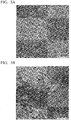
- FIG. 3A and FIG. 3B show the structure observation pictures of the copper alloy materials of Example 2 of the present invention and Comparative Example 1, respectively, after the above-described aging treatment and the heat treatment at 1000°C for 30 minutes retention.
- the component composition of the obtained copper alloy material was measured by ICP-MS analysis. The measurement results are shown in Table 1.
- a sample of 10 mm ⁇ 15 mm from the central portion of the plate width was cut out from the obtained thickness of the copper alloy material and the surface in the rolling direction (RD direction) was polished and then micro etching was performed.
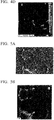
- FIGS. 4A to 4D show SEM-EPMA images of Example 2 of the present invention
- FIGS. 5A to 5C show SEM-EPMA images of Comparative Example 1.
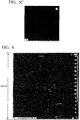
- FIG. 6 shows an example of SEM-EPMA images (visual field of 250 ⁇ m ⁇ 250 ⁇ m) in calculating the area ratio of the Cu-Zr-P compound.
- a sample of 10 mm ⁇ 15 mm from the central portion of the plate width was cut out from the obtained thickness of the copper alloy material and the surface in the rolling direction (RD direction) was polished and then micro etching was performed.
- FIGS. 2A and 3A in Examples 2, 5 and 6 of the present invention, grain coarsening was suppressed even after being placed in a high-temperature environment.
- Comparative Example 5 in which the area ratio of the Cr-Zr-P compound (phase) in a needle shape or a granular shape was less than the range of the scope of the present invention, and the tensile strength was significantly decreased after the heat treatment at 1000°C for 30 minutes.
- Examples 2, 5 and 6 of the present invention electrical conductivity was high and there was no significant reduction of the tensile strength even after the heat treatment at 1000°C for 30 minutes.
- the crystal grain size was set to 200 ⁇ m or less after the heat treatment at 1000°C for 30 minutes, the reduction of the tensile strength after the heat treatment at 1000°C for 30 minutes was suppressed.
Landscapes
- Chemical & Material Sciences (AREA)
- Engineering & Computer Science (AREA)
- Materials Engineering (AREA)
- Mechanical Engineering (AREA)
- Metallurgy (AREA)
- Organic Chemistry (AREA)
- Physics & Mathematics (AREA)
- Thermal Sciences (AREA)
- Crystallography & Structural Chemistry (AREA)
- Conductive Materials (AREA)
Claims (1)
- Kupferlegierungsmaterial mit einer Zusammensetzung bestehend aus:0,1 Masse-% oder mehr und 1,5 Masse-% oder weniger Cr;0,05 Masse-% oder mehr und 0,25 Masse-% oder weniger Zr;0,005 Masse-% oder mehr und 0,10 Masse-% oder weniger P;0,02 Masse-% oder mehr und 0,15 Masse-% oder weniger Co; undeinem Rest Cu einschließlich unvermeidlicher Verunreinigungen, und optional einschließlich einem Gesamtgehalt von Ti and Hf in den unvermeidlichen Verunreinigungen in einem Bereich von 0,10 Masse-% oder weniger,wobei das Kupferlegierungsmaterial eine Cr-Zr-P-Verbindung enthält, die Cr, Zr und P enthält und ein Flächenanteil der Cr-Zr-P-Verbindung in einer Strukturerfassung in einem Bereich von 0,5% oder mehr und 5,0% oder weniger liegt, unddie Cr-Zr-P-Verbindung in Gestalt einer Nadelform oder einer Granulatform vorliegt und eine Länge der längsten Seite der Nadelform oder der Granulatform 100 µm oder weniger beträgt, und ein atomares Verhältnis von Co zu P, [Co]/[P], in einem Bereich von 0,5 ≤ [Co]/[P] ≤ 5,0 liegt.
Applications Claiming Priority (2)
| Application Number | Priority Date | Filing Date | Title |
|---|---|---|---|
| JP2015219851A JP6736869B2 (ja) | 2015-11-09 | 2015-11-09 | 銅合金素材 |
| PCT/JP2016/080082 WO2017081969A1 (ja) | 2015-11-09 | 2016-10-11 | 銅合金素材 |
Publications (3)
| Publication Number | Publication Date |
|---|---|
| EP3375897A1 EP3375897A1 (de) | 2018-09-19 |
| EP3375897A4 EP3375897A4 (de) | 2019-04-03 |
| EP3375897B1 true EP3375897B1 (de) | 2021-09-01 |
Family
ID=58695038
Family Applications (1)
| Application Number | Title | Priority Date | Filing Date |
|---|---|---|---|
| EP16863933.4A Active EP3375897B1 (de) | 2015-11-09 | 2016-10-11 | Kupferlegierungsmaterial |
Country Status (6)
| Country | Link |
|---|---|
| US (1) | US20180291490A1 (de) |
| EP (1) | EP3375897B1 (de) |
| JP (1) | JP6736869B2 (de) |
| KR (1) | KR102493118B1 (de) |
| CN (1) | CN108291275B (de) |
| WO (1) | WO2017081969A1 (de) |
Families Citing this family (4)
| Publication number | Priority date | Publication date | Assignee | Title |
|---|---|---|---|---|
| JP6488951B2 (ja) * | 2014-09-25 | 2019-03-27 | 三菱マテリアル株式会社 | 鋳造用モールド材及びCu−Cr−Zr合金素材 |
| JP7035478B2 (ja) * | 2017-11-21 | 2022-03-15 | 三菱マテリアル株式会社 | 鋳造用モールド材 |
| JP2020133000A (ja) * | 2019-02-20 | 2020-08-31 | 三菱マテリアル株式会社 | 銅合金材、整流子片、電極材 |
| CN115612888A (zh) * | 2022-09-26 | 2023-01-17 | 陕西科技大学 | 一种火箭发动机用耐热冲击铜合金材料及其制备方法 |
Family Cites Families (17)
| Publication number | Priority date | Publication date | Assignee | Title |
|---|---|---|---|---|
| JPH07113133B2 (ja) | 1986-02-06 | 1995-12-06 | 三菱マテリアル株式会社 | 連続鋳造鋳型用Cu合金 |
| JP2614210B2 (ja) | 1986-02-06 | 1997-05-28 | 三菱マテリアル株式会社 | 連続鋳造鋳型用Cu合金 |
| JPS63143229A (ja) * | 1986-12-08 | 1988-06-15 | Nippon Mining Co Ltd | 鋳造性に優れた銅合金 |
| JPH01309935A (ja) * | 1988-06-07 | 1989-12-14 | Kobe Steel Ltd | 鋼のホットスカーフィングノズルユニット用銅合金 |
| JPH04210438A (ja) | 1990-12-13 | 1992-07-31 | Mitsubishi Materials Corp | 高強度Cu 合金製連続鋳造鋳型材 |
| JPH0570867A (ja) * | 1991-06-25 | 1993-03-23 | Mitsubishi Materials Corp | 鋳造方法及び鋳造金型用合金 |
| JPH05339688A (ja) * | 1992-06-05 | 1993-12-21 | Furukawa Electric Co Ltd:The | 金属鋳造用鋳型材の製造方法 |
| JP3699701B2 (ja) * | 2002-10-31 | 2005-09-28 | 日鉱金属加工株式会社 | 易加工高力高導電性銅合金 |
| JP4087307B2 (ja) * | 2003-07-09 | 2008-05-21 | 日鉱金属株式会社 | 延性に優れた高力高導電性銅合金 |
| US20060088437A1 (en) * | 2004-10-22 | 2006-04-27 | Russell Nippert | Copper based precipitation hardening alloy |
| JP4851626B2 (ja) * | 2009-01-09 | 2012-01-11 | 三菱伸銅株式会社 | 高強度高導電銅合金圧延板及びその製造方法 |
| EP2610359A4 (de) * | 2010-08-27 | 2017-08-02 | Furukawa Electric Co., Ltd. | Kupferlegierungsblech und herstellungsverfahren dafür |
| EP2610358A4 (de) * | 2010-08-27 | 2017-05-03 | Furukawa Electric Co., Ltd. | Kupferlegierungsblech und herstellungsverfahren dafür |
| JP5712585B2 (ja) * | 2010-12-03 | 2015-05-07 | 三菱マテリアル株式会社 | 電子機器用銅合金、電子機器用銅合金の製造方法及び電子機器用銅合金圧延材 |
| WO2012169405A1 (ja) * | 2011-06-06 | 2012-12-13 | 三菱マテリアル株式会社 | 電子機器用銅合金、電子機器用銅合金の製造方法、電子機器用銅合金塑性加工材、及び電子機器用部品 |
| KR101364542B1 (ko) * | 2011-08-11 | 2014-02-18 | 주식회사 풍산 | 연속주조 몰드용 동합금재 및 이의 제조 방법 |
| CN102912178B (zh) * | 2012-09-29 | 2015-08-19 | 河南科技大学 | 一种高强高导稀土铜合金及其制备方法 |
-
2015
- 2015-11-09 JP JP2015219851A patent/JP6736869B2/ja active Active
-
2016
- 2016-10-11 KR KR1020187012110A patent/KR102493118B1/ko active Active
- 2016-10-11 EP EP16863933.4A patent/EP3375897B1/de active Active
- 2016-10-11 WO PCT/JP2016/080082 patent/WO2017081969A1/ja not_active Ceased
- 2016-10-11 CN CN201680065120.7A patent/CN108291275B/zh active Active
- 2016-10-11 US US15/769,024 patent/US20180291490A1/en not_active Abandoned
Also Published As
| Publication number | Publication date |
|---|---|
| CN108291275B (zh) | 2020-03-13 |
| WO2017081969A1 (ja) | 2017-05-18 |
| EP3375897A4 (de) | 2019-04-03 |
| EP3375897A1 (de) | 2018-09-19 |
| JP2017088948A (ja) | 2017-05-25 |
| KR20180078244A (ko) | 2018-07-09 |
| KR102493118B1 (ko) | 2023-01-27 |
| JP6736869B2 (ja) | 2020-08-05 |
| CN108291275A (zh) | 2018-07-17 |
| US20180291490A1 (en) | 2018-10-11 |
Similar Documents
| Publication | Publication Date | Title |
|---|---|---|
| JP5045784B2 (ja) | 電子機器用銅合金、電子機器用銅合金の製造方法及び電子機器用銅合金圧延材 | |
| JP5712585B2 (ja) | 電子機器用銅合金、電子機器用銅合金の製造方法及び電子機器用銅合金圧延材 | |
| EP3040430B1 (de) | Kupferlegierungsblech und verfahren zur herstellung davon und stromführende komponente | |
| EP3375898B1 (de) | Kupferlegierungsmaterial | |
| TWI513833B (zh) | 電子機器用銅合金、電子機器用銅合金之製造方法、電子機器銅合金用塑性加工材、以及電子機器用零件 | |
| KR20120130344A (ko) | 전자 재료용 Cu-Ni-Si-Co 계 구리 합금 및 그 제조 방법 | |
| JP4834781B1 (ja) | 電子材料用Cu−Co−Si系合金 | |
| EP3199651B1 (de) | Giessformmaterial aus einer cu-cr-zr-legierung und verfahren zu dessen herstellung | |
| KR20120130342A (ko) | 전자 재료용 Cu-Ni-Si 계 합금 | |
| EP3375897B1 (de) | Kupferlegierungsmaterial | |
| EP3363921B1 (de) | Giessformmaterial und cu-cr-zr-al-legierungsausgangsmaterial | |
| CN111212923B (zh) | 铸造用模具材料及铜合金原材料 | |
| JP2013117060A (ja) | 電子材料用Cu−Co−Si系合金 |
Legal Events
| Date | Code | Title | Description |
|---|---|---|---|
| STAA | Information on the status of an ep patent application or granted ep patent |
Free format text: STATUS: THE INTERNATIONAL PUBLICATION HAS BEEN MADE |
|
| PUAI | Public reference made under article 153(3) epc to a published international application that has entered the european phase |
Free format text: ORIGINAL CODE: 0009012 |
|
| STAA | Information on the status of an ep patent application or granted ep patent |
Free format text: STATUS: REQUEST FOR EXAMINATION WAS MADE |
|
| 17P | Request for examination filed |
Effective date: 20180416 |
|
| AK | Designated contracting states |
Kind code of ref document: A1 Designated state(s): AL AT BE BG CH CY CZ DE DK EE ES FI FR GB GR HR HU IE IS IT LI LT LU LV MC MK MT NL NO PL PT RO RS SE SI SK SM TR |
|
| AX | Request for extension of the european patent |
Extension state: BA ME |
|
| DAV | Request for validation of the european patent (deleted) | ||
| DAX | Request for extension of the european patent (deleted) | ||
| A4 | Supplementary search report drawn up and despatched |
Effective date: 20190306 |
|
| RIC1 | Information provided on ipc code assigned before grant |
Ipc: C22C 9/00 20060101AFI20190227BHEP Ipc: C22F 1/08 20060101ALI20190227BHEP |
|
| RAP1 | Party data changed (applicant data changed or rights of an application transferred) |
Owner name: MITSUBISHI MATERIALS CORPORATION |
|
| STAA | Information on the status of an ep patent application or granted ep patent |
Free format text: STATUS: EXAMINATION IS IN PROGRESS |
|
| 17Q | First examination report despatched |
Effective date: 20190917 |
|
| GRAP | Despatch of communication of intention to grant a patent |
Free format text: ORIGINAL CODE: EPIDOSNIGR1 |
|
| STAA | Information on the status of an ep patent application or granted ep patent |
Free format text: STATUS: GRANT OF PATENT IS INTENDED |
|
| INTG | Intention to grant announced |
Effective date: 20210211 |
|
| RIN1 | Information on inventor provided before grant (corrected) |
Inventor name: SAKAMOTO, TOSHIO Inventor name: SATOU, SHINOBU Inventor name: YANO, SHOICHIRO |
|
| GRAJ | Information related to disapproval of communication of intention to grant by the applicant or resumption of examination proceedings by the epo deleted |
Free format text: ORIGINAL CODE: EPIDOSDIGR1 |
|
| STAA | Information on the status of an ep patent application or granted ep patent |
Free format text: STATUS: EXAMINATION IS IN PROGRESS |
|
| INTC | Intention to grant announced (deleted) | ||
| GRAP | Despatch of communication of intention to grant a patent |
Free format text: ORIGINAL CODE: EPIDOSNIGR1 |
|
| STAA | Information on the status of an ep patent application or granted ep patent |
Free format text: STATUS: GRANT OF PATENT IS INTENDED |
|
| INTG | Intention to grant announced |
Effective date: 20210617 |
|
| GRAS | Grant fee paid |
Free format text: ORIGINAL CODE: EPIDOSNIGR3 |
|
| GRAA | (expected) grant |
Free format text: ORIGINAL CODE: 0009210 |
|
| STAA | Information on the status of an ep patent application or granted ep patent |
Free format text: STATUS: THE PATENT HAS BEEN GRANTED |
|
| AK | Designated contracting states |
Kind code of ref document: B1 Designated state(s): AL AT BE BG CH CY CZ DE DK EE ES FI FR GB GR HR HU IE IS IT LI LT LU LV MC MK MT NL NO PL PT RO RS SE SI SK SM TR |
|
| REG | Reference to a national code |
Ref country code: GB Ref legal event code: FG4D |
|
| REG | Reference to a national code |
Ref country code: CH Ref legal event code: EP Ref country code: AT Ref legal event code: REF Ref document number: 1426327 Country of ref document: AT Kind code of ref document: T Effective date: 20210915 |
|
| REG | Reference to a national code |
Ref country code: DE Ref legal event code: R096 Ref document number: 602016063264 Country of ref document: DE |
|
| REG | Reference to a national code |
Ref country code: IE Ref legal event code: FG4D |
|
| REG | Reference to a national code |
Ref country code: LT Ref legal event code: MG9D |
|
| REG | Reference to a national code |
Ref country code: NL Ref legal event code: MP Effective date: 20210901 |
|
| PG25 | Lapsed in a contracting state [announced via postgrant information from national office to epo] |
Ref country code: LT Free format text: LAPSE BECAUSE OF FAILURE TO SUBMIT A TRANSLATION OF THE DESCRIPTION OR TO PAY THE FEE WITHIN THE PRESCRIBED TIME-LIMIT Effective date: 20210901 Ref country code: BG Free format text: LAPSE BECAUSE OF FAILURE TO SUBMIT A TRANSLATION OF THE DESCRIPTION OR TO PAY THE FEE WITHIN THE PRESCRIBED TIME-LIMIT Effective date: 20211201 Ref country code: HR Free format text: LAPSE BECAUSE OF FAILURE TO SUBMIT A TRANSLATION OF THE DESCRIPTION OR TO PAY THE FEE WITHIN THE PRESCRIBED TIME-LIMIT Effective date: 20210901 Ref country code: ES Free format text: LAPSE BECAUSE OF FAILURE TO SUBMIT A TRANSLATION OF THE DESCRIPTION OR TO PAY THE FEE WITHIN THE PRESCRIBED TIME-LIMIT Effective date: 20210901 Ref country code: FI Free format text: LAPSE BECAUSE OF FAILURE TO SUBMIT A TRANSLATION OF THE DESCRIPTION OR TO PAY THE FEE WITHIN THE PRESCRIBED TIME-LIMIT Effective date: 20210901 Ref country code: NO Free format text: LAPSE BECAUSE OF FAILURE TO SUBMIT A TRANSLATION OF THE DESCRIPTION OR TO PAY THE FEE WITHIN THE PRESCRIBED TIME-LIMIT Effective date: 20211201 Ref country code: RS Free format text: LAPSE BECAUSE OF FAILURE TO SUBMIT A TRANSLATION OF THE DESCRIPTION OR TO PAY THE FEE WITHIN THE PRESCRIBED TIME-LIMIT Effective date: 20210901 Ref country code: SE Free format text: LAPSE BECAUSE OF FAILURE TO SUBMIT A TRANSLATION OF THE DESCRIPTION OR TO PAY THE FEE WITHIN THE PRESCRIBED TIME-LIMIT Effective date: 20210901 |
|
| PG25 | Lapsed in a contracting state [announced via postgrant information from national office to epo] |
Ref country code: PL Free format text: LAPSE BECAUSE OF FAILURE TO SUBMIT A TRANSLATION OF THE DESCRIPTION OR TO PAY THE FEE WITHIN THE PRESCRIBED TIME-LIMIT Effective date: 20210901 Ref country code: LV Free format text: LAPSE BECAUSE OF FAILURE TO SUBMIT A TRANSLATION OF THE DESCRIPTION OR TO PAY THE FEE WITHIN THE PRESCRIBED TIME-LIMIT Effective date: 20210901 Ref country code: GR Free format text: LAPSE BECAUSE OF FAILURE TO SUBMIT A TRANSLATION OF THE DESCRIPTION OR TO PAY THE FEE WITHIN THE PRESCRIBED TIME-LIMIT Effective date: 20211202 |
|
| REG | Reference to a national code |
Ref country code: CH Ref legal event code: PL |
|
| PG25 | Lapsed in a contracting state [announced via postgrant information from national office to epo] |
Ref country code: IS Free format text: LAPSE BECAUSE OF FAILURE TO SUBMIT A TRANSLATION OF THE DESCRIPTION OR TO PAY THE FEE WITHIN THE PRESCRIBED TIME-LIMIT Effective date: 20220101 Ref country code: SM Free format text: LAPSE BECAUSE OF FAILURE TO SUBMIT A TRANSLATION OF THE DESCRIPTION OR TO PAY THE FEE WITHIN THE PRESCRIBED TIME-LIMIT Effective date: 20210901 Ref country code: SK Free format text: LAPSE BECAUSE OF FAILURE TO SUBMIT A TRANSLATION OF THE DESCRIPTION OR TO PAY THE FEE WITHIN THE PRESCRIBED TIME-LIMIT Effective date: 20210901 Ref country code: RO Free format text: LAPSE BECAUSE OF FAILURE TO SUBMIT A TRANSLATION OF THE DESCRIPTION OR TO PAY THE FEE WITHIN THE PRESCRIBED TIME-LIMIT Effective date: 20210901 Ref country code: PT Free format text: LAPSE BECAUSE OF FAILURE TO SUBMIT A TRANSLATION OF THE DESCRIPTION OR TO PAY THE FEE WITHIN THE PRESCRIBED TIME-LIMIT Effective date: 20220103 Ref country code: NL Free format text: LAPSE BECAUSE OF FAILURE TO SUBMIT A TRANSLATION OF THE DESCRIPTION OR TO PAY THE FEE WITHIN THE PRESCRIBED TIME-LIMIT Effective date: 20210901 Ref country code: EE Free format text: LAPSE BECAUSE OF FAILURE TO SUBMIT A TRANSLATION OF THE DESCRIPTION OR TO PAY THE FEE WITHIN THE PRESCRIBED TIME-LIMIT Effective date: 20210901 Ref country code: CZ Free format text: LAPSE BECAUSE OF FAILURE TO SUBMIT A TRANSLATION OF THE DESCRIPTION OR TO PAY THE FEE WITHIN THE PRESCRIBED TIME-LIMIT Effective date: 20210901 Ref country code: AL Free format text: LAPSE BECAUSE OF FAILURE TO SUBMIT A TRANSLATION OF THE DESCRIPTION OR TO PAY THE FEE WITHIN THE PRESCRIBED TIME-LIMIT Effective date: 20210901 |
|
| REG | Reference to a national code |
Ref country code: DE Ref legal event code: R097 Ref document number: 602016063264 Country of ref document: DE |
|
| REG | Reference to a national code |
Ref country code: BE Ref legal event code: MM Effective date: 20211031 |
|
| PG25 | Lapsed in a contracting state [announced via postgrant information from national office to epo] |
Ref country code: MC Free format text: LAPSE BECAUSE OF FAILURE TO SUBMIT A TRANSLATION OF THE DESCRIPTION OR TO PAY THE FEE WITHIN THE PRESCRIBED TIME-LIMIT Effective date: 20210901 |
|
| PLBE | No opposition filed within time limit |
Free format text: ORIGINAL CODE: 0009261 |
|
| STAA | Information on the status of an ep patent application or granted ep patent |
Free format text: STATUS: NO OPPOSITION FILED WITHIN TIME LIMIT |
|
| PG25 | Lapsed in a contracting state [announced via postgrant information from national office to epo] |
Ref country code: LU Free format text: LAPSE BECAUSE OF NON-PAYMENT OF DUE FEES Effective date: 20211011 Ref country code: DK Free format text: LAPSE BECAUSE OF FAILURE TO SUBMIT A TRANSLATION OF THE DESCRIPTION OR TO PAY THE FEE WITHIN THE PRESCRIBED TIME-LIMIT Effective date: 20210901 Ref country code: BE Free format text: LAPSE BECAUSE OF NON-PAYMENT OF DUE FEES Effective date: 20211031 |
|
| 26N | No opposition filed |
Effective date: 20220602 |
|
| PG25 | Lapsed in a contracting state [announced via postgrant information from national office to epo] |
Ref country code: SI Free format text: LAPSE BECAUSE OF FAILURE TO SUBMIT A TRANSLATION OF THE DESCRIPTION OR TO PAY THE FEE WITHIN THE PRESCRIBED TIME-LIMIT Effective date: 20210901 Ref country code: LI Free format text: LAPSE BECAUSE OF NON-PAYMENT OF DUE FEES Effective date: 20211031 Ref country code: CH Free format text: LAPSE BECAUSE OF NON-PAYMENT OF DUE FEES Effective date: 20211031 |
|
| PG25 | Lapsed in a contracting state [announced via postgrant information from national office to epo] |
Ref country code: IE Free format text: LAPSE BECAUSE OF NON-PAYMENT OF DUE FEES Effective date: 20211011 |
|
| REG | Reference to a national code |
Ref country code: AT Ref legal event code: UEP Ref document number: 1426327 Country of ref document: AT Kind code of ref document: T Effective date: 20210901 |
|
| PG25 | Lapsed in a contracting state [announced via postgrant information from national office to epo] |
Ref country code: HU Free format text: LAPSE BECAUSE OF FAILURE TO SUBMIT A TRANSLATION OF THE DESCRIPTION OR TO PAY THE FEE WITHIN THE PRESCRIBED TIME-LIMIT; INVALID AB INITIO Effective date: 20161011 |
|
| PG25 | Lapsed in a contracting state [announced via postgrant information from national office to epo] |
Ref country code: CY Free format text: LAPSE BECAUSE OF FAILURE TO SUBMIT A TRANSLATION OF THE DESCRIPTION OR TO PAY THE FEE WITHIN THE PRESCRIBED TIME-LIMIT Effective date: 20210901 |
|
| PG25 | Lapsed in a contracting state [announced via postgrant information from national office to epo] |
Ref country code: MK Free format text: LAPSE BECAUSE OF FAILURE TO SUBMIT A TRANSLATION OF THE DESCRIPTION OR TO PAY THE FEE WITHIN THE PRESCRIBED TIME-LIMIT Effective date: 20210901 |
|
| PG25 | Lapsed in a contracting state [announced via postgrant information from national office to epo] |
Ref country code: MT Free format text: LAPSE BECAUSE OF FAILURE TO SUBMIT A TRANSLATION OF THE DESCRIPTION OR TO PAY THE FEE WITHIN THE PRESCRIBED TIME-LIMIT Effective date: 20210901 |
|
| PG25 | Lapsed in a contracting state [announced via postgrant information from national office to epo] |
Ref country code: TR Free format text: LAPSE BECAUSE OF FAILURE TO SUBMIT A TRANSLATION OF THE DESCRIPTION OR TO PAY THE FEE WITHIN THE PRESCRIBED TIME-LIMIT Effective date: 20210901 |
|
| PGFP | Annual fee paid to national office [announced via postgrant information from national office to epo] |
Ref country code: DE Payment date: 20251021 Year of fee payment: 10 |
|
| PGFP | Annual fee paid to national office [announced via postgrant information from national office to epo] |
Ref country code: GB Payment date: 20251022 Year of fee payment: 10 |
|
| PGFP | Annual fee paid to national office [announced via postgrant information from national office to epo] |
Ref country code: AT Payment date: 20251022 Year of fee payment: 10 |
|
| PGFP | Annual fee paid to national office [announced via postgrant information from national office to epo] |
Ref country code: IT Payment date: 20251024 Year of fee payment: 10 |
|
| PGFP | Annual fee paid to national office [announced via postgrant information from national office to epo] |
Ref country code: FR Payment date: 20251030 Year of fee payment: 10 |