EP3375921A1 - Pièce tricotée - Google Patents
Pièce tricotée Download PDFInfo
- Publication number
- EP3375921A1 EP3375921A1 EP17161017.3A EP17161017A EP3375921A1 EP 3375921 A1 EP3375921 A1 EP 3375921A1 EP 17161017 A EP17161017 A EP 17161017A EP 3375921 A1 EP3375921 A1 EP 3375921A1
- Authority
- EP
- European Patent Office
- Prior art keywords
- plush
- loops
- thread
- knitted
- knit
- Prior art date
- Legal status (The legal status is an assumption and is not a legal conclusion. Google has not performed a legal analysis and makes no representation as to the accuracy of the status listed.)
- Granted
Links
Images

Classifications
-
- D—TEXTILES; PAPER
- D04—BRAIDING; LACE-MAKING; KNITTING; TRIMMINGS; NON-WOVEN FABRICS
- D04B—KNITTING
- D04B1/00—Weft knitting processes for the production of fabrics or articles not dependent on the use of particular machines; Fabrics or articles defined by such processes
- D04B1/02—Pile fabrics or articles having similar surface features
- D04B1/04—Pile fabrics or articles having similar surface features characterised by thread material
-
- D—TEXTILES; PAPER
- D04—BRAIDING; LACE-MAKING; KNITTING; TRIMMINGS; NON-WOVEN FABRICS
- D04B—KNITTING
- D04B1/00—Weft knitting processes for the production of fabrics or articles not dependent on the use of particular machines; Fabrics or articles defined by such processes
- D04B1/22—Weft knitting processes for the production of fabrics or articles not dependent on the use of particular machines; Fabrics or articles defined by such processes specially adapted for knitting goods of particular configuration
- D04B1/24—Weft knitting processes for the production of fabrics or articles not dependent on the use of particular machines; Fabrics or articles defined by such processes specially adapted for knitting goods of particular configuration wearing apparel
- D04B1/26—Weft knitting processes for the production of fabrics or articles not dependent on the use of particular machines; Fabrics or articles defined by such processes specially adapted for knitting goods of particular configuration wearing apparel stockings
-
- D—TEXTILES; PAPER
- D04—BRAIDING; LACE-MAKING; KNITTING; TRIMMINGS; NON-WOVEN FABRICS
- D04B—KNITTING
- D04B9/00—Circular knitting machines with independently-movable needles
- D04B9/12—Circular knitting machines with independently-movable needles with provision for incorporating pile threads
-
- D—TEXTILES; PAPER
- D04—BRAIDING; LACE-MAKING; KNITTING; TRIMMINGS; NON-WOVEN FABRICS
- D04B—KNITTING
- D04B9/00—Circular knitting machines with independently-movable needles
- D04B9/22—Circular knitting machines with independently-movable needles with provision for changing the fabric construction, e.g. from plain to rib-loop fabric
-
- D—TEXTILES; PAPER
- D10—INDEXING SCHEME ASSOCIATED WITH SUBLASSES OF SECTION D, RELATING TO TEXTILES
- D10B—INDEXING SCHEME ASSOCIATED WITH SUBLASSES OF SECTION D, RELATING TO TEXTILES
- D10B2401/00—Physical properties
- D10B2401/02—Moisture-responsive characteristics
- D10B2401/021—Moisture-responsive characteristics hydrophobic
-
- D—TEXTILES; PAPER
- D10—INDEXING SCHEME ASSOCIATED WITH SUBLASSES OF SECTION D, RELATING TO TEXTILES
- D10B—INDEXING SCHEME ASSOCIATED WITH SUBLASSES OF SECTION D, RELATING TO TEXTILES
- D10B2401/00—Physical properties
- D10B2401/02—Moisture-responsive characteristics
- D10B2401/022—Moisture-responsive characteristics hydrophylic
-
- D—TEXTILES; PAPER
- D10—INDEXING SCHEME ASSOCIATED WITH SUBLASSES OF SECTION D, RELATING TO TEXTILES
- D10B—INDEXING SCHEME ASSOCIATED WITH SUBLASSES OF SECTION D, RELATING TO TEXTILES
- D10B2403/00—Details of fabric structure established in the fabric forming process
- D10B2403/02—Cross-sectional features
Definitions
- the invention relates to a knitted fabric comprising a basic knitted fabric knitted from at least one basic knitted yarn, and at least two plush yarns forming the first and second plush loops which are laminated onto the basic knitted yarn.
- a fabric is for example off EP 1 997 394 A1 known.
- a pronation support and at least one damping zone are provided on the knit side, which may comprise a plush knit.
- This plush knit can be formed from a plush thread which has a lower yarn count, that is thicker than a second plush thread, from which a plush knit of a plush section adjoining the region of the pronation support or the damping zone is formed.
- the support effect of the pronation support and the damping effect of the damping zone can be adjusted or improved, in particular compared to the plush section knitted from a thinner plush thread.
- the local properties of the knit part is influenced by the formation of plush loops of different thick plush threads.
- the various sections in which the various plush loops are present are separated from each other in the known knit part.
- the invention is based on the problem of providing a contrast improved knitted part.
- first and second plush loops are of different heights.
- the two plush-leg forms differing in their height. That is, the plush loops of the first shape are higher or longer than the plush loops of the second shape, and thus the first plush loops project somewhat further out of the plane of the base knit than the second plush loops.
- the structure of the knitted fabric according to the invention results in a quasi-multilayer or multi-level structure.
- the first layer or plane forms the basic knit, which is designed, for example, as a right-left knitted fabric.
- the second layer or plane forms the shorter plush loops protruding slightly from the basic knit plane, while the third layer or plane forms the longer plush loops which protrude further from the basic knit plane and also protrude beyond the first plush pile plane.
- one or more zones are formed in which the first and second plush loops are present together, so that the quasi-zone results in the three-level or three-layer structure.
- a corresponding knit part properties which are perceived by the wearer to be comfortable or advantageous, can be set, for example with regard to damping, thermal effect, etc
- a second characteristic of the knitted part can be influenced or adjusted via the second lower layer of the shorter plush threads, for example the moisture removal from the knitted part due to the capillary action and the fact that the plush loops are tied to the right side of the warning.
- the third level is the basic knit. It can therefore be improved by the training of this three-shift or three-level structure with the two different Plush strap layers or levels, for example, an optimized climate management in conjunction with a pleasant feel and a pleasant wearing comfort can be achieved.
- the plush loops are formed from two threads by means of a board that has a single dimension. That is, the distance between the base knitting yarn and the first and second plush loops is the same immediately after knitting.
- a post-treatment in particular a thermal treatment, which shrinks a thread, so that shorten the plush knitted from it, while the other thread and thus the plush knitted from it almost keep their length. If knitting with different blanks is possible, the different plush loops can be formed directly during knitting without aftertreatment.
- plush threads may show a slightly different shrinkage behavior compared to the first and second plush threads, so that adjust the different handle lengths in the context of post-treatment.
- the two plush threads are made of different materials and / or have different properties. It is therefore preferred to use different plush threads, which either consist of different materials, such as polyamide in one case and a natural fiber such as wool in the other case, but which, alternatively or additionally, may have different properties, among them For example, a different shrinkage behavior under thermal treatment and / or a different elasticity and / or a different surface and / or a different thickness by way of example, but not to mention conclusive.
- a plush thread made of a synthetic fiber shows a low tendency to absorb moisture, and is therefore particularly suitable with regard to a moisture transport through the knitted part from the inside to the outside due to the capillary action.
- a natural thread for example made of wool, from which the longer or higher plush loops are formed, which rest directly on the skin, by heat-retaining and temperature-compensating properties, it is breathable and dirt and water repellent, and its antibacterial properties can be used become and the like.
- threads of different thicknesses can be used so that the padding properties of the plush zone can be further varied.
- the plush thread can be textured and highly elastic and be executed with or without a soul. This means that there is also a high degree of flexibility and variability in this respect.
- the two plush threads in separate courses of the basic knit bring.
- either only first or only second plush loops are introduced in each course of the basic knit.
- course is based on a two-dimensional development of the circular knit, that is, the circular knit quasi cut open and considered planar with a beginning and an end of each course becomes.
- the first plush thread or the first plush loop is knitted in a first course
- the second course is not covered with a plush thread
- the third course is provided with the second plush thread and thus with the second plush loops
- the fourth course is again not with a Plush thread provided
- the fifth course is provided with the first plush thread, etc.
- the plush threads seen in the circumferential direction, are introduced into the basic knit.
- the plush yarn course and thus the plush looper arrangement is considered perpendicular to the knit longitudinal direction, namely in the circumferential direction of the respective course row.
- the plush threads each run in a spiral through the basic knit. Based on the processing described above so the plush thread runs from one end of the developed knit part to the other end. Accordingly, in the real knitted fabric, an annular plush zone running around the entire knit part circumference is formed.
- the plush threads in the respective course series extend only in sections in the circumferential direction.
- the plush threads respectively the area in which the plush loops are formed, starting from the two-dimensional development described above, thus extend only slightly between the left and right edges of the unwound knitted part, and therefore only over a limited number of wales.
- both sides of the basic knitted limited zone with plush loops are formed.
- a plush or upholstery section on the knitted part in which the first and the second plush thread in each of the same row of stitches, each sectionally extending in the circumferential direction, is introduced into the basic knit. While in the embodiment described above, the individual courses are provided only with one or the other plush yarn, in this embodiment, both plush threads are entangled in each case a common course, that is, in the course of the first and second plush loops are provided.
- first and second plush loops are at least partially in common wales. That is, both first and second plush loops are present in a wale, for example, alternately or spaced apart across respective empty stitches in wale direction, or in the form of individual wale sections, each wale section comprising two or more first or two or more plush loops, etc. Alternatively It is also conceivable that the first and second plush loops are offset from each other and in different wales.
- the plush loops are not knitted on each needle, but at least one empty stitch in which the respective plush thread is afloat or catch is provided, so that from stitch row to stitch row respectively wales to wales a corresponding Training offset.
- the number of first plush loops and the number of second plush loops may be substantially the same, alternatively, the number of first and second plush loops may also be different. That is, it is possible to knit the plush tiers or plush tufts either at the same density, or to knit different densities, so that there are any variations depending on the desired property of the fabric in terms of moisture removal and thermal properties.
- a density variation can of course also be achieved by using different thickness plush threads.
- An expedient, but by no means limiting embodiment provides that one plush thread in the form of a 2: 1 plush and the other plush thread in the form of a 1: 2 plush is knitted.
- the lower, shorter plush loops can be knit as a 2: 1 plush, that is, two plush stitches and one empty stitch in which the plush thread is inserted only in the base knit are deposited.
- the second knitted thread, from which the higher or longer plush loops are formed, can be knitted as a 1: 2 plush.
- the first and the second plush loops can protrude to the same side of the basic knit. So they both extend to the left side of the goods, so to the carrier in the support position facing side.
- the first plush legs protrude to one side of the base knit and the second plush loops to the other side of the basic knit.
- weft thread is inserted into the basic knit.
- This weft thread runs as a catch and float through the basic knitted mesh. It consists of a sufficiently elastic material, such as elastane and can be used with or without wrap.
- the weft thread is inserted at least in the courses in which the plush thread forming the lower plush loops is inserted.
- the weft yarn in each second course, in which the shorter plush loops forming plush yarn is inserted inserted and runs as a catch and float through the individual basic knitted mesh rows. This causes the weft thread, when inserted as a catch through the stitches on which the shorter plush loops are plated, to pull the plush thread inwardly into the base knit.
- the weft thread is thus inserted as a catch in the plush loops and pushes the shorter plush loops in the basic knit. This is advantageous for the same if the thread forming the shorter plush loops and thus the knitted plush loops serve for moisture transport.
- the knitted part itself can be designed, for example, as a stocking, wherein the plush loops form an at least local padding. It is obvious that the plush loops can be knitted at any point on the stocking, for example in the area of the sole of the foot where, for example, the center of gravity is placed next to the padding, in particular on the moisture transport. In contrast, for example, in the area of the heel in the transition to the Achilles tendon the focus is more on the padding than on the moisture transport. All of these different properties can easily be varied and adjusted by the variation provided according to the invention with regard to the plush threads used, as well as the plush leg lengths and the plush pith densities, etc.
- the invention further relates to a method for producing such a knitted part.
- This method is characterized in that knit with at least one basic knitting a basic knit, are knitted into the at least two plush threads to form first and second plush loops, wherein either the first and the second plush loops are knitted with different heights, or wherein the first and second plush loops are knitted with the same height and the fabric is subsequently aftertreated, so that the one plush thread shrinks while shortening the plush loops knitted from it.
- the corresponding first and second plush threads are knitted to form the first and second plush loops during the production of the knitting of the basic knit.
- the first and second plush loops are already knitted in-house during the knitting process with different lengths or heights.
- the finished knitted part thus already shows the multilayer or multi-level construction.
- the various plush heald lengths are then produced as part of a post-treatment by shrinking a plush thread through this post-treatment, while the other plush thread almost retains its shape.
- a first and a second plush thread are used, which change in their shrinkage behavior under the influence of appropriate environmental conditions.
- one plush thread and thus the plush loin formed from it shorten while the other plush thread and thus the plush loops formed from it retain their original length.
- the aftertreatment of the knitted fabric can, for example, be a thermal treatment, in particular by means of hot or hot water or steam, that is to say that the knitted fabric part is washed or steamed, for example, the treatment temperature being equal to or above the temperature at which a plush yarn shrinks becomes.
- a thermal treatment in particular by means of hot or hot water or steam, that is to say that the knitted fabric part is washed or steamed, for example, the treatment temperature being equal to or above the temperature at which a plush yarn shrinks becomes.
- irradiation in particular with UV light.
- UV light can also be achieved a kind of thermal treatment, since the different threads absorb the UV light in different ways.
- only the irradiation, for example with UV light influences or alters the material properties of a plush thread so that it shrinks or shortens.
- Fig. 1 1 shows a knit part 1 according to the invention in the form of a stocking 2 with a foot section 3 and a calf section 4.
- the sock 2 consists of a basic knit 5, which is shown here on the less dense dotted line.
- a plush or padding zone 6 is formed, by additionally knitting into the basic knit 5 two different plush threads which form plush loops of different lengths.
- the plush or upholstery region 6 is here shown as ring-shaped or cylindrical around the stocking body. Of course, it is possible to form this plush or padding area 6 only locally.
- this plush or upholstery area 6 after the plush loops knitted from the two different plush threads are of different lengths, there is consequently a three-layer or three-level construction, namely the one Layer of base fabric 5, then the plane formed over the shorter plush loops, and finally the plane formed over the long plush loops.
- the properties the plush or padding area can be adjusted or varied in a wide range.
- the plush or padding region 5 is designed so that it on the one hand provides a tactile pleasant padding and on the other hand allows a good moisture removal respectively a good moisture transport through the knitted part to the outside.
- This is achieved by knitting the longer plush loops, which are furthest from the plane of the basic knit, and which rest against the skin of the wearer, for example, from a natural thread such as wool or silk.
- the plush loops, which are shorter and which primarily serve to transport moisture, are knitted, for example, from a synthetic fiber such as PA and are preferably an intermediate layer between the basic knit layer or plane and the layer or plane of the longer plush loops. If additionally a weft thread is used which lies as a catch in the shorter plush loops, they are additionally pressed into the basic knit, which is advantageous for the moisture transport through the basic knit outwards.
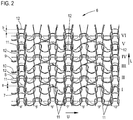
- FIG Fig. 2 An example of a stitch pattern for forming such a plush or padding area 6 is shown in FIG Fig. 2 shown. Shown are a plurality of courses I - VI, which follow each other in the longitudinal direction L, wherein each course of stitches I - VI consists of a plurality of individual, in the circumferential direction U adjacent mesh. In the circumferential direction, seven needles (exemplarily denoted by the numbers 4 to 10) of the circular knitting machine, that is to say therefore seen in the longitudinal direction of the knit, are represented by seven wales.
- the base knit 7 Shown is the base knit 7 shown as a solid, black line.
- the basic knit is executed here as an example as a right-left knit.
- the basic knitted yarn 7 can be any yarn made of an artificial or natural fiber.
- weft thread 8 preferably made of an elastic material such as elastane or the like, which in the example shown in every second course, here the courses II, IV and VI, is inserted.
- a first plush thread 9 and a second plush thread 10 are knitted into the basic knit 5, respectively, and are applied to selected stitches of the basic knitted thread 7.
- the first plush thread 9 forms shorter plush looper 11, while the second plush thread 10 forms longer plush loops 12. That is, the first plush loops 11 protrude less far from the plane of the base knit 5 than the second, longer plush loops 12.
- Fig. 2 the different plush hock lengths are additionally shown by length or distance indications.
- the length of the shorter plush looper 11 is indicated by "a”, the longer plush looper 12 by “b".
- the respective lengths "a", "b” are dimensioned quasi from the upper edge or upper side of the base knitting yarn 7 to the lower edge or underside of the respective plush thread 9, 10 in the respective plush loops 11, 12.
- only one plush thread 9, 10 is inserted in each row of stitches I-VI.
- the first plush thread 9 is inserted in the courses I, III and V, while the second plush thread 10 is inserted in the courses II, IV and VI.
- the first plush thread 9 which is, for example, a PA thread, preferably textured, optionally highly elastic and with or without a soul, knitted as a 2: 1 plush, so that plush loops 11, seen in the circumferential direction, form on two adjacent needles, followed by an empty needle in which the first plush thread 9 is only inserted, followed by another two Plush loops 11, etc.
- the two plush loops 11 are formed in the courses I, III and V, while above the needle "8" the first plush thread 9 is afloat , which in turn on the needles "9", “10” two plush loops 11 are formed, while on the next following needle (not shown here) the plush thread 9 is again afloat, etc.
- the second plush thread 10 which is for example a natural thread, in particular wool, knitted as a 1: 2 plush.
- the respective plush loops 12 is therefore on a first needle respectively on a first basic knit embroidered, after which, seen in the circumferential direction, on the next two needles respectively Grundgestrickmaschen no second Plush handle 11 is formed, but the second plush thread 10 is here only in the basic knitting, while on the next needle in turn a plush handle 12 is formed.
- a second, longer plush loop 12 is formed on the needle "4" or the corresponding wale, while on the needles "5", “6” respectively the corresponding wale of the second plush thread is only in the basic knit .
- a second, longer plush loop 12 is formed on the needle "7”, while on the next following needles "8", “9” the second plush thread 10 is merely inserted again and a longer, second plush loop 12 is formed on the needle 10 is.
- the weft 8 runs as a catch and float through the basic knit. In the example shown, it is in the courses II, IV and VI, ie the courses, in which also the first knitted thread 9 is guided. He runs on the same needles as the first plush thread 9 as a catch, which leads to that the weft 8 presses the first plush thread 9 and thus the first plush loops 11 formed over it into the basic knit.
- the plush threads 9, 10 change from stitch row to stitch row. Due to the different knitting patterns, wales result, in which both plush loops 11, 12 are present alternately, for example the wales on the needles "4", "7” and "10". In contrast, there are also wales in which no plush loin is given, for example, the wales on the needles "5", "8". Furthermore, wales are given in which only first plush loops 11 are given, for example, the wales "6" and "9".
- the plush loops 11, 12 are of different lengths, consequently, different layers or planes are formed on the finished knit part 1.
- the one layer here exemplarily the outer knitted layer or plane, is formed by the basic knit.
- the first and second plush loops 11, 12 are then directed towards the left side of the goods, ie toward the side of the carrier.
- the plush loops 11 form, since shorter than the Plühenhenkekl 12, a second level or intermediate level, which protrudes slightly from the basic knit level.
- the third knitted layer or plane is formed with the second, long plush loops 12, which forms the inner knitted-part plane quasi, based on the support position.
- wool is used as the second plush yarn, a very pleasant feeling of support with good padding can be imparted by the inner plush layer formed over the longer, higher plush loops 12.
- the properties of wool include a good heat retention and a good temperature balance, it is breathable and dirt and water repellent. It also has some antibacterial self-protection.
- the upholstery also beneficial are also the shorter plush loops 11, which form the intermediate level. They are also partially pressed something in the basic knitting over the weft.
- the fiber material used is preferably PA, which has a low moisture absorption capacity. Due to the capillary action, moisture, for example by sweating, can be transported outward via the PA plush loops 11, thus also the intermediate plane, through the knitted part 1 or the basic knit 5, thus achieving good air conditioning.
- the two plush threads 9, 10 can be used with the same thickness, but they can also be used with different thickness.
- a thicker wool thread can be used, so that each plush loop 12 is significantly thicker than a plush loop 11. This means that the volume of wool at the knit part inside can be increased over this, so there is more haptic pleasant material at the same time lower Plüschhenkelaniere.
- a first plush thread 9 for example as a PA thread, a significantly thinner thread can be used, of course, on the one hand the upholstery is beneficial, on the other hand, but primarily the moisture transport respectively the air conditioning is used. It is available in a higher plush number of handles to provide a high transport surface.
Landscapes
- Engineering & Computer Science (AREA)
- Textile Engineering (AREA)
- Knitting Of Fabric (AREA)
Priority Applications (4)
| Application Number | Priority Date | Filing Date | Title |
|---|---|---|---|
| EP17161017.3A EP3375921B1 (fr) | 2017-03-15 | 2017-03-15 | Pièce tricotée et proédépiece de production de ladite pièce |
| ES17161017T ES3048158T3 (en) | 2017-03-15 | 2017-03-15 | Knitted piece and method for producing the same |
| PT171610173T PT3375921T (pt) | 2017-03-15 | 2017-03-15 | Peça tricotada e processo para a sua produção |
| US15/921,845 US11542641B2 (en) | 2017-03-15 | 2018-03-15 | Knitted article |
Applications Claiming Priority (1)
| Application Number | Priority Date | Filing Date | Title |
|---|---|---|---|
| EP17161017.3A EP3375921B1 (fr) | 2017-03-15 | 2017-03-15 | Pièce tricotée et proédépiece de production de ladite pièce |
Publications (2)
| Publication Number | Publication Date |
|---|---|
| EP3375921A1 true EP3375921A1 (fr) | 2018-09-19 |
| EP3375921B1 EP3375921B1 (fr) | 2025-08-27 |
Family
ID=58360859
Family Applications (1)
| Application Number | Title | Priority Date | Filing Date |
|---|---|---|---|
| EP17161017.3A Active EP3375921B1 (fr) | 2017-03-15 | 2017-03-15 | Pièce tricotée et proédépiece de production de ladite pièce |
Country Status (4)
| Country | Link |
|---|---|
| US (1) | US11542641B2 (fr) |
| EP (1) | EP3375921B1 (fr) |
| ES (1) | ES3048158T3 (fr) |
| PT (1) | PT3375921T (fr) |
Cited By (1)
| Publication number | Priority date | Publication date | Assignee | Title |
|---|---|---|---|---|
| EP4459019A1 (fr) | 2023-05-04 | 2024-11-06 | medi GmbH & Co. KG | Pièce tricotée |
Families Citing this family (5)
| Publication number | Priority date | Publication date | Assignee | Title |
|---|---|---|---|---|
| AU2018424469A1 (en) | 2018-05-25 | 2020-11-26 | FEETNESS S.r.l. | Containing fabric, garments comprising such fabric, and related production methods |
| EP4638847A1 (fr) * | 2022-12-23 | 2025-10-29 | Trans Pacific Textile (M) Sdn. Bhd. | Procédé de tricotage pour la production d'un tricot jersey à séchage rapide absorbant l'humidité |
| JP2024097682A (ja) * | 2023-01-06 | 2024-07-19 | 岡本株式会社 | レッグウェア、編物および重ねパイル編地構造 |
| EP4575058A1 (fr) * | 2023-12-20 | 2025-06-25 | F.G.P. S.R.L. | Article tricoté, en particulier pour attelle orthopédique |
| JP7744055B1 (ja) * | 2024-06-17 | 2025-09-25 | 岡本株式会社 | 三重以上の多重編目を有するシングル編地 |
Citations (5)
| Publication number | Priority date | Publication date | Assignee | Title |
|---|---|---|---|---|
| US4732015A (en) * | 1985-10-23 | 1988-03-22 | American Doubloon Corporation | Knitted article |
| US5335517A (en) * | 1993-07-23 | 1994-08-09 | James L. Throneburg | Anatomical isotonic sock and method of knitting the same |
| WO2006002371A2 (fr) * | 2004-06-24 | 2006-01-05 | Malden Mills Industries, Inc. | Articles en tissu manufactures |
| EP1997394A1 (fr) | 2007-05-26 | 2008-12-03 | FALKE KGaA | Pièce d'habillage de jambe |
| EP2628831A1 (fr) * | 2012-02-15 | 2013-08-21 | Okamoto Corporation | Tricot avec longueurs différentes de poil, produit tricoté et chaussettes obtenues |
Family Cites Families (7)
| Publication number | Priority date | Publication date | Assignee | Title |
|---|---|---|---|---|
| US2379852A (en) * | 1935-03-28 | 1945-07-03 | Nebel Max | Production of loop-plush fabric |
| US4255949A (en) * | 1979-08-16 | 1981-03-17 | Thorneburg James L | Athletic socks with integrally knit arch cushion |
| US5603232A (en) * | 1995-11-22 | 1997-02-18 | Throneburg; James L. | Foot protector for use in combination with hosiery and method of making and using same |
| US6230525B1 (en) * | 2000-05-04 | 2001-05-15 | Albert Ray Dunlap | Sock with impact absorbing sole and method |
| JP4502768B2 (ja) * | 2004-09-30 | 2010-07-14 | 岡本株式会社 | 多段パイル構造の靴下 |
| AU2007222886A1 (en) * | 2006-03-07 | 2007-09-13 | Pacific Brands Clothing Pty Ltd | A sock |
| AU2011329538B2 (en) * | 2010-11-15 | 2015-05-07 | Flagship Brands, Llc | Knit sock with targeted compression zone |
-
2017
- 2017-03-15 EP EP17161017.3A patent/EP3375921B1/fr active Active
- 2017-03-15 ES ES17161017T patent/ES3048158T3/es active Active
- 2017-03-15 PT PT171610173T patent/PT3375921T/pt unknown
-
2018
- 2018-03-15 US US15/921,845 patent/US11542641B2/en active Active
Patent Citations (5)
| Publication number | Priority date | Publication date | Assignee | Title |
|---|---|---|---|---|
| US4732015A (en) * | 1985-10-23 | 1988-03-22 | American Doubloon Corporation | Knitted article |
| US5335517A (en) * | 1993-07-23 | 1994-08-09 | James L. Throneburg | Anatomical isotonic sock and method of knitting the same |
| WO2006002371A2 (fr) * | 2004-06-24 | 2006-01-05 | Malden Mills Industries, Inc. | Articles en tissu manufactures |
| EP1997394A1 (fr) | 2007-05-26 | 2008-12-03 | FALKE KGaA | Pièce d'habillage de jambe |
| EP2628831A1 (fr) * | 2012-02-15 | 2013-08-21 | Okamoto Corporation | Tricot avec longueurs différentes de poil, produit tricoté et chaussettes obtenues |
Cited By (1)
| Publication number | Priority date | Publication date | Assignee | Title |
|---|---|---|---|---|
| EP4459019A1 (fr) | 2023-05-04 | 2024-11-06 | medi GmbH & Co. KG | Pièce tricotée |
Also Published As
| Publication number | Publication date |
|---|---|
| US11542641B2 (en) | 2023-01-03 |
| US20180266023A1 (en) | 2018-09-20 |
| PT3375921T (pt) | 2025-12-02 |
| EP3375921B1 (fr) | 2025-08-27 |
| ES3048158T3 (en) | 2025-12-09 |
Similar Documents
| Publication | Publication Date | Title |
|---|---|---|
| EP3375921B1 (fr) | Pièce tricotée et proédépiece de production de ladite pièce | |
| DE1585117C3 (de) | Rundgestrickter Strumpf | |
| EP3214213B1 (fr) | Pièce tricotée sur métier tubulaire et son procédé de production | |
| EP3480350B1 (fr) | Tricot pourvu de zones à caractéristiques d'amortissement différentes | |
| DE2458649A1 (de) | Einteilige nahtlose unterhose und verfahren zur herstellung derselben | |
| EP1668998B1 (fr) | Chaussette tricotée | |
| EP2952616B1 (fr) | Procédé de fabrication d'un tricot plat ou tridimensionnel | |
| DE10316979B4 (de) | Gestricktes Fußbekleidungsstück, insbesondere Socke oder Strumpf | |
| DE2848491A1 (de) | Strumpfhose | |
| EP2431508B1 (fr) | Procédé de fabrication d'un tube tricoté et tricot tubulaire obtenu | |
| DE2656403A1 (de) | Gestrickter rohling fuer kleidungsstuecke und verfahren zu seiner herstellung | |
| DE102012004150A1 (de) | Maschenware mit unterschiedlichen Zonen im Kraft-Dehnungsverhalten | |
| DE10084580C2 (de) | Gestickter Kompressionshandschuh und Verfahren zu seiner Herstellung | |
| DE7735848U1 (de) | Kleidungsstueck fuer den unteren teil des menschlichen koerpers | |
| EP3141644B1 (fr) | Piece tricotee compressive et procede de fabrication | |
| EP4137626B1 (fr) | Procédé de fabrication d'un article de compression sans couture sur un métier à tricoter rectiligne | |
| DE2309349A1 (de) | Einschlauch-strumpfhose | |
| DE102008059241A1 (de) | Strickerzeugnis und Verfahren zum Herstellen eines Strickerzeugnisses | |
| DE2458251A1 (de) | Rundgestrickter, nahtloser strumpf, insbesondere medizinischer strumpf | |
| EP2508660B1 (fr) | Pièce de vêtement, notamment chaussette | |
| EP3640383B1 (fr) | Pièce tricotée | |
| CH617972A5 (en) | Circular-knitted plush fabric and circular knitting machine for producing it | |
| EP2199445B1 (fr) | Habillement de jambe tricoté et son procédé de fabrication | |
| EP3699342B1 (fr) | Procédé de fabrication d'une pièce tricotée ainsi que pièce tricotée | |
| EP0180714A1 (fr) | Etoffe et procédé pour sa fabrication |
Legal Events
| Date | Code | Title | Description |
|---|---|---|---|
| PUAI | Public reference made under article 153(3) epc to a published international application that has entered the european phase |
Free format text: ORIGINAL CODE: 0009012 |
|
| STAA | Information on the status of an ep patent application or granted ep patent |
Free format text: STATUS: THE APPLICATION HAS BEEN PUBLISHED |
|
| AK | Designated contracting states |
Kind code of ref document: A1 Designated state(s): AL AT BE BG CH CY CZ DE DK EE ES FI FR GB GR HR HU IE IS IT LI LT LU LV MC MK MT NL NO PL PT RO RS SE SI SK SM TR |
|
| AX | Request for extension of the european patent |
Extension state: BA ME |
|
| STAA | Information on the status of an ep patent application or granted ep patent |
Free format text: STATUS: REQUEST FOR EXAMINATION WAS MADE |
|
| 17P | Request for examination filed |
Effective date: 20190307 |
|
| RBV | Designated contracting states (corrected) |
Designated state(s): AL AT BE BG CH CY CZ DE DK EE ES FI FR GB GR HR HU IE IS IT LI LT LU LV MC MK MT NL NO PL PT RO RS SE SI SK SM TR |
|
| STAA | Information on the status of an ep patent application or granted ep patent |
Free format text: STATUS: EXAMINATION IS IN PROGRESS |
|
| 17Q | First examination report despatched |
Effective date: 20211216 |
|
| P01 | Opt-out of the competence of the unified patent court (upc) registered |
Effective date: 20230427 |
|
| GRAP | Despatch of communication of intention to grant a patent |
Free format text: ORIGINAL CODE: EPIDOSNIGR1 |
|
| STAA | Information on the status of an ep patent application or granted ep patent |
Free format text: STATUS: GRANT OF PATENT IS INTENDED |
|
| INTG | Intention to grant announced |
Effective date: 20250428 |
|
| GRAS | Grant fee paid |
Free format text: ORIGINAL CODE: EPIDOSNIGR3 |
|
| GRAA | (expected) grant |
Free format text: ORIGINAL CODE: 0009210 |
|
| STAA | Information on the status of an ep patent application or granted ep patent |
Free format text: STATUS: THE PATENT HAS BEEN GRANTED |
|
| AK | Designated contracting states |
Kind code of ref document: B1 Designated state(s): AL AT BE BG CH CY CZ DE DK EE ES FI FR GB GR HR HU IE IS IT LI LT LU LV MC MK MT NL NO PL PT RO RS SE SI SK SM TR |
|
| REG | Reference to a national code |
Ref country code: GB Ref legal event code: FG4D Free format text: NOT ENGLISH |
|
| REG | Reference to a national code |
Ref country code: CH Ref legal event code: EP |
|
| REG | Reference to a national code |
Ref country code: DE Ref legal event code: R096 Ref document number: 502017017022 Country of ref document: DE |
|
| REG | Reference to a national code |
Ref country code: IE Ref legal event code: FG4D Free format text: LANGUAGE OF EP DOCUMENT: GERMAN |
|
| REG | Reference to a national code |
Ref country code: PT Ref legal event code: SC4A Ref document number: 3375921 Country of ref document: PT Date of ref document: 20251202 Kind code of ref document: T Free format text: AVAILABILITY OF NATIONAL TRANSLATION Effective date: 20251125 |
|
| REG | Reference to a national code |
Ref country code: ES Ref legal event code: FG2A Ref document number: 3048158 Country of ref document: ES Kind code of ref document: T3 Effective date: 20251209 |
|
| REG | Reference to a national code |
Ref country code: NL Ref legal event code: MP Effective date: 20250827 |
|
| PG25 | Lapsed in a contracting state [announced via postgrant information from national office to epo] |
Ref country code: IS Free format text: LAPSE BECAUSE OF FAILURE TO SUBMIT A TRANSLATION OF THE DESCRIPTION OR TO PAY THE FEE WITHIN THE PRESCRIBED TIME-LIMIT Effective date: 20251227 |
|
| PG25 | Lapsed in a contracting state [announced via postgrant information from national office to epo] |
Ref country code: NO Free format text: LAPSE BECAUSE OF FAILURE TO SUBMIT A TRANSLATION OF THE DESCRIPTION OR TO PAY THE FEE WITHIN THE PRESCRIBED TIME-LIMIT Effective date: 20251127 |
|
| REG | Reference to a national code |
Ref country code: LT Ref legal event code: MG9D |
|
| PG25 | Lapsed in a contracting state [announced via postgrant information from national office to epo] |
Ref country code: FI Free format text: LAPSE BECAUSE OF FAILURE TO SUBMIT A TRANSLATION OF THE DESCRIPTION OR TO PAY THE FEE WITHIN THE PRESCRIBED TIME-LIMIT Effective date: 20250827 |
|
| PG25 | Lapsed in a contracting state [announced via postgrant information from national office to epo] |
Ref country code: NL Free format text: LAPSE BECAUSE OF FAILURE TO SUBMIT A TRANSLATION OF THE DESCRIPTION OR TO PAY THE FEE WITHIN THE PRESCRIBED TIME-LIMIT Effective date: 20250827 Ref country code: HR Free format text: LAPSE BECAUSE OF FAILURE TO SUBMIT A TRANSLATION OF THE DESCRIPTION OR TO PAY THE FEE WITHIN THE PRESCRIBED TIME-LIMIT Effective date: 20250827 |
|
| PG25 | Lapsed in a contracting state [announced via postgrant information from national office to epo] |
Ref country code: GR Free format text: LAPSE BECAUSE OF FAILURE TO SUBMIT A TRANSLATION OF THE DESCRIPTION OR TO PAY THE FEE WITHIN THE PRESCRIBED TIME-LIMIT Effective date: 20251128 |
|
| PG25 | Lapsed in a contracting state [announced via postgrant information from national office to epo] |
Ref country code: SE Free format text: LAPSE BECAUSE OF FAILURE TO SUBMIT A TRANSLATION OF THE DESCRIPTION OR TO PAY THE FEE WITHIN THE PRESCRIBED TIME-LIMIT Effective date: 20250827 |
|
| PG25 | Lapsed in a contracting state [announced via postgrant information from national office to epo] |
Ref country code: LV Free format text: LAPSE BECAUSE OF FAILURE TO SUBMIT A TRANSLATION OF THE DESCRIPTION OR TO PAY THE FEE WITHIN THE PRESCRIBED TIME-LIMIT Effective date: 20250827 |
|
| PG25 | Lapsed in a contracting state [announced via postgrant information from national office to epo] |
Ref country code: PL Free format text: LAPSE BECAUSE OF FAILURE TO SUBMIT A TRANSLATION OF THE DESCRIPTION OR TO PAY THE FEE WITHIN THE PRESCRIBED TIME-LIMIT Effective date: 20250827 Ref country code: BG Free format text: LAPSE BECAUSE OF FAILURE TO SUBMIT A TRANSLATION OF THE DESCRIPTION OR TO PAY THE FEE WITHIN THE PRESCRIBED TIME-LIMIT Effective date: 20250827 |
|
| PG25 | Lapsed in a contracting state [announced via postgrant information from national office to epo] |
Ref country code: RS Free format text: LAPSE BECAUSE OF FAILURE TO SUBMIT A TRANSLATION OF THE DESCRIPTION OR TO PAY THE FEE WITHIN THE PRESCRIBED TIME-LIMIT Effective date: 20251127 |
|
| REG | Reference to a national code |
Ref country code: CH Ref legal event code: U11 Free format text: ST27 STATUS EVENT CODE: U-0-0-U10-U11 (AS PROVIDED BY THE NATIONAL OFFICE) Effective date: 20260401 |
|
| PG25 | Lapsed in a contracting state [announced via postgrant information from national office to epo] |
Ref country code: SM Free format text: LAPSE BECAUSE OF FAILURE TO SUBMIT A TRANSLATION OF THE DESCRIPTION OR TO PAY THE FEE WITHIN THE PRESCRIBED TIME-LIMIT Effective date: 20250827 |
|
| PGFP | Annual fee paid to national office [announced via postgrant information from national office to epo] |
Ref country code: GB Payment date: 20260324 Year of fee payment: 10 |
|
| PG25 | Lapsed in a contracting state [announced via postgrant information from national office to epo] |
Ref country code: DK Free format text: LAPSE BECAUSE OF FAILURE TO SUBMIT A TRANSLATION OF THE DESCRIPTION OR TO PAY THE FEE WITHIN THE PRESCRIBED TIME-LIMIT Effective date: 20250827 |
|
| PGFP | Annual fee paid to national office [announced via postgrant information from national office to epo] |
Ref country code: DE Payment date: 20260319 Year of fee payment: 10 |
|
| PGFP | Annual fee paid to national office [announced via postgrant information from national office to epo] |
Ref country code: IT Payment date: 20260324 Year of fee payment: 10 |
|
| PGFP | Annual fee paid to national office [announced via postgrant information from national office to epo] |
Ref country code: FR Payment date: 20260320 Year of fee payment: 10 |
|
| PG25 | Lapsed in a contracting state [announced via postgrant information from national office to epo] |
Ref country code: CZ Free format text: LAPSE BECAUSE OF FAILURE TO SUBMIT A TRANSLATION OF THE DESCRIPTION OR TO PAY THE FEE WITHIN THE PRESCRIBED TIME-LIMIT Effective date: 20250827 |
|
| PGFP | Annual fee paid to national office [announced via postgrant information from national office to epo] |
Ref country code: PT Payment date: 20260305 Year of fee payment: 10 |
|
| PG25 | Lapsed in a contracting state [announced via postgrant information from national office to epo] |
Ref country code: SK Free format text: LAPSE BECAUSE OF FAILURE TO SUBMIT A TRANSLATION OF THE DESCRIPTION OR TO PAY THE FEE WITHIN THE PRESCRIBED TIME-LIMIT Effective date: 20250827 Ref country code: EE Free format text: LAPSE BECAUSE OF FAILURE TO SUBMIT A TRANSLATION OF THE DESCRIPTION OR TO PAY THE FEE WITHIN THE PRESCRIBED TIME-LIMIT Effective date: 20250827 |